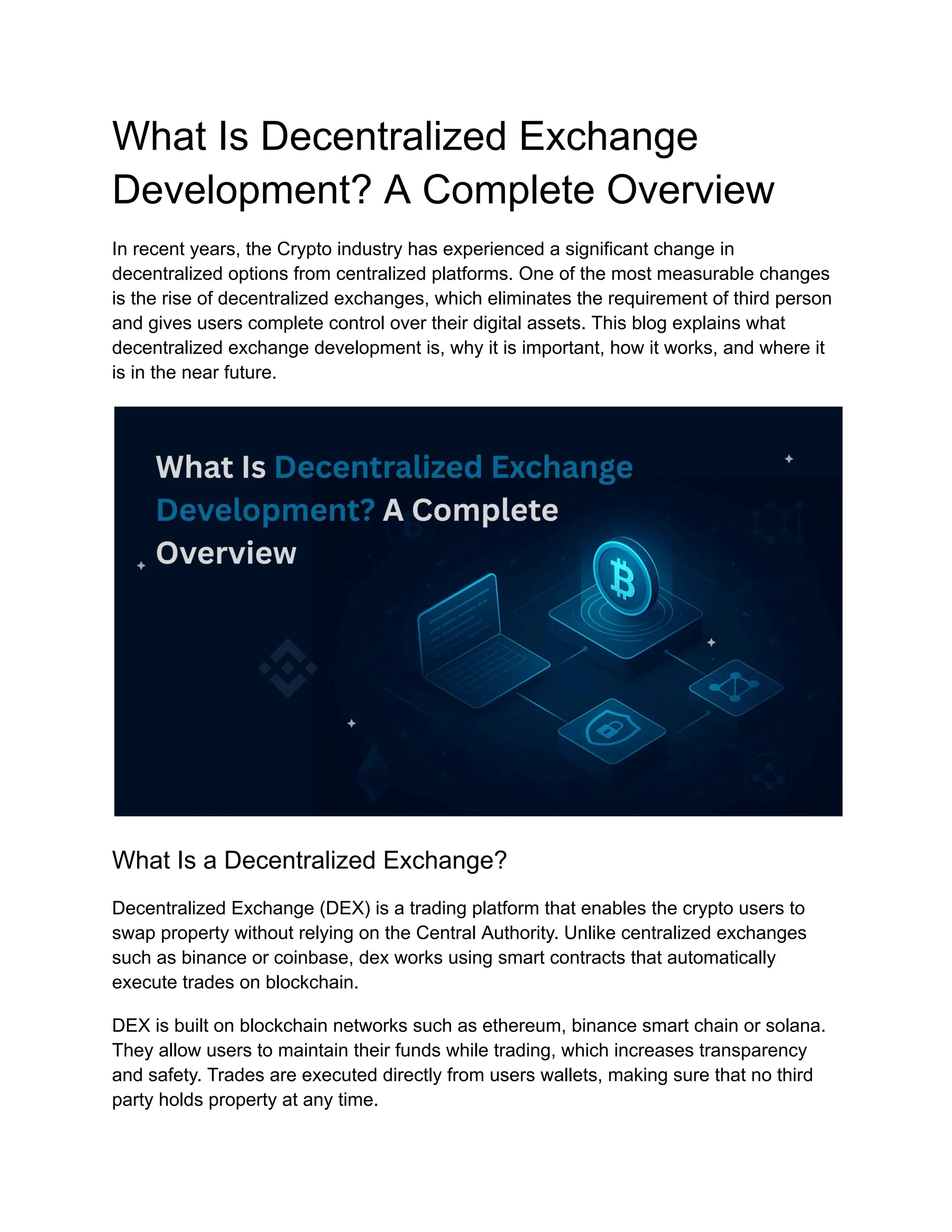
What Is Decentralized Exchange
Development? A Complete Overview
In recent years, the Crypto industry has experienced a significant change in
decentralized options from centralized platforms. One of the most measurable changes
is the rise of decentralized exchanges, which eliminates the requirement of third person
and gives users complete control over their digital assets. This blog explains what
decentralized exchange development is, why it is important, how it works, and where it
is in the near future.
What Is a Decentralized Exchange?
Decentralized Exchange (DEX) is a trading platform that enables the crypto users to
swap property without relying on the Central Authority. Unlike centralized exchanges
such as binance or coinbase, dex works using smart contracts that automatically
execute trades on blockchain.
DEX is built on blockchain networks such as ethereum, binance smart chain or solana.
They allow users to maintain their funds while trading, which increases transparency
and safety. Trades are executed directly from users wallets, making sure that no third
party holds property at any time.
Why Decentralized Exchange Development Matters?
Decentralized exchange development is important in today's web 3 atmosphere due to
data privacy, custodial risk and increasing concerns over regulatory control on
centralized platforms. DEX strengthens users with financial sovereignty, allowing them
to transact without middle points, KYC mandates, or single points of failure.
This, regardless of geographical or political boundaries, opens access to trading to the
global and global audiences. Partnership with a reliable decentralized exchange
development company can help projects to navigate these complications and build
strong, safe and user -friendly trading platforms.
Core Components of a DEX
●​ To create a functional decentralized exchange, developers must add some
fundamental components:
●​ Smart Contracts: Self Display Code that handles order, swap and liquidity
operations.
●​ Liquidity pool: User contributed pools of tokens that facilitate automatic trading.
●​ Automatic market manufacturer (AMM): A mechanism that replaces order books
with algorithms to determine token pricing.
●​ User Interface (UI): A front end application for wallet connection, token swap and
analytics.
●​ Wallet integration: usually using web 3 wallets such as Metamask or
Wallatconnect.
Types of Decentralized Exchanges
There are many types of dex, all with the case of their own design and use:
1.​ AMM-based DEX - like uniswap, Pancakeswap. Use liquidity pool and pricing
algorithms.
2.​ Order Book DEX - eg: Dydx. Center for centralized exchanges equally but
on-chains.
3.​ Peer-to-peer (P2P) - Provides direct trades between users without dex-bicholis.
Choosing the right Dex model depends on your goals - whether it is speed,
decentralization, scalability or user connectivity.
Technology Stack for DEX Development
A strong and safe technology is essential to develop a decentralized exchange. The
option of blockchain platforms is fundamental - ethereum, Binance Smart Chain (BSc),
Polygon and Solana are popular due to their support for smart contracts. Smart contract
language such as solidity, Vyper, or rust (solana) is used to create backend logic.
The Frontend is usually developed using a structure such as react.js or vue.Js to
provide a smooth user experience. The web3 enables libraries such as Web3.JS,
Ethers.JS, or integration with Walletconnect DEX and user interaction between wallets.
Security and Compliance in DEXs
Safety is an important aspect of decentralized exchange development, as weakens in
smart contracts can cause significant financial losses. Developers have to implement
rigorous testing, colleague reviews and third-party audits to identify and fix potential
issues.
Facilities such as time-lock, multi-signature wallet, and emergency withdrawal
mechanisms for administrative functions increase user money safety. Despite being
decentralized, DEX should also consider compliance with developing global rules. While
many DEX work anonymously, alternative KYC/AML integrates layers.
Challenges in Decentralized Exchange Development
Decentralized Exchange have many features, they also have unique challenges. One of
the most pressure is liquidity - without adequate liquidity, users face high slippery and
poor trading experiences.
Another challenge is the user experience. Dex often considers a degree of technical
knowledge, which can be intimidating for beginners. Scalability is also a concern,
especially on a network such as ethereum where high gas fees can stop users.
Future Trends in Decentralized Exchange Development
The Dex landscape is developing rapidly. Major trends that shape the future:
●​ Cross chain swap: enabling trades between tokens in individual blockchains
without bridges.
●​ Layer 2 Integration: Using scalability solutions such as optimism, mediation or
Zk- roll to reduce fees.
●​ Decentralized Governance: DAOS allows token holders to upgrade and vote on
policies.
●​ AI-in-operated trading tools: Helping users with intelligent order routing and
arbitrage.
●​ Integration with traditional finance: Dex may bridge the gap between the future
defi and regulated finance.
This progress will make the dex more powerful, accessible and competitive with
centralized options.
Conclusion
Decentralized exchange development is the cornerstone of the web 3 revolution. As
users demand more control, privacy and autonomy, DEX offers future proof options for
traditional trading platforms. For developers, the construction of DEX isn’t just a
technical challenge - this is contributing to the development of global finance.
If you are looking to develop your own decentralized exchange or launch innovative
trading solutions, then the BlockchainX is here to help. As a major blockchain
development company, we specialize in the manufacture of safe and scalable
decentralized exchange, crypto trading bots and other DEFI applications to suit your
needs. Whether you are a startup or an enterprise, our expert team can guide you
through every stage of your web 3 trip.

What Is Decentralized Exchange Development_ A Complete Overview.pdf

  • 1.
    What Is DecentralizedExchange Development? A Complete Overview In recent years, the Crypto industry has experienced a significant change in decentralized options from centralized platforms. One of the most measurable changes is the rise of decentralized exchanges, which eliminates the requirement of third person and gives users complete control over their digital assets. This blog explains what decentralized exchange development is, why it is important, how it works, and where it is in the near future. What Is a Decentralized Exchange? Decentralized Exchange (DEX) is a trading platform that enables the crypto users to swap property without relying on the Central Authority. Unlike centralized exchanges such as binance or coinbase, dex works using smart contracts that automatically execute trades on blockchain. DEX is built on blockchain networks such as ethereum, binance smart chain or solana. They allow users to maintain their funds while trading, which increases transparency and safety. Trades are executed directly from users wallets, making sure that no third party holds property at any time.
  • 2.
    Why Decentralized ExchangeDevelopment Matters? Decentralized exchange development is important in today's web 3 atmosphere due to data privacy, custodial risk and increasing concerns over regulatory control on centralized platforms. DEX strengthens users with financial sovereignty, allowing them to transact without middle points, KYC mandates, or single points of failure. This, regardless of geographical or political boundaries, opens access to trading to the global and global audiences. Partnership with a reliable decentralized exchange development company can help projects to navigate these complications and build strong, safe and user -friendly trading platforms. Core Components of a DEX ●​ To create a functional decentralized exchange, developers must add some fundamental components: ●​ Smart Contracts: Self Display Code that handles order, swap and liquidity operations. ●​ Liquidity pool: User contributed pools of tokens that facilitate automatic trading. ●​ Automatic market manufacturer (AMM): A mechanism that replaces order books with algorithms to determine token pricing. ●​ User Interface (UI): A front end application for wallet connection, token swap and analytics. ●​ Wallet integration: usually using web 3 wallets such as Metamask or Wallatconnect. Types of Decentralized Exchanges There are many types of dex, all with the case of their own design and use: 1.​ AMM-based DEX - like uniswap, Pancakeswap. Use liquidity pool and pricing algorithms. 2.​ Order Book DEX - eg: Dydx. Center for centralized exchanges equally but on-chains. 3.​ Peer-to-peer (P2P) - Provides direct trades between users without dex-bicholis. Choosing the right Dex model depends on your goals - whether it is speed, decentralization, scalability or user connectivity. Technology Stack for DEX Development
  • 3.
    A strong andsafe technology is essential to develop a decentralized exchange. The option of blockchain platforms is fundamental - ethereum, Binance Smart Chain (BSc), Polygon and Solana are popular due to their support for smart contracts. Smart contract language such as solidity, Vyper, or rust (solana) is used to create backend logic. The Frontend is usually developed using a structure such as react.js or vue.Js to provide a smooth user experience. The web3 enables libraries such as Web3.JS, Ethers.JS, or integration with Walletconnect DEX and user interaction between wallets. Security and Compliance in DEXs Safety is an important aspect of decentralized exchange development, as weakens in smart contracts can cause significant financial losses. Developers have to implement rigorous testing, colleague reviews and third-party audits to identify and fix potential issues. Facilities such as time-lock, multi-signature wallet, and emergency withdrawal mechanisms for administrative functions increase user money safety. Despite being decentralized, DEX should also consider compliance with developing global rules. While many DEX work anonymously, alternative KYC/AML integrates layers. Challenges in Decentralized Exchange Development Decentralized Exchange have many features, they also have unique challenges. One of the most pressure is liquidity - without adequate liquidity, users face high slippery and poor trading experiences. Another challenge is the user experience. Dex often considers a degree of technical knowledge, which can be intimidating for beginners. Scalability is also a concern, especially on a network such as ethereum where high gas fees can stop users. Future Trends in Decentralized Exchange Development The Dex landscape is developing rapidly. Major trends that shape the future: ●​ Cross chain swap: enabling trades between tokens in individual blockchains without bridges. ●​ Layer 2 Integration: Using scalability solutions such as optimism, mediation or Zk- roll to reduce fees. ●​ Decentralized Governance: DAOS allows token holders to upgrade and vote on policies.
  • 4.
    ●​ AI-in-operated tradingtools: Helping users with intelligent order routing and arbitrage. ●​ Integration with traditional finance: Dex may bridge the gap between the future defi and regulated finance. This progress will make the dex more powerful, accessible and competitive with centralized options. Conclusion Decentralized exchange development is the cornerstone of the web 3 revolution. As users demand more control, privacy and autonomy, DEX offers future proof options for traditional trading platforms. For developers, the construction of DEX isn’t just a technical challenge - this is contributing to the development of global finance. If you are looking to develop your own decentralized exchange or launch innovative trading solutions, then the BlockchainX is here to help. As a major blockchain development company, we specialize in the manufacture of safe and scalable decentralized exchange, crypto trading bots and other DEFI applications to suit your needs. Whether you are a startup or an enterprise, our expert team can guide you through every stage of your web 3 trip.