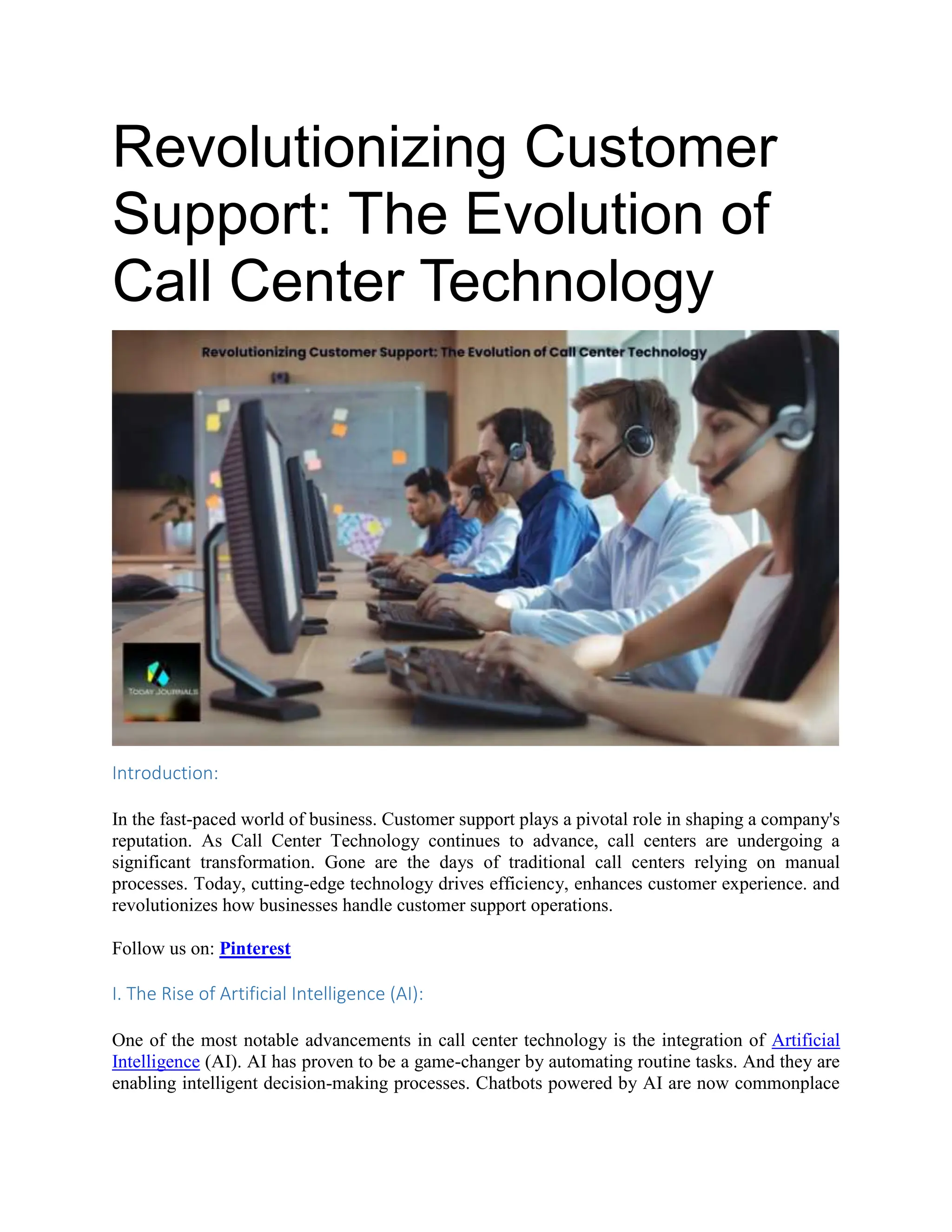
Revolutionizing Customer
Support: The Evolution of
Call Center Technology
Introduction:
In the fast-paced world of business. Customer support plays a pivotal role in shaping a company's
reputation. As Call Center Technology continues to advance, call centers are undergoing a
significant transformation. Gone are the days of traditional call centers relying on manual
processes. Today, cutting-edge technology drives efficiency, enhances customer experience. and
revolutionizes how businesses handle customer support operations.
Follow us on: Pinterest
I. The Rise of Artificial Intelligence (AI):
One of the most notable advancements in call center technology is the integration of Artificial
Intelligence (AI). AI has proven to be a game-changer by automating routine tasks. And they are
enabling intelligent decision-making processes. Chatbots powered by AI are now commonplace
in call centers. They provide instant responses to customer queries and streamline the support
process.
Natural Language Processing (NLP) allows these chatbots to understand and respond to customer
inquiries. making interactions more human-like. This improves customer satisfaction. and frees up
human agents to focus on more complex issues that need a personal touch.
II. Cloud-Based Call Centers:
Traditional call centers were often burdened by complex and expensive on-premises infrastructure.
Cloud-based call center solutions have transformed the landscape by offering scalability,
flexibility, and cost-effectiveness. With cloud technology, businesses can now set up. and manage
call centers without requiring extensive hardware investments.
Cloud-based call centers provide remote access to agents, allowing for a dispersed workforce. This
not only enhances operational efficiency but also ensures business continuity. especially in times
of unforeseen events or disasters. The scalability of cloud solutions allows businesses to adapt to
changing call volumes. providing a seamless experience for both customers and agents.
III. Omnichannel Communication:
Customers today expect seamless communication across various channels. including phone calls,
emails, chat, and social media. Call centers are embracing omnichannel communication to meet
these expectations. Omnichannel solutions integrate many communication channels into a unified
platform. enabling a consistent and cohesive customer experience.
By adopting omnichannel communication. call centers can track customer interactions across
different channels. providing agents with a comprehensive view of the customer's history. This
improves issue resolution and enhances customer satisfaction as they can choose. their preferred
communication method without compromising the quality of service.
IV. Analytics and Data-Driven Insights:
The enough data generated in call centers is a valuable business resource. Advanced analytics tools
are now employed to extract meaningful insights from this data. helping businesses make informed
decisions and improve their customer support strategy.
Analyzing customer interactions allows businesses to identify patterns, trends, and areas for
improvement. This data-driven approach enables call centers to optimize their processes.
personalize customer interactions, and address issues before they escalate. Furthermore, predictive
analytics can leveraged to forecast call volumes. allowing call centers to divide resources.
V. Remote Work and Virtual Call Centers:
Virtual call centers, where agents work from various locations, have become more prevalent. This
provides flexibility for agents. and allows businesses to tap into a diverse talent pool without
geographical constraints.
Technology plays a crucial role in facilitating remote work for call center agents. Cloud-based
solutions, collaboration tools. and secure communication channels ensure that virtual call centers
operate. While challenges such as maintaining team cohesion and ensuring data security must
addressed. the benefits of virtual call centers are undeniable.
VI. Enhanced Security Measures:
With the increasing reliance on technology. ensuring the security of customer data is paramount.
Call centers invest in robust cybersecurity measures to protect sensitive information from threats.
Compliance with data protection regulations. such as GDPR and CCPA, is a top priority for call
centers. By integrating advanced security measures. businesses safeguard customer data and build
trust with their clientele. Security-conscious call centers are better positioned to navigate the
evolving landscape of cybersecurity threats.
VII. Blockchain Integration for Security and Transparency:
As the call center industry evolves. the integration of blockchain technology is emerging as a
powerful solution for enhancing security and transparency. Blockchain, known for its
decentralized and tamper-proof nature. can employed to secure customer data and transaction
records. By decentralizing data storage. blockchain reduces the risk of data breaches and
unauthorized access.
Moreover, blockchain can used to create transparent and auditable logs of customer interactions.
This ensures the integrity of the information exchanged. and provides an immutable record that
can be invaluable for dispute resolution and compliance purposes. As the call center industry
continues to focus on data security. the adoption of blockchain technology is likely to gain traction.
VIII. Augmented Reality (AR) for Enhanced Support:
Integrating augmented reality (AR) is another frontier with immense potential for the call center
industry. AR technology can provide remote help. allowing agents to guide customers through
troubleshooting processes. This is particularly valuable in technical support scenarios. where
visual cues can improve issue resolution.
For example, in a virtual call center setting. an agent with AR tools can overlay step-by-step
instructions onto the customer's live video feed. facilitating a more efficient and accurate problem-
solving experience. As AR technology continues to mature. its application in call centers expected
to redefine how customer support delivered.
IX. Personalization through Predictive Analytics:
Predictive analytics in call centers goes beyond forecasting call volumes. it extends to
personalizing the customer experience. By analyzing historical data and customer behavior
patterns. call centers can expect the needs and preferences of individual customers. This allows
agents to address issues, recommend relevant products or services. and tailor interactions to
enhance customer satisfaction.
Personalization strengthens the customer-agent relationship and contributes to increased customer
loyalty. When integrated with customer relationship management (CRM) systems. predictive
analytics empowers call centers to create personalized. and memorable experiences that set them
apart in a competitive market.
X. Continuous Training and Development with Virtual Reality (VR):
In the dynamic world of customer support. continuous training is crucial for call center agents to
stay updated on product knowledge. communication skills, and problem-solving techniques.
Virtual reality (VR) is being harnessed to create immersive training experiences for call center
staff.
Virtual reality simulations allow agents to practice handling diverse customer scenarios in a
controlled environment. This not only accelerates the learning curve. but also enhances the
confidence and expertise of agents. VR-based training programs are scalable and customizable.
making them an effective tool for onboarding new agents and upskilling existing ones.
Conclusion:
As call center technology evolves. businesses must stay attuned to the latest innovations to remain
competitive in providing exceptional customer support. The call center landscape is undergoing a
profound transformation from integrating AI. and blockchain for enhanced security to the
application of AR and VR for personalized. and immersive experiences.
The synergy of these technologies is creating a customer support ecosystem that is efficient and
scalable. and focused on delivering a personalized and secure experience. In this digital
transformation era, call centers are not answering queries. but becoming strategic hubs for
customer engagement, brand loyalty. and valuable data-driven insights.
By embracing these technological advancements. businesses can position their call centers as not
cost centers but strategic assets. that contribute to customer satisfaction and business success. As
we look ahead, the call center industry will continue to push the boundaries of innovation. setting
new standards for customer support in the ever-evolving digital landscape.

Revolutionizing Customer Support: The Evolution of Call Center Technology

  • 1.
    Revolutionizing Customer Support: TheEvolution of Call Center Technology Introduction: In the fast-paced world of business. Customer support plays a pivotal role in shaping a company's reputation. As Call Center Technology continues to advance, call centers are undergoing a significant transformation. Gone are the days of traditional call centers relying on manual processes. Today, cutting-edge technology drives efficiency, enhances customer experience. and revolutionizes how businesses handle customer support operations. Follow us on: Pinterest I. The Rise of Artificial Intelligence (AI): One of the most notable advancements in call center technology is the integration of Artificial Intelligence (AI). AI has proven to be a game-changer by automating routine tasks. And they are enabling intelligent decision-making processes. Chatbots powered by AI are now commonplace
  • 2.
    in call centers.They provide instant responses to customer queries and streamline the support process. Natural Language Processing (NLP) allows these chatbots to understand and respond to customer inquiries. making interactions more human-like. This improves customer satisfaction. and frees up human agents to focus on more complex issues that need a personal touch. II. Cloud-Based Call Centers: Traditional call centers were often burdened by complex and expensive on-premises infrastructure. Cloud-based call center solutions have transformed the landscape by offering scalability, flexibility, and cost-effectiveness. With cloud technology, businesses can now set up. and manage call centers without requiring extensive hardware investments. Cloud-based call centers provide remote access to agents, allowing for a dispersed workforce. This not only enhances operational efficiency but also ensures business continuity. especially in times of unforeseen events or disasters. The scalability of cloud solutions allows businesses to adapt to changing call volumes. providing a seamless experience for both customers and agents. III. Omnichannel Communication: Customers today expect seamless communication across various channels. including phone calls, emails, chat, and social media. Call centers are embracing omnichannel communication to meet these expectations. Omnichannel solutions integrate many communication channels into a unified platform. enabling a consistent and cohesive customer experience. By adopting omnichannel communication. call centers can track customer interactions across different channels. providing agents with a comprehensive view of the customer's history. This improves issue resolution and enhances customer satisfaction as they can choose. their preferred communication method without compromising the quality of service. IV. Analytics and Data-Driven Insights: The enough data generated in call centers is a valuable business resource. Advanced analytics tools are now employed to extract meaningful insights from this data. helping businesses make informed decisions and improve their customer support strategy. Analyzing customer interactions allows businesses to identify patterns, trends, and areas for improvement. This data-driven approach enables call centers to optimize their processes. personalize customer interactions, and address issues before they escalate. Furthermore, predictive analytics can leveraged to forecast call volumes. allowing call centers to divide resources.
  • 3.
    V. Remote Workand Virtual Call Centers: Virtual call centers, where agents work from various locations, have become more prevalent. This provides flexibility for agents. and allows businesses to tap into a diverse talent pool without geographical constraints. Technology plays a crucial role in facilitating remote work for call center agents. Cloud-based solutions, collaboration tools. and secure communication channels ensure that virtual call centers operate. While challenges such as maintaining team cohesion and ensuring data security must addressed. the benefits of virtual call centers are undeniable. VI. Enhanced Security Measures: With the increasing reliance on technology. ensuring the security of customer data is paramount. Call centers invest in robust cybersecurity measures to protect sensitive information from threats. Compliance with data protection regulations. such as GDPR and CCPA, is a top priority for call centers. By integrating advanced security measures. businesses safeguard customer data and build trust with their clientele. Security-conscious call centers are better positioned to navigate the evolving landscape of cybersecurity threats. VII. Blockchain Integration for Security and Transparency: As the call center industry evolves. the integration of blockchain technology is emerging as a powerful solution for enhancing security and transparency. Blockchain, known for its decentralized and tamper-proof nature. can employed to secure customer data and transaction records. By decentralizing data storage. blockchain reduces the risk of data breaches and unauthorized access. Moreover, blockchain can used to create transparent and auditable logs of customer interactions. This ensures the integrity of the information exchanged. and provides an immutable record that can be invaluable for dispute resolution and compliance purposes. As the call center industry continues to focus on data security. the adoption of blockchain technology is likely to gain traction. VIII. Augmented Reality (AR) for Enhanced Support: Integrating augmented reality (AR) is another frontier with immense potential for the call center industry. AR technology can provide remote help. allowing agents to guide customers through troubleshooting processes. This is particularly valuable in technical support scenarios. where visual cues can improve issue resolution. For example, in a virtual call center setting. an agent with AR tools can overlay step-by-step instructions onto the customer's live video feed. facilitating a more efficient and accurate problem- solving experience. As AR technology continues to mature. its application in call centers expected to redefine how customer support delivered.
  • 4.
    IX. Personalization throughPredictive Analytics: Predictive analytics in call centers goes beyond forecasting call volumes. it extends to personalizing the customer experience. By analyzing historical data and customer behavior patterns. call centers can expect the needs and preferences of individual customers. This allows agents to address issues, recommend relevant products or services. and tailor interactions to enhance customer satisfaction. Personalization strengthens the customer-agent relationship and contributes to increased customer loyalty. When integrated with customer relationship management (CRM) systems. predictive analytics empowers call centers to create personalized. and memorable experiences that set them apart in a competitive market. X. Continuous Training and Development with Virtual Reality (VR): In the dynamic world of customer support. continuous training is crucial for call center agents to stay updated on product knowledge. communication skills, and problem-solving techniques. Virtual reality (VR) is being harnessed to create immersive training experiences for call center staff. Virtual reality simulations allow agents to practice handling diverse customer scenarios in a controlled environment. This not only accelerates the learning curve. but also enhances the confidence and expertise of agents. VR-based training programs are scalable and customizable. making them an effective tool for onboarding new agents and upskilling existing ones. Conclusion: As call center technology evolves. businesses must stay attuned to the latest innovations to remain competitive in providing exceptional customer support. The call center landscape is undergoing a profound transformation from integrating AI. and blockchain for enhanced security to the application of AR and VR for personalized. and immersive experiences. The synergy of these technologies is creating a customer support ecosystem that is efficient and scalable. and focused on delivering a personalized and secure experience. In this digital transformation era, call centers are not answering queries. but becoming strategic hubs for customer engagement, brand loyalty. and valuable data-driven insights. By embracing these technological advancements. businesses can position their call centers as not cost centers but strategic assets. that contribute to customer satisfaction and business success. As we look ahead, the call center industry will continue to push the boundaries of innovation. setting new standards for customer support in the ever-evolving digital landscape.