´15
ENGLISH VERSION
14
2
13
12
15
(Cross-them
a
tic Research)
Inte
rline
Thesocioeconomicdim
ensions of conflict
Group and indivi
dualinteractions
Socialand
po
litical conflict
Geographies of c
onflict:thespatial
dimension of social c
onflictandcohesion
3Diversechaptersininternational
andnational books.
Books
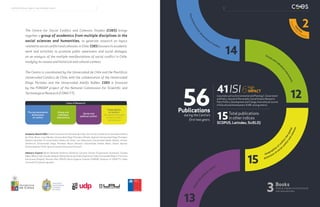
56duringthe Centre’s
firsttwoyears.
Publications
15SCOPUS, Latindex, SciELO)
Totalpublications
in otherindices
high
IMPACT41injournals suchas Environmentaland PlanningC: Government
and Policy, Journalof Personality, SocialScienceResearch,
Party Politics, Development and Change, International Journal
of EducationalDevelopment, EURE, amongothers).
ISI6
The Centre for Social Conflict and Cohesion Studies (COES) brings
together a group of academics from multiple disciplines in the
social sciences and humanities, to generate research on topics
relatedtosocialconflictandcohesion,inChile.COESfocusesitsacademic
work and activities to promote public awareness and social dialogue,
on an analysis of the multiple manifestations of social conflict in Chile,
studying its causes and historical and cultural context.
The Centre is coordinated by the Universidad de Chile and the Pontificia
Universidad Católica de Chile, with the collaboration of the Universidad
Diego Portales and the Universidad Adolfo Ibáñez. COES is financed
by the FONDAP project of the National Commission for Scientific and
Technological Research (CONICYT).
Academic Board COES: Dante Contreras (Universidad de Chile), Juan Carlos Castillo (P. Universidad Católica
de Chile), María Luisa Méndez (Universidad Diego Portales), Alfredo Joignant (Universidad Diego Portales),
Roberto González (P. Universidad Católica de Chile), Luis Valenzuela (Universidad Adolfo Ibáñez), Kirsten
Sehnbruch (Universidad Diego Portales), Mauro Basaure (Universidad Andrés Bello), Daniel Hojman
(Universidad de Chile), Ignacio Cáceres (Executive Director).
Advisory Council: Benito Baranda (América Solidaria), Carolina Carrera (Corporación Humanas), Claudia
Dides (Miles Chile), Claudio Seebach (Generadoras de Chile), Esperanza Cueto (Comunidad Mujer), Francisco
Irarrázaval (Evópoli), Marcela Ríos (PNUD), María Eugenia Camelio (FONDAP program of CONICYT), Pablo
Simonetti (Fundación Iguales).
Social and
political conflict
Geographies
of conflict:
The spatial dimension
of social conflict
and cohesion
Group and
individual
interactions
The socioeconomic
dimensions
of conflict
Lines of Research:
32CENTRE FOR SOCIAL CONFLICT AND COHESION STUDIES
The
socioeconomic
dimensions
ofconflict
Fabián Duarte
Associate Researcher
fabduarte@fen.uchile.cl
Topics: Health economics; education;
economic public policy.
Francisca Gutiérrez
Adjunct researcher
fgcrocco@gmail.com
Topics: Sociology of work; political sociology;
organizational sociology.
Paola Bordón
Postdoctoral Researcher
pbordon@fen.uchile.cl
Topics: Higher education; labor markets.
Nicolás Grau
Adjunct researcher
ngrau@fen.uchile.cl
Topics: Applied microeconomics;
economics of education; labor economics
and econometric methods.
Francisco Pino
Adjunct researcher
fjpino@fen.uchile.cl
Topics: Economic policy; economic
development; economic history.
Emilia Brito
Research Assistant
ebrito@fen.uchile.cl
Topics: Labor economics; gender inequality;
education; segregation.
Valentina Paredes
Associate Researcher
vparedes@fen.uchile.cl
Topics: Labor economics; economics of
education; microeconomic theory.
Claudia Sanhueza
Associate Researcher
claudia.sanhueza@udp.cl
Topics: Applied econometrics; labor
economics; economics of education;
household economics.
Daniel Hojman
Associate Researcher
dhojman@fen.uchile.cl
Topics: Welfare economics; poverty;
inequality; education: economic policy
and corruption.
Matías Sanfuentes
Associate Researcher
msanfuentes@unegocios.cl
Topics: Change management;
human resources; social dynamics.
Dante Contreras
Director and Principal Researcher
dcontrer@econ.uchile.cl
Topics: Economics of education; poverty;
income distribution; social policies and
evaluation of their impact.
Kirsten Sehnbruch
Associate Researcher and
Director of International Relations
kirsten.sehnbruch@udp.cl
Topics: Public policy and labor markets; policies
and development in Latin America.
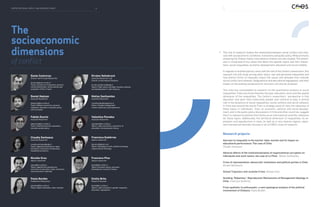
This line of research studies the relationship between social conflict and cohe-
sion with socioeconomic conditions, institutions and public policy.While primarily
analyzing the Chilean reality, international contexts are also studied. This dimen-
sion is comprised of four areas that delve into specific topics and their interac-
tions: social inequalities, economic development, education and social mobility.
In regards to multidisciplinary work with the rest of the Centre’s researchers, this
research line will study, among other topics, real and perceived inequalities and
how distinct forms of inequality impact the values and attitudes that motivate
social conflict and cohesion. Geographical and educational segregation, and their
impact on the existing socioeconomic structure, will also be analyzed.
This area has consolidated its research on the quantitative analysis of social
inequalities. There are three thematic focuses: education, work and the spatial
dimension of the inequalities. The Centre’s researchers´ perspective is that
education and work have historically played, and continue to play, a central
role in the dynamics of social inequalities, social conflicts and social cohesion
in Chile and around the world. From a strategic point of view, the relevance of
these topics in individuals´ lives, on economic, political and social develop-
ment, and in the public policy discussions in Chile and other countries, suggest
that it is relevant to position this Centre as an international scientific reference
for these topics. Additionally, the territorial dimension of inequalities, its ex-
pression and reproduction in cities, as well as in very diverse regions, repre-
sent transversal thematic focuses in all of COES’s lines of research.
Research projects
Aversion to inequality in the teacher labor market and its impact on
educational performance: The case of Chile.
Claudia Sanhueza.
Adverse effects of the institutionalization of organizational corruption on
individuals and work teams: the case of La Polar. Matías Sanfuentes.
Crisis of representation, democratic institutions and political parties in Chile.
Kirsten Sehnbruch.
School Trajectory and Juvenile Crime. Nicolás Grau.
Avoiding “Rabanitos”. Reproduction Mechanisms of Management Ideology in
Chile. Francisca Gutiérrez.
From apathetic to enthusiastic: a new typological analysis of the political
involvement of Chileans. Paola Bordón.
54CENTRE FOR SOCIAL CONFLICT AND COHESION STUDIES
Juan Carlos Castillo
Deputy Director and Principal researcher
jcastillov@uc.cl
Topics: Social inequality; social justice;
public opinion and civic education.
Emmanuelle Barozet
Associate Researcher
ebarozet@uchile.cl
Topics: Social stratification, social inequality
and the middle class in Chile and Latin America.
Pablo de Tezanos
Associate Researcher
pablodtp@gmail.com
Topics: Prejudice; orientation and gender;
intragroup norms.
Matías Bargsted
Associate Researcher
mbargsted@uc.cl
Topics: Public opinion; political attitudes
and preferences; political identification and
comparative sociology.
Dariela Sharim
Associate Researcher
dsharim@uc.cl
Topics: Gender roles; couple connections; love and
intimacy in Chile; domestic conflicts.
Ana Figueiredo
Postdoctoral Researcher
figueiredo.anacm@gmail.com
Topics: Historic social representations; intergroup
relationships and cultural diversity.
Héctor Carvacho
Adjunct Researcher
hscarvac@uc.cl
Topics: Ideology; intergroup conflict; social
hierarchies; historical memory
Benjamín V. Muñoz
Research Assistant
ajmunoz@uc.cl
Topics: Redistribution; territorial inequality
and its political effects; statehood; quantitative
methodology
Jorge Atria
Postdoctoral Researcher
jorgeatria@gmail.com
Topics: Social inequality; taxes and
redistribution; elites.
Mónica Gerber
Adjunct Researcher
mgerber@uc.cl
Topics: Social and political psychology; political
ideologies; attitudes toward social justice.
Paula Luengo
Postdoctoral Researcher
paula.luengo@uniroma1.it
Topics: Pro-social behavior;
civic participation.
Gloria Jiménez-Moya
Postdoctoral Researcher
gloriajm@ugr.es
Topics: Group identity; collective action; prejudice;
legitimization of social inequality.
Patricio Cumsille
Associate Researcher
pcumsill@uc.cl
Topics: Parent-adolescent relationships;
adolescent development; risk and health
behaviors in adolescents; pro-social and
civic behaviors in youths.
Roberto González
Principal Researcher. Panel Study Coordinator
rgonzale@uc.cl
Topics: Intergroup relationships; prejudice; intergroup
emotions; acculturation process; social movements and
reparation behaviors associated with political and ethnic
conflicts.
GroupandIndividualInteractions
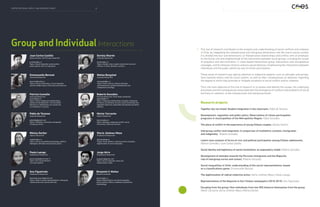
This line of research contributes to the analysis and understanding of social conflicts and cohesion
in Chile, by integrating the interpersonal and intergroup dimensions into the macro-social context.
It is divided into four sub-dimensions: a) interpersonal relationships and conflict, with an emphasis
on the family unit and neighborhood; b) the interactions between social groups, including the issues
of prejudice and discrimination; c) class-based hierarchical group interactions and sociopolitical
cleavages, and d) cohesive citizenry and pro-social behavior, emphasizing the interactions between
individuals and the public sphere by way of citizen participation.
These areas of research pay special attention to subjective aspects, such as attitudes and percep-
tions towards others and the social system, as well as their consequences on behavior, regarding
the degree to which they promote or mitigate situations of social conflict and/or cohesion.
Thus, the main objective of this line of research is: to assess and identify the causes, the underlying
processes and the consequences associated with the emergence of conflicts and problems of social
harmony or cohesion, at the interpersonal and intergroup levels.
Research projects
Together but not mixed: Student integration in the classroom. Pablo de Tezanos.
Development, regulation and public policy. Observations of citizen participation
programs in municipalities of the Metropolitan Region. Pablo González.
The place of conflict in the experience of young Chilean couples. Dariela Sharim.
Intergroup conflict and integration: A comparison of multiethnic contexts, immigration
and indigeneity. Roberto González.
Latent class analysis of forms of civic and political participation among Chilean adolescents.
Patricio Cumsille y Juan Carlos Castillo.
Social identity and legitimacy of social movements: an explanatory model. Roberto González.
Development of attitudes towards the Peruvian immigrants and the Mapuche:
role of intergroup norms and contact. Roberto González.
Social inequalities in Chile: understanding of the social representations, based
on a classifications game. Emmanuelle Barozet.
The legitimization of radical collective action. Gloria Jiménez-Moya y Paula Luengo.
Representations of the Mapuche in four Chilean newspapers (2010-2015). Ana Figueiredo.
Escaping from the group: How individuals from low SES distance themselves from the group.
Héctor Carvacho, Gloria Jiménez-Moya y Mónica Gerber.
76CENTRE FOR SOCIAL CONFLICT AND COHESION STUDIES
This line of research examines the important signs of so-
cial and political conflict, which have manifested themsel-
ves in Chile during recent years, particularly since 2011,
when the incidence of social mobilizations increased sig-
nificantly. An increase in the frequency of aggressive in-
cidents (violence during the demonstrations and outright
anarchist attacks), has contributed to a sensation of insta-
bility and insecurity that Chile has not experienced since
its transition to democracy. All of this has occurred in the
context of a growing electoral and political disaffection,
combined with a loss of trust in all public institutions. A
change in electoral policies from a mandatory vote to a vo-
luntary vote, along with a new system that automatically
registers eligible voters, has only served to highlight the
extent of the problem.
Notably, the social mobilizations, since 2011, have also
articulated demands to change the constitution, which
illustrates the degree to which Chilean institutions have
lost legitimacy. Additionally, a wave of financial scandals
associated with banks and the retail sector have placed
in evidence the abuses and deficiencies of market regu-
lation, which contributes to an overall sense of a lack of
trust, expressed through preferences for state institutions
in opinion polls. Finally, the controversy about the Consti-
tution and the presidential promise of substitution with a
new fundamental charter, reveals the corollary of fights
and conflicts that is not always easy to unify with a com-
mon thread. These types of conflicts justify the incorpora-
tion of a historic approximation, with the goal of detecting
the continuities and changes, and in this way break with
the spontaneous surprise in response to phenomena that
are not necessarily without precedent.
This line of research proposes to examine questions that
arise from these circumstances, from four dimensions:
disaffection and the legitimacy of democracy; the conflict
with judicial and constitutional norms; conflicts and social
movements; and the socio-cultural and political history of
conflict in Chile.
Research projects
Community social capital in Chile. Presence and
evolution of social organizations at the community
level, 2002-2012. Patricio Navia.
Morphologies of the Chilean discontent 2011-2012.
An interdisciplinary approach. Claudio Rolle.
Authoritarian and democratic values in Chile,
1972-2014. Patricio Navia.
The student movement in Chile. Sofía Donoso.
The slow death of Allende, Frei and Neruda and
conflict about memory. Alfredo Joignant y
Mauro Basaure.
Who are the “encapuchados” Participation in
low-intensity political violence in Chile between
2011 and 2013. Ana Velitchkova.
Leaving fear behind: Generational differences in
the tolerance and support for protest in Chile
democrático. Patricio Navia.
Tomás Campos
Research Assistant
tcamposcastro@gmail.com
Topics: Welfare state; education policy; subnational
policy; local legitimacy and conflict.
Claudio Rolle
Associate Researcher
claudiorolle@yahoo.com
Topics: Social movements in Chilean history.
Mauro Basaure
Associate Researcher and
Head of the Theoretical Agenda
mauro.basaure@gmail.com
Topics: Cultural transformations; social move-
ments; protests; youth; political and religious
ideologies.
Alfredo Joignant
Principal Researcher
alfredo.joignant@mail.udp.cl
Topics: Political elites and legitimacy; charisma
and cohesion; capital and resources in political
competition; politics of memory.
Claudia Heiss
Associate Researcher
cheiss@iap.uchile.cl
Topics: Political theory; state of exception;
constitutionalism.
Patricio Navia
Associate Researcher
patricio.navia@nyu.edu
Topics: Demonstrations and public conflicts;
electoral participation; political parties.
Javier Couso
Associate Researcher
javier.couso@udp.cl
Topics: Constitutional conflicts.
Nicolás Somma
Associate Researcher
nsomma@uc.cl
+562 2 354 20 00
Topics: Social movements; protests; political
sociology; comparative sociology.
Ismael Puga 	
Adjunct Researcher
ismael.puga@mail.udp.cl
Topics: Legitimation of social inequality,
analytical sociology and critical theory.
Sofía Donoso
Postdoctoral
sofia.donoso@mail.udp.cl
Topics: Social movements; unionism; state and
civil society relations.
Ana Velitchkova
Postdoctoral
anavelitchkova@gmail.com
Topics: Political violence; encapuchados;
globalization; civil society; cultural inequality.
Daniela Jara
Postdoctoral Researcher
danielapazj@gmail.com
Topics: Cultural memory; generations; cul-
tural studies; transitional justice; qualitative
methodologies.
Socialand
PoliticalConflict
98CENTRE FOR SOCIAL CONFLICT AND COHESION STUDIES
The main objective of this line of research is to examine the debates on social
justice and urban and regional spaces. From a theoretical point of view, this line
of research proposes to broaden the traditional understanding of space based
fundamentally on territoriality, to one that also considers reflections on posi-
tions in the social structure, belonging, as well as research on other non-terri-
torial forms of community and group formation.
Specifically, the theoretical, empirical and public policy aspects will be examined
in four main areas: the impact of inequality and multidimensional segregation
on social justice in urban territories; territorial inequalities and social conflicts;
social capital, conflict and support networks; the tensions between local and
public authorities, the market and civil society. In this sense, important elements
of this line of research include: urban and socio-environmental conflict, urban
segregation, gentrification, territorial belonging, urban heritage, sociability and
intercultural life in neighborhoods, housing policies, protests and demonstra-
tions, regional/territorial identities, immigration and decentralization policies.
Research projects
Territorial dynamics in the agro-mining valleys of Chile: The case of
Salamanca. Patricio Aroca.
Mining and Socio-environmental conflicts in the Great North.
Hugo Romero.
The defense of place: Capabilities and limits of the inhabitants of
Valparaiso and Barrio Puerto. Felipe Link.
Action orientations and contents of the fight against the “territorial
disqualification” in middle and low-income areas of greater Santiago.
María Luisa Méndez.
Additionally, this line is noteworthy for actively engaging in multidisciplinary
work, with a contribution of 10 interline (cross-thematic) projects.
María Luisa Méndez
Principal Researcher
marialuisa.mendez@udp.cl
Topics: Subjective aspects of mobility and
social stratification; construction of belonging
in urban neighborhoods; urban conflicts.
Claudio Agostini
Associate Researcher
claudio.agostini@uai.cl
Topics: Tax policy; tax evasion and avoidance;
estimates of inequality and poverty, disaggre-
gated geographically.
Felipe Link
Associate Researcher
felipe.link@uc.cl
Topics: Sociability networks and urban space;
neighborhood consolidation; urban vulnerability;
housing and urban policies.
Luis Valenzuela
Associate Researcher
luis.valenzuela@uai.cl
Topics: Territorial intelligence; urban planning
and design; urban segregation; territorial
wellbeing; urban production and development;
natural risks and disasters.
Patricio Aroca
Associate Researcher
patricio.aroca@uai.cl
Topics: Growth and regional inequality;
evaluation and design of regional policy;
economics and natural resources policy.
Vicente Espinoza
Associate Researcher
vicente.espinoza@usach.cl
Topics: Social inequality; occupational mobility;
social networks.
Irene Ramos
Postdoctoral Researcher
ireneargil@gmail.com
Topics: Anthropology of the marriage covenant
and policy; sociology of violence; political
ethnography.
Pía Palacios
Assistant for the Center of Territorial Intelligence
(CIT)	
pia.palacios@uai.cl
Topics: Residential segregation.
Hugo Romero
Adjunct Researcher
hugo.romero@uct.cl
Topics: Environmental and territorial
transformations in Chile; mining;
indigenous communities.
Matías Garretón
Adjunct Researcher
matias.garreton@uai.cl
Topics: Territorial inequalities; discontent
and social conflicts; processes of institutional
evolution.
Gabriel Otero
Research Assistant
gabrieloteroc@gmail.com
Topics: Neighborhood effects; social capital;
sociology of science.
Ernesto López
Associate Researcher
elopez@uchilefau.cl
Topics: Socioeconomic conflicts of urban land;
central metropolitan spaces; gentrification.
Cristián Doña
Adjunct Researcher
cristian.dona@gmail.com
Topics: International migration; migratory
decisions; state-migrant relations.
Nicolás Angelcos
Postdoctoral Researcher
nicolas.angelcos@mail.udp.cl
Topics: Poverty; urban conflicts; collective
action; subjectivation policy.
Geographiesofconflict:
Thespatialdimension
ofsocialconflictandcohesion
1110CENTRE FOR SOCIAL CONFLICT AND COHESION STUDIES
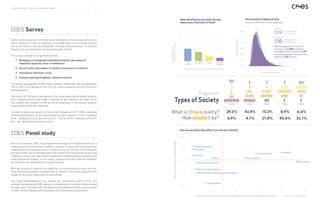
COES Survey
COES’s national survey is the first study that seeks to map social conflicts and
social cohesion in Chile. Its objective is to understand, from multiple discipli-
nes of the Social Sciences, the beliefs, attitudes and perceptions of Chileans
towards various dimensions of coexistence and conflict.
The survey considers four general sections:
1.	 Belonging and integration (distributive beliefs, perception of
inequality, equal pay, trust in institutions).
2.	 Social Conflict (perception of conflicts, evaluation of conflicts).
3.	 Interactions (networks, trust).
4.	 Common good (participation, collective actions).
The survey was applied to 2025 cases, between September 4th and November
30th of 2015, and represents 78.1% of the urban population and 68% of Chile’s
total population.
The Center of Territorial Intelligence of the Universidad Adolfo Ibáñez elabora-
ted a sampling frame that made it possible to geo-reference the data, which
has enabled the inclusion of the territorial dimension in the various analyses
conducted by COES with said data.
In order to share the results of the survey, throughout 2015, COES organized
diverse presentations of the data divided into the modules: “crisis in political
trust”; “Inequality, justice and distribution”; “Social conflict, inequality and terri-
tory” and “Networks and social circles”.
COES Panel study
Since its inception, COES has proposed the design and implementation of a
national panel study that will enable an analysis, across time, of the principal
moderating and mediating factors, context as well as the primary consequen-
ces associated with the development of the distinct forms of social conflict and
cohesion in Chile. The international experience reveals that the countries that
have longitudinal studies, of this nature, produce first-rate scientific knowled-
ge and guide the development of public policies.
With the purpose of meeting this objective, an interdisciplinary team was for-
med, representing COES’s multiple lines of research, which has worked on the
design of the study, questionnaire and sample.
This study, unprecedented in our country, will commence in April of 2016, and
consider approximately 3,000 cases at a national level, all of whom will be tracked
for eight years.This study will contribute to the development of the social sciences
in Chile and will help promote the growth of its international connections.
Diagram of
Types of Society
Source: COES 2014 survery
What is Chile’s reality?
How should it be?
29,2%
0,9%
42,9%
4,1%
15,3%
21,8%
8,9%
40,6%
6,6%
32,1%
TYPE A TYPE B TYPE C TYPE D TYPE E
100
80
60
40
20
0 105 15
Theydirectlyaffectme(percentage)
Perception of the main conflicts at a national level (Percentage, first mention)
20 25
How do you think they affect you and your family?
Transportation
Delinquency
Economy
Inequalities
Justice
Health
Work
EducationSocial movements
Alcoholism and drug consumption
Political legitimacy
Indigenous
How satisfied are you with the way
democracy functions in Chile?
3
2.5
2
1.5
1
very
satisfied
Trust Scale: 1- none, 3- not a little nor a lot.
somewhat Little not at all
satisfied
Proportionofcases
Averagetrustin
PoliticalInstitutions
0.006
0.005
0.004
0.003
0.002
0.001
0.000
0 200 400
Number of contacts
600 800
Distribution of Network Size
(based on contact with 24 social groups)
130
139 average number
of individuals
average number
of individuals
Scale up
Bayesian
High heterogeneity in the size of
networks; while 50% of Chileans
have 117 or fewer contacts, the 5%
reporting the largest networks, have
upwards of 323 contacts.
12CENTRE FOR SOCIAL CONFLICT AND COHESION STUDIES
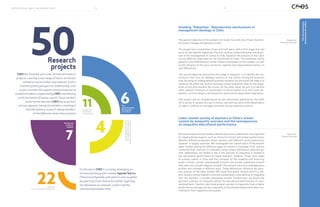
COES has financed, up to now, 50 internal research
projects, covering a vast range of topics of interest
related to social conflict and cohesion, from a
multidisciplinary perspective. Additionally, each
project includes the support and participation of
students funded or supported by COES, contributing
to the formation of human capital. These numbers
reinforce the idea that COES has acquired a
virtuous dynamic among its members, resulting in
multidisciplinary research among members
of the different universities involved.
The
socioeconomic
dimensions
of conflict
Social and
political
conflict
Group and
individual
interactions
Geographiesofconflict:
thespatialdimensionof
socialconflictandcohesion
Interline
(Cross-thematic Research)
Research
projects
6
7
50
11
4
22
Thesocioeconomic
dimensionsofconflict
Avoiding “Rabanitos”. Reproduction mechanisms of
management ideology in Chile.
The general objective of this project is to study how and why Chilean busines-
ses avoid, manage and penalize unions.
The project has a timeframe of two and half years, with a first stage that will
focus on two specific objectives. The first consists of describing the overall pic-
ture of the management of unions in Chile, based on the analysis of the Labor
Survey (ENCLA) undertaken by the Directorate of Labor. The emphasis will be
placed on the differentiation of the Chilean businesses on this subject, as well
as the influence of the socio-economic, regional and organizational factors on
said differences.
The second objective, during this first stage of research, is to identify the me-
chanisms that form an ideology contrary to the unions among the business
elite, focusing on undergraduate business students. On one hand, the hope is to
measure the effect the distinct business school programs have on the dispo-
sition of this elite towards the unions. On the other hand, the aim is to identify
other relevant instances of socialization on the formation of an anti-union dis-
position, such as religion, socioeconomic level and the association experience.
This project will be complemented by the information gathered by the COES
2014 survey in relation to trust in unions, and with the work of the Observatory
of Labour Conflicts on managerial actions during collective conflicts.
Labor market sorting of teachers in Chile’s school
system by inequality aversion and the consequences
on inequality educational performance
Numerous experimental studies indicate that social preferences are important
for organizational aspects, such as choice of contract and worker performance.
Whether different employers attract workers with different social preferences,
however, is largely unknown. We investigated the classification of the teacher
labor market among the different types of schools in Santiago, Chile, and we
measured their aversion to inequality using simple distributive selection ga-
mes. Additionally, we tested to see if the aversion to inequality is related to
the educational performance of these teachers’ students. Three main types
of schools coexist in Chile and they compete for the students and financing:
public schools, private unsubsidized schools and private subsidized schools
(the latter two include religious schools). The schools have very heterogeneous
profiles and compete in different ways. These differences influence the selec-
tion process of the labor market. We found that public schools and Fe y Ale-
gría (Jesuits) attract teachers who are substantially more adverse to inequality
than the teachers in private subsidized schools. Furthermore, we found that
teachers’ aversion to inequality affects the educational performance on stan-
dardized tests. Teachers who have greater aversion to inequality have a higher
performance average and less inequality on the standardized exams after con-
trolling for their happiness and quality.
Researcher
Francisca Gutiérrez
Researcher
Claudia Sanhueza
Furthermore, COES is currently developing an
interdisciplinary project named, Agenda Teórica
(Theoretical Agenda), with which it aims to gather
perspectives from diverse disciplines regarding
the definitions of cohesion, conflict and the
relationship between them.
1514CENTRE FOR SOCIAL CONFLICT AND COHESION STUDIES
Socialand
political
conflict
Groupand
individual
interactions
With or without you?
Party-movement relations and the political impact
of the student movement in Chile.
Scholarship on social movements increasingly acknowledges the blurry
boundaries between movement politics and institutional politics. Social mo-
vements in Latin America have redefined the region’s political course by pu-
tting their demands on the political agenda, building socio-political alliances,
and creating new political parties. In the case of Chile, the Student Movement
has spearheaded massive protests and expanded its initial petition centered
on sectoral demands to pending democratizing reforms. This project seeks to
trace the shifts in the political agenda and partisan alignment prompted by the
protest wave led by the students.
Specifically, it examines how the Student Movement has (i) polarized the po-
litical parties on the centre-left, (ii) introduced and informed an agenda on
education and political reforms, and (iii) instigated the creation of new politi-
cal parties. These dimensions are examined based on interviews with party
members and student leaders, an exhaustive revision of political party and
organization documents, and an analysis of the historical partisan positions
in a set of education and political reforms. This material is analyzed using
process-tracing to generate a theoretically informed historical explanation of
the case under scrutiny.
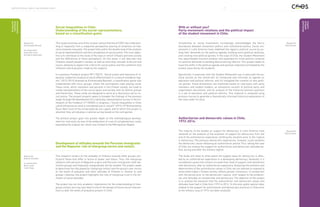
Social inequalities in Chile:
Understanding of the social representations,
based on a classification game.
This study examines one of the nuclear central themes of COES: the understan-
ding of inequality from a subjective perspective, placing an emphasis on tole-
rance towards inequality. The project falls within the double area of the analysis
of social representations and the conceptions of social justice. The main objec-
tive is to contribute to the study of the ways in which Chileans perceive society
and the differences of these perceptions. On this basis, it will describe how
Chileans classify people in society, as well as what they consider to be just and
unjust, allowing to explain the criteria for social justice and the conditions that
influence said evaluation made by the subjects.
In a previous Fondecyt project (Nº1130276, “Social justice and tolerance of in-
equality: subjective analysis of social differentiation in a mature neoliberal regi-
me,” (2013-2015) directed by Emmanuelle Barozet), a classification game was
implemented with focus groups, where the participants used playing cards.
These cards, which represent real persons in the Chilean society, are used to
create representations of the social space and society, with its distinct groups
and hierarchies. These cards are designed to serve as a discussion aid on so-
cial justice. The present projects seeks to broaden the findings of the previous
stage, through the development of a nationally representative survey. In the fra-
mework of the Fondecyt nº1150505, in progress, (“Social inequalities in Chile:
¿what influences on what is considered just or unjust?” (2915-2918) directed by
Oscar Mac-Clure of the Universidad de Los Lagos), and to which this project is
attached, they will develop a national survey based on the card games.
The present project goes into greater depth on the methodological develop-
ment for said work, by way of the elaboration of a set of complementary cards,
expanding the original set, which was limited to the Metropolitan Region.
Authoritarian and democratic values in Chile,
1972-2014.
The majority of the studies on support for democracy in Latin America have
centered on the analysis of the evolution of support for democracy from the
end of the authoritarian experience, omitting the situation prior to the rupture
in democracy. The previous democratic experiences, however, could condition
the democratic values following an authoritarian period. Thus, taking the case
of Chile, we analyze the support for authoritarian and democratic attitudes be-
fore, during and after the military regime.
The study will show to what extent the support base for democracy is affec-
ted by an authoritarian experience in a developing democracy. Generally, it is
considered a given that citizens increase their level of support and satisfaction
with democracy, after an authoritarian experience. Analyzing the evolution and
determinants of the authoritarian values in Chile, we can attempt to respond to
what extent today’s Chilean society reflects greater consensus, in comparison
with the period prior to the democratic rupture, with respect to the preferen-
ces and attitudes on dictatorship and democracy. The objective of the project
is to analyze the evolution that the authoritarian and democratic values and
attitudes have had in Chile from 1972 to 2014. To this end, public opinion data,
related to the support for authoritarian and democratic practices in Chile prior
to the military coup of 1973, has been analyzed.
Development of attitudes towards the Peruvian immigrants
and the Mapuche: role of intergroup norms and contact.
This research centers on the attitudes of Chileans towards other groups, par-
ticularly those that differ in terms of power and status. Thus, the intergroup
relations with persons of Mapuche origins and Peruvian immigrants, both dis-
tinctive groups and frequently marginalized, will be studied. The project seeks
to determine the role played by intergroup contact and the group’s own norms
on the levels of prejudice and other attitudes of Chileans in relation to said
groups. Likewise, the project highlights the role of intergroup trust in the for-
mation of social attitudes.
The project has not only academic implications for the understanding of inter-
group contact, but may also help to inform the design of future social interven-
tions to alter the levels of prejudice present in Chile.
Researcher
Sofía Donoso
Researcher
Emmanuelle Barozet
Co-researchers:
Oscar Mac-Clure
Ana María Valenzuela
Researcher
Patricio Navia
Researcher
Roberto González
Co-researchers:
Brian Lickel
Linda Tropp
1716CENTRE FOR SOCIAL CONFLICT AND COHESION STUDIES
Geographiesofconflict:
thespatialdimensionof
socialconflictandcohesion
Interline
(Cross-thematic
Research)
Mining and Socio-environmental conflicts in the Great
North: the case of Alto Loa.
This research investigates the social and environmental transformations of
the Alto Loa, territory currently inhabited by the original Atacama population
and where significant copper mining is developed. As with other indigenous
communities, the Atacameños are developing a process of identity articulation,
which has brought with it a territorial claim for a space highly degraded by the
mining industry, where water is a critical element.
This project’s objective is to analyze the social and territorial transformations
in the Alto Loa, associated with the mining industry and the rearticulation of the
Atacameño identity.
In regards to the methodology, secondary information from CASEN has been used
in order to characterize the population of the Antofagasta region and municipa-
lities, with particular emphasis on the indigenous population (Atacama, Aymara
and Quechua). The gathering of primary information has been done through in-
terviews and observations in the Atacama communities of Chiu Chiu and Lasna.
Lastly, SIG is used, and in the near future remote sensors, to study the social
and environmental changes of the study’s zone.
On the relevance of the neighborhood scale for the study
of social conflict and cohesion: the definition of the
neighborhood and its effects on the interdisciplinary,
theoretical and methodological agendas.
The investigation addresses the problem of the neighborhood scale on multi-
ple dimensions, at the level of its operational definitions (administrative, func-
tional, for homogenous areas, etc.), as well as from conceptual definitions and
their meanings, in order to highlight their importance as a variable in the com-
prehension, description and/or explanation of the social conflict and cohesion
within our cities.
Specifically, the project (i) has reviewed the debate on the definitions of the
neighborhood scale and its methodological implications; (ii) has created a
multidisciplinary report on the state of the art of the mechanisms assigned
to the “neighborhood effects” and its methodological implications; and (iii) has
implemented multiple empirical tests at the local and national level.
The empirical tests at a local level have been implemented in the municipality
of Santiago Centro, made possible by collaborative work with the Illustrious
Municipality of Santiago (IMS). The specific studies have addressed multiple
problems: local participatory territorial management; location of the street
in the San Borja neighborhood; conviviality and diversity in the University
neighborhood; sociability networks in the neighborhoods Santa Isabel and
Matta-Viel; social integration and use of public spaces in the neighborhoods
Yungay and Panamá; use of calm zones in the neighborhoods Lastarria and
París-Londres.
The empirical tests at a national level have focused on studying the effects of
the neighborhood on academic results for children in elementary education,
including some of the theoretical mechanisms taken from the reviewed litera-
ture. In brief, the studies report on the negative impact of the crime rate and
socioeconomic polarization in Chilean municipalities, on student’s performan-
ce on Simce, but also the positive effects associated with local participation.
Action orientations and contents of the fight against
the “territorial disqualification” in middle and
low-income areas of greater Santiago.
This project studies, from a critical analysis of urban modernization in Chile,
two conflicts associated with the displacement processes related to gentrifica-
tion in Santiago. The first, comprised of middle-class individuals, considers the
defense and promotion of patrimony with the demand for “Declaration of Tradi-
tional Zone” directed by the Ministry of National Assets. The second, comprised
of poor individuals, considers the promotion of “territorial permanence” as the
slogan associated with the demand for housing, directed towards the State.
In both cases, the adversary identified is the real estate business that, as an
accumulation strategy, displaces middle-income and poor sectors to construct
large tall buildings, all within a context of deregulation of the price of land.
The thesis defended by the authors of this investigation, is that, while affected
persons orient their actions according to the geographical structure of opportu-
nities (they fear the disqualification associated with displacement), the subject
of the demand is not the rational individual that neoclassic economy policy as-
sumes, but rather the community of neighbors built around the bonds of solida-
rity and cooperation. In this sense, the collective action, in both cases, questions
the individualistic and competitive principles that orient the neoliberal urbani-
zation, giving way to relative demands for the Right to the city.
Researcher
Hugo Romero
Researchers
María Luisa Méndez
Dante Contreras
Pablo De Tezanos
Felipe Link
Gabriel Otero
and the Center of Territorial
Intelligence of UAI (CIT)
Researchers
María Luisa Méndez
Nicolás Angelcos
1918CENTRE FOR SOCIAL CONFLICT AND COHESION STUDIES
Bonds of cohesion: how social networks connect
diversity and contribute to social cohesion.
The proposal centers on the analysis of the patterns of social interaction of the
Chilean population, from the perspective of bonds and social networks. Thus,
primary and secondary networks will be analyzed, starting from the basis that
the closest contacts form a nucleus of strong bonds, which are effective me-
chanisms of distribution, homogenization, company and emotional support. On
the other hand, extended (or weak) bonds are effective to connect distant social
circles, access information and amass scarce resources.
The main emphasis of the study is centered on the description and explanatory
analysis of the size of close and extended networks of Chileans. The central
hypothesis is that larger networks are associated with higher levels of inter-
personal trust and greater social control in their environment. In this way, the
size of the networks is fundamental for understanding the levels of cohesion
in Chile. The project also intends to delve into other aspects of social networks,
particularly in their makeup and diversity, determining the levels of homophily
in the bonds that Chileans establish with their close and extended contacts.
The study seeks to enrich the understanding of social cohesion in Chile. Co-
hesion involves the recognition of the members of a society, the reduction of
differences and the operation of principles of justice in people’s destinies (Za-
valeta et al 2014). The project is based on the notion, elaborated by Granovetter
(1985), that the social bonds of individuals are a central component for the
understanding of social cohesion, as personal relationships and the networks
formed as a result are those that generate trust and discourage bad faith.
Diffusion of the mobilization: individual and aggregate
factors in the occupations of schools in 2011.
In 2011, the occupations of schools and universities, in the context of massi-
ve social protests, paralyzed the normal functioning of the education system,
over a period of months. This project seeks to describe and explain the dyna-
mic of the occupations of the secondary schools.
Using a database created especially for this study, a statistical analysis will be
done at the level of schools and individuals with respect to the mechanisms
behind the occupations and their dismantling. This latter phenomenon, the
demobilization, has been little studied, relative to the participation in social
movements.
The database generated for this study exhaustively covers the occupied
schools and their students, including measurements of the relationships be-
tween the schools, spatial as well as social, in order to quantify the circulation
of information between them. This database will serve to develop other stu-
dies in the medium-term.
In this way, the present project seeks to make a theoretical and methodologi-
cal contribution towards the analysis of social conflict in Chile, particularly in
the study of social movements.
Quantitative radiograph of the union strikes in
contemporary Chile (2911-2014)
The present project, on the basis of which the Observatory of Labour Conflicts
(OHL) was created, has as its main goal to produce a radiograph of the labor
disputes in contemporary Chile. Thus, they created a database of strikes for
the years 2011-2015, according to diverse national and regional media outlets.
This database continues and enriches the valuable database generated over
the years 1979-2010, by the professor Alberto Armstrong, of the Pontificia Uni-
versidad Católica de Chile.
In the sociology of work and the discussion on contemporary unionism, diverse
authors have postulated the emergence of a new cycle in the worker move-
ment’s fight, following the explosive situation generated by the subcontracted
unionism of the primary-export sectors (years 2006-2007) and their particular
use of the illegal strike (Armstrong and Águila, 2006; Aravena and Núñez, 2009;
Echeverría, 2010; Aguiar, 2011; Pérez, 2014). This database allows us to inves-
tigate if we are in the presence, or not, of new forms of unionism: broader, in
terms of the workers involved, with a gradual replacement of the legal strike
over an illegal one, and with growing participation from economic sectors not
traditionally associated with union organizing.
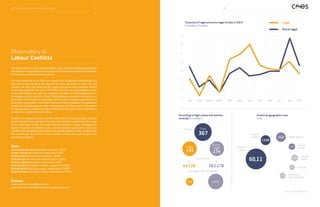
The current investigation reveals, for example, that the illegal strike has been
accentuating its predominance in terms of workers involved, in comparison to
legal ones; that the frequency of strikes occurring outside of the Metropolitan
Region has increased; and that the presence of tertiary economic sectors (new
in terms of union organizing) continues to increase.
Researchers
Matías Bargsted
Vicente Espinoza
Researchers
Daniel Hojman
Sofía Donoso
Nicolás Grau
Researchers
Emmanuelle Barozet
Sofía Donoso
Francisca Gutiérrez
Rodrigo Medel
Domingo Pérez
Kirsten Sehnbruch
Nicolás Somma
Diego Velásquez
Interline
(Cross-thematic
Research)
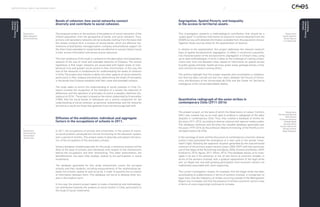
Segregation, Spatial Poverty and Inequality
in the access to territorial assets .
This investigation presents a methodological contribution that should be a
“public good”. It combines information on economic revenue obtained from the
CASEN survey, with detailed information available from the population census.
Together, these sources allow for the spatialization of revenue.
In relation to the spatialization, this project addresses the relevant research
topic of spatial socioeconomic segregation. In effect, it constructs a quantita-
tive characterization of the socioeconomic segregation in Chilean cities, using
up-to-date methodologies. In brief, it takes on the challenge of making compa-
risons over time and between cities, based on information on spatial access
to public goods and bads: health services, green areas, garbage dumps, crime,
and commercial centers among others.
The authors highlight that this project expands and consolidates a collabora-
tion that has been carried out over four years, between the Faculty of Econo-
mics and Business of the Universidad de Chile and the Center for Territorial
Intelligence of the Universidad Adolfo Ibáñez.
Researchers
Claudio Agostini
Daniel Hojman
Luis Valenzuela
Interline
(Cross-thematic
Research)
2120CENTRE FOR SOCIAL CONFLICT AND COHESION STUDIES
Informal Institutions and
Microlevel Politics in Chile
This interdisciplinary project aims to study the functioning and adaptation in
a short time of a group of Chilean informal political institutions, under the
current cycle of institutional reforms, in order to establish their impact on go-
vernance and on the inclusive capacity of Chilean democracy at local, regional
and national levels.
As informal institutions, we include: a) informal decision-making mechanisms
through networks of support and “political braids” b) patronage c) patrimonia-
lism d) nepotism e) compensation or consolation prizes f) cross pacts g) “cuo-
teo”. Three research questions support this project: in the context of current
institutional reforms in Chile, how will these informal political institutions ope-
rate? Will they adapt at the local, regional and national levels? What impact will
this have on governance and inclusive capacity of Chilean democracy?
This funding from COES will contribute to three tasks in particular, between
November and December 2015: additional literature review, especially as it
relates to the international context of informal institutions; a review of recent
media materials that have been published in Chile on the current political cri-
sis (Casos Penta/SQM, etc), which we consider to be part of our range of infor-
mal institutions; and the preparation of a paper for publication.
Researchers
Emmanuelle Barozet
Kirsten Sehnbruch
Peter Siavelis
(Wake Forest, EE.UU.)
Our
International activities
Scientific Advisory Council: Luc Anselin (Arizona State University), Rupert Brown
(University of Sussex), Tim Butler (Kings College London), Manuel Antonio Garretón
(Universidad de Chile), Daniel Gaxie (Université Paris 1 Panthéon-Sorbonne), Pedro
Güell, Charles Jones (University of Cambridge), Beatriz Manz (University of California),
José Antonio Ocampo (School of International and Public Affairs), Diego Sánchez-
Ancochea (Oxford University), Peter Siavelis (Wake Forest University), Eduardo Silva
(Tulane University) y Andreas Zick (Universidad de Bielefeld).
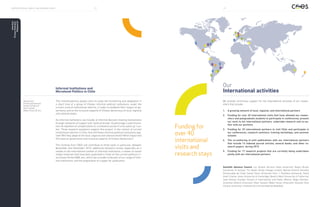
We provide continuous support for the international activities of our resear-
chers that include:
1.	 A growing network of local, regional, and international partners
2.	 Funding for over 40 international visits that have allowed our resear-
chers and postgraduate students to participate in conferences, present
our work to our international partners, undertake research and co-au-
thor with our partners
3.	 Funding for 25 international partners to visit Chile and participate in
our conferences, research seminars, training workshops, and summer
schools
4.	 The co-authoring of joint publications with our international partners
that include 14 indexed journal articles, several books, and other re-
search papers during 2015
5.	 Funding for 17 research projects that are currently being undertaken
jointly with our international partners
Fundingfor
over40
international
visitsand
researchstays
Interline
(Cross-thematic
Research)
2322CENTRE FOR SOCIAL CONFLICT AND COHESION STUDIES
Observatory of
Labour Conflicts
The Observatory of Labour Conflicts (OHL) “Observatorio de Huelgas Laborales”
was formed in August of 2014 as a joint effort between academics and students
from diverse universities and disciplines.
The main objective of the OHL is to support the production of knowledge and
contribute to the debate on the situation of unions and strikes in Chile. For said
purpose, the OHL has continued the registry of strikes that professor Alberto
Armstrong created for the years 1979-2010. The OHL has also worked to upda-
te the methodology and add new variables that allow for the deepening of our
knowledge on labor conflict in Chile. This database is unique in the country, as
it considers information on extra-legal strikes, union strategies, and political in-
tervention, among other information that has not been registered in a systematic
manner by state agencies or other organizations. For this reason, it represents
an opportunity for research on labor conflicts and for social actors interested in
the dynamic of labor relations in Chile.
Based on the registry of social unrest in Chile, the OHL team develops research
concerning the following topics that have been defined as priorities: the causes
of the extra-legal strikes; the continuities and breaks in union strategies; the
spatial dimension of conflict and the relation between public policy and labor
conflicts. With the goal of contributing to the public debate on labor relations, the
OHL periodically disseminates press releases and the principal results of the
research in progress.
Team
Emmanuelle Barozet (Associate researcher, COES)
Kirsten Sehnbruch (Associate researcher, COES)
Nicolás Somma (Associate researcher, COES)
Sofía Donoso (Postdoctoral research fellow, COES)
Francisca Gutiérrez (Adjunct researcher, COES)
Domingo Pérez (Graduate student, supported by COES)
Rodrigo Medel (Graduate student, supported by COES)
Diego Velásquez (Graduate student, supported by COES)
Contact
observatorio.huelgas@gmail.com
www.facebook.com/observatorio.huelgas.laborales/
Evolution of legal and extra-legal strikes in 2014
In number of events
According to legal status and workers
involved. In numbers
Events by geographic area
In %
Multi-regions
Central
South
Strikes
Total workers
Average number of workers
Central
Zone
“Great”
North
“Small”
North
Austral
Embassies
and consulates
12,3
5,46
3,55
0,27
4,92
13,39
60,11
Total
367
Legal
193
Extra-
legal
174
3.851229
Legal
Extra-legal
35
30
25
20
15
10
5
0
JAN FEB MARCH APRIL MAY JUNE JULY AUG SEP OCT NOV DEC
Source: COES 2014 survey
44.128 562.278
2524CENTRE FOR SOCIAL CONFLICT AND COHESION STUDIES
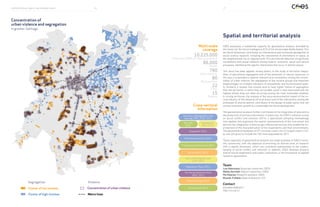
Spatial and territorial analysis
COES possesses a substantial capacity for geostastical analysis, provided by
the Center for Territorial Intelligence (CIT) of the Universidad Adolfo Ibáñez. This
territorial dimension contributes an intersectoral and multiscale perspective to
social science research, revealing the coexistence of phenomena in space, at
the neighborhood, city or regional scale. This permits the detection of significant
correlations and causal relations among historic, economic, social and natural
processes, identifying the specific interactions that occur in distinct places.
This focus has been applied, among others, to the study of territorial inequa-
lities, of educational segregation and of the extraction of natural resources. In
this way, it is possible to observe relevant local correlations among the concen-
tration of urban violence, the segregation of low-income groups and important
disadvantages on multiple indicators of accessibility and environmental quali-
ty. Similarly, it reveals that schools tend to have higher indices of segregation
than the territories, in which they are located, which is also associated with the
highest school drop-out rates occurring among the most vulnerable students.
In mining territories, the analysis of the socio-environmental impact of the mi-
ning industry, of the networks of local actors and of the interactions among the
processes of diverse sectors, contributes to the design of public policy that will
connect economic growth to a sustainable territorial development.
The geostatistical analysis further contributes to the integration of data and to
the production of primary information. In particular, for COES’s national survey
on social conflict and cohesion (2014), a specialized sampling methodology
was applied, that augments the spatial representativity of the instrument and
permits the integration of diverse geo-referenced sources that enable the im-
provement of the characterization of the respondents and their environments.
The geostatistical database of CIT currently covers the 22 largest cities in Chi-
le, and will grow to include the 100 most populated by 2017.
These capacities of geostatistical analysis are made available to COES’s scien-
tific community, with the objective of enriching its diverse lines of research
with a spatial dimension, which can contribute substantially to the unders-
tanding of social conflict and cohesion. In addition, COES develops projects
and territorial diagnostics with public institutions, in the framework of applied
research agreements.
Team
Luis Valenzuela (Associate researcher, COES)
Matías Garretón (Adjunct researcher, COES)
Pía Palacios (Research assistant, COES)
Ricardo Truffello (Head of Research, CIT)
Contact
pia.palacios@uai.cl
http://cit.uai.cl/
Multi-scale
coverage
Cross-sectoral
Information
10.225.000
Inhabitants (68% of Chile’s population)
86.000
Blocks
780
Urban districts
80
Municipalities
22
Cities
15
Regions
Censuses, demographics and
housing 1992, 2002, 2012
Segregation
2002, 2012
Services
2012
Equipment 2012
Telecommunications 2012
Transportation Networks 2012
Accessibility 2012
Uses of Developed Land
1541-2014
Regulatory Plans 2012
Territorial Administration
2002, 2012
Satellite Images 2014
Environment 2014
Concentration of
urban violence and segregation
In greater Santiago
Segregation Violence
Cluster of low incomes Concentration of urban violence
Cluster of high incomes Metro lines
2726CENTRE FOR SOCIAL CONFLICT AND COHESION STUDIES
CROSSCUTTING
THEMES
TRAINING
W
O
RKSHOPS
SOCIAL
MOVEMENTS
LABOR
DISPUTES
ENVIRONMENT
MULTICULTURALISM
COLLECTIVE
ACTION
EDUCATION
INEQUALITY
ECONOMYAND
REGIONALGOVERNANCE
INTERGROUP
COHESION
CITIZENSHIP
AND
REPRESENTATION
TERRITORY
Pos
tdoctoralResearchFellowsv
New academics
Graduate Grants
Graduatestud
ents supporte
UndergraduateTheses
7
14
19
90
25
Support for
undergraduate
students to develop
their theses on topics
of interest to the
Centre.
Students at national and foreign
universities that have access to a
vast network of contacts, benefits
and academic activities.
Funding for postdoctoral
investigations for up to two
years, some in collaboration
with prestigious institutions
abroad.
scholarships for master and
doctoral students enrolled in
Chilean programs.
Developmentof
AdvancedHuman
Capital
Financing for the
incorporation of new
academics in the universities
that make up the Centre.
International Conferences
Every year, COES organizes a series of academic conferences that seek to at-
tract important international and national presenters on topics that address
social conflict and cohesion. Over time, the goal is to consolidate these separate
instances into one annual conference that would support an interdisciplinary
academic discussion and the development of researchers, with the participa-
tion of renowned international experts in every conference.
2014Social
Movements
and
Collective
Action
2016Inequalities
2015Urban and
Territorial
Conflicts
Principal Speakers:
Sidney Tarrow (Cornell University),
Daniel Gaxie (Université Paris 1 Panthéon-Sorbonne),
Leslie McCall (Northwestern University)
This Conference addressed, from different perspectives, social movements
and collective action (with special emphasis on Latin American countries). The
high level of interest, expressed by the public and the national and internatio-
nal presenters, revealed the enormous relevance that this topic has acquired
over the past years in South America.
The 2016 COES Conference seeks to contribute to the debate on inequalities in
the XXI century. Thus, it will address inequalities from distinct thematic areas,
considering globalization, public policy, cities, cultural expressions, democracy
and political representation, among others.
Principal Speakers:
Tim Butler (Kings College London),
Julio Dávila (University College London),
Jamie Peck (The University of British Columbia),
Tom Slater (The University of Edinburgh),
Astrid Ulloa (Universidad Nacional de Colombia),
Richard Webber (Kings College London)
The 2015 COES Conference was divided into four broad areas: (1) Socio-envi-
ronmental conflicts, actors, interests and identities, (2) territorial impacts of
segregation, gentrification and inequality, (3) institutionalism, territorial gover-
nance and social movements, and (4) urban-territorial conflict and daily life.
All of the information on COES’s international conferences can be found at:
www.coes-conference.cl
SOCIAL MOVEMENTS
ECONOMETRÍA
ESPACIAL
IREPRODUCIBLE
RESEARCH
2928CENTRE FOR SOCIAL CONFLICT AND COHESION STUDIES
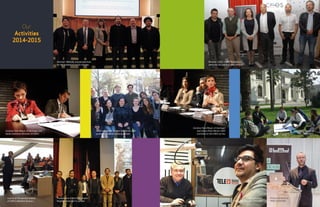
Our
Activities
2014-2015
Seminar: Methods and perspectives
for the analysis of social changes.
Carolina Tohá (Mayor of Santiago)
and Carlos Peña (Rector UDP)
comment on the COES survey.
Launch of the second module
of COES’s National Survey.v
Presentation of the COES project:
Neighborhood port in context.
COES researcher Kirsten Sehnbruch with
graduate students studying abroad.
Annual Conference
PRSCO-SOCHER.
COES researcher
Mauro Basaure on T13 Radio.
Carolina Tohá (Mayor of Santiago) and
Dante Contreras (Director of COES).
SummerLab
DPU-COES.
Seminar: COES-CISPO Territories,
networks and political singularities.
ENGLISH VERSION
@CentroCOES CentroCOES Difusión Coes
www.coes.cl
Phone: +562 2978 3419 / Email: comcoes@gmail.com
´15

Revista COES 2015 ENG

  • 1.
  • 2.
    14 2 13 12 15 (Cross-them a tic Research) Inte rline Thesocioeconomicdim ensions ofconflict Group and indivi dualinteractions Socialand po litical conflict Geographies of c onflict:thespatial dimension of social c onflictandcohesion 3Diversechaptersininternational andnational books. Books 56duringthe Centre’s firsttwoyears. Publications 15SCOPUS, Latindex, SciELO) Totalpublications in otherindices high IMPACT41injournals suchas Environmentaland PlanningC: Government and Policy, Journalof Personality, SocialScienceResearch, Party Politics, Development and Change, International Journal of EducationalDevelopment, EURE, amongothers). ISI6 The Centre for Social Conflict and Cohesion Studies (COES) brings together a group of academics from multiple disciplines in the social sciences and humanities, to generate research on topics relatedtosocialconflictandcohesion,inChile.COESfocusesitsacademic work and activities to promote public awareness and social dialogue, on an analysis of the multiple manifestations of social conflict in Chile, studying its causes and historical and cultural context. The Centre is coordinated by the Universidad de Chile and the Pontificia Universidad Católica de Chile, with the collaboration of the Universidad Diego Portales and the Universidad Adolfo Ibáñez. COES is financed by the FONDAP project of the National Commission for Scientific and Technological Research (CONICYT). Academic Board COES: Dante Contreras (Universidad de Chile), Juan Carlos Castillo (P. Universidad Católica de Chile), María Luisa Méndez (Universidad Diego Portales), Alfredo Joignant (Universidad Diego Portales), Roberto González (P. Universidad Católica de Chile), Luis Valenzuela (Universidad Adolfo Ibáñez), Kirsten Sehnbruch (Universidad Diego Portales), Mauro Basaure (Universidad Andrés Bello), Daniel Hojman (Universidad de Chile), Ignacio Cáceres (Executive Director). Advisory Council: Benito Baranda (América Solidaria), Carolina Carrera (Corporación Humanas), Claudia Dides (Miles Chile), Claudio Seebach (Generadoras de Chile), Esperanza Cueto (Comunidad Mujer), Francisco Irarrázaval (Evópoli), Marcela Ríos (PNUD), María Eugenia Camelio (FONDAP program of CONICYT), Pablo Simonetti (Fundación Iguales). Social and political conflict Geographies of conflict: The spatial dimension of social conflict and cohesion Group and individual interactions The socioeconomic dimensions of conflict Lines of Research: 32CENTRE FOR SOCIAL CONFLICT AND COHESION STUDIES
  • 3.
    The socioeconomic dimensions ofconflict Fabián Duarte Associate Researcher fabduarte@fen.uchile.cl Topics:Health economics; education; economic public policy. Francisca Gutiérrez Adjunct researcher fgcrocco@gmail.com Topics: Sociology of work; political sociology; organizational sociology. Paola Bordón Postdoctoral Researcher pbordon@fen.uchile.cl Topics: Higher education; labor markets. Nicolás Grau Adjunct researcher ngrau@fen.uchile.cl Topics: Applied microeconomics; economics of education; labor economics and econometric methods. Francisco Pino Adjunct researcher fjpino@fen.uchile.cl Topics: Economic policy; economic development; economic history. Emilia Brito Research Assistant ebrito@fen.uchile.cl Topics: Labor economics; gender inequality; education; segregation. Valentina Paredes Associate Researcher vparedes@fen.uchile.cl Topics: Labor economics; economics of education; microeconomic theory. Claudia Sanhueza Associate Researcher claudia.sanhueza@udp.cl Topics: Applied econometrics; labor economics; economics of education; household economics. Daniel Hojman Associate Researcher dhojman@fen.uchile.cl Topics: Welfare economics; poverty; inequality; education: economic policy and corruption. Matías Sanfuentes Associate Researcher msanfuentes@unegocios.cl Topics: Change management; human resources; social dynamics. Dante Contreras Director and Principal Researcher dcontrer@econ.uchile.cl Topics: Economics of education; poverty; income distribution; social policies and evaluation of their impact. Kirsten Sehnbruch Associate Researcher and Director of International Relations kirsten.sehnbruch@udp.cl Topics: Public policy and labor markets; policies and development in Latin America. This line of research studies the relationship between social conflict and cohe- sion with socioeconomic conditions, institutions and public policy.While primarily analyzing the Chilean reality, international contexts are also studied. This dimen- sion is comprised of four areas that delve into specific topics and their interac- tions: social inequalities, economic development, education and social mobility. In regards to multidisciplinary work with the rest of the Centre’s researchers, this research line will study, among other topics, real and perceived inequalities and how distinct forms of inequality impact the values and attitudes that motivate social conflict and cohesion. Geographical and educational segregation, and their impact on the existing socioeconomic structure, will also be analyzed. This area has consolidated its research on the quantitative analysis of social inequalities. There are three thematic focuses: education, work and the spatial dimension of the inequalities. The Centre’s researchers´ perspective is that education and work have historically played, and continue to play, a central role in the dynamics of social inequalities, social conflicts and social cohesion in Chile and around the world. From a strategic point of view, the relevance of these topics in individuals´ lives, on economic, political and social develop- ment, and in the public policy discussions in Chile and other countries, suggest that it is relevant to position this Centre as an international scientific reference for these topics. Additionally, the territorial dimension of inequalities, its ex- pression and reproduction in cities, as well as in very diverse regions, repre- sent transversal thematic focuses in all of COES’s lines of research. Research projects Aversion to inequality in the teacher labor market and its impact on educational performance: The case of Chile. Claudia Sanhueza. Adverse effects of the institutionalization of organizational corruption on individuals and work teams: the case of La Polar. Matías Sanfuentes. Crisis of representation, democratic institutions and political parties in Chile. Kirsten Sehnbruch. School Trajectory and Juvenile Crime. Nicolás Grau. Avoiding “Rabanitos”. Reproduction Mechanisms of Management Ideology in Chile. Francisca Gutiérrez. From apathetic to enthusiastic: a new typological analysis of the political involvement of Chileans. Paola Bordón. 54CENTRE FOR SOCIAL CONFLICT AND COHESION STUDIES
  • 4.
    Juan Carlos Castillo DeputyDirector and Principal researcher jcastillov@uc.cl Topics: Social inequality; social justice; public opinion and civic education. Emmanuelle Barozet Associate Researcher ebarozet@uchile.cl Topics: Social stratification, social inequality and the middle class in Chile and Latin America. Pablo de Tezanos Associate Researcher pablodtp@gmail.com Topics: Prejudice; orientation and gender; intragroup norms. Matías Bargsted Associate Researcher mbargsted@uc.cl Topics: Public opinion; political attitudes and preferences; political identification and comparative sociology. Dariela Sharim Associate Researcher dsharim@uc.cl Topics: Gender roles; couple connections; love and intimacy in Chile; domestic conflicts. Ana Figueiredo Postdoctoral Researcher figueiredo.anacm@gmail.com Topics: Historic social representations; intergroup relationships and cultural diversity. Héctor Carvacho Adjunct Researcher hscarvac@uc.cl Topics: Ideology; intergroup conflict; social hierarchies; historical memory Benjamín V. Muñoz Research Assistant ajmunoz@uc.cl Topics: Redistribution; territorial inequality and its political effects; statehood; quantitative methodology Jorge Atria Postdoctoral Researcher jorgeatria@gmail.com Topics: Social inequality; taxes and redistribution; elites. Mónica Gerber Adjunct Researcher mgerber@uc.cl Topics: Social and political psychology; political ideologies; attitudes toward social justice. Paula Luengo Postdoctoral Researcher paula.luengo@uniroma1.it Topics: Pro-social behavior; civic participation. Gloria Jiménez-Moya Postdoctoral Researcher gloriajm@ugr.es Topics: Group identity; collective action; prejudice; legitimization of social inequality. Patricio Cumsille Associate Researcher pcumsill@uc.cl Topics: Parent-adolescent relationships; adolescent development; risk and health behaviors in adolescents; pro-social and civic behaviors in youths. Roberto González Principal Researcher. Panel Study Coordinator rgonzale@uc.cl Topics: Intergroup relationships; prejudice; intergroup emotions; acculturation process; social movements and reparation behaviors associated with political and ethnic conflicts. GroupandIndividualInteractions This line of research contributes to the analysis and understanding of social conflicts and cohesion in Chile, by integrating the interpersonal and intergroup dimensions into the macro-social context. It is divided into four sub-dimensions: a) interpersonal relationships and conflict, with an emphasis on the family unit and neighborhood; b) the interactions between social groups, including the issues of prejudice and discrimination; c) class-based hierarchical group interactions and sociopolitical cleavages, and d) cohesive citizenry and pro-social behavior, emphasizing the interactions between individuals and the public sphere by way of citizen participation. These areas of research pay special attention to subjective aspects, such as attitudes and percep- tions towards others and the social system, as well as their consequences on behavior, regarding the degree to which they promote or mitigate situations of social conflict and/or cohesion. Thus, the main objective of this line of research is: to assess and identify the causes, the underlying processes and the consequences associated with the emergence of conflicts and problems of social harmony or cohesion, at the interpersonal and intergroup levels. Research projects Together but not mixed: Student integration in the classroom. Pablo de Tezanos. Development, regulation and public policy. Observations of citizen participation programs in municipalities of the Metropolitan Region. Pablo González. The place of conflict in the experience of young Chilean couples. Dariela Sharim. Intergroup conflict and integration: A comparison of multiethnic contexts, immigration and indigeneity. Roberto González. Latent class analysis of forms of civic and political participation among Chilean adolescents. Patricio Cumsille y Juan Carlos Castillo. Social identity and legitimacy of social movements: an explanatory model. Roberto González. Development of attitudes towards the Peruvian immigrants and the Mapuche: role of intergroup norms and contact. Roberto González. Social inequalities in Chile: understanding of the social representations, based on a classifications game. Emmanuelle Barozet. The legitimization of radical collective action. Gloria Jiménez-Moya y Paula Luengo. Representations of the Mapuche in four Chilean newspapers (2010-2015). Ana Figueiredo. Escaping from the group: How individuals from low SES distance themselves from the group. Héctor Carvacho, Gloria Jiménez-Moya y Mónica Gerber. 76CENTRE FOR SOCIAL CONFLICT AND COHESION STUDIES
  • 5.
    This line ofresearch examines the important signs of so- cial and political conflict, which have manifested themsel- ves in Chile during recent years, particularly since 2011, when the incidence of social mobilizations increased sig- nificantly. An increase in the frequency of aggressive in- cidents (violence during the demonstrations and outright anarchist attacks), has contributed to a sensation of insta- bility and insecurity that Chile has not experienced since its transition to democracy. All of this has occurred in the context of a growing electoral and political disaffection, combined with a loss of trust in all public institutions. A change in electoral policies from a mandatory vote to a vo- luntary vote, along with a new system that automatically registers eligible voters, has only served to highlight the extent of the problem. Notably, the social mobilizations, since 2011, have also articulated demands to change the constitution, which illustrates the degree to which Chilean institutions have lost legitimacy. Additionally, a wave of financial scandals associated with banks and the retail sector have placed in evidence the abuses and deficiencies of market regu- lation, which contributes to an overall sense of a lack of trust, expressed through preferences for state institutions in opinion polls. Finally, the controversy about the Consti- tution and the presidential promise of substitution with a new fundamental charter, reveals the corollary of fights and conflicts that is not always easy to unify with a com- mon thread. These types of conflicts justify the incorpora- tion of a historic approximation, with the goal of detecting the continuities and changes, and in this way break with the spontaneous surprise in response to phenomena that are not necessarily without precedent. This line of research proposes to examine questions that arise from these circumstances, from four dimensions: disaffection and the legitimacy of democracy; the conflict with judicial and constitutional norms; conflicts and social movements; and the socio-cultural and political history of conflict in Chile. Research projects Community social capital in Chile. Presence and evolution of social organizations at the community level, 2002-2012. Patricio Navia. Morphologies of the Chilean discontent 2011-2012. An interdisciplinary approach. Claudio Rolle. Authoritarian and democratic values in Chile, 1972-2014. Patricio Navia. The student movement in Chile. Sofía Donoso. The slow death of Allende, Frei and Neruda and conflict about memory. Alfredo Joignant y Mauro Basaure. Who are the “encapuchados” Participation in low-intensity political violence in Chile between 2011 and 2013. Ana Velitchkova. Leaving fear behind: Generational differences in the tolerance and support for protest in Chile democrático. Patricio Navia. Tomás Campos Research Assistant tcamposcastro@gmail.com Topics: Welfare state; education policy; subnational policy; local legitimacy and conflict. Claudio Rolle Associate Researcher claudiorolle@yahoo.com Topics: Social movements in Chilean history. Mauro Basaure Associate Researcher and Head of the Theoretical Agenda mauro.basaure@gmail.com Topics: Cultural transformations; social move- ments; protests; youth; political and religious ideologies. Alfredo Joignant Principal Researcher alfredo.joignant@mail.udp.cl Topics: Political elites and legitimacy; charisma and cohesion; capital and resources in political competition; politics of memory. Claudia Heiss Associate Researcher cheiss@iap.uchile.cl Topics: Political theory; state of exception; constitutionalism. Patricio Navia Associate Researcher patricio.navia@nyu.edu Topics: Demonstrations and public conflicts; electoral participation; political parties. Javier Couso Associate Researcher javier.couso@udp.cl Topics: Constitutional conflicts. Nicolás Somma Associate Researcher nsomma@uc.cl +562 2 354 20 00 Topics: Social movements; protests; political sociology; comparative sociology. Ismael Puga Adjunct Researcher ismael.puga@mail.udp.cl Topics: Legitimation of social inequality, analytical sociology and critical theory. Sofía Donoso Postdoctoral sofia.donoso@mail.udp.cl Topics: Social movements; unionism; state and civil society relations. Ana Velitchkova Postdoctoral anavelitchkova@gmail.com Topics: Political violence; encapuchados; globalization; civil society; cultural inequality. Daniela Jara Postdoctoral Researcher danielapazj@gmail.com Topics: Cultural memory; generations; cul- tural studies; transitional justice; qualitative methodologies. Socialand PoliticalConflict 98CENTRE FOR SOCIAL CONFLICT AND COHESION STUDIES
  • 6.
    The main objectiveof this line of research is to examine the debates on social justice and urban and regional spaces. From a theoretical point of view, this line of research proposes to broaden the traditional understanding of space based fundamentally on territoriality, to one that also considers reflections on posi- tions in the social structure, belonging, as well as research on other non-terri- torial forms of community and group formation. Specifically, the theoretical, empirical and public policy aspects will be examined in four main areas: the impact of inequality and multidimensional segregation on social justice in urban territories; territorial inequalities and social conflicts; social capital, conflict and support networks; the tensions between local and public authorities, the market and civil society. In this sense, important elements of this line of research include: urban and socio-environmental conflict, urban segregation, gentrification, territorial belonging, urban heritage, sociability and intercultural life in neighborhoods, housing policies, protests and demonstra- tions, regional/territorial identities, immigration and decentralization policies. Research projects Territorial dynamics in the agro-mining valleys of Chile: The case of Salamanca. Patricio Aroca. Mining and Socio-environmental conflicts in the Great North. Hugo Romero. The defense of place: Capabilities and limits of the inhabitants of Valparaiso and Barrio Puerto. Felipe Link. Action orientations and contents of the fight against the “territorial disqualification” in middle and low-income areas of greater Santiago. María Luisa Méndez. Additionally, this line is noteworthy for actively engaging in multidisciplinary work, with a contribution of 10 interline (cross-thematic) projects. María Luisa Méndez Principal Researcher marialuisa.mendez@udp.cl Topics: Subjective aspects of mobility and social stratification; construction of belonging in urban neighborhoods; urban conflicts. Claudio Agostini Associate Researcher claudio.agostini@uai.cl Topics: Tax policy; tax evasion and avoidance; estimates of inequality and poverty, disaggre- gated geographically. Felipe Link Associate Researcher felipe.link@uc.cl Topics: Sociability networks and urban space; neighborhood consolidation; urban vulnerability; housing and urban policies. Luis Valenzuela Associate Researcher luis.valenzuela@uai.cl Topics: Territorial intelligence; urban planning and design; urban segregation; territorial wellbeing; urban production and development; natural risks and disasters. Patricio Aroca Associate Researcher patricio.aroca@uai.cl Topics: Growth and regional inequality; evaluation and design of regional policy; economics and natural resources policy. Vicente Espinoza Associate Researcher vicente.espinoza@usach.cl Topics: Social inequality; occupational mobility; social networks. Irene Ramos Postdoctoral Researcher ireneargil@gmail.com Topics: Anthropology of the marriage covenant and policy; sociology of violence; political ethnography. Pía Palacios Assistant for the Center of Territorial Intelligence (CIT) pia.palacios@uai.cl Topics: Residential segregation. Hugo Romero Adjunct Researcher hugo.romero@uct.cl Topics: Environmental and territorial transformations in Chile; mining; indigenous communities. Matías Garretón Adjunct Researcher matias.garreton@uai.cl Topics: Territorial inequalities; discontent and social conflicts; processes of institutional evolution. Gabriel Otero Research Assistant gabrieloteroc@gmail.com Topics: Neighborhood effects; social capital; sociology of science. Ernesto López Associate Researcher elopez@uchilefau.cl Topics: Socioeconomic conflicts of urban land; central metropolitan spaces; gentrification. Cristián Doña Adjunct Researcher cristian.dona@gmail.com Topics: International migration; migratory decisions; state-migrant relations. Nicolás Angelcos Postdoctoral Researcher nicolas.angelcos@mail.udp.cl Topics: Poverty; urban conflicts; collective action; subjectivation policy. Geographiesofconflict: Thespatialdimension ofsocialconflictandcohesion 1110CENTRE FOR SOCIAL CONFLICT AND COHESION STUDIES
  • 7.
    COES Survey COES’s nationalsurvey is the first study that seeks to map social conflicts and social cohesion in Chile. Its objective is to understand, from multiple discipli- nes of the Social Sciences, the beliefs, attitudes and perceptions of Chileans towards various dimensions of coexistence and conflict. The survey considers four general sections: 1. Belonging and integration (distributive beliefs, perception of inequality, equal pay, trust in institutions). 2. Social Conflict (perception of conflicts, evaluation of conflicts). 3. Interactions (networks, trust). 4. Common good (participation, collective actions). The survey was applied to 2025 cases, between September 4th and November 30th of 2015, and represents 78.1% of the urban population and 68% of Chile’s total population. The Center of Territorial Intelligence of the Universidad Adolfo Ibáñez elabora- ted a sampling frame that made it possible to geo-reference the data, which has enabled the inclusion of the territorial dimension in the various analyses conducted by COES with said data. In order to share the results of the survey, throughout 2015, COES organized diverse presentations of the data divided into the modules: “crisis in political trust”; “Inequality, justice and distribution”; “Social conflict, inequality and terri- tory” and “Networks and social circles”. COES Panel study Since its inception, COES has proposed the design and implementation of a national panel study that will enable an analysis, across time, of the principal moderating and mediating factors, context as well as the primary consequen- ces associated with the development of the distinct forms of social conflict and cohesion in Chile. The international experience reveals that the countries that have longitudinal studies, of this nature, produce first-rate scientific knowled- ge and guide the development of public policies. With the purpose of meeting this objective, an interdisciplinary team was for- med, representing COES’s multiple lines of research, which has worked on the design of the study, questionnaire and sample. This study, unprecedented in our country, will commence in April of 2016, and consider approximately 3,000 cases at a national level, all of whom will be tracked for eight years.This study will contribute to the development of the social sciences in Chile and will help promote the growth of its international connections. Diagram of Types of Society Source: COES 2014 survery What is Chile’s reality? How should it be? 29,2% 0,9% 42,9% 4,1% 15,3% 21,8% 8,9% 40,6% 6,6% 32,1% TYPE A TYPE B TYPE C TYPE D TYPE E 100 80 60 40 20 0 105 15 Theydirectlyaffectme(percentage) Perception of the main conflicts at a national level (Percentage, first mention) 20 25 How do you think they affect you and your family? Transportation Delinquency Economy Inequalities Justice Health Work EducationSocial movements Alcoholism and drug consumption Political legitimacy Indigenous How satisfied are you with the way democracy functions in Chile? 3 2.5 2 1.5 1 very satisfied Trust Scale: 1- none, 3- not a little nor a lot. somewhat Little not at all satisfied Proportionofcases Averagetrustin PoliticalInstitutions 0.006 0.005 0.004 0.003 0.002 0.001 0.000 0 200 400 Number of contacts 600 800 Distribution of Network Size (based on contact with 24 social groups) 130 139 average number of individuals average number of individuals Scale up Bayesian High heterogeneity in the size of networks; while 50% of Chileans have 117 or fewer contacts, the 5% reporting the largest networks, have upwards of 323 contacts. 12CENTRE FOR SOCIAL CONFLICT AND COHESION STUDIES
  • 8.
    COES has financed,up to now, 50 internal research projects, covering a vast range of topics of interest related to social conflict and cohesion, from a multidisciplinary perspective. Additionally, each project includes the support and participation of students funded or supported by COES, contributing to the formation of human capital. These numbers reinforce the idea that COES has acquired a virtuous dynamic among its members, resulting in multidisciplinary research among members of the different universities involved. The socioeconomic dimensions of conflict Social and political conflict Group and individual interactions Geographiesofconflict: thespatialdimensionof socialconflictandcohesion Interline (Cross-thematic Research) Research projects 6 7 50 11 4 22 Thesocioeconomic dimensionsofconflict Avoiding “Rabanitos”. Reproduction mechanisms of management ideology in Chile. The general objective of this project is to study how and why Chilean busines- ses avoid, manage and penalize unions. The project has a timeframe of two and half years, with a first stage that will focus on two specific objectives. The first consists of describing the overall pic- ture of the management of unions in Chile, based on the analysis of the Labor Survey (ENCLA) undertaken by the Directorate of Labor. The emphasis will be placed on the differentiation of the Chilean businesses on this subject, as well as the influence of the socio-economic, regional and organizational factors on said differences. The second objective, during this first stage of research, is to identify the me- chanisms that form an ideology contrary to the unions among the business elite, focusing on undergraduate business students. On one hand, the hope is to measure the effect the distinct business school programs have on the dispo- sition of this elite towards the unions. On the other hand, the aim is to identify other relevant instances of socialization on the formation of an anti-union dis- position, such as religion, socioeconomic level and the association experience. This project will be complemented by the information gathered by the COES 2014 survey in relation to trust in unions, and with the work of the Observatory of Labour Conflicts on managerial actions during collective conflicts. Labor market sorting of teachers in Chile’s school system by inequality aversion and the consequences on inequality educational performance Numerous experimental studies indicate that social preferences are important for organizational aspects, such as choice of contract and worker performance. Whether different employers attract workers with different social preferences, however, is largely unknown. We investigated the classification of the teacher labor market among the different types of schools in Santiago, Chile, and we measured their aversion to inequality using simple distributive selection ga- mes. Additionally, we tested to see if the aversion to inequality is related to the educational performance of these teachers’ students. Three main types of schools coexist in Chile and they compete for the students and financing: public schools, private unsubsidized schools and private subsidized schools (the latter two include religious schools). The schools have very heterogeneous profiles and compete in different ways. These differences influence the selec- tion process of the labor market. We found that public schools and Fe y Ale- gría (Jesuits) attract teachers who are substantially more adverse to inequality than the teachers in private subsidized schools. Furthermore, we found that teachers’ aversion to inequality affects the educational performance on stan- dardized tests. Teachers who have greater aversion to inequality have a higher performance average and less inequality on the standardized exams after con- trolling for their happiness and quality. Researcher Francisca Gutiérrez Researcher Claudia Sanhueza Furthermore, COES is currently developing an interdisciplinary project named, Agenda Teórica (Theoretical Agenda), with which it aims to gather perspectives from diverse disciplines regarding the definitions of cohesion, conflict and the relationship between them. 1514CENTRE FOR SOCIAL CONFLICT AND COHESION STUDIES
  • 9.
    Socialand political conflict Groupand individual interactions With or withoutyou? Party-movement relations and the political impact of the student movement in Chile. Scholarship on social movements increasingly acknowledges the blurry boundaries between movement politics and institutional politics. Social mo- vements in Latin America have redefined the region’s political course by pu- tting their demands on the political agenda, building socio-political alliances, and creating new political parties. In the case of Chile, the Student Movement has spearheaded massive protests and expanded its initial petition centered on sectoral demands to pending democratizing reforms. This project seeks to trace the shifts in the political agenda and partisan alignment prompted by the protest wave led by the students. Specifically, it examines how the Student Movement has (i) polarized the po- litical parties on the centre-left, (ii) introduced and informed an agenda on education and political reforms, and (iii) instigated the creation of new politi- cal parties. These dimensions are examined based on interviews with party members and student leaders, an exhaustive revision of political party and organization documents, and an analysis of the historical partisan positions in a set of education and political reforms. This material is analyzed using process-tracing to generate a theoretically informed historical explanation of the case under scrutiny. Social inequalities in Chile: Understanding of the social representations, based on a classification game. This study examines one of the nuclear central themes of COES: the understan- ding of inequality from a subjective perspective, placing an emphasis on tole- rance towards inequality. The project falls within the double area of the analysis of social representations and the conceptions of social justice. The main objec- tive is to contribute to the study of the ways in which Chileans perceive society and the differences of these perceptions. On this basis, it will describe how Chileans classify people in society, as well as what they consider to be just and unjust, allowing to explain the criteria for social justice and the conditions that influence said evaluation made by the subjects. In a previous Fondecyt project (Nº1130276, “Social justice and tolerance of in- equality: subjective analysis of social differentiation in a mature neoliberal regi- me,” (2013-2015) directed by Emmanuelle Barozet), a classification game was implemented with focus groups, where the participants used playing cards. These cards, which represent real persons in the Chilean society, are used to create representations of the social space and society, with its distinct groups and hierarchies. These cards are designed to serve as a discussion aid on so- cial justice. The present projects seeks to broaden the findings of the previous stage, through the development of a nationally representative survey. In the fra- mework of the Fondecyt nº1150505, in progress, (“Social inequalities in Chile: ¿what influences on what is considered just or unjust?” (2915-2918) directed by Oscar Mac-Clure of the Universidad de Los Lagos), and to which this project is attached, they will develop a national survey based on the card games. The present project goes into greater depth on the methodological develop- ment for said work, by way of the elaboration of a set of complementary cards, expanding the original set, which was limited to the Metropolitan Region. Authoritarian and democratic values in Chile, 1972-2014. The majority of the studies on support for democracy in Latin America have centered on the analysis of the evolution of support for democracy from the end of the authoritarian experience, omitting the situation prior to the rupture in democracy. The previous democratic experiences, however, could condition the democratic values following an authoritarian period. Thus, taking the case of Chile, we analyze the support for authoritarian and democratic attitudes be- fore, during and after the military regime. The study will show to what extent the support base for democracy is affec- ted by an authoritarian experience in a developing democracy. Generally, it is considered a given that citizens increase their level of support and satisfaction with democracy, after an authoritarian experience. Analyzing the evolution and determinants of the authoritarian values in Chile, we can attempt to respond to what extent today’s Chilean society reflects greater consensus, in comparison with the period prior to the democratic rupture, with respect to the preferen- ces and attitudes on dictatorship and democracy. The objective of the project is to analyze the evolution that the authoritarian and democratic values and attitudes have had in Chile from 1972 to 2014. To this end, public opinion data, related to the support for authoritarian and democratic practices in Chile prior to the military coup of 1973, has been analyzed. Development of attitudes towards the Peruvian immigrants and the Mapuche: role of intergroup norms and contact. This research centers on the attitudes of Chileans towards other groups, par- ticularly those that differ in terms of power and status. Thus, the intergroup relations with persons of Mapuche origins and Peruvian immigrants, both dis- tinctive groups and frequently marginalized, will be studied. The project seeks to determine the role played by intergroup contact and the group’s own norms on the levels of prejudice and other attitudes of Chileans in relation to said groups. Likewise, the project highlights the role of intergroup trust in the for- mation of social attitudes. The project has not only academic implications for the understanding of inter- group contact, but may also help to inform the design of future social interven- tions to alter the levels of prejudice present in Chile. Researcher Sofía Donoso Researcher Emmanuelle Barozet Co-researchers: Oscar Mac-Clure Ana María Valenzuela Researcher Patricio Navia Researcher Roberto González Co-researchers: Brian Lickel Linda Tropp 1716CENTRE FOR SOCIAL CONFLICT AND COHESION STUDIES
  • 10.
    Geographiesofconflict: thespatialdimensionof socialconflictandcohesion Interline (Cross-thematic Research) Mining and Socio-environmentalconflicts in the Great North: the case of Alto Loa. This research investigates the social and environmental transformations of the Alto Loa, territory currently inhabited by the original Atacama population and where significant copper mining is developed. As with other indigenous communities, the Atacameños are developing a process of identity articulation, which has brought with it a territorial claim for a space highly degraded by the mining industry, where water is a critical element. This project’s objective is to analyze the social and territorial transformations in the Alto Loa, associated with the mining industry and the rearticulation of the Atacameño identity. In regards to the methodology, secondary information from CASEN has been used in order to characterize the population of the Antofagasta region and municipa- lities, with particular emphasis on the indigenous population (Atacama, Aymara and Quechua). The gathering of primary information has been done through in- terviews and observations in the Atacama communities of Chiu Chiu and Lasna. Lastly, SIG is used, and in the near future remote sensors, to study the social and environmental changes of the study’s zone. On the relevance of the neighborhood scale for the study of social conflict and cohesion: the definition of the neighborhood and its effects on the interdisciplinary, theoretical and methodological agendas. The investigation addresses the problem of the neighborhood scale on multi- ple dimensions, at the level of its operational definitions (administrative, func- tional, for homogenous areas, etc.), as well as from conceptual definitions and their meanings, in order to highlight their importance as a variable in the com- prehension, description and/or explanation of the social conflict and cohesion within our cities. Specifically, the project (i) has reviewed the debate on the definitions of the neighborhood scale and its methodological implications; (ii) has created a multidisciplinary report on the state of the art of the mechanisms assigned to the “neighborhood effects” and its methodological implications; and (iii) has implemented multiple empirical tests at the local and national level. The empirical tests at a local level have been implemented in the municipality of Santiago Centro, made possible by collaborative work with the Illustrious Municipality of Santiago (IMS). The specific studies have addressed multiple problems: local participatory territorial management; location of the street in the San Borja neighborhood; conviviality and diversity in the University neighborhood; sociability networks in the neighborhoods Santa Isabel and Matta-Viel; social integration and use of public spaces in the neighborhoods Yungay and Panamá; use of calm zones in the neighborhoods Lastarria and París-Londres. The empirical tests at a national level have focused on studying the effects of the neighborhood on academic results for children in elementary education, including some of the theoretical mechanisms taken from the reviewed litera- ture. In brief, the studies report on the negative impact of the crime rate and socioeconomic polarization in Chilean municipalities, on student’s performan- ce on Simce, but also the positive effects associated with local participation. Action orientations and contents of the fight against the “territorial disqualification” in middle and low-income areas of greater Santiago. This project studies, from a critical analysis of urban modernization in Chile, two conflicts associated with the displacement processes related to gentrifica- tion in Santiago. The first, comprised of middle-class individuals, considers the defense and promotion of patrimony with the demand for “Declaration of Tradi- tional Zone” directed by the Ministry of National Assets. The second, comprised of poor individuals, considers the promotion of “territorial permanence” as the slogan associated with the demand for housing, directed towards the State. In both cases, the adversary identified is the real estate business that, as an accumulation strategy, displaces middle-income and poor sectors to construct large tall buildings, all within a context of deregulation of the price of land. The thesis defended by the authors of this investigation, is that, while affected persons orient their actions according to the geographical structure of opportu- nities (they fear the disqualification associated with displacement), the subject of the demand is not the rational individual that neoclassic economy policy as- sumes, but rather the community of neighbors built around the bonds of solida- rity and cooperation. In this sense, the collective action, in both cases, questions the individualistic and competitive principles that orient the neoliberal urbani- zation, giving way to relative demands for the Right to the city. Researcher Hugo Romero Researchers María Luisa Méndez Dante Contreras Pablo De Tezanos Felipe Link Gabriel Otero and the Center of Territorial Intelligence of UAI (CIT) Researchers María Luisa Méndez Nicolás Angelcos 1918CENTRE FOR SOCIAL CONFLICT AND COHESION STUDIES
  • 11.
    Bonds of cohesion:how social networks connect diversity and contribute to social cohesion. The proposal centers on the analysis of the patterns of social interaction of the Chilean population, from the perspective of bonds and social networks. Thus, primary and secondary networks will be analyzed, starting from the basis that the closest contacts form a nucleus of strong bonds, which are effective me- chanisms of distribution, homogenization, company and emotional support. On the other hand, extended (or weak) bonds are effective to connect distant social circles, access information and amass scarce resources. The main emphasis of the study is centered on the description and explanatory analysis of the size of close and extended networks of Chileans. The central hypothesis is that larger networks are associated with higher levels of inter- personal trust and greater social control in their environment. In this way, the size of the networks is fundamental for understanding the levels of cohesion in Chile. The project also intends to delve into other aspects of social networks, particularly in their makeup and diversity, determining the levels of homophily in the bonds that Chileans establish with their close and extended contacts. The study seeks to enrich the understanding of social cohesion in Chile. Co- hesion involves the recognition of the members of a society, the reduction of differences and the operation of principles of justice in people’s destinies (Za- valeta et al 2014). The project is based on the notion, elaborated by Granovetter (1985), that the social bonds of individuals are a central component for the understanding of social cohesion, as personal relationships and the networks formed as a result are those that generate trust and discourage bad faith. Diffusion of the mobilization: individual and aggregate factors in the occupations of schools in 2011. In 2011, the occupations of schools and universities, in the context of massi- ve social protests, paralyzed the normal functioning of the education system, over a period of months. This project seeks to describe and explain the dyna- mic of the occupations of the secondary schools. Using a database created especially for this study, a statistical analysis will be done at the level of schools and individuals with respect to the mechanisms behind the occupations and their dismantling. This latter phenomenon, the demobilization, has been little studied, relative to the participation in social movements. The database generated for this study exhaustively covers the occupied schools and their students, including measurements of the relationships be- tween the schools, spatial as well as social, in order to quantify the circulation of information between them. This database will serve to develop other stu- dies in the medium-term. In this way, the present project seeks to make a theoretical and methodologi- cal contribution towards the analysis of social conflict in Chile, particularly in the study of social movements. Quantitative radiograph of the union strikes in contemporary Chile (2911-2014) The present project, on the basis of which the Observatory of Labour Conflicts (OHL) was created, has as its main goal to produce a radiograph of the labor disputes in contemporary Chile. Thus, they created a database of strikes for the years 2011-2015, according to diverse national and regional media outlets. This database continues and enriches the valuable database generated over the years 1979-2010, by the professor Alberto Armstrong, of the Pontificia Uni- versidad Católica de Chile. In the sociology of work and the discussion on contemporary unionism, diverse authors have postulated the emergence of a new cycle in the worker move- ment’s fight, following the explosive situation generated by the subcontracted unionism of the primary-export sectors (years 2006-2007) and their particular use of the illegal strike (Armstrong and Águila, 2006; Aravena and Núñez, 2009; Echeverría, 2010; Aguiar, 2011; Pérez, 2014). This database allows us to inves- tigate if we are in the presence, or not, of new forms of unionism: broader, in terms of the workers involved, with a gradual replacement of the legal strike over an illegal one, and with growing participation from economic sectors not traditionally associated with union organizing. The current investigation reveals, for example, that the illegal strike has been accentuating its predominance in terms of workers involved, in comparison to legal ones; that the frequency of strikes occurring outside of the Metropolitan Region has increased; and that the presence of tertiary economic sectors (new in terms of union organizing) continues to increase. Researchers Matías Bargsted Vicente Espinoza Researchers Daniel Hojman Sofía Donoso Nicolás Grau Researchers Emmanuelle Barozet Sofía Donoso Francisca Gutiérrez Rodrigo Medel Domingo Pérez Kirsten Sehnbruch Nicolás Somma Diego Velásquez Interline (Cross-thematic Research) Segregation, Spatial Poverty and Inequality in the access to territorial assets . This investigation presents a methodological contribution that should be a “public good”. It combines information on economic revenue obtained from the CASEN survey, with detailed information available from the population census. Together, these sources allow for the spatialization of revenue. In relation to the spatialization, this project addresses the relevant research topic of spatial socioeconomic segregation. In effect, it constructs a quantita- tive characterization of the socioeconomic segregation in Chilean cities, using up-to-date methodologies. In brief, it takes on the challenge of making compa- risons over time and between cities, based on information on spatial access to public goods and bads: health services, green areas, garbage dumps, crime, and commercial centers among others. The authors highlight that this project expands and consolidates a collabora- tion that has been carried out over four years, between the Faculty of Econo- mics and Business of the Universidad de Chile and the Center for Territorial Intelligence of the Universidad Adolfo Ibáñez. Researchers Claudio Agostini Daniel Hojman Luis Valenzuela Interline (Cross-thematic Research) 2120CENTRE FOR SOCIAL CONFLICT AND COHESION STUDIES
  • 12.
    Informal Institutions and MicrolevelPolitics in Chile This interdisciplinary project aims to study the functioning and adaptation in a short time of a group of Chilean informal political institutions, under the current cycle of institutional reforms, in order to establish their impact on go- vernance and on the inclusive capacity of Chilean democracy at local, regional and national levels. As informal institutions, we include: a) informal decision-making mechanisms through networks of support and “political braids” b) patronage c) patrimonia- lism d) nepotism e) compensation or consolation prizes f) cross pacts g) “cuo- teo”. Three research questions support this project: in the context of current institutional reforms in Chile, how will these informal political institutions ope- rate? Will they adapt at the local, regional and national levels? What impact will this have on governance and inclusive capacity of Chilean democracy? This funding from COES will contribute to three tasks in particular, between November and December 2015: additional literature review, especially as it relates to the international context of informal institutions; a review of recent media materials that have been published in Chile on the current political cri- sis (Casos Penta/SQM, etc), which we consider to be part of our range of infor- mal institutions; and the preparation of a paper for publication. Researchers Emmanuelle Barozet Kirsten Sehnbruch Peter Siavelis (Wake Forest, EE.UU.) Our International activities Scientific Advisory Council: Luc Anselin (Arizona State University), Rupert Brown (University of Sussex), Tim Butler (Kings College London), Manuel Antonio Garretón (Universidad de Chile), Daniel Gaxie (Université Paris 1 Panthéon-Sorbonne), Pedro Güell, Charles Jones (University of Cambridge), Beatriz Manz (University of California), José Antonio Ocampo (School of International and Public Affairs), Diego Sánchez- Ancochea (Oxford University), Peter Siavelis (Wake Forest University), Eduardo Silva (Tulane University) y Andreas Zick (Universidad de Bielefeld). We provide continuous support for the international activities of our resear- chers that include: 1. A growing network of local, regional, and international partners 2. Funding for over 40 international visits that have allowed our resear- chers and postgraduate students to participate in conferences, present our work to our international partners, undertake research and co-au- thor with our partners 3. Funding for 25 international partners to visit Chile and participate in our conferences, research seminars, training workshops, and summer schools 4. The co-authoring of joint publications with our international partners that include 14 indexed journal articles, several books, and other re- search papers during 2015 5. Funding for 17 research projects that are currently being undertaken jointly with our international partners Fundingfor over40 international visitsand researchstays Interline (Cross-thematic Research) 2322CENTRE FOR SOCIAL CONFLICT AND COHESION STUDIES
  • 13.
    Observatory of Labour Conflicts TheObservatory of Labour Conflicts (OHL) “Observatorio de Huelgas Laborales” was formed in August of 2014 as a joint effort between academics and students from diverse universities and disciplines. The main objective of the OHL is to support the production of knowledge and contribute to the debate on the situation of unions and strikes in Chile. For said purpose, the OHL has continued the registry of strikes that professor Alberto Armstrong created for the years 1979-2010. The OHL has also worked to upda- te the methodology and add new variables that allow for the deepening of our knowledge on labor conflict in Chile. This database is unique in the country, as it considers information on extra-legal strikes, union strategies, and political in- tervention, among other information that has not been registered in a systematic manner by state agencies or other organizations. For this reason, it represents an opportunity for research on labor conflicts and for social actors interested in the dynamic of labor relations in Chile. Based on the registry of social unrest in Chile, the OHL team develops research concerning the following topics that have been defined as priorities: the causes of the extra-legal strikes; the continuities and breaks in union strategies; the spatial dimension of conflict and the relation between public policy and labor conflicts. With the goal of contributing to the public debate on labor relations, the OHL periodically disseminates press releases and the principal results of the research in progress. Team Emmanuelle Barozet (Associate researcher, COES) Kirsten Sehnbruch (Associate researcher, COES) Nicolás Somma (Associate researcher, COES) Sofía Donoso (Postdoctoral research fellow, COES) Francisca Gutiérrez (Adjunct researcher, COES) Domingo Pérez (Graduate student, supported by COES) Rodrigo Medel (Graduate student, supported by COES) Diego Velásquez (Graduate student, supported by COES) Contact observatorio.huelgas@gmail.com www.facebook.com/observatorio.huelgas.laborales/ Evolution of legal and extra-legal strikes in 2014 In number of events According to legal status and workers involved. In numbers Events by geographic area In % Multi-regions Central South Strikes Total workers Average number of workers Central Zone “Great” North “Small” North Austral Embassies and consulates 12,3 5,46 3,55 0,27 4,92 13,39 60,11 Total 367 Legal 193 Extra- legal 174 3.851229 Legal Extra-legal 35 30 25 20 15 10 5 0 JAN FEB MARCH APRIL MAY JUNE JULY AUG SEP OCT NOV DEC Source: COES 2014 survey 44.128 562.278 2524CENTRE FOR SOCIAL CONFLICT AND COHESION STUDIES
  • 14.
    Spatial and territorialanalysis COES possesses a substantial capacity for geostastical analysis, provided by the Center for Territorial Intelligence (CIT) of the Universidad Adolfo Ibáñez. This territorial dimension contributes an intersectoral and multiscale perspective to social science research, revealing the coexistence of phenomena in space, at the neighborhood, city or regional scale. This permits the detection of significant correlations and causal relations among historic, economic, social and natural processes, identifying the specific interactions that occur in distinct places. This focus has been applied, among others, to the study of territorial inequa- lities, of educational segregation and of the extraction of natural resources. In this way, it is possible to observe relevant local correlations among the concen- tration of urban violence, the segregation of low-income groups and important disadvantages on multiple indicators of accessibility and environmental quali- ty. Similarly, it reveals that schools tend to have higher indices of segregation than the territories, in which they are located, which is also associated with the highest school drop-out rates occurring among the most vulnerable students. In mining territories, the analysis of the socio-environmental impact of the mi- ning industry, of the networks of local actors and of the interactions among the processes of diverse sectors, contributes to the design of public policy that will connect economic growth to a sustainable territorial development. The geostatistical analysis further contributes to the integration of data and to the production of primary information. In particular, for COES’s national survey on social conflict and cohesion (2014), a specialized sampling methodology was applied, that augments the spatial representativity of the instrument and permits the integration of diverse geo-referenced sources that enable the im- provement of the characterization of the respondents and their environments. The geostatistical database of CIT currently covers the 22 largest cities in Chi- le, and will grow to include the 100 most populated by 2017. These capacities of geostatistical analysis are made available to COES’s scien- tific community, with the objective of enriching its diverse lines of research with a spatial dimension, which can contribute substantially to the unders- tanding of social conflict and cohesion. In addition, COES develops projects and territorial diagnostics with public institutions, in the framework of applied research agreements. Team Luis Valenzuela (Associate researcher, COES) Matías Garretón (Adjunct researcher, COES) Pía Palacios (Research assistant, COES) Ricardo Truffello (Head of Research, CIT) Contact pia.palacios@uai.cl http://cit.uai.cl/ Multi-scale coverage Cross-sectoral Information 10.225.000 Inhabitants (68% of Chile’s population) 86.000 Blocks 780 Urban districts 80 Municipalities 22 Cities 15 Regions Censuses, demographics and housing 1992, 2002, 2012 Segregation 2002, 2012 Services 2012 Equipment 2012 Telecommunications 2012 Transportation Networks 2012 Accessibility 2012 Uses of Developed Land 1541-2014 Regulatory Plans 2012 Territorial Administration 2002, 2012 Satellite Images 2014 Environment 2014 Concentration of urban violence and segregation In greater Santiago Segregation Violence Cluster of low incomes Concentration of urban violence Cluster of high incomes Metro lines 2726CENTRE FOR SOCIAL CONFLICT AND COHESION STUDIES
  • 15.
    CROSSCUTTING THEMES TRAINING W O RKSHOPS SOCIAL MOVEMENTS LABOR DISPUTES ENVIRONMENT MULTICULTURALISM COLLECTIVE ACTION EDUCATION INEQUALITY ECONOMYAND REGIONALGOVERNANCE INTERGROUP COHESION CITIZENSHIP AND REPRESENTATION TERRITORY Pos tdoctoralResearchFellowsv New academics Graduate Grants Graduatestud entssupporte UndergraduateTheses 7 14 19 90 25 Support for undergraduate students to develop their theses on topics of interest to the Centre. Students at national and foreign universities that have access to a vast network of contacts, benefits and academic activities. Funding for postdoctoral investigations for up to two years, some in collaboration with prestigious institutions abroad. scholarships for master and doctoral students enrolled in Chilean programs. Developmentof AdvancedHuman Capital Financing for the incorporation of new academics in the universities that make up the Centre. International Conferences Every year, COES organizes a series of academic conferences that seek to at- tract important international and national presenters on topics that address social conflict and cohesion. Over time, the goal is to consolidate these separate instances into one annual conference that would support an interdisciplinary academic discussion and the development of researchers, with the participa- tion of renowned international experts in every conference. 2014Social Movements and Collective Action 2016Inequalities 2015Urban and Territorial Conflicts Principal Speakers: Sidney Tarrow (Cornell University), Daniel Gaxie (Université Paris 1 Panthéon-Sorbonne), Leslie McCall (Northwestern University) This Conference addressed, from different perspectives, social movements and collective action (with special emphasis on Latin American countries). The high level of interest, expressed by the public and the national and internatio- nal presenters, revealed the enormous relevance that this topic has acquired over the past years in South America. The 2016 COES Conference seeks to contribute to the debate on inequalities in the XXI century. Thus, it will address inequalities from distinct thematic areas, considering globalization, public policy, cities, cultural expressions, democracy and political representation, among others. Principal Speakers: Tim Butler (Kings College London), Julio Dávila (University College London), Jamie Peck (The University of British Columbia), Tom Slater (The University of Edinburgh), Astrid Ulloa (Universidad Nacional de Colombia), Richard Webber (Kings College London) The 2015 COES Conference was divided into four broad areas: (1) Socio-envi- ronmental conflicts, actors, interests and identities, (2) territorial impacts of segregation, gentrification and inequality, (3) institutionalism, territorial gover- nance and social movements, and (4) urban-territorial conflict and daily life. All of the information on COES’s international conferences can be found at: www.coes-conference.cl SOCIAL MOVEMENTS ECONOMETRÍA ESPACIAL IREPRODUCIBLE RESEARCH 2928CENTRE FOR SOCIAL CONFLICT AND COHESION STUDIES
  • 16.
    Our Activities 2014-2015 Seminar: Methods andperspectives for the analysis of social changes. Carolina Tohá (Mayor of Santiago) and Carlos Peña (Rector UDP) comment on the COES survey. Launch of the second module of COES’s National Survey.v Presentation of the COES project: Neighborhood port in context. COES researcher Kirsten Sehnbruch with graduate students studying abroad. Annual Conference PRSCO-SOCHER. COES researcher Mauro Basaure on T13 Radio. Carolina Tohá (Mayor of Santiago) and Dante Contreras (Director of COES). SummerLab DPU-COES. Seminar: COES-CISPO Territories, networks and political singularities.
  • 17.
    ENGLISH VERSION @CentroCOES CentroCOESDifusión Coes www.coes.cl Phone: +562 2978 3419 / Email: comcoes@gmail.com ´15