Application of Monte Carlo AHP in
ranking coastal tourism environmental
carrying capacity factors
Zhu J, Wang E, Sun W (2019)
Anisa Aulia Sabilah
C552190011
Outline
Introduction01
Methods02
Results03
Discussion04
Conclusion05
Introduction
01
03
05
04
02
Since the Reform and Opening up, the
tourism
industry is burgeoning into a new increase
point of economics in China. According to the
official statistics (NBS, 2015), the total
number of visitors was 400 million and the
total revenue of tourism industry is $60 billion
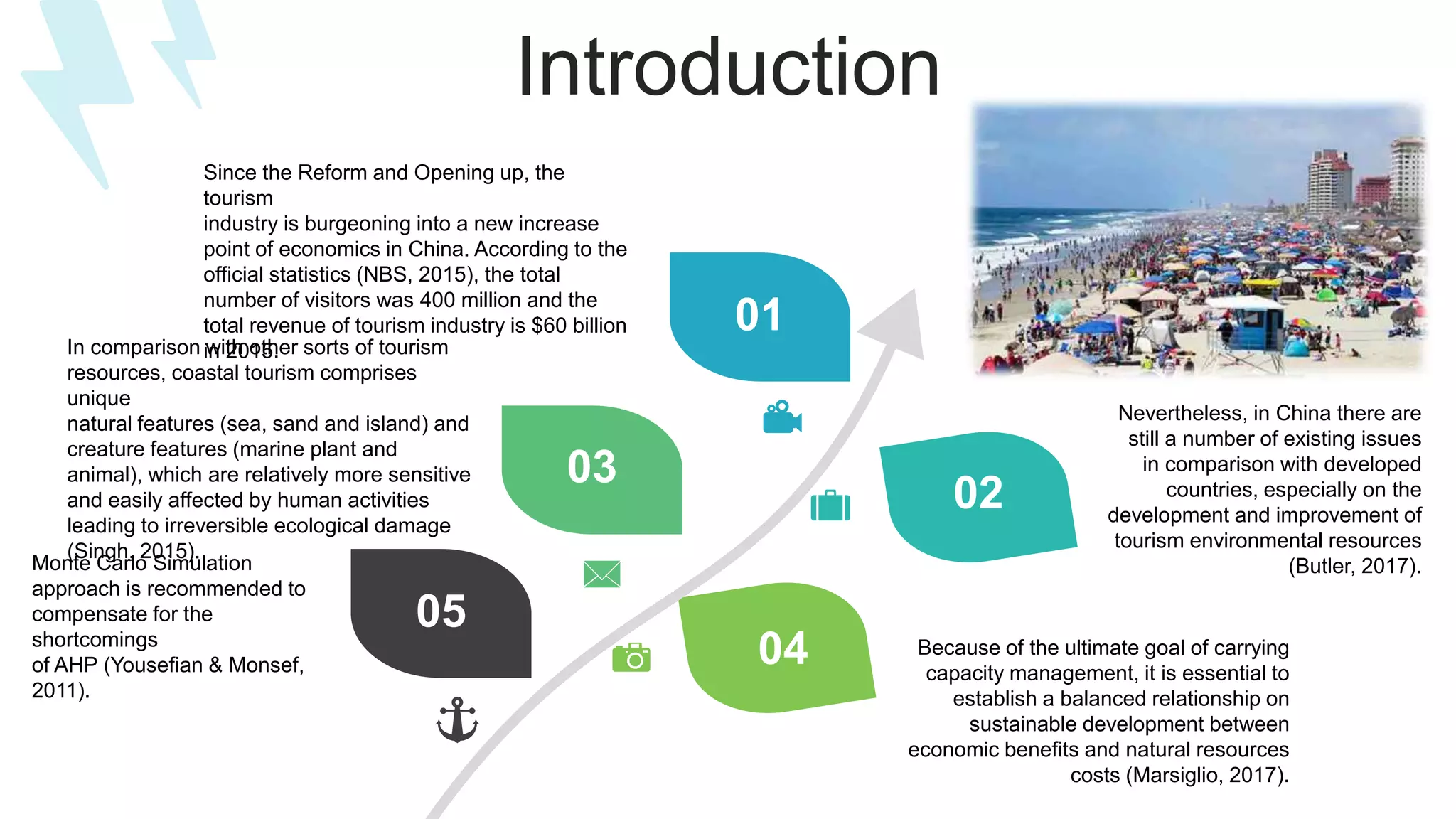
in 2015.In comparison with other sorts of tourism
resources, coastal tourism comprises
unique
natural features (sea, sand and island) and
creature features (marine plant and
animal), which are relatively more sensitive
and easily affected by human activities
leading to irreversible ecological damage
(Singh, 2015).
Nevertheless, in China there are
still a number of existing issues
in comparison with developed
countries, especially on the
development and improvement of
tourism environmental resources
(Butler, 2017).
Because of the ultimate goal of carrying
capacity management, it is essential to
establish a balanced relationship on
sustainable development between
economic benefits and natural resources
costs (Marsiglio, 2017).
Monte Carlo Simulation
approach is recommended to
compensate for the
shortcomings
of AHP (Yousefian & Monsef,
2011).
The propose to add Monte Carlo Simulation in
carrying capacity indicator analysis to form a
MCAHP model in order to conclude more
objective and accurate ranking results.
The aim
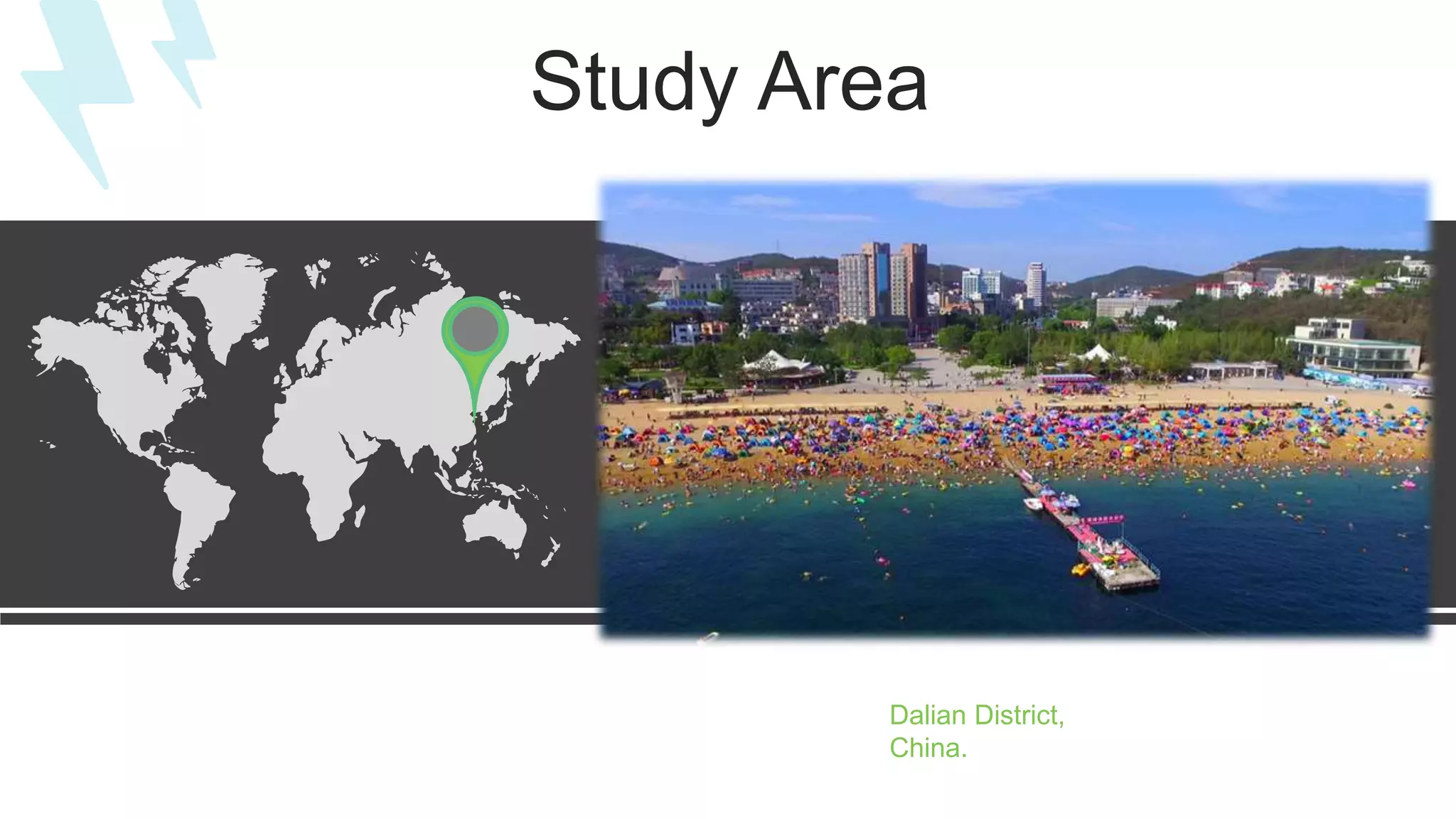
Study Area
Dalian District,
China.
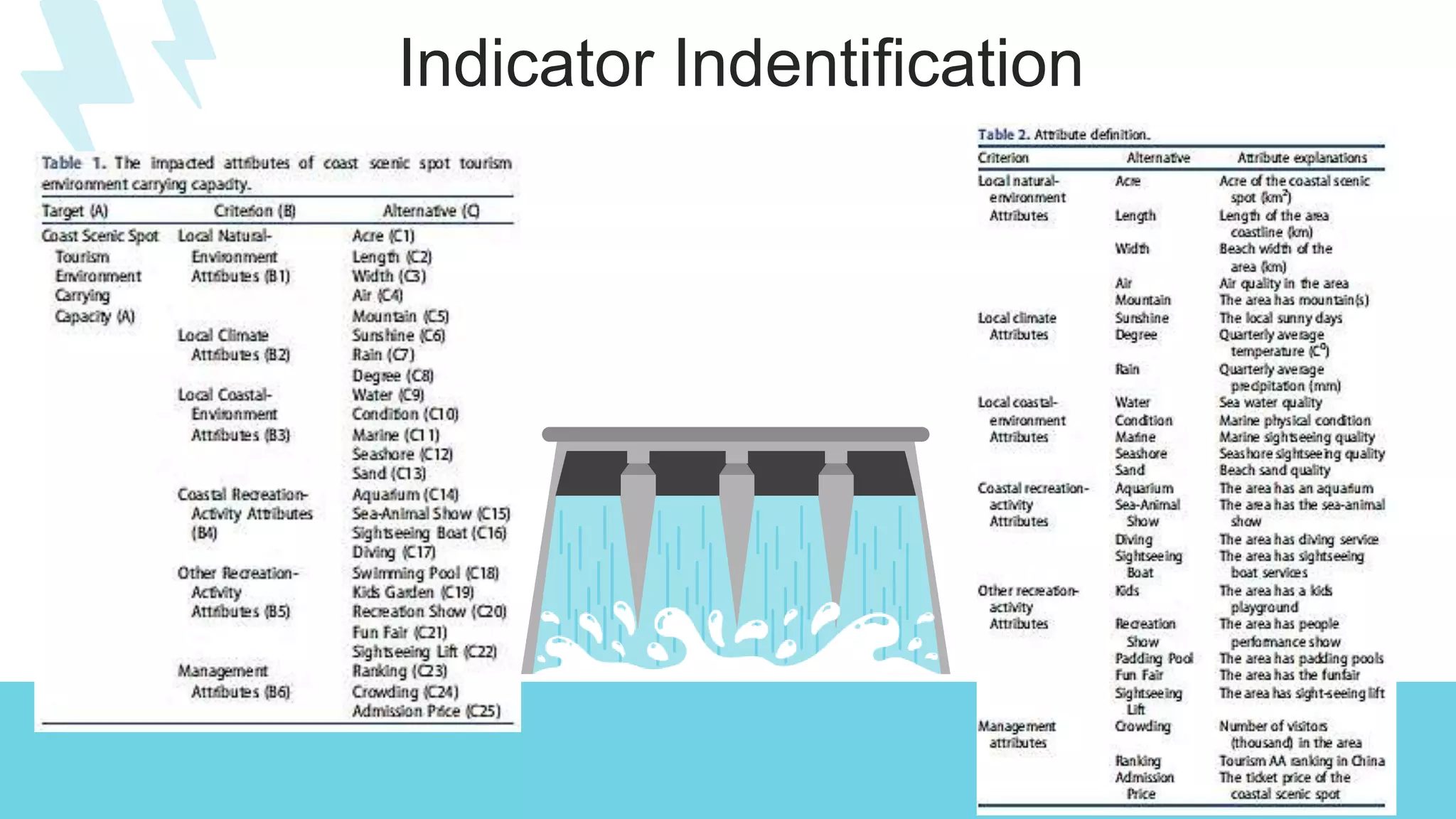
Indicator Indentification
Survey schedule
800 respondents as actual ranking survey by random in coastal
parks and seaside scenic spots with the support from local
management department, and 636 questionnaires results are
valid.
A total of 377 (59.3%) respondents are female, and age
distribution is as follows: 35.5% aged 21–30 years old,
38.8% aged 31–40 years old, and others aged in the rest
age groups.
Around 70.3% of tourists hold a bachelor degree, and over
96% had at least a high school and an equivalent
education level. During the pilot survey, only 36.6% of
respondents are local residents.
Data analysis
in Table 3 that the overall Cronbach’s alpha coefficient
is 0.911, greater than 0.8. indicating the good reliability
of questionnaire and sample data.
Methodology
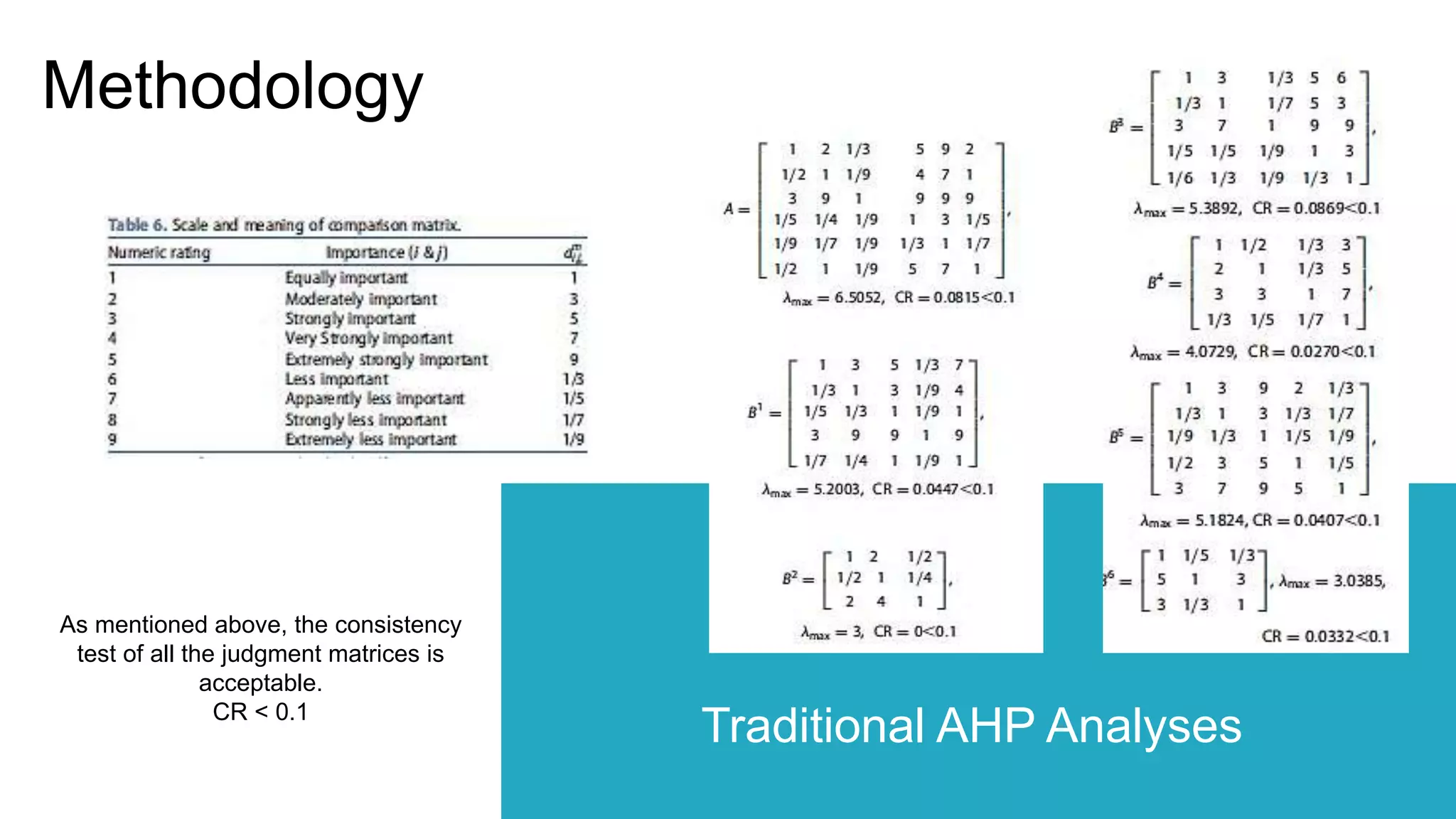
Traditional AHP Analyses
As mentioned above, the consistency
test of all the judgment matrices is
acceptable.
CR < 0.1
Methodology
Monte Carlo AHP
According to the estimations of survey,
it confirms the probability distribution
as the three points of estimations
(maximum, optimum and minimum) to
create triangular distribution of random
variables as follows.
Results
AHP
Results
Monte Carlo AHP
Results
MCAHP
Discussio
n
Both traditional AHP and Monte Carlo AHP
techniques retain the top five leading
alternatives regarding coastal tourism carrying
capacity, including Marine, Water, Air, Degree,
Crowding and etc.
The results identify that great attentions are
paid to “crowding”, because not only tourists
are in the pursuit of comfortable recreation
experience, but also the expenses need to be
guaranteed.
Quality of “marine sightseeing” and “seawater”
are the tourists’ prior considerations in the
coastal tourism, and this is in line with the
main purpose of tourists.
Conclusion
The analysis presented in this paper successfully
combines MCAHP (Monte Carlo Analytical
Hierarchy Process). Empirical results indicate
the newly developed method provides a better
framework for identifying the significance of the
concerned factors.
Thank you

Review "Application of Monte Carlo AHP" Zhu (2019)

  • 1.
    Application of MonteCarlo AHP in ranking coastal tourism environmental carrying capacity factors Zhu J, Wang E, Sun W (2019) Anisa Aulia Sabilah C552190011
  • 3.
  • 4.
    Introduction 01 03 05 04 02 Since the Reformand Opening up, the tourism industry is burgeoning into a new increase point of economics in China. According to the official statistics (NBS, 2015), the total number of visitors was 400 million and the total revenue of tourism industry is $60 billion in 2015.In comparison with other sorts of tourism resources, coastal tourism comprises unique natural features (sea, sand and island) and creature features (marine plant and animal), which are relatively more sensitive and easily affected by human activities leading to irreversible ecological damage (Singh, 2015). Nevertheless, in China there are still a number of existing issues in comparison with developed countries, especially on the development and improvement of tourism environmental resources (Butler, 2017). Because of the ultimate goal of carrying capacity management, it is essential to establish a balanced relationship on sustainable development between economic benefits and natural resources costs (Marsiglio, 2017). Monte Carlo Simulation approach is recommended to compensate for the shortcomings of AHP (Yousefian & Monsef, 2011).
  • 5.
    The propose toadd Monte Carlo Simulation in carrying capacity indicator analysis to form a MCAHP model in order to conclude more objective and accurate ranking results. The aim
  • 6.
  • 7.
  • 8.
    Survey schedule 800 respondentsas actual ranking survey by random in coastal parks and seaside scenic spots with the support from local management department, and 636 questionnaires results are valid. A total of 377 (59.3%) respondents are female, and age distribution is as follows: 35.5% aged 21–30 years old, 38.8% aged 31–40 years old, and others aged in the rest age groups. Around 70.3% of tourists hold a bachelor degree, and over 96% had at least a high school and an equivalent education level. During the pilot survey, only 36.6% of respondents are local residents.
  • 9.
    Data analysis in Table3 that the overall Cronbach’s alpha coefficient is 0.911, greater than 0.8. indicating the good reliability of questionnaire and sample data.
  • 10.
    Methodology Traditional AHP Analyses Asmentioned above, the consistency test of all the judgment matrices is acceptable. CR < 0.1
  • 11.
    Methodology Monte Carlo AHP Accordingto the estimations of survey, it confirms the probability distribution as the three points of estimations (maximum, optimum and minimum) to create triangular distribution of random variables as follows.
  • 12.
  • 13.
  • 14.
  • 15.
    Discussio n Both traditional AHPand Monte Carlo AHP techniques retain the top five leading alternatives regarding coastal tourism carrying capacity, including Marine, Water, Air, Degree, Crowding and etc. The results identify that great attentions are paid to “crowding”, because not only tourists are in the pursuit of comfortable recreation experience, but also the expenses need to be guaranteed. Quality of “marine sightseeing” and “seawater” are the tourists’ prior considerations in the coastal tourism, and this is in line with the main purpose of tourists.
  • 16.
    Conclusion The analysis presentedin this paper successfully combines MCAHP (Monte Carlo Analytical Hierarchy Process). Empirical results indicate the newly developed method provides a better framework for identifying the significance of the concerned factors.
  • 17.