Reuse Contracts as a basis for
     investigating reusability of
           Smalltalk code
                      Koen De Hondt
               Programming Technology Lab
               Computer Science Department
                 Vrije Universiteit Brussel

      kdehondt@vub.ac.be       http:/progwww.vub.ac.be/

1
Overview
     Problems with reuse
     Problems with evolution
     What are reuse contracts?
     Reuse contracts at work
     Examining class hierarchies based on
     reuse contracts
     Reuse contract research
     Exercises: introduction to the browser
2
How do You Reuse a Class?

     Cloning (copy and paste)
     Inheritance / method overriding
     Composition / delegation


3
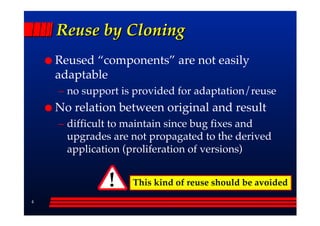
Reuse by Cloning
    Reused ““components”” are not easily
    adaptable
    –– no support is provided for adaptation/reuse
    No relation between original and result
    –– difficult to maintain since bug fixes and
       upgrades are not propagated to the derived
       application (proliferation of versions)


              !    This kind of reuse should be avoided
4
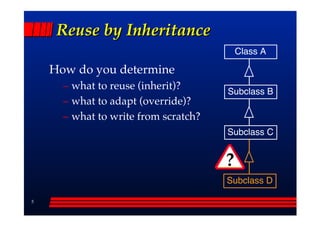
Reuse by Inheritance
                                           Class A

    How do you determine
      –– what to reuse (inherit)?      Subclass B
      –– what to adapt (override)?
      –– what to write from scratch?
                                       Subclass C


                                       ?
                                       Subclass D

5
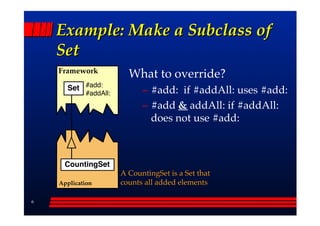
Example: Make a Subclass of
    Set
    Framework
                         What to override?
      Set #add:              –– #add: if #addAll: uses #add:
            #addAll:
                             –– #add & addAll: if #addAll:
                                does not use #add:


     CountingSet
                       A CountingSet is a Set that
    Application        counts all added elements

6
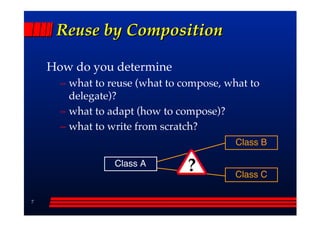
Reuse by Composition

    How do you determine
      –– what to reuse (what to compose, what to
         delegate)?
      –– what to adapt (how to compose)?
      –– what to write from scratch?
                                          Class B

                 Class A
                                ?         Class C

7
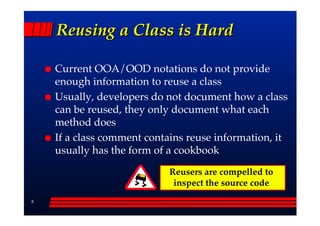
Reusing a Class is Hard

    Current OOA/OOD notations do not provide
    enough information to reuse a class
    Usually, developers do not document how a class
    can be reused, they only document what each
    method does
    If a class comment contains reuse information, it
    usually has the form of a cookbook
                            Reusers are compelled to
                             inspect the source code
8
Inspecting the Source Code

     To reuse a class:
     –– inspect the class
     –– inspect all its superclasses
     –– inspect all the classes it co-operates with
     Source code inspection is error-prone
     If source code inspection doesn’’t work:
     talk to the developer (i.e. the expert)!

9
What are You Looking for?
     Self sends
     Super sends
                                     Reusers need the
     Abstract methods             specialisation interface
     Template methods
     Default methods
     Methods that are overridden frequently
     Methods that are part of a design pattern
     Co-operation with other objects/classes
     ...

10
Self Sends are Important

     Self sends & template methods & abstract
     methods reify the design of a class
     Method decomposition
     –– distinguish ““core”” methods from ““peripheral””
        methods
     Using self sends = planning for reuse
     –– fine-grained overriding of methods


11
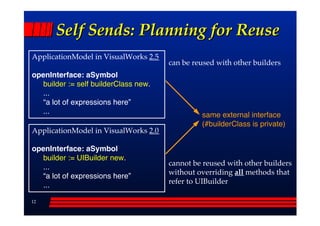
Self Sends: Planning for Reuse
ApplicationModel in VisualWorks 2.5
                                       can be reused with other builders
openInterface: aSymbol
   builder := self builderClass new.
   ...
   “a lot of expressions here”
   ...                                          same external interface
                                                (#builderClass is private)
ApplicationModel in VisualWorks 2.0

openInterface: aSymbol
   builder := UIBuilder new.
                                       cannot be reused with other builders
   ...
                                       without overriding all methods that
   “a lot of expressions here”
                                       refer to UIBuilder
   ...

12
Co-operation with Other
     Objects/Classes is Important

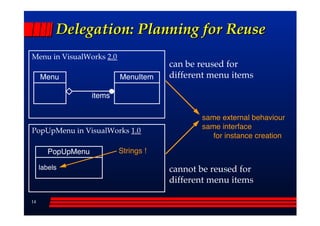
      Delegation of responsibilities principle
      Using delegation= planning for reuse
      –– a system can easily be extended by adding
         new classes
      –– objects with ““the same interface”” can be
         substituted for each other


13
Delegation: Planning for Reuse
Menu in VisualWorks 2.0
                                        can be reused for
     Menu                   MenuItem    different menu items

                    items

                                               same external behaviour
                                               same interface
PopUpMenu in VisualWorks 1.0
                                                  for instance creation

        PopUpMenu           Strings !

     labels                             cannot be reused for
                                        different menu items

14
Overview
      Problems with reuse
      Problems with evolution
      What are reuse contracts?
      Reuse contracts at work
      Examining class hierarchies based on
      reuse contracts
      Reuse contract research
      Exercises: introduction to the browser
15
Evolution is Important

      Iterative development
      –– a framework is never finished
      Changing requirements
      –– functional: user requirements
      –– non-functional: maintainability,
         adaptibility, reusability, customisability, ...


16
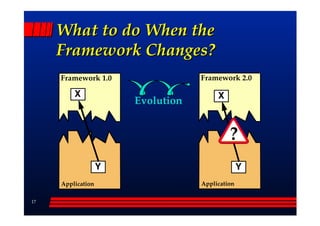
What to do When the
     Framework Changes?
     Framework 1.0                 Framework 2.0

         X                              X
                       Evolution


                                            ?
                   Y                             Y
     Application                   Application

17
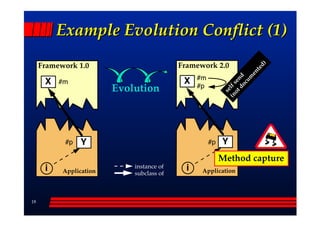
Example Evolution Conflict (1)
     Framework 1.0                         Framework 2.0


                                                                       d)
                                                                       te
                                                                     en
                                                 #m


                                                               do d
                                                                   m
      X                                     X


                                                             ot en
          #m


                                                                 cu
                                                           (n lf s
                         Evolution               #p


                                                             se
           #p   Y                                     #p   Y
                                                           Method capture
      i                      instance of     i
           Application       subclass of          Application


18
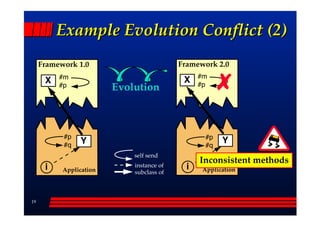
Example Evolution Conflict (2)
     Framework 1.0                         Framework 2.0
          #m                                     #m
      X                                     X    #p
          #p             Evolution


           #p                                      #p
           #q
                Y                                  #q
                                                        Y
                             self send
                             instance of
                                                 Inconsistent methods
      i    Application                       i    Application
                             subclass of


19
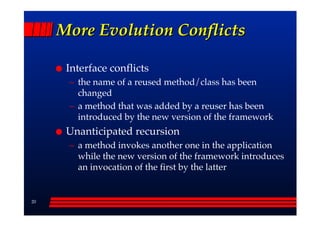
More Evolution Conflicts

      Interface conflicts
      –– the name of a reused method/class has been
         changed
      –– a method that was added by a reuser has been
         introduced by the new version of the framework
      Unanticipated recursion
      –– a method invokes another one in the application
         while the new version of the framework introduces
         an invocation of the first by the latter


20
Spotting Evolution Problems

      Unless the changes to the framework
      are well-documented (informally), the
      application developer is condemned to
      perform code inspection to determine
      what has changed
      Often evolution conflicts are not spotted
      until the application is running based on
      the new version of the framework

21
What are the Challenges?
     Supporting reuse
     –– what can be reused, what must be adapted, and what
        must be built from scratch ?
     –– formal documentation on how classes are reused
     Supporting evolution
     –– change propagation
     Support for estimates/testing/metrics
     –– feasibility of reusing a class
     –– the cost of ““upgrading”” the class repository

22
Overview
      Problems with reuse
      Problems with evolution
      What are reuse contracts?
      Reuse contracts at work
      Examining class hierarchies based on
      reuse contracts
      Reuse contract research
      Exercises: introduction to the browser
23
Reuse Contracts

      Are contracts between the framework
      developer and the application
      developer
      State what assumptions can be made
      about reusable components
      State how components are actually
      reused


24
Reuse Contract Notation

     Notation based on OMT (UML)
     Methods are annotated with
     specialisation clauses to make the
     specialisation interface explicit
     ““Reuse operators””, or ““modifiers””, lay
     down how reuse is achieved


25
Reuse Contracts for Inheritance
                                                       specialisation clause
     Enhance the interface of a class
                                          abstract method
     with specialisation clauses
                                                        Collection
     Identify what changes are made
                                                     #collect: [#do:]
     when a class is subclassed:
                                                     #do:
      –– concretisation/abstraction                  #select: [#do:]
      –– extension/cancellation
                                               concretisation
      –– refinement/coarsening                     #do:
     Specialisation clauses may contain
                                                             Set
     names of methods invoked
                                                     #collect: [#do:]
     through self sends, and ““super””
                                                     #do:
                                   reuse operator    #select: [#do:]


26
Reuse Operator: Concretisation

                                   Collection
     Makes abstract methods     #collect: [#do:]
     concrete                   #do:
                                #select: [#do:]
     Does not change the
     specialisation clause of       concretisation
                                      #do:
     the concretised methods
     Design preserving                  Set
                                #collect: [#do:]
     Inverse = abstraction      #do:
                                #select: [#do:]


27
Reuse Operator: Abstraction
                                        View
                                #preferredBounds [ ]
     Makes a concrete method
     abstract
                                    SimpleView
     Design breaching           #preferredBounds [ ]
     Inverse = concretisation
                                 BasicButtonView
                                #preferredBounds [ ]
                                  abstraction
                                   #preferredBounds
                                LabeledButtonView
                                #preferredBounds [ ]

28
Reuse Operator: Extension
     Typically performed by an
     application developer to add           Collection
     application specific behaviour   ...

     Adds new methods to the                 extension
     interface of a class                      #-
                                               #grow
     Design preserving                         Set
     Inverse = cancellation           ...
                                      #- [ ]
                                      #grow [ ]


29
Reuse Operator: Cancellation
                                             Collection
     Typically performed by an   ...
                                 #add: [ ]
     application developer to    #remove:ifAbsent: [ ]
     remove behaviour                   cancellation
                                          #remove:ifAbsent:
     Removes methods from
     the interface of a class    SequenceableCollection
                                 ...
     Design breaching            #add: [ ]

     Inverse = extension                cancellation
                                          #add:

                                       ArrayedCollection
                                 ...

30
Reuse Operator: Refinement
     Adds elements to the
                                                 Object
     specialisation clause of a
     method                           #postCopy [ ]

     Used to e.g. :                     refinement
                                          #postCopy [super,
     –– reduce redundancy                       + #breakDependents]
     –– specialise the behaviour of              Model
        an existing method with an    #postCopy
        existing behaviour             [super, #breakDependents]

     Design preserving
     Inverse = coarsening
31
Reuse Operator: Coarsening
     Removes elements from
                                       Collection
     the specialisation clause of
     a method                       #size [#do:]

     Used to e.g.:                     coarsening
                                         #size [- #do:]
     –– optimize performance
     Design breaching                       Set
     Inverse = refinement           #size [ ]


32
Reuse Operators

      Make a distinction between different
      kinds of inheritance
      State how a class is derived from its
      superclass
      Are orthogonal basic operators
      Usually, one subclassing step is a
      combination of several reuse operators


33
Frequently Used Combinations
     of Reuse Operators
     Extension & refinement
     Coarsening & cancellation
     Concretisation & refinement
     Concretisation & extension & refinement
     Coarsening & refinement = redefinition
     Coarsening & extension & refinement
     = factorization
34
Multi-Class Reuse Contracts
     (in short)
     Co-operating classes are put in one reuse
     contract; these classes are called ““participants””
     Interfaces of classes as in reuse contracts for
     inheritance
     Specialisation clauses are extended with names
     of methods invoked on other classes
     Reuse operators identify what changes are
     made to a whole contract

35
Reuse Contract Notation
     Interface opening          specialisation clauses              participants

                            #openInterface:                    UIBuilder
        ApplicationModel     [#source:, #add:,             #source:
                              #openWithExtent:]            #add:
        #openInterface:
                                                   builder #openWithExtent:
                self
                                         #openInterface:
                                          [#model:, #displayPendingInvalidation]

        #openInterface:
         [#preBuildWith:,                       ApplicationWindow
          #hookupWindow:spec:builder:,     #model:
          #postBuildWith:,                 #displayPendingInvalidation
          #postOpenWith:]

36
Overview
      Problems with reuse
      Problems with evolution
      What are reuse contracts?
      Reuse contracts at work
      Examining class hierarchies based on
      reuse contracts
      Reuse contract research
      Exercises: introduction to the browser
37
Reuse Contracts at Work
     The formal nature of reuse contracts
     enables their use in a development
     environment
       –– code generation from reuse contracts
       –– impact analysis when a framework
          changes (assessing evolution conflicts)
       –– effort estimation for framework
          customisation
       –– extraction from source code

38
Estimating Reuse
     Framework                  Framework

      Set #add:                  Set #add: [ ]
          #addAll:                    #addAll: [#add:]


             ?
           What to override?
                                 CountingSet
      CountingSet
                                #add: [super, #incCount]
                                #incCount [ ]

                  Application                Application


39
Evolution
     Framework                               Framework

      Set #add: [ ]                           Set #add: [ ]
           #addAll: [#add:]     Evolution           #addAll: [#add:]


      CountingSet                             CountingSet
     #add: [super, #incCount]                 #add: [super, #incCount]
     #incCount [ ]                            #incCount [ ]
                                    Not all additions
                  Application                         Application
                                    are counted anymore
40
Documenting Reuse
                                Framework
     Framework
                                 Set #add: [ ]
                                      #addAll: [#add:]
      Set #add: [ ]
          #addAll: [#add:]

                                     extension
                                       #incCount
                                     refinement
                                       #add: [super,+#incCount]


      CountingSet
                                 CountingSet
     #add: [super, #incCount]
     #incCount [ ]              #add: [super, #incCount]
                                #incCount [ ]
                  Application
                                             Application

41
Documenting Evolution
     Framework                                      Framework

      Set #add: [ ]                                  Set #add: [ ]
           #addAll: [#add:]   Evolution                   #addAll: [#add:]


     Framework                                      Framework

      Set #add: [ ]           coarsening             Set #add: [ ]
           #addAll: [#add:]                               #addAll: [ ]
                                #addAll: [-#add:]


42
Estimating Impact of Changes
Framework                                             Framework

     Set #add: [ ]                                     Set #add: [ ]
           #addAll: [#add:]     coarsening                  #addAll: [ ]
                                  #addAll: [-#add:]

          extension                                        extension
            #incCount                                        #incCount
          refinement                                       refinement
            #add: [super,+#incCount]                         #add: [super,+#incCount]


     CountingSet                                       CountingSet
     #add: [super, #incCount]                      #add: [super, #incCount]
     #incCount [ ]                                 #incCount [ ]
                                            #addAll: needs to be
                  Application               overridden too          Application

43
Overview
      Problems with reuse
      Problems with evolution
      What are reuse contracts?
      Reuse contracts at work
      Examining class hierarchies based on
      reuse contracts
      Reuse contract research
      Exercises: introduction to the browser
44
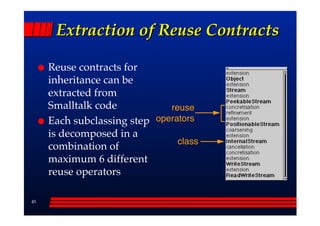
Extraction of Reuse Contracts

     Reuse contracts for
     inheritance can be
     extracted from
     Smalltalk code           reuse
     Each subclassing step operators
     is decomposed in a
                                class
     combination of
     maximum 6 different
     reuse operators

45
Too Much Extracted
     Information
      The extractor does not know which
      methods are important
      Interaction with a developer is required
      to strip implementation details


46
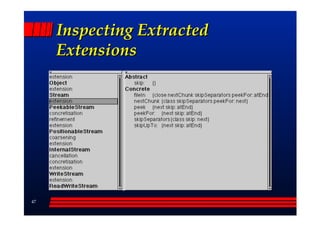
Inspecting Extracted
     Extensions


47
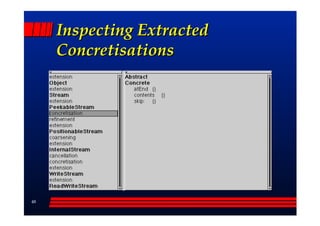
Inspecting Extracted
     Concretisations


48
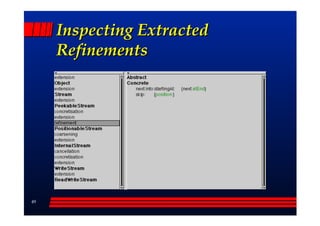
Inspecting Extracted
     Refinements


49
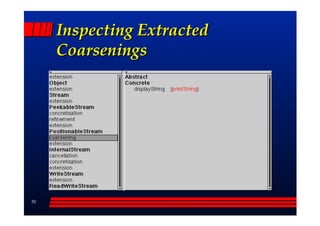
Inspecting Extracted
     Coarsenings


50
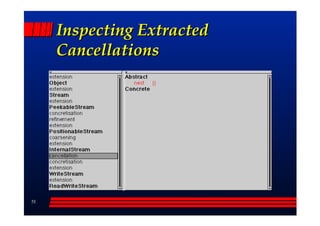
Inspecting Extracted
     Cancellations


51
Spotting Bad Designs in a
     Class Hierarchy
      Look for design breaching reuse
      operators
      –– they indicate methods that do not respect
         the design as laid down by a superclass
      Examine what happens with the
      affected methods in reuse operators that
      are applied later on

52
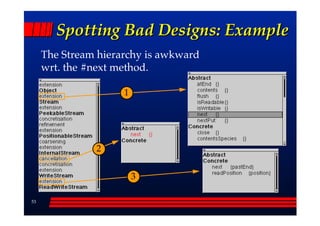
Spotting Bad Designs: Example
     The Stream hierarchy is awkward
     wrt. the #next method.

                     1


               2


                         3

53
Impact of Bad Coding Style

      Bad coding style is troublesome for the
      extractor
      –– e.g. only super send, bad super send, ...
      This has driven us to make qualitative
      assessment of source code possible
      An analysis tool is integrated in our
      browser

54
Overview
      Problems with reuse
      Problems with evolution
      What are reuse contracts?
      Reuse contracts at work
      Examining class hierarchies based on
      reuse contracts
      Reuse contract research
      Exercises: introduction to the browser
55
Reuse Contract Research
     Reuse contracts have been applied to
     –– classes (inheritance)
     –– sets of interacting classes/components
     –– state diagrams
     Under investigation:
     ––   can reuse contracts describe design patterns?
     ––   generic reuse contracts
     ––   extraction of multi-class reuse contracts
     ––   software architectures and componentware
     ––   reuse contracts in a development environment
     ––   more documentation than interfaces and invocations
56
Design Pattern Example
     Client                    Component      graphics

                               #operation

              concretisation                refinement   operation [operation]
                                            extension

                                      Composite
                                                                    concretisation
                   Leaf              #operation
                                     #add:
               #operation
                                     #remove:
                                     #getChild:                   CompositeA
                                                                  #operation
                                                                  #add:
                                                                  #remove:
                                                                  #getChild:

57
Summary: Theory

     Reuse contracts formally document what
     a reuser can assume about a ““reusable
     component””
     Reuse operators formally document how
     a reusable component is actually reused
     Formal rules for change propagation
     enable automatic detection of evolution
     conflicts
58
Summary: Practice

      Reuse contracts for inheritance can be
      extracted
      –– examination of existing source code
      –– understanding the design
      –– human input is needed to filter out
         implementation details
      –– bad coding style may give rise to extraction
         problems

59
Overview
      Problems with reuse
      Problems with evolution
      What are reuse contracts?
      Reuse contracts at work
      Examining class hierarchies based on
      reuse contracts
      Reuse contract research
      Exercises: introduction to the browser
60
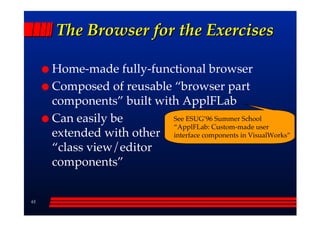
The Browser for the Exercises

     Home-made fully-functional browser
     Composed of reusable ““browser part
     components”” built with ApplFLab
     Can easily be         See ESUG’’96 Summer School
                           ““ApplFLab: Custom-made user
     extended with other interface components in VisualWorks””
     ““class view/editor
     components””


61
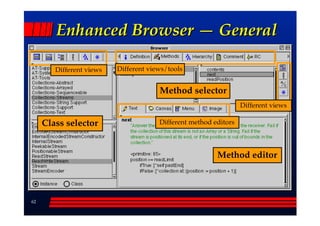
Enhanced Browser —— General

        Different views   Different views/tools


                                       Method selector
                                                                  Different views

     Class selector                    Different method editors


                                                         Method editor


62
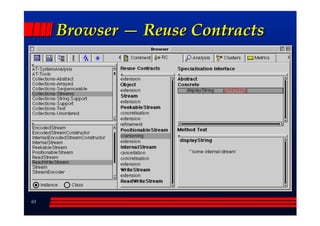
Browser —— Reuse Contracts


63
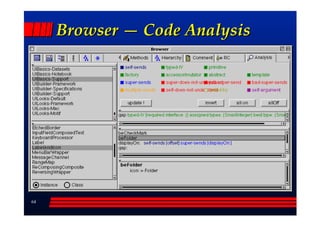
Browser —— Code Analysis


64
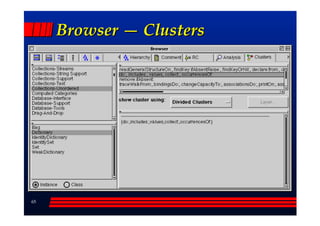
Browser —— Clusters


65
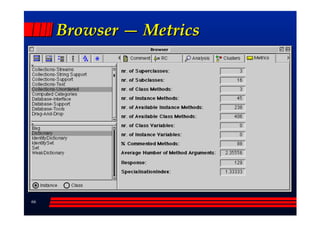
Browser —— Metrics


66
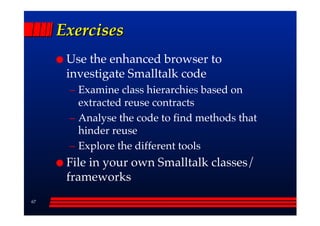
Exercises
      Use the enhanced browser to
      investigate Smalltalk code
      –– Examine class hierarchies based on
         extracted reuse contracts
      –– Analyse the code to find methods that
         hinder reuse
      –– Explore the different tools
      File in your own Smalltalk classes/
      frameworks
67
Up-to-date Information


       http://progwww.vub.ac.be/prog/pools/rcs/

68

Reuse Contracts

  • 1.
    Reuse Contracts asa basis for investigating reusability of Smalltalk code Koen De Hondt Programming Technology Lab Computer Science Department Vrije Universiteit Brussel kdehondt@vub.ac.be http:/progwww.vub.ac.be/ 1
  • 2.
    Overview Problems with reuse Problems with evolution What are reuse contracts? Reuse contracts at work Examining class hierarchies based on reuse contracts Reuse contract research Exercises: introduction to the browser 2
  • 3.
    How do YouReuse a Class? Cloning (copy and paste) Inheritance / method overriding Composition / delegation 3
  • 4.
    Reuse by Cloning Reused ““components”” are not easily adaptable –– no support is provided for adaptation/reuse No relation between original and result –– difficult to maintain since bug fixes and upgrades are not propagated to the derived application (proliferation of versions) ! This kind of reuse should be avoided 4
  • 5.
    Reuse by Inheritance Class A How do you determine –– what to reuse (inherit)? Subclass B –– what to adapt (override)? –– what to write from scratch? Subclass C ? Subclass D 5
  • 6.
    Example: Make aSubclass of Set Framework What to override? Set #add: –– #add: if #addAll: uses #add: #addAll: –– #add & addAll: if #addAll: does not use #add: CountingSet A CountingSet is a Set that Application counts all added elements 6
  • 7.
    Reuse by Composition How do you determine –– what to reuse (what to compose, what to delegate)? –– what to adapt (how to compose)? –– what to write from scratch? Class B Class A ? Class C 7
  • 8.
    Reusing a Classis Hard Current OOA/OOD notations do not provide enough information to reuse a class Usually, developers do not document how a class can be reused, they only document what each method does If a class comment contains reuse information, it usually has the form of a cookbook Reusers are compelled to inspect the source code 8
  • 9.
    Inspecting the SourceCode To reuse a class: –– inspect the class –– inspect all its superclasses –– inspect all the classes it co-operates with Source code inspection is error-prone If source code inspection doesn’’t work: talk to the developer (i.e. the expert)! 9
  • 10.
    What are YouLooking for? Self sends Super sends Reusers need the Abstract methods specialisation interface Template methods Default methods Methods that are overridden frequently Methods that are part of a design pattern Co-operation with other objects/classes ... 10
  • 11.
    Self Sends areImportant Self sends & template methods & abstract methods reify the design of a class Method decomposition –– distinguish ““core”” methods from ““peripheral”” methods Using self sends = planning for reuse –– fine-grained overriding of methods 11
  • 12.
    Self Sends: Planningfor Reuse ApplicationModel in VisualWorks 2.5 can be reused with other builders openInterface: aSymbol builder := self builderClass new. ... “a lot of expressions here” ... same external interface (#builderClass is private) ApplicationModel in VisualWorks 2.0 openInterface: aSymbol builder := UIBuilder new. cannot be reused with other builders ... without overriding all methods that “a lot of expressions here” refer to UIBuilder ... 12
  • 13.
    Co-operation with Other Objects/Classes is Important Delegation of responsibilities principle Using delegation= planning for reuse –– a system can easily be extended by adding new classes –– objects with ““the same interface”” can be substituted for each other 13
  • 14.
    Delegation: Planning forReuse Menu in VisualWorks 2.0 can be reused for Menu MenuItem different menu items items same external behaviour same interface PopUpMenu in VisualWorks 1.0 for instance creation PopUpMenu Strings ! labels cannot be reused for different menu items 14
  • 15.
    Overview Problems with reuse Problems with evolution What are reuse contracts? Reuse contracts at work Examining class hierarchies based on reuse contracts Reuse contract research Exercises: introduction to the browser 15
  • 16.
    Evolution is Important Iterative development –– a framework is never finished Changing requirements –– functional: user requirements –– non-functional: maintainability, adaptibility, reusability, customisability, ... 16
  • 17.
    What to doWhen the Framework Changes? Framework 1.0 Framework 2.0 X X Evolution ? Y Y Application Application 17
  • 18.
    Example Evolution Conflict(1) Framework 1.0 Framework 2.0 d) te en #m do d m X X ot en #m cu (n lf s Evolution #p se #p Y #p Y Method capture i instance of i Application subclass of Application 18
  • 19.
    Example Evolution Conflict(2) Framework 1.0 Framework 2.0 #m #m X X #p #p Evolution #p #p #q Y #q Y self send instance of Inconsistent methods i Application i Application subclass of 19
  • 20.
    More Evolution Conflicts Interface conflicts –– the name of a reused method/class has been changed –– a method that was added by a reuser has been introduced by the new version of the framework Unanticipated recursion –– a method invokes another one in the application while the new version of the framework introduces an invocation of the first by the latter 20
  • 21.
    Spotting Evolution Problems Unless the changes to the framework are well-documented (informally), the application developer is condemned to perform code inspection to determine what has changed Often evolution conflicts are not spotted until the application is running based on the new version of the framework 21
  • 22.
    What are theChallenges? Supporting reuse –– what can be reused, what must be adapted, and what must be built from scratch ? –– formal documentation on how classes are reused Supporting evolution –– change propagation Support for estimates/testing/metrics –– feasibility of reusing a class –– the cost of ““upgrading”” the class repository 22
  • 23.
    Overview Problems with reuse Problems with evolution What are reuse contracts? Reuse contracts at work Examining class hierarchies based on reuse contracts Reuse contract research Exercises: introduction to the browser 23
  • 24.
    Reuse Contracts Are contracts between the framework developer and the application developer State what assumptions can be made about reusable components State how components are actually reused 24
  • 25.
    Reuse Contract Notation Notation based on OMT (UML) Methods are annotated with specialisation clauses to make the specialisation interface explicit ““Reuse operators””, or ““modifiers””, lay down how reuse is achieved 25
  • 26.
    Reuse Contracts forInheritance specialisation clause Enhance the interface of a class abstract method with specialisation clauses Collection Identify what changes are made #collect: [#do:] when a class is subclassed: #do: –– concretisation/abstraction #select: [#do:] –– extension/cancellation concretisation –– refinement/coarsening #do: Specialisation clauses may contain Set names of methods invoked #collect: [#do:] through self sends, and ““super”” #do: reuse operator #select: [#do:] 26
  • 27.
    Reuse Operator: Concretisation Collection Makes abstract methods #collect: [#do:] concrete #do: #select: [#do:] Does not change the specialisation clause of concretisation #do: the concretised methods Design preserving Set #collect: [#do:] Inverse = abstraction #do: #select: [#do:] 27
  • 28.
    Reuse Operator: Abstraction View #preferredBounds [ ] Makes a concrete method abstract SimpleView Design breaching #preferredBounds [ ] Inverse = concretisation BasicButtonView #preferredBounds [ ] abstraction #preferredBounds LabeledButtonView #preferredBounds [ ] 28
  • 29.
    Reuse Operator: Extension Typically performed by an application developer to add Collection application specific behaviour ... Adds new methods to the extension interface of a class #- #grow Design preserving Set Inverse = cancellation ... #- [ ] #grow [ ] 29
  • 30.
    Reuse Operator: Cancellation Collection Typically performed by an ... #add: [ ] application developer to #remove:ifAbsent: [ ] remove behaviour cancellation #remove:ifAbsent: Removes methods from the interface of a class SequenceableCollection ... Design breaching #add: [ ] Inverse = extension cancellation #add: ArrayedCollection ... 30
  • 31.
    Reuse Operator: Refinement Adds elements to the Object specialisation clause of a method #postCopy [ ] Used to e.g. : refinement #postCopy [super, –– reduce redundancy + #breakDependents] –– specialise the behaviour of Model an existing method with an #postCopy existing behaviour [super, #breakDependents] Design preserving Inverse = coarsening 31
  • 32.
    Reuse Operator: Coarsening Removes elements from Collection the specialisation clause of a method #size [#do:] Used to e.g.: coarsening #size [- #do:] –– optimize performance Design breaching Set Inverse = refinement #size [ ] 32
  • 33.
    Reuse Operators Make a distinction between different kinds of inheritance State how a class is derived from its superclass Are orthogonal basic operators Usually, one subclassing step is a combination of several reuse operators 33
  • 34.
    Frequently Used Combinations of Reuse Operators Extension & refinement Coarsening & cancellation Concretisation & refinement Concretisation & extension & refinement Coarsening & refinement = redefinition Coarsening & extension & refinement = factorization 34
  • 35.
    Multi-Class Reuse Contracts (in short) Co-operating classes are put in one reuse contract; these classes are called ““participants”” Interfaces of classes as in reuse contracts for inheritance Specialisation clauses are extended with names of methods invoked on other classes Reuse operators identify what changes are made to a whole contract 35
  • 36.
    Reuse Contract Notation Interface opening specialisation clauses participants #openInterface: UIBuilder ApplicationModel [#source:, #add:, #source: #openWithExtent:] #add: #openInterface: builder #openWithExtent: self #openInterface: [#model:, #displayPendingInvalidation] #openInterface: [#preBuildWith:, ApplicationWindow #hookupWindow:spec:builder:, #model: #postBuildWith:, #displayPendingInvalidation #postOpenWith:] 36
  • 37.
    Overview Problems with reuse Problems with evolution What are reuse contracts? Reuse contracts at work Examining class hierarchies based on reuse contracts Reuse contract research Exercises: introduction to the browser 37
  • 38.
    Reuse Contracts atWork The formal nature of reuse contracts enables their use in a development environment –– code generation from reuse contracts –– impact analysis when a framework changes (assessing evolution conflicts) –– effort estimation for framework customisation –– extraction from source code 38
  • 39.
    Estimating Reuse Framework Framework Set #add: Set #add: [ ] #addAll: #addAll: [#add:] ? What to override? CountingSet CountingSet #add: [super, #incCount] #incCount [ ] Application Application 39
  • 40.
    Evolution Framework Framework Set #add: [ ] Set #add: [ ] #addAll: [#add:] Evolution #addAll: [#add:] CountingSet CountingSet #add: [super, #incCount] #add: [super, #incCount] #incCount [ ] #incCount [ ] Not all additions Application Application are counted anymore 40
  • 41.
    Documenting Reuse Framework Framework Set #add: [ ] #addAll: [#add:] Set #add: [ ] #addAll: [#add:] extension #incCount refinement #add: [super,+#incCount] CountingSet CountingSet #add: [super, #incCount] #incCount [ ] #add: [super, #incCount] #incCount [ ] Application Application 41
  • 42.
    Documenting Evolution Framework Framework Set #add: [ ] Set #add: [ ] #addAll: [#add:] Evolution #addAll: [#add:] Framework Framework Set #add: [ ] coarsening Set #add: [ ] #addAll: [#add:] #addAll: [ ] #addAll: [-#add:] 42
  • 43.
    Estimating Impact ofChanges Framework Framework Set #add: [ ] Set #add: [ ] #addAll: [#add:] coarsening #addAll: [ ] #addAll: [-#add:] extension extension #incCount #incCount refinement refinement #add: [super,+#incCount] #add: [super,+#incCount] CountingSet CountingSet #add: [super, #incCount] #add: [super, #incCount] #incCount [ ] #incCount [ ] #addAll: needs to be Application overridden too Application 43
  • 44.
    Overview Problems with reuse Problems with evolution What are reuse contracts? Reuse contracts at work Examining class hierarchies based on reuse contracts Reuse contract research Exercises: introduction to the browser 44
  • 45.
    Extraction of ReuseContracts Reuse contracts for inheritance can be extracted from Smalltalk code reuse Each subclassing step operators is decomposed in a class combination of maximum 6 different reuse operators 45
  • 46.
    Too Much Extracted Information The extractor does not know which methods are important Interaction with a developer is required to strip implementation details 46
  • 47.
    Inspecting Extracted Extensions 47
  • 48.
    Inspecting Extracted Concretisations 48
  • 49.
    Inspecting Extracted Refinements 49
  • 50.
    Inspecting Extracted Coarsenings 50
  • 51.
    Inspecting Extracted Cancellations 51
  • 52.
    Spotting Bad Designsin a Class Hierarchy Look for design breaching reuse operators –– they indicate methods that do not respect the design as laid down by a superclass Examine what happens with the affected methods in reuse operators that are applied later on 52
  • 53.
    Spotting Bad Designs:Example The Stream hierarchy is awkward wrt. the #next method. 1 2 3 53
  • 54.
    Impact of BadCoding Style Bad coding style is troublesome for the extractor –– e.g. only super send, bad super send, ... This has driven us to make qualitative assessment of source code possible An analysis tool is integrated in our browser 54
  • 55.
    Overview Problems with reuse Problems with evolution What are reuse contracts? Reuse contracts at work Examining class hierarchies based on reuse contracts Reuse contract research Exercises: introduction to the browser 55
  • 56.
    Reuse Contract Research Reuse contracts have been applied to –– classes (inheritance) –– sets of interacting classes/components –– state diagrams Under investigation: –– can reuse contracts describe design patterns? –– generic reuse contracts –– extraction of multi-class reuse contracts –– software architectures and componentware –– reuse contracts in a development environment –– more documentation than interfaces and invocations 56
  • 57.
    Design Pattern Example Client Component graphics #operation concretisation refinement operation [operation] extension Composite concretisation Leaf #operation #add: #operation #remove: #getChild: CompositeA #operation #add: #remove: #getChild: 57
  • 58.
    Summary: Theory Reuse contracts formally document what a reuser can assume about a ““reusable component”” Reuse operators formally document how a reusable component is actually reused Formal rules for change propagation enable automatic detection of evolution conflicts 58
  • 59.
    Summary: Practice Reuse contracts for inheritance can be extracted –– examination of existing source code –– understanding the design –– human input is needed to filter out implementation details –– bad coding style may give rise to extraction problems 59
  • 60.
    Overview Problems with reuse Problems with evolution What are reuse contracts? Reuse contracts at work Examining class hierarchies based on reuse contracts Reuse contract research Exercises: introduction to the browser 60
  • 61.
    The Browser forthe Exercises Home-made fully-functional browser Composed of reusable ““browser part components”” built with ApplFLab Can easily be See ESUG’’96 Summer School ““ApplFLab: Custom-made user extended with other interface components in VisualWorks”” ““class view/editor components”” 61
  • 62.
    Enhanced Browser ——General Different views Different views/tools Method selector Different views Class selector Different method editors Method editor 62
  • 63.
  • 64.
  • 65.
  • 66.
  • 67.
    Exercises Use the enhanced browser to investigate Smalltalk code –– Examine class hierarchies based on extracted reuse contracts –– Analyse the code to find methods that hinder reuse –– Explore the different tools File in your own Smalltalk classes/ frameworks 67
  • 68.
    Up-to-date Information http://progwww.vub.ac.be/prog/pools/rcs/ 68