Rethinking Data Protection Strategies 1st Edition by Aberdeen group
Rethinking Data Protection Strategies 1st Edition by Aberdeen group
Rethinking Data Protection Strategies 1st Edition by Aberdeen group
Rethinking Data Protection Strategies 1st Edition by Aberdeen group
Rethinking Data Protection Strategies 1st Edition by Aberdeen group
1.
Rethinking Data ProtectionStrategies 1st
Edition by Aberdeen group pdf download
https://ebookball.com/product/rethinking-data-protection-
strategies-1st-edition-by-aberdeen-group-10314/
Explore and download more ebooks or textbooks
at ebookball.com
2.
Get Your DigitalFiles Instantly: PDF, ePub, MOBI and More
Quick Digital Downloads: PDF, ePub, MOBI and Other Formats
Component Based Architectures Time to Migrate the Enterprise
Application Portfolio 1st Edition by Aberdeen group
https://ebookball.com/product/component-based-architectures-time-
to-migrate-the-enterprise-application-portfolio-1st-edition-by-
aberdeen-group-10326/
Data protection around the world 1st edition by Elif Kiesow
9789462654075 9462654077
https://ebookball.com/product/data-protection-around-the-
world-1st-edition-by-elif-kiesow-9789462654075-9462654077-15468/
Data Protection and Information Lifecycle Management 1st Edition by
Tom Petrocelli ISBN 0131927574 9780131927575
https://ebookball.com/product/data-protection-and-information-
lifecycle-management-1st-edition-by-tom-petrocelli-
isbn-0131927574-9780131927575-14692/
Data Protection and Information Lifecycle Management 1st Edition by
Tom Petrocelli ISBN 0131927574 9780131927575
https://ebookball.com/product/data-protection-and-information-
lifecycle-management-1st-edition-by-tom-petrocelli-
isbn-0131927574-9780131927575-14690/
3.
Handbook of Researchon Cyber Law Data Protection and Privacy 1st
edition by Dewani Nisha 1799886441 9781799886440
https://ebookball.com/product/handbook-of-research-on-cyber-law-
data-protection-and-privacy-1st-edition-by-dewani-
nisha-1799886441-9781799886440-20030/
Aviation Security Privacy Data Protection and Other Human Rights
Technologies and Legal Principles 1st edition by Olga Mironenko
Enerstvedt 9783319581392 3319581392
https://ebookball.com/product/aviation-security-privacy-data-
protection-and-other-human-rights-technologies-and-legal-
principles-1st-edition-by-olga-mironenko-
enerstvedt-9783319581392-3319581392-25710/
Aviation Security Privacy Data Protection and Other Human Rights
Technologies and Legal Principles 1st edition by Olga Mironenko
Enerstvedt 9783319581392 3319581392
https://ebookball.com/product/aviation-security-privacy-data-
protection-and-other-human-rights-technologies-and-legal-
principles-1st-edition-by-olga-mironenko-
enerstvedt-9783319581392-3319581392-25712/
(EBOOK PDF) Aviation Security Privacy Data Protection and Other Human
Rights 1st Edition by Olga Mironenko Enerstvedt 3319581384
9783319581385 full chapters
https://ebookball.com/product/ebook-pdf-aviation-security-
privacy-data-protection-and-other-human-rights-1st-edition-by-
olga-mironenko-enerstvedt-3319581384-9783319581385-full-
chapters-25548/
A Heuristic Method for Correlating Attribute Group Pairs in Data
Mining 1st Edition by Chua Eng Huang Cecil, Roger Chiang, Ee Peng Lim
9783540656906
https://ebookball.com/product/a-heuristic-method-for-correlating-
attribute-group-pairs-in-data-mining-1st-edition-by-chua-eng-
huang-cecil-roger-chiang-ee-peng-lim-9783540656906-11860/
4.
AberdeenGroup
Rethinking Data
Protection Strategies
AnExecutive White Paper
February 2002
Aberdeen Group, Inc.
One Boston Place
Boston, Massachusetts 02108 USA
Telephone: 617 723 7890
Fax: 617 723 7897
www.aberdeen.com
5.
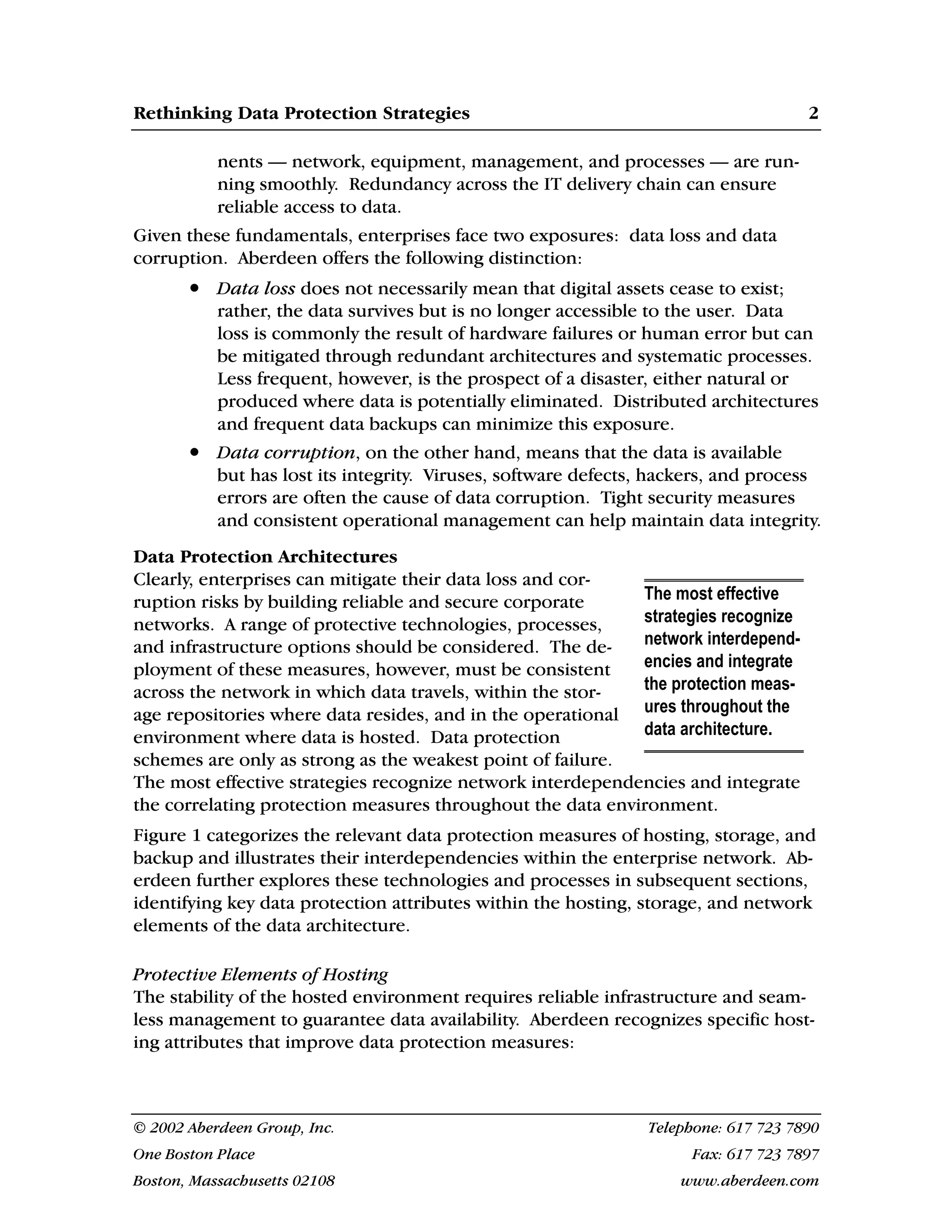
Rethinking Data ProtectionStrategies
Preface
The safety of critical business data is an ongoing concern for responsible enter-
prises. They are challenged by myriad threats to that data: hackers, data corrup-
tion, power outages, natural disasters, and even the most unthinkable. At the
same time, the dynamics of data are also working against the enterprise: Internet
strategies are opening more access points and therefore exposing more data to
these threats; the volume of data is rapidly mounting; and data is more vital to the
business. As a result, enterprises are recognizing that core intellectual assets are
vulnerable, and effective data protection is critical to business success.
Rational enterprises acknowledge these trends and are rethinking data protection
architectures and business continuance plans. A wide selection of technologies,
services, and architectural alternatives — each providing unique benefits, but each
limited in data protection capabilities — is being considered. IT ecosystems are
under analysis to identify the weakest links, where any exposures can nullify all
other protective measures. Security policies are continually updated. Enterprises
are reviewing contingency plans and understanding their effectiveness.
Technologies and services exist to protect an enterprise’s mission-critical data. Un-
fortunately, the costs of protection often restrict the adoption of conservative data
strategies. Instead, enterprises must be pragmatic in their planning, understand-
ing the likelihood of data faults, the implications of those events on the business,
as well as the costs of preventive measures. Enterprises must carefully manage
these variables to minimize risk as if it were a statistical exercise. Outsourced data
protection services have proven to be a practical alternative — when providers of-
fer more secure solutions at lower costs — to those provided internally.
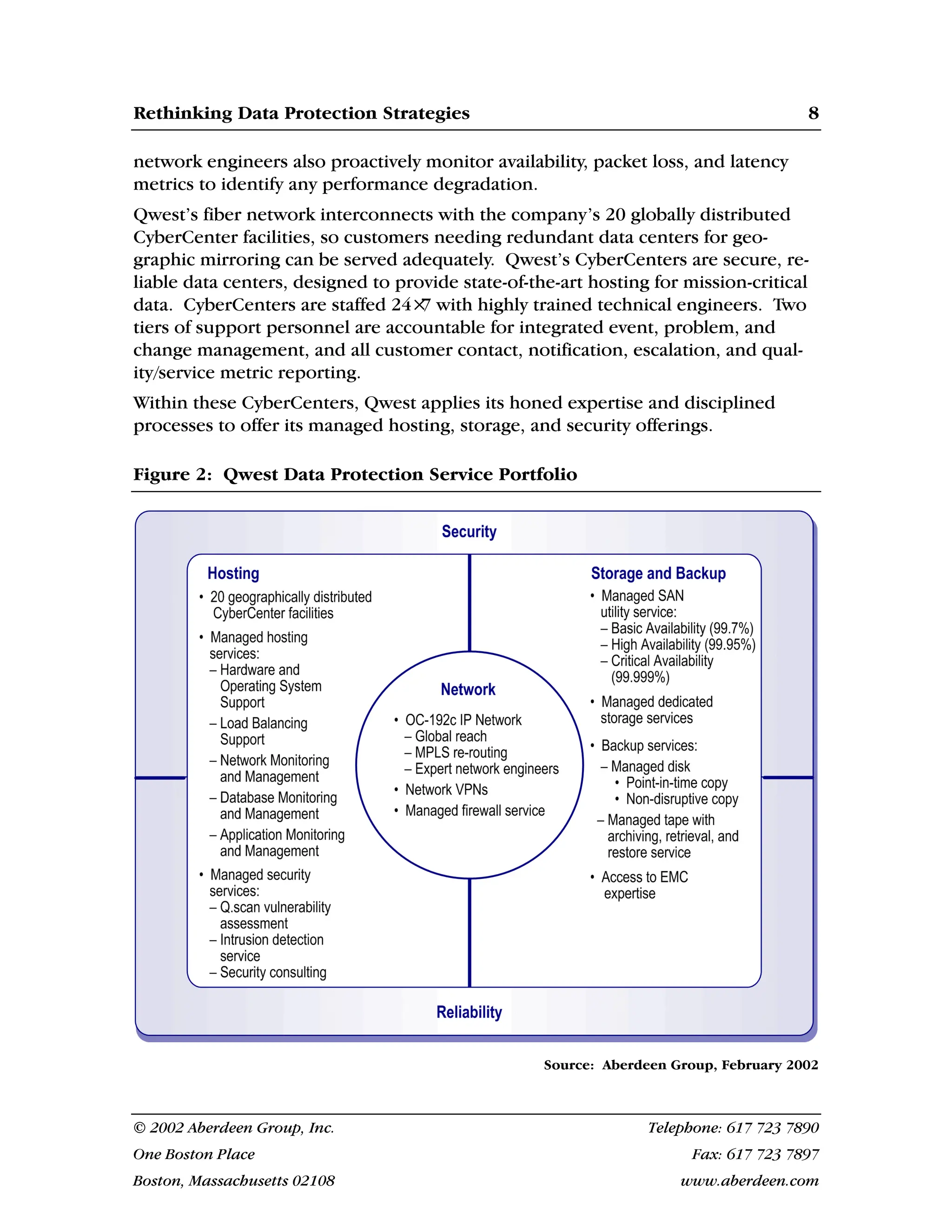
In this Executive White Paper, Aberdeen examines the fundamental variables —
i.e., security and reliability — of data protection and outlines enterprise strategies.
Aberdeen also provides a framework for enterprises to rethink their data protec-
tion architectures and offers insight into practical outsourcing alternatives.
Data Protection Fundamentals
Business privacy and continuity are the goals of corporate data protection efforts.
Enterprises can ensure the safety of critical data sets and the stability of the busi-
ness by building protective measures throughout the data architecture. The fun-
damental variables of security and reliability must be inherent in these strategies.
Both are multi-faceted components of protection, but each requires specific exper-
tise and resources to implement:
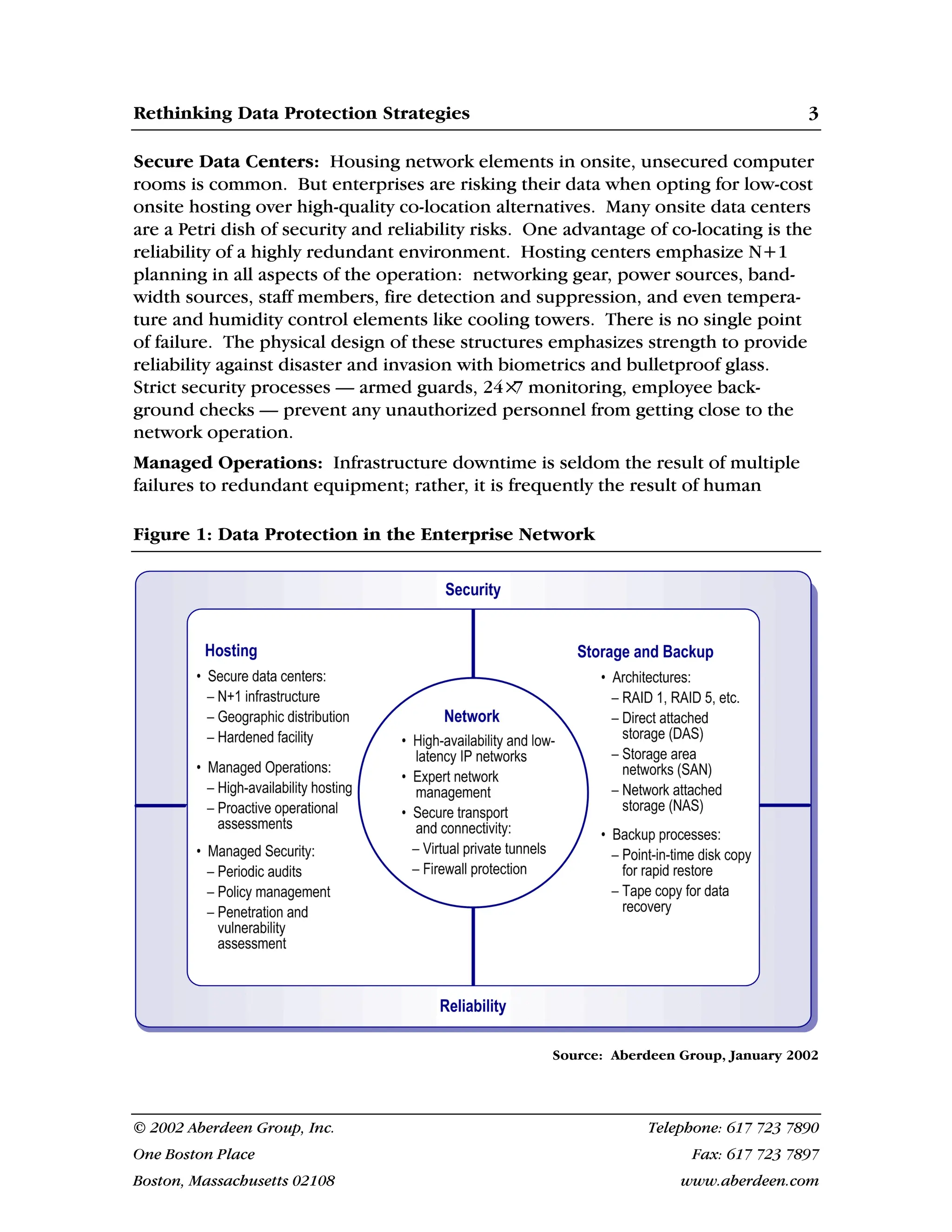
• Security: Providing protection for corporate data requires strict security
policies on two fronts: physical access to the data and its supporting
infrastructure and virtual access to that data through the network;
• Reliability: Data must be easily accessible to users or business continuity
is sacrificed. The consistent availability of data means that all IT compo-
“Then, we arenot likely to become full-fledged machinists in six
months,” added Pemberton Millweed.
“Certainly not, but you can learn a great deal in that time; and, if
you follow the trade for a living, you will have to keep learning all
the time you work at it. In America, apprentices, if there are any
now, only work six months or a year, and really learn the trade, if
they learn it at all, after they go to work as journeymen. Labor is too
valuable in this country for a man to spend seven years in learning a
trade: besides, one who has worked six months at a trade becomes
valuable to his employer.”
“But we are to learn a lot of trades in six months or a year,”
suggested Harry Franklin.
“Not at all: the only trades you are to learn are those of machinist
and carpenter. Incidentally you are to learn a score of other things.
When we find out what the boys are best for, we shall put them
mainly to that. It is a good thing for a machinist to know something
about carpentering, and for a carpenter to be able to handle a piece
of iron as well as a piece of wood.
“Almost every trade now is subdivided into several. Formerly a
carpenter did every thing about a house. Now the doors are made
by one concern, the blinds by another, the stairs by a third, the
floors are laid by a fourth, the lathing by a fifth: all the mouldings
are done by machinery, and so on. So it is with many trades: they
are cut up into specialties. Now, if you please, we will go to work.”
On this side of the shop there were a dozen short benches, each
supplied with tools, which were fewer and simpler than on the
carpenters’ side; for much of the work was to be done by machinery.
Out in the floor were several lathes for heavy work, a planer, a
boring-machine, a circular-saw for metals, a grindstone, several
emery-wheels and polishers,—in fact, every thing that could be
required for work in metals.
19.
Mr. Jepson gaveout several blocks of iron, and required the boys to
put them in the vises. Then he explained the large number of files
belonging to each bench, gave each student a drawing of the form
into which he was to file his metal, and set them at work.
Passing from one pupil to another, he instructed him in the work
before him. The boys soon found that they had not taken an easy
job, but they did not complain. Some of them soon learned to
handle the file with some degree of skill, and the instructor began to
have some idea who would make machinists among them.
When the school was dismissed for the day, the pupils were directed
to go on board of the Sylph.
20.
[Top]
CHAPTER XXX.
WHAT THESTUDENTS FOUND AT THOMPSON’S POINT.
At the scholastic session, in the morning, the scholars had been
forbidden to take any of the boats without special permission, which
would not be granted to those who were not qualified to manage
them. The Goldwing, and a sloop called the Emma, were the only
sailboats belonging to Beech Hill.
Besides the two four-oar quarter-boats belonging to the Sylph, there
were four other rowboats, two pulling four oars, and two pulling two
oars, each. When the boys went on board of the steam-yacht, they
noticed that all the rowboats were made fast to her stern. It was
evident that the present excursion was for the purpose of drilling the
boys in rowing and handling boats.
Captain Gildrock had been away all the afternoon, and returned only
in time to join the school in the steamer. Bates had got up steam, for
he had learned to be a man-of-all-work, from hoeing corn, up to
steering a steamer. Dory was sent to the pilot-house, but no one
heard the instructions given him. Oscar went with him; but, if Dory
knew the programme, he did not speak of it.
The ship’s company all went to their stations, though there was
nothing for the cooks and stewards to do. Oscar steered until the
steamer was near Thompson’s Point, opposite Split Rock, when Dory
took the wheel. The captain had instructed Thad Glovering, the first
officer, to get the anchor ready. Dory ran the steamer into a bay next
21.
to the point;and, when she was within a quarter of a mile of the
shore, he rang to stop her.
“Back her, Dory,” said the captain, who did not wish to go too near
the shore. “That will do: let go the anchor.”
“Now, my lads, we are going to learn to handle boats before we sail
any more,” said Captain Gildrock. “It is often as important to be able
to handle a boat properly, as it is to be able to sail the ship. We are
rather short of instructors in the art of rowing, but we shall do as
well as we can. I will take the port quarter-boat, and Dory will go in
the starboard.”
“The Goldwing Club know how to row,” suggested Dory. “They can
do all that I can, though that isn’t much.”
The captain admitted that they could row very well, for he had seen
them do it; and he appointed the other four members of the club as
coxswains of the remaining boats. In a few minutes they had all
embarked, and, as directed, had assembled around the port quarter-
boat, from which Captain Gildrock told them all that could be told in
regard to the art of rowing.
“You will obey the orders of the coxswains without grumbling, or
asking any questions,” continued the captain, when he had given the
pupils the names of the different parts of an oar, and shown them
how to use it. He was in favor of a man-of-war stroke, especially for
beginners; for it was slow and measured.
The Goldwing Club had practised it a great deal, for the skipper had
learned it of his father. The boats separated, and each coxswain
proceeded to tell what he knew about rowing “man-of-war fashion.”
Many of the boys were disposed to indulge in a little skylarking, and
some of them were not inclined to obey the orders of the several
members of the Goldwing Club. But the captain was too near to
permit any thing like an outbreak.
22.
But the boyswere greatly interested in all aquatic sports, and in an
hour’s time they could pull a very fair stroke. They learned all the
man-of-war boat terms, and could “toss” and “let fall” with tolerable
precision.
“Pull to the end of the point,” shouted Captain Gildrock, as his boat
led off in that direction.
The other boats followed him. As they approached the shore, the
coxswains discovered that there were several persons there; though
it was generally an unfrequented spot, without a house within a mile
of the point. The rowers, being back to the shore, could see nothing.
The coxswains wondered what the sensation was to be, for they
were satisfied that there was “something in the wind.”
Even when the boats touched the beach they could see nothing, for
the point was covered with trees. Captain Gildrock landed first, and
the coxswains had hard work to prevent their crews from following
him pell-mell. But the discipline was preserved without breaking any
thing, till orders came for all to go on shore. The boats were all
hauled up so that they should not get adrift, and the several crews
followed the captain up the hill.
“Hurrah!” yelled those who got to the road first.
Doubtless this yell gave expression to their astonishment as well as
their enthusiasm. In the road, which leads down to the end of the
point, they found two long vehicles, the pairs of wheels on which
were twenty feet apart.
Standing by the side of them were two men, who were the
teamsters, and two boys of seventeen, very genteelly dressed. On
each vehicle was a boat, each of which was hardly less than fifty
feet long. They were both broad for rowboats, and were finished in
the most elegant style. The students were delighted, and could
hardly find words to express their enthusiasm.
23.
“Six oars ona side! Twelve oars in one boat! Who ever heard of such
a thing?” exclaimed Will Orwell.
“You would not have believed there was such a boat, to say nothing
of two of them, if you had been told about it,” said Dave Windsor
mischievously.
“I believe in them both now,” replied Will. “Do you suppose they are
for us?”
“I think they must be. I don’t believe there is any other concern in
these parts that would have any use for such boats,” added Dave.
“My lads, here are two new pupils, from the city of New York. I hope
you will give them a cordial welcome, and make things pleasant, for
them,” said the captain, interrupting the comments of the boys on
the boats.
“Hurrah for the New-Yorkers!” shouted Ben Ludlow; and three lusty
cheers were given in response to the captain’s introduction of the
new boys.
“This is Luke Bennington, and his father is a shipbuilder. He knows a
ship from a cooking-stove, and can give you all points in boating.
The other is Matt Randolph, whose father is captain of an ocean-
steamer; and he can do any thing in a yacht except splice the main-
brace.”
The two boys began to bow as they were introduced, and kept it up
until the principal ceased. Then they went in among the boys, and
began to shake hands with them, and to make themselves
acquainted.
“What about those boats, Captain Gildrock?” called Bob Swanton,
after he had met the new-comers.
“Those are twelve-oar barges such as they use in the navy. They are
single banked, and will accommodate nine persons in the stern-
sheet,” replied the captain. “They were built in New-York City
24.
especially for theBeech-Hill Industrial School. I expected to have
had them a week ago, but they were not finished. Luke Bennington
and Matt Randolph came up in charge of them. Now, if you are
ready, we will put them into the water.”
The barges were unloaded, and conveyed to the lake. As soon as
they were in the water, the students gave the usual three cheers. Of
course, they were not satisfied until they were seated in them; and
there were now just students enough to man them, without any
coxswains. They pulled off to the steamer, towing the other boats.
The boys were sorry to get out of them so soon, but there was no
more than time to reach the school before six o’clock.
The new boats were the subject of much enthusiastic talk that
evening, but they were not to be used until four the next afternoon.
That night two more students arrived, and the complement intended
was exceeded. Dory was moved into the mansion, and also Thad
Glovering, so that the dormitory would accommodate them. Of the
new boys it happened that three of them were qualified for the first
class, while the fourth was admitted to the second class.
The next day the studies, and the work in the shop, went on as
before. It was a new thing to the boys, and the captain did not
expect any difficulty at present; and he had none, beyond the little
bits of mischief which were not at all serious. Dory was superlatively
happy in the snug harbor he had found after the wanderings and
trials of the earlier part of the year.
The deep interest of the principal in the institution induced him to
give his personal attention to every thing that was done. He was in
the school-room most of the forenoon, and in the shop most of the
afternoon. But his teaching was done mostly on board of the Sylph,
and in the boats. When he found an opportunity to improve the
minds or hearts of the boys, he used it, wherever it happened to be.
His instructions were always welcome to the students.
25.
The practice inswimming was kept up every day during the rest of
the season, unless the weather was unfavorable. In a fortnight most
of the boys could swim very well; but half a dozen of them had not
yet obtained the confidence to strike out, without the planks, into
the deep water of the lake. The two New-Yorkers were fine
swimmers, and their example and suggestions were valuable to the
others.
On the day after the arrival of the barges, the students gathered at
the lake for the exciting exercise of rowing. They were gathered on
the temporary wharf built for the accommodation of the Sylph.
“We have not got things to rights here yet, my lads,” said Captain
Gildrock. “I was thinking this summer of building a suitable wharf
and boat-house, but I concluded to let you do it. We can have two
boat-clubs now, and we want a hall for them to meet in during the
winter. You are to build this house.”
“Build a house!” exclaimed Bob Swanton.
“That was what I said, and what I meant,” replied the captain. “It
will be a boat-house, large enough for all the boats on the lower
floor, and for a club-room on the second floor.”
“Can we do it?” asked Ben Ludlow.
“If you can’t do it, with Mr. Brookbine’s assistance, I might as well
discontinue this school at once. I find that boys work best, and enjoy
it more, when their labor is to accomplish a result. You will not only
build the house, but you will, I hope, make the plan for it. When you
get a little farther along with your drawing, you will be competent to
do it.
“I shall offer several prizes for the best plan, and build upon it when
it is accepted. We shall also build a wharf of stone at the same time,
and that will be a part of the plan. I want you to think how you
would do it all as you have opportunity.
26.
“For the present,”continued the captain, “the first class will be
machinists; and the second class, carpenters. I think it is better,
therefore, to give one boat to the first class, and the other to the
second. Each of the classes may organize a boat-club at once. I
should like to have each one choose a coxswain now, before you get
into the boats. Don’t do as the American people often do,—select
one who don’t know any thing about the work he is to do. Elect one
whose orders you will be willing to obey.
“This election will be of temporary coxswains. In a week or two,
when you have learned more about boats, you can do it more
understandingly than now.”
The students were delighted with the idea, and a lot of them fell to
electioneering as naturally as the average American citizen. In the
first class, Matt Randolph was elected; in the second class, Dory
Dornwood received very nearly a unanimous vote. The coxswains
were directed to take the command at once, and they proceeded to
number their men. Then they were assigned to their places. Dory
was the first to get his boat off, and he led the way out into Lake
Champlain.
Each coxswain exercised his crew for an hour; and, of course, they
had to have a race. As Dory had all the Goldwing Club with him, his
boat won it; though the boys in the first class were older and
stronger than those of the second. Captain Gildrock had told them
that each club might name their own boat, and every student was
requested to propose a good name at the next meeting. They had a
great deal of fun over this subject.
When the name of “Leader” was first suggested, it met with favor;
but Ned Bellows, who had proposed “Winooski,” said he would vote
for “Leader” if the other boat would call their barge “Follower.” The
joke was carried so far that a committee was appointed to wait on
the other club, and suggest the name of “Follower.” Of course, the
first class were indignant; as the suggestion was a reflection upon
their position at the end of the first race. The names finally adopted
27.
were “Gildrock,” incompliment to the captain, and “Winooski,” one
of the rivers of the State.
Perhaps the students enjoyed themselves more in these elegant
barges than even in the Sylph. Before the season closed, they made
many excursions in the Gildrock and the Winooski; and with all the
practice they had, under the best instructors, they could not well
avoid becoming first-class oarsmen.
As they continued their work in the shop, some of the boys
developed a very decided taste for the mechanic arts; some
preferred carpentering; others were fascinated with wood-turning,
after the lathes were in use; not a few desired to be working
machinists; and some desired to learn only enough of the latter
trade to enable them to run a steam-engine to the best advantage.
After finding out what trade best suited each boy’s taste and ability,
the captain intended to allow him to work mainly at that trade,
though not to the neglect of any other essential knowledge. To say
that all the boys were delighted with their occupation, with their
work in the school-room and the shop, as well as their play on land
and water, would not be stating the truth too strongly. Even
Pemberton Millweed was proud of his accomplishments when he
could make a bolt, with a screw and nut: and it is even probable that
he forgot the meaning of the word “genteel;” at any rate, he did not
use it any more.
Bolingbroke became a good mechanic as well as a good scholar,—all
the better mechanic for being a good scholar. Both of the farmer’s
boys were glad they failed to find places in stores; for they were
satisfied in less than a month that they could earn more money, be
quite as respectable, and more independent, as mechanics.
Elinora liked her place in the store, where she had fair wages. She
paid her board at home, and was independent of everybody. The
captain found plenty for Fatima to do, and she proved to be a very
valuable clerk to him.
28.
The boys lookout of the corners of their eyes when they see Mr.
Darlingby with her, as he is a great deal of the time when they are
not about their work; and even the principal fears that he may lose
his accomplished assistant in the care of the records and his
correspondence.
Farmer Millweed seemed to have become a new man, as well as the
new head of his family. Captain Gildrock took the mortgage on his
farm, and lent him money to pay his interest and the more pressing
of his other debts. His daughters pay their board, and the eight
dollars a week from this source is a godsend to him.
Mrs. Millweed does not say much about the new order of things, but
she cannot help seeing and appreciating the improvement in their
circumstances; for the farmer is certain that he shall be able to pay
all his debts in time, and own his farm free and clear.
Affairs went on very smoothly at the Beech-Hill Industrial School for
several weeks, though in time the institution had its trials and
troubles; and we are content to leave the “Champlain Mechanics” in
their “Snug Harbor,” expecting to present them again when they
begin their promised work with the “Square and Compass,” in the
practical work of “Building the House.”
29.
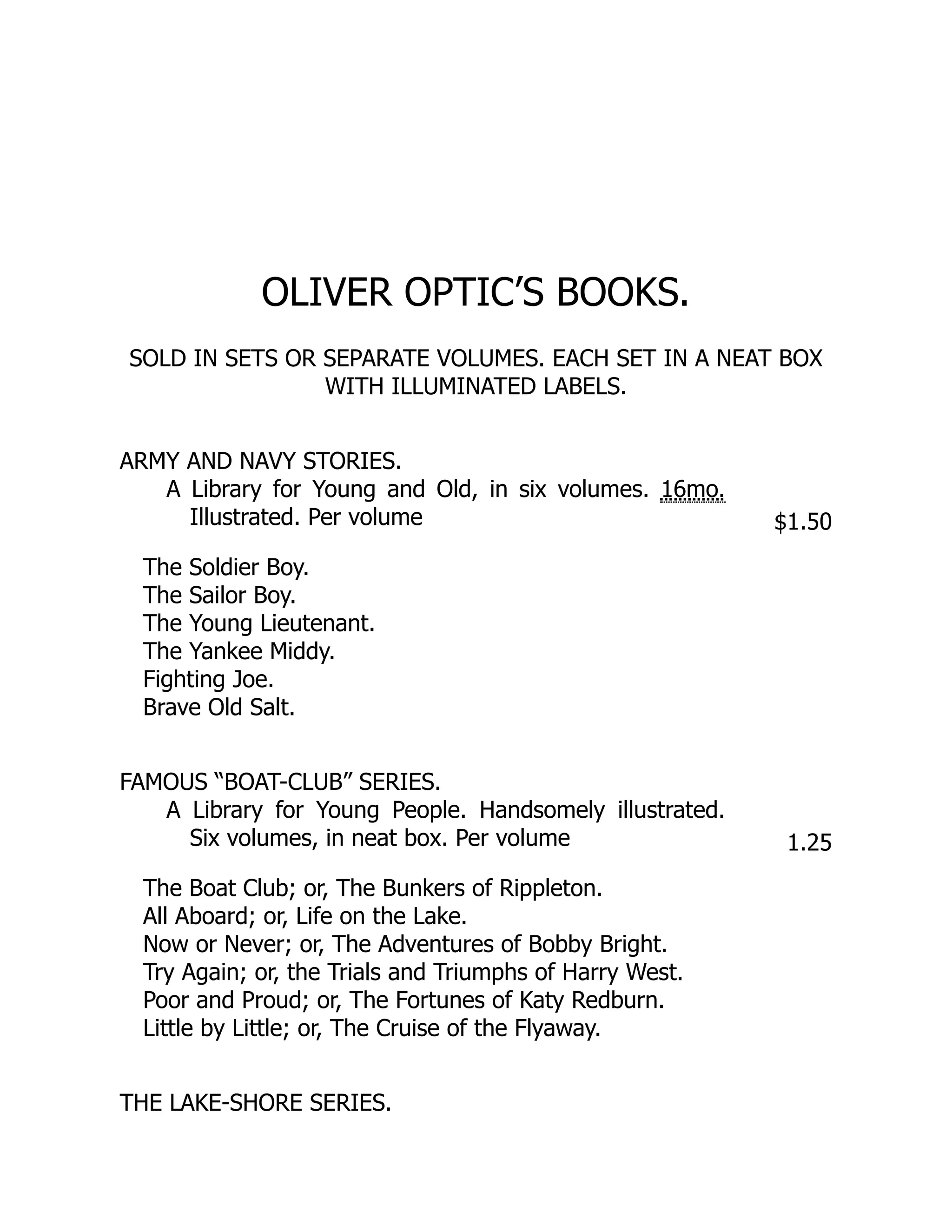
OLIVER OPTIC’S BOOKS.
SOLDIN SETS OR SEPARATE VOLUMES. EACH SET IN A NEAT BOX
WITH ILLUMINATED LABELS.
ARMY AND NAVY STORIES.
A Library for Young and Old, in six volumes. 16mo.
Illustrated. Per volume $1.50
The Soldier Boy.
The Sailor Boy.
The Young Lieutenant.
The Yankee Middy.
Fighting Joe.
Brave Old Salt.
FAMOUS “BOAT-CLUB” SERIES.
A Library for Young People. Handsomely illustrated.
Six volumes, in neat box. Per volume 1.25
The Boat Club; or, The Bunkers of Rippleton.
All Aboard; or, Life on the Lake.
Now or Never; or, The Adventures of Bobby Bright.
Try Again; or, the Trials and Triumphs of Harry West.
Poor and Proud; or, The Fortunes of Katy Redburn.
Little by Little; or, The Cruise of the Flyaway.
THE LAKE-SHORE SERIES.
30.
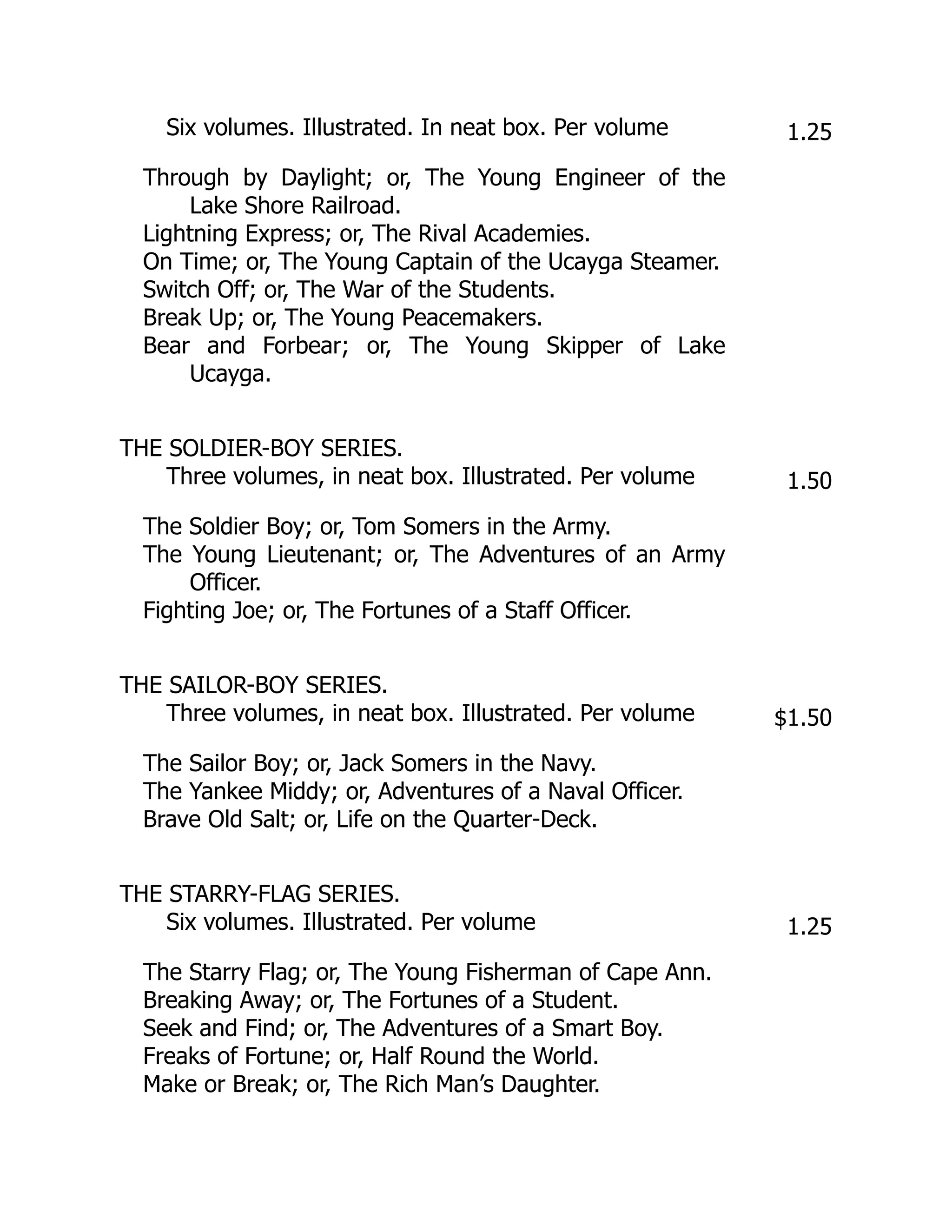
Six volumes. Illustrated.In neat box. Per volume 1.25
Through by Daylight; or, The Young Engineer of the
Lake Shore Railroad.
Lightning Express; or, The Rival Academies.
On Time; or, The Young Captain of the Ucayga Steamer.
Switch Off; or, The War of the Students.
Break Up; or, The Young Peacemakers.
Bear and Forbear; or, The Young Skipper of Lake
Ucayga.
THE SOLDIER-BOY SERIES.
Three volumes, in neat box. Illustrated. Per volume 1.50
The Soldier Boy; or, Tom Somers in the Army.
The Young Lieutenant; or, The Adventures of an Army
Officer.
Fighting Joe; or, The Fortunes of a Staff Officer.
THE SAILOR-BOY SERIES.
Three volumes, in neat box. Illustrated. Per volume $1.50
The Sailor Boy; or, Jack Somers in the Navy.
The Yankee Middy; or, Adventures of a Naval Officer.
Brave Old Salt; or, Life on the Quarter-Deck.
THE STARRY-FLAG SERIES.
Six volumes. Illustrated. Per volume 1.25
The Starry Flag; or, The Young Fisherman of Cape Ann.
Breaking Away; or, The Fortunes of a Student.
Seek and Find; or, The Adventures of a Smart Boy.
Freaks of Fortune; or, Half Round the World.
Make or Break; or, The Rich Man’s Daughter.
31.
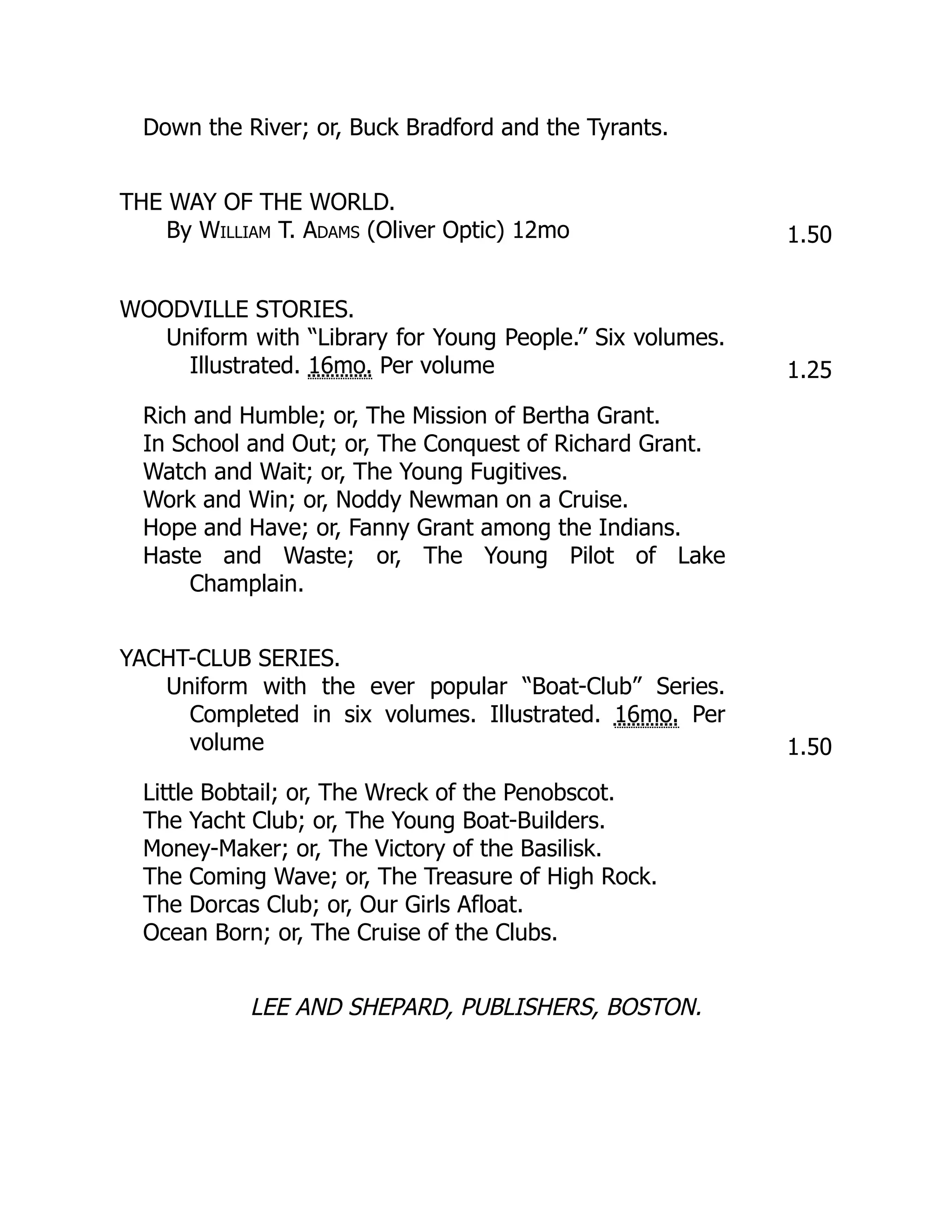
Down the River;or, Buck Bradford and the Tyrants.
THE WAY OF THE WORLD.
By William T. Adams (Oliver Optic) 12mo 1.50
WOODVILLE STORIES.
Uniform with “Library for Young People.” Six volumes.
Illustrated. 16mo. Per volume 1.25
Rich and Humble; or, The Mission of Bertha Grant.
In School and Out; or, The Conquest of Richard Grant.
Watch and Wait; or, The Young Fugitives.
Work and Win; or, Noddy Newman on a Cruise.
Hope and Have; or, Fanny Grant among the Indians.
Haste and Waste; or, The Young Pilot of Lake
Champlain.
YACHT-CLUB SERIES.
Uniform with the ever popular “Boat-Club” Series.
Completed in six volumes. Illustrated. 16mo. Per
volume 1.50
Little Bobtail; or, The Wreck of the Penobscot.
The Yacht Club; or, The Young Boat-Builders.
Money-Maker; or, The Victory of the Basilisk.
The Coming Wave; or, The Treasure of High Rock.
The Dorcas Club; or, Our Girls Afloat.
Ocean Born; or, The Cruise of the Clubs.
LEE AND SHEPARD, PUBLISHERS, BOSTON.
32.
Transcriber’s Note:
Obsolete andalternative spellings were left
unchanged.
The following items were changed:
Commas were deleted at the end of
chapter titles in the Table of
Contents.
Missing end quote added to ‘...will have
a warrant for his arrest.”...’
Missing period added in list, after name
‘Phil Gawner’
‘Dont’ to ‘Don’t’
‘yatch’ to ‘yacht’
33.
*** END OFTHE PROJECT GUTENBERG EBOOK SNUG HARBOR; OR,
THE CHAMPLAIN MECHANICS ***
Updated editions will replace the previous one—the old editions will
be renamed.
Creating the works from print editions not protected by U.S.
copyright law means that no one owns a United States copyright in
these works, so the Foundation (and you!) can copy and distribute it
in the United States without permission and without paying
copyright royalties. Special rules, set forth in the General Terms of
Use part of this license, apply to copying and distributing Project
Gutenberg™ electronic works to protect the PROJECT GUTENBERG™
concept and trademark. Project Gutenberg is a registered trademark,
and may not be used if you charge for an eBook, except by following
the terms of the trademark license, including paying royalties for use
of the Project Gutenberg trademark. If you do not charge anything
for copies of this eBook, complying with the trademark license is
very easy. You may use this eBook for nearly any purpose such as
creation of derivative works, reports, performances and research.
Project Gutenberg eBooks may be modified and printed and given
away—you may do practically ANYTHING in the United States with
eBooks not protected by U.S. copyright law. Redistribution is subject
to the trademark license, especially commercial redistribution.
START: FULL LICENSE
PLEASE READ THISBEFORE YOU DISTRIBUTE OR USE THIS WORK
To protect the Project Gutenberg™ mission of promoting the free
distribution of electronic works, by using or distributing this work (or
any other work associated in any way with the phrase “Project
Gutenberg”), you agree to comply with all the terms of the Full
Project Gutenberg™ License available with this file or online at
www.gutenberg.org/license.
Section 1. General Terms of Use and
Redistributing Project Gutenberg™
electronic works
1.A. By reading or using any part of this Project Gutenberg™
electronic work, you indicate that you have read, understand, agree
to and accept all the terms of this license and intellectual property
(trademark/copyright) agreement. If you do not agree to abide by all
the terms of this agreement, you must cease using and return or
destroy all copies of Project Gutenberg™ electronic works in your
possession. If you paid a fee for obtaining a copy of or access to a
Project Gutenberg™ electronic work and you do not agree to be
bound by the terms of this agreement, you may obtain a refund
from the person or entity to whom you paid the fee as set forth in
paragraph 1.E.8.
1.B. “Project Gutenberg” is a registered trademark. It may only be
used on or associated in any way with an electronic work by people
who agree to be bound by the terms of this agreement. There are a
few things that you can do with most Project Gutenberg™ electronic
works even without complying with the full terms of this agreement.
See paragraph 1.C below. There are a lot of things you can do with
Project Gutenberg™ electronic works if you follow the terms of this
agreement and help preserve free future access to Project
Gutenberg™ electronic works. See paragraph 1.E below.
36.
1.C. The ProjectGutenberg Literary Archive Foundation (“the
Foundation” or PGLAF), owns a compilation copyright in the
collection of Project Gutenberg™ electronic works. Nearly all the
individual works in the collection are in the public domain in the
United States. If an individual work is unprotected by copyright law
in the United States and you are located in the United States, we do
not claim a right to prevent you from copying, distributing,
performing, displaying or creating derivative works based on the
work as long as all references to Project Gutenberg are removed. Of
course, we hope that you will support the Project Gutenberg™
mission of promoting free access to electronic works by freely
sharing Project Gutenberg™ works in compliance with the terms of
this agreement for keeping the Project Gutenberg™ name associated
with the work. You can easily comply with the terms of this
agreement by keeping this work in the same format with its attached
full Project Gutenberg™ License when you share it without charge
with others.
1.D. The copyright laws of the place where you are located also
govern what you can do with this work. Copyright laws in most
countries are in a constant state of change. If you are outside the
United States, check the laws of your country in addition to the
terms of this agreement before downloading, copying, displaying,
performing, distributing or creating derivative works based on this
work or any other Project Gutenberg™ work. The Foundation makes
no representations concerning the copyright status of any work in
any country other than the United States.
1.E. Unless you have removed all references to Project Gutenberg:
1.E.1. The following sentence, with active links to, or other
immediate access to, the full Project Gutenberg™ License must
appear prominently whenever any copy of a Project Gutenberg™
work (any work on which the phrase “Project Gutenberg” appears,
or with which the phrase “Project Gutenberg” is associated) is
accessed, displayed, performed, viewed, copied or distributed:
37.
This eBook isfor the use of anyone anywhere in the United
States and most other parts of the world at no cost and with
almost no restrictions whatsoever. You may copy it, give it away
or re-use it under the terms of the Project Gutenberg License
included with this eBook or online at www.gutenberg.org. If you
are not located in the United States, you will have to check the
laws of the country where you are located before using this
eBook.
1.E.2. If an individual Project Gutenberg™ electronic work is derived
from texts not protected by U.S. copyright law (does not contain a
notice indicating that it is posted with permission of the copyright
holder), the work can be copied and distributed to anyone in the
United States without paying any fees or charges. If you are
redistributing or providing access to a work with the phrase “Project
Gutenberg” associated with or appearing on the work, you must
comply either with the requirements of paragraphs 1.E.1 through
1.E.7 or obtain permission for the use of the work and the Project
Gutenberg™ trademark as set forth in paragraphs 1.E.8 or 1.E.9.
1.E.3. If an individual Project Gutenberg™ electronic work is posted
with the permission of the copyright holder, your use and distribution
must comply with both paragraphs 1.E.1 through 1.E.7 and any
additional terms imposed by the copyright holder. Additional terms
will be linked to the Project Gutenberg™ License for all works posted
with the permission of the copyright holder found at the beginning
of this work.
1.E.4. Do not unlink or detach or remove the full Project
Gutenberg™ License terms from this work, or any files containing a
part of this work or any other work associated with Project
Gutenberg™.
1.E.5. Do not copy, display, perform, distribute or redistribute this
electronic work, or any part of this electronic work, without
prominently displaying the sentence set forth in paragraph 1.E.1
38.
with active linksor immediate access to the full terms of the Project
Gutenberg™ License.
1.E.6. You may convert to and distribute this work in any binary,
compressed, marked up, nonproprietary or proprietary form,
including any word processing or hypertext form. However, if you
provide access to or distribute copies of a Project Gutenberg™ work
in a format other than “Plain Vanilla ASCII” or other format used in
the official version posted on the official Project Gutenberg™ website
(www.gutenberg.org), you must, at no additional cost, fee or
expense to the user, provide a copy, a means of exporting a copy, or
a means of obtaining a copy upon request, of the work in its original
“Plain Vanilla ASCII” or other form. Any alternate format must
include the full Project Gutenberg™ License as specified in
paragraph 1.E.1.
1.E.7. Do not charge a fee for access to, viewing, displaying,
performing, copying or distributing any Project Gutenberg™ works
unless you comply with paragraph 1.E.8 or 1.E.9.
1.E.8. You may charge a reasonable fee for copies of or providing
access to or distributing Project Gutenberg™ electronic works
provided that:
• You pay a royalty fee of 20% of the gross profits you derive
from the use of Project Gutenberg™ works calculated using
the method you already use to calculate your applicable
taxes. The fee is owed to the owner of the Project
Gutenberg™ trademark, but he has agreed to donate royalties
under this paragraph to the Project Gutenberg Literary
Archive Foundation. Royalty payments must be paid within 60
days following each date on which you prepare (or are legally
required to prepare) your periodic tax returns. Royalty
payments should be clearly marked as such and sent to the
Project Gutenberg Literary Archive Foundation at the address
39.
specified in Section4, “Information about donations to the
Project Gutenberg Literary Archive Foundation.”
• You provide a full refund of any money paid by a user who
notifies you in writing (or by e-mail) within 30 days of receipt
that s/he does not agree to the terms of the full Project
Gutenberg™ License. You must require such a user to return
or destroy all copies of the works possessed in a physical
medium and discontinue all use of and all access to other
copies of Project Gutenberg™ works.
• You provide, in accordance with paragraph 1.F.3, a full refund
of any money paid for a work or a replacement copy, if a
defect in the electronic work is discovered and reported to
you within 90 days of receipt of the work.
• You comply with all other terms of this agreement for free
distribution of Project Gutenberg™ works.
1.E.9. If you wish to charge a fee or distribute a Project Gutenberg™
electronic work or group of works on different terms than are set
forth in this agreement, you must obtain permission in writing from
the Project Gutenberg Literary Archive Foundation, the manager of
the Project Gutenberg™ trademark. Contact the Foundation as set
forth in Section 3 below.
1.F.
1.F.1. Project Gutenberg volunteers and employees expend
considerable effort to identify, do copyright research on, transcribe
and proofread works not protected by U.S. copyright law in creating
the Project Gutenberg™ collection. Despite these efforts, Project
Gutenberg™ electronic works, and the medium on which they may
be stored, may contain “Defects,” such as, but not limited to,
incomplete, inaccurate or corrupt data, transcription errors, a
copyright or other intellectual property infringement, a defective or
40.
damaged disk orother medium, a computer virus, or computer
codes that damage or cannot be read by your equipment.
1.F.2. LIMITED WARRANTY, DISCLAIMER OF DAMAGES - Except for
the “Right of Replacement or Refund” described in paragraph 1.F.3,
the Project Gutenberg Literary Archive Foundation, the owner of the
Project Gutenberg™ trademark, and any other party distributing a
Project Gutenberg™ electronic work under this agreement, disclaim
all liability to you for damages, costs and expenses, including legal
fees. YOU AGREE THAT YOU HAVE NO REMEDIES FOR
NEGLIGENCE, STRICT LIABILITY, BREACH OF WARRANTY OR
BREACH OF CONTRACT EXCEPT THOSE PROVIDED IN PARAGRAPH
1.F.3. YOU AGREE THAT THE FOUNDATION, THE TRADEMARK
OWNER, AND ANY DISTRIBUTOR UNDER THIS AGREEMENT WILL
NOT BE LIABLE TO YOU FOR ACTUAL, DIRECT, INDIRECT,
CONSEQUENTIAL, PUNITIVE OR INCIDENTAL DAMAGES EVEN IF
YOU GIVE NOTICE OF THE POSSIBILITY OF SUCH DAMAGE.
1.F.3. LIMITED RIGHT OF REPLACEMENT OR REFUND - If you
discover a defect in this electronic work within 90 days of receiving
it, you can receive a refund of the money (if any) you paid for it by
sending a written explanation to the person you received the work
from. If you received the work on a physical medium, you must
return the medium with your written explanation. The person or
entity that provided you with the defective work may elect to provide
a replacement copy in lieu of a refund. If you received the work
electronically, the person or entity providing it to you may choose to
give you a second opportunity to receive the work electronically in
lieu of a refund. If the second copy is also defective, you may
demand a refund in writing without further opportunities to fix the
problem.
1.F.4. Except for the limited right of replacement or refund set forth
in paragraph 1.F.3, this work is provided to you ‘AS-IS’, WITH NO
OTHER WARRANTIES OF ANY KIND, EXPRESS OR IMPLIED,
41.
INCLUDING BUT NOTLIMITED TO WARRANTIES OF
MERCHANTABILITY OR FITNESS FOR ANY PURPOSE.
1.F.5. Some states do not allow disclaimers of certain implied
warranties or the exclusion or limitation of certain types of damages.
If any disclaimer or limitation set forth in this agreement violates the
law of the state applicable to this agreement, the agreement shall be
interpreted to make the maximum disclaimer or limitation permitted
by the applicable state law. The invalidity or unenforceability of any
provision of this agreement shall not void the remaining provisions.
1.F.6. INDEMNITY - You agree to indemnify and hold the Foundation,
the trademark owner, any agent or employee of the Foundation,
anyone providing copies of Project Gutenberg™ electronic works in
accordance with this agreement, and any volunteers associated with
the production, promotion and distribution of Project Gutenberg™
electronic works, harmless from all liability, costs and expenses,
including legal fees, that arise directly or indirectly from any of the
following which you do or cause to occur: (a) distribution of this or
any Project Gutenberg™ work, (b) alteration, modification, or
additions or deletions to any Project Gutenberg™ work, and (c) any
Defect you cause.
Section 2. Information about the Mission
of Project Gutenberg™
Project Gutenberg™ is synonymous with the free distribution of
electronic works in formats readable by the widest variety of
computers including obsolete, old, middle-aged and new computers.
It exists because of the efforts of hundreds of volunteers and
donations from people in all walks of life.
Volunteers and financial support to provide volunteers with the
assistance they need are critical to reaching Project Gutenberg™’s
goals and ensuring that the Project Gutenberg™ collection will
42.
remain freely availablefor generations to come. In 2001, the Project
Gutenberg Literary Archive Foundation was created to provide a
secure and permanent future for Project Gutenberg™ and future
generations. To learn more about the Project Gutenberg Literary
Archive Foundation and how your efforts and donations can help,
see Sections 3 and 4 and the Foundation information page at
www.gutenberg.org.
Section 3. Information about the Project
Gutenberg Literary Archive Foundation
The Project Gutenberg Literary Archive Foundation is a non-profit
501(c)(3) educational corporation organized under the laws of the
state of Mississippi and granted tax exempt status by the Internal
Revenue Service. The Foundation’s EIN or federal tax identification
number is 64-6221541. Contributions to the Project Gutenberg
Literary Archive Foundation are tax deductible to the full extent
permitted by U.S. federal laws and your state’s laws.
The Foundation’s business office is located at 809 North 1500 West,
Salt Lake City, UT 84116, (801) 596-1887. Email contact links and up
to date contact information can be found at the Foundation’s website
and official page at www.gutenberg.org/contact
Section 4. Information about Donations to
the Project Gutenberg Literary Archive
Foundation
Project Gutenberg™ depends upon and cannot survive without
widespread public support and donations to carry out its mission of
increasing the number of public domain and licensed works that can
be freely distributed in machine-readable form accessible by the
widest array of equipment including outdated equipment. Many
43.
small donations ($1to $5,000) are particularly important to
maintaining tax exempt status with the IRS.
The Foundation is committed to complying with the laws regulating
charities and charitable donations in all 50 states of the United
States. Compliance requirements are not uniform and it takes a
considerable effort, much paperwork and many fees to meet and
keep up with these requirements. We do not solicit donations in
locations where we have not received written confirmation of
compliance. To SEND DONATIONS or determine the status of
compliance for any particular state visit www.gutenberg.org/donate.
While we cannot and do not solicit contributions from states where
we have not met the solicitation requirements, we know of no
prohibition against accepting unsolicited donations from donors in
such states who approach us with offers to donate.
International donations are gratefully accepted, but we cannot make
any statements concerning tax treatment of donations received from
outside the United States. U.S. laws alone swamp our small staff.
Please check the Project Gutenberg web pages for current donation
methods and addresses. Donations are accepted in a number of
other ways including checks, online payments and credit card
donations. To donate, please visit: www.gutenberg.org/donate.
Section 5. General Information About
Project Gutenberg™ electronic works
Professor Michael S. Hart was the originator of the Project
Gutenberg™ concept of a library of electronic works that could be
freely shared with anyone. For forty years, he produced and
distributed Project Gutenberg™ eBooks with only a loose network of
volunteer support.
44.
Project Gutenberg™ eBooksare often created from several printed
editions, all of which are confirmed as not protected by copyright in
the U.S. unless a copyright notice is included. Thus, we do not
necessarily keep eBooks in compliance with any particular paper
edition.
Most people start at our website which has the main PG search
facility: www.gutenberg.org.
This website includes information about Project Gutenberg™,
including how to make donations to the Project Gutenberg Literary
Archive Foundation, how to help produce our new eBooks, and how
to subscribe to our email newsletter to hear about new eBooks.
45.
Welcome to OurBookstore - The Ultimate Destination for Book Lovers
Are you passionate about books and eager to explore new worlds of
knowledge? At our website, we offer a vast collection of books that
cater to every interest and age group. From classic literature to
specialized publications, self-help books, and children’s stories, we
have it all! Each book is a gateway to new adventures, helping you
expand your knowledge and nourish your soul
Experience Convenient and Enjoyable Book Shopping Our website is more
than just an online bookstore—it’s a bridge connecting readers to the
timeless values of culture and wisdom. With a sleek and user-friendly
interface and a smart search system, you can find your favorite books
quickly and easily. Enjoy special promotions, fast home delivery, and
a seamless shopping experience that saves you time and enhances your
love for reading.
Let us accompany you on the journey of exploring knowledge and
personal growth!
ebookball.com






![[Top]
CHAPTER XXX.
WHAT THE STUDENTS FOUND AT THOMPSON’S POINT.
At the scholastic session, in the morning, the scholars had been
forbidden to take any of the boats without special permission, which
would not be granted to those who were not qualified to manage
them. The Goldwing, and a sloop called the Emma, were the only
sailboats belonging to Beech Hill.
Besides the two four-oar quarter-boats belonging to the Sylph, there
were four other rowboats, two pulling four oars, and two pulling two
oars, each. When the boys went on board of the steam-yacht, they
noticed that all the rowboats were made fast to her stern. It was
evident that the present excursion was for the purpose of drilling the
boys in rowing and handling boats.
Captain Gildrock had been away all the afternoon, and returned only
in time to join the school in the steamer. Bates had got up steam, for
he had learned to be a man-of-all-work, from hoeing corn, up to
steering a steamer. Dory was sent to the pilot-house, but no one
heard the instructions given him. Oscar went with him; but, if Dory
knew the programme, he did not speak of it.
The ship’s company all went to their stations, though there was
nothing for the cooks and stewards to do. Oscar steered until the
steamer was near Thompson’s Point, opposite Split Rock, when Dory
took the wheel. The captain had instructed Thad Glovering, the first
officer, to get the anchor ready. Dory ran the steamer into a bay next](https://image.slidesharecdn.com/14970-250425152832-ff41990a/75/Rethinking-Data-Protection-Strategies-1st-Edition-by-Aberdeen-group-20-2048.jpg)