Pearson
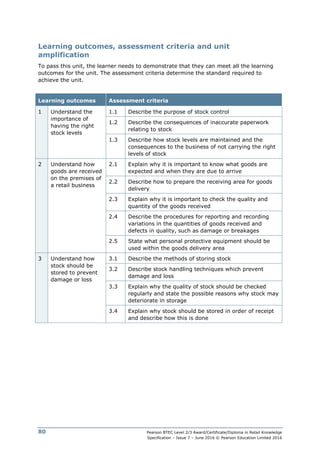
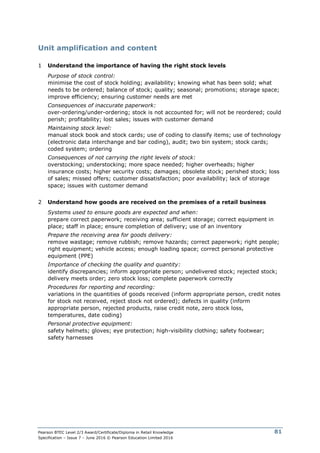
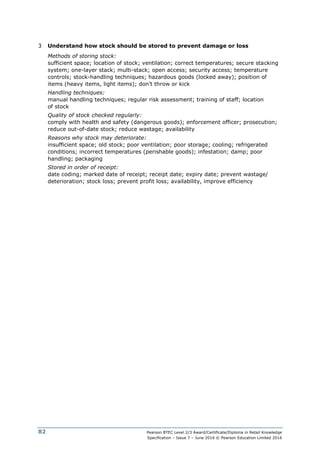
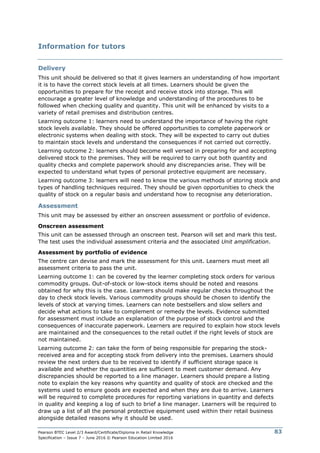
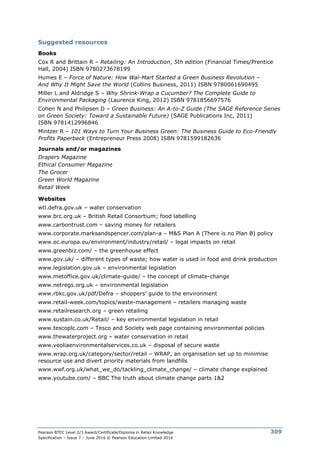
BTEC Level 2 and 3
Award/Certificate/Diploma
in Retail Knowledge
Specification
BTEC Specialist qualification
First teaching September 2010
Issue 7: June 2016
Edexcel, BTEC and LCCI qualifications
Edexcel, BTEC and LCCI qualifications are awarded by Pearson, the UK’s largest awarding
body offering academic and vocational qualifications that are globally recognised and
benchmarked. For further information, please visit our qualification websites at
www.edexcel.com, www.btec.co.uk or www.lcci.org.uk. Alternatively, you can get in touch
with us using the details on our contact us page at qualifications.pearson.com/contactus
About Pearson
Pearson is the world's leading learning company, with 40,000 employees in more than
70 countries working to help people of all ages to make measurable progress in their lives
through learning. We put the learner at the centre of everything we do, because wherever
learning flourishes, so do people. Find out more about how we can help you and your
learners at qualifications.pearson.com
This specification is Issue 7. Key changes are listed in summary table on next page. We will
inform centres of any changes to this issue. The latest issue can be found on the Pearson
website: qualifications.pearson.com
These qualifications were previously entitled:
Pearson BTEC Level 2 Award in Retail Knowledge (QCF)
Pearson BTEC Level 2 Certificate in Retail Knowledge (QCF)
Pearson BTEC Level 2 Diploma in Retail Knowledge (QCF)
Pearson BTEC Level 3 Award in Retail Knowledge (QCF)
Pearson BTEC Level 3 Certificate in Retail Knowledge (QCF)
Pearson BTEC Level 3 Diploma in Retail Knowledge (QCF)
The QNs remain the same.
References to third party material made in this specification are made in good faith. Pearson
does not endorse, approve or accept responsibility for the content of materials, which may be
subject to change, or any opinions expressed therein. (Material may include textbooks,
journals, magazines and other publications and websites.)
All information in this specification is correct at time of publication.
ISBN 978 1 446 93339 8
All the material in this publication is copyright
© Pearson Education Limited 2016
Summary of Pearson BTEC Level 2 and 3
Award/Certificate/Diploma in Retail Knowledge
specification Issue 7 changes
Summary of changes made between previous issue and this
current issue
Page/section
number
All references to QCF have been removed throughout the specification
Definition of TQT added Section 1
Definition of sizes of qualifications aligned to TQT Section 1
Credit value range removed and replaced with lowest credit value for
the shortest route through the qualification
Section 2
TQT value added Section 2
GLH range removed and replaced with lowest GLH value for the
shortest route through the qualification
Section 2
Reference to credit transfer within the QCF removed Section 5
QCF references removed from unit titles and unit levels in all units Section 12
Guided learning definition updated Section 12
Earlier issue(s) show(s) previous changes.
If you need further information on these changes or what they mean, contact us via our website
at: qualifications.pearson.com/en/support/contact-us.html.
Contents
Purpose of this specification 1
1 Introducing BTEC Specialist qualifications 2
What are BTEC Specialist qualifications? 2
Sizes of Specialist qualifications 2
2 Qualification summary and key information 3
Qualification Number and qualification title 6
Qualification objectives 6
Apprenticeships 7
Relationship with previous qualifications 7
Progression opportunities through Pearson qualifications 7
Industry support and recognition 7
Relationship with National Occupational Standards 7
3 Qualification structures 8
Pearson BTEC Level 2 Award in Retail Knowledge 8
Pearson BTEC Level 2 Certificate in Retail Knowledge 9
Pearson BTEC Level 2 Diploma in Retail Knowledge 13
Pearson BTEC Level 3 Award in Retail Knowledge 17
Pearson BTEC Level 3 Certificate in Retail Knowledge 19
Pearson BTEC Level 3 Diploma in Retail Knowledge 22
4 Assessment 26
5 Recognising prior learning and achievement 27
Recognition of Prior Learning 27
General resource requirements 28
Specific resource requirements 28
7 Centre recognition and approval 30
Approvals agreement 30
8 Quality assurance of centres 31
9 Programme delivery 32
10 Access and recruitment 33
11 Access to qualifications for learners with disabilities or
specific needs 34
12 Units 35
Unit title 35
Unit reference number 35
Level 35
Credit value 35
Guided learning hours 35
Unit aim 35
Essential resources 35
Learning outcomes 35
Assessment criteria 36
Unit amplification 36
Information for tutors 36
Unit 1: Understanding Customer Service in the Retail Sector 37
Unit 2: Understanding the Retail Selling Process 43
Unit 3: Understanding how Individuals and Teams Contribute to the
Effectiveness of a Retail Business 49
Unit 4: Understanding how a Retail Business Maintains Health and Safety
on its Premises 56
Unit 5: Understanding Retail Consumer Law 62
Unit 6: Understanding Security and Loss Prevention in a Retail Business68
Unit 7: Understanding the Handling of Customer Payments in a Retail
Business 73
Unit 8: Understanding the Control, Receipt and Storage of Stock in a
Retail Business 79
Unit 9: Understanding Visual Merchandising for Retail Business 85
Unit 10: Understanding Fashion Retail Personal Shopping and Styling 91
Unit 11: Understanding Fashion Trends and Forecasting 97
Unit 12: Understanding the Fashion Retail Market 103
Unit 13: Understanding the Evolution of the Beauty Retailing 109
Unit 14: Understanding the Retail Sale of Skin Care Products 115
Unit 15: Understanding the Retail Sale of Perfumery Products 121
Unit 16: Understanding the Retail Sale of Cosmetics 127
Unit 17: Understanding the Retail Sale of the Nail Care Products 133
Unit 18: Understanding the Retail Sale of Beauty Products 140
Unit 19: Understanding the Storage, Monitoring and Replenishment of
Fresh Produce in a Retail Outlet 147
Unit 20: Understanding the Storage, Monitoring and Replenishment of
Chilled Food Items in a Retail Outlet 152
Unit 21: Understanding how Retailers Sell National Lottery Products and
Services 157
Unit 22: Understanding the Features of Different Types of Alcoholic
Beverages Sold in Retail Outlets 162
Unit 23: Understanding how Retailers Operate Home Delivery Services for
Newspapers and Magazines 168
Unit 24: Understanding how Stocks of Newspapers and Magazines are
Controlled in Retail Outlets 174
Unit 25: Understanding Plant Nomenclature, Terminology and
Identification 179
Unit 26: Understanding Customer Service in the Retail Sector 185
Unit 27: Understanding the Management of Risks to Health and Safety on
the Premises of a Retail Business 191
Unit 28: Understanding Security and Loss Prevention in a Retail Business198
Unit 29: Understanding how the Smooth Operation of a Payment Point is
Maintained 205
Unit 30: Understanding the Retail Selling Process 212
Unit 31: Understanding the Management of Stock in a Retail Business 220
Unit 32: Understanding the Development of Personal and Team
Effectiveness in a Retail Business 227
Unit 33: Understanding how the Effectiveness of Store Operations can be
Improved 236
Unit 34: Understanding the Control of Pests and Diseases Which May
Affect Plants in a Retail Outlet 243
Unit 35: Understanding the Nature, Uses and Importance of Product
Information in a Retail Outlet Selling Gardening Products 250
Unit 36: Understanding the Management of Delivery of Plants into a Retail
Business 257
Unit 37: Understanding how the Growth and Development of Plants is
Promoted and Monitored in a Retail Outlet 263
Unit 38: Understand how to Approach Work-Based Projects within Retail
Business 271
Unit 39: Underage Sales Prevention for Retail And Licensed Premises 276
Unit 40: The Principles of Food Safety for Retail 282
Unit 41: Understanding how to Maintain the Confidentiality and Security of
Customer Data Held Online 288
Unit 42: Understanding the Use of In-Store Web-Based Facilities in
Promoting Retail Sales 294
Unit 43: Understanding Environmental Sustainability in the Retail Sector300
13 Further information and useful publications 310
14 Professional development and training 311
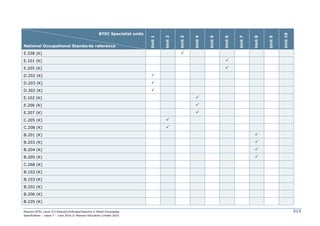
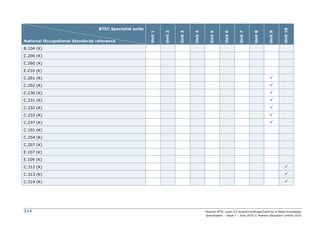
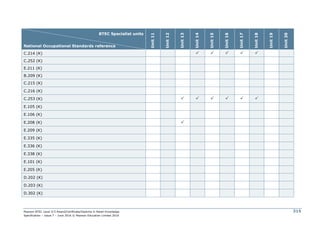
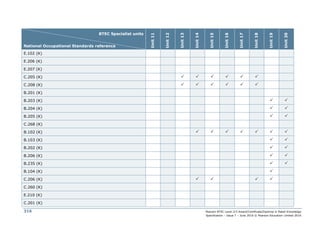
Annexe A 312
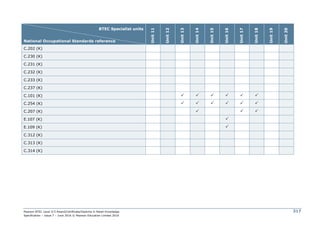
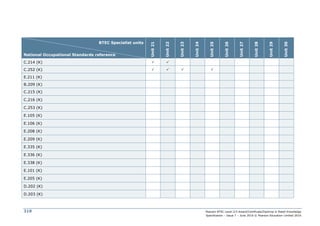
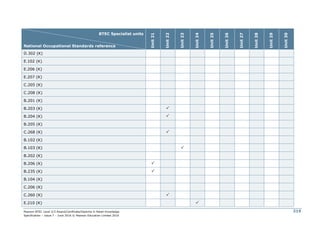
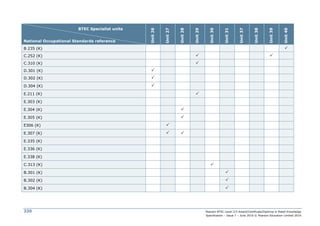
Mapping with National Occupational Standards 312
Annexe B 321
Onscreen multiple-choice question testing 321
Pearson BTEC Level 2/3 Award/Certificate/Diploma in Retail Knowledge
Specification – Issue 7 – June 2016 © Pearson Education Limited 2016
1
Purpose of this specification
The purpose of a specification as defined by Ofqual is to set out:
● the qualification’s objective
● any other qualification that a learner must have completed before taking the
qualification
● any prior knowledge, skills or understanding that the learner is required to have
before taking the qualification
● units that a learner must have completed before the qualification will be awarded
and any optional routes
● any other requirements that a learner must have satisfied before they will be
assessed or before the qualification will be awarded
● the knowledge, skills and understanding that will be assessed as part of the
qualification (giving a clear indication of their coverage and depth)
● the method of any assessment and any associated requirements relating to it
● the criteria against which the learner’s level of attainment will be measured
(such as assessment criteria)
● any specimen materials
● any specified levels of attainment.
Pearson BTEC Level 2/3 Award/Certificate/Diploma in Retail Knowledge
Specification – Issue 7 – June 2016 © Pearson Education Limited 2016
2
1 Introducing BTEC Specialist qualifications
What are BTEC Specialist qualifications?
BTEC Specialist qualifications are work-related qualifications available from Entry to Level
3 in a range of sectors. They give learners the knowledge, understanding and skills they
need to prepare for employment in a specific occupational area. The qualifications also
provide career development opportunities for those already in work. The qualifications
may be offered as full-time or part-time courses in schools or colleges. Training centres
and employers may also offer these qualifications.
Sizes of Specialist qualifications
For all regulated qualifications, we specify a total number of hours that learners are
expected to undertake in order to complete and show achievement for the qualification –
this is the Total Qualification Time (TQT). The TQT value indicates the size of a
qualification.
Within the TQT, we identify the number of Guided Learning Hours (GLH) that a centre
delivering the qualification needs to provide. Guided learning means activities that
directly or immediately involve tutors and assessors in teaching, supervising, and
invigilating learners, for example lectures, tutorials, online instruction and supervised
study.
As well as guided learning, there may be other required learning that is directed by
tutors or assessors. This includes, for example, private study, preparation for assessment
and undertaking assessment when not under supervision, such as preparatory reading,
revision and independent research.
As well as TQT and GLH, qualifications can also have a credit value – equal to one tenth
of TQT, rounded to the nearest whole number.
TQT and credit values are assigned after consultation with users of the qualifications.
BTEC Specialist qualifications are available in the following sizes:
• Award – a qualification with a TQT value of 120 or less (equivalent to a range of 1–12
credits)
• Certificate – a qualification with a TQT value in the range of 121–369 (equivalent to a
range of 13–36 credits)
• Diploma – a qualification with a TQT value of 370 or more (equivalent to 37 credits
and above).
Pearson BTEC Level 2/3 Award/Certificate/Diploma in Retail Knowledge
Specification – Issue 7 – June 2016 © Pearson Education Limited 2016
3
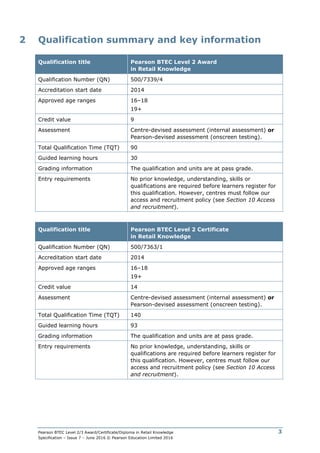
2 Qualification summary and key information
Qualification title Pearson BTEC Level 2 Award
in Retail Knowledge
Qualification Number (QN) 500/7339/4
Accreditation start date 2014
Approved age ranges 16–18
19+
Credit value 9
Assessment Centre-devised assessment (internal assessment) or
Pearson-devised assessment (onscreen testing).
Total Qualification Time (TQT) 90
Guided learning hours 30
Grading information The qualification and units are at pass grade.
Entry requirements No prior knowledge, understanding, skills or
qualifications are required before learners register for
this qualification. However, centres must follow our
access and recruitment policy (see Section 10 Access
and recruitment).
Qualification title Pearson BTEC Level 2 Certificate
in Retail Knowledge
Qualification Number (QN) 500/7363/1
Accreditation start date 2014
Approved age ranges 16–18
19+
Credit value 14
Assessment Centre-devised assessment (internal assessment) or
Pearson-devised assessment (onscreen testing).
Total Qualification Time (TQT) 140
Guided learning hours 93
Grading information The qualification and units are at pass grade.
Entry requirements No prior knowledge, understanding, skills or
qualifications are required before learners register for
this qualification. However, centres must follow our
access and recruitment policy (see Section 10 Access
and recruitment).
Pearson BTEC Level 2/3 Award/Certificate/Diploma in Retail Knowledge
Specification – Issue 7 – June 2016 © Pearson Education Limited 2016
4
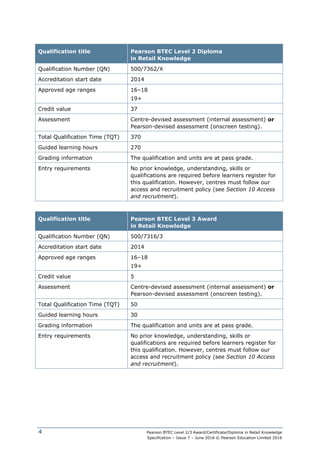
Qualification title Pearson BTEC Level 2 Diploma
in Retail Knowledge
Qualification Number (QN) 500/7362/X
Accreditation start date 2014
Approved age ranges 16–18
19+
Credit value 37
Assessment Centre-devised assessment (internal assessment) or
Pearson-devised assessment (onscreen testing).
Total Qualification Time (TQT) 370
Guided learning hours 270
Grading information The qualification and units are at pass grade.
Entry requirements No prior knowledge, understanding, skills or
qualifications are required before learners register for
this qualification. However, centres must follow our
access and recruitment policy (see Section 10 Access
and recruitment).
Qualification title Pearson BTEC Level 3 Award
in Retail Knowledge
Qualification Number (QN) 500/7316/3
Accreditation start date 2014
Approved age ranges 16–18
19+
Credit value 5
Assessment Centre-devised assessment (internal assessment) or
Pearson-devised assessment (onscreen testing).
Total Qualification Time (TQT) 50
Guided learning hours 30
Grading information The qualification and units are at pass grade.
Entry requirements No prior knowledge, understanding, skills or
qualifications are required before learners register for
this qualification. However, centres must follow our
access and recruitment policy (see Section 10 Access
and recruitment).
Pearson BTEC Level 2/3 Award/Certificate/Diploma in Retail Knowledge
Specification – Issue 7 – June 2016 © Pearson Education Limited 2016
5
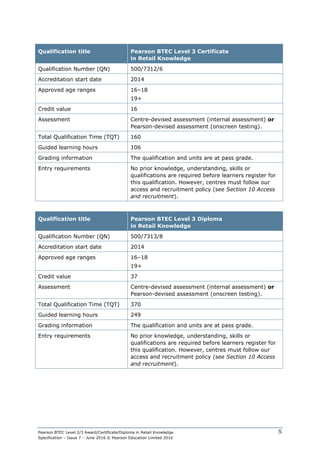
Qualification title Pearson BTEC Level 3 Certificate
in Retail Knowledge
Qualification Number (QN) 500/7312/6
Accreditation start date 2014
Approved age ranges 16–18
19+
Credit value 16
Assessment Centre-devised assessment (internal assessment) or
Pearson-devised assessment (onscreen testing).
Total Qualification Time (TQT) 160
Guided learning hours 106
Grading information The qualification and units are at pass grade.
Entry requirements No prior knowledge, understanding, skills or
qualifications are required before learners register for
this qualification. However, centres must follow our
access and recruitment policy (see Section 10 Access
and recruitment).
Qualification title Pearson BTEC Level 3 Diploma
in Retail Knowledge
Qualification Number (QN) 500/7313/8
Accreditation start date 2014
Approved age ranges 16–18
19+
Credit value 37
Assessment Centre-devised assessment (internal assessment) or
Pearson-devised assessment (onscreen testing).
Total Qualification Time (TQT) 370
Guided learning hours 249
Grading information The qualification and units are at pass grade.
Entry requirements No prior knowledge, understanding, skills or
qualifications are required before learners register for
this qualification. However, centres must follow our
access and recruitment policy (see Section 10 Access
and recruitment).
Pearson BTEC Level 2/3 Award/Certificate/Diploma in Retail Knowledge
Specification – Issue 7 – June 2016 © Pearson Education Limited 2016
6
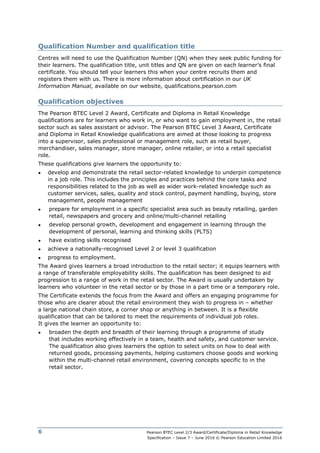
Qualification Number and qualification title
Centres will need to use the Qualification Number (QN) when they seek public funding for
their learners. The qualification title, unit titles and QN are given on each learner’s final
certificate. You should tell your learners this when your centre recruits them and
registers them with us. There is more information about certification in our UK
Information Manual, available on our website, qualifications.pearson.com
Qualification objectives
The Pearson BTEC Level 2 Award, Certificate and Diploma in Retail Knowledge
qualifications are for learners who work in, or who want to gain employment in, the retail
sector such as sales assistant or advisor. The Pearson BTEC Level 3 Award, Certificate
and Diploma in Retail Knowledge qualifications are aimed at those looking to progress
into a supervisor, sales professional or management role, such as retail buyer,
merchandiser, sales manager, store manager, online retailer, or into a retail specialist
role.
These qualifications give learners the opportunity to:
● develop and demonstrate the retail sector-related knowledge to underpin competence
in a job role. This includes the principles and practices behind the core tasks and
responsibilities related to the job as well as wider work-related knowledge such as
customer services, sales, quality and stock control, payment handling, buying, store
management, people management
● prepare for employment in a specific specialist area such as beauty retailing, garden
retail, newspapers and grocery and online/multi-channel retailing
● develop personal growth, development and engagement in learning through the
development of personal, learning and thinking skills (PLTS)
● have existing skills recognised
● achieve a nationally-recognised Level 2 or level 3 qualification
● progress to employment.
The Award gives learners a broad introduction to the retail sector; it equips learners with
a range of transferable employability skills. The qualification has been designed to aid
progression to a range of work in the retail sector. The Award is usually undertaken by
learners who volunteer in the retail sector or by those in a part time or a temporary role.
The Certificate extends the focus from the Award and offers an engaging programme for
those who are clearer about the retail environment they wish to progress in – whether
a large national chain store, a corner shop or anything in between. It is a flexible
qualification that can be tailored to meet the requirements of individual job roles.
It gives the learner an opportunity to:
● broaden the depth and breadth of their learning through a programme of study
that includes working effectively in a team, health and safety, and customer service.
The qualification also gives learners the option to select units on how to deal with
returned goods, processing payments, helping customers choose goods and working
within the multi-channel retail environment, covering concepts specific to in the
retail sector.
Pearson BTEC Level 2/3 Award/Certificate/Diploma in Retail Knowledge
Specification – Issue 7 – June 2016 © Pearson Education Limited 2016
7
The Diploma extends the focus from the Certificate and is a more substantial qualification
that will help learners to develop the skills needed to work in a junior role at Level 2 or to
progress to a management role in the retail sector at Level 3.
This qualification gives the learner an opportunity to:
● complete projects and assignments based on understanding workplace situations
and activities. Topics covered can include understanding displays and visual
merchandising, understanding handling cash, security and stock control
● understand health and safety regulations in a retail environment and some legal
aspects of retail, and to develop their team-working and customer service skills
● establish a foundation of knowledge and understanding at Level 2 enabling
progression to a Level 3 qualification in retail
● extend their programme of study through a competency based or other related
vocational or personal and social development qualification.
Apprenticeships
People1st, the SSC for retail, hospitality passenger transport and travel recognises the
Pearson BTEC Level 2 Certificate and Diploma in Retail Knowledge as a knowledge
component for the Intermediate Apprenticeship in Retail and Retail Specialist pathways,
and the Level 3 Certificate and Diploma in Retail Knowledge as a knowledge component
for the Advanced/Higher Apprenticeship in Retail Management, Sales Professional and
Visual Merchandising pathways.
Relationship with previous qualifications
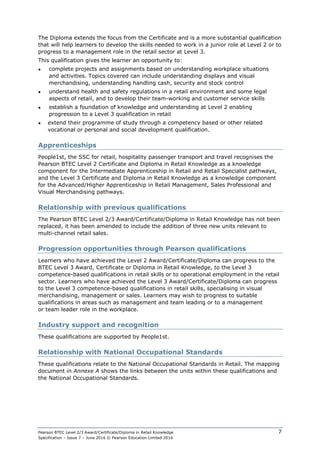
The Pearson BTEC Level 2/3 Award/Certificate/Diploma in Retail Knowledge has not been
replaced, it has been amended to include the addition of three new units relevant to
multi-channel retail sales.
Progression opportunities through Pearson qualifications
Learners who have achieved the Level 2 Award/Certificate/Diploma can progress to the
BTEC Level 3 Award, Certificate or Diploma in Retail Knowledge, to the Level 3
competence-based qualifications in retail skills or to operational employment in the retail
sector. Learners who have achieved the Level 3 Award/Certificate/Diploma can progress
to the Level 3 competence-based qualifications in retail skills, specialising in visual
merchandising, management or sales. Learners may wish to progress to suitable
qualifications in areas such as management and team leading or to a management
or team leader role in the workplace.
Industry support and recognition
These qualifications are supported by People1st.
Relationship with National Occupational Standards
These qualifications relate to the National Occupational Standards in Retail. The mapping
document in Annexe A shows the links between the units within these qualifications and
the National Occupational Standards.
Pearson BTEC Level 2/3 Award/Certificate/Diploma in Retail Knowledge
Specification – Issue 7 – June 2016 © Pearson Education Limited 2016
8
3 Qualification structures
Pearson BTEC Level 2 Award in Retail Knowledge
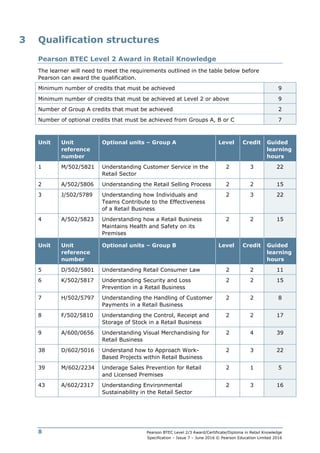
The learner will need to meet the requirements outlined in the table below before
Pearson can award the qualification.
Minimum number of credits that must be achieved 9
Minimum number of credits that must be achieved at Level 2 or above 9
Number of Group A credits that must be achieved 2
Number of optional credits that must be achieved from Groups A, B or C 7
Unit Unit
reference
number
Optional units – Group A Level Credit Guided
learning
hours
1 M/502/5821 Understanding Customer Service in the
Retail Sector
2 3 22
2 A/502/5806 Understanding the Retail Selling Process 2 2 15
3 J/502/5789 Understanding how Individuals and
Teams Contribute to the Effectiveness
of a Retail Business
2 3 22
4 A/502/5823 Understanding how a Retail Business
Maintains Health and Safety on its
Premises
2 2 15
Unit Unit
reference
number
Optional units – Group B Level Credit Guided
learning
hours
5 D/502/5801 Understanding Retail Consumer Law 2 2 11
6 K/502/5817 Understanding Security and Loss
Prevention in a Retail Business
2 2 15
7 H/502/5797 Understanding the Handling of Customer
Payments in a Retail Business
2 2 8
8 F/502/5810 Understanding the Control, Receipt and
Storage of Stock in a Retail Business
2 2 17
9 A/600/0656 Understanding Visual Merchandising for
Retail Business
2 4 39
38 D/602/5016 Understand how to Approach Work-
Based Projects within Retail Business
2 3 22
39 M/602/2234 Underage Sales Prevention for Retail
and Licensed Premises
2 1 5
43 A/602/2317 Understanding Environmental
Sustainability in the Retail Sector
2 3 16
Pearson BTEC Level 2/3 Award/Certificate/Diploma in Retail Knowledge
Specification – Issue 7 – June 2016 © Pearson Education Limited 2016
9
Unit Unit
reference
number
Optional units – Group C Level Credit Guided
learning
hours
40 K/502/0178 The Principles of Food Safety for
Retail
2 1 9
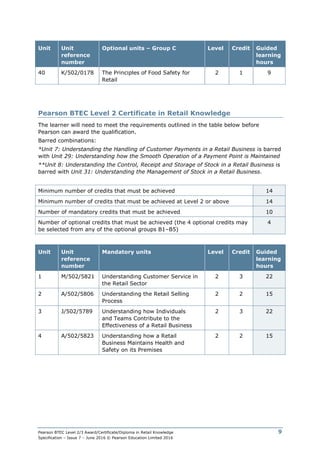
Pearson BTEC Level 2 Certificate in Retail Knowledge
The learner will need to meet the requirements outlined in the table below before
Pearson can award the qualification.
Barred combinations:
*Unit 7: Understanding the Handling of Customer Payments in a Retail Business is barred
with Unit 29: Understanding how the Smooth Operation of a Payment Point is Maintained
**Unit 8: Understanding the Control, Receipt and Storage of Stock in a Retail Business is
barred with Unit 31: Understanding the Management of Stock in a Retail Business.
Minimum number of credits that must be achieved 14
Minimum number of credits that must be achieved at Level 2 or above 14
Number of mandatory credits that must be achieved 10
Number of optional credits that must be achieved (the 4 optional credits may
be selected from any of the optional groups B1–B5)
4
Unit Unit
reference
number
Mandatory units Level Credit Guided
learning
hours
1 M/502/5821 Understanding Customer Service in
the Retail Sector
2 3 22
2 A/502/5806 Understanding the Retail Selling
Process
2 2 15
3 J/502/5789 Understanding how Individuals
and Teams Contribute to the
Effectiveness of a Retail Business
2 3 22
4 A/502/5823 Understanding how a Retail
Business Maintains Health and
Safety on its Premises
2 2 15
Pearson BTEC Level 2/3 Award/Certificate/Diploma in Retail Knowledge
Specification – Issue 7 – June 2016 © Pearson Education Limited 2016
10
Unit Unit
reference
number
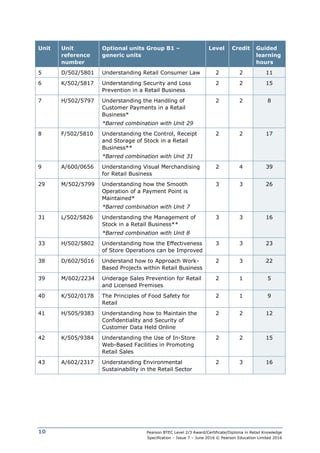
Optional units Group B1 –
generic units
Level Credit Guided
learning
hours
5 D/502/5801 Understanding Retail Consumer Law 2 2 11
6 K/502/5817 Understanding Security and Loss
Prevention in a Retail Business
2 2 15
7 H/502/5797 Understanding the Handling of
Customer Payments in a Retail
Business*
*Barred combination with Unit 29
2 2 8
8 F/502/5810 Understanding the Control, Receipt
and Storage of Stock in a Retail
Business**
*Barred combination with Unit 31
2 2 17
9 A/600/0656 Understanding Visual Merchandising
for Retail Business
2 4 39
29 M/502/5799 Understanding how the Smooth
Operation of a Payment Point is
Maintained*
*Barred combination with Unit 7
3 3 26
31 L/502/5826 Understanding the Management of
Stock in a Retail Business**
*Barred combination with Unit 8
3 3 16
33 H/502/5802 Understanding how the Effectiveness
of Store Operations can be Improved
3 3 23
38 D/602/5016 Understand how to Approach Work-
Based Projects within Retail Business
2 3 22
39 M/602/2234 Underage Sales Prevention for Retail
and Licensed Premises
2 1 5
40 K/502/0178 The Principles of Food Safety for
Retail
2 1 9
41 H/505/9383 Understanding how to Maintain the
Confidentiality and Security of
Customer Data Held Online
2 2 12
42 K/505/9384 Understanding the Use of In-Store
Web-Based Facilities in Promoting
Retail Sales
2 2 15
43 A/602/2317 Understanding Environmental
Sustainability in the Retail Sector
2 3 16
Pearson BTEC Level 2/3 Award/Certificate/Diploma in Retail Knowledge
Specification – Issue 7 – June 2016 © Pearson Education Limited 2016
11
Unit Unit
reference
number
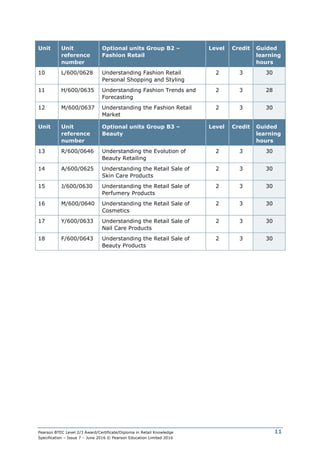
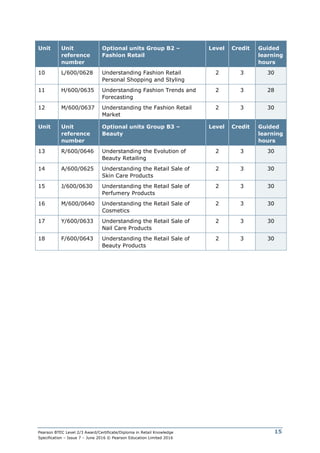
Optional units Group B2 –
Fashion Retail
Level Credit Guided
learning
hours
10 L/600/0628 Understanding Fashion Retail
Personal Shopping and Styling
2 3 30
11 H/600/0635 Understanding Fashion Trends and
Forecasting
2 3 28
12 M/600/0637 Understanding the Fashion Retail
Market
2 3 30
Unit Unit
reference
number
Optional units Group B3 –
Beauty
Level Credit Guided
learning
hours
13 R/600/0646 Understanding the Evolution of
Beauty Retailing
2 3 30
14 A/600/0625 Understanding the Retail Sale of
Skin Care Products
2 3 30
15 J/600/0630 Understanding the Retail Sale of
Perfumery Products
2 3 30
16 M/600/0640 Understanding the Retail Sale of
Cosmetics
2 3 30
17 Y/600/0633 Understanding the Retail Sale of
Nail Care Products
2 3 30
18 F/600/0643 Understanding the Retail Sale of
Beauty Products
2 3 30
Pearson BTEC Level 2/3 Award/Certificate/Diploma in Retail Knowledge
Specification – Issue 7 – June 2016 © Pearson Education Limited 2016
12
Unit Unit
reference
number
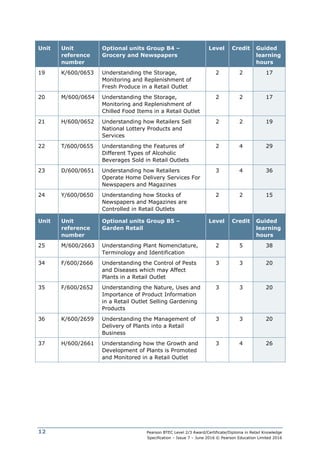
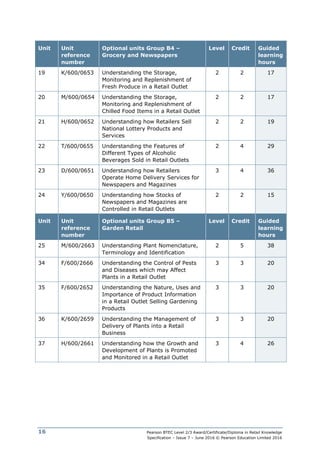
Optional units Group B4 –
Grocery and Newspapers
Level Credit Guided
learning
hours
19 K/600/0653 Understanding the Storage,
Monitoring and Replenishment of
Fresh Produce in a Retail Outlet
2 2 17
20 M/600/0654 Understanding the Storage,
Monitoring and Replenishment of
Chilled Food Items in a Retail Outlet
2 2 17
21 H/600/0652 Understanding how Retailers Sell
National Lottery Products and
Services
2 2 19
22 T/600/0655 Understanding the Features of
Different Types of Alcoholic
Beverages Sold in Retail Outlets
2 4 29
23 D/600/0651 Understanding how Retailers
Operate Home Delivery Services For
Newspapers and Magazines
3 4 36
24 Y/600/0650 Understanding how Stocks of
Newspapers and Magazines are
Controlled in Retail Outlets
2 2 15
Unit Unit
reference
number
Optional units Group B5 –
Garden Retail
Level Credit Guided
learning
hours
25 M/600/2663 Understanding Plant Nomenclature,
Terminology and Identification
2 5 38
34 F/600/2666 Understanding the Control of Pests
and Diseases which may Affect
Plants in a Retail Outlet
3 3 20
35 F/600/2652 Understanding the Nature, Uses and
Importance of Product Information
in a Retail Outlet Selling Gardening
Products
3 3 20
36 K/600/2659 Understanding the Management of
Delivery of Plants into a Retail
Business
3 3 20
37 H/600/2661 Understanding how the Growth and
Development of Plants is Promoted
and Monitored in a Retail Outlet
3 4 26
Pearson BTEC Level 2/3 Award/Certificate/Diploma in Retail Knowledge
Specification – Issue 7 – June 2016 © Pearson Education Limited 2016
13
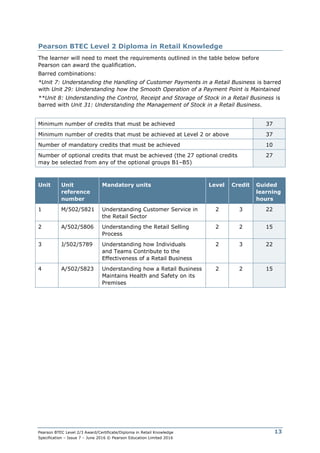
Pearson BTEC Level 2 Diploma in Retail Knowledge
The learner will need to meet the requirements outlined in the table below before
Pearson can award the qualification.
Barred combinations:
*Unit 7: Understanding the Handling of Customer Payments in a Retail Business is barred
with Unit 29: Understanding how the Smooth Operation of a Payment Point is Maintained
**Unit 8: Understanding the Control, Receipt and Storage of Stock in a Retail Business is
barred with Unit 31: Understanding the Management of Stock in a Retail Business.
Minimum number of credits that must be achieved 37
Minimum number of credits that must be achieved at Level 2 or above 37
Number of mandatory credits that must be achieved 10
Number of optional credits that must be achieved (the 27 optional credits
may be selected from any of the optional groups B1–B5)
27
Unit Unit
reference
number
Mandatory units Level Credit Guided
learning
hours
1 M/502/5821 Understanding Customer Service in
the Retail Sector
2 3 22
2 A/502/5806 Understanding the Retail Selling
Process
2 2 15
3 J/502/5789 Understanding how Individuals
and Teams Contribute to the
Effectiveness of a Retail Business
2 3 22
4 A/502/5823 Understanding how a Retail Business
Maintains Health and Safety on its
Premises
2 2 15
Pearson BTEC Level 2/3 Award/Certificate/Diploma in Retail Knowledge
Specification – Issue 7 – June 2016 © Pearson Education Limited 2016
14
Unit Unit
reference
number
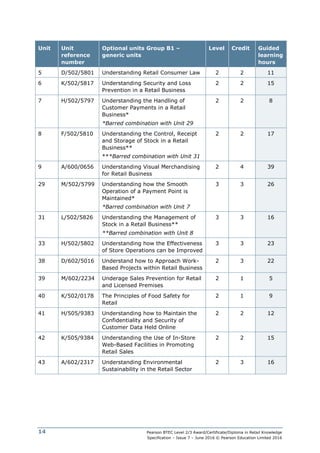
Optional units Group B1 –
generic units
Level Credit Guided
learning
hours
5 D/502/5801 Understanding Retail Consumer Law 2 2 11
6 K/502/5817 Understanding Security and Loss
Prevention in a Retail Business
2 2 15
7 H/502/5797 Understanding the Handling of
Customer Payments in a Retail
Business*
*Barred combination with Unit 29
2 2 8
8 F/502/5810 Understanding the Control, Receipt
and Storage of Stock in a Retail
Business**
***Barred combination with Unit 31
2 2 17
9 A/600/0656 Understanding Visual Merchandising
for Retail Business
2 4 39
29 M/502/5799 Understanding how the Smooth
Operation of a Payment Point is
Maintained*
*Barred combination with Unit 7
3 3 26
31 L/502/5826 Understanding the Management of
Stock in a Retail Business**
**Barred combination with Unit 8
3 3 16
33 H/502/5802 Understanding how the Effectiveness
of Store Operations can be Improved
3 3 23
38 D/602/5016 Understand how to Approach Work-
Based Projects within Retail Business
2 3 22
39 M/602/2234 Underage Sales Prevention for Retail
and Licensed Premises
2 1 5
40 K/502/0178 The Principles of Food Safety for
Retail
2 1 9
41 H/505/9383 Understanding how to Maintain the
Confidentiality and Security of
Customer Data Held Online
2 2 12
42 K/505/9384 Understanding the Use of In-Store
Web-Based Facilities in Promoting
Retail Sales
2 2 15
43 A/602/2317 Understanding Environmental
Sustainability in the Retail Sector
2 3 16
Pearson BTEC Level 2/3 Award/Certificate/Diploma in Retail Knowledge
Specification – Issue 7 – June 2016 © Pearson Education Limited 2016
15
Unit Unit
reference
number
Optional units Group B2 –
Fashion Retail
Level Credit Guided
learning
hours
10 L/600/0628 Understanding Fashion Retail
Personal Shopping and Styling
2 3 30
11 H/600/0635 Understanding Fashion Trends and
Forecasting
2 3 28
12 M/600/0637 Understanding the Fashion Retail
Market
2 3 30
Unit Unit
reference
number
Optional units Group B3 –
Beauty
Level Credit Guided
learning
hours
13 R/600/0646 Understanding the Evolution of
Beauty Retailing
2 3 30
14 A/600/0625 Understanding the Retail Sale of
Skin Care Products
2 3 30
15 J/600/0630 Understanding the Retail Sale of
Perfumery Products
2 3 30
16 M/600/0640 Understanding the Retail Sale of
Cosmetics
2 3 30
17 Y/600/0633 Understanding the Retail Sale of
Nail Care Products
2 3 30
18 F/600/0643 Understanding the Retail Sale of
Beauty Products
2 3 30
Pearson BTEC Level 2/3 Award/Certificate/Diploma in Retail Knowledge
Specification – Issue 7 – June 2016 © Pearson Education Limited 2016
16
Unit Unit
reference
number
Optional units Group B4 –
Grocery and Newspapers
Level Credit Guided
learning
hours
19 K/600/0653 Understanding the Storage,
Monitoring and Replenishment of
Fresh Produce in a Retail Outlet
2 2 17
20 M/600/0654 Understanding the Storage,
Monitoring and Replenishment of
Chilled Food Items in a Retail Outlet
2 2 17
21 H/600/0652 Understanding how Retailers Sell
National Lottery Products and
Services
2 2 19
22 T/600/0655 Understanding the Features of
Different Types of Alcoholic
Beverages Sold in Retail Outlets
2 4 29
23 D/600/0651 Understanding how Retailers
Operate Home Delivery Services for
Newspapers and Magazines
3 4 36
24 Y/600/0650 Understanding how Stocks of
Newspapers and Magazines are
Controlled in Retail Outlets
2 2 15
Unit Unit
reference
number
Optional units Group B5 –
Garden Retail
Level Credit Guided
learning
hours
25 M/600/2663 Understanding Plant Nomenclature,
Terminology and Identification
2 5 38
34 F/600/2666 Understanding the Control of Pests
and Diseases which may Affect
Plants in a Retail Outlet
3 3 20
35 F/600/2652 Understanding the Nature, Uses and
Importance of Product Information
in a Retail Outlet Selling Gardening
Products
3 3 20
36 K/600/2659 Understanding the Management of
Delivery of Plants into a Retail
Business
3 3 20
37 H/600/2661 Understanding how the Growth and
Development of Plants is Promoted
and Monitored in a Retail Outlet
3 4 26
Pearson BTEC Level 2/3 Award/Certificate/Diploma in Retail Knowledge
Specification – Issue 7 – June 2016 © Pearson Education Limited 2016
17
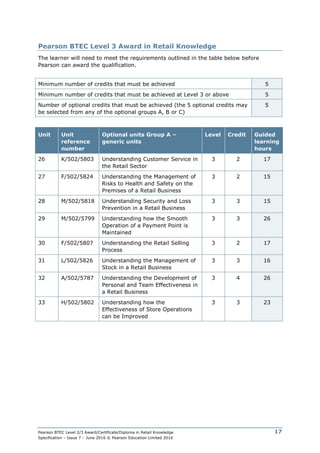
Pearson BTEC Level 3 Award in Retail Knowledge
The learner will need to meet the requirements outlined in the table below before
Pearson can award the qualification.
Minimum number of credits that must be achieved 5
Minimum number of credits that must be achieved at Level 3 or above 5
Number of optional credits that must be achieved (the 5 optional credits may
be selected from any of the optional groups A, B or C)
5
Unit Unit
reference
number
Optional units Group A –
generic units
Level Credit Guided
learning
hours
26 K/502/5803 Understanding Customer Service in
the Retail Sector
3 2 17
27 F/502/5824 Understanding the Management of
Risks to Health and Safety on the
Premises of a Retail Business
3 2 15
28 M/502/5818 Understanding Security and Loss
Prevention in a Retail Business
3 3 15
29 M/502/5799 Understanding how the Smooth
Operation of a Payment Point is
Maintained
3 3 26
30 F/502/5807 Understanding the Retail Selling
Process
3 2 17
31 L/502/5826 Understanding the Management of
Stock in a Retail Business
3 3 16
32 A/502/5787 Understanding the Development of
Personal and Team Effectiveness in
a Retail Business
3 4 26
33 H/502/5802 Understanding how the
Effectiveness of Store Operations
can be Improved
3 3 23
Pearson BTEC Level 2/3 Award/Certificate/Diploma in Retail Knowledge
Specification – Issue 7 – June 2016 © Pearson Education Limited 2016
18
Unit Unit
reference
number
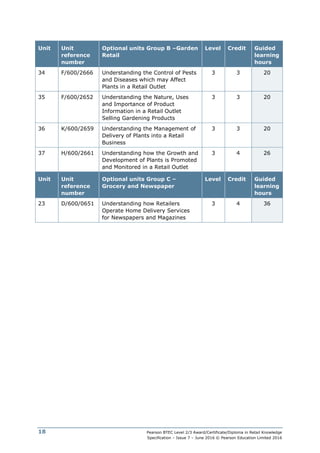
Optional units Group B –Garden
Retail
Level Credit Guided
learning
hours
34 F/600/2666 Understanding the Control of Pests
and Diseases which may Affect
Plants in a Retail Outlet
3 3 20
35 F/600/2652 Understanding the Nature, Uses
and Importance of Product
Information in a Retail Outlet
Selling Gardening Products
3 3 20
36 K/600/2659 Understanding the Management of
Delivery of Plants into a Retail
Business
3 3 20
37 H/600/2661 Understanding how the Growth and
Development of Plants is Promoted
and Monitored in a Retail Outlet
3 4 26
Unit Unit
reference
number
Optional units Group C –
Grocery and Newspaper
Level Credit Guided
learning
hours
23 D/600/0651 Understanding how Retailers
Operate Home Delivery Services
for Newspapers and Magazines
3 4 36
Pearson BTEC Level 2/3 Award/Certificate/Diploma in Retail Knowledge
Specification – Issue 7 – June 2016 © Pearson Education Limited 2016
19
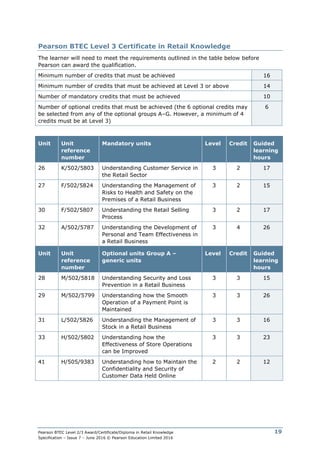
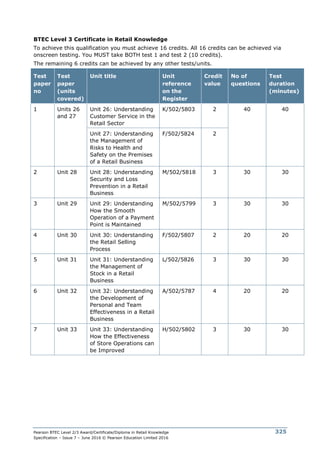
Pearson BTEC Level 3 Certificate in Retail Knowledge
The learner will need to meet the requirements outlined in the table below before
Pearson can award the qualification.
Minimum number of credits that must be achieved 16
Minimum number of credits that must be achieved at Level 3 or above 14
Number of mandatory credits that must be achieved 10
Number of optional credits that must be achieved (the 6 optional credits may
be selected from any of the optional groups A–G. However, a minimum of 4
credits must be at Level 3)
6
Unit Unit
reference
number
Mandatory units Level Credit Guided
learning
hours
26 K/502/5803 Understanding Customer Service in
the Retail Sector
3 2 17
27 F/502/5824 Understanding the Management of
Risks to Health and Safety on the
Premises of a Retail Business
3 2 15
30 F/502/5807 Understanding the Retail Selling
Process
3 2 17
32 A/502/5787 Understanding the Development of
Personal and Team Effectiveness in
a Retail Business
3 4 26
Unit Unit
reference
number
Optional units Group A –
generic units
Level Credit Guided
learning
hours
28 M/502/5818 Understanding Security and Loss
Prevention in a Retail Business
3 3 15
29 M/502/5799 Understanding how the Smooth
Operation of a Payment Point is
Maintained
3 3 26
31 L/502/5826 Understanding the Management of
Stock in a Retail Business
3 3 16
33 H/502/5802 Understanding how the
Effectiveness of Store Operations
can be Improved
3 3 23
41 H/505/9383 Understanding how to Maintain the
Confidentiality and Security of
Customer Data Held Online
2 2 12
Pearson BTEC Level 2/3 Award/Certificate/Diploma in Retail Knowledge
Specification – Issue 7 – June 2016 © Pearson Education Limited 2016
20
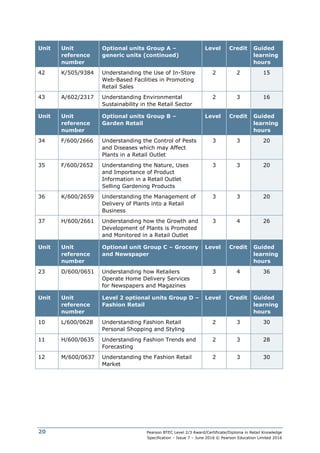
Unit Unit
reference
number
Optional units Group A –
generic units (continued)
Level Credit Guided
learning
hours
42 K/505/9384 Understanding the Use of In-Store
Web-Based Facilities in Promoting
Retail Sales
2 2 15
43 A/602/2317 Understanding Environmental
Sustainability in the Retail Sector
2 3 16
Unit Unit
reference
number
Optional units Group B –
Garden Retail
Level Credit Guided
learning
hours
34 F/600/2666 Understanding the Control of Pests
and Diseases which may Affect
Plants in a Retail Outlet
3 3 20
35 F/600/2652 Understanding the Nature, Uses
and Importance of Product
Information in a Retail Outlet
Selling Gardening Products
3 3 20
36 K/600/2659 Understanding the Management of
Delivery of Plants into a Retail
Business
3 3 20
37 H/600/2661 Understanding how the Growth and
Development of Plants is Promoted
and Monitored in a Retail Outlet
3 4 26
Unit Unit
reference
number
Optional unit Group C – Grocery
and Newspaper
Level Credit Guided
learning
hours
23 D/600/0651 Understanding how Retailers
Operate Home Delivery Services
for Newspapers and Magazines
3 4 36
Unit Unit
reference
number
Level 2 optional units Group D –
Fashion Retail
Level Credit Guided
learning
hours
10 L/600/0628 Understanding Fashion Retail
Personal Shopping and Styling
2 3 30
11 H/600/0635 Understanding Fashion Trends and
Forecasting
2 3 28
12 M/600/0637 Understanding the Fashion Retail
Market
2 3 30
Pearson BTEC Level 2/3 Award/Certificate/Diploma in Retail Knowledge
Specification – Issue 7 – June 2016 © Pearson Education Limited 2016
21
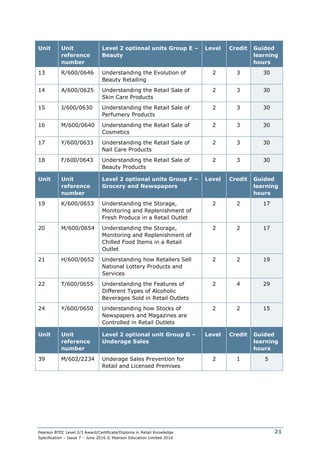
Unit Unit
reference
number
Level 2 optional units Group E –
Beauty
Level Credit Guided
learning
hours
13 R/600/0646 Understanding the Evolution of
Beauty Retailing
2 3 30
14 A/600/0625 Understanding the Retail Sale of
Skin Care Products
2 3 30
15 J/600/0630 Understanding the Retail Sale of
Perfumery Products
2 3 30
16 M/600/0640 Understanding the Retail Sale of
Cosmetics
2 3 30
17 Y/600/0633 Understanding the Retail Sale of
Nail Care Products
2 3 30
18 F/600/0643 Understanding the Retail Sale of
Beauty Products
2 3 30
Unit Unit
reference
number
Level 2 optional units Group F –
Grocery and Newspapers
Level Credit Guided
learning
hours
19 K/600/0653 Understanding the Storage,
Monitoring and Replenishment of
Fresh Produce in a Retail Outlet
2 2 17
20 M/600/0654 Understanding the Storage,
Monitoring and Replenishment of
Chilled Food Items in a Retail
Outlet
2 2 17
21 H/600/0652 Understanding how Retailers Sell
National Lottery Products and
Services
2 2 19
22 T/600/0655 Understanding the Features of
Different Types of Alcoholic
Beverages Sold in Retail Outlets
2 4 29
24 Y/600/0650 Understanding how Stocks of
Newspapers and Magazines are
Controlled in Retail Outlets
2 2 15
Unit Unit
reference
number
Level 2 optional unit Group G –
Underage Sales
Level Credit Guided
learning
hours
39 M/602/2234 Underage Sales Prevention for
Retail and Licensed Premises
2 1 5
Pearson BTEC Level 2/3 Award/Certificate/Diploma in Retail Knowledge
Specification – Issue 7 – June 2016 © Pearson Education Limited 2016
22
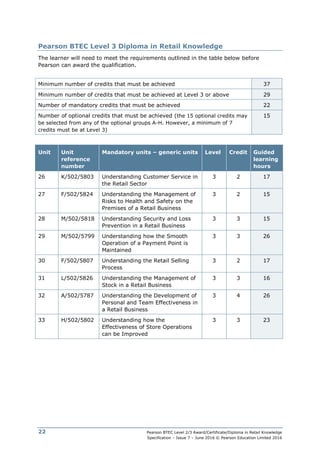
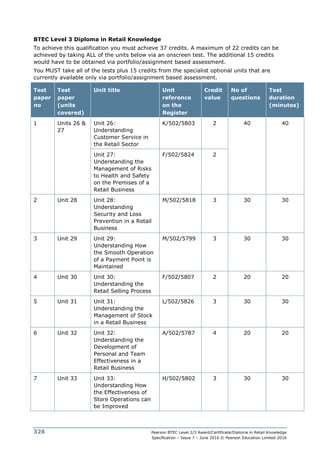
Pearson BTEC Level 3 Diploma in Retail Knowledge
The learner will need to meet the requirements outlined in the table below before
Pearson can award the qualification.
Minimum number of credits that must be achieved 37
Minimum number of credits that must be achieved at Level 3 or above 29
Number of mandatory credits that must be achieved 22
Number of optional credits that must be achieved (the 15 optional credits may
be selected from any of the optional groups A-H. However, a minimum of 7
credits must be at Level 3)
15
Unit Unit
reference
number
Mandatory units – generic units Level Credit Guided
learning
hours
26 K/502/5803 Understanding Customer Service in
the Retail Sector
3 2 17
27 F/502/5824 Understanding the Management of
Risks to Health and Safety on the
Premises of a Retail Business
3 2 15
28 M/502/5818 Understanding Security and Loss
Prevention in a Retail Business
3 3 15
29 M/502/5799 Understanding how the Smooth
Operation of a Payment Point is
Maintained
3 3 26
30 F/502/5807 Understanding the Retail Selling
Process
3 2 17
31 L/502/5826 Understanding the Management of
Stock in a Retail Business
3 3 16
32 A/502/5787 Understanding the Development of
Personal and Team Effectiveness in
a Retail Business
3 4 26
33 H/502/5802 Understanding how the
Effectiveness of Store Operations
can be Improved
3 3 23
Pearson BTEC Level 2/3 Award/Certificate/Diploma in Retail Knowledge
Specification – Issue 7 – June 2016 © Pearson Education Limited 2016
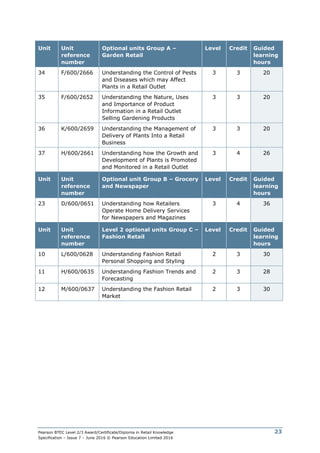
23
Unit Unit
reference
number
Optional units Group A –
Garden Retail
Level Credit Guided
learning
hours
34 F/600/2666 Understanding the Control of Pests
and Diseases which may Affect
Plants in a Retail Outlet
3 3 20
35 F/600/2652 Understanding the Nature, Uses
and Importance of Product
Information in a Retail Outlet
Selling Gardening Products
3 3 20
36 K/600/2659 Understanding the Management of
Delivery of Plants Into a Retail
Business
3 3 20
37 H/600/2661 Understanding how the Growth and
Development of Plants is Promoted
and Monitored in a Retail Outlet
3 4 26
Unit Unit
reference
number
Optional unit Group B – Grocery
and Newspaper
Level Credit Guided
learning
hours
23 D/600/0651 Understanding how Retailers
Operate Home Delivery Services
for Newspapers and Magazines
3 4 36
Unit Unit
reference
number
Level 2 optional units Group C –
Fashion Retail
Level Credit Guided
learning
hours
10 L/600/0628 Understanding Fashion Retail
Personal Shopping and Styling
2 3 30
11 H/600/0635 Understanding Fashion Trends and
Forecasting
2 3 28
12 M/600/0637 Understanding the Fashion Retail
Market
2 3 30
Pearson BTEC Level 2/3 Award/Certificate/Diploma in Retail Knowledge
Specification – Issue 7 – June 2016 © Pearson Education Limited 2016
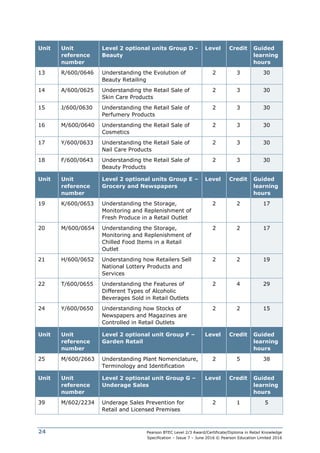
24
Unit Unit
reference
number
Level 2 optional units Group D -
Beauty
Level Credit Guided
learning
hours
13 R/600/0646 Understanding the Evolution of
Beauty Retailing
2 3 30
14 A/600/0625 Understanding the Retail Sale of
Skin Care Products
2 3 30
15 J/600/0630 Understanding the Retail Sale of
Perfumery Products
2 3 30
16 M/600/0640 Understanding the Retail Sale of
Cosmetics
2 3 30
17 Y/600/0633 Understanding the Retail Sale of
Nail Care Products
2 3 30
18 F/600/0643 Understanding the Retail Sale of
Beauty Products
2 3 30
Unit Unit
reference
number
Level 2 optional units Group E –
Grocery and Newspapers
Level Credit Guided
learning
hours
19 K/600/0653 Understanding the Storage,
Monitoring and Replenishment of
Fresh Produce in a Retail Outlet
2 2 17
20 M/600/0654 Understanding the Storage,
Monitoring and Replenishment of
Chilled Food Items in a Retail
Outlet
2 2 17
21 H/600/0652 Understanding how Retailers Sell
National Lottery Products and
Services
2 2 19
22 T/600/0655 Understanding the Features of
Different Types of Alcoholic
Beverages Sold in Retail Outlets
2 4 29
24 Y/600/0650 Understanding how Stocks of
Newspapers and Magazines are
Controlled in Retail Outlets
2 2 15
Unit Unit
reference
number
Level 2 optional unit Group F –
Garden Retail
Level Credit Guided
learning
hours
25 M/600/2663 Understanding Plant Nomenclature,
Terminology and Identification
2 5 38
Unit Unit
reference
number
Level 2 optional unit Group G –
Underage Sales
Level Credit Guided
learning
hours
39 M/602/2234 Underage Sales Prevention for
Retail and Licensed Premises
2 1 5
Pearson BTEC Level 2/3 Award/Certificate/Diploma in Retail Knowledge
Specification – Issue 7 – June 2016 © Pearson Education Limited 2016
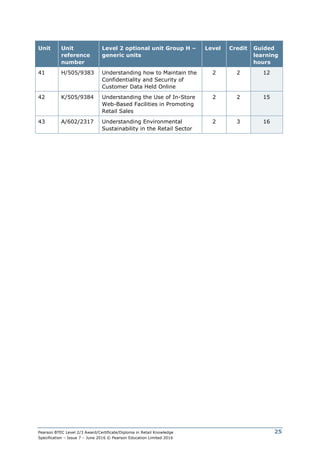
25
Unit Unit
reference
number
Level 2 optional unit Group H –
generic units
Level Credit Guided
learning
hours
41 H/505/9383 Understanding how to Maintain the
Confidentiality and Security of
Customer Data Held Online
2 2 12
42 K/505/9384 Understanding the Use of In-Store
Web-Based Facilities in Promoting
Retail Sales
2 2 15
43 A/602/2317 Understanding Environmental
Sustainability in the Retail Sector
2 3 16
Pearson BTEC Level 2/3 Award/Certificate/Diploma in Retail Knowledge
Specification – Issue 7 – June 2016 © Pearson Education Limited 2016
26
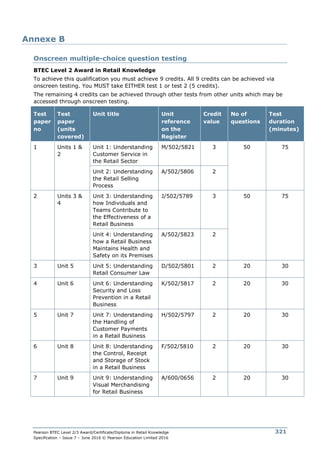
4 Assessment
The table below gives a summary of the assessment methods used in the qualifications.
Units Assessment methods
Units 1–9
Units 26–33
Centre-devised assessment or
Pearson-devised assessment: onscreen multiple-choice test
Unit 10–25
Unit 34–43
Centre-devised assessment only
Centre-devised assessment (internal assessment)
Each unit has specified learning outcomes and assessment criteria. To pass an internally
assessed unit, learners must meet all of the unit’s learning outcomes. Centres may find it
helpful if learners index and reference their evidence to the relevant learning outcomes
and assessment criteria.
Centres need to write assignment briefs for learners to show what evidence is required.
Assignment briefs should indicate clearly which assessment criteria are being targeted.
Assignment briefs and evidence produced by learners must meet any additional
requirements given in the Information for tutors section of each unit.
Unless otherwise indicated in Information for tutors, the centre can decide the form of
assessment evidence (for example performance observation, presentations, projects,
tests, extended writing) as long as the methods chosen allow learners to produce valid,
sufficient and reliable evidence of meeting the assessment criteria.
Centres are encouraged to give learners realistic scenarios and to maximise the use of
practical activities in delivery and assessment.
To avoid over-assessment, centres are encouraged to link delivery and assessment
across units.
There is more guidance about internal assessment on our website. For details please see
Section 13 Further information and useful publications.
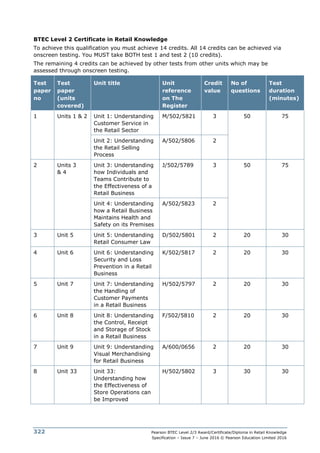
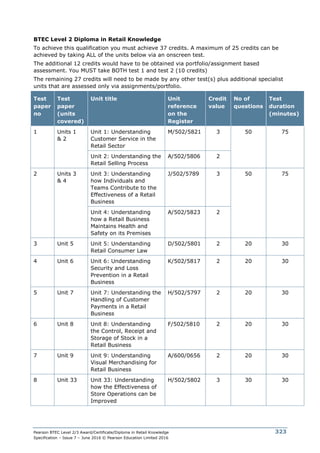
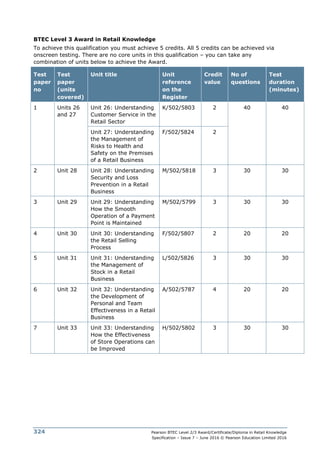
Pearson-devised assessment (external assessment)
To pass an externally assessed unit, learners must pass an onscreen test. Pearson sets
and marks the test. The test writer will use the Unit amplification section in the unit as a
guide when writing questions for the external assessments.
Further information, including details of test duration and question types, is available in
Annexe B.
Pearson BTEC Level 2/3 Award/Certificate/Diploma in Retail Knowledge
Specification – Issue 7 – June 2016 © Pearson Education Limited 2016
27
5 Recognising prior learning and achievement
Recognition of Prior Learning
Recognition of Prior Learning (RPL) is a method of assessment (leading to the award of
credit) that considers whether a learner can demonstrate that they can meet the
assessment requirements for a unit through knowledge, understanding or skills they
already possess and so do not need to develop through a course of learning.
Pearson encourages centres to recognise learners’ previous achievements and
experiences in and outside the workplace, as well as in the classroom. RPL provides a
route for the recognition of the achievements resulting from continuous learning.
RPL enables recognition of achievement from a range of activities using any valid
assessment methodology. If the assessment requirements of a given unit or qualification
have been met, the use of RPL is acceptable for accrediting a unit, units or a whole
qualification. Evidence of learning must be sufficient, reliable and valid.
Further guidance is available in our policy document Recognition of Prior Learning Policy
and Process, available on our website, qualifications.pearson.com
Pearson BTEC Level 2/3 Award/Certificate/Diploma in Retail Knowledge
Specification – Issue 7 – June 2016 © Pearson Education Limited 2016
28
6 Centre resource requirements
As part of the approval process, centres must make sure that the resource requirements
below are in place before offering the qualification.
General resource requirements
● Centres must have appropriate physical resources (for example IT, learning
materials, teaching rooms) to support delivery and assessment.
● Staff involved in the assessment process must have relevant expertise and
occupational experience.
● There must be systems in place that ensure continuing professional development
(CPD) for staff delivering the qualifications.
● Centres must have in place appropriate health and safety policies relating to the use
of equipment by learners.
● Centres must deliver the qualifications in accordance with current equality legislation.
For further details on Pearson’s commitment to the Equality Act 2010, please see
Section 10 Access and recruitment and Section 11 Access to qualifications for learners
with disabilities or specific needs. For full details of the Equality Act 2010, please go
to www.legislation.gov.uk
Specific resource requirements
As well as the general resource requirements given above, there are specific resources
that centres must provide. They are listed by unit below.
Unit Resources required
23 For this unit to be delivered effectively learners should be given
access to a convenience store retailing environment and the
owner/manager’s expertise so that that they can fully appreciate the
issues and problems that this area of retailing presents. Although
internet-based research will provide some resources, it is felt that
first-hand exposure to the retail environment itself will be most useful
to learner.
25 For this unit learners will require access to an area where plants can
be grown and maintained to a garden standard. A range of plant
types and habits would make the delivery relevant and interesting.
To enable learners to meet the requirements of the unit access to a
retail outlet displaying and selling plants is desirable.
27 This unit should be delivered in a retail learning environment with,
ideally, learners having access to real customers, employees and
managers. Learners will require access to a range of resources to
enable them to undertake internet and other necessary research.
Links with industry will be the most useful resource for this unit.
Pearson BTEC Level 2/3 Award/Certificate/Diploma in Retail Knowledge
Specification – Issue 7 – June 2016 © Pearson Education Limited 2016
29
Unit Resources required
35 To enable learners to meet the requirements of this unit, access to a
retail outlet displaying and selling garden products is desirable.
37 For this unit learners require access to an area where plants can be
grown and maintained, ideally to a saleable standard. A range of plant
types and habits would make delivery relevant and interesting. To
enable learners to meet the requirements of the unit, access to a
retail outlet displaying and selling plants is desirable.
39 The following legislation list may be useful for learners as further
reading:
 Children and Young Persons Acts 1991 and 1993 in relation to
tobacco sales
 National Lottery Act 1993 and associated Regulations of 1994 in
relation to lottery tickets/scratch cards
 Offensive Weapons Act 1996 in respect of offensive weapons
 Licensing Act 2003 in respect of alcohol
 Fireworks (Safety) Regulations 1997 in respect of fireworks and
crackers and caps
 Intoxicating substances (Supply) Act 1985 in respect of volatile
substances and solvents
 Cigarette Lighter Refill (Safety) Regulations 1999 in respect of
lighter refills containing butane
 Video Recordings Act 1984 in respect of videos and DVDs
 Tattooing of Minors Act 1969 in respect of tattooing persons under
the age of eighteen years
All of the above Acts of Parliament and regulations can be ordered
from Her Majesty’s Stationery Office ‘the stationery office’ on
www.tsoshop.co.uk
All of the above acts are correct at time of publication.
Pearson BTEC Level 2/3 Award/Certificate/Diploma in Retail Knowledge
Specification – Issue 7 – June 2016 © Pearson Education Limited 2016
30
7 Centre recognition and approval
Centres that have not previously offered Pearson qualifications need to apply for,
and be granted, centre recognition as part of the process for approval to offer
individual qualifications.
Existing centres will be given ‘automatic approval’ for a new qualification if they are
already approved for a qualification that is being replaced by a new qualification and
the conditions for automatic approval are met.
Guidance on seeking approval to deliver BTEC qualifications is given on our website,
qualifications.pearson.com
Approvals agreement
All centres are required to enter into an approval agreement that is a formal commitment
by the head or principal of a centre to meet all the requirements of the specification and
any associated codes, conditions or regulations.
Pearson will act to protect the integrity of the awarding of qualifications. If centres do
not comply with the agreement, this could result in the suspension of certification or
withdrawal of approval.
Pearson BTEC Level 2/3 Award/Certificate/Diploma in Retail Knowledge
Specification – Issue 7 – June 2016 © Pearson Education Limited 2016
31
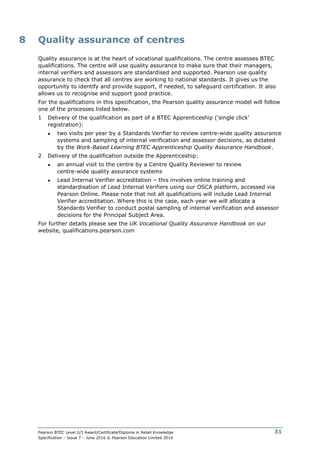
8 Quality assurance of centres
Quality assurance is at the heart of vocational qualifications. The centre assesses BTEC
qualifications. The centre will use quality assurance to make sure that their managers,
internal verifiers and assessors are standardised and supported. Pearson use quality
assurance to check that all centres are working to national standards. It gives us the
opportunity to identify and provide support, if needed, to safeguard certification. It also
allows us to recognise and support good practice.
For the qualifications in this specification, the Pearson quality assurance model will follow
one of the processes listed below.
1 Delivery of the qualification as part of a BTEC Apprenticeship (‘single click’
registration):
● two visits per year by a Standards Verifier to review centre-wide quality assurance
systems and sampling of internal verification and assessor decisions, as dictated
by the Work-Based Learning BTEC Apprenticeship Quality Assurance Handbook.
2 Delivery of the qualification outside the Apprenticeship:
● an annual visit to the centre by a Centre Quality Reviewer to review
centre-wide quality assurance systems
● Lead Internal Verifier accreditation – this involves online training and
standardisation of Lead Internal Verifiers using our OSCA platform, accessed via
Pearson Online. Please note that not all qualifications will include Lead Internal
Verifier accreditation. Where this is the case, each year we will allocate a
Standards Verifier to conduct postal sampling of internal verification and assessor
decisions for the Principal Subject Area.
For further details please see the UK Vocational Quality Assurance Handbook on our
website, qualifications.pearson.com
Pearson BTEC Level 2/3 Award/Certificate/Diploma in Retail Knowledge
Specification – Issue 7 – June 2016 © Pearson Education Limited 2016
32
9 Programme delivery
Centres are free to offer these qualifications using any mode of delivery (for example
full time, part time, evening only, distance learning) that meets their learners’ needs.
Whichever mode of delivery is used, centres must make sure that learners have access
to the resources identified in the specification and to the subject specialists delivering
the units.
Those planning the programme should aim to enhance the vocational nature of the
qualification by:
● liaising with employers to make sure that a course is relevant to learners’ specific
needs
● accessing and using non-confidential data and documents from learners’ workplaces
● developing up-to-date and relevant teaching materials that make use of scenarios
that are relevant to the sector
● giving learners the opportunity to apply their learning in practical activities
● including sponsoring employers in the delivery of the programme and, where
appropriate, in assessment
● making full use of the variety of experience of work and life that learners bring to
the programme.
Where a unit is externally assessed, it is essential that learners have covered all of the
Unit amplification before they are tested.
Where legislation is taught, centres must ensure that it is current and up to date.
Pearson BTEC Level 2/3 Award/Certificate/Diploma in Retail Knowledge
Specification – Issue 7 – June 2016 © Pearson Education Limited 2016
33
10 Access and recruitment
Pearson’s policy regarding access to our qualifications is that:
● they should be available to everyone who is capable of reaching the required
standards
● they should be free from any barriers that restrict access and progression
● there should be equal opportunities for all those wishing to access the qualifications.
Centres are required to recruit learners to BTEC Specialist qualifications with integrity.
Applicants will need relevant information and advice about the qualification to make sure
it meets their needs.
Centres should review the applicant’s prior qualifications and/or experience, considering
whether this profile shows that they have the potential to achieve the qualification.
For learners with disabilities and specific needs, this review will need to take account of
the support available to the learner during teaching and assessment of the qualification.
The review must take account of the information and guidance in Section 11 Access to
qualifications for learners with disabilities or specific needs.
Learners may be aged between 14 and 16 and therefore potentially vulnerable. Where
learners are required to spend time and be assessed in work settings, it is the centre’s
responsibility to ensure that the work environment they go into is safe.
Pearson BTEC Level 2/3 Award/Certificate/Diploma in Retail Knowledge
Specification – Issue 7 – June 2016 © Pearson Education Limited 2016
34
11 Access to qualifications for learners with
disabilities or specific needs
Equality and fairness are central to our work. Pearson’s Equality Policy requires all
learners to have equal opportunity to access our qualifications and assessments and that
our qualifications are awarded in a way that is fair to every learner.
We are committed to making sure that:
● learners with a protected characteristic (as defined by the Equality Act 2010) are not,
when they are undertaking one of our qualifications, disadvantaged in comparison to
learners who do not share that characteristic
● all learners achieve the recognition they deserve from undertaking a qualification and
that this achievement can be compared fairly to the achievement of their peers.
For learners with disabilities and specific needs, the assessment of their potential to
achieve the qualification must identify, where appropriate, the support that will be made
available to them during delivery and assessment of the qualification. Please see the
information on reasonable adjustments and special consideration in
Section 4, Assessment.
Learners taking a qualification may be assessed in British sign language or Irish sign
language where it is permitted for the purpose of reasonable adjustments.
Pearson BTEC Level 2/3 Award/Certificate/Diploma in Retail Knowledge
Specification – Issue 7 – June 2016 © Pearson Education Limited 2016
35
12 Units
Units have the following sections.
Unit title
This is the formal title of the unit that will appear on the learner’s certificate.
Unit reference number
Each unit is assigned a unit reference number that appears with the unit title on the
Register of Regulated Qualifications.
Level
All units and qualifications have a level assigned to them. The level assigned is informed
by the level descriptors defined by Ofqual, the qualifications regulator.
Credit value
When a learner achieves a unit, they gain the specified number of credits.
Guided learning hours
Guided Learning Hours (GLH) is the number of hours that a centre delivering the
qualification needs to provide. Guided learning means activities that directly or
immediately involve tutors and assessors in teaching, supervising, and invigilating
learners, for example lectures, tutorials, online instruction and supervised study.
Unit aim
This gives a summary of what the unit aims to do.
Essential resources
This section lists any specialist resources needed to deliver the unit. The centre will be
asked to make sure that these resources are in place when it seeks approval from
Pearson to offer the qualification.
Learning outcomes
The learning outcomes of a unit set out what a learner knows, understands or is able to
do as the result of a process of learning.
Pearson BTEC Level 2/3 Award/Certificate/Diploma in Retail Knowledge
Specification – Issue 7 – June 2016 © Pearson Education Limited 2016
36
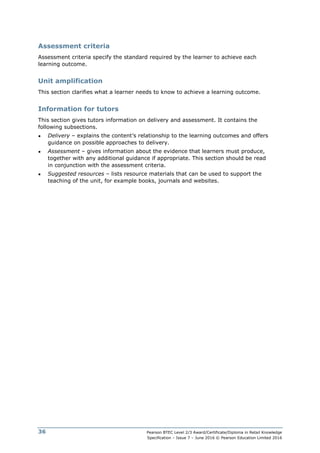
Assessment criteria
Assessment criteria specify the standard required by the learner to achieve each
learning outcome.
Unit amplification
This section clarifies what a learner needs to know to achieve a learning outcome.
Information for tutors
This section gives tutors information on delivery and assessment. It contains the
following subsections.
● Delivery – explains the content’s relationship to the learning outcomes and offers
guidance on possible approaches to delivery.
● Assessment – gives information about the evidence that learners must produce,
together with any additional guidance if appropriate. This section should be read
in conjunction with the assessment criteria.
● Suggested resources – lists resource materials that can be used to support the
teaching of the unit, for example books, journals and websites.
Pearson BTEC Level 2/3 Award/Certificate/Diploma in Retail Knowledge
Specification – Issue 7 – June 2016 © Pearson Education Limited 2016
37
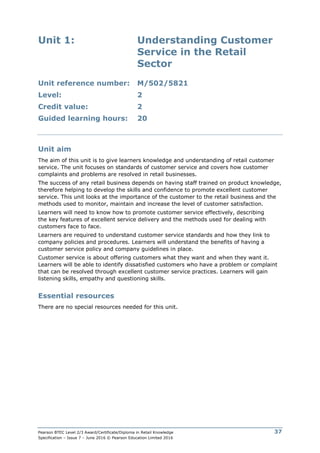
Unit 1: Understanding Customer
Service in the Retail
Sector
Unit reference number: M/502/5821
Level: 2
Credit value: 2
Guided learning hours: 20
Unit aim
The aim of this unit is to give learners knowledge and understanding of retail customer
service. The unit focuses on standards of customer service and covers how customer
complaints and problems are resolved in retail businesses.
The success of any retail business depends on having staff trained on product knowledge,
therefore helping to develop the skills and confidence to promote excellent customer
service. This unit looks at the importance of the customer to the retail business and the
methods used to monitor, maintain and increase the level of customer satisfaction.
Learners will need to know how to promote customer service effectively, describing
the key features of excellent service delivery and the methods used for dealing with
customers face to face.
Learners are required to understand customer service standards and how they link to
company policies and procedures. Learners will understand the benefits of having a
customer service policy and company guidelines in place.
Customer service is about offering customers what they want and when they want it.
Learners will be able to identify dissatisfied customers who have a problem or complaint
that can be resolved through excellent customer service practices. Learners will gain
listening skills, empathy and questioning skills.
Essential resources
There are no special resources needed for this unit.
Pearson BTEC Level 2/3 Award/Certificate/Diploma in Retail Knowledge
Specification – Issue 7 – June 2016 © Pearson Education Limited 2016
38
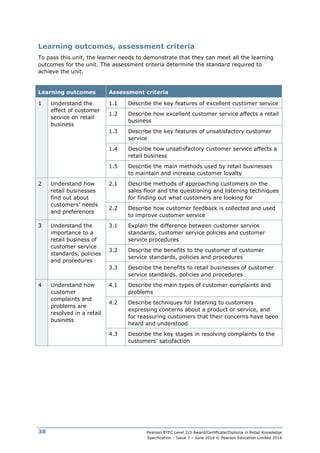
Learning outcomes, assessment criteria
To pass this unit, the learner needs to demonstrate that they can meet all the learning
outcomes for the unit. The assessment criteria determine the standard required to
achieve the unit.
Learning outcomes Assessment criteria
1 Understand the
effect of customer
service on retail
business
1.1 Describe the key features of excellent customer service
1.2 Describe how excellent customer service affects a retail
business
1.3 Describe the key features of unsatisfactory customer
service
1.4 Describe how unsatisfactory customer service affects a
retail business
1.5 Describe the main methods used by retail businesses
to maintain and increase customer loyalty
2 Understand how
retail businesses
find out about
customers’ needs
and preferences
2.1 Describe methods of approaching customers on the
sales floor and the questioning and listening techniques
for finding out what customers are looking for
2.2 Describe how customer feedback is collected and used
to improve customer service
3 Understand the
importance to a
retail business of
customer service
standards, policies
and procedures
3.1 Explain the difference between customer service
standards, customer service policies and customer
service procedures
3.2 Describe the benefits to the customer of customer
service standards, policies and procedures
3.3 Describe the benefits to retail businesses of customer
service standards, policies and procedures
4 Understand how
customer
complaints and
problems are
resolved in a retail
business
4.1 Describe the main types of customer complaints and
problems
4.2 Describe techniques for listening to customers
expressing concerns about a product or service, and
for reassuring customers that their concerns have been
heard and understood
4.3 Describe the key stages in resolving complaints to the
customers’ satisfaction
Pearson BTEC Level 2/3 Award/Certificate/Diploma in Retail Knowledge
Specification – Issue 7 – June 2016 © Pearson Education Limited 2016
39
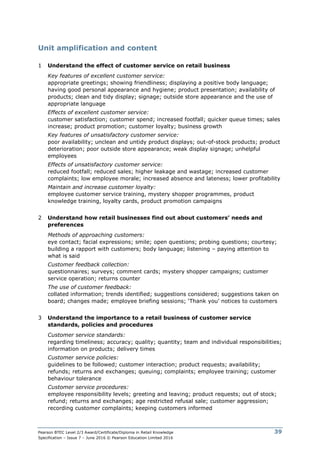
Unit amplification and content
1 Understand the effect of customer service on retail business
Key features of excellent customer service:
appropriate greetings; showing friendliness; displaying a positive body language;
having good personal appearance and hygiene; product presentation; availability of
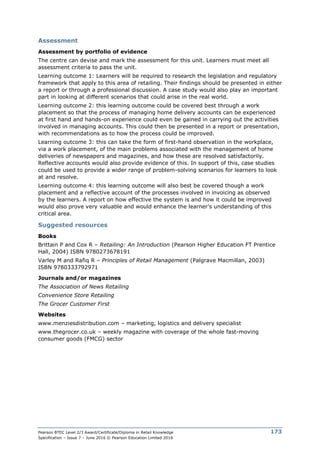
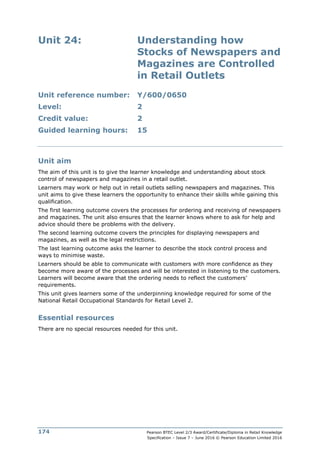
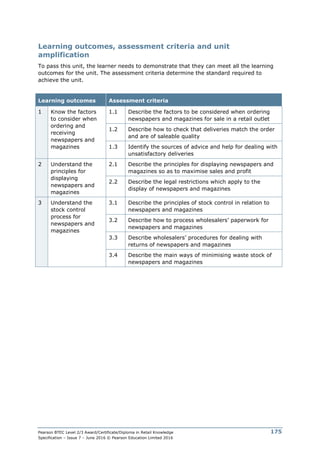
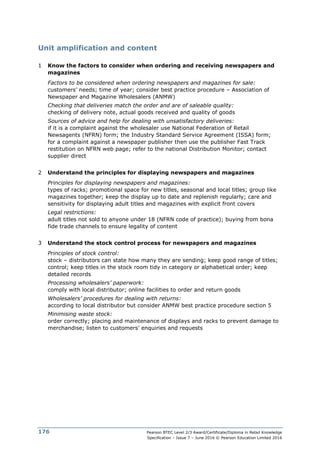
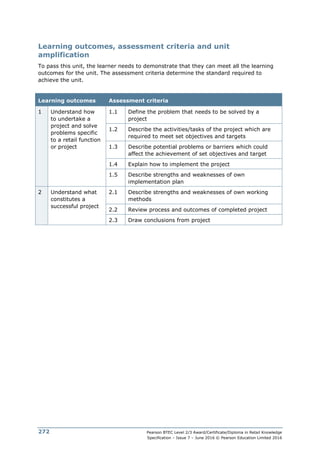
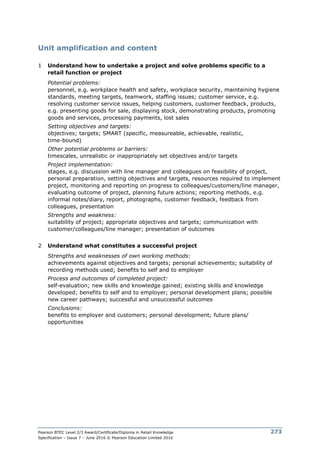
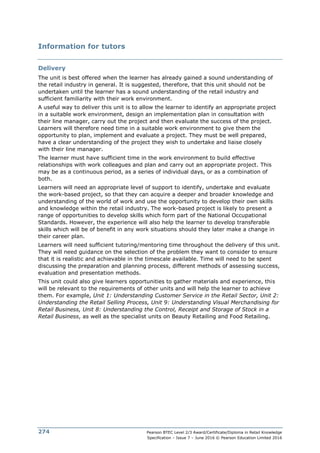
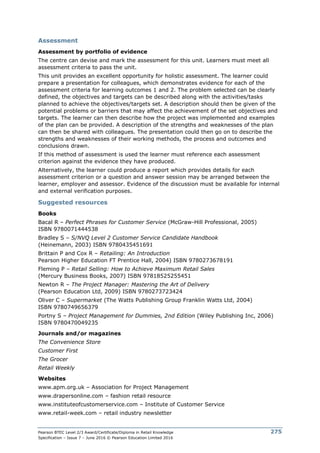
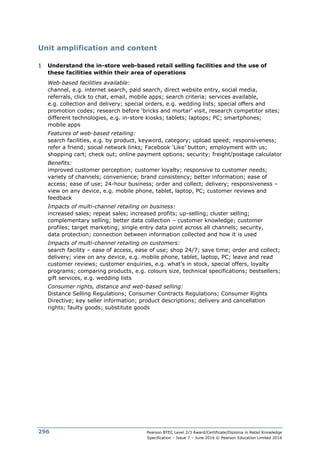
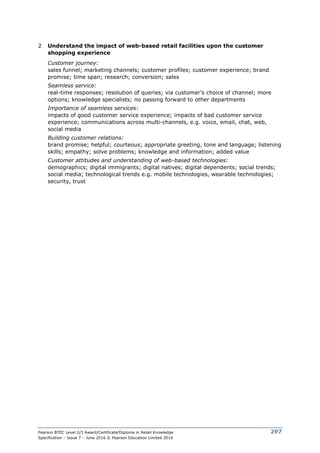
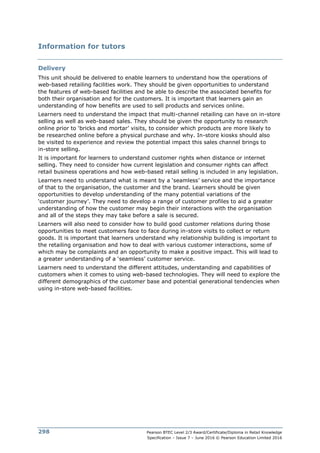
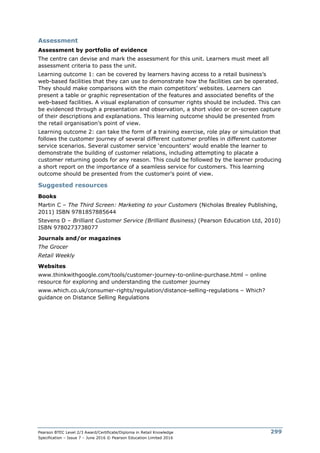
products; clean and tidy display; signage; outside store appearance and the use of
appropriate language
Effects of excellent customer service:
customer satisfaction; customer spend; increased footfall; quicker queue times; sales
increase; product promotion; customer loyalty; business growth
Key features of unsatisfactory customer service:
poor availability; unclean and untidy product displays; out-of-stock products; product
deterioration; poor outside store appearance; weak display signage; unhelpful
employees
Effects of unsatisfactory customer service:
reduced footfall; reduced sales; higher leakage and wastage; increased customer
complaints; low employee morale; increased absence and lateness; lower profitability
Maintain and increase customer loyalty:
employee customer service training, mystery shopper programmes, product
knowledge training, loyalty cards, product promotion campaigns
2 Understand how retail businesses find out about customers’ needs and
preferences
Methods of approaching customers:
eye contact; facial expressions; smile; open questions; probing questions; courtesy;
building a rapport with customers; body language; listening – paying attention to
what is said
Customer feedback collection:
questionnaires; surveys; comment cards; mystery shopper campaigns; customer
service operation; returns counter
The use of customer feedback:
collated information; trends identified; suggestions considered; suggestions taken on
board; changes made; employee briefing sessions; ‘Thank you’ notices to customers
3 Understand the importance to a retail business of customer service
standards, policies and procedures
Customer service standards:
regarding timeliness; accuracy; quality; quantity; team and individual responsibilities;
information on products; delivery times
Customer service policies:
guidelines to be followed; customer interaction; product requests; availability;
refunds; returns and exchanges; queuing; complaints; employee training; customer
behaviour tolerance
Customer service procedures:
employee responsibility levels; greeting and leaving; product requests; out of stock;
refund; returns and exchanges; age restricted refusal sale; customer aggression;
recording customer complaints; keeping customers informed
Pearson BTEC Level 2/3 Award/Certificate/Diploma in Retail Knowledge
Specification – Issue 7 – June 2016 © Pearson Education Limited 2016
40
Benefits to the customer:
ease of access to information; increased availability; knowledgeable employees;
questions answered satisfactory; waiting time reduced; friendly employees
Benefits to the retail business:
employee consistency; knowledgeable employees; measurable; mistakes quickly
revised; improved servicing; satisfied customers; standards maintained; employee
accountability; improved employee motivation; good media reputation
4 Understand how customer complaints and problems are resolved in a retail
business
Main types of customer complaints:
long queues; faulty goods; poor service-employee behaviour; out of code; out-of-
stock products; cleanliness of retail business; poor signage
Techniques for listening and reassuring customers:
eye contact; open questioning – probing questioning – to identify the problem; facial
expressions – looking concerned and helpful; acknowledge problem; repeat
customers words back; nodding; reassuring noises; face the customer
Key stages in resolving complaints:
show understanding; identify the problem; seek clarification throughout; ask what
45the customer requires; explain complaints procedure; explain the action to be
taken and when; seek customer approval; check customer satisfaction; regularly
update the customer on progress in dealing with complaint
Pearson BTEC Level 2/3 Award/Certificate/Diploma in Retail Knowledge
Specification – Issue 7 – June 2016 © Pearson Education Limited 2016
41
Information for tutors
Delivery
This unit should give the learner understanding of how important customer service is to
the success of a retail business.
Learners should be encouraged to interact with real customers and to gain knowledge
and practice from their own experiences. This unit should be delivered to a learner who
works in a realistic working environment.
Learners need to know and understand the importance of delivering excellent customer
service within the retail environment. Attention should be given to knowledge gained
when working through each section, so all learners will understand why they deliver the
service they do and know how to interact with customers in any given situation.
The retail owner’s or manager’s perspective on the delivery of excellent customer service
is key. Learners are encouraged to follow the policies and procedures in place in the
organisation to deliver this service. Learners should be encouraged to evaluate their
experiences of dealing with customers.
Open learning – this unit could be delivered through distance learning. To do this careful
planning is needed by the store and assessor to ensure sufficiency and authenticity of the
learners’ evidence.
Assessment
This unit may be assessed either by onscreen assessment or portfolio of evidence.
Onscreen assessment
This unit can be assessed through an onscreen test. Pearson will set and mark this test.
The test uses the individual assessment criteria and the associated Unit amplification.
Assessment by portfolio of evidence
The centre can devise and mark the assessment for this unit. Learners must meet all
assessment criteria to pass the unit.
Learning outcome 1: can be covered by the learner asking a number of store
managers/management to describe their views on how customer service affects their
retail business. The learner could prepare a list of set questions to ensure the consistency
of questions. Learners should read a selection of magazine and newspaper articles to
capture customer service issues and prepare a brief report on their findings. From the
collected information, the learner must explain the key features required in providing
good customer service, and explain how providing excellent customer service can benefit
a retail business. They must also describe the features of poor customer service and
explain the effect of this on a retail business. The main methods used by a retail business
to maintain and increase customer loyalty must also be described.
Learning outcome 2: can take a similar form as learning outcome 1 by producing a
further list of questions to ask a number of store managers and in this case, also asking
sales assistants and supervisor level employees. Learners could also compile a customer
questionnaire and ask customers before and after they shop. The evidence the learner
must present should include a description of the methods used to deal with customer
service issues, and a description of how customer feedback is collected and used to
improve customer service in the future.
Pearson BTEC Level 2/3 Award/Certificate/Diploma in Retail Knowledge
Specification – Issue 7 – June 2016 © Pearson Education Limited 2016
42
Learning outcome 3: can be covered by the learner gaining access to company
standards, policies and procedures documentation. The evidence submitted for
assessment should include an explanation of the difference between customer service
standards, policies and procedures. The learner must also explain the benefits of these
standards, policies and procedures to both the retail outlet and the customer.
Learning outcome 4: can be covered by the learner visiting one or more customer service
desk operations in local stores. The learner should prepare a list of set questions to
ensure consistency of questioning and ask several customer service desk assistants. If
acceptable by the store, the learner would benefit from observing how customers are
dealt with and recording the outcomes. The evidence submitted for assessment should
include a description of the main types of customer service issues and complaints, a
description of the techniques used to deal with customer service issues, and the key
stages involved in resolving a customer service complaint.
Suggested resources
Books
Bacal R – Perfect Phrases for Customer Service (McGraw-Hill Education, 2010)
ISBN 9780071745062
Bradley S – S/NVQ level 2 Customer Service – 2nd edition (Heinemann, 2007)
ISBN 978043546592
Brittain P and Cox R – Retailing: An Introduction
(Pearson Higher Education FT Prentice Hall, 2004) ISBN 9780273678191
Freemantle D – The Buzz 50 Little Things That Make a Big Difference to Serve Your
Customers (Nicholas Bentley Publishing, 2004) ISBN 9781857883473
Leland K and Bailey K – Customer Service for Dummies (John Wiley & Sons, 2006)
ISBN 9780471768692
Journals and/or magazines
The Convenience Store Magazine
Customer First – Institute of Customer Service
Drapers
The Grocer
Retail Weekly
Websites
www.businessballs.com/customer_service.htm – a range of information on
customer service
www.instituteofcustomerservice.com – the Institute of Customer Service
www.people1st.co.uk/retail-apprenticeships – People 1st, the Sector Skills Council
for retail
Pearson BTEC Level 2/3 Award/Certificate/Diploma in Retail Knowledge
Specification – Issue 7 – June 2016 © Pearson Education Limited 2016
43
Unit 2: Understanding the Retail
Selling Process
Unit reference number: A/502/5806
Level: 2
Credit value: 2
Guided learning hours: 15
Unit aim
The aim of this unit is to give learners knowledge and understanding of the retail selling
process. The unit focuses on the techniques used for identifying and meeting the needs
of customers in retail businesses.
The success of any retail business depends on having skilled staff who understand the
retail selling process, who know how to promote sales and who understand the
techniques available.
Learners will become familiar with and understand the concept behind the ‘five steps’
selling model. Continuous improvement will allow them to guide customers through the
selling process, ensuring customer needs are addressed and a sale is completed.
Building relationships is one of the most important aspects when dealing with potential
customers and gaining a sale. Communication techniques within the retail sales process
is a skill that can be used to the advantage of the learner. Being able to effectively
communicate within a sales environment will enable them to provide a customer with
information, answers to questions and an influence as to whether or not the product or
service is what the customer intends to purchase.
Learners will have knowledge and understanding of the link products available, how to
encourage more product sales per customer and how to promote additional products to
customers with confidence.
Essential resources
There are no special resources needed for this unit.
Pearson BTEC Level 2/3 Award/Certificate/Diploma in Retail Knowledge
Specification – Issue 7 – June 2016 © Pearson Education Limited 2016
44
Learning outcomes, assessment criteria and unit
amplification
To pass this unit, the learner needs to demonstrate that they can meet all the learning
outcomes for the unit. The assessment criteria determine the standard required to
achieve the unit.
Learning outcomes Assessment criteria
1 Understand the
five steps of the
selling model
1.1 Outline the five steps of the selling model
1.2 Explain why an effective rapport needs to be created
with customers
1.3 Explain the importance of effective questioning to the
sales process
1.4 Explain how linking benefits to product features helps
to promote sales
1.5 Explain why products must be matched to customers’
needs
1.6 Explain the importance of closing the sale
2 Understand how
questions are
used to identify
customers’ needs
2.1 Define ‘open’ and ‘closed’ questions and state the
purpose of each in the selling process
2.2 Define what is meant by ‘probing’ questions and state
the purpose of these in the selling process
2.3 Identify questions which can be used to establish sales
opportunities
3 Understand the
benefits and
uses of product
knowledge
3.1 Explain how comprehensive and up-to-date product
knowledge can be used to promote sales
3.2 Describe how the features and benefits of products can
be identified and matched to customers’ needs
3.3 Describe a range of methods for keeping product
knowledge up-to-date
4 Understand how
sales are closed
4.1 State what is meant by a ‘buying signal’ and describe
the main buying signals the salesperson needs to
look for
4.2 Describe the main ways of closing sales
Pearson BTEC Level 2/3 Award/Certificate/Diploma in Retail Knowledge
Specification – Issue 7 – June 2016 © Pearson Education Limited 2016
45
Unit amplification and content
1 Understand the five steps of the selling model
Outline the five steps:
first impressions count; gain trust and confidence; relaxed customer; increased sales
opportunities; adapting style to complement customer style; customer becomes more
open; making it easier to explain their needs; recognising buying signals and knowing
the right time to close the sale; creating an enthusiasm and desire to purchase
Approach customer and build rapport; establish what they require; find the right
product and sell the benefits; look for buying signals and action them; close the sale
Effective rapport with customers:
first impressions count; gain trust and confidence; relaxed customer; increased sales
opportunities; adapting style to complement customer style; customer becomes more
open; making it easier to explain their needs; recognising buying signals and knowing
the right time to close the sale; creating an enthusiasm and desire to purchase
Importance of effective questioning:
understanding customers’ wants and needs; gain accurate information; select
appropriate products; eliminate unsuitable products; establish price parameters;
colour; style and size; customer satisfaction
Linking benefits to product features:
meet customer needs; meet customer expectations; influencing the decision to
purchase
Matching products to customers’ needs:
meeting expectations; gain customer trust; purchases made; reduced product
returns; increased customer loyalty; customer satisfaction
Importance of closing a sale:
increased retail sales; increased impulse purchases by customer; improved stock
rotation; reaching sales targets; increasing customer base; increasing market share
2 Understand how questions are used to identify customers’ needs
‘Open’ questions and their purpose:
invites a wider response; clearer explanation; customer able to respond positively;
in their own words; establishes customers’ needs; begins a discussion; helps build
rapport
‘Closed’ questions and their purpose:
invites yes or no responses; steer conversation towards the desired outcome
‘Probing’ questions and their purpose:
establish facts and details; understand needs; establish appropriate products;
recommend suitable products; ensures a sale; establish likes and dislikes; establish
budget considerations/restrictions
Questions used to establish sales opportunities:
Who is the product for? Why is the product desired? Where will it be used?
When is it required? What is the price? Is it a luxury or essential item?
Pearson BTEC Level 2/3 Award/Certificate/Diploma in Retail Knowledge
Specification – Issue 7 – June 2016 © Pearson Education Limited 2016
46
3 Understand the benefits and uses of product knowledge
Comprehensive product knowledge:
questions answered; overcome objections; meeting expectations; guidance;
expert status; advice; seen as helpful; reassuring for customer; salesperson
is confident and relaxed; can suggest alternatives
Features and benefits:
establish customer needs; identify specific features and benefits to needs;
use of probing questions; establish key features and benefits; explain and
demonstrate product; increased desirability
Up-to-date product knowledge:
manufacturer information; sales literature; trade magazines; websites; consumer
and marketing brochures; consumer reviews; consumer testing; training sessions;
familiarity through use of product
4 Understand how sales are closed
Buying signals:
customer is ready to purchase
Main buying signals:
verbal – specific questions; clarifying details; technical or product-specific questions;
is product in stock; seeking approval from others
non-verbal – looking for help; spending a long time looking at one product; handling
products; reaching for a purse or wallet
Main ways of closing sale:
ask the customer whether they would like to purchase; how they will pay; offer
accessories; offer enhancements; offer incentives
Pearson BTEC Level 2/3 Award/Certificate/Diploma in Retail Knowledge
Specification – Issue 7 – June 2016 © Pearson Education Limited 2016
47
Information for tutors
Delivery
This unit should be delivered so that it gives learners an understanding of how important
the retail selling process is to a successful retail business. Learners could be given the
opportunity to interact with a wide range of customers to begin to establish their unique
selling skills.
Learners could benefit from shadowing experienced sales professionals and observing the
methods used to follow the five steps of selling. Learners could reflect upon the different
selling styles used by others and take time to construct their own style.
Learners could make time to familiarise themselves with product information to identify
the important features and benefits of each product. Developing a keenness to
understand products, how they work, their uses and likely desirable features must be
encouraged by tutors.
Learners could seek out opportunities to lead the sales process to fine tune their style
with a more experienced colleague in attendance. They could watch television sales
programmes and shopping channels and read newspaper and magazines advertisements
to help them understand how products are promoted.
Assessment
This unit may be assessed either by onscreen assessment or portfolio of evidence.
Onscreen assessment
This unit can be assessed through an onscreen test. Pearson will set and mark this test.
The test uses the individual assessment criteria and the associated Unit amplification.
Assessment by portfolio of evidence
The centre can devise and mark the assessment for this unit. Learners must meet all
assessment criteria to pass the unit.
Learning outcome 1: can be covered by the learner observing experienced sales
colleagues and by visiting similar and different retail stores to observe other sales
people. Learners could make notes to highlight key areas of skill delivery, including how
this was approached and delivered. The reading of sales technique literature and books is
recommended, along with attendance at suitable training courses if available. Role-play
activity can act as positive encouragement and learners should take time to reflect on
their performance and make recommendations for future experience. From the collected
information, learners must ensure that they provide evidence that demonstrates that
they understand all six assessment criteria.
Learning outcome 2: can take the form of reading essential literature and books on the
subject to understand the terms ‘open’, ‘closed’ and ‘probing’ questions. Learners could
identify appropriate questions, write them down in a learning log and then practise with
colleagues. Testing can take the form of identifying appropriate selling opportunities and
asking the learner to choose the most relevant questions to ask. The evidence the
learner must present should include a definition of ‘open’ ‘closed’ and ‘probing’ questions
and their purpose in the selling process. Learners must demonstrate that they know the
types of questions that can be used to establish sales opportunities. This assessment
may take the form of a role play but tutors must ensure that evidence is provided that
shows that the learner has demonstrated their understanding of assessment criteria 2.1,
2.2 and 2.3.
Pearson BTEC Level 2/3 Award/Certificate/Diploma in Retail Knowledge
Specification – Issue 7 – June 2016 © Pearson Education Limited 2016
48
Learning outcome 3: can be covered by learners explaining where product information is
kept, how it is maintained and communicated to colleagues. A role-play activity should
be arranged to enable the learner to demonstrate their skills by explaining how a product
works, its features and its benefits. Learners should be asked to explain the notes they
have taken when observing others. The evidence submitted for assessment should
include an explanation of how comprehensive product knowledge can promote sales.
Learners must also explain the methods retailers use to ensure that employees keep
their product knowledge up to date. Role-play assessment can be used to show a
learner’s ability to describe product features and benefits to a potential customer, and to
match a product to a customer’s needs. Role-play assessment must be recorded on an
observation sheet and signed by the tutor or work placement tutor.
Learning outcome 4: can take the form of a list prepared by the learner to explain the
main buying signals and how they are recognised. The learner could show and explain
how a sale is closed from the notes they have taken while observing others.
Suggested resources
Books
Cox R and Brittain P – Retailing: An Introduction (Financial Times/Prentice Hall, 2004)
ISBN 9780273678199
Dion J – The Complete Idiot’s Guide to Starting and Running a Retail Store
(Alpha Books, 2008) ISBN 9781592577262
Fleming P – Retail Selling: How to Achieve Maximum Retail Sales
(Mercury Business Books, 2007) ISBN 9781852525545
Hammond R – Smart Retail: Turn your store into a sales phenomenon
(Prentice Hall, 2003) ISBN 9780273675211
Segal R – Retail Business Kit for Dummies (John Wiley and Sons, 2008)
ISBN 9780470293300
Journals and/or magazines
Customer First
Drapers
The Grocer
Retail Weekly
Websites
www.drapersonline.com – fashion retail resource
www.people1st.co.uk/retail-apprenticeships – People 1st, the Sector Skills Council
for retail
www.retail-week.com – retail industry newsletter
www.theretailbulletin.com – retail news newsletter
Pearson BTEC Level 2/3 Award/Certificate/Diploma in Retail Knowledge
Specification – Issue 7 – June 2016 © Pearson Education Limited 2016
49
Unit 3: Understanding how
Individuals and Teams
Contribute to the
Effectiveness of a Retail
Business
Unit reference number: J/502/5789
Level: 2
Credit value: 3
Guided learning hours: 22
Unit aim
This unit gives learners knowledge and understanding of how to monitor their own
performance and how to develop this to achieve higher standards. It focuses on how
working as a team and using effective communication skills can maximise overall
productivity. The unit also covers employment rights and responsibilities.
This unit will give learners a clear and concise indication of how retail stores function
daily and will look at team performance, relationships and the working environment.
Personal and professional development is all part of the learning process. This unit guides
learners through self-assessment so they will be able to identify their strengths and
weaknesses effectively and to engage proactively in their own personal development,
using training plans and other tools.
Learners will consider specific areas, including how to contribute to effective relationships
when working in a team. They will gain understanding of what a contract of employment
is and the importance of having this contract in place. They will also understand the need
for having an equality and diversity policy in place.
Effective teamwork means communicating with colleagues successfully, building
relationships and striving together to succeed as a business, thereby creating more
opportunities for both the learner and the team.
Essential resources
There are no special resources needed for this unit.
Pearson BTEC Level 2/3 Award/Certificate/Diploma in Retail Knowledge
Specification – Issue 7 – June 2016 © Pearson Education Limited 2016
50
Learning outcomes, assessment criteria and unit
amplification
To pass this unit, the learner needs to demonstrate that they can meet all the learning
outcomes for the unit. The assessment criteria determine the standard required to
achieve the unit.
Learning outcomes Assessment criteria
1 Know the
employment rights
and responsibilities
of an employee
and the employer
1.1 State the key requirements in a contract of
employment in retail business
1.2 State which organisations are able to help individuals
in the cases of violation of employee rights
1.3 State the key areas covered by ‘equality’ legislation
1.4 State the purpose of laws that promote equality within
the workplace
1.5 Define diversity in relation to promoting equality and
diversity within the workplace
2 Understand the
importance and
characteristics of
effective teamwork
in retail business
2.1 Explain what is meant by ‘teamwork’ in retail business
2.2 Describe the benefits that teamwork can bring to team
members and to retail business as a whole
2.3 Describe the general qualities and abilities required to
be an effective member of a team in retail business
3 Understand the
impact of effective
communication
skills when
working in a
retail team
3.1 Describe the relevance and importance of
communication skills in clarifying and resolving
misunderstandings
3.2 Describe effective methods of communication used
within teams
3.3 Describe how poor communication skills can affect a
team’s performance
4 Understand how
the roles and
responsibilities of
retail teams relate
to the structure
and function of
organisations
4.1 Describe broad functional teams in retail and identify
the different job roles and career pathways within
these
4.2 Describe the relationships between different job roles
within functional teams and identify the lines of
accountability in retail business
Pearson BTEC Level 2/3 Award/Certificate/Diploma in Retail Knowledge
Specification – Issue 7 – June 2016 © Pearson Education Limited 2016
51
Learning outcomes Assessment criteria
5 Understand how to
improve personal
performance
5.1 Explain the benefit to individual employees and the
retail business as a whole of a personal development
plan
5.2 Describe the range of methods available to identify
own learning needs
5.3 Explain the main learning styles and state which
learning methods and activities suit each style
5.4 Identify potential learning resources available for
improving own performance
6 Understand how
personal
performance
contributes to
business success
6.1 Explain how work objectives are agreed and state the
benefits they can bring to the individual and the retail
business
6.2 Explain how a team’s goals impact on the roles and
responsibilities of individual team members
6.3 Describe the benefits to the retail business of
identifying more effective ways of working
Pearson BTEC Level 2/3 Award/Certificate/Diploma in Retail Knowledge
Specification – Issue 7 – June 2016 © Pearson Education Limited 2016
52
Unit amplification and content
1 Know the employment rights and responsibilities of an employee and the
employer
Key requirements in a contract of employment:
names of the parties; start date; job title; job description; place of work; hours of
work; probationary period; salary; holidays; sickness and disability; pension; notice
and grievance and disciplinary procedure
Employee rights organisations:
Citizens Advice Bureau; trade unions; Advisory, Conciliation and Arbitration Service
(ACAS); industrial tribunals
Key areas of equality legislation:
harassment; discrimination (age, sex, race, disability); code of practice; pregnancy;
maternity
Purpose of laws promoting equality:
introduces a positive duty; prohibits discrimination on grounds of sex; race; age or
disability
Define diversity:
individual acknowledgement and acceptance of differences within and between groups
of people; respecting unique differences; appreciating a variety of viewpoints (race,
gender, ethnic group, age, cognitive style, education, background)
2 Understand the importance and characteristics of effective teamwork in
retail business
Teamwork:
helping and supporting; communicating; common goal; contributing; cooperating;
motivation; openness; accepting consensus decisions; commitment to working with
others to achieve a goal
Benefits that teamwork can bring:
increased profitability; increased productivity; better customer service; increased
staff morale; motivated people; lower staff turnover; competitive edge; objectives
met; problem solving; morale; feeling valued; being supported; improving efficiency
Qualities and abilities required to be an effective team member:
listening; questioning; contributing; creativity; innovation; responsibility; initiative;
problem solving; empathy; drive; sharing; helpful; compromising; decision making;
positive attitude; good communication
3 Understand the impact of effective communication skills when working in a
retail team
Communication skills in clarifying and resolving misunderstandings:
understanding; clarity; respectful; sensitive; compromising; fair resolution
Effective methods of communication:
questioning; listening; compromising; negotiating; team meetings; face to face
How poor communication skills affect performance:
misunderstanding; low morale; unclear role; unclear responsibilities; mistakes;
targets not met; grapevine; repeated tasks; missed tasks; lack of enthusiasm;
individual agenda; lost information; customer dissatisfaction; lost sales
Pearson BTEC Level 2/3 Award/Certificate/Diploma in Retail Knowledge
Specification – Issue 7 – June 2016 © Pearson Education Limited 2016
53
4 Understand how the roles and responsibilities of retail teams relate to the
structure and function of organisations
Functional teams and different job roles:
various departments; marketing; operations; buying; finance; distribution; human
resources; manager; assistant manager; department manager; supervisor; trainee;
sales assistant; administrator
Career pathways:
sales; merchandising; management; marketing; buying; finance; logistics; human
resources; legal
Relationships between different job roles and lines of accountability:
roles and responsibilities of managers, supervisors and operatives; where job roles
fit within a retail organisation structure – chain of command; span of control
5 Understand how to improve personal performance
Benefits of a personal development plan to the employee:
identifies personal needs; prioritises development needs; motivates individuals;
encourages promotion opportunities to the retail business; helps achieve goals;
improves quality of service; increases sales; aids retail business action planning
Methods to identify own learning needs:
appraisals; discussion; colleague feedback; regular performance review; skill scan
Learning styles:
theorist – researching; reading; reports; books; web; manuals; procedures
pragmatist – situations; try; experience; background information; past success;
apply to new
activist – having a go; getting to it; trying something; active
reflector – stand back; gather information; put to the test; weigh up options;
then experience
Learning resources:
manuals; procedures; policies; standards; demonstrations; courses;
trade magazines; coaching; books; internet
6 Understand how personal performance contributes to business success
Agreeing work objectives:
job description; reviews and appraisals; discussion with manager; consultation;
directive
Benefits of work objectives:
problems solved; achievement; personal goals; efficiency; profitability; clear
accountabilities; customer satisfaction
Team goals:
improved focus; task allocation; common goal; team contribution; working together;
motivation; skill development; maximising strengths; relationships
Benefits of identifying effective ways of working:
motivation; morale; improved working relationships; job satisfaction; customer
satisfaction; improve standards; quality; performance; efficiencies; profitability
Pearson BTEC Level 2/3 Award/Certificate/Diploma in Retail Knowledge
Specification – Issue 7 – June 2016 © Pearson Education Limited 2016
54
Information for tutors
Delivery
This unit should be delivered so that it gives learners an understanding of how important
responsible employment practices are, the impact effective teams can have on retail
businesses and how individual personal development plans can benefit individuals and
teams.
Learners need to understand the importance of adhering to employment legislation and
show they have accessed to the various types of act and codes of practice. Examples
could be from trade magazines, newspaper articles, TV and other media sources.
Learners should be encouraged to attend and participate in a variety of team meetings
to experience and identify the characteristics of effective team working. They should be
offered opportunities to reflect on the experience with other attendees.
Learners could design a personal development plan and identify the improvements they
wish to make. Access to anonymous personal development plans would be rewarding.
Assessment
This unit may be assessed by either an onscreen assessment or portfolio of evidence.
Onscreen assessment
This unit can be assessed through an onscreen test. Pearson will set and mark this test.
The test uses the individual assessment criteria and the associated Unit amplification.
Assessment by portfolio of evidence
The centre can devise and mark the assessment for this unit. Learners must meet all
assessment criteria to pass the unit.
Learning outcome 1: can be covered by a visit to a Citizens Advice Bureau or ACAS
office, where learners speak with employees or simply collect relevant information in the
form of leaflets and booklets. Learners should obtain access to company policies and
procedures. Learners could produce an article that explains their opinion of the major
rights and responsibilities for employers and employees. This could include an outline
of a chosen organisation, the key legislative measures that are in place to protect
employees, and an explanation of the terms ‘equality and diversity’.
Learning outcome 2: can be covered by learners choosing a leading author’s book
on effective teamwork and then summarising the benefits of effective team working.
Learners should be encouraged to survey colleagues’ views on what they believe is
necessary to become an effective team member. Learners could then fully explain the
term ‘teamwork’.
Learning outcome 3: can be covered by speaking with team managers to identify
their views on what constitutes effective communication. Further discussion with
team managers could elicit examples of how performance was affected by poor
communication. The evidence produced by learners should include an explanation of the
importance of communication when working in a team, describe effective methods of
communication that can be used, and explain how poor communication can affect the
success of a team’s performance.
Learning outcome 4: can take the form of learners each designing an organisational
structure chart to identify the various teams and departments within a company. This
document could list the different job roles found in each team. Learners could discuss the
organisation’s different job roles and career pathways with human resources personnel,
providing notes from their meeting.
Pearson BTEC Level 2/3 Award/Certificate/Diploma in Retail Knowledge
Specification – Issue 7 – June 2016 © Pearson Education Limited 2016
55
Learning outcome 5: can take the form of learners designing their own personal
development plan document. They could complete a section of this plan to demonstrate
the identification of needs and how, through learning, these needs can be addressed.
Learners should complete a learning styles profile test to show and explain how the
results relate to them. Further explanations of their development needs could include
how they will choose development activities that match their learning style. Evidence
produced must include an explanation of the benefit of a personal development plan –
both to the employee and to the retail business. Evidence must also include a description
of the range of methods available to identify learning needs, and a list of the resources
available to improve own performance.
Learning outcome 6: can be covered by identifying a known personal development issue
an objective could be produced by the learner to explain how development is to be
remedied. Learners should then be encouraged to explain on what grounds tasks would
be allocated to others, the roles and responsibilities allocated to each team member
and how this will impact on the team’s goals. Learners would benefit from questioning
managers to get their opinion on why objectives are important. Learners should be
expected to provide a list of the most valued views from their meetings. Evidence must
also include an outline of more effective ways of working both individually and as a team
and how they might benefit the retail organisation.
Suggested resources
Books
Cox R and Brittain P – Retailing: An Introduction (Financial Times/Prentice Hall, 2004)
ISBN 9780273678199
Whalin G – Retail Success: Increase Sales, Maximize Profits, and Wow Your Customers
in the Most Competitive Marketplace in History (Willoughby Press, 2001)
ISBN 9780970643506
Journals and/or magazines
The Convenience Store
Drapers
The Grocer
Retail Weekly
Websites
www.belbin.com – Belbin Team Role Inventory information
www.drapersonline.com – fashion retail resource
www.people1st.co.uk/retail-apprenticeships – People 1st, the Sector Skills Council
for retail
www.retail-week.com – retail industry newsletter
Pearson BTEC Level 2/3 Award/Certificate/Diploma in Retail Knowledge
Specification – Issue 7 – June 2016 © Pearson Education Limited 2016
56
Unit 4: Understanding how a
Retail Business Maintains
Health and Safety on its
Premises
Unit reference number: A/502/5823
Level: 2
Credit value: 2
Guided learning hours: 15
Unit aim
The aim of this unit is to develop the learner’s knowledge and understanding of health
and safety matters for retail businesses.
This unit gives the learner knowledge and understanding of the procedures required
for maintaining health and safety on the premises of retail businesses. It also covers
employers’ and employees’ responsibilities in terms of legislation and safe working
practices.
Knowledge and understanding of a safe, hygienic and secure working environment is
especially important in retail businesses. It is essential that all employees and employers
understand their roles and responsibilities under the current health and safety legislation.
This unit gives learners an understanding of personal responsibility for their own safety
and the safety of others. Learners will be introduced to health and safety policies and
procedures and must develop a thorough knowledge and understanding of them. This
unit will cover awareness of reporting procedures and what to do in the event of an
accident or emergency.
Learners will be introduced to the procedures for contacting emergency services and
evacuating the premises. They will be required to demonstrate appropriate knowledge
and understanding of basic workplace health and safety procedures. They will learn about
the benefits of promoting health and safety practices in a retail work environment.
This unit will consider the most typical hazards associated with a retail business. Learners
will have opportunities to gain different experiences of helping to identify potential
hazards and be able to define the risk factor. Personal accidents in the workplace are
always a major concern to retail businesses and learners must know the correct
procedures to follow should an accident occur.
Retailers must provide adequate training in all aspects of lifting and handling techniques.
Retailers must also provide adequate training and ensure safe working practices are
followed when dealing with substances hazardous to health. This unit will help learners to
understand the legal obligations placed on employees and employers, and how to work
within these obligations.
The very nature of compliance with health and safety regulations in a retail business
places everyone in a position of responsibility. Learners will examine the importance
of minimising risks. They will also cover the reasons for following manufacturer’s
instructions when using equipment and material.
Essential resources
There are no special resources needed for this unit.
Pearson BTEC Level 2/3 Award/Certificate/Diploma in Retail Knowledge
Specification – Issue 7 – June 2016 © Pearson Education Limited 2016
57
Learning outcomes, assessment criteria and unit
amplification
To pass this unit, the learner needs to demonstrate that they can meet all the learning
outcomes for the unit. The assessment criteria determine the standard required to
achieve the unit.
Learning outcomes Assessment criteria
1 Know the main
provisions of
health and safety
legislation in
relation to a retail
business
1.1 Describe the main legal responsibilities of employees
and employers in relation to the relevant health and
safety legislation
1.2 Describe the main responsibilities of employees and
employers in relation to the control of substances
hazardous to health
2 Know what actions
to take in an
emergency
2.1 State when and how to raise an emergency alarm
2.2 State the actions an employee should take in the event
of fire, a bomb alert, acute illness or accident
2.3 State the main stages in an emergency evacuation
procedure
3 Understand the
employees’
responsibilities in
reporting hazards
and accidents that
typically occur on
the premises of a
retail business
3.1 Describe the hazards and associated risks typically
found on the premises of a retail business
3.2 Explain why it is important to notice and report
hazards
3.3 State when and to whom a personal accident should be
reported
4 Understand safe
handling, storage
and disposal
4.1 Describe safe methods for lifting and carrying
4.2 Describe methods for safely handling, removing and
disposing of waste and rubbish
4.3 Describe where and how to store dangerous
substances and items
4.4 State the importance and relevance in handling,
storing and disposing of substances hazardous to
health
5 Understand safe
working practices
5.1 Describe the routine practices which employees need
to follow to minimise health and safety risks at work
5.2 Explain why equipment and materials should be used
in line with the employer’s and manufacturer’s
instructions
Pearson BTEC Level 2/3 Award/Certificate/Diploma in Retail Knowledge
Specification – Issue 7 – June 2016 © Pearson Education Limited 2016
58
Unit amplification and content
1 Know the main provisions of health and safety legislation in relation to a
retail business
Employer and employee main legal responsibilities – health and safety:
Health and Safety at Work Act; relevance to the workplace; risks and hazards;
reporting injuries; reporting diseases; dangerous occurrences; manual handling;
use of equipment; personal protective equipment; instruction; training; facilities;
policy; misuse
Employer and employee main responsibilities – control of substances hazardous
to health (COSHH):
legal requirement of employers to control hazardous substances; assessing health
hazards; preventing exposure to hazardous substances; providing control measures
to reduce harm to health; regulations; risk assessment; prevention; exposure;
monitoring; maintenance; precautions; identify hazardous substances; warning
labels; intended purpose; storage; instructions; guidance; reporting problems
2 Know what actions to take in an emergency
When and how to raise an emergency alarm:
fire; bomb or serious incident; breaking the glass at the call point; calling the
emergency services
Actions to be taken in the event of fire, bomb, acute illness or accident:
evacuation procedure; sound the alarm; calling emergency services; safety of
customers; safety of staff members; stay calm; stop work; personal belongings;
lifts; nearest emergency exit; assembly point; fire marshal/warden
Main stages in an emergency evacuation procedure:
raise alarm; respond; nearest exit; keep calm; customers; colleagues; designated
assembly point; await instructions; ensure all personnel are accounted for; report
any possible missing persons; re-entry
3 Understand the employees’ responsibilities in reporting hazards and
accidents that typically occur on the premises of a retail business
Hazards and associated risks typically found on the premises of a retail business:
manual handling; electricity; gas; switches within reach; sharp tools; untrained staff;
harmful substances; slips; trips; falls; damaged or uneven flooring; cleaning fluids;
machinery; stairs; blocked fire exits; storage areas
Importance of noticing and reporting hazards:
health and safety executive legal requirement; reduced risk of accident; removed
hazard; take action to reduce risk of harm
When and to whom a personal accident should be reported:
immediately; first-aider; appointed person; manager; accident book; first-aid
resources; emergency services
Pearson BTEC Level 2/3 Award/Certificate/Diploma in Retail Knowledge
Specification – Issue 7 – June 2016 © Pearson Education Limited 2016
59
4 Understand safe handling, storage and disposal
Safe methods for lifting and carrying:
follow manual handling procedures; during delivery; sales floor; busy periods; use of
equipment; bending knees; straight back; hold stock against the body; never twist
the body; make space before lifting; asking for help; checking for obstacles; hazards;
obstructions
Methods for safely handling, removing and disposing of waste and rubbish:
personal protective equipment; separation of waste type; tie bags securely;
never let bins overflow; keep bins and lids clean and closed; wash hands
Where and how to store dangerous substances and items:
handling techniques; warning signage; notices; follow instructions and guidance;
protective equipment; protective clothing; store in original containers; labelling of
goods; secure storage; controlled access
Importance and relevance in handling, storing and disposing of substances hazardous
to health:
COSHH; employee safety; customer safety; reduce risk
5 Understand safe working practices
Routine practices to minimise health and safety risks:
Health and Safety at Work etc Act 1974; procedures; emergency evacuation;
manual handling; training; reporting; control measurements; warning; signage
Equipment and materials used in line with employers’ and manufacturers’
instructions:
liability; hazards; risk reduction; protection; safer practices; maintenance; duty;
inspection; legal obligation
Pearson BTEC Level 2/3 Award/Certificate/Diploma in Retail Knowledge
Specification – Issue 7 – June 2016 © Pearson Education Limited 2016
60
Information for tutors
Delivery
This unit could be delivered so that it gives learners an understanding of the importance
a retail business places on maintaining health and safety. Learners should be given
opportunities to understand the typical health and safety issues that are associated with
a retail business. This will create a greater understanding of their role and the employer’s
role in addressing appropriate responsibilities.
Learners need to understand the procedures for dealing with emergencies and must be
given opportunities to take part in planned drill activity.
To develop their knowledge of health and safety procedures, learners should be given
opportunities to partake in risk assessments and hazard analysis. This will encourage
greater knowledge and understanding of how risks can be avoided or reduced. This unit
will be enhanced by visits to a variety of retail premises. Learners should be encouraged
to work in small groups to identify typical hazards and risks found in retail premises.
They should be offered opportunities to draw up procedures to address the identified
hazards and risks.
Learners should become well versed in safe lifting and handling methods. They should
be given the opportunity to be involved in the steps to handle, remove and dispose of
different types of waste and rubbish. This will lead to a greater understanding of the
measures needed to reduce risks. They will need to be involved in dealing with
dangerous substances and learn how items are stored and disposed of.
Assessment
This unit may be assessed by either an onscreen assessment or portfolio of evidence.
Onscreen assessment
This unit can be assessed through an onscreen test. Pearson will set and mark this test.
The test uses the individual assessment criteria and the associated Unit amplification.
Assessment by portfolio of evidence
The centre can devise and mark the assessment for this unit. Learners must meet all
assessment criteria to pass the unit.
Learning outcome 1: can be covered by learners being given access to company health
and safety policies and procedures to see the how they are put in place in the workplace.
A visit to the local Health and Safety Executive office would be worthwhile, where
learners could meet with a representative and obtain various leaflets and booklets.
Learners could then prepare a brief report on the main points of advice received from
the representative and/or from the literature.
Learning outcome 2: can take the form of participation in an emergency drill and
feedback on the role of the warden/marshal. Learners should have access to relevant
policies and procedures and identify the employee responsibilities that are required in
the form of an information poster to employees.
Learning outcome 3: can be covered through learners having access to hazard and risk
records and listing the most common types of occurrences. Learners should carry out
a store walk and list the potential hazards. Action should be taken quickly where an
immediate remedy is simple to perform and detailed notes taken for those that require
a more advanced remedy. Learners should review personal accident documents and
identifying the most common occurrences. Evidence produced for assessment should
include an explanation about why it is important to display notices and report hazards.
Pearson BTEC Level 2/3 Award/Certificate/Diploma in Retail Knowledge
Specification – Issue 7 – June 2016 © Pearson Education Limited 2016
61
Learning outcome 4: can take the form of designing briefing notes to explain how to
handle and lift a number of items commonly used within the retail business. Learners
should familiarise themselves with procedures for handling, removing and disposing of
waste and rubbish, along with substances hazardous to health. They should also carry
out duties to follow those procedures. Evidence produced for assessment should include
a description of where and how to store dangerous substances and an explanation about
why it is important to handle, store and dispose of dangerous substances carefully.
Learning outcome 5: can be covered by learners addressing the store-walk hazard
assessment detailed in learning outcome 3 and implementing action plans to reduce the
risks. Learners should familiarise themselves with manufacturer’s instructions relating to
the types of equipment used in the retail business. Evidence produced for assessment
should also include a description of the health and safety procedures that must be
followed in the retail outlet, and an explanation as to why employees must follow
health and safety instructions.
Suggested resources
Books
Hughes P and Ferrett E – Introduction to Health and Safety at Work
(Butterworth-Heinemann, 2009) ISBN 9781856176682
Welham W and St John Holt A (ed) – Tolley’s Risk Assessment Workbook Series:
Retail (Butterworth-Heinemann, 2003) ISBN 9780754518907
Journals and/or magazines
The Convenience Store
Retail Weekly
Websites
www.gov.uk – government services and information
www.hse.gov.uk – Health and Safety Executive
www.people1st.co.uk/retail-apprenticeships – People 1st, the Sector Skills Council
for retail
Pearson BTEC Level 2/3 Award/Certificate/Diploma in Retail Knowledge
Specification – Issue 7 – June 2016 © Pearson Education Limited 2016
62
Unit 5: Understanding Retail
Consumer Law
Unit reference number: D/502/5801
Level: 2
Credit value: 2
Guided learning hours: 11
Unit aim
The aim of this unit is to develop knowledge and understanding of retail consumer law.
This unit gives the learner knowledge and understanding of legislation relevant to
consumers. It covers acts such as the Trade Descriptions Act 1968 and the Data
Protection Act 1998, as well as legislation for consumer credit and the provision of
licensed and age-restricted products.
Retail consumer law has to be addressed by every retail business. It is there to protect
employees, employers and consumers. Severe consequences to the business will result
should the business fail to comply with the legislation.
This unit will provide learners with an understanding of the importance and purpose
of consumer legislation. They will be introduced to the key principles and concepts of
consumer legislation and will consider the purpose and main provisions of the Trade
Descriptions Act 1968.
This unit will help learners to describe the key responsibilities and obligations of
businesses and employees when offering credit facilities. Learners will be able to
understand the key responsibilities and obligations of businesses and employees under
current data protection legislation.
The unit will identify the responsibilities and obligations of businesses and employees in
relation to the sale of licensed goods. Learners will be introduced to the various types of
licence, enabling them to relate the licences to the business in which they are employed.
The legal consequences for businesses not complying with legislation will be outlined
for learners. Understanding the probable commercial consequences to employees and
businesses will help learners to understand the importance of complying with the law.
Essential resources
There are no special resources needed for this unit.
Pearson BTEC Level 2/3 Award/Certificate/Diploma in Retail Knowledge
Specification – Issue 7 – June 2016 © Pearson Education Limited 2016
63
Learning outcomes, assessment criteria and unit amplification
To pass this unit, the learner needs to demonstrate that they can meet all the learning
outcomes for the unit. The assessment criteria determine the standard required to
achieve the unit.
Learning outcomes Assessment criteria
1 Understand how
consumer
legislation protects
the rights of
customers
1.1 State the purpose of consumer legislation in relation to
retail
1.2 Describe the key principles and concepts of consumer
legislation such as fitness for purpose,
misinterpretation, and merchantable quality
2 Know the main
provisions of the
Trade Descriptions
Act in relation to
retail
2.1 Describe the provisions in place to protect consumers
from unfair trading practices
2.2 Describe retail employees’ responsibilities in ensuring
fair trading practices
3 Know the main
provisions of
consumer credit
legislation in
relation to retail
3.1 Describe the key legal responsibilities of a retail
business and its employees when offering credit
facilities to customers
4 Know the main
provisions of
data protection
legislation in
relation to retail
4.1 Describe the key responsibilities and obligations of a
retail business and its employees under current data
protection legislation
5 Know the main
provisions of the
law relating to the
sale of licensed
and age-restricted
products
5.1 Identify the responsibilities and obligations of a retail
business and its employees in relation to the sale of
licensed goods
5.2 Identify the responsibilities and obligations of a retail
business and its employees in relation to the sale of
age-restricted goods
6 Understand the
consequences for
businesses and
employees of
contravening
retail law
6.1 Describe the legal consequences for businesses and
employees of contravening retail law
6.2 Describe the probable commercial consequences and
sanctions for employees and businesses of
contravening retail law
Pearson BTEC Level 2/3 Award/Certificate/Diploma in Retail Knowledge
Specification – Issue 7 – June 2016 © Pearson Education Limited 2016
64
Unit amplification and content
1 Understand how consumer legislation protects the rights of customers
The purpose of consumer legislation:
protect consumers when buying goods or services; Consumer Rights Act 2015
Key principles and concepts of consumer legislation:
goods and digital content must be of satisfactory quality; fit for a particular purpose,
match the description given; services must be carried out with reasonable care and
skill, within a reasonable time, for a reasonable price; consumer rights; consumer
protection; enforcement officers; statutory rights
2 Know the main provisions of the Trade Descriptions Act in relation to retail
Purpose and main provisions of the Trade Descriptions Act:
fit for purpose; of merchantable quality; consumer trading regulations; Trade
Descriptions Act; trade fairly; misleading prices; misleading adverts; false trade
association membership; falsely claiming limited product availability
Employees’ responsibilities under the Trade Descriptions Act:
not misleading customers; not selling aggressively; being honest
3 Know the main provisions of consumer credit legislation in relation to retail
Key legal responsibilities when offering credit facilities:
Consumer Credit Act; offering credit to consumers; local Office of Fair Trading;
offering credit without a licence; credit agreement; company lending the credit;
consumer details; amount of credit; deposit paid; number of payments; total charge
for credit; trader and consumer must sign agreement; consumer copy of the credit
agreement; cancellation or cooling-off period
4 Know the main provisions of data protection legislation in relation to retail
Data Protection Act 1998:
personal information; processed in line with customers’ rights; kept safe and secure;
fairly and lawfully processed; processed for limited purposes; accurate and up to
date; not kept for longer than is necessary; processed in line with consumer rights;
fairly and lawfully processed
5 Know the main provisions of the law relating to the sale of licensed and
age-restricted products
Responsibilities and obligations in relation to the sale of licensed goods:
specific licences held; premises licence; fireworks licence; stored in metal containers
or glass display cabinets; only sold in the lead-up to events (bonfire night, New Year’s
Eve, Chinese New Year, Divali); alcohol premises licence; alcohol personal licence;
prevention of crime and disorder; public safety; prevention of public nuisance;
protection of children from harm
Responsibilities and obligations in relation to the sale of age-restricted goods:
not to be sold to anyone under age; restrictions on the seller; refuse sales to
customers suspected of buying for persons under age
Pearson BTEC Level 2/3 Award/Certificate/Diploma in Retail Knowledge
Specification – Issue 7 – June 2016 © Pearson Education Limited 2016
65
6 Understand the consequences for businesses and employees of contravening
retail law
Legal consequences for contravening retail law:
contravening civil law; threatens future of the business; prosecuted; convicted of a
criminal offence; loss of jobs; cost of repair, replacement and/or compensation; loss
of licence; fined; imprisoned
Possible consequences of contravening retail law:
lose customers, reputation, loss of goodwill, difficulties gaining credit, getting insured,
reduced sales, reduced profit, problems gaining new suppliers
Pearson BTEC Level 2/3 Award/Certificate/Diploma in Retail Knowledge
Specification – Issue 7 – June 2016 © Pearson Education Limited 2016
66
Information for tutors
Delivery
This unit should be delivered so that it gives learners an understanding of how important
it is to follow consumer law legislation. Learners should be given the opportunity to
research the various pieces of legislation and relate their understanding to the business.
This will encourage a greater level of knowledge and understanding of responsibilities
and obligations. This unit will be enhanced by visits to a variety of businesses to research
how this legislation is applied.
Access to the Trade Descriptions Act should be made available to learners. They should
be encouraged to understand the purpose and main provisions of the act. They will be
expected to understand their responsibilities.
Learners should be given opportunities to be involved in situations where customers take
up credit facilities or purchases. Learners are expected to understand key responsibilities
to businesses and employees regarding offering credit facilities to customers.
Access to data protection legislation should be made available to learners. They will be
expected to understand the responsibilities and obligations of businesses and employees.
Access to legislation regarding the sale of licensed goods and the sale of age-restricted
goods should be made available. Learners will be expected to understand the
responsibilities and obligations relating to licensed goods and the sale of age-restricted
goods.
Assessment
This unit may be assessed by either an onscreen assessment or portfolio of evidence.
Onscreen assessment
This unit can be assessed through an onscreen test. Pearson will set and mark this test.
The test uses the individual assessment criteria and the associated Unit amplification.
Assessment by portfolio of evidence
The centre can devise and mark the assessment for this unit. Learners must meet all
assessment criteria to pass the unit.
Learning outcome 1: can be covered by learners researching all the relevant legislation
by visiting the local library or using the internet. Learners should visit the local Trading
Standards offices and book a meeting with a manager. They could produce a report
detailing the key principles of the relevant legislation relating to the business in which
they work.
Learning outcome 2: can be covered by having access to the Trade Descriptions Act.
Following a visit to their local Trading Standards offices, learners should complete a brief
report outlining the purpose and main provisions relating to the business they work in.
Learners should carry out a survey by obtaining colleagues’ views on what they perceive
to be their responsibilities. From the results of the survey, learners can present their
findings as a presentation that details the main provisions of the act and employer and
employee responsibilities relating to the act.
Learning outcome 3: can be covered by having access to the Consumer Credit Act.
Learners could shadow sales professionals in situations where customers are taking up
credit facilities. Learners could explain to a line manager the legal obligations that need
to be met when offering credit facilities. This can be evidenced by an observation sheet
signed by the tutor.
Pearson BTEC Level 2/3 Award/Certificate/Diploma in Retail Knowledge
Specification – Issue 7 – June 2016 © Pearson Education Limited 2016
67
Learning outcome 4: can be covered by having access to data protection legislation.
Learners should research the amount and type of data an employer holds on customers
and the results of their research should be outlined in a report that explains the key
responsibilities of a retail business under current data protection legislation. Learners
can make recommendations to a line manager based on their findings to correct any
shortfalls. They should work together with the line manager to action plan these
shortfalls.
Learning outcome 5: can be covered by having access to legislation on the sale of
licensed goods and age-restricted goods. Learners could prepare a wall chart explaining
the responsibilities for, and obligations of, each licence.
Learning outcome 6: can be covered following the visit to the local Trading Standards
office, by learners listing the most common consequences of contravening retail law
experienced by that office, or by a visit to the local Magistrates Court as a member of
the public to attend a hearing. A visit to the local Citizens Advice Bureau will help to give
learners an understanding of the range of consumer problems. Learners could interview
managers and owners of retail establishments in the local vicinity to obtain their views
on what the consequences of contravening retail law would be. Learners could produce
a poster showing the main consequences.
Suggested resources
Books
Silberstein S – Consumer Law (Nutshells), Fifth Edition (Sweet and Maxwell, 2007)
ISBN 9780421958906
Woodroffe G F and Lowe R – Woodroffe and Lowe’s Consumer Law and Practice
(Sweet and Maxwell, 2010) ISBN 9780414042407
Journals and/or magazines
The Convenience Store
The Grocer
Independent Retail News Magazine
Website
www.compactlaw.co.uk – free legal advice
Pearson BTEC Level 2/3 Award/Certificate/Diploma in Retail Knowledge
Specification – Issue 7 – June 2016 © Pearson Education Limited 2016
68
Unit 6: Understanding Security
and Loss Prevention in a
Retail Business
Unit reference number: K/502/5817
Level: 2
Credit value: 2
Guided learning hours: 15
Unit aim
This unit gives the learner knowledge and understanding of the impact of crime on retail
business and the precautions and actions that are undertaken to prevent loss and
maintain security.
Retail businesses can easily become targets for criminal activity. Retailers need to be
aware of the security issues facing them and how to reduce the level of risks. Successful
retailers understand the effects of crime on their business and the impact it can have
on employees. Knowing how to deal with incidents and protect their premises is key
to success.
This unit will give learners an understanding of the types of criminal activity and
merchandise most at risk of theft. Learners will consider how crime can affect the
success of a retail business and the damaging effects on employees.
This unit will also consider how retailers need to focus on security measures and
place security procedures and practices high on the agenda. Learners will also gain
understanding on how having precautions in place and actions well practised and
communicated will reduce these security risks.
Security incidents have a significant effect on employees. The importance of correct
procedures to identify the action to be taken will be covered, along with steps to safe
guard employees. Learners will also explore when to seek help from a senior level
employee.
Essential resources
There are no special resources needed for this unit.
Pearson BTEC Level 2/3 Award/Certificate/Diploma in Retail Knowledge
Specification – Issue 7 – June 2016 © Pearson Education Limited 2016
69
Learning outcomes, assessment criteria and unit
amplification
To pass this unit, the learner needs to demonstrate that they can meet all the learning
outcomes for the unit. The assessment criteria determine the standard required to
achieve the unit.
Learning outcomes Assessment criteria
1 Know the range
of security risks
faced by a retail
business
1.1 Describe the types of criminal activity which commonly
occur in retail businesses
1.2 Identify the types of merchandise at greatest risk of
theft and the reason for this
2 Understand the
effect which crime
has on a retail
business and its
staff
2.1 Describe how crime can affect the profits of a retail
business
2.2 Describe how crime can affect people working in retail
3 Know what actions
can be taken to
prevent crime in
a retail business
3.1 Outline actions and precautions typically taken to
secure: stock, premises, cash, people, information
3.2 Outline actions and precautions that can be taken to
reduce staff theft and the resulting loss of stock
4 Know how security
incidents should be
dealt with
4.1 Describe what action should be undertaken in the
event of an observed or suspected theft
4.2 Describe the steps employees should take to safeguard
their own personal security
4.3 State when security incidents should be referred to
senior staff
Pearson BTEC Level 2/3 Award/Certificate/Diploma in Retail Knowledge
Specification – Issue 7 – June 2016 © Pearson Education Limited 2016
70
Unit amplification and content
1 Know the range of security risks faced by a retail business
Common occurrence of criminal activity:
shoplifting; fraud; cash theft; equipment theft; stock theft; vandalism; antisocial
behaviour; threatening behaviour
Merchandise at greatest risk of theft and the reasons for this:
alcohol; cigarettes; batteries and razor blades; DVDs; mobile phones; watches;
jewellery; fragrances; meat; make-up; easy to conceal; clothes; high resell value
2 Understand the effect which crime has on a retail business and its staff
Effect of crime on profits:
security staff; security equipment; working time lost through implementing
improved security measures; working time lost through managing a security incident;
stock loss
Effect of crime on people:
feeling unsafe; threatened; time wasted; absence; low productivity; confidence;
stress-related illness
3 Know what actions can be taken to prevent crime in a retail business
Actions and precautions typically taken to secure:
stock – CCTV; signs; secure storage; dummy packets; security tags; staff awareness;
safe storage of keys; restricted area
premises – store off site; store room; CCTV; shutters; alarm systems; security signs;
staff awareness; lighting; remove climbing aids outside
cash – keep off site; cash draw limits; security signs; CCTV; vary cash transfer times;
validation methods; security pens
people – CCTV; security signs; staff awareness; training; phone networking with
neighbouring stores to alert staff to potential dangers
information – keep in a locked cabinet; locked office; locked store room; computer –
password-protected; hard drive back-up; hard copies filed
Actions and precautions to reduce staff theft and the resulting loss of stock:
staff purchase policies; regular spot checks; neutral person serving family and
friends; staff should leave through the front door; bag search; locker search;
no personal belongings at the till point
4 Know how security incidents should be dealt with
In the event of an observed or suspected theft:
discourage shop theft; keep them in sight; alert security; inform line manager;
make a note of the incident
Steps employees should take to safeguard their personal security:
be vigilant; take care entering and leaving the store; recognise suspicious behaviour;
inform senior members; do not try to recover stolen items; discourage theft
Security incidents should be referred to senior staff:
cash; cheque; debit card; credit card; bomb alert
Pearson BTEC Level 2/3 Award/Certificate/Diploma in Retail Knowledge
Specification – Issue 7 – June 2016 © Pearson Education Limited 2016
71
Information for tutors
Delivery
Learning outcome 1: this unit should be delivered so that it gives learners an
understanding of the importance of knowing the types of security risks associated with a
retail business. Learners should be given information that demonstrates the effect crime
has on people and profits. This will increase the level of knowledge and understanding of
the typical precautions and actions needed to combat crime. This unit will be enhanced
by a visit to, or by, a crime prevention officer.
Learning outcome 2: learners need to understand the range of criminal activity most
common in retail business and the most at-risk merchandise. Looking at security logs
and stock-loss information will support understanding.
Learning outcome 3: learners should be encouraged to discuss with managers the effects
crime can have on store profits. Where possible they should be offered opportunities to
meet with employees who have faced or dealt with criminal activity.
Learning outcome 4: learners will need to know what actions to take in order to keep the
retail business secure. They will be required to know which precautions to take when
dealing with security issues. They will be expected to know the procedures in place to
reduce the risk of staff theft and implement precautions used within the retail business.
Learners should also be able to highlight the actions to be followed should a security
incident occur. They will be expected to understand how to safeguard their personal
safety and when to refer to senior employees.
Assessment
This unit may be assessed by either an onscreen assessment or portfolio of evidence.
Onscreen assessment
This unit can be assessed through an onscreen test. Pearson will set and mark this test.
The test uses the individual assessment criteria and the associated Unit amplification.
Assessment by portfolio of evidence
The centre can devise and mark the assessment for this unit. Learners must meet all
assessment criteria to pass the unit.
Learning outcome 1: can be covered by a visit to the local crime prevention office.
Learners could question the officers and note the identification of the most common
criminal activity.
They should also complete a comprehensive list detailing the most at-risk merchandise.
Work experience with the local community officer could be arranged, which could include
visiting several retail businesses. Learners should produce a team briefing presentation
from the list and present this to colleagues. A discussion with a line manager should also
be arranged to understand the security risks associated with their particular retail
business.
Learning outcome 2: can be covered by reviewing the security incident log and
identifying the amount of profit lost in each incident. Learners may be able to undertake
a visit to a local crime prevention network meeting discussing the effects of crime on
profits and how crime can affect people. Evidence submitted for assessment should
include an explanation of how crime affects the level of profits in a retail business and
how it affects individuals working in the outlet.
Pearson BTEC Level 2/3 Award/Certificate/Diploma in Retail Knowledge
Specification – Issue 7 – June 2016 © Pearson Education Limited 2016
72
Learning outcome 3: can take the form of a poster to illustrate the actions and
precautions that need to be taken to secure stock, premises, cash, people and
information. Learners should discuss with a line manager how staff theft is dealt with and
precautions that can be taken to reduce the risk. Learners should prepare and partake in
a bag-search operation with a line manager. This could also be carried out as a role play.
Learning outcome 4: can be covered by work experience with a local store detective
team. Learners should make notes on the role of store detectives and security
operatives. An aide-memoir notice can be designed to explain to colleagues the actions
to be followed, how to ensure their safety and when to refer to senior employees.
Suggested resources
Books
Cox R and Brittain P – Retailing: An Introduction (Financial Times/Prentice Hall, 2004)
ISBN 9780273678199
Dion J – The Complete Idiot’s Guide to Starting and Running a Retail Store
(Alpha Books, 2008) ISBN 9781592577262
Hayes R – Retail Security and Loss Prevention (Palgrave Macmillan, 2007)
ISBN 9780230006812
Segal R – Retail Business Kit for Dummies (John Wiley and Sons, 2008)
ISBN 9780470293300
Journals and/or magazines
The Convenience Store
The Grocer
Independent Retail News Magazine
Websites
www.drapersonline.com – fashion retail resource
www.people1st.co.uk/retail-apprenticeships – People 1st, the Sector Skills Council
for retail
www.retail-week.com – retail industry newsletter
Pearson BTEC Level 2/3 Award/Certificate/Diploma in Retail Knowledge
Specification – Issue 7 – June 2016 © Pearson Education Limited 2016
73
Unit 7: Understanding the
Handling of Customer
Payments in a Retail
Business
Unit reference number: H/502/5797
Level: 2
Credit value: 2
Guided learning hours: 8
Unit aim
The aim of this unit is to develop knowledge and understanding of handling customer
payments. Having knowledgeable and effective employees at the cashier point is vital for
all retail businesses.
This unit gives the learner knowledge and understanding of the cashier’s responsibilities
in terms of processing payments at the payment point within retail businesses. It
identifies the important role played by the cashier, including the due diligence that must
be adhered to, ensuring that the handling of payments and selling of products are within
strict guidelines.
This unit will give learners an understanding of the various methods of payment used and
an explanation of how each one is processed.
This unit will help learners to identify how errors happen and explain how they can result
in losses to the business. Learners will be introduced to the various security risks.
Learners will be introduced to their key responsibilities when serving customers. They will
be able to identify common problems and explain how they can be resolved.
The very nature of selling age-restricted goods presents the business and employee
with a possible risk. Learners will be introduced to the various products listed as age-
restricted goods. This unit will help learners understand the consequences if legal-age
restrictions are not complied with and identify their responsibilities when processing age-
restricted goods.
Essential resources
There are no special resources needed for this unit.
Pearson BTEC Level 2/3 Award/Certificate/Diploma in Retail Knowledge
Specification – Issue 7 – June 2016 © Pearson Education Limited 2016
74
Learning outcomes, assessment criteria and unit
amplification
To pass this unit, the learner needs to demonstrate that they can meet all the learning
outcomes for the unit. The assessment criteria determine the standard required to
achieve the unit.
Learning outcomes Assessment criteria
1 Know the methods
of payment
accepted from
retail customers
1.1 List the methods of payment typically accepted by
retail businesses and describe how each is processed
2 Understand the
risks involved in
handling payments
2.1 Describe how errors can arise when accepting cash
payments at the till, and explain how these can result
in losses
2.2 Identify the security risks that may arise when
handling payments
3 Understand the
cashier’s
responsibility for
providing service
at the payment
point
3.1 Outline the cashier’s key responsibilities for serving
customers at the payment point
3.2 Identify common problems which can arise at the
payment point and describe how the cashier can
resolve or refer these
3.3 Describe additional services which are often offered to
customers at the payment point, such as cash-back or
wrapping
3.4 Describe how the cashier can help to promote
additional sales at the payment point
4 Understand the
cashier’s
responsibilities
when processing
age-restricted
goods at the
payment point
4.1 List the types and age restrictions of products which
can be sold only to customers, or by employees, who
are over a minimum age specified by law
4.2 State the consequences for the cashier and the
business if legal age restrictions are not complied with
4.3 Describe the cashier’s responsibilities for helping to
ensure that legal age restrictions are complied with
Pearson BTEC Level 2/3 Award/Certificate/Diploma in Retail Knowledge
Specification – Issue 7 – June 2016 © Pearson Education Limited 2016
75
Unit amplification and content
1 Know the methods of payment accepted from retail customers
Methods of payment:
cash; credit cards; debit cards; gift vouchers; coupons; loyalty vouchers,
loyalty cards
Process cash:
electronic scanning/barcode recognition/vendor codes; enter item price; confirm total
amount; check amount given by the customer; verify authenticity; place money in
the till; count out change to the customer; provide receipt
Process credit and debit cards:
chip and pin machines; electronic scanning/barcode recognition/vendor codes; enter
item price; confirm total; enter card into the reader; ask customer to enter pin; hand
back their card with a receipt
Process gift vouchers:
electronic scanning/barcode recognition/vendor codes; enter item price; confirm total
amount; check amount given by the customer; verify authenticity; place voucher/
coupon on the till; cannot be exchanged for cash; check expiry date; provide receipt
2 Understand the risks involved in handling payments
Errors that can arise when accepting cash payments at the till:
under- or overcharging; wrong change; counterfeit or stolen money; reduced levels
of cash; reduced profits; lose customers; customer goodwill; return visits;
authenticity
Security risks:
debit and credit card fraud; counterfeit money; till theft; faulty equipment
3 Understand the cashier’s responsibility for providing service at the
payment point
Cashier’s key responsibilities:
serve quickly; politely; efficiently; dealing with as individuals; process payments;
process transactions; answer enquiries/queries; returning an item; ensure customers
leave with a good impression; ensure till has adequate change; maintain security;
follow company policy
Common problems and how they can be resolved:
customers returning/exchanging products – refund or exchange; deal with complaints
long queues – open additional till; process payments quickly; apologise to customers;
staff help with packing
card payments being declined – ask for another form of payment; be polite and
tactful; customer has no other form of payment – offer to store their goods; return
them to the shop floor
customer has no funds to pay for the goods – ask if customer would like to leave
goods and return later with payment
under-age customer – politely ask to see identification; allow or decline purchase
poor service; product or pricing issues; faulty equipment; insufficient change –
call a supervisor or manager
Pearson BTEC Level 2/3 Award/Certificate/Diploma in Retail Knowledge
Specification – Issue 7 – June 2016 © Pearson Education Limited 2016
76
Additional services at the payment point:
cash-back; gift wrapping; packing; promotions; carry to car; home delivery; store or
loyalty cards; stock availability; additional items such as stamps/phone top-ups
Promoting additional sales:
display impulse buys; essential product; related products; mention promotions;
suggest additional services
4 Understand the cashier’s responsibilities when processing age-restricted
goods at the payment point
Age restrictions:
alcohol; cigarettes; tobacco; lighters; solvents; knives; fireworks; National Lottery
tickets; scratch cards; football pools; aerosol paints; petrol
Consequences if not complied with:
prosecuted; fined; loss of licence; imprisonment
Cashier’s responsibilities:
follow company procedures; records of sales refused; check for valid identification;
citizen card; UK passport; prove it card; driving licence; photo matched the
customer; card is flat, smooth, no raised edges
Pearson BTEC Level 2/3 Award/Certificate/Diploma in Retail Knowledge
Specification – Issue 7 – June 2016 © Pearson Education Limited 2016
77
Information for tutors
Delivery
This unit should be delivered so that it gives learners an understanding of the importance
of handling customer payments correctly.
Learning outcome 1: learners are required to identify all methods of payment that can be
accepted and must have the opportunity to partake in transactions for each method.
Learning outcome 2: learners should become well versed in understanding how errors
can arise when accepting cash. They will need to be able to explain how errors can result
in losses. Learners will be required to identify the risks associated with handling
payments.
Learning outcome 3: cashiers have key responsibilities for serving customers and
learners must be able to identify those responsibilities. Learners need to know about the
common problems and be able to resolve or refer them. Additional services are key to
achieving high customer satisfaction and learners should be able to describe the various
additional services that can be offered. Promoting additional sales is a key to business
success and learners are required to identify what constitutes an additional sale and how
they can be promoted.
Learning outcome 4: learners will be expected to list all types and products relating to
age-restricted sales and the age restrictions relating to each. They should be able to
state the consequences for the cashier and business if these restrictions are not complied
with. Learners will be required to serve customers, accompanied by an older colleague if
necessary, to experience the responsibilities cashiers have.
Assessment
This unit may be assessed by either an onscreen assessment or portfolio of evidence.
Onscreen assessment
This unit can be assessed through an onscreen test. Pearson will set and mark this test.
The test uses the individual assessment criteria and the associated Unit amplification.
Assessment by portfolio of evidence
The centre can devise and mark the assessment for this unit. Learners must meet all
assessment criteria to pass the unit.
Learning outcome 1: can be covered by a learner questioning colleagues to ascertain
the different methods of payments. A list of methods can be produced. Learners should
observe cashiers carrying out transactions. The observations should aim to show the
learner how each type of payment is processed. A brief document listing the payment
type and method of acceptance described can be produced as an aid to new employers.
Learning outcome 2: can take the form of questioning cashiers and a line manager to
understand how errors can arise. By questioning managers, the learner can identify the
reasons why these errors can result in losses. Researching the last four weeks’ till results
will show the typical errors made in the business. A brief presentation is to be drawn
up on the common errors during this timeframe could then be presented to cashiers.
Observation of cashiers should also identify the security risks that can arise. Learners
should list the risks as an aide-memoire for new employees.
Pearson BTEC Level 2/3 Award/Certificate/Diploma in Retail Knowledge
Specification – Issue 7 – June 2016 © Pearson Education Limited 2016
78
Learning outcome 3: can be covered by learners serving customers. By questioning
cashiers, learners will be able to make a list of the common problems cashiers face and
how they use their skills and procedures to resolve them. The list of common problems
and solutions could be for the benefit of new employees. Learners will be required to list
the additional services offered by cashiers following their observations. Learners should
be able to indicate how cashiers promote additional sales and make a list of the most
used methods.
Learning outcome 4: can be covered by the learner walking the store and making a list of
all the age-restricted products on display. They could be make a visit to a different type
of retail business and complete the same store walk. Learners should obtain a ‘No ID, No
Sale’ pack from CitizenCard on behalf of the store and implement the pack materials in
store. The local Trading Standards office can be contacted to ascertain the consequences
should practices not be complied with. Learners should compile a list of the cashiers’
responsibilities that ensure practices are complied with. These responsibilities and the
consequences of non-compliance should then be written up and presented to cashiers
at a team briefing.
Suggested resources
Books
Cox R and Brittain P – Retailing: An Introduction (Financial Times/Prentice Hall, 2004)
ISBN 9780273678199
Journals and/or magazines
The Convenience Store
The Grocer
Independent Retail News Magazine
Websites
www.drapersonline.com – fashion retail resource
www.people1st.co.uk/retail-apprenticeships – People 1st, the Sector Skills Council
for retail
www.retail-week.com – retail industry newsletter
Pearson BTEC Level 2/3 Award/Certificate/Diploma in Retail Knowledge
Specification – Issue 7 – June 2016 © Pearson Education Limited 2016
79
Unit 8: Understanding the
Control, Receipt and
Storage of Stock in a
Retail Business
Unit reference number: F/502/5810
Level: 2
Credit value: 2
Guided learning hours: 17
Unit aim
The aim of this unit is to give learners knowledge and understanding of stock control
systems and the procedures for taking delivery of stock in retail businesses. It also
covers the different methods of storing and moving stock in order to prevent damage
or loss.
It is vital for retailers to have availability of stock and the choice to serve customers with
the products they require. Equally, stock control is important to ensure stock is stored
safely and ordered efficiently to meet demand.
This unit will give learners understanding of the importance of having the right stock
levels. They will be introduced to the purpose of stock control and the consequences that
inaccurate paperwork can have. They will also be introduced to methods to maintain
stock levels and the consequences of not carrying the right levels of stock.
The unit will explain the importance of knowing what stock is due to arrive and when.
Learners will know how to prepare for receiving stock and the importance of quality and
quantity checking stock. There will be opportunities to carry out procedures for reporting
and recording any variations in quantity and defects in quality of stock received. Learners
will be able to state what personal protective equipment should be used.
This unit will introduce learners to the methods of storing stock and correct handling
techniques. There will be opportunities to check the quality of stock on a regular basis.
Learners will understand how stock can deteriorate and why storing stock in order of
receipt is important.
Essential resources
There are no special resources needed for this unit.
Pearson BTEC Level 2/3 Award/Certificate/Diploma in Retail Knowledge
Specification – Issue 7 – June 2016 © Pearson Education Limited 2016
80
Learning outcomes, assessment criteria and unit
amplification
To pass this unit, the learner needs to demonstrate that they can meet all the learning
outcomes for the unit. The assessment criteria determine the standard required to
achieve the unit.
Learning outcomes Assessment criteria
1 Understand the
importance of
having the right
stock levels
1.1 Describe the purpose of stock control
1.2 Describe the consequences of inaccurate paperwork
relating to stock
1.3 Describe how stock levels are maintained and the
consequences to the business of not carrying the right
levels of stock
2 Understand how
goods are received
on the premises of
a retail business
2.1 Explain why it is important to know what goods are
expected and when they are due to arrive
2.2 Describe how to prepare the receiving area for goods
delivery
2.3 Explain why it is important to check the quality and
quantity of the goods received
2.4 Describe the procedures for reporting and recording
variations in the quantities of goods received and
defects in quality, such as damage or breakages
2.5 State what personal protective equipment should be
used within the goods delivery area
3 Understand how
stock should be
stored to prevent
damage or loss
3.1 Describe the methods of storing stock
3.2 Describe stock handling techniques which prevent
damage and loss
3.3 Explain why the quality of stock should be checked
regularly and state the possible reasons why stock may
deteriorate in storage
3.4 Explain why stock should be stored in order of receipt
and describe how this is done
Pearson BTEC Level 2/3 Award/Certificate/Diploma in Retail Knowledge
Specification – Issue 7 – June 2016 © Pearson Education Limited 2016
81
Unit amplification and content
1 Understand the importance of having the right stock levels
Purpose of stock control:
minimise the cost of stock holding; availability; knowing what has been sold; what
needs to be ordered; balance of stock; quality; seasonal; promotions; storage space;
improve efficiency; ensuring customer needs are met
Consequences of inaccurate paperwork:
over-ordering/under-ordering; stock is not accounted for; will not be reordered; could
perish; profitability; lost sales; issues with customer demand
Maintaining stock level:
manual stock book and stock cards; use of coding to classify items; use of technology
(electronic data interchange and bar coding), audit; two bin system; stock cards;
coded system; ordering
Consequences of not carrying the right levels of stock:
overstocking; understocking; more space needed; higher overheads; higher
insurance costs; higher security costs; damages; obsolete stock; perished stock; loss
of sales; missed offers; customer dissatisfaction; poor availability; lack of storage
space; issues with customer demand
2 Understand how goods are received on the premises of a retail business
Systems used to ensure goods are expected and when:
prepare correct paperwork; receiving area; sufficient storage; correct equipment in
place; staff in place; ensure completion of delivery; use of an inventory
Prepare the receiving area for goods delivery:
remove wastage; remove rubbish; remove hazards; correct paperwork; right people;
right equipment; vehicle access; enough loading space; correct personal protective
equipment (PPE)
Importance of checking the quality and quantity:
identify discrepancies; inform appropriate person; undelivered stock; rejected stock;
delivery meets order; zero stock loss; complete paperwork correctly
Procedures for reporting and recording:
variations in the quantities of goods received (inform appropriate person, credit notes
for stock not received, reject stock not ordered); defects in quality (inform
appropriate person, rejected products, raise credit note, zero stock loss,
temperatures, date coding)
Personal protective equipment:
safety helmets; gloves; eye protection; high-visibility clothing; safety footwear;
safety harnesses
Pearson BTEC Level 2/3 Award/Certificate/Diploma in Retail Knowledge
Specification – Issue 7 – June 2016 © Pearson Education Limited 2016
82
3 Understand how stock should be stored to prevent damage or loss
Methods of storing stock:
sufficient space; location of stock; ventilation; correct temperatures; secure stacking
system; one-layer stack; multi-stack; open access; security access; temperature
controls; stock-handling techniques; hazardous goods (locked away); position of
items (heavy items, light items); don’t throw or kick
Handling techniques:
manual handling techniques; regular risk assessment; training of staff; location
of stock
Quality of stock checked regularly:
comply with health and safety (dangerous goods); enforcement officer; prosecution;
reduce out-of-date stock; reduce wastage; availability
Reasons why stock may deteriorate:
insufficient space; old stock; poor ventilation; poor storage; cooling; refrigerated
conditions; incorrect temperatures (perishable goods); infestation; damp; poor
handling; packaging
Stored in order of receipt:
date coding; marked date of receipt; receipt date; expiry date; prevent wastage/
deterioration; stock loss; prevent profit loss; availability, improve efficiency
Pearson BTEC Level 2/3 Award/Certificate/Diploma in Retail Knowledge
Specification – Issue 7 – June 2016 © Pearson Education Limited 2016
83
Information for tutors
Delivery
This unit should be delivered so that it gives learners an understanding of how important
it is to have the correct stock levels at all times. Learners should be given the
opportunities to prepare for the receipt and receive stock into storage. This will
encourage a greater level of knowledge and understanding of the procedures to be
followed when checking quality and quantity. This unit will be enhanced by visits to a
variety of retail premises and distribution centres.
Learning outcome 1: learners need to understand the importance of having the right
stock levels available. They should be offered opportunities to complete paperwork or
electronic systems when dealing with stock. They will be expected to carry out duties
to maintain stock levels and understand the consequences if not carried out correctly.
Learning outcome 2: learners should become well versed in preparing for and accepting
delivered stock to the premises. They will be required to carry out both quantity and
quality checks and complete paperwork should any discrepancies arise. They will be
expected to understand what types of personal protective equipment are necessary.
Learning outcome 3: learners will need to know the various methods of storing stock and
types of handling techniques required. They should be given opportunities to check the
quality of stock on a regular basis and understand how to recognise any deterioration.
Assessment
This unit may be assessed by either an onscreen assessment or portfolio of evidence.
Onscreen assessment
This unit can be assessed through an onscreen test. Pearson will set and mark this test.
The test uses the individual assessment criteria and the associated Unit amplification.
Assessment by portfolio of evidence
The centre can devise and mark the assessment for this unit. Learners must meet all
assessment criteria to pass the unit.
Learning outcome 1: can be covered by the learner completing stock orders for various
commodity groups. Out-of-stock or low-stock items should be noted and reasons
obtained for why this is the case. Learners should make regular checks throughout the
day to check stock levels. Various commodity groups should be chosen to identify the
levels of stock at varying times. Learners can note bestsellers and slow sellers and
decide what actions to take to complement or remedy the levels. Evidence submitted
for assessment must include an explanation of the purpose of stock control and the
consequences of inaccurate paperwork. Learners are required to explain how stock levels
are maintained and the consequences to the retail outlet if the right levels of stock are
not maintained.
Learning outcome 2: can take the form of being responsible for preparing the stock-
received area and for accepting stock from delivery into the premises. Learners should
review the next orders due to be received to identify if sufficient storage space is
available and whether the quantities are sufficient to meet customer demand. Any
discrepancies should be reported to a line manager. Learners should prepare a listing
note to explain the key reasons why quantity and quality of stock are checked and the
systems used to ensure goods are expected and when they are due to arrive. Learners
will be required to complete procedures for reporting variations in quantity and defects
in quality and keeping a log of such to brief a line manager. Learners will be required to
draw up a list of all the personal protective equipment used within their retail business
alongside detailed reasons why it should be used.
Pearson BTEC Level 2/3 Award/Certificate/Diploma in Retail Knowledge
Specification – Issue 7 – June 2016 © Pearson Education Limited 2016
84
Learning outcome 3: can be covered by the learner listing the different methods of
storing stock in their retail business. Learners can design a poster to illustrate the correct
methods of handling stock. They should carry out quality stock checks at various time of
the day. Any deterioration is to be resolved, and an explanation must be given as to why
this has occurred. Action should be taken to remedy the problem. Learners can carry out
a stock rotation audit to verify that all stock has been stored correctly. Any discrepancies
are to be recorded and immediately rectified. Evidence submitted for assessment must
also include an explanation as to why stock must be checked, why stock may deteriorate
and why it must be stored in order of receipt.
Suggested resources
Books
Battersby A – Guide to stock control (Pitman Publishing, 1977) ISBN 9780273010746
Cox R and Brittain P – Retailing: An Introduction (Financial Times/Prentice Hall, 2004)
ISBN 9780273678199
Journals and/or magazines
Drapers
The Grocer
Retail Weekly
Websites
www.people1st.co.uk/retail-apprenticeships – People 1st, the Sector Skills Council
for retail
www.retail-week.com – retail industry newsletter
www.thegrocer.co.uk – weekly magazine with coverage of the whole fast-moving
consumer goods (FMCG) sector
Pearson BTEC Level 2/3 Award/Certificate/Diploma in Retail Knowledge
Specification – Issue 7 – June 2016 © Pearson Education Limited 2016
85
Unit 9: Understanding Visual
Merchandising for Retail
Business
Unit reference number: A/600/0656
Level: 2
Credit value: 4
Guided learning hours: 39
Unit aim
The aim of this unit is to develop knowledge and understanding of visual merchandising
for retail business.
The unit gives the learner knowledge and understanding of the principles of visual
merchandising. It covers the principles of display design and installation. The unit also
focuses on the importance of visual merchandising in relation to brand identity.
Retailers compete intensely to get customers into their stores. They are all chasing
market share. Visual merchandising is one of the ways retailers aim to increase sales
by enticing customers through the doors. Successful retailers understand how visual
merchandising works and how to make it work for them.
This unit will give learners understanding of the importance of using window displays to
ensure customers recognise the retailer’s brand image. Learners will be introduced to the
ideas of presenting visual messages through display.
The unit will consider how different seasons and themes are used through window and
in-store displays to promote sales. Learners will be introduced to the use of display props
to support the brand identity of retailers.
Retailers use the principles of colour theory and design to plan and install window
displays. This unit will help learners consider how to make best use of space. There will
be opportunities for selecting and installing a variety of fixtures and fittings to support
display designs. Selection of the correct tools and equipment is important for health and
safety reasons as well as easing the way a job is carried out.
Learners will explore floor layouts to understand how and why these are changed to
maximise sales. They will be able to consider what is meant by ‘product adjacencies’ and
the impact these can have on sales. The unit will introduce the concepts of displaying
products in different locations to bring benefits to the retailers and the customers.
The very nature of visual merchandising requires the best possible presentation of
products. Learners will examine the importance of cleaning and polishing products before
displaying them. They will also explore the reasons for careful handling of products.
Pearson BTEC Level 2/3 Award/Certificate/Diploma in Retail Knowledge
Specification – Issue 7 – June 2016 © Pearson Education Limited 2016
86
Learning outcomes, assessment criteria and unit
amplification
To pass this unit, the learner needs to demonstrate that they can meet all the learning
outcomes for the unit. The assessment criteria determine the standard required to
achieve the unit.
Learning outcomes Assessment criteria
1 Understand the
importance
window displays
have in translating
the retailer’s
identity to the
customer
1.1 Describe how to translate brand image to the customer
through window displays
1.2 Describe the different types of visual messages that
retailers can showcase through window displays
2 Understand how
events and
props are used
to promote
merchandise in a
retail environment
2.1 Describe how different seasonal and calendar events
are applied through window and/or in-store displays in
order to support brand identity
2.2 Explain how different props can be used in window
and/or in-store displays to support brand identity
3 Understand how to
plan and install
window and store
displays
3.1 Identify the basic principles of colour theory
3.2 Identify basic design principles and elements used in
retail displays
3.3 Describe the methods used to produce and record
simple design plans
3.4 Describe how to make best use of the space allocated
3.5 Describe basic principles for preparing fixtures and
fittings and installing props safely
3.6 Identify the tools and equipment required to install a
themed display
4 Understand how
floor layouts
and product
adjacencies
maximise sales
4.1 Describe why it is important to change a floor layout in
order to maximise sales
4.2 Describe what is meant by ‘product adjacencies’
4.3 Describe the benefits of displaying specific products in
different locations
5 Understand the
importance
of product
preparation and
handling in visual
merchandising
5.1 Explain why products may need cleaning and polishing
before being displayed
5.2 Describe why it is important to handle products
carefully
Pearson BTEC Level 2/3 Award/Certificate/Diploma in Retail Knowledge
Specification – Issue 7 – June 2016 © Pearson Education Limited 2016
87
Unit amplification and content
1 Understand the importance window displays have in translating the retailer’s
identity to the customer
Translating brand image:
image; colour; display signs; style of mannequins; events; labelling; layout; logos;
perception of quality; shopping environment; buying atmosphere; price; name;
lighting; location; architecture
Visual messages:
themes; value for money; quality; events; promotions; seasonal; environmental
atmosphere; regional or local; beauty; classification; price; style; utility; size; loss
leaders; decorative elements
2 Understand how events and props are used to promote merchandise in a
retail environment
Seasonal and calendar events:
thematic displays; seasons (winter, autumn, spring, summer); events (Easter,
Christmas, Divali, Halloween); tie-in promotions; display highlights (special
promotions); focused display areas; clear messages; relationships between theme,
fashion, decor and event; seasonal props and trim; target markets; company image;
colour coordination; formula displays
Display props:
complementary and enhancing; secondary to merchandise; rent; buy or build to suit
plan and budget; selecting props; set style – art objects, pedestals, back-drops,
textiles, antiques; seasonal highlights – artificial grass or snow, flowers; add detail –
cane and bamboo, ribbons, braids and bows, paper and cardboard; reinforce
messages – banners, decorative screens and panels; highlight themes – baskets and
pots, barrels and boxes; floor coverings; company image; colour coordination;
formula displays
3 Understand how to plan and install window and store displays
Colour theory basic principles:
trends; colour wheel; primary; secondary; tertiary; dominant; accent;
complementary; matching; rainbow system; colour families; palette;
display composition
Design principles and elements:
‘golden mean’ (3×5 dimensions); balance; beauty; needs; optical centre; white
space; location; fixtures; floor density; depth; breadth; placement; volume;
company culture and values
Design plans:
drafting; sketching; colour; planning; textural composites; design composition;
pattern planning; balance; purpose
Space allocation:
scaled floor plans; sales targets; fixtures by size; capacity and quantity;
classifications of products; units of merchandise; traffic patterns; featured
merchandise; focal point; accessibility; health and safety issues
Pearson BTEC Level 2/3 Award/Certificate/Diploma in Retail Knowledge
Specification – Issue 7 – June 2016 © Pearson Education Limited 2016
88
Fixtures and fittings preparation and installation:
presentation; complementary to merchandise; scaled floor plans; types of fixtures;
rounder; tri rounder; T-stand; straight; waterfall; showcase; slat wall; cubes; tables;
parallel hanging rods; merchandise counts; assembly; display loading; traffic
patterns; safe assembly; clear working area; set up framework; secure all nuts;
bolts and screws; test for strength; hang visible ‘flags’ on all arms and rods;
fill with merchandise; dismantling and storage
Tools and equipment for themed display:
thematic design plan; merchandise; display props; art objects; artificial grass or
snow; flowers; cane and bamboo; ribbons; braids and bows; banners; baskets and
pots; barrels and boxes; decorative screens and panels; floor coverings; paper and
cardboard; pedestals; textiles; antiques; wallpapers; block foam; fibre board;
plywood; glass; paint; well-equipped tool box; pins; staple gun; glue gun; invisible
nylon wire; screwdrivers; utility knife; scissors; tape measure; picture-hanging wire;
fine sandpaper; erasers; masking tape; duct tape; double-sided tape; steam iron;
clothes brushes; portable vacuum cleaner; cleaning materials; extension cords
4 Understand how floor layouts and product adjacencies maximise sales
Changing floor layout to maximise sales:
create order; sales environments to change ‘mood’; traffic patterns; presentation of
new stock; product life cycle; fixture maintenance; fashions and trends; consumer
interests; customer familiarity and shopping habits; seasons and calendar events;
increase customer traffic and footfall
Product adjacencies:
product categories; complementary product sets; arranged into themes; closer
proximity; logical presentation; cross merchandising; encourage impulse buying;
highlights loss leaders; product promotion; increasing sales
Benefits of specific products in different locations:
meets customer needs; maximises sales; customer familiarity and shopping habits;
traffic patterns; merchandise groups; represent sales volume; ethical and cultural
considerations of target customers and how floor layout can encourage a diverse
range of customers
5 Understand the importance of product preparation and handling in visual
merchandising
Cleaning and polishing products:
create good first impressions; create the right image; presentation of products;
enhance the visual look of products; increase customer satisfaction; increase sales
Careful handling of products:
maintain sales value; avoid damage; reduce loss through shrinkage; improve
efficiency; presentation of products
Pearson BTEC Level 2/3 Award/Certificate/Diploma in Retail Knowledge
Specification – Issue 7 – June 2016 © Pearson Education Limited 2016
89
Information for tutors
Delivery
This unit should be delivered so that it gives learners an understanding of how important
visual merchandising is to the brand identity of retailers. Learners should be given
opportunities to develop creative skills in visual merchandising. This will encourage a
greater level of knowledge and understanding of how the principles of display and design
apply to visual merchandising and brand identity. This unit will be enhanced by visits to a
variety of retail premises and guest speakers.
Learning outcome 1: learners need to understand the importance of window displays
in ensuring customers recognise the retailer’s brand. Use of visual aids from television
adverts, magazines and publications could support recognition of the visual themes and
messages retailers send out. Permission from retail organisations should be obtained
if their photographs are to be used but these do offer exciting opportunities for learner-
centred work.
Learning outcome 2: the use of events and props in promoting merchandise gives great
scope for interactive and practical application of learning. Learners should be encouraged
to work in small teams to identify and create thematic displays in a realistic environment.
They should be offered opportunities to use display props at retail events.
Learning outcome 3: learners should become well versed in the principles of colour
theory. They should be given opportunities to use different design and colour principles in
a variety of display scenarios. Learners will be expected to carry out design plans and
allocate space and presentation elements in realistic settings. They will need to be able to
select and assemble the correct fixtures and fittings and install the final design using the
correct tools for the job.
Learning outcome 4: learners’ should demonstrate how the floor layout will maximise
sales. Learners will need to know about product adjacencies and what they aim to
achieve. Learners’ designs should also highlight the benefits of placing products in
specific locations.
Learning outcome 5: during the creation of any display learners will be expected to
understand the need for product preparation and handling. They will be expected to
prepare, clean and polish products to create the right impressions. Learners should be
held responsible for the careful handling of products and merchandise when setting up
displays.
Assessment
This unit may be assessed by either an onscreen assessment or portfolio of evidence.
Onscreen assessment
This unit can be assessed through an onscreen test. Pearson will set and mark this test.
The test uses the individual assessment criteria and the associated Unit amplification.
Assessment by portfolio of evidence
The centre can devise and mark the assessment for this unit. Learners must meet all
assessment criteria to pass the unit.
Learning outcome 1: can be covered through learners visiting a local high street or
shopping centre to identify two retailers. Learners should observe and note the window
displays to determine what image each retailer is trying to create. The observations
should aim to identify the target markets each retailer is trying to reach. Learners could
write a brief article for a retail magazine that explains their opinion of the image and
appearance of each store, along with a description of how the brand image has been
Pearson BTEC Level 2/3 Award/Certificate/Diploma in Retail Knowledge
Specification – Issue 7 – June 2016 © Pearson Education Limited 2016
90
communicated to customers through window display. Use could also be made of visual
aids to enhance the article, thus showing the different types of visual messages that
retailers use.
Learning outcome 2: can be covered by the creation of a display for a themed event
using relevant display props and trim that give a clear message. The display could be
captured in a photographic montage or video diary depending on resources available.
Learners should explain the different props that were used to support the brand identity.
Learning outcome 3: can take the form of a design and installation of a window
or in-store display that uses some of the principles of design and colour theory. Learners
could set out the design in a series of sketches that demonstrates composition. Learners
could produce a scaled floor plan of the final design showing how space was used
effectively. The display could be set up using the correct fixtures and fittings and the
correct tools for the job. Learners must ensure the display is assembled following health
and safety guidelines.
Learning outcome 4: can be covered through a learner visit to a retail store in the local
area. Learners could review the layout of the store and make notes to help create a floor
plan that recommends some changes in layout. The plan does not need to be detailed.
Learners could make notes on the plan that indicate what should be changed and why.
There should be a text box on the plan that briefly outlines the benefits of moving the
products into these locations. For assessment purposes, learners must also submit a
description of product adjacencies and describe the benefits of displaying specific
products in particular locations.
Learning outcome 5: can take the form of a guide or poster to illustrate the importance
of preparing products for visual merchandising. Learners could also indicate where they
have used these principles during their design and display activities.
Suggested resources
Books
Bell J and Ternus K – Silent Selling: Best Practices and Effective Strategies in Visual
Merchandising (Fairchild Publications, 2011) ISBN 9781609011536
Cox R and Brittain P – Retailing: An Introduction (Financial Times/Prentice Hall, 2004)
ISBN 9780273678199
Diamond J and Diamond E – Contemporary Visual Merchandising (Prentice Hall, 2010)
ISBN 9780135007617
Morgan T – Visual Merchandising: Window and In-store Displays for Retail
(Laurence King Publishing Ltd, 2008) ISBN 9781856697637
Tucker J – Retail Desire: Design, Display and the Art of the Visual Merchandiser
(Rotovision 2004) ISBN 9782880468064
Underhill P – Why We Buy: The Science of Shopping (Texere, 2000)
ISBN 9781587990441
Journals and/or magazines
Drapers
The Grocer
Retail Weekly
Websites
www.drapersonline.com – fashion retail resource
www.people1st.co.uk/retail-apprenticeships – People 1st, the Sector Skills Council
for retail
www.retail-week.com – retail industry newsletter
Pearson BTEC Level 2/3 Award/Certificate/Diploma in Retail Knowledge
Specification – Issue 7 – June 2016 © Pearson Education Limited 2016
91
Unit 10: Understanding Fashion
Retail Personal Shopping
and Styling
Unit reference number: L/600/0628
Level: 2
Credit value: 3
Guided learning hours: 30
Unit aim
This unit gives learners knowledge and understanding of personal shopping and styling in
fashion retail. It covers the role and responsibilities of the personal shopping department
within a fashion retail organisation and how to style individuals.
First impressions count and image is everything in today’s media-intensive world. This
intense scrutiny has led to greater interest in the way we all look and behave. It is no
longer just celebrities that are followed in the media; reality television has led to the
rise of the ‘ordinary’ celebrity. We are all aware that development of personal image is
increasingly important in business and social relationships. Personal shopping offers
opportunities for restyling with expert advice. For the fashion retail business, it offers
opportunities to increase sales and improve customer service in an increasingly
competitive sector.
The aim of this unit is to develop knowledge and understanding in fashion retailing
personal shopping and styling. It gives learners an understanding of the role of the
personal shopper within a retail environment. Learners will be introduced to how personal
shopping can contribute to retail sales targets. Working with other retail departments is
a key component of successful personal shopping and learners need to be able to
understand how it fits into the wider retail business.
The unit also introduces the principles of different body shapes. Learners will consider the
factors that influence the style of clothing or accessories selected to flatter or disguise
different body shapes. They will also analyse colour, fabrics and silhouettes used to dress
the different body shapes to facilitate a successful personal shopping service. Finally,
learners will study how influencing factors can play a significant part in customer needs
and preferences and consider how some of the more relevant factors of lifestyle, budget
and shopping habits can assist in developing wardrobe-planning skills and knowledge.
Essential resources
There are no special resources needed for this unit.
Pearson BTEC Level 2/3 Award/Certificate/Diploma in Retail Knowledge
Specification – Issue 7 – June 2016 © Pearson Education Limited 2016
92
Learning outcomes, assessment criteria and unit
amplification
To pass this unit, the learner needs to demonstrate that they can meet all the learning
outcomes for the unit. The assessment criteria determine the standard required to
achieve the unit.
Learning outcomes Assessment criteria
1 Understand the
role of personal
shopping within
fashion retail
1.1 Describe the role of personal shopping within fashion
retail
1.2 Explain how personal shopping can contribute to sales
targets
1.3 Describe how the personal shopping department works
with other departments within the same organisation
2 Understand how
clothing and
accessories are
chosen to suit
different body
shapes
2.1 Describe the range of body shapes
2.2 State the factors which influence the style of clothing
or accessories when considering body shapes
3 Understand styling
principles used to
style different
customers and
their needs
3.1 Describe how colour, fabric, prints and silhouettes are
used in styling different customers
3.2 Describe how the following influencing factors can
affect customers’ needs and preferences: lifestyle,
budget, shopping habits, wardrobe planning, special
occasions
Pearson BTEC Level 2/3 Award/Certificate/Diploma in Retail Knowledge
Specification – Issue 7 – June 2016 © Pearson Education Limited 2016
93
Unit amplification and content
1 Understand the role of personal shopping within fashion retail
Role of personal shopping:
image consultancy; identify customer needs; personal profiles; budgets; styles;
preferences; sizing; body shape analysis; body balance proportions; dressing
different figure shapes; personalise style; advise on current trends; fashion elements;
complement existing wardrobe; update overall look; new wardrobe; seasonal pieces;
classic pieces; colour analysis; fabrics; shades and patterns
How personal shopping contributes to sales targets:
high customer service levels; reduces barriers to shopping; supports purchase
decision making; meets customer needs; suits or enhances customer image; sets up
products for purchase; complementary products; meets budget aims
How personal shopping works across departments:
total image consultancy; make-over; make-up; perfume; hair and beauty products;
spas and salons; in-store dining; handbags; shoes; accessories; jewellery; seasonal
wardrobes; holiday wardrobes; shopping for occasions and ceremonies; bridal
services; off-the-peg; made to measure; bespoke tailoring; alteration services;
couture; designer collections; delivery services
2 Understand how clothing and accessories are chosen to suit different body
shapes
Range of body shapes:
apple, pear, hourglass, strawberry, rectangle, skittle, vase, cornet, lollipop, column,
bell, goblet, cello, brick; vertical body type; horizontal body type; face shape; weight;
height; bone structure; shoulder size and angle; neck length and circumference
Factors influencing style for body shapes:
style aims; garment silhouettes; jacket and top lengths; skirt, dress, coat and trouser
lengths; cut and shape; flattering collar and neckline styles; underwear and
swimwear styles; accessory size and style aims; clothes coordination; colour
contrasts; fabric textures and structures; patterns and prints
3 Understand styling principles used to style different customers and their
needs
How colour, fabrics, prints and silhouettes are used:
colour – enhance mood; emotion; perceived body shape; impressions on others;
seasonal categories; hue; temperature – cool, warm, neutral; value – light, medium,
dark; intensity – clear, muted
fabrics – properties; characteristics; natural; man-made; stretch; drape; structured;
dyes; patterns; finishes; grain line; bias cut; knitwear; yarn
prints – central prints; supporting; groups; formula; scale; size; colours; tone;
collection; boldness; brightness; motifs; visual interest; block; proportions
silhouettes – shape and form; complement body shape; exaggeration; effect;
emphasis; current trends; shape of the season; range of shapes; line; outlines;
proportion; balance; symmetry
Pearson BTEC Level 2/3 Award/Certificate/Diploma in Retail Knowledge
Specification – Issue 7 – June 2016 © Pearson Education Limited 2016
94
Factors influencing customer needs and preferences:
lifestyle – business or pleasure; social group membership; sport and active leisure;
age; gender; profession; save time; tastes
budget – stated; matched; efficiency; effectiveness; spend less and have more to
wear; buy cheap or buy better; longer-term benefits
shopping habits – feel good; thrill of new purchases; replace lost; old or worn out
items; investment pieces; new season’s trends; total seasonal replacements; year-
round purchases; sales shopping; regular or occasional
wardrobe planning – assessment of current wardrobe; clothes to suit body shape;
age appropriate; what goes with what; build self-confidence; what to buy; where
to buy it; new season’s trends
special occasions – perfect outfits; perfect gifts; designer labels; exclusive styles;
personal dressing rooms; garments brought to the shopper; luxury; pampering;
avoid crowds; accessories; professional advice
Pearson BTEC Level 2/3 Award/Certificate/Diploma in Retail Knowledge
Specification – Issue 7 – June 2016 © Pearson Education Limited 2016
95
Information for tutors
Delivery
This unit should be delivered so that it gives learners an understanding of the role of
personal shopping and how it can support the fashion retail business. This unit should be
delivered through interactive and experiential learning that gives learners opportunities
to develop real skills required by personal shoppers.
Learning outcome 1: learners need to understand the role of personal shopping and the
range of different services that can be offered within the personal shopper role. Research
of the different types of personal shopper can be carried out virtually if resources allow.
Personal shoppers could be asked to speak about their role; this would enhance the
delivery of this unit. Learners would benefit from visits to fashion retailers who use the
services of personal shoppers. This would allow for focused questioning on how personal
shopping can contribute to sales targets. Visits would allow for practical demonstration
of how personal shopping can work across departments and the potential this offers the
fashion retail organisation.
Learning outcome 2: learners need to develop the practical skills of analysing a range
of body shapes. They should be offered opportunities to use the tools of the trade in
a realistic and meaningful way. Learners can research and review the various factors
that can flatter or disguise different body shapes. They would benefit from keeping
a reflective diary that shows how they have analysed different body shapes and the
different style factors they would recommend for various body shapes. They should
include supporting illustrations, showing different silhouettes and what style factors
would be useful for each case.
Learning outcome 3: practical opportunities to carry out colour analysis on real people
will help learners understand how it is used and the impact colour can have on individual
image. Colour analysts can be asked to demonstrate how colour is used to style different
customers and would enhance the delivery of this unit. Learners could be offered
opportunities to review different fabrics and patterns through visits to trade fairs and
exhibitions. Being able to experience the tactile properties of fabrics helps learners
understand how they move and drape across different body shapes. Learners could
research forecasting agencies for the different silhouettes that are being identified as
part of emerging trends.
Questioning techniques are essential tools for good personal shoppers. Learners need
to be aware of how to ask open and closed questions. They will need to understand the
requirement of confidentiality and how to be sensitive when asking questions. Learners
could work with individuals to find out about how their lifestyle, budget and shopping
habits influence their needs and preferences. Opportunities to carry out real wardrobe
planning and special occasion consultancy would support learners in developing the
skills required.
Pearson BTEC Level 2/3 Award/Certificate/Diploma in Retail Knowledge
Specification – Issue 7 – June 2016 © Pearson Education Limited 2016
96
Assessment
Assessment by portfolio of evidence
The centre can devise and mark the assessment for this unit. Learners must meet all
assessment criteria to pass the unit.
Learning outcome 1: can be assessed through the development of a marketing tool that
clearly explains the role of the personal shopper. The learner could develop a company
name and produce a leaflet, magazine or television advert or a web page that advertises
the services offered by a personal shopper. Learners could then develop a five-minute
sales pitch to ‘sell’ their personal shopping business to a fashion retailer. Learners could
include how their services can contribute to sales targets and how personal shopping can
work across departments. The ‘Dragons’ Den’ style pitch may be made to the tutor,
and/or an employer or guest retailer.
Learning outcome 2: could be assessed through the review of a range of body shapes
and suggested styles for each one. At least two body shapes need to be selected for
further review. Learners need to produce visual representations of the types of fashion
styles that would flatter and disguise each body shape. The visual representation could
be a mood board, poster or other suitable visual aid. It should demonstrate the styles,
colours, prints and silhouettes that would suit the selected body shape.
Learning outcome 3: could be covered by learners carrying out a total image consultancy
for an individual. Learners could use questioning techniques to analyse the needs and
preferences of the client. The main focus of the questions could be based on factors such
as lifestyle, budget and shopping habits. The learner could detail a personal profile of the
client and create a visual package of a wardrobe plan for either a special occasion or a
wardrobe makeover. This could be supported by a mood board that illustrates the
selection of colours, fabrics, styles and silhouettes.
Suggested resources
Books
Goworek H – Fashion Buying (Blackwell Publishing Ltd, 2007) ISBN 9781405149921
Woodhall T and Constantine S – The Body Shape Bible: Forget Your Size, Discover Your
Shape, Transform Yourself (Orion Publishing Ltd, 2008) ISBN 9780753823330
Journals and/or magazines
Drapers
Glamour
In Style
Vogue
Websites
www.bodyshapefashionadvice.com – style advice for specific body types
www.snapfashun.com – digital fashion resource
www.styleaware.co.uk – style and fashion advice
Pearson BTEC Level 2/3 Award/Certificate/Diploma in Retail Knowledge
Specification – Issue 7 – June 2016 © Pearson Education Limited 2016
97
Unit 11: Understanding Fashion
Trends and Forecasting
Unit reference number: H/600/0635
Level: 2
Credit value: 3
Guided learning hours: 28
Unit aim
The aim of this unit is to give learners knowledge and understanding of how fashion
trends are analysed, predicted, developed and reflected in society.
Designers can produce outrageous catwalk shows with fashions that are clearly not
intended for everyday wear. Fashion retailers need to have the right products, in the
right colour with the shape and material that their customers want to buy. Fashion trends
have to be analysed and deciphered to make them relevant to the retailers and their
customers. Part of the service offered by fashion forecasting agencies is to decipher
these trends and make them more accessible for manufacturers and retailers in the
notoriously unpredictable fashion industry.
This unit will help learners to develop knowledge and understanding of how fashion
trends and forecasting are made to work for the fashion industry. It will give learners
knowledge of how fashion trends are analysed. Learners will review the work of fashion
forecasting agencies and the various elements of fashion that are scrutinised. They will
be introduced to the role and purpose of fashion shows, trade fairs and exhibitions, and
the influence these can have on trends; this will support learners’ understanding of how
fashion trends are predicted and developed.
The unit will help learners to consider the different influences on contemporary fashion.
Learners will be introduced to the influences of film, sport and music and the concept
of celebrity as an influential fashion icon. The unit will help learners consider different
aspects of social groups and how they can influence the individual and the fashion
business.
Knowing how to present a forecast in fashion trends is a valuable skill. Learners will
be given opportunities to develop their knowledge and understanding of the types of
research carried out and the data that is produced. Interpretation of research data is
the key to successful fashion forecasting. Presentation of the forecasts is important
in attracting the industry leaders and learners will study how the communication of
forecasts and trends is undertaken using industry-standard methods and materials.
Essential resources
There are no special resources needed for this unit.
Pearson BTEC Level 2/3 Award/Certificate/Diploma in Retail Knowledge
Specification – Issue 7 – June 2016 © Pearson Education Limited 2016
98
Learning outcomes, assessment criteria and unit
amplification
To pass this unit, the learner needs to demonstrate that they can meet all the learning
outcomes for the unit. The assessment criteria determine the standard required to
achieve the unit.
Learning outcomes Assessment criteria
1 Know the ways in
which fashion
trends are
analysed,
predicted and
developed
1.1 Describe the role and function of fashion forecasting
agencies
1.2 Describe the role and purpose of fashion shows, trade
fairs and exhibitions
1.3 Describe how fashion trends are predicted and
developed
2 Understand
contemporary
influences on
fashion trends
2.1 Describe the influence of film, sport and music on
fashion trends
2.2 Describe how celebrities’ choice of dress influences
fashion trends
2.3 Describe how the choice of dress of social groups can
influence fashion trends
3 Know how to
present a forecast
in fashion trends
3.1 Identify the types of research data used for forecasting
fashion trends
3.2 Describe how research data is interpreted
3.3 Describe the methods and materials used to present
forecasts of fashion trends
Pearson BTEC Level 2/3 Award/Certificate/Diploma in Retail Knowledge
Specification – Issue 7 – June 2016 © Pearson Education Limited 2016
99
Unit amplification and content
1 Know the ways in which fashion trends are analysed, predicted and
developed
Role and function of fashion forecasting agencies:
carry out market research; review market activity; recommend products; trend
forecasting; catwalk analysis; store reporting; colour forecasting; prints and graphics;
accessories; silhouette; consumer expectations; trend reports; breaking fashion
news; expert advice; reduce risks; save clients time; help clients make money
Role and purpose of fashion shows, trade fairs and exhibitions:
sales – sell collections; attract buyers; trade audience; take advance orders
marketing – get messages across; get noticed; review competitors; photo
opportunities; publicity; celebrity audience; public relations; branding
entertainment – image; styling; spectacle; glamour; artistry
How fashion trends are predicted and developed:
market research; review market activity; fashion forecasting websites; review
publications; read special reports; visit trade fairs, exhibitions and fashion shows;
identifying emerging themes; developed by design teams; use of trend boards; colour
palette; silhouette; monitoring lifestyle; street style; celebrity; haute couture;
designer collections; trend setting; anticipating trends; counter culture
2 Understand contemporary influences on fashion trends
Influence of film, sport, music:
film – star power; celebrity style; fashion icons; wardrobe designers; Hollywood;
Academy Awards; photography and image; Bollywood; film festivals; red carpet
reporting; red carpet catwalk
sport – status symbol; sporting heroes; fashion icons; branding; designer brands;
sportswear; lifestyle clothes; tracksuit; polo shirt; trainers; tennis; football; fitness
boom; quality; fabric technologies; luxury sportswear; hip hop cross-over
music – image; rebellion; street style; personality; attitude; pop; rock, punk;
new romantics; hip hop; dance; goths; divas; fashion icons; music heroes
Influence of celebrity:
star power; celebrity style; fashion icons; fashion gatekeepers; professional stylists;
image makers; image; aspirational lifestyles; halo effect; trend setting; trickle-down
effect; media projection
Influence of social groups:
status; identification; desired membership; ceremony and special occasions; class;
gender; age; race; social stereotypes; cultural identity; mass branding and
advertising; individuality versus conformity
Pearson BTEC Level 2/3 Award/Certificate/Diploma in Retail Knowledge
Specification – Issue 7 – June 2016 © Pearson Education Limited 2016
100
3 Know how to present a forecast in fashion trends
Types of research data:
primary research – on-site catwalk analysis; presence at fashion weeks; daily
analysis updates; questionnaire design; mystery shopping; street style trend spotters
secondary research – numerical and quantitative; publications review; media
searches; internet research; social trends; consumer trends; trend overviews; trend
themes; store reporting; displays; graphics; packaging; product photos; current
season key trends; retail news; catwalk analysis; fashion weeks reviews; retailers;
counter culture
How research data is interpreted:
identify focus of research – garments, footwear, accessories, prints and graphics,
fabrics, knitwear, colours, detailing, prints, embellishments, key silhouettes, tailoring;
organise results into tables, graphs or other visual representation; look for patterns in
the results; trend analysis; trend overviews; trend themes; record conclusions; make
recommendations; report results
Methods and materials to present forecasts:
websites; publications; mobile phones; special reports; case studies; video;
photographic; illustrations; pictures; design boards; colour charts; fabrics; swatches;
specifications; sketches; silhouettes; store shots; aim to be visual and inspiring
Pearson BTEC Level 2/3 Award/Certificate/Diploma in Retail Knowledge
Specification – Issue 7 – June 2016 © Pearson Education Limited 2016
101
Information for tutors
Delivery
This unit should be delivered in a way that allows learners to apply their knowledge and
understanding realistically. Delivery should be as practical and interactive as possible,
based on real research and trend-setting scenarios.
Learning outcome 1: learners will need to be given opportunities to research fashion
forecasting agencies. They should be able to identify the specialisms of the various
agencies and review their news reports and presentation techniques. From this research,
learners should be encouraged to identify current or emerging trends. Learners could
undertake some market research to identify and predict emerging fashion trends. This
unit would be enriched by arranging visits to fashion shows, trade fairs or exhibitions.
Learners should be given a clear brief to identify the purpose of the event and to
research emerging themes during any visits. Fashion retailers could also be approached
to host visits where learners could identify current trends and research counter culture.
If resources are available, learners could follow the reporting of various ‘fashion weeks’
around the world using ‘virtual forums’.
Learning outcome 2: learners need to be able to identify the impact of film, sport and
music on the world of fashion. Research into the influence of film would enable learners
to identify films that have actually impacted on fashion trends. Tutors need to ensure
that learners consider past celebrity influences and the longer-term effect they may have
had on current fashions. Learners could be given opportunities to research the influence
of celebrities from the fields of film, sport and music in order to identify who is influential,
how and why. Learners could consider the impact of social groups in the world of fashion,
by identifying social stereotypes and the fashions they may adopt. Discussions would
enable learners to explore their own social groups and any prejudices they may hold.
If resources allow, tutors need to make use of a wide range of resources to explore
influences on fashion trends – film footage, interactive websites, social networking sites
and publications are rich research seams to be mined.
Learning outcome 3: in this unit learners need to be able to identify the different types
of research data used in forecasting fashion trends. They need to be able to carry out
their own research to help them understand what the data means. The data they have
collected could be used to interpret their own views on emerging fashion trends, or
confirm current trends. Learners could explore the different types of presentation
methods used in the fashion industry and present their results to a professional standard.
This unit offers opportunities for experiential and applied learning in a realistic and
meaningful way.
Assessment
Assessment by portfolio of evidence
The centre can devise and mark the assessment for this unit. Learners must meet all
assessment criteria to pass the unit.
Learning outcome 1: could be covered through the review of at least two different
fashion forecasting agencies. The review could explain what the specialisms of each
forecasting agency are and their role in the fashion world and be supported by typical
visuals used by each agency. Learners can visit a fashion show, trade fair or exhibition
(real or virtual) and produce a report about it for a leading fashion forecasting agency.
The report could explain the purpose of the event and identify any emerging trends. If
resources allow, this could be reported as a recorded video interview for television or
uploading to an interactive website. A market research activity could be carried out to
Pearson BTEC Level 2/3 Award/Certificate/Diploma in Retail Knowledge
Specification – Issue 7 – June 2016 © Pearson Education Limited 2016
102
identify potential emerging trends. Learners could predict trends for a selected theme
and produce a design board to support their predictions, which could be linked to
learning outcome 3.
Learning outcome 2: could take the form of a visual exhibition of contemporary
influences on fashion trends. The exhibition needs to represent the three key influences
of film, sport and music. Learners could work in teams to complete the exhibition;
individuals could take responsibility for their part of the display. Learners could identify
a celebrity who is a key influence in their field of film, sport or music and produce a
celebrity dress ‘diary’ on how their life and dress choices influence the fashion world.
Social groups could be researched in the media to identify what social stereotypes are
commonly portrayed. Learners could produce a newspaper article or poster on the agreed
dress standards or fashion influences of at least two social groups. Attention could be
given to whether the social groups prefer a named designer label or produce their own
version of street style.
Learning outcome 3: can be assessed through the completion of a market research
activity, which could be linked to learning outcome 1. Learners could carry out a series
of research activities. These could be primary or secondary research depending on
resources available. From the results of their research learners could predict emerging
trends. If resources allow, learners could produce a website to illustrate the results of
their research and make their predictions as a fashion forecasting agency. The results
could also be reported as a special report or news item. The results of the research and
predictions can be reported using supporting visuals and should be to an industry
standard.
Suggested resources
Books
Gorman P – The Look: Adventures in Rock and Pop Fashion (Adelita, 2006)
ISBN 9780955201707
Goworek H – Fashion Buying (Blackwell Publishing Ltd, 2007) ISBN 9781405149921
Sims J – Rock Fashion (Omnibus Press, 1999) ISBN 9780711977334
Journals and/or magazines
Drapers
Glamour
In Style
Vogue
Websites
www.glamourmagazine.co.uk – Glamour magazine
www.instyle.co.uk – InStyle magazine
www.lebook.com – reference for photography, video, illustration, design and production
www.snapfashun.com – digital fashion resource
www.vogue.co.uk – Vogue magazine
Pearson BTEC Level 2/3 Award/Certificate/Diploma in Retail Knowledge
Specification – Issue 7 – June 2016 © Pearson Education Limited 2016
103
Unit 12: Understanding the
Fashion Retail Market
Unit reference number: M/600/0637
Level: 2
Credit value: 3
Guided learning hours: 30
Unit aim
This unit gives learners knowledge and understanding of the current fashion retail market
and seeks to develop the learner’s awareness of its ongoing challenges.
The fashion retail market has been subject to many influences, past and present.
As a dynamic business sector, the fashion retail market needs to remain alert and
knowledgeable so that it can respond to the many impacts and challenges it faces.
The aim of this unit is to develop knowledge and understanding of the dynamic nature
of the fashion retail market. The unit will give learners understanding of historic
developments that have influenced fashion right up to the present day. Learners will be
introduced to different eras and the fashions that prevailed at the time. They will be
introduced to the concept that nothing is really new. Learners will also consider the
impact political, economic, social and technological factors have had on the development
of the fashion retail market.
The unit introduces the different store formats used by fashion retailers. Learners will
explore the reasons why retailers choose different store formats and review why some
retailers have more than one store format to support their fashion retail activities.
This unit will help learners to understand the impact of social and economic factors on
fashion retailers. In developing that understanding learners can go on to explore how
fashion retailers respond to ever-changing market challenges. Even in times of economic
depression there are opportunities for growth and emerging new markets. The unit will
help learners to identify new opportunities for fashion retailers to exploit to ensure their
survival or development.
The unit will explore multi-channel marketing, emphasising how the more responsive
fashion retailers have been able to exploit this opportunity to strengthen and grow
their business.
Essential resources
There are no special resources needed for this unit.
Pearson BTEC Level 2/3 Award/Certificate/Diploma in Retail Knowledge
Specification – Issue 7 – June 2016 © Pearson Education Limited 2016
104
Learning outcomes, assessment criteria and unit
amplification
To pass this unit, the learner needs to demonstrate that they can meet all the learning
outcomes for the unit. The assessment criteria determine the standard required to
achieve the unit.
Learning outcomes Assessment criteria
1 Understand the
development of
fashion retailing
1.1 Describe the main historical developments that have
influenced present-day fashion retailing
1.2 Describe how the characteristics of present-day fashion
retailing have been shaped by political, economic,
social and technological factors
2 Understand the
different store
formats offered by
fashion retailers
2.1 Identify the different store formats that are used by
fashion retailers and describe their respective customer
profiles
2.2 Explain the reasons why retailers choose different store
formats
3 Understand how
current social and
economic factors
affect fashion
retailers
3.1 Describe current social and economic factors which
may affect fashion retailers
3.2 Describe how fashion retailers respond to market
challenges
3.3 Describe future opportunities for areas of growth in the
fashion retail market
4 Understand
multi-channel
retailing
4.1 Explain what multi-channel retailing is
4.2 Describe how fashion retailers have used
multi-channelling effectively
Pearson BTEC Level 2/3 Award/Certificate/Diploma in Retail Knowledge
Specification – Issue 7 – June 2016 © Pearson Education Limited 2016
105
Unit amplification and content
1 Understand the development of fashion retailing
Historical influences:
Regency; Victorian; Edwardian; First World War; 1920s’ flappers; 1930s’ depression
era; between the wars; Second World War and fashion by decree; effects of
rationing; 1947 New Look; 1950s’ teenagers, rock and roll, Americana, swimwear,
denim jeans; 1960s’ swinging London, pop art; 1970s’ ready to wear, revolt and punk
era; 1980s’ power dressing, new romantics, rise of the ‘yuppie’, ‘Sloane rangers’;
1990s’ changes to shops, designer brands; 2000 onwards, rise of designers, celebrity
influences
Political, economic, social and technological factors:
PEST analysis (Political Economic Social Technological); political – First World War;
Second World War; economic – sweat shops; 1930s’ Great Depression; rationing;
1960s’ growth and prosperity; 2000s’ credit crunch; China as a global market;
Social – fashions for the privileged few; First World War and removal of class
barriers; Second World War; 1950s’ rise of the teenager; film, theatre and television;
technological – manufacturing; mass production
2 Understand the different store formats offered by fashion retailers
Store formats and customer profiles:
formats – flagship stores; designer boutiques; store within a store; department store;
variety store; e-tailers; mail order
customer profiles – age, gender, career, education, values, geographical location,
price range, body confidence, size
Reasons for store formats:
brand identity; style statements; concept; image; differentiate from competitors;
customer recognition; customer profile; classification; market segmentation; target
markets
3 Understand how current social and economic factors affect fashion retailers
Social and economic factors:
social – celebrity role models; lifestyle; media preferences; body conscious; trends;
art; corporate social responsibilities; customer profiles
economic – prosperity; credit crunch; technologies; employment levels; disposable
income; taxation
Responding to market challenges:
anticipate consumer demand; monitor sales levels; special offers; review production
costs; monitor fuel costs in supply chains; measure carbon footprint; offer ethical
trading goods; review pricing policies; measure customer expectations; adopt
technologies; develop workforce capacity and skills
Future opportunities for growth:
new markets; globalisation – China, Asia, Middle East; increased square footage;
new stores; new locations; city centre; out of town; new trends; ethical trading
Pearson BTEC Level 2/3 Award/Certificate/Diploma in Retail Knowledge
Specification – Issue 7 – June 2016 © Pearson Education Limited 2016
106
4 Understand multi-channel retailing
What is multi-channel retailing?
selling directly to the public; distribution channels; ‘bricks and mortar’ retail stores;
mail-order catalogues; online sales; websites; interactive television; mobile consoles;
retail storefronts; customer loyalty programmes; direct mail
Effective use of multi-channel retailing:
customer choice; customer centred; customer interactions; seamless experiences;
integrated systems and processes; order capture; skilled staff for each channel; staff
training programmes; returns through any channel; reward loyalty; pricing strategies
to suit channel; protected profit margins; consistent product range; brand protection
Pearson BTEC Level 2/3 Award/Certificate/Diploma in Retail Knowledge
Specification – Issue 7 – June 2016 © Pearson Education Limited 2016
107
Information for tutors
Delivery
Learning outcome 1: this unit should be delivered so that it gives learners an
understanding of the current fashion retail market. This unit could be delivered through
action and experiential learning, using real issues that affect the fashion retail market.
Learners will explore historical influences on current fashions. They should be encouraged
to research different historical eras and present how fashion has evolved as a result.
Learners should take into account factors such as the political and economic climate,
social factors and technological advances. Current news stories from the world of
business would help in delivering this content.
Learning outcome 2: learners will understand the different types of store formats that
exist. They could be encouraged to research several different fashion stores with which
they are familiar. Learners could then aim to identify why the fashion retailers chose their
store formats. Active learning could be based on relevant questions such as – What does
the format say about the fashion retailer, their brand image and the customers they are
aiming to attract?
Learning outcome 3: fashion retailers face a broad range of challenges and learners will
need to be able to identify what they are and how retailers can respond. Learners could
explore how a selected fashion retailer responds to the current social and economic
factors; this could be related to the identification of opportunities and areas of potential
growth. Learners could present their results to a peer group, a line manager and/or
tutor.
Learning outcome 4: fashion retailers are increasingly using multi-channel retailing.
Learners need to know what multi-channel retailing is. They could research which fashion
retailers use multi-channel retailing effectively. Learners need to understand what sort of
business activities fashion retailers carry out across the multi-channels in order to be
effective.
Assessment
Assessment by portfolio of evidence
The centre can devise and mark the assessment for this unit. Learners must meet all
assessment criteria to pass the unit.
Learning outcome 1: can be covered through research of at least two different historical
eras that have influenced fashion. Learners can produce a montage poster of their work
that depicts the eras they have selected and emphasises how they have influenced
fashion. The montage could reflect the impact on fashion retailing. To demonstrate
understanding of external factors, learners can produce an article for a fashion magazine
that explains a PEST analysis (political, economic, social and technological) for a selected
fashion retailer.
Learning outcome 2: can be assessed through production of a visual representation of a
local high street or shopping mall that illustrates the different types of formats used by
fashion retailers. Each fashion store format illustrated should have a legend that explains
the customer profile of the retailer and the reasons they have chosen the format. The
visual representation could be in the form of a map or poster that depicts different types
of formats, which could be presented to a professional standard using industrial-standard
resources, information technologies and innovative display techniques wherever possible.
Pearson BTEC Level 2/3 Award/Certificate/Diploma in Retail Knowledge
Specification – Issue 7 – June 2016 © Pearson Education Limited 2016
108
Learning outcome 3: learners can research a fashion retail business with which they are
familiar or that they want to know more about. This can be linked to learning outcome 2.
Learners will describe the social and economic factors that influence the fashion retailer
they are researching. Reviews of each of the social and economic factors could contribute
to a report on the impact these have on the fashion retailer’s business. Learners could
then recommend what actions the fashion retailer can take to respond to market
challenges and identify future opportunities for growth. They can present the results
of their research through a short formal presentation.
Learning outcome 4: this can be linked to learning outcomes 2 and 3 if required.
Learners could identify a fashion retail business to research. They could produce a guide
that ‘sells’ the idea of multi-channel retailing. The guide could describe clearly what
multi-channel retailing is and how it can support the fashion retail business. Clear links
need to be made to apply the theories of multi-channel retailing to the actual fashion
retail business under review. For a fashion retailer that already uses multi-channel
retailing, the research could include a critique of what they currently do and what
improvements could be made.
In each learning outcome, the selected fashion retailer could be an employer or a work
placement.
Tutors must support learners in their planning of work placement observations and
professional discussions, along with encouraging them to build on communication and
confidence skills.
Suggested resources
Books
Easey M – Fashion Marketing (WileyBlackwell, 2008) ISBN 9781405139533
Ewing E and Mackrell A – History of 20th Century Fashion (Batsford Ltd, 2005)
ISBN 9780713489323
Hinds T and Bruce M – Fashion Marketing: Contemporary Issues
(Butterworth-Heinemann, 2006) ISBN 9780750668972
Manuelli S – Design for Shopping: New Retail Interiors (Abbeville Press, 2006)
ISBN 9780789208989
Journals and/or magazines
Drapers
The Grocer
Retail Weekly
Websites
www.fashion-era.com – fashion history resource
www.drapersonline.com – fashion retail resource
www.people1st.co.uk/retail-apprenticeships – People 1st, the Sector Skills Council
for retail
www.retail-week.com – retail industry newsletter
Pearson BTEC Level 2/3 Award/Certificate/Diploma in Retail Knowledge
Specification – Issue 7 – June 2016 © Pearson Education Limited 2016
109
Unit 13: Understanding the
Evolution of the Beauty
Retailing
Unit reference number: R/600/0646
Level: 2
Credit value: 3
Guided learning hours: 30
Unit aim
This unit gives learners knowledge and understanding of the retail beauty sector and its
development. Learners will review the changes that have taken place within the sector
since the late 1970s and will also review how international influences have affected the
retail beauty sector. The unit will allow learners to review the roles and responsibilities of
different staff in retail beauty and to gain an understanding of how these roles affect the
success of the organisation.
The retail sector is constantly adapting to social and economic change in order to meet
customer needs. This has led to the evolution of beauty retailing. Beauty retailing uses
many different approaches for the delivery of beauty products and treatments to a large
and varied audience in different types of retail outlet. This unit will give learners an
understanding of how beauty retailing developed into a separate sector of retailing. The
unit examines the financial contribution to the retail sector made by the sale of beauty
products. Developments in the sector have encouraged the selling of beauty products
through different types of retail outlet, from department stores covering the mass market
to niche market stores which sell only beauty products. The role of the beauty consultant
is to sell and provide beauty care products and treatments which contribute to healthy
skin and nails, thereby promoting general wellbeing for customers. An in-depth
knowledge of the beauty consultant’s role and responsibilities is essential in order to
appreciate the successful contribution of beauty retailing to the sector.
Learners will examine how international influences in the trading environment impact
on the beauty retail sector and the responses of retailers to ensure successful business
performance. Learners will explore how the key developments in consumer protection
law have affected the sector. Beauty retailing is highly dynamic and responsive and has
readily taken advantage of the electronic age, which has significantly affected the way
retailers manage and plan the sale and distribution of beauty products. Technology is
important as a competitive tool, allowing retailers to offer price savings, high standards
of service and varied product choice for the customer. Learners will need to be aware
of how e-business, online shopping, catalogue, mail order and other alternative selling
methods are transforming many retail operations and their overall contribution to the
beauty retail industry.
Essential resources
There are no special resources needed for this unit.
Pearson BTEC Level 2/3 Award/Certificate/Diploma in Retail Knowledge
Specification – Issue 7 – June 2016 © Pearson Education Limited 2016
110
Learning outcomes, assessment criteria and unit
amplification
To pass this unit, the learner needs to demonstrate that they can meet all the learning
outcomes for the unit. The assessment criteria determine the standard required to
achieve the unit.
Learning outcomes Assessment criteria
1 Understand how
beauty retailing
contributes to the
success of the
retail sector
1.1 Describe how beauty retailing developed into a
separate area of retailing
1.2 Describe the financial contribution made to the retail
sector by the sale of beauty products
1.3 Outline the sale of beauty products through the
different types of retail outlet, such as department
stores and stores which sell only beauty products
1.4 Outline the role and responsibilities of the beauty sales
consultant in different types of retail outlet, including
relationships with colleagues
2 Understand the
significance of
recent changes in
beauty retailing
2.1 Describe how beauty retailing has responded to
international influences
2.2 Describe how changes in consumer protection law have
affected beauty retailing
2.3 Describe how technology has affected the sale and
distribution of beauty products to consumers and
retailers
2.4 Describe the effects which competition and alternative
selling methods have had on the retail beauty sector
Pearson BTEC Level 2/3 Award/Certificate/Diploma in Retail Knowledge
Specification – Issue 7 – June 2016 © Pearson Education Limited 2016
111
Unit amplification and content
1 Understand how beauty retailing contributes to the success of the retail
sector
Beauty retailing – a separate area of retailing:
developments in the consumer market – radical; continuing changes; customer
expectations and demand; changing social and work patterns; affluence; higher
consumer spending; cultural and lifestyle expectations; attitudes to environmental
issues; need for sustainable products; technology
marketing objectives – business growth; moving into new markets; extension of
product range; brand building; establishing own brand; increased market share;
increased sales; increased profitability; creating a distinctive market presence
Financial contribution from sale of beauty products:
industry statistics – industry size; industry annual turnover; employment as a
percentage of UK workforce; sales from sector-specific beauty products
Types of retail outlet:
nail bars/nail technicians; beauty salons/consultants; beauty therapists/mobile
therapists; department stores; supermarkets; direct sales; franchises; catalogue;
online stores
Roles and responsibilities – including relationships with colleagues:
role of beauty sales consultant – meet and greet all customers; exceptional
knowledge of product range and product benefits; use expertise and knowledge to
satisfy customer needs; demonstrate understanding of brand values; explore all
available options; has a customer service orientation
responsibility in the workplace – business focus; contribute to the financial success
of the business; maximise every sales opportunity; promote additional/alternative
products to the customer; concern for order and quality; monitor and check all work;
operate within guidelines and procedures; ensure own actions reduce risks to health
and safety
relationships with colleagues – cooperation and commitment; ability to work as part
of a team; accepts and responds to authority; willing to share information and value
input from others, actively involves others in working for a common goal
2 Understand the significance of recent changes in beauty retailing
Response to international influences:
current influences – global culture – France, Italy, America, Japan, India, China;
celebrity culture; Bollywood; changing body part emphasis; holistic approach; use of
designer labels; environmental issues; sustainable products; increased trading peaks
– festivals and celebrations
Changes in consumer protection law:
Supply of Goods and Services Act 1982; Consumer Protection Act 1987; Consumer
Protection (Distance Selling) Regulations 2000; insurance; industry codes of practice;
ethics; retail outlet guidelines; adherence to professional body’s
directives/manufacturer’s data sheets for all products; important to follow correct
legal procedures at all times
Pearson BTEC Level 2/3 Award/Certificate/Diploma in Retail Knowledge
Specification – Issue 7 – June 2016 © Pearson Education Limited 2016
112
Effects of technology on sales and distribution:
types of technology – electronic point of sale; electronic funds transfer at the point of
sale; database marketing systems; loyalty cards; barcodes; laser technology; hand-
held terminals; hands-free stock ordering; EDI – electronic data interchange; bank’s
automated clearing system; improved customer service; greater accuracy in sales
and profit figures; shelf and store space management systems; reduced lead time in
stock replenishment systems; planogram production; speed of response; competitive
advantage
Effects of competition and alternative selling methods:
advantages – wider customer base; global access; reduced staffing/transport costs;
competitive advantage; sharing information with distributors; increased speed of
despatch of goods; digital retail business; catalogue; mobile; internet; repeat
purchases
disadvantages to the retailer – set-up/running costs; lack of resources/skills; security
concerns; organisational culture, implications of poorly designed websites
disadvantages to the consumer – security issues; no human interface; only see
images; unscrupulous operators; problems with returning goods
Pearson BTEC Level 2/3 Award/Certificate/Diploma in Retail Knowledge
Specification – Issue 7 – June 2016 © Pearson Education Limited 2016
113
Information for tutors
Delivery
Learning outcome 1: the development of beauty retailing into a separate areaof retailing,
which makes a significant financial contribution to the sector, is an example of how
retailing has adapted to the needs of today’s increasingly sophisticated and affluent
customer. Work experience and any part-time retail employment could form the basis
for discussion and mind mapping these developments, supplemented by the internet to
research industry statistics on the financial contributions made by the sale of beauty
products. Tutors should ensure that learners can gain knowledge of the features of
different types of retail outlet which sell beauty products and they should be encouraged
to visit a range of retail environments, from department stores to salons which sell only
beauty products. They could work in small groups, with each group researching a
different environment, and then prepare a wall chart to present their findings to the rest
of the class. Visits could be supplemented with using beauty sales consultants from the
different outlets as guest speakers, to outline their roles and responsibilities and to
highlight the importance of effective working relationships with colleagues.
Learning outcome 2: learners will explore the key developments that have taken place
in the retail sector and understand it is important that retailers anticipate change and
respond accordingly, to ensure successful business performance. Learners will appreciate
that these changes can range from international influences, to alternative selling
methods. Learners will explore how regulatory and legislative requirements in consumer
protection law impact on the way beauty retail businesses operate and how every part of
the retail business is affected by technology, even though many of these developments
may not be immediately visible to customers. Tutors should ensure that learners are
constantly updated on all these changes, developments and influences by encouraging
discussion with employers and guest speakers, research on the internet and through
learning resource centres, and by learners drawing on their work experience or part-time
retail employment.
Pearson BTEC Level 2/3 Award/Certificate/Diploma in Retail Knowledge
Specification – Issue 7 – June 2016 © Pearson Education Limited 2016
114
Assessment
Assessment by portfolio of evidence
The centre can devise and mark the assessment for this unit. Learners must meet all
assessment criteria to pass the unit.
Learning outcome 1: in small groups, learners could discuss how changes in consumer
demand and marketing objectives have led to the development of beauty retailing into
a separate area of retailing, using a mind map to help formulate their ideas. These
ideas could then be transferred on to a colourful wall display for question and answer/
discussion sessions with the rest of the class. Learners could produce an informal report
on the financial contribution beauty retailing makes to the sector, based on research into
government statistics and the internet. As a follow-on activity, learners could design a
template grid to outline the sale of beauty products in the different types of retail outlet
and the role and responsibility of the beauty consultant in each type of outlet, drawing on
their work experience or part-time retail employment. This could lead to a discussion on
the importance of effective relationships with colleagues in the workplace, which learners
could summarise in a handout on the relevant points.
Learning outcome 2: this part of the assessment of the unit could be through a research-
based project that identifies the significance of the recent changes in beauty retailing.
Learners should work in small teams. The tutor could allocate each team one of the
following recent changes to investigate in depth: international influences, consumer
protection law, technology, competition and alternative selling methods. Each team could
then give a presentation to the other teams/tutor, using creative techniques, which will
allow for peer review and the opportunity for feedback. Each team could produce an
informal report on their findings, to be handed out at the end of the presentation.
Suggested resources
Books
Baren M E – How It All Began Up the High Street (Michael O’Mara Books Ltd, 1997)
ISBN 9781854796677
Dennis C et al – E-retailing (Routledge, 2004) ISBN 9780415311427
Poloian L G – Retailing Principles: A Global Outlook (Fairchild Books, 2003)
ISBN 9781563671920
Thomas WH – Law for Retailers (Management Books 200 Ltd, 2003)
ISBN 9781852524234
Journals and/or magazines
The Convenience Store
Independent Retail News Magazine
Websites
www.babtac.com – British Association of Beauty Therapy and Cosmetology
www.theretailbulletin.com – retail news resource
Pearson BTEC Level 2/3 Award/Certificate/Diploma in Retail Knowledge
Specification – Issue 7 – June 2016 © Pearson Education Limited 2016
115
Unit 14: Understanding the Retail
Sale of Skin Care Products
Unit reference number: A/600/0625
Level: 2
Credit value: 3
Guided learning hours: 30
Unit aim
This unit gives learners knowledge and understanding of skin care retailing. It will cover
the basic anatomy and physiology of skin. It will allow the learner to explore the different
range of skin types and understand why the market and products are segmented
according to skin type. The importance of product knowledge is covered and how such
knowledge can be used to recommend and advise the customer on the best type of
product to use.
This unit gives learners an understanding of the purpose of skin care products and
treatments in contributing to healthy skin and thereby promoting general wellbeing for
customers. Knowledge of the skin is essential in order to have an understanding of how
the skin behaves, how it grows and of problems or reactions that may occur.
It is essential for the growth of a business to keep the customer knowledgeable and
informed about all the products and treatments available. This is not only helpful for the
customer, allowing them to make informed choices, it is also essential for the survival of
the business in a very competitive marketplace. The general public is more aware than
ever before of the latest products and treatments. The media communicates the latest
trends and customers will take their business elsewhere if their usual retailer does not
stock what is being advertised.
With experience and product and retail knowledge, learners will look at matching
customer need with the right product or service. Their description of the features and
benefits will give customers accurate and sufficient information to enable them to make
a decision. Learners will understand how to make an informed choice on the products to
recommend to customers.
Having empathy with the customer is essential when discussing additional treatments
or products. Identifying opportunities for offering additional or associated products is
easy if the seller is receptive and aware. Customers may have had a word-of-mouth
recommendation from a friend, or they may have seen a product advertised on the web
and wish to know more. A special day or occasion will trigger extra interest – weddings,
holidays and parties focus attention on extra treatments or products.
Essential resources
There are no special resources needed for this unit.
Pearson BTEC Level 2/3 Award/Certificate/Diploma in Retail Knowledge
Specification – Issue 7 – June 2016 © Pearson Education Limited 2016
116
Learning outcomes, assessment criteria and unit
amplification
To pass this unit, the learner needs to demonstrate that they can meet all the learning
outcomes for the unit. The assessment criteria determine the standard required to
achieve the unit.
Learning outcomes Assessment criteria
1 Understand the
basic composition
and structure of
the skin
1.1 Describe the structure of the skin
1.2 Describe how skin cells renew themselves
1.3 Describe the principal skin types and their
characteristics
1.4 Outline common skin conditions which may restrict or
prevent product use
1.5 Identify the situations where the consultant may need
to suggest that the customer seeks medical advice
2 Understand skin
care products and
the selection of
products to suit
the customer’s
skin type
2.1 Explain why it is important to provide the best possible
advice and information when selling skin care products
2.2 Explain how nail and skin analysis help in selecting the
most effective products for the individual customer
2.3 Describe how skin analysis can help in selecting
suitable products for the customer
2.4 Describe the factors that should be considered during
skin analysis and explain their significance
3 Understand how to
help customers to
choose skin care
products
3.1 Describe effective questioning techniques used to
establish customers’ requirements for skin care
products
3.2 Describe ways of helping customers to understand the
features and benefits of skin care products
3.3 Describe opportunities for selling additional or
associated products
Pearson BTEC Level 2/3 Award/Certificate/Diploma in Retail Knowledge
Specification – Issue 7 – June 2016 © Pearson Education Limited 2016
117
Unit amplification and content
1 Understand the basic composition and structure of the skin
Structure of the skin:
three distinct layers – epidermis, dermis, sub-dermis
Renewal of skin cells:
factors – nutrition, health, age, lifestyle, care and maintenance
Skin types:
normal, oily, dry, combination, sensitive, mature, dehydrated, blemished, congested,
gender
Common skin conditions:
uneven texture, open pores, shiny patches, dry patches, flaky patches, tightness,
blemishes, folliculitis
Situations where customer needs to seek medical advice:
allergic reactions – nuts, galvanic treatments, creams, gels
When contraindications are present, it is necessary to seek guidance from the line
manager to ensure a particular product is suitable for the skin condition presented.
2 Understand skin care products and the selection of products to suit the
customer’s skin type
Importance of advice and information on skin care products:
products – suit customers’ skin types; personal needs; individual requirements;
prevent allergic reactions
Features and benefits of skin care products:
features of products – cleanse; exfoliate; facial mask; tone; nourish; provides extra
care; removes make-up; hypo allergenic; fragrance free; dermatologically tested
benefits – opens pores; floats out impurities; tightens pores; freshens the skin;
replaces moisture; protects and softens; provides make-up base; nourishes; feeds
and improves texture of skin
Skin analysis:
helps to establish a customer’s skin type; once established then important to
recommend suitable products to the customer needs
Factors to consider:
thorough understanding of the ingredients, benefits to the customer’s skin type;
knowledge of how the different ingredients can help the customer’s skin type (tight
skin, flaky, sore, prone to dermatitis, eczema, sensitive, dry, oily, combination)
Pearson BTEC Level 2/3 Award/Certificate/Diploma in Retail Knowledge
Specification – Issue 7 – June 2016 © Pearson Education Limited 2016
118
3 Understand how to help customers to choose skin care products
Effective questioning techniques:
open questions for all products – Who are you buying for? What sort of product are
you looking for? What do you currently use? How do you find it?
closed question to help the establishing process – Do you use it every day?
skin care – What results do you want from your skin care?
lips/eyes/nails – What colour, texture and finish do you require?
foundation – How do you prepare your skin before foundation is applied? What
coverage and finish do you want? Determine the customer’s skin type and the most
suitable skin care regime and foundation
Ways to help customers understand the features and benefits:
visual; questioning; consultation; description; benefits related to customer needs;
demonstration; free trial samples; regularly check customer understands
Opportunities to sell additional, associated products:
link selling – when demonstrating, introduce second/third product to meet the
customer’s needs
skin care – cleanser, toner, moisturiser, extra care
foundation – moisturiser, foundation, powder
eye colour – remover, mascara, pencils, eyeliner
lip colour – pencils, glosses, glazes, lipstick
nail colour – base, topcoat, corrector pen, varnish, protector
Pearson BTEC Level 2/3 Award/Certificate/Diploma in Retail Knowledge
Specification – Issue 7 – June 2016 © Pearson Education Limited 2016
119
Information for tutors
Delivery
Learning outcome 1: an essential part of understanding the basic composition and
structure of the skin is being able to recognise the characteristics of the principal skin
types and the common skin conditions, which may restrict product use. This part of the
unit could be delivered through visits to beauty consultants who have knowledge of the
full range of facial and body consultation techniques. It is important that there is an
emphasis on being able to identify those situations where the beauty consultant may
need to suggest that the customer seeks medical advice. Learners could prepare wall
charts to describe skin structures, skin types and common skin conditions; these can be
included as portfolio evidence.
Learning outcome 2: learners need to understand that once a customer’s skin type has
been established, it is then important to recommend the correct regime of products that
will suit the customer’s individual needs. When doing this, learners will need to be able
to describe the features and benefits of the products, so that customers can understand
what these products will do for them. This is an important part of the beauty consultant’s
skill base. Learners could prepare a template to use to aid the organisation of information
on the factors to be considered during skin analysis, and their significance when selecting
suitable products for the customer.
Learning outcome 3: in order to use questioning techniques to effectively establish
customer requirements, learners could carry out role-play activities with different
techniques, such as asking open and closed questions, then discuss how it made them
feel both as a deliverer and a receiver. They could work in small groups, with each group
researching the best methods of helping customers to understand the features and
benefits of skin care products, and then present their findings to the other groups.
Learners will need to understand how retailers use a variety of psychological techniques
to influence customers to buy and the different influences on customers that encourage
them to purchase products.
Assessment
Assessment by portfolio of evidence
The centre can devise and mark the assessment for this unit. Learners must meet all
assessment criteria to pass the unit.
This unit could be assessed through a number of practical activities that demonstrate the
learner’s understanding of the retail sale of skin care products.
Learning outcome 1: can be achieved by learners working in small groups, to carry out
a research-based project on the skin structure, renewal and different skin types and to
produce wall charts to show key components. The tutor could organise a visiting beauty
consultant guest speaker and learners could develop worksheets for question and answer
sessions on common skin conditions and to identify situations when the consultant needs
to advise the customer to seek medical advice. Learners could produce an informal report
to summarise findings.
Learning outcome 2: as a follow-on activity, learners could each be given a particular
product to research the features and benefits of and to describe the importance of this
knowledge when selling skin care products and when selecting products to suit the
customer’s skin type. Working in small groups, learners could then prepare a template/
grid on the factors to consider during skin analysis and their significance when selecting
suitable products for the customer.
Pearson BTEC Level 2/3 Award/Certificate/Diploma in Retail Knowledge
Specification – Issue 7 – June 2016 © Pearson Education Limited 2016
120
Learning outcome 3: in this part of the unit learners could carry out role plays with each
other, to demonstrate open and closed questioning techniques to establish customers’
requirements for skin care products. This could lead to a discussion on how effective
these techniques are; both for a receiver and as a deliverer. They could then, working in
small groups, research the most effective ways of helping customers to understand the
features and benefits of products. As a follow-on activity, learners could prepare a two-
minute presentation on the opportunities for selling additional or associated products.
The tutor could give learners scripts or visual recordings of effective link selling and
learners could use them to evaluate and set their own criteria for success.
Suggested resources
Books
Brittain P and Cox R – Retailing: An Introduction
(Pearson Higher Education FT Prentice Hall, 2004) ISBN 9780273678191
Hiscock J, Stoddart E, Connor J – Beauty Therapy S/NVQ Level 3 (S/NVQ Beauty Therapy
for Levels 1, 2 and 3) (Heinemann Educational Publishers, 2004) ISBN 9780435456405
Journals and/or magazines
Drapers
Retail Weekly
Websites
www.babtac.com – British Association of Beauty Therapy and Cosmetology
www.theretailbulletin.com – retail news resource
Pearson BTEC Level 2/3 Award/Certificate/Diploma in Retail Knowledge
Specification – Issue 7 – June 2016 © Pearson Education Limited 2016
121
Unit 15: Understanding the Retail
Sale of Perfumery
Products
Unit reference number: J/600/0630
Level: 2
Credit value: 3
Guided learning hours: 30
Unit aim
This unit gives learners knowledge and understanding of fragrance retailing. It examines
the construction of perfumes and identifies ‘fragrance families’. Also covered are the
main ingredients and the geographical source of ingredients. The unit explores the
history and development of perfumes and the link with fragrance families and customer
preferences. The unit will cover the techniques for identifying customers’ needs.
This unit gives learners an understanding of the importance of the history and
development of perfume throughout the ages. The key ingredients of perfume, including
natural and synthetic, will be explained, with the different ‘fragrance families’ explored to
understand fragrances that have similar ingredients. Learners will investigate the origins
of natural ingredients and aromatic sources, to include plant, animal and other sources,
to demonstrate how they influence the fragrance.
It is essential for the growth of the business to keep the customer knowledgeable and
informed about the range of perfumery products available. This is not only helpful for the
customer, allowing them to make informed choices, it is also essential if the business is
to survive in a very competitive marketplace. The general public is more aware than ever
before of the latest products and this unit will help learners explain to the customer the
principal differences between different types of perfumery products. Effective questioning
techniques will be used to establish customers’ requirements and with experience,
product and retail knowledge, learners will look at matching customer need and
preferences with the right perfumery product. Their description of the features and
benefits will give customers accurate and sufficient information to enable them to make
a decision.
Having empathy with the customer is essential when discussing additional products.
Identifying opportunities for offering additional or associated products is easy if the seller
is receptive and aware. Customers may have had word-of-mouth recommendation from
a friend, or they may have seen a product advertised on the web and wish to know more.
A special day or occasion can generate extra interest – weddings, holidays and parties
always can focus attention on extra products.
Essential resources
There are no special resources needed for this unit.
Pearson BTEC Level 2/3 Award/Certificate/Diploma in Retail Knowledge
Specification – Issue 7 – June 2016 © Pearson Education Limited 2016
122
Learning outcomes, assessment criteria and unit
amplification
To pass this unit, the learner needs to demonstrate that they can meet all the learning
outcomes for the unit. The assessment criteria determine the standard required to
achieve the unit.
Learning outcomes Assessment criteria
1 Understand the
composition and
historical
development of
perfumes
1.1 Explain the key stages in the history and development
of perfumes
1.2 Describe the ‘fragrance families’ and indicate
fragrances that have similar ingredients
1.3 Identify the key ingredients of perfumes and explain
how these ingredients are used to construct perfumes
1.4 Describe natural ingredients of perfumes including
their origin, their qualities and how they influence the
fragrance
2 Understand what
types of perfumery
products are
available
2.1 Describe the range of perfumery products available
2.2 Explain the principal differences between types of
perfumery products
3 Understand how to
help customers to
choose perfumery
products
3.1 Describe effective questioning techniques used to
establish customers’ requirements for perfumery
products
3.2 Describe the criteria for matching perfumery products
to customers’ needs and preferences
3.3 Describe opportunities for selling additional or assorted
products, including opportunities to recommend
‘fragrance families’ to customers
Pearson BTEC Level 2/3 Award/Certificate/Diploma in Retail Knowledge
Specification – Issue 7 – June 2016 © Pearson Education Limited 2016
123
Unit amplification and content
1 Understand the composition and historical development of perfumes
History of perfumes:
meaning of the word ‘perfume’; origin of perfume in the Middle East; when perfumes
came to Europe; how the art of perfumery began in Hungary, Italy, France
Development of perfumes:
key stages in classification – 1900 traditional classification; 1945 modern
classification due to great advances in the technology of perfume creation; 1983
fragrance wheel widely used in retail and created to simplify perfume classification
Process:
distillation; expression; enfleurage
Major industry:
uses of perfume; France as European centre
Fragrance families:
fragrance wheel – five families (fresh, woody, oriental, floral and fougère); fresh
(citrus, green, water); woody (wood, mossy woods, dry woods); oriental (soft
oriental, oriental, woody oriental); floral (floral, soft floral, floral oriental) fougère
(fragrance elements from each of the other four families
olfactive families with similar ingredients – aldehydic, amber, aromatic, balsamic,
citrus, floral, fruity, green, herbal, musk, powdery, woody
traditional – single floral, floral bouquet, amber, wood, leather, chypre, fougère
modern – bright floral, green, oceanic, citrus, fruity, gourmand
Key ingredients:
primary scents, modifiers, blenders, fixatives
Perfume construction:
use of fragrance bases – essential oils; aromatic chemicals; fragrance oils; ethyl
alcohol; water; synthesised odorants
Natural ingredients and influence – origin:
plants – bark, flowers and blossoms, fruits, leaves and twigs, resins, roots, bulbs,
seeds, woods
animals – ambergris, castoreum, civet, hyraceum, honeycomb, musk; lichens
qualities – fragrant, aromatic compounds, essential oils
influence – odour characteristics; variances; multiple chemical components;
scent uniqueness; scent complexity; more expensive
2 Understand what types of perfumery products are available
Range of products:
products – perfume extract; eau de parfum; parfum de toilette; eau de toilette;
eau de cologne; splash and aftershave; natural; synthetic
Principal differences:
concentration; intensity; longevity of aromatic compounds used; different amount of
oils; gender differences; odour characteristics; scent uniqueness; scent complexity;
price
Pearson BTEC Level 2/3 Award/Certificate/Diploma in Retail Knowledge
Specification – Issue 7 – June 2016 © Pearson Education Limited 2016
124
3 Understand how to help customers to choose perfumery products
Effective questioning techniques:
open questions for all products – Who are you buying for? What sort of product are
you looking for/do you currently use? How do you find it?
closed question to help the establishing process – Do you use it every day? Are you
satisfied?
natural/synthetic – What qualities are you looking for?
purpose – Why do you use this perfume? What colour/aroma do you require?
Criteria to match customers’ needs/preferences to product:
visual packaging; questioning; consultation; description; benefits/features related to
customer needs/preferences; demonstration; free trial samples; proper preservation
methods of perfume; allergic reactions; regularly check customer’s understanding
Opportunities to sell additional, associated product:
link selling – when demonstrating; introduce second/third product; associated
products to meet the customer’s needs and preferences
fragrance families – demonstration of fragrance wheel to highlight
similarities/differences between each of the individual classes (traditional, modern,
classic, fresh); promote link selling
associated range of products – eau de parfum; eau de toilette; eau de cologne;
gender preferences; splash and aftershave
Pearson BTEC Level 2/3 Award/Certificate/Diploma in Retail Knowledge
Specification – Issue 7 – June 2016 © Pearson Education Limited 2016
125
Information for tutors
Delivery
An essential part of understanding the development and history of perfumes is
knowledge of how the art of making perfumes began in the Middle East, was refined by
the Romans and the Persians and came to Europe as early as the 14th century. Learners
could create a template that they then use to gather information on the key stages of
this history and development. They could then carry out research on the fragrance
families and the fragrances that have similar ingredients and draw a ‘fragrance family
wheel’. Working in groups, each group could create a wall chart grid to incorporate the
key ingredients of perfumes, both natural and synthetic, their origin, qualities and
influence on the fragrances, for presentation to the rest of the class.
Learners need to be able to describe the different types of perfumery products that are
available. Learners should be encouraged to use their relevant work experience or part-
time retail employment to enrich their experience of the various fragrance families.
Tutors should ensure that learners can gain knowledge of the principal differences
between different types of perfumery products and they should be able to research their
local retail environment by visiting a range of retail outlets, report on their findings and
benefit from any free trial samples being offered at fragrance demonstrations in stores.
Visits to retail outlets could be supplemented with visits by guest speakers from specialist
perfumer outlets to discuss and analyse product ranges.
Tutors should make sure that learners know how to use effective questioning techniques
to establish customer requirements. Learners could carry out role-play activities on
effective questioning techniques such as asking open and closed questions and they
could then discuss how it made them feel both as a deliverer and as a receiver. They
could then work in small groups, with each group researching the best methods of
helping customers to understand the features and benefits of perfumery products, in
order to be able to demonstrate the criteria for matching products to customer needs
and preferences. Learners could then give a presentation on their findings to the other
groups. Learners will need to understand how retailers use a variety of psychological
techniques to influence customers to buy and the different influences on customers that
encourage them to purchase products and associated products. They could conduct an
activity where they show the tangible and intangible influences used to sell a product in
a simulated classroom environment.
Pearson BTEC Level 2/3 Award/Certificate/Diploma in Retail Knowledge
Specification – Issue 7 – June 2016 © Pearson Education Limited 2016
126
Assessment
Assessment by portfolio of evidence
The centre can devise and mark the assessment for this unit. Learners must meet all
assessment criteria to pass the unit.
Learning outcome 1: can be covered through a research project on the composition
and historical development of perfumes, with learners creating a template to gather
information on the key stages of this history and development. The tutor could invite
a perfumer as guest speaker, to demonstrate the ‘fragrance families’ and the key
ingredients of perfumes, including their use in constructing perfumes. Learners can
present this information in diagrammatic form, drawing up the ‘fragrance family wheel’
and the methods used by perfumers to smell and sample perfumes. Then working in
groups, each group could research a natural fragrance family and create a poster/wall
chart on their findings for presentation to the rest of the class.
Learning outcome 2: learners could be encouraged to use relevant work experience or
part-time retail employment to experiment with a range of perfumery products and to
enrich their experience of the different types of perfumery products available. Tutors
could ensure that learners can research their local retail environment by visiting a
range of retail outlets, collecting any free trial samples being offered at fragrance
demonstrations. A professional discussion, followed by a written report, can demonstrate
learners’ understanding of the range and the different types of perfumery products
available.
Learning outcome 3: here learners can carry out role-play activities on effective
questioning techniques to establish customer requirements for perfumery products. The
tutor could video this performance and the recording can be used to stimulate discussion
and show how it made learners feel, both as receiver and as deliverer. As a follow-on
activity, and working in small groups, each group could develop a factsheet on the best
methods of helping customers to understand the features and benefits of perfumery
products and the criteria for matching products to customer needs and preferences.
A presentation of these criteria could then be evaluated by the other groups.
Learners will look at the importance of always identifying opportunities to sell additional
or associated products. They could produce a leaflet entitled ‘Did you know’ to be used
forin-house training in the perfume department of a simulated classroom environment,
highlighting the techniques for linked selling and the tangible and intangible influences
used to persuade customers to buy additional products, particularly in recommending the
‘fragrance families’ to customers.
Suggested resources
Books
Burr C – The Perfect Scent: A Year Inside the Perfume Industry in Paris and New York
(Henry Holt and Company, 2009) ISBN 9780312425777
Edwards M – Fragrances of the World 2006: Parfums du Monde
(Crescent House Publishing, 2006) ISBN 9780975609712
Journals and/or magazines
Journal of Chemical Education
Retail Weekly
Websites
www.basenotes.net – online reference guide to the world of fragrances
www.theretailbulletin.com – retail news resource
www.time.com/time/specials/2007/perfume – Time magazine article on perfume
Pearson BTEC Level 2/3 Award/Certificate/Diploma in Retail Knowledge
Specification – Issue 7 – June 2016 © Pearson Education Limited 2016
127
Unit 16: Understanding the Retail
Sale of Cosmetics
Unit reference number: M/600/0640
Level: 2
Credit value: 3
Guided learning hours: 30
Unit aim
This unit is designed to give the learner knowledge and understanding of how cosmetics
are sold. It covers product knowledge required in the role of a beauty consultant as well
as the principles of preparing for a make-up demonstration. The unit will explore the
techniques for identifying customer needs as well as the factors that determine whether
cosmetics can be applied to a customer.
The cosmetic industry is a large economic force in the world today. You only have to
walk through a retail outlet to realise just how much retail space is devoted to providing
cosmetics, for different purposes and occasions, to meet customers’ requirements.
However, the customer quite often has very little background information to help them in
the selection and evaluation of suitable cosmetics. Often, purchase decisions are based
on advertising claims, product packaging, or word-of-mouth recommendation from
friends. This unit will give learners an understanding of the importance of product
knowledge to the beauty consultant’s role. It is crucial for the beauty consultant to be
able to provide advice to customers on the selection and effective use of cosmetics.
Learners need to understand the factors to be considered, including legal considerations,
when deciding whether to apply cosmetics to a customer or whether to suggest that the
customer needs to seek medical advice.
It is essential for the growth of a business to keep the customer knowledgeable and
informed about all the possible products available and the laws governing the sale and
application of cosmetics. This is not only helpful for the customer, allowing them to make
informed choices, it is also essential if the business is to survive in a very competitive
marketplace. Proper cosmetic application is not easy; fortunately a bad result can be
removed in a matter of minutes. The role of the beauty consultant is important in
assisting the customer in the use of sample products, using the most up-to-date
techniques when applying cosmetics. The professional image of the beauty consultant is
enhanced by the correct preparation before working with customers. Through gaining
experience and product knowledge, learners will develop confidence to demonstrate
cosmetics effectively.
Essential resources
There are no special resources needed for this unit.
Pearson BTEC Level 2/3 Award/Certificate/Diploma in Retail Knowledge
Specification – Issue 7 – June 2016 © Pearson Education Limited 2016
128
Learning outcomes, assessment criteria and unit
amplification
To pass this unit, the learner needs to demonstrate that they can meet all the learning
outcomes for the unit. The assessment criteria determine the standard required to
achieve the unit.
Learning outcomes Assessment criteria
1 Understand
customers’
requirements for
cosmetics for
different purposes
and occasions
1.1 Describe the different types of make-up products that
are available to customers
1.2 Describe the consultation techniques used to identify
customers’ requirements for cosmetics
1.3 Describe the factors that should be taken into account
when selecting cosmetic products for a customer
2 Understand the
factors to take into
account when
deciding whether
to apply cosmetics
to a customer
2.1 Identify the factors to be taken into account when
deciding whether cosmetics can be applied to a
customer, including legal considerations
2.2 Identify the situations where the beauty consultant
may need to suggest that the customer seeks medical
advice
3 Understand the
importance of
product knowledge
to the beauty
consultant’s role
3.1 Explain why product knowledge is important in the
retail sale of cosmetics
3.2 Explain why it is important to understand the laws
governing the application and sale of cosmetics
4 Know the
techniques used
to demonstrate
cosmetics
4.1 State the preparation for self, customer and area when
demonstrating cosmetic application
4.2 State the purpose of tools used to apply cosmetics
4.3 Describe the techniques used by beauty consultants
when applying cosmetics to customers
Pearson BTEC Level 2/3 Award/Certificate/Diploma in Retail Knowledge
Specification – Issue 7 – June 2016 © Pearson Education Limited 2016
129
Unit amplification and content
1 Understand customers’ requirements for cosmetics for different purposes
and occasions
Types of make-up products:
facial – foundation (primer, liquid, cream, powder); rouge; blusher
eyelid – eye liner; eye shadow; eye shimmer; glitter colour pencils
eyebrow – pencils; creams; waxes; gels; powder
eyelash – mascara; primer; waterproof; eyelash curler
lips – lipstick; gloss; plumper; balm; conditioner; booster; lip stain
Consultation techniques:
use of open questions to establish customer needs; observation of customer’s skin
type; manual examination; check understanding; repeat back customer key words
and phrases; establish what is important to the customer about the cosmetics
Factors to take into account:
answers obtained in the consultation process; knowledge and understanding of
features and benefits of cosmetic products (to add colour, cover blemishes, blend
uneven facial colour, highlight/accentuate features, act as a sunscreen); features and
benefits must relate to customers’ needs
2 Understand the factors to take into account when deciding whether to apply
cosmetics to a customer
Factors to take into account, including legal considerations:
skin conditions/disorders; allergic reactions; sensitivity tests; infections; customer
preferences; health issues; awareness of current health and safety legislation;
Control of Substances Hazardous to Health; Trade Descriptions Act; Supply of Goods
and Services Act; industry codes of practice; ethics; insurance; retail outlet
guidelines; EU/EEA laws on the use of substances
Situations where customer needs medical advice:
presence of contra-indications; allergic reactions; skin conditions; skin disorders;
health problems
3 Understand the importance of product knowledge to the beauty consultant’s
role
Importance of product knowledge:
ability to describe the features and benefits of products to the customer; ensure
benefits relate to and match customer’s needs/health issues
Importance of understanding laws relating to cosmetics:
reduces risks to health and safety; protects customers, consultants, colleagues,
everyone in the retail outlet; ensures compliance with the relevant acts and
regulations
Pearson BTEC Level 2/3 Award/Certificate/Diploma in Retail Knowledge
Specification – Issue 7 – June 2016 © Pearson Education Limited 2016
130
4 Know the techniques used to demonstrate cosmetics
Preparation for self, customer and area:
self – researches additional information when appropriate, anticipates and responds
to problems/queries, polite, sensitive, supportive, neat/tidy appearance, organised
manner, confident and self-assured, use of effective body language, use of expertise
and knowledge to meet/exceed customer needs and expectations, professionalism,
integrity, honesty
customer – good first impressions, care and attention, comfortable and secure,
privacy, encouragement to ask questions, complete customer record card,
clarification techniques, questioning techniques, skin care routine, aftercare,
time span involved, relaxation dynamics in place, expected outcomes (enhance
appearance, look more youthful, cover blemishes, highlight features)
area – hygiene in the treatment area, legal requirement to avoid cross-infection,
compliance with professional body’s code of practice and ethics, Control of
Substances Hazardous to Health, setting up required resources, environmental
considerations of lighting, heating, ventilation, atmosphere, suitable music and
sound, fire precautions and evacuation procedures, first-aid kit, accident-reporting
procedures
Purpose of tools used:
retail outlet policy; reflect professionalism; to function effectively; provide customer
care; helps customer interface; hygiene reasons; health and safety; reduce possibility
of cross-infection; easier application; better coverage; more uniform appearance
Techniques used to apply cosmetics:
general techniques – cleanse; tone; moisturise; aftercare
facial cosmetics – applied with fingertips; make-up sponge; sculpting; contouring
eyelid cosmetics – brush; sponge applicator
eyeliner tattooing – intra-dermal pigment insertion
eyelash cosmetics – mascara; multi-tufted applicator brush
eyebrow cosmetics – pencils; sealers; dyes
lip cosmetics – lipsticks; crayons; lip liners; tattooing; sealant
Pearson BTEC Level 2/3 Award/Certificate/Diploma in Retail Knowledge
Specification – Issue 7 – June 2016 © Pearson Education Limited 2016
131
Information for tutors
Delivery
Learning outcome 1: an essential part of understanding customer requirements for
different cosmetics is to be able to describe the different types of make-up products
available and to use this knowledge to help the customer to identify and select the most
effective products. This part of the unit could be delivered through learners forming
groups and using discussion and mind-mapping techniques, and exploring their
experience of visiting retail outlets to buy cosmetics for a range of purposes and
occasions. Each group could research a specific retail outlet/make-up product and discuss
the effectiveness of the various consultation techniques used by the beauty consultants
to identify the customer’s requirements and selection of cosmetic products. They could
then present their findings to the rest of the group.
Learning outcome 2: learners need to understand the importance of the wide range
of factors that need to be taken into account before cosmetics can be applied to a
customer. It is vital that all beauty consultants are aware of the current health and safety
legislation to ensure that their actions reduce any risks to the customer. The industry
codes of practice, ethics, and manufacturer/salon guidelines also need to be considered.
It is the duty of every professional beauty consultant to protect everyone in their area,
whether it be customers, colleagues, self or even passers-by, and indeed to recognise
those situations when it would be best to advise the customer to seek medical advice. It
is the employer’s duty to hold regular training sessions on health and safety issues and
the employee’s duty to always attend these sessions. Working life is controlled by two
sets of external laws, acts and regulations and the tutors should ensure that the learners
have opportunities to carry out internet research in their learning resource centres to
update them on these laws.
Learning outcome 3: learners need to have a thorough knowledge of the different
product ranges if they are to meet customer requirements effectively. The role of the
beauty consultant is to optimise customer satisfaction and this can be achieved through
a systematic approach to enabling customers to have an understanding of the features
and benefits of those cosmetic products that will best match their individual needs.
Health and safety laws and regulations apply to all businesses and they should not be
something merely brushed up where there has been an accident in the workplace or
adverse reaction to a cosmetics; this needs to be a full-time and ongoing concern for
everybody. It is the duty of a beauty consultant to understand the laws governing the
sale and application of cosmetics. Health and safety responsibilities could to be divided
equally among the learners. They can then research certain areas in their work
experience placement or part-time retail employment. It is not necessary for learners
to know the detail of every regulation and piece of legislation that affects retail outlets,
however they should have awareness and general understanding of the main legislation.
Guest speakers from the local Trading Standards office and environmental health
department will help learners understand why retail cosmetics departments have to
accommodate legislative requirements for the sale and application of cosmetics.
Learning outcome 4: it is important for learners to understand how the tools and
techniques are used and to be able to demonstrate in-depth knowledge of these
tools and techniques when applying cosmetics to customers. Guest speakers/beauty
consultants could be invited to carry out live demonstrations on the learners themselves.
Learners could carry out role-play activities for the preparation of self, customer and area
in a simulated classroom environment and encourage them to use their relevant work
experience or part-time retail experience to develop their knowledge and understanding
of the tools and techniques used when applying cosmetics.
Pearson BTEC Level 2/3 Award/Certificate/Diploma in Retail Knowledge
Specification – Issue 7 – June 2016 © Pearson Education Limited 2016
132
Assessment
Assessment by portfolio of evidence
The centre can devise and mark the assessment for this unit. Learners must meet all
assessment criteria to pass the unit.
Learning outcome 1: learners need to understand that customers’ requirements for
cosmetics will vary according to the different purposes and occasions for use. Working
in groups, learners could draw a mind map to outline and make notes on the types of
make-up products available to customers. This could form the basis for a tutor-led
discussion with the other groups. Each group could visit a retail outlet to research a
specific make-up product, the consultation techniques used to identify customer
requirements and the factors that need to be taken into account when selecting the
cosmetic product for a customer. A presentation, including a handout on findings,
could then be made to the rest of the class.
Learning outcome 2: as a follow-on activity, working individually and carrying out
internet research on the legal considerations, each learner could complete a tutor-
devised assignment on the factors to be taken into account when deciding whether
cosmetics can be applied to a customer and the situations where the beauty consultant
may need to suggest that the customer seeks medical advice.
Learning outcome 3: a beauty consultant could be invited as a guest speaker to give
a presentation to explain both the importance of product knowledge to the role and
understanding the laws governing the application and sale of cosmetics. Learners could
prepare an information sheet for discussion with the speaker and produce a wall chart
outlining the key points from the presentation.
Learning outcome 4: this part of the unit could be assessed through the tutor observing
learners taking part in a role-play scenario in a simulated retail environment. Each
learner could demonstrate how to prepare self, customer and the working area, when
demonstrating cosmetic application. Also, learners could describe the purpose of tools
and the techniques used by beauty consultants when applying cosmetics. The role play
could be recorded by the tutor and used by the learners to evaluate their performance
against an agreed set of criteria.
Suggested resources
Books
Franco S I – The World of Cosmetology: A Professional Text (McGraw-Hill Book, 1980)
ISBN 9780070217911
Staiano J – Looking Good, Feeling Beautiful: Avon Book of Beauty
(Simon and Schuster, 1981) ISBN 9780671252243
Journals and/or magazines
Drapers
Retail Weekly
Websites
www.babtac.com – British Association of Beauty Therapy and Cosmetology
www.beautyguild.com – The Guild of Beauty Therapists
www.habia.org – hair and beauty industry authority
www.theretailbulletin.com – retail news resource
Pearson BTEC Level 2/3 Award/Certificate/Diploma in Retail Knowledge
Specification – Issue 7 – June 2016 © Pearson Education Limited 2016
133
Unit 17: Understanding the Retail
Sale of the Nail Care
Products
Unit reference number: Y/600/0633
Level: 2
Credit value: 3
Guided learning hours: 30
Unit aim
This unit gives learners knowledge and understanding of nail care products used in
retailing. Learners will have the opportunity to investigate nail structures, shapes, growth
and common nail diseases and disorders. Learners will explore cuticle and skin corrective
products and treatments and the range of finishing products and varnishes.
Today’s more affluent and discerning consumers expect choice, value and high ethical
standards. This means that to fulfil customers’ demands, the modern retailer, in addition
to the basic product knowledge and selling skills, needs to know every step of the retail
process in the sale of nail care products. This is an exciting and vibrant part of the beauty
retail sector and provides scope for interesting study.
This unit will illustrate the purpose of nail care products and treatments used to stimulate
healthy nail growth and to protect existing nails from damage, to retard the growth of
the cuticle by keeping it pliable and smooth, to treat hands with moisturisers, which will
keep them soft. They will also learn how to shape nails properly for added strength and
support and to strengthen and beautify the nails using varnishes.
Learners will investigate the characteristics of different nail structures and their growth,
describing common nail and cuticle disorders and identifying which of them is treatable.
Learners will discover the features and benefits of relevant products and corrective
treatments. They will also learn about the features and benefits of a range of nail care
products and the importance of using product knowledge in selecting the most effective
products for the customer.
Learners need to know that regularly manicured nails are more resistant to breaking,
peeling and splitting than those that are neglected. Learners will be shown how to set up
an effective working area, recommend suitable nail products and treatments and carry
out a nail care treatment to meet the customer’s requirements. Never before has there
been such a variety of aftercare nail treatments and products available to the customer.
Modern trends require beauty retailers to be able to promote a wide variety of products,
not simply to care for the natural nails, cuticles and hands, but also the wide variety of
artificial products available to extend, repair or strengthen the nail plate. Indeed, never
before has the colouring of the nail plate reached such heights of artistic achievement.
The learner will study the aftercare treatment for the customer to use at home and learn
that harmful reactions may result if the products are combined incorrectly.
Essential resources
There are no special resources needed for this unit.
Pearson BTEC Level 2/3 Award/Certificate/Diploma in Retail Knowledge
Specification – Issue 7 – June 2016 © Pearson Education Limited 2016
134
Learning outcomes, assessment criteria and unit
amplification
To pass this unit, the learner needs to demonstrate that they can meet all the learning
outcomes for the unit. The assessment criteria determine the standard required to
achieve the unit.
Learning outcomes Assessment criteria
1 Understand the
characteristics of
nail structures and
disorders
1.1 Describe the structure of the nail
1.2 Describe the features of different nail shapes including
how nails vary in strength
1.3 Describe how nails grow and the factors which affect
their growth
1.4 Describe common nail disorders
1.5 Identify which nail disorders are treatable
2 Understand
corrective products
and treatments for
nails, cuticles and
the skin of the
hands
2.1 Identify the types of products used to treat common
disorders of nails, cuticles and the skin of the hands
2.2 Describe the features and benefits of corrective
treatments for nails, cuticles, and the skin of the hands
3 Understand how
to use product
knowledge to
select the right
products
3.1 Explain how nail and skin analysis help in selecting the
most effective products for the individual customer
3.2 Describe the range of nail care products
3.3 Describe the features and benefits of nail care products
and how to match these to the needs of individual
customers
4 Understand how
to prepare and
conduct a nail care
treatment
4.1 Describe how to set up the working area with the
correct tools, materials and products
4.2 Describe how to select and recommend nail treatments
and products to suit the needs of the individual
customer
4.3 Describe how to carry out a nail care treatment to
meet the customer’s requirements
4 Understand how
to promote a
range of aftercare
treatments and
products to the
customer
5.1 Describe the types of follow-up treatments available to
the customer after an initial treatment
5.2 Identify the range of products available to meet the
customer’s future requirements, and describe the use
of these products
5.3 Identify the aftercare plans available for the customer
to use at home and describe their use and effects
5.4 Describe the harmful reactions which may result if
products are combined incorrectly
Pearson BTEC Level 2/3 Award/Certificate/Diploma in Retail Knowledge
Specification – Issue 7 – June 2016 © Pearson Education Limited 2016
135
Unit amplification and content
1 Understand the characteristics of nail structures and disorders
Structure of the nail:
matrix, skin tissue, nails plate, half moon, nail bed, cuticle, free edge
Features of nail shapes:
commonly found shapes – balloon, pointed, no shape, oval, square, squoval
variation in strength – condition, shape
Nail growth:
process – how a nail grows
factors – genetic, nutrition, health, age, lifestyle, care and maintenance
Common nail disorders:
nail biting, flaking, splitting, ridges, furrows, brittleness, ragged cuticles,
hangnails, fungal/bacterial infections
Treatable nail disorders:
flaking, splitting, ridges, furrows, brittleness, ragged cuticles, hangnails
2 Understand corrective products and treatments for nails, cuticles and the
skin of the hands
Corrective products:
nails – strengtheners, moisturisers, nail brush, emery boards, nail files,
cotton-wool pads, clippers
cuticles – creams – hand, nail and cuticle, orange sticks, cotton wool
skin – hand creams, hot oil, paraffin wax, dermatology products, hypoallergenic,
barrier cream
Features and benefits of corrective treatments:
manicure
features – stimulates healthy nail growth, protects existing nails from damage
benefits – nails that are manicured regularly are more resistant to breaking, flaking
and splitting
filing
features – obtain desired length and shape of the nail, bevels the free edge, seals the
nail layers
benefits – improves the overall condition of the nails, encourages growth, gives added
strength and support, looks good, prevents hangnail, reduces flaking and splitting,
reduces ridges
pushing back cuticles
features – pliability, expose half moon, free from nail plate
benefits – removes unsightly skin, prevents infection, discourages nail biting, retards
growth of the cuticle, looks good
moisturise skin of hands
features – softens skin, promotes healthy growth, protective
benefits – prevents dryness, prevents flaking and splitting, nourishes, waterproofs,
protects hands from premature ageing
buffing
features – chamois leather with paste polish, graduated buffer file
benefits – stimulates the blood circulation, improves the colour of the body of the
nail, smoothes the nail surface, gives a shiny finish, binds the nail layers together
Pearson BTEC Level 2/3 Award/Certificate/Diploma in Retail Knowledge
Specification – Issue 7 – June 2016 © Pearson Education Limited 2016
136
hot oil
features – penetrates the oil and nutritive elements into the nail plate, cuticles and
surrounding skin
benefits – improves dry and flaky nail conditions, brittle nails and dry cuticles
paraffin waxing
features – can be used on the hands and the feet, deep cleansing and toning
treatment
benefits – stimulates blood circulation, improves dry and chapped hands and feet,
relieves pain in muscles and joints
3 Understand how to use product knowledge to select the right products
Selecting effective products:
visual, discussion, questioning, consultation, description of features and benefits of
the selected products, benefits related to customer needs
Range of nail care products:
creams – moisturiser, oil, barrier, hands, feet, cuticle
manicure kit – nail brush, emery boards, nail files, nail caps, clippers, scissors,
orange sticks
finishing products – base coat, strengtheners, nail varnish, nail varnish remover,
top coat
Matching features and benefits to customer needs:
customer needs – fashion, health, medical, maintenance, age related, occasion,
lifestyle
features – price, brand, colour, texture, improved condition, hypoallergenic,
sustainable
benefits – image, self-esteem, looks good, improved health, wellbeing
4 Understand how to prepare and conduct a nail care treatment
Set up the working area:
equipment – manicure table, client’s chair and manicurist’s stool, water bowl,
waste bowl, hand towel
materials – cotton wool, tissues, disposable paper towels
cosmetics – creams, nail varnishes, base coat, top coat, non-acetone nail varnish
remover, supply of hot water
implements – manicure kit, magnifying glass, spatula
Selecting and recommending nail treatments:
consultation – identify needs, manicure styles, suitability of treatment and products;
make recommendations, assist selection
Carry out a nail care treatment:
preparation – client comfort, remove jewellery, wash hands and nails, manicure kit
treatment – inspection of nails for contra-indications, removal of old varnish, filing
and bevelling, buffing, application of cuticle cream, soaking and drying the hands,
feet, cleaning the nails, application of hand cream and massage, carry out repairs,
apply base coat, manicure style, colours, nail art, drying coat
Pearson BTEC Level 2/3 Award/Certificate/Diploma in Retail Knowledge
Specification – Issue 7 – June 2016 © Pearson Education Limited 2016
137
5 Understand how to promote a range of aftercare treatments and products to
the customer
Types of follow-up treatments:
French manicure, hot oil manicures, paraffin wax manicures, file and paint, acrylic
nail extensions, acrylic overlays, nail maintenance; nail removals
Range of products for future requirements:
nail tips, acrylic, gel, nail wraps, nail glue, fibreglass, product removers, cuticle oils,
creams, brush cleaners
Aftercare plans for use at home:
care of cuticles, using the hands, gloves, barrier creams, preventing stains, drying
the hands properly, cold weather, refreshing the varnish, preserving the varnish
Possible harmful reactions:
allergies – eczematous rash, swelling of cuticle areas, aching nail bed
infections – nail porosity, nail lifting
Pearson BTEC Level 2/3 Award/Certificate/Diploma in Retail Knowledge
Specification – Issue 7 – June 2016 © Pearson Education Limited 2016
138
Information for tutors
Delivery
Learning outcome 1: learners need to be aware that the first step towards proper nail
care is to understand how the nail is structured, how the nail grows and varies in
strength and the different nail shapes, as well as common nail disorders and which of
them are treatable. In groups, learners can complete diagrams of nail structure and nail
shapes. They can then prepare a template that can be used to gather information on the
variety of nail disorders and their treatment
Learning outcome 2: an essential part of this unit is that learners understand the
different types of product available and are able to describe the features and benefits of
the corrective treatments used for nails, cuticles and the skin of the hands. Access to a
range of case study exercises would broaden the learner’s knowledge and understanding.
Learning outcome 3: this topic could be introduced through learners drawing on their
personal and workplace experiences to demonstrate how knowledge of the nail care
product range has helped them to match the specific features and benefits of the
products to the needs of individual customers. They could then prepare a wall chart
or give a presentation to the rest of the group.
Learning outcome 4: the use of role play, background music and video recording in a
simulated retail environment are useful ways of demonstrating the skills and knowledge
required to set up the working area with the correct tools, materials and products to
carry out an effective nail care treatment to meet the customer’s requirements. Learners
could do this as part of ‘a day in the life’ activity and then complete an ‘essentials for
manicure/pedicure’ checklist. All of this will be useful evidence for portfolio building.
Learning outcome 5: the final part of the unit requires learners to understand the
importance of discussing with the customer the range of follow-up treatments, and
products available to meet the customer’s future requirements. Tutors could encourage
learners, working in groups, to hold discussions on the types of aftercare plans most
suited to individual customer requirements. The discussions could be recorded and each
learner could then produce an illustrated leaflet outlining the uses and effects of an
aftercare plan. Finally, learners could produce a poster display to describe the harmful
reactions that may result if products are combined incorrectly.
Pearson BTEC Level 2/3 Award/Certificate/Diploma in Retail Knowledge
Specification – Issue 7 – June 2016 © Pearson Education Limited 2016
139
Assessment
Assessment by portfolio of evidence
The centre can devise and mark the assessment for this unit. Learners must meet all
assessment criteria to pass the unit.
The tutor will assess this unit through a number of activities to be carried out either in
small groups or by individuals.
Understanding the structure of the nail is the first step towards proper nail care.
Each learner should draw two correctly labelled diagrams. The first diagram should
demonstrate the six main parts of the nail structure, accompanied by a handout to
explain each part. The second should demonstrate the most common nail shapes,
accompanied by a handout to explain each different shape, how nails vary in strength
and the factors that affect nail growth.
As a follow-on activity, in small groups and drawing on their experience of family and
friends, learners could discuss common nail disorders and their treatments. Each group
should then produce a wall chart to identify the features and benefits of the corrective
products and treatments used for nails, cuticles and the skin of the hands.
From the range of nail care products available, learners could choose a product to
research, including the features and benefits and the factors that help in selecting the
most effective products for individual customers. Each learner could prepare a two-
minute presentation on their chosen product for a simulated TV home shopping channel.
They could discuss how the features of various types of product have different benefits
for different types of customer. The presentations could be recorded and class members
could evaluate each learner’s effectiveness against a set of agreed criteria.
The tutor could video learners carrying out a role-play scenario in a simulated
environment. Each learner should have the opportunity to demonstrate how to prepare
the working area, how to select and recommend nail treatments and products, and
finally, how to carry out a nail care treatment to meet the customer’s requirements.
The final part of the unit could be assessed through the learners developing an
information sheet. The sheet could be discussed in a question and answer session with a
visiting beauty specialist guest speaker on the types of follow-up treatments and range of
products available to the customer for future requirements and use at home. As a follow-
on activity learners could produce a handout on the possible harmful reactions if the
products are combined incorrectly.
Suggested resources
Books
Almond E – Manicure, Pedicure and Advanced Nail Techniques (Cengage Learning, 1994)
ISBN 9781861526892
Cox R and Brittain P – Retailing: An Introduction (Financial Times/Prentice Hall, 2004)
ISBN 9780273678199
Journals and/or magazines
The Convenience Store Magazine
Drapers
Retail Weekly
Websites
www.secretsofsuccess.com – self-help resource
www.theretailbulletin.com – retail news resource
Pearson BTEC Level 2/3 Award/Certificate/Diploma in Retail Knowledge
Specification – Issue 7 – June 2016 © Pearson Education Limited 2016
140
Unit 18: Understanding the Retail
Sale of Beauty Products
Unit reference number: M/502/5821
Level: 2
Credit value: 3
Guided learning hours: 30
Unit aim
This unit gives learners knowledge and understanding of beauty product retailing. The
unit is designed to give the learner an insight into the mass and luxury beauty markets.
Learners will explore the differences between the markets and the customer types
associated with them. Learners will review brand strategies and assess how these affect
the image and sales of products. Marketing and promotion will also be covered and
reviewed at organisational and beauty consultant level for potential to increase sales.
The delivery of this unit should be learner centred and give learners an understanding of
the exciting beauty retail market. Customers have become increasingly demanding in
terms of what they require from the retailer, and there are significant differences
between the needs of customers and customer types in the mass market and the luxury
beauty markets.
Brands and brand values are among the most important influences on buying decisions
and customer choice. It is, in fact, the brand and the image that convey as much
functionality as the product itself. Brand strategies are therefore crucial to maximise
product sales in the beauty retail business.
Sales promotions and their role in successful marketing campaigns to increase sales are
also covered in this unit. The beauty consultant must constantly be aware and keep up to
date with the sales promotions being offered. It is part of their role to make sure that the
customer is aware of the retailer’s promotional campaigns, thereby maximising the
opportunity to increase sales.
Effective promotional campaigns are designed with identified customer groups in mind
and therefore the market must be carefully segmented to ensure that the promotional
campaign is appealing to the correct group or groups.
Essential resources
There are no special resources needed for this unit.
Pearson BTEC Level 2/3 Award/Certificate/Diploma in Retail Knowledge
Specification – Issue 7 – June 2016 © Pearson Education Limited 2016
141
Learning outcomes, assessment criteria and unit
amplification
To pass this unit, the learner needs to demonstrate that they can meet all the learning
outcomes for the unit. The assessment criteria determine the standard required to
achieve the unit.
Learning outcomes Assessment criteria
1 Understand the
differences
between the mass
and luxury retail
beauty markets
1.1 Describe the differences between the mass and luxury
retail beauty markets
1.2 Describe how the types of customers differ in the mass
and luxury retail beauty markets
1.3 Explain how the needs and expectations of customers
differ in the mass and luxury retail beauty markets
2 Understand the
importance of
branding in the
retail beauty
market
2.1 Outline the different types of retail beauty brands and
their associated strategies
2.2 Explain why product packaging is important in creating
a brand image for beauty products
2.3 Describe how companies market their brands through
advertising
2.4 State the advertising media typically used by
companies to advertise their brands
3 Understand how
promotional
campaigns
contribute to the
sale of beauty
products
3.1 Describe how promotional campaigns increase sales
3.2 Describe how the beauty consultant can use
promotional campaigns to increase sales turnover
3.3 Explain how promotional campaigns are designed to
appeal to different groups of customers
Pearson BTEC Level 2/3 Award/Certificate/Diploma in Retail Knowledge
Specification – Issue 7 – June 2016 © Pearson Education Limited 2016
142
Unit amplification and content
1 Understand the differences between the mass and luxury retail beauty
markets
The differences:
types of outlet; format of retailer; retail environment; trading hours; retail
experience; product range; product offering; pricing; value for money; customer
care; customised service; aftercare plans; e-tailing
Types of customer:
customer profiles – income, occupation, age, gender, levels of education, culture,
hobbies, beliefs, ethnicity, area of residence, health, lifestyle, level of care
segmentation characteristics – demographic, geographic, psychographic
Needs and expectations of customer:
tangible – product design; product knowledge; availability; performance; price;
packaging; quality; customer service; reliability; delivery; after-sales support;
payment facilities
intangible – image; status; self-esteem; perception; value; satisfaction; prestige;
philosophy of customer care; attitude
2 Understand the importance of branding in the retail beauty market
Types of beauty brands:
brand names – legal, language, cultural issues, individual names, company names
types of brands – manufacturer brands (helps to identify the producer of the brand at
point of purchase); own-label brands (owned by the retailer, e.g. Boots, Tesco, helps
to develop store image, higher profit margin); price brands (product is low priced;
absence of any promotional support; helps persuade less loyal buyers to switch trade
over to low-priced offering); generic brands (often sold at prices well below normal
brands and known as ‘white carton’ brands)
Importance of product packaging:
creates brand image – distinctive, recognised, fits product and corporate image,
colour, shape and language meets needs and perceptions of target audience
importance – growth of self-service, proliferation of branded products, increased
consumer affluence, differentiation
Marketing through advertising:
types – consumer, corporate, trade
characteristics to be successful – need to present a new/substantially different
product from the other products in the category; be interesting and stimulating;
be personally significant
uses of advertising – products and services, ideas and issues, people
typical advertising media – broadcast, print, outdoor, new media, in-store, cinema,
exhibitions, ambient
Pearson BTEC Level 2/3 Award/Certificate/Diploma in Retail Knowledge
Specification – Issue 7 – June 2016 © Pearson Education Limited 2016
143
3 Understand how promotional campaigns contribute to the sale of beauty
products
Increases sales:
prompts customers into action; strong incentives to purchase; encourages multiple
purchase/repeat purchase behaviour; promotes loyalty and retention programmes;
value for money; adds value to products; motivates employees/customers; brand
switching; increases product awareness/usage
Promotional campaigns by beauty consultant:
sampling (induces new product trial); multiple purchase promotions (3 for2 offers);
bogofs (buy one get one free); loyalty cards (a points-accrual programme which
customers can cash in for products or treatments), merchandising allowances
(temporary price reductions), bargain packages, vouchers and gift cards
Promotional campaigns appeal to different groups of customers:
segmented market – demographic, geographic, psychographic, usage, life stage,
social value
internal customers – staff/employees, sales force
external customers – attributes sought, satisfy individual needs and wants; trade and
intermediaries
Pearson BTEC Level 2/3 Award/Certificate/Diploma in Retail Knowledge
Specification – Issue 7 – June 2016 © Pearson Education Limited 2016
144
Information for tutors
Delivery
Learning outcome 1: an essential part of understanding the basic differences between
the mass and the luxury beauty markets, the type of retail outlet, the product offering,
the range of treatments, and customers’ needs and expectations, forms the basis of
this outcome. Delivery should include giving learners the opportunity to visit and to
investigate their local retailers to learn about different retail environments, as the sale
of beauty products often depends on the context for the provision of products and
treatments. Learners should be encouraged to appreciate the different types of
customers and their needs and expectations, which will vary according to the retail
environment. For example, an independent salon selling exclusive and expensive beauty
products will offer a personal, customised service, whereas a large multiple chain selling
products through an outlet and through the internet will be offering a mass market,
delivery response service.
Learning outcome 2: successful brands are a major company asset not only in corporate
terms but also in financial terms. It is important for learners to find out about the
different retail beauty brands and to understand that customers have moved from merely
buying products and services to fulfil basic physical needs and requirements, to buying
products that satisfy other needs such as self-esteem. Packaging carries tangible and
intangible messages. Packaging can also be used to create a brand image and
identification, a cue by which customers recognise and differentiate a brand. Learners
could conduct an activity to show the tangible and intangible influences to promote
a product. Advertising and the relevant advertising media can reach huge audiences
with simple messages, which help to build and maintain awareness of a product or
organisation and therefore increase sales. Learners could work in small groups, with each
group researching a different advertising media typically used by retailers to advertise
their products. They could then prepare a presentation to explain and discuss with the
rest of the class.
Learning outcome 3: sales promotion seeks to offer customers additional value as an
inducement to generate an immediate sale. Generally, public perceptions of sales
promotions are favourable as they are seen as offering value for money and strong
incentives to purchase and brand choice. In order to appeal to different groups of
customers, learners should be positively encouraged to use their work experience,
or any other part-time retail employment, to understand the theoretical aspects of
sales promotion campaigns as used by the beauty consultant and organisations.
Pearson BTEC Level 2/3 Award/Certificate/Diploma in Retail Knowledge
Specification – Issue 7 – June 2016 © Pearson Education Limited 2016
145
Assessment
Assessment by portfolio of evidence
The centre can devise and mark the assessment for this unit. Learners must meet all
assessment criteria to pass the unit.
This unit is learner centred and the tutor should encourage learners to make use of any
relevant work experience or part-time retail employment.
Learning outcome 1: can be delivered by giving the learners an opportunity to visit many
types of retail outlet to observe these differences and to understand how the types of
customer differ, along with their needs and expectations in the mass and luxury beauty
retail markets. The tutor could create an assignment that allows learners to research
differences in the retail workplace, produce customer profiles and explain how both the
needs and expectations of customers differ in the mass and luxury retail beauty markets.
Learning outcome 2: could be delivered as a follow-on activity; in small groups and
drawing on their experience of family and friends, learners could produce a mind map to
outline the different types of retail beauty brands available, which could then lead on to
a professional discussion on their associated strategies. Each group could carry out an
activity to demonstrate the tangible and intangible messages given by the packaging of
their favourite beauty brand, accompanied by a handout explaining the importance of
packaging in creating an image for the brand. An advertising executive could be invited
as guest speaker to demonstrate how companies market their brands through advertising
and the typical media used. Each group should produce a factsheet to research a
different advertising medium typically used and then prepare a presentation to explain
and discuss with the group.
Learning outcome 3: can be delivered by a research project where each learner will
investigate the promotion of five separate products These should be promoted across a
range of retail outlets and include different types of promotion such as 3 for 2, BOGOF,
percentage discount, loyalty cards, etc. Learners could produce interview questions
and use these to interview family and friends to establish the success of each of the
promotions investigated. A beauty consultant guest speaker could also be interviewed on
how they use promotional campaigns to increase sales turnover. Learners could present
their findings in diagrammatic form so that the success of each promotion can be seen
clearly. Learners could then produce some exemplar promotional campaign material,
for example, a leaflet, poster, point-of-sale material, etc., and in a simulated classroom
environment, they could then explain to the rest of the class how promotional campaigns
are designed to appeal to different groups of customers.
Pearson BTEC Level 2/3 Award/Certificate/Diploma in Retail Knowledge
Specification – Issue 7 – June 2016 © Pearson Education Limited 2016
146
Suggested resources
Books
Falk A E – 1001 Ideas to Create Retail Excitement, Revised Edition (Prentice Hall Press,
2003) ISBN 9780735203433
McGoldrick P J – Retail Marketing (McGraw Hill Higher Education, 2002)
ISBN 9780077092504
Journals and/or magazines
Drapers
In-store Marketing
Retail Weekly
Websites
www.mad.co.uk/Home/Home.aspx – marketing, advertising, design and new
media resource
www.theretailbulletin.com – retail news resource
Pearson BTEC Level 2/3 Award/Certificate/Diploma in Retail Knowledge
Specification – Issue 7 – June 2016 © Pearson Education Limited 2016
147
Unit 19: Understanding the
Storage, Monitoring and
Replenishment of Fresh
Produce in a Retail Outlet
Unit reference number: K/600/0653
Level: 2
Credit value: 2
Guided learning hours: 17
Unit aim
This unit gives the learner knowledge and understanding of the principles of storage,
monitoring and replenishment of fresh produce.
Fresh produce plays a vital role in attracting customers by offering a fresh image.
Retailers who offer fresh produce must maintain high-quality standards if they are to be
deemed successful. The unit gives learners an understanding of the importance of storing
fresh produce correctly. They will learn about how stock can become damaged and how
packaging and waste should be disposed of.
This unit will identify efficient stock control systems and how they are used to maintain
correct stock levels. Learners will be introduced to the factors that influence demand and
the importance of recording wastage.
Learners will be introduced to the importance of monitoring quality. They will be able
to identify stock that does not meet the required standard and know when to refuse
received stock, as well as what causes stock to deteriorate. There will be opportunities
for working with stock to understand the importance of stock rotation, labelling, quality
checking and the correct handling of stock.
Essential resources
There are no special resources needed for this unit.
Pearson BTEC Level 2/3 Award/Certificate/Diploma in Retail Knowledge
Specification – Issue 7 – June 2016 © Pearson Education Limited 2016
148
Learning outcomes, assessment criteria and unit
amplification
To pass this unit, the learner needs to demonstrate that they can meet all the learning
outcomes for the unit. The assessment criteria determine the standard required to
achieve the unit.
Learning outcomes Assessment criteria
1 Understand
the storage
requirements of
fresh produce
1.1 Describe the storage requirements for fresh produce
1.2 Describe how fresh produce can be damaged while
being placed in storage
1.3 Describe how packaging and waste should be
disposed of
2 Understand how
stock levels of
fresh produce are
monitored and
maintained
2.1 Describe how a stock control system is used to check
actual stock levels against required stock levels
2.2 Explain the importance of maintaining correct stock
levels of fresh produce
2.3 Identify the factors that influence demand for fresh
produce
2.4 Explain why wastage should be recorded in stock level
records
3 Understand how
the quality of
fresh produce
is monitored
3.1 Identify the reasons for refusing fresh produce into
storage
3.2 Describe the common causes of deterioration in the
quality of fresh produce
3.3 Describe the stock rotation requirements for fresh
produce
3.4 Describe the labelling requirements for fresh produce
on sale in a retail outlet
3.5 Describe how the condition of fresh produce is checked
3.6 Describe how fresh produce is dealt with when it has
deteriorated or is at risk of doing so
Pearson BTEC Level 2/3 Award/Certificate/Diploma in Retail Knowledge
Specification – Issue 7 – June 2016 © Pearson Education Limited 2016
149
Unit amplification and content
1 Understand the storage requirements of fresh produce
Storage requirements:
store immediately; deal with high-risk and highly perishable produce first; store at
correct temperatures; handle with care; appropriate storage areas; protect from
cross-contamination; store above the floor; use clean, dry containers; do not
overload; keep storage area clean; rotate stock; prevent food-borne illness
How fresh produce can be damaged:
overloading; heavy stock being placed on top of lighter stock; packaging not secure
Packaging and waste:
remove waste throughout the day; use appropriate bins/skips; break down
cardboard; reduce fire risks; recycle
2 Understand how stock levels of fresh produce are monitored and maintained
Actual stock levels against required:
monitoring received stock; stock sold; wastage; out of stock; seasonal
Importance of maintaining correct stock levels:
too much stock; reducing stock; little shelf life; throwing away; insufficient stock
level; customers buy elsewhere
Influence demand for fresh produce:
weather; seasonal variation; promotions; advertising; holidays
Recording wastage correctly:
incorrect stock levels; disposed stock not accounted for; profits; ordering patterns
3 Understand how the quality of fresh produce is monitored
Reasons for refusing into storage:
incorrect temperature; packaging damaged; dirty or wet; goods of unacceptable
standard; signs of mould; signs of spoilage; expired; short life; ‘use by’ or ‘best
before’ date
Common causes of deterioration:
incorrect storage conditions; location; not being handled with care; temperature;
poor stock rotation
Stock rotation requirements:
when stock is checked; date codes checked; shelf life; brought forward; used first;
first in first out
Labelling requirements:
product type; price per pack/kg; country of origin; class; variety; sell-by/use-by date
How the condition is checked:
deliveries, storing immediately, signs of soft rot, discolouration, foul odour,
black spots
How deteriorated stock is dealt with:
reduce price, move closer to checkouts, throw away, record as wastage
Pearson BTEC Level 2/3 Award/Certificate/Diploma in Retail Knowledge
Specification – Issue 7 – June 2016 © Pearson Education Limited 2016
150
Information for tutors
Delivery
This unit should be delivered so that it gives learners an understanding of how important
the storage, monitoring and replenishment of fresh produce is to a retail business.
Learners should be given the opportunity to work with stock from the receipt of stock,
through to quality checking and taking action with regard to deteriorated stock.
Learners need to understand the importance of correct storage requirements to ensure
the maintenance of quality. This can be achieved by learners being encouraged to handle
stock to identify how it can be damaged. They should be offered opportunities to remove
and dispose of packaging and the disposal of waste.
The use of control systems gives great scope for interaction and practical application of
learning. Learners should be encouraged to check stock levels, prepare orders and
process waste stock.
During the delivery of stock into the premises, learners will be expected to understand
the reasons why stock should sometimes be refused. They will be expected to identify
stock that deteriorates and take action. Learners should be held responsible for stock
rotation practices. They will need to be able to identify the correct labelling requirements.
Assessment
Assessment by portfolio of evidence
The centre can devise and mark the assessment for this unit. Learners must meet all
assessment criteria to pass the unit.
Learning outcome 1: can be covered by a learner being involved in the delivery of
stock into retail premises on a number of occasions. Learners should identify the
storage requirements necessary for storing the goods. A review of wastage records
will identify the reasons why stock is damaged while being stored. Learners could give
a presentation to colleagues at a team briefing, describing how packaging and waste
are to be disposed of.
Learning outcome 2: can be covered by learners being involved in the ordering process
for a two-week period. Learners will be required to produce notes showing the increases
and decreases for each stock item. This will lead to the explanation of why sales for
particular items have increased and decreased. During the two-week period, learners
could note the recorded wastage and make recommendations to decrease this amount
for the next four-week period. This information could be presented to the tutor or a line
manager.
Learning outcome 3: can be covered by accepting stock into the premises, enabling the
learner to understand when stock should be refused. Learners can be involved in quality
checking stock on a daily basis for a three-week period. Notes should be taken to explain
the causes of deterioration and stock rotation methods for all types of products sold.
Learners should carry-out a full labelling check for all products and rectify any errors
immediately.
Pearson BTEC Level 2/3 Award/Certificate/Diploma in Retail Knowledge
Specification – Issue 7 – June 2016 © Pearson Education Limited 2016
151
Suggested resources
Books
Cox R and Brittain P – Retailing: An Introduction (Financial Times/Prentice Hall, 2004)
ISBN 9780273678199
Journals and/or magazines
The Convenience Store Magazine
Drapers
The Grocer
Retail Weekly
Websites
www.people1st.co.uk/retail-apprenticeships – People 1st, the Sector Skills Council
for retail
www.retail-week.com – retail industry newsletter
www.thegrocer.co.uk – weekly magazine with coverage of the whole fast-moving
consumer goods (FMCG) sector
Pearson BTEC Level 2/3 Award/Certificate/Diploma in Retail Knowledge
Specification – Issue 7 – June 2016 © Pearson Education Limited 2016
152
Unit 20: Understanding the
Storage, Monitoring and
Replenishment of Chilled
Food Items in a Retail
Outlet
Unit reference number: M/600/0654
Level: 2
Credit value: 2
Guided learning hours: 17
Unit aim
This aim of this unit is to give the learner knowledge and understanding of the principles
of storage, monitoring and replenishment of chilled food items.
Chilled food plays a vital role in attracting customers by offering a fresh image. Retailers
who offer chilled food must maintain high-quality standards if they are to be deemed
successful.
This unit will give learners an understanding of the importance of storing chilled food
correctly. They will be introduced to how stock can become damaged and how packaging
and waste should be disposed of.
This unit will identify efficient stock control systems and how they are used to maintain
correct stock levels. Learners will be introduced to the factors that influence demand and
the importance of recording wastage.
Learners will be introduced to the importance of monitoring quality. They will be able to
identify stock that does not meet the required standard, know when to refuse received
stock and understand what causes deterioration. There will be opportunities for working
with stock to understand stock rotation, quality checking and how items with little or no
remaining shelf life should be dealt with.
Essential resources
There are no special resources needed for this unit.
Pearson BTEC Level 2/3 Award/Certificate/Diploma in Retail Knowledge
Specification – Issue 7 – June 2016 © Pearson Education Limited 2016
153
Learning outcomes, assessment criteria and unit
amplification
To pass this unit, the learner needs to demonstrate that they can meet all the learning
outcomes for the unit. The assessment criteria determine the standard required to
achieve the unit.
Learning outcomes Assessment criteria
1 Understand the
storage of chilled
food items
1.1 Describe the regulatory requirements for storage of
chilled food items
1.2 Describe how chilled food items can be damaged while
being placed in storage
1.3 Describe how to correctly dispose of food packaging
and waste
2 Understand how
stock levels of
chilled food items
are monitored and
maintained
2.1 Describe how a stock control system is used to check
actual stock levels against required stock levels
2.2 Explain the importance of maintaining correct stock
levels of chilled food items
2.3 Identify the factors that influence demand for chilled
food items
2.4 Explain why wastage should be recorded in stock level
records
3 Understand how
the quality of
chilled food items
is monitored
3.1 Identify reasons for refusing chilled food items for
storage
3.2 Describe the common causes of deterioration in the
quality of chilled food items
3.3 Describe the stock rotation requirements for chilled
food items
3.4 Describe how the remaining shelf life of chilled food
items should be checked
3.5 Explain how chilled food items with little or no
remaining shelf life should be dealt with
Pearson BTEC Level 2/3 Award/Certificate/Diploma in Retail Knowledge
Specification – Issue 7 – June 2016 © Pearson Education Limited 2016
154
Unit amplification and content
1 Understand the storage of chilled food items
Regulatory requirements for storage:
store products immediately; appropriate location; free from dirt and pests; ensure
raw and cooked foods are kept separate; controlled temperature; off the floor; rotate
stock; gentle handling; ensure air circulates
How chilled food items can be damaged:
cold chain not maintained; kept in poor conditions; damaged packaging; cross-
contamination
Correct disposal of food packaging and waste:
use appropriate bins; remove waste throughout the day; recycle where appropriate;
maximise space by breaking down cardboard boxes
2 Understand how stock levels of chilled food items are monitored and
maintained
Checking actual stock levels against required stock levels:
stock control; monitoring stock deliveries; stock sold; wastage; ordering; minimum
availability
Importance of maintaining correct stock levels:
customers can buy what they want; minimising waste; sales profits; promotions;
availability; automated ordering
Factors influencing demand:
marketing campaigns; seasonal trends – summer, Christmas and Easter promotions;
advertising.
Why wastage should be recorded:
all stock items need to be accounted for; stock levels need to be accurate; future
ordering; budget
3 Understand how the quality of chilled food items is monitored
Reasons for refusing chilled food items:
inadequately wrapped; not at the correct temperature; cross-contaminated products;
food items have come into contact with cleaning or display material; date coding; chill
chain broken
Common causes of deterioration:
poor packaging; incorrect temperatures; cross-contamination; chill chain broken
Stock rotation requirements:
use items with a shorter shelf life first; remove damaged items; check temperatures;
fill from the back; bring items to the front
Remaining shelf life of chilled food items:
best-before dates; use-by dates
How chilled food items with little or no remaining shelf life should be dealt with:
check stock regularly; reduce stock approaching their best-before or use-by date;
clearly label them; remove from sale; record as wastage; reduce to clear; disposal
Pearson BTEC Level 2/3 Award/Certificate/Diploma in Retail Knowledge
Specification – Issue 7 – June 2016 © Pearson Education Limited 2016
155
Information for tutors
Delivery
The unit should be delivered so that it gives learners an understanding of how important
the storage, monitoring and replenishment of chilled food are to a retail business.
Learners should be given the opportunity to work with stock from receipt, through to
quality checking and taking action with regard to deteriorated stock.
Learners need to understand the importance of correct storage requirements to ensure
the maintenance of quality. They should be encouraged to handle stock to identify how
it can be damaged. They should be offered opportunities to remove and dispose of
packaging and waste.
The use of control systems gives great scope for interaction and practical application of
learning. Learners should be encouraged to check stock levels, prepare orders and
process waste stock.
During the delivery of stock into the premises, learners will be expected to understand
the reasons why stock should sometimes be refused. They will be expected to identify
stock that deteriorates and take action. Learners should be held responsible for stock
rotation practices. They will need to understand how shelf life should be checked and
how items with little or no shelf life should be dealt with.
Assessment
Assessment by portfolio of evidence
The centre can devise and mark the assessment for this unit. Learners must meet all
assessment criteria to pass the unit.
Learning outcome 1: can be covered by a learner being involved in the delivery of stock
into the retail premises on a number of occasions. Learners should identify the storage
requirements necessary for the goods. A review of wastage records will identify the
reasons why stock is damaged while being stored. Learners could describe, in a
presentation at a team briefing, how packaging and waste should be disposed of.
Learning outcome 2: can be covered by the learner being involved in the ordering
process for a two-week period. Learners will be required to produce notes showing the
increases and decreases for each stock item. This will lead to the explanation of why
sales for particular items have increased and decreased. During the two-week period,
learners should note the recorded wastage and make recommendations to decrease this
amount for the next two-week period. Information should then be presented to the tutor
or line manager.
Learning outcome 3: can be covered by the learner accepting stock into the premises,
enabling them to understand when stock should be refused. Learners can be involved in
quality checking stock on a daily basis for a two-week period. Notes should be taken to
explain the causes of deterioration and stock rotation methods for all types of products
sold. Learners should identify stock items with decreasing shelf life, including those with
little or no shelf life remaining. Actions should be taken to address short shelf-life items
and reported to the tutor or line manager.
Pearson BTEC Level 2/3 Award/Certificate/Diploma in Retail Knowledge
Specification – Issue 7 – June 2016 © Pearson Education Limited 2016
156
Suggested resources
Books
Cox R and Brittain P – Retailing: An Introduction (Financial Times/Prentice Hall, 2004)
ISBN 9780273678199
Journals and/or magazines
Drapers
The Convenience Store Magazine
The Grocer
Retail Weekly
Websites
www.people1st.co.uk/retail-apprenticeships – People 1st, the Sector Skills Council
for retail
www.retail-week.com – retail industry newsletter
www.thegrocer.co.uk – weekly magazine with coverage of the whole fast-moving
consumer goods (FMCG) sector
Pearson BTEC Level 2/3 Award/Certificate/Diploma in Retail Knowledge
Specification – Issue 7 – June 2016 © Pearson Education Limited 2016
157
Unit 21: Understanding how
Retailers Sell National
Lottery Products and
Services
Unit reference number: H/600/0652
Level: 2
Credit value: 2
Guided learning hours: 19
Unit aim
This unit gives the learner knowledge and understanding of how to sell National Lottery
products and services. It covers the range of products, use of the terminal, the role of
the terminal operator and legal considerations.
Retailers with a licence to promote the sale of National Lottery products to customers
have a unique selling point but also a responsibility to ensure standards of service and
legislative requirements are met.
This unit gives learners understanding of the types of products sold. Learners will be
introduced to the key features and sources of information regarding National Lottery
products. This unit will help learners to use the service terminal effectively by carrying
out proper maintenance and fault recording and reporting.
This unit will introduce the learner to the role of the National Lottery operator in
promoting products and processing transactions. Learners will consider how the National
Lottery Commission monitors the performance of the operator.
The unit helps learners to understand the main legislative requirements that affect the
sale of products. Learners will be able to describe the age restrictions for products and
the types of identification acceptable. The penalties for failing to follow legislative
requirements will also be looked at.
Essential resources
There are no special resources needed for this unit.
Pearson BTEC Level 2/3 Award/Certificate/Diploma in Retail Knowledge
Specification – Issue 7 – June 2016 © Pearson Education Limited 2016
158
Learning outcomes, assessment criteria and unit
amplification
To pass this unit, the learner needs to demonstrate that they can meet all the learning
outcomes for the unit. The assessment criteria determine the standard required to
achieve the unit.
Learning outcomes Assessment criteria
1 Know the National
Lottery products
offered by retailers
1.1 Describe the types of National Lottery products sold by
retailers
1.2 Describe the features of the National Lottery products
sold by retailers
1.3 Describe the sources of information available on
National Lottery products
2 Know how to use
a National Lottery
service terminal in
a retail store
2.1 Identify the functions of a National Lottery service
terminal
2.2 Describe how to maintain a National Lottery service
terminal
2.3 Describe how to record and report faults with a
National Lottery service terminal
3 Understand the
role of the
operator of the
National Lottery
3.1 Describe the role of the operator in promoting the
National Lottery
3.2 Describe the role of the operator in processing National
Lottery transactions
3.3 Describe the role of the National Lottery Commission in
monitoring the National Lottery operator
4 Understand the
legal requirements
that affect the sale
of National Lottery
products
4.1 Identify the main legislation that affects the sale of
National Lottery products
4.2 Describe the age restrictions on the sale of National
Lottery products
4.3 Identify the types of proof of age that are acceptable
when selling National Lottery products
4.4 Explain the penalties for failing to follow legal
requirements when selling National Lottery products
Pearson BTEC Level 2/3 Award/Certificate/Diploma in Retail Knowledge
Specification – Issue 7 – June 2016 © Pearson Education Limited 2016
159
Unit amplification and content
1 Know the National Lottery products offered by retailers
Types of product:
Lotto, Euromillions, Thunderball, Lotto hotpicks, Dream Numbers, Daily Play
Features of the National Lottery products sold by retailers:
Lotto – draws take place every Wednesday and Friday, six main numbers are drawn
and an additional bonus ball; EuroMillions – takes place every Friday, match five main
numbers and two lucky stars to win the jackpot; Daily Play – Drawn every day
Monday to Friday; Lotto HotPicks – you decide how many numbers you want to pick;
Thunderball – drawn every Wednesday and Friday
Sources of information:
website; play stations; leaflets; Jackpot! Magazine; sales executives; Camelot
helpline
2 Know how to use a National Lottery service terminal in a retail store
Functions of service terminal:
purchase one or more National Lottery products; scan tickets purchased;
collect prize monies; print out winning information; access weekly accounts;
order stock
Maintaining a service terminal, retailer hotline:
recording and reporting faults with a National Lottery service terminal, retailer hotline
3 Understand the role of the operator of the National Lottery
Role of the operator:
inform customers about new games and prizes, features and benefits of new and
existing games, odds of winning on a scratch card, estimated jackpot, how easy it is
to play
Role of the operator in processing transactions:
follow company procedures, offer excellent customer service, deal with customers
quickly and efficiently, never sell age restricted products to anyone under age
The role of the National Lottery Commission:
responsible for licensing and regulating the National Lottery; protects the integrity of
the National Lottery, protects players, maximises funds to good causes
4 Understand the legal requirements that affect the sale of National Lottery
products
Legislation affecting the sale of products:
age restrictions
Age restrictions on the sale of products:
customers have to be over 16 to buy National Lottery tickets; the seller also has to be
over 16
Proof of age accepted when selling products:
UK passport, UK driving licence, CitizenCard, Portman ‘prove it’ card
Penalties for failing to follow legal requirements:
Magistrates Court – up to £5000 fine; Crown Court – unlimited fines and/or up to two
years imprisonment; loss of licence
Pearson BTEC Level 2/3 Award/Certificate/Diploma in Retail Knowledge
Specification – Issue 7 – June 2016 © Pearson Education Limited 2016
160
Information for tutors
Delivery
This unit should be delivered so that it gives learners an understanding of the importance
of being able to sell National Lottery products. Learners should be given the opportunity
to serve customers. This will encourage a greater level of knowledge and understanding
of the types of products sold.
To ensure customer satisfaction, learners need to understand the importance of each
type of National Lottery product and where the product information can be sourced.
Learners should become well versed in selling and completing transactions with
customers. This will lead them to a fully understanding of how a service terminal
operates.
Learners will be expected to understand the role of the National Lottery operator. This
will enable them to understand how the National Lottery is promoted. This, in turn, will
lead to the understanding of how transactions are monitored. Learners will be expected
to also understand the role of the National Lottery Commission in monitoring the National
Lottery operator.
Learners will be held responsible for adhering to legislative requirements when selling
National Lottery products. They will be expected to ask for appropriate personal
identification when required.
Assessment
Assessment by portfolio of evidence
The centre can devise and mark the assessment for this unit. Learners must meet all
assessment criteria to pass the unit.
Learning outcome 1: can be covered by learners researching the National Lottery
website, Jackpot! Magazine, promotional leaflets and speaking with the local Camelot
sales executive. A guide poster to illustrate the key features of each product could be
designed and presented to colleagues.
Learning outcome 2: can be covered by learners showing evidence that they were
responsible for selling products to customers over a one-week period. Learners could
produce a guide describing the functions of the service terminal and how best to maintain
it, also indicating how to record and report faults with a National Lottery service terminal.
Learning outcome 3: can be covered by researching the National Lottery operator
Camelot and National Lottery Commission websites, and speaking with the National
Lottery operator sales executive. Learners could produce notes to explain how the
operator promotes and monitors the processing of transactions; learners could present
their findings to their line manager.
Learning outcome 4: can be covered by researching National Lottery information
regarding the sale of products. A visit from the local National Lottery operator sales
executive should be arranged. In addition, a visit to the local Trading Standards office
can be made. Learners should then be responsible for designing a guide that explains
sale restrictions and the penalties for not complying, for all colleagues on how to sell
products legally. The learner should also apply to CitizenCard and request the ‘No ID,
No Sale!’ retailer pack and then follow its guidelines at store level.
Pearson BTEC Level 2/3 Award/Certificate/Diploma in Retail Knowledge
Specification – Issue 7 – June 2016 © Pearson Education Limited 2016
161
Suggested resources
Books
Fleming P – Retail Selling: How to Achieve Maximum Retail Sales
(Mercury Business Books, 2007) ISBN 9781852525545
Hammond R – Smart Retail: Turn your store into a sales phenomenon
(Prentice Hall, 2003) ISBN 9780273675211
Journal
Retail Weekly
Websites
www.jackpotmagazine.info – Jackpot magazine
www.national-lottery.co.uk – National Lottery online
www.natlotcomm.gov.uk – National Lottery regulatory body
www.people1st.co.uk/retail-apprenticeships – People 1st, the Sector Skills Council
for retail
www.retail-week.com – retail industry newsletter
Other resources
Resources in store supplied by Camelot Group Plc
Pearson BTEC Level 2/3 Award/Certificate/Diploma in Retail Knowledge
Specification – Issue 7 – June 2016 © Pearson Education Limited 2016
162
Unit 22: Understanding the
Features of Different
Types of Alcoholic
Beverages Sold in Retail
Outlets
Unit reference number: T/600/0655
Level: 2
Credit value: 4
Guided learning hours: 29
Unit aim
This unit is about the learner having an understanding of the features of alcoholic
beverages sold in retail outlets. The learner will also have an understanding of the
regulations and legislation relating to the retail sale of alcoholic beverages.
This unit will give learners an understanding of how to be effective members of a team
selling alcoholic beverages in a retail outlet.
The unit ensures that learners are able to describe the features of most beverages
including beer, cider, wine, spirits, vermouths and liqueurs. Learners should be able to
describe the similarities and differences between the various alcoholic beverages.
On completion of the unit, learners will be able to offer their customers an enhanced
service. Customers like to ask staff questions and appreciate getting an informed answer.
This unit gives learners the general information that they require to be able to deal with
customers’ general questions; meanwhile, learners gain more confidence when
answering customers.
This unit will also cover the legislation relating to the sale of alcoholic beverages as well
as good practice in the industry regarding advertising.
This unit provides the underpinning knowledge required for some of the National
Occupational Standards for Retail Level 2.
Essential resources
There are no special resources needed for this unit.
Pearson BTEC Level 2/3 Award/Certificate/Diploma in Retail Knowledge
Specification – Issue 7 – June 2016 © Pearson Education Limited 2016
163
Learning outcomes, assessment criteria and unit
amplification
To pass this unit, the learner needs to demonstrate that they can meet all the learning
outcomes for the unit. The assessment criteria determine the standard required to
achieve the unit.
Learning outcomes Assessment criteria
1 Know the features
of packaged beer,
cider and perry
products
1.1 Describe the similarities and differences between beer
cider and perry
1.2 Identify the main categories of beers, ciders and
perries
1.3 Describe the features of different types of beer
1.4 Describe the features of different types of cider
1.5 Describe the features of different types of perry
2 Know the features
of packaged wine
products
2.1 Describe how wines are classified according to their
geographical origin and method of production
2.2 Describe the key characteristics of wines which will
affect the consumer’s perception of individual wines on
drinking them
2.3 Identify the key terms used to describe the
characteristics of individual wines
2.4 Describe the type of information given on wine labels
2.5 Identify the different storage requirements for red,
white, rosé, sparkling and fortified wines
3 Know the features
of packaged
spirits, vermouths
and liqueurs
3.1 Describe the similarities and differences between
spirits, vermouths and liqueurs
3.2 Identify the main categories of spirits, vermouths and
liqueurs
3.3 Describe the features of different types of international
spirits
3.4 Describe the features of different types of vermouths
3.5 Describe the features of different types of liqueurs
4 Understand the
legislation relating
to the sale of
alcoholic
beverages
4.1 Identify the main licensing laws relating to the retail
sale of alcoholic beverages
4.2 Describe the key requirements of the main licensing
laws relating to the retail sale of alcoholic beverages
4.3 Identify the main pieces of consumer legislation
relating to the retail sale of alcoholic beverages
4.4 Describe the key requirements of the main pieces of
consumer legislation relating to the retail sale of
alcoholic beverages
Pearson BTEC Level 2/3 Award/Certificate/Diploma in Retail Knowledge
Specification – Issue 7 – June 2016 © Pearson Education Limited 2016
164
Unit amplification and content
1 Know the features of packaged beer, cider and perry products
Similarities and differences:
size of measure sold; alcoholic content; manufacturing process; customer;
appearance
Beer – main types and categories:
lager and ale – main varieties, e.g. pale ale, stout, brown ale
features – alcoholic content, gassy, flat, British, European
Cider – types and category:
sweet, dry, scrumpy
features – appearance, e.g. cloudy through to clear; colour, e.g. light yellow through
orange to brown; sparkling, flat
Perry:
often referred to as pear cider; single variety; blends of different pears; sparkling
characteristics – blends have greater body; hint of citrus
2 Know the features of packaged wine products
Wine classification:
geographical origin – old world by regions (Appellation d’Origine Controle in France,
Denominazione di Origine Controlla in Italy); new world by grape variety
Method of production:
red, white, sparkling, rosé
Fortified wines, e.g. wine with brandy giving 18-20 per cent alcohol:
both dry and sweet versions available; dry for an aperitif, sweet for dessert or after
dinner drink; examples – sherry, port, Madeira, Marsala
Characteristics of wine:
key terms (colour, flavour, bouquet, palate, appearance)
Wine label information:
wine region, vintage, bottler, grape variety, quality rating, crest and name of
producer (Appellation d’Origine Contrôlée (AC) in France, Denominazione di Origine
Controllata (DOC) in Italy)
General storage requirements:
constant temperature; away from light; free from vibration; stored on side,
damp atmosphere
Specific storage requirements:
white wine prefers cooler temperature; sherry stored upright; vintage port
horizontally
Pearson BTEC Level 2/3 Award/Certificate/Diploma in Retail Knowledge
Specification – Issue 7 – June 2016 © Pearson Education Limited 2016
165
3 Know the features of packaged spirits, vermouths and liqueurs
Spirits:
whisky, vodka, gin, rum, tequila, brandy
whisky – made from malted barley, rye, wheat, maize, potatoes
types – Scotch, Irish, bourbon; single malt, blends
features – strong, can be diluted, taste
vodka – distilled from rye, wheat, potatoes
features – clear, tasteless, odourless
gin – distilled from grain and flavoured with juniper berries or a substitute
features – strong, can be diluted with other soft drinks
rum – fermented molasses or sugar cane, produced mainly in the West Indies
features – strong, can be diluted with other soft drinks
tequila – fiery Mexican drink distilled from several species of agave
brandy – spirit distilled from wine, finest being Cognac distilled from the white wine in
the Cognac region of France
Vermouth:
aromatised wine – made from wine and flavoured with a variety of items such as
herbs
common types – dry (18 per cent) dry to very sweet (15 per cent); white and red
Liqueur:
a strongly flavoured and highly fortified alcoholic liquor, flavours on a
spirit base
common types – cream, crème, triple sec
4 Understand the legislation relating to the sale of alcoholic beverages
Licensing Act of 2003:
licence required to sell alcohol
Content of act:
sale of and by over-18-year-olds; anyone under 18 should not enter a dedicated off-
licence unless in the company of a parent or guardian; it is an offence to sell alcohol
to anyone over 18 if the purchase is intended to be consumed by a minor; selling
alcohol to anyone who is intoxicated is against the law; permitted hours vary
depending on type of retailer and these can vary during public or bank holidays;
it remains an offence to buy and consume any type of alcoholic beverage within
100 metres of the shop from which it was bought
Weights and Measures Act 1985 and subsequent changes in 2006:
changes to regulations regarding sizes of bottles for retail – removal of the restriction
on the use of the 187 ml size of pre-packaged still wines, which limited its use to
duty-free sales; the addition of the 1750 ml size for pre-packaged spirits
Good practice:
challenge 25 on alcoholic sales
Alcohol Advertising Rules 2005:
adverts for alcoholic products should not – encourage excessive drinking; have a
strong appeal to those under the age of 18; imply that alcohol has contributed to
sexual or social success; show alcohol being handled or served irresponsibly; feature
those who are or appear to be under the age of 25; place undue emphasis on
alcoholic strength
Pearson BTEC Level 2/3 Award/Certificate/Diploma in Retail Knowledge
Specification – Issue 7 – June 2016 © Pearson Education Limited 2016
166
Information for tutors
Delivery
Learners will need to be 18 or older in order to sell or be in an off-licence.
Centres will need to take a flexible approach to delivering the content of this unit, as
learners could be completing their training while working. Learners based in a centre
should be given work experience opportunities. The learner’s experience will be very
different in a large retail centre compared with the local off-licence. The learner should
be able to give customers the information they ask for or role play could be used to
enable the learner to reinforce the information about the products.
Learners should be shown the various processes and routines with a mentor giving
advice. It would be useful for the centre to provide a training manual that the learner
could work through; the manual would also give the retailer the knowledge that the
learner requires to successfully complete the unit. It may also be useful for the centre to
offer one day a week in the centre, allowing learners to discuss their experiences with
other learners and for the underpinning knowledge to be covered. This underpinning
knowledge could be delivered through class discussions, worksheets, videos for
discussion or direct input from the centre.
Visits to a brewery, vineyard or bottling plant would be useful, as would the opportunity
to meet with guest speakers from various areas of the industry.
Learning outcome 1: the learner could be encouraged to create a chart with the different
drinks; the chart could have separate columns for the different types of information to be
gathered and included. The content of this unit encourages the use of either role play or
work in a retail facility, with the learner having the opportunity to give the customer the
required information. Learners could refer to the chart they have created.
Learning outcome 2: the learner should be encouraged to consider how the wines in
the retail outlet are stored. This information should give rise to questions regarding
the different types of wine and classification. The answers could be recorded in a chart.
The detail on the wine labels could be recorded as a series of annotated diagrams.
Learners could complete worksheets highlighting the feature differences between
the various wines.
Learning outcome 3: the learner could be introduced to the various alcoholic spirits
sold by the retail outlet by looking closely at the labels and prices. This could lead to a
discussion on the differences between the various spirits. Learners could then do further
research on the internet; a worksheet or manual could guide them in their research. This
process could be repeated for the vermouths and liqueurs. Learning outcome 3.1 could
be used to sum up their findings.
Learning outcome 4: learners could be encouraged to look on the internet for instances
of people losing their sales licences. This could be followed by a discussion of the
reasons. A visit to or from the local Trading Standards office and/or local police station
could be very useful. Learners should be encouraged to consider the reasons for the
legalisation; this should make the legislation more meaningful and easier to understand,
and therefore easier for the learner to implement. Learners could be encouraged to
record the main requirements of the legislation as they see evidence of its
implementation in the workplace. Learners should be made aware of good practice in
the industry with regards to advertising and Challenge 25 (Challenge 25 is a retailing
strategy that encourages anyone who is over 18 but looks under 25 to carry
acceptable ID).
Pearson BTEC Level 2/3 Award/Certificate/Diploma in Retail Knowledge
Specification – Issue 7 – June 2016 © Pearson Education Limited 2016
167
Assessment
Assessment by portfolio of evidence
The centre can devise and mark the assessment for this unit. Learners must meet all
assessment criteria to pass the unit.
As far as possible, the assessment for this unit should be observation of real situations
or role play, but could include a portfolio of evidence comprising witness statements,
photographs, video clips, tapes and learners’ written work; all of which need to be kept
for the quality assurance, both internally and externally. The assessment criteria for each
outcome can be assessed together or as individual parts. It is essential that the evidence
for each part is recorded. The centre should ensure that learners are given regular one-
to-one feedback on their progress. The centre could use a series of questions to ask the
learner, to confirm that the learner meets the assessment criteria.
To achieve assessment criteria 1.1, 1.2, 1.3, 1.4 and 1.5, learners could cover all aspects
at the same time. It is possible for learners to describe the similarities and differences
between beers, cider and perries while identifying the main categories of each and
describing their features. The information can be given verbally or be written. Evidence
can be recorded as a chart, a video of the explanation or of the observer giving a witness
statement. The evidence could take the form of a role play, with the learner giving a
‘customer’ their required information.
To achieve assessment criteria 2.1, 2.2, 2.3, 2.4 and 2.5, the learner has to show that
they can describe features of packaged wine. The evidence could take the form of
annotated charts, or written or oral descriptions. These could be recorded on tape,
video, or as witness statements. Role play could be used, with the learner giving the
information to a ‘customer’.
To achieve assessment criteria 3.1, 3.2, 3.3, 3.4 and 3.5, the learner has to identify the
main categories of spirits, vermouths and liqueurs and then describe the features of
each. In conclusion, learners should be able to describe the similarities and differences
between spirits, vermouths and liqueurs. The evidence could be a chart, a report, or a
video or tape of a real situation with a customer or a role play.
To meet assessment criteria 4.1 and 4.3 the learner has to be able to show that they can
identify the main licensing law and pieces of consumer legislation relating to the retail of
alcoholic beverages. To meet assessment criteria 4.2 and 4.4 the learner has to be able
to describe key requirements of licensing law and consumer legislation. The evidence
could be a poster, a written description or an oral description.
Suggested resources
Book
Babor T – Alcohol and Public Policy: No Ordinary Commodity: Research and Public Policy
(Oxford University Press, USA, 2010) ISBN 9780199551149
Websites
www.alcoholpolicy.net – news and analysis for the alcohol harm reduction field
www.almr.org.uk – The Association of Licensed Multiple Retailers
www.gov.uk/government/organisations/department-for-business-innovation-skills –
Department for Business, Innovation and Skills
www.just-drinks.com – newsletter for the beverage market
www.offlicencenews.co.uk – beverage retail news
www.legislation.gov.uk/ – government legislation resource
www.theretailbulletin.com – retail news newsletter
www.wsta.co.uk – wine and spirit trade association
Pearson BTEC Level 2/3 Award/Certificate/Diploma in Retail Knowledge
Specification – Issue 7 – June 2016 © Pearson Education Limited 2016
168
Unit 23: Understanding how
Retailers Operate Home
Delivery Services for
Newspapers and
Magazines
Unit reference number: D/600/0651
Level: 3
Credit value: 4
Guided learning hours: 36
Unit aim
The aim of this unit is to give learners knowledge and understanding of how home
deliveries for newspapers and magazine are managed and operated. This includes the
legal and regulatory requirements involved in this aspect of retail operations.
Home deliveries of newspapers and magazines are an integral part of the business
for many small convenience goods retailers. These services play an important role in
maintaining close links with customers and in ensuring customer loyalty which provides
a valuable source of additional sales, this may not have been achieved without home
deliveries. It is crucial, therefore, that the retailer provides an efficient and friendly
service that meets the customer’s requirements for accuracy and timeliness. As many
of the delivery staff will be school children, the retailer has to be vigilant in making sure
they observe the strict legal requirements that apply to the employment of minors, and
that the children’s employment does not affect their school attendance or performance.
The purpose of the unit is to give the learner an understanding of the somewhat unusual
issues presented by the employment of young people, their treatment and remuneration.
The purpose of the unit is also to develop the learner’s knowledge of the process of
operating customers’ home delivery accounts and how customer service standards can
be maintained. There is an emphasis on the information needed to do this effectively
and classroom exercises would be a good way to reinforce these disciplines.
Lastly, the unit addresses the problems of resolving customer service issues and how
customer invoicing is carried out and overdue accounts dealt with by the retailer. The
ability in retail to control the financial aspects of the business, particularly a small- to
medium-sized one, where maximising the flow of revenues is crucial, will need to be
understood by the learners. Case studies that deal with real-life scenarios would be an
excellent way of demonstrating this.
Essential resources
To effectively deliver this unit, learners should have access to a convenience store
retailing environment and the owner/manager’s expertise so that learners can fully
appreciate the issues and problems that this area of retailing presents. Although
internet-based research will provide some resources, first-hand exposure to the
retail environment itself will be most useful to learners.
Pearson BTEC Level 2/3 Award/Certificate/Diploma in Retail Knowledge
Specification – Issue 7 – June 2016 © Pearson Education Limited 2016
169
Learning outcomes, assessment criteria and unit
amplification
To pass this unit, the learner needs to demonstrate that they can meet all the learning
outcomes for the unit. The assessment criteria determine the standard required to
achieve the unit.
Learning outcomes Assessment criteria
1 Understand the
legal and
regulatory
requirements
relating to the
home delivery of
newspapers and
magazines
1.1 Understand the legal requirements that apply to the
employment of young people
1.2 Describe the legal requirements relating to the home
delivery of restricted material
1.3 Describe the classification system used by the British
Board of Film Classification (BBFC)
1.4 Describe how the BBFC ratings affect the home
delivery of newspapers and magazines
2 Know how retailers
manage home
delivery accounts
for newspapers
and magazines
2.1 Describe the process for opening a home news delivery
account
2.2 Describe the process for closing a home news delivery
account
3 Understand how
retailers maintain
customer service
standards in
relation to the
home delivery of
newspapers and
magazines
3.1 Describe the standards of service customers tend to
expect from a home delivery service provided by a
retailer
3.2 Describe the common customer service problems
associated with the home delivery of newspapers and
magazines
3.3 Describe the main ways of resolving customer service
problems associated with the home delivery of
newspapers and magazines
4 Understand
invoicing processes
in relation to the
home delivery of
newspapers and
magazines
4.1 Describe the information needed to generate an invoice
for a home news delivery account
4.2 Describe the systems used to identify overdue
accounts
4.3 Describe the process for dealing with overdue
payments
Pearson BTEC Level 2/3 Award/Certificate/Diploma in Retail Knowledge
Specification – Issue 7 – June 2016 © Pearson Education Limited 2016
170
Unit amplification and content
1 Understand the legal and regulatory requirements relating to the home
delivery of newspapers and magazines
The legal requirements that apply to young people:
age restrictions; working hours (daily, weekly, weekends); holidays; working times;
minimum wage; redundancy; health and safety; CRB checks
Legal requirements relating to the home delivery of restricted material:
age restriction; newspapers, magazines, DVDs, videos, video games, computer
software, other materials
British Board of Film Classification:
classifications for different types of film
The application of the BBFC ratings to the delivery of newspapers and magazines:
magazines, dvds, videos, video games, computer software, other materials
2 Know how retailers manage home delivery accounts for newspapers and
magazines
Opening a home news delivery account:
request for the delivery service; explanation of terms of home delivery account;
recording of details (publication(s) required, contact details of account holder, period
of delivery, time of delivery, frequency of delivery, price of publication; delivery
charge); manual ticket system; electronic system; bank details; direct debiting
mandate
The process for closing a home delivery account:
settling of the account; date of closure; reason for closure; removal from the system
3 Understand how retailers maintain customer service standards in relation to
the home delivery of newspapers and magazines
The standards of service expected from a home delivery service:
timeliness; accuracy of delivery; correct product; product condition; customer
service; correct frequency of delivery; account accuracy; timely billing
Common customer service problem associated with home delivery of newspapers
and magazines:
late delivery; wrong address; incorrect product; poor product condition; poor
customer service; incorrect frequency of delivery; account inaccuracy; late or early
billing
Main ways to resolve customer service problems associated with the home delivery
of newspapers and magazines:
increase delivery staff; improve training of delivery staff; early deliveries from the
wholesaler; improved communication (customers, staff, suppliers, local schools);
improved organisation; feedback from customers
Pearson BTEC Level 2/3 Award/Certificate/Diploma in Retail Knowledge
Specification – Issue 7 – June 2016 © Pearson Education Limited 2016
171
4 Understand invoicing processes in relation to the home delivery of
newspapers and magazines
The information needed to generate an invoice for a home news account:
contact details of customer; account number; name of publication; frequency
of delivery; number of items invoiced; bank account details
Systems used to identify overdue accounts:
manual checks; electronic systems; customer advice
The process for dealing with overdue accounts:
issuing of reminders (telephone, electronic, verbal, delivery staff, letter);
final reminder; solicitors’ letter; court order
Pearson BTEC Level 2/3 Award/Certificate/Diploma in Retail Knowledge
Specification – Issue 7 – June 2016 © Pearson Education Limited 2016
172
Information for tutors
Delivery
The delivery of this unit should give learners an understanding of the way retailers
operate and manage home delivery services for newspapers and magazines. The unit
should help learners to identify the sorts of issues that the retailer needs to consider
when making decisions about the running of their business and the areas that they
should concentrate on to make their business a success. Using their own experiences,
learners should consider the consequences of not taking into consideration the pitfalls
and problems that can seriously affect the profitability of a business that undertakes
home delivery services.
An essential part of understanding the essence of the home delivery business is the
legal and regulatory requirements. This is due to the type of labour used to make home
deliveries of newspapers and magazines and that the majority of the staff used for this
are only 16 years of age or under. This part of the unit could be delivered by a visiting
speaker who has knowledge of the current legal and regulatory legislation and the major
problems that can arise. It is important to emphasise that the exploitation aspect of the
staff used is a very sensitive one and a range of case studies that refers to this would be
of real value to the learners and would help to broaden their learning.
The next part of the unit covers the actual management of home delivery accounts for
newspapers and magazines and this would be best delivered by the learners visiting
retailers to experience the process of operating a delivery system. The use of project
work attached to these visits would be of real value to the learning process. Alternatively,
role-play exercises could be used to deliver the same learning, although not quite as
powerfully as first-hand experience of it.
The maintenance of customer service standards is also particularly important here. A
visit to a retailer would again be very useful so that learners can hear and see what the
problems are in developing and maintaining customer service standards and the common
customer service problems that have to be solved for the business to prosper. Case
studies would play a part here as they would generate useful and challenging discussion
on this topic.
Finally, the financial processes required to operate a successful home delivery service are
again best looked at through the eyes of the manager of one of these businesses, so a
visit from a home delivery retailer would again be very useful, as would case studies and
exercises in the actual processes used to operate accounts and follow-up on overdue
accounts. It is important that the relevance of this aspect of the business is not lost and
that learners fully appreciate just how important these processes are in running the
business at a profit as home delivery services often underpin these small retail
businesses and help to differentiate them from their competitors.
Pearson BTEC Level 2/3 Award/Certificate/Diploma in Retail Knowledge
Specification – Issue 7 – June 2016 © Pearson Education Limited 2016
173
Assessment
Assessment by portfolio of evidence
The centre can devise and mark the assessment for this unit. Learners must meet all
assessment criteria to pass the unit.
Learning outcome 1: Learners will be required to research the legislation and regulatory
framework that apply to this area of retailing. Their findings should be presented in either
a report or through a professional discussion. A case study would also play an important
part in looking at different scenarios that could arise in the real world.
Learning outcome 2: this learning outcome could be covered best through a work
placement so that the process of managing home delivery accounts can be experienced
at first hand and hands-on experience could even be gained in carrying out the activities
involved in managing accounts. This could then be presented in a report or presentation,
with recommendations as to how the process could be improved.
Learning outcome 3: this can take the form of first-hand observation in the workplace,
via a work placement, of the main problems associated with the management of home
deliveries of newspapers and magazines, and how these are resolved satisfactorily.
Reflective accounts would also provide evidence of this. In support of this, case studies
could be used to provide a wider range of problem-solving scenarios for learners to look
at and resolve.
Learning outcome 4: this learning outcome will also best be covered though a work
placement and a reflective account of the processes involved in invoicing as observed
by the learners. A report on how effective the system is and how it could be improved
would also prove very valuable and would enhance the learner’s understanding of this
critical area.
Suggested resources
Books
Brittain P and Cox R – Retailing: An Introduction (Pearson Higher Education FT Prentice
Hall, 2004) ISBN 9780273678191
Varley M and Rafiq R – Principles of Retail Management (Palgrave Macmillan, 2003)
ISBN 9780333792971
Journals and/or magazines
The Association of News Retailing
Convenience Store Retailing
The Grocer Customer First
Websites
www.menziesdistribution.com – marketing, logistics and delivery specialist
www.thegrocer.co.uk – weekly magazine with coverage of the whole fast-moving
consumer goods (FMCG) sector
Pearson BTEC Level 2/3 Award/Certificate/Diploma in Retail Knowledge
Specification – Issue 7 – June 2016 © Pearson Education Limited 2016
174
Unit 24: Understanding how
Stocks of Newspapers and
Magazines are Controlled
in Retail Outlets
Unit reference number: Y/600/0650
Level: 2
Credit value: 2
Guided learning hours: 15
Unit aim
The aim of this unit is to give the learner knowledge and understanding about stock
control of newspapers and magazines in a retail outlet.
Learners may work or help out in retail outlets selling newspapers and magazines. This
unit aims to give these learners the opportunity to enhance their skills while gaining this
qualification.
The first learning outcome covers the processes for ordering and receiving of newspapers
and magazines. The unit also ensures that the learner knows where to ask for help and
advice should there be problems with the delivery.
The second learning outcome covers the principles for displaying newspapers and
magazines, as well as the legal restrictions.
The last learning outcome asks the learner to describe the stock control process and
ways to minimise waste.
Learners should be able to communicate with customers with more confidence as they
become more aware of the processes and will be interested in listening to the customers.
Learners will become aware that the ordering needs to reflect the customers’
requirements.
This unit gives learners some of the underpinning knowledge required for some of the
National Retail Occupational Standards for Retail Level 2.
Essential resources
There are no special resources needed for this unit.
Pearson BTEC Level 2/3 Award/Certificate/Diploma in Retail Knowledge
Specification – Issue 7 – June 2016 © Pearson Education Limited 2016
175
Learning outcomes, assessment criteria and unit
amplification
To pass this unit, the learner needs to demonstrate that they can meet all the learning
outcomes for the unit. The assessment criteria determine the standard required to
achieve the unit.
Learning outcomes Assessment criteria
1 Know the factors
to consider when
ordering and
receiving
newspapers and
magazines
1.1 Describe the factors to be considered when ordering
newspapers and magazines for sale in a retail outlet
1.2 Describe how to check that deliveries match the order
and are of saleable quality
1.3 Identify the sources of advice and help for dealing with
unsatisfactory deliveries
2 Understand the
principles for
displaying
newspapers and
magazines
2.1 Describe the principles for displaying newspapers and
magazines so as to maximise sales and profit
2.2 Describe the legal restrictions which apply to the
display of newspapers and magazines
3 Understand the
stock control
process for
newspapers and
magazines
3.1 Describe the principles of stock control in relation to
newspapers and magazines
3.2 Describe how to process wholesalers’ paperwork for
newspapers and magazines
3.3 Describe wholesalers’ procedures for dealing with
returns of newspapers and magazines
3.4 Describe the main ways of minimising waste stock of
newspapers and magazines
Pearson BTEC Level 2/3 Award/Certificate/Diploma in Retail Knowledge
Specification – Issue 7 – June 2016 © Pearson Education Limited 2016
176
Unit amplification and content
1 Know the factors to consider when ordering and receiving newspapers and
magazines
Factors to be considered when ordering newspapers and magazines for sale:
customers’ needs; time of year; consider best practice procedure – Association of
Newspaper and Magazine Wholesalers (ANMW)
Checking that deliveries match the order and are of saleable quality:
checking of delivery note, actual goods received and quality of goods
Sources of advice and help for dealing with unsatisfactory deliveries:
if it is a complaint against the wholesaler use National Federation of Retail
Newsagents (NFRN) form; the Industry Standard Service Agreement (ISSA) form;
for a complaint against a newspaper publisher then use the publisher Fast Track
restitution on NFRN web page; refer to the national Distribution Monitor; contact
supplier direct
2 Understand the principles for displaying newspapers and magazines
Principles for displaying newspapers and magazines:
types of racks; promotional space for new titles, seasonal and local titles; group like
magazines together; keep the display up to date and replenish regularly; care and
sensitivity for displaying adult titles and magazines with explicit front covers
Legal restrictions:
adult titles not sold to anyone under 18 (NFRN code of practice); buying from bona
fide trade channels to ensure legality of content
3 Understand the stock control process for newspapers and magazines
Principles of stock control:
stock – distributors can state how many they are sending; keep good range of titles;
control; keep titles in the stock room tidy in category or alphabetical order; keep
detailed records
Processing wholesalers’ paperwork:
comply with local distributor; online facilities to order and return goods
Wholesalers’ procedures for dealing with returns:
according to local distributor but consider ANMW best practice procedure section 5
Minimising waste stock:
order correctly; placing and maintenance of displays and racks to prevent damage to
merchandise; listen to customers’ enquiries and requests
Pearson BTEC Level 2/3 Award/Certificate/Diploma in Retail Knowledge
Specification – Issue 7 – June 2016 © Pearson Education Limited 2016
177
Information for tutors
Delivery
Centres will need to take a flexible approach to delivering the content of this unit,
as learners for this unit will be mainly engaged in on-the-job training. It is therefore
expected that learners will either be in full employment or will have the opportunity to
experience a variety of retail outlets. The learner’s experience will be very different in a
large retail centre compared with the local newsagents.
The learner should be shown the various processes and routines, with a mentor giving
advice. It would be useful for the centre to provide a training manual that the learner
could work through; this would also give guidance to the retail outlet as to the skills and
knowledge required. It may also be useful for the centre to offer one day a week in the
centre, where learners can discuss their experiences with other learners while studying.
The underpinning knowledge can be delivered via class discussions, worksheets, videos
for discussion, consideration of wholesalers’ manuals, and more formal input from the
centre.
Visits to the distribution centre would give learners valuable insight and make the
process used in the retail centre more meaningful.
Learning outcome 1: looks at the factors to consider when ordering and receiving
newspapers and magazines. The learner could shadow the person in the retail outlet
with responsibility for the ordering and receiving. It is envisaged that there will be a
great deal of questioning and answering to ensure that the learner understands the
process involved.
Learning outcome 2: the learner describes the principles for displaying newspapers and
magazines. Learners will be encouraged to look at various displays in a variety of retail
outlets to consider the similarities and differences. The legal restrictions could be covered
via a written exercise, internet research, or as a result of discussions.
Learning outcome 3: the learner has to describe various aspects of stock control. This
will vary between outlets and the wholesale distributor. The learner will find the aid of
a mentor very useful in this situation as they will be able to ask questions and have
the processes explained. Learners could complete a checklist or grid covering the main
aspects. They could compile a flow chart to show the procedures for dealing with returns.
The minimising of waste could be covered through the creation of a series of signs for
putting up around the retail outlet, as a reminder to staff and customers.
Pearson BTEC Level 2/3 Award/Certificate/Diploma in Retail Knowledge
Specification – Issue 7 – June 2016 © Pearson Education Limited 2016
178
Assessment
Assessment by portfolio of evidence
The centre can devise and mark the assessment for this unit. Learners must meet all
assessment criteria to pass the unit.
All parts of the assessment criteria must be completed satisfactorily for the learner to
achieve the unit.
The assessment for this unit could include a portfolio of evidence comprising witness
statements, photographs, video clips, tapes, learners’ written work, or a completed
training manual, all of which need to be kept for quality assurance, both internally and
externally. The assessment criteria for each outcome can be assessed together or as
individual parts. It is essential that the evidence for each part is recorded. The centre
could use a series of questions to ask learners to confirm that they have met the
assessment criteria.
The centre should ensure that learners are given regular one-to-one feedback on
their progress.
The assessment criterion for all learning outcomes does not require the learner to
demonstrate any outcome, but only identify or describe.
To achieve assessment criteria 1.1 and 1.2, the learner has to describe factors to be
considered when ordering the newspapers and magazines and how to check that the
delivery matches the order and is of good quality. This information could be given orally
or in writing. Assessment criterion 1.3 requires the learner to identify the sources of
advice and help for dealing with unsatisfactory deliveries. This information could be given
in the form of a chart or orally and recorded, using a witness statement.
Assessment criteria 2.1 and 2.2 could be assessed together as knowledge of 2.2 should
be described in the answer to 2.1. To achieve assessment criterion 2.1 the learner
describes the principles used for displaying newspapers and magazines, and how these
would maximise profit. Assessment criterion 2.2 ensures that the learner can describe
the legal restrictions and how they apply to the display.
To achieve assessment criteria 3.1 and 3.2, the learner has to describe the principles of
stock control and the wholesaler’s paperwork. A completed checklist compiled by the
learner could be used for evidence. For assessment criterion 3.3, the learner has to
describe the wholesalers’ procedures for dealing with returns; this could take the form
of a completed flow chart or description, given orally or in writing, with appropriate
evidence. Assessment criterion 3.4 could be achieved through a description of the main
ways of minimising waste stock, or by using the signs created with appropriate
descriptions for each.
Suggested resources
Journals and/or magazines
The Convenience Store
Independent Buyer
Independent Retail News Magazine
Websites
www.menziesdistribution.com – marketing, logistics and delivery specialist
www.ndm.anmw.co.uk – information on national newspaper distribution throughout
the UK
www.nfrnonline.com – information for independent retailers
Pearson BTEC Level 2/3 Award/Certificate/Diploma in Retail Knowledge
Specification – Issue 7 – June 2016 © Pearson Education Limited 2016
179
Unit 25: Understanding Plant
Nomenclature,
Terminology and
Identification
Unit reference number: M/600/2663
Level: 2
Credit value: 5
Guided learning hours: 38
Unit aim
The aim of this unit is to give the learner the knowledge and skills required to identify
and name a range of plants using the correct botanical terminology and format. It also
covers the processes for caring and maintaining a range of plants appropriately.
Garden retail outlets are a popular destination for the gardener to buy garden products
and to access gardening information. They offer personal contact with knowledgeable
staff who are able to help with the choice of product and answer questions. To ensure
plants for display and sale are named correctly it is necessary to maintain the many
forms of plant labelling.
Retail outlets display and sell a wide range of plants capable of growing either outdoors
or with the aid of protection. There are fundamental factors to be considered in the
identification and naming of plants to ensure the accuracy of information passed to
the customer. Learners will need to know the correct method for writing plant names
to ensure a high-quality display in the sales area and for ease of identification by
customers. All activities will require staff to work efficiently and be able to answer
enquiries from customers.
Learners need to be aware of the accepted codes of practice for the identification and
naming of plants. Monitoring of plant names in a retail outlet may be carried out during
other ongoing activities or as part of a routine inspection procedure. Learners will need
to make decisions about the most suitable methods to use and be able to resolve any
problems as they emerge in relation to work activities. Throughout all the activities they
will need to select, maintain and use equipment in a safe and correct way.
This unit develops the knowledge, understanding and skills of the learner and on
completion they should be able to identify and name correctly a range of plants that
would be found in a retail outlet. It will also give the learner the confidence to advise
customers on the purchasing of plants and their maintenance in the garden. Product
knowledge is also required when advising customers on tools and other sundries
associated with plant care.
Pearson BTEC Level 2/3 Award/Certificate/Diploma in Retail Knowledge
Specification – Issue 7 – June 2016 © Pearson Education Limited 2016
180
Essential resources
For this unit learners will require access to an area where plants can be grown and
maintained to a garden standard. A range of plant types and habits would make the
delivery relevant and interesting.
It would be desirable for the learner to have access to a retail outlet displaying and
selling plants to enable them to meet the requirements of this unit.
Pearson BTEC Level 2/3 Award/Certificate/Diploma in Retail Knowledge
Specification – Issue 7 – June 2016 © Pearson Education Limited 2016
181
Learning outcomes, assessment criteria and unit
amplification
To pass this unit, the learner needs to demonstrate that they can meet all the learning
outcomes for the unit. The assessment criteria determine the standard required to
achieve the unit.
Learning outcomes Assessment criteria
1 Understand the
terminology used
in naming plants
1.1 Define the terms ‘family’, ‘genus’, ‘species’, ‘cultivar
variety’ and ‘hybrid’
1.2 Describe the binomial system of plant nomenclature
1.3 Explain the purpose and importance of botanical names
and why they are sometimes reclassified
1.4 Describe how descriptive botanical names such as
‘pendula’ can aid identification
1.5 Define a range of terms used to describe the key
characteristics of plants including terms describing life
cycle, seedlings, leaf drop and sensitivity to cold
2 Understand the
sources of
information which
can help to identify
plants
2.1 Describe how examining a plant’s characteristics helps
identification
2.2 Describe how examining the parts of the whole plant
helps identification
2.3 Describe how the internal structure of a plant may help
when undertaking plant identification
2.4 Describe a range of reliable reference materials which
can be used to identify plants
2.5 Use the correct format when writing botanical names
3 Know how to
handle plants
safely and in ways
which minimise
environmental
damage
3.1 Describe the key requirements of current legislation
and codes of practice relevant to identifying plants
3.2 Describe the main ways in which environmental
damage can occur when identifying plants and describe
methods for minimising such damage
Pearson BTEC Level 2/3 Award/Certificate/Diploma in Retail Knowledge
Specification – Issue 7 – June 2016 © Pearson Education Limited 2016
182
Unit amplification and content
1 Understand the terminology used in naming plants
Definitions:
position in classification hierarchy; role in classification; writing of terms
Binomial system:
Linnaeus; scheme of classification; genus; species; accepted format of recording
Purpose and importance of botanical names:
universal language; biological classification; plant relationships; grouping of
characteristics; descriptive; hybrids; clarification; plant trading; Plant Breeder’s
Rights (exclusive commercial rights to a registered cultivar, intellectual property,
legislation, propagation and sales, import and export)
Reclassification:
taxonomic; misidentification; nomenclature recording
Descriptive:
morphological features; plant shape; flower shape; leaf shape; colour; markings;
texture; size; direction of growth; fragrance; taste; flowering time; habitat;
resemblance to other things; compass points
Key characteristics:
life cycle (ephemerals, annual, biennial), seedling; leaf drop (deciduous, evergreen);
juvenility; maturity; senescence; herbaceous and woody perennials; sensitivity to
cold; light requirement; soil; habit; uses (seasonal, site orientation, soil type,
architectural, soft landscaping).
2 Understand the sources of information which can help to identify plants
Examining:
recording; reference to published descriptions; structures (flowers, fruits and seeds,
leaves, stems, roots, characteristics)
Internal structure:
position of vascular system; presence and absence of specific structures
Reference materials:
plant key; nursery catalogue; plant collection; plant encyclopaedia; botanical
painting; seed bank; herbarium
Correct format:
genus; species; cultivar; italics; underlining; inverted commas; pronunciation;
plant breeders’ rights
3 Know how to handle plants safely and in ways which minimise
environmental damage
Key requirements:
plant exchange; poisonous plants; pest and disease notification; protected plants;
conservation; biodiversity; codes of practice (Cites, EU Plant Passports, Species
Planatarum by Linnaeus, Health and Safety at Work Act)
Environmental damage:
physical damage; pollution; seed spread; pests; diseases; alien species
Minimise damage:
management systems; legislation; codes of practice; pictorial records; authorised
access; handling systems; waste disposal
Pearson BTEC Level 2/3 Award/Certificate/Diploma in Retail Knowledge
Specification – Issue 7 – June 2016 © Pearson Education Limited 2016
183
Information for tutors
Delivery
Tutors delivering this unit have opportunities to use as wide a range of techniques as
possible. The unit is likely to be delivered through formal lectures, discussions, site visits,
supervised practical sessions and independent learner research. Lectures, seminar
presentations, site visits, supervised field practicals, research using the internet and/or
library resources and the use of personal and/or industrial experience should all be
available. Active participation using sticky note displays, sequence cards and bingo
sessions would enhance the learning experience. Tutors should consider integrating
the delivery, private study and assessment for this unit with other relevant units and
assessment methods that learners are undertaking as part of their programme of study.
At the outset of this unit, learners must be clear about the importance of developing
a professional approach to monitoring and promoting plant growth and development,
ensuring they have the right attitude in all aspects of their work while in the public gaze.
Whichever delivery methods are used, it is essential that tutors stress the importance
of environmental management and the need to manage the activities using approved
methods.
Health and safety issues must be stressed and regularly reinforced, and risk assessments
must be undertaken prior to practical activities. Adequate personal protective equipment
(PPE) must be provided and used following the completion of risk assessments.
Learning outcome 1 investigates the terms used and their meaning as an aid to plant
identification. A domino activity would show learners’ understanding and make the
subject enjoyable. The assignment asks learners to compile 10 plant profiles, which
would include genera, species, cultivars, distinguishing characteristics, use of the plants
in the garden and requirements for their successful growing.
In learning outcome 2, learners have the opportunity to examine the characteristics of
plants and use reference materials to identify plants. The use of pictorial illustrations and
bingo activities would cater for those learners with specific learning difficulties and show
their understanding. The plant identification tests ought to be conducted using live plants
and comprise plants commonly found in a retail outlet. Producing descriptive labels for
plants on sale would add to the learner’s product knowledge.
Learning outcome 3 covers the current legislation and codes of practice relevant to
identifying plants. It also covers the possible environmental damage when identifying
plants in the retail outlet. The assignment allows the learner to handle plants correctly
and avoid causing environmental damage.
Tutors should identify the plants or agree them through discussion with learners. Where
possible, to ensure fairness of assessment, the size and complexity of the tasks should
be the same for all learners.
Pearson BTEC Level 2/3 Award/Certificate/Diploma in Retail Knowledge
Specification – Issue 7 – June 2016 © Pearson Education Limited 2016
184
Assessment
Assessment by portfolio of evidence
The centre can devise and mark the assessment for this unit. Learners must meet all
assessment criteria to pass the unit.
Learning outcome 1: can be covered through learners choosing ten plants and
constructing a profile for each. This would require research of the characteristics of each
plant and learners can design a piece of literature to support their plant profiles. Each
profile could take the form of a pictorial presentation using symbols to convey the
information, such as key characteristics as well as their uses and growing requirements.
Profiles would need to show the plant’s family, genus, species, cultivar and hybrid where
appropriate.
Learning outcome 2: can take the form of observation directly related to the work
placement for identifying plants. Learners would need to identify plants using botanical
and accepted common names. Ideally, the plants would be chosen for testing to coincide
with their particular season of interest. It might be necessary for assessors to consider
alternative methods of naming plants such as placing a written or pictorial plant label
against the appropriate plant.
Learning outcome 3: can be covered by the learner identifying plants and collecting them
in preparation for the construction of a plant display. Learners could be given a list of
plants to collect and label in preparation for their display but would also need to be
mindful of handling plants correctly. Learners could be asked to identify and explain
those plants on their list which are subject to the EU Plant Passport legislation.
Support must be provided for learners in their planning of work placement observations
and professional discussions, as well as giving encouragement in building communication
and confidence skills.
Suggested resources
Books
Johnson A T and Smith H A – Plant Names Simplified (Old Pond Publishing, 2008)
ISBN 9781905523825
NCCPG – The National Plant Collections Directory 2009
(National Council for the Conservation of Plants & Gardens, 2008) ISBN 9780954457983
Journals and/or magazines
The Garden
Horticulture Week
Plant Heritage
The Plantsman
Websites
www.nccpg.com – National Council for the Conservation of Plants and Gardens
www.rhs.org.uk – Royal Horticultural Society
Pearson BTEC Level 2/3 Award/Certificate/Diploma in Retail Knowledge
Specification – Issue 7 – June 2016 © Pearson Education Limited 2016
185
Unit 26: Understanding Customer
Service in the Retail
Sector
Unit reference number: K/502/5803
Level: 3
Credit value: 2
Guided learning hours: 17
Unit aim
The aim of this unit is to give learners knowledge and understanding of retail customer
service. The unit focuses on how retail businesses meet and monitor standards of
customer service as well as negotiating with customers in order to resolve complaints.
Customer loyalty is the lifeblood of any retail business. It is estimated to cost five
times more to attract a new customer than it does to sell products to an existing one.
Customer loyalty is nurtured through excellence in customer service and any retail
organisation needs to have this at the heart of its business if it is to succeed in a
competitive environment.
This unit will give learners an understanding of the relationship between customer service
and customer loyalty. They will be introduced to the concept of ‘delighting customers’
and exceeding expectations. There will be opportunities for team working to mirror the
activities of a customer service team and to relate this to the importance of everyone
making a contribution, as just one person in an organisation cannot be responsible for
the delivery of customer service.
The unit will provide opportunities for dealing with real customer complaints in retail
environments. It will introduce procedures for dealing with customer complaints and
explore the idea that a customer complaint is an opportunity to improve and not just
criticism. The challenge is in turning a customer complaint into a customer delight
through negotiated solutions.
Retail businesses use several methods to monitor and evaluate customer service,
satisfaction and loyalty. Monitoring and evaluating customer service is something that
retail business owners and managers use to benchmark their customer satisfaction
levels. These methods are also used to measure the performance and effectiveness of
retail staff. The results of monitoring and evaluating customer service levels may be used
to instigate a change in procedures, staff training or development of a whole new culture
in the retail business. They are used to keep customers and their loyalty at the centre of
the business.
Essential resources
There are no special resources needed for this unit.
Pearson BTEC Level 2/3 Award/Certificate/Diploma in Retail Knowledge
Specification – Issue 7 – June 2016 © Pearson Education Limited 2016
186
Learning outcomes, assessment criteria and unit
amplification
To pass this unit, the learner needs to demonstrate that they can meet all the learning
outcomes for the unit. The assessment criteria determine the standard required to
achieve the unit.
Learning outcomes Assessment criteria
1 Understand the
effect of customer
service on retail
business
1.1 Explain the importance of customer loyalty to a retail
business
1.2 Explain the relationship between standards of customer
service and customer loyalty
2 Understand how
retail businesses
ensure customer
service standards
are met
2.1 Explain how a team’s work needs to be organised so as
to ensure that customer service standards can be
consistently met
2.2 Describe common contingencies which can affect a
team’s ability to meet customer service standards, and
explain how the effects of these contingencies can be
minimised
3 Understand how
customer
complaints are
resolved in a retail
business
3.1 Describe the procedures used by retail businesses for
resolving a variety of complaints, including how the
customer is kept informed of progress
3.2 Describe techniques for negotiating with customers to
reach a solution acceptable to both parties
3.3 Explain how resolving complaints can turn the
customer’s dissatisfaction into delight
4 Understand how
customer service
is monitored in a
retail business
4.1 Explain why it is important to monitor the delivery and
effectiveness of customer service in a retail business
4.2 Describe the main methods which are used to monitor
customer service in retail businesses
4.3 Explain the techniques used by line managers to
monitor the customer service delivered by themselves
and their teams
Pearson BTEC Level 2/3 Award/Certificate/Diploma in Retail Knowledge
Specification – Issue 7 – June 2016 © Pearson Education Limited 2016
187
Unit amplification and content
1 Understand the effect of customer service on retail business
Importance of customer loyalty:
repeat business; increased sales; word-of-mouth recommendations; feedback
opportunities; increased market share; long-term survival of the retail business
Relationship with customer service:
quality of product; quality of service; responding to needs; confidence; repeat
custom; trust; attention to detail
2 Understand how retail businesses ensure customer service standards are
met
Organising teamwork:
communication; share knowledge; set clear procedures; follow procedures; empower
team members; accountability for results; acknowledge results; reward and
recognition; utilise technology and resources
How internal issues may affect customer service:
misunderstanding, lack of company policy; unsure of procedures; lack of decisions;
failure to satisfy customer complaints; staff absences; lack of staff training to deal
with customer service issues
Minimise effects:
clarity of message; staff training; management intervention; staff recruited/trained
3 Understand how customer complaints are resolved in a retail business
Customer complaints procedures:
procedures – identify the issue; deal with the situation; follow company policy; offer
resolution or information; take actions; opportunities for improvement; keeping
customer informed; follow company policy; regular update (face to face, writing –
email, letter, telephone)
Negotiating techniques:
listening; confirm understanding; apologise; take ownership; offer possible solutions;
agree course of action; follow up
Resolving complaints successfully:
greeting the customer; careful questioning; determine customer needs; build a
rapport; offer solutions; empathise; check customer is satisfied with the outcome
4 Understand how customer service is monitored in a retail business
Delivery and effectiveness:
meet customer needs; improve procedures; repeat business; maintain standards;
reputation of organisation
Methods of monitoring:
mystery shoppers; questionnaires; focus groups; line management observations;
number of complaints received; surveys; one-to-one informal conversations; on-site
customer visits
Line management techniques:
team evaluation questionnaires; peer feedback; customer questionnaires;
observations; number of complaints received; one-to-one informal conversations;
formal review; team meetings
Pearson BTEC Level 2/3 Award/Certificate/Diploma in Retail Knowledge
Specification – Issue 7 – June 2016 © Pearson Education Limited 2016
188
Information for tutors
Delivery
The delivery of this unit should give learners an understanding of how important
customer service is to the retail sector. Learners should be given opportunities to interact
with real customers and be encouraged to draw on their own experiences. The delivery of
this unit should be based on real practice in a retail environment as much as possible.
Learning should be interactive and allow learners to reflect on the impact customer
service levels can have on a retail business.
Learners need to understand the importance of customer loyalty and the relationship
between customer loyalty and customer service levels. Attention should be given to the
differences between customer satisfaction and customer delight.
Learners should be encouraged to work in small teams. This can be related to the
delivery of customer service standards in a retail business. Learners should organise
their own work and share the effects of their work with other team members and
consider how the effects impact on the achievement of the whole team. Working in a
retail environment will offer real experiences of customer service standards and give
learners a benchmark of what is expected of customer service teams. Learners should be
able to understand contingency planning for the customer service team and relate this to
their team operations.
Customer complaints scenarios offer a rich seam of case-study and role-play materials.
These should be utilised to supplement any real-life customer service incidents that
learners can draw on. Learners could receive industrial-standard training on how to deal
with customer complaints. Any development work in this area should include the concept
of a customer complaint as an opportunity to improve in some way rather than an overt
or implied criticism. Negotiating skills could be developed during role play, this allows for
real interaction without causing negative impacts on a retail business. The outcome for
all scenarios, real or role play, should be resolution. Learners need to understand why
some retailers have to make the harder decision of how to say no without losing
customer loyalty.
From a retail business owner’s or manager’s perspective, monitoring customer service
is as important as delivery. Learners need to know how the levels of customer service
standards are monitored and evaluated and the reasons why this is done. There is lots
of scope for learners to carry out their own monitoring of customer service through their
retail experiences. Acting as mystery shoppers and reporting on their experiences allows
learners to see retail service from the customer’s viewpoint.
Pearson BTEC Level 2/3 Award/Certificate/Diploma in Retail Knowledge
Specification – Issue 7 – June 2016 © Pearson Education Limited 2016
189
Assessment
This unit may be assessed either by onscreen assessment or portfolio of evidence.
Onscreen assessment
This unit can be assessed through an onscreen test. Pearson will set and mark this test.
The test uses the individual assessment criteria and the associated Unit amplification.
Assessment by portfolio of evidence
The centre can devise and mark the assessment for this unit. Learners must meet all
assessment criteria to pass the unit.
Learning outcome 1: can be carried out in small teams to collect or develop a range of
customer service case studies based on real situations (at least three per team member).
Learners should explain how a team approach helped to resolve each of these cases, the
importance of customer loyalty to the long-term survival of a retail business, and the
relationship between customer service standards and customer loyalty.
Learning outcome 2: working as a team, learners should illustrate the background to
each case study and explain or demonstrate the outcome. They should identify whether
the customer was satisfied, delighted or not, and the reasons behind this result. An
explanation can be provided of the impact this result could have on customer loyalty.
Evidence submitted for assessment should include an explanation of the impact the team
had on the outcome of customer service standards, and a discussion of the issues that
might affect the successful delivery of customer service. This can be demonstrated
through role play, presentation or video, depending on resources available.
Learning outcome 3: can be covered by the production of a brief report to a line manager
(or tutor) analysing the procedures used and the skills needed to negotiate a resolution
to a range of customer complaints outlined in each case study. Learners must also
analyse the importance of resolving customer complaints effectively.
Learning outcome 4: can take the form of learners carrying out a range of customer
service methods and presenting the results to a line manager (or tutor). Learners should
explain how these methods contribute to customer service standards in a retail business.
Each learner should evaluate their contribution to the team and explain how this
improved the overall team performance.
Suggested resources
Books
Bacal R – Perfect Phrases for Customer Service (McGraw-Hill Education, 2010)
ISBN 9780071745062
Bradley S – S/NVQ level 2 Customer Service – 2nd edition (Heinemann, 2007)
ISBN 978043546592
Bradley S, et al – S/NVQ Level 3 Customer Service Candidate Handbook (Heinemann,
2001) ISBN 9780435452278
Cox R and Brittain P – Retailing: An Introduction (Financial Times/Prentice Hall, 2004)
ISBN 9780273678199
Freemantle D – The Buzz 50 Little Things That Make a Big Difference to Delivering World-
class Customer Service (Nicholas Bentley Publishing, 2004) ISBN 9781857883473
Johns T – Out To Lunch Back In Six Hours (Institute of Customer Service, 2007)
ISBN 9781906080013
Leland K and Bailey K – Customer Service for Dummies (John Wiley & Sons, 2006)
ISBN 9780471768692
Pearson BTEC Level 2/3 Award/Certificate/Diploma in Retail Knowledge
Specification – Issue 7 – June 2016 © Pearson Education Limited 2016
190
Journals and/or magazines
Customer First
Drapers
The Grocer
Retail Weekly
Websites
www.drapersonline.com – fashion retail resource
www.people1st.co.uk/retail-apprenticeships – People 1st, the Sector Skills Council
for retail
www.retail-week.com – retail industry newsletter
www.thebuildingfuturesgroup.com/ – the Building Futures Group
Pearson BTEC Level 2/3 Award/Certificate/Diploma in Retail Knowledge
Specification – Issue 7 – June 2016 © Pearson Education Limited 2016
191
Unit 27: Understanding the
Management of Risks to
Health and Safety on the
Premises of a Retail
Business
Unit reference number: F/502/5824
Level: 3
Credit value: 2
Guided learning hours: 15
Unit aim
This unit gives the learner knowledge and understanding of managing health and safety
risks within retail business premises. The unit covers methods for identifying, monitoring
and preventing risks; there is also a focus on the management of accidents and
emergencies.
The health and safety of staff, visitors and customers of any business is a legal
requirement. In retail business premises it is essential that risks to health and safety
are identified so they can be minimised by managing them effectively.
The aim of this unit is to develop knowledge and understanding of the responsibilities
both employers and employees in a retail business have, with regard to health and safety.
The unit will give learners an understanding of the importance of how risks to health
and safety are managed on retail premises. There will be an introduction to the relevant
legislation. Opportunities will be provided to identify and apply the stages of risk
assessments and the part staff training and briefings have to play in managing health
and safety. The ability to deal with emergency procedures in a calm and collected
manner is an essential skill in retail business and learners will be able to explore this
through appropriate staff training methods.
The unit will give learners opportunities to develop an understanding of how accidents
are dealt with in retail environments through evaluation of the types of accidents that
can occur and consideration of the procedures that should be in place for dealing with
these incidents. The legal reporting requirements for recording accidents will be explored
and applied to retail business.
Visiting speakers who can discuss the role of nominated health and safety
representatives would enrich this unit. Retail employers who can offer themed health
and safety visits that give live demonstrations of dealing with emergency procedures,
risk assessments and typical accident reporting procedures would bring many of the
aspects of health and safety to life. This would allow learners to apply their learning
and offer a vehicle to demonstrate health and safety legislation in a real context.
Essential resources
To deliver this unit, learners should be provided with a retail learning environment,
ideally including access to real customers, employees and managers. Learners will
require access to a range of resources to enable them to undertake internet and other
necessary research. Links with industry will be the most useful resource for this unit.
Pearson BTEC Level 2/3 Award/Certificate/Diploma in Retail Knowledge
Specification – Issue 7 – June 2016 © Pearson Education Limited 2016
192
Learning outcomes, assessment criteria and unit
amplification
To pass this unit, the learner needs to demonstrate that they can meet all the learning
outcomes for the unit. The assessment criteria determine the standard required to
achieve the unit.
Learning outcomes Assessment criteria
1 Understand the
health and safety
responsibilities of
employees and
employers
1.1 Explain the role and responsibilities of nominated
health and safety representatives in risk prevention
and management under relevant health and safety
legislation
1.2 Explain the role and responsibilities of nominated
health and safety representatives in relation to
substances hazardous to health
1.3 Explain the employer’s responsibilities for providing
clearly defined health and safety procedures
2 Understand the
management of
potential risks to
health and safety
on the premises of
a retail business
2.1 Describe the main methods of monitoring and
preventing the risks to health and safety in the
workplace
2.2 Explain the purpose of risk assessment and describe
the key stages in the risk assessment process
2.3 Explain the importance of briefing and training staff on
health and safety issues
2.4 Explain the main methods of briefing and training staff
on health and safety issues
3 Understand the
management of
emergency
procedures on
the premises of
a retail business
3.1 Explain why it is essential to have effective policies and
procedures for managing emergencies such as bomb
threats and fire
3.2 Describe methods for training staff to respond to
emergency situations
4 Understand the
management of
accidents in the
retail environment
4.1 Describe the types of accidents which typically occur
on the premises of a retail business to people such as
visitors, customers or staff
4.2 Describe the arrangements which should be in place
for dealing with accidents in the workplace
4.3 State the legal requirements for recording accidents
including the essential contents of an accident report
Pearson BTEC Level 2/3 Award/Certificate/Diploma in Retail Knowledge
Specification – Issue 7 – June 2016 © Pearson Education Limited 2016
193
Unit amplification and content
1 Understand the health and safety responsibilities of employees and
employers
Health and safety representatives – health and safety legislation:
adhere to Health and Safety at Work Act (HASAWA); carry out inspections; identify
and prevent hazards and risks; display health and safety notices; undertake risk
assessments; provide necessary health and safety equipment and clothing; provide
necessary health and safety training
Health and safety representatives – substances hazardous to health:
adhere to Control of Substances Hazardous to Health (COSHH); risk assessments;
evacuation procedures; health and safety management plans; signage; accident
reporting
Employers’ and employees’ responsibilities:
follow legislation – Health and Safety Executive (HSE); Health and Safety at Work Act
(HASAWA); Control of Substances Hazardous to Health (COSHH); report potential
dangers and hazards; report accidents
2 Understand the management of potential risks to health and safety on the
premises of a retail business
Monitoring methods:
regular risk assessment; health and safety representative; health and safety training;
clear policies and procedures
Risk assessments:
purpose – ensure safe operating procedures; protect staff, customers and visitors;
clear instructions; ensure risk of harm is minimised
key stages – identification of hazards; who is at risk of harm and how; evaluate risks;
record findings; recommend controls; implementation; regular reviews and updates;
timing
Staff training and briefing:
importance – avoid accident or illness through work; develop positive attitudes to a
healthy and safe culture; manage health and safety better; meet legal requirements;
avoid financial costs of accidents and illness; avoid damaged stock; loss of business
methods – basic induction; training needs analysis; information briefings; instruction;
coaching; on-the-job training; classroom-based learning; distance and open learning;
computer-based and interactive learning
3 Understand the management of emergency procedures on the premises of a
retail business
Reasons for policies and procedures:
types of threats; fire; flood; bombs; poisoning
Effective policies and procedures:
staff and customer safety; prevention of injury or fatality; duty of care
Staff training:
methods – information briefings; instruction; on-the-job training; classroom-based
learning; groups or individual; computer-based and interactive learning; drills and
practice
Pearson BTEC Level 2/3 Award/Certificate/Diploma in Retail Knowledge
Specification – Issue 7 – June 2016 © Pearson Education Limited 2016
194
4 Understand the management of accidents in the retail environment
Types of accident:
slips; trips and falls; falling products and displays; falls from heights; manual
handling; machinery (slicers; packaging; balers); vehicles
Accident procedures:
qualified first-aider; first-aid box; accident book; report incident as soon as possible;
assess how accident can be avoided in future; implement changes to working
practices to improve safety; organise staff training
Legislation:
RIDDOR – (Reporting of Injuries, Diseases and Dangerous Occurrences Regulations
1995); legal duties on employers to report accidents and injuries; Incident Control
Centre (ICC); record and report work-related accidents; deaths; major injuries; over
three-day injuries; involving members of the public; work-related diseases;
dangerous occurrences; gas incidents
Content of accident report:
details of injured person – name, home address, telephone number, age, gender, job
title; status – e.g. employed, trainee, work experience, contractor, visitor, customer;
details of report writer – name, job title, contact details, organisation details,
address, type of work carried out; incident details – date and time of incident,
location, type of incident, involving machinery, hit by object, hit by object or vehicle,
manual handling, slipped, tripped or fell on same level, fall from a height, trapped,
description of what occurred, events leading to the incident, names of anyone else
involved and/or witnesses; injury details – type, part of body; status – fatal, major,
minor; status of person – conscious, unconscious, resuscitated; hospitalised;
dangerous occurrences code number from regulations; signature of report writer;
date
Pearson BTEC Level 2/3 Award/Certificate/Diploma in Retail Knowledge
Specification – Issue 7 – June 2016 © Pearson Education Limited 2016
195
Information for tutors
Delivery
The delivery of this unit should give learners an understanding of the management of
health and safety within retail business premises. The delivery should be based on active
learning and rooted in real practice wherever possible. Learners should be encouraged to
consider the contributions that they, as employees, can make to health and safety, as
well as the legislative duties that employers must comply with.
Learners need to understand the role and responsibilities of nominated health and
safety representatives. Visiting speakers who are also nominated health and safety
representatives could support this part of the unit. It is important to emphasise the
importance of the health and safety representative’s role in accident prevention and
risk management. In some retail businesses there will be requirements to understand
how health and safety representatives have responsibilities in relation to substances
hazardous to health. A better understanding of these aspects of the role could be
achieved through visits to different types of retail premises.
It is essential that tutors make sure that learners know about the employer’s
responsibilities for providing well-defined health and safety procedures and how these
are developed. Learners need to be able to relate the procedures to the requirements
of health and safety legislation and the relevant acts. There is a wealth of information
available through a variety of websites that can be used as a valuable resource for
researching the subject. Access to a range of case studies and related newspaper articles
demonstrating real-life scenarios would bring reality to this subject. During visits to retail
premises, learners could explore the health and safety procedures in place and identify
the purposes behind them. Learners could be asked to analyse different retail premises.
They could identify and map any potential hazard, then give a report or presentation to
a representative of the retail business.
Learners will need to know why risk assessments are an important part of an employer’s
health and safety procedures. It is important to emphasise how risk assessment can
reduce and prevent accidents. Learners should be given practical opportunities to carry
out all of the key stages in risk assessments and then present their ideas for reducing
identified risks. Experienced health and safety trainers from retail organisations could
give learners industry-standard training in risk assessment. In pairs or small groups,
learners could then design their own training or briefing session(s) to present the
methods and importance of staff training on health and safety issues. An additional
challenge could be to ask learners to produce a risk assessment/health and safety
training video if appropriate resources were available.
Learners will need to know what types of accidents can typically occur on retail business
premises. They should consider accidents from the point of view of customers,
employees and employers. Tutors should ensure that learners know what the legal
requirements for reporting accidents are. Access to a range of case studies that
illustrates the different types of accidents that can occur would be useful stimulus
materials for discussions about how accidents can occur and what arrangements could be
made for dealing with these. Learners should be given opportunities to carry out realistic
accident-reporting procedures to illustrate what is recorded and why. Ideally this active
learning would take place on retail business premises. It would be useful to link this
section of the unit with that of managing risk.
Pearson BTEC Level 2/3 Award/Certificate/Diploma in Retail Knowledge
Specification – Issue 7 – June 2016 © Pearson Education Limited 2016
196
Learners need to know why it is essential to have effective emergency policies and
procedures. They could explore this aspect of health and safety by researching relevant
media reports of cases of serious threat to retail business. Some examples explored
could include bomb threats, fire and poisoning. This could then be linked to changes in
legislation in response to these threats, such as tamper-proof packaging due to poisoning
threats. The learner could explore the impact on a retail business, such as potential
additional costs. Visits to retail business premises could use ‘emergencies’ as a theme
and learners could be trained in some of the methods used for responding to emergency
situations (for example, evacuation procedures). Alternatively, role-play activities could
provide opportunities to develop learner confidence in this aspect. Group discussions
could follow, with tutor guidance, to identify the best methods of training staff to be
able to respond to emergency situations.
Assessment
This unit may be assessed either by onscreen assessment or portfolio of evidence.
Onscreen assessment
This unit can be assessed through an onscreen test. Pearson will set and mark this test.
The test uses the individual assessment criteria and the associated Unit amplification.
Assessment by portfolio of evidence
The centre can devise and mark the assessment for this unit. Learners must meet all
assessment criteria to pass the unit.
Learning outcome 1: can take the form of a health and safety induction pack for new
sales staff in a retail organisation. The induction pack should set out clear guidelines for
new sales staff to be able to follow health and safety procedures. It should include an
information sheet that explains the employer’s and employee’s responsibilities for health
and safety procedures, together with a series of information sheets that outline relevant
legislation related to health and safety at work and control of substances hazardous to
health. Learners should produce a job description of the role and responsibilities of
nominated health and safety representatives in managing risk and in relation to
substances hazardous to health.
Learning outcome 2: can be covered by producing and completing the relevant risk
assessment documentation. Learners should design a training plan to explain the risk
assessment procedures that enable new staff to complete risk assessments and accident
reporting. Assessment evidence must also include an analysis of the importance of
training staff on health and safety issues, and an analysis of the main methods used
to train andbrief staff.
Learning outcome 3: can take the form of a poster that sets out emergency procedures
for dealing with bomb threats and fire. The poster should clearly explain why these
procedures are essential. Learners should design a training plan to demonstrate
emergency procedures to a new member of staff.
Learning outcome 4: can be covered by producing and completing the relevant accident
reporting documentation. Learners should design a training plan to explain the accident
reporting procedures that enable new staff to complete an accident reporting form.
Assessment evidence must also include an analysis of the arrangements that are in
place for dealing with accidents in a retail environment.
Pearson BTEC Level 2/3 Award/Certificate/Diploma in Retail Knowledge
Specification – Issue 7 – June 2016 © Pearson Education Limited 2016
197
Suggested resources
Books
Duncan M, Cahill F and Heighway P – Health and Safety at Work Essentials:
The One-stop Guide for Anyone Responsible for Health and Safety Issues in
the Workplace, 5th Edition (Lawpack Publishing Ltd, 2006) ISBN 9781905261246
Ferrett (editor) – Introduction to Health and Safety at Work Revision Cards
(Butterworth-Heinemann, 2009) ISBN 9781856177023
Health and Safety Executive (HSE) – Essentials of Health and Safety at Work 2006
(Health and Safety Executive, 2006) ISBN 9780717661794
Journals and/or magazines
Drapers
The Grocer
Retail Weekly
Websites
www.businessballs.com/customer_service.htm – a range of information on
customer service
www.iosh.co.uk – chartered body for health and safety professionals
www.retail-week.com – retail industry newsletter
Pearson BTEC Level 2/3 Award/Certificate/Diploma in Retail Knowledge
Specification – Issue 7 – June 2016 © Pearson Education Limited 2016
198
Unit 28: Understanding Security
and Loss Prevention in a
Retail Business
Unit reference number: M/502/5818
Level: 3
Credit value: 3
Guided learning hours: 15
Unit aim
The aim of this unit is to give learners knowledge and understanding of the impact
of crime on retail business and how security risks are assessed. It also covers the
precautions and actions undertaken for preventing loss and maintaining security.
Retailers need to take a proactive approach to managing security risks in order to
protect customers, staff, stock and profits.
This unit will give learners an understanding of the types of security and loss faced by
retailers and the impact these can have on the business.
The unit focuses on the impact of crime and the actions retailers need to take to
minimise loss and maintain security. It will give learners an understanding of the loss
prevention procedures that can be used in a retail business.
The unit will give learners an understanding of the types of crime that can occur and an
introduction to relevant legislation. Learners will be introduced to ways of dealing with
a variety of security incidents and learn how to handle threatening or violent situations.
The ability to deal with these situations calmly in a way that diffuses them is a key skill
in a retail environment.
This unit will give learners opportunities to carry out assessments of security risks in
order to minimise the potential for harm or damage. The responses to security breaches
will also be considered in terms of why it is important to recognise and deal with them
promptly.
Essential resources
There are no special resources needed for this unit.
Pearson BTEC Level 2/3 Award/Certificate/Diploma in Retail Knowledge
Specification – Issue 7 – June 2016 © Pearson Education Limited 2016
199
Learning outcomes, assessment criteria and unit
amplification
To pass this unit, the learner needs to demonstrate that they can meet all the learning
outcomes for the unit. The assessment criteria determine the standard required to
achieve the unit.
Learning outcomes Assessment criteria
1 Know the range of
security risks faced
by a retail
business
1.1 Define the security risks faced by a retail business and
distinguish between external and internal threats to
security
1.2 Explain how and why losses can occur in a retail
business as a result of crime
2 Understand the
effect which crime
has on a retail
business and its
staff
2.1 Explain the implications of criminal loss to retail
businesses
2.2 Explain the role of management and other staff in
maintaining the security of a retail business
3 Understand the
loss prevention
procedures used in
a retail business
3.1 Explain the main ways in which retail businesses use
technology to prevent loss
3.2 Explain how stock control procedures are used to
prevent loss
3.3 Explain how routine stocktaking helps to prevent loss
4 Know how security
incidents should be
dealt with
4.1 Explain how to apprehend individuals suspected of
fraud in accordance with relevant legislation
4.2 Explain how to apprehend individuals suspected of
theft in accordance with relevant legislation
4.3 Explain common procedures for carrying out searches
when theft is suspected
4.4 Describe common types of situations where
threatening and violent behaviour from customers may
occur in a retail business
4.5 Explain the techniques for controlling threatening and
violent behaviour and explain why these techniques
are effective
5 Know how to carry
out an assessment
of security risk
5.1 Explain why it is necessary to assess security risks in a
retail business
5.2 Describe the key stages in the risk assessment process
5.3 Explain why it is important to identify breaches in
security and deal with them promptly
Pearson BTEC Level 2/3 Award/Certificate/Diploma in Retail Knowledge
Specification – Issue 7 – June 2016 © Pearson Education Limited 2016
200
Unit amplification and content
1 Know the range of security risks faced by a retail business
Internal security threats:
employee theft (equipment, stock and cash); fraud; sabotage; shrinkage; violent
incidents; personal property; vandalism
External security threats:
shoplifting; bad cheques; credit and debit card fraud; counterfeit notes; returned
goods fraud; violent incidents; threatening behaviour; burglary and robbery;
supplier fraud
How and why losses occur:
how – theft; fraud; sabotage; shrinkage
why – intent to steal; intent to defraud; internal sales of damaged goods or
packaging with reduced prices; payment point reductions; lack of care by employees
2 Understand the effect which crime has on a retail business and its staff
Implications of criminal loss:
loss of stock; loss of cash; reduced profits; increased costs; threat to business
survival and/or growth; loss of jobs; higher prices; increased insurance rates
Role of management and staff:
risk management; security procedures; staff vigilance; staff training; cash collection
and banking; point-of-sale set up; store design; recognise suspicious behaviours; key
controls; customer service levels; refusing to serve customers; premises securities;
store opening procedures; store closing checks
3 Understand the loss prevention procedures used in a retail business
Technologies:
video and audio; CCTV; microphones; stock management; data tagging; bar-coding;
scanners; hand-held terminals; electronic point-of-sale registers; chip and pin
machines; Data Protection Act
Stock control procedures:
electronic data interchange; stock ordering levels; bar-coding; hand-held terminals;
regular stock counts; recording stock counts and stock-outs; stock rotation; financial
accountability procedures – damaged or reduced goods; highlight discrepancies;
security; data tagging; visual checks; tidy layouts; handling techniques
Routine stocktaking:
audit stock levels; measure financial values; stock rotation; regular monitoring;
ensures staff vigilance; impose management controls; identify problem areas
Pearson BTEC Level 2/3 Award/Certificate/Diploma in Retail Knowledge
Specification – Issue 7 – June 2016 © Pearson Education Limited 2016
201
4 Know how security incidents should be dealt with
Apprehending fraud suspects:
company policy; Police and Criminal Evidence Act (PACE); credit card retention; check
credit card via authorisation centres; citizen’s arrest (any person arrest); contact
police; management support; store detectives; security staff; safety issues;
processing; questioning; reports; handling evidence; remain calm
Apprehending theft suspects:
company policy; PACE Act; citizen’s arrest (any person arrest; must be witnessed);
contact police; management support; store detectives; security staff; selection and
concealment; continuous observation; fail to pay; approaches; clear identification
(of retail/security staff); safety issues; processing; ‘pat down’ searches; retrieve and
return merchandise; questioning; juvenile procedures; reports; handling evidence;
remain calm
Search procedures:
company procedures; management support; store detectives; security staff; training
courses; random searches; non-physical contact search; bag searches; locker
searches; personal effects search; reports; handling evidence; consent; same-sex
search
Threatening and violent situations:
refusal to sell alcohol or goods for being under age; refusal to give refunds or
exchange goods; refusing suspected credit cards or cash; poorly trained staff
(poor customer service)
Controlling threatening and violent behaviour:
use of security measures (CCTV, security guards); techniques, e.g. stay alert, remain
calm, recognise signs of anger, manage and avoid confrontation, non-retaliation;
record details of incidents; listening skills; body language; use physical barriers –
shop counters; do not stare or maintain eye contact; observe appearance; safety
first; protect employees and customers; distraction until police arrive
why effective – awareness of potential incidents; intervene before incidents escalate;
keep everyone calm; establish trust; maintain distance; avoids invasion of personal
space to reduce tensions; avoids startling perpetrator to reduce tensions; avoids
causing reactions
5 Know how to carry out an assessment of security risk
Necessity of assessing security risks:
protection of employees and customers; minimising danger; protecting stock;
protecting profitability; set out policies and procedures
Risk assessments:
key stages in identification of security hazards or risk; who or what is at risk of
security breaches and how; evaluate risks; record findings; recommend controls;
implement preventative measures; regular reviews and updates; timing; regular
and ongoing assessments; security measures (staff, stock, cash)
Security breaches:
ensure safety of employees and customers; identify loss or damage; assess
procedural weaknesses; review risk assessment; prevent future security breaches;
implement and maintain security of premises
Pearson BTEC Level 2/3 Award/Certificate/Diploma in Retail Knowledge
Specification – Issue 7 – June 2016 © Pearson Education Limited 2016
202
Information for tutors
Delivery
The delivery of this unit should give learners an understanding of the need for security
and loss prevention in retail businesses. The unit should be delivered in as practical a
format as possible to aid learners’ understanding of the impact that theft and loss can
have. Learners should be encouraged to consider the costs of maintaining security and
safety as well as the loss of stock or money to the retail business.
Learners need to be able to identify the different types of security risks a retail business
has to face. They should be able to distinguish between internal and external security
risks and the losses each of these can cause. Learners’ understanding of this could be
supported through themed visits to retail premises and guest speakers.
Learners should be able to identify the implications of criminal loss and the impact this
can have on the operations of the business. Cost–benefit question and answer sessions
with retailers will be useful to support this subject. Learners could review the role of
managers and staff and the types of procedures they are expected to follow as a result
of crime. The use of case studies and recent media reports illustrating real-life incidents
would be useful to bring the reality of this subject to the learners. Learners could also
consider the human aspect of crime in retail.
It is essential that learners understand the loss prevention procedures that are used
in retail businesses. During visits to retailers, learners would be able to explore the
technologies used to support loss prevention. Learners could undertake stock control
procedures in a retail environment that allows them to relate what they are doing to
the control of theft and loss. Substantial work experience would give more in-depth
understanding of what these procedures are and how they prevent loss.
Security incidents are serious and potentially threatening situations that retail staff have
to deal with. Learners need to know what types of security incidents can occur and how
these should be dealt with. Tutors should ensure that learners understand the terms of
the Police and Criminal Evidence (PACE) Act; this could be supported by visiting speakers
from local police forces. Learners will need to develop skills in observation, staying calm
under duress and being able to follow the correct procedures in different types of security
incidents. Training through role play offers safe opportunities for learning how to deal
with various incidents that can include threatening and potentially violent behaviour. If
resources allow, the role play could be recorded to allow learners to review and reflect
on their responses in different situations and consider what they might do differently
next time.
Learners will need to be able to carry out the assessment of security risks in the retail
workplace. They need to be able to undertake the key stages of a risk assessment of a
potential security hazard and make recommendations for minimising that hazard. They
should also be able to carry out follow-up procedures after a security breach incident
that protects the interests of the retailers.
Pearson BTEC Level 2/3 Award/Certificate/Diploma in Retail Knowledge
Specification – Issue 7 – June 2016 © Pearson Education Limited 2016
203
Assessment
This unit may be assessed either by onscreen assessment or portfolio of evidence.
Onscreen assessment
This unit can be assessed through an onscreen test. Pearson will set and mark this test.
The test uses the individual assessment criteria and the associated Unit amplification.
Assessment by portfolio of evidence
The centre can devise and mark the assessment for this unit. Learners must meet all
assessment criteria to pass the unit.
Learning outcome 1: can be covered by learners selecting at least one internal and one
external security risk to explore in depth. Learners should identify the types of losses
incurred by each of the security risks they are exploring. This may be related to a retail
department or a product sold by a retailer they work with. This is linked to learning
outcome 5.
Learning outcome 2: can take the form of a brief report on the role of management and
staff on the procedures related to security risks. The report should be supported by a
visual representation (a graph, pictogram or other relevant visual representation) on
the impact of criminal loss to the business. This could include an assessment of how
effectively the retail business manages security.
Learning outcome 3: can be assessed as learners identify all of the procedures for
controlling the stock in a retail business. Learners should research the latest loss
prevention technologies for retail businesses. They should compare and critique the
technology being used to support stock control in a retail business and select one to
‘sell’ to a retailer. Learners could present the technology selected in a sales pitch to a
line manager or tutor, including an analysis of how effective the stock control systems
are in preventing loss in the retail business.
Learning outcome 4: can be carried out in small groups demonstrating how security
incidents are dealt with through role play, case study or work-based activities. Each
group member should take a supporting role of suspect, manager, security staff or store
detective. Learners should follow a suspect through from observation to apprehension
and undertake search procedures. At least one of the case studies could offer everyone
an opportunity to deal with a potentially threatening situation. Learners should
demonstrate how to deal with each situation appropriately following the required
procedures. Learners must also analyse how effective their techniques were in
controlling violent and threatening behaviour.
If resources are available this activity could be recorded visually for reflection and
retrospective mapping of personal, learning and thinking skills.
Learning outcome 5: requires learners to carry out a risk assessment of each of the
security issues explored in learning outcome 1. Learners could set out the stages of the
risk assessment and identify all potential losses or damage. A report on what could be
developed in the case of a security breach is required to support the security risk
assessment.
Pearson BTEC Level 2/3 Award/Certificate/Diploma in Retail Knowledge
Specification – Issue 7 – June 2016 © Pearson Education Limited 2016
204
Suggested resources
Books
Clark V – Start and Run Your Own Shop: How to Open a Successful Retail Business
(How To Books Ltd, 2005) ISBN 9781845280468
Cox R and Brittain P – Retailing: An introduction (Financial Times/Prentice Hall, 2004)
ISBN 9780273678199
Dion J E – The Complete Idiot’s Guide to Starting and Running a Retail Store
(Alpha Books, 2008) ISBN 9781592577262
Segal R – Retail Business Kit for Dummies (John Wiley & Sons, 2001)
ISBN 9780764553813
Journals and/or magazines
Drapers
The Grocer
Retail Weekly
Websites
www.drapersonline.com – fashion retail resource
www.people1st.co.uk/retail-apprenticeships – People 1st, the Sector Skills Council
for retail
www.retail-week.com – retail industry newsletter
Pearson BTEC Level 2/3 Award/Certificate/Diploma in Retail Knowledge
Specification – Issue 7 – June 2016 © Pearson Education Limited 2016
205
Unit 29: Understanding how the
Smooth Operation of a
Payment Point is
Maintained
Unit reference number: M/502/5799
Level: 3
Credit value: 3
Guided learning hours: 26
Unit aim
The aim of this unit is to give learners knowledge and understanding of managing
payment point/s within retail businesses. The unit focuses on methods for monitoring
payment points and dealing with queries and abnormal operating conditions. The unit
will develop the learner’s knowledge and understanding of how the smooth operations
of payment points are maintained.
Any business requires the inflow of cash to ensure survival and growth. The smooth
operation of payment points in retail business is essential for the key activity of taking
cash into the business. It is also an essential element of good customer service.
This unit will give learners an understanding of how payment points are set up for the
start of a trading day or shift. There will be an introduction to staffing rotas and how they
support the effective operations of payment points. Opportunities will be provided to deal
with real-life scenarios of customer and staff queries and incorrect change procedures.
The unit will offer opportunities to consider monitoring procedures for payment points
and the reasons for this type of activity. Problems and resolutions from monitoring
activities will be explored. Procedures required to continue operating within abnormal
operating conditions will be carried out under realistic conditions. The essential
requirements of accuracy during till operations will be explored in some depth, to identify
the types of discrepancies that can occur and the impact these can have on a retail
business. How retailers can deal with these discrepancies will also be considered.
The unit will give learners opportunities to carry out end-of-shift procedures of a
payment point by undertaking closing methods and preparing the payment point
for the next shift or trading day.
Essential resources
There are no special resources needed for this unit.
Pearson BTEC Level 2/3 Award/Certificate/Diploma in Retail Knowledge
Specification – Issue 7 – June 2016 © Pearson Education Limited 2016
206
Learning outcomes, assessment criteria and unit
amplification
To pass this unit, the learner needs to demonstrate that they can meet all the learning
outcomes for the unit. The assessment criteria determine the standard required to
achieve the unit.
Learning outcomes Assessment criteria
1 Know how a
payment point is
made ready for
trading
1.1 Describe typical procedures for opening up a payment
point
1.2 Explain the key principles for establishing an effective
staffing rota for a payment point
2 Know how to deal
with queries raised
at the payment
point
2.1 Describe the types of queries raised at the payment
point by staff and customers and explain how these
queries are resolved
2.2 Describe procedures for dealing with claims by
customers that incorrect change was given
3 Understand the
routine monitoring
of a payment point
3.1 Explain the reasons for monitoring payment point
activity
3.2 Describe the routine monitoring procedures of a
payment point
3.3 Describe the problems which routine monitoring of a
payment point can uncover, and explain how these
problems can be resolved
4 Know what actions
should be taken at
the payment point
when abnormal
operating
conditions apply
4.1 Explain what is meant by abnormal operating
conditions in relation to the payment point
4.2 Describe the actions to be taken at the payment point
when abnormal operating conditions apply
5 Understand how
the accuracy of
till operation is
monitored
5.1 Describe the main types of till discrepancy and explain
how these occur
5.2 Describe the measures for evaluating the accuracy of
till operation
5.3 Describe the measures for dealing with till
discrepancies
6 Know how to
implement end-of-
shift procedures at
a payment point
6.1 Describe the methods used at the payment point at the
end of a shift or close of business
Pearson BTEC Level 2/3 Award/Certificate/Diploma in Retail Knowledge
Specification – Issue 7 – June 2016 © Pearson Education Limited 2016
207
Unit amplification and content
1 Know how a payment point is made ready for trading
Opening procedures:
opening till reading; check cash float; check till drawers; check electronic point of sale
(EPOS) equipment; reduced/damaged goods record cards; staff identity number; till
receipt message; special offers; price lists; wrapping and packaging replenishment;
check supplies
Staff rota:
forward planning; ensure effective cover for peak periods; opening time; lunch and
breaks; queuing policy; minimum staff levels; identify gaps; shift patterns; full-time
and part-time staff; task rotation; named staff; roles and responsibilities; day; date;
time; tracking time off and holidays
2 Know how to deal with queries raised at the payment point
Types of queries:
staff – price query; reduced/damaged goods record card; void sale; no sale; stock
levels; items in stock; sales levels; sales trends; integrated point of sale; system
interrogation; stock management system; management decisions; exception reports
customers – price query; incorrect price challenge; faulty goods; refund; exchanges;
cancel sale; refunds and exchange policy; management decisions; customer service
levels
Incorrect change procedures:
take customer details; till reading; expected balance; cash count; ‘black box’ till
drawer; record results; call customer; return cash where appropriate; apologise if
necessary
3 Understand the routine monitoring of a payment point
Reasons for monitoring:
customer service; queuing policy; avoid breakdowns; internal and external security;
avoid theft and fraud; protect income; protect profits; ensure sufficient cash; protect
stock; ensure correct procedures are followed; monitor payment point
Routine procedures:
visual monitoring from supervisor/team leader; cash collection; balancing tills;
spot checks
Technology:
CCTV; chip and pin machines; transaction reports; scanners; security tags
Problems and resolutions:
problems – customer complaints; long queues; tills not working; cash shortage;
supply shortage; suspicion of internal theft or fraud; suspicion of external theft
or fraud
resolutions – supervisory intervention; move staff from shop floor; reboot till bank;
internal – till readings; cash counts; ‘black box’ till checks; supervised staff
purchases; external – alert supervisors; move customer from queue; alert security;
call banks for authorisation and/or instruction.
Pearson BTEC Level 2/3 Award/Certificate/Diploma in Retail Knowledge
Specification – Issue 7 – June 2016 © Pearson Education Limited 2016
208
4 Know what actions should be taken at the payment point when abnormal
operating conditions apply
Abnormal operating conditions:
end-of-year processing; stock-taking; power cuts; security alerts; staff training;
changes to VAT rate
Actions for abnormal operating conditions:
end of year – close year on tills; take final readings; set calendars for ‘new’ year;
stocktaking – print sales and stock reports; power cuts – move to battery power;
security alerts – follow company procedures; VAT changes – change rate before
opening on day of change
5 Understand how the accuracy of till operation is monitored
Types of till discrepancies:
cash balance over/under; incorrect change given; unrecorded reductions;
deliberate theft or fraud; incorrect opening cash float; incorrect pricing
Evaluating accuracy of till operations:
balance against till readings; run transaction reports; cash collection records;
‘black box’ till checks; accounting procedures
Dealing with till discrepancies:
tolerance levels; investigate reasons for discrepancies; check for unrecorded
reductions; check for unregistered sales; identify till operators; place on watch;
monitor operations; instigate ‘black box’ checks against operators on watch;
review cash collection processes; reporting of staff
6 Know how to implement end-of-shift procedures at a payment point
Payment point closing methods:
take till readings; till operator electronic sign-off; till operator till roll sign-off;
calculate overs/shortages; seal and remove till drawer; power down tills; final cash
collection; tidy payment point; remove waste; remove hangers; return abandoned
stock to sales departments; replenish wrapping and packaging for following shift
Pearson BTEC Level 2/3 Award/Certificate/Diploma in Retail Knowledge
Specification – Issue 7 – June 2016 © Pearson Education Limited 2016
209
Information for tutors
Delivery
This unit should be delivered in a way that gives learners practical applications of
payment point operations. It should give learners an understanding of how the smooth
operation of a payment point is maintained.
Learners will need to carry out payment point opening procedures in order to be able
to describe how the area is prepared for store opening, or to open additional tills in
response to customer queues. Ideally these procedures should be carried out in a
working retail environment that allows learners to develop a deeper understanding of the
reasons for the procedures. It is important that learners have opportunities to set out
staff rotas to aid forward planning. They need to be able to apply the key principles of
establishing an effective staffing rota to ensure that the payment point can operate
smoothly during trading hours.
Learners will need to be offered opportunities to deal with queries raised while they
are operating at the payment points. Ideally, they will be able to respond to a range of
queries from both customers and staff. Incidents where customers claim incorrect change
was given should be used by learners to illustrate a retail company’s procedures. They
could deliver a short training or briefing session to other members of staff, a line
manager or a tutor to underpin their understanding of this topic area.
It is essential to ensure that learners understand about the routine monitoring of a
payment point. They will need to be able to explain the reasons why a retail organisation
carries out these monitoring activities and describe the different types of routine
procedures. Ideally learners will be given opportunities to carry out some aspects of
monitoring of their own, with some supervisory or line management support. They could
then identify some of the types of problems this routine monitoring could uncover and
report on how these problems could be resolved. Where relevant, links could be made
to Unit 28: Understanding Security and Loss Prevention in a Retail Business.
Learners should be given opportunities to participate in realistic scenarios of abnormal
operating conditions. They will need to know what the required actions are for a variety
of abnormal operating conditions and be able to respond accordingly. They should also
be able to explain and justify their actions during the abnormal operating conditions.
It is important for learners to understand the requirement for accuracy in till operations.
They will need to know about the different types of till discrepancies that can occur and
the reasons behind them. Learners should be given opportunities to evaluate accuracy
levels during till operations and what these measures could mean to a retail organisation.
It would be particularly relevant if learners could take part in an event that monitors the
measurement and accuracy of till operations. A better understanding of this would be
gained through learners participating in the investigation of till discrepancies. This could
be linked to Unit 28: Understanding Security and Loss Prevention in a Retail Business.
Learners will need to carry out closing procedures of payment points at the end of a shift
or trading day. They should be offered opportunities to complete the closing procedures
by taking the different types of till readings, monitor the sign-off procedures and deal
with the cash collection. It will be important for learners to complete the close down of
the payment point by carrying out the more routine tasks in clearing down and preparing
for the next shift or trading day.
Pearson BTEC Level 2/3 Award/Certificate/Diploma in Retail Knowledge
Specification – Issue 7 – June 2016 © Pearson Education Limited 2016
210
Assessment
This unit may be assessed either by onscreen assessment or portfolio of evidence.
Onscreen assessment
This unit can be assessed through an onscreen test. Pearson will set and mark this test.
The test uses the individual assessment criteria and the associated Unit amplification.
Assessment by portfolio of evidence
The centre can devise and mark the assessment for this unit. Learners must meet all
assessment criteria to pass the unit.
Learning outcome 1: can take the form of observation of learners demonstrating the
opening procedures of a payment point. Learners should be able to carry out the
procedures fully and smoothly so that the payment point is ready for operations.
Learners should set out a two-week staffing rota that ensures effective cover of a
payment point in a retail department.
Learning outcome 2: requires learners to deal with a range of queries raised during the
operation of a payment point. The queries should include examples from both customers
and staff. Learners should write up each query as a brief case study that explains how
each query was resolved. They should deal with a customer claim of incorrect change
and design a briefing session that explains the procedure for this to a new member of
staff. They should present this to a line manager or tutor.
Learning outcome 3: can be carried out through research as learners explore the reasons
for monitoring payment point activities and prepare a presentation that describes the
types of problems that this can uncover. The presentation should explain how a retailer
can resolve these problems. The presentation should be given according to resources
available and using the most suitable media.
Learning outcome 4: requires learners to operate a payment point during abnormal
operating conditions – this can be a role play if a real opportunity does not present itself.
Learners need to write a brief report on what procedures they followed and why. The
report should justify the actions they took and relate them to the requirements of the
retailer during the abnormal operating conditions.
Learning outcome 5: can be covered as learners undertake or shadow an evaluation of a
till accuracy operation. They should follow the process from the till reading to accounting
procedures and identify the measures used to evaluate accuracy. They should investigate
any till discrepancies and identify how these occur. They should explain how till
discrepancies are dealt with. They should design a flow chart or diagram that illustrates
this process.
Learning outcome 6: can take the form of observation of learners closing down a
payment point at the end of a shift or trading day. They should complete all till readings,
sign-off and cash-collection procedures and ensure the payment point is prepared for the
next shift or trading day. They should provide visual evidence of this activity or design a
‘how to’ guide or poster explaining these procedures to a new member of staff that links
to the activity for learning outcome 1.
Pearson BTEC Level 2/3 Award/Certificate/Diploma in Retail Knowledge
Specification – Issue 7 – June 2016 © Pearson Education Limited 2016
211
Suggested resources
Books
Clark V – Start and Run Your Own Shop: How to Open a Successful Retail Business
(How To Books Ltd, 2005) ISBN 9781845280468
Dion J – The Complete Idiot’s Guide to Starting and Running a Retail Store
(Alpha Books, 2008) ISBN 9781592577262
Segal R – Retail Business Kit for Dummies (John Wiley and Sons, 2008)
ISBN 9780470293300
Journals and/or magazines
Drapers
The Grocer
Retail Weekly
Websites
www.drapersonline.com – fashion retail resource
www.people1st.co.uk/retail-apprenticeships – People 1st, the Sector Skills Council
for retail
www.retail-week.com – retail industry newsletter
Pearson BTEC Level 2/3 Award/Certificate/Diploma in Retail Knowledge
Specification – Issue 7 – June 2016 © Pearson Education Limited 2016
212
Unit 30: Understanding the Retail
Selling Process
Unit reference number: F/502/5807
Level: 3
Credit value: 2
Guided learning hours: 17
Unit aim
The unit gives the learner an understanding of the retail selling process. The unit covers
the communication process involved in the customer choosing products, the importance
of good product knowledge and the part this plays in the selling process. There is also a
focus on the legislation that applies in relation to selling and also how sales levels can be
maximised.
Good selling techniques are extremely important in many retail environments if the
required level of sales is to be achieved. Understanding how this works is crucial to
developing real expertise in this area and thus making a meaningful contribution to
sales targets and the organisation’s goals.
The aim of the unit is to develop a firm knowledge and understanding of the skills
involved in selling products to customers. This is clearly directly linked to the
organisation’s effectiveness and it is only if all members of the sales team understand
how best to approach the sales process that the team’s efforts will be maximised.
The selling process is basically a communication exercise, so the first part of the unit
will give the learner an understanding of how communication techniques and the
understanding of customers are used to match the features and benefits of the
product to the needs of the customer, which can be complex at times.
The next part of the unit deals with the area of product knowledge which links directly to
the communication process. It emphasises the importance of the salesperson having a
comprehensive grasp of the product’s specifications in order to communicate these
features effectively to the customer.
The legislative background to selling is then looked at so the learner will gain a firm
knowledge of the legislation that governs retail sales and how the customer’s rights are
protected under the law. Lastly, the unit looks at the most important aspect of the sales
process from the business point of view: maximising sales. Emphasis will be placed on
how effective leadership and target setting are crucial in maximising sales levels and the
effectiveness or otherwise of certain sales techniques used by different retailers.
Essential resources
There are no special resources needed for this unit.
Pearson BTEC Level 2/3 Award/Certificate/Diploma in Retail Knowledge
Specification – Issue 7 – June 2016 © Pearson Education Limited 2016
213
Learning outcomes, assessment criteria and unit
amplification
To pass this unit, the learner needs to demonstrate that they can meet all the learning
outcomes for the unit. The assessment criteria determine the standard required to
achieve the unit.
Learning outcomes Assessment criteria
1 Understand how
communication
techniques can be
used to help the
customer choose
products
1.1 Explain how communication techniques can be used to
match product features and benefits to complex
customer needs
1.2 Explain how communication techniques can be used to
narrow the choice of products to those best suited to
the customers’ needs
2 Understand the
benefits and
maintenance of
product knowledge
2.1 Explain the benefits of maintaining comprehensive and
accurate product information
2.2 Explain the salesperson’s legal responsibilities for
giving product information and describe the legal
consequences of failing to comply with the law
2.3 Describe how to ensure that staff have the training and
information they need to develop and maintain their
product knowledge
3 Understand
legislation relating
to selling in the
retail environment
3.1 Describe the purpose of the main legislation relating to
retail sales
3.2 Explain the impact of legislation relating to sales on
retail business
3.3 Explain the rights and protection the key legislation
relating to sales gives customers
4 Understand
techniques for
maximising sales
4.1 Explain the ways in which staff can maximise sales
opportunities
4.2 Explain how effective leadership methods can be used
to maximise sales
4.3 Evaluate the effectiveness of techniques used by
specific retail businesses to maximise sales
4.4 Explain how effective target setting helps to maximise
sales
Pearson BTEC Level 2/3 Award/Certificate/Diploma in Retail Knowledge
Specification – Issue 7 – June 2016 © Pearson Education Limited 2016
214
Unit amplification and content
1 Understand how communication techniques can be used to help the
customer choose products
Communication techniques:
questioning skills; body language; listening skills; demonstration videos;
demonstration of product; product literature; telephone; email; the internet;
language skills
Types of features and benefits:
value for money; quality features; price; appearance; suitability for purpose;
hard wearing; fashionable; reliability
Customer needs:
value for money; quality; price; appearance; suitability for purpose; hard wearing;
fashionable; reliable; budget considerations
Matching of needs:
active listening; open questions; body language; understanding individual needs;
product knowledge; customer suitability
Narrow product choice:
open questions; active listening; body language; suggest enhancements/
improvements; consider budget implications; consider why the product is needed
2 Understand the benefits and maintenance of product knowledge
Types of information:
after-sales information; warranties and guarantees; assembly and set-up
information; operating information; credit and finance information; model types;
pricing information; country and area of origin; method of manufacture; website
navigational information; technical specifications
The benefit of maintaining accurate information:
personal reputation enhanced; company reputation enhanced; competitive
advantage; reliable image; increases sales skills; after-sales contracts; sale of
warranties; customer confidence; customer loyalty
Legal responsibilities for giving product information:
Consumer Rights Act 2015; goods and data must match the description; Consumer
Protection from Unfair Trading Practices Regulations 2008; accuracy, balanced, true,
moral, ethical, unbiased
Legal consequences of failing to comply with the law:
personal financial penalties; personal non-financial penalties; consequences for the
business – poor image, financial penalties, customer dissatisfaction and loss of future
sales; legal action against the company; legal action against the individual
Types of training:
on-the-job (practical training); off-the-job training (external and internal training);
written material; computer-generated training; classroom-based; extended training;
video and DVD training; role play; case studies
Product information:
sources of information; access to information on training; types of information
(after-sales; warranties and guarantees; assembly and set-up; operating; credit
and finance; model types; pricing; product; country and area of origin; method of
manufacture; website navigation; technical specifications)
Pearson BTEC Level 2/3 Award/Certificate/Diploma in Retail Knowledge
Specification – Issue 7 – June 2016 © Pearson Education Limited 2016
215
Ensure that staff have the right training and information:
action – regular review; skills gap analysis; individual and group on-the-job training;
off-the-job training
Analyse need:
benefits for the company and employee – increased sales, increased profit, improved
market share, staff morale and motivation, lower labour turnover
limitations for the company – training costs, time lost, quality of the training provided
may not meet needs, trained staff may leave the company for another post
3 Understand legislation relating to selling in the retail environment
The main retail sales legislation:
Consumer Rights Act 2015; Trade Descriptions Act 1968; Consumer Protection
(Amendments) Regulations 2014; Consumer Contracts Regulations 2013; Consumer
Credit Act 2006; Financial Services Act 2012
The purpose of the main retail sales legislation:
regulation of the activities of retail organisations; protection of the rights of the
consumer; provision of goods that are fit for their particular purpose; supply of goods
that match their description; supply of goods of satisfactory quality
The impact of legislation on retail business:
maintenance of quality standards; all products to be fit for their particular purpose,
match the description, be of satisfactory quality; requirement to provide
repairs/refunds/exchanges/compensation; requirement to explain all financing
arrangements; requirement to provide a cooling-off period for all finance
arrangements; need for staff training, potential for increased costs
Customers’ rights and protection under the key retail legislation:
to be sold goods that are fit for their particular purpose; to be supplied with goods
that match their description; to be supplied with goods of satisfactory quality; to
return unsatisfactory or faulty goods; entitlement to receive
repairs/replacements/price reductions/refunds/compensation in regard to faulty
goods
4 Understand techniques for maximising sales
Ways in which staff can maximise sales opportunities:
training in selling techniques; providing information to customers (after-sales
information, warranties and guarantees, assembly and set-up information, operating
information, credit and finance information, model types, pricing information, product
information, country and area of origin, method of manufacture, website navigational
information, technical specifications); developing relationships with customers;
providing good after-sales service; provision of finance; achieving linked or add-on
sales; sale of credit for further purchases
Leadership methods maximise sales:
providing staff policy on effective sales practices; setting individual and team sales
targets; communicating information (current pricing policy, promotional offers,
marketing campaigns); showing commitment to the maximisation of sales;
motivating and encouraging effective and enthusiastic sales practices; ensuring that
all sales activity is carried out legally; regular appraisals; regular team meetings;
staff training; praise and reward success
Specific retail businesses:
door-to-door salesmen; direct mail; telephone sales; internet sales; retail outlet sales
Pearson BTEC Level 2/3 Award/Certificate/Diploma in Retail Knowledge
Specification – Issue 7 – June 2016 © Pearson Education Limited 2016
216
Techniques used by specific retail businesses to maximise sales:
use of marketing aids; verbal techniques (promoting features and benefits, hard/soft
sell, use of questioning, closing techniques); demonstration videos highlighting key
features of the product; demonstration of product; point-of-sale demonstrations;
product literature; tele-sales; email techniques (online marketing and branding,
search engine optimisation, email marketing); the internet; competitions; special
offers; promotional deals; vouchers and coupons; direct mail; personal selling by
appointment; buy one get one free; try before you buy; money back if not satisfied
with product; customer loyalty schemes
The effectiveness of selling techniques:
evaluation of selling techniques – measurement of actual sales against targets; sales
enquiries against target (value, quantity); number of new customers found; individual
contribution to the overall sales target; direct selling (double glazing, timeshares;
holidays)
Effective target setting:
motivational effect; measurable performance; comparable sales performance;
salary/bonus-based reward; recognition of performance
Pearson BTEC Level 2/3 Award/Certificate/Diploma in Retail Knowledge
Specification – Issue 7 – June 2016 © Pearson Education Limited 2016
217
Information for tutors
Delivery
The unit will give learners an understanding of how the retail selling process works and
what the individual components are which contribute to an approach that maximises
sales. Learners will consider the importance of communication techniques and product
knowledge in the selling process and how these aspects are inextricably linked while the
legislation that relates to retail is also extremely important in understanding how sales
can be maximised. Learners could use their experiences to consider how the process
works and how effective it has been in their retail environments.
For the first part of the unit learners could use visits to other retail environments where
selling is important as well as role-play exercises to understand the importance of
communication and discuss how certain styles and methods of communication are best
suited in different circumstances to achieving selling success. In the same way, it will
become obvious which forms of communication can be unsuited to particular situations
and retail environments, and do not produce the best results in terms of sales
performance.
In order to understand the benefits of product knowledge learners could be advised to
visit retail environments where product knowledge is vital to sales performance and
where without this knowledge sales performance would be considerably worse. This part
of the unit would be greatly enhanced by learners having the opportunity to listen to
visiting speakers who have to use product knowledge to sell and who have experience of
doing this in highly competitive retail areas. The speaker could highlight salespersons’
legal responsibilities for giving accurate product information and the potential legal
consequences of not doing this. This could lead on to project work that would ask the
learners to design a training programme that would be successful in developing and
maintaining product knowledge skills.
The next part of the unit is concerned with the legislation that links to the retail selling
process and involves researching the individual pieces of major legislation that apply to
retail selling. Learners could use role play and further discussion of the outcomes from
these to fully understand how the legislation applies and the impact that this legislation
can make on the selling process.
The last part of the unit ties together all the previous parts of the unit as it asks learners
to look at ways in which sales can be maximised and this is an opportunity for learners
to be creative and give full vent to their ideas. They could use case studies to do this
and could draw on their retail experience to evaluate leadership methods and the
effectiveness of techniques used by particular retail businesses to maximise sales and
achieve commercial success. Again, visits to organisations that have achieved success
in maximising sales through such techniques as effective target setting would be
particularly useful as the methods used in these businesses could be analysed, noted
and discussed.
Pearson BTEC Level 2/3 Award/Certificate/Diploma in Retail Knowledge
Specification – Issue 7 – June 2016 © Pearson Education Limited 2016
218
Assessment
This unit may be assessed either by onscreen assessment or portfolio of evidence.
Onscreen assessment
This unit can be assessed through an onscreen test. Pearson will set and mark this test.
The test uses the individual assessment criteria and the associated Unit amplification.
Assessment by portfolio of evidence
The centre can devise and mark the assessment for this unit. Learners must meet all
assessment criteria to pass the unit.
Learning outcome 1: can be covered by the learner undertaking a piece of research into
the different methods of communication that will assist customers in making their choice
to purchase goods. A work placement also can demonstrate the ways that different
companies approach this. If possible, time spent in both high-pressure and low-pressure
selling environments would be useful. Learners can design a piece of literature that
the business could use to communicate product information to customers and list the
apparent advantages and disadvantages of different pieces of information and their
effectiveness.
Learning outcome 2: using a work placement, learners could research the amount and
degree to which salespeople receive product information and technical specifications
by using a survey of employees and analysing the results. Case studies that look at
legal aspects of providing inaccurate or misleading information and training in selling
techniques would also be invaluable. Evidence submitted for assessment should include
an explanation of the main benefits of maintaining accurate product information, an
analysis of the legal responsibilities of sales representatives, and an analysis of the
need for staff training.
Learning outcome 3: learners will be expected to research the main legislation involved
in selling, including the customer’s rights under current legislation. Learners can then
display their findings in a report, presentation or professional discussion. From work
placements, learners will be expected to provide examples of legal situations that can
arise in those businesses and present them as reflective accounts. Evidence submitted
for assessment should include an analysis of the impact of legislation on sales in retail
business.
Learning outcome 4: from appropriate work placements, learners could understand how
these businesses seek to maximise sales and whether in their opinion they are effective
and successful in this endeavour. Case studies can be provided which look at specific
retail businesses and ask learners to look at a wider range of possible problems and
challenges in driving the retail selling process. Suitable support must be given in
the planning of work placements and professional discussions, as well as giving
encouragement in making presentations and building self-confidence. Evidence submitted
for assessment should include an explanation of the ways staff can maximise sales
opportunities and how leadership methods can be used to maximise sales. Learners must
also evaluate the effectiveness of sales techniques used in a retail business and explain
the need for effective target setting.
To deliver this unit, the learners should be given access to appropriate retail
environments with exposure to real selling situations where the selling process is
important to the overall operation.
Learners will require access to a range of resources to enable them to undertake
internet and other similar searches. Links to industry and industry professionals will
be invaluable.
Pearson BTEC Level 2/3 Award/Certificate/Diploma in Retail Knowledge
Specification – Issue 7 – June 2016 © Pearson Education Limited 2016
219
Suggested resources
Books
Clay J – Successful Selling Solutions: Test, Monitor and Constantly Improve Your Selling
Skills (Thorogood Publishing, 2004) ISBN 9781854182982
Cox R and Brittain P – Retailing: An Introduction (Financial Times/Prentice Hall, 2004)
ISBN 9780273678199
Varley R and Dr Rafiq M – Principles of Retail Management (Palgrave Macmillan, 2003)
ISBN 9780333792971
Journals and/or magazines
The Grocer Magazine
Management Today
Websites
www.managementtoday.co.uk – practical guide to business success
www.managers.org.uk – Chartered Management Institute
www.thegrocer.co.uk – weekly magazine with coverage of the whole fast-moving
consumer goods (FMCG) sector
Pearson BTEC Level 2/3 Award/Certificate/Diploma in Retail Knowledge
Specification – Issue 7 – June 2016 © Pearson Education Limited 2016
220
Unit 31: Understanding the
Management of Stock in a
Retail Business
Unit reference number: L/502/5826
Level: 3
Credit value: 3
Guided learning hours: 16
Unit aim
The aim of this unit is to give learners knowledge and understanding of the management
of stock in retail businesses. This includes how to manage the procedures for receiving
and storing stock and the principles of auditing stock levels.
Good stock management techniques are crucial to the smooth operation of a modern
retail business, no matter which retail sector it is operating in. The eventual service to
the customer will depend in large part on how well the stock is managed in the business
during its journey from receipt to point of sale. Equally important in this is the
management team’s understanding of the stock management process.
Although it is not always apparent or appreciated, stock management forms a part of
most of the roles in the retail operation, from replenishment assistant to warehouseman
and from security operator to checkout operator. A full understanding of stock
management will enable the individual to more clearly appreciate their own role
in the overall picture.
This unit will develop the learner’s knowledge and understanding of the importance of
good stock control management and how this is linked to providing a first-class level of
service to customers and thus maintaining positive customer experiences.
This unit will give learners an understanding of the receipt and storage of goods, the
principles and practices of auditing stock and the legal requirements that relate to stock
management, including the consequences of not fulfilling these requirements.
Learners could look at different stock management systems and be able to see their
relative strengths and weaknesses and how problems within these systems can be
identified and dealt with. There will be particular emphasis on how stock management
information is collected and used by the organisation to benefit the running of the overall
operation.
The unit is central to the understanding of retail and links directly to other units,
including Unit 28: Understanding Security and Loss Prevention in a Retail Business and
Unit 33: Understanding How the Effectiveness of Store Operations can be Improved.
Essential resources
There are no special resources needed for this unit.
Pearson BTEC Level 2/3 Award/Certificate/Diploma in Retail Knowledge
Specification – Issue 7 – June 2016 © Pearson Education Limited 2016
221
Learning outcomes, assessment criteria and unit
amplification
To pass this unit, the learner needs to demonstrate that they can meet all the learning
outcomes for the unit. The assessment criteria determine the standard required to
achieve the unit.
Learning outcomes Assessment criteria
1 Understand how
the receipt and
storage of stock
is managed
1.1 Explain the importance of having sufficient resources
(staff, equipment and space) to process deliveries of
stock
1.2 State what information is needed by staff receiving a
delivery of stock and explain why they need it
1.3 Describe the procedures for monitoring:
● the preparation of the delivery area and storage
facilities
● the quality and quantity of goods received
● the movement of goods
● the disposal of stock and waste
1.4 ● Describe the actions to take in the event of:
discrepancies in the goods received
● late deliveries
1.5 Explain the main principles of systems used for
recording and controlling stock
1.6 Explain how to identify and evaluate improvement to
stock management using a range of information such
as that from suppliers, customers and colleagues
2 Understand the
principles of
auditing stock
levels
2.1 Explain the purpose of auditing stock levels
2.2 Explain why stock should be audited regularly
2.3 Explain how to anticipate and prevent situations that
make it difficult to carry out an audit
2.4 Explain the resources needed for auditing stock and
the effects on the business of redeploying staff to the
audit team
2.5 State what preventative actions and further
investigations can be recommended as a consequence
of a stock audit
3 Understand the
legal requirements
relating to stock
management
3.1 Describe the legal requirements for storing different
types of products such as food, toxic items and bonded
items
3.2 Describe the legal requirements for keeping records
regarding the disposal of stock and the consequences
to the business of failing to comply with these
requirements
Pearson BTEC Level 2/3 Award/Certificate/Diploma in Retail Knowledge
Specification – Issue 7 – June 2016 © Pearson Education Limited 2016
222
Unit amplification and content
1 Understand how the receipt and storage of stock is managed
Importance of sufficient resources:
staff – loss of sale; poor availability; loss of life on product; credibility; turnover of
sales; profit levels; health and safety issues; security; management cover; staff
levels; key sellers; staff morale; rota; training; roles and responsibilities
equipment – loss of sale; poor availability; loss of life on product; turnover of sales;
profit levels; health and safety issues; security; damaged stock; manual handling;
mechanical handling equipment (MHE); temperature gauges; probe; pallets; rails;
racking; packaging balers; computer and manual systems; hand-held scanners;
pricing guns
space – loss of sale; poor availability; loss of life on product; turnover of sales; profit
levels; health and safety issues; security; damaged stock; customised types of space
Stock delivery information:
information – correct documentation (purchase order, packing note, delivery note,
goods received note); expected delivery volumes; temperature levels; delivery
schedule; pack sizes; price; supplier details; security procedures
need for information – accuracy; financial performance; quality and condition;
efficiency; stock replenishment
Monitoring procedures:
preparation (check amount of space, review hygiene, type of space, health and
safety, vehicle access)
quality and quantity (check physical appearance, accuracy, probing, date checking)
movement (stock rotation, check displays, stock control, stock take, health and
safety, manual handling techniques)
stock disposal (price reduction, stock write-off, accounting, date codes)
waste disposal (control, recycling, sorting, health and safety, hygiene, environmental
issues)
Discrepancies:
reconcile counts to documentation; record; verbal report; contact distribution centre
or supplier; raise a claim; follow-up claim
late deliveries – timings; rescheduling; availability of resource; internal and external
communication
Principles of systems:
record and control stock (First in First Out (FIFO), Radio Frequency identification
(RFID)); timeliness; accuracy; simplicity; interpretation; system compatibility; cost
effective; security; reduction of shrinkage
Identify and evaluate improvement to stock management:
assess current situation; use surveys; use system information; staff suggestion;
industry trends; set targets; maximise sales; minimise cost; minimise loss; check to
targets; re-survey
Pearson BTEC Level 2/3 Award/Certificate/Diploma in Retail Knowledge
Specification – Issue 7 – June 2016 © Pearson Education Limited 2016
223
2 Understand the principles of auditing stock levels
Auditing stock levels:
statutory requirement; financial accounting; ordering levels; stock levels; monitor
stock shrinkage; check administration systems; storage management; verify and
adjust stock inventory
Regular audits:
financial accounting; maintain levels (ordering, stock); highlights discrepancies;
security; verify inventory; safety of goods
Anticipate and prevent situations:
planning; availability of trained staff; timing of audit; operational computer systems;
manual system back-up; specific document issued; preparation of stock area;
availability of equipment; availability of data
Resources for auditing stock:
availability of trained staff; staff management; time; computer systems; manual
systems; equipment
Effects:
financial implications; additional staff training; shortage of trained staff in other
departments; staff morale; increase in wages; customer service issues
Preventative and further investigations:
specialist staff training; change systems; improve security measures; improve
management systems; re-audit; regular internal audit; update equipment; review
supplier
3 Understand the legal requirements relating to stock management
Legal requirements for storing different types of products:
types of food – non-food; ambient food; perishable food; frozen food; toxic products;
bonded goods
Legal requirements:
Health and Safety at Work Act (Personal Protective Equipment); Control of
Substances Harmful to Health (separate storage for critical products); Food Safety
Standards (temperature control requirements); security of storage; date coding and
life of the goods; labelling; security of packaging; stock recording; pest control;
auditing of stock
Legal requirements for keeping records of disposals of stock:
stock disposal records (disposal methods, quantity of stock, value of stock, date of
disposal, reason for disposal, authorised signatures for all stock disposals)
The consequences of non-compliance:
financial; legal effects; investigations; fines; effects on trading; effects on
employment; retraining needs; organisation reputation
Pearson BTEC Level 2/3 Award/Certificate/Diploma in Retail Knowledge
Specification – Issue 7 – June 2016 © Pearson Education Limited 2016
224
Information for tutors
Delivery
The delivery of this unit should give learners an understanding of how important good
stock management is to a business and how through its audit practices and processes
the legal requirements placed on the business can be achieved. Learners should be
encouraged to consider the importance of good stock management in their working
experience and the consequences of poorly managed systems.
An essential method of understanding stock management is to see it in use, which could
be achieved through visits to different types of retail outlet, which may or may not be
familiar to the learner. Access to a range of case-study exercises relating to stock
management systems and their maintenance would also broaden understanding in
this area.
The learner could also spend time working in the stock receipt and storage areas of a
business in order to gain first-hand experience of the stock management problems that
are routinely encountered. The use and application of resources such as labour and
equipment would become familiar to the learner, as would the documentation and
recording systems, whether manual or computerised that are employed. Discussion and
examination of the stock management systems the learner has had personal experience
of would be very useful, with suggestions as to how these could be improved and the
potential benefits to the businesses concerned presented.
A useful practical exercise could be to plan and carry out a stock audit for a particular
section or department of the business and then to do the necessary analysis and follow-
up activities in response to the audit results. The learner could compile an action plan to
address the shortcomings, discrepancies or weaknesses highlighted by the audit and then
feed back this information in the form of a report and presentation.
For the section that covers the legal requirements relating to stock management, the
learner could contact the local authority’s Trading Standards department and discuss
some real-life situations in which they have been involved in order to give the learner a
practical insight into how the legal regulations are enforced. This research could then be
incorporated into a learner’s presentation in which these processes could be discussed
and conclusions drawn as to how businesses should bear in mind the regulatory aspects
of stock management when designing and operating systems. A visit to a Trading
Standards department would be invaluable if this could be arranged so that first-hand
experience of the work of the enforcement agencies may be gained.
Overall, the emphasis is on gaining practical experience within operating retail businesses
and although the theories that lie behind stock management must be understood, it is
their application that is important and it is application that will lead to real understanding
of this vital area.
Pearson BTEC Level 2/3 Award/Certificate/Diploma in Retail Knowledge
Specification – Issue 7 – June 2016 © Pearson Education Limited 2016
225
Assessment
This unit may be assessed either by onscreen assessment or portfolio of evidence.
Onscreen assessment
This unit can be assessed through an onscreen test. Pearson will set and mark this test.
The test uses the individual assessment criteria and the associated Unit amplification.
Assessment by portfolio of evidence
The centre can devise and mark the assessment for this unit. Learners must meet all
assessment criteria to pass the unit.
Learning outcome 1: can best be covered through work placement observation,
preferably in more than one retail organisation so that different methods of management
of stock can be seen and compared. Learners’ findings could be provided in the form of
a report and/or in a presentation format to the peer group. Investigations during the
work placement into the monitoring procedures and the available resources for stock
management will also be necessary, with conclusions summarised in a report as to how
these management techniques can be improved. Case studies would also provide
valuable insights into the potential pitfalls of stock management.
Learning outcome 2: research into the principles and practices of stock auditing is
paramount with this learning outcome so that they are firmly understood. Case studies of
contrasting systems and processes in differing retail environments will also be important
so that learners can fully appreciate the importance of this vital area. Designing an
auditing system for a retail operation familiar to the learners will also be very useful.
Evidence submitted for assessment must include an evaluation of the preventative
actions that can be used to improve stock control systems.
Learning outcome 3: research into the relevant legislation that applies to the area of
retailing that they are familiar with is crucial so that learners have a solid understanding
of it. Discussions with professionals in this field will strengthen their knowledge and
provide valuable insights into the consequences of non-compliance. Case-study work
may provide good reinforcement of the main learning themes and will aid learners in
understanding the regulation that applies to their own and other retail areas. Evidence
submitted for assessment should include a description of all the main legal requirements.
To deliver this unit, learners should be given access to a stock control management
environment, preferably a fast moving, large-scale retail environment with the accent on
‘right first time techniques’. Learners will require access to a range of resources to enable
them to undertake the necessary research such as the internet and visiting professionals
from legal enforcement bodies.
Suggested resources
Books
Baily P, Tavernier G and Storey R – Stock Control Systems and Records
(Ashgate, 1984) ISBN 0566023636
Cox R and Brittain P – Retailing: An Introduction (Financial Times/Prentice Hall, 2004)
ISBN 9780273678199
Varley M and Rafiq R – Principles of Retail Management (Palgrave Macmillan, 2003)
ISBN 9780333792971
Journals and/or magazines
The Grocer
The Journal of Purchasing and Supply Management
Management Today
Pearson BTEC Level 2/3 Award/Certificate/Diploma in Retail Knowledge
Specification – Issue 7 – June 2016 © Pearson Education Limited 2016
226
Websites
www.managementtoday.co.uk –practical guide to business
www.managers.org.uk – Chartered Management Institute
www.thegrocer.co.uk – weekly magazine with coverage of the whole fast-moving
consumer goods (FMCG) sector
Pearson BTEC Level 2/3 Award/Certificate/Diploma in Retail Knowledge
Specification – Issue 7 – June 2016 © Pearson Education Limited 2016
227
Unit 32: Understanding the
Development of Personal
and Team Effectiveness in
a Retail Business
Unit reference number: A/502/5787
Level: 3
Credit value: 4
Guided learning hours: 26
Unit aim
The aim of this unit is to give learners knowledge and understanding of the development
of personal and team effectiveness in a retail business. This includes understanding the
recruitment process, how individuals and teams develop, the part that communication
plays in retail and how conflict is dealt with when it arises.
The development of personal and team effectiveness is vital to maintaining a healthy and
vigorous organisation in any industry sector but it is particularly important in the retail
sector where there is continuous and rapid change taking place and where to remain
rooted in the past is a certain path to failure. Thus the key to success is to make
maximum use of the most valuable resource the business has: its people. This process
starts with the recruitment of its people. This unit will develop knowledge and
understanding of the importance of having an effective recruitment system that has
access to the necessary information to recruit the right sort of high-calibre people to
the organisation, people who will carry the business forward in the years to come.
Learners will understand how individual and team performance is evaluated and how
people’s skills are developed within the retail business. They will have opportunities to
see how development needs are first of all identified and the range of development
activities designed to suit different learning needs.
Learners will develop an understanding of how effective communication systems work in
retail organisations and how effective communications can be used to achieve a range of
outcomes that benefits the business organisation. Learners will discover how to resolve
the different sorts of conflict that can arise in retail operations. They will consider how
personal performance of team members is reviewed and the link between improved
personal performance and improved business performance.
Finally, the general principles of employment law will be considered and the learners
will understand the main pieces of legislation that apply to employment practices, the
sources of information on this legislation for businesses and the consequences for
businesses that do not comply with this legislation.
Essential resources
There are no special resources needed for this unit.
Pearson BTEC Level 2/3 Award/Certificate/Diploma in Retail Knowledge
Specification – Issue 7 – June 2016 © Pearson Education Limited 2016
228
Learning outcomes, assessment criteria and unit
amplification
To pass this unit, the learner needs to demonstrate that they can meet all the learning
outcomes for the unit. The assessment criteria determine the standard required to
achieve the unit.
Learning outcomes Assessment criteria
1 Understand the
recruitment
process
1.1 Describe the key stages in the recruitment process
1.2 Describe the sources of information typically used to
support recruitment decisions and explain their
relevance to the recruitment process
1.3 State the legal requirements relating to the
recruitment process
2 Understand how
individuals and
teams are
developed within
a retail business
2.1 Explain how to evaluate the performance of individuals
and teams in retail business
2.2 Explain how to identify the development needs of
individuals and teams
2.3 Describe a range of development activities and
approaches and explain how they suit differing learning
needs, personal aspirations and business goals
3 Understand
effective
communication
within retail teams
in retail business
3.1 Evaluate the suitability of a variety of communication
methods and styles for a range of situations typically
faced by retail teams
3.2 Describe how to use communication skills to:
● build relationships within a retail team,
● give and receive constructive criticism and
feedback
● listen to and show understanding of the feelings
and view of other team members
4 Understand how
conflict is resolved
within teams in
retail business
4.1 Describe the types of situation which typically give rise
to conflict within retail teams
4.2 Describe techniques for resolving conflict within retail
teams and explain why these work
5 Understand the
link between
improved personal
performance and
improved business
performance
5.1 Explain methods for identifying own training and
development needs and the resources available for
addressing those needs
5.2 Evaluate how personal development plans can improve
the performance of the individual and the retail
business
Pearson BTEC Level 2/3 Award/Certificate/Diploma in Retail Knowledge
Specification – Issue 7 – June 2016 © Pearson Education Limited 2016
229
Learning outcomes Assessment criteria
6 Understand how
to review the
personal
performance of
retail team
members
6.1 Describe how to set objectives for individuals and
teams
6.2 Explain methods for measuring and evaluating the
performance of individuals and teams against
objectives
6.3 Explain how to give feedback to individuals and teams
on their performance against objectives
7 Understand the
general principles
of employment law
7.1 Describe who is responsible for determining
employment legislation
7.2 Explain how employment legislation benefits the retail
industry as a whole, individual retail businesses and
individual employees
7.3 State the main provisions of current employment
statutes in relation to both employers and employees
7.4 Describe how businesses may be penalised for not
complying with employment law
7.5 Describe the main internal and external sources of
information which can be used to help decide whether
employment law has been breached
7.6 Explain how individuals can be protected and
prosecuted under equality and diversity legislation and
anti-discrimination practice
Pearson BTEC Level 2/3 Award/Certificate/Diploma in Retail Knowledge
Specification – Issue 7 – June 2016 © Pearson Education Limited 2016
230
Unit amplification and content
1 Understand the recruitment process
The recruitment process:
staffing requirements; job description; vacancy advertising; mailing of application
forms; processing of applications; short-listing; first interviews (face to face,
telephone, video); second interview (solo interview, panel, assessment centre);
testing (psychometric, aptitude, intelligence, dexterity); references (character,
professional); recruitment decision; induction
Sources of information to support the recruitment decision:
personal letters; emails; application forms (manual, electronic); CV; references;
testing
Relevance of information to recruitment process:
matching of skills and aptitudes; career history; suitability for job role; basis for
interview
Recruitment process legal requirements:
Race Relations Act 1976; Sex Discrimination Act 1975; Disability Discrimination Act
1995; Equal Pay Act 1970; Employment Equality 2003l Equality Act 2010; Data
Protection Act 1998; Regulations, equality and diversity issues, fairness, honesty,
clarity
2 Understand how individuals and teams are developed within a retail
business
Performance evaluation methods for teams and individuals:
performance management; appraisal systems (manager, self-assessment,
peer review)
Identification of the development needs of individuals and teams:
individual interviews; feedback; regular appraisals; measurement of performance
against targets; competencies audits (self-evaluation of skills competency),
questionnaires completed by individuals and/or team members; regular skills
gap analysis
Development activities and approaches:
individuals’ training needs analysis; training courses (internal, external); on-the-job
training; coaching (one-to-one, group); provision of training materials (written,
internet, DVD, video, presentation); mentoring; job transfer; job shadowing
Types of learning needs:
training courses (internal, external); provision of training materials; practical;
classroom based; coaching; mentoring; job shadowing; cater to learning styles
(auditory, kinesthetic, visual); business goals; maximising profitability; survival;
increased sales and turnover; reduction of waste; ethical aims; environmental;
political
personal aspirations – career progression; job satisfaction; financial reward; personal
recognition; good work/life balance
Pearson BTEC Level 2/3 Award/Certificate/Diploma in Retail Knowledge
Specification – Issue 7 – June 2016 © Pearson Education Limited 2016
231
3 Understand effective communication within retail teams in retail business
Communication methods:
verbal (face to face, telephone, loudspeaker mass communication, meetings);
non-verbal (body language, electronic, letter, notice board, magazines, journals,
newsletters, text)
Range of situations:
misunderstandings; lack of knowledge; need for fast communication; conflict and
misinterpretation of information; deadline pressures; staff shortages; late delivery of
stock; systems failure; lack of training; lack of equipment; health and safety (unsafe
working conditions, unsafe equipment, unsafe practices, accidents, incidents);
security issues; problems with colleagues; allocation of roles and responsibilities
Communicate:
building relationships; face-to-face communication; reliable and accurate information;
timely; relevant content; appropriate recipient; clarity; method
Give and receive constructive criticism and feedback:
clarity; correct method; show understanding of the feelings and views of other team
members
Show understanding of feelings and views of team:
empathy; listening; show understanding through verbal and non-verbal
communication; provide positive feedback; encourage and listen to ideas
4 Understand how conflict is resolved within teams in retail business
Types of conflict situations in retail team:
general misunderstandings; lack of knowledge; inadequate communication;
misinterpretation of information; deadline pressures; staff shortages; late delivery
of stock; systems failure; lack of training; lack of equipment; health and safety
issues (unsafe working conditions, unsafe equipment, unsafe practices, accidents,
incidents); security issues; absenteeism; unplanned holidays; allocation of roles and
responsibilities; lack of clarity in the management structure; lack of confidence in
colleagues; personal differences
Techniques for resolving conflict:
improved communication skills (verbal, body language, listening); negotiation skills;
consideration of views of others; compromise; use of external decision maker;
negotiation techniques; referral to company procedures; provision of additional
resources; improved training; clarification of team roles; improvements in health
and safety; improvement in security; review of available resources
5 Understand the link between improved personal performance and improved
business performance
Methods of identifying development needs:
skills audits; training needs analysis; staff surveys; customer surveys; supplier and
third-party surveys; performance appraisals; interviews (formal, informal); job
analysis; questionnaires; discussion with line manager
Resources available for addressing the development needs:
training courses (internal training courses, external training courses); internal human
resources; training materials; training equipment
Personal development plans to develop individual and business performance:
individual – motivate staff, measure individual performance against targets, career
development and opportunities for promotion, identify training needs
business – achieve targets, increase sales and profit, increase market share
Pearson BTEC Level 2/3 Award/Certificate/Diploma in Retail Knowledge
Specification – Issue 7 – June 2016 © Pearson Education Limited 2016
232
6 Understand how to review the personal performance of retail team members
Types of objectives to set teams and individuals:
SMART (specific, measurable, achievable, realistic, time specific) short term; medium
term; long term; realistic; current; relevant; bench-marked
Methods of measuring and evaluating teams and individuals against objectives:
analysis of performance data; performance appraisals; interviews; surveys
(customer, supplier, internal, external); self-assessment; performance evaluation;
feedback
Methods of giving feedback to individuals and teams on their performance against
objectives:
verbal (formal and informal interviews, appraisals); positive; forward thinking;
questioning
7 Understand the general principles of employment law
Who is responsible for determining employment law:
the European Court of Justice; UK Parliament; international legal system; legal
precedent
How employment legislation benefits the retail industry:
clarification of points of law; flexibility; provides basis for retail company policy,
ensures fair treatment of staff and thus improves company image
How employment law benefits retail businesses:
reduces labour costs to the business
How employment law benefits the individual employee:
prevents exploitation; flexibility
The main provisions of employment law:
contracts of employment; grievance handling procedures; unfair dismissal; tribunals;
rights of appeal; problem solving; hours and conditions; recruitment; paternity and
maternity; holidays; national minimum wage; bullying and harassment;
discrimination; agency working; equality of pay; flexible working; personal records
Penalties for non-compliance with employment law by businesses:
financial (company, individual); custodial
Sources of information on whether employment law has been breached:
company human resources department; the internet; legal statutes; legal
professionals; external bodies (CIPD, ACAS, the Law Society, Department of
Employment).
Protection for individuals under equality and diversity legislation and anti-
discrimination practice:
contract of employment; trade unions; staff association; personal legal
representation; company legal representation
Prosecution of individuals under equality and diversity legislation and anti-
discrimination practice:
company prosecution; private prosecution; public prosecution
Pearson BTEC Level 2/3 Award/Certificate/Diploma in Retail Knowledge
Specification – Issue 7 – June 2016 © Pearson Education Limited 2016
233
Information for tutors
Delivery
The delivery of this unit should give learners an understanding of how the development
of people and teams’ effectiveness in a retail business can be achieved and the part that
this can play in the overall effectiveness of the retail operation. Learners should be
encouraged to look at their own organisations and the organisations that they worked
in to draw on their first-hand experience of the systems and procedures they have
encountered and how effective they have been in the operation of the business. They
should use their experiences to consider the effectiveness of communication methods
and the suitability of different methods in different situations and also consider how
conflict is resolved with particular reference to their own experience.
An essential part of understanding how people are developed within a business is to look
first at the recruitment process itself. This part of the unit could be delivered by visiting
speakers from a human resources background with recruitment and development
experience. They would have particular knowledge of the legal aspects and requirements
of the process and also the evaluation processes that might be used in identifying
development needs and designing activities to address these needs. Access to a range
of case studies would also be useful in understanding the recruitment process.
Tutors should ensure that learners understand fully the significance of effective
communications within and between teams and individuals Role-play exercises could be
used to illuminate this part of the unit and assist in understanding how relationships are
built and the importance of understanding the feelings and views of others in typical work
situations. Learners should also be encouraged to hold discussions with their managers
to gain an understanding of this area and the potential problems that can be faced.
Learners will also need to learn about conflict situations in the retail world, how they
arise and how they are dealt with. An excellent way of doing this would be to carry out
role plays that look at real-life situations suggested by the learners and the tutor. These
should be drawn from a wide range of retail experiences if possible.
A self-assessment exercise to cover the link between improved personal performance and
improved business performance would be invaluable and role-playing to look at ways of
reviewing the personal performance of team members would be an excellent way of
dealing with this part of the unit in a practical and reflective way.
Finally, the legal aspects of employment and employment law are best covered by a
visiting human resources or legal professional from a business background. Case studies
and exercises drawn from real-life situations would reinforce the learning points from this
vital and complex area.
Pearson BTEC Level 2/3 Award/Certificate/Diploma in Retail Knowledge
Specification – Issue 7 – June 2016 © Pearson Education Limited 2016
234
Assessment
This unit may be assessed either by onscreen assessment or portfolio of evidence.
Onscreen assessment
This unit can be assessed through an onscreen test. Pearson will set and mark this test.
The test uses the individual assessment criteria and the associated Unit amplification.
Assessment by portfolio of evidence
The centre can devise and mark the assessment for this unit. Learners must meet all
assessment criteria to pass the unit.
Learning outcome 1: the initial approach should be through research. Learners’ findings
should be produced in the form of a report or professional discussion. Evidence presented
for assessment should include a description of the key stages in the recruitment process,
an explanation of the sources of information available to support recruitment decisions,
and the legal requirements related to the recruitment process. Learners will also gain a
valuable insight into this process through a work placement that allows them to track
the process of recruitment from beginning to end so that they fully understand it and
appreciate its importance. Designing some of the documents used in the recruitment
process would also be very helpful in understanding the potential difficulties that may
be encountered here.
Learning outcome 2: work placement observation and questioning of individuals in the
workplace resulting in a written report or presentation would be a valuable way of
understanding this complex and vital area. Case studies also would allow for useful
insights into this aspect of retail management. Evidence presented for assessment should
include an explanation of how performance of individuals and teams can be evaluated
and how development needs can be identified.
Learning outcome 3: the learner will be expected to research the different methods of
communication and, using their workplace experience, produce a report that looks at the
suitability of the different forms of communication for specific situations faced by retail
teams and how these are used to build effective relationships. Case studies will play
a vital part in looking at how communication is used to build effective retail teams.
Assessment evidence should include a discussion of the suitability of communication
methods in given situations, and a description as to how communication skills can be
used to improve team performance.
Learning outcome 4: can be best covered through case-study work where different sorts
of conflict situations are encountered. Learners can suggest a range of solutions and how
these solutions are to be applied. Evidence must also include an explanation of the
techniques that can be used to resolve conflict.
Learning outcome 5: the learner should produce a reflective account that covers their
training and development needs and how these needs are to be addressed. Workplace
observation will give an insight into how development plans will improve business
performance and this will be enhanced by gathering information from professionals
in this field within the workplace.
Assessment evidence must include an explanation of the methods that can be used
to identify own training needs and the resources available for addressing those needs.
Learners must also evaluate how personal development plans can improve performance
for the individual and the retail business.
Learning outcome 6: case studies will form the basis of this learning outcome in addition
to role-playing exercises which will give a good insight into the issues and potential
problems that may be encountered when delivering performance reviews. Initial research
into performance appraisal methods as well as a report detailing the main methods used
to set objectives for individuals and teams will be required for this outcome. Learners will
also have to explain the methods used to measure and evaluate performance.
Pearson BTEC Level 2/3 Award/Certificate/Diploma in Retail Knowledge
Specification – Issue 7 – June 2016 © Pearson Education Limited 2016
235
Learning outcome 7: research into the sources and content of employment law form
the basis of this learning outcome, while details of actual legal cases will give vital
background information, which can then be delivered as a report or presentation to the
peer group. Case studies are also important, as are role-playing exercises, which will
provide a wider range of situations to consider than learners would otherwise have
experienced. Learners must ensure that all elements of the assessment criteria are
included in their portfolio.
Learners should be introduced to human resources recruitment professionals so that
first-hand experience of the recruitment process can be fully understood as it applies in
the workplace today. Links with the retail world will be the most important resource here.
Suggested resources
Books
Cox R and Brittain P – Retailing: An Introduction (Financial Times/Prentice Hall, 2004)
ISBN 9780273678199
Kozlowski S W J and Salas E – Learning, Training and Development in Organizations
(Routledge Academic, 2009) ISBN 9780805855593
Varley R and Dr Rafiq M – Principles of Retail Management (Palgrave Macmillan, 2003)
ISBN 9780333792971
Journals and/or magazines
Human Resource Management
People Management
Websites
www.acas.org.uk – employment and human resources newsletter
www.cipd.co.uk – Chartered Institute of Personnel and Development
www.gov.uk – government services and information
Pearson BTEC Level 2/3 Award/Certificate/Diploma in Retail Knowledge
Specification – Issue 7 – June 2016 © Pearson Education Limited 2016
236
Unit 33: Understanding how the
Effectiveness of Store
Operations can be
Improved
Unit reference number: H/502/5802
Level: 3
Credit value: 3
Guided learning hours: 23
Unit aim
The aim of this unit is to give learners knowledge and understanding of how the
effectiveness of store operations can be improved.
Store operations have to be effective for a business to function efficiently and profitably
and in today’s fast-paced retail environment they must be continually assessed and
improved so that overall effectiveness in the marketplace is maximised and maintained.
This unit will develop the learner’s knowledge and understanding of how operations can
be improved, how areas for improvement are chosen and the part that good
communication and staffing play in this process.
This unit will give learners the knowledge and understanding necessary to be able to
identify the areas of the business that will best respond to improvement and how the
ideas for improvement are generated and the methods used to review how this process is
progressing.
At the heart of any process designed to bring about improvement are the retail team and
the communication between the members of the team will be crucial to the success of
the review process. Their motivation and commitment to it are vital and the unit will give
the learner opportunities to explain who should be involved and why this commitment is
so important.
The importance of good staff scheduling cannot be underestimated and learners will
understand the issues and constraints involved in the staff planning process and how
these have a direct effect on the success of a store operations improvement programme.
Emphasis will be placed on the importance of constantly reviewing the effectiveness of
staffing plans so that they can be adjusted according to the requirements of the business
and its operational demands and constraints.
Essential resources
There are no special resources needed for this unit.
Pearson BTEC Level 2/3 Award/Certificate/Diploma in Retail Knowledge
Specification – Issue 7 – June 2016 © Pearson Education Limited 2016
237
Learning outcomes, assessment criteria and unit
amplification
To pass this unit, the learner needs to demonstrate that they can meet all the learning
outcomes for the unit. The assessment criteria determine the standard required to
achieve the unit.
Learning outcomes Assessment criteria
1 Understand the
process of
improving store
operations
1.1 Explain the methods for monitoring operational
performance of retail businesses
1.2 Explain the opportunities for improvement to business
areas that are likely to be identified from the
monitoring of store operations
1.3 Explain how to identify and select business areas for
improvement
1.4 Explain how to generate and evaluate ideas for
improving store operations
1.5 Explain the planning tools and models used for
developing and reviewing plans in store operations
2 Understand how to
communicate with
and motivate
those involved in
bringing about
change and
improvement in
store operations
2.1 Identify who needs to be involved in bringing about
change and improvement in store operations
2.2 Explain how individuals can be encouraged and
motivated to bring about improvement in store
operations
2.3 Explain why it is important for staff to be committed
and motivated to bringing about change in store
operations
3 Understand how
the organisation
and scheduling of
staffing
contributes to the
effectiveness of
store operations
3.1 Describe the relationship between staffing plans, work
objectives and goals in retail business
3.2 Describe the constraints that apply when planning to
meet work objectives and goals in a retail business
3.3 Explain how constraints can affect teams, individual
staff members and customers in a retail business
3.4 Explain how different types of staffing plans and
schedules can help retail businesses to respond to a
range of operational demands and constraints
3.5 Explain how to assess the effectiveness of staffing
plans
Pearson BTEC Level 2/3 Award/Certificate/Diploma in Retail Knowledge
Specification – Issue 7 – June 2016 © Pearson Education Limited 2016
238
Unit amplification and content
1 Understand the process of improving store operations
Types of retail business:
large-scale retailer; small independent retailer; service sector; multiple retail
operation; convenience stores; market stalls; department stores; superstores;
hypermarkets; specialist outlet
Methods of monitoring:
sales performance; number of items sold; number of transactions; labour turnover;
labour hours used; cost per item; sales per square foot; stock results; gross and net
profit margins; out-of-stock lines; level of fill; stock turn rate; stock replenishment
rates; mystery shopper scores; market research; customer feedback (verbal, written,
suggestions, non-verbal, levels of repeat business); sales conversion rates; queue
lengths; queuing times
Opportunities for improvement:
improved sales levels; improved profits; increase in customer satisfaction; lower
labour costs; lower labour turnover; improved public image
Types of business areas:
sales area; non-sales areas; administration and office areas
How to identify and select business area:
business performance; by impact on customer service; effect on turnover; gross
profit margins; labour turnover; analyse key performance indicators; sales figures;
customer footfall; health and safety checks; surveys; customer/employee
questionnaires; analyse customer flow; stock turnover; mystery shopper;
monitor levels of waste
Generating and evaluating ideas for improvement:
staff meetings and briefings; staff surveys and suggestion schemes; customer focus
groups; mystery shopper results; audits (stock taking, financial audits, health and
safety audits, security audits, food safety audits); consultation with senior
management; company directives
Planning tools and models used to develop and review plans:
short- and long-term planning schedules; budgeting plans; project management
techniques; manual systems; computerised modelling (programme management,
portfolio management, Six Sigma, Quality Management Systems, Kaizen and
continuous improvement)
2 Understand how to communicate with and motivate those involved in
bringing about change and improvement in store operations
Those involved in the change and improvement programme:
store staff; store management; district and area management; head office staff;
customers; suppliers (product suppliers, equipment suppliers, service and facilities
suppliers)
Ways to encourage and motivate individuals to bring about store operations
improvements:
regular and effective communication (face to face, noticeboards, email, letter,
company publications, recognition of individual achievement – financial and
non-financial)
The importance of staff commitment and motivation in bringing about change:
ensures the company’s survival; high-quality results; personal satisfaction; financial
benefits to the individual; improvements to the company’s performance (profitability,
sales levels, quality of service, customer satisfaction)
Pearson BTEC Level 2/3 Award/Certificate/Diploma in Retail Knowledge
Specification – Issue 7 – June 2016 © Pearson Education Limited 2016
239
3 Understand how the organisation and scheduling of staffing contributes to
the effectiveness of store operations
Types of objectives and goals in a retail business:
sales performance, number of items sold, number of transactions, labour turnover,
labour hours used, cost per item, sales per square foot, stock results, gross and net
profit margins, out-of-stock lines, level of fill, stock turn rate, stock replenishment
rates, mystery shopper scores, market research results, customer feedback, sales
conversion rates; footfall
Types of staffing plans:
manual; computerised; labour matching; labour budgets; skills auditing; long-term
planning; short- and medium-term planning; special events planning; seasonal
planning
The constraints that apply to staff planning:
financial; physical; availability of staff; lack of skills (planning expertise, retail skills,
non-retail skills), length of time to train staff; shortages of equipment; shortage of
training facilities; levels of business activity; staff absence levels; staff holidays; lack
of information; high labour turnover; poor staff involvement and motivation
The effects the constraints have on teams and individuals:
morale; increased absence; reduced effectiveness; lower productivity; lower levels
of cooperation and innovation; less risk taking; less individual initiative shown;
increased labour turnover
The effects the constraints have on customers:
greater customer dissatisfaction; poorer quality of customer service; lower sales;
higher level of complaints
Plans and schedules can give help to retail businesses:
improved sales performance; lower labour turnover; fewer labour hours used; lower
cost per item; increased sales per square foot; improved stock results; lower rates
of stock shrinkage; improved gross and net profit margins; fewer out-of-stock lines;
improved level of fill; better stock turn rate; better stock replenishment rates;
improved mystery shopper scores; positive customer feedback (verbal, written,
suggestions, non-verbal), improved levels of repeat business, improved sales
conversion rates; shorter queue lengths; lower queuing times
Assessing the effectiveness of staffing plans:
sales performance; number of items sold; number of transactions; labour turnover;
labour hours used; cost per item; sales per square foot; stock results; gross and net
profit margins; out-of-stock lines; level of fill; stock turn rate; stock replenishment
rates; mystery shopper scores; market research; customer feedback (verbal, written,
suggestions, non-verbal, levels of repeat business); sales conversion rates (value,
items); queue lengths; queuing times
Pearson BTEC Level 2/3 Award/Certificate/Diploma in Retail Knowledge
Specification – Issue 7 – June 2016 © Pearson Education Limited 2016
240
Information for tutors
Delivery
The delivery of this unit should give learners understanding of how the effectiveness of
store operations can be improved and the techniques that can be employed to do this.
The unit should make learners consider where the opportunities for improvement are and
it should make them reflect on their own experiences, encouraging them to think about
their retail background, and how retail operations could be improved and the benefits
these improvements would bring to the organisation and the individual staff teams
therein. It should help them to identify particular areas of the business from their
experience that would benefit most from operational improvement.
Electronic resources are available that would explain the range of planning tools and a
number of exercises based on this material should be completed so that learners can
appreciate how the systems work and have a working framework to achieve real
operational improvements.
An essential part of the unit is to understand how to communicate and motivate those
involved in the improvement in operations. Learners must understand that the best and
most creative plan on paper is worthless without the involvement and full commitment to
the plan by others. This part of the qualification could be delivered by visiting speakers
who have first-hand knowledge and understanding of implementing and effecting change
so that their experiences can be shared with the learners and the outcomes discussed.
From these discussions a range of case-study exercises would also broaden learners’
understanding. Learners would take an area of their own business and develop a plan
of how the process would be communicated to those involved and how they would be
motivated to pursue the objectives. Experience of team-building exercises would
highlight the opportunities and potential pitfalls of motivating and communicating with
individual members of the team. Alternatively role-playing exercises would illuminate this
part of the unit and generate valuable discussion about motivational techniques so that
conclusions could be drawn as to the correct approach to take in real-life situations.
The final part of the unit requires learners to look at the contribution that staffing plans
and schedules make to the effectiveness of store operations. Classroom-based examples
of staffing systems would be a good starting point and again a guest speaker with
hands-on experience of working with staffing systems on a day-to-day basis would be
invaluable. In this way learners would see how a system works, the pitfalls and problems
of such a system and also the benefits to the operation of such methods.
Pearson BTEC Level 2/3 Award/Certificate/Diploma in Retail Knowledge
Specification – Issue 7 – June 2016 © Pearson Education Limited 2016
241
Assessment
This unit may be assessed either by onscreen assessment or portfolio of evidence.
Onscreen assessment
This unit can be assessed through an onscreen test. Pearson will set and mark this test.
The test uses the individual assessment criteria and the associated Unit amplification.
Assessment by portfolio of evidence
The centre can devise and mark the assessment for this unit. Learners must meet all
assessment criteria to pass the unit.
Learning outcome 1: can be covered through learners’ own research into their chosen
business’s potential areas for improvement, which can then be presented in a written
report or through a professional discussion. Learners can design a plan that lists ways to
improve the organisation and how these are evaluated prior to the implementation of the
plan. Learners can also use a reflective account to describe the sorts of tools that could
be used for the aspects of store operations being addressed and the advantages and
disadvantages of each one. In addition, case studies could be provided of other
businesses for learners to describe how they would deal with a different set of problems
in a different area of retail from their own.
Learning outcome 2: learners could research a chosen business with regard to
the methods of communication used and motivation of its staff. They could use
questionnaires and surveys to gain feedback from employees as to how effective the
techniques are. To support this focus, learners could design a communication system
that effectively addresses the issues and motivates the team. Reflective accounts could
be used to gauge the effect of these methods and suitable conclusions drawn. Evidence
submitted for assessment should include a description of who needs to be involved when
bringing about change and improvements to store operations, an explanation as to how
individuals can be encouraged to bring about change, and an analysis of the importance
of staff commitment.
Learning outcome 3: learners could research the goals and objectives of different retail
organisations, reporting on how these differ between organisations and why. They could
also research the staffing plans that these organisations use and the use of reflective
accounts to gauge the effectiveness of staffing and scheduling and how these have
helped the organisations’ operating processes. Case studies could also play a part in
this to enable learners to show their understanding of this aspect.
Support should be given in the planning of learners’ research so that they gain a wide
insight into different retail environments.
Learners should have access to a suitable retail environment in which they can
investigate current store operations and communicate with experienced retail
professionals in order to explore ways that the operation can be improved. The use
of staffing models and processes can best be seen in their retail environment and a
solid link with industry will be the most valuable source of information on which to
base this unit.
Pearson BTEC Level 2/3 Award/Certificate/Diploma in Retail Knowledge
Specification – Issue 7 – June 2016 © Pearson Education Limited 2016
242
Suggested resources
Books
Brittain P and Cox R – Retailing: An Introduction
(Pearson Higher Education FT Prentice Hall, 2004) ISBN 9780273678191
Littlejohn S W and Foss K A – Theories of Human Communication (Wadsworth, 2010)
ISBN 9781577667063
Redmond M V – Communication: Theories and Applications
(Houghton Mifflin (Academic), 1999) ISBN 9780395888551
Varley R and Dr Rafiq M – Principles of Retail Management (Palgrave Macmillan, 2003)
ISBN 9780333792971
Journals and/or magazines
Management Today
People Management
Websites
www.cipd.co.uk – professional body for HR and people development
www.managementtoday.co.uk – www.managementtoday.co.uk – practical guide
to business
www.people1st.co.uk/retail-apprenticeships – People 1st, the Sector Skills Council
for retail
www.theretailbulletin.com – retail news newsletter
Pearson BTEC Level 2/3 Award/Certificate/Diploma in Retail Knowledge
Specification – Issue 7 – June 2016 © Pearson Education Limited 2016
243
Unit 34: Understanding the Control
of Pests and Diseases
Which May Affect Plants
in a Retail Outlet
Unit reference number: F/600/2666
Level: 3
Credit value: 3
Guided learning hours: 20
Unit aim
This unit is designed to give learners the knowledge required to manage the control
of pests and diseases in a horticultural retail environment, in a manner that reflects
appropriate health and safety principles and relevant codes of practice for the industry.
Garden retail outlets are a popular destination for the gardener to buy garden products
and to access gardening information. They offer a personal contact with knowledgeable
staff that are able to help with the choice of product and answer questions. To ensure
plants are of a suitable quality for display, sale and after-sales, it is necessary to manage
the monitoring and control of pests and diseases in the retail outlet.
Retail outlets display and sell a wide range of plants which can be grown outdoors or with
the aid of protection. There are fundamental factors to be considered in the maintenance
of healthy plants to ensure their growth and development is not affected by pests and
diseases. The learner will need to know what control methods are available, how these
are implemented in a retail outlet and to appreciate the need to quarantine plants for
ease of control. Learners should understand the need for speed and organisation when
carrying out pest and disease control measures and the need, also, to be available to
answer enquiries from customers on the health of plants.
Managing the monitoring and control of pests and diseases will involve identifying their
presence, selecting appropriate control methods and implementing their control in a safe
manner. The monitoring of pests and diseases will involve the inspection, recording and
reporting of the presence of pests and diseases, and also the effectiveness of any control
measures used. Monitoring may be carried out during other ongoing activities or as part
of a routine inspection procedure. The learner will need to make decisions about the most
suitable methods of control to use and the correct actions to take, and be able to resolve
any problems as they emerge in relation to work activities. Chemical control methods
may pose problems with the safety of staff and customers so learners may be required
to use non-chemical methods. Throughout all the activities, learners will need to select,
maintain and use equipment in a safe and correct way.
This unit develops the learner’s knowledge and understanding and, on completion, they
should be able to manage the control of pests and diseases for a range of plants that
could be found in a retail outlet. The unit will also give the learner confidence to advise
customers on the purchase of plants, crop protection products and their use in the
garden. Product knowledge will be greatly enhanced, particularly in the choice of
associated equipment and sundries.
Pearson BTEC Level 2/3 Award/Certificate/Diploma in Retail Knowledge
Specification – Issue 7 – June 2016 © Pearson Education Limited 2016
244
Learning outcomes, assessment criteria and unit
amplification
To pass this unit, the learner needs to demonstrate that they can meet all the learning
outcomes for the unit. The assessment criteria determine the standard required to
achieve the unit.
Learning outcomes Assessment criteria
1 Understand the
importance of
monitoring plant
health in a retail
outlet
1.1 Explain the reasons why plant health needs to be
monitored
1.2 Explain what can happen if plant health is not
monitored effectively
2 Know the different
types of pests and
diseases that may
affect plants in a
retail outlet
2.1 Describe the common types of pests and diseases that
may occur in retail outlets
2.2 Describe the problems caused in retail outlets by the
common pests and diseases which affect plants
3 Understand the
control of pests
and diseases
affecting plants
in a retail outlet
3.1 Explain the range of appropriate control methods for
pests and diseases including:
● biological methods
● chemical methods
● other possible methods available
3.2 Compare the different methods of control and evaluate
their effectiveness in a range of situations
3.3 Explain the relevance of the integrated approach to
plant protection
4 Understand the
health and safety
requirements
relating to the
control of pests
and diseases
affecting plants
in a retail outlet
4.1 Explain key health and safety issues in relation to the
control of pests and diseases
4.2 Explain how to carry out a Control of Substances
Hazardous to Health (COSHH) assessment when using
plant protection products
4.3 Explain the relevance of the code of practice for using
plant protection products
Pearson BTEC Level 2/3 Award/Certificate/Diploma in Retail Knowledge
Specification – Issue 7 – June 2016 © Pearson Education Limited 2016
245
Unit amplification and content
1 Understand the importance of monitoring plant health in a retail outlet
Reasons for monitoring:
reputation; plant quality; extent of infestation/infection; personal protection; alien
species; legislation; notifiable species; environment; capability; effectiveness of
control measures; methods of monitoring
Ineffective monitoring:
poor control; further infestation/infection; spread of infestation/infection;
prosecution; quarantine; poor quality; waste disposal; loss of sales; cash flow;
profit and loss
2 Know the different types of pests and diseases that may affect plants in a
retail outlet
Pests:
eelworms; slugs and snails; capsid bugs; psyllids; leaf hoppers; whiteflies; aphids;
scale insects; mealy bugs; thrips; caterpillars; flies; sawflies; ants; wasps; mites;
birds; mammals
Diseases:
rusts; mildews; sooty mould; wilts; bacteria; cankers and diebacks; galls and leaf
curls; scabs; rots; spots; slime moulds; lichens and algae; specific replant effects;
root nodules; mycorrhiza; viruses
Problems caused:
defoliation; further infections/infestations; plant quality; death of plants; loss of
sales; waste
3 Understand the control of pests and diseases affecting plants in a retail
outlet
Appropriate control methods:
biological method – beneficial insects; bio-pesticides (bacteria, fungi); companion
planting; resistant plants; pheromones; bio-stimulants; sacrificial plants; genetically
modified organisms (gmos); chemical method – insecticides; fungicides; herbicides;
modes of action; adjuvants; operator certification; product approval; organic
approval; commercial products; amateur products; other methods – hygiene;
rotation; hand picking; barriers; covers; repellents; scarers; traps; pruning;
nutrition; host-weed control
Comparison of different methods:
advantages (fast control, no chemicals, ease of use, personnel safety, aids product
knowledge); disadvantages (chemicals, contamination, storage, insects and
customers, cost, waste disposal); outdoors; under protection; environment;
health and safety; public concern; specialist equipment; skilled staff; legislation
Effectiveness:
total; partial; resistance to chemicals; stage of plant growth; re-infection/
re-infestation; non-target species; environmental contamination
Relevance of integrated approach:
resistance to chemicals; reduced chemical use; chemical residues; personal safety;
cost; organic principles; sales trends
Pearson BTEC Level 2/3 Award/Certificate/Diploma in Retail Knowledge
Specification – Issue 7 – June 2016 © Pearson Education Limited 2016
246
4 Understand the health and safety requirements relating to the control of
pests and diseases affecting plants in a retail outlet
Key health and safety issues:
personal safety; chemical residues; allergies; stings and bites; quarantine;
equipment; water contamination
COSHH assessment:
risk assessment (identify dangers and to whom doing which task, identify
control measures to prevent harm, applying control measures and checking their
effectiveness); management system; procedure; consult label; data sheet; record;
staff access; updating
Code of practice:
mandatory; certification to apply chemical products; best practice; chemical storage;
environmental pollution
Pearson BTEC Level 2/3 Award/Certificate/Diploma in Retail Knowledge
Specification – Issue 7 – June 2016 © Pearson Education Limited 2016
247
Information for tutors
Delivery
Tutors delivering this unit have opportunities to use as wide a range of techniques as
possible. The unit is likely to be delivered through formal lectures, discussion, site visits,
supervised practical sessions, independent learner research and the use of personal
and/or industrial experience. Learners’ active participation in playing games would
enhance the learning experience. Tutors should consider integrating the delivery, private
study and assessment for this unit with other relevant units and assessment instruments
learners are taking as part of their programme of study.
At the outset of this unit, learners must be clear about the importance of developing a
professional approach to managing the control of pests and diseases, ensuring they have
the right attitude in all aspects of their work while in the public gaze. Whichever delivery
methods are used, it is essential that tutors stress the importance of environmental
management and the need to manage the activities using approved methods.
Health and safety issues must be stressed and regularly reinforced, and risk assessments
must be undertaken prior to practical activities. Adequate PPE must be provided and
used following the completion of risk assessments.
Learning outcome 1: covers the need to monitor the health of plants and the problems
that result from ineffective monitoring. The assignment encourages an understanding
of the methods used for monitoring pests and diseases and for learners to show their
knowledge of monitoring systems.
In learning outcome 2: learners are able to observe and appreciate the pests and
diseases, and the problems they may cause. The assignment allows the learner to
research a chosen pest and disease before presenting their findings to a group of people.
In learning outcome 3: learners cover the control methods for pests and diseases
available to the learner and the integrated approach of using both non-chemical and
chemical methods. The assignment offers the opportunity for the learner to inspect
plants for pest and diseases, and to continue the process over a period of time. In
addition, they can take on some responsibility by making recommendations for pest and
disease control and having the chance to implement a non-chemical control. The learner
may be certificated to apply chemical products, in which case the assignment has much
more to offer.
Learning outcome 4: explains the need to understand the legislation and the health and
safety assessments required to comply with the code of practice. The assignment allows
the learner to complete the unit by recording the information from learning outcomes
1–4 as a COSHH assessment. This could then be used as a working document in a
retail outlet.
Learners should maintain and control pests and diseases on selected plants, which ideally
are for sale. Tutors should identify the plants or agree them through discussion with
learners. Where possible, to ensure fairness of assessment, the size and complexity of
the tasks should be the same for all learners.
Pearson BTEC Level 2/3 Award/Certificate/Diploma in Retail Knowledge
Specification – Issue 7 – June 2016 © Pearson Education Limited 2016
248
Assessment
Assessment by portfolio of evidence
The centre can devise and mark the assessment for this unit. Learners must meet all
assessment criteria to pass the unit.
Learning outcome 1: can be covered by the learner researching the detail of a specified
method of monitoring pests and diseases. Materials and plants would need to be made
available to enable the learner to demonstrate the working of the chosen method in
consultation with their tutor. The demonstration would need to identify the particular
pests and diseases that would be monitored, and the significance of its findings.
Learning outcome 2: can be covered by the learner researching the detail for one chosen
pest and one disease, and presenting the information to a group of other learners. A time
limit would need to be set for the presentation of findings, using the varied forms of
audio-visual presentation available; the appropriate ICT key skill requires eight minutes.
The pest and disease would need to be chosen, after consultation with the tutor, from
those expected to be found in a retail outlet. The learner would need to explain their
choice.
Learning outcome 3: can be covered through work placement observations of the learner
demonstrating the different stages in the control of pests and diseases on plants for
a retail outlet. Learners would need to regularly monitor a batch of plants, make
recommendations for the control of pests and diseases found and implement those
controls within their capabilities. The assignment would also encompass the monitoring of
the effectiveness of any control measures applied. Recommendations for control would
need to cover both chemical and non-chemical control methods. The learner’s ability to
implement the recommended chemical control methods will depend on their qualifications
to do so or their working under the supervision of a qualified person.
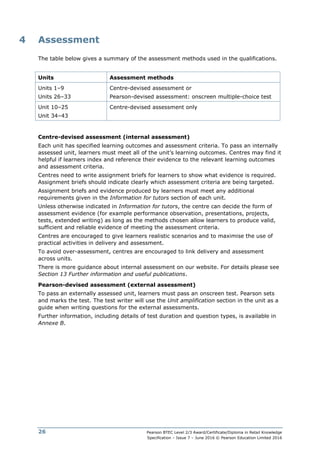
Learning outcome 4: can be covered by learners conducting a COSHH assessment using
a recording sheet for the assignment in learning outcome 3. Learners should be able to
construct their own recording sheet. The assessment will need to include appropriate
up-to-date data sheets readily available from manufacturers or via the internet.
Learners will require access to growing plants and will need the opportunity to monitor
pests and diseases as well as implement appropriate control methods. It would be
desirable for learners to have access to a retail outlet displaying and selling plants
to enable them to meet the requirements of this unit.
Pearson BTEC Level 2/3 Award/Certificate/Diploma in Retail Knowledge
Specification – Issue 7 – June 2016 © Pearson Education Limited 2016
249
Suggested resources
Books
Alford D V – Color Atlas of Pests of Ornamental Trees, Shrubs and Flowers
(Timber Press, 2003) ISBN 9780881925616
Buczacki S and Harris K – Pests, Diseases and Disorders of Garden Plants
(Collins, 1998) ISBN 9780002200639
Lainsbury M – UK Pesticide Guide 2009 (CABI Publishing, 2009) ISBN 9781845935627
Other
Defra – Pesticides: Code of Practice for Using Plant Protection Products (Defra, 2006)
Journal
Horticulture Week
Websites
www.bopp.org.uk – The British Ornamental Plant Producers' Certification Scheme (BOPP)
www.cropprotection.org.uk – The Crop Protection Association
www.gardenorganic.org.uk – organic growing charity
www.hortweek.com – Horticulture Week magazine
www.hse.gov.uk – Health and Safety Executive
www.pesticides.gov.uk – government website for pesticide authorisation
www.rhs.org.uk – Royal Horticultural Society
www.soilassociation.org – Soil Association
Pearson BTEC Level 2/3 Award/Certificate/Diploma in Retail Knowledge
Specification – Issue 7 – June 2016 © Pearson Education Limited 2016
250
Unit 35: Understanding the
Nature, Uses and
Importance of Product
Information in a Retail
Outlet Selling Gardening
Products
Unit reference number: F/600/2652
Level: 3
Credit value: 3
Guided learning hours: 20
Unit aim
This unit is designed to enable the learner to understand the range of gardening products
on sale in a retail outlet and recognise the importance of product information, including
how different types of product information might be used to support customer service.
Garden retail outlets are a popular destination for the gardener to buy garden products
and to access gardening information. They offer a personal contact with knowledgeable
staff who are able to help with the choice of product and answer questions. To ensure
appropriate displays, sales and after-sales it is necessary to promote product knowledge
with staff.
Retail outlets display and sell a wide range of products for the garden, including plants,
sundries, equipment, clothing, furniture and buildings. The learner will need to know,
and be able to transmit, a considerable amount of information about a product to the
customer. The gathering of product information by staff may be during other ongoing
activities or as part of a staff training programme. The communication of information
to staff and to customers can be by verbal and non-verbal methods; staff need to be
aware of the effectiveness and use of each method. Staff need to be available to
answer enquiries from customers regarding products for the garden. Throughout all
the activities, learners will need to select, maintain and use equipment in a safe and
correct way.
This unit develops the learner’s knowledge and skills and on completion they should be
able to understand the role of product knowledge and implement its use effectively in a
retail outlet. It will also give the learner confidence to advise customers on the purchase
of products and their use in the garden. The learner would need to study the following
units as a prerequisite Unit 25: Understanding Plant Nomenclature, Terminology and
Identification, Unit 34: Understanding the Control of Pests and Diseases Which May Affect
Plants in a Retail Outlet, Unit 36: Understanding the Management of Delivery of Plants
into a Retail Business and Unit 37: Understanding How the Growth and Development of
Plants is Promoted and Monitored in a Retail Business.
Essential resources
It would be desirable for learners to have access to a retail outlet displaying and selling
garden products to enable them to meet the requirements of this unit.
Pearson BTEC Level 2/3 Award/Certificate/Diploma in Retail Knowledge
Specification – Issue 7 – June 2016 © Pearson Education Limited 2016
251
Learning outcomes, assessment criteria and unit
amplification
To pass this unit, the learner needs to demonstrate that they can meet all the learning
outcomes for the unit. The assessment criteria determine the standard required to
achieve the unit.
Learning outcomes Assessment criteria
1 Understand the
product ranges
typically offered
by retail outlets
selling gardening
products
1.1 Explain the common gardening product ranges and
their typical target market groups
1.2 Explain how the social, economical and environmental
factors of a specific geographical area can affect how
well different gardening product ranges sell
1.3 Describe the sources of information which can be used
to define and predict key current and future trends in
gardening products
2 Understand the
communication
of product
information to
sales staff
2.1 Explain the importance to a retail business of ensuring
that the product knowledge of the sales staff is kept
up-to-date
2.2 Explain effective methods of communicating the
features and benefits of a product range to sales staff
3 Understand the
communication
of product
information to
customers
3.1 Describe the types of information available to help
customers choose and use gardening products
3.2 Compare product information aimed at trade and
non-trade customers
3.3 Evaluate the effectiveness of the different types of
product information available to customers
4 Understand how
a retail business
benefits from the
product knowledge
of its staff
4.1 Assess the importance of product knowledge to the
delivery of customer service
4.2 Explain how the product knowledge of sales staff helps
to drive sales
Pearson BTEC Level 2/3 Award/Certificate/Diploma in Retail Knowledge
Specification – Issue 7 – June 2016 © Pearson Education Limited 2016
252
Unit amplification and content
1 Understand the product ranges typically offered by retail outlets selling
gardening products
Product ranges:
plants, sundries, furniture, buildings, tools, equipment, outdoor living, hard landscape
materials, aquatics, pets, wildlife, clothing, demography
Social factors:
housing, average age, education, marital status, family size, ethnic origin,
occupation, employment status, disability, socio-economic groupings
Economical factors:
home ownership, competition, leisure outlets, rural, urban, cost barriers, income
levels, growth potential, mobility, employment
Environmental factors:
transport systems, topography, soil types, size of gardens, roads, local authority
Sources of information:
demography, government surveys, industry surveys, market research, university
research, socio-economic groups, local authority, overseas retailing trends, UK non-
garden retailing trends, industry bodies, industry publications, internet, television,
cinema
2 Understand the communication of product information to sales staff
Up-to date product knowledge:
level of sales, increased scope of communication to customers, legislation, litigation,
customer satisfaction, modifications (models, styles, colours, warranty, servicing,
spares), confident and enthusiastic staff
Effective methods of communication:
newsletters, product leaflets, catalogues, sales representatives, demonstration,
websites, internal training, external training, role play, email, team meetings,
conferencing
3 Understand the communication of product information to customers
Types of information:
media (television, radio, CD, internet, newspapers, magazines), use, price,
ingredients, symbols/pictograms, health and safety instructions, benefits, awards,
mode of action, data sheets, project sheets, demonstration, exhibit, newsletter,
guarantee, posters, direct mailing, advertisements, garden clubs
Compare between trade and non-trade:
name, legislation, certification, technical details, appearance, terminology, price,
promotions, packaging, use-by dates
Effectiveness:
questionnaire, sales reports, linked sales, impulse sales, return visits, complaints,
confrontation, cash flow, reordering
Pearson BTEC Level 2/3 Award/Certificate/Diploma in Retail Knowledge
Specification – Issue 7 – June 2016 © Pearson Education Limited 2016
253
4 Understand how a retail business benefits from the product knowledge of
its staff
Importance of product knowledge:
sales, cash flow, return visits, spending profiles, questionnaire, advice desk
Product knowledge of sales staff:
increased sales, strengthens communication skills, ability to adapt sales presentation,
shoppers’ needs, boosts enthusiasm, removes uncertainty, grows confidence, assists
in overcoming objections, decision making
Pearson BTEC Level 2/3 Award/Certificate/Diploma in Retail Knowledge
Specification – Issue 7 – June 2016 © Pearson Education Limited 2016
254
Information for tutors
Delivery
Tutors delivering this unit have opportunities to use as wide a range of techniques as
possible. The unit is likely to be delivered through formal lectures, discussion, site visits,
supervised practical sessions, independent learner research and the use of personal
and/or industrial experience. Learners’ active participation in playing games would
enhance the learning experience. Tutors should consider integrating the delivery, private
study and assessment for this unit with other relevant units and assessments that
learners are taking as part of their programme of study.
At the outset of this unit, learners must be clear about the importance of developing
a professional approach to monitoring and promoting plant growth and development,
ensuring they have the right attitude in all aspects of their work while in the public gaze.
Whichever delivery methods are used, it is essential that tutors stress the importance of
environmental management and the need to manage the activities using approved
methods.
The need for attention to health and safety issues must be stressed and regularly
reinforced, and risk assessments must be undertaken prior to practical activities.
Adequate PPE must be provided and used following the completion of risk assessments.
Learning outcome 1 explains and describes the range of gardening products offered by
retail outlets. A visit to a retail outlet where the learners can observe the range of
products offered and investigate the factors that affect sales would enhance
understanding.
Learning outcome 2 covers the communication of up-to-date product information to staff.
Learners could prepare a questionnaire for the staff of a retail outlet asking about recent
changes to specific products. The results could be discussed with other learners.
In learning outcome 3 learners experience the communication of product information
to customers by taking part in a role-play activity and recording for analysis. The
assignment is to prepare profiles of products to show the differences in product
information aimed at the trade and retail customer.
Learning outcome 4 explains the benefits to a retail business of providing product
information to customers. Learners can prepare a questionnaire and have the opportunity
to ask customers about their wants and needs when visiting a retail outlet selling garden
products. Analysis of the results would inform learners of the benefits of product
information to customer service and sales.
Tutors should identify the products or agree them through discussion with learners.
Where possible, to ensure fairness of assessment, the size and complexity of the tasks
should be the same for all learners.
Pearson BTEC Level 2/3 Award/Certificate/Diploma in Retail Knowledge
Specification – Issue 7 – June 2016 © Pearson Education Limited 2016
255
Assessment
Assessment by portfolio of evidence
The centre can devise and mark the assessment for this unit. Learners must meet all
assessment criteria to pass the unit.
Learning outcome 1: can be covered through observation of the learner in their work
placement as they demonstrate the maintenance of a stock list. Alternatively, this could
be an exercise where two learners work together, one as a scribe and one assessing the
stock levels. Learners would need to research socio-economic groupings and identify the
target group on the retail outlet they work in.
Learning outcome 2: can take the form observation of the learner giving information
to customers and gaining a sale in their work placement. Learners ought to have the
opportunity to question a member of the management team of a retail outlet about
gaining a sale and discuss their communication of product knowledge to their staff.
Learners should then be able to question the sales staff about the effectiveness of that
communication from management. To conclude the assignment, learners ought to
construct a report of their findings with recommendations for discussion with the member
of the management team.
Learning outcome 3: can take the form of a project to gather product information and
submit it as information profiles. Learners can choose a specified number of products
that they are familiar with and research the differences in the information available to
both the trade and retail customer. Learners can design a short questionnaire for retail
customers asking how much information they require.
Learning outcome 4: can be covered by observing directly the conducting of a customer
survey at a retail outlet at the point of customer departure. Learners can design the
questionnaire in advance after some discussion as a group, perhaps together with a
member of staff from the retail outlet, to assess customer satisfaction. Results could
be collated and presented to the retail outlet staff. Learners can be assessed on their
conducting of the questioning and their collation of the results. This could be made
into a group task but criteria for individual assessment will need to be discussed and
accepted by the learners. A keen focus of this learning outcome is collecting customers’
complaints, comments and suggestions during departure. A professional discussion or
a report that has been produced can demonstrate the learner’s understanding of the
different methods available for customer feedback and how the information is then used.
To support this focus, learners will be requested to design a method for gaining customer
feedback suitable for their establishment and report their reasons for choice in design,
and how they may use the feedback gained to implement improvements. Reflective
accounts from learners will provide details of how unexpected problems during customer
departure have been dealt with. The use of case studies can be provided for the learner
to detail how they would deal with a wider number of possible problems than they may
have experienced.
Pearson BTEC Level 2/3 Award/Certificate/Diploma in Retail Knowledge
Specification – Issue 7 – June 2016 © Pearson Education Limited 2016
256
Suggested resources
Books
Stanley J – The Complete Guide to Garden Center Management
(ebrandedbooks.com, US, 2002) ISBN 9781883052317
Stanley J – The Nursery and Garden Centre Marketing Manual
(The Reference Publishing Co, 1994) ASIN B002Y76RC2
Journal
The Retailer
Websites
www.farma.org.uk – co-operative of UK farmers, small-scale local producers and farmers’
market organisers
www.gohelios.co.uk – National Plant specification (NPS) and the GoHelios Plants Selector
www.retail-week.com – retail industry newsletter
Pearson BTEC Level 2/3 Award/Certificate/Diploma in Retail Knowledge
Specification – Issue 7 – June 2016 © Pearson Education Limited 2016
257
Unit 36: Understanding the
Management of Delivery
of Plants into a Retail
Business
Unit reference number: K/600/2659
Level: 3
Credit value: 3
Guided learning hours: 20
Unit aim
This unit enables the learner to understand the different types of packaging for the range
of gardening retail products and how to deal with plants before, during and after delivery.
It also covers the administrative processes in place for the tracking and monitoring of
plants.
Garden retail outlets are a popular destination for the gardener to buy garden products
and to access gardening information. They offer personal contact with knowledgeable
staff who are able to help with the choice of product and answer enquiries. To ensure
plants are of a suitable quality for display, sale and after-sales, it is necessary to
understand the processes of plant preparation for despatch, their management during
and after delivery to the retail outlet and the necessary administrative procedures.
Retail outlets display and sell a wide range of plants which can be grown outdoors or with
the aid of protection. There are fundamental factors to be considered when preparing
plants for delivery to a customer and actions to be taken once the plants reach their
destination. The learner will need to know the requirements of the main groupings of
plants to ensure a high-quality plant for eventual sale and appreciate the need to choose
packaging that will preserve plant quality while in transit. The management of the
delivery of plants will involve the choice of packaging and understanding the factors
that could cause deterioration of plant quality in transit. The learner will need to make
decisions about the most suitable methods of packaging and be able to resolve any
problems as they emerge in relation to work activities. Managing plant quality will involve
maintaining moisture levels, providing nutrients and removing unwanted plant material.
Learners may be required to manipulate plant development through trimming and
supporting, and maintaining health by controlling pests, diseases, weeds and disorders.
The monitoring of plant quality may be carried out during other ongoing activities or as
part of a routine inspection procedure. Throughout all the activities Learners will need to
select, maintain and use equipment in a safe and correct way.
This unit develops the learners’ knowledge and skills and on completion they should be
able to select packaging and manage the delivery for a range of plants that would be
found in a retail outlet. It will also give the learner confidence to advise customers on the
care and maintenance of plants. Product knowledge will be greatly enhanced particularly
in the choice of associated tools and sundries.
The learner would need to study the following units as a prerequisite: Unit 34:
Understanding the Control of Pests and Diseases Which May Affect Plants in a Retail
Outlet and Unit 37: Understanding How the Growth and Development of Plants is
Promoted and Monitored in a Retail Outlet.
Pearson BTEC Level 2/3 Award/Certificate/Diploma in Retail Knowledge
Specification – Issue 7 – June 2016 © Pearson Education Limited 2016
258
Essential resources
For this unit, learners will require access to an area where plants can be grown and
maintained to a saleable standard. A range of plant types and habits would make the
delivery relevant and interesting. It would be desirable for learners to have access to
a retail outlet displaying and selling plants to enable them to meet the requirements of
this unit.
Pearson BTEC Level 2/3 Award/Certificate/Diploma in Retail Knowledge
Specification – Issue 7 – June 2016 © Pearson Education Limited 2016
259
Learning outcomes, assessment criteria and unit
amplification
To pass this unit, the learner needs to demonstrate that they can meet all the learning
outcomes for the unit. The assessment criteria determine the standard required to
achieve the unit.
Learning outcomes Assessment criteria
1 Understand the
preparation of
plants for
transportation
1.1 Describe the methods of packaging used for different
types of plants
1.2 Explain how the choice of packaging helps to ensure
that plants reach the customer in the required
condition
2 Understand how
plant quality is
managed during
and immediately
after delivery
2.1 Explain the factors affecting the quality of plants during
transit
2.2 Explain the processes and procedures for dealing with
plants at risk of deterioration during transit
2.3 Explain how to assess the condition of plants on arrival
at the customer’s premises and the action to take if
plants have deteriorated
2.4 Explain the kinds of advice and help the customer may
need to care for plants immediately after delivery
3 Understand the
administrative
procedures
associated with
delivery of plants
to customers
3.1 Describe the administrative systems and paperwork
associated with deliveries of plants to customers
3.2 Explain the relevance of ‘plant passports’ and how they
are used
3.3 Assess the impact on the business of failing to follow
correct administrative procedures
Pearson BTEC Level 2/3 Award/Certificate/Diploma in Retail Knowledge
Specification – Issue 7 – June 2016 © Pearson Education Limited 2016
260
Unit amplification and content
1 Understand the preparation of plants for transportation
Methods of packaging:
trolley, pallet, cling film, cardboard box, pot, pre-pack, straw, paper
Choice of packaging:
protection from physical damage, control of humidity, gaseous exchange,
controlled atmosphere
2 Understand how plant quality is managed during and immediately after
delivery
Quality factors:
desiccation and shrivelling, scorch, cold and light related, pests and diseases,
compost spillage, weeds, breakage
Processes:
inspection, storage before despatch, environmental protection, temperature control,
choice of packaging, waste disposal, transit container
Procedures:
management systems, labelling, advisory, contact customer, staff training
Assessment:
correct grades, sizes, container damage, transit damage, weather damage, plants
free from pests, diseases, disorders and weeds, plants established in pots, compost
levels, watering, feeding, pest, disease and weed control, pruning, disposal
Advice:
contact distribution centre or supplier, quarantine, nutritional status of plants and
feeding, repotting, watering, pruning and training, labelling, light requirement
3 Understand the administrative procedures associated with delivery of plants
to customers
Administrative systems:
computer software, barcodes, stock control, labelling
Paperwork:
picking list, despatch and delivery notes
Plant passports:
European Union (plant movement within EU, within individual states, quarantine pests
and diseases, ornamental, fruit and vegetables), UK regulations, Fera Plant Health
and Seeds Inspectors (PHSI), phytosanitary certificate for imports from non-EU
countries, pests and diseases control, accompanying documents, grower to trade
customer
Impact:
loss of order, litigation, penalties, imprisonment, debt, stock control, contravention of
legislation, profit and loss
Pearson BTEC Level 2/3 Award/Certificate/Diploma in Retail Knowledge
Specification – Issue 7 – June 2016 © Pearson Education Limited 2016
261
Information for tutors
Delivery
Tutors delivering this unit have opportunities to use as wide a range of techniques as
possible. The unit is likely to be delivered through formal lectures, discussion, site visits,
supervised practical sessions, independent learner research and the use of personal
and/or industrial experience. Learners’ active participation in games would enhance the
learning experience. Tutors should consider integrating the delivery, private study and
assessment for this unit with other relevant units and assessments that learners are
taking as part of their programme of study.
At the outset of this unit, learners must be clear about the importance of developing
a professional approach to monitoring and promoting plant growth and development,
ensuring they have the right attitude in all aspects of their work while in the public gaze.
Whichever delivery methods are used, it is essential that tutors stress the importance of
environmental management and the need to manage the activities using approved
methods.
Health and safety issues must be stressed and regularly reinforced, and risk assessments
undertaken prior to practical activities. Adequate PPE must be provided and used
following the completion of risk assessments.
Learning outcome 1 investigates the choice of packaging used to protect plants while in
transit. A visit to a plant supplier and the opportunity to collect and prepare plants for
despatch to a retail outlet would aid the understanding of the role of packaging.
In learning outcome 2, the learner is able to observe and appreciate the factors that
could affect plants while in transit. It also covers the action to be considered on receipt of
the plants to avoid deterioration in plant quality. A domino game activity would show the
learner’s level of understanding. The opportunity to visit a plant supplier or retail outlet
to unpack and assess the condition of plants would help learners appreciate the necessity
for procedures and processes.
In learning outcome 3, the learner covers the administrative requirements for the
delivery of plants and the role of plant passports. Their importance can be emphasised
as the learners actually record the information from the assignments in learning
outcomes 1 and 2.
Assessment
Assessment by portfolio of evidence
The centre can devise and mark the assessment for this unit. Learners must meet all
assessment criteria to pass the unit.
Learning outcome 1: can be covered through learner work placement observations
demonstrating the different stages of preparing a plant for despatch. Alternatively,
this could be a simulated assignment with a range of packaging materials being made
available. The learner would need to choose the appropriate material and be encouraged
to explain their choice.
Learning outcome 2: can take the form of observation directly related to the work
placement for the receipt of a plant order. The learner would need to construct a
checklist for completion and recording of their comments on the condition of the plants
after their delivery. This would provide an opportunity for the learner to comment on
the role of the packaging used for the delivery and recommend any remedial action.
Appropriate equipment and sundries would need to be available to allow learners to
carry out any remedial action to the plants.
Pearson BTEC Level 2/3 Award/Certificate/Diploma in Retail Knowledge
Specification – Issue 7 – June 2016 © Pearson Education Limited 2016
262
Learning outcome 3: can be covered through the completion of appropriate paperwork or
computerised log. The choice of packaging for despatch in learning outcome 1 will need
to be recorded for receipt by the customer, together with guidance for its disposal and
recycling. Details of relevant plant passports would also need to be attached. The
checklist and action plan used in learning outcome 2 could be transferred to a recognised
management system.
Suggested resources
Books
Snook C and Crafer K – Grower Manual 4: Garden Centre Manager
(Grower Books – A division of Nexus Media Ltd, 1999) ISBN 9781899372157
Stanley J – The Complete Guide to Garden Center Management (ebrandedbooks.com,
US, 2002) ISBN 9781883052317
Stanley J – The Nursery and Garden Centre Marketing Manual
(The Reference Publishing Co, 1994) ASIN B002Y76RC2
Journals and/or magazines
American Nurserymen
Horticulture Week
Websites
www.bopp.org.uk – The British Ornamental Plant Producers' Certification Scheme (BOPP)
http://www.fera.defra.gov.uk/ – The Food and Environment Research Agency
Pearson BTEC Level 2/3 Award/Certificate/Diploma in Retail Knowledge
Specification – Issue 7 – June 2016 © Pearson Education Limited 2016
263
Unit 37: Understanding how the
Growth and Development
of Plants is Promoted and
Monitored in a Retail
Outlet
Unit reference number: H/600/2661
Level: 3
Credit value: 4
Guided learning hours: 26
Unit aim
This unit enables the learner to understand plant growth and development and promote
the health of plants in order to meet commercial requirements. It also enables the
learner to recognise the importance of plant maintenance and administer the processes
for record keeping in relation to growing plants.
Garden retail outlets are a popular destination for the gardener to buy garden products
and to access gardening information. They offer a personal contact with knowledgeable
staff who are able to help with the choice of product and answer questions. To ensure
plants are of a suitable quality for display, sale and after-sales, it is necessary to
maintain their growth and development in the retail outlet. Retail outlets display and sell
a wide range of plants which can be grown outdoors or with the aid of protection. There
are fundamental factors to be considered in the maintenance of plants to ensure their
growth and development is not affected by the display environment. The learner will
need to know the requirements of the main groupings of plants to ensure a high-quality
display for sale and appreciate the need to segregate groupings in the display area for
ease of maintenance and use by customers.
The monitoring of plant growth and development will involve inspecting and reporting on
the progress and development of the plants on display. Monitoring may be carried out
during other ongoing activities or as part of a routine inspection procedure. Decisions will
need to be made regarding the most suitable methods to use and learners will be able to
resolve any problems as they emerge in relation to work activities. Maintaining growth
and development will involve maintaining moisture levels, providing nutrients and
removing unwanted plant material. Maintaining moisture levels may involve watering
plants manually or checking and adjusting automated systems. There may be a
requirement to manipulate plant development through trimming and supporting, and
maintaining the health of plants by controlling pests, diseases, weeds and disorders.
Throughout all the activities learners will need to select, maintain and use equipment
in a safe and correct way.
This unit develops the learner’s knowledge and skills and on completion they should be
able to monitor and maintain plant growth for a range of plants that would be found
in a retail outlet. It will also give the learner confidence to advise customers on the
purchasing of plants and their maintenance in the garden. The learner would need to
study the following unit as a pre-requisite: Unit 34: Understanding the Control of Pests
and Diseases Which May Affect Plants in a Retail Outlet. Product knowledge will be
greatly enhanced particularly in the choice of associated tools and sundries.
Pearson BTEC Level 2/3 Award/Certificate/Diploma in Retail Knowledge
Specification – Issue 7 – June 2016 © Pearson Education Limited 2016
264
Essential resources
For this unit, learners will require access to an area where plants can be grown and
maintained, ideally to a saleable standard. A range of plant types and habits would make
the delivery relevant and interesting. It would be desirable for the learner to have access
to a retail outlet displaying and selling plants to enable them to meet the requirements of
this unit.
Pearson BTEC Level 2/3 Award/Certificate/Diploma in Retail Knowledge
Specification – Issue 7 – June 2016 © Pearson Education Limited 2016
265
Learning outcomes, assessment criteria and unit
amplification
To pass this unit, the learner needs to demonstrate that they can meet all the learning
outcomes for the unit. The assessment criteria determine the standard required to
achieve the unit.
Learning outcomes Assessment criteria
1 Understand the
factors which
promote the
growth and
development of
plants to meet
commercial
requirements
1.1 Explain the tasks which promote plant growth and
development and the best times to carry out these
tasks
1.2 Explain the requirements of different types of growing
plant for nutrients and moisture and the importance of
monitoring and adjusting nutrients and moisture
1.3 Explain the relationship between the care of growing
plants and levels of production
2 Understand the
factors which
promote the health
of growing plants
2.1 Explain the methods of promoting the health of
growing plants
2.2 Explain the common health problems which may affect
growing plants and the remedies for such problems
3 Understand the
importance of the
routine tasks
required to
maintain the area
where plants are
grown
3.1 Explain the reasons why it is important to maintain
hygiene and describe how this is achieved
3.2 Explain methods of handling plant material which
protect personal health and the condition of plants
3.3 Describe possible environmental damage that could
occur and how to minimise such occurrences
4 Understand how
to maintain
equipment
4.1 Explain the importance of maintaining equipment
for use
4.2 Describe the methods of maintaining the range of
equipment for use
5 Understand the
record-keeping in
relation to growing
plants
5.1 Explain the records required for management and
legislative purposes and the importance of maintaining
them
Pearson BTEC Level 2/3 Award/Certificate/Diploma in Retail Knowledge
Specification – Issue 7 – June 2016 © Pearson Education Limited 2016
266
Unit amplification and content
1 Understand the factors which promote the growth and development of
plants to meet commercial requirements
Promoting plant growth and development:
definition of growth and development – dormancy, germination, vegetative growth,
apical dominance, flowering, fruiting, seed set, factors affecting each growth stage,
monitoring of growth stages
tasks – hygiene, watering, feeding, weed control, lighting, provide shelter, provide
heat, pruning, training, cane and tie, standing up of plants in containers, pest and
disease control, weed control
times – seasonal, weather conditions, hours of trading, stages of plant growth,
to meet plant needs
Requirements of different plants:
types of growing plant – trees, shrubs, conifers, climbers, herbaceous, ground cover,
bedding, alpine, ferns, bulbs, house, vegetables and herbs, tree and soft fruit, turf,
cacti, aquatics
nutrients – major, minor and trace elements, pH, base dressing, top dressing,
quick and slow release, liquid feed, foliar feed, organic and inorganic products
moisture – humidity, watering by hand, overhead irrigation, low-level irrigation,
quantity, frequency, liquid feeding
importance of monitoring and adjusting – loss of quality, poor flowering and fruiting,
excessive growth, poor leaf colour, dead plants, profit and loss, reputation
Care and levels of production:
relationship – saleable, plant display, National Plant Specifications, reputation,
stock control, ordering, shrinkage, waste disposal, cash flow, profit and loss
2 Understand the factors which promote the health of growing plants
Promoting health of growing plants:
methods – management systems, regular monitoring, soil and compost analysis,
recording systems, watering systems, feeding, weed control, lighting, provide shelter,
provide heat, pruning, training, cane and tie, standing up plants in containers
Common health problems and remedies:
problems – underwatering, overwatering, leaching, underfeeding, overfeeding,
scorching of foliage, flowers and fruits, cold damage, pests, diseases, weeds,
lack of light, too much light, animal damage, customer damage, staff damage
remedies – introduce management systems, monitor and adjust watering and
feeding, prune, relocate plants, quarantine and treat, non-chemical control,
bio-stimulants, chemical control, staff training
Pearson BTEC Level 2/3 Award/Certificate/Diploma in Retail Knowledge
Specification – Issue 7 – June 2016 © Pearson Education Limited 2016
267
3 Understand the importance of the routine tasks required to maintain the
area where plants are grown
Reasons to maintain hygiene:
reputation, loss of plant quality, saleability, plant display, waste, shrinkage
How hygiene is achieved:
disposal of debris, clean display bench and area, plant spacing, ventilation, remove
infection and infestation, water quality, supervision, risk assessment, waste disposal
Plant handling methods:
mechanical, by hand, cane protectors, health and safety procedures, delivery to
display area
Possible environmental damage:
water drainage, soil water contamination, site run-off, pest and disease spread, weed
spread, air pollution, litter, vandalism
How to minimise environmental damage:
water run-off, waste disposal, staff responsibility, management procedures, facilities,
equipment
4 Understand how to maintain equipment
Importance of maintenance:
health and safety, capital investment, rate of application, environmental damage,
effective
Methods of maintaining equipment:
management procedures, staff responsibility, staff training, risk assessment,
calibration, regular servicing, replacement
5 Understand the record-keeping in relation to growing plants
Records required:
risk assessment, chemical spray record, COSHH assessment, BOPP crop assurance
scheme, stock list, paper system, computer system
Importance of maintaining records:
legislation, litigation, management (weekly, monthly, seasonal, suppliers),
crop assurance scheme inspection
Pearson BTEC Level 2/3 Award/Certificate/Diploma in Retail Knowledge
Specification – Issue 7 – June 2016 © Pearson Education Limited 2016
268
Information for tutors
Delivery
Tutors delivering this unit have opportunities to use as wide a range of techniques as
possible. The unit is likely to be delivered through formal lectures, discussion, site visits,
supervised practical sessions, independent learner research and the use of personal
and/or industrial experience. Learners’ active participation in games would enhance the
learning experience. Tutors could consider integrating the delivery, private study and
assessment for this unit with other relevant units and assessment methods learners are
taking as part of their programme of study.
At the outset of this unit, learners must be clear about the importance of developing
a professional approach to monitoring and promoting plant growth and development,
ensuring they have the right attitude in all aspects of their work while in the public gaze.
Whichever delivery methods are used, it is essential that tutors stress the importance
of environmental management and the need to manage the activities using approved
methods. Health and safety issues must be stressed and regularly reinforced, and risk
assessments undertaken prior to practical activities.
Learning outcome 1 investigates the factors that promote the growth and development
of plants to meet commercial requirements. Learners in small groups could identify
the tasks to promote plant growth and development and use a sticky-note display
to illustrate their thoughts. The assignment asks the learner to choose a plant type,
research the requirements to promote its growth and development, and then present
the information to fellow learners and work staff.
In learning outcome 2, the factors which promote the health of growing plants need to be
linked with the factors in learning outcome 1. Learners can take part in activities such as
using a sticky-note display on the wall to show their understanding. The assignment asks
learners to observe plants, preferably grown in containers, record their findings and
propose remedies to improve their growth and development.
For learning outcome 3, learners should understand the importance of the routine tasks
required to maintain the area where plants are grown, while recognising the need for
hygiene and awareness of possible environmental damage. Learners can take part in
activities such as the use of ‘sequence cards’ to show their understanding. The
assignment can be conducted in a garden situation, plant nursery or retail outlet.
Learning outcome 4 explains the need for the maintenance of equipment used to
promote growth, development and health of plants. The opportunity to use tools,
lubricants and cleaning materials would benefit the learner and aid their demonstration
of maintaining a piece of equipment. Suitable equipment, tools and lubricants should be
made available to learners.
Learning outcome 5 covers the need for keeping records of the work activities both to
satisfy current legislation and to provide information to aid the management of the retail
outlet. The importance of record-keeping can be emphasised as learners record the
information from the assignments in learning outcomes 1–4. The health and safety
implications need to be highlighted.
Learners need to maintain and control the growth and development of selected plants.
Tutors need to identify the plants, or agree them through discussion with learners, that
would be appropriate to a retail outlet. Where possible, to ensure fairness of assessment,
the size and complexity of the tasks should be the same for all learners.
Pearson BTEC Level 2/3 Award/Certificate/Diploma in Retail Knowledge
Specification – Issue 7 – June 2016 © Pearson Education Limited 2016
269
Assessment
Assessment by portfolio of evidence
The centre can devise and mark the assessment for this unit. Learners must meet all
assessment criteria to pass the unit.
Learning outcome 1: can be covered by a presentation to cover the tasks to promote
plant growth and development. The chosen plant should be one that is typical of either a
house plant or outdoor plant for sale in a retail outlet. The presentation should cover the
management of the watering and nutrition of the chosen plant. Learners should make
reference to how these management practices affect the quality of the plant and its
production of flowers, fruits, leaves and stems.
Learning outcome 2: can take the form of observation directly related to the work
placement for plant display and their maintenance. Learners will be required to research
remedies for plant health problems found while inspecting plants in a retail display.
Reflective accounts from learners will provide details of how unexpected problems during
customer departure have been dealt with and case studies can be provided for the
learner to explain how they would deal with a wider number of possible problems than
they may have experienced.
Learning outcome 3: can be covered by observing learners tending a group of plants by
watering, feeding and pruning them. A key focus could be on their cleaning up afterwards
and the disposal of waste, with particular regard to the health and safety of staff and
customers. This could be covered by a series of assessments throughout the year using
the typical range of plant types to be found in a retail outlet.
Learning outcome 4: can take the form of a practical presentation to demonstrate
the learner’s understanding of the maintenance of a chosen piece of equipment. The
demonstration would need to address prescribed health and safety procedures. Learners
should have the opportunity to discuss their proposed presentation with their tutor.
Learning outcome 5: can be covered by the completion of appropriate paperwork or
computerised records for learning outcomes 3 and 4. Learners could complete a written
log of the work they carried out while maintaining plants, when they were meeting the
requirements for learning outcome 3. It would need to include details of waste disposal.
They could then complete a maintenance log for learning outcome 4, with a record of
materials used. Learners should identify the reasons for recording this information.
Suggested resources
Books
Adams C and Early M – Principles of Horticulture (Butterworth-Heinemann, 2004)
ISBN 9780750660884
Alford D – A Colour Atlas of Pests of Ornamental Trees, Shrubs and Flowers
(Timber Press, 2003) ISBN 9780881925616
Buczacki S and Harris K – Pests, Diseases and Disorders of Garden Plants
(Collins, 1998) ISBN 9780002200639
Ingram D, Vince-Prue D, and Gregory P – Science and the Garden: The Scientific Basis
of Horticultural Practice (Wiley-Blackwell, 2002) ISBN 9780632053087
Ministry of Agriculture, Fisheries and Food – Fertiliser recommendations, 7th Edition
(Stationery Office Books, 2000) ISBN 9780112430582
Roth S and Dourado A – Weeds: Friend or Foe? – An Illustrated Guide to Identifying,
Taming and Using Weeds (Carroll and Brown Publishers Limited, 2002)
ISBN 9781903258262
Pearson BTEC Level 2/3 Award/Certificate/Diploma in Retail Knowledge
Specification – Issue 7 – June 2016 © Pearson Education Limited 2016
270
Journals and/or magazines
American Nurserymen
Horticulture Week
Websites
www.bopp.org.uk – The British Ornamental Plant Producers' Certification Scheme (BOPP)
www.cropprotection.org.uk – The Crop Protection Association
www.gardenorganic.org.uk – organic growing charity
www.gohelios.co.uk – website for the National Plant specification (NPS) and the GoHelios
Plants Selector
www.pesticides.gov.uk – government website for pesticide authorisation
www.rhs.org.uk – Royal Horticultural Society
www.soilassociation.org – Soil Association
Pearson BTEC Level 2/3 Award/Certificate/Diploma in Retail Knowledge
Specification – Issue 7 – June 2016 © Pearson Education Limited 2016
271
Unit 38: Understand how to
Approach Work-Based
Projects within Retail
Business
Unit reference number: D/602/5016
Level: 2
Credit value: 3
Guided learning hours: 22
Unit aim
The aim of this unit is to give learners knowledge and understanding of how projects are
undertaken within the retail workplace. The unit covers the process of planning and
implementing appropriate activities and tasks within the retail workplace and also
provides learners with an opportunity to review the outcomes and progress.
Employers use projects to gain a better understanding of problems associated with
particular products or processes and identify the most effective way to resolve those
problems. This unit has been designed to give learners an understanding of how such
a project is planned and implemented in order to achieve a successful outcome. It is
anticipated that this unit will be delivered in a practical way, allowing the learner to
experience first-hand the challenges of undertaking such a task and the benefits to the
learner and the workplace.
Learners will be required to focus on a product or process of the retail business and then
set objectives and targets in order to solve an identified problem. The learner will need
to understand potential problems or barriers that could result in the objectives and/or
targets not being achieved. To achieve this, the learner will need to have sufficient time
within a suitable work environment to be able to carry out this work. The learner should
be encouraged to prepare a plan showing how the project could be implemented.
Following the implementation of the plan the learner will then be able to describe the
strengths and weaknesses of the plan and the skills and knowledge they have gained as
a result of the work they have done on the project.
Throughout the delivery and assessment of this unit learners will gain valuable personal,
learning and thinking skills. They will need to work as an effective member of a team.
Self-management will be essential in the development and implementation of the plan.
Reflective skills will be used when describing the strengths and weaknesses of the plan
and presentation skills may be enhanced when sharing the outcomes of the project with
work colleagues and other learners.
The learner will require support and constructive feedback from work colleagues and
tutors throughout the unit.
Essential resources
There are no special resources needed for this unit.
Pearson BTEC Level 2/3 Award/Certificate/Diploma in Retail Knowledge
Specification – Issue 7 – June 2016 © Pearson Education Limited 2016
272
Learning outcomes, assessment criteria and unit
amplification
To pass this unit, the learner needs to demonstrate that they can meet all the learning
outcomes for the unit. The assessment criteria determine the standard required to
achieve the unit.
Learning outcomes Assessment criteria
1 Understand how
to undertake a
project and solve
problems specific
to a retail function
or project
1.1 Define the problem that needs to be solved by a
project
1.2 Describe the activities/tasks of the project which are
required to meet set objectives and targets
1.3 Describe potential problems or barriers which could
affect the achievement of set objectives and target
1.4 Explain how to implement the project
1.5 Describe strengths and weaknesses of own
implementation plan
2 Understand what
constitutes a
successful project
2.1 Describe strengths and weaknesses of own working
methods
2.2 Review process and outcomes of completed project
2.3 Draw conclusions from project
Pearson BTEC Level 2/3 Award/Certificate/Diploma in Retail Knowledge
Specification – Issue 7 – June 2016 © Pearson Education Limited 2016
273
Unit amplification and content
1 Understand how to undertake a project and solve problems specific to a
retail function or project
Potential problems:
personnel, e.g. workplace health and safety, workplace security, maintaining hygiene
standards, meeting targets, teamwork, staffing issues; customer service, e.g.
resolving customer service issues, helping customers, customer feedback, products,
e.g. presenting goods for sale, displaying stock, demonstrating products, promoting
goods and services, processing payments, lost sales
Setting objectives and targets:
objectives; targets; SMART (specific, measureable, achievable, realistic,
time-bound)
Other potential problems or barriers:
timescales, unrealistic or inappropriately set objectives and/or targets
Project implementation:
stages, e.g. discussion with line manager and colleagues on feasibility of project,
personal preparation, setting objectives and targets, resources required to implement
project, monitoring and reporting on progress to colleagues/customers/line manager,
evaluating outcome of project, planning future actions; reporting methods, e.g.
informal notes/diary, report, photographs, customer feedback, feedback from
colleagues, presentation
Strengths and weakness:
suitability of project; appropriate objectives and targets; communication with
customer/colleagues/line manager; presentation of outcomes
2 Understand what constitutes a successful project
Strengths and weaknesses of own working methods:
achievements against objectives and targets; personal achievements; suitability of
recording methods used; benefits to self and to employer
Process and outcomes of completed project:
self-evaluation; new skills and knowledge gained; existing skills and knowledge
developed; benefits to self and to employer; personal development plans; possible
new career pathways; successful and unsuccessful outcomes
Conclusions:
benefits to employer and customers; personal development; future plans/
opportunities
Pearson BTEC Level 2/3 Award/Certificate/Diploma in Retail Knowledge
Specification – Issue 7 – June 2016 © Pearson Education Limited 2016
274
Information for tutors
Delivery
The unit is best offered when the learner has already gained a sound understanding of
the retail industry in general. It is suggested, therefore, that this unit should not be
undertaken until the learner has a sound understanding of the retail industry and
sufficient familiarity with their work environment.
A useful way to deliver this unit is to allow the learner to identify an appropriate project
in a suitable work environment, design an implementation plan in consultation with
their line manager, carry out the project and then evaluate the success of the project.
Learners will therefore need time in a suitable work environment to give them the
opportunity to plan, implement and evaluate a project. They must be well prepared,
have a clear understanding of the project they wish to undertake and liaise closely
with their line manager.
The learner must have sufficient time in the work environment to build effective
relationships with work colleagues and plan and carry out an appropriate project. This
may be as a continuous period, as a series of individual days, or as a combination of
both.
Learners will need an appropriate level of support to identify, undertake and evaluate
the work-based project, so that they can acquire a deeper and broader knowledge and
understanding of the world of work and use the opportunity to develop their own skills
and knowledge within the retail industry. The work-based project is likely to present a
range of opportunities to develop skills which form part of the National Occupational
Standards. However, the experience will also help the learner to develop transferable
skills which will be of benefit in any work situations should they later make a change in
their career plan.
Learners will need sufficient tutoring/mentoring time throughout the delivery of this unit.
They will need guidance on the selection of the problem they want to consider to ensure
that it is realistic and achievable in the timescale available. Time will need to be spent
discussing the preparation and planning process, different methods of assessing success,
evaluation and presentation methods.
This unit could also give learners opportunities to gather materials and experience, this
will be relevant to the requirements of other units and will help the learner to achieve
them. For example, Unit 1: Understanding Customer Service in the Retail Sector, Unit 2:
Understanding the Retail Selling Process, Unit 9: Understanding Visual Merchandising for
Retail Business, Unit 8: Understanding the Control, Receipt and Storage of Stock in a
Retail Business, as well as the specialist units on Beauty Retailing and Food Retailing.
Pearson BTEC Level 2/3 Award/Certificate/Diploma in Retail Knowledge
Specification – Issue 7 – June 2016 © Pearson Education Limited 2016
275
Assessment
Assessment by portfolio of evidence
The centre can devise and mark the assessment for this unit. Learners must meet all
assessment criteria to pass the unit.
This unit provides an excellent opportunity for holistic assessment. The learner could
prepare a presentation for colleagues, which demonstrates evidence for each of the
assessment criteria for learning outcomes 1 and 2. The problem selected can be clearly
defined, the objectives and targets can be described along with the activities/tasks
planned to achieve the objectives/targets set. A description should then be given of the
potential problems or barriers that may affect the achievement of the set objectives and
targets. The learner can then describe how the project was implemented and examples
of the plan can be provided. A description of the strengths and weaknesses of the plan
can then be shared with colleagues. The presentation could then go on to describe the
strengths and weaknesses of their working methods, the process and outcomes and
conclusions drawn.
If this method of assessment is used the learner must reference each assessment
criterion against the evidence they have produced.
Alternatively, the learner could produce a report which provides details for each
assessment criterion or a question and answer session may be arranged between the
learner, employer and assessor. Evidence of the discussion must be available for internal
and external verification purposes.
Suggested resources
Books
Bacal R – Perfect Phrases for Customer Service (McGraw-Hill Professional, 2005)
ISBN 9780071444538
Bradley S – S/NVQ Level 2 Customer Service Candidate Handbook
(Heinemann, 2003) ISBN 9780435451691
Brittain P and Cox R – Retailing: An Introduction
Pearson Higher Education FT Prentice Hall, 2004) ISBN 9780273678191
Fleming P – Retail Selling: How to Achieve Maximum Retail Sales
(Mercury Business Books, 2007) ISBN 97818525255451
Newton R – The Project Manager: Mastering the Art of Delivery
(Pearson Education Ltd, 2009) ISBN 9780273723424
Oliver C – Supermarket (The Watts Publishing Group Franklin Watts Ltd, 2004)
ISBN 9780749656379
Portny S – Project Management for Dummies, 2nd Edition (Wiley Publishing Inc, 2006)
ISBN 9780470049235
Journals and/or magazines
The Convenience Store
Customer First
The Grocer
Retail Weekly
Websites
www.apm.org.uk – Association for Project Management
www.drapersonline.com – fashion retail resource
www.instituteofcustomerservice.com – Institute of Customer Service
www.retail-week.com – retail industry newsletter
Pearson BTEC Level 2/3 Award/Certificate/Diploma in Retail Knowledge
Specification – Issue 7 – June 2016 © Pearson Education Limited 2016
276
Unit 39: Underage Sales
Prevention for Retail And
Licensed Premises
Unit reference number: M/602/2234
Level: 2
Credit value: 1
Guided learning hours: 5
Unit aim
The purpose of this unit is to provide sales staff with the knowledge they need to sell
age-restricted products in either licensed premises or retail businesses.
The unit has been developed to comply with current licensing and serious crime and
disorder legislation. Examples of licensed premises and retail businesses include bars,
hotels, restaurants, off-sales premises, supermarkets, convenience stores, garages,
newsagents, DIY centres, hardware stores, and cookware stores.
Age-restricted products include: alcohol (inclusive of exceptions); tobacco and tobacco
products; lottery tickets and scratch cards; petrol; party poppers and caps; air guns,
pellets, crossbows and knives; solvents; butane gas cigarette lighter refills; tattooing;
fireworks; DVDs, videos and computer games.
The unit has been developed to allow learners to understand the importance of
complying with the current legislation relating to age-restricted products. Examples
of licensed premises and retail businesses include bars, hotels, restaurants, off-sales
premises, supermarkets, convenience stores, garages, newsagents, DIY centres,
hardware stores, and cookware stores.
UK law restricts the sale of certain products to people below a certain age for their own
health and safety and that of the community. The unit will give learners, who may be
working in licensed and general retail businesses, the ability to identify which products
are age restricted, to know when and how to demand proof of age from customers, how
to refuse a sale to a customer and how to manage potentially disgruntled customers who
have been refused.
The unit will also give learners an understanding of the legal penalties for employees,
employers and customers for breaking the laws associated with age-restricted products.
Pearson BTEC Level 2/3 Award/Certificate/Diploma in Retail Knowledge
Specification – Issue 7 – June 2016 © Pearson Education Limited 2016
277
Essential resources
The following legislation may be useful for learners as further reading:
● Children and Young Persons Acts 1991 and 1993 in relation to tobacco sales
● National Lottery Act 1993 and associated Regulations of 1994 in relation to lottery
tickets/scratchcards
● Offensive Weapons Act 1996 in respect of offensive weapons
● Licensing Act 2003 in respect of alcohol
● Fireworks (Safety) Regulations 1997 in respect of fireworks and crackers
and caps
● Intoxicating substances (Supply) Act 1985 in respect of volatile substances
and solvents
● Cigarette Lighter Refill (Safety) Regulations 1999 in respect of lighter refills
containing butane
● Video Recordings Act 1984 in respect of videos and DVDs
● Tattooing of Minors Act 1969 in respect of tattooing persons under the age of
eighteen years.
All of the above Acts of Parliament and regulations can be ordered from Her Majesty’s
Stationery Office ‘the stationery office’ on www.tsoshop.co.uk
All of the above acts were correct at time of publication.
Pearson BTEC Level 2/3 Award/Certificate/Diploma in Retail Knowledge
Specification – Issue 7 – June 2016 © Pearson Education Limited 2016
278
Learning outcomes, assessment criteria and unit
amplification
To pass this unit, the learner needs to demonstrate that they can meet all the learning
outcomes for the unit. The assessment criteria determine the standard required to
achieve the unit.
Learning outcomes Assessment criteria
1 Know current
legislation relating
to the sale and
purchase of age-
restricted products
1.1 Describe reasons why the law restricts the sale of
certain products
1.2 Identify which products are age-restricted by law
1.3 Identify the legal age restrictions which apply to the
sale of certain products
1.4 Identify the legal penalties for employers, employees
and customers which apply to the unlawful sale and
purchase of age-restricted products
2 Know how to
prevent unlawful
sales of age-
restricted products
2.1 Describe procedures for challenging for proof of age
documentation
2.2 Describe how to refuse the sale of age-restricted
products to minimise the risk of conflict
2.3 Describe how to manage conflict arising out of
challenges and refusals
2.4 Describe the benefits of recording admission and sales
refusals
Pearson BTEC Level 2/3 Award/Certificate/Diploma in Retail Knowledge
Specification – Issue 7 – June 2016 © Pearson Education Limited 2016
279
Unit amplification and content
1 Know current legislation relating to the sale and purchase of age-restricted
products
Reasons why the law restricts the sale of certain products:
risks of harm – to the health, safety and welfare of children; use by children, directly
or indirectly, creating risk of harm to others; categories of harm (physical and
psychological harm to the purchaser, moral harm through inappropriate exposure,
increased vulnerability to harm caused by others, harm to others arising from
underage use); increase in antisocial behaviour, effects on local community,
possible long-term effect on health of young people
Which products are age-restricted by law:
caps, cracker snaps; lottery tickets/instant win; petrol; liqueur confectionery;
aerosol paint; alcohol; tobacco products; crossbows; airguns and pellets; offensive
weapons/knives; lighter refills containing butane; fireworks; volatile
substances/solvents; DVDs, videos and games
Legal age restrictions that apply to certain products:
minimum age 16 (caps, cracker snaps, lottery tickets/instant win, petrol, liqueur
confectionery, aerosol paint); minimum age 18 (alcohol, tobacco products, crossbows,
airguns and pellets, offensive weapons/knives, lighter refills containing butane,
fireworks, volatile substances/solvents); videos and DVDs (12, 15 and 18 years)
Legal penalties for employers, employees and customers, which apply to the unlawful
sale and purchase of age-restricted products:
fine, prison, penalty notices, on-the-spot fines, review and revoke premises licences
2 Know how to prevent unlawful sales of age-restricted products
Procedures for challenging for proof of age documentation:
using Challenge 25/21, a key policy and tool to help prevent the sale of alcohol
to people under the age of 18; procedure (identifying proxy-purchasers; using
interpersonal skills, asking politely, use of appropriate body language, depersonalising
the request, explaining why, establishing empathy); checking proof of age documents
(passport, UK driving licence, proof of age scheme cards); checking ID (hologram,
photo, date of birth); checking card not tampered with; continued uncertainty obliged
to refuse service
How to refuse the sale of age-restricted products to minimise the risk of conflict:
interpersonal skills – refusing the sale firmly but politely; depersonalising the refusal-
to-serve; separating individuals from groups to avoid ‘playing to the audience’;
techniques to defuse anger/conflict, e.g. proof of age card application form
How to manage conflict arising out of challenges and refusals:
interpersonal skills – managing angry or aggressive responses from customers – not
taking it personally; not becoming angry or aggressive in response; body language;
not accepting abuse or aggression from others; maintaining a positive attitude; acting
assertively; keeping safe by (positioning yourself correctly, estimating and assessing
the likelihood of abuse turning to violence, understanding the difference between
being assertive and being aggressive, remaining calm, standing your ground, seeking
support from colleagues, using the techniques of ‘switching’ and ‘lead and backup’,
having an exit strategy in place)
Benefits of recording admission and sales refusals:
providing evidence of due diligence in respect of legal compliance responsibilities;
management and staff having a record of incidents in the event of complaints;
enabling the identification of training needs in respect of underperforming staff
Pearson BTEC Level 2/3 Award/Certificate/Diploma in Retail Knowledge
Specification – Issue 7 – June 2016 © Pearson Education Limited 2016
280
Information for tutors
Delivery
The delivery of this unit should give the learner understanding of how important it is for
retail businesses to comply with law and regulations on age-restricted sales in general
retail, as well as in licensed retail outlets.
Delivery has to link knowledge of age-restricted products with an understanding of the
interpersonal skills needed to challenge for a proof of age and refuse the sale of age-
restricted products when necessary.
Learners need to understand the consequences for society, themselves and their store or
outlet if they fail to comply with age-restriction legislation.
This is a knowledge-based unit and as such can be delivered by didactic teaching
using presentation software and printed learning support materials, such as a course
handbook. Group work could also be undertaken. This could involve buyer-seller role play
to practise the interaction involved in challenging for proof of age and refusing underage
sales. The roles can be reversed so that each player gains experience of both roles.
Similarly, a small group of learners can play question and answer games – with one
person playing the questioner and the others finding answers. A list of questions might
be provided, for example ‘What is the minimum age for purchasing XYZ?’.
Providing ready-made quizzes and practice tests, for example ‘Identify which of the
following is an acceptable proof of age document.’ Using a feather-light, inflated beach
ball made up different coloured segments: write the name of an age-restricted product
on each segment; throw the ball into the class and ask the learner who catches it to
choose a product and then ask the group what minimum age applies to this product.
Pearson BTEC Level 2/3 Award/Certificate/Diploma in Retail Knowledge
Specification – Issue 7 – June 2016 © Pearson Education Limited 2016
281
Assessment
Assessment by portfolio of evidence
The centre can devise and mark the assessment for this unit. Learners must meet all
assessment criteria to pass the unit.
For learning outcome 1, assessment can be through tasks, projects or other activities
completed individually to meet the assessment criteria. Examples of assessment
activities could include written or oral answers to questions that test the knowledge and
understanding of why the law restricts the sale of certain products, the identification of
age-restricted products and the particular age restriction applying to different types of
product. Finally, further questions could be given testing the learners’ knowledge and
understanding of the legal penalties that may apply to the various participants if the
laws relating to age-restricted products are broken.
For learning outcome 2, assessment could again include written or oral answers to
questions that test knowledge and understanding of the procedures that could be in place
for the challenging of customers who appear to be underage, such as 25/21, and the
interpersonal skills required to politely request customers to provide appropriate forms
of ID. The learner should then be given a further set of questions or assessed through a
role-playing exercise, to test their knowledge and understanding of what interpersonal
skills they would use to refuse the sale of age-restricted products to minimise the risk of
conflict. The next assessment criteria, which deals with how to manage conflict arising
out of challenges and refusals, can also be assessed either by questioning or through role
play. The learner will need to demonstrate their knowledge and understanding of the
interpersonal skills required to manage angry or aggrieved customers and the various
techniques available to manage the situation. Finally, the learners need to demonstrate
their knowledge and understanding of the benefits of recording admission and sales
refusals. Again, this can be done through questioning, with the learner providing
evidence that they understand the importance of due diligence and the accurate
recording of refusals and admissions that can facilitate the identification of training needs
and staff underperformance, it can also provide evidence for others, such as the police.
Suggested resources
Books
Chase P – Underage Sales Prevention Handbook
(Confederation of Professional Licensees 2008) ISBN 9781906643041
Mehigan S and Phillips J – Paterson’s Licensing Acts (Butterworths Law, 2009)
ISBN 9781405742481
Websites
http://www.leics.gov.uk/underage_sales.htm – Leicestershire County Council advice on
age restricted sales
http://www.tradingstandards.gov.uk/ – Trading Standards
www.noidnosale.com – No ID No Sale! campaign website
www.thegrocer.co.uk – weekly magazine with coverage of the whole fast-moving
consumer goods (FMCG) sector
Pearson BTEC Level 2/3 Award/Certificate/Diploma in Retail Knowledge
Specification – Issue 7 – June 2016 © Pearson Education Limited 2016
282
Unit 40: The Principles of Food
Safety for Retail
Unit reference number: K/502/0178
Level: 2
Credit value: 1
Guided learning hours: 9
Unit aim
This unit covers the basic principles of food safety for food handlers working in the food
retail industry. Holders of qualifications that include this unit will have a knowledge and
understanding of the importance of food hygiene, associated food hazards, good hygiene
practice and controls based on an awareness of food safety management systems. These
topics are regarded by the Food Standards Agency as being important to understanding
and maintaining good practice in the handling, processing and preparation of safe food.
The success of any retail business that works in the food sector depends on having
skilled staff that understand their roles and follow all food safety legislation. This unit
will enable learners to understand the roles and responsibilities of themselves and their
employer and to follow the legal obligations placed on them.
Personal hygiene, the wearing of appropriate clothing and how to deal with illness or
injury, are considered in detail in the unit. Learners will be given opportunities to fully
understand all the principles surrounding this through training, simulation or real-time
practice. In this unit, the learner will also consider how to keep the work area clean, the
use of appropriate equipment and how to dispose of waste. In the retail food sector all
food products must be kept safe. This unit will also consider the different risks posed by
the different types of contamination and cross-contamination and how to handle food
safely. Stock control, storage and food spoilage will also be covered.
Learners will be introduced to health and safety policies and in particular those
associated with food safety. This unit will also cover the importance of risk assessments,
how to define risk factors, how to report hazards and deal with all other safety issues
regarding food.
Essential resources
There are no special resources needed for this unit.
Pearson BTEC Level 2/3 Award/Certificate/Diploma in Retail Knowledge
Specification – Issue 7 – June 2016 © Pearson Education Limited 2016
283
Learning outcomes, assessment criteria and unit
amplification
To pass this unit, the learner needs to demonstrate that they can meet all the learning
outcomes for the unit. The assessment criteria determine the standard required to
achieve the unit.
Learning outcomes Assessment criteria
1 Understand how
individuals can
take personal
responsibility for
food safety
1.1 Outline the importance of food safety procedures, risk
assessment, safe food handling, avoiding unsafe
behaviour
1.2 Describe how to report food safety hazards,
infestations and food spoilage
1.3 Outline the legal responsibilities of food handlers and
food business operators
2 Understand the
importance of
keeping him/
herself clean
and hygienic
2.1 Explain the importance of personal hygiene in food
safety including their role in reducing the risk of
contamination
2.2 Describe effective personal hygiene practices, for
example protective clothing, hand washing, personal
illnesses, cuts and wounds
3 Understand how to
keep the working
area clean and
hygienic
3.1 Explain how to keep the work area and equipment
clean and tidy to include cleaning methods, safe use of
chemicals, storage of cleaning materials
3.2 State the importance of safe waste disposal
3.3 Outline the importance of pest control
4 Understand the
importance of
keeping products
safe
4.1 State the risk to food safety from contamination and
cross-contamination to include microbial, chemical,
physical and allergenic hazards, vehicles of
contamination
4.2 State how contamination of food can cause illness or
injury
4.3 Describe safe food handling practices and procedures
4.4 Explain the importance of temperature controls
4.5 Describe stock control procedures including deliveries,
storage, date marking and stock rotation
4.6 Explain how to deal with food spoilage to include
recognition, reporting and disposal
Pearson BTEC Level 2/3 Award/Certificate/Diploma in Retail Knowledge
Specification – Issue 7 – June 2016 © Pearson Education Limited 2016
284
Unit amplification and content
1 Understand how individuals can take personal responsibility for food safety
Importance of food safety procedures:
definitions of food safety and food hygiene; regulations for temperature control;
personal hygiene and training; management of food safety; hygiene premises and
practices; preventing illness and injury; good for staff and customers; good for
business; HACCP 7 steps (identifying any hazards that must be prevented, eliminated
or reduced, identifying the Critical Control Points (CCPs), setting critical limits for
each CCP, establishing procedures to monitor CCPs, establishing corrective actions to
be taken if CCPs not under control, establishing verification procedures, establishing
documents and records for effective application of above measures
Reporting food safety incidents:
taking action to remove hazards; control measures; appointed person; first-aider;
manager; incident book; due diligence; reporting to supervisor
Legal responsibilities:
Food Safety Act 1990; relevance to workplace; responsibility of employer and
employees for food safety; risk assessments; food safety hazards; food must not be
harmful, unfit, contaminated or below standard; Environmental Health Practitioner
(fines, penalties)
2 Understand the importance of keeping him/herself clean and hygienic
Importance of personal hygiene:
legal requirement to observe high standards of personal hygiene; moral obligation
to customers; contamination of food through habits, poor hand washing, things that
are worn
Effective personal hygiene practices:
principles of washing hands before, between and after handling food; washing hands
with bactericidal soap; six steps of hand washing – wet hands with hot water, soap,
rub soap, rinse, dry hands, anti-bacterial lotion if required; protective clothing;
appearance – hair, nails jewellery; personal habits and behaviour; personal health
and first aid
3 Understand how to keep the working area clean and hygienic
Keeping the work area and equipment clean and tidy:
well-designed layouts contributing to avoidance of contamination by allowing flow
and reducing overcrowding; minimum lighting illuminance in storage area 20 Lux;
minimum lighting illuminance in kitchens 50 Lux; ventilation covered by Workplace
(Health, Safety and Welfare) Regulations 1992 – between 6 and 20 air changes per
hour; keeping equipment clean and disinfected, in good condition and repair, installed
correctly, any required control devices; using chemical additives in accordance with
practice; six steps of cleaning – pre-clean, main clean, rinse (hot), disinfect, rinse,
dry; cleaning schedules, detergent, disinfectant and sanitiser; cleaning temperature
82°C; monitoring of cleaning – inspect, audit, test
Pearson BTEC Level 2/3 Award/Certificate/Diploma in Retail Knowledge
Specification – Issue 7 – June 2016 © Pearson Education Limited 2016
285
Importance of safe waste disposal:
following procedures for internal and external waste control; protective equipment;
separation waste; tying bags securely; not letting bins overflow; keeping bins and lids
clean, following personal hygiene procedures; stopping cross-contamination
Importance of pest control:
pest control can spread diseases, damage profit and reputation, equipment and
buildings; non-compliance with regulations may result in fine or closure of business;
causes of pest infestation – place to shelter, feed, drink, breed; types – rodents,
insects, birds, domestic pets; signs of infestation – sighting, droppings, damage, dead
bodies, eggs and larvae; good housekeeping – pest proofing, denying harborage,
denying food; treatment – poison, trap but prevention is best
4 Understand the importance of keeping products safe
Risks from contamination and cross-contamination:
contamination – chemical, physical, micro-biological; sources; cross-contamination –
vehicles; high-risk foods; how to avoid cross-contamination
risks – food-borne illness; injury on consumption; unfit or spilt food; prosecution
How contamination can cause illness:
contamination is the presence in food of any unwanted objectionable matter or
substance; chemical or physical causing illness or injury; micro-borne bacteria
causing illness (pathogens; bacteria producing toxins; vulnerable groups – young,
old, expectant mothers, people in hospitals, those with low immune systems;
symptoms (nausea, dermatitis, stomach pain, fever, headache, constipation,
diarrhoea, vomiting)
Methods for safe food handling:
requirements for bacteria to grow; methods to destroy bacteria (heat, radiation,
chemicals); other factors (personal hygiene, waste control, pest control); HACCP;
safe food handling (chilling and freezing, pasteurisation and sterilisation, canning,
drying, chemical preservatives, removal of air)
Importance of temperature controls:
keeping food at correct temperature to prevent the growth of harmful bacteria
that could cause illness; temperatures for storage (frozen, chilled, ambient);
minimum freezer temperature; refrigeration unit temperature storage; hot holding
temperature; centre/core temperature to be reached for 30 seconds for all cooked
or heated food
Stock control procedures:
refrigerate at 5°C and below; frozen food stored at -18°C and below; not selling after
use-by date; removing foods with expired date controls; date/rotation order;
separate raw/cooked; checking temperatures; throwing away damaged/contaminated
food; reporting and fixing broken refrigerators; checking all delivered foods
How to deal with food spoilage:
what happens to spoiled food (decomposition, contamination, damage); completing
hazard analysis to prevent it happening again; recognising signs of spoilt food
(discolouration, change of flavour, observable mould, change of smell, damage to
packaging, change to texture); preventing contamination (checking use-by and sell-
by dates, keeping storage areas clean, reporting any sign of spoilage to supervisor,
treating as all waste)
Pearson BTEC Level 2/3 Award/Certificate/Diploma in Retail Knowledge
Specification – Issue 7 – June 2016 © Pearson Education Limited 2016
286
Information for tutors
Delivery
This unit should be delivered so that it gives learners an understanding of the
importance a retail business places on maintaining food safety. Learners should be
given opportunities to understand the typical food safety issues that are associated with
a retail business. This will create a greater understanding of their role and the employer’s
role in fulfilling appropriate responsibilities.
Learners need to understand the procedures for dealing with risk assessments and food
safety hazards across all aspects of the unit. They should be given the opportunity to
participate in these activities as this will promote greater knowledge and understanding
of how risks can be avoided or reduced. Learners would have their knowledge enhanced
by a visit to at least one retail premise where good food safety principles are put into
practice. They should be allowed to draw up procedures that would prevent cross-
contamination and spoilage.
Learners should also be given the opportunity to be involved in the steps to handle
waste, deal with pest control and store and use cleaning materials. This will lead to a
greater understanding of the measures to reduce risks. They will need to be involved in
dealing with the safe use of chemicals and the disposal of food waste.
Assessment
Assessment by portfolio of evidence
The centre can devise and mark the assessment for this unit. Learners must meet all
assessment criteria to pass the unit.
Learning outcome 1: can be covered by the learners having access to a retail business’s
health and safety policies and procedures to understand the principles and law behind
food safety regulations in the workplace. A visit to a workplace where the learners could
produce risk assessments and be given scenarios would augment the understanding of
the policies and procedures and how to implement them. A short personal statement
explaining employee, employer responsibilities and HACCP would demonstrate a full
understanding of this outcome.
Learning outcome 2: can take the form of a training exercise or simulated activity that
shows the learners fully understand the importance of personal hygiene practices and
procedures. Briefing notes to back this up would allow learners to familiarise themselves
with the procedures before taking part in training or simulation.
Learning outcome 3: can be covered by producing briefing notes that enable the learner
to understand the actions needed to deal with cleaning practices and equipment.
Learners should carry out tasks that provide evidence explaining how to use cleaning
equipment and how the waste is disposed of. A short personal statement detailing how
pest control is implemented and waste is managed in the business would also fulfil this
outcome if not demonstrated by other evidence. Risk assessments produced for learning
outcome 1 will also provide evidence for these assessment criteria.
Learning outcome 4: can be covered by the risk assessments and scenarios produced for
learning outcome 1. Briefing notes for this outcome could also be provided. Learners
must use real-time examples to demonstrate they understand how contamination
happens and how to report and deal with it when it does. A short report covering the
importance of temperature controls and stock control in keeping food products safe
should be included.
Pearson BTEC Level 2/3 Award/Certificate/Diploma in Retail Knowledge
Specification – Issue 7 – June 2016 © Pearson Education Limited 2016
287
Suggested resources
Books
Nash C – Food Safety First Principles (Chadwick House, 2006) ISBN 9781904306467
Salmon B and Golton-Davis, J – Understanding Food Hygiene and Safety Regulations,
2009/2010 Edition (Food Solutions Publishing Ltd, 2009) ISBN 9780955746604
Stranks J – The A-Z of Food Safety (Thorogood, 2007) ISBN 9781854183798
Journals and/or magazines
Food Safety Magazine
Retail Weekly
The Grocer
Websites
www.fda.org.uk/ – professional association and union for the UK's senior public servants
and professionals
www.gov.uk – government services and information
www.hse.gov.uk – Health and Safety Executive
Pearson BTEC Level 2/3 Award/Certificate/Diploma in Retail Knowledge
Specification – Issue 7 – June 2016 © Pearson Education Limited 2016
288
Unit 41: Understanding how to
Maintain the
Confidentiality and
Security of Customer Data
Held Online
Unit reference number: H/505/9383
Level: 2
Credit value: 2
Guided learning hours: 12
Unit aim
This unit covers the principles of the Data Protection Act and its implications for retailers
with an online presence. This is essential knowledge for retail staff to have when working
with online customer information and sensitive company data. This unit will give learners
an understanding of how the principles of the Data Protection Act translate into
organisational polices and processes designed to protect the customer’s information
and the business’s activities.
It is important for retailers to follow the principles of the Data Protection Act 1998 which
gives clear guidelines on what type and how much customer data can be stored and how
it can be used. Having staff that understand these principles is invaluable to the success
of an online retailer and can prevent serious breaches of confidentiality and security
during its business operations. Learners studying this unit will understand the potential
impact that security breaches could have on a retail business.
Responding to requests for confidential information from customers and third parties
needs to be handled very carefully. Learners will gain understanding of how these
requests for confidential information should be dealt with. They will have learn about
the customer’s rights to certain types of information and will be able to respond correctly
to specific requests with clear knowledge and understanding.
On completing this unit, learners will be able to follow the processes and guidelines
provided by a retail organisation. They will be able to undertake the required security
checks before releasing any information to customers and third parties. They will also
know what to do in those cases where security checks have not been satisfied. Learners
will also understand how to deal with cases of suspected fraud.
During this unit, learners will develop understanding of the requirements for encryption
and password security. They will learn how to send information securely and safely
through a number of methods, depending on the value and sensitivity of the data.
Learners will be introduced to the requirements of rendering computer data unreadable
and disposing of computer media safely and securely.
Essential resources
There are no special resources needed for this unit.
Pearson BTEC Level 2/3 Award/Certificate/Diploma in Retail Knowledge
Specification – Issue 7 – June 2016 © Pearson Education Limited 2016
289
Learning outcomes, assessment criteria and unit
amplification
To pass this unit, the learner needs to demonstrate that they can meet all the learning
outcomes for the unit. The assessment criteria determine the standard required to
achieve the unit.
Learning outcomes Assessment criteria
1 Understand legal
and organisational
requirements
relating to the
maintenance of
online data
confidentiality
and security
1.1 Describe legal and organisational requirements relating
to maintaining the confidentiality and security of online
customer data as these impact upon their area of
operations
1.2 Describe their own organisation’s policies and
guidelines for the recording, retention, protection and
disposal of customer information held online
1.3 Explain the different items of customer information
that are required and why
1.4 Describe organisational guidelines regarding the use of
social media in relation to maintaining customer
confidentiality
1.5 Explain why protecting information is important to
them, their own organisation and others outside the
organisation
1.6 Describe the potential implications of an information
security incident to them, the organisation and others
outside the organisation
1.7 Describe customers’ rights to see the data held about
them by their own organisation
1.8 Describe how to respond to requests from customers
to see data held about them by their own organisation
2 Understand the
procedures to
follow to maintain
online data
confidentiality
and security
2.1 Describe how to protect information held online,
including the use of encryption and passwords
2.2 Explain the security checks required by the
organisation before releasing information to a third
party by telephone and online
2.3 Explain the actions to take where a customer or third
party is unable to satisfy the required security checks
when seeking information by telephone and online
2.4 Explain the actions to take where an attempt at fraud
by a third party is suspected
2.5 Describe methods of sending information securely
according to the values and sensitivity of the
information and the level of protection that it needs
2.6 Describe organisational procedures in place to make
sure that computer media is made unreadable, prior to
its disposal
Pearson BTEC Level 2/3 Award/Certificate/Diploma in Retail Knowledge
Specification – Issue 7 – June 2016 © Pearson Education Limited 2016
290
Unit amplification and content
1 Understand legal and organisational requirements relating to the
maintenance of online data confidentiality and security
Legal requirements:
Data Protection Act 1998 (UK); the Eight Principles of Data Protection; definitions of
types of data, e.g. personal data, sensitive data; different security levels between
data types; age identification information linked to personal identification information;
website, products apps; targeted at consumers aged under 13 years
Polices and guidelines:
Data Protection Registration Record; what information will be stored; how it will be
used; internal communications policy, e.g. who has access and how; information
life cycle, e.g. how long it will be held for; security procedures; confidentiality
procedures; retrieval systems; back-up systems; disposal procedures; staff training
Items of information stored:
customer records; purpose of information held; personal data; data fields, e.g. name
contact information; adequate; relevant, e.g. employment history, credit history;
must not be excessive; accurate; up to date
Social media and customer confidentiality:
personal information; key design feature in social media; draws on users’ social
connections, social media activities, location, address book; shares personal
information with advertisers, friends; cross-network connections; view data accessed;
requests from government agencies; court orders; police search warrants;
emergency cases; alert users to access requests; transparency reports, e.g. Google
Importance of protecting information:
individuals; identity theft; financial history; credit rating; organisations; business
impact; financial penalties; legal implications; reputation; competitive edge;
customers; trust
Implications of breaches in information security:
fines and financial penalties; negative publicity; being sued; loss of consumer trust;
loss of business; systems failure; incident recovery costs
Rights of data subjects:
rights of – subject access; correction; complaint to Information Commissioner; rights
to – prevent distress; prevent direct marketing; prevent automatic decisions;
compensation; some exemptions to these rights
Responding to customer requests to see data held about them:
organisational procedures; identity verification; exemptions and joint/third party
information processes; allowed disclosure methods; data protection law; response
times; fees; formats; exemptions
2 Understand the procedures to follow to maintain online data confidentiality
and security
Protecting information online:
privacy policy; email privacy practices; customer Personally Identifiable Information
(PII); website security; online behavioural tracking; hardware policy, e.g. PC, tablet,
laptops, smartphones
Use of encryption and passwords:
security policy; full disk encryption; file encryption; mobile device tracking systems;
data encryption software; password rules; password change schedule
Pearson BTEC Level 2/3 Award/Certificate/Diploma in Retail Knowledge
Specification – Issue 7 – June 2016 © Pearson Education Limited 2016
291
Security checks before releasing information to third parties:
consent procedures; who is making request; internal – staff; identity verification;
level of authority; organisational guidelines; external – written requests; investigative
bodies –policy and procedures
Unsatisfactory security checks:
customer; identify authentication process; knowledge-based proofing; third party;
organisational procedures; written requests; escalation process
Suspected fraud:
staff training; organisational procedures; levels of authority; escalation procedures;
reporting procedures
Values and sensitivity of information:
personal information; financial information; sensitive information
Levels of protection of information:
organisational policies; encryption services; secure file transfer services; mobile
device security measures; security software
Disposal of computer media:
IT and Media Disposal policy; WEEE regulations; media definitions; data destruction;
media collections and disposal processes
Pearson BTEC Level 2/3 Award/Certificate/Diploma in Retail Knowledge
Specification – Issue 7 – June 2016 © Pearson Education Limited 2016
292
Information for tutors
Delivery
This unit should be delivered so that it gives learners an understanding of the importance
of keeping customer information confidential and secure. Learners should be given
opportunities to develop understanding of the potential consequences to a retail business
if there are any breaches in the confidentiality and security of customer information. This
will create a better understanding of the reach and implications of the Data Protection Act
1998 and other relevant legislation.
Learners will need to consider organisational policies and processes for dealing with
customer data in order to develop greater knowledge and understanding of the
importance that retailers place on this information. Learners will benefit from
participating in activities allowing them to deal with requests for confidential personal
information from customer and third parties. This will help to promote how security
breaches can be avoided and what to do in the event of any data security breaches.
Learners should also be given opportunities to encrypt message and use passwords while
sending and receiving confidential information through a variety of communications
channels used by retail businesses. Learners would benefit from being involved in the
safe disposal of computer media.
Assessment
Assessment by portfolio of evidence
The centre can devise and mark the assessment for this unit. Learners must meet all
assessment criteria to pass the unit.
Learning outcome 1: can be covered by learners accessing an overview of the Data
Protection Act 1998 and producing an outline of its main requirements. Learners should
have access to examples of retail businesses organisational polices and processes for
dealing with the confidentiality and security of customer information. Learners could
develop a set of organisational polices and processes that follow the requirements of the
Data Protection Act, explain customers’ rights and outline how they will deal with the
confidentiality and security of customer information for a retail business they are familiar
with to demonstrate a full understanding of this outcome.
Learning outcome 2: can take the form of a simulated activity, training exercise or role
play to demonstrate learners’ understanding of how to deal with requests for personal
confidential information. The activities should include a range of scenarios that include
requests for personal information from customers and third parties. The scenarios should
include opportunities for dealing with requests that do not satisfy the required security
checks and where suspected fraud occurs. An email to a line manager or supervisor
explaining the incidents dealt with and the steps taken in line with organisational
requirements will provide evidence for the assessment criteria. Learners should then
be involved in the safe disposal of the confidential data generated as a result of these
activities.
Pearson BTEC Level 2/3 Award/Certificate/Diploma in Retail Knowledge
Specification – Issue 7 – June 2016 © Pearson Education Limited 2016
293
Suggested resources
Book
McKilligan NFJ and Powell NHE – Data Protection Pocket Guide: Essential Facts
(British Standards Institution, 2009) ISBN 9780580444371
Journals and/or magazines
The Grocer
Retail Weekly
Websites
www.bbc.co.uk/schools/gcsebitesize/ict/legal/0dataprotectionactrev1.shtml
– overview of the Data Protection Act 1998
www.direct.gov.uk – Data Protection Act 1998
www.dft.gov.uk/vca/enforcement/weee-enforcement.asp – WEEE Regulations
Pearson BTEC Level 2/3 Award/Certificate/Diploma in Retail Knowledge
Specification – Issue 7 – June 2016 © Pearson Education Limited 2016
294
Unit 42: Understanding the Use of
In-Store Web-Based
Facilities in Promoting
Retail Sales
Unit reference number: K/505/9384
Level: 2
Credit value: 2
Guided learning hours: 15
Unit aim
This unit covers the basic principles for using in-store web-based facilities for the
purpose of promoting retail sales. Holders of qualifications that include this unit will have
knowledge and understanding of the features and benefits of web-based retail facilities
from the viewpoints of both customers and retail organisations.
The impact of multi-channel retailing has been phenomenal across the globe. Retailers
have had to adapt in order to stay competitive and retain a presence in the market. This
unit will enable learners to understand the impact of multi-channel marketing on in-store
sales. They will develop knowledge and understanding of how customers research prior
to, during and after ‘bricks and mortar’ visits, research competitors sites before making
purchase decisions and use the web-based facilities to order and collect goods.
Web-based retailers have to take account of the consumer rights embedded in current
and updated consumer legislation. Learners will develop a good understanding of the
regulations in distance and web-based retail selling, including product descriptions, key
seller information, rights to cancel, delivery rights and what to do in cases of faulty and
substitute goods. This will enable learners to understand the retailer’s responsibilities and
legal obligations.
Customer service is the lifeblood of retail businesses and multi-channel retailing brings its
own challenges to customer service operations. A ‘seamless’ service between online and
offline retailing is essential to ensure that customers are not disadvantaged in any way
because of their particular route to sale. Learners will have opportunities to understand
thoroughly the key elements of customer service, the different customer journeys
that may lead their customers to their organisation and their own contribution to the
customer experience. There will be opportunities to build customer relations during times
when customers collect or return products purchased online. Learners will deal with
customer complaints and returns with the aim of turning these into positive experiences
for the customer, building good relationships and contributing to retaining existing
customers.
Learners will need to learn to deal with the differing attitudes and levels of understanding
that customers have of using web-based technologies when shopping online. This will
help learners understand the need to create a positive impact on the customer
experience and become part of the ‘seamless’ service that is now expected.
Essential resources
There are no essential resources for this unit.
Pearson BTEC Level 2/3 Award/Certificate/Diploma in Retail Knowledge
Specification – Issue 7 – June 2016 © Pearson Education Limited 2016
295
Learning outcomes, assessment criteria and unit
amplification
To pass this unit, the learner needs to demonstrate that they can meet all the learning
outcomes for the unit. The assessment criteria determine the standard required to
achieve the unit.
Learning outcomes Assessment criteria
1 Understand the
in-store web-based
retail selling
facilities and the
use of these
facilities within
their area of
operations
1.1 Explain how to operate the web-based facilities
available in-store within their own organisation
1.2 Describe the features of the web-based facilities and
the associated benefits, both for their customers and
for their own organisation
1.3 Describe the impact of multi-channel retailing upon
in-store selling within their own organisation, including
its impact for their customers’ ability to research and
order products from the organisation and its
competitors
1.4 Describe how distance selling legislation and consumer
rights affect their area of retail operations, including
web-based retail selling
2 Understand the
impact of web-
based retail
facilities upon the
customer shopping
experience
2.1 Describe the importance of providing a ‘seamless’
service to customers, irrespective of the customer
journey undertaken
2.2 Explain what providing a ‘seamless’ service means for
them in their dealings with customers in store
2.3 Explain the opportunities to build customer relations
when customers are in stores to collect and to return
products purchased online
2.4 Describe how customers’ attitudes and understanding
of web-based technology can affect their customers’
use of in-store web-based facilities
Pearson BTEC Level 2/3 Award/Certificate/Diploma in Retail Knowledge
Specification – Issue 7 – June 2016 © Pearson Education Limited 2016
296
Unit amplification and content
1 Understand the in-store web-based retail selling facilities and the use of
these facilities within their area of operations
Web-based facilities available:
channel, e.g. internet search, paid search, direct website entry, social media,
referrals, click to chat, email, mobile apps; search criteria; services available,
e.g. collection and delivery; special orders, e.g. wedding lists; special offers and
promotion codes; research before ‘bricks and mortar’ visit, research competitor sites;
different technologies, e.g. in-store kiosks; tablets; laptops; PC; smartphones;
mobile apps
Features of web-based retailing:
search facilities, e.g. by product, keyword, category; upload speed; responsiveness;
refer a friend; social network links; Facebook ‘Like’ button; employment with us;
shopping cart; check out; online payment options; security; freight/postage calculator
Benefits:
improved customer perception; customer loyalty; responsive to customer needs;
variety of channels; convenience; brand consistency; better information; ease of
access; ease of use; 24-hour business; order and collect; delivery; responsiveness –
view on any device, e.g. mobile phone, tablet, laptop, PC; customer reviews and
feedback
Impacts of multi-channel retailing on business:
increased sales; repeat sales; increased profits; up-selling; cluster selling;
complementary selling; better data collection – customer knowledge; customer
profiles; target marketing; single entry data point across all channels; security,
data protection; connection between information collected and how it is used
Impacts of multi-channel retailing on customers:
search facility – ease of access, ease of use; shop 24/7; save time; order and collect;
delivery; view on any device, e.g. mobile phone, tablet, laptop, PC; leave and read
customer reviews; customer enquiries, e.g. what’s in stock, special offers, loyalty
programs; comparing products, e.g. colours size, technical specifications; bestsellers;
gift services, e.g. wedding lists
Consumer rights, distance and web-based selling:
Distance Selling Regulations; Consumer Contracts Regulations; Consumer Rights
Directive; key seller information; product descriptions; delivery and cancellation
rights; faulty goods; substitute goods
Pearson BTEC Level 2/3 Award/Certificate/Diploma in Retail Knowledge
Specification – Issue 7 – June 2016 © Pearson Education Limited 2016
297
2 Understand the impact of web-based retail facilities upon the customer
shopping experience
Customer journey:
sales funnel; marketing channels; customer profiles; customer experience; brand
promise; time span; research; conversion; sales
Seamless service:
real-time responses; resolution of queries; via customer’s choice of channel; more
options; knowledge specialists; no passing forward to other departments
Importance of seamless services:
impacts of good customer service experience; impacts of bad customer service
experience; communications across multi-channels, e.g. voice, email, chat, web,
social media
Building customer relations:
brand promise; helpful; courteous; appropriate greeting, tone and language; listening
skills; empathy; solve problems; knowledge and information; added value
Customer attitudes and understanding of web-based technologies:
demographics; digital immigrants; digital natives; digital dependents; social trends;
social media; technological trends e.g. mobile technologies, wearable technologies;
security, trust
Pearson BTEC Level 2/3 Award/Certificate/Diploma in Retail Knowledge
Specification – Issue 7 – June 2016 © Pearson Education Limited 2016
298
Information for tutors
Delivery
This unit should be delivered to enable learners to understand how the operations of
web-based retailing facilities work. They should be given opportunities to understand
the features of web-based facilities and be able to describe the associated benefits for
both their organisation and for the customers. It is important that learners gain an
understanding of how benefits are used to sell products and services online.
Learners need to understand the impact that multi-channel retailing can have on in-store
selling as well as web-based sales. They should be given the opportunity to research
online prior to ‘bricks and mortar’ visits, to consider which products are more likely to
be researched online before a physical purchase and why. In-store kiosks should also
be visited to experience and review the potential impact this sales channel brings to
in-store selling.
It is important for learners to understand customer rights when distance or internet
selling. They need to consider how current legislation and consumer rights can affect
retail business operations and how web-based retail selling is included in any legislation.
Learners need to understand what is meant by a ‘seamless’ service and the importance
of that to the organisation, the customer and the brand. Learners should be given
opportunities to develop understanding of the many potential variations of the
‘customer journey’. They need to develop a range of customer profiles to aid a greater
understanding of how the customer may begin their interactions with the organisation
and all of the steps they may take before a sale is secured.
Learners will also need to consider how to build good customer relations during those
opportunities to meet customers face to face during in-store visits to collect or return
goods. It is important that learners understand why relationship building is important to
the retailing organisation and how to deal with various customer interactions, some of
which may be complaints and an opportunity to make a positive impact. This will lead to
a greater understanding of a ‘seamless’ customer service.
Learners need to understand the different attitudes, understanding and capabilities of
customers when it comes to using web-based technologies. They will need to explore the
different demographics of the customer base and potential generational tendencies when
using in-store web-based facilities.
Pearson BTEC Level 2/3 Award/Certificate/Diploma in Retail Knowledge
Specification – Issue 7 – June 2016 © Pearson Education Limited 2016
299
Assessment
Assessment by portfolio of evidence
The centre can devise and mark the assessment for this unit. Learners must meet all
assessment criteria to pass the unit.
Learning outcome 1: can be covered by learners having access to a retail business’s
web-based facilities that they can use to demonstrate how the facilities can be operated.
They should make comparisons with the main competitors’ websites. Learners can
present a table or graphic representation of the features and associated benefits of the
web-based facilities. A visual explanation of consumer rights should be included. This can
be evidenced through a presentation and observation, a short video or on-screen capture
of their descriptions and explanations. This learning outcome should be presented from
the retail organisation’s point of view.
Learning outcome 2: can take the form of a training exercise, role play or simulation that
follows the customer journey of several different customer profiles in different customer
service scenarios. Several customer service ‘encounters’ would enable the learner to
demonstrate the building of customer relations, including attempting to placate a
customer returning goods for any reason. This could be followed by the learner producing
a short report on the importance of a seamless service for customers. This learning
outcome should be presented from the customer’s point of view.
Suggested resources
Books
Martin C – The Third Screen: Marketing to your Customers (Nicholas Brealey Publishing,
2011) ISBN 9781857885644
Stevens D – Brilliant Customer Service (Brilliant Business) (Pearson Education Ltd, 2010)
ISBN 9780273738077
Journals and/or magazines
The Grocer
Retail Weekly
Websites
www.thinkwithgoogle.com/tools/customer-journey-to-online-purchase.html – online
resource for exploring and understanding the customer journey
www.which.co.uk/consumer-rights/regulation/distance-selling-regulations – Which?
guidance on Distance Selling Regulations
Pearson BTEC Level 2/3 Award/Certificate/Diploma in Retail Knowledge
Specification – Issue 7 – June 2016 © Pearson Education Limited 2016
300
Unit 43: Understanding
Environmental
Sustainability in the Retail
Sector
Unit reference number: A/602/2317
Level: 2
Credit value: 3
Guided learning hours: 16
Unit aim
The aim of this unit is to give learners knowledge and understanding of the impact
of concern for the environment on the retail sector and the importance of sustainable
retailing. Retailers have had to re-think their attitudes towards the way they run their
businesses, label their products and treat waste, all because of climate change.
This unit will consider the global environment to give learners an understanding of the
concept and causes of climate change. Learners will look into the key impacts of climate
change and explain the greenhouse effect. They will explain the concerns those engaged
in a retail business should have about climate change and, more importantly, the reasons
for this concern. They will recognise the different ways retailers influence customer
attitudes and behaviour towards the environment.
The unit focuses on the methods used by the retail sector to improve energy and
materials conservation, especially the key legislation that is now in place to ensure the
retail sector contributes to a sustainable environment. Learners will also recognise the
impact of key legal responsibilities within the sector regarding the disposal of retail
waste.
The unit will give learners an understanding of waste ‘hierarchy’, disposal routes and
different waste streams. Learners will investigate how these differ according to the type
and size of retailer as well as the waste itself. They will also identify the differences
between household waste disposal systems and those used by the retail sector.
This unit provides learners with opportunities to investigate how retail businesses
monitor their energy consumption, with a focus on how these savings can contribute
to a sustainable environment. Learners will be able to identify good practice in energy
management and offer ideas that can reduce energy consumption, including methods
for harnessing water, which learners will discover is used more and more throughout
all retail operations.
Essential resources
There are no special resources needed for this unit.
Pearson BTEC Level 2/3 Award/Certificate/Diploma in Retail Knowledge
Specification – Issue 7 – June 2016 © Pearson Education Limited 2016
301
Learning outcomes, assessment criteria and unit
amplification
To pass this unit, the learner needs to demonstrate that they can meet all the learning
outcomes for the unit. The assessment criteria determine the standard required to
achieve the unit.
Learning outcomes Assessment criteria
1 Understand the
effect of climate
change on the
environment
1.1 Outline the concept of climate change
1.2 Outline the possible causes of climate change
1.3 Outline the key impacts of climate change
1.4 Explain the greenhouse effect
2 Understand the
relevance of
climate change
issues to the retail
sector
2.1 Describe why a retail business should be concerned
about climate change
2.2 Explain how retailers typically influence customer
attitudes and behaviour towards the environment
2.3 Describe how energy and material conservation can be
improved within the retail sector
3 Know the key
environmental
legislation which
impacts on the
retail sector
3.1 Identify key environmental legislation relevant to the
retail sector
3.2 Identify the key legal responsibilities of the retail
sector in relation to different types of waste
3.3 Outline the legal and financial impacts of energy use by
the retail sector
4 Understand how
waste is managed
within the retail
sector
4.1 Describe the waste ‘hierarchy’
4.2 Describe an environmentally responsible disposal route
for different waste streams created by the retail sector
4.3 Explain any differences in how waste is managed at
home and within a retail business
5 Understand energy
conservation and
how to reduce
carbon emissions
within the retail
sector
5.1 Explain how energy consumption can be monitored to
aid conservation within the retail sector
5.2 Describe examples of good practice in energy
management within the retail sector
5.3 Describe ways in which energy consumption can be
reduced within the retail sector
6 Understand water
conservation and
the demand on
water consumption
6.1 Describe methods for reducing water consumption in
the retail sector
6.2 Outline the main reasons for an increased demand on
water consumption by the retail sector
Pearson BTEC Level 2/3 Award/Certificate/Diploma in Retail Knowledge
Specification – Issue 7 – June 2016 © Pearson Education Limited 2016
302
Unit amplification and content
1 Understand the effect of climate change on the environment
The concept of climate change:
long-term change in global weather patterns; change in average temperatures,
gradual global warming
The possible causes of climate change:
more energy from the Sun, larger natural events, e.g. El Niño, La Niña; increase
in greenhouse gases, human activities, e.g. burning of fossil fuels ( coal, gas, oil)
increases carbon dioxide, changes in land use (forest clearing) for crop production;
breeding large numbers of methane-producing livestock
The key impacts of climate change:
higher temperatures; changing rainfall; rises in sea levels; changes in nature;
retreating glaciers and sea ice; fresh water shortages; extreme and unpredictable
weather events; threats to food chain and food security; change in the location of
natural disasters causing poverty; availability of freshwater
The greenhouse effect:
sunlight passing through the Earth’s atmosphere, infrared radiation (IR) escaping
from Earth to outer space should cool, greenhouse gases trap IR and reduce cooling
effect, greenhouse gases, e.g. carbon dioxide (CO2), methane (CH4) ozone (O3);
impact on water, plants, animals, farming, sea levels, weather, people
2 Understand the relevance of climate change issues to the retail sector
Why a retail business should be concerned about climate change:
extreme weather affects supplies of materials and products; energy supplies for
manufacturing products to sell; transportation; storage (temperature control);
food availability and continual price increase of staple foods – wheat, rice
How retailers’ typically influence customer attitudes and behaviour towards the
environment:
policies; marketing; positive public relations; use of recyclable packaging, packaging
presentation such as the word ‘Eco’; natural or green colour, products made from
recycled materials – paper products, clothes, furniture and furnishings; promoting
mechanical performance – white goods such as refrigeration units, ovens, washing
machines, dishwashers, vehicles, garden tools, detergents; encouraging local
suppliers, use of public transport – bus stops near stores, bicycle racks; use of ‘green
labels’ – logos such as Red Tractor, Leaf Marque; compliance with plastic bag levies
How energy and material conservation can be improved within the retail sector:
energy conservation; sustainability projects; recycling waste; interaction between
the Heating, Ventilation and Air Conditioning (HVAC) systems; decreasing usage of
electricity for storage equipment, lighting – LED for external display, T8 fluorescent
tubes for use in store; display of brown goods – televisions, computers; installing
occupancy sensors for store rooms and offices; using halide lamps in car parks;
decreasing usage of gas for heating, food preparation, heating water; decreasing
refrigerant emission leakage; use of more eco-friendly refrigeration – open-well units
having an air curtain, use of night blinds when the store is closed, use of glass doors;
monitoring transportation fuel usage; store design – incorporating solar panels,
glazed roofs; insulation, wind energy systems; protection of marine wildlife in the UK.
Pearson BTEC Level 2/3 Award/Certificate/Diploma in Retail Knowledge
Specification – Issue 7 – June 2016 © Pearson Education Limited 2016
303
3 Know the key environmental legislation which impacts on the retail sector
Key environmental legislation relevant to the retail sector:
Climate Change Act 2008; Energy Act 2010; Environmental Protection Act 1990;
Health and Safety at Work Act 1974; Control of Substances Harmful to Health
(COSHH) Regulations; The Producer Responsibility Obligations (Packaging Waste)
Regulations 2007; Hazardous Waste Regulations (2005); Waste Regulations 2011
(Amended 2012)
Key legal responsibilities of the retail sector in relation to different types of waste:
adhere to European Waste Catalogue(EWC) code; duty of care; packaging waste
and recycling includes – waste type, waste status, hazardous and non-hazardous;
batteries, ‘take back’ service; specific waste classification for the disposal/recycling
of small and large electrical goods (WEEE); correct disposal of food and oils;
encouraging ethical shopping
Legal and financial impacts of energy use by the retail sector:
legal – EU legislation recommends national targets for more renewable energy use;
energy for lighting must ensure customer and employee movement is safe; longer
trading hours legislation means increase in ventilation/heating power usage; food
cooling and refrigeration must comply to efficiency codes; Green Leases – retail
tenants sign up to an agreed level of energy consumption
financial – saves money; assist in the fight against climate change; enhance
corporate reputation, therefore more customers; increase sales and profits –
UK Enhanced Capital Allowance Scheme for heating and refrigeration equipment
4 Understand how waste is managed within the retail sector
The waste ‘hierarchy’:
reduce, minimise waste produced; reuse, use items as many times as possible;
recycle, preferably after re-using; dispose – landfill, recovery, incinerate (could be
used to produce energy such as fuel)
Environmentally responsible disposal routes for different waste streams created by
the retail sector:
waste streams – food (including oils), residual (general), hazardous, packaging
(including paper), secure
retailers ‘duty of care’ disposal process; classify waste into hazardous and non-
hazardous; register retail premises, complete waste transfer note, make available to
council enforcement/Environment Agency officers; classify unless less than 500
kilograms of hazardous waste produced/held in any 12-month period; store waste
safely (COSHH)
food (Category 3 material) – raw meat, fish and eggs – cannot go to landfill or be
used as animal feed; disposed of separately in a marked bin; stored away from
cooked food; labelled ‘Not for human consumption’; sent to an approved plant using a
registered collector; keep records of material sent for two years – where it was sent
to, who transported it and the date it was sent
food – cooked food and meals, honey in bulk, lard and goose fat, bakery products,
breakfast cereals, chocolate, pasta, unsold fruit and vegetables can go to landfill;
use of anaerobic digesters
residual (general) – in accordance with local authority instructions, use authorised
businesses to collect
Pearson BTEC Level 2/3 Award/Certificate/Diploma in Retail Knowledge
Specification – Issue 7 – June 2016 © Pearson Education Limited 2016
304
hazardous waste – asbestos, chemicals, e.g. brake fluid or print toner, batteries,
solvents, pesticides, oils (except edible ones), e.g. car oil, equipment containing
ozone depleting substances, e.g. refrigeration units (WEEE ); use hazardous waste
container – separate and store hazardous waste safely; use authorised businesses to
collect, recycle or dispose of hazardous waste; keep records (register) for three years
packaging – classify into clean, plastics, metal, paper and cardboard, glass,textiles;
use authorised businesses to collect, recycle or dispose of; empty packaging
contaminated with substances, e.g. paint, oils – are disposed of as hazardous
secure waste – e.g. personal data, performance data, bank information, contracts –
internal shredding, bagged/internal consoles/red 240 litre bins, labelled dispose of by
authorised business; external shredding service – use paper bags; IT data – ‘cleaned’
internally/externally
Differences in how waste is managed at home and within a retail business:
waste managed at home – reused, recycled for home use or as directed by local
authorities; collection – use of different bins/units/consoles; households go to
recycling centres; use of kerb-side collections by non-profit making businesses
waste managed by a retail business – subject to landfill tax; retailers have methods
to avoid landfills, i.e. anaerobic digestion; other waste is classified according to
contracted authorised businesses who then collect and dispose of; large supermarkets
return waste to distribution centres (backhauling), collated, classified and sent to
recycling service units; products donated to non-profit making businesses
5 Understand energy conservation and how to reduce carbon emissions within
the retail sector
How energy consumption can be monitored to aid conservation within the retail
sector:
energy consumption – amount of power used to operate a retail business; gas,
electricity, water, oil; monitoring method – identify where energy is wasted; faulty
equipment, poor control; reducing carbon emissions; identifying and collecting
accurate energy and emissions data with auditable evidence trails; effective
management systems for data handling and other required information; using
local suppliers; using hybrid-fuelled vehicles; monitoring litre consumption per
mile/kilometre; monitoring speed; having a ‘return with full vehicle policy’
Examples of good practice in energy management within the retail sector:
energy policies; monitoring and targetting (M&T) schemes; energy audits for all sized
retailers; monitoring transportation and storage of goods; adhering to the Green
Claims Code; ‘Switch Off’ Policy; Sustainable Clothing Action Plan (SCAP); energy
managers
Ways in which energy consumption can be reduced within the retail sector:
investment in energy-efficient technologies; listen to customers; staff training to
use new technologies; understanding of the benefits of efficiency improvements;
information sharing between shop owners and tenants; using thermal insulation in
buildings; installing solar energy collection systems; using smart meters; installation
of low energy lighting systems; more use of daylight/natural skylights; increased use
of renewable energy – wind; recycling hot water and air; reducing carbon dioxide
emissions – source and buy local convenience and fresh products; aerodynamically
designed carriers; electric/hybrid carriers; efficient temperature control for water-led
systems for ventilation and heating
Pearson BTEC Level 2/3 Award/Certificate/Diploma in Retail Knowledge
Specification – Issue 7 – June 2016 © Pearson Education Limited 2016
305
6 Understand water conservation and the demand on water consumption
Methods for reducing water consumption in the retail sector:
monitor usage using meters; leakage detection equipment; installation of automatic
shut off taps; low flow toilets and taps; reusing water; vehicle wash water reclaim
units; water-efficient industrial cleaning equipment; efficient dishwashing and clothes
washing machines; abstracting ground water (rainfall); efficient temperature control
for water-led systems such as ventilation and heating; encouraging suppliers to
monitor water used for production
The main reasons for an increased demand on water consumption by the retail
sector:
hygiene; increase in climate temperatures; increase in air ventilation and
refrigeration; more beverage/drinks required; changes in irrigation for fresh produce;
more electricity generation requires more water; pressing and drying processes
in paper/card used as goods/consumables; textile production; food and drink
manufacturing; increase in diet – more fruit and fresh vegetables; increased demand
for pre-prepared fruit and vegetables, e.g. bags of salad; increased demand for
cheaper products; richer population eating ‘speciality’ processed food and better-
quality food products; highly processed food – water in some cheaper meat products
to enhance appearance and add bulk; more food being grown in the UK to avoid
unsustainable shipping and air freight
Pearson BTEC Level 2/3 Award/Certificate/Diploma in Retail Knowledge
Specification – Issue 7 – June 2016 © Pearson Education Limited 2016
306
Information for tutors
Delivery
Tutors delivering this unit have the opportunity to use a wide range of techniques.
Delivery of the unit is likely to be through formal lectures, discussion, site visits,
supervised practical sessions, independent learner research and the use of personal
and/or industrial experience. Learners’ active participation in games would enhance the
learning experience. Tutors should consider integrating the delivery, private study and
assessment for this unit with other relevant units and assessments that learners are
taking as part of their programme of study.
At the outset of this unit, learners must be clear about the importance of developing an
awareness of the planet’s environment and global resources. Learners also need to be
aware of how retailers, both national and international, have contributed to the changes
in the availability of global resources and the impact of climate change. Whichever
delivery methods are used, it is essential that tutors stress the importance of the
contribution made by all sizes and types of retail businesses. The relationship between
health and safety issues, in particular the COSHH regulations, must be stressed and
regularly reinforced, particularly the disposal methods used for hazardous waste.
For learning outcome 1, learners should investigate the effects of climate change on the
environment. Learners should understand the concept of climate change, and why and
how climate change is happening on a global basis. Tutors could use YouTube or other
online video sites to give learners a visual impression of global climate change and
encourage discussion on the changing weather patterns and their impact on the planet.
Diagrams could be used to explain the greenhouse effect and its impact on the planet’s
elements, agriculture, plants, animals and the human race.
In learning outcome 2, learners will be made aware of how important the retail sector
is in relation to climate change issues. Learners will be familiar with a range of retail
operations within a variety of retail businesses, including online retail, large distribution
centres and transportation of goods. Learners should identify a range of climate change
concerns these operations contribute to, such as fuel emissions and methane production.
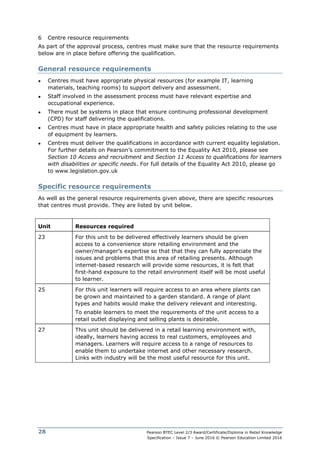
They should give details of the methods used by retailers to sway their customers’
feelings about the environment. Discussions on how the retail sector could improve
the conservation of energy and materials will identify a number of methods. Learners
should identify differences in some of these methods, depending on their location,
such as the plastic bag levy already introduced in some parts of the United Kingdom
and other countries. A visit to a distribution centre, in particular one used by the large
supermarkets, could give learners an opportunity to understand how the retail supply
chain contributes to energy and material conservation.
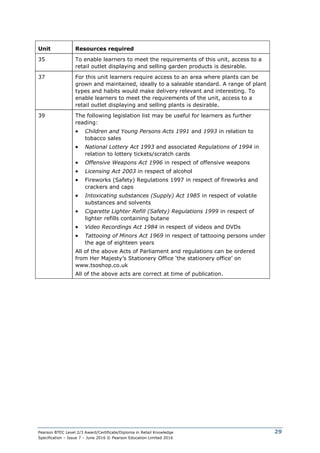
In learning outcome 3, learners will become familiar with the key environmental
legislation that impacts on the retail sector. The key legislation for learners’ independent
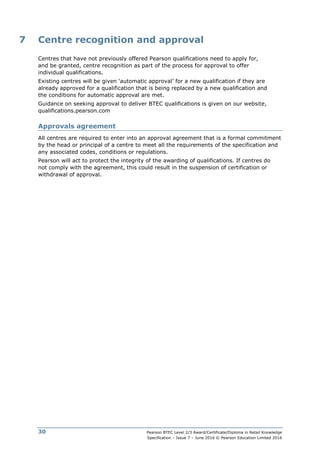
study is the Climate Change Act 2008, as this influences other related legislation,
such as the Energy Act 2010 and the Waste Regulations 2011 (Amended 2012). The
Environmental Protection Act 1990 is also important in terms of the retail sector, as
is the Health and Safety at Work Act, which includes the handling, storage and, in
particular, the disposal of hazardous substances. Learners should investigate the key
responsibilities retailers have for the many different types of waste that they create; this
includes products such as food, vehicles, textiles, furniture and electrical items, as well
as consumables used by retailers, such as oils, paper, card, plastics, computing items
and secure data. Learners can select different types/sizes of retail operations, and by
becoming involved with group work, can discuss and brainstorm the legal and financial
impacts of the energy used by these retail operations. They could compare a range of
retail businesses, including fayres and markets, online retailers, vehicle dealers,
Pearson BTEC Level 2/3 Award/Certificate/Diploma in Retail Knowledge
Specification – Issue 7 – June 2016 © Pearson Education Limited 2016
307
independent food retailers (such as butchers, bakers and greengrocers), mobile phone
stores and not-for-profit retailers, as well as large well-known supermarkets and ‘High
Street’ chains.
For learning outcome 4, learners could use the information gained in learning outcome 3
and the waste hierarchy to recognise how different types of waste are managed by the
retail sector. They could use flow charts to understand the different waste streams
created by the retail sector and identify the environmentally responsible disposal routes.
Discussions about waste management could be enhanced by inviting a guest speaker
involved with commercial waste management as well as an individual from the local
council who is able to give learners information on domestic waste management, in
particular recycling.
In learning outcome 5, learners will understand the value of energy conservation and
processes use to reduce carbon emissions within the retail sector. Again, YouTube or
other online video sites could be used as a learning resource to show how reduction in
carbon emissions can benefit the globe and the processes retailers use to contribute
to this. Learners can gather information from a guest speaker from one of the many
organisations that use technology and other mechanical methods to monitor energy
consumption. Information from those working for energy providers could give learners
insight into the ways energy is successfully managed and consumption is reduced in
specific retail businesses.
Learning outcome 6 investigates how water is consumed and conserved in the retail
sector. Learners can explain how water is used in the retail sector and then discuss
ways to reduce this consumption. Learners should understand how retail suppliers, in
both primary and secondary sectors, use water and how the necessary hygiene and
temperature control factors all impact on the demand for water consumption in the
sector. Learners can look into the water usage involved in the manufacture of a range
of products, such as paper and textiles. They could also research water consumption
used within the retail environment, such as for refrigeration and maintaining the store
environment. Learners could then identify ways to reduce water consumption that may or
may not affect the products sold by the retail sector. Learners could investigate also how
consumers’ changing eating patterns impact on food technology and water consumption
by looking at food labels and their water content. They also could investigate changes in
the climate, referring to learning outcome 1.
Assessment
Assessment by portfolio of evidence
The centre can devise and mark the assessment for this unit. Learners must meet all
assessment criteria to pass the unit.
Learning outcome 1: can be covered by learners investigating the components of
climate change, what contributes to climate change and its consequences including the
greenhouse effect. Learners could then give a presentation on the concept of climate
change. The presentation should include information on three possible causes and three
key impacts of climate change taken from the unit amplification and content. Learners
also need to give an explanation of the greenhouse effect on the planet and could include
any contributions made by the retail sector to this. The presentation should be supported
by briefing notes and appropriate graphics.
Learning outcome 2: this part of the assessment could include a brief report on why one
retail business should be concerned about climate change and four methods used by the
retailer to influence its customers’ attitudes and behaviour towards the environment.
The final part of this learning outcome can be covered by briefing notes taken from an
observed discussion on how two different types of retail businesses selected by learners
(for example one online retailer and one sole trader), can improve energy and material
conservation; at least four methods should be taken from the unit amplification and
content.
Pearson BTEC Level 2/3 Award/Certificate/Diploma in Retail Knowledge
Specification – Issue 7 – June 2016 © Pearson Education Limited 2016
308
Learning outcome 3: can be covered by learners researching the key environmental
legislation that has an impact on the retail sector. Learners should present their findings
through a poster that shows at least four pieces of legislation taken from the unit
amplification that applies to the retail sector. The poster should also contain two legal
and two financial impacts the use of energy has on one retail business. To assess the
remaining part of this learning outcome learners should produce a ‘trade’ handout/leaflet
that informs the retail sector of at least four different legal responsibilities it has in
relation to different types of waste.
Learning outcome 4: can be covered by learners giving details of how retailers manage
their waste. To assess the first part of the learning outcome learners could produce an
annotated diagram of the waste hierarchy. The diagram needs to include a retail example
for each section.
The second part of the learning outcome can be covered by learners producing a poster
on the environmental disposal route for a specific range of items, for example cooked
food including oils, uncooked food, residual (general) waste, hazardous waste, packaging
and secure data, and how items enter the ‘waste stream’. The unit amplification gives
examples of waste streams and disposal routes.
Learners then need to include this information in a leaflet on how households manage
the waste from the same range of items, with a summary of four methods used by local
retailers to manage their waste.
Learning outcome 5: this learning outcome can be covered by learners investigating
methods used by the retail sector to conserve energy. For this learning outcome the
learner needs to include the supply chain as well as the outlets/online operation. The
learner can provide evidence through a written report that focuses on one online
operation and one outlet trading format, e.g traditional store/market stall. The learner
needs to include at least two monitoring methods that differ for each retail business.
Using the same two retail businesses, the learner can cover the rest of the learning
outcome by including at least two examples of energy management good practice for
each retail business and a further three methods in which each retail business can reduce
energy consumption.
Learning outcome 6: can be covered by learners exploring ways water is conserved by
the retail sector as well as the sector’s demand on water consumption. Learners could
give an observed presentation that is in two parts; the first focuses on four methods used
by a local retail business to reduce its water consumption. For the second part of the
presentation, learners should give specific examples of how water contributes to the
production and appearance of two different products. Learners should then select a
further four reasons as to why the retail sector, including the supply chain, has increased
the demand for water. The presentation should be supported by briefing notes, contain
appropriate graphics and could include actual products.
Employer engagement and vocational contexts
For this unit learners will require access to a range of retail formats either through the
internet or directly. In particular, the environmental policies, commercial functions and
operations of all aspects of the retail sector from online retailers (excluding eBay) to
independent small and medium enterprises (SMEs) to market traders and not-for-profit
retailers. Those who have direct involvement with the retail sector, either as an
employee or on work experience, should gather as much information as possible for
learning outcomes 2, 3, 4, 5 and 6. Learners would be advised to investigate the supply
chain including wholesaling and its contribution to energy conservation.
Pearson BTEC Level 2/3 Award/Certificate/Diploma in Retail Knowledge
Specification – Issue 7 – June 2016 © Pearson Education Limited 2016
309
Suggested resources
Books
Cox R and Brittain R – Retailing: An Introduction, 5th edition (Financial Times/Prentice
Hall, 2004) ISBN 9780273678199
Humes E – Force of Nature: How Wal-Mart Started a Green Business Revolution –
And Why It Might Save the World (Collins Business, 2011) ISBN 9780061690495
Miller L and Aldridge S – Why Shrink-Wrap a Cucumber? The Complete Guide to
Environmental Packaging (Laurence King, 2012) ISBN 9781856697576
Cohen N and Philipsen D – Green Business: An A-to-Z Guide (The SAGE Reference Series
on Green Society: Toward a Sustainable Future) (SAGE Publications Inc, 2011)
ISBN 9781412996846
Mintzer R – 101 Ways to Turn Your Business Green: The Business Guide to Eco-Friendly
Profits Paperback (Entrepreneur Press 2008) ISBN 9781599182636
Journals and/or magazines
Drapers Magazine
Ethical Consumer Magazine
The Grocer
Green World Magazine
Retail Week
Websites
wtl.defra.gov.uk – water conservation
www.brc.org.uk – British Retail Consortium; food labelling
www.carbontrust.com – saving money for retailers
www.corporate.marksandspencer.com/plan-a – M&S Plan A (There is no Plan B) policy
www.ec.europa.eu/environment/industry/retail/ – legal impacts on retail
www.greenbiz.com/ – the greenhouse effect
www.gov.uk/ – different types of waste; how water is used in food and drink production
www.legislation.gov.uk – environmental legislation
www.metoffice.gov.uk/climate-guide/ – the concept of climate-change
www.netregs.org.uk – environmental legislation
www.rbkc.gov.uk/pdf/Defra – shoppers’ guide to the environment
www.retail-week.com/topics/waste-management – retailers managing waste
www.retailresearch.org – green retailing
www.sustain.co.uk/Retail/ – key environmental legislation in retail
www.tescoplc.com – Tesco and Society web page containing environmental policies
www.thewaterproject.org – water conservation in retail
www.veoliaenvironmentalservices.co.uk – disposal of secure waste
www.wrap.org.uk/category/sector/retail – WRAP, an organisation set up to minimise
resource use and divert priority materials from landfills
www.wwf.org.uk/what_we_do/tackling_climate_change/ – climate change explained
www.youtube.com/ – BBC The truth about climate change parts 1&2
Pearson BTEC Level 2/3 Award/Certificate/Diploma in Retail Knowledge
Specification – Issue 7 – June 2016 © Pearson Education Limited 2016
310
13 Further information and useful publications
To get in touch with us visit our ‘Contact us’ pages:
● Edexcel, BTEC and Pearson Work Based Learning contact details:
qualifications.pearson.com/en/support/contact-us.html
● books, software and online resources for UK schools and colleges:
www.pearsonschoolsandfecolleges.co.uk
Key publications:
● Adjustments for candidates with disabilities and learning difficulties – Access and
Arrangements and Reasonable Adjustments, General and Vocational qualifications
(Joint Council for Qualifications (JCQ))
● Equality Policy (Pearson)
● Recognition of Prior Learning Policy and Process (Pearson)
● UK Information Manual (Pearson)
● UK Quality Vocational Assurance Handbook (Pearson).
All of these publications are available on our website.
Publications on the quality assurance of BTEC qualifications are available on our website
at qualifications.pearson.com
Our publications catalogue lists all the material available to support our qualifications. To
access the catalogue and order publications, please go to qualifications.pearson.com
Additional resources
If you need further learning and teaching materials to support planning and delivery for
your learners, there is a wide range of BTEC resources available.
Any publisher can seek endorsement for their resources, and, if they are successful, we
will list their BTEC resources on our website, qualifications.pearson.com
Pearson BTEC Level 2/3 Award/Certificate/Diploma in Retail Knowledge
Specification – Issue 7 – June 2016 © Pearson Education Limited 2016
311
14 Professional development and training
Pearson supports UK and international customers with training related to BTEC
qualifications. This support is available through a choice of training options offered on our
website: qualifications.pearson.com
The support we offer focuses on a range of issues, such as:
● planning for the delivery of a new programme
● planning for assessment and grading
● developing effective assignments
● building your team and teamwork skills
● developing learner-centred learning and teaching approaches
● building in effective and efficient quality assurance systems.
The national programme of training we offer is on our website at:
qualifications.pearson.com. You can request centre-based training through the website or
you can contact one of our advisers in the Training from Pearson UK team via Customer
Services to discuss your training needs.
BTEC training and support for the lifetime of the qualifications
Training and networks: our training programme ranges from free introductory events
through sector-specific opportunities to detailed training on all aspects of delivery,
assignments and assessment. We also host some regional network events to allow you to
share your experiences, ideas and best practice with other BTEC colleagues in your
region.
Regional support: our team of Curriculum Development Managers and Curriculum
Support Consultants, based around the country, are responsible for providing advice and
support in centres. They can help you with planning and curriculum developments.
To get in touch with our dedicated support teams please visit: qualifications.pearson.com
Your Pearson support team
Whether you want to talk to a sector specialist, browse online or submit your query for
an individual response, there’s someone in our Pearson support team to help you
whenever – and however – you need:
● Subject Advisors: find out more about our subject advisor team – immediate, reliable
support from a fellow subject expert
● Ask the Expert: submit your question online to our Ask the Expert online service and
we will make sure your query is handled by a subject specialist.
Please visit, qualifications.pearson.com/en/support/contact-us.html
Pearson BTEC Level 2/3 Award/Certificate/Diploma in Retail Knowledge
Specification – Issue 7 – June 2016 © Pearson Education Limited 2016
312
Annexe A
Mapping with National Occupational Standards
The grid below maps the knowledge covered in the Pearson BTEC Level 2/3 Specialist qualifications in Retail Knowledge against the
underpinning knowledge of the National Occupational Standards in Retail. Centres can use this mapping when planning holistic delivery and
assessment activities.
KEY
# indicates partial coverage of knowledge in the NVQ/competence-based qualification or NOS unit
A blank space indicates no coverage of the knowledge
BTEC Specialist units
National Occupational Standards reference
Unit
1
Unit
2
Unit
3
Unit
4
Unit
5
Unit
6
Unit
7
Unit
8
Unit
9
Unit
10
C.214 (K) 
C.252 (K)  
E.211 (K) 
B.209 (K) 
C.215 (K) 
C.216 (K) 
C.253 (K)
E.105 (K) 
E.106 (K) 
E.208 (K) 
E.209 (K) 
E.335 (K) 
E.336 (K) 
Pearson BTEC Level 2/3 Award/Certificate/Diploma in Retail Knowledge
Specification – Issue 7 – June 2016 © Pearson Education Limited 2016
313
BTEC Specialist units
National Occupational Standards reference
Unit
1
Unit
2
Unit
3
Unit
4
Unit
5
Unit
6
Unit
7
Unit
8
Unit
9
Unit
10
E.338 (K) 
E.101 (K) 
E.205 (K) 
D.202 (K) 
D.203 (K) 
D.302 (K) 
E.102 (K) 
E.206 (K) 
E.207 (K) 
C.205 (K) 
C.208 (K) 
B.201 (K) 
B.203 (K) 
B.204 (K) 
B.205 (K) 
C.268 (K)
B.102 (K)
B.103 (K)
B.202 (K)
B.206 (K)
B.235 (K)
Pearson BTEC Level 2/3 Award/Certificate/Diploma in Retail Knowledge
Specification – Issue 7 – June 2016 © Pearson Education Limited 2016
314
BTEC Specialist units
National Occupational Standards reference
Unit
1
Unit
2
Unit
3
Unit
4
Unit
5
Unit
6
Unit
7
Unit
8
Unit
9
Unit
10
B.104 (K)
C.206 (K)
C.260 (K)
E.210 (K)
C.201 (K) 
C.202 (K) 
C.230 (K) 
C.231 (K) 
C.232 (K) 
C.233 (K) 
C.237 (K) 
C.101 (K)
C.254 (K)
C.207 (K)
E.107 (K)
E.109 (K)
C.312 (K) 
C.313 (K) 
C.314 (K) 
Pearson BTEC Level 2/3 Award/Certificate/Diploma in Retail Knowledge
Specification – Issue 7 – June 2016 © Pearson Education Limited 2016
315
BTEC Specialist units
National Occupational Standards reference
Unit
11
Unit
12
Unit
13
Unit
14
Unit
15
Unit
16
Unit
17
Unit
18
Unit
19
Unit
20
C.214 (K)     
C.252 (K)
E.211 (K)
B.209 (K)
C.215 (K)
C.216 (K)
C.253 (K)      
E.105 (K)
E.106 (K)
E.208 (K) 
E.209 (K)
E.335 (K)
E.336 (K)
E.338 (K)
E.101 (K)
E.205 (K)
D.202 (K)
D.203 (K)
D.302 (K)
Pearson BTEC Level 2/3 Award/Certificate/Diploma in Retail Knowledge
Specification – Issue 7 – June 2016 © Pearson Education Limited 2016
316
BTEC Specialist units
National Occupational Standards reference
Unit
11
Unit
12
Unit
13
Unit
14
Unit
15
Unit
16
Unit
17
Unit
18
Unit
19
Unit
20
E.102 (K)
E.206 (K)
E.207 (K)
C.205 (K)      
C.208 (K)      
B.201 (K)
B.203 (K)  
B.204 (K)  
B.205 (K)  
C.268 (K)
B.102 (K)       
B.103 (K)  
B.202 (K)  
B.206 (K)  
B.235 (K)  
B.104 (K) 
C.206 (K)    
C.260 (K)
E.210 (K)
C.201 (K)
Pearson BTEC Level 2/3 Award/Certificate/Diploma in Retail Knowledge
Specification – Issue 7 – June 2016 © Pearson Education Limited 2016
317
BTEC Specialist units
National Occupational Standards reference
Unit
11
Unit
12
Unit
13
Unit
14
Unit
15
Unit
16
Unit
17
Unit
18
Unit
19
Unit
20
C.202 (K)
C.230 (K)
C.231 (K)
C.232 (K)
C.233 (K)
C.237 (K)
C.101 (K)      
C.254 (K)      
C.207 (K)   
E.107 (K) 
E.109 (K) 
C.312 (K)
C.313 (K)
C.314 (K)
Pearson BTEC Level 2/3 Award/Certificate/Diploma in Retail Knowledge
Specification – Issue 7 – June 2016 © Pearson Education Limited 2016
318
BTEC Specialist units
National Occupational Standards reference
Unit
21
Unit
22
Unit
23
Unit
24
Unit
25
Unit
26
Unit
27
Unit
28
Unit
29
Unit
30
C.214 (K)  
C.252 (K)    
E.211 (K)
B.209 (K)
C.215 (K)
C.216 (K)
C.253 (K)
E.105 (K)
E.106 (K)
E.208 (K)
E.209 (K)
E.335 (K)
E.336 (K)
E.338 (K)
E.101 (K)
E.205 (K)
D.202 (K)
D.203 (K)
Pearson BTEC Level 2/3 Award/Certificate/Diploma in Retail Knowledge
Specification – Issue 7 – June 2016 © Pearson Education Limited 2016
319
BTEC Specialist units
National Occupational Standards reference
Unit
21
Unit
22
Unit
23
Unit
24
Unit
25
Unit
26
Unit
27
Unit
28
Unit
29
Unit
30
D.302 (K)
E.102 (K)
E.206 (K)
E.207 (K)
C.205 (K)
C.208 (K)
B.201 (K)
B.203 (K) 
B.204 (K) 
B.205 (K)
C.268 (K) 
B.102 (K)
B.103 (K) 
B.202 (K)
B.206 (K) 
B.235 (K) 
B.104 (K)
C.206 (K)
C.260 (K) 
E.210 (K) 
Pearson BTEC Level 2/3 Award/Certificate/Diploma in Retail Knowledge
Specification – Issue 7 – June 2016 © Pearson Education Limited 2016
320
BTEC Specialist units
National Occupational Standards reference
Unit
26
Unit
27
Unit
28
Unit
29
Unit
30
Unit
31
Unit
37
Unit
38
Unit
39
Unit
40
B 235 (K) 
C.252 (K)  
C.310 (K) 
D.301 (K) 
D.302 (K) 
D.304 (K) 
E.211 (K) 
E.303 (K)
E.304 (K) 
E.305 (K) 
E306 (K) 
E.307 (K)  
E.335 (K)
E.336 (K)
E.338 (K)
C.313 (K) 
B.301 (K) 
B.302 (K) 
B.304 (K) 
Pearson BTEC Level 2/3 Award/Certificate/Diploma in Retail Knowledge
Specification – Issue 7 – June 2016 © Pearson Education Limited 2016
321
Annexe B
Onscreen multiple-choice question testing
BTEC Level 2 Award in Retail Knowledge
To achieve this qualification you must achieve 9 credits. All 9 credits can be achieved via
onscreen testing. You MUST take EITHER test 1 or test 2 (5 credits).
The remaining 4 credits can be achieved through other tests from other units which may be
accessed through onscreen testing.
Test
paper
no
Test
paper
(units
covered)
Unit title Unit
reference
on the
Register
Credit
value
No of
questions
Test
duration
(minutes)
1 Units 1 &
2
Unit 1: Understanding
Customer Service in
the Retail Sector
M/502/5821 3 50 75
Unit 2: Understanding
the Retail Selling
Process
A/502/5806 2
2 Units 3 &
4
Unit 3: Understanding
how Individuals and
Teams Contribute to
the Effectiveness of a
Retail Business
J/502/5789 3 50 75
Unit 4: Understanding
how a Retail Business
Maintains Health and
Safety on its Premises
A/502/5823 2
3 Unit 5 Unit 5: Understanding
Retail Consumer Law
D/502/5801 2 20 30
4 Unit 6 Unit 6: Understanding
Security and Loss
Prevention in a Retail
Business
K/502/5817 2 20 30
5 Unit 7 Unit 7: Understanding
the Handling of
Customer Payments
in a Retail Business
H/502/5797 2 20 30
6 Unit 8 Unit 8: Understanding
the Control, Receipt
and Storage of Stock
in a Retail Business
F/502/5810 2 20 30
7 Unit 9 Unit 9: Understanding
Visual Merchandising
for Retail Business
A/600/0656 2 20 30
Pearson BTEC Level 2/3 Award/Certificate/Diploma in Retail Knowledge
Specification – Issue 7 – June 2016 © Pearson Education Limited 2016
322
BTEC Level 2 Certificate in Retail Knowledge
To achieve this qualification you must achieve 14 credits. All 14 credits can be achieved via
onscreen testing. You MUST take BOTH test 1 and test 2 (10 credits).
The remaining 4 credits can be achieved by other tests from other units which may be
assessed through onscreen testing.
Test
paper
no
Test
paper
(units
covered)
Unit title Unit
reference
on The
Register
Credit
value
No of
questions
Test
duration
(minutes)
1 Units 1 & 2 Unit 1: Understanding
Customer Service in
the Retail Sector
M/502/5821 3 50 75
Unit 2: Understanding
the Retail Selling
Process
A/502/5806 2
2 Units 3
& 4
Unit 3: Understanding
how Individuals and
Teams Contribute to
the Effectiveness of a
Retail Business
J/502/5789 3 50 75
Unit 4: Understanding
how a Retail Business
Maintains Health and
Safety on its Premises
A/502/5823 2
3 Unit 5 Unit 5: Understanding
Retail Consumer Law
D/502/5801 2 20 30
4 Unit 6 Unit 6: Understanding
Security and Loss
Prevention in a Retail
Business
K/502/5817 2 20 30
5 Unit 7 Unit 7: Understanding
the Handling of
Customer Payments
in a Retail Business
H/502/5797 2 20 30
6 Unit 8 Unit 8: Understanding
the Control, Receipt
and Storage of Stock
in a Retail Business
F/502/5810 2 20 30
7 Unit 9 Unit 9: Understanding
Visual Merchandising
for Retail Business
A/600/0656 2 20 30
8 Unit 33 Unit 33:
Understanding how
the Effectiveness of
Store Operations can
be Improved
H/502/5802 3 30 30
Pearson BTEC Level 2/3 Award/Certificate/Diploma in Retail Knowledge
Specification – Issue 7 – June 2016 © Pearson Education Limited 2016
323
BTEC Level 2 Diploma in Retail Knowledge
To achieve this qualification you must achieve 37 credits. A maximum of 25 credits can be
achieved by taking ALL of the units below via an onscreen test.
The additional 12 credits would have to be obtained via portfolio/assignment based
assessment. You MUST take BOTH test 1 and test 2 (10 credits)
The remaining 27 credits will need to be made by any other test(s) plus additional specialist
units that are assessed only via assignments/portfolio.
Test
paper
no
Test
paper
(units
covered)
Unit title Unit
reference
on the
Register
Credit
value
No of
questions
Test
duration
(minutes)
1 Units 1
& 2
Unit 1: Understanding
Customer Service in the
Retail Sector
M/502/5821 3 50 75
Unit 2: Understanding the
Retail Selling Process
A/502/5806 2
2 Units 3
& 4
Unit 3: Understanding
how Individuals and
Teams Contribute to the
Effectiveness of a Retail
Business
J/502/5789 3 50 75
Unit 4: Understanding
how a Retail Business
Maintains Health and
Safety on its Premises
A/502/5823 2
3 Unit 5 Unit 5: Understanding
Retail Consumer Law
D/502/5801 2 20 30
4 Unit 6 Unit 6: Understanding
Security and Loss
Prevention in a Retail
Business
K/502/5817 2 20 30
5 Unit 7 Unit 7: Understanding the
Handling of Customer
Payments in a Retail
Business
H/502/5797 2 20 30
6 Unit 8 Unit 8: Understanding
the Control, Receipt and
Storage of Stock in a
Retail Business
F/502/5810 2 20 30
7 Unit 9 Unit 9: Understanding
Visual Merchandising for
Retail Business
A/600/0656 2 20 30
8 Unit 33 Unit 33: Understanding
how the Effectiveness of
Store Operations can be
Improved
H/502/5802 3 30 30
Pearson BTEC Level 2/3 Award/Certificate/Diploma in Retail Knowledge
Specification – Issue 7 – June 2016 © Pearson Education Limited 2016
324
BTEC Level 3 Award in Retail Knowledge
To achieve this qualification you must achieve 5 credits. All 5 credits can be achieved via
onscreen testing. There are no core units in this qualification – you can take any
combination of units below to achieve the Award.
Test
paper
no
Test
paper
(units
covered)
Unit title Unit
reference
on the
Register
Credit
value
No of
questions
Test
duration
(minutes)
1 Units 26
and 27
Unit 26: Understanding
Customer Service in the
Retail Sector
K/502/5803 2 40 40
Unit 27: Understanding
the Management of
Risks to Health and
Safety on the Premises
of a Retail Business
F/502/5824 2
2 Unit 28 Unit 28: Understanding
Security and Loss
Prevention in a Retail
Business
M/502/5818 3 30 30
3 Unit 29 Unit 29: Understanding
How the Smooth
Operation of a Payment
Point is Maintained
M/502/5799 3 30 30
4 Unit 30 Unit 30: Understanding
the Retail Selling
Process
F/502/5807 2 20 20
5 Unit 31 Unit 31: Understanding
the Management of
Stock in a Retail
Business
L/502/5826 3 30 30
6 Unit 32 Unit 32: Understanding
the Development of
Personal and Team
Effectiveness in a Retail
Business
A/502/5787 4 20 20
7 Unit 33 Unit 33: Understanding
How the Effectiveness
of Store Operations can
be Improved
H/502/5802 3 30 30
Pearson BTEC Level 2/3 Award/Certificate/Diploma in Retail Knowledge
Specification – Issue 7 – June 2016 © Pearson Education Limited 2016
325
BTEC Level 3 Certificate in Retail Knowledge
To achieve this qualification you must achieve 16 credits. All 16 credits can be achieved via
onscreen testing. You MUST take BOTH test 1 and test 2 (10 credits).
The remaining 6 credits can be achieved by any other tests/units.
Test
paper
no
Test
paper
(units
covered)
Unit title Unit
reference
on the
Register
Credit
value
No of
questions
Test
duration
(minutes)
1 Units 26
and 27
Unit 26: Understanding
Customer Service in the
Retail Sector
K/502/5803 2 40 40
Unit 27: Understanding
the Management of
Risks to Health and
Safety on the Premises
of a Retail Business
F/502/5824 2
2 Unit 28 Unit 28: Understanding
Security and Loss
Prevention in a Retail
Business
M/502/5818 3 30 30
3 Unit 29 Unit 29: Understanding
How the Smooth
Operation of a Payment
Point is Maintained
M/502/5799 3 30 30
4 Unit 30 Unit 30: Understanding
the Retail Selling
Process
F/502/5807 2 20 20
5 Unit 31 Unit 31: Understanding
the Management of
Stock in a Retail
Business
L/502/5826 3 30 30
6 Unit 32 Unit 32: Understanding
the Development of
Personal and Team
Effectiveness in a Retail
Business
A/502/5787 4 20 20
7 Unit 33 Unit 33: Understanding
How the Effectiveness
of Store Operations can
be Improved
H/502/5802 3 30 30
Pearson BTEC Level 2/3 Award/Certificate/Diploma in Retail Knowledge
Specification – Issue 7 – June 2016 © Pearson Education Limited 2016
326
BTEC Level 3 Diploma in Retail Knowledge
To achieve this qualification you must achieve 37 credits. A maximum of 22 credits can be
achieved by taking ALL of the units below via an onscreen test. The additional 15 credits
would have to be obtained via portfolio/assignment based assessment.
You MUST take all of the tests plus 15 credits from the specialist optional units that are
currently available only via portfolio/assignment based assessment.
Test
paper
no
Test
paper
(units
covered)
Unit title Unit
reference
on the
Register
Credit
value
No of
questions
Test
duration
(minutes)
1 Units 26 &
27
Unit 26:
Understanding
Customer Service in
the Retail Sector
K/502/5803 2 40 40
Unit 27:
Understanding the
Management of Risks
to Health and Safety
on the Premises of a
Retail Business
F/502/5824 2
2 Unit 28 Unit 28:
Understanding
Security and Loss
Prevention in a Retail
Business
M/502/5818 3 30 30
3 Unit 29 Unit 29:
Understanding How
the Smooth Operation
of a Payment Point is
Maintained
M/502/5799 3 30 30
4 Unit 30 Unit 30:
Understanding the
Retail Selling Process
F/502/5807 2 20 20
5 Unit 31 Unit 31:
Understanding the
Management of Stock
in a Retail Business
L/502/5826 3 30 30
6 Unit 32 Unit 32:
Understanding the
Development of
Personal and Team
Effectiveness in a
Retail Business
A/502/5787 4 20 20
7 Unit 33 Unit 33:
Understanding How
the Effectiveness of
Store Operations can
be Improved
H/502/5802 3 30 30
June 2016
ISBN 978 1 446 93339 8
For information about Edexcel, BTEC or LCCI qualifications visit
qualifications.pearson.com
BTEC is a registered trademark of Pearson Education Limited
Pearson Education Limited. Registered in England and Wales No. 872828
Registered Office: 80 Strand, London WC2R 0RL.
VAT Reg No GB 278 537121

retail.pdf

  • 1.
    Pearson BTEC Level 2and 3 Award/Certificate/Diploma in Retail Knowledge Specification BTEC Specialist qualification First teaching September 2010 Issue 7: June 2016
  • 2.
    Edexcel, BTEC andLCCI qualifications Edexcel, BTEC and LCCI qualifications are awarded by Pearson, the UK’s largest awarding body offering academic and vocational qualifications that are globally recognised and benchmarked. For further information, please visit our qualification websites at www.edexcel.com, www.btec.co.uk or www.lcci.org.uk. Alternatively, you can get in touch with us using the details on our contact us page at qualifications.pearson.com/contactus About Pearson Pearson is the world's leading learning company, with 40,000 employees in more than 70 countries working to help people of all ages to make measurable progress in their lives through learning. We put the learner at the centre of everything we do, because wherever learning flourishes, so do people. Find out more about how we can help you and your learners at qualifications.pearson.com This specification is Issue 7. Key changes are listed in summary table on next page. We will inform centres of any changes to this issue. The latest issue can be found on the Pearson website: qualifications.pearson.com These qualifications were previously entitled: Pearson BTEC Level 2 Award in Retail Knowledge (QCF) Pearson BTEC Level 2 Certificate in Retail Knowledge (QCF) Pearson BTEC Level 2 Diploma in Retail Knowledge (QCF) Pearson BTEC Level 3 Award in Retail Knowledge (QCF) Pearson BTEC Level 3 Certificate in Retail Knowledge (QCF) Pearson BTEC Level 3 Diploma in Retail Knowledge (QCF) The QNs remain the same. References to third party material made in this specification are made in good faith. Pearson does not endorse, approve or accept responsibility for the content of materials, which may be subject to change, or any opinions expressed therein. (Material may include textbooks, journals, magazines and other publications and websites.) All information in this specification is correct at time of publication. ISBN 978 1 446 93339 8 All the material in this publication is copyright © Pearson Education Limited 2016
  • 3.
    Summary of PearsonBTEC Level 2 and 3 Award/Certificate/Diploma in Retail Knowledge specification Issue 7 changes Summary of changes made between previous issue and this current issue Page/section number All references to QCF have been removed throughout the specification Definition of TQT added Section 1 Definition of sizes of qualifications aligned to TQT Section 1 Credit value range removed and replaced with lowest credit value for the shortest route through the qualification Section 2 TQT value added Section 2 GLH range removed and replaced with lowest GLH value for the shortest route through the qualification Section 2 Reference to credit transfer within the QCF removed Section 5 QCF references removed from unit titles and unit levels in all units Section 12 Guided learning definition updated Section 12 Earlier issue(s) show(s) previous changes. If you need further information on these changes or what they mean, contact us via our website at: qualifications.pearson.com/en/support/contact-us.html.
  • 5.
    Contents Purpose of thisspecification 1 1 Introducing BTEC Specialist qualifications 2 What are BTEC Specialist qualifications? 2 Sizes of Specialist qualifications 2 2 Qualification summary and key information 3 Qualification Number and qualification title 6 Qualification objectives 6 Apprenticeships 7 Relationship with previous qualifications 7 Progression opportunities through Pearson qualifications 7 Industry support and recognition 7 Relationship with National Occupational Standards 7 3 Qualification structures 8 Pearson BTEC Level 2 Award in Retail Knowledge 8 Pearson BTEC Level 2 Certificate in Retail Knowledge 9 Pearson BTEC Level 2 Diploma in Retail Knowledge 13 Pearson BTEC Level 3 Award in Retail Knowledge 17 Pearson BTEC Level 3 Certificate in Retail Knowledge 19 Pearson BTEC Level 3 Diploma in Retail Knowledge 22 4 Assessment 26 5 Recognising prior learning and achievement 27 Recognition of Prior Learning 27 General resource requirements 28 Specific resource requirements 28 7 Centre recognition and approval 30 Approvals agreement 30 8 Quality assurance of centres 31 9 Programme delivery 32 10 Access and recruitment 33 11 Access to qualifications for learners with disabilities or specific needs 34 12 Units 35 Unit title 35 Unit reference number 35 Level 35
  • 6.
    Credit value 35 Guidedlearning hours 35 Unit aim 35 Essential resources 35 Learning outcomes 35 Assessment criteria 36 Unit amplification 36 Information for tutors 36 Unit 1: Understanding Customer Service in the Retail Sector 37 Unit 2: Understanding the Retail Selling Process 43 Unit 3: Understanding how Individuals and Teams Contribute to the Effectiveness of a Retail Business 49 Unit 4: Understanding how a Retail Business Maintains Health and Safety on its Premises 56 Unit 5: Understanding Retail Consumer Law 62 Unit 6: Understanding Security and Loss Prevention in a Retail Business68 Unit 7: Understanding the Handling of Customer Payments in a Retail Business 73 Unit 8: Understanding the Control, Receipt and Storage of Stock in a Retail Business 79 Unit 9: Understanding Visual Merchandising for Retail Business 85 Unit 10: Understanding Fashion Retail Personal Shopping and Styling 91 Unit 11: Understanding Fashion Trends and Forecasting 97 Unit 12: Understanding the Fashion Retail Market 103 Unit 13: Understanding the Evolution of the Beauty Retailing 109 Unit 14: Understanding the Retail Sale of Skin Care Products 115 Unit 15: Understanding the Retail Sale of Perfumery Products 121 Unit 16: Understanding the Retail Sale of Cosmetics 127 Unit 17: Understanding the Retail Sale of the Nail Care Products 133 Unit 18: Understanding the Retail Sale of Beauty Products 140 Unit 19: Understanding the Storage, Monitoring and Replenishment of Fresh Produce in a Retail Outlet 147 Unit 20: Understanding the Storage, Monitoring and Replenishment of Chilled Food Items in a Retail Outlet 152 Unit 21: Understanding how Retailers Sell National Lottery Products and Services 157 Unit 22: Understanding the Features of Different Types of Alcoholic Beverages Sold in Retail Outlets 162 Unit 23: Understanding how Retailers Operate Home Delivery Services for Newspapers and Magazines 168 Unit 24: Understanding how Stocks of Newspapers and Magazines are Controlled in Retail Outlets 174 Unit 25: Understanding Plant Nomenclature, Terminology and Identification 179 Unit 26: Understanding Customer Service in the Retail Sector 185
  • 7.
    Unit 27: Understandingthe Management of Risks to Health and Safety on the Premises of a Retail Business 191 Unit 28: Understanding Security and Loss Prevention in a Retail Business198 Unit 29: Understanding how the Smooth Operation of a Payment Point is Maintained 205 Unit 30: Understanding the Retail Selling Process 212 Unit 31: Understanding the Management of Stock in a Retail Business 220 Unit 32: Understanding the Development of Personal and Team Effectiveness in a Retail Business 227 Unit 33: Understanding how the Effectiveness of Store Operations can be Improved 236 Unit 34: Understanding the Control of Pests and Diseases Which May Affect Plants in a Retail Outlet 243 Unit 35: Understanding the Nature, Uses and Importance of Product Information in a Retail Outlet Selling Gardening Products 250 Unit 36: Understanding the Management of Delivery of Plants into a Retail Business 257 Unit 37: Understanding how the Growth and Development of Plants is Promoted and Monitored in a Retail Outlet 263 Unit 38: Understand how to Approach Work-Based Projects within Retail Business 271 Unit 39: Underage Sales Prevention for Retail And Licensed Premises 276 Unit 40: The Principles of Food Safety for Retail 282 Unit 41: Understanding how to Maintain the Confidentiality and Security of Customer Data Held Online 288 Unit 42: Understanding the Use of In-Store Web-Based Facilities in Promoting Retail Sales 294 Unit 43: Understanding Environmental Sustainability in the Retail Sector300 13 Further information and useful publications 310 14 Professional development and training 311 Annexe A 312 Mapping with National Occupational Standards 312 Annexe B 321 Onscreen multiple-choice question testing 321
  • 9.
    Pearson BTEC Level2/3 Award/Certificate/Diploma in Retail Knowledge Specification – Issue 7 – June 2016 © Pearson Education Limited 2016 1 Purpose of this specification The purpose of a specification as defined by Ofqual is to set out: ● the qualification’s objective ● any other qualification that a learner must have completed before taking the qualification ● any prior knowledge, skills or understanding that the learner is required to have before taking the qualification ● units that a learner must have completed before the qualification will be awarded and any optional routes ● any other requirements that a learner must have satisfied before they will be assessed or before the qualification will be awarded ● the knowledge, skills and understanding that will be assessed as part of the qualification (giving a clear indication of their coverage and depth) ● the method of any assessment and any associated requirements relating to it ● the criteria against which the learner’s level of attainment will be measured (such as assessment criteria) ● any specimen materials ● any specified levels of attainment.
  • 10.
    Pearson BTEC Level2/3 Award/Certificate/Diploma in Retail Knowledge Specification – Issue 7 – June 2016 © Pearson Education Limited 2016 2 1 Introducing BTEC Specialist qualifications What are BTEC Specialist qualifications? BTEC Specialist qualifications are work-related qualifications available from Entry to Level 3 in a range of sectors. They give learners the knowledge, understanding and skills they need to prepare for employment in a specific occupational area. The qualifications also provide career development opportunities for those already in work. The qualifications may be offered as full-time or part-time courses in schools or colleges. Training centres and employers may also offer these qualifications. Sizes of Specialist qualifications For all regulated qualifications, we specify a total number of hours that learners are expected to undertake in order to complete and show achievement for the qualification – this is the Total Qualification Time (TQT). The TQT value indicates the size of a qualification. Within the TQT, we identify the number of Guided Learning Hours (GLH) that a centre delivering the qualification needs to provide. Guided learning means activities that directly or immediately involve tutors and assessors in teaching, supervising, and invigilating learners, for example lectures, tutorials, online instruction and supervised study. As well as guided learning, there may be other required learning that is directed by tutors or assessors. This includes, for example, private study, preparation for assessment and undertaking assessment when not under supervision, such as preparatory reading, revision and independent research. As well as TQT and GLH, qualifications can also have a credit value – equal to one tenth of TQT, rounded to the nearest whole number. TQT and credit values are assigned after consultation with users of the qualifications. BTEC Specialist qualifications are available in the following sizes: • Award – a qualification with a TQT value of 120 or less (equivalent to a range of 1–12 credits) • Certificate – a qualification with a TQT value in the range of 121–369 (equivalent to a range of 13–36 credits) • Diploma – a qualification with a TQT value of 370 or more (equivalent to 37 credits and above).
  • 11.
    Pearson BTEC Level2/3 Award/Certificate/Diploma in Retail Knowledge Specification – Issue 7 – June 2016 © Pearson Education Limited 2016 3 2 Qualification summary and key information Qualification title Pearson BTEC Level 2 Award in Retail Knowledge Qualification Number (QN) 500/7339/4 Accreditation start date 2014 Approved age ranges 16–18 19+ Credit value 9 Assessment Centre-devised assessment (internal assessment) or Pearson-devised assessment (onscreen testing). Total Qualification Time (TQT) 90 Guided learning hours 30 Grading information The qualification and units are at pass grade. Entry requirements No prior knowledge, understanding, skills or qualifications are required before learners register for this qualification. However, centres must follow our access and recruitment policy (see Section 10 Access and recruitment). Qualification title Pearson BTEC Level 2 Certificate in Retail Knowledge Qualification Number (QN) 500/7363/1 Accreditation start date 2014 Approved age ranges 16–18 19+ Credit value 14 Assessment Centre-devised assessment (internal assessment) or Pearson-devised assessment (onscreen testing). Total Qualification Time (TQT) 140 Guided learning hours 93 Grading information The qualification and units are at pass grade. Entry requirements No prior knowledge, understanding, skills or qualifications are required before learners register for this qualification. However, centres must follow our access and recruitment policy (see Section 10 Access and recruitment).
  • 12.
    Pearson BTEC Level2/3 Award/Certificate/Diploma in Retail Knowledge Specification – Issue 7 – June 2016 © Pearson Education Limited 2016 4 Qualification title Pearson BTEC Level 2 Diploma in Retail Knowledge Qualification Number (QN) 500/7362/X Accreditation start date 2014 Approved age ranges 16–18 19+ Credit value 37 Assessment Centre-devised assessment (internal assessment) or Pearson-devised assessment (onscreen testing). Total Qualification Time (TQT) 370 Guided learning hours 270 Grading information The qualification and units are at pass grade. Entry requirements No prior knowledge, understanding, skills or qualifications are required before learners register for this qualification. However, centres must follow our access and recruitment policy (see Section 10 Access and recruitment). Qualification title Pearson BTEC Level 3 Award in Retail Knowledge Qualification Number (QN) 500/7316/3 Accreditation start date 2014 Approved age ranges 16–18 19+ Credit value 5 Assessment Centre-devised assessment (internal assessment) or Pearson-devised assessment (onscreen testing). Total Qualification Time (TQT) 50 Guided learning hours 30 Grading information The qualification and units are at pass grade. Entry requirements No prior knowledge, understanding, skills or qualifications are required before learners register for this qualification. However, centres must follow our access and recruitment policy (see Section 10 Access and recruitment).
  • 13.
    Pearson BTEC Level2/3 Award/Certificate/Diploma in Retail Knowledge Specification – Issue 7 – June 2016 © Pearson Education Limited 2016 5 Qualification title Pearson BTEC Level 3 Certificate in Retail Knowledge Qualification Number (QN) 500/7312/6 Accreditation start date 2014 Approved age ranges 16–18 19+ Credit value 16 Assessment Centre-devised assessment (internal assessment) or Pearson-devised assessment (onscreen testing). Total Qualification Time (TQT) 160 Guided learning hours 106 Grading information The qualification and units are at pass grade. Entry requirements No prior knowledge, understanding, skills or qualifications are required before learners register for this qualification. However, centres must follow our access and recruitment policy (see Section 10 Access and recruitment). Qualification title Pearson BTEC Level 3 Diploma in Retail Knowledge Qualification Number (QN) 500/7313/8 Accreditation start date 2014 Approved age ranges 16–18 19+ Credit value 37 Assessment Centre-devised assessment (internal assessment) or Pearson-devised assessment (onscreen testing). Total Qualification Time (TQT) 370 Guided learning hours 249 Grading information The qualification and units are at pass grade. Entry requirements No prior knowledge, understanding, skills or qualifications are required before learners register for this qualification. However, centres must follow our access and recruitment policy (see Section 10 Access and recruitment).
  • 14.
    Pearson BTEC Level2/3 Award/Certificate/Diploma in Retail Knowledge Specification – Issue 7 – June 2016 © Pearson Education Limited 2016 6 Qualification Number and qualification title Centres will need to use the Qualification Number (QN) when they seek public funding for their learners. The qualification title, unit titles and QN are given on each learner’s final certificate. You should tell your learners this when your centre recruits them and registers them with us. There is more information about certification in our UK Information Manual, available on our website, qualifications.pearson.com Qualification objectives The Pearson BTEC Level 2 Award, Certificate and Diploma in Retail Knowledge qualifications are for learners who work in, or who want to gain employment in, the retail sector such as sales assistant or advisor. The Pearson BTEC Level 3 Award, Certificate and Diploma in Retail Knowledge qualifications are aimed at those looking to progress into a supervisor, sales professional or management role, such as retail buyer, merchandiser, sales manager, store manager, online retailer, or into a retail specialist role. These qualifications give learners the opportunity to: ● develop and demonstrate the retail sector-related knowledge to underpin competence in a job role. This includes the principles and practices behind the core tasks and responsibilities related to the job as well as wider work-related knowledge such as customer services, sales, quality and stock control, payment handling, buying, store management, people management ● prepare for employment in a specific specialist area such as beauty retailing, garden retail, newspapers and grocery and online/multi-channel retailing ● develop personal growth, development and engagement in learning through the development of personal, learning and thinking skills (PLTS) ● have existing skills recognised ● achieve a nationally-recognised Level 2 or level 3 qualification ● progress to employment. The Award gives learners a broad introduction to the retail sector; it equips learners with a range of transferable employability skills. The qualification has been designed to aid progression to a range of work in the retail sector. The Award is usually undertaken by learners who volunteer in the retail sector or by those in a part time or a temporary role. The Certificate extends the focus from the Award and offers an engaging programme for those who are clearer about the retail environment they wish to progress in – whether a large national chain store, a corner shop or anything in between. It is a flexible qualification that can be tailored to meet the requirements of individual job roles. It gives the learner an opportunity to: ● broaden the depth and breadth of their learning through a programme of study that includes working effectively in a team, health and safety, and customer service. The qualification also gives learners the option to select units on how to deal with returned goods, processing payments, helping customers choose goods and working within the multi-channel retail environment, covering concepts specific to in the retail sector.
  • 15.
    Pearson BTEC Level2/3 Award/Certificate/Diploma in Retail Knowledge Specification – Issue 7 – June 2016 © Pearson Education Limited 2016 7 The Diploma extends the focus from the Certificate and is a more substantial qualification that will help learners to develop the skills needed to work in a junior role at Level 2 or to progress to a management role in the retail sector at Level 3. This qualification gives the learner an opportunity to: ● complete projects and assignments based on understanding workplace situations and activities. Topics covered can include understanding displays and visual merchandising, understanding handling cash, security and stock control ● understand health and safety regulations in a retail environment and some legal aspects of retail, and to develop their team-working and customer service skills ● establish a foundation of knowledge and understanding at Level 2 enabling progression to a Level 3 qualification in retail ● extend their programme of study through a competency based or other related vocational or personal and social development qualification. Apprenticeships People1st, the SSC for retail, hospitality passenger transport and travel recognises the Pearson BTEC Level 2 Certificate and Diploma in Retail Knowledge as a knowledge component for the Intermediate Apprenticeship in Retail and Retail Specialist pathways, and the Level 3 Certificate and Diploma in Retail Knowledge as a knowledge component for the Advanced/Higher Apprenticeship in Retail Management, Sales Professional and Visual Merchandising pathways. Relationship with previous qualifications The Pearson BTEC Level 2/3 Award/Certificate/Diploma in Retail Knowledge has not been replaced, it has been amended to include the addition of three new units relevant to multi-channel retail sales. Progression opportunities through Pearson qualifications Learners who have achieved the Level 2 Award/Certificate/Diploma can progress to the BTEC Level 3 Award, Certificate or Diploma in Retail Knowledge, to the Level 3 competence-based qualifications in retail skills or to operational employment in the retail sector. Learners who have achieved the Level 3 Award/Certificate/Diploma can progress to the Level 3 competence-based qualifications in retail skills, specialising in visual merchandising, management or sales. Learners may wish to progress to suitable qualifications in areas such as management and team leading or to a management or team leader role in the workplace. Industry support and recognition These qualifications are supported by People1st. Relationship with National Occupational Standards These qualifications relate to the National Occupational Standards in Retail. The mapping document in Annexe A shows the links between the units within these qualifications and the National Occupational Standards.
  • 16.
    Pearson BTEC Level2/3 Award/Certificate/Diploma in Retail Knowledge Specification – Issue 7 – June 2016 © Pearson Education Limited 2016 8 3 Qualification structures Pearson BTEC Level 2 Award in Retail Knowledge The learner will need to meet the requirements outlined in the table below before Pearson can award the qualification. Minimum number of credits that must be achieved 9 Minimum number of credits that must be achieved at Level 2 or above 9 Number of Group A credits that must be achieved 2 Number of optional credits that must be achieved from Groups A, B or C 7 Unit Unit reference number Optional units – Group A Level Credit Guided learning hours 1 M/502/5821 Understanding Customer Service in the Retail Sector 2 3 22 2 A/502/5806 Understanding the Retail Selling Process 2 2 15 3 J/502/5789 Understanding how Individuals and Teams Contribute to the Effectiveness of a Retail Business 2 3 22 4 A/502/5823 Understanding how a Retail Business Maintains Health and Safety on its Premises 2 2 15 Unit Unit reference number Optional units – Group B Level Credit Guided learning hours 5 D/502/5801 Understanding Retail Consumer Law 2 2 11 6 K/502/5817 Understanding Security and Loss Prevention in a Retail Business 2 2 15 7 H/502/5797 Understanding the Handling of Customer Payments in a Retail Business 2 2 8 8 F/502/5810 Understanding the Control, Receipt and Storage of Stock in a Retail Business 2 2 17 9 A/600/0656 Understanding Visual Merchandising for Retail Business 2 4 39 38 D/602/5016 Understand how to Approach Work- Based Projects within Retail Business 2 3 22 39 M/602/2234 Underage Sales Prevention for Retail and Licensed Premises 2 1 5 43 A/602/2317 Understanding Environmental Sustainability in the Retail Sector 2 3 16
  • 17.
    Pearson BTEC Level2/3 Award/Certificate/Diploma in Retail Knowledge Specification – Issue 7 – June 2016 © Pearson Education Limited 2016 9 Unit Unit reference number Optional units – Group C Level Credit Guided learning hours 40 K/502/0178 The Principles of Food Safety for Retail 2 1 9 Pearson BTEC Level 2 Certificate in Retail Knowledge The learner will need to meet the requirements outlined in the table below before Pearson can award the qualification. Barred combinations: *Unit 7: Understanding the Handling of Customer Payments in a Retail Business is barred with Unit 29: Understanding how the Smooth Operation of a Payment Point is Maintained **Unit 8: Understanding the Control, Receipt and Storage of Stock in a Retail Business is barred with Unit 31: Understanding the Management of Stock in a Retail Business. Minimum number of credits that must be achieved 14 Minimum number of credits that must be achieved at Level 2 or above 14 Number of mandatory credits that must be achieved 10 Number of optional credits that must be achieved (the 4 optional credits may be selected from any of the optional groups B1–B5) 4 Unit Unit reference number Mandatory units Level Credit Guided learning hours 1 M/502/5821 Understanding Customer Service in the Retail Sector 2 3 22 2 A/502/5806 Understanding the Retail Selling Process 2 2 15 3 J/502/5789 Understanding how Individuals and Teams Contribute to the Effectiveness of a Retail Business 2 3 22 4 A/502/5823 Understanding how a Retail Business Maintains Health and Safety on its Premises 2 2 15
  • 18.
    Pearson BTEC Level2/3 Award/Certificate/Diploma in Retail Knowledge Specification – Issue 7 – June 2016 © Pearson Education Limited 2016 10 Unit Unit reference number Optional units Group B1 – generic units Level Credit Guided learning hours 5 D/502/5801 Understanding Retail Consumer Law 2 2 11 6 K/502/5817 Understanding Security and Loss Prevention in a Retail Business 2 2 15 7 H/502/5797 Understanding the Handling of Customer Payments in a Retail Business* *Barred combination with Unit 29 2 2 8 8 F/502/5810 Understanding the Control, Receipt and Storage of Stock in a Retail Business** *Barred combination with Unit 31 2 2 17 9 A/600/0656 Understanding Visual Merchandising for Retail Business 2 4 39 29 M/502/5799 Understanding how the Smooth Operation of a Payment Point is Maintained* *Barred combination with Unit 7 3 3 26 31 L/502/5826 Understanding the Management of Stock in a Retail Business** *Barred combination with Unit 8 3 3 16 33 H/502/5802 Understanding how the Effectiveness of Store Operations can be Improved 3 3 23 38 D/602/5016 Understand how to Approach Work- Based Projects within Retail Business 2 3 22 39 M/602/2234 Underage Sales Prevention for Retail and Licensed Premises 2 1 5 40 K/502/0178 The Principles of Food Safety for Retail 2 1 9 41 H/505/9383 Understanding how to Maintain the Confidentiality and Security of Customer Data Held Online 2 2 12 42 K/505/9384 Understanding the Use of In-Store Web-Based Facilities in Promoting Retail Sales 2 2 15 43 A/602/2317 Understanding Environmental Sustainability in the Retail Sector 2 3 16
  • 19.
    Pearson BTEC Level2/3 Award/Certificate/Diploma in Retail Knowledge Specification – Issue 7 – June 2016 © Pearson Education Limited 2016 11 Unit Unit reference number Optional units Group B2 – Fashion Retail Level Credit Guided learning hours 10 L/600/0628 Understanding Fashion Retail Personal Shopping and Styling 2 3 30 11 H/600/0635 Understanding Fashion Trends and Forecasting 2 3 28 12 M/600/0637 Understanding the Fashion Retail Market 2 3 30 Unit Unit reference number Optional units Group B3 – Beauty Level Credit Guided learning hours 13 R/600/0646 Understanding the Evolution of Beauty Retailing 2 3 30 14 A/600/0625 Understanding the Retail Sale of Skin Care Products 2 3 30 15 J/600/0630 Understanding the Retail Sale of Perfumery Products 2 3 30 16 M/600/0640 Understanding the Retail Sale of Cosmetics 2 3 30 17 Y/600/0633 Understanding the Retail Sale of Nail Care Products 2 3 30 18 F/600/0643 Understanding the Retail Sale of Beauty Products 2 3 30
  • 20.
    Pearson BTEC Level2/3 Award/Certificate/Diploma in Retail Knowledge Specification – Issue 7 – June 2016 © Pearson Education Limited 2016 12 Unit Unit reference number Optional units Group B4 – Grocery and Newspapers Level Credit Guided learning hours 19 K/600/0653 Understanding the Storage, Monitoring and Replenishment of Fresh Produce in a Retail Outlet 2 2 17 20 M/600/0654 Understanding the Storage, Monitoring and Replenishment of Chilled Food Items in a Retail Outlet 2 2 17 21 H/600/0652 Understanding how Retailers Sell National Lottery Products and Services 2 2 19 22 T/600/0655 Understanding the Features of Different Types of Alcoholic Beverages Sold in Retail Outlets 2 4 29 23 D/600/0651 Understanding how Retailers Operate Home Delivery Services For Newspapers and Magazines 3 4 36 24 Y/600/0650 Understanding how Stocks of Newspapers and Magazines are Controlled in Retail Outlets 2 2 15 Unit Unit reference number Optional units Group B5 – Garden Retail Level Credit Guided learning hours 25 M/600/2663 Understanding Plant Nomenclature, Terminology and Identification 2 5 38 34 F/600/2666 Understanding the Control of Pests and Diseases which may Affect Plants in a Retail Outlet 3 3 20 35 F/600/2652 Understanding the Nature, Uses and Importance of Product Information in a Retail Outlet Selling Gardening Products 3 3 20 36 K/600/2659 Understanding the Management of Delivery of Plants into a Retail Business 3 3 20 37 H/600/2661 Understanding how the Growth and Development of Plants is Promoted and Monitored in a Retail Outlet 3 4 26
  • 21.
    Pearson BTEC Level2/3 Award/Certificate/Diploma in Retail Knowledge Specification – Issue 7 – June 2016 © Pearson Education Limited 2016 13 Pearson BTEC Level 2 Diploma in Retail Knowledge The learner will need to meet the requirements outlined in the table below before Pearson can award the qualification. Barred combinations: *Unit 7: Understanding the Handling of Customer Payments in a Retail Business is barred with Unit 29: Understanding how the Smooth Operation of a Payment Point is Maintained **Unit 8: Understanding the Control, Receipt and Storage of Stock in a Retail Business is barred with Unit 31: Understanding the Management of Stock in a Retail Business. Minimum number of credits that must be achieved 37 Minimum number of credits that must be achieved at Level 2 or above 37 Number of mandatory credits that must be achieved 10 Number of optional credits that must be achieved (the 27 optional credits may be selected from any of the optional groups B1–B5) 27 Unit Unit reference number Mandatory units Level Credit Guided learning hours 1 M/502/5821 Understanding Customer Service in the Retail Sector 2 3 22 2 A/502/5806 Understanding the Retail Selling Process 2 2 15 3 J/502/5789 Understanding how Individuals and Teams Contribute to the Effectiveness of a Retail Business 2 3 22 4 A/502/5823 Understanding how a Retail Business Maintains Health and Safety on its Premises 2 2 15
  • 22.
    Pearson BTEC Level2/3 Award/Certificate/Diploma in Retail Knowledge Specification – Issue 7 – June 2016 © Pearson Education Limited 2016 14 Unit Unit reference number Optional units Group B1 – generic units Level Credit Guided learning hours 5 D/502/5801 Understanding Retail Consumer Law 2 2 11 6 K/502/5817 Understanding Security and Loss Prevention in a Retail Business 2 2 15 7 H/502/5797 Understanding the Handling of Customer Payments in a Retail Business* *Barred combination with Unit 29 2 2 8 8 F/502/5810 Understanding the Control, Receipt and Storage of Stock in a Retail Business** ***Barred combination with Unit 31 2 2 17 9 A/600/0656 Understanding Visual Merchandising for Retail Business 2 4 39 29 M/502/5799 Understanding how the Smooth Operation of a Payment Point is Maintained* *Barred combination with Unit 7 3 3 26 31 L/502/5826 Understanding the Management of Stock in a Retail Business** **Barred combination with Unit 8 3 3 16 33 H/502/5802 Understanding how the Effectiveness of Store Operations can be Improved 3 3 23 38 D/602/5016 Understand how to Approach Work- Based Projects within Retail Business 2 3 22 39 M/602/2234 Underage Sales Prevention for Retail and Licensed Premises 2 1 5 40 K/502/0178 The Principles of Food Safety for Retail 2 1 9 41 H/505/9383 Understanding how to Maintain the Confidentiality and Security of Customer Data Held Online 2 2 12 42 K/505/9384 Understanding the Use of In-Store Web-Based Facilities in Promoting Retail Sales 2 2 15 43 A/602/2317 Understanding Environmental Sustainability in the Retail Sector 2 3 16
  • 23.
    Pearson BTEC Level2/3 Award/Certificate/Diploma in Retail Knowledge Specification – Issue 7 – June 2016 © Pearson Education Limited 2016 15 Unit Unit reference number Optional units Group B2 – Fashion Retail Level Credit Guided learning hours 10 L/600/0628 Understanding Fashion Retail Personal Shopping and Styling 2 3 30 11 H/600/0635 Understanding Fashion Trends and Forecasting 2 3 28 12 M/600/0637 Understanding the Fashion Retail Market 2 3 30 Unit Unit reference number Optional units Group B3 – Beauty Level Credit Guided learning hours 13 R/600/0646 Understanding the Evolution of Beauty Retailing 2 3 30 14 A/600/0625 Understanding the Retail Sale of Skin Care Products 2 3 30 15 J/600/0630 Understanding the Retail Sale of Perfumery Products 2 3 30 16 M/600/0640 Understanding the Retail Sale of Cosmetics 2 3 30 17 Y/600/0633 Understanding the Retail Sale of Nail Care Products 2 3 30 18 F/600/0643 Understanding the Retail Sale of Beauty Products 2 3 30
  • 24.
    Pearson BTEC Level2/3 Award/Certificate/Diploma in Retail Knowledge Specification – Issue 7 – June 2016 © Pearson Education Limited 2016 16 Unit Unit reference number Optional units Group B4 – Grocery and Newspapers Level Credit Guided learning hours 19 K/600/0653 Understanding the Storage, Monitoring and Replenishment of Fresh Produce in a Retail Outlet 2 2 17 20 M/600/0654 Understanding the Storage, Monitoring and Replenishment of Chilled Food Items in a Retail Outlet 2 2 17 21 H/600/0652 Understanding how Retailers Sell National Lottery Products and Services 2 2 19 22 T/600/0655 Understanding the Features of Different Types of Alcoholic Beverages Sold in Retail Outlets 2 4 29 23 D/600/0651 Understanding how Retailers Operate Home Delivery Services for Newspapers and Magazines 3 4 36 24 Y/600/0650 Understanding how Stocks of Newspapers and Magazines are Controlled in Retail Outlets 2 2 15 Unit Unit reference number Optional units Group B5 – Garden Retail Level Credit Guided learning hours 25 M/600/2663 Understanding Plant Nomenclature, Terminology and Identification 2 5 38 34 F/600/2666 Understanding the Control of Pests and Diseases which may Affect Plants in a Retail Outlet 3 3 20 35 F/600/2652 Understanding the Nature, Uses and Importance of Product Information in a Retail Outlet Selling Gardening Products 3 3 20 36 K/600/2659 Understanding the Management of Delivery of Plants into a Retail Business 3 3 20 37 H/600/2661 Understanding how the Growth and Development of Plants is Promoted and Monitored in a Retail Outlet 3 4 26
  • 25.
    Pearson BTEC Level2/3 Award/Certificate/Diploma in Retail Knowledge Specification – Issue 7 – June 2016 © Pearson Education Limited 2016 17 Pearson BTEC Level 3 Award in Retail Knowledge The learner will need to meet the requirements outlined in the table below before Pearson can award the qualification. Minimum number of credits that must be achieved 5 Minimum number of credits that must be achieved at Level 3 or above 5 Number of optional credits that must be achieved (the 5 optional credits may be selected from any of the optional groups A, B or C) 5 Unit Unit reference number Optional units Group A – generic units Level Credit Guided learning hours 26 K/502/5803 Understanding Customer Service in the Retail Sector 3 2 17 27 F/502/5824 Understanding the Management of Risks to Health and Safety on the Premises of a Retail Business 3 2 15 28 M/502/5818 Understanding Security and Loss Prevention in a Retail Business 3 3 15 29 M/502/5799 Understanding how the Smooth Operation of a Payment Point is Maintained 3 3 26 30 F/502/5807 Understanding the Retail Selling Process 3 2 17 31 L/502/5826 Understanding the Management of Stock in a Retail Business 3 3 16 32 A/502/5787 Understanding the Development of Personal and Team Effectiveness in a Retail Business 3 4 26 33 H/502/5802 Understanding how the Effectiveness of Store Operations can be Improved 3 3 23
  • 26.
    Pearson BTEC Level2/3 Award/Certificate/Diploma in Retail Knowledge Specification – Issue 7 – June 2016 © Pearson Education Limited 2016 18 Unit Unit reference number Optional units Group B –Garden Retail Level Credit Guided learning hours 34 F/600/2666 Understanding the Control of Pests and Diseases which may Affect Plants in a Retail Outlet 3 3 20 35 F/600/2652 Understanding the Nature, Uses and Importance of Product Information in a Retail Outlet Selling Gardening Products 3 3 20 36 K/600/2659 Understanding the Management of Delivery of Plants into a Retail Business 3 3 20 37 H/600/2661 Understanding how the Growth and Development of Plants is Promoted and Monitored in a Retail Outlet 3 4 26 Unit Unit reference number Optional units Group C – Grocery and Newspaper Level Credit Guided learning hours 23 D/600/0651 Understanding how Retailers Operate Home Delivery Services for Newspapers and Magazines 3 4 36
  • 27.
    Pearson BTEC Level2/3 Award/Certificate/Diploma in Retail Knowledge Specification – Issue 7 – June 2016 © Pearson Education Limited 2016 19 Pearson BTEC Level 3 Certificate in Retail Knowledge The learner will need to meet the requirements outlined in the table below before Pearson can award the qualification. Minimum number of credits that must be achieved 16 Minimum number of credits that must be achieved at Level 3 or above 14 Number of mandatory credits that must be achieved 10 Number of optional credits that must be achieved (the 6 optional credits may be selected from any of the optional groups A–G. However, a minimum of 4 credits must be at Level 3) 6 Unit Unit reference number Mandatory units Level Credit Guided learning hours 26 K/502/5803 Understanding Customer Service in the Retail Sector 3 2 17 27 F/502/5824 Understanding the Management of Risks to Health and Safety on the Premises of a Retail Business 3 2 15 30 F/502/5807 Understanding the Retail Selling Process 3 2 17 32 A/502/5787 Understanding the Development of Personal and Team Effectiveness in a Retail Business 3 4 26 Unit Unit reference number Optional units Group A – generic units Level Credit Guided learning hours 28 M/502/5818 Understanding Security and Loss Prevention in a Retail Business 3 3 15 29 M/502/5799 Understanding how the Smooth Operation of a Payment Point is Maintained 3 3 26 31 L/502/5826 Understanding the Management of Stock in a Retail Business 3 3 16 33 H/502/5802 Understanding how the Effectiveness of Store Operations can be Improved 3 3 23 41 H/505/9383 Understanding how to Maintain the Confidentiality and Security of Customer Data Held Online 2 2 12
  • 28.
    Pearson BTEC Level2/3 Award/Certificate/Diploma in Retail Knowledge Specification – Issue 7 – June 2016 © Pearson Education Limited 2016 20 Unit Unit reference number Optional units Group A – generic units (continued) Level Credit Guided learning hours 42 K/505/9384 Understanding the Use of In-Store Web-Based Facilities in Promoting Retail Sales 2 2 15 43 A/602/2317 Understanding Environmental Sustainability in the Retail Sector 2 3 16 Unit Unit reference number Optional units Group B – Garden Retail Level Credit Guided learning hours 34 F/600/2666 Understanding the Control of Pests and Diseases which may Affect Plants in a Retail Outlet 3 3 20 35 F/600/2652 Understanding the Nature, Uses and Importance of Product Information in a Retail Outlet Selling Gardening Products 3 3 20 36 K/600/2659 Understanding the Management of Delivery of Plants into a Retail Business 3 3 20 37 H/600/2661 Understanding how the Growth and Development of Plants is Promoted and Monitored in a Retail Outlet 3 4 26 Unit Unit reference number Optional unit Group C – Grocery and Newspaper Level Credit Guided learning hours 23 D/600/0651 Understanding how Retailers Operate Home Delivery Services for Newspapers and Magazines 3 4 36 Unit Unit reference number Level 2 optional units Group D – Fashion Retail Level Credit Guided learning hours 10 L/600/0628 Understanding Fashion Retail Personal Shopping and Styling 2 3 30 11 H/600/0635 Understanding Fashion Trends and Forecasting 2 3 28 12 M/600/0637 Understanding the Fashion Retail Market 2 3 30
  • 29.
    Pearson BTEC Level2/3 Award/Certificate/Diploma in Retail Knowledge Specification – Issue 7 – June 2016 © Pearson Education Limited 2016 21 Unit Unit reference number Level 2 optional units Group E – Beauty Level Credit Guided learning hours 13 R/600/0646 Understanding the Evolution of Beauty Retailing 2 3 30 14 A/600/0625 Understanding the Retail Sale of Skin Care Products 2 3 30 15 J/600/0630 Understanding the Retail Sale of Perfumery Products 2 3 30 16 M/600/0640 Understanding the Retail Sale of Cosmetics 2 3 30 17 Y/600/0633 Understanding the Retail Sale of Nail Care Products 2 3 30 18 F/600/0643 Understanding the Retail Sale of Beauty Products 2 3 30 Unit Unit reference number Level 2 optional units Group F – Grocery and Newspapers Level Credit Guided learning hours 19 K/600/0653 Understanding the Storage, Monitoring and Replenishment of Fresh Produce in a Retail Outlet 2 2 17 20 M/600/0654 Understanding the Storage, Monitoring and Replenishment of Chilled Food Items in a Retail Outlet 2 2 17 21 H/600/0652 Understanding how Retailers Sell National Lottery Products and Services 2 2 19 22 T/600/0655 Understanding the Features of Different Types of Alcoholic Beverages Sold in Retail Outlets 2 4 29 24 Y/600/0650 Understanding how Stocks of Newspapers and Magazines are Controlled in Retail Outlets 2 2 15 Unit Unit reference number Level 2 optional unit Group G – Underage Sales Level Credit Guided learning hours 39 M/602/2234 Underage Sales Prevention for Retail and Licensed Premises 2 1 5
  • 30.
    Pearson BTEC Level2/3 Award/Certificate/Diploma in Retail Knowledge Specification – Issue 7 – June 2016 © Pearson Education Limited 2016 22 Pearson BTEC Level 3 Diploma in Retail Knowledge The learner will need to meet the requirements outlined in the table below before Pearson can award the qualification. Minimum number of credits that must be achieved 37 Minimum number of credits that must be achieved at Level 3 or above 29 Number of mandatory credits that must be achieved 22 Number of optional credits that must be achieved (the 15 optional credits may be selected from any of the optional groups A-H. However, a minimum of 7 credits must be at Level 3) 15 Unit Unit reference number Mandatory units – generic units Level Credit Guided learning hours 26 K/502/5803 Understanding Customer Service in the Retail Sector 3 2 17 27 F/502/5824 Understanding the Management of Risks to Health and Safety on the Premises of a Retail Business 3 2 15 28 M/502/5818 Understanding Security and Loss Prevention in a Retail Business 3 3 15 29 M/502/5799 Understanding how the Smooth Operation of a Payment Point is Maintained 3 3 26 30 F/502/5807 Understanding the Retail Selling Process 3 2 17 31 L/502/5826 Understanding the Management of Stock in a Retail Business 3 3 16 32 A/502/5787 Understanding the Development of Personal and Team Effectiveness in a Retail Business 3 4 26 33 H/502/5802 Understanding how the Effectiveness of Store Operations can be Improved 3 3 23
  • 31.
    Pearson BTEC Level2/3 Award/Certificate/Diploma in Retail Knowledge Specification – Issue 7 – June 2016 © Pearson Education Limited 2016 23 Unit Unit reference number Optional units Group A – Garden Retail Level Credit Guided learning hours 34 F/600/2666 Understanding the Control of Pests and Diseases which may Affect Plants in a Retail Outlet 3 3 20 35 F/600/2652 Understanding the Nature, Uses and Importance of Product Information in a Retail Outlet Selling Gardening Products 3 3 20 36 K/600/2659 Understanding the Management of Delivery of Plants Into a Retail Business 3 3 20 37 H/600/2661 Understanding how the Growth and Development of Plants is Promoted and Monitored in a Retail Outlet 3 4 26 Unit Unit reference number Optional unit Group B – Grocery and Newspaper Level Credit Guided learning hours 23 D/600/0651 Understanding how Retailers Operate Home Delivery Services for Newspapers and Magazines 3 4 36 Unit Unit reference number Level 2 optional units Group C – Fashion Retail Level Credit Guided learning hours 10 L/600/0628 Understanding Fashion Retail Personal Shopping and Styling 2 3 30 11 H/600/0635 Understanding Fashion Trends and Forecasting 2 3 28 12 M/600/0637 Understanding the Fashion Retail Market 2 3 30
  • 32.
    Pearson BTEC Level2/3 Award/Certificate/Diploma in Retail Knowledge Specification – Issue 7 – June 2016 © Pearson Education Limited 2016 24 Unit Unit reference number Level 2 optional units Group D - Beauty Level Credit Guided learning hours 13 R/600/0646 Understanding the Evolution of Beauty Retailing 2 3 30 14 A/600/0625 Understanding the Retail Sale of Skin Care Products 2 3 30 15 J/600/0630 Understanding the Retail Sale of Perfumery Products 2 3 30 16 M/600/0640 Understanding the Retail Sale of Cosmetics 2 3 30 17 Y/600/0633 Understanding the Retail Sale of Nail Care Products 2 3 30 18 F/600/0643 Understanding the Retail Sale of Beauty Products 2 3 30 Unit Unit reference number Level 2 optional units Group E – Grocery and Newspapers Level Credit Guided learning hours 19 K/600/0653 Understanding the Storage, Monitoring and Replenishment of Fresh Produce in a Retail Outlet 2 2 17 20 M/600/0654 Understanding the Storage, Monitoring and Replenishment of Chilled Food Items in a Retail Outlet 2 2 17 21 H/600/0652 Understanding how Retailers Sell National Lottery Products and Services 2 2 19 22 T/600/0655 Understanding the Features of Different Types of Alcoholic Beverages Sold in Retail Outlets 2 4 29 24 Y/600/0650 Understanding how Stocks of Newspapers and Magazines are Controlled in Retail Outlets 2 2 15 Unit Unit reference number Level 2 optional unit Group F – Garden Retail Level Credit Guided learning hours 25 M/600/2663 Understanding Plant Nomenclature, Terminology and Identification 2 5 38 Unit Unit reference number Level 2 optional unit Group G – Underage Sales Level Credit Guided learning hours 39 M/602/2234 Underage Sales Prevention for Retail and Licensed Premises 2 1 5
  • 33.
    Pearson BTEC Level2/3 Award/Certificate/Diploma in Retail Knowledge Specification – Issue 7 – June 2016 © Pearson Education Limited 2016 25 Unit Unit reference number Level 2 optional unit Group H – generic units Level Credit Guided learning hours 41 H/505/9383 Understanding how to Maintain the Confidentiality and Security of Customer Data Held Online 2 2 12 42 K/505/9384 Understanding the Use of In-Store Web-Based Facilities in Promoting Retail Sales 2 2 15 43 A/602/2317 Understanding Environmental Sustainability in the Retail Sector 2 3 16
  • 34.
    Pearson BTEC Level2/3 Award/Certificate/Diploma in Retail Knowledge Specification – Issue 7 – June 2016 © Pearson Education Limited 2016 26 4 Assessment The table below gives a summary of the assessment methods used in the qualifications. Units Assessment methods Units 1–9 Units 26–33 Centre-devised assessment or Pearson-devised assessment: onscreen multiple-choice test Unit 10–25 Unit 34–43 Centre-devised assessment only Centre-devised assessment (internal assessment) Each unit has specified learning outcomes and assessment criteria. To pass an internally assessed unit, learners must meet all of the unit’s learning outcomes. Centres may find it helpful if learners index and reference their evidence to the relevant learning outcomes and assessment criteria. Centres need to write assignment briefs for learners to show what evidence is required. Assignment briefs should indicate clearly which assessment criteria are being targeted. Assignment briefs and evidence produced by learners must meet any additional requirements given in the Information for tutors section of each unit. Unless otherwise indicated in Information for tutors, the centre can decide the form of assessment evidence (for example performance observation, presentations, projects, tests, extended writing) as long as the methods chosen allow learners to produce valid, sufficient and reliable evidence of meeting the assessment criteria. Centres are encouraged to give learners realistic scenarios and to maximise the use of practical activities in delivery and assessment. To avoid over-assessment, centres are encouraged to link delivery and assessment across units. There is more guidance about internal assessment on our website. For details please see Section 13 Further information and useful publications. Pearson-devised assessment (external assessment) To pass an externally assessed unit, learners must pass an onscreen test. Pearson sets and marks the test. The test writer will use the Unit amplification section in the unit as a guide when writing questions for the external assessments. Further information, including details of test duration and question types, is available in Annexe B.
  • 35.
    Pearson BTEC Level2/3 Award/Certificate/Diploma in Retail Knowledge Specification – Issue 7 – June 2016 © Pearson Education Limited 2016 27 5 Recognising prior learning and achievement Recognition of Prior Learning Recognition of Prior Learning (RPL) is a method of assessment (leading to the award of credit) that considers whether a learner can demonstrate that they can meet the assessment requirements for a unit through knowledge, understanding or skills they already possess and so do not need to develop through a course of learning. Pearson encourages centres to recognise learners’ previous achievements and experiences in and outside the workplace, as well as in the classroom. RPL provides a route for the recognition of the achievements resulting from continuous learning. RPL enables recognition of achievement from a range of activities using any valid assessment methodology. If the assessment requirements of a given unit or qualification have been met, the use of RPL is acceptable for accrediting a unit, units or a whole qualification. Evidence of learning must be sufficient, reliable and valid. Further guidance is available in our policy document Recognition of Prior Learning Policy and Process, available on our website, qualifications.pearson.com
  • 36.
    Pearson BTEC Level2/3 Award/Certificate/Diploma in Retail Knowledge Specification – Issue 7 – June 2016 © Pearson Education Limited 2016 28 6 Centre resource requirements As part of the approval process, centres must make sure that the resource requirements below are in place before offering the qualification. General resource requirements ● Centres must have appropriate physical resources (for example IT, learning materials, teaching rooms) to support delivery and assessment. ● Staff involved in the assessment process must have relevant expertise and occupational experience. ● There must be systems in place that ensure continuing professional development (CPD) for staff delivering the qualifications. ● Centres must have in place appropriate health and safety policies relating to the use of equipment by learners. ● Centres must deliver the qualifications in accordance with current equality legislation. For further details on Pearson’s commitment to the Equality Act 2010, please see Section 10 Access and recruitment and Section 11 Access to qualifications for learners with disabilities or specific needs. For full details of the Equality Act 2010, please go to www.legislation.gov.uk Specific resource requirements As well as the general resource requirements given above, there are specific resources that centres must provide. They are listed by unit below. Unit Resources required 23 For this unit to be delivered effectively learners should be given access to a convenience store retailing environment and the owner/manager’s expertise so that that they can fully appreciate the issues and problems that this area of retailing presents. Although internet-based research will provide some resources, it is felt that first-hand exposure to the retail environment itself will be most useful to learner. 25 For this unit learners will require access to an area where plants can be grown and maintained to a garden standard. A range of plant types and habits would make the delivery relevant and interesting. To enable learners to meet the requirements of the unit access to a retail outlet displaying and selling plants is desirable. 27 This unit should be delivered in a retail learning environment with, ideally, learners having access to real customers, employees and managers. Learners will require access to a range of resources to enable them to undertake internet and other necessary research. Links with industry will be the most useful resource for this unit.
  • 37.
    Pearson BTEC Level2/3 Award/Certificate/Diploma in Retail Knowledge Specification – Issue 7 – June 2016 © Pearson Education Limited 2016 29 Unit Resources required 35 To enable learners to meet the requirements of this unit, access to a retail outlet displaying and selling garden products is desirable. 37 For this unit learners require access to an area where plants can be grown and maintained, ideally to a saleable standard. A range of plant types and habits would make delivery relevant and interesting. To enable learners to meet the requirements of the unit, access to a retail outlet displaying and selling plants is desirable. 39 The following legislation list may be useful for learners as further reading:  Children and Young Persons Acts 1991 and 1993 in relation to tobacco sales  National Lottery Act 1993 and associated Regulations of 1994 in relation to lottery tickets/scratch cards  Offensive Weapons Act 1996 in respect of offensive weapons  Licensing Act 2003 in respect of alcohol  Fireworks (Safety) Regulations 1997 in respect of fireworks and crackers and caps  Intoxicating substances (Supply) Act 1985 in respect of volatile substances and solvents  Cigarette Lighter Refill (Safety) Regulations 1999 in respect of lighter refills containing butane  Video Recordings Act 1984 in respect of videos and DVDs  Tattooing of Minors Act 1969 in respect of tattooing persons under the age of eighteen years All of the above Acts of Parliament and regulations can be ordered from Her Majesty’s Stationery Office ‘the stationery office’ on www.tsoshop.co.uk All of the above acts are correct at time of publication.
  • 38.
    Pearson BTEC Level2/3 Award/Certificate/Diploma in Retail Knowledge Specification – Issue 7 – June 2016 © Pearson Education Limited 2016 30 7 Centre recognition and approval Centres that have not previously offered Pearson qualifications need to apply for, and be granted, centre recognition as part of the process for approval to offer individual qualifications. Existing centres will be given ‘automatic approval’ for a new qualification if they are already approved for a qualification that is being replaced by a new qualification and the conditions for automatic approval are met. Guidance on seeking approval to deliver BTEC qualifications is given on our website, qualifications.pearson.com Approvals agreement All centres are required to enter into an approval agreement that is a formal commitment by the head or principal of a centre to meet all the requirements of the specification and any associated codes, conditions or regulations. Pearson will act to protect the integrity of the awarding of qualifications. If centres do not comply with the agreement, this could result in the suspension of certification or withdrawal of approval.
  • 39.
    Pearson BTEC Level2/3 Award/Certificate/Diploma in Retail Knowledge Specification – Issue 7 – June 2016 © Pearson Education Limited 2016 31 8 Quality assurance of centres Quality assurance is at the heart of vocational qualifications. The centre assesses BTEC qualifications. The centre will use quality assurance to make sure that their managers, internal verifiers and assessors are standardised and supported. Pearson use quality assurance to check that all centres are working to national standards. It gives us the opportunity to identify and provide support, if needed, to safeguard certification. It also allows us to recognise and support good practice. For the qualifications in this specification, the Pearson quality assurance model will follow one of the processes listed below. 1 Delivery of the qualification as part of a BTEC Apprenticeship (‘single click’ registration): ● two visits per year by a Standards Verifier to review centre-wide quality assurance systems and sampling of internal verification and assessor decisions, as dictated by the Work-Based Learning BTEC Apprenticeship Quality Assurance Handbook. 2 Delivery of the qualification outside the Apprenticeship: ● an annual visit to the centre by a Centre Quality Reviewer to review centre-wide quality assurance systems ● Lead Internal Verifier accreditation – this involves online training and standardisation of Lead Internal Verifiers using our OSCA platform, accessed via Pearson Online. Please note that not all qualifications will include Lead Internal Verifier accreditation. Where this is the case, each year we will allocate a Standards Verifier to conduct postal sampling of internal verification and assessor decisions for the Principal Subject Area. For further details please see the UK Vocational Quality Assurance Handbook on our website, qualifications.pearson.com
  • 40.
    Pearson BTEC Level2/3 Award/Certificate/Diploma in Retail Knowledge Specification – Issue 7 – June 2016 © Pearson Education Limited 2016 32 9 Programme delivery Centres are free to offer these qualifications using any mode of delivery (for example full time, part time, evening only, distance learning) that meets their learners’ needs. Whichever mode of delivery is used, centres must make sure that learners have access to the resources identified in the specification and to the subject specialists delivering the units. Those planning the programme should aim to enhance the vocational nature of the qualification by: ● liaising with employers to make sure that a course is relevant to learners’ specific needs ● accessing and using non-confidential data and documents from learners’ workplaces ● developing up-to-date and relevant teaching materials that make use of scenarios that are relevant to the sector ● giving learners the opportunity to apply their learning in practical activities ● including sponsoring employers in the delivery of the programme and, where appropriate, in assessment ● making full use of the variety of experience of work and life that learners bring to the programme. Where a unit is externally assessed, it is essential that learners have covered all of the Unit amplification before they are tested. Where legislation is taught, centres must ensure that it is current and up to date.
  • 41.
    Pearson BTEC Level2/3 Award/Certificate/Diploma in Retail Knowledge Specification – Issue 7 – June 2016 © Pearson Education Limited 2016 33 10 Access and recruitment Pearson’s policy regarding access to our qualifications is that: ● they should be available to everyone who is capable of reaching the required standards ● they should be free from any barriers that restrict access and progression ● there should be equal opportunities for all those wishing to access the qualifications. Centres are required to recruit learners to BTEC Specialist qualifications with integrity. Applicants will need relevant information and advice about the qualification to make sure it meets their needs. Centres should review the applicant’s prior qualifications and/or experience, considering whether this profile shows that they have the potential to achieve the qualification. For learners with disabilities and specific needs, this review will need to take account of the support available to the learner during teaching and assessment of the qualification. The review must take account of the information and guidance in Section 11 Access to qualifications for learners with disabilities or specific needs. Learners may be aged between 14 and 16 and therefore potentially vulnerable. Where learners are required to spend time and be assessed in work settings, it is the centre’s responsibility to ensure that the work environment they go into is safe.
  • 42.
    Pearson BTEC Level2/3 Award/Certificate/Diploma in Retail Knowledge Specification – Issue 7 – June 2016 © Pearson Education Limited 2016 34 11 Access to qualifications for learners with disabilities or specific needs Equality and fairness are central to our work. Pearson’s Equality Policy requires all learners to have equal opportunity to access our qualifications and assessments and that our qualifications are awarded in a way that is fair to every learner. We are committed to making sure that: ● learners with a protected characteristic (as defined by the Equality Act 2010) are not, when they are undertaking one of our qualifications, disadvantaged in comparison to learners who do not share that characteristic ● all learners achieve the recognition they deserve from undertaking a qualification and that this achievement can be compared fairly to the achievement of their peers. For learners with disabilities and specific needs, the assessment of their potential to achieve the qualification must identify, where appropriate, the support that will be made available to them during delivery and assessment of the qualification. Please see the information on reasonable adjustments and special consideration in Section 4, Assessment. Learners taking a qualification may be assessed in British sign language or Irish sign language where it is permitted for the purpose of reasonable adjustments.
  • 43.
    Pearson BTEC Level2/3 Award/Certificate/Diploma in Retail Knowledge Specification – Issue 7 – June 2016 © Pearson Education Limited 2016 35 12 Units Units have the following sections. Unit title This is the formal title of the unit that will appear on the learner’s certificate. Unit reference number Each unit is assigned a unit reference number that appears with the unit title on the Register of Regulated Qualifications. Level All units and qualifications have a level assigned to them. The level assigned is informed by the level descriptors defined by Ofqual, the qualifications regulator. Credit value When a learner achieves a unit, they gain the specified number of credits. Guided learning hours Guided Learning Hours (GLH) is the number of hours that a centre delivering the qualification needs to provide. Guided learning means activities that directly or immediately involve tutors and assessors in teaching, supervising, and invigilating learners, for example lectures, tutorials, online instruction and supervised study. Unit aim This gives a summary of what the unit aims to do. Essential resources This section lists any specialist resources needed to deliver the unit. The centre will be asked to make sure that these resources are in place when it seeks approval from Pearson to offer the qualification. Learning outcomes The learning outcomes of a unit set out what a learner knows, understands or is able to do as the result of a process of learning.
  • 44.
    Pearson BTEC Level2/3 Award/Certificate/Diploma in Retail Knowledge Specification – Issue 7 – June 2016 © Pearson Education Limited 2016 36 Assessment criteria Assessment criteria specify the standard required by the learner to achieve each learning outcome. Unit amplification This section clarifies what a learner needs to know to achieve a learning outcome. Information for tutors This section gives tutors information on delivery and assessment. It contains the following subsections. ● Delivery – explains the content’s relationship to the learning outcomes and offers guidance on possible approaches to delivery. ● Assessment – gives information about the evidence that learners must produce, together with any additional guidance if appropriate. This section should be read in conjunction with the assessment criteria. ● Suggested resources – lists resource materials that can be used to support the teaching of the unit, for example books, journals and websites.
  • 45.
    Pearson BTEC Level2/3 Award/Certificate/Diploma in Retail Knowledge Specification – Issue 7 – June 2016 © Pearson Education Limited 2016 37 Unit 1: Understanding Customer Service in the Retail Sector Unit reference number: M/502/5821 Level: 2 Credit value: 2 Guided learning hours: 20 Unit aim The aim of this unit is to give learners knowledge and understanding of retail customer service. The unit focuses on standards of customer service and covers how customer complaints and problems are resolved in retail businesses. The success of any retail business depends on having staff trained on product knowledge, therefore helping to develop the skills and confidence to promote excellent customer service. This unit looks at the importance of the customer to the retail business and the methods used to monitor, maintain and increase the level of customer satisfaction. Learners will need to know how to promote customer service effectively, describing the key features of excellent service delivery and the methods used for dealing with customers face to face. Learners are required to understand customer service standards and how they link to company policies and procedures. Learners will understand the benefits of having a customer service policy and company guidelines in place. Customer service is about offering customers what they want and when they want it. Learners will be able to identify dissatisfied customers who have a problem or complaint that can be resolved through excellent customer service practices. Learners will gain listening skills, empathy and questioning skills. Essential resources There are no special resources needed for this unit.
  • 46.
    Pearson BTEC Level2/3 Award/Certificate/Diploma in Retail Knowledge Specification – Issue 7 – June 2016 © Pearson Education Limited 2016 38 Learning outcomes, assessment criteria To pass this unit, the learner needs to demonstrate that they can meet all the learning outcomes for the unit. The assessment criteria determine the standard required to achieve the unit. Learning outcomes Assessment criteria 1 Understand the effect of customer service on retail business 1.1 Describe the key features of excellent customer service 1.2 Describe how excellent customer service affects a retail business 1.3 Describe the key features of unsatisfactory customer service 1.4 Describe how unsatisfactory customer service affects a retail business 1.5 Describe the main methods used by retail businesses to maintain and increase customer loyalty 2 Understand how retail businesses find out about customers’ needs and preferences 2.1 Describe methods of approaching customers on the sales floor and the questioning and listening techniques for finding out what customers are looking for 2.2 Describe how customer feedback is collected and used to improve customer service 3 Understand the importance to a retail business of customer service standards, policies and procedures 3.1 Explain the difference between customer service standards, customer service policies and customer service procedures 3.2 Describe the benefits to the customer of customer service standards, policies and procedures 3.3 Describe the benefits to retail businesses of customer service standards, policies and procedures 4 Understand how customer complaints and problems are resolved in a retail business 4.1 Describe the main types of customer complaints and problems 4.2 Describe techniques for listening to customers expressing concerns about a product or service, and for reassuring customers that their concerns have been heard and understood 4.3 Describe the key stages in resolving complaints to the customers’ satisfaction
  • 47.
    Pearson BTEC Level2/3 Award/Certificate/Diploma in Retail Knowledge Specification – Issue 7 – June 2016 © Pearson Education Limited 2016 39 Unit amplification and content 1 Understand the effect of customer service on retail business Key features of excellent customer service: appropriate greetings; showing friendliness; displaying a positive body language; having good personal appearance and hygiene; product presentation; availability of products; clean and tidy display; signage; outside store appearance and the use of appropriate language Effects of excellent customer service: customer satisfaction; customer spend; increased footfall; quicker queue times; sales increase; product promotion; customer loyalty; business growth Key features of unsatisfactory customer service: poor availability; unclean and untidy product displays; out-of-stock products; product deterioration; poor outside store appearance; weak display signage; unhelpful employees Effects of unsatisfactory customer service: reduced footfall; reduced sales; higher leakage and wastage; increased customer complaints; low employee morale; increased absence and lateness; lower profitability Maintain and increase customer loyalty: employee customer service training, mystery shopper programmes, product knowledge training, loyalty cards, product promotion campaigns 2 Understand how retail businesses find out about customers’ needs and preferences Methods of approaching customers: eye contact; facial expressions; smile; open questions; probing questions; courtesy; building a rapport with customers; body language; listening – paying attention to what is said Customer feedback collection: questionnaires; surveys; comment cards; mystery shopper campaigns; customer service operation; returns counter The use of customer feedback: collated information; trends identified; suggestions considered; suggestions taken on board; changes made; employee briefing sessions; ‘Thank you’ notices to customers 3 Understand the importance to a retail business of customer service standards, policies and procedures Customer service standards: regarding timeliness; accuracy; quality; quantity; team and individual responsibilities; information on products; delivery times Customer service policies: guidelines to be followed; customer interaction; product requests; availability; refunds; returns and exchanges; queuing; complaints; employee training; customer behaviour tolerance Customer service procedures: employee responsibility levels; greeting and leaving; product requests; out of stock; refund; returns and exchanges; age restricted refusal sale; customer aggression; recording customer complaints; keeping customers informed
  • 48.
    Pearson BTEC Level2/3 Award/Certificate/Diploma in Retail Knowledge Specification – Issue 7 – June 2016 © Pearson Education Limited 2016 40 Benefits to the customer: ease of access to information; increased availability; knowledgeable employees; questions answered satisfactory; waiting time reduced; friendly employees Benefits to the retail business: employee consistency; knowledgeable employees; measurable; mistakes quickly revised; improved servicing; satisfied customers; standards maintained; employee accountability; improved employee motivation; good media reputation 4 Understand how customer complaints and problems are resolved in a retail business Main types of customer complaints: long queues; faulty goods; poor service-employee behaviour; out of code; out-of- stock products; cleanliness of retail business; poor signage Techniques for listening and reassuring customers: eye contact; open questioning – probing questioning – to identify the problem; facial expressions – looking concerned and helpful; acknowledge problem; repeat customers words back; nodding; reassuring noises; face the customer Key stages in resolving complaints: show understanding; identify the problem; seek clarification throughout; ask what 45the customer requires; explain complaints procedure; explain the action to be taken and when; seek customer approval; check customer satisfaction; regularly update the customer on progress in dealing with complaint
  • 49.
    Pearson BTEC Level2/3 Award/Certificate/Diploma in Retail Knowledge Specification – Issue 7 – June 2016 © Pearson Education Limited 2016 41 Information for tutors Delivery This unit should give the learner understanding of how important customer service is to the success of a retail business. Learners should be encouraged to interact with real customers and to gain knowledge and practice from their own experiences. This unit should be delivered to a learner who works in a realistic working environment. Learners need to know and understand the importance of delivering excellent customer service within the retail environment. Attention should be given to knowledge gained when working through each section, so all learners will understand why they deliver the service they do and know how to interact with customers in any given situation. The retail owner’s or manager’s perspective on the delivery of excellent customer service is key. Learners are encouraged to follow the policies and procedures in place in the organisation to deliver this service. Learners should be encouraged to evaluate their experiences of dealing with customers. Open learning – this unit could be delivered through distance learning. To do this careful planning is needed by the store and assessor to ensure sufficiency and authenticity of the learners’ evidence. Assessment This unit may be assessed either by onscreen assessment or portfolio of evidence. Onscreen assessment This unit can be assessed through an onscreen test. Pearson will set and mark this test. The test uses the individual assessment criteria and the associated Unit amplification. Assessment by portfolio of evidence The centre can devise and mark the assessment for this unit. Learners must meet all assessment criteria to pass the unit. Learning outcome 1: can be covered by the learner asking a number of store managers/management to describe their views on how customer service affects their retail business. The learner could prepare a list of set questions to ensure the consistency of questions. Learners should read a selection of magazine and newspaper articles to capture customer service issues and prepare a brief report on their findings. From the collected information, the learner must explain the key features required in providing good customer service, and explain how providing excellent customer service can benefit a retail business. They must also describe the features of poor customer service and explain the effect of this on a retail business. The main methods used by a retail business to maintain and increase customer loyalty must also be described. Learning outcome 2: can take a similar form as learning outcome 1 by producing a further list of questions to ask a number of store managers and in this case, also asking sales assistants and supervisor level employees. Learners could also compile a customer questionnaire and ask customers before and after they shop. The evidence the learner must present should include a description of the methods used to deal with customer service issues, and a description of how customer feedback is collected and used to improve customer service in the future.
  • 50.
    Pearson BTEC Level2/3 Award/Certificate/Diploma in Retail Knowledge Specification – Issue 7 – June 2016 © Pearson Education Limited 2016 42 Learning outcome 3: can be covered by the learner gaining access to company standards, policies and procedures documentation. The evidence submitted for assessment should include an explanation of the difference between customer service standards, policies and procedures. The learner must also explain the benefits of these standards, policies and procedures to both the retail outlet and the customer. Learning outcome 4: can be covered by the learner visiting one or more customer service desk operations in local stores. The learner should prepare a list of set questions to ensure consistency of questioning and ask several customer service desk assistants. If acceptable by the store, the learner would benefit from observing how customers are dealt with and recording the outcomes. The evidence submitted for assessment should include a description of the main types of customer service issues and complaints, a description of the techniques used to deal with customer service issues, and the key stages involved in resolving a customer service complaint. Suggested resources Books Bacal R – Perfect Phrases for Customer Service (McGraw-Hill Education, 2010) ISBN 9780071745062 Bradley S – S/NVQ level 2 Customer Service – 2nd edition (Heinemann, 2007) ISBN 978043546592 Brittain P and Cox R – Retailing: An Introduction (Pearson Higher Education FT Prentice Hall, 2004) ISBN 9780273678191 Freemantle D – The Buzz 50 Little Things That Make a Big Difference to Serve Your Customers (Nicholas Bentley Publishing, 2004) ISBN 9781857883473 Leland K and Bailey K – Customer Service for Dummies (John Wiley & Sons, 2006) ISBN 9780471768692 Journals and/or magazines The Convenience Store Magazine Customer First – Institute of Customer Service Drapers The Grocer Retail Weekly Websites www.businessballs.com/customer_service.htm – a range of information on customer service www.instituteofcustomerservice.com – the Institute of Customer Service www.people1st.co.uk/retail-apprenticeships – People 1st, the Sector Skills Council for retail
  • 51.
    Pearson BTEC Level2/3 Award/Certificate/Diploma in Retail Knowledge Specification – Issue 7 – June 2016 © Pearson Education Limited 2016 43 Unit 2: Understanding the Retail Selling Process Unit reference number: A/502/5806 Level: 2 Credit value: 2 Guided learning hours: 15 Unit aim The aim of this unit is to give learners knowledge and understanding of the retail selling process. The unit focuses on the techniques used for identifying and meeting the needs of customers in retail businesses. The success of any retail business depends on having skilled staff who understand the retail selling process, who know how to promote sales and who understand the techniques available. Learners will become familiar with and understand the concept behind the ‘five steps’ selling model. Continuous improvement will allow them to guide customers through the selling process, ensuring customer needs are addressed and a sale is completed. Building relationships is one of the most important aspects when dealing with potential customers and gaining a sale. Communication techniques within the retail sales process is a skill that can be used to the advantage of the learner. Being able to effectively communicate within a sales environment will enable them to provide a customer with information, answers to questions and an influence as to whether or not the product or service is what the customer intends to purchase. Learners will have knowledge and understanding of the link products available, how to encourage more product sales per customer and how to promote additional products to customers with confidence. Essential resources There are no special resources needed for this unit.
  • 52.
    Pearson BTEC Level2/3 Award/Certificate/Diploma in Retail Knowledge Specification – Issue 7 – June 2016 © Pearson Education Limited 2016 44 Learning outcomes, assessment criteria and unit amplification To pass this unit, the learner needs to demonstrate that they can meet all the learning outcomes for the unit. The assessment criteria determine the standard required to achieve the unit. Learning outcomes Assessment criteria 1 Understand the five steps of the selling model 1.1 Outline the five steps of the selling model 1.2 Explain why an effective rapport needs to be created with customers 1.3 Explain the importance of effective questioning to the sales process 1.4 Explain how linking benefits to product features helps to promote sales 1.5 Explain why products must be matched to customers’ needs 1.6 Explain the importance of closing the sale 2 Understand how questions are used to identify customers’ needs 2.1 Define ‘open’ and ‘closed’ questions and state the purpose of each in the selling process 2.2 Define what is meant by ‘probing’ questions and state the purpose of these in the selling process 2.3 Identify questions which can be used to establish sales opportunities 3 Understand the benefits and uses of product knowledge 3.1 Explain how comprehensive and up-to-date product knowledge can be used to promote sales 3.2 Describe how the features and benefits of products can be identified and matched to customers’ needs 3.3 Describe a range of methods for keeping product knowledge up-to-date 4 Understand how sales are closed 4.1 State what is meant by a ‘buying signal’ and describe the main buying signals the salesperson needs to look for 4.2 Describe the main ways of closing sales
  • 53.
    Pearson BTEC Level2/3 Award/Certificate/Diploma in Retail Knowledge Specification – Issue 7 – June 2016 © Pearson Education Limited 2016 45 Unit amplification and content 1 Understand the five steps of the selling model Outline the five steps: first impressions count; gain trust and confidence; relaxed customer; increased sales opportunities; adapting style to complement customer style; customer becomes more open; making it easier to explain their needs; recognising buying signals and knowing the right time to close the sale; creating an enthusiasm and desire to purchase Approach customer and build rapport; establish what they require; find the right product and sell the benefits; look for buying signals and action them; close the sale Effective rapport with customers: first impressions count; gain trust and confidence; relaxed customer; increased sales opportunities; adapting style to complement customer style; customer becomes more open; making it easier to explain their needs; recognising buying signals and knowing the right time to close the sale; creating an enthusiasm and desire to purchase Importance of effective questioning: understanding customers’ wants and needs; gain accurate information; select appropriate products; eliminate unsuitable products; establish price parameters; colour; style and size; customer satisfaction Linking benefits to product features: meet customer needs; meet customer expectations; influencing the decision to purchase Matching products to customers’ needs: meeting expectations; gain customer trust; purchases made; reduced product returns; increased customer loyalty; customer satisfaction Importance of closing a sale: increased retail sales; increased impulse purchases by customer; improved stock rotation; reaching sales targets; increasing customer base; increasing market share 2 Understand how questions are used to identify customers’ needs ‘Open’ questions and their purpose: invites a wider response; clearer explanation; customer able to respond positively; in their own words; establishes customers’ needs; begins a discussion; helps build rapport ‘Closed’ questions and their purpose: invites yes or no responses; steer conversation towards the desired outcome ‘Probing’ questions and their purpose: establish facts and details; understand needs; establish appropriate products; recommend suitable products; ensures a sale; establish likes and dislikes; establish budget considerations/restrictions Questions used to establish sales opportunities: Who is the product for? Why is the product desired? Where will it be used? When is it required? What is the price? Is it a luxury or essential item?
  • 54.
    Pearson BTEC Level2/3 Award/Certificate/Diploma in Retail Knowledge Specification – Issue 7 – June 2016 © Pearson Education Limited 2016 46 3 Understand the benefits and uses of product knowledge Comprehensive product knowledge: questions answered; overcome objections; meeting expectations; guidance; expert status; advice; seen as helpful; reassuring for customer; salesperson is confident and relaxed; can suggest alternatives Features and benefits: establish customer needs; identify specific features and benefits to needs; use of probing questions; establish key features and benefits; explain and demonstrate product; increased desirability Up-to-date product knowledge: manufacturer information; sales literature; trade magazines; websites; consumer and marketing brochures; consumer reviews; consumer testing; training sessions; familiarity through use of product 4 Understand how sales are closed Buying signals: customer is ready to purchase Main buying signals: verbal – specific questions; clarifying details; technical or product-specific questions; is product in stock; seeking approval from others non-verbal – looking for help; spending a long time looking at one product; handling products; reaching for a purse or wallet Main ways of closing sale: ask the customer whether they would like to purchase; how they will pay; offer accessories; offer enhancements; offer incentives
  • 55.
    Pearson BTEC Level2/3 Award/Certificate/Diploma in Retail Knowledge Specification – Issue 7 – June 2016 © Pearson Education Limited 2016 47 Information for tutors Delivery This unit should be delivered so that it gives learners an understanding of how important the retail selling process is to a successful retail business. Learners could be given the opportunity to interact with a wide range of customers to begin to establish their unique selling skills. Learners could benefit from shadowing experienced sales professionals and observing the methods used to follow the five steps of selling. Learners could reflect upon the different selling styles used by others and take time to construct their own style. Learners could make time to familiarise themselves with product information to identify the important features and benefits of each product. Developing a keenness to understand products, how they work, their uses and likely desirable features must be encouraged by tutors. Learners could seek out opportunities to lead the sales process to fine tune their style with a more experienced colleague in attendance. They could watch television sales programmes and shopping channels and read newspaper and magazines advertisements to help them understand how products are promoted. Assessment This unit may be assessed either by onscreen assessment or portfolio of evidence. Onscreen assessment This unit can be assessed through an onscreen test. Pearson will set and mark this test. The test uses the individual assessment criteria and the associated Unit amplification. Assessment by portfolio of evidence The centre can devise and mark the assessment for this unit. Learners must meet all assessment criteria to pass the unit. Learning outcome 1: can be covered by the learner observing experienced sales colleagues and by visiting similar and different retail stores to observe other sales people. Learners could make notes to highlight key areas of skill delivery, including how this was approached and delivered. The reading of sales technique literature and books is recommended, along with attendance at suitable training courses if available. Role-play activity can act as positive encouragement and learners should take time to reflect on their performance and make recommendations for future experience. From the collected information, learners must ensure that they provide evidence that demonstrates that they understand all six assessment criteria. Learning outcome 2: can take the form of reading essential literature and books on the subject to understand the terms ‘open’, ‘closed’ and ‘probing’ questions. Learners could identify appropriate questions, write them down in a learning log and then practise with colleagues. Testing can take the form of identifying appropriate selling opportunities and asking the learner to choose the most relevant questions to ask. The evidence the learner must present should include a definition of ‘open’ ‘closed’ and ‘probing’ questions and their purpose in the selling process. Learners must demonstrate that they know the types of questions that can be used to establish sales opportunities. This assessment may take the form of a role play but tutors must ensure that evidence is provided that shows that the learner has demonstrated their understanding of assessment criteria 2.1, 2.2 and 2.3.
  • 56.
    Pearson BTEC Level2/3 Award/Certificate/Diploma in Retail Knowledge Specification – Issue 7 – June 2016 © Pearson Education Limited 2016 48 Learning outcome 3: can be covered by learners explaining where product information is kept, how it is maintained and communicated to colleagues. A role-play activity should be arranged to enable the learner to demonstrate their skills by explaining how a product works, its features and its benefits. Learners should be asked to explain the notes they have taken when observing others. The evidence submitted for assessment should include an explanation of how comprehensive product knowledge can promote sales. Learners must also explain the methods retailers use to ensure that employees keep their product knowledge up to date. Role-play assessment can be used to show a learner’s ability to describe product features and benefits to a potential customer, and to match a product to a customer’s needs. Role-play assessment must be recorded on an observation sheet and signed by the tutor or work placement tutor. Learning outcome 4: can take the form of a list prepared by the learner to explain the main buying signals and how they are recognised. The learner could show and explain how a sale is closed from the notes they have taken while observing others. Suggested resources Books Cox R and Brittain P – Retailing: An Introduction (Financial Times/Prentice Hall, 2004) ISBN 9780273678199 Dion J – The Complete Idiot’s Guide to Starting and Running a Retail Store (Alpha Books, 2008) ISBN 9781592577262 Fleming P – Retail Selling: How to Achieve Maximum Retail Sales (Mercury Business Books, 2007) ISBN 9781852525545 Hammond R – Smart Retail: Turn your store into a sales phenomenon (Prentice Hall, 2003) ISBN 9780273675211 Segal R – Retail Business Kit for Dummies (John Wiley and Sons, 2008) ISBN 9780470293300 Journals and/or magazines Customer First Drapers The Grocer Retail Weekly Websites www.drapersonline.com – fashion retail resource www.people1st.co.uk/retail-apprenticeships – People 1st, the Sector Skills Council for retail www.retail-week.com – retail industry newsletter www.theretailbulletin.com – retail news newsletter
  • 57.
    Pearson BTEC Level2/3 Award/Certificate/Diploma in Retail Knowledge Specification – Issue 7 – June 2016 © Pearson Education Limited 2016 49 Unit 3: Understanding how Individuals and Teams Contribute to the Effectiveness of a Retail Business Unit reference number: J/502/5789 Level: 2 Credit value: 3 Guided learning hours: 22 Unit aim This unit gives learners knowledge and understanding of how to monitor their own performance and how to develop this to achieve higher standards. It focuses on how working as a team and using effective communication skills can maximise overall productivity. The unit also covers employment rights and responsibilities. This unit will give learners a clear and concise indication of how retail stores function daily and will look at team performance, relationships and the working environment. Personal and professional development is all part of the learning process. This unit guides learners through self-assessment so they will be able to identify their strengths and weaknesses effectively and to engage proactively in their own personal development, using training plans and other tools. Learners will consider specific areas, including how to contribute to effective relationships when working in a team. They will gain understanding of what a contract of employment is and the importance of having this contract in place. They will also understand the need for having an equality and diversity policy in place. Effective teamwork means communicating with colleagues successfully, building relationships and striving together to succeed as a business, thereby creating more opportunities for both the learner and the team. Essential resources There are no special resources needed for this unit.
  • 58.
    Pearson BTEC Level2/3 Award/Certificate/Diploma in Retail Knowledge Specification – Issue 7 – June 2016 © Pearson Education Limited 2016 50 Learning outcomes, assessment criteria and unit amplification To pass this unit, the learner needs to demonstrate that they can meet all the learning outcomes for the unit. The assessment criteria determine the standard required to achieve the unit. Learning outcomes Assessment criteria 1 Know the employment rights and responsibilities of an employee and the employer 1.1 State the key requirements in a contract of employment in retail business 1.2 State which organisations are able to help individuals in the cases of violation of employee rights 1.3 State the key areas covered by ‘equality’ legislation 1.4 State the purpose of laws that promote equality within the workplace 1.5 Define diversity in relation to promoting equality and diversity within the workplace 2 Understand the importance and characteristics of effective teamwork in retail business 2.1 Explain what is meant by ‘teamwork’ in retail business 2.2 Describe the benefits that teamwork can bring to team members and to retail business as a whole 2.3 Describe the general qualities and abilities required to be an effective member of a team in retail business 3 Understand the impact of effective communication skills when working in a retail team 3.1 Describe the relevance and importance of communication skills in clarifying and resolving misunderstandings 3.2 Describe effective methods of communication used within teams 3.3 Describe how poor communication skills can affect a team’s performance 4 Understand how the roles and responsibilities of retail teams relate to the structure and function of organisations 4.1 Describe broad functional teams in retail and identify the different job roles and career pathways within these 4.2 Describe the relationships between different job roles within functional teams and identify the lines of accountability in retail business
  • 59.
    Pearson BTEC Level2/3 Award/Certificate/Diploma in Retail Knowledge Specification – Issue 7 – June 2016 © Pearson Education Limited 2016 51 Learning outcomes Assessment criteria 5 Understand how to improve personal performance 5.1 Explain the benefit to individual employees and the retail business as a whole of a personal development plan 5.2 Describe the range of methods available to identify own learning needs 5.3 Explain the main learning styles and state which learning methods and activities suit each style 5.4 Identify potential learning resources available for improving own performance 6 Understand how personal performance contributes to business success 6.1 Explain how work objectives are agreed and state the benefits they can bring to the individual and the retail business 6.2 Explain how a team’s goals impact on the roles and responsibilities of individual team members 6.3 Describe the benefits to the retail business of identifying more effective ways of working
  • 60.
    Pearson BTEC Level2/3 Award/Certificate/Diploma in Retail Knowledge Specification – Issue 7 – June 2016 © Pearson Education Limited 2016 52 Unit amplification and content 1 Know the employment rights and responsibilities of an employee and the employer Key requirements in a contract of employment: names of the parties; start date; job title; job description; place of work; hours of work; probationary period; salary; holidays; sickness and disability; pension; notice and grievance and disciplinary procedure Employee rights organisations: Citizens Advice Bureau; trade unions; Advisory, Conciliation and Arbitration Service (ACAS); industrial tribunals Key areas of equality legislation: harassment; discrimination (age, sex, race, disability); code of practice; pregnancy; maternity Purpose of laws promoting equality: introduces a positive duty; prohibits discrimination on grounds of sex; race; age or disability Define diversity: individual acknowledgement and acceptance of differences within and between groups of people; respecting unique differences; appreciating a variety of viewpoints (race, gender, ethnic group, age, cognitive style, education, background) 2 Understand the importance and characteristics of effective teamwork in retail business Teamwork: helping and supporting; communicating; common goal; contributing; cooperating; motivation; openness; accepting consensus decisions; commitment to working with others to achieve a goal Benefits that teamwork can bring: increased profitability; increased productivity; better customer service; increased staff morale; motivated people; lower staff turnover; competitive edge; objectives met; problem solving; morale; feeling valued; being supported; improving efficiency Qualities and abilities required to be an effective team member: listening; questioning; contributing; creativity; innovation; responsibility; initiative; problem solving; empathy; drive; sharing; helpful; compromising; decision making; positive attitude; good communication 3 Understand the impact of effective communication skills when working in a retail team Communication skills in clarifying and resolving misunderstandings: understanding; clarity; respectful; sensitive; compromising; fair resolution Effective methods of communication: questioning; listening; compromising; negotiating; team meetings; face to face How poor communication skills affect performance: misunderstanding; low morale; unclear role; unclear responsibilities; mistakes; targets not met; grapevine; repeated tasks; missed tasks; lack of enthusiasm; individual agenda; lost information; customer dissatisfaction; lost sales
  • 61.
    Pearson BTEC Level2/3 Award/Certificate/Diploma in Retail Knowledge Specification – Issue 7 – June 2016 © Pearson Education Limited 2016 53 4 Understand how the roles and responsibilities of retail teams relate to the structure and function of organisations Functional teams and different job roles: various departments; marketing; operations; buying; finance; distribution; human resources; manager; assistant manager; department manager; supervisor; trainee; sales assistant; administrator Career pathways: sales; merchandising; management; marketing; buying; finance; logistics; human resources; legal Relationships between different job roles and lines of accountability: roles and responsibilities of managers, supervisors and operatives; where job roles fit within a retail organisation structure – chain of command; span of control 5 Understand how to improve personal performance Benefits of a personal development plan to the employee: identifies personal needs; prioritises development needs; motivates individuals; encourages promotion opportunities to the retail business; helps achieve goals; improves quality of service; increases sales; aids retail business action planning Methods to identify own learning needs: appraisals; discussion; colleague feedback; regular performance review; skill scan Learning styles: theorist – researching; reading; reports; books; web; manuals; procedures pragmatist – situations; try; experience; background information; past success; apply to new activist – having a go; getting to it; trying something; active reflector – stand back; gather information; put to the test; weigh up options; then experience Learning resources: manuals; procedures; policies; standards; demonstrations; courses; trade magazines; coaching; books; internet 6 Understand how personal performance contributes to business success Agreeing work objectives: job description; reviews and appraisals; discussion with manager; consultation; directive Benefits of work objectives: problems solved; achievement; personal goals; efficiency; profitability; clear accountabilities; customer satisfaction Team goals: improved focus; task allocation; common goal; team contribution; working together; motivation; skill development; maximising strengths; relationships Benefits of identifying effective ways of working: motivation; morale; improved working relationships; job satisfaction; customer satisfaction; improve standards; quality; performance; efficiencies; profitability
  • 62.
    Pearson BTEC Level2/3 Award/Certificate/Diploma in Retail Knowledge Specification – Issue 7 – June 2016 © Pearson Education Limited 2016 54 Information for tutors Delivery This unit should be delivered so that it gives learners an understanding of how important responsible employment practices are, the impact effective teams can have on retail businesses and how individual personal development plans can benefit individuals and teams. Learners need to understand the importance of adhering to employment legislation and show they have accessed to the various types of act and codes of practice. Examples could be from trade magazines, newspaper articles, TV and other media sources. Learners should be encouraged to attend and participate in a variety of team meetings to experience and identify the characteristics of effective team working. They should be offered opportunities to reflect on the experience with other attendees. Learners could design a personal development plan and identify the improvements they wish to make. Access to anonymous personal development plans would be rewarding. Assessment This unit may be assessed by either an onscreen assessment or portfolio of evidence. Onscreen assessment This unit can be assessed through an onscreen test. Pearson will set and mark this test. The test uses the individual assessment criteria and the associated Unit amplification. Assessment by portfolio of evidence The centre can devise and mark the assessment for this unit. Learners must meet all assessment criteria to pass the unit. Learning outcome 1: can be covered by a visit to a Citizens Advice Bureau or ACAS office, where learners speak with employees or simply collect relevant information in the form of leaflets and booklets. Learners should obtain access to company policies and procedures. Learners could produce an article that explains their opinion of the major rights and responsibilities for employers and employees. This could include an outline of a chosen organisation, the key legislative measures that are in place to protect employees, and an explanation of the terms ‘equality and diversity’. Learning outcome 2: can be covered by learners choosing a leading author’s book on effective teamwork and then summarising the benefits of effective team working. Learners should be encouraged to survey colleagues’ views on what they believe is necessary to become an effective team member. Learners could then fully explain the term ‘teamwork’. Learning outcome 3: can be covered by speaking with team managers to identify their views on what constitutes effective communication. Further discussion with team managers could elicit examples of how performance was affected by poor communication. The evidence produced by learners should include an explanation of the importance of communication when working in a team, describe effective methods of communication that can be used, and explain how poor communication can affect the success of a team’s performance. Learning outcome 4: can take the form of learners each designing an organisational structure chart to identify the various teams and departments within a company. This document could list the different job roles found in each team. Learners could discuss the organisation’s different job roles and career pathways with human resources personnel, providing notes from their meeting.
  • 63.
    Pearson BTEC Level2/3 Award/Certificate/Diploma in Retail Knowledge Specification – Issue 7 – June 2016 © Pearson Education Limited 2016 55 Learning outcome 5: can take the form of learners designing their own personal development plan document. They could complete a section of this plan to demonstrate the identification of needs and how, through learning, these needs can be addressed. Learners should complete a learning styles profile test to show and explain how the results relate to them. Further explanations of their development needs could include how they will choose development activities that match their learning style. Evidence produced must include an explanation of the benefit of a personal development plan – both to the employee and to the retail business. Evidence must also include a description of the range of methods available to identify learning needs, and a list of the resources available to improve own performance. Learning outcome 6: can be covered by identifying a known personal development issue an objective could be produced by the learner to explain how development is to be remedied. Learners should then be encouraged to explain on what grounds tasks would be allocated to others, the roles and responsibilities allocated to each team member and how this will impact on the team’s goals. Learners would benefit from questioning managers to get their opinion on why objectives are important. Learners should be expected to provide a list of the most valued views from their meetings. Evidence must also include an outline of more effective ways of working both individually and as a team and how they might benefit the retail organisation. Suggested resources Books Cox R and Brittain P – Retailing: An Introduction (Financial Times/Prentice Hall, 2004) ISBN 9780273678199 Whalin G – Retail Success: Increase Sales, Maximize Profits, and Wow Your Customers in the Most Competitive Marketplace in History (Willoughby Press, 2001) ISBN 9780970643506 Journals and/or magazines The Convenience Store Drapers The Grocer Retail Weekly Websites www.belbin.com – Belbin Team Role Inventory information www.drapersonline.com – fashion retail resource www.people1st.co.uk/retail-apprenticeships – People 1st, the Sector Skills Council for retail www.retail-week.com – retail industry newsletter
  • 64.
    Pearson BTEC Level2/3 Award/Certificate/Diploma in Retail Knowledge Specification – Issue 7 – June 2016 © Pearson Education Limited 2016 56 Unit 4: Understanding how a Retail Business Maintains Health and Safety on its Premises Unit reference number: A/502/5823 Level: 2 Credit value: 2 Guided learning hours: 15 Unit aim The aim of this unit is to develop the learner’s knowledge and understanding of health and safety matters for retail businesses. This unit gives the learner knowledge and understanding of the procedures required for maintaining health and safety on the premises of retail businesses. It also covers employers’ and employees’ responsibilities in terms of legislation and safe working practices. Knowledge and understanding of a safe, hygienic and secure working environment is especially important in retail businesses. It is essential that all employees and employers understand their roles and responsibilities under the current health and safety legislation. This unit gives learners an understanding of personal responsibility for their own safety and the safety of others. Learners will be introduced to health and safety policies and procedures and must develop a thorough knowledge and understanding of them. This unit will cover awareness of reporting procedures and what to do in the event of an accident or emergency. Learners will be introduced to the procedures for contacting emergency services and evacuating the premises. They will be required to demonstrate appropriate knowledge and understanding of basic workplace health and safety procedures. They will learn about the benefits of promoting health and safety practices in a retail work environment. This unit will consider the most typical hazards associated with a retail business. Learners will have opportunities to gain different experiences of helping to identify potential hazards and be able to define the risk factor. Personal accidents in the workplace are always a major concern to retail businesses and learners must know the correct procedures to follow should an accident occur. Retailers must provide adequate training in all aspects of lifting and handling techniques. Retailers must also provide adequate training and ensure safe working practices are followed when dealing with substances hazardous to health. This unit will help learners to understand the legal obligations placed on employees and employers, and how to work within these obligations. The very nature of compliance with health and safety regulations in a retail business places everyone in a position of responsibility. Learners will examine the importance of minimising risks. They will also cover the reasons for following manufacturer’s instructions when using equipment and material. Essential resources There are no special resources needed for this unit.
  • 65.
    Pearson BTEC Level2/3 Award/Certificate/Diploma in Retail Knowledge Specification – Issue 7 – June 2016 © Pearson Education Limited 2016 57 Learning outcomes, assessment criteria and unit amplification To pass this unit, the learner needs to demonstrate that they can meet all the learning outcomes for the unit. The assessment criteria determine the standard required to achieve the unit. Learning outcomes Assessment criteria 1 Know the main provisions of health and safety legislation in relation to a retail business 1.1 Describe the main legal responsibilities of employees and employers in relation to the relevant health and safety legislation 1.2 Describe the main responsibilities of employees and employers in relation to the control of substances hazardous to health 2 Know what actions to take in an emergency 2.1 State when and how to raise an emergency alarm 2.2 State the actions an employee should take in the event of fire, a bomb alert, acute illness or accident 2.3 State the main stages in an emergency evacuation procedure 3 Understand the employees’ responsibilities in reporting hazards and accidents that typically occur on the premises of a retail business 3.1 Describe the hazards and associated risks typically found on the premises of a retail business 3.2 Explain why it is important to notice and report hazards 3.3 State when and to whom a personal accident should be reported 4 Understand safe handling, storage and disposal 4.1 Describe safe methods for lifting and carrying 4.2 Describe methods for safely handling, removing and disposing of waste and rubbish 4.3 Describe where and how to store dangerous substances and items 4.4 State the importance and relevance in handling, storing and disposing of substances hazardous to health 5 Understand safe working practices 5.1 Describe the routine practices which employees need to follow to minimise health and safety risks at work 5.2 Explain why equipment and materials should be used in line with the employer’s and manufacturer’s instructions
  • 66.
    Pearson BTEC Level2/3 Award/Certificate/Diploma in Retail Knowledge Specification – Issue 7 – June 2016 © Pearson Education Limited 2016 58 Unit amplification and content 1 Know the main provisions of health and safety legislation in relation to a retail business Employer and employee main legal responsibilities – health and safety: Health and Safety at Work Act; relevance to the workplace; risks and hazards; reporting injuries; reporting diseases; dangerous occurrences; manual handling; use of equipment; personal protective equipment; instruction; training; facilities; policy; misuse Employer and employee main responsibilities – control of substances hazardous to health (COSHH): legal requirement of employers to control hazardous substances; assessing health hazards; preventing exposure to hazardous substances; providing control measures to reduce harm to health; regulations; risk assessment; prevention; exposure; monitoring; maintenance; precautions; identify hazardous substances; warning labels; intended purpose; storage; instructions; guidance; reporting problems 2 Know what actions to take in an emergency When and how to raise an emergency alarm: fire; bomb or serious incident; breaking the glass at the call point; calling the emergency services Actions to be taken in the event of fire, bomb, acute illness or accident: evacuation procedure; sound the alarm; calling emergency services; safety of customers; safety of staff members; stay calm; stop work; personal belongings; lifts; nearest emergency exit; assembly point; fire marshal/warden Main stages in an emergency evacuation procedure: raise alarm; respond; nearest exit; keep calm; customers; colleagues; designated assembly point; await instructions; ensure all personnel are accounted for; report any possible missing persons; re-entry 3 Understand the employees’ responsibilities in reporting hazards and accidents that typically occur on the premises of a retail business Hazards and associated risks typically found on the premises of a retail business: manual handling; electricity; gas; switches within reach; sharp tools; untrained staff; harmful substances; slips; trips; falls; damaged or uneven flooring; cleaning fluids; machinery; stairs; blocked fire exits; storage areas Importance of noticing and reporting hazards: health and safety executive legal requirement; reduced risk of accident; removed hazard; take action to reduce risk of harm When and to whom a personal accident should be reported: immediately; first-aider; appointed person; manager; accident book; first-aid resources; emergency services
  • 67.
    Pearson BTEC Level2/3 Award/Certificate/Diploma in Retail Knowledge Specification – Issue 7 – June 2016 © Pearson Education Limited 2016 59 4 Understand safe handling, storage and disposal Safe methods for lifting and carrying: follow manual handling procedures; during delivery; sales floor; busy periods; use of equipment; bending knees; straight back; hold stock against the body; never twist the body; make space before lifting; asking for help; checking for obstacles; hazards; obstructions Methods for safely handling, removing and disposing of waste and rubbish: personal protective equipment; separation of waste type; tie bags securely; never let bins overflow; keep bins and lids clean and closed; wash hands Where and how to store dangerous substances and items: handling techniques; warning signage; notices; follow instructions and guidance; protective equipment; protective clothing; store in original containers; labelling of goods; secure storage; controlled access Importance and relevance in handling, storing and disposing of substances hazardous to health: COSHH; employee safety; customer safety; reduce risk 5 Understand safe working practices Routine practices to minimise health and safety risks: Health and Safety at Work etc Act 1974; procedures; emergency evacuation; manual handling; training; reporting; control measurements; warning; signage Equipment and materials used in line with employers’ and manufacturers’ instructions: liability; hazards; risk reduction; protection; safer practices; maintenance; duty; inspection; legal obligation
  • 68.
    Pearson BTEC Level2/3 Award/Certificate/Diploma in Retail Knowledge Specification – Issue 7 – June 2016 © Pearson Education Limited 2016 60 Information for tutors Delivery This unit could be delivered so that it gives learners an understanding of the importance a retail business places on maintaining health and safety. Learners should be given opportunities to understand the typical health and safety issues that are associated with a retail business. This will create a greater understanding of their role and the employer’s role in addressing appropriate responsibilities. Learners need to understand the procedures for dealing with emergencies and must be given opportunities to take part in planned drill activity. To develop their knowledge of health and safety procedures, learners should be given opportunities to partake in risk assessments and hazard analysis. This will encourage greater knowledge and understanding of how risks can be avoided or reduced. This unit will be enhanced by visits to a variety of retail premises. Learners should be encouraged to work in small groups to identify typical hazards and risks found in retail premises. They should be offered opportunities to draw up procedures to address the identified hazards and risks. Learners should become well versed in safe lifting and handling methods. They should be given the opportunity to be involved in the steps to handle, remove and dispose of different types of waste and rubbish. This will lead to a greater understanding of the measures needed to reduce risks. They will need to be involved in dealing with dangerous substances and learn how items are stored and disposed of. Assessment This unit may be assessed by either an onscreen assessment or portfolio of evidence. Onscreen assessment This unit can be assessed through an onscreen test. Pearson will set and mark this test. The test uses the individual assessment criteria and the associated Unit amplification. Assessment by portfolio of evidence The centre can devise and mark the assessment for this unit. Learners must meet all assessment criteria to pass the unit. Learning outcome 1: can be covered by learners being given access to company health and safety policies and procedures to see the how they are put in place in the workplace. A visit to the local Health and Safety Executive office would be worthwhile, where learners could meet with a representative and obtain various leaflets and booklets. Learners could then prepare a brief report on the main points of advice received from the representative and/or from the literature. Learning outcome 2: can take the form of participation in an emergency drill and feedback on the role of the warden/marshal. Learners should have access to relevant policies and procedures and identify the employee responsibilities that are required in the form of an information poster to employees. Learning outcome 3: can be covered through learners having access to hazard and risk records and listing the most common types of occurrences. Learners should carry out a store walk and list the potential hazards. Action should be taken quickly where an immediate remedy is simple to perform and detailed notes taken for those that require a more advanced remedy. Learners should review personal accident documents and identifying the most common occurrences. Evidence produced for assessment should include an explanation about why it is important to display notices and report hazards.
  • 69.
    Pearson BTEC Level2/3 Award/Certificate/Diploma in Retail Knowledge Specification – Issue 7 – June 2016 © Pearson Education Limited 2016 61 Learning outcome 4: can take the form of designing briefing notes to explain how to handle and lift a number of items commonly used within the retail business. Learners should familiarise themselves with procedures for handling, removing and disposing of waste and rubbish, along with substances hazardous to health. They should also carry out duties to follow those procedures. Evidence produced for assessment should include a description of where and how to store dangerous substances and an explanation about why it is important to handle, store and dispose of dangerous substances carefully. Learning outcome 5: can be covered by learners addressing the store-walk hazard assessment detailed in learning outcome 3 and implementing action plans to reduce the risks. Learners should familiarise themselves with manufacturer’s instructions relating to the types of equipment used in the retail business. Evidence produced for assessment should also include a description of the health and safety procedures that must be followed in the retail outlet, and an explanation as to why employees must follow health and safety instructions. Suggested resources Books Hughes P and Ferrett E – Introduction to Health and Safety at Work (Butterworth-Heinemann, 2009) ISBN 9781856176682 Welham W and St John Holt A (ed) – Tolley’s Risk Assessment Workbook Series: Retail (Butterworth-Heinemann, 2003) ISBN 9780754518907 Journals and/or magazines The Convenience Store Retail Weekly Websites www.gov.uk – government services and information www.hse.gov.uk – Health and Safety Executive www.people1st.co.uk/retail-apprenticeships – People 1st, the Sector Skills Council for retail
  • 70.
    Pearson BTEC Level2/3 Award/Certificate/Diploma in Retail Knowledge Specification – Issue 7 – June 2016 © Pearson Education Limited 2016 62 Unit 5: Understanding Retail Consumer Law Unit reference number: D/502/5801 Level: 2 Credit value: 2 Guided learning hours: 11 Unit aim The aim of this unit is to develop knowledge and understanding of retail consumer law. This unit gives the learner knowledge and understanding of legislation relevant to consumers. It covers acts such as the Trade Descriptions Act 1968 and the Data Protection Act 1998, as well as legislation for consumer credit and the provision of licensed and age-restricted products. Retail consumer law has to be addressed by every retail business. It is there to protect employees, employers and consumers. Severe consequences to the business will result should the business fail to comply with the legislation. This unit will provide learners with an understanding of the importance and purpose of consumer legislation. They will be introduced to the key principles and concepts of consumer legislation and will consider the purpose and main provisions of the Trade Descriptions Act 1968. This unit will help learners to describe the key responsibilities and obligations of businesses and employees when offering credit facilities. Learners will be able to understand the key responsibilities and obligations of businesses and employees under current data protection legislation. The unit will identify the responsibilities and obligations of businesses and employees in relation to the sale of licensed goods. Learners will be introduced to the various types of licence, enabling them to relate the licences to the business in which they are employed. The legal consequences for businesses not complying with legislation will be outlined for learners. Understanding the probable commercial consequences to employees and businesses will help learners to understand the importance of complying with the law. Essential resources There are no special resources needed for this unit.
  • 71.
    Pearson BTEC Level2/3 Award/Certificate/Diploma in Retail Knowledge Specification – Issue 7 – June 2016 © Pearson Education Limited 2016 63 Learning outcomes, assessment criteria and unit amplification To pass this unit, the learner needs to demonstrate that they can meet all the learning outcomes for the unit. The assessment criteria determine the standard required to achieve the unit. Learning outcomes Assessment criteria 1 Understand how consumer legislation protects the rights of customers 1.1 State the purpose of consumer legislation in relation to retail 1.2 Describe the key principles and concepts of consumer legislation such as fitness for purpose, misinterpretation, and merchantable quality 2 Know the main provisions of the Trade Descriptions Act in relation to retail 2.1 Describe the provisions in place to protect consumers from unfair trading practices 2.2 Describe retail employees’ responsibilities in ensuring fair trading practices 3 Know the main provisions of consumer credit legislation in relation to retail 3.1 Describe the key legal responsibilities of a retail business and its employees when offering credit facilities to customers 4 Know the main provisions of data protection legislation in relation to retail 4.1 Describe the key responsibilities and obligations of a retail business and its employees under current data protection legislation 5 Know the main provisions of the law relating to the sale of licensed and age-restricted products 5.1 Identify the responsibilities and obligations of a retail business and its employees in relation to the sale of licensed goods 5.2 Identify the responsibilities and obligations of a retail business and its employees in relation to the sale of age-restricted goods 6 Understand the consequences for businesses and employees of contravening retail law 6.1 Describe the legal consequences for businesses and employees of contravening retail law 6.2 Describe the probable commercial consequences and sanctions for employees and businesses of contravening retail law
  • 72.
    Pearson BTEC Level2/3 Award/Certificate/Diploma in Retail Knowledge Specification – Issue 7 – June 2016 © Pearson Education Limited 2016 64 Unit amplification and content 1 Understand how consumer legislation protects the rights of customers The purpose of consumer legislation: protect consumers when buying goods or services; Consumer Rights Act 2015 Key principles and concepts of consumer legislation: goods and digital content must be of satisfactory quality; fit for a particular purpose, match the description given; services must be carried out with reasonable care and skill, within a reasonable time, for a reasonable price; consumer rights; consumer protection; enforcement officers; statutory rights 2 Know the main provisions of the Trade Descriptions Act in relation to retail Purpose and main provisions of the Trade Descriptions Act: fit for purpose; of merchantable quality; consumer trading regulations; Trade Descriptions Act; trade fairly; misleading prices; misleading adverts; false trade association membership; falsely claiming limited product availability Employees’ responsibilities under the Trade Descriptions Act: not misleading customers; not selling aggressively; being honest 3 Know the main provisions of consumer credit legislation in relation to retail Key legal responsibilities when offering credit facilities: Consumer Credit Act; offering credit to consumers; local Office of Fair Trading; offering credit without a licence; credit agreement; company lending the credit; consumer details; amount of credit; deposit paid; number of payments; total charge for credit; trader and consumer must sign agreement; consumer copy of the credit agreement; cancellation or cooling-off period 4 Know the main provisions of data protection legislation in relation to retail Data Protection Act 1998: personal information; processed in line with customers’ rights; kept safe and secure; fairly and lawfully processed; processed for limited purposes; accurate and up to date; not kept for longer than is necessary; processed in line with consumer rights; fairly and lawfully processed 5 Know the main provisions of the law relating to the sale of licensed and age-restricted products Responsibilities and obligations in relation to the sale of licensed goods: specific licences held; premises licence; fireworks licence; stored in metal containers or glass display cabinets; only sold in the lead-up to events (bonfire night, New Year’s Eve, Chinese New Year, Divali); alcohol premises licence; alcohol personal licence; prevention of crime and disorder; public safety; prevention of public nuisance; protection of children from harm Responsibilities and obligations in relation to the sale of age-restricted goods: not to be sold to anyone under age; restrictions on the seller; refuse sales to customers suspected of buying for persons under age
  • 73.
    Pearson BTEC Level2/3 Award/Certificate/Diploma in Retail Knowledge Specification – Issue 7 – June 2016 © Pearson Education Limited 2016 65 6 Understand the consequences for businesses and employees of contravening retail law Legal consequences for contravening retail law: contravening civil law; threatens future of the business; prosecuted; convicted of a criminal offence; loss of jobs; cost of repair, replacement and/or compensation; loss of licence; fined; imprisoned Possible consequences of contravening retail law: lose customers, reputation, loss of goodwill, difficulties gaining credit, getting insured, reduced sales, reduced profit, problems gaining new suppliers
  • 74.
    Pearson BTEC Level2/3 Award/Certificate/Diploma in Retail Knowledge Specification – Issue 7 – June 2016 © Pearson Education Limited 2016 66 Information for tutors Delivery This unit should be delivered so that it gives learners an understanding of how important it is to follow consumer law legislation. Learners should be given the opportunity to research the various pieces of legislation and relate their understanding to the business. This will encourage a greater level of knowledge and understanding of responsibilities and obligations. This unit will be enhanced by visits to a variety of businesses to research how this legislation is applied. Access to the Trade Descriptions Act should be made available to learners. They should be encouraged to understand the purpose and main provisions of the act. They will be expected to understand their responsibilities. Learners should be given opportunities to be involved in situations where customers take up credit facilities or purchases. Learners are expected to understand key responsibilities to businesses and employees regarding offering credit facilities to customers. Access to data protection legislation should be made available to learners. They will be expected to understand the responsibilities and obligations of businesses and employees. Access to legislation regarding the sale of licensed goods and the sale of age-restricted goods should be made available. Learners will be expected to understand the responsibilities and obligations relating to licensed goods and the sale of age-restricted goods. Assessment This unit may be assessed by either an onscreen assessment or portfolio of evidence. Onscreen assessment This unit can be assessed through an onscreen test. Pearson will set and mark this test. The test uses the individual assessment criteria and the associated Unit amplification. Assessment by portfolio of evidence The centre can devise and mark the assessment for this unit. Learners must meet all assessment criteria to pass the unit. Learning outcome 1: can be covered by learners researching all the relevant legislation by visiting the local library or using the internet. Learners should visit the local Trading Standards offices and book a meeting with a manager. They could produce a report detailing the key principles of the relevant legislation relating to the business in which they work. Learning outcome 2: can be covered by having access to the Trade Descriptions Act. Following a visit to their local Trading Standards offices, learners should complete a brief report outlining the purpose and main provisions relating to the business they work in. Learners should carry out a survey by obtaining colleagues’ views on what they perceive to be their responsibilities. From the results of the survey, learners can present their findings as a presentation that details the main provisions of the act and employer and employee responsibilities relating to the act. Learning outcome 3: can be covered by having access to the Consumer Credit Act. Learners could shadow sales professionals in situations where customers are taking up credit facilities. Learners could explain to a line manager the legal obligations that need to be met when offering credit facilities. This can be evidenced by an observation sheet signed by the tutor.
  • 75.
    Pearson BTEC Level2/3 Award/Certificate/Diploma in Retail Knowledge Specification – Issue 7 – June 2016 © Pearson Education Limited 2016 67 Learning outcome 4: can be covered by having access to data protection legislation. Learners should research the amount and type of data an employer holds on customers and the results of their research should be outlined in a report that explains the key responsibilities of a retail business under current data protection legislation. Learners can make recommendations to a line manager based on their findings to correct any shortfalls. They should work together with the line manager to action plan these shortfalls. Learning outcome 5: can be covered by having access to legislation on the sale of licensed goods and age-restricted goods. Learners could prepare a wall chart explaining the responsibilities for, and obligations of, each licence. Learning outcome 6: can be covered following the visit to the local Trading Standards office, by learners listing the most common consequences of contravening retail law experienced by that office, or by a visit to the local Magistrates Court as a member of the public to attend a hearing. A visit to the local Citizens Advice Bureau will help to give learners an understanding of the range of consumer problems. Learners could interview managers and owners of retail establishments in the local vicinity to obtain their views on what the consequences of contravening retail law would be. Learners could produce a poster showing the main consequences. Suggested resources Books Silberstein S – Consumer Law (Nutshells), Fifth Edition (Sweet and Maxwell, 2007) ISBN 9780421958906 Woodroffe G F and Lowe R – Woodroffe and Lowe’s Consumer Law and Practice (Sweet and Maxwell, 2010) ISBN 9780414042407 Journals and/or magazines The Convenience Store The Grocer Independent Retail News Magazine Website www.compactlaw.co.uk – free legal advice
  • 76.
    Pearson BTEC Level2/3 Award/Certificate/Diploma in Retail Knowledge Specification – Issue 7 – June 2016 © Pearson Education Limited 2016 68 Unit 6: Understanding Security and Loss Prevention in a Retail Business Unit reference number: K/502/5817 Level: 2 Credit value: 2 Guided learning hours: 15 Unit aim This unit gives the learner knowledge and understanding of the impact of crime on retail business and the precautions and actions that are undertaken to prevent loss and maintain security. Retail businesses can easily become targets for criminal activity. Retailers need to be aware of the security issues facing them and how to reduce the level of risks. Successful retailers understand the effects of crime on their business and the impact it can have on employees. Knowing how to deal with incidents and protect their premises is key to success. This unit will give learners an understanding of the types of criminal activity and merchandise most at risk of theft. Learners will consider how crime can affect the success of a retail business and the damaging effects on employees. This unit will also consider how retailers need to focus on security measures and place security procedures and practices high on the agenda. Learners will also gain understanding on how having precautions in place and actions well practised and communicated will reduce these security risks. Security incidents have a significant effect on employees. The importance of correct procedures to identify the action to be taken will be covered, along with steps to safe guard employees. Learners will also explore when to seek help from a senior level employee. Essential resources There are no special resources needed for this unit.
  • 77.
    Pearson BTEC Level2/3 Award/Certificate/Diploma in Retail Knowledge Specification – Issue 7 – June 2016 © Pearson Education Limited 2016 69 Learning outcomes, assessment criteria and unit amplification To pass this unit, the learner needs to demonstrate that they can meet all the learning outcomes for the unit. The assessment criteria determine the standard required to achieve the unit. Learning outcomes Assessment criteria 1 Know the range of security risks faced by a retail business 1.1 Describe the types of criminal activity which commonly occur in retail businesses 1.2 Identify the types of merchandise at greatest risk of theft and the reason for this 2 Understand the effect which crime has on a retail business and its staff 2.1 Describe how crime can affect the profits of a retail business 2.2 Describe how crime can affect people working in retail 3 Know what actions can be taken to prevent crime in a retail business 3.1 Outline actions and precautions typically taken to secure: stock, premises, cash, people, information 3.2 Outline actions and precautions that can be taken to reduce staff theft and the resulting loss of stock 4 Know how security incidents should be dealt with 4.1 Describe what action should be undertaken in the event of an observed or suspected theft 4.2 Describe the steps employees should take to safeguard their own personal security 4.3 State when security incidents should be referred to senior staff
  • 78.
    Pearson BTEC Level2/3 Award/Certificate/Diploma in Retail Knowledge Specification – Issue 7 – June 2016 © Pearson Education Limited 2016 70 Unit amplification and content 1 Know the range of security risks faced by a retail business Common occurrence of criminal activity: shoplifting; fraud; cash theft; equipment theft; stock theft; vandalism; antisocial behaviour; threatening behaviour Merchandise at greatest risk of theft and the reasons for this: alcohol; cigarettes; batteries and razor blades; DVDs; mobile phones; watches; jewellery; fragrances; meat; make-up; easy to conceal; clothes; high resell value 2 Understand the effect which crime has on a retail business and its staff Effect of crime on profits: security staff; security equipment; working time lost through implementing improved security measures; working time lost through managing a security incident; stock loss Effect of crime on people: feeling unsafe; threatened; time wasted; absence; low productivity; confidence; stress-related illness 3 Know what actions can be taken to prevent crime in a retail business Actions and precautions typically taken to secure: stock – CCTV; signs; secure storage; dummy packets; security tags; staff awareness; safe storage of keys; restricted area premises – store off site; store room; CCTV; shutters; alarm systems; security signs; staff awareness; lighting; remove climbing aids outside cash – keep off site; cash draw limits; security signs; CCTV; vary cash transfer times; validation methods; security pens people – CCTV; security signs; staff awareness; training; phone networking with neighbouring stores to alert staff to potential dangers information – keep in a locked cabinet; locked office; locked store room; computer – password-protected; hard drive back-up; hard copies filed Actions and precautions to reduce staff theft and the resulting loss of stock: staff purchase policies; regular spot checks; neutral person serving family and friends; staff should leave through the front door; bag search; locker search; no personal belongings at the till point 4 Know how security incidents should be dealt with In the event of an observed or suspected theft: discourage shop theft; keep them in sight; alert security; inform line manager; make a note of the incident Steps employees should take to safeguard their personal security: be vigilant; take care entering and leaving the store; recognise suspicious behaviour; inform senior members; do not try to recover stolen items; discourage theft Security incidents should be referred to senior staff: cash; cheque; debit card; credit card; bomb alert
  • 79.
    Pearson BTEC Level2/3 Award/Certificate/Diploma in Retail Knowledge Specification – Issue 7 – June 2016 © Pearson Education Limited 2016 71 Information for tutors Delivery Learning outcome 1: this unit should be delivered so that it gives learners an understanding of the importance of knowing the types of security risks associated with a retail business. Learners should be given information that demonstrates the effect crime has on people and profits. This will increase the level of knowledge and understanding of the typical precautions and actions needed to combat crime. This unit will be enhanced by a visit to, or by, a crime prevention officer. Learning outcome 2: learners need to understand the range of criminal activity most common in retail business and the most at-risk merchandise. Looking at security logs and stock-loss information will support understanding. Learning outcome 3: learners should be encouraged to discuss with managers the effects crime can have on store profits. Where possible they should be offered opportunities to meet with employees who have faced or dealt with criminal activity. Learning outcome 4: learners will need to know what actions to take in order to keep the retail business secure. They will be required to know which precautions to take when dealing with security issues. They will be expected to know the procedures in place to reduce the risk of staff theft and implement precautions used within the retail business. Learners should also be able to highlight the actions to be followed should a security incident occur. They will be expected to understand how to safeguard their personal safety and when to refer to senior employees. Assessment This unit may be assessed by either an onscreen assessment or portfolio of evidence. Onscreen assessment This unit can be assessed through an onscreen test. Pearson will set and mark this test. The test uses the individual assessment criteria and the associated Unit amplification. Assessment by portfolio of evidence The centre can devise and mark the assessment for this unit. Learners must meet all assessment criteria to pass the unit. Learning outcome 1: can be covered by a visit to the local crime prevention office. Learners could question the officers and note the identification of the most common criminal activity. They should also complete a comprehensive list detailing the most at-risk merchandise. Work experience with the local community officer could be arranged, which could include visiting several retail businesses. Learners should produce a team briefing presentation from the list and present this to colleagues. A discussion with a line manager should also be arranged to understand the security risks associated with their particular retail business. Learning outcome 2: can be covered by reviewing the security incident log and identifying the amount of profit lost in each incident. Learners may be able to undertake a visit to a local crime prevention network meeting discussing the effects of crime on profits and how crime can affect people. Evidence submitted for assessment should include an explanation of how crime affects the level of profits in a retail business and how it affects individuals working in the outlet.
  • 80.
    Pearson BTEC Level2/3 Award/Certificate/Diploma in Retail Knowledge Specification – Issue 7 – June 2016 © Pearson Education Limited 2016 72 Learning outcome 3: can take the form of a poster to illustrate the actions and precautions that need to be taken to secure stock, premises, cash, people and information. Learners should discuss with a line manager how staff theft is dealt with and precautions that can be taken to reduce the risk. Learners should prepare and partake in a bag-search operation with a line manager. This could also be carried out as a role play. Learning outcome 4: can be covered by work experience with a local store detective team. Learners should make notes on the role of store detectives and security operatives. An aide-memoir notice can be designed to explain to colleagues the actions to be followed, how to ensure their safety and when to refer to senior employees. Suggested resources Books Cox R and Brittain P – Retailing: An Introduction (Financial Times/Prentice Hall, 2004) ISBN 9780273678199 Dion J – The Complete Idiot’s Guide to Starting and Running a Retail Store (Alpha Books, 2008) ISBN 9781592577262 Hayes R – Retail Security and Loss Prevention (Palgrave Macmillan, 2007) ISBN 9780230006812 Segal R – Retail Business Kit for Dummies (John Wiley and Sons, 2008) ISBN 9780470293300 Journals and/or magazines The Convenience Store The Grocer Independent Retail News Magazine Websites www.drapersonline.com – fashion retail resource www.people1st.co.uk/retail-apprenticeships – People 1st, the Sector Skills Council for retail www.retail-week.com – retail industry newsletter
  • 81.
    Pearson BTEC Level2/3 Award/Certificate/Diploma in Retail Knowledge Specification – Issue 7 – June 2016 © Pearson Education Limited 2016 73 Unit 7: Understanding the Handling of Customer Payments in a Retail Business Unit reference number: H/502/5797 Level: 2 Credit value: 2 Guided learning hours: 8 Unit aim The aim of this unit is to develop knowledge and understanding of handling customer payments. Having knowledgeable and effective employees at the cashier point is vital for all retail businesses. This unit gives the learner knowledge and understanding of the cashier’s responsibilities in terms of processing payments at the payment point within retail businesses. It identifies the important role played by the cashier, including the due diligence that must be adhered to, ensuring that the handling of payments and selling of products are within strict guidelines. This unit will give learners an understanding of the various methods of payment used and an explanation of how each one is processed. This unit will help learners to identify how errors happen and explain how they can result in losses to the business. Learners will be introduced to the various security risks. Learners will be introduced to their key responsibilities when serving customers. They will be able to identify common problems and explain how they can be resolved. The very nature of selling age-restricted goods presents the business and employee with a possible risk. Learners will be introduced to the various products listed as age- restricted goods. This unit will help learners understand the consequences if legal-age restrictions are not complied with and identify their responsibilities when processing age- restricted goods. Essential resources There are no special resources needed for this unit.
  • 82.
    Pearson BTEC Level2/3 Award/Certificate/Diploma in Retail Knowledge Specification – Issue 7 – June 2016 © Pearson Education Limited 2016 74 Learning outcomes, assessment criteria and unit amplification To pass this unit, the learner needs to demonstrate that they can meet all the learning outcomes for the unit. The assessment criteria determine the standard required to achieve the unit. Learning outcomes Assessment criteria 1 Know the methods of payment accepted from retail customers 1.1 List the methods of payment typically accepted by retail businesses and describe how each is processed 2 Understand the risks involved in handling payments 2.1 Describe how errors can arise when accepting cash payments at the till, and explain how these can result in losses 2.2 Identify the security risks that may arise when handling payments 3 Understand the cashier’s responsibility for providing service at the payment point 3.1 Outline the cashier’s key responsibilities for serving customers at the payment point 3.2 Identify common problems which can arise at the payment point and describe how the cashier can resolve or refer these 3.3 Describe additional services which are often offered to customers at the payment point, such as cash-back or wrapping 3.4 Describe how the cashier can help to promote additional sales at the payment point 4 Understand the cashier’s responsibilities when processing age-restricted goods at the payment point 4.1 List the types and age restrictions of products which can be sold only to customers, or by employees, who are over a minimum age specified by law 4.2 State the consequences for the cashier and the business if legal age restrictions are not complied with 4.3 Describe the cashier’s responsibilities for helping to ensure that legal age restrictions are complied with
  • 83.
    Pearson BTEC Level2/3 Award/Certificate/Diploma in Retail Knowledge Specification – Issue 7 – June 2016 © Pearson Education Limited 2016 75 Unit amplification and content 1 Know the methods of payment accepted from retail customers Methods of payment: cash; credit cards; debit cards; gift vouchers; coupons; loyalty vouchers, loyalty cards Process cash: electronic scanning/barcode recognition/vendor codes; enter item price; confirm total amount; check amount given by the customer; verify authenticity; place money in the till; count out change to the customer; provide receipt Process credit and debit cards: chip and pin machines; electronic scanning/barcode recognition/vendor codes; enter item price; confirm total; enter card into the reader; ask customer to enter pin; hand back their card with a receipt Process gift vouchers: electronic scanning/barcode recognition/vendor codes; enter item price; confirm total amount; check amount given by the customer; verify authenticity; place voucher/ coupon on the till; cannot be exchanged for cash; check expiry date; provide receipt 2 Understand the risks involved in handling payments Errors that can arise when accepting cash payments at the till: under- or overcharging; wrong change; counterfeit or stolen money; reduced levels of cash; reduced profits; lose customers; customer goodwill; return visits; authenticity Security risks: debit and credit card fraud; counterfeit money; till theft; faulty equipment 3 Understand the cashier’s responsibility for providing service at the payment point Cashier’s key responsibilities: serve quickly; politely; efficiently; dealing with as individuals; process payments; process transactions; answer enquiries/queries; returning an item; ensure customers leave with a good impression; ensure till has adequate change; maintain security; follow company policy Common problems and how they can be resolved: customers returning/exchanging products – refund or exchange; deal with complaints long queues – open additional till; process payments quickly; apologise to customers; staff help with packing card payments being declined – ask for another form of payment; be polite and tactful; customer has no other form of payment – offer to store their goods; return them to the shop floor customer has no funds to pay for the goods – ask if customer would like to leave goods and return later with payment under-age customer – politely ask to see identification; allow or decline purchase poor service; product or pricing issues; faulty equipment; insufficient change – call a supervisor or manager
  • 84.
    Pearson BTEC Level2/3 Award/Certificate/Diploma in Retail Knowledge Specification – Issue 7 – June 2016 © Pearson Education Limited 2016 76 Additional services at the payment point: cash-back; gift wrapping; packing; promotions; carry to car; home delivery; store or loyalty cards; stock availability; additional items such as stamps/phone top-ups Promoting additional sales: display impulse buys; essential product; related products; mention promotions; suggest additional services 4 Understand the cashier’s responsibilities when processing age-restricted goods at the payment point Age restrictions: alcohol; cigarettes; tobacco; lighters; solvents; knives; fireworks; National Lottery tickets; scratch cards; football pools; aerosol paints; petrol Consequences if not complied with: prosecuted; fined; loss of licence; imprisonment Cashier’s responsibilities: follow company procedures; records of sales refused; check for valid identification; citizen card; UK passport; prove it card; driving licence; photo matched the customer; card is flat, smooth, no raised edges
  • 85.
    Pearson BTEC Level2/3 Award/Certificate/Diploma in Retail Knowledge Specification – Issue 7 – June 2016 © Pearson Education Limited 2016 77 Information for tutors Delivery This unit should be delivered so that it gives learners an understanding of the importance of handling customer payments correctly. Learning outcome 1: learners are required to identify all methods of payment that can be accepted and must have the opportunity to partake in transactions for each method. Learning outcome 2: learners should become well versed in understanding how errors can arise when accepting cash. They will need to be able to explain how errors can result in losses. Learners will be required to identify the risks associated with handling payments. Learning outcome 3: cashiers have key responsibilities for serving customers and learners must be able to identify those responsibilities. Learners need to know about the common problems and be able to resolve or refer them. Additional services are key to achieving high customer satisfaction and learners should be able to describe the various additional services that can be offered. Promoting additional sales is a key to business success and learners are required to identify what constitutes an additional sale and how they can be promoted. Learning outcome 4: learners will be expected to list all types and products relating to age-restricted sales and the age restrictions relating to each. They should be able to state the consequences for the cashier and business if these restrictions are not complied with. Learners will be required to serve customers, accompanied by an older colleague if necessary, to experience the responsibilities cashiers have. Assessment This unit may be assessed by either an onscreen assessment or portfolio of evidence. Onscreen assessment This unit can be assessed through an onscreen test. Pearson will set and mark this test. The test uses the individual assessment criteria and the associated Unit amplification. Assessment by portfolio of evidence The centre can devise and mark the assessment for this unit. Learners must meet all assessment criteria to pass the unit. Learning outcome 1: can be covered by a learner questioning colleagues to ascertain the different methods of payments. A list of methods can be produced. Learners should observe cashiers carrying out transactions. The observations should aim to show the learner how each type of payment is processed. A brief document listing the payment type and method of acceptance described can be produced as an aid to new employers. Learning outcome 2: can take the form of questioning cashiers and a line manager to understand how errors can arise. By questioning managers, the learner can identify the reasons why these errors can result in losses. Researching the last four weeks’ till results will show the typical errors made in the business. A brief presentation is to be drawn up on the common errors during this timeframe could then be presented to cashiers. Observation of cashiers should also identify the security risks that can arise. Learners should list the risks as an aide-memoire for new employees.
  • 86.
    Pearson BTEC Level2/3 Award/Certificate/Diploma in Retail Knowledge Specification – Issue 7 – June 2016 © Pearson Education Limited 2016 78 Learning outcome 3: can be covered by learners serving customers. By questioning cashiers, learners will be able to make a list of the common problems cashiers face and how they use their skills and procedures to resolve them. The list of common problems and solutions could be for the benefit of new employees. Learners will be required to list the additional services offered by cashiers following their observations. Learners should be able to indicate how cashiers promote additional sales and make a list of the most used methods. Learning outcome 4: can be covered by the learner walking the store and making a list of all the age-restricted products on display. They could be make a visit to a different type of retail business and complete the same store walk. Learners should obtain a ‘No ID, No Sale’ pack from CitizenCard on behalf of the store and implement the pack materials in store. The local Trading Standards office can be contacted to ascertain the consequences should practices not be complied with. Learners should compile a list of the cashiers’ responsibilities that ensure practices are complied with. These responsibilities and the consequences of non-compliance should then be written up and presented to cashiers at a team briefing. Suggested resources Books Cox R and Brittain P – Retailing: An Introduction (Financial Times/Prentice Hall, 2004) ISBN 9780273678199 Journals and/or magazines The Convenience Store The Grocer Independent Retail News Magazine Websites www.drapersonline.com – fashion retail resource www.people1st.co.uk/retail-apprenticeships – People 1st, the Sector Skills Council for retail www.retail-week.com – retail industry newsletter
  • 87.
    Pearson BTEC Level2/3 Award/Certificate/Diploma in Retail Knowledge Specification – Issue 7 – June 2016 © Pearson Education Limited 2016 79 Unit 8: Understanding the Control, Receipt and Storage of Stock in a Retail Business Unit reference number: F/502/5810 Level: 2 Credit value: 2 Guided learning hours: 17 Unit aim The aim of this unit is to give learners knowledge and understanding of stock control systems and the procedures for taking delivery of stock in retail businesses. It also covers the different methods of storing and moving stock in order to prevent damage or loss. It is vital for retailers to have availability of stock and the choice to serve customers with the products they require. Equally, stock control is important to ensure stock is stored safely and ordered efficiently to meet demand. This unit will give learners understanding of the importance of having the right stock levels. They will be introduced to the purpose of stock control and the consequences that inaccurate paperwork can have. They will also be introduced to methods to maintain stock levels and the consequences of not carrying the right levels of stock. The unit will explain the importance of knowing what stock is due to arrive and when. Learners will know how to prepare for receiving stock and the importance of quality and quantity checking stock. There will be opportunities to carry out procedures for reporting and recording any variations in quantity and defects in quality of stock received. Learners will be able to state what personal protective equipment should be used. This unit will introduce learners to the methods of storing stock and correct handling techniques. There will be opportunities to check the quality of stock on a regular basis. Learners will understand how stock can deteriorate and why storing stock in order of receipt is important. Essential resources There are no special resources needed for this unit.
  • 88.
    Pearson BTEC Level2/3 Award/Certificate/Diploma in Retail Knowledge Specification – Issue 7 – June 2016 © Pearson Education Limited 2016 80 Learning outcomes, assessment criteria and unit amplification To pass this unit, the learner needs to demonstrate that they can meet all the learning outcomes for the unit. The assessment criteria determine the standard required to achieve the unit. Learning outcomes Assessment criteria 1 Understand the importance of having the right stock levels 1.1 Describe the purpose of stock control 1.2 Describe the consequences of inaccurate paperwork relating to stock 1.3 Describe how stock levels are maintained and the consequences to the business of not carrying the right levels of stock 2 Understand how goods are received on the premises of a retail business 2.1 Explain why it is important to know what goods are expected and when they are due to arrive 2.2 Describe how to prepare the receiving area for goods delivery 2.3 Explain why it is important to check the quality and quantity of the goods received 2.4 Describe the procedures for reporting and recording variations in the quantities of goods received and defects in quality, such as damage or breakages 2.5 State what personal protective equipment should be used within the goods delivery area 3 Understand how stock should be stored to prevent damage or loss 3.1 Describe the methods of storing stock 3.2 Describe stock handling techniques which prevent damage and loss 3.3 Explain why the quality of stock should be checked regularly and state the possible reasons why stock may deteriorate in storage 3.4 Explain why stock should be stored in order of receipt and describe how this is done
  • 89.
    Pearson BTEC Level2/3 Award/Certificate/Diploma in Retail Knowledge Specification – Issue 7 – June 2016 © Pearson Education Limited 2016 81 Unit amplification and content 1 Understand the importance of having the right stock levels Purpose of stock control: minimise the cost of stock holding; availability; knowing what has been sold; what needs to be ordered; balance of stock; quality; seasonal; promotions; storage space; improve efficiency; ensuring customer needs are met Consequences of inaccurate paperwork: over-ordering/under-ordering; stock is not accounted for; will not be reordered; could perish; profitability; lost sales; issues with customer demand Maintaining stock level: manual stock book and stock cards; use of coding to classify items; use of technology (electronic data interchange and bar coding), audit; two bin system; stock cards; coded system; ordering Consequences of not carrying the right levels of stock: overstocking; understocking; more space needed; higher overheads; higher insurance costs; higher security costs; damages; obsolete stock; perished stock; loss of sales; missed offers; customer dissatisfaction; poor availability; lack of storage space; issues with customer demand 2 Understand how goods are received on the premises of a retail business Systems used to ensure goods are expected and when: prepare correct paperwork; receiving area; sufficient storage; correct equipment in place; staff in place; ensure completion of delivery; use of an inventory Prepare the receiving area for goods delivery: remove wastage; remove rubbish; remove hazards; correct paperwork; right people; right equipment; vehicle access; enough loading space; correct personal protective equipment (PPE) Importance of checking the quality and quantity: identify discrepancies; inform appropriate person; undelivered stock; rejected stock; delivery meets order; zero stock loss; complete paperwork correctly Procedures for reporting and recording: variations in the quantities of goods received (inform appropriate person, credit notes for stock not received, reject stock not ordered); defects in quality (inform appropriate person, rejected products, raise credit note, zero stock loss, temperatures, date coding) Personal protective equipment: safety helmets; gloves; eye protection; high-visibility clothing; safety footwear; safety harnesses
  • 90.
    Pearson BTEC Level2/3 Award/Certificate/Diploma in Retail Knowledge Specification – Issue 7 – June 2016 © Pearson Education Limited 2016 82 3 Understand how stock should be stored to prevent damage or loss Methods of storing stock: sufficient space; location of stock; ventilation; correct temperatures; secure stacking system; one-layer stack; multi-stack; open access; security access; temperature controls; stock-handling techniques; hazardous goods (locked away); position of items (heavy items, light items); don’t throw or kick Handling techniques: manual handling techniques; regular risk assessment; training of staff; location of stock Quality of stock checked regularly: comply with health and safety (dangerous goods); enforcement officer; prosecution; reduce out-of-date stock; reduce wastage; availability Reasons why stock may deteriorate: insufficient space; old stock; poor ventilation; poor storage; cooling; refrigerated conditions; incorrect temperatures (perishable goods); infestation; damp; poor handling; packaging Stored in order of receipt: date coding; marked date of receipt; receipt date; expiry date; prevent wastage/ deterioration; stock loss; prevent profit loss; availability, improve efficiency
  • 91.
    Pearson BTEC Level2/3 Award/Certificate/Diploma in Retail Knowledge Specification – Issue 7 – June 2016 © Pearson Education Limited 2016 83 Information for tutors Delivery This unit should be delivered so that it gives learners an understanding of how important it is to have the correct stock levels at all times. Learners should be given the opportunities to prepare for the receipt and receive stock into storage. This will encourage a greater level of knowledge and understanding of the procedures to be followed when checking quality and quantity. This unit will be enhanced by visits to a variety of retail premises and distribution centres. Learning outcome 1: learners need to understand the importance of having the right stock levels available. They should be offered opportunities to complete paperwork or electronic systems when dealing with stock. They will be expected to carry out duties to maintain stock levels and understand the consequences if not carried out correctly. Learning outcome 2: learners should become well versed in preparing for and accepting delivered stock to the premises. They will be required to carry out both quantity and quality checks and complete paperwork should any discrepancies arise. They will be expected to understand what types of personal protective equipment are necessary. Learning outcome 3: learners will need to know the various methods of storing stock and types of handling techniques required. They should be given opportunities to check the quality of stock on a regular basis and understand how to recognise any deterioration. Assessment This unit may be assessed by either an onscreen assessment or portfolio of evidence. Onscreen assessment This unit can be assessed through an onscreen test. Pearson will set and mark this test. The test uses the individual assessment criteria and the associated Unit amplification. Assessment by portfolio of evidence The centre can devise and mark the assessment for this unit. Learners must meet all assessment criteria to pass the unit. Learning outcome 1: can be covered by the learner completing stock orders for various commodity groups. Out-of-stock or low-stock items should be noted and reasons obtained for why this is the case. Learners should make regular checks throughout the day to check stock levels. Various commodity groups should be chosen to identify the levels of stock at varying times. Learners can note bestsellers and slow sellers and decide what actions to take to complement or remedy the levels. Evidence submitted for assessment must include an explanation of the purpose of stock control and the consequences of inaccurate paperwork. Learners are required to explain how stock levels are maintained and the consequences to the retail outlet if the right levels of stock are not maintained. Learning outcome 2: can take the form of being responsible for preparing the stock- received area and for accepting stock from delivery into the premises. Learners should review the next orders due to be received to identify if sufficient storage space is available and whether the quantities are sufficient to meet customer demand. Any discrepancies should be reported to a line manager. Learners should prepare a listing note to explain the key reasons why quantity and quality of stock are checked and the systems used to ensure goods are expected and when they are due to arrive. Learners will be required to complete procedures for reporting variations in quantity and defects in quality and keeping a log of such to brief a line manager. Learners will be required to draw up a list of all the personal protective equipment used within their retail business alongside detailed reasons why it should be used.
  • 92.
    Pearson BTEC Level2/3 Award/Certificate/Diploma in Retail Knowledge Specification – Issue 7 – June 2016 © Pearson Education Limited 2016 84 Learning outcome 3: can be covered by the learner listing the different methods of storing stock in their retail business. Learners can design a poster to illustrate the correct methods of handling stock. They should carry out quality stock checks at various time of the day. Any deterioration is to be resolved, and an explanation must be given as to why this has occurred. Action should be taken to remedy the problem. Learners can carry out a stock rotation audit to verify that all stock has been stored correctly. Any discrepancies are to be recorded and immediately rectified. Evidence submitted for assessment must also include an explanation as to why stock must be checked, why stock may deteriorate and why it must be stored in order of receipt. Suggested resources Books Battersby A – Guide to stock control (Pitman Publishing, 1977) ISBN 9780273010746 Cox R and Brittain P – Retailing: An Introduction (Financial Times/Prentice Hall, 2004) ISBN 9780273678199 Journals and/or magazines Drapers The Grocer Retail Weekly Websites www.people1st.co.uk/retail-apprenticeships – People 1st, the Sector Skills Council for retail www.retail-week.com – retail industry newsletter www.thegrocer.co.uk – weekly magazine with coverage of the whole fast-moving consumer goods (FMCG) sector
  • 93.
    Pearson BTEC Level2/3 Award/Certificate/Diploma in Retail Knowledge Specification – Issue 7 – June 2016 © Pearson Education Limited 2016 85 Unit 9: Understanding Visual Merchandising for Retail Business Unit reference number: A/600/0656 Level: 2 Credit value: 4 Guided learning hours: 39 Unit aim The aim of this unit is to develop knowledge and understanding of visual merchandising for retail business. The unit gives the learner knowledge and understanding of the principles of visual merchandising. It covers the principles of display design and installation. The unit also focuses on the importance of visual merchandising in relation to brand identity. Retailers compete intensely to get customers into their stores. They are all chasing market share. Visual merchandising is one of the ways retailers aim to increase sales by enticing customers through the doors. Successful retailers understand how visual merchandising works and how to make it work for them. This unit will give learners understanding of the importance of using window displays to ensure customers recognise the retailer’s brand image. Learners will be introduced to the ideas of presenting visual messages through display. The unit will consider how different seasons and themes are used through window and in-store displays to promote sales. Learners will be introduced to the use of display props to support the brand identity of retailers. Retailers use the principles of colour theory and design to plan and install window displays. This unit will help learners consider how to make best use of space. There will be opportunities for selecting and installing a variety of fixtures and fittings to support display designs. Selection of the correct tools and equipment is important for health and safety reasons as well as easing the way a job is carried out. Learners will explore floor layouts to understand how and why these are changed to maximise sales. They will be able to consider what is meant by ‘product adjacencies’ and the impact these can have on sales. The unit will introduce the concepts of displaying products in different locations to bring benefits to the retailers and the customers. The very nature of visual merchandising requires the best possible presentation of products. Learners will examine the importance of cleaning and polishing products before displaying them. They will also explore the reasons for careful handling of products.
  • 94.
    Pearson BTEC Level2/3 Award/Certificate/Diploma in Retail Knowledge Specification – Issue 7 – June 2016 © Pearson Education Limited 2016 86 Learning outcomes, assessment criteria and unit amplification To pass this unit, the learner needs to demonstrate that they can meet all the learning outcomes for the unit. The assessment criteria determine the standard required to achieve the unit. Learning outcomes Assessment criteria 1 Understand the importance window displays have in translating the retailer’s identity to the customer 1.1 Describe how to translate brand image to the customer through window displays 1.2 Describe the different types of visual messages that retailers can showcase through window displays 2 Understand how events and props are used to promote merchandise in a retail environment 2.1 Describe how different seasonal and calendar events are applied through window and/or in-store displays in order to support brand identity 2.2 Explain how different props can be used in window and/or in-store displays to support brand identity 3 Understand how to plan and install window and store displays 3.1 Identify the basic principles of colour theory 3.2 Identify basic design principles and elements used in retail displays 3.3 Describe the methods used to produce and record simple design plans 3.4 Describe how to make best use of the space allocated 3.5 Describe basic principles for preparing fixtures and fittings and installing props safely 3.6 Identify the tools and equipment required to install a themed display 4 Understand how floor layouts and product adjacencies maximise sales 4.1 Describe why it is important to change a floor layout in order to maximise sales 4.2 Describe what is meant by ‘product adjacencies’ 4.3 Describe the benefits of displaying specific products in different locations 5 Understand the importance of product preparation and handling in visual merchandising 5.1 Explain why products may need cleaning and polishing before being displayed 5.2 Describe why it is important to handle products carefully
  • 95.
    Pearson BTEC Level2/3 Award/Certificate/Diploma in Retail Knowledge Specification – Issue 7 – June 2016 © Pearson Education Limited 2016 87 Unit amplification and content 1 Understand the importance window displays have in translating the retailer’s identity to the customer Translating brand image: image; colour; display signs; style of mannequins; events; labelling; layout; logos; perception of quality; shopping environment; buying atmosphere; price; name; lighting; location; architecture Visual messages: themes; value for money; quality; events; promotions; seasonal; environmental atmosphere; regional or local; beauty; classification; price; style; utility; size; loss leaders; decorative elements 2 Understand how events and props are used to promote merchandise in a retail environment Seasonal and calendar events: thematic displays; seasons (winter, autumn, spring, summer); events (Easter, Christmas, Divali, Halloween); tie-in promotions; display highlights (special promotions); focused display areas; clear messages; relationships between theme, fashion, decor and event; seasonal props and trim; target markets; company image; colour coordination; formula displays Display props: complementary and enhancing; secondary to merchandise; rent; buy or build to suit plan and budget; selecting props; set style – art objects, pedestals, back-drops, textiles, antiques; seasonal highlights – artificial grass or snow, flowers; add detail – cane and bamboo, ribbons, braids and bows, paper and cardboard; reinforce messages – banners, decorative screens and panels; highlight themes – baskets and pots, barrels and boxes; floor coverings; company image; colour coordination; formula displays 3 Understand how to plan and install window and store displays Colour theory basic principles: trends; colour wheel; primary; secondary; tertiary; dominant; accent; complementary; matching; rainbow system; colour families; palette; display composition Design principles and elements: ‘golden mean’ (3×5 dimensions); balance; beauty; needs; optical centre; white space; location; fixtures; floor density; depth; breadth; placement; volume; company culture and values Design plans: drafting; sketching; colour; planning; textural composites; design composition; pattern planning; balance; purpose Space allocation: scaled floor plans; sales targets; fixtures by size; capacity and quantity; classifications of products; units of merchandise; traffic patterns; featured merchandise; focal point; accessibility; health and safety issues
  • 96.
    Pearson BTEC Level2/3 Award/Certificate/Diploma in Retail Knowledge Specification – Issue 7 – June 2016 © Pearson Education Limited 2016 88 Fixtures and fittings preparation and installation: presentation; complementary to merchandise; scaled floor plans; types of fixtures; rounder; tri rounder; T-stand; straight; waterfall; showcase; slat wall; cubes; tables; parallel hanging rods; merchandise counts; assembly; display loading; traffic patterns; safe assembly; clear working area; set up framework; secure all nuts; bolts and screws; test for strength; hang visible ‘flags’ on all arms and rods; fill with merchandise; dismantling and storage Tools and equipment for themed display: thematic design plan; merchandise; display props; art objects; artificial grass or snow; flowers; cane and bamboo; ribbons; braids and bows; banners; baskets and pots; barrels and boxes; decorative screens and panels; floor coverings; paper and cardboard; pedestals; textiles; antiques; wallpapers; block foam; fibre board; plywood; glass; paint; well-equipped tool box; pins; staple gun; glue gun; invisible nylon wire; screwdrivers; utility knife; scissors; tape measure; picture-hanging wire; fine sandpaper; erasers; masking tape; duct tape; double-sided tape; steam iron; clothes brushes; portable vacuum cleaner; cleaning materials; extension cords 4 Understand how floor layouts and product adjacencies maximise sales Changing floor layout to maximise sales: create order; sales environments to change ‘mood’; traffic patterns; presentation of new stock; product life cycle; fixture maintenance; fashions and trends; consumer interests; customer familiarity and shopping habits; seasons and calendar events; increase customer traffic and footfall Product adjacencies: product categories; complementary product sets; arranged into themes; closer proximity; logical presentation; cross merchandising; encourage impulse buying; highlights loss leaders; product promotion; increasing sales Benefits of specific products in different locations: meets customer needs; maximises sales; customer familiarity and shopping habits; traffic patterns; merchandise groups; represent sales volume; ethical and cultural considerations of target customers and how floor layout can encourage a diverse range of customers 5 Understand the importance of product preparation and handling in visual merchandising Cleaning and polishing products: create good first impressions; create the right image; presentation of products; enhance the visual look of products; increase customer satisfaction; increase sales Careful handling of products: maintain sales value; avoid damage; reduce loss through shrinkage; improve efficiency; presentation of products
  • 97.
    Pearson BTEC Level2/3 Award/Certificate/Diploma in Retail Knowledge Specification – Issue 7 – June 2016 © Pearson Education Limited 2016 89 Information for tutors Delivery This unit should be delivered so that it gives learners an understanding of how important visual merchandising is to the brand identity of retailers. Learners should be given opportunities to develop creative skills in visual merchandising. This will encourage a greater level of knowledge and understanding of how the principles of display and design apply to visual merchandising and brand identity. This unit will be enhanced by visits to a variety of retail premises and guest speakers. Learning outcome 1: learners need to understand the importance of window displays in ensuring customers recognise the retailer’s brand. Use of visual aids from television adverts, magazines and publications could support recognition of the visual themes and messages retailers send out. Permission from retail organisations should be obtained if their photographs are to be used but these do offer exciting opportunities for learner- centred work. Learning outcome 2: the use of events and props in promoting merchandise gives great scope for interactive and practical application of learning. Learners should be encouraged to work in small teams to identify and create thematic displays in a realistic environment. They should be offered opportunities to use display props at retail events. Learning outcome 3: learners should become well versed in the principles of colour theory. They should be given opportunities to use different design and colour principles in a variety of display scenarios. Learners will be expected to carry out design plans and allocate space and presentation elements in realistic settings. They will need to be able to select and assemble the correct fixtures and fittings and install the final design using the correct tools for the job. Learning outcome 4: learners’ should demonstrate how the floor layout will maximise sales. Learners will need to know about product adjacencies and what they aim to achieve. Learners’ designs should also highlight the benefits of placing products in specific locations. Learning outcome 5: during the creation of any display learners will be expected to understand the need for product preparation and handling. They will be expected to prepare, clean and polish products to create the right impressions. Learners should be held responsible for the careful handling of products and merchandise when setting up displays. Assessment This unit may be assessed by either an onscreen assessment or portfolio of evidence. Onscreen assessment This unit can be assessed through an onscreen test. Pearson will set and mark this test. The test uses the individual assessment criteria and the associated Unit amplification. Assessment by portfolio of evidence The centre can devise and mark the assessment for this unit. Learners must meet all assessment criteria to pass the unit. Learning outcome 1: can be covered through learners visiting a local high street or shopping centre to identify two retailers. Learners should observe and note the window displays to determine what image each retailer is trying to create. The observations should aim to identify the target markets each retailer is trying to reach. Learners could write a brief article for a retail magazine that explains their opinion of the image and appearance of each store, along with a description of how the brand image has been
  • 98.
    Pearson BTEC Level2/3 Award/Certificate/Diploma in Retail Knowledge Specification – Issue 7 – June 2016 © Pearson Education Limited 2016 90 communicated to customers through window display. Use could also be made of visual aids to enhance the article, thus showing the different types of visual messages that retailers use. Learning outcome 2: can be covered by the creation of a display for a themed event using relevant display props and trim that give a clear message. The display could be captured in a photographic montage or video diary depending on resources available. Learners should explain the different props that were used to support the brand identity. Learning outcome 3: can take the form of a design and installation of a window or in-store display that uses some of the principles of design and colour theory. Learners could set out the design in a series of sketches that demonstrates composition. Learners could produce a scaled floor plan of the final design showing how space was used effectively. The display could be set up using the correct fixtures and fittings and the correct tools for the job. Learners must ensure the display is assembled following health and safety guidelines. Learning outcome 4: can be covered through a learner visit to a retail store in the local area. Learners could review the layout of the store and make notes to help create a floor plan that recommends some changes in layout. The plan does not need to be detailed. Learners could make notes on the plan that indicate what should be changed and why. There should be a text box on the plan that briefly outlines the benefits of moving the products into these locations. For assessment purposes, learners must also submit a description of product adjacencies and describe the benefits of displaying specific products in particular locations. Learning outcome 5: can take the form of a guide or poster to illustrate the importance of preparing products for visual merchandising. Learners could also indicate where they have used these principles during their design and display activities. Suggested resources Books Bell J and Ternus K – Silent Selling: Best Practices and Effective Strategies in Visual Merchandising (Fairchild Publications, 2011) ISBN 9781609011536 Cox R and Brittain P – Retailing: An Introduction (Financial Times/Prentice Hall, 2004) ISBN 9780273678199 Diamond J and Diamond E – Contemporary Visual Merchandising (Prentice Hall, 2010) ISBN 9780135007617 Morgan T – Visual Merchandising: Window and In-store Displays for Retail (Laurence King Publishing Ltd, 2008) ISBN 9781856697637 Tucker J – Retail Desire: Design, Display and the Art of the Visual Merchandiser (Rotovision 2004) ISBN 9782880468064 Underhill P – Why We Buy: The Science of Shopping (Texere, 2000) ISBN 9781587990441 Journals and/or magazines Drapers The Grocer Retail Weekly Websites www.drapersonline.com – fashion retail resource www.people1st.co.uk/retail-apprenticeships – People 1st, the Sector Skills Council for retail www.retail-week.com – retail industry newsletter
  • 99.
    Pearson BTEC Level2/3 Award/Certificate/Diploma in Retail Knowledge Specification – Issue 7 – June 2016 © Pearson Education Limited 2016 91 Unit 10: Understanding Fashion Retail Personal Shopping and Styling Unit reference number: L/600/0628 Level: 2 Credit value: 3 Guided learning hours: 30 Unit aim This unit gives learners knowledge and understanding of personal shopping and styling in fashion retail. It covers the role and responsibilities of the personal shopping department within a fashion retail organisation and how to style individuals. First impressions count and image is everything in today’s media-intensive world. This intense scrutiny has led to greater interest in the way we all look and behave. It is no longer just celebrities that are followed in the media; reality television has led to the rise of the ‘ordinary’ celebrity. We are all aware that development of personal image is increasingly important in business and social relationships. Personal shopping offers opportunities for restyling with expert advice. For the fashion retail business, it offers opportunities to increase sales and improve customer service in an increasingly competitive sector. The aim of this unit is to develop knowledge and understanding in fashion retailing personal shopping and styling. It gives learners an understanding of the role of the personal shopper within a retail environment. Learners will be introduced to how personal shopping can contribute to retail sales targets. Working with other retail departments is a key component of successful personal shopping and learners need to be able to understand how it fits into the wider retail business. The unit also introduces the principles of different body shapes. Learners will consider the factors that influence the style of clothing or accessories selected to flatter or disguise different body shapes. They will also analyse colour, fabrics and silhouettes used to dress the different body shapes to facilitate a successful personal shopping service. Finally, learners will study how influencing factors can play a significant part in customer needs and preferences and consider how some of the more relevant factors of lifestyle, budget and shopping habits can assist in developing wardrobe-planning skills and knowledge. Essential resources There are no special resources needed for this unit.
  • 100.
    Pearson BTEC Level2/3 Award/Certificate/Diploma in Retail Knowledge Specification – Issue 7 – June 2016 © Pearson Education Limited 2016 92 Learning outcomes, assessment criteria and unit amplification To pass this unit, the learner needs to demonstrate that they can meet all the learning outcomes for the unit. The assessment criteria determine the standard required to achieve the unit. Learning outcomes Assessment criteria 1 Understand the role of personal shopping within fashion retail 1.1 Describe the role of personal shopping within fashion retail 1.2 Explain how personal shopping can contribute to sales targets 1.3 Describe how the personal shopping department works with other departments within the same organisation 2 Understand how clothing and accessories are chosen to suit different body shapes 2.1 Describe the range of body shapes 2.2 State the factors which influence the style of clothing or accessories when considering body shapes 3 Understand styling principles used to style different customers and their needs 3.1 Describe how colour, fabric, prints and silhouettes are used in styling different customers 3.2 Describe how the following influencing factors can affect customers’ needs and preferences: lifestyle, budget, shopping habits, wardrobe planning, special occasions
  • 101.
    Pearson BTEC Level2/3 Award/Certificate/Diploma in Retail Knowledge Specification – Issue 7 – June 2016 © Pearson Education Limited 2016 93 Unit amplification and content 1 Understand the role of personal shopping within fashion retail Role of personal shopping: image consultancy; identify customer needs; personal profiles; budgets; styles; preferences; sizing; body shape analysis; body balance proportions; dressing different figure shapes; personalise style; advise on current trends; fashion elements; complement existing wardrobe; update overall look; new wardrobe; seasonal pieces; classic pieces; colour analysis; fabrics; shades and patterns How personal shopping contributes to sales targets: high customer service levels; reduces barriers to shopping; supports purchase decision making; meets customer needs; suits or enhances customer image; sets up products for purchase; complementary products; meets budget aims How personal shopping works across departments: total image consultancy; make-over; make-up; perfume; hair and beauty products; spas and salons; in-store dining; handbags; shoes; accessories; jewellery; seasonal wardrobes; holiday wardrobes; shopping for occasions and ceremonies; bridal services; off-the-peg; made to measure; bespoke tailoring; alteration services; couture; designer collections; delivery services 2 Understand how clothing and accessories are chosen to suit different body shapes Range of body shapes: apple, pear, hourglass, strawberry, rectangle, skittle, vase, cornet, lollipop, column, bell, goblet, cello, brick; vertical body type; horizontal body type; face shape; weight; height; bone structure; shoulder size and angle; neck length and circumference Factors influencing style for body shapes: style aims; garment silhouettes; jacket and top lengths; skirt, dress, coat and trouser lengths; cut and shape; flattering collar and neckline styles; underwear and swimwear styles; accessory size and style aims; clothes coordination; colour contrasts; fabric textures and structures; patterns and prints 3 Understand styling principles used to style different customers and their needs How colour, fabrics, prints and silhouettes are used: colour – enhance mood; emotion; perceived body shape; impressions on others; seasonal categories; hue; temperature – cool, warm, neutral; value – light, medium, dark; intensity – clear, muted fabrics – properties; characteristics; natural; man-made; stretch; drape; structured; dyes; patterns; finishes; grain line; bias cut; knitwear; yarn prints – central prints; supporting; groups; formula; scale; size; colours; tone; collection; boldness; brightness; motifs; visual interest; block; proportions silhouettes – shape and form; complement body shape; exaggeration; effect; emphasis; current trends; shape of the season; range of shapes; line; outlines; proportion; balance; symmetry
  • 102.
    Pearson BTEC Level2/3 Award/Certificate/Diploma in Retail Knowledge Specification – Issue 7 – June 2016 © Pearson Education Limited 2016 94 Factors influencing customer needs and preferences: lifestyle – business or pleasure; social group membership; sport and active leisure; age; gender; profession; save time; tastes budget – stated; matched; efficiency; effectiveness; spend less and have more to wear; buy cheap or buy better; longer-term benefits shopping habits – feel good; thrill of new purchases; replace lost; old or worn out items; investment pieces; new season’s trends; total seasonal replacements; year- round purchases; sales shopping; regular or occasional wardrobe planning – assessment of current wardrobe; clothes to suit body shape; age appropriate; what goes with what; build self-confidence; what to buy; where to buy it; new season’s trends special occasions – perfect outfits; perfect gifts; designer labels; exclusive styles; personal dressing rooms; garments brought to the shopper; luxury; pampering; avoid crowds; accessories; professional advice
  • 103.
    Pearson BTEC Level2/3 Award/Certificate/Diploma in Retail Knowledge Specification – Issue 7 – June 2016 © Pearson Education Limited 2016 95 Information for tutors Delivery This unit should be delivered so that it gives learners an understanding of the role of personal shopping and how it can support the fashion retail business. This unit should be delivered through interactive and experiential learning that gives learners opportunities to develop real skills required by personal shoppers. Learning outcome 1: learners need to understand the role of personal shopping and the range of different services that can be offered within the personal shopper role. Research of the different types of personal shopper can be carried out virtually if resources allow. Personal shoppers could be asked to speak about their role; this would enhance the delivery of this unit. Learners would benefit from visits to fashion retailers who use the services of personal shoppers. This would allow for focused questioning on how personal shopping can contribute to sales targets. Visits would allow for practical demonstration of how personal shopping can work across departments and the potential this offers the fashion retail organisation. Learning outcome 2: learners need to develop the practical skills of analysing a range of body shapes. They should be offered opportunities to use the tools of the trade in a realistic and meaningful way. Learners can research and review the various factors that can flatter or disguise different body shapes. They would benefit from keeping a reflective diary that shows how they have analysed different body shapes and the different style factors they would recommend for various body shapes. They should include supporting illustrations, showing different silhouettes and what style factors would be useful for each case. Learning outcome 3: practical opportunities to carry out colour analysis on real people will help learners understand how it is used and the impact colour can have on individual image. Colour analysts can be asked to demonstrate how colour is used to style different customers and would enhance the delivery of this unit. Learners could be offered opportunities to review different fabrics and patterns through visits to trade fairs and exhibitions. Being able to experience the tactile properties of fabrics helps learners understand how they move and drape across different body shapes. Learners could research forecasting agencies for the different silhouettes that are being identified as part of emerging trends. Questioning techniques are essential tools for good personal shoppers. Learners need to be aware of how to ask open and closed questions. They will need to understand the requirement of confidentiality and how to be sensitive when asking questions. Learners could work with individuals to find out about how their lifestyle, budget and shopping habits influence their needs and preferences. Opportunities to carry out real wardrobe planning and special occasion consultancy would support learners in developing the skills required.
  • 104.
    Pearson BTEC Level2/3 Award/Certificate/Diploma in Retail Knowledge Specification – Issue 7 – June 2016 © Pearson Education Limited 2016 96 Assessment Assessment by portfolio of evidence The centre can devise and mark the assessment for this unit. Learners must meet all assessment criteria to pass the unit. Learning outcome 1: can be assessed through the development of a marketing tool that clearly explains the role of the personal shopper. The learner could develop a company name and produce a leaflet, magazine or television advert or a web page that advertises the services offered by a personal shopper. Learners could then develop a five-minute sales pitch to ‘sell’ their personal shopping business to a fashion retailer. Learners could include how their services can contribute to sales targets and how personal shopping can work across departments. The ‘Dragons’ Den’ style pitch may be made to the tutor, and/or an employer or guest retailer. Learning outcome 2: could be assessed through the review of a range of body shapes and suggested styles for each one. At least two body shapes need to be selected for further review. Learners need to produce visual representations of the types of fashion styles that would flatter and disguise each body shape. The visual representation could be a mood board, poster or other suitable visual aid. It should demonstrate the styles, colours, prints and silhouettes that would suit the selected body shape. Learning outcome 3: could be covered by learners carrying out a total image consultancy for an individual. Learners could use questioning techniques to analyse the needs and preferences of the client. The main focus of the questions could be based on factors such as lifestyle, budget and shopping habits. The learner could detail a personal profile of the client and create a visual package of a wardrobe plan for either a special occasion or a wardrobe makeover. This could be supported by a mood board that illustrates the selection of colours, fabrics, styles and silhouettes. Suggested resources Books Goworek H – Fashion Buying (Blackwell Publishing Ltd, 2007) ISBN 9781405149921 Woodhall T and Constantine S – The Body Shape Bible: Forget Your Size, Discover Your Shape, Transform Yourself (Orion Publishing Ltd, 2008) ISBN 9780753823330 Journals and/or magazines Drapers Glamour In Style Vogue Websites www.bodyshapefashionadvice.com – style advice for specific body types www.snapfashun.com – digital fashion resource www.styleaware.co.uk – style and fashion advice
  • 105.
    Pearson BTEC Level2/3 Award/Certificate/Diploma in Retail Knowledge Specification – Issue 7 – June 2016 © Pearson Education Limited 2016 97 Unit 11: Understanding Fashion Trends and Forecasting Unit reference number: H/600/0635 Level: 2 Credit value: 3 Guided learning hours: 28 Unit aim The aim of this unit is to give learners knowledge and understanding of how fashion trends are analysed, predicted, developed and reflected in society. Designers can produce outrageous catwalk shows with fashions that are clearly not intended for everyday wear. Fashion retailers need to have the right products, in the right colour with the shape and material that their customers want to buy. Fashion trends have to be analysed and deciphered to make them relevant to the retailers and their customers. Part of the service offered by fashion forecasting agencies is to decipher these trends and make them more accessible for manufacturers and retailers in the notoriously unpredictable fashion industry. This unit will help learners to develop knowledge and understanding of how fashion trends and forecasting are made to work for the fashion industry. It will give learners knowledge of how fashion trends are analysed. Learners will review the work of fashion forecasting agencies and the various elements of fashion that are scrutinised. They will be introduced to the role and purpose of fashion shows, trade fairs and exhibitions, and the influence these can have on trends; this will support learners’ understanding of how fashion trends are predicted and developed. The unit will help learners to consider the different influences on contemporary fashion. Learners will be introduced to the influences of film, sport and music and the concept of celebrity as an influential fashion icon. The unit will help learners consider different aspects of social groups and how they can influence the individual and the fashion business. Knowing how to present a forecast in fashion trends is a valuable skill. Learners will be given opportunities to develop their knowledge and understanding of the types of research carried out and the data that is produced. Interpretation of research data is the key to successful fashion forecasting. Presentation of the forecasts is important in attracting the industry leaders and learners will study how the communication of forecasts and trends is undertaken using industry-standard methods and materials. Essential resources There are no special resources needed for this unit.
  • 106.
    Pearson BTEC Level2/3 Award/Certificate/Diploma in Retail Knowledge Specification – Issue 7 – June 2016 © Pearson Education Limited 2016 98 Learning outcomes, assessment criteria and unit amplification To pass this unit, the learner needs to demonstrate that they can meet all the learning outcomes for the unit. The assessment criteria determine the standard required to achieve the unit. Learning outcomes Assessment criteria 1 Know the ways in which fashion trends are analysed, predicted and developed 1.1 Describe the role and function of fashion forecasting agencies 1.2 Describe the role and purpose of fashion shows, trade fairs and exhibitions 1.3 Describe how fashion trends are predicted and developed 2 Understand contemporary influences on fashion trends 2.1 Describe the influence of film, sport and music on fashion trends 2.2 Describe how celebrities’ choice of dress influences fashion trends 2.3 Describe how the choice of dress of social groups can influence fashion trends 3 Know how to present a forecast in fashion trends 3.1 Identify the types of research data used for forecasting fashion trends 3.2 Describe how research data is interpreted 3.3 Describe the methods and materials used to present forecasts of fashion trends
  • 107.
    Pearson BTEC Level2/3 Award/Certificate/Diploma in Retail Knowledge Specification – Issue 7 – June 2016 © Pearson Education Limited 2016 99 Unit amplification and content 1 Know the ways in which fashion trends are analysed, predicted and developed Role and function of fashion forecasting agencies: carry out market research; review market activity; recommend products; trend forecasting; catwalk analysis; store reporting; colour forecasting; prints and graphics; accessories; silhouette; consumer expectations; trend reports; breaking fashion news; expert advice; reduce risks; save clients time; help clients make money Role and purpose of fashion shows, trade fairs and exhibitions: sales – sell collections; attract buyers; trade audience; take advance orders marketing – get messages across; get noticed; review competitors; photo opportunities; publicity; celebrity audience; public relations; branding entertainment – image; styling; spectacle; glamour; artistry How fashion trends are predicted and developed: market research; review market activity; fashion forecasting websites; review publications; read special reports; visit trade fairs, exhibitions and fashion shows; identifying emerging themes; developed by design teams; use of trend boards; colour palette; silhouette; monitoring lifestyle; street style; celebrity; haute couture; designer collections; trend setting; anticipating trends; counter culture 2 Understand contemporary influences on fashion trends Influence of film, sport, music: film – star power; celebrity style; fashion icons; wardrobe designers; Hollywood; Academy Awards; photography and image; Bollywood; film festivals; red carpet reporting; red carpet catwalk sport – status symbol; sporting heroes; fashion icons; branding; designer brands; sportswear; lifestyle clothes; tracksuit; polo shirt; trainers; tennis; football; fitness boom; quality; fabric technologies; luxury sportswear; hip hop cross-over music – image; rebellion; street style; personality; attitude; pop; rock, punk; new romantics; hip hop; dance; goths; divas; fashion icons; music heroes Influence of celebrity: star power; celebrity style; fashion icons; fashion gatekeepers; professional stylists; image makers; image; aspirational lifestyles; halo effect; trend setting; trickle-down effect; media projection Influence of social groups: status; identification; desired membership; ceremony and special occasions; class; gender; age; race; social stereotypes; cultural identity; mass branding and advertising; individuality versus conformity
  • 108.
    Pearson BTEC Level2/3 Award/Certificate/Diploma in Retail Knowledge Specification – Issue 7 – June 2016 © Pearson Education Limited 2016 100 3 Know how to present a forecast in fashion trends Types of research data: primary research – on-site catwalk analysis; presence at fashion weeks; daily analysis updates; questionnaire design; mystery shopping; street style trend spotters secondary research – numerical and quantitative; publications review; media searches; internet research; social trends; consumer trends; trend overviews; trend themes; store reporting; displays; graphics; packaging; product photos; current season key trends; retail news; catwalk analysis; fashion weeks reviews; retailers; counter culture How research data is interpreted: identify focus of research – garments, footwear, accessories, prints and graphics, fabrics, knitwear, colours, detailing, prints, embellishments, key silhouettes, tailoring; organise results into tables, graphs or other visual representation; look for patterns in the results; trend analysis; trend overviews; trend themes; record conclusions; make recommendations; report results Methods and materials to present forecasts: websites; publications; mobile phones; special reports; case studies; video; photographic; illustrations; pictures; design boards; colour charts; fabrics; swatches; specifications; sketches; silhouettes; store shots; aim to be visual and inspiring
  • 109.
    Pearson BTEC Level2/3 Award/Certificate/Diploma in Retail Knowledge Specification – Issue 7 – June 2016 © Pearson Education Limited 2016 101 Information for tutors Delivery This unit should be delivered in a way that allows learners to apply their knowledge and understanding realistically. Delivery should be as practical and interactive as possible, based on real research and trend-setting scenarios. Learning outcome 1: learners will need to be given opportunities to research fashion forecasting agencies. They should be able to identify the specialisms of the various agencies and review their news reports and presentation techniques. From this research, learners should be encouraged to identify current or emerging trends. Learners could undertake some market research to identify and predict emerging fashion trends. This unit would be enriched by arranging visits to fashion shows, trade fairs or exhibitions. Learners should be given a clear brief to identify the purpose of the event and to research emerging themes during any visits. Fashion retailers could also be approached to host visits where learners could identify current trends and research counter culture. If resources are available, learners could follow the reporting of various ‘fashion weeks’ around the world using ‘virtual forums’. Learning outcome 2: learners need to be able to identify the impact of film, sport and music on the world of fashion. Research into the influence of film would enable learners to identify films that have actually impacted on fashion trends. Tutors need to ensure that learners consider past celebrity influences and the longer-term effect they may have had on current fashions. Learners could be given opportunities to research the influence of celebrities from the fields of film, sport and music in order to identify who is influential, how and why. Learners could consider the impact of social groups in the world of fashion, by identifying social stereotypes and the fashions they may adopt. Discussions would enable learners to explore their own social groups and any prejudices they may hold. If resources allow, tutors need to make use of a wide range of resources to explore influences on fashion trends – film footage, interactive websites, social networking sites and publications are rich research seams to be mined. Learning outcome 3: in this unit learners need to be able to identify the different types of research data used in forecasting fashion trends. They need to be able to carry out their own research to help them understand what the data means. The data they have collected could be used to interpret their own views on emerging fashion trends, or confirm current trends. Learners could explore the different types of presentation methods used in the fashion industry and present their results to a professional standard. This unit offers opportunities for experiential and applied learning in a realistic and meaningful way. Assessment Assessment by portfolio of evidence The centre can devise and mark the assessment for this unit. Learners must meet all assessment criteria to pass the unit. Learning outcome 1: could be covered through the review of at least two different fashion forecasting agencies. The review could explain what the specialisms of each forecasting agency are and their role in the fashion world and be supported by typical visuals used by each agency. Learners can visit a fashion show, trade fair or exhibition (real or virtual) and produce a report about it for a leading fashion forecasting agency. The report could explain the purpose of the event and identify any emerging trends. If resources allow, this could be reported as a recorded video interview for television or uploading to an interactive website. A market research activity could be carried out to
  • 110.
    Pearson BTEC Level2/3 Award/Certificate/Diploma in Retail Knowledge Specification – Issue 7 – June 2016 © Pearson Education Limited 2016 102 identify potential emerging trends. Learners could predict trends for a selected theme and produce a design board to support their predictions, which could be linked to learning outcome 3. Learning outcome 2: could take the form of a visual exhibition of contemporary influences on fashion trends. The exhibition needs to represent the three key influences of film, sport and music. Learners could work in teams to complete the exhibition; individuals could take responsibility for their part of the display. Learners could identify a celebrity who is a key influence in their field of film, sport or music and produce a celebrity dress ‘diary’ on how their life and dress choices influence the fashion world. Social groups could be researched in the media to identify what social stereotypes are commonly portrayed. Learners could produce a newspaper article or poster on the agreed dress standards or fashion influences of at least two social groups. Attention could be given to whether the social groups prefer a named designer label or produce their own version of street style. Learning outcome 3: can be assessed through the completion of a market research activity, which could be linked to learning outcome 1. Learners could carry out a series of research activities. These could be primary or secondary research depending on resources available. From the results of their research learners could predict emerging trends. If resources allow, learners could produce a website to illustrate the results of their research and make their predictions as a fashion forecasting agency. The results could also be reported as a special report or news item. The results of the research and predictions can be reported using supporting visuals and should be to an industry standard. Suggested resources Books Gorman P – The Look: Adventures in Rock and Pop Fashion (Adelita, 2006) ISBN 9780955201707 Goworek H – Fashion Buying (Blackwell Publishing Ltd, 2007) ISBN 9781405149921 Sims J – Rock Fashion (Omnibus Press, 1999) ISBN 9780711977334 Journals and/or magazines Drapers Glamour In Style Vogue Websites www.glamourmagazine.co.uk – Glamour magazine www.instyle.co.uk – InStyle magazine www.lebook.com – reference for photography, video, illustration, design and production www.snapfashun.com – digital fashion resource www.vogue.co.uk – Vogue magazine
  • 111.
    Pearson BTEC Level2/3 Award/Certificate/Diploma in Retail Knowledge Specification – Issue 7 – June 2016 © Pearson Education Limited 2016 103 Unit 12: Understanding the Fashion Retail Market Unit reference number: M/600/0637 Level: 2 Credit value: 3 Guided learning hours: 30 Unit aim This unit gives learners knowledge and understanding of the current fashion retail market and seeks to develop the learner’s awareness of its ongoing challenges. The fashion retail market has been subject to many influences, past and present. As a dynamic business sector, the fashion retail market needs to remain alert and knowledgeable so that it can respond to the many impacts and challenges it faces. The aim of this unit is to develop knowledge and understanding of the dynamic nature of the fashion retail market. The unit will give learners understanding of historic developments that have influenced fashion right up to the present day. Learners will be introduced to different eras and the fashions that prevailed at the time. They will be introduced to the concept that nothing is really new. Learners will also consider the impact political, economic, social and technological factors have had on the development of the fashion retail market. The unit introduces the different store formats used by fashion retailers. Learners will explore the reasons why retailers choose different store formats and review why some retailers have more than one store format to support their fashion retail activities. This unit will help learners to understand the impact of social and economic factors on fashion retailers. In developing that understanding learners can go on to explore how fashion retailers respond to ever-changing market challenges. Even in times of economic depression there are opportunities for growth and emerging new markets. The unit will help learners to identify new opportunities for fashion retailers to exploit to ensure their survival or development. The unit will explore multi-channel marketing, emphasising how the more responsive fashion retailers have been able to exploit this opportunity to strengthen and grow their business. Essential resources There are no special resources needed for this unit.
  • 112.
    Pearson BTEC Level2/3 Award/Certificate/Diploma in Retail Knowledge Specification – Issue 7 – June 2016 © Pearson Education Limited 2016 104 Learning outcomes, assessment criteria and unit amplification To pass this unit, the learner needs to demonstrate that they can meet all the learning outcomes for the unit. The assessment criteria determine the standard required to achieve the unit. Learning outcomes Assessment criteria 1 Understand the development of fashion retailing 1.1 Describe the main historical developments that have influenced present-day fashion retailing 1.2 Describe how the characteristics of present-day fashion retailing have been shaped by political, economic, social and technological factors 2 Understand the different store formats offered by fashion retailers 2.1 Identify the different store formats that are used by fashion retailers and describe their respective customer profiles 2.2 Explain the reasons why retailers choose different store formats 3 Understand how current social and economic factors affect fashion retailers 3.1 Describe current social and economic factors which may affect fashion retailers 3.2 Describe how fashion retailers respond to market challenges 3.3 Describe future opportunities for areas of growth in the fashion retail market 4 Understand multi-channel retailing 4.1 Explain what multi-channel retailing is 4.2 Describe how fashion retailers have used multi-channelling effectively
  • 113.
    Pearson BTEC Level2/3 Award/Certificate/Diploma in Retail Knowledge Specification – Issue 7 – June 2016 © Pearson Education Limited 2016 105 Unit amplification and content 1 Understand the development of fashion retailing Historical influences: Regency; Victorian; Edwardian; First World War; 1920s’ flappers; 1930s’ depression era; between the wars; Second World War and fashion by decree; effects of rationing; 1947 New Look; 1950s’ teenagers, rock and roll, Americana, swimwear, denim jeans; 1960s’ swinging London, pop art; 1970s’ ready to wear, revolt and punk era; 1980s’ power dressing, new romantics, rise of the ‘yuppie’, ‘Sloane rangers’; 1990s’ changes to shops, designer brands; 2000 onwards, rise of designers, celebrity influences Political, economic, social and technological factors: PEST analysis (Political Economic Social Technological); political – First World War; Second World War; economic – sweat shops; 1930s’ Great Depression; rationing; 1960s’ growth and prosperity; 2000s’ credit crunch; China as a global market; Social – fashions for the privileged few; First World War and removal of class barriers; Second World War; 1950s’ rise of the teenager; film, theatre and television; technological – manufacturing; mass production 2 Understand the different store formats offered by fashion retailers Store formats and customer profiles: formats – flagship stores; designer boutiques; store within a store; department store; variety store; e-tailers; mail order customer profiles – age, gender, career, education, values, geographical location, price range, body confidence, size Reasons for store formats: brand identity; style statements; concept; image; differentiate from competitors; customer recognition; customer profile; classification; market segmentation; target markets 3 Understand how current social and economic factors affect fashion retailers Social and economic factors: social – celebrity role models; lifestyle; media preferences; body conscious; trends; art; corporate social responsibilities; customer profiles economic – prosperity; credit crunch; technologies; employment levels; disposable income; taxation Responding to market challenges: anticipate consumer demand; monitor sales levels; special offers; review production costs; monitor fuel costs in supply chains; measure carbon footprint; offer ethical trading goods; review pricing policies; measure customer expectations; adopt technologies; develop workforce capacity and skills Future opportunities for growth: new markets; globalisation – China, Asia, Middle East; increased square footage; new stores; new locations; city centre; out of town; new trends; ethical trading
  • 114.
    Pearson BTEC Level2/3 Award/Certificate/Diploma in Retail Knowledge Specification – Issue 7 – June 2016 © Pearson Education Limited 2016 106 4 Understand multi-channel retailing What is multi-channel retailing? selling directly to the public; distribution channels; ‘bricks and mortar’ retail stores; mail-order catalogues; online sales; websites; interactive television; mobile consoles; retail storefronts; customer loyalty programmes; direct mail Effective use of multi-channel retailing: customer choice; customer centred; customer interactions; seamless experiences; integrated systems and processes; order capture; skilled staff for each channel; staff training programmes; returns through any channel; reward loyalty; pricing strategies to suit channel; protected profit margins; consistent product range; brand protection
  • 115.
    Pearson BTEC Level2/3 Award/Certificate/Diploma in Retail Knowledge Specification – Issue 7 – June 2016 © Pearson Education Limited 2016 107 Information for tutors Delivery Learning outcome 1: this unit should be delivered so that it gives learners an understanding of the current fashion retail market. This unit could be delivered through action and experiential learning, using real issues that affect the fashion retail market. Learners will explore historical influences on current fashions. They should be encouraged to research different historical eras and present how fashion has evolved as a result. Learners should take into account factors such as the political and economic climate, social factors and technological advances. Current news stories from the world of business would help in delivering this content. Learning outcome 2: learners will understand the different types of store formats that exist. They could be encouraged to research several different fashion stores with which they are familiar. Learners could then aim to identify why the fashion retailers chose their store formats. Active learning could be based on relevant questions such as – What does the format say about the fashion retailer, their brand image and the customers they are aiming to attract? Learning outcome 3: fashion retailers face a broad range of challenges and learners will need to be able to identify what they are and how retailers can respond. Learners could explore how a selected fashion retailer responds to the current social and economic factors; this could be related to the identification of opportunities and areas of potential growth. Learners could present their results to a peer group, a line manager and/or tutor. Learning outcome 4: fashion retailers are increasingly using multi-channel retailing. Learners need to know what multi-channel retailing is. They could research which fashion retailers use multi-channel retailing effectively. Learners need to understand what sort of business activities fashion retailers carry out across the multi-channels in order to be effective. Assessment Assessment by portfolio of evidence The centre can devise and mark the assessment for this unit. Learners must meet all assessment criteria to pass the unit. Learning outcome 1: can be covered through research of at least two different historical eras that have influenced fashion. Learners can produce a montage poster of their work that depicts the eras they have selected and emphasises how they have influenced fashion. The montage could reflect the impact on fashion retailing. To demonstrate understanding of external factors, learners can produce an article for a fashion magazine that explains a PEST analysis (political, economic, social and technological) for a selected fashion retailer. Learning outcome 2: can be assessed through production of a visual representation of a local high street or shopping mall that illustrates the different types of formats used by fashion retailers. Each fashion store format illustrated should have a legend that explains the customer profile of the retailer and the reasons they have chosen the format. The visual representation could be in the form of a map or poster that depicts different types of formats, which could be presented to a professional standard using industrial-standard resources, information technologies and innovative display techniques wherever possible.
  • 116.
    Pearson BTEC Level2/3 Award/Certificate/Diploma in Retail Knowledge Specification – Issue 7 – June 2016 © Pearson Education Limited 2016 108 Learning outcome 3: learners can research a fashion retail business with which they are familiar or that they want to know more about. This can be linked to learning outcome 2. Learners will describe the social and economic factors that influence the fashion retailer they are researching. Reviews of each of the social and economic factors could contribute to a report on the impact these have on the fashion retailer’s business. Learners could then recommend what actions the fashion retailer can take to respond to market challenges and identify future opportunities for growth. They can present the results of their research through a short formal presentation. Learning outcome 4: this can be linked to learning outcomes 2 and 3 if required. Learners could identify a fashion retail business to research. They could produce a guide that ‘sells’ the idea of multi-channel retailing. The guide could describe clearly what multi-channel retailing is and how it can support the fashion retail business. Clear links need to be made to apply the theories of multi-channel retailing to the actual fashion retail business under review. For a fashion retailer that already uses multi-channel retailing, the research could include a critique of what they currently do and what improvements could be made. In each learning outcome, the selected fashion retailer could be an employer or a work placement. Tutors must support learners in their planning of work placement observations and professional discussions, along with encouraging them to build on communication and confidence skills. Suggested resources Books Easey M – Fashion Marketing (WileyBlackwell, 2008) ISBN 9781405139533 Ewing E and Mackrell A – History of 20th Century Fashion (Batsford Ltd, 2005) ISBN 9780713489323 Hinds T and Bruce M – Fashion Marketing: Contemporary Issues (Butterworth-Heinemann, 2006) ISBN 9780750668972 Manuelli S – Design for Shopping: New Retail Interiors (Abbeville Press, 2006) ISBN 9780789208989 Journals and/or magazines Drapers The Grocer Retail Weekly Websites www.fashion-era.com – fashion history resource www.drapersonline.com – fashion retail resource www.people1st.co.uk/retail-apprenticeships – People 1st, the Sector Skills Council for retail www.retail-week.com – retail industry newsletter
  • 117.
    Pearson BTEC Level2/3 Award/Certificate/Diploma in Retail Knowledge Specification – Issue 7 – June 2016 © Pearson Education Limited 2016 109 Unit 13: Understanding the Evolution of the Beauty Retailing Unit reference number: R/600/0646 Level: 2 Credit value: 3 Guided learning hours: 30 Unit aim This unit gives learners knowledge and understanding of the retail beauty sector and its development. Learners will review the changes that have taken place within the sector since the late 1970s and will also review how international influences have affected the retail beauty sector. The unit will allow learners to review the roles and responsibilities of different staff in retail beauty and to gain an understanding of how these roles affect the success of the organisation. The retail sector is constantly adapting to social and economic change in order to meet customer needs. This has led to the evolution of beauty retailing. Beauty retailing uses many different approaches for the delivery of beauty products and treatments to a large and varied audience in different types of retail outlet. This unit will give learners an understanding of how beauty retailing developed into a separate sector of retailing. The unit examines the financial contribution to the retail sector made by the sale of beauty products. Developments in the sector have encouraged the selling of beauty products through different types of retail outlet, from department stores covering the mass market to niche market stores which sell only beauty products. The role of the beauty consultant is to sell and provide beauty care products and treatments which contribute to healthy skin and nails, thereby promoting general wellbeing for customers. An in-depth knowledge of the beauty consultant’s role and responsibilities is essential in order to appreciate the successful contribution of beauty retailing to the sector. Learners will examine how international influences in the trading environment impact on the beauty retail sector and the responses of retailers to ensure successful business performance. Learners will explore how the key developments in consumer protection law have affected the sector. Beauty retailing is highly dynamic and responsive and has readily taken advantage of the electronic age, which has significantly affected the way retailers manage and plan the sale and distribution of beauty products. Technology is important as a competitive tool, allowing retailers to offer price savings, high standards of service and varied product choice for the customer. Learners will need to be aware of how e-business, online shopping, catalogue, mail order and other alternative selling methods are transforming many retail operations and their overall contribution to the beauty retail industry. Essential resources There are no special resources needed for this unit.
  • 118.
    Pearson BTEC Level2/3 Award/Certificate/Diploma in Retail Knowledge Specification – Issue 7 – June 2016 © Pearson Education Limited 2016 110 Learning outcomes, assessment criteria and unit amplification To pass this unit, the learner needs to demonstrate that they can meet all the learning outcomes for the unit. The assessment criteria determine the standard required to achieve the unit. Learning outcomes Assessment criteria 1 Understand how beauty retailing contributes to the success of the retail sector 1.1 Describe how beauty retailing developed into a separate area of retailing 1.2 Describe the financial contribution made to the retail sector by the sale of beauty products 1.3 Outline the sale of beauty products through the different types of retail outlet, such as department stores and stores which sell only beauty products 1.4 Outline the role and responsibilities of the beauty sales consultant in different types of retail outlet, including relationships with colleagues 2 Understand the significance of recent changes in beauty retailing 2.1 Describe how beauty retailing has responded to international influences 2.2 Describe how changes in consumer protection law have affected beauty retailing 2.3 Describe how technology has affected the sale and distribution of beauty products to consumers and retailers 2.4 Describe the effects which competition and alternative selling methods have had on the retail beauty sector
  • 119.
    Pearson BTEC Level2/3 Award/Certificate/Diploma in Retail Knowledge Specification – Issue 7 – June 2016 © Pearson Education Limited 2016 111 Unit amplification and content 1 Understand how beauty retailing contributes to the success of the retail sector Beauty retailing – a separate area of retailing: developments in the consumer market – radical; continuing changes; customer expectations and demand; changing social and work patterns; affluence; higher consumer spending; cultural and lifestyle expectations; attitudes to environmental issues; need for sustainable products; technology marketing objectives – business growth; moving into new markets; extension of product range; brand building; establishing own brand; increased market share; increased sales; increased profitability; creating a distinctive market presence Financial contribution from sale of beauty products: industry statistics – industry size; industry annual turnover; employment as a percentage of UK workforce; sales from sector-specific beauty products Types of retail outlet: nail bars/nail technicians; beauty salons/consultants; beauty therapists/mobile therapists; department stores; supermarkets; direct sales; franchises; catalogue; online stores Roles and responsibilities – including relationships with colleagues: role of beauty sales consultant – meet and greet all customers; exceptional knowledge of product range and product benefits; use expertise and knowledge to satisfy customer needs; demonstrate understanding of brand values; explore all available options; has a customer service orientation responsibility in the workplace – business focus; contribute to the financial success of the business; maximise every sales opportunity; promote additional/alternative products to the customer; concern for order and quality; monitor and check all work; operate within guidelines and procedures; ensure own actions reduce risks to health and safety relationships with colleagues – cooperation and commitment; ability to work as part of a team; accepts and responds to authority; willing to share information and value input from others, actively involves others in working for a common goal 2 Understand the significance of recent changes in beauty retailing Response to international influences: current influences – global culture – France, Italy, America, Japan, India, China; celebrity culture; Bollywood; changing body part emphasis; holistic approach; use of designer labels; environmental issues; sustainable products; increased trading peaks – festivals and celebrations Changes in consumer protection law: Supply of Goods and Services Act 1982; Consumer Protection Act 1987; Consumer Protection (Distance Selling) Regulations 2000; insurance; industry codes of practice; ethics; retail outlet guidelines; adherence to professional body’s directives/manufacturer’s data sheets for all products; important to follow correct legal procedures at all times
  • 120.
    Pearson BTEC Level2/3 Award/Certificate/Diploma in Retail Knowledge Specification – Issue 7 – June 2016 © Pearson Education Limited 2016 112 Effects of technology on sales and distribution: types of technology – electronic point of sale; electronic funds transfer at the point of sale; database marketing systems; loyalty cards; barcodes; laser technology; hand- held terminals; hands-free stock ordering; EDI – electronic data interchange; bank’s automated clearing system; improved customer service; greater accuracy in sales and profit figures; shelf and store space management systems; reduced lead time in stock replenishment systems; planogram production; speed of response; competitive advantage Effects of competition and alternative selling methods: advantages – wider customer base; global access; reduced staffing/transport costs; competitive advantage; sharing information with distributors; increased speed of despatch of goods; digital retail business; catalogue; mobile; internet; repeat purchases disadvantages to the retailer – set-up/running costs; lack of resources/skills; security concerns; organisational culture, implications of poorly designed websites disadvantages to the consumer – security issues; no human interface; only see images; unscrupulous operators; problems with returning goods
  • 121.
    Pearson BTEC Level2/3 Award/Certificate/Diploma in Retail Knowledge Specification – Issue 7 – June 2016 © Pearson Education Limited 2016 113 Information for tutors Delivery Learning outcome 1: the development of beauty retailing into a separate areaof retailing, which makes a significant financial contribution to the sector, is an example of how retailing has adapted to the needs of today’s increasingly sophisticated and affluent customer. Work experience and any part-time retail employment could form the basis for discussion and mind mapping these developments, supplemented by the internet to research industry statistics on the financial contributions made by the sale of beauty products. Tutors should ensure that learners can gain knowledge of the features of different types of retail outlet which sell beauty products and they should be encouraged to visit a range of retail environments, from department stores to salons which sell only beauty products. They could work in small groups, with each group researching a different environment, and then prepare a wall chart to present their findings to the rest of the class. Visits could be supplemented with using beauty sales consultants from the different outlets as guest speakers, to outline their roles and responsibilities and to highlight the importance of effective working relationships with colleagues. Learning outcome 2: learners will explore the key developments that have taken place in the retail sector and understand it is important that retailers anticipate change and respond accordingly, to ensure successful business performance. Learners will appreciate that these changes can range from international influences, to alternative selling methods. Learners will explore how regulatory and legislative requirements in consumer protection law impact on the way beauty retail businesses operate and how every part of the retail business is affected by technology, even though many of these developments may not be immediately visible to customers. Tutors should ensure that learners are constantly updated on all these changes, developments and influences by encouraging discussion with employers and guest speakers, research on the internet and through learning resource centres, and by learners drawing on their work experience or part-time retail employment.
  • 122.
    Pearson BTEC Level2/3 Award/Certificate/Diploma in Retail Knowledge Specification – Issue 7 – June 2016 © Pearson Education Limited 2016 114 Assessment Assessment by portfolio of evidence The centre can devise and mark the assessment for this unit. Learners must meet all assessment criteria to pass the unit. Learning outcome 1: in small groups, learners could discuss how changes in consumer demand and marketing objectives have led to the development of beauty retailing into a separate area of retailing, using a mind map to help formulate their ideas. These ideas could then be transferred on to a colourful wall display for question and answer/ discussion sessions with the rest of the class. Learners could produce an informal report on the financial contribution beauty retailing makes to the sector, based on research into government statistics and the internet. As a follow-on activity, learners could design a template grid to outline the sale of beauty products in the different types of retail outlet and the role and responsibility of the beauty consultant in each type of outlet, drawing on their work experience or part-time retail employment. This could lead to a discussion on the importance of effective relationships with colleagues in the workplace, which learners could summarise in a handout on the relevant points. Learning outcome 2: this part of the assessment of the unit could be through a research- based project that identifies the significance of the recent changes in beauty retailing. Learners should work in small teams. The tutor could allocate each team one of the following recent changes to investigate in depth: international influences, consumer protection law, technology, competition and alternative selling methods. Each team could then give a presentation to the other teams/tutor, using creative techniques, which will allow for peer review and the opportunity for feedback. Each team could produce an informal report on their findings, to be handed out at the end of the presentation. Suggested resources Books Baren M E – How It All Began Up the High Street (Michael O’Mara Books Ltd, 1997) ISBN 9781854796677 Dennis C et al – E-retailing (Routledge, 2004) ISBN 9780415311427 Poloian L G – Retailing Principles: A Global Outlook (Fairchild Books, 2003) ISBN 9781563671920 Thomas WH – Law for Retailers (Management Books 200 Ltd, 2003) ISBN 9781852524234 Journals and/or magazines The Convenience Store Independent Retail News Magazine Websites www.babtac.com – British Association of Beauty Therapy and Cosmetology www.theretailbulletin.com – retail news resource
  • 123.
    Pearson BTEC Level2/3 Award/Certificate/Diploma in Retail Knowledge Specification – Issue 7 – June 2016 © Pearson Education Limited 2016 115 Unit 14: Understanding the Retail Sale of Skin Care Products Unit reference number: A/600/0625 Level: 2 Credit value: 3 Guided learning hours: 30 Unit aim This unit gives learners knowledge and understanding of skin care retailing. It will cover the basic anatomy and physiology of skin. It will allow the learner to explore the different range of skin types and understand why the market and products are segmented according to skin type. The importance of product knowledge is covered and how such knowledge can be used to recommend and advise the customer on the best type of product to use. This unit gives learners an understanding of the purpose of skin care products and treatments in contributing to healthy skin and thereby promoting general wellbeing for customers. Knowledge of the skin is essential in order to have an understanding of how the skin behaves, how it grows and of problems or reactions that may occur. It is essential for the growth of a business to keep the customer knowledgeable and informed about all the products and treatments available. This is not only helpful for the customer, allowing them to make informed choices, it is also essential for the survival of the business in a very competitive marketplace. The general public is more aware than ever before of the latest products and treatments. The media communicates the latest trends and customers will take their business elsewhere if their usual retailer does not stock what is being advertised. With experience and product and retail knowledge, learners will look at matching customer need with the right product or service. Their description of the features and benefits will give customers accurate and sufficient information to enable them to make a decision. Learners will understand how to make an informed choice on the products to recommend to customers. Having empathy with the customer is essential when discussing additional treatments or products. Identifying opportunities for offering additional or associated products is easy if the seller is receptive and aware. Customers may have had a word-of-mouth recommendation from a friend, or they may have seen a product advertised on the web and wish to know more. A special day or occasion will trigger extra interest – weddings, holidays and parties focus attention on extra treatments or products. Essential resources There are no special resources needed for this unit.
  • 124.
    Pearson BTEC Level2/3 Award/Certificate/Diploma in Retail Knowledge Specification – Issue 7 – June 2016 © Pearson Education Limited 2016 116 Learning outcomes, assessment criteria and unit amplification To pass this unit, the learner needs to demonstrate that they can meet all the learning outcomes for the unit. The assessment criteria determine the standard required to achieve the unit. Learning outcomes Assessment criteria 1 Understand the basic composition and structure of the skin 1.1 Describe the structure of the skin 1.2 Describe how skin cells renew themselves 1.3 Describe the principal skin types and their characteristics 1.4 Outline common skin conditions which may restrict or prevent product use 1.5 Identify the situations where the consultant may need to suggest that the customer seeks medical advice 2 Understand skin care products and the selection of products to suit the customer’s skin type 2.1 Explain why it is important to provide the best possible advice and information when selling skin care products 2.2 Explain how nail and skin analysis help in selecting the most effective products for the individual customer 2.3 Describe how skin analysis can help in selecting suitable products for the customer 2.4 Describe the factors that should be considered during skin analysis and explain their significance 3 Understand how to help customers to choose skin care products 3.1 Describe effective questioning techniques used to establish customers’ requirements for skin care products 3.2 Describe ways of helping customers to understand the features and benefits of skin care products 3.3 Describe opportunities for selling additional or associated products
  • 125.
    Pearson BTEC Level2/3 Award/Certificate/Diploma in Retail Knowledge Specification – Issue 7 – June 2016 © Pearson Education Limited 2016 117 Unit amplification and content 1 Understand the basic composition and structure of the skin Structure of the skin: three distinct layers – epidermis, dermis, sub-dermis Renewal of skin cells: factors – nutrition, health, age, lifestyle, care and maintenance Skin types: normal, oily, dry, combination, sensitive, mature, dehydrated, blemished, congested, gender Common skin conditions: uneven texture, open pores, shiny patches, dry patches, flaky patches, tightness, blemishes, folliculitis Situations where customer needs to seek medical advice: allergic reactions – nuts, galvanic treatments, creams, gels When contraindications are present, it is necessary to seek guidance from the line manager to ensure a particular product is suitable for the skin condition presented. 2 Understand skin care products and the selection of products to suit the customer’s skin type Importance of advice and information on skin care products: products – suit customers’ skin types; personal needs; individual requirements; prevent allergic reactions Features and benefits of skin care products: features of products – cleanse; exfoliate; facial mask; tone; nourish; provides extra care; removes make-up; hypo allergenic; fragrance free; dermatologically tested benefits – opens pores; floats out impurities; tightens pores; freshens the skin; replaces moisture; protects and softens; provides make-up base; nourishes; feeds and improves texture of skin Skin analysis: helps to establish a customer’s skin type; once established then important to recommend suitable products to the customer needs Factors to consider: thorough understanding of the ingredients, benefits to the customer’s skin type; knowledge of how the different ingredients can help the customer’s skin type (tight skin, flaky, sore, prone to dermatitis, eczema, sensitive, dry, oily, combination)
  • 126.
    Pearson BTEC Level2/3 Award/Certificate/Diploma in Retail Knowledge Specification – Issue 7 – June 2016 © Pearson Education Limited 2016 118 3 Understand how to help customers to choose skin care products Effective questioning techniques: open questions for all products – Who are you buying for? What sort of product are you looking for? What do you currently use? How do you find it? closed question to help the establishing process – Do you use it every day? skin care – What results do you want from your skin care? lips/eyes/nails – What colour, texture and finish do you require? foundation – How do you prepare your skin before foundation is applied? What coverage and finish do you want? Determine the customer’s skin type and the most suitable skin care regime and foundation Ways to help customers understand the features and benefits: visual; questioning; consultation; description; benefits related to customer needs; demonstration; free trial samples; regularly check customer understands Opportunities to sell additional, associated products: link selling – when demonstrating, introduce second/third product to meet the customer’s needs skin care – cleanser, toner, moisturiser, extra care foundation – moisturiser, foundation, powder eye colour – remover, mascara, pencils, eyeliner lip colour – pencils, glosses, glazes, lipstick nail colour – base, topcoat, corrector pen, varnish, protector
  • 127.
    Pearson BTEC Level2/3 Award/Certificate/Diploma in Retail Knowledge Specification – Issue 7 – June 2016 © Pearson Education Limited 2016 119 Information for tutors Delivery Learning outcome 1: an essential part of understanding the basic composition and structure of the skin is being able to recognise the characteristics of the principal skin types and the common skin conditions, which may restrict product use. This part of the unit could be delivered through visits to beauty consultants who have knowledge of the full range of facial and body consultation techniques. It is important that there is an emphasis on being able to identify those situations where the beauty consultant may need to suggest that the customer seeks medical advice. Learners could prepare wall charts to describe skin structures, skin types and common skin conditions; these can be included as portfolio evidence. Learning outcome 2: learners need to understand that once a customer’s skin type has been established, it is then important to recommend the correct regime of products that will suit the customer’s individual needs. When doing this, learners will need to be able to describe the features and benefits of the products, so that customers can understand what these products will do for them. This is an important part of the beauty consultant’s skill base. Learners could prepare a template to use to aid the organisation of information on the factors to be considered during skin analysis, and their significance when selecting suitable products for the customer. Learning outcome 3: in order to use questioning techniques to effectively establish customer requirements, learners could carry out role-play activities with different techniques, such as asking open and closed questions, then discuss how it made them feel both as a deliverer and a receiver. They could work in small groups, with each group researching the best methods of helping customers to understand the features and benefits of skin care products, and then present their findings to the other groups. Learners will need to understand how retailers use a variety of psychological techniques to influence customers to buy and the different influences on customers that encourage them to purchase products. Assessment Assessment by portfolio of evidence The centre can devise and mark the assessment for this unit. Learners must meet all assessment criteria to pass the unit. This unit could be assessed through a number of practical activities that demonstrate the learner’s understanding of the retail sale of skin care products. Learning outcome 1: can be achieved by learners working in small groups, to carry out a research-based project on the skin structure, renewal and different skin types and to produce wall charts to show key components. The tutor could organise a visiting beauty consultant guest speaker and learners could develop worksheets for question and answer sessions on common skin conditions and to identify situations when the consultant needs to advise the customer to seek medical advice. Learners could produce an informal report to summarise findings. Learning outcome 2: as a follow-on activity, learners could each be given a particular product to research the features and benefits of and to describe the importance of this knowledge when selling skin care products and when selecting products to suit the customer’s skin type. Working in small groups, learners could then prepare a template/ grid on the factors to consider during skin analysis and their significance when selecting suitable products for the customer.
  • 128.
    Pearson BTEC Level2/3 Award/Certificate/Diploma in Retail Knowledge Specification – Issue 7 – June 2016 © Pearson Education Limited 2016 120 Learning outcome 3: in this part of the unit learners could carry out role plays with each other, to demonstrate open and closed questioning techniques to establish customers’ requirements for skin care products. This could lead to a discussion on how effective these techniques are; both for a receiver and as a deliverer. They could then, working in small groups, research the most effective ways of helping customers to understand the features and benefits of products. As a follow-on activity, learners could prepare a two- minute presentation on the opportunities for selling additional or associated products. The tutor could give learners scripts or visual recordings of effective link selling and learners could use them to evaluate and set their own criteria for success. Suggested resources Books Brittain P and Cox R – Retailing: An Introduction (Pearson Higher Education FT Prentice Hall, 2004) ISBN 9780273678191 Hiscock J, Stoddart E, Connor J – Beauty Therapy S/NVQ Level 3 (S/NVQ Beauty Therapy for Levels 1, 2 and 3) (Heinemann Educational Publishers, 2004) ISBN 9780435456405 Journals and/or magazines Drapers Retail Weekly Websites www.babtac.com – British Association of Beauty Therapy and Cosmetology www.theretailbulletin.com – retail news resource
  • 129.
    Pearson BTEC Level2/3 Award/Certificate/Diploma in Retail Knowledge Specification – Issue 7 – June 2016 © Pearson Education Limited 2016 121 Unit 15: Understanding the Retail Sale of Perfumery Products Unit reference number: J/600/0630 Level: 2 Credit value: 3 Guided learning hours: 30 Unit aim This unit gives learners knowledge and understanding of fragrance retailing. It examines the construction of perfumes and identifies ‘fragrance families’. Also covered are the main ingredients and the geographical source of ingredients. The unit explores the history and development of perfumes and the link with fragrance families and customer preferences. The unit will cover the techniques for identifying customers’ needs. This unit gives learners an understanding of the importance of the history and development of perfume throughout the ages. The key ingredients of perfume, including natural and synthetic, will be explained, with the different ‘fragrance families’ explored to understand fragrances that have similar ingredients. Learners will investigate the origins of natural ingredients and aromatic sources, to include plant, animal and other sources, to demonstrate how they influence the fragrance. It is essential for the growth of the business to keep the customer knowledgeable and informed about the range of perfumery products available. This is not only helpful for the customer, allowing them to make informed choices, it is also essential if the business is to survive in a very competitive marketplace. The general public is more aware than ever before of the latest products and this unit will help learners explain to the customer the principal differences between different types of perfumery products. Effective questioning techniques will be used to establish customers’ requirements and with experience, product and retail knowledge, learners will look at matching customer need and preferences with the right perfumery product. Their description of the features and benefits will give customers accurate and sufficient information to enable them to make a decision. Having empathy with the customer is essential when discussing additional products. Identifying opportunities for offering additional or associated products is easy if the seller is receptive and aware. Customers may have had word-of-mouth recommendation from a friend, or they may have seen a product advertised on the web and wish to know more. A special day or occasion can generate extra interest – weddings, holidays and parties always can focus attention on extra products. Essential resources There are no special resources needed for this unit.
  • 130.
    Pearson BTEC Level2/3 Award/Certificate/Diploma in Retail Knowledge Specification – Issue 7 – June 2016 © Pearson Education Limited 2016 122 Learning outcomes, assessment criteria and unit amplification To pass this unit, the learner needs to demonstrate that they can meet all the learning outcomes for the unit. The assessment criteria determine the standard required to achieve the unit. Learning outcomes Assessment criteria 1 Understand the composition and historical development of perfumes 1.1 Explain the key stages in the history and development of perfumes 1.2 Describe the ‘fragrance families’ and indicate fragrances that have similar ingredients 1.3 Identify the key ingredients of perfumes and explain how these ingredients are used to construct perfumes 1.4 Describe natural ingredients of perfumes including their origin, their qualities and how they influence the fragrance 2 Understand what types of perfumery products are available 2.1 Describe the range of perfumery products available 2.2 Explain the principal differences between types of perfumery products 3 Understand how to help customers to choose perfumery products 3.1 Describe effective questioning techniques used to establish customers’ requirements for perfumery products 3.2 Describe the criteria for matching perfumery products to customers’ needs and preferences 3.3 Describe opportunities for selling additional or assorted products, including opportunities to recommend ‘fragrance families’ to customers
  • 131.
    Pearson BTEC Level2/3 Award/Certificate/Diploma in Retail Knowledge Specification – Issue 7 – June 2016 © Pearson Education Limited 2016 123 Unit amplification and content 1 Understand the composition and historical development of perfumes History of perfumes: meaning of the word ‘perfume’; origin of perfume in the Middle East; when perfumes came to Europe; how the art of perfumery began in Hungary, Italy, France Development of perfumes: key stages in classification – 1900 traditional classification; 1945 modern classification due to great advances in the technology of perfume creation; 1983 fragrance wheel widely used in retail and created to simplify perfume classification Process: distillation; expression; enfleurage Major industry: uses of perfume; France as European centre Fragrance families: fragrance wheel – five families (fresh, woody, oriental, floral and fougère); fresh (citrus, green, water); woody (wood, mossy woods, dry woods); oriental (soft oriental, oriental, woody oriental); floral (floral, soft floral, floral oriental) fougère (fragrance elements from each of the other four families olfactive families with similar ingredients – aldehydic, amber, aromatic, balsamic, citrus, floral, fruity, green, herbal, musk, powdery, woody traditional – single floral, floral bouquet, amber, wood, leather, chypre, fougère modern – bright floral, green, oceanic, citrus, fruity, gourmand Key ingredients: primary scents, modifiers, blenders, fixatives Perfume construction: use of fragrance bases – essential oils; aromatic chemicals; fragrance oils; ethyl alcohol; water; synthesised odorants Natural ingredients and influence – origin: plants – bark, flowers and blossoms, fruits, leaves and twigs, resins, roots, bulbs, seeds, woods animals – ambergris, castoreum, civet, hyraceum, honeycomb, musk; lichens qualities – fragrant, aromatic compounds, essential oils influence – odour characteristics; variances; multiple chemical components; scent uniqueness; scent complexity; more expensive 2 Understand what types of perfumery products are available Range of products: products – perfume extract; eau de parfum; parfum de toilette; eau de toilette; eau de cologne; splash and aftershave; natural; synthetic Principal differences: concentration; intensity; longevity of aromatic compounds used; different amount of oils; gender differences; odour characteristics; scent uniqueness; scent complexity; price
  • 132.
    Pearson BTEC Level2/3 Award/Certificate/Diploma in Retail Knowledge Specification – Issue 7 – June 2016 © Pearson Education Limited 2016 124 3 Understand how to help customers to choose perfumery products Effective questioning techniques: open questions for all products – Who are you buying for? What sort of product are you looking for/do you currently use? How do you find it? closed question to help the establishing process – Do you use it every day? Are you satisfied? natural/synthetic – What qualities are you looking for? purpose – Why do you use this perfume? What colour/aroma do you require? Criteria to match customers’ needs/preferences to product: visual packaging; questioning; consultation; description; benefits/features related to customer needs/preferences; demonstration; free trial samples; proper preservation methods of perfume; allergic reactions; regularly check customer’s understanding Opportunities to sell additional, associated product: link selling – when demonstrating; introduce second/third product; associated products to meet the customer’s needs and preferences fragrance families – demonstration of fragrance wheel to highlight similarities/differences between each of the individual classes (traditional, modern, classic, fresh); promote link selling associated range of products – eau de parfum; eau de toilette; eau de cologne; gender preferences; splash and aftershave
  • 133.
    Pearson BTEC Level2/3 Award/Certificate/Diploma in Retail Knowledge Specification – Issue 7 – June 2016 © Pearson Education Limited 2016 125 Information for tutors Delivery An essential part of understanding the development and history of perfumes is knowledge of how the art of making perfumes began in the Middle East, was refined by the Romans and the Persians and came to Europe as early as the 14th century. Learners could create a template that they then use to gather information on the key stages of this history and development. They could then carry out research on the fragrance families and the fragrances that have similar ingredients and draw a ‘fragrance family wheel’. Working in groups, each group could create a wall chart grid to incorporate the key ingredients of perfumes, both natural and synthetic, their origin, qualities and influence on the fragrances, for presentation to the rest of the class. Learners need to be able to describe the different types of perfumery products that are available. Learners should be encouraged to use their relevant work experience or part- time retail employment to enrich their experience of the various fragrance families. Tutors should ensure that learners can gain knowledge of the principal differences between different types of perfumery products and they should be able to research their local retail environment by visiting a range of retail outlets, report on their findings and benefit from any free trial samples being offered at fragrance demonstrations in stores. Visits to retail outlets could be supplemented with visits by guest speakers from specialist perfumer outlets to discuss and analyse product ranges. Tutors should make sure that learners know how to use effective questioning techniques to establish customer requirements. Learners could carry out role-play activities on effective questioning techniques such as asking open and closed questions and they could then discuss how it made them feel both as a deliverer and as a receiver. They could then work in small groups, with each group researching the best methods of helping customers to understand the features and benefits of perfumery products, in order to be able to demonstrate the criteria for matching products to customer needs and preferences. Learners could then give a presentation on their findings to the other groups. Learners will need to understand how retailers use a variety of psychological techniques to influence customers to buy and the different influences on customers that encourage them to purchase products and associated products. They could conduct an activity where they show the tangible and intangible influences used to sell a product in a simulated classroom environment.
  • 134.
    Pearson BTEC Level2/3 Award/Certificate/Diploma in Retail Knowledge Specification – Issue 7 – June 2016 © Pearson Education Limited 2016 126 Assessment Assessment by portfolio of evidence The centre can devise and mark the assessment for this unit. Learners must meet all assessment criteria to pass the unit. Learning outcome 1: can be covered through a research project on the composition and historical development of perfumes, with learners creating a template to gather information on the key stages of this history and development. The tutor could invite a perfumer as guest speaker, to demonstrate the ‘fragrance families’ and the key ingredients of perfumes, including their use in constructing perfumes. Learners can present this information in diagrammatic form, drawing up the ‘fragrance family wheel’ and the methods used by perfumers to smell and sample perfumes. Then working in groups, each group could research a natural fragrance family and create a poster/wall chart on their findings for presentation to the rest of the class. Learning outcome 2: learners could be encouraged to use relevant work experience or part-time retail employment to experiment with a range of perfumery products and to enrich their experience of the different types of perfumery products available. Tutors could ensure that learners can research their local retail environment by visiting a range of retail outlets, collecting any free trial samples being offered at fragrance demonstrations. A professional discussion, followed by a written report, can demonstrate learners’ understanding of the range and the different types of perfumery products available. Learning outcome 3: here learners can carry out role-play activities on effective questioning techniques to establish customer requirements for perfumery products. The tutor could video this performance and the recording can be used to stimulate discussion and show how it made learners feel, both as receiver and as deliverer. As a follow-on activity, and working in small groups, each group could develop a factsheet on the best methods of helping customers to understand the features and benefits of perfumery products and the criteria for matching products to customer needs and preferences. A presentation of these criteria could then be evaluated by the other groups. Learners will look at the importance of always identifying opportunities to sell additional or associated products. They could produce a leaflet entitled ‘Did you know’ to be used forin-house training in the perfume department of a simulated classroom environment, highlighting the techniques for linked selling and the tangible and intangible influences used to persuade customers to buy additional products, particularly in recommending the ‘fragrance families’ to customers. Suggested resources Books Burr C – The Perfect Scent: A Year Inside the Perfume Industry in Paris and New York (Henry Holt and Company, 2009) ISBN 9780312425777 Edwards M – Fragrances of the World 2006: Parfums du Monde (Crescent House Publishing, 2006) ISBN 9780975609712 Journals and/or magazines Journal of Chemical Education Retail Weekly Websites www.basenotes.net – online reference guide to the world of fragrances www.theretailbulletin.com – retail news resource www.time.com/time/specials/2007/perfume – Time magazine article on perfume
  • 135.
    Pearson BTEC Level2/3 Award/Certificate/Diploma in Retail Knowledge Specification – Issue 7 – June 2016 © Pearson Education Limited 2016 127 Unit 16: Understanding the Retail Sale of Cosmetics Unit reference number: M/600/0640 Level: 2 Credit value: 3 Guided learning hours: 30 Unit aim This unit is designed to give the learner knowledge and understanding of how cosmetics are sold. It covers product knowledge required in the role of a beauty consultant as well as the principles of preparing for a make-up demonstration. The unit will explore the techniques for identifying customer needs as well as the factors that determine whether cosmetics can be applied to a customer. The cosmetic industry is a large economic force in the world today. You only have to walk through a retail outlet to realise just how much retail space is devoted to providing cosmetics, for different purposes and occasions, to meet customers’ requirements. However, the customer quite often has very little background information to help them in the selection and evaluation of suitable cosmetics. Often, purchase decisions are based on advertising claims, product packaging, or word-of-mouth recommendation from friends. This unit will give learners an understanding of the importance of product knowledge to the beauty consultant’s role. It is crucial for the beauty consultant to be able to provide advice to customers on the selection and effective use of cosmetics. Learners need to understand the factors to be considered, including legal considerations, when deciding whether to apply cosmetics to a customer or whether to suggest that the customer needs to seek medical advice. It is essential for the growth of a business to keep the customer knowledgeable and informed about all the possible products available and the laws governing the sale and application of cosmetics. This is not only helpful for the customer, allowing them to make informed choices, it is also essential if the business is to survive in a very competitive marketplace. Proper cosmetic application is not easy; fortunately a bad result can be removed in a matter of minutes. The role of the beauty consultant is important in assisting the customer in the use of sample products, using the most up-to-date techniques when applying cosmetics. The professional image of the beauty consultant is enhanced by the correct preparation before working with customers. Through gaining experience and product knowledge, learners will develop confidence to demonstrate cosmetics effectively. Essential resources There are no special resources needed for this unit.
  • 136.
    Pearson BTEC Level2/3 Award/Certificate/Diploma in Retail Knowledge Specification – Issue 7 – June 2016 © Pearson Education Limited 2016 128 Learning outcomes, assessment criteria and unit amplification To pass this unit, the learner needs to demonstrate that they can meet all the learning outcomes for the unit. The assessment criteria determine the standard required to achieve the unit. Learning outcomes Assessment criteria 1 Understand customers’ requirements for cosmetics for different purposes and occasions 1.1 Describe the different types of make-up products that are available to customers 1.2 Describe the consultation techniques used to identify customers’ requirements for cosmetics 1.3 Describe the factors that should be taken into account when selecting cosmetic products for a customer 2 Understand the factors to take into account when deciding whether to apply cosmetics to a customer 2.1 Identify the factors to be taken into account when deciding whether cosmetics can be applied to a customer, including legal considerations 2.2 Identify the situations where the beauty consultant may need to suggest that the customer seeks medical advice 3 Understand the importance of product knowledge to the beauty consultant’s role 3.1 Explain why product knowledge is important in the retail sale of cosmetics 3.2 Explain why it is important to understand the laws governing the application and sale of cosmetics 4 Know the techniques used to demonstrate cosmetics 4.1 State the preparation for self, customer and area when demonstrating cosmetic application 4.2 State the purpose of tools used to apply cosmetics 4.3 Describe the techniques used by beauty consultants when applying cosmetics to customers
  • 137.
    Pearson BTEC Level2/3 Award/Certificate/Diploma in Retail Knowledge Specification – Issue 7 – June 2016 © Pearson Education Limited 2016 129 Unit amplification and content 1 Understand customers’ requirements for cosmetics for different purposes and occasions Types of make-up products: facial – foundation (primer, liquid, cream, powder); rouge; blusher eyelid – eye liner; eye shadow; eye shimmer; glitter colour pencils eyebrow – pencils; creams; waxes; gels; powder eyelash – mascara; primer; waterproof; eyelash curler lips – lipstick; gloss; plumper; balm; conditioner; booster; lip stain Consultation techniques: use of open questions to establish customer needs; observation of customer’s skin type; manual examination; check understanding; repeat back customer key words and phrases; establish what is important to the customer about the cosmetics Factors to take into account: answers obtained in the consultation process; knowledge and understanding of features and benefits of cosmetic products (to add colour, cover blemishes, blend uneven facial colour, highlight/accentuate features, act as a sunscreen); features and benefits must relate to customers’ needs 2 Understand the factors to take into account when deciding whether to apply cosmetics to a customer Factors to take into account, including legal considerations: skin conditions/disorders; allergic reactions; sensitivity tests; infections; customer preferences; health issues; awareness of current health and safety legislation; Control of Substances Hazardous to Health; Trade Descriptions Act; Supply of Goods and Services Act; industry codes of practice; ethics; insurance; retail outlet guidelines; EU/EEA laws on the use of substances Situations where customer needs medical advice: presence of contra-indications; allergic reactions; skin conditions; skin disorders; health problems 3 Understand the importance of product knowledge to the beauty consultant’s role Importance of product knowledge: ability to describe the features and benefits of products to the customer; ensure benefits relate to and match customer’s needs/health issues Importance of understanding laws relating to cosmetics: reduces risks to health and safety; protects customers, consultants, colleagues, everyone in the retail outlet; ensures compliance with the relevant acts and regulations
  • 138.
    Pearson BTEC Level2/3 Award/Certificate/Diploma in Retail Knowledge Specification – Issue 7 – June 2016 © Pearson Education Limited 2016 130 4 Know the techniques used to demonstrate cosmetics Preparation for self, customer and area: self – researches additional information when appropriate, anticipates and responds to problems/queries, polite, sensitive, supportive, neat/tidy appearance, organised manner, confident and self-assured, use of effective body language, use of expertise and knowledge to meet/exceed customer needs and expectations, professionalism, integrity, honesty customer – good first impressions, care and attention, comfortable and secure, privacy, encouragement to ask questions, complete customer record card, clarification techniques, questioning techniques, skin care routine, aftercare, time span involved, relaxation dynamics in place, expected outcomes (enhance appearance, look more youthful, cover blemishes, highlight features) area – hygiene in the treatment area, legal requirement to avoid cross-infection, compliance with professional body’s code of practice and ethics, Control of Substances Hazardous to Health, setting up required resources, environmental considerations of lighting, heating, ventilation, atmosphere, suitable music and sound, fire precautions and evacuation procedures, first-aid kit, accident-reporting procedures Purpose of tools used: retail outlet policy; reflect professionalism; to function effectively; provide customer care; helps customer interface; hygiene reasons; health and safety; reduce possibility of cross-infection; easier application; better coverage; more uniform appearance Techniques used to apply cosmetics: general techniques – cleanse; tone; moisturise; aftercare facial cosmetics – applied with fingertips; make-up sponge; sculpting; contouring eyelid cosmetics – brush; sponge applicator eyeliner tattooing – intra-dermal pigment insertion eyelash cosmetics – mascara; multi-tufted applicator brush eyebrow cosmetics – pencils; sealers; dyes lip cosmetics – lipsticks; crayons; lip liners; tattooing; sealant
  • 139.
    Pearson BTEC Level2/3 Award/Certificate/Diploma in Retail Knowledge Specification – Issue 7 – June 2016 © Pearson Education Limited 2016 131 Information for tutors Delivery Learning outcome 1: an essential part of understanding customer requirements for different cosmetics is to be able to describe the different types of make-up products available and to use this knowledge to help the customer to identify and select the most effective products. This part of the unit could be delivered through learners forming groups and using discussion and mind-mapping techniques, and exploring their experience of visiting retail outlets to buy cosmetics for a range of purposes and occasions. Each group could research a specific retail outlet/make-up product and discuss the effectiveness of the various consultation techniques used by the beauty consultants to identify the customer’s requirements and selection of cosmetic products. They could then present their findings to the rest of the group. Learning outcome 2: learners need to understand the importance of the wide range of factors that need to be taken into account before cosmetics can be applied to a customer. It is vital that all beauty consultants are aware of the current health and safety legislation to ensure that their actions reduce any risks to the customer. The industry codes of practice, ethics, and manufacturer/salon guidelines also need to be considered. It is the duty of every professional beauty consultant to protect everyone in their area, whether it be customers, colleagues, self or even passers-by, and indeed to recognise those situations when it would be best to advise the customer to seek medical advice. It is the employer’s duty to hold regular training sessions on health and safety issues and the employee’s duty to always attend these sessions. Working life is controlled by two sets of external laws, acts and regulations and the tutors should ensure that the learners have opportunities to carry out internet research in their learning resource centres to update them on these laws. Learning outcome 3: learners need to have a thorough knowledge of the different product ranges if they are to meet customer requirements effectively. The role of the beauty consultant is to optimise customer satisfaction and this can be achieved through a systematic approach to enabling customers to have an understanding of the features and benefits of those cosmetic products that will best match their individual needs. Health and safety laws and regulations apply to all businesses and they should not be something merely brushed up where there has been an accident in the workplace or adverse reaction to a cosmetics; this needs to be a full-time and ongoing concern for everybody. It is the duty of a beauty consultant to understand the laws governing the sale and application of cosmetics. Health and safety responsibilities could to be divided equally among the learners. They can then research certain areas in their work experience placement or part-time retail employment. It is not necessary for learners to know the detail of every regulation and piece of legislation that affects retail outlets, however they should have awareness and general understanding of the main legislation. Guest speakers from the local Trading Standards office and environmental health department will help learners understand why retail cosmetics departments have to accommodate legislative requirements for the sale and application of cosmetics. Learning outcome 4: it is important for learners to understand how the tools and techniques are used and to be able to demonstrate in-depth knowledge of these tools and techniques when applying cosmetics to customers. Guest speakers/beauty consultants could be invited to carry out live demonstrations on the learners themselves. Learners could carry out role-play activities for the preparation of self, customer and area in a simulated classroom environment and encourage them to use their relevant work experience or part-time retail experience to develop their knowledge and understanding of the tools and techniques used when applying cosmetics.
  • 140.
    Pearson BTEC Level2/3 Award/Certificate/Diploma in Retail Knowledge Specification – Issue 7 – June 2016 © Pearson Education Limited 2016 132 Assessment Assessment by portfolio of evidence The centre can devise and mark the assessment for this unit. Learners must meet all assessment criteria to pass the unit. Learning outcome 1: learners need to understand that customers’ requirements for cosmetics will vary according to the different purposes and occasions for use. Working in groups, learners could draw a mind map to outline and make notes on the types of make-up products available to customers. This could form the basis for a tutor-led discussion with the other groups. Each group could visit a retail outlet to research a specific make-up product, the consultation techniques used to identify customer requirements and the factors that need to be taken into account when selecting the cosmetic product for a customer. A presentation, including a handout on findings, could then be made to the rest of the class. Learning outcome 2: as a follow-on activity, working individually and carrying out internet research on the legal considerations, each learner could complete a tutor- devised assignment on the factors to be taken into account when deciding whether cosmetics can be applied to a customer and the situations where the beauty consultant may need to suggest that the customer seeks medical advice. Learning outcome 3: a beauty consultant could be invited as a guest speaker to give a presentation to explain both the importance of product knowledge to the role and understanding the laws governing the application and sale of cosmetics. Learners could prepare an information sheet for discussion with the speaker and produce a wall chart outlining the key points from the presentation. Learning outcome 4: this part of the unit could be assessed through the tutor observing learners taking part in a role-play scenario in a simulated retail environment. Each learner could demonstrate how to prepare self, customer and the working area, when demonstrating cosmetic application. Also, learners could describe the purpose of tools and the techniques used by beauty consultants when applying cosmetics. The role play could be recorded by the tutor and used by the learners to evaluate their performance against an agreed set of criteria. Suggested resources Books Franco S I – The World of Cosmetology: A Professional Text (McGraw-Hill Book, 1980) ISBN 9780070217911 Staiano J – Looking Good, Feeling Beautiful: Avon Book of Beauty (Simon and Schuster, 1981) ISBN 9780671252243 Journals and/or magazines Drapers Retail Weekly Websites www.babtac.com – British Association of Beauty Therapy and Cosmetology www.beautyguild.com – The Guild of Beauty Therapists www.habia.org – hair and beauty industry authority www.theretailbulletin.com – retail news resource
  • 141.
    Pearson BTEC Level2/3 Award/Certificate/Diploma in Retail Knowledge Specification – Issue 7 – June 2016 © Pearson Education Limited 2016 133 Unit 17: Understanding the Retail Sale of the Nail Care Products Unit reference number: Y/600/0633 Level: 2 Credit value: 3 Guided learning hours: 30 Unit aim This unit gives learners knowledge and understanding of nail care products used in retailing. Learners will have the opportunity to investigate nail structures, shapes, growth and common nail diseases and disorders. Learners will explore cuticle and skin corrective products and treatments and the range of finishing products and varnishes. Today’s more affluent and discerning consumers expect choice, value and high ethical standards. This means that to fulfil customers’ demands, the modern retailer, in addition to the basic product knowledge and selling skills, needs to know every step of the retail process in the sale of nail care products. This is an exciting and vibrant part of the beauty retail sector and provides scope for interesting study. This unit will illustrate the purpose of nail care products and treatments used to stimulate healthy nail growth and to protect existing nails from damage, to retard the growth of the cuticle by keeping it pliable and smooth, to treat hands with moisturisers, which will keep them soft. They will also learn how to shape nails properly for added strength and support and to strengthen and beautify the nails using varnishes. Learners will investigate the characteristics of different nail structures and their growth, describing common nail and cuticle disorders and identifying which of them is treatable. Learners will discover the features and benefits of relevant products and corrective treatments. They will also learn about the features and benefits of a range of nail care products and the importance of using product knowledge in selecting the most effective products for the customer. Learners need to know that regularly manicured nails are more resistant to breaking, peeling and splitting than those that are neglected. Learners will be shown how to set up an effective working area, recommend suitable nail products and treatments and carry out a nail care treatment to meet the customer’s requirements. Never before has there been such a variety of aftercare nail treatments and products available to the customer. Modern trends require beauty retailers to be able to promote a wide variety of products, not simply to care for the natural nails, cuticles and hands, but also the wide variety of artificial products available to extend, repair or strengthen the nail plate. Indeed, never before has the colouring of the nail plate reached such heights of artistic achievement. The learner will study the aftercare treatment for the customer to use at home and learn that harmful reactions may result if the products are combined incorrectly. Essential resources There are no special resources needed for this unit.
  • 142.
    Pearson BTEC Level2/3 Award/Certificate/Diploma in Retail Knowledge Specification – Issue 7 – June 2016 © Pearson Education Limited 2016 134 Learning outcomes, assessment criteria and unit amplification To pass this unit, the learner needs to demonstrate that they can meet all the learning outcomes for the unit. The assessment criteria determine the standard required to achieve the unit. Learning outcomes Assessment criteria 1 Understand the characteristics of nail structures and disorders 1.1 Describe the structure of the nail 1.2 Describe the features of different nail shapes including how nails vary in strength 1.3 Describe how nails grow and the factors which affect their growth 1.4 Describe common nail disorders 1.5 Identify which nail disorders are treatable 2 Understand corrective products and treatments for nails, cuticles and the skin of the hands 2.1 Identify the types of products used to treat common disorders of nails, cuticles and the skin of the hands 2.2 Describe the features and benefits of corrective treatments for nails, cuticles, and the skin of the hands 3 Understand how to use product knowledge to select the right products 3.1 Explain how nail and skin analysis help in selecting the most effective products for the individual customer 3.2 Describe the range of nail care products 3.3 Describe the features and benefits of nail care products and how to match these to the needs of individual customers 4 Understand how to prepare and conduct a nail care treatment 4.1 Describe how to set up the working area with the correct tools, materials and products 4.2 Describe how to select and recommend nail treatments and products to suit the needs of the individual customer 4.3 Describe how to carry out a nail care treatment to meet the customer’s requirements 4 Understand how to promote a range of aftercare treatments and products to the customer 5.1 Describe the types of follow-up treatments available to the customer after an initial treatment 5.2 Identify the range of products available to meet the customer’s future requirements, and describe the use of these products 5.3 Identify the aftercare plans available for the customer to use at home and describe their use and effects 5.4 Describe the harmful reactions which may result if products are combined incorrectly
  • 143.
    Pearson BTEC Level2/3 Award/Certificate/Diploma in Retail Knowledge Specification – Issue 7 – June 2016 © Pearson Education Limited 2016 135 Unit amplification and content 1 Understand the characteristics of nail structures and disorders Structure of the nail: matrix, skin tissue, nails plate, half moon, nail bed, cuticle, free edge Features of nail shapes: commonly found shapes – balloon, pointed, no shape, oval, square, squoval variation in strength – condition, shape Nail growth: process – how a nail grows factors – genetic, nutrition, health, age, lifestyle, care and maintenance Common nail disorders: nail biting, flaking, splitting, ridges, furrows, brittleness, ragged cuticles, hangnails, fungal/bacterial infections Treatable nail disorders: flaking, splitting, ridges, furrows, brittleness, ragged cuticles, hangnails 2 Understand corrective products and treatments for nails, cuticles and the skin of the hands Corrective products: nails – strengtheners, moisturisers, nail brush, emery boards, nail files, cotton-wool pads, clippers cuticles – creams – hand, nail and cuticle, orange sticks, cotton wool skin – hand creams, hot oil, paraffin wax, dermatology products, hypoallergenic, barrier cream Features and benefits of corrective treatments: manicure features – stimulates healthy nail growth, protects existing nails from damage benefits – nails that are manicured regularly are more resistant to breaking, flaking and splitting filing features – obtain desired length and shape of the nail, bevels the free edge, seals the nail layers benefits – improves the overall condition of the nails, encourages growth, gives added strength and support, looks good, prevents hangnail, reduces flaking and splitting, reduces ridges pushing back cuticles features – pliability, expose half moon, free from nail plate benefits – removes unsightly skin, prevents infection, discourages nail biting, retards growth of the cuticle, looks good moisturise skin of hands features – softens skin, promotes healthy growth, protective benefits – prevents dryness, prevents flaking and splitting, nourishes, waterproofs, protects hands from premature ageing buffing features – chamois leather with paste polish, graduated buffer file benefits – stimulates the blood circulation, improves the colour of the body of the nail, smoothes the nail surface, gives a shiny finish, binds the nail layers together
  • 144.
    Pearson BTEC Level2/3 Award/Certificate/Diploma in Retail Knowledge Specification – Issue 7 – June 2016 © Pearson Education Limited 2016 136 hot oil features – penetrates the oil and nutritive elements into the nail plate, cuticles and surrounding skin benefits – improves dry and flaky nail conditions, brittle nails and dry cuticles paraffin waxing features – can be used on the hands and the feet, deep cleansing and toning treatment benefits – stimulates blood circulation, improves dry and chapped hands and feet, relieves pain in muscles and joints 3 Understand how to use product knowledge to select the right products Selecting effective products: visual, discussion, questioning, consultation, description of features and benefits of the selected products, benefits related to customer needs Range of nail care products: creams – moisturiser, oil, barrier, hands, feet, cuticle manicure kit – nail brush, emery boards, nail files, nail caps, clippers, scissors, orange sticks finishing products – base coat, strengtheners, nail varnish, nail varnish remover, top coat Matching features and benefits to customer needs: customer needs – fashion, health, medical, maintenance, age related, occasion, lifestyle features – price, brand, colour, texture, improved condition, hypoallergenic, sustainable benefits – image, self-esteem, looks good, improved health, wellbeing 4 Understand how to prepare and conduct a nail care treatment Set up the working area: equipment – manicure table, client’s chair and manicurist’s stool, water bowl, waste bowl, hand towel materials – cotton wool, tissues, disposable paper towels cosmetics – creams, nail varnishes, base coat, top coat, non-acetone nail varnish remover, supply of hot water implements – manicure kit, magnifying glass, spatula Selecting and recommending nail treatments: consultation – identify needs, manicure styles, suitability of treatment and products; make recommendations, assist selection Carry out a nail care treatment: preparation – client comfort, remove jewellery, wash hands and nails, manicure kit treatment – inspection of nails for contra-indications, removal of old varnish, filing and bevelling, buffing, application of cuticle cream, soaking and drying the hands, feet, cleaning the nails, application of hand cream and massage, carry out repairs, apply base coat, manicure style, colours, nail art, drying coat
  • 145.
    Pearson BTEC Level2/3 Award/Certificate/Diploma in Retail Knowledge Specification – Issue 7 – June 2016 © Pearson Education Limited 2016 137 5 Understand how to promote a range of aftercare treatments and products to the customer Types of follow-up treatments: French manicure, hot oil manicures, paraffin wax manicures, file and paint, acrylic nail extensions, acrylic overlays, nail maintenance; nail removals Range of products for future requirements: nail tips, acrylic, gel, nail wraps, nail glue, fibreglass, product removers, cuticle oils, creams, brush cleaners Aftercare plans for use at home: care of cuticles, using the hands, gloves, barrier creams, preventing stains, drying the hands properly, cold weather, refreshing the varnish, preserving the varnish Possible harmful reactions: allergies – eczematous rash, swelling of cuticle areas, aching nail bed infections – nail porosity, nail lifting
  • 146.
    Pearson BTEC Level2/3 Award/Certificate/Diploma in Retail Knowledge Specification – Issue 7 – June 2016 © Pearson Education Limited 2016 138 Information for tutors Delivery Learning outcome 1: learners need to be aware that the first step towards proper nail care is to understand how the nail is structured, how the nail grows and varies in strength and the different nail shapes, as well as common nail disorders and which of them are treatable. In groups, learners can complete diagrams of nail structure and nail shapes. They can then prepare a template that can be used to gather information on the variety of nail disorders and their treatment Learning outcome 2: an essential part of this unit is that learners understand the different types of product available and are able to describe the features and benefits of the corrective treatments used for nails, cuticles and the skin of the hands. Access to a range of case study exercises would broaden the learner’s knowledge and understanding. Learning outcome 3: this topic could be introduced through learners drawing on their personal and workplace experiences to demonstrate how knowledge of the nail care product range has helped them to match the specific features and benefits of the products to the needs of individual customers. They could then prepare a wall chart or give a presentation to the rest of the group. Learning outcome 4: the use of role play, background music and video recording in a simulated retail environment are useful ways of demonstrating the skills and knowledge required to set up the working area with the correct tools, materials and products to carry out an effective nail care treatment to meet the customer’s requirements. Learners could do this as part of ‘a day in the life’ activity and then complete an ‘essentials for manicure/pedicure’ checklist. All of this will be useful evidence for portfolio building. Learning outcome 5: the final part of the unit requires learners to understand the importance of discussing with the customer the range of follow-up treatments, and products available to meet the customer’s future requirements. Tutors could encourage learners, working in groups, to hold discussions on the types of aftercare plans most suited to individual customer requirements. The discussions could be recorded and each learner could then produce an illustrated leaflet outlining the uses and effects of an aftercare plan. Finally, learners could produce a poster display to describe the harmful reactions that may result if products are combined incorrectly.
  • 147.
    Pearson BTEC Level2/3 Award/Certificate/Diploma in Retail Knowledge Specification – Issue 7 – June 2016 © Pearson Education Limited 2016 139 Assessment Assessment by portfolio of evidence The centre can devise and mark the assessment for this unit. Learners must meet all assessment criteria to pass the unit. The tutor will assess this unit through a number of activities to be carried out either in small groups or by individuals. Understanding the structure of the nail is the first step towards proper nail care. Each learner should draw two correctly labelled diagrams. The first diagram should demonstrate the six main parts of the nail structure, accompanied by a handout to explain each part. The second should demonstrate the most common nail shapes, accompanied by a handout to explain each different shape, how nails vary in strength and the factors that affect nail growth. As a follow-on activity, in small groups and drawing on their experience of family and friends, learners could discuss common nail disorders and their treatments. Each group should then produce a wall chart to identify the features and benefits of the corrective products and treatments used for nails, cuticles and the skin of the hands. From the range of nail care products available, learners could choose a product to research, including the features and benefits and the factors that help in selecting the most effective products for individual customers. Each learner could prepare a two- minute presentation on their chosen product for a simulated TV home shopping channel. They could discuss how the features of various types of product have different benefits for different types of customer. The presentations could be recorded and class members could evaluate each learner’s effectiveness against a set of agreed criteria. The tutor could video learners carrying out a role-play scenario in a simulated environment. Each learner should have the opportunity to demonstrate how to prepare the working area, how to select and recommend nail treatments and products, and finally, how to carry out a nail care treatment to meet the customer’s requirements. The final part of the unit could be assessed through the learners developing an information sheet. The sheet could be discussed in a question and answer session with a visiting beauty specialist guest speaker on the types of follow-up treatments and range of products available to the customer for future requirements and use at home. As a follow- on activity learners could produce a handout on the possible harmful reactions if the products are combined incorrectly. Suggested resources Books Almond E – Manicure, Pedicure and Advanced Nail Techniques (Cengage Learning, 1994) ISBN 9781861526892 Cox R and Brittain P – Retailing: An Introduction (Financial Times/Prentice Hall, 2004) ISBN 9780273678199 Journals and/or magazines The Convenience Store Magazine Drapers Retail Weekly Websites www.secretsofsuccess.com – self-help resource www.theretailbulletin.com – retail news resource
  • 148.
    Pearson BTEC Level2/3 Award/Certificate/Diploma in Retail Knowledge Specification – Issue 7 – June 2016 © Pearson Education Limited 2016 140 Unit 18: Understanding the Retail Sale of Beauty Products Unit reference number: M/502/5821 Level: 2 Credit value: 3 Guided learning hours: 30 Unit aim This unit gives learners knowledge and understanding of beauty product retailing. The unit is designed to give the learner an insight into the mass and luxury beauty markets. Learners will explore the differences between the markets and the customer types associated with them. Learners will review brand strategies and assess how these affect the image and sales of products. Marketing and promotion will also be covered and reviewed at organisational and beauty consultant level for potential to increase sales. The delivery of this unit should be learner centred and give learners an understanding of the exciting beauty retail market. Customers have become increasingly demanding in terms of what they require from the retailer, and there are significant differences between the needs of customers and customer types in the mass market and the luxury beauty markets. Brands and brand values are among the most important influences on buying decisions and customer choice. It is, in fact, the brand and the image that convey as much functionality as the product itself. Brand strategies are therefore crucial to maximise product sales in the beauty retail business. Sales promotions and their role in successful marketing campaigns to increase sales are also covered in this unit. The beauty consultant must constantly be aware and keep up to date with the sales promotions being offered. It is part of their role to make sure that the customer is aware of the retailer’s promotional campaigns, thereby maximising the opportunity to increase sales. Effective promotional campaigns are designed with identified customer groups in mind and therefore the market must be carefully segmented to ensure that the promotional campaign is appealing to the correct group or groups. Essential resources There are no special resources needed for this unit.
  • 149.
    Pearson BTEC Level2/3 Award/Certificate/Diploma in Retail Knowledge Specification – Issue 7 – June 2016 © Pearson Education Limited 2016 141 Learning outcomes, assessment criteria and unit amplification To pass this unit, the learner needs to demonstrate that they can meet all the learning outcomes for the unit. The assessment criteria determine the standard required to achieve the unit. Learning outcomes Assessment criteria 1 Understand the differences between the mass and luxury retail beauty markets 1.1 Describe the differences between the mass and luxury retail beauty markets 1.2 Describe how the types of customers differ in the mass and luxury retail beauty markets 1.3 Explain how the needs and expectations of customers differ in the mass and luxury retail beauty markets 2 Understand the importance of branding in the retail beauty market 2.1 Outline the different types of retail beauty brands and their associated strategies 2.2 Explain why product packaging is important in creating a brand image for beauty products 2.3 Describe how companies market their brands through advertising 2.4 State the advertising media typically used by companies to advertise their brands 3 Understand how promotional campaigns contribute to the sale of beauty products 3.1 Describe how promotional campaigns increase sales 3.2 Describe how the beauty consultant can use promotional campaigns to increase sales turnover 3.3 Explain how promotional campaigns are designed to appeal to different groups of customers
  • 150.
    Pearson BTEC Level2/3 Award/Certificate/Diploma in Retail Knowledge Specification – Issue 7 – June 2016 © Pearson Education Limited 2016 142 Unit amplification and content 1 Understand the differences between the mass and luxury retail beauty markets The differences: types of outlet; format of retailer; retail environment; trading hours; retail experience; product range; product offering; pricing; value for money; customer care; customised service; aftercare plans; e-tailing Types of customer: customer profiles – income, occupation, age, gender, levels of education, culture, hobbies, beliefs, ethnicity, area of residence, health, lifestyle, level of care segmentation characteristics – demographic, geographic, psychographic Needs and expectations of customer: tangible – product design; product knowledge; availability; performance; price; packaging; quality; customer service; reliability; delivery; after-sales support; payment facilities intangible – image; status; self-esteem; perception; value; satisfaction; prestige; philosophy of customer care; attitude 2 Understand the importance of branding in the retail beauty market Types of beauty brands: brand names – legal, language, cultural issues, individual names, company names types of brands – manufacturer brands (helps to identify the producer of the brand at point of purchase); own-label brands (owned by the retailer, e.g. Boots, Tesco, helps to develop store image, higher profit margin); price brands (product is low priced; absence of any promotional support; helps persuade less loyal buyers to switch trade over to low-priced offering); generic brands (often sold at prices well below normal brands and known as ‘white carton’ brands) Importance of product packaging: creates brand image – distinctive, recognised, fits product and corporate image, colour, shape and language meets needs and perceptions of target audience importance – growth of self-service, proliferation of branded products, increased consumer affluence, differentiation Marketing through advertising: types – consumer, corporate, trade characteristics to be successful – need to present a new/substantially different product from the other products in the category; be interesting and stimulating; be personally significant uses of advertising – products and services, ideas and issues, people typical advertising media – broadcast, print, outdoor, new media, in-store, cinema, exhibitions, ambient
  • 151.
    Pearson BTEC Level2/3 Award/Certificate/Diploma in Retail Knowledge Specification – Issue 7 – June 2016 © Pearson Education Limited 2016 143 3 Understand how promotional campaigns contribute to the sale of beauty products Increases sales: prompts customers into action; strong incentives to purchase; encourages multiple purchase/repeat purchase behaviour; promotes loyalty and retention programmes; value for money; adds value to products; motivates employees/customers; brand switching; increases product awareness/usage Promotional campaigns by beauty consultant: sampling (induces new product trial); multiple purchase promotions (3 for2 offers); bogofs (buy one get one free); loyalty cards (a points-accrual programme which customers can cash in for products or treatments), merchandising allowances (temporary price reductions), bargain packages, vouchers and gift cards Promotional campaigns appeal to different groups of customers: segmented market – demographic, geographic, psychographic, usage, life stage, social value internal customers – staff/employees, sales force external customers – attributes sought, satisfy individual needs and wants; trade and intermediaries
  • 152.
    Pearson BTEC Level2/3 Award/Certificate/Diploma in Retail Knowledge Specification – Issue 7 – June 2016 © Pearson Education Limited 2016 144 Information for tutors Delivery Learning outcome 1: an essential part of understanding the basic differences between the mass and the luxury beauty markets, the type of retail outlet, the product offering, the range of treatments, and customers’ needs and expectations, forms the basis of this outcome. Delivery should include giving learners the opportunity to visit and to investigate their local retailers to learn about different retail environments, as the sale of beauty products often depends on the context for the provision of products and treatments. Learners should be encouraged to appreciate the different types of customers and their needs and expectations, which will vary according to the retail environment. For example, an independent salon selling exclusive and expensive beauty products will offer a personal, customised service, whereas a large multiple chain selling products through an outlet and through the internet will be offering a mass market, delivery response service. Learning outcome 2: successful brands are a major company asset not only in corporate terms but also in financial terms. It is important for learners to find out about the different retail beauty brands and to understand that customers have moved from merely buying products and services to fulfil basic physical needs and requirements, to buying products that satisfy other needs such as self-esteem. Packaging carries tangible and intangible messages. Packaging can also be used to create a brand image and identification, a cue by which customers recognise and differentiate a brand. Learners could conduct an activity to show the tangible and intangible influences to promote a product. Advertising and the relevant advertising media can reach huge audiences with simple messages, which help to build and maintain awareness of a product or organisation and therefore increase sales. Learners could work in small groups, with each group researching a different advertising media typically used by retailers to advertise their products. They could then prepare a presentation to explain and discuss with the rest of the class. Learning outcome 3: sales promotion seeks to offer customers additional value as an inducement to generate an immediate sale. Generally, public perceptions of sales promotions are favourable as they are seen as offering value for money and strong incentives to purchase and brand choice. In order to appeal to different groups of customers, learners should be positively encouraged to use their work experience, or any other part-time retail employment, to understand the theoretical aspects of sales promotion campaigns as used by the beauty consultant and organisations.
  • 153.
    Pearson BTEC Level2/3 Award/Certificate/Diploma in Retail Knowledge Specification – Issue 7 – June 2016 © Pearson Education Limited 2016 145 Assessment Assessment by portfolio of evidence The centre can devise and mark the assessment for this unit. Learners must meet all assessment criteria to pass the unit. This unit is learner centred and the tutor should encourage learners to make use of any relevant work experience or part-time retail employment. Learning outcome 1: can be delivered by giving the learners an opportunity to visit many types of retail outlet to observe these differences and to understand how the types of customer differ, along with their needs and expectations in the mass and luxury beauty retail markets. The tutor could create an assignment that allows learners to research differences in the retail workplace, produce customer profiles and explain how both the needs and expectations of customers differ in the mass and luxury retail beauty markets. Learning outcome 2: could be delivered as a follow-on activity; in small groups and drawing on their experience of family and friends, learners could produce a mind map to outline the different types of retail beauty brands available, which could then lead on to a professional discussion on their associated strategies. Each group could carry out an activity to demonstrate the tangible and intangible messages given by the packaging of their favourite beauty brand, accompanied by a handout explaining the importance of packaging in creating an image for the brand. An advertising executive could be invited as guest speaker to demonstrate how companies market their brands through advertising and the typical media used. Each group should produce a factsheet to research a different advertising medium typically used and then prepare a presentation to explain and discuss with the group. Learning outcome 3: can be delivered by a research project where each learner will investigate the promotion of five separate products These should be promoted across a range of retail outlets and include different types of promotion such as 3 for 2, BOGOF, percentage discount, loyalty cards, etc. Learners could produce interview questions and use these to interview family and friends to establish the success of each of the promotions investigated. A beauty consultant guest speaker could also be interviewed on how they use promotional campaigns to increase sales turnover. Learners could present their findings in diagrammatic form so that the success of each promotion can be seen clearly. Learners could then produce some exemplar promotional campaign material, for example, a leaflet, poster, point-of-sale material, etc., and in a simulated classroom environment, they could then explain to the rest of the class how promotional campaigns are designed to appeal to different groups of customers.
  • 154.
    Pearson BTEC Level2/3 Award/Certificate/Diploma in Retail Knowledge Specification – Issue 7 – June 2016 © Pearson Education Limited 2016 146 Suggested resources Books Falk A E – 1001 Ideas to Create Retail Excitement, Revised Edition (Prentice Hall Press, 2003) ISBN 9780735203433 McGoldrick P J – Retail Marketing (McGraw Hill Higher Education, 2002) ISBN 9780077092504 Journals and/or magazines Drapers In-store Marketing Retail Weekly Websites www.mad.co.uk/Home/Home.aspx – marketing, advertising, design and new media resource www.theretailbulletin.com – retail news resource
  • 155.
    Pearson BTEC Level2/3 Award/Certificate/Diploma in Retail Knowledge Specification – Issue 7 – June 2016 © Pearson Education Limited 2016 147 Unit 19: Understanding the Storage, Monitoring and Replenishment of Fresh Produce in a Retail Outlet Unit reference number: K/600/0653 Level: 2 Credit value: 2 Guided learning hours: 17 Unit aim This unit gives the learner knowledge and understanding of the principles of storage, monitoring and replenishment of fresh produce. Fresh produce plays a vital role in attracting customers by offering a fresh image. Retailers who offer fresh produce must maintain high-quality standards if they are to be deemed successful. The unit gives learners an understanding of the importance of storing fresh produce correctly. They will learn about how stock can become damaged and how packaging and waste should be disposed of. This unit will identify efficient stock control systems and how they are used to maintain correct stock levels. Learners will be introduced to the factors that influence demand and the importance of recording wastage. Learners will be introduced to the importance of monitoring quality. They will be able to identify stock that does not meet the required standard and know when to refuse received stock, as well as what causes stock to deteriorate. There will be opportunities for working with stock to understand the importance of stock rotation, labelling, quality checking and the correct handling of stock. Essential resources There are no special resources needed for this unit.
  • 156.
    Pearson BTEC Level2/3 Award/Certificate/Diploma in Retail Knowledge Specification – Issue 7 – June 2016 © Pearson Education Limited 2016 148 Learning outcomes, assessment criteria and unit amplification To pass this unit, the learner needs to demonstrate that they can meet all the learning outcomes for the unit. The assessment criteria determine the standard required to achieve the unit. Learning outcomes Assessment criteria 1 Understand the storage requirements of fresh produce 1.1 Describe the storage requirements for fresh produce 1.2 Describe how fresh produce can be damaged while being placed in storage 1.3 Describe how packaging and waste should be disposed of 2 Understand how stock levels of fresh produce are monitored and maintained 2.1 Describe how a stock control system is used to check actual stock levels against required stock levels 2.2 Explain the importance of maintaining correct stock levels of fresh produce 2.3 Identify the factors that influence demand for fresh produce 2.4 Explain why wastage should be recorded in stock level records 3 Understand how the quality of fresh produce is monitored 3.1 Identify the reasons for refusing fresh produce into storage 3.2 Describe the common causes of deterioration in the quality of fresh produce 3.3 Describe the stock rotation requirements for fresh produce 3.4 Describe the labelling requirements for fresh produce on sale in a retail outlet 3.5 Describe how the condition of fresh produce is checked 3.6 Describe how fresh produce is dealt with when it has deteriorated or is at risk of doing so
  • 157.
    Pearson BTEC Level2/3 Award/Certificate/Diploma in Retail Knowledge Specification – Issue 7 – June 2016 © Pearson Education Limited 2016 149 Unit amplification and content 1 Understand the storage requirements of fresh produce Storage requirements: store immediately; deal with high-risk and highly perishable produce first; store at correct temperatures; handle with care; appropriate storage areas; protect from cross-contamination; store above the floor; use clean, dry containers; do not overload; keep storage area clean; rotate stock; prevent food-borne illness How fresh produce can be damaged: overloading; heavy stock being placed on top of lighter stock; packaging not secure Packaging and waste: remove waste throughout the day; use appropriate bins/skips; break down cardboard; reduce fire risks; recycle 2 Understand how stock levels of fresh produce are monitored and maintained Actual stock levels against required: monitoring received stock; stock sold; wastage; out of stock; seasonal Importance of maintaining correct stock levels: too much stock; reducing stock; little shelf life; throwing away; insufficient stock level; customers buy elsewhere Influence demand for fresh produce: weather; seasonal variation; promotions; advertising; holidays Recording wastage correctly: incorrect stock levels; disposed stock not accounted for; profits; ordering patterns 3 Understand how the quality of fresh produce is monitored Reasons for refusing into storage: incorrect temperature; packaging damaged; dirty or wet; goods of unacceptable standard; signs of mould; signs of spoilage; expired; short life; ‘use by’ or ‘best before’ date Common causes of deterioration: incorrect storage conditions; location; not being handled with care; temperature; poor stock rotation Stock rotation requirements: when stock is checked; date codes checked; shelf life; brought forward; used first; first in first out Labelling requirements: product type; price per pack/kg; country of origin; class; variety; sell-by/use-by date How the condition is checked: deliveries, storing immediately, signs of soft rot, discolouration, foul odour, black spots How deteriorated stock is dealt with: reduce price, move closer to checkouts, throw away, record as wastage
  • 158.
    Pearson BTEC Level2/3 Award/Certificate/Diploma in Retail Knowledge Specification – Issue 7 – June 2016 © Pearson Education Limited 2016 150 Information for tutors Delivery This unit should be delivered so that it gives learners an understanding of how important the storage, monitoring and replenishment of fresh produce is to a retail business. Learners should be given the opportunity to work with stock from the receipt of stock, through to quality checking and taking action with regard to deteriorated stock. Learners need to understand the importance of correct storage requirements to ensure the maintenance of quality. This can be achieved by learners being encouraged to handle stock to identify how it can be damaged. They should be offered opportunities to remove and dispose of packaging and the disposal of waste. The use of control systems gives great scope for interaction and practical application of learning. Learners should be encouraged to check stock levels, prepare orders and process waste stock. During the delivery of stock into the premises, learners will be expected to understand the reasons why stock should sometimes be refused. They will be expected to identify stock that deteriorates and take action. Learners should be held responsible for stock rotation practices. They will need to be able to identify the correct labelling requirements. Assessment Assessment by portfolio of evidence The centre can devise and mark the assessment for this unit. Learners must meet all assessment criteria to pass the unit. Learning outcome 1: can be covered by a learner being involved in the delivery of stock into retail premises on a number of occasions. Learners should identify the storage requirements necessary for storing the goods. A review of wastage records will identify the reasons why stock is damaged while being stored. Learners could give a presentation to colleagues at a team briefing, describing how packaging and waste are to be disposed of. Learning outcome 2: can be covered by learners being involved in the ordering process for a two-week period. Learners will be required to produce notes showing the increases and decreases for each stock item. This will lead to the explanation of why sales for particular items have increased and decreased. During the two-week period, learners could note the recorded wastage and make recommendations to decrease this amount for the next four-week period. This information could be presented to the tutor or a line manager. Learning outcome 3: can be covered by accepting stock into the premises, enabling the learner to understand when stock should be refused. Learners can be involved in quality checking stock on a daily basis for a three-week period. Notes should be taken to explain the causes of deterioration and stock rotation methods for all types of products sold. Learners should carry-out a full labelling check for all products and rectify any errors immediately.
  • 159.
    Pearson BTEC Level2/3 Award/Certificate/Diploma in Retail Knowledge Specification – Issue 7 – June 2016 © Pearson Education Limited 2016 151 Suggested resources Books Cox R and Brittain P – Retailing: An Introduction (Financial Times/Prentice Hall, 2004) ISBN 9780273678199 Journals and/or magazines The Convenience Store Magazine Drapers The Grocer Retail Weekly Websites www.people1st.co.uk/retail-apprenticeships – People 1st, the Sector Skills Council for retail www.retail-week.com – retail industry newsletter www.thegrocer.co.uk – weekly magazine with coverage of the whole fast-moving consumer goods (FMCG) sector
  • 160.
    Pearson BTEC Level2/3 Award/Certificate/Diploma in Retail Knowledge Specification – Issue 7 – June 2016 © Pearson Education Limited 2016 152 Unit 20: Understanding the Storage, Monitoring and Replenishment of Chilled Food Items in a Retail Outlet Unit reference number: M/600/0654 Level: 2 Credit value: 2 Guided learning hours: 17 Unit aim This aim of this unit is to give the learner knowledge and understanding of the principles of storage, monitoring and replenishment of chilled food items. Chilled food plays a vital role in attracting customers by offering a fresh image. Retailers who offer chilled food must maintain high-quality standards if they are to be deemed successful. This unit will give learners an understanding of the importance of storing chilled food correctly. They will be introduced to how stock can become damaged and how packaging and waste should be disposed of. This unit will identify efficient stock control systems and how they are used to maintain correct stock levels. Learners will be introduced to the factors that influence demand and the importance of recording wastage. Learners will be introduced to the importance of monitoring quality. They will be able to identify stock that does not meet the required standard, know when to refuse received stock and understand what causes deterioration. There will be opportunities for working with stock to understand stock rotation, quality checking and how items with little or no remaining shelf life should be dealt with. Essential resources There are no special resources needed for this unit.
  • 161.
    Pearson BTEC Level2/3 Award/Certificate/Diploma in Retail Knowledge Specification – Issue 7 – June 2016 © Pearson Education Limited 2016 153 Learning outcomes, assessment criteria and unit amplification To pass this unit, the learner needs to demonstrate that they can meet all the learning outcomes for the unit. The assessment criteria determine the standard required to achieve the unit. Learning outcomes Assessment criteria 1 Understand the storage of chilled food items 1.1 Describe the regulatory requirements for storage of chilled food items 1.2 Describe how chilled food items can be damaged while being placed in storage 1.3 Describe how to correctly dispose of food packaging and waste 2 Understand how stock levels of chilled food items are monitored and maintained 2.1 Describe how a stock control system is used to check actual stock levels against required stock levels 2.2 Explain the importance of maintaining correct stock levels of chilled food items 2.3 Identify the factors that influence demand for chilled food items 2.4 Explain why wastage should be recorded in stock level records 3 Understand how the quality of chilled food items is monitored 3.1 Identify reasons for refusing chilled food items for storage 3.2 Describe the common causes of deterioration in the quality of chilled food items 3.3 Describe the stock rotation requirements for chilled food items 3.4 Describe how the remaining shelf life of chilled food items should be checked 3.5 Explain how chilled food items with little or no remaining shelf life should be dealt with
  • 162.
    Pearson BTEC Level2/3 Award/Certificate/Diploma in Retail Knowledge Specification – Issue 7 – June 2016 © Pearson Education Limited 2016 154 Unit amplification and content 1 Understand the storage of chilled food items Regulatory requirements for storage: store products immediately; appropriate location; free from dirt and pests; ensure raw and cooked foods are kept separate; controlled temperature; off the floor; rotate stock; gentle handling; ensure air circulates How chilled food items can be damaged: cold chain not maintained; kept in poor conditions; damaged packaging; cross- contamination Correct disposal of food packaging and waste: use appropriate bins; remove waste throughout the day; recycle where appropriate; maximise space by breaking down cardboard boxes 2 Understand how stock levels of chilled food items are monitored and maintained Checking actual stock levels against required stock levels: stock control; monitoring stock deliveries; stock sold; wastage; ordering; minimum availability Importance of maintaining correct stock levels: customers can buy what they want; minimising waste; sales profits; promotions; availability; automated ordering Factors influencing demand: marketing campaigns; seasonal trends – summer, Christmas and Easter promotions; advertising. Why wastage should be recorded: all stock items need to be accounted for; stock levels need to be accurate; future ordering; budget 3 Understand how the quality of chilled food items is monitored Reasons for refusing chilled food items: inadequately wrapped; not at the correct temperature; cross-contaminated products; food items have come into contact with cleaning or display material; date coding; chill chain broken Common causes of deterioration: poor packaging; incorrect temperatures; cross-contamination; chill chain broken Stock rotation requirements: use items with a shorter shelf life first; remove damaged items; check temperatures; fill from the back; bring items to the front Remaining shelf life of chilled food items: best-before dates; use-by dates How chilled food items with little or no remaining shelf life should be dealt with: check stock regularly; reduce stock approaching their best-before or use-by date; clearly label them; remove from sale; record as wastage; reduce to clear; disposal
  • 163.
    Pearson BTEC Level2/3 Award/Certificate/Diploma in Retail Knowledge Specification – Issue 7 – June 2016 © Pearson Education Limited 2016 155 Information for tutors Delivery The unit should be delivered so that it gives learners an understanding of how important the storage, monitoring and replenishment of chilled food are to a retail business. Learners should be given the opportunity to work with stock from receipt, through to quality checking and taking action with regard to deteriorated stock. Learners need to understand the importance of correct storage requirements to ensure the maintenance of quality. They should be encouraged to handle stock to identify how it can be damaged. They should be offered opportunities to remove and dispose of packaging and waste. The use of control systems gives great scope for interaction and practical application of learning. Learners should be encouraged to check stock levels, prepare orders and process waste stock. During the delivery of stock into the premises, learners will be expected to understand the reasons why stock should sometimes be refused. They will be expected to identify stock that deteriorates and take action. Learners should be held responsible for stock rotation practices. They will need to understand how shelf life should be checked and how items with little or no shelf life should be dealt with. Assessment Assessment by portfolio of evidence The centre can devise and mark the assessment for this unit. Learners must meet all assessment criteria to pass the unit. Learning outcome 1: can be covered by a learner being involved in the delivery of stock into the retail premises on a number of occasions. Learners should identify the storage requirements necessary for the goods. A review of wastage records will identify the reasons why stock is damaged while being stored. Learners could describe, in a presentation at a team briefing, how packaging and waste should be disposed of. Learning outcome 2: can be covered by the learner being involved in the ordering process for a two-week period. Learners will be required to produce notes showing the increases and decreases for each stock item. This will lead to the explanation of why sales for particular items have increased and decreased. During the two-week period, learners should note the recorded wastage and make recommendations to decrease this amount for the next two-week period. Information should then be presented to the tutor or line manager. Learning outcome 3: can be covered by the learner accepting stock into the premises, enabling them to understand when stock should be refused. Learners can be involved in quality checking stock on a daily basis for a two-week period. Notes should be taken to explain the causes of deterioration and stock rotation methods for all types of products sold. Learners should identify stock items with decreasing shelf life, including those with little or no shelf life remaining. Actions should be taken to address short shelf-life items and reported to the tutor or line manager.
  • 164.
    Pearson BTEC Level2/3 Award/Certificate/Diploma in Retail Knowledge Specification – Issue 7 – June 2016 © Pearson Education Limited 2016 156 Suggested resources Books Cox R and Brittain P – Retailing: An Introduction (Financial Times/Prentice Hall, 2004) ISBN 9780273678199 Journals and/or magazines Drapers The Convenience Store Magazine The Grocer Retail Weekly Websites www.people1st.co.uk/retail-apprenticeships – People 1st, the Sector Skills Council for retail www.retail-week.com – retail industry newsletter www.thegrocer.co.uk – weekly magazine with coverage of the whole fast-moving consumer goods (FMCG) sector
  • 165.
    Pearson BTEC Level2/3 Award/Certificate/Diploma in Retail Knowledge Specification – Issue 7 – June 2016 © Pearson Education Limited 2016 157 Unit 21: Understanding how Retailers Sell National Lottery Products and Services Unit reference number: H/600/0652 Level: 2 Credit value: 2 Guided learning hours: 19 Unit aim This unit gives the learner knowledge and understanding of how to sell National Lottery products and services. It covers the range of products, use of the terminal, the role of the terminal operator and legal considerations. Retailers with a licence to promote the sale of National Lottery products to customers have a unique selling point but also a responsibility to ensure standards of service and legislative requirements are met. This unit gives learners understanding of the types of products sold. Learners will be introduced to the key features and sources of information regarding National Lottery products. This unit will help learners to use the service terminal effectively by carrying out proper maintenance and fault recording and reporting. This unit will introduce the learner to the role of the National Lottery operator in promoting products and processing transactions. Learners will consider how the National Lottery Commission monitors the performance of the operator. The unit helps learners to understand the main legislative requirements that affect the sale of products. Learners will be able to describe the age restrictions for products and the types of identification acceptable. The penalties for failing to follow legislative requirements will also be looked at. Essential resources There are no special resources needed for this unit.
  • 166.
    Pearson BTEC Level2/3 Award/Certificate/Diploma in Retail Knowledge Specification – Issue 7 – June 2016 © Pearson Education Limited 2016 158 Learning outcomes, assessment criteria and unit amplification To pass this unit, the learner needs to demonstrate that they can meet all the learning outcomes for the unit. The assessment criteria determine the standard required to achieve the unit. Learning outcomes Assessment criteria 1 Know the National Lottery products offered by retailers 1.1 Describe the types of National Lottery products sold by retailers 1.2 Describe the features of the National Lottery products sold by retailers 1.3 Describe the sources of information available on National Lottery products 2 Know how to use a National Lottery service terminal in a retail store 2.1 Identify the functions of a National Lottery service terminal 2.2 Describe how to maintain a National Lottery service terminal 2.3 Describe how to record and report faults with a National Lottery service terminal 3 Understand the role of the operator of the National Lottery 3.1 Describe the role of the operator in promoting the National Lottery 3.2 Describe the role of the operator in processing National Lottery transactions 3.3 Describe the role of the National Lottery Commission in monitoring the National Lottery operator 4 Understand the legal requirements that affect the sale of National Lottery products 4.1 Identify the main legislation that affects the sale of National Lottery products 4.2 Describe the age restrictions on the sale of National Lottery products 4.3 Identify the types of proof of age that are acceptable when selling National Lottery products 4.4 Explain the penalties for failing to follow legal requirements when selling National Lottery products
  • 167.
    Pearson BTEC Level2/3 Award/Certificate/Diploma in Retail Knowledge Specification – Issue 7 – June 2016 © Pearson Education Limited 2016 159 Unit amplification and content 1 Know the National Lottery products offered by retailers Types of product: Lotto, Euromillions, Thunderball, Lotto hotpicks, Dream Numbers, Daily Play Features of the National Lottery products sold by retailers: Lotto – draws take place every Wednesday and Friday, six main numbers are drawn and an additional bonus ball; EuroMillions – takes place every Friday, match five main numbers and two lucky stars to win the jackpot; Daily Play – Drawn every day Monday to Friday; Lotto HotPicks – you decide how many numbers you want to pick; Thunderball – drawn every Wednesday and Friday Sources of information: website; play stations; leaflets; Jackpot! Magazine; sales executives; Camelot helpline 2 Know how to use a National Lottery service terminal in a retail store Functions of service terminal: purchase one or more National Lottery products; scan tickets purchased; collect prize monies; print out winning information; access weekly accounts; order stock Maintaining a service terminal, retailer hotline: recording and reporting faults with a National Lottery service terminal, retailer hotline 3 Understand the role of the operator of the National Lottery Role of the operator: inform customers about new games and prizes, features and benefits of new and existing games, odds of winning on a scratch card, estimated jackpot, how easy it is to play Role of the operator in processing transactions: follow company procedures, offer excellent customer service, deal with customers quickly and efficiently, never sell age restricted products to anyone under age The role of the National Lottery Commission: responsible for licensing and regulating the National Lottery; protects the integrity of the National Lottery, protects players, maximises funds to good causes 4 Understand the legal requirements that affect the sale of National Lottery products Legislation affecting the sale of products: age restrictions Age restrictions on the sale of products: customers have to be over 16 to buy National Lottery tickets; the seller also has to be over 16 Proof of age accepted when selling products: UK passport, UK driving licence, CitizenCard, Portman ‘prove it’ card Penalties for failing to follow legal requirements: Magistrates Court – up to £5000 fine; Crown Court – unlimited fines and/or up to two years imprisonment; loss of licence
  • 168.
    Pearson BTEC Level2/3 Award/Certificate/Diploma in Retail Knowledge Specification – Issue 7 – June 2016 © Pearson Education Limited 2016 160 Information for tutors Delivery This unit should be delivered so that it gives learners an understanding of the importance of being able to sell National Lottery products. Learners should be given the opportunity to serve customers. This will encourage a greater level of knowledge and understanding of the types of products sold. To ensure customer satisfaction, learners need to understand the importance of each type of National Lottery product and where the product information can be sourced. Learners should become well versed in selling and completing transactions with customers. This will lead them to a fully understanding of how a service terminal operates. Learners will be expected to understand the role of the National Lottery operator. This will enable them to understand how the National Lottery is promoted. This, in turn, will lead to the understanding of how transactions are monitored. Learners will be expected to also understand the role of the National Lottery Commission in monitoring the National Lottery operator. Learners will be held responsible for adhering to legislative requirements when selling National Lottery products. They will be expected to ask for appropriate personal identification when required. Assessment Assessment by portfolio of evidence The centre can devise and mark the assessment for this unit. Learners must meet all assessment criteria to pass the unit. Learning outcome 1: can be covered by learners researching the National Lottery website, Jackpot! Magazine, promotional leaflets and speaking with the local Camelot sales executive. A guide poster to illustrate the key features of each product could be designed and presented to colleagues. Learning outcome 2: can be covered by learners showing evidence that they were responsible for selling products to customers over a one-week period. Learners could produce a guide describing the functions of the service terminal and how best to maintain it, also indicating how to record and report faults with a National Lottery service terminal. Learning outcome 3: can be covered by researching the National Lottery operator Camelot and National Lottery Commission websites, and speaking with the National Lottery operator sales executive. Learners could produce notes to explain how the operator promotes and monitors the processing of transactions; learners could present their findings to their line manager. Learning outcome 4: can be covered by researching National Lottery information regarding the sale of products. A visit from the local National Lottery operator sales executive should be arranged. In addition, a visit to the local Trading Standards office can be made. Learners should then be responsible for designing a guide that explains sale restrictions and the penalties for not complying, for all colleagues on how to sell products legally. The learner should also apply to CitizenCard and request the ‘No ID, No Sale!’ retailer pack and then follow its guidelines at store level.
  • 169.
    Pearson BTEC Level2/3 Award/Certificate/Diploma in Retail Knowledge Specification – Issue 7 – June 2016 © Pearson Education Limited 2016 161 Suggested resources Books Fleming P – Retail Selling: How to Achieve Maximum Retail Sales (Mercury Business Books, 2007) ISBN 9781852525545 Hammond R – Smart Retail: Turn your store into a sales phenomenon (Prentice Hall, 2003) ISBN 9780273675211 Journal Retail Weekly Websites www.jackpotmagazine.info – Jackpot magazine www.national-lottery.co.uk – National Lottery online www.natlotcomm.gov.uk – National Lottery regulatory body www.people1st.co.uk/retail-apprenticeships – People 1st, the Sector Skills Council for retail www.retail-week.com – retail industry newsletter Other resources Resources in store supplied by Camelot Group Plc
  • 170.
    Pearson BTEC Level2/3 Award/Certificate/Diploma in Retail Knowledge Specification – Issue 7 – June 2016 © Pearson Education Limited 2016 162 Unit 22: Understanding the Features of Different Types of Alcoholic Beverages Sold in Retail Outlets Unit reference number: T/600/0655 Level: 2 Credit value: 4 Guided learning hours: 29 Unit aim This unit is about the learner having an understanding of the features of alcoholic beverages sold in retail outlets. The learner will also have an understanding of the regulations and legislation relating to the retail sale of alcoholic beverages. This unit will give learners an understanding of how to be effective members of a team selling alcoholic beverages in a retail outlet. The unit ensures that learners are able to describe the features of most beverages including beer, cider, wine, spirits, vermouths and liqueurs. Learners should be able to describe the similarities and differences between the various alcoholic beverages. On completion of the unit, learners will be able to offer their customers an enhanced service. Customers like to ask staff questions and appreciate getting an informed answer. This unit gives learners the general information that they require to be able to deal with customers’ general questions; meanwhile, learners gain more confidence when answering customers. This unit will also cover the legislation relating to the sale of alcoholic beverages as well as good practice in the industry regarding advertising. This unit provides the underpinning knowledge required for some of the National Occupational Standards for Retail Level 2. Essential resources There are no special resources needed for this unit.
  • 171.
    Pearson BTEC Level2/3 Award/Certificate/Diploma in Retail Knowledge Specification – Issue 7 – June 2016 © Pearson Education Limited 2016 163 Learning outcomes, assessment criteria and unit amplification To pass this unit, the learner needs to demonstrate that they can meet all the learning outcomes for the unit. The assessment criteria determine the standard required to achieve the unit. Learning outcomes Assessment criteria 1 Know the features of packaged beer, cider and perry products 1.1 Describe the similarities and differences between beer cider and perry 1.2 Identify the main categories of beers, ciders and perries 1.3 Describe the features of different types of beer 1.4 Describe the features of different types of cider 1.5 Describe the features of different types of perry 2 Know the features of packaged wine products 2.1 Describe how wines are classified according to their geographical origin and method of production 2.2 Describe the key characteristics of wines which will affect the consumer’s perception of individual wines on drinking them 2.3 Identify the key terms used to describe the characteristics of individual wines 2.4 Describe the type of information given on wine labels 2.5 Identify the different storage requirements for red, white, rosé, sparkling and fortified wines 3 Know the features of packaged spirits, vermouths and liqueurs 3.1 Describe the similarities and differences between spirits, vermouths and liqueurs 3.2 Identify the main categories of spirits, vermouths and liqueurs 3.3 Describe the features of different types of international spirits 3.4 Describe the features of different types of vermouths 3.5 Describe the features of different types of liqueurs 4 Understand the legislation relating to the sale of alcoholic beverages 4.1 Identify the main licensing laws relating to the retail sale of alcoholic beverages 4.2 Describe the key requirements of the main licensing laws relating to the retail sale of alcoholic beverages 4.3 Identify the main pieces of consumer legislation relating to the retail sale of alcoholic beverages 4.4 Describe the key requirements of the main pieces of consumer legislation relating to the retail sale of alcoholic beverages
  • 172.
    Pearson BTEC Level2/3 Award/Certificate/Diploma in Retail Knowledge Specification – Issue 7 – June 2016 © Pearson Education Limited 2016 164 Unit amplification and content 1 Know the features of packaged beer, cider and perry products Similarities and differences: size of measure sold; alcoholic content; manufacturing process; customer; appearance Beer – main types and categories: lager and ale – main varieties, e.g. pale ale, stout, brown ale features – alcoholic content, gassy, flat, British, European Cider – types and category: sweet, dry, scrumpy features – appearance, e.g. cloudy through to clear; colour, e.g. light yellow through orange to brown; sparkling, flat Perry: often referred to as pear cider; single variety; blends of different pears; sparkling characteristics – blends have greater body; hint of citrus 2 Know the features of packaged wine products Wine classification: geographical origin – old world by regions (Appellation d’Origine Controle in France, Denominazione di Origine Controlla in Italy); new world by grape variety Method of production: red, white, sparkling, rosé Fortified wines, e.g. wine with brandy giving 18-20 per cent alcohol: both dry and sweet versions available; dry for an aperitif, sweet for dessert or after dinner drink; examples – sherry, port, Madeira, Marsala Characteristics of wine: key terms (colour, flavour, bouquet, palate, appearance) Wine label information: wine region, vintage, bottler, grape variety, quality rating, crest and name of producer (Appellation d’Origine Contrôlée (AC) in France, Denominazione di Origine Controllata (DOC) in Italy) General storage requirements: constant temperature; away from light; free from vibration; stored on side, damp atmosphere Specific storage requirements: white wine prefers cooler temperature; sherry stored upright; vintage port horizontally
  • 173.
    Pearson BTEC Level2/3 Award/Certificate/Diploma in Retail Knowledge Specification – Issue 7 – June 2016 © Pearson Education Limited 2016 165 3 Know the features of packaged spirits, vermouths and liqueurs Spirits: whisky, vodka, gin, rum, tequila, brandy whisky – made from malted barley, rye, wheat, maize, potatoes types – Scotch, Irish, bourbon; single malt, blends features – strong, can be diluted, taste vodka – distilled from rye, wheat, potatoes features – clear, tasteless, odourless gin – distilled from grain and flavoured with juniper berries or a substitute features – strong, can be diluted with other soft drinks rum – fermented molasses or sugar cane, produced mainly in the West Indies features – strong, can be diluted with other soft drinks tequila – fiery Mexican drink distilled from several species of agave brandy – spirit distilled from wine, finest being Cognac distilled from the white wine in the Cognac region of France Vermouth: aromatised wine – made from wine and flavoured with a variety of items such as herbs common types – dry (18 per cent) dry to very sweet (15 per cent); white and red Liqueur: a strongly flavoured and highly fortified alcoholic liquor, flavours on a spirit base common types – cream, crème, triple sec 4 Understand the legislation relating to the sale of alcoholic beverages Licensing Act of 2003: licence required to sell alcohol Content of act: sale of and by over-18-year-olds; anyone under 18 should not enter a dedicated off- licence unless in the company of a parent or guardian; it is an offence to sell alcohol to anyone over 18 if the purchase is intended to be consumed by a minor; selling alcohol to anyone who is intoxicated is against the law; permitted hours vary depending on type of retailer and these can vary during public or bank holidays; it remains an offence to buy and consume any type of alcoholic beverage within 100 metres of the shop from which it was bought Weights and Measures Act 1985 and subsequent changes in 2006: changes to regulations regarding sizes of bottles for retail – removal of the restriction on the use of the 187 ml size of pre-packaged still wines, which limited its use to duty-free sales; the addition of the 1750 ml size for pre-packaged spirits Good practice: challenge 25 on alcoholic sales Alcohol Advertising Rules 2005: adverts for alcoholic products should not – encourage excessive drinking; have a strong appeal to those under the age of 18; imply that alcohol has contributed to sexual or social success; show alcohol being handled or served irresponsibly; feature those who are or appear to be under the age of 25; place undue emphasis on alcoholic strength
  • 174.
    Pearson BTEC Level2/3 Award/Certificate/Diploma in Retail Knowledge Specification – Issue 7 – June 2016 © Pearson Education Limited 2016 166 Information for tutors Delivery Learners will need to be 18 or older in order to sell or be in an off-licence. Centres will need to take a flexible approach to delivering the content of this unit, as learners could be completing their training while working. Learners based in a centre should be given work experience opportunities. The learner’s experience will be very different in a large retail centre compared with the local off-licence. The learner should be able to give customers the information they ask for or role play could be used to enable the learner to reinforce the information about the products. Learners should be shown the various processes and routines with a mentor giving advice. It would be useful for the centre to provide a training manual that the learner could work through; the manual would also give the retailer the knowledge that the learner requires to successfully complete the unit. It may also be useful for the centre to offer one day a week in the centre, allowing learners to discuss their experiences with other learners and for the underpinning knowledge to be covered. This underpinning knowledge could be delivered through class discussions, worksheets, videos for discussion or direct input from the centre. Visits to a brewery, vineyard or bottling plant would be useful, as would the opportunity to meet with guest speakers from various areas of the industry. Learning outcome 1: the learner could be encouraged to create a chart with the different drinks; the chart could have separate columns for the different types of information to be gathered and included. The content of this unit encourages the use of either role play or work in a retail facility, with the learner having the opportunity to give the customer the required information. Learners could refer to the chart they have created. Learning outcome 2: the learner should be encouraged to consider how the wines in the retail outlet are stored. This information should give rise to questions regarding the different types of wine and classification. The answers could be recorded in a chart. The detail on the wine labels could be recorded as a series of annotated diagrams. Learners could complete worksheets highlighting the feature differences between the various wines. Learning outcome 3: the learner could be introduced to the various alcoholic spirits sold by the retail outlet by looking closely at the labels and prices. This could lead to a discussion on the differences between the various spirits. Learners could then do further research on the internet; a worksheet or manual could guide them in their research. This process could be repeated for the vermouths and liqueurs. Learning outcome 3.1 could be used to sum up their findings. Learning outcome 4: learners could be encouraged to look on the internet for instances of people losing their sales licences. This could be followed by a discussion of the reasons. A visit to or from the local Trading Standards office and/or local police station could be very useful. Learners should be encouraged to consider the reasons for the legalisation; this should make the legislation more meaningful and easier to understand, and therefore easier for the learner to implement. Learners could be encouraged to record the main requirements of the legislation as they see evidence of its implementation in the workplace. Learners should be made aware of good practice in the industry with regards to advertising and Challenge 25 (Challenge 25 is a retailing strategy that encourages anyone who is over 18 but looks under 25 to carry acceptable ID).
  • 175.
    Pearson BTEC Level2/3 Award/Certificate/Diploma in Retail Knowledge Specification – Issue 7 – June 2016 © Pearson Education Limited 2016 167 Assessment Assessment by portfolio of evidence The centre can devise and mark the assessment for this unit. Learners must meet all assessment criteria to pass the unit. As far as possible, the assessment for this unit should be observation of real situations or role play, but could include a portfolio of evidence comprising witness statements, photographs, video clips, tapes and learners’ written work; all of which need to be kept for the quality assurance, both internally and externally. The assessment criteria for each outcome can be assessed together or as individual parts. It is essential that the evidence for each part is recorded. The centre should ensure that learners are given regular one- to-one feedback on their progress. The centre could use a series of questions to ask the learner, to confirm that the learner meets the assessment criteria. To achieve assessment criteria 1.1, 1.2, 1.3, 1.4 and 1.5, learners could cover all aspects at the same time. It is possible for learners to describe the similarities and differences between beers, cider and perries while identifying the main categories of each and describing their features. The information can be given verbally or be written. Evidence can be recorded as a chart, a video of the explanation or of the observer giving a witness statement. The evidence could take the form of a role play, with the learner giving a ‘customer’ their required information. To achieve assessment criteria 2.1, 2.2, 2.3, 2.4 and 2.5, the learner has to show that they can describe features of packaged wine. The evidence could take the form of annotated charts, or written or oral descriptions. These could be recorded on tape, video, or as witness statements. Role play could be used, with the learner giving the information to a ‘customer’. To achieve assessment criteria 3.1, 3.2, 3.3, 3.4 and 3.5, the learner has to identify the main categories of spirits, vermouths and liqueurs and then describe the features of each. In conclusion, learners should be able to describe the similarities and differences between spirits, vermouths and liqueurs. The evidence could be a chart, a report, or a video or tape of a real situation with a customer or a role play. To meet assessment criteria 4.1 and 4.3 the learner has to be able to show that they can identify the main licensing law and pieces of consumer legislation relating to the retail of alcoholic beverages. To meet assessment criteria 4.2 and 4.4 the learner has to be able to describe key requirements of licensing law and consumer legislation. The evidence could be a poster, a written description or an oral description. Suggested resources Book Babor T – Alcohol and Public Policy: No Ordinary Commodity: Research and Public Policy (Oxford University Press, USA, 2010) ISBN 9780199551149 Websites www.alcoholpolicy.net – news and analysis for the alcohol harm reduction field www.almr.org.uk – The Association of Licensed Multiple Retailers www.gov.uk/government/organisations/department-for-business-innovation-skills – Department for Business, Innovation and Skills www.just-drinks.com – newsletter for the beverage market www.offlicencenews.co.uk – beverage retail news www.legislation.gov.uk/ – government legislation resource www.theretailbulletin.com – retail news newsletter www.wsta.co.uk – wine and spirit trade association
  • 176.
    Pearson BTEC Level2/3 Award/Certificate/Diploma in Retail Knowledge Specification – Issue 7 – June 2016 © Pearson Education Limited 2016 168 Unit 23: Understanding how Retailers Operate Home Delivery Services for Newspapers and Magazines Unit reference number: D/600/0651 Level: 3 Credit value: 4 Guided learning hours: 36 Unit aim The aim of this unit is to give learners knowledge and understanding of how home deliveries for newspapers and magazine are managed and operated. This includes the legal and regulatory requirements involved in this aspect of retail operations. Home deliveries of newspapers and magazines are an integral part of the business for many small convenience goods retailers. These services play an important role in maintaining close links with customers and in ensuring customer loyalty which provides a valuable source of additional sales, this may not have been achieved without home deliveries. It is crucial, therefore, that the retailer provides an efficient and friendly service that meets the customer’s requirements for accuracy and timeliness. As many of the delivery staff will be school children, the retailer has to be vigilant in making sure they observe the strict legal requirements that apply to the employment of minors, and that the children’s employment does not affect their school attendance or performance. The purpose of the unit is to give the learner an understanding of the somewhat unusual issues presented by the employment of young people, their treatment and remuneration. The purpose of the unit is also to develop the learner’s knowledge of the process of operating customers’ home delivery accounts and how customer service standards can be maintained. There is an emphasis on the information needed to do this effectively and classroom exercises would be a good way to reinforce these disciplines. Lastly, the unit addresses the problems of resolving customer service issues and how customer invoicing is carried out and overdue accounts dealt with by the retailer. The ability in retail to control the financial aspects of the business, particularly a small- to medium-sized one, where maximising the flow of revenues is crucial, will need to be understood by the learners. Case studies that deal with real-life scenarios would be an excellent way of demonstrating this. Essential resources To effectively deliver this unit, learners should have access to a convenience store retailing environment and the owner/manager’s expertise so that learners can fully appreciate the issues and problems that this area of retailing presents. Although internet-based research will provide some resources, first-hand exposure to the retail environment itself will be most useful to learners.
  • 177.
    Pearson BTEC Level2/3 Award/Certificate/Diploma in Retail Knowledge Specification – Issue 7 – June 2016 © Pearson Education Limited 2016 169 Learning outcomes, assessment criteria and unit amplification To pass this unit, the learner needs to demonstrate that they can meet all the learning outcomes for the unit. The assessment criteria determine the standard required to achieve the unit. Learning outcomes Assessment criteria 1 Understand the legal and regulatory requirements relating to the home delivery of newspapers and magazines 1.1 Understand the legal requirements that apply to the employment of young people 1.2 Describe the legal requirements relating to the home delivery of restricted material 1.3 Describe the classification system used by the British Board of Film Classification (BBFC) 1.4 Describe how the BBFC ratings affect the home delivery of newspapers and magazines 2 Know how retailers manage home delivery accounts for newspapers and magazines 2.1 Describe the process for opening a home news delivery account 2.2 Describe the process for closing a home news delivery account 3 Understand how retailers maintain customer service standards in relation to the home delivery of newspapers and magazines 3.1 Describe the standards of service customers tend to expect from a home delivery service provided by a retailer 3.2 Describe the common customer service problems associated with the home delivery of newspapers and magazines 3.3 Describe the main ways of resolving customer service problems associated with the home delivery of newspapers and magazines 4 Understand invoicing processes in relation to the home delivery of newspapers and magazines 4.1 Describe the information needed to generate an invoice for a home news delivery account 4.2 Describe the systems used to identify overdue accounts 4.3 Describe the process for dealing with overdue payments
  • 178.
    Pearson BTEC Level2/3 Award/Certificate/Diploma in Retail Knowledge Specification – Issue 7 – June 2016 © Pearson Education Limited 2016 170 Unit amplification and content 1 Understand the legal and regulatory requirements relating to the home delivery of newspapers and magazines The legal requirements that apply to young people: age restrictions; working hours (daily, weekly, weekends); holidays; working times; minimum wage; redundancy; health and safety; CRB checks Legal requirements relating to the home delivery of restricted material: age restriction; newspapers, magazines, DVDs, videos, video games, computer software, other materials British Board of Film Classification: classifications for different types of film The application of the BBFC ratings to the delivery of newspapers and magazines: magazines, dvds, videos, video games, computer software, other materials 2 Know how retailers manage home delivery accounts for newspapers and magazines Opening a home news delivery account: request for the delivery service; explanation of terms of home delivery account; recording of details (publication(s) required, contact details of account holder, period of delivery, time of delivery, frequency of delivery, price of publication; delivery charge); manual ticket system; electronic system; bank details; direct debiting mandate The process for closing a home delivery account: settling of the account; date of closure; reason for closure; removal from the system 3 Understand how retailers maintain customer service standards in relation to the home delivery of newspapers and magazines The standards of service expected from a home delivery service: timeliness; accuracy of delivery; correct product; product condition; customer service; correct frequency of delivery; account accuracy; timely billing Common customer service problem associated with home delivery of newspapers and magazines: late delivery; wrong address; incorrect product; poor product condition; poor customer service; incorrect frequency of delivery; account inaccuracy; late or early billing Main ways to resolve customer service problems associated with the home delivery of newspapers and magazines: increase delivery staff; improve training of delivery staff; early deliveries from the wholesaler; improved communication (customers, staff, suppliers, local schools); improved organisation; feedback from customers
  • 179.
    Pearson BTEC Level2/3 Award/Certificate/Diploma in Retail Knowledge Specification – Issue 7 – June 2016 © Pearson Education Limited 2016 171 4 Understand invoicing processes in relation to the home delivery of newspapers and magazines The information needed to generate an invoice for a home news account: contact details of customer; account number; name of publication; frequency of delivery; number of items invoiced; bank account details Systems used to identify overdue accounts: manual checks; electronic systems; customer advice The process for dealing with overdue accounts: issuing of reminders (telephone, electronic, verbal, delivery staff, letter); final reminder; solicitors’ letter; court order
  • 180.
    Pearson BTEC Level2/3 Award/Certificate/Diploma in Retail Knowledge Specification – Issue 7 – June 2016 © Pearson Education Limited 2016 172 Information for tutors Delivery The delivery of this unit should give learners an understanding of the way retailers operate and manage home delivery services for newspapers and magazines. The unit should help learners to identify the sorts of issues that the retailer needs to consider when making decisions about the running of their business and the areas that they should concentrate on to make their business a success. Using their own experiences, learners should consider the consequences of not taking into consideration the pitfalls and problems that can seriously affect the profitability of a business that undertakes home delivery services. An essential part of understanding the essence of the home delivery business is the legal and regulatory requirements. This is due to the type of labour used to make home deliveries of newspapers and magazines and that the majority of the staff used for this are only 16 years of age or under. This part of the unit could be delivered by a visiting speaker who has knowledge of the current legal and regulatory legislation and the major problems that can arise. It is important to emphasise that the exploitation aspect of the staff used is a very sensitive one and a range of case studies that refers to this would be of real value to the learners and would help to broaden their learning. The next part of the unit covers the actual management of home delivery accounts for newspapers and magazines and this would be best delivered by the learners visiting retailers to experience the process of operating a delivery system. The use of project work attached to these visits would be of real value to the learning process. Alternatively, role-play exercises could be used to deliver the same learning, although not quite as powerfully as first-hand experience of it. The maintenance of customer service standards is also particularly important here. A visit to a retailer would again be very useful so that learners can hear and see what the problems are in developing and maintaining customer service standards and the common customer service problems that have to be solved for the business to prosper. Case studies would play a part here as they would generate useful and challenging discussion on this topic. Finally, the financial processes required to operate a successful home delivery service are again best looked at through the eyes of the manager of one of these businesses, so a visit from a home delivery retailer would again be very useful, as would case studies and exercises in the actual processes used to operate accounts and follow-up on overdue accounts. It is important that the relevance of this aspect of the business is not lost and that learners fully appreciate just how important these processes are in running the business at a profit as home delivery services often underpin these small retail businesses and help to differentiate them from their competitors.
  • 181.
    Pearson BTEC Level2/3 Award/Certificate/Diploma in Retail Knowledge Specification – Issue 7 – June 2016 © Pearson Education Limited 2016 173 Assessment Assessment by portfolio of evidence The centre can devise and mark the assessment for this unit. Learners must meet all assessment criteria to pass the unit. Learning outcome 1: Learners will be required to research the legislation and regulatory framework that apply to this area of retailing. Their findings should be presented in either a report or through a professional discussion. A case study would also play an important part in looking at different scenarios that could arise in the real world. Learning outcome 2: this learning outcome could be covered best through a work placement so that the process of managing home delivery accounts can be experienced at first hand and hands-on experience could even be gained in carrying out the activities involved in managing accounts. This could then be presented in a report or presentation, with recommendations as to how the process could be improved. Learning outcome 3: this can take the form of first-hand observation in the workplace, via a work placement, of the main problems associated with the management of home deliveries of newspapers and magazines, and how these are resolved satisfactorily. Reflective accounts would also provide evidence of this. In support of this, case studies could be used to provide a wider range of problem-solving scenarios for learners to look at and resolve. Learning outcome 4: this learning outcome will also best be covered though a work placement and a reflective account of the processes involved in invoicing as observed by the learners. A report on how effective the system is and how it could be improved would also prove very valuable and would enhance the learner’s understanding of this critical area. Suggested resources Books Brittain P and Cox R – Retailing: An Introduction (Pearson Higher Education FT Prentice Hall, 2004) ISBN 9780273678191 Varley M and Rafiq R – Principles of Retail Management (Palgrave Macmillan, 2003) ISBN 9780333792971 Journals and/or magazines The Association of News Retailing Convenience Store Retailing The Grocer Customer First Websites www.menziesdistribution.com – marketing, logistics and delivery specialist www.thegrocer.co.uk – weekly magazine with coverage of the whole fast-moving consumer goods (FMCG) sector
  • 182.
    Pearson BTEC Level2/3 Award/Certificate/Diploma in Retail Knowledge Specification – Issue 7 – June 2016 © Pearson Education Limited 2016 174 Unit 24: Understanding how Stocks of Newspapers and Magazines are Controlled in Retail Outlets Unit reference number: Y/600/0650 Level: 2 Credit value: 2 Guided learning hours: 15 Unit aim The aim of this unit is to give the learner knowledge and understanding about stock control of newspapers and magazines in a retail outlet. Learners may work or help out in retail outlets selling newspapers and magazines. This unit aims to give these learners the opportunity to enhance their skills while gaining this qualification. The first learning outcome covers the processes for ordering and receiving of newspapers and magazines. The unit also ensures that the learner knows where to ask for help and advice should there be problems with the delivery. The second learning outcome covers the principles for displaying newspapers and magazines, as well as the legal restrictions. The last learning outcome asks the learner to describe the stock control process and ways to minimise waste. Learners should be able to communicate with customers with more confidence as they become more aware of the processes and will be interested in listening to the customers. Learners will become aware that the ordering needs to reflect the customers’ requirements. This unit gives learners some of the underpinning knowledge required for some of the National Retail Occupational Standards for Retail Level 2. Essential resources There are no special resources needed for this unit.
  • 183.
    Pearson BTEC Level2/3 Award/Certificate/Diploma in Retail Knowledge Specification – Issue 7 – June 2016 © Pearson Education Limited 2016 175 Learning outcomes, assessment criteria and unit amplification To pass this unit, the learner needs to demonstrate that they can meet all the learning outcomes for the unit. The assessment criteria determine the standard required to achieve the unit. Learning outcomes Assessment criteria 1 Know the factors to consider when ordering and receiving newspapers and magazines 1.1 Describe the factors to be considered when ordering newspapers and magazines for sale in a retail outlet 1.2 Describe how to check that deliveries match the order and are of saleable quality 1.3 Identify the sources of advice and help for dealing with unsatisfactory deliveries 2 Understand the principles for displaying newspapers and magazines 2.1 Describe the principles for displaying newspapers and magazines so as to maximise sales and profit 2.2 Describe the legal restrictions which apply to the display of newspapers and magazines 3 Understand the stock control process for newspapers and magazines 3.1 Describe the principles of stock control in relation to newspapers and magazines 3.2 Describe how to process wholesalers’ paperwork for newspapers and magazines 3.3 Describe wholesalers’ procedures for dealing with returns of newspapers and magazines 3.4 Describe the main ways of minimising waste stock of newspapers and magazines
  • 184.
    Pearson BTEC Level2/3 Award/Certificate/Diploma in Retail Knowledge Specification – Issue 7 – June 2016 © Pearson Education Limited 2016 176 Unit amplification and content 1 Know the factors to consider when ordering and receiving newspapers and magazines Factors to be considered when ordering newspapers and magazines for sale: customers’ needs; time of year; consider best practice procedure – Association of Newspaper and Magazine Wholesalers (ANMW) Checking that deliveries match the order and are of saleable quality: checking of delivery note, actual goods received and quality of goods Sources of advice and help for dealing with unsatisfactory deliveries: if it is a complaint against the wholesaler use National Federation of Retail Newsagents (NFRN) form; the Industry Standard Service Agreement (ISSA) form; for a complaint against a newspaper publisher then use the publisher Fast Track restitution on NFRN web page; refer to the national Distribution Monitor; contact supplier direct 2 Understand the principles for displaying newspapers and magazines Principles for displaying newspapers and magazines: types of racks; promotional space for new titles, seasonal and local titles; group like magazines together; keep the display up to date and replenish regularly; care and sensitivity for displaying adult titles and magazines with explicit front covers Legal restrictions: adult titles not sold to anyone under 18 (NFRN code of practice); buying from bona fide trade channels to ensure legality of content 3 Understand the stock control process for newspapers and magazines Principles of stock control: stock – distributors can state how many they are sending; keep good range of titles; control; keep titles in the stock room tidy in category or alphabetical order; keep detailed records Processing wholesalers’ paperwork: comply with local distributor; online facilities to order and return goods Wholesalers’ procedures for dealing with returns: according to local distributor but consider ANMW best practice procedure section 5 Minimising waste stock: order correctly; placing and maintenance of displays and racks to prevent damage to merchandise; listen to customers’ enquiries and requests
  • 185.
    Pearson BTEC Level2/3 Award/Certificate/Diploma in Retail Knowledge Specification – Issue 7 – June 2016 © Pearson Education Limited 2016 177 Information for tutors Delivery Centres will need to take a flexible approach to delivering the content of this unit, as learners for this unit will be mainly engaged in on-the-job training. It is therefore expected that learners will either be in full employment or will have the opportunity to experience a variety of retail outlets. The learner’s experience will be very different in a large retail centre compared with the local newsagents. The learner should be shown the various processes and routines, with a mentor giving advice. It would be useful for the centre to provide a training manual that the learner could work through; this would also give guidance to the retail outlet as to the skills and knowledge required. It may also be useful for the centre to offer one day a week in the centre, where learners can discuss their experiences with other learners while studying. The underpinning knowledge can be delivered via class discussions, worksheets, videos for discussion, consideration of wholesalers’ manuals, and more formal input from the centre. Visits to the distribution centre would give learners valuable insight and make the process used in the retail centre more meaningful. Learning outcome 1: looks at the factors to consider when ordering and receiving newspapers and magazines. The learner could shadow the person in the retail outlet with responsibility for the ordering and receiving. It is envisaged that there will be a great deal of questioning and answering to ensure that the learner understands the process involved. Learning outcome 2: the learner describes the principles for displaying newspapers and magazines. Learners will be encouraged to look at various displays in a variety of retail outlets to consider the similarities and differences. The legal restrictions could be covered via a written exercise, internet research, or as a result of discussions. Learning outcome 3: the learner has to describe various aspects of stock control. This will vary between outlets and the wholesale distributor. The learner will find the aid of a mentor very useful in this situation as they will be able to ask questions and have the processes explained. Learners could complete a checklist or grid covering the main aspects. They could compile a flow chart to show the procedures for dealing with returns. The minimising of waste could be covered through the creation of a series of signs for putting up around the retail outlet, as a reminder to staff and customers.
  • 186.
    Pearson BTEC Level2/3 Award/Certificate/Diploma in Retail Knowledge Specification – Issue 7 – June 2016 © Pearson Education Limited 2016 178 Assessment Assessment by portfolio of evidence The centre can devise and mark the assessment for this unit. Learners must meet all assessment criteria to pass the unit. All parts of the assessment criteria must be completed satisfactorily for the learner to achieve the unit. The assessment for this unit could include a portfolio of evidence comprising witness statements, photographs, video clips, tapes, learners’ written work, or a completed training manual, all of which need to be kept for quality assurance, both internally and externally. The assessment criteria for each outcome can be assessed together or as individual parts. It is essential that the evidence for each part is recorded. The centre could use a series of questions to ask learners to confirm that they have met the assessment criteria. The centre should ensure that learners are given regular one-to-one feedback on their progress. The assessment criterion for all learning outcomes does not require the learner to demonstrate any outcome, but only identify or describe. To achieve assessment criteria 1.1 and 1.2, the learner has to describe factors to be considered when ordering the newspapers and magazines and how to check that the delivery matches the order and is of good quality. This information could be given orally or in writing. Assessment criterion 1.3 requires the learner to identify the sources of advice and help for dealing with unsatisfactory deliveries. This information could be given in the form of a chart or orally and recorded, using a witness statement. Assessment criteria 2.1 and 2.2 could be assessed together as knowledge of 2.2 should be described in the answer to 2.1. To achieve assessment criterion 2.1 the learner describes the principles used for displaying newspapers and magazines, and how these would maximise profit. Assessment criterion 2.2 ensures that the learner can describe the legal restrictions and how they apply to the display. To achieve assessment criteria 3.1 and 3.2, the learner has to describe the principles of stock control and the wholesaler’s paperwork. A completed checklist compiled by the learner could be used for evidence. For assessment criterion 3.3, the learner has to describe the wholesalers’ procedures for dealing with returns; this could take the form of a completed flow chart or description, given orally or in writing, with appropriate evidence. Assessment criterion 3.4 could be achieved through a description of the main ways of minimising waste stock, or by using the signs created with appropriate descriptions for each. Suggested resources Journals and/or magazines The Convenience Store Independent Buyer Independent Retail News Magazine Websites www.menziesdistribution.com – marketing, logistics and delivery specialist www.ndm.anmw.co.uk – information on national newspaper distribution throughout the UK www.nfrnonline.com – information for independent retailers
  • 187.
    Pearson BTEC Level2/3 Award/Certificate/Diploma in Retail Knowledge Specification – Issue 7 – June 2016 © Pearson Education Limited 2016 179 Unit 25: Understanding Plant Nomenclature, Terminology and Identification Unit reference number: M/600/2663 Level: 2 Credit value: 5 Guided learning hours: 38 Unit aim The aim of this unit is to give the learner the knowledge and skills required to identify and name a range of plants using the correct botanical terminology and format. It also covers the processes for caring and maintaining a range of plants appropriately. Garden retail outlets are a popular destination for the gardener to buy garden products and to access gardening information. They offer personal contact with knowledgeable staff who are able to help with the choice of product and answer questions. To ensure plants for display and sale are named correctly it is necessary to maintain the many forms of plant labelling. Retail outlets display and sell a wide range of plants capable of growing either outdoors or with the aid of protection. There are fundamental factors to be considered in the identification and naming of plants to ensure the accuracy of information passed to the customer. Learners will need to know the correct method for writing plant names to ensure a high-quality display in the sales area and for ease of identification by customers. All activities will require staff to work efficiently and be able to answer enquiries from customers. Learners need to be aware of the accepted codes of practice for the identification and naming of plants. Monitoring of plant names in a retail outlet may be carried out during other ongoing activities or as part of a routine inspection procedure. Learners will need to make decisions about the most suitable methods to use and be able to resolve any problems as they emerge in relation to work activities. Throughout all the activities they will need to select, maintain and use equipment in a safe and correct way. This unit develops the knowledge, understanding and skills of the learner and on completion they should be able to identify and name correctly a range of plants that would be found in a retail outlet. It will also give the learner the confidence to advise customers on the purchasing of plants and their maintenance in the garden. Product knowledge is also required when advising customers on tools and other sundries associated with plant care.
  • 188.
    Pearson BTEC Level2/3 Award/Certificate/Diploma in Retail Knowledge Specification – Issue 7 – June 2016 © Pearson Education Limited 2016 180 Essential resources For this unit learners will require access to an area where plants can be grown and maintained to a garden standard. A range of plant types and habits would make the delivery relevant and interesting. It would be desirable for the learner to have access to a retail outlet displaying and selling plants to enable them to meet the requirements of this unit.
  • 189.
    Pearson BTEC Level2/3 Award/Certificate/Diploma in Retail Knowledge Specification – Issue 7 – June 2016 © Pearson Education Limited 2016 181 Learning outcomes, assessment criteria and unit amplification To pass this unit, the learner needs to demonstrate that they can meet all the learning outcomes for the unit. The assessment criteria determine the standard required to achieve the unit. Learning outcomes Assessment criteria 1 Understand the terminology used in naming plants 1.1 Define the terms ‘family’, ‘genus’, ‘species’, ‘cultivar variety’ and ‘hybrid’ 1.2 Describe the binomial system of plant nomenclature 1.3 Explain the purpose and importance of botanical names and why they are sometimes reclassified 1.4 Describe how descriptive botanical names such as ‘pendula’ can aid identification 1.5 Define a range of terms used to describe the key characteristics of plants including terms describing life cycle, seedlings, leaf drop and sensitivity to cold 2 Understand the sources of information which can help to identify plants 2.1 Describe how examining a plant’s characteristics helps identification 2.2 Describe how examining the parts of the whole plant helps identification 2.3 Describe how the internal structure of a plant may help when undertaking plant identification 2.4 Describe a range of reliable reference materials which can be used to identify plants 2.5 Use the correct format when writing botanical names 3 Know how to handle plants safely and in ways which minimise environmental damage 3.1 Describe the key requirements of current legislation and codes of practice relevant to identifying plants 3.2 Describe the main ways in which environmental damage can occur when identifying plants and describe methods for minimising such damage
  • 190.
    Pearson BTEC Level2/3 Award/Certificate/Diploma in Retail Knowledge Specification – Issue 7 – June 2016 © Pearson Education Limited 2016 182 Unit amplification and content 1 Understand the terminology used in naming plants Definitions: position in classification hierarchy; role in classification; writing of terms Binomial system: Linnaeus; scheme of classification; genus; species; accepted format of recording Purpose and importance of botanical names: universal language; biological classification; plant relationships; grouping of characteristics; descriptive; hybrids; clarification; plant trading; Plant Breeder’s Rights (exclusive commercial rights to a registered cultivar, intellectual property, legislation, propagation and sales, import and export) Reclassification: taxonomic; misidentification; nomenclature recording Descriptive: morphological features; plant shape; flower shape; leaf shape; colour; markings; texture; size; direction of growth; fragrance; taste; flowering time; habitat; resemblance to other things; compass points Key characteristics: life cycle (ephemerals, annual, biennial), seedling; leaf drop (deciduous, evergreen); juvenility; maturity; senescence; herbaceous and woody perennials; sensitivity to cold; light requirement; soil; habit; uses (seasonal, site orientation, soil type, architectural, soft landscaping). 2 Understand the sources of information which can help to identify plants Examining: recording; reference to published descriptions; structures (flowers, fruits and seeds, leaves, stems, roots, characteristics) Internal structure: position of vascular system; presence and absence of specific structures Reference materials: plant key; nursery catalogue; plant collection; plant encyclopaedia; botanical painting; seed bank; herbarium Correct format: genus; species; cultivar; italics; underlining; inverted commas; pronunciation; plant breeders’ rights 3 Know how to handle plants safely and in ways which minimise environmental damage Key requirements: plant exchange; poisonous plants; pest and disease notification; protected plants; conservation; biodiversity; codes of practice (Cites, EU Plant Passports, Species Planatarum by Linnaeus, Health and Safety at Work Act) Environmental damage: physical damage; pollution; seed spread; pests; diseases; alien species Minimise damage: management systems; legislation; codes of practice; pictorial records; authorised access; handling systems; waste disposal
  • 191.
    Pearson BTEC Level2/3 Award/Certificate/Diploma in Retail Knowledge Specification – Issue 7 – June 2016 © Pearson Education Limited 2016 183 Information for tutors Delivery Tutors delivering this unit have opportunities to use as wide a range of techniques as possible. The unit is likely to be delivered through formal lectures, discussions, site visits, supervised practical sessions and independent learner research. Lectures, seminar presentations, site visits, supervised field practicals, research using the internet and/or library resources and the use of personal and/or industrial experience should all be available. Active participation using sticky note displays, sequence cards and bingo sessions would enhance the learning experience. Tutors should consider integrating the delivery, private study and assessment for this unit with other relevant units and assessment methods that learners are undertaking as part of their programme of study. At the outset of this unit, learners must be clear about the importance of developing a professional approach to monitoring and promoting plant growth and development, ensuring they have the right attitude in all aspects of their work while in the public gaze. Whichever delivery methods are used, it is essential that tutors stress the importance of environmental management and the need to manage the activities using approved methods. Health and safety issues must be stressed and regularly reinforced, and risk assessments must be undertaken prior to practical activities. Adequate personal protective equipment (PPE) must be provided and used following the completion of risk assessments. Learning outcome 1 investigates the terms used and their meaning as an aid to plant identification. A domino activity would show learners’ understanding and make the subject enjoyable. The assignment asks learners to compile 10 plant profiles, which would include genera, species, cultivars, distinguishing characteristics, use of the plants in the garden and requirements for their successful growing. In learning outcome 2, learners have the opportunity to examine the characteristics of plants and use reference materials to identify plants. The use of pictorial illustrations and bingo activities would cater for those learners with specific learning difficulties and show their understanding. The plant identification tests ought to be conducted using live plants and comprise plants commonly found in a retail outlet. Producing descriptive labels for plants on sale would add to the learner’s product knowledge. Learning outcome 3 covers the current legislation and codes of practice relevant to identifying plants. It also covers the possible environmental damage when identifying plants in the retail outlet. The assignment allows the learner to handle plants correctly and avoid causing environmental damage. Tutors should identify the plants or agree them through discussion with learners. Where possible, to ensure fairness of assessment, the size and complexity of the tasks should be the same for all learners.
  • 192.
    Pearson BTEC Level2/3 Award/Certificate/Diploma in Retail Knowledge Specification – Issue 7 – June 2016 © Pearson Education Limited 2016 184 Assessment Assessment by portfolio of evidence The centre can devise and mark the assessment for this unit. Learners must meet all assessment criteria to pass the unit. Learning outcome 1: can be covered through learners choosing ten plants and constructing a profile for each. This would require research of the characteristics of each plant and learners can design a piece of literature to support their plant profiles. Each profile could take the form of a pictorial presentation using symbols to convey the information, such as key characteristics as well as their uses and growing requirements. Profiles would need to show the plant’s family, genus, species, cultivar and hybrid where appropriate. Learning outcome 2: can take the form of observation directly related to the work placement for identifying plants. Learners would need to identify plants using botanical and accepted common names. Ideally, the plants would be chosen for testing to coincide with their particular season of interest. It might be necessary for assessors to consider alternative methods of naming plants such as placing a written or pictorial plant label against the appropriate plant. Learning outcome 3: can be covered by the learner identifying plants and collecting them in preparation for the construction of a plant display. Learners could be given a list of plants to collect and label in preparation for their display but would also need to be mindful of handling plants correctly. Learners could be asked to identify and explain those plants on their list which are subject to the EU Plant Passport legislation. Support must be provided for learners in their planning of work placement observations and professional discussions, as well as giving encouragement in building communication and confidence skills. Suggested resources Books Johnson A T and Smith H A – Plant Names Simplified (Old Pond Publishing, 2008) ISBN 9781905523825 NCCPG – The National Plant Collections Directory 2009 (National Council for the Conservation of Plants & Gardens, 2008) ISBN 9780954457983 Journals and/or magazines The Garden Horticulture Week Plant Heritage The Plantsman Websites www.nccpg.com – National Council for the Conservation of Plants and Gardens www.rhs.org.uk – Royal Horticultural Society
  • 193.
    Pearson BTEC Level2/3 Award/Certificate/Diploma in Retail Knowledge Specification – Issue 7 – June 2016 © Pearson Education Limited 2016 185 Unit 26: Understanding Customer Service in the Retail Sector Unit reference number: K/502/5803 Level: 3 Credit value: 2 Guided learning hours: 17 Unit aim The aim of this unit is to give learners knowledge and understanding of retail customer service. The unit focuses on how retail businesses meet and monitor standards of customer service as well as negotiating with customers in order to resolve complaints. Customer loyalty is the lifeblood of any retail business. It is estimated to cost five times more to attract a new customer than it does to sell products to an existing one. Customer loyalty is nurtured through excellence in customer service and any retail organisation needs to have this at the heart of its business if it is to succeed in a competitive environment. This unit will give learners an understanding of the relationship between customer service and customer loyalty. They will be introduced to the concept of ‘delighting customers’ and exceeding expectations. There will be opportunities for team working to mirror the activities of a customer service team and to relate this to the importance of everyone making a contribution, as just one person in an organisation cannot be responsible for the delivery of customer service. The unit will provide opportunities for dealing with real customer complaints in retail environments. It will introduce procedures for dealing with customer complaints and explore the idea that a customer complaint is an opportunity to improve and not just criticism. The challenge is in turning a customer complaint into a customer delight through negotiated solutions. Retail businesses use several methods to monitor and evaluate customer service, satisfaction and loyalty. Monitoring and evaluating customer service is something that retail business owners and managers use to benchmark their customer satisfaction levels. These methods are also used to measure the performance and effectiveness of retail staff. The results of monitoring and evaluating customer service levels may be used to instigate a change in procedures, staff training or development of a whole new culture in the retail business. They are used to keep customers and their loyalty at the centre of the business. Essential resources There are no special resources needed for this unit.
  • 194.
    Pearson BTEC Level2/3 Award/Certificate/Diploma in Retail Knowledge Specification – Issue 7 – June 2016 © Pearson Education Limited 2016 186 Learning outcomes, assessment criteria and unit amplification To pass this unit, the learner needs to demonstrate that they can meet all the learning outcomes for the unit. The assessment criteria determine the standard required to achieve the unit. Learning outcomes Assessment criteria 1 Understand the effect of customer service on retail business 1.1 Explain the importance of customer loyalty to a retail business 1.2 Explain the relationship between standards of customer service and customer loyalty 2 Understand how retail businesses ensure customer service standards are met 2.1 Explain how a team’s work needs to be organised so as to ensure that customer service standards can be consistently met 2.2 Describe common contingencies which can affect a team’s ability to meet customer service standards, and explain how the effects of these contingencies can be minimised 3 Understand how customer complaints are resolved in a retail business 3.1 Describe the procedures used by retail businesses for resolving a variety of complaints, including how the customer is kept informed of progress 3.2 Describe techniques for negotiating with customers to reach a solution acceptable to both parties 3.3 Explain how resolving complaints can turn the customer’s dissatisfaction into delight 4 Understand how customer service is monitored in a retail business 4.1 Explain why it is important to monitor the delivery and effectiveness of customer service in a retail business 4.2 Describe the main methods which are used to monitor customer service in retail businesses 4.3 Explain the techniques used by line managers to monitor the customer service delivered by themselves and their teams
  • 195.
    Pearson BTEC Level2/3 Award/Certificate/Diploma in Retail Knowledge Specification – Issue 7 – June 2016 © Pearson Education Limited 2016 187 Unit amplification and content 1 Understand the effect of customer service on retail business Importance of customer loyalty: repeat business; increased sales; word-of-mouth recommendations; feedback opportunities; increased market share; long-term survival of the retail business Relationship with customer service: quality of product; quality of service; responding to needs; confidence; repeat custom; trust; attention to detail 2 Understand how retail businesses ensure customer service standards are met Organising teamwork: communication; share knowledge; set clear procedures; follow procedures; empower team members; accountability for results; acknowledge results; reward and recognition; utilise technology and resources How internal issues may affect customer service: misunderstanding, lack of company policy; unsure of procedures; lack of decisions; failure to satisfy customer complaints; staff absences; lack of staff training to deal with customer service issues Minimise effects: clarity of message; staff training; management intervention; staff recruited/trained 3 Understand how customer complaints are resolved in a retail business Customer complaints procedures: procedures – identify the issue; deal with the situation; follow company policy; offer resolution or information; take actions; opportunities for improvement; keeping customer informed; follow company policy; regular update (face to face, writing – email, letter, telephone) Negotiating techniques: listening; confirm understanding; apologise; take ownership; offer possible solutions; agree course of action; follow up Resolving complaints successfully: greeting the customer; careful questioning; determine customer needs; build a rapport; offer solutions; empathise; check customer is satisfied with the outcome 4 Understand how customer service is monitored in a retail business Delivery and effectiveness: meet customer needs; improve procedures; repeat business; maintain standards; reputation of organisation Methods of monitoring: mystery shoppers; questionnaires; focus groups; line management observations; number of complaints received; surveys; one-to-one informal conversations; on-site customer visits Line management techniques: team evaluation questionnaires; peer feedback; customer questionnaires; observations; number of complaints received; one-to-one informal conversations; formal review; team meetings
  • 196.
    Pearson BTEC Level2/3 Award/Certificate/Diploma in Retail Knowledge Specification – Issue 7 – June 2016 © Pearson Education Limited 2016 188 Information for tutors Delivery The delivery of this unit should give learners an understanding of how important customer service is to the retail sector. Learners should be given opportunities to interact with real customers and be encouraged to draw on their own experiences. The delivery of this unit should be based on real practice in a retail environment as much as possible. Learning should be interactive and allow learners to reflect on the impact customer service levels can have on a retail business. Learners need to understand the importance of customer loyalty and the relationship between customer loyalty and customer service levels. Attention should be given to the differences between customer satisfaction and customer delight. Learners should be encouraged to work in small teams. This can be related to the delivery of customer service standards in a retail business. Learners should organise their own work and share the effects of their work with other team members and consider how the effects impact on the achievement of the whole team. Working in a retail environment will offer real experiences of customer service standards and give learners a benchmark of what is expected of customer service teams. Learners should be able to understand contingency planning for the customer service team and relate this to their team operations. Customer complaints scenarios offer a rich seam of case-study and role-play materials. These should be utilised to supplement any real-life customer service incidents that learners can draw on. Learners could receive industrial-standard training on how to deal with customer complaints. Any development work in this area should include the concept of a customer complaint as an opportunity to improve in some way rather than an overt or implied criticism. Negotiating skills could be developed during role play, this allows for real interaction without causing negative impacts on a retail business. The outcome for all scenarios, real or role play, should be resolution. Learners need to understand why some retailers have to make the harder decision of how to say no without losing customer loyalty. From a retail business owner’s or manager’s perspective, monitoring customer service is as important as delivery. Learners need to know how the levels of customer service standards are monitored and evaluated and the reasons why this is done. There is lots of scope for learners to carry out their own monitoring of customer service through their retail experiences. Acting as mystery shoppers and reporting on their experiences allows learners to see retail service from the customer’s viewpoint.
  • 197.
    Pearson BTEC Level2/3 Award/Certificate/Diploma in Retail Knowledge Specification – Issue 7 – June 2016 © Pearson Education Limited 2016 189 Assessment This unit may be assessed either by onscreen assessment or portfolio of evidence. Onscreen assessment This unit can be assessed through an onscreen test. Pearson will set and mark this test. The test uses the individual assessment criteria and the associated Unit amplification. Assessment by portfolio of evidence The centre can devise and mark the assessment for this unit. Learners must meet all assessment criteria to pass the unit. Learning outcome 1: can be carried out in small teams to collect or develop a range of customer service case studies based on real situations (at least three per team member). Learners should explain how a team approach helped to resolve each of these cases, the importance of customer loyalty to the long-term survival of a retail business, and the relationship between customer service standards and customer loyalty. Learning outcome 2: working as a team, learners should illustrate the background to each case study and explain or demonstrate the outcome. They should identify whether the customer was satisfied, delighted or not, and the reasons behind this result. An explanation can be provided of the impact this result could have on customer loyalty. Evidence submitted for assessment should include an explanation of the impact the team had on the outcome of customer service standards, and a discussion of the issues that might affect the successful delivery of customer service. This can be demonstrated through role play, presentation or video, depending on resources available. Learning outcome 3: can be covered by the production of a brief report to a line manager (or tutor) analysing the procedures used and the skills needed to negotiate a resolution to a range of customer complaints outlined in each case study. Learners must also analyse the importance of resolving customer complaints effectively. Learning outcome 4: can take the form of learners carrying out a range of customer service methods and presenting the results to a line manager (or tutor). Learners should explain how these methods contribute to customer service standards in a retail business. Each learner should evaluate their contribution to the team and explain how this improved the overall team performance. Suggested resources Books Bacal R – Perfect Phrases for Customer Service (McGraw-Hill Education, 2010) ISBN 9780071745062 Bradley S – S/NVQ level 2 Customer Service – 2nd edition (Heinemann, 2007) ISBN 978043546592 Bradley S, et al – S/NVQ Level 3 Customer Service Candidate Handbook (Heinemann, 2001) ISBN 9780435452278 Cox R and Brittain P – Retailing: An Introduction (Financial Times/Prentice Hall, 2004) ISBN 9780273678199 Freemantle D – The Buzz 50 Little Things That Make a Big Difference to Delivering World- class Customer Service (Nicholas Bentley Publishing, 2004) ISBN 9781857883473 Johns T – Out To Lunch Back In Six Hours (Institute of Customer Service, 2007) ISBN 9781906080013 Leland K and Bailey K – Customer Service for Dummies (John Wiley & Sons, 2006) ISBN 9780471768692
  • 198.
    Pearson BTEC Level2/3 Award/Certificate/Diploma in Retail Knowledge Specification – Issue 7 – June 2016 © Pearson Education Limited 2016 190 Journals and/or magazines Customer First Drapers The Grocer Retail Weekly Websites www.drapersonline.com – fashion retail resource www.people1st.co.uk/retail-apprenticeships – People 1st, the Sector Skills Council for retail www.retail-week.com – retail industry newsletter www.thebuildingfuturesgroup.com/ – the Building Futures Group
  • 199.
    Pearson BTEC Level2/3 Award/Certificate/Diploma in Retail Knowledge Specification – Issue 7 – June 2016 © Pearson Education Limited 2016 191 Unit 27: Understanding the Management of Risks to Health and Safety on the Premises of a Retail Business Unit reference number: F/502/5824 Level: 3 Credit value: 2 Guided learning hours: 15 Unit aim This unit gives the learner knowledge and understanding of managing health and safety risks within retail business premises. The unit covers methods for identifying, monitoring and preventing risks; there is also a focus on the management of accidents and emergencies. The health and safety of staff, visitors and customers of any business is a legal requirement. In retail business premises it is essential that risks to health and safety are identified so they can be minimised by managing them effectively. The aim of this unit is to develop knowledge and understanding of the responsibilities both employers and employees in a retail business have, with regard to health and safety. The unit will give learners an understanding of the importance of how risks to health and safety are managed on retail premises. There will be an introduction to the relevant legislation. Opportunities will be provided to identify and apply the stages of risk assessments and the part staff training and briefings have to play in managing health and safety. The ability to deal with emergency procedures in a calm and collected manner is an essential skill in retail business and learners will be able to explore this through appropriate staff training methods. The unit will give learners opportunities to develop an understanding of how accidents are dealt with in retail environments through evaluation of the types of accidents that can occur and consideration of the procedures that should be in place for dealing with these incidents. The legal reporting requirements for recording accidents will be explored and applied to retail business. Visiting speakers who can discuss the role of nominated health and safety representatives would enrich this unit. Retail employers who can offer themed health and safety visits that give live demonstrations of dealing with emergency procedures, risk assessments and typical accident reporting procedures would bring many of the aspects of health and safety to life. This would allow learners to apply their learning and offer a vehicle to demonstrate health and safety legislation in a real context. Essential resources To deliver this unit, learners should be provided with a retail learning environment, ideally including access to real customers, employees and managers. Learners will require access to a range of resources to enable them to undertake internet and other necessary research. Links with industry will be the most useful resource for this unit.
  • 200.
    Pearson BTEC Level2/3 Award/Certificate/Diploma in Retail Knowledge Specification – Issue 7 – June 2016 © Pearson Education Limited 2016 192 Learning outcomes, assessment criteria and unit amplification To pass this unit, the learner needs to demonstrate that they can meet all the learning outcomes for the unit. The assessment criteria determine the standard required to achieve the unit. Learning outcomes Assessment criteria 1 Understand the health and safety responsibilities of employees and employers 1.1 Explain the role and responsibilities of nominated health and safety representatives in risk prevention and management under relevant health and safety legislation 1.2 Explain the role and responsibilities of nominated health and safety representatives in relation to substances hazardous to health 1.3 Explain the employer’s responsibilities for providing clearly defined health and safety procedures 2 Understand the management of potential risks to health and safety on the premises of a retail business 2.1 Describe the main methods of monitoring and preventing the risks to health and safety in the workplace 2.2 Explain the purpose of risk assessment and describe the key stages in the risk assessment process 2.3 Explain the importance of briefing and training staff on health and safety issues 2.4 Explain the main methods of briefing and training staff on health and safety issues 3 Understand the management of emergency procedures on the premises of a retail business 3.1 Explain why it is essential to have effective policies and procedures for managing emergencies such as bomb threats and fire 3.2 Describe methods for training staff to respond to emergency situations 4 Understand the management of accidents in the retail environment 4.1 Describe the types of accidents which typically occur on the premises of a retail business to people such as visitors, customers or staff 4.2 Describe the arrangements which should be in place for dealing with accidents in the workplace 4.3 State the legal requirements for recording accidents including the essential contents of an accident report
  • 201.
    Pearson BTEC Level2/3 Award/Certificate/Diploma in Retail Knowledge Specification – Issue 7 – June 2016 © Pearson Education Limited 2016 193 Unit amplification and content 1 Understand the health and safety responsibilities of employees and employers Health and safety representatives – health and safety legislation: adhere to Health and Safety at Work Act (HASAWA); carry out inspections; identify and prevent hazards and risks; display health and safety notices; undertake risk assessments; provide necessary health and safety equipment and clothing; provide necessary health and safety training Health and safety representatives – substances hazardous to health: adhere to Control of Substances Hazardous to Health (COSHH); risk assessments; evacuation procedures; health and safety management plans; signage; accident reporting Employers’ and employees’ responsibilities: follow legislation – Health and Safety Executive (HSE); Health and Safety at Work Act (HASAWA); Control of Substances Hazardous to Health (COSHH); report potential dangers and hazards; report accidents 2 Understand the management of potential risks to health and safety on the premises of a retail business Monitoring methods: regular risk assessment; health and safety representative; health and safety training; clear policies and procedures Risk assessments: purpose – ensure safe operating procedures; protect staff, customers and visitors; clear instructions; ensure risk of harm is minimised key stages – identification of hazards; who is at risk of harm and how; evaluate risks; record findings; recommend controls; implementation; regular reviews and updates; timing Staff training and briefing: importance – avoid accident or illness through work; develop positive attitudes to a healthy and safe culture; manage health and safety better; meet legal requirements; avoid financial costs of accidents and illness; avoid damaged stock; loss of business methods – basic induction; training needs analysis; information briefings; instruction; coaching; on-the-job training; classroom-based learning; distance and open learning; computer-based and interactive learning 3 Understand the management of emergency procedures on the premises of a retail business Reasons for policies and procedures: types of threats; fire; flood; bombs; poisoning Effective policies and procedures: staff and customer safety; prevention of injury or fatality; duty of care Staff training: methods – information briefings; instruction; on-the-job training; classroom-based learning; groups or individual; computer-based and interactive learning; drills and practice
  • 202.
    Pearson BTEC Level2/3 Award/Certificate/Diploma in Retail Knowledge Specification – Issue 7 – June 2016 © Pearson Education Limited 2016 194 4 Understand the management of accidents in the retail environment Types of accident: slips; trips and falls; falling products and displays; falls from heights; manual handling; machinery (slicers; packaging; balers); vehicles Accident procedures: qualified first-aider; first-aid box; accident book; report incident as soon as possible; assess how accident can be avoided in future; implement changes to working practices to improve safety; organise staff training Legislation: RIDDOR – (Reporting of Injuries, Diseases and Dangerous Occurrences Regulations 1995); legal duties on employers to report accidents and injuries; Incident Control Centre (ICC); record and report work-related accidents; deaths; major injuries; over three-day injuries; involving members of the public; work-related diseases; dangerous occurrences; gas incidents Content of accident report: details of injured person – name, home address, telephone number, age, gender, job title; status – e.g. employed, trainee, work experience, contractor, visitor, customer; details of report writer – name, job title, contact details, organisation details, address, type of work carried out; incident details – date and time of incident, location, type of incident, involving machinery, hit by object, hit by object or vehicle, manual handling, slipped, tripped or fell on same level, fall from a height, trapped, description of what occurred, events leading to the incident, names of anyone else involved and/or witnesses; injury details – type, part of body; status – fatal, major, minor; status of person – conscious, unconscious, resuscitated; hospitalised; dangerous occurrences code number from regulations; signature of report writer; date
  • 203.
    Pearson BTEC Level2/3 Award/Certificate/Diploma in Retail Knowledge Specification – Issue 7 – June 2016 © Pearson Education Limited 2016 195 Information for tutors Delivery The delivery of this unit should give learners an understanding of the management of health and safety within retail business premises. The delivery should be based on active learning and rooted in real practice wherever possible. Learners should be encouraged to consider the contributions that they, as employees, can make to health and safety, as well as the legislative duties that employers must comply with. Learners need to understand the role and responsibilities of nominated health and safety representatives. Visiting speakers who are also nominated health and safety representatives could support this part of the unit. It is important to emphasise the importance of the health and safety representative’s role in accident prevention and risk management. In some retail businesses there will be requirements to understand how health and safety representatives have responsibilities in relation to substances hazardous to health. A better understanding of these aspects of the role could be achieved through visits to different types of retail premises. It is essential that tutors make sure that learners know about the employer’s responsibilities for providing well-defined health and safety procedures and how these are developed. Learners need to be able to relate the procedures to the requirements of health and safety legislation and the relevant acts. There is a wealth of information available through a variety of websites that can be used as a valuable resource for researching the subject. Access to a range of case studies and related newspaper articles demonstrating real-life scenarios would bring reality to this subject. During visits to retail premises, learners could explore the health and safety procedures in place and identify the purposes behind them. Learners could be asked to analyse different retail premises. They could identify and map any potential hazard, then give a report or presentation to a representative of the retail business. Learners will need to know why risk assessments are an important part of an employer’s health and safety procedures. It is important to emphasise how risk assessment can reduce and prevent accidents. Learners should be given practical opportunities to carry out all of the key stages in risk assessments and then present their ideas for reducing identified risks. Experienced health and safety trainers from retail organisations could give learners industry-standard training in risk assessment. In pairs or small groups, learners could then design their own training or briefing session(s) to present the methods and importance of staff training on health and safety issues. An additional challenge could be to ask learners to produce a risk assessment/health and safety training video if appropriate resources were available. Learners will need to know what types of accidents can typically occur on retail business premises. They should consider accidents from the point of view of customers, employees and employers. Tutors should ensure that learners know what the legal requirements for reporting accidents are. Access to a range of case studies that illustrates the different types of accidents that can occur would be useful stimulus materials for discussions about how accidents can occur and what arrangements could be made for dealing with these. Learners should be given opportunities to carry out realistic accident-reporting procedures to illustrate what is recorded and why. Ideally this active learning would take place on retail business premises. It would be useful to link this section of the unit with that of managing risk.
  • 204.
    Pearson BTEC Level2/3 Award/Certificate/Diploma in Retail Knowledge Specification – Issue 7 – June 2016 © Pearson Education Limited 2016 196 Learners need to know why it is essential to have effective emergency policies and procedures. They could explore this aspect of health and safety by researching relevant media reports of cases of serious threat to retail business. Some examples explored could include bomb threats, fire and poisoning. This could then be linked to changes in legislation in response to these threats, such as tamper-proof packaging due to poisoning threats. The learner could explore the impact on a retail business, such as potential additional costs. Visits to retail business premises could use ‘emergencies’ as a theme and learners could be trained in some of the methods used for responding to emergency situations (for example, evacuation procedures). Alternatively, role-play activities could provide opportunities to develop learner confidence in this aspect. Group discussions could follow, with tutor guidance, to identify the best methods of training staff to be able to respond to emergency situations. Assessment This unit may be assessed either by onscreen assessment or portfolio of evidence. Onscreen assessment This unit can be assessed through an onscreen test. Pearson will set and mark this test. The test uses the individual assessment criteria and the associated Unit amplification. Assessment by portfolio of evidence The centre can devise and mark the assessment for this unit. Learners must meet all assessment criteria to pass the unit. Learning outcome 1: can take the form of a health and safety induction pack for new sales staff in a retail organisation. The induction pack should set out clear guidelines for new sales staff to be able to follow health and safety procedures. It should include an information sheet that explains the employer’s and employee’s responsibilities for health and safety procedures, together with a series of information sheets that outline relevant legislation related to health and safety at work and control of substances hazardous to health. Learners should produce a job description of the role and responsibilities of nominated health and safety representatives in managing risk and in relation to substances hazardous to health. Learning outcome 2: can be covered by producing and completing the relevant risk assessment documentation. Learners should design a training plan to explain the risk assessment procedures that enable new staff to complete risk assessments and accident reporting. Assessment evidence must also include an analysis of the importance of training staff on health and safety issues, and an analysis of the main methods used to train andbrief staff. Learning outcome 3: can take the form of a poster that sets out emergency procedures for dealing with bomb threats and fire. The poster should clearly explain why these procedures are essential. Learners should design a training plan to demonstrate emergency procedures to a new member of staff. Learning outcome 4: can be covered by producing and completing the relevant accident reporting documentation. Learners should design a training plan to explain the accident reporting procedures that enable new staff to complete an accident reporting form. Assessment evidence must also include an analysis of the arrangements that are in place for dealing with accidents in a retail environment.
  • 205.
    Pearson BTEC Level2/3 Award/Certificate/Diploma in Retail Knowledge Specification – Issue 7 – June 2016 © Pearson Education Limited 2016 197 Suggested resources Books Duncan M, Cahill F and Heighway P – Health and Safety at Work Essentials: The One-stop Guide for Anyone Responsible for Health and Safety Issues in the Workplace, 5th Edition (Lawpack Publishing Ltd, 2006) ISBN 9781905261246 Ferrett (editor) – Introduction to Health and Safety at Work Revision Cards (Butterworth-Heinemann, 2009) ISBN 9781856177023 Health and Safety Executive (HSE) – Essentials of Health and Safety at Work 2006 (Health and Safety Executive, 2006) ISBN 9780717661794 Journals and/or magazines Drapers The Grocer Retail Weekly Websites www.businessballs.com/customer_service.htm – a range of information on customer service www.iosh.co.uk – chartered body for health and safety professionals www.retail-week.com – retail industry newsletter
  • 206.
    Pearson BTEC Level2/3 Award/Certificate/Diploma in Retail Knowledge Specification – Issue 7 – June 2016 © Pearson Education Limited 2016 198 Unit 28: Understanding Security and Loss Prevention in a Retail Business Unit reference number: M/502/5818 Level: 3 Credit value: 3 Guided learning hours: 15 Unit aim The aim of this unit is to give learners knowledge and understanding of the impact of crime on retail business and how security risks are assessed. It also covers the precautions and actions undertaken for preventing loss and maintaining security. Retailers need to take a proactive approach to managing security risks in order to protect customers, staff, stock and profits. This unit will give learners an understanding of the types of security and loss faced by retailers and the impact these can have on the business. The unit focuses on the impact of crime and the actions retailers need to take to minimise loss and maintain security. It will give learners an understanding of the loss prevention procedures that can be used in a retail business. The unit will give learners an understanding of the types of crime that can occur and an introduction to relevant legislation. Learners will be introduced to ways of dealing with a variety of security incidents and learn how to handle threatening or violent situations. The ability to deal with these situations calmly in a way that diffuses them is a key skill in a retail environment. This unit will give learners opportunities to carry out assessments of security risks in order to minimise the potential for harm or damage. The responses to security breaches will also be considered in terms of why it is important to recognise and deal with them promptly. Essential resources There are no special resources needed for this unit.
  • 207.
    Pearson BTEC Level2/3 Award/Certificate/Diploma in Retail Knowledge Specification – Issue 7 – June 2016 © Pearson Education Limited 2016 199 Learning outcomes, assessment criteria and unit amplification To pass this unit, the learner needs to demonstrate that they can meet all the learning outcomes for the unit. The assessment criteria determine the standard required to achieve the unit. Learning outcomes Assessment criteria 1 Know the range of security risks faced by a retail business 1.1 Define the security risks faced by a retail business and distinguish between external and internal threats to security 1.2 Explain how and why losses can occur in a retail business as a result of crime 2 Understand the effect which crime has on a retail business and its staff 2.1 Explain the implications of criminal loss to retail businesses 2.2 Explain the role of management and other staff in maintaining the security of a retail business 3 Understand the loss prevention procedures used in a retail business 3.1 Explain the main ways in which retail businesses use technology to prevent loss 3.2 Explain how stock control procedures are used to prevent loss 3.3 Explain how routine stocktaking helps to prevent loss 4 Know how security incidents should be dealt with 4.1 Explain how to apprehend individuals suspected of fraud in accordance with relevant legislation 4.2 Explain how to apprehend individuals suspected of theft in accordance with relevant legislation 4.3 Explain common procedures for carrying out searches when theft is suspected 4.4 Describe common types of situations where threatening and violent behaviour from customers may occur in a retail business 4.5 Explain the techniques for controlling threatening and violent behaviour and explain why these techniques are effective 5 Know how to carry out an assessment of security risk 5.1 Explain why it is necessary to assess security risks in a retail business 5.2 Describe the key stages in the risk assessment process 5.3 Explain why it is important to identify breaches in security and deal with them promptly
  • 208.
    Pearson BTEC Level2/3 Award/Certificate/Diploma in Retail Knowledge Specification – Issue 7 – June 2016 © Pearson Education Limited 2016 200 Unit amplification and content 1 Know the range of security risks faced by a retail business Internal security threats: employee theft (equipment, stock and cash); fraud; sabotage; shrinkage; violent incidents; personal property; vandalism External security threats: shoplifting; bad cheques; credit and debit card fraud; counterfeit notes; returned goods fraud; violent incidents; threatening behaviour; burglary and robbery; supplier fraud How and why losses occur: how – theft; fraud; sabotage; shrinkage why – intent to steal; intent to defraud; internal sales of damaged goods or packaging with reduced prices; payment point reductions; lack of care by employees 2 Understand the effect which crime has on a retail business and its staff Implications of criminal loss: loss of stock; loss of cash; reduced profits; increased costs; threat to business survival and/or growth; loss of jobs; higher prices; increased insurance rates Role of management and staff: risk management; security procedures; staff vigilance; staff training; cash collection and banking; point-of-sale set up; store design; recognise suspicious behaviours; key controls; customer service levels; refusing to serve customers; premises securities; store opening procedures; store closing checks 3 Understand the loss prevention procedures used in a retail business Technologies: video and audio; CCTV; microphones; stock management; data tagging; bar-coding; scanners; hand-held terminals; electronic point-of-sale registers; chip and pin machines; Data Protection Act Stock control procedures: electronic data interchange; stock ordering levels; bar-coding; hand-held terminals; regular stock counts; recording stock counts and stock-outs; stock rotation; financial accountability procedures – damaged or reduced goods; highlight discrepancies; security; data tagging; visual checks; tidy layouts; handling techniques Routine stocktaking: audit stock levels; measure financial values; stock rotation; regular monitoring; ensures staff vigilance; impose management controls; identify problem areas
  • 209.
    Pearson BTEC Level2/3 Award/Certificate/Diploma in Retail Knowledge Specification – Issue 7 – June 2016 © Pearson Education Limited 2016 201 4 Know how security incidents should be dealt with Apprehending fraud suspects: company policy; Police and Criminal Evidence Act (PACE); credit card retention; check credit card via authorisation centres; citizen’s arrest (any person arrest); contact police; management support; store detectives; security staff; safety issues; processing; questioning; reports; handling evidence; remain calm Apprehending theft suspects: company policy; PACE Act; citizen’s arrest (any person arrest; must be witnessed); contact police; management support; store detectives; security staff; selection and concealment; continuous observation; fail to pay; approaches; clear identification (of retail/security staff); safety issues; processing; ‘pat down’ searches; retrieve and return merchandise; questioning; juvenile procedures; reports; handling evidence; remain calm Search procedures: company procedures; management support; store detectives; security staff; training courses; random searches; non-physical contact search; bag searches; locker searches; personal effects search; reports; handling evidence; consent; same-sex search Threatening and violent situations: refusal to sell alcohol or goods for being under age; refusal to give refunds or exchange goods; refusing suspected credit cards or cash; poorly trained staff (poor customer service) Controlling threatening and violent behaviour: use of security measures (CCTV, security guards); techniques, e.g. stay alert, remain calm, recognise signs of anger, manage and avoid confrontation, non-retaliation; record details of incidents; listening skills; body language; use physical barriers – shop counters; do not stare or maintain eye contact; observe appearance; safety first; protect employees and customers; distraction until police arrive why effective – awareness of potential incidents; intervene before incidents escalate; keep everyone calm; establish trust; maintain distance; avoids invasion of personal space to reduce tensions; avoids startling perpetrator to reduce tensions; avoids causing reactions 5 Know how to carry out an assessment of security risk Necessity of assessing security risks: protection of employees and customers; minimising danger; protecting stock; protecting profitability; set out policies and procedures Risk assessments: key stages in identification of security hazards or risk; who or what is at risk of security breaches and how; evaluate risks; record findings; recommend controls; implement preventative measures; regular reviews and updates; timing; regular and ongoing assessments; security measures (staff, stock, cash) Security breaches: ensure safety of employees and customers; identify loss or damage; assess procedural weaknesses; review risk assessment; prevent future security breaches; implement and maintain security of premises
  • 210.
    Pearson BTEC Level2/3 Award/Certificate/Diploma in Retail Knowledge Specification – Issue 7 – June 2016 © Pearson Education Limited 2016 202 Information for tutors Delivery The delivery of this unit should give learners an understanding of the need for security and loss prevention in retail businesses. The unit should be delivered in as practical a format as possible to aid learners’ understanding of the impact that theft and loss can have. Learners should be encouraged to consider the costs of maintaining security and safety as well as the loss of stock or money to the retail business. Learners need to be able to identify the different types of security risks a retail business has to face. They should be able to distinguish between internal and external security risks and the losses each of these can cause. Learners’ understanding of this could be supported through themed visits to retail premises and guest speakers. Learners should be able to identify the implications of criminal loss and the impact this can have on the operations of the business. Cost–benefit question and answer sessions with retailers will be useful to support this subject. Learners could review the role of managers and staff and the types of procedures they are expected to follow as a result of crime. The use of case studies and recent media reports illustrating real-life incidents would be useful to bring the reality of this subject to the learners. Learners could also consider the human aspect of crime in retail. It is essential that learners understand the loss prevention procedures that are used in retail businesses. During visits to retailers, learners would be able to explore the technologies used to support loss prevention. Learners could undertake stock control procedures in a retail environment that allows them to relate what they are doing to the control of theft and loss. Substantial work experience would give more in-depth understanding of what these procedures are and how they prevent loss. Security incidents are serious and potentially threatening situations that retail staff have to deal with. Learners need to know what types of security incidents can occur and how these should be dealt with. Tutors should ensure that learners understand the terms of the Police and Criminal Evidence (PACE) Act; this could be supported by visiting speakers from local police forces. Learners will need to develop skills in observation, staying calm under duress and being able to follow the correct procedures in different types of security incidents. Training through role play offers safe opportunities for learning how to deal with various incidents that can include threatening and potentially violent behaviour. If resources allow, the role play could be recorded to allow learners to review and reflect on their responses in different situations and consider what they might do differently next time. Learners will need to be able to carry out the assessment of security risks in the retail workplace. They need to be able to undertake the key stages of a risk assessment of a potential security hazard and make recommendations for minimising that hazard. They should also be able to carry out follow-up procedures after a security breach incident that protects the interests of the retailers.
  • 211.
    Pearson BTEC Level2/3 Award/Certificate/Diploma in Retail Knowledge Specification – Issue 7 – June 2016 © Pearson Education Limited 2016 203 Assessment This unit may be assessed either by onscreen assessment or portfolio of evidence. Onscreen assessment This unit can be assessed through an onscreen test. Pearson will set and mark this test. The test uses the individual assessment criteria and the associated Unit amplification. Assessment by portfolio of evidence The centre can devise and mark the assessment for this unit. Learners must meet all assessment criteria to pass the unit. Learning outcome 1: can be covered by learners selecting at least one internal and one external security risk to explore in depth. Learners should identify the types of losses incurred by each of the security risks they are exploring. This may be related to a retail department or a product sold by a retailer they work with. This is linked to learning outcome 5. Learning outcome 2: can take the form of a brief report on the role of management and staff on the procedures related to security risks. The report should be supported by a visual representation (a graph, pictogram or other relevant visual representation) on the impact of criminal loss to the business. This could include an assessment of how effectively the retail business manages security. Learning outcome 3: can be assessed as learners identify all of the procedures for controlling the stock in a retail business. Learners should research the latest loss prevention technologies for retail businesses. They should compare and critique the technology being used to support stock control in a retail business and select one to ‘sell’ to a retailer. Learners could present the technology selected in a sales pitch to a line manager or tutor, including an analysis of how effective the stock control systems are in preventing loss in the retail business. Learning outcome 4: can be carried out in small groups demonstrating how security incidents are dealt with through role play, case study or work-based activities. Each group member should take a supporting role of suspect, manager, security staff or store detective. Learners should follow a suspect through from observation to apprehension and undertake search procedures. At least one of the case studies could offer everyone an opportunity to deal with a potentially threatening situation. Learners should demonstrate how to deal with each situation appropriately following the required procedures. Learners must also analyse how effective their techniques were in controlling violent and threatening behaviour. If resources are available this activity could be recorded visually for reflection and retrospective mapping of personal, learning and thinking skills. Learning outcome 5: requires learners to carry out a risk assessment of each of the security issues explored in learning outcome 1. Learners could set out the stages of the risk assessment and identify all potential losses or damage. A report on what could be developed in the case of a security breach is required to support the security risk assessment.
  • 212.
    Pearson BTEC Level2/3 Award/Certificate/Diploma in Retail Knowledge Specification – Issue 7 – June 2016 © Pearson Education Limited 2016 204 Suggested resources Books Clark V – Start and Run Your Own Shop: How to Open a Successful Retail Business (How To Books Ltd, 2005) ISBN 9781845280468 Cox R and Brittain P – Retailing: An introduction (Financial Times/Prentice Hall, 2004) ISBN 9780273678199 Dion J E – The Complete Idiot’s Guide to Starting and Running a Retail Store (Alpha Books, 2008) ISBN 9781592577262 Segal R – Retail Business Kit for Dummies (John Wiley & Sons, 2001) ISBN 9780764553813 Journals and/or magazines Drapers The Grocer Retail Weekly Websites www.drapersonline.com – fashion retail resource www.people1st.co.uk/retail-apprenticeships – People 1st, the Sector Skills Council for retail www.retail-week.com – retail industry newsletter
  • 213.
    Pearson BTEC Level2/3 Award/Certificate/Diploma in Retail Knowledge Specification – Issue 7 – June 2016 © Pearson Education Limited 2016 205 Unit 29: Understanding how the Smooth Operation of a Payment Point is Maintained Unit reference number: M/502/5799 Level: 3 Credit value: 3 Guided learning hours: 26 Unit aim The aim of this unit is to give learners knowledge and understanding of managing payment point/s within retail businesses. The unit focuses on methods for monitoring payment points and dealing with queries and abnormal operating conditions. The unit will develop the learner’s knowledge and understanding of how the smooth operations of payment points are maintained. Any business requires the inflow of cash to ensure survival and growth. The smooth operation of payment points in retail business is essential for the key activity of taking cash into the business. It is also an essential element of good customer service. This unit will give learners an understanding of how payment points are set up for the start of a trading day or shift. There will be an introduction to staffing rotas and how they support the effective operations of payment points. Opportunities will be provided to deal with real-life scenarios of customer and staff queries and incorrect change procedures. The unit will offer opportunities to consider monitoring procedures for payment points and the reasons for this type of activity. Problems and resolutions from monitoring activities will be explored. Procedures required to continue operating within abnormal operating conditions will be carried out under realistic conditions. The essential requirements of accuracy during till operations will be explored in some depth, to identify the types of discrepancies that can occur and the impact these can have on a retail business. How retailers can deal with these discrepancies will also be considered. The unit will give learners opportunities to carry out end-of-shift procedures of a payment point by undertaking closing methods and preparing the payment point for the next shift or trading day. Essential resources There are no special resources needed for this unit.
  • 214.
    Pearson BTEC Level2/3 Award/Certificate/Diploma in Retail Knowledge Specification – Issue 7 – June 2016 © Pearson Education Limited 2016 206 Learning outcomes, assessment criteria and unit amplification To pass this unit, the learner needs to demonstrate that they can meet all the learning outcomes for the unit. The assessment criteria determine the standard required to achieve the unit. Learning outcomes Assessment criteria 1 Know how a payment point is made ready for trading 1.1 Describe typical procedures for opening up a payment point 1.2 Explain the key principles for establishing an effective staffing rota for a payment point 2 Know how to deal with queries raised at the payment point 2.1 Describe the types of queries raised at the payment point by staff and customers and explain how these queries are resolved 2.2 Describe procedures for dealing with claims by customers that incorrect change was given 3 Understand the routine monitoring of a payment point 3.1 Explain the reasons for monitoring payment point activity 3.2 Describe the routine monitoring procedures of a payment point 3.3 Describe the problems which routine monitoring of a payment point can uncover, and explain how these problems can be resolved 4 Know what actions should be taken at the payment point when abnormal operating conditions apply 4.1 Explain what is meant by abnormal operating conditions in relation to the payment point 4.2 Describe the actions to be taken at the payment point when abnormal operating conditions apply 5 Understand how the accuracy of till operation is monitored 5.1 Describe the main types of till discrepancy and explain how these occur 5.2 Describe the measures for evaluating the accuracy of till operation 5.3 Describe the measures for dealing with till discrepancies 6 Know how to implement end-of- shift procedures at a payment point 6.1 Describe the methods used at the payment point at the end of a shift or close of business
  • 215.
    Pearson BTEC Level2/3 Award/Certificate/Diploma in Retail Knowledge Specification – Issue 7 – June 2016 © Pearson Education Limited 2016 207 Unit amplification and content 1 Know how a payment point is made ready for trading Opening procedures: opening till reading; check cash float; check till drawers; check electronic point of sale (EPOS) equipment; reduced/damaged goods record cards; staff identity number; till receipt message; special offers; price lists; wrapping and packaging replenishment; check supplies Staff rota: forward planning; ensure effective cover for peak periods; opening time; lunch and breaks; queuing policy; minimum staff levels; identify gaps; shift patterns; full-time and part-time staff; task rotation; named staff; roles and responsibilities; day; date; time; tracking time off and holidays 2 Know how to deal with queries raised at the payment point Types of queries: staff – price query; reduced/damaged goods record card; void sale; no sale; stock levels; items in stock; sales levels; sales trends; integrated point of sale; system interrogation; stock management system; management decisions; exception reports customers – price query; incorrect price challenge; faulty goods; refund; exchanges; cancel sale; refunds and exchange policy; management decisions; customer service levels Incorrect change procedures: take customer details; till reading; expected balance; cash count; ‘black box’ till drawer; record results; call customer; return cash where appropriate; apologise if necessary 3 Understand the routine monitoring of a payment point Reasons for monitoring: customer service; queuing policy; avoid breakdowns; internal and external security; avoid theft and fraud; protect income; protect profits; ensure sufficient cash; protect stock; ensure correct procedures are followed; monitor payment point Routine procedures: visual monitoring from supervisor/team leader; cash collection; balancing tills; spot checks Technology: CCTV; chip and pin machines; transaction reports; scanners; security tags Problems and resolutions: problems – customer complaints; long queues; tills not working; cash shortage; supply shortage; suspicion of internal theft or fraud; suspicion of external theft or fraud resolutions – supervisory intervention; move staff from shop floor; reboot till bank; internal – till readings; cash counts; ‘black box’ till checks; supervised staff purchases; external – alert supervisors; move customer from queue; alert security; call banks for authorisation and/or instruction.
  • 216.
    Pearson BTEC Level2/3 Award/Certificate/Diploma in Retail Knowledge Specification – Issue 7 – June 2016 © Pearson Education Limited 2016 208 4 Know what actions should be taken at the payment point when abnormal operating conditions apply Abnormal operating conditions: end-of-year processing; stock-taking; power cuts; security alerts; staff training; changes to VAT rate Actions for abnormal operating conditions: end of year – close year on tills; take final readings; set calendars for ‘new’ year; stocktaking – print sales and stock reports; power cuts – move to battery power; security alerts – follow company procedures; VAT changes – change rate before opening on day of change 5 Understand how the accuracy of till operation is monitored Types of till discrepancies: cash balance over/under; incorrect change given; unrecorded reductions; deliberate theft or fraud; incorrect opening cash float; incorrect pricing Evaluating accuracy of till operations: balance against till readings; run transaction reports; cash collection records; ‘black box’ till checks; accounting procedures Dealing with till discrepancies: tolerance levels; investigate reasons for discrepancies; check for unrecorded reductions; check for unregistered sales; identify till operators; place on watch; monitor operations; instigate ‘black box’ checks against operators on watch; review cash collection processes; reporting of staff 6 Know how to implement end-of-shift procedures at a payment point Payment point closing methods: take till readings; till operator electronic sign-off; till operator till roll sign-off; calculate overs/shortages; seal and remove till drawer; power down tills; final cash collection; tidy payment point; remove waste; remove hangers; return abandoned stock to sales departments; replenish wrapping and packaging for following shift
  • 217.
    Pearson BTEC Level2/3 Award/Certificate/Diploma in Retail Knowledge Specification – Issue 7 – June 2016 © Pearson Education Limited 2016 209 Information for tutors Delivery This unit should be delivered in a way that gives learners practical applications of payment point operations. It should give learners an understanding of how the smooth operation of a payment point is maintained. Learners will need to carry out payment point opening procedures in order to be able to describe how the area is prepared for store opening, or to open additional tills in response to customer queues. Ideally these procedures should be carried out in a working retail environment that allows learners to develop a deeper understanding of the reasons for the procedures. It is important that learners have opportunities to set out staff rotas to aid forward planning. They need to be able to apply the key principles of establishing an effective staffing rota to ensure that the payment point can operate smoothly during trading hours. Learners will need to be offered opportunities to deal with queries raised while they are operating at the payment points. Ideally, they will be able to respond to a range of queries from both customers and staff. Incidents where customers claim incorrect change was given should be used by learners to illustrate a retail company’s procedures. They could deliver a short training or briefing session to other members of staff, a line manager or a tutor to underpin their understanding of this topic area. It is essential to ensure that learners understand about the routine monitoring of a payment point. They will need to be able to explain the reasons why a retail organisation carries out these monitoring activities and describe the different types of routine procedures. Ideally learners will be given opportunities to carry out some aspects of monitoring of their own, with some supervisory or line management support. They could then identify some of the types of problems this routine monitoring could uncover and report on how these problems could be resolved. Where relevant, links could be made to Unit 28: Understanding Security and Loss Prevention in a Retail Business. Learners should be given opportunities to participate in realistic scenarios of abnormal operating conditions. They will need to know what the required actions are for a variety of abnormal operating conditions and be able to respond accordingly. They should also be able to explain and justify their actions during the abnormal operating conditions. It is important for learners to understand the requirement for accuracy in till operations. They will need to know about the different types of till discrepancies that can occur and the reasons behind them. Learners should be given opportunities to evaluate accuracy levels during till operations and what these measures could mean to a retail organisation. It would be particularly relevant if learners could take part in an event that monitors the measurement and accuracy of till operations. A better understanding of this would be gained through learners participating in the investigation of till discrepancies. This could be linked to Unit 28: Understanding Security and Loss Prevention in a Retail Business. Learners will need to carry out closing procedures of payment points at the end of a shift or trading day. They should be offered opportunities to complete the closing procedures by taking the different types of till readings, monitor the sign-off procedures and deal with the cash collection. It will be important for learners to complete the close down of the payment point by carrying out the more routine tasks in clearing down and preparing for the next shift or trading day.
  • 218.
    Pearson BTEC Level2/3 Award/Certificate/Diploma in Retail Knowledge Specification – Issue 7 – June 2016 © Pearson Education Limited 2016 210 Assessment This unit may be assessed either by onscreen assessment or portfolio of evidence. Onscreen assessment This unit can be assessed through an onscreen test. Pearson will set and mark this test. The test uses the individual assessment criteria and the associated Unit amplification. Assessment by portfolio of evidence The centre can devise and mark the assessment for this unit. Learners must meet all assessment criteria to pass the unit. Learning outcome 1: can take the form of observation of learners demonstrating the opening procedures of a payment point. Learners should be able to carry out the procedures fully and smoothly so that the payment point is ready for operations. Learners should set out a two-week staffing rota that ensures effective cover of a payment point in a retail department. Learning outcome 2: requires learners to deal with a range of queries raised during the operation of a payment point. The queries should include examples from both customers and staff. Learners should write up each query as a brief case study that explains how each query was resolved. They should deal with a customer claim of incorrect change and design a briefing session that explains the procedure for this to a new member of staff. They should present this to a line manager or tutor. Learning outcome 3: can be carried out through research as learners explore the reasons for monitoring payment point activities and prepare a presentation that describes the types of problems that this can uncover. The presentation should explain how a retailer can resolve these problems. The presentation should be given according to resources available and using the most suitable media. Learning outcome 4: requires learners to operate a payment point during abnormal operating conditions – this can be a role play if a real opportunity does not present itself. Learners need to write a brief report on what procedures they followed and why. The report should justify the actions they took and relate them to the requirements of the retailer during the abnormal operating conditions. Learning outcome 5: can be covered as learners undertake or shadow an evaluation of a till accuracy operation. They should follow the process from the till reading to accounting procedures and identify the measures used to evaluate accuracy. They should investigate any till discrepancies and identify how these occur. They should explain how till discrepancies are dealt with. They should design a flow chart or diagram that illustrates this process. Learning outcome 6: can take the form of observation of learners closing down a payment point at the end of a shift or trading day. They should complete all till readings, sign-off and cash-collection procedures and ensure the payment point is prepared for the next shift or trading day. They should provide visual evidence of this activity or design a ‘how to’ guide or poster explaining these procedures to a new member of staff that links to the activity for learning outcome 1.
  • 219.
    Pearson BTEC Level2/3 Award/Certificate/Diploma in Retail Knowledge Specification – Issue 7 – June 2016 © Pearson Education Limited 2016 211 Suggested resources Books Clark V – Start and Run Your Own Shop: How to Open a Successful Retail Business (How To Books Ltd, 2005) ISBN 9781845280468 Dion J – The Complete Idiot’s Guide to Starting and Running a Retail Store (Alpha Books, 2008) ISBN 9781592577262 Segal R – Retail Business Kit for Dummies (John Wiley and Sons, 2008) ISBN 9780470293300 Journals and/or magazines Drapers The Grocer Retail Weekly Websites www.drapersonline.com – fashion retail resource www.people1st.co.uk/retail-apprenticeships – People 1st, the Sector Skills Council for retail www.retail-week.com – retail industry newsletter
  • 220.
    Pearson BTEC Level2/3 Award/Certificate/Diploma in Retail Knowledge Specification – Issue 7 – June 2016 © Pearson Education Limited 2016 212 Unit 30: Understanding the Retail Selling Process Unit reference number: F/502/5807 Level: 3 Credit value: 2 Guided learning hours: 17 Unit aim The unit gives the learner an understanding of the retail selling process. The unit covers the communication process involved in the customer choosing products, the importance of good product knowledge and the part this plays in the selling process. There is also a focus on the legislation that applies in relation to selling and also how sales levels can be maximised. Good selling techniques are extremely important in many retail environments if the required level of sales is to be achieved. Understanding how this works is crucial to developing real expertise in this area and thus making a meaningful contribution to sales targets and the organisation’s goals. The aim of the unit is to develop a firm knowledge and understanding of the skills involved in selling products to customers. This is clearly directly linked to the organisation’s effectiveness and it is only if all members of the sales team understand how best to approach the sales process that the team’s efforts will be maximised. The selling process is basically a communication exercise, so the first part of the unit will give the learner an understanding of how communication techniques and the understanding of customers are used to match the features and benefits of the product to the needs of the customer, which can be complex at times. The next part of the unit deals with the area of product knowledge which links directly to the communication process. It emphasises the importance of the salesperson having a comprehensive grasp of the product’s specifications in order to communicate these features effectively to the customer. The legislative background to selling is then looked at so the learner will gain a firm knowledge of the legislation that governs retail sales and how the customer’s rights are protected under the law. Lastly, the unit looks at the most important aspect of the sales process from the business point of view: maximising sales. Emphasis will be placed on how effective leadership and target setting are crucial in maximising sales levels and the effectiveness or otherwise of certain sales techniques used by different retailers. Essential resources There are no special resources needed for this unit.
  • 221.
    Pearson BTEC Level2/3 Award/Certificate/Diploma in Retail Knowledge Specification – Issue 7 – June 2016 © Pearson Education Limited 2016 213 Learning outcomes, assessment criteria and unit amplification To pass this unit, the learner needs to demonstrate that they can meet all the learning outcomes for the unit. The assessment criteria determine the standard required to achieve the unit. Learning outcomes Assessment criteria 1 Understand how communication techniques can be used to help the customer choose products 1.1 Explain how communication techniques can be used to match product features and benefits to complex customer needs 1.2 Explain how communication techniques can be used to narrow the choice of products to those best suited to the customers’ needs 2 Understand the benefits and maintenance of product knowledge 2.1 Explain the benefits of maintaining comprehensive and accurate product information 2.2 Explain the salesperson’s legal responsibilities for giving product information and describe the legal consequences of failing to comply with the law 2.3 Describe how to ensure that staff have the training and information they need to develop and maintain their product knowledge 3 Understand legislation relating to selling in the retail environment 3.1 Describe the purpose of the main legislation relating to retail sales 3.2 Explain the impact of legislation relating to sales on retail business 3.3 Explain the rights and protection the key legislation relating to sales gives customers 4 Understand techniques for maximising sales 4.1 Explain the ways in which staff can maximise sales opportunities 4.2 Explain how effective leadership methods can be used to maximise sales 4.3 Evaluate the effectiveness of techniques used by specific retail businesses to maximise sales 4.4 Explain how effective target setting helps to maximise sales
  • 222.
    Pearson BTEC Level2/3 Award/Certificate/Diploma in Retail Knowledge Specification – Issue 7 – June 2016 © Pearson Education Limited 2016 214 Unit amplification and content 1 Understand how communication techniques can be used to help the customer choose products Communication techniques: questioning skills; body language; listening skills; demonstration videos; demonstration of product; product literature; telephone; email; the internet; language skills Types of features and benefits: value for money; quality features; price; appearance; suitability for purpose; hard wearing; fashionable; reliability Customer needs: value for money; quality; price; appearance; suitability for purpose; hard wearing; fashionable; reliable; budget considerations Matching of needs: active listening; open questions; body language; understanding individual needs; product knowledge; customer suitability Narrow product choice: open questions; active listening; body language; suggest enhancements/ improvements; consider budget implications; consider why the product is needed 2 Understand the benefits and maintenance of product knowledge Types of information: after-sales information; warranties and guarantees; assembly and set-up information; operating information; credit and finance information; model types; pricing information; country and area of origin; method of manufacture; website navigational information; technical specifications The benefit of maintaining accurate information: personal reputation enhanced; company reputation enhanced; competitive advantage; reliable image; increases sales skills; after-sales contracts; sale of warranties; customer confidence; customer loyalty Legal responsibilities for giving product information: Consumer Rights Act 2015; goods and data must match the description; Consumer Protection from Unfair Trading Practices Regulations 2008; accuracy, balanced, true, moral, ethical, unbiased Legal consequences of failing to comply with the law: personal financial penalties; personal non-financial penalties; consequences for the business – poor image, financial penalties, customer dissatisfaction and loss of future sales; legal action against the company; legal action against the individual Types of training: on-the-job (practical training); off-the-job training (external and internal training); written material; computer-generated training; classroom-based; extended training; video and DVD training; role play; case studies Product information: sources of information; access to information on training; types of information (after-sales; warranties and guarantees; assembly and set-up; operating; credit and finance; model types; pricing; product; country and area of origin; method of manufacture; website navigation; technical specifications)
  • 223.
    Pearson BTEC Level2/3 Award/Certificate/Diploma in Retail Knowledge Specification – Issue 7 – June 2016 © Pearson Education Limited 2016 215 Ensure that staff have the right training and information: action – regular review; skills gap analysis; individual and group on-the-job training; off-the-job training Analyse need: benefits for the company and employee – increased sales, increased profit, improved market share, staff morale and motivation, lower labour turnover limitations for the company – training costs, time lost, quality of the training provided may not meet needs, trained staff may leave the company for another post 3 Understand legislation relating to selling in the retail environment The main retail sales legislation: Consumer Rights Act 2015; Trade Descriptions Act 1968; Consumer Protection (Amendments) Regulations 2014; Consumer Contracts Regulations 2013; Consumer Credit Act 2006; Financial Services Act 2012 The purpose of the main retail sales legislation: regulation of the activities of retail organisations; protection of the rights of the consumer; provision of goods that are fit for their particular purpose; supply of goods that match their description; supply of goods of satisfactory quality The impact of legislation on retail business: maintenance of quality standards; all products to be fit for their particular purpose, match the description, be of satisfactory quality; requirement to provide repairs/refunds/exchanges/compensation; requirement to explain all financing arrangements; requirement to provide a cooling-off period for all finance arrangements; need for staff training, potential for increased costs Customers’ rights and protection under the key retail legislation: to be sold goods that are fit for their particular purpose; to be supplied with goods that match their description; to be supplied with goods of satisfactory quality; to return unsatisfactory or faulty goods; entitlement to receive repairs/replacements/price reductions/refunds/compensation in regard to faulty goods 4 Understand techniques for maximising sales Ways in which staff can maximise sales opportunities: training in selling techniques; providing information to customers (after-sales information, warranties and guarantees, assembly and set-up information, operating information, credit and finance information, model types, pricing information, product information, country and area of origin, method of manufacture, website navigational information, technical specifications); developing relationships with customers; providing good after-sales service; provision of finance; achieving linked or add-on sales; sale of credit for further purchases Leadership methods maximise sales: providing staff policy on effective sales practices; setting individual and team sales targets; communicating information (current pricing policy, promotional offers, marketing campaigns); showing commitment to the maximisation of sales; motivating and encouraging effective and enthusiastic sales practices; ensuring that all sales activity is carried out legally; regular appraisals; regular team meetings; staff training; praise and reward success Specific retail businesses: door-to-door salesmen; direct mail; telephone sales; internet sales; retail outlet sales
  • 224.
    Pearson BTEC Level2/3 Award/Certificate/Diploma in Retail Knowledge Specification – Issue 7 – June 2016 © Pearson Education Limited 2016 216 Techniques used by specific retail businesses to maximise sales: use of marketing aids; verbal techniques (promoting features and benefits, hard/soft sell, use of questioning, closing techniques); demonstration videos highlighting key features of the product; demonstration of product; point-of-sale demonstrations; product literature; tele-sales; email techniques (online marketing and branding, search engine optimisation, email marketing); the internet; competitions; special offers; promotional deals; vouchers and coupons; direct mail; personal selling by appointment; buy one get one free; try before you buy; money back if not satisfied with product; customer loyalty schemes The effectiveness of selling techniques: evaluation of selling techniques – measurement of actual sales against targets; sales enquiries against target (value, quantity); number of new customers found; individual contribution to the overall sales target; direct selling (double glazing, timeshares; holidays) Effective target setting: motivational effect; measurable performance; comparable sales performance; salary/bonus-based reward; recognition of performance
  • 225.
    Pearson BTEC Level2/3 Award/Certificate/Diploma in Retail Knowledge Specification – Issue 7 – June 2016 © Pearson Education Limited 2016 217 Information for tutors Delivery The unit will give learners an understanding of how the retail selling process works and what the individual components are which contribute to an approach that maximises sales. Learners will consider the importance of communication techniques and product knowledge in the selling process and how these aspects are inextricably linked while the legislation that relates to retail is also extremely important in understanding how sales can be maximised. Learners could use their experiences to consider how the process works and how effective it has been in their retail environments. For the first part of the unit learners could use visits to other retail environments where selling is important as well as role-play exercises to understand the importance of communication and discuss how certain styles and methods of communication are best suited in different circumstances to achieving selling success. In the same way, it will become obvious which forms of communication can be unsuited to particular situations and retail environments, and do not produce the best results in terms of sales performance. In order to understand the benefits of product knowledge learners could be advised to visit retail environments where product knowledge is vital to sales performance and where without this knowledge sales performance would be considerably worse. This part of the unit would be greatly enhanced by learners having the opportunity to listen to visiting speakers who have to use product knowledge to sell and who have experience of doing this in highly competitive retail areas. The speaker could highlight salespersons’ legal responsibilities for giving accurate product information and the potential legal consequences of not doing this. This could lead on to project work that would ask the learners to design a training programme that would be successful in developing and maintaining product knowledge skills. The next part of the unit is concerned with the legislation that links to the retail selling process and involves researching the individual pieces of major legislation that apply to retail selling. Learners could use role play and further discussion of the outcomes from these to fully understand how the legislation applies and the impact that this legislation can make on the selling process. The last part of the unit ties together all the previous parts of the unit as it asks learners to look at ways in which sales can be maximised and this is an opportunity for learners to be creative and give full vent to their ideas. They could use case studies to do this and could draw on their retail experience to evaluate leadership methods and the effectiveness of techniques used by particular retail businesses to maximise sales and achieve commercial success. Again, visits to organisations that have achieved success in maximising sales through such techniques as effective target setting would be particularly useful as the methods used in these businesses could be analysed, noted and discussed.
  • 226.
    Pearson BTEC Level2/3 Award/Certificate/Diploma in Retail Knowledge Specification – Issue 7 – June 2016 © Pearson Education Limited 2016 218 Assessment This unit may be assessed either by onscreen assessment or portfolio of evidence. Onscreen assessment This unit can be assessed through an onscreen test. Pearson will set and mark this test. The test uses the individual assessment criteria and the associated Unit amplification. Assessment by portfolio of evidence The centre can devise and mark the assessment for this unit. Learners must meet all assessment criteria to pass the unit. Learning outcome 1: can be covered by the learner undertaking a piece of research into the different methods of communication that will assist customers in making their choice to purchase goods. A work placement also can demonstrate the ways that different companies approach this. If possible, time spent in both high-pressure and low-pressure selling environments would be useful. Learners can design a piece of literature that the business could use to communicate product information to customers and list the apparent advantages and disadvantages of different pieces of information and their effectiveness. Learning outcome 2: using a work placement, learners could research the amount and degree to which salespeople receive product information and technical specifications by using a survey of employees and analysing the results. Case studies that look at legal aspects of providing inaccurate or misleading information and training in selling techniques would also be invaluable. Evidence submitted for assessment should include an explanation of the main benefits of maintaining accurate product information, an analysis of the legal responsibilities of sales representatives, and an analysis of the need for staff training. Learning outcome 3: learners will be expected to research the main legislation involved in selling, including the customer’s rights under current legislation. Learners can then display their findings in a report, presentation or professional discussion. From work placements, learners will be expected to provide examples of legal situations that can arise in those businesses and present them as reflective accounts. Evidence submitted for assessment should include an analysis of the impact of legislation on sales in retail business. Learning outcome 4: from appropriate work placements, learners could understand how these businesses seek to maximise sales and whether in their opinion they are effective and successful in this endeavour. Case studies can be provided which look at specific retail businesses and ask learners to look at a wider range of possible problems and challenges in driving the retail selling process. Suitable support must be given in the planning of work placements and professional discussions, as well as giving encouragement in making presentations and building self-confidence. Evidence submitted for assessment should include an explanation of the ways staff can maximise sales opportunities and how leadership methods can be used to maximise sales. Learners must also evaluate the effectiveness of sales techniques used in a retail business and explain the need for effective target setting. To deliver this unit, the learners should be given access to appropriate retail environments with exposure to real selling situations where the selling process is important to the overall operation. Learners will require access to a range of resources to enable them to undertake internet and other similar searches. Links to industry and industry professionals will be invaluable.
  • 227.
    Pearson BTEC Level2/3 Award/Certificate/Diploma in Retail Knowledge Specification – Issue 7 – June 2016 © Pearson Education Limited 2016 219 Suggested resources Books Clay J – Successful Selling Solutions: Test, Monitor and Constantly Improve Your Selling Skills (Thorogood Publishing, 2004) ISBN 9781854182982 Cox R and Brittain P – Retailing: An Introduction (Financial Times/Prentice Hall, 2004) ISBN 9780273678199 Varley R and Dr Rafiq M – Principles of Retail Management (Palgrave Macmillan, 2003) ISBN 9780333792971 Journals and/or magazines The Grocer Magazine Management Today Websites www.managementtoday.co.uk – practical guide to business success www.managers.org.uk – Chartered Management Institute www.thegrocer.co.uk – weekly magazine with coverage of the whole fast-moving consumer goods (FMCG) sector
  • 228.
    Pearson BTEC Level2/3 Award/Certificate/Diploma in Retail Knowledge Specification – Issue 7 – June 2016 © Pearson Education Limited 2016 220 Unit 31: Understanding the Management of Stock in a Retail Business Unit reference number: L/502/5826 Level: 3 Credit value: 3 Guided learning hours: 16 Unit aim The aim of this unit is to give learners knowledge and understanding of the management of stock in retail businesses. This includes how to manage the procedures for receiving and storing stock and the principles of auditing stock levels. Good stock management techniques are crucial to the smooth operation of a modern retail business, no matter which retail sector it is operating in. The eventual service to the customer will depend in large part on how well the stock is managed in the business during its journey from receipt to point of sale. Equally important in this is the management team’s understanding of the stock management process. Although it is not always apparent or appreciated, stock management forms a part of most of the roles in the retail operation, from replenishment assistant to warehouseman and from security operator to checkout operator. A full understanding of stock management will enable the individual to more clearly appreciate their own role in the overall picture. This unit will develop the learner’s knowledge and understanding of the importance of good stock control management and how this is linked to providing a first-class level of service to customers and thus maintaining positive customer experiences. This unit will give learners an understanding of the receipt and storage of goods, the principles and practices of auditing stock and the legal requirements that relate to stock management, including the consequences of not fulfilling these requirements. Learners could look at different stock management systems and be able to see their relative strengths and weaknesses and how problems within these systems can be identified and dealt with. There will be particular emphasis on how stock management information is collected and used by the organisation to benefit the running of the overall operation. The unit is central to the understanding of retail and links directly to other units, including Unit 28: Understanding Security and Loss Prevention in a Retail Business and Unit 33: Understanding How the Effectiveness of Store Operations can be Improved. Essential resources There are no special resources needed for this unit.
  • 229.
    Pearson BTEC Level2/3 Award/Certificate/Diploma in Retail Knowledge Specification – Issue 7 – June 2016 © Pearson Education Limited 2016 221 Learning outcomes, assessment criteria and unit amplification To pass this unit, the learner needs to demonstrate that they can meet all the learning outcomes for the unit. The assessment criteria determine the standard required to achieve the unit. Learning outcomes Assessment criteria 1 Understand how the receipt and storage of stock is managed 1.1 Explain the importance of having sufficient resources (staff, equipment and space) to process deliveries of stock 1.2 State what information is needed by staff receiving a delivery of stock and explain why they need it 1.3 Describe the procedures for monitoring: ● the preparation of the delivery area and storage facilities ● the quality and quantity of goods received ● the movement of goods ● the disposal of stock and waste 1.4 ● Describe the actions to take in the event of: discrepancies in the goods received ● late deliveries 1.5 Explain the main principles of systems used for recording and controlling stock 1.6 Explain how to identify and evaluate improvement to stock management using a range of information such as that from suppliers, customers and colleagues 2 Understand the principles of auditing stock levels 2.1 Explain the purpose of auditing stock levels 2.2 Explain why stock should be audited regularly 2.3 Explain how to anticipate and prevent situations that make it difficult to carry out an audit 2.4 Explain the resources needed for auditing stock and the effects on the business of redeploying staff to the audit team 2.5 State what preventative actions and further investigations can be recommended as a consequence of a stock audit 3 Understand the legal requirements relating to stock management 3.1 Describe the legal requirements for storing different types of products such as food, toxic items and bonded items 3.2 Describe the legal requirements for keeping records regarding the disposal of stock and the consequences to the business of failing to comply with these requirements
  • 230.
    Pearson BTEC Level2/3 Award/Certificate/Diploma in Retail Knowledge Specification – Issue 7 – June 2016 © Pearson Education Limited 2016 222 Unit amplification and content 1 Understand how the receipt and storage of stock is managed Importance of sufficient resources: staff – loss of sale; poor availability; loss of life on product; credibility; turnover of sales; profit levels; health and safety issues; security; management cover; staff levels; key sellers; staff morale; rota; training; roles and responsibilities equipment – loss of sale; poor availability; loss of life on product; turnover of sales; profit levels; health and safety issues; security; damaged stock; manual handling; mechanical handling equipment (MHE); temperature gauges; probe; pallets; rails; racking; packaging balers; computer and manual systems; hand-held scanners; pricing guns space – loss of sale; poor availability; loss of life on product; turnover of sales; profit levels; health and safety issues; security; damaged stock; customised types of space Stock delivery information: information – correct documentation (purchase order, packing note, delivery note, goods received note); expected delivery volumes; temperature levels; delivery schedule; pack sizes; price; supplier details; security procedures need for information – accuracy; financial performance; quality and condition; efficiency; stock replenishment Monitoring procedures: preparation (check amount of space, review hygiene, type of space, health and safety, vehicle access) quality and quantity (check physical appearance, accuracy, probing, date checking) movement (stock rotation, check displays, stock control, stock take, health and safety, manual handling techniques) stock disposal (price reduction, stock write-off, accounting, date codes) waste disposal (control, recycling, sorting, health and safety, hygiene, environmental issues) Discrepancies: reconcile counts to documentation; record; verbal report; contact distribution centre or supplier; raise a claim; follow-up claim late deliveries – timings; rescheduling; availability of resource; internal and external communication Principles of systems: record and control stock (First in First Out (FIFO), Radio Frequency identification (RFID)); timeliness; accuracy; simplicity; interpretation; system compatibility; cost effective; security; reduction of shrinkage Identify and evaluate improvement to stock management: assess current situation; use surveys; use system information; staff suggestion; industry trends; set targets; maximise sales; minimise cost; minimise loss; check to targets; re-survey
  • 231.
    Pearson BTEC Level2/3 Award/Certificate/Diploma in Retail Knowledge Specification – Issue 7 – June 2016 © Pearson Education Limited 2016 223 2 Understand the principles of auditing stock levels Auditing stock levels: statutory requirement; financial accounting; ordering levels; stock levels; monitor stock shrinkage; check administration systems; storage management; verify and adjust stock inventory Regular audits: financial accounting; maintain levels (ordering, stock); highlights discrepancies; security; verify inventory; safety of goods Anticipate and prevent situations: planning; availability of trained staff; timing of audit; operational computer systems; manual system back-up; specific document issued; preparation of stock area; availability of equipment; availability of data Resources for auditing stock: availability of trained staff; staff management; time; computer systems; manual systems; equipment Effects: financial implications; additional staff training; shortage of trained staff in other departments; staff morale; increase in wages; customer service issues Preventative and further investigations: specialist staff training; change systems; improve security measures; improve management systems; re-audit; regular internal audit; update equipment; review supplier 3 Understand the legal requirements relating to stock management Legal requirements for storing different types of products: types of food – non-food; ambient food; perishable food; frozen food; toxic products; bonded goods Legal requirements: Health and Safety at Work Act (Personal Protective Equipment); Control of Substances Harmful to Health (separate storage for critical products); Food Safety Standards (temperature control requirements); security of storage; date coding and life of the goods; labelling; security of packaging; stock recording; pest control; auditing of stock Legal requirements for keeping records of disposals of stock: stock disposal records (disposal methods, quantity of stock, value of stock, date of disposal, reason for disposal, authorised signatures for all stock disposals) The consequences of non-compliance: financial; legal effects; investigations; fines; effects on trading; effects on employment; retraining needs; organisation reputation
  • 232.
    Pearson BTEC Level2/3 Award/Certificate/Diploma in Retail Knowledge Specification – Issue 7 – June 2016 © Pearson Education Limited 2016 224 Information for tutors Delivery The delivery of this unit should give learners an understanding of how important good stock management is to a business and how through its audit practices and processes the legal requirements placed on the business can be achieved. Learners should be encouraged to consider the importance of good stock management in their working experience and the consequences of poorly managed systems. An essential method of understanding stock management is to see it in use, which could be achieved through visits to different types of retail outlet, which may or may not be familiar to the learner. Access to a range of case-study exercises relating to stock management systems and their maintenance would also broaden understanding in this area. The learner could also spend time working in the stock receipt and storage areas of a business in order to gain first-hand experience of the stock management problems that are routinely encountered. The use and application of resources such as labour and equipment would become familiar to the learner, as would the documentation and recording systems, whether manual or computerised that are employed. Discussion and examination of the stock management systems the learner has had personal experience of would be very useful, with suggestions as to how these could be improved and the potential benefits to the businesses concerned presented. A useful practical exercise could be to plan and carry out a stock audit for a particular section or department of the business and then to do the necessary analysis and follow- up activities in response to the audit results. The learner could compile an action plan to address the shortcomings, discrepancies or weaknesses highlighted by the audit and then feed back this information in the form of a report and presentation. For the section that covers the legal requirements relating to stock management, the learner could contact the local authority’s Trading Standards department and discuss some real-life situations in which they have been involved in order to give the learner a practical insight into how the legal regulations are enforced. This research could then be incorporated into a learner’s presentation in which these processes could be discussed and conclusions drawn as to how businesses should bear in mind the regulatory aspects of stock management when designing and operating systems. A visit to a Trading Standards department would be invaluable if this could be arranged so that first-hand experience of the work of the enforcement agencies may be gained. Overall, the emphasis is on gaining practical experience within operating retail businesses and although the theories that lie behind stock management must be understood, it is their application that is important and it is application that will lead to real understanding of this vital area.
  • 233.
    Pearson BTEC Level2/3 Award/Certificate/Diploma in Retail Knowledge Specification – Issue 7 – June 2016 © Pearson Education Limited 2016 225 Assessment This unit may be assessed either by onscreen assessment or portfolio of evidence. Onscreen assessment This unit can be assessed through an onscreen test. Pearson will set and mark this test. The test uses the individual assessment criteria and the associated Unit amplification. Assessment by portfolio of evidence The centre can devise and mark the assessment for this unit. Learners must meet all assessment criteria to pass the unit. Learning outcome 1: can best be covered through work placement observation, preferably in more than one retail organisation so that different methods of management of stock can be seen and compared. Learners’ findings could be provided in the form of a report and/or in a presentation format to the peer group. Investigations during the work placement into the monitoring procedures and the available resources for stock management will also be necessary, with conclusions summarised in a report as to how these management techniques can be improved. Case studies would also provide valuable insights into the potential pitfalls of stock management. Learning outcome 2: research into the principles and practices of stock auditing is paramount with this learning outcome so that they are firmly understood. Case studies of contrasting systems and processes in differing retail environments will also be important so that learners can fully appreciate the importance of this vital area. Designing an auditing system for a retail operation familiar to the learners will also be very useful. Evidence submitted for assessment must include an evaluation of the preventative actions that can be used to improve stock control systems. Learning outcome 3: research into the relevant legislation that applies to the area of retailing that they are familiar with is crucial so that learners have a solid understanding of it. Discussions with professionals in this field will strengthen their knowledge and provide valuable insights into the consequences of non-compliance. Case-study work may provide good reinforcement of the main learning themes and will aid learners in understanding the regulation that applies to their own and other retail areas. Evidence submitted for assessment should include a description of all the main legal requirements. To deliver this unit, learners should be given access to a stock control management environment, preferably a fast moving, large-scale retail environment with the accent on ‘right first time techniques’. Learners will require access to a range of resources to enable them to undertake the necessary research such as the internet and visiting professionals from legal enforcement bodies. Suggested resources Books Baily P, Tavernier G and Storey R – Stock Control Systems and Records (Ashgate, 1984) ISBN 0566023636 Cox R and Brittain P – Retailing: An Introduction (Financial Times/Prentice Hall, 2004) ISBN 9780273678199 Varley M and Rafiq R – Principles of Retail Management (Palgrave Macmillan, 2003) ISBN 9780333792971 Journals and/or magazines The Grocer The Journal of Purchasing and Supply Management Management Today
  • 234.
    Pearson BTEC Level2/3 Award/Certificate/Diploma in Retail Knowledge Specification – Issue 7 – June 2016 © Pearson Education Limited 2016 226 Websites www.managementtoday.co.uk –practical guide to business www.managers.org.uk – Chartered Management Institute www.thegrocer.co.uk – weekly magazine with coverage of the whole fast-moving consumer goods (FMCG) sector
  • 235.
    Pearson BTEC Level2/3 Award/Certificate/Diploma in Retail Knowledge Specification – Issue 7 – June 2016 © Pearson Education Limited 2016 227 Unit 32: Understanding the Development of Personal and Team Effectiveness in a Retail Business Unit reference number: A/502/5787 Level: 3 Credit value: 4 Guided learning hours: 26 Unit aim The aim of this unit is to give learners knowledge and understanding of the development of personal and team effectiveness in a retail business. This includes understanding the recruitment process, how individuals and teams develop, the part that communication plays in retail and how conflict is dealt with when it arises. The development of personal and team effectiveness is vital to maintaining a healthy and vigorous organisation in any industry sector but it is particularly important in the retail sector where there is continuous and rapid change taking place and where to remain rooted in the past is a certain path to failure. Thus the key to success is to make maximum use of the most valuable resource the business has: its people. This process starts with the recruitment of its people. This unit will develop knowledge and understanding of the importance of having an effective recruitment system that has access to the necessary information to recruit the right sort of high-calibre people to the organisation, people who will carry the business forward in the years to come. Learners will understand how individual and team performance is evaluated and how people’s skills are developed within the retail business. They will have opportunities to see how development needs are first of all identified and the range of development activities designed to suit different learning needs. Learners will develop an understanding of how effective communication systems work in retail organisations and how effective communications can be used to achieve a range of outcomes that benefits the business organisation. Learners will discover how to resolve the different sorts of conflict that can arise in retail operations. They will consider how personal performance of team members is reviewed and the link between improved personal performance and improved business performance. Finally, the general principles of employment law will be considered and the learners will understand the main pieces of legislation that apply to employment practices, the sources of information on this legislation for businesses and the consequences for businesses that do not comply with this legislation. Essential resources There are no special resources needed for this unit.
  • 236.
    Pearson BTEC Level2/3 Award/Certificate/Diploma in Retail Knowledge Specification – Issue 7 – June 2016 © Pearson Education Limited 2016 228 Learning outcomes, assessment criteria and unit amplification To pass this unit, the learner needs to demonstrate that they can meet all the learning outcomes for the unit. The assessment criteria determine the standard required to achieve the unit. Learning outcomes Assessment criteria 1 Understand the recruitment process 1.1 Describe the key stages in the recruitment process 1.2 Describe the sources of information typically used to support recruitment decisions and explain their relevance to the recruitment process 1.3 State the legal requirements relating to the recruitment process 2 Understand how individuals and teams are developed within a retail business 2.1 Explain how to evaluate the performance of individuals and teams in retail business 2.2 Explain how to identify the development needs of individuals and teams 2.3 Describe a range of development activities and approaches and explain how they suit differing learning needs, personal aspirations and business goals 3 Understand effective communication within retail teams in retail business 3.1 Evaluate the suitability of a variety of communication methods and styles for a range of situations typically faced by retail teams 3.2 Describe how to use communication skills to: ● build relationships within a retail team, ● give and receive constructive criticism and feedback ● listen to and show understanding of the feelings and view of other team members 4 Understand how conflict is resolved within teams in retail business 4.1 Describe the types of situation which typically give rise to conflict within retail teams 4.2 Describe techniques for resolving conflict within retail teams and explain why these work 5 Understand the link between improved personal performance and improved business performance 5.1 Explain methods for identifying own training and development needs and the resources available for addressing those needs 5.2 Evaluate how personal development plans can improve the performance of the individual and the retail business
  • 237.
    Pearson BTEC Level2/3 Award/Certificate/Diploma in Retail Knowledge Specification – Issue 7 – June 2016 © Pearson Education Limited 2016 229 Learning outcomes Assessment criteria 6 Understand how to review the personal performance of retail team members 6.1 Describe how to set objectives for individuals and teams 6.2 Explain methods for measuring and evaluating the performance of individuals and teams against objectives 6.3 Explain how to give feedback to individuals and teams on their performance against objectives 7 Understand the general principles of employment law 7.1 Describe who is responsible for determining employment legislation 7.2 Explain how employment legislation benefits the retail industry as a whole, individual retail businesses and individual employees 7.3 State the main provisions of current employment statutes in relation to both employers and employees 7.4 Describe how businesses may be penalised for not complying with employment law 7.5 Describe the main internal and external sources of information which can be used to help decide whether employment law has been breached 7.6 Explain how individuals can be protected and prosecuted under equality and diversity legislation and anti-discrimination practice
  • 238.
    Pearson BTEC Level2/3 Award/Certificate/Diploma in Retail Knowledge Specification – Issue 7 – June 2016 © Pearson Education Limited 2016 230 Unit amplification and content 1 Understand the recruitment process The recruitment process: staffing requirements; job description; vacancy advertising; mailing of application forms; processing of applications; short-listing; first interviews (face to face, telephone, video); second interview (solo interview, panel, assessment centre); testing (psychometric, aptitude, intelligence, dexterity); references (character, professional); recruitment decision; induction Sources of information to support the recruitment decision: personal letters; emails; application forms (manual, electronic); CV; references; testing Relevance of information to recruitment process: matching of skills and aptitudes; career history; suitability for job role; basis for interview Recruitment process legal requirements: Race Relations Act 1976; Sex Discrimination Act 1975; Disability Discrimination Act 1995; Equal Pay Act 1970; Employment Equality 2003l Equality Act 2010; Data Protection Act 1998; Regulations, equality and diversity issues, fairness, honesty, clarity 2 Understand how individuals and teams are developed within a retail business Performance evaluation methods for teams and individuals: performance management; appraisal systems (manager, self-assessment, peer review) Identification of the development needs of individuals and teams: individual interviews; feedback; regular appraisals; measurement of performance against targets; competencies audits (self-evaluation of skills competency), questionnaires completed by individuals and/or team members; regular skills gap analysis Development activities and approaches: individuals’ training needs analysis; training courses (internal, external); on-the-job training; coaching (one-to-one, group); provision of training materials (written, internet, DVD, video, presentation); mentoring; job transfer; job shadowing Types of learning needs: training courses (internal, external); provision of training materials; practical; classroom based; coaching; mentoring; job shadowing; cater to learning styles (auditory, kinesthetic, visual); business goals; maximising profitability; survival; increased sales and turnover; reduction of waste; ethical aims; environmental; political personal aspirations – career progression; job satisfaction; financial reward; personal recognition; good work/life balance
  • 239.
    Pearson BTEC Level2/3 Award/Certificate/Diploma in Retail Knowledge Specification – Issue 7 – June 2016 © Pearson Education Limited 2016 231 3 Understand effective communication within retail teams in retail business Communication methods: verbal (face to face, telephone, loudspeaker mass communication, meetings); non-verbal (body language, electronic, letter, notice board, magazines, journals, newsletters, text) Range of situations: misunderstandings; lack of knowledge; need for fast communication; conflict and misinterpretation of information; deadline pressures; staff shortages; late delivery of stock; systems failure; lack of training; lack of equipment; health and safety (unsafe working conditions, unsafe equipment, unsafe practices, accidents, incidents); security issues; problems with colleagues; allocation of roles and responsibilities Communicate: building relationships; face-to-face communication; reliable and accurate information; timely; relevant content; appropriate recipient; clarity; method Give and receive constructive criticism and feedback: clarity; correct method; show understanding of the feelings and views of other team members Show understanding of feelings and views of team: empathy; listening; show understanding through verbal and non-verbal communication; provide positive feedback; encourage and listen to ideas 4 Understand how conflict is resolved within teams in retail business Types of conflict situations in retail team: general misunderstandings; lack of knowledge; inadequate communication; misinterpretation of information; deadline pressures; staff shortages; late delivery of stock; systems failure; lack of training; lack of equipment; health and safety issues (unsafe working conditions, unsafe equipment, unsafe practices, accidents, incidents); security issues; absenteeism; unplanned holidays; allocation of roles and responsibilities; lack of clarity in the management structure; lack of confidence in colleagues; personal differences Techniques for resolving conflict: improved communication skills (verbal, body language, listening); negotiation skills; consideration of views of others; compromise; use of external decision maker; negotiation techniques; referral to company procedures; provision of additional resources; improved training; clarification of team roles; improvements in health and safety; improvement in security; review of available resources 5 Understand the link between improved personal performance and improved business performance Methods of identifying development needs: skills audits; training needs analysis; staff surveys; customer surveys; supplier and third-party surveys; performance appraisals; interviews (formal, informal); job analysis; questionnaires; discussion with line manager Resources available for addressing the development needs: training courses (internal training courses, external training courses); internal human resources; training materials; training equipment Personal development plans to develop individual and business performance: individual – motivate staff, measure individual performance against targets, career development and opportunities for promotion, identify training needs business – achieve targets, increase sales and profit, increase market share
  • 240.
    Pearson BTEC Level2/3 Award/Certificate/Diploma in Retail Knowledge Specification – Issue 7 – June 2016 © Pearson Education Limited 2016 232 6 Understand how to review the personal performance of retail team members Types of objectives to set teams and individuals: SMART (specific, measurable, achievable, realistic, time specific) short term; medium term; long term; realistic; current; relevant; bench-marked Methods of measuring and evaluating teams and individuals against objectives: analysis of performance data; performance appraisals; interviews; surveys (customer, supplier, internal, external); self-assessment; performance evaluation; feedback Methods of giving feedback to individuals and teams on their performance against objectives: verbal (formal and informal interviews, appraisals); positive; forward thinking; questioning 7 Understand the general principles of employment law Who is responsible for determining employment law: the European Court of Justice; UK Parliament; international legal system; legal precedent How employment legislation benefits the retail industry: clarification of points of law; flexibility; provides basis for retail company policy, ensures fair treatment of staff and thus improves company image How employment law benefits retail businesses: reduces labour costs to the business How employment law benefits the individual employee: prevents exploitation; flexibility The main provisions of employment law: contracts of employment; grievance handling procedures; unfair dismissal; tribunals; rights of appeal; problem solving; hours and conditions; recruitment; paternity and maternity; holidays; national minimum wage; bullying and harassment; discrimination; agency working; equality of pay; flexible working; personal records Penalties for non-compliance with employment law by businesses: financial (company, individual); custodial Sources of information on whether employment law has been breached: company human resources department; the internet; legal statutes; legal professionals; external bodies (CIPD, ACAS, the Law Society, Department of Employment). Protection for individuals under equality and diversity legislation and anti- discrimination practice: contract of employment; trade unions; staff association; personal legal representation; company legal representation Prosecution of individuals under equality and diversity legislation and anti- discrimination practice: company prosecution; private prosecution; public prosecution
  • 241.
    Pearson BTEC Level2/3 Award/Certificate/Diploma in Retail Knowledge Specification – Issue 7 – June 2016 © Pearson Education Limited 2016 233 Information for tutors Delivery The delivery of this unit should give learners an understanding of how the development of people and teams’ effectiveness in a retail business can be achieved and the part that this can play in the overall effectiveness of the retail operation. Learners should be encouraged to look at their own organisations and the organisations that they worked in to draw on their first-hand experience of the systems and procedures they have encountered and how effective they have been in the operation of the business. They should use their experiences to consider the effectiveness of communication methods and the suitability of different methods in different situations and also consider how conflict is resolved with particular reference to their own experience. An essential part of understanding how people are developed within a business is to look first at the recruitment process itself. This part of the unit could be delivered by visiting speakers from a human resources background with recruitment and development experience. They would have particular knowledge of the legal aspects and requirements of the process and also the evaluation processes that might be used in identifying development needs and designing activities to address these needs. Access to a range of case studies would also be useful in understanding the recruitment process. Tutors should ensure that learners understand fully the significance of effective communications within and between teams and individuals Role-play exercises could be used to illuminate this part of the unit and assist in understanding how relationships are built and the importance of understanding the feelings and views of others in typical work situations. Learners should also be encouraged to hold discussions with their managers to gain an understanding of this area and the potential problems that can be faced. Learners will also need to learn about conflict situations in the retail world, how they arise and how they are dealt with. An excellent way of doing this would be to carry out role plays that look at real-life situations suggested by the learners and the tutor. These should be drawn from a wide range of retail experiences if possible. A self-assessment exercise to cover the link between improved personal performance and improved business performance would be invaluable and role-playing to look at ways of reviewing the personal performance of team members would be an excellent way of dealing with this part of the unit in a practical and reflective way. Finally, the legal aspects of employment and employment law are best covered by a visiting human resources or legal professional from a business background. Case studies and exercises drawn from real-life situations would reinforce the learning points from this vital and complex area.
  • 242.
    Pearson BTEC Level2/3 Award/Certificate/Diploma in Retail Knowledge Specification – Issue 7 – June 2016 © Pearson Education Limited 2016 234 Assessment This unit may be assessed either by onscreen assessment or portfolio of evidence. Onscreen assessment This unit can be assessed through an onscreen test. Pearson will set and mark this test. The test uses the individual assessment criteria and the associated Unit amplification. Assessment by portfolio of evidence The centre can devise and mark the assessment for this unit. Learners must meet all assessment criteria to pass the unit. Learning outcome 1: the initial approach should be through research. Learners’ findings should be produced in the form of a report or professional discussion. Evidence presented for assessment should include a description of the key stages in the recruitment process, an explanation of the sources of information available to support recruitment decisions, and the legal requirements related to the recruitment process. Learners will also gain a valuable insight into this process through a work placement that allows them to track the process of recruitment from beginning to end so that they fully understand it and appreciate its importance. Designing some of the documents used in the recruitment process would also be very helpful in understanding the potential difficulties that may be encountered here. Learning outcome 2: work placement observation and questioning of individuals in the workplace resulting in a written report or presentation would be a valuable way of understanding this complex and vital area. Case studies also would allow for useful insights into this aspect of retail management. Evidence presented for assessment should include an explanation of how performance of individuals and teams can be evaluated and how development needs can be identified. Learning outcome 3: the learner will be expected to research the different methods of communication and, using their workplace experience, produce a report that looks at the suitability of the different forms of communication for specific situations faced by retail teams and how these are used to build effective relationships. Case studies will play a vital part in looking at how communication is used to build effective retail teams. Assessment evidence should include a discussion of the suitability of communication methods in given situations, and a description as to how communication skills can be used to improve team performance. Learning outcome 4: can be best covered through case-study work where different sorts of conflict situations are encountered. Learners can suggest a range of solutions and how these solutions are to be applied. Evidence must also include an explanation of the techniques that can be used to resolve conflict. Learning outcome 5: the learner should produce a reflective account that covers their training and development needs and how these needs are to be addressed. Workplace observation will give an insight into how development plans will improve business performance and this will be enhanced by gathering information from professionals in this field within the workplace. Assessment evidence must include an explanation of the methods that can be used to identify own training needs and the resources available for addressing those needs. Learners must also evaluate how personal development plans can improve performance for the individual and the retail business. Learning outcome 6: case studies will form the basis of this learning outcome in addition to role-playing exercises which will give a good insight into the issues and potential problems that may be encountered when delivering performance reviews. Initial research into performance appraisal methods as well as a report detailing the main methods used to set objectives for individuals and teams will be required for this outcome. Learners will also have to explain the methods used to measure and evaluate performance.
  • 243.
    Pearson BTEC Level2/3 Award/Certificate/Diploma in Retail Knowledge Specification – Issue 7 – June 2016 © Pearson Education Limited 2016 235 Learning outcome 7: research into the sources and content of employment law form the basis of this learning outcome, while details of actual legal cases will give vital background information, which can then be delivered as a report or presentation to the peer group. Case studies are also important, as are role-playing exercises, which will provide a wider range of situations to consider than learners would otherwise have experienced. Learners must ensure that all elements of the assessment criteria are included in their portfolio. Learners should be introduced to human resources recruitment professionals so that first-hand experience of the recruitment process can be fully understood as it applies in the workplace today. Links with the retail world will be the most important resource here. Suggested resources Books Cox R and Brittain P – Retailing: An Introduction (Financial Times/Prentice Hall, 2004) ISBN 9780273678199 Kozlowski S W J and Salas E – Learning, Training and Development in Organizations (Routledge Academic, 2009) ISBN 9780805855593 Varley R and Dr Rafiq M – Principles of Retail Management (Palgrave Macmillan, 2003) ISBN 9780333792971 Journals and/or magazines Human Resource Management People Management Websites www.acas.org.uk – employment and human resources newsletter www.cipd.co.uk – Chartered Institute of Personnel and Development www.gov.uk – government services and information
  • 244.
    Pearson BTEC Level2/3 Award/Certificate/Diploma in Retail Knowledge Specification – Issue 7 – June 2016 © Pearson Education Limited 2016 236 Unit 33: Understanding how the Effectiveness of Store Operations can be Improved Unit reference number: H/502/5802 Level: 3 Credit value: 3 Guided learning hours: 23 Unit aim The aim of this unit is to give learners knowledge and understanding of how the effectiveness of store operations can be improved. Store operations have to be effective for a business to function efficiently and profitably and in today’s fast-paced retail environment they must be continually assessed and improved so that overall effectiveness in the marketplace is maximised and maintained. This unit will develop the learner’s knowledge and understanding of how operations can be improved, how areas for improvement are chosen and the part that good communication and staffing play in this process. This unit will give learners the knowledge and understanding necessary to be able to identify the areas of the business that will best respond to improvement and how the ideas for improvement are generated and the methods used to review how this process is progressing. At the heart of any process designed to bring about improvement are the retail team and the communication between the members of the team will be crucial to the success of the review process. Their motivation and commitment to it are vital and the unit will give the learner opportunities to explain who should be involved and why this commitment is so important. The importance of good staff scheduling cannot be underestimated and learners will understand the issues and constraints involved in the staff planning process and how these have a direct effect on the success of a store operations improvement programme. Emphasis will be placed on the importance of constantly reviewing the effectiveness of staffing plans so that they can be adjusted according to the requirements of the business and its operational demands and constraints. Essential resources There are no special resources needed for this unit.
  • 245.
    Pearson BTEC Level2/3 Award/Certificate/Diploma in Retail Knowledge Specification – Issue 7 – June 2016 © Pearson Education Limited 2016 237 Learning outcomes, assessment criteria and unit amplification To pass this unit, the learner needs to demonstrate that they can meet all the learning outcomes for the unit. The assessment criteria determine the standard required to achieve the unit. Learning outcomes Assessment criteria 1 Understand the process of improving store operations 1.1 Explain the methods for monitoring operational performance of retail businesses 1.2 Explain the opportunities for improvement to business areas that are likely to be identified from the monitoring of store operations 1.3 Explain how to identify and select business areas for improvement 1.4 Explain how to generate and evaluate ideas for improving store operations 1.5 Explain the planning tools and models used for developing and reviewing plans in store operations 2 Understand how to communicate with and motivate those involved in bringing about change and improvement in store operations 2.1 Identify who needs to be involved in bringing about change and improvement in store operations 2.2 Explain how individuals can be encouraged and motivated to bring about improvement in store operations 2.3 Explain why it is important for staff to be committed and motivated to bringing about change in store operations 3 Understand how the organisation and scheduling of staffing contributes to the effectiveness of store operations 3.1 Describe the relationship between staffing plans, work objectives and goals in retail business 3.2 Describe the constraints that apply when planning to meet work objectives and goals in a retail business 3.3 Explain how constraints can affect teams, individual staff members and customers in a retail business 3.4 Explain how different types of staffing plans and schedules can help retail businesses to respond to a range of operational demands and constraints 3.5 Explain how to assess the effectiveness of staffing plans
  • 246.
    Pearson BTEC Level2/3 Award/Certificate/Diploma in Retail Knowledge Specification – Issue 7 – June 2016 © Pearson Education Limited 2016 238 Unit amplification and content 1 Understand the process of improving store operations Types of retail business: large-scale retailer; small independent retailer; service sector; multiple retail operation; convenience stores; market stalls; department stores; superstores; hypermarkets; specialist outlet Methods of monitoring: sales performance; number of items sold; number of transactions; labour turnover; labour hours used; cost per item; sales per square foot; stock results; gross and net profit margins; out-of-stock lines; level of fill; stock turn rate; stock replenishment rates; mystery shopper scores; market research; customer feedback (verbal, written, suggestions, non-verbal, levels of repeat business); sales conversion rates; queue lengths; queuing times Opportunities for improvement: improved sales levels; improved profits; increase in customer satisfaction; lower labour costs; lower labour turnover; improved public image Types of business areas: sales area; non-sales areas; administration and office areas How to identify and select business area: business performance; by impact on customer service; effect on turnover; gross profit margins; labour turnover; analyse key performance indicators; sales figures; customer footfall; health and safety checks; surveys; customer/employee questionnaires; analyse customer flow; stock turnover; mystery shopper; monitor levels of waste Generating and evaluating ideas for improvement: staff meetings and briefings; staff surveys and suggestion schemes; customer focus groups; mystery shopper results; audits (stock taking, financial audits, health and safety audits, security audits, food safety audits); consultation with senior management; company directives Planning tools and models used to develop and review plans: short- and long-term planning schedules; budgeting plans; project management techniques; manual systems; computerised modelling (programme management, portfolio management, Six Sigma, Quality Management Systems, Kaizen and continuous improvement) 2 Understand how to communicate with and motivate those involved in bringing about change and improvement in store operations Those involved in the change and improvement programme: store staff; store management; district and area management; head office staff; customers; suppliers (product suppliers, equipment suppliers, service and facilities suppliers) Ways to encourage and motivate individuals to bring about store operations improvements: regular and effective communication (face to face, noticeboards, email, letter, company publications, recognition of individual achievement – financial and non-financial) The importance of staff commitment and motivation in bringing about change: ensures the company’s survival; high-quality results; personal satisfaction; financial benefits to the individual; improvements to the company’s performance (profitability, sales levels, quality of service, customer satisfaction)
  • 247.
    Pearson BTEC Level2/3 Award/Certificate/Diploma in Retail Knowledge Specification – Issue 7 – June 2016 © Pearson Education Limited 2016 239 3 Understand how the organisation and scheduling of staffing contributes to the effectiveness of store operations Types of objectives and goals in a retail business: sales performance, number of items sold, number of transactions, labour turnover, labour hours used, cost per item, sales per square foot, stock results, gross and net profit margins, out-of-stock lines, level of fill, stock turn rate, stock replenishment rates, mystery shopper scores, market research results, customer feedback, sales conversion rates; footfall Types of staffing plans: manual; computerised; labour matching; labour budgets; skills auditing; long-term planning; short- and medium-term planning; special events planning; seasonal planning The constraints that apply to staff planning: financial; physical; availability of staff; lack of skills (planning expertise, retail skills, non-retail skills), length of time to train staff; shortages of equipment; shortage of training facilities; levels of business activity; staff absence levels; staff holidays; lack of information; high labour turnover; poor staff involvement and motivation The effects the constraints have on teams and individuals: morale; increased absence; reduced effectiveness; lower productivity; lower levels of cooperation and innovation; less risk taking; less individual initiative shown; increased labour turnover The effects the constraints have on customers: greater customer dissatisfaction; poorer quality of customer service; lower sales; higher level of complaints Plans and schedules can give help to retail businesses: improved sales performance; lower labour turnover; fewer labour hours used; lower cost per item; increased sales per square foot; improved stock results; lower rates of stock shrinkage; improved gross and net profit margins; fewer out-of-stock lines; improved level of fill; better stock turn rate; better stock replenishment rates; improved mystery shopper scores; positive customer feedback (verbal, written, suggestions, non-verbal), improved levels of repeat business, improved sales conversion rates; shorter queue lengths; lower queuing times Assessing the effectiveness of staffing plans: sales performance; number of items sold; number of transactions; labour turnover; labour hours used; cost per item; sales per square foot; stock results; gross and net profit margins; out-of-stock lines; level of fill; stock turn rate; stock replenishment rates; mystery shopper scores; market research; customer feedback (verbal, written, suggestions, non-verbal, levels of repeat business); sales conversion rates (value, items); queue lengths; queuing times
  • 248.
    Pearson BTEC Level2/3 Award/Certificate/Diploma in Retail Knowledge Specification – Issue 7 – June 2016 © Pearson Education Limited 2016 240 Information for tutors Delivery The delivery of this unit should give learners understanding of how the effectiveness of store operations can be improved and the techniques that can be employed to do this. The unit should make learners consider where the opportunities for improvement are and it should make them reflect on their own experiences, encouraging them to think about their retail background, and how retail operations could be improved and the benefits these improvements would bring to the organisation and the individual staff teams therein. It should help them to identify particular areas of the business from their experience that would benefit most from operational improvement. Electronic resources are available that would explain the range of planning tools and a number of exercises based on this material should be completed so that learners can appreciate how the systems work and have a working framework to achieve real operational improvements. An essential part of the unit is to understand how to communicate and motivate those involved in the improvement in operations. Learners must understand that the best and most creative plan on paper is worthless without the involvement and full commitment to the plan by others. This part of the qualification could be delivered by visiting speakers who have first-hand knowledge and understanding of implementing and effecting change so that their experiences can be shared with the learners and the outcomes discussed. From these discussions a range of case-study exercises would also broaden learners’ understanding. Learners would take an area of their own business and develop a plan of how the process would be communicated to those involved and how they would be motivated to pursue the objectives. Experience of team-building exercises would highlight the opportunities and potential pitfalls of motivating and communicating with individual members of the team. Alternatively role-playing exercises would illuminate this part of the unit and generate valuable discussion about motivational techniques so that conclusions could be drawn as to the correct approach to take in real-life situations. The final part of the unit requires learners to look at the contribution that staffing plans and schedules make to the effectiveness of store operations. Classroom-based examples of staffing systems would be a good starting point and again a guest speaker with hands-on experience of working with staffing systems on a day-to-day basis would be invaluable. In this way learners would see how a system works, the pitfalls and problems of such a system and also the benefits to the operation of such methods.
  • 249.
    Pearson BTEC Level2/3 Award/Certificate/Diploma in Retail Knowledge Specification – Issue 7 – June 2016 © Pearson Education Limited 2016 241 Assessment This unit may be assessed either by onscreen assessment or portfolio of evidence. Onscreen assessment This unit can be assessed through an onscreen test. Pearson will set and mark this test. The test uses the individual assessment criteria and the associated Unit amplification. Assessment by portfolio of evidence The centre can devise and mark the assessment for this unit. Learners must meet all assessment criteria to pass the unit. Learning outcome 1: can be covered through learners’ own research into their chosen business’s potential areas for improvement, which can then be presented in a written report or through a professional discussion. Learners can design a plan that lists ways to improve the organisation and how these are evaluated prior to the implementation of the plan. Learners can also use a reflective account to describe the sorts of tools that could be used for the aspects of store operations being addressed and the advantages and disadvantages of each one. In addition, case studies could be provided of other businesses for learners to describe how they would deal with a different set of problems in a different area of retail from their own. Learning outcome 2: learners could research a chosen business with regard to the methods of communication used and motivation of its staff. They could use questionnaires and surveys to gain feedback from employees as to how effective the techniques are. To support this focus, learners could design a communication system that effectively addresses the issues and motivates the team. Reflective accounts could be used to gauge the effect of these methods and suitable conclusions drawn. Evidence submitted for assessment should include a description of who needs to be involved when bringing about change and improvements to store operations, an explanation as to how individuals can be encouraged to bring about change, and an analysis of the importance of staff commitment. Learning outcome 3: learners could research the goals and objectives of different retail organisations, reporting on how these differ between organisations and why. They could also research the staffing plans that these organisations use and the use of reflective accounts to gauge the effectiveness of staffing and scheduling and how these have helped the organisations’ operating processes. Case studies could also play a part in this to enable learners to show their understanding of this aspect. Support should be given in the planning of learners’ research so that they gain a wide insight into different retail environments. Learners should have access to a suitable retail environment in which they can investigate current store operations and communicate with experienced retail professionals in order to explore ways that the operation can be improved. The use of staffing models and processes can best be seen in their retail environment and a solid link with industry will be the most valuable source of information on which to base this unit.
  • 250.
    Pearson BTEC Level2/3 Award/Certificate/Diploma in Retail Knowledge Specification – Issue 7 – June 2016 © Pearson Education Limited 2016 242 Suggested resources Books Brittain P and Cox R – Retailing: An Introduction (Pearson Higher Education FT Prentice Hall, 2004) ISBN 9780273678191 Littlejohn S W and Foss K A – Theories of Human Communication (Wadsworth, 2010) ISBN 9781577667063 Redmond M V – Communication: Theories and Applications (Houghton Mifflin (Academic), 1999) ISBN 9780395888551 Varley R and Dr Rafiq M – Principles of Retail Management (Palgrave Macmillan, 2003) ISBN 9780333792971 Journals and/or magazines Management Today People Management Websites www.cipd.co.uk – professional body for HR and people development www.managementtoday.co.uk – www.managementtoday.co.uk – practical guide to business www.people1st.co.uk/retail-apprenticeships – People 1st, the Sector Skills Council for retail www.theretailbulletin.com – retail news newsletter
  • 251.
    Pearson BTEC Level2/3 Award/Certificate/Diploma in Retail Knowledge Specification – Issue 7 – June 2016 © Pearson Education Limited 2016 243 Unit 34: Understanding the Control of Pests and Diseases Which May Affect Plants in a Retail Outlet Unit reference number: F/600/2666 Level: 3 Credit value: 3 Guided learning hours: 20 Unit aim This unit is designed to give learners the knowledge required to manage the control of pests and diseases in a horticultural retail environment, in a manner that reflects appropriate health and safety principles and relevant codes of practice for the industry. Garden retail outlets are a popular destination for the gardener to buy garden products and to access gardening information. They offer a personal contact with knowledgeable staff that are able to help with the choice of product and answer questions. To ensure plants are of a suitable quality for display, sale and after-sales, it is necessary to manage the monitoring and control of pests and diseases in the retail outlet. Retail outlets display and sell a wide range of plants which can be grown outdoors or with the aid of protection. There are fundamental factors to be considered in the maintenance of healthy plants to ensure their growth and development is not affected by pests and diseases. The learner will need to know what control methods are available, how these are implemented in a retail outlet and to appreciate the need to quarantine plants for ease of control. Learners should understand the need for speed and organisation when carrying out pest and disease control measures and the need, also, to be available to answer enquiries from customers on the health of plants. Managing the monitoring and control of pests and diseases will involve identifying their presence, selecting appropriate control methods and implementing their control in a safe manner. The monitoring of pests and diseases will involve the inspection, recording and reporting of the presence of pests and diseases, and also the effectiveness of any control measures used. Monitoring may be carried out during other ongoing activities or as part of a routine inspection procedure. The learner will need to make decisions about the most suitable methods of control to use and the correct actions to take, and be able to resolve any problems as they emerge in relation to work activities. Chemical control methods may pose problems with the safety of staff and customers so learners may be required to use non-chemical methods. Throughout all the activities, learners will need to select, maintain and use equipment in a safe and correct way. This unit develops the learner’s knowledge and understanding and, on completion, they should be able to manage the control of pests and diseases for a range of plants that could be found in a retail outlet. The unit will also give the learner confidence to advise customers on the purchase of plants, crop protection products and their use in the garden. Product knowledge will be greatly enhanced, particularly in the choice of associated equipment and sundries.
  • 252.
    Pearson BTEC Level2/3 Award/Certificate/Diploma in Retail Knowledge Specification – Issue 7 – June 2016 © Pearson Education Limited 2016 244 Learning outcomes, assessment criteria and unit amplification To pass this unit, the learner needs to demonstrate that they can meet all the learning outcomes for the unit. The assessment criteria determine the standard required to achieve the unit. Learning outcomes Assessment criteria 1 Understand the importance of monitoring plant health in a retail outlet 1.1 Explain the reasons why plant health needs to be monitored 1.2 Explain what can happen if plant health is not monitored effectively 2 Know the different types of pests and diseases that may affect plants in a retail outlet 2.1 Describe the common types of pests and diseases that may occur in retail outlets 2.2 Describe the problems caused in retail outlets by the common pests and diseases which affect plants 3 Understand the control of pests and diseases affecting plants in a retail outlet 3.1 Explain the range of appropriate control methods for pests and diseases including: ● biological methods ● chemical methods ● other possible methods available 3.2 Compare the different methods of control and evaluate their effectiveness in a range of situations 3.3 Explain the relevance of the integrated approach to plant protection 4 Understand the health and safety requirements relating to the control of pests and diseases affecting plants in a retail outlet 4.1 Explain key health and safety issues in relation to the control of pests and diseases 4.2 Explain how to carry out a Control of Substances Hazardous to Health (COSHH) assessment when using plant protection products 4.3 Explain the relevance of the code of practice for using plant protection products
  • 253.
    Pearson BTEC Level2/3 Award/Certificate/Diploma in Retail Knowledge Specification – Issue 7 – June 2016 © Pearson Education Limited 2016 245 Unit amplification and content 1 Understand the importance of monitoring plant health in a retail outlet Reasons for monitoring: reputation; plant quality; extent of infestation/infection; personal protection; alien species; legislation; notifiable species; environment; capability; effectiveness of control measures; methods of monitoring Ineffective monitoring: poor control; further infestation/infection; spread of infestation/infection; prosecution; quarantine; poor quality; waste disposal; loss of sales; cash flow; profit and loss 2 Know the different types of pests and diseases that may affect plants in a retail outlet Pests: eelworms; slugs and snails; capsid bugs; psyllids; leaf hoppers; whiteflies; aphids; scale insects; mealy bugs; thrips; caterpillars; flies; sawflies; ants; wasps; mites; birds; mammals Diseases: rusts; mildews; sooty mould; wilts; bacteria; cankers and diebacks; galls and leaf curls; scabs; rots; spots; slime moulds; lichens and algae; specific replant effects; root nodules; mycorrhiza; viruses Problems caused: defoliation; further infections/infestations; plant quality; death of plants; loss of sales; waste 3 Understand the control of pests and diseases affecting plants in a retail outlet Appropriate control methods: biological method – beneficial insects; bio-pesticides (bacteria, fungi); companion planting; resistant plants; pheromones; bio-stimulants; sacrificial plants; genetically modified organisms (gmos); chemical method – insecticides; fungicides; herbicides; modes of action; adjuvants; operator certification; product approval; organic approval; commercial products; amateur products; other methods – hygiene; rotation; hand picking; barriers; covers; repellents; scarers; traps; pruning; nutrition; host-weed control Comparison of different methods: advantages (fast control, no chemicals, ease of use, personnel safety, aids product knowledge); disadvantages (chemicals, contamination, storage, insects and customers, cost, waste disposal); outdoors; under protection; environment; health and safety; public concern; specialist equipment; skilled staff; legislation Effectiveness: total; partial; resistance to chemicals; stage of plant growth; re-infection/ re-infestation; non-target species; environmental contamination Relevance of integrated approach: resistance to chemicals; reduced chemical use; chemical residues; personal safety; cost; organic principles; sales trends
  • 254.
    Pearson BTEC Level2/3 Award/Certificate/Diploma in Retail Knowledge Specification – Issue 7 – June 2016 © Pearson Education Limited 2016 246 4 Understand the health and safety requirements relating to the control of pests and diseases affecting plants in a retail outlet Key health and safety issues: personal safety; chemical residues; allergies; stings and bites; quarantine; equipment; water contamination COSHH assessment: risk assessment (identify dangers and to whom doing which task, identify control measures to prevent harm, applying control measures and checking their effectiveness); management system; procedure; consult label; data sheet; record; staff access; updating Code of practice: mandatory; certification to apply chemical products; best practice; chemical storage; environmental pollution
  • 255.
    Pearson BTEC Level2/3 Award/Certificate/Diploma in Retail Knowledge Specification – Issue 7 – June 2016 © Pearson Education Limited 2016 247 Information for tutors Delivery Tutors delivering this unit have opportunities to use as wide a range of techniques as possible. The unit is likely to be delivered through formal lectures, discussion, site visits, supervised practical sessions, independent learner research and the use of personal and/or industrial experience. Learners’ active participation in playing games would enhance the learning experience. Tutors should consider integrating the delivery, private study and assessment for this unit with other relevant units and assessment instruments learners are taking as part of their programme of study. At the outset of this unit, learners must be clear about the importance of developing a professional approach to managing the control of pests and diseases, ensuring they have the right attitude in all aspects of their work while in the public gaze. Whichever delivery methods are used, it is essential that tutors stress the importance of environmental management and the need to manage the activities using approved methods. Health and safety issues must be stressed and regularly reinforced, and risk assessments must be undertaken prior to practical activities. Adequate PPE must be provided and used following the completion of risk assessments. Learning outcome 1: covers the need to monitor the health of plants and the problems that result from ineffective monitoring. The assignment encourages an understanding of the methods used for monitoring pests and diseases and for learners to show their knowledge of monitoring systems. In learning outcome 2: learners are able to observe and appreciate the pests and diseases, and the problems they may cause. The assignment allows the learner to research a chosen pest and disease before presenting their findings to a group of people. In learning outcome 3: learners cover the control methods for pests and diseases available to the learner and the integrated approach of using both non-chemical and chemical methods. The assignment offers the opportunity for the learner to inspect plants for pest and diseases, and to continue the process over a period of time. In addition, they can take on some responsibility by making recommendations for pest and disease control and having the chance to implement a non-chemical control. The learner may be certificated to apply chemical products, in which case the assignment has much more to offer. Learning outcome 4: explains the need to understand the legislation and the health and safety assessments required to comply with the code of practice. The assignment allows the learner to complete the unit by recording the information from learning outcomes 1–4 as a COSHH assessment. This could then be used as a working document in a retail outlet. Learners should maintain and control pests and diseases on selected plants, which ideally are for sale. Tutors should identify the plants or agree them through discussion with learners. Where possible, to ensure fairness of assessment, the size and complexity of the tasks should be the same for all learners.
  • 256.
    Pearson BTEC Level2/3 Award/Certificate/Diploma in Retail Knowledge Specification – Issue 7 – June 2016 © Pearson Education Limited 2016 248 Assessment Assessment by portfolio of evidence The centre can devise and mark the assessment for this unit. Learners must meet all assessment criteria to pass the unit. Learning outcome 1: can be covered by the learner researching the detail of a specified method of monitoring pests and diseases. Materials and plants would need to be made available to enable the learner to demonstrate the working of the chosen method in consultation with their tutor. The demonstration would need to identify the particular pests and diseases that would be monitored, and the significance of its findings. Learning outcome 2: can be covered by the learner researching the detail for one chosen pest and one disease, and presenting the information to a group of other learners. A time limit would need to be set for the presentation of findings, using the varied forms of audio-visual presentation available; the appropriate ICT key skill requires eight minutes. The pest and disease would need to be chosen, after consultation with the tutor, from those expected to be found in a retail outlet. The learner would need to explain their choice. Learning outcome 3: can be covered through work placement observations of the learner demonstrating the different stages in the control of pests and diseases on plants for a retail outlet. Learners would need to regularly monitor a batch of plants, make recommendations for the control of pests and diseases found and implement those controls within their capabilities. The assignment would also encompass the monitoring of the effectiveness of any control measures applied. Recommendations for control would need to cover both chemical and non-chemical control methods. The learner’s ability to implement the recommended chemical control methods will depend on their qualifications to do so or their working under the supervision of a qualified person. Learning outcome 4: can be covered by learners conducting a COSHH assessment using a recording sheet for the assignment in learning outcome 3. Learners should be able to construct their own recording sheet. The assessment will need to include appropriate up-to-date data sheets readily available from manufacturers or via the internet. Learners will require access to growing plants and will need the opportunity to monitor pests and diseases as well as implement appropriate control methods. It would be desirable for learners to have access to a retail outlet displaying and selling plants to enable them to meet the requirements of this unit.
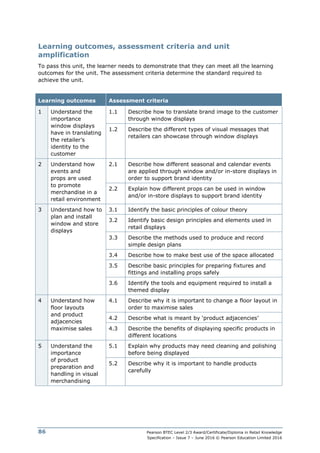
  • 257.
    Pearson BTEC Level2/3 Award/Certificate/Diploma in Retail Knowledge Specification – Issue 7 – June 2016 © Pearson Education Limited 2016 249 Suggested resources Books Alford D V – Color Atlas of Pests of Ornamental Trees, Shrubs and Flowers (Timber Press, 2003) ISBN 9780881925616 Buczacki S and Harris K – Pests, Diseases and Disorders of Garden Plants (Collins, 1998) ISBN 9780002200639 Lainsbury M – UK Pesticide Guide 2009 (CABI Publishing, 2009) ISBN 9781845935627 Other Defra – Pesticides: Code of Practice for Using Plant Protection Products (Defra, 2006) Journal Horticulture Week Websites www.bopp.org.uk – The British Ornamental Plant Producers' Certification Scheme (BOPP) www.cropprotection.org.uk – The Crop Protection Association www.gardenorganic.org.uk – organic growing charity www.hortweek.com – Horticulture Week magazine www.hse.gov.uk – Health and Safety Executive www.pesticides.gov.uk – government website for pesticide authorisation www.rhs.org.uk – Royal Horticultural Society www.soilassociation.org – Soil Association
  • 258.
    Pearson BTEC Level2/3 Award/Certificate/Diploma in Retail Knowledge Specification – Issue 7 – June 2016 © Pearson Education Limited 2016 250 Unit 35: Understanding the Nature, Uses and Importance of Product Information in a Retail Outlet Selling Gardening Products Unit reference number: F/600/2652 Level: 3 Credit value: 3 Guided learning hours: 20 Unit aim This unit is designed to enable the learner to understand the range of gardening products on sale in a retail outlet and recognise the importance of product information, including how different types of product information might be used to support customer service. Garden retail outlets are a popular destination for the gardener to buy garden products and to access gardening information. They offer a personal contact with knowledgeable staff who are able to help with the choice of product and answer questions. To ensure appropriate displays, sales and after-sales it is necessary to promote product knowledge with staff. Retail outlets display and sell a wide range of products for the garden, including plants, sundries, equipment, clothing, furniture and buildings. The learner will need to know, and be able to transmit, a considerable amount of information about a product to the customer. The gathering of product information by staff may be during other ongoing activities or as part of a staff training programme. The communication of information to staff and to customers can be by verbal and non-verbal methods; staff need to be aware of the effectiveness and use of each method. Staff need to be available to answer enquiries from customers regarding products for the garden. Throughout all the activities, learners will need to select, maintain and use equipment in a safe and correct way. This unit develops the learner’s knowledge and skills and on completion they should be able to understand the role of product knowledge and implement its use effectively in a retail outlet. It will also give the learner confidence to advise customers on the purchase of products and their use in the garden. The learner would need to study the following units as a prerequisite Unit 25: Understanding Plant Nomenclature, Terminology and Identification, Unit 34: Understanding the Control of Pests and Diseases Which May Affect Plants in a Retail Outlet, Unit 36: Understanding the Management of Delivery of Plants into a Retail Business and Unit 37: Understanding How the Growth and Development of Plants is Promoted and Monitored in a Retail Business. Essential resources It would be desirable for learners to have access to a retail outlet displaying and selling garden products to enable them to meet the requirements of this unit.
  • 259.
    Pearson BTEC Level2/3 Award/Certificate/Diploma in Retail Knowledge Specification – Issue 7 – June 2016 © Pearson Education Limited 2016 251 Learning outcomes, assessment criteria and unit amplification To pass this unit, the learner needs to demonstrate that they can meet all the learning outcomes for the unit. The assessment criteria determine the standard required to achieve the unit. Learning outcomes Assessment criteria 1 Understand the product ranges typically offered by retail outlets selling gardening products 1.1 Explain the common gardening product ranges and their typical target market groups 1.2 Explain how the social, economical and environmental factors of a specific geographical area can affect how well different gardening product ranges sell 1.3 Describe the sources of information which can be used to define and predict key current and future trends in gardening products 2 Understand the communication of product information to sales staff 2.1 Explain the importance to a retail business of ensuring that the product knowledge of the sales staff is kept up-to-date 2.2 Explain effective methods of communicating the features and benefits of a product range to sales staff 3 Understand the communication of product information to customers 3.1 Describe the types of information available to help customers choose and use gardening products 3.2 Compare product information aimed at trade and non-trade customers 3.3 Evaluate the effectiveness of the different types of product information available to customers 4 Understand how a retail business benefits from the product knowledge of its staff 4.1 Assess the importance of product knowledge to the delivery of customer service 4.2 Explain how the product knowledge of sales staff helps to drive sales
  • 260.
    Pearson BTEC Level2/3 Award/Certificate/Diploma in Retail Knowledge Specification – Issue 7 – June 2016 © Pearson Education Limited 2016 252 Unit amplification and content 1 Understand the product ranges typically offered by retail outlets selling gardening products Product ranges: plants, sundries, furniture, buildings, tools, equipment, outdoor living, hard landscape materials, aquatics, pets, wildlife, clothing, demography Social factors: housing, average age, education, marital status, family size, ethnic origin, occupation, employment status, disability, socio-economic groupings Economical factors: home ownership, competition, leisure outlets, rural, urban, cost barriers, income levels, growth potential, mobility, employment Environmental factors: transport systems, topography, soil types, size of gardens, roads, local authority Sources of information: demography, government surveys, industry surveys, market research, university research, socio-economic groups, local authority, overseas retailing trends, UK non- garden retailing trends, industry bodies, industry publications, internet, television, cinema 2 Understand the communication of product information to sales staff Up-to date product knowledge: level of sales, increased scope of communication to customers, legislation, litigation, customer satisfaction, modifications (models, styles, colours, warranty, servicing, spares), confident and enthusiastic staff Effective methods of communication: newsletters, product leaflets, catalogues, sales representatives, demonstration, websites, internal training, external training, role play, email, team meetings, conferencing 3 Understand the communication of product information to customers Types of information: media (television, radio, CD, internet, newspapers, magazines), use, price, ingredients, symbols/pictograms, health and safety instructions, benefits, awards, mode of action, data sheets, project sheets, demonstration, exhibit, newsletter, guarantee, posters, direct mailing, advertisements, garden clubs Compare between trade and non-trade: name, legislation, certification, technical details, appearance, terminology, price, promotions, packaging, use-by dates Effectiveness: questionnaire, sales reports, linked sales, impulse sales, return visits, complaints, confrontation, cash flow, reordering
  • 261.
    Pearson BTEC Level2/3 Award/Certificate/Diploma in Retail Knowledge Specification – Issue 7 – June 2016 © Pearson Education Limited 2016 253 4 Understand how a retail business benefits from the product knowledge of its staff Importance of product knowledge: sales, cash flow, return visits, spending profiles, questionnaire, advice desk Product knowledge of sales staff: increased sales, strengthens communication skills, ability to adapt sales presentation, shoppers’ needs, boosts enthusiasm, removes uncertainty, grows confidence, assists in overcoming objections, decision making
  • 262.
    Pearson BTEC Level2/3 Award/Certificate/Diploma in Retail Knowledge Specification – Issue 7 – June 2016 © Pearson Education Limited 2016 254 Information for tutors Delivery Tutors delivering this unit have opportunities to use as wide a range of techniques as possible. The unit is likely to be delivered through formal lectures, discussion, site visits, supervised practical sessions, independent learner research and the use of personal and/or industrial experience. Learners’ active participation in playing games would enhance the learning experience. Tutors should consider integrating the delivery, private study and assessment for this unit with other relevant units and assessments that learners are taking as part of their programme of study. At the outset of this unit, learners must be clear about the importance of developing a professional approach to monitoring and promoting plant growth and development, ensuring they have the right attitude in all aspects of their work while in the public gaze. Whichever delivery methods are used, it is essential that tutors stress the importance of environmental management and the need to manage the activities using approved methods. The need for attention to health and safety issues must be stressed and regularly reinforced, and risk assessments must be undertaken prior to practical activities. Adequate PPE must be provided and used following the completion of risk assessments. Learning outcome 1 explains and describes the range of gardening products offered by retail outlets. A visit to a retail outlet where the learners can observe the range of products offered and investigate the factors that affect sales would enhance understanding. Learning outcome 2 covers the communication of up-to-date product information to staff. Learners could prepare a questionnaire for the staff of a retail outlet asking about recent changes to specific products. The results could be discussed with other learners. In learning outcome 3 learners experience the communication of product information to customers by taking part in a role-play activity and recording for analysis. The assignment is to prepare profiles of products to show the differences in product information aimed at the trade and retail customer. Learning outcome 4 explains the benefits to a retail business of providing product information to customers. Learners can prepare a questionnaire and have the opportunity to ask customers about their wants and needs when visiting a retail outlet selling garden products. Analysis of the results would inform learners of the benefits of product information to customer service and sales. Tutors should identify the products or agree them through discussion with learners. Where possible, to ensure fairness of assessment, the size and complexity of the tasks should be the same for all learners.
  • 263.
    Pearson BTEC Level2/3 Award/Certificate/Diploma in Retail Knowledge Specification – Issue 7 – June 2016 © Pearson Education Limited 2016 255 Assessment Assessment by portfolio of evidence The centre can devise and mark the assessment for this unit. Learners must meet all assessment criteria to pass the unit. Learning outcome 1: can be covered through observation of the learner in their work placement as they demonstrate the maintenance of a stock list. Alternatively, this could be an exercise where two learners work together, one as a scribe and one assessing the stock levels. Learners would need to research socio-economic groupings and identify the target group on the retail outlet they work in. Learning outcome 2: can take the form observation of the learner giving information to customers and gaining a sale in their work placement. Learners ought to have the opportunity to question a member of the management team of a retail outlet about gaining a sale and discuss their communication of product knowledge to their staff. Learners should then be able to question the sales staff about the effectiveness of that communication from management. To conclude the assignment, learners ought to construct a report of their findings with recommendations for discussion with the member of the management team. Learning outcome 3: can take the form of a project to gather product information and submit it as information profiles. Learners can choose a specified number of products that they are familiar with and research the differences in the information available to both the trade and retail customer. Learners can design a short questionnaire for retail customers asking how much information they require. Learning outcome 4: can be covered by observing directly the conducting of a customer survey at a retail outlet at the point of customer departure. Learners can design the questionnaire in advance after some discussion as a group, perhaps together with a member of staff from the retail outlet, to assess customer satisfaction. Results could be collated and presented to the retail outlet staff. Learners can be assessed on their conducting of the questioning and their collation of the results. This could be made into a group task but criteria for individual assessment will need to be discussed and accepted by the learners. A keen focus of this learning outcome is collecting customers’ complaints, comments and suggestions during departure. A professional discussion or a report that has been produced can demonstrate the learner’s understanding of the different methods available for customer feedback and how the information is then used. To support this focus, learners will be requested to design a method for gaining customer feedback suitable for their establishment and report their reasons for choice in design, and how they may use the feedback gained to implement improvements. Reflective accounts from learners will provide details of how unexpected problems during customer departure have been dealt with. The use of case studies can be provided for the learner to detail how they would deal with a wider number of possible problems than they may have experienced.
  • 264.
    Pearson BTEC Level2/3 Award/Certificate/Diploma in Retail Knowledge Specification – Issue 7 – June 2016 © Pearson Education Limited 2016 256 Suggested resources Books Stanley J – The Complete Guide to Garden Center Management (ebrandedbooks.com, US, 2002) ISBN 9781883052317 Stanley J – The Nursery and Garden Centre Marketing Manual (The Reference Publishing Co, 1994) ASIN B002Y76RC2 Journal The Retailer Websites www.farma.org.uk – co-operative of UK farmers, small-scale local producers and farmers’ market organisers www.gohelios.co.uk – National Plant specification (NPS) and the GoHelios Plants Selector www.retail-week.com – retail industry newsletter
  • 265.
    Pearson BTEC Level2/3 Award/Certificate/Diploma in Retail Knowledge Specification – Issue 7 – June 2016 © Pearson Education Limited 2016 257 Unit 36: Understanding the Management of Delivery of Plants into a Retail Business Unit reference number: K/600/2659 Level: 3 Credit value: 3 Guided learning hours: 20 Unit aim This unit enables the learner to understand the different types of packaging for the range of gardening retail products and how to deal with plants before, during and after delivery. It also covers the administrative processes in place for the tracking and monitoring of plants. Garden retail outlets are a popular destination for the gardener to buy garden products and to access gardening information. They offer personal contact with knowledgeable staff who are able to help with the choice of product and answer enquiries. To ensure plants are of a suitable quality for display, sale and after-sales, it is necessary to understand the processes of plant preparation for despatch, their management during and after delivery to the retail outlet and the necessary administrative procedures. Retail outlets display and sell a wide range of plants which can be grown outdoors or with the aid of protection. There are fundamental factors to be considered when preparing plants for delivery to a customer and actions to be taken once the plants reach their destination. The learner will need to know the requirements of the main groupings of plants to ensure a high-quality plant for eventual sale and appreciate the need to choose packaging that will preserve plant quality while in transit. The management of the delivery of plants will involve the choice of packaging and understanding the factors that could cause deterioration of plant quality in transit. The learner will need to make decisions about the most suitable methods of packaging and be able to resolve any problems as they emerge in relation to work activities. Managing plant quality will involve maintaining moisture levels, providing nutrients and removing unwanted plant material. Learners may be required to manipulate plant development through trimming and supporting, and maintaining health by controlling pests, diseases, weeds and disorders. The monitoring of plant quality may be carried out during other ongoing activities or as part of a routine inspection procedure. Throughout all the activities Learners will need to select, maintain and use equipment in a safe and correct way. This unit develops the learners’ knowledge and skills and on completion they should be able to select packaging and manage the delivery for a range of plants that would be found in a retail outlet. It will also give the learner confidence to advise customers on the care and maintenance of plants. Product knowledge will be greatly enhanced particularly in the choice of associated tools and sundries. The learner would need to study the following units as a prerequisite: Unit 34: Understanding the Control of Pests and Diseases Which May Affect Plants in a Retail Outlet and Unit 37: Understanding How the Growth and Development of Plants is Promoted and Monitored in a Retail Outlet.
  • 266.
    Pearson BTEC Level2/3 Award/Certificate/Diploma in Retail Knowledge Specification – Issue 7 – June 2016 © Pearson Education Limited 2016 258 Essential resources For this unit, learners will require access to an area where plants can be grown and maintained to a saleable standard. A range of plant types and habits would make the delivery relevant and interesting. It would be desirable for learners to have access to a retail outlet displaying and selling plants to enable them to meet the requirements of this unit.
  • 267.
    Pearson BTEC Level2/3 Award/Certificate/Diploma in Retail Knowledge Specification – Issue 7 – June 2016 © Pearson Education Limited 2016 259 Learning outcomes, assessment criteria and unit amplification To pass this unit, the learner needs to demonstrate that they can meet all the learning outcomes for the unit. The assessment criteria determine the standard required to achieve the unit. Learning outcomes Assessment criteria 1 Understand the preparation of plants for transportation 1.1 Describe the methods of packaging used for different types of plants 1.2 Explain how the choice of packaging helps to ensure that plants reach the customer in the required condition 2 Understand how plant quality is managed during and immediately after delivery 2.1 Explain the factors affecting the quality of plants during transit 2.2 Explain the processes and procedures for dealing with plants at risk of deterioration during transit 2.3 Explain how to assess the condition of plants on arrival at the customer’s premises and the action to take if plants have deteriorated 2.4 Explain the kinds of advice and help the customer may need to care for plants immediately after delivery 3 Understand the administrative procedures associated with delivery of plants to customers 3.1 Describe the administrative systems and paperwork associated with deliveries of plants to customers 3.2 Explain the relevance of ‘plant passports’ and how they are used 3.3 Assess the impact on the business of failing to follow correct administrative procedures
  • 268.
    Pearson BTEC Level2/3 Award/Certificate/Diploma in Retail Knowledge Specification – Issue 7 – June 2016 © Pearson Education Limited 2016 260 Unit amplification and content 1 Understand the preparation of plants for transportation Methods of packaging: trolley, pallet, cling film, cardboard box, pot, pre-pack, straw, paper Choice of packaging: protection from physical damage, control of humidity, gaseous exchange, controlled atmosphere 2 Understand how plant quality is managed during and immediately after delivery Quality factors: desiccation and shrivelling, scorch, cold and light related, pests and diseases, compost spillage, weeds, breakage Processes: inspection, storage before despatch, environmental protection, temperature control, choice of packaging, waste disposal, transit container Procedures: management systems, labelling, advisory, contact customer, staff training Assessment: correct grades, sizes, container damage, transit damage, weather damage, plants free from pests, diseases, disorders and weeds, plants established in pots, compost levels, watering, feeding, pest, disease and weed control, pruning, disposal Advice: contact distribution centre or supplier, quarantine, nutritional status of plants and feeding, repotting, watering, pruning and training, labelling, light requirement 3 Understand the administrative procedures associated with delivery of plants to customers Administrative systems: computer software, barcodes, stock control, labelling Paperwork: picking list, despatch and delivery notes Plant passports: European Union (plant movement within EU, within individual states, quarantine pests and diseases, ornamental, fruit and vegetables), UK regulations, Fera Plant Health and Seeds Inspectors (PHSI), phytosanitary certificate for imports from non-EU countries, pests and diseases control, accompanying documents, grower to trade customer Impact: loss of order, litigation, penalties, imprisonment, debt, stock control, contravention of legislation, profit and loss
  • 269.
    Pearson BTEC Level2/3 Award/Certificate/Diploma in Retail Knowledge Specification – Issue 7 – June 2016 © Pearson Education Limited 2016 261 Information for tutors Delivery Tutors delivering this unit have opportunities to use as wide a range of techniques as possible. The unit is likely to be delivered through formal lectures, discussion, site visits, supervised practical sessions, independent learner research and the use of personal and/or industrial experience. Learners’ active participation in games would enhance the learning experience. Tutors should consider integrating the delivery, private study and assessment for this unit with other relevant units and assessments that learners are taking as part of their programme of study. At the outset of this unit, learners must be clear about the importance of developing a professional approach to monitoring and promoting plant growth and development, ensuring they have the right attitude in all aspects of their work while in the public gaze. Whichever delivery methods are used, it is essential that tutors stress the importance of environmental management and the need to manage the activities using approved methods. Health and safety issues must be stressed and regularly reinforced, and risk assessments undertaken prior to practical activities. Adequate PPE must be provided and used following the completion of risk assessments. Learning outcome 1 investigates the choice of packaging used to protect plants while in transit. A visit to a plant supplier and the opportunity to collect and prepare plants for despatch to a retail outlet would aid the understanding of the role of packaging. In learning outcome 2, the learner is able to observe and appreciate the factors that could affect plants while in transit. It also covers the action to be considered on receipt of the plants to avoid deterioration in plant quality. A domino game activity would show the learner’s level of understanding. The opportunity to visit a plant supplier or retail outlet to unpack and assess the condition of plants would help learners appreciate the necessity for procedures and processes. In learning outcome 3, the learner covers the administrative requirements for the delivery of plants and the role of plant passports. Their importance can be emphasised as the learners actually record the information from the assignments in learning outcomes 1 and 2. Assessment Assessment by portfolio of evidence The centre can devise and mark the assessment for this unit. Learners must meet all assessment criteria to pass the unit. Learning outcome 1: can be covered through learner work placement observations demonstrating the different stages of preparing a plant for despatch. Alternatively, this could be a simulated assignment with a range of packaging materials being made available. The learner would need to choose the appropriate material and be encouraged to explain their choice. Learning outcome 2: can take the form of observation directly related to the work placement for the receipt of a plant order. The learner would need to construct a checklist for completion and recording of their comments on the condition of the plants after their delivery. This would provide an opportunity for the learner to comment on the role of the packaging used for the delivery and recommend any remedial action. Appropriate equipment and sundries would need to be available to allow learners to carry out any remedial action to the plants.
  • 270.
    Pearson BTEC Level2/3 Award/Certificate/Diploma in Retail Knowledge Specification – Issue 7 – June 2016 © Pearson Education Limited 2016 262 Learning outcome 3: can be covered through the completion of appropriate paperwork or computerised log. The choice of packaging for despatch in learning outcome 1 will need to be recorded for receipt by the customer, together with guidance for its disposal and recycling. Details of relevant plant passports would also need to be attached. The checklist and action plan used in learning outcome 2 could be transferred to a recognised management system. Suggested resources Books Snook C and Crafer K – Grower Manual 4: Garden Centre Manager (Grower Books – A division of Nexus Media Ltd, 1999) ISBN 9781899372157 Stanley J – The Complete Guide to Garden Center Management (ebrandedbooks.com, US, 2002) ISBN 9781883052317 Stanley J – The Nursery and Garden Centre Marketing Manual (The Reference Publishing Co, 1994) ASIN B002Y76RC2 Journals and/or magazines American Nurserymen Horticulture Week Websites www.bopp.org.uk – The British Ornamental Plant Producers' Certification Scheme (BOPP) http://www.fera.defra.gov.uk/ – The Food and Environment Research Agency
  • 271.
    Pearson BTEC Level2/3 Award/Certificate/Diploma in Retail Knowledge Specification – Issue 7 – June 2016 © Pearson Education Limited 2016 263 Unit 37: Understanding how the Growth and Development of Plants is Promoted and Monitored in a Retail Outlet Unit reference number: H/600/2661 Level: 3 Credit value: 4 Guided learning hours: 26 Unit aim This unit enables the learner to understand plant growth and development and promote the health of plants in order to meet commercial requirements. It also enables the learner to recognise the importance of plant maintenance and administer the processes for record keeping in relation to growing plants. Garden retail outlets are a popular destination for the gardener to buy garden products and to access gardening information. They offer a personal contact with knowledgeable staff who are able to help with the choice of product and answer questions. To ensure plants are of a suitable quality for display, sale and after-sales, it is necessary to maintain their growth and development in the retail outlet. Retail outlets display and sell a wide range of plants which can be grown outdoors or with the aid of protection. There are fundamental factors to be considered in the maintenance of plants to ensure their growth and development is not affected by the display environment. The learner will need to know the requirements of the main groupings of plants to ensure a high-quality display for sale and appreciate the need to segregate groupings in the display area for ease of maintenance and use by customers. The monitoring of plant growth and development will involve inspecting and reporting on the progress and development of the plants on display. Monitoring may be carried out during other ongoing activities or as part of a routine inspection procedure. Decisions will need to be made regarding the most suitable methods to use and learners will be able to resolve any problems as they emerge in relation to work activities. Maintaining growth and development will involve maintaining moisture levels, providing nutrients and removing unwanted plant material. Maintaining moisture levels may involve watering plants manually or checking and adjusting automated systems. There may be a requirement to manipulate plant development through trimming and supporting, and maintaining the health of plants by controlling pests, diseases, weeds and disorders. Throughout all the activities learners will need to select, maintain and use equipment in a safe and correct way. This unit develops the learner’s knowledge and skills and on completion they should be able to monitor and maintain plant growth for a range of plants that would be found in a retail outlet. It will also give the learner confidence to advise customers on the purchasing of plants and their maintenance in the garden. The learner would need to study the following unit as a pre-requisite: Unit 34: Understanding the Control of Pests and Diseases Which May Affect Plants in a Retail Outlet. Product knowledge will be greatly enhanced particularly in the choice of associated tools and sundries.
  • 272.
    Pearson BTEC Level2/3 Award/Certificate/Diploma in Retail Knowledge Specification – Issue 7 – June 2016 © Pearson Education Limited 2016 264 Essential resources For this unit, learners will require access to an area where plants can be grown and maintained, ideally to a saleable standard. A range of plant types and habits would make the delivery relevant and interesting. It would be desirable for the learner to have access to a retail outlet displaying and selling plants to enable them to meet the requirements of this unit.
  • 273.
    Pearson BTEC Level2/3 Award/Certificate/Diploma in Retail Knowledge Specification – Issue 7 – June 2016 © Pearson Education Limited 2016 265 Learning outcomes, assessment criteria and unit amplification To pass this unit, the learner needs to demonstrate that they can meet all the learning outcomes for the unit. The assessment criteria determine the standard required to achieve the unit. Learning outcomes Assessment criteria 1 Understand the factors which promote the growth and development of plants to meet commercial requirements 1.1 Explain the tasks which promote plant growth and development and the best times to carry out these tasks 1.2 Explain the requirements of different types of growing plant for nutrients and moisture and the importance of monitoring and adjusting nutrients and moisture 1.3 Explain the relationship between the care of growing plants and levels of production 2 Understand the factors which promote the health of growing plants 2.1 Explain the methods of promoting the health of growing plants 2.2 Explain the common health problems which may affect growing plants and the remedies for such problems 3 Understand the importance of the routine tasks required to maintain the area where plants are grown 3.1 Explain the reasons why it is important to maintain hygiene and describe how this is achieved 3.2 Explain methods of handling plant material which protect personal health and the condition of plants 3.3 Describe possible environmental damage that could occur and how to minimise such occurrences 4 Understand how to maintain equipment 4.1 Explain the importance of maintaining equipment for use 4.2 Describe the methods of maintaining the range of equipment for use 5 Understand the record-keeping in relation to growing plants 5.1 Explain the records required for management and legislative purposes and the importance of maintaining them
  • 274.
    Pearson BTEC Level2/3 Award/Certificate/Diploma in Retail Knowledge Specification – Issue 7 – June 2016 © Pearson Education Limited 2016 266 Unit amplification and content 1 Understand the factors which promote the growth and development of plants to meet commercial requirements Promoting plant growth and development: definition of growth and development – dormancy, germination, vegetative growth, apical dominance, flowering, fruiting, seed set, factors affecting each growth stage, monitoring of growth stages tasks – hygiene, watering, feeding, weed control, lighting, provide shelter, provide heat, pruning, training, cane and tie, standing up of plants in containers, pest and disease control, weed control times – seasonal, weather conditions, hours of trading, stages of plant growth, to meet plant needs Requirements of different plants: types of growing plant – trees, shrubs, conifers, climbers, herbaceous, ground cover, bedding, alpine, ferns, bulbs, house, vegetables and herbs, tree and soft fruit, turf, cacti, aquatics nutrients – major, minor and trace elements, pH, base dressing, top dressing, quick and slow release, liquid feed, foliar feed, organic and inorganic products moisture – humidity, watering by hand, overhead irrigation, low-level irrigation, quantity, frequency, liquid feeding importance of monitoring and adjusting – loss of quality, poor flowering and fruiting, excessive growth, poor leaf colour, dead plants, profit and loss, reputation Care and levels of production: relationship – saleable, plant display, National Plant Specifications, reputation, stock control, ordering, shrinkage, waste disposal, cash flow, profit and loss 2 Understand the factors which promote the health of growing plants Promoting health of growing plants: methods – management systems, regular monitoring, soil and compost analysis, recording systems, watering systems, feeding, weed control, lighting, provide shelter, provide heat, pruning, training, cane and tie, standing up plants in containers Common health problems and remedies: problems – underwatering, overwatering, leaching, underfeeding, overfeeding, scorching of foliage, flowers and fruits, cold damage, pests, diseases, weeds, lack of light, too much light, animal damage, customer damage, staff damage remedies – introduce management systems, monitor and adjust watering and feeding, prune, relocate plants, quarantine and treat, non-chemical control, bio-stimulants, chemical control, staff training
  • 275.
    Pearson BTEC Level2/3 Award/Certificate/Diploma in Retail Knowledge Specification – Issue 7 – June 2016 © Pearson Education Limited 2016 267 3 Understand the importance of the routine tasks required to maintain the area where plants are grown Reasons to maintain hygiene: reputation, loss of plant quality, saleability, plant display, waste, shrinkage How hygiene is achieved: disposal of debris, clean display bench and area, plant spacing, ventilation, remove infection and infestation, water quality, supervision, risk assessment, waste disposal Plant handling methods: mechanical, by hand, cane protectors, health and safety procedures, delivery to display area Possible environmental damage: water drainage, soil water contamination, site run-off, pest and disease spread, weed spread, air pollution, litter, vandalism How to minimise environmental damage: water run-off, waste disposal, staff responsibility, management procedures, facilities, equipment 4 Understand how to maintain equipment Importance of maintenance: health and safety, capital investment, rate of application, environmental damage, effective Methods of maintaining equipment: management procedures, staff responsibility, staff training, risk assessment, calibration, regular servicing, replacement 5 Understand the record-keeping in relation to growing plants Records required: risk assessment, chemical spray record, COSHH assessment, BOPP crop assurance scheme, stock list, paper system, computer system Importance of maintaining records: legislation, litigation, management (weekly, monthly, seasonal, suppliers), crop assurance scheme inspection
  • 276.
    Pearson BTEC Level2/3 Award/Certificate/Diploma in Retail Knowledge Specification – Issue 7 – June 2016 © Pearson Education Limited 2016 268 Information for tutors Delivery Tutors delivering this unit have opportunities to use as wide a range of techniques as possible. The unit is likely to be delivered through formal lectures, discussion, site visits, supervised practical sessions, independent learner research and the use of personal and/or industrial experience. Learners’ active participation in games would enhance the learning experience. Tutors could consider integrating the delivery, private study and assessment for this unit with other relevant units and assessment methods learners are taking as part of their programme of study. At the outset of this unit, learners must be clear about the importance of developing a professional approach to monitoring and promoting plant growth and development, ensuring they have the right attitude in all aspects of their work while in the public gaze. Whichever delivery methods are used, it is essential that tutors stress the importance of environmental management and the need to manage the activities using approved methods. Health and safety issues must be stressed and regularly reinforced, and risk assessments undertaken prior to practical activities. Learning outcome 1 investigates the factors that promote the growth and development of plants to meet commercial requirements. Learners in small groups could identify the tasks to promote plant growth and development and use a sticky-note display to illustrate their thoughts. The assignment asks the learner to choose a plant type, research the requirements to promote its growth and development, and then present the information to fellow learners and work staff. In learning outcome 2, the factors which promote the health of growing plants need to be linked with the factors in learning outcome 1. Learners can take part in activities such as using a sticky-note display on the wall to show their understanding. The assignment asks learners to observe plants, preferably grown in containers, record their findings and propose remedies to improve their growth and development. For learning outcome 3, learners should understand the importance of the routine tasks required to maintain the area where plants are grown, while recognising the need for hygiene and awareness of possible environmental damage. Learners can take part in activities such as the use of ‘sequence cards’ to show their understanding. The assignment can be conducted in a garden situation, plant nursery or retail outlet. Learning outcome 4 explains the need for the maintenance of equipment used to promote growth, development and health of plants. The opportunity to use tools, lubricants and cleaning materials would benefit the learner and aid their demonstration of maintaining a piece of equipment. Suitable equipment, tools and lubricants should be made available to learners. Learning outcome 5 covers the need for keeping records of the work activities both to satisfy current legislation and to provide information to aid the management of the retail outlet. The importance of record-keeping can be emphasised as learners record the information from the assignments in learning outcomes 1–4. The health and safety implications need to be highlighted. Learners need to maintain and control the growth and development of selected plants. Tutors need to identify the plants, or agree them through discussion with learners, that would be appropriate to a retail outlet. Where possible, to ensure fairness of assessment, the size and complexity of the tasks should be the same for all learners.
  • 277.
    Pearson BTEC Level2/3 Award/Certificate/Diploma in Retail Knowledge Specification – Issue 7 – June 2016 © Pearson Education Limited 2016 269 Assessment Assessment by portfolio of evidence The centre can devise and mark the assessment for this unit. Learners must meet all assessment criteria to pass the unit. Learning outcome 1: can be covered by a presentation to cover the tasks to promote plant growth and development. The chosen plant should be one that is typical of either a house plant or outdoor plant for sale in a retail outlet. The presentation should cover the management of the watering and nutrition of the chosen plant. Learners should make reference to how these management practices affect the quality of the plant and its production of flowers, fruits, leaves and stems. Learning outcome 2: can take the form of observation directly related to the work placement for plant display and their maintenance. Learners will be required to research remedies for plant health problems found while inspecting plants in a retail display. Reflective accounts from learners will provide details of how unexpected problems during customer departure have been dealt with and case studies can be provided for the learner to explain how they would deal with a wider number of possible problems than they may have experienced. Learning outcome 3: can be covered by observing learners tending a group of plants by watering, feeding and pruning them. A key focus could be on their cleaning up afterwards and the disposal of waste, with particular regard to the health and safety of staff and customers. This could be covered by a series of assessments throughout the year using the typical range of plant types to be found in a retail outlet. Learning outcome 4: can take the form of a practical presentation to demonstrate the learner’s understanding of the maintenance of a chosen piece of equipment. The demonstration would need to address prescribed health and safety procedures. Learners should have the opportunity to discuss their proposed presentation with their tutor. Learning outcome 5: can be covered by the completion of appropriate paperwork or computerised records for learning outcomes 3 and 4. Learners could complete a written log of the work they carried out while maintaining plants, when they were meeting the requirements for learning outcome 3. It would need to include details of waste disposal. They could then complete a maintenance log for learning outcome 4, with a record of materials used. Learners should identify the reasons for recording this information. Suggested resources Books Adams C and Early M – Principles of Horticulture (Butterworth-Heinemann, 2004) ISBN 9780750660884 Alford D – A Colour Atlas of Pests of Ornamental Trees, Shrubs and Flowers (Timber Press, 2003) ISBN 9780881925616 Buczacki S and Harris K – Pests, Diseases and Disorders of Garden Plants (Collins, 1998) ISBN 9780002200639 Ingram D, Vince-Prue D, and Gregory P – Science and the Garden: The Scientific Basis of Horticultural Practice (Wiley-Blackwell, 2002) ISBN 9780632053087 Ministry of Agriculture, Fisheries and Food – Fertiliser recommendations, 7th Edition (Stationery Office Books, 2000) ISBN 9780112430582 Roth S and Dourado A – Weeds: Friend or Foe? – An Illustrated Guide to Identifying, Taming and Using Weeds (Carroll and Brown Publishers Limited, 2002) ISBN 9781903258262
  • 278.
    Pearson BTEC Level2/3 Award/Certificate/Diploma in Retail Knowledge Specification – Issue 7 – June 2016 © Pearson Education Limited 2016 270 Journals and/or magazines American Nurserymen Horticulture Week Websites www.bopp.org.uk – The British Ornamental Plant Producers' Certification Scheme (BOPP) www.cropprotection.org.uk – The Crop Protection Association www.gardenorganic.org.uk – organic growing charity www.gohelios.co.uk – website for the National Plant specification (NPS) and the GoHelios Plants Selector www.pesticides.gov.uk – government website for pesticide authorisation www.rhs.org.uk – Royal Horticultural Society www.soilassociation.org – Soil Association
  • 279.
    Pearson BTEC Level2/3 Award/Certificate/Diploma in Retail Knowledge Specification – Issue 7 – June 2016 © Pearson Education Limited 2016 271 Unit 38: Understand how to Approach Work-Based Projects within Retail Business Unit reference number: D/602/5016 Level: 2 Credit value: 3 Guided learning hours: 22 Unit aim The aim of this unit is to give learners knowledge and understanding of how projects are undertaken within the retail workplace. The unit covers the process of planning and implementing appropriate activities and tasks within the retail workplace and also provides learners with an opportunity to review the outcomes and progress. Employers use projects to gain a better understanding of problems associated with particular products or processes and identify the most effective way to resolve those problems. This unit has been designed to give learners an understanding of how such a project is planned and implemented in order to achieve a successful outcome. It is anticipated that this unit will be delivered in a practical way, allowing the learner to experience first-hand the challenges of undertaking such a task and the benefits to the learner and the workplace. Learners will be required to focus on a product or process of the retail business and then set objectives and targets in order to solve an identified problem. The learner will need to understand potential problems or barriers that could result in the objectives and/or targets not being achieved. To achieve this, the learner will need to have sufficient time within a suitable work environment to be able to carry out this work. The learner should be encouraged to prepare a plan showing how the project could be implemented. Following the implementation of the plan the learner will then be able to describe the strengths and weaknesses of the plan and the skills and knowledge they have gained as a result of the work they have done on the project. Throughout the delivery and assessment of this unit learners will gain valuable personal, learning and thinking skills. They will need to work as an effective member of a team. Self-management will be essential in the development and implementation of the plan. Reflective skills will be used when describing the strengths and weaknesses of the plan and presentation skills may be enhanced when sharing the outcomes of the project with work colleagues and other learners. The learner will require support and constructive feedback from work colleagues and tutors throughout the unit. Essential resources There are no special resources needed for this unit.
  • 280.
    Pearson BTEC Level2/3 Award/Certificate/Diploma in Retail Knowledge Specification – Issue 7 – June 2016 © Pearson Education Limited 2016 272 Learning outcomes, assessment criteria and unit amplification To pass this unit, the learner needs to demonstrate that they can meet all the learning outcomes for the unit. The assessment criteria determine the standard required to achieve the unit. Learning outcomes Assessment criteria 1 Understand how to undertake a project and solve problems specific to a retail function or project 1.1 Define the problem that needs to be solved by a project 1.2 Describe the activities/tasks of the project which are required to meet set objectives and targets 1.3 Describe potential problems or barriers which could affect the achievement of set objectives and target 1.4 Explain how to implement the project 1.5 Describe strengths and weaknesses of own implementation plan 2 Understand what constitutes a successful project 2.1 Describe strengths and weaknesses of own working methods 2.2 Review process and outcomes of completed project 2.3 Draw conclusions from project
  • 281.
    Pearson BTEC Level2/3 Award/Certificate/Diploma in Retail Knowledge Specification – Issue 7 – June 2016 © Pearson Education Limited 2016 273 Unit amplification and content 1 Understand how to undertake a project and solve problems specific to a retail function or project Potential problems: personnel, e.g. workplace health and safety, workplace security, maintaining hygiene standards, meeting targets, teamwork, staffing issues; customer service, e.g. resolving customer service issues, helping customers, customer feedback, products, e.g. presenting goods for sale, displaying stock, demonstrating products, promoting goods and services, processing payments, lost sales Setting objectives and targets: objectives; targets; SMART (specific, measureable, achievable, realistic, time-bound) Other potential problems or barriers: timescales, unrealistic or inappropriately set objectives and/or targets Project implementation: stages, e.g. discussion with line manager and colleagues on feasibility of project, personal preparation, setting objectives and targets, resources required to implement project, monitoring and reporting on progress to colleagues/customers/line manager, evaluating outcome of project, planning future actions; reporting methods, e.g. informal notes/diary, report, photographs, customer feedback, feedback from colleagues, presentation Strengths and weakness: suitability of project; appropriate objectives and targets; communication with customer/colleagues/line manager; presentation of outcomes 2 Understand what constitutes a successful project Strengths and weaknesses of own working methods: achievements against objectives and targets; personal achievements; suitability of recording methods used; benefits to self and to employer Process and outcomes of completed project: self-evaluation; new skills and knowledge gained; existing skills and knowledge developed; benefits to self and to employer; personal development plans; possible new career pathways; successful and unsuccessful outcomes Conclusions: benefits to employer and customers; personal development; future plans/ opportunities
  • 282.
    Pearson BTEC Level2/3 Award/Certificate/Diploma in Retail Knowledge Specification – Issue 7 – June 2016 © Pearson Education Limited 2016 274 Information for tutors Delivery The unit is best offered when the learner has already gained a sound understanding of the retail industry in general. It is suggested, therefore, that this unit should not be undertaken until the learner has a sound understanding of the retail industry and sufficient familiarity with their work environment. A useful way to deliver this unit is to allow the learner to identify an appropriate project in a suitable work environment, design an implementation plan in consultation with their line manager, carry out the project and then evaluate the success of the project. Learners will therefore need time in a suitable work environment to give them the opportunity to plan, implement and evaluate a project. They must be well prepared, have a clear understanding of the project they wish to undertake and liaise closely with their line manager. The learner must have sufficient time in the work environment to build effective relationships with work colleagues and plan and carry out an appropriate project. This may be as a continuous period, as a series of individual days, or as a combination of both. Learners will need an appropriate level of support to identify, undertake and evaluate the work-based project, so that they can acquire a deeper and broader knowledge and understanding of the world of work and use the opportunity to develop their own skills and knowledge within the retail industry. The work-based project is likely to present a range of opportunities to develop skills which form part of the National Occupational Standards. However, the experience will also help the learner to develop transferable skills which will be of benefit in any work situations should they later make a change in their career plan. Learners will need sufficient tutoring/mentoring time throughout the delivery of this unit. They will need guidance on the selection of the problem they want to consider to ensure that it is realistic and achievable in the timescale available. Time will need to be spent discussing the preparation and planning process, different methods of assessing success, evaluation and presentation methods. This unit could also give learners opportunities to gather materials and experience, this will be relevant to the requirements of other units and will help the learner to achieve them. For example, Unit 1: Understanding Customer Service in the Retail Sector, Unit 2: Understanding the Retail Selling Process, Unit 9: Understanding Visual Merchandising for Retail Business, Unit 8: Understanding the Control, Receipt and Storage of Stock in a Retail Business, as well as the specialist units on Beauty Retailing and Food Retailing.
  • 283.
    Pearson BTEC Level2/3 Award/Certificate/Diploma in Retail Knowledge Specification – Issue 7 – June 2016 © Pearson Education Limited 2016 275 Assessment Assessment by portfolio of evidence The centre can devise and mark the assessment for this unit. Learners must meet all assessment criteria to pass the unit. This unit provides an excellent opportunity for holistic assessment. The learner could prepare a presentation for colleagues, which demonstrates evidence for each of the assessment criteria for learning outcomes 1 and 2. The problem selected can be clearly defined, the objectives and targets can be described along with the activities/tasks planned to achieve the objectives/targets set. A description should then be given of the potential problems or barriers that may affect the achievement of the set objectives and targets. The learner can then describe how the project was implemented and examples of the plan can be provided. A description of the strengths and weaknesses of the plan can then be shared with colleagues. The presentation could then go on to describe the strengths and weaknesses of their working methods, the process and outcomes and conclusions drawn. If this method of assessment is used the learner must reference each assessment criterion against the evidence they have produced. Alternatively, the learner could produce a report which provides details for each assessment criterion or a question and answer session may be arranged between the learner, employer and assessor. Evidence of the discussion must be available for internal and external verification purposes. Suggested resources Books Bacal R – Perfect Phrases for Customer Service (McGraw-Hill Professional, 2005) ISBN 9780071444538 Bradley S – S/NVQ Level 2 Customer Service Candidate Handbook (Heinemann, 2003) ISBN 9780435451691 Brittain P and Cox R – Retailing: An Introduction Pearson Higher Education FT Prentice Hall, 2004) ISBN 9780273678191 Fleming P – Retail Selling: How to Achieve Maximum Retail Sales (Mercury Business Books, 2007) ISBN 97818525255451 Newton R – The Project Manager: Mastering the Art of Delivery (Pearson Education Ltd, 2009) ISBN 9780273723424 Oliver C – Supermarket (The Watts Publishing Group Franklin Watts Ltd, 2004) ISBN 9780749656379 Portny S – Project Management for Dummies, 2nd Edition (Wiley Publishing Inc, 2006) ISBN 9780470049235 Journals and/or magazines The Convenience Store Customer First The Grocer Retail Weekly Websites www.apm.org.uk – Association for Project Management www.drapersonline.com – fashion retail resource www.instituteofcustomerservice.com – Institute of Customer Service www.retail-week.com – retail industry newsletter
  • 284.
    Pearson BTEC Level2/3 Award/Certificate/Diploma in Retail Knowledge Specification – Issue 7 – June 2016 © Pearson Education Limited 2016 276 Unit 39: Underage Sales Prevention for Retail And Licensed Premises Unit reference number: M/602/2234 Level: 2 Credit value: 1 Guided learning hours: 5 Unit aim The purpose of this unit is to provide sales staff with the knowledge they need to sell age-restricted products in either licensed premises or retail businesses. The unit has been developed to comply with current licensing and serious crime and disorder legislation. Examples of licensed premises and retail businesses include bars, hotels, restaurants, off-sales premises, supermarkets, convenience stores, garages, newsagents, DIY centres, hardware stores, and cookware stores. Age-restricted products include: alcohol (inclusive of exceptions); tobacco and tobacco products; lottery tickets and scratch cards; petrol; party poppers and caps; air guns, pellets, crossbows and knives; solvents; butane gas cigarette lighter refills; tattooing; fireworks; DVDs, videos and computer games. The unit has been developed to allow learners to understand the importance of complying with the current legislation relating to age-restricted products. Examples of licensed premises and retail businesses include bars, hotels, restaurants, off-sales premises, supermarkets, convenience stores, garages, newsagents, DIY centres, hardware stores, and cookware stores. UK law restricts the sale of certain products to people below a certain age for their own health and safety and that of the community. The unit will give learners, who may be working in licensed and general retail businesses, the ability to identify which products are age restricted, to know when and how to demand proof of age from customers, how to refuse a sale to a customer and how to manage potentially disgruntled customers who have been refused. The unit will also give learners an understanding of the legal penalties for employees, employers and customers for breaking the laws associated with age-restricted products.
  • 285.
    Pearson BTEC Level2/3 Award/Certificate/Diploma in Retail Knowledge Specification – Issue 7 – June 2016 © Pearson Education Limited 2016 277 Essential resources The following legislation may be useful for learners as further reading: ● Children and Young Persons Acts 1991 and 1993 in relation to tobacco sales ● National Lottery Act 1993 and associated Regulations of 1994 in relation to lottery tickets/scratchcards ● Offensive Weapons Act 1996 in respect of offensive weapons ● Licensing Act 2003 in respect of alcohol ● Fireworks (Safety) Regulations 1997 in respect of fireworks and crackers and caps ● Intoxicating substances (Supply) Act 1985 in respect of volatile substances and solvents ● Cigarette Lighter Refill (Safety) Regulations 1999 in respect of lighter refills containing butane ● Video Recordings Act 1984 in respect of videos and DVDs ● Tattooing of Minors Act 1969 in respect of tattooing persons under the age of eighteen years. All of the above Acts of Parliament and regulations can be ordered from Her Majesty’s Stationery Office ‘the stationery office’ on www.tsoshop.co.uk All of the above acts were correct at time of publication.
  • 286.
    Pearson BTEC Level2/3 Award/Certificate/Diploma in Retail Knowledge Specification – Issue 7 – June 2016 © Pearson Education Limited 2016 278 Learning outcomes, assessment criteria and unit amplification To pass this unit, the learner needs to demonstrate that they can meet all the learning outcomes for the unit. The assessment criteria determine the standard required to achieve the unit. Learning outcomes Assessment criteria 1 Know current legislation relating to the sale and purchase of age- restricted products 1.1 Describe reasons why the law restricts the sale of certain products 1.2 Identify which products are age-restricted by law 1.3 Identify the legal age restrictions which apply to the sale of certain products 1.4 Identify the legal penalties for employers, employees and customers which apply to the unlawful sale and purchase of age-restricted products 2 Know how to prevent unlawful sales of age- restricted products 2.1 Describe procedures for challenging for proof of age documentation 2.2 Describe how to refuse the sale of age-restricted products to minimise the risk of conflict 2.3 Describe how to manage conflict arising out of challenges and refusals 2.4 Describe the benefits of recording admission and sales refusals
  • 287.
    Pearson BTEC Level2/3 Award/Certificate/Diploma in Retail Knowledge Specification – Issue 7 – June 2016 © Pearson Education Limited 2016 279 Unit amplification and content 1 Know current legislation relating to the sale and purchase of age-restricted products Reasons why the law restricts the sale of certain products: risks of harm – to the health, safety and welfare of children; use by children, directly or indirectly, creating risk of harm to others; categories of harm (physical and psychological harm to the purchaser, moral harm through inappropriate exposure, increased vulnerability to harm caused by others, harm to others arising from underage use); increase in antisocial behaviour, effects on local community, possible long-term effect on health of young people Which products are age-restricted by law: caps, cracker snaps; lottery tickets/instant win; petrol; liqueur confectionery; aerosol paint; alcohol; tobacco products; crossbows; airguns and pellets; offensive weapons/knives; lighter refills containing butane; fireworks; volatile substances/solvents; DVDs, videos and games Legal age restrictions that apply to certain products: minimum age 16 (caps, cracker snaps, lottery tickets/instant win, petrol, liqueur confectionery, aerosol paint); minimum age 18 (alcohol, tobacco products, crossbows, airguns and pellets, offensive weapons/knives, lighter refills containing butane, fireworks, volatile substances/solvents); videos and DVDs (12, 15 and 18 years) Legal penalties for employers, employees and customers, which apply to the unlawful sale and purchase of age-restricted products: fine, prison, penalty notices, on-the-spot fines, review and revoke premises licences 2 Know how to prevent unlawful sales of age-restricted products Procedures for challenging for proof of age documentation: using Challenge 25/21, a key policy and tool to help prevent the sale of alcohol to people under the age of 18; procedure (identifying proxy-purchasers; using interpersonal skills, asking politely, use of appropriate body language, depersonalising the request, explaining why, establishing empathy); checking proof of age documents (passport, UK driving licence, proof of age scheme cards); checking ID (hologram, photo, date of birth); checking card not tampered with; continued uncertainty obliged to refuse service How to refuse the sale of age-restricted products to minimise the risk of conflict: interpersonal skills – refusing the sale firmly but politely; depersonalising the refusal- to-serve; separating individuals from groups to avoid ‘playing to the audience’; techniques to defuse anger/conflict, e.g. proof of age card application form How to manage conflict arising out of challenges and refusals: interpersonal skills – managing angry or aggressive responses from customers – not taking it personally; not becoming angry or aggressive in response; body language; not accepting abuse or aggression from others; maintaining a positive attitude; acting assertively; keeping safe by (positioning yourself correctly, estimating and assessing the likelihood of abuse turning to violence, understanding the difference between being assertive and being aggressive, remaining calm, standing your ground, seeking support from colleagues, using the techniques of ‘switching’ and ‘lead and backup’, having an exit strategy in place) Benefits of recording admission and sales refusals: providing evidence of due diligence in respect of legal compliance responsibilities; management and staff having a record of incidents in the event of complaints; enabling the identification of training needs in respect of underperforming staff
  • 288.
    Pearson BTEC Level2/3 Award/Certificate/Diploma in Retail Knowledge Specification – Issue 7 – June 2016 © Pearson Education Limited 2016 280 Information for tutors Delivery The delivery of this unit should give the learner understanding of how important it is for retail businesses to comply with law and regulations on age-restricted sales in general retail, as well as in licensed retail outlets. Delivery has to link knowledge of age-restricted products with an understanding of the interpersonal skills needed to challenge for a proof of age and refuse the sale of age- restricted products when necessary. Learners need to understand the consequences for society, themselves and their store or outlet if they fail to comply with age-restriction legislation. This is a knowledge-based unit and as such can be delivered by didactic teaching using presentation software and printed learning support materials, such as a course handbook. Group work could also be undertaken. This could involve buyer-seller role play to practise the interaction involved in challenging for proof of age and refusing underage sales. The roles can be reversed so that each player gains experience of both roles. Similarly, a small group of learners can play question and answer games – with one person playing the questioner and the others finding answers. A list of questions might be provided, for example ‘What is the minimum age for purchasing XYZ?’. Providing ready-made quizzes and practice tests, for example ‘Identify which of the following is an acceptable proof of age document.’ Using a feather-light, inflated beach ball made up different coloured segments: write the name of an age-restricted product on each segment; throw the ball into the class and ask the learner who catches it to choose a product and then ask the group what minimum age applies to this product.
  • 289.
    Pearson BTEC Level2/3 Award/Certificate/Diploma in Retail Knowledge Specification – Issue 7 – June 2016 © Pearson Education Limited 2016 281 Assessment Assessment by portfolio of evidence The centre can devise and mark the assessment for this unit. Learners must meet all assessment criteria to pass the unit. For learning outcome 1, assessment can be through tasks, projects or other activities completed individually to meet the assessment criteria. Examples of assessment activities could include written or oral answers to questions that test the knowledge and understanding of why the law restricts the sale of certain products, the identification of age-restricted products and the particular age restriction applying to different types of product. Finally, further questions could be given testing the learners’ knowledge and understanding of the legal penalties that may apply to the various participants if the laws relating to age-restricted products are broken. For learning outcome 2, assessment could again include written or oral answers to questions that test knowledge and understanding of the procedures that could be in place for the challenging of customers who appear to be underage, such as 25/21, and the interpersonal skills required to politely request customers to provide appropriate forms of ID. The learner should then be given a further set of questions or assessed through a role-playing exercise, to test their knowledge and understanding of what interpersonal skills they would use to refuse the sale of age-restricted products to minimise the risk of conflict. The next assessment criteria, which deals with how to manage conflict arising out of challenges and refusals, can also be assessed either by questioning or through role play. The learner will need to demonstrate their knowledge and understanding of the interpersonal skills required to manage angry or aggrieved customers and the various techniques available to manage the situation. Finally, the learners need to demonstrate their knowledge and understanding of the benefits of recording admission and sales refusals. Again, this can be done through questioning, with the learner providing evidence that they understand the importance of due diligence and the accurate recording of refusals and admissions that can facilitate the identification of training needs and staff underperformance, it can also provide evidence for others, such as the police. Suggested resources Books Chase P – Underage Sales Prevention Handbook (Confederation of Professional Licensees 2008) ISBN 9781906643041 Mehigan S and Phillips J – Paterson’s Licensing Acts (Butterworths Law, 2009) ISBN 9781405742481 Websites http://www.leics.gov.uk/underage_sales.htm – Leicestershire County Council advice on age restricted sales http://www.tradingstandards.gov.uk/ – Trading Standards www.noidnosale.com – No ID No Sale! campaign website www.thegrocer.co.uk – weekly magazine with coverage of the whole fast-moving consumer goods (FMCG) sector
  • 290.
    Pearson BTEC Level2/3 Award/Certificate/Diploma in Retail Knowledge Specification – Issue 7 – June 2016 © Pearson Education Limited 2016 282 Unit 40: The Principles of Food Safety for Retail Unit reference number: K/502/0178 Level: 2 Credit value: 1 Guided learning hours: 9 Unit aim This unit covers the basic principles of food safety for food handlers working in the food retail industry. Holders of qualifications that include this unit will have a knowledge and understanding of the importance of food hygiene, associated food hazards, good hygiene practice and controls based on an awareness of food safety management systems. These topics are regarded by the Food Standards Agency as being important to understanding and maintaining good practice in the handling, processing and preparation of safe food. The success of any retail business that works in the food sector depends on having skilled staff that understand their roles and follow all food safety legislation. This unit will enable learners to understand the roles and responsibilities of themselves and their employer and to follow the legal obligations placed on them. Personal hygiene, the wearing of appropriate clothing and how to deal with illness or injury, are considered in detail in the unit. Learners will be given opportunities to fully understand all the principles surrounding this through training, simulation or real-time practice. In this unit, the learner will also consider how to keep the work area clean, the use of appropriate equipment and how to dispose of waste. In the retail food sector all food products must be kept safe. This unit will also consider the different risks posed by the different types of contamination and cross-contamination and how to handle food safely. Stock control, storage and food spoilage will also be covered. Learners will be introduced to health and safety policies and in particular those associated with food safety. This unit will also cover the importance of risk assessments, how to define risk factors, how to report hazards and deal with all other safety issues regarding food. Essential resources There are no special resources needed for this unit.
  • 291.
    Pearson BTEC Level2/3 Award/Certificate/Diploma in Retail Knowledge Specification – Issue 7 – June 2016 © Pearson Education Limited 2016 283 Learning outcomes, assessment criteria and unit amplification To pass this unit, the learner needs to demonstrate that they can meet all the learning outcomes for the unit. The assessment criteria determine the standard required to achieve the unit. Learning outcomes Assessment criteria 1 Understand how individuals can take personal responsibility for food safety 1.1 Outline the importance of food safety procedures, risk assessment, safe food handling, avoiding unsafe behaviour 1.2 Describe how to report food safety hazards, infestations and food spoilage 1.3 Outline the legal responsibilities of food handlers and food business operators 2 Understand the importance of keeping him/ herself clean and hygienic 2.1 Explain the importance of personal hygiene in food safety including their role in reducing the risk of contamination 2.2 Describe effective personal hygiene practices, for example protective clothing, hand washing, personal illnesses, cuts and wounds 3 Understand how to keep the working area clean and hygienic 3.1 Explain how to keep the work area and equipment clean and tidy to include cleaning methods, safe use of chemicals, storage of cleaning materials 3.2 State the importance of safe waste disposal 3.3 Outline the importance of pest control 4 Understand the importance of keeping products safe 4.1 State the risk to food safety from contamination and cross-contamination to include microbial, chemical, physical and allergenic hazards, vehicles of contamination 4.2 State how contamination of food can cause illness or injury 4.3 Describe safe food handling practices and procedures 4.4 Explain the importance of temperature controls 4.5 Describe stock control procedures including deliveries, storage, date marking and stock rotation 4.6 Explain how to deal with food spoilage to include recognition, reporting and disposal
  • 292.
    Pearson BTEC Level2/3 Award/Certificate/Diploma in Retail Knowledge Specification – Issue 7 – June 2016 © Pearson Education Limited 2016 284 Unit amplification and content 1 Understand how individuals can take personal responsibility for food safety Importance of food safety procedures: definitions of food safety and food hygiene; regulations for temperature control; personal hygiene and training; management of food safety; hygiene premises and practices; preventing illness and injury; good for staff and customers; good for business; HACCP 7 steps (identifying any hazards that must be prevented, eliminated or reduced, identifying the Critical Control Points (CCPs), setting critical limits for each CCP, establishing procedures to monitor CCPs, establishing corrective actions to be taken if CCPs not under control, establishing verification procedures, establishing documents and records for effective application of above measures Reporting food safety incidents: taking action to remove hazards; control measures; appointed person; first-aider; manager; incident book; due diligence; reporting to supervisor Legal responsibilities: Food Safety Act 1990; relevance to workplace; responsibility of employer and employees for food safety; risk assessments; food safety hazards; food must not be harmful, unfit, contaminated or below standard; Environmental Health Practitioner (fines, penalties) 2 Understand the importance of keeping him/herself clean and hygienic Importance of personal hygiene: legal requirement to observe high standards of personal hygiene; moral obligation to customers; contamination of food through habits, poor hand washing, things that are worn Effective personal hygiene practices: principles of washing hands before, between and after handling food; washing hands with bactericidal soap; six steps of hand washing – wet hands with hot water, soap, rub soap, rinse, dry hands, anti-bacterial lotion if required; protective clothing; appearance – hair, nails jewellery; personal habits and behaviour; personal health and first aid 3 Understand how to keep the working area clean and hygienic Keeping the work area and equipment clean and tidy: well-designed layouts contributing to avoidance of contamination by allowing flow and reducing overcrowding; minimum lighting illuminance in storage area 20 Lux; minimum lighting illuminance in kitchens 50 Lux; ventilation covered by Workplace (Health, Safety and Welfare) Regulations 1992 – between 6 and 20 air changes per hour; keeping equipment clean and disinfected, in good condition and repair, installed correctly, any required control devices; using chemical additives in accordance with practice; six steps of cleaning – pre-clean, main clean, rinse (hot), disinfect, rinse, dry; cleaning schedules, detergent, disinfectant and sanitiser; cleaning temperature 82°C; monitoring of cleaning – inspect, audit, test
  • 293.
    Pearson BTEC Level2/3 Award/Certificate/Diploma in Retail Knowledge Specification – Issue 7 – June 2016 © Pearson Education Limited 2016 285 Importance of safe waste disposal: following procedures for internal and external waste control; protective equipment; separation waste; tying bags securely; not letting bins overflow; keeping bins and lids clean, following personal hygiene procedures; stopping cross-contamination Importance of pest control: pest control can spread diseases, damage profit and reputation, equipment and buildings; non-compliance with regulations may result in fine or closure of business; causes of pest infestation – place to shelter, feed, drink, breed; types – rodents, insects, birds, domestic pets; signs of infestation – sighting, droppings, damage, dead bodies, eggs and larvae; good housekeeping – pest proofing, denying harborage, denying food; treatment – poison, trap but prevention is best 4 Understand the importance of keeping products safe Risks from contamination and cross-contamination: contamination – chemical, physical, micro-biological; sources; cross-contamination – vehicles; high-risk foods; how to avoid cross-contamination risks – food-borne illness; injury on consumption; unfit or spilt food; prosecution How contamination can cause illness: contamination is the presence in food of any unwanted objectionable matter or substance; chemical or physical causing illness or injury; micro-borne bacteria causing illness (pathogens; bacteria producing toxins; vulnerable groups – young, old, expectant mothers, people in hospitals, those with low immune systems; symptoms (nausea, dermatitis, stomach pain, fever, headache, constipation, diarrhoea, vomiting) Methods for safe food handling: requirements for bacteria to grow; methods to destroy bacteria (heat, radiation, chemicals); other factors (personal hygiene, waste control, pest control); HACCP; safe food handling (chilling and freezing, pasteurisation and sterilisation, canning, drying, chemical preservatives, removal of air) Importance of temperature controls: keeping food at correct temperature to prevent the growth of harmful bacteria that could cause illness; temperatures for storage (frozen, chilled, ambient); minimum freezer temperature; refrigeration unit temperature storage; hot holding temperature; centre/core temperature to be reached for 30 seconds for all cooked or heated food Stock control procedures: refrigerate at 5°C and below; frozen food stored at -18°C and below; not selling after use-by date; removing foods with expired date controls; date/rotation order; separate raw/cooked; checking temperatures; throwing away damaged/contaminated food; reporting and fixing broken refrigerators; checking all delivered foods How to deal with food spoilage: what happens to spoiled food (decomposition, contamination, damage); completing hazard analysis to prevent it happening again; recognising signs of spoilt food (discolouration, change of flavour, observable mould, change of smell, damage to packaging, change to texture); preventing contamination (checking use-by and sell- by dates, keeping storage areas clean, reporting any sign of spoilage to supervisor, treating as all waste)
  • 294.
    Pearson BTEC Level2/3 Award/Certificate/Diploma in Retail Knowledge Specification – Issue 7 – June 2016 © Pearson Education Limited 2016 286 Information for tutors Delivery This unit should be delivered so that it gives learners an understanding of the importance a retail business places on maintaining food safety. Learners should be given opportunities to understand the typical food safety issues that are associated with a retail business. This will create a greater understanding of their role and the employer’s role in fulfilling appropriate responsibilities. Learners need to understand the procedures for dealing with risk assessments and food safety hazards across all aspects of the unit. They should be given the opportunity to participate in these activities as this will promote greater knowledge and understanding of how risks can be avoided or reduced. Learners would have their knowledge enhanced by a visit to at least one retail premise where good food safety principles are put into practice. They should be allowed to draw up procedures that would prevent cross- contamination and spoilage. Learners should also be given the opportunity to be involved in the steps to handle waste, deal with pest control and store and use cleaning materials. This will lead to a greater understanding of the measures to reduce risks. They will need to be involved in dealing with the safe use of chemicals and the disposal of food waste. Assessment Assessment by portfolio of evidence The centre can devise and mark the assessment for this unit. Learners must meet all assessment criteria to pass the unit. Learning outcome 1: can be covered by the learners having access to a retail business’s health and safety policies and procedures to understand the principles and law behind food safety regulations in the workplace. A visit to a workplace where the learners could produce risk assessments and be given scenarios would augment the understanding of the policies and procedures and how to implement them. A short personal statement explaining employee, employer responsibilities and HACCP would demonstrate a full understanding of this outcome. Learning outcome 2: can take the form of a training exercise or simulated activity that shows the learners fully understand the importance of personal hygiene practices and procedures. Briefing notes to back this up would allow learners to familiarise themselves with the procedures before taking part in training or simulation. Learning outcome 3: can be covered by producing briefing notes that enable the learner to understand the actions needed to deal with cleaning practices and equipment. Learners should carry out tasks that provide evidence explaining how to use cleaning equipment and how the waste is disposed of. A short personal statement detailing how pest control is implemented and waste is managed in the business would also fulfil this outcome if not demonstrated by other evidence. Risk assessments produced for learning outcome 1 will also provide evidence for these assessment criteria. Learning outcome 4: can be covered by the risk assessments and scenarios produced for learning outcome 1. Briefing notes for this outcome could also be provided. Learners must use real-time examples to demonstrate they understand how contamination happens and how to report and deal with it when it does. A short report covering the importance of temperature controls and stock control in keeping food products safe should be included.
  • 295.
    Pearson BTEC Level2/3 Award/Certificate/Diploma in Retail Knowledge Specification – Issue 7 – June 2016 © Pearson Education Limited 2016 287 Suggested resources Books Nash C – Food Safety First Principles (Chadwick House, 2006) ISBN 9781904306467 Salmon B and Golton-Davis, J – Understanding Food Hygiene and Safety Regulations, 2009/2010 Edition (Food Solutions Publishing Ltd, 2009) ISBN 9780955746604 Stranks J – The A-Z of Food Safety (Thorogood, 2007) ISBN 9781854183798 Journals and/or magazines Food Safety Magazine Retail Weekly The Grocer Websites www.fda.org.uk/ – professional association and union for the UK's senior public servants and professionals www.gov.uk – government services and information www.hse.gov.uk – Health and Safety Executive
  • 296.
    Pearson BTEC Level2/3 Award/Certificate/Diploma in Retail Knowledge Specification – Issue 7 – June 2016 © Pearson Education Limited 2016 288 Unit 41: Understanding how to Maintain the Confidentiality and Security of Customer Data Held Online Unit reference number: H/505/9383 Level: 2 Credit value: 2 Guided learning hours: 12 Unit aim This unit covers the principles of the Data Protection Act and its implications for retailers with an online presence. This is essential knowledge for retail staff to have when working with online customer information and sensitive company data. This unit will give learners an understanding of how the principles of the Data Protection Act translate into organisational polices and processes designed to protect the customer’s information and the business’s activities. It is important for retailers to follow the principles of the Data Protection Act 1998 which gives clear guidelines on what type and how much customer data can be stored and how it can be used. Having staff that understand these principles is invaluable to the success of an online retailer and can prevent serious breaches of confidentiality and security during its business operations. Learners studying this unit will understand the potential impact that security breaches could have on a retail business. Responding to requests for confidential information from customers and third parties needs to be handled very carefully. Learners will gain understanding of how these requests for confidential information should be dealt with. They will have learn about the customer’s rights to certain types of information and will be able to respond correctly to specific requests with clear knowledge and understanding. On completing this unit, learners will be able to follow the processes and guidelines provided by a retail organisation. They will be able to undertake the required security checks before releasing any information to customers and third parties. They will also know what to do in those cases where security checks have not been satisfied. Learners will also understand how to deal with cases of suspected fraud. During this unit, learners will develop understanding of the requirements for encryption and password security. They will learn how to send information securely and safely through a number of methods, depending on the value and sensitivity of the data. Learners will be introduced to the requirements of rendering computer data unreadable and disposing of computer media safely and securely. Essential resources There are no special resources needed for this unit.
  • 297.
    Pearson BTEC Level2/3 Award/Certificate/Diploma in Retail Knowledge Specification – Issue 7 – June 2016 © Pearson Education Limited 2016 289 Learning outcomes, assessment criteria and unit amplification To pass this unit, the learner needs to demonstrate that they can meet all the learning outcomes for the unit. The assessment criteria determine the standard required to achieve the unit. Learning outcomes Assessment criteria 1 Understand legal and organisational requirements relating to the maintenance of online data confidentiality and security 1.1 Describe legal and organisational requirements relating to maintaining the confidentiality and security of online customer data as these impact upon their area of operations 1.2 Describe their own organisation’s policies and guidelines for the recording, retention, protection and disposal of customer information held online 1.3 Explain the different items of customer information that are required and why 1.4 Describe organisational guidelines regarding the use of social media in relation to maintaining customer confidentiality 1.5 Explain why protecting information is important to them, their own organisation and others outside the organisation 1.6 Describe the potential implications of an information security incident to them, the organisation and others outside the organisation 1.7 Describe customers’ rights to see the data held about them by their own organisation 1.8 Describe how to respond to requests from customers to see data held about them by their own organisation 2 Understand the procedures to follow to maintain online data confidentiality and security 2.1 Describe how to protect information held online, including the use of encryption and passwords 2.2 Explain the security checks required by the organisation before releasing information to a third party by telephone and online 2.3 Explain the actions to take where a customer or third party is unable to satisfy the required security checks when seeking information by telephone and online 2.4 Explain the actions to take where an attempt at fraud by a third party is suspected 2.5 Describe methods of sending information securely according to the values and sensitivity of the information and the level of protection that it needs 2.6 Describe organisational procedures in place to make sure that computer media is made unreadable, prior to its disposal
  • 298.
    Pearson BTEC Level2/3 Award/Certificate/Diploma in Retail Knowledge Specification – Issue 7 – June 2016 © Pearson Education Limited 2016 290 Unit amplification and content 1 Understand legal and organisational requirements relating to the maintenance of online data confidentiality and security Legal requirements: Data Protection Act 1998 (UK); the Eight Principles of Data Protection; definitions of types of data, e.g. personal data, sensitive data; different security levels between data types; age identification information linked to personal identification information; website, products apps; targeted at consumers aged under 13 years Polices and guidelines: Data Protection Registration Record; what information will be stored; how it will be used; internal communications policy, e.g. who has access and how; information life cycle, e.g. how long it will be held for; security procedures; confidentiality procedures; retrieval systems; back-up systems; disposal procedures; staff training Items of information stored: customer records; purpose of information held; personal data; data fields, e.g. name contact information; adequate; relevant, e.g. employment history, credit history; must not be excessive; accurate; up to date Social media and customer confidentiality: personal information; key design feature in social media; draws on users’ social connections, social media activities, location, address book; shares personal information with advertisers, friends; cross-network connections; view data accessed; requests from government agencies; court orders; police search warrants; emergency cases; alert users to access requests; transparency reports, e.g. Google Importance of protecting information: individuals; identity theft; financial history; credit rating; organisations; business impact; financial penalties; legal implications; reputation; competitive edge; customers; trust Implications of breaches in information security: fines and financial penalties; negative publicity; being sued; loss of consumer trust; loss of business; systems failure; incident recovery costs Rights of data subjects: rights of – subject access; correction; complaint to Information Commissioner; rights to – prevent distress; prevent direct marketing; prevent automatic decisions; compensation; some exemptions to these rights Responding to customer requests to see data held about them: organisational procedures; identity verification; exemptions and joint/third party information processes; allowed disclosure methods; data protection law; response times; fees; formats; exemptions 2 Understand the procedures to follow to maintain online data confidentiality and security Protecting information online: privacy policy; email privacy practices; customer Personally Identifiable Information (PII); website security; online behavioural tracking; hardware policy, e.g. PC, tablet, laptops, smartphones Use of encryption and passwords: security policy; full disk encryption; file encryption; mobile device tracking systems; data encryption software; password rules; password change schedule
  • 299.
    Pearson BTEC Level2/3 Award/Certificate/Diploma in Retail Knowledge Specification – Issue 7 – June 2016 © Pearson Education Limited 2016 291 Security checks before releasing information to third parties: consent procedures; who is making request; internal – staff; identity verification; level of authority; organisational guidelines; external – written requests; investigative bodies –policy and procedures Unsatisfactory security checks: customer; identify authentication process; knowledge-based proofing; third party; organisational procedures; written requests; escalation process Suspected fraud: staff training; organisational procedures; levels of authority; escalation procedures; reporting procedures Values and sensitivity of information: personal information; financial information; sensitive information Levels of protection of information: organisational policies; encryption services; secure file transfer services; mobile device security measures; security software Disposal of computer media: IT and Media Disposal policy; WEEE regulations; media definitions; data destruction; media collections and disposal processes
  • 300.
    Pearson BTEC Level2/3 Award/Certificate/Diploma in Retail Knowledge Specification – Issue 7 – June 2016 © Pearson Education Limited 2016 292 Information for tutors Delivery This unit should be delivered so that it gives learners an understanding of the importance of keeping customer information confidential and secure. Learners should be given opportunities to develop understanding of the potential consequences to a retail business if there are any breaches in the confidentiality and security of customer information. This will create a better understanding of the reach and implications of the Data Protection Act 1998 and other relevant legislation. Learners will need to consider organisational policies and processes for dealing with customer data in order to develop greater knowledge and understanding of the importance that retailers place on this information. Learners will benefit from participating in activities allowing them to deal with requests for confidential personal information from customer and third parties. This will help to promote how security breaches can be avoided and what to do in the event of any data security breaches. Learners should also be given opportunities to encrypt message and use passwords while sending and receiving confidential information through a variety of communications channels used by retail businesses. Learners would benefit from being involved in the safe disposal of computer media. Assessment Assessment by portfolio of evidence The centre can devise and mark the assessment for this unit. Learners must meet all assessment criteria to pass the unit. Learning outcome 1: can be covered by learners accessing an overview of the Data Protection Act 1998 and producing an outline of its main requirements. Learners should have access to examples of retail businesses organisational polices and processes for dealing with the confidentiality and security of customer information. Learners could develop a set of organisational polices and processes that follow the requirements of the Data Protection Act, explain customers’ rights and outline how they will deal with the confidentiality and security of customer information for a retail business they are familiar with to demonstrate a full understanding of this outcome. Learning outcome 2: can take the form of a simulated activity, training exercise or role play to demonstrate learners’ understanding of how to deal with requests for personal confidential information. The activities should include a range of scenarios that include requests for personal information from customers and third parties. The scenarios should include opportunities for dealing with requests that do not satisfy the required security checks and where suspected fraud occurs. An email to a line manager or supervisor explaining the incidents dealt with and the steps taken in line with organisational requirements will provide evidence for the assessment criteria. Learners should then be involved in the safe disposal of the confidential data generated as a result of these activities.
  • 301.
    Pearson BTEC Level2/3 Award/Certificate/Diploma in Retail Knowledge Specification – Issue 7 – June 2016 © Pearson Education Limited 2016 293 Suggested resources Book McKilligan NFJ and Powell NHE – Data Protection Pocket Guide: Essential Facts (British Standards Institution, 2009) ISBN 9780580444371 Journals and/or magazines The Grocer Retail Weekly Websites www.bbc.co.uk/schools/gcsebitesize/ict/legal/0dataprotectionactrev1.shtml – overview of the Data Protection Act 1998 www.direct.gov.uk – Data Protection Act 1998 www.dft.gov.uk/vca/enforcement/weee-enforcement.asp – WEEE Regulations
  • 302.
    Pearson BTEC Level2/3 Award/Certificate/Diploma in Retail Knowledge Specification – Issue 7 – June 2016 © Pearson Education Limited 2016 294 Unit 42: Understanding the Use of In-Store Web-Based Facilities in Promoting Retail Sales Unit reference number: K/505/9384 Level: 2 Credit value: 2 Guided learning hours: 15 Unit aim This unit covers the basic principles for using in-store web-based facilities for the purpose of promoting retail sales. Holders of qualifications that include this unit will have knowledge and understanding of the features and benefits of web-based retail facilities from the viewpoints of both customers and retail organisations. The impact of multi-channel retailing has been phenomenal across the globe. Retailers have had to adapt in order to stay competitive and retain a presence in the market. This unit will enable learners to understand the impact of multi-channel marketing on in-store sales. They will develop knowledge and understanding of how customers research prior to, during and after ‘bricks and mortar’ visits, research competitors sites before making purchase decisions and use the web-based facilities to order and collect goods. Web-based retailers have to take account of the consumer rights embedded in current and updated consumer legislation. Learners will develop a good understanding of the regulations in distance and web-based retail selling, including product descriptions, key seller information, rights to cancel, delivery rights and what to do in cases of faulty and substitute goods. This will enable learners to understand the retailer’s responsibilities and legal obligations. Customer service is the lifeblood of retail businesses and multi-channel retailing brings its own challenges to customer service operations. A ‘seamless’ service between online and offline retailing is essential to ensure that customers are not disadvantaged in any way because of their particular route to sale. Learners will have opportunities to understand thoroughly the key elements of customer service, the different customer journeys that may lead their customers to their organisation and their own contribution to the customer experience. There will be opportunities to build customer relations during times when customers collect or return products purchased online. Learners will deal with customer complaints and returns with the aim of turning these into positive experiences for the customer, building good relationships and contributing to retaining existing customers. Learners will need to learn to deal with the differing attitudes and levels of understanding that customers have of using web-based technologies when shopping online. This will help learners understand the need to create a positive impact on the customer experience and become part of the ‘seamless’ service that is now expected. Essential resources There are no essential resources for this unit.
  • 303.
    Pearson BTEC Level2/3 Award/Certificate/Diploma in Retail Knowledge Specification – Issue 7 – June 2016 © Pearson Education Limited 2016 295 Learning outcomes, assessment criteria and unit amplification To pass this unit, the learner needs to demonstrate that they can meet all the learning outcomes for the unit. The assessment criteria determine the standard required to achieve the unit. Learning outcomes Assessment criteria 1 Understand the in-store web-based retail selling facilities and the use of these facilities within their area of operations 1.1 Explain how to operate the web-based facilities available in-store within their own organisation 1.2 Describe the features of the web-based facilities and the associated benefits, both for their customers and for their own organisation 1.3 Describe the impact of multi-channel retailing upon in-store selling within their own organisation, including its impact for their customers’ ability to research and order products from the organisation and its competitors 1.4 Describe how distance selling legislation and consumer rights affect their area of retail operations, including web-based retail selling 2 Understand the impact of web- based retail facilities upon the customer shopping experience 2.1 Describe the importance of providing a ‘seamless’ service to customers, irrespective of the customer journey undertaken 2.2 Explain what providing a ‘seamless’ service means for them in their dealings with customers in store 2.3 Explain the opportunities to build customer relations when customers are in stores to collect and to return products purchased online 2.4 Describe how customers’ attitudes and understanding of web-based technology can affect their customers’ use of in-store web-based facilities
  • 304.
    Pearson BTEC Level2/3 Award/Certificate/Diploma in Retail Knowledge Specification – Issue 7 – June 2016 © Pearson Education Limited 2016 296 Unit amplification and content 1 Understand the in-store web-based retail selling facilities and the use of these facilities within their area of operations Web-based facilities available: channel, e.g. internet search, paid search, direct website entry, social media, referrals, click to chat, email, mobile apps; search criteria; services available, e.g. collection and delivery; special orders, e.g. wedding lists; special offers and promotion codes; research before ‘bricks and mortar’ visit, research competitor sites; different technologies, e.g. in-store kiosks; tablets; laptops; PC; smartphones; mobile apps Features of web-based retailing: search facilities, e.g. by product, keyword, category; upload speed; responsiveness; refer a friend; social network links; Facebook ‘Like’ button; employment with us; shopping cart; check out; online payment options; security; freight/postage calculator Benefits: improved customer perception; customer loyalty; responsive to customer needs; variety of channels; convenience; brand consistency; better information; ease of access; ease of use; 24-hour business; order and collect; delivery; responsiveness – view on any device, e.g. mobile phone, tablet, laptop, PC; customer reviews and feedback Impacts of multi-channel retailing on business: increased sales; repeat sales; increased profits; up-selling; cluster selling; complementary selling; better data collection – customer knowledge; customer profiles; target marketing; single entry data point across all channels; security, data protection; connection between information collected and how it is used Impacts of multi-channel retailing on customers: search facility – ease of access, ease of use; shop 24/7; save time; order and collect; delivery; view on any device, e.g. mobile phone, tablet, laptop, PC; leave and read customer reviews; customer enquiries, e.g. what’s in stock, special offers, loyalty programs; comparing products, e.g. colours size, technical specifications; bestsellers; gift services, e.g. wedding lists Consumer rights, distance and web-based selling: Distance Selling Regulations; Consumer Contracts Regulations; Consumer Rights Directive; key seller information; product descriptions; delivery and cancellation rights; faulty goods; substitute goods
  • 305.
    Pearson BTEC Level2/3 Award/Certificate/Diploma in Retail Knowledge Specification – Issue 7 – June 2016 © Pearson Education Limited 2016 297 2 Understand the impact of web-based retail facilities upon the customer shopping experience Customer journey: sales funnel; marketing channels; customer profiles; customer experience; brand promise; time span; research; conversion; sales Seamless service: real-time responses; resolution of queries; via customer’s choice of channel; more options; knowledge specialists; no passing forward to other departments Importance of seamless services: impacts of good customer service experience; impacts of bad customer service experience; communications across multi-channels, e.g. voice, email, chat, web, social media Building customer relations: brand promise; helpful; courteous; appropriate greeting, tone and language; listening skills; empathy; solve problems; knowledge and information; added value Customer attitudes and understanding of web-based technologies: demographics; digital immigrants; digital natives; digital dependents; social trends; social media; technological trends e.g. mobile technologies, wearable technologies; security, trust
  • 306.
    Pearson BTEC Level2/3 Award/Certificate/Diploma in Retail Knowledge Specification – Issue 7 – June 2016 © Pearson Education Limited 2016 298 Information for tutors Delivery This unit should be delivered to enable learners to understand how the operations of web-based retailing facilities work. They should be given opportunities to understand the features of web-based facilities and be able to describe the associated benefits for both their organisation and for the customers. It is important that learners gain an understanding of how benefits are used to sell products and services online. Learners need to understand the impact that multi-channel retailing can have on in-store selling as well as web-based sales. They should be given the opportunity to research online prior to ‘bricks and mortar’ visits, to consider which products are more likely to be researched online before a physical purchase and why. In-store kiosks should also be visited to experience and review the potential impact this sales channel brings to in-store selling. It is important for learners to understand customer rights when distance or internet selling. They need to consider how current legislation and consumer rights can affect retail business operations and how web-based retail selling is included in any legislation. Learners need to understand what is meant by a ‘seamless’ service and the importance of that to the organisation, the customer and the brand. Learners should be given opportunities to develop understanding of the many potential variations of the ‘customer journey’. They need to develop a range of customer profiles to aid a greater understanding of how the customer may begin their interactions with the organisation and all of the steps they may take before a sale is secured. Learners will also need to consider how to build good customer relations during those opportunities to meet customers face to face during in-store visits to collect or return goods. It is important that learners understand why relationship building is important to the retailing organisation and how to deal with various customer interactions, some of which may be complaints and an opportunity to make a positive impact. This will lead to a greater understanding of a ‘seamless’ customer service. Learners need to understand the different attitudes, understanding and capabilities of customers when it comes to using web-based technologies. They will need to explore the different demographics of the customer base and potential generational tendencies when using in-store web-based facilities.
  • 307.
    Pearson BTEC Level2/3 Award/Certificate/Diploma in Retail Knowledge Specification – Issue 7 – June 2016 © Pearson Education Limited 2016 299 Assessment Assessment by portfolio of evidence The centre can devise and mark the assessment for this unit. Learners must meet all assessment criteria to pass the unit. Learning outcome 1: can be covered by learners having access to a retail business’s web-based facilities that they can use to demonstrate how the facilities can be operated. They should make comparisons with the main competitors’ websites. Learners can present a table or graphic representation of the features and associated benefits of the web-based facilities. A visual explanation of consumer rights should be included. This can be evidenced through a presentation and observation, a short video or on-screen capture of their descriptions and explanations. This learning outcome should be presented from the retail organisation’s point of view. Learning outcome 2: can take the form of a training exercise, role play or simulation that follows the customer journey of several different customer profiles in different customer service scenarios. Several customer service ‘encounters’ would enable the learner to demonstrate the building of customer relations, including attempting to placate a customer returning goods for any reason. This could be followed by the learner producing a short report on the importance of a seamless service for customers. This learning outcome should be presented from the customer’s point of view. Suggested resources Books Martin C – The Third Screen: Marketing to your Customers (Nicholas Brealey Publishing, 2011) ISBN 9781857885644 Stevens D – Brilliant Customer Service (Brilliant Business) (Pearson Education Ltd, 2010) ISBN 9780273738077 Journals and/or magazines The Grocer Retail Weekly Websites www.thinkwithgoogle.com/tools/customer-journey-to-online-purchase.html – online resource for exploring and understanding the customer journey www.which.co.uk/consumer-rights/regulation/distance-selling-regulations – Which? guidance on Distance Selling Regulations
  • 308.
    Pearson BTEC Level2/3 Award/Certificate/Diploma in Retail Knowledge Specification – Issue 7 – June 2016 © Pearson Education Limited 2016 300 Unit 43: Understanding Environmental Sustainability in the Retail Sector Unit reference number: A/602/2317 Level: 2 Credit value: 3 Guided learning hours: 16 Unit aim The aim of this unit is to give learners knowledge and understanding of the impact of concern for the environment on the retail sector and the importance of sustainable retailing. Retailers have had to re-think their attitudes towards the way they run their businesses, label their products and treat waste, all because of climate change. This unit will consider the global environment to give learners an understanding of the concept and causes of climate change. Learners will look into the key impacts of climate change and explain the greenhouse effect. They will explain the concerns those engaged in a retail business should have about climate change and, more importantly, the reasons for this concern. They will recognise the different ways retailers influence customer attitudes and behaviour towards the environment. The unit focuses on the methods used by the retail sector to improve energy and materials conservation, especially the key legislation that is now in place to ensure the retail sector contributes to a sustainable environment. Learners will also recognise the impact of key legal responsibilities within the sector regarding the disposal of retail waste. The unit will give learners an understanding of waste ‘hierarchy’, disposal routes and different waste streams. Learners will investigate how these differ according to the type and size of retailer as well as the waste itself. They will also identify the differences between household waste disposal systems and those used by the retail sector. This unit provides learners with opportunities to investigate how retail businesses monitor their energy consumption, with a focus on how these savings can contribute to a sustainable environment. Learners will be able to identify good practice in energy management and offer ideas that can reduce energy consumption, including methods for harnessing water, which learners will discover is used more and more throughout all retail operations. Essential resources There are no special resources needed for this unit.
  • 309.
    Pearson BTEC Level2/3 Award/Certificate/Diploma in Retail Knowledge Specification – Issue 7 – June 2016 © Pearson Education Limited 2016 301 Learning outcomes, assessment criteria and unit amplification To pass this unit, the learner needs to demonstrate that they can meet all the learning outcomes for the unit. The assessment criteria determine the standard required to achieve the unit. Learning outcomes Assessment criteria 1 Understand the effect of climate change on the environment 1.1 Outline the concept of climate change 1.2 Outline the possible causes of climate change 1.3 Outline the key impacts of climate change 1.4 Explain the greenhouse effect 2 Understand the relevance of climate change issues to the retail sector 2.1 Describe why a retail business should be concerned about climate change 2.2 Explain how retailers typically influence customer attitudes and behaviour towards the environment 2.3 Describe how energy and material conservation can be improved within the retail sector 3 Know the key environmental legislation which impacts on the retail sector 3.1 Identify key environmental legislation relevant to the retail sector 3.2 Identify the key legal responsibilities of the retail sector in relation to different types of waste 3.3 Outline the legal and financial impacts of energy use by the retail sector 4 Understand how waste is managed within the retail sector 4.1 Describe the waste ‘hierarchy’ 4.2 Describe an environmentally responsible disposal route for different waste streams created by the retail sector 4.3 Explain any differences in how waste is managed at home and within a retail business 5 Understand energy conservation and how to reduce carbon emissions within the retail sector 5.1 Explain how energy consumption can be monitored to aid conservation within the retail sector 5.2 Describe examples of good practice in energy management within the retail sector 5.3 Describe ways in which energy consumption can be reduced within the retail sector 6 Understand water conservation and the demand on water consumption 6.1 Describe methods for reducing water consumption in the retail sector 6.2 Outline the main reasons for an increased demand on water consumption by the retail sector
  • 310.
    Pearson BTEC Level2/3 Award/Certificate/Diploma in Retail Knowledge Specification – Issue 7 – June 2016 © Pearson Education Limited 2016 302 Unit amplification and content 1 Understand the effect of climate change on the environment The concept of climate change: long-term change in global weather patterns; change in average temperatures, gradual global warming The possible causes of climate change: more energy from the Sun, larger natural events, e.g. El Niño, La Niña; increase in greenhouse gases, human activities, e.g. burning of fossil fuels ( coal, gas, oil) increases carbon dioxide, changes in land use (forest clearing) for crop production; breeding large numbers of methane-producing livestock The key impacts of climate change: higher temperatures; changing rainfall; rises in sea levels; changes in nature; retreating glaciers and sea ice; fresh water shortages; extreme and unpredictable weather events; threats to food chain and food security; change in the location of natural disasters causing poverty; availability of freshwater The greenhouse effect: sunlight passing through the Earth’s atmosphere, infrared radiation (IR) escaping from Earth to outer space should cool, greenhouse gases trap IR and reduce cooling effect, greenhouse gases, e.g. carbon dioxide (CO2), methane (CH4) ozone (O3); impact on water, plants, animals, farming, sea levels, weather, people 2 Understand the relevance of climate change issues to the retail sector Why a retail business should be concerned about climate change: extreme weather affects supplies of materials and products; energy supplies for manufacturing products to sell; transportation; storage (temperature control); food availability and continual price increase of staple foods – wheat, rice How retailers’ typically influence customer attitudes and behaviour towards the environment: policies; marketing; positive public relations; use of recyclable packaging, packaging presentation such as the word ‘Eco’; natural or green colour, products made from recycled materials – paper products, clothes, furniture and furnishings; promoting mechanical performance – white goods such as refrigeration units, ovens, washing machines, dishwashers, vehicles, garden tools, detergents; encouraging local suppliers, use of public transport – bus stops near stores, bicycle racks; use of ‘green labels’ – logos such as Red Tractor, Leaf Marque; compliance with plastic bag levies How energy and material conservation can be improved within the retail sector: energy conservation; sustainability projects; recycling waste; interaction between the Heating, Ventilation and Air Conditioning (HVAC) systems; decreasing usage of electricity for storage equipment, lighting – LED for external display, T8 fluorescent tubes for use in store; display of brown goods – televisions, computers; installing occupancy sensors for store rooms and offices; using halide lamps in car parks; decreasing usage of gas for heating, food preparation, heating water; decreasing refrigerant emission leakage; use of more eco-friendly refrigeration – open-well units having an air curtain, use of night blinds when the store is closed, use of glass doors; monitoring transportation fuel usage; store design – incorporating solar panels, glazed roofs; insulation, wind energy systems; protection of marine wildlife in the UK.
  • 311.
    Pearson BTEC Level2/3 Award/Certificate/Diploma in Retail Knowledge Specification – Issue 7 – June 2016 © Pearson Education Limited 2016 303 3 Know the key environmental legislation which impacts on the retail sector Key environmental legislation relevant to the retail sector: Climate Change Act 2008; Energy Act 2010; Environmental Protection Act 1990; Health and Safety at Work Act 1974; Control of Substances Harmful to Health (COSHH) Regulations; The Producer Responsibility Obligations (Packaging Waste) Regulations 2007; Hazardous Waste Regulations (2005); Waste Regulations 2011 (Amended 2012) Key legal responsibilities of the retail sector in relation to different types of waste: adhere to European Waste Catalogue(EWC) code; duty of care; packaging waste and recycling includes – waste type, waste status, hazardous and non-hazardous; batteries, ‘take back’ service; specific waste classification for the disposal/recycling of small and large electrical goods (WEEE); correct disposal of food and oils; encouraging ethical shopping Legal and financial impacts of energy use by the retail sector: legal – EU legislation recommends national targets for more renewable energy use; energy for lighting must ensure customer and employee movement is safe; longer trading hours legislation means increase in ventilation/heating power usage; food cooling and refrigeration must comply to efficiency codes; Green Leases – retail tenants sign up to an agreed level of energy consumption financial – saves money; assist in the fight against climate change; enhance corporate reputation, therefore more customers; increase sales and profits – UK Enhanced Capital Allowance Scheme for heating and refrigeration equipment 4 Understand how waste is managed within the retail sector The waste ‘hierarchy’: reduce, minimise waste produced; reuse, use items as many times as possible; recycle, preferably after re-using; dispose – landfill, recovery, incinerate (could be used to produce energy such as fuel) Environmentally responsible disposal routes for different waste streams created by the retail sector: waste streams – food (including oils), residual (general), hazardous, packaging (including paper), secure retailers ‘duty of care’ disposal process; classify waste into hazardous and non- hazardous; register retail premises, complete waste transfer note, make available to council enforcement/Environment Agency officers; classify unless less than 500 kilograms of hazardous waste produced/held in any 12-month period; store waste safely (COSHH) food (Category 3 material) – raw meat, fish and eggs – cannot go to landfill or be used as animal feed; disposed of separately in a marked bin; stored away from cooked food; labelled ‘Not for human consumption’; sent to an approved plant using a registered collector; keep records of material sent for two years – where it was sent to, who transported it and the date it was sent food – cooked food and meals, honey in bulk, lard and goose fat, bakery products, breakfast cereals, chocolate, pasta, unsold fruit and vegetables can go to landfill; use of anaerobic digesters residual (general) – in accordance with local authority instructions, use authorised businesses to collect
  • 312.
    Pearson BTEC Level2/3 Award/Certificate/Diploma in Retail Knowledge Specification – Issue 7 – June 2016 © Pearson Education Limited 2016 304 hazardous waste – asbestos, chemicals, e.g. brake fluid or print toner, batteries, solvents, pesticides, oils (except edible ones), e.g. car oil, equipment containing ozone depleting substances, e.g. refrigeration units (WEEE ); use hazardous waste container – separate and store hazardous waste safely; use authorised businesses to collect, recycle or dispose of hazardous waste; keep records (register) for three years packaging – classify into clean, plastics, metal, paper and cardboard, glass,textiles; use authorised businesses to collect, recycle or dispose of; empty packaging contaminated with substances, e.g. paint, oils – are disposed of as hazardous secure waste – e.g. personal data, performance data, bank information, contracts – internal shredding, bagged/internal consoles/red 240 litre bins, labelled dispose of by authorised business; external shredding service – use paper bags; IT data – ‘cleaned’ internally/externally Differences in how waste is managed at home and within a retail business: waste managed at home – reused, recycled for home use or as directed by local authorities; collection – use of different bins/units/consoles; households go to recycling centres; use of kerb-side collections by non-profit making businesses waste managed by a retail business – subject to landfill tax; retailers have methods to avoid landfills, i.e. anaerobic digestion; other waste is classified according to contracted authorised businesses who then collect and dispose of; large supermarkets return waste to distribution centres (backhauling), collated, classified and sent to recycling service units; products donated to non-profit making businesses 5 Understand energy conservation and how to reduce carbon emissions within the retail sector How energy consumption can be monitored to aid conservation within the retail sector: energy consumption – amount of power used to operate a retail business; gas, electricity, water, oil; monitoring method – identify where energy is wasted; faulty equipment, poor control; reducing carbon emissions; identifying and collecting accurate energy and emissions data with auditable evidence trails; effective management systems for data handling and other required information; using local suppliers; using hybrid-fuelled vehicles; monitoring litre consumption per mile/kilometre; monitoring speed; having a ‘return with full vehicle policy’ Examples of good practice in energy management within the retail sector: energy policies; monitoring and targetting (M&T) schemes; energy audits for all sized retailers; monitoring transportation and storage of goods; adhering to the Green Claims Code; ‘Switch Off’ Policy; Sustainable Clothing Action Plan (SCAP); energy managers Ways in which energy consumption can be reduced within the retail sector: investment in energy-efficient technologies; listen to customers; staff training to use new technologies; understanding of the benefits of efficiency improvements; information sharing between shop owners and tenants; using thermal insulation in buildings; installing solar energy collection systems; using smart meters; installation of low energy lighting systems; more use of daylight/natural skylights; increased use of renewable energy – wind; recycling hot water and air; reducing carbon dioxide emissions – source and buy local convenience and fresh products; aerodynamically designed carriers; electric/hybrid carriers; efficient temperature control for water-led systems for ventilation and heating
  • 313.
    Pearson BTEC Level2/3 Award/Certificate/Diploma in Retail Knowledge Specification – Issue 7 – June 2016 © Pearson Education Limited 2016 305 6 Understand water conservation and the demand on water consumption Methods for reducing water consumption in the retail sector: monitor usage using meters; leakage detection equipment; installation of automatic shut off taps; low flow toilets and taps; reusing water; vehicle wash water reclaim units; water-efficient industrial cleaning equipment; efficient dishwashing and clothes washing machines; abstracting ground water (rainfall); efficient temperature control for water-led systems such as ventilation and heating; encouraging suppliers to monitor water used for production The main reasons for an increased demand on water consumption by the retail sector: hygiene; increase in climate temperatures; increase in air ventilation and refrigeration; more beverage/drinks required; changes in irrigation for fresh produce; more electricity generation requires more water; pressing and drying processes in paper/card used as goods/consumables; textile production; food and drink manufacturing; increase in diet – more fruit and fresh vegetables; increased demand for pre-prepared fruit and vegetables, e.g. bags of salad; increased demand for cheaper products; richer population eating ‘speciality’ processed food and better- quality food products; highly processed food – water in some cheaper meat products to enhance appearance and add bulk; more food being grown in the UK to avoid unsustainable shipping and air freight
  • 314.
    Pearson BTEC Level2/3 Award/Certificate/Diploma in Retail Knowledge Specification – Issue 7 – June 2016 © Pearson Education Limited 2016 306 Information for tutors Delivery Tutors delivering this unit have the opportunity to use a wide range of techniques. Delivery of the unit is likely to be through formal lectures, discussion, site visits, supervised practical sessions, independent learner research and the use of personal and/or industrial experience. Learners’ active participation in games would enhance the learning experience. Tutors should consider integrating the delivery, private study and assessment for this unit with other relevant units and assessments that learners are taking as part of their programme of study. At the outset of this unit, learners must be clear about the importance of developing an awareness of the planet’s environment and global resources. Learners also need to be aware of how retailers, both national and international, have contributed to the changes in the availability of global resources and the impact of climate change. Whichever delivery methods are used, it is essential that tutors stress the importance of the contribution made by all sizes and types of retail businesses. The relationship between health and safety issues, in particular the COSHH regulations, must be stressed and regularly reinforced, particularly the disposal methods used for hazardous waste. For learning outcome 1, learners should investigate the effects of climate change on the environment. Learners should understand the concept of climate change, and why and how climate change is happening on a global basis. Tutors could use YouTube or other online video sites to give learners a visual impression of global climate change and encourage discussion on the changing weather patterns and their impact on the planet. Diagrams could be used to explain the greenhouse effect and its impact on the planet’s elements, agriculture, plants, animals and the human race. In learning outcome 2, learners will be made aware of how important the retail sector is in relation to climate change issues. Learners will be familiar with a range of retail operations within a variety of retail businesses, including online retail, large distribution centres and transportation of goods. Learners should identify a range of climate change concerns these operations contribute to, such as fuel emissions and methane production. They should give details of the methods used by retailers to sway their customers’ feelings about the environment. Discussions on how the retail sector could improve the conservation of energy and materials will identify a number of methods. Learners should identify differences in some of these methods, depending on their location, such as the plastic bag levy already introduced in some parts of the United Kingdom and other countries. A visit to a distribution centre, in particular one used by the large supermarkets, could give learners an opportunity to understand how the retail supply chain contributes to energy and material conservation. In learning outcome 3, learners will become familiar with the key environmental legislation that impacts on the retail sector. The key legislation for learners’ independent study is the Climate Change Act 2008, as this influences other related legislation, such as the Energy Act 2010 and the Waste Regulations 2011 (Amended 2012). The Environmental Protection Act 1990 is also important in terms of the retail sector, as is the Health and Safety at Work Act, which includes the handling, storage and, in particular, the disposal of hazardous substances. Learners should investigate the key responsibilities retailers have for the many different types of waste that they create; this includes products such as food, vehicles, textiles, furniture and electrical items, as well as consumables used by retailers, such as oils, paper, card, plastics, computing items and secure data. Learners can select different types/sizes of retail operations, and by becoming involved with group work, can discuss and brainstorm the legal and financial impacts of the energy used by these retail operations. They could compare a range of retail businesses, including fayres and markets, online retailers, vehicle dealers,
  • 315.
    Pearson BTEC Level2/3 Award/Certificate/Diploma in Retail Knowledge Specification – Issue 7 – June 2016 © Pearson Education Limited 2016 307 independent food retailers (such as butchers, bakers and greengrocers), mobile phone stores and not-for-profit retailers, as well as large well-known supermarkets and ‘High Street’ chains. For learning outcome 4, learners could use the information gained in learning outcome 3 and the waste hierarchy to recognise how different types of waste are managed by the retail sector. They could use flow charts to understand the different waste streams created by the retail sector and identify the environmentally responsible disposal routes. Discussions about waste management could be enhanced by inviting a guest speaker involved with commercial waste management as well as an individual from the local council who is able to give learners information on domestic waste management, in particular recycling. In learning outcome 5, learners will understand the value of energy conservation and processes use to reduce carbon emissions within the retail sector. Again, YouTube or other online video sites could be used as a learning resource to show how reduction in carbon emissions can benefit the globe and the processes retailers use to contribute to this. Learners can gather information from a guest speaker from one of the many organisations that use technology and other mechanical methods to monitor energy consumption. Information from those working for energy providers could give learners insight into the ways energy is successfully managed and consumption is reduced in specific retail businesses. Learning outcome 6 investigates how water is consumed and conserved in the retail sector. Learners can explain how water is used in the retail sector and then discuss ways to reduce this consumption. Learners should understand how retail suppliers, in both primary and secondary sectors, use water and how the necessary hygiene and temperature control factors all impact on the demand for water consumption in the sector. Learners can look into the water usage involved in the manufacture of a range of products, such as paper and textiles. They could also research water consumption used within the retail environment, such as for refrigeration and maintaining the store environment. Learners could then identify ways to reduce water consumption that may or may not affect the products sold by the retail sector. Learners could investigate also how consumers’ changing eating patterns impact on food technology and water consumption by looking at food labels and their water content. They also could investigate changes in the climate, referring to learning outcome 1. Assessment Assessment by portfolio of evidence The centre can devise and mark the assessment for this unit. Learners must meet all assessment criteria to pass the unit. Learning outcome 1: can be covered by learners investigating the components of climate change, what contributes to climate change and its consequences including the greenhouse effect. Learners could then give a presentation on the concept of climate change. The presentation should include information on three possible causes and three key impacts of climate change taken from the unit amplification and content. Learners also need to give an explanation of the greenhouse effect on the planet and could include any contributions made by the retail sector to this. The presentation should be supported by briefing notes and appropriate graphics. Learning outcome 2: this part of the assessment could include a brief report on why one retail business should be concerned about climate change and four methods used by the retailer to influence its customers’ attitudes and behaviour towards the environment. The final part of this learning outcome can be covered by briefing notes taken from an observed discussion on how two different types of retail businesses selected by learners (for example one online retailer and one sole trader), can improve energy and material conservation; at least four methods should be taken from the unit amplification and content.
  • 316.
    Pearson BTEC Level2/3 Award/Certificate/Diploma in Retail Knowledge Specification – Issue 7 – June 2016 © Pearson Education Limited 2016 308 Learning outcome 3: can be covered by learners researching the key environmental legislation that has an impact on the retail sector. Learners should present their findings through a poster that shows at least four pieces of legislation taken from the unit amplification that applies to the retail sector. The poster should also contain two legal and two financial impacts the use of energy has on one retail business. To assess the remaining part of this learning outcome learners should produce a ‘trade’ handout/leaflet that informs the retail sector of at least four different legal responsibilities it has in relation to different types of waste. Learning outcome 4: can be covered by learners giving details of how retailers manage their waste. To assess the first part of the learning outcome learners could produce an annotated diagram of the waste hierarchy. The diagram needs to include a retail example for each section. The second part of the learning outcome can be covered by learners producing a poster on the environmental disposal route for a specific range of items, for example cooked food including oils, uncooked food, residual (general) waste, hazardous waste, packaging and secure data, and how items enter the ‘waste stream’. The unit amplification gives examples of waste streams and disposal routes. Learners then need to include this information in a leaflet on how households manage the waste from the same range of items, with a summary of four methods used by local retailers to manage their waste. Learning outcome 5: this learning outcome can be covered by learners investigating methods used by the retail sector to conserve energy. For this learning outcome the learner needs to include the supply chain as well as the outlets/online operation. The learner can provide evidence through a written report that focuses on one online operation and one outlet trading format, e.g traditional store/market stall. The learner needs to include at least two monitoring methods that differ for each retail business. Using the same two retail businesses, the learner can cover the rest of the learning outcome by including at least two examples of energy management good practice for each retail business and a further three methods in which each retail business can reduce energy consumption. Learning outcome 6: can be covered by learners exploring ways water is conserved by the retail sector as well as the sector’s demand on water consumption. Learners could give an observed presentation that is in two parts; the first focuses on four methods used by a local retail business to reduce its water consumption. For the second part of the presentation, learners should give specific examples of how water contributes to the production and appearance of two different products. Learners should then select a further four reasons as to why the retail sector, including the supply chain, has increased the demand for water. The presentation should be supported by briefing notes, contain appropriate graphics and could include actual products. Employer engagement and vocational contexts For this unit learners will require access to a range of retail formats either through the internet or directly. In particular, the environmental policies, commercial functions and operations of all aspects of the retail sector from online retailers (excluding eBay) to independent small and medium enterprises (SMEs) to market traders and not-for-profit retailers. Those who have direct involvement with the retail sector, either as an employee or on work experience, should gather as much information as possible for learning outcomes 2, 3, 4, 5 and 6. Learners would be advised to investigate the supply chain including wholesaling and its contribution to energy conservation.
  • 317.
    Pearson BTEC Level2/3 Award/Certificate/Diploma in Retail Knowledge Specification – Issue 7 – June 2016 © Pearson Education Limited 2016 309 Suggested resources Books Cox R and Brittain R – Retailing: An Introduction, 5th edition (Financial Times/Prentice Hall, 2004) ISBN 9780273678199 Humes E – Force of Nature: How Wal-Mart Started a Green Business Revolution – And Why It Might Save the World (Collins Business, 2011) ISBN 9780061690495 Miller L and Aldridge S – Why Shrink-Wrap a Cucumber? The Complete Guide to Environmental Packaging (Laurence King, 2012) ISBN 9781856697576 Cohen N and Philipsen D – Green Business: An A-to-Z Guide (The SAGE Reference Series on Green Society: Toward a Sustainable Future) (SAGE Publications Inc, 2011) ISBN 9781412996846 Mintzer R – 101 Ways to Turn Your Business Green: The Business Guide to Eco-Friendly Profits Paperback (Entrepreneur Press 2008) ISBN 9781599182636 Journals and/or magazines Drapers Magazine Ethical Consumer Magazine The Grocer Green World Magazine Retail Week Websites wtl.defra.gov.uk – water conservation www.brc.org.uk – British Retail Consortium; food labelling www.carbontrust.com – saving money for retailers www.corporate.marksandspencer.com/plan-a – M&S Plan A (There is no Plan B) policy www.ec.europa.eu/environment/industry/retail/ – legal impacts on retail www.greenbiz.com/ – the greenhouse effect www.gov.uk/ – different types of waste; how water is used in food and drink production www.legislation.gov.uk – environmental legislation www.metoffice.gov.uk/climate-guide/ – the concept of climate-change www.netregs.org.uk – environmental legislation www.rbkc.gov.uk/pdf/Defra – shoppers’ guide to the environment www.retail-week.com/topics/waste-management – retailers managing waste www.retailresearch.org – green retailing www.sustain.co.uk/Retail/ – key environmental legislation in retail www.tescoplc.com – Tesco and Society web page containing environmental policies www.thewaterproject.org – water conservation in retail www.veoliaenvironmentalservices.co.uk – disposal of secure waste www.wrap.org.uk/category/sector/retail – WRAP, an organisation set up to minimise resource use and divert priority materials from landfills www.wwf.org.uk/what_we_do/tackling_climate_change/ – climate change explained www.youtube.com/ – BBC The truth about climate change parts 1&2
  • 318.
    Pearson BTEC Level2/3 Award/Certificate/Diploma in Retail Knowledge Specification – Issue 7 – June 2016 © Pearson Education Limited 2016 310 13 Further information and useful publications To get in touch with us visit our ‘Contact us’ pages: ● Edexcel, BTEC and Pearson Work Based Learning contact details: qualifications.pearson.com/en/support/contact-us.html ● books, software and online resources for UK schools and colleges: www.pearsonschoolsandfecolleges.co.uk Key publications: ● Adjustments for candidates with disabilities and learning difficulties – Access and Arrangements and Reasonable Adjustments, General and Vocational qualifications (Joint Council for Qualifications (JCQ)) ● Equality Policy (Pearson) ● Recognition of Prior Learning Policy and Process (Pearson) ● UK Information Manual (Pearson) ● UK Quality Vocational Assurance Handbook (Pearson). All of these publications are available on our website. Publications on the quality assurance of BTEC qualifications are available on our website at qualifications.pearson.com Our publications catalogue lists all the material available to support our qualifications. To access the catalogue and order publications, please go to qualifications.pearson.com Additional resources If you need further learning and teaching materials to support planning and delivery for your learners, there is a wide range of BTEC resources available. Any publisher can seek endorsement for their resources, and, if they are successful, we will list their BTEC resources on our website, qualifications.pearson.com
  • 319.
    Pearson BTEC Level2/3 Award/Certificate/Diploma in Retail Knowledge Specification – Issue 7 – June 2016 © Pearson Education Limited 2016 311 14 Professional development and training Pearson supports UK and international customers with training related to BTEC qualifications. This support is available through a choice of training options offered on our website: qualifications.pearson.com The support we offer focuses on a range of issues, such as: ● planning for the delivery of a new programme ● planning for assessment and grading ● developing effective assignments ● building your team and teamwork skills ● developing learner-centred learning and teaching approaches ● building in effective and efficient quality assurance systems. The national programme of training we offer is on our website at: qualifications.pearson.com. You can request centre-based training through the website or you can contact one of our advisers in the Training from Pearson UK team via Customer Services to discuss your training needs. BTEC training and support for the lifetime of the qualifications Training and networks: our training programme ranges from free introductory events through sector-specific opportunities to detailed training on all aspects of delivery, assignments and assessment. We also host some regional network events to allow you to share your experiences, ideas and best practice with other BTEC colleagues in your region. Regional support: our team of Curriculum Development Managers and Curriculum Support Consultants, based around the country, are responsible for providing advice and support in centres. They can help you with planning and curriculum developments. To get in touch with our dedicated support teams please visit: qualifications.pearson.com Your Pearson support team Whether you want to talk to a sector specialist, browse online or submit your query for an individual response, there’s someone in our Pearson support team to help you whenever – and however – you need: ● Subject Advisors: find out more about our subject advisor team – immediate, reliable support from a fellow subject expert ● Ask the Expert: submit your question online to our Ask the Expert online service and we will make sure your query is handled by a subject specialist. Please visit, qualifications.pearson.com/en/support/contact-us.html
  • 320.
    Pearson BTEC Level2/3 Award/Certificate/Diploma in Retail Knowledge Specification – Issue 7 – June 2016 © Pearson Education Limited 2016 312 Annexe A Mapping with National Occupational Standards The grid below maps the knowledge covered in the Pearson BTEC Level 2/3 Specialist qualifications in Retail Knowledge against the underpinning knowledge of the National Occupational Standards in Retail. Centres can use this mapping when planning holistic delivery and assessment activities. KEY # indicates partial coverage of knowledge in the NVQ/competence-based qualification or NOS unit A blank space indicates no coverage of the knowledge BTEC Specialist units National Occupational Standards reference Unit 1 Unit 2 Unit 3 Unit 4 Unit 5 Unit 6 Unit 7 Unit 8 Unit 9 Unit 10 C.214 (K)  C.252 (K)   E.211 (K)  B.209 (K)  C.215 (K)  C.216 (K)  C.253 (K) E.105 (K)  E.106 (K)  E.208 (K)  E.209 (K)  E.335 (K)  E.336 (K) 
  • 321.
    Pearson BTEC Level2/3 Award/Certificate/Diploma in Retail Knowledge Specification – Issue 7 – June 2016 © Pearson Education Limited 2016 313 BTEC Specialist units National Occupational Standards reference Unit 1 Unit 2 Unit 3 Unit 4 Unit 5 Unit 6 Unit 7 Unit 8 Unit 9 Unit 10 E.338 (K)  E.101 (K)  E.205 (K)  D.202 (K)  D.203 (K)  D.302 (K)  E.102 (K)  E.206 (K)  E.207 (K)  C.205 (K)  C.208 (K)  B.201 (K)  B.203 (K)  B.204 (K)  B.205 (K)  C.268 (K) B.102 (K) B.103 (K) B.202 (K) B.206 (K) B.235 (K)
  • 322.
    Pearson BTEC Level2/3 Award/Certificate/Diploma in Retail Knowledge Specification – Issue 7 – June 2016 © Pearson Education Limited 2016 314 BTEC Specialist units National Occupational Standards reference Unit 1 Unit 2 Unit 3 Unit 4 Unit 5 Unit 6 Unit 7 Unit 8 Unit 9 Unit 10 B.104 (K) C.206 (K) C.260 (K) E.210 (K) C.201 (K)  C.202 (K)  C.230 (K)  C.231 (K)  C.232 (K)  C.233 (K)  C.237 (K)  C.101 (K) C.254 (K) C.207 (K) E.107 (K) E.109 (K) C.312 (K)  C.313 (K)  C.314 (K) 
  • 323.
    Pearson BTEC Level2/3 Award/Certificate/Diploma in Retail Knowledge Specification – Issue 7 – June 2016 © Pearson Education Limited 2016 315 BTEC Specialist units National Occupational Standards reference Unit 11 Unit 12 Unit 13 Unit 14 Unit 15 Unit 16 Unit 17 Unit 18 Unit 19 Unit 20 C.214 (K)      C.252 (K) E.211 (K) B.209 (K) C.215 (K) C.216 (K) C.253 (K)       E.105 (K) E.106 (K) E.208 (K)  E.209 (K) E.335 (K) E.336 (K) E.338 (K) E.101 (K) E.205 (K) D.202 (K) D.203 (K) D.302 (K)
  • 324.
    Pearson BTEC Level2/3 Award/Certificate/Diploma in Retail Knowledge Specification – Issue 7 – June 2016 © Pearson Education Limited 2016 316 BTEC Specialist units National Occupational Standards reference Unit 11 Unit 12 Unit 13 Unit 14 Unit 15 Unit 16 Unit 17 Unit 18 Unit 19 Unit 20 E.102 (K) E.206 (K) E.207 (K) C.205 (K)       C.208 (K)       B.201 (K) B.203 (K)   B.204 (K)   B.205 (K)   C.268 (K) B.102 (K)        B.103 (K)   B.202 (K)   B.206 (K)   B.235 (K)   B.104 (K)  C.206 (K)     C.260 (K) E.210 (K) C.201 (K)
  • 325.
    Pearson BTEC Level2/3 Award/Certificate/Diploma in Retail Knowledge Specification – Issue 7 – June 2016 © Pearson Education Limited 2016 317 BTEC Specialist units National Occupational Standards reference Unit 11 Unit 12 Unit 13 Unit 14 Unit 15 Unit 16 Unit 17 Unit 18 Unit 19 Unit 20 C.202 (K) C.230 (K) C.231 (K) C.232 (K) C.233 (K) C.237 (K) C.101 (K)       C.254 (K)       C.207 (K)    E.107 (K)  E.109 (K)  C.312 (K) C.313 (K) C.314 (K)
  • 326.
    Pearson BTEC Level2/3 Award/Certificate/Diploma in Retail Knowledge Specification – Issue 7 – June 2016 © Pearson Education Limited 2016 318 BTEC Specialist units National Occupational Standards reference Unit 21 Unit 22 Unit 23 Unit 24 Unit 25 Unit 26 Unit 27 Unit 28 Unit 29 Unit 30 C.214 (K)   C.252 (K)     E.211 (K) B.209 (K) C.215 (K) C.216 (K) C.253 (K) E.105 (K) E.106 (K) E.208 (K) E.209 (K) E.335 (K) E.336 (K) E.338 (K) E.101 (K) E.205 (K) D.202 (K) D.203 (K)
  • 327.
    Pearson BTEC Level2/3 Award/Certificate/Diploma in Retail Knowledge Specification – Issue 7 – June 2016 © Pearson Education Limited 2016 319 BTEC Specialist units National Occupational Standards reference Unit 21 Unit 22 Unit 23 Unit 24 Unit 25 Unit 26 Unit 27 Unit 28 Unit 29 Unit 30 D.302 (K) E.102 (K) E.206 (K) E.207 (K) C.205 (K) C.208 (K) B.201 (K) B.203 (K)  B.204 (K)  B.205 (K) C.268 (K)  B.102 (K) B.103 (K)  B.202 (K) B.206 (K)  B.235 (K)  B.104 (K) C.206 (K) C.260 (K)  E.210 (K) 
  • 328.
    Pearson BTEC Level2/3 Award/Certificate/Diploma in Retail Knowledge Specification – Issue 7 – June 2016 © Pearson Education Limited 2016 320 BTEC Specialist units National Occupational Standards reference Unit 26 Unit 27 Unit 28 Unit 29 Unit 30 Unit 31 Unit 37 Unit 38 Unit 39 Unit 40 B 235 (K)  C.252 (K)   C.310 (K)  D.301 (K)  D.302 (K)  D.304 (K)  E.211 (K)  E.303 (K) E.304 (K)  E.305 (K)  E306 (K)  E.307 (K)   E.335 (K) E.336 (K) E.338 (K) C.313 (K)  B.301 (K)  B.302 (K)  B.304 (K) 
  • 329.
    Pearson BTEC Level2/3 Award/Certificate/Diploma in Retail Knowledge Specification – Issue 7 – June 2016 © Pearson Education Limited 2016 321 Annexe B Onscreen multiple-choice question testing BTEC Level 2 Award in Retail Knowledge To achieve this qualification you must achieve 9 credits. All 9 credits can be achieved via onscreen testing. You MUST take EITHER test 1 or test 2 (5 credits). The remaining 4 credits can be achieved through other tests from other units which may be accessed through onscreen testing. Test paper no Test paper (units covered) Unit title Unit reference on the Register Credit value No of questions Test duration (minutes) 1 Units 1 & 2 Unit 1: Understanding Customer Service in the Retail Sector M/502/5821 3 50 75 Unit 2: Understanding the Retail Selling Process A/502/5806 2 2 Units 3 & 4 Unit 3: Understanding how Individuals and Teams Contribute to the Effectiveness of a Retail Business J/502/5789 3 50 75 Unit 4: Understanding how a Retail Business Maintains Health and Safety on its Premises A/502/5823 2 3 Unit 5 Unit 5: Understanding Retail Consumer Law D/502/5801 2 20 30 4 Unit 6 Unit 6: Understanding Security and Loss Prevention in a Retail Business K/502/5817 2 20 30 5 Unit 7 Unit 7: Understanding the Handling of Customer Payments in a Retail Business H/502/5797 2 20 30 6 Unit 8 Unit 8: Understanding the Control, Receipt and Storage of Stock in a Retail Business F/502/5810 2 20 30 7 Unit 9 Unit 9: Understanding Visual Merchandising for Retail Business A/600/0656 2 20 30
  • 330.
    Pearson BTEC Level2/3 Award/Certificate/Diploma in Retail Knowledge Specification – Issue 7 – June 2016 © Pearson Education Limited 2016 322 BTEC Level 2 Certificate in Retail Knowledge To achieve this qualification you must achieve 14 credits. All 14 credits can be achieved via onscreen testing. You MUST take BOTH test 1 and test 2 (10 credits). The remaining 4 credits can be achieved by other tests from other units which may be assessed through onscreen testing. Test paper no Test paper (units covered) Unit title Unit reference on The Register Credit value No of questions Test duration (minutes) 1 Units 1 & 2 Unit 1: Understanding Customer Service in the Retail Sector M/502/5821 3 50 75 Unit 2: Understanding the Retail Selling Process A/502/5806 2 2 Units 3 & 4 Unit 3: Understanding how Individuals and Teams Contribute to the Effectiveness of a Retail Business J/502/5789 3 50 75 Unit 4: Understanding how a Retail Business Maintains Health and Safety on its Premises A/502/5823 2 3 Unit 5 Unit 5: Understanding Retail Consumer Law D/502/5801 2 20 30 4 Unit 6 Unit 6: Understanding Security and Loss Prevention in a Retail Business K/502/5817 2 20 30 5 Unit 7 Unit 7: Understanding the Handling of Customer Payments in a Retail Business H/502/5797 2 20 30 6 Unit 8 Unit 8: Understanding the Control, Receipt and Storage of Stock in a Retail Business F/502/5810 2 20 30 7 Unit 9 Unit 9: Understanding Visual Merchandising for Retail Business A/600/0656 2 20 30 8 Unit 33 Unit 33: Understanding how the Effectiveness of Store Operations can be Improved H/502/5802 3 30 30
  • 331.
    Pearson BTEC Level2/3 Award/Certificate/Diploma in Retail Knowledge Specification – Issue 7 – June 2016 © Pearson Education Limited 2016 323 BTEC Level 2 Diploma in Retail Knowledge To achieve this qualification you must achieve 37 credits. A maximum of 25 credits can be achieved by taking ALL of the units below via an onscreen test. The additional 12 credits would have to be obtained via portfolio/assignment based assessment. You MUST take BOTH test 1 and test 2 (10 credits) The remaining 27 credits will need to be made by any other test(s) plus additional specialist units that are assessed only via assignments/portfolio. Test paper no Test paper (units covered) Unit title Unit reference on the Register Credit value No of questions Test duration (minutes) 1 Units 1 & 2 Unit 1: Understanding Customer Service in the Retail Sector M/502/5821 3 50 75 Unit 2: Understanding the Retail Selling Process A/502/5806 2 2 Units 3 & 4 Unit 3: Understanding how Individuals and Teams Contribute to the Effectiveness of a Retail Business J/502/5789 3 50 75 Unit 4: Understanding how a Retail Business Maintains Health and Safety on its Premises A/502/5823 2 3 Unit 5 Unit 5: Understanding Retail Consumer Law D/502/5801 2 20 30 4 Unit 6 Unit 6: Understanding Security and Loss Prevention in a Retail Business K/502/5817 2 20 30 5 Unit 7 Unit 7: Understanding the Handling of Customer Payments in a Retail Business H/502/5797 2 20 30 6 Unit 8 Unit 8: Understanding the Control, Receipt and Storage of Stock in a Retail Business F/502/5810 2 20 30 7 Unit 9 Unit 9: Understanding Visual Merchandising for Retail Business A/600/0656 2 20 30 8 Unit 33 Unit 33: Understanding how the Effectiveness of Store Operations can be Improved H/502/5802 3 30 30
  • 332.
    Pearson BTEC Level2/3 Award/Certificate/Diploma in Retail Knowledge Specification – Issue 7 – June 2016 © Pearson Education Limited 2016 324 BTEC Level 3 Award in Retail Knowledge To achieve this qualification you must achieve 5 credits. All 5 credits can be achieved via onscreen testing. There are no core units in this qualification – you can take any combination of units below to achieve the Award. Test paper no Test paper (units covered) Unit title Unit reference on the Register Credit value No of questions Test duration (minutes) 1 Units 26 and 27 Unit 26: Understanding Customer Service in the Retail Sector K/502/5803 2 40 40 Unit 27: Understanding the Management of Risks to Health and Safety on the Premises of a Retail Business F/502/5824 2 2 Unit 28 Unit 28: Understanding Security and Loss Prevention in a Retail Business M/502/5818 3 30 30 3 Unit 29 Unit 29: Understanding How the Smooth Operation of a Payment Point is Maintained M/502/5799 3 30 30 4 Unit 30 Unit 30: Understanding the Retail Selling Process F/502/5807 2 20 20 5 Unit 31 Unit 31: Understanding the Management of Stock in a Retail Business L/502/5826 3 30 30 6 Unit 32 Unit 32: Understanding the Development of Personal and Team Effectiveness in a Retail Business A/502/5787 4 20 20 7 Unit 33 Unit 33: Understanding How the Effectiveness of Store Operations can be Improved H/502/5802 3 30 30
  • 333.
    Pearson BTEC Level2/3 Award/Certificate/Diploma in Retail Knowledge Specification – Issue 7 – June 2016 © Pearson Education Limited 2016 325 BTEC Level 3 Certificate in Retail Knowledge To achieve this qualification you must achieve 16 credits. All 16 credits can be achieved via onscreen testing. You MUST take BOTH test 1 and test 2 (10 credits). The remaining 6 credits can be achieved by any other tests/units. Test paper no Test paper (units covered) Unit title Unit reference on the Register Credit value No of questions Test duration (minutes) 1 Units 26 and 27 Unit 26: Understanding Customer Service in the Retail Sector K/502/5803 2 40 40 Unit 27: Understanding the Management of Risks to Health and Safety on the Premises of a Retail Business F/502/5824 2 2 Unit 28 Unit 28: Understanding Security and Loss Prevention in a Retail Business M/502/5818 3 30 30 3 Unit 29 Unit 29: Understanding How the Smooth Operation of a Payment Point is Maintained M/502/5799 3 30 30 4 Unit 30 Unit 30: Understanding the Retail Selling Process F/502/5807 2 20 20 5 Unit 31 Unit 31: Understanding the Management of Stock in a Retail Business L/502/5826 3 30 30 6 Unit 32 Unit 32: Understanding the Development of Personal and Team Effectiveness in a Retail Business A/502/5787 4 20 20 7 Unit 33 Unit 33: Understanding How the Effectiveness of Store Operations can be Improved H/502/5802 3 30 30
  • 334.
    Pearson BTEC Level2/3 Award/Certificate/Diploma in Retail Knowledge Specification – Issue 7 – June 2016 © Pearson Education Limited 2016 326 BTEC Level 3 Diploma in Retail Knowledge To achieve this qualification you must achieve 37 credits. A maximum of 22 credits can be achieved by taking ALL of the units below via an onscreen test. The additional 15 credits would have to be obtained via portfolio/assignment based assessment. You MUST take all of the tests plus 15 credits from the specialist optional units that are currently available only via portfolio/assignment based assessment. Test paper no Test paper (units covered) Unit title Unit reference on the Register Credit value No of questions Test duration (minutes) 1 Units 26 & 27 Unit 26: Understanding Customer Service in the Retail Sector K/502/5803 2 40 40 Unit 27: Understanding the Management of Risks to Health and Safety on the Premises of a Retail Business F/502/5824 2 2 Unit 28 Unit 28: Understanding Security and Loss Prevention in a Retail Business M/502/5818 3 30 30 3 Unit 29 Unit 29: Understanding How the Smooth Operation of a Payment Point is Maintained M/502/5799 3 30 30 4 Unit 30 Unit 30: Understanding the Retail Selling Process F/502/5807 2 20 20 5 Unit 31 Unit 31: Understanding the Management of Stock in a Retail Business L/502/5826 3 30 30 6 Unit 32 Unit 32: Understanding the Development of Personal and Team Effectiveness in a Retail Business A/502/5787 4 20 20 7 Unit 33 Unit 33: Understanding How the Effectiveness of Store Operations can be Improved H/502/5802 3 30 30
  • 335.
    June 2016 ISBN 9781 446 93339 8 For information about Edexcel, BTEC or LCCI qualifications visit qualifications.pearson.com BTEC is a registered trademark of Pearson Education Limited Pearson Education Limited. Registered in England and Wales No. 872828 Registered Office: 80 Strand, London WC2R 0RL. VAT Reg No GB 278 537121