DEPARTMENT OF EDUCATION
SAN AGUSTIN NATIONAL HIGH SCHOOL
Senior High School Department
PRACTICAL RESEARCH 1
LENN DON A. BERNASOL, LPT
Faculty Member, Senior HS Department
San Agustin NHS
Week 3: Identifying the
Inquiry and Stating the
Problem
Day 1
Week 3: Identifying the Inquiry and Stating the
Problem
DEPARTMENT OF EDUCATION
Outline
• Reminders
• Review of Lesson
• Today’s Topic
DEPARTMENT OF EDUCATION
Review of the Lesson
What is research?
DEPARTMENT OF EDUCATION
Review of the Lesson
What is research?
• It is a systematic inquiry that involves data collection and
analysis from reliable sources to establish new facts and
reach new conclusions.
DEPARTMENT OF EDUCATION
Review of the Lesson
Why is Research important?
DEPARTMENT OF EDUCATION
Review of the Lesson
Why is Research important?
• Advance knowledge and progress in society.
DEPARTMENT OF EDUCATION
Review of the Lesson
What is Qualitative Research?
DEPARTMENT OF EDUCATION
Review of the Lesson
What is Qualitative Research?
• It seeks to understand the lived experiences in humans
and seeks to understanding meaning
DEPARTMENT OF EDUCATION
Review of the Lesson
What are some characteristics of Qualitative Research?
DEPARTMENT OF EDUCATION
Review of the Lesson
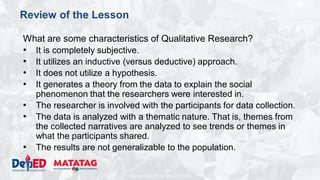
What are some characteristics of Qualitative Research?
• It is completely subjective.
• It utilizes an inductive (versus deductive) approach.

• It does not utilize a hypothesis.
• It generates a theory from the data to explain the social
phenomenon that the researchers were interested in.
• The researcher is involved with the participants for data collection.
• The data is analyzed with a thematic nature. That is, themes from
the collected narratives are analyzed to see trends or themes in
what the participants shared.
• The results are not generalizable to the population.
DEPARTMENT OF EDUCATION
Review of the Lesson
What are some of the kinds of Qualitative Research?
DEPARTMENT OF EDUCATION
Review of the Lesson
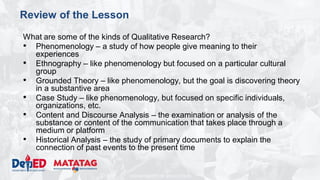
What are some of the kinds of Qualitative Research?
• Phenomenology – a study of how people give meaning to their
experiences
• Ethnography – like phenomenology but focused on a particular cultural
group
• Grounded Theory – like phenomenology, but the goal is discovering theory
in a substantive area
• Case Study – like phenomenology, but focused on specific individuals,
organizations, etc.
• Content and Discourse Analysis – the examination or analysis of the
substance or content of the communication that takes place through a
medium or platform
• Historical Analysis – the study of primary documents to explain the
connection of past events to the present time
DEPARTMENT OF EDUCATION
Think/Pair/Share
Any pair in the class may be called to share later.
DEPARTMENT OF EDUCATION
Designing a research is similar to making a house, car, bag,
dress, cake, etc. which needs appropriate materials and
necessary process or steps to follow. Then, you have to
consider whether what you intend to make or invent has
significance to you as a person. Otherwise, your efforts will
not be put to use.
DEPARTMENT OF EDUCATION
Qualitative Research: Considerations
• You have to consider whether the topic you have chosen
is relevant to you as a learner, as a constituent in your
barangay, and as a citizen of this country.
DEPARTMENT OF EDUCATION
Qualitative Research: Considerations
• You have to consider whether the topic you have chosen
is relevant to you as a learner, as a constituent in your
barangay, and as a citizen of this country.
• The first question you should answer is, “What is the
issue, phenomenon or problem in my school, at home,
and in the community that needs my special attention by
conducting a research?”
DEPARTMENT OF EDUCATION
Qualitative Research: Design
• Qualitative research is an emergent design which means
that it emerges as you make ongoing decisions about
what you have learned.
DEPARTMENT OF EDUCATION
Qualitative Research: Design
• Qualitative research is an emergent design which means
that it emerges as you make ongoing decisions about
what you have learned.
• As a design, qualitative research requires researcher’s
decision-making like how to gather data, from where and
whom to collect, when to gather, and for how long is the
process will be.
DEPARTMENT OF EDUCATION
Qualitative Research: Design
• Qualitative research is an emergent design which means that it
emerges as you make ongoing decisions about what you have
learned.
• As a design, qualitative research requires researcher’s
decision-making like how to gather data, from where and whom
to collect, when to gather, and for how long is the process will
be.
• To have a holistic picture of qualitative research project, you
have to remember that in deciding on a topic, you have to
consider the kind and the field it belongs, as well as its
relevance to your daily life.
DEPARTMENT OF EDUCATION
Relevant or Not?
½ CW. Only answer whether or not this is relevant to you as a Senior
HS learner. Defend your answer. Note: Do not copy the statements.
DEPARTMENT OF EDUCATION
Qualitative Research: Design (Example)
• Topic: Utilization of gadgets among learners
• Domain: School
• Issue/Problem/Concern: Patterns, impact, and implication of
gadget utilization among learners
• Kind of Qualitative Research: Phenomenological Study
• Methodology
– Research Environment: San Agustin National High School (the
school where the researchers are enrolled)
– Research Participants: STEM-12 Learners (criteria: currently
enrolled, mature enough, non-bias[not classmates])
– Research Instrument: In-depth interviews and focus group
discussions (the focus group discussion is included to triangulate
results
Can be in-depth interviews, focus
group discussions, or observations
Can be school, family, or community
DEPARTMENT OF EDUCATION
Activity
Instruction: Per column, discuss the topic and populate the
missing fields.
• Topic: Study habits of honor students
• Domain:
• Issue/Problem/Concern:
• Kind of Qualitative Research:
• Methodology
– Research Environment:
– Research Participants:
– Research Instrument:
DEPARTMENT OF EDUCATION
Activity
Instruction: Per group, discuss the topic and populate the
missing fields.
• Topic: Study habits of honor students
• Domain:
• Issue/Problem/Concern:
• Kind of Qualitative Research:
• Methodology
– Research Environment:
– Research Participants:
– Research Instrument:
DEPARTMENT OF EDUCATION
Activity
Instruction: Individually, look up at least 5 manuscripts at
the Research Center and populate the following:
• Topic:
• Domain:
• Issue/Problem/Concern:
• Kind of Qualitative Research:
• Methodology
– Research Environment:
– Research Participants:
– Research Instrument:
Day 2
Week 3: Identifying the Inquiry and Stating the
Problem
DEPARTMENT OF EDUCATION
Outline
• Review of Lesson
• Today’s Topic
DEPARTMENT OF EDUCATION
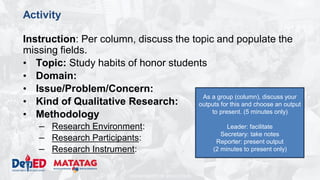
Activity
Instruction: Per column, discuss the topic and populate the
missing fields.
• Topic: Study habits of honor students
• Domain:
• Issue/Problem/Concern:
• Kind of Qualitative Research:
• Methodology
– Research Environment:
– Research Participants:
– Research Instrument:
As a group (column), discuss your
outputs for this and choose an output
to present. (5 minutes only)
Leader: facilitate
Secretary: take notes
Reporter: present output
(2 minutes to present only)
DEPARTMENT OF EDUCATION
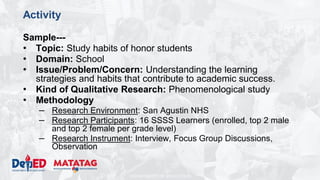
Activity
Sample---
• Topic: Study habits of honor students
• Domain: School
• Issue/Problem/Concern: Understanding the learning
strategies and habits that contribute to academic success.
• Kind of Qualitative Research: Phenomenological study
• Methodology
– Research Environment: San Agustin NHS
– Research Participants: 16 SSSS Learners (enrolled, top 2 male
and top 2 female per grade level)
– Research Instrument: Interview, Focus Group Discussions,
Observation
DEPARTMENT OF EDUCATION
What is next?
After having initially planned out the research design, what’s
next?
DEPARTMENT OF EDUCATION
What is next?
After having initially planned out the research design, what’s
next?
Writing Research Title
DEPARTMENT OF EDUCATION
What is next?
After having initially planned out the research design, what’s
next?
Writing Research Title
But how?
DEPARTMENT OF EDUCATION
Activity
• Topic: Study habits of honor students
• Domain: School
• Issue/Problem/Concern: Understanding the learning
strategies and habits that contribute to academic success.
• Kind of Qualitative Research: Phenomenological study
• Methodology
– Research Environment: San Agustin NHS
– Research Participants: 16 SSSS Learners (enrolled, top 2 male
and top 2 female per grade level)
– Research Instrument: Interview, Focus Group Discussions,
Observation
What research title could you possible give?
DEPARTMENT OF EDUCATION
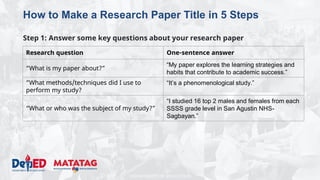
How to Make a Research Paper Title in 5 Steps
Step 1: Answer some key questions about your research paper
Research question One-sentence answer
“What is my paper about?”
“My paper explores the learning strategies and
habits that contribute to academic success.”
“What methods/techniques did I use to
perform my study?
“It’s a phenomenological study.”
“What or who was the subject of my study?”
“I studied 16 top 2 males and females from each
SSSS grade level in San Agustin NHS-
Sagbayan.”
DEPARTMENT OF EDUCATION
How to Make a Research Paper Title in 5 Steps
Step 2: Identify research study keywords
One-sentence answer Title keywords/phrases
“My paper studies the learning strategies and habits that
contribute to academic success.”
- Learning strategies
- Learning habits
- Academic success
“It’s a phenomenological study.” -Phenomenological study
“I studied 16 top 2 males and females from each SSSS grade
level.”
- SANHS SSSS/ top 2 male
and female per level
- 16 learners
DEPARTMENT OF EDUCATION
How to Make a Research Paper Title in 5 Steps
Step 3: Research title writing: use these keywords
“I employed a phenomenological study of 16
SSSS learners from the top 2 males and
females from each grade level to explore their
learning strategies and learning habits that
contribute to academic success”
DEPARTMENT OF EDUCATION
How to Make a Research Paper Title in 5 Steps
Step 3: Research title writing: use these keywords
“I employed a phenomenological study of 16
SSSS learners from the top 2 males and
females from each grade level to explore their
learning strategies and learning habits that
contribute to academic success”
The sentence above is clearly much too long for a research
paper title. This is why you will trim and polish your title in the
next two steps.
DEPARTMENT OF EDUCATION
How to Make a Research Paper Title in 5 Steps
Step 4: Create a working research paper title
“I employed a phenomenological study of 16
SSSS learners’ from the top 2 males and
females from each grade level to explore their
learning strategies and learning habits that
contribute to academic success”
Remove elements that make it a complete “sentence” but keep everything that is important
to what the study is about. Delete all unnecessary and redundant words that are not central
to the study or that researchers would most likely not use in a database search.
DEPARTMENT OF EDUCATION
How to Make a Research Paper Title in 5 Steps
Step 4: Create a working research paper title
“a phenomenological study of 16 SSSS learners’
to explore learning strategies and habits that
contribute to academic success”
(Word Count: 18)
Suggested word count for a title: 12
DEPARTMENT OF EDUCATION
How to Make a Research Paper Title in 5 Steps
Step 5: Remove any nonessential words and phrases from your title
“a phenomenological study of 16 SSSS learners’
to explore learning strategies and habits that
contribute to academic success” (Word Count:
12)
Because the number of patients studied is not the most essential part of this
paper, remove this element first.
DEPARTMENT OF EDUCATION
How to Make a Research Paper Title in 5 Steps
Step 5: Remove any nonessential words and phrases from your title
“a phenomenological study to explore learning
strategies and habits academic success” (Word
Count: 7)
The methods used in a study are not usually the most searched-for keywords
in databases and represent additional details that you may want to remove to
make your title leaner.
DEPARTMENT OF EDUCATION
How to Make a Research Paper Title in 5 Steps
Step 5: Remove any nonessential words and phrases from your title
“explore learning strategies and habits
academic success”
To
“exploring the learning strategies and habits
of academic achievers”
The subject and objective must be clear.
DEPARTMENT OF EDUCATION
How to Make a Research Paper Title in 5 Steps
Step 5: Add a subtitle to make it catchy
“Exploring the Learning strategies and habits
of academic achievers”
To
“Academic success: exploring the learning
strategies and habits of achievers”
DEPARTMENT OF EDUCATION
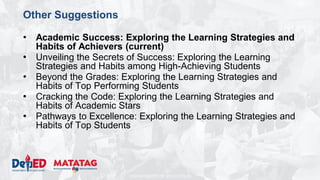
Other Suggestions
• Academic Success: Exploring the Learning Strategies and
Habits of Achievers (current)
• Unveiling the Secrets of Success: Exploring the Learning
Strategies and Habits among High-Achieving Students
• Beyond the Grades: Exploring the Learning Strategies and
Habits of Top Performing Students
• Cracking the Code: Exploring the Learning Strategies and
Habits of Academic Stars
• Pathways to Excellence: Exploring the Learning Strategies and
Habits of Top Students
DEPARTMENT OF EDUCATION
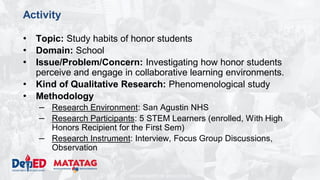
Activity
• Topic: Study habits of honor students
• Domain: School
• Issue/Problem/Concern: Investigating how honor students
perceive and engage in collaborative learning environments.
• Kind of Qualitative Research: Phenomenological study
• Methodology
– Research Environment: San Agustin NHS
– Research Participants: 5 STEM Learners (enrolled, With High
Honors Recipient for the First Sem)
– Research Instrument: Interview, Focus Group Discussions,
Observation
Day 3
Week 3: Identifying the Inquiry and Stating the
Problem
DEPARTMENT OF EDUCATION
Outline
• Review of Lesson
• Today’s Topic
DEPARTMENT OF EDUCATION
Review of Lesson
How to Make a Research Paper Title in 5 Steps
• Step 1: Answer some key questions about your research paper
• Step 2: Identify research study keywords
• Step 3: Research title writing: use these keywords
• Step 4: Create a working research paper title
– Remove the unnecessary and redundant words
• Step 5: Remove any nonessential words and phrases from your
title
– Remove the adjectives of participants
– Remove the methodology
– Paraphrase to highlight the subject and objective.
– Add a subtitle
DEPARTMENT OF EDUCATION
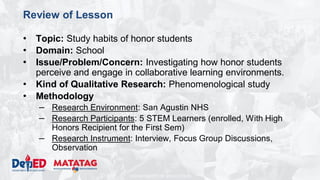
Review of Lesson
• Topic: Study habits of honor students
• Domain: School
• Issue/Problem/Concern: Investigating how honor students
perceive and engage in collaborative learning environments.
• Kind of Qualitative Research: Phenomenological study
• Methodology
– Research Environment: San Agustin NHS
– Research Participants: 5 STEM Learners (enrolled, With High
Honors Recipient for the First Sem)
– Research Instrument: Interview, Focus Group Discussions,
Observation
DEPARTMENT OF EDUCATION
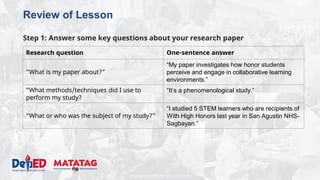
Review of Lesson
Step 1: Answer some key questions about your research paper
Research question One-sentence answer
“What is my paper about?”
“My paper investigates how honor students
perceive and engage in collaborative learning
environments.”
“What methods/techniques did I use to
perform my study?
“It’s a phenomenological study.”
“What or who was the subject of my study?”
“I studied 5 STEM learners who are recipients of
With High Honors last year in San Agustin NHS-
Sagbayan.”
DEPARTMENT OF EDUCATION
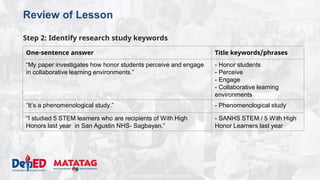
Review of Lesson
Step 2: Identify research study keywords
One-sentence answer Title keywords/phrases
“My paper investigates how honor students perceive and engage
in collaborative learning environments.”
- Honor students
- Perceive
- Engage
- Collaborative learning
environments
“It’s a phenomenological study.” - Phenomenological study
“I studied 5 STEM learners who are recipients of With High
Honors last year in San Agustin NHS- Sagbayan.”
- SANHS STEM / 5 With High
Honor Learners last year
DEPARTMENT OF EDUCATION
Review of Lesson
Step 3: Research title writing: use these keywords
“I employed a phenomenological study of 5
STEM honor students who are With High Honor
recipients last year to investigate how they
perceive and engage in collaborative learning
environments.”
DEPARTMENT OF EDUCATION
Review of Lesson
Step 4: Create a working research paper title
“I employed a phenomenological study of 5
STEM honor learners who are With High Honor
recipients last year to investigate how they
perceive and engage in collaborative learning
environments.”
Remove elements that make it a complete “sentence” but keep everything that is important
to what the study is about. Delete all unnecessary and redundant words that are not central
to the study or that researchers would most likely not use in a database search.
DEPARTMENT OF EDUCATION
Review of Lesson
Step 5: Remove any nonessential words and phrases from your title
“a phenomenological study of 5 STEM honor
learners to investigate perceive and engage in
collaborative learning environments.”
Because the number of learners studied is not the most essential part of this
paper, remove this element first.
DEPARTMENT OF EDUCATION
Review of Lesson
Step 5: Remove any nonessential words and phrases from your title
“a phenomenological study honor learners to
investigate perceive and engage in
collaborative learning environments.”
Remove the methodology
DEPARTMENT OF EDUCATION
Review of Lesson
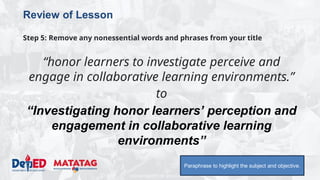
Step 5: Remove any nonessential words and phrases from your title
“honor learners to investigate perceive and
engage in collaborative learning environments.”
to
“Investigating honor learners’ perception and
engagement in collaborative learning
environments”
Paraphrase to highlight the subject and objective.
DEPARTMENT OF EDUCATION
Review of Lesson
Step 5: Remove any nonessential words and phrases from your title
“Investigating honor learners’ perception and
engagement in collaborative learning
environments”
to
“Collaborative Learning Environments: Honor
Learners’ Perception and Engagement “
Add a subtitle
DEPARTMENT OF EDUCATION
Review of Lesson
Step 5: Remove any nonessential words and phrases from your title
“Investigating honor learners’ perception and
engagement in collaborative learning
environments”
to
“Collaborative Learning Environments: Honor
Learners’ Perception and Engagement “
Add a subtitle
Comments from the Research Title Activity:
• The focus was lost (focus was perception and engagement)
• Eliminating important keywords (perception/perspective was gone)
DEPARTMENT OF EDUCATION
Let’s Apply (1/4 Sheet)
• Topic: Study habits of honor students
• Domain: School
• Issue/Problem/Concern: Exploring the time management
practices of honor learners.
• Kind of Qualitative Research: Phenomenological study
• Methodology
– Research Environment: San Agustin NHS
– Research Participants: 16 SSSS Learners (enrolled, top 2 male
and top 2 female per grade level)
– Research Instrument: Interview, Focus Group Discussions,
Observation
DEPARTMENT OF EDUCATION
Let’s Apply (1/4 Sheet)
• Topic: Study habits of honor students
• Domain: School
• Issue/Problem/Concern: Exploring the time management
practices of honor learners.
• Kind of Qualitative Research: Phenomenological study
• Methodology
– Research Environment: San Agustin NHS
– Research Participants: 16 SSSS Learners (enrolled, top 2 male
and top 2 female per grade level)
– Research Instrument: Interview, Focus Group Discussions,
Observation
DEPARTMENT OF EDUCATION
Let’s Apply (1/4 Sheet)
• Topic: Study habits of honor students
• Domain: School
• Issue/Problem/Concern: Exploring the time management
practices of honor learners.
• Kind of Qualitative Research: Phenomenological study
• Methodology
– Research Environment: San Agustin NHS
– Research Participants: 16 SSSS Learners (enrolled, top 2 male
and top 2 female per grade level)
– Research Instrument: Interview, Focus Group Discussions,
Observation
Scholarly Time Management: Practices
of High-Performing Learners
DEPARTMENT OF EDUCATION
Today’s Topic
Congratulations, you are already skilled enough to make
research title….
DEPARTMENT OF EDUCATION
Today’s Topic
Congratulations, you are already skilled enough to make
research title….
So what’s next?
DEPARTMENT OF EDUCATION
Today’s Topic
Congratulations, you are already skilled enough to make
research title….
So what’s next?
Attain your research objective.
DEPARTMENT OF EDUCATION
Today’s Topic
Congratulations, you are already skilled enough to make
research title….
So what’s next?
Attain your research objective.
But HOW?
DEPARTMENT OF EDUCATION
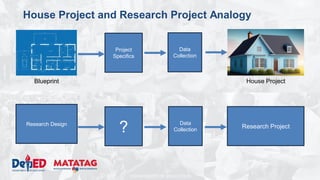
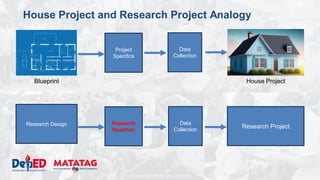
House Project and Research Project Analogy
Research Project
Research Design
Blueprint House Project
Data
Collection
Data
Collection
Project
Specifics
?
DEPARTMENT OF EDUCATION
House Project and Research Project Analogy
Research Project
Research Design
Blueprint House Project
Data
Collection
Data
Collection
Project
Specifics
Research
Question
DEPARTMENT OF EDUCATION
Research Question
• question that you ask in your research that you want to
have and answer.
• helps writers focus their research by providing a path
through the research and writing process.
DEPARTMENT OF EDUCATION
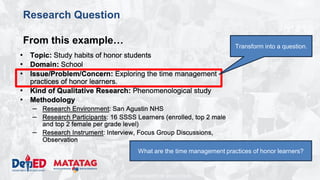
Research Question
From this example… Transform into a question.
What are the time management practices of honor learners?
DEPARTMENT OF EDUCATION
Research Question
From this example… Transform into a question.
What are the time management practices of honor learners?
But what if the concern is not
given and you are to identify it
yourself?
DEPARTMENT OF EDUCATION
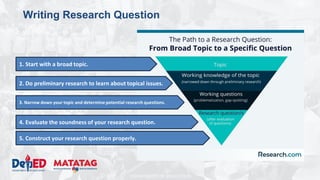
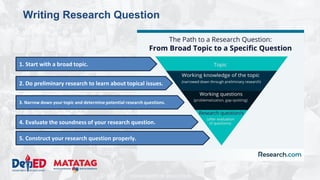
Writing Research Question
1. Start with a broad topic.
2. Do preliminary research to learn about topical issues.
3. Narrow down your topic and determine potential research questions.
4. Evaluate the soundness of your research question.
5. Construct your research question properly.
DEPARTMENT OF EDUCATION
Writing Research Question
1. Start with a broad topic.
Artificial intelligence
DEPARTMENT OF EDUCATION
Writing Research Question
2. Do preliminary research to learn about topical issues.
Artificial intelligence is already widely used. As a student, I am
curious about how it is utilized in educational institutions.
DEPARTMENT OF EDUCATION
Writing Research Question
3. Narrow down your topic and determine potential research
questions.
How is artificial intelligence used in educational institutions?
How do students perceive the use of artificial intelligence?
How do teachers perceive the use of artificial intelligence?
DEPARTMENT OF EDUCATION
Writing Research Question
4. Evaluate the soundness of your research question.
How do students perceive the use of artificial intelligence?
DEPARTMENT OF EDUCATION
Writing Research Question
5. Construct your research question properly.
Among learners enrolled in Practical Research, what are their
perceptions of using artificial intelligence?
DEPARTMENT OF EDUCATION
Writing Research Question
5. Construct your research question properly.
Among learners enrolled in Practical Research, what are their
perceptions of using artificial intelligence?
From there, construct your Statement of the Problem:
This study aims to unveil the perspectives of Practical
Research learners regarding the use of artificial intelligence in
San Agustin National High School, Sagbayan, Bohol, for the
school year 2023-2024.
DEPARTMENT OF EDUCATION
Writing Research Question
Statement of the Problem
This study aims to unveil the perspectives of Practical
Research learners regarding the use of artificial intelligence in
San Agustin National High School, Sagbayan, Bohol, for the
school year 2023-2024.
From here, you can break down the research question into
specific research questions… But how?
DEPARTMENT OF EDUCATION
Writing Research Question
Statement of the Problem
This study aims to unveil the perspectives of Practical
Research learners regarding the use of artificial intelligence in
San Agustin National High School, Sagbayan, Bohol, for the
school year 2023-2024.
From here, you can break down the research question into
specific research questions… But how?
Cover the salient aspects of the research question.
DEPARTMENT OF EDUCATION
Writing Research Question
Statement of the Problem
This study aims to unveil the perspectives of Practical
Research learners regarding the use of artificial intelligence in
San Agustin National High School, Sagbayan, Bohol, for the
school year 2023-2024.
- Their understanding of the AI
- AI tools or platforms they’ve used
- Their feeling about using AI
DEPARTMENT OF EDUCATION
Writing Research Question
Statement of the Problem
This study aims to unveil the perspectives of Practical Research
learners regarding the use of artificial intelligence in San Agustin National
High School, Sagbayan, Bohol, for the school year 2023-2024.
Specifically, this study seeks to answer the following questions:
1. How do learners describe artificial intelligence?
2. What artificial tools or platforms have been explored by the learners?
3. How do learners feel about using artificial intelligence?
4. What recommendation can be proposed based on the findings of this
study?
Always added. It could also be an
action plan.
DEPARTMENT OF EDUCATION
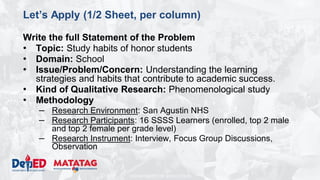
Let’s Apply (1/2 Sheet, per column)
Write the full Statement of the Problem
• Topic: Study habits of honor students
• Domain: School
• Issue/Problem/Concern: Understanding the learning
strategies and habits that contribute to academic success.
• Kind of Qualitative Research: Phenomenological study
• Methodology
– Research Environment: San Agustin NHS
– Research Participants: 16 SSSS Learners (enrolled, top 2 male
and top 2 female per grade level)
– Research Instrument: Interview, Focus Group Discussions,
Observation
DEPARTMENT OF EDUCATION
Assignment
Make it a habit to browse at least one qualitative research
paper per week. Write your reflection on your PR1 Notebook.
Day 4
Week 3: Identifying the Inquiry and Stating the
Problem
DEPARTMENT OF EDUCATION
Outline
• Review of Lesson
• Today’s Topic
DEPARTMENT OF EDUCATION
Writing Research Question
1. Start with a broad topic.
2. Do preliminary research to learn about topical issues.
3. Narrow down your topic and determine potential research questions.
4. Evaluate the soundness of your research question.
5. Construct your research question properly.
DEPARTMENT OF EDUCATION
Let’s Apply
Write the full Statement of the Problem
• Topic: Study habits of honor students
• Domain: School
• Issue/Problem/Concern: Understanding the learning
strategies and habits that contribute to academic success.
• Kind of Qualitative Research: Phenomenological study
• Methodology
– Research Environment: San Agustin NHS
– Research Participants: 16 SSSS Learners (enrolled, top 2 male
and top 2 female per grade level)
– Research Instrument: Interview, Focus Group Discussions,
Observation
DEPARTMENT OF EDUCATION
Let’s Apply
Write the full Statement of the Problem
• Topic: Study habits of honor students
• Domain: School
• Issue/Problem/Concern: Understanding the learning
strategies and habits that contribute to academic success.
• Kind of Qualitative Research: Phenomenological study
• Methodology
– Research Environment: San Agustin NHS
– Research Participants: 16 SSSS Learners (enrolled, top 2 male
and top 2 female per grade level)
– Research Instrument: Interview, Focus Group Discussions,
Observation
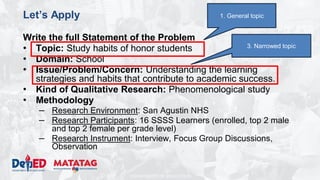
General Topic
DEPARTMENT OF EDUCATION
Let’s Apply
Write the full Statement of the Problem
• Topic: Study habits of honor students
• Domain: School
• Issue/Problem/Concern: Understanding the learning
strategies and habits that contribute to academic success.
• Kind of Qualitative Research: Phenomenological study
• Methodology
– Research Environment: San Agustin NHS
– Research Participants: 16 SSSS Learners (enrolled, top 2 male
and top 2 female per grade level)
– Research Instrument: Interview, Focus Group Discussions,
Observation
3. Narrowed topic
1. General topic
DEPARTMENT OF EDUCATION
Let’s Apply
Write the full Statement of the Problem
• Topic: Study habits of honor students
• Domain: School
• Issue/Problem/Concern: Understanding the learning
strategies and habits that contribute to academic success.
• Kind of Qualitative Research: Phenomenological study
• Methodology
– Research Environment: San Agustin NHS
– Research Participants: 16 SSSS Learners (enrolled, top 2 male
and top 2 female per grade level)
– Research Instrument: Interview, Focus Group Discussions,
Observation
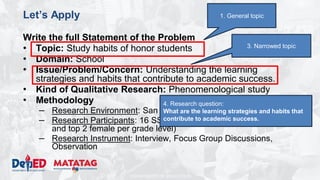
3. Narrowed topic
1. General topic
4. Research question:
What are the learning strategies and habits that
contribute to academic success.
DEPARTMENT OF EDUCATION
Let’s Apply
Write the full Statement of the Problem
• Topic: Study habits of honor students
• Domain: School
• Issue/Problem/Concern: Understanding the learning
strategies and habits that contribute to academic success.
• Kind of Qualitative Research: Phenomenological study
• Methodology
– Research Environment: San Agustin NHS
– Research Participants: 16 SSSS Learners (enrolled, top 2 male
and top 2 female per grade level)
– Research Instrument: Interview, Focus Group Discussions,
Observation
3. Narrowed topic
1. General topic
4. Research question:
What are the learning strategies and habits that
contribute to academic success.
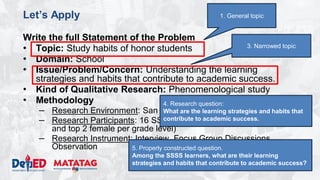
5. Properly constructed question.
Among the SSSS learners, what are their learning
strategies and habits that contribute to academic success?
DEPARTMENT OF EDUCATION
Let’s Apply
Write the full Statement of the Problem
• Topic: Study habits of honor students
• Domain: School
• Issue/Problem/Concern: Understanding the learning
strategies and habits that contribute to academic success.
• Kind of Qualitative Research: Phenomenological study
• Methodology
– Research Environment: San Agustin NHS
– Research Participants: 16 SSSS Learners (enrolled, top 2 male
and top 2 female per grade level)
– Research Instrument: Interview, Focus Group Discussions,
Observation
3. Narrowed topic
1. General topic
4. Research question:
What are the learning strategies and habits that
contribute to academic success.
5. Properly constructed question.
Among the SSSS learners, what are their learning
strategies and habits that contribute to academic success?
DEPARTMENT OF EDUCATION
Let’s Apply
Write the full Statement of the Problem
• Topic: Study habits of honor students
• Domain: School
• Issue/Problem/Concern: Understanding the learning
strategies and habits that contribute to academic success.
• Kind of Qualitative Research: Phenomenological study
• Methodology
– Research Environment: San Agustin NHS
– Research Participants: 16 SSSS Learners (enrolled, top 2 male
and top 2 female per grade level)
– Research Instrument: Interview, Focus Group Discussions,
Observation
3. Narrowed topic
1. General topic
4. Research question:
What are the learning strategies and habits that
contribute to academic success.
5. Properly constructed question.
Among the SSSS learners, what are their learning
strategies and habits that contribute to academic success?
DEPARTMENT OF EDUCATION
Let’s Apply
Write the full Statement of the Problem
• Topic: Study habits of honor students
• Domain: School
• Issue/Problem/Concern: Understanding the learning
strategies and habits that contribute to academic success.
• Kind of Qualitative Research: Phenomenological study
• Methodology
– Research Environment: San Agustin NHS
– Research Participants: 16 SSSS Learners (enrolled, top 2 male
and top 2 female per grade level)
– Research Instrument: Interview, Focus Group Discussions,
Observation
3. Narrowed topic
1. General topic
4. Research question:
What are the learning strategies and habits that
contribute to academic success.
5. Properly constructed question.
Among the SSSS learners, what are their learning
strategies and habits that contribute to academic success?
DEPARTMENT OF EDUCATION
Let’s Apply
Write the full Statement of the Problem
• Topic: Study habits of honor students
• Domain: School
• Issue/Problem/Concern: Understanding the learning
strategies and habits that contribute to academic success.
• Kind of Qualitative Research: Phenomenological study
• Methodology
– Research Environment: San Agustin NHS
– Research Participants: 16 SSSS Learners (enrolled, top 2 male
and top 2 female per grade level)
– Research Instrument: Interview, Focus Group Discussions,
Observation
3. Narrowed topic
1. General topic
4. Research question:
What are the learning strategies and habits that
contribute to academic success.
5. Properly constructed question.
Among the SSSS learners, what are their learning
strategies and habits that contribute to academic success?
DEPARTMENT OF EDUCATION
Let’s Apply
Write the full Statement of the Problem
• Topic: Study habits of honor students
• Domain: School
• Issue/Problem/Concern: Understanding the learning
strategies and habits that contribute to academic success.
• Kind of Qualitative Research: Phenomenological study
• Methodology
– Research Environment: San Agustin NHS
– Research Participants: 16 SSSS Learners (enrolled, top 2 male
and top 2 female per grade level)
– Research Instrument: Interview, Focus Group Discussions,
Observation
3. Narrowed topic
1. General topic
4. Research question:
What are the learning strategies and habits that
contribute to academic success.
5. Properly constructed question.
Among the SSSS learners, what are their learning
strategies and habits that contribute to academic success?
DEPARTMENT OF EDUCATION
Let’s Apply
Write the full Statement of the Problem
• Topic: Study habits of honor students
• Domain: School
• Issue/Problem/Concern: Understanding the learning
strategies and habits that contribute to academic success.
• Kind of Qualitative Research: Phenomenological study
• Methodology
– Research Environment: San Agustin NHS
– Research Participants: 16 SSSS Learners (enrolled, top 2 male
and top 2 female per grade level)
– Research Instrument: Interview, Focus Group Discussions,
Observation
3. Narrowed topic
1. General topic
4. Research question:
What are the learning strategies and habits that
contribute to academic success.
5. Properly constructed question.
Among the SSSS learners, what are their learning
strategies and habits that contribute to academic success?
DEPARTMENT OF EDUCATION
Let’s Apply
Write the full Statement of the Problem
• Topic: Study habits of honor students
• Domain: School
• Issue/Problem/Concern: Understanding the learning
strategies and habits that contribute to academic success.
• Kind of Qualitative Research: Phenomenological study
• Methodology
– Research Environment: San Agustin NHS
– Research Participants: 16 SSSS Learners (enrolled, top 2 male
and top 2 female per grade level)
– Research Instrument: Interview, Focus Group Discussions,
Observation
3. Narrowed topic
1. General topic
4. Research question:
What are the learning strategies and habits that
contribute to academic success.
5. Properly constructed question.
Among the SSSS learners, what are their learning
strategies and habits that contribute to academic success?
DEPARTMENT OF EDUCATION
Let’s Apply
Among the SSSS learners, what are their learning strategies and
habits that contribute to academic success?
Statement of the Problem
This study aims to explore the learning strategies and
habits that contribute to academic success among SSSS
learners of San Agustin National High School for school year
2023-2024.
DEPARTMENT OF EDUCATION
Let’s Apply
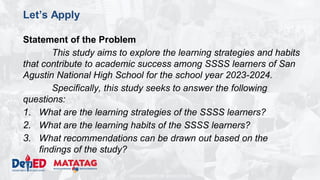
Statement of the Problem
This study aims to explore the learning strategies and habits
that contribute to academic success among SSSS learners of San
Agustin National High School for the school year 2023-2024.
Specifically, this study seeks to answer the following
questions:
1. What are the learning strategies of the SSSS learners?
2. What are the learning habits of the SSSS learners?
3. What recommendations can be drawn out based on the
findings of the study?
DEPARTMENT OF EDUCATION
Today’s Topic
Congratulations, you are already skilled enough to make a
the research question (Statement of the Problem)…
DEPARTMENT OF EDUCATION
Today’s Topic
Congratulations, you are already skilled enough to make a
the research question (Statement of the Problem)…
So what’s next?
DEPARTMENT OF EDUCATION
Today’s Topic
Congratulations, you are already skilled enough to make a
the research question (Statement of the Problem)…
So what’s next?
Write the Scope and Limitation
Significance of the Study
DEPARTMENT OF EDUCATION
Today’s Topic
Congratulations, you are already skilled enough to make a
the research question (Statement of the Problem)…
So what’s next?
Write the Scope and Limitation
Significance of the Study
But HOW?
DEPARTMENT OF EDUCATION
Scope and Limitation
Scope
• Contains the explanation of what information or subject is
analyzed
• Explains the definite aspects of the study--- why subjects
were chosen (inclusion), research methodology
Limitation
• Limitations of the research--- sample size, time, and
geographic area
DEPARTMENT OF EDUCATION
Scope and Limitation
Writing the scope and limitations of the RD below.
• Topic: Study habits of honor students
• Domain: School
• Issue/Problem/Concern: Understanding the learning
strategies and habits that contribute to academic success.
• Kind of Qualitative Research: Phenomenological study
• Methodology
– Research Environment: San Agustin NHS
– Research Participants: 16 SSSS Learners (enrolled, top 2 male
and top 2 female per grade level)
– Research Instrument: Interview, Focus Group Discussions,
Observation
DEPARTMENT OF EDUCATION
Scope and Limitation (Sample)
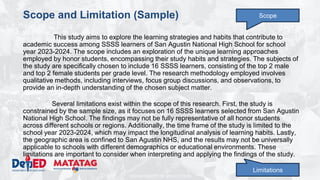
This study aims to explore the learning strategies and habits that contribute to
academic success among SSSS learners of San Agustin National High School for school
year 2023-2024. The scope includes an exploration of the unique learning approaches
employed by honor students, encompassing their study habits and strategies. The subjects of
the study are specifically chosen to include 16 SSSS learners, consisting of the top 2 male
and top 2 female students per grade level. The research methodology employed involves
qualitative methods, including interviews, focus group discussions, and observations, to
provide an in-depth understanding of the chosen subject matter.
Several limitations exist within the scope of this research. First, the study is
constrained by the sample size, as it focuses on 16 SSSS learners selected from San Agustin
National High School. The findings may not be fully representative of all honor students
across different schools or regions. Additionally, the time frame of the study is limited to the
school year 2023-2024, which may impact the longitudinal analysis of learning habits. Lastly,
the geographic area is confined to San Agustin NHS, and the results may not be universally
applicable to schools with different demographics or educational environments. These
limitations are important to consider when interpreting and applying the findings of the study.
Scope
Limitations
DEPARTMENT OF EDUCATION
Significance of the Study
Writing a research paper has its purpose-- may it be for you
(as a researcher) or even for others. That is why you need to
identify the key reason/s and entities for taking a step
forward and making your query into formal writing.
• Tips:
– Refer to the statement of the problem
– Write from general to specific contribution s (e.g., School,
Teacher, Learners, and Researchers)
DEPARTMENT OF EDUCATION
Scope and Limitation
Writing significance of the study of the RD below.
• Topic: Study habits of honor students
• Domain: School
• Issue/Problem/Concern: Understanding the learning
strategies and habits that contribute to academic success.
• Kind of Qualitative Research: Phenomenological study
• Methodology
– Research Environment: San Agustin NHS
– Research Participants: 16 SSSS Learners (enrolled, top 2 male
and top 2 female per grade level)
– Research Instrument: Interview, Focus Group Discussions,
Observation
DEPARTMENT OF EDUCATION
Significance of the Study (Sample)
The result of this study aims to provide valuable information to the following entities:
Educators. The findings of this study might provide them with insights into effective
learning strategies and habits exhibited by honor students. This may guide them in
developing tailored teaching methods and school programs to enhance academic success
among all students.
Parents. The findings of this study might allow the understanding of the habits and
strategies that contribute to academic success, providing guidance for supporting their
children's education. They may use the study's findings to create conducive learning
environments at home and offer targeted support based on identified successful habits.
Learners. The findings of this study might allow them to learn from the successful
strategies of their high-performing peers. The study might inspire and guide other students to
adopt effective study habits and strategies, fostering a positive learning culture.
Future Researchers. The findings of this study might contribute to the existing
body of knowledge on effective learning strategies among honor students. The study's
findings might inform further research and academic discussions, providing a foundation for
future studies in the field of education.
DEPARTMENT OF EDUCATION
Significance of the Study (Sample)
The result of this study aims to provide valuable information to the following entities:
Educators. The findings of this study might provide them with insights into effective
learning strategies and habits exhibited by honor students. This may guide them in
developing tailored teaching methods and school programs to enhance academic success
among all students.
Parents. The findings of this study might allow the understanding of the habits and
strategies that contribute to academic success, providing guidance for supporting their
children's education. They may use the study's findings to create conducive learning
environments at home and offer targeted support based on identified successful habits.
Learners. The findings of this study might allow them to learn from the successful
strategies of their high-performing peers. The study might inspire and guide other students to
adopt effective study habits and strategies, fostering a positive learning culture.
Future Researchers. The findings of this study might contribute to the existing
body of knowledge on effective learning strategies among honor students. The study's
findings might inform further research and academic discussions, providing a foundation for
future studies in the field of education.
Congratulations, we are finally over with Module 3.
DEPARTMENT OF EDUCATION
Assignment
• Individual Performance Task
• From a research topic of your choice, you are to write
the following:
– Title of the Research
– Statement of the Problem
– Scope and Limitation
– Significance of the Study
DEPARTMENT OF EDUCATION

Research Title, SOP, Scope, Qualitatives

  • 1.
    DEPARTMENT OF EDUCATION SANAGUSTIN NATIONAL HIGH SCHOOL Senior High School Department PRACTICAL RESEARCH 1 LENN DON A. BERNASOL, LPT Faculty Member, Senior HS Department San Agustin NHS Week 3: Identifying the Inquiry and Stating the Problem
  • 2.
    Day 1 Week 3:Identifying the Inquiry and Stating the Problem
  • 3.
    DEPARTMENT OF EDUCATION Outline •Reminders • Review of Lesson • Today’s Topic
  • 4.
    DEPARTMENT OF EDUCATION Reviewof the Lesson What is research?
  • 5.
    DEPARTMENT OF EDUCATION Reviewof the Lesson What is research? • It is a systematic inquiry that involves data collection and analysis from reliable sources to establish new facts and reach new conclusions.
  • 6.
    DEPARTMENT OF EDUCATION Reviewof the Lesson Why is Research important?
  • 7.
    DEPARTMENT OF EDUCATION Reviewof the Lesson Why is Research important? • Advance knowledge and progress in society.
  • 8.
    DEPARTMENT OF EDUCATION Reviewof the Lesson What is Qualitative Research?
  • 9.
    DEPARTMENT OF EDUCATION Reviewof the Lesson What is Qualitative Research? • It seeks to understand the lived experiences in humans and seeks to understanding meaning
  • 10.
    DEPARTMENT OF EDUCATION Reviewof the Lesson What are some characteristics of Qualitative Research?
  • 11.
    DEPARTMENT OF EDUCATION Reviewof the Lesson What are some characteristics of Qualitative Research? • It is completely subjective. • It utilizes an inductive (versus deductive) approach. • It does not utilize a hypothesis. • It generates a theory from the data to explain the social phenomenon that the researchers were interested in. • The researcher is involved with the participants for data collection. • The data is analyzed with a thematic nature. That is, themes from the collected narratives are analyzed to see trends or themes in what the participants shared. • The results are not generalizable to the population.
  • 12.
    DEPARTMENT OF EDUCATION Reviewof the Lesson What are some of the kinds of Qualitative Research?
  • 13.
    DEPARTMENT OF EDUCATION Reviewof the Lesson What are some of the kinds of Qualitative Research? • Phenomenology – a study of how people give meaning to their experiences • Ethnography – like phenomenology but focused on a particular cultural group • Grounded Theory – like phenomenology, but the goal is discovering theory in a substantive area • Case Study – like phenomenology, but focused on specific individuals, organizations, etc. • Content and Discourse Analysis – the examination or analysis of the substance or content of the communication that takes place through a medium or platform • Historical Analysis – the study of primary documents to explain the connection of past events to the present time
  • 14.
    DEPARTMENT OF EDUCATION Think/Pair/Share Anypair in the class may be called to share later.
  • 15.
    DEPARTMENT OF EDUCATION Designinga research is similar to making a house, car, bag, dress, cake, etc. which needs appropriate materials and necessary process or steps to follow. Then, you have to consider whether what you intend to make or invent has significance to you as a person. Otherwise, your efforts will not be put to use.
  • 16.
    DEPARTMENT OF EDUCATION QualitativeResearch: Considerations • You have to consider whether the topic you have chosen is relevant to you as a learner, as a constituent in your barangay, and as a citizen of this country.
  • 17.
    DEPARTMENT OF EDUCATION QualitativeResearch: Considerations • You have to consider whether the topic you have chosen is relevant to you as a learner, as a constituent in your barangay, and as a citizen of this country. • The first question you should answer is, “What is the issue, phenomenon or problem in my school, at home, and in the community that needs my special attention by conducting a research?”
  • 18.
    DEPARTMENT OF EDUCATION QualitativeResearch: Design • Qualitative research is an emergent design which means that it emerges as you make ongoing decisions about what you have learned.
  • 19.
    DEPARTMENT OF EDUCATION QualitativeResearch: Design • Qualitative research is an emergent design which means that it emerges as you make ongoing decisions about what you have learned. • As a design, qualitative research requires researcher’s decision-making like how to gather data, from where and whom to collect, when to gather, and for how long is the process will be.
  • 20.
    DEPARTMENT OF EDUCATION QualitativeResearch: Design • Qualitative research is an emergent design which means that it emerges as you make ongoing decisions about what you have learned. • As a design, qualitative research requires researcher’s decision-making like how to gather data, from where and whom to collect, when to gather, and for how long is the process will be. • To have a holistic picture of qualitative research project, you have to remember that in deciding on a topic, you have to consider the kind and the field it belongs, as well as its relevance to your daily life.
  • 21.
    DEPARTMENT OF EDUCATION Relevantor Not? ½ CW. Only answer whether or not this is relevant to you as a Senior HS learner. Defend your answer. Note: Do not copy the statements.
  • 22.
    DEPARTMENT OF EDUCATION QualitativeResearch: Design (Example) • Topic: Utilization of gadgets among learners • Domain: School • Issue/Problem/Concern: Patterns, impact, and implication of gadget utilization among learners • Kind of Qualitative Research: Phenomenological Study • Methodology – Research Environment: San Agustin National High School (the school where the researchers are enrolled) – Research Participants: STEM-12 Learners (criteria: currently enrolled, mature enough, non-bias[not classmates]) – Research Instrument: In-depth interviews and focus group discussions (the focus group discussion is included to triangulate results Can be in-depth interviews, focus group discussions, or observations Can be school, family, or community
  • 23.
    DEPARTMENT OF EDUCATION Activity Instruction:Per column, discuss the topic and populate the missing fields. • Topic: Study habits of honor students • Domain: • Issue/Problem/Concern: • Kind of Qualitative Research: • Methodology – Research Environment: – Research Participants: – Research Instrument:
  • 24.
    DEPARTMENT OF EDUCATION Activity Instruction:Per group, discuss the topic and populate the missing fields. • Topic: Study habits of honor students • Domain: • Issue/Problem/Concern: • Kind of Qualitative Research: • Methodology – Research Environment: – Research Participants: – Research Instrument:
  • 25.
    DEPARTMENT OF EDUCATION Activity Instruction:Individually, look up at least 5 manuscripts at the Research Center and populate the following: • Topic: • Domain: • Issue/Problem/Concern: • Kind of Qualitative Research: • Methodology – Research Environment: – Research Participants: – Research Instrument:
  • 26.
    Day 2 Week 3:Identifying the Inquiry and Stating the Problem
  • 27.
    DEPARTMENT OF EDUCATION Outline •Review of Lesson • Today’s Topic
  • 28.
    DEPARTMENT OF EDUCATION Activity Instruction:Per column, discuss the topic and populate the missing fields. • Topic: Study habits of honor students • Domain: • Issue/Problem/Concern: • Kind of Qualitative Research: • Methodology – Research Environment: – Research Participants: – Research Instrument: As a group (column), discuss your outputs for this and choose an output to present. (5 minutes only) Leader: facilitate Secretary: take notes Reporter: present output (2 minutes to present only)
  • 29.
    DEPARTMENT OF EDUCATION Activity Sample--- •Topic: Study habits of honor students • Domain: School • Issue/Problem/Concern: Understanding the learning strategies and habits that contribute to academic success. • Kind of Qualitative Research: Phenomenological study • Methodology – Research Environment: San Agustin NHS – Research Participants: 16 SSSS Learners (enrolled, top 2 male and top 2 female per grade level) – Research Instrument: Interview, Focus Group Discussions, Observation
  • 30.
    DEPARTMENT OF EDUCATION Whatis next? After having initially planned out the research design, what’s next?
  • 31.
    DEPARTMENT OF EDUCATION Whatis next? After having initially planned out the research design, what’s next? Writing Research Title
  • 32.
    DEPARTMENT OF EDUCATION Whatis next? After having initially planned out the research design, what’s next? Writing Research Title But how?
  • 33.
    DEPARTMENT OF EDUCATION Activity •Topic: Study habits of honor students • Domain: School • Issue/Problem/Concern: Understanding the learning strategies and habits that contribute to academic success. • Kind of Qualitative Research: Phenomenological study • Methodology – Research Environment: San Agustin NHS – Research Participants: 16 SSSS Learners (enrolled, top 2 male and top 2 female per grade level) – Research Instrument: Interview, Focus Group Discussions, Observation What research title could you possible give?
  • 34.
    DEPARTMENT OF EDUCATION Howto Make a Research Paper Title in 5 Steps Step 1: Answer some key questions about your research paper Research question One-sentence answer “What is my paper about?” “My paper explores the learning strategies and habits that contribute to academic success.” “What methods/techniques did I use to perform my study? “It’s a phenomenological study.” “What or who was the subject of my study?” “I studied 16 top 2 males and females from each SSSS grade level in San Agustin NHS- Sagbayan.”
  • 35.
    DEPARTMENT OF EDUCATION Howto Make a Research Paper Title in 5 Steps Step 2: Identify research study keywords One-sentence answer Title keywords/phrases “My paper studies the learning strategies and habits that contribute to academic success.” - Learning strategies - Learning habits - Academic success “It’s a phenomenological study.” -Phenomenological study “I studied 16 top 2 males and females from each SSSS grade level.” - SANHS SSSS/ top 2 male and female per level - 16 learners
  • 36.
    DEPARTMENT OF EDUCATION Howto Make a Research Paper Title in 5 Steps Step 3: Research title writing: use these keywords “I employed a phenomenological study of 16 SSSS learners from the top 2 males and females from each grade level to explore their learning strategies and learning habits that contribute to academic success”
  • 37.
    DEPARTMENT OF EDUCATION Howto Make a Research Paper Title in 5 Steps Step 3: Research title writing: use these keywords “I employed a phenomenological study of 16 SSSS learners from the top 2 males and females from each grade level to explore their learning strategies and learning habits that contribute to academic success” The sentence above is clearly much too long for a research paper title. This is why you will trim and polish your title in the next two steps.
  • 38.
    DEPARTMENT OF EDUCATION Howto Make a Research Paper Title in 5 Steps Step 4: Create a working research paper title “I employed a phenomenological study of 16 SSSS learners’ from the top 2 males and females from each grade level to explore their learning strategies and learning habits that contribute to academic success” Remove elements that make it a complete “sentence” but keep everything that is important to what the study is about. Delete all unnecessary and redundant words that are not central to the study or that researchers would most likely not use in a database search.
  • 39.
    DEPARTMENT OF EDUCATION Howto Make a Research Paper Title in 5 Steps Step 4: Create a working research paper title “a phenomenological study of 16 SSSS learners’ to explore learning strategies and habits that contribute to academic success” (Word Count: 18) Suggested word count for a title: 12
  • 40.
    DEPARTMENT OF EDUCATION Howto Make a Research Paper Title in 5 Steps Step 5: Remove any nonessential words and phrases from your title “a phenomenological study of 16 SSSS learners’ to explore learning strategies and habits that contribute to academic success” (Word Count: 12) Because the number of patients studied is not the most essential part of this paper, remove this element first.
  • 41.
    DEPARTMENT OF EDUCATION Howto Make a Research Paper Title in 5 Steps Step 5: Remove any nonessential words and phrases from your title “a phenomenological study to explore learning strategies and habits academic success” (Word Count: 7) The methods used in a study are not usually the most searched-for keywords in databases and represent additional details that you may want to remove to make your title leaner.
  • 42.
    DEPARTMENT OF EDUCATION Howto Make a Research Paper Title in 5 Steps Step 5: Remove any nonessential words and phrases from your title “explore learning strategies and habits academic success” To “exploring the learning strategies and habits of academic achievers” The subject and objective must be clear.
  • 43.
    DEPARTMENT OF EDUCATION Howto Make a Research Paper Title in 5 Steps Step 5: Add a subtitle to make it catchy “Exploring the Learning strategies and habits of academic achievers” To “Academic success: exploring the learning strategies and habits of achievers”
  • 44.
    DEPARTMENT OF EDUCATION OtherSuggestions • Academic Success: Exploring the Learning Strategies and Habits of Achievers (current) • Unveiling the Secrets of Success: Exploring the Learning Strategies and Habits among High-Achieving Students • Beyond the Grades: Exploring the Learning Strategies and Habits of Top Performing Students • Cracking the Code: Exploring the Learning Strategies and Habits of Academic Stars • Pathways to Excellence: Exploring the Learning Strategies and Habits of Top Students
  • 45.
    DEPARTMENT OF EDUCATION Activity •Topic: Study habits of honor students • Domain: School • Issue/Problem/Concern: Investigating how honor students perceive and engage in collaborative learning environments. • Kind of Qualitative Research: Phenomenological study • Methodology – Research Environment: San Agustin NHS – Research Participants: 5 STEM Learners (enrolled, With High Honors Recipient for the First Sem) – Research Instrument: Interview, Focus Group Discussions, Observation
  • 46.
    Day 3 Week 3:Identifying the Inquiry and Stating the Problem
  • 47.
    DEPARTMENT OF EDUCATION Outline •Review of Lesson • Today’s Topic
  • 48.
    DEPARTMENT OF EDUCATION Reviewof Lesson How to Make a Research Paper Title in 5 Steps • Step 1: Answer some key questions about your research paper • Step 2: Identify research study keywords • Step 3: Research title writing: use these keywords • Step 4: Create a working research paper title – Remove the unnecessary and redundant words • Step 5: Remove any nonessential words and phrases from your title – Remove the adjectives of participants – Remove the methodology – Paraphrase to highlight the subject and objective. – Add a subtitle
  • 49.
    DEPARTMENT OF EDUCATION Reviewof Lesson • Topic: Study habits of honor students • Domain: School • Issue/Problem/Concern: Investigating how honor students perceive and engage in collaborative learning environments. • Kind of Qualitative Research: Phenomenological study • Methodology – Research Environment: San Agustin NHS – Research Participants: 5 STEM Learners (enrolled, With High Honors Recipient for the First Sem) – Research Instrument: Interview, Focus Group Discussions, Observation
  • 50.
    DEPARTMENT OF EDUCATION Reviewof Lesson Step 1: Answer some key questions about your research paper Research question One-sentence answer “What is my paper about?” “My paper investigates how honor students perceive and engage in collaborative learning environments.” “What methods/techniques did I use to perform my study? “It’s a phenomenological study.” “What or who was the subject of my study?” “I studied 5 STEM learners who are recipients of With High Honors last year in San Agustin NHS- Sagbayan.”
  • 51.
    DEPARTMENT OF EDUCATION Reviewof Lesson Step 2: Identify research study keywords One-sentence answer Title keywords/phrases “My paper investigates how honor students perceive and engage in collaborative learning environments.” - Honor students - Perceive - Engage - Collaborative learning environments “It’s a phenomenological study.” - Phenomenological study “I studied 5 STEM learners who are recipients of With High Honors last year in San Agustin NHS- Sagbayan.” - SANHS STEM / 5 With High Honor Learners last year
  • 52.
    DEPARTMENT OF EDUCATION Reviewof Lesson Step 3: Research title writing: use these keywords “I employed a phenomenological study of 5 STEM honor students who are With High Honor recipients last year to investigate how they perceive and engage in collaborative learning environments.”
  • 53.
    DEPARTMENT OF EDUCATION Reviewof Lesson Step 4: Create a working research paper title “I employed a phenomenological study of 5 STEM honor learners who are With High Honor recipients last year to investigate how they perceive and engage in collaborative learning environments.” Remove elements that make it a complete “sentence” but keep everything that is important to what the study is about. Delete all unnecessary and redundant words that are not central to the study or that researchers would most likely not use in a database search.
  • 54.
    DEPARTMENT OF EDUCATION Reviewof Lesson Step 5: Remove any nonessential words and phrases from your title “a phenomenological study of 5 STEM honor learners to investigate perceive and engage in collaborative learning environments.” Because the number of learners studied is not the most essential part of this paper, remove this element first.
  • 55.
    DEPARTMENT OF EDUCATION Reviewof Lesson Step 5: Remove any nonessential words and phrases from your title “a phenomenological study honor learners to investigate perceive and engage in collaborative learning environments.” Remove the methodology
  • 56.
    DEPARTMENT OF EDUCATION Reviewof Lesson Step 5: Remove any nonessential words and phrases from your title “honor learners to investigate perceive and engage in collaborative learning environments.” to “Investigating honor learners’ perception and engagement in collaborative learning environments” Paraphrase to highlight the subject and objective.
  • 57.
    DEPARTMENT OF EDUCATION Reviewof Lesson Step 5: Remove any nonessential words and phrases from your title “Investigating honor learners’ perception and engagement in collaborative learning environments” to “Collaborative Learning Environments: Honor Learners’ Perception and Engagement “ Add a subtitle
  • 58.
    DEPARTMENT OF EDUCATION Reviewof Lesson Step 5: Remove any nonessential words and phrases from your title “Investigating honor learners’ perception and engagement in collaborative learning environments” to “Collaborative Learning Environments: Honor Learners’ Perception and Engagement “ Add a subtitle Comments from the Research Title Activity: • The focus was lost (focus was perception and engagement) • Eliminating important keywords (perception/perspective was gone)
  • 59.
    DEPARTMENT OF EDUCATION Let’sApply (1/4 Sheet) • Topic: Study habits of honor students • Domain: School • Issue/Problem/Concern: Exploring the time management practices of honor learners. • Kind of Qualitative Research: Phenomenological study • Methodology – Research Environment: San Agustin NHS – Research Participants: 16 SSSS Learners (enrolled, top 2 male and top 2 female per grade level) – Research Instrument: Interview, Focus Group Discussions, Observation
  • 60.
    DEPARTMENT OF EDUCATION Let’sApply (1/4 Sheet) • Topic: Study habits of honor students • Domain: School • Issue/Problem/Concern: Exploring the time management practices of honor learners. • Kind of Qualitative Research: Phenomenological study • Methodology – Research Environment: San Agustin NHS – Research Participants: 16 SSSS Learners (enrolled, top 2 male and top 2 female per grade level) – Research Instrument: Interview, Focus Group Discussions, Observation
  • 61.
    DEPARTMENT OF EDUCATION Let’sApply (1/4 Sheet) • Topic: Study habits of honor students • Domain: School • Issue/Problem/Concern: Exploring the time management practices of honor learners. • Kind of Qualitative Research: Phenomenological study • Methodology – Research Environment: San Agustin NHS – Research Participants: 16 SSSS Learners (enrolled, top 2 male and top 2 female per grade level) – Research Instrument: Interview, Focus Group Discussions, Observation Scholarly Time Management: Practices of High-Performing Learners
  • 62.
    DEPARTMENT OF EDUCATION Today’sTopic Congratulations, you are already skilled enough to make research title….
  • 63.
    DEPARTMENT OF EDUCATION Today’sTopic Congratulations, you are already skilled enough to make research title…. So what’s next?
  • 64.
    DEPARTMENT OF EDUCATION Today’sTopic Congratulations, you are already skilled enough to make research title…. So what’s next? Attain your research objective.
  • 65.
    DEPARTMENT OF EDUCATION Today’sTopic Congratulations, you are already skilled enough to make research title…. So what’s next? Attain your research objective. But HOW?
  • 66.
    DEPARTMENT OF EDUCATION HouseProject and Research Project Analogy Research Project Research Design Blueprint House Project Data Collection Data Collection Project Specifics ?
  • 67.
    DEPARTMENT OF EDUCATION HouseProject and Research Project Analogy Research Project Research Design Blueprint House Project Data Collection Data Collection Project Specifics Research Question
  • 68.
    DEPARTMENT OF EDUCATION ResearchQuestion • question that you ask in your research that you want to have and answer. • helps writers focus their research by providing a path through the research and writing process.
  • 69.
    DEPARTMENT OF EDUCATION ResearchQuestion From this example… Transform into a question. What are the time management practices of honor learners?
  • 70.
    DEPARTMENT OF EDUCATION ResearchQuestion From this example… Transform into a question. What are the time management practices of honor learners? But what if the concern is not given and you are to identify it yourself?
  • 71.
    DEPARTMENT OF EDUCATION WritingResearch Question 1. Start with a broad topic. 2. Do preliminary research to learn about topical issues. 3. Narrow down your topic and determine potential research questions. 4. Evaluate the soundness of your research question. 5. Construct your research question properly.
  • 72.
    DEPARTMENT OF EDUCATION WritingResearch Question 1. Start with a broad topic. Artificial intelligence
  • 73.
    DEPARTMENT OF EDUCATION WritingResearch Question 2. Do preliminary research to learn about topical issues. Artificial intelligence is already widely used. As a student, I am curious about how it is utilized in educational institutions.
  • 74.
    DEPARTMENT OF EDUCATION WritingResearch Question 3. Narrow down your topic and determine potential research questions. How is artificial intelligence used in educational institutions? How do students perceive the use of artificial intelligence? How do teachers perceive the use of artificial intelligence?
  • 75.
    DEPARTMENT OF EDUCATION WritingResearch Question 4. Evaluate the soundness of your research question. How do students perceive the use of artificial intelligence?
  • 76.
    DEPARTMENT OF EDUCATION WritingResearch Question 5. Construct your research question properly. Among learners enrolled in Practical Research, what are their perceptions of using artificial intelligence?
  • 77.
    DEPARTMENT OF EDUCATION WritingResearch Question 5. Construct your research question properly. Among learners enrolled in Practical Research, what are their perceptions of using artificial intelligence? From there, construct your Statement of the Problem: This study aims to unveil the perspectives of Practical Research learners regarding the use of artificial intelligence in San Agustin National High School, Sagbayan, Bohol, for the school year 2023-2024.
  • 78.
    DEPARTMENT OF EDUCATION WritingResearch Question Statement of the Problem This study aims to unveil the perspectives of Practical Research learners regarding the use of artificial intelligence in San Agustin National High School, Sagbayan, Bohol, for the school year 2023-2024. From here, you can break down the research question into specific research questions… But how?
  • 79.
    DEPARTMENT OF EDUCATION WritingResearch Question Statement of the Problem This study aims to unveil the perspectives of Practical Research learners regarding the use of artificial intelligence in San Agustin National High School, Sagbayan, Bohol, for the school year 2023-2024. From here, you can break down the research question into specific research questions… But how? Cover the salient aspects of the research question.
  • 80.
    DEPARTMENT OF EDUCATION WritingResearch Question Statement of the Problem This study aims to unveil the perspectives of Practical Research learners regarding the use of artificial intelligence in San Agustin National High School, Sagbayan, Bohol, for the school year 2023-2024. - Their understanding of the AI - AI tools or platforms they’ve used - Their feeling about using AI
  • 81.
    DEPARTMENT OF EDUCATION WritingResearch Question Statement of the Problem This study aims to unveil the perspectives of Practical Research learners regarding the use of artificial intelligence in San Agustin National High School, Sagbayan, Bohol, for the school year 2023-2024. Specifically, this study seeks to answer the following questions: 1. How do learners describe artificial intelligence? 2. What artificial tools or platforms have been explored by the learners? 3. How do learners feel about using artificial intelligence? 4. What recommendation can be proposed based on the findings of this study? Always added. It could also be an action plan.
  • 82.
    DEPARTMENT OF EDUCATION Let’sApply (1/2 Sheet, per column) Write the full Statement of the Problem • Topic: Study habits of honor students • Domain: School • Issue/Problem/Concern: Understanding the learning strategies and habits that contribute to academic success. • Kind of Qualitative Research: Phenomenological study • Methodology – Research Environment: San Agustin NHS – Research Participants: 16 SSSS Learners (enrolled, top 2 male and top 2 female per grade level) – Research Instrument: Interview, Focus Group Discussions, Observation
  • 83.
    DEPARTMENT OF EDUCATION Assignment Makeit a habit to browse at least one qualitative research paper per week. Write your reflection on your PR1 Notebook.
  • 84.
    Day 4 Week 3:Identifying the Inquiry and Stating the Problem
  • 85.
    DEPARTMENT OF EDUCATION Outline •Review of Lesson • Today’s Topic
  • 86.
    DEPARTMENT OF EDUCATION WritingResearch Question 1. Start with a broad topic. 2. Do preliminary research to learn about topical issues. 3. Narrow down your topic and determine potential research questions. 4. Evaluate the soundness of your research question. 5. Construct your research question properly.
  • 87.
    DEPARTMENT OF EDUCATION Let’sApply Write the full Statement of the Problem • Topic: Study habits of honor students • Domain: School • Issue/Problem/Concern: Understanding the learning strategies and habits that contribute to academic success. • Kind of Qualitative Research: Phenomenological study • Methodology – Research Environment: San Agustin NHS – Research Participants: 16 SSSS Learners (enrolled, top 2 male and top 2 female per grade level) – Research Instrument: Interview, Focus Group Discussions, Observation
  • 88.
    DEPARTMENT OF EDUCATION Let’sApply Write the full Statement of the Problem • Topic: Study habits of honor students • Domain: School • Issue/Problem/Concern: Understanding the learning strategies and habits that contribute to academic success. • Kind of Qualitative Research: Phenomenological study • Methodology – Research Environment: San Agustin NHS – Research Participants: 16 SSSS Learners (enrolled, top 2 male and top 2 female per grade level) – Research Instrument: Interview, Focus Group Discussions, Observation General Topic
  • 89.
    DEPARTMENT OF EDUCATION Let’sApply Write the full Statement of the Problem • Topic: Study habits of honor students • Domain: School • Issue/Problem/Concern: Understanding the learning strategies and habits that contribute to academic success. • Kind of Qualitative Research: Phenomenological study • Methodology – Research Environment: San Agustin NHS – Research Participants: 16 SSSS Learners (enrolled, top 2 male and top 2 female per grade level) – Research Instrument: Interview, Focus Group Discussions, Observation 3. Narrowed topic 1. General topic
  • 90.
    DEPARTMENT OF EDUCATION Let’sApply Write the full Statement of the Problem • Topic: Study habits of honor students • Domain: School • Issue/Problem/Concern: Understanding the learning strategies and habits that contribute to academic success. • Kind of Qualitative Research: Phenomenological study • Methodology – Research Environment: San Agustin NHS – Research Participants: 16 SSSS Learners (enrolled, top 2 male and top 2 female per grade level) – Research Instrument: Interview, Focus Group Discussions, Observation 3. Narrowed topic 1. General topic 4. Research question: What are the learning strategies and habits that contribute to academic success.
  • 91.
    DEPARTMENT OF EDUCATION Let’sApply Write the full Statement of the Problem • Topic: Study habits of honor students • Domain: School • Issue/Problem/Concern: Understanding the learning strategies and habits that contribute to academic success. • Kind of Qualitative Research: Phenomenological study • Methodology – Research Environment: San Agustin NHS – Research Participants: 16 SSSS Learners (enrolled, top 2 male and top 2 female per grade level) – Research Instrument: Interview, Focus Group Discussions, Observation 3. Narrowed topic 1. General topic 4. Research question: What are the learning strategies and habits that contribute to academic success. 5. Properly constructed question. Among the SSSS learners, what are their learning strategies and habits that contribute to academic success?
  • 92.
    DEPARTMENT OF EDUCATION Let’sApply Write the full Statement of the Problem • Topic: Study habits of honor students • Domain: School • Issue/Problem/Concern: Understanding the learning strategies and habits that contribute to academic success. • Kind of Qualitative Research: Phenomenological study • Methodology – Research Environment: San Agustin NHS – Research Participants: 16 SSSS Learners (enrolled, top 2 male and top 2 female per grade level) – Research Instrument: Interview, Focus Group Discussions, Observation 3. Narrowed topic 1. General topic 4. Research question: What are the learning strategies and habits that contribute to academic success. 5. Properly constructed question. Among the SSSS learners, what are their learning strategies and habits that contribute to academic success?
  • 93.
    DEPARTMENT OF EDUCATION Let’sApply Write the full Statement of the Problem • Topic: Study habits of honor students • Domain: School • Issue/Problem/Concern: Understanding the learning strategies and habits that contribute to academic success. • Kind of Qualitative Research: Phenomenological study • Methodology – Research Environment: San Agustin NHS – Research Participants: 16 SSSS Learners (enrolled, top 2 male and top 2 female per grade level) – Research Instrument: Interview, Focus Group Discussions, Observation 3. Narrowed topic 1. General topic 4. Research question: What are the learning strategies and habits that contribute to academic success. 5. Properly constructed question. Among the SSSS learners, what are their learning strategies and habits that contribute to academic success?
  • 94.
    DEPARTMENT OF EDUCATION Let’sApply Write the full Statement of the Problem • Topic: Study habits of honor students • Domain: School • Issue/Problem/Concern: Understanding the learning strategies and habits that contribute to academic success. • Kind of Qualitative Research: Phenomenological study • Methodology – Research Environment: San Agustin NHS – Research Participants: 16 SSSS Learners (enrolled, top 2 male and top 2 female per grade level) – Research Instrument: Interview, Focus Group Discussions, Observation 3. Narrowed topic 1. General topic 4. Research question: What are the learning strategies and habits that contribute to academic success. 5. Properly constructed question. Among the SSSS learners, what are their learning strategies and habits that contribute to academic success?
  • 95.
    DEPARTMENT OF EDUCATION Let’sApply Write the full Statement of the Problem • Topic: Study habits of honor students • Domain: School • Issue/Problem/Concern: Understanding the learning strategies and habits that contribute to academic success. • Kind of Qualitative Research: Phenomenological study • Methodology – Research Environment: San Agustin NHS – Research Participants: 16 SSSS Learners (enrolled, top 2 male and top 2 female per grade level) – Research Instrument: Interview, Focus Group Discussions, Observation 3. Narrowed topic 1. General topic 4. Research question: What are the learning strategies and habits that contribute to academic success. 5. Properly constructed question. Among the SSSS learners, what are their learning strategies and habits that contribute to academic success?
  • 96.
    DEPARTMENT OF EDUCATION Let’sApply Write the full Statement of the Problem • Topic: Study habits of honor students • Domain: School • Issue/Problem/Concern: Understanding the learning strategies and habits that contribute to academic success. • Kind of Qualitative Research: Phenomenological study • Methodology – Research Environment: San Agustin NHS – Research Participants: 16 SSSS Learners (enrolled, top 2 male and top 2 female per grade level) – Research Instrument: Interview, Focus Group Discussions, Observation 3. Narrowed topic 1. General topic 4. Research question: What are the learning strategies and habits that contribute to academic success. 5. Properly constructed question. Among the SSSS learners, what are their learning strategies and habits that contribute to academic success?
  • 97.
    DEPARTMENT OF EDUCATION Let’sApply Write the full Statement of the Problem • Topic: Study habits of honor students • Domain: School • Issue/Problem/Concern: Understanding the learning strategies and habits that contribute to academic success. • Kind of Qualitative Research: Phenomenological study • Methodology – Research Environment: San Agustin NHS – Research Participants: 16 SSSS Learners (enrolled, top 2 male and top 2 female per grade level) – Research Instrument: Interview, Focus Group Discussions, Observation 3. Narrowed topic 1. General topic 4. Research question: What are the learning strategies and habits that contribute to academic success. 5. Properly constructed question. Among the SSSS learners, what are their learning strategies and habits that contribute to academic success?
  • 98.
    DEPARTMENT OF EDUCATION Let’sApply Write the full Statement of the Problem • Topic: Study habits of honor students • Domain: School • Issue/Problem/Concern: Understanding the learning strategies and habits that contribute to academic success. • Kind of Qualitative Research: Phenomenological study • Methodology – Research Environment: San Agustin NHS – Research Participants: 16 SSSS Learners (enrolled, top 2 male and top 2 female per grade level) – Research Instrument: Interview, Focus Group Discussions, Observation 3. Narrowed topic 1. General topic 4. Research question: What are the learning strategies and habits that contribute to academic success. 5. Properly constructed question. Among the SSSS learners, what are their learning strategies and habits that contribute to academic success?
  • 99.
    DEPARTMENT OF EDUCATION Let’sApply Among the SSSS learners, what are their learning strategies and habits that contribute to academic success? Statement of the Problem This study aims to explore the learning strategies and habits that contribute to academic success among SSSS learners of San Agustin National High School for school year 2023-2024.
  • 100.
    DEPARTMENT OF EDUCATION Let’sApply Statement of the Problem This study aims to explore the learning strategies and habits that contribute to academic success among SSSS learners of San Agustin National High School for the school year 2023-2024. Specifically, this study seeks to answer the following questions: 1. What are the learning strategies of the SSSS learners? 2. What are the learning habits of the SSSS learners? 3. What recommendations can be drawn out based on the findings of the study?
  • 101.
    DEPARTMENT OF EDUCATION Today’sTopic Congratulations, you are already skilled enough to make a the research question (Statement of the Problem)…
  • 102.
    DEPARTMENT OF EDUCATION Today’sTopic Congratulations, you are already skilled enough to make a the research question (Statement of the Problem)… So what’s next?
  • 103.
    DEPARTMENT OF EDUCATION Today’sTopic Congratulations, you are already skilled enough to make a the research question (Statement of the Problem)… So what’s next? Write the Scope and Limitation Significance of the Study
  • 104.
    DEPARTMENT OF EDUCATION Today’sTopic Congratulations, you are already skilled enough to make a the research question (Statement of the Problem)… So what’s next? Write the Scope and Limitation Significance of the Study But HOW?
  • 105.
    DEPARTMENT OF EDUCATION Scopeand Limitation Scope • Contains the explanation of what information or subject is analyzed • Explains the definite aspects of the study--- why subjects were chosen (inclusion), research methodology Limitation • Limitations of the research--- sample size, time, and geographic area
  • 106.
    DEPARTMENT OF EDUCATION Scopeand Limitation Writing the scope and limitations of the RD below. • Topic: Study habits of honor students • Domain: School • Issue/Problem/Concern: Understanding the learning strategies and habits that contribute to academic success. • Kind of Qualitative Research: Phenomenological study • Methodology – Research Environment: San Agustin NHS – Research Participants: 16 SSSS Learners (enrolled, top 2 male and top 2 female per grade level) – Research Instrument: Interview, Focus Group Discussions, Observation
  • 107.
    DEPARTMENT OF EDUCATION Scopeand Limitation (Sample) This study aims to explore the learning strategies and habits that contribute to academic success among SSSS learners of San Agustin National High School for school year 2023-2024. The scope includes an exploration of the unique learning approaches employed by honor students, encompassing their study habits and strategies. The subjects of the study are specifically chosen to include 16 SSSS learners, consisting of the top 2 male and top 2 female students per grade level. The research methodology employed involves qualitative methods, including interviews, focus group discussions, and observations, to provide an in-depth understanding of the chosen subject matter. Several limitations exist within the scope of this research. First, the study is constrained by the sample size, as it focuses on 16 SSSS learners selected from San Agustin National High School. The findings may not be fully representative of all honor students across different schools or regions. Additionally, the time frame of the study is limited to the school year 2023-2024, which may impact the longitudinal analysis of learning habits. Lastly, the geographic area is confined to San Agustin NHS, and the results may not be universally applicable to schools with different demographics or educational environments. These limitations are important to consider when interpreting and applying the findings of the study. Scope Limitations
  • 108.
    DEPARTMENT OF EDUCATION Significanceof the Study Writing a research paper has its purpose-- may it be for you (as a researcher) or even for others. That is why you need to identify the key reason/s and entities for taking a step forward and making your query into formal writing. • Tips: – Refer to the statement of the problem – Write from general to specific contribution s (e.g., School, Teacher, Learners, and Researchers)
  • 109.
    DEPARTMENT OF EDUCATION Scopeand Limitation Writing significance of the study of the RD below. • Topic: Study habits of honor students • Domain: School • Issue/Problem/Concern: Understanding the learning strategies and habits that contribute to academic success. • Kind of Qualitative Research: Phenomenological study • Methodology – Research Environment: San Agustin NHS – Research Participants: 16 SSSS Learners (enrolled, top 2 male and top 2 female per grade level) – Research Instrument: Interview, Focus Group Discussions, Observation
  • 110.
    DEPARTMENT OF EDUCATION Significanceof the Study (Sample) The result of this study aims to provide valuable information to the following entities: Educators. The findings of this study might provide them with insights into effective learning strategies and habits exhibited by honor students. This may guide them in developing tailored teaching methods and school programs to enhance academic success among all students. Parents. The findings of this study might allow the understanding of the habits and strategies that contribute to academic success, providing guidance for supporting their children's education. They may use the study's findings to create conducive learning environments at home and offer targeted support based on identified successful habits. Learners. The findings of this study might allow them to learn from the successful strategies of their high-performing peers. The study might inspire and guide other students to adopt effective study habits and strategies, fostering a positive learning culture. Future Researchers. The findings of this study might contribute to the existing body of knowledge on effective learning strategies among honor students. The study's findings might inform further research and academic discussions, providing a foundation for future studies in the field of education.
  • 111.
    DEPARTMENT OF EDUCATION Significanceof the Study (Sample) The result of this study aims to provide valuable information to the following entities: Educators. The findings of this study might provide them with insights into effective learning strategies and habits exhibited by honor students. This may guide them in developing tailored teaching methods and school programs to enhance academic success among all students. Parents. The findings of this study might allow the understanding of the habits and strategies that contribute to academic success, providing guidance for supporting their children's education. They may use the study's findings to create conducive learning environments at home and offer targeted support based on identified successful habits. Learners. The findings of this study might allow them to learn from the successful strategies of their high-performing peers. The study might inspire and guide other students to adopt effective study habits and strategies, fostering a positive learning culture. Future Researchers. The findings of this study might contribute to the existing body of knowledge on effective learning strategies among honor students. The study's findings might inform further research and academic discussions, providing a foundation for future studies in the field of education. Congratulations, we are finally over with Module 3.
  • 112.
    DEPARTMENT OF EDUCATION Assignment •Individual Performance Task • From a research topic of your choice, you are to write the following: – Title of the Research – Statement of the Problem – Scope and Limitation – Significance of the Study
  • 113.