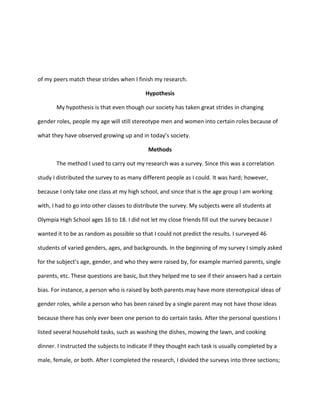
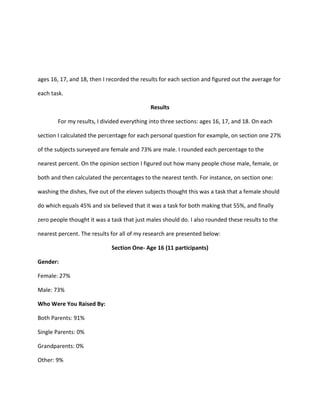
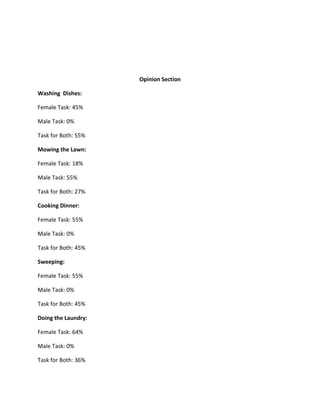
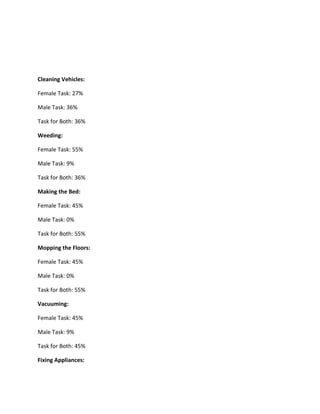
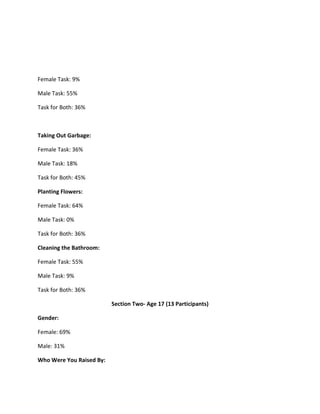
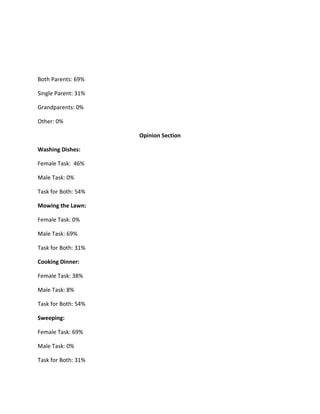
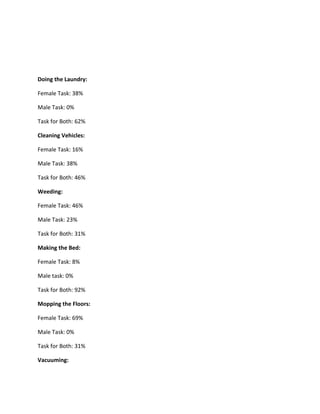
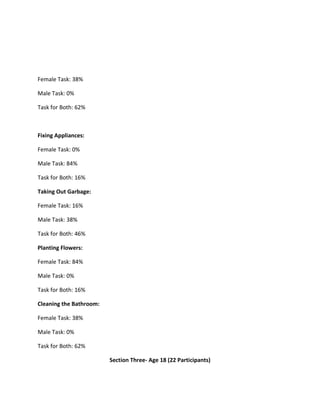
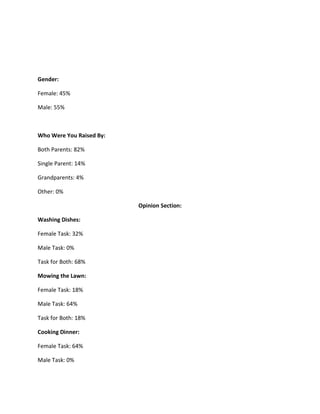
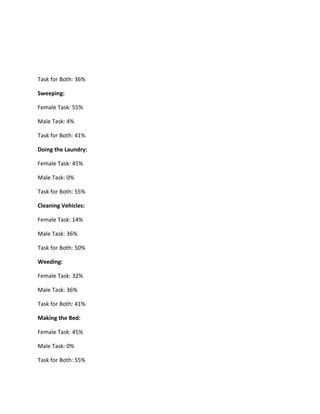
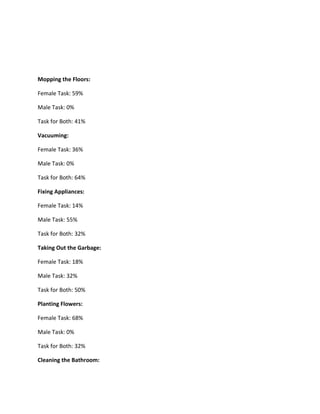
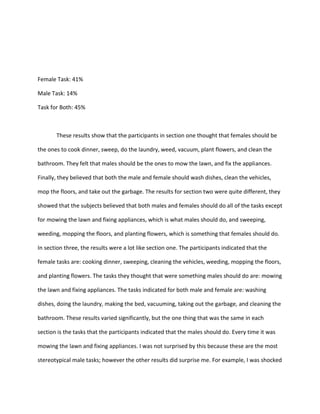
Gender Roles and Household Tasks<br />Tessa Turnbow<br />Gender Roles: Diversity (Soc 235)<br />Erica Dixon<br />March 13, 2010<br />Topic<br />The topic that I decided to study for this research project is gender roles. More <br />specifically, are gender roles still stereotyped as they were years ago when it comes to <br />household tasks.  What I am most interested to see is if the younger generation, i.e. ages 16-18, <br />are seeing changes in the stereotypes because this generation is who will ultimately see a <br />change if there ever is one, and they we are the ones that could work to make a change <br />happen. <br />Background<br />In order to understand gender roles and how they change over time, it is important to <br />look at the history. In the early 1900s it was unheard of for women to work and in some cases it <br />was illegal.  In 1930, in fact, it was against the law in 26 of the 48 states for married women to <br />be employed (Gender Roles ).  Married women, instead, were expected to stay home, cook, <br />clean, and take care of the children while their husbands were at work. And once their <br />husbands returned home, dinner was expected to be done, the house clean, and children well <br />behaved. Women were also not supposed to “nag” their husbands once they got home and <br />silence was expected, since, obviously, their husbands had such a hard day at work. Thankfully, <br />this started to change over time. In the 1970s, about 50% of women ages 25 to 54 worked <br />outside of home and in the work place, and in 1995, 76% of women worked outside of home <br />(Gender and Society ).  These are great strides that we have made as a society, bringing the <br />work place more equality. Now, according to the Bureau of Labor Statistics, only 45% of white <br />men, who used to control the workplace, make up the total workers and 47% of women, even <br />though men still make more money. With this change in who is working more, gender account <br />for the total workers (She Works. They’re Happy). However, research has also found that when <br />women work by themselves they are less successful than men (Martinot,D). In my opinion, this <br />is probably because women are not always given the same chances to work alone and be <br />successful as men are. There are obviously still some drawbacks, but overall women have <br />begun to dominate the job market. With this change in the work place, gender roles have also <br />changed at home. According to a recent study from the Pew Research Center, women are now <br />the primary breadwinners in marriages and roles have also shifted. Many would assume that <br />the role shift would create conflict in a marriage; I mean what kind of guy would possibly want <br />to stay at home and clean the house while his wife works and makes the money? However, <br />divorce rates have actually gone down since this role shift. In 1970 there was an average of 23 <br />divorces per 1,000 couples, and that has dropped to less than 17 divorces per 1,000 couples <br />(She Works. They’re Happy.).  This may be because, as many experts point out, women no <br />longer are looking for a husband that, simply, has a lot of money but looking for someone that <br />better suits them based on their personality. Also, I believe that the divorce rate has gone down <br />because with women becoming more independent men have more respect for them, and <br />respect is one of the most important parts in relationships. It is obvious that we have made <br />strides as a society when it comes to gender roles, so it will be interesting to see if the opinions <br />of my peers match these strides when I finish my research. <br />Hypothesis<br />My hypothesis is that even though our society has taken great strides in changing <br />gender roles, people my age will still stereotype men and women into certain roles because of <br />what they have observed growing up and in today’s society. <br />Methods<br />The method I used to carry out my research was a survey. Since this was a correlation <br />study I distributed the survey to as many different people as I could. It was hard; however, <br />because I only take one class at my high school, and since that is the age group I am working <br />with, I had to go into other classes to distribute the survey. My subjects were all students at <br />Olympia High School ages 16 to 18. I did not let my close friends fill out the survey because I <br />wanted it to be as random as possible so that I could not predict the results. I surveyed 46 <br />students of varied genders, ages, and backgrounds. In the beginning of my survey I simply asked <br />for the subject’s age, gender, and who they were raised by, for example married parents, single <br />parents, etc. These questions are basic, but they helped me to see if their answers had a certain <br />bias. For instance, a person who is raised by both parents may have more stereotypical ideas of <br />gender roles, while a person who has been raised by a single parent may not have those ideas <br />because there has only ever been one person to do certain tasks. After the personal questions I <br />listed several household tasks, such as washing the dishes, mowing the lawn, and cooking <br />dinner. I instructed the subjects to indicate if they thought each task is usually completed by a <br />male, female, or both. After I completed the research, I divided the surveys into three sections; <br />ages 16, 17, and 18, then I recorded the results for each section and figured out the average for <br />each task. <br />Results<br /> For my results, I divided everything into three sections: ages 16, 17, and 18. On each <br />section I calculated the percentage for each personal question for example, on section one 27% <br />of the subjects surveyed are female and 73% are male. I rounded each percentage to the <br />nearest percent. On the opinion section I figured out how many people chose male, female, or <br />both and then calculated the percentages to the nearest tenth. For instance, on section one: <br />washing the dishes, five out of the eleven subjects thought this was a task that a female should <br />do which equals 45% and six believed that it was a task for both making that 55%, and finally <br />zero people thought it was a task that just males should do. I also rounded these results to the <br />nearest percent. The results for all of my research are presented below:<br />Section One- Age 16 (11 participants)<br />Gender:<br />Female: 27%<br />Male: 73%<br />Who Were You Raised By:<br />Both Parents: 91%<br />Single Parents: 0%<br />Grandparents: 0%<br />Other: 9%<br />Opinion Section<br />Washing  Dishes:<br />Female Task: 45%<br />Male Task: 0%<br />Task for Both: 55%<br />Mowing the Lawn:<br />Female Task: 18%<br />Male Task: 55%<br />Task for Both: 27%<br />Cooking Dinner:<br />Female Task: 55%<br />Male Task: 0%<br />Task for Both: 45%<br />Sweeping:<br />Female Task: 55%<br />Male Task: 0%<br />Task for Both: 45%<br />Doing the Laundry:<br />Female Task: 64%<br />Male Task: 0%<br />Task for Both: 36%<br />Cleaning Vehicles:<br />Female Task: 27%<br />Male Task: 36%<br />Task for Both: 36%<br />Weeding:<br />Female Task: 55%<br />Male Task: 9%<br />Task for Both: 36%<br />Making the Bed:<br />Female Task: 45%<br />Male Task: 0%<br />Task for Both: 55%<br />Mopping the Floors:<br />Female Task: 45%<br />Male Task: 0%<br />Task for Both: 55%<br />Vacuuming:<br />Female Task: 45%<br />Male Task: 9%<br />Task for Both: 45%<br />Fixing Appliances:<br />Female Task: 9%<br />Male Task: 55%<br />Task for Both: 36%<br />Taking Out Garbage:<br />Female Task: 36%<br />Male Task: 18%<br />Task for Both: 45%<br />Planting Flowers:<br />Female Task: 64%<br />Male Task: 0%<br />Task for Both: 36%<br />Cleaning the Bathroom:<br />Female Task: 55%<br />Male Task: 9%<br />Task for Both: 36%<br />Section Two- Age 17 (13 Participants)<br />Gender:<br />Female: 69%<br />Male: 31%<br />Who Were You Raised By:<br />Both Parents: 69%<br />Single Parent: 31%<br />Grandparents: 0%<br />Other: 0%<br />Opinion Section<br />Washing Dishes:<br />Female Task:  46%<br />Male Task: 0%<br />Task for Both: 54%<br />Mowing the Lawn:<br />Female Task: 0%<br />Male Task: 69%<br />Task for Both: 31%<br />Cooking Dinner:<br />Female Task: 38%<br />Male Task: 8%<br />Task for Both: 54%<br />Sweeping:<br />Female Task: 69%<br />Male Task: 0%<br />Task for Both: 31%<br />Doing the Laundry:<br />Female Task: 38%<br />Male Task: 0%<br />Task for Both: 62%<br />Cleaning Vehicles: <br />Female Task: 16%<br />Male Task: 38%<br />Task for Both: 46%<br />Weeding:<br />Female Task: 46%<br />Male Task: 23%<br />Task for Both: 31%<br />Making the Bed:<br />Female Task: 8%<br />Male task: 0%<br />Task for Both: 92%<br />Mopping the Floors:<br />Female Task: 69%<br />Male Task: 0%<br />Task for Both: 31%<br />Vacuuming:<br />Female Task: 38%<br />Male Task: 0%<br />Task for Both: 62%<br />Fixing Appliances:<br />Female Task: 0%<br />Male Task: 84%<br />Task for Both: 16%<br />Taking Out Garbage:<br />Female Task: 16%<br />Male Task: 38%<br />Task for Both: 46%<br />Planting Flowers:<br />Female Task: 84%<br />Male Task: 0%<br />Task for Both: 16%<br />Cleaning the Bathroom:<br />Female Task: 38%<br />Male Task: 0%<br />Task for Both: 62%<br />Section Three- Age 18 (22 Participants)<br />Gender:<br />Female: 45%<br />Male: 55%<br />Who Were You Raised By:<br />Both Parents: 82%<br />Single Parent: 14%<br />Grandparents: 4%<br />Other: 0%<br />Opinion Section:<br />Washing Dishes:<br />Female Task: 32%<br />Male Task: 0%<br />Task for Both: 68%<br />Mowing the Lawn:<br />Female Task: 18%<br />Male Task: 64%<br />Task for Both: 18%<br />Cooking Dinner:<br />Female Task: 64%<br />Male Task: 0%<br />Task for Both: 36%<br />Sweeping:<br />Female Task: 55%<br />Male Task: 4%<br />Task for Both: 41%<br />Doing the Laundry: <br />Female Task: 45%<br />Male Task: 0%<br />Task for Both: 55%<br />Cleaning Vehicles:<br />Female Task: 14%<br />Male Task: 36%<br />Task for Both: 50%<br />Weeding: <br />Female Task: 32%<br />Male Task: 36%<br />Task for Both: 41%<br />Making the Bed:<br />Female Task: 45%<br />Male Task: 0%<br />Task for Both: 55%<br />Mopping the Floors:<br />Female Task: 59%<br />Male Task: 0%<br />Task for Both: 41%<br />Vacuuming:<br />Female Task: 36%<br />Male Task: 0%<br />Task for Both: 64%<br />Fixing Appliances:<br />Female Task: 14%<br />Male Task: 55%<br />Task for Both: 32%<br />Taking Out the Garbage:<br />Female Task: 18%<br />Male Task: 32%<br />Task for Both: 50%<br />Planting Flowers:<br />Female Task: 68%<br />Male Task: 0%<br />Task for Both: 32%<br />Cleaning the Bathroom:<br />Female Task: 41%<br />Male Task: 14%<br />Task for Both: 45%<br />These results show that the participants in section one thought that females should be <br />the ones to cook dinner, sweep, do the laundry, weed, vacuum, plant flowers, and clean the <br />bathroom. They felt that males should be the ones to mow the lawn, and fix the appliances. <br />Finally, they believed that both the male and female should wash dishes, clean the vehicles, <br />mop the floors, and take out the garbage. The results for section two were quite different, they <br />showed that the subjects believed that both males and females should do all of the tasks except <br />for mowing the lawn and fixing appliances, which is what males should do, and sweeping, <br />weeding, mopping the floors, and planting flowers, which is something that females should do. <br />In section three, the results were a lot like section one. The participants indicated that the <br />female tasks are: cooking dinner, sweeping, cleaning the vehicles, weeding, mopping the floors, <br />and planting flowers. The tasks they thought that were something males should do are: mowing <br />the lawn and fixing appliances. The tasks indicated for both male and female are: washing <br />dishes, doing the laundry, making the bed, vacuuming, taking out the garbage, and cleaning the <br />bathroom. These results varied significantly, but the one thing that was the same in each <br />section is the tasks that the participants indicated that the males should do. Every time it was <br />mowing the lawn and fixing appliances. I was not surprised by this because these are the most <br />stereotypical male tasks; however the other results did surprise me. For example, I was shocked <br />at how many tasks were considered to be done by both females and males; I was expecting it to <br />be either male or female. <br />Conclusion:<br />Throughout this research project, my hypothesis was both supported and refuted. I <br />hypothesized that even though our society has taken huge strides to end inequality between <br />men and women and change the gender roles stereotypes there would still be the stereotypes <br />because of what the subjects have observed as they have grown up. I was correct that there are <br />still some stereotypes, the most obvious is that in each section of results the participants <br />believed that mowing the lawn and fixing appliances is something that males should do. When I <br />wrote this survey, I knew that these would have been male stereotypes, but I did not think that <br />they would still be so obviously assumed to be a male task. Also, sweeping, weeding, and <br />planting flowers are all tasks that in every section it was indicated that females should complete <br />those tasks. The fact that there are still tasks that are obviously gender stereotyped supported <br />my hypothesis, however there were several tasks that the participants thought both males and <br />females could complete. In each section washing the dishes, making the bed, and taking out the <br />garbage were all considered to be tasks that men and women should do. These results refuted <br />my hypothesis because it shows that tasks that would be considered a female stereotype (i.e. <br />washing the dishes) are now something that both genders should do. These results definitely <br />surprised me. I was expecting the subjects to indicate that every task except mowing the lawn <br />and fixing appliances should be completed by females. This is because even though our society <br />has come long ways there are still so many things that stereotype men and women into <br />traditional gender roles. If I were to do this project over again I would do several things <br />differently. First, I would broaden the age range. If I added people to the survey that are in the <br />older generation I would be able to compare and contrast and see how much of a difference <br />has actually been made. I would also ask more questions in the background section. For <br />example, I would ask about religion and relationship status. These could help me to see if the <br />answers are more bias toward one side or the other for a reason. For instance, if someone is <br />really religious their answers may lean more toward the traditional gender stereotypes. This <br />study made me question if we are really doing enough as a society to change the stereotypes of <br />gender roles. I would have liked if my hypothesis was totally refuted and that every task was <br />considered to be something that males and females could do. This research may help <br />sociologists who are trying to figure out what we still need to change as a society and how <br />much we have already changed in the area of gendered stereotypes. This could be used as an <br />outline for someone to teach their children about gender roles. For example, they could show <br />them that males and females can do the same tasks around the house. If children in the future <br />generation know that gender roles are not stereotypes then we, as a society would be able to <br />take even bigger strides toward equality. This research is, over all, important to the study of <br />gender because it shows that we still have a long ways to go when it comes to men and women <br />being considered equal. We have taken small strides, but it is obvious that much still has to be <br />done. I am very happy with this research project. Even though I could have done some things <br />differently, I am proud of my work and found the results, both informative and surprising.<br />References:<br />Gender and Society. Retrieved Feb 22, 2010,  from <br />http://www.trinity.edu/~MKEARL/gender.html<br />Gender Roles. Retrieved Feb 25, 2010, from<br /> http://www.faqs.org/health/topics/8/Gender-roles.html <br />Martinot, D., & Viallon, M.L. (June 2009). The Effects of Solo Status on Women’s and Men’s <br />Success: The Moderating Role of the Performance Context.(24)191-205. Retrieved Feb <br />26, 2010, from Ebsco<br />She Works. They’re Happy. (2010, January 24). Retrieved Feb 27, 2010, from The New York <br />Times’ website: <br />http://www.nytimes.com/2010/01/24/fashion/24marriage.html?pagewanted=1<br />
Research project gender roles

Research project gender roles

  • 1.
    Gender Roles andHousehold Tasks<br />Tessa Turnbow<br />Gender Roles: Diversity (Soc 235)<br />Erica Dixon<br />March 13, 2010<br />Topic<br />The topic that I decided to study for this research project is gender roles. More <br />specifically, are gender roles still stereotyped as they were years ago when it comes to <br />household tasks. What I am most interested to see is if the younger generation, i.e. ages 16-18, <br />are seeing changes in the stereotypes because this generation is who will ultimately see a <br />change if there ever is one, and they we are the ones that could work to make a change <br />happen. <br />Background<br />In order to understand gender roles and how they change over time, it is important to <br />look at the history. In the early 1900s it was unheard of for women to work and in some cases it <br />was illegal. In 1930, in fact, it was against the law in 26 of the 48 states for married women to <br />be employed (Gender Roles ). Married women, instead, were expected to stay home, cook, <br />clean, and take care of the children while their husbands were at work. And once their <br />husbands returned home, dinner was expected to be done, the house clean, and children well <br />behaved. Women were also not supposed to “nag” their husbands once they got home and <br />silence was expected, since, obviously, their husbands had such a hard day at work. Thankfully, <br />this started to change over time. In the 1970s, about 50% of women ages 25 to 54 worked <br />outside of home and in the work place, and in 1995, 76% of women worked outside of home <br />(Gender and Society ). These are great strides that we have made as a society, bringing the <br />work place more equality. Now, according to the Bureau of Labor Statistics, only 45% of white <br />men, who used to control the workplace, make up the total workers and 47% of women, even <br />though men still make more money. With this change in who is working more, gender account <br />for the total workers (She Works. They’re Happy). However, research has also found that when <br />women work by themselves they are less successful than men (Martinot,D). In my opinion, this <br />is probably because women are not always given the same chances to work alone and be <br />successful as men are. There are obviously still some drawbacks, but overall women have <br />begun to dominate the job market. With this change in the work place, gender roles have also <br />changed at home. According to a recent study from the Pew Research Center, women are now <br />the primary breadwinners in marriages and roles have also shifted. Many would assume that <br />the role shift would create conflict in a marriage; I mean what kind of guy would possibly want <br />to stay at home and clean the house while his wife works and makes the money? However, <br />divorce rates have actually gone down since this role shift. In 1970 there was an average of 23 <br />divorces per 1,000 couples, and that has dropped to less than 17 divorces per 1,000 couples <br />(She Works. They’re Happy.). This may be because, as many experts point out, women no <br />longer are looking for a husband that, simply, has a lot of money but looking for someone that <br />better suits them based on their personality. Also, I believe that the divorce rate has gone down <br />because with women becoming more independent men have more respect for them, and <br />respect is one of the most important parts in relationships. It is obvious that we have made <br />strides as a society when it comes to gender roles, so it will be interesting to see if the opinions <br />of my peers match these strides when I finish my research. <br />Hypothesis<br />My hypothesis is that even though our society has taken great strides in changing <br />gender roles, people my age will still stereotype men and women into certain roles because of <br />what they have observed growing up and in today’s society. <br />Methods<br />The method I used to carry out my research was a survey. Since this was a correlation <br />study I distributed the survey to as many different people as I could. It was hard; however, <br />because I only take one class at my high school, and since that is the age group I am working <br />with, I had to go into other classes to distribute the survey. My subjects were all students at <br />Olympia High School ages 16 to 18. I did not let my close friends fill out the survey because I <br />wanted it to be as random as possible so that I could not predict the results. I surveyed 46 <br />students of varied genders, ages, and backgrounds. In the beginning of my survey I simply asked <br />for the subject’s age, gender, and who they were raised by, for example married parents, single <br />parents, etc. These questions are basic, but they helped me to see if their answers had a certain <br />bias. For instance, a person who is raised by both parents may have more stereotypical ideas of <br />gender roles, while a person who has been raised by a single parent may not have those ideas <br />because there has only ever been one person to do certain tasks. After the personal questions I <br />listed several household tasks, such as washing the dishes, mowing the lawn, and cooking <br />dinner. I instructed the subjects to indicate if they thought each task is usually completed by a <br />male, female, or both. After I completed the research, I divided the surveys into three sections; <br />ages 16, 17, and 18, then I recorded the results for each section and figured out the average for <br />each task. <br />Results<br /> For my results, I divided everything into three sections: ages 16, 17, and 18. On each <br />section I calculated the percentage for each personal question for example, on section one 27% <br />of the subjects surveyed are female and 73% are male. I rounded each percentage to the <br />nearest percent. On the opinion section I figured out how many people chose male, female, or <br />both and then calculated the percentages to the nearest tenth. For instance, on section one: <br />washing the dishes, five out of the eleven subjects thought this was a task that a female should <br />do which equals 45% and six believed that it was a task for both making that 55%, and finally <br />zero people thought it was a task that just males should do. I also rounded these results to the <br />nearest percent. The results for all of my research are presented below:<br />Section One- Age 16 (11 participants)<br />Gender:<br />Female: 27%<br />Male: 73%<br />Who Were You Raised By:<br />Both Parents: 91%<br />Single Parents: 0%<br />Grandparents: 0%<br />Other: 9%<br />Opinion Section<br />Washing Dishes:<br />Female Task: 45%<br />Male Task: 0%<br />Task for Both: 55%<br />Mowing the Lawn:<br />Female Task: 18%<br />Male Task: 55%<br />Task for Both: 27%<br />Cooking Dinner:<br />Female Task: 55%<br />Male Task: 0%<br />Task for Both: 45%<br />Sweeping:<br />Female Task: 55%<br />Male Task: 0%<br />Task for Both: 45%<br />Doing the Laundry:<br />Female Task: 64%<br />Male Task: 0%<br />Task for Both: 36%<br />Cleaning Vehicles:<br />Female Task: 27%<br />Male Task: 36%<br />Task for Both: 36%<br />Weeding:<br />Female Task: 55%<br />Male Task: 9%<br />Task for Both: 36%<br />Making the Bed:<br />Female Task: 45%<br />Male Task: 0%<br />Task for Both: 55%<br />Mopping the Floors:<br />Female Task: 45%<br />Male Task: 0%<br />Task for Both: 55%<br />Vacuuming:<br />Female Task: 45%<br />Male Task: 9%<br />Task for Both: 45%<br />Fixing Appliances:<br />Female Task: 9%<br />Male Task: 55%<br />Task for Both: 36%<br />Taking Out Garbage:<br />Female Task: 36%<br />Male Task: 18%<br />Task for Both: 45%<br />Planting Flowers:<br />Female Task: 64%<br />Male Task: 0%<br />Task for Both: 36%<br />Cleaning the Bathroom:<br />Female Task: 55%<br />Male Task: 9%<br />Task for Both: 36%<br />Section Two- Age 17 (13 Participants)<br />Gender:<br />Female: 69%<br />Male: 31%<br />Who Were You Raised By:<br />Both Parents: 69%<br />Single Parent: 31%<br />Grandparents: 0%<br />Other: 0%<br />Opinion Section<br />Washing Dishes:<br />Female Task: 46%<br />Male Task: 0%<br />Task for Both: 54%<br />Mowing the Lawn:<br />Female Task: 0%<br />Male Task: 69%<br />Task for Both: 31%<br />Cooking Dinner:<br />Female Task: 38%<br />Male Task: 8%<br />Task for Both: 54%<br />Sweeping:<br />Female Task: 69%<br />Male Task: 0%<br />Task for Both: 31%<br />Doing the Laundry:<br />Female Task: 38%<br />Male Task: 0%<br />Task for Both: 62%<br />Cleaning Vehicles: <br />Female Task: 16%<br />Male Task: 38%<br />Task for Both: 46%<br />Weeding:<br />Female Task: 46%<br />Male Task: 23%<br />Task for Both: 31%<br />Making the Bed:<br />Female Task: 8%<br />Male task: 0%<br />Task for Both: 92%<br />Mopping the Floors:<br />Female Task: 69%<br />Male Task: 0%<br />Task for Both: 31%<br />Vacuuming:<br />Female Task: 38%<br />Male Task: 0%<br />Task for Both: 62%<br />Fixing Appliances:<br />Female Task: 0%<br />Male Task: 84%<br />Task for Both: 16%<br />Taking Out Garbage:<br />Female Task: 16%<br />Male Task: 38%<br />Task for Both: 46%<br />Planting Flowers:<br />Female Task: 84%<br />Male Task: 0%<br />Task for Both: 16%<br />Cleaning the Bathroom:<br />Female Task: 38%<br />Male Task: 0%<br />Task for Both: 62%<br />Section Three- Age 18 (22 Participants)<br />Gender:<br />Female: 45%<br />Male: 55%<br />Who Were You Raised By:<br />Both Parents: 82%<br />Single Parent: 14%<br />Grandparents: 4%<br />Other: 0%<br />Opinion Section:<br />Washing Dishes:<br />Female Task: 32%<br />Male Task: 0%<br />Task for Both: 68%<br />Mowing the Lawn:<br />Female Task: 18%<br />Male Task: 64%<br />Task for Both: 18%<br />Cooking Dinner:<br />Female Task: 64%<br />Male Task: 0%<br />Task for Both: 36%<br />Sweeping:<br />Female Task: 55%<br />Male Task: 4%<br />Task for Both: 41%<br />Doing the Laundry: <br />Female Task: 45%<br />Male Task: 0%<br />Task for Both: 55%<br />Cleaning Vehicles:<br />Female Task: 14%<br />Male Task: 36%<br />Task for Both: 50%<br />Weeding: <br />Female Task: 32%<br />Male Task: 36%<br />Task for Both: 41%<br />Making the Bed:<br />Female Task: 45%<br />Male Task: 0%<br />Task for Both: 55%<br />Mopping the Floors:<br />Female Task: 59%<br />Male Task: 0%<br />Task for Both: 41%<br />Vacuuming:<br />Female Task: 36%<br />Male Task: 0%<br />Task for Both: 64%<br />Fixing Appliances:<br />Female Task: 14%<br />Male Task: 55%<br />Task for Both: 32%<br />Taking Out the Garbage:<br />Female Task: 18%<br />Male Task: 32%<br />Task for Both: 50%<br />Planting Flowers:<br />Female Task: 68%<br />Male Task: 0%<br />Task for Both: 32%<br />Cleaning the Bathroom:<br />Female Task: 41%<br />Male Task: 14%<br />Task for Both: 45%<br />These results show that the participants in section one thought that females should be <br />the ones to cook dinner, sweep, do the laundry, weed, vacuum, plant flowers, and clean the <br />bathroom. They felt that males should be the ones to mow the lawn, and fix the appliances. <br />Finally, they believed that both the male and female should wash dishes, clean the vehicles, <br />mop the floors, and take out the garbage. The results for section two were quite different, they <br />showed that the subjects believed that both males and females should do all of the tasks except <br />for mowing the lawn and fixing appliances, which is what males should do, and sweeping, <br />weeding, mopping the floors, and planting flowers, which is something that females should do. <br />In section three, the results were a lot like section one. The participants indicated that the <br />female tasks are: cooking dinner, sweeping, cleaning the vehicles, weeding, mopping the floors, <br />and planting flowers. The tasks they thought that were something males should do are: mowing <br />the lawn and fixing appliances. The tasks indicated for both male and female are: washing <br />dishes, doing the laundry, making the bed, vacuuming, taking out the garbage, and cleaning the <br />bathroom. These results varied significantly, but the one thing that was the same in each <br />section is the tasks that the participants indicated that the males should do. Every time it was <br />mowing the lawn and fixing appliances. I was not surprised by this because these are the most <br />stereotypical male tasks; however the other results did surprise me. For example, I was shocked <br />at how many tasks were considered to be done by both females and males; I was expecting it to <br />be either male or female. <br />Conclusion:<br />Throughout this research project, my hypothesis was both supported and refuted. I <br />hypothesized that even though our society has taken huge strides to end inequality between <br />men and women and change the gender roles stereotypes there would still be the stereotypes <br />because of what the subjects have observed as they have grown up. I was correct that there are <br />still some stereotypes, the most obvious is that in each section of results the participants <br />believed that mowing the lawn and fixing appliances is something that males should do. When I <br />wrote this survey, I knew that these would have been male stereotypes, but I did not think that <br />they would still be so obviously assumed to be a male task. Also, sweeping, weeding, and <br />planting flowers are all tasks that in every section it was indicated that females should complete <br />those tasks. The fact that there are still tasks that are obviously gender stereotyped supported <br />my hypothesis, however there were several tasks that the participants thought both males and <br />females could complete. In each section washing the dishes, making the bed, and taking out the <br />garbage were all considered to be tasks that men and women should do. These results refuted <br />my hypothesis because it shows that tasks that would be considered a female stereotype (i.e. <br />washing the dishes) are now something that both genders should do. These results definitely <br />surprised me. I was expecting the subjects to indicate that every task except mowing the lawn <br />and fixing appliances should be completed by females. This is because even though our society <br />has come long ways there are still so many things that stereotype men and women into <br />traditional gender roles. If I were to do this project over again I would do several things <br />differently. First, I would broaden the age range. If I added people to the survey that are in the <br />older generation I would be able to compare and contrast and see how much of a difference <br />has actually been made. I would also ask more questions in the background section. For <br />example, I would ask about religion and relationship status. These could help me to see if the <br />answers are more bias toward one side or the other for a reason. For instance, if someone is <br />really religious their answers may lean more toward the traditional gender stereotypes. This <br />study made me question if we are really doing enough as a society to change the stereotypes of <br />gender roles. I would have liked if my hypothesis was totally refuted and that every task was <br />considered to be something that males and females could do. This research may help <br />sociologists who are trying to figure out what we still need to change as a society and how <br />much we have already changed in the area of gendered stereotypes. This could be used as an <br />outline for someone to teach their children about gender roles. For example, they could show <br />them that males and females can do the same tasks around the house. If children in the future <br />generation know that gender roles are not stereotypes then we, as a society would be able to <br />take even bigger strides toward equality. This research is, over all, important to the study of <br />gender because it shows that we still have a long ways to go when it comes to men and women <br />being considered equal. We have taken small strides, but it is obvious that much still has to be <br />done. I am very happy with this research project. Even though I could have done some things <br />differently, I am proud of my work and found the results, both informative and surprising.<br />References:<br />Gender and Society. Retrieved Feb 22, 2010, from <br />http://www.trinity.edu/~MKEARL/gender.html<br />Gender Roles. Retrieved Feb 25, 2010, from<br /> http://www.faqs.org/health/topics/8/Gender-roles.html <br />Martinot, D., & Viallon, M.L. (June 2009). The Effects of Solo Status on Women’s and Men’s <br />Success: The Moderating Role of the Performance Context.(24)191-205. Retrieved Feb <br />26, 2010, from Ebsco<br />She Works. They’re Happy. (2010, January 24). Retrieved Feb 27, 2010, from The New York <br />Times’ website: <br />http://www.nytimes.com/2010/01/24/fashion/24marriage.html?pagewanted=1<br />