TOPIC
EFFECT OF POLLUTED WATER ON FRESH AND HARD
CONCRETE
PRESENTER; KENYONYOZI FORTUNATE
REG NO; 18/UG/1262/BSCE-S
SUPERVISOR; NDAWULA DERRICK
BACKGROUND OF THE STUDY
Concrete is a construction material composed of cement, fine
aggregates (sand) and coarse aggregates mixed with water
which hardens with time.
Water is an important ingredient of concrete. Part of mixing
water is utilized in the hydration of cement and the balance is
required for imparting workability to concrete.
Polluted water is that whose composition has been changed
to the extent that is unusable.
PROBLEM STATEMENT
Buildings no longer last and this could be the problem of
Polluted water which affects the compressive strength and
durability of concrete. This results from increased
industrialization and poor wastewater disposal in Uganda
which are the main pollutants of water, most construction
sites are lacking normal water for mixing concrete so they
end up using polluted water
OBJECTIVES
Main objectives
 To investigate the effects of polluted water on fresh and hard
concrete
Specific objectives
 To determine the physical properties of coarse, fine aggregates
and water
 To develop the concrete mix ratio.
 To carry out structural strength tests on cubes in order to
JUSTIFICATION OF THE STUDY
This research seeks to lay down the effect of polluted water
on fresh and hard concrete and after investigation it will
recommend possible solutions.
RESEARCH QUESTIONS
 What are the physical properties of coarse, fine
aggregates and water?
 How is the concrete mix ratio developed?
 How is structural strength of cubes carried out?
 What is the effect of polluted water on comprehensive
strength of concrete?
SCOPE OF THE STUDY
This research will focus on investigation of the effects of
polluted water on fresh and hard concrete. Laboratory tests
will be carried out from international university of east
Africa civil engineering laboratory.
Time scope
I will collect data in the first three of my project, analyze it,
report and write the findings about my project and the last
three months, I will carryout all the required tests and present
the findings.
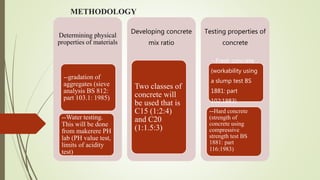
METHODOLOGY
Determining physical
properties of materials
--gradation of
aggregates (sieve
analysis BS 812:
part 103.1: 1985)
--Water testing.
This will be done
from makerere PH
lab (PH value test,
limits of acidity
test)
Developing concrete
mix ratio
Two classes of
concrete will
be used that is
C15 (1:2:4)
and C20
(1:1.5:3)
Testing properties of
concrete
--Fresh concrete
(workability using
a slump test BS
1881: part
102:1983)
--Hard concrete
(strength of
concrete using
compressive
strength test BS
1881: part
116:1983)
WORK PLAN
Work description Feb March April May June July August
Data collection
Data collection
Proposal writing
Field activities
Laboratory tests
Analyzing results and report
writing
Final presentation
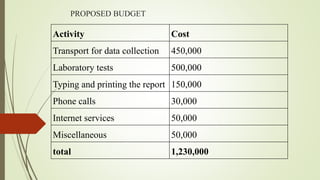
PROPOSED BUDGET
Activity Cost
Transport for data collection 450,000
Laboratory tests 500,000
Typing and printing the report 150,000
Phone calls 30,000
Internet services 50,000
Miscellaneous 50,000
total 1,230,000
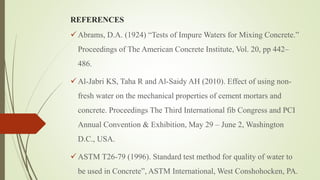
REFERENCES
 Abrams, D.A. (1924) “Tests of Impure Waters for Mixing Concrete.”
Proceedings of The American Concrete Institute, Vol. 20, pp 442–
486.
 Al-Jabri KS, Taha R and Al-Saidy AH (2010). Effect of using non-
fresh water on the mechanical properties of cement mortars and
concrete. Proceedings The Third International fib Congress and PCI
Annual Convention & Exhibition, May 29 – June 2, Washington
D.C., USA.
 ASTM T26-79 (1996). Standard test method for quality of water to
be used in Concrete”, ASTM International, West Conshohocken, PA.
THANK YOU SO MUCH

research presentation (1).pptx

  • 1.
    TOPIC EFFECT OF POLLUTEDWATER ON FRESH AND HARD CONCRETE PRESENTER; KENYONYOZI FORTUNATE REG NO; 18/UG/1262/BSCE-S SUPERVISOR; NDAWULA DERRICK
  • 2.
    BACKGROUND OF THESTUDY Concrete is a construction material composed of cement, fine aggregates (sand) and coarse aggregates mixed with water which hardens with time. Water is an important ingredient of concrete. Part of mixing water is utilized in the hydration of cement and the balance is required for imparting workability to concrete. Polluted water is that whose composition has been changed to the extent that is unusable.
  • 3.
    PROBLEM STATEMENT Buildings nolonger last and this could be the problem of Polluted water which affects the compressive strength and durability of concrete. This results from increased industrialization and poor wastewater disposal in Uganda which are the main pollutants of water, most construction sites are lacking normal water for mixing concrete so they end up using polluted water
  • 4.
    OBJECTIVES Main objectives  Toinvestigate the effects of polluted water on fresh and hard concrete Specific objectives  To determine the physical properties of coarse, fine aggregates and water  To develop the concrete mix ratio.  To carry out structural strength tests on cubes in order to
  • 5.
    JUSTIFICATION OF THESTUDY This research seeks to lay down the effect of polluted water on fresh and hard concrete and after investigation it will recommend possible solutions.
  • 6.
    RESEARCH QUESTIONS  Whatare the physical properties of coarse, fine aggregates and water?  How is the concrete mix ratio developed?  How is structural strength of cubes carried out?  What is the effect of polluted water on comprehensive strength of concrete?
  • 7.
    SCOPE OF THESTUDY This research will focus on investigation of the effects of polluted water on fresh and hard concrete. Laboratory tests will be carried out from international university of east Africa civil engineering laboratory. Time scope I will collect data in the first three of my project, analyze it, report and write the findings about my project and the last three months, I will carryout all the required tests and present the findings.
  • 8.
    METHODOLOGY Determining physical properties ofmaterials --gradation of aggregates (sieve analysis BS 812: part 103.1: 1985) --Water testing. This will be done from makerere PH lab (PH value test, limits of acidity test) Developing concrete mix ratio Two classes of concrete will be used that is C15 (1:2:4) and C20 (1:1.5:3) Testing properties of concrete --Fresh concrete (workability using a slump test BS 1881: part 102:1983) --Hard concrete (strength of concrete using compressive strength test BS 1881: part 116:1983)
  • 9.
    WORK PLAN Work descriptionFeb March April May June July August Data collection Data collection Proposal writing Field activities Laboratory tests Analyzing results and report writing Final presentation
  • 10.
    PROPOSED BUDGET Activity Cost Transportfor data collection 450,000 Laboratory tests 500,000 Typing and printing the report 150,000 Phone calls 30,000 Internet services 50,000 Miscellaneous 50,000 total 1,230,000
  • 11.
    REFERENCES  Abrams, D.A.(1924) “Tests of Impure Waters for Mixing Concrete.” Proceedings of The American Concrete Institute, Vol. 20, pp 442– 486.  Al-Jabri KS, Taha R and Al-Saidy AH (2010). Effect of using non- fresh water on the mechanical properties of cement mortars and concrete. Proceedings The Third International fib Congress and PCI Annual Convention & Exhibition, May 29 – June 2, Washington D.C., USA.  ASTM T26-79 (1996). Standard test method for quality of water to be used in Concrete”, ASTM International, West Conshohocken, PA.
  • 12.