At the endof the lesson, Students will be able
design a personalized Likert scale assessment
tool that measures affective domain after a
guided lesson on affective variables and sample
measurement formats with at least 5 clear,
emotionally relevant statements and correct use
of the 5-point Likert scale.
LEARNING OBJECTIVES
The Most Commonvariables for
Affective Assessment
• ATTITUDE
• VALUES AND BELIEFS
• INTEREST
• MOTIVATION
• SELF-CONFIDENCE
5.
ATTITUDE
• A person’spositive or negative reaction
toward an object, activity, person, or
environment. In teaching, this includes
attitudes toward learning, subjects, teachers,
classmates, and school activities. Attitude also
has a cognitive component—knowledge that
shapes the value of the object or situation.
6.
VALUES AND BELIEFS
•Values are traits or principles a person holds in high
importance, guiding actions and decisions. Beliefs
are convictions we consider true, often without
proof. Both can change over time based on
experiences and strongly influence learning
performance.
7.
INTEREST
• Interest isa psychological state that draws a person's attention to
an object, idea or event. in a classroom setting it is what students
are "into" or the learner's disposition about a topic, such as
reading, science, mathematics, history, etc. It is interest that
drives the learner to be attentive to the topic of discussion or
engage in any academic activity interest may be personal or
situational.
8.
MOTIVATIONS
• Brown (1987)defines motivation as an inner drive, impulse,
emotion, or desire that moves one to a particular action. It
arouses and sustains behavior. It can lead to increased
effort and energy to pursue a goal.
• Motivation has other intrinsic factors like curiosity,
appreciation, valuing for learning, as well as extrinsic
factors like praise, grades for completion, certification, etc.
Ausubel (1968) has identified six needs and desires that are
integral parts of motivation:
9.
• The needfor exploration (Students want to discover new things)
• The need for manipulation (Students like to touch, move, or
change things to understand them)
• The need for activity (Students want to be active, not just sit and
listen)
• The need for stimulation(Students like lessons that are lively and
exciting)
• The need for knowledge(Students want to understand and learn
more)
• The need for ego enhancement ( Students want to feel proud and
recognized)
10.
• This refersto how a person feels about his or her abilities to
accomplish a task or reach a goal. It is the person's perception of
himself/ herself and his or her capabilities to perform successfully
the task given to him/her.
• Empirical studies showed self-confidence is associated with
academic success, in particular, Stankov et al. (2012) have found that
students who think they are skilled in Math tend to perform well on
Math and English tests.
SELF - CONFIDENCE
11.
What assessment toolsare used to measure affective learning?
• Measuring affective learning is more difficult than measuring knowledge or skills
because it involves internal feelings like attitudes, values, and beliefs. There are
two ways to assess it: direct and indirect.
• Direct assessment is based on visible behaviors, such as attendance, class
participation, and completing assignments. These show a student’s willingness to
learn.
• Indirect assessment is used for deeper emotional traits and includes tools like self-
report inventories, questionnaires, interviews, observations, and peer feedback.
These help teachers understand how students feel and what they believe.
Although it's challenging, assessing affective learning is important, and educators
continue to improve the ways to measure it.
12.
• A self-reportis a type of assessment where students answer
questions about themselves, including their behavior, emotions, and
opinions. It is commonly used to understand a student’s mental and
emotional state. Teachers often use it before and after a lesson to
see changes in attitude, interest, or motivation. This method is easy
to administer and provides quick, direct information from the
student. However, its accuracy can be affected by whether the
student is honest or simply answering to please the teacher.
Self-Report Questionnaires
13.
Self-report inventories usea variety of formats. The most common are
presented in the following:
Likert scale
• This measuring tool, invented by Rensis Likert, is a series of questions
or items that requires the respondent to select on a scale a rating
reflecting the level of agreement or disagreement on items that are
related to a particular topic, experience, or issue.
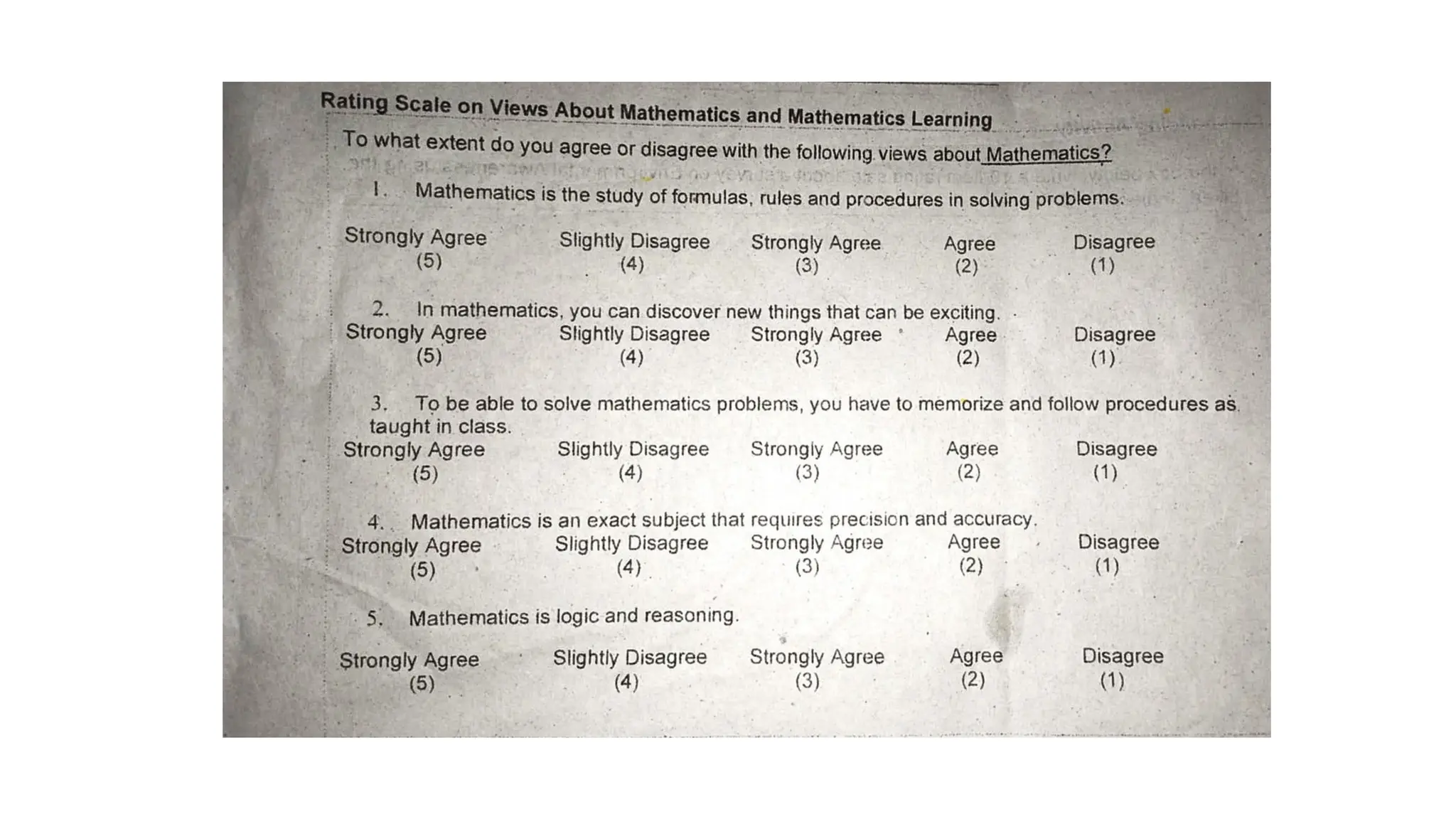
• The responses, both in descriptive and numeric form, range from one
extreme to another, such as "strongly agree" to "strongly disagree",
where "5" is the numerical value of the extreme positive feeling and "1"
for the extreme negative. This kind of scaling gives deeper insight into
what the students are thinking and feeling. An example of Likert scale is
shown below:
ACTIVITY
INSTRUCTION: You willdesign your own affective assessment tool using the
Likert scale format to measure emotions, attitudes, or values related to
learning.
Steps to Follow
1. Choose Your Focus Select one affective variables that you want to explore:
belief
• Attitude toward subject or teacher
• Classroom engagement
• Self-confidence or self-concept
• Values related to learning
2. Write Your Statements Create 5–7 statements that reflect your chosen
domain. Each statement should be something students can agree or disagree
with emotionally. Example: “I feel confident sharing my ideas in class.”
17.
3. Apply theLikert Scale Format For each statement, use this 5-point
scale:
• 5 – Strongly Agree
• 4 – Agree
• 3 – Neutral
• 2 – Disagree
• 1 – Strongly Disagree
4. Add a Title and Description Give your tool a creative title and write a
short description explaining:
• What it measures
• Why it matters
• Who might use it