Project Report Format
THE TECHNICAL UNIVERSITY OF KENYA
FACULTY OF ENGINEERING SCIENCES AND TECHNOLOGY
SCHOOL OF ELCTRICAL AND ELECTRONIC ENGINEERING
DEPARTMENT OF AUTOMATION AND CONTROL ENGINEERING
DESIGN AND CONTRUCTION OF AN AUTOMATIC TANK WATER LEVEL
CONTROL SYSTEM
BY: STEPHEN WANYAMA
PROJECT REPORT SUBMITTED IN PARTIAL FULFILLMENT OF THE
AWARD OF A BACHELOR OF TECHNOLOGY DEGREE IN ELECTRICAL
AND ELECTRONIC ENGINEERING
OCTOBER 25, 2014
© Copyright – The Technical University of Kenya
The report is the intellectual property of the university and no part or the whole of it shall
be reproduced, disseminated or used in any manner electronic or hard copy without the
written permission of the university. Any products arising from the work contained in this
report are the intellectual property of the author.
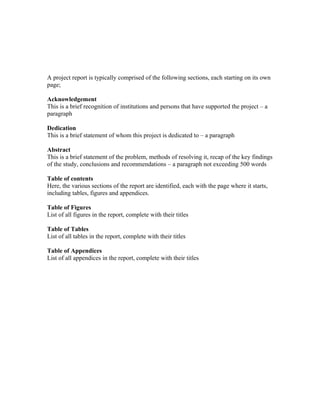
A project report is typically comprised of the following sections, each starting on its own
page;
Acknowledgement
This is a brief recognition of institutions and persons that have supported the project – a
paragraph
Dedication
This is a brief statement of whom this project is dedicated to – a paragraph
Abstract
This is a brief statement of the problem, methods of resolving it, recap of the key findings
of the study, conclusions and recommendations – a paragraph not exceeding 500 words
Table of contents
Here, the various sections of the report are identified, each with the page where it starts,
including tables, figures and appendices.
Table of Figures
List of all figures in the report, complete with their titles
Table of Tables
List of all tables in the report, complete with their titles
Table of Appendices
List of all appendices in the report, complete with their titles
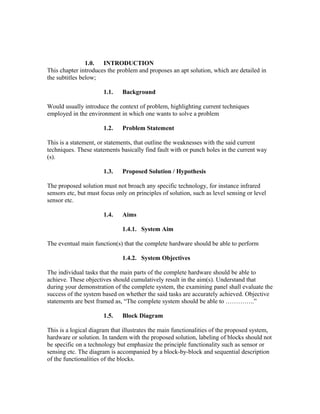
1.0. INTRODUCTION
This chapter introduces the problem and proposes an apt solution, which are detailed in
the subtitles below;
1.1. Background
Would usually introduce the context of problem, highlighting current techniques
employed in the environment in which one wants to solve a problem
1.2. Problem Statement
This is a statement, or statements, that outline the weaknesses with the said current
techniques. These statements basically find fault with or punch holes in the current way
(s).
1.3. Proposed Solution / Hypothesis
The proposed solution must not broach any specific technology, for instance infrared
sensors etc, but must focus only on principles of solution, such as level sensing or level
sensor etc.
1.4. Aims
1.4.1. System Aim
The eventual main function(s) that the complete hardware should be able to perform
1.4.2. System Objectives
The individual tasks that the main parts of the complete hardware should be able to
achieve. These objectives should cumulatively result in the aim(s). Understand that
during your demonstration of the complete system, the examining panel shall evaluate the
success of the system based on whether the said tasks are accurately achieved. Objective
statements are best framed as, “The complete system should be able to …………..”
1.5. Block Diagram
This is a logical diagram that illustrates the main functionalities of the proposed system,
hardware or solution. In tandem with the proposed solution, labeling of blocks should not
be specific on a technology but emphasize the principle functionality such as sensor or
sensing etc. The diagram is accompanied by a block-by-block and sequential description
of the functionalities of the blocks.
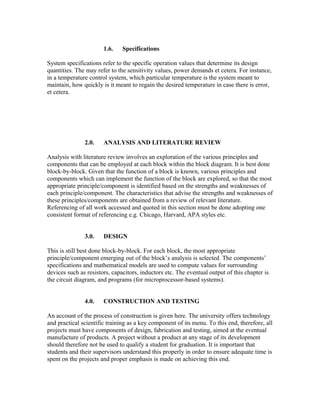
1.6. Specifications
System specifications refer to the specific operation values that determine its design
quantities. The may refer to the sensitivity values, power demands et cetera. For instance,
in a temperature control system, which particular temperature is the system meant to
maintain, how quickly is it meant to regain the desired temperature in case there is error,
et cetera.
2.0. ANALYSIS AND LITERATURE REVIEW
Analysis with literature review involves an exploration of the various principles and
components that can be employed at each block within the block diagram. It is best done
block-by-block. Given that the function of a block is known, various principles and
components which can implement the function of the block are explored, so that the most
appropriate principle/component is identified based on the strengths and weaknesses of
each principle/component. The characteristics that advise the strengths and weaknesses of
these principles/components are obtained from a review of relevant literature.
Referencing of all work accessed and quoted in this section must be done adopting one
consistent format of referencing e.g. Chicago, Harvard, APA styles etc.
3.0. DESIGN
This is still best done block-by-block. For each block, the most appropriate
principle/component emerging out of the block’s analysis is selected. The components’
specifications and mathematical models are used to compute values for surrounding
devices such as resistors, capacitors, inductors etc. The eventual output of this chapter is
the circuit diagram, and programs (for microprocessor-based systems).
4.0. CONSTRUCTION AND TESTING
An account of the process of construction is given here. The university offers technology
and practical scientific training as a key component of its menu. To this end, therefore, all
projects must have components of design, fabrication and testing, aimed at the eventual
manufacture of products. A project without a product at any stage of its development
should therefore not be used to qualify a student for graduation. It is important that
students and their supervisors understand this properly in order to ensure adequate time is
spent on the projects and proper emphasis is made on achieving this end.
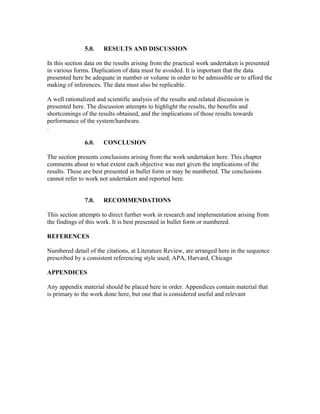
5.0. RESULTS AND DISCUSSION
In this section data on the results arising from the practical work undertaken is presented
in various forms. Duplication of data must be avoided. It is important that the data
presented here be adequate in number or volume in order to be admissible or to afford the
making of inferences. The data must also be replicable.
A well rationalized and scientific analysis of the results and related discussion is
presented here. The discussion attempts to highlight the results, the benefits and
shortcomings of the results obtained, and the implications of those results towards
performance of the system/hardware.
.
6.0. CONCLUSION
The section presents conclusions arising from the work undertaken here. This chapter
comments about to what extent each objective was met given the implications of the
results. These are best presented in bullet form or may be numbered. The conclusions
cannot refer to work not undertaken and reported here.
7.0. RECOMMENDATIONS
This section attempts to direct further work in research and implementation arising from
the findings of this work. It is best presented in bullet form or numbered.
REFERENCES
Numbered detail of the citations, at Literature Review, are arranged here in the sequence
prescribed by a consistent referencing style used; APA, Harvard, Chicago
APPENDICES
Any appendix material should be placed here in order. Appendices contain material that
is primary to the work done here, but one that is considered useful and relevant
Formatting of the Reports
For purposes of ensuring uniformity, the following format should be used for all student
project reports;
1. A4 Size, Portrait format
2. Calibri Size 11
3. All title heads to be in capital and to be bolded
4. All subtitles to be bolded and to have the first letters of each word capitalized
5. A double space to be left between each title and the preceding paragraph
6. A single space to be left between each title and the ensuing paragraph
7. A single space to be left between each title and subtitle and both the preceding
and ensuing paragraph
8. All titles and subtitles to be numbered consecutively throughout the project report
9. All tables to have bolded captions above them, with the first letter of each word
capitalized, and to be numbered consecutively in each chapter
10. All figures to have bolded captions below them, with the first letter of each word
capitalized, and to be numbered consecutively in each chapter
11. All equations to be numbered consecutively in each chapter
12. All tables and figures that may require presentation in landscape format should be
bound rotated 90 degrees counterclockwise
13. START EACH CHAPTER ON ITS OWN PAGE

Report format customised

  • 1.
  • 2.
    THE TECHNICAL UNIVERSITYOF KENYA FACULTY OF ENGINEERING SCIENCES AND TECHNOLOGY SCHOOL OF ELCTRICAL AND ELECTRONIC ENGINEERING DEPARTMENT OF AUTOMATION AND CONTROL ENGINEERING DESIGN AND CONTRUCTION OF AN AUTOMATIC TANK WATER LEVEL CONTROL SYSTEM BY: STEPHEN WANYAMA PROJECT REPORT SUBMITTED IN PARTIAL FULFILLMENT OF THE AWARD OF A BACHELOR OF TECHNOLOGY DEGREE IN ELECTRICAL AND ELECTRONIC ENGINEERING OCTOBER 25, 2014 © Copyright – The Technical University of Kenya The report is the intellectual property of the university and no part or the whole of it shall be reproduced, disseminated or used in any manner electronic or hard copy without the written permission of the university. Any products arising from the work contained in this report are the intellectual property of the author.
  • 3.
    A project reportis typically comprised of the following sections, each starting on its own page; Acknowledgement This is a brief recognition of institutions and persons that have supported the project – a paragraph Dedication This is a brief statement of whom this project is dedicated to – a paragraph Abstract This is a brief statement of the problem, methods of resolving it, recap of the key findings of the study, conclusions and recommendations – a paragraph not exceeding 500 words Table of contents Here, the various sections of the report are identified, each with the page where it starts, including tables, figures and appendices. Table of Figures List of all figures in the report, complete with their titles Table of Tables List of all tables in the report, complete with their titles Table of Appendices List of all appendices in the report, complete with their titles
  • 4.
    1.0. INTRODUCTION This chapterintroduces the problem and proposes an apt solution, which are detailed in the subtitles below; 1.1. Background Would usually introduce the context of problem, highlighting current techniques employed in the environment in which one wants to solve a problem 1.2. Problem Statement This is a statement, or statements, that outline the weaknesses with the said current techniques. These statements basically find fault with or punch holes in the current way (s). 1.3. Proposed Solution / Hypothesis The proposed solution must not broach any specific technology, for instance infrared sensors etc, but must focus only on principles of solution, such as level sensing or level sensor etc. 1.4. Aims 1.4.1. System Aim The eventual main function(s) that the complete hardware should be able to perform 1.4.2. System Objectives The individual tasks that the main parts of the complete hardware should be able to achieve. These objectives should cumulatively result in the aim(s). Understand that during your demonstration of the complete system, the examining panel shall evaluate the success of the system based on whether the said tasks are accurately achieved. Objective statements are best framed as, “The complete system should be able to …………..” 1.5. Block Diagram This is a logical diagram that illustrates the main functionalities of the proposed system, hardware or solution. In tandem with the proposed solution, labeling of blocks should not be specific on a technology but emphasize the principle functionality such as sensor or sensing etc. The diagram is accompanied by a block-by-block and sequential description of the functionalities of the blocks.
  • 5.
    1.6. Specifications System specificationsrefer to the specific operation values that determine its design quantities. The may refer to the sensitivity values, power demands et cetera. For instance, in a temperature control system, which particular temperature is the system meant to maintain, how quickly is it meant to regain the desired temperature in case there is error, et cetera. 2.0. ANALYSIS AND LITERATURE REVIEW Analysis with literature review involves an exploration of the various principles and components that can be employed at each block within the block diagram. It is best done block-by-block. Given that the function of a block is known, various principles and components which can implement the function of the block are explored, so that the most appropriate principle/component is identified based on the strengths and weaknesses of each principle/component. The characteristics that advise the strengths and weaknesses of these principles/components are obtained from a review of relevant literature. Referencing of all work accessed and quoted in this section must be done adopting one consistent format of referencing e.g. Chicago, Harvard, APA styles etc. 3.0. DESIGN This is still best done block-by-block. For each block, the most appropriate principle/component emerging out of the block’s analysis is selected. The components’ specifications and mathematical models are used to compute values for surrounding devices such as resistors, capacitors, inductors etc. The eventual output of this chapter is the circuit diagram, and programs (for microprocessor-based systems). 4.0. CONSTRUCTION AND TESTING An account of the process of construction is given here. The university offers technology and practical scientific training as a key component of its menu. To this end, therefore, all projects must have components of design, fabrication and testing, aimed at the eventual manufacture of products. A project without a product at any stage of its development should therefore not be used to qualify a student for graduation. It is important that students and their supervisors understand this properly in order to ensure adequate time is spent on the projects and proper emphasis is made on achieving this end.
  • 6.
    5.0. RESULTS ANDDISCUSSION In this section data on the results arising from the practical work undertaken is presented in various forms. Duplication of data must be avoided. It is important that the data presented here be adequate in number or volume in order to be admissible or to afford the making of inferences. The data must also be replicable. A well rationalized and scientific analysis of the results and related discussion is presented here. The discussion attempts to highlight the results, the benefits and shortcomings of the results obtained, and the implications of those results towards performance of the system/hardware. . 6.0. CONCLUSION The section presents conclusions arising from the work undertaken here. This chapter comments about to what extent each objective was met given the implications of the results. These are best presented in bullet form or may be numbered. The conclusions cannot refer to work not undertaken and reported here. 7.0. RECOMMENDATIONS This section attempts to direct further work in research and implementation arising from the findings of this work. It is best presented in bullet form or numbered. REFERENCES Numbered detail of the citations, at Literature Review, are arranged here in the sequence prescribed by a consistent referencing style used; APA, Harvard, Chicago APPENDICES Any appendix material should be placed here in order. Appendices contain material that is primary to the work done here, but one that is considered useful and relevant
  • 7.
    Formatting of theReports For purposes of ensuring uniformity, the following format should be used for all student project reports; 1. A4 Size, Portrait format 2. Calibri Size 11 3. All title heads to be in capital and to be bolded 4. All subtitles to be bolded and to have the first letters of each word capitalized 5. A double space to be left between each title and the preceding paragraph 6. A single space to be left between each title and the ensuing paragraph 7. A single space to be left between each title and subtitle and both the preceding and ensuing paragraph 8. All titles and subtitles to be numbered consecutively throughout the project report 9. All tables to have bolded captions above them, with the first letter of each word capitalized, and to be numbered consecutively in each chapter 10. All figures to have bolded captions below them, with the first letter of each word capitalized, and to be numbered consecutively in each chapter 11. All equations to be numbered consecutively in each chapter 12. All tables and figures that may require presentation in landscape format should be bound rotated 90 degrees counterclockwise 13. START EACH CHAPTER ON ITS OWN PAGE