Format for Project
Report
TITLE OF PROJECT REPORT
<Font Size 18><1.5 line spacing><Font Style Times New Roman – Bold>
A PROJECT REPORT
<Font Size 14><Font Style Times New Roman – Bold>
Submittedby
<Font Size 14><Italic><Font Style Times New Roman – Bold>
NAME OF THE CANDIDATE(S)
<Font Size 16><Font Style Times New Roman – Bold>
in partial fulfillment for the award of the degree of
<Font Size 14><1.5 line spacing><Italic><Font Style Times New Roman – Bold>
NAME OF THE DEGREE
<Font Size 16><Font Style Times New Roman – Bold>
IN
BRANCH OF STUDY
<Font Size 14><Font Style Times New Roman>
ChandigarhUniversity
MONTH & YEAR
<Font Size 14>
TITLE OF PROJECT REPORT
A PROJECT REPORT
Submittedby
John Doe (UID) Jane Doe (UID)
in partial fulfillment for the award of the degree of
BACHELOR OF ENGINEERING
IN
ELECTRONICSENGINEERING
Chandigarh University
Dec 2022
BONAFIDE CERTIFICATE
<Font Style Times New Roman – size -16>
<Font Style Times New Roman – size -14>
Certified that this project report “………. TITLE OF THE
PROJECT…………….” is the bonafide work of “…………..NAME OF THE
CANDIDATE(S).…………” who carried out the project work under my/our
supervision.
<<Signature of the HoD>>
SIGNATURE
<<Name of the Head of the Department>>
HEAD OF THE DEPARTMENT
<<Department>>
<<Signature of the Supervisor>>
SIGNATURE
<<Name>>
SUPERVISOR
<<Academic Designation>>
<<Department>>
Submitted for the project viva-voce examination held on
INTERNAL EXAMINER EXTERNAL EXAMINER
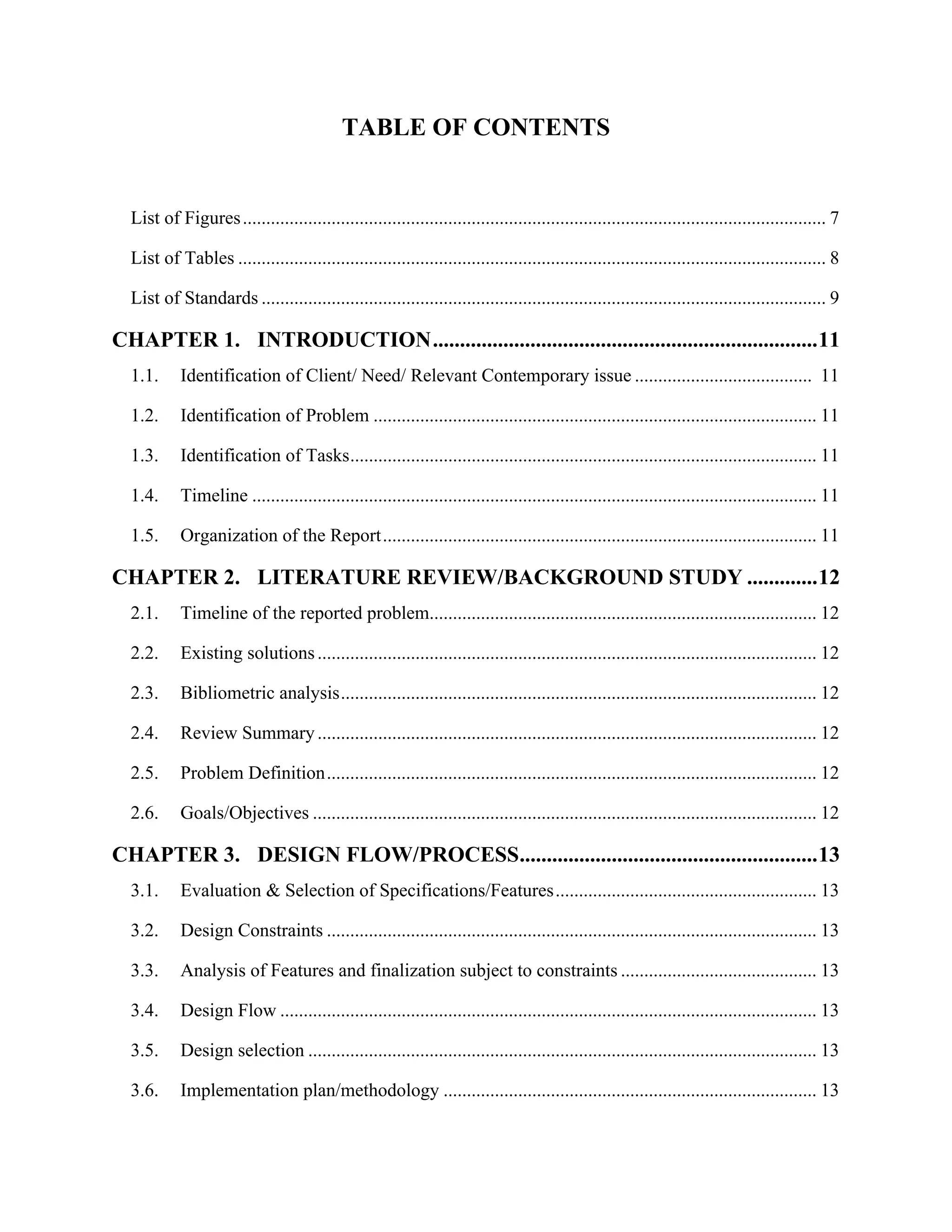
TABLE OF CONTENTS
List of Figures............................................................................................................................. 7
List of Tables .............................................................................................................................. 8
List of Standards ......................................................................................................................... 9
CHAPTER 1. INTRODUCTION.......................................................................11
1.1. Identification of Client/ Need/ Relevant Contemporary issue ...................................... 11
1.2. Identification of Problem ............................................................................................... 11
1.3. Identification of Tasks.................................................................................................... 11
1.4. Timeline ......................................................................................................................... 11
1.5. Organization of the Report............................................................................................. 11
CHAPTER 2. LITERATURE REVIEW/BACKGROUND STUDY .............12
2.1. Timeline of the reported problem................................................................................... 12
2.2. Existing solutions........................................................................................................... 12
2.3. Bibliometric analysis...................................................................................................... 12
2.4. Review Summary........................................................................................................... 12
2.5. Problem Definition......................................................................................................... 12
2.6. Goals/Objectives ............................................................................................................ 12
CHAPTER 3. DESIGN FLOW/PROCESS.......................................................13
3.1. Evaluation & Selection of Specifications/Features........................................................ 13
3.2. Design Constraints ......................................................................................................... 13
3.3. Analysis of Features and finalization subject to constraints .......................................... 13
3.4. Design Flow ................................................................................................................... 13
3.5. Design selection ............................................................................................................. 13
3.6. Implementation plan/methodology ................................................................................ 13
CHAPTER 4. RESULTS ANALYSIS AND VALIDATION ..........................14
4.1. Implementation of solution ............................................................................................ 14
CHAPTER 5. CONCLUSION AND FUTURE WORK ..................................15
5.1. Conclusion...................................................................................................................... 15
5.2. Future work .................................................................................................................... 15
REFERENCES.......................................................................................................16
APPENDIX.............................................................................................................17
1. Plagiarism Report............................................................................................................... 17
2. Design Checklist................................................................................................................ 17
USER MANUAL....................................................................................................18
List of Figures
Figure 3.1 ………………………………………………………………………………….
Figure 3.2 ………………………………………………………………………………….
Figure 4.1 …………………………………………………………………………….……
List of Tables
Table 3.1 ………………………………………………………………………………….
Table 3.2 ………………………………………………………………………………….
Table 4.1 …………………………………………………………………………….……
List of Standards (Mandatory For Engineering Programs)
Standard
Publishing
Agency
About the standard Page no
IEEE
802.11
IEEE
IEEE 802.11 is part of the IEEE
802 set of local area network
(LAN) technical standards and
specifies the set of media access
control (MAC) and physical layer
(PHY) protocols for
implementing wireless local area
network (WLAN) computer
communication.
Mention page nowhere standard
is used
Note: Text in Red is presented as an example (replace with relevant information)
ABSTRACT
---------------------------- New Page -------------------------
GRAPHICAL ABSTRACT
---------------------------- New Page -------------------------
ABBREVIATIONS
---------------------------- New Page -------------------------
SYMBOLS
---------------------------- New Page -------------------------
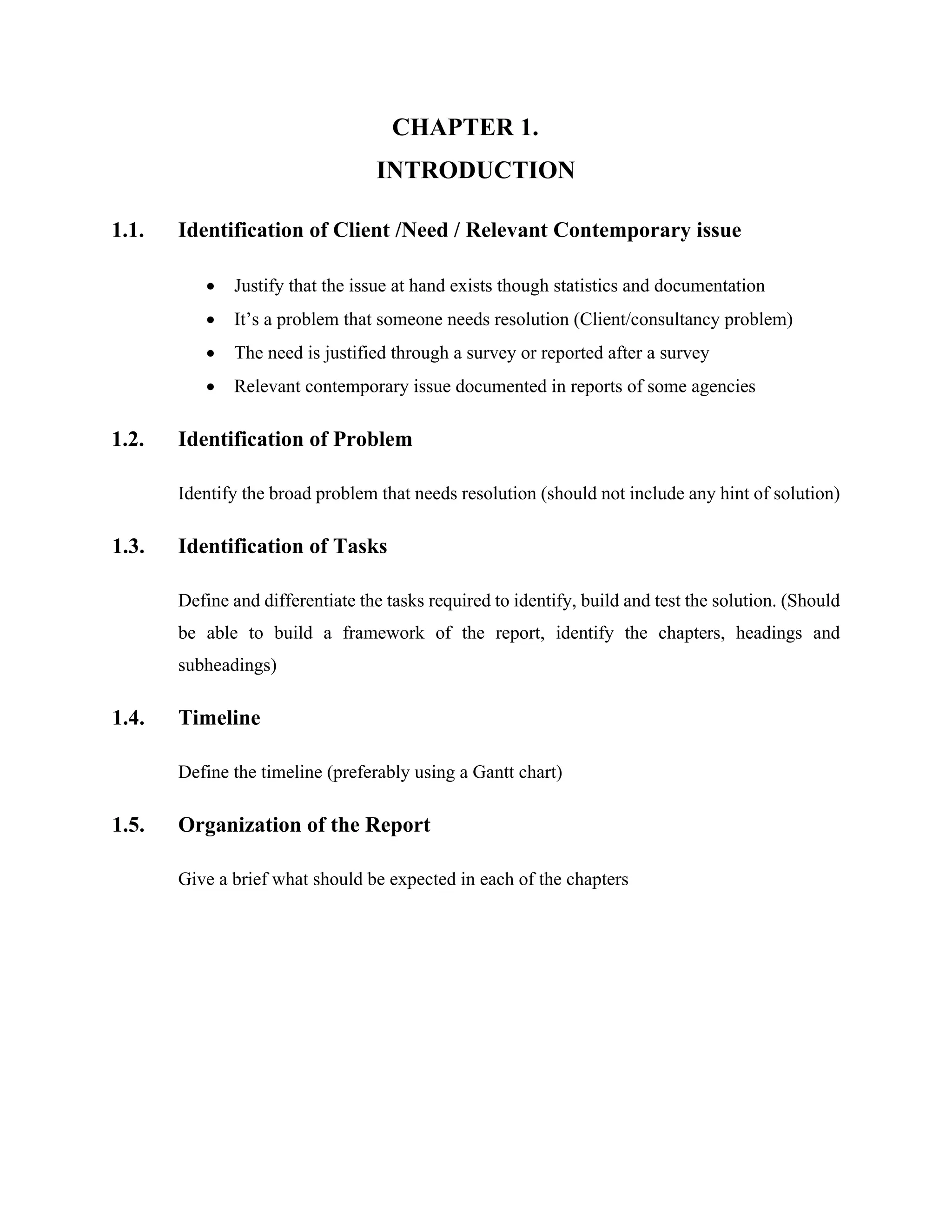
CHAPTER 1.
INTRODUCTION
1.1. Identification of Client /Need / Relevant Contemporary issue
 Justify that the issue at hand exists though statistics and documentation
 It’s a problem that someone needs resolution (Client/consultancy problem)
 The need is justified through a survey or reported after a survey
 Relevant contemporary issue documented in reports of some agencies
1.2. Identification of Problem
Identify the broad problem that needs resolution (should not include any hint of solution)
1.3. Identification of Tasks
Define and differentiate the tasks required to identify, build and test the solution. (Should
be able to build a framework of the report, identify the chapters, headings and
subheadings)
1.4. Timeline
Define the timeline (preferably using a Gantt chart)
1.5. Organization of the Report
Give a brief what should be expected in each of the chapters
CHAPTER 2.
LITERATURE REVIEW/BACKGROUND STUDY
2.1. Timeline of the reported problem
As investigated throughout the world, when was the problem identified, documentary
proof of the incidents.
2.2. Existing solutions
Brief of the earlier proposed solutions
2.3. Bibliometric analysis
Analysis based on (key features, effectiveness and drawback)
2.4. Review Summary
Link findings of literature review with the project at hand.
2.5. Problem Definition
Define the problem at hand including what is to be done, how it is to be done and what
not to be done
2.6. Goals/Objectives
Statements setting the milestones during the course of project work.
Keeping in mind
 Narrow, specific statements about what is to be learned and performed
 Precise intentions
 Tangible
 Concrete
 Can be validated or measure
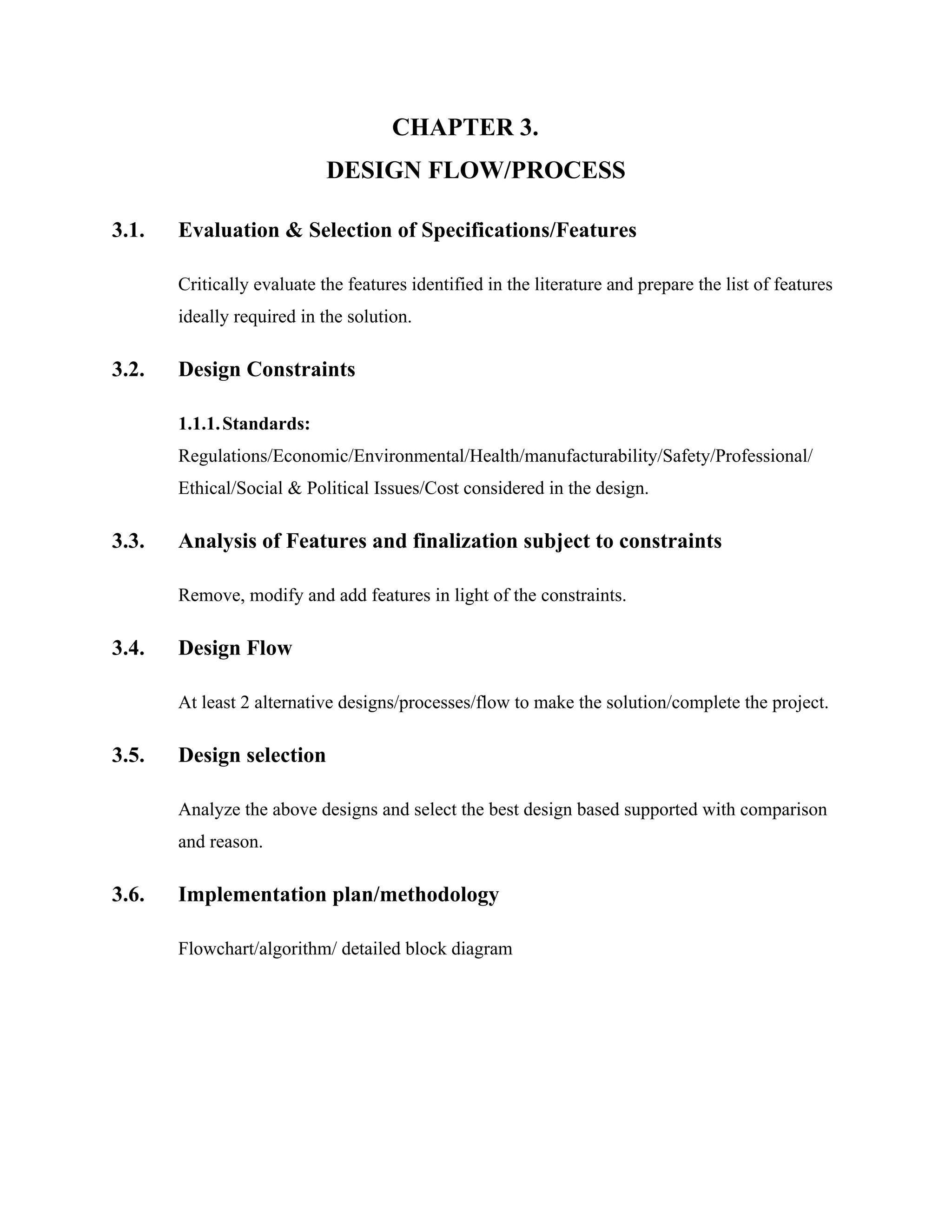
CHAPTER 3.
DESIGN FLOW/PROCESS
3.1. Evaluation & Selection of Specifications/Features
Critically evaluate the features identified in the literature and prepare the list of features
ideally required in the solution.
3.2. Design Constraints
1.1.1.Standards:
Regulations/Economic/Environmental/Health/manufacturability/Safety/Professional/
Ethical/Social & Political Issues/Cost considered in the design.
3.3. Analysis of Features and finalization subject to constraints
Remove, modify and add features in light of the constraints.
3.4. Design Flow
At least 2 alternative designs/processes/flow to make the solution/complete the project.
3.5. Design selection
Analyze the above designs and select the best design based supported with comparison
and reason.
3.6. Implementation plan/methodology
Flowchart/algorithm/ detailed block diagram
CHAPTER 4.
RESULTS ANALYSIS AND VALIDATION
4.1. Implementation of solution
Use modern tools in:
 analysis,
 design drawings/schematics/ solid models,
 report preparation,
 project management, and communication,
 Testing/characterization/interpretation/data validation.
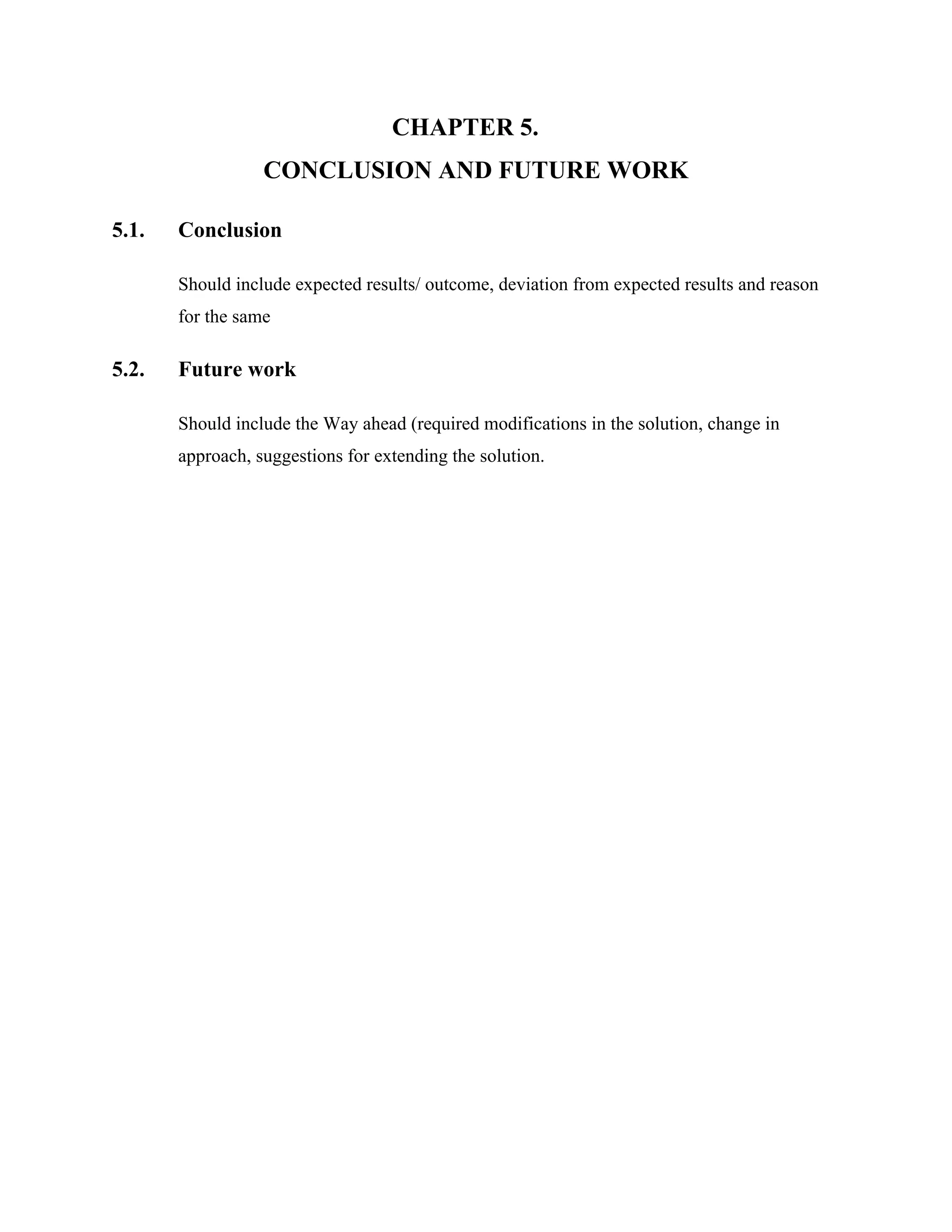
CHAPTER 5.
CONCLUSION AND FUTURE WORK
5.1. Conclusion
Should include expected results/ outcome, deviation from expected results and reason
for the same
5.2. Future work
Should include the Way ahead (required modifications in the solution, change in
approach, suggestions for extending the solution.
REFERENCES
APPENDIX
1. Plagiarism Report
2. Design Checklist
USER MANUAL
(Complete step by step instructions along with pictures necessary to run the project)

Report_Format.pdf

  • 1.
  • 2.
    TITLE OF PROJECTREPORT <Font Size 18><1.5 line spacing><Font Style Times New Roman – Bold> A PROJECT REPORT <Font Size 14><Font Style Times New Roman – Bold> Submittedby <Font Size 14><Italic><Font Style Times New Roman – Bold> NAME OF THE CANDIDATE(S) <Font Size 16><Font Style Times New Roman – Bold> in partial fulfillment for the award of the degree of <Font Size 14><1.5 line spacing><Italic><Font Style Times New Roman – Bold> NAME OF THE DEGREE <Font Size 16><Font Style Times New Roman – Bold> IN BRANCH OF STUDY <Font Size 14><Font Style Times New Roman> ChandigarhUniversity MONTH & YEAR <Font Size 14>
  • 3.
    TITLE OF PROJECTREPORT A PROJECT REPORT Submittedby John Doe (UID) Jane Doe (UID) in partial fulfillment for the award of the degree of BACHELOR OF ENGINEERING IN ELECTRONICSENGINEERING Chandigarh University Dec 2022
  • 4.
    BONAFIDE CERTIFICATE <Font StyleTimes New Roman – size -16> <Font Style Times New Roman – size -14> Certified that this project report “………. TITLE OF THE PROJECT…………….” is the bonafide work of “…………..NAME OF THE CANDIDATE(S).…………” who carried out the project work under my/our supervision. <<Signature of the HoD>> SIGNATURE <<Name of the Head of the Department>> HEAD OF THE DEPARTMENT <<Department>> <<Signature of the Supervisor>> SIGNATURE <<Name>> SUPERVISOR <<Academic Designation>> <<Department>> Submitted for the project viva-voce examination held on INTERNAL EXAMINER EXTERNAL EXAMINER
  • 5.
    TABLE OF CONTENTS Listof Figures............................................................................................................................. 7 List of Tables .............................................................................................................................. 8 List of Standards ......................................................................................................................... 9 CHAPTER 1. INTRODUCTION.......................................................................11 1.1. Identification of Client/ Need/ Relevant Contemporary issue ...................................... 11 1.2. Identification of Problem ............................................................................................... 11 1.3. Identification of Tasks.................................................................................................... 11 1.4. Timeline ......................................................................................................................... 11 1.5. Organization of the Report............................................................................................. 11 CHAPTER 2. LITERATURE REVIEW/BACKGROUND STUDY .............12 2.1. Timeline of the reported problem................................................................................... 12 2.2. Existing solutions........................................................................................................... 12 2.3. Bibliometric analysis...................................................................................................... 12 2.4. Review Summary........................................................................................................... 12 2.5. Problem Definition......................................................................................................... 12 2.6. Goals/Objectives ............................................................................................................ 12 CHAPTER 3. DESIGN FLOW/PROCESS.......................................................13 3.1. Evaluation & Selection of Specifications/Features........................................................ 13 3.2. Design Constraints ......................................................................................................... 13 3.3. Analysis of Features and finalization subject to constraints .......................................... 13 3.4. Design Flow ................................................................................................................... 13 3.5. Design selection ............................................................................................................. 13 3.6. Implementation plan/methodology ................................................................................ 13
  • 6.
    CHAPTER 4. RESULTSANALYSIS AND VALIDATION ..........................14 4.1. Implementation of solution ............................................................................................ 14 CHAPTER 5. CONCLUSION AND FUTURE WORK ..................................15 5.1. Conclusion...................................................................................................................... 15 5.2. Future work .................................................................................................................... 15 REFERENCES.......................................................................................................16 APPENDIX.............................................................................................................17 1. Plagiarism Report............................................................................................................... 17 2. Design Checklist................................................................................................................ 17 USER MANUAL....................................................................................................18
  • 7.
    List of Figures Figure3.1 …………………………………………………………………………………. Figure 3.2 …………………………………………………………………………………. Figure 4.1 …………………………………………………………………………….……
  • 8.
    List of Tables Table3.1 …………………………………………………………………………………. Table 3.2 …………………………………………………………………………………. Table 4.1 …………………………………………………………………………….……
  • 9.
    List of Standards(Mandatory For Engineering Programs) Standard Publishing Agency About the standard Page no IEEE 802.11 IEEE IEEE 802.11 is part of the IEEE 802 set of local area network (LAN) technical standards and specifies the set of media access control (MAC) and physical layer (PHY) protocols for implementing wireless local area network (WLAN) computer communication. Mention page nowhere standard is used Note: Text in Red is presented as an example (replace with relevant information)
  • 10.
    ABSTRACT ---------------------------- New Page------------------------- GRAPHICAL ABSTRACT ---------------------------- New Page ------------------------- ABBREVIATIONS ---------------------------- New Page ------------------------- SYMBOLS ---------------------------- New Page -------------------------
  • 11.
    CHAPTER 1. INTRODUCTION 1.1. Identificationof Client /Need / Relevant Contemporary issue  Justify that the issue at hand exists though statistics and documentation  It’s a problem that someone needs resolution (Client/consultancy problem)  The need is justified through a survey or reported after a survey  Relevant contemporary issue documented in reports of some agencies 1.2. Identification of Problem Identify the broad problem that needs resolution (should not include any hint of solution) 1.3. Identification of Tasks Define and differentiate the tasks required to identify, build and test the solution. (Should be able to build a framework of the report, identify the chapters, headings and subheadings) 1.4. Timeline Define the timeline (preferably using a Gantt chart) 1.5. Organization of the Report Give a brief what should be expected in each of the chapters
  • 12.
    CHAPTER 2. LITERATURE REVIEW/BACKGROUNDSTUDY 2.1. Timeline of the reported problem As investigated throughout the world, when was the problem identified, documentary proof of the incidents. 2.2. Existing solutions Brief of the earlier proposed solutions 2.3. Bibliometric analysis Analysis based on (key features, effectiveness and drawback) 2.4. Review Summary Link findings of literature review with the project at hand. 2.5. Problem Definition Define the problem at hand including what is to be done, how it is to be done and what not to be done 2.6. Goals/Objectives Statements setting the milestones during the course of project work. Keeping in mind  Narrow, specific statements about what is to be learned and performed  Precise intentions  Tangible  Concrete  Can be validated or measure
  • 13.
    CHAPTER 3. DESIGN FLOW/PROCESS 3.1.Evaluation & Selection of Specifications/Features Critically evaluate the features identified in the literature and prepare the list of features ideally required in the solution. 3.2. Design Constraints 1.1.1.Standards: Regulations/Economic/Environmental/Health/manufacturability/Safety/Professional/ Ethical/Social & Political Issues/Cost considered in the design. 3.3. Analysis of Features and finalization subject to constraints Remove, modify and add features in light of the constraints. 3.4. Design Flow At least 2 alternative designs/processes/flow to make the solution/complete the project. 3.5. Design selection Analyze the above designs and select the best design based supported with comparison and reason. 3.6. Implementation plan/methodology Flowchart/algorithm/ detailed block diagram
  • 14.
    CHAPTER 4. RESULTS ANALYSISAND VALIDATION 4.1. Implementation of solution Use modern tools in:  analysis,  design drawings/schematics/ solid models,  report preparation,  project management, and communication,  Testing/characterization/interpretation/data validation.
  • 15.
    CHAPTER 5. CONCLUSION ANDFUTURE WORK 5.1. Conclusion Should include expected results/ outcome, deviation from expected results and reason for the same 5.2. Future work Should include the Way ahead (required modifications in the solution, change in approach, suggestions for extending the solution.
  • 16.
  • 17.
  • 18.
    USER MANUAL (Complete stepby step instructions along with pictures necessary to run the project)