BETHANIYA KASSAYE
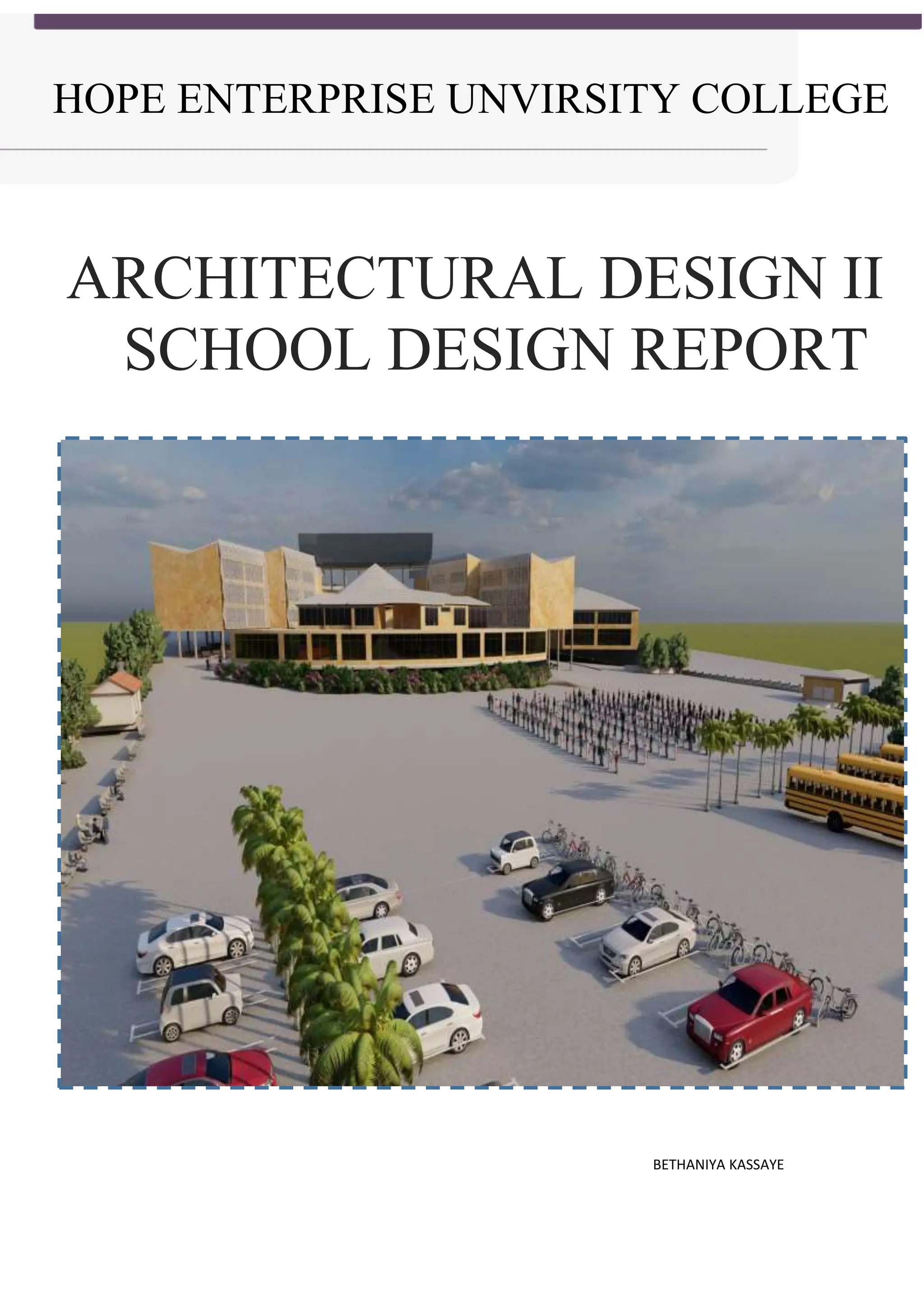
ARCHITECTURAL DESIGN II
SCHOOL DESIGN REPORT
BBBB
HOPE ENTERPRISE UNVIRSITY COLLEGE
NATNAEL BIRHANU
Table of content
Descriptions of the project
General Introduction
Concept or theme of the Building
Site Development (Massing)
Formal composition (Expression)
Space usage and Articulations
Functional arrangements and Flow
Facades Treatment
Materials
Sustainability features
Technology
Natural Lighting, Ventilation and Acoustics...
Building Details: - Openings, Connections, Colors…
Other Building Systems or Services: - Elevators, Escalators, Toilets…
Conclusions
Descriptions of the project
This semester project is about creating a sustainable and well adaptable
space for students .
Our task is to create a unique space for students from 9th grade to 12th
grade.
What make this project unique ?
Is it being out of the usual traditional class room model.
Our main purpose to create a kind of space is for students to experience
new activities to make the teaching learning process more exciting and
fun to create a moment.
General Introduction
The high school we designed have lots of unique characters that is out of
the usual high school .
We designed this program thinking of adapting new experience
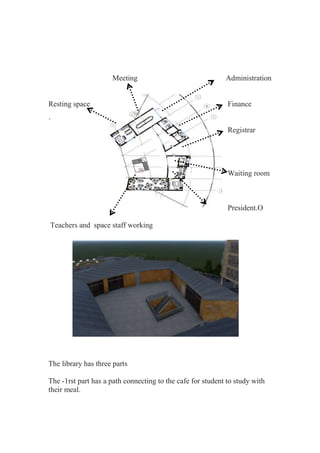
The program list include-
-Administration
Registrar
-Working space
Teachers and staff working space
-Resting space
Teachers and staff resting area which include mini kitchen and resting
area.
-The president oce,the vice president and waiting room.
- Cafeteria
Wide space for students teachers and student
- Library
Meeting Administration
Resting space Finance
`
Registrar
Waiting room
President.O
Teachers and space staff working
The library has three parts
The -1rst part has a path connecting to the cafe for student to study with
their meal.
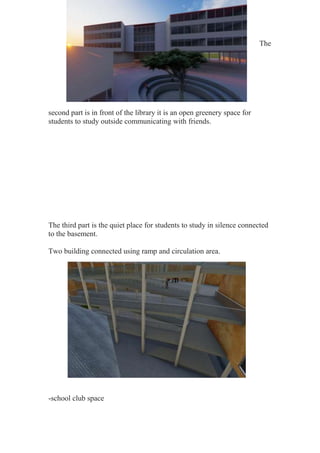
The
second part is in front of the library it is an open greenery space for
students to study outside communicating with friends.
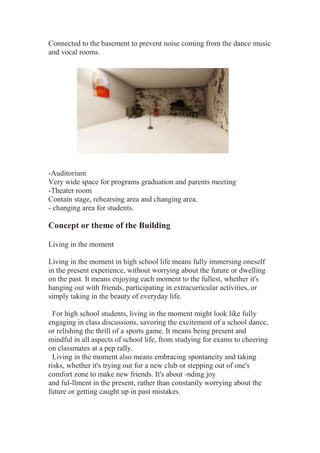
The third part is the quiet place for students to study in silence connected
to the basement.
Two building connected using ramp and circulation area.
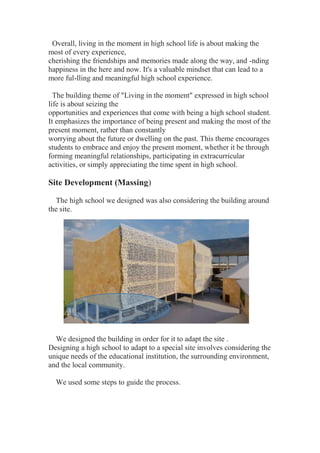
-school club space
Connected to the basement to prevent noise coming from the dance music
and vocal rooms.
-Auditorium
Very wide space for programs graduation and parents meeting
-Theater room
Contain stage, rehearsing area and changing area.
- changing area for students.
Concept or theme of the Building
Living in the moment
Living in the moment in high school life means fully immersing oneself
in the present experience, without worrying about the future or dwelling
on the past. It means enjoying each moment to the fullest, whether it's
hanging out with friends, participating in extracurricular activities, or
simply taking in the beauty of everyday life.
For high school students, living in the moment might look like fully
engaging in class discussions, savoring the excitement of a school dance,
or relishing the thrill of a sports game. It means being present and
mindful in all aspects of school life, from studying for exams to cheering
on classmates at a pep rally.
Living in the moment also means embracing spontaneity and taking
risks, whether it's trying out for a new club or stepping out of one's
comfort zone to make new friends. It's about -nding joy
and ful-llment in the present, rather than constantly worrying about the
future or getting caught up in past mistakes.
Overall, living in the moment in high school life is about making the
most of every experience,
cherishing the friendships and memories made along the way, and -nding
happiness in the here and now. It's a valuable mindset that can lead to a
more ful-lling and meaningful high school experience.
The building theme of "Living in the moment" expressed in high school
life is about seizing the
opportunities and experiences that come with being a high school student.
It emphasizes the importance of being present and making the most of the
present moment, rather than constantly
worrying about the future or dwelling on the past. This theme encourages
students to embrace and enjoy the present moment, whether it be through
forming meaningful relationships, participating in extracurricular
activities, or simply appreciating the time spent in high school.
Site Development (Massing)
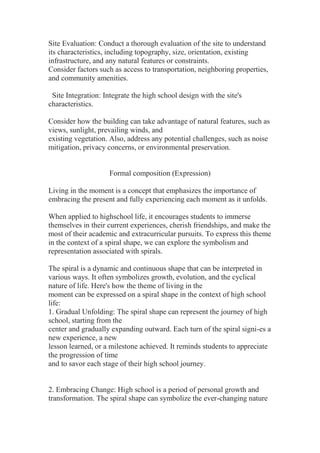
The high school we designed was also considering the building around
the site.
We designed the building in order for it to adapt the site .
Designing a high school to adapt to a special site involves considering the
unique needs of the educational institution, the surrounding environment,
and the local community.
We used some steps to guide the process.
Site Evaluation: Conduct a thorough evaluation of the site to understand
its characteristics, including topography, size, orientation, existing
infrastructure, and any natural features or constraints.
Consider factors such as access to transportation, neighboring properties,
and community amenities.
Site Integration: Integrate the high school design with the site's
characteristics.
Consider how the building can take advantage of natural features, such as
views, sunlight, prevailing winds, and
existing vegetation. Also, address any potential challenges, such as noise
mitigation, privacy concerns, or environmental preservation.
Formal composition (Expression)
Living in the moment is a concept that emphasizes the importance of
embracing the present and fully experiencing each moment as it unfolds.
When applied to highschool life, it encourages students to immerse
themselves in their current experiences, cherish friendships, and make the
most of their academic and extracurricular pursuits. To express this theme
in the context of a spiral shape, we can explore the symbolism and
representation associated with spirals.
The spiral is a dynamic and continuous shape that can be interpreted in
various ways. It often symbolizes growth, evolution, and the cyclical
nature of life. Here's how the theme of living in the
moment can be expressed on a spiral shape in the context of high school
life:
1. Gradual Unfolding: The spiral shape can represent the journey of high
school, starting from the
center and gradually expanding outward. Each turn of the spiral signi-es a
new experience, a new
lesson learned, or a milestone achieved. It reminds students to appreciate
the progression of time
and to savor each stage of their high school journey.
2. Embracing Change: High school is a period of personal growth and
transformation. The spiral shape can symbolize the ever-changing nature
of student life, encouraging individuals to embrace change and adapt to
new circumstances. It serves as a reminder that high school is a eet
ing phase, and by living in the moment, students can make the most of
their ever-evolving environment.
3. Mindful Presence: The spiral can also represent mindfulness and being
fully present in each
moment. As students navigate the twists and turns of high school life, the
spiral serves as a reminder to stay grounded and engaged. By cultivating
mindfulness, students can appreciate the
small joys, celebrate achievements, and form deeper connections with
their peers.
4. Connection and Interdependence: A spiral is composed of
interconnected loops, symbolizing the relationships and social dynamics
within a high school community. It highlights the significance of
meaningful connections with classmates, teachers, and mentors. Students
can recognize that the quality of their interactions and relationships
greatly contributes to their overall high school experience.
5. Expanding Horizons: The spiral shape can represent the broader
perspective gained during high school. As students move outward on the
spiral, they are exposed to new subjects, ideas, and opportunities. It
encourages them to explore diverse interests, step out of their comfort
zones, and broaden their horizons. By living in the moment, students can
fully engage with these opportunities and develop a well-rounded
perspective.
By expressing the theme of living in the moment on a spiral shape in the
context of high school life, students are reminded to cherish their
experiences, embrace growth and change, cultivate mindfulness, foster
connections, and expand their horizons. It serves as a visual
representation of the transformative journey that high school and
encourages students to make the most of their present moments.
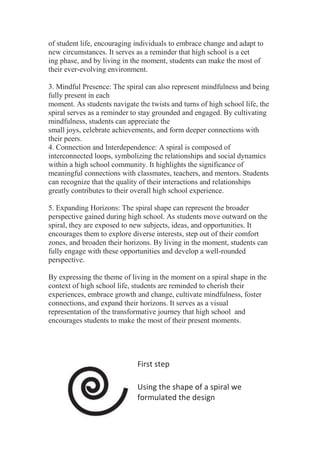
First step
Using the shape of a spiral we
formulated the design
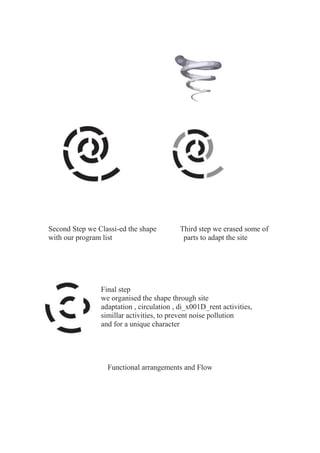
Second Step we Classi-ed the shape Third step we erased some of
with our program list parts to adapt the site
Final step
we organised the shape through site
adaptation , circulation , di_x001D_rent activities,
simillar activities, to prevent noise pollution
and for a unique character
Functional arrangements and Flow
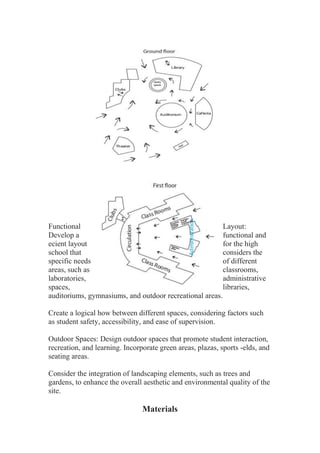
Functional Layout:
Develop a functional and
ecient layout for the high
school that considers the
specific needs of different
areas, such as classrooms,
laboratories, administrative
spaces, libraries,
auditoriums, gymnasiums, and outdoor recreational areas.
Create a logical how between different spaces, considering factors such
as student safety, accessibility, and ease of supervision.
Outdoor Spaces: Design outdoor spaces that promote student interaction,
recreation, and learning. Incorporate green areas, plazas, sports -elds, and
seating areas.
Consider the integration of landscaping elements, such as trees and
gardens, to enhance the overall aesthetic and environmental quality of the
site.
Materials
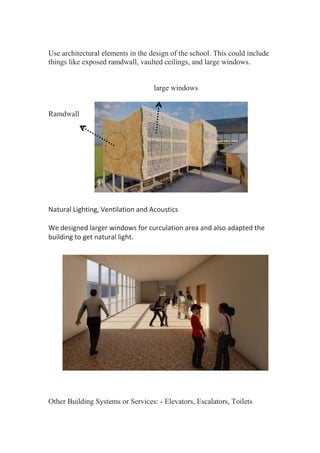
Use architectural elements in the design of the school. This could include
things like exposed ramdwall, vaulted ceilings, and large windows.
large windows
Ramdwall
Natural Lighting, Ventilation and Acoustics
We designed larger windows for curculation area and also adapted the
building to get natural light.
Other Building Systems or Services: - Elevators, Escalators, Toilets
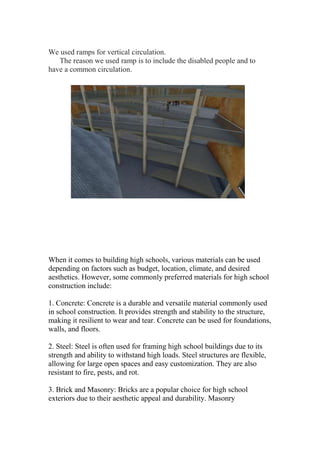
We used ramps for vertical circulation.
The reason we used ramp is to include the disabled people and to
have a common circulation.
When it comes to building high schools, various materials can be used
depending on factors such as budget, location, climate, and desired
aesthetics. However, some commonly preferred materials for high school
construction include:
1. Concrete: Concrete is a durable and versatile material commonly used
in school construction. It provides strength and stability to the structure,
making it resilient to wear and tear. Concrete can be used for foundations,
walls, and floors.
2. Steel: Steel is often used for framing high school buildings due to its
strength and ability to withstand high loads. Steel structures are flexible,
allowing for large open spaces and easy customization. They are also
resistant to fire, pests, and rot.
3. Brick and Masonry: Bricks are a popular choice for high school
exteriors due to their aesthetic appeal and durability. Masonry
construction provides good insulation and thermal mass, helping to
regulate temperature and reduce energy consumption.
4. Glass: Glass is commonly used for windows, curtain walls, and atriums
in high school buildings. It allows natural light into the interior spaces,
enhances visual connectivity, and creates a more open and welcoming
environment.
5. Wood: Wood is a renewable and sustainable material that can be used
for interior finishes, doors, and furniture. It adds warmth and a natural
aesthetic to the building. However, its use in structural elements may be
limited to specific areas or in combination with other materials for fire
safety reasons.
6. Sustainable Materials: With a growing focus on sustainability, high
schools may incorporate environmentally friendly materials such as
recycled steel, bamboo, reclaimed wood, or low VOC (volatile organic
compound) paints and finishes. These materials help reduce the
environmental impact of construction and promote healthier indoor air
quality.
Some unique materials that can be used in building a high school to
create a distinctive and innovative design. Here are a few examples:
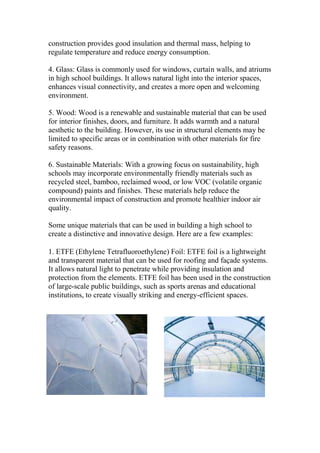
1. ETFE (Ethylene Tetrafluoroethylene) Foil: ETFE foil is a lightweight
and transparent material that can be used for roofing and façade systems.
It allows natural light to penetrate while providing insulation and
protection from the elements. ETFE foil has been used in the construction
of large-scale public buildings, such as sports arenas and educational
institutions, to create visually striking and energy-efficient spaces.
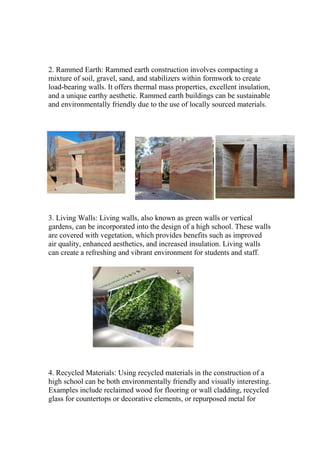
2. Rammed Earth: Rammed earth construction involves compacting a
mixture of soil, gravel, sand, and stabilizers within formwork to create
load-bearing walls. It offers thermal mass properties, excellent insulation,
and a unique earthy aesthetic. Rammed earth buildings can be sustainable
and environmentally friendly due to the use of locally sourced materials.
3. Living Walls: Living walls, also known as green walls or vertical
gardens, can be incorporated into the design of a high school. These walls
are covered with vegetation, which provides benefits such as improved
air quality, enhanced aesthetics, and increased insulation. Living walls
can create a refreshing and vibrant environment for students and staff.
4. Recycled Materials: Using recycled materials in the construction of a
high school can be both environmentally friendly and visually interesting.
Examples include reclaimed wood for flooring or wall cladding, recycled
glass for countertops or decorative elements, or repurposed metal for
architectural features. Utilizing recycled materials can give a unique
character to the building while promoting sustainability.
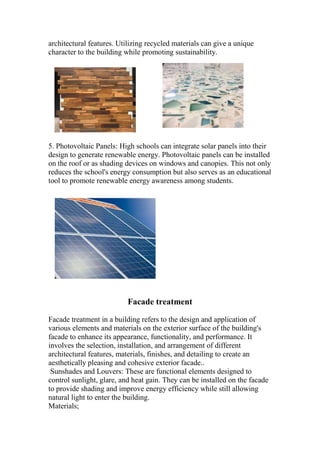
5. Photovoltaic Panels: High schools can integrate solar panels into their
design to generate renewable energy. Photovoltaic panels can be installed
on the roof or as shading devices on windows and canopies. This not only
reduces the school's energy consumption but also serves as an educational
tool to promote renewable energy awareness among students.
Facade treatment
Facade treatment in a building refers to the design and application of
various elements and materials on the exterior surface of the building's
facade to enhance its appearance, functionality, and performance. It
involves the selection, installation, and arrangement of different
architectural features, materials, finishes, and detailing to create an
aesthetically pleasing and cohesive exterior facade..
Sunshades and Louvers: These are functional elements designed to
control sunlight, glare, and heat gain. They can be installed on the facade
to provide shading and improve energy efficiency while still allowing
natural light to enter the building.
Materials;
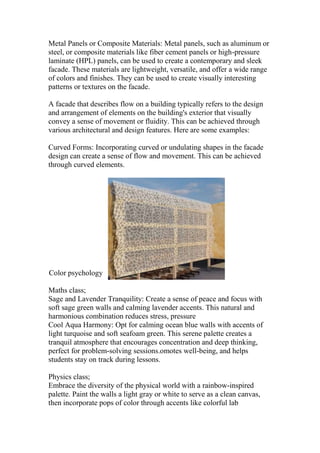
Metal Panels or Composite Materials: Metal panels, such as aluminum or
steel, or composite materials like fiber cement panels or high-pressure
laminate (HPL) panels, can be used to create a contemporary and sleek
facade. These materials are lightweight, versatile, and offer a wide range
of colors and finishes. They can be used to create visually interesting
patterns or textures on the facade.
A facade that describes flow on a building typically refers to the design
and arrangement of elements on the building's exterior that visually
convey a sense of movement or fluidity. This can be achieved through
various architectural and design features. Here are some examples:
Curved Forms: Incorporating curved or undulating shapes in the facade
design can create a sense of flow and movement. This can be achieved
through curved elements.
Color psychology
Maths class;
Sage and Lavender Tranquility: Create a sense of peace and focus with
soft sage green walls and calming lavender accents. This natural and
harmonious combination reduces stress, pressure
Cool Aqua Harmony: Opt for calming ocean blue walls with accents of
light turquoise and soft seafoam green. This serene palette creates a
tranquil atmosphere that encourages concentration and deep thinking,
perfect for problem-solving sessions.omotes well-being, and helps
students stay on track during lessons.
Physics class;
Embrace the diversity of the physical world with a rainbow-inspired
palette. Paint the walls a light gray or white to serve as a clean canvas,
then incorporate pops of color through accents like colorful lab
equipment, student artwork depicting scientific concepts, or even
educational posters showcasing the electromagnetic spectrum. This
vibrant approach reflects the multifaceted nature of physics and
encourages exploration and discovery.
Biology class;
Embrace the natural world with a calming green base color for the walls,
like sage green or olive green. This evokes the lushness of forests,
grasslands, and other ecosystems, creating a serene and inviting
atmosphere for learning about life's intricate processes.
English class;
Supplement the mural with color-coded shelves for different genres,
using warm oranges and yellows for adventure.
Amharic class;
Calming blues and greens for historical fiction, and vibrant purples and
pinks for contemporary literature.
Economic class;
Incorporate pops of gold or yellow to represent success and prosperity,
along with touches of brown or gray for charts and graphs, creating a
balanced and professional atmosphere.
Agricultural class;
Add pops of bright green (lime, emerald) to represent various plant
varieties, touches of brown (soil, wood) for farm elements, and hints of
yellow and orange for ripening fruits or agricultural machinery.
Chemistry class;
Play with bold contrasts to stimulate curiosity and represent the exciting
nature of chemical reactions. You could paint one wall a deep blue to
represent night, then create yellow streaks across it like lightning,
symbolizing electrical reactions. Alternatively, use contrasting red and
green to depict exothermic and endothermic reactions.
History class;
Paint the walls with a gradient transition from blue (ancient history) to
green (medieval) to brown (early modern) to orange (industrial) to red
(contemporary). This visually showcases the flow of time and invites
students to journey through different eras.
Technical drawing class;
Opt for a calming and neutral base color like light gray, beige, or white.
This creates a clean canvas for focusing on technical details and avoids
distracting from intricate drawings and plans.
Geography class;
Embrace the globe-trotting spirit of geography with a map of the world
painted across the walls. Highlight different continents or regions with
distinct color palettes, using warm hues for deserts, lush greens for
rainforests, and cool blues for oceans. This visual reminder of Earth's
diversity ignites students' imagination and invites them to explore
different corners of the planet.
Information technology (IT);
Use pops of bright color as highlights, like blue for coding screens, green
for network diagrams, or orange for innovation and creativity.
Incorporate sleek accents like chrome or glass furniture and keep
decorations minimal for a polished and professional feel.
Sports class;
Go for a vibrant and energizing mix of colors to reflect the dynamic
nature of sports. Use a bright base color like yellow or orange, and add
pops of contrasting hues like blue, green, and red representing different
sports disciplines. This energizes the space and encourages a positive and
active attitude.
Civic class;
Embrace the balance and cooperation inherent in a healthy democracy
with a dual-tone color scheme. Paint one wall a strong blue (representing
government and authority) and another a vibrant green (representing the
people and community). This visual reminder prompts discussions about
the interplay between these two crucial elements.
Corridors;
Visibility and safety: Light-colored floors like beige, tan, or pale yellow
enhance visibility, aiding pedestrian flow and highlighting potential
hazards. They also make the space feel brighter and more open.

Report for school design & Report for school design

  • 1.
    BETHANIYA KASSAYE ARCHITECTURAL DESIGNII SCHOOL DESIGN REPORT BBBB HOPE ENTERPRISE UNVIRSITY COLLEGE
  • 2.
    NATNAEL BIRHANU Table ofcontent Descriptions of the project General Introduction Concept or theme of the Building Site Development (Massing) Formal composition (Expression) Space usage and Articulations Functional arrangements and Flow Facades Treatment Materials Sustainability features Technology Natural Lighting, Ventilation and Acoustics... Building Details: - Openings, Connections, Colors… Other Building Systems or Services: - Elevators, Escalators, Toilets… Conclusions
  • 3.
    Descriptions of theproject This semester project is about creating a sustainable and well adaptable space for students . Our task is to create a unique space for students from 9th grade to 12th grade. What make this project unique ? Is it being out of the usual traditional class room model. Our main purpose to create a kind of space is for students to experience new activities to make the teaching learning process more exciting and fun to create a moment. General Introduction The high school we designed have lots of unique characters that is out of the usual high school . We designed this program thinking of adapting new experience The program list include- -Administration Registrar -Working space Teachers and staff working space -Resting space Teachers and staff resting area which include mini kitchen and resting area. -The president oce,the vice president and waiting room. - Cafeteria Wide space for students teachers and student - Library
  • 4.
    Meeting Administration Resting spaceFinance ` Registrar Waiting room President.O Teachers and space staff working The library has three parts The -1rst part has a path connecting to the cafe for student to study with their meal.
  • 5.
    The second part isin front of the library it is an open greenery space for students to study outside communicating with friends. The third part is the quiet place for students to study in silence connected to the basement. Two building connected using ramp and circulation area. -school club space
  • 6.
    Connected to thebasement to prevent noise coming from the dance music and vocal rooms. -Auditorium Very wide space for programs graduation and parents meeting -Theater room Contain stage, rehearsing area and changing area. - changing area for students. Concept or theme of the Building Living in the moment Living in the moment in high school life means fully immersing oneself in the present experience, without worrying about the future or dwelling on the past. It means enjoying each moment to the fullest, whether it's hanging out with friends, participating in extracurricular activities, or simply taking in the beauty of everyday life. For high school students, living in the moment might look like fully engaging in class discussions, savoring the excitement of a school dance, or relishing the thrill of a sports game. It means being present and mindful in all aspects of school life, from studying for exams to cheering on classmates at a pep rally. Living in the moment also means embracing spontaneity and taking risks, whether it's trying out for a new club or stepping out of one's comfort zone to make new friends. It's about -nding joy and ful-llment in the present, rather than constantly worrying about the future or getting caught up in past mistakes.
  • 7.
    Overall, living inthe moment in high school life is about making the most of every experience, cherishing the friendships and memories made along the way, and -nding happiness in the here and now. It's a valuable mindset that can lead to a more ful-lling and meaningful high school experience. The building theme of "Living in the moment" expressed in high school life is about seizing the opportunities and experiences that come with being a high school student. It emphasizes the importance of being present and making the most of the present moment, rather than constantly worrying about the future or dwelling on the past. This theme encourages students to embrace and enjoy the present moment, whether it be through forming meaningful relationships, participating in extracurricular activities, or simply appreciating the time spent in high school. Site Development (Massing) The high school we designed was also considering the building around the site. We designed the building in order for it to adapt the site . Designing a high school to adapt to a special site involves considering the unique needs of the educational institution, the surrounding environment, and the local community. We used some steps to guide the process.
  • 8.
    Site Evaluation: Conducta thorough evaluation of the site to understand its characteristics, including topography, size, orientation, existing infrastructure, and any natural features or constraints. Consider factors such as access to transportation, neighboring properties, and community amenities. Site Integration: Integrate the high school design with the site's characteristics. Consider how the building can take advantage of natural features, such as views, sunlight, prevailing winds, and existing vegetation. Also, address any potential challenges, such as noise mitigation, privacy concerns, or environmental preservation. Formal composition (Expression) Living in the moment is a concept that emphasizes the importance of embracing the present and fully experiencing each moment as it unfolds. When applied to highschool life, it encourages students to immerse themselves in their current experiences, cherish friendships, and make the most of their academic and extracurricular pursuits. To express this theme in the context of a spiral shape, we can explore the symbolism and representation associated with spirals. The spiral is a dynamic and continuous shape that can be interpreted in various ways. It often symbolizes growth, evolution, and the cyclical nature of life. Here's how the theme of living in the moment can be expressed on a spiral shape in the context of high school life: 1. Gradual Unfolding: The spiral shape can represent the journey of high school, starting from the center and gradually expanding outward. Each turn of the spiral signi-es a new experience, a new lesson learned, or a milestone achieved. It reminds students to appreciate the progression of time and to savor each stage of their high school journey. 2. Embracing Change: High school is a period of personal growth and transformation. The spiral shape can symbolize the ever-changing nature
  • 9.
    of student life,encouraging individuals to embrace change and adapt to new circumstances. It serves as a reminder that high school is a eet ing phase, and by living in the moment, students can make the most of their ever-evolving environment. 3. Mindful Presence: The spiral can also represent mindfulness and being fully present in each moment. As students navigate the twists and turns of high school life, the spiral serves as a reminder to stay grounded and engaged. By cultivating mindfulness, students can appreciate the small joys, celebrate achievements, and form deeper connections with their peers. 4. Connection and Interdependence: A spiral is composed of interconnected loops, symbolizing the relationships and social dynamics within a high school community. It highlights the significance of meaningful connections with classmates, teachers, and mentors. Students can recognize that the quality of their interactions and relationships greatly contributes to their overall high school experience. 5. Expanding Horizons: The spiral shape can represent the broader perspective gained during high school. As students move outward on the spiral, they are exposed to new subjects, ideas, and opportunities. It encourages them to explore diverse interests, step out of their comfort zones, and broaden their horizons. By living in the moment, students can fully engage with these opportunities and develop a well-rounded perspective. By expressing the theme of living in the moment on a spiral shape in the context of high school life, students are reminded to cherish their experiences, embrace growth and change, cultivate mindfulness, foster connections, and expand their horizons. It serves as a visual representation of the transformative journey that high school and encourages students to make the most of their present moments. First step Using the shape of a spiral we formulated the design
  • 10.
    Second Step weClassi-ed the shape Third step we erased some of with our program list parts to adapt the site Final step we organised the shape through site adaptation , circulation , di_x001D_rent activities, simillar activities, to prevent noise pollution and for a unique character Functional arrangements and Flow
  • 11.
    Functional Layout: Develop afunctional and ecient layout for the high school that considers the specific needs of different areas, such as classrooms, laboratories, administrative spaces, libraries, auditoriums, gymnasiums, and outdoor recreational areas. Create a logical how between different spaces, considering factors such as student safety, accessibility, and ease of supervision. Outdoor Spaces: Design outdoor spaces that promote student interaction, recreation, and learning. Incorporate green areas, plazas, sports -elds, and seating areas. Consider the integration of landscaping elements, such as trees and gardens, to enhance the overall aesthetic and environmental quality of the site. Materials
  • 12.
    Use architectural elementsin the design of the school. This could include things like exposed ramdwall, vaulted ceilings, and large windows. large windows Ramdwall Natural Lighting, Ventilation and Acoustics We designed larger windows for curculation area and also adapted the building to get natural light. Other Building Systems or Services: - Elevators, Escalators, Toilets
  • 13.
    We used rampsfor vertical circulation. The reason we used ramp is to include the disabled people and to have a common circulation. When it comes to building high schools, various materials can be used depending on factors such as budget, location, climate, and desired aesthetics. However, some commonly preferred materials for high school construction include: 1. Concrete: Concrete is a durable and versatile material commonly used in school construction. It provides strength and stability to the structure, making it resilient to wear and tear. Concrete can be used for foundations, walls, and floors. 2. Steel: Steel is often used for framing high school buildings due to its strength and ability to withstand high loads. Steel structures are flexible, allowing for large open spaces and easy customization. They are also resistant to fire, pests, and rot. 3. Brick and Masonry: Bricks are a popular choice for high school exteriors due to their aesthetic appeal and durability. Masonry
  • 14.
    construction provides goodinsulation and thermal mass, helping to regulate temperature and reduce energy consumption. 4. Glass: Glass is commonly used for windows, curtain walls, and atriums in high school buildings. It allows natural light into the interior spaces, enhances visual connectivity, and creates a more open and welcoming environment. 5. Wood: Wood is a renewable and sustainable material that can be used for interior finishes, doors, and furniture. It adds warmth and a natural aesthetic to the building. However, its use in structural elements may be limited to specific areas or in combination with other materials for fire safety reasons. 6. Sustainable Materials: With a growing focus on sustainability, high schools may incorporate environmentally friendly materials such as recycled steel, bamboo, reclaimed wood, or low VOC (volatile organic compound) paints and finishes. These materials help reduce the environmental impact of construction and promote healthier indoor air quality. Some unique materials that can be used in building a high school to create a distinctive and innovative design. Here are a few examples: 1. ETFE (Ethylene Tetrafluoroethylene) Foil: ETFE foil is a lightweight and transparent material that can be used for roofing and façade systems. It allows natural light to penetrate while providing insulation and protection from the elements. ETFE foil has been used in the construction of large-scale public buildings, such as sports arenas and educational institutions, to create visually striking and energy-efficient spaces.
  • 15.
    2. Rammed Earth:Rammed earth construction involves compacting a mixture of soil, gravel, sand, and stabilizers within formwork to create load-bearing walls. It offers thermal mass properties, excellent insulation, and a unique earthy aesthetic. Rammed earth buildings can be sustainable and environmentally friendly due to the use of locally sourced materials. 3. Living Walls: Living walls, also known as green walls or vertical gardens, can be incorporated into the design of a high school. These walls are covered with vegetation, which provides benefits such as improved air quality, enhanced aesthetics, and increased insulation. Living walls can create a refreshing and vibrant environment for students and staff. 4. Recycled Materials: Using recycled materials in the construction of a high school can be both environmentally friendly and visually interesting. Examples include reclaimed wood for flooring or wall cladding, recycled glass for countertops or decorative elements, or repurposed metal for
  • 16.
    architectural features. Utilizingrecycled materials can give a unique character to the building while promoting sustainability. 5. Photovoltaic Panels: High schools can integrate solar panels into their design to generate renewable energy. Photovoltaic panels can be installed on the roof or as shading devices on windows and canopies. This not only reduces the school's energy consumption but also serves as an educational tool to promote renewable energy awareness among students. Facade treatment Facade treatment in a building refers to the design and application of various elements and materials on the exterior surface of the building's facade to enhance its appearance, functionality, and performance. It involves the selection, installation, and arrangement of different architectural features, materials, finishes, and detailing to create an aesthetically pleasing and cohesive exterior facade.. Sunshades and Louvers: These are functional elements designed to control sunlight, glare, and heat gain. They can be installed on the facade to provide shading and improve energy efficiency while still allowing natural light to enter the building. Materials;
  • 17.
    Metal Panels orComposite Materials: Metal panels, such as aluminum or steel, or composite materials like fiber cement panels or high-pressure laminate (HPL) panels, can be used to create a contemporary and sleek facade. These materials are lightweight, versatile, and offer a wide range of colors and finishes. They can be used to create visually interesting patterns or textures on the facade. A facade that describes flow on a building typically refers to the design and arrangement of elements on the building's exterior that visually convey a sense of movement or fluidity. This can be achieved through various architectural and design features. Here are some examples: Curved Forms: Incorporating curved or undulating shapes in the facade design can create a sense of flow and movement. This can be achieved through curved elements. Color psychology Maths class; Sage and Lavender Tranquility: Create a sense of peace and focus with soft sage green walls and calming lavender accents. This natural and harmonious combination reduces stress, pressure Cool Aqua Harmony: Opt for calming ocean blue walls with accents of light turquoise and soft seafoam green. This serene palette creates a tranquil atmosphere that encourages concentration and deep thinking, perfect for problem-solving sessions.omotes well-being, and helps students stay on track during lessons. Physics class; Embrace the diversity of the physical world with a rainbow-inspired palette. Paint the walls a light gray or white to serve as a clean canvas, then incorporate pops of color through accents like colorful lab
  • 18.
    equipment, student artworkdepicting scientific concepts, or even educational posters showcasing the electromagnetic spectrum. This vibrant approach reflects the multifaceted nature of physics and encourages exploration and discovery. Biology class; Embrace the natural world with a calming green base color for the walls, like sage green or olive green. This evokes the lushness of forests, grasslands, and other ecosystems, creating a serene and inviting atmosphere for learning about life's intricate processes. English class; Supplement the mural with color-coded shelves for different genres, using warm oranges and yellows for adventure. Amharic class; Calming blues and greens for historical fiction, and vibrant purples and pinks for contemporary literature. Economic class; Incorporate pops of gold or yellow to represent success and prosperity, along with touches of brown or gray for charts and graphs, creating a balanced and professional atmosphere. Agricultural class; Add pops of bright green (lime, emerald) to represent various plant varieties, touches of brown (soil, wood) for farm elements, and hints of yellow and orange for ripening fruits or agricultural machinery. Chemistry class; Play with bold contrasts to stimulate curiosity and represent the exciting nature of chemical reactions. You could paint one wall a deep blue to represent night, then create yellow streaks across it like lightning, symbolizing electrical reactions. Alternatively, use contrasting red and green to depict exothermic and endothermic reactions. History class; Paint the walls with a gradient transition from blue (ancient history) to green (medieval) to brown (early modern) to orange (industrial) to red (contemporary). This visually showcases the flow of time and invites students to journey through different eras. Technical drawing class;
  • 19.
    Opt for acalming and neutral base color like light gray, beige, or white. This creates a clean canvas for focusing on technical details and avoids distracting from intricate drawings and plans. Geography class; Embrace the globe-trotting spirit of geography with a map of the world painted across the walls. Highlight different continents or regions with distinct color palettes, using warm hues for deserts, lush greens for rainforests, and cool blues for oceans. This visual reminder of Earth's diversity ignites students' imagination and invites them to explore different corners of the planet. Information technology (IT); Use pops of bright color as highlights, like blue for coding screens, green for network diagrams, or orange for innovation and creativity. Incorporate sleek accents like chrome or glass furniture and keep decorations minimal for a polished and professional feel. Sports class; Go for a vibrant and energizing mix of colors to reflect the dynamic nature of sports. Use a bright base color like yellow or orange, and add pops of contrasting hues like blue, green, and red representing different sports disciplines. This energizes the space and encourages a positive and active attitude. Civic class; Embrace the balance and cooperation inherent in a healthy democracy with a dual-tone color scheme. Paint one wall a strong blue (representing government and authority) and another a vibrant green (representing the people and community). This visual reminder prompts discussions about the interplay between these two crucial elements. Corridors; Visibility and safety: Light-colored floors like beige, tan, or pale yellow enhance visibility, aiding pedestrian flow and highlighting potential hazards. They also make the space feel brighter and more open.