THE 1987
CONSTITUTI
ON
CHAPTER 6: OTHER EDUCATION AND
TEACHER-RELATED LAWS
LESSON 1
REPORTER: ROXY JEN L. FONTELO
WHATS IN IT
FOR ME?
 LEGAL COMPLIANCE
 QUALITY EDUCATION
 RIGHTS & RESPONSIBILITIES
 STUDENT PROTECTION
 ADVOCAY & REFORM
PREAMBLE
We, the sovereign Filipino people, imploring the aid of Almighty
God, in order to build a just and humane society and establish a
Government that shall embody our ideals and aspirations,
promote the common good, conserve and develop our
patrimony, and secure to ourselves and our posterity, the
blessings of independence and democracy under the rule of
law and a regime of truth, justice, freedom, love, equality, and
peace, do ordain and promulgate this Constitution.
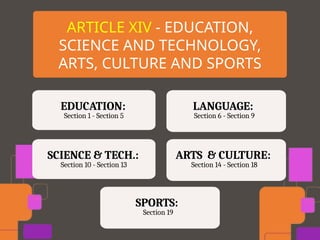
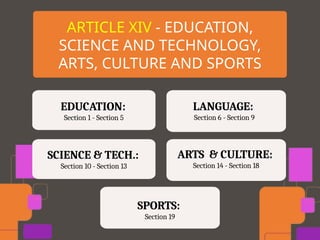
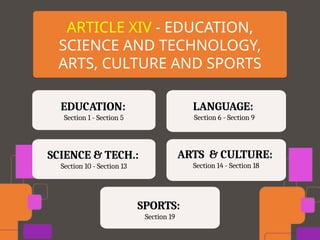
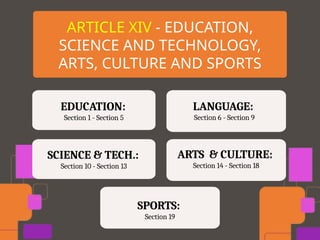
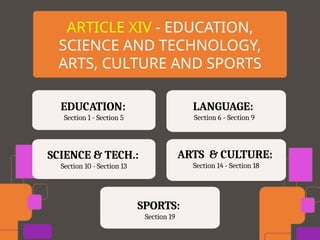
ARTICLE XIV - EDUCATION,
SCIENCE AND TECHNOLOGY,
ARTS, CULTURE AND SPORTS
EDUCATION:
Section 1 - Section 5
LANGUAGE:
Section 6 - Section 9
SCIENCE & TECH.:
Section 10 - Section 13
ARTS & CULTURE:
Section 14 - Section 18
SPORTS:
Section 19
ARTICLE XIV - EDUCATION,
SCIENCE AND TECHNOLOGY,
ARTS, CULTURE AND SPORTS
EDUCATION:
Section 1 - Section 5
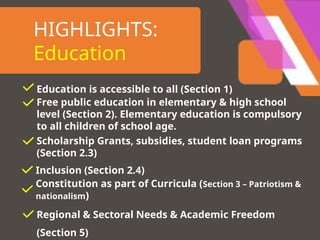
HIGHLIGHTS:
Education
Education is accessible to all (Section 1)
Free public education in elementary & high school
level (Section 2). Elementary education is compulsory
to all children of school age.
Scholarship Grants, subsidies, student loan programs
(Section 2.3)
Inclusion (Section 2.4)
Constitution as part of Curricula (Section 3 – Patriotism &
nationalism)
Regional & Sectoral Needs & Academic Freedom
(Section 5)
ARTICLE XIV - EDUCATION,
SCIENCE AND TECHNOLOGY,
ARTS, CULTURE AND SPORTS
EDUCATION:
Section 1 - Section 5
LANGUAGE:
Section 6 - Section 9
SCIENCE & TECH.:
Section 10 - Section 13
ARTS & CULTURE:
Section 14 - Section 18
SPORTS:
Section 19
ARTICLE XIV - EDUCATION,
SCIENCE AND TECHNOLOGY,
ARTS, CULTURE AND SPORTS
LANGUAGE:
Section 6 - Section 9
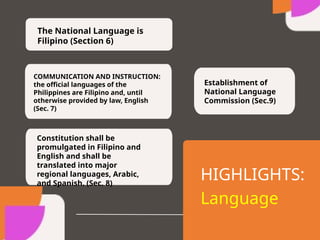
The National Language is
Filipino (Section 6)
COMMUNICATION AND INSTRUCTION:
the official languages of the
Philippines are Filipino and, until
otherwise provided by law, English
(Sec. 7)
Constitution shall be
promulgated in Filipino and
English and shall be
translated into major
regional languages, Arabic,
and Spanish. (Sec. 8)
Establishment of
National Language
Commission (Sec.9)
HIGHLIGHTS:
Language
ARTICLE XIV - EDUCATION,
SCIENCE AND TECHNOLOGY,
ARTS, CULTURE AND SPORTS
EDUCATION:
Section 1 - Section 5
LANGUAGE:
Section 6 - Section 9
SCIENCE & TECH.:
Section 10 - Section 13
ARTS & CULTURE:
Section 14 - Section 18
SPORTS:
Section 19
ARTICLE XIV - EDUCATION,
SCIENCE AND TECHNOLOGY,
ARTS, CULTURE AND SPORTS
SCIENCE & TECH.:
Section 10 - Section 13
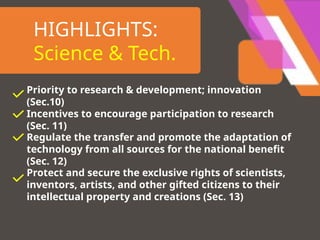
HIGHLIGHTS:
Science & Tech.
Priority to research & development; innovation
(Sec.10)
Incentives to encourage participation to research
(Sec. 11)
Regulate the transfer and promote the adaptation of
technology from all sources for the national benefit
(Sec. 12)
Protect and secure the exclusive rights of scientists,
inventors, artists, and other gifted citizens to their
intellectual property and creations (Sec. 13)
ARTICLE XIV - EDUCATION,
SCIENCE AND TECHNOLOGY,
ARTS, CULTURE AND SPORTS
EDUCATION:
Section 1 - Section 5
LANGUAGE:
Section 6 - Section 9
SCIENCE & TECH.:
Section 10 - Section 13
ARTS & CULTURE:
Section 14 - Section 18
SPORTS:
Section 19
ARTICLE XIV - EDUCATION,
SCIENCE AND TECHNOLOGY,
ARTS, CULTURE AND SPORTS
ARTS & CULTURE:
Section 14 - Section 18
HIGHLIGHTS:
Arts & Culture
Preservation, enrichment, and dynamic
evolution of a Filipino national culture
(Sec. 14)
Conserve, promote, and popularize the
nation’s historical and cultural heritage
and resources, as well as artistic
creations (Sec. 15)
Recognize, respect, and protect the
rights of indigenous cultural
communities to preserve and develop
their cultures, traditions, and
institutions (Sec. 17)
Cultural treasure of the
nation shall be under the
protection of the State
(Sec. 16)
Encourage and support
researches and studies on
the arts and culture.
(Sec. 18.2)
Equal access to cultural
opportunities through the
educational system, grants,
incentives (Sec. 18.1)
ARTICLE XIV - EDUCATION,
SCIENCE AND TECHNOLOGY,
ARTS, CULTURE AND SPORTS
EDUCATION:
Section 1 - Section 5
LANGUAGE:
Section 6 - Section 9
SCIENCE & TECH.:
Section 10 - Section 13
ARTS & CULTURE:
Section 14 - Section 18
SPORTS:
Section 19
ARTICLE XIV - EDUCATION,
SCIENCE AND TECHNOLOGY,
ARTS, CULTURE AND SPORTS
SPORTS:
Section 19
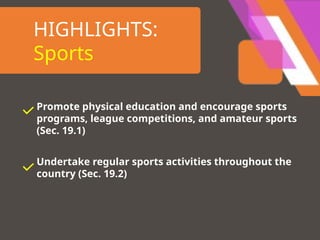
HIGHLIGHTS:
Sports
Promote physical education and encourage sports
programs, league competitions, and amateur sports
(Sec. 19.1)
Undertake regular sports activities throughout the
country (Sec. 19.2)
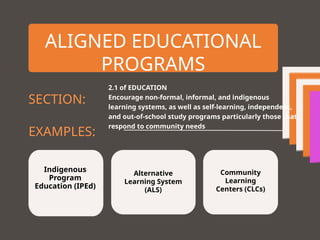
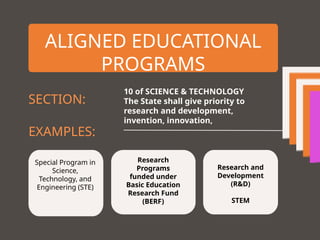
ALIGNED EDUCATIONAL
PROGRAMS
Indigenous
Program
Education (IPEd)
Alternative
Learning System
(ALS)
Community
Learning
Centers (CLCs)
SECTION:
2.1 of EDUCATION
Encourage non-formal, informal, and indigenous
learning systems, as well as self-learning, independent,
and out-of-school study programs particularly those that
respond to community needs
EXAMPLES:
ALIGNED EDUCATIONAL
PROGRAMS
Special Program in
Science,
Technology, and
Engineering (STE)
Research
Programs
funded under
Basic Education
Research Fund
(BERF)
Research and
Development
(R&D)
STEM
SECTION:
10 of SCIENCE & TECHNOLOGY
The State shall give priority to
research and development,
invention, innovation,
EXAMPLES:
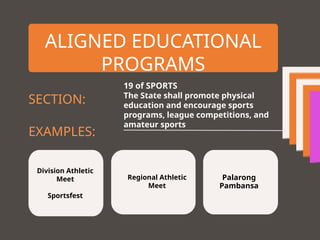
ALIGNED EDUCATIONAL
PROGRAMS
Division Athletic
Meet
Sportsfest
Regional Athletic
Meet
Palarong
Pambansa
SECTION:
19 of SPORTS
The State shall promote physical
education and encourage sports
programs, league competitions, and
amateur sports
EXAMPLES:
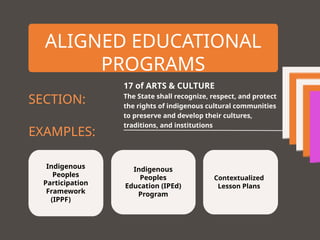
ALIGNED EDUCATIONAL
PROGRAMS
Indigenous
Peoples
Participation
Framework
(IPPF)
Indigenous
Peoples
Education (IPEd)
Program
Contextualized
Lesson Plans
SECTION:
17 of ARTS & CULTURE
The State shall recognize, respect, and protect
the rights of indigenous cultural communities
to preserve and develop their cultures,
traditions, and institutions
EXAMPLES:
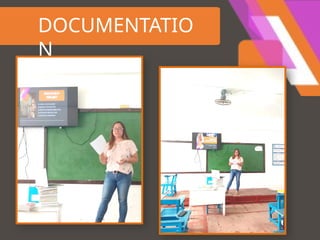
DOCUMENTATIO
N
DOCUMENTATIO
N
DOCUMENTATIO
N
DOCUMENTATIO
N
Ped 202:
TEACHING
PROFESSION
TOPIC/REPORT: THE 1987
CONSTITUTION
Submitted by: ROXY JEN L. FONTELO
Submitted To: RICKY LEGARIA

REPORT-CHAPTER6-LESSON1-THE-1987-CONSTITUTION.pptx

  • 1.
    THE 1987 CONSTITUTI ON CHAPTER 6:OTHER EDUCATION AND TEACHER-RELATED LAWS LESSON 1 REPORTER: ROXY JEN L. FONTELO
  • 3.
    WHATS IN IT FORME?  LEGAL COMPLIANCE  QUALITY EDUCATION  RIGHTS & RESPONSIBILITIES  STUDENT PROTECTION  ADVOCAY & REFORM
  • 4.
    PREAMBLE We, the sovereignFilipino people, imploring the aid of Almighty God, in order to build a just and humane society and establish a Government that shall embody our ideals and aspirations, promote the common good, conserve and develop our patrimony, and secure to ourselves and our posterity, the blessings of independence and democracy under the rule of law and a regime of truth, justice, freedom, love, equality, and peace, do ordain and promulgate this Constitution.
  • 5.
    ARTICLE XIV -EDUCATION, SCIENCE AND TECHNOLOGY, ARTS, CULTURE AND SPORTS EDUCATION: Section 1 - Section 5 LANGUAGE: Section 6 - Section 9 SCIENCE & TECH.: Section 10 - Section 13 ARTS & CULTURE: Section 14 - Section 18 SPORTS: Section 19
  • 6.
    ARTICLE XIV -EDUCATION, SCIENCE AND TECHNOLOGY, ARTS, CULTURE AND SPORTS EDUCATION: Section 1 - Section 5
  • 7.
    HIGHLIGHTS: Education Education is accessibleto all (Section 1) Free public education in elementary & high school level (Section 2). Elementary education is compulsory to all children of school age. Scholarship Grants, subsidies, student loan programs (Section 2.3) Inclusion (Section 2.4) Constitution as part of Curricula (Section 3 – Patriotism & nationalism) Regional & Sectoral Needs & Academic Freedom (Section 5)
  • 8.
    ARTICLE XIV -EDUCATION, SCIENCE AND TECHNOLOGY, ARTS, CULTURE AND SPORTS EDUCATION: Section 1 - Section 5 LANGUAGE: Section 6 - Section 9 SCIENCE & TECH.: Section 10 - Section 13 ARTS & CULTURE: Section 14 - Section 18 SPORTS: Section 19
  • 9.
    ARTICLE XIV -EDUCATION, SCIENCE AND TECHNOLOGY, ARTS, CULTURE AND SPORTS LANGUAGE: Section 6 - Section 9
  • 10.
    The National Languageis Filipino (Section 6) COMMUNICATION AND INSTRUCTION: the official languages of the Philippines are Filipino and, until otherwise provided by law, English (Sec. 7) Constitution shall be promulgated in Filipino and English and shall be translated into major regional languages, Arabic, and Spanish. (Sec. 8) Establishment of National Language Commission (Sec.9) HIGHLIGHTS: Language
  • 11.
    ARTICLE XIV -EDUCATION, SCIENCE AND TECHNOLOGY, ARTS, CULTURE AND SPORTS EDUCATION: Section 1 - Section 5 LANGUAGE: Section 6 - Section 9 SCIENCE & TECH.: Section 10 - Section 13 ARTS & CULTURE: Section 14 - Section 18 SPORTS: Section 19
  • 12.
    ARTICLE XIV -EDUCATION, SCIENCE AND TECHNOLOGY, ARTS, CULTURE AND SPORTS SCIENCE & TECH.: Section 10 - Section 13
  • 13.
    HIGHLIGHTS: Science & Tech. Priorityto research & development; innovation (Sec.10) Incentives to encourage participation to research (Sec. 11) Regulate the transfer and promote the adaptation of technology from all sources for the national benefit (Sec. 12) Protect and secure the exclusive rights of scientists, inventors, artists, and other gifted citizens to their intellectual property and creations (Sec. 13)
  • 14.
    ARTICLE XIV -EDUCATION, SCIENCE AND TECHNOLOGY, ARTS, CULTURE AND SPORTS EDUCATION: Section 1 - Section 5 LANGUAGE: Section 6 - Section 9 SCIENCE & TECH.: Section 10 - Section 13 ARTS & CULTURE: Section 14 - Section 18 SPORTS: Section 19
  • 15.
    ARTICLE XIV -EDUCATION, SCIENCE AND TECHNOLOGY, ARTS, CULTURE AND SPORTS ARTS & CULTURE: Section 14 - Section 18
  • 16.
    HIGHLIGHTS: Arts & Culture Preservation,enrichment, and dynamic evolution of a Filipino national culture (Sec. 14) Conserve, promote, and popularize the nation’s historical and cultural heritage and resources, as well as artistic creations (Sec. 15) Recognize, respect, and protect the rights of indigenous cultural communities to preserve and develop their cultures, traditions, and institutions (Sec. 17) Cultural treasure of the nation shall be under the protection of the State (Sec. 16) Encourage and support researches and studies on the arts and culture. (Sec. 18.2) Equal access to cultural opportunities through the educational system, grants, incentives (Sec. 18.1)
  • 17.
    ARTICLE XIV -EDUCATION, SCIENCE AND TECHNOLOGY, ARTS, CULTURE AND SPORTS EDUCATION: Section 1 - Section 5 LANGUAGE: Section 6 - Section 9 SCIENCE & TECH.: Section 10 - Section 13 ARTS & CULTURE: Section 14 - Section 18 SPORTS: Section 19
  • 18.
    ARTICLE XIV -EDUCATION, SCIENCE AND TECHNOLOGY, ARTS, CULTURE AND SPORTS SPORTS: Section 19
  • 19.
    HIGHLIGHTS: Sports Promote physical educationand encourage sports programs, league competitions, and amateur sports (Sec. 19.1) Undertake regular sports activities throughout the country (Sec. 19.2)
  • 20.
    ALIGNED EDUCATIONAL PROGRAMS Indigenous Program Education (IPEd) Alternative LearningSystem (ALS) Community Learning Centers (CLCs) SECTION: 2.1 of EDUCATION Encourage non-formal, informal, and indigenous learning systems, as well as self-learning, independent, and out-of-school study programs particularly those that respond to community needs EXAMPLES:
  • 21.
    ALIGNED EDUCATIONAL PROGRAMS Special Programin Science, Technology, and Engineering (STE) Research Programs funded under Basic Education Research Fund (BERF) Research and Development (R&D) STEM SECTION: 10 of SCIENCE & TECHNOLOGY The State shall give priority to research and development, invention, innovation, EXAMPLES:
  • 22.
    ALIGNED EDUCATIONAL PROGRAMS Division Athletic Meet Sportsfest RegionalAthletic Meet Palarong Pambansa SECTION: 19 of SPORTS The State shall promote physical education and encourage sports programs, league competitions, and amateur sports EXAMPLES:
  • 23.
    ALIGNED EDUCATIONAL PROGRAMS Indigenous Peoples Participation Framework (IPPF) Indigenous Peoples Education (IPEd) Program Contextualized LessonPlans SECTION: 17 of ARTS & CULTURE The State shall recognize, respect, and protect the rights of indigenous cultural communities to preserve and develop their cultures, traditions, and institutions EXAMPLES:
  • 25.
  • 26.
  • 27.
  • 28.
  • 29.
    Ped 202: TEACHING PROFESSION TOPIC/REPORT: THE1987 CONSTITUTION Submitted by: ROXY JEN L. FONTELO Submitted To: RICKY LEGARIA

Editor's Notes

  • #7 SECTION 1. The State shall protect and promote the right of all citizens to quality education at all levels and shall take appropriate steps to make such education accessible to all. SECTION 2. The State shall: (1) Establish, maintain, and support a complete, adequate, and integrated system of education relevant to the needs of the people and society; (2) Establish and maintain a system of free public education in the elementary and high school levels. Without limiting the natural right of parents to rear their children, elementary education is compulsory for all children of school age; (3) Establish and maintain a system of scholarship grants, student loan programs, subsidies, and other incentives which shall be available to deserving students in both public and private schools, especially to the underprivileged; (4) Encourage non-formal, informal, and indigenous learning systems, as well as self-learning, independent, and out-of-school study programs particularly those that respond to community needs; and (5) Provide adult citizens, the disabled, and out-of-school youth with training in civics, vocational efficiency, and other skills. SECTION 3. (1) All educational institutions shall include the study of the Constitution as part of the curricula. (2) They shall inculcate patriotism and nationalism, foster love of humanity, respect for human rights, appreciation of the role of national heroes in the historical development of the country, teach the rights and duties of citizenship, strengthen ethical and spiritual values, develop moral character and personal discipline, encourage critical and creative thinking, broaden scientific and technological knowledge, and promote vocational efficiency. (3) At the option expressed in writing by the parents or guardians, religion shall be allowed to be taught to their children or wards in public elementary and high schools within the regular class hours by instructors designated or approved by the religious authorities of the religion to which the children or wards belong, without additional cost to the Government. SECTION 4. (1) The State recognizes the complementary roles of public and private institutions in the educational system and shall exercise reasonable supervision and regulation of all educational institutions. (2) Educational institutions, other than those established by religious groups and mission boards, shall be owned solely by citizens of the Philippines or corporations or associations at least sixty per centum of the capital of which is owned by such citizens. The Congress may, however, require increased Filipino equity participation in all educational institutions. The control and administration of educational institutions shall be vested in citizens of the Philippines. No educational institution shall be established exclusively for aliens and no group of aliens shall comprise more than one-third of the enrollment in any school. The provisions of this subsection shall not apply to schools established for foreign diplomatic personnel and their dependents and, unless otherwise provided by law, for other foreign temporary residents. (3) All revenues and assets of non-stock, non-profit educational institutions used actually, directly, and exclusively for educational purposes shall be exempt from taxes and duties. Upon the dissolution or cessation of the corporate existence of such institutions, their assets shall be disposed of in the manner provided by law. Proprietary educational institutions, including those cooperatively owned, may likewise be entitled to such exemptions subject to the limitations provided by law including restrictions on dividends and provisions for reinvestment. (4) Subject to conditions prescribed by law, all grants, endowments, donations, or contributions used actually, directly, and exclusively for educational purposes shall be exempt from tax. SECTION 5. (1) The State shall take into account regional and sectoral needs and conditions and shall encourage local planning in the development of educational policies and programs. (2) Academic freedom shall be enjoyed in all institutions of higher learning. (3) Every citizen has a right to select a profession or course of study, subject to fair, reasonable, and equitable admission and academic requirements. (4) The State shall enhance the right of teachers to professional advancement. Non-teaching academic and non-academic personnel shall enjoy the protection of the State.