Design For Electric Driving
Student: Glenn Jacobs
Coach: Jan Rouvroye
Date: 27-04-2010
Abstract
Mobility and especially auto mobility has nested itself in our society
and became one of the prime factors to the smooth functioning of and
sustaining the economy.
The automotive industry is a huge employer and driver of knowledge
and innovation. On a global scale the automotive industry is good
for a turnover around $2.6 trillion, and it contributes 6 percent to
the gross domestic product to the EU. On a global scale the automo-
tive industry employs 9 million people directly, auto experts say that
every job created in this sector indirectly supports 5 more jobs which
comes to a rough total of 50 million people employees depend on this
sector(Articlebase, 2009).
In 2008 in the world there where about 806 million cars and light
trucks on the road accounting for the consumption of 260 billion gal-
lons of gasoline and diesel fuel yearly (Plunkett Research, 2008). At
the moment the industry is heading a different direction where it is
already apparent that the electrical car is going to be the dominant
design(Vasilash, 2000).
This project aims at enabling the possibility to introduce the electrical
car in short terms and sustain the current automotive industry through
the use of a product service system design, provoking a dynamic mar-
ket and stimulate the consumer behaviour in a sustainable way.
The project fits in the program Electric Driving of Provincie Noord
Brabant and focuses on developing concepts for electric vehicles. The
client supports the project with workshops and a master class. Results
will be shown at the DDW 2010 Design on Wheels show.
Index
6
Project
Business Case
14
Past studies
Experts
Brainstorming
20
Final Concept
Target
Survey
Anthropometry
Conceptual test
Material & Production
40
Prototype
Technology
References
Appendix
Target Research Solution Implementation
Project
Provided with this open project description I took the liberty to approach this project from an economical perspective. This all
because now while the automotive industry is still weak it is the time to innovate and head into a new direction in transportation.
In response to the industry’s current position my search for the attractive factor will be done within the economical and func-
tional rather than the emotional aspects of the electrical car.
“The project fits in the programme Electric Driving of Provincie Noord Brabant and focuses on developing
concepts for electric vehicles. How can driving without combustion engine (the vroom vroom feeling) still be
attractive to the driver.”
Vision
Imagine a car that can be rebuilt or reused for parts over and over again. In house recycling of the vehicle will create an interesting opportunity regard-
ing the efficiency of material use.
Car sales will rise by disabling the used car market and redundant cars will be a thing of the past. Clean, new and well maintained electrical cars will be-
come the brand’s image. Like with the old vinyl players the attractive factors shift from the rough but small imperfections to a solid, smooth and improved
quality.
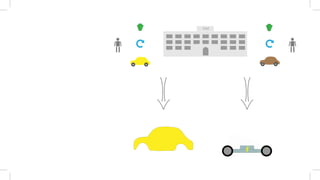
The service wants to sustain material and apply the cradle to cradle concept into the automotive industry. It wants to make the electrical car financially
accessible for the masses and provide new job opportunities in a dynamic but stable market. This is realised by signing a service deal with the customers
whereby the car after its use phase will return to the manufacturer. Which creates several beneficial opportunities for both the customer and the manufac-
turer. In this context there is no direct need for the car to make profit during it’s first life cycle. Currently there can be seen that a comparable electrical
car is almost twice as expensive as a combustion propelled car, and that benefits aren’t that obvious as they seem.
For this reason a financing system like this will provide the opportunity to drive an electrical car for compatible prices. This concept needs a radically dif-
ferent car design then we are used to. Since we are adding an extra dimension to the production process it is important that the car can be taking apart
and rebuild with use of as little energy as possible. Which will be realized by material and architectural choices.
The consumer first selects its initial preferred model on the website, choosing body, colours, layout and options. After agreeing signing and paying the
deal the consumer will have this car to its disposal for a period of 2 years or 200.000km. During this use phase the consumer is obliged to meet the peri-
odical maintenance at an OEM service point.
After the contract period the customer can either choose to pick a new model, keep the current body or take the deposit return the car and end the
service.
During the contract period the customer has the opportunity to either permanently or temporarily switch body type and lay-out. The website will provide
an online store where several specific OEM car designs will be available to the customer. This same store will be a platform for third party developers to
rent their body designs for a reasonable royalty to our customers. By choosing this service the customer will have a substantial amount of different cars to
his disposal but only the cost and space of one.
Service Idea
Service Description
The consumer will have an affordable but solid car to its disposal without the direct disadvantages of doing maintenance himself. The car itself should not
cost more than an equivalent petrol car, but there should be a warranty for the manufacturer in the form of a deposit. These deposits can be used by the
manufacturer as credit for further development or to support the production process. This credit is currently extremely important as it is hard to obtain it
from an incubator, and offering the product below it’s initial cost price will lead to an substantial increased Pay Back Time. The credit is needed directly
in the first year of production where the initial investments have to be founded externally, the deposits will be needed to support production as revenues
won’t be apparent during the first life cycle of the product(2010,Tommaso Buganza,DIG).
Third parties such as developers and or service stations will be able to offer their services and products on the webstore. They will pay a small fee to the
company for offering their products and have to buy the developers kit in order for them to co-create. Doing this will provoke versatility of designs and
functions for the car, by providing a set of standard specific bodies the consumer can profit from the system right away.
The architecture of this system can best be compared to that of the Iphone where Apple provides a small amount of applications in order to gain access
to the functional aspects of the phone. In Apple’s application store consumers are able to buy applications that transform their platform (Iphone) into a
customized product.
Main actors and benefits
Research
Past Studies
Currently the biggest problems concerning the mass introduction of the electrical car can be found in the implementation of the product into both society
as into the production process. The use of this new technology requires complementary technologies that require the development of an infrastructure for
charging or changing batteries. Besides this fact the technology itself needs to be further developed. In these early days of development, batteries are ill-
developed in terms of user needs and expensive because of low-scale production (B. Elzen, R Hoogma & J Schot,1996). They need to be optimized, and
the only way to do this is by creating a market for them which will be fundamental to found new developments in this area.
Governments are committed to environmental protection and other social goals but they are not sending the right message, many R&D project are
subsidised by governments alike but they remain individual concepts as is not clear what role they should play in future transportation (Rene Kemp, Johan
Schot, Remco Hoogma,1998).
Besides these technological and political factors, another threshold can be found in psychological and cultural factors. Currently the automobile with it’s
possibilities of freedom has grown to be an icon of modern lifestyle, everybody has got an idea of what a car is and can do. This image doesn’t directly
accord with that of the electric car which leads to scepticism on the basis of the comparison between the new and the current.
The new technology has not proven what it’s worth, so consumers are not sure what to expect. The meaning and implications of the new technology has
not been specified by its use in practice (R. Kemp & L. Soete,1992).
Experts
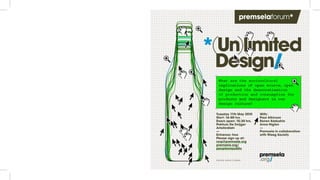
Involving users and third parties in co-creation of the product requires standardisation and the availability of knowledge and skills. For this reason I at-
tended the premselaforum convention. Here the boundaries of user involvement and the role of the designer were openly discussed by professors and
designers that are involved in open source design.
By sharing your design works with the world you are able to create free publicity and or complement one’s product range. As for Ronan Kadushin open
source design is the way he shares, promotes and co-creates his designs all over the world in order to make a living. Applying this system to a bigger
scale and or consumer goods a set of boundaries and rules are needed in order to meet quality and standardization regulations in such a way that form
follows production.
I learned more about the different aspects involved when dealing with the involvement of users in the design process, such as user capabilities in proto-
typing, techniques to share designs and the role of the designer.
The experts present at this venue confirmed several of my findings concerning user involvement, such as their capabilities and the coherence between
manufacturer and user which are merely an approach and logistic issue when dealing with a large scale production.
Paul Atkinson (Sheffield Hallam University) predicts a big shift in the production process were DIY (Do It Yourself) will fulfil an already existing need for
individuality. Anne nigten(V2_Lab) claims that in order to provide the ability for the user to co-design we should first get rid of all the rules and afterwards
consider safety and construction issues.
The venue presented as an example a project by two design academy students whom involved the user in pottery designs by providing a laser guided
digital pottery wheel which triggered a 3d printer. This is a good example of how a special tool made by designers creates an opportunity for co-design,
considering the project a tool and user needs to be defined in order to make individualization a possibility.
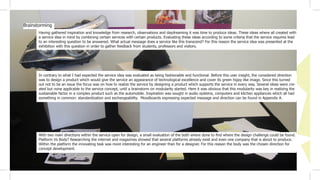
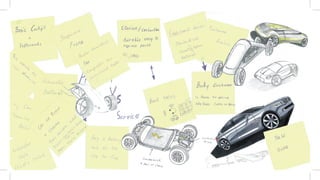
Having gathered inspiration and knowledge from research, observations and daydreaming it was time to produce ideas. These ideas where all created with
a service idea in mind by combining certain services with certain products. Evaluating these ideas according to some criteria that the service requires lead
to an interesting question to be answered. What actual message does a service like this transcend? For this reason the service idea was presented at the
exhibition with this question in order to gather feedback from students, professors and visitors.
Brainstorming
In contrary to what I had expected the service idea was evaluated as being fashionable and functional. Before this user insight, the considered direction
was to design a product which would give the service an appearance of technological excellence and cover its green hippy like image. Since this turned
out not to be an issue the focus was on how to realize the service by designing a product which supports the service in every way. Several ideas were cre-
ated but none applicable to the service concept, until a brainstorm on modularity started. Here it was obvious that this modularity was key in realizing the
sustainable factor in a complex product such as the automobile. Inspiration was sought in audio systems, computers and kitchen appliances which all had
something in common: standardization and exchangeability. Moodboards expressing expected message and direction can be found in Appendix A.
With two main directions within the service open for design, a small evaluation of the both where done to find where the design challenge could be found.
Platform Vs Body? Researching the internet and magazines showed that several platforms already exist and even one company that is about to produce.
Within the platform the innovating task was more interesting for an engineer than for a designer. For this reason the body was the chosen direction for
concept development.
Solution
Final concept
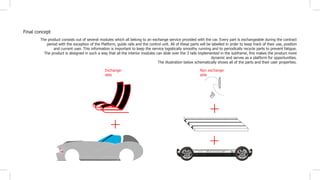
The product consists out of several modules which all belong to an exchange service provided with the car. Every part is exchangeable during the contract
period with the exception of the Platform, guide rails and the control unit. All of these parts will be labelled in order to keep track of their use, position
and current user. This information is important to keep the service logistically smoothy running and to periodically recycle parts to prevent fatigue.
The product is designed in such a way that all the interior modules can slide over the 3 rails implemented in the subframe, this makes the product more
dynamic and serves as a platform for opportunities.
The illustration below schematically shows all of the parts and their user properties.
Exchange-
able
Non exchange-
able
The perfect car for the job, for any job, any day with the costs and maintenance of one. That is exactly what the user will get when joining the service.
Mainly the architecture of the product is responsible for this benefit, with its adjustable modules fitted to a standardized platform. Transforming a family
MPV to a roadster on the click of a button, all niches fitted in one car is exactly what the customer will get.
All seats are the same and ensured to be in top condition, they are part of the service and therefore there is no need to store them at home. The same
goes for the bodies just as easy as putting on the right shoes for the right activity, the user will be able to change bodies for their functional features.
A fully flat platform with its guide rails provides space for six seats plus control unit. When desired these seats can be taken out and space is created for
luggage or a whole different car layout. From this point on the most logical step was to identify the most desirable layouts within the context of the target
for further development.
Target
Currently the electric car isn’t ultimately less polluting to the environment than the internal combustion propelled car. The electric car itself is cleaner and
more efficient with its fuel but when considering the waste that goes into producing electricity the electric car isn’t that clean anymore. Either coal or
nuclear power plants are needed to provide the electricity here you can already see that the electrical car doesn’t pollute directly but merely from a dif-
ferent location. There are even more downsides that make the electrical car not ready to be introduced. Currently the electrical car in production with the
biggest range is the Tesla s with a range of 480 km and a quick charge method of 45 minutes, is not directly compatible with the convenience of use that
the petrol car has.
So where is it interesting to introduce and use the electric car? Large cities all around the world are struggling with their quality of air, for instance the
city of Amsterdam has got a ban on older cars and trucks in the city centre, as a response to the air quality they even raised parking prices to prevent
people form using their cars(Elsevier,2008). The city of Milan has got a totally different approach to the problem they measure the air quality on a periodic
basis and in case of exceeded limits they forbid people to use their cars until these readings reach an acceptable limit(Corriere della sera,2010). It is clear
that these solutions are drastic measures that are only of temporary benefit and affect citizens lives. European governments agreed on supporting the
charging and infrastructure of the electrical car, here they consider banning petrol cars in city centres and create electrical vehicles zones(Maria van der
Hoeven, 2010).
For this reason the electric car provides the answer, within the city the car is in general only used for small distances and by moving the pollution problem
from the car to the power plant the air quality in cities will improve. Consider the electric car to be an urban solution for now and a real life test ground
for further development of charging systems, batteries and engines.
For this reason I have conducted a survey among drivers, in order to find decisive factors in car purchases.
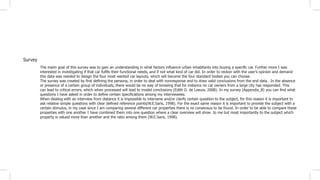
Survey
The maim goal of this survey was to gain an understanding in what factors influence urban inhabitants into buying a specific car. Further more I was
interested in investigating if that car fulfils their functional needs, and if not what kind of car did. In order to reckon with the user’s opinion and demand
this data was needed to design the four most wanted car layouts, which will become the four standard bodies you can choose.
The survey was created by first defining the persona, in order to deal with nonresponse and to draw valid conclusions from the end data. In the absence
or presence of a certain group of individuals, there would be no way of knowing that for instance no car owners from a large city has responded. This
can lead to critical errors, which when processed will lead to invalid conclusions (Edith D. de Leeuw, 2008). In my survey (Appendix_B) you can find what
questions I have asked in order to define certain specifications among my interviewees.
When dealing with an interview from distance it is impossible to intervene and/or clarify certain question to the subject, for this reason it is important to
ask relative simple questions with clear defined reference points(W.E.Saris, 1998). For the exact same reason it is important to provide the subject with a
certain stimulus, in my case since I am comparing several different car properties there is no consensus to be found. In order to be able to compare these
properties with one another I have combined them into one question where a clear overview will show to me but most importantly to the subject which
property is valued more than another and the ratio among them (W.E.Saris, 1998).
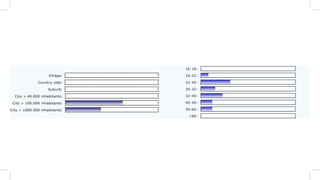
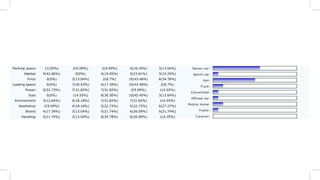
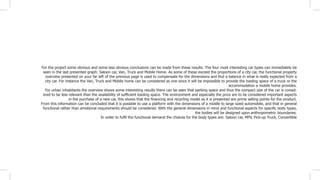
For the project some obvious and some less obvious conclusions can be made from these results. The four most interesting car types can immediately be
seen in the last presented graph: Saloon car, Van, Truck and Mobile Home. As some of these exceed the proportions of a city car, the functional property
overview presented on your far left of the previous page is used to compensate for the dimensions and find a balance in what is really expected from a
city car. For instance the Van, Truck and Mobile home can be considered as one since it will be impossible to provide the loading space of a truck or the
accommodation a mobile home provides.
For urban inhabitants the overview shows some interesting results there can be seen that parking space and thus the compact size of the car is consid-
ered to be less relevant than the availability of sufficient loading space. The environment and especially the price are to be considered important aspects
in the purchase of a new car, this shows that the financing and recycling model as it is presented are prime selling points for the product.
From this information can be concluded that it is possible to use a platform with the dimensions of a middle to large sized automobile, and that in general
functional rather than emotional requirements should be considered. With the general dimensions in mind and functional aspects for specific body types,
the bodies will be designed upon anthropometric boundaries.
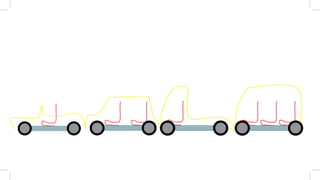
In order to fulfil the functional demand the choices for the body types are: Saloon car, MPV, Pick-up Truck, Convertible
Anthropometry
In order to ensure the quality of the interaction between user, product and the environment, specific product dimensions are needed.
Dimensions are chosen to accommodate 90% of the population (from 5 to 95 percentile) This excludes individuals that have minimum or maximum val-
ues. Between racial and ethnic groups there is a substantial variation on body properties and dimensions for instance a tool designed to meet 90% of the
American male population is in general able to satisfy 90% of Germans, 80% of the French, 65% of Italians, 45% of the Japanese, 25% of the Thai and
10% of the Vietnamese(Giuseppe Andreoni, 2010).
For this reason I focused on western Europe and choose Britain to be my benchmark, seats and steering wheel will be adjustable but the car body itself
won’t be. Using the anthropometric parameters of British people, digital dummies where created in order to make the car suitable for 90% of the British
population(Alvin R. Tilley, 2002).
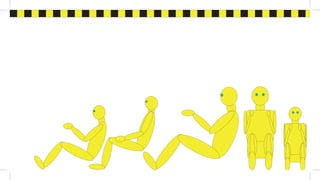
These measurements where translated into the AMVO (Anthropometry of Motor Vehicle Occupants) model which represents the correct driving
posture(L.W. Schneider, 1983).
Between the 5th and the 90th percentile a clear difference can be seen in eye height, reach and overall dimensions. The challenge is to design a product
that will be as comfortable to the 5th as it is to the 95th percentile. The test dummies are constructed in such a way they represent the correct driving
posture, passenger posture and sports posture(Appendix_C).
Conceptual Test
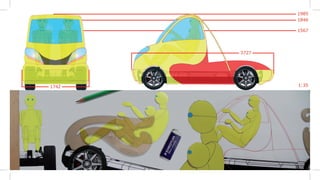
This test is performed in order to determine the dimension of the platform and sketch four possible body types that meet the users’s requirements and
expectations.
Considering the wheel clearance first the seat position from the front view needs to be determined, from this position the side view is drawn according to
the 5th and 95th percentile.
In this test the seats and steering module are excluded since they are adjustable and thus suitable for almost every driver. In the drawings sufficient
clearance is maintained in order to place and use these modules. More about the seats and steering module can be found under the chapter Architec-
ture.
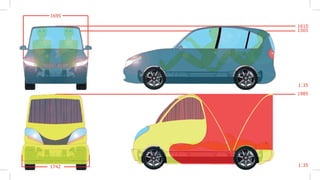
During the test a considerable challenge was found when dealing with the overall height of the platform and thus the whole car. In contrary to a conven-
tional car the Trexa platform used in this design is in general 20 cm higher due to the batteries motors and steering module. On top of this platform 2cm
height is required for the fully flat floor including the seat rails. All this height increasement resulted in a challenge when designing a normal proportioned
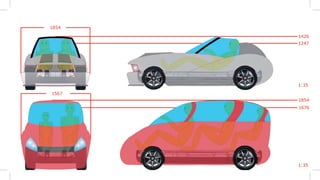
car. All of the concepts are dimension wise comparable to existing cars: the Pick-up truck can be compared to the Opel Vivaro, the Roadster to the BMW
Z4, the MPV to the Renault Espace and the Saloon car to the BMW 1-series
On the left the technical drawings of the pick-up truck on a scale of 1 to 35 are presented on the next pages the roadster, MPV, Saloon car and the Pick-
up truck provided with camping kit are presented. All files are available in (Appendix_D).
Material & Production
In order to choose to right material for a product a list of demands and wishes are needed that support the concept’s key features. These demands will
be translated into measurable properties in order to compare materials and construct a profound choice.
Since the car makes use of a skateboard like platform that already supports the engine batteries and drivetrain, the body itself is relatively stress free
when considering normal use. In other words this means that in contrary to a conventional car the body isn’t part of the strength of the car, but acts as
an aerodynamic and safety part of the vehicle. For this reason the body doesn’t need to deal with repetitive stress or torque. On the other side since the
concept requires easy to replace bodies use of a space frame or a roll bar will be undesirable, therefore the monocoque itself needs to be able to handle
all applied forces in case of a crash. Furthermore there should be made use of only a few different materials in order to make the recycling process ef-
ficient.
Demands:
_Recyclable
_Shock absorbing
_Relatively small deformation under abrupt stress
_Rustproof
Wishes:
_Easy to produce
_Lightweight
Now it is time to translate these demands into measurable material properties which can be compared with each other.
_Recyclable
Recyclability of a product isn’t expressed in a certain unit but in a fraction that indicates the actual percentage of material being recycled in the current
supply chain. Since we are talking about a closed service the logistics are constructed in such a way to recycle all of our products into new, therefore the
recycle fraction isn’t relevant. What we can compare is the embodied energy needed to recycle a certain material, we want to keep this as low as possible
since this will lead to lower production costs.
_Shock absorbing
A reasonably large plastic region and a standard elastic region is needed to ensure the energy absorption during a crash. The passengers need to be safe,
and the car should absorb the energy instead of the passengers. A reasonably larger plastic region than elastic region allows the car body to start bend-
ing and consuming the external forces unleashed during the crash. A sufficient ductility in the material will ensure its energy absorption capacity. This
requires a Relative tough material, in order to have a high resistance against fracture.
_Relatively small deformation under abrupt stress
In order to prevent large deformations the material used should have a relative large compressive strength in combination with its thougness. In case of
flipping the car on its roof the body should be able to coop with the weight of the platform in combination with the sudden force applied due to the crash.
_Rustproof
Corrosion prevention and removal are energy and money consuming activities, therefor a rustproof material is needed to ensure the environmental and
financial security of the product. Without any special treatments these characteristics can be found in alloys and plastics. This will be the initial criteria to
start the material search.
Due to an ease in processing I have a preference for polymers because they can meet all the above mentioned demands and wishes. Currently in produc-
tion vehicles polymers are merely used as non structural body parts with the exception of some prototypes and high end sports cars whom use relative
expensive carbon fibres for roofs and hoods.
By examining these prototypes an interesting material was found in the Chrysler CCV project. This car made use of a reinforced version of a 15% glass
filled PET material.
According to Chrysler, the Hi Impet material meets all of the conventional material properties plus some extra benefits which meet the above mentioned
wishes.
_Easy to produce
The material enables the possibility to mould larger body pieces than currently can be pressed in aluminium. By reducing the number of body parts a big
advantage in assembly time is created, in contrary to a conventional car the Chrysler CCV can be assembled in about 6.5 hours. Compared to 19 hours for
a conventional car production time the time is reduced to about one third. According to Chrysler this design should reduce manufacturing costs by 80%,
and manufacturing space for assembly could be only one sixth of that for a conventional vehicle.
_Lightweight
Very important factor and hot topic among electrical cars, the batteries cause the electrical car to be considerably heavier than a comparable petrol car.
For this reason the material with its low density of 1500 kg/m^3 balances the weight of the batteries.
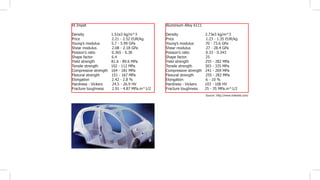
In order to compare the material properties of conventional materials and Hi Impet I used the aluminium alloy 6111 as a benchmark. Aluminium 6111 is
the most commonly used material for constructing body parts in the automotive sector(R. Lapovok, 2008).
Comparing the data sheets shows us some rather considerable differences in important properties such as compressive strength and fracture toughness.
In order to conquer these disadvantages, the production process provides us with a solution. The production process makes use of in inner and outer
mould by using variations of wall thickness in the finished part. Chrysler ensures proper mould filling, to reduce distortion and for end-use structural
strength. (Fred Keller, 1999)
This material choice has to be revised by engineers and tested in real time settings, Chrysler already proved that proved 100% recyclable materials can
be used to mould large parts. After rigorous testing Bernard Robinson, Chryslers vice president of engineering technologies claims that a car body made
of the right thermoplastic resin can perform safely.
Hi Impet
Density 1.51e3 kg/m^3
Price 2.21 - 2.52 EUR/kg
Young’s modulus 5.7 - 5.99 GPa
Shear modulus 2.08 - 2.18 GPa
Poisson’s ratio 0.365 - 0.38
Shape factor 6.4
Yield strength 81.6 - 89.6 MPa
Tensile strength 102 - 112 MPa
Compressive strength 164 - 181 MPa
Flexural strength 151 - 167 MPa
Elongation 2.42 - 2.8 %
Hardness - Vickers 24.5 - 26.9 HV
Fracture toughness 2.91 - 4.87 MPa.m^1/2
Aluminium Alloy 6111
Density 2.73e3 kg/m^3
Price 1.23 - 1.35 EUR/kg
Young’s modulus 70 - 73.6 GPa
Shear modulus 27 - 28.4 GPa
Poisson’s ratio 0.33 - 0.343
Shape factor 25
Yield strength 255 - 282 MPa
Tensile strength 303 - 335 MPa
Compressive strength 241 - 269 MPa
Flexural strength 255 - 282 MPa
Elongation 6 - 10 %
Hardness - Vickers 103 - 108 HV
Fracture toughness 25 - 35 MPa.m^1/2
Source: http://www.matweb.com/
The interior should support the same design rational as the exterior does, therefore it has to meet many of the same demands and wishes for the mate-
rial choice. Since we are talking about a city car used to cover reasonable small distances physical comfort isn’t a big concern. In order to maintain a low
weight and consume relative little space, adjustable interior modules are designed. These modules consist out of seats and a centre control unit which
enables both left hand and right hand drive.
The applicable demands and wishes are:
_Recyclable
_Rustproof
_Easy to produce
_Lightweight
In the centre control unit these demands are easy to fulfil because of the lack of any significant external forces applied to the unit. For this reason the
unit will make use of the same Hi Impet material as the body does. Doing this will minimize the number of different materials used and thus resulting in a
logistical advantage when considering the production process.
The seats are a different story, even though comfort isn’t a big concern it remains an important issue for any product. As can be seen from the concep-
tual test space is limited and thus requires an efficient design. Materials such as foam, fabrics and leather are vastly affected by wear and most of them
are not suitable for recycling. To narrow down the search again factors such as rustproof and recyclable confined the search into Aluminium alloys and
Polymers.
With such strict limitations as limited space and a relative small selection in materials, I began researching chairs, seats and sofas to find inspiration. A
hammock, the Wassily chair and some of Mart Stams famous chairs provided me with the answer. A frame which supports some kind of elastic material
to provide some comfort for the user. The search for this elastic material started with plastic foils which are mainly used in the packaging industry, due to
their cheap appearance and feel another solution had to be found. Shape Memory Polymers or SMPs are modifiable so that they can change from a rigid
into an elastic state by thermal, pressure or electrical stimuli. Unlike the plastic foils the SMPs when unstrained return to their original shape and appear
to be a solid material. Veriflex® is such a SMP it can be modified to have a thermal activation from –30°C to 260°C, with a possible elongation of 200%
there can truly be said that this is an elastic material. In order to figure out the exact properties this material should have, tests should be conducted with
different versions of this material in the same frame.
Samples of Veriflex®, Source: http://www.crgrp.com
Implementation
Prototype
As tools to communicate the concept and the product, two prototypes were made to support the exhibition and act as a base for further development.
These prototypes will be further developed over summer in case of my project being picked to be displayed at the Dutch Design Week 2010.
The aesthetics of the prototypes are a response to the hectic life in cities which the product is designed for. Simple clean and calming is the message I
want to transcend to the user, the same message the concept carries when considering economy ecology and functionality.
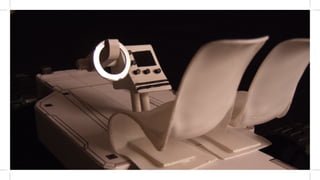
The physical prototype nr. 1 has been created in order to explain the versatility and the endless opportunities that the architecture of the product offers.
The standard platform with its guide rails, and the primary modules such as seat and control have been build on a scale of 1:15. They will need to show
the ease and convenience of changing modules and adjusting the cars layout.
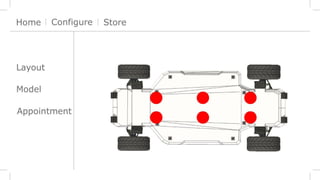
Prototype nr. 2 is a draft version of the service website which is needed to access the online bodystore and to check on vital information concerning
maintenance and interesting information. The website is created to demonstrate the service in its context and show the intended way of using the serv-
ice. The most interesting feature from this website is the fact that the customer can either start choosing a body from a desired layout, model or choose
for the convenience of a certain service station. Doing this emphasizes the functional aspect of the whole concept and thus sustain the image shift from
emotional to functional product.
Appendix E shows the website and Appendix F contains a picture collection of the physical model.
Technology
Since the concept exists out of a variety in modules, many technologies are involved in realizing the proper working of the product.
First and probably most important of all is the powering platform, how can it efficiently deal with a high mileage. For this reason we have to compare the
electrical engine to the internal combustion engine. An electrical engine is less vulnerable to wear than the internal combustion engine, this is due to a
significant reduction in moving parts as well as in less fluctuation in heat. In order to support the system in it’s recycling ability it is from great concern
that the electrical engine can be services and refurbished in such a way it can outlast the internal combustion engine by a significant deal.
Where best to compare such technologies than in a field where both are being used for years. Forklifts are available with Diesel, LPG and Electrical
engines all of which have been around for many years now. Comparing factory demanded maintenance intervals shows that an electrical powered forklift
requires only half of the maintenance as the internal combustion equivalent(Jeff Bowles, 2008).
To make an honest comparison there are more parts in both vehicles that need to be examined such as the gearbox and battery pack. In conventional
cars power is transmitted to the wheels through a gearbox , this gearbox consist out of many parts and is one of the most vulnerable mechanical systems
in the car today. The electrical car doesn’t need to make use of such a gearbox since the electrical engine provides its maximum torque at any revolution
rate.
What the electrical car does require is a battery pack instead of a simple fuel tank. These battery packs are currently only ensured to perform 100% at a
mileage of 100.000 miles (Martin Eberhard CEO & JB Straubel, CTO, 2006). After this time the battery is expected to remain working on a 70% capacity,
currently it is not possible to refurbish such a battery but they can be recycled. Considering all the investments being made in this industry we can expect
better and reusable batteries in the near future.
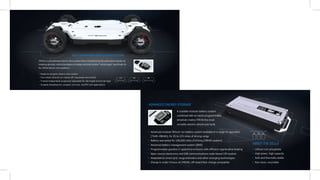
As Displayed on the left page the concept makes use of an skateboard platform which includes batteries, drivetrain and engines. As an example and for
its dimensions the Trexa® platform is used.
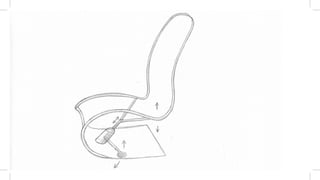
The seat makes cleaver use of a small hydraulic pump and its material’s flexibility to alternate the seating height and provide a comfortable ride for the
majority of people. The seating area is upholstered with the shape memory polymer Veriflex® which provides the comfort and the perfect fit for any body
type. When seated down the flexibility of the material will literally ensure the seat will fit like a glove, in contrary to many fabrics the polymer is 100%
recyclable and doesn’t wrinkle, scratch or tear under stress. The seat will deform every time a person will sit on it but when left in the sun or heated the
seat will return to its original shape hence the shape memory feature of this material.
Just as with any other ordinary car seat this seat will be able to slide along a rail in order to change to drive position. As it is mounted on the flat platform
it is actually possible to move the seat all the way to the other side of the car or even when desired turned around in or taken out of the car.
A T-shaped wedge underneath each module will keep the seat in place and prevents it from turning around. A spring loaded arm will lock the T-shaped
wedge in one of many small cavities cut into the guide rail. Currently a quite similar system is being used by the snowboard manufacturer Burton to
mount their binding on their snowboards. This system has proven itself to be fast, easy and most importantly reliable. In both cases the wedge easily
deals with the full weight of a grown man. This system will make changing or removing seats childsplay and still provides the user with a reliable and
solid seating position.
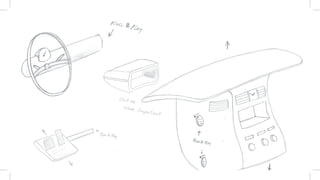
The control unit consist out of several parts of which each has its own distinct function, this architecture is chosen to ensure its universal applicability
to provide both left hand as right hand drive. The centre control unit contains all electronics necessary to control the drive by wire Trexa® platform and
comfort functions such as heat regulation and a space to store your portable navigation system or cell phone. As became clear from the conceptual test
the platform should be able to be adjusted in height and cover minimum space at the driver position. Same as the seats do, the control unit makes use
of a small hydraulic pump in order to adjust its height.
Since the platform requires drive by wire no physical control linkages are needed and thus all controls are plug and play. This results in an even more
dynamic product which provides the opportunity to change from left hand drive to right hand drive as easy as doing so with a game controller.
The modules are all designed with the city environment in mind, a clean serene interior should help the driver to relax and escape the cities mayhem.
References
Plunkett Research
	 Automoblies and Trucks Overview
	 Automobile Industry_2008
Gary S. Vasilash
	 Automotive Manufacturing and Production
	 Changing the Dominant Design_2000
ArticlesBase SC #941873
	 http://www.articlesbase.com/advertising-articles/why-is-auto-industry-so-important-941873.html
	 Why Is Auto Industry So Important?_2009
Tommaso Buganza,DIG
	 Assessing an investment w/ PBT
	 Strategic Design_2010
B. Elzen, R Hoogma & J Schot
	 Mobiliteit met Toekomst naar een Vraaggericht Technologiebeleid
	 Report for the Dutch Ministry of Traffic and Transport_1996
Rene Kemp, Johan Schot, Remco Hoogma
	 Regime shifts to sustainability through processes of niche formation: The approach of strategic niche management
	 Technology Analysis & Strategic Management, Volume 10, Issue 2 _1998
R. Kemp & L. Soete
	 The Greening of Technological Progress
	 An Evolutionary Perspective_1992
Elsevier
	 Amsterdam zet stadsverbod oude auto’s door_2008
Minister Maria van der Hoeven
	 Voorbank, Carros May/June nr 3_2010
Corriere della sera
	 Milano chiude per smog Auto, domenica è stop totale_2010
Edith D. de Leeuw, Joop J. Hox, Don A. Dillman
	 Nonresponse
	 International Handbook of Survey Methodology_2008
J. van der Zouwen en W.Dijkstra
	 Variatie in responsefuncties
	 Sociaal-wetenschappelijk onderzoek met vragenlijsten
Giuseppe Andreoni
	 Anthropometria
	 Biodesign_2010
Alvin R. Tilley, Henry Dreyfuss
	 The measure of Man, The measure of Women
	 Human Factors in Design_2002
L.W. Schneider, D.H. Robbins, M.A. Pflug, R.G. Snyder
	 Comparison of dummy sizes with selected populations
	 Development of anthropometrically based design_1983
R. Lapovok, I. Timokhina, P.W.J. McKenzie and R. O’Donnell
	 Processing and properties of ultrafine-grain aluminium alloy 6111 sheet
	 Journal of Materials Processing Technology Volume 200, Issues 1-3, 8 May_2008
A. J. Beaudoin, J. D. Bryant and David A. Korzekwa
	 Analysis of ridging in aluminum auto body sheet metal_1998
Bernard Robinson, Fred Keller
	 The institute of Materials, Minerals and Mining
	 Materials World, Vol. 7 no. 1, January_1999.
Jeff Bowles
	 Jungheinrich
	 Cost of ownership considerations: Electric vs ICE Forklifts_2008
Martin Eberhard CEO & JB Straubel, CTO
	 A Bit About Batteries_2006
Appendix

Report

  • 1.
    Design For ElectricDriving Student: Glenn Jacobs Coach: Jan Rouvroye Date: 27-04-2010
  • 2.
  • 3.
    Mobility and especiallyauto mobility has nested itself in our society and became one of the prime factors to the smooth functioning of and sustaining the economy. The automotive industry is a huge employer and driver of knowledge and innovation. On a global scale the automotive industry is good for a turnover around $2.6 trillion, and it contributes 6 percent to the gross domestic product to the EU. On a global scale the automo- tive industry employs 9 million people directly, auto experts say that every job created in this sector indirectly supports 5 more jobs which comes to a rough total of 50 million people employees depend on this sector(Articlebase, 2009). In 2008 in the world there where about 806 million cars and light trucks on the road accounting for the consumption of 260 billion gal- lons of gasoline and diesel fuel yearly (Plunkett Research, 2008). At the moment the industry is heading a different direction where it is already apparent that the electrical car is going to be the dominant design(Vasilash, 2000). This project aims at enabling the possibility to introduce the electrical car in short terms and sustain the current automotive industry through the use of a product service system design, provoking a dynamic mar- ket and stimulate the consumer behaviour in a sustainable way. The project fits in the program Electric Driving of Provincie Noord Brabant and focuses on developing concepts for electric vehicles. The client supports the project with workshops and a master class. Results will be shown at the DDW 2010 Design on Wheels show.
  • 4.
  • 5.
    6 Project Business Case 14 Past studies Experts Brainstorming 20 FinalConcept Target Survey Anthropometry Conceptual test Material & Production 40 Prototype Technology References Appendix Target Research Solution Implementation
  • 6.
  • 7.
    Provided with thisopen project description I took the liberty to approach this project from an economical perspective. This all because now while the automotive industry is still weak it is the time to innovate and head into a new direction in transportation. In response to the industry’s current position my search for the attractive factor will be done within the economical and func- tional rather than the emotional aspects of the electrical car. “The project fits in the programme Electric Driving of Provincie Noord Brabant and focuses on developing concepts for electric vehicles. How can driving without combustion engine (the vroom vroom feeling) still be attractive to the driver.”
  • 8.
  • 9.
    Imagine a carthat can be rebuilt or reused for parts over and over again. In house recycling of the vehicle will create an interesting opportunity regard- ing the efficiency of material use. Car sales will rise by disabling the used car market and redundant cars will be a thing of the past. Clean, new and well maintained electrical cars will be- come the brand’s image. Like with the old vinyl players the attractive factors shift from the rough but small imperfections to a solid, smooth and improved quality.
  • 11.
    The service wantsto sustain material and apply the cradle to cradle concept into the automotive industry. It wants to make the electrical car financially accessible for the masses and provide new job opportunities in a dynamic but stable market. This is realised by signing a service deal with the customers whereby the car after its use phase will return to the manufacturer. Which creates several beneficial opportunities for both the customer and the manufac- turer. In this context there is no direct need for the car to make profit during it’s first life cycle. Currently there can be seen that a comparable electrical car is almost twice as expensive as a combustion propelled car, and that benefits aren’t that obvious as they seem. For this reason a financing system like this will provide the opportunity to drive an electrical car for compatible prices. This concept needs a radically dif- ferent car design then we are used to. Since we are adding an extra dimension to the production process it is important that the car can be taking apart and rebuild with use of as little energy as possible. Which will be realized by material and architectural choices. The consumer first selects its initial preferred model on the website, choosing body, colours, layout and options. After agreeing signing and paying the deal the consumer will have this car to its disposal for a period of 2 years or 200.000km. During this use phase the consumer is obliged to meet the peri- odical maintenance at an OEM service point. After the contract period the customer can either choose to pick a new model, keep the current body or take the deposit return the car and end the service. During the contract period the customer has the opportunity to either permanently or temporarily switch body type and lay-out. The website will provide an online store where several specific OEM car designs will be available to the customer. This same store will be a platform for third party developers to rent their body designs for a reasonable royalty to our customers. By choosing this service the customer will have a substantial amount of different cars to his disposal but only the cost and space of one. Service Idea Service Description
  • 12.
    The consumer willhave an affordable but solid car to its disposal without the direct disadvantages of doing maintenance himself. The car itself should not cost more than an equivalent petrol car, but there should be a warranty for the manufacturer in the form of a deposit. These deposits can be used by the manufacturer as credit for further development or to support the production process. This credit is currently extremely important as it is hard to obtain it from an incubator, and offering the product below it’s initial cost price will lead to an substantial increased Pay Back Time. The credit is needed directly in the first year of production where the initial investments have to be founded externally, the deposits will be needed to support production as revenues won’t be apparent during the first life cycle of the product(2010,Tommaso Buganza,DIG). Third parties such as developers and or service stations will be able to offer their services and products on the webstore. They will pay a small fee to the company for offering their products and have to buy the developers kit in order for them to co-create. Doing this will provoke versatility of designs and functions for the car, by providing a set of standard specific bodies the consumer can profit from the system right away. The architecture of this system can best be compared to that of the Iphone where Apple provides a small amount of applications in order to gain access to the functional aspects of the phone. In Apple’s application store consumers are able to buy applications that transform their platform (Iphone) into a customized product. Main actors and benefits
  • 14.
  • 15.
    Past Studies Currently thebiggest problems concerning the mass introduction of the electrical car can be found in the implementation of the product into both society as into the production process. The use of this new technology requires complementary technologies that require the development of an infrastructure for charging or changing batteries. Besides this fact the technology itself needs to be further developed. In these early days of development, batteries are ill- developed in terms of user needs and expensive because of low-scale production (B. Elzen, R Hoogma & J Schot,1996). They need to be optimized, and the only way to do this is by creating a market for them which will be fundamental to found new developments in this area. Governments are committed to environmental protection and other social goals but they are not sending the right message, many R&D project are subsidised by governments alike but they remain individual concepts as is not clear what role they should play in future transportation (Rene Kemp, Johan Schot, Remco Hoogma,1998). Besides these technological and political factors, another threshold can be found in psychological and cultural factors. Currently the automobile with it’s possibilities of freedom has grown to be an icon of modern lifestyle, everybody has got an idea of what a car is and can do. This image doesn’t directly accord with that of the electric car which leads to scepticism on the basis of the comparison between the new and the current. The new technology has not proven what it’s worth, so consumers are not sure what to expect. The meaning and implications of the new technology has not been specified by its use in practice (R. Kemp & L. Soete,1992).
  • 17.
    Experts Involving users andthird parties in co-creation of the product requires standardisation and the availability of knowledge and skills. For this reason I at- tended the premselaforum convention. Here the boundaries of user involvement and the role of the designer were openly discussed by professors and designers that are involved in open source design. By sharing your design works with the world you are able to create free publicity and or complement one’s product range. As for Ronan Kadushin open source design is the way he shares, promotes and co-creates his designs all over the world in order to make a living. Applying this system to a bigger scale and or consumer goods a set of boundaries and rules are needed in order to meet quality and standardization regulations in such a way that form follows production. I learned more about the different aspects involved when dealing with the involvement of users in the design process, such as user capabilities in proto- typing, techniques to share designs and the role of the designer. The experts present at this venue confirmed several of my findings concerning user involvement, such as their capabilities and the coherence between manufacturer and user which are merely an approach and logistic issue when dealing with a large scale production. Paul Atkinson (Sheffield Hallam University) predicts a big shift in the production process were DIY (Do It Yourself) will fulfil an already existing need for individuality. Anne nigten(V2_Lab) claims that in order to provide the ability for the user to co-design we should first get rid of all the rules and afterwards consider safety and construction issues. The venue presented as an example a project by two design academy students whom involved the user in pottery designs by providing a laser guided digital pottery wheel which triggered a 3d printer. This is a good example of how a special tool made by designers creates an opportunity for co-design, considering the project a tool and user needs to be defined in order to make individualization a possibility.
  • 18.
    Having gathered inspirationand knowledge from research, observations and daydreaming it was time to produce ideas. These ideas where all created with a service idea in mind by combining certain services with certain products. Evaluating these ideas according to some criteria that the service requires lead to an interesting question to be answered. What actual message does a service like this transcend? For this reason the service idea was presented at the exhibition with this question in order to gather feedback from students, professors and visitors. Brainstorming In contrary to what I had expected the service idea was evaluated as being fashionable and functional. Before this user insight, the considered direction was to design a product which would give the service an appearance of technological excellence and cover its green hippy like image. Since this turned out not to be an issue the focus was on how to realize the service by designing a product which supports the service in every way. Several ideas were cre- ated but none applicable to the service concept, until a brainstorm on modularity started. Here it was obvious that this modularity was key in realizing the sustainable factor in a complex product such as the automobile. Inspiration was sought in audio systems, computers and kitchen appliances which all had something in common: standardization and exchangeability. Moodboards expressing expected message and direction can be found in Appendix A. With two main directions within the service open for design, a small evaluation of the both where done to find where the design challenge could be found. Platform Vs Body? Researching the internet and magazines showed that several platforms already exist and even one company that is about to produce. Within the platform the innovating task was more interesting for an engineer than for a designer. For this reason the body was the chosen direction for concept development.
  • 20.
  • 21.
    Final concept The productconsists out of several modules which all belong to an exchange service provided with the car. Every part is exchangeable during the contract period with the exception of the Platform, guide rails and the control unit. All of these parts will be labelled in order to keep track of their use, position and current user. This information is important to keep the service logistically smoothy running and to periodically recycle parts to prevent fatigue. The product is designed in such a way that all the interior modules can slide over the 3 rails implemented in the subframe, this makes the product more dynamic and serves as a platform for opportunities. The illustration below schematically shows all of the parts and their user properties. Exchange- able Non exchange- able
  • 22.
    The perfect carfor the job, for any job, any day with the costs and maintenance of one. That is exactly what the user will get when joining the service. Mainly the architecture of the product is responsible for this benefit, with its adjustable modules fitted to a standardized platform. Transforming a family MPV to a roadster on the click of a button, all niches fitted in one car is exactly what the customer will get. All seats are the same and ensured to be in top condition, they are part of the service and therefore there is no need to store them at home. The same goes for the bodies just as easy as putting on the right shoes for the right activity, the user will be able to change bodies for their functional features. A fully flat platform with its guide rails provides space for six seats plus control unit. When desired these seats can be taken out and space is created for luggage or a whole different car layout. From this point on the most logical step was to identify the most desirable layouts within the context of the target for further development.
  • 23.
    Target Currently the electriccar isn’t ultimately less polluting to the environment than the internal combustion propelled car. The electric car itself is cleaner and more efficient with its fuel but when considering the waste that goes into producing electricity the electric car isn’t that clean anymore. Either coal or nuclear power plants are needed to provide the electricity here you can already see that the electrical car doesn’t pollute directly but merely from a dif- ferent location. There are even more downsides that make the electrical car not ready to be introduced. Currently the electrical car in production with the biggest range is the Tesla s with a range of 480 km and a quick charge method of 45 minutes, is not directly compatible with the convenience of use that the petrol car has. So where is it interesting to introduce and use the electric car? Large cities all around the world are struggling with their quality of air, for instance the city of Amsterdam has got a ban on older cars and trucks in the city centre, as a response to the air quality they even raised parking prices to prevent people form using their cars(Elsevier,2008). The city of Milan has got a totally different approach to the problem they measure the air quality on a periodic basis and in case of exceeded limits they forbid people to use their cars until these readings reach an acceptable limit(Corriere della sera,2010). It is clear that these solutions are drastic measures that are only of temporary benefit and affect citizens lives. European governments agreed on supporting the charging and infrastructure of the electrical car, here they consider banning petrol cars in city centres and create electrical vehicles zones(Maria van der Hoeven, 2010). For this reason the electric car provides the answer, within the city the car is in general only used for small distances and by moving the pollution problem from the car to the power plant the air quality in cities will improve. Consider the electric car to be an urban solution for now and a real life test ground for further development of charging systems, batteries and engines. For this reason I have conducted a survey among drivers, in order to find decisive factors in car purchases.
  • 24.
    Survey The maim goalof this survey was to gain an understanding in what factors influence urban inhabitants into buying a specific car. Further more I was interested in investigating if that car fulfils their functional needs, and if not what kind of car did. In order to reckon with the user’s opinion and demand this data was needed to design the four most wanted car layouts, which will become the four standard bodies you can choose. The survey was created by first defining the persona, in order to deal with nonresponse and to draw valid conclusions from the end data. In the absence or presence of a certain group of individuals, there would be no way of knowing that for instance no car owners from a large city has responded. This can lead to critical errors, which when processed will lead to invalid conclusions (Edith D. de Leeuw, 2008). In my survey (Appendix_B) you can find what questions I have asked in order to define certain specifications among my interviewees. When dealing with an interview from distance it is impossible to intervene and/or clarify certain question to the subject, for this reason it is important to ask relative simple questions with clear defined reference points(W.E.Saris, 1998). For the exact same reason it is important to provide the subject with a certain stimulus, in my case since I am comparing several different car properties there is no consensus to be found. In order to be able to compare these properties with one another I have combined them into one question where a clear overview will show to me but most importantly to the subject which property is valued more than another and the ratio among them (W.E.Saris, 1998).
  • 27.
    For the projectsome obvious and some less obvious conclusions can be made from these results. The four most interesting car types can immediately be seen in the last presented graph: Saloon car, Van, Truck and Mobile Home. As some of these exceed the proportions of a city car, the functional property overview presented on your far left of the previous page is used to compensate for the dimensions and find a balance in what is really expected from a city car. For instance the Van, Truck and Mobile home can be considered as one since it will be impossible to provide the loading space of a truck or the accommodation a mobile home provides. For urban inhabitants the overview shows some interesting results there can be seen that parking space and thus the compact size of the car is consid- ered to be less relevant than the availability of sufficient loading space. The environment and especially the price are to be considered important aspects in the purchase of a new car, this shows that the financing and recycling model as it is presented are prime selling points for the product. From this information can be concluded that it is possible to use a platform with the dimensions of a middle to large sized automobile, and that in general functional rather than emotional requirements should be considered. With the general dimensions in mind and functional aspects for specific body types, the bodies will be designed upon anthropometric boundaries. In order to fulfil the functional demand the choices for the body types are: Saloon car, MPV, Pick-up Truck, Convertible
  • 29.
    Anthropometry In order toensure the quality of the interaction between user, product and the environment, specific product dimensions are needed. Dimensions are chosen to accommodate 90% of the population (from 5 to 95 percentile) This excludes individuals that have minimum or maximum val- ues. Between racial and ethnic groups there is a substantial variation on body properties and dimensions for instance a tool designed to meet 90% of the American male population is in general able to satisfy 90% of Germans, 80% of the French, 65% of Italians, 45% of the Japanese, 25% of the Thai and 10% of the Vietnamese(Giuseppe Andreoni, 2010). For this reason I focused on western Europe and choose Britain to be my benchmark, seats and steering wheel will be adjustable but the car body itself won’t be. Using the anthropometric parameters of British people, digital dummies where created in order to make the car suitable for 90% of the British population(Alvin R. Tilley, 2002). These measurements where translated into the AMVO (Anthropometry of Motor Vehicle Occupants) model which represents the correct driving posture(L.W. Schneider, 1983). Between the 5th and the 90th percentile a clear difference can be seen in eye height, reach and overall dimensions. The challenge is to design a product that will be as comfortable to the 5th as it is to the 95th percentile. The test dummies are constructed in such a way they represent the correct driving posture, passenger posture and sports posture(Appendix_C).
  • 31.
    Conceptual Test This testis performed in order to determine the dimension of the platform and sketch four possible body types that meet the users’s requirements and expectations. Considering the wheel clearance first the seat position from the front view needs to be determined, from this position the side view is drawn according to the 5th and 95th percentile. In this test the seats and steering module are excluded since they are adjustable and thus suitable for almost every driver. In the drawings sufficient clearance is maintained in order to place and use these modules. More about the seats and steering module can be found under the chapter Architec- ture. During the test a considerable challenge was found when dealing with the overall height of the platform and thus the whole car. In contrary to a conven- tional car the Trexa platform used in this design is in general 20 cm higher due to the batteries motors and steering module. On top of this platform 2cm height is required for the fully flat floor including the seat rails. All this height increasement resulted in a challenge when designing a normal proportioned car. All of the concepts are dimension wise comparable to existing cars: the Pick-up truck can be compared to the Opel Vivaro, the Roadster to the BMW Z4, the MPV to the Renault Espace and the Saloon car to the BMW 1-series On the left the technical drawings of the pick-up truck on a scale of 1 to 35 are presented on the next pages the roadster, MPV, Saloon car and the Pick- up truck provided with camping kit are presented. All files are available in (Appendix_D).
  • 34.
    Material & Production Inorder to choose to right material for a product a list of demands and wishes are needed that support the concept’s key features. These demands will be translated into measurable properties in order to compare materials and construct a profound choice. Since the car makes use of a skateboard like platform that already supports the engine batteries and drivetrain, the body itself is relatively stress free when considering normal use. In other words this means that in contrary to a conventional car the body isn’t part of the strength of the car, but acts as an aerodynamic and safety part of the vehicle. For this reason the body doesn’t need to deal with repetitive stress or torque. On the other side since the concept requires easy to replace bodies use of a space frame or a roll bar will be undesirable, therefore the monocoque itself needs to be able to handle all applied forces in case of a crash. Furthermore there should be made use of only a few different materials in order to make the recycling process ef- ficient. Demands: _Recyclable _Shock absorbing _Relatively small deformation under abrupt stress _Rustproof Wishes: _Easy to produce _Lightweight
  • 35.
    Now it istime to translate these demands into measurable material properties which can be compared with each other. _Recyclable Recyclability of a product isn’t expressed in a certain unit but in a fraction that indicates the actual percentage of material being recycled in the current supply chain. Since we are talking about a closed service the logistics are constructed in such a way to recycle all of our products into new, therefore the recycle fraction isn’t relevant. What we can compare is the embodied energy needed to recycle a certain material, we want to keep this as low as possible since this will lead to lower production costs. _Shock absorbing A reasonably large plastic region and a standard elastic region is needed to ensure the energy absorption during a crash. The passengers need to be safe, and the car should absorb the energy instead of the passengers. A reasonably larger plastic region than elastic region allows the car body to start bend- ing and consuming the external forces unleashed during the crash. A sufficient ductility in the material will ensure its energy absorption capacity. This requires a Relative tough material, in order to have a high resistance against fracture. _Relatively small deformation under abrupt stress In order to prevent large deformations the material used should have a relative large compressive strength in combination with its thougness. In case of flipping the car on its roof the body should be able to coop with the weight of the platform in combination with the sudden force applied due to the crash. _Rustproof Corrosion prevention and removal are energy and money consuming activities, therefor a rustproof material is needed to ensure the environmental and financial security of the product. Without any special treatments these characteristics can be found in alloys and plastics. This will be the initial criteria to start the material search.
  • 36.
    Due to anease in processing I have a preference for polymers because they can meet all the above mentioned demands and wishes. Currently in produc- tion vehicles polymers are merely used as non structural body parts with the exception of some prototypes and high end sports cars whom use relative expensive carbon fibres for roofs and hoods. By examining these prototypes an interesting material was found in the Chrysler CCV project. This car made use of a reinforced version of a 15% glass filled PET material. According to Chrysler, the Hi Impet material meets all of the conventional material properties plus some extra benefits which meet the above mentioned wishes. _Easy to produce The material enables the possibility to mould larger body pieces than currently can be pressed in aluminium. By reducing the number of body parts a big advantage in assembly time is created, in contrary to a conventional car the Chrysler CCV can be assembled in about 6.5 hours. Compared to 19 hours for a conventional car production time the time is reduced to about one third. According to Chrysler this design should reduce manufacturing costs by 80%, and manufacturing space for assembly could be only one sixth of that for a conventional vehicle. _Lightweight Very important factor and hot topic among electrical cars, the batteries cause the electrical car to be considerably heavier than a comparable petrol car. For this reason the material with its low density of 1500 kg/m^3 balances the weight of the batteries. In order to compare the material properties of conventional materials and Hi Impet I used the aluminium alloy 6111 as a benchmark. Aluminium 6111 is the most commonly used material for constructing body parts in the automotive sector(R. Lapovok, 2008). Comparing the data sheets shows us some rather considerable differences in important properties such as compressive strength and fracture toughness. In order to conquer these disadvantages, the production process provides us with a solution. The production process makes use of in inner and outer mould by using variations of wall thickness in the finished part. Chrysler ensures proper mould filling, to reduce distortion and for end-use structural strength. (Fred Keller, 1999) This material choice has to be revised by engineers and tested in real time settings, Chrysler already proved that proved 100% recyclable materials can be used to mould large parts. After rigorous testing Bernard Robinson, Chryslers vice president of engineering technologies claims that a car body made of the right thermoplastic resin can perform safely.
  • 37.
    Hi Impet Density 1.51e3kg/m^3 Price 2.21 - 2.52 EUR/kg Young’s modulus 5.7 - 5.99 GPa Shear modulus 2.08 - 2.18 GPa Poisson’s ratio 0.365 - 0.38 Shape factor 6.4 Yield strength 81.6 - 89.6 MPa Tensile strength 102 - 112 MPa Compressive strength 164 - 181 MPa Flexural strength 151 - 167 MPa Elongation 2.42 - 2.8 % Hardness - Vickers 24.5 - 26.9 HV Fracture toughness 2.91 - 4.87 MPa.m^1/2 Aluminium Alloy 6111 Density 2.73e3 kg/m^3 Price 1.23 - 1.35 EUR/kg Young’s modulus 70 - 73.6 GPa Shear modulus 27 - 28.4 GPa Poisson’s ratio 0.33 - 0.343 Shape factor 25 Yield strength 255 - 282 MPa Tensile strength 303 - 335 MPa Compressive strength 241 - 269 MPa Flexural strength 255 - 282 MPa Elongation 6 - 10 % Hardness - Vickers 103 - 108 HV Fracture toughness 25 - 35 MPa.m^1/2 Source: http://www.matweb.com/
  • 38.
    The interior shouldsupport the same design rational as the exterior does, therefore it has to meet many of the same demands and wishes for the mate- rial choice. Since we are talking about a city car used to cover reasonable small distances physical comfort isn’t a big concern. In order to maintain a low weight and consume relative little space, adjustable interior modules are designed. These modules consist out of seats and a centre control unit which enables both left hand and right hand drive. The applicable demands and wishes are: _Recyclable _Rustproof _Easy to produce _Lightweight In the centre control unit these demands are easy to fulfil because of the lack of any significant external forces applied to the unit. For this reason the unit will make use of the same Hi Impet material as the body does. Doing this will minimize the number of different materials used and thus resulting in a logistical advantage when considering the production process. The seats are a different story, even though comfort isn’t a big concern it remains an important issue for any product. As can be seen from the concep- tual test space is limited and thus requires an efficient design. Materials such as foam, fabrics and leather are vastly affected by wear and most of them are not suitable for recycling. To narrow down the search again factors such as rustproof and recyclable confined the search into Aluminium alloys and Polymers. With such strict limitations as limited space and a relative small selection in materials, I began researching chairs, seats and sofas to find inspiration. A hammock, the Wassily chair and some of Mart Stams famous chairs provided me with the answer. A frame which supports some kind of elastic material to provide some comfort for the user. The search for this elastic material started with plastic foils which are mainly used in the packaging industry, due to their cheap appearance and feel another solution had to be found. Shape Memory Polymers or SMPs are modifiable so that they can change from a rigid into an elastic state by thermal, pressure or electrical stimuli. Unlike the plastic foils the SMPs when unstrained return to their original shape and appear to be a solid material. Veriflex® is such a SMP it can be modified to have a thermal activation from –30°C to 260°C, with a possible elongation of 200% there can truly be said that this is an elastic material. In order to figure out the exact properties this material should have, tests should be conducted with different versions of this material in the same frame.
  • 39.
    Samples of Veriflex®,Source: http://www.crgrp.com
  • 40.
  • 43.
    Prototype As tools tocommunicate the concept and the product, two prototypes were made to support the exhibition and act as a base for further development. These prototypes will be further developed over summer in case of my project being picked to be displayed at the Dutch Design Week 2010. The aesthetics of the prototypes are a response to the hectic life in cities which the product is designed for. Simple clean and calming is the message I want to transcend to the user, the same message the concept carries when considering economy ecology and functionality. The physical prototype nr. 1 has been created in order to explain the versatility and the endless opportunities that the architecture of the product offers. The standard platform with its guide rails, and the primary modules such as seat and control have been build on a scale of 1:15. They will need to show the ease and convenience of changing modules and adjusting the cars layout. Prototype nr. 2 is a draft version of the service website which is needed to access the online bodystore and to check on vital information concerning maintenance and interesting information. The website is created to demonstrate the service in its context and show the intended way of using the serv- ice. The most interesting feature from this website is the fact that the customer can either start choosing a body from a desired layout, model or choose for the convenience of a certain service station. Doing this emphasizes the functional aspect of the whole concept and thus sustain the image shift from emotional to functional product. Appendix E shows the website and Appendix F contains a picture collection of the physical model.
  • 45.
    Technology Since the conceptexists out of a variety in modules, many technologies are involved in realizing the proper working of the product. First and probably most important of all is the powering platform, how can it efficiently deal with a high mileage. For this reason we have to compare the electrical engine to the internal combustion engine. An electrical engine is less vulnerable to wear than the internal combustion engine, this is due to a significant reduction in moving parts as well as in less fluctuation in heat. In order to support the system in it’s recycling ability it is from great concern that the electrical engine can be services and refurbished in such a way it can outlast the internal combustion engine by a significant deal. Where best to compare such technologies than in a field where both are being used for years. Forklifts are available with Diesel, LPG and Electrical engines all of which have been around for many years now. Comparing factory demanded maintenance intervals shows that an electrical powered forklift requires only half of the maintenance as the internal combustion equivalent(Jeff Bowles, 2008). To make an honest comparison there are more parts in both vehicles that need to be examined such as the gearbox and battery pack. In conventional cars power is transmitted to the wheels through a gearbox , this gearbox consist out of many parts and is one of the most vulnerable mechanical systems in the car today. The electrical car doesn’t need to make use of such a gearbox since the electrical engine provides its maximum torque at any revolution rate. What the electrical car does require is a battery pack instead of a simple fuel tank. These battery packs are currently only ensured to perform 100% at a mileage of 100.000 miles (Martin Eberhard CEO & JB Straubel, CTO, 2006). After this time the battery is expected to remain working on a 70% capacity, currently it is not possible to refurbish such a battery but they can be recycled. Considering all the investments being made in this industry we can expect better and reusable batteries in the near future. As Displayed on the left page the concept makes use of an skateboard platform which includes batteries, drivetrain and engines. As an example and for its dimensions the Trexa® platform is used.
  • 47.
    The seat makescleaver use of a small hydraulic pump and its material’s flexibility to alternate the seating height and provide a comfortable ride for the majority of people. The seating area is upholstered with the shape memory polymer Veriflex® which provides the comfort and the perfect fit for any body type. When seated down the flexibility of the material will literally ensure the seat will fit like a glove, in contrary to many fabrics the polymer is 100% recyclable and doesn’t wrinkle, scratch or tear under stress. The seat will deform every time a person will sit on it but when left in the sun or heated the seat will return to its original shape hence the shape memory feature of this material. Just as with any other ordinary car seat this seat will be able to slide along a rail in order to change to drive position. As it is mounted on the flat platform it is actually possible to move the seat all the way to the other side of the car or even when desired turned around in or taken out of the car. A T-shaped wedge underneath each module will keep the seat in place and prevents it from turning around. A spring loaded arm will lock the T-shaped wedge in one of many small cavities cut into the guide rail. Currently a quite similar system is being used by the snowboard manufacturer Burton to mount their binding on their snowboards. This system has proven itself to be fast, easy and most importantly reliable. In both cases the wedge easily deals with the full weight of a grown man. This system will make changing or removing seats childsplay and still provides the user with a reliable and solid seating position.
  • 49.
    The control unitconsist out of several parts of which each has its own distinct function, this architecture is chosen to ensure its universal applicability to provide both left hand as right hand drive. The centre control unit contains all electronics necessary to control the drive by wire Trexa® platform and comfort functions such as heat regulation and a space to store your portable navigation system or cell phone. As became clear from the conceptual test the platform should be able to be adjusted in height and cover minimum space at the driver position. Same as the seats do, the control unit makes use of a small hydraulic pump in order to adjust its height. Since the platform requires drive by wire no physical control linkages are needed and thus all controls are plug and play. This results in an even more dynamic product which provides the opportunity to change from left hand drive to right hand drive as easy as doing so with a game controller. The modules are all designed with the city environment in mind, a clean serene interior should help the driver to relax and escape the cities mayhem.
  • 50.
  • 51.
    Plunkett Research Automobliesand Trucks Overview Automobile Industry_2008 Gary S. Vasilash Automotive Manufacturing and Production Changing the Dominant Design_2000 ArticlesBase SC #941873 http://www.articlesbase.com/advertising-articles/why-is-auto-industry-so-important-941873.html Why Is Auto Industry So Important?_2009 Tommaso Buganza,DIG Assessing an investment w/ PBT Strategic Design_2010 B. Elzen, R Hoogma & J Schot Mobiliteit met Toekomst naar een Vraaggericht Technologiebeleid Report for the Dutch Ministry of Traffic and Transport_1996 Rene Kemp, Johan Schot, Remco Hoogma Regime shifts to sustainability through processes of niche formation: The approach of strategic niche management Technology Analysis & Strategic Management, Volume 10, Issue 2 _1998
  • 52.
    R. Kemp &L. Soete The Greening of Technological Progress An Evolutionary Perspective_1992 Elsevier Amsterdam zet stadsverbod oude auto’s door_2008 Minister Maria van der Hoeven Voorbank, Carros May/June nr 3_2010 Corriere della sera Milano chiude per smog Auto, domenica è stop totale_2010 Edith D. de Leeuw, Joop J. Hox, Don A. Dillman Nonresponse International Handbook of Survey Methodology_2008 J. van der Zouwen en W.Dijkstra Variatie in responsefuncties Sociaal-wetenschappelijk onderzoek met vragenlijsten Giuseppe Andreoni Anthropometria Biodesign_2010
  • 53.
    Alvin R. Tilley,Henry Dreyfuss The measure of Man, The measure of Women Human Factors in Design_2002 L.W. Schneider, D.H. Robbins, M.A. Pflug, R.G. Snyder Comparison of dummy sizes with selected populations Development of anthropometrically based design_1983 R. Lapovok, I. Timokhina, P.W.J. McKenzie and R. O’Donnell Processing and properties of ultrafine-grain aluminium alloy 6111 sheet Journal of Materials Processing Technology Volume 200, Issues 1-3, 8 May_2008 A. J. Beaudoin, J. D. Bryant and David A. Korzekwa Analysis of ridging in aluminum auto body sheet metal_1998 Bernard Robinson, Fred Keller The institute of Materials, Minerals and Mining Materials World, Vol. 7 no. 1, January_1999. Jeff Bowles Jungheinrich Cost of ownership considerations: Electric vs ICE Forklifts_2008 Martin Eberhard CEO & JB Straubel, CTO A Bit About Batteries_2006
  • 54.