Remove centralisation in
Security
Quentin ADAM @waxzce & Geoffroy COUPRIE @gcouprie
Clever Cloud 💡☁️
At API Days Paris 2018
Quentin ADAM
@waxzce
CEO @ Clever Cloud
Geoffroy COUPRIE
@gcouprie
Developer @ Clever Cloud
💡☁️
Clever Cloud
💡☁️
Git push
It’s free to try it out
Deploy
&
Application sustainability
European Cloud & on premises
Microservice, geo-replication,
resiliency, cooperation…
Authorization need to be
distributed
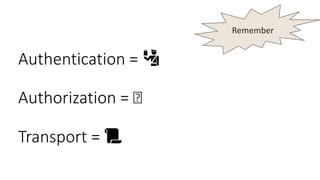
Authentication = 🛂
Authorization = 🗝
Transport = 📜
Remember
Kerberos
• Authorization + Transport
• Ticket based
• Centralized
• Hard to distribute
• Network intensive
• Not embeddable in the browser
RADIUS
• Authentication + Transport
• Centralized
• Hard to distribute
• Network intensive
• Not embeddable in the browser
SAML
• Authorization & Authorization on SSO context
• Based on HTTP and browsing
• Complex
Cookie
• HTTP only
• Arbitrary data
• Leading to mistake
• Transport / storage
• Tooling and options on the browsers is mature
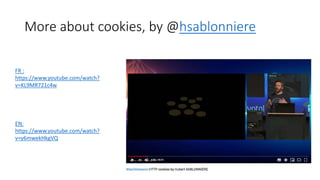
More about cookies, by @hsablonniere
FR :
https://www.youtube.com/watch?
v=KL9MR721c4w
EN:
https://www.youtube.com/watch?
v=y6mwekHkgVQ
Oauth
• Delegate Authentication & somehow Authorization
• Implementation non consistent
• Centralized
• Token mess and easy to steal
JWT
• Authorization token & transport agnostic
• Can convoy identity
JWT
• Heavy token
• Complexity, leading to security issue
• Data Staleness
• No delegation nor attenuation
What’s delegation and
attenuation?
Macaroons
• Authorization token & transport agnostic
• Can convoy identity
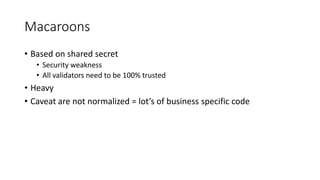
Macaroons
• Based on shared secret
• Security weakness
• All validators need to be 100% trusted
• Heavy
• Caveat are not normalized = lot’s of business specific code
So, we are not satisfied.
Avoid shared secret
And allow the use of the token for multiple trust circles
Allow Delegation and attenuation
Be small
Introducing
Logo by @madgraphism
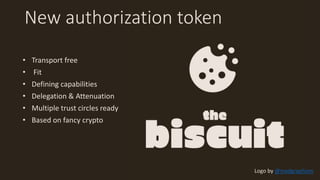
New authorization token
• Transport free
• Fit
• Defining capabilities
• Delegation & Attenuation
• Multiple trust circles ready
• Based on fancy crypto
Logo by @madgraphism
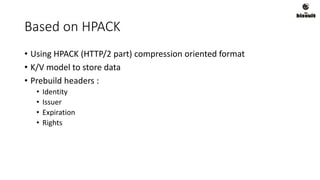
Based on HPACK
• Using HPACK (HTTP/2 part) compression oriented format
• K/V model to store data
• Prebuild headers :
• Identity
• Issuer
• Expiration
• Rights
Capabilities
• Unique scheme to describes rights
alias * = /.+/
namespace { [+,-][tag,/tag-regexp/]:[feature,/feature-
regexp/](options,/options-regexp/) }
//example
clevercloud { +*:*(*) -/.*prod/:*(*) +*:log(read, drain) }
cleverbench { +rust:metrics(*) }
// another block
clevercloud { -wordpress:log(drain) }
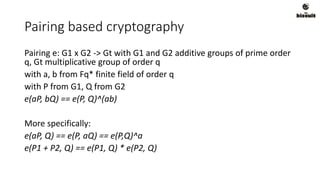
Pairing based cryptography
Pairing e: G1 x G2 -> Gt with G1 and G2 additive groups of prime order
q, Gt multiplicative group of order q
with a, b from Fq* finite field of order q
with P from G1, Q from G2
e(aP, bQ) == e(P, Q)^(ab)
More specifically:
e(aP, Q) == e(P, aQ) == e(P,Q)^a
e(P1 + P2, Q) == e(P1, Q) * e(P2, Q)
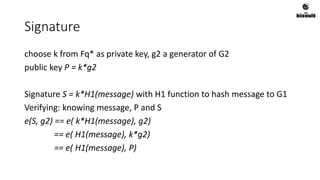
Signature
choose k from Fq* as private key, g2 a generator of G2
public key P = k*g2
Signature S = k*H1(message) with H1 function to hash message to G1
Verifying: knowing message, P and S
e(S, g2) == e( k*H1(message), g2)
== e( H1(message), k*g2)
== e( H1(message), P)
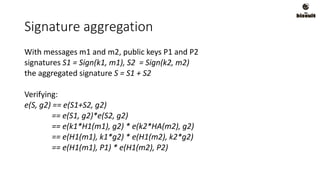
Signature aggregation
With messages m1 and m2, public keys P1 and P2
signatures S1 = Sign(k1, m1), S2 = Sign(k2, m2)
the aggregated signature S = S1 + S2
Verifying:
e(S, g2) == e(S1+S2, g2)
== e(S1, g2)*e(S2, g2)
== e(k1*H1(m1), g2) * e(k2*HA(m2), g2)
== e(H1(m1), k1*g2) * e(H1(m2), k2*g2)
== e(H1(m1), P1) * e(H1(m2), P2)
Signing tokens
Token 1: [block] sig1
Deriving a token for [block 2] with pubkey P2:
sig2 = Sign(k2, block 2)
S = sig1 + sig2
Token 2: [block 1][block 2] S
Technical details
Using curve BLS 12 381
Example of library this can be implemented with:
- pairing crate: https://github.com/zkcrypto/pairing
- mcl: https://github.com/herumi/mcl
No formal proof or audit for now
Can be used as SSO
Built in revocation mechanism
Current Performances
can validate 3 caveats in 1.7ms
size:
public key 128 hex characters
signature 64 hex characters
Status
• RFC in less than 20 days on Clever Cloud blog
http://www.clever-cloud.com/blog
• C++/rust implementation
• Wasm ?
• JVM / Java will be ongoing
• Need audit, need comment
We are @gcouprie & @waxzce on twitter
Give CLEVER-CLOUD.COM a try
Free credits coupon :
cc-api-18
Thx for listening

Remove centralization on Authorization - API Days Paris 2018 (announcement for biscuit)

Editor's Notes

  • #14 - cookies - easy to handle (random string) - linked to session data on the server -> state management - no delegation - easy to revoke (delete from state) - any service validating auth must access the shared state - browser support is great (cf tough cookies https://scotthelme.co.uk/tough-cookies/ ) - use with TLS
  • #17 - JWT - JSON data + signature (and possibly encrypted data), lots of base64 - can embed user specific data, and we can detect if that data was modified - use public key, so the service validating the token is not necessarily the one that created it - the validating service should not need shared state, BUT - revocation will either need state management or short expiration dates (and probably state management just to be sure)) - quite large (can exceed the size of a cookie) - so they are often stored in localstorage, so they can be stolen via XSS - complex: many ways to sign or encrypt things, too many parameters, which leads to insecure implementations and insecure usage - no delegation (cannot create a valid signature from another one) - data staleness
  • #18 - JWT - JSON data + signature (and possibly encrypted data), lots of base64 - can embed user specific data, and we can detect if that data was modified - use public key, so the service validating the token is not necessarily the one that created it - the validating service should not need shared state, BUT - revocation will either need state management or short expiration dates (and probably state management just to be sure)) - quite large (can exceed the size of a cookie) - so they are often stored in localstorage, so they can be stolen via XSS - complex: many ways to sign or encrypt things, too many parameters, which leads to insecure implementations and insecure usage - no delegation (cannot create a valid signature from another one) - data staleness
  • #20 - macaroons - meant for delegated auth: if you have a macaroon, you can add claims to restrict it, and create a new valid macaroon from it (and we can’t get the old macaroon back from the new one) - uses HMAC - validation requires knowing the original secret of the macaroon, so the creation service must share that secret with the validation service - as usual, revocation will require shared state - typically stored as one long base64 string (binary format, not well specified) - has a concept of third party macaroon, so a macaroon can require authorization from another service we already share a key with
  • #21 - macaroons - meant for delegated auth: if you have a macaroon, you can add claims to restrict it, and create a new valid macaroon from it (and we can’t get the old macaroon back from the new one) - uses HMAC - validation requires knowing the original secret of the macaroon, so the creation service must share that secret with the validation service - as usual, revocation will require shared state - typically stored as one long base64 string (binary format, not well specified) - has a concept of third party macaroon, so a macaroon can require authorization from another service we already share a key with