2019 HPCC
Systems®
Community Day
Challenge Yourself –
Challenge the Status Quo
Attila Vámos
Consulting Software Engineer
HPCC Systems Platform Team
Release on the
schedule approach
in the HPCC
Systems Platform
Team
Demand
Concept
Realisation
Challenges
Release Cycle
Changes
Demand
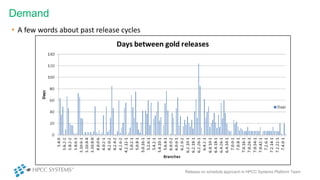
• A few words about past release cycles
Release on schedule approach in HPCC Systems Platform Team
• Every release:
• Has lots of changes, bug fixes, features, etc.
• Impacts on a wide range of HPCC Systems Platform components
• If something goes wrong outside the Platform team:
• It is hard to identify and extract the culprit from source tree and build a new
install package
• Therefore the whole release should roll back to an earlier release.
• It can be weeks or months old, sometimes from the previous main release
• It can hold back to develop/release new products
• It can cause problems in operations and existing products
• It can make everyone life much harder than necessary
Release on schedule approach in HPCC Systems Platform Team
Demand
Concept
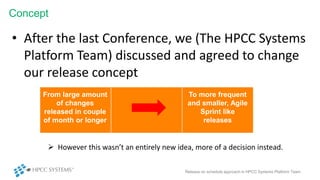
• After the last Conference, we (The HPCC Systems
Platform Team) discussed and agreed to change
our release concept
Release on schedule approach in HPCC Systems Platform Team
 However this wasn’t an entirely new idea, more of a decision instead.
From large amount
of changes
released in couple
of month or longer
To more frequent
and smaller, Agile
Sprint like
releases
Concept
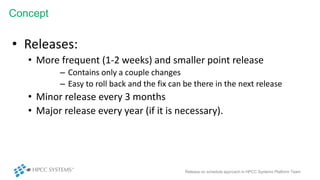
• Releases:
• More frequent (1-2 weeks) and smaller point release
– Contains only a couple changes
– Easy to roll back and the fix can be there in the next release
• Minor release every 3 months
• Major release every year (if it is necessary).
Release on schedule approach in HPCC Systems Platform Team
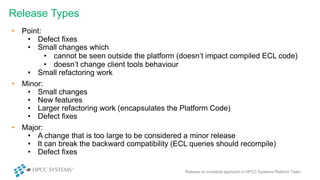
• Point:
• Defect fixes
• Small changes which
• cannot be seen outside the platform (doesn’t impact compiled ECL code)
• doesn’t change client tools behaviour
• Small refactoring work
• Minor:
• Small changes
• New features
• Larger refactoring work (encapsulates the Platform Code)
• Defect fixes
• Major:
• A change that is too large to be considered a minor release
• It can break the backward compatibility (ECL queries should recompile)
• Defect fixes
Release on schedule approach in HPCC Systems Platform Team
Release Types
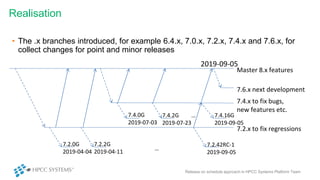
• The .x branches introduced, for example 6.4.x, 7.0.x, 7.2.x, 7.4.x and 7.6.x, for
collect changes for point and minor releases
Realisation
Master 8.x features
7.6.x next development
7.4.x to fix bugs,
new features etc.
7.2.x to fix regressions
7.2.0G
2019-04-04
7.2.2G
2019-04-11
7.2.42RC-1
2019-09-05
7.4.0G
2019-07-03
7.4.2G …
2019-07-23
7.4.16G
2019-09-05
2019-09-05
…
Release on schedule approach in HPCC Systems Platform Team
• At the push of a button release
• Previously the release process was a manual process
• Merge all reviewed and tested Pull Request into the target branch
• Use git command to create tags
• Now it is automatized
• Scripts created to do a lots of previously manual operations
• Now it is nearly a push button release.
Realisation
Release on schedule approach in HPCC Systems Platform Team
Challenges
• The point release branches are kept in-house for
a short period of time only and we should test
them as rigorously as we can
• We should test all pre release candidates on a daily basis in
different environments:
– On large and small HW
– Different settings (e.g.: Thor slaves and channels/slave)
Release on schedule approach in HPCC Systems Platform Team
• The new .x branches don’t challenge Smoketest because:
• It already handles different base branches of Pull Requests
• Smoketest utilises the new Draft Pull Request feature of GitHub, where the PR
• can be used as proof of concept without any chance to infer its base branch because it
can’t be merged
• The initial commit is fully tested by Smoketest (the PR owner can manage if they want
all further commits will be tested or not)
• can observe, review by other members
• can move to standard (able to merge) PR
Release on schedule approach in HPCC Systems Platform Team
Impacts in Smoketest system
• Previously ( ~1.5 years ago) we tested only one selected branch on a daily bases.
• But we have demand to do more because we have 2 or more active branches
• Internal and Unit test case execution is reviewed and highly time consuming
cases are removed from the daily test and executed less frequently.
• Average test session time decreased from 3.5 ~ 4 hours to 1.5 ~ 2 hours
• It heavily uses versioning
• RUN_0=("BRANCH_ID=candidate-7.2.x")
• RUN_1=("BRANCH_ID=candidate-7.4.x")
• RUN_2=("BRANCH_ID=candidate-7.6.x")
• RUN_3=("BRANCH_ID=master")
• Now we have the chance to run whole test sets twice a day if necessary
Changes in our OBT system
Release on schedule approach in HPCC Systems Platform Team
Changes in our OBT system
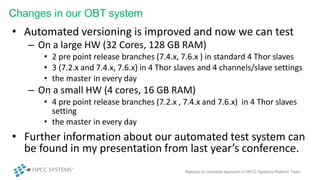
• Automated versioning is improved and now we can test
– On a large HW (32 Cores, 128 GB RAM)
• 2 pre point release branches (7.4.x, 7.6.x ) in standard 4 Thor slaves
• 3 (7.2.x and 7.4.x, 7.6.x) in 4 Thor slaves and 4 channels/slave settings
• the master in every day
– On a small HW (4 cores, 16 GB RAM)
• 4 pre point release branches (7.2.x , 7.4.x and 7.6.x) in 4 Thor slaves
setting
• the master in every day
• Further information about our automated test system can
be found in my presentation from last year’s conference.
Release on schedule approach in HPCC Systems Platform Team
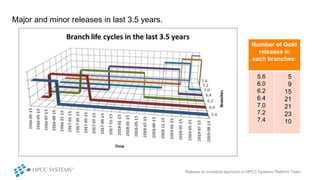
Major and minor releases in last 3.5 years.
Release on schedule approach in HPCC Systems Platform Team
Number of Gold
releases in
each branches:
5.6
6.0
6.2
6.4
7.0
7.2
7.4
5
9
15
21
21
23
10
Thank you for your attention.
If you have any questions, please send it to: attila.vamos@lexisnexisrisk.com
Release on schedule approach in HPCC Systems Platform Team
View this presentation on YouTube:
https://www.youtube.com/watch?v=Z1A3nOuhv3A&list=PL-
8MJMUpp8IKH5-d56az56t52YccleX5h&index=11&t=43s (1:08:01)

Release Cycle Changes

  • 1.
    2019 HPCC Systems® Community Day ChallengeYourself – Challenge the Status Quo Attila Vámos Consulting Software Engineer HPCC Systems Platform Team
  • 2.
    Release on the scheduleapproach in the HPCC Systems Platform Team Demand Concept Realisation Challenges Release Cycle Changes
  • 3.
    Demand • A fewwords about past release cycles Release on schedule approach in HPCC Systems Platform Team
  • 4.
    • Every release: •Has lots of changes, bug fixes, features, etc. • Impacts on a wide range of HPCC Systems Platform components • If something goes wrong outside the Platform team: • It is hard to identify and extract the culprit from source tree and build a new install package • Therefore the whole release should roll back to an earlier release. • It can be weeks or months old, sometimes from the previous main release • It can hold back to develop/release new products • It can cause problems in operations and existing products • It can make everyone life much harder than necessary Release on schedule approach in HPCC Systems Platform Team Demand
  • 5.
    Concept • After thelast Conference, we (The HPCC Systems Platform Team) discussed and agreed to change our release concept Release on schedule approach in HPCC Systems Platform Team  However this wasn’t an entirely new idea, more of a decision instead. From large amount of changes released in couple of month or longer To more frequent and smaller, Agile Sprint like releases
  • 6.
    Concept • Releases: • Morefrequent (1-2 weeks) and smaller point release – Contains only a couple changes – Easy to roll back and the fix can be there in the next release • Minor release every 3 months • Major release every year (if it is necessary). Release on schedule approach in HPCC Systems Platform Team
  • 7.
    • Point: • Defectfixes • Small changes which • cannot be seen outside the platform (doesn’t impact compiled ECL code) • doesn’t change client tools behaviour • Small refactoring work • Minor: • Small changes • New features • Larger refactoring work (encapsulates the Platform Code) • Defect fixes • Major: • A change that is too large to be considered a minor release • It can break the backward compatibility (ECL queries should recompile) • Defect fixes Release on schedule approach in HPCC Systems Platform Team Release Types
  • 8.
    • The .xbranches introduced, for example 6.4.x, 7.0.x, 7.2.x, 7.4.x and 7.6.x, for collect changes for point and minor releases Realisation Master 8.x features 7.6.x next development 7.4.x to fix bugs, new features etc. 7.2.x to fix regressions 7.2.0G 2019-04-04 7.2.2G 2019-04-11 7.2.42RC-1 2019-09-05 7.4.0G 2019-07-03 7.4.2G … 2019-07-23 7.4.16G 2019-09-05 2019-09-05 … Release on schedule approach in HPCC Systems Platform Team
  • 9.
    • At thepush of a button release • Previously the release process was a manual process • Merge all reviewed and tested Pull Request into the target branch • Use git command to create tags • Now it is automatized • Scripts created to do a lots of previously manual operations • Now it is nearly a push button release. Realisation Release on schedule approach in HPCC Systems Platform Team
  • 10.
    Challenges • The pointrelease branches are kept in-house for a short period of time only and we should test them as rigorously as we can • We should test all pre release candidates on a daily basis in different environments: – On large and small HW – Different settings (e.g.: Thor slaves and channels/slave) Release on schedule approach in HPCC Systems Platform Team
  • 11.
    • The new.x branches don’t challenge Smoketest because: • It already handles different base branches of Pull Requests • Smoketest utilises the new Draft Pull Request feature of GitHub, where the PR • can be used as proof of concept without any chance to infer its base branch because it can’t be merged • The initial commit is fully tested by Smoketest (the PR owner can manage if they want all further commits will be tested or not) • can observe, review by other members • can move to standard (able to merge) PR Release on schedule approach in HPCC Systems Platform Team Impacts in Smoketest system
  • 12.
    • Previously (~1.5 years ago) we tested only one selected branch on a daily bases. • But we have demand to do more because we have 2 or more active branches • Internal and Unit test case execution is reviewed and highly time consuming cases are removed from the daily test and executed less frequently. • Average test session time decreased from 3.5 ~ 4 hours to 1.5 ~ 2 hours • It heavily uses versioning • RUN_0=("BRANCH_ID=candidate-7.2.x") • RUN_1=("BRANCH_ID=candidate-7.4.x") • RUN_2=("BRANCH_ID=candidate-7.6.x") • RUN_3=("BRANCH_ID=master") • Now we have the chance to run whole test sets twice a day if necessary Changes in our OBT system Release on schedule approach in HPCC Systems Platform Team
  • 13.
    Changes in ourOBT system • Automated versioning is improved and now we can test – On a large HW (32 Cores, 128 GB RAM) • 2 pre point release branches (7.4.x, 7.6.x ) in standard 4 Thor slaves • 3 (7.2.x and 7.4.x, 7.6.x) in 4 Thor slaves and 4 channels/slave settings • the master in every day – On a small HW (4 cores, 16 GB RAM) • 4 pre point release branches (7.2.x , 7.4.x and 7.6.x) in 4 Thor slaves setting • the master in every day • Further information about our automated test system can be found in my presentation from last year’s conference. Release on schedule approach in HPCC Systems Platform Team
  • 14.
    Major and minorreleases in last 3.5 years. Release on schedule approach in HPCC Systems Platform Team Number of Gold releases in each branches: 5.6 6.0 6.2 6.4 7.0 7.2 7.4 5 9 15 21 21 23 10
  • 15.
    Thank you foryour attention. If you have any questions, please send it to: attila.vamos@lexisnexisrisk.com Release on schedule approach in HPCC Systems Platform Team
  • 16.
    Release on scheduleapproach in HPCC Systems Platform Team View this presentation on YouTube: https://www.youtube.com/watch?v=Z1A3nOuhv3A&list=PL- 8MJMUpp8IKH5-d56az56t52YccleX5h&index=11&t=43s (1:08:01)