RELATIVE CLAUSES
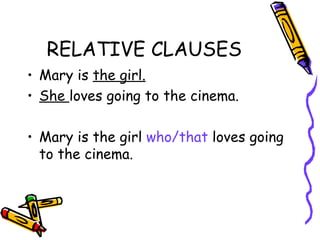
RELATIVE CLAUSES Mary is  the girl.   She  loves going to the cinema. Mary is the girl  who/that  loves going to the cinema.
CHARACTERISTICS. Mary is the girl  who  loves going to the cinema. Used to join information which is repeated.  Introduction of relative pronoun:  who; which; that; where; when; whose, why… Some elements could be omitted.
RELATIVE PRONOUNS. Depending on the antecedent (the name they make reference to). Ex: That is  the boy .  The boy  broke the window  yesterday. R.C: That is the boy  who  broke the window yesterday. (  Who  makes reference to  the boy).
RELATIVE PRONOUNS: Who: To refer to people. Ex: She is the woman   who   brought the cake. Which: To refer to animals/things.   Ex: MTC is a company   which  offers concerts around the world.   That: People/ objects Ex: This is the dog  that  bit my cousin last summer. Ex: The teacher  who  arrives on time.
OTHER RELATIVE PRONOUNS: Whose: To express possession (cuyo/a): whose+ noun Ex: The woman  whose  mobile phone was ringing. When: To express time. Ex: The day  when  the volcano erupted. Where: To express place Ex: The bank  where  my friends keep all their money.
OTHER RELATIVE PRONOUNS: WHY: To express reason (por lo que) Ex: The reason  why  she came back home… WHOM: For people (after preposition) Ex: The flight attendant is the person to  whom  you have to talk. (Formal language) or:  The flight attendant is the person (who) you have to talk to. (Informal language)
DEFINE THESE WORDS An engineer: design roads and bridges A cook: prepare food A postman: deliver letters A footballer: play matches and kick a ball A waiter: serve customers in a restaurant A journalist: write news stories for newspapers
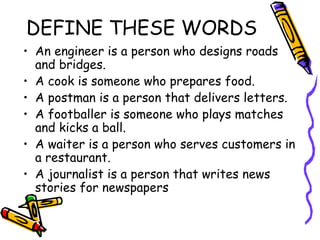
DEFINE THESE WORDS An engineer is a person who designs roads and bridges. A cook is someone who prepares food. A postman is a person that delivers letters. A footballer is someone who plays matches and kicks a ball. A waiter is a person who serves customers in a restaurant.  A journalist is a person that writes news stories for newspapers
COMBINE THE SENTENCES USING RELATIVE PRONOUNS: 1.What was the film? You were watching it. 2.That is the car. I saw it earlier. 3.Are they the books? We read them last year. 4.He is the student. He was my classmate. 5.Is that the woman? Her sister is my teacher. 6.This is the place. Everyone plays chess here. 7.We bought a computer. The computer doesn’t work properly. 8.My brother studies at your school. The school is next to the hospital.
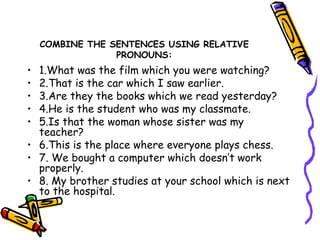
COMBINE THE SENTENCES USING RELATIVE PRONOUNS: 1.What was the film which you were watching? 2.That is the car which I saw earlier. 3.Are they the books which we read yesterday? 4.He is the student who was my classmate. 5.Is that the woman whose sister was my teacher? 6.This is the place where everyone plays chess. 7. We bought a computer which doesn’t work properly. 8. My brother studies at your school which is next to the hospital.

Relative clauses

  • 1.
  • 2.
    RELATIVE CLAUSES Maryis the girl. She loves going to the cinema. Mary is the girl who/that loves going to the cinema.
  • 3.
    CHARACTERISTICS. Mary isthe girl who loves going to the cinema. Used to join information which is repeated. Introduction of relative pronoun: who; which; that; where; when; whose, why… Some elements could be omitted.
  • 4.
    RELATIVE PRONOUNS. Dependingon the antecedent (the name they make reference to). Ex: That is the boy . The boy broke the window yesterday. R.C: That is the boy who broke the window yesterday. ( Who makes reference to the boy).
  • 5.
    RELATIVE PRONOUNS: Who:To refer to people. Ex: She is the woman who brought the cake. Which: To refer to animals/things. Ex: MTC is a company which offers concerts around the world. That: People/ objects Ex: This is the dog that bit my cousin last summer. Ex: The teacher who arrives on time.
  • 6.
    OTHER RELATIVE PRONOUNS:Whose: To express possession (cuyo/a): whose+ noun Ex: The woman whose mobile phone was ringing. When: To express time. Ex: The day when the volcano erupted. Where: To express place Ex: The bank where my friends keep all their money.
  • 7.
    OTHER RELATIVE PRONOUNS:WHY: To express reason (por lo que) Ex: The reason why she came back home… WHOM: For people (after preposition) Ex: The flight attendant is the person to whom you have to talk. (Formal language) or: The flight attendant is the person (who) you have to talk to. (Informal language)
  • 8.
    DEFINE THESE WORDSAn engineer: design roads and bridges A cook: prepare food A postman: deliver letters A footballer: play matches and kick a ball A waiter: serve customers in a restaurant A journalist: write news stories for newspapers
  • 9.
    DEFINE THESE WORDSAn engineer is a person who designs roads and bridges. A cook is someone who prepares food. A postman is a person that delivers letters. A footballer is someone who plays matches and kicks a ball. A waiter is a person who serves customers in a restaurant. A journalist is a person that writes news stories for newspapers
  • 10.
    COMBINE THE SENTENCESUSING RELATIVE PRONOUNS: 1.What was the film? You were watching it. 2.That is the car. I saw it earlier. 3.Are they the books? We read them last year. 4.He is the student. He was my classmate. 5.Is that the woman? Her sister is my teacher. 6.This is the place. Everyone plays chess here. 7.We bought a computer. The computer doesn’t work properly. 8.My brother studies at your school. The school is next to the hospital.
  • 11.
    COMBINE THE SENTENCESUSING RELATIVE PRONOUNS: 1.What was the film which you were watching? 2.That is the car which I saw earlier. 3.Are they the books which we read yesterday? 4.He is the student who was my classmate. 5.Is that the woman whose sister was my teacher? 6.This is the place where everyone plays chess. 7. We bought a computer which doesn’t work properly. 8. My brother studies at your school which is next to the hospital.