Regulation
Media Regulation is the use of legal means to control
media ownership and the content of media
communications; which are split into two sections,
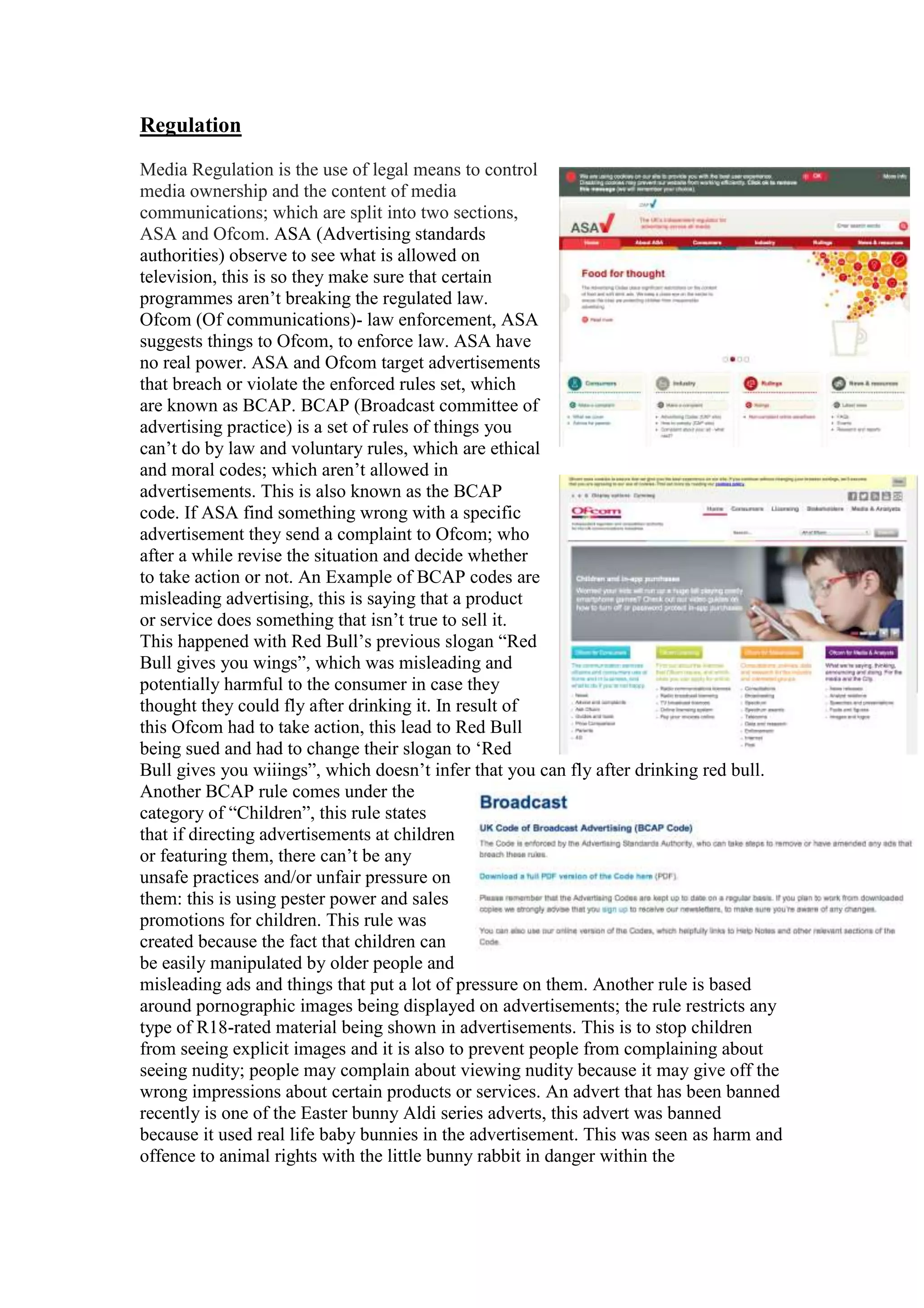
ASA and Ofcom. ASA (Advertising standards
authorities) observe to see what is allowed on
television, this is so they make sure that certain
programmes aren‟t breaking the regulated law.
Ofcom (Of communications)- law enforcement, ASA
suggests things to Ofcom, to enforce law. ASA have
no real power. ASA and Ofcom target advertisements
that breach or violate the enforced rules set, which
are known as BCAP. BCAP (Broadcast committee of
advertising practice) is a set of rules of things you
can‟t do by law and voluntary rules, which are ethical
and moral codes; which aren‟t allowed in
advertisements. This is also known as the BCAP
code. If ASA find something wrong with a specific
advertisement they send a complaint to Ofcom; who
after a while revise the situation and decide whether
to take action or not. An Example of BCAP codes are
misleading advertising, this is saying that a product
or service does something that isn‟t true to sell it.
This happened with Red Bull‟s previous slogan “Red
Bull gives you wings”, which was misleading and
potentially harmful to the consumer in case they
thought they could fly after drinking it. In result of
this Ofcom had to take action, this lead to Red Bull
being sued and had to change their slogan to „Red
Bull gives you wiiings”, which doesn‟t infer that you can fly after drinking red bull.
Another BCAP rule comes under the
category of “Children”, this rule states
that if directing advertisements at children
or featuring them, there can‟t be any
unsafe practices and/or unfair pressure on
them: this is using pester power and sales
promotions for children. This rule was
created because the fact that children can
be easily manipulated by older people and
misleading ads and things that put a lot of pressure on them. Another rule is based
around pornographic images being displayed on advertisements; the rule restricts any
type of R18-rated material being shown in advertisements. This is to stop children
from seeing explicit images and it is also to prevent people from complaining about
seeing nudity; people may complain about viewing nudity because it may give off the
wrong impressions about certain products or services. An advert that has been banned
recently is one of the Easter bunny Aldi series adverts, this advert was banned
because it used real life baby bunnies in the advertisement. This was seen as harm and
offence to animal rights with the little bunny rabbit in danger within the
advertisement. ASA reported this advert and after Ofcom reviewing it they had the
advert taken down.

Audience Regulation

  • 1.
    Regulation Media Regulation isthe use of legal means to control media ownership and the content of media communications; which are split into two sections, ASA and Ofcom. ASA (Advertising standards authorities) observe to see what is allowed on television, this is so they make sure that certain programmes aren‟t breaking the regulated law. Ofcom (Of communications)- law enforcement, ASA suggests things to Ofcom, to enforce law. ASA have no real power. ASA and Ofcom target advertisements that breach or violate the enforced rules set, which are known as BCAP. BCAP (Broadcast committee of advertising practice) is a set of rules of things you can‟t do by law and voluntary rules, which are ethical and moral codes; which aren‟t allowed in advertisements. This is also known as the BCAP code. If ASA find something wrong with a specific advertisement they send a complaint to Ofcom; who after a while revise the situation and decide whether to take action or not. An Example of BCAP codes are misleading advertising, this is saying that a product or service does something that isn‟t true to sell it. This happened with Red Bull‟s previous slogan “Red Bull gives you wings”, which was misleading and potentially harmful to the consumer in case they thought they could fly after drinking it. In result of this Ofcom had to take action, this lead to Red Bull being sued and had to change their slogan to „Red Bull gives you wiiings”, which doesn‟t infer that you can fly after drinking red bull. Another BCAP rule comes under the category of “Children”, this rule states that if directing advertisements at children or featuring them, there can‟t be any unsafe practices and/or unfair pressure on them: this is using pester power and sales promotions for children. This rule was created because the fact that children can be easily manipulated by older people and misleading ads and things that put a lot of pressure on them. Another rule is based around pornographic images being displayed on advertisements; the rule restricts any type of R18-rated material being shown in advertisements. This is to stop children from seeing explicit images and it is also to prevent people from complaining about seeing nudity; people may complain about viewing nudity because it may give off the wrong impressions about certain products or services. An advert that has been banned recently is one of the Easter bunny Aldi series adverts, this advert was banned because it used real life baby bunnies in the advertisement. This was seen as harm and offence to animal rights with the little bunny rabbit in danger within the
  • 2.
    advertisement. ASA reportedthis advert and after Ofcom reviewing it they had the advert taken down.