
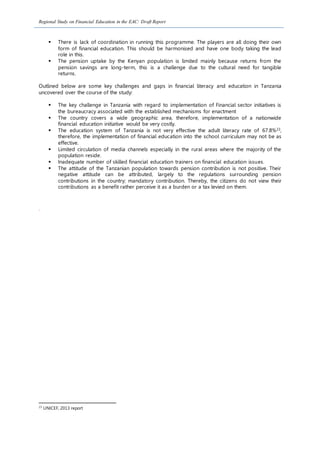
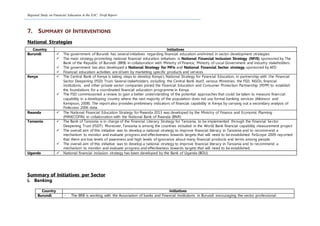
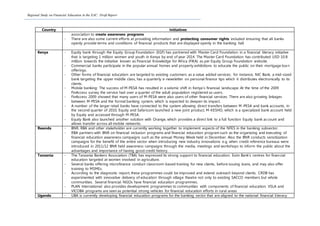
Regional Study on Financial Education in the EAC: Draft Report
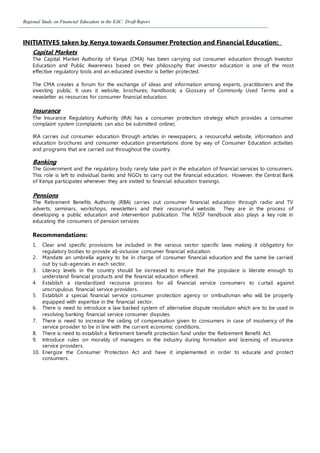
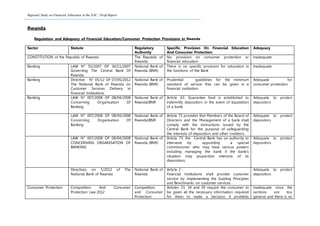
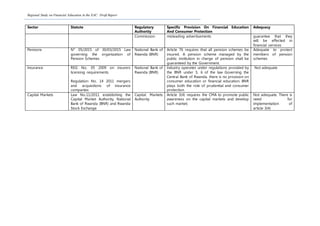
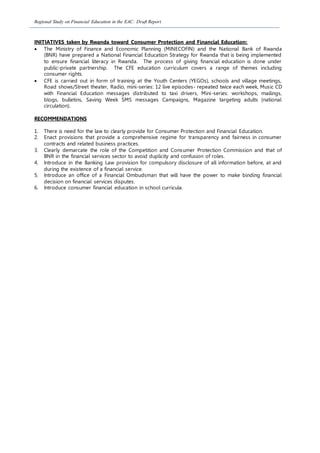
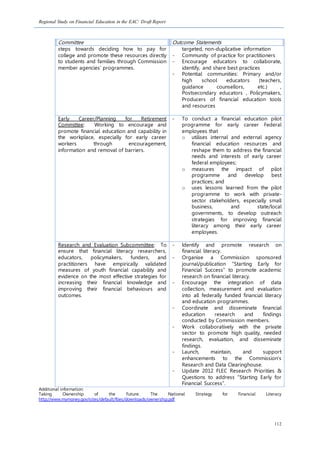
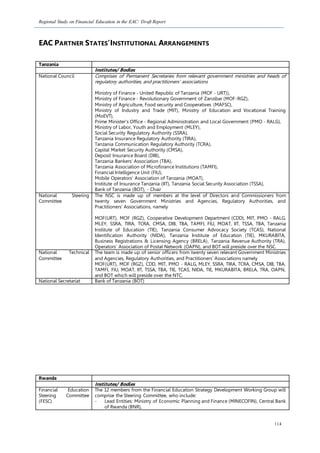
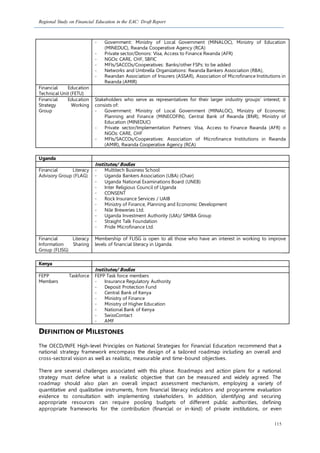
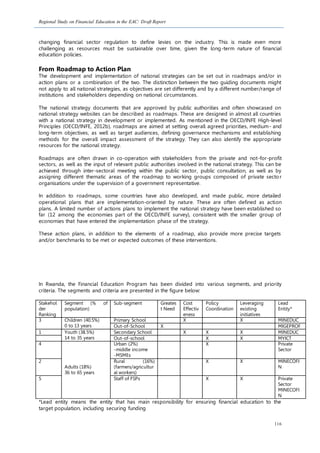
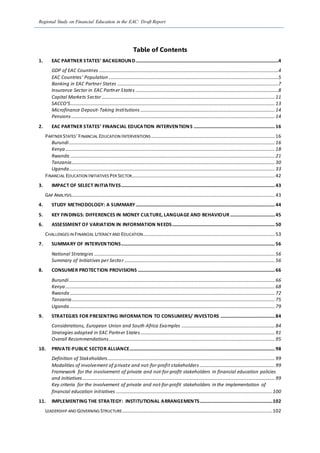
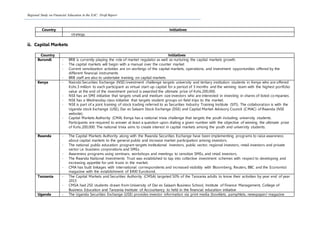
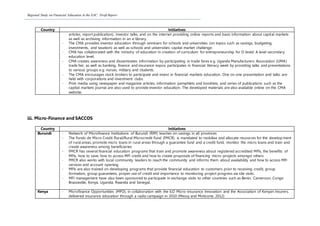
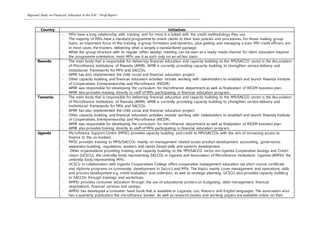
Table of Contents
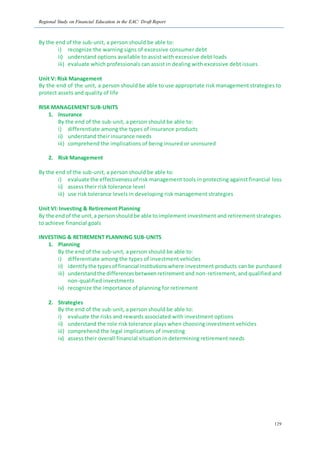
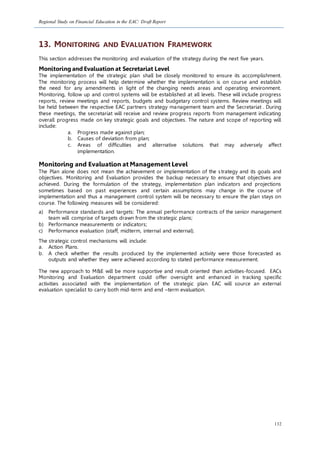
1. EAC PARTNER STATES’ BACKGROUND......................................................................................................................4
GDP of EAC Countries ....................................................................................................................................................4
EAC Countries’ Population ............................................................................................................................................5
Banking in EAC Partner States .....................................................................................................................................7
Insurance Sector in EAC Partner States ......................................................................................................................8
Capital Markets Sector...............................................................................................................................................11
SACCO’S.........................................................................................................................................................................13
Microfinance Deposit-Taking Institutions ...............................................................................................................14
Pensions ........................................................................................................................................................................14
2. EAC PARTNER STATES’ FINANCIAL EDUCATION INTERVENTIONS ...................................................................16
PARTNER STATES’FINANCIAL EDUCATION INTERVENTIONS ......................................................................................................16
Burundi..........................................................................................................................................................................16
Kenya.............................................................................................................................................................................18
Rwanda .........................................................................................................................................................................21
Tanzania........................................................................................................................................................................30
Uganda..........................................................................................................................................................................33
FINANCIAL EDUCATION INITIATIVES PER SECTOR......................................................................................................................42
3. IMPACT OF SELECT INITIATIVES...............................................................................................................................43
GAP ANALYSIS........................................................................................................................................................................43
4. STUDY METHODOLOGY: A SUMMARY...................................................................................................................44
5. KEY FINDINGS: DIFFERENCES IN MONEY CULTURE, LANGUAGE AND BEHAVIOUR.....................................45
6. ASSESSMENT OF VARIATION IN INFORMATION NEEDS.....................................................................................50
CHALLENGES IN FINANCIAL LITERACYAND EDUCATION.............................................................................................................53
7. SUMMARY OF INTERVENTIONS...............................................................................................................................56
National Strategies .....................................................................................................................................................56
Summary of Initiatives per Sector ............................................................................................................................56
8. CONSUMER PROTECTION PROVISIONS .................................................................................................................66
Burundi..........................................................................................................................................................................66
Kenya.............................................................................................................................................................................68
Rwanda .........................................................................................................................................................................72
Tanzania........................................................................................................................................................................75
Uganda..........................................................................................................................................................................79
9. STRATEGIES FOR PRESENTING INFORMATION TO CONSUMERS/ INVESTORS .............................................84
Considerations, European Union and South Africa Examples .............................................................................84
Strategies adopted in EAC Partner States...............................................................................................................91
Overall Recommendations.........................................................................................................................................95
10. PRIVATE-PUBLIC SECTOR ALLIANCE........................................................................................................................98
Definition of Stakeholders..........................................................................................................................................99
Modalities of involvement of private and not-for-profit stakeholders ..............................................................99
Framework for the involvement of private and not-for-profit stakeholders in financial education policies
and initiatives...............................................................................................................................................................99
Key criteria for the involvement of private and not-for-profit stakeholders in the implementation of
financial education initiatives .................................................................................................................................100
11. IMPLEMENTING THE STRATEGY: INSTITUTIONAL ARRANGEMENTS............................................................102
LEADERSHIP AND GOVERNING STRUCTURE............................................................................................................................102
Regional Study on Financial Education in the EAC: Draft Report
CO-ORDINATION AND THEROLES AND RESPONSIBILITIES OF VARIOUS STAKEHOLDERS...............................................................103
OTHER CIVIL SOCIETYAND INTERNATIONAL STAKEHOLDERS.....................................................................................................106
IMPORTANCEOF LEADERSHIP,CLEAR GOVERNING MECHANISMS AND STAKEHOLDERS’ROLES...................................................109
Implementation Strategy – US example................................................................................................................111
EAC PARTNER STATES’ INSTITUTIONAL ARRANGEMENTS .......................................................................................................114
DEFINITION OF MILESTONES.................................................................................................................................................115
12. REGIONAL EDUCATION FRAMEWORK .................................................................................................................120
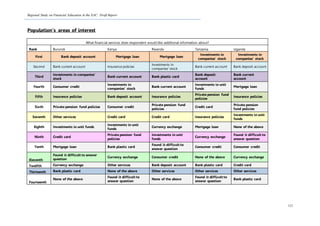
Population’s areas of interest .................................................................................................................................122
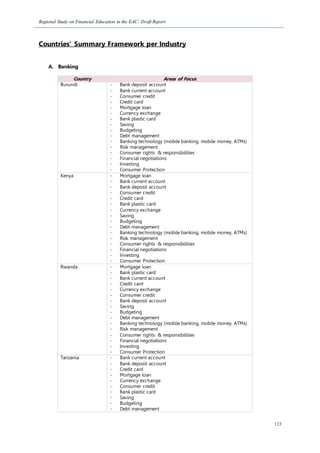
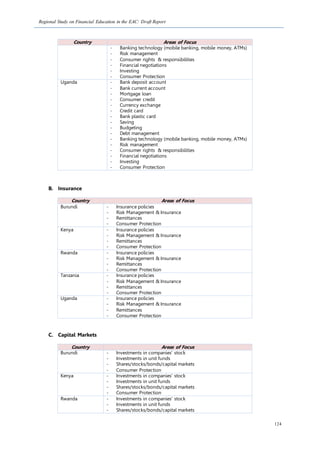
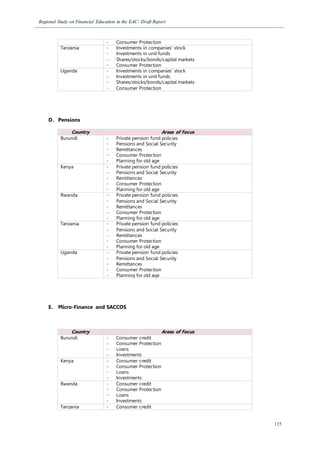
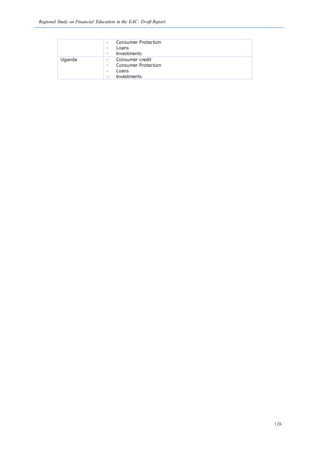
Countries’ Summary Framework per Industry......................................................................................................123
13. MONITORING AND EVALUATION FRAMEWORK ...............................................................................................132
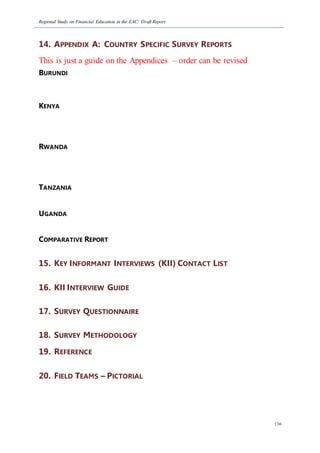
14. APPENDIX A: COUNTRY SPECIFIC SURVEY REPORTS........................................................................................136
BURUNDI.............................................................................................................................................................................136
KENYA.................................................................................................................................................................................136
RWANDA.............................................................................................................................................................................136
TANZANIA............................................................................................................................................................................136
UGANDA..............................................................................................................................................................................136
COMPARATIVE REPORT ........................................................................................................................................................136
15. KEY INFORMANT INTERVIEWS (KII) CONTACT LIST...........................................................................................136
16. KII INTERVIEW GUIDE ..............................................................................................................................................136
17. SURVEY QUESTIONNAIRE .......................................................................................................................................136
18. SURVEY METHODOLOGY ........................................................................................................................................136
19. REFERENCE.................................................................................................................................................................136
20. FIELD TEAMS – PICTORIAL ......................................................................................................................................136
Regional Study on Financial Education in the EAC: Draft Report
1. EAC PARTNER STATES’ BACKGROUND
GDP of EAC Countries
The East African Community (EAC) countries’ economic growth performance during the past
decade has been impressive at 6.2 percent, the EAC’s (unweighted) average growth rate in
2004–13 is in the top one-fifth of the distribution of 10-year growth rate episodes
experienced by all countries worldwide since 1960. Such performance is even more
remarkable taking into account that the past decade encompasses the global economic and
financial crisis that began in 2007.
East Africa’s growth accelerated in 2014 to more than 7%, from below 5% in 2013. It is
projected to decelerate to 5.6% in 2015 and accelerate again to 6.7% in 2016.1 East Africa
recorded the highest increase in foreign direct investment in 2014. Kenya, Rwanda, Tanzania
and Uganda kept up their relatively high growth. As these countries have small mining sectors
and their manufacturing is also not very large, or has declined as a percentage of GDP, their
growth is more driven by services and construction. But countries are achieving growth with
different degrees of sectoral transformation. In 2015, it’s projected that Rwanda will record
the highest economic growth rate of 7.5 percent followed by Tanzania, Kenya, Uganda and
Burundi with 7.4, 6.5, 6.3 and 4.7 percent, respectively. The dominant sector in all the Partner
States in 2014 was agriculture, followed by wholesale and retail trade and manufacturing.
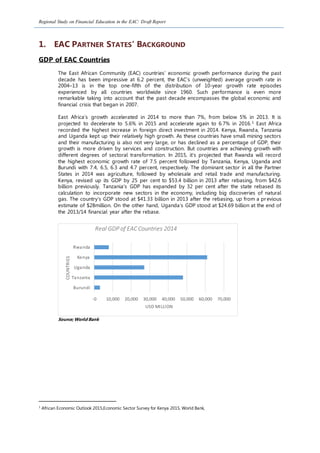
Kenya, revised up its GDP by 25 per cent to $53.4 billion in 2013 after rebasing, from $42.6
billion previously. Tanzania's GDP has expanded by 32 per cent after the state rebased its
calculation to incorporate new sectors in the economy, including big discoveries of natural
gas. The country's GDP stood at $41.33 billion in 2013 after the rebasing, up from a previous
estimate of $28million. On the other hand, Uganda’s GDP stood at $24.69 billion at the end of
the 2013/14 financial year after the rebase.
Source; World Bank
1
African Economic Outlook 2015,Economic Sector Survey for Kenya 2015, World Bank,
Burundi
Tanzania
Uganda
Kenya
Rwanda
-0 10,000 20,000 30,000 40,000 50,000 60,000 70,000
COUNTRIES
USD MILLION
Real GDP of EAC Countries 2014
Regional Study on Financial Education in the EAC: Draft Report
EAC Countries’ Population
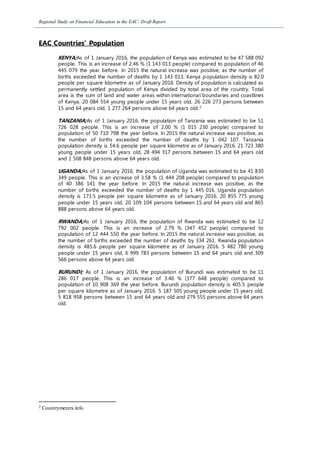
KENYA;As of 1 January 2016, the population of Kenya was estimated to be 47 588 092
people. This is an increase of 2.46 % (1 143 013 people) compared to population of 46
445 079 the year before. In 2015 the natural increase was positive, as the number of
births exceeded the number of deaths by 1 143 013. Kenya population density is 82.0
people per square kilometre as of January 2016. Density of population is calculated as
permanently settled population of Kenya divided by total area of the country. Total
area is the sum of land and water areas within international boundaries and coastlines
of Kenya. 20 084 554 young people under 15 years old, 26 226 273 persons between
15 and 64 years old, 1 277 264 persons above 64 years old.2
TANZANIA;As of 1 January 2016, the population of Tanzania was estimated to be 51
726 028 people. This is an increase of 2.00 % (1 015 230 people) compared to
population of 50 710 798 the year before. In 2015 the natural increase was positive, as
the number of births exceeded the number of deaths by 1 042 107. Tanzania
population density is 54.6 people per square kilometre as of January 2016. 21 723 380
young people under 15 years old, 28 494 317 persons between 15 and 64 years old
and 1 508 848 persons above 64 years old.
UGANDA;As of 1 January 2016, the population of Uganda was estimated to be 41 830
349 people. This is an increase of 3.58 % (1 444 208 people) compared to population
of 40 386 141 the year before. In 2015 the natural increase was positive, as the
number of births exceeded the number of deaths by 1 445 016. Uganda population
density is 173.5 people per square kilometre as of January 2016. 20 855 775 young
people under 15 years old, 20 109 104 persons between 15 and 64 years old and 865
888 persons above 64 years old.
RWANDA;As of 1 January 2016, the population of Rwanda was estimated to be 12
792 002 people. This is an increase of 2.79 % (347 452 people) compared to
population of 12 444 550 the year before. In 2015 the natural increase was positive, as
the number of births exceeded the number of deaths by 334 261. Rwanda population
density is 485.6 people per square kilometre as of January 2016. 5 482 780 young
people under 15 years old, 6 999 783 persons between 15 and 64 years old and 309
566 persons above 64 years old.
BURUNDI; As of 1 January 2016, the population of Burundi was estimated to be 11
286 017 people. This is an increase of 3.46 % (377 648 people) compared to
population of 10 908 369 the year before. Burundi population density is 405.5 people
per square kilometre as of January 2016. 5 187 505 young people under 15 years old,
5 818 958 persons between 15 and 64 years old and 279 555 persons above 64 years
old.
2 Countrymeters.info
Regional Study on Financial Education in the EAC: Draft Report
Source: Countrymeters.info
Gross Savings (% of GDP)
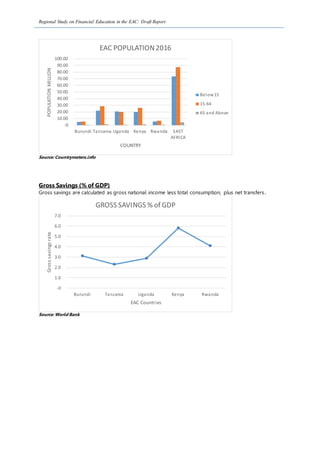
Gross savings are calculated as gross national income less total consumption, plus net transfers.
Source: World Bank
Burundi Tanzania Uganda Kenya Rwanda EAST
AFRICA
-0
10.00
20.00
30.00
40.00
50.00
60.00
70.00
80.00
90.00
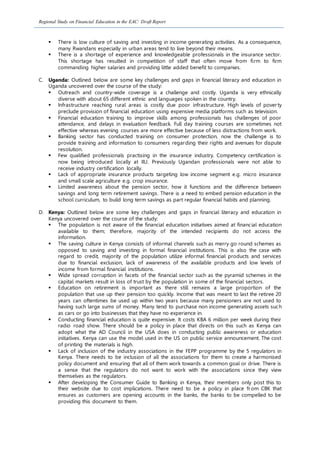
100.00
COUNTRY
POPULATIONMILLION EAC POPULATION2016
Below15
15-64
65 and Above
Burundi Tanzania Uganda Kenya Rwanda
-0
1.0
2.0
3.0
4.0
5.0
6.0
7.0
EAC Countries
Grosssavingsrate
GROSS SAVINGS % of GDP
Regional Study on Financial Education in the EAC: Draft Report
Banking in EAC Partner States
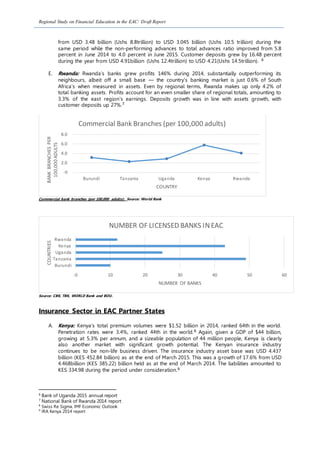
A. Rwanda, by far the smallest banking market in the region, saw profits more than double
through 2014, up 145%. Profits growth in other markets was also impressive, with Tanzania up
29% and Uganda 26.5%. Kenya, being the largest market, reported the slowest growth in the
region, at 15.5%. Profits growth was solid despite lower margins in three of the four East
African markets. The average 17.3% rise in banking assets across east Africa proved to be a
strong driver. In addition, Uganda and Kenya experienced sharply rising impairments, while
lower nonperforming loans were reported in Tanzania (albeit after a spike in 2013).3
B. Kenya; During the period ended June 30, 2015, the Kenyan banking sector comprised 43
commercial banks, 1 mortgage finance company, 12 microfinance banks, 8 representative
offices of foreign banks, 14 money remittance providers, 86 foreign exchange bureaus and 3
credit reference bureaus. The Banking Sector registered improved performance in the period
ended June 30, 2015 as shown below: Assets increased to USD 35.28 billion (KSh 3.6 trillion)
from USD 34.8 billion (KSh 3.0 trillion) in June 30, 2014. Loans and advances grew to USD
20.58 billion (KSh 2.1 trillion) compared to USD 19.72 billion (KSh 1.7 trillion) as at June 30,
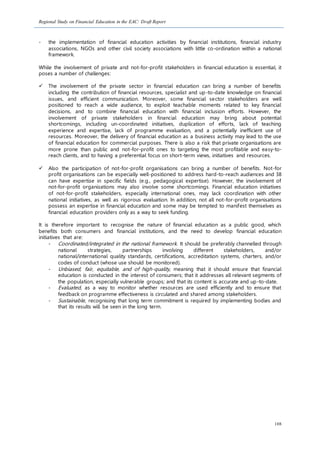
2014. The deposit base expanded to USD 25.48 billion (KSh 2.6 trillion) an increase from USD
24.36 billion (KSh 2.1 trillion) reported in June 30, 2014. Profit before tax was USD 751.66
million (KSh 76.7 billion) compared to USD 823.6 million (KSh 71.0 billion) reported in the
period ended June 30, 2014. The banking sector gross loans and advances rose from USD
20.88 billion (KSh 1.8 trillion) in June 2014 to USD 21.56 billion (KSh 2.2 trillion) in June 2015
translating to a growth of 22.1 percent. Customer deposits were the main source of funding
for the banking sector, accounting for 71.5 percent of total liabilities. The deposit base
increased by 10.5 percent from USD 20.88 (KSh 2.1 trillion) in June 2014 to USD 25.48 (KSh 2.6
trillion) in June 2015 mainly attributed to branch expansion, remittances, and agency banking.
The deposit accounts increased by 24.9 percent from 25.3 million accounts in June 2014 to
31.6 million in June 2015.4
C. Tanzania: Between 2010 and 2014, bank assets grew at a cumulated average growth rate of
33.4%. Banking sector assets increased 16% in 2014, slightly higher than 2013’s 14%, but well
below the four-year CAGR of 33.4%.Loans and advances outpaced overall asset growth, rising
49.1% during the same period. Net profits (after tax) rose at a CAGR of 38.5% between 2010
and 2014, which was faster than asset growth. This was driven by solid net interest income
growth of 51.2%. Bad debts rose considerably slower during this period, up 25.6%. Of the 49
registered banks, 34 reported profits during the year, with the remaining 15 banks declaring
losses. Deposits growth was marginally weaker than asset growth, up 29.9%. Customer
deposits increased 15% in 2014, up from 12% in 2013. Banks were therefore able to increase
their loan-to-deposit ratios and deploy more deposits to loans. Two large banks still
dominate the deposit market, accounting for 38% of total deposits, while large banks
collectively account for 80% of total bank deposits. The share of total assets by medium-sized
banks increased to 27% (25% in 2013 and 23% in 2012). NBFI’s share of total assets has
remained flat at 4% in 2014 (3% in 2012 and 4% in 2011). Regional and small banks’ share of
total assets increased to 3% in 2014 (2% in 2013, 2012 and 2011). 5
D. Uganda: Rapid growth strongly supported bank earnings, which rose 26.4% during the year,
only trailing Rwanda. This means each 1% rise in GDP sees a 4.3% rise in net profits after tax.
Of the 24 registered banks, 18 reported profits and 6 reported losses. Asset growth was
slower than profits growth, at 12%, despite stronger loans and advances growth of 16%.
Profits were higher due to a substantial fall in bad-debt provisions and losses (down almost
70% from 2013’s levels). Deposits growth was in line with loans growth, resulting in a flat
loan-to-deposit ratio of 47.8%.The banking system remained safe and sound. The banks’ total
assets grew by 15.9 percent from USD 7.36 billion Ushs 18.6 trillion in June 2014 to USD
6.26billion (Ushs 21.6 trillion) as at June 2015. Total gross loans increased by 19.7 percent
3
EY-sub-Saharan-Africa-banking-review 2015
4
Central Bank of Kenya 2015 Annual report
5
Bank of Tanzania 2015 Annual report
Regional Study on Financial Education in the EAC: Draft Report
from USD 3.48 billion (Ushs 8.8trillion) to USD 3.045 billion (Ushs 10.5 trillion) during the
same period while the non-performing advances to total advances ratio improved from 5.8
percent in June 2014 to 4.0 percent in June 2015. Customer deposits grew by 16.48 percent
during the year from USD 4.91billion (Ushs 12.4trillion) to USD 4.21(Ushs 14.5trillion). 6
E. Rwanda: Rwanda’s banks grew profits 146% during 2014, substantially outperforming its
neighbours, albeit off a small base — the country’s banking market is just 0.6% of South
Africa’s when measured in assets. Even by regional terms, Rwanda makes up only 4.2% of
total banking assets. Profits account for an even smaller share of regional totals, amounting to
3.3% of the east region’s earnings. Deposits growth was in line with assets growth, with
customer deposits up 27%.7
Commercial bank branches (per 100,000 adults): Source: World Bank
Source: CBK, TBK, WORLD Bank and BOU.
Insurance Sector in EAC Partner States
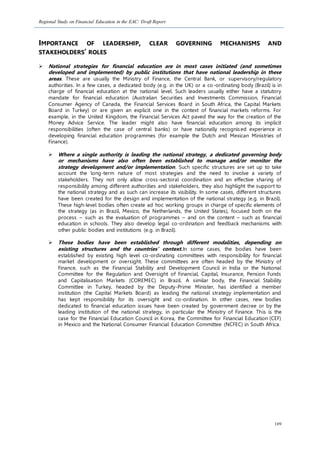
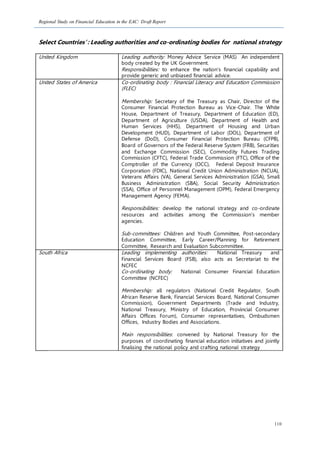
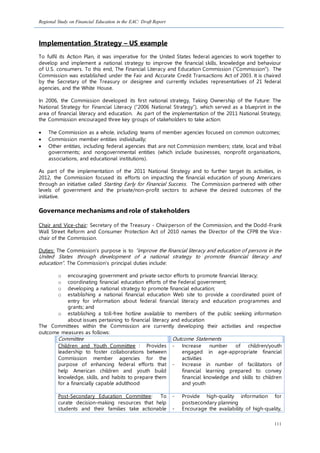
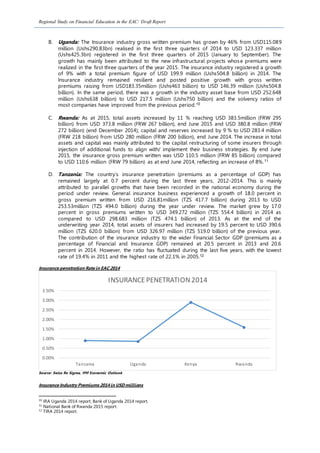
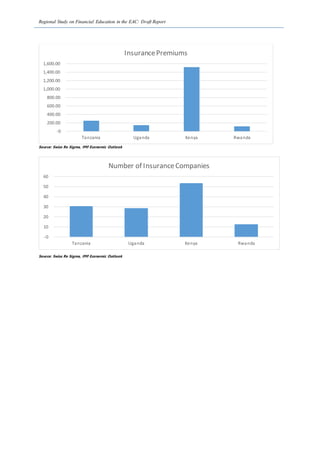
A. Kenya: Kenya’s total premium volumes were $1.52 billion in 2014, ranked 64th in the world.
Penetration rates were 3.4%, ranked 44th in the world.8 Again, given a GDP of $44 billion,
growing at 5.3% per annum, and a sizeable population of 44 million people, Kenya is clearly
also another market with significant growth potential. The Kenyan insurance industry
continues to be non-life business driven. The insurance industry asset base was USD 4.437
billion (KES 452.84 billion) as at the end of March 2015. This was a growth of 17.6% from USD
4.468billion (KES 385.22) billion held as at the end of March 2014. The liabilities amounted to
KES 334.98 during the period under consideration.9
6
Bank of Uganda 2015 annual report
7
National Bank of Rwanda 2014 report
8
Swiss Re Sigma, IMF Economic Outlook
9
IRA Kenya 2014 report
Burundi Tanzania Uganda Kenya Rwanda
-0
2.0
4.0
6.0
8.0
COUNTRY
BANKBRANCHESPER
100,000ADULTS
Commercial Bank Branches (per 100,000 adults)
Burundi
Tanzania
Uganda
Kenya
Rwanda
-0 10 20 30 40 50 60
COUNTRIES
NUMBER OF BANKS
NUMBER OF LICENSED BANKS INEAC
Regional Study on Financial Education in the EAC: Draft Report
B. Uganda: The Insurance industry gross written premium has grown by 46% from USD115.089
million (Ushs290.83bn) realised in the first three quarters of 2014 to USD 123.337 million
(Ushs425.3bn) registered in the first three quarters of 2015 (January to September). The
growth has mainly been attributed to the new infrastructural projects whose premiums were
realized in the first three quarters of the year 2015. The insurance industry registered a growth
of 9% with a total premium figure of USD 199.9 million (Ushs504.8 billion) in 2014. The
Insurance industry remained resilient and posted positive growth with gross written
premiums raising from USD183.35million (Ushs463 billion) to USD 146.39 million (Ushs504.8
billion). In the same period, there was a growth in the industry asset base from USD 252.648
million (Ushs638 billion) to USD 217.5 million (Ushs750 billion) and the solvency ratios of
most companies have improved from the previous period.10
C. Rwanda: As at 2015, total assets increased by 11 % reaching USD 383.5million (FRW 295
billion) from USD 373.8 million (FRW 267 billion), end June 2015 and USD 380.8 million (FRW
272 billion) (end December 2014); capital and reserves increased by 9 % to USD 283.4 million
(FRW 218 billion) from USD 280 million (FRW 200 billion), end June 2014. The increase in total
assets and capital was mainly attributed to the capital restructuring of some insurers through
injection of additional funds to align with/ implement their business strategies. By end June
2015, the insurance gross premium written was USD 110.5 million (FRW 85 billion) compared
to USD 110.6 million (FRW 79 billion) as at end June 2014, reflecting an increase of 8%.11
D. Tanzania: The country’s insurance penetration (premiums as a percentage of GDP) has
remained largely at 0.7 percent during the last three years, 2012-2014. This is mainly
attributed to parallel growths that have been recorded in the national economy during the
period under review. General insurance business experienced a growth of 18.0 percent in
gross premium written from USD 216.81million (TZS 417.7 billion) during 2013 to USD
253.53million (TZS 494.0 billion) during the year under review. The market grew by 17.0
percent in gross premiums written to USD 349.272 million (TZS 554.4 billion) in 2014 as
compared to USD 298.683 million (TZS 474.1 billion) of 2013. As at the end of the
underwriting year 2014, total assets of insurers had increased by 19.5 percent to USD 390.6
million (TZS 620.0 billion) from USD 326.97 million (TZS 519.0 billion) of the previous year.
The contribution of the insurance industry to the wider Financial Sector GDP (premiums as a
percentage of Financial and Insurance GDP) remained at 20.5 percent in 2013 and 20.6
percent in 2014. However, the ratio has fluctuated during the last five years, with the lowest
rate of 19.4% in 2011 and the highest rate of 22.1% in 2005.12
Insurance penetration Rate in EAC 2014
Source: Swiss Re Sigma, IMF Economic Outlook
Insurance Industry Premiums 2014in USD millions
10
IRA Uganda 2014 report, Bank of Uganda 2014 report.
11
National Bank of Rwanda 2015 report.
12
TIRA 2014 report.
Tanzania Uganda Kenya Rwanda
0.00%
0.50%
1.00%
1.50%
2.00%
2.50%
3.00%
3.50%
INSURANCEPENETRATION2014
Regional Study on Financial Education in the EAC: Draft Report
Source: Swiss Re Sigma, IMF Economic Outlook
Tanzania Uganda Kenya Rwanda
-0
200.00
400.00
600.00
800.00
1,000.00
1,200.00
1,400.00
1,600.00
InsurancePremiums
Tanzania Uganda Kenya Rwanda
-0
10
20
30
40
50
60
Number of InsuranceCompanies
Regional Study on Financial Education in the EAC: Draft Report
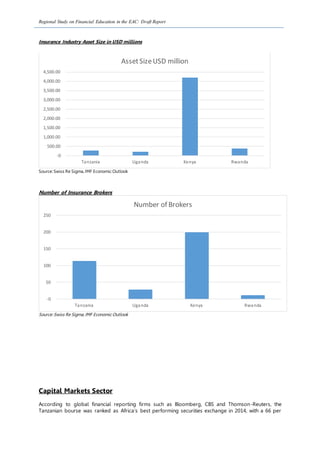
Insurance Industry Asset Size in USD millions
Source:Swiss Re Sigma,IMF Economic Outlook
Number of Insurance Brokers
Source:Swiss Re Sigma,IMF Economic Outlook
Capital Markets Sector
According to global financial reporting firms such as Bloomberg, CBS and Thomson-Reuters, the
Tanzanian bourse was ranked as Africa’s best performing securities exchange in 2014, with a 66 per
Tanzania Uganda Kenya Rwanda
-0
500.00
1,000.00
1,500.00
2,000.00
2,500.00
3,000.00
3,500.00
4,000.00
4,500.00
AssetSizeUSD million
Tanzania Uganda Kenya Rwanda
-0
50
100
150
200
250
Number of Brokers
Regional Study on Financial Education in the EAC: Draft Report
cent index upturn. While the Uganda Securities Exchange (USE) emerged third with a jump of 26.5 per
cent. The NSE, which emerged fourth, registered a drop at 19.2 per cent.13
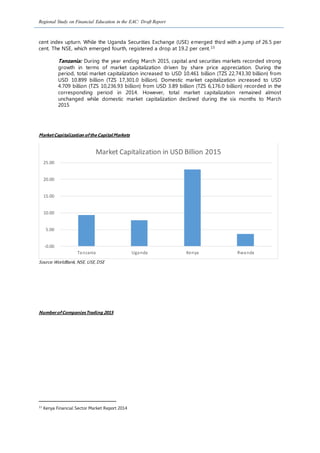
Tanzania: During the year ending March 2015, capital and securities markets recorded strong
growth in terms of market capitalization driven by share price appreciation. During the
period, total market capitalization increased to USD 10.461 billion (TZS 22,743.30 billion) from
USD 10.899 billion (TZS 17,301.0 billion). Domestic market capitalization increased to USD
4.709 billion (TZS 10,236.93 billion) from USD 3.89 billion (TZS 6,176.0 billion) recorded in the
corresponding period in 2014. However, total market capitalization remained almost
unchanged while domestic market capitalization declined during the six months to March
2015
MarketCapitalization of the CapitalMarkets
Source:WorldBank, NSE, USE,DSE
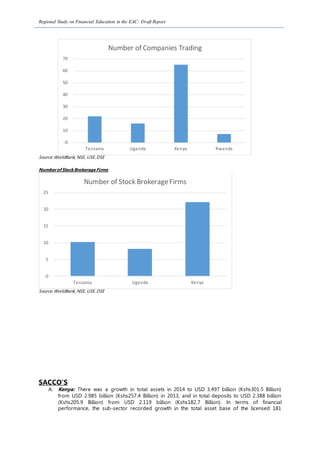
Numberof CompaniesTrading 2015
13
Kenya Financial Sector Market Report 2014
Tanzania Uganda Kenya Rwanda
-0.00
5.00
10.00
15.00
20.00
25.00
Market Capitalization in USD Billion 2015
Regional Study on Financial Education in the EAC: Draft Report
Source:WorldBank, NSE, USE,DSE
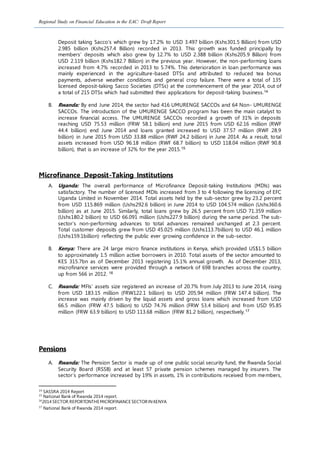
Numberof Stock Brokerage Firms
Source:WorldBank, NSE, USE,DSE
SACCO’S
A. Kenya: There was a growth in total assets in 2014 to USD 3.497 billion (Kshs301.5 Billion)
from USD 2.985 billion (Kshs257.4 Billion) in 2013, and in total deposits to USD 2.388 billion
(Kshs205.9 Billion) from USD 2.119 billion (Kshs182.7 Billion). In terms of financial
performance, the sub-sector recorded growth in the total asset base of the licensed 181
Tanzania Uganda Kenya Rwanda
-0
10
20
30
40
50
60
70
Number of Companies Trading
Tanzania Uganda Kenya
-0
5
10
15
20
25
Number of Stock BrokerageFirms
Regional Study on Financial Education in the EAC: Draft Report
Deposit taking Sacco’s which grew by 17.2% to USD 3.497 billion (Kshs301.5 Billion) from USD
2.985 billion (Kshs257.4 Billion) recorded in 2013. This growth was funded principally by
members’ deposits which also grew by 12.7% to USD 2.388 billion (Kshs205.9 Billion) from
USD 2.119 billion (Kshs182.7 Billion) in the previous year. However, the non-performing loans
increased from 4.7% recorded in 2013 to 5.74%. This deterioration in loan performance was
mainly experienced in the agriculture-based DTSs and attributed to reduced tea bonus
payments, adverse weather conditions and general crop failure. There were a total of 135
licensed deposit-taking Sacco Societies (DTSs) at the commencement of the year 2014, out of
a total of 215 DTSs which had submitted their applications for deposit-taking business.14
B. Rwanda: By end June 2014, the sector had 416 UMURENGE SACCOs and 64 Non- UMURENGE
SACCOs. The introduction of the UMURENGE SACCO program has been the main catalyst to
increase financial access. The UMURENGE SACCOs recorded a growth of 31% in deposits
reaching USD 75.53 million (FRW 58.1 billion) end June 2015 from USD 62.16 million (RWF
44.4 billion) end June 2014 and loans granted increased to USD 37.57 million (RWF 28.9
billion) in June 2015 from USD 33.88 million (RWF 24.2 billion) in June 2014. As a result, total
assets increased from USD 96.18 million (RWF 68.7 billion) to USD 118.04 million (RWF 90.8
billion), that is an increase of 32% for the year 2015.15
Microfinance Deposit-Taking Institutions
A. Uganda: The overall performance of Microfinance Deposit-taking Institutions (MDIs) was
satisfactory. The number of licensed MDIs increased from 3 to 4 following the licensing of EFC
Uganda Limited in November 2014. Total assets held by the sub-sector grew by 23.2 percent
from USD 115.869 million (Ushs292.6 billion) in June 2014 to USD 104.574 million (Ushs360.6
billion) as at June 2015. Similarly, total loans grew by 26.5 percent from USD 71.359 million
(Ushs180.2 billion) to USD 66.091 million (Ushs227.9 billion) during the same period. The sub-
sector’s non-performing advances to total advances remained unchanged at 2.3 percent.
Total customer deposits grew from USD 45.025 million (Ushs113.7billion) to USD 46.1 million
(Ushs159.1billion) reflecting the public ever growing confidence in the sub-sector.
B. Kenya: There are 24 large micro finance institutions in Kenya, which provided US$1.5 billion
to approximately 1.5 million active borrowers in 2010. Total assets of the sector amounted to
KES 315.7bn as of December 2013 registering 15.1% annual growth. As of December 2013,
microfinance services were provided through a network of 698 branches across the country,
up from 566 in 2012. 16
C. Rwanda: MFIs’ assets size registered an increase of 20.7% from July 2013 to June 2014, rising
from USD 183.15 million (FRW122.1 billion) to USD 205.94 million (FRW 147.4 billion). The
increase was mainly driven by the liquid assets and gross loans which increased from USD
66.5 million (FRW 47.5 billion) to USD 74.76 million (FRW 53.4 billion) and from USD 95.85
million (FRW 63.9 billion) to USD 113.68 million (FRW 81.2 billion), respectively.17
Pensions
A. Rwanda: The Pension Sector is made up of one public social security fund, the Rwanda Social
Security Board (RSSB) and at least 57 private pension schemes managed by insurers. The
sector’s performance increased by 19% in assets, 1% in contributions received from members,
14
SASSRA 2014 Report
15
National Bank of Rwanda 2014 report.
16
2014 SECTOR REPORTONTHEMICROFINANCE SECTORIN KENYA
17
National Bank of Rwanda 2014 report.
Regional Study on Financial Education in the EAC: Draft Report
and 18% in benefits paid and 27% in investment income from June 2013 to June 2014. The
total assets were USD 609.98 million (RWF 435.7 billion) while the total contributions received
were USD 56.42 million (RWF 40.3 billion).18
B. Kenya: Total Industry assets grew by 5.1 percent in the second half of the year 2014 to stand
at USD 9.1425 billion (Kshs.788.15 billion) as of December 31st 2014. Compared to last year,
December 2013, the assets under management have grown by 13.1 percent from USD 8.081
billion (Kshs.696.68 Billion) to USD 9.142 billion (Kshs.788.15 Billion). The amount was
composed of the USD 7.9 billion (Kshs.681.29 billion) held by the fund managers and
insurance issuers, USD 717.228 million (Kshs.61.83 billion) internally administered by National
Social Security Fund (NSSF) and an additional USD 522.23 million (Kshs.45.02 billion) of
property investments directly managed by scheme trustees. The assets under fund
management included USD 923.36 million (Kshs.79.6 billion) of NSSF funds externally
managed by the 6 contracted managers. Similar to other periods, Government Securities and
Quoted Securities had the majority of investments with the two accounting for 57 percent of
total assets under management.19
C. Tanzania: Assets of the social security sector continued to grow amid rising government loan
portfolio on account of interest accumulation. The ratio of government loans to total assets
stood at 19.3 percent, which was above the limit of 10.0 percent prescribed by Investment
Guidelines of 2012. Meanwhile, the Government has outlined a strategy to repay the loans
through issuance of government securities in the 2015/16 financial year. The sector has
substantial latitude for holding government debt with a floor of 20.0 percent and a ceiling of
70.0 percent. Currently, the sector holds only 20.1 percent of government debt. Meanwhile,
membership of the schemes grew by 59.5 percent to 2.1 million and the number of
pensioners by 7.1 percent to 86,969. Zanzibar’s social security fund recorded improved
performance on account of increased membership and contributions. Membership increased
by 3.1 percent to 74.4 thousand during the period ending March 2015. Investment income
and members’ contributions increased by USD 5.842 million (TZS 12.7 billion) and USD 10.212
million (TZS 22.2 billion), respectively during the nine months to March 2015. Likewise, during
the same period, benefit payments increased by USD 4.784 million (TZS 10.4 billion). As of
March 2015, the investment portfolio was dominated by treasury bonds at 33.3 percent, fixed
deposits (23.8 percent) and real estate (22.7 percent).20
18 National Bank of Rwanda 2014.
19RETIREMENT BENEFITS INDUSTRY PERFORMANCE REPORT FOR JUNE - DECEMBER 2014
20
Financial Stability Report - March 2015
Regional Study on Financial Education in the EAC: Draft Report
2. EAC PARTNER STATES’ FINANCIAL EDUCATION INTERVENTIONS
PARTNER STATES’ FINANCIAL EDUCATION INTERVENTIONS
EAC governments have recognized the important role of financial education plays in supporting
financial inclusion initiatives. EAC governments have launched initiatives aimed at systematically
increasing financial inclusion, improving consumer knowledge on financial management, informed
use of financial products and services and consumer protection. Outlined in the following section are
financial education initiatives at national level and a summary of key financial education activities in
each country. Following is an examination of financial education initiatives by sub-sector i.e. banking,
capital markets, insurance, pensions and microfinance/SACCOs.
1.1 National Financial Education Interventions
The EAC governments through the respective Ministry of Finance (i.e. Uganda’s Ministry of Finance,
Planning and Economic Development, Rwanda Ministry Finance and Economic Planning, Burundi’s
Ministry of Finance and Economic Development Planning, Kenya’s Ministry of Finance and Tanzania’s
Ministry of Finance and Economic Affairs) and central banks (i.e. Central Bank of Kenya, Bank of
Tanzania, Bank of Uganda, The National Bank of Rwanda (Banque Nationale du Rwanda), and The Bank
of the Republic of Burundi (Banque de la République du Burundi.), have engaged in financial sector
strengthening research and developed frameworks and strategies toward greater financial education.
The Ministry of Finance and Economic Planning in Rwanda and the Ministry of Finance and Economic
Development Planning Burundi spear-head the financial education and literacy initiatives whereas in
Kenya, Tanzania and Uganda development of financial education initiatives are championed by the
respective aforementioned the Central Banks.
Each member state is at different stages of development and implementation of financial literacy
initiatives. The national financial literacy and education initiatives are informed by national baseline
surveys on financial capability such as the FinScope Surveys or FinaAccess surveys. Following the
administration of the surveys EAC countries have developed strategies for financial literacy e.g. the
Strategy for Financial Literacy – Uganda 2013, National Financial Education Strategy – Rwanda 2013 or
have developed national financial inclusion strategies e.g. the National Financial Inclusion Framework
– Tanzania 2013 and the Burundi National Financial Inclusion Strategy 2014, wherein financial
education and literacy activities are embedded therein. Kenya’s Central Bank in collaboration with FSD
Kenya has undertaken several surveys assessing financial access, FinAccess Surveys 2006, 2009 and
2012, and is using these findings to develop a national financial education strategy.
Provided here is an overview of EAC member state progress toward national financial education
strategies and highlights of current financial education initiatives currently being undertaken by each
EAC jurisdiction.
Burundi
The government of Burundi has several initiatives regarding financial education enshrined in sector
development strategies. The main strategy promoting national financial education initiatives is
National Financial Inclusion Strategy (NFIS). The Bank of the Republic of Burundi (BRB) initiated the
development of the National Financial Inclusion Strategy (NFIS) with collaboration of Ministry of
Finance, Ministry of Local Government and industry stakeholders. The government has also developed
a National Strategy for MFIs and National Financial Sector strategy. These strategies also have aspects
of financial education incorporated within. The national strategy for MFIs was sponsored by AFD and
is awaiting the formation of multi-stakeholder entity responsible for implementation to be formed.
The National Financial Inclusion Strategy was developed following the findings of the Bank of the
Republic of Burundi “Burundi National Financial Inclusion Survey, 2012”. The findings of the Bank of
Burundi National Financial Inclusion Survey 2012, outlined challenges and gaps in the knowledge of
financial services. According to the survey several gaps in financial literacy were highlighted, these
include:
Regional Study on Financial Education in the EAC: Draft Report
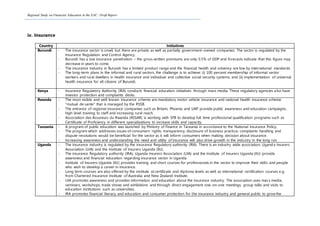
 Only 37% of survey respondents knew the meaning of current account and bank check
 Low understanding of other financial terms such as microcredit, money transfer, ATM, credit card,
personal loan or forex bureau
 Knowledge of financial services was very low with only 10% of survey responds being well
informed about various services offered in the market
 Only about 9% have an idea of the interest rates charged on bank loans
Overall the objectives of the NFIS are to increase financial inclusion in Burundi. Financial education
and literacy and consumer protection initiatives are a component in the National Financial Inclusion
Strategy. One of the key indicators in the NFIS regarding financial education aims at achieving a
“population that is better informed, educated and protected with regard to usage of financial services
and products”. Principles, Objectives and activities concerning financial education are, as shown
below:
“…Principle no. 8: The NFIS takes into account the need to increase financial literacy and
information among the general public and to protect the consumers offinancial services and
products.
…Objective 1: Ensure increased and permanent access to and usage of financial services and
products by the population with conditions that favour access and usage.
Sub-objective 1.3: Inform, educate and protect the public in general and the target clientele
of the NFIS in particular.
Activity 1.3.1: Ensure country-wide coordination for awareness, communication and financial
education efforts
Activity 1.3.2: Undertake national awareness campaigns on the use of financial services and
products
Activity 1.3.3: Inform clients and staff of financial institutions about using financial services
and products, preferably in Kirundi
Activity 1.3.4: Inform clients and staff of financial institutions about directives concerning
protection of consumers of financial services and products
Activity 1.3.5: Integrate financial education programs in educational institutions…”
The activities on financial education under the NFIS are to be coordinated by technical group,
however a lack of funds has delayed implementation of many activities. The strategy has prioritized
increasing reach of financial access in rural areas, including the development of microfinance sector
and agricultural based micro financial products. Currently financial education activities regarding the
development of the microfinance sector are being implemented in the rural areas by Fonds de Micro
Credit Rural/Rural Microcredit Fund (FMCR) and Reseau des Institutions de Microfinance au Burundi/
Network of Microfinance institutions of Burundi (RIM). See the section on financial education
initiatives in the microfinance sector in EAC for more details.
Regional Study on Financial Education in the EAC: Draft Report
Kenya
Kenya’s financial services sector contributed 6.7% to GDP and is comprised of commercial banks,
deposit taking microfinance institutions, non-bank financial institutions such and microfinance
institutions, mortgage companies, forex bureaus, development finance institutions, pension schemes,
SACCOs insurance sector and capital markets. The main regulators of the financial sector include
Central Bank of Kenya (banking and deposit taking microfinance sector), Retirement benefits
Authority (pensions sector), Insurance Regulatory Authority (insurance sector), Capital Markets
Authority (capital markets sector) and Sacco Societies Regulatory Authority (SACCO sector). These five
regulators in collaboration with other industry stakeholders are responsible for the main financial
education initiatives currently implemented in the country to date.
The main driver for the five regulators engaging in financial education and financial literacy activities
were the findings from FinAccess surveys conducted in 2006, 2009 and 2013. The survey findings
identified the following gaps in financial inclusion as well as the correlation between increased
financial inclusion and increased financial literacy. The FinAccess surveys (2013) highlight the
following findings regarding financial inclusion and financial literacy:
 Increasing levels of financial inclusion: The Finaccess survey 2006 showed formal financial access
increasing from 15% to 32.7% in 2013. The numbers of informal financial access only dropped
from 35.3% to 25.4%. The increase in formal financial access has been coupled by innovations in
the financial services sector such as agency banking, internet banking and mobile banking that
have increased reach of formal financial services to users. Mobile phone financial access was 28%
in 2009 to 62% in 2013.
 Correlation between education level and financial inclusion: Financial exclusion decreases with
improved levels of education. The survey found that those 82.9% of formal financial access had
tertiary education whereas 22.6% of formal financial access had primary education.
 Low use of insurance and pension: pension and mortgage products were used by less than 20% of
the adult population.
 Awareness of financial terms: Survey users were aware of financial terms such as budget 86.9% of
respondents, insurance 81.4%, cheque 81%, and savings account 76.7%. Financial terms that
respondents were least aware of included collateral 20%, mortgage 28% and inflation 33.7%
 Numeracy: the survey showed high numeracy 38.9% of respondents, 28.05% with medium
numeracy skills and 33.05% having low numeracy skills. High numeracy skills were recorded in
urban areas 47.9% of respondents and lowest numeracy in rural areas 42.5%.
 Consumer protection: highest levels of loss of money were recorded in the informal segment,
SACCOs and mobile money transfer. Survey respondents that lost money through mobile money
transfer were 8%, however about half 43% got their money back. Unexpected charges were the
most complaint lodged in the banking segment.
Following the first FinAccess Survey in 2006, industry stakeholders recognized a lack of basic financial
education. FSD Kenya with encouragement of financial industry stakeholders conducted a scoping
study on financial sector initiatives in Kenya, “Financial Education in Kenya: Scoping Exercise Report,
2008”. The study provided a mapping of financial education programs in Kenya and provided
recommendations on how to approach development and coordination of national financial education
policies and programs.
A public-private partnership financial education programme (Financial Education and Consumer
Protection Partnership – FEPP) was also developed as part of the 2008-2011 FSD financial education
programme, to guide development, implementation and coordination of financial education
initiatives. They included the five industry regulators, government ministries, education institutions,
industry players through associations, and development partners among others. Four pilot initiatives
were identified supported by FinEd to examine the applicability and effectiveness of the intended
comprehensive nationwide programme. The first pilot programme: the public media programme
Makutano Junction, implemented by Media-e; aimed to reach six million Kenyans through broadcast,
the initiative surpassed target by over 1.2 million. However, with regard to the attitudes of the viewers
only half of the intended target was achieved (10%). The second pilot: The Faulu pilot aimed at Faulu
clients and communities in the selected Faulu branches; 48,306 out of the intended 70,000 received
training with an average increase in knowledge of above 33% which fell short of the anticipated 50%,
Regional Study on Financial Education in the EAC: Draft Report
625 trainers were certified exceeding expectations by 125. The third pilot: The Equity Group
Foundation pilot aimed at the youth (primarily Kenyatta University students); the targets of the
initiative with regard to number of youth reached (8101) and trainers trained (332) was realized. The
final pilot: The Plan International programme targeted at Schools. The first two were large
programmes and were primarily funded by DFID’s Financial Education Fund 346 teachers were trained
and certified exceeding the 145 anticipated, 8,000 pupils were also trained, out of the expected 145
only 30 saving accounts were opened. Generally, based on target audience the Equity and public
media programme achieved their objectives. In the long run however, the pilot programmes
dominated the initiative dwarfing the activities of the FEPP.
FSD financial support for the financial education partnership concluded in 2013. Unfortunately, as a
result, the FEPP initiatives and activities regarding financial education and devolvement of financial
education strategy have since slowed down. However, a key result of the program was a strong
partnership with Kenya Institute of Curriculum Development (KICD) to develop and implement a pilot
program for financial education in the school system from Early Childhood Education to Tertiary level.
Training manuals have been developed and the curriculum has since been completed and approved
by the government. In 2016 a pilot project will be rolled out in 20 schools (12 primaries and 8 high
schools) in 8 provincial regions of the country. The financial sector has been identified as a key
economic pillar for development and is a priority sector in Vision 2030. Under the Vision 2030, Second
Mid-Term Plan 2013-2017 the government has identified development of a policy to guide
development of financial education framework.
The majority of the financial education initiatives are implemented by the institutions in the financial
sector, the government, private sector, non-governmental organizations as well as other stakeholders.
Provided below is an outline of the financial education initiatives identified in the FSD financial
education scoping study and other initiatives currently being undertaken by different financial
education stakeholders in Kenya. There is no initiatives have been segmented as follows, children,
youth, urban adults, rural adults, women and cross-cutting initiatives.
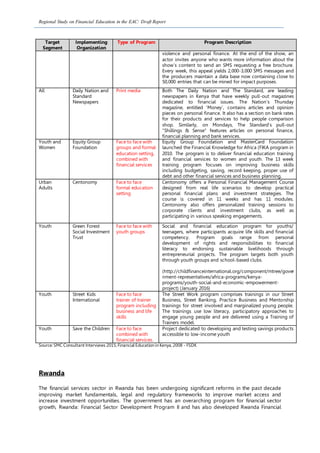
Overview of Financial Initiatives in Kenya
Target
Segment
Implementing
Organization
Type of Program Program Description
Rural Adults Swedish
Cooperative
Centre (SCC)
Face to face with
groups in SACCOs
including business
and life skills as
well as combining
with financial
services
The Swedish Cooperative Centre (SCC) was founded in 1958
by the Swedish cooperative movement. The overall goal of
SCC is poverty alleviation, which is expressed in the
organization’s vision of “a world free from poverty and
injustice”.
SCC’s work mainly focuses on Rural Development, Housing
and Habitat, and Financial Services. This is further
complemented by a focus on Democratic participation,
Gender Equality, Environmental sustainability and HIV/AIDS,
all four as cross-cutting issues to SCC’s development work.
Delivering financial education to SACCO members a primary
goal. The expansion of CARE’s model for Village Savings and
Loan Associations (VSLAs)
Rural Adults Swedish
Cooperative
Centre (SCC) and
Swiss Contact
Face to face with
groups including
business and life
skills (Village
Savings and Loan
Associations
(VSLAs))
Both organizations have initiated VSLA programs in Kenya.
Through its Lake Victoria Development Programme, SCC has
fostered the emergence of VSLAs in East Africa that now
count 10,000 members, 3,000 of whom are in Kenya. Swiss
Contact initiated a VSLA programme in Kisumu (via a
contract with CARE Kenya) named “Muvuno” that currently
has 16 groups. Swiss Contact has decided to use these
savings and loan groups as a platform for financial
education.
The priority topics are:
 •Savings (the value of savings, how to save)
 Debt management (when to borrow, how much to
borrow, how to use credit to create wealth)
 •Understanding financial services (How to choose a
Regional Study on Financial Education in the EAC: Draft Report
Target
Segment
Implementing
Organization
Type of Program Program Description
financial institution, benefit from bank services;
empower clients to enter into contracts with service
providers).
Rural Adults Swiss Contact Face to face with
groups (Villages
Savings and Loans
Associations)
including
Community based
trainers (CBTs)
In 2006, Swiss Contact introduced the Mavuno Project,
designed after village savings and lending association and in
the same year, the Micro-leasing project was introduced in
Kenya in collaboration with K-rep Development Agency. The
programme has since grown and to include other projects
such as agriculture finance and support forum and the
fanikisha + project.
Swisscontact supports the formation and development of
community-based savings and loans associations. Mavunos,
based on the Swahili word for harvest, are comprised of 20-
30 community members that are trained to operate a
revolving loan fund supported by member savings.
Youth
(College
Students)
Nairobi Securities
Exchange
Online using
Virtual trading
simulation
platform targeting
college students
NSE Investment Challenge. The challenge is an online
simulation of live trading at the Nairobi Securities Exchange,
where each participating group/individual is given a virtual
startup capital to invest using the NSE real time information
for a period of 3 months. The winner is the team/individual
with the highest portfolio value. One can participate as an
individual or a group of maximum 4 members from the same
institution.
Youth
(University
Students)
Capital Markets
Authority
Face to face at
formal education
institutions
University Investment Challenge, is a knock-off competition
that aims at selecting 12 students to participate in the final
round at the CMA/ or other venue in Nairobi. The challenges
begins with a multiple choice stage, followed by intra-
university presentations stage, question and answer stage
and finally a presentation as well as question and answer
session on the presentation in Nairobi. The winner of the
challenge is awarded Ksh 150,000 (US$ 1,500) to invest in
shares in the NSE, 3 day visit to another securities exchange
in Africa and literature and books on capital markets. The
objectives of the challenge are:
 To create awareness and increase knowledge about
capital markets among the university students as well as
the faculty members;
 To create momentum and build up towards a National
University Challenge involving participating Universities
in Kenya;
 To increase participation of university students in the
capital markets industry by encouraging a culture of
saving and investment;
 To broaden the country’s capital markets investor base
by creating awareness among potential investors;
 To create a strong link between the Authority and capital
markets stakeholders on one hand and the world of the
Academia on the other hand.
All Faida Investment
Bank
Television and
website
Faida is sponsored the development of a series of short 5-10
minute TV sessions on two local TV stations on ‘stock
investment tips’. The sessions are targeted to reach a large
audience as they are aired during prime time news hours.
Faida also features various articles on financial literacy on its
website.
All Mediae Television
Mediae are an organisation dedicated to improving the
livelihoods of large audiences in Africa through the
development of educative, entertaining and effective media.
Mediae has developed a weekly drama serial “Makutano
Junction” that both entertains and educates. Over a 13-week
series, the show’s storyline weaves together messages that
might include health, education, governance, domestic
Regional Study on Financial Education in the EAC: Draft Report
Target
Segment
Implementing
Organization
Type of Program Program Description
violence and personal finance. At the end of the show, an
actor invites anyone who wants more information about the
show’s content to send an SMS requesting a free brochure.
Every week, this appeal yields 2,000-3,000 SMS messages and
the producers maintain a data base now containing close to
50,000 entries that can be mined for impact purposes.
All Daily Nation and
Standard
Newspapers
Print media Both The Daily Nation and The Standard, are leading
newspapers in Kenya that have weekly pull-out magazines
dedicated to financial issues. The Nation’s Thursday
magazine, entitled ‘Money’, contains articles and opinion
pieces on personal finance. It also has a section on bank rates
for their products and services to help people comparison
shop. Similarly, on Mondays, The Standard’s pull-out
“Shillings & Sense” features articles on personal finance,
financial planning and bank services.
Youth and
Women
Equity Group
Foundation
Face to face with
groups and formal
education setting,
combined with
financial services
Equity Group Foundation and MasterCard Foundation
launched the Financial Knowledge for Africa (FIKA program in
2010. The program is to deliver financial education training
and financial services to women and youth. The 13 week
training program focuses on improving business skills
including budgeting, saving, record keeping, proper use of
debt and other financial services and business planning.
Urban
Adults
Centonomy Face to face
formal education
setting
Centonomy offers a Personal Financial Management Course
designed from real life scenarios to develop practical
personal financial plans and investment strategies. The
course is covered in 11 weeks and has 11 modules.
Centonomy also offers personalized training sessions to
corporate clients and investment clubs, as well as
participating in various speaking engagements.
Youth Green Forest
Social Investment
Trust
Face to face with
youth groups
Social and financial education program for youths/
teenagers, where participants acquire life skills and financial
competency. Program goals range from personal
development of rights and responsibilities to financial
literacy to endorsing sustainable livelihoods through
entrepreneurial projects. The program targets both youth
through youth groups and school-based clubs.
(http://childfinanceinternational.org/component/mtree/gover
nment-representatives/africa-programs/kenya-
programs/youth-social-and-economic-empowerment-
project) (January 2016)
Youth Street Kids
International
Face to face
trainer of trainer
program including
business and life
skills
The Street Work program comprises trainings in our Street
Business, Street Banking, Practice Business and Mentorship
trainings for street involved and marginalized young people.
The trainings use low literacy, participatory approaches to
engage young people and are delivered using a Training of
Trainers model.
Youth Save the Children Face to face
combined with
financial services.
Project dedicated to developing and testing savings products
accessible to low-income youth
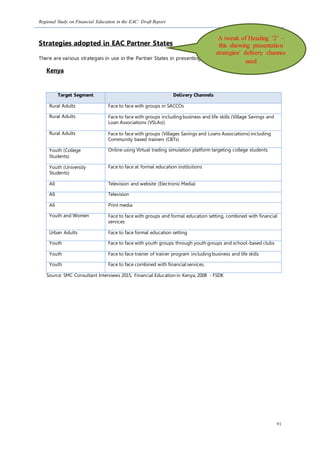
Source:SMC Consultant Interviews 2015,Financial Education in Kenya,2008 - FSDK
Rwanda
The financial services sector in Rwanda has been undergoing significant reforms in the past decade
improving market fundamentals, legal and regulatory frameworks to improve market access and
increase investment opportunities. The government has an overarching program for financial sector
growth, Rwanda: Financial Sector Development Program II and has also developed Rwanda Financial
Regional Study on Financial Education in the EAC: Draft Report
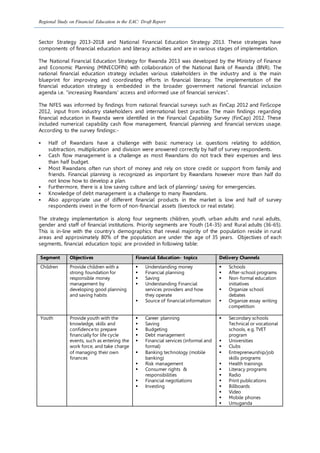
Sector Strategy 2013-2018 and National Financial Education Strategy 2013. These strategies have
components of financial education and literacy activities and are in various stages of implementation.
The National Financial Education Strategy for Rwanda 2013 was developed by the Ministry of Finance
and Economic Planning (MINECOFIN) with collaboration of the National Bank of Rwanda (BNR). The
national financial education strategy includes various stakeholders in the industry and is the main
blueprint for improving and coordinating efforts in financial literacy. The implementation of the
financial education strategy is embedded in the broader government national financial inclusion
agenda i.e. “increasing Rwandans’ access and informed use of financial services”.
The NFES was informed by findings from national financial surveys such as FinCap 2012 and FinScope
2012, input from industry stakeholders and international best practise. The main findings regarding
financial education in Rwanda were identified in the Financial Capability Survey (FinCap) 2012. These
included numerical capability cash flow management, financial planning and financial services usage.
According to the survey findings:-
 Half of Rwandans have a challenge with basic numeracy i.e. questions relating to addition,
subtraction, multiplication and division were answered correctly by half of survey respondents.
 Cash flow management is a challenge as most Rwandans do not track their expenses and less
than half budget.
 Most Rwandans often run short of money and rely on store credit or support from family and
friends. Financial planning is recognized as important by Rwandans however more than half do
not know how to develop a plan.
 Furthermore, there is a low saving culture and lack of planning/ saving for emergencies.
 Knowledge of debt management is a challenge to many Rwandans.
 Also appropriate use of different financial products in the market is low and half of survey
respondents invest in the form of non-financial assets (livestock or real estate).
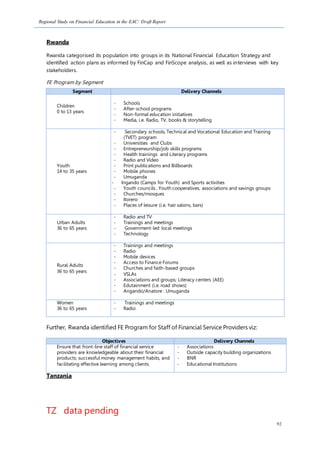
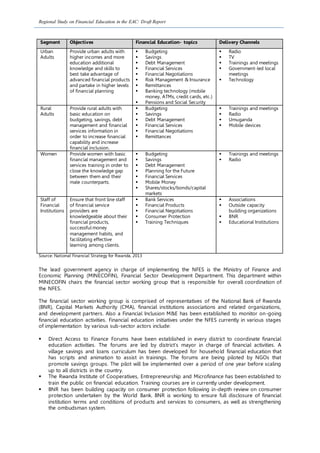
The strategy implementation is along four segments children, youth, urban adults and rural adults,
gender and staff of financial institutions. Priority segments are Youth (14-35) and Rural adults (36-65).
This is in-line with the country’s demographics that reveal majority of the population reside in rural
areas and approximately 80% of the population are under the age of 35 years. Objectives of each
segments, financial education topic are provided in following table:
Segment Objectives Financial Education- topics Delivery Channels
Children Provide children with a
strong foundation for
responsible money
management by
developing good planning
and saving habits
 Understanding money
 Financial planning
 Saving
 Understanding Financial
services providers and how
they operate
 Source of financial information
 Schools
 After-school programs
 Non-formal education
initiatives
 Organize school
debates
 Organize essay writing
competition
Youth Provide youth with the
knowledge, skills and
confidenceto prepare
financially for life cycle
events, such as entering the
work force, and take charge
of managing their own
finances
 Career planning
 Saving
 Budgeting
 Debt management
 Financial services (informal and
formal)
 Banking technology (mobile
banking)
 Risk management
 Consumer rights &
responsibilities
 Financial negotiations
 Investing
 Secondary schools
Technical or vocational
schools, e.g. TVET
program
 Universities
 Clubs
 Entrepreneurship/job
skills programs
 Health trainings
 Literacy programs
 Radio
 Print publications
 Billboards
 Video
 Mobile phones
 Umuganda
Regional Study on Financial Education in the EAC: Draft Report
Segment Objectives Financial Education- topics Delivery Channels
Urban
Adults
Provide urban adults with
higher incomes and more
education additional
knowledge and skills to
best take advantage of
advanced financial products
and partake in higher levels
of financial planning
 Budgeting
 Savings
 Debt Management
 Financial Services
 Financial Negotiations
 Risk Management & Insurance
 Remittances
 Banking technology (mobile
money, ATMs, credit cards, etc.)
 Pensions and Social Security
 Radio
 TV
 Trainings and meetings
 Government-led local
meetings
 Technology
Rural
Adults
Provide rural adults with
basic education on
budgeting, savings, debt
management and financial
services information in
order to increase financial
capability and increase
financial inclusion.
 Budgeting
 Savings
 Debt Management
 Financial Services
 Financial Negotiations
 Remittances
 Trainings and meetings
 Radio
 Umuganda
 Mobile devices
Women Provide women with basic
financial management and
services training in order to
close the knowledge gap
between them and their
male counterparts.
 Budgeting
 Savings
 Debt Management
 Planning for the Future
 Financial Services
 Mobile Money
 Shares/stocks/bonds/capital
markets
 Trainings and meetings
 Radio
Staff of
Financial
Institutions
Ensure that front line staff
of financial service
providers are
knowledgeable about their
financial products,
successful money
management habits, and
facilitating effective
learning among clients.
 Bank Services
 Financial Products
 Financial Negotiations
 Consumer Protection
 Training Techniques
 Associations
 Outside capacity
building organizations
 BNR
 Educational Institutions
Source: National Financial Strategy for Rwanda, 2013
The lead government agency in charge of implementing the NFES is the Ministry of Finance and
Economic Planning (MINECOFIN), Financial Sector Development Department. This department within
MINECOFIN chairs the financial sector working group that is responsible for overall coordination of
the NFES.
The financial sector working group is comprised of representatives of the National Bank of Rwanda
(BNR), Capital Markets Authority (CMA), financial institutions associations and related organizations,
and development partners. Also a Financial Inclusion M&E has been established to monitor on-going
financial education activities. Financial education initiatives under the NFES currently in various stages
of implementation by various sub-sector actors include:
 Direct Access to Finance Forums have been established in every district to coordinate financial
education activities. The forums are led by district’s mayor in charge of financial activities. A
village savings and loans curriculum has been developed for household financial education that
has scripts and animation to assist in trainings. The forums are being piloted by NGOs that
promote savings groups. The pilot will be implemented over a period of one year before scaling
up to all districts in the country.
 The Rwanda Institute of Cooperatives, Entrepreneurship and Microfinance has been established to
train the public on financial education. Training courses are in currently under development.
 BNR has been building capacity on consumer protection following in-depth review on consumer
protection undertaken by the World Bank. BNR is working to ensure full disclosure of financial
institution terms and conditions of products and services to consumers, as well as strengthening
the ombudsman system.
Regional Study on Financial Education in the EAC: Draft Report
 Savings clubs have been introduced in schools where students are taught basic financial concepts
such as account opening, importance of saving, proper use of credit, interest rates among other
topics. AIESEC and Child Youth Finance International (CYFI) are also working to introduce School-
bank project in Rwanda. As well activities for annually celebrating world savings week and global
money have been organized.
 Radio messages concerning financial education that are delivered in the form of entertainment
drama have been developed for the Urunana Radio Program. The Urunana radio program is
broadcasted in Kirundi and reaches over 70% of the population. Other radio programs on
financial education have also been developed and are being implemented by Global
Communities’ Ejo Heza Radio and world Savings Day.
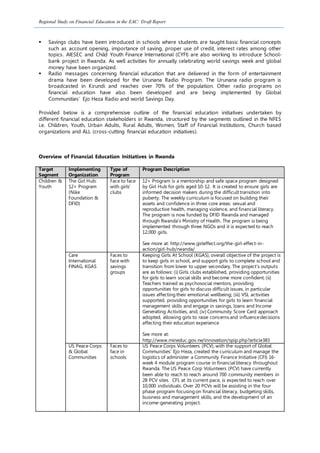
Provided below is a comprehensive outline of the financial education initiatives undertaken by
different financial education stakeholders in Rwanda, structured by the segments outlined in the NFES
i.e. Children, Youth, Urban Adults, Rural Adults, Women, Staff of Financial Institutions, Church based
organizations and ALL (cross-cutting financial education initiatives).
Overview of Financial Education Initiatives in Rwanda
Target
Segment
Implementing
Organization
Type of
Program
Program Description
Children &
Youth
The Girl Hub:
12+ Program
(Nike
Foundation &
DFID)
Face to face
with girls'
clubs
12+ Program is a mentorship and safe space program designed
by Girl Hub for girls aged 10-12. It is created to ensure girls are
informed decision makers during the difficult transition into
puberty. The weekly curriculum is focused on building their
assets and confidence in three core areas: sexual and
reproductive health, managing violence, and financial literacy.
The program is now funded by DFID Rwanda and managed
through Rwanda's Ministry of Health. The program is being
implemented through three NGOs and it is expected to reach
12,000 girls.
See more at: http://www.girleffect.org/the-girl-effect-in-
action/girl-hub/rwanda/
Care
International
FINAG, KGAS
Faces to
face with
savings
groups
Keeping Girls At School (KGAS), overall objective of the project is
to keep girls in school, and support girls to complete school and
transition from lower to upper secondary. The project’s outputs
are as follows: (i) Girls clubs established, providing opportunities
for girls to learn social skills and become more confident; (ii)
Teachers trained as psychosocial mentors, providing
opportunities for girls to discuss difficult issues, in particular
issues affecting their emotional wellbeing; (iii) VSL activities
supported, providing opportunities for girls to learn financial
management skills and engage in savings, loans and Income
Generating Activities, and; (iv) Community Score Card approach
adopted, allowing girls to raise concerns and influencedecisions
affecting their education experience
See more at:
http://www.mineduc.gov.rw/innovation/spip.php?article383
US Peace Corps
& Global
Communities
Faces to
face in
schools
US Peace Corps Volunteers (PCV), with the support of Global
Communities’ Ejo Heza, created the curriculum and manage the
logistics of administer a Community Finance Initiative (CFI) 16-
week 4 module program course in financial literacy throughout
Rwanda. The US Peace Corp Volunteers (PCV) have currently
been able to reach to reach around 700 community members in
28 PCV sites. CFI, at its current pace, is expected to reach over
10,000 individuals. Over 20 PCVs will be assisting in the four
phase program focusing on financial literacy, budgeting skills,
business and management skills, and the development of an
income-generating project.
Regional Study on Financial Education in the EAC: Draft Report
Target
Segment
Implementing
Organization
Type of
Program
Program Description
See more at: http://rwanda.peacecorps.gov/content/pcvs-work
Technoserve
STRYDE
face to face
with
business
skills and
savings
groups
In 2011, TechnoServe and The MasterCard Foundation partnered
to help rural young women and men in East Africa transition to
economic independence through the Strengthening Rural Youth
Development through Enterprise (STRYDE) program. In the first
phase of the program, STRYDE delivered a comprehensive
package of services including skills training, business
development and mentoring to young people ages 18 to 30 in
Kenya, Rwanda and Uganda. It aimed to equip 15,000 rural youth
by 2015 with the skills and knowledge necessary to capitalize on
economic opportunities and increase their incomes, with the
ripple effects benefiting more than 67,000 family members.
See more at: http://www.technoserve.org/our-
work/projects/stryde#sthash.2OR7C7YZ.dpuf
AKAZI KANOZE
(EDC)
face to face
in TVET
schools
Launched in 2009, Akazi Kanoze (AK) is funded by USAID and is
implemented by the Education Development Center Inc. (EDC)
The program works in collaboration with multiple local and
international partners that are spread out across Rwanda. AK’s
work readiness/soft skills training program is targeted to
Rwandan youth aged 14-24. In rural areas, however, the program
caters to participants as old as 35 years of age. Program
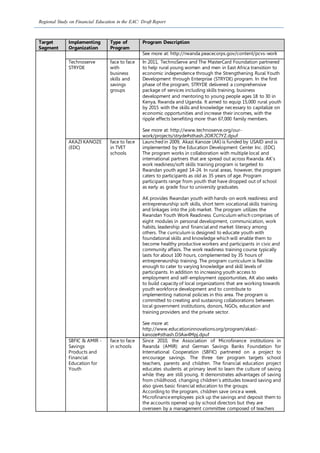
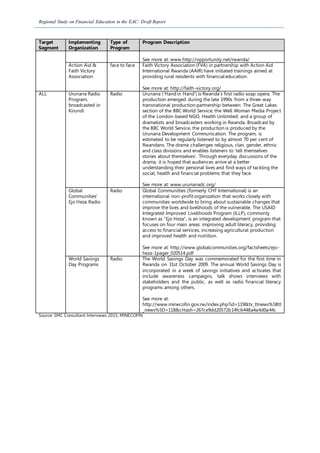
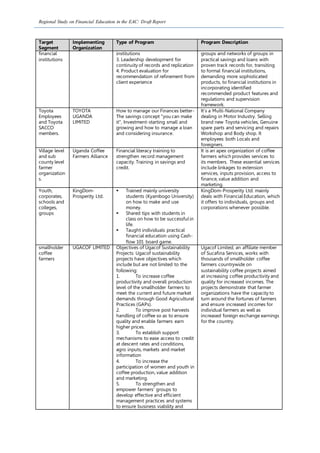
participants range from youth that have dropped out of school
as early as grade four to university graduates.
AK provides Rwandan youth with hands-on work readiness and
entrepreneurship soft skills, short term vocational skills training
and linkages into the job market. The program utilizes the
Rwandan Youth Work Readiness Curriculum which comprises of
eight modules in personal development, communication, work
habits, leadership and financial and market literacy among
others. The curriculum is designed to educate youth with
foundational skills and knowledge which will enable them to
become healthy productive workers and participants in civic and
community affairs. The work readiness training course typically
lasts for about 100 hours, complemented by 35 hours of
entrepreneurship training. The program curriculum is flexible
enough to cater to varying knowledge and skill levels of
participants. In addition to increasing youth access to
employment and self-employment opportunities, AK also seeks
to build capacity of local organizations that are working towards
youth workforce development and to contribute to
implementing national policies in this area. The program is
committed to creating and sustaining collaborations between
local government institutions, donors, NGOs, education and
training providers and the private sector.
See more at:
http://www.educationinnovations.org/program/akazi-
kanoze#sthash.D3Aw4Mpj.dpuf
SBFIC & AMIR -
Savings
Products and
Financial
Education for
Youth
face to face
in schools
Since 2010, the Association of Microfinance institutions in
Rwanda (AMIR) and German Savings Banks Foundation for
International Cooperation (SBFIC) partnered on a project to
encourage savings. The three tier program targets school
teachers, parents and children. The financial education project
educates students at primary level to learn the culture of saving
while they are still young. It demonstrates advantages of saving
from childhood, changing children’s attitudes toward saving and
also gives basic financial education to the groups.
According to the program, children save oncea week.
Microfinanceemployees pick up the savings and deposit them to
the accounts opened up by school directors but they are
overseen by a management committee composed of teachers
Regional Study on Financial Education in the EAC: Draft Report
Target
Segment
Implementing
Organization
Type of
Program
Program Description
and pupils. This project now totals 21,164 children at school age,
have embraced the culture of saving, are linked to microfinance
institutions-members of AMIR in Rwanda and have mobilized
more than 60 million Rwandan francs of savings.
Aflatoun and
AMIR
face to face
in schools
The Association of Microfinance Institutions in Rwanda (AMIR),
the umbrella organization for Rwandan microfinance institutions
(MFIs) and related organizations, have partnered with Child
Savings International (referred to as Aflatoun), a Netherlands-
based nonprofit, and the United Kingdom’s Department for
International Development (DFID) to launch an educational
program in Rwanda that will teach entrepreneurial, savings and
financial skills to youth. The program worked with approximately
100 schools and trained over 500 teachers around the country,
and allowed participating students to open savings accounts
with Rwandan MFIs to learn about business and finance in
practice. The program offered financial education courses in
savings clubs at schools, during extracurricular activities and at
home on weekends and school holidays.
About the Association of Microfinance Institutions in Rwanda
(AMIR)
The Association of Microfinance Institutions in Rwanda (AMIR) is
an organization that was established in 2007 to build the
capacity of the microfinance industry in Rwanda. As of July 2013,
AMIR consists of 62 active members.
About Child Savings International (Aflatoun)
Established in 1991 in Mumbai, India, Child Savings International
(referred to as Aflatoun) is a Netherlands-based nonprofit that
aims to teach children in developing countries entrepreneurial,
savings and financial skills. Aflatoun has operations in 94
countries as of January 2013, partnerships with approximately
8,400 schools and non-formal education centers as of December
2010 and has reached approximately 1.3 million children as of
June 2012.
See more at: http://www.microcapital.org/microcapital-brief-
association-of-microfinance-institutions-in-rwanda-amir-child-
savings-international-aflatoun-united-kingdoms-department-
for-international-development-inaugurate-yout/
http://www.aflatoun.org/docs/default-source/partner-
evaluation/rwanda-amir-aflatoun-rct-results-social-financial-
education-brief-2015.pdf?sfvrsn=6
UMUTANGUHA
Finance Ltd.
YouthStart
face to face
combined
with formal
financial
services
Umutanguha Finance Ltd has been engaged in microfinance
since 2004. Umutanguha provides financial services to over
58,000 clients predominantly (80% July 2013) women and Youth.
As at August 31, 2013, 19,800 Youth clients in the age bracket of
12-24 and 29,000 24-35 years are being served. The loan
portfolio was over USD 2,000,000 (RWF 1.3 billion) and savings
deposits USD 1,091,000 (RWF 712 million). Varied products
tailored to meet the financial needs of the unbanked poor both
in urban and rural areas of the country with a focus on Youth
and Women are provided.
The company provides Savings products including, Current
passbook accounts, Fixed deposit, Purpose Saving plans
accounts, Youth Demand accounts; and Purpose Saving for
specific project such as building a house, buying a car, starting a
business, etc. Loan products include solidarity group loans
mainly through VSLAs; different kinds of Business loans;
Agriculture loan; Youth Business Loans and Micro-Leasing.
Regional Study on Financial Education in the EAC: Draft Report
Target
Segment
Implementing
Organization
Type of
Program
Program Description
In partnership with UNCDF under the YouthStart and
UNCDF/UNDP BIFSIR Programs, focus has been on Youth under
the age of 25 as well as unbanked Youth in the age of 25-35
years largely in rural areas.
http://www.ufinance.co.rw/microfinance.html
MINECOFIN &
REB
face to face
education
embedded
in the
National
Curriculum
FE is being included in schools by MINECOFIN and REB as a
National Strategy priority. The United Nations agreement to
include FE in school curricula and the current complicated
financial landscape in Rwanda requires the population to
understand the benefits and risks associated with money,
develop personal resilience and ability to take personal
responsibility to increase participation and access to financial
markets and meet national development goals.
FE is cross cutting and is not a subject on its own. FE links well
with a range of subjects and strengthens them. FE can only work
well if it is planned throughout the curriculum. There are 32
places where FE is to be found in the new competency-based
curriculum. As well Scope and Sequence chart has been
developed as an educational framework in the new FE
curriculum which shows clearly what should be taught in which
subject and at which age. There are 7 FE subjects in Primary (Pre-
primary, Mathematics, Social Studies) and
Secondary (Mathematics, Entrepreneurship, Economics, General
Studies and ICT)
Four core areas of FE training are covered i.e. How to manage
money, Becoming a critical consumer, Managing risk and
emotion and Understand the important role money plays in our
lives.
See more at: http://www.minecofin.gov.rw/and http://reb.rw/
FHI 360 -
ROADS III for
Youth and OVCs
face to face
with
business
skills and
savings
groups
FHI 360 works in the United States and throughout the world
mainly in health services, HIV/AIDs programs. Along health
programs education and economic development (business skills)
are also included to increase productivity, employment and
household incomes. FHI 360 works in post conflict areas and
mainly targets women and youth in rural areas
See more at: http://www.fhi360.org/
Urban
Adults
FHI 360 -
ROADS III
face to face
with
business
skills and
savings
groups
Rural
Adults
Global
Communities
face to face
with savings
groups,
health and
nutrition
Global Communities is implementing the USAID Ejo Heza
program (“brighter future”) which aims to improve the
livelihoods and food consumption of 75,000 of Rwanda’s very
poor, particularly women. USAID Ejo Heza helps by building the
capacity of low-income households to access financial services
and necessary to grow their enterprises while assisting financial
service providers to develop and deliver effective products to the
rural market. The program also supports financial literacy,
integrates nutrition messaging and promotes kitchen gardening.
See more at: See more at:
http://www.globalcommunities.org/factsheets/ejo-heza-
1pager_020514.pdf
Women Women for
Women
International
12 month
face to face
training,
includes
business
and life
skills
Women for Women International (WfWI) is a nonprofit
humanitarian organization that provides practical and moral
support to women survivors of war. WfWI helps such women
rebuild their lives after war’s devastation through a year-long
tiered program that begins with direct financial aid and
emotional counseling and includes life skills (e.g., literacy,
numeracy) training if necessary, rights awareness education,
Regional Study on Financial Education in the EAC: Draft Report
Target
Segment
Implementing
Organization
Type of
Program
Program Description
health education, job skills training and small business
development. Since then, more than 66,000 Rwandan women
have gained new job skills, knowledge about health and wellness
and learned how to be decision-makers in their families and
communities through our training program.
See more at: http://www.womenforwomen.org/what-we-
do/countries/rwanda
Church
Members/
Faith
based
organizati
ons
Hope
International
Chalmers’s
Curriculum,
face to face
with savings
groups
In partnership with Urwego Opportunity Bank, Hope
International is reaching over 175,000 Rwandan borrowers and
savers with traditional microfinanceservices. Clients begin
borrowing in community banks of roughly 30 members. When a
client has successfully completed four loan cycles, he/she is
eligible to join a smaller group and receive a larger loan.
In addition to working with Urwego, Hope International
established HOPE Rwanda in partnership with several local
denominational partners to provide savings services to those
who do not have access to traditional banks and may not yet be
ready for small loans. The savings groups are well-suited to rural
areas and underserved communities.
The program has 590 staff, 550 facilitators and provides services
to 223,828 clients (64% female) and 10,947 savings groups. The
average savings per member is $32.74 and total savings is $
7,328,188 as at September 2014.
See more at: http://www.hopeinternational.org/where-we
work/countries/rwanda.html?referrer=https://www.google.com
World Relief Faces to
face with
savings
groups
World Relief Savings for Life program provides local churches
with the skills and tools to deliver basic financial services and
education to Rwanda’s poorest and provides access to savings
and loans possible. World Relief trains church volunteers who, in
turn, train savings and credit groups in the communities. Special
emphasis is placed on savings mobilization methods, Biblical
stewardship, financial integrity, overcoming poverty, effective
asset use and group government and management. World Relief
has been implementing Savings for Life in Rwanda since 2010.
There are currently 682 groups and 14,535 members across four
districts.
See more at: http://worldreliefresponds.com/savings-for-
life%E2%84%A2-empowering-the-poor-in-rwanda/
Urwego
Opportunity
Bank
face to face
combined
with formal
financial
services
Urwego, founded by World Relief Rwanda in 1997, as a
microfinance institution (MFI) in Rwanda. Since 2004 Urwego had
been operating as an independent and regulated MFI in the
country with branches in Kigali and in the provinces. Urwego
Opportunity Bank of Rwanda, SA (Urwego), was created in July
2007, as a result of a merger between Urwego Community
Banking SA (Urwego), and Opportunity International Bank of
Rwanda SA(OIBR).
UOB reaches its clients through 36 outlets, branches and credit
offices scattered throughout the country. The institution offers
different types of loans, including community loans, solidarity
group loans, micro business loans, agriculture loans, motorcycles
loans, school tuition loans among others.
Urwego also provides training services to its microfinance clients
in business management, household financial management and
health management. The courses include modules on how
clients can manage money, increase their profits, network and
share business knowledge, prevent the spread of HIV/AIDS.
Regional Study on Financial Education in the EAC: Draft Report
Target
Segment
Implementing
Organization
Type of
Program
Program Description
See more at: www.http://opportunity.net/rwanda/
Action Aid &
Faith Victory
Association
face to face Faith Victory Association (FVA) in partnership with Action Aid
International Rwanda (AAIR) have initiated trainings aimed at
providing rural residents with financial education.
See more at: http://faith-victory.org/
ALL Urunana Radio
Program,
broadcasted in
Kirundi
Radio Urunana (‘Hand in Hand’) is Rwanda’s first radio soap opera. The
production emerged during the late 1990s from a three-way
transnational production partnership between: The Great Lakes
section of the BBC World Service; the Well Woman Media Project
of the London-based NGO, Health Unlimited; and a group of
dramatists and broadcasters working in Rwanda. Broadcast by
the BBC World Service, the production is produced by the
Urunana Development Communication. The program, is
estimated to be regularly listened to by almost 70 per cent of
Rwandans. The drama challenges religious, clan, gender, ethnic
and class divisions and enables listeners to ‘tell themselves
stories about themselves’. Through everyday discussions of the
drama, it is hoped that audiences arrive at a better
understanding their personal lives and find ways of tackling the
social, health and financial problems that they face.
See more at: www.urunanadc.org/
Global
Communities'
Ejo Heza Radio
Radio Global Communities (formerly CHF International) is an
international non-profit organization that works closely with
communities worldwide to bring about sustainable changes that
improve the lives and livelihoods of the vulnerable. The USAID
Integrated Improved Livelihoods Program (ILLP), commonly
known as “Ejo Heza”, is an integrated development program that
focuses on four main areas: improving adult literacy, providing
access to financial services, increasing agricultural production
and improved health and nutrition.
See more at: http://www.globalcommunities.org/factsheets/ejo-
heza-1pager_020514.pdf
World Savings
Day Programs
Radio The World Savings Day was commemorated for the first time in
Rwanda on 31st October 2009. The annual World Savings Day is
incorporated in a week of savings initiatives and activates that
include awareness campaigns, talk shows interviews with
stakeholders and the public, as well as radio financial literacy
programs among others.
See more at:
http://www.minecofin.gov.rw/index.php?id=119&tx_ttnews%5Btt
_news%5D=118&cHash=267ce9dd20572b14fc6448a4a4d0a44c
Source: SMC Consultant Interviews 2015, MINECOFIN
Regional Study on Financial Education in the EAC: Draft Report
Tanzania
Overview of Financial Education Initiatives in Tanzania
Target
Segment
Implementing
Organization
Type of Program Program Description
Sacco’s Financial Sector
Deepening Trust
CRDB Sacco’s Capacity Building The
objective of the project was to strengthen
CRDB Bank’s partner SACCOs to increase
their outreach. This involved the
establishment of new SACCOs as well as
working with existing SACCOs mainly in
rural areas. The support helped to identify
areas of economic potential with
contracted crops such as sugar, rice, coffee,
tea and tobacco.. FSDT support allowed
CRDB to: • Sensitize government officials
and villagers/ farmers to introduce the
benefits of SACCOs and the increased
economic activity they will bring to the
area • Identify possible cooperating
SACCOs already in existence or form new
SACCOs • Identify potential leaders of
SACCOs and train them to operate SACCOs
in a transparent and open manner to
benefit members
All Alliance for a
Green Revolution
in Africa (AGRA)
and Financial
Sector
Deepening Trust
NMB AGRO-Dealers Guarantee Scheme
objective was to enable agro-dealers have
access to finance, so as to ensure timely
cash flow to facilitate the stocking of
sufficient supplies of inputs for smallholder
poor farmers in Tanzania. FSDT support
allowed NMB to :
• Extend credit facilities to agro-dealers
based on the NMB’s lending policies and
procedures for overdraft facilities
• Facilitate comprehensive training from
Citizen Network for Foreign Affairs (CNFA)
on business management to all agro
dealers operating in the approved districts
Microfinance Tanzania
association OF
Microfinance
institutions
(TAMFI) and
Financial Sector
Deepening Trust
FSDT support allowed TAMFI to: • Establish
communication structure with quarterly
newsletters, members’ directory and
annual association reports • Facilitate
TAMFI’s publicity and sensitization of
members • Develop membership
mobilization strategy • Develop guidelines
for establishing and running of TAMFI’s
regional activities The project aimed at
enhancing and strengthening the capacity
of TAMFI to deliver services to members;
and to act as a forum to address mutual
interests and to develop micro-finance
institutions in Tanzania.
FSDT supported TAMFI to increase
stakeholder engagement for the sector in
terms of regulatory environment, support
functions and coordination.
Regional Study on Financial Education in the EAC: Draft Report
Target
Segment
Implementing
Organization
Type of Program Program Description
Microfinance Financial Sector
Deepening Trust
(SME Innovation Challenge FUND)The
process followed by FSDT is: • Concept
Notes are screened and reviewed by an
independent review panel. Shortlisted
applicants craft full project proposals. The
full proposals are again reviewed by the
panelists and winners selected on merit •
Winners sign grant agreements with FSDT
and disbursements are made according to
and agreed schedule. FSDT monitors the
winning projects for up to two years. The
Innovation Challenge Fund was officially
launched in June 2011.The fund is planned
for several rounds, and two rounds have
been completed.
The objective is to explore and showcase
innovative ideas from the SME finance
industry. The winning proposals and
sponsors are provided funding support to
further develop their ideas.
Microfinance Financial Sector
Deepening Trust
and National
Microfinance
Bank Plc (NMB)
(NMB Mobile Banking) To support NMB
improve its banking convenience, by
providing a faster, flexible and affordable
channel to un-banked Tanzanians and
bank clients.
FSDT support contributed to NMB’s launch
activities which included: • Procurement of
software for the platform • Marketing
campaign • Establishment of the Central
Help Desk – Technical Assistance (TA) from
Rabobank – Rollout of the operations of
the platform – Introduction of different
products to the platform. These included
Mini-statements, Airtime services and
Money Transfer service.
All Financial Sector
Deepening Trust
BRAC was founded in Bangladesh and is a
global leader in creating opportunity for
the world’s poor. Organizing the poor
using communities’ own human and
material resources, BRAC catalyses’ lasting
change.
The objective of the project was to support
BRAC to pilot and scale up its microfinance
model providing microloans to women
clients in Tanzania. In Tanzania, BRAC
applied a similar concept used in
Bangladesh, including two basic micro-
credit products, but with modifications to
suit the local market.
Informal
Sector
Financial Sector
Deepening Trust
(CARE Ongeza Akiba Project)FSDT
provided support to CARE Tanzania for the
Ongeza Akiba project. The aim was to
introduce the VSLA methodology in 40
districts during a 44 year period from 15th
April, 2008 to 31st December, 2011.
The objective of the project was bring
financial services to the informal financial
sector using the Village Savings and Loan
Association methodology. This
methodology has demonstrated success
for facilitating financial services to the rural
Regional Study on Financial Education in the EAC: Draft Report
Target
Segment
Implementing
Organization
Type of Program Program Description
poor.
Women Financial Sector
Deepening Trust
and Sero
Business
Associates and
the Grassroots
Business Fund
(GBF)
SELFINA is the only entity in Tanzania that
offers micro leasing products to its clients,
who are mainly women. A Micro leasing
model is a very effective way to reach the
rural poor, since it offers small businesses a
way into obtaining productive assets for
their businesses, without traditional
collateral.
The objective of the project was to
empower women by supporting their
efforts in enterprise development through
expanding their access to productive assets
through micro leases. Other partners in the
project were Sero Business Associates and
the Grassroots Business Fund (GBF). FSDT
provided a guarantee to Bank of Africa
Tanzania Ltd (BOA) for SELFINA to access a
loan facility in order to grow its micro
leases portfolio and outreach. The loan
facility allowed SELFINA to: • Train women
clients in business management skills, life
skills, and control • Develop new products
• Improve its MIS systems • Strengthen
management capabilities to manage a
growing business
Source: SMC Consultant Interviews 2015, Financial Sector Deepening Tanzania, 2015
Regional Study on Financial Education in the EAC: Draft Report
Uganda
The Bank of Uganda (BOU) is the lead government agency developing the country’s overall national
financial inclusion strategy. The strategy for financial literacy in Uganda was developed by BOU in
partnership with industry stakeholders. The strategy is built around four pillars, i.) financial literacy, ii.)
consumer protection, iii.) financial innovations and iv.) financial services data and management. Each
pillar has a sub-committee drawn for BOU and GIZ that is responsible for coordination and
implementation of the planned activities within the strategy.
The national financial literacy strategy aims at improving knowledge and skill of consumers to
manage finances well-being, including budgeting, debt management, financial planning, ability to
choose optimal financial products to suit ones needs and avoid frauds and scams as well as being
aware of consumer rights. The overall goals of the strategy are to:
 improve the ability of the population to manage their personal finances well;
 help equip people to protect themselves against fraud;
 make cost-effective use of resources which can be used to strengthen financial literacy;
 promote increases in the number, and improvements in the quality, of initiatives to strengthen
financial literacy; and
 facilitate effective co-ordination and knowledge-sharing between organisations and individuals
who are working to improve financial literacy.
The national financial literacy strategy is informed by findings of FinScope Surveys that identified the
following gaps in financial education and financial inclusion. Current FinScope survey highlight the
following:
 Low levels of financial inclusion: Uganda FinScope Survey 2013 showed that 20% of the
population use formal financial services, 34% use SACCOs and MFIs, 31% use only informal
financial services and 15% do not use any form of financial services. There has been significant
uptake of non-formal bank services as only 7% used SACCOs and MFIs in 2009, this has increase
significantly to 34% in 2013. The most common barrier cited as to not having a bank account was
low income, 47%
 Low levels of personal savings and investments: there is a lack of a culture of saving through
formal financial services providers. The FinScope 2013 survey showed that 68% of Ugandans are
currently saving. However, saving in formal financial institutions remains low, 19%. A significant
portion of Ugandans, 41% save their money in “a secret place”. Common reasons for savings are
not investments but for emergencies or household needs.
 Low use of insurance and pension: FinScope survey 2013 showed that 55% of the population do
not know about insurance or how it works. Only 2% of financial services consumers in Uganda
use formal insurance products, 43% have informal insurance products and 65% do not use any
insurance product. Majority of Ugandans 43% are not taking action with respect to saving for
retirement.
 Low rate of financial literacy: low level of understanding of financial terms, 49% could not fully
understand issues concerning interest rates, discount rates 45% and money lending 59%. Majority
of the adult population, 53%, receives their financial information through the radio.
Prior to the development of a national financial education strategy, efforts at financial education were
fragmented, project based, largely donor driven and difficult to scale. The strategy provides
coordination and strategic thrust to achieve the above mention goals. The strategy takes cognizance
of Uganda’s demographics and population distribution is implemented along five priority activity
strands i.e. schools, youth, rural outreach, work-place and media. The following table shows summary
of priority activities for each segment.
Strands Summary of priority activities
Schools Incorporating financial literacy (FL) into the secondary school curriculum as part
of the overall reform of the secondary school curriculum (initiated in 2011)
Providing FL in primary schools through the development and dissemination of
supplementary material and the training of teachers
Promoting FL through extra-curricular activities, particularly through the
extension of FL-related after-school clubs and the integration of FL activities /
Regional Study on Financial Education in the EAC: Draft Report
Strands Summary of priority activities
messages into various school events
Youth Providing FL to university students via the incorporation of FL into university exit
courses and well-targeted presentations
Incorporating FL into the activities of existing youth clubs and associations
country-wide with the help of community FL mentors
Rural outreach Provision of FL training to rural communities, capitalising on existing training and
trainers in related areas
Dissemination of FL messages via community radio, community parliaments, local
groups, etc. – coordinated by community FL mentors
Workplace Improving FL at formal workplaces through a flexible package (FL presentations,
FL modules for staff orientations, FL materials and trainings for internal FL
champions) being offered to employers
Improving the FL of informal workers via presentations delivered through their
associations
Media Developing and managing a lively and vibrant website for consumers and
partners, including a range of information, guides, budget planners, calculators,
tips, warnings and games
Working with newspapers and magazines to increase FL-related contents
(articles, columns, etc.) in their publications
Providing FL messages via radio (e.g. radio drama skits, talk shows on FL, DJ)
Source: Strategy for Financial Literacy in Uganda, 2013
The Bank of Uganda (BoU) is the main government agency spearheading the implementation of the
national financial literacy strategy using a collaborative approach with GiZ and industry stakeholders.
Some key findings on financial education activities that are currently being implemented under the
national financial literacy are outlined below:
 There is strong alignment between the current education sector reforms and implementation
of the national financial strategy. At the time of financial literacy strategy development and
implementation the education sector was commencing reviews on primary and secondary
curriculums and financial education is being introduced into the curriculum. Previously only at
the tertiary segment was there access to financial education programs in commerce, finance,
accounting and economic programs. Incorporation of financial literacy content at lower
education levels has commenced. Introducing financial education as early as possible in
education system enables the building of lasting good financial habits.
 Use of different mass media has been used to delivering financial education. The strategy has
developed services of print publications, Core Messages that cover financial education topics
regarding personal financial management, savings, loans, investments, insurance, planning for
old age, making payments and financial service providers. The publications are available in
several wide spoken languages in Uganda, English, Luganda, Runyankore, Rutoro, Atesot,
Lugbara, Luo and Kiswahili. Also in partnership with several implementers financial literacy
content has been developed and transmitted via radio. This has proved to be an effective
delivery method for rural outreach. Rural outreach has provided a good avenue for gender
reach. The strategy has also complied information regarding financial education on the
internet website www. Simplifymoney.co.ug making easy access of training material available
to the wider public.
 Trainer of trainer program has been implemented. The trainer of trainer program has been
funded by Citi Foundation and is based on the Microfinance Opportunities and Freedom from
Hunger’s (MFO) Global Financial Education Program (GFEP) curriculum. These are usually
small classes held quarterly. The training provides accreditation as financial literacy trainer.
The training package is available under the www.simplifymoney.co.ug website.
 Financial literacy is a long term engagement and the strategy has been aligned along national
strategies to ensure effective coordination and sustainability. Regular meetings involving all
Regional Study on Financial Education in the EAC: Draft Report
stakeholders are held at least annually to steer the process and ensure seamless coordination
and implementation of financial literacy strategy.
Provided below is a comprehensive outline of the financial education initiatives undertaken by
different financial education stakeholders in Uganda.
Overview of Financial Education Initiatives in Uganda
Target
Segment
Implementing
Organization
Type of Program Program Description
Youth Amarin Financial
Group
 Developed Products: Budgeting
Diary, Budgeting App, Micro
Business Accounting App
 Assessment of Farmer Groups,
SACCOs & businesses for
capacity to access loans,
capacity building and linking
them for loan opportunities
 Provide literacy training to
clients; farmers, youth, children
and other professionals
 Providing linkage for banking
services, capital markets and
agricultural markets
Amarin Financial Group is a youth
owned and led company. It works in
areas of financial literacy, financial
planning, micro business accounting
and business brokerage. With
special interest in the agricultural
sector, the company is exploring
areas of work to improve personal
and business financial literacy and
management.
Farmers Gulu Agricultural
Development Co.
Ltd
Farmers are GADC’s biggest
suppliers. They provide financial
support to farmers to manage the
money they receive upon selling
their crops. Farmers are trained on
Budgeting, cost analysis, financial
planning, savings and VSLA
methodologies.
GADC is a limited liability company
dealing in training, facilitating,
equipping farmers as well as buying
and selling agricultural produce
mainly Cotton, Sesame, Sunflower
and Chilies. GADC also gins cotton
in Gulu and Kitgum.
All CARITAS Uganda PROMIC UGANDA was started in
2002 in Uganda and 2003 in Kabale
Diocese with the purpose of
promoting micro enterprises for
small and micro entrepreneurs.
PROMIC UGANDA was initiated by
Catholic Women’s Bureau, an
affirmative action department of
Caritas Uganda, in partnership with
Foundation Open-Hand Swisshand
of Switzerland. The programme also
aims at enabling less privileged
women to access Micro-financial
services for economic development.
It encourages women to participate
actively in developmental
programmes in Uganda, and to
promote a culture of savings with an
intention of improving and
expanding household economic
standards of living.
Caritas Uganda was founded in 1970
and is the overall coordinating body
for the socio-economic
development of the Uganda
Episcopal Conference.
Agricultural
& Rural
Finance
Blue Springs
Uganda Limited
Training for Trainer of Trainers Business Consultancy Firm
specializing in MFIs, Banks, Rural
Population
Children &
Youth
The Private
Education
Development
Network
Through working with the Ministry
of Education and other International
partners such as Child & Youth
Finance International and Aflatoun.
PEDN is implementing a Financial
Literacy Model that is based under
five core elements;
-Personal Understanding &
Exploration
-Rights & Responsibilities
PEDN is a Ugandan non-
government organization that
empowers the youth through
offering financial education,
business skills training, youth
mentoring and entrepreneurial
training for young people in out and
out of schools.
PEDN is also one of the leading
Regional Study on Financial Education in the EAC: Draft Report
Target
Segment
Implementing
Organization
Type of Program Program Description
-Saving & Spending
-Planning & Budgeting
-Social & Financial Enterprises
This model provides youth and
children with a holistic approach to
Financial Literacy
organizations advocating for
financial literacy as a key component
of the school National Curriculum
through engaging the National
Curriculum Development Center
(NCDC), Bank of Uganda, GIZ and
other partner organizations
advocating for FL.
Youth and
Women
Plan Uganda Plan is supporting several Village
Savings and Loan Associations
(VSLAs) across the country. Since
2013 Plan is implementing the
project “A Working Future -
Uganda” (AWF), the core objective
of which is to support 12,000 young
people (15 – 24 years) on this path
by enlisting them in VSLAs as a
starting point whilst working on
other empowerment initiatives using
a multi sectorial approach. One of
the goals in AWF is to promote
financial inclusion through the
VSLAs with the potential of linking
them to formal financial institutions.
In order to achieve this goal,
financial literacy is a key component.
Plan is an international child-
centered community development
organization, working with children
in developing countries, their
families, communities, organizations
and governments to bring about
positive change. Plan values and
advocates for child rights and
creates opportunities for meaningful
child participation. Plan has offices
in 48 developing countries,
including 23 in Africa. Plan also has
20 national offices that act as the
organization’s main fundraising arm,
and perform a vital role in
development education and
advocacy to people, governments
and international bodies in
developed countries.
Corporate
and pro-
poor
communities
FRIENDS Consult
Ltd
FRIENDS Consult Ltd has undertaken
several trainings including;
 Preparing for life after
retirement
 Personal FinanceManagement
 Negotiation skills
 Financial Management
 Savings
 Credit/Loan Management
among others
FCL is the consulting firm in rural
finance sector (80% of projects are
in rural and pro-poor projects) to
provide the required technical
assistance the four named areas of
MicrofinanceCapacity Building: 1.
Banking Sector, 2. Corporate
Business, 3. Economic/Social
Development, and 4. MSME
Development
Corporate
and pro-
poor
communities
(Governmen
t parastatal ,
NGOs, CBOs,
private
companies,
Self-Affinity
Groups,
Individual)
KEZZI
HEADSTART
FL Interventions
1. Appreciation inquiry
2. Capacity building in
Community Managed Microfinance.
3. Leadership development
for sustainability and continuity of
records.
4. Structural analysis of
society
5. Entrepreneurship
development
KEZZI HEADSTART is a multi-
discipline consultancy service
provider. KEZZI HEADSTART focuses
its financial services on the families
and communities in Uganda. KEZZI
HEADSTART provides the poor with
financial choices. Through their
work, a family is able to accumulate
assets and build up their small
businesses one step at a time. Their
aim is to provide the necessary
training and resources for each
family to maintain the provision of
food for their children, create
savings for emergency needs, afford
medical care for their family, build
up their businesses and send their
children to school. As their financial
prospects grow, families will have
more options and can even access
more advanced credit markets
through KEZZI HEADSTART.
Self-help
groups,
SMEs,
AYANI Inclusive
Financial Sector
Consultants
1. Practical savings and credit
management
2. Transiting to formal financial
AYANI InclusiveFinancial Sector
Consultants is consulting company
offering TA services to individuals in
Regional Study on Financial Education in the EAC: Draft Report
Target
Segment
Implementing
Organization
Type of Program Program Description
financial
institutions
institutions
3. Leadership development for
continuity of records and replication
4. Product evaluation for
recommendation of refinement from
client experience
groups and networks of groups in
practical savings and loans with
proven track records for, transiting
to formal financial institutions,
demanding more sophisticated
products, to financial institutions in
incorporating identified
recommended product features and
regulations and supervision
framework.
Toyota
Employees
and Toyota
SACCO
members.
TOYOTA
UGANDA
LIMITED
How to manage our Finances better-
The savings concept "you can make
it", Investment-starting small and
growing and how to manage a loan
and considering insurance.
It's a Multi-National Company
dealing in Motor Industry. Selling
brand new Toyota vehicles, Genuine
spare parts and servicing and repairs
Workshop and Body shop. It
employees both Locals and
foreigners.
Village level
and sub
county level
farmer
organization
s.
Uganda Coffee
Farmers Alliance
Financial literacy training to
strengthen record management
capacity. Training in savings and
credit.
It is an apex organization of coffee
farmers which provides services to
its members. These essential services
include linkages to extension
services, inputs provision, access to
finance, value addition and
marketing.
Youth,
corporates,
schools and
colleges,
groups
KingDom-
Prosperity Ltd.
 Trained mainly university
students (Kyambogo University)
on how to make and use
money.
 Shared tips with students in
class on how to be successful in
life.
 Taught individuals practical
financial education using Cash-
flow 101 board game.
KingDom-Prosperity Ltd. mainly
deals with Financial Education, which
it offers to individuals, groups and
corporations whenever possible.
smallholder
coffee
farmers
UGACOF LIMITED Objectives of Ugacof Sustainability
Projects: Ugacof sustainability
projects have objectives which
include but are not limited to the
following:
1. To increase coffee
productivity and overall production
level of the smallholder farmers to
meet the current and future market
demands through Good Agricultural
Practices (GAPs).
2. To improve post harvests
handling of coffee so as to ensure
quality and enable farmers earn
higher prices.
3. To establish support
mechanisms to ease access to credit
at descent rates and conditions,
agro inputs, markets and market
information
4. To increase the
participation of women and youth in
coffee production, value addition
and marketing.
5. To strengthen and
empower farmers’ groups to
develop effective and efficient
management practices and systems
to ensure business viability and
Ugacof Limited, an affiliate member
of Sucafina Services, works with
thousands of smallholder coffee
farmers countrywide on
sustainability coffee projects aimed
at increasing coffee productivity and
quality for increased incomes. The
projects demonstrate that farmer
organizations have the capacity to
turn around the fortunes of farmers
and ensure increased incomes for
individual farmers as well as
increased foreign exchange earnings
for the country.
Regional Study on Financial Education in the EAC: Draft Report
Target
Segment
Implementing
Organization
Type of Program Program Description
sustainability.
6. To increase area under
coffee production by ensuring
availability of clean planting material
for planting new areas as well as
replacing the very old unproductive
trees
7. To improve market access
for the coffee produced by the
smallholder farmers through value
addition by wet mill processing and
certification
Small holder
farmers and
small scale
entrepreneur
s
TRIAS Uganda Through the Saccos and MFI's we
promote access to financeby the
family farmers and small scale
entrepreneurs. In addition to
supporting our partners provide
appropriate financial services, our
partners also train the target group
in improving their financial
capability
TRIAS is a Belgian development
organization that works to improve
the livelihood security and wellbeing
of family farmers and small scale
entrepreneurs by supporting their
member based organizations.
Employees
and clients
of financial
institutions,
village
organized
groups,
Village
Farmers
Groups and
local
government
s
Jecon Group of
Companies Ltd
To provide training to our clients
who includes; Employees and clients
of financial institutions, village
organized groups, Village Farmers
Groups and local governments
Jecon is a consulting and capacity
building firm. Jecon has expertise in
Financial literacy, Micro finance,
Project Management, Institutional
assessment, Organizational
Evaluation and skilled based
training.
youth,
farmers,
teachers,
students
Kampala Naguru
Rotary Club
The focus is on financial
empowerment through the creation
of a savings culture and through
using the little available resources.
Rotary first engages the leaders of
the communities who then gather
the community for a meeting where
they will be taught the essentials of
financial literacy.
Rotary is a non-profit organization
providing services to the local
communities.
youth and
rural
communities
BRAC Uganda Financial Literacy is given to the
youth to improve in their social life
and economic welfare. BRAC trains
club leaders (mentors) who then
offer the training to their peers.
More than 300 mentors were trained
who each trained up to 30 youth.
BRAC Uganda is an international
NGO which began in Bangladesh
1972. It is now using a holistic
approach reaching to the poor.
youth and
rural
communities
Mountains of the
Moon University
Training of university students and
staff on financial literacy and
encouraging them to form savings
clubs; training of communities in
form of microfinanceand other
organized groups (300+)
Mountains of the Moon University is
a higher institution of learning
based in the Rwenzori region with a
vision of learning, research and
community service.
Financial
sector and
the NGO
Professional
Enterprise Skills
Services Ltd
Facilitated FL TOT to over 70 AMFIU
members with support from AMFIU;
Developed, adapted and translated
FL curriculumfor Habitat for
Humanity Uganda; Adapted FL
curriculum for Stromme East Africa
Microfinance; Delivered FL trainings
Consultancy firm that offers
Institutional development and
organizational strengthening
consultancy services. These include:
Financial literacy curriculum
development, adaptation, training;
Evaluation; Research studies;
Regional Study on Financial Education in the EAC: Draft Report
Target
Segment
Implementing
Organization
Type of Program Program Description
to over 10 MFIs with support from
aBi Trust; Designing, Editing and
Translating of Assorted Information,
Education and Communication (IEC)
materials for Financial Education
Project of Habitat for Humanity;
Facilitated FL TOT for BOU/GIZ;
Facilitated TOTs with support from
Trias
Product development; Business
planning; Development of
Information, Education and
Communication (IEC)Materials; to
mention but a few
Small holder
farmers
Kilimo Trust Capacity building of farmers
institutions in Financial Literacy:
savings, groups formation for
collective savings and borrowing,
records keeping e.t.c
Kilimo Trust is an independent
organization working on agriculture
for development across the East
Africa Community (EAC) Region – in
Burundi, Kenya, Rwanda, Tanzania,
and Uganda – and more recently in
the new Republic of South Sudan.
Schools,
churches,
financial
institutions,
rural
communities
Masterlinks
Uganda
A summary:
1. Uganda Rural Financial Services
Programme,
2. Association of Microfinance
Institutions of Uganda,
3. Financial Consumer Education (a
DFiD programme),
4. National Teachers Union,
5. Kyamuhunga People’s
Development SACCO,
6. Muhame Financial Services,
7. St James Cathedral, Church of
Uganda, Mbarara,
8. Mitooma Town Council,
9. Lyantode Town Council
10. Arua Catholic Social Centre, and
many others
Masterlinks provides training and
consulting services to public and
private organizations. Services
include financial literacy, computer
& management training, business
process re-engineering and
computer systems support.
All,
nationwide
GIZ AGRUFIN
Programme
Uganda
GIZ is supporting Bank of Uganda in
spearheading and coordinating the
Strategy for Financial Literacy in
Uganda. GIZ is further actively
contributing to some of the priority
activities (e.g. integration of FL into
the revised lower Secondary Schools
curriculum; National Secondary
Schools performing Arts Festival;
piloting FL via the radio and text
messages with mercycorps; piloting
FL at universities with Mountains of
the Moon University, etc.)
GIZ is a federal enterprise,
implementing projects mainly on
behalf of the German Federal
Ministry for Economic Cooperation
and Development, all around the
world. The GIZ AGRUFIN programme
in Uganda is focusing on increasing
access to financial services for the
rural population.
Source: SMC Consultant Interviews 2015, Bank of Uganda, GIZ
1.1.5 TANZANIA
The Tanzanian economy has experienced steady growth in the last decade due to economic reforms
and liberalization, and the financial sector has shown substantial growth and development. Tanzanian
stakeholders in both the private and public sector partnered in order to ensure the development and
maintenance of a proficient financial sector in the country, favourable to both individuals and
enterprises. The stakeholders that come together to achieve this objective comprise of the Financial
Sector Deepening Trust (FSDT), the Banking Sector: Predominantly BoT, Various ministries including
Finance, Agriculture, Education, Youth, Labour and Employment, the Capital Markets and Securities
Authority, the Tanzania Insurance Regulatory Authority, as well as the Registrar of Cooperatives. In
consultation and input from industry stakeholders the Tanzania Financial Inclusion Framework 2014 –
2016 was developed. The Financial Inclusion Framework identified at meso-level, low financial
capability as a barrier of access to financial services. Informed and protected consumers was
prioritized as a core enabler to financial inclusion. To address this enabler financial institution
Regional Study on Financial Education in the EAC: Draft Report
regulators have been tasked to implement financial literacy and consumer protection initiatives that
are included in the implementation plan. Also developed in 2010 was Framework for Financial
Education in Tanzania that outlined implementation of financial education and literacy in Tanzania.
The Financial Education framework is currently under review, such that the document can be aligned
to the overarching Financial Inclusion framework.
The Tanzanian Financial sector formulated a financial education draft framework in 2009-2010 and
approved by the government in 2011. The preliminary responsibility of the framework was to establish
and prioritize financial education goals and plans, determine the current state of financial education
in Tanzania, develop monitoring and evaluation and ultimately lead to the national enhancement of
financial literacy levels in the county. The financial education initiative was spearheaded by Bank of
Tanzania (BoT) and backed by the Financial Sector Deepening Trust (FSDT). The main channels and
priority market segments identified in the 2009-2010 financial education draft framework include: the
introduction of financial education into the school curricula including the establishment of class based
initiatives in all levels of education, financial education in religious based organization, at the
education level among others. These initiative applies to and is cultured specifically for the various
demographic subgroups in the country. The segments that have been established in the financial
education framework include, public media campaigns, formal market, emerging markets (adult),
emerging markets (youth and young adult), youth in education system (school going), young adults at
tertiary institutions and trainer of trainers, CBO, NGO and policy makers.
The financial education framework was informed by the 2006 and 2009 FinScope survey and identified
the channels through which financial education can be achieved in Tanzania coupled with market
segments and interest groups. Some of the gaps in financial literacy identified in the country based on
the 2009 and 2013 FinScope as well as 2013 FinCap survey include:
 High levels of financial exclusion: The level of financial exclusion was almost evenly
distributed by gender in 2009, however, as of 2013; survey results indicate that the female
population was more excluded than the male population 31.6% and 22.7% respectively.
Moreover, 2009 survey results indicated that only 9% of the adult population had bank
accounts. 83% of the excluded live in the rural areas, while 48.1% were under the age of 30.
Those excluded from the usage of financial services and products decreased according to the
Finscope survey from 66.4% in 2009 to 27.4% in 2013.
 Poor saving culture: The proportion of the population that save formally increased from
11.8% in 2009 to 30.4% in 2013. Despite the increase this number is still on the lower end. The
number of those who do not save 41.4% in 2009 increased slightly to 43.4% in 2013. The
number that does not save 29.6% in 2009 and decreased to 12.2% in 2013.
 Barriers to banking: 29.6% of the population surveyed do not have sufficient money to justify
banking while 21% cannot maintain minimum balance
 Weak numeracy skills: The respondents had low numeracy skills, which constitute addition,
subtraction, division and multiplication.
 68% and 35% of the population are not confident at all dealing with financial services
providers and making financial decisions respectively.
 Low insurance uptake: the level of utilization of insurance products and services increased
from 6.3% in 2009 to 13.0% in 2013, however, the level of utilization is still low.
 The usage of financial products: 16.8% of respondents utilized financial products in 2009 the
proportion increased to 66.8% in 2013.
The implementation of the financial 2009-2010 education draft framework was delayed due to
alignment of the financial education framework to the overarching financial inclusion framework and
the progress of establishing a coordinating body, a financial education secretariat, responsible for
coordination of various stakeholders and implementation of the framework. The implementation of
the financial education activities will be tasked to a Board comprising a public-private-sector
partnership (PPP), with a permanent secretariat (the financial education secretariat) facilitated by BoT.
Progress in the establishment of the institutional mechanisms and the implementation of the strategy
has been relatively limited. Nevertheless, some aspects of the strategy are being implemented by
stakeholders in the public and private sectors.
Regional Study on Financial Education in the EAC: Draft Report
An initiative was established in 2008 to ensure increased financial awareness and improved livelihood
of the Rural population of Tanzania. The initiative was facilitated by BoT and supported by FSDT. One
of the primary channels utilized was the SACCOS. The initiative aimed to achieve its objective through
strengthening the position of SACCOS as community and savings-based institutions as well as
provision of support to rural individuals and their micro, small and medium enterprises. Financial
education programmes in Tanzania as of 2010 included capacity building and training programmes
that include aspects of financial education for SACCOs, VSLAs/VICOBAs and MSMEs. The Rural
financial systems development financed by IFAD and AGRA involve, financial literacy development
and implementation under knowledge management in the initiative by the FSDT following the BoT
Financial Education Framework.
The Marketing Infrastructure, Value Addition and Rural Finance Support Programme (MIVARF)
Programme in Tanzania, will include financial education initiatives in line with the FSDT and BoT
objectives for financial literacy and consumer protection. The FSDT will implement undertakings to
promote financial literacy, conditioned to the establishment of an agreement between the
stakeholders BoT, FSDT and the programme coordination team (PCT) on the different facets of the
collaboration and implementation of the initiative. The initiative also aims to incorporate cooperation
from the banking sector and the financial community especially in the rural areas.
The financial education framework Tanzania identified segments of the population, the prominent
financial education topics for each segment and the delivery mechanisms. An overview of financial
education initiatives in Tanzania have been highlighted in the table below: -
Regional Study on Financial Education in the EAC: Draft Report
FINANCIAL EDUCATION INITIATIVES PER SECTOR
Pending
Regional Study on Financial Education in the EAC: Draft Report
3. IMPACT OF SELECT INITIATIVES
GAP ANALYSIS
Regional Study on Financial Education in the EAC: Draft Report
4. STUDY METHODOLOGY: A SUMMARY
Sample Universe
(N)
 N=All citizens of EAC Partner States: Kenya, Uganda, Tanzania,
Burundi and Rwanda
 Aged 18 to 79 years
 Respondents residing within EAC region
Sampling Design
 Sample size (n) =2,161
 Cluster stratified probability sampling
 Questionnaires-Self-administered
 Questionnaires administered 2,635
 Return rate 84% (2,217)
Survey
 Cross-sectional in design
 Both Qualitative and Quantitative
 Household Survey
 Duration of 30 days
Statistical
Reliability
 Maximum margin of Error 0.02 at 95% Confidence Interval (
0.05  )
 This implies that at we can be 95% confident that the study estimate
would be reflective of the true status of situation to within 2.0%
Analysis
 Data analyzed, tabulated and significancetested using ‘Statistical
Package for the Social Sciences (SPSS)
 Data was weighted to be representative of respective partner state’s
national statistical bureaus
Instruments
 Pre-test: Questionnaires/ Interview guide piloted amongst 50 and 30
prospective study respondents respectively, findings not included in final
analysis
 Key Informant Interview (KIIs) guide: open-ended
 Survey eligibility: Age and residence
 Tools Classification: money culture, language, behaviour, socio-economic
factors, cultural backgrounds, behavioural factors, life-events and skills
 Bio data: Age, Gender, Level of Education, Income and Household size
Regional Study on Financial Education in the EAC: Draft Report
5. KEY FINDINGS: DIFFERENCES IN MONEY CULTURE, LANGUAGE
AND BEHAVIOUR
Demographic
Variables
 Majority of respondents sampled were male; 55.4% (Uganda), 56.5%
(Kenya), 58.5% (Rwanda), 67.5% (Burundi) and 62.1% (Tanzania) as
compared to female; 44.6% (Uganda), 43.5% (Kenya), 41.5% (Rwanda),
32.5% (Burundi) and 37.9% (Tanzania).
 Cumulatively, majority of sampled respondents were between the age of
25 to 34 years (36.6%), 18 to 24 years (29.6%) whereas 35 to 44 years
(21.1%), 45 to 59 years (10.2%) and 60 years and over (2.4%).
 Of sampled respondents’ level of education; 32.9% (Uganda), 29.7%
(Kenya), 29.2% (Rwanda), 27.2% (Burundi) and 33.1% (Tanzania) had
higher level of education. Those with primary or less level of education
recorded the least proportion of the respondents; 6.7% (Uganda), 7.6%
(Kenya), 7.7% (Rwanda) and 5.3% (Burundi).
 On levels of income, 19.6% (Uganda), 7.6% (Kenya), 16.4% (Rwanda),
17.5% (Burundi) and 16.6% (Tanzania) earned up to 162 USD.
Significantly, 15.9% (Uganda), 10.7% (Kenya), 4.1% (Rwanda), 9.6%
(Burundi) and 10.3% (Tanzania) had no income.
 On average, households were comprised of 4 members (17.1%), 5 people
(16.8%), 6 people (15.3%) and 3 people (12.9%) across the Partner States.
Regional Study on Financial Education in the EAC: Draft Report
Money Culture
Consumption, Saving and Investment Culture
 51.8% of respondents in Burundi indicated they first saved their income and spent the
rest on every day’s need compared to 44.6%, 44.3%, 44.2% and 43.4%, of the
respondents in Rwanda, Kenya, Tanzania and Uganda respectively.
 Significantly, 41.1% of respondents in Tanzania, indicated that they would first spend
their income on everyday needs and save the rest as compared to 38.7%, 38.5%, 34.4%,
and 34.2% in Uganda, Kenya, Rwanda and Burundi in that order.
 Notably, 11.9% of respondents in Uganda indicated that they spent all their income on
everyday needs.
 Asked how they would spend an extra 40% increase on the household income; while
22.8% and 22.7% of respondents in Kenya and Uganda indicated that they would invest
it on their own family business; in contrast, their counterparts in Burundi(18.4%),
Rwanda (17.9%) and Tanzania (17.9%) preferred to adding more money to purchase an
asset. Of interest, 11.4% of respondents in Burundi found it difficult it to answer.
 27.7%, 25%, 23.3%, and 22.8% of respondents in Tanzania, Kenya, Uganda and Burundi
cited preference to saving than spending as the main reason for making savings or
investing respectively compared to 12.8% of respondents in Rwanda. In contrast, 13.8%
of Rwandese cited ‘a rainy day’ or unexpected expenses as the main reason.
 Of interest, only 0.9% (Burundi), 1.7% (Kenya), 1.6% (Tanzania), 1.4% (Uganda) and 0%
(Rwanda) of respondents who cited saving and investment as part of family tradition.
 Worth noting, are respondents (14.5%) in Uganda who cited retirement as the main
reason for making saving and investment. 12.3% of those in Burundi cited earning
income from increased market value from assets acquired as the main reason for
making saving and investment.
 On financial record keeping practice, proportionally, 21% of Rwandese indicated that
they kept all financial records compared to 19%, 17%, 15.8% and 14% of Ugandans,
Tanzanians, Kenyans and Burundian respectively.
 Significantly, 20%, 18.2% and 15.2% of Tanzanians, Ugandans, and Kenyans don’t
financial records at all.
 Low income was most cited as the main reason why majority of respondents do not
make savings or investments; 47.2% (Tanzania), 46% (Kenya), 42.5% (Uganda), 37.7%
(Burundi) and 23.6% (Rwanda)
Regional Study on Financial Education in the EAC: Draft Report
Money
Behaviour
 On being asked if they have had money unspent before the next cycle of income; 50% of
Burundians, 48% of their Rwandan counterparts indicated they sometimes had money
unspent these comparing well with 35.9% in Tanzania, 35% in Uganda and 37.1% in
Kenya.
 Notably, 16.2%, 16%, 13.1% and 12.3% of the respondents in Kenya, Tanzania, Uganda
and Burundi indicated that they never had money unspent before the next income cycle
respectively, as compared to 6.7% in Rwanda.
 On being probed on how the family (household) would spend money left from the
previous income / revenue; 26.2% and 25.4% of Kenyans and Burundians indicated that
they would deposit in an account without withdrawals respectively. Those in Rwanda
(23.6%), Tanzania (22.7%) and Uganda (26%) indicated they would invest in their own
businesses.
 On being probed further, those in Burundi (21.1%), Uganda (22.5%) and Rwanda (18.5%)
indicated they would spend the surplus on purchase of consumer goods while the
Kenyans (25.9%) would invest in own business and 20% of Tanzanians would make a
deposit in an account without withdrawal.
 Of interest to note is the significant proportion of respondents who indicated that they
would keep the surplus in cash; 20.2% of Burundians, 18.8% of Tanzanians, 16.2% of
Ugandans and 10.3% of Rwandese.
 Significantly, majority of respondents (Burundi (57%), Uganda (71.6%), Kenya (67.8%),
Tanzania (59%), and Rwanda (65.5%)) indicated that they had experienced unexpected
reduction in their households’ income in the last 3 years.
 Asked on how they would make ends meet when their income dropped, 34.4% of
Ugandans, and 29% Kenyans respondents indicated that they would cut down on
expenses and save whilst 31.6% of respondents in Burundi and 24.2% in Tanzania
indicated they would borrow from friends and relatives.
 27%, 15.4% and 13.1% of respondents in Kenya, Rwanda and Uganda suggested that they
would spend their savings respectively. Notably, 13.2% of those in Burundi would find
other sources of income if their income dropped.
 On being asked on how often the respondents had to borrow in the last one year to pay
debts, 50.9%, 37.9%, 34.5%, 33.3% and 30.3% of Burundians, Tanzanians, Kenyans,
Rwandese and Ugandans respectively indicated that they sometimes had to borrow to
repay debts. 23.1% (Uganda), 20.7% (Tanzania), 18% (Kenya), 12.3% (Burundi) and 10.8%
(Rwanda) indicated that they never borrowed to repay previous debts.
 70.2% (Burundi), 66.3% (Kenya), 66.7% (Rwanda), 61.3% (Tanzania) and 65% of
respondents indicated that they do compare terms and conditions for a financial service/
product before making purchase.
 On being asked whether they were aware of the maximum level of their bank deposits
insured by government in case an investment bank collapsed; significantly only 20.2%
(Uganda), 19% (Tanzania), 15.5% (Kenya), 14% (Burundi), and 8.7% (Rwanda) answered
Regional Study on Financial Education in the EAC: Draft Report
 The study sought to find out if the respondents knew of families of
acquaintances or friends who were financially well-to-do and suddenly
encountered financial problems and if so, what was the main reason in
respondents’ opinion? From the findings; 43.1% (Rwanda), 37.7% (Burundi),
37.8% (Uganda), 43.5% (Kenya), and 47.8% (Tanzania) attributed this to poor
financial management skills (e.g., overspending, too much credit etc.,)
 Majority of the respondents; 86% (Burundi), 84.5% (Kenya), 91.3% (Rwanda),
81.2% (Tanzania) and 79.8% (Uganda) indicated that they did not know the
maximum level of deposits entirely insured by the government should the bank
Regional Study on Financial Education in the EAC: Draft Report
 Bank current account and deposit account were cited as mostly used
financial services by the respondents; 30.7% (Burundi), 24.5% (Kenya), 12.8%
(Rwanda), 27.1% (Tanzania) and 14.5% (Uganda) and 21.9% (Burundi), 30%
(Kenya), 12.3% (Rwanda), 27% (Tanzania) and 23.5% (Uganda) respectively.
Investments in unit funds and investments in companies’ stock were cited
as the least used financial services.
 Combined, bank current account and deposit account were cited as the
financial services the respondents planned to use in the next 2 years, 40.3%
(Burundi), 26.7% (Kenya), 9.7% (Rwanda), 34.7% (Tanzania) and 27.2%
(Uganda). Worth noting, 13.2% (Kenya) and 16.4% (Rwanda) of the
respondents who indicated mortgage loan and 11.4% (Tanzania), 11.2%
Regional Study on Financial Education in the EAC: Draft Report
6. ASSESSMENT OF VARIATION IN INFORMATION NEEDS
INTRO PENDING – Some Tables adopted for other areas further on…….
What financial services does respondent like additional information about?
Rank Burundi Kenya Rwanda Tanzania Uganda
First Bank deposit account Mortgage loan Mortgage loan
Investments in companies'
stock
Investments in
companies' stock
Second Bank current account Insurance policies Investments in stock Bank current account Bank deposit account
Third Investments in companies' stock Bank current account Bank plastic card Bank deposit account Bank current account
Fourth Consumer credit Investments in companies' stock Bank current account Investments in unit funds Mortgage loan
Fifth Insurance policies Bank deposit account Insurance policies
Private pension fund
policies
Insurance policies
Sixth Private pension fund policies Consumer credit
Private pension fund
policies
Credit card
Private pension fund
policies
Seventh Other services Credit card Credit card Insurance policies
Investments in unit
funds
Eighth Investments in unit funds Investments in unit funds Currency exchange Mortgage loan None of the above
Ninth Credit card Private pension fund policies Investments in unit funds Currency exchange
Found it difficult to
answer question
Tenth Mortgage loan Bank plastic card Found it difficult to answer Consumer credit Consumer credit
Eleventh
Found it difficult to answer
question
Currency exchange Consumer credit None of the above Currency exchange
Twelfth Currency exchange Other services Bank deposit account Bank plastic card Credit card
Thirteenth Bank plastic card None of the above Other services Other services Other services
Fourteenth
None of the above Found it difficult to answer question None of the above
Found it difficult to answer
question
Bank plastic card
Regional Study on Financial Education in the EAC: Draft Report
Sources of information paid attention to when choosing a company to buy a service from
Country
Rank Burundi Kenya Rwanda Tanzania Uganda
First Advertisements
Provider’s Information
materials; tariffs and services
Advertisements Advertisements Advertisements
Second
Consultants from the service
provider
Advertisements
Consultants from the
service provider
Provider’s Information
materials; tariffs and services
Consultants from the service
provider
Third
Provider’s Information
materials; tariffs and services
Consultants from the service
provider
Provider’s Information
materials; tariffs and
services
Advice of friends and
relatives
Provider’s Information
materials; tariffs and
services
Fourth
Analytical materials published in
mass media
Advice of friends and relatives
Advice of friends and
relatives
Consultants from the service
provider
Internet resources
Fifth Advice of friends and relatives
Independent financial
consultants or brokers
No answer Internet resources No answer
Sixth Internet resources
Analytical materials published in
mass media
Found it difficult to answer
question
Analytical materials
published in mass media
Advice of friends and relatives
Seventh Employer’s advice No answer
Independent financial
consultants or brokers
Independent financial
consultants or brokers
Independent financial
consultants or brokers
Eighth
Independent financial consultants
or brokers
Internet resources Internet resources
Found it difficult to answer
question
Analytical materials published
in mass media
Ninth Other sources Employer’s advice
Analytical materials
published in mass media
No answer Other sources
Tenth Found it difficult to answer Other sources Other sources Employer’s advice Found it difficult to answer
Eleventh No answer Found it difficult to answer Employer’s advice Other sources Employer’s advice
Regional Study on Financial Education in the EAC: Draft Report
Sources of information paid attention to when choosing a company to buy a service from
Country
Rank Burundi Kenya Rwanda Tanzania Uganda
First Advertisements
Provider’s Information
materials; tariffs and services
Advertisements Advertisements Advertisements
Second
Consultants from the service
provider
Advertisements
Consultants from the
service provider
Provider’s Information
materials; tariffs and services
Consultants from the service
provider
Third
Provider’s Information
materials; tariffs and services
Consultants from the service
provider
Provider’s Information
materials; tariffs and
services
Advice of friends and
relatives
Provider’s Information
materials; tariffs and
services
Fourth
Analytical materials published in
mass media
Advice of friends and relatives
Advice of friends and
relatives
Consultants from the service
provider
Internet resources
Fifth Advice of friends and relatives
Independent financial
consultants or brokers
No answer Internet resources No answer
Sixth Internet resources
Analytical materials published in
mass media
Found it difficult to answer
question
Analytical materials
published in mass media
Advice of friends and relatives
Seventh Employer’s advice No answer
Independent financial
consultants or brokers
Independent financial
consultants or brokers
Independent financial
consultants or brokers
Eighth
Independent financial consultants
or brokers
Internet resources Internet resources
Found it difficult to answer
question
Analytical materials published
in mass media
Ninth Other sources Employer’s advice
Analytical materials
published in mass media
No answer Other sources
Tenth
Found it difficult to answer
question
Other sources Other sources Employer’s advice
Found it difficult to answer
question
Eleventh No answer
Found it difficult to answer
question Employer’s advice Other sources Employer’s advice
Regional Study on Financial Education in the EAC: Draft Report
CHALLENGES IN FINANCIAL LITERACY AND EDUCATION
A. Burundi: The major obstacle that may stand in the way of implementing financial literacy and
education initiatives in Burundi is the security issues that face the nation. Although recent peace
talks have been successful, the country had a failed coup attempt in 2015. Political instability will
deter economic growth in the financial sector and reduce international donor aid that partially
supports government programs e.g. FMRC21 that increase access to credit in rural areas.
Other challenges hindering financial education and literacy implementation and ultimately
financial access, in Burundi are outlined below.
 The level of financial inclusion in Burundi is low, only 12.5% of Burundi’s population has an
account in a formal financial institution, 14.2% access informal financial services while
majority of the population 73.3% are entirely excluded from the financial system.
 Though there is a low level of financial education in Burundi and low access to formal
financial services is also driven partly by other socio-economic factors such as high level of
poverty. An estimated 67% of Burundi’s 8.1 million inhabitants live below the poverty line.
This number increased from 35% in 1993 to 67% in 2006, with the rural poverty estimated to
be twice that of urban areas. Over 87.6% of the rural population depends on subsistence
agriculture and livestock and have low income levels. Savings level and participation in formal
financial services is low because of poor level of income.
 Burundi has a literacy rate of 67%, however there is a high rate of illiteracy in rural areas,
approximately 40% of rural population are illiterate. This provides challenges in implementing
financial awareness and education initiatives in rural areas.
 Their remains low penetration of financial services institutions in rural areas as most of the
country’s financial services providers are concentrated in capital city Bujumbura. Moreover,
Burundi has a very poor infrastructure and distances to financial access points are far for most
Burundians. Only 49.4% of the population live with 8Kms to a financial access point.22
According to the NFIS, 90% of the population lives in rural area however rural areas account
for 66% of financial access points.
 Low level of awareness of financial institutions, products and services among the population
especially microfinance institutions.
 Informal services are used more than formal services in Burundi, especially for saving,
borrowing and even transferring money.
B. Rwanda: Outlined below are some key challenges and gaps in financial literacy and education in
Rwanda uncovered over the course of the study:
 Large number of illiterate population especially in rural areas provides a challenge in
developing appropriate modes of delivery of financial education programs to ensure
comprehensive understanding of the concepts taught.
 Teaching modules on financial education are sometimes loaded with too much material by
trainers resulting in learners getting lost in the material and not retaining the financial
concepts learned.
 The capital markets are a new institution and the level of understanding among the public as
to how capital markets operate and opportunities therein is low. Moreover, stock-brokers
have limited geographic presence in rural areas, where awareness of capital markets is lowest.
Stock brokers do not actively have deliberate programs to reach rural investors.
 There is a high appetite for knowledge from consumers about financial products and services
however for suppliers of financial services this is not a priority beyond marketing purposes.
 It is difficult to measure the impact of mass public awareness and financial education
programs e.g. radio programs. Only after several years will a positives change in attitudes
towards importance of saving and good financial habits can the effects be measured but the
impact cannot be wholly attributed to mass media programs alone.
 Many processes in MFI/SACCO sector are not computerized, manual systems are used. There
is a high level of lost and/ or incorrect records that cause disputes among clients and financial
institutions. The insurance and capital markets segments also mainly have manual processes.
21
FMRC: Fonds de Micro Credit Rural (Rural Micro Credit Fund)
22
August 2012, “Burundi National Financial Inclusion Survey”, Bank of the Republic of Burundi, Bujumbura, Burundi
Regional Study on Financial Education in the EAC: Draft Report
 There is low culture of saving and investing in income generating activities. As a consequence,
many Rwandans especially in urban areas tend to live beyond their means.
 There is a shortage of experience and knowledgeable professionals in the insurance sector.
This shortage has resulted in competition of staff that often move from firm to firm
commanding higher salaries and providing little added benefit to companies.
C. Uganda: Outlined below are some key challenges and gaps in financial literacy and education in
Uganda uncovered over the course of the study:
 Outreach and country-wide coverage is a challenge and costly. Uganda is very ethnically
diverse with about 65 different ethnic and languages spoken in the country.
 Infrastructure reaching rural areas is costly due poor infrastructure. High levels of poverty
preclude provision of financial education using expensive media platforms such as television.
 Financial education training to improve skills among professionals has challenges of poor
attendance, and delays in evaluation feedback. Full day training courses are sometimes not
effective whereas evening courses are more effective because of less distractions from work.
 Banking sector has conducted training on consumer protection, now the challenge is to
provide training and information to consumers regarding their rights and avenues for dispute
resolution.
 Few qualified professionals practising in the insurance industry. Competency certification is
now being introduced locally at IIU. Previously Ugandan professionals were not able to
receive industry certification locally.
 Lack of appropriate insurance products targeting low income segment e.g. micro insurance
and small scale agriculture e.g. crop insurance.
 Limited awareness about the pension sector, how it functions and the difference between
savings and long term retirement savings. There is a need to embed pension education in the
school curriculum, to build long term savings as part regular financial habits and planning.
D. Kenya: Outlined below are some key challenges and gaps in financial literacy and education in
Kenya uncovered over the course of the study:
 The population is not aware of the financial education initiatives aimed at financial education
available to them; therefore, majority of the intended recipients do not access the
information.
 The saving culture in Kenya consists of informal channels such as merry go round schemes as
opposed to saving and investing in formal financial institutions. This is also the case with
regard to credit, majority of the population utilize informal financial products and services
due to financial exclusion, lack of awareness of the available products and low levels of
income from formal financial institutions.
 Wide spread corruption in facets of the financial sector such as the pyramid schemes in the
capital markets result in loss of trust by the population in some of the financial sectors.
 Education on retirement is important as there still remains a large proportion of the
population that use up their pension too quickly. Income that was meant to last the retiree 20
years can oftentimes be used up within two years because many pensioners are not used to
having such large sums of money. Many tend to purchase non income generating assets such
as cars or go into businesses that they have no experience in.
 Conducting financial education is quite expensive. It costs KBA 6 million per week during their
radio road show. There should be a policy in place that directs on this such as Kenya can
adopt what the AD Council in the USA does in conducting public awareness or education
initiatives. Kenya can use the model used in the US on public service announcement. The cost
of printing the materials is high.
 Lack of inclusion of the industry associations in the FEPP programme by the 5 regulators in
Kenya. There needs to be inclusion of all the associations for them to create a harmonised
policy document and ensuring that all of them work towards a common goal or drive. There is
a sense that the regulators do not want to work with the associations since they view
themselves as the regulators.
 After developing the Consumer Guide to Banking in Kenya, their members only post this to
their website due to cost implications. There need to be a policy in place from CBK that
ensures as customers are opening accounts in the banks, the banks to be compelled to be
providing this document to them.
Regional Study on Financial Education in the EAC: Draft Report
 There is lack of coordination in running this programme. The players are all doing their own
form of financial education. This should be harmonised and have one body taking the lead
role in this.
 The pension uptake by the Kenyan population is limited mainly because returns from the
pension savings are long-term, this is a challenge due to the cultural need for tangible
returns.
Outlined below are some key challenges and gaps in financial literacy and education in Tanzania
uncovered over the course of the study:
 The key challenge in Tanzania with regard to implementation of Financial sector initiatives is
the bureaucracy associated with the established mechanisms for enactment
 The country covers a wide geographic area, therefore, implementation of a nationwide
financial education initiative would be very costly.
 The education system of Tanzania is not very effective the adult literacy rate of 67.8%23,
therefore, the implementation of financial education into the school curriculum may not be as
effective.
 Limited circulation of media channels especially in the rural areas where the majority of the
population reside.
 Inadequate number of skilled financial education trainers on financial education issues.
 The attitude of the Tanzanian population towards pension contribution is not positive. Their
negative attitude can be attributed, largely to the regulations surrounding pension
contributions in the country; mandatory contribution. Thereby, the citizens do not view their
contributions as a benefit rather perceive it as a burden or a tax levied on them.
.
23
UNICEF, 2013 report
Regional Study on Financial Education in the EAC: Draft Report
7. SUMMARY OF INTERVENTIONS
National Strategies
Country Initiatives
Burundi  The government of Burundi has several initiatives regarding financial education enshrined in sector development strategies
 The main strategy promoting national financial education initiatives is National Financial Inclusion Strategy (NFIS) sponsored by The
Bank of the Republic of Burundi (BRB) in collaboration with Ministry of Finance, Ministry of Local Government and industry stakeholders
 The government has also developed a National Strategy for MFIs and National Financial Sector strategy sponsored by AFD
 Financial education activities are driven by marketing specific products and services
Kenya  The Central Bank of Kenya is taking steps to develop Kenya’s National Strategy for Financial Education, in partnership with the Financial
Sector Deepening (FSD) Trust. Several stakeholders, including the Central Bank itself, various Ministries, the FSD, NGOs, financial
institutions, and other private sector companies joined the Financial Education and Consumer Protection Partnership (FEPP) to establish
the foundations for a coordinated financial education programme in Kenya.
 The FSD commissioned a review to gain a better understanding of the potential approaches that could be taken to measure financial
capability in a developing country where the vast majority of the population does not use formal banking services (Atkinson and
Kempson, 2008). The report also provides preliminary indicators of financial capability in Kenya by carrying out a secondary analysis of
FinAccess 2006 data.
Rwanda  The National Financial Education Strategy for Rwanda 2013 was developed by the Ministry of Finance and Economic Planning
(MINECOFIN) in collaboration with the National Bank of Rwanda (BNR)
Tanzania  The Bank of Tanzania is in charge of the Financial Literacy Strategy for Tanzania, to be implemented through the Financial Sector
Deepening Trust (FSDT). Moreover, Tanzania is among the countries included in the World Bank financial capability measurement project
 The overall aim of this initiative was to develop a national strategy to improve financial literacy in Tanzania and to recommend a
mechanism to monitor and evaluate progress and effectiveness towards targets that will need to be established. FinScope 2009 rep orted
that there are low levels of awareness and high levels of ignorance about many financial products and terms among people
 The overall aim of this initiative was to develop a national strategy to improve financial literacy in Tanzania and to recommend a
mechanism to monitor and evaluate progress and effectiveness towards targets that will need to be established.
Uganda  National financial inclusion strategy has been developed by the Bank of Uganda (BOU)
Summary of Initiatives per Sector
i. Banking
Country Initiatives
Burundi - The BRB is working with the Association of banks and Financial Institutions in Burundi encouraging the sector professional
Regional Study on Financial Education in the EAC: Draft Report
Country Initiatives
association to create awareness programs
- There are also some current efforts at providing information and protecting consumer rights included ensuring that all banks
openly provide terms and conditions of financial products that are displayed openly in the banking hall
Kenya - Equity bank through the Equity Group Foundation (EGF) has partnered with Master Card Foundation in a financial literacy initiative
that is targeting 1 million women and youth in Kenya by end of year 2014. The Master Card Foundation has contributed USD 10.8
million towards the initiative known as Financial Knowledge for Africa (FIKA) as per Equity Group Foundation website.
- Commercial banks participate in the popular annual homes and property exhibitions to educate the public on their mortgage loa n
offerings.
- Other forms of financial education are targeted to existing customers as a value added services; for instance, NIC Bank, a mid-sized
bank targeting the upper middle class, has a quarterly e-newsletter on personal finance tips which it distributes electronically to its
clients.
- Mobile banking: The success of M-PESA has resulted in a seismic shift in Kenya’s financial landscape. At the time of the 2009
FinAccess survey the service had over a quarter of the adult population registered as users.
- FinAccess 2009 showed that many users of M-PESA were also users of other financial services. There are also growing linkages
between M-PESA and the formal banking system, which is expected to deepen its impact.
- A number of the larger retail banks have connected to the system allowing direct transfers between M-PESA and bank accounts. In
the second quarter of 2010, Equity and Safaricom launched a new joint product, M-KESHO, which is a specialized bank account held
by Equity and accessed through M-PESA.
- Equity Bank also launched another solution with Orange, which provides a direct link to a full function Equity bank account and
allows transfer across all mobile networks.
Rwanda - BNR, RBA and other stakeholder are currently working together to implement aspects of the NFES in the banking subsector.
- RBA partners with BNR on financial inclusion programs and financial education program such as the organizing and executing of
financial education awareness campaigns such as the annual Money Week held in December. Also the BNR conducts sensitization
campaigns for the benefit of the entire sector when introducing new industry innovations e.g. when credit reference bureaus were
introduced in 2011/12 BNR held awareness campaigns through the media, meetings and workshops to inform the public about the
advantages and importance of having good credit history.
Tanzania - The Tanzania Bankers Association (TBA) has expressed its strong support to financial education. Exim Bank’s centres for financial
education targeted at women involved in agriculture.
- Several banks offering microfinance conduct classroom-based training for new clients, before issuing loans, and may also offer
training to MSMEs.
- According to the diagnostic report, these programmes could be improved and extend outreach beyond clients. CRDB has
experimented with innovative delivery of education through village theatre not only to existing SACCO members but whole
communities. Several financial NGOs have financial education programmes.
- PLAN International also provides development programmes to communities with components of financial education. VSLA and
VICOBA programs are seen as potential strong vehicles for financial education efforts in rural areas
Uganda - UBA is currently developing financial education programs for the banking sector that are aligned to the national financial literacy
Regional Study on Financial Education in the EAC: Draft Report
Country Initiatives
strategy.
ii. Capital Markets
Country Initiatives
Burundi - BRB is currently playing the role of market regulator as well as nurturing the capital markets growth.
- The capital markets will begin with a manual over the counter market
- Current sensitization activities are on workings of the capital markets, operations, and investment opportunities offered by the
different financial instruments
- BRB staff are also to undertake training on capital markets
Kenya - Nairobi Securities Exchange (NSE) investment challenge targets university and tertiary institution students in Kenya who are offered
Kshs.3 million to each participant as virtual start-up capital for a period of 3 months and the winning team with the highest portfolio
value at the end of the investment period is awarded the ultimate prize of Kshs.200,000.
- NSE has an SME initiative that targets small and medium size investors who are interested in investing in shares of listed companies.
- NSE has a Wednesday class initiative that targets student groups on field trips to the market.
- NSE is part of a joint training of stock trading referred to as Securities Industry Training Institute (SITI). The collaboration is with the
Uganda stock Exchange (USE), Dar es Salaam Stock Exchange (DSE) and Capital Market Advisory Council (CMAC) of Rwanda (NSE
website).
- Capital Markets Authority (CMA) Kenya has a national trivia challenge that targets the youth including university students.
Participants are required to answer at least a question upon dialing a given number with the objective of winning the ultimate prize
of Kshs.200,000. The national trivia aims to create interest in capital markets among the youth and university students.
Rwanda - The Capital Markets Authority along with the Rwanda Securities Exchange have been implementing programs to raise awareness
about capital markets to the general public and increase market participation among investors.
- The national public education program targets institutional investors, public sector, regional investors, retail investors and private
sector i.e. business corporations and SMEs.
- Awareness programs using seminars, workshops and meetings to sensitize SMEs, and retail investors.
- The Rwanda National Investments Trust was established to tap into collective investment schemes with respect to developing and
increasing appetite for unit trusts in the market.
- CMA has built linkages with international correspondents and increased visibility with Bloomberg, Reuters, BBC and the Economist
magazine with the establishment of $400 Eurobond.
Tanzania - The Capital Markets and Securities Authority (CMSA) targeted 50% of the Tanzania adults to know their activities by year end of year
2015
- CMSA had 250 students drawn from University of Dar es Salaam Business School, Institute of Finance Management, College of
Business Education and Tanzania Institute of Accountancy to held in the financial education initiative
Uganda - The Uganda Securities Exchange (USE) provides investor information via print media (booklets, pamphlets, newspaper/ magazine
Regional Study on Financial Education in the EAC: Draft Report
Country Initiatives
articles, report publication), investor talks, and on the internet providing online reports and basic information about capital markets
as well as archiving information in an e-library.
- The CMA provides investor education through seminars for schools and universities (on topics such as savings, budgeting,
investments, and taxation) as well as schools and universities capital market challenge.
- CMA has collaborated with the ministry of education in creation of curriculum for entrepreneurship for O level/ A level secondary
education level.
- CMA creates awareness and disseminates information by participating in trade fares e.g. Uganda Manufacturers Association (UMA)
trade fair, as well as banking, finance and insurance expos; participates in financial literacy week by providing talks and presentations
to various groups e.g. nurses, military and students.
- The CMA encourages stock brokers to participate and invest in financial markets education. One on one presentation and talks are
held with corporations and investment clubs.
- Print media using newspaper and magazine articles, information pamphlets and booklets, and series of publications such as the
capital markets journal are also used to provide investor education. The developed materials are also available online on the CMA
website.
iii. Micro-Finance and SACCOS
Country Initiatives
Burundi - Network of Microfinance Institutions of Burundi (RIM) teaches on savings in all provinces
- The Fonds de Micro Credit Rural/Rural Microcredit Fund (FMCR) is mandated to mobilise and allocate resources for the develop ment
of rural areas, promote micro loans in rural areas through a guarantee fund and a credit fund, monitor the micro loans and train and
create awareness among beneficiaries
- FMCR has several financial education programs that train and promote awareness about registered accredited MFIs, the benefits of
MFIs, how to save, how to access MFI credit and how to create proposals of financing micro-projects amongst others
- FMCR also works with local community leaders to reach the community and informs them about availability and how to access MFI
services and account opening.
- MFIs are also trained on developing programs that provide financial education to customers prior to receiving credit, group
formation, group guarantees, proper use of credit and importance to monitoring project progress via site visits.
- MFI management have also been sponsored to participate in exchange visits to other countries such as Benin, Cameroon, Congo
Brazzaville, Kenya, Uganda, Rwanda and Senegal.
Kenya - Microfinance Opportunities (MFO), in collaboration with the ILO Micro-insurance Innovation and the Association of Kenyan Insurers,
delivered insurance education through a radio campaign in 2010 (Messy and Moticone, 2012)
Regional Study on Financial Education in the EAC: Draft Report
Country Initiatives
- MFIs have a long relationship with training, and for most it is linked with the credit methodology they use.
- The majority of MFIs have a standard programme to orient clients to their loan policies and procedures. For those making group
loans, an important focus of this training is group formation and dynamics, plus getting and managing a loan. MFI credit officers are,
in most cases, the trainers, delivering what is largely a standardized package.
- While the group structure with its regular (often weekly) meeting can be seen as a ready-made channel for client education beyond
the programme orientation, most MFIs use it as such only on an ad hoc basis
Rwanda - The main body that is responsible for delivering financial education and capacity building to the MFI/SACCO sector is the Ass ociation
of Microfinance Institutions of Rwanda (AMIR). AMIR is currently providing capacity building to strengthen service delivery and
institutional frameworks for MFIs and SACCOs.
- AMIR has also implemented the child social and financial education project.
- Other capacity building and financial education activities include working with stakeholders to establish and launch Rwanda Institute
of Cooperatives, Entrepreneurship and Microfinance (RICEM).
- AMIR was responsible for developing the curriculum for microfinance department as well as finalization of RICEM business plan.
- AMIR also provides training directly to staff of MFIs participating in financial education program.
Tanzania - The main body that is responsible for delivering financial education and capacity building to the MFI/SACCO sector is the Ass ociation
of Microfinance Institutions of Rwanda (AMIR). AMIR is currently providing capacity building to strengthen service delivery and
institutional frameworks for MFIs and SACCOs.
- AMIR has also implemented the child social and financial education project.
- Other capacity building and financial education activities include working with stakeholders to establish and launch Rwanda Institute
of Cooperatives, Entrepreneurship and Microfinance (RICEM).
- AMIR was responsible for developing the curriculum for microfinance department as well as finalization of RICEM business plan.
- AMIR also provides training directly to staff of MFIs participating in financial education program.
Uganda - Microfinance Support Centre (MFSC) provides capacity building and credit to MFI/SACCOs with the aim of increasing access to
finance to the un-banked.
- MFSC provides training to MFIS/SACCOs mainly on management related issues product development, accounting, governance,
awareness building, regulations, taxation and needs based skills and systems development. .
- Other organizations providing training and capacity building to the MFI/SACCO sector are Uganda Cooperative Savings and Credit
Union (UCSCU), the umbrella body representing SACCOs in Uganda and Association of Microfinance Institutions Uganda (AMFIU) the
umbrella body representing MFIs.
- UCSCU in collaboration with Uganda Cooperatives College offers cooperative management education via short course, certificate
and diploma programs on community development in Sacco’s and MFIs. The topics mainly cover management and operations, skills
and process development e.g. credit evaluation and collection, as well as strategic planning. UCSCU also provides capacity building
to SACCOs through trainings and workshops.
- AMFIU provides consumer education through the use of educational posters on budgeting, debt management, financial
negotiations, financial services and savings.
- AMFIU has developed a consumer hand book that is available in Luganda, Luo, Rutooro and English languages. The association also
has a quarterly publication the microfinance banker. As well as research studies and working papers are available online on their
Regional Study on Financial Education in the EAC: Draft Report
Country Initiatives
website.
Regional Study on Financial Education in the EAC: Draft Report
iv. Insurance
Country Initiatives
Burundi - The insurance sector is small, but there are private as well as partially government–owned companies. The sector is regulated by the
Insurance Regulation and Control Agency,
- Burundi has a low insurance penetration – the gross written premiums are only 0.5% of GDP and forecasts indicate that this figure may
decrease in years to come.
- The insurance industry in Burundi has a limited product range and the financial health and solvency are low by international standards
- The long-term plans in the informal and rural sectors, the challenge is to achieve: (i) 100 percent membership of informal sector
workers and rural dwellers in health insurance and individual and collective social security systems; and (ii) implementation of universal
health insurance for all citizens of Burundi.
Kenya - Insurance Regulatory Authority (IRA) conducts financial education initiatives through mass media. These regulatory agencies a lso have
investor protection and complaints desks.
Rwanda - The most visible and well known insurance scheme are mandatory motor vehicle insurance and national health insurance scheme
“mutual de sante” that is managed by the RSSB.
- The entrance of regional insurance companies such as Britam, Phoenix and UAP provide public awareness and education campaigns ,
high level training to staff and increasing rural reach.
- Association des Assureurs du Rwanda (ASSAR) is working with SFB to develop full time professional qualification programs such as
Certificate of Proficiency in different specializations to increase skills and capacity.
Tanzania - A program of public education was launched by Ministry of Finance in Tanzania in accordance to the National Insurance Policy.
- The program which addresses issues of consumers’ rights, transparency, disclosure of business practice, complaints handling and
dispute resolutions would be beneficial for the sector as it will inform consumers when making decision about insurance.
- Increasing awareness and understanding the need and utility of insurance will also drive growth in the industry in the long run.
Uganda - The insurance industry is regulated by the insurance Regulatory authority (IRA). There is an industry wide association, Ugand a Insurers
Association (UIA) and the Institute of Insurers Uganda (IIU).
- The insurance Regulatory authority (IRA), Uganda Insurers Association (UIA) and the Institute of Insurers Uganda (IIU) provide
awareness and financial education regarding insurance sector in Uganda.
- Institute of Insurers Uganda (IIU) provides training and short courses for professionals in the sector to improve their skills and people
who wish to develop a career in insurance.
- Long term courses are also offered by the institute at certificate and diploma levels as well as international certification courses e.g.
from Chartered Insurance Institute of Australia and New Zealand Institute.
- UIA promotes awareness and provides information and education about the insurance industry. The association uses mas s media,
seminars, workshops, trade shows and exhibitions and through direct engagement one-on-one meetings, group talks and visits to
education institutions such as universities.
- IRA promotes financial literacy and education and consumer protection for the insurance industry and general public to grow the
Regional Study on Financial Education in the EAC: Draft Report
Country Initiatives
uptake of insurance services in the country. The target audience is the business community, tertiary institutions, professional
continuous development and the general public. The regulator provides general information about insurance, operations and the need
for insurance, for instance sensitizing market vendors on fire policies or general traders about goods in transit insurance. IRA uses
different deliver channels in promoting awareness and financial education. These include awareness seminars and annual trade shows
(e.g. UAM, agricultural shows), regional group discussion programs in districts and municipalities, and radio talk shows.
v. Pensions
Country Initiatives
Burundi - The pension contributors are salaried workers covered by the labour code, military personnel, and contract workers from the civil
service and public utility commission.
- Burundi is planning on creating a Social Protection Framework.
Kenya - Pension education campaign carried out by the Retirement Benefits Authority.
Rwanda - RSSB’s department of Customer Care and Public Education is responsible for financial education initiatives for the pension sector. The
department has developed education programs to increase participation in social security and reduce non-compliance among
employers.
- RSSB performs employer visits to promote awareness and benefits of participating in the pension sector.
Tanzania - The Social Security Regulatory Authority (SSRA) is responsible for the pensions industry.
- SSRA initiatives include increasing the responsibility for saving to the insured members and increasing the financial and pension
literacy to make the insured members more prepared for retirement.
Uganda - Information and education about the pensions sector is disseminated by NSSF through road shows that educate about pensions,
savings, fund expectations, fund performance, consumer rights and question answer session. NSSF in partnership with BOU conducts
an annual NSSF Customer Connect Week that offers financial literacy to members that are retired and about to retire.
- Members also receive sensitization and training when joining the pension scheme.
- At retirement, the Club 55 program provides financial education to members that receive their retirement benefits. NSSF also engages
members after they have retired.
vi. Education Institutions
Country Initiatives
Burundi
Kenya - Kenya Institute of Curriculum Development (KICD) which is a body under the Ministry of Education Science and Technology (MOEST)
has set up an initiative to incorporate Financial Literacy Education into the curriculum will equip learners with financial skills which will
increase savings rate, facilitate wealth accumulation, reduce loan delinquency rates, enhance retirement plan participation a nd reduce
debt burden among Kenyan youth
Regional Study on Financial Education in the EAC: Draft Report
Rwanda - Savings clubs have been introduced in schools where students are taught basic financial concepts such as account opening,
importance of saving, proper use of credit, interest rates among other topics.
- 12+ Program is a mentorship and safe space program designed by Girl Hub for girls aged 10-12. It is created to ensure girls are
informed decision makers during the difficult transition into puberty. The weekly curriculum is focused on building their assets and
confidence in three core areas: sexual and reproductive health, managing violence, and financial literacy. The program is being
implemented through three NGOs and it is expected to reach 12,000 girls.
- Keeping Girls At School (KGAS), overall objective of the project is to keep girls in school, and support girls to complete school and
transition from lower to upper secondary. Some of the project’s outputs are VSL activities support and providing opportunities for girls
to learn financial management skills and engage in savings, loans and Income Generating Activities.
- US Peace Corps Volunteers (PCV), with the support of Global Communities’ EjoHeza, created the curriculum and manage the logistics
to administer a Community Finance Initiative (CFI) 16-week 4 module program course in financial literacy throughout Rwanda.
- The Association of Microfinance institutions in Rwanda (AMIR) and German Savings Banks Foundation for International Cooperation
(SBFIC) partnered on a project to encourage savings in 2010.
- The three tier program targets school teachers, parents and children. The financial education project educates students at primary level
to learn the culture of saving while they are still young. It demonstrates advantages of saving from childhood, changing children’s
attitudes towards saving and also gives basic financial education to the groups.
- According to the program, children save once a week.
- Microfinance employees pick up the savings and deposit them to the accounts opened up by school directors but they are overseen by
a management committee composed of teachers and pupils.
-
- RBA is working in partnership with sector stakeholders in developing financial educations programs for extracurricular activities in
schools, mobile phone financial education messages, television and radio financial education programs and participating in trainings
and meetings targeting the youth, rural adults and women. The RBA is working with AFR on developing a code of ethics and standards
for the banking sector. Training to banking sector will be undertaken to increase the level of governance, accountability and
transparency once the code of ethics and standards is completed. RBA is also working with AFR to provide specialized training in
banking for staff and banks.
- CMA has engaged the youth in the university in creating investment clubs.
- AMIR has implemented the child social and financial education project.
- The projects main objective was to reach 30,000 children of primary and secondary level, provide them with financial education and
skills and thereafter link the children to open savings accounts at microfinance institutions.
- Financial education curriculum has been developed for certain subjects e.g. social sciences, ICT, general studies, math and
entrepreneurship. The approach used is to embed financial concepts into these subjects e.g. in math subject problems are structured
to include real world financial applications such as calculating loan repayment periods at different interest rates.
Tanzania - The Education and Training Policy (ETP) of 1995. This is the basis for the development of all education programs in Tanzania Mainland
aims at producing and sustaining a literate society capable of contributing to personal, social and economic development
Uganda - The CMA provides investor education through seminars for schools and universities (on topics such as savings, budgeting, investments,
and taxation) as well as schools and universities capital market challenge.
- CMA has collaborated with the ministry of education in creation of curriculum for entrepreneurship for O level/ A level secondary
Regional Study on Financial Education in the EAC: Draft Report
education level.
- CMA creates awareness and disseminates information by participating in financial literacy week by providing talks and presentations to
various groups such as students.
- UCSCU in collaboration with Uganda Cooperatives College offers cooperative management education via short course, certificate and
diploma programs on community development in Sacco’s and MFIs.
- Institute of Insurers Uganda (IIU) provides training and short courses for professionals in the sector to improve their skills and people
who wish to develop a career in insurance.
- Long term courses are also offered by the institute at certificate and diploma levels as well as international certification courses e.g.
from Chartered Insurance Institute of Australia and New Zealand Institute.
- UIA promotes awareness and provides information and education about the insurance industry. The association uses mass media,
seminars, workshops, trade shows and exhibitions and through direct engagement one-on-one meetings, group talks and visits to
education institutions such as universities.
Messy F A and Moticone C (2012),The Status of Financial Education in Africa,OECD WorkingPapers on Finance,Insurance andPrivate Pensions No.25,pp 33
Regional Study on Financial Education in the EAC: Draft Report
8. CONSUMER PROTECTION PROVISIONS
Burundi
Sectors Applicable
Laws
Regulating Authority Specific Provisions, Financial Education and
Consumer Protection
Adequacy
Burundi's Constitution of 2005. The Republic of
Burundi
Article 53 states every citizen has a right to
equal access to instruction, to education and
to culture. The State has the duty to organize
public education and to favor [its] access.
Inadequate in so far
as financial
education is not
catered for.
Banking The Bank of the Republic of Burundi Act The Bank of the
Republic of Burundi
No specific provision on consumer protection
or financial education
Inadequate
Insurance The Insurance Code of Burundi
Law no. 1/02 of January 7 2014
No specific provision on consumer protection
or financial education
Inadequate
Social Benefits National policy on social security and
protection
- No specific provision on consumer protection
or financial education
Inadequate
Capital Market No law No regulatory body No specific provision on consumer protection
or financial education
Inadequate
Regional Study on Financial Education in the EAC: Draft Report
INITIATIVES by Burundi towards Financial education and Consumer protection
Financial education is done through Programs created by Radio Publique Africaine, Financial newspapers,
magazines, TV programs.
RECOMMENDATIONS:
1. The Constitution of the Republic Burundi should contain a provision on Consumer protection financial
education.
2. The statute establishing the Bank of Burundi which regulates the financial institutions in the country
should contain a provision empowering the Bank to ensure other financial institutions conduct financial
education through countrywide awareness of financial services and products and that they enshrine
consumer protection in their practices.
3. Enactment of the Insurance Act of Burundi, Legislation on social security services, Retirement Benefit and
Capital Markets Authority.
Regional Study on Financial Education in the EAC: Draft Report
Kenya
Sector Statute Regulatory Body Specific Provision on Financial Education and
Consumer Protection
Is the provision
adequate?
Constitution of Kenya, 2010
The Government of
the Republic of
Kenya
Article 46 states that consumer has a right to: services of
reasonable quality, information necessary for them to
gain the full benefit from the service, protection of their
economic interest and compensation for loss or injury
arising from defects in services or goods.
The Constitution
lays a legal basis for
financial education
and consumer
protection.
Banking Central Bank of Kenya
Act
Central Bank of
Kenya (CBK)
There is no provision for consumer education and
protection in the Act but the Central Bank does issue
Prudential Guidelines for the banking sector for
protection of the consumer rights but there is no specific
provision for financial education
Not adequate
Banking Act Central Bank of
Kenya
There is no provision for consumer education and
protection in the Act but the Central Bank regularly
issues Prudential Guidelines for the banking sector
aimed at protecting consumer rights but there is no
specific provision for financial education.
Not adequate
Banking Act Central Bank of
Kenya
Section 16A prohibits institutions from imposing any
form of charges on savings and fixed deposit accounts.
Adequate to protect
savings and fixed
deposits
Banking Act Central Bank of
Kenya
S. 33 authorizes CBK to intervene where a bank operates
in any manner detrimental to or against the best interest
of depositors or members of the public
Adequate to protect
depositors and
public
Banking Act Central Bank of
Kenya
S. 44 prohibits banks from increasing rates of banking or
other charges without prior approval of the Minister
Adequate to protect
customers
Banking Act Central Bank of
Kenya
S.44A provides the maximum amount an institution can
recover from a non performing loan.
Adequate to protect
borrowers
Banking Act Central Bank of
Kenya
S.55 protects consumers from misleading
advertisements by authorizing the CBK to direct any
person to withdraw amend or refrain from issuing any
misleading advertisement, brochure, circular or other
document relating to deposits.
Adequate
Deposit Insurance Act Central Bank of
Kenya
The Act establishes the Deposit Insurance Fund to
protect consumers in the event of financial distress of a
Not adequate
Regional Study on Financial Education in the EAC: Draft Report
Sector Statute Regulatory Body Specific Provision on Financial Education and
Consumer Protection
Is the provision
adequate?
financial institution but does not provide for financial
education to depositors or public.
Deposit Insurance Act Central Bank of
Kenya
Section 28 of the Act limits the compensation to an
amount of Kes. 100,000/= only notwithstanding the
amount of deposit or number of accounts held.
Not adequate
Consumer protection Consumer Protection
Act
The Kenya
Consumers
Protection Advisory
Committee
Section 55 limits the amount a borrower can pay as
authorized charges under a credit agreement for open
credit.
Adequate on
unauthorized
charges
Consumer Protection
Act
Section 58 gives discretion to borrowers who need to
purchase insurance policies as security to choose the
insurance service provider.
Adequate on choice
Consumer Protection
Act
Section 59 allows a borrower to terminate a continuing
service after giving a notice without paying any charges
or penalty.
Adequate on
termination notice
Consumer Protection
Act
Section 61 protects a consumer who defaults on
repayment of a loan from being charged any cost other
than the reasonable expense incurred by the creditor in
the process of recovery.
Adequate
Consumer Protection
Act
Section 62 entitles a borrower to pay the full
outstanding balance under a credit agreement at any
time without any prepayment charge or penalty.
Adequate
Consumer Protection
Act
The Kenya
Consumers
Protection Advisory
Committee
Section 89 of the Act establishes The Kenya Consumers
Protection Advisory Committee whose functions include
(i) promotion or participation in consumer education
programs, dissemination of consumer issues and
providing advice to consumers on their rights and
responsibilities under appropriate laws, and making
available to consumers general information affecting the
interest of consumers.
Not adequate since
there are not
parameters for
carrying out
financial education.
Capital Markets Capital Markets Act Capital Market
Authority
Under section 11, the functions of the Capital Markets
Authority include the protection of investor interests but
there is no specific requirement to provide financial
education to investors or the public generally.
Not adequate,
Capital Markets Act Section 18 establishes the Investor Compensation Fund
(ICF) used to compensate investors who incur financial
Not adequate
Regional Study on Financial Education in the EAC: Draft Report
Sector Statute Regulatory Body Specific Provision on Financial Education and
Consumer Protection
Is the provision
adequate?
loss as a result of failures by licensed stock brokers or
other intermediaries. The compensation has a ceiling of
Kes. 50,000/-
Section 14(2)(a) of the Act establishes a Committee that
handles all the complaints from shareholders of all the
companies listed by the Capital Market Authority while
Section 35A establishes the Capital Markets tribunal to
hear appeals from decision made by the Authority
against institutions.
Adequate on
complaints and
disputes
Insurance Insurance Act Insurance Regulatory
Authority (IRA)
The Act has no specific provision for consumer
education
Not adequate
Insurance Act IRA Section 179(1) of the Act of establishes a
Compensation Fund to compensate policy holders in
case of insolvency of the service provider. The
compensation has a ceiling of Kes. 100,000/-.
Not adequate
Insurance Act IRA Section 3E establishes the office of the Commissioner
of Insurance who has power to resolve disputes while
section 169 establishes the Insurance Tribunal to hear
appeals from the decisions of the Commissioner
of Insurance
Adequate for
consumer rights
Insurance Act IRA S. 4 provides that one of the objects of the IRA is to
protect the interests of insurance policy-holders and
insurance beneficiaries in any insurance contract; but
there is no provision for financial education
Not adequate them.
Insurance Act IRA In the establishment of insurance companies, there is no
provision that guarantees the morality of managers in
the industry or that they will provide financial education
to policy holders
Not adequate
MOU for the East
African Pension
Supervisory
Association (EAPSA)
EAC Pension
Supervisory
Authorities
No specific Provision on consumer protection or
financial education.
In adequate
Pensions Retirement Benefits
Act
Retirement Benefits
Authority
One of the role of the Retirement Benefit Authority is
protect the interests of members and sponsors of
retirement benefits sector but there is no obligation to
educate them financially
Not adequate
Regional Study on Financial Education in the EAC: Draft Report
INITIATIVES taken by Kenya towards Consumer Protection and Financial Education:
Capital Markets
The Capital Market Authority of Kenya (CMA) has been carrying out consumer education through Investor
Education and Public Awareness based on their philosophy that investor education is one of the most
effective regulatory tools and an educated investor is better protected.
The CMA creates a forum for the exchange of ideas and information among experts, practitioners and the
investing public. It uses it website, brochures; handbook; a Glossary of Commonly Used Terms and a
newsletter as resources for consumer financial education.
Insurance
The Insurance Regulatory Authority (IRA) has a consumer protection strategy which provides a consumer
complaint system (complaints can also be submitted online).
IRA carries out consumer education through articles in newspapers, a resourceful website, information and
education brochures and consumer education presentations done by way of Consumer Education activities
and programs that are carried out throughout the country.
Banking
The Government and the regulatory body rarely take part in the education of financial services to consumers.
This role is left to individual banks and NGOs to carry out the financial education. However, the Central Bank
of Kenya participates whenever they are invited to financial education trainings.
Pensions
The Retirement Benefits Authority (RBA) carries out consumer financial education through radio and TV
adverts, seminars, workshops, newsletters and their resourceful website. They are in the process of
developing a public education and intervention publication. The NSSF handbook also plays a key role in
educating the consumers of pension services
Recommendations:
1. Clear and specific provisions be included in the various sector specific laws making it obligatory for
regulatory bodies to provide all-inclusive consumer financial education.
2. Mandate an umbrella agency to be in charge of consumer financial education and the same be carried
out by sub-agencies in each sector.
3. Literacy levels in the country should be increased to ensure that the populace is literate enough to
understand financial products and the financial education offered.
4. Establish a standardized recourse process for all financial service consumers to curtail against
unscrupulous financial service providers.
5. Establish a special financial service consumer protection agency or ombudsman who will be properly
equipped with expertise in the financial sector.
6. There is need to introduce a law backed system of alternative dispute resolution which are to be used in
resolving banking financial service consumer disputes.
7. There is need to increase the ceiling of compensation given to consumers in case of insolvency of the
service provider to be in line with the current economic conditions.
8. There is need to establish a Retirement benefit protection fund under the Retirement Benefit Act.
9. Introduce rules on morality of managers in the industry during formation and licensing of insurance
service providers.
10. Energize the Consumer Protection Act and have it implemented in order to educate and protect
consumers.
Regional Study on Financial Education in the EAC: Draft Report
Rwanda
Regulation and Adequacy of Financial Education/Consumer Protection Provisions in Rwanda
Sector Statute Regulatory
Authority
Specific Provision On Financial Education
And Consumer Protection
Adequacy
CONSTITUTION of the Republic of Rwanda The Republic of
Rwanda
No provision on consumer protection or
financial education
Inadequate
Banking LAW N° 55/2007 OF 30/11/2007
Governing The Central Bank Of
Rwanda
National Bank of
Rwanda (BNR)
There is no specific provision for education in
the functions of the Bank
Inadequate
Banking Directive N° 05/12 OF 07/05/2012
The National Bank of Rwanda on
Customer Services Delivery in
Financial Institutions.
National Bank of
Rwanda (BNR)
Prudential guidelines for the minimum
standard of service that can be given in a
financial institution.
Adequate for
consumer protection
Banking LAW N° 007/2008 OF 08/04/2008
Concerning Organisation Of
Banking
National Bank of
Rwanda(BNR
Article 63: Guarantee fund is established to
indemnify depositors in the event of liquidation
of a bank.
Adequate to protect
depositors
LAW N° 007/2008 OF 08/04/2008
Concerning Organisation Of
Banking
National Bank of
Rwanda(BNR
Article 71 provides that Members of the Board of
Directors and the Management of a bank shall
comply with the instructions issued by the
Central Bank for the purpose of safeguarding
the interests of depositors and other creditors.
Adequate to protect
depositors
LAW N° 007/2008 OF 08/04/2008
CONCERNING ORGANISATION OF
BANKING
National Bank of
Rwanda (BNR)
Article 73: the Central Bank has an authority to
intervene by appointing a special
commissioner who may have various powers
including managing the bank if the bank’s
situation may jeopardize interests of its
depositors;
Adequate to protect
depositors
Directives on 5/2012 of The
National Bank of Rwanda
National Bank of
Rwanda
Article 2 -
Financial Institutions shall provide customer
service by implementing the Guiding Principles
and Benchmarks on customer services
Adequate to protect
depositors
Consumer Protection Competition And Consumer
Protection Law 2012
Competition
and Consumer
Protection
Articles 33, 34 and 39 require the consumer to
be given all the necessary information required
for them to make a decision. It prohibits
Inadequate since the
sections are too
general and there is no
Regional Study on Financial Education in the EAC: Draft Report
Sector Statute Regulatory
Authority
Specific Provision On Financial Education
And Consumer Protection
Adequacy
Commission misleading advertisements guarantee that they
will be effected in
financial services
Pensions N° 05/2015 of 30/03/2015 Law
governing the organization of
Pension Schemes
National Bank of
Rwanda (BNR)
Article 76 requires that all pension schemes be
insured. A pension scheme managed by the
public institution in charge of pension shall be
guaranteed by the Government.
Adequate to protect
members of pension
schemes
Insurance REG No. 05 2009 on insurers
licensing requirements
Regulation No. 14 2011 mergers
and acquisitions of insurance
companies
National Bank of
Rwanda (BNR)
Industry operates under regulations provided by
the BNR under S. 6 of the law Governing the
Central Bank of Rwanda. there is no provision on
consumer education or financial education. BNR
plays both the role of prudential and consumer
protection.
Not adequate
Capital Markets Law No.11/2011 establishing the
Capital Market Authority, National
Bank of Rwanda (BNR) and Rwanda
Stock Exchange
Capital Markets
Authority
Article 3(4) requires the CMA to promote public
awareness on the capital markets and develop
such market;
Not adequate. There is
need for
implementation of
article 3(4)
Regional Study on Financial Education in the EAC: Draft Report
INITIATIVES taken by Rwanda toward Consumer Protection and Financial Education:
 The Ministry of Finance and Economic Planning (MINECOFIN) and the National Bank of Rwanda
(BNR) have prepared a National Financial Education Strategy for Rwanda that is being implemented
to ensure financial literacy in Rwanda. The process of giving financial education is done under
public-private partnership. The CFE education curriculum covers a range of themes including
consumer rights.
 CFE is carried out in form of training at the Youth Centers (YEGOs), schools and village meetings,
Road shows/Street theater, Radio, mini-series: 12 live episodes- repeated twice each week, Music CD
with Financial Education messages distributed to taxi drivers, Mini-series: workshops, mailings,
blogs, bulletins, Saving Week SMS messages Campaigns, Magazine targeting adults (national
circulation).
RECOMMENDATIONS
1. There is need for the law to clearly provide for Consumer Protection and Financial Education.
2. Enact provisions that provide a comprehensive regime for transparency and fairness in consumer
contracts and related business practices.
3. Clearly demarcate the role of the Competition and Consumer Protection Commission and that of
BNR in the financial services sector to avoid duplicity and confusion of roles.
4. Introduce in the Banking Law provision for compulsory disclosure of all information before, at and
during the existence of a financial service.
5. Introduce an office of a Financial Ombudsman that will have the power to make binding financial
decision on financial services disputes.
6. Introduce consumer financial education in school curricula.
Regional Study on Financial Education in the EAC: Draft Report
Tanzania
Regulation and Adequacy of Financial Education/Consumer Protection Provisions
Sector Statute Regulatory Body Specific Provision On Financial Education And Consumer
Protection
Adequacy
Banking Banking and Financial
Institutions Act, 2006
Bank of Tanzania Section 45 (1) requires every bank or financial institution
always exhibit a copy of its last audited financial statements
including notes to the accounts, in a conspicuous part of all
its branches and make the financial statements available to
the public
Not adequate since
not all bank customers
can understand
financial statements.
Insurance MOU for the East African
Pension Supervisory
Association (EAPSA)
EAC Pension
Supervisory
Authorities
No specific Provision on consumer protection or financial
education.
In adequate
Insurance Insurance Act 2009
Tanzania
Insurance
Regulatory
Authority
Section 6 (2)(j) provides that the
Insurance Regulatory Authority is to protect the interests of
the policy holders.
Section 11 (d) requires the Commissioner of Insurance to
offer guidance to insurers in the making of insurance
contracts and ensure simplification of the terms and
conditions.
Section 122(1) establishes the office of the Ombudsman
service for the purpose of resolving disputes arising between
in the Tanzanian insurance sector.
Paragraph 3.1.11 mandates the Government in collaboration
with other stakeholders to incorporate insurance matters in
educational curricula; finance public education program on
insurance.
Not adequate since it
offers minimal
financial education.
Tanzania at least has at
least attempted to
include insurance
financial education in
school curricula
Capital Markets Capital Markets and
Securities Act, 1994
Capital Markets
and Securities
Authority
The Act provides for punishment of errant members of the
exchange (S.28) and regulates the licensing of the operators
in the capital markets (S. 32) but there is no specific provision
regarding education of consumers on matters relating to
capital markets
Not specific provision
for financial education
Social Security Regulatory Social Security There are sufficient provisions on registration of schemes,
Regional Study on Financial Education in the EAC: Draft Report
Sector Statute Regulatory Body Specific Provision On Financial Education And Consumer
Protection
Adequacy
Pensions Authority Act Regulatory
Authority
managers and custodians, inspection of registers of members
of pension schemes and protection of the pension funds
under the control of trustees, managers or custodians.
Section 43 (1) establishes a Social Security Tribunal that has
the power to hear appeals from the Authority.
There is however no provision regarding financial education
of consumers
Inadequate
Consumer
Protection
Fair Competition Act 2003 Fair Competition
Commission
The Act is enacted to protect consumers from unfair and
misleading markets conduct. Section 62 establishes the Fair
Competition Commission whose functions include (i.)
Promotion of Public knowledge, awareness and
understanding of the obligations, rights and remedies under
the Act;
ii.)To make available to consumers information and
guidelines and rights and remedies under the Act.
iii.)To study government policies, procedures, legislation and
programs and assess their effects on competition and
consumer welfare and publicize the results of such studies.
Adequate
Regional Study on Financial Education in the EAC: Draft Report
INTIATIVES taken by Tanzania towards consumer protection and financial education:
BANKING
The banking sector in Tanzania is regulated by the Bank of Tanzania. Just like many other countries
in East Africa, there is a very low rate of financial literacy in Tanzania. However, the Bank of Tanzania
has put certain initiatives in place to address this issue. The initiatives include:
1. Awarding of Scholarships To Top Performing Students
The Mwalimu Julius Nyerere Memorial Scholarship Fund has been created by the Bank. The
Scholarship is awarded to top students in the Advanced Certificate of Secondary Education
Examination to pursue undergraduate degree programs in Economics, Information Technology,
Accounting and Finance. In addition students who have performed well in their undergraduate
courses are also viable to receive the scholarship.
2. Facilitating Business Forums
Bank of Tanzania in conjunction with other banks regularly conducts business forums where
consumers are enlightened on the available financial products and services and opportunities of
investment in Tanzania. The business forums are open to the public.
3. Press releases and publications
Using press releases and publications, the Bank of Tanzania is able to pass information to the
general public regarding matters and issue that arise in the financial sector.
4. Website
Bank of Tanzania maintains a vibrant website where all its publications, reports and updates are
freely accessible to the public.
INSURANCE
The insurance industry in Tanzania is regulated by the Tanzania Insurance Regulatory Authority. TIRA
has been on the forefront in promoting financial education in Tanzania. This is seen through the very
many activities that it has initiated to promote consumer education and awareness in the insurance
sector. Such initiatives include:
1. Collaboration with other institutions
TIRA has entered into a collaborative arrangement with the Institute of Finance Management
based in Dar es Salaam to offer insurance certificate training to person’s interested in pursuing
the program. This initiative affords a chance to any interested person to study on insurance. This
sought of education if well harnessed shall go a long way in promoting financial literacy among
the people.
2. Zonal Office Operations
TIRA has devolved its activities to ensure that at least each zone is represented. The role of the
zonal officers include to carry out public education/ market sensitization campaigns within a
zone and to handle complaints from policy holders. This initiative brings the insurance industry
close to the people and as such they are able to find a chance to learn and understand insurance
matters in their context of living.
3. TV and Radio Shows
The Authority has conducted a three month special program on insurance consumer education
through the TV and Radio’s. This program has facilitated the understanding of many of insurance
matters. This is especially because many people access information and knowledge through the
Radio and the TV.
4. Seminars and Workshops
The Authority has actively engaged in conducting workshops where consumers have been
sensitized on the role of TIRA, motor insurance, claim procedures and documentation. In
addition, it has taught personal and group insurance to drivers and owners of motor vehicles.
5. Road Shows and Exhibitions
Regional Study on Financial Education in the EAC: Draft Report
On occasions such as Saba saba and Nane nane, the Authority has been actively involved in
conducting exhibitions and road shows that teach on insurance and insurance related matters.
6. Combating Insurance Crimes
The Authority in conjunction with the Ministry of Transport has engaged in conducting road
inspections to ascertain the validity of Motor Insurance Stickers issued to motorists. This has
been done on the national safety week.
7. Website
TIRA maintains and operates a vibrant website that has information that is highly educative.
8. Draft Insurance Policy
Draft National Insurance Policy that addresses issues of public education in insurance. If the
policy is adopted it shall lay a firm foundation for the insurance sector to actively participate in
public education and awareness.
9. Insurance Week Celebration
TIRA organizes the annual insurance week celebrations where various stakeholders in insurance
participate and present papers on emerging issues in insurance. In addition, lessons on insurance
risk management are taught to the stakeholders. This goes a long way in ensuring that the policy
holder is protected at all times.
CAPITAL MARKETS
The Capital Markets and Security Authority is the regulator of the Capital Markets in Tanzania. Unlike
the TIRA, the CMSA has no elaborate program on financial education. It majorly handles complaints
from members and also maintains a website where it occasionally publishes its reports and any other
relevant information.
PENSION
Pension in Tanzania is regulated by the Social Security Regulatory Authority. The Authority is in
charge of NSSF (National Social Security Fund), PPF (Political Officer Provident Fund), GEPF
(Government Employee Provident Fund), and LPF (Local Authority Provident Fund).
The members of the fund have taken initiatives to educate the masses in TV and Radio shows, in
national exhibitions on Saba saba and Nane nane days. The police Force and the Prison Department
have also been taught through seminars and workshops organized by the Authority in conjunction
with the various funds.
RECOMMENDATIONS
1. Clear and specific provisions be included in the various sector specific laws making it
obligatory to provide all-inclusive consumer financial education.
2. Mandate an umbrella agency to be in charge of consumer financial education and the same
be carried out by sub-agencies in each sector.
3. The clarity of the contracts of insurance will make policy holders to make an informed choice
on the exact package that they would like to purchase and ensure consumers know their
roles and rights.
4. There is need for a deliberate attempt to educate the masses on the dealings of the Capital
Markets and Securities and financial markets in general.
Regional Study on Financial Education in the EAC: Draft Report
Uganda
Sector Statute Regulatory Body Specific Provision on Financial Education
and Consumer Protection
Is the provision adequate?
The Constitution of the
republic of Uganda, 1995.
The Government
of the Republic of
Uganda
Article 30 provides that all persons have a
right to education.
Article 40(1) provides for access to
information in in the possession of the State
or any other state organ or agency.
Inadequate since there is no
specific provision on financial
education
Banking The Bank of Uganda Act The Bank of
Uganda
No provision on Financial Education or
Consumer protection
Inadequate
Financial Institutions Act
2004
No provision on Financial Education or
Consumer protection
Uganda Bankers’
Association Code
of Good Banking
Practices
Banks undertakes to act fairly and reasonably
in all their dealings with their customers
Adequate for consumer protection
Financial Consumer
Protection Guidelines,
2011
Section 6(2)(a) obligates a financial service
provider to explain clearly to a consumer all
the features of the product including fees
and charges while
Section 6(1)(b) prohibits financial service
providers from engaging in unfair, deceptive
or aggressive practices or unfair inducement.
Adequate for consumer protection
Insurance The Insurance Act Insurance
Regulatory
Authority of
Section 15 (1) – some of the functions of the
Authority are to provide a bureau to which
complaints may be submitted by members of
Adequate for consumer protection
.
Regional Study on Financial Education in the EAC: Draft Report
Sector Statute Regulatory Body Specific Provision on Financial Education
and Consumer Protection
Is the provision adequate?
Uganda the public safeguard the rights of insurance
policyholders and insurance beneficiaries; to
arbitrate and grant restitutions.
Insurance Amendment
Act ,13 2011
No provision on Financial education or
consumer protection
Inadequate
Uganda Insurers
Association Code of
Conduct
The Code states that members shall explain
to consumers all the essential provisions of
the policy, which they are recommending.
The Code does not however indicate how
providers concerned should achieve the fair
treatment of consumers.
Not adequate
Motor Vehicle Insurance
(Third Party Risks) Act
No provision on Financial Education or
consumer protection
Not adequate
Pensions Uganda Retirement
Benefits Regulatory
Authority Act
Uganda
Retirement
Benefits
Regulatory
Authority
Section 5(1)(k) provides that some of the
functions of the Authority is to promote
public awareness of the retirement benefits
sector and to protect the interests of
members and beneficiaries of retirement
benefits schemes including the promotion of
transparency and accountability. The
Authority is mandated to come up with
Guidelines to explain to promote public
awareness and how the interest of members
of retirement benefit scheme should be
protected..
The intention of the Act is clear and
if followed and implemented, it
should offer adequate consumer
protection and financial education.
.
MOU for the East African
Pension Supervisory
Association (EAPSA)
EAC Pension
Supervisory
Authorities
No specific Provision on consumer protection
or financial education.
In adequate
Regional Study on Financial Education in the EAC: Draft Report
Sector Statute Regulatory Body Specific Provision on Financial Education
and Consumer Protection
Is the provision adequate?
Capital Markets The Capital Markets
Authority Act. cap 84
Capital Market
Authority
Section 5(1)(d) - The functions of the
authority are the protection of investor
interests.
Inadequate since it is too general.
Capital Markets Authority
Act (Amendment) Act
No provision on consumer protection or
financial education
Inadequate
Capital Markets (Conduct
of Business) Regulations
1996
A licensee who recommends a transaction
should take all reasonable steps to enable
the customer to understand the risks
involved and is prohibited from imposing
unfair or unreasonable charges.
Adequate to protect consumers but
inadequate for financial education
Regional Study on Financial Education in the EAC: Draft Report
82
Initiatives Undertaken Towards Financial Education And Consumer Protection In Uganda
A. Banking Sector
Bank of Uganda has spearheaded the development and implementation of a Strategy for Financial
Literacy through the following initiatives.
1. Financial Education in Schools: Incorporation of Financial Literacy into the secondary
school curriculum as part of the overall reform of the curriculum, as well as into the primary
school curriculum through the development of supplementary materials and teachers’
trainings; extension of extra-curricular Financial Literacy activities.
2. Financial Literacy and Rural Outreach: Provision of Financial Literacy trainings to rural
communities, capitalizing on existing trainings and trainers. Dissemination of Financial
Literacy messages via a variety of community channels, such as community radios, community
parliaments, and many more.
3. Financial Literacy in Workplaces, Clubs & Associations: Improving Financial Literacy at
formal workplaces through presentations and trainings, as well as presentations being held to
informal workers through their associations.
4. Use of Media for Financial Literacy: Development of a lively and vibrant website dedicated
to Financial Literacy; engagement of newspapers and magazines and radio to increase their
Financial Literacy content, as well as the use of social media.
5. The financial literacy core messages which are a set of simple, tried and tested messages,
responding specifically to what someone needs to know to manage his/her personal finances
effectively. The concept behind the development of the core messages is that hearing the
same, or a very similar, message three times will always have more effect than hearing three
different messages once.
B. Insurance Sector
Initiatives to promote Financial Education
1. In 2013, the Insurance Regulatory Authority of Uganda undertook regional awareness
seminars and participated in annual trade shows to enlighten the public about the benefits of
insurance.
2. The Insurance Regulatory Authority of Uganda has also educated the public on social media
by posting updates on Financial Plans and the benefits of insurance.
3. The Authority continues to promote insurance education through regional awareness
seminars and participated in annual trade shows to further enlighten the public about the
mandate of the Authority.
Initiatives to promote consumer protection
1. The Authority set up a Complaints Bureau in 1998 to handle complaints against Insurance
players. The public is urged to always lodge complaints with the Bureau for prompt
settlement to complaints and avoidance of lengthy and costly Court cases
C. Pensions Sector
1. URBRA Newsletter. Since November 2014, the Uganda Retirement Benefits Authority has been
publishing a newsletter which educates the public on different aspects of pension savings.
E.g. How Will URBRA Ensure Workers’ Savings are Safe and Protected among other headlines.
2. The Authority has embarked on sensitization and training of trustees in the area of risk
management. This will enable trustees to carefully select the asset classes in which retirement
funds would be invested to maximize return and minimize risk by integrating risk
management mechanisms in their investment portfolios
3. URBRA is has also embarked on the development of a risk-based supervision framework
which will enable effective and timely identification of risks and ensure that they are managed
before realization.
4. Regular workshops are conducted to inform stakeholders including the media, fund
managers, trustees, custodians and administrators of the mandate of URBRA.
5. The Authority has established a dedicated website to enhance communication to
stakeholders, to provide resources relevant to the sector and to enable feedback. The address
for the website is www.urbra.go.ug. The website will be enhanced to enable the licensing of
retirement benefits schemes and others service providers online, for efficiency.
Regional Study on Financial Education in the EAC: Draft Report
83
D. Consumer Protection
The Authority has set up a complaints desk to handle various issues of savers and pensioners or
beneficiaries in the retirement Benefits sector. A complaints desk was set up at URBRA offices to deal
with complaints on retirement benefits related issues and to facilitate the resolution of issues between
the parties involved and to provide appropriate advice. The Authority is undertaking appropriate
analysis of the patterns and nature of the complaints received for purposes of developing industry
standards and operational procedures of addressing the complaints.
E. Capital Markets
Financial Education
1. The Capital Markets Authority has run a Secondary Schools Challenge since 2003. This is a
competition to educate Advanced Level (A-Level) students on financial matters. The Schools
Challenge also aims to capture a wider adult audience such as parents and teachers as well as
the interested general public.
2. The Investors Club runs an annual Financial Literacy Week and financial literacy clinics. The
Investors Club, a private company, has two limbs to its business: investment advice and
financial literacy. The Financial Literacy Week targets the uniformed forces, professionals and
students. The activities are intended to promote savings and best practices in personal
finance
Consumer Protection
1. The CMA's main objective is investor protection. The Authority is committed to ensuring that
investors are treated fairly and follows a systematic process in handling complaints arising
from business transactions between investors and any of the licensed entities.
RECOMMENDATIONS:
1. The Constitution of the Republic of Uganda should contain provisions on Consumer
protection and obligate Parliament to enact legislation on Consumer protection and financial
education.
2. The statute establishing the Bank of Uganda which regulates the financial institutions in the
country should contain a provision empowering the Bank to ensure other financial institutions
conduct financial education and countrywide awareness of financial services and products.
3. The State should enact a law to implement the Strategy for Financial Literacy in Uganda.
4. The Code on Bankers should include a provision that ensures that Bankers disclose the
relevant information to their customer.
5. Amendment of the Insurance Act to provide for public education on insurance beneficiaries in
Uganda.
6. The Code of Conduct for Insurers should be amended to include a provision holding
companies accountable for delays or unfairness in settlement of claims.
7. The Enactment of East Africa Community Pensions Act to provide for awareness and
protection of pensions beneficiaries within the East Africa Community.
8. Uganda should come up with a strategy aimed at improving general literacy levels and
financial education in all financial sectors.
Regional Study on Financial Education in the EAC: Draft Report
84
9. STRATEGIES FOR PRESENTING INFORMATION TO CONSUMERS/
INVESTORS
There are traditional and innovative channels for provision of financial: from school-based
programmes to edutainment and games, from workshops and leaflets to the use of branding and
social media.24
Financial education strategies display a variety of implementation components and delivery channels,
based on the policy priorities identified, the subgroups of the population that are targeted, the
available budget as well as which channels are used. The delivery channels exploited to provide
financial education are increasingly incorporating technology, and benefiting from the results of
evaluation, data analysis, and other disciplines such as behavioural economics.
The financial education initiatives that have proven to be most effective seek to combine different
approaches aimed at:
1. Facilitating access to information and education;
2. Taking into account timing and location and harnessing existing learning environments; and,
3. Supporting individual engagement, motivation and decision-making.
Considerations, European Union and South Africa Examples
Facilitating access to information and advice through multi-channel delivery
Facilitating access to information can be achieved through a variety of channels, including the
creation of national strategy websites, communication campaigns on the strategy or specific areas or
priorities within the strategy as well as a multiplicity of tools, including the use of technology.
Websites and web-based tools: In order to maximise impact and the efficient use of
resources, the information and tools provided in the framework of the national strategy
should be centralised to the extent possible. This can be achieved through the creation of a
website
Creating a brand: Countries have benefitted from the creation of strategy names in the format
of a “consumer brand” as well as logos for their national strategies that could be easily
identified by the public;, e.g the “Sorted” brand in New Zealand.
Awareness and communication campaigns using multi-channel delivery: strategies include
use of roadmaps mass communication campaigns, which can be general or focus on selected
issues and/or target groups. The campaigns to inform the population of the onset of a
national effort to support financial consumers by public authorities fall within the first
category.
Taking into account timing and location and harnessing existing learning environments
Choosing the right timing: Programmes within the national strategy can exploit potential
teachable moments, such as by adopting a lifecycle approach or by reacting to events
impacting the lives of individuals. Indeed a life-cycle approach to financial education is
24 Adapted from: National Strategies For Financial Education: OECD/INFE Policy Handbook
Regional Study on Financial Education in the EAC: Draft Report
85
increasingly chosen by many national strategies for financial education. This approach
recognises that financial education can be more powerful when provided at critical points in
the lives of individuals, in order to seize “teachable moments”.
Appropriate learning environments: Use of environments conducive to learning for effective
and successful delivery, such as schools and the workplace. Often in the case of workplace
education, the institution in charge of the national strategy may provide financial education
programmes targeting selected sectors of the economy, or selected workers based on their
age and saving needs.
Using trusted intermediaries and networks and training to foster outreach: For the
programmes in which the human resource component has a direct interaction with the target
audience, such as in workshops or classrooms, the national strategy should promote the
proper education and competence of the educators. Trainers and intermediaries should have,
or be trained to have, expertise on the subject and on the pedagogic elements of the
programme, as well as soft skills such as good communication. External/private consultants
can also be used in a PPP arrangement.
Supporting individual engagement, motivation and decision-making
Effective financial education programmes focus on the development of attitudes and skills
and not simply on the provision of knowledge. This can be achieved by building on financial
competencies early in life (notably through the introduction of financial education in schools
and/or targeting young people), or by harnessing peer pressure and the community effect, as
in the case of programmes aimed at indigenous communities and cultural minorities. The
community effect is harnessed in particular when financial education programmes involve
respected community leaders in order to convince target audiences of the importance of the
financial education intervention.
When targeting homogenous groups, evidence has showed that role modelling of desirable
behaviours and peer-to-peer transmission of financial education can play a role in improving
behavioural outcomes and have spill-over effects even on those who do not take up financial
education. Programmes aimed at changing behaviours among hard-to-reach target groups or
the financially excluded have also introduced the use of monetary incentives. The pilot
programme for the introduction of a financial education component in the programme
Familias en Accion in Colombia for example has trialled the use of a monetary incentive for
the promotion of a savings habit.
In appreciation of the constituent of the EAC, we have considered the European Union and
United States and strategies applied (macro-level), and South Africa for strategies respective
Member States may consider.
Regional Study on Financial Education in the EAC: Draft Report
86
A. European Union
The Communication from the Commission - Financial education /* COM/2007/0808
#presented in Brussels outlines the context for action at EU Level, in full respect of the
competences of the Member States for the provision of education. The EU developed a
number of activities in financial education, and plays a supporting role to the stakeholders,
in accordance to Article 153 of the Community’s Treaty – “the Community shall contribute
to promoting the right to information and education of consumers in order to safeguard
their interests and adopt measures which support, supplement and monitor the policy
pursued by the Member States”
The Commission identified the following initiatives as a priority:
a. The creation of a network of financial education practitioners
b. Providing sponsorship to Member States and private actors in the organisation of
national/regional conferences on financial education – most financial education
programmes are local, regional or, at best, national in scope. As such, there is a need for
awareness-raising events to take place as close to the target audiences as possible. The
Commission strongly encourages Member States and private actors to organise such
events, and can provide sponsorship and European Commission participation.
Commission involvement provides a good opportunity to support or encourage the
start of national financial education fora, promote best practice at a local level and
promote existing initiatives. Such conferences provide impetus, visibility and coverage
to financial education issues at the level at which they should be tackled.
c. The publication of an online database of financial education schemes and research in
the EU
d. Development of a teacher training module on financial literacy- undertaken with the
help of pedagogues and financial experts from the European Universities Continuing
Education Network. This module will provide teachers in primary and secondary
education with ready-to-use kits, including internet training, in order to encourage and
help them to incorporate financial issues into the general curriculum on a voluntary
basis. All materials will be adapted to the national cultures. Upon the completion of this
teacher-training module, national development teams will, where possible, participate
in teacher-training events to advertise the consumer education materials and
encourage teachers to use them.
Regional Study on Financial Education in the EAC: Draft Report
87
In the EU, as it is among the EAC Partner States, financial education plays a useful role in underpinning the Single Market in financial series. Initial steps
taken by EU to address financial education include:
ELECTRONIC MEDIA
This includes Websites and Social Media Platforms and constitutes ‘social marketing’ - i.e. the use of commercial marketing
techniques to bring about long-term, advantageous, behavioural change in a defined group. The key considerations are:
- recognise the complexity of changing people's behaviour;
- make it relevant for the people concerned;
- make it interesting and fun;
- being in the right place at the right time, i.e. selecting the appropriate media and activities; speak your audience's
language.
www.dolceta.eu DOLCETA (Development of On Line Consumer Education Tools for Adults)
- A website on consumer issues with educational material and interactive tools available in all official EU languages
- Adapted to the specific characteristics of each national market (national legislation and culture of the 27 EU Member States).
- Designed to be used by “multipliers”: trainers and teachers in adult education, primary and secondary schools. It is also meant as a training or reference tool for
consumer organisations, SME's, government agencies, NGOs, community-education programmes and press officers.
- A self-learning tool for individual consumers. Up to now, six modules have been developed and are accessible on the web site. One of the modules of this site is
dedicated to financial services, with subjects including budgeting, consumer credit and home loans, means of payment and investments.
http://ec.europa.eu/consumers/europadiary/
Also: https://www.facebook.com/europadiary/
Europe-wide, multilingual and always up-to-date student diary and text book, explaining how the EU works and what it does for young people. Available in all EU
languages.
’Europa Diary’ is the booklet version, distributed to second-level students to inform them of their rights as consumers. It includes a section on money and debt, which
explains how financial institutions and products work, and gives early warning about the dangers of excessive borrowing.
www.itsyourmoney.ie facilitated by IE National Consumer Agency and educates on consumer rights. Contents of the website addresses the following topics:
Regional Study on Financial Education in the EAC: Draft Report
88
#MyMoneyEU : As an improvement tool, and way of evaluation, The European Union works to improve cross border retail financial services for its citizens. It is
interested in the issues citizens face in either of the EU countries in matters concerning; Bank accounts, Credit cards, Savings, Life insurance, Mortgage, etc. Accessible as
a website and through social media platforms (Twitter, Facebook, Youtube…) It asks:
“Did you have problems opening a bank account while you were on an Erasmus?25
Have you ever tried to use a credit card to buy something from an online shop based in
another EU country only to find that your card was rejected? Did your insurance company tell you that you were no longer covered by your life insurance when you moved to
another EU country? Have you triedto get your car insured in another European country? Do you have enough information on how much you are charged when using a credit
card aboard?
It invites citizens to record a video explaining problems encountered, then post on preferred social media platform (Twitter, Facebook, Youtube,...) in any EU language
using the hashtag #MyMoneyEU
To encourage awareness-raising campaigns and conferences as close to the target audience as possible, the Commission committed in the 2007
Communication to provide support in the form of patronage, including, in certain cases, a direct participation in such events. The objective of this form of
intervention was to provide additional visibility and credibility to initiatives in the Member States in order to stimulate the debate at national level on the
relevance of financial education and to spur the development of financial education programmes.
25The EU programme for education, training, youth and sport
Regional Study on Financial Education in the EAC: Draft Report
89
B. South Africa
In South Africa, financial institutions have an obligation through the Financial Sector Codes for broad-based black economic empowerment to use a percentage
of their after tax profits to fund consumer financial education projects and programmes. Each stakeholder determines delivery mechanisms for its own
programmes implemented in terms of its individual financial literacy strategy. These can range from edutainment (TV and radio soap operas) to market
practitioners training in classrooms at schools and universities. The media and presentation approaches used include:
Presentations
- Group presentations - particularly with small groups from various organisations.
- Exhibitions - identify various exhibitions and exhibit consumer message and materials.
- Face-to-face interaction at public places, which include shopping malls, train stations and taxi ranks.
- Trendy, interactive, multi-media PowerPoint presentations - short and punchy with budgeting exercises.
- Use of electronic voting systems to get immediate and anonymous feedback from consumers.
Advertising and
marketing
- Produce booklets and brochures in various languages for various target groups (children, youth, adults, elderly and others),
in various topics
- Clinic TV - run short shows in Clinics in Townships in the waiting area creating awareness and the importance of budgeting
and saving.
- Financial education video broadcasts through public health clinics and airports.
- Industrial theatrical dramatisations – taking consumer financial education messages to schools, shopping malls, universities,
market places and taxi ranks.
- Radio broadcasts on various radio stations to target persons in remote areas to create an awareness of financial literacy
issues.
- Placing posters on public notice boards.
- Niche magazines – identifying the leisure magazines of identified target audiences to take consumer education messages
to them. Real case studies and responses to consumer questions are provided.
- SMS – after workshops and exhibitions as a follow up send financial literacy messages to consumers.
Regional Study on Financial Education in the EAC: Draft Report
90
Online Media
There has been a rapid move toward online media and the following are being utilised:
- A consumer education website – www.mylifemymoney.co.za . Forms part of the Consumer Education Departments’
Mandate to provide guidance to consumers in order to make better financial choices and to live a financially successful
life. It caters for all South Africans, young or old, rich or poor, investing or paying off debt, planning and setting financial
goals. It alerts consumers’ facts so they can make informed decisions about their finances. It is classified in ‘LifeStages’, to
guide at every stage of life, and offers weekly financial tips and articles dealing with complex financial matters, in lay-man’s
terms.
- Social media – Facebook, Twitter and YouTube
- The creation of a Mobi-site (www.mylifemymoney.co.za) that allow users to access the website on their cell-phones.
- Search engine optimisation, which will draw more people to consumer education website in online searches.
Regional Study on Financial Education in the EAC: Draft Report
91
Strategies adopted in EAC Partner States
There are various strategies in use in the Partner States in presenting information to the public.
Kenya
Target Segment Delivery Channels
Rural Adults Face to face with groups in SACCOs
Rural Adults Face to face with groups including business and life skills (Village Savings and
Loan Associations (VSLAs))
Rural Adults Face to face with groups (Villages Savings and Loans Associations) including
Community based trainers (CBTs)
Youth (College
Students)
Online using Virtual trading simulation platform targeting college students
Youth (University
Students)
Face to face at formal education institutions
All Television and website (Electronic Media)
All Television
All Print media
Youth and Women Face to face with groups and formal education setting, combined with financial
services
Urban Adults Face to face formal education setting
Youth Face to face with youth groups through youth groups and school-based clubs
Youth Face to face trainer of trainer program including business and life skills
Youth Face to face combined with financial services.
Source: SMC Consultant Interviews 2015, Financial Education in Kenya, 2008 - FSDK
A tweak of Heading ‘2’ –
this showing presentation
strategies/ delivery channes
used
Regional Study on Financial Education in the EAC: Draft Report
92
Rwanda
Rwanda categorised its population into groups in its National Financial Education Strategy and
identified action plans as informed by FinCap and FinScope analysis, as well as interviews with key
stakeholders.
FE Program by Segment
Segment Delivery Channels
Children
0 to 13 years
- Schools
- After-school programs
- Non-formal education initiatives
- Media, i.e. Radio, TV, books & storytelling
Youth
14 to 35 years
- Secondary schools, Technical and Vocational Education and Training
(TVET) program
- Universities and Clubs
- Entrepreneurship/job skills programs
- Health trainings and Literacy programs
- Radio and Video
- Print publications and Billboards
- Mobile phones
- Umuganda
- Ingando (Camps for Youth) and Sports activities
- Youth councils , Youth cooperatives, associations and savings groups
- Churches/mosques
- Itorero
- Places of leisure (i.e. hair salons, bars)
Urban Adults
36 to 65 years
- Radio and TV
- Trainings and meetings
- Government-led local meetings
- Technology
Rural Adults
36 to 65 years
- Trainings and meetings
- Radio
- Mobile devices
- Access to Finance Forums
- Churches and faith-based groups
- VSLAs
- Associations and groups; Literacy centers (AEE)
- Edutainment (i.e. road shows)
- Angando/Anatore : Umuganda
Women
36 to 65 years
- Trainings and meetings
- Radio
Further, Rwanda identified FE Program for Staff of Financial Service Providers viz:
Objectives Delivery Channels
Ensure that front-line staff of financial service
providers are knowledgeable about their financial
products; successful money management habits, and
facilitating effective learning among clients.
- Associations
- Outside capacity building organizations
- BNR
- Educational Institutions
Tanzania
TZ data pending
Regional Study on Financial Education in the EAC: Draft Report
93
Regional Study on Financial Education in the EAC: Draft Report
94
Uganda
Following consultation with stakeholders, Uganda identified• Schools • Youth • Rural outreach •
Workplace • Media as the five strands for focusing its Financial Literacy (FL). The table below
shows the priorities for each
Strand/ Target Delivery Channels
Schools
 School curriculum (initiated in 2011)
 Print: - development and dissemination of material
 Teacher training
 School clubs and other school events
Youth
 University exit courses
 Presentations
 Youth Clubs and Associations
 Community FL mentors
Rural Outreach
 Community trainers
 Community radio, community parliaments, local groups, etc. – coordinated by
community FL mentors
Work-Place
 FL presentations,
 FL modules for staff orientations, FL materials and trainings for internal FL
champions
 Professional associations
Media
 Developing and managing a lively and vibrant website for consumers and partners,
including a range of information, guides, budget planners, calculators, tips,
warnings and games
 Newspapers and magazines
 Radio (e.g. radio drama skits, talk shows on FL, DJ mentions)
 Using new media such as SMS, Facebook, twitter, blogs, Youtube,
 TV drama
 Road Shows
Regional Study on Financial Education in the EAC: Draft Report
95
Overall Recommendations
EAC Partner States can use various methods, training and tools, at meso, micro and macro levels. It is
important to assess preferences and needs of target groups. Some cross-cutting recommendations
that EAC Partner States can adopt are:
 Harmonize financial education indicators in financial capability and access surveys.
 Develop standardized and tailored financial capacity and access survey for East Africa.
 Harmonized indicators will enhance monitoring and evaluation of financial literacy and education
initiatives
 Trade in services, with increase of foreign and regional financial service providers expanding to
EAC has increase the level of competiveness and innovation in EAC markets. E.g. the entry of
Equity bank in Uganda and Rwanda. KCB in Burundi has brought a shift in customer acquisition
with agency banking and more proactive approach to rural customer acquisition. Enhance
enabling environment to allow for more regions FDI.
 Differences in introducing financial education in school education system. Introducing financial
education content in relevant subjects e.g. math. Introducing financial education as extra-
curriculum activity e.g. investment clubs.
 Deliver financial education sequentially from basic to more complex financial concepts.
 Use of edutainment (plays, radio dramas and television programs) are effective delivery systems
to teach financial education concepts to illiterate rural populations.
 Providing training information on the internet significantly reduces information asymmetries
making access to training material and financial education messages to a wider audience.
 Establish EAC certification for insurance and pension sector professionals especially for countries
with nascent insurance and pension industry that have deficiencies in human resources e.g.
Burundi and Rwanda
 Increasing cross-border trade in services for professionals and financial institutions in the EAC
increases level of skills, skills transfer and capacity.
Common characteristics and demographics shared by Burundi, Rwanda and
Uganda:-
 Recent civil wars in Burundi and Rwanda, in the 1990s, and Uganda in the 1970s to mid-1980s
 Young populations, about 80% of populations in Burundi, Rwanda and Uganda below age of 35,
about 50% less than 18%
 High rates of illiteracy, about 40%. illiteracy rate higher in rural areas
 Banking sector dominates financial services sector in asset size but most banks are concentrated
in the city with little rural penetration
 MFI/SACCO segment has greater penetration in rural areas
 Rural populations mainly engaged in subsistence agriculture, and have low incomes
 There is poor savings culture,
 Limited diversification of financial products
 Limited use of insurance and pensions products
 Low levels of skilled professions in financial services especially in the insurance and pensions sub-
segments
Where does this info in
red belong?
Regional Study on Financial Education in the EAC: Draft Report
96
According to the survey, participants had preferences for source of information when buying a service (that can be adopted as presentation tools) were:
Sources of information paidattentionto when choosing a companyto buy a service from
Country
Rank Burundi Kenya Rwanda Tanzania Uganda
First Advertisements
Provider’s Information
materials; tariffs and services
Advertisements Advertisements Advertisements
Second
Consultants fromthe service
provider
Advertisements
Consultants fromthe service
provider
Provider’s Information
materials;tariffs andservices
Consultants fromthe service
provider
Third
Provider’s Information
materials; tariffs and services
Consultantsfrom the service
provider
Provider’s Information
materials; tariffs and services
Advice of friends and
relatives
Provider’s Information
materials; tariffs and services
Fourth
Analytical materialspublishedin
mass media
Advice of friends and relatives Advice of friends and relatives
Consultants fromthe service
provider
Internet resources
Fifth Advice of friends and relatives
Independent financial
consultants orbrokers
No answer Internet resources No answer
Sixth Internet resources
Analytical materialspublishedin
mass media
Found it difficult toanswer
question
Analytical materialspublished
in mass media
Advice of friends and relatives
Seventh Employer’s advice No answer
Independent financial consultants
or brokers
Independent financial
consultants or brokers
Independent financial
consultants or brokers
Eighth
Independent financial consultants
or brokers
Internet resources Internet resources
Found it difficult toanswer
question
Analytical materialspublishedin
mass media
Ninth Other sources Employer’s advice
Analytical materialspublishedin
mass media
No answer Other sources
Tenth
Found it difficult toanswer
question
Other sources Other sources Employer’s advice
Found it difficult toanswer
question
Eleventh No answer
Found it difficult to answer
question Employer’s advice Other sources Employer’s advice
Regional Study on Financial Education in the EAC: Draft Report
97
Examples of toolsEAC Partner States can adopt, across groups and industries can include:
Focus Mode
All audiences
(in main languages per country,
including English)
o Electronic Media – Television and Radio, broadcasts, including and not limited to drama/ skits, plays.
o Website/s specific to Financial Education can be developed, and also linked to Government and
stakeholders websites, and/or dedicated link on such
o Mobile networks in form of Short Message Service (SMS)
o Print Media – pamphlets, posters, notices in newspapers and other publications (magazines), school/
university books
o Road shows – these can be regional, bearing the targeted markets’ realities (behaviour, culture). For
example, more during school holidays to engage children, youth and adults in one for a, thereby
triggering discussions
o Government/ Special groups meetings, for example community groups, youth, women, special groups,
churches/mosques/temples, grass-root leaders’ meetings (e.g chief meetings), Trade shows, Exhibitions
(can also be specific to financial education)
o Use of centralised information centres (e.g Huduma Centres in Kenya)
o Use of popular personalities as Ambassadors of Financial Literacy
Urban Audience
(adults and youth) o Use of Electronic media – Twitter, YouTube, Blogs, Facebook, Websites. Urban population is more
technology savvy, ever busy and use of Social Media Platform would be more appreciated than, for
example, road shows.
o Information can also be disseminated through special associations specific for certain practices, e.g
Accountants, HR personnel
Learning Institutions – Schools,
Colleges, Universities, o Interactive, colourful websites (adapted by EU)
o School text books
Review
Regional Study on Financial Education in the EAC: Draft Report
98
10. PRIVATE-PUBLIC SECTOR ALLIANCE
Guidelines for Private and Not-For-Profit Stakeholders In Financial Education26(OECD, 2015)
The involvement of private and not-for-profit stakeholders follows different modalities within and
across countries, as highlighted in the “Revised Mapping on the Involvement of Private and Not-for-
profit Stakeholders in Financial Education and Related Codes of Conduct”, including:
i. involvement in the design of the national strategy;
ii. involvement in the implementation of the national strategy, including through ad hoc bodies,
public-private partnerships, and/or certification and accreditation systems;
iii. provision of financial support, though mandatory levies and voluntary contributions, in favour
of public financial education bodies, strategies, and/or initiatives; and
iv. the implementation of financial education activities by financial institutions, financial industry
associations, NGOs and other civil society associations with little co-ordination within a
national framework.
The involvement of private and not-for-profit stakeholders in financial education is essential but
poses a number of challenges:
 The involvement of the private sector in financial education can bring a number of benefits
including the contribution of financial resources, specialist and up-to-date knowledge on financial
issues, and efficient communication. Moreover, some financial sector stakeholders are well
positioned to reach a wide audience, to exploit teachable moments related to key financial
decisions, and to combine financial education with financial inclusion efforts. However, the
involvement of private stakeholders in financial education may bring about potential
shortcomings, including un-coordinated initiatives, duplication of efforts, lack of teaching
experience and expertise, lack of programme evaluation, and a potentially inefficient use of
resources. Moreover, the delivery of financial education as a business activity may lead to the use
of financial education for commercial purposes. There is also a risk that private organisations are
more prone than public and not-for-profit ones to targeting the most profitable and easy-to-
reach clients, and to having a preferential focus on short-term views, initiatives and resources.
 Also the participation of not-for-profit organisations can bring a number of benefits. Not-for-
profit organisations can be especially well-positioned to address hard-to-reach audiences and can
have expertise in specific fields (e.g., pedagogical expertise). However, the involvement of not-for-
profit organisations may also involve some shortcomings. Financial education initiatives of not-
for-profit stakeholders, especially international ones, may lack coordination with other national
initiatives, as well as rigorous evaluation. In addition, not all not-for-profit organisations possess
an expertise in financial education and some may be tempted to manifest themselves as financial
education providers only as a way to seek funding.
It is therefore important to recognise the nature of financial education as a public good, which
benefits both consumers and financial institutions, and the need to develop financial education
initiatives that are:
- Coordinated/integrated in the national framework. It should be preferably channelled through
national strategies, partnerships involving different stakeholders, and/or national/international
quality standards, certifications, accreditation systems, charters, and/or codes of conduct (whose
use should be monitored).
- Unbiased, fair, equitable, and of high-quality, meaning that it should ensure that financial
education is conducted in the interest of consumers; that it addresses all relevant segments of the
population, especially vulnerable groups; and that its content is accurate and up-to-date.
- Evaluated, as a way to monitor whether resources are used efficiently and to ensure that feedback
on programme effectiveness is circulated and shared among stakeholders.
- Sustainable, recognising that long term commitment is required by implementing bodies and that
its results will be seen in the long term.
26
Adapted from: National Strategies for Financial Education: OECD/INFE Policy Handbook
Regional Study on Financial Education in the EAC: Draft Report
99
In this context, the following Guidelines define the scope, modalities, and key criteria for the
involvement of private and not-for-profit stakeholders in financial education. As such they
complement the OECD/INFE High-level Principles on National Strategies for Financial Education.
Definition of Stakeholders
The set of private and not-for-profit stakeholders with an interest in financial education is large and
encompasses a wide range of diverse actors, including for-profit and not-for-profit stakeholders from
financial and non-financial sectors. These Guidelines are applicable to all private and not-for-profit
stakeholders with an interest in financial education, namely comprising:
1. For-profit institutions providing financial services: e.g., banks and other financial institutions,
including microfinance institutions, credit institutions, insurance companies, pension funds, stock
exchanges, individual financial professionals/providers (including fund and asset managers), and
other companies with a licence to provide financial services.
2. For-profit institutions delivering financial education as a business activity: e.g., private service
providers that are contracted out to carry out financial education on behalf of other public,
private and not for-profit institutions. This group also includes consultancy firms.
3. Non-financial for-profit institutions: including non-financial companies (e.g. employers providing
financial education in the workplace and/or financing financial education initiatives, media
companies, etc.), as well as telecommunication companies involved in mobile banking (i.e.
telecommunications companies whose network is used by financial institutions to provide
financial services).
4. Not-for-profit organisations with links to the financial sector but no direct commercial interest:
e.g., industry associations (e.g., associations of banks, investment funds, insurance companies,
pension funds, etc.) as well as financial institutions’ foundations and financial ombudsmen.
5. Not-for-profit organisations with no direct link to the financial sector and with an interest in
financial education: non-governmental organisations (NGOs), consumers’ associations, trade
unions, research institutions, teachers’ unions, parents’ associations, etc.
Modalities of involvement of private and not-for-profit stakeholders
The involvement and role of private and not-for-profit stakeholders can take various forms, and can
include the following modalities and activities:
- the preparation and/or development of a national strategy framework in co-operation with public
authorities;
- the implementation of a national strategy framework or other financial education initiatives, alone
or in cooperation with other stakeholders (e.g., from the public, private, and not-for-profit
sectors);
- the participation in public-private partnerships (PPPs). PPPs can also take place outside of the
scope of / in the absence of a national strategy (where private and not-for-profit stakeholders
may have different roles and can be involved to varying degrees, including the definition of
objectives, the implementation of initiatives, and the provision of funding);
- the support by the private sector of national and international public and not-for-profit bodies,
initiatives, and research through mandatory or voluntary contributions, in the form of financial
resources or in kind;
- the preparation of dedicated financial education material and resources, including teaching and
training material; and the delivery of training programmes, face-to-face or using a variety of
media (television, radio, websites, etc.);
- the organisation of awareness/sensitisation campaigns, conferences, forums, and related events,
including contests and annual financial literacy days/weeks; the professional development of
teachers delivering financial education in schools, and the training of trainers delivering financial
education outside schools; and
- the monitoring and evaluation of financial education programmes, and similar activities that
contribute to enhancing the knowledge base of effective financial education initiatives.
Framework for the involvement of private and not-for-profit
stakeholders in financial education policies and initiatives
a. Co-ordination between public, private and not-for-profit stakeholders
Regional Study on Financial Education in the EAC: Draft Report
100
In order to maximise the benefit to consumers, to avoid the duplication of efforts, and to ensure
fair and adequate outreach, financial education initiatives by private and not-for-profit
stakeholders should be mapped and integrated into any existing national strategy for financial
education or other coordinated policy framework at the national, state or regional level. If such a
framework does not exist yet, private and not-for profit stakeholders should be encouraged to
participate in the design of a national strategy, and/or to coordinate among themselves if a
national strategy is not planned.27
Co-ordination among stakeholders through partnerships, working groups and other fora should
preferably be carried by a leading public authority or body, which should also establish from the
outset the roles and responsibilities of private and not-for-profit stakeholders. Coordination with
the national school curriculum and/or education policies should also be ensured whenever private
and not-for-profit stakeholders are involved in the design and delivery of financial education in
schools.
b. Managing potential conflicts of interest and other shortcomings
The involvement of private and not-for-profit stakeholders should be designed in such a way to
enhance its efficiency and outreach, and to identify and address, to the extent possible, potential
conflicts of interest that can arise when institutions with a commercial interest are involved in
financial education.
Potential shortcomings can be addressed through the following (non-mutually exclusive)
channels:
- Support for public strategies and initiatives. The involvement of private and not-for-profit
stakeholders through the financial and in-kind support of national strategies and initiatives
should be encouraged and disclosed, but not as a means of direct marketing/advertising.
- Indirect involvement of financial institutions. Whenever possible, the involvement of financial
for profit institutions should preferably be carried out within the framework of the financial
education activities of the relevant national industry association or self-regulatory body,
which should also be the promoting entity.
- Development of, and compliance with, codes of conduct. Private and not-for-profit
stakeholders should be encouraged to participate in national strategies for financial
education and/or other nationally coordinated financial education initiatives through specific
codes of conduct or guidelines detailing the scope, modalities, and criteria for the
involvement of private and not-for-profit stakeholders. Such codes of conduct should be
developed in coordination with the interested private and not-for-profit stakeholders.
- Distinction between commercial and educational activities. Direct involvement of private and
not-for-profit stakeholders in financial education initiatives should be designed and
developed so as to make sure that educational activities can be clearly distinguished from
commercial/marketing activities.28 Consumers’ interests should be given priority, in particular
ensuring that:
- Financial providers refrain from using educational initiatives to promote their own
products and services and/or to criticise the products of their competitors;
- ii. Conflicts of interest of organisations and individuals in carrying out awareness,
communication, and financial education activities are disclosed and managed; and,
- iii. Educational resources are distinguished from commercial material.
Key criteria for the involvement of private and not-for-profit
stakeholders in the implementation of financial education initiatives
a. Objectivity
a. 27 See the OECD/INFE High-level Principles on National Strategies for Financial Education (OECD/INFE, 2012) about
any aspect relatedtogovernance mechanisms andthe role of main stakeholders in a national strategy not covered in
these Guidelines
b. 28 The OECD/INFE High-level Principles on National Strategies for Financial Education statethat “the development of
financial education programmes by the private sector should not involve the promotion and/or marketing of specific
financial products or services” (OECD/INFE, 2012).
Regional Study on Financial Education in the EAC: Draft Report
101
The content and format of any material and physical environments (e.g. locations dedicated to
financial education delivery, such as learning centres, museums, etc.) used for financial education
training and awareness initiatives that is developed, promoted or used by private and not-for-
profit stakeholders should be balanced, impartial, unbiased, and not linked to their commercial
priorities. In particular, materials should not be specific to a given product or provider. Any
branding, logo, or reference to a financial institution should be kept to a minimum and within
limits agreed in advance and in accordance with national circumstances.
b. Quality of resources and trainers
Financial education materials and programmes should be developed in the interest of consumers
and learners and of addressing their needs. They should also make reference to financial
consumers’ rights and responsibilities as appropriate.
c. Monitoring and evaluation
As for all other financial education programmes, the design of financial education initiatives
involving private and not-for-profit stakeholders should preferably include:
o a pilot/trial phase of the financial education programmes and related resources, before they
are scaled up to the full audience of interest; and rigorous and independent monitoring
(process evaluation) and impact evaluation. These should be included in the programme
design from the beginning to assess to what extent the programme meets participants’ needs
and programme objectives. Evaluation results should be shared publicly, or at least among
the relevant stakeholders, to allow a wider audience to benefit from feedback on programme
effectiveness.
d. Compliance issues
Public authorities responsible for coordinating national financial education strategies and/or
other nationally coordinated frameworks should consider, resources permitting and given
countries’ legal framework, the creation of awards, accreditation, certification, and licensing
systems of programmes and providers. These should establish the criteria and the modalities
under which private and not-for-profit stakeholders can deliver financial education, based on
established guidelines and key criteria.
More generally, public authorities responsible for coordinating national financial education
policies should be encouraged to develop and implement monitoring and compliance
mechanisms to ensure that private and not-for-profit stakeholders involved in financial education
are accountable and comply with national codes of conduct and/or these international Guidelines.
Regional Study on Financial Education in the EAC: Draft Report
102
11. IMPLEMENTING THE STRATEGY: INSTITUTIONAL ARRANGEMENTS
We base our advice on institutional arrangements on various best practices and we have borrowed
recommendations made by OECD/INFE to G20 Leaders at a meeting in Los Cabos in June 2012.
Ideally, the development of a National Strategy should involve the whole sequence of appropriate
assessment, mapping, consultative and communication processes and preparatory surveys. Such
preparation should preferably be driven by the government, a public or regulatory authority or a
national consultative/steering body.
The process for the development of the National Strategy is important in order to raise the level of
awareness of financial literacy issues at a national level, build trust among various stakeholders,
identify the best modalities for co-ordination and ensure relevance at the national level. It can also be
instrumental in identifying a leading authority for the NS and establishing adequate co-ordination
mechanisms in readiness for implementation. 29
Since financial education is conducted by multiple stakeholders, public and private, the formation of
institutions for implementation financial strategies need to encompass the different players.
Individual country institutional arrangements should be tailored to national circumstances and be
flexible, and across EAC Partner States, these tend to almost mirror one another. As stated in
OECD/INFE High-Level Principles On National Strategies For Financial Education, August 2012), there
should be transparent co-ordination and governance mechanisms with an identified leading authority
or governing mechanism and shared but clearly defined roles and responsibilities for relevant
stakeholders. Key to note are:
i. Leadership and Governing Structure
ii. Co-ordination and the roles and responsibilities of various stakeholders
iii. Other civil society and international stakeholders
LEADERSHIP AND GOVERNING STRUCTURE
OECD opines that National Strategies should preferably initiated, developed and monitored by a
credible and unbiased authority of governing mechanism. It should be recognised and promoted at
the highest policy level, and such a leading authority or governing mechanism should possess
expertise and ideally a dedicated mandate on financial education (or consumer empowerment issues
including financial education). It should also have the necessary resources and possibly enforcement
powers to enable it to develop and ensure the appropriate implementation of a nationally-adapted,
sustainable and efficient national strategy. The leading authority or governing mechanism can be an
existing public authority or body(either government, public body regulator(s) or council), a new and
dedicated body or a new mechanism/structure aimed at co-ordinating various responsible authorities.
a. In Tanzania, The Bank of Tanzania is the Secretariat of the National Coordinating Structure30
and comprises of National Council (NC), National Council Steering Committee (NSC) and
National Technical Committees (NTC). The NC comprises of Permanent Secretaries from
relevant government ministries and heads of regulatory authorities, and practitioners
associations (nineteen in total), and meets at least twice a year, and when there is an urgent
matter requiring policy guidance or decision. The NSC comprises members at Director and
Commissioner level from twenty-seven Government Ministries and Agencies, Regulatory
Authorities and Practitioners’ Associations. It reports to the National Council and meets twice
yearly, or as necessary. Senior Officers from twenty seven relevant Government Ministries and
Agencies, Regulatory Authorities and Practitioners’ Associations constitute the National
Technical Committee. It reports to the NSC and meets at least quarterly.
29
http://www.oecd.org/daf/fin/financial-
education/OECD_INFE_High_Level_Principles_National_Strategies_Financial_Education_APEC.pdf
30
National Financial Inclusion Framework; A Public-Private Stakeholders’ Initiative: (2014 – 2016)
Regional Study on Financial Education in the EAC: Draft Report
103
b. In Uganda31, the Bank of Uganda is the lead, and has The Financial Literacy Advisory Group
(FLAG) comprising of senior and influential decision-makers from key sectors, including
Government, banking and Insurance sectors, Educationists, NGOs, MFIs and development
partners. FLAG meets four to six times a year. It also has Financial Literacy Information
Sharing Group (FLISG), involving a wide range of stakeholders and other partners.
c. Rwanda established the National Financial Education Strategy (NFES) informed by national
surveys as the 2012 FinCap Survey ad Finscope 2012, input from key stakeholders in financial
education, financial services and the financial development sector; the Financial Education
Strategy Working Group, the national strategy documents and lessons learnt from other
financial education initiatives in other countries. The coordination unit for the NFES is to be
housed within the Financial Sector Development Secretariat (FSDS) of the Ministry of Finance
and Economic Planning (MINECOFIN) – subsequent lead Government arm, with active
engagement from the Bank of Rwanda (BNR) and consists of the Financial Education Steering
Committee (FESC) and the Financial Education Technical Unit (FETU)32. There is the option to
house FETU at MINECOFIN or BNR, or a non-government organisation, most likely Access to
Finance, Rwanda. Another option is to establish FETU as an independent organisation. FESC
and FETU are informally supported by five Financial Literacy Working Groups embracing the
Youth, Schools, Rural Outreach, Workplace and Media.
d. Kenya developed a public-private partnership financial education programme (Financial
Education and Consumer Protection Partnership – FEPP). This was after a FinAccess Survey in
2006 and a scoping study, “Financial Education in Kenya: Scoping Exercise Report, 2008”.
FEPP was developed as part of the 2008-2011 FSD financial education programme, to guide
development, implementation and coordination of financial education initiatives.
They included the five industry regulators, government ministries, education institutions, industry
players through associations, and development partners among others.
FSD financial support for the financial education partnership concluded in 2013. The FEPP was not
institutionalised and there was no clear exit strategy for the FinEd as the Secretariat and
consequently FEPP became dormant when the FinEd came to closure.
Unfortunately, as a result, the FEPP initiatives and activities regarding financial education and
devolvement of financial education strategy have since slowed down. However, a key result of the
program was a strong partnership with Kenya Institute of Curriculum Development (KICD) to
develop and implement a pilot program for financial education in the school system from Early
Childhood Education to Tertiary level. Training manuals have been developed and the curriculum
has since been completed and approved by the government.
In 2016 a pilot project will be rolled out in 20 schools (12 primaries and 8 high schools) in 8
provincial regions of the country. The financial sector has been identified as a key economic pillar
for development and is a priority sector in Vision 2030. Under the Vision 2030, Second Mid-Term
Plan 2013-2017 the government has identified development of a policy to guide development of
financial education framework.
The outcome in Kenya was that there was no-one to develop or establish the framework. While it
could be argued that the stakeholders in Kenya should have assumed this role, the reality is that
everyone was looking towards the FSD to do so, as it has been playing the central role in FE in
Kenya until then
CO-ORDINATION AND THE ROLES AND RESPONSIBILITIES OF VARIOUS
STAKEHOLDERS
31
Strategy for Financial Literacy in Uganda, August 2013
32
National Financial Education Strategy for Rwanda, August 2013
Regional Study on Financial Education in the EAC: Draft Report
104
The National Strategy framework should involve cross-sectoral co-ordination at a national level of the
various stakeholders known to be competent and interested in financial education. Such co-
ordination should encompass the setting of responsibilities and roles consistent with the main
stakeholders’ expertise, strengths, interests and resources. It should be sufficiently flexible to adapt to
changing circumstances and permit renegotiations amongst concerned stakeholders whenever
necessary in order to better co-ordinate the various financial education programmes and avoid
unnecessary duplication.
The stakeholders can be public authorities or private sector providers.
a. Public authorities
All potentially relevant public stakeholders should be involved, to the extent possible, including
ministries (and in particular the Ministries of Finance and Education), the Central Bank, the
financial regulator(s) and supervisor(s), as well as other public national, regional and local
authorities.
Depending on national circumstances, the involvement of public authorities should at least
encompass:
 the preparation and establishment of the NS framework, in consultation with other
stakeholders;
 the identification of overarching goals and national priorities for financial education; and,
 the design and/or promotion of effective and flexible regulation, guidance, quality standards,
codes of conduct33 and/or licensing in order to achieve these objectives through the provision
of appropriate and high quality financial education programmes.
The actions of public authorities should not substitute or duplicate existing efficient initiatives by
non-public stakeholders, but rather strive to co-ordinate, facilitate, reinforce and ensure the
quality of the actions of all stakeholders.
b. Private sector and financial service providers34
Owing to the expertise and resources of market players and in particular financial institutions,
their role in financial education and in the development of related NS should be promoted as a
component of their social responsibility and good governance.
The private sector contribution to financial education should at the same time be monitored and
guided in order to manage potential conflicts of interests. The involvement of national
associations or self-regulatory bodies should be encouraged as well as the private sponsorship of
public or civil society programmes. Dedicated national and/or international quality standards,
charters and/or codes of conduct for the development and implementation of financial education
programmes by the private sector should be developed; and their enforcement by private actors
actively supported. More generally, the development of financial education programmes by the
private sector should not involve the promotion and/or marketing of specific financial products or
services.
EAC Partner States can determine which country-specific private sector and financial service providers
to involve, and at what stage.
Below is a summary of the roles and responsibilities of various stakeholders in the EAC Partner States.
Tanzania
33
These should be based on international criteria such as those to be developed by the OECD/ INFE.
34
In the frameworkof their commercial activities,financial serviceproviders,their intermediariesand authorised agents have a
responsibility toprovide objective and timely information andadvice to their customers as well as ensure the qualification and
adequate trainingoftheir staff(especially those involved in the selling of financial products and interacting with custome rs) –
see G20 High-level Principles on Financial Consumer Protection (2011) andOECD (2005) Recommendation for further guidance
on financial service providers andauthorisedagents’role andresponsibilities vis-à-vis consumers and their customers through
their commercial activities.
Regional Study on Financial Education in the EAC: Draft Report
105
Body Roles and Responsibilities
National Council This is the overall policy making body for the national agenda on promoting
Financial Inclusion in the country. It has a responsibility of overall strategic
direction and oversight of the Financial Inclusion agenda.
Specifically, the NC will:
i. Set the strategy for Financial Inclusion for Tanzania
ii. Review and approve Action Plan to achieve Financial Inclusion goal
iii. Review Financial Inclusion implementation progress
iv. Clarify policy issues and approve proposals from the Financial Inclusion
national Steering Committee and
v. Review any other issues related to implementation of the Financial
Inclusion Initiatives as needed, with a view to advising the Government
on the best way forward.
National Steering
Committee
The NSC is responsible for coordination and quality control. Specifically, the
NSC has the role to:
i. Coordinate and closely monitor the activities of NTC such as reviewing
of Technical Committee report on Action plan progress including
identified critical technical obstacles and opportunities
ii. Provide guidance to NTC activities and make recommendations to the
NC on matters related to Financial Inclusion development and
iii. Prepare and vet its reports before submission to the National Council
for decision making and endorsement.
National Technical
Committee (NTC)
Principally, this is the committee which is implementing and reporting on the
Financial Inclusion initiatives in the country. Specifically, The NTC will have
the following role:
i. Develop and implement a Financial Inclusion Framework
ii. Create public awareness of the Financial Inclusion Framework
iii. Review Action Plan in the Framework
iv. Measure performance as per developed indicators
v. Review indicators
vi. Identify critical obstacles to perform Financial Inclusion activities
(referring to the Action Plan in the Framework)
vii. Identify opportunities for Financial Inclusion and Prepare quarterly
report and submit to the National Steering Committee.
It forms a link between institutions and the Committees as members share
experiences on initiatives and challenges faced by their institutions in the
efforts to implement Financial Inclusion
National Secretariat The NS has a role of collecting and compiling Financial Inclusion information
and distributing this information when required. IT is housed at the Bank of
Tanzania
Uganda
Body Roles and Responsibilities
Financial Literacy Advisory
Group
FLAG provides strategic advice to BOU on the development and
implementation of the Strategy for Financial Literacy in Uganda. In doing so,
it:
i. Comments on papers and presentations related to the Strategy by BOU
staff or other relevant persons;
ii. Advises on the feasibility and relative cost-effectiveness of options for
inclusion in the Strategy for Financial Literacy in Uganda;
iii. Recommends further options for improving financial literacy; • Advises
on the effectiveness of the implementation of the Strategy and on any
changes which might be desirable.
Financial Literacy
Information Sharing Group
(FLISG)
FLISG is a forum:
i. To share information and ideas about developments and potential
developments;
ii. To highlight examples of good practices from which others can learn
useful lessons; and
Regional Study on Financial Education in the EAC: Draft Report
106
iii. To provide feedback.
Financial Literary Working
Groups viz:
Schools Working Groups
Youth Working Group
Rural Outreach Working
Group
Workplace Working Group
Media Working Group
i. Developing, in a collaborative way, cost-effective, sustainable, replicable,
scalable, well targeted activities for strengthening financial literacy.
ii. Prioritising activities and submitting recommendations to the Financial
Literacy Advisory Group (FLAG).
iii. Driving forward and overseeing the implementation of prioritised and
agreed activities and making adjustments as appropriate.
iv. Fostering cooperation and coordination between stakeholders.
v. Reporting on progress to the Financial Literacy Advisory Group (FLAG).
Rwanda
Body Roles and Responsibilities
(Lead) Ministry of Finance and
Economic Planning (MINEFOFIN)
Lead government body for the implementation of the strategy,
continuing its leadership from the development of the strategy.
MINECOFIN in collaboration with Access to Finance Rwanda (AFR) will
ensure a smooth and efficient transition from the strategic planning
phase to implementation with little or no lapse in momentum
Financial Education Steering
Committee (FESC)
Oversees coordination and provides general oversight of the NFES
implementation phase. It monitors progress in meeting key
milestones, advises on key policy issues, and helps ensure national
funding
Financial Education Technical Unit
(FETU)
Mandate should be to directly coordinate and manage the
implementation of the NFES, charged with the following key
responsibilities:
i. Coordinates activities and initiatives to maximize efficiency and
cost-effectiveness
ii. Oversees funding mechanism where appropriate for financial
education programs Implementation:
iii. Personnel: Program Officer
iv. Identifies needs and ensures that needs are addressed
v. Provides guidelines on quality standards; promotes and upholds
quality standards
vi. Promotes and supports partnerships; identifies potential linkages
between financial education and other national initiatives
vii. Manages Online knowledge portal (web site): Provide access to
training and resource materials – divided by segments and
Identifies resources on principles of guiding and best practices
established by guidelines, e.g. OECD
viii. Advocates for financial education at the national policy level
ix. Conducts periodic news/updates to stakeholders: Reports on
current financial education initiatives and progress towards
implementation milestones.
x. Gathers and disseminates best practices and lessons learned from
stakeholders Regulation/Accountability
xi. Monitors the delivery of financial education programs
xii. Promotes consumer rights and responsibilities and transparency
of information by financial service providers in coordination with
the Office of the Ombudsman
xiii. Implements monitoring & evaluation strategy for the
implementation of the NFES
xiv. Ensures that milestones in implementation are being met
Financial Education Strategy
Working Group
Provides feedback and input on the direction of the NfES. The group is
comprised of stakeholders who serve as representatives for their larger
industry groups’ interests and verify that the strategy reflects the goals
and objectives of participating organizations.
OTHER CIVIL SOCIETY AND INTERNATIONAL STAKEHOLDERS
Regional Study on Financial Education in the EAC: Draft Report
107
Other partners, such as relevant nongovernmental organisations, trade unions, consumer associations,
employers, media and other national disseminators (e.g. public servants) should also be involved in
the NS framework development and/or its implementation.
Public and Private stakeholders to be involved in the institution implementing the strategy can
include, but not limited to:
i. Government Bodies Ministries, Oversight Authorities
ii. Regulatory Authorities Capital Markets, Pensions, Micro-Finance, Insurance,
Banking sectors
iii. Education Bodies Universities and Tertiary Training Institutes (TVET),
Secondary, Primary and Early Childhood
iv. Private institutions
associations /
Practitioners’ associations
Industry-specific, e.g Accountants, Bankers, Insurance,
v. Private Providers Consultants/ trainers in finance-related subjects)
vi. Semi-formal groups Youth and Women groups
vii. Other players Mobile network providers35, Media – print, electronic and
social media (twitter, What’sApp, Facebook, Blogs)
viii. Development Partners and
Civil Society
Donors, Consumer Protection Bodies
Financial literacy has been increasingly recognised as an important individual life skill in majority of
economies36 and in the EAC Partner States, a consideration can be made to include education
providers as members in the coordination Board. This consideration can be seen in Uganda where
financial literacy was incorporated as part of the overall reform of the secondary school curriculum in
2011, and formed part of the Financial Literacy Working Group.
The growing relevance of financial education in recent years has been accompanied by an increasing
involvement in financial education of a wide range of actors, including financial institutions, not-for-
profit organisations and the civil society, alongside governments and regulators. This engagement is
particularly important for the implementation of national strategies for financial education and for the
sustainability of long-term financial education initiatives.
In 2014, OECD/INFE presented a progress report and circulated at GPFI meetings in Perth and
transmitted to G20 Ministers of Finance and Central Bank Governors (meeting in Cairns on 20-21
September) for approval for transmission to G20 Leaders at their summit in Brisbane on 15-16
November 2014.37
The Progress noted that the involvement of private and not-for-profit stakeholders follows different
modalities within and across countries including:
- involvement in the design of the national strategy;
- involvement in the implementation of the national strategy, including through ad hoc bodies,
public-private partnerships, and/or certification and accreditation systems;
- provision of financial support, though mandatory levies and voluntary contributions, in favour of
public financial education bodies, strategies, and/or initiatives; and
35
An ever expandingplayer: In Kenya, M-PESA has grown exponentially since its launch in 2007 toreach 14 million registered
users by April 2011.This means that about 70% of the adult population in Kenya has access toM-PESA.New data suggests that
M-PESA has alsoquickly reachedthe unbanked. Among the population outside of Nairobi, during a period of four years when
the prevalence of bank accounts remainedrelatively flat,the share ofthe unbankedwho usedMPESA rose from about 21% in
2008 to 75% in 2011.The number of M-PESA agents,who exchange cash for e-money when users deposit or withdraw funds,
has grown in tandem.By April 2011, there were about 28,000 agents across the country,comparedtoroughly 1,100 bank
branches.http://www.cfsp.org/sites/default/files/publications/cfsp_rb_m_pesa_final_1_0.pdf
36
OECD/INFE (2009)
37
http://www.oecd.org/finance/financial-education/OECD-INFE-Fin-Ed-G20-2014-Progress-Report.pdf
Regional Study on Financial Education in the EAC: Draft Report
108
- the implementation of financial education activities by financial institutions, financial industry
associations, NGOs and other civil society associations with little co-ordination within a national
framework.
While the involvement of private and not-for-profit stakeholders in financial education is essential, it
poses a number of challenges:
 The involvement of the private sector in financial education can bring a number of benefits
including the contribution of financial resources, specialist and up-to-date knowledge on financial
issues, and efficient communication. Moreover, some financial sector stakeholders are well
positioned to reach a wide audience, to exploit teachable moments related to key financial
decisions, and to combine financial education with financial inclusion efforts. However, the
involvement of private stakeholders in financial education may bring about potential
shortcomings, including un-coordinated initiatives, duplication of efforts, lack of teaching
experience and expertise, lack of programme evaluation, and a potentially inefficient use of
resources. Moreover, the delivery of financial education as a business activity may lead to the use
of financial education for commercial purposes. There is also a risk that private organisations are
more prone than public and not-for-profit ones to targeting the most profitable and easy-to-
reach clients, and to having a preferential focus on short-term views, initiatives and resources.
 Also the participation of not-for-profit organisations can bring a number of benefits. Not-for
profit organisations can be especially well-positioned to address hard-to-reach audiences and 38
can have expertise in specific fields (e.g., pedagogical expertise). However, the involvement of
not-for-profit organisations may also involve some shortcomings. Financial education initiatives
of not-for-profit stakeholders, especially international ones, may lack coordination with other
national initiatives, as well as rigorous evaluation. In addition, not all not-for-profit organisations
possess an expertise in financial education and some may be tempted to manifest themselves as
financial education providers only as a way to seek funding.
It is therefore important to recognise the nature of financial education as a public good, which
benefits both consumers and financial institutions, and the need to develop financial education
initiatives that are:
- Coordinated/integrated in the national framework. It should be preferably channelled through
national strategies, partnerships involving different stakeholders, and/or
national/international quality standards, certifications, accreditation systems, charters, and/or
codes of conduct (whose use should be monitored).
- Unbiased, fair, equitable, and of high-quality, meaning that it should ensure that financial
education is conducted in the interest of consumers; that it addresses all relevant segments of
the population, especially vulnerable groups; and that its content is accurate and up-to-date.
- Evaluated, as a way to monitor whether resources are used efficiently and to ensure that
feedback on programme effectiveness is circulated and shared among stakeholders.
- Sustainable, recognising that long term commitment is required by implementing bodies and
that its results will be seen in the long term.
Regional Study on Financial Education in the EAC: Draft Report
109
IMPORTANCE OF LEADERSHIP, CLEAR GOVERNING MECHANISMS AND
STAKEHOLDERS’ ROLES
 National strategies for financial education are in most cases initiated (and sometimes
developed and implemented) by public institutions that have national leadership in these
areas. These are usually the Ministry of Finance, the Central Bank, or supervisory/regulatory
authorities. In a few cases, a dedicated body (e.g. in the UK) or a co-ordinating body (Brazil) is in
charge of financial education at the national level. Such leaders usually either have a statutory
mandate for financial education (Australian Securities and Investments Commission, Financial
Consumer Agency of Canada, the Financial Services Board in South Africa, the Capital Markets
Board in Turkey) or are given an explicit one in the context of financial markets reforms. For
example, in the United Kingdom, the Financial Services Act paved the way for the creation of the
Money Advice Service. The leader might also have financial education among its implicit
responsibilities (often the case of central banks) or have nationally recognised experience in
developing financial education programmes (for example the Dutch and Mexican Ministries of
Finance).
 Where a single authority is leading the national strategy, a dedicated governing body
or mechanisms have also often been established to manage and/or monitor the
strategy development and/or implementation. Such specific structures are set up to take
account the long-term nature of most strategies and the need to involve a variety of
stakeholders. They not only allow cross-sectoral coordination and an effective sharing of
responsibility among different authorities and stakeholders, they also highlight the support to
the national strategy and as such can increase its visibility. In some cases, different structures
have been created for the design and implementation of the national strategy (e.g. in Brazil).
These high-level bodies often create ad hoc working groups in charge of specific elements of
the strategy (as in Brazil, Mexico, the Netherlands, the United States), focused both on the
process – such as the evaluation of programmes – and on the content – such as financial
education in schools. They also develop legal co-ordination and feedback mechanisms with
other public bodies and institutions (e.g. in Brazil).
 These bodies have been established through different modalities, depending on
existing structures and the countries’ context.In some cases, the bodies have been
established by existing high level co-ordinating committees with responsibility for financial
market development or oversight. These committees are often headed by the Ministry of
Finance, such as the Financial Stability and Development Council in India or the National
Committee for the Regulation and Oversight of Financial, Capital, Insurance, Pension Funds
and Capitalisation Markets (COREMEC) in Brazil. A similar body, the Financial Stability
Committee in Turkey, headed by the Deputy-Prime Minister, has identified a member
institution (the Capital Markets Board) as leading the national strategy implementation and
has kept responsibility for its oversight and co-ordination. In other cases, new bodies
dedicated to financial education issues have been created by government decree or by the
leading institution of the national strategy, in particular the Ministry of Finance. This is the
case for the Financial Education Council in Korea, the Committee for Financial Education (CEF)
in Mexico and the National Consumer Financial Education Committee (NCFEC) in South Africa.
Regional Study on Financial Education in the EAC: Draft Report
110
Select Countries’ : Leading authorities and co-ordinating bodies for national strategy
United Kingdom Leading authority: Money Advice Service (MAS) An independent
body created by the UK Government.
Responsibilities: to enhance the nation’s financial capability and
provide generic and unbiased financial advice.
United States of America Co-ordinating body : Financial Literacy and Education Commission
(FLEC)
Membership: Secretary of the Treasury as Chair, Director of the
Consumer Financial Protection Bureau as Vice-Chair. The White
House, Department of Treasury, Department of Education (ED),
Department of Agriculture (USDA), Department of Health and
Human Services (HHS), Department of Housing and Urban
Development (HUD), Department of Labor (DOL), Department of
Defense (DoD), Consumer Financial Protection Bureau (CFPB),
Board of Governors of the Federal Reserve System (FRB), Securities
and Exchange Commission (SEC), Commodity Futures Trading
Commission (CFTC), Federal Trade Commission (FTC), Office of the
Comptroller of the Currency (OCC), Federal Deposit Insurance
Corporation (FDIC), National Credit Union Administration (NCUA),
Veterans Affairs (VA), General Services Administration (GSA), Small
Business Administration (SBA), Social Security Administration
(SSA), Office of Personnel Management (OPM), Federal Emergency
Management Agency (FEMA).
Responsibilities: develop the national strategy and co-ordinate
resources and activities among the Commission’s member
agencies.
Sub-committees: Children and Youth Committee, Post-secondary
Education Committee, Early Career/Planning for Retirement
Committee, Research and Evaluation Subcommittee.
South Africa Leading implementing authorities: National Treasury and
Financial Services Board (FSB), also acts as Secretariat to the
NCFEC
Co-ordinating body: National Consumer Financial Education
Committee (NCFEC)
Membership: all regulators (National Credit Regulator, South
African Reserve Bank, Financial Services Board, National Consumer
Commission), Government Departments (Trade and Industry,
National Treasury, Ministry of Education, Provincial Consumer
Affairs Offices Forum), Consumer representatives, Ombudsmen
Offices, Industry Bodies and Associations.
Main responsibilities: convened by National Treasury for the
purposes of coordinating financial education initiatives and jointly
finalising the national policy and crafting national strategy
Regional Study on Financial Education in the EAC: Draft Report
111
Implementation Strategy – US example
To fulfil its Action Plan, it was imperative for the United States federal agencies to work together to
develop and implement a national strategy to improve the financial skills, knowledge and behaviour
of U.S. consumers. To this end, The Financial Literacy and Education Commission (“Commission”). The
Commission was established under the Fair and Accurate Credit Transactions Act of 2003. It is chaired
by the Secretary of the Treasury or designee and currently includes representatives of 21 federal
agencies, and the White House.
In 2006, the Commission developed its first national strategy, Taking Ownership of the Future: The
National Strategy for Financial Literacy (“2006 National Strategy”), which served as a blueprint in the
area of financial literacy and education. As part of the implementation of the 2011 National Strategy,
the Commission encouraged three key groups of stakeholders to take action:
 The Commission as a whole, including teams of member agencies focused on common outcomes;
 Commission member entities individually;
 Other entities, including federal agencies that are not Commission members; state, local and tribal
governments; and nongovernmental entities (which include businesses, nonprofit organisations,
associations, and educational institutions).
As part of the implementation of the 2011 National Strategy and to further target its activities, in
2012, the Commission focused its efforts on impacting the financial education of young Americans
through an initiative called Starting Early for Financial Success. The Commission partnered with other
levels of government and the private/non-profit sectors to achieve the desired outcomes of the
initiative.
Governance mechanisms and role of stakeholders
Chair and Vice-chair: Secretary of the Treasury - Chairperson of the Commission, and the Dodd-Frank
Wall Street Reform and Consumer Protection Act of 2010 names the Director of the CFPB the Vice-
chair of the Commission.
Duties: The Commission’s purpose is to “improve the financial literacy and education of persons in the
United States through development of a national strategy to promote financial literacy and
education”. The Commission’s principal duties include:
o encouraging government and private sector efforts to promote financial literacy;
o coordinating financial education efforts of the Federal government;
o developing a national strategy to promote financial education;
o establishing a national financial education Web site to provide a coordinated point of
entry for information about federal financial literacy and education programmes and
grants; and
o establishing a toll-free hotline available to members of the public seeking information
about issues pertaining to financial literacy and education
The Committees within the Commission are currently developing their activities and respective
outcome measures as follows:
Committee Outcome Statements
Children and Youth Committee : Provides
leadership to foster collaborations between
Commission member agencies for the
purpose of enhancing federal efforts that
help American children and youth build
knowledge, skills, and habits to prepare them
for a financially capable adulthood
- Increase number of children/youth
engaged in age-appropriate financial
activities
- Increase in number of facilitators of
financial learning prepared to convey
financial knowledge and skills to children
and youth
Post-Secondary Education Committee: To
curate decision-making resources that help
students and their families take actionable
- Provide high-quality information for
postsecondary planning
- Encourage the availability of high-quality,
Regional Study on Financial Education in the EAC: Draft Report
112
Committee Outcome Statements
steps towards deciding how to pay for
college and promote these resources directly
to students and families through Commission
member agencies’ programmes.
targeted, non-duplicative information
- Community of practice for practitioners
- Encourage educators to collaborate,
identify, and share best practices
- Potential communities: Primary and/or
high school educators (teachers,
guidance counsellors, etc.) ,
Postsecondary educators , Policymakers,
Producers of financial education tools
and resources
Early Career/Planning for Retirement
Committee: Working to encourage and
promote financial education and capability in
the workplace, especially for early career
workers through encouragement,
information and removal of barriers.
- To conduct a financial education pilot
programme for early career Federal
employees that
o utilises internal and external agency
financial education resources and
reshape them to address the financial
needs and interests of early career
federal employees;
o measures the impact of pilot
programme and develop best
practices; and
o uses lessons learned from the pilot
programme to work with private-
sector stakeholders, especially small
business, and state/local
governments, to develop outreach
strategies for improving financial
literacy among their early career
employees.
Research and Evaluation Subcommittee: To
ensure that financial literacy researchers,
educators, policymakers, funders, and
practitioners have empirically validated
measures of youth financial capability and
evidence on the most effective strategies for
increasing their financial knowledge and
improving their financial behaviours and
outcomes.
- Identify and promote research on
financial literacy.
- Organise a Commission sponsored
journal/publication “Starting Early for
Financial Success” to promote academic
research on financial literacy.
- Encourage the integration of data
collection, measurement and evaluation
into all federally funded financial literacy
and education programmes.
- Coordinate and disseminate financial
education research and findings
conducted by Commission members.
- Work collaboratively with the private
sector to promote high quality, needed
research, evaluation, and disseminate
findings.
- Launch, maintain, and support
enhancements to the Commission’s
Research and Data Clearinghouse.
- Update 2012 FLEC Research Priorities &
Questions to address “Starting Early for
Financial Success”.
Additional information:
Taking Ownership of the Future: The National Strategy for Financial Literacy
http://www.mymoney.gov/sites/default/files/downloads/ownership.pdf
Regional Study on Financial Education in the EAC: Draft Report
113
Promoting Financial Success in the United States http://www.treasury.gov/resource-
center/financialeducation/Documents/NationalStrategyBook_12310%20(2).pdf
Regional Study on Financial Education in the EAC: Draft Report
114
EAC PARTNER STATES’INSTITUTIONAL ARRANGEMENTS
Tanzania
Institutes/ Bodies
National Council Comprises of Permanent Secretaries from relevant government ministries and heads of
regulatory authorities, and practitioners’ associations
Ministry of Finance - United Republic of Tanzania (MOF - URT)),
Ministry of Finance - Revolutionary Government of Zanzibar (MOF-RGZ),
Ministry of Agriculture, Food security and Cooperatives (MAFSC),
Ministry of Industry and Trade (MIT), Ministry of Education and Vocational Training
(MoEVT),
Prime Minister’s Office - Regional Administration and Local Government (PMO - RALG),
Ministry of Labor, Youth and Employment (MLEY),
Social Security Regulatory Authority (SSRA),
Tanzania Insurance Regulatory Authority (TIRA),
Tanzania Communication Regulatory Authority (TCRA),
Capital Market Security Authority (CMSA),
Deposit Insurance Board (DIB),
Tanzania Bankers’ Association (TBA),
Tanzania Association of Microfinance Institutions (TAMFI),
Financial Intelligence Unit (FIU),
Mobile Operators’ Association of Tanzania (MOAT),
Institute of Insurance Tanzania (IIT), Tanzania Social Security Association (TSSA),
Bank of Tanzania (BOT), - Chair
National Steering
Committee
The NSC is made up of members at the level of Directors and Commissioners from
twenty seven Government Ministries and Agencies, Regulatory Authorities, and
Practitioners’ Associations, namely
MOF(URT), MOF (RGZ), Cooperative Development Department (CDD), MIT, PMO - RALG,
MLEY, SSRA, TIRA, TCRA, CMSA, DIB, TBA, TAMFI, FIU, MOAT, IIT, TSSA, TBA, Tanzania
Institute of Education (TIE), Tanzania Consumer Advocacy Society (TCAS), National
Identification Authority (NIDA), Tanzania Institute of Education (TIE), MKURABITA,
Business Registrations & Licensing Agency (BRELA), Tanzania Revenue Authority (TRA),
Operators’ Association of Postal Network (OAPN), and BOT will preside over the NSC.
National Technical
Committee
The team is made up of senior officers from twenty seven relevant Government Ministries
and Agencies, Regulatory Authorities, and Practitioners’ Associations namely
MOF(URT), MOF (RGZ), CDD, MIT, PMO - RALG, MLEY, SSRA, TIRA, TCRA, CMSA, DIB, TBA,
TAMFI, FIU, MOAT, IIT, TSSA, TBA, TIE, TCAS, NIDA, TIE, MKURABITA, BRELA, TRA, OAPN,
and BOT which will preside over the NTC.
National Secretariat Bank of Tanzania (BOT)
Rwanda
Institutes/ Bodies
Financial Education
Steering Committee
(FESC)
The 12 members from the Financial Education Strategy Development Working Group will
comprise the Steering Committee, who include:
- Lead Entities: Ministry of Economic Planning and Finance (MINECOFIN), Central Bank
of Rwanda (BNR),
Regional Study on Financial Education in the EAC: Draft Report
115
- Government: Ministry of Local Government (MINALOC), Ministry of Education
(MINEDUC), Rwanda Cooperative Agency (RCA)
- Private sector/Donors: Visa, Access to Finance Rwanda (AFR)
- NGOs: CARE, CHF, SBFIC
- MFIs/SACCOs/Cooperatives: Banks/other FSPs: to be added
- Networks and Umbrella Organizations: Rwanda Bankers Association (RBA),
- Rwandan Association of Insurers (ASSAR), Association of Microfinance Institutions in
Rwanda (AMIR)
Financial Education
Technical Unit (FETU)
Financial Education
Strategy Working
Group
Stakeholders who serve as representatives for their larger industry groups’ interest; it
consists of:
- Government: Ministry of Local Government (MINALOC), Ministry of Economic
Planning and Finance (MINECOFIN), Central Bank of Rwanda (BNR), Ministry of
Education (MINEDUC)
- Private sector/Implementation Partners: Visa, Access to Finance Rwanda (AFR) o
NGOs: CARE, CHF
- MFIs/SACCOs/Cooperatives: Association of Microfinance Institutions in Rwanda
(AMIR), Rwanda Cooperative Agency (RCA)
Uganda
Institutes/ Bodies
Financial Literacy
Advisory Group (FLAG)
- Multitech Business School
- Uganda Bankers Association (UBA) (Chair)
- Uganda National Examinations Board (UNEB)
- Inter Religious Council of Uganda
- CONSENT
- Rock Insurance Services / UAIB
- Ministry of Finance, Planning and Economic Development
- Nile Breweries Ltd.
- Uganda Investment Authority (UIA)/ SIMBA Group
- Straight Talk Foundation
- Pride Microfinance Ltd.
Financial Literacy
Information Sharing
Group (FLISG)
Membership of FLISG is open to all those who have an interest in working to improve
levels of financial literacy in Uganda.
Kenya
Institutes/ Bodies
FEPP Taskforce
Members
FEPP Task force members
- Insurance Regulatory Authority
- Deposit Protection Fund
- Central Bank of Kenya
- Ministry of Finance
- Ministry of Higher Education
- National Bank of Kenya
- SwissContact
- AMF
DEFINITION OF MILESTONES
The OECD/INFE High-level Principles on National Strategies for Financial Education recommend that a
national strategy framework encompass the design of a tailored roadmap including an overall and
cross-sectoral vision as well as realistic, measurable and time-bound objectives.
There are several challenges associated with this phase. Roadmaps and action plans for a national
strategy must define what is a realistic objective that can be measured and widely agreed. The
roadmap should also plan an overall impact assessment mechanism, employing a variety of
quantitative and qualitative instruments, from financial literacy indicators and programme evaluation
evidence to consultation with implementing stakeholders. In addition, identifying and securing
appropriate resources can require pooling budgets of different public authorities, defining
appropriate frameworks for the contribution (financial or in-kind) of private institutions, or even
Regional Study on Financial Education in the EAC: Draft Report
116
changing financial sector regulation to define levies on the industry. This is made even more
challenging as resources must be sustainable over time, given the long-term nature of financial
education policies.
From Roadmap to Action Plan
The development and implementation of national strategies can be set out in roadmaps and/or in
action plans or a combination of the two. The distinction between the two guiding documents might
not apply to all national strategies, as objectives are set differently and by a different number/range of
institutions and stakeholders depending on national circumstances.
The national strategy documents that are approved by public authorities and often showcased on
national strategy websites can be described as roadmaps. These are designed in almost all countries
with a national strategy in development or implemented. As mentioned in the OECD/INFE High-level
Principles (OECD/INFE, 2012b), roadmaps are aimed at setting overall agreed priorities, medium- and
long-term objectives, as well as target audiences, defining governance mechanisms and establishing
methods for the overall impact assessment of the strategy. They can also identify the appropriate
resources for the national strategy.
Roadmaps are often drawn in co-operation with stakeholders from the private and not-for-profit
sectors, as well as the input of relevant public authorities involved in the national strategy. This can be
achieved through inter-sectoral meeting within the public sector, public consultation, as well as by
assigning different thematic areas of the roadmap to working groups composed of private secto r
organisations under the supervision of a government representative.
In addition to roadmaps, some countries have also developed, and made public, more detailed
operational plans that are implementation-oriented by nature. These are often defined as action
plans. A limited number of actions plans to implement the national strategy have been established so
far (12 among the economies part of the OECD/INFE survey), consistent with the smaller group of
economies that have entered the implementation phase of the strategy.
These action plans, in addition to the elements of a roadmap, also provide more precise targets
and/or benchmarks to be met or expected outcomes of these interventions.
In Rwanda, the Financial Education Program has been divided into various segments, and priority
criteria. The segments and criteria are presented in the figure below:
Stakehol
der
Ranking
Segment (% of
population)
Sub-segment Greates
t Need
Cost
Effectiv
eness
Policy
Coordination
Leveraging
existing
initiatives
Lead
Entity*
3 Children (40.5%)
0 to 13 years
Primary School X X MINEDUC
Out-of-School X MIGEPROF
1 Youth (38.5%)
14 to 35 years
Secondary School X X X MINEDUC
Out-of-school X X MYICT
4
Adults (18%)
36 to 65 years
Urban (2%)
-middle income
-MSMEs
X Private
Sector
2 Rural (16%)
(farmers/agricultur
al workers)
X X MINECOFI
N
5 Staff of FSPs X X Private
Sector
MINECOFI
N
*Lead entity means the entity that has main responsibility for ensuring financial education to the
target population, including securing funding
Regional Study on Financial Education in the EAC: Draft Report
117
Figure11-1: Segments and Priority Criteria
NFES, Rwanda has further broken-down financial education programs for each group. The action
plans arose from FinCap and FinScope analysis, as well as interviews with key stakeholders.
Action plans also set out priorities and targets for the implementation of the strategy and identify
indicative actions for the institutions (both public and from the not-for-profit and private sector)
contributing to the implementation of the strategy.
Regional Study on Financial Education in the EAC: Draft Report
118
EAC Partner States can explore using road maps targeted at various groups/ population, e.g youth,
children. The case of the United States is a useful example of a roadmap drafted for a specific target
group, young people: starting from an agreed priority of the strategy, i.e. improving the financial
literacy of young people, the document sets medium and long term objectives around key areas and
identifies the expected results.
CASE STUDY: UNITED STATES: A roadmap for a specific target group: young people38
In October 2012, the United States Financial Literacy and Education Commission39
, committed to helping Americans
by making Starting Early for Financial Success a strategic focus to make improvements in the financial literacy of
young people. The Commission selected this strategic focus, recognising that the financial stability of young people
– and their families – is vital to the overall strength of the United States’ economy.
The strategic focus is intended to serve as a platform for achieving a primary purpose of the Commission – to better
coordinate resources and activities among the Commission’s member agencies40
. A shared strategic focus should
help Commission member agencies better coordinate activities, achieve greater effectiveness and efficiency,
leverage resources, and identify areas where additional resources might be needed. The Commission identified
specific outcomes to ensure accountability and to better assess the Commission’s impact from its efforts. Key areas
and objectives identified were the following:
Key areas Objectives
American youth are financially
capable by the time they reach
adulthood.
Increase
Increase the financial knowledge, skills, confidence, and access of youth by the
time they leave school by ensuring children (1) are effectively taught financial
basics by informed and confident parents, teachers, or others, and (2) have
access to basic financial products and services, such as savings accounts as a
way to promote a lifetime of financial capability.
Higher education is within reach
to more Americans, and is
understood and evaluated as an
investment.
Increase the number of students who are sufficiently prepared to evaluate the
best way to pay for higher education by helping students, potential students,
and their families wisely use tools and information to make good decisions
about paying for higher education.
Americans start to plan and take
action early in their careers for
long-term financial well-being.
More young adults and newly-employed workers are better prepared to (1)
manage short and long-term expenses and investments and (2) plan, save, and
invest for retirement and other long term goals.
Learning about and assessing the
effectiveness of financial
capability through research and
evaluation is an on-going priority.
Identify ongoing support for research and evaluation that implements the
Commission’s Research Priorities, both as stand-alone research and integration
into other research.
Expected Outcomes
As a result of the Commission’s strategic focus on Starting Early for Financial Success, a number of outcomes have
been identified that impact the financial literacy and decision making of young Americans. The Commission, its
member agencies, and other partners are expected to see the following results of their work:
- More financial institutions will develop plans to open savings accounts for children, through venues such as
school-based bank or credit union programmes, to help children build sound financial management habits.
- More federally funded social service providers will be able to connect their low-income clients to resources
on financial education and asset-building. This will help the clients better manage their financial resources.
- Through summer or other employment programmes, more communities will offer opportunities for youth
to obtain financial education and access to products and services to help them manage their money safely
and affordably, such as direct deposit into a bank or credit union account.
- More school counsellors and others will be able to better guide students and their families to make sound
financial decisions about higher education choices.
38
NATIONAL STRATEGIES FOR FINANCIAL EDUCATION: OECD/INFE Policy Handbook
39
The Commission was establishedunder the Fair andAccurate Credit Transactions Act of 2003. It is chaired by the Secretary
of the Treasury or designee andcurrently includes representatives of 21 federal agencies, listed below, and the White House.
The Dodd-Frank Wall Street Reformand Consumer Protection Act of 2010 provided that the Director of the CFPB would serve
as the Vice Chairman of the Commission.
40
Commission members: Office of the Comptroller of the Currency (OCC); Board of Governors of the Federal Reserve System
(FRB); Federal Deposit Insurance Corporation (FDIC); National Credit Union Administration (NCUA); Securities and Exchange
Commission (SEC); Departments of Treasury, Education (ED), Agriculture (USDA), Defense (DoD), Health and Human Services
(HHS), Housing and Urban Development (HUD), Labor (DOL), and Veterans Affairs (VA); Federal Trade Commission (FTC);
General ServicesAdministration (GSA); Small Business Administration (SBA); Social Security Administration (SSA); Commodity
Futures Trading Commission (CFTC); Office of Personnel Management (OPM); Consumer Financial Protection Bureau (CFPB);
Federal Emergency Management Agency (FEMA) and The White House Domestic Policy Council
Regional Study on Financial Education in the EAC: Draft Report
119
- More institutions of higher education will plan to expand financial education provided to students.
- More borrowers of federal student loans will become aware of and consider repayment options to help
them manage their debt.
- More workers in the federal government and beyond will have access to financial education in the
workplace to help them make informed choices to manage their current needs and debt and plan and save
for their retirement.
All of these activities will be informed by, and further inform, effective practices for promoting financial literacy to
help more Americans build a sounder financial future.
Regional Study on Financial Education in the EAC: Draft Report
120
12. REGIONAL EDUCATION FRAMEWORK
Financial literacy has gained international recognition as a critical life skill for individuals. Thus
financial education strategies involve the introduction of financial education life skills into the school,
tertiary institution and workplace curriculum and the design and implementation of dedicated
learning frameworks for all.
Financial educationlife skillsisa behaviour change programme that involves creating awareness of
financesandfinancial products,effectivecommunicationof availablefinancial productsanddecision
making initiatives by consumers to make use of appropriate financial products. The financial
educationlearningframeworksforall involvesthe introductionof financial education life skills into
curriculum design and implementation.
Financial education life skills should be introduced for schools, out of school youth, adults in
workplaces, self-employment and community at large. Financial education life skills is a behaviour
change programme that involves creating awareness of finances and financial products, effective
communication of available financial products and decision making initiatives by consumers to make
use of appropriate financial products.
The guidelines and guidance recommend in particular that countries promote financial education life
skills in and out of schools by:
1) Integrating financial education into in and out of school, tertiary and workplace curriculum for
children, youth and adults as part of a co-ordinated national strategy for financial education
and on the basis of identified needs;
2) Setting appropriate, tailored and quantifiable goals of financial education into in and out of
the school, tertiary and workplace curriculum for children, youth and adults, including
through dedicated learning frameworks;
3) Starting to teach financial education as early as possible and preferably at the beginning of
formal schooling and throughout one’s life;
4) Implementing financial education in and out of schools, tertiary institutions and workplaces in
a flexible manner adapted to national, regional and local circumstances either through a
standalone or a cross curricular approach;
5) Identifying appropriate, commensurate and long-term financial and in-kind resources to
ensure the sustainability and credibility of the development and implementation of financial
education in and out of the school, tertiary institutions and workplaces;
6) Planning and establishing, at the outset of the programme, methods and criteria to evaluate
the progress and impact of financial education in and out of schools, tertiary institutions and
workplaces;
7) Ensuring suitable involvement of important key stakeholders through both a top-down and
bottom-up approach. This should include a leading and coordinating role for the government
and ministry of education, other public authorities and the education system as well as a
pivotal role for teachers and an appropriate role for parents, the local community, students
and other relevant stakeholders;
8) Identifying, devising and making available adequate supporting tools and means to key
stakeholders in the education system to facilitate the efficient introduction of financial
Regional Study on Financial Education in the EAC: Draft Report
121
education for all in and out of schools, tertiary institutions and workplaces. These should
include:
- appropriate information and training of teaching staff;
- availability and provision of high quality, objective and efficient tools;
- promotion of appropriate incentives; and
- exchange and promotion of international good practices.
9) Monitoring of progress and impact of financial education programmes in and out of schools,
tertiary institutions and workplaces. The efficiency of the different approaches should be
planned and established at the outset of the programme. These should preferably involve the
monitoring of each stage of the program’s implementation and the quantitative and
qualitative measurement of short-term outcomes and long-term impacts in order to improve
its efficiency and the accountability of involved stakeholders over time.
W provide on the following page, respondent’s response on areas of interest.
Regional Study on Financial Education in the EAC: Draft Report
122
Population’s areas of interest
What financial services does respondent would like additional information about?
Rank Burundi Kenya Rwanda Tanzania Uganda
First Bank deposit account Mortgage loan Mortgage loan
Investments in
companies' stock
Investments in
companies' stock
Second Bank current account Insurance policies
Investments in
companies' stock
Bank current account Bank deposit account
Third
Investments in companies'
stock
Bank current account Bank plastic card
Bank deposit
account
Bank current
account
Fourth Consumer credit
Investments in
companies' stock
Bank current account
Investments in unit
funds
Mortgage loan
Fifth Insurance policies Bank deposit account Insurance policies
Private pension fund
policies
Insurance policies
Sixth Private pension fund policies Consumer credit
Private pension fund
policies
Credit card
Private pension
fund policies
Seventh Other services Credit card Credit card Insurance policies
Investments in unit
funds
Eighth Investments in unit funds
Investments in unit
funds
Currency exchange Mortgage loan None of the above
Ninth Credit card
Private pension fund
policies
Investments in unit
funds
Currency exchange
Found it difficult to
answer question
Tenth Mortgage loan Bank plastic card
Found it difficult to
answer question
Consumer credit Consumer credit
Eleventh
Found it difficult to answer
question
Currency exchange Consumer credit None of the above Currency exchange
Twelfth Currency exchange Other services Bank deposit account Bank plastic card Credit card
Thirteenth Bank plastic card None of the above Other services Other services Other services
Fourteenth
None of the above
Found it difficult to
answer question
None of the above
Found it difficult to
answer question
Bank plastic card
Regional Study on Financial Education in the EAC: Draft Report
123
Countries’ Summary Framework per Industry
A. Banking
Country Areas of Focus
Burundi - Bank deposit account
- Bank current account
- Consumer credit
- Credit card
- Mortgage loan
- Currency exchange
- Bank plastic card
- Saving
- Budgeting
- Debt management
- Banking technology (mobile banking, mobile money, ATMs)
- Risk management
- Consumer rights & responsibilities
- Financial negotiations
- Investing
- Consumer Protection
Kenya - Mortgage loan
- Bank current account
- Bank deposit account
- Consumer credit
- Credit card
- Bank plastic card
- Currency exchange
- Saving
- Budgeting
- Debt management
- Banking technology (mobile banking, mobile money, ATMs)
- Risk management
- Consumer rights & responsibilities
- Financial negotiations
- Investing
- Consumer Protection
Rwanda - Mortgage loan
- Bank plastic card
- Bank current account
- Credit card
- Currency exchange
- Consumer credit
- Bank deposit account
- Saving
- Budgeting
- Debt management
- Banking technology (mobile banking, mobile money, ATMs)
- Risk management
- Consumer rights & responsibilities
- Financial negotiations
- Investing
- Consumer Protection
Tanzania - Bank current account
- Bank deposit account
- Credit card
- Mortgage loan
- Currency exchange
- Consumer credit
- Bank plastic card
- Saving
- Budgeting
- Debt management
Regional Study on Financial Education in the EAC: Draft Report
124
Country Areas of Focus
- Banking technology (mobile banking, mobile money, ATMs)
- Risk management
- Consumer rights & responsibilities
- Financial negotiations
- Investing
- Consumer Protection
Uganda - Bank deposit account
- Bank current account
- Mortgage loan
- Consumer credit
- Currency exchange
- Credit card
- Bank plastic card
- Saving
- Budgeting
- Debt management
- Banking technology (mobile banking, mobile money, ATMs)
- Risk management
- Consumer rights & responsibilities
- Financial negotiations
- Investing
- Consumer Protection
B. Insurance
Country Areas of Focus
Burundi - Insurance policies
- Risk Management & Insurance
- Remittances
- Consumer Protection
Kenya - Insurance policies
- Risk Management & Insurance
- Remittances
- Consumer Protection
Rwanda - Insurance policies
- Risk Management & Insurance
- Remittances
- Consumer Protection
Tanzania - Insurance policies
- Risk Management & Insurance
- Remittances
- Consumer Protection
Uganda - Insurance policies
- Risk Management & Insurance
- Remittances
- Consumer Protection
C. Capital Markets
Country Areas of Focus
Burundi - Investments in companies' stock
- Investments in unit funds
- Shares/stocks/bonds/capital markets
- Consumer Protection
Kenya - Investments in companies' stock
- Investments in unit funds
- Shares/stocks/bonds/capital markets
- Consumer Protection
Rwanda - Investments in companies' stock
- Investments in unit funds
- Shares/stocks/bonds/capital markets
Regional Study on Financial Education in the EAC: Draft Report
125
- Consumer Protection
Tanzania - Investments in companies' stock
- Investments in unit funds
- Shares/stocks/bonds/capital markets
- Consumer Protection
Uganda - Investments in companies' stock
- Investments in unit funds
- Shares/stocks/bonds/capital markets
- Consumer Protection
D. Pensions
Country Areas of Focus
Burundi - Private pension fund policies
- Pensions and Social Security
- Remittances
- Consumer Protection
- Planning for old age
Kenya - Private pension fund policies
- Pensions and Social Security
- Remittances
- Consumer Protection
- Planning for old age
Rwanda - Private pension fund policies
- Pensions and Social Security
- Remittances
- Consumer Protection
- Planning for old age
Tanzania - Private pension fund policies
- Pensions and Social Security
- Remittances
- Consumer Protection
- Planning for old age
Uganda - Private pension fund policies
- Pensions and Social Security
- Remittances
- Consumer Protection
- Planning for old age
E. Micro-Finance and SACCOS
Country Areas of Focus
Burundi - Consumer credit
- Consumer Protection
- Loans
- Investments
Kenya - Consumer credit
- Consumer Protection
- Loans
- Investments
Rwanda - Consumer credit
- Consumer Protection
- Loans
- Investments
Tanzania - Consumer credit
Regional Study on Financial Education in the EAC: Draft Report
126
- Consumer Protection
- Loans
- Investments
Uganda - Consumer credit
- Consumer Protection
- Loans
- Investments
Regional Study on Financial Education in the EAC: Draft Report
127
BELOW IS WHAT APPEARED IN OUR WORKING DRAFT IN
AUGUST (not formatted)
4.0 Proposed Draft Financial Literacy Curriculum
4.1 Overview
Aim of Financial Literacy Education
By the end of the programme, a person who receives financial literacy education should have, at a
minimum, the knowledge and ability to competently perform the basic tasks of managing their
personal finances.
Objectives of Financial Literacy Education
By the end of the programme, a person should be able to:
a) appreciate financial literacy education as a way of life
b) acquire basic skills and knowledge to issues related to money management
c) appreciate and demonstrate ability to use credit wisely
d) demonstrate use of debt management skills in day to day handling of money
e) apply appropriate risk management strategies to protect assets and quality of life
f) implement investment and retirement planning strategies to achieve financial goals
4.2 Draft Financial Literacy Curriculum
Unit I: Introduction to Financial Literacy Education
By the endof the unit,a personshouldbe able touse financial literacyeducationtounderstandhow
money works and realize financial goals
Financial Literacy Education Sub-units
1. Meaning of financial literacy education
By the end of the sub-unit, a person should be able to:
i) debate the meaning of financial literacy education
ii) role play the benefits of financial literacy education
2. Sources of financial literacy education
By the end of the sub-unit, a person should be able to:
i) identify sources of financial literacy education
ii) differentiate between financial services and financial products
iii) apply the decision making model in making sound financial decision
Unit II: Money Management
By the end of the unit, a person should be able to recognize how cash flow management and net
worth analysis can be used as tools to achieve financial goals.
Money Management Sub-Units
1. Cash Flow Management
By the end of the sub-unit, a person should be able to:
i) identify the components of a budget
ii) create personalized budget documents
Regional Study on Financial Education in the EAC: Draft Report
128
iii) revise their budgets to reflect current cash flow
2. Personal Net Worth
By the end of the sub-unit, a person should be able to:
i) identify the components of a personal net worth statement
ii) create personalized net worth statements
iii) understandthattheirnetworthwill fluctuate asthe valuesof their assets and liabilities
change
3. Financial Goal Setting
By the end of the sub-unit, a person should be able to:
i) differentiate between short and long term financial goals
ii) prioritize their financial goals
iii) construct a realistic financial goal action plan
iv) revise their financial goals as life circumstances change
Unit III: Credit
By the end of the unit, a person should be able to demonstrate know how and where to obtain
credit, and the implications of using and misusing credit
Credit Sub Units
1. Obtaining Credit
By the end of the sub-unit, a person should be able to:
i) differentiate among the types of credit
ii) understand which types of credit are better suited for particular purposes than other
types
iii) identify types of financial institutions where credit can be obtained
iv) understand how the credit application process works
2. Utilization of Credit
By the end of the sub-unit, a person should be able to:
i) comprehend the legal implications of using credit
ii) understand what a credit report is, how to dispute errors in credit reports, and what a
consumer’s rights are regarding credit reports
iii) understand what credit scores mean and the significance of their use in modern life
iv) recognize what precautions can be taken to prevent identity theft and fraud, and what
to do if victimized
Unit Iv: Debt Management
By the end of the unit, a person should be able to recognize how using debt can be a tool in asset
building
DEBT MANAGEMENT SUB-UNITS
1. Debt Measurement
By the end of the sub-unit, a person should be able to:
i) know what tools are available to them to measure their debt load
ii) determine what their appropriate debt load is
iii) understand the difference between good debt and bad debt
2. Debt Resolution
Regional Study on Financial Education in the EAC: Draft Report
129
By the end of the sub-unit, a person should be able to:
i) recognize the warning signs of excessive consumer debt
ii) understand options available to assist with excessive debt loads
iii) evaluate which professionals can assist in dealing with excessive debt issues
Unit V: Risk Management
By the end of the unit, a person should be able to use appropriate risk management strategies to
protect assets and quality of life
RISK MANAGEMENT SUB-UNITS
1. Insurance
By the end of the sub-unit, a person should be able to:
i) differentiate among the types of insurance products
ii) understand their insurance needs
iii) comprehend the implications of being insured or uninsured
2. Risk Management
By the end of the sub-unit, a person should be able to:
i) evaluate the effectivenessof risk management tools in protecting against financial loss
ii) assess their risk tolerance level
iii) use risk tolerance levels in developing risk management strategies
Unit VI: Investing & Retirement Planning
By the endof the unit,a personshouldbe able toimplement investment and retirement strategies
to achieve financial goals
INVESTING & RETIREMENT PLANNING SUB-UNITS
1. Planning
By the end of the sub-unit, a person should be able to:
i) differentiate among the types of investment vehicles
ii) identifythe typesof financial institutionswhere investment products can be purchased
iii) understandthe differencesbetweenretirement and non-retirement, and qualified and
non-qualified investments
iv) recognize the importance of planning for retirement
2. Strategies
By the end of the sub-unit, a person should be able to:
i) evaluate the risks and rewards associated with investment options
ii) understand the role risk tolerance plays when choosing investment vehicles
iii) comprehend the legal implications of investing
iv) assess their overall financial situation in determining retirement needs
Regional Study on Financial Education in the EAC: Draft Report
130
Regional Study on Financial Education in the EAC: Draft Report
131
Regional Study on Financial Education in the EAC: Draft Report
132
13. MONITORING AND EVALUATION FRAMEWORK
This section addresses the monitoring and evaluation of the strategy during the next five years.
Monitoring and Evaluation at Secretariat Level
The implementation of the strategic plan shall be closely monitored to ensure its accomplishment.
The monitoring process will help determine whether the implementation is on course and establish
the need for any amendments in light of the changing needs areas and operating environment.
Monitoring, follow up and control systems will be established at all levels. These will include progress
reports, review meetings and reports, budgets and budgetary control systems. Review meetings will
be held between the respective EAC partners strategy management team and the Secretariat . During
these meetings, the secretariat will receive and review progress reports from management indicating
overall progress made on key strategic goals and objectives. The nature and scope of reporting will
include:
a. Progress made against plan;
b. Causes of deviation from plan;
c. Areas of difficulties and alternative solutions that may adversely affect
implementation.
Monitoring and Evaluation at Management Level
The Plan alone does not mean the achievement or implementation of the strategy and its goals and
objectives. Monitoring and Evaluation provides the backup necessary to ensure that objectives are
achieved. During the formulation of the strategy, implementation plan indicators and projections
sometimes based on past experiences and certain assumptions may change in the course of
implementation and thus a management control system will be necessary to ensure the plan stays on
course. The following measures will be considered:
a) Performance standards and targets: The annual performance contracts of the senior management
team will comprise of targets drawn from the strategic plans;
b) Performance measurements or indicators;
c) Performance evaluation (staff, midterm, internal and external).
The strategic control mechanisms will include:
a. Action Plans.
b. A check whether the results produced by the implemented activity were those forecasted as
outputs and whether they were achieved according to stated performance measurement.
The new approach to M&E will be more supportive and result oriented than activities-focused. EACs
Monitoring and Evaluation department could offer oversight and enhanced in tracking specific
activities associated with the implementation of the strategic plan. EAC will source an external
evaluation specialist to carry both mid-term and end –term evaluation.
Regional Study on Financial Education in the EAC: Draft Report
133
Monitoring and Evaluation Team
Title M & E Task
Data Sources and Data Collection
Data Sources
Data Collection and Delivery Plan
Regional Study on Financial Education in the EAC: Draft Report
134
Output Brief description
of type of data to
be collected
Frequency of
data
collection
How the data will
be packaged
before being
moved to the
central data
analysis point
Mode (process) of delivery Staff Responsible
Logical Framework
Performance Monitoring Plan (Year)
Key Monitoring Results Means of
verification
Frequency
of
reporting
Target
Quarter 1
Target
Quarter 2
Target
Quarter 3
Target
Quarter 4
Output 1.1 :
Description Performance Indicators Means of Verification Assumptions
Key activities: Resources Required:
Regional Study on Financial Education in the EAC: Draft Report
135
Output 2.1:
Performance Evaluation Plan
Results level Performance
Indicator
Operational
definition of the
indicator
Calculation of
performance
Data
Source
Data
collection
methodology
Frequency of
data
collection
Baseline
Value
Target Cost
Regional Study on Financial Education in the EAC: Draft Report
136
14. APPENDIX A: COUNTRY SPECIFIC SURVEY REPORTS
This is just a guide on the Appendices – order can be revised
BURUNDI
KENYA
RWANDA
TANZANIA
UGANDA
COMPARATIVE REPORT
15. KEY INFORMANT INTERVIEWS (KII) CONTACT LIST
16. KII INTERVIEW GUIDE
17. SURVEY QUESTIONNAIRE
18. SURVEY METHODOLOGY
19. REFERENCE
20. FIELD TEAMS – PICTORIAL
Regional Study on Financial Education in the EAC: Draft Report
137
Appendices

Regional Study on Financial Education in the EAC Draft Report

  • 2.
    Regional Study onFinancial Education in the EAC: Draft Report Table of Contents 1. EAC PARTNER STATES’ BACKGROUND......................................................................................................................4 GDP of EAC Countries ....................................................................................................................................................4 EAC Countries’ Population ............................................................................................................................................5 Banking in EAC Partner States .....................................................................................................................................7 Insurance Sector in EAC Partner States ......................................................................................................................8 Capital Markets Sector...............................................................................................................................................11 SACCO’S.........................................................................................................................................................................13 Microfinance Deposit-Taking Institutions ...............................................................................................................14 Pensions ........................................................................................................................................................................14 2. EAC PARTNER STATES’ FINANCIAL EDUCATION INTERVENTIONS ...................................................................16 PARTNER STATES’FINANCIAL EDUCATION INTERVENTIONS ......................................................................................................16 Burundi..........................................................................................................................................................................16 Kenya.............................................................................................................................................................................18 Rwanda .........................................................................................................................................................................21 Tanzania........................................................................................................................................................................30 Uganda..........................................................................................................................................................................33 FINANCIAL EDUCATION INITIATIVES PER SECTOR......................................................................................................................42 3. IMPACT OF SELECT INITIATIVES...............................................................................................................................43 GAP ANALYSIS........................................................................................................................................................................43 4. STUDY METHODOLOGY: A SUMMARY...................................................................................................................44 5. KEY FINDINGS: DIFFERENCES IN MONEY CULTURE, LANGUAGE AND BEHAVIOUR.....................................45 6. ASSESSMENT OF VARIATION IN INFORMATION NEEDS.....................................................................................50 CHALLENGES IN FINANCIAL LITERACYAND EDUCATION.............................................................................................................53 7. SUMMARY OF INTERVENTIONS...............................................................................................................................56 National Strategies .....................................................................................................................................................56 Summary of Initiatives per Sector ............................................................................................................................56 8. CONSUMER PROTECTION PROVISIONS .................................................................................................................66 Burundi..........................................................................................................................................................................66 Kenya.............................................................................................................................................................................68 Rwanda .........................................................................................................................................................................72 Tanzania........................................................................................................................................................................75 Uganda..........................................................................................................................................................................79 9. STRATEGIES FOR PRESENTING INFORMATION TO CONSUMERS/ INVESTORS .............................................84 Considerations, European Union and South Africa Examples .............................................................................84 Strategies adopted in EAC Partner States...............................................................................................................91 Overall Recommendations.........................................................................................................................................95 10. PRIVATE-PUBLIC SECTOR ALLIANCE........................................................................................................................98 Definition of Stakeholders..........................................................................................................................................99 Modalities of involvement of private and not-for-profit stakeholders ..............................................................99 Framework for the involvement of private and not-for-profit stakeholders in financial education policies and initiatives...............................................................................................................................................................99 Key criteria for the involvement of private and not-for-profit stakeholders in the implementation of financial education initiatives .................................................................................................................................100 11. IMPLEMENTING THE STRATEGY: INSTITUTIONAL ARRANGEMENTS............................................................102 LEADERSHIP AND GOVERNING STRUCTURE............................................................................................................................102
  • 3.
    Regional Study onFinancial Education in the EAC: Draft Report CO-ORDINATION AND THEROLES AND RESPONSIBILITIES OF VARIOUS STAKEHOLDERS...............................................................103 OTHER CIVIL SOCIETYAND INTERNATIONAL STAKEHOLDERS.....................................................................................................106 IMPORTANCEOF LEADERSHIP,CLEAR GOVERNING MECHANISMS AND STAKEHOLDERS’ROLES...................................................109 Implementation Strategy – US example................................................................................................................111 EAC PARTNER STATES’ INSTITUTIONAL ARRANGEMENTS .......................................................................................................114 DEFINITION OF MILESTONES.................................................................................................................................................115 12. REGIONAL EDUCATION FRAMEWORK .................................................................................................................120 Population’s areas of interest .................................................................................................................................122 Countries’ Summary Framework per Industry......................................................................................................123 13. MONITORING AND EVALUATION FRAMEWORK ...............................................................................................132 14. APPENDIX A: COUNTRY SPECIFIC SURVEY REPORTS........................................................................................136 BURUNDI.............................................................................................................................................................................136 KENYA.................................................................................................................................................................................136 RWANDA.............................................................................................................................................................................136 TANZANIA............................................................................................................................................................................136 UGANDA..............................................................................................................................................................................136 COMPARATIVE REPORT ........................................................................................................................................................136 15. KEY INFORMANT INTERVIEWS (KII) CONTACT LIST...........................................................................................136 16. KII INTERVIEW GUIDE ..............................................................................................................................................136 17. SURVEY QUESTIONNAIRE .......................................................................................................................................136 18. SURVEY METHODOLOGY ........................................................................................................................................136 19. REFERENCE.................................................................................................................................................................136 20. FIELD TEAMS – PICTORIAL ......................................................................................................................................136
  • 4.
    Regional Study onFinancial Education in the EAC: Draft Report 1. EAC PARTNER STATES’ BACKGROUND GDP of EAC Countries The East African Community (EAC) countries’ economic growth performance during the past decade has been impressive at 6.2 percent, the EAC’s (unweighted) average growth rate in 2004–13 is in the top one-fifth of the distribution of 10-year growth rate episodes experienced by all countries worldwide since 1960. Such performance is even more remarkable taking into account that the past decade encompasses the global economic and financial crisis that began in 2007. East Africa’s growth accelerated in 2014 to more than 7%, from below 5% in 2013. It is projected to decelerate to 5.6% in 2015 and accelerate again to 6.7% in 2016.1 East Africa recorded the highest increase in foreign direct investment in 2014. Kenya, Rwanda, Tanzania and Uganda kept up their relatively high growth. As these countries have small mining sectors and their manufacturing is also not very large, or has declined as a percentage of GDP, their growth is more driven by services and construction. But countries are achieving growth with different degrees of sectoral transformation. In 2015, it’s projected that Rwanda will record the highest economic growth rate of 7.5 percent followed by Tanzania, Kenya, Uganda and Burundi with 7.4, 6.5, 6.3 and 4.7 percent, respectively. The dominant sector in all the Partner States in 2014 was agriculture, followed by wholesale and retail trade and manufacturing. Kenya, revised up its GDP by 25 per cent to $53.4 billion in 2013 after rebasing, from $42.6 billion previously. Tanzania's GDP has expanded by 32 per cent after the state rebased its calculation to incorporate new sectors in the economy, including big discoveries of natural gas. The country's GDP stood at $41.33 billion in 2013 after the rebasing, up from a previous estimate of $28million. On the other hand, Uganda’s GDP stood at $24.69 billion at the end of the 2013/14 financial year after the rebase. Source; World Bank 1 African Economic Outlook 2015,Economic Sector Survey for Kenya 2015, World Bank, Burundi Tanzania Uganda Kenya Rwanda -0 10,000 20,000 30,000 40,000 50,000 60,000 70,000 COUNTRIES USD MILLION Real GDP of EAC Countries 2014
  • 5.
    Regional Study onFinancial Education in the EAC: Draft Report EAC Countries’ Population KENYA;As of 1 January 2016, the population of Kenya was estimated to be 47 588 092 people. This is an increase of 2.46 % (1 143 013 people) compared to population of 46 445 079 the year before. In 2015 the natural increase was positive, as the number of births exceeded the number of deaths by 1 143 013. Kenya population density is 82.0 people per square kilometre as of January 2016. Density of population is calculated as permanently settled population of Kenya divided by total area of the country. Total area is the sum of land and water areas within international boundaries and coastlines of Kenya. 20 084 554 young people under 15 years old, 26 226 273 persons between 15 and 64 years old, 1 277 264 persons above 64 years old.2 TANZANIA;As of 1 January 2016, the population of Tanzania was estimated to be 51 726 028 people. This is an increase of 2.00 % (1 015 230 people) compared to population of 50 710 798 the year before. In 2015 the natural increase was positive, as the number of births exceeded the number of deaths by 1 042 107. Tanzania population density is 54.6 people per square kilometre as of January 2016. 21 723 380 young people under 15 years old, 28 494 317 persons between 15 and 64 years old and 1 508 848 persons above 64 years old. UGANDA;As of 1 January 2016, the population of Uganda was estimated to be 41 830 349 people. This is an increase of 3.58 % (1 444 208 people) compared to population of 40 386 141 the year before. In 2015 the natural increase was positive, as the number of births exceeded the number of deaths by 1 445 016. Uganda population density is 173.5 people per square kilometre as of January 2016. 20 855 775 young people under 15 years old, 20 109 104 persons between 15 and 64 years old and 865 888 persons above 64 years old. RWANDA;As of 1 January 2016, the population of Rwanda was estimated to be 12 792 002 people. This is an increase of 2.79 % (347 452 people) compared to population of 12 444 550 the year before. In 2015 the natural increase was positive, as the number of births exceeded the number of deaths by 334 261. Rwanda population density is 485.6 people per square kilometre as of January 2016. 5 482 780 young people under 15 years old, 6 999 783 persons between 15 and 64 years old and 309 566 persons above 64 years old. BURUNDI; As of 1 January 2016, the population of Burundi was estimated to be 11 286 017 people. This is an increase of 3.46 % (377 648 people) compared to population of 10 908 369 the year before. Burundi population density is 405.5 people per square kilometre as of January 2016. 5 187 505 young people under 15 years old, 5 818 958 persons between 15 and 64 years old and 279 555 persons above 64 years old. 2 Countrymeters.info
  • 6.
    Regional Study onFinancial Education in the EAC: Draft Report Source: Countrymeters.info Gross Savings (% of GDP) Gross savings are calculated as gross national income less total consumption, plus net transfers. Source: World Bank Burundi Tanzania Uganda Kenya Rwanda EAST AFRICA -0 10.00 20.00 30.00 40.00 50.00 60.00 70.00 80.00 90.00 100.00 COUNTRY POPULATIONMILLION EAC POPULATION2016 Below15 15-64 65 and Above Burundi Tanzania Uganda Kenya Rwanda -0 1.0 2.0 3.0 4.0 5.0 6.0 7.0 EAC Countries Grosssavingsrate GROSS SAVINGS % of GDP
  • 7.
    Regional Study onFinancial Education in the EAC: Draft Report Banking in EAC Partner States A. Rwanda, by far the smallest banking market in the region, saw profits more than double through 2014, up 145%. Profits growth in other markets was also impressive, with Tanzania up 29% and Uganda 26.5%. Kenya, being the largest market, reported the slowest growth in the region, at 15.5%. Profits growth was solid despite lower margins in three of the four East African markets. The average 17.3% rise in banking assets across east Africa proved to be a strong driver. In addition, Uganda and Kenya experienced sharply rising impairments, while lower nonperforming loans were reported in Tanzania (albeit after a spike in 2013).3 B. Kenya; During the period ended June 30, 2015, the Kenyan banking sector comprised 43 commercial banks, 1 mortgage finance company, 12 microfinance banks, 8 representative offices of foreign banks, 14 money remittance providers, 86 foreign exchange bureaus and 3 credit reference bureaus. The Banking Sector registered improved performance in the period ended June 30, 2015 as shown below: Assets increased to USD 35.28 billion (KSh 3.6 trillion) from USD 34.8 billion (KSh 3.0 trillion) in June 30, 2014. Loans and advances grew to USD 20.58 billion (KSh 2.1 trillion) compared to USD 19.72 billion (KSh 1.7 trillion) as at June 30, 2014. The deposit base expanded to USD 25.48 billion (KSh 2.6 trillion) an increase from USD 24.36 billion (KSh 2.1 trillion) reported in June 30, 2014. Profit before tax was USD 751.66 million (KSh 76.7 billion) compared to USD 823.6 million (KSh 71.0 billion) reported in the period ended June 30, 2014. The banking sector gross loans and advances rose from USD 20.88 billion (KSh 1.8 trillion) in June 2014 to USD 21.56 billion (KSh 2.2 trillion) in June 2015 translating to a growth of 22.1 percent. Customer deposits were the main source of funding for the banking sector, accounting for 71.5 percent of total liabilities. The deposit base increased by 10.5 percent from USD 20.88 (KSh 2.1 trillion) in June 2014 to USD 25.48 (KSh 2.6 trillion) in June 2015 mainly attributed to branch expansion, remittances, and agency banking. The deposit accounts increased by 24.9 percent from 25.3 million accounts in June 2014 to 31.6 million in June 2015.4 C. Tanzania: Between 2010 and 2014, bank assets grew at a cumulated average growth rate of 33.4%. Banking sector assets increased 16% in 2014, slightly higher than 2013’s 14%, but well below the four-year CAGR of 33.4%.Loans and advances outpaced overall asset growth, rising 49.1% during the same period. Net profits (after tax) rose at a CAGR of 38.5% between 2010 and 2014, which was faster than asset growth. This was driven by solid net interest income growth of 51.2%. Bad debts rose considerably slower during this period, up 25.6%. Of the 49 registered banks, 34 reported profits during the year, with the remaining 15 banks declaring losses. Deposits growth was marginally weaker than asset growth, up 29.9%. Customer deposits increased 15% in 2014, up from 12% in 2013. Banks were therefore able to increase their loan-to-deposit ratios and deploy more deposits to loans. Two large banks still dominate the deposit market, accounting for 38% of total deposits, while large banks collectively account for 80% of total bank deposits. The share of total assets by medium-sized banks increased to 27% (25% in 2013 and 23% in 2012). NBFI’s share of total assets has remained flat at 4% in 2014 (3% in 2012 and 4% in 2011). Regional and small banks’ share of total assets increased to 3% in 2014 (2% in 2013, 2012 and 2011). 5 D. Uganda: Rapid growth strongly supported bank earnings, which rose 26.4% during the year, only trailing Rwanda. This means each 1% rise in GDP sees a 4.3% rise in net profits after tax. Of the 24 registered banks, 18 reported profits and 6 reported losses. Asset growth was slower than profits growth, at 12%, despite stronger loans and advances growth of 16%. Profits were higher due to a substantial fall in bad-debt provisions and losses (down almost 70% from 2013’s levels). Deposits growth was in line with loans growth, resulting in a flat loan-to-deposit ratio of 47.8%.The banking system remained safe and sound. The banks’ total assets grew by 15.9 percent from USD 7.36 billion Ushs 18.6 trillion in June 2014 to USD 6.26billion (Ushs 21.6 trillion) as at June 2015. Total gross loans increased by 19.7 percent 3 EY-sub-Saharan-Africa-banking-review 2015 4 Central Bank of Kenya 2015 Annual report 5 Bank of Tanzania 2015 Annual report
  • 8.
    Regional Study onFinancial Education in the EAC: Draft Report from USD 3.48 billion (Ushs 8.8trillion) to USD 3.045 billion (Ushs 10.5 trillion) during the same period while the non-performing advances to total advances ratio improved from 5.8 percent in June 2014 to 4.0 percent in June 2015. Customer deposits grew by 16.48 percent during the year from USD 4.91billion (Ushs 12.4trillion) to USD 4.21(Ushs 14.5trillion). 6 E. Rwanda: Rwanda’s banks grew profits 146% during 2014, substantially outperforming its neighbours, albeit off a small base — the country’s banking market is just 0.6% of South Africa’s when measured in assets. Even by regional terms, Rwanda makes up only 4.2% of total banking assets. Profits account for an even smaller share of regional totals, amounting to 3.3% of the east region’s earnings. Deposits growth was in line with assets growth, with customer deposits up 27%.7 Commercial bank branches (per 100,000 adults): Source: World Bank Source: CBK, TBK, WORLD Bank and BOU. Insurance Sector in EAC Partner States A. Kenya: Kenya’s total premium volumes were $1.52 billion in 2014, ranked 64th in the world. Penetration rates were 3.4%, ranked 44th in the world.8 Again, given a GDP of $44 billion, growing at 5.3% per annum, and a sizeable population of 44 million people, Kenya is clearly also another market with significant growth potential. The Kenyan insurance industry continues to be non-life business driven. The insurance industry asset base was USD 4.437 billion (KES 452.84 billion) as at the end of March 2015. This was a growth of 17.6% from USD 4.468billion (KES 385.22) billion held as at the end of March 2014. The liabilities amounted to KES 334.98 during the period under consideration.9 6 Bank of Uganda 2015 annual report 7 National Bank of Rwanda 2014 report 8 Swiss Re Sigma, IMF Economic Outlook 9 IRA Kenya 2014 report Burundi Tanzania Uganda Kenya Rwanda -0 2.0 4.0 6.0 8.0 COUNTRY BANKBRANCHESPER 100,000ADULTS Commercial Bank Branches (per 100,000 adults) Burundi Tanzania Uganda Kenya Rwanda -0 10 20 30 40 50 60 COUNTRIES NUMBER OF BANKS NUMBER OF LICENSED BANKS INEAC
  • 9.
    Regional Study onFinancial Education in the EAC: Draft Report B. Uganda: The Insurance industry gross written premium has grown by 46% from USD115.089 million (Ushs290.83bn) realised in the first three quarters of 2014 to USD 123.337 million (Ushs425.3bn) registered in the first three quarters of 2015 (January to September). The growth has mainly been attributed to the new infrastructural projects whose premiums were realized in the first three quarters of the year 2015. The insurance industry registered a growth of 9% with a total premium figure of USD 199.9 million (Ushs504.8 billion) in 2014. The Insurance industry remained resilient and posted positive growth with gross written premiums raising from USD183.35million (Ushs463 billion) to USD 146.39 million (Ushs504.8 billion). In the same period, there was a growth in the industry asset base from USD 252.648 million (Ushs638 billion) to USD 217.5 million (Ushs750 billion) and the solvency ratios of most companies have improved from the previous period.10 C. Rwanda: As at 2015, total assets increased by 11 % reaching USD 383.5million (FRW 295 billion) from USD 373.8 million (FRW 267 billion), end June 2015 and USD 380.8 million (FRW 272 billion) (end December 2014); capital and reserves increased by 9 % to USD 283.4 million (FRW 218 billion) from USD 280 million (FRW 200 billion), end June 2014. The increase in total assets and capital was mainly attributed to the capital restructuring of some insurers through injection of additional funds to align with/ implement their business strategies. By end June 2015, the insurance gross premium written was USD 110.5 million (FRW 85 billion) compared to USD 110.6 million (FRW 79 billion) as at end June 2014, reflecting an increase of 8%.11 D. Tanzania: The country’s insurance penetration (premiums as a percentage of GDP) has remained largely at 0.7 percent during the last three years, 2012-2014. This is mainly attributed to parallel growths that have been recorded in the national economy during the period under review. General insurance business experienced a growth of 18.0 percent in gross premium written from USD 216.81million (TZS 417.7 billion) during 2013 to USD 253.53million (TZS 494.0 billion) during the year under review. The market grew by 17.0 percent in gross premiums written to USD 349.272 million (TZS 554.4 billion) in 2014 as compared to USD 298.683 million (TZS 474.1 billion) of 2013. As at the end of the underwriting year 2014, total assets of insurers had increased by 19.5 percent to USD 390.6 million (TZS 620.0 billion) from USD 326.97 million (TZS 519.0 billion) of the previous year. The contribution of the insurance industry to the wider Financial Sector GDP (premiums as a percentage of Financial and Insurance GDP) remained at 20.5 percent in 2013 and 20.6 percent in 2014. However, the ratio has fluctuated during the last five years, with the lowest rate of 19.4% in 2011 and the highest rate of 22.1% in 2005.12 Insurance penetration Rate in EAC 2014 Source: Swiss Re Sigma, IMF Economic Outlook Insurance Industry Premiums 2014in USD millions 10 IRA Uganda 2014 report, Bank of Uganda 2014 report. 11 National Bank of Rwanda 2015 report. 12 TIRA 2014 report. Tanzania Uganda Kenya Rwanda 0.00% 0.50% 1.00% 1.50% 2.00% 2.50% 3.00% 3.50% INSURANCEPENETRATION2014
  • 10.
    Regional Study onFinancial Education in the EAC: Draft Report Source: Swiss Re Sigma, IMF Economic Outlook Source: Swiss Re Sigma, IMF Economic Outlook Tanzania Uganda Kenya Rwanda -0 200.00 400.00 600.00 800.00 1,000.00 1,200.00 1,400.00 1,600.00 InsurancePremiums Tanzania Uganda Kenya Rwanda -0 10 20 30 40 50 60 Number of InsuranceCompanies
  • 11.
    Regional Study onFinancial Education in the EAC: Draft Report Insurance Industry Asset Size in USD millions Source:Swiss Re Sigma,IMF Economic Outlook Number of Insurance Brokers Source:Swiss Re Sigma,IMF Economic Outlook Capital Markets Sector According to global financial reporting firms such as Bloomberg, CBS and Thomson-Reuters, the Tanzanian bourse was ranked as Africa’s best performing securities exchange in 2014, with a 66 per Tanzania Uganda Kenya Rwanda -0 500.00 1,000.00 1,500.00 2,000.00 2,500.00 3,000.00 3,500.00 4,000.00 4,500.00 AssetSizeUSD million Tanzania Uganda Kenya Rwanda -0 50 100 150 200 250 Number of Brokers
  • 12.
    Regional Study onFinancial Education in the EAC: Draft Report cent index upturn. While the Uganda Securities Exchange (USE) emerged third with a jump of 26.5 per cent. The NSE, which emerged fourth, registered a drop at 19.2 per cent.13 Tanzania: During the year ending March 2015, capital and securities markets recorded strong growth in terms of market capitalization driven by share price appreciation. During the period, total market capitalization increased to USD 10.461 billion (TZS 22,743.30 billion) from USD 10.899 billion (TZS 17,301.0 billion). Domestic market capitalization increased to USD 4.709 billion (TZS 10,236.93 billion) from USD 3.89 billion (TZS 6,176.0 billion) recorded in the corresponding period in 2014. However, total market capitalization remained almost unchanged while domestic market capitalization declined during the six months to March 2015 MarketCapitalization of the CapitalMarkets Source:WorldBank, NSE, USE,DSE Numberof CompaniesTrading 2015 13 Kenya Financial Sector Market Report 2014 Tanzania Uganda Kenya Rwanda -0.00 5.00 10.00 15.00 20.00 25.00 Market Capitalization in USD Billion 2015
  • 13.
    Regional Study onFinancial Education in the EAC: Draft Report Source:WorldBank, NSE, USE,DSE Numberof Stock Brokerage Firms Source:WorldBank, NSE, USE,DSE SACCO’S A. Kenya: There was a growth in total assets in 2014 to USD 3.497 billion (Kshs301.5 Billion) from USD 2.985 billion (Kshs257.4 Billion) in 2013, and in total deposits to USD 2.388 billion (Kshs205.9 Billion) from USD 2.119 billion (Kshs182.7 Billion). In terms of financial performance, the sub-sector recorded growth in the total asset base of the licensed 181 Tanzania Uganda Kenya Rwanda -0 10 20 30 40 50 60 70 Number of Companies Trading Tanzania Uganda Kenya -0 5 10 15 20 25 Number of Stock BrokerageFirms
  • 14.
    Regional Study onFinancial Education in the EAC: Draft Report Deposit taking Sacco’s which grew by 17.2% to USD 3.497 billion (Kshs301.5 Billion) from USD 2.985 billion (Kshs257.4 Billion) recorded in 2013. This growth was funded principally by members’ deposits which also grew by 12.7% to USD 2.388 billion (Kshs205.9 Billion) from USD 2.119 billion (Kshs182.7 Billion) in the previous year. However, the non-performing loans increased from 4.7% recorded in 2013 to 5.74%. This deterioration in loan performance was mainly experienced in the agriculture-based DTSs and attributed to reduced tea bonus payments, adverse weather conditions and general crop failure. There were a total of 135 licensed deposit-taking Sacco Societies (DTSs) at the commencement of the year 2014, out of a total of 215 DTSs which had submitted their applications for deposit-taking business.14 B. Rwanda: By end June 2014, the sector had 416 UMURENGE SACCOs and 64 Non- UMURENGE SACCOs. The introduction of the UMURENGE SACCO program has been the main catalyst to increase financial access. The UMURENGE SACCOs recorded a growth of 31% in deposits reaching USD 75.53 million (FRW 58.1 billion) end June 2015 from USD 62.16 million (RWF 44.4 billion) end June 2014 and loans granted increased to USD 37.57 million (RWF 28.9 billion) in June 2015 from USD 33.88 million (RWF 24.2 billion) in June 2014. As a result, total assets increased from USD 96.18 million (RWF 68.7 billion) to USD 118.04 million (RWF 90.8 billion), that is an increase of 32% for the year 2015.15 Microfinance Deposit-Taking Institutions A. Uganda: The overall performance of Microfinance Deposit-taking Institutions (MDIs) was satisfactory. The number of licensed MDIs increased from 3 to 4 following the licensing of EFC Uganda Limited in November 2014. Total assets held by the sub-sector grew by 23.2 percent from USD 115.869 million (Ushs292.6 billion) in June 2014 to USD 104.574 million (Ushs360.6 billion) as at June 2015. Similarly, total loans grew by 26.5 percent from USD 71.359 million (Ushs180.2 billion) to USD 66.091 million (Ushs227.9 billion) during the same period. The sub- sector’s non-performing advances to total advances remained unchanged at 2.3 percent. Total customer deposits grew from USD 45.025 million (Ushs113.7billion) to USD 46.1 million (Ushs159.1billion) reflecting the public ever growing confidence in the sub-sector. B. Kenya: There are 24 large micro finance institutions in Kenya, which provided US$1.5 billion to approximately 1.5 million active borrowers in 2010. Total assets of the sector amounted to KES 315.7bn as of December 2013 registering 15.1% annual growth. As of December 2013, microfinance services were provided through a network of 698 branches across the country, up from 566 in 2012. 16 C. Rwanda: MFIs’ assets size registered an increase of 20.7% from July 2013 to June 2014, rising from USD 183.15 million (FRW122.1 billion) to USD 205.94 million (FRW 147.4 billion). The increase was mainly driven by the liquid assets and gross loans which increased from USD 66.5 million (FRW 47.5 billion) to USD 74.76 million (FRW 53.4 billion) and from USD 95.85 million (FRW 63.9 billion) to USD 113.68 million (FRW 81.2 billion), respectively.17 Pensions A. Rwanda: The Pension Sector is made up of one public social security fund, the Rwanda Social Security Board (RSSB) and at least 57 private pension schemes managed by insurers. The sector’s performance increased by 19% in assets, 1% in contributions received from members, 14 SASSRA 2014 Report 15 National Bank of Rwanda 2014 report. 16 2014 SECTOR REPORTONTHEMICROFINANCE SECTORIN KENYA 17 National Bank of Rwanda 2014 report.
  • 15.
    Regional Study onFinancial Education in the EAC: Draft Report and 18% in benefits paid and 27% in investment income from June 2013 to June 2014. The total assets were USD 609.98 million (RWF 435.7 billion) while the total contributions received were USD 56.42 million (RWF 40.3 billion).18 B. Kenya: Total Industry assets grew by 5.1 percent in the second half of the year 2014 to stand at USD 9.1425 billion (Kshs.788.15 billion) as of December 31st 2014. Compared to last year, December 2013, the assets under management have grown by 13.1 percent from USD 8.081 billion (Kshs.696.68 Billion) to USD 9.142 billion (Kshs.788.15 Billion). The amount was composed of the USD 7.9 billion (Kshs.681.29 billion) held by the fund managers and insurance issuers, USD 717.228 million (Kshs.61.83 billion) internally administered by National Social Security Fund (NSSF) and an additional USD 522.23 million (Kshs.45.02 billion) of property investments directly managed by scheme trustees. The assets under fund management included USD 923.36 million (Kshs.79.6 billion) of NSSF funds externally managed by the 6 contracted managers. Similar to other periods, Government Securities and Quoted Securities had the majority of investments with the two accounting for 57 percent of total assets under management.19 C. Tanzania: Assets of the social security sector continued to grow amid rising government loan portfolio on account of interest accumulation. The ratio of government loans to total assets stood at 19.3 percent, which was above the limit of 10.0 percent prescribed by Investment Guidelines of 2012. Meanwhile, the Government has outlined a strategy to repay the loans through issuance of government securities in the 2015/16 financial year. The sector has substantial latitude for holding government debt with a floor of 20.0 percent and a ceiling of 70.0 percent. Currently, the sector holds only 20.1 percent of government debt. Meanwhile, membership of the schemes grew by 59.5 percent to 2.1 million and the number of pensioners by 7.1 percent to 86,969. Zanzibar’s social security fund recorded improved performance on account of increased membership and contributions. Membership increased by 3.1 percent to 74.4 thousand during the period ending March 2015. Investment income and members’ contributions increased by USD 5.842 million (TZS 12.7 billion) and USD 10.212 million (TZS 22.2 billion), respectively during the nine months to March 2015. Likewise, during the same period, benefit payments increased by USD 4.784 million (TZS 10.4 billion). As of March 2015, the investment portfolio was dominated by treasury bonds at 33.3 percent, fixed deposits (23.8 percent) and real estate (22.7 percent).20 18 National Bank of Rwanda 2014. 19RETIREMENT BENEFITS INDUSTRY PERFORMANCE REPORT FOR JUNE - DECEMBER 2014 20 Financial Stability Report - March 2015
  • 16.
    Regional Study onFinancial Education in the EAC: Draft Report 2. EAC PARTNER STATES’ FINANCIAL EDUCATION INTERVENTIONS PARTNER STATES’ FINANCIAL EDUCATION INTERVENTIONS EAC governments have recognized the important role of financial education plays in supporting financial inclusion initiatives. EAC governments have launched initiatives aimed at systematically increasing financial inclusion, improving consumer knowledge on financial management, informed use of financial products and services and consumer protection. Outlined in the following section are financial education initiatives at national level and a summary of key financial education activities in each country. Following is an examination of financial education initiatives by sub-sector i.e. banking, capital markets, insurance, pensions and microfinance/SACCOs. 1.1 National Financial Education Interventions The EAC governments through the respective Ministry of Finance (i.e. Uganda’s Ministry of Finance, Planning and Economic Development, Rwanda Ministry Finance and Economic Planning, Burundi’s Ministry of Finance and Economic Development Planning, Kenya’s Ministry of Finance and Tanzania’s Ministry of Finance and Economic Affairs) and central banks (i.e. Central Bank of Kenya, Bank of Tanzania, Bank of Uganda, The National Bank of Rwanda (Banque Nationale du Rwanda), and The Bank of the Republic of Burundi (Banque de la République du Burundi.), have engaged in financial sector strengthening research and developed frameworks and strategies toward greater financial education. The Ministry of Finance and Economic Planning in Rwanda and the Ministry of Finance and Economic Development Planning Burundi spear-head the financial education and literacy initiatives whereas in Kenya, Tanzania and Uganda development of financial education initiatives are championed by the respective aforementioned the Central Banks. Each member state is at different stages of development and implementation of financial literacy initiatives. The national financial literacy and education initiatives are informed by national baseline surveys on financial capability such as the FinScope Surveys or FinaAccess surveys. Following the administration of the surveys EAC countries have developed strategies for financial literacy e.g. the Strategy for Financial Literacy – Uganda 2013, National Financial Education Strategy – Rwanda 2013 or have developed national financial inclusion strategies e.g. the National Financial Inclusion Framework – Tanzania 2013 and the Burundi National Financial Inclusion Strategy 2014, wherein financial education and literacy activities are embedded therein. Kenya’s Central Bank in collaboration with FSD Kenya has undertaken several surveys assessing financial access, FinAccess Surveys 2006, 2009 and 2012, and is using these findings to develop a national financial education strategy. Provided here is an overview of EAC member state progress toward national financial education strategies and highlights of current financial education initiatives currently being undertaken by each EAC jurisdiction. Burundi The government of Burundi has several initiatives regarding financial education enshrined in sector development strategies. The main strategy promoting national financial education initiatives is National Financial Inclusion Strategy (NFIS). The Bank of the Republic of Burundi (BRB) initiated the development of the National Financial Inclusion Strategy (NFIS) with collaboration of Ministry of Finance, Ministry of Local Government and industry stakeholders. The government has also developed a National Strategy for MFIs and National Financial Sector strategy. These strategies also have aspects of financial education incorporated within. The national strategy for MFIs was sponsored by AFD and is awaiting the formation of multi-stakeholder entity responsible for implementation to be formed. The National Financial Inclusion Strategy was developed following the findings of the Bank of the Republic of Burundi “Burundi National Financial Inclusion Survey, 2012”. The findings of the Bank of Burundi National Financial Inclusion Survey 2012, outlined challenges and gaps in the knowledge of financial services. According to the survey several gaps in financial literacy were highlighted, these include:
  • 17.
    Regional Study onFinancial Education in the EAC: Draft Report  Only 37% of survey respondents knew the meaning of current account and bank check  Low understanding of other financial terms such as microcredit, money transfer, ATM, credit card, personal loan or forex bureau  Knowledge of financial services was very low with only 10% of survey responds being well informed about various services offered in the market  Only about 9% have an idea of the interest rates charged on bank loans Overall the objectives of the NFIS are to increase financial inclusion in Burundi. Financial education and literacy and consumer protection initiatives are a component in the National Financial Inclusion Strategy. One of the key indicators in the NFIS regarding financial education aims at achieving a “population that is better informed, educated and protected with regard to usage of financial services and products”. Principles, Objectives and activities concerning financial education are, as shown below: “…Principle no. 8: The NFIS takes into account the need to increase financial literacy and information among the general public and to protect the consumers offinancial services and products. …Objective 1: Ensure increased and permanent access to and usage of financial services and products by the population with conditions that favour access and usage. Sub-objective 1.3: Inform, educate and protect the public in general and the target clientele of the NFIS in particular. Activity 1.3.1: Ensure country-wide coordination for awareness, communication and financial education efforts Activity 1.3.2: Undertake national awareness campaigns on the use of financial services and products Activity 1.3.3: Inform clients and staff of financial institutions about using financial services and products, preferably in Kirundi Activity 1.3.4: Inform clients and staff of financial institutions about directives concerning protection of consumers of financial services and products Activity 1.3.5: Integrate financial education programs in educational institutions…” The activities on financial education under the NFIS are to be coordinated by technical group, however a lack of funds has delayed implementation of many activities. The strategy has prioritized increasing reach of financial access in rural areas, including the development of microfinance sector and agricultural based micro financial products. Currently financial education activities regarding the development of the microfinance sector are being implemented in the rural areas by Fonds de Micro Credit Rural/Rural Microcredit Fund (FMCR) and Reseau des Institutions de Microfinance au Burundi/ Network of Microfinance institutions of Burundi (RIM). See the section on financial education initiatives in the microfinance sector in EAC for more details.
  • 18.
    Regional Study onFinancial Education in the EAC: Draft Report Kenya Kenya’s financial services sector contributed 6.7% to GDP and is comprised of commercial banks, deposit taking microfinance institutions, non-bank financial institutions such and microfinance institutions, mortgage companies, forex bureaus, development finance institutions, pension schemes, SACCOs insurance sector and capital markets. The main regulators of the financial sector include Central Bank of Kenya (banking and deposit taking microfinance sector), Retirement benefits Authority (pensions sector), Insurance Regulatory Authority (insurance sector), Capital Markets Authority (capital markets sector) and Sacco Societies Regulatory Authority (SACCO sector). These five regulators in collaboration with other industry stakeholders are responsible for the main financial education initiatives currently implemented in the country to date. The main driver for the five regulators engaging in financial education and financial literacy activities were the findings from FinAccess surveys conducted in 2006, 2009 and 2013. The survey findings identified the following gaps in financial inclusion as well as the correlation between increased financial inclusion and increased financial literacy. The FinAccess surveys (2013) highlight the following findings regarding financial inclusion and financial literacy:  Increasing levels of financial inclusion: The Finaccess survey 2006 showed formal financial access increasing from 15% to 32.7% in 2013. The numbers of informal financial access only dropped from 35.3% to 25.4%. The increase in formal financial access has been coupled by innovations in the financial services sector such as agency banking, internet banking and mobile banking that have increased reach of formal financial services to users. Mobile phone financial access was 28% in 2009 to 62% in 2013.  Correlation between education level and financial inclusion: Financial exclusion decreases with improved levels of education. The survey found that those 82.9% of formal financial access had tertiary education whereas 22.6% of formal financial access had primary education.  Low use of insurance and pension: pension and mortgage products were used by less than 20% of the adult population.  Awareness of financial terms: Survey users were aware of financial terms such as budget 86.9% of respondents, insurance 81.4%, cheque 81%, and savings account 76.7%. Financial terms that respondents were least aware of included collateral 20%, mortgage 28% and inflation 33.7%  Numeracy: the survey showed high numeracy 38.9% of respondents, 28.05% with medium numeracy skills and 33.05% having low numeracy skills. High numeracy skills were recorded in urban areas 47.9% of respondents and lowest numeracy in rural areas 42.5%.  Consumer protection: highest levels of loss of money were recorded in the informal segment, SACCOs and mobile money transfer. Survey respondents that lost money through mobile money transfer were 8%, however about half 43% got their money back. Unexpected charges were the most complaint lodged in the banking segment. Following the first FinAccess Survey in 2006, industry stakeholders recognized a lack of basic financial education. FSD Kenya with encouragement of financial industry stakeholders conducted a scoping study on financial sector initiatives in Kenya, “Financial Education in Kenya: Scoping Exercise Report, 2008”. The study provided a mapping of financial education programs in Kenya and provided recommendations on how to approach development and coordination of national financial education policies and programs. A public-private partnership financial education programme (Financial Education and Consumer Protection Partnership – FEPP) was also developed as part of the 2008-2011 FSD financial education programme, to guide development, implementation and coordination of financial education initiatives. They included the five industry regulators, government ministries, education institutions, industry players through associations, and development partners among others. Four pilot initiatives were identified supported by FinEd to examine the applicability and effectiveness of the intended comprehensive nationwide programme. The first pilot programme: the public media programme Makutano Junction, implemented by Media-e; aimed to reach six million Kenyans through broadcast, the initiative surpassed target by over 1.2 million. However, with regard to the attitudes of the viewers only half of the intended target was achieved (10%). The second pilot: The Faulu pilot aimed at Faulu clients and communities in the selected Faulu branches; 48,306 out of the intended 70,000 received training with an average increase in knowledge of above 33% which fell short of the anticipated 50%,
  • 19.
    Regional Study onFinancial Education in the EAC: Draft Report 625 trainers were certified exceeding expectations by 125. The third pilot: The Equity Group Foundation pilot aimed at the youth (primarily Kenyatta University students); the targets of the initiative with regard to number of youth reached (8101) and trainers trained (332) was realized. The final pilot: The Plan International programme targeted at Schools. The first two were large programmes and were primarily funded by DFID’s Financial Education Fund 346 teachers were trained and certified exceeding the 145 anticipated, 8,000 pupils were also trained, out of the expected 145 only 30 saving accounts were opened. Generally, based on target audience the Equity and public media programme achieved their objectives. In the long run however, the pilot programmes dominated the initiative dwarfing the activities of the FEPP. FSD financial support for the financial education partnership concluded in 2013. Unfortunately, as a result, the FEPP initiatives and activities regarding financial education and devolvement of financial education strategy have since slowed down. However, a key result of the program was a strong partnership with Kenya Institute of Curriculum Development (KICD) to develop and implement a pilot program for financial education in the school system from Early Childhood Education to Tertiary level. Training manuals have been developed and the curriculum has since been completed and approved by the government. In 2016 a pilot project will be rolled out in 20 schools (12 primaries and 8 high schools) in 8 provincial regions of the country. The financial sector has been identified as a key economic pillar for development and is a priority sector in Vision 2030. Under the Vision 2030, Second Mid-Term Plan 2013-2017 the government has identified development of a policy to guide development of financial education framework. The majority of the financial education initiatives are implemented by the institutions in the financial sector, the government, private sector, non-governmental organizations as well as other stakeholders. Provided below is an outline of the financial education initiatives identified in the FSD financial education scoping study and other initiatives currently being undertaken by different financial education stakeholders in Kenya. There is no initiatives have been segmented as follows, children, youth, urban adults, rural adults, women and cross-cutting initiatives. Overview of Financial Initiatives in Kenya Target Segment Implementing Organization Type of Program Program Description Rural Adults Swedish Cooperative Centre (SCC) Face to face with groups in SACCOs including business and life skills as well as combining with financial services The Swedish Cooperative Centre (SCC) was founded in 1958 by the Swedish cooperative movement. The overall goal of SCC is poverty alleviation, which is expressed in the organization’s vision of “a world free from poverty and injustice”. SCC’s work mainly focuses on Rural Development, Housing and Habitat, and Financial Services. This is further complemented by a focus on Democratic participation, Gender Equality, Environmental sustainability and HIV/AIDS, all four as cross-cutting issues to SCC’s development work. Delivering financial education to SACCO members a primary goal. The expansion of CARE’s model for Village Savings and Loan Associations (VSLAs) Rural Adults Swedish Cooperative Centre (SCC) and Swiss Contact Face to face with groups including business and life skills (Village Savings and Loan Associations (VSLAs)) Both organizations have initiated VSLA programs in Kenya. Through its Lake Victoria Development Programme, SCC has fostered the emergence of VSLAs in East Africa that now count 10,000 members, 3,000 of whom are in Kenya. Swiss Contact initiated a VSLA programme in Kisumu (via a contract with CARE Kenya) named “Muvuno” that currently has 16 groups. Swiss Contact has decided to use these savings and loan groups as a platform for financial education. The priority topics are:  •Savings (the value of savings, how to save)  Debt management (when to borrow, how much to borrow, how to use credit to create wealth)  •Understanding financial services (How to choose a
  • 20.
    Regional Study onFinancial Education in the EAC: Draft Report Target Segment Implementing Organization Type of Program Program Description financial institution, benefit from bank services; empower clients to enter into contracts with service providers). Rural Adults Swiss Contact Face to face with groups (Villages Savings and Loans Associations) including Community based trainers (CBTs) In 2006, Swiss Contact introduced the Mavuno Project, designed after village savings and lending association and in the same year, the Micro-leasing project was introduced in Kenya in collaboration with K-rep Development Agency. The programme has since grown and to include other projects such as agriculture finance and support forum and the fanikisha + project. Swisscontact supports the formation and development of community-based savings and loans associations. Mavunos, based on the Swahili word for harvest, are comprised of 20- 30 community members that are trained to operate a revolving loan fund supported by member savings. Youth (College Students) Nairobi Securities Exchange Online using Virtual trading simulation platform targeting college students NSE Investment Challenge. The challenge is an online simulation of live trading at the Nairobi Securities Exchange, where each participating group/individual is given a virtual startup capital to invest using the NSE real time information for a period of 3 months. The winner is the team/individual with the highest portfolio value. One can participate as an individual or a group of maximum 4 members from the same institution. Youth (University Students) Capital Markets Authority Face to face at formal education institutions University Investment Challenge, is a knock-off competition that aims at selecting 12 students to participate in the final round at the CMA/ or other venue in Nairobi. The challenges begins with a multiple choice stage, followed by intra- university presentations stage, question and answer stage and finally a presentation as well as question and answer session on the presentation in Nairobi. The winner of the challenge is awarded Ksh 150,000 (US$ 1,500) to invest in shares in the NSE, 3 day visit to another securities exchange in Africa and literature and books on capital markets. The objectives of the challenge are:  To create awareness and increase knowledge about capital markets among the university students as well as the faculty members;  To create momentum and build up towards a National University Challenge involving participating Universities in Kenya;  To increase participation of university students in the capital markets industry by encouraging a culture of saving and investment;  To broaden the country’s capital markets investor base by creating awareness among potential investors;  To create a strong link between the Authority and capital markets stakeholders on one hand and the world of the Academia on the other hand. All Faida Investment Bank Television and website Faida is sponsored the development of a series of short 5-10 minute TV sessions on two local TV stations on ‘stock investment tips’. The sessions are targeted to reach a large audience as they are aired during prime time news hours. Faida also features various articles on financial literacy on its website. All Mediae Television Mediae are an organisation dedicated to improving the livelihoods of large audiences in Africa through the development of educative, entertaining and effective media. Mediae has developed a weekly drama serial “Makutano Junction” that both entertains and educates. Over a 13-week series, the show’s storyline weaves together messages that might include health, education, governance, domestic
  • 21.
    Regional Study onFinancial Education in the EAC: Draft Report Target Segment Implementing Organization Type of Program Program Description violence and personal finance. At the end of the show, an actor invites anyone who wants more information about the show’s content to send an SMS requesting a free brochure. Every week, this appeal yields 2,000-3,000 SMS messages and the producers maintain a data base now containing close to 50,000 entries that can be mined for impact purposes. All Daily Nation and Standard Newspapers Print media Both The Daily Nation and The Standard, are leading newspapers in Kenya that have weekly pull-out magazines dedicated to financial issues. The Nation’s Thursday magazine, entitled ‘Money’, contains articles and opinion pieces on personal finance. It also has a section on bank rates for their products and services to help people comparison shop. Similarly, on Mondays, The Standard’s pull-out “Shillings & Sense” features articles on personal finance, financial planning and bank services. Youth and Women Equity Group Foundation Face to face with groups and formal education setting, combined with financial services Equity Group Foundation and MasterCard Foundation launched the Financial Knowledge for Africa (FIKA program in 2010. The program is to deliver financial education training and financial services to women and youth. The 13 week training program focuses on improving business skills including budgeting, saving, record keeping, proper use of debt and other financial services and business planning. Urban Adults Centonomy Face to face formal education setting Centonomy offers a Personal Financial Management Course designed from real life scenarios to develop practical personal financial plans and investment strategies. The course is covered in 11 weeks and has 11 modules. Centonomy also offers personalized training sessions to corporate clients and investment clubs, as well as participating in various speaking engagements. Youth Green Forest Social Investment Trust Face to face with youth groups Social and financial education program for youths/ teenagers, where participants acquire life skills and financial competency. Program goals range from personal development of rights and responsibilities to financial literacy to endorsing sustainable livelihoods through entrepreneurial projects. The program targets both youth through youth groups and school-based clubs. (http://childfinanceinternational.org/component/mtree/gover nment-representatives/africa-programs/kenya- programs/youth-social-and-economic-empowerment- project) (January 2016) Youth Street Kids International Face to face trainer of trainer program including business and life skills The Street Work program comprises trainings in our Street Business, Street Banking, Practice Business and Mentorship trainings for street involved and marginalized young people. The trainings use low literacy, participatory approaches to engage young people and are delivered using a Training of Trainers model. Youth Save the Children Face to face combined with financial services. Project dedicated to developing and testing savings products accessible to low-income youth Source:SMC Consultant Interviews 2015,Financial Education in Kenya,2008 - FSDK Rwanda The financial services sector in Rwanda has been undergoing significant reforms in the past decade improving market fundamentals, legal and regulatory frameworks to improve market access and increase investment opportunities. The government has an overarching program for financial sector growth, Rwanda: Financial Sector Development Program II and has also developed Rwanda Financial
  • 22.
    Regional Study onFinancial Education in the EAC: Draft Report Sector Strategy 2013-2018 and National Financial Education Strategy 2013. These strategies have components of financial education and literacy activities and are in various stages of implementation. The National Financial Education Strategy for Rwanda 2013 was developed by the Ministry of Finance and Economic Planning (MINECOFIN) with collaboration of the National Bank of Rwanda (BNR). The national financial education strategy includes various stakeholders in the industry and is the main blueprint for improving and coordinating efforts in financial literacy. The implementation of the financial education strategy is embedded in the broader government national financial inclusion agenda i.e. “increasing Rwandans’ access and informed use of financial services”. The NFES was informed by findings from national financial surveys such as FinCap 2012 and FinScope 2012, input from industry stakeholders and international best practise. The main findings regarding financial education in Rwanda were identified in the Financial Capability Survey (FinCap) 2012. These included numerical capability cash flow management, financial planning and financial services usage. According to the survey findings:-  Half of Rwandans have a challenge with basic numeracy i.e. questions relating to addition, subtraction, multiplication and division were answered correctly by half of survey respondents.  Cash flow management is a challenge as most Rwandans do not track their expenses and less than half budget.  Most Rwandans often run short of money and rely on store credit or support from family and friends. Financial planning is recognized as important by Rwandans however more than half do not know how to develop a plan.  Furthermore, there is a low saving culture and lack of planning/ saving for emergencies.  Knowledge of debt management is a challenge to many Rwandans.  Also appropriate use of different financial products in the market is low and half of survey respondents invest in the form of non-financial assets (livestock or real estate). The strategy implementation is along four segments children, youth, urban adults and rural adults, gender and staff of financial institutions. Priority segments are Youth (14-35) and Rural adults (36-65). This is in-line with the country’s demographics that reveal majority of the population reside in rural areas and approximately 80% of the population are under the age of 35 years. Objectives of each segments, financial education topic are provided in following table: Segment Objectives Financial Education- topics Delivery Channels Children Provide children with a strong foundation for responsible money management by developing good planning and saving habits  Understanding money  Financial planning  Saving  Understanding Financial services providers and how they operate  Source of financial information  Schools  After-school programs  Non-formal education initiatives  Organize school debates  Organize essay writing competition Youth Provide youth with the knowledge, skills and confidenceto prepare financially for life cycle events, such as entering the work force, and take charge of managing their own finances  Career planning  Saving  Budgeting  Debt management  Financial services (informal and formal)  Banking technology (mobile banking)  Risk management  Consumer rights & responsibilities  Financial negotiations  Investing  Secondary schools Technical or vocational schools, e.g. TVET program  Universities  Clubs  Entrepreneurship/job skills programs  Health trainings  Literacy programs  Radio  Print publications  Billboards  Video  Mobile phones  Umuganda
  • 23.
    Regional Study onFinancial Education in the EAC: Draft Report Segment Objectives Financial Education- topics Delivery Channels Urban Adults Provide urban adults with higher incomes and more education additional knowledge and skills to best take advantage of advanced financial products and partake in higher levels of financial planning  Budgeting  Savings  Debt Management  Financial Services  Financial Negotiations  Risk Management & Insurance  Remittances  Banking technology (mobile money, ATMs, credit cards, etc.)  Pensions and Social Security  Radio  TV  Trainings and meetings  Government-led local meetings  Technology Rural Adults Provide rural adults with basic education on budgeting, savings, debt management and financial services information in order to increase financial capability and increase financial inclusion.  Budgeting  Savings  Debt Management  Financial Services  Financial Negotiations  Remittances  Trainings and meetings  Radio  Umuganda  Mobile devices Women Provide women with basic financial management and services training in order to close the knowledge gap between them and their male counterparts.  Budgeting  Savings  Debt Management  Planning for the Future  Financial Services  Mobile Money  Shares/stocks/bonds/capital markets  Trainings and meetings  Radio Staff of Financial Institutions Ensure that front line staff of financial service providers are knowledgeable about their financial products, successful money management habits, and facilitating effective learning among clients.  Bank Services  Financial Products  Financial Negotiations  Consumer Protection  Training Techniques  Associations  Outside capacity building organizations  BNR  Educational Institutions Source: National Financial Strategy for Rwanda, 2013 The lead government agency in charge of implementing the NFES is the Ministry of Finance and Economic Planning (MINECOFIN), Financial Sector Development Department. This department within MINECOFIN chairs the financial sector working group that is responsible for overall coordination of the NFES. The financial sector working group is comprised of representatives of the National Bank of Rwanda (BNR), Capital Markets Authority (CMA), financial institutions associations and related organizations, and development partners. Also a Financial Inclusion M&E has been established to monitor on-going financial education activities. Financial education initiatives under the NFES currently in various stages of implementation by various sub-sector actors include:  Direct Access to Finance Forums have been established in every district to coordinate financial education activities. The forums are led by district’s mayor in charge of financial activities. A village savings and loans curriculum has been developed for household financial education that has scripts and animation to assist in trainings. The forums are being piloted by NGOs that promote savings groups. The pilot will be implemented over a period of one year before scaling up to all districts in the country.  The Rwanda Institute of Cooperatives, Entrepreneurship and Microfinance has been established to train the public on financial education. Training courses are in currently under development.  BNR has been building capacity on consumer protection following in-depth review on consumer protection undertaken by the World Bank. BNR is working to ensure full disclosure of financial institution terms and conditions of products and services to consumers, as well as strengthening the ombudsman system.
  • 24.
    Regional Study onFinancial Education in the EAC: Draft Report  Savings clubs have been introduced in schools where students are taught basic financial concepts such as account opening, importance of saving, proper use of credit, interest rates among other topics. AIESEC and Child Youth Finance International (CYFI) are also working to introduce School- bank project in Rwanda. As well activities for annually celebrating world savings week and global money have been organized.  Radio messages concerning financial education that are delivered in the form of entertainment drama have been developed for the Urunana Radio Program. The Urunana radio program is broadcasted in Kirundi and reaches over 70% of the population. Other radio programs on financial education have also been developed and are being implemented by Global Communities’ Ejo Heza Radio and world Savings Day. Provided below is a comprehensive outline of the financial education initiatives undertaken by different financial education stakeholders in Rwanda, structured by the segments outlined in the NFES i.e. Children, Youth, Urban Adults, Rural Adults, Women, Staff of Financial Institutions, Church based organizations and ALL (cross-cutting financial education initiatives). Overview of Financial Education Initiatives in Rwanda Target Segment Implementing Organization Type of Program Program Description Children & Youth The Girl Hub: 12+ Program (Nike Foundation & DFID) Face to face with girls' clubs 12+ Program is a mentorship and safe space program designed by Girl Hub for girls aged 10-12. It is created to ensure girls are informed decision makers during the difficult transition into puberty. The weekly curriculum is focused on building their assets and confidence in three core areas: sexual and reproductive health, managing violence, and financial literacy. The program is now funded by DFID Rwanda and managed through Rwanda's Ministry of Health. The program is being implemented through three NGOs and it is expected to reach 12,000 girls. See more at: http://www.girleffect.org/the-girl-effect-in- action/girl-hub/rwanda/ Care International FINAG, KGAS Faces to face with savings groups Keeping Girls At School (KGAS), overall objective of the project is to keep girls in school, and support girls to complete school and transition from lower to upper secondary. The project’s outputs are as follows: (i) Girls clubs established, providing opportunities for girls to learn social skills and become more confident; (ii) Teachers trained as psychosocial mentors, providing opportunities for girls to discuss difficult issues, in particular issues affecting their emotional wellbeing; (iii) VSL activities supported, providing opportunities for girls to learn financial management skills and engage in savings, loans and Income Generating Activities, and; (iv) Community Score Card approach adopted, allowing girls to raise concerns and influencedecisions affecting their education experience See more at: http://www.mineduc.gov.rw/innovation/spip.php?article383 US Peace Corps & Global Communities Faces to face in schools US Peace Corps Volunteers (PCV), with the support of Global Communities’ Ejo Heza, created the curriculum and manage the logistics of administer a Community Finance Initiative (CFI) 16- week 4 module program course in financial literacy throughout Rwanda. The US Peace Corp Volunteers (PCV) have currently been able to reach to reach around 700 community members in 28 PCV sites. CFI, at its current pace, is expected to reach over 10,000 individuals. Over 20 PCVs will be assisting in the four phase program focusing on financial literacy, budgeting skills, business and management skills, and the development of an income-generating project.
  • 25.
    Regional Study onFinancial Education in the EAC: Draft Report Target Segment Implementing Organization Type of Program Program Description See more at: http://rwanda.peacecorps.gov/content/pcvs-work Technoserve STRYDE face to face with business skills and savings groups In 2011, TechnoServe and The MasterCard Foundation partnered to help rural young women and men in East Africa transition to economic independence through the Strengthening Rural Youth Development through Enterprise (STRYDE) program. In the first phase of the program, STRYDE delivered a comprehensive package of services including skills training, business development and mentoring to young people ages 18 to 30 in Kenya, Rwanda and Uganda. It aimed to equip 15,000 rural youth by 2015 with the skills and knowledge necessary to capitalize on economic opportunities and increase their incomes, with the ripple effects benefiting more than 67,000 family members. See more at: http://www.technoserve.org/our- work/projects/stryde#sthash.2OR7C7YZ.dpuf AKAZI KANOZE (EDC) face to face in TVET schools Launched in 2009, Akazi Kanoze (AK) is funded by USAID and is implemented by the Education Development Center Inc. (EDC) The program works in collaboration with multiple local and international partners that are spread out across Rwanda. AK’s work readiness/soft skills training program is targeted to Rwandan youth aged 14-24. In rural areas, however, the program caters to participants as old as 35 years of age. Program participants range from youth that have dropped out of school as early as grade four to university graduates. AK provides Rwandan youth with hands-on work readiness and entrepreneurship soft skills, short term vocational skills training and linkages into the job market. The program utilizes the Rwandan Youth Work Readiness Curriculum which comprises of eight modules in personal development, communication, work habits, leadership and financial and market literacy among others. The curriculum is designed to educate youth with foundational skills and knowledge which will enable them to become healthy productive workers and participants in civic and community affairs. The work readiness training course typically lasts for about 100 hours, complemented by 35 hours of entrepreneurship training. The program curriculum is flexible enough to cater to varying knowledge and skill levels of participants. In addition to increasing youth access to employment and self-employment opportunities, AK also seeks to build capacity of local organizations that are working towards youth workforce development and to contribute to implementing national policies in this area. The program is committed to creating and sustaining collaborations between local government institutions, donors, NGOs, education and training providers and the private sector. See more at: http://www.educationinnovations.org/program/akazi- kanoze#sthash.D3Aw4Mpj.dpuf SBFIC & AMIR - Savings Products and Financial Education for Youth face to face in schools Since 2010, the Association of Microfinance institutions in Rwanda (AMIR) and German Savings Banks Foundation for International Cooperation (SBFIC) partnered on a project to encourage savings. The three tier program targets school teachers, parents and children. The financial education project educates students at primary level to learn the culture of saving while they are still young. It demonstrates advantages of saving from childhood, changing children’s attitudes toward saving and also gives basic financial education to the groups. According to the program, children save oncea week. Microfinanceemployees pick up the savings and deposit them to the accounts opened up by school directors but they are overseen by a management committee composed of teachers
  • 26.
    Regional Study onFinancial Education in the EAC: Draft Report Target Segment Implementing Organization Type of Program Program Description and pupils. This project now totals 21,164 children at school age, have embraced the culture of saving, are linked to microfinance institutions-members of AMIR in Rwanda and have mobilized more than 60 million Rwandan francs of savings. Aflatoun and AMIR face to face in schools The Association of Microfinance Institutions in Rwanda (AMIR), the umbrella organization for Rwandan microfinance institutions (MFIs) and related organizations, have partnered with Child Savings International (referred to as Aflatoun), a Netherlands- based nonprofit, and the United Kingdom’s Department for International Development (DFID) to launch an educational program in Rwanda that will teach entrepreneurial, savings and financial skills to youth. The program worked with approximately 100 schools and trained over 500 teachers around the country, and allowed participating students to open savings accounts with Rwandan MFIs to learn about business and finance in practice. The program offered financial education courses in savings clubs at schools, during extracurricular activities and at home on weekends and school holidays. About the Association of Microfinance Institutions in Rwanda (AMIR) The Association of Microfinance Institutions in Rwanda (AMIR) is an organization that was established in 2007 to build the capacity of the microfinance industry in Rwanda. As of July 2013, AMIR consists of 62 active members. About Child Savings International (Aflatoun) Established in 1991 in Mumbai, India, Child Savings International (referred to as Aflatoun) is a Netherlands-based nonprofit that aims to teach children in developing countries entrepreneurial, savings and financial skills. Aflatoun has operations in 94 countries as of January 2013, partnerships with approximately 8,400 schools and non-formal education centers as of December 2010 and has reached approximately 1.3 million children as of June 2012. See more at: http://www.microcapital.org/microcapital-brief- association-of-microfinance-institutions-in-rwanda-amir-child- savings-international-aflatoun-united-kingdoms-department- for-international-development-inaugurate-yout/ http://www.aflatoun.org/docs/default-source/partner- evaluation/rwanda-amir-aflatoun-rct-results-social-financial- education-brief-2015.pdf?sfvrsn=6 UMUTANGUHA Finance Ltd. YouthStart face to face combined with formal financial services Umutanguha Finance Ltd has been engaged in microfinance since 2004. Umutanguha provides financial services to over 58,000 clients predominantly (80% July 2013) women and Youth. As at August 31, 2013, 19,800 Youth clients in the age bracket of 12-24 and 29,000 24-35 years are being served. The loan portfolio was over USD 2,000,000 (RWF 1.3 billion) and savings deposits USD 1,091,000 (RWF 712 million). Varied products tailored to meet the financial needs of the unbanked poor both in urban and rural areas of the country with a focus on Youth and Women are provided. The company provides Savings products including, Current passbook accounts, Fixed deposit, Purpose Saving plans accounts, Youth Demand accounts; and Purpose Saving for specific project such as building a house, buying a car, starting a business, etc. Loan products include solidarity group loans mainly through VSLAs; different kinds of Business loans; Agriculture loan; Youth Business Loans and Micro-Leasing.
  • 27.
    Regional Study onFinancial Education in the EAC: Draft Report Target Segment Implementing Organization Type of Program Program Description In partnership with UNCDF under the YouthStart and UNCDF/UNDP BIFSIR Programs, focus has been on Youth under the age of 25 as well as unbanked Youth in the age of 25-35 years largely in rural areas. http://www.ufinance.co.rw/microfinance.html MINECOFIN & REB face to face education embedded in the National Curriculum FE is being included in schools by MINECOFIN and REB as a National Strategy priority. The United Nations agreement to include FE in school curricula and the current complicated financial landscape in Rwanda requires the population to understand the benefits and risks associated with money, develop personal resilience and ability to take personal responsibility to increase participation and access to financial markets and meet national development goals. FE is cross cutting and is not a subject on its own. FE links well with a range of subjects and strengthens them. FE can only work well if it is planned throughout the curriculum. There are 32 places where FE is to be found in the new competency-based curriculum. As well Scope and Sequence chart has been developed as an educational framework in the new FE curriculum which shows clearly what should be taught in which subject and at which age. There are 7 FE subjects in Primary (Pre- primary, Mathematics, Social Studies) and Secondary (Mathematics, Entrepreneurship, Economics, General Studies and ICT) Four core areas of FE training are covered i.e. How to manage money, Becoming a critical consumer, Managing risk and emotion and Understand the important role money plays in our lives. See more at: http://www.minecofin.gov.rw/and http://reb.rw/ FHI 360 - ROADS III for Youth and OVCs face to face with business skills and savings groups FHI 360 works in the United States and throughout the world mainly in health services, HIV/AIDs programs. Along health programs education and economic development (business skills) are also included to increase productivity, employment and household incomes. FHI 360 works in post conflict areas and mainly targets women and youth in rural areas See more at: http://www.fhi360.org/ Urban Adults FHI 360 - ROADS III face to face with business skills and savings groups Rural Adults Global Communities face to face with savings groups, health and nutrition Global Communities is implementing the USAID Ejo Heza program (“brighter future”) which aims to improve the livelihoods and food consumption of 75,000 of Rwanda’s very poor, particularly women. USAID Ejo Heza helps by building the capacity of low-income households to access financial services and necessary to grow their enterprises while assisting financial service providers to develop and deliver effective products to the rural market. The program also supports financial literacy, integrates nutrition messaging and promotes kitchen gardening. See more at: See more at: http://www.globalcommunities.org/factsheets/ejo-heza- 1pager_020514.pdf Women Women for Women International 12 month face to face training, includes business and life skills Women for Women International (WfWI) is a nonprofit humanitarian organization that provides practical and moral support to women survivors of war. WfWI helps such women rebuild their lives after war’s devastation through a year-long tiered program that begins with direct financial aid and emotional counseling and includes life skills (e.g., literacy, numeracy) training if necessary, rights awareness education,
  • 28.
    Regional Study onFinancial Education in the EAC: Draft Report Target Segment Implementing Organization Type of Program Program Description health education, job skills training and small business development. Since then, more than 66,000 Rwandan women have gained new job skills, knowledge about health and wellness and learned how to be decision-makers in their families and communities through our training program. See more at: http://www.womenforwomen.org/what-we- do/countries/rwanda Church Members/ Faith based organizati ons Hope International Chalmers’s Curriculum, face to face with savings groups In partnership with Urwego Opportunity Bank, Hope International is reaching over 175,000 Rwandan borrowers and savers with traditional microfinanceservices. Clients begin borrowing in community banks of roughly 30 members. When a client has successfully completed four loan cycles, he/she is eligible to join a smaller group and receive a larger loan. In addition to working with Urwego, Hope International established HOPE Rwanda in partnership with several local denominational partners to provide savings services to those who do not have access to traditional banks and may not yet be ready for small loans. The savings groups are well-suited to rural areas and underserved communities. The program has 590 staff, 550 facilitators and provides services to 223,828 clients (64% female) and 10,947 savings groups. The average savings per member is $32.74 and total savings is $ 7,328,188 as at September 2014. See more at: http://www.hopeinternational.org/where-we work/countries/rwanda.html?referrer=https://www.google.com World Relief Faces to face with savings groups World Relief Savings for Life program provides local churches with the skills and tools to deliver basic financial services and education to Rwanda’s poorest and provides access to savings and loans possible. World Relief trains church volunteers who, in turn, train savings and credit groups in the communities. Special emphasis is placed on savings mobilization methods, Biblical stewardship, financial integrity, overcoming poverty, effective asset use and group government and management. World Relief has been implementing Savings for Life in Rwanda since 2010. There are currently 682 groups and 14,535 members across four districts. See more at: http://worldreliefresponds.com/savings-for- life%E2%84%A2-empowering-the-poor-in-rwanda/ Urwego Opportunity Bank face to face combined with formal financial services Urwego, founded by World Relief Rwanda in 1997, as a microfinance institution (MFI) in Rwanda. Since 2004 Urwego had been operating as an independent and regulated MFI in the country with branches in Kigali and in the provinces. Urwego Opportunity Bank of Rwanda, SA (Urwego), was created in July 2007, as a result of a merger between Urwego Community Banking SA (Urwego), and Opportunity International Bank of Rwanda SA(OIBR). UOB reaches its clients through 36 outlets, branches and credit offices scattered throughout the country. The institution offers different types of loans, including community loans, solidarity group loans, micro business loans, agriculture loans, motorcycles loans, school tuition loans among others. Urwego also provides training services to its microfinance clients in business management, household financial management and health management. The courses include modules on how clients can manage money, increase their profits, network and share business knowledge, prevent the spread of HIV/AIDS.
  • 29.
    Regional Study onFinancial Education in the EAC: Draft Report Target Segment Implementing Organization Type of Program Program Description See more at: www.http://opportunity.net/rwanda/ Action Aid & Faith Victory Association face to face Faith Victory Association (FVA) in partnership with Action Aid International Rwanda (AAIR) have initiated trainings aimed at providing rural residents with financial education. See more at: http://faith-victory.org/ ALL Urunana Radio Program, broadcasted in Kirundi Radio Urunana (‘Hand in Hand’) is Rwanda’s first radio soap opera. The production emerged during the late 1990s from a three-way transnational production partnership between: The Great Lakes section of the BBC World Service; the Well Woman Media Project of the London-based NGO, Health Unlimited; and a group of dramatists and broadcasters working in Rwanda. Broadcast by the BBC World Service, the production is produced by the Urunana Development Communication. The program, is estimated to be regularly listened to by almost 70 per cent of Rwandans. The drama challenges religious, clan, gender, ethnic and class divisions and enables listeners to ‘tell themselves stories about themselves’. Through everyday discussions of the drama, it is hoped that audiences arrive at a better understanding their personal lives and find ways of tackling the social, health and financial problems that they face. See more at: www.urunanadc.org/ Global Communities' Ejo Heza Radio Radio Global Communities (formerly CHF International) is an international non-profit organization that works closely with communities worldwide to bring about sustainable changes that improve the lives and livelihoods of the vulnerable. The USAID Integrated Improved Livelihoods Program (ILLP), commonly known as “Ejo Heza”, is an integrated development program that focuses on four main areas: improving adult literacy, providing access to financial services, increasing agricultural production and improved health and nutrition. See more at: http://www.globalcommunities.org/factsheets/ejo- heza-1pager_020514.pdf World Savings Day Programs Radio The World Savings Day was commemorated for the first time in Rwanda on 31st October 2009. The annual World Savings Day is incorporated in a week of savings initiatives and activates that include awareness campaigns, talk shows interviews with stakeholders and the public, as well as radio financial literacy programs among others. See more at: http://www.minecofin.gov.rw/index.php?id=119&tx_ttnews%5Btt _news%5D=118&cHash=267ce9dd20572b14fc6448a4a4d0a44c Source: SMC Consultant Interviews 2015, MINECOFIN
  • 30.
    Regional Study onFinancial Education in the EAC: Draft Report Tanzania Overview of Financial Education Initiatives in Tanzania Target Segment Implementing Organization Type of Program Program Description Sacco’s Financial Sector Deepening Trust CRDB Sacco’s Capacity Building The objective of the project was to strengthen CRDB Bank’s partner SACCOs to increase their outreach. This involved the establishment of new SACCOs as well as working with existing SACCOs mainly in rural areas. The support helped to identify areas of economic potential with contracted crops such as sugar, rice, coffee, tea and tobacco.. FSDT support allowed CRDB to: • Sensitize government officials and villagers/ farmers to introduce the benefits of SACCOs and the increased economic activity they will bring to the area • Identify possible cooperating SACCOs already in existence or form new SACCOs • Identify potential leaders of SACCOs and train them to operate SACCOs in a transparent and open manner to benefit members All Alliance for a Green Revolution in Africa (AGRA) and Financial Sector Deepening Trust NMB AGRO-Dealers Guarantee Scheme objective was to enable agro-dealers have access to finance, so as to ensure timely cash flow to facilitate the stocking of sufficient supplies of inputs for smallholder poor farmers in Tanzania. FSDT support allowed NMB to : • Extend credit facilities to agro-dealers based on the NMB’s lending policies and procedures for overdraft facilities • Facilitate comprehensive training from Citizen Network for Foreign Affairs (CNFA) on business management to all agro dealers operating in the approved districts Microfinance Tanzania association OF Microfinance institutions (TAMFI) and Financial Sector Deepening Trust FSDT support allowed TAMFI to: • Establish communication structure with quarterly newsletters, members’ directory and annual association reports • Facilitate TAMFI’s publicity and sensitization of members • Develop membership mobilization strategy • Develop guidelines for establishing and running of TAMFI’s regional activities The project aimed at enhancing and strengthening the capacity of TAMFI to deliver services to members; and to act as a forum to address mutual interests and to develop micro-finance institutions in Tanzania. FSDT supported TAMFI to increase stakeholder engagement for the sector in terms of regulatory environment, support functions and coordination.
  • 31.
    Regional Study onFinancial Education in the EAC: Draft Report Target Segment Implementing Organization Type of Program Program Description Microfinance Financial Sector Deepening Trust (SME Innovation Challenge FUND)The process followed by FSDT is: • Concept Notes are screened and reviewed by an independent review panel. Shortlisted applicants craft full project proposals. The full proposals are again reviewed by the panelists and winners selected on merit • Winners sign grant agreements with FSDT and disbursements are made according to and agreed schedule. FSDT monitors the winning projects for up to two years. The Innovation Challenge Fund was officially launched in June 2011.The fund is planned for several rounds, and two rounds have been completed. The objective is to explore and showcase innovative ideas from the SME finance industry. The winning proposals and sponsors are provided funding support to further develop their ideas. Microfinance Financial Sector Deepening Trust and National Microfinance Bank Plc (NMB) (NMB Mobile Banking) To support NMB improve its banking convenience, by providing a faster, flexible and affordable channel to un-banked Tanzanians and bank clients. FSDT support contributed to NMB’s launch activities which included: • Procurement of software for the platform • Marketing campaign • Establishment of the Central Help Desk – Technical Assistance (TA) from Rabobank – Rollout of the operations of the platform – Introduction of different products to the platform. These included Mini-statements, Airtime services and Money Transfer service. All Financial Sector Deepening Trust BRAC was founded in Bangladesh and is a global leader in creating opportunity for the world’s poor. Organizing the poor using communities’ own human and material resources, BRAC catalyses’ lasting change. The objective of the project was to support BRAC to pilot and scale up its microfinance model providing microloans to women clients in Tanzania. In Tanzania, BRAC applied a similar concept used in Bangladesh, including two basic micro- credit products, but with modifications to suit the local market. Informal Sector Financial Sector Deepening Trust (CARE Ongeza Akiba Project)FSDT provided support to CARE Tanzania for the Ongeza Akiba project. The aim was to introduce the VSLA methodology in 40 districts during a 44 year period from 15th April, 2008 to 31st December, 2011. The objective of the project was bring financial services to the informal financial sector using the Village Savings and Loan Association methodology. This methodology has demonstrated success for facilitating financial services to the rural
  • 32.
    Regional Study onFinancial Education in the EAC: Draft Report Target Segment Implementing Organization Type of Program Program Description poor. Women Financial Sector Deepening Trust and Sero Business Associates and the Grassroots Business Fund (GBF) SELFINA is the only entity in Tanzania that offers micro leasing products to its clients, who are mainly women. A Micro leasing model is a very effective way to reach the rural poor, since it offers small businesses a way into obtaining productive assets for their businesses, without traditional collateral. The objective of the project was to empower women by supporting their efforts in enterprise development through expanding their access to productive assets through micro leases. Other partners in the project were Sero Business Associates and the Grassroots Business Fund (GBF). FSDT provided a guarantee to Bank of Africa Tanzania Ltd (BOA) for SELFINA to access a loan facility in order to grow its micro leases portfolio and outreach. The loan facility allowed SELFINA to: • Train women clients in business management skills, life skills, and control • Develop new products • Improve its MIS systems • Strengthen management capabilities to manage a growing business Source: SMC Consultant Interviews 2015, Financial Sector Deepening Tanzania, 2015
  • 33.
    Regional Study onFinancial Education in the EAC: Draft Report Uganda The Bank of Uganda (BOU) is the lead government agency developing the country’s overall national financial inclusion strategy. The strategy for financial literacy in Uganda was developed by BOU in partnership with industry stakeholders. The strategy is built around four pillars, i.) financial literacy, ii.) consumer protection, iii.) financial innovations and iv.) financial services data and management. Each pillar has a sub-committee drawn for BOU and GIZ that is responsible for coordination and implementation of the planned activities within the strategy. The national financial literacy strategy aims at improving knowledge and skill of consumers to manage finances well-being, including budgeting, debt management, financial planning, ability to choose optimal financial products to suit ones needs and avoid frauds and scams as well as being aware of consumer rights. The overall goals of the strategy are to:  improve the ability of the population to manage their personal finances well;  help equip people to protect themselves against fraud;  make cost-effective use of resources which can be used to strengthen financial literacy;  promote increases in the number, and improvements in the quality, of initiatives to strengthen financial literacy; and  facilitate effective co-ordination and knowledge-sharing between organisations and individuals who are working to improve financial literacy. The national financial literacy strategy is informed by findings of FinScope Surveys that identified the following gaps in financial education and financial inclusion. Current FinScope survey highlight the following:  Low levels of financial inclusion: Uganda FinScope Survey 2013 showed that 20% of the population use formal financial services, 34% use SACCOs and MFIs, 31% use only informal financial services and 15% do not use any form of financial services. There has been significant uptake of non-formal bank services as only 7% used SACCOs and MFIs in 2009, this has increase significantly to 34% in 2013. The most common barrier cited as to not having a bank account was low income, 47%  Low levels of personal savings and investments: there is a lack of a culture of saving through formal financial services providers. The FinScope 2013 survey showed that 68% of Ugandans are currently saving. However, saving in formal financial institutions remains low, 19%. A significant portion of Ugandans, 41% save their money in “a secret place”. Common reasons for savings are not investments but for emergencies or household needs.  Low use of insurance and pension: FinScope survey 2013 showed that 55% of the population do not know about insurance or how it works. Only 2% of financial services consumers in Uganda use formal insurance products, 43% have informal insurance products and 65% do not use any insurance product. Majority of Ugandans 43% are not taking action with respect to saving for retirement.  Low rate of financial literacy: low level of understanding of financial terms, 49% could not fully understand issues concerning interest rates, discount rates 45% and money lending 59%. Majority of the adult population, 53%, receives their financial information through the radio. Prior to the development of a national financial education strategy, efforts at financial education were fragmented, project based, largely donor driven and difficult to scale. The strategy provides coordination and strategic thrust to achieve the above mention goals. The strategy takes cognizance of Uganda’s demographics and population distribution is implemented along five priority activity strands i.e. schools, youth, rural outreach, work-place and media. The following table shows summary of priority activities for each segment. Strands Summary of priority activities Schools Incorporating financial literacy (FL) into the secondary school curriculum as part of the overall reform of the secondary school curriculum (initiated in 2011) Providing FL in primary schools through the development and dissemination of supplementary material and the training of teachers Promoting FL through extra-curricular activities, particularly through the extension of FL-related after-school clubs and the integration of FL activities /
  • 34.
    Regional Study onFinancial Education in the EAC: Draft Report Strands Summary of priority activities messages into various school events Youth Providing FL to university students via the incorporation of FL into university exit courses and well-targeted presentations Incorporating FL into the activities of existing youth clubs and associations country-wide with the help of community FL mentors Rural outreach Provision of FL training to rural communities, capitalising on existing training and trainers in related areas Dissemination of FL messages via community radio, community parliaments, local groups, etc. – coordinated by community FL mentors Workplace Improving FL at formal workplaces through a flexible package (FL presentations, FL modules for staff orientations, FL materials and trainings for internal FL champions) being offered to employers Improving the FL of informal workers via presentations delivered through their associations Media Developing and managing a lively and vibrant website for consumers and partners, including a range of information, guides, budget planners, calculators, tips, warnings and games Working with newspapers and magazines to increase FL-related contents (articles, columns, etc.) in their publications Providing FL messages via radio (e.g. radio drama skits, talk shows on FL, DJ) Source: Strategy for Financial Literacy in Uganda, 2013 The Bank of Uganda (BoU) is the main government agency spearheading the implementation of the national financial literacy strategy using a collaborative approach with GiZ and industry stakeholders. Some key findings on financial education activities that are currently being implemented under the national financial literacy are outlined below:  There is strong alignment between the current education sector reforms and implementation of the national financial strategy. At the time of financial literacy strategy development and implementation the education sector was commencing reviews on primary and secondary curriculums and financial education is being introduced into the curriculum. Previously only at the tertiary segment was there access to financial education programs in commerce, finance, accounting and economic programs. Incorporation of financial literacy content at lower education levels has commenced. Introducing financial education as early as possible in education system enables the building of lasting good financial habits.  Use of different mass media has been used to delivering financial education. The strategy has developed services of print publications, Core Messages that cover financial education topics regarding personal financial management, savings, loans, investments, insurance, planning for old age, making payments and financial service providers. The publications are available in several wide spoken languages in Uganda, English, Luganda, Runyankore, Rutoro, Atesot, Lugbara, Luo and Kiswahili. Also in partnership with several implementers financial literacy content has been developed and transmitted via radio. This has proved to be an effective delivery method for rural outreach. Rural outreach has provided a good avenue for gender reach. The strategy has also complied information regarding financial education on the internet website www. Simplifymoney.co.ug making easy access of training material available to the wider public.  Trainer of trainer program has been implemented. The trainer of trainer program has been funded by Citi Foundation and is based on the Microfinance Opportunities and Freedom from Hunger’s (MFO) Global Financial Education Program (GFEP) curriculum. These are usually small classes held quarterly. The training provides accreditation as financial literacy trainer. The training package is available under the www.simplifymoney.co.ug website.  Financial literacy is a long term engagement and the strategy has been aligned along national strategies to ensure effective coordination and sustainability. Regular meetings involving all
  • 35.
    Regional Study onFinancial Education in the EAC: Draft Report stakeholders are held at least annually to steer the process and ensure seamless coordination and implementation of financial literacy strategy. Provided below is a comprehensive outline of the financial education initiatives undertaken by different financial education stakeholders in Uganda. Overview of Financial Education Initiatives in Uganda Target Segment Implementing Organization Type of Program Program Description Youth Amarin Financial Group  Developed Products: Budgeting Diary, Budgeting App, Micro Business Accounting App  Assessment of Farmer Groups, SACCOs & businesses for capacity to access loans, capacity building and linking them for loan opportunities  Provide literacy training to clients; farmers, youth, children and other professionals  Providing linkage for banking services, capital markets and agricultural markets Amarin Financial Group is a youth owned and led company. It works in areas of financial literacy, financial planning, micro business accounting and business brokerage. With special interest in the agricultural sector, the company is exploring areas of work to improve personal and business financial literacy and management. Farmers Gulu Agricultural Development Co. Ltd Farmers are GADC’s biggest suppliers. They provide financial support to farmers to manage the money they receive upon selling their crops. Farmers are trained on Budgeting, cost analysis, financial planning, savings and VSLA methodologies. GADC is a limited liability company dealing in training, facilitating, equipping farmers as well as buying and selling agricultural produce mainly Cotton, Sesame, Sunflower and Chilies. GADC also gins cotton in Gulu and Kitgum. All CARITAS Uganda PROMIC UGANDA was started in 2002 in Uganda and 2003 in Kabale Diocese with the purpose of promoting micro enterprises for small and micro entrepreneurs. PROMIC UGANDA was initiated by Catholic Women’s Bureau, an affirmative action department of Caritas Uganda, in partnership with Foundation Open-Hand Swisshand of Switzerland. The programme also aims at enabling less privileged women to access Micro-financial services for economic development. It encourages women to participate actively in developmental programmes in Uganda, and to promote a culture of savings with an intention of improving and expanding household economic standards of living. Caritas Uganda was founded in 1970 and is the overall coordinating body for the socio-economic development of the Uganda Episcopal Conference. Agricultural & Rural Finance Blue Springs Uganda Limited Training for Trainer of Trainers Business Consultancy Firm specializing in MFIs, Banks, Rural Population Children & Youth The Private Education Development Network Through working with the Ministry of Education and other International partners such as Child & Youth Finance International and Aflatoun. PEDN is implementing a Financial Literacy Model that is based under five core elements; -Personal Understanding & Exploration -Rights & Responsibilities PEDN is a Ugandan non- government organization that empowers the youth through offering financial education, business skills training, youth mentoring and entrepreneurial training for young people in out and out of schools. PEDN is also one of the leading
  • 36.
    Regional Study onFinancial Education in the EAC: Draft Report Target Segment Implementing Organization Type of Program Program Description -Saving & Spending -Planning & Budgeting -Social & Financial Enterprises This model provides youth and children with a holistic approach to Financial Literacy organizations advocating for financial literacy as a key component of the school National Curriculum through engaging the National Curriculum Development Center (NCDC), Bank of Uganda, GIZ and other partner organizations advocating for FL. Youth and Women Plan Uganda Plan is supporting several Village Savings and Loan Associations (VSLAs) across the country. Since 2013 Plan is implementing the project “A Working Future - Uganda” (AWF), the core objective of which is to support 12,000 young people (15 – 24 years) on this path by enlisting them in VSLAs as a starting point whilst working on other empowerment initiatives using a multi sectorial approach. One of the goals in AWF is to promote financial inclusion through the VSLAs with the potential of linking them to formal financial institutions. In order to achieve this goal, financial literacy is a key component. Plan is an international child- centered community development organization, working with children in developing countries, their families, communities, organizations and governments to bring about positive change. Plan values and advocates for child rights and creates opportunities for meaningful child participation. Plan has offices in 48 developing countries, including 23 in Africa. Plan also has 20 national offices that act as the organization’s main fundraising arm, and perform a vital role in development education and advocacy to people, governments and international bodies in developed countries. Corporate and pro- poor communities FRIENDS Consult Ltd FRIENDS Consult Ltd has undertaken several trainings including;  Preparing for life after retirement  Personal FinanceManagement  Negotiation skills  Financial Management  Savings  Credit/Loan Management among others FCL is the consulting firm in rural finance sector (80% of projects are in rural and pro-poor projects) to provide the required technical assistance the four named areas of MicrofinanceCapacity Building: 1. Banking Sector, 2. Corporate Business, 3. Economic/Social Development, and 4. MSME Development Corporate and pro- poor communities (Governmen t parastatal , NGOs, CBOs, private companies, Self-Affinity Groups, Individual) KEZZI HEADSTART FL Interventions 1. Appreciation inquiry 2. Capacity building in Community Managed Microfinance. 3. Leadership development for sustainability and continuity of records. 4. Structural analysis of society 5. Entrepreneurship development KEZZI HEADSTART is a multi- discipline consultancy service provider. KEZZI HEADSTART focuses its financial services on the families and communities in Uganda. KEZZI HEADSTART provides the poor with financial choices. Through their work, a family is able to accumulate assets and build up their small businesses one step at a time. Their aim is to provide the necessary training and resources for each family to maintain the provision of food for their children, create savings for emergency needs, afford medical care for their family, build up their businesses and send their children to school. As their financial prospects grow, families will have more options and can even access more advanced credit markets through KEZZI HEADSTART. Self-help groups, SMEs, AYANI Inclusive Financial Sector Consultants 1. Practical savings and credit management 2. Transiting to formal financial AYANI InclusiveFinancial Sector Consultants is consulting company offering TA services to individuals in
  • 37.
    Regional Study onFinancial Education in the EAC: Draft Report Target Segment Implementing Organization Type of Program Program Description financial institutions institutions 3. Leadership development for continuity of records and replication 4. Product evaluation for recommendation of refinement from client experience groups and networks of groups in practical savings and loans with proven track records for, transiting to formal financial institutions, demanding more sophisticated products, to financial institutions in incorporating identified recommended product features and regulations and supervision framework. Toyota Employees and Toyota SACCO members. TOYOTA UGANDA LIMITED How to manage our Finances better- The savings concept "you can make it", Investment-starting small and growing and how to manage a loan and considering insurance. It's a Multi-National Company dealing in Motor Industry. Selling brand new Toyota vehicles, Genuine spare parts and servicing and repairs Workshop and Body shop. It employees both Locals and foreigners. Village level and sub county level farmer organization s. Uganda Coffee Farmers Alliance Financial literacy training to strengthen record management capacity. Training in savings and credit. It is an apex organization of coffee farmers which provides services to its members. These essential services include linkages to extension services, inputs provision, access to finance, value addition and marketing. Youth, corporates, schools and colleges, groups KingDom- Prosperity Ltd.  Trained mainly university students (Kyambogo University) on how to make and use money.  Shared tips with students in class on how to be successful in life.  Taught individuals practical financial education using Cash- flow 101 board game. KingDom-Prosperity Ltd. mainly deals with Financial Education, which it offers to individuals, groups and corporations whenever possible. smallholder coffee farmers UGACOF LIMITED Objectives of Ugacof Sustainability Projects: Ugacof sustainability projects have objectives which include but are not limited to the following: 1. To increase coffee productivity and overall production level of the smallholder farmers to meet the current and future market demands through Good Agricultural Practices (GAPs). 2. To improve post harvests handling of coffee so as to ensure quality and enable farmers earn higher prices. 3. To establish support mechanisms to ease access to credit at descent rates and conditions, agro inputs, markets and market information 4. To increase the participation of women and youth in coffee production, value addition and marketing. 5. To strengthen and empower farmers’ groups to develop effective and efficient management practices and systems to ensure business viability and Ugacof Limited, an affiliate member of Sucafina Services, works with thousands of smallholder coffee farmers countrywide on sustainability coffee projects aimed at increasing coffee productivity and quality for increased incomes. The projects demonstrate that farmer organizations have the capacity to turn around the fortunes of farmers and ensure increased incomes for individual farmers as well as increased foreign exchange earnings for the country.
  • 38.
    Regional Study onFinancial Education in the EAC: Draft Report Target Segment Implementing Organization Type of Program Program Description sustainability. 6. To increase area under coffee production by ensuring availability of clean planting material for planting new areas as well as replacing the very old unproductive trees 7. To improve market access for the coffee produced by the smallholder farmers through value addition by wet mill processing and certification Small holder farmers and small scale entrepreneur s TRIAS Uganda Through the Saccos and MFI's we promote access to financeby the family farmers and small scale entrepreneurs. In addition to supporting our partners provide appropriate financial services, our partners also train the target group in improving their financial capability TRIAS is a Belgian development organization that works to improve the livelihood security and wellbeing of family farmers and small scale entrepreneurs by supporting their member based organizations. Employees and clients of financial institutions, village organized groups, Village Farmers Groups and local government s Jecon Group of Companies Ltd To provide training to our clients who includes; Employees and clients of financial institutions, village organized groups, Village Farmers Groups and local governments Jecon is a consulting and capacity building firm. Jecon has expertise in Financial literacy, Micro finance, Project Management, Institutional assessment, Organizational Evaluation and skilled based training. youth, farmers, teachers, students Kampala Naguru Rotary Club The focus is on financial empowerment through the creation of a savings culture and through using the little available resources. Rotary first engages the leaders of the communities who then gather the community for a meeting where they will be taught the essentials of financial literacy. Rotary is a non-profit organization providing services to the local communities. youth and rural communities BRAC Uganda Financial Literacy is given to the youth to improve in their social life and economic welfare. BRAC trains club leaders (mentors) who then offer the training to their peers. More than 300 mentors were trained who each trained up to 30 youth. BRAC Uganda is an international NGO which began in Bangladesh 1972. It is now using a holistic approach reaching to the poor. youth and rural communities Mountains of the Moon University Training of university students and staff on financial literacy and encouraging them to form savings clubs; training of communities in form of microfinanceand other organized groups (300+) Mountains of the Moon University is a higher institution of learning based in the Rwenzori region with a vision of learning, research and community service. Financial sector and the NGO Professional Enterprise Skills Services Ltd Facilitated FL TOT to over 70 AMFIU members with support from AMFIU; Developed, adapted and translated FL curriculumfor Habitat for Humanity Uganda; Adapted FL curriculum for Stromme East Africa Microfinance; Delivered FL trainings Consultancy firm that offers Institutional development and organizational strengthening consultancy services. These include: Financial literacy curriculum development, adaptation, training; Evaluation; Research studies;
  • 39.
    Regional Study onFinancial Education in the EAC: Draft Report Target Segment Implementing Organization Type of Program Program Description to over 10 MFIs with support from aBi Trust; Designing, Editing and Translating of Assorted Information, Education and Communication (IEC) materials for Financial Education Project of Habitat for Humanity; Facilitated FL TOT for BOU/GIZ; Facilitated TOTs with support from Trias Product development; Business planning; Development of Information, Education and Communication (IEC)Materials; to mention but a few Small holder farmers Kilimo Trust Capacity building of farmers institutions in Financial Literacy: savings, groups formation for collective savings and borrowing, records keeping e.t.c Kilimo Trust is an independent organization working on agriculture for development across the East Africa Community (EAC) Region – in Burundi, Kenya, Rwanda, Tanzania, and Uganda – and more recently in the new Republic of South Sudan. Schools, churches, financial institutions, rural communities Masterlinks Uganda A summary: 1. Uganda Rural Financial Services Programme, 2. Association of Microfinance Institutions of Uganda, 3. Financial Consumer Education (a DFiD programme), 4. National Teachers Union, 5. Kyamuhunga People’s Development SACCO, 6. Muhame Financial Services, 7. St James Cathedral, Church of Uganda, Mbarara, 8. Mitooma Town Council, 9. Lyantode Town Council 10. Arua Catholic Social Centre, and many others Masterlinks provides training and consulting services to public and private organizations. Services include financial literacy, computer & management training, business process re-engineering and computer systems support. All, nationwide GIZ AGRUFIN Programme Uganda GIZ is supporting Bank of Uganda in spearheading and coordinating the Strategy for Financial Literacy in Uganda. GIZ is further actively contributing to some of the priority activities (e.g. integration of FL into the revised lower Secondary Schools curriculum; National Secondary Schools performing Arts Festival; piloting FL via the radio and text messages with mercycorps; piloting FL at universities with Mountains of the Moon University, etc.) GIZ is a federal enterprise, implementing projects mainly on behalf of the German Federal Ministry for Economic Cooperation and Development, all around the world. The GIZ AGRUFIN programme in Uganda is focusing on increasing access to financial services for the rural population. Source: SMC Consultant Interviews 2015, Bank of Uganda, GIZ 1.1.5 TANZANIA The Tanzanian economy has experienced steady growth in the last decade due to economic reforms and liberalization, and the financial sector has shown substantial growth and development. Tanzanian stakeholders in both the private and public sector partnered in order to ensure the development and maintenance of a proficient financial sector in the country, favourable to both individuals and enterprises. The stakeholders that come together to achieve this objective comprise of the Financial Sector Deepening Trust (FSDT), the Banking Sector: Predominantly BoT, Various ministries including Finance, Agriculture, Education, Youth, Labour and Employment, the Capital Markets and Securities Authority, the Tanzania Insurance Regulatory Authority, as well as the Registrar of Cooperatives. In consultation and input from industry stakeholders the Tanzania Financial Inclusion Framework 2014 – 2016 was developed. The Financial Inclusion Framework identified at meso-level, low financial capability as a barrier of access to financial services. Informed and protected consumers was prioritized as a core enabler to financial inclusion. To address this enabler financial institution
  • 40.
    Regional Study onFinancial Education in the EAC: Draft Report regulators have been tasked to implement financial literacy and consumer protection initiatives that are included in the implementation plan. Also developed in 2010 was Framework for Financial Education in Tanzania that outlined implementation of financial education and literacy in Tanzania. The Financial Education framework is currently under review, such that the document can be aligned to the overarching Financial Inclusion framework. The Tanzanian Financial sector formulated a financial education draft framework in 2009-2010 and approved by the government in 2011. The preliminary responsibility of the framework was to establish and prioritize financial education goals and plans, determine the current state of financial education in Tanzania, develop monitoring and evaluation and ultimately lead to the national enhancement of financial literacy levels in the county. The financial education initiative was spearheaded by Bank of Tanzania (BoT) and backed by the Financial Sector Deepening Trust (FSDT). The main channels and priority market segments identified in the 2009-2010 financial education draft framework include: the introduction of financial education into the school curricula including the establishment of class based initiatives in all levels of education, financial education in religious based organization, at the education level among others. These initiative applies to and is cultured specifically for the various demographic subgroups in the country. The segments that have been established in the financial education framework include, public media campaigns, formal market, emerging markets (adult), emerging markets (youth and young adult), youth in education system (school going), young adults at tertiary institutions and trainer of trainers, CBO, NGO and policy makers. The financial education framework was informed by the 2006 and 2009 FinScope survey and identified the channels through which financial education can be achieved in Tanzania coupled with market segments and interest groups. Some of the gaps in financial literacy identified in the country based on the 2009 and 2013 FinScope as well as 2013 FinCap survey include:  High levels of financial exclusion: The level of financial exclusion was almost evenly distributed by gender in 2009, however, as of 2013; survey results indicate that the female population was more excluded than the male population 31.6% and 22.7% respectively. Moreover, 2009 survey results indicated that only 9% of the adult population had bank accounts. 83% of the excluded live in the rural areas, while 48.1% were under the age of 30. Those excluded from the usage of financial services and products decreased according to the Finscope survey from 66.4% in 2009 to 27.4% in 2013.  Poor saving culture: The proportion of the population that save formally increased from 11.8% in 2009 to 30.4% in 2013. Despite the increase this number is still on the lower end. The number of those who do not save 41.4% in 2009 increased slightly to 43.4% in 2013. The number that does not save 29.6% in 2009 and decreased to 12.2% in 2013.  Barriers to banking: 29.6% of the population surveyed do not have sufficient money to justify banking while 21% cannot maintain minimum balance  Weak numeracy skills: The respondents had low numeracy skills, which constitute addition, subtraction, division and multiplication.  68% and 35% of the population are not confident at all dealing with financial services providers and making financial decisions respectively.  Low insurance uptake: the level of utilization of insurance products and services increased from 6.3% in 2009 to 13.0% in 2013, however, the level of utilization is still low.  The usage of financial products: 16.8% of respondents utilized financial products in 2009 the proportion increased to 66.8% in 2013. The implementation of the financial 2009-2010 education draft framework was delayed due to alignment of the financial education framework to the overarching financial inclusion framework and the progress of establishing a coordinating body, a financial education secretariat, responsible for coordination of various stakeholders and implementation of the framework. The implementation of the financial education activities will be tasked to a Board comprising a public-private-sector partnership (PPP), with a permanent secretariat (the financial education secretariat) facilitated by BoT. Progress in the establishment of the institutional mechanisms and the implementation of the strategy has been relatively limited. Nevertheless, some aspects of the strategy are being implemented by stakeholders in the public and private sectors.
  • 41.
    Regional Study onFinancial Education in the EAC: Draft Report An initiative was established in 2008 to ensure increased financial awareness and improved livelihood of the Rural population of Tanzania. The initiative was facilitated by BoT and supported by FSDT. One of the primary channels utilized was the SACCOS. The initiative aimed to achieve its objective through strengthening the position of SACCOS as community and savings-based institutions as well as provision of support to rural individuals and their micro, small and medium enterprises. Financial education programmes in Tanzania as of 2010 included capacity building and training programmes that include aspects of financial education for SACCOs, VSLAs/VICOBAs and MSMEs. The Rural financial systems development financed by IFAD and AGRA involve, financial literacy development and implementation under knowledge management in the initiative by the FSDT following the BoT Financial Education Framework. The Marketing Infrastructure, Value Addition and Rural Finance Support Programme (MIVARF) Programme in Tanzania, will include financial education initiatives in line with the FSDT and BoT objectives for financial literacy and consumer protection. The FSDT will implement undertakings to promote financial literacy, conditioned to the establishment of an agreement between the stakeholders BoT, FSDT and the programme coordination team (PCT) on the different facets of the collaboration and implementation of the initiative. The initiative also aims to incorporate cooperation from the banking sector and the financial community especially in the rural areas. The financial education framework Tanzania identified segments of the population, the prominent financial education topics for each segment and the delivery mechanisms. An overview of financial education initiatives in Tanzania have been highlighted in the table below: -
  • 42.
    Regional Study onFinancial Education in the EAC: Draft Report FINANCIAL EDUCATION INITIATIVES PER SECTOR Pending
  • 43.
    Regional Study onFinancial Education in the EAC: Draft Report 3. IMPACT OF SELECT INITIATIVES GAP ANALYSIS
  • 44.
    Regional Study onFinancial Education in the EAC: Draft Report 4. STUDY METHODOLOGY: A SUMMARY Sample Universe (N)  N=All citizens of EAC Partner States: Kenya, Uganda, Tanzania, Burundi and Rwanda  Aged 18 to 79 years  Respondents residing within EAC region Sampling Design  Sample size (n) =2,161  Cluster stratified probability sampling  Questionnaires-Self-administered  Questionnaires administered 2,635  Return rate 84% (2,217) Survey  Cross-sectional in design  Both Qualitative and Quantitative  Household Survey  Duration of 30 days Statistical Reliability  Maximum margin of Error 0.02 at 95% Confidence Interval ( 0.05  )  This implies that at we can be 95% confident that the study estimate would be reflective of the true status of situation to within 2.0% Analysis  Data analyzed, tabulated and significancetested using ‘Statistical Package for the Social Sciences (SPSS)  Data was weighted to be representative of respective partner state’s national statistical bureaus Instruments  Pre-test: Questionnaires/ Interview guide piloted amongst 50 and 30 prospective study respondents respectively, findings not included in final analysis  Key Informant Interview (KIIs) guide: open-ended  Survey eligibility: Age and residence  Tools Classification: money culture, language, behaviour, socio-economic factors, cultural backgrounds, behavioural factors, life-events and skills  Bio data: Age, Gender, Level of Education, Income and Household size
  • 45.
    Regional Study onFinancial Education in the EAC: Draft Report 5. KEY FINDINGS: DIFFERENCES IN MONEY CULTURE, LANGUAGE AND BEHAVIOUR Demographic Variables  Majority of respondents sampled were male; 55.4% (Uganda), 56.5% (Kenya), 58.5% (Rwanda), 67.5% (Burundi) and 62.1% (Tanzania) as compared to female; 44.6% (Uganda), 43.5% (Kenya), 41.5% (Rwanda), 32.5% (Burundi) and 37.9% (Tanzania).  Cumulatively, majority of sampled respondents were between the age of 25 to 34 years (36.6%), 18 to 24 years (29.6%) whereas 35 to 44 years (21.1%), 45 to 59 years (10.2%) and 60 years and over (2.4%).  Of sampled respondents’ level of education; 32.9% (Uganda), 29.7% (Kenya), 29.2% (Rwanda), 27.2% (Burundi) and 33.1% (Tanzania) had higher level of education. Those with primary or less level of education recorded the least proportion of the respondents; 6.7% (Uganda), 7.6% (Kenya), 7.7% (Rwanda) and 5.3% (Burundi).  On levels of income, 19.6% (Uganda), 7.6% (Kenya), 16.4% (Rwanda), 17.5% (Burundi) and 16.6% (Tanzania) earned up to 162 USD. Significantly, 15.9% (Uganda), 10.7% (Kenya), 4.1% (Rwanda), 9.6% (Burundi) and 10.3% (Tanzania) had no income.  On average, households were comprised of 4 members (17.1%), 5 people (16.8%), 6 people (15.3%) and 3 people (12.9%) across the Partner States.
  • 46.
    Regional Study onFinancial Education in the EAC: Draft Report Money Culture Consumption, Saving and Investment Culture  51.8% of respondents in Burundi indicated they first saved their income and spent the rest on every day’s need compared to 44.6%, 44.3%, 44.2% and 43.4%, of the respondents in Rwanda, Kenya, Tanzania and Uganda respectively.  Significantly, 41.1% of respondents in Tanzania, indicated that they would first spend their income on everyday needs and save the rest as compared to 38.7%, 38.5%, 34.4%, and 34.2% in Uganda, Kenya, Rwanda and Burundi in that order.  Notably, 11.9% of respondents in Uganda indicated that they spent all their income on everyday needs.  Asked how they would spend an extra 40% increase on the household income; while 22.8% and 22.7% of respondents in Kenya and Uganda indicated that they would invest it on their own family business; in contrast, their counterparts in Burundi(18.4%), Rwanda (17.9%) and Tanzania (17.9%) preferred to adding more money to purchase an asset. Of interest, 11.4% of respondents in Burundi found it difficult it to answer.  27.7%, 25%, 23.3%, and 22.8% of respondents in Tanzania, Kenya, Uganda and Burundi cited preference to saving than spending as the main reason for making savings or investing respectively compared to 12.8% of respondents in Rwanda. In contrast, 13.8% of Rwandese cited ‘a rainy day’ or unexpected expenses as the main reason.  Of interest, only 0.9% (Burundi), 1.7% (Kenya), 1.6% (Tanzania), 1.4% (Uganda) and 0% (Rwanda) of respondents who cited saving and investment as part of family tradition.  Worth noting, are respondents (14.5%) in Uganda who cited retirement as the main reason for making saving and investment. 12.3% of those in Burundi cited earning income from increased market value from assets acquired as the main reason for making saving and investment.  On financial record keeping practice, proportionally, 21% of Rwandese indicated that they kept all financial records compared to 19%, 17%, 15.8% and 14% of Ugandans, Tanzanians, Kenyans and Burundian respectively.  Significantly, 20%, 18.2% and 15.2% of Tanzanians, Ugandans, and Kenyans don’t financial records at all.  Low income was most cited as the main reason why majority of respondents do not make savings or investments; 47.2% (Tanzania), 46% (Kenya), 42.5% (Uganda), 37.7% (Burundi) and 23.6% (Rwanda)
  • 47.
    Regional Study onFinancial Education in the EAC: Draft Report Money Behaviour  On being asked if they have had money unspent before the next cycle of income; 50% of Burundians, 48% of their Rwandan counterparts indicated they sometimes had money unspent these comparing well with 35.9% in Tanzania, 35% in Uganda and 37.1% in Kenya.  Notably, 16.2%, 16%, 13.1% and 12.3% of the respondents in Kenya, Tanzania, Uganda and Burundi indicated that they never had money unspent before the next income cycle respectively, as compared to 6.7% in Rwanda.  On being probed on how the family (household) would spend money left from the previous income / revenue; 26.2% and 25.4% of Kenyans and Burundians indicated that they would deposit in an account without withdrawals respectively. Those in Rwanda (23.6%), Tanzania (22.7%) and Uganda (26%) indicated they would invest in their own businesses.  On being probed further, those in Burundi (21.1%), Uganda (22.5%) and Rwanda (18.5%) indicated they would spend the surplus on purchase of consumer goods while the Kenyans (25.9%) would invest in own business and 20% of Tanzanians would make a deposit in an account without withdrawal.  Of interest to note is the significant proportion of respondents who indicated that they would keep the surplus in cash; 20.2% of Burundians, 18.8% of Tanzanians, 16.2% of Ugandans and 10.3% of Rwandese.  Significantly, majority of respondents (Burundi (57%), Uganda (71.6%), Kenya (67.8%), Tanzania (59%), and Rwanda (65.5%)) indicated that they had experienced unexpected reduction in their households’ income in the last 3 years.  Asked on how they would make ends meet when their income dropped, 34.4% of Ugandans, and 29% Kenyans respondents indicated that they would cut down on expenses and save whilst 31.6% of respondents in Burundi and 24.2% in Tanzania indicated they would borrow from friends and relatives.  27%, 15.4% and 13.1% of respondents in Kenya, Rwanda and Uganda suggested that they would spend their savings respectively. Notably, 13.2% of those in Burundi would find other sources of income if their income dropped.  On being asked on how often the respondents had to borrow in the last one year to pay debts, 50.9%, 37.9%, 34.5%, 33.3% and 30.3% of Burundians, Tanzanians, Kenyans, Rwandese and Ugandans respectively indicated that they sometimes had to borrow to repay debts. 23.1% (Uganda), 20.7% (Tanzania), 18% (Kenya), 12.3% (Burundi) and 10.8% (Rwanda) indicated that they never borrowed to repay previous debts.  70.2% (Burundi), 66.3% (Kenya), 66.7% (Rwanda), 61.3% (Tanzania) and 65% of respondents indicated that they do compare terms and conditions for a financial service/ product before making purchase.  On being asked whether they were aware of the maximum level of their bank deposits insured by government in case an investment bank collapsed; significantly only 20.2% (Uganda), 19% (Tanzania), 15.5% (Kenya), 14% (Burundi), and 8.7% (Rwanda) answered
  • 48.
    Regional Study onFinancial Education in the EAC: Draft Report  The study sought to find out if the respondents knew of families of acquaintances or friends who were financially well-to-do and suddenly encountered financial problems and if so, what was the main reason in respondents’ opinion? From the findings; 43.1% (Rwanda), 37.7% (Burundi), 37.8% (Uganda), 43.5% (Kenya), and 47.8% (Tanzania) attributed this to poor financial management skills (e.g., overspending, too much credit etc.,)  Majority of the respondents; 86% (Burundi), 84.5% (Kenya), 91.3% (Rwanda), 81.2% (Tanzania) and 79.8% (Uganda) indicated that they did not know the maximum level of deposits entirely insured by the government should the bank
  • 49.
    Regional Study onFinancial Education in the EAC: Draft Report  Bank current account and deposit account were cited as mostly used financial services by the respondents; 30.7% (Burundi), 24.5% (Kenya), 12.8% (Rwanda), 27.1% (Tanzania) and 14.5% (Uganda) and 21.9% (Burundi), 30% (Kenya), 12.3% (Rwanda), 27% (Tanzania) and 23.5% (Uganda) respectively. Investments in unit funds and investments in companies’ stock were cited as the least used financial services.  Combined, bank current account and deposit account were cited as the financial services the respondents planned to use in the next 2 years, 40.3% (Burundi), 26.7% (Kenya), 9.7% (Rwanda), 34.7% (Tanzania) and 27.2% (Uganda). Worth noting, 13.2% (Kenya) and 16.4% (Rwanda) of the respondents who indicated mortgage loan and 11.4% (Tanzania), 11.2%
  • 50.
    Regional Study onFinancial Education in the EAC: Draft Report 6. ASSESSMENT OF VARIATION IN INFORMATION NEEDS INTRO PENDING – Some Tables adopted for other areas further on……. What financial services does respondent like additional information about? Rank Burundi Kenya Rwanda Tanzania Uganda First Bank deposit account Mortgage loan Mortgage loan Investments in companies' stock Investments in companies' stock Second Bank current account Insurance policies Investments in stock Bank current account Bank deposit account Third Investments in companies' stock Bank current account Bank plastic card Bank deposit account Bank current account Fourth Consumer credit Investments in companies' stock Bank current account Investments in unit funds Mortgage loan Fifth Insurance policies Bank deposit account Insurance policies Private pension fund policies Insurance policies Sixth Private pension fund policies Consumer credit Private pension fund policies Credit card Private pension fund policies Seventh Other services Credit card Credit card Insurance policies Investments in unit funds Eighth Investments in unit funds Investments in unit funds Currency exchange Mortgage loan None of the above Ninth Credit card Private pension fund policies Investments in unit funds Currency exchange Found it difficult to answer question Tenth Mortgage loan Bank plastic card Found it difficult to answer Consumer credit Consumer credit Eleventh Found it difficult to answer question Currency exchange Consumer credit None of the above Currency exchange Twelfth Currency exchange Other services Bank deposit account Bank plastic card Credit card Thirteenth Bank plastic card None of the above Other services Other services Other services Fourteenth None of the above Found it difficult to answer question None of the above Found it difficult to answer question Bank plastic card
  • 51.
    Regional Study onFinancial Education in the EAC: Draft Report Sources of information paid attention to when choosing a company to buy a service from Country Rank Burundi Kenya Rwanda Tanzania Uganda First Advertisements Provider’s Information materials; tariffs and services Advertisements Advertisements Advertisements Second Consultants from the service provider Advertisements Consultants from the service provider Provider’s Information materials; tariffs and services Consultants from the service provider Third Provider’s Information materials; tariffs and services Consultants from the service provider Provider’s Information materials; tariffs and services Advice of friends and relatives Provider’s Information materials; tariffs and services Fourth Analytical materials published in mass media Advice of friends and relatives Advice of friends and relatives Consultants from the service provider Internet resources Fifth Advice of friends and relatives Independent financial consultants or brokers No answer Internet resources No answer Sixth Internet resources Analytical materials published in mass media Found it difficult to answer question Analytical materials published in mass media Advice of friends and relatives Seventh Employer’s advice No answer Independent financial consultants or brokers Independent financial consultants or brokers Independent financial consultants or brokers Eighth Independent financial consultants or brokers Internet resources Internet resources Found it difficult to answer question Analytical materials published in mass media Ninth Other sources Employer’s advice Analytical materials published in mass media No answer Other sources Tenth Found it difficult to answer Other sources Other sources Employer’s advice Found it difficult to answer Eleventh No answer Found it difficult to answer Employer’s advice Other sources Employer’s advice
  • 52.
    Regional Study onFinancial Education in the EAC: Draft Report Sources of information paid attention to when choosing a company to buy a service from Country Rank Burundi Kenya Rwanda Tanzania Uganda First Advertisements Provider’s Information materials; tariffs and services Advertisements Advertisements Advertisements Second Consultants from the service provider Advertisements Consultants from the service provider Provider’s Information materials; tariffs and services Consultants from the service provider Third Provider’s Information materials; tariffs and services Consultants from the service provider Provider’s Information materials; tariffs and services Advice of friends and relatives Provider’s Information materials; tariffs and services Fourth Analytical materials published in mass media Advice of friends and relatives Advice of friends and relatives Consultants from the service provider Internet resources Fifth Advice of friends and relatives Independent financial consultants or brokers No answer Internet resources No answer Sixth Internet resources Analytical materials published in mass media Found it difficult to answer question Analytical materials published in mass media Advice of friends and relatives Seventh Employer’s advice No answer Independent financial consultants or brokers Independent financial consultants or brokers Independent financial consultants or brokers Eighth Independent financial consultants or brokers Internet resources Internet resources Found it difficult to answer question Analytical materials published in mass media Ninth Other sources Employer’s advice Analytical materials published in mass media No answer Other sources Tenth Found it difficult to answer question Other sources Other sources Employer’s advice Found it difficult to answer question Eleventh No answer Found it difficult to answer question Employer’s advice Other sources Employer’s advice
  • 53.
    Regional Study onFinancial Education in the EAC: Draft Report CHALLENGES IN FINANCIAL LITERACY AND EDUCATION A. Burundi: The major obstacle that may stand in the way of implementing financial literacy and education initiatives in Burundi is the security issues that face the nation. Although recent peace talks have been successful, the country had a failed coup attempt in 2015. Political instability will deter economic growth in the financial sector and reduce international donor aid that partially supports government programs e.g. FMRC21 that increase access to credit in rural areas. Other challenges hindering financial education and literacy implementation and ultimately financial access, in Burundi are outlined below.  The level of financial inclusion in Burundi is low, only 12.5% of Burundi’s population has an account in a formal financial institution, 14.2% access informal financial services while majority of the population 73.3% are entirely excluded from the financial system.  Though there is a low level of financial education in Burundi and low access to formal financial services is also driven partly by other socio-economic factors such as high level of poverty. An estimated 67% of Burundi’s 8.1 million inhabitants live below the poverty line. This number increased from 35% in 1993 to 67% in 2006, with the rural poverty estimated to be twice that of urban areas. Over 87.6% of the rural population depends on subsistence agriculture and livestock and have low income levels. Savings level and participation in formal financial services is low because of poor level of income.  Burundi has a literacy rate of 67%, however there is a high rate of illiteracy in rural areas, approximately 40% of rural population are illiterate. This provides challenges in implementing financial awareness and education initiatives in rural areas.  Their remains low penetration of financial services institutions in rural areas as most of the country’s financial services providers are concentrated in capital city Bujumbura. Moreover, Burundi has a very poor infrastructure and distances to financial access points are far for most Burundians. Only 49.4% of the population live with 8Kms to a financial access point.22 According to the NFIS, 90% of the population lives in rural area however rural areas account for 66% of financial access points.  Low level of awareness of financial institutions, products and services among the population especially microfinance institutions.  Informal services are used more than formal services in Burundi, especially for saving, borrowing and even transferring money. B. Rwanda: Outlined below are some key challenges and gaps in financial literacy and education in Rwanda uncovered over the course of the study:  Large number of illiterate population especially in rural areas provides a challenge in developing appropriate modes of delivery of financial education programs to ensure comprehensive understanding of the concepts taught.  Teaching modules on financial education are sometimes loaded with too much material by trainers resulting in learners getting lost in the material and not retaining the financial concepts learned.  The capital markets are a new institution and the level of understanding among the public as to how capital markets operate and opportunities therein is low. Moreover, stock-brokers have limited geographic presence in rural areas, where awareness of capital markets is lowest. Stock brokers do not actively have deliberate programs to reach rural investors.  There is a high appetite for knowledge from consumers about financial products and services however for suppliers of financial services this is not a priority beyond marketing purposes.  It is difficult to measure the impact of mass public awareness and financial education programs e.g. radio programs. Only after several years will a positives change in attitudes towards importance of saving and good financial habits can the effects be measured but the impact cannot be wholly attributed to mass media programs alone.  Many processes in MFI/SACCO sector are not computerized, manual systems are used. There is a high level of lost and/ or incorrect records that cause disputes among clients and financial institutions. The insurance and capital markets segments also mainly have manual processes. 21 FMRC: Fonds de Micro Credit Rural (Rural Micro Credit Fund) 22 August 2012, “Burundi National Financial Inclusion Survey”, Bank of the Republic of Burundi, Bujumbura, Burundi
  • 54.
    Regional Study onFinancial Education in the EAC: Draft Report  There is low culture of saving and investing in income generating activities. As a consequence, many Rwandans especially in urban areas tend to live beyond their means.  There is a shortage of experience and knowledgeable professionals in the insurance sector. This shortage has resulted in competition of staff that often move from firm to firm commanding higher salaries and providing little added benefit to companies. C. Uganda: Outlined below are some key challenges and gaps in financial literacy and education in Uganda uncovered over the course of the study:  Outreach and country-wide coverage is a challenge and costly. Uganda is very ethnically diverse with about 65 different ethnic and languages spoken in the country.  Infrastructure reaching rural areas is costly due poor infrastructure. High levels of poverty preclude provision of financial education using expensive media platforms such as television.  Financial education training to improve skills among professionals has challenges of poor attendance, and delays in evaluation feedback. Full day training courses are sometimes not effective whereas evening courses are more effective because of less distractions from work.  Banking sector has conducted training on consumer protection, now the challenge is to provide training and information to consumers regarding their rights and avenues for dispute resolution.  Few qualified professionals practising in the insurance industry. Competency certification is now being introduced locally at IIU. Previously Ugandan professionals were not able to receive industry certification locally.  Lack of appropriate insurance products targeting low income segment e.g. micro insurance and small scale agriculture e.g. crop insurance.  Limited awareness about the pension sector, how it functions and the difference between savings and long term retirement savings. There is a need to embed pension education in the school curriculum, to build long term savings as part regular financial habits and planning. D. Kenya: Outlined below are some key challenges and gaps in financial literacy and education in Kenya uncovered over the course of the study:  The population is not aware of the financial education initiatives aimed at financial education available to them; therefore, majority of the intended recipients do not access the information.  The saving culture in Kenya consists of informal channels such as merry go round schemes as opposed to saving and investing in formal financial institutions. This is also the case with regard to credit, majority of the population utilize informal financial products and services due to financial exclusion, lack of awareness of the available products and low levels of income from formal financial institutions.  Wide spread corruption in facets of the financial sector such as the pyramid schemes in the capital markets result in loss of trust by the population in some of the financial sectors.  Education on retirement is important as there still remains a large proportion of the population that use up their pension too quickly. Income that was meant to last the retiree 20 years can oftentimes be used up within two years because many pensioners are not used to having such large sums of money. Many tend to purchase non income generating assets such as cars or go into businesses that they have no experience in.  Conducting financial education is quite expensive. It costs KBA 6 million per week during their radio road show. There should be a policy in place that directs on this such as Kenya can adopt what the AD Council in the USA does in conducting public awareness or education initiatives. Kenya can use the model used in the US on public service announcement. The cost of printing the materials is high.  Lack of inclusion of the industry associations in the FEPP programme by the 5 regulators in Kenya. There needs to be inclusion of all the associations for them to create a harmonised policy document and ensuring that all of them work towards a common goal or drive. There is a sense that the regulators do not want to work with the associations since they view themselves as the regulators.  After developing the Consumer Guide to Banking in Kenya, their members only post this to their website due to cost implications. There need to be a policy in place from CBK that ensures as customers are opening accounts in the banks, the banks to be compelled to be providing this document to them.
  • 55.
    Regional Study onFinancial Education in the EAC: Draft Report  There is lack of coordination in running this programme. The players are all doing their own form of financial education. This should be harmonised and have one body taking the lead role in this.  The pension uptake by the Kenyan population is limited mainly because returns from the pension savings are long-term, this is a challenge due to the cultural need for tangible returns. Outlined below are some key challenges and gaps in financial literacy and education in Tanzania uncovered over the course of the study:  The key challenge in Tanzania with regard to implementation of Financial sector initiatives is the bureaucracy associated with the established mechanisms for enactment  The country covers a wide geographic area, therefore, implementation of a nationwide financial education initiative would be very costly.  The education system of Tanzania is not very effective the adult literacy rate of 67.8%23, therefore, the implementation of financial education into the school curriculum may not be as effective.  Limited circulation of media channels especially in the rural areas where the majority of the population reside.  Inadequate number of skilled financial education trainers on financial education issues.  The attitude of the Tanzanian population towards pension contribution is not positive. Their negative attitude can be attributed, largely to the regulations surrounding pension contributions in the country; mandatory contribution. Thereby, the citizens do not view their contributions as a benefit rather perceive it as a burden or a tax levied on them. . 23 UNICEF, 2013 report
  • 56.
    Regional Study onFinancial Education in the EAC: Draft Report 7. SUMMARY OF INTERVENTIONS National Strategies Country Initiatives Burundi  The government of Burundi has several initiatives regarding financial education enshrined in sector development strategies  The main strategy promoting national financial education initiatives is National Financial Inclusion Strategy (NFIS) sponsored by The Bank of the Republic of Burundi (BRB) in collaboration with Ministry of Finance, Ministry of Local Government and industry stakeholders  The government has also developed a National Strategy for MFIs and National Financial Sector strategy sponsored by AFD  Financial education activities are driven by marketing specific products and services Kenya  The Central Bank of Kenya is taking steps to develop Kenya’s National Strategy for Financial Education, in partnership with the Financial Sector Deepening (FSD) Trust. Several stakeholders, including the Central Bank itself, various Ministries, the FSD, NGOs, financial institutions, and other private sector companies joined the Financial Education and Consumer Protection Partnership (FEPP) to establish the foundations for a coordinated financial education programme in Kenya.  The FSD commissioned a review to gain a better understanding of the potential approaches that could be taken to measure financial capability in a developing country where the vast majority of the population does not use formal banking services (Atkinson and Kempson, 2008). The report also provides preliminary indicators of financial capability in Kenya by carrying out a secondary analysis of FinAccess 2006 data. Rwanda  The National Financial Education Strategy for Rwanda 2013 was developed by the Ministry of Finance and Economic Planning (MINECOFIN) in collaboration with the National Bank of Rwanda (BNR) Tanzania  The Bank of Tanzania is in charge of the Financial Literacy Strategy for Tanzania, to be implemented through the Financial Sector Deepening Trust (FSDT). Moreover, Tanzania is among the countries included in the World Bank financial capability measurement project  The overall aim of this initiative was to develop a national strategy to improve financial literacy in Tanzania and to recommend a mechanism to monitor and evaluate progress and effectiveness towards targets that will need to be established. FinScope 2009 rep orted that there are low levels of awareness and high levels of ignorance about many financial products and terms among people  The overall aim of this initiative was to develop a national strategy to improve financial literacy in Tanzania and to recommend a mechanism to monitor and evaluate progress and effectiveness towards targets that will need to be established. Uganda  National financial inclusion strategy has been developed by the Bank of Uganda (BOU) Summary of Initiatives per Sector i. Banking Country Initiatives Burundi - The BRB is working with the Association of banks and Financial Institutions in Burundi encouraging the sector professional
  • 57.
    Regional Study onFinancial Education in the EAC: Draft Report Country Initiatives association to create awareness programs - There are also some current efforts at providing information and protecting consumer rights included ensuring that all banks openly provide terms and conditions of financial products that are displayed openly in the banking hall Kenya - Equity bank through the Equity Group Foundation (EGF) has partnered with Master Card Foundation in a financial literacy initiative that is targeting 1 million women and youth in Kenya by end of year 2014. The Master Card Foundation has contributed USD 10.8 million towards the initiative known as Financial Knowledge for Africa (FIKA) as per Equity Group Foundation website. - Commercial banks participate in the popular annual homes and property exhibitions to educate the public on their mortgage loa n offerings. - Other forms of financial education are targeted to existing customers as a value added services; for instance, NIC Bank, a mid-sized bank targeting the upper middle class, has a quarterly e-newsletter on personal finance tips which it distributes electronically to its clients. - Mobile banking: The success of M-PESA has resulted in a seismic shift in Kenya’s financial landscape. At the time of the 2009 FinAccess survey the service had over a quarter of the adult population registered as users. - FinAccess 2009 showed that many users of M-PESA were also users of other financial services. There are also growing linkages between M-PESA and the formal banking system, which is expected to deepen its impact. - A number of the larger retail banks have connected to the system allowing direct transfers between M-PESA and bank accounts. In the second quarter of 2010, Equity and Safaricom launched a new joint product, M-KESHO, which is a specialized bank account held by Equity and accessed through M-PESA. - Equity Bank also launched another solution with Orange, which provides a direct link to a full function Equity bank account and allows transfer across all mobile networks. Rwanda - BNR, RBA and other stakeholder are currently working together to implement aspects of the NFES in the banking subsector. - RBA partners with BNR on financial inclusion programs and financial education program such as the organizing and executing of financial education awareness campaigns such as the annual Money Week held in December. Also the BNR conducts sensitization campaigns for the benefit of the entire sector when introducing new industry innovations e.g. when credit reference bureaus were introduced in 2011/12 BNR held awareness campaigns through the media, meetings and workshops to inform the public about the advantages and importance of having good credit history. Tanzania - The Tanzania Bankers Association (TBA) has expressed its strong support to financial education. Exim Bank’s centres for financial education targeted at women involved in agriculture. - Several banks offering microfinance conduct classroom-based training for new clients, before issuing loans, and may also offer training to MSMEs. - According to the diagnostic report, these programmes could be improved and extend outreach beyond clients. CRDB has experimented with innovative delivery of education through village theatre not only to existing SACCO members but whole communities. Several financial NGOs have financial education programmes. - PLAN International also provides development programmes to communities with components of financial education. VSLA and VICOBA programs are seen as potential strong vehicles for financial education efforts in rural areas Uganda - UBA is currently developing financial education programs for the banking sector that are aligned to the national financial literacy
  • 58.
    Regional Study onFinancial Education in the EAC: Draft Report Country Initiatives strategy. ii. Capital Markets Country Initiatives Burundi - BRB is currently playing the role of market regulator as well as nurturing the capital markets growth. - The capital markets will begin with a manual over the counter market - Current sensitization activities are on workings of the capital markets, operations, and investment opportunities offered by the different financial instruments - BRB staff are also to undertake training on capital markets Kenya - Nairobi Securities Exchange (NSE) investment challenge targets university and tertiary institution students in Kenya who are offered Kshs.3 million to each participant as virtual start-up capital for a period of 3 months and the winning team with the highest portfolio value at the end of the investment period is awarded the ultimate prize of Kshs.200,000. - NSE has an SME initiative that targets small and medium size investors who are interested in investing in shares of listed companies. - NSE has a Wednesday class initiative that targets student groups on field trips to the market. - NSE is part of a joint training of stock trading referred to as Securities Industry Training Institute (SITI). The collaboration is with the Uganda stock Exchange (USE), Dar es Salaam Stock Exchange (DSE) and Capital Market Advisory Council (CMAC) of Rwanda (NSE website). - Capital Markets Authority (CMA) Kenya has a national trivia challenge that targets the youth including university students. Participants are required to answer at least a question upon dialing a given number with the objective of winning the ultimate prize of Kshs.200,000. The national trivia aims to create interest in capital markets among the youth and university students. Rwanda - The Capital Markets Authority along with the Rwanda Securities Exchange have been implementing programs to raise awareness about capital markets to the general public and increase market participation among investors. - The national public education program targets institutional investors, public sector, regional investors, retail investors and private sector i.e. business corporations and SMEs. - Awareness programs using seminars, workshops and meetings to sensitize SMEs, and retail investors. - The Rwanda National Investments Trust was established to tap into collective investment schemes with respect to developing and increasing appetite for unit trusts in the market. - CMA has built linkages with international correspondents and increased visibility with Bloomberg, Reuters, BBC and the Economist magazine with the establishment of $400 Eurobond. Tanzania - The Capital Markets and Securities Authority (CMSA) targeted 50% of the Tanzania adults to know their activities by year end of year 2015 - CMSA had 250 students drawn from University of Dar es Salaam Business School, Institute of Finance Management, College of Business Education and Tanzania Institute of Accountancy to held in the financial education initiative Uganda - The Uganda Securities Exchange (USE) provides investor information via print media (booklets, pamphlets, newspaper/ magazine
  • 59.
    Regional Study onFinancial Education in the EAC: Draft Report Country Initiatives articles, report publication), investor talks, and on the internet providing online reports and basic information about capital markets as well as archiving information in an e-library. - The CMA provides investor education through seminars for schools and universities (on topics such as savings, budgeting, investments, and taxation) as well as schools and universities capital market challenge. - CMA has collaborated with the ministry of education in creation of curriculum for entrepreneurship for O level/ A level secondary education level. - CMA creates awareness and disseminates information by participating in trade fares e.g. Uganda Manufacturers Association (UMA) trade fair, as well as banking, finance and insurance expos; participates in financial literacy week by providing talks and presentations to various groups e.g. nurses, military and students. - The CMA encourages stock brokers to participate and invest in financial markets education. One on one presentation and talks are held with corporations and investment clubs. - Print media using newspaper and magazine articles, information pamphlets and booklets, and series of publications such as the capital markets journal are also used to provide investor education. The developed materials are also available online on the CMA website. iii. Micro-Finance and SACCOS Country Initiatives Burundi - Network of Microfinance Institutions of Burundi (RIM) teaches on savings in all provinces - The Fonds de Micro Credit Rural/Rural Microcredit Fund (FMCR) is mandated to mobilise and allocate resources for the develop ment of rural areas, promote micro loans in rural areas through a guarantee fund and a credit fund, monitor the micro loans and train and create awareness among beneficiaries - FMCR has several financial education programs that train and promote awareness about registered accredited MFIs, the benefits of MFIs, how to save, how to access MFI credit and how to create proposals of financing micro-projects amongst others - FMCR also works with local community leaders to reach the community and informs them about availability and how to access MFI services and account opening. - MFIs are also trained on developing programs that provide financial education to customers prior to receiving credit, group formation, group guarantees, proper use of credit and importance to monitoring project progress via site visits. - MFI management have also been sponsored to participate in exchange visits to other countries such as Benin, Cameroon, Congo Brazzaville, Kenya, Uganda, Rwanda and Senegal. Kenya - Microfinance Opportunities (MFO), in collaboration with the ILO Micro-insurance Innovation and the Association of Kenyan Insurers, delivered insurance education through a radio campaign in 2010 (Messy and Moticone, 2012)
  • 60.
    Regional Study onFinancial Education in the EAC: Draft Report Country Initiatives - MFIs have a long relationship with training, and for most it is linked with the credit methodology they use. - The majority of MFIs have a standard programme to orient clients to their loan policies and procedures. For those making group loans, an important focus of this training is group formation and dynamics, plus getting and managing a loan. MFI credit officers are, in most cases, the trainers, delivering what is largely a standardized package. - While the group structure with its regular (often weekly) meeting can be seen as a ready-made channel for client education beyond the programme orientation, most MFIs use it as such only on an ad hoc basis Rwanda - The main body that is responsible for delivering financial education and capacity building to the MFI/SACCO sector is the Ass ociation of Microfinance Institutions of Rwanda (AMIR). AMIR is currently providing capacity building to strengthen service delivery and institutional frameworks for MFIs and SACCOs. - AMIR has also implemented the child social and financial education project. - Other capacity building and financial education activities include working with stakeholders to establish and launch Rwanda Institute of Cooperatives, Entrepreneurship and Microfinance (RICEM). - AMIR was responsible for developing the curriculum for microfinance department as well as finalization of RICEM business plan. - AMIR also provides training directly to staff of MFIs participating in financial education program. Tanzania - The main body that is responsible for delivering financial education and capacity building to the MFI/SACCO sector is the Ass ociation of Microfinance Institutions of Rwanda (AMIR). AMIR is currently providing capacity building to strengthen service delivery and institutional frameworks for MFIs and SACCOs. - AMIR has also implemented the child social and financial education project. - Other capacity building and financial education activities include working with stakeholders to establish and launch Rwanda Institute of Cooperatives, Entrepreneurship and Microfinance (RICEM). - AMIR was responsible for developing the curriculum for microfinance department as well as finalization of RICEM business plan. - AMIR also provides training directly to staff of MFIs participating in financial education program. Uganda - Microfinance Support Centre (MFSC) provides capacity building and credit to MFI/SACCOs with the aim of increasing access to finance to the un-banked. - MFSC provides training to MFIS/SACCOs mainly on management related issues product development, accounting, governance, awareness building, regulations, taxation and needs based skills and systems development. . - Other organizations providing training and capacity building to the MFI/SACCO sector are Uganda Cooperative Savings and Credit Union (UCSCU), the umbrella body representing SACCOs in Uganda and Association of Microfinance Institutions Uganda (AMFIU) the umbrella body representing MFIs. - UCSCU in collaboration with Uganda Cooperatives College offers cooperative management education via short course, certificate and diploma programs on community development in Sacco’s and MFIs. The topics mainly cover management and operations, skills and process development e.g. credit evaluation and collection, as well as strategic planning. UCSCU also provides capacity building to SACCOs through trainings and workshops. - AMFIU provides consumer education through the use of educational posters on budgeting, debt management, financial negotiations, financial services and savings. - AMFIU has developed a consumer hand book that is available in Luganda, Luo, Rutooro and English languages. The association also has a quarterly publication the microfinance banker. As well as research studies and working papers are available online on their
  • 61.
    Regional Study onFinancial Education in the EAC: Draft Report Country Initiatives website.
  • 62.
    Regional Study onFinancial Education in the EAC: Draft Report iv. Insurance Country Initiatives Burundi - The insurance sector is small, but there are private as well as partially government–owned companies. The sector is regulated by the Insurance Regulation and Control Agency, - Burundi has a low insurance penetration – the gross written premiums are only 0.5% of GDP and forecasts indicate that this figure may decrease in years to come. - The insurance industry in Burundi has a limited product range and the financial health and solvency are low by international standards - The long-term plans in the informal and rural sectors, the challenge is to achieve: (i) 100 percent membership of informal sector workers and rural dwellers in health insurance and individual and collective social security systems; and (ii) implementation of universal health insurance for all citizens of Burundi. Kenya - Insurance Regulatory Authority (IRA) conducts financial education initiatives through mass media. These regulatory agencies a lso have investor protection and complaints desks. Rwanda - The most visible and well known insurance scheme are mandatory motor vehicle insurance and national health insurance scheme “mutual de sante” that is managed by the RSSB. - The entrance of regional insurance companies such as Britam, Phoenix and UAP provide public awareness and education campaigns , high level training to staff and increasing rural reach. - Association des Assureurs du Rwanda (ASSAR) is working with SFB to develop full time professional qualification programs such as Certificate of Proficiency in different specializations to increase skills and capacity. Tanzania - A program of public education was launched by Ministry of Finance in Tanzania in accordance to the National Insurance Policy. - The program which addresses issues of consumers’ rights, transparency, disclosure of business practice, complaints handling and dispute resolutions would be beneficial for the sector as it will inform consumers when making decision about insurance. - Increasing awareness and understanding the need and utility of insurance will also drive growth in the industry in the long run. Uganda - The insurance industry is regulated by the insurance Regulatory authority (IRA). There is an industry wide association, Ugand a Insurers Association (UIA) and the Institute of Insurers Uganda (IIU). - The insurance Regulatory authority (IRA), Uganda Insurers Association (UIA) and the Institute of Insurers Uganda (IIU) provide awareness and financial education regarding insurance sector in Uganda. - Institute of Insurers Uganda (IIU) provides training and short courses for professionals in the sector to improve their skills and people who wish to develop a career in insurance. - Long term courses are also offered by the institute at certificate and diploma levels as well as international certification courses e.g. from Chartered Insurance Institute of Australia and New Zealand Institute. - UIA promotes awareness and provides information and education about the insurance industry. The association uses mas s media, seminars, workshops, trade shows and exhibitions and through direct engagement one-on-one meetings, group talks and visits to education institutions such as universities. - IRA promotes financial literacy and education and consumer protection for the insurance industry and general public to grow the
  • 63.
    Regional Study onFinancial Education in the EAC: Draft Report Country Initiatives uptake of insurance services in the country. The target audience is the business community, tertiary institutions, professional continuous development and the general public. The regulator provides general information about insurance, operations and the need for insurance, for instance sensitizing market vendors on fire policies or general traders about goods in transit insurance. IRA uses different deliver channels in promoting awareness and financial education. These include awareness seminars and annual trade shows (e.g. UAM, agricultural shows), regional group discussion programs in districts and municipalities, and radio talk shows. v. Pensions Country Initiatives Burundi - The pension contributors are salaried workers covered by the labour code, military personnel, and contract workers from the civil service and public utility commission. - Burundi is planning on creating a Social Protection Framework. Kenya - Pension education campaign carried out by the Retirement Benefits Authority. Rwanda - RSSB’s department of Customer Care and Public Education is responsible for financial education initiatives for the pension sector. The department has developed education programs to increase participation in social security and reduce non-compliance among employers. - RSSB performs employer visits to promote awareness and benefits of participating in the pension sector. Tanzania - The Social Security Regulatory Authority (SSRA) is responsible for the pensions industry. - SSRA initiatives include increasing the responsibility for saving to the insured members and increasing the financial and pension literacy to make the insured members more prepared for retirement. Uganda - Information and education about the pensions sector is disseminated by NSSF through road shows that educate about pensions, savings, fund expectations, fund performance, consumer rights and question answer session. NSSF in partnership with BOU conducts an annual NSSF Customer Connect Week that offers financial literacy to members that are retired and about to retire. - Members also receive sensitization and training when joining the pension scheme. - At retirement, the Club 55 program provides financial education to members that receive their retirement benefits. NSSF also engages members after they have retired. vi. Education Institutions Country Initiatives Burundi Kenya - Kenya Institute of Curriculum Development (KICD) which is a body under the Ministry of Education Science and Technology (MOEST) has set up an initiative to incorporate Financial Literacy Education into the curriculum will equip learners with financial skills which will increase savings rate, facilitate wealth accumulation, reduce loan delinquency rates, enhance retirement plan participation a nd reduce debt burden among Kenyan youth
  • 64.
    Regional Study onFinancial Education in the EAC: Draft Report Rwanda - Savings clubs have been introduced in schools where students are taught basic financial concepts such as account opening, importance of saving, proper use of credit, interest rates among other topics. - 12+ Program is a mentorship and safe space program designed by Girl Hub for girls aged 10-12. It is created to ensure girls are informed decision makers during the difficult transition into puberty. The weekly curriculum is focused on building their assets and confidence in three core areas: sexual and reproductive health, managing violence, and financial literacy. The program is being implemented through three NGOs and it is expected to reach 12,000 girls. - Keeping Girls At School (KGAS), overall objective of the project is to keep girls in school, and support girls to complete school and transition from lower to upper secondary. Some of the project’s outputs are VSL activities support and providing opportunities for girls to learn financial management skills and engage in savings, loans and Income Generating Activities. - US Peace Corps Volunteers (PCV), with the support of Global Communities’ EjoHeza, created the curriculum and manage the logistics to administer a Community Finance Initiative (CFI) 16-week 4 module program course in financial literacy throughout Rwanda. - The Association of Microfinance institutions in Rwanda (AMIR) and German Savings Banks Foundation for International Cooperation (SBFIC) partnered on a project to encourage savings in 2010. - The three tier program targets school teachers, parents and children. The financial education project educates students at primary level to learn the culture of saving while they are still young. It demonstrates advantages of saving from childhood, changing children’s attitudes towards saving and also gives basic financial education to the groups. - According to the program, children save once a week. - Microfinance employees pick up the savings and deposit them to the accounts opened up by school directors but they are overseen by a management committee composed of teachers and pupils. - - RBA is working in partnership with sector stakeholders in developing financial educations programs for extracurricular activities in schools, mobile phone financial education messages, television and radio financial education programs and participating in trainings and meetings targeting the youth, rural adults and women. The RBA is working with AFR on developing a code of ethics and standards for the banking sector. Training to banking sector will be undertaken to increase the level of governance, accountability and transparency once the code of ethics and standards is completed. RBA is also working with AFR to provide specialized training in banking for staff and banks. - CMA has engaged the youth in the university in creating investment clubs. - AMIR has implemented the child social and financial education project. - The projects main objective was to reach 30,000 children of primary and secondary level, provide them with financial education and skills and thereafter link the children to open savings accounts at microfinance institutions. - Financial education curriculum has been developed for certain subjects e.g. social sciences, ICT, general studies, math and entrepreneurship. The approach used is to embed financial concepts into these subjects e.g. in math subject problems are structured to include real world financial applications such as calculating loan repayment periods at different interest rates. Tanzania - The Education and Training Policy (ETP) of 1995. This is the basis for the development of all education programs in Tanzania Mainland aims at producing and sustaining a literate society capable of contributing to personal, social and economic development Uganda - The CMA provides investor education through seminars for schools and universities (on topics such as savings, budgeting, investments, and taxation) as well as schools and universities capital market challenge. - CMA has collaborated with the ministry of education in creation of curriculum for entrepreneurship for O level/ A level secondary
  • 65.
    Regional Study onFinancial Education in the EAC: Draft Report education level. - CMA creates awareness and disseminates information by participating in financial literacy week by providing talks and presentations to various groups such as students. - UCSCU in collaboration with Uganda Cooperatives College offers cooperative management education via short course, certificate and diploma programs on community development in Sacco’s and MFIs. - Institute of Insurers Uganda (IIU) provides training and short courses for professionals in the sector to improve their skills and people who wish to develop a career in insurance. - Long term courses are also offered by the institute at certificate and diploma levels as well as international certification courses e.g. from Chartered Insurance Institute of Australia and New Zealand Institute. - UIA promotes awareness and provides information and education about the insurance industry. The association uses mass media, seminars, workshops, trade shows and exhibitions and through direct engagement one-on-one meetings, group talks and visits to education institutions such as universities. Messy F A and Moticone C (2012),The Status of Financial Education in Africa,OECD WorkingPapers on Finance,Insurance andPrivate Pensions No.25,pp 33
  • 66.
    Regional Study onFinancial Education in the EAC: Draft Report 8. CONSUMER PROTECTION PROVISIONS Burundi Sectors Applicable Laws Regulating Authority Specific Provisions, Financial Education and Consumer Protection Adequacy Burundi's Constitution of 2005. The Republic of Burundi Article 53 states every citizen has a right to equal access to instruction, to education and to culture. The State has the duty to organize public education and to favor [its] access. Inadequate in so far as financial education is not catered for. Banking The Bank of the Republic of Burundi Act The Bank of the Republic of Burundi No specific provision on consumer protection or financial education Inadequate Insurance The Insurance Code of Burundi Law no. 1/02 of January 7 2014 No specific provision on consumer protection or financial education Inadequate Social Benefits National policy on social security and protection - No specific provision on consumer protection or financial education Inadequate Capital Market No law No regulatory body No specific provision on consumer protection or financial education Inadequate
  • 67.
    Regional Study onFinancial Education in the EAC: Draft Report INITIATIVES by Burundi towards Financial education and Consumer protection Financial education is done through Programs created by Radio Publique Africaine, Financial newspapers, magazines, TV programs. RECOMMENDATIONS: 1. The Constitution of the Republic Burundi should contain a provision on Consumer protection financial education. 2. The statute establishing the Bank of Burundi which regulates the financial institutions in the country should contain a provision empowering the Bank to ensure other financial institutions conduct financial education through countrywide awareness of financial services and products and that they enshrine consumer protection in their practices. 3. Enactment of the Insurance Act of Burundi, Legislation on social security services, Retirement Benefit and Capital Markets Authority.
  • 68.
    Regional Study onFinancial Education in the EAC: Draft Report Kenya Sector Statute Regulatory Body Specific Provision on Financial Education and Consumer Protection Is the provision adequate? Constitution of Kenya, 2010 The Government of the Republic of Kenya Article 46 states that consumer has a right to: services of reasonable quality, information necessary for them to gain the full benefit from the service, protection of their economic interest and compensation for loss or injury arising from defects in services or goods. The Constitution lays a legal basis for financial education and consumer protection. Banking Central Bank of Kenya Act Central Bank of Kenya (CBK) There is no provision for consumer education and protection in the Act but the Central Bank does issue Prudential Guidelines for the banking sector for protection of the consumer rights but there is no specific provision for financial education Not adequate Banking Act Central Bank of Kenya There is no provision for consumer education and protection in the Act but the Central Bank regularly issues Prudential Guidelines for the banking sector aimed at protecting consumer rights but there is no specific provision for financial education. Not adequate Banking Act Central Bank of Kenya Section 16A prohibits institutions from imposing any form of charges on savings and fixed deposit accounts. Adequate to protect savings and fixed deposits Banking Act Central Bank of Kenya S. 33 authorizes CBK to intervene where a bank operates in any manner detrimental to or against the best interest of depositors or members of the public Adequate to protect depositors and public Banking Act Central Bank of Kenya S. 44 prohibits banks from increasing rates of banking or other charges without prior approval of the Minister Adequate to protect customers Banking Act Central Bank of Kenya S.44A provides the maximum amount an institution can recover from a non performing loan. Adequate to protect borrowers Banking Act Central Bank of Kenya S.55 protects consumers from misleading advertisements by authorizing the CBK to direct any person to withdraw amend or refrain from issuing any misleading advertisement, brochure, circular or other document relating to deposits. Adequate Deposit Insurance Act Central Bank of Kenya The Act establishes the Deposit Insurance Fund to protect consumers in the event of financial distress of a Not adequate
  • 69.
    Regional Study onFinancial Education in the EAC: Draft Report Sector Statute Regulatory Body Specific Provision on Financial Education and Consumer Protection Is the provision adequate? financial institution but does not provide for financial education to depositors or public. Deposit Insurance Act Central Bank of Kenya Section 28 of the Act limits the compensation to an amount of Kes. 100,000/= only notwithstanding the amount of deposit or number of accounts held. Not adequate Consumer protection Consumer Protection Act The Kenya Consumers Protection Advisory Committee Section 55 limits the amount a borrower can pay as authorized charges under a credit agreement for open credit. Adequate on unauthorized charges Consumer Protection Act Section 58 gives discretion to borrowers who need to purchase insurance policies as security to choose the insurance service provider. Adequate on choice Consumer Protection Act Section 59 allows a borrower to terminate a continuing service after giving a notice without paying any charges or penalty. Adequate on termination notice Consumer Protection Act Section 61 protects a consumer who defaults on repayment of a loan from being charged any cost other than the reasonable expense incurred by the creditor in the process of recovery. Adequate Consumer Protection Act Section 62 entitles a borrower to pay the full outstanding balance under a credit agreement at any time without any prepayment charge or penalty. Adequate Consumer Protection Act The Kenya Consumers Protection Advisory Committee Section 89 of the Act establishes The Kenya Consumers Protection Advisory Committee whose functions include (i) promotion or participation in consumer education programs, dissemination of consumer issues and providing advice to consumers on their rights and responsibilities under appropriate laws, and making available to consumers general information affecting the interest of consumers. Not adequate since there are not parameters for carrying out financial education. Capital Markets Capital Markets Act Capital Market Authority Under section 11, the functions of the Capital Markets Authority include the protection of investor interests but there is no specific requirement to provide financial education to investors or the public generally. Not adequate, Capital Markets Act Section 18 establishes the Investor Compensation Fund (ICF) used to compensate investors who incur financial Not adequate
  • 70.
    Regional Study onFinancial Education in the EAC: Draft Report Sector Statute Regulatory Body Specific Provision on Financial Education and Consumer Protection Is the provision adequate? loss as a result of failures by licensed stock brokers or other intermediaries. The compensation has a ceiling of Kes. 50,000/- Section 14(2)(a) of the Act establishes a Committee that handles all the complaints from shareholders of all the companies listed by the Capital Market Authority while Section 35A establishes the Capital Markets tribunal to hear appeals from decision made by the Authority against institutions. Adequate on complaints and disputes Insurance Insurance Act Insurance Regulatory Authority (IRA) The Act has no specific provision for consumer education Not adequate Insurance Act IRA Section 179(1) of the Act of establishes a Compensation Fund to compensate policy holders in case of insolvency of the service provider. The compensation has a ceiling of Kes. 100,000/-. Not adequate Insurance Act IRA Section 3E establishes the office of the Commissioner of Insurance who has power to resolve disputes while section 169 establishes the Insurance Tribunal to hear appeals from the decisions of the Commissioner of Insurance Adequate for consumer rights Insurance Act IRA S. 4 provides that one of the objects of the IRA is to protect the interests of insurance policy-holders and insurance beneficiaries in any insurance contract; but there is no provision for financial education Not adequate them. Insurance Act IRA In the establishment of insurance companies, there is no provision that guarantees the morality of managers in the industry or that they will provide financial education to policy holders Not adequate MOU for the East African Pension Supervisory Association (EAPSA) EAC Pension Supervisory Authorities No specific Provision on consumer protection or financial education. In adequate Pensions Retirement Benefits Act Retirement Benefits Authority One of the role of the Retirement Benefit Authority is protect the interests of members and sponsors of retirement benefits sector but there is no obligation to educate them financially Not adequate
  • 71.
    Regional Study onFinancial Education in the EAC: Draft Report INITIATIVES taken by Kenya towards Consumer Protection and Financial Education: Capital Markets The Capital Market Authority of Kenya (CMA) has been carrying out consumer education through Investor Education and Public Awareness based on their philosophy that investor education is one of the most effective regulatory tools and an educated investor is better protected. The CMA creates a forum for the exchange of ideas and information among experts, practitioners and the investing public. It uses it website, brochures; handbook; a Glossary of Commonly Used Terms and a newsletter as resources for consumer financial education. Insurance The Insurance Regulatory Authority (IRA) has a consumer protection strategy which provides a consumer complaint system (complaints can also be submitted online). IRA carries out consumer education through articles in newspapers, a resourceful website, information and education brochures and consumer education presentations done by way of Consumer Education activities and programs that are carried out throughout the country. Banking The Government and the regulatory body rarely take part in the education of financial services to consumers. This role is left to individual banks and NGOs to carry out the financial education. However, the Central Bank of Kenya participates whenever they are invited to financial education trainings. Pensions The Retirement Benefits Authority (RBA) carries out consumer financial education through radio and TV adverts, seminars, workshops, newsletters and their resourceful website. They are in the process of developing a public education and intervention publication. The NSSF handbook also plays a key role in educating the consumers of pension services Recommendations: 1. Clear and specific provisions be included in the various sector specific laws making it obligatory for regulatory bodies to provide all-inclusive consumer financial education. 2. Mandate an umbrella agency to be in charge of consumer financial education and the same be carried out by sub-agencies in each sector. 3. Literacy levels in the country should be increased to ensure that the populace is literate enough to understand financial products and the financial education offered. 4. Establish a standardized recourse process for all financial service consumers to curtail against unscrupulous financial service providers. 5. Establish a special financial service consumer protection agency or ombudsman who will be properly equipped with expertise in the financial sector. 6. There is need to introduce a law backed system of alternative dispute resolution which are to be used in resolving banking financial service consumer disputes. 7. There is need to increase the ceiling of compensation given to consumers in case of insolvency of the service provider to be in line with the current economic conditions. 8. There is need to establish a Retirement benefit protection fund under the Retirement Benefit Act. 9. Introduce rules on morality of managers in the industry during formation and licensing of insurance service providers. 10. Energize the Consumer Protection Act and have it implemented in order to educate and protect consumers.
  • 72.
    Regional Study onFinancial Education in the EAC: Draft Report Rwanda Regulation and Adequacy of Financial Education/Consumer Protection Provisions in Rwanda Sector Statute Regulatory Authority Specific Provision On Financial Education And Consumer Protection Adequacy CONSTITUTION of the Republic of Rwanda The Republic of Rwanda No provision on consumer protection or financial education Inadequate Banking LAW N° 55/2007 OF 30/11/2007 Governing The Central Bank Of Rwanda National Bank of Rwanda (BNR) There is no specific provision for education in the functions of the Bank Inadequate Banking Directive N° 05/12 OF 07/05/2012 The National Bank of Rwanda on Customer Services Delivery in Financial Institutions. National Bank of Rwanda (BNR) Prudential guidelines for the minimum standard of service that can be given in a financial institution. Adequate for consumer protection Banking LAW N° 007/2008 OF 08/04/2008 Concerning Organisation Of Banking National Bank of Rwanda(BNR Article 63: Guarantee fund is established to indemnify depositors in the event of liquidation of a bank. Adequate to protect depositors LAW N° 007/2008 OF 08/04/2008 Concerning Organisation Of Banking National Bank of Rwanda(BNR Article 71 provides that Members of the Board of Directors and the Management of a bank shall comply with the instructions issued by the Central Bank for the purpose of safeguarding the interests of depositors and other creditors. Adequate to protect depositors LAW N° 007/2008 OF 08/04/2008 CONCERNING ORGANISATION OF BANKING National Bank of Rwanda (BNR) Article 73: the Central Bank has an authority to intervene by appointing a special commissioner who may have various powers including managing the bank if the bank’s situation may jeopardize interests of its depositors; Adequate to protect depositors Directives on 5/2012 of The National Bank of Rwanda National Bank of Rwanda Article 2 - Financial Institutions shall provide customer service by implementing the Guiding Principles and Benchmarks on customer services Adequate to protect depositors Consumer Protection Competition And Consumer Protection Law 2012 Competition and Consumer Protection Articles 33, 34 and 39 require the consumer to be given all the necessary information required for them to make a decision. It prohibits Inadequate since the sections are too general and there is no
  • 73.
    Regional Study onFinancial Education in the EAC: Draft Report Sector Statute Regulatory Authority Specific Provision On Financial Education And Consumer Protection Adequacy Commission misleading advertisements guarantee that they will be effected in financial services Pensions N° 05/2015 of 30/03/2015 Law governing the organization of Pension Schemes National Bank of Rwanda (BNR) Article 76 requires that all pension schemes be insured. A pension scheme managed by the public institution in charge of pension shall be guaranteed by the Government. Adequate to protect members of pension schemes Insurance REG No. 05 2009 on insurers licensing requirements Regulation No. 14 2011 mergers and acquisitions of insurance companies National Bank of Rwanda (BNR) Industry operates under regulations provided by the BNR under S. 6 of the law Governing the Central Bank of Rwanda. there is no provision on consumer education or financial education. BNR plays both the role of prudential and consumer protection. Not adequate Capital Markets Law No.11/2011 establishing the Capital Market Authority, National Bank of Rwanda (BNR) and Rwanda Stock Exchange Capital Markets Authority Article 3(4) requires the CMA to promote public awareness on the capital markets and develop such market; Not adequate. There is need for implementation of article 3(4)
  • 74.
    Regional Study onFinancial Education in the EAC: Draft Report INITIATIVES taken by Rwanda toward Consumer Protection and Financial Education:  The Ministry of Finance and Economic Planning (MINECOFIN) and the National Bank of Rwanda (BNR) have prepared a National Financial Education Strategy for Rwanda that is being implemented to ensure financial literacy in Rwanda. The process of giving financial education is done under public-private partnership. The CFE education curriculum covers a range of themes including consumer rights.  CFE is carried out in form of training at the Youth Centers (YEGOs), schools and village meetings, Road shows/Street theater, Radio, mini-series: 12 live episodes- repeated twice each week, Music CD with Financial Education messages distributed to taxi drivers, Mini-series: workshops, mailings, blogs, bulletins, Saving Week SMS messages Campaigns, Magazine targeting adults (national circulation). RECOMMENDATIONS 1. There is need for the law to clearly provide for Consumer Protection and Financial Education. 2. Enact provisions that provide a comprehensive regime for transparency and fairness in consumer contracts and related business practices. 3. Clearly demarcate the role of the Competition and Consumer Protection Commission and that of BNR in the financial services sector to avoid duplicity and confusion of roles. 4. Introduce in the Banking Law provision for compulsory disclosure of all information before, at and during the existence of a financial service. 5. Introduce an office of a Financial Ombudsman that will have the power to make binding financial decision on financial services disputes. 6. Introduce consumer financial education in school curricula.
  • 75.
    Regional Study onFinancial Education in the EAC: Draft Report Tanzania Regulation and Adequacy of Financial Education/Consumer Protection Provisions Sector Statute Regulatory Body Specific Provision On Financial Education And Consumer Protection Adequacy Banking Banking and Financial Institutions Act, 2006 Bank of Tanzania Section 45 (1) requires every bank or financial institution always exhibit a copy of its last audited financial statements including notes to the accounts, in a conspicuous part of all its branches and make the financial statements available to the public Not adequate since not all bank customers can understand financial statements. Insurance MOU for the East African Pension Supervisory Association (EAPSA) EAC Pension Supervisory Authorities No specific Provision on consumer protection or financial education. In adequate Insurance Insurance Act 2009 Tanzania Insurance Regulatory Authority Section 6 (2)(j) provides that the Insurance Regulatory Authority is to protect the interests of the policy holders. Section 11 (d) requires the Commissioner of Insurance to offer guidance to insurers in the making of insurance contracts and ensure simplification of the terms and conditions. Section 122(1) establishes the office of the Ombudsman service for the purpose of resolving disputes arising between in the Tanzanian insurance sector. Paragraph 3.1.11 mandates the Government in collaboration with other stakeholders to incorporate insurance matters in educational curricula; finance public education program on insurance. Not adequate since it offers minimal financial education. Tanzania at least has at least attempted to include insurance financial education in school curricula Capital Markets Capital Markets and Securities Act, 1994 Capital Markets and Securities Authority The Act provides for punishment of errant members of the exchange (S.28) and regulates the licensing of the operators in the capital markets (S. 32) but there is no specific provision regarding education of consumers on matters relating to capital markets Not specific provision for financial education Social Security Regulatory Social Security There are sufficient provisions on registration of schemes,
  • 76.
    Regional Study onFinancial Education in the EAC: Draft Report Sector Statute Regulatory Body Specific Provision On Financial Education And Consumer Protection Adequacy Pensions Authority Act Regulatory Authority managers and custodians, inspection of registers of members of pension schemes and protection of the pension funds under the control of trustees, managers or custodians. Section 43 (1) establishes a Social Security Tribunal that has the power to hear appeals from the Authority. There is however no provision regarding financial education of consumers Inadequate Consumer Protection Fair Competition Act 2003 Fair Competition Commission The Act is enacted to protect consumers from unfair and misleading markets conduct. Section 62 establishes the Fair Competition Commission whose functions include (i.) Promotion of Public knowledge, awareness and understanding of the obligations, rights and remedies under the Act; ii.)To make available to consumers information and guidelines and rights and remedies under the Act. iii.)To study government policies, procedures, legislation and programs and assess their effects on competition and consumer welfare and publicize the results of such studies. Adequate
  • 77.
    Regional Study onFinancial Education in the EAC: Draft Report INTIATIVES taken by Tanzania towards consumer protection and financial education: BANKING The banking sector in Tanzania is regulated by the Bank of Tanzania. Just like many other countries in East Africa, there is a very low rate of financial literacy in Tanzania. However, the Bank of Tanzania has put certain initiatives in place to address this issue. The initiatives include: 1. Awarding of Scholarships To Top Performing Students The Mwalimu Julius Nyerere Memorial Scholarship Fund has been created by the Bank. The Scholarship is awarded to top students in the Advanced Certificate of Secondary Education Examination to pursue undergraduate degree programs in Economics, Information Technology, Accounting and Finance. In addition students who have performed well in their undergraduate courses are also viable to receive the scholarship. 2. Facilitating Business Forums Bank of Tanzania in conjunction with other banks regularly conducts business forums where consumers are enlightened on the available financial products and services and opportunities of investment in Tanzania. The business forums are open to the public. 3. Press releases and publications Using press releases and publications, the Bank of Tanzania is able to pass information to the general public regarding matters and issue that arise in the financial sector. 4. Website Bank of Tanzania maintains a vibrant website where all its publications, reports and updates are freely accessible to the public. INSURANCE The insurance industry in Tanzania is regulated by the Tanzania Insurance Regulatory Authority. TIRA has been on the forefront in promoting financial education in Tanzania. This is seen through the very many activities that it has initiated to promote consumer education and awareness in the insurance sector. Such initiatives include: 1. Collaboration with other institutions TIRA has entered into a collaborative arrangement with the Institute of Finance Management based in Dar es Salaam to offer insurance certificate training to person’s interested in pursuing the program. This initiative affords a chance to any interested person to study on insurance. This sought of education if well harnessed shall go a long way in promoting financial literacy among the people. 2. Zonal Office Operations TIRA has devolved its activities to ensure that at least each zone is represented. The role of the zonal officers include to carry out public education/ market sensitization campaigns within a zone and to handle complaints from policy holders. This initiative brings the insurance industry close to the people and as such they are able to find a chance to learn and understand insurance matters in their context of living. 3. TV and Radio Shows The Authority has conducted a three month special program on insurance consumer education through the TV and Radio’s. This program has facilitated the understanding of many of insurance matters. This is especially because many people access information and knowledge through the Radio and the TV. 4. Seminars and Workshops The Authority has actively engaged in conducting workshops where consumers have been sensitized on the role of TIRA, motor insurance, claim procedures and documentation. In addition, it has taught personal and group insurance to drivers and owners of motor vehicles. 5. Road Shows and Exhibitions
  • 78.
    Regional Study onFinancial Education in the EAC: Draft Report On occasions such as Saba saba and Nane nane, the Authority has been actively involved in conducting exhibitions and road shows that teach on insurance and insurance related matters. 6. Combating Insurance Crimes The Authority in conjunction with the Ministry of Transport has engaged in conducting road inspections to ascertain the validity of Motor Insurance Stickers issued to motorists. This has been done on the national safety week. 7. Website TIRA maintains and operates a vibrant website that has information that is highly educative. 8. Draft Insurance Policy Draft National Insurance Policy that addresses issues of public education in insurance. If the policy is adopted it shall lay a firm foundation for the insurance sector to actively participate in public education and awareness. 9. Insurance Week Celebration TIRA organizes the annual insurance week celebrations where various stakeholders in insurance participate and present papers on emerging issues in insurance. In addition, lessons on insurance risk management are taught to the stakeholders. This goes a long way in ensuring that the policy holder is protected at all times. CAPITAL MARKETS The Capital Markets and Security Authority is the regulator of the Capital Markets in Tanzania. Unlike the TIRA, the CMSA has no elaborate program on financial education. It majorly handles complaints from members and also maintains a website where it occasionally publishes its reports and any other relevant information. PENSION Pension in Tanzania is regulated by the Social Security Regulatory Authority. The Authority is in charge of NSSF (National Social Security Fund), PPF (Political Officer Provident Fund), GEPF (Government Employee Provident Fund), and LPF (Local Authority Provident Fund). The members of the fund have taken initiatives to educate the masses in TV and Radio shows, in national exhibitions on Saba saba and Nane nane days. The police Force and the Prison Department have also been taught through seminars and workshops organized by the Authority in conjunction with the various funds. RECOMMENDATIONS 1. Clear and specific provisions be included in the various sector specific laws making it obligatory to provide all-inclusive consumer financial education. 2. Mandate an umbrella agency to be in charge of consumer financial education and the same be carried out by sub-agencies in each sector. 3. The clarity of the contracts of insurance will make policy holders to make an informed choice on the exact package that they would like to purchase and ensure consumers know their roles and rights. 4. There is need for a deliberate attempt to educate the masses on the dealings of the Capital Markets and Securities and financial markets in general.
  • 79.
    Regional Study onFinancial Education in the EAC: Draft Report Uganda Sector Statute Regulatory Body Specific Provision on Financial Education and Consumer Protection Is the provision adequate? The Constitution of the republic of Uganda, 1995. The Government of the Republic of Uganda Article 30 provides that all persons have a right to education. Article 40(1) provides for access to information in in the possession of the State or any other state organ or agency. Inadequate since there is no specific provision on financial education Banking The Bank of Uganda Act The Bank of Uganda No provision on Financial Education or Consumer protection Inadequate Financial Institutions Act 2004 No provision on Financial Education or Consumer protection Uganda Bankers’ Association Code of Good Banking Practices Banks undertakes to act fairly and reasonably in all their dealings with their customers Adequate for consumer protection Financial Consumer Protection Guidelines, 2011 Section 6(2)(a) obligates a financial service provider to explain clearly to a consumer all the features of the product including fees and charges while Section 6(1)(b) prohibits financial service providers from engaging in unfair, deceptive or aggressive practices or unfair inducement. Adequate for consumer protection Insurance The Insurance Act Insurance Regulatory Authority of Section 15 (1) – some of the functions of the Authority are to provide a bureau to which complaints may be submitted by members of Adequate for consumer protection .
  • 80.
    Regional Study onFinancial Education in the EAC: Draft Report Sector Statute Regulatory Body Specific Provision on Financial Education and Consumer Protection Is the provision adequate? Uganda the public safeguard the rights of insurance policyholders and insurance beneficiaries; to arbitrate and grant restitutions. Insurance Amendment Act ,13 2011 No provision on Financial education or consumer protection Inadequate Uganda Insurers Association Code of Conduct The Code states that members shall explain to consumers all the essential provisions of the policy, which they are recommending. The Code does not however indicate how providers concerned should achieve the fair treatment of consumers. Not adequate Motor Vehicle Insurance (Third Party Risks) Act No provision on Financial Education or consumer protection Not adequate Pensions Uganda Retirement Benefits Regulatory Authority Act Uganda Retirement Benefits Regulatory Authority Section 5(1)(k) provides that some of the functions of the Authority is to promote public awareness of the retirement benefits sector and to protect the interests of members and beneficiaries of retirement benefits schemes including the promotion of transparency and accountability. The Authority is mandated to come up with Guidelines to explain to promote public awareness and how the interest of members of retirement benefit scheme should be protected.. The intention of the Act is clear and if followed and implemented, it should offer adequate consumer protection and financial education. . MOU for the East African Pension Supervisory Association (EAPSA) EAC Pension Supervisory Authorities No specific Provision on consumer protection or financial education. In adequate
  • 81.
    Regional Study onFinancial Education in the EAC: Draft Report Sector Statute Regulatory Body Specific Provision on Financial Education and Consumer Protection Is the provision adequate? Capital Markets The Capital Markets Authority Act. cap 84 Capital Market Authority Section 5(1)(d) - The functions of the authority are the protection of investor interests. Inadequate since it is too general. Capital Markets Authority Act (Amendment) Act No provision on consumer protection or financial education Inadequate Capital Markets (Conduct of Business) Regulations 1996 A licensee who recommends a transaction should take all reasonable steps to enable the customer to understand the risks involved and is prohibited from imposing unfair or unreasonable charges. Adequate to protect consumers but inadequate for financial education
  • 82.
    Regional Study onFinancial Education in the EAC: Draft Report 82 Initiatives Undertaken Towards Financial Education And Consumer Protection In Uganda A. Banking Sector Bank of Uganda has spearheaded the development and implementation of a Strategy for Financial Literacy through the following initiatives. 1. Financial Education in Schools: Incorporation of Financial Literacy into the secondary school curriculum as part of the overall reform of the curriculum, as well as into the primary school curriculum through the development of supplementary materials and teachers’ trainings; extension of extra-curricular Financial Literacy activities. 2. Financial Literacy and Rural Outreach: Provision of Financial Literacy trainings to rural communities, capitalizing on existing trainings and trainers. Dissemination of Financial Literacy messages via a variety of community channels, such as community radios, community parliaments, and many more. 3. Financial Literacy in Workplaces, Clubs & Associations: Improving Financial Literacy at formal workplaces through presentations and trainings, as well as presentations being held to informal workers through their associations. 4. Use of Media for Financial Literacy: Development of a lively and vibrant website dedicated to Financial Literacy; engagement of newspapers and magazines and radio to increase their Financial Literacy content, as well as the use of social media. 5. The financial literacy core messages which are a set of simple, tried and tested messages, responding specifically to what someone needs to know to manage his/her personal finances effectively. The concept behind the development of the core messages is that hearing the same, or a very similar, message three times will always have more effect than hearing three different messages once. B. Insurance Sector Initiatives to promote Financial Education 1. In 2013, the Insurance Regulatory Authority of Uganda undertook regional awareness seminars and participated in annual trade shows to enlighten the public about the benefits of insurance. 2. The Insurance Regulatory Authority of Uganda has also educated the public on social media by posting updates on Financial Plans and the benefits of insurance. 3. The Authority continues to promote insurance education through regional awareness seminars and participated in annual trade shows to further enlighten the public about the mandate of the Authority. Initiatives to promote consumer protection 1. The Authority set up a Complaints Bureau in 1998 to handle complaints against Insurance players. The public is urged to always lodge complaints with the Bureau for prompt settlement to complaints and avoidance of lengthy and costly Court cases C. Pensions Sector 1. URBRA Newsletter. Since November 2014, the Uganda Retirement Benefits Authority has been publishing a newsletter which educates the public on different aspects of pension savings. E.g. How Will URBRA Ensure Workers’ Savings are Safe and Protected among other headlines. 2. The Authority has embarked on sensitization and training of trustees in the area of risk management. This will enable trustees to carefully select the asset classes in which retirement funds would be invested to maximize return and minimize risk by integrating risk management mechanisms in their investment portfolios 3. URBRA is has also embarked on the development of a risk-based supervision framework which will enable effective and timely identification of risks and ensure that they are managed before realization. 4. Regular workshops are conducted to inform stakeholders including the media, fund managers, trustees, custodians and administrators of the mandate of URBRA. 5. The Authority has established a dedicated website to enhance communication to stakeholders, to provide resources relevant to the sector and to enable feedback. The address for the website is www.urbra.go.ug. The website will be enhanced to enable the licensing of retirement benefits schemes and others service providers online, for efficiency.
  • 83.
    Regional Study onFinancial Education in the EAC: Draft Report 83 D. Consumer Protection The Authority has set up a complaints desk to handle various issues of savers and pensioners or beneficiaries in the retirement Benefits sector. A complaints desk was set up at URBRA offices to deal with complaints on retirement benefits related issues and to facilitate the resolution of issues between the parties involved and to provide appropriate advice. The Authority is undertaking appropriate analysis of the patterns and nature of the complaints received for purposes of developing industry standards and operational procedures of addressing the complaints. E. Capital Markets Financial Education 1. The Capital Markets Authority has run a Secondary Schools Challenge since 2003. This is a competition to educate Advanced Level (A-Level) students on financial matters. The Schools Challenge also aims to capture a wider adult audience such as parents and teachers as well as the interested general public. 2. The Investors Club runs an annual Financial Literacy Week and financial literacy clinics. The Investors Club, a private company, has two limbs to its business: investment advice and financial literacy. The Financial Literacy Week targets the uniformed forces, professionals and students. The activities are intended to promote savings and best practices in personal finance Consumer Protection 1. The CMA's main objective is investor protection. The Authority is committed to ensuring that investors are treated fairly and follows a systematic process in handling complaints arising from business transactions between investors and any of the licensed entities. RECOMMENDATIONS: 1. The Constitution of the Republic of Uganda should contain provisions on Consumer protection and obligate Parliament to enact legislation on Consumer protection and financial education. 2. The statute establishing the Bank of Uganda which regulates the financial institutions in the country should contain a provision empowering the Bank to ensure other financial institutions conduct financial education and countrywide awareness of financial services and products. 3. The State should enact a law to implement the Strategy for Financial Literacy in Uganda. 4. The Code on Bankers should include a provision that ensures that Bankers disclose the relevant information to their customer. 5. Amendment of the Insurance Act to provide for public education on insurance beneficiaries in Uganda. 6. The Code of Conduct for Insurers should be amended to include a provision holding companies accountable for delays or unfairness in settlement of claims. 7. The Enactment of East Africa Community Pensions Act to provide for awareness and protection of pensions beneficiaries within the East Africa Community. 8. Uganda should come up with a strategy aimed at improving general literacy levels and financial education in all financial sectors.
  • 84.
    Regional Study onFinancial Education in the EAC: Draft Report 84 9. STRATEGIES FOR PRESENTING INFORMATION TO CONSUMERS/ INVESTORS There are traditional and innovative channels for provision of financial: from school-based programmes to edutainment and games, from workshops and leaflets to the use of branding and social media.24 Financial education strategies display a variety of implementation components and delivery channels, based on the policy priorities identified, the subgroups of the population that are targeted, the available budget as well as which channels are used. The delivery channels exploited to provide financial education are increasingly incorporating technology, and benefiting from the results of evaluation, data analysis, and other disciplines such as behavioural economics. The financial education initiatives that have proven to be most effective seek to combine different approaches aimed at: 1. Facilitating access to information and education; 2. Taking into account timing and location and harnessing existing learning environments; and, 3. Supporting individual engagement, motivation and decision-making. Considerations, European Union and South Africa Examples Facilitating access to information and advice through multi-channel delivery Facilitating access to information can be achieved through a variety of channels, including the creation of national strategy websites, communication campaigns on the strategy or specific areas or priorities within the strategy as well as a multiplicity of tools, including the use of technology. Websites and web-based tools: In order to maximise impact and the efficient use of resources, the information and tools provided in the framework of the national strategy should be centralised to the extent possible. This can be achieved through the creation of a website Creating a brand: Countries have benefitted from the creation of strategy names in the format of a “consumer brand” as well as logos for their national strategies that could be easily identified by the public;, e.g the “Sorted” brand in New Zealand. Awareness and communication campaigns using multi-channel delivery: strategies include use of roadmaps mass communication campaigns, which can be general or focus on selected issues and/or target groups. The campaigns to inform the population of the onset of a national effort to support financial consumers by public authorities fall within the first category. Taking into account timing and location and harnessing existing learning environments Choosing the right timing: Programmes within the national strategy can exploit potential teachable moments, such as by adopting a lifecycle approach or by reacting to events impacting the lives of individuals. Indeed a life-cycle approach to financial education is 24 Adapted from: National Strategies For Financial Education: OECD/INFE Policy Handbook
  • 85.
    Regional Study onFinancial Education in the EAC: Draft Report 85 increasingly chosen by many national strategies for financial education. This approach recognises that financial education can be more powerful when provided at critical points in the lives of individuals, in order to seize “teachable moments”. Appropriate learning environments: Use of environments conducive to learning for effective and successful delivery, such as schools and the workplace. Often in the case of workplace education, the institution in charge of the national strategy may provide financial education programmes targeting selected sectors of the economy, or selected workers based on their age and saving needs. Using trusted intermediaries and networks and training to foster outreach: For the programmes in which the human resource component has a direct interaction with the target audience, such as in workshops or classrooms, the national strategy should promote the proper education and competence of the educators. Trainers and intermediaries should have, or be trained to have, expertise on the subject and on the pedagogic elements of the programme, as well as soft skills such as good communication. External/private consultants can also be used in a PPP arrangement. Supporting individual engagement, motivation and decision-making Effective financial education programmes focus on the development of attitudes and skills and not simply on the provision of knowledge. This can be achieved by building on financial competencies early in life (notably through the introduction of financial education in schools and/or targeting young people), or by harnessing peer pressure and the community effect, as in the case of programmes aimed at indigenous communities and cultural minorities. The community effect is harnessed in particular when financial education programmes involve respected community leaders in order to convince target audiences of the importance of the financial education intervention. When targeting homogenous groups, evidence has showed that role modelling of desirable behaviours and peer-to-peer transmission of financial education can play a role in improving behavioural outcomes and have spill-over effects even on those who do not take up financial education. Programmes aimed at changing behaviours among hard-to-reach target groups or the financially excluded have also introduced the use of monetary incentives. The pilot programme for the introduction of a financial education component in the programme Familias en Accion in Colombia for example has trialled the use of a monetary incentive for the promotion of a savings habit. In appreciation of the constituent of the EAC, we have considered the European Union and United States and strategies applied (macro-level), and South Africa for strategies respective Member States may consider.
  • 86.
    Regional Study onFinancial Education in the EAC: Draft Report 86 A. European Union The Communication from the Commission - Financial education /* COM/2007/0808 #presented in Brussels outlines the context for action at EU Level, in full respect of the competences of the Member States for the provision of education. The EU developed a number of activities in financial education, and plays a supporting role to the stakeholders, in accordance to Article 153 of the Community’s Treaty – “the Community shall contribute to promoting the right to information and education of consumers in order to safeguard their interests and adopt measures which support, supplement and monitor the policy pursued by the Member States” The Commission identified the following initiatives as a priority: a. The creation of a network of financial education practitioners b. Providing sponsorship to Member States and private actors in the organisation of national/regional conferences on financial education – most financial education programmes are local, regional or, at best, national in scope. As such, there is a need for awareness-raising events to take place as close to the target audiences as possible. The Commission strongly encourages Member States and private actors to organise such events, and can provide sponsorship and European Commission participation. Commission involvement provides a good opportunity to support or encourage the start of national financial education fora, promote best practice at a local level and promote existing initiatives. Such conferences provide impetus, visibility and coverage to financial education issues at the level at which they should be tackled. c. The publication of an online database of financial education schemes and research in the EU d. Development of a teacher training module on financial literacy- undertaken with the help of pedagogues and financial experts from the European Universities Continuing Education Network. This module will provide teachers in primary and secondary education with ready-to-use kits, including internet training, in order to encourage and help them to incorporate financial issues into the general curriculum on a voluntary basis. All materials will be adapted to the national cultures. Upon the completion of this teacher-training module, national development teams will, where possible, participate in teacher-training events to advertise the consumer education materials and encourage teachers to use them.
  • 87.
    Regional Study onFinancial Education in the EAC: Draft Report 87 In the EU, as it is among the EAC Partner States, financial education plays a useful role in underpinning the Single Market in financial series. Initial steps taken by EU to address financial education include: ELECTRONIC MEDIA This includes Websites and Social Media Platforms and constitutes ‘social marketing’ - i.e. the use of commercial marketing techniques to bring about long-term, advantageous, behavioural change in a defined group. The key considerations are: - recognise the complexity of changing people's behaviour; - make it relevant for the people concerned; - make it interesting and fun; - being in the right place at the right time, i.e. selecting the appropriate media and activities; speak your audience's language. www.dolceta.eu DOLCETA (Development of On Line Consumer Education Tools for Adults) - A website on consumer issues with educational material and interactive tools available in all official EU languages - Adapted to the specific characteristics of each national market (national legislation and culture of the 27 EU Member States). - Designed to be used by “multipliers”: trainers and teachers in adult education, primary and secondary schools. It is also meant as a training or reference tool for consumer organisations, SME's, government agencies, NGOs, community-education programmes and press officers. - A self-learning tool for individual consumers. Up to now, six modules have been developed and are accessible on the web site. One of the modules of this site is dedicated to financial services, with subjects including budgeting, consumer credit and home loans, means of payment and investments. http://ec.europa.eu/consumers/europadiary/ Also: https://www.facebook.com/europadiary/ Europe-wide, multilingual and always up-to-date student diary and text book, explaining how the EU works and what it does for young people. Available in all EU languages. ’Europa Diary’ is the booklet version, distributed to second-level students to inform them of their rights as consumers. It includes a section on money and debt, which explains how financial institutions and products work, and gives early warning about the dangers of excessive borrowing. www.itsyourmoney.ie facilitated by IE National Consumer Agency and educates on consumer rights. Contents of the website addresses the following topics:
  • 88.
    Regional Study onFinancial Education in the EAC: Draft Report 88 #MyMoneyEU : As an improvement tool, and way of evaluation, The European Union works to improve cross border retail financial services for its citizens. It is interested in the issues citizens face in either of the EU countries in matters concerning; Bank accounts, Credit cards, Savings, Life insurance, Mortgage, etc. Accessible as a website and through social media platforms (Twitter, Facebook, Youtube…) It asks: “Did you have problems opening a bank account while you were on an Erasmus?25 Have you ever tried to use a credit card to buy something from an online shop based in another EU country only to find that your card was rejected? Did your insurance company tell you that you were no longer covered by your life insurance when you moved to another EU country? Have you triedto get your car insured in another European country? Do you have enough information on how much you are charged when using a credit card aboard? It invites citizens to record a video explaining problems encountered, then post on preferred social media platform (Twitter, Facebook, Youtube,...) in any EU language using the hashtag #MyMoneyEU To encourage awareness-raising campaigns and conferences as close to the target audience as possible, the Commission committed in the 2007 Communication to provide support in the form of patronage, including, in certain cases, a direct participation in such events. The objective of this form of intervention was to provide additional visibility and credibility to initiatives in the Member States in order to stimulate the debate at national level on the relevance of financial education and to spur the development of financial education programmes. 25The EU programme for education, training, youth and sport
  • 89.
    Regional Study onFinancial Education in the EAC: Draft Report 89 B. South Africa In South Africa, financial institutions have an obligation through the Financial Sector Codes for broad-based black economic empowerment to use a percentage of their after tax profits to fund consumer financial education projects and programmes. Each stakeholder determines delivery mechanisms for its own programmes implemented in terms of its individual financial literacy strategy. These can range from edutainment (TV and radio soap operas) to market practitioners training in classrooms at schools and universities. The media and presentation approaches used include: Presentations - Group presentations - particularly with small groups from various organisations. - Exhibitions - identify various exhibitions and exhibit consumer message and materials. - Face-to-face interaction at public places, which include shopping malls, train stations and taxi ranks. - Trendy, interactive, multi-media PowerPoint presentations - short and punchy with budgeting exercises. - Use of electronic voting systems to get immediate and anonymous feedback from consumers. Advertising and marketing - Produce booklets and brochures in various languages for various target groups (children, youth, adults, elderly and others), in various topics - Clinic TV - run short shows in Clinics in Townships in the waiting area creating awareness and the importance of budgeting and saving. - Financial education video broadcasts through public health clinics and airports. - Industrial theatrical dramatisations – taking consumer financial education messages to schools, shopping malls, universities, market places and taxi ranks. - Radio broadcasts on various radio stations to target persons in remote areas to create an awareness of financial literacy issues. - Placing posters on public notice boards. - Niche magazines – identifying the leisure magazines of identified target audiences to take consumer education messages to them. Real case studies and responses to consumer questions are provided. - SMS – after workshops and exhibitions as a follow up send financial literacy messages to consumers.
  • 90.
    Regional Study onFinancial Education in the EAC: Draft Report 90 Online Media There has been a rapid move toward online media and the following are being utilised: - A consumer education website – www.mylifemymoney.co.za . Forms part of the Consumer Education Departments’ Mandate to provide guidance to consumers in order to make better financial choices and to live a financially successful life. It caters for all South Africans, young or old, rich or poor, investing or paying off debt, planning and setting financial goals. It alerts consumers’ facts so they can make informed decisions about their finances. It is classified in ‘LifeStages’, to guide at every stage of life, and offers weekly financial tips and articles dealing with complex financial matters, in lay-man’s terms. - Social media – Facebook, Twitter and YouTube - The creation of a Mobi-site (www.mylifemymoney.co.za) that allow users to access the website on their cell-phones. - Search engine optimisation, which will draw more people to consumer education website in online searches.
  • 91.
    Regional Study onFinancial Education in the EAC: Draft Report 91 Strategies adopted in EAC Partner States There are various strategies in use in the Partner States in presenting information to the public. Kenya Target Segment Delivery Channels Rural Adults Face to face with groups in SACCOs Rural Adults Face to face with groups including business and life skills (Village Savings and Loan Associations (VSLAs)) Rural Adults Face to face with groups (Villages Savings and Loans Associations) including Community based trainers (CBTs) Youth (College Students) Online using Virtual trading simulation platform targeting college students Youth (University Students) Face to face at formal education institutions All Television and website (Electronic Media) All Television All Print media Youth and Women Face to face with groups and formal education setting, combined with financial services Urban Adults Face to face formal education setting Youth Face to face with youth groups through youth groups and school-based clubs Youth Face to face trainer of trainer program including business and life skills Youth Face to face combined with financial services. Source: SMC Consultant Interviews 2015, Financial Education in Kenya, 2008 - FSDK A tweak of Heading ‘2’ – this showing presentation strategies/ delivery channes used
  • 92.
    Regional Study onFinancial Education in the EAC: Draft Report 92 Rwanda Rwanda categorised its population into groups in its National Financial Education Strategy and identified action plans as informed by FinCap and FinScope analysis, as well as interviews with key stakeholders. FE Program by Segment Segment Delivery Channels Children 0 to 13 years - Schools - After-school programs - Non-formal education initiatives - Media, i.e. Radio, TV, books & storytelling Youth 14 to 35 years - Secondary schools, Technical and Vocational Education and Training (TVET) program - Universities and Clubs - Entrepreneurship/job skills programs - Health trainings and Literacy programs - Radio and Video - Print publications and Billboards - Mobile phones - Umuganda - Ingando (Camps for Youth) and Sports activities - Youth councils , Youth cooperatives, associations and savings groups - Churches/mosques - Itorero - Places of leisure (i.e. hair salons, bars) Urban Adults 36 to 65 years - Radio and TV - Trainings and meetings - Government-led local meetings - Technology Rural Adults 36 to 65 years - Trainings and meetings - Radio - Mobile devices - Access to Finance Forums - Churches and faith-based groups - VSLAs - Associations and groups; Literacy centers (AEE) - Edutainment (i.e. road shows) - Angando/Anatore : Umuganda Women 36 to 65 years - Trainings and meetings - Radio Further, Rwanda identified FE Program for Staff of Financial Service Providers viz: Objectives Delivery Channels Ensure that front-line staff of financial service providers are knowledgeable about their financial products; successful money management habits, and facilitating effective learning among clients. - Associations - Outside capacity building organizations - BNR - Educational Institutions Tanzania TZ data pending
  • 93.
    Regional Study onFinancial Education in the EAC: Draft Report 93
  • 94.
    Regional Study onFinancial Education in the EAC: Draft Report 94 Uganda Following consultation with stakeholders, Uganda identified• Schools • Youth • Rural outreach • Workplace • Media as the five strands for focusing its Financial Literacy (FL). The table below shows the priorities for each Strand/ Target Delivery Channels Schools  School curriculum (initiated in 2011)  Print: - development and dissemination of material  Teacher training  School clubs and other school events Youth  University exit courses  Presentations  Youth Clubs and Associations  Community FL mentors Rural Outreach  Community trainers  Community radio, community parliaments, local groups, etc. – coordinated by community FL mentors Work-Place  FL presentations,  FL modules for staff orientations, FL materials and trainings for internal FL champions  Professional associations Media  Developing and managing a lively and vibrant website for consumers and partners, including a range of information, guides, budget planners, calculators, tips, warnings and games  Newspapers and magazines  Radio (e.g. radio drama skits, talk shows on FL, DJ mentions)  Using new media such as SMS, Facebook, twitter, blogs, Youtube,  TV drama  Road Shows
  • 95.
    Regional Study onFinancial Education in the EAC: Draft Report 95 Overall Recommendations EAC Partner States can use various methods, training and tools, at meso, micro and macro levels. It is important to assess preferences and needs of target groups. Some cross-cutting recommendations that EAC Partner States can adopt are:  Harmonize financial education indicators in financial capability and access surveys.  Develop standardized and tailored financial capacity and access survey for East Africa.  Harmonized indicators will enhance monitoring and evaluation of financial literacy and education initiatives  Trade in services, with increase of foreign and regional financial service providers expanding to EAC has increase the level of competiveness and innovation in EAC markets. E.g. the entry of Equity bank in Uganda and Rwanda. KCB in Burundi has brought a shift in customer acquisition with agency banking and more proactive approach to rural customer acquisition. Enhance enabling environment to allow for more regions FDI.  Differences in introducing financial education in school education system. Introducing financial education content in relevant subjects e.g. math. Introducing financial education as extra- curriculum activity e.g. investment clubs.  Deliver financial education sequentially from basic to more complex financial concepts.  Use of edutainment (plays, radio dramas and television programs) are effective delivery systems to teach financial education concepts to illiterate rural populations.  Providing training information on the internet significantly reduces information asymmetries making access to training material and financial education messages to a wider audience.  Establish EAC certification for insurance and pension sector professionals especially for countries with nascent insurance and pension industry that have deficiencies in human resources e.g. Burundi and Rwanda  Increasing cross-border trade in services for professionals and financial institutions in the EAC increases level of skills, skills transfer and capacity. Common characteristics and demographics shared by Burundi, Rwanda and Uganda:-  Recent civil wars in Burundi and Rwanda, in the 1990s, and Uganda in the 1970s to mid-1980s  Young populations, about 80% of populations in Burundi, Rwanda and Uganda below age of 35, about 50% less than 18%  High rates of illiteracy, about 40%. illiteracy rate higher in rural areas  Banking sector dominates financial services sector in asset size but most banks are concentrated in the city with little rural penetration  MFI/SACCO segment has greater penetration in rural areas  Rural populations mainly engaged in subsistence agriculture, and have low incomes  There is poor savings culture,  Limited diversification of financial products  Limited use of insurance and pensions products  Low levels of skilled professions in financial services especially in the insurance and pensions sub- segments Where does this info in red belong?
  • 96.
    Regional Study onFinancial Education in the EAC: Draft Report 96 According to the survey, participants had preferences for source of information when buying a service (that can be adopted as presentation tools) were: Sources of information paidattentionto when choosing a companyto buy a service from Country Rank Burundi Kenya Rwanda Tanzania Uganda First Advertisements Provider’s Information materials; tariffs and services Advertisements Advertisements Advertisements Second Consultants fromthe service provider Advertisements Consultants fromthe service provider Provider’s Information materials;tariffs andservices Consultants fromthe service provider Third Provider’s Information materials; tariffs and services Consultantsfrom the service provider Provider’s Information materials; tariffs and services Advice of friends and relatives Provider’s Information materials; tariffs and services Fourth Analytical materialspublishedin mass media Advice of friends and relatives Advice of friends and relatives Consultants fromthe service provider Internet resources Fifth Advice of friends and relatives Independent financial consultants orbrokers No answer Internet resources No answer Sixth Internet resources Analytical materialspublishedin mass media Found it difficult toanswer question Analytical materialspublished in mass media Advice of friends and relatives Seventh Employer’s advice No answer Independent financial consultants or brokers Independent financial consultants or brokers Independent financial consultants or brokers Eighth Independent financial consultants or brokers Internet resources Internet resources Found it difficult toanswer question Analytical materialspublishedin mass media Ninth Other sources Employer’s advice Analytical materialspublishedin mass media No answer Other sources Tenth Found it difficult toanswer question Other sources Other sources Employer’s advice Found it difficult toanswer question Eleventh No answer Found it difficult to answer question Employer’s advice Other sources Employer’s advice
  • 97.
    Regional Study onFinancial Education in the EAC: Draft Report 97 Examples of toolsEAC Partner States can adopt, across groups and industries can include: Focus Mode All audiences (in main languages per country, including English) o Electronic Media – Television and Radio, broadcasts, including and not limited to drama/ skits, plays. o Website/s specific to Financial Education can be developed, and also linked to Government and stakeholders websites, and/or dedicated link on such o Mobile networks in form of Short Message Service (SMS) o Print Media – pamphlets, posters, notices in newspapers and other publications (magazines), school/ university books o Road shows – these can be regional, bearing the targeted markets’ realities (behaviour, culture). For example, more during school holidays to engage children, youth and adults in one for a, thereby triggering discussions o Government/ Special groups meetings, for example community groups, youth, women, special groups, churches/mosques/temples, grass-root leaders’ meetings (e.g chief meetings), Trade shows, Exhibitions (can also be specific to financial education) o Use of centralised information centres (e.g Huduma Centres in Kenya) o Use of popular personalities as Ambassadors of Financial Literacy Urban Audience (adults and youth) o Use of Electronic media – Twitter, YouTube, Blogs, Facebook, Websites. Urban population is more technology savvy, ever busy and use of Social Media Platform would be more appreciated than, for example, road shows. o Information can also be disseminated through special associations specific for certain practices, e.g Accountants, HR personnel Learning Institutions – Schools, Colleges, Universities, o Interactive, colourful websites (adapted by EU) o School text books Review
  • 98.
    Regional Study onFinancial Education in the EAC: Draft Report 98 10. PRIVATE-PUBLIC SECTOR ALLIANCE Guidelines for Private and Not-For-Profit Stakeholders In Financial Education26(OECD, 2015) The involvement of private and not-for-profit stakeholders follows different modalities within and across countries, as highlighted in the “Revised Mapping on the Involvement of Private and Not-for- profit Stakeholders in Financial Education and Related Codes of Conduct”, including: i. involvement in the design of the national strategy; ii. involvement in the implementation of the national strategy, including through ad hoc bodies, public-private partnerships, and/or certification and accreditation systems; iii. provision of financial support, though mandatory levies and voluntary contributions, in favour of public financial education bodies, strategies, and/or initiatives; and iv. the implementation of financial education activities by financial institutions, financial industry associations, NGOs and other civil society associations with little co-ordination within a national framework. The involvement of private and not-for-profit stakeholders in financial education is essential but poses a number of challenges:  The involvement of the private sector in financial education can bring a number of benefits including the contribution of financial resources, specialist and up-to-date knowledge on financial issues, and efficient communication. Moreover, some financial sector stakeholders are well positioned to reach a wide audience, to exploit teachable moments related to key financial decisions, and to combine financial education with financial inclusion efforts. However, the involvement of private stakeholders in financial education may bring about potential shortcomings, including un-coordinated initiatives, duplication of efforts, lack of teaching experience and expertise, lack of programme evaluation, and a potentially inefficient use of resources. Moreover, the delivery of financial education as a business activity may lead to the use of financial education for commercial purposes. There is also a risk that private organisations are more prone than public and not-for-profit ones to targeting the most profitable and easy-to- reach clients, and to having a preferential focus on short-term views, initiatives and resources.  Also the participation of not-for-profit organisations can bring a number of benefits. Not-for- profit organisations can be especially well-positioned to address hard-to-reach audiences and can have expertise in specific fields (e.g., pedagogical expertise). However, the involvement of not-for- profit organisations may also involve some shortcomings. Financial education initiatives of not- for-profit stakeholders, especially international ones, may lack coordination with other national initiatives, as well as rigorous evaluation. In addition, not all not-for-profit organisations possess an expertise in financial education and some may be tempted to manifest themselves as financial education providers only as a way to seek funding. It is therefore important to recognise the nature of financial education as a public good, which benefits both consumers and financial institutions, and the need to develop financial education initiatives that are: - Coordinated/integrated in the national framework. It should be preferably channelled through national strategies, partnerships involving different stakeholders, and/or national/international quality standards, certifications, accreditation systems, charters, and/or codes of conduct (whose use should be monitored). - Unbiased, fair, equitable, and of high-quality, meaning that it should ensure that financial education is conducted in the interest of consumers; that it addresses all relevant segments of the population, especially vulnerable groups; and that its content is accurate and up-to-date. - Evaluated, as a way to monitor whether resources are used efficiently and to ensure that feedback on programme effectiveness is circulated and shared among stakeholders. - Sustainable, recognising that long term commitment is required by implementing bodies and that its results will be seen in the long term. 26 Adapted from: National Strategies for Financial Education: OECD/INFE Policy Handbook
  • 99.
    Regional Study onFinancial Education in the EAC: Draft Report 99 In this context, the following Guidelines define the scope, modalities, and key criteria for the involvement of private and not-for-profit stakeholders in financial education. As such they complement the OECD/INFE High-level Principles on National Strategies for Financial Education. Definition of Stakeholders The set of private and not-for-profit stakeholders with an interest in financial education is large and encompasses a wide range of diverse actors, including for-profit and not-for-profit stakeholders from financial and non-financial sectors. These Guidelines are applicable to all private and not-for-profit stakeholders with an interest in financial education, namely comprising: 1. For-profit institutions providing financial services: e.g., banks and other financial institutions, including microfinance institutions, credit institutions, insurance companies, pension funds, stock exchanges, individual financial professionals/providers (including fund and asset managers), and other companies with a licence to provide financial services. 2. For-profit institutions delivering financial education as a business activity: e.g., private service providers that are contracted out to carry out financial education on behalf of other public, private and not for-profit institutions. This group also includes consultancy firms. 3. Non-financial for-profit institutions: including non-financial companies (e.g. employers providing financial education in the workplace and/or financing financial education initiatives, media companies, etc.), as well as telecommunication companies involved in mobile banking (i.e. telecommunications companies whose network is used by financial institutions to provide financial services). 4. Not-for-profit organisations with links to the financial sector but no direct commercial interest: e.g., industry associations (e.g., associations of banks, investment funds, insurance companies, pension funds, etc.) as well as financial institutions’ foundations and financial ombudsmen. 5. Not-for-profit organisations with no direct link to the financial sector and with an interest in financial education: non-governmental organisations (NGOs), consumers’ associations, trade unions, research institutions, teachers’ unions, parents’ associations, etc. Modalities of involvement of private and not-for-profit stakeholders The involvement and role of private and not-for-profit stakeholders can take various forms, and can include the following modalities and activities: - the preparation and/or development of a national strategy framework in co-operation with public authorities; - the implementation of a national strategy framework or other financial education initiatives, alone or in cooperation with other stakeholders (e.g., from the public, private, and not-for-profit sectors); - the participation in public-private partnerships (PPPs). PPPs can also take place outside of the scope of / in the absence of a national strategy (where private and not-for-profit stakeholders may have different roles and can be involved to varying degrees, including the definition of objectives, the implementation of initiatives, and the provision of funding); - the support by the private sector of national and international public and not-for-profit bodies, initiatives, and research through mandatory or voluntary contributions, in the form of financial resources or in kind; - the preparation of dedicated financial education material and resources, including teaching and training material; and the delivery of training programmes, face-to-face or using a variety of media (television, radio, websites, etc.); - the organisation of awareness/sensitisation campaigns, conferences, forums, and related events, including contests and annual financial literacy days/weeks; the professional development of teachers delivering financial education in schools, and the training of trainers delivering financial education outside schools; and - the monitoring and evaluation of financial education programmes, and similar activities that contribute to enhancing the knowledge base of effective financial education initiatives. Framework for the involvement of private and not-for-profit stakeholders in financial education policies and initiatives a. Co-ordination between public, private and not-for-profit stakeholders
  • 100.
    Regional Study onFinancial Education in the EAC: Draft Report 100 In order to maximise the benefit to consumers, to avoid the duplication of efforts, and to ensure fair and adequate outreach, financial education initiatives by private and not-for-profit stakeholders should be mapped and integrated into any existing national strategy for financial education or other coordinated policy framework at the national, state or regional level. If such a framework does not exist yet, private and not-for profit stakeholders should be encouraged to participate in the design of a national strategy, and/or to coordinate among themselves if a national strategy is not planned.27 Co-ordination among stakeholders through partnerships, working groups and other fora should preferably be carried by a leading public authority or body, which should also establish from the outset the roles and responsibilities of private and not-for-profit stakeholders. Coordination with the national school curriculum and/or education policies should also be ensured whenever private and not-for-profit stakeholders are involved in the design and delivery of financial education in schools. b. Managing potential conflicts of interest and other shortcomings The involvement of private and not-for-profit stakeholders should be designed in such a way to enhance its efficiency and outreach, and to identify and address, to the extent possible, potential conflicts of interest that can arise when institutions with a commercial interest are involved in financial education. Potential shortcomings can be addressed through the following (non-mutually exclusive) channels: - Support for public strategies and initiatives. The involvement of private and not-for-profit stakeholders through the financial and in-kind support of national strategies and initiatives should be encouraged and disclosed, but not as a means of direct marketing/advertising. - Indirect involvement of financial institutions. Whenever possible, the involvement of financial for profit institutions should preferably be carried out within the framework of the financial education activities of the relevant national industry association or self-regulatory body, which should also be the promoting entity. - Development of, and compliance with, codes of conduct. Private and not-for-profit stakeholders should be encouraged to participate in national strategies for financial education and/or other nationally coordinated financial education initiatives through specific codes of conduct or guidelines detailing the scope, modalities, and criteria for the involvement of private and not-for-profit stakeholders. Such codes of conduct should be developed in coordination with the interested private and not-for-profit stakeholders. - Distinction between commercial and educational activities. Direct involvement of private and not-for-profit stakeholders in financial education initiatives should be designed and developed so as to make sure that educational activities can be clearly distinguished from commercial/marketing activities.28 Consumers’ interests should be given priority, in particular ensuring that: - Financial providers refrain from using educational initiatives to promote their own products and services and/or to criticise the products of their competitors; - ii. Conflicts of interest of organisations and individuals in carrying out awareness, communication, and financial education activities are disclosed and managed; and, - iii. Educational resources are distinguished from commercial material. Key criteria for the involvement of private and not-for-profit stakeholders in the implementation of financial education initiatives a. Objectivity a. 27 See the OECD/INFE High-level Principles on National Strategies for Financial Education (OECD/INFE, 2012) about any aspect relatedtogovernance mechanisms andthe role of main stakeholders in a national strategy not covered in these Guidelines b. 28 The OECD/INFE High-level Principles on National Strategies for Financial Education statethat “the development of financial education programmes by the private sector should not involve the promotion and/or marketing of specific financial products or services” (OECD/INFE, 2012).
  • 101.
    Regional Study onFinancial Education in the EAC: Draft Report 101 The content and format of any material and physical environments (e.g. locations dedicated to financial education delivery, such as learning centres, museums, etc.) used for financial education training and awareness initiatives that is developed, promoted or used by private and not-for- profit stakeholders should be balanced, impartial, unbiased, and not linked to their commercial priorities. In particular, materials should not be specific to a given product or provider. Any branding, logo, or reference to a financial institution should be kept to a minimum and within limits agreed in advance and in accordance with national circumstances. b. Quality of resources and trainers Financial education materials and programmes should be developed in the interest of consumers and learners and of addressing their needs. They should also make reference to financial consumers’ rights and responsibilities as appropriate. c. Monitoring and evaluation As for all other financial education programmes, the design of financial education initiatives involving private and not-for-profit stakeholders should preferably include: o a pilot/trial phase of the financial education programmes and related resources, before they are scaled up to the full audience of interest; and rigorous and independent monitoring (process evaluation) and impact evaluation. These should be included in the programme design from the beginning to assess to what extent the programme meets participants’ needs and programme objectives. Evaluation results should be shared publicly, or at least among the relevant stakeholders, to allow a wider audience to benefit from feedback on programme effectiveness. d. Compliance issues Public authorities responsible for coordinating national financial education strategies and/or other nationally coordinated frameworks should consider, resources permitting and given countries’ legal framework, the creation of awards, accreditation, certification, and licensing systems of programmes and providers. These should establish the criteria and the modalities under which private and not-for-profit stakeholders can deliver financial education, based on established guidelines and key criteria. More generally, public authorities responsible for coordinating national financial education policies should be encouraged to develop and implement monitoring and compliance mechanisms to ensure that private and not-for-profit stakeholders involved in financial education are accountable and comply with national codes of conduct and/or these international Guidelines.
  • 102.
    Regional Study onFinancial Education in the EAC: Draft Report 102 11. IMPLEMENTING THE STRATEGY: INSTITUTIONAL ARRANGEMENTS We base our advice on institutional arrangements on various best practices and we have borrowed recommendations made by OECD/INFE to G20 Leaders at a meeting in Los Cabos in June 2012. Ideally, the development of a National Strategy should involve the whole sequence of appropriate assessment, mapping, consultative and communication processes and preparatory surveys. Such preparation should preferably be driven by the government, a public or regulatory authority or a national consultative/steering body. The process for the development of the National Strategy is important in order to raise the level of awareness of financial literacy issues at a national level, build trust among various stakeholders, identify the best modalities for co-ordination and ensure relevance at the national level. It can also be instrumental in identifying a leading authority for the NS and establishing adequate co-ordination mechanisms in readiness for implementation. 29 Since financial education is conducted by multiple stakeholders, public and private, the formation of institutions for implementation financial strategies need to encompass the different players. Individual country institutional arrangements should be tailored to national circumstances and be flexible, and across EAC Partner States, these tend to almost mirror one another. As stated in OECD/INFE High-Level Principles On National Strategies For Financial Education, August 2012), there should be transparent co-ordination and governance mechanisms with an identified leading authority or governing mechanism and shared but clearly defined roles and responsibilities for relevant stakeholders. Key to note are: i. Leadership and Governing Structure ii. Co-ordination and the roles and responsibilities of various stakeholders iii. Other civil society and international stakeholders LEADERSHIP AND GOVERNING STRUCTURE OECD opines that National Strategies should preferably initiated, developed and monitored by a credible and unbiased authority of governing mechanism. It should be recognised and promoted at the highest policy level, and such a leading authority or governing mechanism should possess expertise and ideally a dedicated mandate on financial education (or consumer empowerment issues including financial education). It should also have the necessary resources and possibly enforcement powers to enable it to develop and ensure the appropriate implementation of a nationally-adapted, sustainable and efficient national strategy. The leading authority or governing mechanism can be an existing public authority or body(either government, public body regulator(s) or council), a new and dedicated body or a new mechanism/structure aimed at co-ordinating various responsible authorities. a. In Tanzania, The Bank of Tanzania is the Secretariat of the National Coordinating Structure30 and comprises of National Council (NC), National Council Steering Committee (NSC) and National Technical Committees (NTC). The NC comprises of Permanent Secretaries from relevant government ministries and heads of regulatory authorities, and practitioners associations (nineteen in total), and meets at least twice a year, and when there is an urgent matter requiring policy guidance or decision. The NSC comprises members at Director and Commissioner level from twenty-seven Government Ministries and Agencies, Regulatory Authorities and Practitioners’ Associations. It reports to the National Council and meets twice yearly, or as necessary. Senior Officers from twenty seven relevant Government Ministries and Agencies, Regulatory Authorities and Practitioners’ Associations constitute the National Technical Committee. It reports to the NSC and meets at least quarterly. 29 http://www.oecd.org/daf/fin/financial- education/OECD_INFE_High_Level_Principles_National_Strategies_Financial_Education_APEC.pdf 30 National Financial Inclusion Framework; A Public-Private Stakeholders’ Initiative: (2014 – 2016)
  • 103.
    Regional Study onFinancial Education in the EAC: Draft Report 103 b. In Uganda31, the Bank of Uganda is the lead, and has The Financial Literacy Advisory Group (FLAG) comprising of senior and influential decision-makers from key sectors, including Government, banking and Insurance sectors, Educationists, NGOs, MFIs and development partners. FLAG meets four to six times a year. It also has Financial Literacy Information Sharing Group (FLISG), involving a wide range of stakeholders and other partners. c. Rwanda established the National Financial Education Strategy (NFES) informed by national surveys as the 2012 FinCap Survey ad Finscope 2012, input from key stakeholders in financial education, financial services and the financial development sector; the Financial Education Strategy Working Group, the national strategy documents and lessons learnt from other financial education initiatives in other countries. The coordination unit for the NFES is to be housed within the Financial Sector Development Secretariat (FSDS) of the Ministry of Finance and Economic Planning (MINECOFIN) – subsequent lead Government arm, with active engagement from the Bank of Rwanda (BNR) and consists of the Financial Education Steering Committee (FESC) and the Financial Education Technical Unit (FETU)32. There is the option to house FETU at MINECOFIN or BNR, or a non-government organisation, most likely Access to Finance, Rwanda. Another option is to establish FETU as an independent organisation. FESC and FETU are informally supported by five Financial Literacy Working Groups embracing the Youth, Schools, Rural Outreach, Workplace and Media. d. Kenya developed a public-private partnership financial education programme (Financial Education and Consumer Protection Partnership – FEPP). This was after a FinAccess Survey in 2006 and a scoping study, “Financial Education in Kenya: Scoping Exercise Report, 2008”. FEPP was developed as part of the 2008-2011 FSD financial education programme, to guide development, implementation and coordination of financial education initiatives. They included the five industry regulators, government ministries, education institutions, industry players through associations, and development partners among others. FSD financial support for the financial education partnership concluded in 2013. The FEPP was not institutionalised and there was no clear exit strategy for the FinEd as the Secretariat and consequently FEPP became dormant when the FinEd came to closure. Unfortunately, as a result, the FEPP initiatives and activities regarding financial education and devolvement of financial education strategy have since slowed down. However, a key result of the program was a strong partnership with Kenya Institute of Curriculum Development (KICD) to develop and implement a pilot program for financial education in the school system from Early Childhood Education to Tertiary level. Training manuals have been developed and the curriculum has since been completed and approved by the government. In 2016 a pilot project will be rolled out in 20 schools (12 primaries and 8 high schools) in 8 provincial regions of the country. The financial sector has been identified as a key economic pillar for development and is a priority sector in Vision 2030. Under the Vision 2030, Second Mid-Term Plan 2013-2017 the government has identified development of a policy to guide development of financial education framework. The outcome in Kenya was that there was no-one to develop or establish the framework. While it could be argued that the stakeholders in Kenya should have assumed this role, the reality is that everyone was looking towards the FSD to do so, as it has been playing the central role in FE in Kenya until then CO-ORDINATION AND THE ROLES AND RESPONSIBILITIES OF VARIOUS STAKEHOLDERS 31 Strategy for Financial Literacy in Uganda, August 2013 32 National Financial Education Strategy for Rwanda, August 2013
  • 104.
    Regional Study onFinancial Education in the EAC: Draft Report 104 The National Strategy framework should involve cross-sectoral co-ordination at a national level of the various stakeholders known to be competent and interested in financial education. Such co- ordination should encompass the setting of responsibilities and roles consistent with the main stakeholders’ expertise, strengths, interests and resources. It should be sufficiently flexible to adapt to changing circumstances and permit renegotiations amongst concerned stakeholders whenever necessary in order to better co-ordinate the various financial education programmes and avoid unnecessary duplication. The stakeholders can be public authorities or private sector providers. a. Public authorities All potentially relevant public stakeholders should be involved, to the extent possible, including ministries (and in particular the Ministries of Finance and Education), the Central Bank, the financial regulator(s) and supervisor(s), as well as other public national, regional and local authorities. Depending on national circumstances, the involvement of public authorities should at least encompass:  the preparation and establishment of the NS framework, in consultation with other stakeholders;  the identification of overarching goals and national priorities for financial education; and,  the design and/or promotion of effective and flexible regulation, guidance, quality standards, codes of conduct33 and/or licensing in order to achieve these objectives through the provision of appropriate and high quality financial education programmes. The actions of public authorities should not substitute or duplicate existing efficient initiatives by non-public stakeholders, but rather strive to co-ordinate, facilitate, reinforce and ensure the quality of the actions of all stakeholders. b. Private sector and financial service providers34 Owing to the expertise and resources of market players and in particular financial institutions, their role in financial education and in the development of related NS should be promoted as a component of their social responsibility and good governance. The private sector contribution to financial education should at the same time be monitored and guided in order to manage potential conflicts of interests. The involvement of national associations or self-regulatory bodies should be encouraged as well as the private sponsorship of public or civil society programmes. Dedicated national and/or international quality standards, charters and/or codes of conduct for the development and implementation of financial education programmes by the private sector should be developed; and their enforcement by private actors actively supported. More generally, the development of financial education programmes by the private sector should not involve the promotion and/or marketing of specific financial products or services. EAC Partner States can determine which country-specific private sector and financial service providers to involve, and at what stage. Below is a summary of the roles and responsibilities of various stakeholders in the EAC Partner States. Tanzania 33 These should be based on international criteria such as those to be developed by the OECD/ INFE. 34 In the frameworkof their commercial activities,financial serviceproviders,their intermediariesand authorised agents have a responsibility toprovide objective and timely information andadvice to their customers as well as ensure the qualification and adequate trainingoftheir staff(especially those involved in the selling of financial products and interacting with custome rs) – see G20 High-level Principles on Financial Consumer Protection (2011) andOECD (2005) Recommendation for further guidance on financial service providers andauthorisedagents’role andresponsibilities vis-à-vis consumers and their customers through their commercial activities.
  • 105.
    Regional Study onFinancial Education in the EAC: Draft Report 105 Body Roles and Responsibilities National Council This is the overall policy making body for the national agenda on promoting Financial Inclusion in the country. It has a responsibility of overall strategic direction and oversight of the Financial Inclusion agenda. Specifically, the NC will: i. Set the strategy for Financial Inclusion for Tanzania ii. Review and approve Action Plan to achieve Financial Inclusion goal iii. Review Financial Inclusion implementation progress iv. Clarify policy issues and approve proposals from the Financial Inclusion national Steering Committee and v. Review any other issues related to implementation of the Financial Inclusion Initiatives as needed, with a view to advising the Government on the best way forward. National Steering Committee The NSC is responsible for coordination and quality control. Specifically, the NSC has the role to: i. Coordinate and closely monitor the activities of NTC such as reviewing of Technical Committee report on Action plan progress including identified critical technical obstacles and opportunities ii. Provide guidance to NTC activities and make recommendations to the NC on matters related to Financial Inclusion development and iii. Prepare and vet its reports before submission to the National Council for decision making and endorsement. National Technical Committee (NTC) Principally, this is the committee which is implementing and reporting on the Financial Inclusion initiatives in the country. Specifically, The NTC will have the following role: i. Develop and implement a Financial Inclusion Framework ii. Create public awareness of the Financial Inclusion Framework iii. Review Action Plan in the Framework iv. Measure performance as per developed indicators v. Review indicators vi. Identify critical obstacles to perform Financial Inclusion activities (referring to the Action Plan in the Framework) vii. Identify opportunities for Financial Inclusion and Prepare quarterly report and submit to the National Steering Committee. It forms a link between institutions and the Committees as members share experiences on initiatives and challenges faced by their institutions in the efforts to implement Financial Inclusion National Secretariat The NS has a role of collecting and compiling Financial Inclusion information and distributing this information when required. IT is housed at the Bank of Tanzania Uganda Body Roles and Responsibilities Financial Literacy Advisory Group FLAG provides strategic advice to BOU on the development and implementation of the Strategy for Financial Literacy in Uganda. In doing so, it: i. Comments on papers and presentations related to the Strategy by BOU staff or other relevant persons; ii. Advises on the feasibility and relative cost-effectiveness of options for inclusion in the Strategy for Financial Literacy in Uganda; iii. Recommends further options for improving financial literacy; • Advises on the effectiveness of the implementation of the Strategy and on any changes which might be desirable. Financial Literacy Information Sharing Group (FLISG) FLISG is a forum: i. To share information and ideas about developments and potential developments; ii. To highlight examples of good practices from which others can learn useful lessons; and
  • 106.
    Regional Study onFinancial Education in the EAC: Draft Report 106 iii. To provide feedback. Financial Literary Working Groups viz: Schools Working Groups Youth Working Group Rural Outreach Working Group Workplace Working Group Media Working Group i. Developing, in a collaborative way, cost-effective, sustainable, replicable, scalable, well targeted activities for strengthening financial literacy. ii. Prioritising activities and submitting recommendations to the Financial Literacy Advisory Group (FLAG). iii. Driving forward and overseeing the implementation of prioritised and agreed activities and making adjustments as appropriate. iv. Fostering cooperation and coordination between stakeholders. v. Reporting on progress to the Financial Literacy Advisory Group (FLAG). Rwanda Body Roles and Responsibilities (Lead) Ministry of Finance and Economic Planning (MINEFOFIN) Lead government body for the implementation of the strategy, continuing its leadership from the development of the strategy. MINECOFIN in collaboration with Access to Finance Rwanda (AFR) will ensure a smooth and efficient transition from the strategic planning phase to implementation with little or no lapse in momentum Financial Education Steering Committee (FESC) Oversees coordination and provides general oversight of the NFES implementation phase. It monitors progress in meeting key milestones, advises on key policy issues, and helps ensure national funding Financial Education Technical Unit (FETU) Mandate should be to directly coordinate and manage the implementation of the NFES, charged with the following key responsibilities: i. Coordinates activities and initiatives to maximize efficiency and cost-effectiveness ii. Oversees funding mechanism where appropriate for financial education programs Implementation: iii. Personnel: Program Officer iv. Identifies needs and ensures that needs are addressed v. Provides guidelines on quality standards; promotes and upholds quality standards vi. Promotes and supports partnerships; identifies potential linkages between financial education and other national initiatives vii. Manages Online knowledge portal (web site): Provide access to training and resource materials – divided by segments and Identifies resources on principles of guiding and best practices established by guidelines, e.g. OECD viii. Advocates for financial education at the national policy level ix. Conducts periodic news/updates to stakeholders: Reports on current financial education initiatives and progress towards implementation milestones. x. Gathers and disseminates best practices and lessons learned from stakeholders Regulation/Accountability xi. Monitors the delivery of financial education programs xii. Promotes consumer rights and responsibilities and transparency of information by financial service providers in coordination with the Office of the Ombudsman xiii. Implements monitoring & evaluation strategy for the implementation of the NFES xiv. Ensures that milestones in implementation are being met Financial Education Strategy Working Group Provides feedback and input on the direction of the NfES. The group is comprised of stakeholders who serve as representatives for their larger industry groups’ interests and verify that the strategy reflects the goals and objectives of participating organizations. OTHER CIVIL SOCIETY AND INTERNATIONAL STAKEHOLDERS
  • 107.
    Regional Study onFinancial Education in the EAC: Draft Report 107 Other partners, such as relevant nongovernmental organisations, trade unions, consumer associations, employers, media and other national disseminators (e.g. public servants) should also be involved in the NS framework development and/or its implementation. Public and Private stakeholders to be involved in the institution implementing the strategy can include, but not limited to: i. Government Bodies Ministries, Oversight Authorities ii. Regulatory Authorities Capital Markets, Pensions, Micro-Finance, Insurance, Banking sectors iii. Education Bodies Universities and Tertiary Training Institutes (TVET), Secondary, Primary and Early Childhood iv. Private institutions associations / Practitioners’ associations Industry-specific, e.g Accountants, Bankers, Insurance, v. Private Providers Consultants/ trainers in finance-related subjects) vi. Semi-formal groups Youth and Women groups vii. Other players Mobile network providers35, Media – print, electronic and social media (twitter, What’sApp, Facebook, Blogs) viii. Development Partners and Civil Society Donors, Consumer Protection Bodies Financial literacy has been increasingly recognised as an important individual life skill in majority of economies36 and in the EAC Partner States, a consideration can be made to include education providers as members in the coordination Board. This consideration can be seen in Uganda where financial literacy was incorporated as part of the overall reform of the secondary school curriculum in 2011, and formed part of the Financial Literacy Working Group. The growing relevance of financial education in recent years has been accompanied by an increasing involvement in financial education of a wide range of actors, including financial institutions, not-for- profit organisations and the civil society, alongside governments and regulators. This engagement is particularly important for the implementation of national strategies for financial education and for the sustainability of long-term financial education initiatives. In 2014, OECD/INFE presented a progress report and circulated at GPFI meetings in Perth and transmitted to G20 Ministers of Finance and Central Bank Governors (meeting in Cairns on 20-21 September) for approval for transmission to G20 Leaders at their summit in Brisbane on 15-16 November 2014.37 The Progress noted that the involvement of private and not-for-profit stakeholders follows different modalities within and across countries including: - involvement in the design of the national strategy; - involvement in the implementation of the national strategy, including through ad hoc bodies, public-private partnerships, and/or certification and accreditation systems; - provision of financial support, though mandatory levies and voluntary contributions, in favour of public financial education bodies, strategies, and/or initiatives; and 35 An ever expandingplayer: In Kenya, M-PESA has grown exponentially since its launch in 2007 toreach 14 million registered users by April 2011.This means that about 70% of the adult population in Kenya has access toM-PESA.New data suggests that M-PESA has alsoquickly reachedthe unbanked. Among the population outside of Nairobi, during a period of four years when the prevalence of bank accounts remainedrelatively flat,the share ofthe unbankedwho usedMPESA rose from about 21% in 2008 to 75% in 2011.The number of M-PESA agents,who exchange cash for e-money when users deposit or withdraw funds, has grown in tandem.By April 2011, there were about 28,000 agents across the country,comparedtoroughly 1,100 bank branches.http://www.cfsp.org/sites/default/files/publications/cfsp_rb_m_pesa_final_1_0.pdf 36 OECD/INFE (2009) 37 http://www.oecd.org/finance/financial-education/OECD-INFE-Fin-Ed-G20-2014-Progress-Report.pdf
  • 108.
    Regional Study onFinancial Education in the EAC: Draft Report 108 - the implementation of financial education activities by financial institutions, financial industry associations, NGOs and other civil society associations with little co-ordination within a national framework. While the involvement of private and not-for-profit stakeholders in financial education is essential, it poses a number of challenges:  The involvement of the private sector in financial education can bring a number of benefits including the contribution of financial resources, specialist and up-to-date knowledge on financial issues, and efficient communication. Moreover, some financial sector stakeholders are well positioned to reach a wide audience, to exploit teachable moments related to key financial decisions, and to combine financial education with financial inclusion efforts. However, the involvement of private stakeholders in financial education may bring about potential shortcomings, including un-coordinated initiatives, duplication of efforts, lack of teaching experience and expertise, lack of programme evaluation, and a potentially inefficient use of resources. Moreover, the delivery of financial education as a business activity may lead to the use of financial education for commercial purposes. There is also a risk that private organisations are more prone than public and not-for-profit ones to targeting the most profitable and easy-to- reach clients, and to having a preferential focus on short-term views, initiatives and resources.  Also the participation of not-for-profit organisations can bring a number of benefits. Not-for profit organisations can be especially well-positioned to address hard-to-reach audiences and 38 can have expertise in specific fields (e.g., pedagogical expertise). However, the involvement of not-for-profit organisations may also involve some shortcomings. Financial education initiatives of not-for-profit stakeholders, especially international ones, may lack coordination with other national initiatives, as well as rigorous evaluation. In addition, not all not-for-profit organisations possess an expertise in financial education and some may be tempted to manifest themselves as financial education providers only as a way to seek funding. It is therefore important to recognise the nature of financial education as a public good, which benefits both consumers and financial institutions, and the need to develop financial education initiatives that are: - Coordinated/integrated in the national framework. It should be preferably channelled through national strategies, partnerships involving different stakeholders, and/or national/international quality standards, certifications, accreditation systems, charters, and/or codes of conduct (whose use should be monitored). - Unbiased, fair, equitable, and of high-quality, meaning that it should ensure that financial education is conducted in the interest of consumers; that it addresses all relevant segments of the population, especially vulnerable groups; and that its content is accurate and up-to-date. - Evaluated, as a way to monitor whether resources are used efficiently and to ensure that feedback on programme effectiveness is circulated and shared among stakeholders. - Sustainable, recognising that long term commitment is required by implementing bodies and that its results will be seen in the long term.
  • 109.
    Regional Study onFinancial Education in the EAC: Draft Report 109 IMPORTANCE OF LEADERSHIP, CLEAR GOVERNING MECHANISMS AND STAKEHOLDERS’ ROLES  National strategies for financial education are in most cases initiated (and sometimes developed and implemented) by public institutions that have national leadership in these areas. These are usually the Ministry of Finance, the Central Bank, or supervisory/regulatory authorities. In a few cases, a dedicated body (e.g. in the UK) or a co-ordinating body (Brazil) is in charge of financial education at the national level. Such leaders usually either have a statutory mandate for financial education (Australian Securities and Investments Commission, Financial Consumer Agency of Canada, the Financial Services Board in South Africa, the Capital Markets Board in Turkey) or are given an explicit one in the context of financial markets reforms. For example, in the United Kingdom, the Financial Services Act paved the way for the creation of the Money Advice Service. The leader might also have financial education among its implicit responsibilities (often the case of central banks) or have nationally recognised experience in developing financial education programmes (for example the Dutch and Mexican Ministries of Finance).  Where a single authority is leading the national strategy, a dedicated governing body or mechanisms have also often been established to manage and/or monitor the strategy development and/or implementation. Such specific structures are set up to take account the long-term nature of most strategies and the need to involve a variety of stakeholders. They not only allow cross-sectoral coordination and an effective sharing of responsibility among different authorities and stakeholders, they also highlight the support to the national strategy and as such can increase its visibility. In some cases, different structures have been created for the design and implementation of the national strategy (e.g. in Brazil). These high-level bodies often create ad hoc working groups in charge of specific elements of the strategy (as in Brazil, Mexico, the Netherlands, the United States), focused both on the process – such as the evaluation of programmes – and on the content – such as financial education in schools. They also develop legal co-ordination and feedback mechanisms with other public bodies and institutions (e.g. in Brazil).  These bodies have been established through different modalities, depending on existing structures and the countries’ context.In some cases, the bodies have been established by existing high level co-ordinating committees with responsibility for financial market development or oversight. These committees are often headed by the Ministry of Finance, such as the Financial Stability and Development Council in India or the National Committee for the Regulation and Oversight of Financial, Capital, Insurance, Pension Funds and Capitalisation Markets (COREMEC) in Brazil. A similar body, the Financial Stability Committee in Turkey, headed by the Deputy-Prime Minister, has identified a member institution (the Capital Markets Board) as leading the national strategy implementation and has kept responsibility for its oversight and co-ordination. In other cases, new bodies dedicated to financial education issues have been created by government decree or by the leading institution of the national strategy, in particular the Ministry of Finance. This is the case for the Financial Education Council in Korea, the Committee for Financial Education (CEF) in Mexico and the National Consumer Financial Education Committee (NCFEC) in South Africa.
  • 110.
    Regional Study onFinancial Education in the EAC: Draft Report 110 Select Countries’ : Leading authorities and co-ordinating bodies for national strategy United Kingdom Leading authority: Money Advice Service (MAS) An independent body created by the UK Government. Responsibilities: to enhance the nation’s financial capability and provide generic and unbiased financial advice. United States of America Co-ordinating body : Financial Literacy and Education Commission (FLEC) Membership: Secretary of the Treasury as Chair, Director of the Consumer Financial Protection Bureau as Vice-Chair. The White House, Department of Treasury, Department of Education (ED), Department of Agriculture (USDA), Department of Health and Human Services (HHS), Department of Housing and Urban Development (HUD), Department of Labor (DOL), Department of Defense (DoD), Consumer Financial Protection Bureau (CFPB), Board of Governors of the Federal Reserve System (FRB), Securities and Exchange Commission (SEC), Commodity Futures Trading Commission (CFTC), Federal Trade Commission (FTC), Office of the Comptroller of the Currency (OCC), Federal Deposit Insurance Corporation (FDIC), National Credit Union Administration (NCUA), Veterans Affairs (VA), General Services Administration (GSA), Small Business Administration (SBA), Social Security Administration (SSA), Office of Personnel Management (OPM), Federal Emergency Management Agency (FEMA). Responsibilities: develop the national strategy and co-ordinate resources and activities among the Commission’s member agencies. Sub-committees: Children and Youth Committee, Post-secondary Education Committee, Early Career/Planning for Retirement Committee, Research and Evaluation Subcommittee. South Africa Leading implementing authorities: National Treasury and Financial Services Board (FSB), also acts as Secretariat to the NCFEC Co-ordinating body: National Consumer Financial Education Committee (NCFEC) Membership: all regulators (National Credit Regulator, South African Reserve Bank, Financial Services Board, National Consumer Commission), Government Departments (Trade and Industry, National Treasury, Ministry of Education, Provincial Consumer Affairs Offices Forum), Consumer representatives, Ombudsmen Offices, Industry Bodies and Associations. Main responsibilities: convened by National Treasury for the purposes of coordinating financial education initiatives and jointly finalising the national policy and crafting national strategy
  • 111.
    Regional Study onFinancial Education in the EAC: Draft Report 111 Implementation Strategy – US example To fulfil its Action Plan, it was imperative for the United States federal agencies to work together to develop and implement a national strategy to improve the financial skills, knowledge and behaviour of U.S. consumers. To this end, The Financial Literacy and Education Commission (“Commission”). The Commission was established under the Fair and Accurate Credit Transactions Act of 2003. It is chaired by the Secretary of the Treasury or designee and currently includes representatives of 21 federal agencies, and the White House. In 2006, the Commission developed its first national strategy, Taking Ownership of the Future: The National Strategy for Financial Literacy (“2006 National Strategy”), which served as a blueprint in the area of financial literacy and education. As part of the implementation of the 2011 National Strategy, the Commission encouraged three key groups of stakeholders to take action:  The Commission as a whole, including teams of member agencies focused on common outcomes;  Commission member entities individually;  Other entities, including federal agencies that are not Commission members; state, local and tribal governments; and nongovernmental entities (which include businesses, nonprofit organisations, associations, and educational institutions). As part of the implementation of the 2011 National Strategy and to further target its activities, in 2012, the Commission focused its efforts on impacting the financial education of young Americans through an initiative called Starting Early for Financial Success. The Commission partnered with other levels of government and the private/non-profit sectors to achieve the desired outcomes of the initiative. Governance mechanisms and role of stakeholders Chair and Vice-chair: Secretary of the Treasury - Chairperson of the Commission, and the Dodd-Frank Wall Street Reform and Consumer Protection Act of 2010 names the Director of the CFPB the Vice- chair of the Commission. Duties: The Commission’s purpose is to “improve the financial literacy and education of persons in the United States through development of a national strategy to promote financial literacy and education”. The Commission’s principal duties include: o encouraging government and private sector efforts to promote financial literacy; o coordinating financial education efforts of the Federal government; o developing a national strategy to promote financial education; o establishing a national financial education Web site to provide a coordinated point of entry for information about federal financial literacy and education programmes and grants; and o establishing a toll-free hotline available to members of the public seeking information about issues pertaining to financial literacy and education The Committees within the Commission are currently developing their activities and respective outcome measures as follows: Committee Outcome Statements Children and Youth Committee : Provides leadership to foster collaborations between Commission member agencies for the purpose of enhancing federal efforts that help American children and youth build knowledge, skills, and habits to prepare them for a financially capable adulthood - Increase number of children/youth engaged in age-appropriate financial activities - Increase in number of facilitators of financial learning prepared to convey financial knowledge and skills to children and youth Post-Secondary Education Committee: To curate decision-making resources that help students and their families take actionable - Provide high-quality information for postsecondary planning - Encourage the availability of high-quality,
  • 112.
    Regional Study onFinancial Education in the EAC: Draft Report 112 Committee Outcome Statements steps towards deciding how to pay for college and promote these resources directly to students and families through Commission member agencies’ programmes. targeted, non-duplicative information - Community of practice for practitioners - Encourage educators to collaborate, identify, and share best practices - Potential communities: Primary and/or high school educators (teachers, guidance counsellors, etc.) , Postsecondary educators , Policymakers, Producers of financial education tools and resources Early Career/Planning for Retirement Committee: Working to encourage and promote financial education and capability in the workplace, especially for early career workers through encouragement, information and removal of barriers. - To conduct a financial education pilot programme for early career Federal employees that o utilises internal and external agency financial education resources and reshape them to address the financial needs and interests of early career federal employees; o measures the impact of pilot programme and develop best practices; and o uses lessons learned from the pilot programme to work with private- sector stakeholders, especially small business, and state/local governments, to develop outreach strategies for improving financial literacy among their early career employees. Research and Evaluation Subcommittee: To ensure that financial literacy researchers, educators, policymakers, funders, and practitioners have empirically validated measures of youth financial capability and evidence on the most effective strategies for increasing their financial knowledge and improving their financial behaviours and outcomes. - Identify and promote research on financial literacy. - Organise a Commission sponsored journal/publication “Starting Early for Financial Success” to promote academic research on financial literacy. - Encourage the integration of data collection, measurement and evaluation into all federally funded financial literacy and education programmes. - Coordinate and disseminate financial education research and findings conducted by Commission members. - Work collaboratively with the private sector to promote high quality, needed research, evaluation, and disseminate findings. - Launch, maintain, and support enhancements to the Commission’s Research and Data Clearinghouse. - Update 2012 FLEC Research Priorities & Questions to address “Starting Early for Financial Success”. Additional information: Taking Ownership of the Future: The National Strategy for Financial Literacy http://www.mymoney.gov/sites/default/files/downloads/ownership.pdf
  • 113.
    Regional Study onFinancial Education in the EAC: Draft Report 113 Promoting Financial Success in the United States http://www.treasury.gov/resource- center/financialeducation/Documents/NationalStrategyBook_12310%20(2).pdf
  • 114.
    Regional Study onFinancial Education in the EAC: Draft Report 114 EAC PARTNER STATES’INSTITUTIONAL ARRANGEMENTS Tanzania Institutes/ Bodies National Council Comprises of Permanent Secretaries from relevant government ministries and heads of regulatory authorities, and practitioners’ associations Ministry of Finance - United Republic of Tanzania (MOF - URT)), Ministry of Finance - Revolutionary Government of Zanzibar (MOF-RGZ), Ministry of Agriculture, Food security and Cooperatives (MAFSC), Ministry of Industry and Trade (MIT), Ministry of Education and Vocational Training (MoEVT), Prime Minister’s Office - Regional Administration and Local Government (PMO - RALG), Ministry of Labor, Youth and Employment (MLEY), Social Security Regulatory Authority (SSRA), Tanzania Insurance Regulatory Authority (TIRA), Tanzania Communication Regulatory Authority (TCRA), Capital Market Security Authority (CMSA), Deposit Insurance Board (DIB), Tanzania Bankers’ Association (TBA), Tanzania Association of Microfinance Institutions (TAMFI), Financial Intelligence Unit (FIU), Mobile Operators’ Association of Tanzania (MOAT), Institute of Insurance Tanzania (IIT), Tanzania Social Security Association (TSSA), Bank of Tanzania (BOT), - Chair National Steering Committee The NSC is made up of members at the level of Directors and Commissioners from twenty seven Government Ministries and Agencies, Regulatory Authorities, and Practitioners’ Associations, namely MOF(URT), MOF (RGZ), Cooperative Development Department (CDD), MIT, PMO - RALG, MLEY, SSRA, TIRA, TCRA, CMSA, DIB, TBA, TAMFI, FIU, MOAT, IIT, TSSA, TBA, Tanzania Institute of Education (TIE), Tanzania Consumer Advocacy Society (TCAS), National Identification Authority (NIDA), Tanzania Institute of Education (TIE), MKURABITA, Business Registrations & Licensing Agency (BRELA), Tanzania Revenue Authority (TRA), Operators’ Association of Postal Network (OAPN), and BOT will preside over the NSC. National Technical Committee The team is made up of senior officers from twenty seven relevant Government Ministries and Agencies, Regulatory Authorities, and Practitioners’ Associations namely MOF(URT), MOF (RGZ), CDD, MIT, PMO - RALG, MLEY, SSRA, TIRA, TCRA, CMSA, DIB, TBA, TAMFI, FIU, MOAT, IIT, TSSA, TBA, TIE, TCAS, NIDA, TIE, MKURABITA, BRELA, TRA, OAPN, and BOT which will preside over the NTC. National Secretariat Bank of Tanzania (BOT) Rwanda Institutes/ Bodies Financial Education Steering Committee (FESC) The 12 members from the Financial Education Strategy Development Working Group will comprise the Steering Committee, who include: - Lead Entities: Ministry of Economic Planning and Finance (MINECOFIN), Central Bank of Rwanda (BNR),
  • 115.
    Regional Study onFinancial Education in the EAC: Draft Report 115 - Government: Ministry of Local Government (MINALOC), Ministry of Education (MINEDUC), Rwanda Cooperative Agency (RCA) - Private sector/Donors: Visa, Access to Finance Rwanda (AFR) - NGOs: CARE, CHF, SBFIC - MFIs/SACCOs/Cooperatives: Banks/other FSPs: to be added - Networks and Umbrella Organizations: Rwanda Bankers Association (RBA), - Rwandan Association of Insurers (ASSAR), Association of Microfinance Institutions in Rwanda (AMIR) Financial Education Technical Unit (FETU) Financial Education Strategy Working Group Stakeholders who serve as representatives for their larger industry groups’ interest; it consists of: - Government: Ministry of Local Government (MINALOC), Ministry of Economic Planning and Finance (MINECOFIN), Central Bank of Rwanda (BNR), Ministry of Education (MINEDUC) - Private sector/Implementation Partners: Visa, Access to Finance Rwanda (AFR) o NGOs: CARE, CHF - MFIs/SACCOs/Cooperatives: Association of Microfinance Institutions in Rwanda (AMIR), Rwanda Cooperative Agency (RCA) Uganda Institutes/ Bodies Financial Literacy Advisory Group (FLAG) - Multitech Business School - Uganda Bankers Association (UBA) (Chair) - Uganda National Examinations Board (UNEB) - Inter Religious Council of Uganda - CONSENT - Rock Insurance Services / UAIB - Ministry of Finance, Planning and Economic Development - Nile Breweries Ltd. - Uganda Investment Authority (UIA)/ SIMBA Group - Straight Talk Foundation - Pride Microfinance Ltd. Financial Literacy Information Sharing Group (FLISG) Membership of FLISG is open to all those who have an interest in working to improve levels of financial literacy in Uganda. Kenya Institutes/ Bodies FEPP Taskforce Members FEPP Task force members - Insurance Regulatory Authority - Deposit Protection Fund - Central Bank of Kenya - Ministry of Finance - Ministry of Higher Education - National Bank of Kenya - SwissContact - AMF DEFINITION OF MILESTONES The OECD/INFE High-level Principles on National Strategies for Financial Education recommend that a national strategy framework encompass the design of a tailored roadmap including an overall and cross-sectoral vision as well as realistic, measurable and time-bound objectives. There are several challenges associated with this phase. Roadmaps and action plans for a national strategy must define what is a realistic objective that can be measured and widely agreed. The roadmap should also plan an overall impact assessment mechanism, employing a variety of quantitative and qualitative instruments, from financial literacy indicators and programme evaluation evidence to consultation with implementing stakeholders. In addition, identifying and securing appropriate resources can require pooling budgets of different public authorities, defining appropriate frameworks for the contribution (financial or in-kind) of private institutions, or even
  • 116.
    Regional Study onFinancial Education in the EAC: Draft Report 116 changing financial sector regulation to define levies on the industry. This is made even more challenging as resources must be sustainable over time, given the long-term nature of financial education policies. From Roadmap to Action Plan The development and implementation of national strategies can be set out in roadmaps and/or in action plans or a combination of the two. The distinction between the two guiding documents might not apply to all national strategies, as objectives are set differently and by a different number/range of institutions and stakeholders depending on national circumstances. The national strategy documents that are approved by public authorities and often showcased on national strategy websites can be described as roadmaps. These are designed in almost all countries with a national strategy in development or implemented. As mentioned in the OECD/INFE High-level Principles (OECD/INFE, 2012b), roadmaps are aimed at setting overall agreed priorities, medium- and long-term objectives, as well as target audiences, defining governance mechanisms and establishing methods for the overall impact assessment of the strategy. They can also identify the appropriate resources for the national strategy. Roadmaps are often drawn in co-operation with stakeholders from the private and not-for-profit sectors, as well as the input of relevant public authorities involved in the national strategy. This can be achieved through inter-sectoral meeting within the public sector, public consultation, as well as by assigning different thematic areas of the roadmap to working groups composed of private secto r organisations under the supervision of a government representative. In addition to roadmaps, some countries have also developed, and made public, more detailed operational plans that are implementation-oriented by nature. These are often defined as action plans. A limited number of actions plans to implement the national strategy have been established so far (12 among the economies part of the OECD/INFE survey), consistent with the smaller group of economies that have entered the implementation phase of the strategy. These action plans, in addition to the elements of a roadmap, also provide more precise targets and/or benchmarks to be met or expected outcomes of these interventions. In Rwanda, the Financial Education Program has been divided into various segments, and priority criteria. The segments and criteria are presented in the figure below: Stakehol der Ranking Segment (% of population) Sub-segment Greates t Need Cost Effectiv eness Policy Coordination Leveraging existing initiatives Lead Entity* 3 Children (40.5%) 0 to 13 years Primary School X X MINEDUC Out-of-School X MIGEPROF 1 Youth (38.5%) 14 to 35 years Secondary School X X X MINEDUC Out-of-school X X MYICT 4 Adults (18%) 36 to 65 years Urban (2%) -middle income -MSMEs X Private Sector 2 Rural (16%) (farmers/agricultur al workers) X X MINECOFI N 5 Staff of FSPs X X Private Sector MINECOFI N *Lead entity means the entity that has main responsibility for ensuring financial education to the target population, including securing funding
  • 117.
    Regional Study onFinancial Education in the EAC: Draft Report 117 Figure11-1: Segments and Priority Criteria NFES, Rwanda has further broken-down financial education programs for each group. The action plans arose from FinCap and FinScope analysis, as well as interviews with key stakeholders. Action plans also set out priorities and targets for the implementation of the strategy and identify indicative actions for the institutions (both public and from the not-for-profit and private sector) contributing to the implementation of the strategy.
  • 118.
    Regional Study onFinancial Education in the EAC: Draft Report 118 EAC Partner States can explore using road maps targeted at various groups/ population, e.g youth, children. The case of the United States is a useful example of a roadmap drafted for a specific target group, young people: starting from an agreed priority of the strategy, i.e. improving the financial literacy of young people, the document sets medium and long term objectives around key areas and identifies the expected results. CASE STUDY: UNITED STATES: A roadmap for a specific target group: young people38 In October 2012, the United States Financial Literacy and Education Commission39 , committed to helping Americans by making Starting Early for Financial Success a strategic focus to make improvements in the financial literacy of young people. The Commission selected this strategic focus, recognising that the financial stability of young people – and their families – is vital to the overall strength of the United States’ economy. The strategic focus is intended to serve as a platform for achieving a primary purpose of the Commission – to better coordinate resources and activities among the Commission’s member agencies40 . A shared strategic focus should help Commission member agencies better coordinate activities, achieve greater effectiveness and efficiency, leverage resources, and identify areas where additional resources might be needed. The Commission identified specific outcomes to ensure accountability and to better assess the Commission’s impact from its efforts. Key areas and objectives identified were the following: Key areas Objectives American youth are financially capable by the time they reach adulthood. Increase Increase the financial knowledge, skills, confidence, and access of youth by the time they leave school by ensuring children (1) are effectively taught financial basics by informed and confident parents, teachers, or others, and (2) have access to basic financial products and services, such as savings accounts as a way to promote a lifetime of financial capability. Higher education is within reach to more Americans, and is understood and evaluated as an investment. Increase the number of students who are sufficiently prepared to evaluate the best way to pay for higher education by helping students, potential students, and their families wisely use tools and information to make good decisions about paying for higher education. Americans start to plan and take action early in their careers for long-term financial well-being. More young adults and newly-employed workers are better prepared to (1) manage short and long-term expenses and investments and (2) plan, save, and invest for retirement and other long term goals. Learning about and assessing the effectiveness of financial capability through research and evaluation is an on-going priority. Identify ongoing support for research and evaluation that implements the Commission’s Research Priorities, both as stand-alone research and integration into other research. Expected Outcomes As a result of the Commission’s strategic focus on Starting Early for Financial Success, a number of outcomes have been identified that impact the financial literacy and decision making of young Americans. The Commission, its member agencies, and other partners are expected to see the following results of their work: - More financial institutions will develop plans to open savings accounts for children, through venues such as school-based bank or credit union programmes, to help children build sound financial management habits. - More federally funded social service providers will be able to connect their low-income clients to resources on financial education and asset-building. This will help the clients better manage their financial resources. - Through summer or other employment programmes, more communities will offer opportunities for youth to obtain financial education and access to products and services to help them manage their money safely and affordably, such as direct deposit into a bank or credit union account. - More school counsellors and others will be able to better guide students and their families to make sound financial decisions about higher education choices. 38 NATIONAL STRATEGIES FOR FINANCIAL EDUCATION: OECD/INFE Policy Handbook 39 The Commission was establishedunder the Fair andAccurate Credit Transactions Act of 2003. It is chaired by the Secretary of the Treasury or designee andcurrently includes representatives of 21 federal agencies, listed below, and the White House. The Dodd-Frank Wall Street Reformand Consumer Protection Act of 2010 provided that the Director of the CFPB would serve as the Vice Chairman of the Commission. 40 Commission members: Office of the Comptroller of the Currency (OCC); Board of Governors of the Federal Reserve System (FRB); Federal Deposit Insurance Corporation (FDIC); National Credit Union Administration (NCUA); Securities and Exchange Commission (SEC); Departments of Treasury, Education (ED), Agriculture (USDA), Defense (DoD), Health and Human Services (HHS), Housing and Urban Development (HUD), Labor (DOL), and Veterans Affairs (VA); Federal Trade Commission (FTC); General ServicesAdministration (GSA); Small Business Administration (SBA); Social Security Administration (SSA); Commodity Futures Trading Commission (CFTC); Office of Personnel Management (OPM); Consumer Financial Protection Bureau (CFPB); Federal Emergency Management Agency (FEMA) and The White House Domestic Policy Council
  • 119.
    Regional Study onFinancial Education in the EAC: Draft Report 119 - More institutions of higher education will plan to expand financial education provided to students. - More borrowers of federal student loans will become aware of and consider repayment options to help them manage their debt. - More workers in the federal government and beyond will have access to financial education in the workplace to help them make informed choices to manage their current needs and debt and plan and save for their retirement. All of these activities will be informed by, and further inform, effective practices for promoting financial literacy to help more Americans build a sounder financial future.
  • 120.
    Regional Study onFinancial Education in the EAC: Draft Report 120 12. REGIONAL EDUCATION FRAMEWORK Financial literacy has gained international recognition as a critical life skill for individuals. Thus financial education strategies involve the introduction of financial education life skills into the school, tertiary institution and workplace curriculum and the design and implementation of dedicated learning frameworks for all. Financial educationlife skillsisa behaviour change programme that involves creating awareness of financesandfinancial products,effectivecommunicationof availablefinancial productsanddecision making initiatives by consumers to make use of appropriate financial products. The financial educationlearningframeworksforall involvesthe introductionof financial education life skills into curriculum design and implementation. Financial education life skills should be introduced for schools, out of school youth, adults in workplaces, self-employment and community at large. Financial education life skills is a behaviour change programme that involves creating awareness of finances and financial products, effective communication of available financial products and decision making initiatives by consumers to make use of appropriate financial products. The guidelines and guidance recommend in particular that countries promote financial education life skills in and out of schools by: 1) Integrating financial education into in and out of school, tertiary and workplace curriculum for children, youth and adults as part of a co-ordinated national strategy for financial education and on the basis of identified needs; 2) Setting appropriate, tailored and quantifiable goals of financial education into in and out of the school, tertiary and workplace curriculum for children, youth and adults, including through dedicated learning frameworks; 3) Starting to teach financial education as early as possible and preferably at the beginning of formal schooling and throughout one’s life; 4) Implementing financial education in and out of schools, tertiary institutions and workplaces in a flexible manner adapted to national, regional and local circumstances either through a standalone or a cross curricular approach; 5) Identifying appropriate, commensurate and long-term financial and in-kind resources to ensure the sustainability and credibility of the development and implementation of financial education in and out of the school, tertiary institutions and workplaces; 6) Planning and establishing, at the outset of the programme, methods and criteria to evaluate the progress and impact of financial education in and out of schools, tertiary institutions and workplaces; 7) Ensuring suitable involvement of important key stakeholders through both a top-down and bottom-up approach. This should include a leading and coordinating role for the government and ministry of education, other public authorities and the education system as well as a pivotal role for teachers and an appropriate role for parents, the local community, students and other relevant stakeholders; 8) Identifying, devising and making available adequate supporting tools and means to key stakeholders in the education system to facilitate the efficient introduction of financial
  • 121.
    Regional Study onFinancial Education in the EAC: Draft Report 121 education for all in and out of schools, tertiary institutions and workplaces. These should include: - appropriate information and training of teaching staff; - availability and provision of high quality, objective and efficient tools; - promotion of appropriate incentives; and - exchange and promotion of international good practices. 9) Monitoring of progress and impact of financial education programmes in and out of schools, tertiary institutions and workplaces. The efficiency of the different approaches should be planned and established at the outset of the programme. These should preferably involve the monitoring of each stage of the program’s implementation and the quantitative and qualitative measurement of short-term outcomes and long-term impacts in order to improve its efficiency and the accountability of involved stakeholders over time. W provide on the following page, respondent’s response on areas of interest.
  • 122.
    Regional Study onFinancial Education in the EAC: Draft Report 122 Population’s areas of interest What financial services does respondent would like additional information about? Rank Burundi Kenya Rwanda Tanzania Uganda First Bank deposit account Mortgage loan Mortgage loan Investments in companies' stock Investments in companies' stock Second Bank current account Insurance policies Investments in companies' stock Bank current account Bank deposit account Third Investments in companies' stock Bank current account Bank plastic card Bank deposit account Bank current account Fourth Consumer credit Investments in companies' stock Bank current account Investments in unit funds Mortgage loan Fifth Insurance policies Bank deposit account Insurance policies Private pension fund policies Insurance policies Sixth Private pension fund policies Consumer credit Private pension fund policies Credit card Private pension fund policies Seventh Other services Credit card Credit card Insurance policies Investments in unit funds Eighth Investments in unit funds Investments in unit funds Currency exchange Mortgage loan None of the above Ninth Credit card Private pension fund policies Investments in unit funds Currency exchange Found it difficult to answer question Tenth Mortgage loan Bank plastic card Found it difficult to answer question Consumer credit Consumer credit Eleventh Found it difficult to answer question Currency exchange Consumer credit None of the above Currency exchange Twelfth Currency exchange Other services Bank deposit account Bank plastic card Credit card Thirteenth Bank plastic card None of the above Other services Other services Other services Fourteenth None of the above Found it difficult to answer question None of the above Found it difficult to answer question Bank plastic card
  • 123.
    Regional Study onFinancial Education in the EAC: Draft Report 123 Countries’ Summary Framework per Industry A. Banking Country Areas of Focus Burundi - Bank deposit account - Bank current account - Consumer credit - Credit card - Mortgage loan - Currency exchange - Bank plastic card - Saving - Budgeting - Debt management - Banking technology (mobile banking, mobile money, ATMs) - Risk management - Consumer rights & responsibilities - Financial negotiations - Investing - Consumer Protection Kenya - Mortgage loan - Bank current account - Bank deposit account - Consumer credit - Credit card - Bank plastic card - Currency exchange - Saving - Budgeting - Debt management - Banking technology (mobile banking, mobile money, ATMs) - Risk management - Consumer rights & responsibilities - Financial negotiations - Investing - Consumer Protection Rwanda - Mortgage loan - Bank plastic card - Bank current account - Credit card - Currency exchange - Consumer credit - Bank deposit account - Saving - Budgeting - Debt management - Banking technology (mobile banking, mobile money, ATMs) - Risk management - Consumer rights & responsibilities - Financial negotiations - Investing - Consumer Protection Tanzania - Bank current account - Bank deposit account - Credit card - Mortgage loan - Currency exchange - Consumer credit - Bank plastic card - Saving - Budgeting - Debt management
  • 124.
    Regional Study onFinancial Education in the EAC: Draft Report 124 Country Areas of Focus - Banking technology (mobile banking, mobile money, ATMs) - Risk management - Consumer rights & responsibilities - Financial negotiations - Investing - Consumer Protection Uganda - Bank deposit account - Bank current account - Mortgage loan - Consumer credit - Currency exchange - Credit card - Bank plastic card - Saving - Budgeting - Debt management - Banking technology (mobile banking, mobile money, ATMs) - Risk management - Consumer rights & responsibilities - Financial negotiations - Investing - Consumer Protection B. Insurance Country Areas of Focus Burundi - Insurance policies - Risk Management & Insurance - Remittances - Consumer Protection Kenya - Insurance policies - Risk Management & Insurance - Remittances - Consumer Protection Rwanda - Insurance policies - Risk Management & Insurance - Remittances - Consumer Protection Tanzania - Insurance policies - Risk Management & Insurance - Remittances - Consumer Protection Uganda - Insurance policies - Risk Management & Insurance - Remittances - Consumer Protection C. Capital Markets Country Areas of Focus Burundi - Investments in companies' stock - Investments in unit funds - Shares/stocks/bonds/capital markets - Consumer Protection Kenya - Investments in companies' stock - Investments in unit funds - Shares/stocks/bonds/capital markets - Consumer Protection Rwanda - Investments in companies' stock - Investments in unit funds - Shares/stocks/bonds/capital markets
  • 125.
    Regional Study onFinancial Education in the EAC: Draft Report 125 - Consumer Protection Tanzania - Investments in companies' stock - Investments in unit funds - Shares/stocks/bonds/capital markets - Consumer Protection Uganda - Investments in companies' stock - Investments in unit funds - Shares/stocks/bonds/capital markets - Consumer Protection D. Pensions Country Areas of Focus Burundi - Private pension fund policies - Pensions and Social Security - Remittances - Consumer Protection - Planning for old age Kenya - Private pension fund policies - Pensions and Social Security - Remittances - Consumer Protection - Planning for old age Rwanda - Private pension fund policies - Pensions and Social Security - Remittances - Consumer Protection - Planning for old age Tanzania - Private pension fund policies - Pensions and Social Security - Remittances - Consumer Protection - Planning for old age Uganda - Private pension fund policies - Pensions and Social Security - Remittances - Consumer Protection - Planning for old age E. Micro-Finance and SACCOS Country Areas of Focus Burundi - Consumer credit - Consumer Protection - Loans - Investments Kenya - Consumer credit - Consumer Protection - Loans - Investments Rwanda - Consumer credit - Consumer Protection - Loans - Investments Tanzania - Consumer credit
  • 126.
    Regional Study onFinancial Education in the EAC: Draft Report 126 - Consumer Protection - Loans - Investments Uganda - Consumer credit - Consumer Protection - Loans - Investments
  • 127.
    Regional Study onFinancial Education in the EAC: Draft Report 127 BELOW IS WHAT APPEARED IN OUR WORKING DRAFT IN AUGUST (not formatted) 4.0 Proposed Draft Financial Literacy Curriculum 4.1 Overview Aim of Financial Literacy Education By the end of the programme, a person who receives financial literacy education should have, at a minimum, the knowledge and ability to competently perform the basic tasks of managing their personal finances. Objectives of Financial Literacy Education By the end of the programme, a person should be able to: a) appreciate financial literacy education as a way of life b) acquire basic skills and knowledge to issues related to money management c) appreciate and demonstrate ability to use credit wisely d) demonstrate use of debt management skills in day to day handling of money e) apply appropriate risk management strategies to protect assets and quality of life f) implement investment and retirement planning strategies to achieve financial goals 4.2 Draft Financial Literacy Curriculum Unit I: Introduction to Financial Literacy Education By the endof the unit,a personshouldbe able touse financial literacyeducationtounderstandhow money works and realize financial goals Financial Literacy Education Sub-units 1. Meaning of financial literacy education By the end of the sub-unit, a person should be able to: i) debate the meaning of financial literacy education ii) role play the benefits of financial literacy education 2. Sources of financial literacy education By the end of the sub-unit, a person should be able to: i) identify sources of financial literacy education ii) differentiate between financial services and financial products iii) apply the decision making model in making sound financial decision Unit II: Money Management By the end of the unit, a person should be able to recognize how cash flow management and net worth analysis can be used as tools to achieve financial goals. Money Management Sub-Units 1. Cash Flow Management By the end of the sub-unit, a person should be able to: i) identify the components of a budget ii) create personalized budget documents
  • 128.
    Regional Study onFinancial Education in the EAC: Draft Report 128 iii) revise their budgets to reflect current cash flow 2. Personal Net Worth By the end of the sub-unit, a person should be able to: i) identify the components of a personal net worth statement ii) create personalized net worth statements iii) understandthattheirnetworthwill fluctuate asthe valuesof their assets and liabilities change 3. Financial Goal Setting By the end of the sub-unit, a person should be able to: i) differentiate between short and long term financial goals ii) prioritize their financial goals iii) construct a realistic financial goal action plan iv) revise their financial goals as life circumstances change Unit III: Credit By the end of the unit, a person should be able to demonstrate know how and where to obtain credit, and the implications of using and misusing credit Credit Sub Units 1. Obtaining Credit By the end of the sub-unit, a person should be able to: i) differentiate among the types of credit ii) understand which types of credit are better suited for particular purposes than other types iii) identify types of financial institutions where credit can be obtained iv) understand how the credit application process works 2. Utilization of Credit By the end of the sub-unit, a person should be able to: i) comprehend the legal implications of using credit ii) understand what a credit report is, how to dispute errors in credit reports, and what a consumer’s rights are regarding credit reports iii) understand what credit scores mean and the significance of their use in modern life iv) recognize what precautions can be taken to prevent identity theft and fraud, and what to do if victimized Unit Iv: Debt Management By the end of the unit, a person should be able to recognize how using debt can be a tool in asset building DEBT MANAGEMENT SUB-UNITS 1. Debt Measurement By the end of the sub-unit, a person should be able to: i) know what tools are available to them to measure their debt load ii) determine what their appropriate debt load is iii) understand the difference between good debt and bad debt 2. Debt Resolution
  • 129.
    Regional Study onFinancial Education in the EAC: Draft Report 129 By the end of the sub-unit, a person should be able to: i) recognize the warning signs of excessive consumer debt ii) understand options available to assist with excessive debt loads iii) evaluate which professionals can assist in dealing with excessive debt issues Unit V: Risk Management By the end of the unit, a person should be able to use appropriate risk management strategies to protect assets and quality of life RISK MANAGEMENT SUB-UNITS 1. Insurance By the end of the sub-unit, a person should be able to: i) differentiate among the types of insurance products ii) understand their insurance needs iii) comprehend the implications of being insured or uninsured 2. Risk Management By the end of the sub-unit, a person should be able to: i) evaluate the effectivenessof risk management tools in protecting against financial loss ii) assess their risk tolerance level iii) use risk tolerance levels in developing risk management strategies Unit VI: Investing & Retirement Planning By the endof the unit,a personshouldbe able toimplement investment and retirement strategies to achieve financial goals INVESTING & RETIREMENT PLANNING SUB-UNITS 1. Planning By the end of the sub-unit, a person should be able to: i) differentiate among the types of investment vehicles ii) identifythe typesof financial institutionswhere investment products can be purchased iii) understandthe differencesbetweenretirement and non-retirement, and qualified and non-qualified investments iv) recognize the importance of planning for retirement 2. Strategies By the end of the sub-unit, a person should be able to: i) evaluate the risks and rewards associated with investment options ii) understand the role risk tolerance plays when choosing investment vehicles iii) comprehend the legal implications of investing iv) assess their overall financial situation in determining retirement needs
  • 130.
    Regional Study onFinancial Education in the EAC: Draft Report 130
  • 131.
    Regional Study onFinancial Education in the EAC: Draft Report 131
  • 132.
    Regional Study onFinancial Education in the EAC: Draft Report 132 13. MONITORING AND EVALUATION FRAMEWORK This section addresses the monitoring and evaluation of the strategy during the next five years. Monitoring and Evaluation at Secretariat Level The implementation of the strategic plan shall be closely monitored to ensure its accomplishment. The monitoring process will help determine whether the implementation is on course and establish the need for any amendments in light of the changing needs areas and operating environment. Monitoring, follow up and control systems will be established at all levels. These will include progress reports, review meetings and reports, budgets and budgetary control systems. Review meetings will be held between the respective EAC partners strategy management team and the Secretariat . During these meetings, the secretariat will receive and review progress reports from management indicating overall progress made on key strategic goals and objectives. The nature and scope of reporting will include: a. Progress made against plan; b. Causes of deviation from plan; c. Areas of difficulties and alternative solutions that may adversely affect implementation. Monitoring and Evaluation at Management Level The Plan alone does not mean the achievement or implementation of the strategy and its goals and objectives. Monitoring and Evaluation provides the backup necessary to ensure that objectives are achieved. During the formulation of the strategy, implementation plan indicators and projections sometimes based on past experiences and certain assumptions may change in the course of implementation and thus a management control system will be necessary to ensure the plan stays on course. The following measures will be considered: a) Performance standards and targets: The annual performance contracts of the senior management team will comprise of targets drawn from the strategic plans; b) Performance measurements or indicators; c) Performance evaluation (staff, midterm, internal and external). The strategic control mechanisms will include: a. Action Plans. b. A check whether the results produced by the implemented activity were those forecasted as outputs and whether they were achieved according to stated performance measurement. The new approach to M&E will be more supportive and result oriented than activities-focused. EACs Monitoring and Evaluation department could offer oversight and enhanced in tracking specific activities associated with the implementation of the strategic plan. EAC will source an external evaluation specialist to carry both mid-term and end –term evaluation.
  • 133.
    Regional Study onFinancial Education in the EAC: Draft Report 133 Monitoring and Evaluation Team Title M & E Task Data Sources and Data Collection Data Sources Data Collection and Delivery Plan
  • 134.
    Regional Study onFinancial Education in the EAC: Draft Report 134 Output Brief description of type of data to be collected Frequency of data collection How the data will be packaged before being moved to the central data analysis point Mode (process) of delivery Staff Responsible Logical Framework Performance Monitoring Plan (Year) Key Monitoring Results Means of verification Frequency of reporting Target Quarter 1 Target Quarter 2 Target Quarter 3 Target Quarter 4 Output 1.1 : Description Performance Indicators Means of Verification Assumptions Key activities: Resources Required:
  • 135.
    Regional Study onFinancial Education in the EAC: Draft Report 135 Output 2.1: Performance Evaluation Plan Results level Performance Indicator Operational definition of the indicator Calculation of performance Data Source Data collection methodology Frequency of data collection Baseline Value Target Cost
  • 136.
    Regional Study onFinancial Education in the EAC: Draft Report 136 14. APPENDIX A: COUNTRY SPECIFIC SURVEY REPORTS This is just a guide on the Appendices – order can be revised BURUNDI KENYA RWANDA TANZANIA UGANDA COMPARATIVE REPORT 15. KEY INFORMANT INTERVIEWS (KII) CONTACT LIST 16. KII INTERVIEW GUIDE 17. SURVEY QUESTIONNAIRE 18. SURVEY METHODOLOGY 19. REFERENCE 20. FIELD TEAMS – PICTORIAL
  • 137.
    Regional Study onFinancial Education in the EAC: Draft Report 137 Appendices