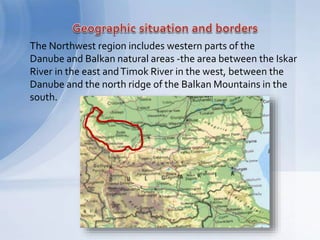
The Northwest region includes western parts of the
Danube and Balkan natural areas -the area between the Iskar
River in the east andTimok River in the west, between the
Danube and the north ridge of the Balkan Mountains in the
south.
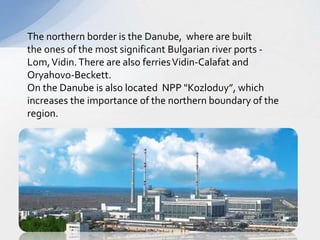
The northern border is the Danube, where are built
the ones of the most significant Bulgarian river ports -
Lom,Vidin.There are also ferriesVidin-Calafat and
Oryahovo-Beckett.
On the Danube is also located NPP "Kozloduy”, which
increases the importance of the northern boundary of the
region.
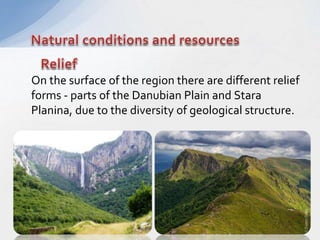
On the surface of the region there are different relief
forms - parts of the Danubian Plain and Stara
Planina, due to the diversity of geological structure.
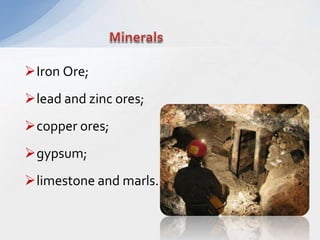
Iron Ore;
lead and zinc ores;
copper ores;
gypsum;
limestone and marls.
Nortwestern region is situated in the
moderate - continental climate area.
The average July temperature is about -
26°C and the average temperature in
January is around 0°C.
The average annual precipitation
amount in the plains and lowland parts
of the region is between 500 and
600 mm.
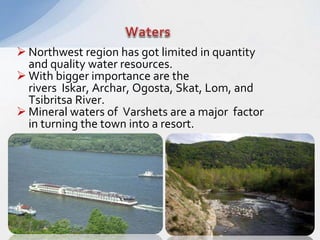
 Northwest region has got limited in quantity
and quality water resources.
 With bigger importance are the
rivers Iskar, Archar, Ogosta, Skat, Lom, and
Tsibritsa River.
 Mineral waters of Varshets are a major factor
in turning the town into a resort.
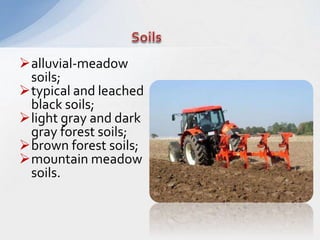
alluvial-meadow
soils;
typical and leached
black soils;
light gray and dark
gray forest soils;
brown forest soils;
mountain meadow
soils.
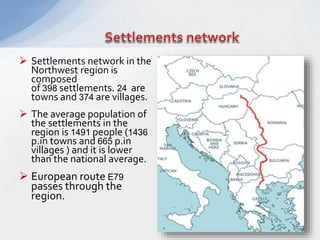
 Settlements network in the
Northwest region is
composed
of 398 settlements. 24 are
towns and 374 are villages.
 The average population of
the settlements in the
region is 1491 people (1436
p.in towns and 665 p.in
villages ) and it is lower
than the national average.
 European route E79
passes through the
region.
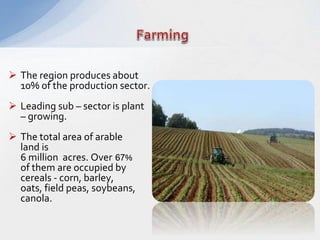
 The region produces about
10% of the production sector.
 Leading sub – sector is plant
– growing.
 The total area of arable
land is
6 million acres. Over 67%
of them are occupied by
cereals - corn, barley,
oats, field peas, soybeans,
canola.
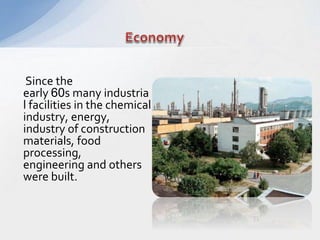
Since the
early 60s many industria
l facilities in the chemical
industry, energy,
industry of construction
materials, food
processing,
engineering and others
were built.
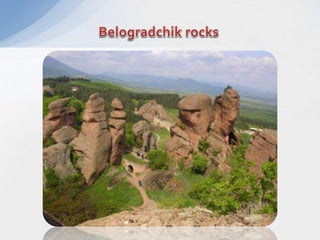
 Cave “Ledenika” God's bridge
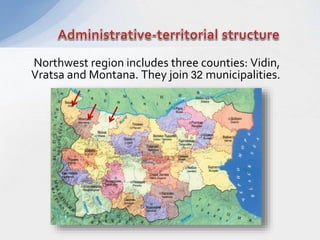
Northwest region includes three counties: Vidin,
Vratsa and Montana. They join 32 municipalities.
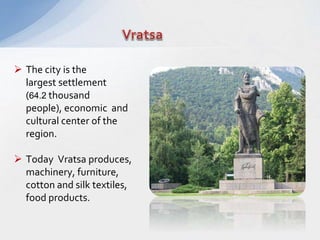
 The city is the
largest settlement
(64.2 thousand
people), economic and
cultural center of the
region.
 Today Vratsa produces,
machinery, furniture,
cotton and silk textiles,
food products.
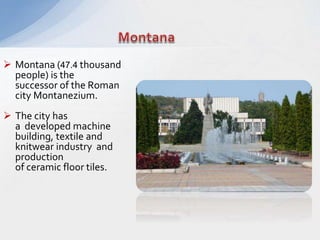
 Montana (47.4 thousand
people) is the
successor of the Roman
city Montanezium.
 The city has
а developed machine
building, textile and
knitwear industry and
production
of ceramic floor tiles.
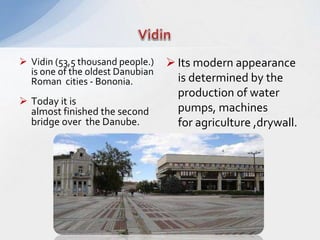
 Vidin (53,5 thousand people.)
is one of the oldest Danubian
Roman cities - Bononia.
 Today it is
almost finished the second
bridge over the Danube.
 Its modern appearance
is determined by the
production of water
pumps, machines
for agriculture ,drywall.
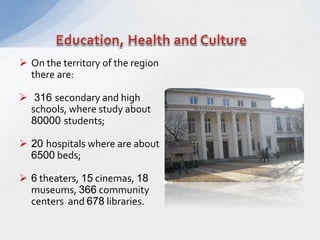
 On the territory of the region
there are:
 316 secondary and high
schools, where study about
80000 students;
 20 hospitals where are about
6500 beds;
 6 theaters, 15 cinemas, 18
museums, 366 community
centers and 678 libraries.
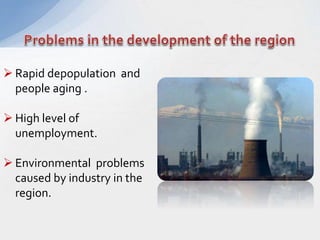
 Rapid depopulation and
people aging .
 High level of
unemployment.
 Environmental problems
caused by industry in the
region.
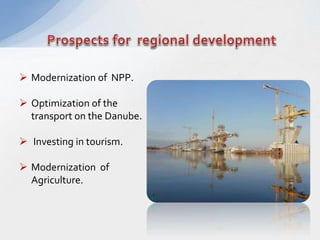
 Modernization of NPP.
 Optimization of the
transport on the Danube.
 Investing in tourism.
 Modernization of
Agriculture.
 Building
- Danubian Bridge 2
- 7-th reactor of NPP
Kozloduy
- Solar energy park
 Food industry
- meat processing
- milk processing
 Textile
- Cloth Factory
 Agriculture in the
region
- Plants for producing
bio-diesel (canola)
 Services
- Lawyers
- Accounting
- Automobile
showrooms

Region bg (1)

  • 2.
    The Northwest regionincludes western parts of the Danube and Balkan natural areas -the area between the Iskar River in the east andTimok River in the west, between the Danube and the north ridge of the Balkan Mountains in the south.
  • 3.
    The northern borderis the Danube, where are built the ones of the most significant Bulgarian river ports - Lom,Vidin.There are also ferriesVidin-Calafat and Oryahovo-Beckett. On the Danube is also located NPP "Kozloduy”, which increases the importance of the northern boundary of the region.
  • 4.
    On the surfaceof the region there are different relief forms - parts of the Danubian Plain and Stara Planina, due to the diversity of geological structure.
  • 5.
    Iron Ore; lead andzinc ores; copper ores; gypsum; limestone and marls.
  • 6.
    Nortwestern region issituated in the moderate - continental climate area. The average July temperature is about - 26°C and the average temperature in January is around 0°C. The average annual precipitation amount in the plains and lowland parts of the region is between 500 and 600 mm.
  • 7.
     Northwest regionhas got limited in quantity and quality water resources.  With bigger importance are the rivers Iskar, Archar, Ogosta, Skat, Lom, and Tsibritsa River.  Mineral waters of Varshets are a major factor in turning the town into a resort.
  • 8.
    alluvial-meadow soils; typical and leached blacksoils; light gray and dark gray forest soils; brown forest soils; mountain meadow soils.
  • 9.
     Settlements networkin the Northwest region is composed of 398 settlements. 24 are towns and 374 are villages.  The average population of the settlements in the region is 1491 people (1436 p.in towns and 665 p.in villages ) and it is lower than the national average.  European route E79 passes through the region.
  • 10.
     The regionproduces about 10% of the production sector.  Leading sub – sector is plant – growing.  The total area of arable land is 6 million acres. Over 67% of them are occupied by cereals - corn, barley, oats, field peas, soybeans, canola.
  • 11.
    Since the early 60smany industria l facilities in the chemical industry, energy, industry of construction materials, food processing, engineering and others were built.
  • 12.
     Cave “Ledenika”God's bridge
  • 17.
    Northwest region includesthree counties: Vidin, Vratsa and Montana. They join 32 municipalities.
  • 18.
     The cityis the largest settlement (64.2 thousand people), economic and cultural center of the region.  Today Vratsa produces, machinery, furniture, cotton and silk textiles, food products.
  • 19.
     Montana (47.4thousand people) is the successor of the Roman city Montanezium.  The city has а developed machine building, textile and knitwear industry and production of ceramic floor tiles.
  • 20.
     Vidin (53,5thousand people.) is one of the oldest Danubian Roman cities - Bononia.  Today it is almost finished the second bridge over the Danube.  Its modern appearance is determined by the production of water pumps, machines for agriculture ,drywall.
  • 21.
     On theterritory of the region there are:  316 secondary and high schools, where study about 80000 students;  20 hospitals where are about 6500 beds;  6 theaters, 15 cinemas, 18 museums, 366 community centers and 678 libraries.
  • 22.
     Rapid depopulationand people aging .  High level of unemployment.  Environmental problems caused by industry in the region.
  • 23.
     Modernization ofNPP.  Optimization of the transport on the Danube.  Investing in tourism.  Modernization of Agriculture.
  • 24.
     Building - DanubianBridge 2 - 7-th reactor of NPP Kozloduy - Solar energy park  Food industry - meat processing - milk processing  Textile - Cloth Factory  Agriculture in the region - Plants for producing bio-diesel (canola)  Services - Lawyers - Accounting - Automobile showrooms