REG Cost-Effectiveness
Workshop (Part II)
Jonathan D. Campbell; Piyameth Dilokthornsakul
Workshop Objectives
• Introductions
• Cystic fibrosis model example
• What can we do with CEA models? What can’t we do?
• Unveil the cost-effectiveness model black box.
• Review current evidence gaps in respiratory health technology
assessment
• Collectively propose study designs and other solutions toward HTA
respiratory evidence
• Who would like to participate in a REG working group?
• Research priorities of a cost-effectiveness REG working group and action
items for initiating a working group?
Forecasting the Lifetime Outcomes
and Cost of Ivacaftor in Patients with
Cystic Fibrosis in the United States
Piyameth Dilokthornsakul; Ryan N. Hansen; Jonathan D. Campbell
CF Model Objectives
• To forecast lifetime outcomes and cost to compare ivacaftor plus usual care
versus usual care alone
• To indirectly compared the long-run projected impact of ivacaftor to the non-
CF U.S. population.
4
Model and assumptions
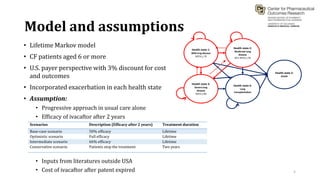
• Lifetime Markov model
• CF patients aged 6 or more
• U.S. payer perspective with 3% discount for cost
and outcomes
• Incorporated exacerbation in each health state
• Assumption:
• Progressive approach in usual care alone
• Efficacy of ivacaftor after 2 years
• Inputs from literatures outside USA
• Cost of ivacaftor after patent expired 5
Scenarios Description (Efficacy after 2 years) Treatment duration
Base-case scenario 50% efficacy Lifetime
Optimistic scenario Full efficacy Lifetime
Intermediate scenario 66% efficacy Lifetime
Conservative scenario Patients stop the treatment Two years
Health state 1:
Mild lung disease
%FEV1≥ 70
Health state 2:
Moderate lung
disease
40 ≤ %FEV1<70
Health state 3:
Severe lung
disease
%FEV1<40
Health state 4:
Lung
transplantation
Health state 5:
Death
Inputs
6
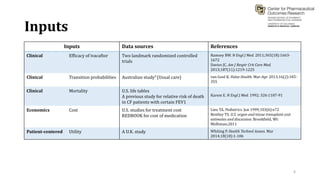
Inputs Data sources References
Clinical Efficacy of ivacaftor Two landmark randomized controlled
trials
Ramsey BW. N Engl J Med. 2011;365(18):1663-
1672
Davies JC. Am J Respir Crit Care Med.
2013;187(11):1219-1225
Clinical Transition probabilities Australian study3 (Usual care) van Gool K. Value Health. Mar-Apr 2013;16(2):345-
355
Clinical Mortality U.S. life tables
A previous study for relative risk of death
in CF patients with certain FEV1
Karem E. N Engl J Med. 1992; 326:1187-91
Economics Cost U.S. studies for treatment cost
REDBOOK for cost of medication
Lieu TA. Pediatrics. Jun 1999;103(6):e72
Bentley TS. U.S. organ and tissue transplant cost
estimates and discussion. Brookfield, WI:
Miilliman;2011
Patient-centered Utility A U.K. study Whiting P. Health Technol Assess. Mar
2014;18(18):1-106
Analysis
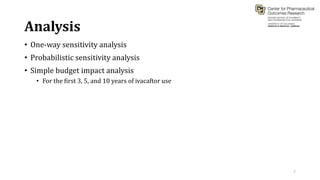
• One-way sensitivity analysis
• Probabilistic sensitivity analysis
• Simple budget impact analysis
• For the first 3, 5, and 10 years of ivacaftor use
7
Model example
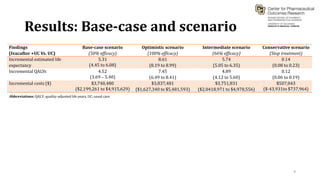
Results: Base-case and scenario
Findings
(Ivacaftor +UC Vs. UC)
Base-case scenario
(50% efficacy)
Optimistic scenario
(100% efficacy)
Intermediate scenario
(66% efficacy)
Conservative scenario
(Stop treatment)
Incremental estimated life
expectancy
5.31
(4.45 to 6.08)
8.61
(8.19 to 8.99)
5.74
(5.05 to 6.35)
0.14
(0.08 to 0.23)
Incremental QALYs 4.52
(3.69 – 5.40)
7.45
(6.49 to 8.41)
4.89
(4.12 to 5.60)
0.12
(0.06 to 0.19)
Incremental costs ($) $3,740,480
($2,199,261 to $4,915,629)
$3,837,481
($1,627,340 to $5,481,593)
$3,751,831
($2,0418,971 to $4,978,556)
$507,043
($-43,931to $737,964)
9
Abbreviations: QALY; quality-adjusted life years, UC; usual care
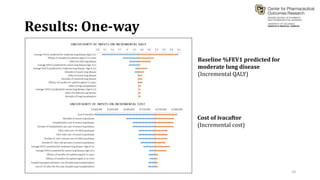
Results: One-way
Baseline %FEV1 predicted for
moderate lung disease
(Incremental QALY)
Cost of ivacaftor
(Incremental cost)
10
11
0
0.1
0.2
0.3
0.4
0.5
0.6
0.7
0.8
0.9
1
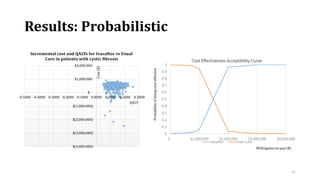
$- $1,000,000 $2,000,000 $3,000,000 $4,000,000
Cost Effectiveness Acceptibility Curve
Ivacaftor Usual Care
Willingness-to-pay ($)
Probabilityofbeingcost-effective
Results: Probabilistic
$(4,000,000)
$(3,000,000)
$(2,000,000)
$(1,000,000)
$-
$1,000,000
$2,000,000
-0.5000 -0.4000 -0.3000 -0.2000 -0.1000 0.0000 0.1000 0.2000 0.3000
Incremental cost and QALYs for Ivacaftor vs Usual
Care in patients with cystic fibrosis
QALY
Cost($)
Results
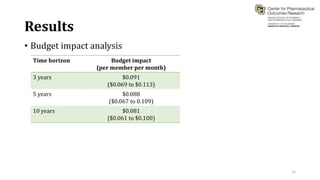
• Budget impact analysis
Time horizon Budget impact
(per member per month)
3 years $0.091
($0.069 to $0.113)
5 years $0.088
($0.067 to 0.109)
10 years $0.081
($0.061 to $0.100)
12
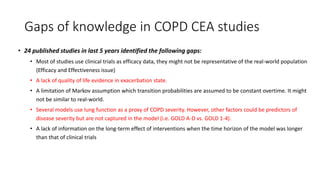
Gaps of knowledge in COPD CEA studies
• 24 published studies in last 5 years identified the following gaps:
• Most of studies use clinical trials as efficacy data, they might not be representative of the real-world population
(Efficacy and Effectiveness issue)
• A lack of quality of life evidence in exacerbation state.
• A limitation of Markov assumption which transition probabilities are assumed to be constant overtime. It might
not be similar to real-world.
• Several models use lung function as a proxy of COPD severity. However, other factors could be predictors of
disease severity but are not captured in the model (i.e. GOLD A-D vs. GOLD 1-4).
• A lack of information on the long-term effect of interventions when the time horizon of the model was longer
than that of clinical trials
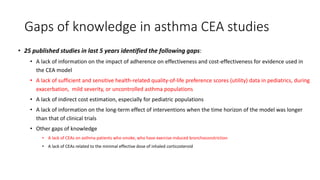
Gaps of knowledge in asthma CEA studies
• 25 published studies in last 5 years identified the following gaps:
• A lack of information on the impact of adherence on effectiveness and cost-effectiveness for evidence used in
the CEA model
• A lack of sufficient and sensitive health-related quality-of-life preference scores (utility) data in pediatrics, during
exacerbation, mild severity, or uncontrolled asthma populations
• A lack of indirect cost estimation, especially for pediatric populations
• A lack of information on the long-term effect of interventions when the time horizon of the model was longer
than that of clinical trials
• Other gaps of knowledge
• A lack of CEAs on asthma patients who smoke, who have exercise-induced bronchoconstriction
• A lack of CEAs related to the minimal effective dose of inhaled corticosteroid
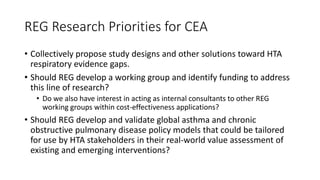
REG Research Priorities for CEA
• Collectively propose study designs and other solutions toward HTA
respiratory evidence gaps.
• Should REG develop a working group and identify funding to address
this line of research?
• Do we also have interest in acting as internal consultants to other REG
working groups within cost-effectiveness applications?
• Should REG develop and validate global asthma and chronic
obstructive pulmonary disease policy models that could be tailored
for use by HTA stakeholders in their real-world value assessment of
existing and emerging interventions?
Policy Models
• Well-designed Health Care Policy Models with robust inputs are
powerful tools for analyzing health care policy and clinical trial
investment decisions.
• Such models are frequently used by the National Cancer Institute, the
Congressional Budget Office, and other policy analysts when short-
run trial-based or observational evidence is not enough to address all
of the relevant policy issues.
Cost-Effectiveness Working Group Members
and Action Items
• Members
• Action Items
Jonathan D Campbell, PhD
Assistant Professor
Director, Pharmaceutical Outcomes Research Graduate Program
Center for Pharmaceutical Outcomes Research
University of Colorado Skaggs School of Pharmacy and Pharmaceutical Sciences | Anschutz Medical
Campus
Department of Clinical Pharmacy
p: 303.724.2886 | f: 303.724.0979
Jon.Campbell@ucdenver.edu | www.ucdenver.edu/pharmacy
Mail Stop C238
12850 E. Montview Blvd, V20-1205
Aurora, CO 80045
Piyameth Dilokthornsakul, PharmD
Lecturer
Center of Pharmaceutical Outcomes Research
Faculty of Pharmaceutical Sciences, Naresuan University
Muang, Phitsanulok, Thailand
Tel: 66-86-7354746
E-mail: piyamethd@gmail.com

REG Cost-Effectiveness Workshop

  • 1.
    REG Cost-Effectiveness Workshop (PartII) Jonathan D. Campbell; Piyameth Dilokthornsakul
  • 2.
    Workshop Objectives • Introductions •Cystic fibrosis model example • What can we do with CEA models? What can’t we do? • Unveil the cost-effectiveness model black box. • Review current evidence gaps in respiratory health technology assessment • Collectively propose study designs and other solutions toward HTA respiratory evidence • Who would like to participate in a REG working group? • Research priorities of a cost-effectiveness REG working group and action items for initiating a working group?
  • 3.
    Forecasting the LifetimeOutcomes and Cost of Ivacaftor in Patients with Cystic Fibrosis in the United States Piyameth Dilokthornsakul; Ryan N. Hansen; Jonathan D. Campbell
  • 4.
    CF Model Objectives •To forecast lifetime outcomes and cost to compare ivacaftor plus usual care versus usual care alone • To indirectly compared the long-run projected impact of ivacaftor to the non- CF U.S. population. 4
  • 5.
    Model and assumptions •Lifetime Markov model • CF patients aged 6 or more • U.S. payer perspective with 3% discount for cost and outcomes • Incorporated exacerbation in each health state • Assumption: • Progressive approach in usual care alone • Efficacy of ivacaftor after 2 years • Inputs from literatures outside USA • Cost of ivacaftor after patent expired 5 Scenarios Description (Efficacy after 2 years) Treatment duration Base-case scenario 50% efficacy Lifetime Optimistic scenario Full efficacy Lifetime Intermediate scenario 66% efficacy Lifetime Conservative scenario Patients stop the treatment Two years Health state 1: Mild lung disease %FEV1≥ 70 Health state 2: Moderate lung disease 40 ≤ %FEV1<70 Health state 3: Severe lung disease %FEV1<40 Health state 4: Lung transplantation Health state 5: Death
  • 6.
    Inputs 6 Inputs Data sourcesReferences Clinical Efficacy of ivacaftor Two landmark randomized controlled trials Ramsey BW. N Engl J Med. 2011;365(18):1663- 1672 Davies JC. Am J Respir Crit Care Med. 2013;187(11):1219-1225 Clinical Transition probabilities Australian study3 (Usual care) van Gool K. Value Health. Mar-Apr 2013;16(2):345- 355 Clinical Mortality U.S. life tables A previous study for relative risk of death in CF patients with certain FEV1 Karem E. N Engl J Med. 1992; 326:1187-91 Economics Cost U.S. studies for treatment cost REDBOOK for cost of medication Lieu TA. Pediatrics. Jun 1999;103(6):e72 Bentley TS. U.S. organ and tissue transplant cost estimates and discussion. Brookfield, WI: Miilliman;2011 Patient-centered Utility A U.K. study Whiting P. Health Technol Assess. Mar 2014;18(18):1-106
  • 7.
    Analysis • One-way sensitivityanalysis • Probabilistic sensitivity analysis • Simple budget impact analysis • For the first 3, 5, and 10 years of ivacaftor use 7
  • 8.
  • 9.
    Results: Base-case andscenario Findings (Ivacaftor +UC Vs. UC) Base-case scenario (50% efficacy) Optimistic scenario (100% efficacy) Intermediate scenario (66% efficacy) Conservative scenario (Stop treatment) Incremental estimated life expectancy 5.31 (4.45 to 6.08) 8.61 (8.19 to 8.99) 5.74 (5.05 to 6.35) 0.14 (0.08 to 0.23) Incremental QALYs 4.52 (3.69 – 5.40) 7.45 (6.49 to 8.41) 4.89 (4.12 to 5.60) 0.12 (0.06 to 0.19) Incremental costs ($) $3,740,480 ($2,199,261 to $4,915,629) $3,837,481 ($1,627,340 to $5,481,593) $3,751,831 ($2,0418,971 to $4,978,556) $507,043 ($-43,931to $737,964) 9 Abbreviations: QALY; quality-adjusted life years, UC; usual care
  • 10.
    Results: One-way Baseline %FEV1predicted for moderate lung disease (Incremental QALY) Cost of ivacaftor (Incremental cost) 10
  • 11.
    11 0 0.1 0.2 0.3 0.4 0.5 0.6 0.7 0.8 0.9 1 $- $1,000,000 $2,000,000$3,000,000 $4,000,000 Cost Effectiveness Acceptibility Curve Ivacaftor Usual Care Willingness-to-pay ($) Probabilityofbeingcost-effective Results: Probabilistic $(4,000,000) $(3,000,000) $(2,000,000) $(1,000,000) $- $1,000,000 $2,000,000 -0.5000 -0.4000 -0.3000 -0.2000 -0.1000 0.0000 0.1000 0.2000 0.3000 Incremental cost and QALYs for Ivacaftor vs Usual Care in patients with cystic fibrosis QALY Cost($)
  • 12.
    Results • Budget impactanalysis Time horizon Budget impact (per member per month) 3 years $0.091 ($0.069 to $0.113) 5 years $0.088 ($0.067 to 0.109) 10 years $0.081 ($0.061 to $0.100) 12
  • 13.
    Gaps of knowledgein COPD CEA studies • 24 published studies in last 5 years identified the following gaps: • Most of studies use clinical trials as efficacy data, they might not be representative of the real-world population (Efficacy and Effectiveness issue) • A lack of quality of life evidence in exacerbation state. • A limitation of Markov assumption which transition probabilities are assumed to be constant overtime. It might not be similar to real-world. • Several models use lung function as a proxy of COPD severity. However, other factors could be predictors of disease severity but are not captured in the model (i.e. GOLD A-D vs. GOLD 1-4). • A lack of information on the long-term effect of interventions when the time horizon of the model was longer than that of clinical trials
  • 14.
    Gaps of knowledgein asthma CEA studies • 25 published studies in last 5 years identified the following gaps: • A lack of information on the impact of adherence on effectiveness and cost-effectiveness for evidence used in the CEA model • A lack of sufficient and sensitive health-related quality-of-life preference scores (utility) data in pediatrics, during exacerbation, mild severity, or uncontrolled asthma populations • A lack of indirect cost estimation, especially for pediatric populations • A lack of information on the long-term effect of interventions when the time horizon of the model was longer than that of clinical trials • Other gaps of knowledge • A lack of CEAs on asthma patients who smoke, who have exercise-induced bronchoconstriction • A lack of CEAs related to the minimal effective dose of inhaled corticosteroid
  • 15.
    REG Research Prioritiesfor CEA • Collectively propose study designs and other solutions toward HTA respiratory evidence gaps. • Should REG develop a working group and identify funding to address this line of research? • Do we also have interest in acting as internal consultants to other REG working groups within cost-effectiveness applications? • Should REG develop and validate global asthma and chronic obstructive pulmonary disease policy models that could be tailored for use by HTA stakeholders in their real-world value assessment of existing and emerging interventions?
  • 16.
    Policy Models • Well-designedHealth Care Policy Models with robust inputs are powerful tools for analyzing health care policy and clinical trial investment decisions. • Such models are frequently used by the National Cancer Institute, the Congressional Budget Office, and other policy analysts when short- run trial-based or observational evidence is not enough to address all of the relevant policy issues.
  • 17.
    Cost-Effectiveness Working GroupMembers and Action Items • Members • Action Items
  • 18.
    Jonathan D Campbell,PhD Assistant Professor Director, Pharmaceutical Outcomes Research Graduate Program Center for Pharmaceutical Outcomes Research University of Colorado Skaggs School of Pharmacy and Pharmaceutical Sciences | Anschutz Medical Campus Department of Clinical Pharmacy p: 303.724.2886 | f: 303.724.0979 Jon.Campbell@ucdenver.edu | www.ucdenver.edu/pharmacy Mail Stop C238 12850 E. Montview Blvd, V20-1205 Aurora, CO 80045 Piyameth Dilokthornsakul, PharmD Lecturer Center of Pharmaceutical Outcomes Research Faculty of Pharmaceutical Sciences, Naresuan University Muang, Phitsanulok, Thailand Tel: 66-86-7354746 E-mail: piyamethd@gmail.com