


LOG AGGREGATION
To better manage your Red Hat footprint
Miguel Pérez Colino
Strategic Design Team - ISBU
2017-05-03
@mmmmmmpc
Agenda
Managing your Red Hat footprint with Log Aggregation
● The Situation
● The Challenge
● The Solution
THE SITUATION
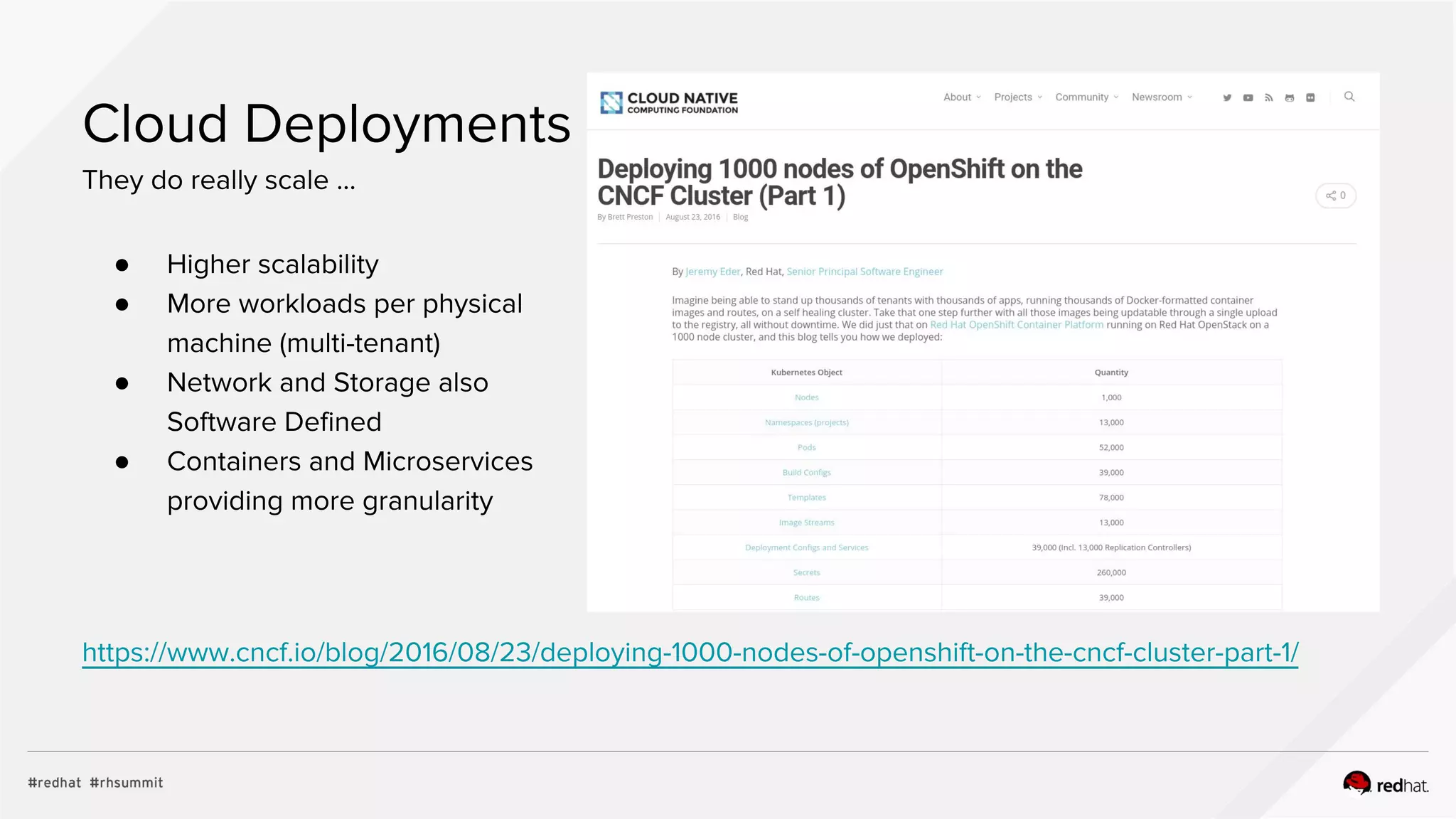
Cloud Deployments
They do really scale ...
https://www.cncf.io/blog/2016/08/23/deploying-1000-nodes-of-openshift-on-the-cncf-cluster-part-1/
● Higher scalability
● More workloads per physical
machine (multi-tenant)
● Network and Storage also
Software Defined
● Containers and Microservices
providing more granularity
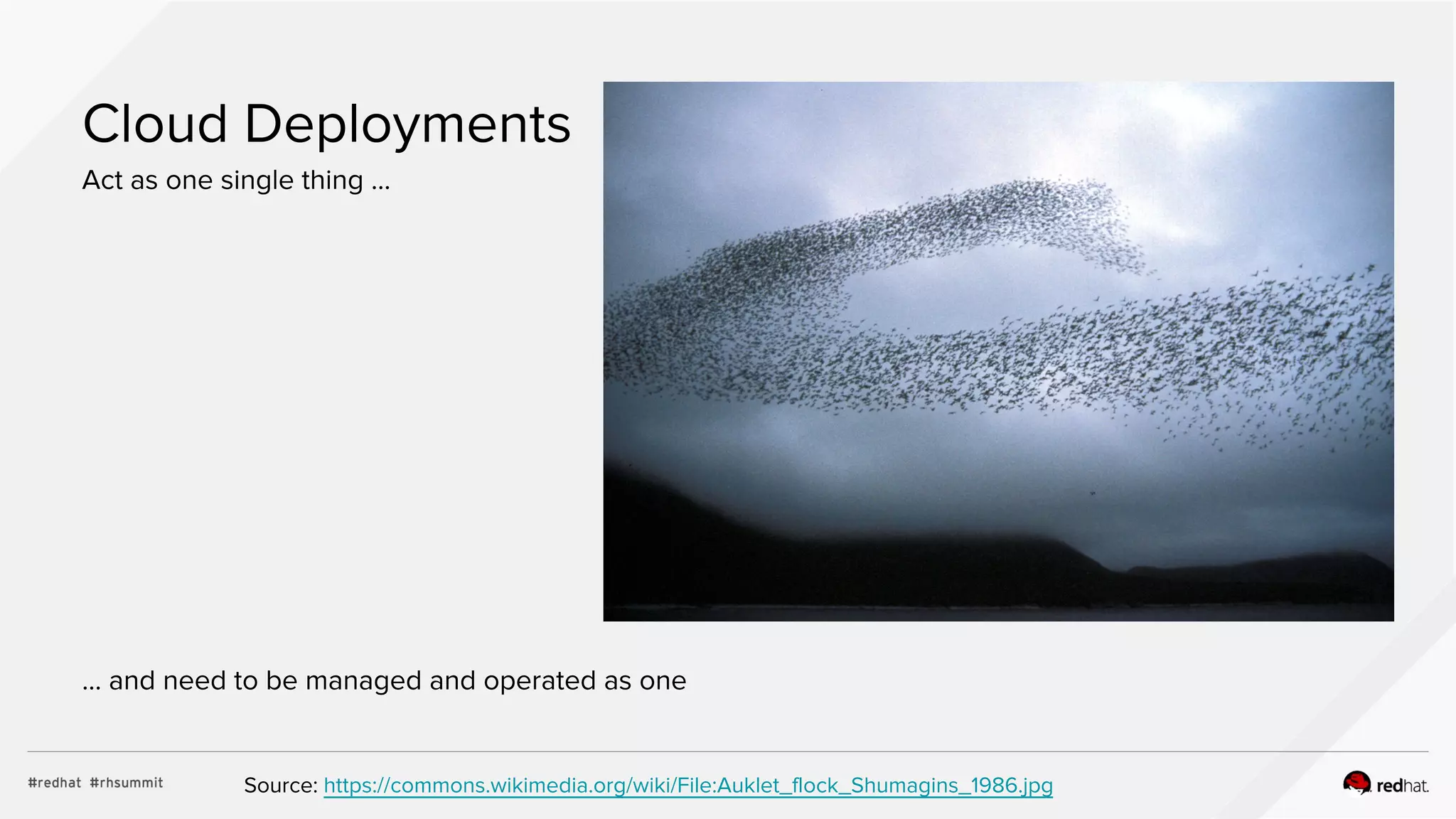
Cloud Deployments
Act as one single thing …
… and need to be managed and operated as one
Source: https://commons.wikimedia.org/wiki/File:Auklet_flock_Shumagins_1986.jpg
THE CHALLENGE
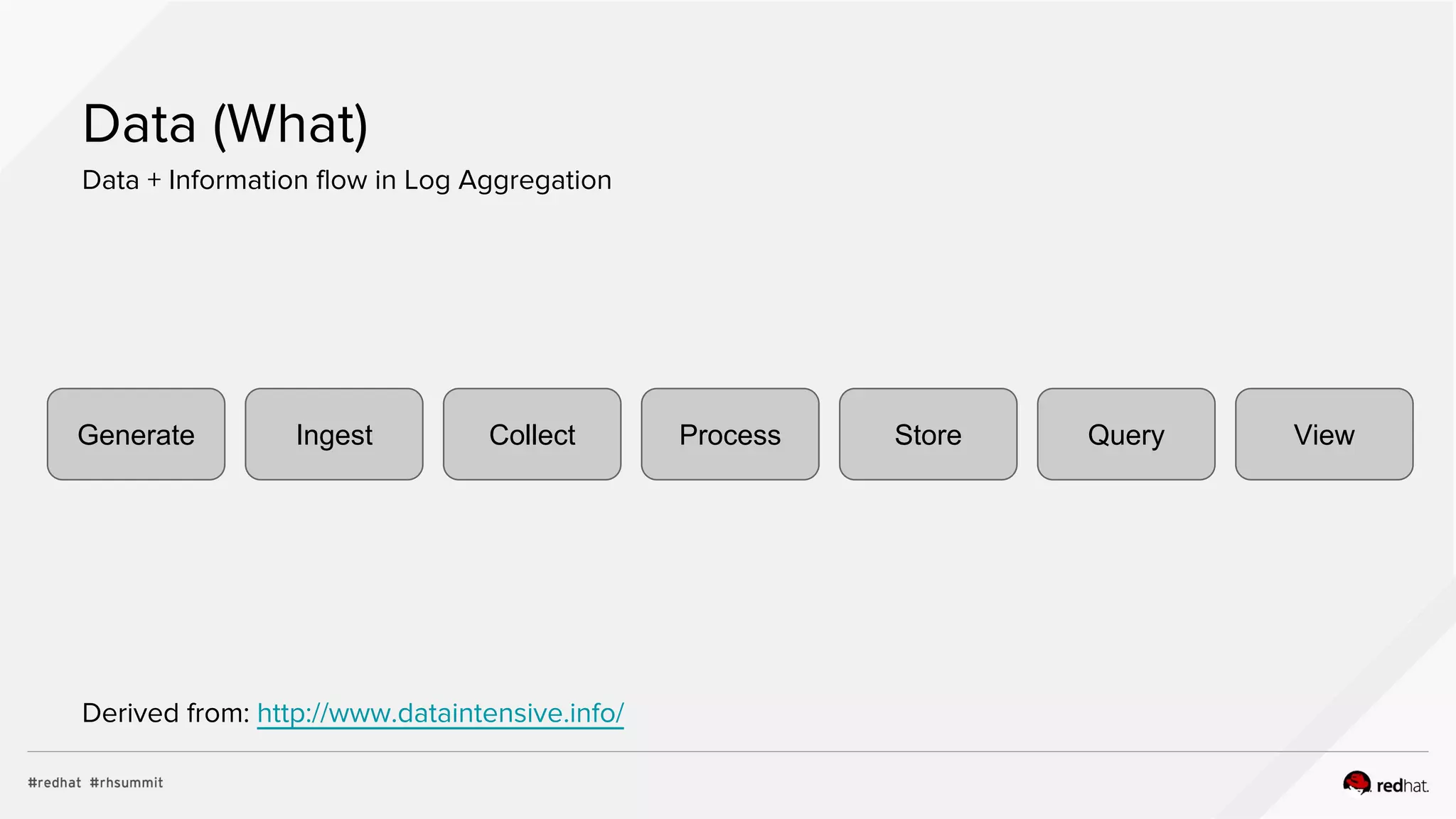
Data (What)
Data + Information flow in Log Aggregation
ProcessIngest StoreCollect Query ViewGenerate
Derived from: http://www.dataintensive.info/
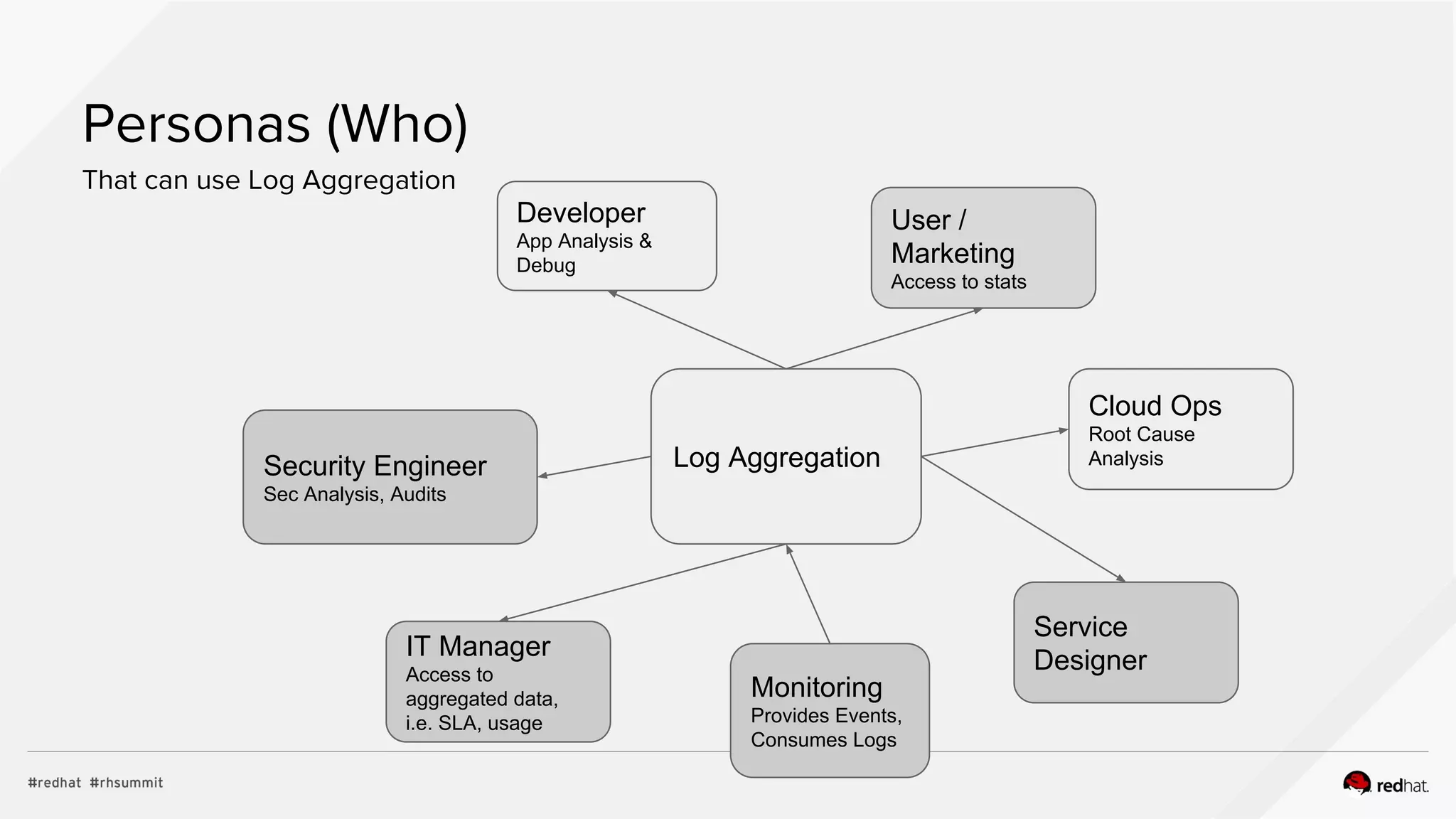
Personas (Who)
That can use Log Aggregation
Log Aggregation
Monitoring
Provides Events,
Consumes Logs
Cloud Ops
Root Cause
Analysis
Developer
App Analysis &
Debug
Security Engineer
Sec Analysis, Audits
User /
Marketing
Access to stats
Service
DesignerIT Manager
Access to
aggregated data,
i.e. SLA, usage
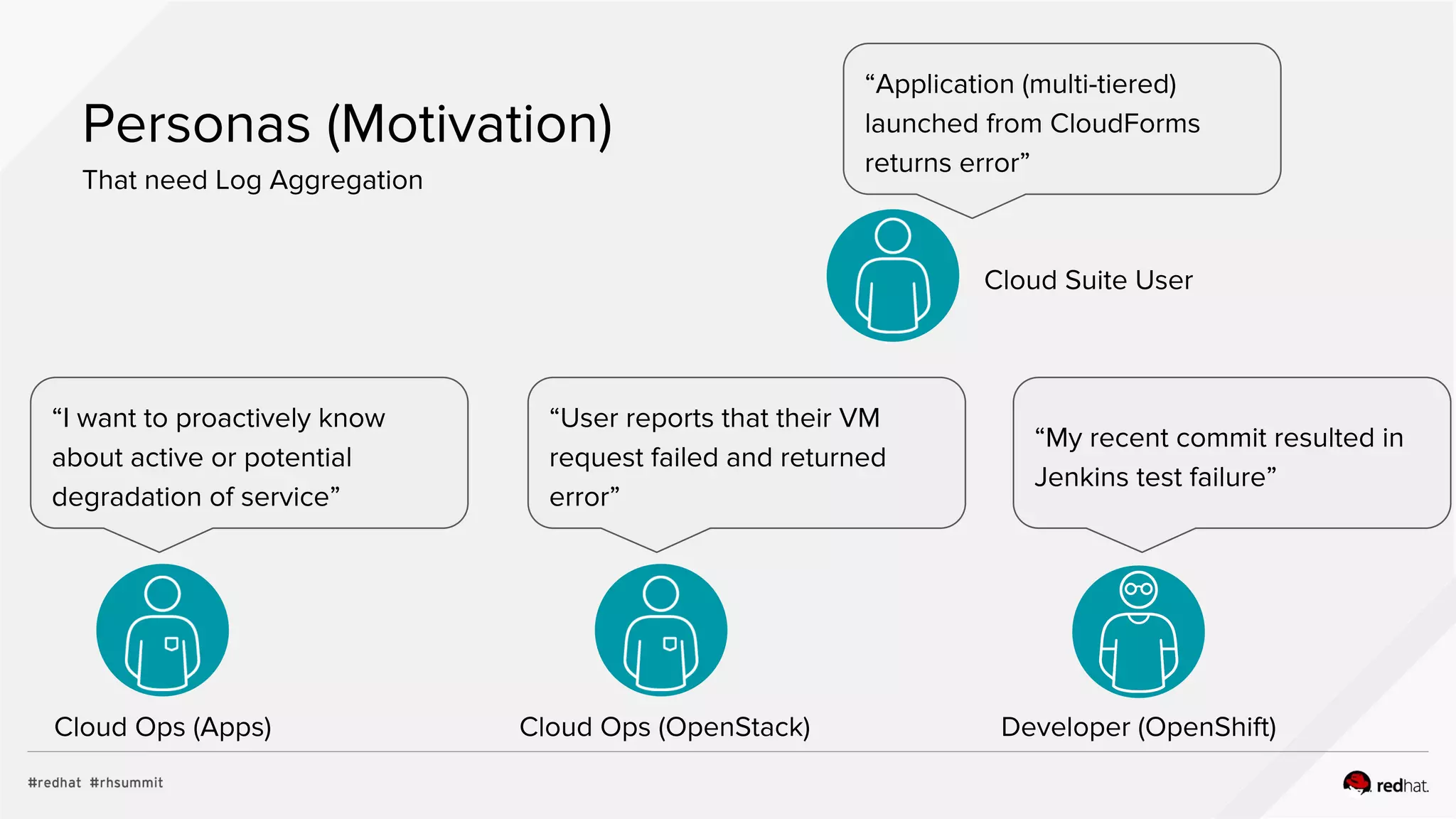
Personas (Motivation)
That need Log Aggregation
Cloud Ops (Apps)
“I want to proactively know
about active or potential
degradation of service”
Cloud Ops (OpenStack)
“User reports that their VM
request failed and returned
error”
Developer (OpenShift)
“My recent commit resulted in
Jenkins test failure”
“Application (multi-tiered)
launched from CloudForms
returns error”
Cloud Suite User
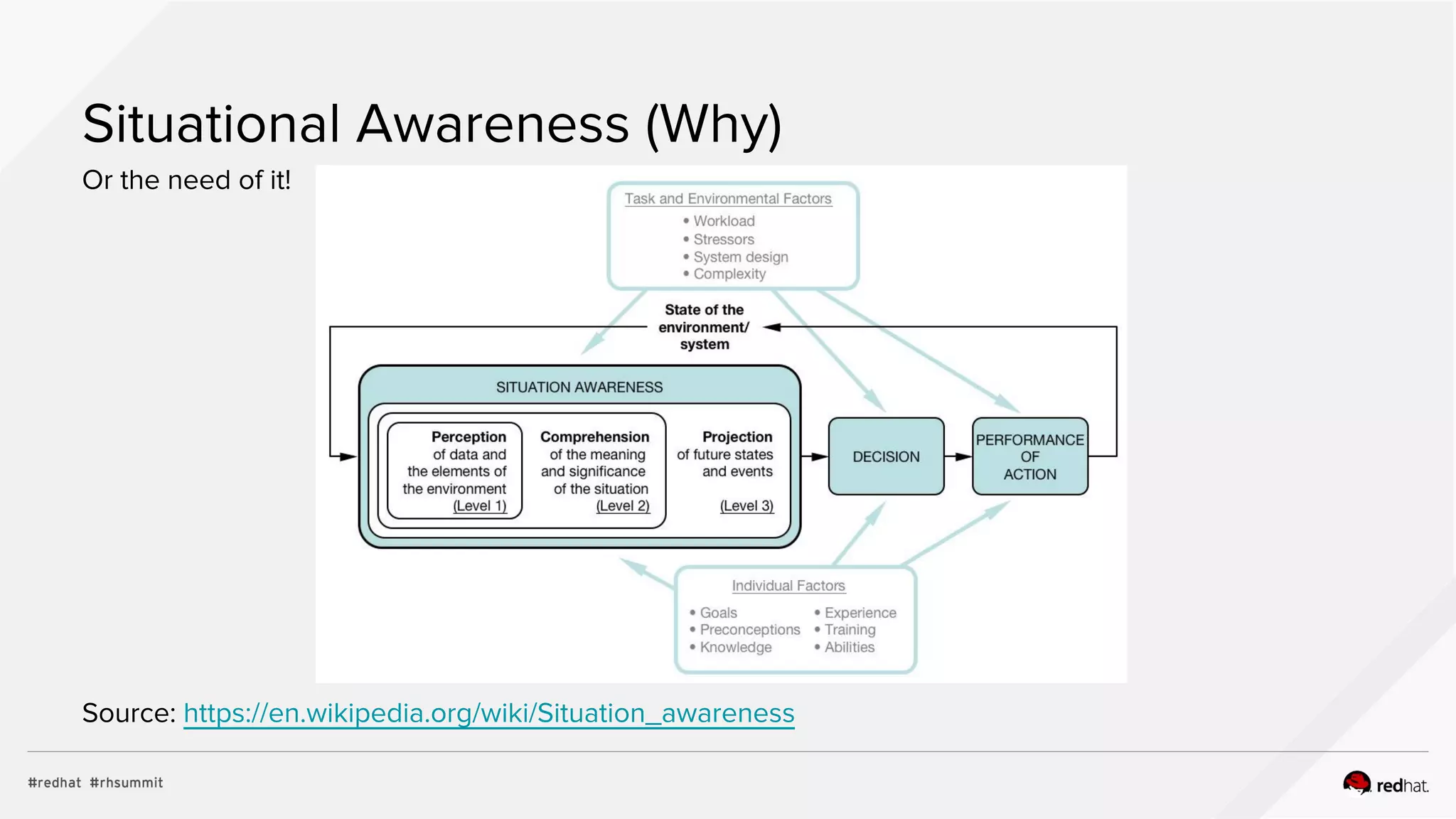
Situational Awareness (Why)
Or the need of it!
Source: https://en.wikipedia.org/wiki/Situation_awareness
THE SOLUTION
Architecture
Proposed General Architecture
Real Time
Analytics
and
Response
Host
Bus
N N N
Archive
Data
Store
General
Visualization
M
C
M
C
Storage
Legend
M
C
N
Message
Client
Normalizer
C
C
C Collector
Slide Credit: Tushar Katarki [@tkatarki]
Implementation
Introduction to EFK
KibanaElasticSearchLog Source Fluentd
User Interface for:
● Search
● Graph
● Dashboard
Index and store
data and metadata
making search
fast and reliable
● Parsing
● Filtering
● Enriching
● Deleting
● Output
Buffering
● TCP/UDP
● HTTP
● File: Text
● Stdout: CSV,
JSON,
MessagePack
● syslog/journal
Slide Credit: Tushar Katarki [@tkatarki]
Current Status
Being delivered and supported
OpenShift Container
Platform 3.5
● Full EFK stack provided
as containers
OpenStack Platform 10
● Fluentd as log collector
Red Hat Virtualization
● Coming Soon!
Log files
Journal Fluentd
Kuberentes
Services
Syslog
Master Nodes
Elastic
search
Kibana
...
Application Nodes
Log files
Journal Fluentd
App inside
container
Syslog
Infra Nodes
Elastic
search
Kibana
host logs
App inside
container
Elastic
search
Curator
Multi-Tenant
Access
Diagram Credit: Tushar Katarki [@tkatarki]
BEYOND ...
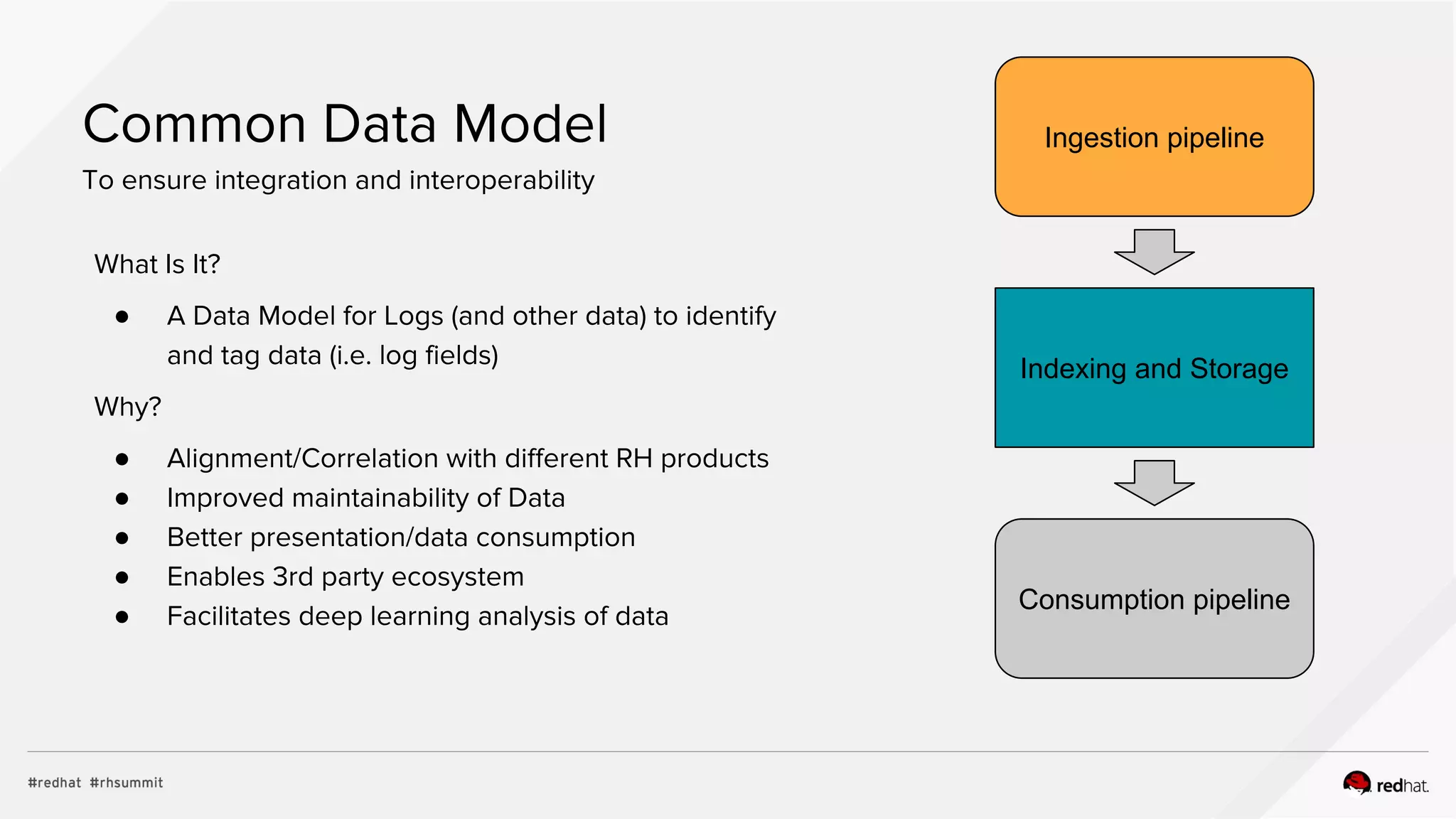
Common Data Model
To ensure integration and interoperability
What Is It?
● A Data Model for Logs (and other data) to identify
and tag data (i.e. log fields)
Why?
● Alignment/Correlation with different RH products
● Improved maintainability of Data
● Better presentation/data consumption
● Enables 3rd party ecosystem
● Facilitates deep learning analysis of data
Ingestion pipeline
Consumption pipeline
Indexing and Storage
Common Data Model
Example ...
Data extracted:
● Container name
● Pod name
● Namespace name
● Docker container ID
K8S data queried:
● Pod UID
● Pod labels
● Pod host
● Namespace UID.
All merged into output log in JSON Format
Images Credit: Anton Sherkhonov [@peatz]
CDM
A → 1
B → 2
C → 3
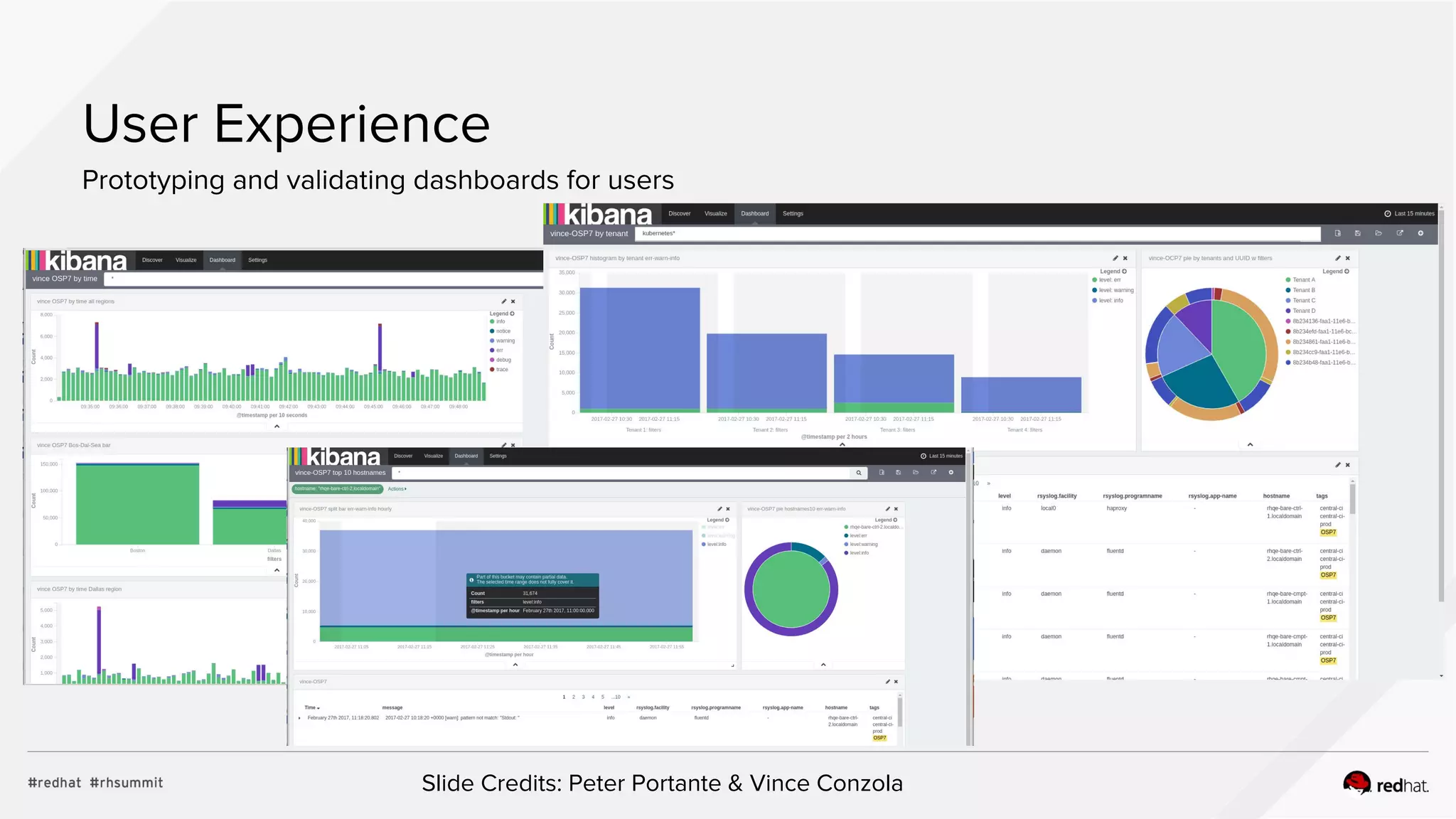
User Experience
Prototyping and validating dashboards for users
Slide Credits: Peter Portante & Vince Conzola
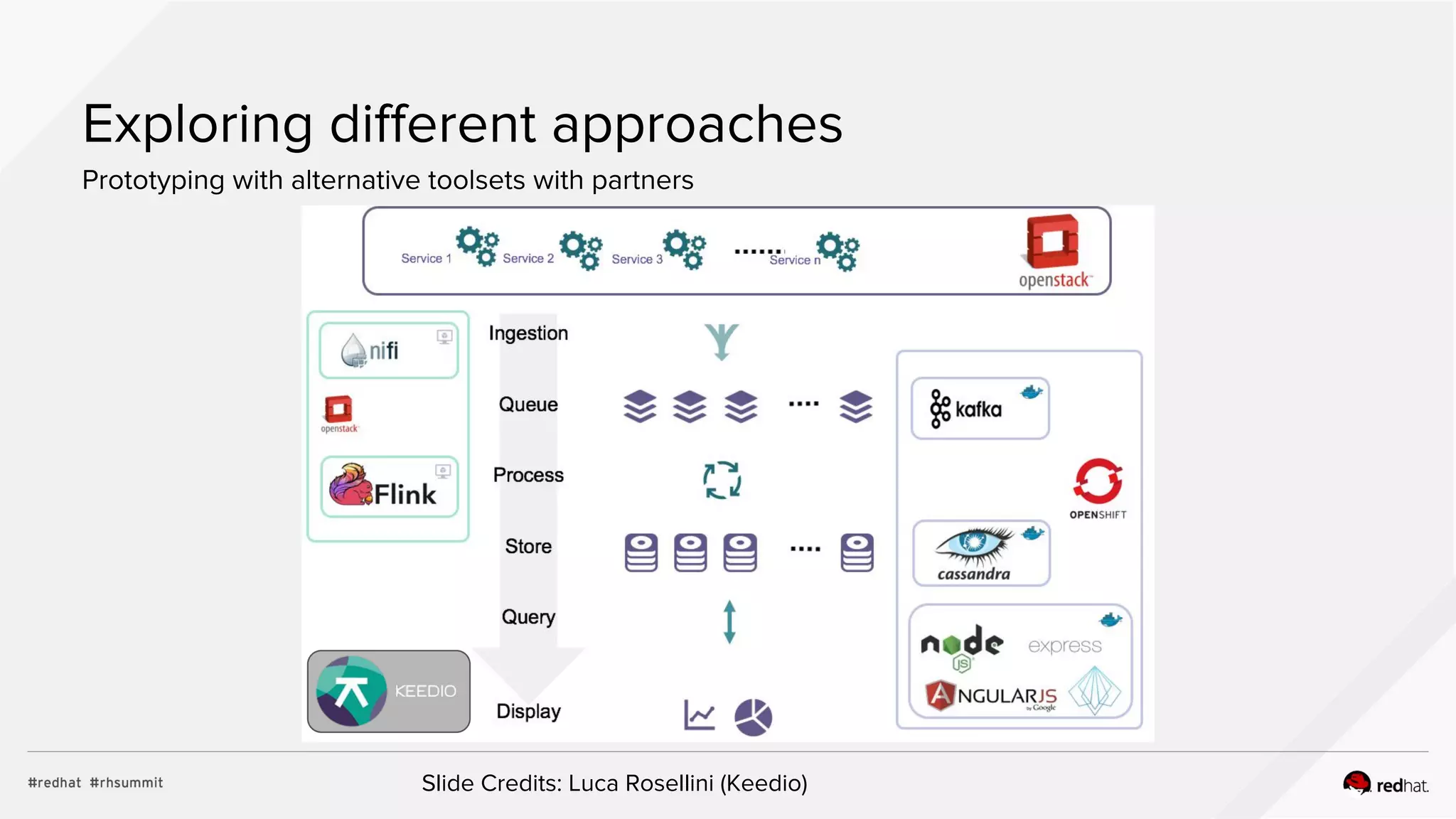
Exploring different approaches
Prototyping with alternative toolsets with partners
Slide Credits: Luca Rosellini (Keedio)
ACTION!
How are you doing it?
Please, provide your feedback ...
http://bit.ly/log-aggregation
THANK YOU
plus.google.com/+RedHat
linkedin.com/company/red-hat
youtube.com/user/RedHatVideos
facebook.com/redhatinc
twitter.com/RedHatNews
Red Hat Summit 2017 - LT107508 - Better Managing your Red Hat footprint with log aggregation

Red Hat Summit 2017 - LT107508 - Better Managing your Red Hat footprint with log aggregation

  • 1.
    LOG AGGREGATION To bettermanage your Red Hat footprint Miguel Pérez Colino Strategic Design Team - ISBU 2017-05-03 @mmmmmmpc
  • 2.
    Agenda Managing your RedHat footprint with Log Aggregation ● The Situation ● The Challenge ● The Solution
  • 3.
  • 4.
    Cloud Deployments They doreally scale ... https://www.cncf.io/blog/2016/08/23/deploying-1000-nodes-of-openshift-on-the-cncf-cluster-part-1/ ● Higher scalability ● More workloads per physical machine (multi-tenant) ● Network and Storage also Software Defined ● Containers and Microservices providing more granularity
  • 5.
    Cloud Deployments Act asone single thing … … and need to be managed and operated as one Source: https://commons.wikimedia.org/wiki/File:Auklet_flock_Shumagins_1986.jpg
  • 6.
  • 7.
    Data (What) Data +Information flow in Log Aggregation ProcessIngest StoreCollect Query ViewGenerate Derived from: http://www.dataintensive.info/
  • 8.
    Personas (Who) That canuse Log Aggregation Log Aggregation Monitoring Provides Events, Consumes Logs Cloud Ops Root Cause Analysis Developer App Analysis & Debug Security Engineer Sec Analysis, Audits User / Marketing Access to stats Service DesignerIT Manager Access to aggregated data, i.e. SLA, usage
  • 9.
    Personas (Motivation) That needLog Aggregation Cloud Ops (Apps) “I want to proactively know about active or potential degradation of service” Cloud Ops (OpenStack) “User reports that their VM request failed and returned error” Developer (OpenShift) “My recent commit resulted in Jenkins test failure” “Application (multi-tiered) launched from CloudForms returns error” Cloud Suite User
  • 10.
    Situational Awareness (Why) Orthe need of it! Source: https://en.wikipedia.org/wiki/Situation_awareness
  • 11.
  • 12.
    Architecture Proposed General Architecture RealTime Analytics and Response Host Bus N N N Archive Data Store General Visualization M C M C Storage Legend M C N Message Client Normalizer C C C Collector Slide Credit: Tushar Katarki [@tkatarki]
  • 13.
    Implementation Introduction to EFK KibanaElasticSearchLogSource Fluentd User Interface for: ● Search ● Graph ● Dashboard Index and store data and metadata making search fast and reliable ● Parsing ● Filtering ● Enriching ● Deleting ● Output Buffering ● TCP/UDP ● HTTP ● File: Text ● Stdout: CSV, JSON, MessagePack ● syslog/journal Slide Credit: Tushar Katarki [@tkatarki]
  • 14.
    Current Status Being deliveredand supported OpenShift Container Platform 3.5 ● Full EFK stack provided as containers OpenStack Platform 10 ● Fluentd as log collector Red Hat Virtualization ● Coming Soon! Log files Journal Fluentd Kuberentes Services Syslog Master Nodes Elastic search Kibana ... Application Nodes Log files Journal Fluentd App inside container Syslog Infra Nodes Elastic search Kibana host logs App inside container Elastic search Curator Multi-Tenant Access Diagram Credit: Tushar Katarki [@tkatarki]
  • 15.
  • 16.
    Common Data Model Toensure integration and interoperability What Is It? ● A Data Model for Logs (and other data) to identify and tag data (i.e. log fields) Why? ● Alignment/Correlation with different RH products ● Improved maintainability of Data ● Better presentation/data consumption ● Enables 3rd party ecosystem ● Facilitates deep learning analysis of data Ingestion pipeline Consumption pipeline Indexing and Storage
  • 17.
    Common Data Model Example... Data extracted: ● Container name ● Pod name ● Namespace name ● Docker container ID K8S data queried: ● Pod UID ● Pod labels ● Pod host ● Namespace UID. All merged into output log in JSON Format Images Credit: Anton Sherkhonov [@peatz] CDM A → 1 B → 2 C → 3
  • 18.
    User Experience Prototyping andvalidating dashboards for users Slide Credits: Peter Portante & Vince Conzola
  • 19.
    Exploring different approaches Prototypingwith alternative toolsets with partners Slide Credits: Luca Rosellini (Keedio)
  • 20.
  • 21.
    How are youdoing it? Please, provide your feedback ... http://bit.ly/log-aggregation
  • 22.