“A STUDY OF RED GRAM PROCESSING “
PREPAREDED BY
SHARAD PANT
MBA
Osmania University, Hyderabad
RED GRAM PROCESSING REPORT
Introduction
Red gram or Tur has been procured from different farmers of Kodangal and
Hasnabad Farmer producer companies as part of development of business for the
farmers. The business plan includes input and output business by the FPCs to improve
the bargaining power and profit for the FPC.
Input business includes, handling of fertilisers, pesticides, seeds and other farm
pre-production requirements. By collective buying many of the costs can be reduced
through bargaining with the traders and supply companies as quantity of requirement
involve is large. The major advantage in handling of business on their own is, on time
supply of fertilisers and other inputs as compared to depending on market and small
traders at local level which is all volatile.
The out business majorly includes the processing of produce and marketing to
link directly to the consumers with fewer intermediaries. This will reduce the cost of
production and farmer can be benefited out of this.
The business plan includes construction of ware house for storage of raw and
processed produce and Dal Mill for processing of raw material. Construction of ware
house and dal mill requires land, capital and time, which are to be acquired through
different means.
So, as an initial step towards output business, instead of selling the raw produce
to the traders or millers, FPC tried to procure material from its farmers and process and
sell the processed produce in themarket.
Procurement of RedGram
Red gram was procured from farmers from Kodangal and Hasnabad FPCs. Total
material procured was around 469quintal, from Kodangal and Hasnabad for
commercial processing.
The price of each quintal purchased varied from 385 to 4300 depending on the
quality.
For the procurement of the material, a charge of 10 rupees collected as service
charge. This will be deposited into FPCs account. A total amount of 30,000 Rs collected
from the farmers as procurementcharge.
During procurement process, due to lack of expertise about the process and
absence of quality controlling mechanism, all sizes or quality of dal procured in same
basis. Raw material with various quality levels combined together, which caused
degradation of dal quality (based on size). This was reflected in the final product and
many buyers clearly expressed that the material is not of first grade quality.
To avoid such mistakes I the future, the procurement process should be done in
presence of a quality controller, who can monitor the quality of material being
procured.
Specification of required grade or quality has to be done toavoid mixing of less
quality product into the quality product. In case, procurement donefor all kinds of
grades or sizes, separate bagging and labelling to be done to process separately.
Of these, monitoring officer at the time of procurement is very much required to
avoidquality depletion of raw material and extra payment for theless quality material.
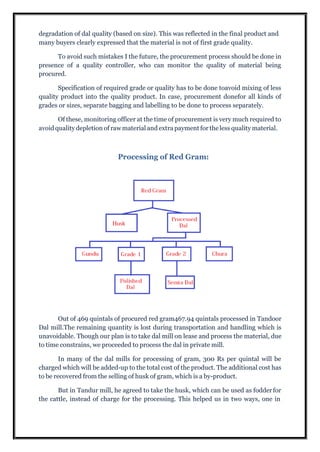
Processing of Red Gram:
Out of 469 quintals of procured red gram467.94 quintals processed in Tandoor
Dal mill.The remaining quantity is lost during transportation and handling which is
unavoidable. Though our plan is to take dal mill on lease and process the material, due
to time constrains, we proceeded to process the dal in private mill.
In many of the dal mills for processing of gram, 300 Rs per quintal will be
charged which will be added-up to the total cost of the product. The additional cost has
to be recovered from the selling of husk of gram, which is a by-product.
But in Tandur mill, he agreed to take the husk, which can be used as fodderfor
the cattle, instead of charge for the processing. This helped us in two ways, one in
reducing the cost of total processing and second, in avoiding difficulty of searching for
the market for the husk, which is again another difficult task.
Apart from husk and first grade dal, there are other by-products like unpeeled
product, unbroken dal and fine broken dal. These are called with different names
depending on region. These are considerable fraction of the input quantity and need to
be marketed.
The recovery of the material which includes processed dal and other by-products
excluding husk is around 78% in general. We tried to achieve as much as possible and
got 77% recovery.
The major problem occurred during the processing was inappropriate use of
sieves for the grading of dal. The miller did not use right set of sieves and not fix
properly for the separation of different products. This resulted in passing of less size
material into the first grade dal and reduced the quality. The presence of small dal in th
main product also reduced the market price of the product as many traders not willing o
accept it is of first gradedal.
The reduction in quality happened at two levels, one at the procurement level
and other at processing level.
To avoid such mistakes, those reduce the quality and market price of product,
manpower with expertise in procurement and processing is very much required.
Bagging, transportation and Storage
Another major work which takes considerable time and costs is handling of
material. It includes weighing, bagging, transportation and storage. At every place,
enough man power is very much required to for safe and secure operation.
The movement of the material not only requires time but also incurs cost of
transportation and loading and unloading. So the movement of the material has to be
avoided.
Storage of the material is very important that, any negligence in storage will
result in heavy losses. The reasons can be as simple as leaking roof of warehouse to
improper doors and otherbut,the cost will be high if the material caught fire, pests ,
eating by rats and theft by others. To avoid such catastrophes proper storage is very
much essential.
In Tandur, the material was kept at government warehouse. It was not secured
enough. So personal has to be present there to avoid loss of material. During the
processing also, Women farmers from Hasnabads’FPC have been there to monitor the
process.
So, before going for confirmation of warehouse for storing of material, it has to
be ensured that, the warehouse is well enough in all respects to store the material
safely.
Marketing of Processed Dal
The very important part of the whole process is marketing of Dal. Unless the
product sold at right time and at proper price, the whole process cannot yield any
benefit to the farmers. Any set back in these will result in two kinds of losses, one is
monetary and other is thrust.
Farmers cannot wait for too long to covert produce into money because it is the
source of their livelihood and also they have to invest for the next season. If we fail to
provide money in time, it will discourage them from investing their time, energy and
money in the business. So marketing of produce is very important.
We tried different platforms to sell the produce.
1. Through Millers who can buy the finished product
2. Through traders (In Tandur andHyderabad)
3. Through Export agencies
4. Though Commercial Procurement Agencies
5. Through different Government and Non-Government institutions
6. Through retails chains andwholesalers
7. Through Schools and Colleges and other residential institutes
8. Other contacts
Unfortunately, as we are first time into the business, we are not able to get
through potential buyers in right time. There are many reasons for the inability of
getting through the market.
The very reason many traders and other wholesalers declined to buy the
products is comparatively high price of our product. Due to mistakes at procurement
and processing level the cost of product has increased than normal. So we are not able
to sell the product to the traders as the price so low that we will end up in some losses.
The quality of product is also low that we could not able to bargain with traders.
For the same cost, a higher quality material is available to them. So our increased cost
and decreased quality is one of the man reasons why we could not get right price at
right time.
Secondly, Due to the state bifurcation, there were apprehensions about the new
laws on taxes so many traders stopped buying the product for the time being. Much of
theproduct from TandurAreahasmarket inAndhraregion.Dueto thestatebifurcation
and tax on trans-border trade many traders from Andhra region rejecting the product
from Tandur. So the Market in Tandur could not able to find quick alternative, due to
this the price in the market fell lower than the normal.
So, on one side the processing cost increased and on the other side , the market
cost dropped so, we could not sell the product as the product price was so low that even
break even cannot beachieved.
Apart from these, only few channels of trade, established marketing agents are
another reason for the delay. Manyresidential schools and other organisations declined
on the basis that, the present suppliers are consistent and can supply all products they
require. So, they are not ready to buy our product if it is only Tur Dal. So, it was a
Hercules task to find market for the processed dal in this complex situation.
It is to be noted that, it is very much required to have proper market plan before
processing of the produce. The volatility of the market becomes a problem for the
marketing. The delay in marketing results in degradation of product if not stored
properly. It will also increase the cost of storage and risks of storage.
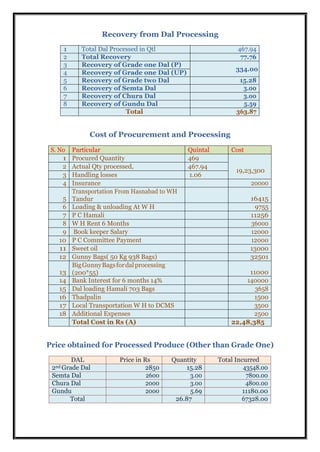
Recovery from Dal Processing
1 Total Dal Processed in Qtl 467.94
2 Total Recovery 77.76
3 Recovery of Grade one Dal (P)
334.00
4 Recovery of Grade one Dal (UP)
5 Recovery of Grade two Dal 15.28
6 Recovery of Semta Dal 3.00
7 Recovery of Chura Dal 3.00
8 Recovery of Gundu Dal 5.59
Total 363.87
Cost of Procurement and Processing
S. No Particular Quintal Cost
1 Procured Quantity 469
19,23,300
2 Actual Qty processed, 467.94
3 Handling losses 1.06
4 Insurance 20000
5
Transportation From Hasnabad to WH
Tandur 16415
6 Loading & unloading At W H 9755
7 P C Hamali 11256
8 W H Rent 6 Months 36000
9 Book keeper Salary 12000
10 P C Committee Payment 12000
11 Sweet oil 13000
12 Gunny Bags( 50 Kg 938 Bags) 32501
13
BigGunnyBagsfordalprocessing
(200*55) 11000
14 Bank Interest for 6 months 14% 140000
15 Dal loading Hamali 703 Bags 3658
16 Thadpalin 1500
17 Local Transportation W H to DCMS 3500
18 Additional Expenses 2500
Total Cost in Rs (A) 22,48,385
Price obtained for Processed Produce (Other than Grade One)
DAL Price in Rs Quantity Total Incurred
2nd Grade Dal 2850 15.28 43548.00
Semta Dal 2600 3.00 7800.00
Chura Dal 2000 3.00 4800.00
Gundu 2000 5.69 11180.00
Total 26.87 67328.00
Cost of Grade One Dal
Item Unit Value
1 Total Quantity Processed output Qtl 363.87
2 Quantity of First Grade Dal Qtl (C) 334.00
3 Quantity of By-Products 26.87
4 Total Cost of the Product in Rs 2248385.00
5 Value recovered fromBy-Products in Rs (B) 67328.00
6 Cost to be recovered for Break Even (A-B) 2181057.00
7 Cost of Grade One Dal Per Qtl (A-B)/C 6530.11
So, to get Break-even Price the remaining Dal has to to be sold at the rate of
6530.11 Rs per Quintal. If anything less than that will reflect in loss for FPC. After
Adding VAT the price will be even higher.
--x--

Red gram procurement and processing report

  • 1.
    “A STUDY OFRED GRAM PROCESSING “ PREPAREDED BY SHARAD PANT MBA Osmania University, Hyderabad
  • 2.
    RED GRAM PROCESSINGREPORT Introduction Red gram or Tur has been procured from different farmers of Kodangal and Hasnabad Farmer producer companies as part of development of business for the farmers. The business plan includes input and output business by the FPCs to improve the bargaining power and profit for the FPC. Input business includes, handling of fertilisers, pesticides, seeds and other farm pre-production requirements. By collective buying many of the costs can be reduced through bargaining with the traders and supply companies as quantity of requirement involve is large. The major advantage in handling of business on their own is, on time supply of fertilisers and other inputs as compared to depending on market and small traders at local level which is all volatile. The out business majorly includes the processing of produce and marketing to link directly to the consumers with fewer intermediaries. This will reduce the cost of production and farmer can be benefited out of this. The business plan includes construction of ware house for storage of raw and processed produce and Dal Mill for processing of raw material. Construction of ware house and dal mill requires land, capital and time, which are to be acquired through different means. So, as an initial step towards output business, instead of selling the raw produce to the traders or millers, FPC tried to procure material from its farmers and process and sell the processed produce in themarket. Procurement of RedGram Red gram was procured from farmers from Kodangal and Hasnabad FPCs. Total material procured was around 469quintal, from Kodangal and Hasnabad for commercial processing. The price of each quintal purchased varied from 385 to 4300 depending on the quality. For the procurement of the material, a charge of 10 rupees collected as service charge. This will be deposited into FPCs account. A total amount of 30,000 Rs collected from the farmers as procurementcharge. During procurement process, due to lack of expertise about the process and absence of quality controlling mechanism, all sizes or quality of dal procured in same basis. Raw material with various quality levels combined together, which caused
  • 3.
    degradation of dalquality (based on size). This was reflected in the final product and many buyers clearly expressed that the material is not of first grade quality. To avoid such mistakes I the future, the procurement process should be done in presence of a quality controller, who can monitor the quality of material being procured. Specification of required grade or quality has to be done toavoid mixing of less quality product into the quality product. In case, procurement donefor all kinds of grades or sizes, separate bagging and labelling to be done to process separately. Of these, monitoring officer at the time of procurement is very much required to avoidquality depletion of raw material and extra payment for theless quality material. Processing of Red Gram: Out of 469 quintals of procured red gram467.94 quintals processed in Tandoor Dal mill.The remaining quantity is lost during transportation and handling which is unavoidable. Though our plan is to take dal mill on lease and process the material, due to time constrains, we proceeded to process the dal in private mill. In many of the dal mills for processing of gram, 300 Rs per quintal will be charged which will be added-up to the total cost of the product. The additional cost has to be recovered from the selling of husk of gram, which is a by-product. But in Tandur mill, he agreed to take the husk, which can be used as fodderfor the cattle, instead of charge for the processing. This helped us in two ways, one in
  • 4.
    reducing the costof total processing and second, in avoiding difficulty of searching for the market for the husk, which is again another difficult task. Apart from husk and first grade dal, there are other by-products like unpeeled product, unbroken dal and fine broken dal. These are called with different names depending on region. These are considerable fraction of the input quantity and need to be marketed. The recovery of the material which includes processed dal and other by-products excluding husk is around 78% in general. We tried to achieve as much as possible and got 77% recovery. The major problem occurred during the processing was inappropriate use of sieves for the grading of dal. The miller did not use right set of sieves and not fix properly for the separation of different products. This resulted in passing of less size material into the first grade dal and reduced the quality. The presence of small dal in th main product also reduced the market price of the product as many traders not willing o accept it is of first gradedal. The reduction in quality happened at two levels, one at the procurement level and other at processing level. To avoid such mistakes, those reduce the quality and market price of product, manpower with expertise in procurement and processing is very much required. Bagging, transportation and Storage Another major work which takes considerable time and costs is handling of material. It includes weighing, bagging, transportation and storage. At every place, enough man power is very much required to for safe and secure operation. The movement of the material not only requires time but also incurs cost of transportation and loading and unloading. So the movement of the material has to be avoided. Storage of the material is very important that, any negligence in storage will result in heavy losses. The reasons can be as simple as leaking roof of warehouse to improper doors and otherbut,the cost will be high if the material caught fire, pests , eating by rats and theft by others. To avoid such catastrophes proper storage is very much essential. In Tandur, the material was kept at government warehouse. It was not secured enough. So personal has to be present there to avoid loss of material. During the processing also, Women farmers from Hasnabads’FPC have been there to monitor the process.
  • 5.
    So, before goingfor confirmation of warehouse for storing of material, it has to be ensured that, the warehouse is well enough in all respects to store the material safely. Marketing of Processed Dal The very important part of the whole process is marketing of Dal. Unless the product sold at right time and at proper price, the whole process cannot yield any benefit to the farmers. Any set back in these will result in two kinds of losses, one is monetary and other is thrust. Farmers cannot wait for too long to covert produce into money because it is the source of their livelihood and also they have to invest for the next season. If we fail to provide money in time, it will discourage them from investing their time, energy and money in the business. So marketing of produce is very important. We tried different platforms to sell the produce. 1. Through Millers who can buy the finished product 2. Through traders (In Tandur andHyderabad) 3. Through Export agencies 4. Though Commercial Procurement Agencies 5. Through different Government and Non-Government institutions 6. Through retails chains andwholesalers 7. Through Schools and Colleges and other residential institutes 8. Other contacts Unfortunately, as we are first time into the business, we are not able to get through potential buyers in right time. There are many reasons for the inability of getting through the market. The very reason many traders and other wholesalers declined to buy the products is comparatively high price of our product. Due to mistakes at procurement and processing level the cost of product has increased than normal. So we are not able to sell the product to the traders as the price so low that we will end up in some losses. The quality of product is also low that we could not able to bargain with traders. For the same cost, a higher quality material is available to them. So our increased cost and decreased quality is one of the man reasons why we could not get right price at right time. Secondly, Due to the state bifurcation, there were apprehensions about the new laws on taxes so many traders stopped buying the product for the time being. Much of theproduct from TandurAreahasmarket inAndhraregion.Dueto thestatebifurcation
  • 6.
    and tax ontrans-border trade many traders from Andhra region rejecting the product from Tandur. So the Market in Tandur could not able to find quick alternative, due to this the price in the market fell lower than the normal. So, on one side the processing cost increased and on the other side , the market cost dropped so, we could not sell the product as the product price was so low that even break even cannot beachieved. Apart from these, only few channels of trade, established marketing agents are another reason for the delay. Manyresidential schools and other organisations declined on the basis that, the present suppliers are consistent and can supply all products they require. So, they are not ready to buy our product if it is only Tur Dal. So, it was a Hercules task to find market for the processed dal in this complex situation. It is to be noted that, it is very much required to have proper market plan before processing of the produce. The volatility of the market becomes a problem for the marketing. The delay in marketing results in degradation of product if not stored properly. It will also increase the cost of storage and risks of storage.
  • 7.
    Recovery from DalProcessing 1 Total Dal Processed in Qtl 467.94 2 Total Recovery 77.76 3 Recovery of Grade one Dal (P) 334.00 4 Recovery of Grade one Dal (UP) 5 Recovery of Grade two Dal 15.28 6 Recovery of Semta Dal 3.00 7 Recovery of Chura Dal 3.00 8 Recovery of Gundu Dal 5.59 Total 363.87 Cost of Procurement and Processing S. No Particular Quintal Cost 1 Procured Quantity 469 19,23,300 2 Actual Qty processed, 467.94 3 Handling losses 1.06 4 Insurance 20000 5 Transportation From Hasnabad to WH Tandur 16415 6 Loading & unloading At W H 9755 7 P C Hamali 11256 8 W H Rent 6 Months 36000 9 Book keeper Salary 12000 10 P C Committee Payment 12000 11 Sweet oil 13000 12 Gunny Bags( 50 Kg 938 Bags) 32501 13 BigGunnyBagsfordalprocessing (200*55) 11000 14 Bank Interest for 6 months 14% 140000 15 Dal loading Hamali 703 Bags 3658 16 Thadpalin 1500 17 Local Transportation W H to DCMS 3500 18 Additional Expenses 2500 Total Cost in Rs (A) 22,48,385 Price obtained for Processed Produce (Other than Grade One) DAL Price in Rs Quantity Total Incurred 2nd Grade Dal 2850 15.28 43548.00 Semta Dal 2600 3.00 7800.00 Chura Dal 2000 3.00 4800.00 Gundu 2000 5.69 11180.00 Total 26.87 67328.00
  • 8.
    Cost of GradeOne Dal Item Unit Value 1 Total Quantity Processed output Qtl 363.87 2 Quantity of First Grade Dal Qtl (C) 334.00 3 Quantity of By-Products 26.87 4 Total Cost of the Product in Rs 2248385.00 5 Value recovered fromBy-Products in Rs (B) 67328.00 6 Cost to be recovered for Break Even (A-B) 2181057.00 7 Cost of Grade One Dal Per Qtl (A-B)/C 6530.11 So, to get Break-even Price the remaining Dal has to to be sold at the rate of 6530.11 Rs per Quintal. If anything less than that will reflect in loss for FPC. After Adding VAT the price will be even higher. --x--