RECURRENT MISCARRIAGE
EIMALRIZWA
ROLL NO:28
DEFINITION
Sequence of three or more consecutive spontaneous abortion before
20 weeks.
It may be primary or secondary (having previous viable birth).
ETIOLOGY
• FIRST TRIMESTER ABORTION:
• Genetic factors[3-5%]: Parental chromosomal abnormalities is a
proven cause of recurrent abortion.
• The most common abnormality is a balanced translocation.
• Risk of miscarriage in couples with a balanced translocation is greater
than 25%.
• However, the chance of successful pregnancy even without treatment
is 40-50%.
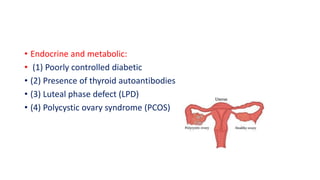
• Endocrine and metabolic:
• (1) Poorly controlled diabetic
• (2) Presence of thyroid autoantibodies
• (3) Luteal phase defect (LPD)
• (4) Polycystic ovary syndrome (PCOS)
• Infection: Genital tract infection may be responsible for sporadic
spontaneous abortion but its relation to recurrent abortion is a not
ending doubt.
• Inherited thrombophilia causes both early and late miscarriages due
to intravascular coagulation and thrombosis.
• Protein C resistance is the most common cause.
• Protein C is the natural inhibitor of coagulation.
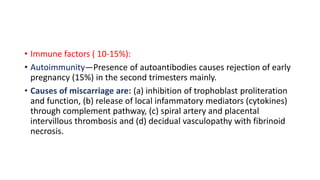
• Immune factors ( 10-15%):
• Autoimmunity—Presence of autoantibodies causes rejection of early
pregnancy (15%) in the second trimesters mainly.
• Causes of miscarriage are: (a) inhibition of trophoblast proliteration
and function, (b) release of local infammatory mediators (cytokines)
through complement pathway, (c) spiral artery and placental
intervillous thrombosis and (d) decidual vasculopathy with fibrinoid
necrosis.
• Unexplained: In the majority , the causes remains unknown.
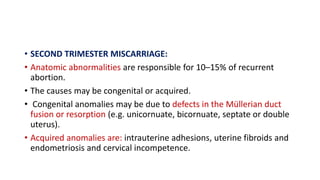
• SECOND TRIMESTER MISCARRIAGE:
• Anatomic abnormalities are responsible for 10–15% of recurrent
abortion.
• The causes may be congenital or acquired.
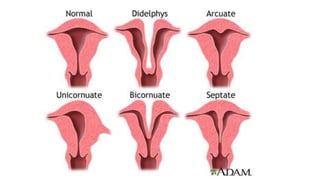
• Congenital anomalies may be due to defects in the Müllerian duct
fusion or resorption (e.g. unicornuate, bicornuate, septate or double
uterus).
• Acquired anomalies are: intrauterine adhesions, uterine fibroids and
endometriosis and cervical incompetence.
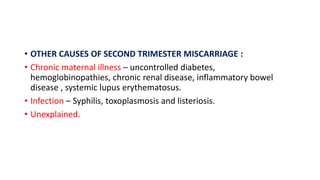
• OTHER CAUSES OF SECOND TRIMESTER MISCARRIAGE :
• Chronic maternal illness – uncontrolled diabetes,
hemoglobinopathies, chronic renal disease, inflammatory bowel
disease , systemic lupus erythematosus.
• Infection – Syphilis, toxoplasmosis and listeriosis.
• Unexplained.
INVESTIGATIONS FOR RECURRENT MISCARRIAGE
• A thorough medical, surgical and obstetric history with careful clinical
examination should be carried out to find out the possible cause or
causes as mentioned previously.
• Careful history taking should include—(i) The nature of previous
abortion process. (ii) Histology of the placenta or karyotyping of the
conceptus, if available. (iii) Any chronic illness and bacterial vaginosis.
• Diagnostic tests:
• (1) Blood-glucose (fasting and postprandial), VDRL, thyroid function test, ABO and
Rh grouping (husband and wife), toxoplasma antibodies IgG and IgM.
• (2) Autoimmune screening—lupus anticoagulant and anticardiolipin antibodies.
• (3) Ultrasonography—to detect congenital malformation of uterus, polycystic
ovaries and uterine fibroid.
• (4) Hysterosalpingography in the secretory phase to detect—cervical
incompetence, uterine synechiae and uterine malformation.
• (5) This is supported by hysteroscopy and/or laparoscopy.
• (6) Karyotyping (husband and wife).
• (7) Endocervical swab to detect chlamydia, mycoplasma and bacterial vaginosis.
REFERENCES
• DC Dutta’s Textbook of OBSTETRICS – 9TH EDITION
RECURRENT MISCARRIAGE.pptx

RECURRENT MISCARRIAGE.pptx

  • 1.
  • 2.
    DEFINITION Sequence of threeor more consecutive spontaneous abortion before 20 weeks. It may be primary or secondary (having previous viable birth).
  • 3.
    ETIOLOGY • FIRST TRIMESTERABORTION: • Genetic factors[3-5%]: Parental chromosomal abnormalities is a proven cause of recurrent abortion. • The most common abnormality is a balanced translocation. • Risk of miscarriage in couples with a balanced translocation is greater than 25%. • However, the chance of successful pregnancy even without treatment is 40-50%.
  • 4.
    • Endocrine andmetabolic: • (1) Poorly controlled diabetic • (2) Presence of thyroid autoantibodies • (3) Luteal phase defect (LPD) • (4) Polycystic ovary syndrome (PCOS)
  • 5.
    • Infection: Genitaltract infection may be responsible for sporadic spontaneous abortion but its relation to recurrent abortion is a not ending doubt.
  • 6.
    • Inherited thrombophiliacauses both early and late miscarriages due to intravascular coagulation and thrombosis. • Protein C resistance is the most common cause. • Protein C is the natural inhibitor of coagulation.
  • 7.
    • Immune factors( 10-15%): • Autoimmunity—Presence of autoantibodies causes rejection of early pregnancy (15%) in the second trimesters mainly. • Causes of miscarriage are: (a) inhibition of trophoblast proliteration and function, (b) release of local infammatory mediators (cytokines) through complement pathway, (c) spiral artery and placental intervillous thrombosis and (d) decidual vasculopathy with fibrinoid necrosis.
  • 8.
    • Unexplained: Inthe majority , the causes remains unknown.
  • 9.
    • SECOND TRIMESTERMISCARRIAGE: • Anatomic abnormalities are responsible for 10–15% of recurrent abortion. • The causes may be congenital or acquired. • Congenital anomalies may be due to defects in the Müllerian duct fusion or resorption (e.g. unicornuate, bicornuate, septate or double uterus). • Acquired anomalies are: intrauterine adhesions, uterine fibroids and endometriosis and cervical incompetence.
  • 11.
    • OTHER CAUSESOF SECOND TRIMESTER MISCARRIAGE : • Chronic maternal illness – uncontrolled diabetes, hemoglobinopathies, chronic renal disease, inflammatory bowel disease , systemic lupus erythematosus. • Infection – Syphilis, toxoplasmosis and listeriosis. • Unexplained.
  • 12.
    INVESTIGATIONS FOR RECURRENTMISCARRIAGE • A thorough medical, surgical and obstetric history with careful clinical examination should be carried out to find out the possible cause or causes as mentioned previously. • Careful history taking should include—(i) The nature of previous abortion process. (ii) Histology of the placenta or karyotyping of the conceptus, if available. (iii) Any chronic illness and bacterial vaginosis.
  • 13.
    • Diagnostic tests: •(1) Blood-glucose (fasting and postprandial), VDRL, thyroid function test, ABO and Rh grouping (husband and wife), toxoplasma antibodies IgG and IgM. • (2) Autoimmune screening—lupus anticoagulant and anticardiolipin antibodies. • (3) Ultrasonography—to detect congenital malformation of uterus, polycystic ovaries and uterine fibroid. • (4) Hysterosalpingography in the secretory phase to detect—cervical incompetence, uterine synechiae and uterine malformation. • (5) This is supported by hysteroscopy and/or laparoscopy. • (6) Karyotyping (husband and wife). • (7) Endocervical swab to detect chlamydia, mycoplasma and bacterial vaginosis.
  • 14.
    REFERENCES • DC Dutta’sTextbook of OBSTETRICS – 9TH EDITION