Generic Structure of Recount
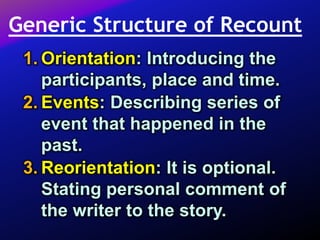
 1. Orientation: Introducing the
    participants, place and time.
 2. Events: Describing series of
    event that happened in the
    past.
 3. Reorientation: It is optional.
    Stating personal comment of
    the writer to the story.
Language Feature of Recount
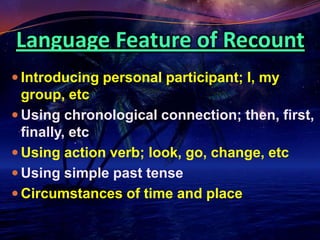
 Introducing personal participant; I, my
  group, etc
 Using chronological connection; then, first,
  finally, etc
 Using action verb; look, go, change, etc
 Using simple past tense
 Circumstances of time and place
E XAMPLES          AND STRUCTURES OF
                       THE TEXT
Orientation   When I was in Junior High School, I used
              to cycle went to school.
    Event 1   One day when I was on my way to
              school, I saw a girl with a long black hair
              from the back side. I thought she was my
              old friend.
    Event 2   I called her loudly, “Miaa..!”. Then she
              looked at me. I was so ashamed, she
              wasn’t her. So I speeded up my bike and
              went away.
TYPES OF RECOUNT
 Personal  Recount: Retelling an activity
  that the writer has been personally
  involved (diary entry, biography)
 Factual    Recount:         Recording the
  particulars of an incident (police report,
 news report)
 ImaginativeRecount: Taking on an
 imaginary role and giving details of
 events.
Recount text is used to tell past experience
that is aimed to informing and entertaining.
Recount has 3 types; personal recount,
factual recount, and imaginative recount.
Narrative and recount are telling something
in the past, so narrative and recount usually
apply past tense.
The thing that makes narrative and recount
different is the structure in which they are
constructed. On recount there is no
complication among the participants and
that differentiates from narrative.
Thank You
   http://www.text-types.com/2011/01/text-types-recount.html
   http://www.cribd.com/
   http://www.enoktes.com/literaly-term/q-and-a/what-imaginative-
    recount-110197

Recount - Narrative

  • 4.
    Generic Structure ofRecount 1. Orientation: Introducing the participants, place and time. 2. Events: Describing series of event that happened in the past. 3. Reorientation: It is optional. Stating personal comment of the writer to the story.
  • 5.
    Language Feature ofRecount  Introducing personal participant; I, my group, etc  Using chronological connection; then, first, finally, etc  Using action verb; look, go, change, etc  Using simple past tense  Circumstances of time and place
  • 6.
    E XAMPLES AND STRUCTURES OF THE TEXT Orientation When I was in Junior High School, I used to cycle went to school. Event 1 One day when I was on my way to school, I saw a girl with a long black hair from the back side. I thought she was my old friend. Event 2 I called her loudly, “Miaa..!”. Then she looked at me. I was so ashamed, she wasn’t her. So I speeded up my bike and went away.
  • 7.
    TYPES OF RECOUNT Personal Recount: Retelling an activity that the writer has been personally involved (diary entry, biography)  Factual Recount: Recording the particulars of an incident (police report, news report)  ImaginativeRecount: Taking on an imaginary role and giving details of events.
  • 13.
    Recount text isused to tell past experience that is aimed to informing and entertaining. Recount has 3 types; personal recount, factual recount, and imaginative recount. Narrative and recount are telling something in the past, so narrative and recount usually apply past tense. The thing that makes narrative and recount different is the structure in which they are constructed. On recount there is no complication among the participants and that differentiates from narrative.
  • 14.
  • 15.
    http://www.text-types.com/2011/01/text-types-recount.html  http://www.cribd.com/  http://www.enoktes.com/literaly-term/q-and-a/what-imaginative- recount-110197