
RECENT MEDIUMSHIP 
RESEARCH: 
NOVEMBER 21ST, 2014 
Nancy L. Zingrone, PhD 
Parapsychology 
Foundation
SOME DATES IN THE 
HISTORY OF 
SPIRITUALISM 
1. 1792 – Word first used by Emanuel Swedenborg, but mediumship and 
spiritualist traditions date back to antiquity in various forms and 
contexts 
2. 1848 – The Fox Sisters, starting point for modern American 
Spiritualism 
3. 1857 – Publication of Kardec’s Book of the Spirits, starting point for 
Kardecist Spiritism 
4. 1882 – Founding of the Society for Psychical Research, starting point of 
formal investigations into a host of phenomena including mediumship 
5. Mid-1800s through 1930s – Heyday of scientific investigation into 
mediumship phenomena
SPIRITUALISM/SPIRITISM A CONTEXT … 
MEDIUMSHIP IS OLDER AND MORE BROADLY BASED 
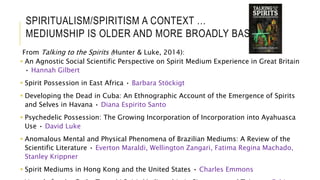
From Talking to the Spirits (Hunter & Luke, 2014): 
 An Agnostic Social Scientific Perspective on Spirit Medium Experience in Great Britain 
• Hannah Gilbert 
 Spirit Possession in East Africa • Barbara Stöckigt 
 Developing the Dead in Cuba: An Ethnographic Account of the Emergence of Spirits 
and Selves in Havana • Diana Espirito Santo 
 Psychedelic Possession: The Growing Incorporation of Incorporation into Ayahuasca 
Use • David Luke 
 Anomalous Mental and Physical Phenomena of Brazilian Mediums: A Review of the 
Scientific Literature • Everton Maraldi, Wellington Zangari, Fatima Regina Machado, 
Stanley Krippner 
 Spirit Mediums in Hong Kong and the United States • Charles Emmons 
 Vessels for the Gods: Tang-ki Spirit Mediumship in Singapore and Taiwan • Fabian
MEDIUMSHIP RESEARCH TO 
1930S 
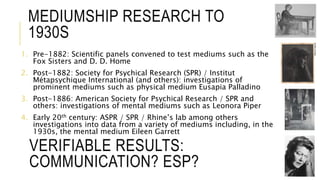
1. Pre-1882: Scientific panels convened to test mediums such as the 
Fox Sisters and D. D. Home 
2. Post-1882: Society for Psychical Research (SPR) / Institut 
Métapsychique International (and others): investigations of 
prominent mediums such as physical medium Eusapia Palladino 
3. Post-1886: American Society for Psychical Research / SPR and 
others: investigations of mental mediums such as Leonora Piper 
4. Early 20th century: ASPR / SPR / Rhine’s lab among others 
investigations into data from a variety of mediums including, in the 
1930s, the mental medium Eileen Garrett 
VERIFIABLE RESULTS: 
COMMUNICATION? ESP?
RESEARCH RESTART IN THE 1990S 
… 
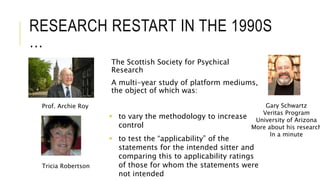
The Scottish Society for Psychical 
Research 
A multi-year study of platform mediums, 
the object of which was: 
 to vary the methodology to increase 
control 
 to test the “applicability” of the 
statements for the intended sitter and 
comparing this to applicability ratings 
of those for whom the statements were 
not intended 
Prof. Archie Roy 
Tricia Robertson 
Gary Schwartz 
Veritas Program 
University of Arizona 
More about his research 
In a minute
PUBLICATIONS BEGAN APPEARING 
IN 2001 … 
Robertson, T. J., & Roy, A. E. (2001). A preliminary study of the acceptance 
by non- recipients of medium’s statement to recipients. Journal of the 
Society for Psychical Research, 65, 91–106. 
Roy, A. E., & Robertson, T. J. (2001). A double- blind procedure for assessing 
the relevance of a medium’s statements to a recipient. Journal of the Society 
for Psychical Research, 65, 161–174. 
Schwartz, G. E. R., & Russek, L. G. S. (2001). Evidence of anomalous 
information retrieval between two mediums: Telepathy, network memory 
resonance, and continuance of consciousness. Journal of the Society for 
Psychical Research, 65(4), 257–275. 
Schwartz, G. E. R., Russek, L. G. S., Nelson, L. A., & Barentsen, C. (2001). 
Accuracy and replicability of anomalous after-death communication across 
highly skilled mediums. Journal of the Society for Psychical Research, 65(1), 
1–25.
FROM 2001 TO TODAY … 
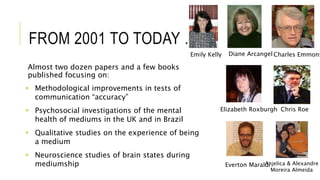
Almost two dozen papers and a few books 
published focusing on: 
 Methodological improvements in tests of 
communication “accuracy” 
 Psychosocial investigations of the mental 
health of mediums in the UK and in Brazil 
 Qualitative studies on the experience of being 
a medium 
 Neuroscience studies of brain states during 
mediumship 
Emily Kelly Diane Arcangel Charles Emmons 
Elizabeth Roxburgh Chris Roe 
Everton MaraldAni jelica & Alexandre 
Moreira Almeida
WINDBRIDGE RESEARCHERS AND CERTIFIED 
MEDIUMS … 
Dr. Julie Beischel, Mark Boccuzzi, Dr. Adam Rock & Dr. Chad Mosher 
Joanne Gerber, Debra Martin, Doreen 
Molloy 
http://www.Windbridge.org
WINDBRIDGE RESEARCH 
Beischel, J. (2007). Contemporary methods used in laboratory-based 
mediumship research. Journal of Parapsychology, 71(1), 37–68. 
Beischel, J. (2014). Advances in quantitative mediumship research. In 
A.J. Rock (Ed.), Survival hypothesis: Essays on mediumship (pp. 177– 
195). Jefferson, NC: McFarland. 
Beischel, J., & Rock, A. J. (2009). Addressing the survival vs. psi debate 
through process-focused mediumship research. Journal of 
Parapsychology, 73, 71–90. 
Delorme, A., Beischel, J., Michel, L., Boccuzzi, M., Radin, D., & Mills, P. J. 
(2013). Electrocortical activity associated with subjective 
communication with the deceased. Frontiers in psychology, 4(Article 
834), 1–10. DOI: 10.3.389/fpsycg.2013.00834. 
Rock, A. J., Beischel, J., & Cott, C. C. (2009). Psi vs. survival: A 
qualitative investigation of mediums’ phenomenology comparing 
psychic readings and ostensible communication with the deceased. 
Transpersonal Psychology Review, 13(2), 76–89. 
Rock, A. J., Beischel, J., & Schwartz, G. E. (2008). Thematic analysis of 
research mediums’ experiences of discarnate communication. Journal
KEY CHANGES. THEN AND NOW … 
19th century mediumship 
research … 
 Emphasis on trance mediums 
 Very little respect for the 
medium’s own experience 
 Scientific demands frequently 
appalling 
 Interest in methodological 
improvements such as “proxy” 
sittings 
 Detailed analysis of sitting 
transcripts 
 Emphasis on verification of 
21st century medium research … 
 Emphasis on waking state 
mediums 
 More respect for medium’s 
own experience / some 
researchers obtaining training 
 Verification (applicability) 
important still 
 Mental health, Culture and 
Context 
 Neuroscience approaches to 
distinguish psychic “states” 
from “mediumship” states
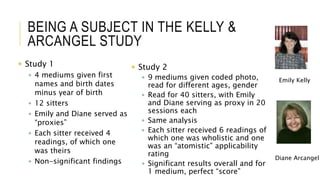
BEING A SUBJECT IN THE KELLY & 
ARCANGEL STUDY 
 Study 1 
 4 mediums given first 
names and birth dates 
minus year of birth 
 12 sitters 
 Emily and Diane served as 
“proxies” 
 Each sitter received 4 
readings, of which one 
was theirs 
 Non-significant findings 
 Study 2 
 9 mediums given coded photo, 
read for different ages, gender 
 Read for 40 sitters, with Emily 
and Diane serving as proxy in 20 
sessions each 
 Same analysis 
 Each sitter received 6 readings of 
which one was wholistic and one 
was an “atomistic” applicability 
rating 
 Significant results overall and for 
1 medium, perfect “score” 
Emily Kelly 
Diane Arcangel
THE ISSUE OF “APPLICABILITY” 
 Is the statement you are give specific? (Not very specific = too 
common) 
 How long do you have to search your understanding / memories to 
find a family member to whom the statement might fit? (A long 
search = too much of a stretch) 
 Do the statements apply to the same person? (Too many 
“communicators” = too much “noise”) 
 Is the statement something you have to verify independently (Not 
readily available in memory = then less likely to be ESP instead of 
communication) 
 Are the facts in Google? (More private / more unknown = more 
likely to be something unusual but is it ESP or communication?) 
 Is it okay to feel comforted even if objective evidence isn’t there? Of
THANK YOU FOR YOUR ATTENTION 
Slides will be up on www.slideshare.net this evening, search for Alvarado 
Consulting, or “Recent Mediumship Research, November 21st, 2014” 
Look for us on YouTube and Facebook: Parapsychology Online 
On www.WizIQ.com search for “Parapsychology” and create a free account to 
enroll in the Parapsychology and Anomalistic Psychology: Research and 
Education free online course (starts January 5th) 
For an invitation to our past conference email: nancy@theazire.org or 
carlos@theazire.org

Recent Mediumship Research November 21st 2015

  • 1.
    RECENT MEDIUMSHIP RESEARCH: NOVEMBER 21ST, 2014 Nancy L. Zingrone, PhD Parapsychology Foundation
  • 2.
    SOME DATES INTHE HISTORY OF SPIRITUALISM 1. 1792 – Word first used by Emanuel Swedenborg, but mediumship and spiritualist traditions date back to antiquity in various forms and contexts 2. 1848 – The Fox Sisters, starting point for modern American Spiritualism 3. 1857 – Publication of Kardec’s Book of the Spirits, starting point for Kardecist Spiritism 4. 1882 – Founding of the Society for Psychical Research, starting point of formal investigations into a host of phenomena including mediumship 5. Mid-1800s through 1930s – Heyday of scientific investigation into mediumship phenomena
  • 3.
    SPIRITUALISM/SPIRITISM A CONTEXT… MEDIUMSHIP IS OLDER AND MORE BROADLY BASED From Talking to the Spirits (Hunter & Luke, 2014):  An Agnostic Social Scientific Perspective on Spirit Medium Experience in Great Britain • Hannah Gilbert  Spirit Possession in East Africa • Barbara Stöckigt  Developing the Dead in Cuba: An Ethnographic Account of the Emergence of Spirits and Selves in Havana • Diana Espirito Santo  Psychedelic Possession: The Growing Incorporation of Incorporation into Ayahuasca Use • David Luke  Anomalous Mental and Physical Phenomena of Brazilian Mediums: A Review of the Scientific Literature • Everton Maraldi, Wellington Zangari, Fatima Regina Machado, Stanley Krippner  Spirit Mediums in Hong Kong and the United States • Charles Emmons  Vessels for the Gods: Tang-ki Spirit Mediumship in Singapore and Taiwan • Fabian
  • 4.
    MEDIUMSHIP RESEARCH TO 1930S 1. Pre-1882: Scientific panels convened to test mediums such as the Fox Sisters and D. D. Home 2. Post-1882: Society for Psychical Research (SPR) / Institut Métapsychique International (and others): investigations of prominent mediums such as physical medium Eusapia Palladino 3. Post-1886: American Society for Psychical Research / SPR and others: investigations of mental mediums such as Leonora Piper 4. Early 20th century: ASPR / SPR / Rhine’s lab among others investigations into data from a variety of mediums including, in the 1930s, the mental medium Eileen Garrett VERIFIABLE RESULTS: COMMUNICATION? ESP?
  • 5.
    RESEARCH RESTART INTHE 1990S … The Scottish Society for Psychical Research A multi-year study of platform mediums, the object of which was:  to vary the methodology to increase control  to test the “applicability” of the statements for the intended sitter and comparing this to applicability ratings of those for whom the statements were not intended Prof. Archie Roy Tricia Robertson Gary Schwartz Veritas Program University of Arizona More about his research In a minute
  • 6.
    PUBLICATIONS BEGAN APPEARING IN 2001 … Robertson, T. J., & Roy, A. E. (2001). A preliminary study of the acceptance by non- recipients of medium’s statement to recipients. Journal of the Society for Psychical Research, 65, 91–106. Roy, A. E., & Robertson, T. J. (2001). A double- blind procedure for assessing the relevance of a medium’s statements to a recipient. Journal of the Society for Psychical Research, 65, 161–174. Schwartz, G. E. R., & Russek, L. G. S. (2001). Evidence of anomalous information retrieval between two mediums: Telepathy, network memory resonance, and continuance of consciousness. Journal of the Society for Psychical Research, 65(4), 257–275. Schwartz, G. E. R., Russek, L. G. S., Nelson, L. A., & Barentsen, C. (2001). Accuracy and replicability of anomalous after-death communication across highly skilled mediums. Journal of the Society for Psychical Research, 65(1), 1–25.
  • 7.
    FROM 2001 TOTODAY … Almost two dozen papers and a few books published focusing on:  Methodological improvements in tests of communication “accuracy”  Psychosocial investigations of the mental health of mediums in the UK and in Brazil  Qualitative studies on the experience of being a medium  Neuroscience studies of brain states during mediumship Emily Kelly Diane Arcangel Charles Emmons Elizabeth Roxburgh Chris Roe Everton MaraldAni jelica & Alexandre Moreira Almeida
  • 8.
    WINDBRIDGE RESEARCHERS ANDCERTIFIED MEDIUMS … Dr. Julie Beischel, Mark Boccuzzi, Dr. Adam Rock & Dr. Chad Mosher Joanne Gerber, Debra Martin, Doreen Molloy http://www.Windbridge.org
  • 9.
    WINDBRIDGE RESEARCH Beischel,J. (2007). Contemporary methods used in laboratory-based mediumship research. Journal of Parapsychology, 71(1), 37–68. Beischel, J. (2014). Advances in quantitative mediumship research. In A.J. Rock (Ed.), Survival hypothesis: Essays on mediumship (pp. 177– 195). Jefferson, NC: McFarland. Beischel, J., & Rock, A. J. (2009). Addressing the survival vs. psi debate through process-focused mediumship research. Journal of Parapsychology, 73, 71–90. Delorme, A., Beischel, J., Michel, L., Boccuzzi, M., Radin, D., & Mills, P. J. (2013). Electrocortical activity associated with subjective communication with the deceased. Frontiers in psychology, 4(Article 834), 1–10. DOI: 10.3.389/fpsycg.2013.00834. Rock, A. J., Beischel, J., & Cott, C. C. (2009). Psi vs. survival: A qualitative investigation of mediums’ phenomenology comparing psychic readings and ostensible communication with the deceased. Transpersonal Psychology Review, 13(2), 76–89. Rock, A. J., Beischel, J., & Schwartz, G. E. (2008). Thematic analysis of research mediums’ experiences of discarnate communication. Journal
  • 10.
    KEY CHANGES. THENAND NOW … 19th century mediumship research …  Emphasis on trance mediums  Very little respect for the medium’s own experience  Scientific demands frequently appalling  Interest in methodological improvements such as “proxy” sittings  Detailed analysis of sitting transcripts  Emphasis on verification of 21st century medium research …  Emphasis on waking state mediums  More respect for medium’s own experience / some researchers obtaining training  Verification (applicability) important still  Mental health, Culture and Context  Neuroscience approaches to distinguish psychic “states” from “mediumship” states
  • 11.
    BEING A SUBJECTIN THE KELLY & ARCANGEL STUDY  Study 1  4 mediums given first names and birth dates minus year of birth  12 sitters  Emily and Diane served as “proxies”  Each sitter received 4 readings, of which one was theirs  Non-significant findings  Study 2  9 mediums given coded photo, read for different ages, gender  Read for 40 sitters, with Emily and Diane serving as proxy in 20 sessions each  Same analysis  Each sitter received 6 readings of which one was wholistic and one was an “atomistic” applicability rating  Significant results overall and for 1 medium, perfect “score” Emily Kelly Diane Arcangel
  • 12.
    THE ISSUE OF“APPLICABILITY”  Is the statement you are give specific? (Not very specific = too common)  How long do you have to search your understanding / memories to find a family member to whom the statement might fit? (A long search = too much of a stretch)  Do the statements apply to the same person? (Too many “communicators” = too much “noise”)  Is the statement something you have to verify independently (Not readily available in memory = then less likely to be ESP instead of communication)  Are the facts in Google? (More private / more unknown = more likely to be something unusual but is it ESP or communication?)  Is it okay to feel comforted even if objective evidence isn’t there? Of
  • 13.
    THANK YOU FORYOUR ATTENTION Slides will be up on www.slideshare.net this evening, search for Alvarado Consulting, or “Recent Mediumship Research, November 21st, 2014” Look for us on YouTube and Facebook: Parapsychology Online On www.WizIQ.com search for “Parapsychology” and create a free account to enroll in the Parapsychology and Anomalistic Psychology: Research and Education free online course (starts January 5th) For an invitation to our past conference email: nancy@theazire.org or carlos@theazire.org