Upstream Midstream Downstream
CONFIDENTIAL
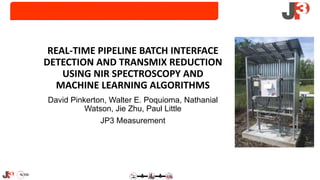
REAL-TIME PIPELINE BATCH INTERFACE
DETECTION AND TRANSMIX REDUCTION
USING NIR SPECTROSCOPY AND
MACHINE LEARNING ALGORITHMS
David Pinkerton, Walter E. Poquioma, Nathanial
Watson, Jie Zhu, Paul Little
JP3 Measurement
Upstream Midstream Downstream
CONFIDENTIAL
Process Line
Process Flow
Sample Stream
to Flowcell
Sample
Return
Principle of Operation
1. Sample continuously streams through flowcell
2. Verax analyzer spectrometer emits NIR energy
via fiber optic cable through process in flowcell
3. NIR return energy less absorbed energy
4. Spectrometer creates spectra
5. On-board computer utilizes chemometric
models to analyze produced spectra and product
outputs
6. Results in ZERO sample system emissions!
NIR Light
Out
NIR Light
Return
Local System
2
P
Sample
Port
NIR Analyzer – Normal Operation
Upstream Midstream Downstream
CONFIDENTIAL
Agenda
• The Transmix Problem
• Automatic Interface Detection Algorithm (AIDA)
• Motivation
• Description
• Application to Refined Fuels
• Application to Crude Oil
• Future Developments
Upstream Midstream Downstream
CONFIDENTIAL
The Transmix Problem
Upstream Midstream Downstream
CONFIDENTIAL
AIDA - Motivation
$$S$ $S$$
$
Diesel Gasoline
Diesel-Gasoline
Transmix
• Pipelines that transport different products in
batches have an interface (transmix) fluid.
• Moving pure products (Gas, Diesel, Jet, etc.) to
Transmix tank translates to loss of profit due to
lower price of Transmix.
• AIDA was made for:
• Accurate detection of start and end of transmix region in Real Time.
• Allowing better classification of pure products.
Upstream Midstream Downstream
CONFIDENTIAL
AIDA - Observation
Decomposition
Near Infrared Spectra Decomposed data space (aka “Process Space”)
• Transforming NIR Spectra to their decomposed representation:
• Similar Spectra cluster together
• Spectra belonging to the same pure product are similar; therefore, cluster together
• Transmix spectra do not generally cluster together (with some exceptions related to flow)
• Transmix moves from one pure product cluster to another as time progresses.
Pure Product 1 Transmix Pure Product 2
Upstream Midstream Downstream
CONFIDENTIAL
Decomposition
Upstream Midstream Downstream
CONFIDENTIAL
AIDA - Description
1) Get the spectra collected in the last N minutes.
2) Draw a sphere around the most recent collected spectrum in Process Space.
3) Calculate percentage of points within sphere.
4) Compare percentage of points within sphere to the user selected threshold.
5) If above threshold label spectra as pure product otherwise label as transmix.
1 2 3
% 𝑝𝑜𝑖𝑛𝑡𝑠 𝑖𝑛 =
𝑝𝑜𝑖𝑛𝑡𝑠 𝑖𝑛𝑠𝑖𝑑𝑒 𝑠𝑝ℎ𝑒𝑟𝑒
𝑡𝑜𝑡𝑎𝑙 𝑝𝑜𝑖𝑛𝑡𝑠
4
% 𝑝𝑜𝑖𝑛𝑡𝑠 𝑖𝑛 > 𝑡ℎ𝑟𝑒𝑠ℎ𝑜𝑙𝑑?
• Yes → Pure Product
• No → Transmix
5
Pure Product 1 Transmix Unlabeled Product
Upstream Midstream Downstream
CONFIDENTIAL
AIDA - Description
Upstream Midstream Downstream
CONFIDENTIAL
AIDA - Description
Upstream Midstream Downstream
CONFIDENTIAL
AIDA - Description
Upstream Midstream Downstream
CONFIDENTIAL
AIDA - Description
Upstream Midstream Downstream
CONFIDENTIAL
AIDA - Validation
1
–
Interface;
0
–
Stable
Product
Product
Identifier
Product Identifiers
• 200- Diesel
• 300- Conventional Gasoline
• 500- Premium Gasoline
Upstream Midstream Downstream
CONFIDENTIAL
AIDA - Validation
Measured Flash Point Readings: 127 F 129 F 131 F
Upstream Midstream Downstream
CONFIDENTIAL
AIDA - Validation
Upstream Midstream Downstream
CONFIDENTIAL
Future Developments
•Automation of spheroid radius and threshold
determination
•Enhanced UX/UI
•Application to a crude oil transport pipeline
• ESG Opportunities
• Enhance pricing
•Additional decomposition techniques

REAL-TIME PIPELINE BATCH INTERFACE DETECTION & TRANSMIX REDUCTION

  • 1.
    Upstream Midstream Downstream CONFIDENTIAL REAL-TIMEPIPELINE BATCH INTERFACE DETECTION AND TRANSMIX REDUCTION USING NIR SPECTROSCOPY AND MACHINE LEARNING ALGORITHMS David Pinkerton, Walter E. Poquioma, Nathanial Watson, Jie Zhu, Paul Little JP3 Measurement
  • 2.
    Upstream Midstream Downstream CONFIDENTIAL ProcessLine Process Flow Sample Stream to Flowcell Sample Return Principle of Operation 1. Sample continuously streams through flowcell 2. Verax analyzer spectrometer emits NIR energy via fiber optic cable through process in flowcell 3. NIR return energy less absorbed energy 4. Spectrometer creates spectra 5. On-board computer utilizes chemometric models to analyze produced spectra and product outputs 6. Results in ZERO sample system emissions! NIR Light Out NIR Light Return Local System 2 P Sample Port NIR Analyzer – Normal Operation
  • 3.
    Upstream Midstream Downstream CONFIDENTIAL Agenda •The Transmix Problem • Automatic Interface Detection Algorithm (AIDA) • Motivation • Description • Application to Refined Fuels • Application to Crude Oil • Future Developments
  • 4.
  • 5.
    Upstream Midstream Downstream CONFIDENTIAL AIDA- Motivation $$S$ $S$$ $ Diesel Gasoline Diesel-Gasoline Transmix • Pipelines that transport different products in batches have an interface (transmix) fluid. • Moving pure products (Gas, Diesel, Jet, etc.) to Transmix tank translates to loss of profit due to lower price of Transmix. • AIDA was made for: • Accurate detection of start and end of transmix region in Real Time. • Allowing better classification of pure products.
  • 6.
    Upstream Midstream Downstream CONFIDENTIAL AIDA- Observation Decomposition Near Infrared Spectra Decomposed data space (aka “Process Space”) • Transforming NIR Spectra to their decomposed representation: • Similar Spectra cluster together • Spectra belonging to the same pure product are similar; therefore, cluster together • Transmix spectra do not generally cluster together (with some exceptions related to flow) • Transmix moves from one pure product cluster to another as time progresses. Pure Product 1 Transmix Pure Product 2
  • 7.
  • 8.
    Upstream Midstream Downstream CONFIDENTIAL AIDA- Description 1) Get the spectra collected in the last N minutes. 2) Draw a sphere around the most recent collected spectrum in Process Space. 3) Calculate percentage of points within sphere. 4) Compare percentage of points within sphere to the user selected threshold. 5) If above threshold label spectra as pure product otherwise label as transmix. 1 2 3 % 𝑝𝑜𝑖𝑛𝑡𝑠 𝑖𝑛 = 𝑝𝑜𝑖𝑛𝑡𝑠 𝑖𝑛𝑠𝑖𝑑𝑒 𝑠𝑝ℎ𝑒𝑟𝑒 𝑡𝑜𝑡𝑎𝑙 𝑝𝑜𝑖𝑛𝑡𝑠 4 % 𝑝𝑜𝑖𝑛𝑡𝑠 𝑖𝑛 > 𝑡ℎ𝑟𝑒𝑠ℎ𝑜𝑙𝑑? • Yes → Pure Product • No → Transmix 5 Pure Product 1 Transmix Unlabeled Product
  • 9.
  • 10.
  • 11.
  • 12.
  • 13.
    Upstream Midstream Downstream CONFIDENTIAL AIDA- Validation 1 – Interface; 0 – Stable Product Product Identifier Product Identifiers • 200- Diesel • 300- Conventional Gasoline • 500- Premium Gasoline
  • 14.
    Upstream Midstream Downstream CONFIDENTIAL AIDA- Validation Measured Flash Point Readings: 127 F 129 F 131 F
  • 15.
  • 16.
    Upstream Midstream Downstream CONFIDENTIAL FutureDevelopments •Automation of spheroid radius and threshold determination •Enhanced UX/UI •Application to a crude oil transport pipeline • ESG Opportunities • Enhance pricing •Additional decomposition techniques