Extensive Reading & Writing-to-Read ApplicationsMarsha WalkerP. Monique WardAL 8570
What is Extensive Reading?What Grabe says:It’s the “hallmark” of a fluent reader (Grabe, p. 311)What Stanovich says:It’s “exposure” to print over a long period of time (Grabe, p.313) What Bamford and Day (1997) say:It’s “to read widely and in quantity”What Palmer (1917) says:It’s rapidly reading book after book (focusing on meaning) (Day & Bamford, p.5)What West (1955) says:It’s supplementary reading (Day & Bamford, p.6)
What do you think?What constitutes extensive reading to you?Is it Sustained Silent Reading?Is it pleasure reading at home?How long must you read for it to be extensive?30 minutes a day?1 hour over 6 months?
Should we even extensively read?YES!Research states that reading comprehension increases in direct correlation with the amount that you read (Greaney(1980), Walberg & Tsai (1984), Wilson & Fielding (1988), Rob & Susser (1989), Elley (1992), Pichette (2005), Tanaka & Stapleton (2007))
Additional Benefits:Positive attitude and increased motivationVocabulary growth – incidental reading can lead to 5-15% gainDevelopment of language and literacy skillsConceptual knowledge – gains in world knowledgeReasoning – with other skills involved print exposure correlates to better reasoning
How do we address extensive reading?Provide resources for your students in class (ex. book floods, classroom library)Give students time to read in class (SSR, DEAR)(ex. set up cozy place (bathtub, couch, rug))Read aloud to your students on interesting topics (ex. children’s books, current songs, magazines) Give students prizes/rewards to foster motivation (ex. stickers, candy, extra credit, recognition)
How do we address extensive reading? Provide resources for students to take HOME (ex. Donorschoose.org)Facilitate discussions on what the students are reading (ex. “share chair”)Model how to read (ex. reading circle) – Prowse (2002)Hold students accountable (ex. reading log)
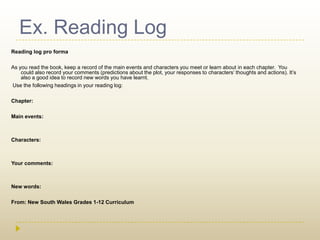
Ex. Reading LogReading log pro forma As you read the book, keep a record of the main events and characters you meet or learn about in each chapter.  You could also record your comments (predictions about the plot, your responses to characters’ thoughts and actions). It’s also a good idea to record new words you have learnt.  Use the following headings in your reading log: Chapter: Main events:  Characters:   Your comments:   New words:From: New South Wales Grades 1-12 Curriculum
Writing to Read, Hirvela, 2004 (Using writing to support reading)“…writing before, during, or after reading enables a reader to make sense of her or his reading, which in turn strengthens the quality of the reading and contributes to the development of L2 reading skills” (p. 73-74).How can students benefit from classroom work that connects reading and writing?What can teachers do to build relationships between reading and writing?
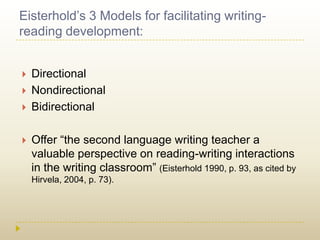
Eisterhold’s 3 Models for facilitating writing-reading development:DirectionalNondirectionalBidirectionalOffer “the second language writing teacher a valuable perspective on reading-writing interactions in the writing classroom” (Eisterhold 1990, p. 93, as cited by Hirvela, 2004, p. 73).
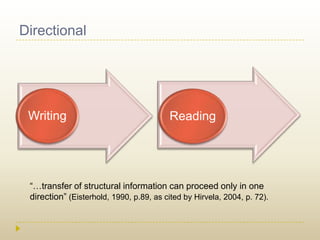
Directional“…transfer of structural information can proceed only in one direction” (Eisterhold, 1990, p.89, as cited by Hirvela, 2004, p. 72).
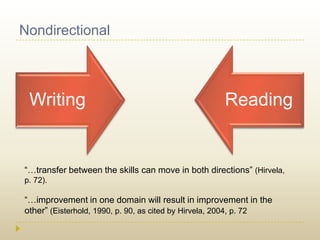
Nondirectional“…transfer between the skills can move in both directions” (Hirvela, p. 72).“…improvement in one domain will result in improvement in the other” (Eisterhold, 1990, p. 90, as cited by Hirvela, 2004, p. 72
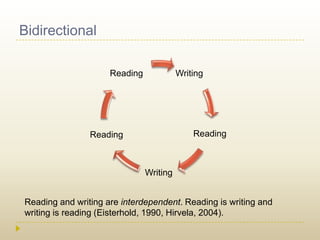
BidirectionalReading and writing are interdependent. Reading is writing and writing is reading (Eisterhold, 1990, Hirvela, 2004).
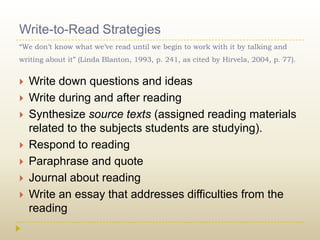
Write-to-Read Strategies“We don’t know what we’ve read until we begin to work with it by talking and writing about it” (Linda Blanton, 1993, p. 241, as cited by Hirvela, 2004, p. 77).Write down questions and ideasWrite during and after readingSynthesize source texts (assigned reading materials related to the subjects students are studying).Respond to readingParaphrase and quoteJournal about readingWrite an essay that addresses difficulties from the reading
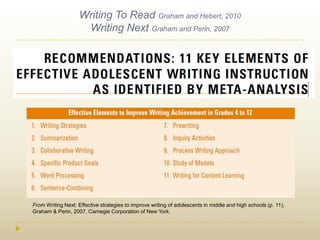
Writing To Read Graham and Hebert, 2010Writing Next Graham and Perin, 2007FromWriting Next: Effective strategies to improve writing of adolescents in middle and high schools (p. 11), Graham & Perin, 2007. Carnegie Corporation of New York.
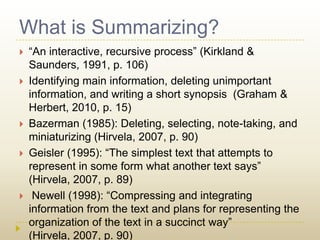
What is Summarizing?“An interactive, recursive process” (Kirkland & Saunders, 1991, p. 106)Identifying main information, deleting unimportant information, and writing a short synopsis  (Graham & Herbert, 2010, p. 15)Bazerman (1985): Deleting, selecting, note-taking, and miniaturizing (Hirvela, 2007, p. 90)Geisler (1995): “The simplest text that attempts to represent in some form what another text says” (Hirvela, 2007, p. 89) Newell (1998): “Compressing and integrating information from the text and plans for representing the organization of the text in a succinct way” (Hirvela, 2007, p. 90)
What a student needs to know…Purpose of the textIntended audience of the textInstructor’s preferencesAssignment details (how long, when is it due)How to structure the textHow to analyze the text (where are the main ideas, what is the author saying)
How do I teach summarizing?From Kirkland & Saunders:Pick a manageable and appropriate selection of textsExplicitly teach students what to includeTeach superordination and transformation (critical thinking skills)Model thought processes aloudProvide sample summaries Foster background knowledge (if needed)
How do I teach summarizing? Cont.Teach for America strategy (Farr, 2010, p.123)Just like any other objectiveIntroduction to New Material (I DO)Guided Practice (WE DO)Independent Practice (YOU DO)(similar superordination teacher model from Kirkland & Saunders, 1991, p. 114)
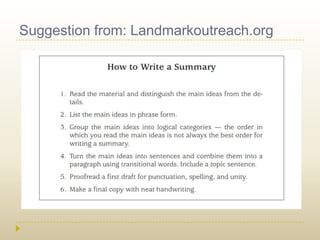
Suggestion from: Landmarkoutreach.org
How do I teach summarizing? Cont.More from Kirkland & Saunders:Get to know your students (use summaries as diagnostic tool)Use graphic organizers (mapping diagrams)Have students give oral summaries before written summariesHave students practice (deleting, identifying and simplifying)Focus on global understanding (top-down)
Ex. Graphic Organizer (from readingquest.org)
Other teaching ideas:Teach skimming, and paraphrasing skills to foster summarizing capabilitiesEx. Skimming – read a text for a limited amount of time; write what you remember; check; edit;Ex. Paraphrasing – Replacing difficult vocabulary words or phrases with words the student understandsRewriting lengthy or complex sentences into simpler sentences, or combining simple sentences into more interesting, complex sentencesExplaining concepts and abstract ideas from sentences or passage using more clear and concise wordingTranslating ideas and information into students’ own words (from landmarkoutreach.org)
Activity:Read through the text given and decide which activities (from the handout) you would utilize to teach the text.Come up with your own teaching context!When we say stop you will find who has the same text as yours, and create a group.You will share what activities and context you came up with in your group.Each member will vote on their favorite application.The winner of each group will share to the whole class.
ReferencesBamford, J. & Day, R. (1997). Extensive Reading:  What is it? Why bother? The Language Teacher Online. 21(5).Day, R. & Bamford, J. (1998). Extensive reading in the second language classroom. Cambridge: Cambridge University Press.English/ESL Stage 4 Unit. (2004). Retrieved July 1, 2010, from  http://www.curriculumsupport.education.nsw. gov.au/ 	secondary/english/assets/docs/stages45/eng_esl/esl_hpot_ohd.doc Farr, S. (2010). Teaching as Leadership: The Highly Effective Teacher’s Guide to Closing the Achievement Gap. San Francisco: Jossey-	Bass.Grabe, W. (2009) Reading in a second language: Moving from theory to practice. New York:  Cambridge University Press. Graham, S., & Hebert, M. (2010). Writing to read: Evidence for how writing can improve reading. New York:  Carnegie 	Corporation of New York. Graham, S., & Perin, D. (2007). Writing next: Effective strategies to improve writing of adolescents in middle and high schools 	(p. 11) New York: Carnegie Corporation of New York.Hiaasen, C. (2005). Flush (pp. 4-5). New York: Random House, Inc. Hirvela, A. (2004). Connecting reading and writing in second language writing instruction. University of Michigan Press. Kirkland, M., & Saunders, M. (1991). Maximizing student performance in summarizing: Managing cognitive load. TESOL Quarterly, 	25 (1), 105-121.Prose, P. Top Ten Principles for Teaching Extensive Reading: A Response. Reading in a Foreign Language. 14(2), 142-145.Sedita, J. (2001). Summarizing and Paraphrasing, Chapter 4. Study Skills: A Landmark School Teaching 		Guide. (pp. 63-68). New York: Landmark Outreach Program.Sum it up. (2010). Retrieved July 1, 2010, from http://www.readingquest.org/pdf/sumitup.pdfSuter, W. N. (2006) Introduction to educational research: A critical thinking approach (p. 208). Thousand Oaks, CA:  Sage 	Publications.

Reading and Writing Presentation

  • 1.
    Extensive Reading &Writing-to-Read ApplicationsMarsha WalkerP. Monique WardAL 8570
  • 2.
    What is ExtensiveReading?What Grabe says:It’s the “hallmark” of a fluent reader (Grabe, p. 311)What Stanovich says:It’s “exposure” to print over a long period of time (Grabe, p.313) What Bamford and Day (1997) say:It’s “to read widely and in quantity”What Palmer (1917) says:It’s rapidly reading book after book (focusing on meaning) (Day & Bamford, p.5)What West (1955) says:It’s supplementary reading (Day & Bamford, p.6)
  • 3.
    What do youthink?What constitutes extensive reading to you?Is it Sustained Silent Reading?Is it pleasure reading at home?How long must you read for it to be extensive?30 minutes a day?1 hour over 6 months?
  • 4.
    Should we evenextensively read?YES!Research states that reading comprehension increases in direct correlation with the amount that you read (Greaney(1980), Walberg & Tsai (1984), Wilson & Fielding (1988), Rob & Susser (1989), Elley (1992), Pichette (2005), Tanaka & Stapleton (2007))
  • 5.
    Additional Benefits:Positive attitudeand increased motivationVocabulary growth – incidental reading can lead to 5-15% gainDevelopment of language and literacy skillsConceptual knowledge – gains in world knowledgeReasoning – with other skills involved print exposure correlates to better reasoning
  • 6.
    How do weaddress extensive reading?Provide resources for your students in class (ex. book floods, classroom library)Give students time to read in class (SSR, DEAR)(ex. set up cozy place (bathtub, couch, rug))Read aloud to your students on interesting topics (ex. children’s books, current songs, magazines) Give students prizes/rewards to foster motivation (ex. stickers, candy, extra credit, recognition)
  • 7.
    How do weaddress extensive reading? Provide resources for students to take HOME (ex. Donorschoose.org)Facilitate discussions on what the students are reading (ex. “share chair”)Model how to read (ex. reading circle) – Prowse (2002)Hold students accountable (ex. reading log)
  • 8.
    Ex. Reading LogReadinglog pro forma As you read the book, keep a record of the main events and characters you meet or learn about in each chapter. You could also record your comments (predictions about the plot, your responses to characters’ thoughts and actions). It’s also a good idea to record new words you have learnt.  Use the following headings in your reading log: Chapter: Main events:  Characters:   Your comments:   New words:From: New South Wales Grades 1-12 Curriculum
  • 9.
    Writing to Read,Hirvela, 2004 (Using writing to support reading)“…writing before, during, or after reading enables a reader to make sense of her or his reading, which in turn strengthens the quality of the reading and contributes to the development of L2 reading skills” (p. 73-74).How can students benefit from classroom work that connects reading and writing?What can teachers do to build relationships between reading and writing?
  • 10.
    Eisterhold’s 3 Modelsfor facilitating writing-reading development:DirectionalNondirectionalBidirectionalOffer “the second language writing teacher a valuable perspective on reading-writing interactions in the writing classroom” (Eisterhold 1990, p. 93, as cited by Hirvela, 2004, p. 73).
  • 11.
    Directional“…transfer of structuralinformation can proceed only in one direction” (Eisterhold, 1990, p.89, as cited by Hirvela, 2004, p. 72).
  • 12.
    Nondirectional“…transfer between theskills can move in both directions” (Hirvela, p. 72).“…improvement in one domain will result in improvement in the other” (Eisterhold, 1990, p. 90, as cited by Hirvela, 2004, p. 72
  • 13.
    BidirectionalReading and writingare interdependent. Reading is writing and writing is reading (Eisterhold, 1990, Hirvela, 2004).
  • 14.
    Write-to-Read Strategies“We don’tknow what we’ve read until we begin to work with it by talking and writing about it” (Linda Blanton, 1993, p. 241, as cited by Hirvela, 2004, p. 77).Write down questions and ideasWrite during and after readingSynthesize source texts (assigned reading materials related to the subjects students are studying).Respond to readingParaphrase and quoteJournal about readingWrite an essay that addresses difficulties from the reading
  • 15.
    Writing To ReadGraham and Hebert, 2010Writing Next Graham and Perin, 2007FromWriting Next: Effective strategies to improve writing of adolescents in middle and high schools (p. 11), Graham & Perin, 2007. Carnegie Corporation of New York.
  • 16.
    What is Summarizing?“Aninteractive, recursive process” (Kirkland & Saunders, 1991, p. 106)Identifying main information, deleting unimportant information, and writing a short synopsis (Graham & Herbert, 2010, p. 15)Bazerman (1985): Deleting, selecting, note-taking, and miniaturizing (Hirvela, 2007, p. 90)Geisler (1995): “The simplest text that attempts to represent in some form what another text says” (Hirvela, 2007, p. 89) Newell (1998): “Compressing and integrating information from the text and plans for representing the organization of the text in a succinct way” (Hirvela, 2007, p. 90)
  • 17.
    What a studentneeds to know…Purpose of the textIntended audience of the textInstructor’s preferencesAssignment details (how long, when is it due)How to structure the textHow to analyze the text (where are the main ideas, what is the author saying)
  • 18.
    How do Iteach summarizing?From Kirkland & Saunders:Pick a manageable and appropriate selection of textsExplicitly teach students what to includeTeach superordination and transformation (critical thinking skills)Model thought processes aloudProvide sample summaries Foster background knowledge (if needed)
  • 19.
    How do Iteach summarizing? Cont.Teach for America strategy (Farr, 2010, p.123)Just like any other objectiveIntroduction to New Material (I DO)Guided Practice (WE DO)Independent Practice (YOU DO)(similar superordination teacher model from Kirkland & Saunders, 1991, p. 114)
  • 20.
  • 21.
    How do Iteach summarizing? Cont.More from Kirkland & Saunders:Get to know your students (use summaries as diagnostic tool)Use graphic organizers (mapping diagrams)Have students give oral summaries before written summariesHave students practice (deleting, identifying and simplifying)Focus on global understanding (top-down)
  • 22.
    Ex. Graphic Organizer(from readingquest.org)
  • 23.
    Other teaching ideas:Teachskimming, and paraphrasing skills to foster summarizing capabilitiesEx. Skimming – read a text for a limited amount of time; write what you remember; check; edit;Ex. Paraphrasing – Replacing difficult vocabulary words or phrases with words the student understandsRewriting lengthy or complex sentences into simpler sentences, or combining simple sentences into more interesting, complex sentencesExplaining concepts and abstract ideas from sentences or passage using more clear and concise wordingTranslating ideas and information into students’ own words (from landmarkoutreach.org)
  • 24.
    Activity:Read through thetext given and decide which activities (from the handout) you would utilize to teach the text.Come up with your own teaching context!When we say stop you will find who has the same text as yours, and create a group.You will share what activities and context you came up with in your group.Each member will vote on their favorite application.The winner of each group will share to the whole class.
  • 25.
    ReferencesBamford, J. &Day, R. (1997). Extensive Reading: What is it? Why bother? The Language Teacher Online. 21(5).Day, R. & Bamford, J. (1998). Extensive reading in the second language classroom. Cambridge: Cambridge University Press.English/ESL Stage 4 Unit. (2004). Retrieved July 1, 2010, from http://www.curriculumsupport.education.nsw. gov.au/ secondary/english/assets/docs/stages45/eng_esl/esl_hpot_ohd.doc Farr, S. (2010). Teaching as Leadership: The Highly Effective Teacher’s Guide to Closing the Achievement Gap. San Francisco: Jossey- Bass.Grabe, W. (2009) Reading in a second language: Moving from theory to practice. New York: Cambridge University Press. Graham, S., & Hebert, M. (2010). Writing to read: Evidence for how writing can improve reading. New York: Carnegie Corporation of New York. Graham, S., & Perin, D. (2007). Writing next: Effective strategies to improve writing of adolescents in middle and high schools (p. 11) New York: Carnegie Corporation of New York.Hiaasen, C. (2005). Flush (pp. 4-5). New York: Random House, Inc. Hirvela, A. (2004). Connecting reading and writing in second language writing instruction. University of Michigan Press. Kirkland, M., & Saunders, M. (1991). Maximizing student performance in summarizing: Managing cognitive load. TESOL Quarterly, 25 (1), 105-121.Prose, P. Top Ten Principles for Teaching Extensive Reading: A Response. Reading in a Foreign Language. 14(2), 142-145.Sedita, J. (2001). Summarizing and Paraphrasing, Chapter 4. Study Skills: A Landmark School Teaching Guide. (pp. 63-68). New York: Landmark Outreach Program.Sum it up. (2010). Retrieved July 1, 2010, from http://www.readingquest.org/pdf/sumitup.pdfSuter, W. N. (2006) Introduction to educational research: A critical thinking approach (p. 208). Thousand Oaks, CA: Sage Publications.