Reactive MicroServices
using RSocket
New reactive features in Spring 5.2
Reactive ?
Reactive Programming is an
asynchronous programming paradigm
concerned with data streams
and the propagation of change.
- Wikipedia
RSocket ?
S-Rocket ?
WebSockets ?
Binary application protocol
providing reactive streams semantics
using (a)sync message passing
over a single connection
for use on byte stream transports
(as TCP, WebSockets and Aeron)
Who ?
Supported by
How ?
4 Symmetric Interaction Models
● Request-Response
○ Stream of one (1 to 1)
○ Mono<Payload> response = client.requestResponse(Payload request)
● Fire-and-Forget
○ No response (1 to 0)
○ Mono<Void> response = client.fireForget(Payload request)
● Request-Stream
○ Finite stream of many (1 to N)
○ Flux<Payload> out = client.requestStream(Payload request)
● Channel
○ Bi-directional streams (M to N)
○ Flux<Payload> out = client.requestChannel(Flux<Payload> in)
Transport Agnostic
● TCP
● WebSocket
● Aeron UDP
Implementations
● Java
● Kotlin
● Go
● JavaScript
● Python
● .Net
● C++
Features
● Bi-directional
● Multiplexed
● Message based
● Binary
● Protocol
● Back Pressure
● Session Resumption
Bi-Directional
● Both partners can be client and server
● No client/server distinction
● No requestor/responder distinction
● Even HTTP/2 makes this distinction
Multiplexed
● HTTP 1.0 one connection per request
=> very inefficient
● HTTP 1.1 pipeline (no random order)
=> head-of-line blocking
● Multiple “logical streams” within one connection
● Messages are tagged with stream-id
● Random order
Message Driven Binary Protocol
● Message split into discrete binary frames
● Machine-to-machine efficiency
● Payload can be anything
Reactive Streams Back Pressure
● TCP already queues data to some extent
● Reactive Streams (pull-push) backpressure:
○ Materialize data
○ Transfer data
○ Only when receiver is ready
Session Resumption
● Long-lived streams
● Across different transport connections
● E.g. mobile re-connection
Why ?
It removes some of the
roadblocks
to use
reactive
everywhere
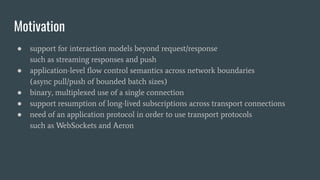
Motivation
● support for interaction models beyond request/response
such as streaming responses and push
● application-level flow control semantics across network boundaries
(async pull/push of bounded batch sizes)
● binary, multiplexed use of a single connection
● support resumption of long-lived subscriptions across transport connections
● need of an application protocol in order to use transport protocols
such as WebSockets and Aeron
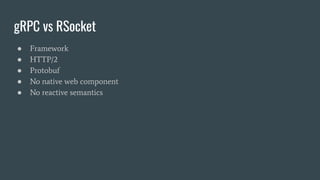
gRPC vs RSocket
● Framework
● HTTP/2
● Protobuf
● No native web component
● No reactive semantics
Future ?
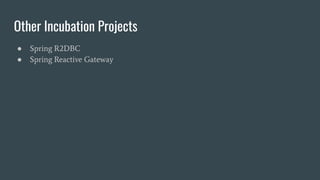
Other Incubation Projects
● Spring R2DBC
● Spring Reactive Gateway
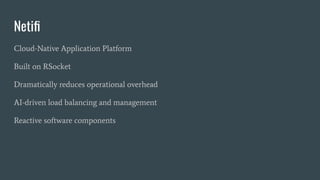
Netifi
Cloud-Native Application Platform
Built on RSocket
Dramatically reduces operational overhead
AI-driven load balancing and management
Reactive software components
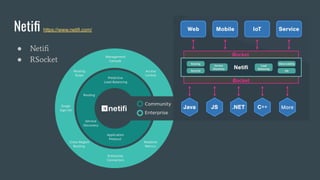
Netifi https://www.netifi.com/
● Netifi
● RSocket
Demo
On gitlab
https://gitlab.com/tothepoint/tutorials/rsocket-demo.git
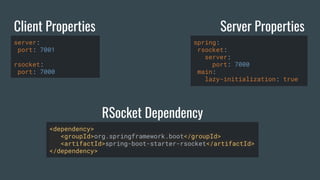
Client Properties Server Properties
server:
port: 7001
rsocket:
port: 7000
spring:
rsocket:
server:
port: 7000
main:
lazy-initialization: true
<dependency>
<groupId>org.springframework.boot</groupId>
<artifactId>spring-boot-starter-rsocket</artifactId>
</dependency>
RSocket Dependency
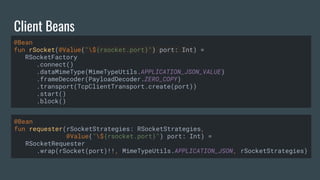
Client Beans
@Bean
fun rSocket(@Value("${rsocket.port}") port: Int) =
RSocketFactory
.connect()
.dataMimeType(MimeTypeUtils.APPLICATION_JSON_VALUE)
.frameDecoder(PayloadDecoder.ZERO_COPY)
.transport(TcpClientTransport.create(port))
.start()
.block()
@Bean
fun requester(rSocketStrategies: RSocketStrategies,
@Value("${rsocket.port}") port: Int) =
RSocketRequester
.wrap(rSocket(port)!!, MimeTypeUtils.APPLICATION_JSON, rSocketStrategies)
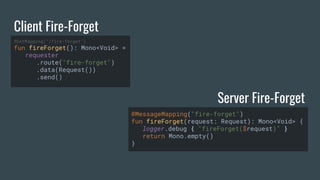
Client Fire-Forget
Server Fire-Forget
@GetMapping("/fire-forget")
fun fireForget(): Mono<Void> =
requester
.route("fire-forget")
.data(Request())
.send()
@MessageMapping("fire-forget")
fun fireForget(request: Request): Mono<Void> {
logger.debug { "fireForget($request)" }
return Mono.empty()
}
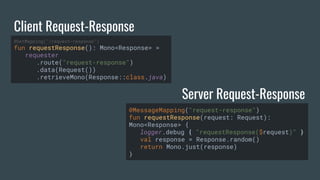
Client Request-Response
Server Request-Response
@GetMapping("/request-response")
fun requestResponse(): Mono<Response> =
requester
.route("request-response")
.data(Request())
.retrieveMono(Response::class.java)
@MessageMapping("request-response")
fun requestResponse(request: Request):
Mono<Response> {
logger.debug { "requestResponse($request)" }
val response = Response.random()
return Mono.just(response)
}
Client Request-Stream
Server Request-Stream
@GetMapping(value = ["/request-stream"], produces = [MediaType.TEXT_EVENT_STREAM_VALUE])
fun requestStream(): Flux<Response> =
requester
.route("request-stream")
.data(Request())
.retrieveFlux(Response::class.java)
@MessageMapping("request-stream")
fun requestStream(request: Request): Flux<Response> {
logger.debug { "requestStream($request)" }
val responseStream = Stream.generate { Response.random() }
return Flux
.fromStream(responseStream)
.delayElements(Duration.ofSeconds(5))
}
Links
Links
● https://rsocket.io/
● https://www.slideshare.net/Pivotal/welcome-to-the-reactive-revolutionrsocket-and-spring-cloud-gateway-spencer-gibb
● https://www.youtube.com/watch?v=dGNv-Djm7h0

Reactive micro services using RSocket