About me...
•
•
•
•

Technology lead for a team at LexisNexis
Blog: http://seanmccarthy.me
Twitter: mccartsc
G+: scmccart
About this talk...
Slides and Code at, https://github.
com/scmccart/MetaprogrammingEssentialsDemo

Or,

http://bit.ly/1go2IsO
Metaprogramming, huh?
• Writing code that can write code.
• Metaprogramming uses a Metalanguage
• S-Expressions, Attributes, Conventions

• Wide support, in languages such as ruby,

python, javascript, C++, lisp, template haskell
• Compile time vs Runtime
Metalanguages in .Net
• S-Expressions?
• Not available, unless you are using IronScheme

or clojureclr. Kind of via Expression<T>

• Attributes
• Available everywhere, widely understood.

• Conventions
• Common, but custom.
• Asp.Net’s routing.
• Entity Framework’s code first method.

• T4 kind of counts, kind of.
Metaprogramming methods
• Reflection.Emit
• Powerful, can build anything.
• Very manual, hard to use, error prone

• System.Linq.Expressions
• AKA Expression Trees
• Easyish API, type checks
• Can only do lambdas, not as fine grained

• Roslyn
• Compiler as a service
• Not released yet
Expression Trees
Expression Trees map very closely to an AST
An example, x => x.y * 2
As a tree, would be:
*
.
x

2
y
Expression Trees
Trees maps to the Expression builder’s use.
Expression.Multiply(
Expression.Property(
x,
"y"),
Expression.Constant(2))

*
.
x

2
y
Using Expression Trees
Repeatable flow with the Expression builder,
1. Declare parameters
2. Build out body
3. Pull together in lambda
4. Compile
5. Use!
1. Declare Parameters
var value = Expression.Parameter(typeof(int), "value");
2. Build out body
var value = Expression.Parameter(typeof(int), "value");
var body = Expression.Multiply(value, Expression.Constant(2));
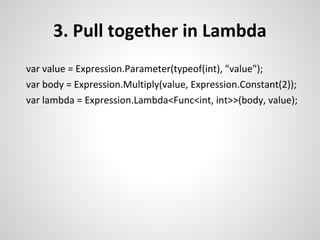
3. Pull together in Lambda
var value = Expression.Parameter(typeof(int), "value");
var body = Expression.Multiply(value, Expression.Constant(2));
var lambda = Expression.Lambda<Func<int, int>>(body, value);
4. Compile
var value = Expression.Parameter(typeof(int), "value");
var body = Expression.Multiply(value, Expression.Constant(2));
var lambda = Expression.Lambda<Func<int, int>>(body, value);
var compiled = lambda.Compile();
5. Use!
var value = Expression.Parameter(typeof(int), "value");
var body = Expression.Multiply(value, Expression.Constant(2));
var lambda = Expression.Lambda<Func<int, int>>(body, value);
var compiled = lambda.Compile();
Console.Write("input: ");
var input = int.Parse(Console.ReadLine());
var output = compiled(input);
Console.WriteLine("output: " + output);
Let’s see that in action.
Speed
Quick Tips
•
•
•
•

DebugView
ToString
Cache compiled trees
Limits
• Async/Await
• Yield Return
Object Routing Example
• Routing for objects to eliminate nested switch

statements.
• Uses Expressions for
•
•
•
•

Getting property values
Invoking methods
Ternary expressions
Constructing Arrays

Raleigh Code Camp 2103 - .Net Metaprogramming Essentials

  • 2.
    About me... • • • • Technology leadfor a team at LexisNexis Blog: http://seanmccarthy.me Twitter: mccartsc G+: scmccart
  • 3.
    About this talk... Slidesand Code at, https://github. com/scmccart/MetaprogrammingEssentialsDemo Or, http://bit.ly/1go2IsO
  • 4.
    Metaprogramming, huh? • Writingcode that can write code. • Metaprogramming uses a Metalanguage • S-Expressions, Attributes, Conventions • Wide support, in languages such as ruby, python, javascript, C++, lisp, template haskell • Compile time vs Runtime
  • 5.
    Metalanguages in .Net •S-Expressions? • Not available, unless you are using IronScheme or clojureclr. Kind of via Expression<T> • Attributes • Available everywhere, widely understood. • Conventions • Common, but custom. • Asp.Net’s routing. • Entity Framework’s code first method. • T4 kind of counts, kind of.
  • 6.
    Metaprogramming methods • Reflection.Emit •Powerful, can build anything. • Very manual, hard to use, error prone • System.Linq.Expressions • AKA Expression Trees • Easyish API, type checks • Can only do lambdas, not as fine grained • Roslyn • Compiler as a service • Not released yet
  • 7.
    Expression Trees Expression Treesmap very closely to an AST An example, x => x.y * 2 As a tree, would be: * . x 2 y
  • 8.
    Expression Trees Trees mapsto the Expression builder’s use. Expression.Multiply( Expression.Property( x, "y"), Expression.Constant(2)) * . x 2 y
  • 9.
    Using Expression Trees Repeatableflow with the Expression builder, 1. Declare parameters 2. Build out body 3. Pull together in lambda 4. Compile 5. Use!
  • 10.
    1. Declare Parameters varvalue = Expression.Parameter(typeof(int), "value");
  • 11.
    2. Build outbody var value = Expression.Parameter(typeof(int), "value"); var body = Expression.Multiply(value, Expression.Constant(2));
  • 12.
    3. Pull togetherin Lambda var value = Expression.Parameter(typeof(int), "value"); var body = Expression.Multiply(value, Expression.Constant(2)); var lambda = Expression.Lambda<Func<int, int>>(body, value);
  • 13.
    4. Compile var value= Expression.Parameter(typeof(int), "value"); var body = Expression.Multiply(value, Expression.Constant(2)); var lambda = Expression.Lambda<Func<int, int>>(body, value); var compiled = lambda.Compile();
  • 14.
    5. Use! var value= Expression.Parameter(typeof(int), "value"); var body = Expression.Multiply(value, Expression.Constant(2)); var lambda = Expression.Lambda<Func<int, int>>(body, value); var compiled = lambda.Compile(); Console.Write("input: "); var input = int.Parse(Console.ReadLine()); var output = compiled(input); Console.WriteLine("output: " + output);
  • 15.
    Let’s see thatin action.
  • 16.
  • 17.
    Quick Tips • • • • DebugView ToString Cache compiledtrees Limits • Async/Await • Yield Return
  • 18.
    Object Routing Example •Routing for objects to eliminate nested switch statements. • Uses Expressions for • • • • Getting property values Invoking methods Ternary expressions Constructing Arrays