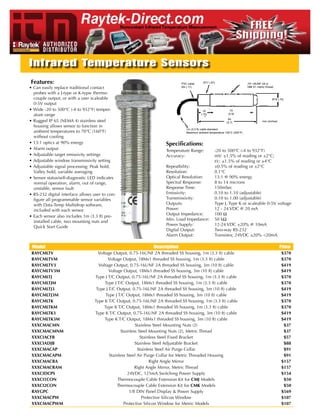
Infrared temperature Sensors
Features:                                                                     PVC cable      ø17 (.67)                       .75"-16UNF 2A or
•	Can	easily	replace	traditional	contact		                                    ø4 (.17)                                       18M X1 metric thread

  probes	with	a	J-type	or	k-typw	thermo-	
  couple	output,	or	with	a	user	scaleable		                                                                                                     ø19 (.75)
  0-5V	output
•	Wide	-20	to	500°C	(-4	to	932°F)	temper-	                                                   19                 73
                                                                                                               (2.9)
  ature	range                                                                              (.75)
                                                                                                               94
•	Rugged	iP	65	(nEMA	4)	stainless	steel		                                                                     (3.7)                     mm (inches)
  housing	allows	sensor	to	function	in		
                                                                                 1m (3.3 ft) cable standard
  ambient	temperatures	to	70°C	(160°F)		                                         Maximum ambient temperature 105°C (220°F)
  without	cooling
•	13:1	optics	at	90%	energy                                           Specifications:
•	Alarm	output                                                        Temperature	Range:	            -20	to	500°C	(-4	to	932°F)
•	Adjustable	target	emissivity	settings                               Accuracy:	                     mV:	±1.5%	of	reading	or	±2°C;	
•	Adjustable	window	transmissivity	setting                            	                              t/c:	±1.5%	of	reading	or	±4°C
•	Adjustable	signal	processing:	Peak	hold,		                          Repeatbility:	                 ±0.5%	of	reading	or	±2°C
  Valley	hold,	variable	averaging                                     Resolution:	                   0.1°C
•	Sensor	status/self-diagnostic	LED	indicates		                       optical	Resolution:	           13:1	@	90%	energy
  normal	operation,	alarm,	out	of	range,		                            Spectral	Response:	            8	to	14	microns
  unstable,	sensor	fault                                              Response	Time:	                150mSec
•	RS-232	digital	interface	allows	user	to	con-	                       Emissivity:	                   0.10	to	1.10	(adjustable)
  figure	all	programmable	sensor	variables		                          Transmissivity:	               0.10	to	1.00	(adjustable)
  with	Data-Temp	Multidrop	software,		                                outputs:	                      Type	J,	Type	k	or	scaleable	0-5V	voltage
  included	with	each	sensor                                           Power:	                        12	-	24	VDC	@	20	mA
                                                                      output	impedance:	             100	Ω
•	Each	sensor	also	includes	1m	(3.3	ft)	pre-	
                                                                      Min.	Load	impedance:	          50	kΩ
  installed	cable,	two	mounting	nuts	and		
                                                                      Power	Supply:	                 12-24	VDC	±20%	@	10mA	
  Quick	Start	Guide
                                                                      Digital	output:	               Two-way	RS-232
                                                                      Alarm	output:	                 Transistor,	24VDC	±20%	<20mA

 model                                                          Description                                                                           price
 RAYCMLTV                            Voltage	output,	0.75-16UnF	2A	threaded	SS	housing,	1m	(3.3	ft)	cable                                              $370
 RAYCMLTVM                                Voltage	output,	18Mx1	threaded	SS	housing,	1m	(3.3	ft)	cable                                                 $370
 RAYCMLTV3                           Voltage	output,	0.75-16UnF	2A	threaded	SS	housing,	3m	(10	ft)	cable                                               $419
 RAYCMLTV3M                                Voltage	output,	18Mx1	threaded	SS	housing,	3m	(10	ft)	cable                                                 $419
 RAYCMLTJ                          Type	J	T/C	output,	0.75-16UnF	2A	threaded	SS	housing,	1m	(3.3	ft)	cable                                             $370
 RAYCMLTJM                               Type	J	T/C	output,	18Mx1	threaded	SS	housing,	1m	(3.3	ft)	cable                                               $370
 RAYCMLTJ3                          Type	J	T/C	output,	0.75-16UnF	2A	threaded	SS	housing,	3m	(10	ft)	cable                                             $419
 RAYCMLTJ3M                              Type	J	T/C	output,	18Mx1	threaded	SS	housing,	3m	(10	ft)	cable                                                $419
 RAYCMLTK                          Type	k	T/C	output,	0.75-16UnF	2A	threaded	SS	housing,	1m	(3.3	ft)	cable                                             $370
 RAYCMLTKM                              Type	k	T/C	output,	18Mx1	threaded	SS	housing,	1m	(3.3	ft)	cable                                                $370
 RAYCMLTK3                         Type	k	T/C	output,	0.75-16UnF	2A	threaded	SS	housing,	3m	(10	ft)	cable                                              $419
 RAYCMLTK3M                             Type	k	T/C	output,	18Mx1	threaded	SS	housing,	3m	(10	ft)	cable                                                 $419
 XXXCMACMN                                               Stainless	Steel	Mounting	nuts	(2)                                                              $37
 XXXCMACMNM                                      Stainless	Steel	Mounting	nuts	(2),	Metric	Thread                                                       $37
 XXXCIACFB                                                  Stainless	Steel	Fixed	Bracket                                                               $57
 XXXCIADJB                                               Stainless	Steel	Adjustable	Bracket                                                             $88
 XXXCMACAP                                                 Stainless	Steel	Air	Purge	Collar                                                             $91
 XXXCMACAPM                                Stainless	Steel	Air	Purge	Collar	for	Metric	Threaded	Housing                                                 $91
 XXXCMACRA                                                       Right	Angle	Mirror                                                                    $157
 XXXCMACRAM                                              Right	Angle	Mirror,	Metric	Thread                                                             $157
 XXXCIDCPS                                           24VDC,	125mA	Switching	Power	Supply                                                               $154
 XXXCI1CON                                      Thermocouple	Cable	Extension	kit	for	CMJ	Models                                                         $50
 XXXCI2CON                                      Thermocouple	Cable	Extension	kit	for	CMK	Models                                                         $50
 RAYGPC                                               1/8	Din	Panel	Display	&	Power	Supply                                                             $569
 XXXCMACPW                                                   Protective	Silicon	Window                                                                 $107
 XXXCMACPWM                                        Protective	Silicon	Window	for	Metric	Models                                                         $107
CI                                            TWO YEAR LIMITED WARRANTY


                                                                    THERMALERT SERIES
                                                                                          Raytek warrants this product to be free from defects in material and
                                                                                          workmanship under normal use and service for a period of two
                                                                                          years from date of purchase except as hereinafter provided. This
                                                                                          warranty extends only to the original purchaser (a purchase from
                                                                                          Raytek or Raytek’s licensed distributors is an original purchase).
                                                                                          This warranty shall not apply to fuses or batteries. Factory calibra-
                                                                                          tion is warranted for a period of one year. The warranty shall not
                                                                                          apply to any product which has been subject to misuse, neglect,
                                                                                          accident, or abnormal conditions of operation or storage. Should
                                                                                          Raytek be unable to repair or replace the product within a reason-
                                                                                          able amount of time, purchaser’s exclusive remedy shall be a refund
                                                                                          of the purchase price upon return of the product.

                                                                                          In the event of failure of a product covered by this warranty, Raytek
                                                                                          will repair the instrument when it is returned by the purchaser,
                                                                                          freight prepaid, to an authorized Service Facility within the applica-
                                                                                          ble warranty period, provided Raytek’s examination discloses to its
                                                                                          satisfaction that the product was defective. Raytek may, at its
                                                                                          option, replace the product in lieu of repair. With regard to any cov-
                                                                                          ered product returned within the applicable warranty period,
                                                                                          repairs or replacement will be made without charge and with return
                                                                                          freight paid by Raytek, unless the failure was caused by misuse,
                                                                                          neglect, accident, or abnormal conditions of operation or storage, in
                                                                                          which case repairs will be billed at a reasonable cost. In such a case,
                                                                                          an estimate will be submitted before work is started, if requested.
THERMALERT® CI™
                                                                                          THE FOREGOING WARRANTY IS IN LIEU OF ALL OTHER WAR-
COMPACT INFRARED                                                                          RANTIES, EXPRESSED OR IMPLIED, INCLUDING BUT NOT
                                                                                          LIMITED TO ANY IMPLIED WARRANTY OF MERCHANTABILI-
SENSOR                                                                                    TY, FITNESS, OR ADEQUACY FOR ANY PARTICULAR PURPOSE
                                                                                          OR USE. RAYTEK SHALL NOT BE LIABLE FOR ANY SPECIAL,
                                                                                          INCIDENTAL OR CONSEQUENTIAL DAMAGES, WHETHER IN
OPERATOR’S GUIDE                                                                          CONTRACT, TORT, OR OTHERWISE.


                                                                                        Raytek, the Raytek Logo, and Thermalert are registered trademarks and
                                                                                        CI is a trademark of Raytek Corporation
                                                                             Rev J
                                                                            05/00       © Copyright 1996-2000 by Raytek Corporation
                                                                           56800-1


                    THERMALERT CI                                                                               ACCESSORIES
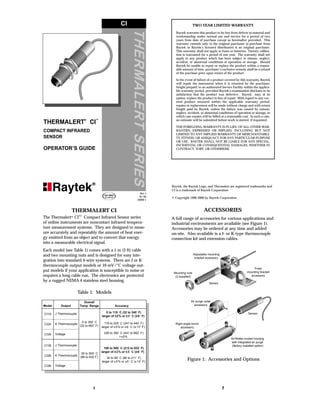
The Thermalert® CI™ Compact Infrared Sensor series                                      A full range of accessories for various applications and
of online instruments are noncontact infrared tempera-                                  industrial environments are available (see Figure 1).
ture measurement systems. They are designed to meas-                                    Accessories may be ordered at any time and added
ure accurately and repeatably the amount of heat ener-                                  on-site. Also available is a J- or K-type thermocouple
gy emitted from an object and to convert that energy                                    connection kit and extension cables.
into a measurable electrical signal.
Each model (see Table 1) comes with a 1 m (3 ft) cable
and two mounting nuts and is designed for easy inte-                                                     Adjustable mounting
                                                                                                          bracket accessory
gration into standard 4-wire systems. There are J or K
thermocouple output models or 10 mV/°C voltage out-
                                                                                                                                                   Fixed
put models if your application is susceptible to noise or                                                                                      mounting bracket
                                                                                         Mounting nuts
requires a long cable run. The electronics are protected                                  (2 supplied)                                           accessory
by a rugged NEMA 4 stainless steel housing.
                                                                                                                    Sensor


                         Table 1: Models

                           Overall                                                                   Air purge collar
Model      Output        Temp. Range                  Accuracy                                          accessory


        J Thermocouple                        0 to 115˚ C (32 to 240˚ F)                                                                        Sensor
CI1A
                                           larger of ±2% or ± 3 ˚ C (± 6 ˚ F)
                            0 to 350˚ C      116 to 225˚ C (241 to 440˚ F)
CI2A    K Thermocouple                                                                    Right angle mirror
                          (32 to 662˚ F)   larger of ± 5 % or ± 6 ˚ C (± 1 0˚ F)             accessory

CI3A    Voltage                              226 to 350˚ C (441 to 662˚ F)
                                                        >±5%
                                                                                                                                   Air/Water-cooled housing
                                                                                                                                   with integrated air purge
CI1B    J Thermocouple                                                                                                             (factory installed option)
                                             100 to 500˚ C (212 to 932˚ F)
                                           larger of ± 2 % or ± 3 ˚ C (± 6 ˚ F)
                        30 to 500˚ C
CI2B    K Thermocouple
                       (86 to 932˚F)           30 to 99˚ C (86 to 211˚ F)
                                           larger of ± 5 % or ± 6 ˚ C (± 1 0˚ F)
                                                                                                   Figure 1: Accessories and Options
CI3B    Voltage


                                    1                                                                                          2
OPTIONS                                                         Table 2 (continued): Specifications
Options for various applications and environments                                      Electrical
are available. Options are factory installed and must                                     Power supply voltage            12 – 24 VDC @20 mA
be ordered with base model units. These include the                                       Maximum current draw            ≤ 10 mA
                                                                                          Ripple                          ≤ 2.5%
following:                                                                                Output impedance                50 ohms
  • NIST traceable certification                                                          Minimum load impedance          50K ohms
  • Air/Water-cooled housing (comes with integrated                                       Outputs                         J or K thermocouple,
     air purging and high temperature cable)                                                                              10mV/˚C Linear Voltage
  • High temperature cable–260°C (500°F) maximum                                       Environmental
     ambient temperature (comes standard with                                            Sensing head rating              IP 65, NEMA 4
     air/water-cooled housing option)                                                    EMI
                                                                                            Conducted noise immunity    IEC 801-4, Level 1
  • Longer 3 m (10 ft) standard cable
                                                                                         Relative humidity              10 to 95%, non-condensing
                                                                                         Storage temp. range            -30 to 85˚ C (-22 to 185˚ F)
                      SPECIFICATIONS                                                     Thermal shock                  Max error of 5˚ C (for ∆T=25˚)
Table 2 (below and continued on Page 4) lists the sen-                                                                    stabilization time=20 mins.
                                                                                         Ambient operating range        0 to 70˚ C (32 to 160˚ F)
sor’s optical, thermal, operational, electrical, environ-
                                                                                          air cooling                   0 to 94˚ C (32 to 200˚ F)
mental, and physical specifications.                                                      water cooling                 0 to 105˚ C (32 to 220˚ F)
                                                                                          water cooling/high temp cable 0 to 260˚ C (32 to 500˚ F)
                     Table 2: Specifications
                                                                                       Physical
                                                                                         Dimensions                       19 mm dia x 87 mm L
  Optical Resolution                       4:1 @ 90% energy                                                               (0.75 in dia x 3.4 in L)
  Spectral Response Range                  7–18 µm                                       Weight                           130 g (4.5 oz)
                                                                                         Material                         Stainless steel
  Thermal
    Measurement range                      See Table 1                                 Cable–Standard
    Detecting element                      Thermopile                                    Maximum ambient temperature      105˚ C (220˚ F)
    Accuracy                               See Table 1                                   Material (type & color)          PVC, grey
                                                                                         Cable length                     1 m (3 ft)
    Repeatability                          ±1% of reading
                                                                                         Gauge                            AWG 24 (J, K t/c cable)
    Temperature coefficient                0.2˚ C per ˚C (0.2˚ F per ˚F)
                                                                                                                          AWG 22 (10mV/˚C cable)
  Operational                                                                          Cable–High Temperature
    Temperature resolution                 < 0.5˚ C (1˚ F)                               Maximum ambient temperature      260˚ C (500˚ F)
    Emissivity                             Fixed at 0.95                                 Material (type & color)          Teflon, black
    Response time                          350 mSec (95% response)                       Cable length                     1 m (3 ft)
    Warm-up period                         < 1 minute                                    Gauge                            AWG 24


                                                     Continued on next page
                                          3                                                                          4


Optical Chart                                                                                           INSTALLATION
Figure 2 shows you how to read the optical chart. The
                                                                                     The installation process consists of the following:
optical chart (Figure 3) indicates the nominal target
                                                                                         • Preparation
spot diameter at any given distance from the sensing
                                                                                         • Mechanical Installation
head and assumes 90% energy.
                                                                                         • Electrical Installation
        Target spot size      Diameter of target       Distance from sensor          The most important part of the installation process is
        at focus point        spot size in inches      to object in inches or feet   preparation. Please read the following section thor-
                                                                                     oughly before proceeding with the mechanical and
                                                                                     electrical installations.
                                                                                     Preparation
                                                                                     Distance and Spot Size—The size of the area (spot
                                                                                     size) you wish to measure determines the distance
                                                                                     between the sensor and the target (see Figure 3 for dis-
                                                                                     tances and spot sizes). The spot size must not be larg-
                                                                                     er than the target. Mount the sensor so the measured
           Diameter of target
                                                                                     spot is the same or smaller than the target. Figure 4 is
                                           Distance from sensor to
           spot size in millimeters        object in millimeters or meters           an overview of proper sensor placement.
    Focus Point D:S = Distance to spot divided by spot diameter at the focus point
    Far Field D:S = Ratio at distances greater than 10x the focus distance

                                                                                                            Best         Good      Incorrect
     Figure 2: How to Read the Optical Chart

                                                                                      Sensor


                                                                                                        Target greater
                                                                                                        than spot size
                                                                                                                       Target equal        Background
                                                                                                                       to spot size
                                                                                                                                   Target smaller
                                                                                                                                   than spot size

                     Figure 3: Optical Chart                                                   Figure 4: Proper Sensor Placement
                                          5                                                                          6
Ambient Temperature—The sensing head is designed                                                               Mechanical Installation
to operate in ambient temperatures from 0 to 70°C (32                                                          All sensors come with a 1 m (3 ft) cable and 2 mount-
to 160°F). For ambient temperatures above 70°C                                                                 ing nuts. You can mount the sensor in brackets or
(160°F), a factory installed air/water-cooled housing                                                          cutouts of your own design, or you can use the fixed
option is available that allows operation in ambient                                                           and adjustable mounting bracket accessories. Figures
conditions up to 260°C (500°F) with water cooling.                                                             5 through 7 show the mounting bracket accessories’
The air/water-cooled housing option comes with a                                                               and sensor’s dimensions.
high-temperature cable and integrated air purging.
                                                                                                                                           Full R
Atmospheric Quality—Smoke, fumes, dust, and other
contaminants can coat the lens and cause erroneous                                                                               ∅19 (.76)

temperature readings. We recommend using the air
purge collar accessory in these types of environments
to keep the lens clean. (The air/water-cooled housing                                                                                                                                       38
                                                                                                                                                                                           (1.5)
comes with integrated air purging.)                                                                                                1.5                                            22
                                                                                                                                  (.06)                                         (.875)

Electrical Interference—To minimize electrical or elec-
tromagnetic interference or “noise,” mount the sensor                                                                                                         38
away from motors producing large step load changes.                                                                                                          (1.5)

                                                                                                                                                         5
Wiring—Before installing, be sure to check the dis-                                                                                                   (.196)

tance between the sensor and the monitoring/control-                                                                                                                                       ∅5 (.196)

ling device. If necessary, extension cables are available
as accessories.                                                                                                                         2X 45˚

                                                                                                                               2X 90˚                                              38
Power—Have available a 12–24 VDC, 10 mA, power                                                                                                                                    (1.5)
supply.


                                                                                                                                                      2X 13            19
                                                                                                                                                     (2X .5)         (.75)
                                                                                                                                                             38
                                                                                                                                                            (1.5)
                                                                                                                                                                                  mm (inches)


                                                                                                                              Figure 5: Fixed Mounting Bracket

                                            7                                                                                                                  8

                                                                                                               Air/Water-cooled Housing with integrated air purge—
                      41
                   (1.625)
                                                                 5                                             The air/water-cooled housing option (Figure 8) allows
                                                              (.196)
                          22                                                                       ∅5 (.196)
                                                                                                               the sensor to withstand ambient temperatures up to
                        (.875)
                                                                                                               260° C (500° F) with water cooling and the high-temper-
                                                    2X 45˚                                                     ature cable. (The high-temp cable is standard when the
                                           2X 90˚                                           38                 housing is ordered as an option.) It has 1/8” NPT fit-
                                                                                           (1.5)
                                                                                                               tings for water and air. Water temperature should be
                                    59
                                  (2.31)
                                                                                                               15-30° C (60-86° F) for best performance. Chilled water
∅19 (.76)
                                                                                                               below 10° C (50° F) is not recommended. Without the
   Full R
                                                              2X 13          19                                high-temperature cable, the sensor can withstand ambient
                                                                           (.75)
                                                             (2X .5)                                           temperatures only up to 105° C (220° F) with water cooling.
                                                                    38
                                                                   (1.5)
                                                                                                                                                      ∅38 (1.5)                                ∅38 (1.5)
                       38
                      (1.5)                                                  mm (inches)
                                                                                                                                                      ∅20 (0.8)                                3/4"–16UNF 2A


            Figure 6: Adjustable Mounting Bracket                                                                                                                                                    13 flats
                                                                                                                                                                                                    (0.5)


 1 m (3 ft)                                                   3/4"–16UNF 2A                                           Front View                               Rear View
 PVC Cable     ∅17 (.67)                                      M18 x 1 (if ordered metric)
  ∅4 (.17)                                                                                                             10                                        96                                            12
                                                                                                                     (0.39)                                    (3.79)                                        (0.45)

                                                                           ∅14 (.56) ∅19 (.75)                                                                     1/8" NPT fittings (3)


                      19                      63                                     7
                     (.75)                  (2.48)                                 (.27)

                                            89
                                           (3.5)                               mm (inches)


                              Figure 7: Sensor
                                                                                                                    6                               ~ 25                                            ~ 13
                                                                                                                 (0.25)                             (~ 1)                                          (~ 0.5)
                                                                                                                                 25
                                                                                                                                 (1)                                  118
                                                                                                                                                                     (4.63)
                                                                                                                                                             137
                                                                                                                                                            (5.38)
                                                                                                                                                                                                   mm (inches)

                                                                                                                          Figure 8: Air/Water-cooled Housing
                                            9                                                                                                                   10
Air Purge Collar—The air purge collar accessory                                         Right Angle Mirror—The right angle mirror accessory
(Figure 9) is used to keep dust, moisture, and other                                    (Figure 10) allows a perpendicular view of a target. It
contaminants away from the lens. It must be screwed                                     may be used when space is limited or when you need
in fully. Air flows into the 10/32” fitting and out the                                 to avoid excessive radiation to the sensor. This can be
front aperture. Clean or “instrument” air is recom-                                     mounted either on the end of the sensor or on the air
mended. The air purge collar accessory is not needed with                               purge collar, but not on the air/water-cooled housing.
the air/water-cooled housing.
                                                                                        Note: When using the right angle mirror, a small
              ∅35
                                              Inside threads M18 x 1
                                     (if ordered with metric threaded sensor)
                                                                                        amount of energy emitted by the source is lost, which
              (1.38)
                                                                                        results in a lower than actual temperature reading. To
         ∅19 (0.75)                                                   3/4" – 16UNF 2A
                                                                                        compute the corrected temperature, use this formula:
    10/32" threads

                                         35
                                                                                                        T = 1.035Tm – .035Tamb
                                       (1.36)
                                                                                        where T=corrected temperature, Tm=temperature read-
              ~ 25                                                                      ing with mirror, and Tamb=ambient temperature. All
              (~ 1)
                           61
                                          11
                                        (0.42)                        9                 temperatures are in either °C or °F.
                         (2.38)                         21          (0.37)
                                                      (0.84)                                                                                        ∅20 (.8)
                                                            31
                                                          (1.21)
                                                                        mm (inches)                                                                 3/4"–16 UNF 2B

                       Figure 9: Air Purge Collar
       Table 3: Recommended Water and Air
     Recommended
       Cooling water supply
         Temperature               15–30˚ C (60–86˚ F)                                                                   82
         Flow rate                 1.89 liters per min (0.5 gpm)
         Pressure drop
                (across unit only) < 0.69 bar (10 psi)                                                             13
                                                                                                                  (.5)
         Cooling air supply
           Temperature                < 30˚ C (< 86˚ F)
           Flow rate                  70.8 liters per minute (2.5 SCFM)
           Pressure drop                                                                                 20
                                                                                                        (.8)
                   (across unit only) < 0.34 bar (5 psi)
         Air purge air supply
             Temperature               < 30˚ C (< 86˚ F)
             Flow rate                 11.33 liters per minute (0.4 SCFM)                                                   31
                                                                                                                          (1.25)
                                                                                                                                                           mm (inches)
             Pressure drop
                    (across unit only) < 0.34 bar (5 psi)
                                                                                                    Figure 10: Right Angle Mirror
                                     11                                                                                               12

                                                                                        Wiring—Wire the electronics cable using Figure 11 and
Electrical Installation                                                                 Table 4 or 5 (for high temp cables) as a guide. USE
                                                                                        ONLY THE OUTPUT TYPE OF YOUR SENSOR.
Sensor to Electronics Cable—The sensor to electron-                                     WIRING TO THE WRONG OUTPUT WILL DAM-
ics cable is a 1m (3 ft), 4-wire, PVC cable. One end is                                 AGE THE SENSOR. Note in Figure 11 that the num-
attached, at the factory, to the sensor head. The                                       bers refer to the wire numbers in Table 4 or 5, which
other end has two pairs of wires and a bare shield                                      shows proper wiring connections based on insulation
(ground) wire (see Figure 11).                                                          color coding.
                                                                                                        NOTE LABEL                                  Wire Numbers
The unlabeled pair of wires is for connecting to a                                                          (ON POWER
                                                                                                                                                 (Refer to Table 4 or 5)
controller or chart recorder or for attaching to a ther-                                            SUPPLY WIRES ONLY)
                                                                                                                                                           1
mocouple plug (for connecting to a thermocouple
                                                                                                                                                           2
meter). DO NOT CONNECT TO A POWER
SOURCE.
                                                                                                                              Red (+)


                                                                                                                                                           3
The second pair of wires, with the label, is for con-
necting to a power source.                                                                                                                                 4
                                                                                                                              12 – 24 VDC


                                                                                                                                                           5 (Shield)


                                  WARNING                                                           Figure 11: Wiring Configuration
  Incorrect wiring will cause severe, per-                                                          Table 4: Standard Cable Wiring
      manent damage to the sensor.
                                                                                                                Wire
                                                                                           Output    Label     Number         Wire Color                         Function
 Pay close attention to the wiring diagram in
                                                                                                    Output       1       White               Signal + (Iron)
 Figure 11, and match your sensor to the appropri-                                        J-type                 2       Red (white stripe)  Signal – (Constantan)
 ate output type in Table 4 or 5. Wire accordingly.                                       Thermo-
                                                                                          couple
                                                                                                    Power        3       Red (yellow stripe) Power Supply +
                                                                                                    Supply       4       Yellow              Power Supply –
   DO NOT CONFUSE OUTPUT WIRES WITH                                                                   –          5       Bare                Shield Ground
          POWER SUPPLY WIRES.                                                                       Output       1       Yellow                          Signal + (Chromel)
                                                                                          K-type                 2       Red (yellow stripe)             Signal – (Alumel)
                                                                                          Thermo-   Power        3       Red (white stripe)              Power Supply +
                                                                                          couple
                                                                                                    Supply       4       White                           Power Supply –
                                                                                                      –          5       Bare                            Shield Ground

                                                                                                  Output         1       White                           Signal +
                                                                                          10mV/˚C                2       Green                           Signal Ground
                                                                                          Voltage Power          3       Red                             Power Supply +
                                                                                                  Supply         4       Black                           Power Supply –
                                                                                                    –            5       Bare                            Shield Ground


                                                                                                                                            14
                                    13
Table 5: High Temperature Cable Wiring                                                         OPERATION
                     Wire                                                    Once the sensor is in position and you have made sure
 Output    Label    Number       Wire Color              Function
                                                                             that the appropriate power, air, water, and cable con-
           Output     1       White                Signal + (Iron)
 J-type               2       Red (white stripe)   Signal – (Constantan)     nections are secure, the system is ready for continuous
 Thermo-
 couple
           Power      3       Red                  Power Supply +            operation.
           Supply     4       Yellow               Power Supply –
             –        5       Bare                 Shield Ground             To operate, complete the following simple steps:
           Output     1       Yellow               Signal + (Chromel)
 K-type               2       Red                  Signal – (Alumel)         1. Turn on the power supply.
 Thermo-
           Power      3       Red (white stripe)   Power Supply +
 couple    Supply     4       White                Power Supply –            2. Turn on the meter, chart recorder, or controller.
              –       5       Bare                 Shield Ground
                                                                             3. Read/monitor the temperature.
         Output       1       Red                  Signal +
 10mV/˚C              2       Yellow               Signal Ground
 Voltage Power        3       Red (white stripe)   Power Supply +
         Supply       4       White                Power Supply –                                    WARNING
              –       5       Bare                 Shield Ground               If using the air/water-cooled housing, do not
                                                                               leave it in a heated environment with the
Extension Cables—Extension cables are available as                             coolant turned off. Damage to the sensor and to
accessories. Also available is a thermocouple connec-                          the housing can occur.
tion kit.

                     IMPORTANT                                                             MAINTENANCE AND
Be aware of the following when using the sensor:                                           TROUBLESHOOTING
• If the sensor is exposed to significant changes in                         If your sensor is not performing as it should, try to
  ambient temperature (hot to cold or cold to hot),                          match the symptom in Table 6 to its probable cause. If
  allow 20 minutes for the temperature to stabilize                          the table does not help, call us at one of the phone
  before taking or recording measurements.                                   numbers listed on the last page.
• Do not operate the sensor near large electrical or                         Our customer service representatives are always at
  magnetic fields (e.g., around arc welders or induc-                        your disposal for application assistance, calibration,
  tion heaters). Electro-Magnetic Interference (EMI)                         repair, and solutions to specific questions or problems.
  can cause measurement errors.                                              Contact our Service Department before returning any
• Connectors or wires must be connected only to the                          equipment to us. In many cases, problems can be
  appropriate input jacks or terminals.                                      solved over the telephone.

                                       15                                                                    16

                    Table 6: Troubleshooting
     Symptom               Probable Cause                 Solution

  No output               No power to sensor       Check the power
                                                   supply

  Erroneous Temp.         Incorrect wire           Check wire color
                          connection               codes and reconnect       Raytek Corporation
                                                                             Worldwide Headquarters
                          Faulty sensor cable      Verify cable continuity      Box 1820, Santa Cruz, CA 95061-1820
  Erroneous Temp.
                                                                                Phone: (831) 458-1110 (800) 227-8074
                                                                                FAX: (831) 458-1239
  Erroneous Temp.         Field of view            Remove obstruction
                          obstruction
                                                                             Raytek GmbH
                                                                             European Headquarters
Lens Cleaning—Keep the lens clean at all times. Blow                            Phone: 49 30 478 0080
                                                                                FAX: 49 30 471 0251
off loose particles (if not using the air purge accessory)
with clean compressed air, then carefully wipe surface                       Raytek do Brasil
with moist cotten swab (water or water-based glass                           South American Headquarters
                                                                                Phone: 55 15 233 6338
cleaner). DO NOT use solvents.                                                  FAX: 55 15 233 6826

                                                                             Raytek Mexico
           CE CONFORMITY FOR THE                                             Mexico, Caribbean, and Central America
                                                                                Phone: 52 22 30 4380
           EUROPEAN COMMUNITY                                                   FAX: 52 22 30 4438

                                                                             Raytek Japan, Inc.
                                                                                Phone: 81 3 3822 5715
                                                                                FAX: 81 3 3822 5712
This instrument conforms to the following standards:                         Raytek China Company
                                                                                Phone: 86 10 6437 0284
  • EN50081-1:1992, Electromagnetic Emissions                                   FAX: 86 10 6437 0285

  • EN50082-1:1992, Electromagnetic Susceptibility                           Raytek UK Ltd.
                                                                                Phone: 441 908 630800
Emission tests were conducted over a frequency range                            FAX: 441 908 630900
of 30–1000 MHz and susceptibility tests over a range                         Raytek France
of 27–500 MHz . The instrument’s average error in                               Phone: 33 1 64 53 1540
these frequency ranges is 1.0° C at an electric field                           FAX: 33 1 64 53 1544
strength of 3 V/m. At some frequencies the instru-
ment may not meet its stated accuracy.

                                       17
CM


Noncontact Temperature Measurement for Industrial Applications & OEMs
CM Highlights                             Measurement Specifications
■ 	 Scaleable 0-5 V, type J or K output      Temperature Range	                 -20ºC to 500ºC (-4ºF to 932ºF)
                                                                                                                                   1,2
■ 	 ide -20°C to 500°C (-4°F to 932°F)
    W                                        Accuracy (mV)	                     ± 1.5% of reading or ± 2ºC, whichever is greater
    temperature range                        Accuracy (t/c)	                    ± 1.5% of reading or ± 4ºC, whichever is greater1,2,3
■ 	Rugged IP 65 (NEMA-4)
                                             Spectral Response	                 8 to 14 microns
    stainless steel housing
■ 	 Rugged 13:1 optics at 90% energy         System Repeatability	              ± 0.5% of reading or ± 2ºC, whichever is greater
■ 	 150 mSec (95%) response time             Temperature Resolution	            0.1°C
■ 	 Alarm output
                                             Response Time (95%)	               150 mSec
■ 	 ensor status/self diagnostic
    S
                                             Emissivity	0.10 to 1.10 (adjustable)
    indicator LED
■ 	 S232 digital communications for
    R                                        Transmissivity	                    0.10 to 1.00 (adjustable)
    sensor set-up and monitoring             Signal Processing	                 Peak hold, valley hold, variable averaging
■ 	 Adjustable signal processing

               ®
                                             Self diagnostics/sensor status	 Normal operation, alarm, out of range, unstable, 		
■ 	 DataTemp Multidrop
                                             	                               sensor fault
	 software compatible
■ 	 ccessories for air purging and
                                             Bore-Sight tolerance 4	            3º @ focal point
    A
                                             1
    lens protection                              Accuracy from -20 to 0ºC is ±3.5ºC
                                             2
                                                 Accuracy and resolution specifications are valid for ambient temperature
The Raytek® CM sensor provides the               23ºC ± 5ºC, e = 1.0 calibration geometry
advantages of infrared temperature           3
                                                 Accuracy measured on the 0-5 VDC output or RS232 for t/c models is ± 1.5%
measurement in a powerful, compact,
                                                 of reading or ± 2ºC, whichever is greater
integrated sensor. Designed for easy
integration, the CM sensor can easily        4
                                                 Typical values measured at focal distance
replace traditional contact probes with a
J-type or K-type thermocouple output, or
with a user scaleable 0-5 volt output, if
your application is susceptible to noise.

The CM sensor is designed to measure
target temperatures ranging from -20°C
to 500°C (-4°F to 932°F). The CM's
onboard electronics are protected by a
rugged IP 65 (NEMA-4) stainless steel
housing, allowing the sensor to function
in ambient temperatures to 70°C (160°F)
without cooling.                                  Nominal Optical Specifications
Although small in size, the CM is loaded
with advanced features. An RS232 digital                             D:S=13:1 at focal point           Far field D:S=9:1
interface allows the user to configure all
programmable sensor variables with the
powerful DataTemp Multidrop software
included with each sensor. These include
a 24 volt DC alarm output triggered by
target temperature or head ambient
temperature, peak hold, valley hold or
variable averaging signal processing,
adjustable target emissivity settings and
adjustable window transmissivity setting.
The built-in sensor health LED provides
a convenient on-line indicator of the
sensor's operating status and aids in        D:S is the optical resolution expressed as a ratio of the distance to the target
troubleshooting initial sensor set up.       spot divided by the diameter of the spot.
Compact. Powerful. Easy to install.          Nominal spot size based on 90% energy.
Affordable. The Raytek CM sensor is the
ideal solution for both OEM and end-user
applications.
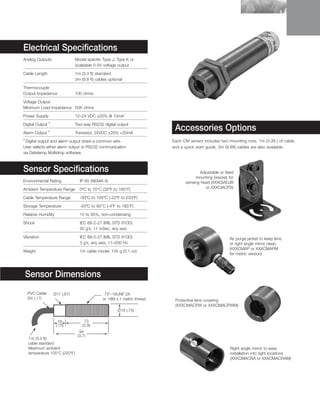
Electrical Specifications
Analog Outputs	            Model specific Type J, Type K or 		
	                          scaleable 0-5V voltage output

Cable Length	 (3.3 ft) standard
              1m
              3m (9.8 ft) cables optional

Thermocouple
Output Impedance	          100 ohms	

Voltage Output
Minimum Load Impedance	 50K ohms

Power Supply	12–24 VDC ±20% @ 10mA

Digital Output 5 	
                                                                  Accessories Options
                           Two-way RS232 digital output
               5
Alarm Output 	             Transistor, 24VDC ±20% 20mA
5
 Digital output and alarm output share a common wire.            Each CM sensor includes two mounting nuts, 1m (3.3ft.) of cable,
User selects either alarm output or RS232 communication          and a quick start guide. 3m (9.8ft) cables are also available.
via Datatemp Multidrop software.


Sensor Specifications                                                         Adjustable or fixed
                                                                            mounting bracket for
Environmental Rating	         IP 65 (NEMA-4)                           sensing head (XXXCIADJB
A bient Temperature Range	 0ºC to 70°C (32ºF to 160°F)
 m                                                                               or XXXCIACFB)

Cable Temperature Range	      -30ºC to 105ºC (-22ºF to 220ºF)

Storage Temperature	          -20ºC to 85°C (-4ºF to 185°F)

Relative Humidity	            10 to 95%, non-condensing

Shock	IEC 68-2-27 (MIL STD 810D)
       50 g’s, 11 mSec, any axis

Vibration	IEC 68-2-27 (MIL STD 810D)                                                          ir purge jacket to keep lens
                                                                                              A
           3 g’s, any axis, 11–200 Hz                                                         or right angle mirror clean
                                                                                              (XXXCMAP or XXXCMAPM
Weight	                       1m cable model: 145 g (5.1 oz)
                                                                                              for metric version)


    Sensor Dimensions

                                                                  Protective lens covering
                                                                  (XXXCMACPW or XXXCMACPWM)


                              94
                             (3.7)


                                                                                               Right angle mirror to ease
                                                                                               installation into tight locations
                                                                                               (XXXCMACRA or XXXCMACRAM)
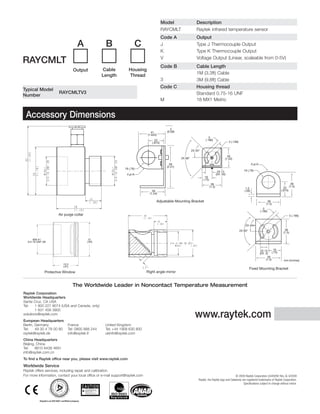
Model                    Description
                                                                                            RAYCMLT                  Raytek infrared temperature sensor
                                                                                            Code A                   Output
                                  A                 B                     C                 J                        Type J Thermocouple Output
                                                                                            K                        Type K Thermocouple Output

RAYCMLT                                                                                     V                        Voltage Output (Linear, scaleable from 0-5V)
                                                                                            Code B                   Cable Length
                                 Output          Cable             Housing
                                                 Length            Thread                                            1M (3.3ft) Cable
                                                                                            3                        3M (9.8ft) Cable
                                                                                            Code C                   Housing thread
Typical Model
                      RAYCMLTV3                                                                                      Standard 0.75-16 UNF
Number
                                                                                            M                        18 MX1 Metric


 Accessory Dimensions
                                                                                                  2
                                                                                  41            (0.08)
                                                                               (1.625)
                                                                                                                                5
                                                                                     22                                      (.196)
                                                                                   (.875)                                                             5 (.196)


                                                                                                                  2X 45º
                                                                                                                                                    40
                                                                                                         2X 90º                                   (1.52)
                                                                                                  59                                                                        Full R
                                                                                                (2.31)
                                                                19 (.76)
                                                                                                                                            2X 13                   19 (.76)
                                                                 Full R                                                                    (2X .50)
                                                                                                                             19
                                                                                                                           (.75)
                                                                                                                                    38                                                                         38
                                                                                                                                   (1.5)                                                                      (1.5)
                                                                                                                                                                     1.5                               22
                                                                                   39                                                                               (.06)                            (.875)
                                                                                 (1.54)

                                                                                      Adjustable Mounting Bracket                                                                          38
                                                                                                                                                                                          (1.5)
                                                                                                                                                                                        5
                                                                                                                                                                                     (.196)
                      Air purge collar                                                                                                                                                                        5 (.196)


                                                                                                                                                                     2X 45∞
                                                                                                                                                                 2X 90º                                38
                                                                                                                                                                                                      (1.5)

      MI8 #1                              21
  3/4-16 UNF-2B                          (.83)


                                                                                                                                                                                     2X 13      19
                                                                                                                                                                                     (2X .5) (.75)
                                                                                                                                                                                           38
                                                                                                                                                                                          (1.5)        mm (inches)
                         15.5
                         (.61)
                                                                                                                                                                          Fixed Mounting Bracket
              Protective Window                                                Right angle mirror


                                 The Worldwide Leader in Noncontact Temperature Measurement
Raytek Corporation
Worldwide Headquarters
Santa Cruz, CA USA
Tel:	 1 800 227 8074 (USA and Canada, only)

                                                                                                                    www.raytek.com
	       1 831 458 3900
solutions@raytek.com
European Headquarters
Berlin, Germany	         France	                    United Kingdom
Tel:	 49 30 4 78 00 80 	 Tel: 0800 888 244	         Tel: +44 1908 630 800
raytek@raytek.de	        info@raytek.fr	            ukinfo@raytek.com
China Headquarters
Beijing, China
Tel:	 8610 6438 4691
info@raytek.com.cn
To find a Raytek office near you, please visit www.raytek.com
Worldwide Service
Raytek offers services, including repair and calibration.
For more information, contact your local office or e-mail support@raytek.com                                                                           © 2009 Raytek Corporation (3449292 Rev. A) 4/2009
                                                                                                                       Raytek, the Raytek logo and Datatemp are registered trademarks of Raytek Corporation.
                                                                                                                                                             Specifications subject to change without notice.
®
Raytek CM
Operator’s Manual
Contacts

Raytek Corporation
Santa Cruz, CA USA
Tel: +1 800 227 – 8074 or
      +1 831 458 – 3900
Fax: +1 831 458 – 1239
solutions@raytek.com

Raytek GmbH
Berlin, Germany
Tel: +49 30 478008 – 0
Fax: +49 30 4710251
raytek@raytek.de


Fluke Beijing Service Center
Sales and technical support line (Raytek): (8610) 64384691
Service line: (8610) 4008103435
Service fax line: (8610) 65286307
Info@raytek.com.cn


United Kingdom                                Raytek Japan, Inc.
ukinfo@raytek.com                             info@raytekjapan.co.jp


France
info@raytek.fr


© Raytek Corporation.
Raytek is a registered trademark of Raytek Corporation.
All rights reserved. Specifications subject to change without notice.
WARRANTY
The manufacturer warrants this product to be free from defects in material and workmanship under
normal use and service for a period of two years from date of purchase except as hereinafter provided.
This warranty extends only to the original purchaser. This warranty shall not apply to fuses or batteries.
Factory calibration is warranted for a period of one year. The warranty shall not apply to any product that
has been subject to misuse, neglect, accident, or abnormal conditions of operation or storage. Should the
manufacturer be unable to repair or replace the product within a reasonable amount of time, purchaser’s
exclusive remedy shall be a refund of the purchase price upon return of the product.

In the event of failure of a product covered by this warranty, the manufacturer will repair the instrument
when it is returned by the purchaser, freight prepaid, to an authorized Service Facility within the
applicable warranty period, provided the manufacturer’s examination discloses to its satisfaction that the
product was defective. The manufacturer may, at its option, replace the product in lieu of repair. With
regard to any covered product returned within the applicable warranty period, repairs or replacement will
be made without charge and with return freight paid by the manufacturer, unless the failure was caused
by misuse, neglect, accident, or abnormal conditions of operation or storage, in which case repairs will be
billed at a reasonable cost. In such a case, an estimate will be submitted before work is started, if
requested.


THE FOREGOING WARRANTY IS IN LIEU OF ALL OTHER WARRANTIES, EXPRESSED OR IMPLIED,
INCLUDING BUT NOT LIMITED TO ANY IMPLIED WARRANTY OF MERCHANTABILITY, FITNESS, OR
ADEQUACY FOR ANY PARTICULAR PURPOSE OR USE. THE MANUFACTURER SHALL NOT BE LIABLE FOR
ANY SPECIAL, INCIDENTAL OR CONSEQUENTIAL DAMAGES, WHETHER IN CONTRACT, TORT, OR
OTHERWISE.
T ABLE OF C ONTENTS
1 Safety Instructions............................................................................................................................................................... 1 
2 Description .............................................................................................................................................................................. 2 
3 Technical Data ....................................................................................................................................................................... 3 
   3.1 PARAMETERS .....................................................................................................................................................3 
   3.2 OPTICAL DIAGRAM .............................................................................................................................................4 
   3.3 SCOPE OF DELIVERY ..........................................................................................................................................4 
4 Basics ........................................................................................................................................................................................ 5 
   4.1 MEASUREMENT OF INFRARED TEMPERATURE ..................................................................................................5 
   4.2 SIGHT..................................................................................................................................................................5 
   4.3 AMBIENT TEMPERATURE ....................................................................................................................................5 
   4.4 ATMOSPHERIC QUALITY .....................................................................................................................................5 
   4.5 ELECTRICAL INTERFERENCE ..............................................................................................................................6 
   4.6 EMISSIVITY OF TARGET OBJECT ........................................................................................................................6 
5 Install and Operation........................................................................................................................................................... 7 
   5.1 DIMENSIONS OF SENSOR ...................................................................................................................................7 
   5.2 MECHANICAL INSTALLATION...............................................................................................................................7 
   5.3 CABLE .................................................................................................................................................................8 
   5.4 WIRE CONNECTION ............................................................................................................................................8 
      5.4.1 Analog output ........................................................................................... 8 
      5.4.2 Alarm output ............................................................................................. 8 
   5.5 LED INDICATOR AND BLINK MODE ......................................................................................................................9 
6 Software.................................................................................................................................................................................. 10 
7 Accessories .......................................................................................................................................................................... 11 
   7.1 OVERVIEW ........................................................................................................................................................11 
   7.2 FIXED MOUNTING BRACKET .............................................................................................................................12 
   7.3 ADJUSTABLE MOUNTING BRACKET..................................................................................................................12 
   7.4 AIR PURGE COLLAR .........................................................................................................................................13 
   7.5 RIGHT ANGLE MIRROR .....................................................................................................................................14 
   7.6 PROTECTIVE WINDOW .....................................................................................................................................14 
8 Programming........................................................................................................................................................................ 15 
   8.1 GENERAL COMMAND STRUCTURE ...................................................................................................................15 
   8.2 DEVICE SETUP .................................................................................................................................................15 
      8.2.1 Temperature Calculation ...................................................................... 15 
      8.2.2 Post Processing..................................................................................... 15 
   8.3 DYNAMIC DATA .................................................................................................................................................16 
   8.4 DEVICE CONTROL ............................................................................................................................................16 
      8.4.1 Controlling the output for the target temperature.............................. 16 
      8.4.2 Analog output, scaling .......................................................................... 16 
      8.4.3 Alarm output ........................................................................................... 16 
      8.4.4 Factory default values........................................................................... 16 
9 Maintenance.......................................................................................................................................................................... 17 
   9.1 TROUBLESHOOTING MINOR PROBLEMS ..........................................................................................................17 
   9.2 ERROR CODES .................................................................................................................................................17 
   9.3 AUTOMATIC ERROR INDICATION ......................................................................................................................17 
   9.4 CLEANING THE LENS ........................................................................................................................................18 
   9.5 REPLACING A PROTECTIVE WINDOW ...............................................................................................................18 
10 Appendix.............................................................................................................................................................................. 19 
   10.1 DETERMINATION OF EMISSIVITY ....................................................................................................................19 
   10.2 TYPICAL EMISSIVITY VALUES .........................................................................................................................19 
   10.3 COMMAND SET ...............................................................................................................................................22 
Operation Manual

1 Safety Instructions
This document contains important information, which should be kept at all times with the instrument during its
operational life. Other users of this instrument should be given these instructions with the instrument. Eventual
updates to this information must be added to the original document. The instrument can only be operated by trained
personnel in accordance with these instructions and local safety regulations.
Acceptable Operation
This instrument is intended only for the measurement of temperature. The instrument is appropriate for continuous
use. The instrument operates reliably in demanding conditions, such as in high environmental temperatures, as long
as the documented technical specifications for all instrument components are adhered to. Compliance with the
operating instructions is necessary to ensure the expected results.
Unacceptable Operation
The instrument should not be used for medical diagnosis.
Replacement Parts and Accessories
Use only original parts and accessories approved by the manufacturer. The use of other products can compromise
the operational safety and functionality of the instrument.

Instrument Disposal
Disposal of old instruments should be handled according to professional and environmental regulations as electronic
waste.
Operating Instructions
The following symbols are used to highlight essential safety information in the operating instructions:


         Helpful information regarding the optimal use of the instrument.


         Warnings concerning operation to avoid instrument damage.


         Warnings concerning operation to avoid personal injury.


Pay particular attention to the following safety instructions.


           Use in 110 / 230 V electrical systems can result in electrical hazards and personal injury if not
           properly protected. All instrument parts supplied by electricity must be covered to prevent
           physical contact and other hazards at all times.


                                 1                                                                                     Raytek CM
Operation Manual

2 Description
The CM miniature infrared sensors are high performance noncontact infrared temperature measurement
systems. They measure the amount of energy emitted from an object accurately and repeatedly and
convert the energy into temperature signal.
The following analog outputs are available by different model:
    • 0-5Volt
    • J -Thermocouple
    • K-Thermocouple
The LED on the back of CM shows the status of units.


RAYCMLT *                             #                 
         Output Cable Length Thread


Model                      Description

RAYCMLT                    Raytek infrared temperature sensor
*                          Output
 V                         Voltage Output (Linear, scaleable from 0-5V)
 J                         Type J Thermocouple output
 K                         Type K Thermocouple output
#                          Cable Length
                           1M (3.3ft) Cable
3                          3M (9.8ft) Cable

                          Thread

                           UNF thread
 M                         metric thread
 Typical Model
 Number                      RAYCMLTV3


Raytek CM                                                                          2                                                          
Operation Manual

3 Technical Data
3.1 Parameters
Temperature range (℃)                              -20 … 500℃
Temperature range (℉)                              -4 … 932℉
Optical resolution                                 13:1 @ 150mm (90% energy)
Spectral response                                  8 … 14μm

Thermal Parameters
Accuracy(Digital and Voltage)*                     ±1.5% of reading or ±2℃, whichever is greater
Accuracy (TC)*                                     ±1.5% of reading ±2℃ ,or ±4℃, whichever is greater
Repeatability(Digital and Voltage)                 ±0.5% of reading or ±1℃, whichever is greater
Repeatability(TC)                                  ±0.5% of reading ±1℃ ,or ±2℃, whichever is greater
Response time (95% energy)                         150 ms
Temperature resolution                             0.1℃ (0.2℉)
Emissivity                                         0.100 … 1.100 (adjustable)
Transmissivity                                     0.100 … 1.000 (adjustable)

Electrical Parameters
Digital Output **                                  Two-way RS232 digital output
Analog Output                                      0 to 5 V or TCJ or TCK output
Alarm Output **                                    Transistor, 24VDC @ 20mA
Power                                              24VDC± 20% @ 20mA

General Parameters
Environmental rating                               IP 65 (NEMA-4x)
Ambient operating range                            -10 to 70℃
Storage temperature                                -20 to 85℃
Dimensions / Weight                                L: 94 mm; Ø: 19 mm / 200g

Specifications subject to change without notice.
*Accuracy(Digital and Voltage) from –20 to 0℃ is ± 3.5℃.
 Accuracy(TC) from –20 to 0℃ is ± 5.5℃.
 Accuracy measured at ambient temperature 23℃±5℃, e = 0.95 and calibration geometry.
** RS232 TxD and Alarm output share one single wire. Either can be selected by DataTemp or RS232 command.


                    Declaration of Conformity for the European Community 
                    This instrument conforms to the following standards: 
                    EMC:      EN61326‐1:2006 
                    Safety:  EN61010‐1:2001 


                                     3                                                                                     Raytek CM
Operation Manual


3.2 Optical Diagram
D: S @ focus point= 13:1 / 11.5mm @ 150mm
D = Distance from sensor to target
S = Spot Diameter (@90% energy)
                                        DISTANCE:   SENSOR TO OBJECT(mm)
                  SPOT DIA.(mm)


                                                                                   D:S
                  SPOT DIA.(in)


                                        DISTANCE:   SENSOR TO OBJECT(in)


                                           Figure 1: How to read the optical diagram


                                  Calculating the Target Spot Size
            To calculate the target spot size from two known points within an
            optical diagram the following formula can be used:

                       ⎡ (D − D n )                ⎤
            S x = Sn + ⎢ x            ⋅ (Sf − S n )⎥
                       ⎣ (D f − D n )              ⎦
              Sx = unknown diameter of target spot
              Sn = smallest known diameter of target spot
              Sf = greatest known diameter of target spot
              Dx = distance to unknown target spot
              Dn = distance to smaller known target spot
              Df = distance to greater known target spot


3.3 Scope of Delivery
All models are provided with:
Mounting nuts
Support software CD
Quickstart Guide


Raytek CM                                                                          4                                                          
Operation Manual

4 Basics
4.1 Measurement of Infrared Temperature
Everything emits an amount of infrared radiation according to its surface temperature. The intensity of the
infrared radiation changes according to the temperature of the object. Depending on the material and
surface properties, the emitted radiation lies in a wavelength spectrum of approximately 1 to 20 µm. The
intensity of the infrared radiation (”heat radiation”) is dependent on the material. For many substances this
material-dependent constant is known. It is referred to as the ”emissivity value”, see 10.2 Typical Emissivity
Values
on page 19.

Infrared thermometers are optical-electronic sensors. These sensors are able to detect ”radiation of heat”.
Infrared thermometers are made up of a lens, a spectral filter, a sensor, and an electronic signal-
processing unit. The task of the spectral filter is to select the wavelength spectrum of interest. The sensor
converts the infrared radiation into an electrical parameter. The connected electronics generate electrical
signals for further analysis. As the intensity of the emitted infrared radiation is dependent on the material,
the required emissivity can be selected on the sensor.
The biggest advantage of the infrared thermometer is its ability to measure in the absence of contact.
Consequently, surface temperatures of moving or hard to reach objects can easily be measured.


4.2 Sight
To assure the target is bigger than the spot size, the distance between the sensor and the target should
be nearer for a smaller target. Refer to the diagram below.

                         Best          Good           Incorrect


 Sensor


              Target greater
              than spot size
                                 Target equal              Background
                                 to spot size
                                                Target smaller
                                                than spot size

                                         Figure 2: Proper Sensor Placement


4.3 Ambient Temperature
The sensing head should work under ambient operating range in Technical Data.

4.4 Atmospheric Quality
In order to prevent damage to the lens and erroneous readings, the lens should always be protected from dust,
smoke, fumes, and other contaminants. For this purpose an air purge collar is available. You should only use oil free,
clean “instrument“ air.


                                5                                                                                     Raytek CM
Operation Manual


4.5 Electrical Interference
To minimize electrical or electromagnetic interference, follow these precautions:
    Mount the sensor as far away as possible from possible sources of interference such as motorized equipment
    producing large step load changes.
    Ensure a fully insulated installation of the sensor (Avoid ground loops!).
    Make sure the shield wire in the sensor cable is earth grounded at one location.
    Don’t connect 24V power wire directly to the power network to avoid possible noise effect from it.

4.6 Emissivity of Target Object
Determine the emissivity of the target object as described in appendix 10.1 Determination of Emissivity on
page 19. If emissivity is low, measured results could be falsified by interfering infrared radiation from
background objects (such as heating systems, flames, fireclay bricks, etc. close beside or behind the
target object). This type of problem can occur when measuring reflecting surfaces and very thin materials
such as plastic films and glass.
This measuring error when measuring objects with low emissivity can be reduced to a minimum if
particular care is taken during installation, and the sensing head is shielded from these reflecting radiation
sources.


Raytek CM                                                                          6                                                          
Operation Manual

5 Install and Operation
5.1 Dimensions of Sensor

          All sensors and accessories are supplied with 3/4-16 UNF-2A or M18x1 thread


                                         Figure 3: Dimensions of sensor


5.2 Mechanical Installation
All sensors come with a 1.0m (39inch) cable or 3.0m (117inch) and 2 mounting nuts. You can mount the sensor in
brackets or cutouts of your own design, or you can use the mounting bracket accessories.


                                Figure 4: sensor with fixed mounting bracket


                              7                                                                                     Raytek CM
Operation Manual


5.3 Cable
The color code of the cable and 6 conductors* are shown in the following table.
        8       1           2          3        4               5             6
        Outer   Power+ Power-** RxD TxD/Alarm                   TC+/mV+       TC-/mV-
        Jacket
J       brown                                                   white         red
K       yellow  orange      black      blue     violet          yellow        red
0-      grey                                                    yellow        brown
5V
* 7: shield
**RS232’s Ground should be connected to Power-
                                         Table 1: Sensor Wiring Color Code


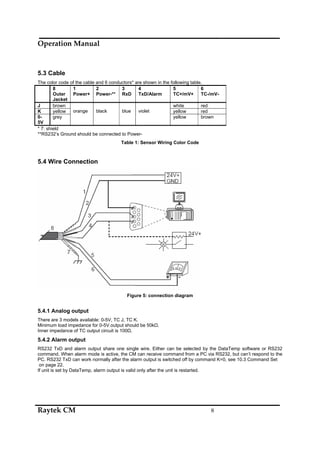
5.4 Wire Connection


                                            Figure 5: connection diagram


5.4.1 Analog output
There are 3 models available: 0-5V, TC J, TC K.
Minimum load impedance for 0-5V output should be 50kΩ.
Inner impedance of TC output circuit is 100Ω.
5.4.2 Alarm output
RS232 TxD and alarm output share one single wire. Either can be selected by the DataTemp software or RS232
command. When alarm mode is active, the CM can receive command from a PC via RS232, but can’t respond to the
PC. RS232 TxD can work normally after the alarm output is switched off by command K=0, see 10.3 Command Set
 on page 22.
If unit is set by DataTemp, alarm output is valid only after the unit is restarted.


Raytek CM                                                                          8                                                          
Operation Manual


5.5 LED indicator and blink mode
You can easily find the unit health status by the following LED blink mode.

CM status      LED blink        LED status
normal         slow blink 1                ○
alarm          fast blink          ○ ○ ○ ○ ○ ○ ○ ○
out of range   double blink        ○ ○○○○○ ○ ○○○○○
unstable*      slow blink 2        ○○○ ○○○ ○○○ ○○○
alarm fault** always lighting
*unstable is typically caused by head ambient temperature fluctuations due to initial warm up or thermal shock
situations.
** alarm fault indicates the input of sensor’s alarm port is over current.
                                                Table 2: LED blink mode


                                9                                                                                     Raytek CM
Operation Manual

6 Software
Raytek DataTemp Multidrop software allows the configuration and monitoring of CM sensor operating parameters,
such as:
     Emissivity
     Transmissivity
     Averaging
     Peak hold
     Valley hold
     Temperature scale of analog output
     Alarm temperature value
     1 point field calibration offset
     Alarm output
Refer to DataTemp software manual (on the software CD) for more detail.

Notes for CM sensors:
1. Use the Temperature unit in Degree C for field calibration, if in Degree F, there is no effect.
2. CM shares the alarm line with the RS232 TxD and the alarm function will be temporarily turned off and changed
    to RS232 mode when connecting to the DataTemp software. After re-powering the sensor without connecting to
    the DateTemp software, the alarm mode will function normally.


Raytek CM                                                                          10                                                         
Operation Manual

7 Accessories
7.1 Overview
For all models:
Fixed Mounting Bracket                    XXXCIACFB
Adjustable Mounting Bracket               XXXCIADJB
Air Purge Collar                          XXXCMACAP, XXXCMACAPM
Right Angle Mirror                        XXXCMACRA, XXXCMACRAM
Protective Window                         XXXCMACPW, XXXCMACPWM


                        Adjustable Mounting Bracket


                Air Purge Collar

                                                   Fixed Mounting
                                                   Bracket
    Protective Window


         Right Angle Mirror


                                   Figure 6: Overview of available accessories


                              11                                                                                     Raytek CM
Operation Manual

7.2 Fixed Mounting Bracket


                                Figure 7: Dimensions of Fixed Mounting Bracket


7.3 Adjustable Mounting Bracket


                            Figure 8: Dimensions of Adjustable Mounting Bracket


Raytek CM                                                                          12                                                         
Operation Manual


7.4 Air Purge Collar
The Air Purge Collar is used to keep dust, moisture, airborne particles, and vapors away from the lens. It
can be mounted before or after the bracket. It has the push-in fitting. A 4mm outside diameter plastic
tubing is recommended to connect the fitting. Air flows into the fitting and out the front aperture. The
pressure of air should be between 0.6 and 1 bar. Clean, oil free air is recommended.


                                   Figure 9: Dimensions of Air Purge Collar


                            13                                                                                     Raytek CM
Operation Manual


7.5 Right Angle Mirror
The Right Angle Mirror is used to turn the field of view by 90° against the sensor axis. It is recommended when space
limitations or excessive radiation do not allow for direct alignment of the sensor to the target. The mirror must be
installed after the bracket and after the Air Purge Collar and screwed in fully. In dusty or contaminated environments,
air purging is required to keep the mirror surface clean.


                                     Figure10: Dimension of Right Angle Mirror

            When using the Right Angle Mirror, adjust the emissivity or transmissivity settings downward by
            5%. For example, for an object with an emissivity of 0.65, you adjust the value down to 0.62. Or,
            you can keep the emissivity 0.65 and adjust the transmissivity from 1.0 to 0.95. This correction
            accounts for energy losses in the mirror.


7.6 Protective Window
Determination of transmissivity of an unknown protective window:
If transmissivity of the measuring screen is not indicated on the data sheet, you can also determine the transmissivity
yourself. Please proceed as follows:
1. Measure the temperature of the target object with the sensing head, without using the protective window. Note
       correct setting of emissivity.
2. Insert the protective window in the sensing head.
3. Adjust the transmissivity in the software until the same temperature is displayed, as it was determined without
       the protective window.
For more information regarding the mounting of a protective window, see 9.5 Replacing a Protective Window
on page 18.


Raytek CM                                                                          14                                                         
Operation Manual

8 Programming
8.1 General Command Structure
Requesting a parameter
?ECR             “?“ is the command for “Request“
                 “E“ is the parameter requested
                 “CR“ (carriage return, 0Dh) is closing the request.
         It is possible to close with “CRLF“ (0D0Ah), but “LF” (0Ah) is not necessary.


          Setting a parameter (Poll Mode)
The parameter will be stored into the device flash memory.
E=0.975CR         “E“ is the parameter to be set
                  “=“ is the command for “set a parameter“
                  “0.975“ is the value for the parameter
        “CR“ (carriage return, 0Dh) is closing the request
          It is possible to close with “CRLF” (0D0Ah), but “LF” (0Ah) is not necessary.


           Setting a parameter without writing it into the device flash memory.
This function is for test purposes only.
E#0.975CR          “E“ is the parameter to be set
                   “#“ is the command for “set parameter without writing it into the Flash“
                   “0.975“ is the value for the parameter
                     “CR“ (carriage return, 0Dh) is closing the request.
           It is possible to close with “CRLF” (0D0Ah), but “LF” (0Ah) is not necessary.


         Device response format:
!E0.975CRLF    “!“ is the parameter for “Answer“
               “E“ is the Parameter
               “0.975“ is the value for the parameter
               “CRLF“ (0D0Ah) is closing the answer.

Error message
*Syntax Error       “*“ is the character for “Error“


8.2 Device Setup

8.2.1 Temperature Calculation
U=C              Physical Unit for the temperature value
E=0.950          Emissivity setting
XG=1.000         Setting for transmission

For the calculation of the temperature value, it is possible to set an offset (relative number to be added to the
temperature value).
DO=-0.3           Offset adjustment -0.3 for the temperature signal


8.2.2 Post Processing
The following parameters can be set to determine the post-processing mode

P=5              maximum hold, hold time: 5 sec
F=12.5           minimum hold, hold time: 12.5 sec
G=10             averaging, average time (90%): 10 sec


                              15                                                                                     Raytek CM
Operation Manual

8.3 Dynamic Data
To request the dynamic data, the following commands are available:

?T                 Target temperature
?I                 Detector ambient temperature
?XJ                Temperature of Thermocouple cold end (only valid for TC)
?Q                 energy value of the target temperature

To check for resets (e.g. power shut down) use the command XI. Notice, after a reset the unit is re- initialized.

?XI                asks for the reset status
!XI0               no reset occurred
!XI1               a reset occurred, new initialization of the unit

XI=0               sets the reset status back to 0


8.4 Device Control

8.4.1 Controlling the output for the target temperature
The output can provide a predefined value of full analog range when signal output is 0-5V.

?XO                Request for the output mode
O=25               output of a constant voltage at 1.25 V (25% of 0-5 V)
O=255              switches back to the temperature controlled output


8.4.2 Analog output, scaling
According to the temperature range of the model, it is possible to set the maximum voltage value according to a
temperature value (e.g., the maximum voltage (5V) shall represent 200℃). The same setting is possible for the
minimum value.

H=500              the maximum voltage value is set to 500℃
L=0                the minimum voltage value is set to 0℃

You cannot set these values for thermocouple output.
The minimum span between the maximum / minimum settings is 20 K.


8.4.3 Alarm output
The alarm output can be activated by various temperature variables:
    -   Internal sensing head temperature (normally open N.O. or normally closed N.C.)
    -   Target temperature, to be set to N.C. (relay contacts are closed while in home position) or N.O. (relay
        contacts are open while in home position)

K=0              alarm output disabled
K=4              Sensor head ambient temperature lower than threshold, relay N.O.
K= 2, XS=125.3 Target         temperature   lower       than      threshold,      relay              N.O.,      threshold
setting to 125.3℃(if U=C is set)


8.4.4 Factory default values
It is possible to reset the unit to the original factory default values.

XF                 factory default values will be set


Raytek CM                                                                          16                                                         
Operation Manual

9 Maintenance
Our customer service representatives are always at your disposal for any questions you might have. This service
includes any support regarding the proper application of your infrared measuring system, calibration or the solution to
customer-specific solutions as well as repair.
In many cases your problems will be application-specific and can possibly be solved over the telephone. So, if you
need to return equipment to us, please contact our Service Department before doing so. See phone and fax
numbers at the beginning of this document.

9.1 Troubleshooting Minor Problems
          Symptom                        Possible Cause                                          Solution
No Output                       Cable Disconnected                       Check Cable Connections
Erroneous Temperature           Field of View Obstructed                 Remove the Obstruction
Erroneous Temperature           Lens Dirty                               Clean the Lens
Erroneous Temperature           Wrong Emissivity Setting                 Correct the Setting
Temperature Fluctuates          Wrong Signal Processing                  Correct Peak, Valley, or Average Settings

                                                 Table 3: Troubleshooting


9.2 Error Codes
Error Codes (via RS232)

                                            Output Error Code Description
                                           T Temperature over range
                                           T Temperature under range
                                            Table 4: Error Codes (via RS232)


9.3 Automatic Error Indication
The automatic error indication (alarm output) shall warn the user and guarantee a secure output in the event of a
system error. In the first place, however, its task is to switch the system off in case of a faulty setup or a defect in the
sensing head or in the electronic circuits.


     Never rely exclusively on the automatic error indication when monitoring critical heating processes. It is
     strongly recommended to take additional safety measures.


                                17                                                                                     Raytek CM
Operation Manual


9.4 Cleaning the Lens
Care should be taken to keep the lens clean. Any foreign matter on the lens will affect the accuracy of the
measurements. Be sure to take care when cleaning the lens. Please observe the following:
1. Blow off loose particles with clean air.
2. Gently brush off remaining particles with a soft camel hair brush.
3.   To remove any severe contamination, use a clean, soft cloth dampened with distilled water. In any
     case, do not scratch the lens surface!
For fingerprints or other grease, use any of the following:
      Denatured alcohol
      Ethanol
     Kodak lens cleaner
Apply any of the above to the lens. Wipe gently with a clean, soft cloth until you see colors on the lens surface, then
allow to air dry. Never wipe the surface dry - this may scratch the surface. If the lens is contaminated with silicones
(e.g. from hand creams), clean it carefully using Hexane. Allow the lens to air dry.

             Do not use any ammonia or any cleaners containing ammonia to clean the lens. This may result
             in permanent damage to the lens’ surface.


9.5 Replacing a Protective Window
The sensors contain a thread for ease in replacing the protective window..
The window material is placed in a metal ring with a thread with an inner rubber gasket. This rubber gasket
hermetically seals the sensor against atmospheric contaminants.
Replace the protective window using the special tool supplied with the spare window. Put the tool into the slot on the
window’s mounting ring. Now gently unscrew the protective window from its mount by turning to the left. Take care to
screw on the new protective window as tight as possible, but do not over tighten.


Raytek CM                                                                          18                                                         
Operation Manual

10 Appendix
10.1 Determination of Emissivity
Emissivity is a measure of an object’s ability to absorb and emit infrared energy. It can have a value between 0 and
1.0. For example, a mirror has an emissivity of 0.1, while the so-called “Blackbody“ reaches an emissivity value of 1.0.
If a higher than actual emissivity value is set, the output will read low, provided the target temperature is above its
ambient temperature. For example, if you have set 0.95 and the actual emissivity is 0.9, the temperature reading will
be lower than the true temperature.

An object’s emissivity can be determined by one of the following methods:
1. Determine the actual temperature of the material using an RTD (PT100), a thermocouple, or any other suitable
    method. Next, measure the object’s temperature and adjust emissivity setting until the correct temperature value
    is reached. This is the emissivity for the measured material.
2. For relatively low temperatures (up to 260℃, 500℉), place a plastic sticker on the object to be measured. This
    sticker should be large enough to cover the target spot. Next, measure the sticker’s temperature using an
    emissivity setting of 0.95. Finally, measure the temperature of an adjacent area on the object and adjust the
    emissivity setting until the same temperature is reached. This is the emissivity for the measured material.
3. If possible, apply flat black paint to a portion of the surface of the object. The emissivity of the paint must be
    above 0.98. Next, measure the temperature of the painted area using an emissivity setting of 0.98. Finally,
    measure the temperature of an adjacent area on the object and adjust the emissivity until the same temperature
    is reached. This is the emissivity for the measured material.

10.2 Typical Emissivity Values
The following table provides a brief reference guide for determining emissivity and can be used when one
of the above methods is not practical. Emissivity values shown in the table are only approximate, since
several parameters may affect the emissivity of a material. These include the following:
1.   Temperature
2.   Angle of measurement
3.   Geometry (plane, concave, convex)
4.   Thickness
5.   Surface quality (polished, rough, oxidized, sandblasted)
6.   Spectral range of measurement
7.   Transmissivity (e.g. thin films plastics)
8.
                     METAL Material                                      Emissivity ( Spectral range 8~14µm)
     Aluminum
        Unoxidized                                         0.02-0.1
        Oxidized                                           0.2-0.4
        Alloy A3003, Oxidized                              0.3
        Roughened                                          0.1-0.3
        Polished                                           0.02-0.1
     Brass
        Polished                                           0.01-0.05
        Burnished                                          0.3
        Oxidized                                           0.5
     Chromium                                              0.02-0.2
     Copper
        Polished                                           0.03
        Roughened                                          0.05-0.1
        Oxidized                                           0.4-0.8
     Gold                                                  0.01-0.1
     Haynes
        Alloy                                              0.3-0.8
     Inconel


                                19                                                                                     Raytek CM
Operation Manual

        Oxidized                                        0.7-0.95
        Sandblasted                                     0.3-0.6
        Electropolished                                 0.15
     Iron
        Oxidized                                        0.5-0.9
        Unoxidized                                      0.05-0.2
        Rusted                                          0.5-0.7
        Molten                                          —
     Iron, Cast
        Oxidized                                        0.6-0.95
        Unoxidized                                      0.2
        Molten                                          0.2-0.3
     Iron, Wrought
        Dull                                            0.9
     Lead
        Polished                                        0.05-0.1
        Rough                                           0.4
        Oxidized                                        0.2-0.6
     Magnesium                                                0.02-0.1
     Mercury                                            0.05-0.15
     Molybdenum
        Oxidized                                        0.2-0.6
        Unoxidized                                      0.1
        Monel (Ni-Cu)                                   0.1-0.14
     Nickel
        Oxidized                                        0.2-0.5
        Electrolytic                                    0.05-0.15
     Platinum
        Black                                           0.9
     Silver                                             0.02
     Steel
         Cold-Rolled                                    0.7-0.9
         Ground Sheet                                   0.4-0.6
         Polished Sheet                                 0.1
         Molten                                         —
         Oxidized                                       0.7-0.9
         Stainless                                      0.1-0.8
     Tin (Unoxidized)                                   0.05
     Titanium
         Polished                                       0.05-0.2
         Oxidized                                       0.5-0.6
     Tungsten                                           0.03
        Polished                                        0.03-0.1
     Zinc
        Oxidized                                        0.1
        Polished                                        0.02
                                        Table 5: Typical Emissivity Values


Raytek CM                                                                          20                                                         
Operation Manual


              NON-METAL Material                                  Emissivity ( Spectral range 8~14µm)
   Asbestos                                      0.95
   Asphalt                                             0.95
   Basalt                                        0.7
   Carbon
      Unoxidized                                       0.8-0.9
      Graphite                                   0.7-0.8
      Carborundum                                0.9
   Ceramic                                       0.95
   Clay                                          0.95
   Concrete                                      0.95
   Cloth                                         0.95
   Glass
      Plate                                      0.85
      “Gob”                                      —
   Gravel                                        0.95
   Gypsum                                        0.8-0.95
   Ice                                           0.98
   Limestone                                     0.98
   Paint (non-al.)                               0.9-0.95
   Paper (any color)                             0.95
   Plastic (opaque, over 20 mils)                0.95
   Rubber                                        0.95
   Sand                                          0.9
   Snow                                          0.9
   Soil                                          0.9-0.98
   Water                                         0.93
   Wood, Natural                                 0.9-0.95
                                       Table 6: Typical Emissivity Values 


To optimize surface temperature measurements, consider the following guidelines: 

    Determine the object emissivity using the instrument that will also be used for the measurements.
    Avoid reflections by shielding the object from surrounding temperature sources.
    For higher temperature objects, use instruments with the shortest wavelength possible.
    For translucent materials, such as plastic foils or glass, assure that the background is uniform and lower in
    temperature than the object.


                            21                                                                                     Raytek CM
Operation Manual


10.3 Command Set
                                      FORMAT SET
 Description         char    Format    P S Example
 Poll parameter      ?       ?X        √     ?T
 Set parameter       =       X=           √ E=0.85
 Set without
 Save                #       X#        √ E#0.85
                                FORMAT RESPONSE
 Description         char    Format       Example
 Acknowledge         !       !XXX         !T020.0
 Error message       *                    *Syntax error

                                     COMMAND LIST
                                                                             Factory
 Description         Char    Format    P    S   Legal values                 default
 Device
 adjustment
 gain**              DG      n.nnnn    √    √   0.8000~1.2000                           1
 Device
 adjustment
 offset **           DO      nn.n      √    √   -20.0~+20.0 ℃                           0
 Device special
 Info.               DS      XXX       √        z.B. !DSRAY                      DSRAY
 Emissivity
 internal            E       n.nnn     √    √   0.100~1.100                         0.95
                                                0.100~998.9 secs
 Valley hold time    F       nnn.n     √    √   (999=infinite)                           0
 Average time        G       nnn.n     √    √   0.100~998.9 secs                         0
 Top of mV range     H       nnnn.n    √    √   0~500℃                                 500
 Sensor/head
 ambient             I       nnn.n     √        In current scale(℃/℉)
 Relay alarm         K       n         √    √
 output control                                 0=Alarm Off
                                                1=Alarm On
                                                2=Target, normal open
                                                3=Target, normal close
                                                4=Head, normal open
                                                5=Head, normal close
                                                6=Over current protect *
 Bottom of mV
 range               L       nnnn.n    √    √   -20~480℃                               -20
 Output              O       nnn       √    √   0-100=% of full range
 voltage***                                     255=controlled by unit
                                                0.100~998.9 secs
 Peak hold time      P       nnn.n     √    √   (999=infinite)                           0
 Power               Q       nnnnn     √
 Target
 temperature         T       nnnn.n    √        In current scale(℃/℉)
 Temperature
 unit                U       X         √    √   ℃/℉                                     C
 Device bottom
 range limit         XB      nnnn.n    √        -20℃                                   -20
 Restore factory
 defaults            XF                     √


Raytek CM                                                                          22                                                         
Operation Manual

Transmission       XG     n.nnn       √    √    0.100~1.000                                  1
Device high
range limit        XH     nnnn.n      √         500℃                                      500
Sensor             XI     n           √    √    1 after RESET
initialization                                  0 if XI=0
TC cold end
temperature        XJ     nnn.n       √         In current scale(℃/℉)
Analog output      XO     n           √
                                                1=0-5V
mode
                                                2=TCJ
                                                3=TCK
FW revision         XR                √         e.g. 1.000
Setpoint/Relay
function            XS     nnnn.n √ √           -17.2~497.2℃                            497.2
Unit
identification      XU                √         e.g. !CMLTV
Serial number       XV                √         e.g. 00012345
* Poll only
** only available when unit is in ℃ mode
*** only available when unit is in mV mode
                                                Table 7: Command set


                             23                                                                                     Raytek CM

Raycmltv

  • 1.
    Infrared temperature Sensors Features: PVC cable ø17 (.67) .75"-16UNF 2A or • Can easily replace traditional contact ø4 (.17) 18M X1 metric thread probes with a J-type or k-typw thermo- couple output, or with a user scaleable ø19 (.75) 0-5V output • Wide -20 to 500°C (-4 to 932°F) temper- 19 73 (2.9) ature range (.75) 94 • Rugged iP 65 (nEMA 4) stainless steel (3.7) mm (inches) housing allows sensor to function in 1m (3.3 ft) cable standard ambient temperatures to 70°C (160°F) Maximum ambient temperature 105°C (220°F) without cooling • 13:1 optics at 90% energy Specifications: • Alarm output Temperature Range: -20 to 500°C (-4 to 932°F) • Adjustable target emissivity settings Accuracy: mV: ±1.5% of reading or ±2°C; • Adjustable window transmissivity setting t/c: ±1.5% of reading or ±4°C • Adjustable signal processing: Peak hold, Repeatbility: ±0.5% of reading or ±2°C Valley hold, variable averaging Resolution: 0.1°C • Sensor status/self-diagnostic LED indicates optical Resolution: 13:1 @ 90% energy normal operation, alarm, out of range, Spectral Response: 8 to 14 microns unstable, sensor fault Response Time: 150mSec • RS-232 digital interface allows user to con- Emissivity: 0.10 to 1.10 (adjustable) figure all programmable sensor variables Transmissivity: 0.10 to 1.00 (adjustable) with Data-Temp Multidrop software, outputs: Type J, Type k or scaleable 0-5V voltage included with each sensor Power: 12 - 24 VDC @ 20 mA output impedance: 100 Ω • Each sensor also includes 1m (3.3 ft) pre- Min. Load impedance: 50 kΩ installed cable, two mounting nuts and Power Supply: 12-24 VDC ±20% @ 10mA Quick Start Guide Digital output: Two-way RS-232 Alarm output: Transistor, 24VDC ±20% <20mA model Description price RAYCMLTV Voltage output, 0.75-16UnF 2A threaded SS housing, 1m (3.3 ft) cable $370 RAYCMLTVM Voltage output, 18Mx1 threaded SS housing, 1m (3.3 ft) cable $370 RAYCMLTV3 Voltage output, 0.75-16UnF 2A threaded SS housing, 3m (10 ft) cable $419 RAYCMLTV3M Voltage output, 18Mx1 threaded SS housing, 3m (10 ft) cable $419 RAYCMLTJ Type J T/C output, 0.75-16UnF 2A threaded SS housing, 1m (3.3 ft) cable $370 RAYCMLTJM Type J T/C output, 18Mx1 threaded SS housing, 1m (3.3 ft) cable $370 RAYCMLTJ3 Type J T/C output, 0.75-16UnF 2A threaded SS housing, 3m (10 ft) cable $419 RAYCMLTJ3M Type J T/C output, 18Mx1 threaded SS housing, 3m (10 ft) cable $419 RAYCMLTK Type k T/C output, 0.75-16UnF 2A threaded SS housing, 1m (3.3 ft) cable $370 RAYCMLTKM Type k T/C output, 18Mx1 threaded SS housing, 1m (3.3 ft) cable $370 RAYCMLTK3 Type k T/C output, 0.75-16UnF 2A threaded SS housing, 3m (10 ft) cable $419 RAYCMLTK3M Type k T/C output, 18Mx1 threaded SS housing, 3m (10 ft) cable $419 XXXCMACMN Stainless Steel Mounting nuts (2) $37 XXXCMACMNM Stainless Steel Mounting nuts (2), Metric Thread $37 XXXCIACFB Stainless Steel Fixed Bracket $57 XXXCIADJB Stainless Steel Adjustable Bracket $88 XXXCMACAP Stainless Steel Air Purge Collar $91 XXXCMACAPM Stainless Steel Air Purge Collar for Metric Threaded Housing $91 XXXCMACRA Right Angle Mirror $157 XXXCMACRAM Right Angle Mirror, Metric Thread $157 XXXCIDCPS 24VDC, 125mA Switching Power Supply $154 XXXCI1CON Thermocouple Cable Extension kit for CMJ Models $50 XXXCI2CON Thermocouple Cable Extension kit for CMK Models $50 RAYGPC 1/8 Din Panel Display & Power Supply $569 XXXCMACPW Protective Silicon Window $107 XXXCMACPWM Protective Silicon Window for Metric Models $107
  • 2.
    CI TWO YEAR LIMITED WARRANTY THERMALERT SERIES Raytek warrants this product to be free from defects in material and workmanship under normal use and service for a period of two years from date of purchase except as hereinafter provided. This warranty extends only to the original purchaser (a purchase from Raytek or Raytek’s licensed distributors is an original purchase). This warranty shall not apply to fuses or batteries. Factory calibra- tion is warranted for a period of one year. The warranty shall not apply to any product which has been subject to misuse, neglect, accident, or abnormal conditions of operation or storage. Should Raytek be unable to repair or replace the product within a reason- able amount of time, purchaser’s exclusive remedy shall be a refund of the purchase price upon return of the product. In the event of failure of a product covered by this warranty, Raytek will repair the instrument when it is returned by the purchaser, freight prepaid, to an authorized Service Facility within the applica- ble warranty period, provided Raytek’s examination discloses to its satisfaction that the product was defective. Raytek may, at its option, replace the product in lieu of repair. With regard to any cov- ered product returned within the applicable warranty period, repairs or replacement will be made without charge and with return freight paid by Raytek, unless the failure was caused by misuse, neglect, accident, or abnormal conditions of operation or storage, in which case repairs will be billed at a reasonable cost. In such a case, an estimate will be submitted before work is started, if requested. THERMALERT® CI™ THE FOREGOING WARRANTY IS IN LIEU OF ALL OTHER WAR- COMPACT INFRARED RANTIES, EXPRESSED OR IMPLIED, INCLUDING BUT NOT LIMITED TO ANY IMPLIED WARRANTY OF MERCHANTABILI- SENSOR TY, FITNESS, OR ADEQUACY FOR ANY PARTICULAR PURPOSE OR USE. RAYTEK SHALL NOT BE LIABLE FOR ANY SPECIAL, INCIDENTAL OR CONSEQUENTIAL DAMAGES, WHETHER IN OPERATOR’S GUIDE CONTRACT, TORT, OR OTHERWISE. Raytek, the Raytek Logo, and Thermalert are registered trademarks and CI is a trademark of Raytek Corporation Rev J 05/00 © Copyright 1996-2000 by Raytek Corporation 56800-1 THERMALERT CI ACCESSORIES The Thermalert® CI™ Compact Infrared Sensor series A full range of accessories for various applications and of online instruments are noncontact infrared tempera- industrial environments are available (see Figure 1). ture measurement systems. They are designed to meas- Accessories may be ordered at any time and added ure accurately and repeatably the amount of heat ener- on-site. Also available is a J- or K-type thermocouple gy emitted from an object and to convert that energy connection kit and extension cables. into a measurable electrical signal. Each model (see Table 1) comes with a 1 m (3 ft) cable and two mounting nuts and is designed for easy inte- Adjustable mounting bracket accessory gration into standard 4-wire systems. There are J or K thermocouple output models or 10 mV/°C voltage out- Fixed put models if your application is susceptible to noise or mounting bracket Mounting nuts requires a long cable run. The electronics are protected (2 supplied) accessory by a rugged NEMA 4 stainless steel housing. Sensor Table 1: Models Overall Air purge collar Model Output Temp. Range Accuracy accessory J Thermocouple 0 to 115˚ C (32 to 240˚ F) Sensor CI1A larger of ±2% or ± 3 ˚ C (± 6 ˚ F) 0 to 350˚ C 116 to 225˚ C (241 to 440˚ F) CI2A K Thermocouple Right angle mirror (32 to 662˚ F) larger of ± 5 % or ± 6 ˚ C (± 1 0˚ F) accessory CI3A Voltage 226 to 350˚ C (441 to 662˚ F) >±5% Air/Water-cooled housing with integrated air purge CI1B J Thermocouple (factory installed option) 100 to 500˚ C (212 to 932˚ F) larger of ± 2 % or ± 3 ˚ C (± 6 ˚ F) 30 to 500˚ C CI2B K Thermocouple (86 to 932˚F) 30 to 99˚ C (86 to 211˚ F) larger of ± 5 % or ± 6 ˚ C (± 1 0˚ F) Figure 1: Accessories and Options CI3B Voltage 1 2
  • 3.
    OPTIONS Table 2 (continued): Specifications Options for various applications and environments Electrical are available. Options are factory installed and must Power supply voltage 12 – 24 VDC @20 mA be ordered with base model units. These include the Maximum current draw ≤ 10 mA Ripple ≤ 2.5% following: Output impedance 50 ohms • NIST traceable certification Minimum load impedance 50K ohms • Air/Water-cooled housing (comes with integrated Outputs J or K thermocouple, air purging and high temperature cable) 10mV/˚C Linear Voltage • High temperature cable–260°C (500°F) maximum Environmental ambient temperature (comes standard with Sensing head rating IP 65, NEMA 4 air/water-cooled housing option) EMI Conducted noise immunity IEC 801-4, Level 1 • Longer 3 m (10 ft) standard cable Relative humidity 10 to 95%, non-condensing Storage temp. range -30 to 85˚ C (-22 to 185˚ F) SPECIFICATIONS Thermal shock Max error of 5˚ C (for ∆T=25˚) Table 2 (below and continued on Page 4) lists the sen- stabilization time=20 mins. Ambient operating range 0 to 70˚ C (32 to 160˚ F) sor’s optical, thermal, operational, electrical, environ- air cooling 0 to 94˚ C (32 to 200˚ F) mental, and physical specifications. water cooling 0 to 105˚ C (32 to 220˚ F) water cooling/high temp cable 0 to 260˚ C (32 to 500˚ F) Table 2: Specifications Physical Dimensions 19 mm dia x 87 mm L Optical Resolution 4:1 @ 90% energy (0.75 in dia x 3.4 in L) Spectral Response Range 7–18 µm Weight 130 g (4.5 oz) Material Stainless steel Thermal Measurement range See Table 1 Cable–Standard Detecting element Thermopile Maximum ambient temperature 105˚ C (220˚ F) Accuracy See Table 1 Material (type & color) PVC, grey Cable length 1 m (3 ft) Repeatability ±1% of reading Gauge AWG 24 (J, K t/c cable) Temperature coefficient 0.2˚ C per ˚C (0.2˚ F per ˚F) AWG 22 (10mV/˚C cable) Operational Cable–High Temperature Temperature resolution < 0.5˚ C (1˚ F) Maximum ambient temperature 260˚ C (500˚ F) Emissivity Fixed at 0.95 Material (type & color) Teflon, black Response time 350 mSec (95% response) Cable length 1 m (3 ft) Warm-up period < 1 minute Gauge AWG 24 Continued on next page 3 4 Optical Chart INSTALLATION Figure 2 shows you how to read the optical chart. The The installation process consists of the following: optical chart (Figure 3) indicates the nominal target • Preparation spot diameter at any given distance from the sensing • Mechanical Installation head and assumes 90% energy. • Electrical Installation Target spot size Diameter of target Distance from sensor The most important part of the installation process is at focus point spot size in inches to object in inches or feet preparation. Please read the following section thor- oughly before proceeding with the mechanical and electrical installations. Preparation Distance and Spot Size—The size of the area (spot size) you wish to measure determines the distance between the sensor and the target (see Figure 3 for dis- tances and spot sizes). The spot size must not be larg- er than the target. Mount the sensor so the measured Diameter of target spot is the same or smaller than the target. Figure 4 is Distance from sensor to spot size in millimeters object in millimeters or meters an overview of proper sensor placement. Focus Point D:S = Distance to spot divided by spot diameter at the focus point Far Field D:S = Ratio at distances greater than 10x the focus distance Best Good Incorrect Figure 2: How to Read the Optical Chart Sensor Target greater than spot size Target equal Background to spot size Target smaller than spot size Figure 3: Optical Chart Figure 4: Proper Sensor Placement 5 6
  • 4.
    Ambient Temperature—The sensinghead is designed Mechanical Installation to operate in ambient temperatures from 0 to 70°C (32 All sensors come with a 1 m (3 ft) cable and 2 mount- to 160°F). For ambient temperatures above 70°C ing nuts. You can mount the sensor in brackets or (160°F), a factory installed air/water-cooled housing cutouts of your own design, or you can use the fixed option is available that allows operation in ambient and adjustable mounting bracket accessories. Figures conditions up to 260°C (500°F) with water cooling. 5 through 7 show the mounting bracket accessories’ The air/water-cooled housing option comes with a and sensor’s dimensions. high-temperature cable and integrated air purging. Full R Atmospheric Quality—Smoke, fumes, dust, and other contaminants can coat the lens and cause erroneous ∅19 (.76) temperature readings. We recommend using the air purge collar accessory in these types of environments to keep the lens clean. (The air/water-cooled housing 38 (1.5) comes with integrated air purging.) 1.5 22 (.06) (.875) Electrical Interference—To minimize electrical or elec- tromagnetic interference or “noise,” mount the sensor 38 away from motors producing large step load changes. (1.5) 5 Wiring—Before installing, be sure to check the dis- (.196) tance between the sensor and the monitoring/control- ∅5 (.196) ling device. If necessary, extension cables are available as accessories. 2X 45˚ 2X 90˚ 38 Power—Have available a 12–24 VDC, 10 mA, power (1.5) supply. 2X 13 19 (2X .5) (.75) 38 (1.5) mm (inches) Figure 5: Fixed Mounting Bracket 7 8 Air/Water-cooled Housing with integrated air purge— 41 (1.625) 5 The air/water-cooled housing option (Figure 8) allows (.196) 22 ∅5 (.196) the sensor to withstand ambient temperatures up to (.875) 260° C (500° F) with water cooling and the high-temper- 2X 45˚ ature cable. (The high-temp cable is standard when the 2X 90˚ 38 housing is ordered as an option.) It has 1/8” NPT fit- (1.5) tings for water and air. Water temperature should be 59 (2.31) 15-30° C (60-86° F) for best performance. Chilled water ∅19 (.76) below 10° C (50° F) is not recommended. Without the Full R 2X 13 19 high-temperature cable, the sensor can withstand ambient (.75) (2X .5) temperatures only up to 105° C (220° F) with water cooling. 38 (1.5) ∅38 (1.5) ∅38 (1.5) 38 (1.5) mm (inches) ∅20 (0.8) 3/4"–16UNF 2A Figure 6: Adjustable Mounting Bracket 13 flats (0.5) 1 m (3 ft) 3/4"–16UNF 2A Front View Rear View PVC Cable ∅17 (.67) M18 x 1 (if ordered metric) ∅4 (.17) 10 96 12 (0.39) (3.79) (0.45) ∅14 (.56) ∅19 (.75) 1/8" NPT fittings (3) 19 63 7 (.75) (2.48) (.27) 89 (3.5) mm (inches) Figure 7: Sensor 6 ~ 25 ~ 13 (0.25) (~ 1) (~ 0.5) 25 (1) 118 (4.63) 137 (5.38) mm (inches) Figure 8: Air/Water-cooled Housing 9 10
  • 5.
    Air Purge Collar—Theair purge collar accessory Right Angle Mirror—The right angle mirror accessory (Figure 9) is used to keep dust, moisture, and other (Figure 10) allows a perpendicular view of a target. It contaminants away from the lens. It must be screwed may be used when space is limited or when you need in fully. Air flows into the 10/32” fitting and out the to avoid excessive radiation to the sensor. This can be front aperture. Clean or “instrument” air is recom- mounted either on the end of the sensor or on the air mended. The air purge collar accessory is not needed with purge collar, but not on the air/water-cooled housing. the air/water-cooled housing. Note: When using the right angle mirror, a small ∅35 Inside threads M18 x 1 (if ordered with metric threaded sensor) amount of energy emitted by the source is lost, which (1.38) results in a lower than actual temperature reading. To ∅19 (0.75) 3/4" – 16UNF 2A compute the corrected temperature, use this formula: 10/32" threads 35 T = 1.035Tm – .035Tamb (1.36) where T=corrected temperature, Tm=temperature read- ~ 25 ing with mirror, and Tamb=ambient temperature. All (~ 1) 61 11 (0.42) 9 temperatures are in either °C or °F. (2.38) 21 (0.37) (0.84) ∅20 (.8) 31 (1.21) mm (inches) 3/4"–16 UNF 2B Figure 9: Air Purge Collar Table 3: Recommended Water and Air Recommended Cooling water supply Temperature 15–30˚ C (60–86˚ F) 82 Flow rate 1.89 liters per min (0.5 gpm) Pressure drop (across unit only) < 0.69 bar (10 psi) 13 (.5) Cooling air supply Temperature < 30˚ C (< 86˚ F) Flow rate 70.8 liters per minute (2.5 SCFM) Pressure drop 20 (.8) (across unit only) < 0.34 bar (5 psi) Air purge air supply Temperature < 30˚ C (< 86˚ F) Flow rate 11.33 liters per minute (0.4 SCFM) 31 (1.25) mm (inches) Pressure drop (across unit only) < 0.34 bar (5 psi) Figure 10: Right Angle Mirror 11 12 Wiring—Wire the electronics cable using Figure 11 and Electrical Installation Table 4 or 5 (for high temp cables) as a guide. USE ONLY THE OUTPUT TYPE OF YOUR SENSOR. Sensor to Electronics Cable—The sensor to electron- WIRING TO THE WRONG OUTPUT WILL DAM- ics cable is a 1m (3 ft), 4-wire, PVC cable. One end is AGE THE SENSOR. Note in Figure 11 that the num- attached, at the factory, to the sensor head. The bers refer to the wire numbers in Table 4 or 5, which other end has two pairs of wires and a bare shield shows proper wiring connections based on insulation (ground) wire (see Figure 11). color coding. NOTE LABEL Wire Numbers The unlabeled pair of wires is for connecting to a (ON POWER (Refer to Table 4 or 5) controller or chart recorder or for attaching to a ther- SUPPLY WIRES ONLY) 1 mocouple plug (for connecting to a thermocouple 2 meter). DO NOT CONNECT TO A POWER SOURCE. Red (+) 3 The second pair of wires, with the label, is for con- necting to a power source. 4 12 – 24 VDC 5 (Shield) WARNING Figure 11: Wiring Configuration Incorrect wiring will cause severe, per- Table 4: Standard Cable Wiring manent damage to the sensor. Wire Output Label Number Wire Color Function Pay close attention to the wiring diagram in Output 1 White Signal + (Iron) Figure 11, and match your sensor to the appropri- J-type 2 Red (white stripe) Signal – (Constantan) ate output type in Table 4 or 5. Wire accordingly. Thermo- couple Power 3 Red (yellow stripe) Power Supply + Supply 4 Yellow Power Supply – DO NOT CONFUSE OUTPUT WIRES WITH – 5 Bare Shield Ground POWER SUPPLY WIRES. Output 1 Yellow Signal + (Chromel) K-type 2 Red (yellow stripe) Signal – (Alumel) Thermo- Power 3 Red (white stripe) Power Supply + couple Supply 4 White Power Supply – – 5 Bare Shield Ground Output 1 White Signal + 10mV/˚C 2 Green Signal Ground Voltage Power 3 Red Power Supply + Supply 4 Black Power Supply – – 5 Bare Shield Ground 14 13
  • 6.
    Table 5: HighTemperature Cable Wiring OPERATION Wire Once the sensor is in position and you have made sure Output Label Number Wire Color Function that the appropriate power, air, water, and cable con- Output 1 White Signal + (Iron) J-type 2 Red (white stripe) Signal – (Constantan) nections are secure, the system is ready for continuous Thermo- couple Power 3 Red Power Supply + operation. Supply 4 Yellow Power Supply – – 5 Bare Shield Ground To operate, complete the following simple steps: Output 1 Yellow Signal + (Chromel) K-type 2 Red Signal – (Alumel) 1. Turn on the power supply. Thermo- Power 3 Red (white stripe) Power Supply + couple Supply 4 White Power Supply – 2. Turn on the meter, chart recorder, or controller. – 5 Bare Shield Ground 3. Read/monitor the temperature. Output 1 Red Signal + 10mV/˚C 2 Yellow Signal Ground Voltage Power 3 Red (white stripe) Power Supply + Supply 4 White Power Supply – WARNING – 5 Bare Shield Ground If using the air/water-cooled housing, do not leave it in a heated environment with the Extension Cables—Extension cables are available as coolant turned off. Damage to the sensor and to accessories. Also available is a thermocouple connec- the housing can occur. tion kit. IMPORTANT MAINTENANCE AND Be aware of the following when using the sensor: TROUBLESHOOTING • If the sensor is exposed to significant changes in If your sensor is not performing as it should, try to ambient temperature (hot to cold or cold to hot), match the symptom in Table 6 to its probable cause. If allow 20 minutes for the temperature to stabilize the table does not help, call us at one of the phone before taking or recording measurements. numbers listed on the last page. • Do not operate the sensor near large electrical or Our customer service representatives are always at magnetic fields (e.g., around arc welders or induc- your disposal for application assistance, calibration, tion heaters). Electro-Magnetic Interference (EMI) repair, and solutions to specific questions or problems. can cause measurement errors. Contact our Service Department before returning any • Connectors or wires must be connected only to the equipment to us. In many cases, problems can be appropriate input jacks or terminals. solved over the telephone. 15 16 Table 6: Troubleshooting Symptom Probable Cause Solution No output No power to sensor Check the power supply Erroneous Temp. Incorrect wire Check wire color connection codes and reconnect Raytek Corporation Worldwide Headquarters Faulty sensor cable Verify cable continuity Box 1820, Santa Cruz, CA 95061-1820 Erroneous Temp. Phone: (831) 458-1110 (800) 227-8074 FAX: (831) 458-1239 Erroneous Temp. Field of view Remove obstruction obstruction Raytek GmbH European Headquarters Lens Cleaning—Keep the lens clean at all times. Blow Phone: 49 30 478 0080 FAX: 49 30 471 0251 off loose particles (if not using the air purge accessory) with clean compressed air, then carefully wipe surface Raytek do Brasil with moist cotten swab (water or water-based glass South American Headquarters Phone: 55 15 233 6338 cleaner). DO NOT use solvents. FAX: 55 15 233 6826 Raytek Mexico CE CONFORMITY FOR THE Mexico, Caribbean, and Central America Phone: 52 22 30 4380 EUROPEAN COMMUNITY FAX: 52 22 30 4438 Raytek Japan, Inc. Phone: 81 3 3822 5715 FAX: 81 3 3822 5712 This instrument conforms to the following standards: Raytek China Company Phone: 86 10 6437 0284 • EN50081-1:1992, Electromagnetic Emissions FAX: 86 10 6437 0285 • EN50082-1:1992, Electromagnetic Susceptibility Raytek UK Ltd. Phone: 441 908 630800 Emission tests were conducted over a frequency range FAX: 441 908 630900 of 30–1000 MHz and susceptibility tests over a range Raytek France of 27–500 MHz . The instrument’s average error in Phone: 33 1 64 53 1540 these frequency ranges is 1.0° C at an electric field FAX: 33 1 64 53 1544 strength of 3 V/m. At some frequencies the instru- ment may not meet its stated accuracy. 17
  • 7.
    CM Noncontact Temperature Measurementfor Industrial Applications & OEMs
  • 8.
    CM Highlights Measurement Specifications ■ Scaleable 0-5 V, type J or K output Temperature Range -20ºC to 500ºC (-4ºF to 932ºF) 1,2 ■ ide -20°C to 500°C (-4°F to 932°F) W Accuracy (mV) ± 1.5% of reading or ± 2ºC, whichever is greater temperature range Accuracy (t/c) ± 1.5% of reading or ± 4ºC, whichever is greater1,2,3 ■ Rugged IP 65 (NEMA-4) Spectral Response 8 to 14 microns stainless steel housing ■ Rugged 13:1 optics at 90% energy System Repeatability ± 0.5% of reading or ± 2ºC, whichever is greater ■ 150 mSec (95%) response time Temperature Resolution 0.1°C ■ Alarm output Response Time (95%) 150 mSec ■ ensor status/self diagnostic S Emissivity 0.10 to 1.10 (adjustable) indicator LED ■ S232 digital communications for R Transmissivity 0.10 to 1.00 (adjustable) sensor set-up and monitoring Signal Processing Peak hold, valley hold, variable averaging ■ Adjustable signal processing ® Self diagnostics/sensor status Normal operation, alarm, out of range, unstable, ■ DataTemp Multidrop sensor fault software compatible ■ ccessories for air purging and Bore-Sight tolerance 4 3º @ focal point A 1 lens protection Accuracy from -20 to 0ºC is ±3.5ºC 2 Accuracy and resolution specifications are valid for ambient temperature The Raytek® CM sensor provides the 23ºC ± 5ºC, e = 1.0 calibration geometry advantages of infrared temperature 3 Accuracy measured on the 0-5 VDC output or RS232 for t/c models is ± 1.5% measurement in a powerful, compact, of reading or ± 2ºC, whichever is greater integrated sensor. Designed for easy integration, the CM sensor can easily 4 Typical values measured at focal distance replace traditional contact probes with a J-type or K-type thermocouple output, or with a user scaleable 0-5 volt output, if your application is susceptible to noise. The CM sensor is designed to measure target temperatures ranging from -20°C to 500°C (-4°F to 932°F). The CM's onboard electronics are protected by a rugged IP 65 (NEMA-4) stainless steel housing, allowing the sensor to function in ambient temperatures to 70°C (160°F) without cooling. Nominal Optical Specifications Although small in size, the CM is loaded with advanced features. An RS232 digital D:S=13:1 at focal point Far field D:S=9:1 interface allows the user to configure all programmable sensor variables with the powerful DataTemp Multidrop software included with each sensor. These include a 24 volt DC alarm output triggered by target temperature or head ambient temperature, peak hold, valley hold or variable averaging signal processing, adjustable target emissivity settings and adjustable window transmissivity setting. The built-in sensor health LED provides a convenient on-line indicator of the sensor's operating status and aids in D:S is the optical resolution expressed as a ratio of the distance to the target troubleshooting initial sensor set up. spot divided by the diameter of the spot. Compact. Powerful. Easy to install. Nominal spot size based on 90% energy. Affordable. The Raytek CM sensor is the ideal solution for both OEM and end-user applications.
  • 9.
    Electrical Specifications Analog Outputs Model specific Type J, Type K or scaleable 0-5V voltage output Cable Length (3.3 ft) standard 1m 3m (9.8 ft) cables optional Thermocouple Output Impedance 100 ohms Voltage Output Minimum Load Impedance 50K ohms Power Supply 12–24 VDC ±20% @ 10mA Digital Output 5 Accessories Options Two-way RS232 digital output 5 Alarm Output Transistor, 24VDC ±20% 20mA 5 Digital output and alarm output share a common wire. Each CM sensor includes two mounting nuts, 1m (3.3ft.) of cable, User selects either alarm output or RS232 communication and a quick start guide. 3m (9.8ft) cables are also available. via Datatemp Multidrop software. Sensor Specifications Adjustable or fixed mounting bracket for Environmental Rating IP 65 (NEMA-4) sensing head (XXXCIADJB A bient Temperature Range 0ºC to 70°C (32ºF to 160°F) m or XXXCIACFB) Cable Temperature Range -30ºC to 105ºC (-22ºF to 220ºF) Storage Temperature -20ºC to 85°C (-4ºF to 185°F) Relative Humidity 10 to 95%, non-condensing Shock IEC 68-2-27 (MIL STD 810D) 50 g’s, 11 mSec, any axis Vibration IEC 68-2-27 (MIL STD 810D) ir purge jacket to keep lens A 3 g’s, any axis, 11–200 Hz or right angle mirror clean (XXXCMAP or XXXCMAPM Weight 1m cable model: 145 g (5.1 oz) for metric version) Sensor Dimensions Protective lens covering (XXXCMACPW or XXXCMACPWM) 94 (3.7) Right angle mirror to ease installation into tight locations (XXXCMACRA or XXXCMACRAM)
  • 10.
    Model Description RAYCMLT Raytek infrared temperature sensor Code A Output A B C J Type J Thermocouple Output K Type K Thermocouple Output RAYCMLT V Voltage Output (Linear, scaleable from 0-5V) Code B Cable Length Output Cable Housing Length Thread 1M (3.3ft) Cable 3 3M (9.8ft) Cable Code C Housing thread Typical Model RAYCMLTV3 Standard 0.75-16 UNF Number M 18 MX1 Metric Accessory Dimensions 2 41 (0.08) (1.625) 5 22 (.196) (.875) 5 (.196) 2X 45º 40 2X 90º (1.52) 59 Full R (2.31) 19 (.76) 2X 13 19 (.76) Full R (2X .50) 19 (.75) 38 38 (1.5) (1.5) 1.5 22 39 (.06) (.875) (1.54) Adjustable Mounting Bracket 38 (1.5) 5 (.196) Air purge collar 5 (.196) 2X 45∞ 2X 90º 38 (1.5) MI8 #1 21 3/4-16 UNF-2B (.83) 2X 13 19 (2X .5) (.75) 38 (1.5) mm (inches) 15.5 (.61) Fixed Mounting Bracket Protective Window Right angle mirror The Worldwide Leader in Noncontact Temperature Measurement Raytek Corporation Worldwide Headquarters Santa Cruz, CA USA Tel: 1 800 227 8074 (USA and Canada, only) www.raytek.com 1 831 458 3900 solutions@raytek.com European Headquarters Berlin, Germany France United Kingdom Tel: 49 30 4 78 00 80 Tel: 0800 888 244 Tel: +44 1908 630 800 raytek@raytek.de info@raytek.fr ukinfo@raytek.com China Headquarters Beijing, China Tel: 8610 6438 4691 info@raytek.com.cn To find a Raytek office near you, please visit www.raytek.com Worldwide Service Raytek offers services, including repair and calibration. For more information, contact your local office or e-mail support@raytek.com © 2009 Raytek Corporation (3449292 Rev. A) 4/2009 Raytek, the Raytek logo and Datatemp are registered trademarks of Raytek Corporation. Specifications subject to change without notice.
  • 11.
  • 12.
    Contacts Raytek Corporation Santa Cruz,CA USA Tel: +1 800 227 – 8074 or +1 831 458 – 3900 Fax: +1 831 458 – 1239 solutions@raytek.com Raytek GmbH Berlin, Germany Tel: +49 30 478008 – 0 Fax: +49 30 4710251 raytek@raytek.de Fluke Beijing Service Center Sales and technical support line (Raytek): (8610) 64384691 Service line: (8610) 4008103435 Service fax line: (8610) 65286307 Info@raytek.com.cn United Kingdom Raytek Japan, Inc. ukinfo@raytek.com info@raytekjapan.co.jp France info@raytek.fr © Raytek Corporation. Raytek is a registered trademark of Raytek Corporation. All rights reserved. Specifications subject to change without notice.
  • 13.
    WARRANTY The manufacturer warrantsthis product to be free from defects in material and workmanship under normal use and service for a period of two years from date of purchase except as hereinafter provided. This warranty extends only to the original purchaser. This warranty shall not apply to fuses or batteries. Factory calibration is warranted for a period of one year. The warranty shall not apply to any product that has been subject to misuse, neglect, accident, or abnormal conditions of operation or storage. Should the manufacturer be unable to repair or replace the product within a reasonable amount of time, purchaser’s exclusive remedy shall be a refund of the purchase price upon return of the product. In the event of failure of a product covered by this warranty, the manufacturer will repair the instrument when it is returned by the purchaser, freight prepaid, to an authorized Service Facility within the applicable warranty period, provided the manufacturer’s examination discloses to its satisfaction that the product was defective. The manufacturer may, at its option, replace the product in lieu of repair. With regard to any covered product returned within the applicable warranty period, repairs or replacement will be made without charge and with return freight paid by the manufacturer, unless the failure was caused by misuse, neglect, accident, or abnormal conditions of operation or storage, in which case repairs will be billed at a reasonable cost. In such a case, an estimate will be submitted before work is started, if requested. THE FOREGOING WARRANTY IS IN LIEU OF ALL OTHER WARRANTIES, EXPRESSED OR IMPLIED, INCLUDING BUT NOT LIMITED TO ANY IMPLIED WARRANTY OF MERCHANTABILITY, FITNESS, OR ADEQUACY FOR ANY PARTICULAR PURPOSE OR USE. THE MANUFACTURER SHALL NOT BE LIABLE FOR ANY SPECIAL, INCIDENTAL OR CONSEQUENTIAL DAMAGES, WHETHER IN CONTRACT, TORT, OR OTHERWISE.
  • 14.
    T ABLE OFC ONTENTS 1 Safety Instructions............................................................................................................................................................... 1  2 Description .............................................................................................................................................................................. 2  3 Technical Data ....................................................................................................................................................................... 3  3.1 PARAMETERS .....................................................................................................................................................3  3.2 OPTICAL DIAGRAM .............................................................................................................................................4  3.3 SCOPE OF DELIVERY ..........................................................................................................................................4  4 Basics ........................................................................................................................................................................................ 5  4.1 MEASUREMENT OF INFRARED TEMPERATURE ..................................................................................................5  4.2 SIGHT..................................................................................................................................................................5  4.3 AMBIENT TEMPERATURE ....................................................................................................................................5  4.4 ATMOSPHERIC QUALITY .....................................................................................................................................5  4.5 ELECTRICAL INTERFERENCE ..............................................................................................................................6  4.6 EMISSIVITY OF TARGET OBJECT ........................................................................................................................6  5 Install and Operation........................................................................................................................................................... 7  5.1 DIMENSIONS OF SENSOR ...................................................................................................................................7  5.2 MECHANICAL INSTALLATION...............................................................................................................................7  5.3 CABLE .................................................................................................................................................................8  5.4 WIRE CONNECTION ............................................................................................................................................8  5.4.1 Analog output ........................................................................................... 8  5.4.2 Alarm output ............................................................................................. 8  5.5 LED INDICATOR AND BLINK MODE ......................................................................................................................9  6 Software.................................................................................................................................................................................. 10  7 Accessories .......................................................................................................................................................................... 11  7.1 OVERVIEW ........................................................................................................................................................11  7.2 FIXED MOUNTING BRACKET .............................................................................................................................12  7.3 ADJUSTABLE MOUNTING BRACKET..................................................................................................................12  7.4 AIR PURGE COLLAR .........................................................................................................................................13  7.5 RIGHT ANGLE MIRROR .....................................................................................................................................14  7.6 PROTECTIVE WINDOW .....................................................................................................................................14  8 Programming........................................................................................................................................................................ 15  8.1 GENERAL COMMAND STRUCTURE ...................................................................................................................15  8.2 DEVICE SETUP .................................................................................................................................................15  8.2.1 Temperature Calculation ...................................................................... 15  8.2.2 Post Processing..................................................................................... 15  8.3 DYNAMIC DATA .................................................................................................................................................16  8.4 DEVICE CONTROL ............................................................................................................................................16  8.4.1 Controlling the output for the target temperature.............................. 16  8.4.2 Analog output, scaling .......................................................................... 16  8.4.3 Alarm output ........................................................................................... 16  8.4.4 Factory default values........................................................................... 16  9 Maintenance.......................................................................................................................................................................... 17  9.1 TROUBLESHOOTING MINOR PROBLEMS ..........................................................................................................17  9.2 ERROR CODES .................................................................................................................................................17  9.3 AUTOMATIC ERROR INDICATION ......................................................................................................................17  9.4 CLEANING THE LENS ........................................................................................................................................18  9.5 REPLACING A PROTECTIVE WINDOW ...............................................................................................................18  10 Appendix.............................................................................................................................................................................. 19  10.1 DETERMINATION OF EMISSIVITY ....................................................................................................................19  10.2 TYPICAL EMISSIVITY VALUES .........................................................................................................................19  10.3 COMMAND SET ...............................................................................................................................................22 
  • 15.
    Operation Manual 1 Safety Instructions Thisdocument contains important information, which should be kept at all times with the instrument during its operational life. Other users of this instrument should be given these instructions with the instrument. Eventual updates to this information must be added to the original document. The instrument can only be operated by trained personnel in accordance with these instructions and local safety regulations. Acceptable Operation This instrument is intended only for the measurement of temperature. The instrument is appropriate for continuous use. The instrument operates reliably in demanding conditions, such as in high environmental temperatures, as long as the documented technical specifications for all instrument components are adhered to. Compliance with the operating instructions is necessary to ensure the expected results. Unacceptable Operation The instrument should not be used for medical diagnosis. Replacement Parts and Accessories Use only original parts and accessories approved by the manufacturer. The use of other products can compromise the operational safety and functionality of the instrument. Instrument Disposal Disposal of old instruments should be handled according to professional and environmental regulations as electronic waste. Operating Instructions The following symbols are used to highlight essential safety information in the operating instructions: Helpful information regarding the optimal use of the instrument. Warnings concerning operation to avoid instrument damage. Warnings concerning operation to avoid personal injury. Pay particular attention to the following safety instructions. Use in 110 / 230 V electrical systems can result in electrical hazards and personal injury if not properly protected. All instrument parts supplied by electricity must be covered to prevent physical contact and other hazards at all times.   1                                                                                     Raytek CM
  • 16.
    Operation Manual 2 Description The CMminiature infrared sensors are high performance noncontact infrared temperature measurement systems. They measure the amount of energy emitted from an object accurately and repeatedly and convert the energy into temperature signal. The following analog outputs are available by different model: • 0-5Volt • J -Thermocouple • K-Thermocouple The LED on the back of CM shows the status of units. RAYCMLT * # Output Cable Length Thread Model Description RAYCMLT Raytek infrared temperature sensor * Output V Voltage Output (Linear, scaleable from 0-5V) J Type J Thermocouple output K Type K Thermocouple output # Cable Length 1M (3.3ft) Cable 3 3M (9.8ft) Cable Thread UNF thread M metric thread Typical Model Number RAYCMLTV3 Raytek CM                                                                          2                                                          
  • 17.
    Operation Manual 3 Technical Data 3.1Parameters Temperature range (℃) -20 … 500℃ Temperature range (℉) -4 … 932℉ Optical resolution 13:1 @ 150mm (90% energy) Spectral response 8 … 14μm Thermal Parameters Accuracy(Digital and Voltage)* ±1.5% of reading or ±2℃, whichever is greater Accuracy (TC)* ±1.5% of reading ±2℃ ,or ±4℃, whichever is greater Repeatability(Digital and Voltage) ±0.5% of reading or ±1℃, whichever is greater Repeatability(TC) ±0.5% of reading ±1℃ ,or ±2℃, whichever is greater Response time (95% energy) 150 ms Temperature resolution 0.1℃ (0.2℉) Emissivity 0.100 … 1.100 (adjustable) Transmissivity 0.100 … 1.000 (adjustable) Electrical Parameters Digital Output ** Two-way RS232 digital output Analog Output 0 to 5 V or TCJ or TCK output Alarm Output ** Transistor, 24VDC @ 20mA Power 24VDC± 20% @ 20mA General Parameters Environmental rating IP 65 (NEMA-4x) Ambient operating range -10 to 70℃ Storage temperature -20 to 85℃ Dimensions / Weight L: 94 mm; Ø: 19 mm / 200g Specifications subject to change without notice. *Accuracy(Digital and Voltage) from –20 to 0℃ is ± 3.5℃. Accuracy(TC) from –20 to 0℃ is ± 5.5℃. Accuracy measured at ambient temperature 23℃±5℃, e = 0.95 and calibration geometry. ** RS232 TxD and Alarm output share one single wire. Either can be selected by DataTemp or RS232 command. Declaration of Conformity for the European Community  This instrument conforms to the following standards:  EMC:  EN61326‐1:2006  Safety:  EN61010‐1:2001    3                                                                                     Raytek CM
  • 18.
    Operation Manual 3.2 Optical Diagram D:S @ focus point= 13:1 / 11.5mm @ 150mm D = Distance from sensor to target S = Spot Diameter (@90% energy) DISTANCE: SENSOR TO OBJECT(mm) SPOT DIA.(mm) D:S SPOT DIA.(in) DISTANCE: SENSOR TO OBJECT(in) Figure 1: How to read the optical diagram Calculating the Target Spot Size To calculate the target spot size from two known points within an optical diagram the following formula can be used: ⎡ (D − D n ) ⎤ S x = Sn + ⎢ x ⋅ (Sf − S n )⎥ ⎣ (D f − D n ) ⎦ Sx = unknown diameter of target spot Sn = smallest known diameter of target spot Sf = greatest known diameter of target spot Dx = distance to unknown target spot Dn = distance to smaller known target spot Df = distance to greater known target spot 3.3 Scope of Delivery All models are provided with: Mounting nuts Support software CD Quickstart Guide Raytek CM                                                                          4                                                          
  • 19.
    Operation Manual 4 Basics 4.1 Measurementof Infrared Temperature Everything emits an amount of infrared radiation according to its surface temperature. The intensity of the infrared radiation changes according to the temperature of the object. Depending on the material and surface properties, the emitted radiation lies in a wavelength spectrum of approximately 1 to 20 µm. The intensity of the infrared radiation (”heat radiation”) is dependent on the material. For many substances this material-dependent constant is known. It is referred to as the ”emissivity value”, see 10.2 Typical Emissivity Values on page 19. Infrared thermometers are optical-electronic sensors. These sensors are able to detect ”radiation of heat”. Infrared thermometers are made up of a lens, a spectral filter, a sensor, and an electronic signal- processing unit. The task of the spectral filter is to select the wavelength spectrum of interest. The sensor converts the infrared radiation into an electrical parameter. The connected electronics generate electrical signals for further analysis. As the intensity of the emitted infrared radiation is dependent on the material, the required emissivity can be selected on the sensor. The biggest advantage of the infrared thermometer is its ability to measure in the absence of contact. Consequently, surface temperatures of moving or hard to reach objects can easily be measured. 4.2 Sight To assure the target is bigger than the spot size, the distance between the sensor and the target should be nearer for a smaller target. Refer to the diagram below. Best Good Incorrect Sensor Target greater than spot size Target equal Background to spot size Target smaller than spot size Figure 2: Proper Sensor Placement 4.3 Ambient Temperature The sensing head should work under ambient operating range in Technical Data. 4.4 Atmospheric Quality In order to prevent damage to the lens and erroneous readings, the lens should always be protected from dust, smoke, fumes, and other contaminants. For this purpose an air purge collar is available. You should only use oil free, clean “instrument“ air.   5                                                                                     Raytek CM
  • 20.
    Operation Manual 4.5 Electrical Interference Tominimize electrical or electromagnetic interference, follow these precautions: Mount the sensor as far away as possible from possible sources of interference such as motorized equipment producing large step load changes. Ensure a fully insulated installation of the sensor (Avoid ground loops!). Make sure the shield wire in the sensor cable is earth grounded at one location. Don’t connect 24V power wire directly to the power network to avoid possible noise effect from it. 4.6 Emissivity of Target Object Determine the emissivity of the target object as described in appendix 10.1 Determination of Emissivity on page 19. If emissivity is low, measured results could be falsified by interfering infrared radiation from background objects (such as heating systems, flames, fireclay bricks, etc. close beside or behind the target object). This type of problem can occur when measuring reflecting surfaces and very thin materials such as plastic films and glass. This measuring error when measuring objects with low emissivity can be reduced to a minimum if particular care is taken during installation, and the sensing head is shielded from these reflecting radiation sources. Raytek CM                                                                          6                                                          
  • 21.
    Operation Manual 5 Install andOperation 5.1 Dimensions of Sensor All sensors and accessories are supplied with 3/4-16 UNF-2A or M18x1 thread Figure 3: Dimensions of sensor 5.2 Mechanical Installation All sensors come with a 1.0m (39inch) cable or 3.0m (117inch) and 2 mounting nuts. You can mount the sensor in brackets or cutouts of your own design, or you can use the mounting bracket accessories. Figure 4: sensor with fixed mounting bracket   7                                                                                     Raytek CM
  • 22.
    Operation Manual 5.3 Cable The colorcode of the cable and 6 conductors* are shown in the following table. 8 1 2 3 4 5 6 Outer Power+ Power-** RxD TxD/Alarm TC+/mV+ TC-/mV- Jacket J brown white red K yellow orange black blue violet yellow red 0- grey yellow brown 5V * 7: shield **RS232’s Ground should be connected to Power- Table 1: Sensor Wiring Color Code 5.4 Wire Connection Figure 5: connection diagram 5.4.1 Analog output There are 3 models available: 0-5V, TC J, TC K. Minimum load impedance for 0-5V output should be 50kΩ. Inner impedance of TC output circuit is 100Ω. 5.4.2 Alarm output RS232 TxD and alarm output share one single wire. Either can be selected by the DataTemp software or RS232 command. When alarm mode is active, the CM can receive command from a PC via RS232, but can’t respond to the PC. RS232 TxD can work normally after the alarm output is switched off by command K=0, see 10.3 Command Set on page 22. If unit is set by DataTemp, alarm output is valid only after the unit is restarted. Raytek CM                                                                          8                                                          
  • 23.
    Operation Manual 5.5 LED indicatorand blink mode You can easily find the unit health status by the following LED blink mode. CM status LED blink LED status normal slow blink 1 ○ alarm fast blink ○ ○ ○ ○ ○ ○ ○ ○ out of range double blink ○ ○○○○○ ○ ○○○○○ unstable* slow blink 2 ○○○ ○○○ ○○○ ○○○ alarm fault** always lighting *unstable is typically caused by head ambient temperature fluctuations due to initial warm up or thermal shock situations. ** alarm fault indicates the input of sensor’s alarm port is over current. Table 2: LED blink mode   9                                                                                     Raytek CM
  • 24.
    Operation Manual 6 Software Raytek DataTempMultidrop software allows the configuration and monitoring of CM sensor operating parameters, such as: Emissivity Transmissivity Averaging Peak hold Valley hold Temperature scale of analog output Alarm temperature value 1 point field calibration offset Alarm output Refer to DataTemp software manual (on the software CD) for more detail. Notes for CM sensors: 1. Use the Temperature unit in Degree C for field calibration, if in Degree F, there is no effect. 2. CM shares the alarm line with the RS232 TxD and the alarm function will be temporarily turned off and changed to RS232 mode when connecting to the DataTemp software. After re-powering the sensor without connecting to the DateTemp software, the alarm mode will function normally. Raytek CM                                                                          10                                                         
  • 25.
    Operation Manual 7 Accessories 7.1 Overview Forall models: Fixed Mounting Bracket XXXCIACFB Adjustable Mounting Bracket XXXCIADJB Air Purge Collar XXXCMACAP, XXXCMACAPM Right Angle Mirror XXXCMACRA, XXXCMACRAM Protective Window XXXCMACPW, XXXCMACPWM Adjustable Mounting Bracket Air Purge Collar Fixed Mounting Bracket Protective Window Right Angle Mirror Figure 6: Overview of available accessories   11                                                                                     Raytek CM
  • 26.
    Operation Manual 7.2 Fixed MountingBracket Figure 7: Dimensions of Fixed Mounting Bracket 7.3 Adjustable Mounting Bracket Figure 8: Dimensions of Adjustable Mounting Bracket Raytek CM                                                                          12                                                         
  • 27.
    Operation Manual 7.4 Air PurgeCollar The Air Purge Collar is used to keep dust, moisture, airborne particles, and vapors away from the lens. It can be mounted before or after the bracket. It has the push-in fitting. A 4mm outside diameter plastic tubing is recommended to connect the fitting. Air flows into the fitting and out the front aperture. The pressure of air should be between 0.6 and 1 bar. Clean, oil free air is recommended. Figure 9: Dimensions of Air Purge Collar   13                                                                                     Raytek CM
  • 28.
    Operation Manual 7.5 Right AngleMirror The Right Angle Mirror is used to turn the field of view by 90° against the sensor axis. It is recommended when space limitations or excessive radiation do not allow for direct alignment of the sensor to the target. The mirror must be installed after the bracket and after the Air Purge Collar and screwed in fully. In dusty or contaminated environments, air purging is required to keep the mirror surface clean. Figure10: Dimension of Right Angle Mirror When using the Right Angle Mirror, adjust the emissivity or transmissivity settings downward by 5%. For example, for an object with an emissivity of 0.65, you adjust the value down to 0.62. Or, you can keep the emissivity 0.65 and adjust the transmissivity from 1.0 to 0.95. This correction accounts for energy losses in the mirror. 7.6 Protective Window Determination of transmissivity of an unknown protective window: If transmissivity of the measuring screen is not indicated on the data sheet, you can also determine the transmissivity yourself. Please proceed as follows: 1. Measure the temperature of the target object with the sensing head, without using the protective window. Note correct setting of emissivity. 2. Insert the protective window in the sensing head. 3. Adjust the transmissivity in the software until the same temperature is displayed, as it was determined without the protective window. For more information regarding the mounting of a protective window, see 9.5 Replacing a Protective Window on page 18. Raytek CM                                                                          14                                                         
  • 29.
    Operation Manual 8 Programming 8.1 GeneralCommand Structure Requesting a parameter ?ECR “?“ is the command for “Request“ “E“ is the parameter requested “CR“ (carriage return, 0Dh) is closing the request. It is possible to close with “CRLF“ (0D0Ah), but “LF” (0Ah) is not necessary. Setting a parameter (Poll Mode) The parameter will be stored into the device flash memory. E=0.975CR “E“ is the parameter to be set “=“ is the command for “set a parameter“ “0.975“ is the value for the parameter “CR“ (carriage return, 0Dh) is closing the request It is possible to close with “CRLF” (0D0Ah), but “LF” (0Ah) is not necessary. Setting a parameter without writing it into the device flash memory. This function is for test purposes only. E#0.975CR “E“ is the parameter to be set “#“ is the command for “set parameter without writing it into the Flash“ “0.975“ is the value for the parameter “CR“ (carriage return, 0Dh) is closing the request. It is possible to close with “CRLF” (0D0Ah), but “LF” (0Ah) is not necessary. Device response format: !E0.975CRLF “!“ is the parameter for “Answer“ “E“ is the Parameter “0.975“ is the value for the parameter “CRLF“ (0D0Ah) is closing the answer. Error message *Syntax Error “*“ is the character for “Error“ 8.2 Device Setup 8.2.1 Temperature Calculation U=C Physical Unit for the temperature value E=0.950 Emissivity setting XG=1.000 Setting for transmission For the calculation of the temperature value, it is possible to set an offset (relative number to be added to the temperature value). DO=-0.3 Offset adjustment -0.3 for the temperature signal 8.2.2 Post Processing The following parameters can be set to determine the post-processing mode P=5 maximum hold, hold time: 5 sec F=12.5 minimum hold, hold time: 12.5 sec G=10 averaging, average time (90%): 10 sec   15                                                                                     Raytek CM
  • 30.
    Operation Manual 8.3 Dynamic Data Torequest the dynamic data, the following commands are available: ?T Target temperature ?I Detector ambient temperature ?XJ Temperature of Thermocouple cold end (only valid for TC) ?Q energy value of the target temperature To check for resets (e.g. power shut down) use the command XI. Notice, after a reset the unit is re- initialized. ?XI asks for the reset status !XI0 no reset occurred !XI1 a reset occurred, new initialization of the unit XI=0 sets the reset status back to 0 8.4 Device Control 8.4.1 Controlling the output for the target temperature The output can provide a predefined value of full analog range when signal output is 0-5V. ?XO Request for the output mode O=25 output of a constant voltage at 1.25 V (25% of 0-5 V) O=255 switches back to the temperature controlled output 8.4.2 Analog output, scaling According to the temperature range of the model, it is possible to set the maximum voltage value according to a temperature value (e.g., the maximum voltage (5V) shall represent 200℃). The same setting is possible for the minimum value. H=500 the maximum voltage value is set to 500℃ L=0 the minimum voltage value is set to 0℃ You cannot set these values for thermocouple output. The minimum span between the maximum / minimum settings is 20 K. 8.4.3 Alarm output The alarm output can be activated by various temperature variables: - Internal sensing head temperature (normally open N.O. or normally closed N.C.) - Target temperature, to be set to N.C. (relay contacts are closed while in home position) or N.O. (relay contacts are open while in home position) K=0 alarm output disabled K=4 Sensor head ambient temperature lower than threshold, relay N.O. K= 2, XS=125.3 Target temperature lower than threshold, relay N.O., threshold setting to 125.3℃(if U=C is set) 8.4.4 Factory default values It is possible to reset the unit to the original factory default values. XF factory default values will be set Raytek CM                                                                          16                                                         
  • 31.
    Operation Manual 9 Maintenance Our customerservice representatives are always at your disposal for any questions you might have. This service includes any support regarding the proper application of your infrared measuring system, calibration or the solution to customer-specific solutions as well as repair. In many cases your problems will be application-specific and can possibly be solved over the telephone. So, if you need to return equipment to us, please contact our Service Department before doing so. See phone and fax numbers at the beginning of this document. 9.1 Troubleshooting Minor Problems Symptom Possible Cause Solution No Output Cable Disconnected Check Cable Connections Erroneous Temperature Field of View Obstructed Remove the Obstruction Erroneous Temperature Lens Dirty Clean the Lens Erroneous Temperature Wrong Emissivity Setting Correct the Setting Temperature Fluctuates Wrong Signal Processing Correct Peak, Valley, or Average Settings Table 3: Troubleshooting 9.2 Error Codes Error Codes (via RS232) Output Error Code Description T Temperature over range T Temperature under range Table 4: Error Codes (via RS232) 9.3 Automatic Error Indication The automatic error indication (alarm output) shall warn the user and guarantee a secure output in the event of a system error. In the first place, however, its task is to switch the system off in case of a faulty setup or a defect in the sensing head or in the electronic circuits. Never rely exclusively on the automatic error indication when monitoring critical heating processes. It is strongly recommended to take additional safety measures.   17                                                                                     Raytek CM
  • 32.
    Operation Manual   9.4 Cleaning theLens Care should be taken to keep the lens clean. Any foreign matter on the lens will affect the accuracy of the measurements. Be sure to take care when cleaning the lens. Please observe the following: 1. Blow off loose particles with clean air. 2. Gently brush off remaining particles with a soft camel hair brush. 3. To remove any severe contamination, use a clean, soft cloth dampened with distilled water. In any case, do not scratch the lens surface! For fingerprints or other grease, use any of the following: Denatured alcohol Ethanol Kodak lens cleaner Apply any of the above to the lens. Wipe gently with a clean, soft cloth until you see colors on the lens surface, then allow to air dry. Never wipe the surface dry - this may scratch the surface. If the lens is contaminated with silicones (e.g. from hand creams), clean it carefully using Hexane. Allow the lens to air dry. Do not use any ammonia or any cleaners containing ammonia to clean the lens. This may result in permanent damage to the lens’ surface. 9.5 Replacing a Protective Window The sensors contain a thread for ease in replacing the protective window.. The window material is placed in a metal ring with a thread with an inner rubber gasket. This rubber gasket hermetically seals the sensor against atmospheric contaminants. Replace the protective window using the special tool supplied with the spare window. Put the tool into the slot on the window’s mounting ring. Now gently unscrew the protective window from its mount by turning to the left. Take care to screw on the new protective window as tight as possible, but do not over tighten. Raytek CM                                                                          18                                                         
  • 33.
    Operation Manual 10 Appendix 10.1 Determinationof Emissivity Emissivity is a measure of an object’s ability to absorb and emit infrared energy. It can have a value between 0 and 1.0. For example, a mirror has an emissivity of 0.1, while the so-called “Blackbody“ reaches an emissivity value of 1.0. If a higher than actual emissivity value is set, the output will read low, provided the target temperature is above its ambient temperature. For example, if you have set 0.95 and the actual emissivity is 0.9, the temperature reading will be lower than the true temperature. An object’s emissivity can be determined by one of the following methods: 1. Determine the actual temperature of the material using an RTD (PT100), a thermocouple, or any other suitable method. Next, measure the object’s temperature and adjust emissivity setting until the correct temperature value is reached. This is the emissivity for the measured material. 2. For relatively low temperatures (up to 260℃, 500℉), place a plastic sticker on the object to be measured. This sticker should be large enough to cover the target spot. Next, measure the sticker’s temperature using an emissivity setting of 0.95. Finally, measure the temperature of an adjacent area on the object and adjust the emissivity setting until the same temperature is reached. This is the emissivity for the measured material. 3. If possible, apply flat black paint to a portion of the surface of the object. The emissivity of the paint must be above 0.98. Next, measure the temperature of the painted area using an emissivity setting of 0.98. Finally, measure the temperature of an adjacent area on the object and adjust the emissivity until the same temperature is reached. This is the emissivity for the measured material. 10.2 Typical Emissivity Values The following table provides a brief reference guide for determining emissivity and can be used when one of the above methods is not practical. Emissivity values shown in the table are only approximate, since several parameters may affect the emissivity of a material. These include the following: 1. Temperature 2. Angle of measurement 3. Geometry (plane, concave, convex) 4. Thickness 5. Surface quality (polished, rough, oxidized, sandblasted) 6. Spectral range of measurement 7. Transmissivity (e.g. thin films plastics) 8. METAL Material Emissivity ( Spectral range 8~14µm) Aluminum Unoxidized 0.02-0.1 Oxidized 0.2-0.4 Alloy A3003, Oxidized 0.3 Roughened 0.1-0.3 Polished 0.02-0.1 Brass Polished 0.01-0.05 Burnished 0.3 Oxidized 0.5 Chromium 0.02-0.2 Copper Polished 0.03 Roughened 0.05-0.1 Oxidized 0.4-0.8 Gold 0.01-0.1 Haynes Alloy 0.3-0.8 Inconel   19                                                                                     Raytek CM
  • 34.
    Operation Manual Oxidized 0.7-0.95 Sandblasted 0.3-0.6 Electropolished 0.15 Iron Oxidized 0.5-0.9 Unoxidized 0.05-0.2 Rusted 0.5-0.7 Molten — Iron, Cast Oxidized 0.6-0.95 Unoxidized 0.2 Molten 0.2-0.3 Iron, Wrought Dull 0.9 Lead Polished 0.05-0.1 Rough 0.4 Oxidized 0.2-0.6 Magnesium 0.02-0.1 Mercury 0.05-0.15 Molybdenum Oxidized 0.2-0.6 Unoxidized 0.1 Monel (Ni-Cu) 0.1-0.14 Nickel Oxidized 0.2-0.5 Electrolytic 0.05-0.15 Platinum Black 0.9 Silver 0.02 Steel Cold-Rolled 0.7-0.9 Ground Sheet 0.4-0.6 Polished Sheet 0.1 Molten — Oxidized 0.7-0.9 Stainless 0.1-0.8 Tin (Unoxidized) 0.05 Titanium Polished 0.05-0.2 Oxidized 0.5-0.6 Tungsten 0.03 Polished 0.03-0.1 Zinc Oxidized 0.1 Polished 0.02 Table 5: Typical Emissivity Values Raytek CM                                                                          20                                                         
  • 35.
    Operation Manual NON-METAL Material Emissivity ( Spectral range 8~14µm) Asbestos 0.95 Asphalt 0.95 Basalt 0.7 Carbon Unoxidized 0.8-0.9 Graphite 0.7-0.8 Carborundum 0.9 Ceramic 0.95 Clay 0.95 Concrete 0.95 Cloth 0.95 Glass Plate 0.85 “Gob” — Gravel 0.95 Gypsum 0.8-0.95 Ice 0.98 Limestone 0.98 Paint (non-al.) 0.9-0.95 Paper (any color) 0.95 Plastic (opaque, over 20 mils) 0.95 Rubber 0.95 Sand 0.9 Snow 0.9 Soil 0.9-0.98 Water 0.93 Wood, Natural 0.9-0.95 Table 6: Typical Emissivity Values  To optimize surface temperature measurements, consider the following guidelines:  Determine the object emissivity using the instrument that will also be used for the measurements. Avoid reflections by shielding the object from surrounding temperature sources. For higher temperature objects, use instruments with the shortest wavelength possible. For translucent materials, such as plastic foils or glass, assure that the background is uniform and lower in temperature than the object.   21                                                                                     Raytek CM
  • 36.
    Operation Manual 10.3 Command Set FORMAT SET Description char Format P S Example Poll parameter ? ?X √ ?T Set parameter = X= √ E=0.85 Set without Save # X# √ E#0.85 FORMAT RESPONSE Description char Format Example Acknowledge ! !XXX !T020.0 Error message * *Syntax error COMMAND LIST Factory Description Char Format P S Legal values default Device adjustment gain** DG n.nnnn √ √ 0.8000~1.2000 1 Device adjustment offset ** DO nn.n √ √ -20.0~+20.0 ℃ 0 Device special Info. DS XXX √ z.B. !DSRAY DSRAY Emissivity internal E n.nnn √ √ 0.100~1.100 0.95 0.100~998.9 secs Valley hold time F nnn.n √ √ (999=infinite) 0 Average time G nnn.n √ √ 0.100~998.9 secs 0 Top of mV range H nnnn.n √ √ 0~500℃ 500 Sensor/head ambient I nnn.n √ In current scale(℃/℉) Relay alarm K n √ √ output control 0=Alarm Off 1=Alarm On 2=Target, normal open 3=Target, normal close 4=Head, normal open 5=Head, normal close 6=Over current protect * Bottom of mV range L nnnn.n √ √ -20~480℃ -20 Output O nnn √ √ 0-100=% of full range voltage*** 255=controlled by unit 0.100~998.9 secs Peak hold time P nnn.n √ √ (999=infinite) 0 Power Q nnnnn √ Target temperature T nnnn.n √ In current scale(℃/℉) Temperature unit U X √ √ ℃/℉ C Device bottom range limit XB nnnn.n √ -20℃ -20 Restore factory defaults XF √ Raytek CM                                                                          22                                                         
  • 37.
    Operation Manual Transmission XG n.nnn √ √ 0.100~1.000 1 Device high range limit XH nnnn.n √ 500℃ 500 Sensor XI n √ √ 1 after RESET initialization 0 if XI=0 TC cold end temperature XJ nnn.n √ In current scale(℃/℉) Analog output XO n √ 1=0-5V mode 2=TCJ 3=TCK FW revision XR √ e.g. 1.000 Setpoint/Relay function XS nnnn.n √ √ -17.2~497.2℃ 497.2 Unit identification XU √ e.g. !CMLTV Serial number XV √ e.g. 00012345 * Poll only ** only available when unit is in ℃ mode *** only available when unit is in mV mode Table 7: Command set   23                                                                                     Raytek CM