RANDSTAD 2040


Bart Vink – sr. programm manager / dep.director National Spatial Planning
Ministry of Infrastructure and the Environment, The Hague, Netherlands


                                                                            1
•   THE RANDSTAD
•   LONG TERM TRENDS AND CHALLENGES
•   THE MAKING OF..STRUCTURAL VISION RANDSTAD 2040
•   IMPLEMENTATION
•   ACTUAL CONTEXT


                                                 2
RANDSTAD in the WORLD


                        3
Randstad: historical development


1900                       1960                2010

Spatial planning in NL:
  • Prevented urban sprawl:
     kept open spaces open, safeguarding cultural+natural heritages
  • Planned ‘new towns’ to control urban growth
  • Supported the compactness of the cities
                                                                 4
NETHERLANDS vs. VLAANDEREN
            (FLANDERS)
…THE DUTCH CREATED THE NETHERLANDS….


                                       1776
IMPORTANCE OF THE RANDSTAD…


• a polycentric urban area
• 4 ‘large’ cities close to each other
• a ´green´ heart

• political, administrative, social and cultural heart of NL
• most important economic motor of NL (GRP: € 271,2 billion
  (2007), 51% of the national GDP)
• over 7 million inhabitants; 41,5% of the Dutch population on less
  than 20% of the Dutch territory

• one of the most densely populated areas in the OECD

                                                                 7
Randstad - a polycentric urban area


MONOCENTRIC


POLYCENTRIC


                                      8
Not one functional metropolitan area


Commuter patterns: 4 daily urban systems


                                           9
International importance

Strengths:
•Ports, airport, international accessibility

•Main offices multinationals, financial sector

•Creative sector, media, ict, urban tourism

•NGO’s and international institutions

•Scientific institutes

•Greenports

•BRP


 Although Amsterdam is relatively small: it
ranks high in international surveys,
compairible to Milan, Madrid, just after
London and Paris


                                                 10
Diversified service economy

•   Financial & business services
•   Logistics & trade
•   Creative industries, ICT, Tourism
•   Life science
•   Horticulture

Amsterdam as its primary city....
•   Amsterdam: internationally oriented business centre,
    creative activities , sciences, tourism, ict, media, port, airport
•   Rotterdam: worldwide logistic junction of Europe
•   The Hague: seat of organisations for peace and justice
•   Utrecht: concentration of national business, creative services, sciences


                                                                               11
NL IN 2040 ?


Long term
challenges
Challenges for the future.....


•   OECD: Diminishing traffic congestion, Improving housing market, governance
•   Longer term:
    Economic growth, climate change, energy supply, water safety

                                                                                 13
SPACE FOR LIVING AND WORKING
SPACE FOR SCHIPHOL AIRPORT


                     Tweede Terminal


                             Parallelle Kaagbaan
SPACE FOR WORKING


    Act / A4 werkstad    Port of Amsterdam


     Zuidas             Flower Mainport Aalsmeer
SPACE FOR AGRICULTURE


 Agricultural land use   Greenport Aalsmeer


   Dairy farming                  Bulbs
SPACE FOR DWELLINGS


            70.000      60.000


Challenge for housing            Restrictions for housing…..
SPACE FOR ACCESSIBILITY


                                    Expected congestion 2040


roads    Public transport   WATER
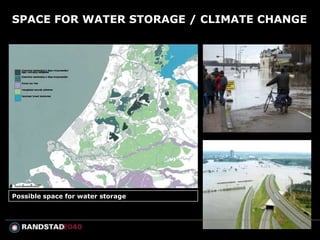
SPACE FOR WATER STORAGE / CLIMATE CHANGE


Possible space for water storage
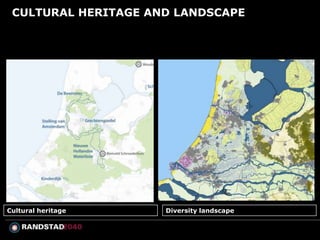
CULTURAL HERITAGE AND LANDSCAPE


Cultural heritage    Diversity landscape
ENERGY

                            2030


Wind turbines Afrikahaven    High-voltage pylons (380 kV)
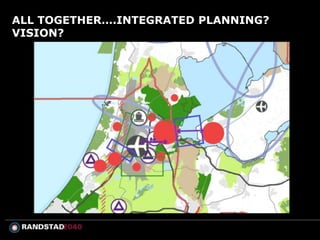
ALL TOGETHER….INTEGRATED PLANNING?
VISION?
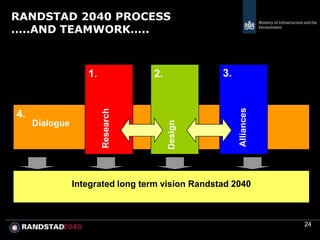
RANDSTAD 2040 PROCESS
…..AND TEAMWORK…..


                   1.              2.             3.


                                                       Alliances
                        Research
4.
     Dialogue


                                        Design
                Integrated long term vision Randstad 2040


                                                                   24
CONCEPTS AS INSPIRATION
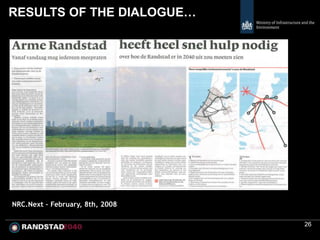
RESULTS OF THE DIALOGUE…


NRC.Next – February, 8th, 2008

                                 26
DESIGN AS A RESOURCE IN THE PROCESS


….STRONG, VIBRANT CITIES, SMART PEOPLE:
FOCUS ON ADDED VALUE, SERVICE DRIVEN
ECONOMY, QUALITY OF LIFE….
less focus on transport-oriented economy

ALSO MEANING: SPACE FOR ‘GREEN AND BLUE’
STRUCTURAL VISION


                    28
IMPLEMENTATION:   SPATIAL AGENDA…..
IMPLEMENTATION:…KEY-PROJECTS


                               30
EUROPEAN ‘TOP’ LOCATION: AMSTERDAM ZUIDAS
ACTUAL POLITICAL CONTEXT
• Constraints of the state budget / necessary cuts
• Economic challenges
• Focus on less state involvement and more ‘realisation power’


 ‘Economy first’
 Decentralisation of responsibilities
 Actualisation of state policy: more focus, less involvement
 Less regulations: ‘faster and better’ realisation


          ....for a competitive and sustainable future...


                                                                 32

Randstad2040

  • 1.
    RANDSTAD 2040 Bart Vink– sr. programm manager / dep.director National Spatial Planning Ministry of Infrastructure and the Environment, The Hague, Netherlands 1
  • 2.
    THE RANDSTAD • LONG TERM TRENDS AND CHALLENGES • THE MAKING OF..STRUCTURAL VISION RANDSTAD 2040 • IMPLEMENTATION • ACTUAL CONTEXT 2
  • 3.
  • 4.
    Randstad: historical development 1900  1960  2010 Spatial planning in NL: • Prevented urban sprawl: kept open spaces open, safeguarding cultural+natural heritages • Planned ‘new towns’ to control urban growth • Supported the compactness of the cities 4
  • 5.
  • 6.
    …THE DUTCH CREATEDTHE NETHERLANDS…. 1776
  • 7.
    IMPORTANCE OF THERANDSTAD… • a polycentric urban area • 4 ‘large’ cities close to each other • a ´green´ heart • political, administrative, social and cultural heart of NL • most important economic motor of NL (GRP: € 271,2 billion (2007), 51% of the national GDP) • over 7 million inhabitants; 41,5% of the Dutch population on less than 20% of the Dutch territory • one of the most densely populated areas in the OECD 7
  • 8.
    Randstad - apolycentric urban area MONOCENTRIC POLYCENTRIC 8
  • 9.
    Not one functionalmetropolitan area Commuter patterns: 4 daily urban systems 9
  • 10.
    International importance Strengths: •Ports, airport,international accessibility •Main offices multinationals, financial sector •Creative sector, media, ict, urban tourism •NGO’s and international institutions •Scientific institutes •Greenports •BRP  Although Amsterdam is relatively small: it ranks high in international surveys, compairible to Milan, Madrid, just after London and Paris 10
  • 11.
    Diversified service economy • Financial & business services • Logistics & trade • Creative industries, ICT, Tourism • Life science • Horticulture Amsterdam as its primary city.... • Amsterdam: internationally oriented business centre, creative activities , sciences, tourism, ict, media, port, airport • Rotterdam: worldwide logistic junction of Europe • The Hague: seat of organisations for peace and justice • Utrecht: concentration of national business, creative services, sciences 11
  • 12.
    NL IN 2040? Long term challenges
  • 13.
    Challenges for thefuture..... • OECD: Diminishing traffic congestion, Improving housing market, governance • Longer term: Economic growth, climate change, energy supply, water safety 13
  • 14.
    SPACE FOR LIVINGAND WORKING
  • 15.
    SPACE FOR SCHIPHOLAIRPORT Tweede Terminal Parallelle Kaagbaan
  • 16.
    SPACE FOR WORKING Act / A4 werkstad Port of Amsterdam Zuidas Flower Mainport Aalsmeer
  • 17.
    SPACE FOR AGRICULTURE Agricultural land use Greenport Aalsmeer Dairy farming Bulbs
  • 18.
    SPACE FOR DWELLINGS 70.000 60.000 Challenge for housing Restrictions for housing…..
  • 19.
    SPACE FOR ACCESSIBILITY Expected congestion 2040 roads Public transport WATER
  • 20.
    SPACE FOR WATERSTORAGE / CLIMATE CHANGE Possible space for water storage
  • 21.
    CULTURAL HERITAGE ANDLANDSCAPE Cultural heritage Diversity landscape
  • 22.
    ENERGY 2030 Wind turbines Afrikahaven High-voltage pylons (380 kV)
  • 23.
  • 24.
    RANDSTAD 2040 PROCESS …..ANDTEAMWORK….. 1. 2. 3. Alliances Research 4. Dialogue Design Integrated long term vision Randstad 2040 24
  • 25.
  • 26.
    RESULTS OF THEDIALOGUE… NRC.Next – February, 8th, 2008 26
  • 27.
    DESIGN AS ARESOURCE IN THE PROCESS ….STRONG, VIBRANT CITIES, SMART PEOPLE: FOCUS ON ADDED VALUE, SERVICE DRIVEN ECONOMY, QUALITY OF LIFE…. less focus on transport-oriented economy ALSO MEANING: SPACE FOR ‘GREEN AND BLUE’
  • 28.
  • 29.
    IMPLEMENTATION: SPATIAL AGENDA…..
  • 30.
  • 31.
  • 32.
    ACTUAL POLITICAL CONTEXT •Constraints of the state budget / necessary cuts • Economic challenges • Focus on less state involvement and more ‘realisation power’  ‘Economy first’  Decentralisation of responsibilities  Actualisation of state policy: more focus, less involvement  Less regulations: ‘faster and better’ realisation ....for a competitive and sustainable future... 32