Randomized Trials
Linda Ahdieh Grant
Epi 504D
Reading
ò  Chapter 7: Assessing the efficacy of preventive
and therapeutic measures: Randomized trials.
ò  Chapter 8: Randomized trials: Some further
issues.
Learning objectives
ò  Understand the uses of randomized trials
ò  Define the concept of randomization and its role on
randomized trials.
ò  Know the main variables collected from subjects in a
randomized trial.
ò  Distinguish crossover types in randomized trials
ò  Recognize internal and external validity of a randomized
trial
ò  Understand the principle of sample size and type I/II
error
Selected concepts
ò  Randomized trial
ò  Community-based trial
ò  Randomization
ò  Stratified randomization
ò  Masking
ò  Crossover
ò  Noncompliance
ò  Validity of a study
ò  Sample size
ò  Informed consent
Randomized trials
ò  Terminology:
ò  In clinical settings →	
  randomized clinical trials
ò  Outside clinical settings →	
  randomized community-
based trials.
ò  Uses
ò  Evaluation of new approaches to treatment and
prevention of disease such as:
ò  New drugs and other treatments for disease
ò  New screening programs
ò  New ways of organizing and delivering health
services
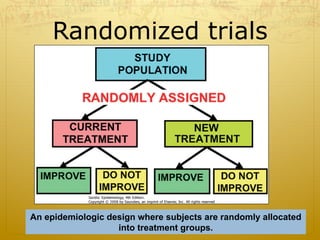
Randomized trials
An epidemiologic design where subjects are randomly allocated
into treatment groups.
Random allocation of
subjects
ò  Advantages
ò  Increases the likelihood that treatment groups are comparable
with regards to measured and unmeasured characteristics that
may affect prognosis
ò  Eliminates subjective biases that may be introduced into the
process of selecting patients for one treatment group versus
the other
ò  Concerns
ò  Should always aim to compare new treatment with currently
recommended treatment
ò  It is not always ethical to randomize subjects (this is the main
reason why most epidemiologic studies are observational in
nature)
Observational (I) versus
Experiemental (II) Studies
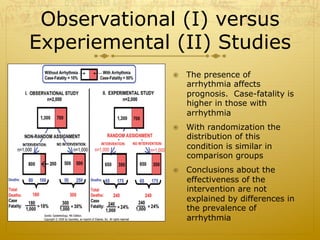
ž  The presence of
arrhythmia affects
prognosis. Case-fatality is
higher in those with
arrhythmia
ž  With randomization the
distribution of this
condition is similar in
comparison groups
ž  Conclusions about the
effectiveness of the
intervention are not
explained by differences in
the prevalence of
arrhythmia
Stratified randomization
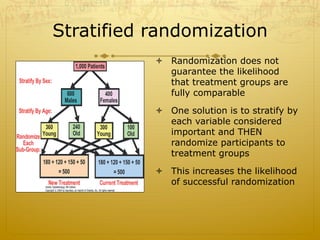
ò  Randomization does not
guarantee the likelihood
that treatment groups are
fully comparable
ò  One solution is to stratify by
each variable considered
important and THEN
randomize participants to
treatment groups
ò  This increases the likelihood
of successful randomization
Data collection on
subjects
ò  Need to know to which treatment group was
the subject assigned to
ò  Outcomes must be measured in the same way
in all treatment and non-treatment groups
ò  Check that randomization made treatment and
non-treatment groups similar regarding risk
factors for an outcome
ò  à remember arrhythmia example?
Masking (Blinding)
ò  Masking
ò  Also known as blinding
ò  Two approaches (can use one or both in the
same study)
ò  Keep study subjects from knowing which therapy
they received →	
  use of a placebo
ò  Keep the observer or data collectors unaware as
to which group a patient has been assigned
Crossover
ò  Planned crossover
ò  A method of comparing two or more treatments in
which the subjects, after being observed for some
time on one therapy, are switched to another therapy
and observed for a certain period of time.
ò  Issues:
ò  Carryover
ò  Order in which therapies are given may elicit
psychological responses
ò  Not possible if new therapy is surgical or cures the
disease
Crossover
ò  Unplanned crossover
ò  Poses a serious problem in analyzing the data
ò  Analysis options
ò  Analyze data according to intention to treat
ò  Analyze data after breaking the randomization
ò  If the number of crossover is large the meaning
of the results is questionable
Problems with randomized
trials
ò  Noncompliance
ò  Failure of patient to comply with the assigned
treatment
ò  Reduces any observed differences among treatment
groups
ò  People who do not comply or may not participate in
studies differ from those who do comply and who do
participate
ò  Drop-ins
ò  Patients in one group may inadvertently take the
agent assigned to the other group
Measures of disease
occurrence
ò  Measures typically used in randomized trials
ò  Incidence risk/rate
ò  Mortality rates
15
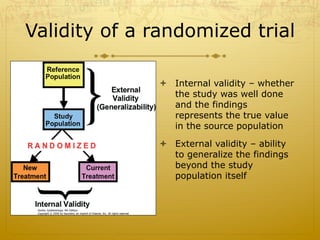
Validity of a randomized trial
ò  Internal validity – whether
the study was well done
and the findings
represents the true value
in the source population
ò  External validity – ability
to generalize the findings
beyond the study
population itself
Sample Size
ò  In order to make sure that a study gives
meaningful results, a sample size calculation
tells you how large of a sample you need with
the minimum amount of error
ò  See Figures 8-4 and 8-5 for description of
ò  Type I error
ò  Type II error
Sample Size - Example
ò  E.g., if doing a trial of on effect of statins on heart
disease, one bases sample size calculation on the
effect of statins, and not the effect of statins among
smokers
ò  Type 1 error: study shows statins do prevent
heart disease, but in reality there is no
association
ò  Type II error: study shows statins do not
prevent heart disease, but in reality there is an
association
Ethical conduct of research
ò  In the U.S., research conducted, supported or otherwise
regulated by Federal institutions, must follow the policy
established for the protection of human subjects
ò  It requires the establishment of an institutional review
board (IRB) in accord with and for the purposes
expressed in the policy
ò  IRB approval means the determination of the IRB that
the research has been reviewed and may be conducted
at an institution within the constraints set forth by the
IRB and by other institutional and federal requirements
ò  Without IRB approval it is not possible to obtain funding
to conduct a study
http://www.hhs.gov/ohrp/humansubjects/guidance/45cfr46.html
Ethical conduct of research
ò  Informed consent
ò  The U.S. code of Federal Regulations states that
no investigator may involve a human being as a
subject in research unless the investigator has
obtained the legally effective informed consent of
the subject or the subject's legally authorized
representative.

Randomized trials

  • 1.
  • 2.
    Reading ò  Chapter 7:Assessing the efficacy of preventive and therapeutic measures: Randomized trials. ò  Chapter 8: Randomized trials: Some further issues.
  • 3.
    Learning objectives ò  Understandthe uses of randomized trials ò  Define the concept of randomization and its role on randomized trials. ò  Know the main variables collected from subjects in a randomized trial. ò  Distinguish crossover types in randomized trials ò  Recognize internal and external validity of a randomized trial ò  Understand the principle of sample size and type I/II error
  • 4.
    Selected concepts ò  Randomizedtrial ò  Community-based trial ò  Randomization ò  Stratified randomization ò  Masking ò  Crossover ò  Noncompliance ò  Validity of a study ò  Sample size ò  Informed consent
  • 5.
    Randomized trials ò  Terminology: ò In clinical settings →  randomized clinical trials ò  Outside clinical settings →  randomized community- based trials. ò  Uses ò  Evaluation of new approaches to treatment and prevention of disease such as: ò  New drugs and other treatments for disease ò  New screening programs ò  New ways of organizing and delivering health services
  • 6.
    Randomized trials An epidemiologicdesign where subjects are randomly allocated into treatment groups.
  • 7.
    Random allocation of subjects ò Advantages ò  Increases the likelihood that treatment groups are comparable with regards to measured and unmeasured characteristics that may affect prognosis ò  Eliminates subjective biases that may be introduced into the process of selecting patients for one treatment group versus the other ò  Concerns ò  Should always aim to compare new treatment with currently recommended treatment ò  It is not always ethical to randomize subjects (this is the main reason why most epidemiologic studies are observational in nature)
  • 8.
    Observational (I) versus Experiemental(II) Studies ž  The presence of arrhythmia affects prognosis. Case-fatality is higher in those with arrhythmia ž  With randomization the distribution of this condition is similar in comparison groups ž  Conclusions about the effectiveness of the intervention are not explained by differences in the prevalence of arrhythmia
  • 9.
    Stratified randomization ò  Randomizationdoes not guarantee the likelihood that treatment groups are fully comparable ò  One solution is to stratify by each variable considered important and THEN randomize participants to treatment groups ò  This increases the likelihood of successful randomization
  • 10.
    Data collection on subjects ò Need to know to which treatment group was the subject assigned to ò  Outcomes must be measured in the same way in all treatment and non-treatment groups ò  Check that randomization made treatment and non-treatment groups similar regarding risk factors for an outcome ò  à remember arrhythmia example?
  • 11.
    Masking (Blinding) ò  Masking ò Also known as blinding ò  Two approaches (can use one or both in the same study) ò  Keep study subjects from knowing which therapy they received →  use of a placebo ò  Keep the observer or data collectors unaware as to which group a patient has been assigned
  • 12.
    Crossover ò  Planned crossover ò A method of comparing two or more treatments in which the subjects, after being observed for some time on one therapy, are switched to another therapy and observed for a certain period of time. ò  Issues: ò  Carryover ò  Order in which therapies are given may elicit psychological responses ò  Not possible if new therapy is surgical or cures the disease
  • 13.
    Crossover ò  Unplanned crossover ò Poses a serious problem in analyzing the data ò  Analysis options ò  Analyze data according to intention to treat ò  Analyze data after breaking the randomization ò  If the number of crossover is large the meaning of the results is questionable
  • 14.
    Problems with randomized trials ò Noncompliance ò  Failure of patient to comply with the assigned treatment ò  Reduces any observed differences among treatment groups ò  People who do not comply or may not participate in studies differ from those who do comply and who do participate ò  Drop-ins ò  Patients in one group may inadvertently take the agent assigned to the other group
  • 15.
    Measures of disease occurrence ò Measures typically used in randomized trials ò  Incidence risk/rate ò  Mortality rates 15
  • 16.
    Validity of arandomized trial ò  Internal validity – whether the study was well done and the findings represents the true value in the source population ò  External validity – ability to generalize the findings beyond the study population itself
  • 17.
    Sample Size ò  Inorder to make sure that a study gives meaningful results, a sample size calculation tells you how large of a sample you need with the minimum amount of error ò  See Figures 8-4 and 8-5 for description of ò  Type I error ò  Type II error
  • 18.
    Sample Size -Example ò  E.g., if doing a trial of on effect of statins on heart disease, one bases sample size calculation on the effect of statins, and not the effect of statins among smokers ò  Type 1 error: study shows statins do prevent heart disease, but in reality there is no association ò  Type II error: study shows statins do not prevent heart disease, but in reality there is an association
  • 19.
    Ethical conduct ofresearch ò  In the U.S., research conducted, supported or otherwise regulated by Federal institutions, must follow the policy established for the protection of human subjects ò  It requires the establishment of an institutional review board (IRB) in accord with and for the purposes expressed in the policy ò  IRB approval means the determination of the IRB that the research has been reviewed and may be conducted at an institution within the constraints set forth by the IRB and by other institutional and federal requirements ò  Without IRB approval it is not possible to obtain funding to conduct a study http://www.hhs.gov/ohrp/humansubjects/guidance/45cfr46.html
  • 20.
    Ethical conduct ofresearch ò  Informed consent ò  The U.S. code of Federal Regulations states that no investigator may involve a human being as a subject in research unless the investigator has obtained the legally effective informed consent of the subject or the subject's legally authorized representative.