




Chapter 13
Experimental Studies
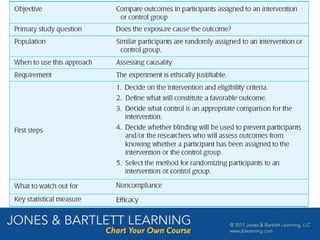
Overview
An experimental study assigns participants to
intervention and control groups in order to examine
whether an intervention causes an intended outcome.
Because the researcher assigns participants to receive a
particular exposure, the exact timing, dose, duration,
and frequency of the exposure are known.
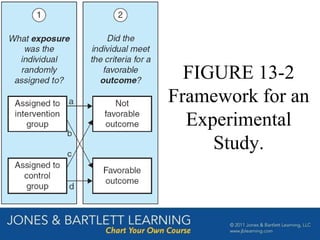
FIGURE 13-2
Framework for an
Experimental
Study.
RCTs
In a randomized controlled trial (RCT):
•Some participants are randomly assigned to an active
intervention group
•The remaining participants are assigned to a control
group
•All participants from both groups are followed forward
in time to see who has a favorable outcome and who
does not
Describing the Intervention
The research plan should carefully define:
•What the intervention will be
•Where and how participants will receive the
intervention
•When, how often, and for what duration participants
will receive the intervention
•Eligibility criteria for participants
Defining Outcomes
Most experimental studies are superiority trials that aim
to demonstrate that a new intervention is “better” than
some type of control.
Because the term “better” can be defined in so many
ways, the researcher must carefully define what
constitutes a favorable outcome for the experiment.
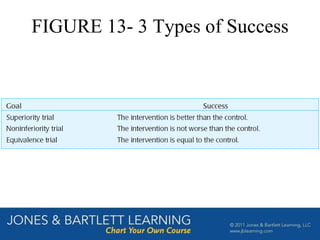
FIGURE 13- 3 Types of Success
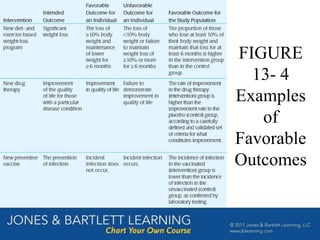
FIGURE
13- 4
Examples
of
Favorable
Outcomes
Selecting Controls
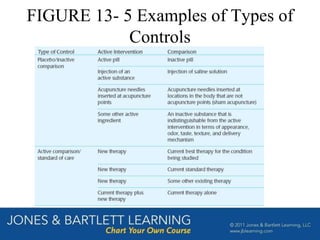
Experimental studies usually assign some participants to
the active intervention and the remainder to a control
group
•The most typical control is a placebo, an inactive
comparison that is similar to the therapy being tested
•Sometimes the new therapy is compared to some
existing “standard of care” or other therapy
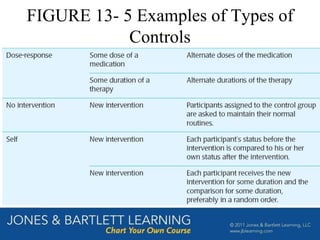
•Sometimes varying doses and durations of a therapy
may be compared to one another
FIGURE 13- 5 Examples of Types of
Controls
FIGURE 13- 5 Examples of Types of
Controls
Hawthorne bias
Hawthorne effect: participants in a study may change
their behavior for the better simply because they know
they are being observed
This may interfere with the accurate measurement of the
impact of the new intervention.
Blinding
Blinding = masking = participants in an experimental
study do not know whether they are in the active
intervention group or the control group
•In a single-blind study, participants are unaware of
their exposure status
•In a double-blind study, neither the participants nor the
persons assessing the participants’ health status know
which participants are in the active and control groups.
Blinding minimizes information bias
Randomization
A variety of approaches can be used to randomly
allocate participants to an active intervention group or a
control group, such as:
•Simple randomization
•Block randomization
•Stratified randomization
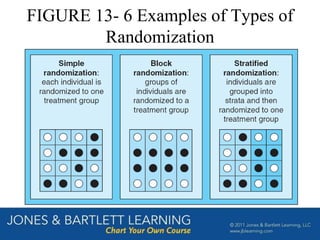
FIGURE 13- 6 Examples of Types of
Randomization
Ethical Considerations
Experimental studies involve a particularly high level of
ethical risk because the researcher assigns participants
to exposures that the participants do not choose and may
have been unlikely to encounter in normal life had they
not volunteered to participate in a research project.
Ethical Principles
• Equipoise: experimental research should be
conducted only when there is genuine uncertainty
about which treatment will work better
• Distributive justice: infers that the source population
must be an appropriate and non-exploitative one
• Beneficence (do good) and nonmaleficence (do not
harm): researchers must balance the likely benefits
and risks of the study
Ethical Principles
• Respect for persons:
– Participants must volunteer for a study without
being unduly influenced by the prospect of being
compensated for their participation
– Participants must be able to understand what it
means to be a research subject, including the
possibility of being assigned to a control group
instead of the new intervention
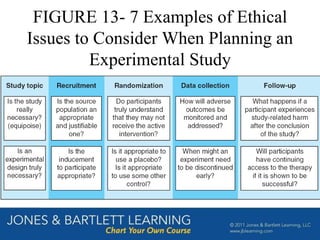
FIGURE 13- 7 Examples of Ethical
Issues to Consider When Planning an
Experimental Study
Analysis
Experimental studies use many of the same measures of
association that cohort studies do:
•Relative rates (RRs)
•Attributable risks (ARs, AR%s)
•Measures of survival
Experimental studies use these measures to examine the
impact of an assigned exposure on the likelihood of
having either a favorable or unfavorable outcome.
Analysis: Efficacy
Efficacy: the proportion of individuals in the control
group who experience an unfavorable outcome who
could have been expected to have a favorable outcome
had they been in the active group instead
A high efficacy is an indicator that an intervention is
successful.
Analysis: NNT
Number needed to treat (NNT): the expected number of
people who would have to receive a treatment to
prevent an unfavorable outcome in one person (or,
alternately stated, to achieve a favorable outcome in one
person)
A small NNT indicates a more effective intervention.
Analysis: NNT
• If a drug is intended to prevent stroke and has an
NNT of 5, then 5 people have to take the drug for one
year (or some other specified time period) to prevent
one of the 5 from having a stroke.
• If a drug has an NNT of 102, it means that 102 people
have to take the drug to prevent one of the 102 from
having a stroke.
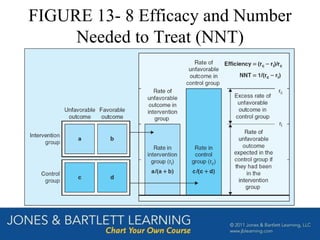
FIGURE 13- 8 Efficacy and Number
Needed to Treat (NNT)
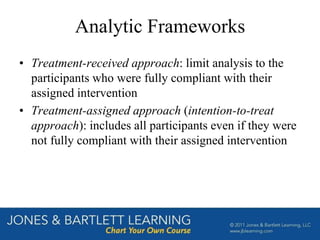
Analytic Frameworks
• Treatment-received approach: limit analysis to the
participants who were fully compliant with their
assigned intervention
• Treatment-assigned approach (intention-to-treat
approach): includes all participants even if they were
not fully compliant with their assigned intervention
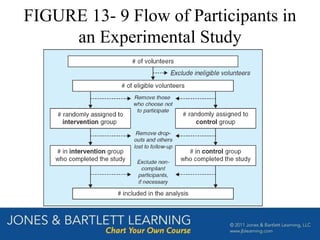
FIGURE 13- 9 Flow of Participants in
an Experimental Study
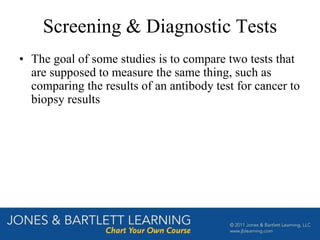
Screening & Diagnostic Tests
• The goal of some studies is to compare two tests that
are supposed to measure the same thing, such as
comparing the results of an antibody test for cancer to
biopsy results
Screening & Diagnostic Tests
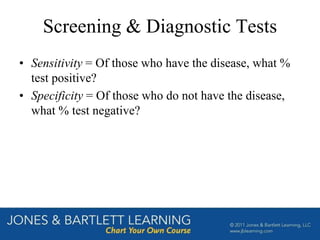
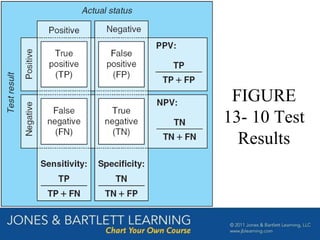
• Sensitivity = Of those who have the disease, what %
test positive?
• Specificity = Of those who do not have the disease,
what % test negative?
Screening & Diagnostic Tests
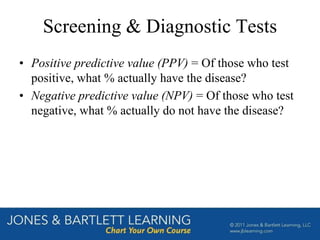
• Positive predictive value (PPV) = Of those who test
positive, what % actually have the disease?
• Negative predictive value (NPV) = Of those who test
negative, what % actually do not have the disease?
FIGURE
13- 10 Test
Results
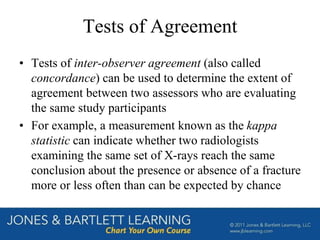
Tests of Agreement
• Tests of inter-observer agreement (also called
concordance) can be used to determine the extent of
agreement between two assessors who are evaluating
the same study participants
• For example, a measurement known as the kappa
statistic can indicate whether two radiologists
examining the same set of X-rays reach the same
conclusion about the presence or absence of a fracture
more or less often than can be expected by chance

83341 ch13 jacobsen

  • 2.
  • 3.
    Overview An experimental studyassigns participants to intervention and control groups in order to examine whether an intervention causes an intended outcome. Because the researcher assigns participants to receive a particular exposure, the exact timing, dose, duration, and frequency of the exposure are known.
  • 4.
    FIGURE 13-2 Framework foran Experimental Study.
  • 5.
    RCTs In a randomizedcontrolled trial (RCT): •Some participants are randomly assigned to an active intervention group •The remaining participants are assigned to a control group •All participants from both groups are followed forward in time to see who has a favorable outcome and who does not
  • 6.
    Describing the Intervention Theresearch plan should carefully define: •What the intervention will be •Where and how participants will receive the intervention •When, how often, and for what duration participants will receive the intervention •Eligibility criteria for participants
  • 7.
    Defining Outcomes Most experimentalstudies are superiority trials that aim to demonstrate that a new intervention is “better” than some type of control. Because the term “better” can be defined in so many ways, the researcher must carefully define what constitutes a favorable outcome for the experiment.
  • 8.
    FIGURE 13- 3Types of Success
  • 9.
  • 10.
    Selecting Controls Experimental studiesusually assign some participants to the active intervention and the remainder to a control group •The most typical control is a placebo, an inactive comparison that is similar to the therapy being tested •Sometimes the new therapy is compared to some existing “standard of care” or other therapy •Sometimes varying doses and durations of a therapy may be compared to one another
  • 11.
    FIGURE 13- 5Examples of Types of Controls
  • 12.
    FIGURE 13- 5Examples of Types of Controls
  • 13.
    Hawthorne bias Hawthorne effect:participants in a study may change their behavior for the better simply because they know they are being observed This may interfere with the accurate measurement of the impact of the new intervention.
  • 14.
    Blinding Blinding = masking= participants in an experimental study do not know whether they are in the active intervention group or the control group •In a single-blind study, participants are unaware of their exposure status •In a double-blind study, neither the participants nor the persons assessing the participants’ health status know which participants are in the active and control groups. Blinding minimizes information bias
  • 15.
    Randomization A variety ofapproaches can be used to randomly allocate participants to an active intervention group or a control group, such as: •Simple randomization •Block randomization •Stratified randomization
  • 16.
    FIGURE 13- 6Examples of Types of Randomization
  • 17.
    Ethical Considerations Experimental studiesinvolve a particularly high level of ethical risk because the researcher assigns participants to exposures that the participants do not choose and may have been unlikely to encounter in normal life had they not volunteered to participate in a research project.
  • 18.
    Ethical Principles • Equipoise:experimental research should be conducted only when there is genuine uncertainty about which treatment will work better • Distributive justice: infers that the source population must be an appropriate and non-exploitative one • Beneficence (do good) and nonmaleficence (do not harm): researchers must balance the likely benefits and risks of the study
  • 19.
    Ethical Principles • Respectfor persons: – Participants must volunteer for a study without being unduly influenced by the prospect of being compensated for their participation – Participants must be able to understand what it means to be a research subject, including the possibility of being assigned to a control group instead of the new intervention
  • 20.
    FIGURE 13- 7Examples of Ethical Issues to Consider When Planning an Experimental Study
  • 21.
    Analysis Experimental studies usemany of the same measures of association that cohort studies do: •Relative rates (RRs) •Attributable risks (ARs, AR%s) •Measures of survival Experimental studies use these measures to examine the impact of an assigned exposure on the likelihood of having either a favorable or unfavorable outcome.
  • 22.
    Analysis: Efficacy Efficacy: theproportion of individuals in the control group who experience an unfavorable outcome who could have been expected to have a favorable outcome had they been in the active group instead A high efficacy is an indicator that an intervention is successful.
  • 23.
    Analysis: NNT Number neededto treat (NNT): the expected number of people who would have to receive a treatment to prevent an unfavorable outcome in one person (or, alternately stated, to achieve a favorable outcome in one person) A small NNT indicates a more effective intervention.
  • 24.
    Analysis: NNT • Ifa drug is intended to prevent stroke and has an NNT of 5, then 5 people have to take the drug for one year (or some other specified time period) to prevent one of the 5 from having a stroke. • If a drug has an NNT of 102, it means that 102 people have to take the drug to prevent one of the 102 from having a stroke.
  • 25.
    FIGURE 13- 8Efficacy and Number Needed to Treat (NNT)
  • 26.
    Analytic Frameworks • Treatment-receivedapproach: limit analysis to the participants who were fully compliant with their assigned intervention • Treatment-assigned approach (intention-to-treat approach): includes all participants even if they were not fully compliant with their assigned intervention
  • 27.
    FIGURE 13- 9Flow of Participants in an Experimental Study
  • 29.
    Screening & DiagnosticTests • The goal of some studies is to compare two tests that are supposed to measure the same thing, such as comparing the results of an antibody test for cancer to biopsy results
  • 30.
    Screening & DiagnosticTests • Sensitivity = Of those who have the disease, what % test positive? • Specificity = Of those who do not have the disease, what % test negative?
  • 31.
    Screening & DiagnosticTests • Positive predictive value (PPV) = Of those who test positive, what % actually have the disease? • Negative predictive value (NPV) = Of those who test negative, what % actually do not have the disease?
  • 32.
  • 33.
    Tests of Agreement •Tests of inter-observer agreement (also called concordance) can be used to determine the extent of agreement between two assessors who are evaluating the same study participants • For example, a measurement known as the kappa statistic can indicate whether two radiologists examining the same set of X-rays reach the same conclusion about the presence or absence of a fracture more or less often than can be expected by chance