EXPERIMENTAL EPIDEMIOLOGY
Why RCT ?
Human experiments
TYPES OF EPIDEMIOLOGICAL
STUDIES
1. OBSERVATIONAL STUDIES
A. DESCRIPTIVE STUDY
DESCRIBE DIESEASE BY
TIME
PLACE
PERSON
B. ANALYTICAL STUDIES
ECOLOGICAL STUDY
CROSS SECTIONAL STUDY
CASE-CONTROL STUDY
COHORT STUDY
2. EXPEREMENTAL STUDIES
RANDOMIZED CONTROLLED TRIAL (RCT)
FIELD TRIAL
COMMUNITY TRIAL
“RCT" by Dr Naresh
7
Experimental studies
 In observational studies (eg. Descriptive,
case-control and cohort ) no action is
taken . The epidemiologist observe only
the natural course of event.
 The Experimental studies are similar to
cohort studies except they involve some
action, intervention, or manipulation
Aims of experimental studies
 To provide scientific proof of etiological (or
risk) factor which may permit modification
or control
 To provide the method of measuring the
effectiveness and efficiency of health
services for prevention, control and
treatment of disease and improve the
health of the community.
Types of Experimental studies
 Randomized Controlled Trials
 Non- Randomized or “Non- Experiment”
trials (those departing from strict randomization
for practical purposes )
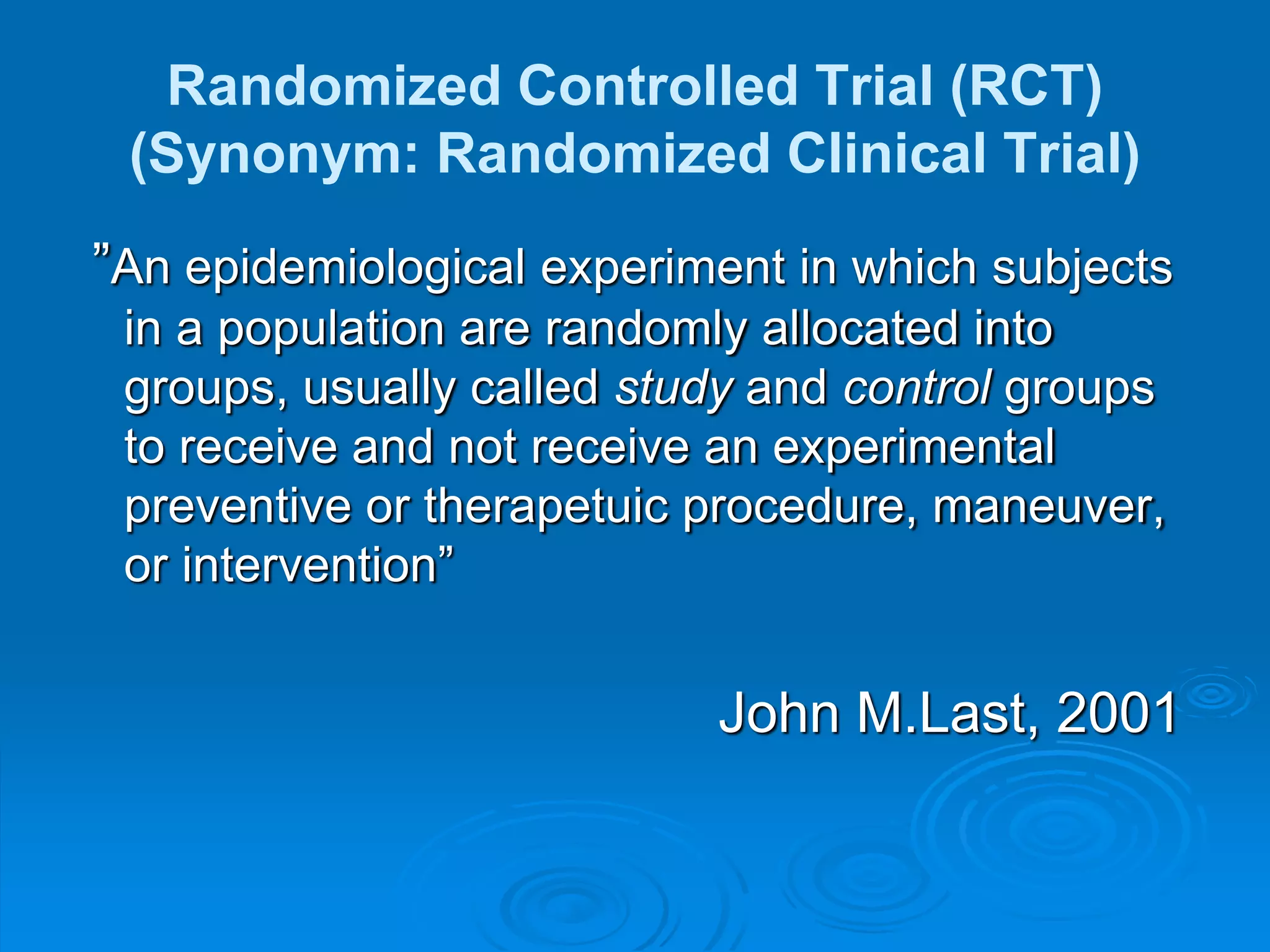
Randomized Controlled Trial (RCT)
(Synonym: Randomized Clinical Trial)
”An epidemiological experiment in which subjects
in a population are randomly allocated into
groups, usually called study and control groups
to receive and not receive an experimental
preventive or therapetuic procedure, maneuver,
or intervention”
John M.Last, 2001
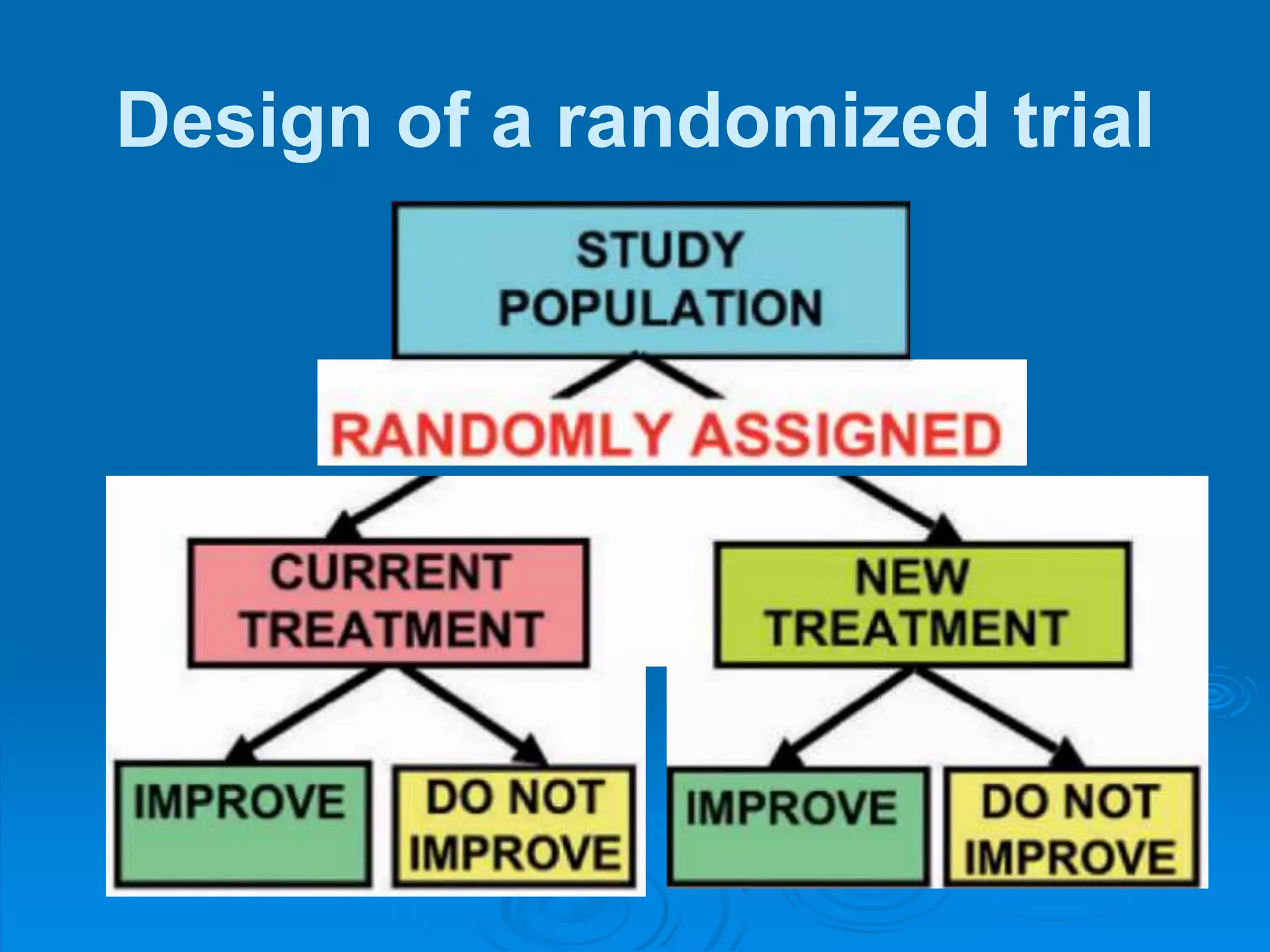
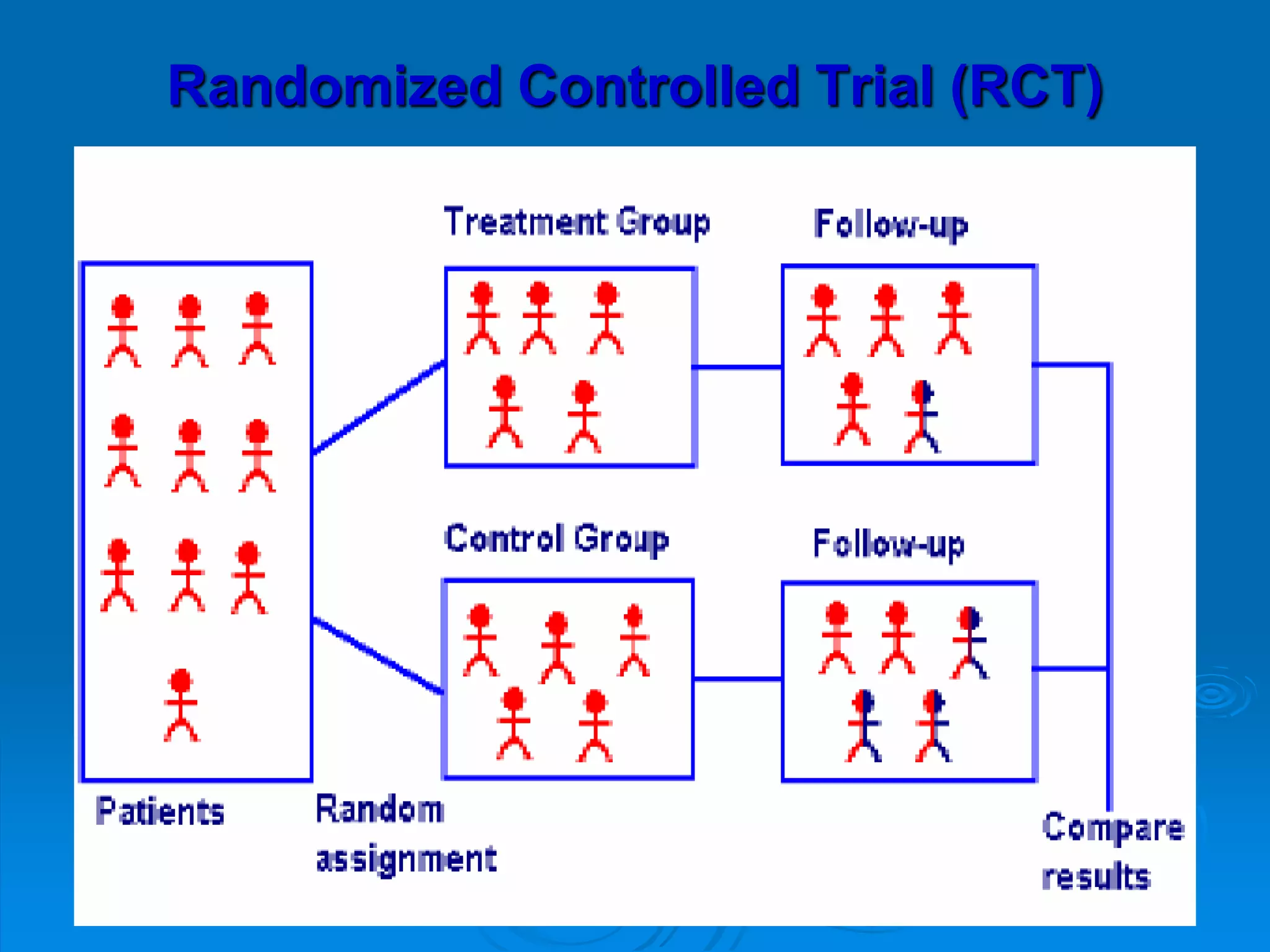
Design of a randomized trial
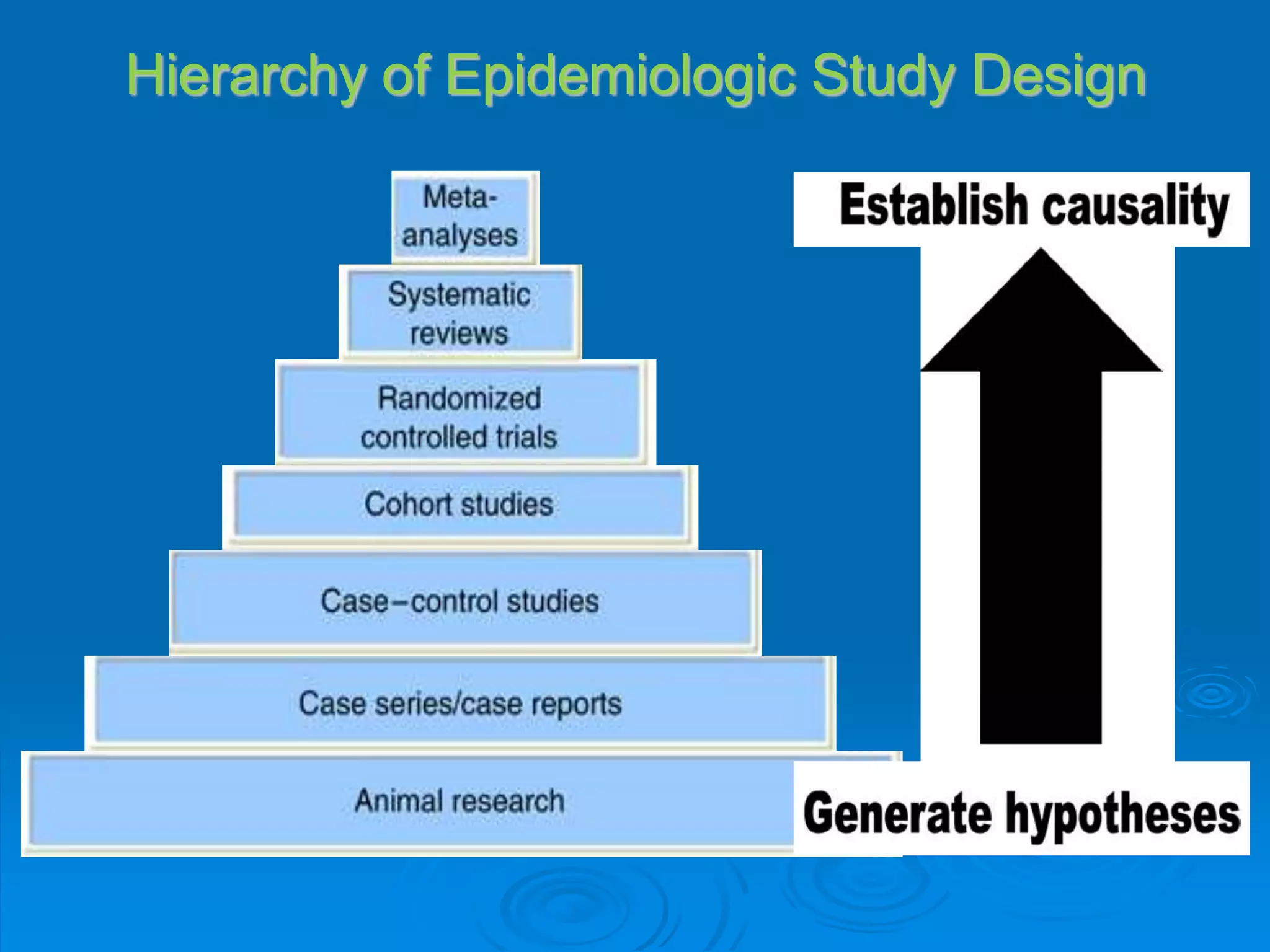
Hierarchy of Epidemiologic Study Design
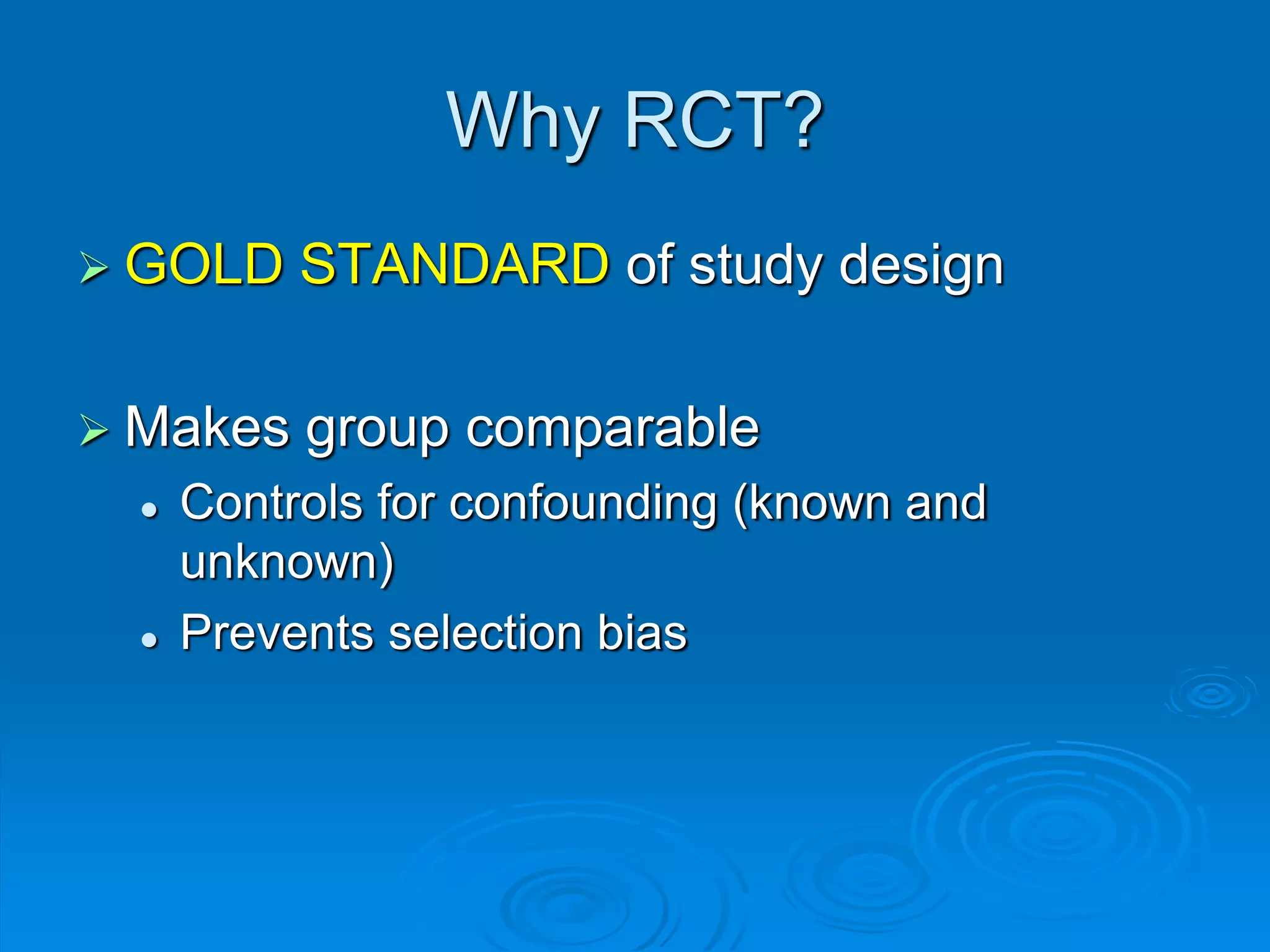
Why RCT?
 GOLD STANDARD of study design
 Makes group comparable
 Controls for confounding (known and
unknown)
 Prevents selection bias
Basic steps of RCT
1. The protocol
2. Selecting reference and
experimental populations
3. Randomization
4. Intervention
5. Follow up
6. Assessment
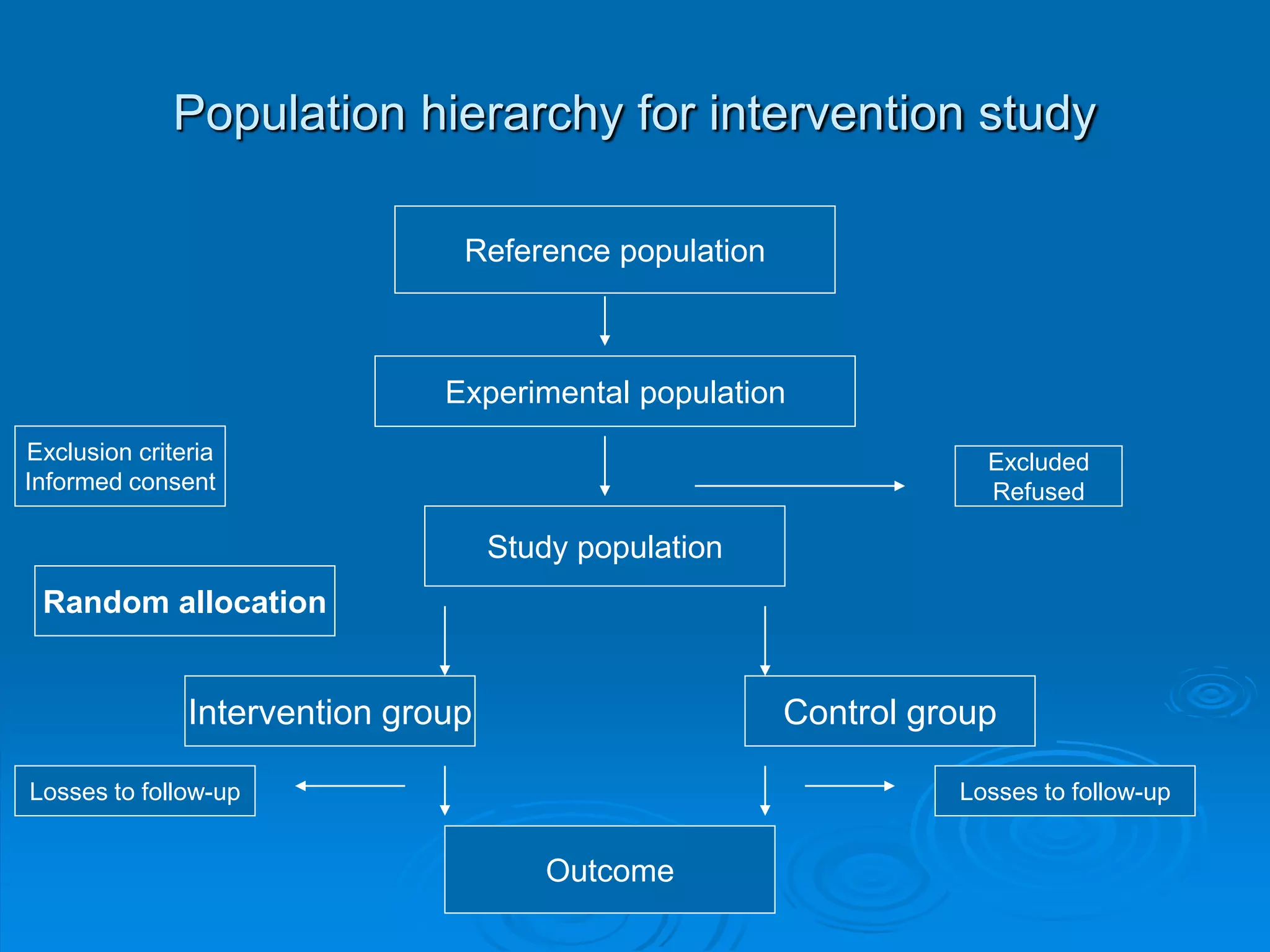
Population hierarchy for intervention study
Reference population
Experimental population
Exclusion criteria
Informed consent
Excluded
Refused
Study population
Intervention group Control group
Outcome
Losses to follow-up Losses to follow-up
Random allocation
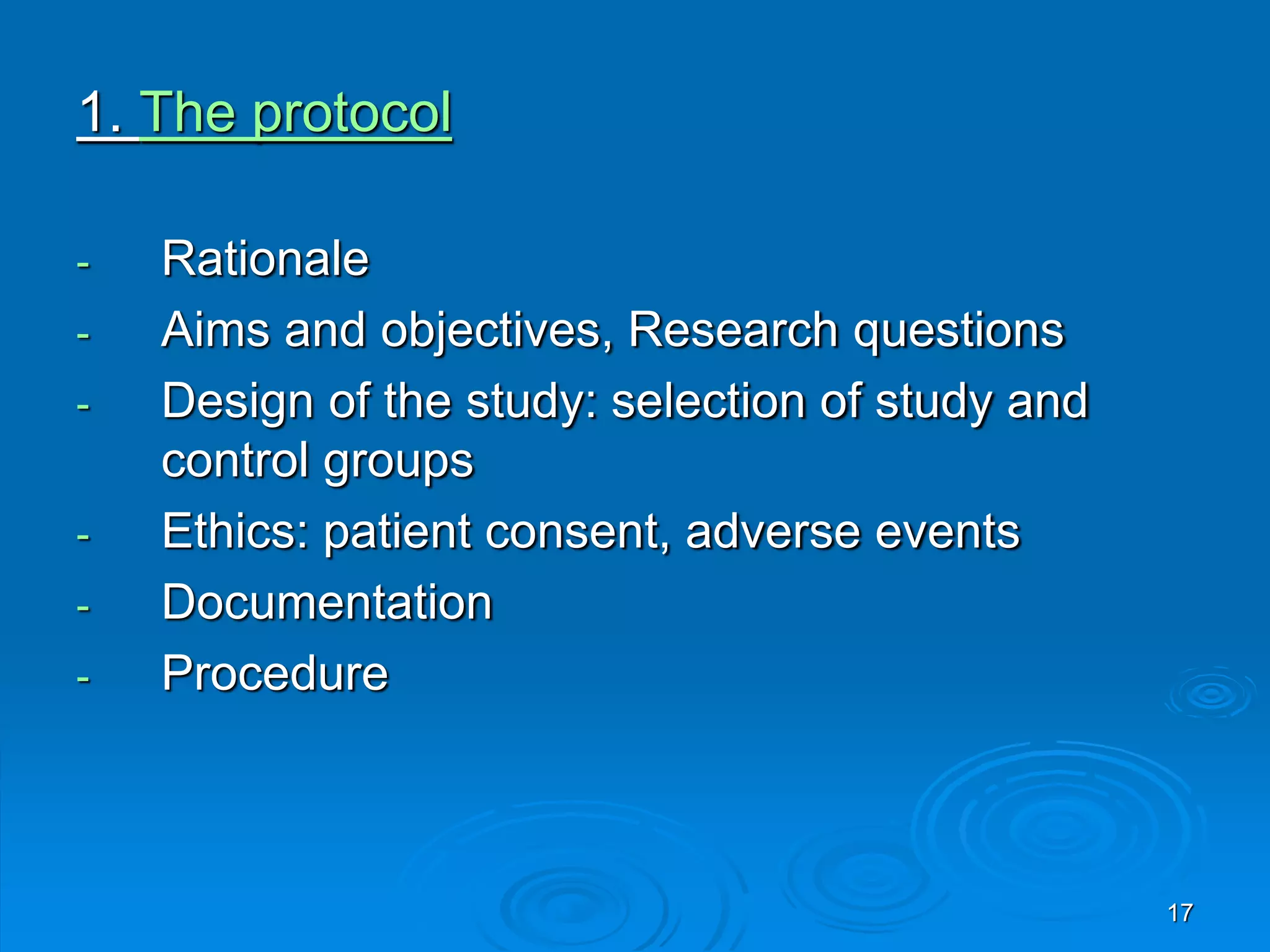
1. The protocol
- Rationale
- Aims and objectives, Research questions
- Design of the study: selection of study and
control groups
- Ethics: patient consent, adverse events
- Documentation
- Procedure
17
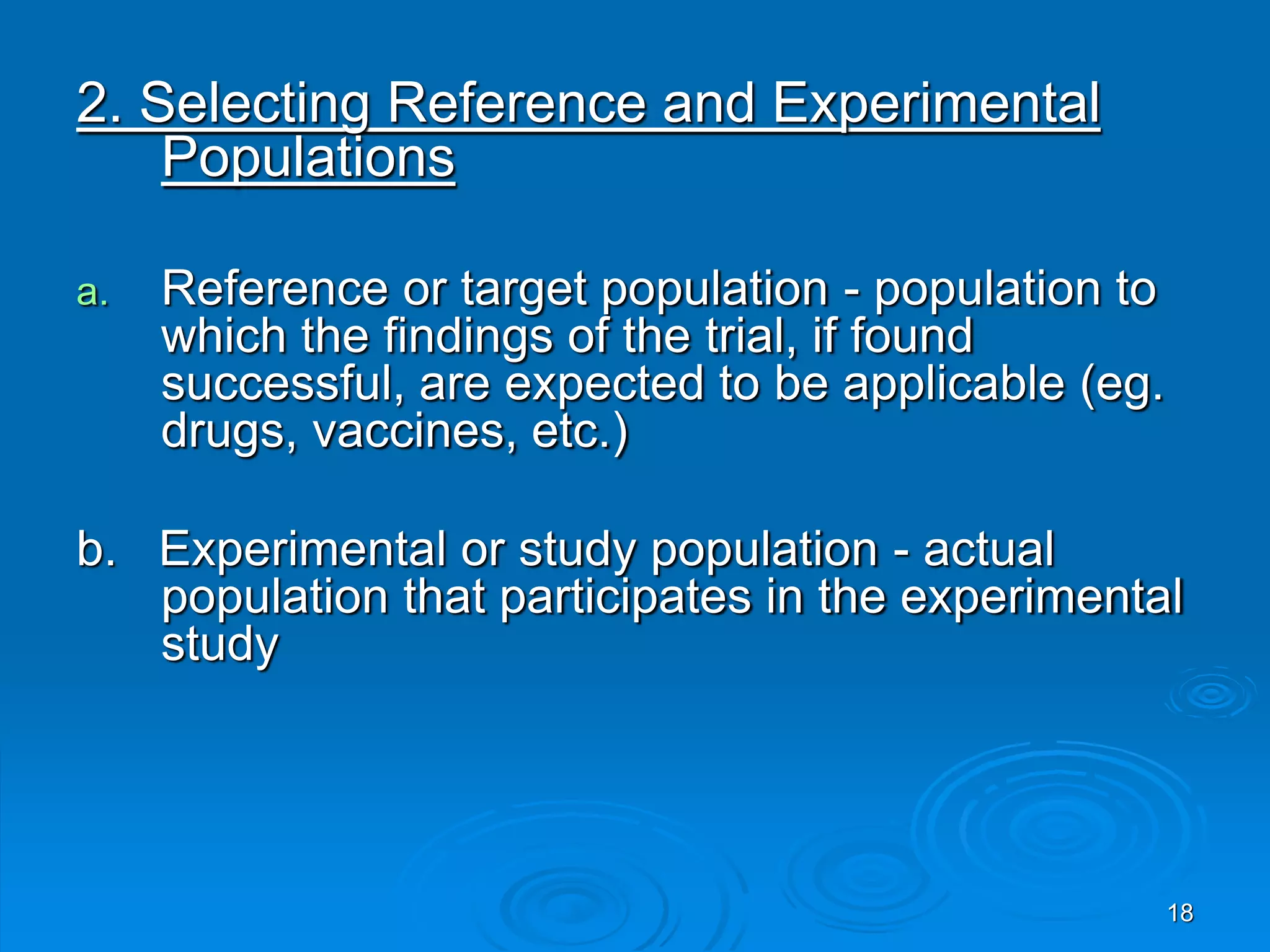
2. Selecting Reference and Experimental
Populations
a. Reference or target population - population to
which the findings of the trial, if found
successful, are expected to be applicable (eg.
drugs, vaccines, etc.)
b. Experimental or study population - actual
population that participates in the experimental
study
18
Participants must fulfill the following criteria:
- Must give informed consent
- Should be representative of the population
- Should be qualified or eligible for the trial
19
The critical element of randomization is the
unpredictability of the next assignment
3. Randomization
- Heart of the control trial
- Procedure: Participants are allocated
into study and control groups
- Eliminates bias and allows comparability
- Both groups should be alike with
regards to certain variables that might
affect the outcome of the experiment
- Best done by using table of random
numbers
24
Both groups should be alike with regards to
certain variables that might affect the
outcome of the experiment
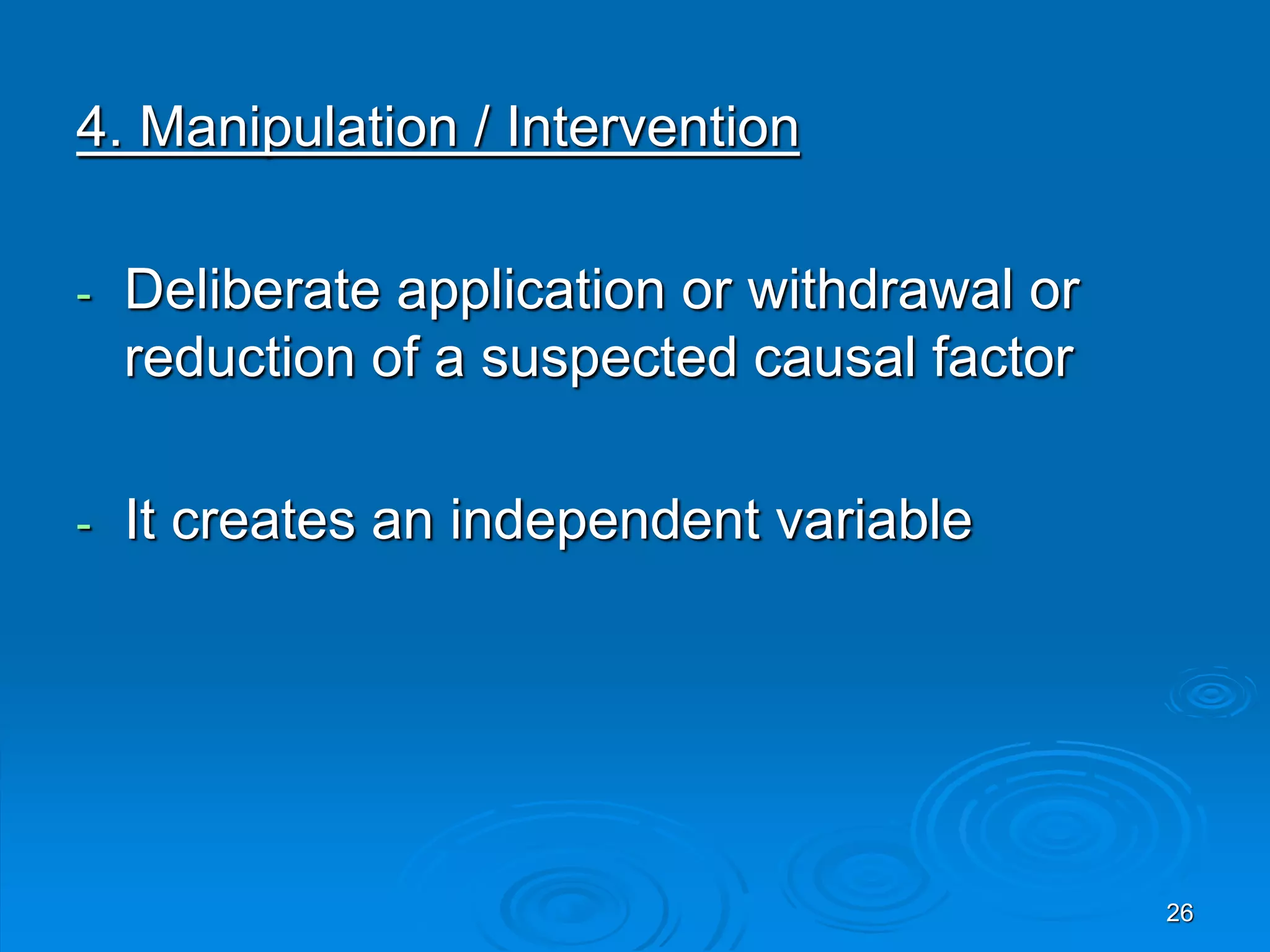
4. Manipulation / Intervention
- Deliberate application or withdrawal or
reduction of a suspected causal factor
- It creates an independent variable
26
Types of Interventions
 Interventions
 Pharmaceutical (Therapeutic or Preventive)
 Device
 Procedure
 Behaviour modification
5. Follow Up
- Implies examination of the experimental
and control group subjects
- at defined intervals of time,
- in a standard manner, with equal intensity,
under the same given circumstances
- Attrition: Inevitable losses to follow up
28
6. Assessment
- Positive results
- Negative results
- Biases: Subject variation, Observer bias,
Evaluation bias
- Can be corrected by blinding
29
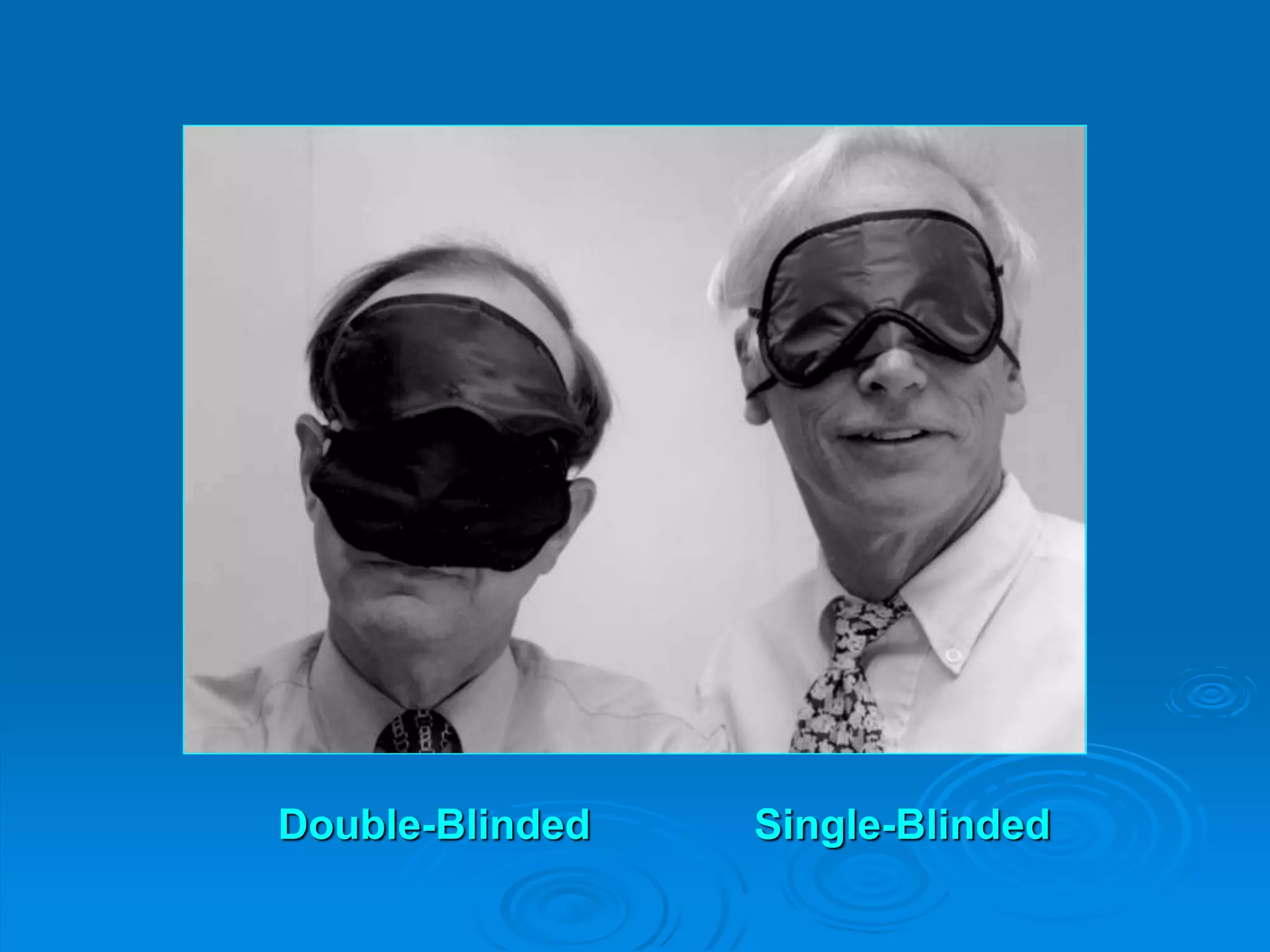
Double-Blinded Single-Blinded
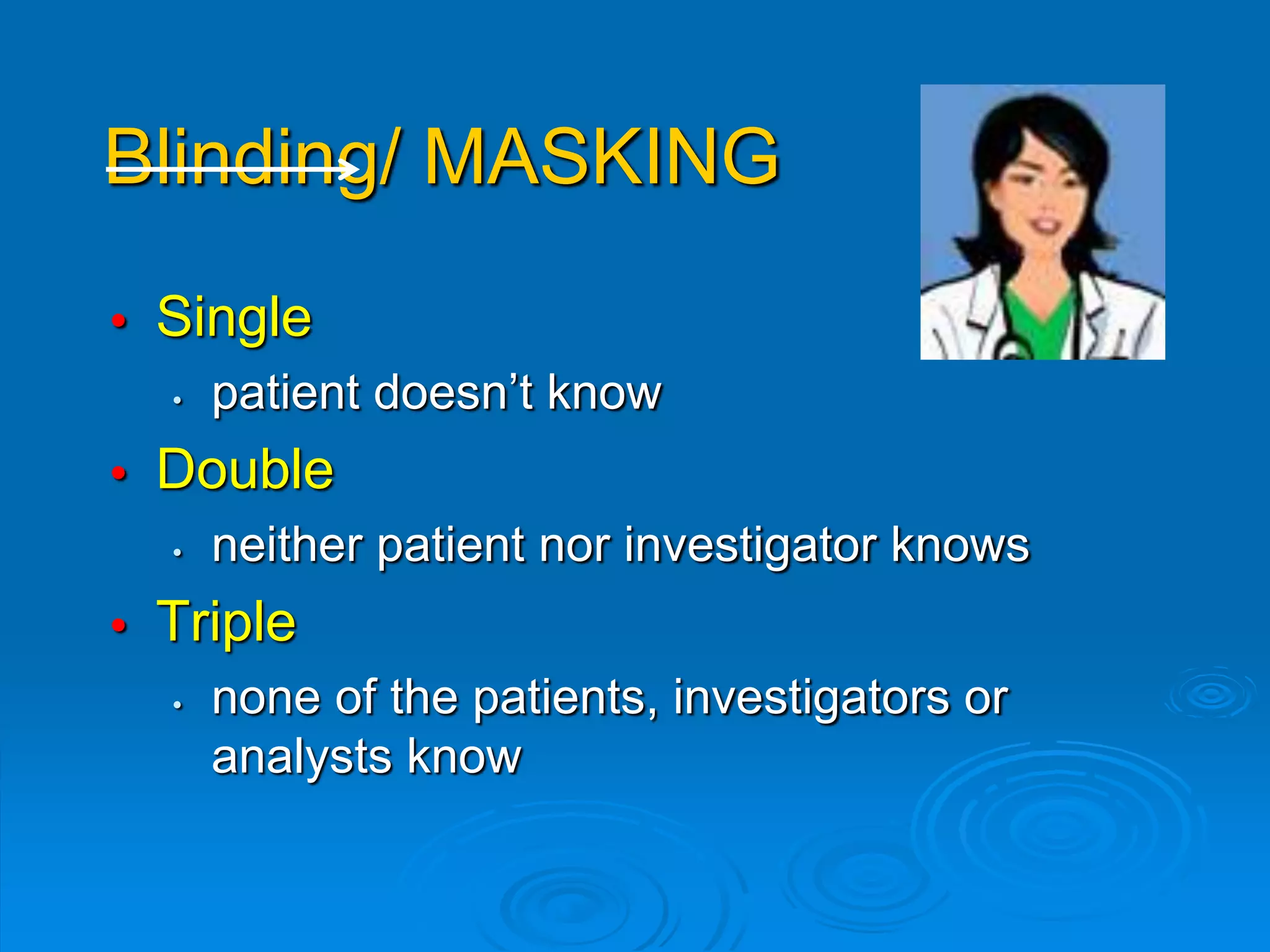
• Single
• patient doesn’t know
• Double
• neither patient nor investigator knows
• Triple
• none of the patients, investigators or
analysts know
Blinding/ MASKING
Randomization is a key feature
And heart of RCT
Random = governed by chance
Randomization = allocation of individuals
to groups by chance
Each sampling unit has the same chance
of selection
Makes intervention and control group
comparable at the start of the investigation
Why is randomized assignment of
intervention so important?
 Randomization is so important because
overall, it provides the strongest evidence
for causal inference
How randomization is done
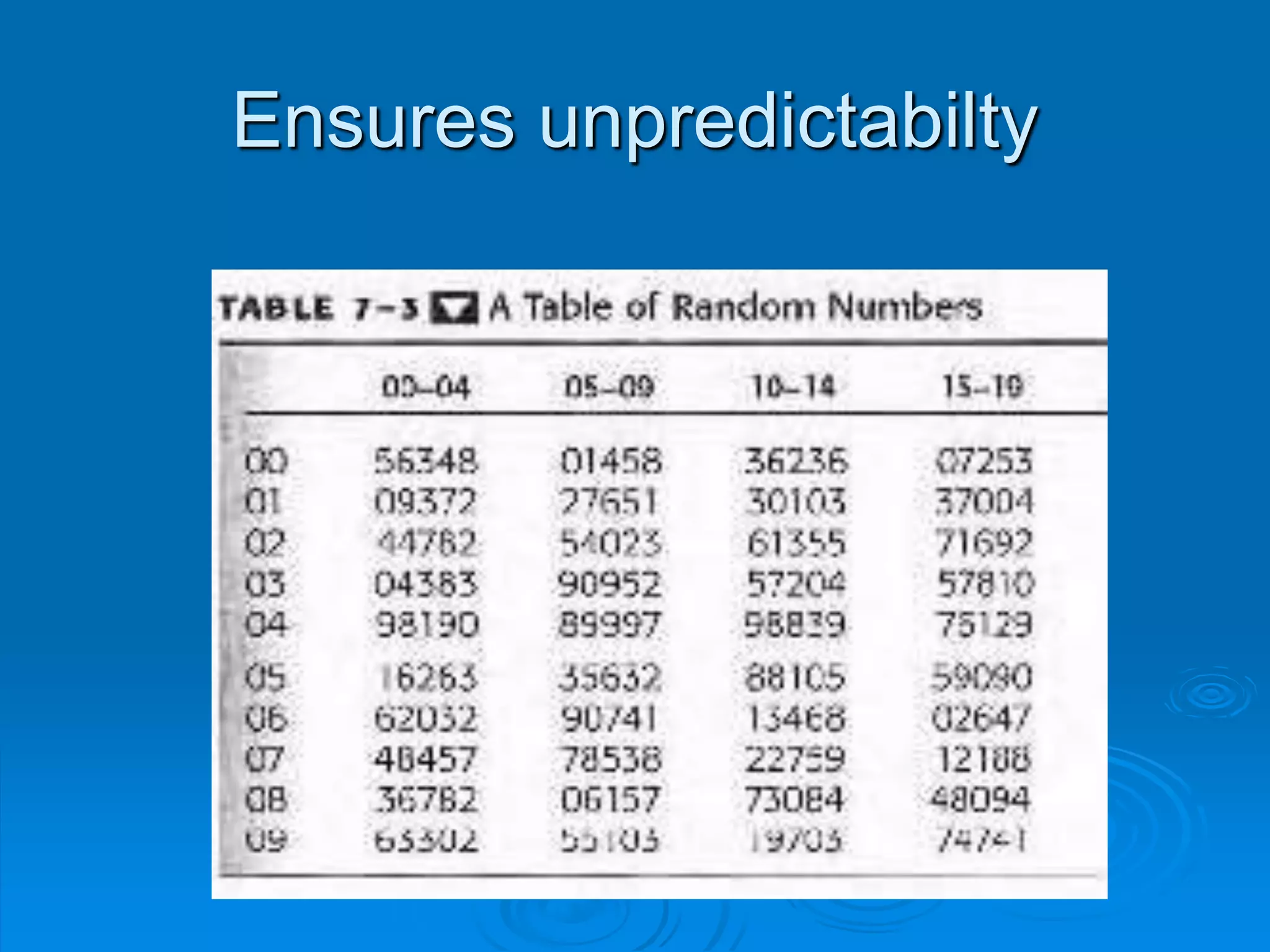
 Table of Random numbers
 Computer generated list
 According to date of birth (odd or even
years), the number of their hospital records,
the date at which they are invited to
participate in the study (odd or even days),
or alternatively into the different study
groups
Ensures unpredictabilty
Simple randomisation
Stratified randomisation
Design variations
 Concurrent Parallel study designs
 Cross over designs
Randomized Controlled Trial (RCT)
Cross over
Types of RCT
 Clinical Trials- Diagnostic, Therapeutic,
Prophylactic, Devices, Procedures,
Regimens, Protocols streptomycin for
treating TB
 Preventive Trials- pertusis vaccine
 Risk factor Trials- MRFIT
 Cessation Experiments- eg smoking
 Trial of aetiological agents- eg. Retrolental
fibroplasia
Types of Randomized Controlled Trials:
1. Clinical Trial
- Concerned with evaluating therapeutic
agent, mainly drugs
eg. Evaluation of beta-blockers in
reducing cardiovascular mortality
- Not all clinical trials are susceptible to
being blinded
46
2. Preventive Trials:
- Trial of primary preventive measures eg.
Vaccines
- Analysis of preventive trials must result in
clear statement about benefits to
community, risk involved and cost to
health
47
3. Risk Factor Trials:
- Investigator intervenes to interrupt the
usual sequence in the development of
disease for those individuals who have risk
factor for developing the disease
- Primary prevention of CHD using clofibrate
to lower serum cholesterol
48
4. Cessation Experiment:
- An attempt is made to evaluate the
termination of a habit which is considered
to be causally related to disease
- Cigarette smoking and lung cancer
49
5. Trials of Etiological Agents:
- To confirm or refute an etiological
hypothesis
6. Evaluation of Health Services:
- Domiciliary treatment of PTB was as
effective as more costlier hospital or
sanatorium treatment
50
Efficacy and effectiveness
 Efficacy – Does the intervention work in
IDEAL situations
 Effectiveness – Does the intervention work
in ‘real world’ conditions?
Reduction in risk or efficacy of a trial
Rate in those who Rate in those who
received placebo who received intervention
Rate in those who received placebo
Clinical Trial Phases
An overlapping continuum
Safety
Feasibility Efficacy Effectiveness
I
II
III
IV
Safety
Other types of evaluation designs
 Uncontrolled Trials
 Natural Experiments
 Before after study
 Non randomized trials
Conclusion
• Well-conducted double-blind randomised
controlled trials are gold standard for studies
of efficacy
•Minimise bias
•Maximise attribution
Thank You …….
Questions
 Long questions
 Short notes
 Comments
 Compare
 Viva

Randomized Controlled Trial

  • 1.
  • 2.
  • 3.
  • 5.
    TYPES OF EPIDEMIOLOGICAL STUDIES 1.OBSERVATIONAL STUDIES A. DESCRIPTIVE STUDY DESCRIBE DIESEASE BY TIME PLACE PERSON B. ANALYTICAL STUDIES ECOLOGICAL STUDY CROSS SECTIONAL STUDY CASE-CONTROL STUDY COHORT STUDY 2. EXPEREMENTAL STUDIES RANDOMIZED CONTROLLED TRIAL (RCT) FIELD TRIAL COMMUNITY TRIAL “RCT" by Dr Naresh 7
  • 6.
    Experimental studies  Inobservational studies (eg. Descriptive, case-control and cohort ) no action is taken . The epidemiologist observe only the natural course of event.  The Experimental studies are similar to cohort studies except they involve some action, intervention, or manipulation
  • 7.
    Aims of experimentalstudies  To provide scientific proof of etiological (or risk) factor which may permit modification or control  To provide the method of measuring the effectiveness and efficiency of health services for prevention, control and treatment of disease and improve the health of the community.
  • 8.
    Types of Experimentalstudies  Randomized Controlled Trials  Non- Randomized or “Non- Experiment” trials (those departing from strict randomization for practical purposes )
  • 9.
    Randomized Controlled Trial(RCT) (Synonym: Randomized Clinical Trial) ”An epidemiological experiment in which subjects in a population are randomly allocated into groups, usually called study and control groups to receive and not receive an experimental preventive or therapetuic procedure, maneuver, or intervention” John M.Last, 2001
  • 10.
    Design of arandomized trial
  • 11.
  • 12.
    Why RCT?  GOLDSTANDARD of study design  Makes group comparable  Controls for confounding (known and unknown)  Prevents selection bias
  • 13.
    Basic steps ofRCT 1. The protocol 2. Selecting reference and experimental populations 3. Randomization 4. Intervention 5. Follow up 6. Assessment
  • 14.
    Population hierarchy forintervention study Reference population Experimental population Exclusion criteria Informed consent Excluded Refused Study population Intervention group Control group Outcome Losses to follow-up Losses to follow-up Random allocation
  • 15.
    1. The protocol -Rationale - Aims and objectives, Research questions - Design of the study: selection of study and control groups - Ethics: patient consent, adverse events - Documentation - Procedure 17
  • 16.
    2. Selecting Referenceand Experimental Populations a. Reference or target population - population to which the findings of the trial, if found successful, are expected to be applicable (eg. drugs, vaccines, etc.) b. Experimental or study population - actual population that participates in the experimental study 18
  • 17.
    Participants must fulfillthe following criteria: - Must give informed consent - Should be representative of the population - Should be qualified or eligible for the trial 19
  • 21.
    The critical elementof randomization is the unpredictability of the next assignment
  • 22.
    3. Randomization - Heartof the control trial - Procedure: Participants are allocated into study and control groups - Eliminates bias and allows comparability - Both groups should be alike with regards to certain variables that might affect the outcome of the experiment - Best done by using table of random numbers 24
  • 23.
    Both groups shouldbe alike with regards to certain variables that might affect the outcome of the experiment
  • 24.
    4. Manipulation /Intervention - Deliberate application or withdrawal or reduction of a suspected causal factor - It creates an independent variable 26
  • 25.
    Types of Interventions Interventions  Pharmaceutical (Therapeutic or Preventive)  Device  Procedure  Behaviour modification
  • 26.
    5. Follow Up -Implies examination of the experimental and control group subjects - at defined intervals of time, - in a standard manner, with equal intensity, under the same given circumstances - Attrition: Inevitable losses to follow up 28
  • 27.
    6. Assessment - Positiveresults - Negative results - Biases: Subject variation, Observer bias, Evaluation bias - Can be corrected by blinding 29
  • 28.
  • 30.
    • Single • patientdoesn’t know • Double • neither patient nor investigator knows • Triple • none of the patients, investigators or analysts know Blinding/ MASKING
  • 31.
    Randomization is akey feature And heart of RCT
  • 32.
    Random = governedby chance Randomization = allocation of individuals to groups by chance Each sampling unit has the same chance of selection Makes intervention and control group comparable at the start of the investigation
  • 33.
    Why is randomizedassignment of intervention so important?  Randomization is so important because overall, it provides the strongest evidence for causal inference
  • 34.
    How randomization isdone  Table of Random numbers  Computer generated list  According to date of birth (odd or even years), the number of their hospital records, the date at which they are invited to participate in the study (odd or even days), or alternatively into the different study groups
  • 35.
  • 36.
  • 37.
  • 38.
    Design variations  ConcurrentParallel study designs  Cross over designs
  • 39.
  • 40.
  • 41.
    Types of RCT Clinical Trials- Diagnostic, Therapeutic, Prophylactic, Devices, Procedures, Regimens, Protocols streptomycin for treating TB  Preventive Trials- pertusis vaccine  Risk factor Trials- MRFIT  Cessation Experiments- eg smoking  Trial of aetiological agents- eg. Retrolental fibroplasia
  • 42.
    Types of RandomizedControlled Trials: 1. Clinical Trial - Concerned with evaluating therapeutic agent, mainly drugs eg. Evaluation of beta-blockers in reducing cardiovascular mortality - Not all clinical trials are susceptible to being blinded 46
  • 43.
    2. Preventive Trials: -Trial of primary preventive measures eg. Vaccines - Analysis of preventive trials must result in clear statement about benefits to community, risk involved and cost to health 47
  • 44.
    3. Risk FactorTrials: - Investigator intervenes to interrupt the usual sequence in the development of disease for those individuals who have risk factor for developing the disease - Primary prevention of CHD using clofibrate to lower serum cholesterol 48
  • 45.
    4. Cessation Experiment: -An attempt is made to evaluate the termination of a habit which is considered to be causally related to disease - Cigarette smoking and lung cancer 49
  • 46.
    5. Trials ofEtiological Agents: - To confirm or refute an etiological hypothesis 6. Evaluation of Health Services: - Domiciliary treatment of PTB was as effective as more costlier hospital or sanatorium treatment 50
  • 47.
    Efficacy and effectiveness Efficacy – Does the intervention work in IDEAL situations  Effectiveness – Does the intervention work in ‘real world’ conditions?
  • 48.
    Reduction in riskor efficacy of a trial Rate in those who Rate in those who received placebo who received intervention Rate in those who received placebo
  • 49.
    Clinical Trial Phases Anoverlapping continuum Safety Feasibility Efficacy Effectiveness I II III IV Safety
  • 50.
    Other types ofevaluation designs  Uncontrolled Trials  Natural Experiments  Before after study  Non randomized trials
  • 51.
    Conclusion • Well-conducted double-blindrandomised controlled trials are gold standard for studies of efficacy •Minimise bias •Maximise attribution
  • 52.
  • 53.
    Questions  Long questions Short notes  Comments  Compare  Viva