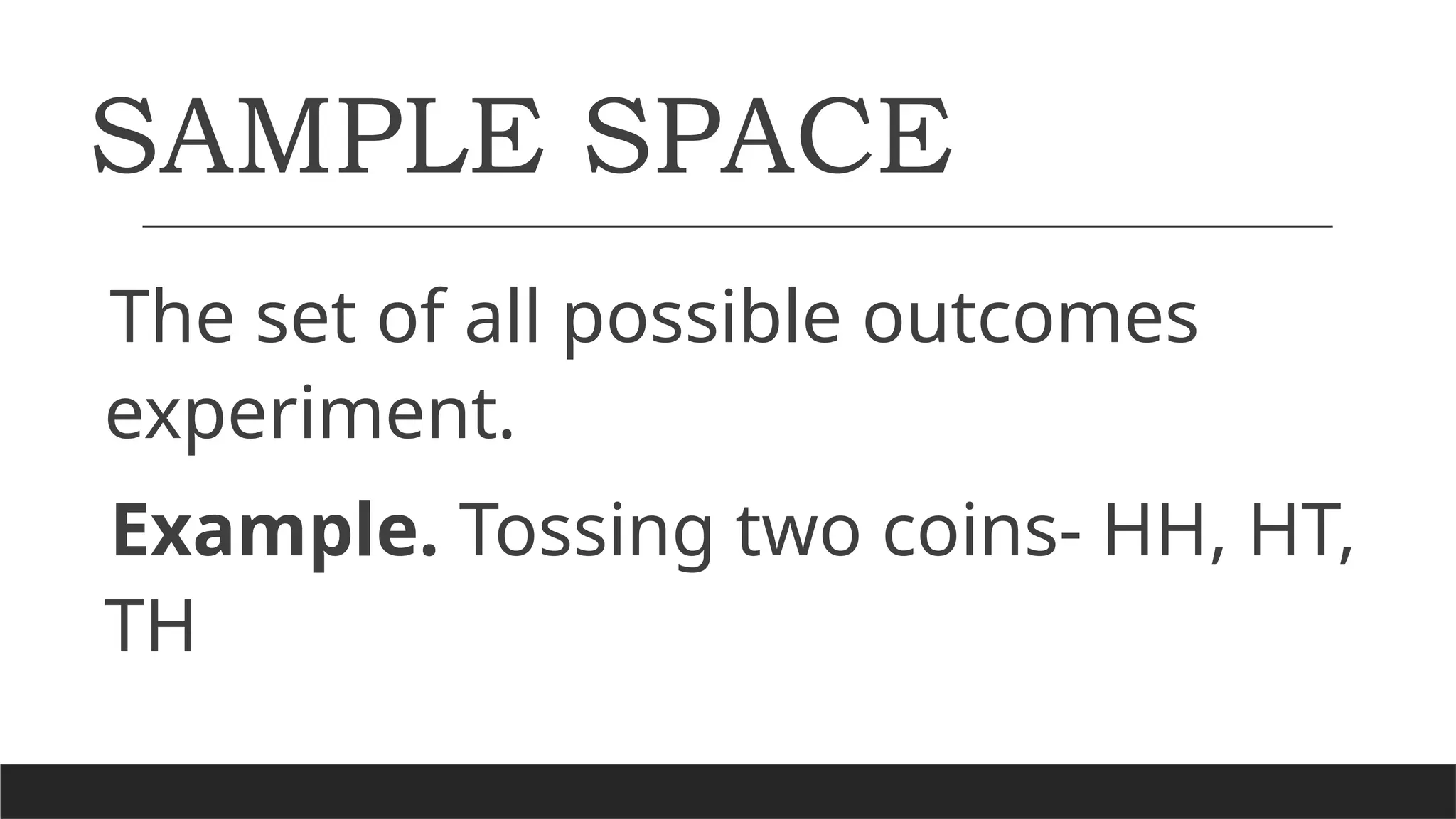
SAMPLE SPACE
The setof all possible outcomes
experiment.
Example. Tossing two coins- HH, HT,
TH
3.
VARIABLE
Is a characteristicor attribute
that can assume different
values. We use capital letters to
denote or represent variables.
4.
RANDOM VARIABLE
Is afunction that associates a
numerical value with every outcome
of an experiment. Its domain is a
sample space and its range is some
set of real numbers.
5.
EXAMPLE
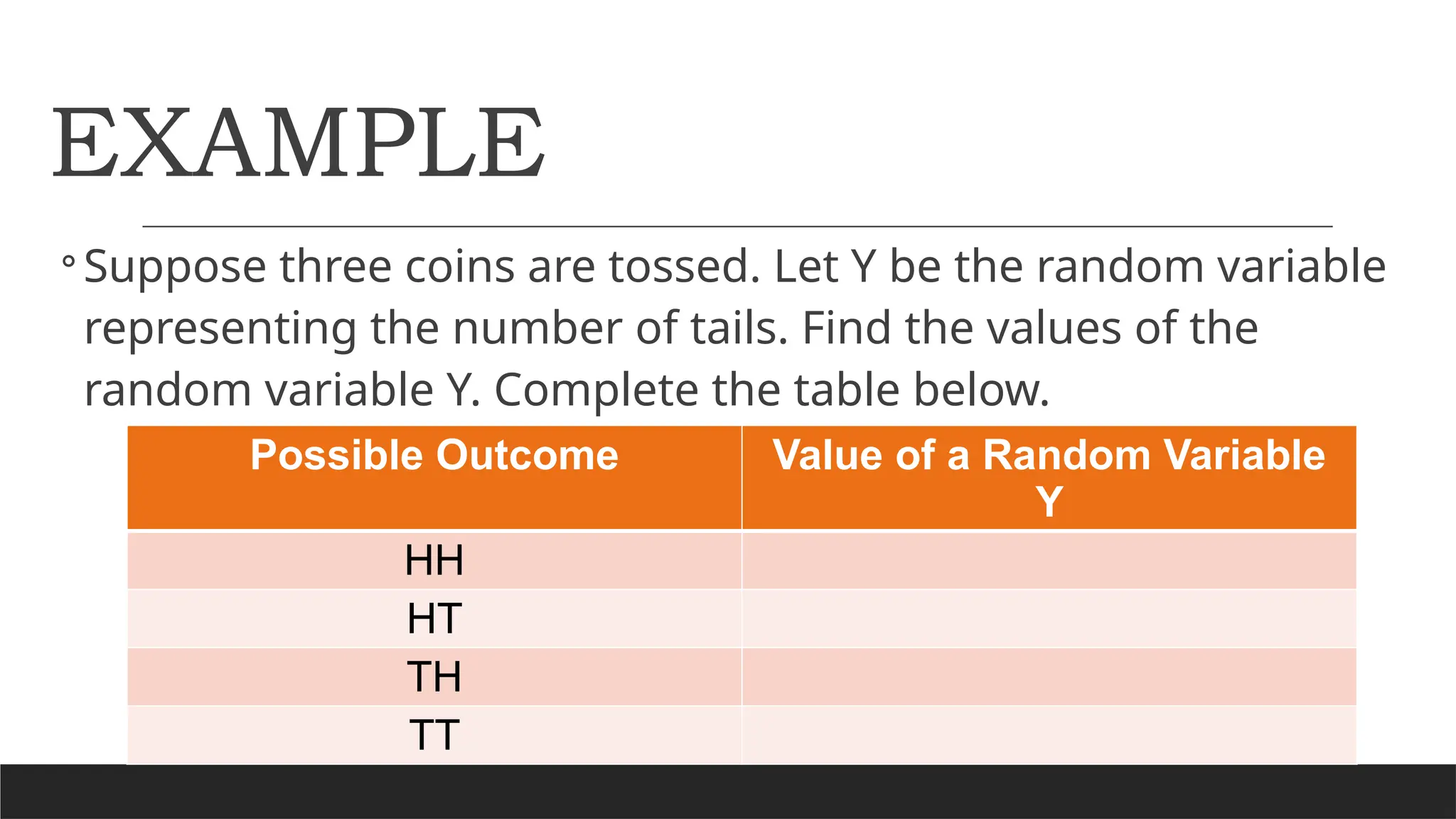
◦Suppose three coinsare tossed. Let Y be the random variable
representing the number of tails. Find the values of the
random variable Y. Complete the table below.
Possible Outcome Value of a Random Variable
Y
HH
HT
TH
TT
6.
SOLUTION
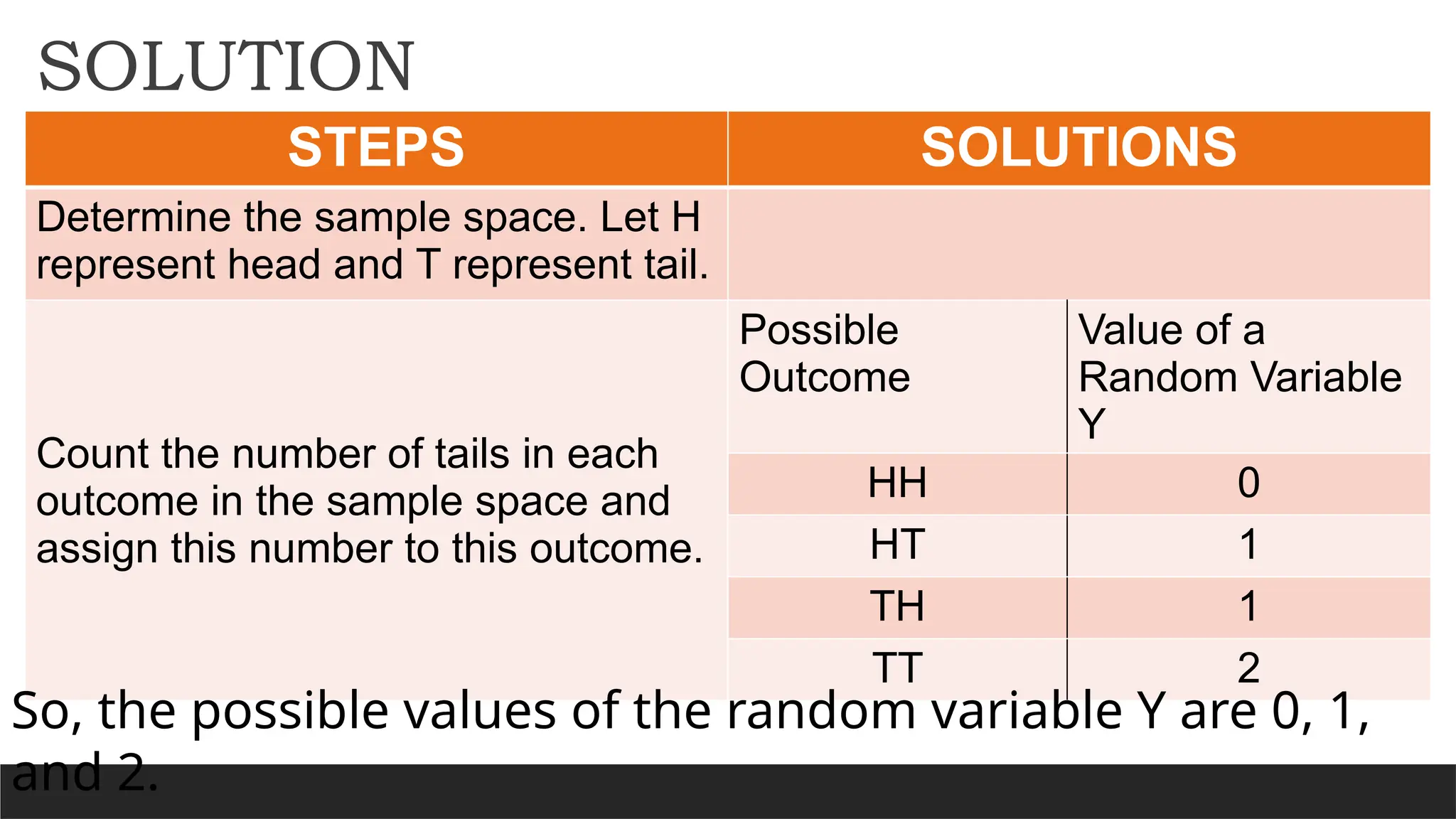
STEPS SOLUTIONS
Determine thesample space. Let H
represent head and T represent tail.
Count the number of tails in each
outcome in the sample space and
assign this number to this outcome.
Possible
Outcome
Value of a
Random Variable
Y
HH 0
HT 1
TH 1
TT 2
So, the possible values of the random variable Y are 0, 1,
and 2.
7.
Example:
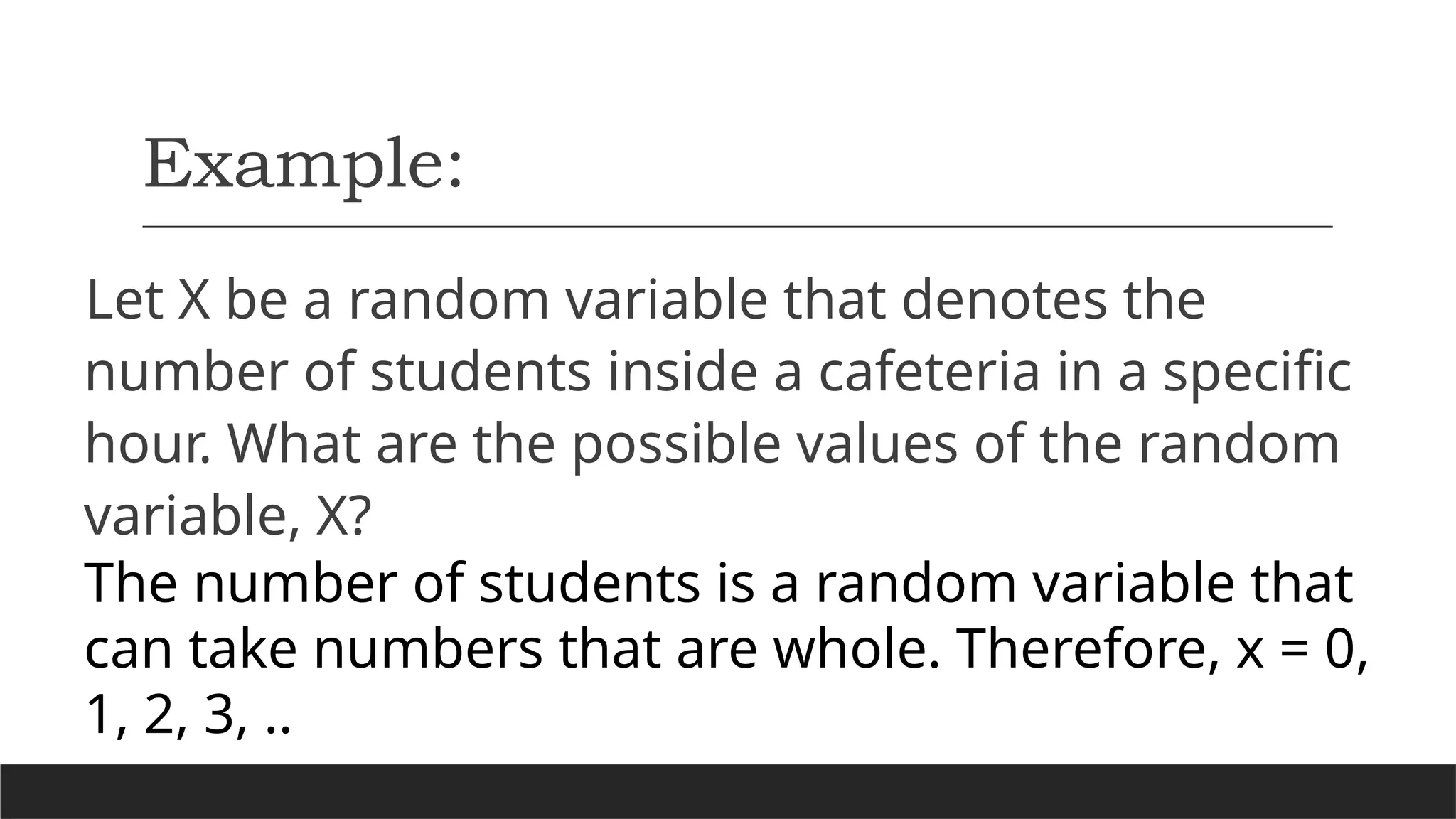
Let X bea random variable that denotes the
number of students inside a cafeteria in a specific
hour. What are the possible values of the random
variable, X?
The number of students is a random variable that
can take numbers that are whole. Therefore, x = 0,
1, 2, 3, ..
8.
EXAMPLE
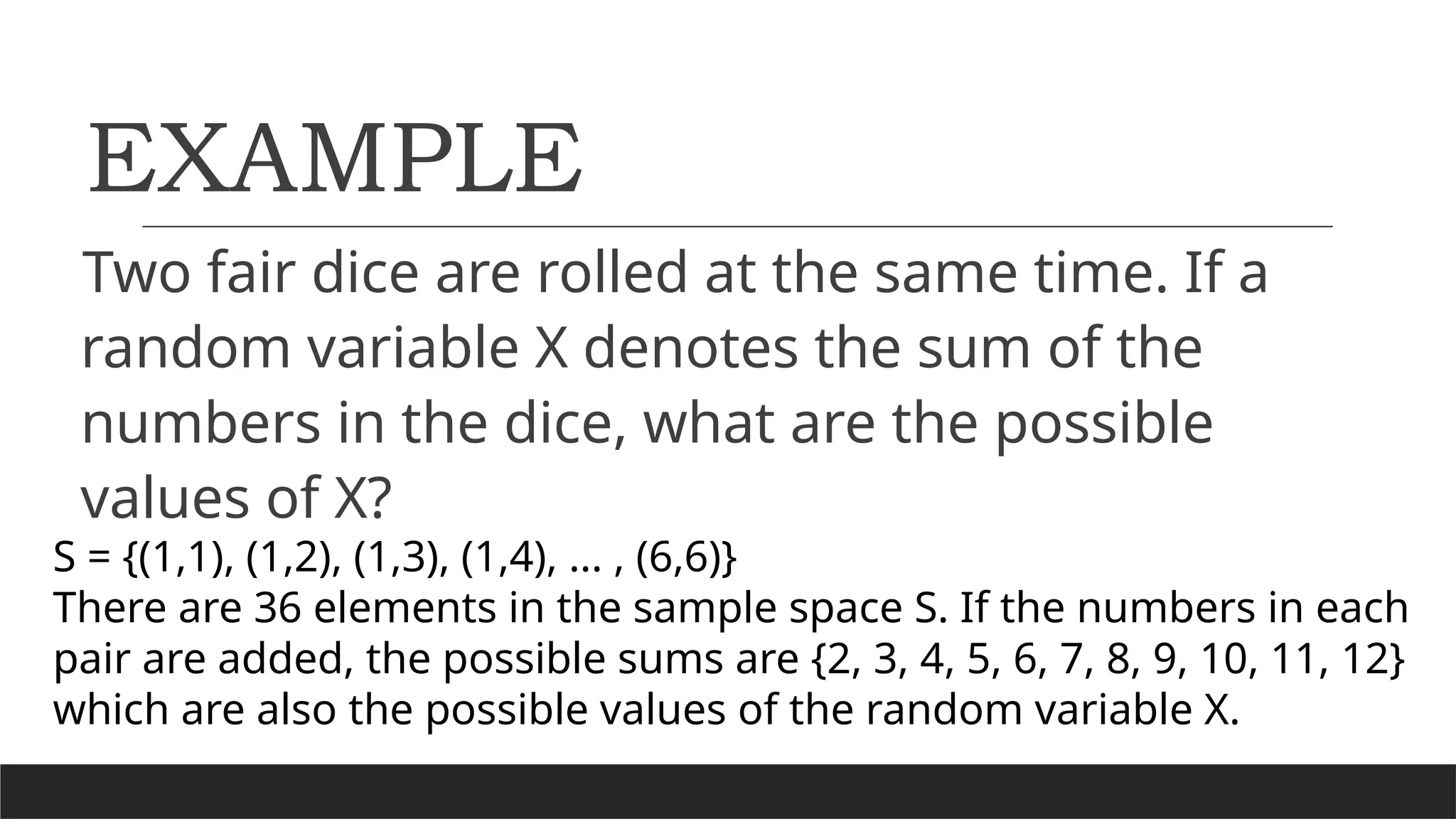
Two fair diceare rolled at the same time. If a
random variable X denotes the sum of the
numbers in the dice, what are the possible
values of X?
S = {(1,1), (1,2), (1,3), (1,4), ... , (6,6)}
There are 36 elements in the sample space S. If the numbers in each
pair are added, the possible sums are {2, 3, 4, 5, 6, 7, 8, 9, 10, 11, 12}
which are also the possible values of the random variable X.
9.
Discrete Random Variable
❑Itis a set of possible outcomes that is
countable.
❑A discrete random variable have a finite
number of possible values or an infinite
number of values that can be counted,
Example. Number of defective chairs produced
in a factory
10.
CONTINOUS RANDOM
VARIABLE
❑It isa set of possible outcomes on a
continuous scale.
❑Can assume an infinite number of values
that can take decimal or fractional values.
Example. Heights, weights and temperatures.
11.
Example
A random variabletakes on the
following values: 4, 7, 9, 11, 13, and
14. Is the random variable discrete
or continuous?
Since the random variable takes on whole number values,
the random variable is classified as a discrete random
variable.
12.
Example
Identify whether theamount of money a
person pays for grocery goods a discrete
or a continuous random variable.
The amount of money that a person pays for grocery goods
varies depending on the quantity of goods a person buys. This
variable takes on values that are decimal in form, like ₱255.65.
Thus, it is a continuous random variable.
13.
Example
Jose’s wallet containsa ₱10, a ₱20, a ₱50, and a ₱100
bill. If Jose is going to pick two bills from his wallet,
and X represents a random variable that denotes the
sum of the two bills, identify if the random variable X
is a discrete or a continuous random variable.
The given amount of bills is written as whole numbers. When we
add any two bills, the sum will still be a whole number. Thus, the
random variable X is a discrete random variable.
14.
Example
The head engineerof a construction firm wanted to
check the progress of their current project. Upon his
checking, he figured out that the project still needs a
number of steel materials, sacks of cement, and hollow
blocks. The current project also needs a certain length
of electrical wires and pipes. Identify the random
variables in the given situation and classify each.
15.
a.number of steelmaterials- The number of steel materials can be
counted using whole numbers. Thus, it is a discrete random
variable.
b.sacks of cement- The sacks of cement can be counted using whole
numbers. Thus, it is a discrete random variable.
c.hollow blocks- The number of hollow blocks can be counted using
whole numbers. Thus, it is a discrete random variable.
d.length of electrical wires- Decimals can be used to describe the
length of an electrical wire such as 75.4 meters or 97.9 meters. Thus,
it is a continuous random variable.
e.length of pipes- This is similar to the length of electrical wires. It is a
continuous random variable.
Editor's Notes
#14 number of steel materials- The number of steel materials can be counted using whole numbers. Thus, it is a discrete random variable.
sacks of cement- The sacks of cement can be counted using whole numbers. Thus, it is a discrete random variable.
hollow blocks- The number of hollow blocks can be counted using whole numbers. Thus, it is a discrete random variable.
length of electrical wires- Decimals can be used to describe the length of an electrical wire such as 75.4 meters or 97.9 meters. Thus, it is a continuous random variable.
length of pipes- This is similar to the length of electrical wires. It is a continuous random variable.