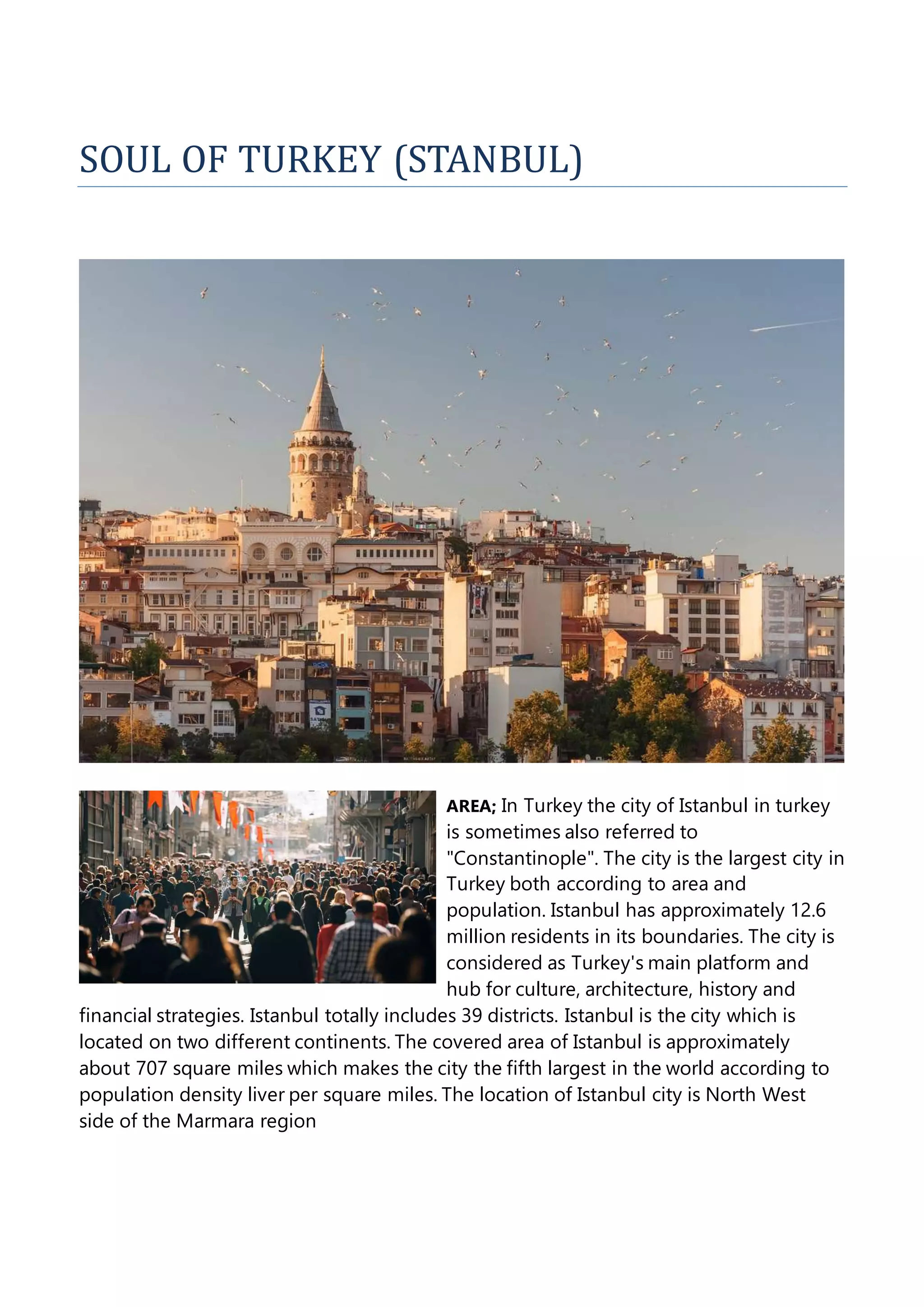
SOUL OF TURKEY (STANBUL)
AREA; In Turkey the city of Istanbul in turkey
is sometimes also referred to
"Constantinople". The city is the largest city in
Turkey both according to area and
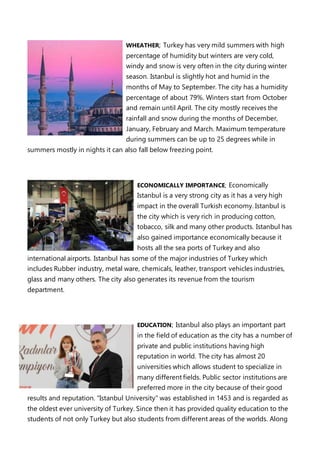
population. Istanbul has approximately 12.6
million residents in its boundaries. The city is
considered as Turkey's main platform and
hub for culture, architecture, history and
financial strategies. Istanbul totally includes 39 districts. Istanbul is the city which is
located on two different continents. The covered area of Istanbul is approximately
about 707 square miles which makes the city the fifth largest in the world according to
population density liver per square miles. The location of Istanbul city is North West
side of the Marmara region
WHEATHER; Turkey has very mild summers with high
percentage of humidity but winters are very cold,
windy and snow is very often in the city during winter
season. Istanbul is slightly hot and humid in the
months of May to September. The city has a humidity
percentage of about 79%. Winters start from October
and remain until April. The city mostly receives the
rainfall and snow during the months of December,
January, February and March. Maximum temperature
during summers can be up to 25 degrees while in
summers mostly in nights it can also fall below freezing point.
ECONOMICALLY IMPORTANCE; Economically
Istanbul is a very strong city as it has a very high
impact in the overall Turkish economy. Istanbul is
the city which is very rich in producing cotton,
tobacco, silk and many other products. Istanbul has
also gained importance economically because it
hosts all the sea ports of Turkey and also
international airports. Istanbul has some of the major industries of Turkey which
includes Rubber industry, metal ware, chemicals, leather, transport vehicles industries,
glass and many others. The city also generates its revenue from the tourism
department.
EDUCATION; Istanbul also plays an important part
in the field of education as the city has a number of
private and public institutions having high
reputation in world. The city has almost 20
universities which allows student to specialize in
many different fields. Public sector institutions are
preferred more in the city because of their good
results and reputation. "Istanbul University" was established in 1453 and is regarded as
the oldest ever university of Turkey. Since then it has provided quality education to the
students of not only Turkey but also students from different areas of the worlds. Along
with Istanbul University "Istanbul Technical University" is also of great importance as it
is the world's third oldest university in the field of technology established in 1773.
SPORTS; In the field of sports Istanbul and
Turkey have started to dominate in sports like
football, basketball and volleyball. Ataturk
Stadium is the biggest stadium in Turkey. The
stadium has the honor of hosting UEFA
champions League Final of 2005 between
Liverpool FC of England and Ac Milan of Italy.
Istanbul is also very famous for hosting many
types of motor sport races. Out of which "Formula One Turkish Grand Prix" is the most
important one.
FOOD;
Like the borders meet, so does the cuisine of Istanbul. A
traditional Turkish platter of Istanbul consists of flavors
comprising of Central Asian, Caucasian, Middle Eastern,
Central and Western European flavors. Iskender Kabap is one
of the prominent dishes in Istanbul.
FAMOUS PLACES TO VISIT IN ISTANBUL
The city (officially renamed Istanbul after the founding of the Turkish Republic) is
liberally scattered with glorious remnants of its long and illustrious history, and the
tourist attractions here will impress even the mostmonument-weary visitor.
As well as the big four (the Hagia Sophia Mosque, Topkapı Palace, the Blue Mosque
and Grand Bazaar), leave enough time to explore the other sights.
Although many of the most popular and best places to visit are located in, or near,
the old city district of Sultanahmet, there is a dazzling array of other things to do
throughout the farther reaches of the city.
1. Admire the Hagia Sophia (Aya Sofya) Mosque
The Hagia Sophia, whose name means “holy wisdom,” is a domed monument
originally built as a cathedral in Constantinople (now Istanbul, Turkey) in the sixth
century A.D. It contains two floors centered on a giant nave that has a great dome
ceiling, along with smaller domes, towering above. Byzantine Emperor
Constantius commissionedconstruction of the first Hagia Sophia in 360 A.D. At the
time of the first church's construction, Istanbul was known as Constantinople, taking
its name from Constantius' father, Constantine I, the first ruler of the Byzantine
Empire.
2. Explore Topkapı Palace (Topkapı
Sarayı)
First built by Mehmet the Conqueror in the 15th century,
this glorious palace beside the Bosphorus was where the
sultans of the Ottoman Empire lived and ruled from.
The vast complex is a dazzling display of Islamic art, with
opulent courtyards lined with intricate hand-painted
tilework, linking a warren of sumptuouslydecorated
rooms, all bounded by battlemented walls and towers.
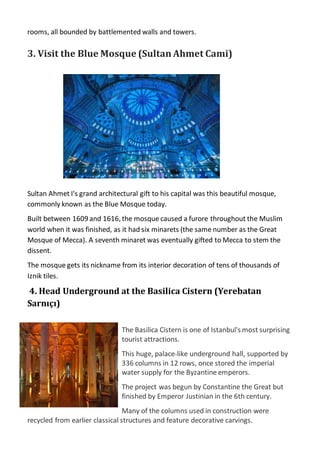
3. Visit the Blue Mosque (Sultan Ahmet Cami)
Sultan Ahmet I's grand architectural gift to his capital was this beautiful mosque,
commonly known as the Blue Mosque today.
Built between 1609 and 1616, the mosque caused a furore throughout the Muslim
world when it was finished, as it had six minarets (the same number as the Great
Mosque of Mecca). A seventh minaret was eventually gifted to Mecca to stem the
dissent.
The mosque gets its nickname from its interior decoration of tens of thousands of
Iznik tiles.
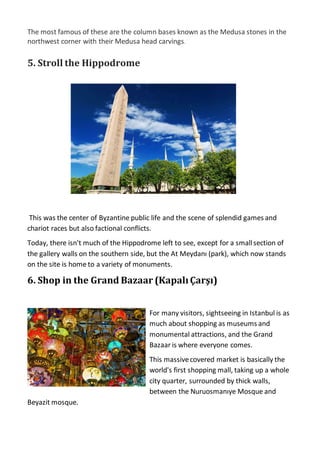
4. Head Underground at the Basilica Cistern (Yerebatan
Sarnıçı)
The Basilica Cistern is one of Istanbul's most surprising
tourist attractions.
This huge, palace-like underground hall, supported by
336 columns in 12 rows, once stored the imperial
water supply for the Byzantine emperors.
The project was begun by Constantine the Great but
finished by Emperor Justinian in the 6th century.
Many of the columns used in construction were
recycled from earlier classical structures and feature decorative carvings.
The most famous of these are the column bases known as the Medusa stones in the
northwest corner with their Medusa head carvings.
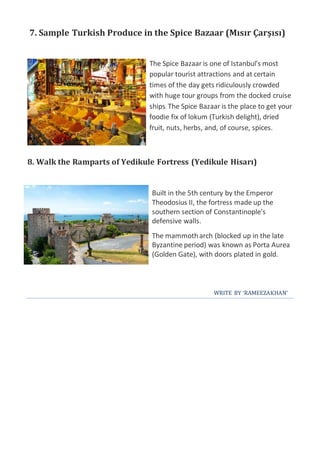
5. Stroll the Hippodrome
This was the center of Byzantine public life and the scene of splendid games and
chariot races but also factional conflicts.
Today, there isn't much of the Hippodrome left to see, except for a smallsection of
the gallery walls on the southern side, but the At Meydanı (park), which now stands
on the site is home to a variety of monuments.
6. Shop in the Grand Bazaar (KapalıÇarşı)
For many visitors, sightseeing in Istanbul is as
much about shopping as museums and
monumental attractions, and the Grand
Bazaar is where everyone comes.
This massivecovered market is basically the
world's first shopping mall, taking up a whole
city quarter, surrounded by thick walls,
between the Nuruosmanıye Mosque and
Beyazit mosque.
7. Sample Turkish Produce in the Spice Bazaar (Mısır Çarşısı)
The Spice Bazaar is one of Istanbul's most
popular tourist attractions and at certain
times of the day gets ridiculously crowded
with huge tour groups from the docked cruise
ships. The Spice Bazaar is the place to get your
foodie fix of lokum (Turkish delight), dried
fruit, nuts, herbs, and, of course, spices.
8. Walk the Ramparts of Yedikule Fortress (Yedikule Hisarı)
Built in the 5th century by the Emperor
Theodosius II, the fortress made up the
southern section of Constantinople's
defensive walls.
The mammotharch (blocked up in the late
Byzantine period) was known as Porta Aurea
(Golden Gate), with doors plated in gold.
WRITE BY ‘RAMEEZAKHAN’

RAMEEZA'S BLOG

  • 1.
    SOUL OF TURKEY(STANBUL) AREA; In Turkey the city of Istanbul in turkey is sometimes also referred to "Constantinople". The city is the largest city in Turkey both according to area and population. Istanbul has approximately 12.6 million residents in its boundaries. The city is considered as Turkey's main platform and hub for culture, architecture, history and financial strategies. Istanbul totally includes 39 districts. Istanbul is the city which is located on two different continents. The covered area of Istanbul is approximately about 707 square miles which makes the city the fifth largest in the world according to population density liver per square miles. The location of Istanbul city is North West side of the Marmara region
  • 2.
    WHEATHER; Turkey hasvery mild summers with high percentage of humidity but winters are very cold, windy and snow is very often in the city during winter season. Istanbul is slightly hot and humid in the months of May to September. The city has a humidity percentage of about 79%. Winters start from October and remain until April. The city mostly receives the rainfall and snow during the months of December, January, February and March. Maximum temperature during summers can be up to 25 degrees while in summers mostly in nights it can also fall below freezing point. ECONOMICALLY IMPORTANCE; Economically Istanbul is a very strong city as it has a very high impact in the overall Turkish economy. Istanbul is the city which is very rich in producing cotton, tobacco, silk and many other products. Istanbul has also gained importance economically because it hosts all the sea ports of Turkey and also international airports. Istanbul has some of the major industries of Turkey which includes Rubber industry, metal ware, chemicals, leather, transport vehicles industries, glass and many others. The city also generates its revenue from the tourism department. EDUCATION; Istanbul also plays an important part in the field of education as the city has a number of private and public institutions having high reputation in world. The city has almost 20 universities which allows student to specialize in many different fields. Public sector institutions are preferred more in the city because of their good results and reputation. "Istanbul University" was established in 1453 and is regarded as the oldest ever university of Turkey. Since then it has provided quality education to the students of not only Turkey but also students from different areas of the worlds. Along
  • 3.
    with Istanbul University"Istanbul Technical University" is also of great importance as it is the world's third oldest university in the field of technology established in 1773. SPORTS; In the field of sports Istanbul and Turkey have started to dominate in sports like football, basketball and volleyball. Ataturk Stadium is the biggest stadium in Turkey. The stadium has the honor of hosting UEFA champions League Final of 2005 between Liverpool FC of England and Ac Milan of Italy. Istanbul is also very famous for hosting many types of motor sport races. Out of which "Formula One Turkish Grand Prix" is the most important one. FOOD; Like the borders meet, so does the cuisine of Istanbul. A traditional Turkish platter of Istanbul consists of flavors comprising of Central Asian, Caucasian, Middle Eastern, Central and Western European flavors. Iskender Kabap is one of the prominent dishes in Istanbul. FAMOUS PLACES TO VISIT IN ISTANBUL The city (officially renamed Istanbul after the founding of the Turkish Republic) is liberally scattered with glorious remnants of its long and illustrious history, and the tourist attractions here will impress even the mostmonument-weary visitor. As well as the big four (the Hagia Sophia Mosque, Topkapı Palace, the Blue Mosque and Grand Bazaar), leave enough time to explore the other sights.
  • 4.
    Although many ofthe most popular and best places to visit are located in, or near, the old city district of Sultanahmet, there is a dazzling array of other things to do throughout the farther reaches of the city. 1. Admire the Hagia Sophia (Aya Sofya) Mosque The Hagia Sophia, whose name means “holy wisdom,” is a domed monument originally built as a cathedral in Constantinople (now Istanbul, Turkey) in the sixth century A.D. It contains two floors centered on a giant nave that has a great dome ceiling, along with smaller domes, towering above. Byzantine Emperor Constantius commissionedconstruction of the first Hagia Sophia in 360 A.D. At the time of the first church's construction, Istanbul was known as Constantinople, taking its name from Constantius' father, Constantine I, the first ruler of the Byzantine Empire. 2. Explore Topkapı Palace (Topkapı Sarayı) First built by Mehmet the Conqueror in the 15th century, this glorious palace beside the Bosphorus was where the sultans of the Ottoman Empire lived and ruled from. The vast complex is a dazzling display of Islamic art, with opulent courtyards lined with intricate hand-painted tilework, linking a warren of sumptuouslydecorated
  • 5.
    rooms, all boundedby battlemented walls and towers. 3. Visit the Blue Mosque (Sultan Ahmet Cami) Sultan Ahmet I's grand architectural gift to his capital was this beautiful mosque, commonly known as the Blue Mosque today. Built between 1609 and 1616, the mosque caused a furore throughout the Muslim world when it was finished, as it had six minarets (the same number as the Great Mosque of Mecca). A seventh minaret was eventually gifted to Mecca to stem the dissent. The mosque gets its nickname from its interior decoration of tens of thousands of Iznik tiles. 4. Head Underground at the Basilica Cistern (Yerebatan Sarnıçı) The Basilica Cistern is one of Istanbul's most surprising tourist attractions. This huge, palace-like underground hall, supported by 336 columns in 12 rows, once stored the imperial water supply for the Byzantine emperors. The project was begun by Constantine the Great but finished by Emperor Justinian in the 6th century. Many of the columns used in construction were recycled from earlier classical structures and feature decorative carvings.
  • 6.
    The most famousof these are the column bases known as the Medusa stones in the northwest corner with their Medusa head carvings. 5. Stroll the Hippodrome This was the center of Byzantine public life and the scene of splendid games and chariot races but also factional conflicts. Today, there isn't much of the Hippodrome left to see, except for a smallsection of the gallery walls on the southern side, but the At Meydanı (park), which now stands on the site is home to a variety of monuments. 6. Shop in the Grand Bazaar (KapalıÇarşı) For many visitors, sightseeing in Istanbul is as much about shopping as museums and monumental attractions, and the Grand Bazaar is where everyone comes. This massivecovered market is basically the world's first shopping mall, taking up a whole city quarter, surrounded by thick walls, between the Nuruosmanıye Mosque and Beyazit mosque.
  • 7.
    7. Sample TurkishProduce in the Spice Bazaar (Mısır Çarşısı) The Spice Bazaar is one of Istanbul's most popular tourist attractions and at certain times of the day gets ridiculously crowded with huge tour groups from the docked cruise ships. The Spice Bazaar is the place to get your foodie fix of lokum (Turkish delight), dried fruit, nuts, herbs, and, of course, spices. 8. Walk the Ramparts of Yedikule Fortress (Yedikule Hisarı) Built in the 5th century by the Emperor Theodosius II, the fortress made up the southern section of Constantinople's defensive walls. The mammotharch (blocked up in the late Byzantine period) was known as Porta Aurea (Golden Gate), with doors plated in gold. WRITE BY ‘RAMEEZAKHAN’