Problem
 Difficulty reusing functionality cutting across:
   Models
   Views
   Controllers
   Assets (JS, CSS, Images)
 Duplication across all web application layers.
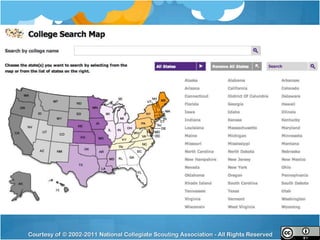
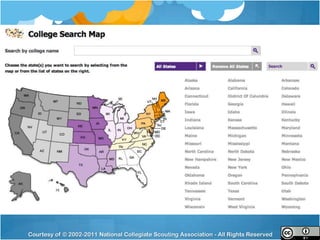
Courtesy of © 2002-2011 National Collegiate Scouting Association - All Rights Reserved
Solution
 Break common behavior into Rails Engines

 Customize models/controllers/helpers in each
 project where needed by reopening classes

 Customize Rails views in each project as needed
 by overriding templates

 Link to Rails Engines in Gemfile via Git repo
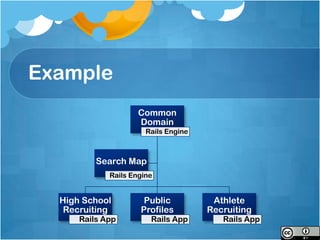
Example
                     Common
                     Domain
                       Rails Engine


          Search Map
             Rails Engine


  High School         Public           Athlete
   Recruiting        Profiles         Recruiting
      Rails App         Rails App        Rails App
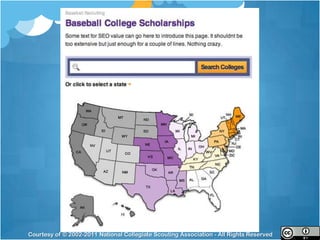
Courtesy of © 2002-2011 National Collegiate Scouting Association - All Rights Reserved
What is a Rails Engine?

       Ruby Gem
            +
  MVC stack elements
What is a Rails Engine?
 Rails Engines let applications reuse:
   Models / Views / Controllers / Helpers
   Assets (JS, CSS, Images)
   Routes
   Rake tasks
   Generators
What is a Rails Engine?
 Rails Engines let applications reuse:
   Initializers
   RSpec / Cucumber
   Rack application with middleware stack
   Migrations and seed data
   Libraries
Engine Definition
 An engine structure is similar to a Rails app
 having app, config, lib, spec, features, etc…
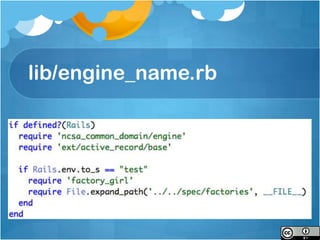
 lib/engine_name.rb (read online instructions)
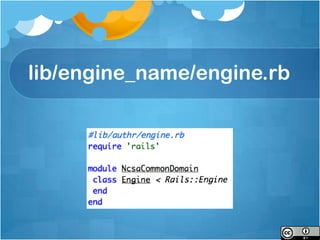
 lib/engine_name/engine.rb (read online
 instructions)
 To reuse engine, use “jeweler” gem to generate
 gemspec (read online instructions)
lib/engine_name.rb
lib/engine_name/engine.rb
Engine Consumption
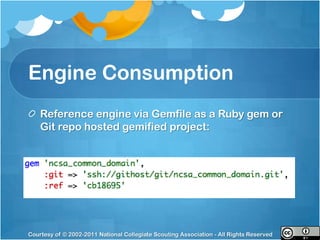
    Reference engine via Gemfile as a Ruby gem or
    Git repo hosted gemified project:


Courtesy of © 2002-2011 National Collegiate Scouting Association - All Rights Reserved
Load Order
 Typically Rails app files load first before Engine
 files.

 Strongly recommended to reverse so that
 engine’s code is customizable in app
Load Order
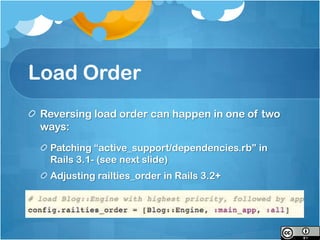
 Reversing load order can happen in one of two
 ways:
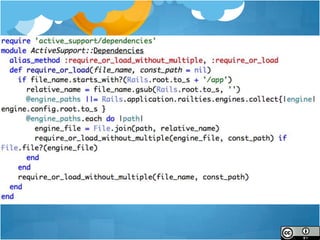
  Patching “active_support/dependencies.rb” in
  Rails 3.1- (see next slide)
  Adjusting railties_order in Rails 3.2+
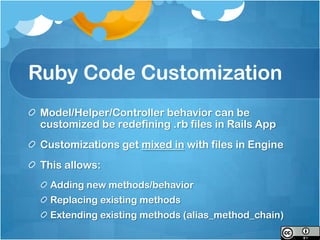
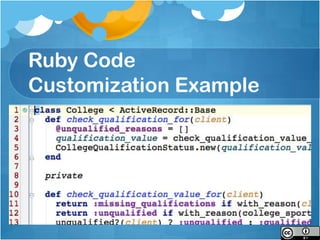
Ruby Code Customization
 Model/Helper/Controller behavior can be
 customized be redefining .rb files in Rails App
 Customizations get mixed in with files in Engine
 This allows:
   Adding new methods/behavior
   Replacing existing methods
   Extending existing methods (alias_method_chain)
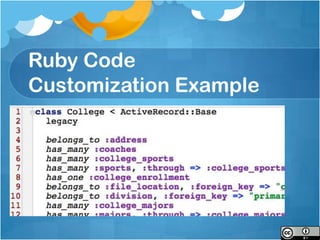
Ruby Code
Customization Example
Ruby Code
Customization Example
View and Asset
Customization
 Engine View and Asset presentation can be
 customized by redefining files in Rails App
 Customizations completely override files in Engine
 Examples of customizable View and Asset files:
   ERB/Haml
   JS
   CSS
   Images
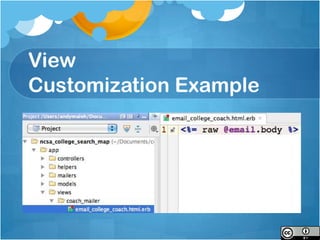
View
Customization Example
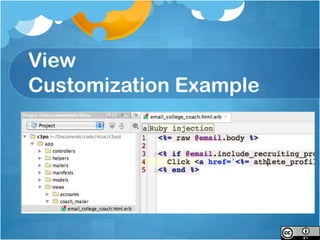
View
Customization Example
Recommended Engine
Code Management
• Each Engine lives in own Repo independent of
  Rails App

• Each Engine has its own Gem dependencies
  (Gemfile)

• Engines preferably share the same Ruby version
  as Rails App
Typical Development
Process
1. Make changes in engine, rake, and commit
   obtaining a new GIT ref
2. Update Gemfile in app with new git ref, run
   “bundle install” (getting ride of symlink)
3. Rake and commit changes in app.
4. If more changes in engine are needed go back
   to step 1
Improved Productivity via
Symlinking
 Multiple engine dependencies can hamper
 productivity when frequently going back and
 forth between engines and app
 Engine gems installed via bundler can be
 symlinked to allow continuous development until
 done with both app and
 engine:http://andymaleh.blogspot.com/2011/09/
 more-productive-rails-engine.html
Improved Development
Process
1. Open Rails app and symlink all engines “rake
   engine:symlink[engine_name]”
2. Work in app and engine until done WITHOUT running
   “bundle install”
3. Rake and commit changes in engine obtaining a new git
   ref
4. Update Gemfile in app with git ref, run “bundle install”
   (getting ride of symlink)
5. Rake and commit changes in app
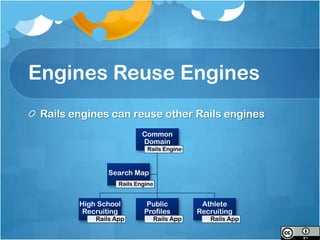
Engines Reuse Engines
 Rails engines can reuse other Rails engines
                           Common
                           Domain
                            Rails Engine


               Search Map
                   Rails Engine


        High School         Public          Athlete
         Recruiting        Profiles        Recruiting
            Rails App         Rails App       Rails App
Engines Reuse Engines
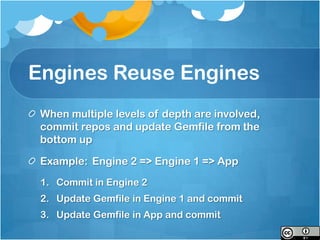
 When multiple levels of depth are involved,
 commit repos and update Gemfile from the
 bottom up

 Example: Engine 2 => Engine 1 => App
 1. Commit in Engine 2
 2. Update Gemfile in Engine 1 and commit
 3. Update Gemfile in App and commit
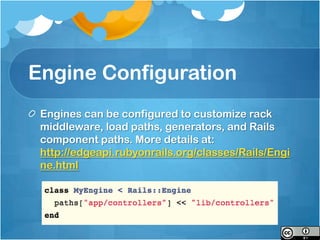
Engine Configuration
 Engines can be configured to customize rack
 middleware, load paths, generators, and Rails
 component paths. More details at:
 http://edgeapi.rubyonrails.org/classes/Rails/Engi
 ne.html
Isolated Engines
 To avoid Ruby namespace clash with
 Models/Helpers/Controllers, you can define an
 isolated namespaced engine.

 For more details, go to
 http://edgeapi.rubyonrails.org/classes/Rails/Engi
 ne.html
Rails Engine Patterns
 Goals:
  Keep engine code agnostic of app customizations
  Prevent bi-directional coupling to simplify
  reasoning about code
  Avoid app dependent conditionals to improve code
  maintainability
Pattern - Common Domain
 Problem: Multiple Rails Apps need to share a basic
 domain model including default CRUD and
 presentation behavior

 Example: need to reuse address model and form
 entry behavior
Pattern - Common Domain
 Solution:
  In engine, include basic domain models (base
  behavior, common associations) with their views,
  CRUD controllers, and routes.
  In each app, define domain model specialized
  behavior, extra associations, and custom views
  Make sure routes are declared with
  Rails.application.routes.draw (not Rails App name)
Pattern - Common Domain
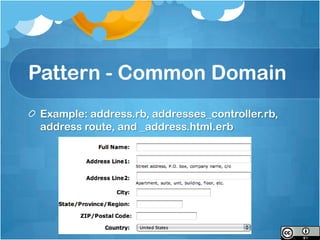
 Example: address.rb, addresses_controller.rb,
 address route, and _address.html.erb
Pattern - Expose Helper
 Problem: need to customize presentation logic for a
 view in one app only, but keep the same logic in
 others
 Example:
   One App needs to hide address1 and county for non-
   government users.
   Other Apps wants to keep the fields displayed.
   You might start by overriding view, but then realize it is
   duplicating many elements just to hide a couple fields.
Pattern - Expose Helper
 Solution:
  In Engine, extract helper logic that needs
  customization into its own helper.
  In App, redefine that new helper with
  customizations.
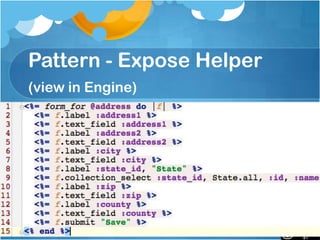
Pattern - Expose Helper
(view in Engine)
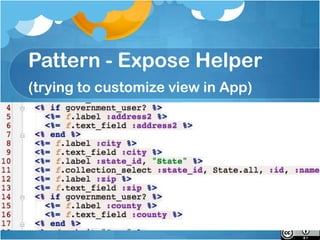
Pattern - Expose Helper
(trying to customize view in App)
Pattern - Expose Helper
 Remove custom view from App

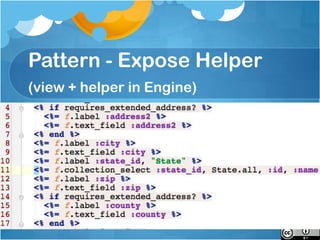
 Use requires_extended_address? helper in Engine
 wherever the App used government_user?

 In Engine, define requires_extended_address? to
 return true

 In App, define requires_extended_address? to return
 government_user?
Pattern - Expose Helper
(view + helper in Engine)
Pattern - Expose Partial
 Problem: need to have different customizations
 in one part of the view in multiple apps

 Example: Address form
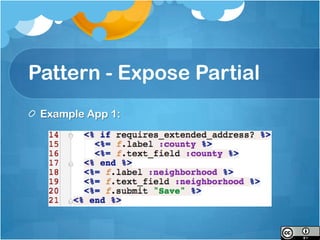
  One App needs an extra neighborhood field
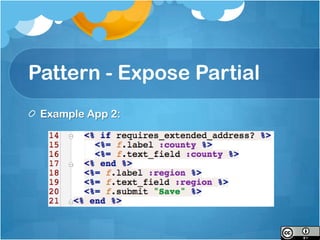
  Another App needs an extra region field
Pattern - Expose Partial
 Example App 1:
Pattern - Expose Partial
 Example App 2:
Pattern - Expose Partial
 Solution:
  In Engine, extract view part that needs
  customization as a partial.
  In App, redefine that partial with customizations.
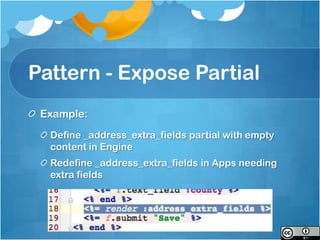
Pattern - Expose Partial
 Example:
  Define _address_extra_fields partial with empty
  content in Engine
  Redefine _address_extra_fields in Apps needing
  extra fields
Pattern - Extension Point
 Problem: multiple Apps need to contribute data
 to a View in different places

 Example: multiple Apps need to add custom
 Rows in different spots of a List that comes from
 an Engine
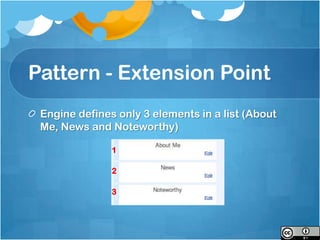
Pattern - Extension Point
 Engine defines only 3 elements in a list (About
 Me, News and Noteworthy)

               1

               2

               3
Pattern - Extension Point
 Solution:
  In Engine, add Helper logic that looks up partials in
  a specific ext directory, and based on file name
  (e.g. row_7.html.erb) insert into the right location
  in the View.
  In App, define these partials with the right file
  names and locations.
Pattern - Extension Point
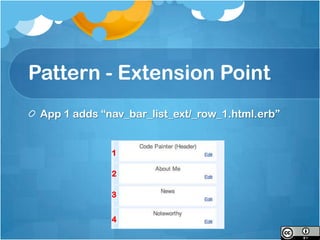
 App 1 adds “nav_bar_list_ext/_row_1.html.erb”


              1

              2

              3


              4
Pattern - Extension Point
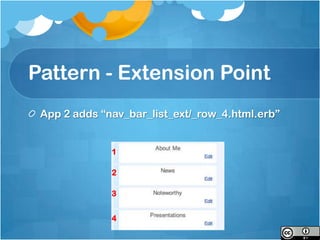
 App 2 adds “nav_bar_list_ext/_row_4.html.erb”


              1

              2

              3


              4
Pattern - Configurable
Features
 Problem: different apps need different features
 from an engine in different combinations
Pattern - Configurable
Features
 Solution:
  In Engine, add logic that looks up configuration
  options
  In App, configure Engine by overriding
  configuration options
Pattern - Configurable
Features
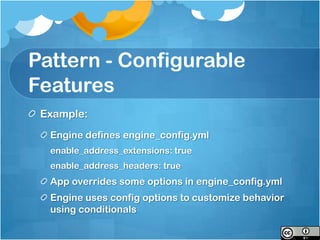
 Example:
  Engine defines engine_config.yml
  enable_address_extensions: true
  enable_address_headers: true
  App overrides some options in engine_config.yml
  Engine uses config options to customize behavior
  using conditionals
Rails Engine Costs
 Overhead in establishing a new Rails Engine
 gem project

 Continuous switching between projects and
 engines to get work done

 Upgrade of ref numbers in Gemfile on every
 commit (minimized with symlinking)
Rails Engine Benefits
 Code reuse across all application layers

 Better maintainability due to:
   Independent project codebases
   Cleanly defined boundaries between projects and
   reusable components (engines)
 Project tests get smaller and run faster
Engines vs Services
 Engines are better when:
  Reusing small MVC features, especially domain
  independent (e.g. Search Map)
  Preferring to avoiding network and infrastructure
  overhead over establishing a service
  Wanting to quickly extract and reuse a feature
Engines vs Services
 Web Services are better when:
  Reusing larger MVC features that depend on
  domain data
  Need to consume feature in another programming
  language or outside the organization boundaries
  Need to scale up feature performance
  independently of the application (e.g. separate DB)
Engines vs Services
 To keep an easier to maintain Agile code base,
 start simple and then move incrementally
 towards a more complex architecture:
  Extract an MVC feature as an engine first
  Convert engine into a service when the need
  arises
Questions & Answers


      ???
Review
 Basics of Rails Engines

 Rails Engine Patterns

 Improved Productivity Tips

 Summary of Benefits and Trade-Offs
More Info
 http://edgeapi.rubyonrails.org/classes/Rails/Engi
 ne.html

 http://andymaleh.blogspot.com/2011/09/more-
 productive-rails-engine.html

 http://stackoverflow.com/questions/2964050/rail
 s-engines-extending-
 functionality/2990539#2990539
Contact
 Andy Maleh / Software Engineer / Groupon
  Email: amaleh {at} groupon {dot} com
  Code Painter Blog: http://andymaleh.blogspot.com
  Twitter: @AndyMaleh

Rails Engine Patterns

  • 2.
    Problem Difficulty reusingfunctionality cutting across: Models Views Controllers Assets (JS, CSS, Images) Duplication across all web application layers.
  • 3.
    Courtesy of ©2002-2011 National Collegiate Scouting Association - All Rights Reserved
  • 4.
    Solution Break commonbehavior into Rails Engines Customize models/controllers/helpers in each project where needed by reopening classes Customize Rails views in each project as needed by overriding templates Link to Rails Engines in Gemfile via Git repo
  • 5.
    Example Common Domain Rails Engine Search Map Rails Engine High School Public Athlete Recruiting Profiles Recruiting Rails App Rails App Rails App
  • 6.
    Courtesy of ©2002-2011 National Collegiate Scouting Association - All Rights Reserved
  • 7.
    Courtesy of ©2002-2011 National Collegiate Scouting Association - All Rights Reserved
  • 8.
    What is aRails Engine? Ruby Gem + MVC stack elements
  • 9.
    What is aRails Engine? Rails Engines let applications reuse: Models / Views / Controllers / Helpers Assets (JS, CSS, Images) Routes Rake tasks Generators
  • 10.
    What is aRails Engine? Rails Engines let applications reuse: Initializers RSpec / Cucumber Rack application with middleware stack Migrations and seed data Libraries
  • 11.
    Engine Definition Anengine structure is similar to a Rails app having app, config, lib, spec, features, etc… lib/engine_name.rb (read online instructions) lib/engine_name/engine.rb (read online instructions) To reuse engine, use “jeweler” gem to generate gemspec (read online instructions)
  • 12.
  • 13.
  • 14.
    Engine Consumption Reference engine via Gemfile as a Ruby gem or Git repo hosted gemified project: Courtesy of © 2002-2011 National Collegiate Scouting Association - All Rights Reserved
  • 15.
    Load Order TypicallyRails app files load first before Engine files. Strongly recommended to reverse so that engine’s code is customizable in app
  • 16.
    Load Order Reversingload order can happen in one of two ways: Patching “active_support/dependencies.rb” in Rails 3.1- (see next slide) Adjusting railties_order in Rails 3.2+
  • 18.
    Ruby Code Customization Model/Helper/Controller behavior can be customized be redefining .rb files in Rails App Customizations get mixed in with files in Engine This allows: Adding new methods/behavior Replacing existing methods Extending existing methods (alias_method_chain)
  • 19.
  • 20.
  • 21.
    View and Asset Customization Engine View and Asset presentation can be customized by redefining files in Rails App Customizations completely override files in Engine Examples of customizable View and Asset files: ERB/Haml JS CSS Images
  • 22.
  • 23.
  • 24.
    Recommended Engine Code Management •Each Engine lives in own Repo independent of Rails App • Each Engine has its own Gem dependencies (Gemfile) • Engines preferably share the same Ruby version as Rails App
  • 25.
    Typical Development Process 1. Makechanges in engine, rake, and commit obtaining a new GIT ref 2. Update Gemfile in app with new git ref, run “bundle install” (getting ride of symlink) 3. Rake and commit changes in app. 4. If more changes in engine are needed go back to step 1
  • 26.
    Improved Productivity via Symlinking Multiple engine dependencies can hamper productivity when frequently going back and forth between engines and app Engine gems installed via bundler can be symlinked to allow continuous development until done with both app and engine:http://andymaleh.blogspot.com/2011/09/ more-productive-rails-engine.html
  • 27.
    Improved Development Process 1. OpenRails app and symlink all engines “rake engine:symlink[engine_name]” 2. Work in app and engine until done WITHOUT running “bundle install” 3. Rake and commit changes in engine obtaining a new git ref 4. Update Gemfile in app with git ref, run “bundle install” (getting ride of symlink) 5. Rake and commit changes in app
  • 28.
    Engines Reuse Engines Rails engines can reuse other Rails engines Common Domain Rails Engine Search Map Rails Engine High School Public Athlete Recruiting Profiles Recruiting Rails App Rails App Rails App
  • 29.
    Engines Reuse Engines When multiple levels of depth are involved, commit repos and update Gemfile from the bottom up Example: Engine 2 => Engine 1 => App 1. Commit in Engine 2 2. Update Gemfile in Engine 1 and commit 3. Update Gemfile in App and commit
  • 30.
    Engine Configuration Enginescan be configured to customize rack middleware, load paths, generators, and Rails component paths. More details at: http://edgeapi.rubyonrails.org/classes/Rails/Engi ne.html
  • 31.
    Isolated Engines Toavoid Ruby namespace clash with Models/Helpers/Controllers, you can define an isolated namespaced engine. For more details, go to http://edgeapi.rubyonrails.org/classes/Rails/Engi ne.html
  • 32.
    Rails Engine Patterns Goals: Keep engine code agnostic of app customizations Prevent bi-directional coupling to simplify reasoning about code Avoid app dependent conditionals to improve code maintainability
  • 33.
    Pattern - CommonDomain Problem: Multiple Rails Apps need to share a basic domain model including default CRUD and presentation behavior Example: need to reuse address model and form entry behavior
  • 34.
    Pattern - CommonDomain Solution: In engine, include basic domain models (base behavior, common associations) with their views, CRUD controllers, and routes. In each app, define domain model specialized behavior, extra associations, and custom views Make sure routes are declared with Rails.application.routes.draw (not Rails App name)
  • 35.
    Pattern - CommonDomain Example: address.rb, addresses_controller.rb, address route, and _address.html.erb
  • 36.
    Pattern - ExposeHelper Problem: need to customize presentation logic for a view in one app only, but keep the same logic in others Example: One App needs to hide address1 and county for non- government users. Other Apps wants to keep the fields displayed. You might start by overriding view, but then realize it is duplicating many elements just to hide a couple fields.
  • 37.
    Pattern - ExposeHelper Solution: In Engine, extract helper logic that needs customization into its own helper. In App, redefine that new helper with customizations.
  • 38.
    Pattern - ExposeHelper (view in Engine)
  • 39.
    Pattern - ExposeHelper (trying to customize view in App)
  • 40.
    Pattern - ExposeHelper Remove custom view from App Use requires_extended_address? helper in Engine wherever the App used government_user? In Engine, define requires_extended_address? to return true In App, define requires_extended_address? to return government_user?
  • 41.
    Pattern - ExposeHelper (view + helper in Engine)
  • 42.
    Pattern - ExposePartial Problem: need to have different customizations in one part of the view in multiple apps Example: Address form One App needs an extra neighborhood field Another App needs an extra region field
  • 43.
    Pattern - ExposePartial Example App 1:
  • 44.
    Pattern - ExposePartial Example App 2:
  • 45.
    Pattern - ExposePartial Solution: In Engine, extract view part that needs customization as a partial. In App, redefine that partial with customizations.
  • 46.
    Pattern - ExposePartial Example: Define _address_extra_fields partial with empty content in Engine Redefine _address_extra_fields in Apps needing extra fields
  • 47.
    Pattern - ExtensionPoint Problem: multiple Apps need to contribute data to a View in different places Example: multiple Apps need to add custom Rows in different spots of a List that comes from an Engine
  • 48.
    Pattern - ExtensionPoint Engine defines only 3 elements in a list (About Me, News and Noteworthy) 1 2 3
  • 49.
    Pattern - ExtensionPoint Solution: In Engine, add Helper logic that looks up partials in a specific ext directory, and based on file name (e.g. row_7.html.erb) insert into the right location in the View. In App, define these partials with the right file names and locations.
  • 50.
    Pattern - ExtensionPoint App 1 adds “nav_bar_list_ext/_row_1.html.erb” 1 2 3 4
  • 51.
    Pattern - ExtensionPoint App 2 adds “nav_bar_list_ext/_row_4.html.erb” 1 2 3 4
  • 52.
    Pattern - Configurable Features Problem: different apps need different features from an engine in different combinations
  • 53.
    Pattern - Configurable Features Solution: In Engine, add logic that looks up configuration options In App, configure Engine by overriding configuration options
  • 54.
    Pattern - Configurable Features Example: Engine defines engine_config.yml enable_address_extensions: true enable_address_headers: true App overrides some options in engine_config.yml Engine uses config options to customize behavior using conditionals
  • 55.
    Rails Engine Costs Overhead in establishing a new Rails Engine gem project Continuous switching between projects and engines to get work done Upgrade of ref numbers in Gemfile on every commit (minimized with symlinking)
  • 56.
    Rails Engine Benefits Code reuse across all application layers Better maintainability due to: Independent project codebases Cleanly defined boundaries between projects and reusable components (engines) Project tests get smaller and run faster
  • 57.
    Engines vs Services Engines are better when: Reusing small MVC features, especially domain independent (e.g. Search Map) Preferring to avoiding network and infrastructure overhead over establishing a service Wanting to quickly extract and reuse a feature
  • 58.
    Engines vs Services Web Services are better when: Reusing larger MVC features that depend on domain data Need to consume feature in another programming language or outside the organization boundaries Need to scale up feature performance independently of the application (e.g. separate DB)
  • 59.
    Engines vs Services To keep an easier to maintain Agile code base, start simple and then move incrementally towards a more complex architecture: Extract an MVC feature as an engine first Convert engine into a service when the need arises
  • 60.
  • 61.
    Review Basics ofRails Engines Rails Engine Patterns Improved Productivity Tips Summary of Benefits and Trade-Offs
  • 62.
    More Info http://edgeapi.rubyonrails.org/classes/Rails/Engi ne.html http://andymaleh.blogspot.com/2011/09/more- productive-rails-engine.html http://stackoverflow.com/questions/2964050/rail s-engines-extending- functionality/2990539#2990539
  • 63.
    Contact Andy Maleh/ Software Engineer / Groupon Email: amaleh {at} groupon {dot} com Code Painter Blog: http://andymaleh.blogspot.com Twitter: @AndyMaleh