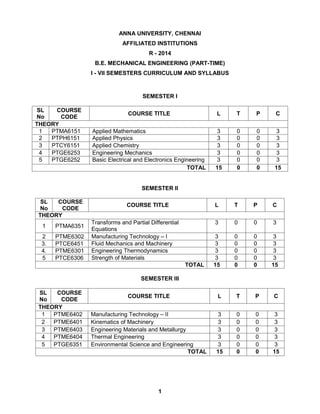
ANNA UNIVERSITY, CHENNAI 
AFFILIATED INSTITUTIONS 
R - 2014 
B.E. MECHANICAL ENGINEERING (PART-TIME) 
I - VII SEMESTERS CURRICULUM AND SYLLABUS 
SEMESTER I 
1 
SL 
No 
COURSE 
CODE COURSE TITLE L T P C 
THEORY 
1 PTMA6151 Applied Mathematics 3 0 0 3 
2 PTPH6151 Applied Physics 3 0 0 3 
3 PTCY6151 Applied Chemistry 3 0 0 3 
4 PTGE6253 Engineering Mechanics 3 0 0 3 
5 PTGE6252 Basic Electrical and Electronics Engineering 3 0 0 3 
TOTAL 15 0 0 15 
SEMESTER II 
SL 
No 
COURSE 
CODE COURSE TITLE L T P C 
THEORY 
1 PTMA6351 Transforms and Partial Differential 
Equations 
3 0 0 3 
2 PTME6302 Manufacturing Technology – I 3 0 0 3 
3. PTCE6451 Fluid Mechanics and Machinery 3 0 0 3 
4. PTME6301 Engineering Thermodynamics 3 0 0 3 
5 PTCE6306 Strength of Materials 3 0 0 3 
TOTAL 15 0 0 15 
SEMESTER III 
SL 
No 
COURSE 
CODE COURSE TITLE L T P C 
THEORY 
1 PTME6402 Manufacturing Technology – II 3 0 0 3 
2 PTME6401 Kinematics of Machinery 3 0 0 3 
3 PTME6403 Engineering Materials and Metallurgy 3 0 0 3 
4 PTME6404 Thermal Engineering 3 0 0 3 
5 PTGE6351 Environmental Science and Engineering 3 0 0 3 
TOTAL 15 0 0 15
SEMESTER IV 
2 
SL 
No 
COURSE 
CODE 
COURSE TITLE L T P C 
THEORY 
1 PTME6503 Design of Machine Elements 3 0 0 3 
2 PTME6505 Dynamics of Machines 3 0 0 3 
3 PTME6502 Heat and Mass Transfer 3 0 0 3 
4 PTME6504 Metrology and Measurements 3 0 0 3 
PRACTICAL 
5 PTME6412 Thermal Engineering Laboratory 0 0 3 2 
TOTAL 12 0 3 14 
SEMESTER V 
SL 
No 
COURSE 
CODE 
COURSE TITLE L T P C 
THEORY 
1 PTME6601 Design of Transmission Systems 3 0 0 3 
2 PTME6602 Automobile Engineering 3 0 0 3 
3 PTME6702 Mechatronics 3 0 0 3 
4 PTMG6851 Principles of Management 3 0 0 3 
5 PTME6604 Gas Dynamics and Jet Propulsion 3 0 0 3 
TOTAL 15 0 0 15 
SEMESTER VI 
SL 
No 
COURSE 
CODE 
COURSE TITLE L T P C 
THEORY 
1 PTME6701 Power Plant Engineering 3 0 0 3 
2 PTME6703 Computer Integrated Manufacturing 
Systems 
3 0 0 3 
3 Elective – I 3 0 0 3 
4 Elective – II 3 0 0 3 
PRACTICAL 
5 PTME6611 CAD / CAM Laboratory 0 0 3 2 
TOTAL 12 0 3 14 
SEMESTER VII 
SL 
No 
COURSE 
CODE 
COURSE TITLE L T P C 
THEORY 
1 PTMG6863 Engineering Economics 3 0 0 3 
2 Elective – III 3 0 0 3 
3 Elective – IV 3 0 0 3 
PRACTICAL 
4 PTME6811 Project Work 0 0 9 6 
TOTAL 9 0 9 15 
TOTAL CREDITS TO BE EARNED FOR THE AWARD OF THE DEGREE = 103
ELECTIVES FOR B.E. MECHANICAL ENGINEERING (PART TIME) 
ELECTIVE I 
3 
SL 
No 
CODE NO. COURSE TITLE L T P C 
1 PTMG6072 Marketing Management 3 0 0 3 
2 PTME6001 Quality Control and Reliability Engineering 3 0 0 3 
3 PTME6002 Refrigeration and Air conditioning 3 0 0 3 
4 PTME6003 Renewable Sources of Energy 3 0 0 3 
5 PTME6004 Unconventional Machining Processes 3 0 0 3 
ELECTIVE II 
SL 
No 
CODE NO. COURSE TITLE L T P C 
1 PTME6005 Process Planning and Cost Estimation 3 0 0 3 
2 PTME6006 Design of Jigs, Fixtures and Press Tools 3 0 0 3 
3 PTME6007 Composite Materials and Mechanics 3 0 0 3 
4 PTME6008 Welding Technology 3 0 0 3 
5 PTME6009 Energy Conservation and Management 3 0 0 3 
6. PTME6018 Additive Manufacturing 3 0 0 3 
ELECTIVE III 
SL 
No 
CODE NO. COURSE TITLE L T P C 
1 PTME6010 Robotics 3 0 0 3 
2 PTGE6081 Fundamentals of Nanoscience 3 0 0 3 
3 PTME6011 Thermal Turbo machines 3 0 0 3 
4 PTME6012 Maintenance Engineering 3 0 0 3 
5 PTEE6007 Micro Electro Mechanical Systems 3 0 0 3 
6. PTME6013 Design of Pressure Vessels and Piping 3 0 0 3 
7 PTME6016 Advanced I.C. Engines 3 0 0 3 
ELECTIVE IV 
SL 
No 
CODE NO. COURSE TITLE L T P C 
1 PTIE6605 Production Planning and Control 3 0 0 3 
2 PTMG6071 Entrepreneurship Development 3 0 0 3 
3 PTME6014 Computational Fluid Dynamics 3 0 0 3 
4 PTME6015 Operations Research 3 0 0 3 
5 PTME6017 Design of Heat Exchangers 3 0 0 3 
6. PTME6019 Non Destructive Testing and Materials 3 0 0 3
PTMA6151 APPLIED MATHEMATICS L T P C 
4 
3 0 0 3 
OBJECTIVES 
 To facilitate the understanding of the principles and to cultivate the art of formulating physical 
problems in the language of mathematics. 
UNIT I MATRICES 9 
Characteristic equation – Eigenvalues and Eigenvectors of a real matrix – Properties of eigenvalues 
and eigenvectors – Cayley-Hamilton Theorem – Diagonalization of matrices - Reduction of a 
quadratic form to canonical form by orthogonal transformation. 
UNIT II FUNCTIONS OF SEVERAL VARIABLES 9 
Partial derivatives – Homogeneous functions and Euler’s theorem – Total derivative – Differentiation 
of implicit functions – Change of variables – Jacobians – Partial differentiation of implicit functions – 
Taylor’s series for functions of two variables - Maxima and minima of functions of two variables. 
UNIT III ANALYTIC FUNCTION 9 
Analytic functions – Necessary and sufficient conditions for analyticity – Properties – Harmonic 
conjugates – Construction of analytic function – Conformal Mapping – Mapping by functions w = a + z 
, az, 1/z, - Bilinear transformation. 
UNIT IV COMPLEX INTEGRATION 9 
Line Integral – Cauchy’s theorem and integral formula – Taylor’s and Laurent’s Series – Singularities 
– Residues – Residue theorem – Application of Residue theorem for evaluation of real integrals – Use 
of circular contour and semicircular contour with no pole on real axis. 
UNIT V LAPLACE TRANSFORM 9 
Existence conditions – Transforms of elementary functions – Basic properties – Transforms of 
derivatives and integrals –Inverse transforms – Convolution theorem – Transform of periodic functions 
– Application to solution of linear ordinary differential equations with constant coefficients. 
TOTAL: 45 PERIODS 
OUTCOMES 
 To develop the use of matrix algebra techniques this is needed by engineers for practical 
applications. 
 To familiarize the student with functions of several variables. This is needed in many 
branches of engineering. 
 To develop an understanding of the standard techniques of complex variable theory so as to 
enable the student to apply them with confidence, in application areas such as heat 
conduction, elasticity, fluid dynamics and flow the of electric current. 
 To make the student appreciate the purpose of using transforms to create a new domain in 
which it is easier to handle the problem that is being investigated. 
BOOKS FOR STUDY 
1. Grewal B.S., Higher Engineering Mathematics, Khanna Publishers, Forty Second Edition, Delhi, 
2012. 
2. Ramana, B.V. Higher Engineering Mathematics” Tata McGraw Hill Publishing Company, 2008. 
REFERENCES 
1. Glyn James, Advanced Modern Engineering Mathematics, Prentice Hall of India, Fouth Edition, 
2011. 
2. Veerarajan, T., Engineering Mathematics (For First Year), Tata McGraw-Hill Pub. Pvt. Ltd., New 
Delhi, 2007.
PTPH6151 APPLIED PHYSICS L T P C 
5 
3 0 0 3 
OBJECTIVE: 
 To enrich the understanding of various types of materials and their applications in 
engineering and technology. 
UNIT I CONDUCTING MATERIALS 9 
Conductors – classical free electron theory of metals – Electrical and thermal conductivity – 
Wiedemann – Franz law – Lorentz number – Draw backs of classical theory – Quantum theory – 
Fermi distribution function – Effect of temperature on Fermi Function – Density of energy states – 
carrier concentration in metals. 
UNIT II SEMICONDUCTING MATERIALS 9 
Intrinsic semiconductor – carrier concentration derivation – Fermi level – Variation of Fermi level with 
temperature – electrical conductivity – band gap determination – compound semiconductors -direct 
and indirect band gap- derivation of carrier concentration in n-type and p-type semiconductor – 
variation of Fermi level with temperature and impurity concentration –– Hall effect –Determination of 
Hall coefficient – Applications. 
UNIT III MAGNETIC AND SUPERCONDUCTING MATERIALS 9 
Origin of magnetic moment – Bohr magneton – comparison of Dia, Para and Ferro magnetism – 
Domain theory – Hysteresis – soft and hard magnetic materials – antiferromagnetic materials – 
Ferrites and its applications 
Superconductivity : properties – Type I and Type II superconductors – BCS theory of 
superconductivity(Qualitative) - High Tc superconductors – Applications of superconductors – SQUID, 
cryotron, magnetic levitation. 
UNIT IV DIELECTRIC MATERIALS 9 
Electrical susceptibility – dielectric constant – electronic, ionic, orientational and space charge 
polarization – frequency and temperature dependence of polarisation – internal field – Claussius – 
Mosotti relation (derivation) – dielectric loss – dielectric breakdown – uses of dielectric materials 
(capacitor and transformer) – ferroelectricity and applications. 
UNIT V ADVANCED ENGINEERING MATERIALS 9 
Metallic glasses: preparation, properties and applications. Shape memory alloys (SMA): 
Characteristics, properties of NiTi alloy, application, Nanomaterials– Preparation -pulsed laser 
deposition – chemical vapour deposition – Applications – NLO materials –Birefringence- optical Kerr 
effect – Classification of Biomaterials and its applications 
TOTAL : 45 PERIODS 
OUTCOMES: 
 The students will be able to understand the fundamentals of materials and their applications in 
Engineering and Technology. 
TEXT BOOKS: 
1. M. Arumugam, Materials Science, Anuradha publishers, 2010 
2. S.O. Pillai, Solid State Physics New Age International(P) Ltd., publishers, 2009 
REFERENCES: 
1. P.K. Palanisamy, Materials Science, SCITECH Publishers, 2011 
2. G. Senthilkumar, Engineering Physics II, VRB Publishers, 2011 
3. P. Mani, Engineering Physics II, Dhanam Publications, 2011 
4. A. Marikani, Engineering Physics, PHI Learning Pvt., India, 2009
PTCY6151 APPLIED CHEMISTR Y L T P C 
6 
3 0 0 3 
OBJECTIVES: 
 To make the students conversant with water technology 
 To make the student acquire sound knowledge of electrochemistry and corrosion of 
importance in engineering applications in all disciplines. 
 To acquaint the student with concepts of importance in polymers and energy sources. 
 To develop an understanding of the basic concepts and its applications to engineering 
materials such as abrasives, refractories cement and glass materials. 
 To acquaint the students with the basics fuel and combustion and their properties and 
applications. 
UNIT I WATER TECHNOLOGY 9 
Introduction to boiler feed water-requirements-formation of deposits in steam boilers and heat 
exchangers- disadvantages (wastage of fuels, decrease in efficiency, boiler explosion) prevention of 
scale formation -softening of hard water -external treatment zeolite and demineralization - internal 
treatment- boiler compounds (phosphate, calgon, carbonate, colloidal) - caustic embrittlement-boiler 
corrosion-priming and foaming- desalination of brackish water –reverse osmosis 
UNIT II ELECTROCHEMISTRY AND CORROSION 9 
Electrochemical cell - redox reaction, electrode potential- origin of electrode potential- oxidation 
potential- reduction potential, measurement and applications - electrochemical series and its 
significance - Nernst equation (derivation and problems). Corrosion- causes- factors- types-chemical, 
electrochemical corrosion (galvanic, differential aeration), corrosion control - material selection and 
design aspects - electrochemical protection – sacrificial anode method and impressed current 
cathodic method. Paints- constituents and function. 
UNIT III POLYMERS AND ENERGY SOURCES 9 
Polymers – Classification- Polyethylene, Polypropylene, Polyvinyl chloride, Polystyrene- Polyamide, 
Polyethylene Terephthalate, Polycarbonate, Acrylonitrile Butadiene styrene - Solar energy 
conversion- solar cells- wind energy. Batteries and fuel cells: Types of batteries- alkaline battery- lead 
storage battery- nickel-cadmium battery- lithium battery- fuel cell H2 -O2 fuel cell- applications. 
UNIT IV ENGINEERING MATERIALS 9 
Abrasives: definition, classification or types, grinding wheel, abrasive paper and cloth. Refractories: 
definition, characteristics, classification, properties – refractoriness and RUL, dimensional stability, 
thermal spalling, thermal expansion, porosity; Manufacture of alumina, magnesite and silicon carbide, 
Portland cement- manufacture and properties - setting and hardening of cement, special cement-waterproof 
and white cement–properties and uses. Glass - manufacture, types, properties and uses. 
UNIT V FUELS AND COMBUSTION 9 
Fuel: Introduction- classification of fuels- calorific value- higher and lower calorific values- coal-analysis 
of coal (proximate and ultimate)- carbonization- manufacture of metallurgical coke (Otto 
Hoffmann method) - petroleum- manufacture of synthetic petrol (Bergius process)- knocking- octane 
number - diesel oil- cetane number - natural gas- compressed natural gas(CNG)- liquefied petroleum 
gases(LPG)- producer gas- water gas. Power alcohol and bio diesel. Combustion of fuels: 
introduction- theoretical calculation of calorific value- calculation of stoichiometry of fuel and air ratio-ignition 
temperature- explosive range - flue gas analysis (ORSAT Method). 
TOTAL : 45 PERIODS
OUTCOMES: 
 The knowledge gained on water technology, thermodynamics, electrochemistry and corrosion, 
polymers and energy sources and engineering materials and fuel and combustion will provide 
a strong platform to understand advanced concepts on these subjects at higher level learning. 
TEXT BOOKS: 
1. Vairam S, Kalyani P, Suba Ramesh.,“Engineering Chemistry”., Wiley India Pvt Ltd., New Delhi., 
7 
2011 
2. Kannan P., Ravikrishnan A., “Engineering Chemistry”, Sri Krishna Hi-tech Publishing Company 
Pvt. Ltd. Chennai, 2009 
REFERENCE BOOKS: 
1. Dara S.S, Umare S.S.“Engineering Chemistry”, S. Chand & Company Ltd., New Delhi , 2010 
2. AshimaSrivastava., Janhavi N N., Concepts of Engineering Chemistry”., ACME Learning Private 
Limited., New Delhi., 2010 
3. Renu Bapna, Renu Gupta., “Engineering Chemistry”, Macmillan India Publisher Ltd., 2010. 
4. Pahari A., Chauhan B., “Engineering Chemistry”., Firewall Media., New Delhi., 2010 
PTGE6253 ENGINEERING MECHANICS L T P C 
3 0 0 3 
OBJECTIVE 
 To develop capacity to predict the effect of force and motion in the course of carrying out the 
design functions of engineering 
UNIT I BASICS AND STATICS OF PARTICLES 12 
Introduction – Units and Dimensions – Laws of Mechanics – Lami’s theorem, Parallelogram and 
triangular Law of forces –– Vectorial representation of forces – Vector operations of forces -additions, 
subtraction, dot product, cross product – Coplanar Forces – rectangular components – Equilibrium of 
a particle – Forces in space – Equilibrium of a particle in space – Equivalent systems of forces – 
Principle of transmissibility . 
UNIT II EQUILIBRIUM OF RIGID BODIES 12 
Free body diagram – Types of supports –Action and reaction forces –stable equilibrium – Moments 
and Couples – Moment of a force about a point and about an axis – Vectorial representation of 
moments and couples – Scalar components of a moment – Varignon’s theorem – Single equivalent 
force -Equilibrium of Rigid bodies in two dimensions – Equilibrium of Rigid bodies in three dimensions 
UNIT III PROPERTIES OF SURFACES AND SOLIDS 12 
Centroids and centre of mass– Centroids of lines and areas - Rectangular, circular, triangular areas 
by integration – T section, I section, - Angle section, Hollow section by using standard formula – 
Theorems of Pappus - Area moments of inertia of plane areas – Rectangular, circular, triangular 
areas by integration – T section, I section, Angle section, Hollow section by using standard formula – 
Parallel axis theorem and perpendicular axis theorem –Principal moments of inertia of plane areas – 
Principal axes of inertia-Mass moment of inertia –mass moment of inertia for prismatic, cylindrical and 
spherical solids from first principle – Relation to area moments of inertia. 
UNIT IV DYNAMICS OF PARTICLES 12 
Displacements, Velocity and acceleration, their relationship – Relative motion – Curvilinear motion - 
Newton’s laws of motion – Work Energy Equation– Impulse and Momentum – Impact of elastic 
bodies.
UNIT V FRICTION AND ELEMENTS OF RIGID BODY DYNAMICS 12 
Friction force – Laws of sliding friction – equilibrium analysis of simple systems with sliding friction – 
wedge friction-. Rolling resistance -Translation and Rotation of Rigid Bodies – Velocity and 
acceleration – General Plane motion of simple rigid bodies such as cylinder, disc/wheel and sphere. 
8 
TOTAL: 60 PERIODS 
OUTCOMES: 
 ability to explain the differential principles applies to solve engineering problems dealing with 
force, displacement, velocity and acceleration. 
 ability to analyse the forces in any structures. 
 ability to solve rigid body subjected to dynamic forces. 
TEXT BOOKS: 
1. Beer, F.P and Johnston Jr. E.R. “Vector Mechanics for Engineers (In SI Units): Statics and 
Dynamics”, 8th Edition, Tata McGraw-Hill Publishing company, New Delhi (2004). 
2. Vela Murali, “Engineering Mechanics”, Oxford University Press (2010) 
REFERENCES: 
1. Hibbeller, R.C and Ashok Gupta, “Engineering Mechanics: Statics and Dynamics”, 11th Edition, 
Pearson Education (2010). 
2. Irving H. Shames and Krishna Mohana Rao. G., “Engineering Mechanics – Statics and Dynamics”, 
4th Edition, Pearson Education (2006) 
3. J.L.Meriam and L.G.Kraige, “ Engineering Mechanics- Statics - Volume 1, Dynamics- Volume 
2,Third Edition, John Wiley & Sons,(1993) 
4. Rajasekaran, S and Sankarasubramanian, G., “Engineering Mechanics Statics and Dynamics”,3rd 
Edition, Vikas Publishing House Pvt. Ltd., (2005). 
5. Bhavikatti, S.S and Rajashekarappa, K.G., “Engineering Mechanics”, New Age International (P) 
Limited Publishers, (1998). 
6. Kumar, K.L., “Engineering Mechanics”, 3rd Revised Edition, Tata McGraw-Hill Publishing 
company, New Delhi (2008) 
PTGE6252 BASIC ELECTRICAL AND ELECTRONICS ENGINEERING L T P C 
3 0 0 3 
OBJECTIVES: 
 To explain the basic theorems used in Electrical circuits and the different components and 
function of electrical machines. 
 To explain the fundamentals of semiconductor and applications. 
 To explain the principles of digital electronics 
 To impart knowledge of communication. 
UNIT I ELECTRICAL CIRCUITS & MEASURMENTS 12 
Ohm’s Law – Kirchoff’s Laws – Steady State Solution of DC Circuits – Introduction to AC Circuits – 
Waveforms and RMS Value – Power and Power factor – Single Phase and Three Phase Balanced 
Circuits. 
Operating Principles of Moving Coil and Moving Iron Instruments (Ammeters and Voltmeters), 
Dynamometer type Watt meters and Energy meters. 
UNIT II ELECTRICAL MECHANICS 12 
Construction, Principle of Operation, Basic Equations and Applications of DC Generators, DC Motors, 
Single Phase Transformer, single phase induction Motor.
UNIT III SEMICONDUCTOR DEVICES AND APPLICATIONS 12 
Characteristics of PN Junction Diode – Zener Effect – Zener Diode and its Characteristics – Half wave 
and Full wave Rectifiers – Voltage Regulation. 
Bipolar Junction Transistor – CB, CE, CC Configurations and Characteristics – Elementary Treatment 
of Small Signal Amplifier. 
UNIT IV DIGITAL ELECTRONICS 12 
Binary Number System – Logic Gates – Boolean Algebra – Half and Full Adders – Flip-Flops – 
Registers and Counters – A/D and D/A Conversion (single concepts) 
UNIT V FUNDAMENTALS OF COMMUNICATION ENGINEERING 12 
Types of Signals: Analog and Digital Signals – Modulation and Demodulation: Principles of Amplitude 
and Frequency Modulations. 
Communication Systems: Radio, TV, Fax, Microwave, Satellite and Optical Fibre (Block Diagram 
Approach only). 
9 
TOTAL : 60 PERIODS 
OUTCOMES: 
 ability to identify the electrical components explain the characteristics of electrical machines. 
 ability to identify electronics components and use of them to design circuits. 
TEXT BOOKS: 
1. .N. Mittle “Basic Electrical Engineering”,Tata McGraw Hill Edition, New Delhi, 1990. 
2. R.S. Sedha, “Applied Electronics” S. Chand & Co., 2006. 
REFERENCES: 
1. Muthusubramanian R, Salivahanan S and Muraleedharan K A, “Basic Electrical, Electronics and 
Computer Engineering”,Tata McGraw Hill, Second Edition, (2006). 
2. Nagsarkar T K and Sukhija M S, “Basics of Electrical Engineering”, Oxford press (2005). 
3. Mehta V K, “Principles of Electronics”, S.Chand & Company Ltd, (1994). 
4. Mahmood Nahvi and Joseph A. Edminister, “Electric Circuits”, Schaum’ Outline Series, McGraw 
Hill, (2002). 
5. Premkumar N, “Basic Electrical Engineering”, Anuradha Publishers, (2003). 
PTMA6351 TRANSFORMS AND PARTIAL DIFFERENTIAL EQUATIONS L T P C 
3 0 0 3 
OBJECTIVE: 
 To facilitate the understanding of the principles and to cultivate the art of formulating physical 
problems in the language of mathematics. 
UNIT I FOURIER SERIES 9 
Dirichlet’s conditions – General Fourier series – Odd and even functions – Half-range Sine and Cosine 
series –Parseval’s identity – Harmonic Analysis. 
UNITII FOURIER TRANSFORM 9 
Fourier integral theorem – Fourier transform pair-Sine and Cosine transforms – Properties – 
Transform of elementary functions – Convolution theorem – Parseval’s identity.
UNIT III PARTIAL DIFFERENTIAL EQUATIONS 9 
Formation – Solutions of first order equations – Standard types and Equations reducible to standard 
types – Singular solutions – Lagrange’s Linear equation –Solution of homogenous linear equations of 
higher order with constant coefficients. 
UNIT IV APPLICATIONS OF PARTIAL DIFFERENTIAL EQUATIONS 9 
Method of separation of Variables – Solutions of one dimensional wave equation and one-dimensional 
heat equation – Steady state solution of two-dimensional heat equation. 
UNIT V Z – TRANSFORM AND DIFFERENCE EQUATIONS 9 
Z-transform – Elementary properties – Inverse Z-transform – Convolution theorem –Formation of 
difference equation – Solution of difference equation using Z-transform. 
10 
TOTAL: 45 PERIODS 
OUTCOMES: 
 To introduce Fourier series analysis which is central to many applications in engineering apart 
from its use in solving boundary value problems. 
 To acquaint the student with Fourier transform techniques used in wide variety of situations in 
which the functions used are not periodic. 
 To introduce the effective mathematical tools for the solutions of partial differential equations that 
model physical processes. 
 To develop Z- transform techniques which will perform the same task for discrete time systems 
as Laplace Transform, a valuable aid in analysis of continuous time systems. 
TEXT BOOK 
1. Grewal B.S., Higher Engineering Mathematics, Khanna Publishers, Forty Second Edition, 
Delhi, 2012 
REFERENCES 
1. Glyn James, Advanced Modern Engineering Mathematics, Prentice Hall of India, Fouth 
Edition, 2011 
2. Ramana, B.V. Higher Engineering Mathematics” Tata McGraw Hill Publishing Company, 
2008. 
3. Bali, N.P. and Manish Goyal, A Text Book of Engineering Mathematics, Lakshmi Publications 
Pvt. Ltd., New Delhi, 2006. 
PTME6302 MANUFACTURING TECHNOLOGY – I L T P C 
3 0 0 3 
OBJECTIVES: 
 To introduce the concepts of basic manufacturing processes and fabrication techniques, such 
as metal casting, metal joining, metal forming and manufacture of plastic components. 
UNIT I METAL CASTING PROCESSES 9 
Sand Casting : Sand Mould – Type of patterns - Pattern Materials – Pattern allowances –Moulding 
sand Properties and testing – Cores –Types and applications – Moulding machines– Types and 
applications; Melting furnaces : Blast and Cupola Furnaces; Principle of special casting 
processes : Shell - investment – Ceramic mould – Pressure die casting - Centrifugal Casting - CO2 
process – Stir casting; Defects in Sand casting
UNIT II JOINING PROCESSES 9 
Operating principle, basic equipment, merits and applications of : Fusion welding processes : 
Gas welding - Types – Flame characteristics; Manual metal arc welding – Gas Tungsten arc welding 
- Gas metal arc welding – Submerged arc welding – Electro slag welding; Operating principle and 
applications of : Resistance welding - Plasma arc welding – Thermit welding – Electron beam 
welding – Friction welding and Friction Stir Welding; Brazing and soldering; Weld defects: types, 
causes and cure. 
UNIT III METAL FORMING PROCESSES 9 
Hot working and cold working of metals – Forging processes – Open, impression and closed die 
forging – forging operations. Rolling of metals– Types of Rolling – Flat strip rolling – shape rolling 
operations – Defects in rolled parts. Principle of rod and wire drawing – Tube drawing – Principles of 
Extrusion – Types – Hot and Cold extrusion. 
UNIT IV SHEET METAL PROCESSES 9 
Sheet metal characteristics – shearing, bending and drawing operations – Stretch forming operations 
– Formability of sheet metal – Test methods –special forming processes-Working principle and 
applications – Hydro forming – Rubber pad forming – Metal spinning– Introduction of Explosive 
forming, magnetic pulse forming, peen forming, Super plastic forming – Micro forming 
UNIT V MANUFACTURE OF PLASTIC COMPONENTS 9 
Types and characteristics of plastics – Moulding of thermoplastics – working principles and typical 
applications – injection moulding – Plunger and screw machines – Compression moulding, Transfer 
Moulding – Typical industrial applications – introduction to blow moulding –Rotational moulding – Film 
blowing – Extrusion – Thermoforming – Bonding of Thermoplastics. 
11 
TOTAL: 45 PERIODS 
OUTCOMES: 
 Upon completion of this course, the students can able to apply the different manufacturing 
process and use this in industry for component production 
TEXT BOOKS: 
1. Hajra Chouldhary S.K and Hajra Choudhury. AK., "Elements of workshop Technology", 
volume I and II, Media promoters and Publishers Private Limited, Mumbai, 1997 
2. Kalpakjian. S, “Manufacturing Engineering and Technology”, Pearson Education India Edition, 
2006 
REFERENCES: 
1. Gowri P. Hariharan, A.Suresh Babu, "Manufacturing Technology I", Pearson Education, 2008 
2. Roy. A. Lindberg, "Processes and Materials of Manufacture", PHI / Pearson education, 2006 
3. Paul Degarma E, Black J.T and Ronald A. Kosher, "Materials and Processes, in 
Manufacturing" Eight Edition, Prentice – Hall of India, 1997. 
4. Sharma, P.C., "A Text book of production Technology", S.Chand and Co. Ltd., 2004. 
5. Rao, P.N. "Manufacturing Technology Foundry, Forming and Welding", 2ndEdition, TMH-2003; 
2003
PTCE6451 FLUID MECHANICS AND MACHINERY L T P C 
12 
3 0 0 3 
OBJECTIVES: 
 The applications of the conservation laws to flow through pipes and hydraulic machines are 
studied 
 To understand the importance of dimensional analysis. 
 To understand the importance of various types of flow in pumps and turbines. 
UNIT I FLUID PROPERTIES AND FLOW CHARACTERISTICS 8 
Units and dimensions- Properties of fluids- mass density, specific weight, specific volume, specific 
gravity, viscosity, compressibility, vapor pressure, surface tension and capillarity. Flow characteristics 
– concept of control volume - application of continuity equation, energy equation and momentum 
equation. 
UNIT II FLOW THROUGH CIRCULAR CONDUITS 8 
Hydraulic and energy gradient - Laminar flow through circular conduits and circular annuli-Boundary 
layer concepts – types of boundary layer thickness – Darcy Weisbach equation –friction factor- Moody 
diagram- commercial pipes- minor losses – Flow through pipes in series and parallel. 
UNIT III DIMENSIONAL ANALYSIS 9 
Need for dimensional analysis – methods of dimensional analysis – Similitude –types of similitude - 
Dimensionless parameters- application of dimensionless parameters – Model analysis. 
UNIT IV PUMPS 10 
Impact of jets - Euler’s equation - Theory of roto-dynamic machines – various efficiencies– velocity 
components at entry and exit of the rotor- velocity triangles - Centrifugal pumps– working principle - 
work done by the impeller - performance curves - Reciprocating pump- working principle – Rotary 
pumps –classification. 
UNIT V TURBINES 10 
Classification of turbines – heads and efficiencies – velocity triangles. Axial, radial and mixed flow 
turbines. Pelton wheel, Francis turbine and Kaplan turbines- working principles - work done by water 
on the runner – draft tube. Specific speed - unit quantities – performance curves for turbines – 
governing of turbines. 
TOTAL: 45 PERIODS 
OUTCOMES: 
 Upon completion of this course, the students can able to apply mathematical knowledge to 
predict the properties and characteristics of a fluid. 
 Can critically analyse the performance of pumps and turbines. 
TEXT BOOK: 
1. Modi P.N. and Seth, S.M. "Hydraulics and Fluid Mechanics", Standard Book House, New Delhi 
2004. 
REFERENCES: 
1. Streeter, V. L. and Wylie E. B., "Fluid Mechanics", McGraw Hill Publishing Co. 2010 
2. Kumar K. L., "Engineering Fluid Mechanics", Eurasia Publishing House(p) Ltd., New Delhi 
2004 
3. Robert W.Fox, Alan T. McDonald, Philip J.Pritchard, “Fluid Mechanics and Machinery”, 2011. 
4. Graebel. W.P, "Engineering Fluid Mechanics", Taylor & Francis, Indian Reprint, 2011
PTME6301 ENGINEERING THERMODYNAMICS L T P C 
13 
3 0 0 3 
OBJECTIVES: 
 To familiarize the students to understand the fundamentals of thermodynamics and to perform 
thermal analysis on their behavior and performance. 
(Use of Standard and approved Steam Table, Mollier Chart, Compressibility Chart and 
Psychrometric Chart permitted) 
UNIT I BASIC CONCEPTS AND FIRST LAW 9 
Basic concepts - concept of continuum, comparison of microscopic and macroscopic approach. Path 
and point functions. Intensive and extensive, total and specific quantities. System and their types. 
Thermodynamic Equilibrium State, path and process. Quasi-static, reversible and irreversible 
processes. Heat and work transfer, definition and comparison, sign convention. Displacement work 
and other modes of work .P-V diagram. Zeroth law of thermodynamics – concept of temperature and 
thermal equilibrium– relationship between temperature scales –new temperature scales. First law of 
thermodynamics –application to closed and open systems – steady and unsteady flow processes. 
UNIT II SECOND LAW AND AVAILABILITY ANALYSIS 9 
Heat Reservoir, source and sink. Heat Engine, Refrigerator, Heat pump. Statements of second law 
and its corollaries. Carnot cycle Reversed Carnot cycle, Performance. Clausius inequality. Concept of 
entropy, T-s diagram, Tds Equations, entropy change for - pure substance, ideal gases - different 
processes, principle of increase in entropy. Applications of II Law. High and low grade energy. 
Available and non-available energy of a source and finite body. Energy and irreversibility. Expressions 
for the energy of a closed system and open systems. Energy balance and entropy generation. 
Irreversibility. I and II law Efficiency. 
UNIT III PROPERTIES OF PURE SUBSTANCE AND STEAM POWER CYCLE 9 
Formation of steam and its thermodynamic properties, p-v, p-T, T-v, T-s, h-s diagrams. p-v-T surface. 
Use of Steam Table and Mollier Chart. Determination of dryness fraction. Application of I and II law 
for pure substances. Ideal and actual Rankine cycles, Cycle Improvement Methods - Reheat and 
Regenerative cycles, Economiser, preheater, Binary and Combined cycles. 
UNIT IV IDEAL AND REAL GASES, THERMODYNAMIC RELATIONS 9 
Properties of Ideal gas- Ideal and real gas comparison- Equations of state for ideal and real gases- 
Reduced properties-.Compressibility factor-.Principle of Corresponding states. -Generalised 
Compressibility Chart and its use-. Maxwell relations, Tds Equations, Difference and ratio of heat 
capacities, Energy equation, Joule-Thomson Coefficient, Clausius Clapeyron equation, Phase 
Change Processes. Simple Calculations. 
UNIT V GAS MIXTURES AND PSYCHROMETRY 9 
Mole and Mass fraction, Dalton’s and Amagat’s Law. Properties of gas mixture – Molar mass, gas 
constant, density, change in internal energy, enthalpy, entropy and Gibbs function. Psychrometric 
properties, Psychrometric charts. Property calculations of air vapour mixtures by using chart and 
expressions. Psychrometric process – adiabatic saturation, sensible heating and cooling, 
humidification, dehumidification, evaporative cooling and adiabatic mixing. Simple Applications 
TOTAL : 45 PERIODS 
OUTCOMES: 
 Upon completion of this course, the students can able to apply the Thermodynamic Principles 
to Mechanical Engineering Application. 
 Apply mathematical fundamentals to study the properties of steam, gas and gas mixtures.
TEXT BOOKS : 
1. Nag.P.K., “Engineering Thermodynamics”, 4thEdition, Tata McGraw-Hill, New Delhi, 2008. 
2. Natarajan E., "Engineering Thermodynamics: Fundamentals and Applications", Anuragam 
14 
Publications, 2012. 
REFERENCES : 
1. Cengel. Y and M.Boles, "Thermodynamics - An Engineering Approach", 7th Edition, Tata 
McGraw Hill, 2010. 
2. Holman.J.P., "Thermodynamics", 3rd Edition, McGraw-Hill, 1995. 
3. Rathakrishnan. E., "Fundamentals of Engineering Thermodynamics", 2nd Edition, Prentice- 
Hall of India Pvt. Ltd, 2006 
4. Chattopadhyay, P, "Engineering Thermodynamics", Oxford University Press, 2010. 
5. Arora C.P, “Thermodynamics”, Tata McGraw-Hill, New Delhi, 2003. 
6. Van Wylen and Sonntag, “Classical Thermodynamics”, Wiley Eastern, 1987 
7. Venkatesh. A, “Basic Engineering Thermodynamics”, Universities Press (India) Limited, 2007. 
8. Kau-Fui Vincent Wong, "Thermodynamics for Engineers", CRC Press, 2010 Indian Reprint. 
9. Prasanna Kumar: Thermodynamics "Engineering Thermodynamics" Pearson Education, 2013 
CE6306 STRENGTH OF MATERIALS L T P C 
3 0 0 3 
OBJECTIVES: 
To understand the stresses developed in bars, compounds bars, beams, shafts, cylinders and 
spheres. 
UNIT I STRESS, STRAIN AND DEFORMATION OF SOLIDS 9 
Rigid bodies and deformable solids – Tension, Compression and Shear Stresses – Deformation of 
simple and compound bars – Thermal stresses – Elastic constants – Volumetric strains –Stresses on 
inclined planes – principal stresses and principal planes – Mohr’s circle of stress. 
UNIT II TRANSVERSE LOADING ON BEAMS AND STRESSES IN BEAM 9 
Beams – types transverse loading on beams – Shear force and bending moment in beams – 
Cantilevers – Simply supported beams and over – hanging beams. Theory of simple bending– 
bending stress distribution – Load carrying capacity – Proportioning of sections – Flitched beams – 
Shear stress distribution. 
UNIT III TORSION 9 
Torsion formulation stresses and deformation in circular and hollows shafts – Stepped shafts– 
Deflection in shafts fixed at the both ends – Stresses in helical springs – Deflection of helical springs, 
carriage springs. 
UNIT IV DEFLECTION OF BEAMS 9 
Double Integration method – Macaulay’s method – Area moment method for computation of slopes 
and deflections in beams - Conjugate beam and strain energy – Maxwell’s reciprocal theorems. 
UNIT V THIN CYLINDERS, SPHERES AND THICK CYLINDERS 9 
Stresses in thin cylindrical shell due to internal pressure circumferential and longitudinal stresses and 
deformation in thin and thick cylinders – spherical shells subjected to internal pressure –Deformation 
in spherical shells – Lame’s theorem. 
TOTAL (L:45+T:15): 60 PERIODS
15 
OUTCOMES: 
 Upon completion of this course, the students can able to apply mathematical knowledge to 
calculate the deformation behavior of simple structures. 
 Critically analyse problem and solve the problems related to mechanical elements and analyse 
the deformation behavior for different types of loads. 
TEXT BOOKS: 
1. Bansal, R.K., "Strength of Materials", Laxmi Publications (P) Ltd., 2007 
2. Jindal U.C., "Strength of Materials", Asian Books Pvt. Ltd., New Delhi, 2007 
REFERENCES: 
1. Egor. P.Popov “Engineering Mechanics of Solids” Prentice Hall of India, New Delhi, 2001 
2. Subramanian R., "Strength of Materials", Oxford University Press, Oxford Higher Education Series, 
2007. 
3. Hibbeler, R.C., "Mechanics of Materials", Pearson Education, Low Price Edition, 2007 
4. Ferdinand P. Been, Russell Johnson, J.r. and John J. Dewole "Mechanics of Materials", Tata 
McGraw Hill Publishing ‘co. Ltd., New Delhi, 2005. 
PTME6402 MANUFACTURING TECHNOLOGY – II L T P C 
3 0 0 3 
OBJECTIVES: 
 To understand the concept and basic mechanics of metal cutting, working of standard 
machine tools such as lathe, shaping and allied machines, milling, drilling and allied machines, 
grinding and allied machines and broaching. 
 To understand the basic concepts of Computer Numerical Control (CNC) of machine tools and 
CNC Programming 
UNIT I THEORY OF METAL CUTTING 9 
Mechanics of chip formation, single point cutting tool, forces in machining, Types of chip, cutting tools 
– nomenclature, orthogonal metal cutting, thermal aspects, cutting tool materials, tool wear, tool life, 
surface finish, cutting fluids and Machinability. 
UNIT II TURNING MACHINES 9 
Centre lathe, constructional features, specification, operations – taper turning methods, thread cutting 
methods, special attachments, machining time and power estimation. Capstan and turret lathes- tool 
layout – automatic lathes: semi automatic – single spindle : Swiss type, automatic screw type – multi 
spindle: 
UNITIII SHAPER, MILLING AND GEAR CUTTING MACHINES 9 
Shaper - Types of operations. Drilling ,reaming, boring, Tapping. Milling operations-types of milling 
cutter. Gear cutting – forming and generation principle and construction of gear milling ,hobbing and 
gear shaping processes –finishing of gears. 
UNIT IV ABRASIVE PROCESS AND BROACHING 9 
Abrasive processes: grinding wheel – specifications and selection, types of grinding process– 
cylindrical grinding, surface grinding, centreless grinding and internal grinding- Typical applications – 
concepts of surface integrity, broaching machines: broach construction – push, pull, surface and 
continuous broaching machines
UNIT V CNC MACHINING 9 
Numerical Control (NC) machine tools – CNC types, constructional details, special features, 
machining centre, part programming fundamentals CNC – manual part programming – 
micromachining – wafer machining 
16 
TOTAL : 45 PERIODS 
OUTCOMES: 
 Upon completion of this course, the students can able to understand and compare the 
functions and applications of different metal cutting tools and also demonstrate the 
programming in CNC machining. 
TEXT BOOKS: 
1. Hajra Choudhury, "Elements of Workshop Technology", Vol.II., Media Promoters 
2. Rao. P.N “Manufacturing Technology,” "Metal Cutting and Machine Tools", Tata McGraw-Hill, 
New Delhi, 2003. 
REFERENCES: 
1. Richerd R Kibbe, John E. Neely, Roland O. Merges and Warren J.White “Machine Tool 
Practices”, Prentice Hall of India, 1998 
2. HMT, "Production Technology", Tata McGraw Hill, 1998. 
3. Geofrey Boothroyd, "Fundamentals of Metal Machining and Machine Tools", Mc Graw Hill, 
1984 
4. Roy. A.Lindberg, “Process and Materials of Manufacture,” Fourth Edition, PHI/Pearson 
Education 2006. 
PTME6401 KINEMATICS OF MACHINERY L T P C 
3 0 0 3 
OBJECTIVES: 
 To understand the basic components and layout of linkages in the assembly of a system / 
machine. 
 To understand the principles in analyzing the assembly with respect to the displacement, 
velocity, and acceleration at any point in a link of a mechanism. 
 To understand the motion resulting from a specified set of linkages, design few linkage 
mechanisms and cam mechanisms for specified output motions. 
 To understand the basic concepts of toothed gearing and kinematics of gear trains and the 
effects of friction in motion transmission and in machine components. 
UNIT I BASICS OF MECHANISMS 9 
Classification of mechanisms – Basic kinematic concepts and definitions – Degree of freedom, 
Mobility – Kutzbach criterion, Gruebler’s criterion – Grashof’s Law – Kinematic inversions of four-bar 
chain and slider crank chains – Limit positions – Mechanical advantage – Transmission Angle – 
Description of some common mechanisms – Quick return mechanisms, Straight line generators, 
Universal Joint – rocker mechanisms. 
UNIT II KINEMATICS OF LINKAGE MECHANISMS 9 
Displacement, velocity and acceleration analysis of simple mechanisms – Graphical method– Velocity 
and acceleration polygons – Velocity analysis using instantaneous centres – kinematic analysis of 
simple mechanisms – Coincident points – Coriolis component of Acceleration – Introduction to linkage 
synthesis problem.
UNIT III KINEMATICS OF CAM MECHANISMS 9 
Classification of cams and followers – Terminology and definitions – Displacement diagrams –Uniform 
velocity, parabolic, simple harmonic and cycloidal motions – Derivatives of follower motions – Layout 
of plate cam profiles – Specified contour cams – Circular arc and tangent cams – Pressure angle and 
undercutting – sizing of cams. 
UNIT IV GEARS AND GEAR TRAINS 9 
Law of toothed gearing – Involutes and cycloidal tooth profiles –Spur Gear terminology and definitions 
–Gear tooth action – contact ratio – Interference and undercutting. Helical, Bevel, Worm, Rack and 
Pinion gears [Basics only]. Gear trains – Speed ratio, train value – Parallel axis gear trains – Epicyclic 
Gear Trains. 
UNIT V FRICTION IN MACHINE ELEMENTS 9 
Surface contacts – Sliding and Rolling friction – Friction drives – Friction in screw threads –Bearings 
and lubrication – Friction clutches – Belt and rope drives – Friction in brakes- Band and Block brakes. 
17 
TOTAL: 45 PERIODS 
OUTCOMES: 
 Upon completion of this course, the students can able to apply fundamentals of mechanism for 
the design of new mechanisms and analyse them for optimum design. 
TEXT BOOKS: 
1. Uicker, J.J., Pennock G.R and Shigley, J.E., “Theory of Machines and Mechanisms”, 3rd 
Edition, Oxford University Press, 2009. 
2. Rattan, S.S, “Theory of Machines”, 3rd Edition, Tata McGraw-Hill, 2009. 
REFERENCES: 
1. Thomas Bevan, "Theory of Machines", 3rd Edition, CBS Publishers and Distributors, 2005. 
2. Cleghorn. W. L, “Mechanisms of Machines”, Oxford University Press, 2005 
3. Robert L. Norton, "Kinematics and Dynamics of Machinery", Tata McGraw-Hill, 2009. 
4. Allen S. Hall Jr., “Kinematics and Linkage Design”, Prentice Hall, 1961 
5. Ghosh. A and Mallick, A.K., “Theory of Mechanisms and Machines", Affiliated East-West Pvt. 
Ltd., New Delhi, 1988. 
6. Rao.J.S. and Dukkipati.R.V. "Mechanisms and Machine Theory", Wiley-Eastern Ltd., New 
Delhi, 1992. 
7. John Hannah and Stephens R.C., "Mechanics of Machines", Viva Low-Prices Student Edition, 
1999. 
8. Ramamurthi. V, "Mechanics of Machines", Narosa Publishing House, 2002. 
9. Khurmi, R.S., ”Theory of Machines”,14th Edition, S Chand Publications, 2005 
10. Sadhu Sigh : Theory of Machines, "Kinematics of Machine", Third Edition, Pearson Education, 
2012
PTME6403 ENGINEERING MATERIALS AND METALLURGY L T P C 
18 
3 0 0 3 
OBJECTIVES: 
 To impart knowledge on the structure, properties, treatment, testing and applications of metals 
and non-metallic materials so as to identify and select suitable materials for various 
engineering applications. 
UNIT I ALLOYS AND PHASE DIAGRAMS 9 
Constitution of alloys – Solid solutions, substitutional and interstitial – phase diagrams, Isomorphous, 
eutectic, eutectoid, peritectic, and peritectoid reactions, Iron – carbon equilibrium diagram. 
Classification of steel and cast Iron microstructure, properties and application. 
UNIT II HEAT TREATMENT 10 
Definition – Full annealing, stress relief, recrystallisation and spheroidising – normalising, hardening 
and Tempering of steel. Isothermal transformation diagrams – cooling curves superimposed on I.T. 
diagram CCR – Hardenability, Jominy end quench test - Austempering, martempering – case 
hardening, carburizing, Nitriding, cyaniding, carbonitriding – Flame and Induction hardening – Vacuum 
and Plasma hardening. . 
UNIT III FERROUS AND NON-FERROUS METALS 9 
Effect of alloying additions on steel- α and β stabilisers– stainless and tool steels – HSLA, Maraging 
steels – Cast Iron - Grey, white, malleable, spheroidal – alloy cast irons, Copper and copper alloys – 
Brass, Bronze and Cupronickel – Aluminium and Al-Cu – precipitation strengthening treatment – 
Bearing alloys, Mg-alloys, Ni-based super alloys and Titanium alloys. 
UNIT IV NON-METALLIC MATERIALS 9 
Polymers – types of polymer, commodity and engineering polymers – Properties and applications of 
various thermosetting and thermoplastic polymers (PP, PS, PVC, PMMA, PET,PC, PA, ABS, PI, PAI, 
PPO, PPS, PEEK, PTFE, Polymers – Urea and Phenol formaldehydes)- Engineering Ceramics – 
Properties and applications of Al2O3, SiC, Si3N4, PSZ and SIALON –Composites-Classifications- Metal 
Matrix and FRP - Applications of Composites. 
UNIT V MECHANICAL PROPERTIES AND DEFORMATION MECHANISMS 8 
Mechanisms of plastic deformation, slip and twinning – Types of fracture – Testing of materials under 
tension, compression and shear loads – Hardness tests (Brinell, Vickers and Rockwell), hardness 
tests, Impact test lzod and charpy, fatigue and creep failure mechanisms. 
TOTAL : 45 PERIODS 
OUTCOMES: 
 Upon completion of this course, the students can able to apply the different materials, their 
processing, heat treatments in suitable application in mechanical engineering fields. 
TEXT BOOKS: 
1. Avner,, S.H., “Introduction to Physical Metallurgy”, McGraw Hill Book Company,1994. 
2. Williams D Callister, “Material Science and Engineering” Wiley India Pvt Ltd, Revised Indian 
Edition 2007 
REFERENCES: 
1. Raghavan.V, “Materials Science and Engineering”, Prentice Hall of India Pvt. Ltd., 1999. 
2. Kenneth G.Budinski and Michael K. Budinski, “Engineering Materials”, Prentice Hall of India 
Private Limited, 4th Indian Reprint 2002. 
3. Upadhyay. G.S. and Anish Upadhyay, “Materials Science and Engineering”, Viva Books Pvt. 
Ltd., New Delhi, 2006. 
4. U.C.Jindal : Material Science and Metallurgy, "Engineering Materials and Mettalurgy", First 
Edition, Dorling Kindersley, 2012
PTME6404 THERMAL ENGINEERING L T P C 
19 
3 0 0 3 
OBJECTIVES: 
 To integrate the concepts, laws and methodologies from the first course in thermodynamics 
into analysis of cyclic processes 
 To apply the thermodynamic concepts into various thermal application like IC engines, Steam 
Turbines, Compressors and Refrigeration and Air conditioning systems 
(Use of standard refrigerant property data book, Steam Tables, Mollier diagram and Psychrometric 
chart permitted) 
UNIT I GAS POWER CYCLES 8 
Otto, Diesel, Dual, Brayton cycles, Calculation of mean effective pressure, and air standard efficiency 
- Comparison of cycles. 
UNIT II INTERNAL COMBUSTION ENGINES 10 
Classification - Components and their function. Actual and theoretical p-V diagram of four stroke and 
two stroke engines. Valve timing diagram and port timing diagram - simple and complete Carburettor. 
MPFI, Diesel pump and injector system. Battery and Magneto Ignition System - Principles of 
Combustion and knocking in SI and CI Engines. Lubrication and Cooling systems. Performance 
calculation. 
UNIT III STEAM NOZZLES AND TURBINES 9 
Flow of steam through nozzles, shapes of nozzles, effect of friction, critical pressure ratio, 
supersaturated flow, Impulse and Reaction principles, compounding, velocity diagram for simple and 
multi-stage turbines, speed regulations –Governors. 
UNIT IV AIR COMPRESSOR 9 
Classification and working principle of various types of compressors, work of compression with and 
without clearance, Volumetric efficiency, Isothermal efficiency and Isentropic efficiency of 
reciprocating compressors, Multistage air compressor and inter cooling –work of multistage air 
compressor 
UNIT V REFRIGERATION AND AIR CONDITIONING 9 
Refrigerants - Vapour compression refrigeration cycle- super heat, sub cooling – Performance 
calculations - working principle of vapour absorption system, Ammonia –Water, Lithium bromide – 
water systems (Description only) . Air conditioning system - Processes, Types and Working 
Principles. - Concept of RSHF, GSHF, ESHF- Cooling Load calculations. 
TOTAL: 45 PERIODS 
OUTCOMES: 
 Upon completion of this course, the students can able to apply the different gas power cycles 
and use of them in IC and R&AC applications. 
TEXT BOOKS: 
1. Rajput. R. K., “Thermal Engineering” S.Chand Publishers, 2000 
2. Kothandaraman.C.P., Domkundwar. S,Domkundwar. A.V., “A course in thermal Engineering", 
Fifth Edition, ”Dhanpat Rai & sons , 2002 
REFERENCES: 
1. Sarkar, B.K,”Thermal Engineering” Tata McGraw-Hill Publishers, 2007 
2. Arora.C.P, ”Refrigeration and Air Conditioning ,” Tata McGraw-Hill Publishers 1994 
3. Ganesan V..” Internal Combustion Engines” , Third Edition, Tata Mcgraw-Hill 2007 
4. Rudramoorthy, R, “Thermal Engineering “,Tata McGraw-Hill, New Delhi,2003 
5. Ramalingam. K.K., "Thermal Engineering", SCITECH Publications (India) Pvt. Ltd., 2009.
PTGE6351 ENVIRONMENTAL SCIENCE AND ENGINEERING L T P C 
20 
3 0 0 3 
OBJECTIVES: 
To the study of nature and the facts about environment. 
 To finding and implementing scientific, technological, economic and political solutions to 
environmental problems. 
 To study the interrelationship between living organism and environment. 
 To appreciate the importance of environment by assessing its impact on the human world; 
envision the surrounding environment, its functions and its value. 
 To study the dynamic processes and understand the features of the earth’s interior and 
surface. 
 To study the integrated themes and biodiversity, natural resources, pollution control and waste 
management. 
UNIT I ENVIRONMENT, ECOSYSTEMS AND BIODIVERSITY 12 
Definition, scope and importance of Risk and hazards; Chemical hazards, Physical hazards, 
Biological hazards in the environment – concept of an ecosystem – structure and function of an 
ecosystem – producers, consumers and decomposers-Oxygen cycle and Nitrogen cycle – energy flow 
in the ecosystem – ecological succession processes – Introduction, types, characteristic features, 
structure and function of the (a) forest ecosystem (b) grassland ecosystem (c) desert ecosystem (d) 
aquatic ecosystems (ponds, streams, lakes, rivers, oceans, estuaries) – Introduction to biodiversity 
definition: genetic, species and ecosystem diversity – biogeographical classification of India – value of 
biodiversity: consumptive use, productive use, social, ethical, aesthetic and option values – 
Biodiversity at global, national and local levels – India as a mega-diversity nation – hot-spots of 
biodiversity – threats to biodiversity: habitat loss, poaching of wildlife, man-wildlife conflicts – 
endangered and endemic species of India – conservation of biodiversity: In-situ and ex-situ 
conservation of biodiversity. Field study of common plants, insects, birds Field study of simple 
ecosystems – pond, river, hill slopes, etc. 
UNIT II ENVIRONMENTAL POLLUTION 10 
Definition – causes, effects and control measures of: (a) Air pollution (Atmospheric chemistry- 
Chemical composition of the atmosphere; Chemical and photochemical reactions in the atmosphere - 
formation of smog, PAN, acid rain, oxygen and ozone chemistry;- Mitigation procedures- Control of 
particulate and gaseous emission, Control of SO2, NOX, CO and HC) (b) Water pollution : Physical 
and chemical properties of terrestrial and marine water and their environmental significance; Water 
quality parameters – physical, chemical and biological; absorption of heavy metals - Water treatment 
processes. (c) Soil pollution - soil waste management: causes, effects and control measures of 
municipal solid wastes – (d) Marine pollution (e) Noise pollution (f) Thermal pollution (g) Nuclear 
hazards–role of an individual in prevention of pollution – pollution case studies – Field study of local 
polluted site – Urban / Rural / Industrial / Agricultural. 
UNIT III NATURAL RESOURCES 10 
Forest resources: Use and over-exploitation, deforestation, case studies- timber extraction, mining, 
dams and their effects on forests and tribal people – Water resources: Use and overutilization of 
surface and ground water, dams-benefits and problems – Mineral resources: Use and exploitation, 
environmental effects of extracting and using mineral resources, case studies – Food resources: 
World food problems, changes caused by agriculture and overgrazing, effects of modern agriculture, 
fertilizer-pesticide problems, water logging, salinity, case studies – Energy resources: Growing energy 
needs, renewable and non renewable energy sources, use of alternate energy sources. Energy 
Conversion processes – Biogas – production and uses, anaerobic digestion; case studies – Land 
resources: Land as a resource, land degradation, man induced landslides, soil erosion and 
desertification – role of an individual in conservation of natural resources – Equitable use of resources 
for sustainable lifestyles. Introduction to Environmental Biochemistry: Proteins –Biochemical
degradation of pollutants, Bioconversion of pollutants. Field study of local area to document 
environmental assets – river / forest / grassland / hill / mountain. 
UNIT IV SOCIAL ISSUES AND THE ENVIRONMENT 7 
From unsustainable to sustainable development – urban problems related to energy – water 
conservation, rain water harvesting, watershed management – resettlement and rehabilitation of 
people; its problems and concerns, case studies – role of non-governmental organization-environmental 
ethics: Issues and possible solutions – 12 Principles of green chemistry- nuclear 
accidents and holocaust, case studies. – wasteland reclamation – consumerism and waste products – 
environment production act – Air act – Water act – Wildlife protection act – Forest conservation act – 
The Biomedical Waste (Management and Handling) Rules; 1998 and amendments- scheme of 
labeling of environmentally friendly products (Ecomark). enforcement machinery involved in 
environmental legislation- central and state pollution control boards- disaster management: floods, 
earthquake, cyclone and landslides. Public awareness. 
UNIT V HUMAN POPULATION AND THE ENVIRONMENT 6 
Population growth, variation among nations – population explosion – family welfare programme – 
environment and human health – human rights – value education – HIV / AIDS – women and child 
welfare –Environmental impact analysis (EIA)- -GIS-remote sensing-role of information technology in 
environment and human health – Case studies. 
21 
TOTAL : 45 PERIODS 
OUTCOMES: 
Environmental Pollution or problems cannot be solved by mere laws. Public participation is an 
important aspect which serves the environmental Protection. One will obtain knowledge on the 
following after completing the course. 
 Public awareness of environmental is at infant stage. 
 Ignorance and incomplete knowledge has lead to misconceptions 
 Development and improvement in std. of living has lead to serious environmental disasters 
TEXT BOOKS : 
1. Gilbert M.Masters, "Introduction to Environmental Engineering and Science", 2nd edition, 
Pearson Education, 2004. 
2. Benny Joseph, "Environmental Science and Engineering", Tata McGraw-Hill, New Delhi, 2006. 
REFERENCES : 
1. Trivedi.R.K., "Handbook of Environmental Laws, Rules, Guidelines, Compliances and 
Standards", Vol. I and II, Enviro Media, 3rd edition, BPB publications, 2010. 
2. Cunningham, W.P. Cooper, T.H. Gorhani, "Environmental Encyclopedia", Jaico Publ., House, 
Mumbai, 2001. 
3. Dharmendra S. Sengar, "Environmental law", Prentice hall of India PVT LTD, New Delhi, 
2007. 
4. Rajagopalan, R, "Environmental Studies-From Crisis to Cure", Oxford University Press, 2005. 
PTME6503 DESIGN OF MACHINE ELEMENTS L T P C 
3 0 0 3 
OBJECTIVES 
• To familiarize the various steps involved in the Design Process 
• To understand the principles involved in evaluating the shape and dimensions of a component 
to satisfy functional and strength requirements. 
• To learn to use standard practices and standard data 
• To learn to use catalogues and standard machine components 
(Use of P S G Design Data Book is permitted)
UNIT I STEADY STRESSES AND VARIABLE STRESSES IN MACHINE MEMBERS 10 
Introduction to the design process - factors influencing machine design, selection of materials based 
on mechanical properties - Preferred numbers, fits and tolerances – Direct, Bending and torsional 
stress equations – Impact and shock loading – calculation of principle stresses for various load 
combinations, eccentric loading – curved beams – crane hook and ‘C’ frame- Factor of safety - 
theories of failure – Design based on strength and stiffness – stress concentration – Design for 
variable loading. 
UNIT II SHAFTS AND COUPLINGS 8 
Design of solid and hollow shafts based on strength, rigidity and critical speed – Keys, keyways and 
splines - Rigid and flexible couplings. 
UNIT III TEMPORARY AND PERMANENT JOINTS 9 
Threaded fastners - Bolted joints including eccentric loading, Knuckle joints, Cotter joints – Welded 
joints, riveted joints for structures - theory of bonded joints. 
UNIT IV ENERGY STORING ELEMENTS AND ENGINE COMPONENTS 9 
Various types of springs, optimization of helical springs - rubber springs - Flywheels considering 
stresses in rims and arms for engines and punching machines- Connecting Rods and crank shafts. 
UNIT V BEARINGS 9 
Sliding contact and rolling contact bearings - Hydrodynamic journal bearings, Sommerfeld Number, 
Raimondi and Boyd graphs, -- Selection of Rolling Contact bearings. 
22 
TOTAL: 45 PERIODS 
OUTCOMES: 
 Upon completion of this course, the students can able to successfully design engine 
components 
TEXT BOOK: 
1. Bhandari V, “Design of Machine Elements”, 3rd Edition, Tata McGraw-Hill Book Co, 2010. 
2. Joseph Shigley, Charles Mischke, Richard Budynas and Keith Nisbett “Mechanical 
Engineering Design”, 8th Edition, Tata McGraw-Hill, 2008. 
REFERENCES: 
1. Sundararajamoorthy T. V. Shanmugam .N, “Machine Design”, Anuradha Publications, 
Chennai, 2003. 
2. Robert C. Juvinall and Kurt M. Marshek, “Fundamentals of Machine Design”, 4th Edition, Wiley, 
2005 
3. Alfred Hall, Halowenko, A and Laughlin, H., “Machine Design”, Tata McGraw-Hill 
BookCo.(Schaum’s Outline), 2010 
4. Bernard Hamrock, Steven Schmid,Bo Jacobson, “Fundamentals of Machine Elements”,2nd 
Edition, Tata McGraw-Hill Book Co., 2006. 
5. Orthwein W, “Machine Component Design”, Jaico Publishing Co, 2003. 
6. Ansel Ugural, “Mechanical Design – An Integral Approach", 1st Edition, Tata McGraw-Hill Book 
Co, 2003. 
7. Merhyle F. Spotts, Terry E. Shoup and Lee E. Hornberger, “Design of Machine Elements” 
8th Edition, Printice Hall, 2003.
PTME6505 DYNAMICS OF MACHINES L T P C 
23 
3 0 0 3 
OBJECTIVES: 
 To understand the force-motion relationship in components subjected to external forces and 
analysis of standard mechanisms. 
 To understand the undesirable effects of unbalances resulting from prescribed motions in 
mechanism. 
 To understand the effect of Dynamics of undesirable vibrations. 
 To understand the principles in mechanisms used for governing of machines. 
UNIT I FORCE ANALYSIS 9 
Dynamic force analysis – Inertia force and Inertia torque– D Alembert’s principle –Dynamic Analysis in 
reciprocating engines – Gas forces – Inertia effect of connecting rod– Bearing loads – Crank shaft 
torque – Turning moment diagrams –Fly Wheels – Flywheels of punching presses- Dynamics of Cam-follower 
mechanism. 
UNIT II BALANCING 9 
Static and dynamic balancing – Balancing of rotating masses – Balancing a single cylinder engine – 
Balancing of Multi-cylinder inline, V-engines – Partial balancing in engines – Balancing of linkages – 
Balancing machines-Field balancing of discs and rotors. 
UNIT III SINGLE DEGREE FREE VIBRATION 9 
Basic features of vibratory systems – Degrees of freedom – single degree of freedom – Free vibration 
– Equations of motion – Natural frequency – Types of Damping – Damped vibration– Torsional 
vibration of shaft – Critical speeds of shafts – Torsional vibration – Two and three rotor torsional 
systems. 
UNIT IV FORCED VIBRATION 9 
Response of one degree freedom systems to periodic forcing – Harmonic disturbances –Disturbance 
caused by unbalance – Support motion –transmissibility – Vibration isolation vibration measurement. 
UNIT V MECHANISM FOR CONTROL 9 
Governors – Types – Centrifugal governors – Gravity controlled and spring controlled centrifugal 
governors – Characteristics – Effect of friction – Controlling force curves. Gyroscopes –Gyroscopic 
forces and torques – Gyroscopic stabilization – Gyroscopic effects in Automobiles, ships and 
airplanes. 
TOTAL : 45 PERIODS 
OUTCOMES: 
 Upon completion of this course, the Students can able to predict the force analysis in 
mechanical system and related vibration issues and can able to solve the problem 
TEXT BOOK: 
1. Uicker, J.J., Pennock G.R and Shigley, J.E., “Theory of Machines and Mechanisms” ,3rd 
Edition, Oxford University Press, 2009. 
2. Rattan, S.S, “Theory of Machines”, 3rd Edition, Tata McGraw-Hill, 2009 
REFERENCES: 
1. Thomas Bevan, "Theory of Machines", 3rd Edition, CBS Publishers and Distributors, 2005. 
2. Cleghorn. W. L, “Mechanisms of Machines”, Oxford University Press, 2005 
3. Benson H. Tongue, ”Principles of Vibrations”, Oxford University Press, 2nd Edition, 2007 
4. Robert L. Norton, "Kinematics and Dynamics of Machinery", Tata McGraw-Hill, 2009. 
5. Allen S. Hall Jr., “Kinematics and Linkage Design”, Prentice Hall, 1961
6. Ghosh. A and Mallick, A.K., “Theory of Mechanisms and Machines", Affiliated East-West Pvt. 
24 
Ltd., New Delhi, 1988. 
7. Rao.J.S. and Dukkipati.R.V. "Mechanisms and Machine Theory", Wiley-Eastern Ltd., New 
Delhi, 1992. 
8. John Hannah and Stephens R.C., "Mechanics of Machines", Viva Low-Prices Student Edition, 
1999. 
9. Grover. G.T., “Mechanical Vibrations”, Nem Chand and Bros., 1996 
10. William T. Thomson, Marie Dillon Dahleh, Chandramouli Padmanabhan, “Theory of Vibration 
with Application”, 5th edition, Pearson Education, 2011 
11. V.Ramamurthi, "Mechanics of Machines", Narosa Publishing House, 2002. 
12. Khurmi, R.S.,”Theory of Machines”, 14th Edition, S Chand Publications, 2005. 
PTME6502 HEAT AND MASS TRANSFER L T P C 
3 0 0 3 
OBJECTIVES: 
 To understand the mechanisms of heat transfer under steady and transient conditions. 
 To understand the concepts of heat transfer through extended surfaces. 
 To learn the thermal analysis and sizing of heat exchangers and to understand the basic 
concepts of mass transfer. 
(Use of standard HMT data book permitted) 
UNIT I CONDUCTION 9 
General Differential equation of Heat Conduction– Cartesian and Polar Coordinates – One 
Dimensional Steady State Heat Conduction –– plane and Composite Systems – Conduction with 
Internal Heat Generation – Extended Surfaces – Unsteady Heat Conduction – Lumped Analysis – 
Semi Infinite and Infinite Solids –Use of Heisler’s charts. 
UNIT II CONVECTION 9 
Free and Forced Convection - Hydrodynamic and Thermal Boundary Layer. Free and Forced 
Convection during external flow over Plates and Cylinders and Internal flow through tubes . 
UNIT III PHASE CHANGE HEAT TRANSFER AND HEAT EXCHANGERS 9 
Nusselt’s theory of condensation - Regimes of Pool boiling and Flow boiling. Correlations in boiling 
and condensation. Heat Exchanger Types - Overall Heat Transfer Coefficient – Fouling Factors - 
Analysis – LMTD method - NTU method. 
UNIT IV RADIATION 9 
Black Body Radiation – Grey body radiation - Shape Factor – Electrical Analogy – Radiation Shields. 
Radiation through gases. 
UNIT V MASS TRANSFER 9 
Basic Concepts – Diffusion Mass Transfer – Fick’s Law of Diffusion – Steady state Molecular Diffusion 
– Convective Mass Transfer – Momentum, Heat and Mass Transfer Analogy –Convective Mass 
Transfer Correlations. 
TOTAL : 45 PERIODS 
OUTCOMES: 
 Upon completion of this course, the students can able to understand and apply different heat 
and mass transfer principles of different applications. 
TEXT BOOK: 
1. Yunus A. Cengel, "Heat Transfer A Practical Approach", Tata McGraw Hill, 2010
REFERENCE BOOKS: 
1. Frank P. Incropera and David P. Dewitt, "Fundamentals of Heat and Mass Transfer", John 
25 
Wiley & Sons, 1998. 
2. Venkateshan. S.P., "Heat Transfer", Ane Books, New Delhi, 2004. 
3. Ghoshdastidar, P.S, "Heat Transfer", Oxford, 2004, 
4. Nag, P.K., "Heat Transfer", Tata McGraw Hill, New Delhi, 2002 
5. Holman, J.P., "Heat and Mass Transfer", Tata McGraw Hill, 2000 
6. Ozisik, M.N., "Heat Transfer", McGraw Hill Book Co., 1994. 
7. Kothandaraman, C.P., "Fundamentals of Heat and Mass Transfer", New Age International, 
New Delhi, 1998. 
8. Yadav, R., "Heat and Mass Transfer", Central Publishing House, 1995. 
9. M.Thirumaleshwar : Fundamentals of Heat and Mass Transfer, "Heat and Mass Transfer", 
First Edition, Dorling Kindersley, 2009 
PTME6504 METROLOGY AND MEASUREMENTS L T P C 
3 0 0 3 
OBJETCTIVES: 
 To provide knowledge on various Metrological equipments available to measure the dimension 
of the components. 
 To provide knowledge on the correct procedure to be adopted to measure the dimension of 
the components. 
UNIT I .BASICS OF METROLOGY 5 
Introduction to Metrology – Need – Elements – Work piece, Instruments – Persons – Environment – 
their effect on Precision and Accuracy – Errors – Errors in Measurements – Types – Control – Types 
of standards. 
UNIT II LINEAR AND ANGULAR MEASUREMENTS 10 
Linear Measuring Instruments – Evolution – Types – Classification – Limit gauges – gauge design – 
terminology – procedure – concepts of interchange ability and selective assembly – Angular 
measuring instruments – Types – Bevel protractor clinometers angle gauges, spirit levels sine bar – 
Angle alignment telescope – Autocollimator – Applications. 
UNIT III ADVANCES IN METROLOGY 12 
Basic concept of lasers Advantages of lasers – laser Interferometers – types – DC and AC Lasers 
interferometer – Applications – Straightness – Alignment. Basic concept of CMM – Types of CMM – 
Constructional features – Probes – Accessories – Software – Applications – Basic concepts of 
Machine Vision System – Element – Applications. 
UNIT IV FORM MEASUREMENT 10 
Principles and Methods of straightness – Flatness measurement – Thread measurement, gear 
measurement, surface finish measurement, Roundness measurement – Applications. 
UNIT V MEASUREMENT OF POWER, FLOW AND TEMPERATURE 8 
Force, torque, power - mechanical , Pneumatic, Hydraulic and Electrical type. Flow measurement: 
Venturimeter, Orifice meter, rotameter, pitot tube – Temperature: bimetallic strip, thermocouples, 
electrical resistance thermometer – Reliability and Calibration – Readability and Reliability. 
TOTAL : 45 PERIODS
OUTCOMES: 
 Upon completion of this course, the Students can demonstrate different measurement 
technologies and use of them in Industrial Components 
TEXT BOOKS: 
1. Jain R.K. “Engineering Metrology”, Khanna Publishers, 2005. 
2. Gupta. I.C., “Engineering Metrology”, Dhanpatrai Publications, 2005. 
REFERENCES: 
1. Charles Reginald Shotbolt, “Metrology for Engineers”, 5th edition, Cengage Learning 
26 
EMEA,1990. 
2. Backwith, Marangoni, Lienhard, “Mechanical Measurements”, Pearson Education , 2006. 
PTME6412 THERMAL ENGINEERING LABORATORY L T P C 
0 0 3 2 
OBJECTIVES: 
 To study the value timing-V diagram and performance of IC Engines 
 To Study the characteristics of fuels/Lubricates used in IC Engines 
 To study the Performance of steam generator/ turbine 
LIST OF EXPERIMENTS 
I.C. ENGINE LAB 30 
1. Valve Timing and Port Timing diagrams. 
2. Actual p-v diagrams of IC engines. 
3. Performance Test on 4 – stroke Diesel Engine. 
4. Heat Balance Test on 4 – stroke Diesel Engine. 
5. Morse Test on Multi-cylinder Petrol Engine. 
7. Retardation Test on a Diesel Engine. 
8. Determination of Flash Point and Fire Point of various fuels / lubricants. 
STEAM LAB 15 
1. Study on Steam Generators and Turbines. 
2. Performance and Energy Balance Test on a Steam Generator. 
3. Performance and Energy Balance Test on Steam Turbine. 
TOTAL: 45 PERIODS 
OUTCOMES: 
 Ability to conduct experiment on IC engine to study the characteristic and performance of IC 
design/ steam turbines. 
LIST OF EQUIPMENT FOR A BATCH OF 30 STUDENTS 
S.No. NAME OF THE EQUIPMENT Qty. 
1 I.C Engine – 2 stroke and 4 stroke model 1 set 
2 Apparatus for Flash and Fire Point 1 No. 
3 4-stroke Diesel Engine with mechanical loading. 1 No 
4 4-stroke Diesel Engine with hydraulic loading. 1 No. 
5 4-stroke Diesel Engine with electrical loading. 1 No. 
6 Multi-cylinder Petrol Engine 1 No.
7 Single cylinder Petrol Engine 1 No. 
8 Data Acquisition system with any one of the above engines 1 No. 
9 Steam Boiler with turbine setup 1 No. 
PTME6601 DESIGN OF TRANSMISSION SYSTEMS L T P C 
27 
3 0 0 3 
OBJECTIVES: 
 To gain knowledge on the principles and procedure for the design of Mechanical power 
Transmission components. 
 To understand the standard procedure available for Design of Transmission of Mechanical 
elements 
 To learn to use standard data and catalogues 
(Use of P S G Design Data Book permitted) 
UNIT I DESIGN OF FLEXIBLE ELEMENTS 9 
Design of Flat belts and pulleys - Selection of V belts and pulleys – Selection of hoisting wire ropes 
and pulleys – Design of Transmission chains and Sprockets. 
UNIT II SPUR GEARS AND PARALLEL AXIS HELICAL GEARS 9 
Speed ratios and number of teeth-Force analysis -Tooth stresses - Dynamic effects – Fatigue strength 
- Factor of safety - Gear materials – Design of straight tooth spur & helical gears based on strength 
and wear considerations – Pressure angle in the normal and transverse plane- Equivalent number of 
teeth-forces for helical gears. 
UNIT III BEVEL, WORM AND CROSS HELICAL GEARS 9 
Straight bevel gear: Tooth terminology, tooth forces and stresses, equivalent number of teeth. 
Estimating the dimensions of pair of straight bevel gears. Worm Gear: Merits and demerits-terminology. 
Thermal capacity, materials-forces and stresses, efficiency, estimating the size of the 
worm gear pair. Cross helical: Terminology-helix angles-Estimating the size of the pair of cross helical 
gears. 
UNIT IV GEAR BOXESES 9 
Geometric progression - Standard step ratio - Ray diagram, kinematics layout -Design of sliding mesh 
gear box - Design of multi speed gear box for machine tool applications - Constant mesh gear box - 
Speed reducer unit. – Variable speed gear box, Fluid Couplings, Torque Converters for automotive 
applications. 
UNIT V CAMS, CLUTCHES AND BRAKES 9 
Cam Design: Types-pressure angle and under cutting base circle determination-forces and surface 
stresses. Design of plate clutches –axial clutches-cone clutches-internal expanding rim clutches- 
Electromagnetic clutches. Band and Block brakes - external shoe brakes – Internal expanding shoe 
brake. 
TOTAL : 45 PERIODS 
OUTCOMES: 
• Upon completion of this course, the students can able to successfully design transmission 
components used in Engine and machines
TEXT BOOKS: 
1. Bhandari V, “Design of Machine Elements”, 3rd Edition, Tata McGraw-Hill Book Co, 2010. 
2. Joseph Shigley, Charles Mischke, Richard Budynas and Keith Nisbett “Mechanical 
Engineering Design”, 8th Edition, Tata McGraw-Hill, 2008. 
REFERENCES: 
1. Sundararajamoorthy T. V, Shanmugam .N, “Machine Design”, Anuradha Publications, 
28 
Chennai, 2003. 
2. Gitin Maitra, L. Prasad “Hand book of Mechanical Design”, 2nd Edition, Tata McGraw-Hill, 
2001. 
3. Prabhu. T.J., “Design of Transmission Elements”, Mani Offset, Chennai, 2000. 
4. C.S.Sharma, Kamlesh Purohit, “Design of Machine Elements”, Prentice Hall of India, Pvt. Ltd., 
2003. 
5. Bernard Hamrock, Steven Schmid, Bo Jacobson, “Fundamentals of Machine Elements”, 
2nd Edition, Tata McGraw-Hill Book Co., 2006. 
6. Robert C. Juvinall and Kurt M. Marshek, “Fundamentals of Machine Design”, 4th Edition, Wiley, 
2005 
7. Alfred Hall, Halowenko, A and Laughlin, H., “Machine Design”, Tata McGraw-Hill 
BookCo.(Schaum’s Outline), 2010 
8. Orthwein W, “Machine Component Design”, Jaico Publishing Co, 2003. 
9. Ansel Ugural, “Mechanical Design – An Integral Approach", 1st Edition, Tata McGraw-Hill 
Book Co, 2003. 
10. Merhyle F. Spotts, Terry E. Shoup and Lee E. Hornberger, “Design of Machine Elements” 
8th Edition, Printice Hall, 2003. 
11. U.C.Jindal : Machine Design, "Design of Transmission System", Dorling Kindersley, 2010 
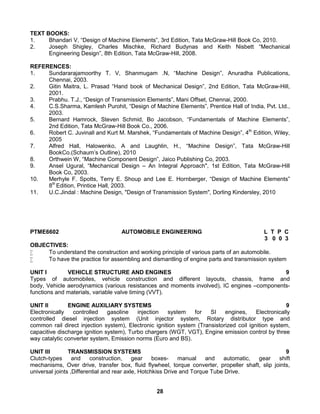
PTME6602 AUTOMOBILE ENGINEERING L T P C 
3 0 0 3 
OBJECTIVES: 
 To understand the construction and working principle of various parts of an automobile. 
 To have the practice for assembling and dismantling of engine parts and transmission system 
UNIT I VEHICLE STRUCTURE AND ENGINES 9 
Types of automobiles, vehicle construction and different layouts, chassis, frame and 
body, Vehicle aerodynamics (various resistances and moments involved), IC engines –components-functions 
and materials, variable valve timing (VVT). 
UNIT II ENGINE AUXILIARY SYSTEMS 9 
Electronically controlled gasoline injection system for SI engines, Electronically 
controlled diesel injection system (Unit injector system, Rotary distributor type and 
common rail direct injection system), Electronic ignition system (Transistorized coil ignition system, 
capacitive discharge ignition system), Turbo chargers (WGT, VGT), Engine emission control by three 
way catalytic converter system, Emission norms (Euro and BS). 
UNIT III TRANSMISSION SYSTEMS 9 
Clutch-types and construction, gear boxes- manual and automatic, gear shift 
mechanisms, Over drive, transfer box, fluid flywheel, torque converter, propeller shaft, slip joints, 
universal joints ,Differential and rear axle, Hotchkiss Drive and Torque Tube Drive.
UNIT IV STEERING, BRAKES AND SUSPENSION SYSTEMS 9 
Steering geometry and types of steering gear box-Power Steering, Types of Front Axle, 
Types of Suspension Systems, Pneumatic and Hydraulic Braking Systems, Antilock Braking System 
(ABS), electronic brake force distribution (EBD) and Traction Control. 
UNIT V ALTERNATIVE ENERGY SOURCES 9 
Use of Natural Gas, Liquefied Petroleum Gas, Bio-diesel, Bio-ethanol, Gasohol and 
Hydrogen in Automobiles- Engine modifications required –Performance, Combustion and Emission 
Characteristics of SI and CI engines with these alternate fuels - Electric and Hybrid Vehicles, Fuel Cell 
Note: Practical Training in dismantling and assembling of Engine parts and Transmission Systems 
should be given to the students. 
29 
TOTAL: 45 PERIODS 
OUTCOMES: 
 Upon completion of this course, the students will be able to identify the different components in 
automobile engineering. 
 Have clear understanding on different auxiliary and transmission systems usual. 
TEXT BOOKS: 
1. Kirpal Singh, “Automobile Engineering”, Vol 1 & 2, Seventh Edition, Standard Publishers, New 
Delhi, 1997. 
2. Jain K.K. and Asthana .R.B, “Automobile Engineering” Tata McGraw Hill Publishers, New 
Delhi, 2002. 
REFERENCES: 
1. Newton ,Steeds and Garet, “Motor Vehicles”, Butterworth Publishers,1989. 
2. Joseph Heitner, “Automotive Mechanics,” Second Edition, East-West Press, 1999. 
3. Martin W, Stockel and Martin T Stockle , “Automotive Mechanics Fundamentals,” The Good 
heart –Will Cox Company Inc, USA ,1978. 
4. Heinz Heisler, “Advanced Engine Technology,” SAE International Publications USA, 1998. 
5. Ganesan V. “Internal Combustion Engines”, Third Edition, Tata McGraw-Hill, 2007. 
PTME6702 MECHATRONICS L T P C 
3 0 0 3 
OBJECTIVES: 
 To impart knowledge about the elements and techniques involved in Mechatronics systems 
which are very much essential to understand the emerging field of automation. 
UNIT I INTRODUCTION 12 
Introduction to Mechatronics – Systems – Concepts of Mechatronics approach – Need for 
Mechatronics – Emerging areas of Mechatronics – Classification of Mechatronics. Sensors and 
Transducers: Static and dynamic Characteristics of Sensor, Potentiometers – LVDT – Capacitance 
sensors – Strain gauges – Eddy current sensor – Hall effect sensor – Temperature sensors – Light 
sensors 
UNIT II 8085 MICROPROCESSOR AND 8051 MICROCONTROLLER 10 
Introduction – Architecture of 8085 – Pin Configuration – Addressing Modes –Instruction set, Timing 
diagram of 8085 – Concepts of 8051 microcontroller – Block diagram,. 
UNIT III PROGRAMMABLE PERIPHERAL INTERFACE 8 
Introduction – Architecture of 8255, Keyboard interfacing, LED display –interfacing, ADC and DAC 
interface, Temperature Control – Stepper Motor Control – Traffic Control interface.
UNIT IV PROGRAMMABLE LOGIC CONTROLLER 7 
Introduction – Basic structure – Input and output processing – Programming – Mnemonics – Timers, 
counters and internal relays – Data handling – Selection of PLC. 
UNIT V ACTUATORS AND MECHATRONIC SYSTEM DESIGN 8 
Types of Stepper and Servo motors – Construction – Working Principle – Advantages and 
Disadvantages. Design process-stages of design process – Traditional and Mechatronics design 
concepts – Case studies of Mechatronics systems – Pick and place Robot – Engine Management 
system – Automatic car park barrier. 
30 
TOTAL : 45 PERIODS 
OUTCOMES: 
• Upon completion of this course, the students can able to design mechatronics system with the 
help of Microprocessor, PLC and other electrical and Electronics Circuits. 
TEXT BOOKS: 
1. Bolton, “Mechatronics”, Printice Hall, 2008 
2. Ramesh S Gaonkar, “Microprocessor Architecture, Programming, and Applications with the 
8085”, 5th Edition, Prentice Hall, 2008. 
REFERENCES: 
1. Michael B.Histand and Davis G.Alciatore, “Introduction to Mechatronics and Measurement 
systems”, McGraw Hill International edition, 2007. 
2. Bradley D.A, Dawson D, Buru N.C and Loader A.J, “Mechatronics”, Chapman and Hall, 1993. 
3. Smaili.A and Mrad.F , “Mechatronics Integrated Technologies for Intelligent Machines”, Oxford 
University Press, 2007. 
4. Devadas Shetty and Richard A. Kolk, “Mechatronics Systems Design”, PWS publishing 
company, 2007. 
5. Krishna Kant, “Microprocessors & Microcontrollers”, Prentice Hall of India, 2007. 
6. Clarence W, de Silva, "Mechatronics" CRC Press, First Indian Re-print, 2013 
PTMG6851 PRINCIPLES OF MANAGEMENT L T P C 
3 0 0 3 
OBJECTIVES: 
 To enable the students to study the evolution of Management, to study the functions and 
principles of management and to learn the application of the principles in an organization . 
UNIT I INTRODUCTION TO MANAGEMENT AND ORGANIZATIONS 9 
Definition of Management – Science or Art – Manager Vs Entrepreneur - types of managers - 
managerial roles and skills – Evolution of Management – Scientific, human relations , system and 
contingency approaches – Types of Business organization - Sole proprietorship, partnership, 
company-public and private sector enterprises - Organization culture and Environment – Current 
trends and issues in Management. 
UNIT II PLANNING 9 
Nature and purpose of planning – planning process – types of planning – objectives – setting 
objectives – policies – Planning premises – Strategic Management – Planning Tools and Techniques 
– Decision making steps and process.
UNIT III ORGANISING 9 
Nature and purpose – Formal and informal organization – organization chart – organization structure 
– types – Line and staff authority – departmentalization – delegation of authority – centralization and 
decentralization – Job Design - Human Resource Management – HR Planning, Recruitment, 
selection, Training and Development, Performance Management , Career planning and management. 
UNIT IV DIRECTING 9 
Foundations of individual and group behaviour – motivation – motivation theories – motivational 
techniques – job satisfaction – job enrichment – leadership – types and theories of leadership – 
communication – process of communication – barrier in communication – effective communication – 
communication and IT. 
UNIT V CONTROLLING 9 
System and process of controlling – budgetary and non-budgetary control techniques – use of 
computers and IT in Management control – Productivity problems and management – control and 
performance – direct and preventive control – reporting. 
31 
TOTAL: 45 PERIODS 
OUTCOMES: 
 Upon completion of the course, students will be able to have clear understanding of 
managerial functions like planning, organizing, staffing, leading & controlling and have same 
basic knowledge on international aspect of management 
TEXTBOOKS: 
1. Stephen P. Robbins & Mary Coulter, “Management”, Prentice Hall (India)Pvt. Ltd., 10th Edition, 
2009. 
2. JAF Stoner, Freeman R.E and Daniel R Gilbert “Management”, 6th Edition, Pearson 
Education, 2004. 
REFERENCES: 
1. Stephen A. Robbins & David A. Decenzo & Mary Coulter, “Fundamentals of Management” 
7th Edition, Pearson Education, 2011. 
2. Robert Kreitner & Mamata Mohapatra, “ Management”, Biztantra, 2008. 
3. Harold Koontz & Heinz Weihrich, “Essentials of Management”, Tata McGraw Hill, 1998. 
4. Tripathy PC & Reddy PN, “Principles of Management”, Tata Mcgraw Hill, 1999 
PTME6604 GAS DYNAMICS AND JET PROPULSION L T P C 
3 0 0 3 
OBJECTIVES: 
 To understand the basic difference between incompressible and compressible flow. 
 To understand the phenomenon of shock waves and its effect on flow. To gain some basic 
knowledge about jet propulsion and Rocket Propulsion. 
(Use of Standard Gas Tables permitted) 
UNIT I BASIC CONCEPTS AND ISENTROPIC FLOWS 6 
Energy and momentum equations of compressible fluid flows – Stagnation states, Mach waves and 
Mach cone – Effect of Mach number on compressibility – Isentropic flow through variable ducts – 
Nozzle and Diffusers
UNIT II FLOW THROUGH DUCTS 9 
Flows through constant area ducts with heat transfer (Rayleigh flow) and Friction (Fanno flow) – 
variation of flow properties. 
UNIT III NORMAL AND OBLIQUE SHOCKS 10 
Governing equations – Variation of flow parameters across the normal and oblique shocks – Prandtl – 
Meyer relations – Applications. 
UNIT IV JET PROPULSION 10 
Theory of jet propulsion – Thrust equation – Thrust power and propulsive efficiency – Operating 
principle, cycle analysis and use of stagnation state performance of ram jet, turbojet, turbofan and 
turbo prop engines. 
UNIT V SPACE PROPULSION 10 
Types of rocket engines – Propellants-feeding systems – Ignition and combustion – Theory of rocket 
propulsion – Performance study – Staging – Terminal and characteristic velocity – Applications – 
space flights. 
32 
TOTAL: 45 PERIODS 
OUTCOMES: 
 Upon completion of this course, the students can able to successfully apply gas dynamics 
principles in the Jet and Space Propulsion 
TEXT BOOKS: 
1. Anderson, J.D., "Modern Compressible flow", 3rd Edition, McGraw Hill, 2003. 
2. Yahya, S.M. "Fundamentals of Compressible Flow", New Age International (P) Limited, New 
Delhi, 1996. 
REFERENCES: 
1. Hill. P. and C. Peterson, "Mechanics and Thermodynamics of Propulsion", Addison – Wesley 
Publishing company, 1992. 
2. Zucrow. N.J., "Aircraft and Missile Propulsion", Vol.1 & II, John Wiley, 1975. 
3. Zucrow. N.J., "Principles of Jet Propulsion and Gas Turbines", John Wiley, New York, 1970. 
4. Sutton. G.P., "Rocket Propulsion Elements", John wiley, New York,1986,. 
5. Shapiro. A.H.," Dynamics and Thermodynamics of Compressible fluid Flow", John wiley, New 
York, 1953. 
6. Ganesan. V., "Gas Turbines", Tata McGraw Hill Publishing Co., New Delhi, 1999. 
7. Somasundaram. PR.S.L., "Gas Dynamics and Jet Propulsions", New Age International 
Publishers, 1996. 
8. Babu. V., "Fundamentals of Gas Dynamics", ANE Books India, 2008. 
9. Cohen. H., G.E.C. Rogers and Saravanamutto, "Gas Turbine Theory", Longman Group Ltd., 
1980. 
PTME6701 POWER PLANT ENGINEERING L T P C 
3 0 0 3 
OBJECTIVES: 
 Providing an overview of Power Plants and detailing the role of Mechanical Engineers in their 
operation and maintenance.
UNIT I COAL BASED THERMAL POWER PLANTS 10 
Rankine cycle - improvisations, Layout of modern coal power plant, Super Critical Boilers, FBC 
Boilers, Turbines, Condensers, Steam & Heat rate, Subsystems of thermal power plants – Fuel and 
ash handling, Draught system, Feed water treatment. Binary Cycles and Cogeneration systems. 
UNIT II DIESEL, GAS TURBINE AND COMBINED CYCLE POWER PLANTS 10 
Otto, Diesel, Dual & Brayton Cycle - Analysis & Optimisation. Components of Diesel and Gas Turbine 
power plants. Combined Cycle Power Plants. Integrated Gasifier based Combined Cycle systems. 
UNIT III NUCLEAR POWER PLANTS 7 
Basics of Nuclear Engineering, Layout and subsystems of Nuclear Power Plants, Working of Nuclear 
Reactors : Boiling Water Reactor (BWR), Pressurized Water Reactor (PWR), CANada Deuterium- 
Uranium reactor (CANDU), Breeder, Gas Cooled and Liquid Metal Cooled Reactors. Safety measures 
for Nuclear Power plants. 
UNIT IV POWER FROM RENEWABLE ENERGY 10 
Hydro Electric Power Plants – Classification, Typical Layout and associated components including 
Turbines. Principle, Construction and working of Wind, Tidal, Solar Photo Voltaic (SPV), Solar 
Thermal, Geo Thermal, Biogas and Fuel Cell power systems. 
UNIT V ENERGY, ECONOMIC AND ENVIRONMENTAL ISSUES OF POWER PLANTS 8 
Power tariff types, Load distribution parameters, load curve, Comparison of site selection criteria, 
relative merits & demerits, Capital & Operating Cost of different power plants. Pollution control 
technologies including Waste Disposal Options for Coal and Nuclear Power Plants. 
33 
TOTAL : 45 PERIODS 
OUTCOMES: 
 Upon completion of this course, the students can able to understand different types of power 
plant, and its functions and their flow lines and issues related to them. 
 Analyse and solve energy and economic related issues in power sectors. 
TEXT BOOK: 
1. Nag. P.K., "Power Plant Engineering", Third Edition, Tata McGraw – Hill Publishing Company 
Ltd., 2008. 
REFERENCES: 
1. El-Wakil. M.M., "Power Plant Technology", Tata McGraw – Hill Publishing Company Ltd., 
2010. 
2. Black & Veatch, Springer, "Power Plant Engineering", 1996. 
3. Thomas C. Elliott, Kao Chen and Robert C. Swanekamp, "Power Plant Engineering", Second 
Edition, Standard Handbook of McGraw – Hill, 1998. 
4. Godfrey Boyle, "Renewable energy", Open University, Oxford University Press in association 
with the Open University, 2004. 
PTME6703 COMPUTER INTEGRATED MANUFACTURING SYSTEMS L T P C 
3 0 0 3 
OBJECTIVES: 
 To understand the application of computers in various aspects of Manufacturing viz., Design, 
Proper planning, Manufacturing cost, Layout & Material Handling system.
UNIT I INTRODUCTION 10 
Brief introduction to CAD and CAM – Manufacturing Planning, Manufacturing control- Introduction to 
CAD/CAM – Concurrent Engineering-CIM concepts – Computerised elements of CIM system –Types 
of production - Manufacturing models and Metrics – Mathematical models of Production Performance 
– Simple problems – Manufacturing Control – Simple Problems – Basic Elements of an Automated 
system – Levels of Automation – Lean Production and Just-In-Time Production. 
UNIT II PRODUCTION PLANNING AND CONTROL AND COMPUTERISED 
PROCESS PLANNING 10 
Process planning – Computer Aided Process Planning (CAPP) – Logical steps in Computer Aided 
Process Planning – Aggregate Production Planning and the Master Production Schedule – Material 
Requirement planning – Capacity Planning- Control Systems-Shop Floor Control-Inventory Control – 
Brief on Manufacturing Resource Planning-II (MRP-II) & Enterprise Resource Planning (ERP) - 
Simple Problems. 
UNIT III CELLULAR MANUFACTURING 9 
Group Technology(GT), Part Families – Parts Classification and coding – Simple Problems in Opitz 
Part Coding system – Production flow Analysis – Cellular Manufacturing – Composite part concept – 
Machine cell design and layout – Quantitative analysis in Cellular Manufacturing – Rank Order 
Clustering Method - Arranging Machines in a GT cell – Hollier Method – Simple Problems. 
UNIT IV FLEXIBLE MANUFACTURING SYSTEM (FMS) AND AUTOMATED 
GUIDED VEHICLE SYSTEM (AGVS) 8 
Types of Flexibility - FMS – FMS Components – FMS Application & Benefits – FMS Planning and 
Control– Quantitative analysis in FMS – Simple Problems. Automated Guided Vehicle System 
(AGVS) – AGVS Application – Vehicle Guidance technology – Vehicle Management & Safety. 
UNIT V INDUSTRIAL ROBOTICS 8 
Robot Anatomy and Related Attributes – Classification of Robots- Robot Control systems – End 
Effectors – Sensors in Robotics – Robot Accuracy and Repeatability - Industrial Robot Applications – 
Robot Part Programming – Robot Accuracy and Repeatability – Simple Problems. 
34 
TOTAL : 45 PERIODS 
OUTCOMES: 
 Upon completion of this course, the student can able to understand the use of computers in 
process planning and use of FMS and Robotics in CIM 
TEXT BOOK: 
1. Mikell.P.Groover “Automation, Production Systems and Computer Integrated Manufacturing”, 
Prentice Hall of India, 2008. 
2. Radhakrishnan P, Subramanyan S.and Raju V., “CAD/CAM/CIM”, 2nd Edition, New Age 
International (P) Ltd, New Delhi, 2000. 
REFERENCES: 
1. Kant Vajpayee S, “Principles of Computer Integrated Manufacturing”, Prentice Hall India, 
2003. 
2. Gideon Halevi and Roland Weill, “Principles of Process Planning – A Logical Approach” 
Chapman & Hall, London, 1995. 
3. Rao. P, N Tewari &T.K. Kundra, “Computer Aided Manufacturing”, Tata McGraw Hill 
Publishing Company, 2000.
PTME6611 CAD / CAM LABORATORY L T P C 
35 
0 0 3 2 
OBJECTIVES: 
• To gain practical experience in handling 2D drafting and 3D modelling software systems. 
• To study the features of CNC Machine Tool. 
• To expose students to modern control systems (Fanuc, Siemens etc.,) 
• To know the application of various CNC machines like CNC lathe, CNC Vertical Machining 
centre, CNC EDM and CNC wire-cut and studying of Rapid prototyping. 
LIST OF EXPERIMENTS 
1. 3D GEOMETRIC MODELLING 24 PERIODS 
List of Experiments 
1. Introduction of 3D Modelling software 
Creation of 3D assembly model of following machine elements using 3D Modelling software 
2. Flange Coupling 
3. Plummer Block 
4. Screw Jack 
5. Lathe Tailstock 
6. Universal Joint 
7. Machine Vice 
8. Stuffing box 
9. Crosshead 
10. Safety Valves 
11. Non-return valves 
12. Connecting rod 
13. Piston 
14. Crankshaft 
* Students can also be trained in manual drawing of some of the above components 
2. Manual Part Programming. 21 PERIODS 
(i) Part Programming - CNC Machining Centre 
a) Linear Cutting. 
b) Circular cutting. 
c) Cutter Radius Compensation. 
d) Canned Cycle Operations. 
(ii) Part Programming - CNC Turning Centre 
a) Straight, Taper and Radius Turning. 
b) Thread Cutting. 
c) Rough and Finish Turning Cycle. 
d) Drilling and Tapping Cycle. 
3. Computer Aided Part Programming 
e) CL Data and Post process generation using CAM packages. 
f) Application of CAPP in Machining and Turning Centre. 
TOTAL: 45 PERIODS
OUTCOMES 
 Ability to develop 2D and 3D models using modeling softwares. 
 Ability to discuss the modern control systems used in CAM 
 Ability to operate part programming and perform manufacturing. 
LIST OF EQUIPMENT FOR A BATCH OF 30 STUDENTS 
S.No. Description of Equipment Qty 
HARDWARE 
1. Computer Server 1 
2. Computer nodes or systems (High end CPU with atleast 1 
GB main memory) networked to the server 30 
3. A3 size plotter 1 
4. Laser Printer 1 
5. CNC Lathe 1 
6. CNC milling machine 1 
SOFTWARE 
7. CAD/CAM software (Pro-E / Unigraphics / CATIA / 
Soidworks) 15 licenses 
36 
8. 
CAM Software for machining centre and turning 
centre(CNC Programming and tool path simulation for 
FANUC / Sinumeric and Heidenhain controller) 
15 licenses 
9. Licensed operating system Adequate 
10. Support for CAPP Adequate 
PTMG6863 ENGINEERING ECONOMICS L T P C 
3 0 0 3 
OBJECTIVES: 
 To enable students to understand the fundamental economic concepts applicable to 
engineering and to learn the techniques of incorporating inflation factor in economic decision 
making. 
UNIT I INTRODUCTION TO ECONOMICS 8 
Introduction to Economics- Flow in an economy, Law of supply and demand, Concept of Engineering 
Economics – Engineering efficiency, Economic efficiency, Scope of engineering economics - Element 
of costs, Marginal cost, Marginal Revenue, Sunk cost, Opportunity cost, Break-even analysis - V ratio, 
Elementary economic Analysis – Material selection for product Design selection for a product, 
Process planning. 
UNIT II VALUE ENGINEERING 10 
Make or buy decision, Value engineering – Function, aims, Value engineering procedure. Interest 
formulae and their applications –Time value of money, Single payment compound amount factor, 
Single payment present worth factor, Equal payment series sinking fund factor, Equal payment series 
payment Present worth factor- equal payment series capital recovery factor - Uniform gradient series 
annual equivalent factor, Effective interest rate, Examples in all the methods.
UNIT III CASH FLOW 9 
Methods of comparison of alternatives – present worth method (Revenue dominated cash flow 
diagram), Future worth method (Revenue dominated cash flow diagram, cost dominated cash flow 
diagram), Annual equivalent method (Revenue dominated cash flow diagram, cost dominated cash 
flow diagram), rate of return method, Examples in all the methods. 
UNIT IV REPLACEMENT AND MAINTENANCE ANALYSIS 9 
Replacement and Maintenance analysis – Types of maintenance, types of replacement problem, 
determination of economic life of an asset, Replacement of an asset with a new asset – capital 
recovery with return and concept of challenger and defender, Simple probabilistic model for items 
which fail completely. 
UNIT V DEPRECIATION 9 
Depreciation- Introduction, Straight line method of depreciation, declining balance method of 
depreciation-Sum of the years digits method of depreciation, sinking fund method of depreciation/ 
Annuity method of depreciation, service output method of depreciation-Evaluation of public 
alternatives- introduction, Examples, Inflation adjusted decisions – procedure to adjust inflation, 
Examples on comparison of alternatives and determination of economic life of asset. 
37 
TOTAL: 45 PERIODS 
OUTCOMES : 
 Upon successful completion of this course, students will acquire the skills to apply the basics 
of economics and cost analysis to engineering and take economically sound decisions. 
TEXT BOOKS: 
1. Panneer Selvam, R, “Engineering Economics”, Prentice Hall of India Ltd, New Delhi, 2001. 
REFERENCES: 
1. Chan S.Park, “Contemporary Engineering Economics”, Prentice Hall of India, 2011. 
2. Donald.G. Newman, Jerome.P.Lavelle, “Engineering Economics and analysis” Engg. Press, 
Texas, 2010. 
3. Degarmo, E.P., Sullivan, W.G and Canada, J.R, “Engineering Economy”, Macmillan, New 
York, 2011. 
4. Zahid A khan: Engineering Economy, "Engineering Economy", Dorling Kindersley, 2012 
PTME6811 PROJECT WORK L T P C 
0 0 9 6 
OBJECTIVES: 
 To develop the ability to solve a specific problem right from its identification and literature 
review till the successful solution of the same. To train the students in preparing project reports 
and to face reviews and viva voce examination. 
The students in a group of 3 to 4 works on a topic approved by the head of the department under the 
guidance of a faculty member and prepares a comprehensive project report after completing the work 
to the satisfaction of the supervisor. The progress of the project is evaluated based on a minimum of 
three reviews. The review committee may be constituted by the Head of the Department. A project 
report is required at the end of the semester. The project work is evaluated based on oral 
presentation and the project report jointly by external and internal examiners constituted by the Head 
of the Department. 
TOTAL: 135 PERIODS
OUTCOMES: 
 On Completion of the project work students will be in a position to take up any challenging 
practical problems and find solution by formulating proper methodology. 
PTMG6072 MARKETING MANAGEMENT L T P C 
38 
3 0 0 3 
OBJECTIVES: 
 To enable students to deal with newer concepts of marketing concepts like strategic marketing 
segmentation, pricing, advertisement and strategic formulation. The course will enable a 
student to take up marketing as a professional career. 
UNIT I MARKETING PROCESS 9 
Definition, Marketing process, dynamics, needs, wants and demands, marketing concepts, 
environment, mix, types. Philosophies, selling versus marketing, organizations, industrial versus 
consumer marketing, consumer goods, industrial goods, product hierarchy. 
UNIT II BUYING BEHAVIOUR AND MARKET SEGMENTATION 9 
Cultural, demographic factors, motives, types, buying decisions, segmentation factors - demographic - 
Psycho graphic and geographic segmentation, process, patterns. 
UNIT III PRODUCT PRICING AND MARKETING RESEARCH 9 
Objectives, pricing, decisions and pricing methods, pricing management. Introduction, uses, process 
of marketing research. 
UNIT IV MARKETING PLANNING AND STRATEGY FORMULATION 9 
Components of marketing plan-strategy formulations and the marketing process, implementations, 
portfolio analysis, BCG, GEC grids. 
UNIT V ADVERTISING, SALES PROMOTION AND DISTRIBUTION 9 
Characteristics, impact, goals, types, and sales promotions - point of purchase - unique selling 
proposition. Characteristics, wholesaling, retailing, channel design, logistics, and modern trends in 
retailing, Modern Trends, e-Marketing. 
TOTAL: 45 PERIODS 
OUTCOMES : 
 The learning skills of Marketing will enhance the knowledge about Marketer’s Practices and 
create insights on Advertising, Branding, Retailing and Marketing Research. 
TEXT BOOKS: 
1. Philip Kolter & Keller, “Marketing Management”, Prentice Hall of India, 14th edition, 2012. 
2. Chandrasekar. K.S., “Marketing Management Text and Cases”, 1st Edition, Tata McGraw Hill – 
Vijaynicole, 2010. 
REFERENCES: 
1. Ramasamy and Nama kumari, “Marketing Environment: Planning, implementation and control 
the Indian context”, 1990. 
2. Czinkota&Kotabe, “Marketing management”, Thomson learning, Indian edition 2007 
3. Adrain palmer, “ Introduction to marketing theory and practice”, Oxford university press IE 
2004. 
4. Donald S. Tull and Hawkins, “Marketing Reasearch”, Prentice Hall of Inida-1997. 
5. Philip Kotler and Gary Armstrong “Principles of Marketing” Prentice Hall of India, 2000.
6. Steven J.Skinner, “Marketing”, All India Publishers and Distributes Ltd. 1998. 
7. Graeme Drummond and John Ensor, "Introduction to marketing concepts", Elsevier, Indian 
39 
Reprint, 2007. 
PTME6001 QUALITY CONTROL AND RELIABILITY ENGINEERING L T P C 
3 0 0 3 
OBJECTIVES: 
 To introduce the concept of SQC 
 To understand process control and acceptance sampling procedure and their application. 
 To learn the concept of reliability. 
UNIT I INTRODUCTION AND PROCESS CONTROL FOR VARIABLES 10 
Introduction, definition of quality, basic concept of quality, definition of SQC, benefits and limitation of 
SQC, Quality assurance, Quality control: Quality cost-Variation in process causes of variation –Theory 
of control chart- uses of control chart – Control chart for variables – X chart, R chart and chart - 
process capability – process capability studies and simple problems. Six sigma concepts 
UNIT II PROCESS CONTROL FOR ATTRIBUTES 8 
Control chart for attributes –control chart for non conformings– p chart and np chart – control chart for 
nonconformities– C and U charts, State of control and process out of control identification in charts, 
pattern study. 
UNIT III ACCEPTANCE SAMPLING 9 
Lot by lot sampling – types – probability of acceptance in single, double, multiple sampling techniques 
– O.C. curves – producer’s Risk and consumer’s Risk. AQL, LTPD, AOQL concepts-standard 
sampling plans for AQL and LTPD- uses of standard sampling plans. 
UNIT IV LIFE TESTING – RELIABILITY 9 
Life testing – Objective – failure data analysis, Mean failure rate, mean time to failure, mean time 
between failure, hazard rate – Weibull model, system reliability, series, parallel and mixed 
configuration – simple problems. Maintainability and availability – simple problems. Acceptance 
sampling based on reliability test – O.C Curves. 
UNIT V QUALITY AND RELIABLITY 9 
Reliability improvements – techniques- use of Pareto analysis – design for reliability – redundancy unit 
and standby redundancy – Optimization in reliability – Product design – Product analysis – Product 
development – Product life cycles. 
TOTAL: 45 PERIODS 
Note: Use of approved statistical table permitted in the examination. 
OUTCOMES: 
• Upon successful completion of this course, the students can able to apply the concept of SQC 
in process control for reliable component production 
TEXT BOOKS: 
1. Douglas.C. Montgomery, “ Introduction to Statistical quality control”, 4th edition, John Wiley 
2001. 
2. Srinath. L.S., “Reliability Engineering”, Affiliated East west press, 1991.
REFERENCES: 
1. John.S. Oakland. "Statistical process control”, 5th edition, Elsevier, 2005 
2. Connor, P.D.T.O., “Practical Reliability Engineering”, John Wiley, 1993 
3. Grant, Eugene .L “Statistical Quality Control”, McGraw-Hill, 1996 
4. Monohar Mahajan, “Statistical Quality Control”, Dhanpat Rai & Sons, 2001. 
5.. Gupta. R.C, “Statistical Quality control”, Khanna Publishers, 1997. 
6. Besterfield D.H., “Quality Control”, Prentice Hall, 1993. 
7. Sharma S.C., “Inspection Quality Control and Reliability”, Khanna Publishers, 1998. 
8. Danny Samson, “Manufacturing & Operations Strategy”, Prentice Hall, 1991 
PTME6002 REFRIGERATION AND AIR CONDITIONING L T P C 
40 
3 0 0 3 
OBJECTIVES: 
 To understand the underlying principles of operations in different Refrigeration & Air 
conditioning systems and components. 
 To provide knowledge on design aspects of Refrigeration & Air conditioning systems 
UNIT I INTRODUCTION 5 
Introduction to Refrigeration - Unit of Refrigeration and C.O.P.– Ideal cycles- Refrigerants Desirable 
properties – Classification - Nomenclature - ODP & GWP. 
UNIT II VAPOUR COMPRESSION REFRIGERATION SYSTEM 10 
Vapor compression cycle : p-h and T-s diagrams - deviations from theoretical cycle – subcooling and 
super heating- effects of condenser and evaporator pressure on COP- multipressure system - low 
temperature refrigeration - Cascade systems – problems. Equipments: Type of Compressors, 
Condensers, Expansion devices, Evaporators. 
UNIT III OTHER REFRIGERATION SYSTEMS 8 
Working principles of Vapour absorption systems and adsorption cooling systems – Steam jet 
refrigeration- Ejector refrigeration systems- Thermoelectric refrigeration- Air refrigeration - Magnetic - 
Vortex and Pulse tube refrigeration systems. 
UNIT IV PSYCHROMETRIC PROPERTIES AND PROCESSES 10 
Properties of moist Air-Gibbs Dalton law, Specific humidity, Dew point temperature, Degree of 
saturation, Relative humidity, Enthalpy, Humid specific heat, Wet bulb temperature Thermodynamic 
wet bulb temperature, Psychrometric chart; Psychrometric of air-conditioning processes, mixing of air 
streams. 
UNIT V AIR CONDITIONING SYSTEMS AND LOAD ESTIMATION 12 
Air conditioning loads: Outside and inside design conditions; Heat transfer through structure, Solar 
radiation, Electrical appliances, Infiltration and ventilation, internal heat load; Apparatus selection; 
fresh air load, human comfort & IAQ principles, effective temperature & chart, calculation of summer & 
winter air conditioning load; Classifications, Layout of plants; Air distribution system; Filters; Air 
Conditioning Systems with Controls: Temperature, Pressure and Humidity sensors, Actuators & 
Safety controls. 
TOTAL: 45 PERIODS
OUTCOMES: 
 Upon completion of this course, the students can able to demonstrate the operations in 
different Refrigeration & Air conditioning systems and also able to design Refrigeration & Air 
conditioning systems . 
TEXT BOOK: 
1. Arora, C.P., "Refrigeration and Air Conditioning", 3rd edition, McGraw Hill, New Delhi, 2010. 
REFERENCES: 
1. Roy J. Dossat, "Principles of Refrigeration", 4th edition, Pearson Education Asia, 2009. 
2. Stoecker, W.F. and Jones J. W., "Refrigeration and Air Conditioning", McGraw Hill, New Delhi, 
41 
1986. 
3. ASHRAE Hand book, Fundamentals, 2010 
4. Jones W.P., "Air conditioning engineering", 5th edition,Elsevier Butterworth-Heinemann, 2001 
PTME6003 RENEWABLE SOURCES OF ENERGY L T P C 
3 0 0 3 
OBJECTIVES: 
 At the end of the course, the students are expected to identify the new methodologies / 
technologies for effective utilization of renewable energy sources. 
UNIT I INTRODUCTION 9 
World Energy Use – Reserves of Energy Resources – Environmental Aspects of Energy Utilisation – 
Renewable Energy Scenario in Tamil nadu, India and around the World – Potentials - Achievements / 
Applications – Economics of renewable energy systems. 
UNIT II SOLAR ENERGY 9 
Solar Radiation – Measurements of Solar Radiation - Flat Plate and Concentrating Collectors – Solar 
direct Thermal Applications – Solar thermal Power Generation - Fundamentals of Solar Photo Voltaic 
Conversion – Solar Cells – Solar PV Power Generation – Solar PV Applications. 
UNIT III WIND ENERGY 9 
Wind Data and Energy Estimation – Types of Wind Energy Systems – Performance – Site Selection – 
Details of Wind Turbine Generator – Safety and Environmental Aspects 
UNIT IV BIO - ENERGY 9 
Biomass direct combustion – Biomass gasifiers – Biogas plants – Digesters – Ethanol production – 
Bio diesel – Cogeneration - Biomass Applications 
UNIT V OTHER RENEWABLE ENERGY SOURCES 9 
Tidal energy – Wave Energy – Open and Closed OTEC Cycles – Small Hydro-Geothermal Energy – 
Hydrogen and Storage - Fuel Cell Systems – Hybrid Systems. 
TOTAL : 45 PERIODS 
OUTCOMES: 
 Upon completion of this course, the students can able to identify the new methodologies / 
technologies for effective utilization of renewable energy sources.
TEXT BOOKS: 
1. Rai. G.D., "Non Conventional Energy Sources", Khanna Publishers, New Delhi, 2011. 
2. Twidell, J.W. & Weir, A., "Renewable Energy Sources", EFN Spon Ltd., UK, 2006. 
REFERENCES: 
1. Sukhatme. S.P., "Solar Energy", Tata McGraw Hill Publishing Company Ltd., New Delhi, 1997. 
2. Godfrey Boyle, "Renewable Energy, Power for a Sustainable Future", Oxford University Press, 
42 
U.K., 1996. 
3. Tiwari. G.N., Solar Energy – "Fundamentals Design, Modelling & Applications", Narosa 
Publishing House, New Delhi, 2002. 
4. Freris. L.L., "Wind Energy Conversion Systems", Prentice Hall, UK, 1990. 
5. Johnson Gary, L. "Wind Energy Systems", Prentice Hall, New York, 1985 
6. David M. Mousdale – "Introduction to Biofuels", CRC Press, Taylor & Francis Group, USA 
2010 
7. Chetan Singh Solanki, Solar Photovoltaics, "Fundamentals, Technologies and Applications", 
PHI Learning Private Limited, New Delhi, 2009. 
PTME6004 UNCONVENTIONAL MACHINING PROCESSES L T P C 
3 0 0 3 
OBJECTIVES: 
 To learn about various unconventional machining processes, the various process parameters 
and their influence on performance and their applications 
UNIT I INTRODUCTION 6 
Unconventional machining Process – Need – classification – Brief overview . 
UNIT II MECHANICAL ENERGY BASED PROCESSES 9 
Abrasive Jet Machining – Water Jet Machining – Abrasive Water Jet Machining - Ultrasonic 
Machining.(AJM, WJM, AWJM and USM). Working Principles – equipment used – Process 
parameters – MRR- Applications. 
UNIT III ELECTRICAL ENERGY BASED PROCESSES 9 
Electric Discharge Machining (EDM)- working Principle-equipments-Process Parameters-Surface 
Finish and MRR- electrode / Tool – Power and control Circuits-Tool Wear – Dielectric – Flushing – 
Wire cut EDM – Applications. 
UNIT IV CHEMICAL AND ELECTRO-CHEMICAL ENERGY BASED PROCESSES 11 
Chemical machining and Electro-Chemical machining (CHM and ECM)-Etchants – Maskant - 
techniques of applying maskants - Process Parameters – Surface finish and MRR-Applications. 
Principles of ECM- equipments-Surface Roughness and MRR Electrical circuit-Process Parameters- 
ECG and ECH - Applications. 
UNIT V THERMAL ENERGY BASED PROCESSES 10 
Laser Beam machining and drilling (LBM), plasma Arc machining (PAM) and Electron Beam 
Machining (EBM). Principles – Equipment –Types - Beam control techniques – Applications. 
TOTAL: 45 PERIODS
OUTCOMES: 
 Upon completion of this course, the students can able to demonstrate different unconventional 
machining processes and know the influence of difference process parameters on the 
performance and their applications. 
TEXT BOOKS: 
1. Vijay.K. Jain “Advanced Machining Processes” Allied Publishers Pvt. Ltd., New Delhi, 2007 
2. Pandey P.C. and Shan H.S. “Modern Machining Processes” Tata McGraw-Hill, New Delhi, 
43 
2007. 
REFERENCES: 
1. Benedict. G.F. “Nontraditional Manufacturing Processes”, Marcel Dekker Inc., New York, 
1987. 
2. Mc Geough, “Advanced Methods of Machining”, Chapman and Hall, London, 1998. 
3. Paul De Garmo, J.T.Black, and Ronald.A.Kohser, “Material and Processes in Manufacturing” 
Prentice Hall of India Pvt. Ltd., 8thEdition, New Delhi , 2001. 
PTME6005 PROCESS PLANNING AND COST ESTIMATION L T P C 
3 0 0 3 
OBJECTIVES: 
 To introduce the process planning concepts to make cost estimation for various products after 
process planning 
UNIT I INTRODUCTION TO PROCESS PLANNING 10 
Introduction- methods of process planning-Drawing interpretation-Material evaluation – steps in 
process selection-.Production equipment and tooling selection 
UNIT II PROCESS PLANNING ACTIVITIES 10 
Process parameters calculation for various production processes-Selection jigs and fixtures election 
of quality assurance methods - Set of documents for process planning-Economics of process 
planning- case studies 
UNIT III INTRODUCTION TO COST ESTIMATION 8 
Importance of costing and estimation –methods of costing-elements of cost estimation –Types of 
estimates – Estimating procedure- Estimation labor cost, material cost- allocation of over head 
charges- Calculation of depreciation cost 
UNIT IV PRODUCTION COST ESTIMATION 8 
Estimation of Different Types of Jobs - Estimation of Forging Shop, Estimation of Welding Shop, 
Estimation of Foundry Shop 
UNIT V MACHINING TIME CALCULATION 9 
Estimation of Machining Time - Importance of Machine Time Calculation- Calculation of Machining 
Time for Different Lathe Operations ,Drilling and Boring - Machining Time Calculation for Milling, 
Shaping and Planning -Machining Time Calculation for Grinding 
TOTAL: 45 PERIODS 
OUTCOMES: 
 Upon completion of this course, the students can able to use the concepts of process planning 
and cost estimation for various products.
TEXT BOOKS: 
1. Peter scalon, “Process planning, Design/Manufacture Interface”, Elsevier science technology 
44 
Books, Dec 2002. 
REFERENCES: 
1. Ostwalal P.F. and Munez J., “Manufacturing Processes and systems”, 9th Edition, John Wiley, 
1998. 
2. Russell R.S and Tailor B.W, “Operations Management”, 4th Edition, PHI, 2003. 
3. Chitale A.V. and Gupta R.C., “Product Design and Manufacturing”, 2nd Edition, PHI, 2002. 
PTME6006 DESIGN OF JIGS, FIXTURES AND PRESS TOOLS L T P C 
3 0 0 3 
OBJECTIVES: 
 To understand the functions and design principles of Jigs, fixtures and press tools 
 To gain proficiency in the development of required views of the final design. 
UNIT I LOCATING AND CLAMPING PRINCIPLES: 8 
Objectives of tool design- Function and advantages of Jigs and fixtures – Basic elements – principles 
of location – Locating methods and devices – Redundant Location – Principles of clamping – 
Mechanical actuation – pneumatic and hydraulic actuation Standard parts – Drill bushes and Jig 
buttons – Tolerances and materials used. 
UNIT II JIGS AND FIXTURES 10 
Design and development of jigs and fixtures for given component- Types of Jigs – Post, Turnover, 
Channel, latch, box, pot, angular post jigs – Indexing jigs – General principles of milling, Lathe, boring, 
broaching and grinding fixtures – Assembly, Inspection and Welding fixtures – Modular fixturing 
systems- Quick change fixtures. 
UNIT III PRESS WORKING TERMINOLOGIES AND ELEMENTS OF CUTTING DIES 10 
Press Working Terminologies - operations – Types of presses – press accessories – Computation of 
press capacity – Strip layout – Material Utilization – Shearing action – Clearances – Press Work 
Materials – Center of pressure- Design of various elements of dies – Die Block – Punch holder, Die 
set, guide plates – Stops – Strippers – Pilots – Selection of Standard parts – Design and preparation 
of four standard views of simple blanking, piercing, compound and progressive dies. 
UNIT IV BENDING AND DRAWING DIES 10 
Difference between bending and drawing – Blank development for above operations – Types of 
Bending dies – Press capacity – Spring back – knockouts – direct and indirect – pressure pads – 
Ejectors – Variables affecting Metal flow in drawing operations – draw die inserts – draw beads-ironing 
– Design and development of bending, forming, drawing, reverse redrawing and combination 
dies – Blank development for axisymmetric, rectangular and elliptic parts – Single and double action 
dies. 
UNIT V OTHER FORMING TECHNIQUES 7 
Bulging, Swaging, Embossing, coining, curling, hole flanging, shaving and sizing, assembly, fine 
Blanking dies – recent trends in tool design- computer Aids for sheet metal forming Analysis – basic 
introduction - tooling for numerically controlled machines- setup reduction for work holding – Single 
minute exchange of dies – Poka Yoke. 
TOTAL: 45 PERIODS
Note: (Use of P S G Design Data Book is permitted in the University examination) 
OUTCOMES: 
 Upon completion of this course, the students can able to design jigs, fixtures and press tools. 
TEXT BOOKS: 
1. Joshi, P.H. “Jigs and Fixtures”, Second Edition, Tata McGraw Hill Publishing Co., Ltd., New 
45 
Delhi, 2004. 
2. Joshi P.H “Press tools - Design and Construction”, wheels publishing, 1996 
REFERENCES: 
1. Venkataraman. K., “Design of Jigs Fixtures & Press Tools”, Tata McGraw Hill, New Delhi, 
2005. 
2. Donaldson, Lecain and Goold “Tool Design”, 3rd Edition, Tata McGraw Hill, 2000. 
3. Kempster, “Jigs and Fixture Design”, Third Edition, Hoddes and Stoughton, 1974. 
4. Hoffman “Jigs and Fixture Design”, Thomson Delmar Learning, Singapore, 2004. 
5. ASTME Fundamentals of Tool Design Prentice Hall of India. 
6. Design Data Hand Book, PSG College of Technology, Coimbatore. 
PTME6007 COMPOSITE MATERIALS AND MECHANICS L T P C 
3 0 0 3 
OBJECTIVES: 
 To understand the fundamentals of composite material strength and its mechanical behavior 
Understanding the analysis of fiber reinforced Laminate design for different 
 combinations of plies with different orientations of the fiber. 
 Thermo-mechanical behavior and study of residual stresses in Laminates during processing. 
Implementation of Classical Laminate Theory (CLT) to study and analysis for residual stresses 
in an isotropic layered structure such as electronic chips. 
UNIT I INTRODUCTION, LAMINA CONSTITUTIVE EQUATIONS & MANUFACTURING 12 
Definition –Need – General Characteristics, Applications. Fibers – Glass, Carbon, Ceramic and 
Aramid fibers. Matrices – Polymer, Graphite, Ceramic and Metal Matrices – Characteristics of fibers 
and matrices. Lamina Constitutive Equations: Lamina Assumptions – Macroscopic Viewpoint. 
Generalized Hooke’s Law. Reduction to Homogeneous Orthotropic Lamina – Isotropic limit case, 
Orthotropic Stiffness matrix (Qij), Typical Commercial material properties, Rule of Mixtures. Generally 
Orthotropic Lamina –Transformation Matrix, Transformed Stiffness. Manufacturing: Bag Moulding 
Compression Moulding – Pultrusion – Filament Winding – Other Manufacturing Processes 
UNIT II FLAT PLATE LAMINATE CONSTITUTE EQUATIONS 10 
Definition of stress and Moment Resultants. Strain Displacement relations. Basic Assumptions of 
Laminated anisotropic plates. Laminate Constitutive Equations – Coupling Interactions, Balanced 
Laminates, Symmetric Laminates, Angle Ply Laminates, Cross Ply Laminates. Laminate Structural 
Moduli. Evaluation of Lamina Properties from Laminate Tests. Quasi-Isotropic Laminates. 
Determination of Lamina stresses within Laminates. 
UNIT III LAMINA STRENGTH ANALYSIS 5 
Introduction - Maximum Stress and Strain Criteria. Von-Misses Yield criterion for Isotropic Materials. 
Generalized Hill’s Criterion for Anisotropic materials. Tsai-Hill’s Failure Criterion for Composites. 
Tensor Polynomial (Tsai-Wu) Failure criterion. Prediction of laminate Failure
UNIT IV THERMAL ANALYSIS 8 
Assumption of Constant C.T.E’s. Modification of Hooke’s Law. Modification of Laminate Constitutive 
Equations. Orthotropic Lamina C.T.E’s. C.T.E’s for special Laminate Configurations – Unidirectional, 
Off-axis, Symmetric Balanced Laminates, Zero C.T.E laminates, Thermally Quasi-Isotropic Laminates 
UNIT V ANALYSIS OF LAMINATED FLAT PLATES 10 
Equilibrium Equations of Motion. Energy Formulations. Static Bending Analysis. Buckling Analysis. 
Free Vibrations – Natural Frequencies 
46 
TOTAL: 45 PERIODS 
OUTCOMES: 
 Upon completion of this course, the students can able to analyse the fiber reinforced Laminate 
for optimum design 
 Apply classical laminate theory to study and analyse the residual stresses in Laminate. 
TEXT BOOKS: 
1. Gibson, R.F., "Principles of Composite Material Mechanics", Second Edition, McGraw-Hill, 
CRC press in progress, 1994, -. 
2. Hyer, M.W., “Stress Analysis of Fiber – Reinforced Composite Materials”, McGraw Hill, 1998 
REFERENCES: 
1. Issac M. Daniel and Ori Ishai, “Engineering Mechanics of Composite Materials”, Oxford 
University Press-2006, First Indian Edition - 2007 
2. Mallick, P.K., Fiber, ”Reinforced Composites: Materials, Manufacturing and Design”, Maneel 
Dekker Inc, 1993. 
3. Halpin, J.C., “Primer on Composite Materials, Analysis”, Technomic Publishing Co., 1984. 
4. Agarwal, B.D., and Broutman L.J., “Analysis and Performance of Fiber Composites”, John 
Wiley and Sons, New York, 1990. 
5. Mallick, P.K. and Newman, S., (edition), “Composite Materials Technology: Processes and 
Properties”, Hansen Publisher, Munish, 1990. 
PTME6008 WELDING TECHNOLOGY L T P C 
3 0 0 3 
OBJECTIVES 
 To understand the basics of welding and to know about the various types of welding 
processes 
UNIT I GAS AND ARC WELDING PROCESSES: 9 
Fundamental principles – Air Acetylene welding, Oxyacetylene welding, Carbon arc welding, Shielded 
metal arc welding, Submerged arc welding, TIG & MIG welding, Plasma arc welding and Electroslag 
welding processes - advantages, limitations and applications. 
UNIT II RESISTANCE WELDING PROCESSES: 9 
Spot welding, Seam welding, Projection welding, Resistance Butt welding, Flash Butt welding, 
Percussion welding and High frequency resistance welding processes - advantages, limitations and 
applications. 
UNIT III SOLID STATE WELDING PROCESSES: 9 
Cold welding, Diffusion bonding, Explosive welding, Ultrasonic welding, Friction welding, Forge 
welding, Roll welding and Hot pressure welding processes - advantages, limitations and applications.
UNIT IV OTHER WELDING PROCESSES: 9 
Thermit welding, Atomic hydrogen welding, Electron beam welding, Laser Beam welding, Friction stir 
welding, Under Water welding, Welding automation in aerospace, nuclear and surface transport 
vehicles. 
UNIT V DESIGN OF WELD JOINTS, WELDABILITY AND TESTING OF WELDMENTS 9 
Various weld joint designs – Weldability of Aluminium, Copper, and Stainless steels. Destructive and 
non destructive testing of weldments. 
47 
TOTAL : 45 HOURS 
OUTCOMES: 
 Upon completion of this course, the students can able to compare different types of Welding 
process for effective Welding of Structural components. 
TEXT BOOKS: 
1. Parmer R.S., “Welding Engineering and Technology”, 1st edition, Khanna Publishers, New 
Delhi, 2008. 
2. Parmer R.S., “Welding Processes and Technology”, Khanna Publishers, New Delhi, 1992. 
3. Little R.L., “Welding and welding Technology”, Tata McGraw Hill Publishing Co., Ltd., New 
Delhi, 34th reprint, 2008. 
REFERENCES: 
1. Schwartz M.M. “Metals Joining Manual”. McGraw Hill Books, 1979. 
2. Tylecote R.F. “The Solid Phase Welding of Metals”. Edward Arnold Publishers Ltd. London, 
1968. 
3. AWS- Welding Hand Book. 8th Edition. Vol- 2. “Welding Process” 
4. Nadkarni S.V. “Modern Arc Welding Technology”, 1st edition, Oxford IBH Publishers, 2005. 
5. Christopher Davis. “Laser Welding- Practical Guide”. Jaico Publishing House, 1994. 
6. Davis A.C., “The Science and Practice of Welding”, Cambridge University Press, Cambridge, 
1993 
PTME6009 ENERGY CONSERVATION AND MANAGEMENT L T P C 
3 0 0 3 
OBJECTIVES: 
At the end of the course, the student is expected to 
 understand and analyse the energy data of industries 
 carryout energy accounting and balancing 
 conduct energy audit and suggest methodologies for energy savings and 
 utilise the available resources in optimal ways 
UNIT I INTRODUCTION 8 
Energy - Power – Past & Present scenario of World; National Energy consumption Data – 
Environmental aspects associated with energy utilization –Energy Auditing: Need, Types, 
Methodology and Barriers. Role of Energy Managers. Instruments for energy auditing. 
UNIT II ELECTRICAL SYSTEMS 12 
Components of EB billing – HT and LT supply, Transformers, Cable Sizing, Concept of Capacitors, 
Power Factor Improvement, Harmonics, Electric Motors - Motor Efficiency Computation, Energy
Efficient Motors, Illumination – Lux, Lumens, Types of lighting, Efficacy, LED Lighting and scope of 
Encon in Illumination. 
UNIT III THERMAL SYSTEMS 12 
Stoichiometry, Boilers, Furnaces and Thermic Fluid Heaters – Efficiency computation and encon 
measures. Steam: Distribution &U sage: Steam Traps, Condensate Recovery, Flash Steam 
Utilization, Insulators & Refractories 
UNIT IV ENERGY CONSERVATION IN MAJOR UTILITIES 8 
Pumps, Fans, Blowers, Compressed Air Systems, Refrigeration and Air Conditioning Systems – 
Cooling Towers – D.G. sets 
UNIT V ECONOMICS 5 
Energy Economics – Discount Rate, Payback Period, Internal Rate of Return, Net Present Value, Life 
Cycle Costing –ESCO concept 
48 
TOTAL: 45 PERIODS 
OUTCOMES: 
Upon completion of this course, the students can able to analyse the energy data of industries. 
 Can carryout energy accounting and balancing 
 Can suggest methodologies for energy savings 
TEXT BOOKS: 
1. Energy Manager Training Manual (4 Volumes) available at www.energymanager training.com, 
a website administered by Bureau of Energy Efficiency (BEE), a statutory body under Ministry 
of Power, Government of India, 2004. 
REFERENCES: 
1. Witte. L.C., P.S. Schmidt, D.R. Brown, “Industrial Energy Management and Utilisation” 
Hemisphere Publ, Washington, 1988. 
2. Callaghn, P.W. “Design and Management for Energy Conservation”, Pergamon Press, Oxford, 
1981. 
3. Dryden. I.G.C., “The Efficient Use of Energy” Butterworths, London, 1982 
4. Turner. W.C., “Energy Management Hand book”, Wiley, New York, 1982. 
5. Murphy. W.R. and G. Mc KAY, “Energy Management”, Butterworths, London 1987. 
ME6018 ADDITIVE MANUFACTURING L T P C 
3 0 0 3 
OBJECTIVES: 
 To know the principle methods, areas of usage, possibilities and limitations as well as 
environmental effects of the Additive Manufacturing technologies 
 To be familiar with the characteristics of the different materials those are used in Additive 
Manufacturing. 
UNIT I INTRODUCTION 10 
Overview – History - Need-Classification -Additive Manufacturing Technology in product development- 
Materials for Additive Manufacturing Technology – Tooling - Applications.
UNIT II CAD & REVERSE ENGINEERING 10 
Basic Concept – Digitization techniques – Model Reconstruction – Data Processing for Additive 
Manufacturing Technology: CAD model preparation – Part Orientation and support generation – 
Model Slicing –Tool path Generation – Softwares for Additive Manufacturing Technology: MIMICS, 
MAGICS. 
UNIT III LIQUID BASED AND SOLID BASED ADDITIVE MANUFACTURING SYSTEMS 10 
Classification – Liquid based system – Stereolithography Apparatus (SLA)- Principle, process, 
advantages and applications - Solid based system –Fused Deposition Modeling - Principle, process, 
advantages and applications, Laminated Object Manufacturing 
UNIT IV POWDER BASED ADDITIVE MANUFACTURING SYSTEMS 10 
Selective Laser Sintering – Principles of SLS process - Process, advantages and applications, Three 
Dimensional Printing - Principle, process, advantages and applications- Laser Engineered Net 
Shaping (LENS), Electron Beam Melting. 
UNIT V MEDICAL AND BIO-ADDITIVE MANUFACTURING 5 
Customized implants and prosthesis: Design and production. Bio-Additive Manufacturing- Computer 
Aided Tissue Engineering (CATE) – Case studies 
49 
TOTAL : 45 PERIODS 
OUTCOMES: 
 Upon completion of this course, the students can able to compare different method and 
discuss the effects of the Additive Manufacturing technologies and analyse the characteristics 
of the different materials in Additive Manufacturing. 
TEXT BOOKS: 
1. Chua C.K., Leong K.F., and Lim C.S., “Rapid prototyping: Principles and applications”, Third 
Edition, World Scientific Publishers, 2010. 
2. Gebhardt A., “Rapid prototyping”, Hanser Gardener Publications, 2003. 
REFERENCES: 
1. Liou L.W. and Liou F.W., “Rapid Prototyping and Engineering applications : A tool box for 
prototype development”, CRC Press, 2007. 
2. Kamrani A.K. and Nasr E.A., “Rapid Prototyping: Theory and practice”, Springer, 2006. 
3. Hilton P.D. and Jacobs P.F., “Rapid Tooling: Technologies and Industrial Applications”, CRC 
press, 2000. 
PTME6010 ROBOTICS L T P C 
3 0 0 3 
OBJECTIVES: 
 To understand the functions of the basic components of a Robot. 
 To study the use of various types of End of Effectors and Sensors 
 To impart knowledge in Robot Kinematics and Programming 
 To learn Robot safety issues and economics. 
UNIT I FUNDAMENTALS OF ROBOT 6 
Robot - Definition - Robot Anatomy - Co ordinate Systems, Work Envelope Types and Classification- 
Specifications-Pitch, Yaw, Roll, Joint Notations, Speed of Motion, Pay Load- Robot Parts and their 
Functions-Need for Robots-Different Applications.
UNIT II ROBOT DRIVE SYSTEMS AND END EFFECTORS 9 
Pneumatic Drives-Hydraulic Drives-Mechanical Drives-Electrical Drives-D.C. Servo Motors, Stepper 
Motors, A.C. Servo Motors-Salient Features, Applications and Comparison of all these Drives, End 
Effectors-Grippers-Mechanical Grippers, Pneumatic and Hydraulic- Grippers, Magnetic Grippers, 
Vacuum Grippers; Two Fingered and Three Fingered Grippers; Internal Grippers and External 
Grippers; Selection and Design Considerations. 
UNIT III SENSORS AND MACHINE VISION 12 
Requirements of a sensor, Principles and Applications of the following types of sensors- Position 
sensors - Piezo Electric Sensor, LVDT, Resolvers, Optical Encoders, pneumatic Position Sensors, 
Range Sensors Triangulations Principles, Structured, Lighting Approach, Time of Flight, Range 
Finders, Laser Range Meters, Touch Sensors ,binary Sensors., Analog Sensors, Wrist Sensors, 
Compliance Sensors, Slip Sensors, Camera, Frame Grabber, Sensing and Digitizing Image Data- 
Signal Conversion, Image Storage, Lighting Techniques, Image Processing and Analysis-Data 
Reduction, Segmentation, Feature Extraction, Object Recognition, Other Algorithms, Applications- 
Inspection, Identification, Visual Serving and Navigation. 
UNIT IV ROBOT KINEMATICS AND ROBOT PROGRAMMING 13 
Forward Kinematics, Inverse Kinematics and Difference; Forward Kinematics and Reverse Kinematics 
of manipulators with Two, Three Degrees of Freedom (in 2 Dimension), Four Degrees of freedom (in 
3 Dimension) Jacobians, Velocity and Forces-Manipulator Dynamics, Trajectory Generator, 
Manipulator Mechanism Design-Derivations and problems. Lead through Programming, Robot 
programming Languages-VAL Programming-Motion Commands, Sensor Commands, End Effector 
commands and simple Programs. 
UNIT V IMPLEMENTATION AND ROBOT ECONOMICS 5 
RGV, AGV; Implementation of Robots in Industries-Various Steps; Safety Considerations for Robot 
Operations - Economic Analysis of Robots. 
50 
TOTAL: 45 PERIODS 
OUTCOMES: 
 Upon completion of this course, the students can able to apply the basic engineering 
knowledge for the design of robotics 
TEXT BOOKS: 
1. Klafter R.D., Chmielewski T.A and Negin M., “Robotic Engineering - An Integrated Approach”, 
Prentice Hall, 2003. 
2. Groover M.P., “Industrial Robotics -Technology Programming and Applications”, McGraw Hill, 
2001. 
REFERENCES: 
1. Craig J.J., “Introduction to Robotics Mechanics and Control”, Pearson Education, 2008. 
2. Deb S.R., “Robotics Technology and Flexible Automation” Tata McGraw Hill Book Co., 1994. 
3. Koren Y., “Robotics for Engineers", Mc Graw Hill Book Co., 1992. 
4. Fu.K.S.,Gonzalz R.C. and Lee C.S.G., “Robotics Control, Sensing, Vision and Intelligence”, 
McGraw Hill Book Co., 1987. 
5. Janakiraman P.A., “Robotics and Image Processing”, Tata McGraw Hill, 1995. 
6. Rajput R.K., “Robotics and Industrial Automation”, S.Chand and Company, 2008. 
7. Surender Kumar, “Industrial Robots and Computer Integrated Manufacturing”, Oxford and IBH 
Publishing Co. Pvt. Ltd., 1991.
PTGE6081 FUNDAMENTALS OF NANOSCIENCE L T P C 
51 
3 0 0 3 
OBJECTIVES 
 To learn about basis of nanomaterial science, preparation method, types and application 
UNIT I INTRODUCTION 8 
Nanoscale Science and Technology- Implications for Physics, Chemistry, Biology and Engineering- 
Classifications of nanostructured materials- nano particles- quantum dots, nanowires-ultra-thinfilms-multilayered 
materials. Length Scales involved and effect on properties: Mechanical, Electronic, 
Optical, Magnetic and Thermal properties. Introduction to properties and motivation for study 
(qualitative only). 
UNIT II GENERAL METHODS OF PREPARATION 9 
Bottom-up Synthesis-Top-down Approach: Co-Precipitation, Ultrasonication, Mechanical Milling, 
Colloidal routes, Self-assembly, Vapour phase deposition, MOCVD, Sputtering, Evaporation, 
Molecular Beam Epitaxy, Atomic Layer Epitaxy, MOMBE. 
UNIT III NANOMATERIALS 12 
Nanoforms of Carbon - Buckminster fullerene- graphene and carbon nanotube, Single wall carbon 
Nanotubes (SWCNT) and Multi wall carbon nanotubes (MWCNT)- methods of synthesis(arc-growth, 
laser ablation, CVD routes, Plasma CVD), structure-property Relationships applications- Nanometal 
oxides-ZnO, TiO2,MgO, ZrO2, NiO, nanoalumina, CaO, AgTiO2, Ferrites, Nanoclays-functionalization 
and applications-Quantum wires, Quantum dots-preparation, properties and 
applications 
UNIT IV CHARACTERIZATION TECHNIQUES 9 
X-ray diffraction technique, Scanning Electron Microscopy - environmental techniques, Transmission 
Electron Microscopy including high-resolution imaging, Surface Analysis techniques- AFM, SPM, 
STM, SNOM, ESCA, SIMS-Nanoindentation 
UNIT V APPLICATIONS 7 
NanoInfoTech: Information storage- nanocomputer, molecular switch, super chip, nanocrystal, 
Nanobiotechlogy: nanoprobes in medical diagnostics and biotechnology, Nano medicines, Targetted 
drug delivery, Bioimaging - Micro Electro Mechanical Systems (MEMS), Nano Electro Mechanical 
Systems (NEMS)- Nanosensors, nano crystalline silver for bacterial inhibition, Nanoparticles for 
sunbarrier products - In Photostat, printing, solar cell, battery 
TOTAL : 45 PERIODS 
OUTCOMES 
 Will familiarize about the science of nanomaterials 
 Will demonstrate the preparation of nanomaterials 
 Will develop knowledge in characteristic nanomaterial 
TEXT BOOKS 
1. Edelstein. A.S. and R.C. Cammearata, eds., “Nanomaterials: Synthesis, Properties and 
Applications”, Institute of Physics Publishing, Bristol and Philadelphia, 1996. 
2. John Dinardo. N, “Nanoscale charecterisation of surfaces & Interfaces”, 2nd edition, Weinheim 
Cambridge, Wiley-VCH, 2000 
REFERENCES 
1. Timp .G, “Nanotechnology”, AIP press/Springer, 1999. 
2. Akhlesh Lakhtakia (Editor),“The Hand Book of Nano Technology, Nanometer Structure, 
Theory, Modeling and Simulations”. Prentice-Hall of India (P) Ltd, New Delhi, 2007.
PTME6011 THERMAL TURBO MACHINES L T P C 
52 
3 0 0 3 
OBJECTIVES: 
 To understand the various systems, principles, operations and applications of different types of 
turbo machinery components. 
UNIT I PRINCIPLES 9 
Energy transfer between fluid and rotor-classification of fluid machinery,-dimensionless parameters-specific 
speed-applications-stage velocity triangles-work and efficiency. 
UNIT II CENTRIFUGAL FANS AND BLOWERS 9 
Types- stage and design parameters-flow analysis in impeller blades-volute and diffusers, losses, 
characteristic curves and selection, fan drives and fan noise. 
UNIT III CENTRIFUGAL COMPRESSOR 9 
Construction details, impeller flow losses, slip factor, diffuser analysis, losses and performance 
curves. 
UNIT IV AXIAL FLOW COMPRESSOR 9 
Stage velocity diagrams, enthalpy-entropy diagrams, stage losses and efficiency, work done simple 
stage design problems and performance characteristics. 
UNIT V AXIAL AND RADIAL FLOW TURBINES 9 
Stage velocity diagrams, reaction stages, losses and coefficients, blade design principles, testing and 
performance characteristics. 
TOTAL: 45 PERIODS 
OUTCOMES: 
 Upon completion of this course, the students can able to explain the various systems, 
principles and applications and different types of turbo machinery components. 
TEXT BOOKS: 
1. Yahya, S.H., Turbines, Compressor and Fans, Tata McGraw Hill Publishing Company, 1996. 
REFERENCES: 
1. Bruneck, Fans, Pergamom Press, 1973. 
2. Earl Logan, Jr., Hand book of Turbomachinery, Marcel Dekker Inc., 1992. 
3. Dixon, S.I., "Fluid Mechanics and Thermodynamics of Turbomachinery", Pergamon Press, 
1990. 
4. Shepherd, D.G., "Principles of Turbomachinery", Macmillan, 1969. 
5. Ganesan, V., "Gas Turbines", Tata McGraw Hill Pub. Co., 1999. 
6. Gopalakrishnan .G and Prithvi Raj .D, "A Treatise on Turbo machines", Scifech Publications 
(India) Pvt. Ltd., 2002. 
PTME6012 MAINTENANCE ENGINEERING L T P C 
3 0 0 3 
OBJECTIVES: 
 To enable the student to understand the principles, functions and practices adapted in industry for 
the successful management of maintenance activities. 
 To explain the different maintenance categories like Preventive maintenance, condition monitoring 
and repair of machine elements.
 To illustrate some of the simple instruments used for condition monitoring in industry. 
UNIT I PRINCIPLES AND PRACTICES OF MAINTENANCE PLANNING 9 
Basic Principles of maintenance planning – Objectives and principles of planned maintenance activity 
– Importance and benefits of sound Maintenance systems – Reliability and machine availability – 
MTBF, MTTR and MWT – Factors of availability – Maintenance organization – Maintenance 
economics. 
UNIT II MAINTENANCE POLICIES – PREVENTIVE MAINTENANCE 9 
Maintenance categories – Comparative merits of each category – Preventive maintenance, 
maintenance schedules, repair cycle - Principles and methods of lubrication – TPM. 
UNIT III CONDITION MONITORING 9 
Condition Monitoring – Cost comparison with and without CM – On-load testing and offload testing – 
Methods and instruments for CM – Temperature sensitive tapes – Pistol thermometers – wear-debris 
analysis 
UNIT IV REPAIR METHODS FOR BASIC MACHINE ELEMENTS 10 
Repair methods for beds, slide ways, spindles, gears, lead screws and bearings – Failure analysis – 
Failures and their development – Logical fault location methods – Sequential fault location. 
UNIT V REPAIR METHODS FOR MATERIAL HANDLING EQUIPMENT 8 
Repair methods for Material handling equipment - Equipment records –Job order systems -Use of 
computers in maintenance. 
53 
TOTAL: 45 PERIODS 
OUTCOMES: 
 Upon completion of the programme, the students can able to implement the maintenance 
function and different practices in industries for the successful management of maintenance 
activities 
 To identify the different maintenance categories like Preventive maintenance, condition 
monitoring and repair of machine elements. 
TEXT BOOKS: 
1. Srivastava S.K., “Industrial Maintenance Management”, S. Chand and Co., 1981 
2. Venkataraman .K “Maintancence Engineering and Management”, PHI Learning, Pvt. Ltd., 
2007 
REFERENCES: 
1. Bhattacharya S.N., “Installation, Servicing and Maintenance”, S. Chand and Co., 1995 
2. White E.N., “Maintenance Planning”, I Documentation, Gower Press, 1979. 
2. Garg M.R., “Industrial Maintenance”, S. Chand & Co., 1986. 
3. Higgins L.R., “Maintenance Engineering Hand book”, 5th Edition, McGraw Hill, 1988. 
4. Armstrong, “Condition Monitoring”, BSIRSA, 1988. 
5. Davies, “Handbook of Condition Monitoring”, Chapman & Hall, 1996. 
6. “Advances in Plant Engineering and Management”, Seminar Proceedings - IIPE, 1996.
PTEE6007 MICRO ELECTRO MECHANICAL SYSTEMS L T P C 
54 
3 0 0 3 
OBJECTIVES 
 To provide knowledge of semiconductors and solid mechanics to fabricate MEMS devices. 
 To educate on the rudiments of Micro fabrication techniques. 
 To introduce various sensors and actuators 
 To introduce different materials used for MEMS 
 To educate on the applications of MEMS to disciplines beyond Electrical and Mechanical 
engineering. 
UNIT I INTRODUCTION 9 
Intrinsic Characteristics of MEMS – Energy Domains and Transducers- Sensors and Actuators – 
Introduction to Micro fabrication - Silicon based MEMS processes – New Materials – Review of 
Electrical and Mechanical concepts in MEMS – Semiconductor devices – Stress and strain analysis – 
Flexural beam bending- Torsional deflection. 
UNIT II SENSORS AND ACTUATORS-I 9 
Electrostatic sensors – Parallel plate capacitors – Applications – Interdigitated Finger capacitor – 
Comb drive devices – Micro Grippers – Micro Motors - Thermal Sensing and Actuation – Thermal 
expansion – Thermal couples – Thermal resistors – Thermal Bimorph - Applications – Magnetic 
Actuators – Micromagnetic components – Case studies of MEMS in magnetic actuators- Actuation 
using Shape Memory Alloys 
UNIT III SENSORS AND ACTUATORS-II 9 
Piezoresistive sensors – Piezoresistive sensor materials - Stress analysis of mechanical elements – 
Applications to Inertia, Pressure, Tactile and Flow sensors – Piezoelectric sensors and actuators – 
piezoelectric effects – piezoelectric materials – Applications to Inertia , Acoustic, Tactile and Flow 
sensors. 
UNIT IV MICROMACHINING 9 
Silicon Anisotropic Etching – Anisotrophic Wet Etching – Dry Etching of Silicon – Plasma Etching – 
Deep Reaction Ion Etching (DRIE) – Isotropic Wet Etching – Gas Phase Etchants – Case studies - 
Basic surface micro machining processes – Structural and Sacrificial Materials – Acceleration of 
sacrificial Etch – Striction and Antistriction methods – LIGA Process - Assembly of 3D MEMS – 
Foundry process. 
UNIT V POLYMER AND OPTICAL MEMS 9 
Polymers in MEMS– Polimide - SU-8 - Liquid Crystal Polymer (LCP) – PDMS – PMMA – Parylene – 
Fluorocarbon - Application to Acceleration, Pressure, Flow and Tactile sensors- Optical MEMS – 
Lenses and Mirrors – Actuators for Active Optical MEMS. 
TOTAL : 45 PERIODS 
OUTCOMES 
 Ability to understand and apply basic science, circuit theory, Electro-magnetic field theory 
control theory and apply them to electrical engineering problems. 
 Ability to understand and analyse, linear and digital electronic circuits. 
TEXT BOOKS: 
1. Chang Liu, "Foundations of MEMS", Pearson Education Inc., 2006. 
2. Stephen D Senturia, "Microsystem Design", Springer Publication, 2000. 
3. Tai Ran Hsu, “MEMS & Micro systems Design and Manufacture” Tata McGraw Hill, New 
Delhi, 2002. 
REFERENCES:
1. Nadim Maluf,“ An Introduction to Micro Electro Mechanical System Design”, Artech House, 
55 
2000. 
2. Mohamed Gad-el-Hak, editor, “ The MEMS Handbook”, CRC press Baco Raton, 2000 
3. Julian w. Gardner, Vijay K. Varadan, Osama O. Awadelkarim, "Micro Sensors MEMS and 
Smart Devices", John Wiley & Son LTD,2002 
4. James J.Allen, "Micro Electro Mechanical System Design", CRC Press Publisher, 2010 
5. Thomas M.Adams and Richard A.Layton, “Introduction MEMS, Fabrication and Application,” 
Springer 2012. 
PTME6013 DESIGN OF PRESSURE VESSELS AND PIPING L T P C 
3 0 0 3 
OBJECTIVES: 
 To understand the Mathematical knowledge to design pressure vessels and piping 
 To understand the ability to carry of stress analysis in pressure vessels and piping 
UNIT I INTRODUCTION 3 
Methods for determining stresses – Terminology and Ligament Efficiency – Applications. 
UNIT II STRESSES IN PRESSURE VESSELS 15 
Introduction – Stresses in a circular ring, cylinder –Dilation of pressure vessels, Membrane stress 
Analysis of Vessel – Cylindrical, spherical and, conical heads – Thermal Stresses – Discontinuity 
stresses in pressure vessels. 
UNIT III DESIGN OF VESSELS 15 
Design of Tall cylindrical self supporting process columns – Supports for short vertical vessels – 
Stress concentration at a variable Thickness transition section in a cylindrical vessel, about a circular 
hole, elliptical openings. Theory of Reinforcement – Pressure Vessel Design. 
UNIT IV BUCKLING AND FRACTURE ANALYSIS IN VESSELS 8 
Buckling phenomenon – Elastic Buckling of circular ring and cylinders under external pressure – 
collapse of thick walled cylinders or tubes under external pressure – Effect of supports on Elastic 
Buckling of Cylinders – Buckling under combined External pressure and axial loading. 
UNIT V PIPING 4 
Introduction – Flow diagram – piping layout and piping stress Analysis. 
TOTAL: 45 PERIODS 
OUTCOMES: 
 Upon completion of this course, the students can able to apply the mathematical fundamental 
for the design of pressure vessels and pipes. Further they can able to analyse and design of 
pressure vessels and piping. 
TEXT BOOKS: 
1. John F. Harvey, "Theory and Design of Pressure Vessels", CBS Publishers and 
Distributors,1987. 
REFERENCES: 
1. Henry H. Bedner, “Pressure Vessels, Design Hand Book", CBS publishers and Distributors, 
1987.
2. Stanley, M. Wales, “Chemical process equipment, selection and Design". Buterworths series 
56 
in Chemical Engineering, 1988. 
3. William. J., Bees, “Approximate Methods in the Design and Analysis of Pressure Vessels and 
Piping”, Pre ASME Pressure Vessels and Piping Conference, 1997. 
4. Sam Kannapan, “Introduction to Pipe Stress Analysis”. John Wiley and Sons, 1985. 
ME6016 ADVANCED I.C ENGINES L T P C 
3 0 0 3 
OBJECTIVES: 
 To understand the underlying principles of operation of different IC Engines and components. 
 To provide knowledge on pollutant formation, control, alternate fuel etc. 
UNIT I SPARK IGNITION ENGINES 9 
Mixture requirements – Fuel injection systems – Monopoint, Multipoint & Direct injection - Stages of 
combustion – Normal and Abnormal combustion – Knock - Factors affecting knock – Combustion 
chambers. 
UNIT II COMPRESSION IGNITION ENGINES 9 
Diesel Fuel Injection Systems - Stages of combustion – Knocking – Factors affecting knock – Direct 
and Indirect injection systems – Combustion chambers – Fuel Spray behaviour – Spray structure and 
spray penetration – Air motion - Introduction to Turbocharging. 
UNIT III POLLUTANT FORMATION AND CONTROL 9 
Pollutant – Sources – Formation of Carbon Monoxide, Unburnt hydrocarbon, Oxides of Nitrogen, 
Smoke and Particulate matter – Methods of controlling Emissions – Catalytic converters, Selective 
Catalytic Reduction and Particulate Traps – Methods of measurement – Emission norms and Driving 
cycles. 
UNIT IV ALTERNATIVE FUELS 9 
Alcohol, Hydrogen, Compressed Natural Gas, Liquefied Petroleum Gas and Bio Diesel - Properties, 
Suitability, Merits and Demerits - Engine Modifications. 
UNIT V RECENT TRENDS 9 
Air assisted Combustion, Homogeneous charge compression ignition engines – Variable Geometry 
turbochargers – Common Rail Direct Injection Systems - Hybrid Electric Vehicles – NOx Adsorbers - 
Onboard Diagnostics. 
TOTAL : 45 PERIODS 
OUTCOME: 
• Upon completion of this course, the students can able to compare the operations of different 
IC Engine and components and can evaluate the pollutant formation, control, alternate fuel 
TEXT BOOKS: 
1. Ramalingam. K.K., "Internal Combustion Engine Fundamentals", Scitech Publications, 2002. 
2. Ganesan, "Internal Combustion Engines", II Edition, TMH, 2002. 
REFERENCES: 
1. Mathur. R.B. and R.P. Sharma, "Internal Combustion Engines"., Dhanpat Rai & Sons 2007. 
2. Duffy Smith, "Auto Fuel Systems", The Good Heart Willcox Company, Inc., 1987. 
3. Eric Chowenitz, "Automobile Electronics", SAE Publications, 1995
PTIE6605 PRODUCTION PLANNING AND CONTROL L T P C 
57 
3 0 0 3 
OBJECTIVES: 
 To understand the various components and functions of production planning and control such 
as work study, product planning, process planning, production scheduling, Inventory Control. 
 To know the recent trends like manufacturing requirement Planning (MRP II) and Enterprise 
Resource Planning (ERP). 
UNIT I INTRODUCTION 9 
Objectives and benefits of planning and control-Functions of production control-Types of production-job- 
batch and continuous-Product development and design-Marketing aspect - Functional aspects- 
Operational aspect-Durability and dependability aspect aesthetic aspect. Profit consideration- 
Standardization, Simplification & specialization- Break even analysis-Economics of a new design. 
UNIT II WORK STUDY 9 
Method study, basic procedure-Selection-Recording of process - Critical analysis, Development - 
Implementation - Micro motion and memo motion study – work measurement - Techniques of work 
measurement - Time study - Production study - Work sampling - Synthesis from standard data - 
Predetermined motion time standards. 
UNIT III PRODUCT PLANNING AND PROCESS PLANNING 9 
Product planning-Extending the original product information-Value analysis-Problems in lack of 
product planning-Process planning and routing-Pre requisite information needed for process planning- 
Steps in process planning-Quantity determination in batch production-Machine capacity, balancing- 
Analysis of process capabilities in a multi product system. 
UNIT IV PRODUCTION SCHEDULING 9 
Production Control Systems-Loading and scheduling-Master Scheduling-Scheduling rules-Gantt 
charts-Perpetual loading-Basic scheduling problems - Line of balance – Flow production scheduling- 
Batch production scheduling-Product sequencing – Production Control systems-Periodic batch 
control-Material requirement planning kanban – Dispatching-Progress reporting and expediting- 
Manufacturing lead time-Techniques for aligning completion times and due dates. 
UNIT V INVENTORY CONTROL AND RECENT TRENDS IN PPC 9 
Inventory control-Purpose of holding stock-Effect of demand on inventories-Ordering procedures. Two 
bin system -Ordering cycle system-Determination of Economic order quantity and economic lot size- 
ABC analysis-Recorder procedure-Introduction to computer integrated production planning systems-elements 
of JUST IN TIME SYSTEMS-Fundamentals of MRP II and ERP. 
TOTAL: 45 PERIODS 
OUTCOMES: 
 Upon completion of this course, the students can able to prepare production planning and 
control activities such as work study, product planning, production scheduling, Inventory 
Control. 
 They can plan manufacturing requirements manufacturing requirement Planning (MRP II) and 
Enterprise Resource Planning (ERP). 
TEXT BOOKS: 
1. Martand Telsang, “Industrial Engineering and Production Management”, First edition, S. 
Chand and Company, 2000. 
2. James.B.Dilworth,”Operations management – Design, Planning and Control for manufacturing 
and services” Mcgraw Hill International edition 1992.
REFERENCES: 
1. Samson Eilon, “Elements of Production Planning and Control”, Universal Book Corpn.1984 
2. Elwood S.Buffa, and Rakesh K.Sarin, “Modern Production / Operations Management”, 8th 
58 
Edition, John Wiley and Sons, 2000. 
3. Kanishka Bedi, “ Production and Operations management”, 2nd Edition, Oxford university 
press, 2007. 
4. Melynk, Denzler, “ Operations management – A value driven approach” Irwin Mcgraw hill. 
5. Norman Gaither, G. Frazier, “Operations Management”, 9th edition, Thomson learning IE, 
2007 
6. Jain. K.C & L.N. Aggarwal, “Production Planning Control and Industrial Management”, Khanna 
Publishers, 1990. 
7. Chary. S.N. “Theory and Problems in Production & Operations Management”, Tata McGraw 
Hill, 1995. 
8. Upendra Kachru, “Production and Operations Management – Text and cases”, 1st Edition, 
Excel books 2007. 
PTMG6071 ENTERPRENEURSHIP DEVELOPMENT L T P C 
3 0 0 3 
OBJECTIVES: 
 To develop and strengthen entrepreneurial quality and motivation in students and to impart 
basic entrepreneurial skills and understanding to run a business efficiently and effectively. 
UNIT I ENTREPRENEURSHIP 9 
Entrepreneur – Types of Entrepreneurs – Difference between Entrepreneur and Intrapreneur 
Entrepreneurship in Economic Growth, Factors Affecting Entrepreneurial Growth. 
UNIT II MOTIVATION 9 
Major Motives Influencing an Entrepreneur – Achievement Motivation Training, Self Rating, Business 
Games, Thematic Apperception Test – Stress Management, Entrepreneurship Development 
Programs – Need, Objectives. 
UNIT III BUSINESS 9 
Small Enterprises – Definition, Classification – Characteristics, Ownership Structures – Project 
Formulation – Steps involved in setting up a Business – identifying, selecting a Good Business 
opportunity, Market Survey and Research, Techno Economic Feasibility Assessment – Preparation of 
Preliminary Project Reports – Project Appraisal – Sources of Information – Classification of Needs 
and Agencies. 
UNIT IV FINANCING AND ACCOUNTING 9 
Need – Sources of Finance, Term Loans, Capital Structure, Financial Institution, Management of 
working Capital, Costing, Break Even Analysis, Taxation – Income Tax, Excise Duty – Sales Tax. 
UNIT V SUPPORT TO ENTREPRENEURS 9 
Sickness in small Business – Concept, Magnitude, Causes and Consequences, Corrective Measures 
- Business Incubators – Government Policy for Small Scale Enterprises – Growth Strategies in small 
industry – Expansion, Diversification, Joint Venture, Merger and Sub Contracting. 
TOTAL : 45 PERIODS
OUTCOMES : 
 Upon completion of the course, students will be able to gain knowledge and skills needed to 
59 
run a business successfully. 
TEXT BOOKS : 
1. Khanka. S.S., “Entrepreneurial Development” S.Chand & Co. Ltd., Ram Nagar, New Delhi, 
2013. 
2. Donald F Kuratko, “Entreprenuership – Theory, Process and Practice”, 9th Edition, Cengage 
Learning, 2014. 
REFERENCES : 
1. Hisrich R D, Peters M P, “Entrepreneurship” 8th Edition, Tata McGraw-Hill, 2013. 
2. Mathew J Manimala, "Enterprenuership theory at cross roads: paradigms and praxis” 2nd 
Edition Dream tech, 2005. 
3. Rajeev Roy, "Entrepreneurship" 2nd Edition, Oxford University Press, 2011. 
4. EDII “Faulty and External Experts – A Hand Book for New Entrepreneurs Publishers: 
Entrepreneurship Development”, Institute of India, Ahmadabad, 1986. 
PTME6014 COMPUTATIONAL FLUID DYNAMICS L T P C 
3 0 0 3 
OBJECTIVES: 
 To introduce Governing Equations of viscous fluid flows 
 To introduce numerical modeling and its role in the field of fluid flow and heat transfer 
 To enable the students to understand the various discretization methods, solution procedures 
and turbulence modeling. 
 To create confidence to solve complex problems in the field of fluid flow and heat transfer by 
using high speed computers. 
UNIT I GOVERNING EQUATIONS AND BOUNDARY CONDITIONS 8 
Basics of computational fluid dynamics – Governing equations of fluid dynamics – Continuity, 
Momentum and Energy equations – Chemical species transport – Physical boundary conditions – 
Time-averaged equations for Turbulent Flow – Turbulent–Kinetic Energy Equations – Mathematical 
behaviour of PDEs on CFD - Elliptic, Parabolic and Hyperbolic equations. 
UNIT II FINITE DIFFERENCE AND FINITE VOLUME METHODS FOR DIFFUSION 9 
Derivation of finite difference equations – Simple Methods – General Methods for first and second 
order accuracy – Finite volume formulation for steady state One, Two and Three -dimensional 
diffusion problems –Parabolic equations – Explicit and Implicit schemes – Example problems on 
elliptic and parabolic equations – Use of Finite Difference and Finite Volume methods. 
UNIT III FINITE VOLUME METHOD FOR CONVECTION DIFFUSION 10 
Steady one-dimensional convection and diffusion – Central, upwind differencing schemes properties 
of discretization schemes – Conservativeness, Boundedness, Transportiveness, Hybrid, Power-law, 
QUICK Schemes. 
UNIT IV FLOW FIELD ANALYSIS 9 
Finite volume methods -Representation of the pressure gradient term and continuity equation – 
Staggered grid – Momentum equations – Pressure and Velocity corrections – Pressure Correction 
equation, SIMPLE algorithm and its variants – PISO Algorithms.
UNIT V TURBULENCE MODELS AND MESH GENERATION 9 
Turbulence models, mixing length model, Two equation (k-Є) models – High and low Reynolds 
number models – Structured Grid generation – Unstructured Grid generation – Mesh refinement – 
Adaptive mesh – Software tools. 
60 
TOTAL: 45 PERIODS 
OUTCOMES: 
Upon completion of this course, the students can able 
 To create numerical modeling and its role in the field of fluid flow and heat transfer 
 To use the various discretization methods, solution procedures and turbulence modeling to 
solve flow and heat transfer problems. 
TEXT BOOKS: 
1. Versteeg, H.K., and Malalasekera, W., "An Introduction to Computational Fluid Dynamics: The 
finite volume Method", Pearson Education Ltd.Second Edition, 2007. 
2. Ghoshdastidar, P.S., "Computer Simulation of flow and heat transfer", Tata McGraw Hill 
Publishing Company Ltd., 1998. 
REFERENCES: 
1. Patankar, S.V. "Numerical Heat Transfer and Fluid Flow", Hemisphere Publishing Corporation, 
2004. 
2. Chung, T.J. "Computational Fluid Dynamics", Cambridge University, Press, 2002. 
3. Ghoshdastidar P.S., "Heat Transfer", Oxford University Press, 2005 
4. Muralidhar, K., and Sundararajan, T., "Computational Fluid Flow and Heat Transfer", Narosa 
Publishing House, New Delhi, 1995. 
5. ProdipNiyogi, Chakrabarty, S.K., Laha, M.K. "Introduction to Computational Fluid Dynamics", 
Pearson Education, 2005. 
6. Anil W. Date "Introduction to Computational Fluid Dynamics" Cambridge University Press, 
2005. 
PTME6015 OPERATIONS RESEARCH L T P C 
3 0 0 3 
OBJECTIVES: 
 To provide knowledge and training in using optimization techniques under limited resources for 
the engineering and business problems. 
UNIT I LINEAR MODELS 15 
The phase of an operation research study – Linear programming – Graphical method– Simplex 
algorithm – Duality formulation – Sensitivity analysis. 
UNIT II TRANSPORTATION MODELS AND NETWORK MODELS 8 
Transportation Assignment Models –Traveling Salesman problem-Networks models – Shortest route 
– Minimal spanning tree – Maximum flow models –Project network – CPM and PERT networks – 
Critical path scheduling – Sequencing models. 
UNIT III INVENTORY MODELS 6 
Inventory models – Economic order quantity models – Quantity discount models – Stochastic 
inventory models – Multi product models – Inventory control models in practice.
UNIT IV QUEUEING MODELS 6 
Queueing models - Queueing systems and structures – Notation parameter – Single server and multi 
server models – Poisson input – Exponential service – Constant rate service – Infinite population – 
Simulation. 
UNIT V DECISION MODELS 10 
Decision models – Game theory – Two person zero sum games – Graphical solution- Algebraic 
solution– Linear Programming solution – Replacement models – Models based on service life – 
Economic life– Single / Multi variable search technique – Dynamic Programming – Simple Problem. 
61 
TOTAL: 45 PERIODS 
OUTCOMES: 
• Upon completion of this course, the students can able to use the optimization techniques for 
use engineering and Business problems 
TEXT BOOK: 
1. Taha H.A., “Operations Research”, Sixth Edition, Prentice Hall of India, 2003. 
REFERENCES: 
1. Shennoy G.V. and Srivastava U.K., “Operation Research for Management”, Wiley Eastern, 
1994. 
2. Bazara M.J., Jarvis and Sherali H., “Linear Programming and Network Flows”, John Wiley, 
1990. 
3. Philip D.T. and Ravindran A., “Operations Research”, John Wiley, 1992. 
4. Hillier and Libeberman, “Operations Research”, Holden Day, 1986 
5. Budnick F.S., “Principles of Operations Research for Management”, Richard D Irwin, 1990. 
6. Tulsian and Pasdey V., “Quantitative Techniques”, Pearson Asia, 2002. 
PTME6017 DESIGN OF HEAT EXCHANGERS L T P C 
3 0 0 3 
OBJECTIVES: 
 To learn the thermal and stress analysis on various parts of the heat exchangers 
 To analyze the sizing and rating of the heat exchangers for various applications 
UNIT I INTRODUCTION 9 
Types of heat exchangers, shell and tube heat exchangers – regenerators and recuperators - 
Temperature distribution and its implications - Parts description, Classification as per Tubular 
Exchanger Manufacturers Association (TEMA) 
UNIT II PROCESS DESIGN OF HEAT EXCHANGERS 9 
Heat transfer correlations, Overall heat transfer coefficient, analysis of heat exchangers – LMTD and 
effectiveness method. Sizing of finned tube heat exchangers, U tube heat exchangers, Design of shell 
and tube heat exchangers, fouling factors, pressure drop calculations. 
UNIT III STRESS ANALYSIS 9 
Stress in tubes – header sheets and pressure vessels – thermal stresses, shear stresses - types of 
failures, buckling of tubes, flow induced vibration.
UNIT IV COMPACT AND PLATE HEAT EXCHANGER 9 
Types- Merits and Demerits- Design of compact heat exchangers, plate heat exchangers, 
performance influencing parameters, limitations. 
UNIT V CONDENSERS AND COOLING TOWERS 9 
Design of surface and evaporative condensers – cooling tower – performance characteristics. 
62 
TOTAL: 45 PERIODS 
OUTCOMES: 
• Upon completion of this course, the students can able to apply the mathematical knowledge 
for thermal and stress analysis on various parts of the heat exchangers components. 
TEXT BOOKS: 
1. SadikKakac and Hongtan Liu, "Heat Exchangers Selection", Rating and Thermal Design, CRC 
Press, 2002. 
2. Shah,R. K., Dušan P. Sekulić, "Fundamentals of heat exchanger design", John Wiley & Sons, 
2003. 
REFERENCES: 
1. Robert W. Serth, "Process heat transfer principles and applications", Academic press, 
Elesevier, 2007. 
2. Sarit Kumar Das, "Process heat transfer", Alpha Science International, 2005 
3. John E. Hesselgreaves, "Compact heat exchangers: selection, design, and operation", 
Elsevier science Ltd, 2001. 
4. Kuppan. T., "Heat exchanger design hand book", New York : Marcel Dekker, 2000. 
5. Eric M. Smith, "Advances in thermal design of heat exchangers: a numerical approach: direct-sizing, 
step-wise rating, and transients", John Wiley & Sons, 1999. 
PTME6019 NON DESTRUCTIVE TESTING AND MATERIALS L T P C 
3 0 0 3 
OBJECTIVES: 
 To study and understand the various Non Destructive Evaluation and Testing methods, theory 
and their industrial applications. 
UNIT I OVERVIEW OF NDT 7 
NDT Versus Mechanical testing, Overview of the Non Destructive Testing Methods for the detection of 
manufacturing defects as well as material characterisation. Relative merits and limitations, Various 
physical characteristics of materials and their applications in NDT., Visual inspection – Unaided and 
aided. 
UNIT II SURFACE NDE METHODS 8 
Liquid Penetrant Testing - Principles, types and properties of liquid penetrants, developers, 
advantages and limitations of various methods, Testing Procedure, Interpretation of results. Magnetic 
Particle Testing- Theory of magnetism, inspection materials Magnetisation methods, Interpretation 
and evaluation of test indications, Principles and methods of demagnetization, Residual magnetism. 
UNIT III THERMOGRAPHY AND EDDY CURRENT TESTING (ET) 10 
Thermography- Principles, Contact and non contact inspection methods, Techniques for applying 
liquid crystals, Advantages and limitation - infrared radiation and infrared detectors, Instrumentations 
and methods, applications.Eddy Current Testing-Generation of eddy currents, Properties of eddy
currents, Eddy current sensing elements, Probes, Instrumentation, Types of arrangement, 
Applications, advantages, Limitations, Interpretation/Evaluation. 
UNIT IV ULTRASONIC TESTING (UT) AND ACOUSTIC EMISSION (AE) 10 
Ultrasonic Testing-Principle, Transducers, transmission and pulse-echo method, straight beam and 
angle beam, instrumentation, data representation, A/Scan, B-scan, C-scan. Phased Array Ultrasound, 
Time of Flight Diffraction. Acoustic Emission Technique –Principle, AE parameters, Applications 
UNIT V RADIOGRAPHY (RT) 10 
Principle, interaction of X-Ray with matter, imaging, film and film less techniques, types and use of 
filters and screens, geometric factors, Inverse square, law, characteristics of films - graininess, 
density, speed, contrast, characteristic curves, Penetrameters, Exposure charts, Radiographic 
equivalence. Fluoroscopy- Xero-Radiography, Computed Radiography, Computed Tomography 
63 
TOTAL : 45 PERIODS 
OUTCOMES: 
 Upon completion of this course, the students can able to use the various Non Destructive 
Testing and Testing methods understand for defects and characterization of industrial 
components 
TEXT BOOKS: 
1. Baldev Raj, T.Jayakumar, M.Thavasimuthu “Practical Non-Destructive Testing”, Narosa 
Publishing House, 2009. 
2. Ravi Prakash, “Non-Destructive Testing Techniques”, 1st revised edition, New Age 
International Publishers, 2010 
REFERENCES: 
1. ASM Metals Handbook,”Non-Destructive Evaluation and Quality Control”, American Society of 
Metals, Metals Park, Ohio, USA, 200, Volume-17. 
2. Paul E Mix, “Introduction to Non-destructive testing: a training guide”, Wiley, 2nd Edition New 
Jersey, 2005 
3. Charles, J. Hellier,“ Handbook of Nondestructive evaluation”, McGraw Hill, New York 2001. 
4. ASNT, American Society for Non Destructive Testing, Columbus, Ohio, NDT Handbook,Vol. 1, 
Leak Testing, Vol. 2, Liquid Penetrant Testing, Vol. 3, Infrared and Thermal Testing Vol. 4, 
Radiographic Testing, Vol. 5, Electromagnetic Testing, Vol. 6, Acoustic Emission Testing, Vol. 
7, Ultrasonic Testing

rafik mecanism

  • 1.
    ANNA UNIVERSITY, CHENNAI AFFILIATED INSTITUTIONS R - 2014 B.E. MECHANICAL ENGINEERING (PART-TIME) I - VII SEMESTERS CURRICULUM AND SYLLABUS SEMESTER I 1 SL No COURSE CODE COURSE TITLE L T P C THEORY 1 PTMA6151 Applied Mathematics 3 0 0 3 2 PTPH6151 Applied Physics 3 0 0 3 3 PTCY6151 Applied Chemistry 3 0 0 3 4 PTGE6253 Engineering Mechanics 3 0 0 3 5 PTGE6252 Basic Electrical and Electronics Engineering 3 0 0 3 TOTAL 15 0 0 15 SEMESTER II SL No COURSE CODE COURSE TITLE L T P C THEORY 1 PTMA6351 Transforms and Partial Differential Equations 3 0 0 3 2 PTME6302 Manufacturing Technology – I 3 0 0 3 3. PTCE6451 Fluid Mechanics and Machinery 3 0 0 3 4. PTME6301 Engineering Thermodynamics 3 0 0 3 5 PTCE6306 Strength of Materials 3 0 0 3 TOTAL 15 0 0 15 SEMESTER III SL No COURSE CODE COURSE TITLE L T P C THEORY 1 PTME6402 Manufacturing Technology – II 3 0 0 3 2 PTME6401 Kinematics of Machinery 3 0 0 3 3 PTME6403 Engineering Materials and Metallurgy 3 0 0 3 4 PTME6404 Thermal Engineering 3 0 0 3 5 PTGE6351 Environmental Science and Engineering 3 0 0 3 TOTAL 15 0 0 15
  • 2.
    SEMESTER IV 2 SL No COURSE CODE COURSE TITLE L T P C THEORY 1 PTME6503 Design of Machine Elements 3 0 0 3 2 PTME6505 Dynamics of Machines 3 0 0 3 3 PTME6502 Heat and Mass Transfer 3 0 0 3 4 PTME6504 Metrology and Measurements 3 0 0 3 PRACTICAL 5 PTME6412 Thermal Engineering Laboratory 0 0 3 2 TOTAL 12 0 3 14 SEMESTER V SL No COURSE CODE COURSE TITLE L T P C THEORY 1 PTME6601 Design of Transmission Systems 3 0 0 3 2 PTME6602 Automobile Engineering 3 0 0 3 3 PTME6702 Mechatronics 3 0 0 3 4 PTMG6851 Principles of Management 3 0 0 3 5 PTME6604 Gas Dynamics and Jet Propulsion 3 0 0 3 TOTAL 15 0 0 15 SEMESTER VI SL No COURSE CODE COURSE TITLE L T P C THEORY 1 PTME6701 Power Plant Engineering 3 0 0 3 2 PTME6703 Computer Integrated Manufacturing Systems 3 0 0 3 3 Elective – I 3 0 0 3 4 Elective – II 3 0 0 3 PRACTICAL 5 PTME6611 CAD / CAM Laboratory 0 0 3 2 TOTAL 12 0 3 14 SEMESTER VII SL No COURSE CODE COURSE TITLE L T P C THEORY 1 PTMG6863 Engineering Economics 3 0 0 3 2 Elective – III 3 0 0 3 3 Elective – IV 3 0 0 3 PRACTICAL 4 PTME6811 Project Work 0 0 9 6 TOTAL 9 0 9 15 TOTAL CREDITS TO BE EARNED FOR THE AWARD OF THE DEGREE = 103
  • 3.
    ELECTIVES FOR B.E.MECHANICAL ENGINEERING (PART TIME) ELECTIVE I 3 SL No CODE NO. COURSE TITLE L T P C 1 PTMG6072 Marketing Management 3 0 0 3 2 PTME6001 Quality Control and Reliability Engineering 3 0 0 3 3 PTME6002 Refrigeration and Air conditioning 3 0 0 3 4 PTME6003 Renewable Sources of Energy 3 0 0 3 5 PTME6004 Unconventional Machining Processes 3 0 0 3 ELECTIVE II SL No CODE NO. COURSE TITLE L T P C 1 PTME6005 Process Planning and Cost Estimation 3 0 0 3 2 PTME6006 Design of Jigs, Fixtures and Press Tools 3 0 0 3 3 PTME6007 Composite Materials and Mechanics 3 0 0 3 4 PTME6008 Welding Technology 3 0 0 3 5 PTME6009 Energy Conservation and Management 3 0 0 3 6. PTME6018 Additive Manufacturing 3 0 0 3 ELECTIVE III SL No CODE NO. COURSE TITLE L T P C 1 PTME6010 Robotics 3 0 0 3 2 PTGE6081 Fundamentals of Nanoscience 3 0 0 3 3 PTME6011 Thermal Turbo machines 3 0 0 3 4 PTME6012 Maintenance Engineering 3 0 0 3 5 PTEE6007 Micro Electro Mechanical Systems 3 0 0 3 6. PTME6013 Design of Pressure Vessels and Piping 3 0 0 3 7 PTME6016 Advanced I.C. Engines 3 0 0 3 ELECTIVE IV SL No CODE NO. COURSE TITLE L T P C 1 PTIE6605 Production Planning and Control 3 0 0 3 2 PTMG6071 Entrepreneurship Development 3 0 0 3 3 PTME6014 Computational Fluid Dynamics 3 0 0 3 4 PTME6015 Operations Research 3 0 0 3 5 PTME6017 Design of Heat Exchangers 3 0 0 3 6. PTME6019 Non Destructive Testing and Materials 3 0 0 3
  • 4.
    PTMA6151 APPLIED MATHEMATICSL T P C 4 3 0 0 3 OBJECTIVES  To facilitate the understanding of the principles and to cultivate the art of formulating physical problems in the language of mathematics. UNIT I MATRICES 9 Characteristic equation – Eigenvalues and Eigenvectors of a real matrix – Properties of eigenvalues and eigenvectors – Cayley-Hamilton Theorem – Diagonalization of matrices - Reduction of a quadratic form to canonical form by orthogonal transformation. UNIT II FUNCTIONS OF SEVERAL VARIABLES 9 Partial derivatives – Homogeneous functions and Euler’s theorem – Total derivative – Differentiation of implicit functions – Change of variables – Jacobians – Partial differentiation of implicit functions – Taylor’s series for functions of two variables - Maxima and minima of functions of two variables. UNIT III ANALYTIC FUNCTION 9 Analytic functions – Necessary and sufficient conditions for analyticity – Properties – Harmonic conjugates – Construction of analytic function – Conformal Mapping – Mapping by functions w = a + z , az, 1/z, - Bilinear transformation. UNIT IV COMPLEX INTEGRATION 9 Line Integral – Cauchy’s theorem and integral formula – Taylor’s and Laurent’s Series – Singularities – Residues – Residue theorem – Application of Residue theorem for evaluation of real integrals – Use of circular contour and semicircular contour with no pole on real axis. UNIT V LAPLACE TRANSFORM 9 Existence conditions – Transforms of elementary functions – Basic properties – Transforms of derivatives and integrals –Inverse transforms – Convolution theorem – Transform of periodic functions – Application to solution of linear ordinary differential equations with constant coefficients. TOTAL: 45 PERIODS OUTCOMES  To develop the use of matrix algebra techniques this is needed by engineers for practical applications.  To familiarize the student with functions of several variables. This is needed in many branches of engineering.  To develop an understanding of the standard techniques of complex variable theory so as to enable the student to apply them with confidence, in application areas such as heat conduction, elasticity, fluid dynamics and flow the of electric current.  To make the student appreciate the purpose of using transforms to create a new domain in which it is easier to handle the problem that is being investigated. BOOKS FOR STUDY 1. Grewal B.S., Higher Engineering Mathematics, Khanna Publishers, Forty Second Edition, Delhi, 2012. 2. Ramana, B.V. Higher Engineering Mathematics” Tata McGraw Hill Publishing Company, 2008. REFERENCES 1. Glyn James, Advanced Modern Engineering Mathematics, Prentice Hall of India, Fouth Edition, 2011. 2. Veerarajan, T., Engineering Mathematics (For First Year), Tata McGraw-Hill Pub. Pvt. Ltd., New Delhi, 2007.
  • 5.
    PTPH6151 APPLIED PHYSICSL T P C 5 3 0 0 3 OBJECTIVE:  To enrich the understanding of various types of materials and their applications in engineering and technology. UNIT I CONDUCTING MATERIALS 9 Conductors – classical free electron theory of metals – Electrical and thermal conductivity – Wiedemann – Franz law – Lorentz number – Draw backs of classical theory – Quantum theory – Fermi distribution function – Effect of temperature on Fermi Function – Density of energy states – carrier concentration in metals. UNIT II SEMICONDUCTING MATERIALS 9 Intrinsic semiconductor – carrier concentration derivation – Fermi level – Variation of Fermi level with temperature – electrical conductivity – band gap determination – compound semiconductors -direct and indirect band gap- derivation of carrier concentration in n-type and p-type semiconductor – variation of Fermi level with temperature and impurity concentration –– Hall effect –Determination of Hall coefficient – Applications. UNIT III MAGNETIC AND SUPERCONDUCTING MATERIALS 9 Origin of magnetic moment – Bohr magneton – comparison of Dia, Para and Ferro magnetism – Domain theory – Hysteresis – soft and hard magnetic materials – antiferromagnetic materials – Ferrites and its applications Superconductivity : properties – Type I and Type II superconductors – BCS theory of superconductivity(Qualitative) - High Tc superconductors – Applications of superconductors – SQUID, cryotron, magnetic levitation. UNIT IV DIELECTRIC MATERIALS 9 Electrical susceptibility – dielectric constant – electronic, ionic, orientational and space charge polarization – frequency and temperature dependence of polarisation – internal field – Claussius – Mosotti relation (derivation) – dielectric loss – dielectric breakdown – uses of dielectric materials (capacitor and transformer) – ferroelectricity and applications. UNIT V ADVANCED ENGINEERING MATERIALS 9 Metallic glasses: preparation, properties and applications. Shape memory alloys (SMA): Characteristics, properties of NiTi alloy, application, Nanomaterials– Preparation -pulsed laser deposition – chemical vapour deposition – Applications – NLO materials –Birefringence- optical Kerr effect – Classification of Biomaterials and its applications TOTAL : 45 PERIODS OUTCOMES:  The students will be able to understand the fundamentals of materials and their applications in Engineering and Technology. TEXT BOOKS: 1. M. Arumugam, Materials Science, Anuradha publishers, 2010 2. S.O. Pillai, Solid State Physics New Age International(P) Ltd., publishers, 2009 REFERENCES: 1. P.K. Palanisamy, Materials Science, SCITECH Publishers, 2011 2. G. Senthilkumar, Engineering Physics II, VRB Publishers, 2011 3. P. Mani, Engineering Physics II, Dhanam Publications, 2011 4. A. Marikani, Engineering Physics, PHI Learning Pvt., India, 2009
  • 6.
    PTCY6151 APPLIED CHEMISTRY L T P C 6 3 0 0 3 OBJECTIVES:  To make the students conversant with water technology  To make the student acquire sound knowledge of electrochemistry and corrosion of importance in engineering applications in all disciplines.  To acquaint the student with concepts of importance in polymers and energy sources.  To develop an understanding of the basic concepts and its applications to engineering materials such as abrasives, refractories cement and glass materials.  To acquaint the students with the basics fuel and combustion and their properties and applications. UNIT I WATER TECHNOLOGY 9 Introduction to boiler feed water-requirements-formation of deposits in steam boilers and heat exchangers- disadvantages (wastage of fuels, decrease in efficiency, boiler explosion) prevention of scale formation -softening of hard water -external treatment zeolite and demineralization - internal treatment- boiler compounds (phosphate, calgon, carbonate, colloidal) - caustic embrittlement-boiler corrosion-priming and foaming- desalination of brackish water –reverse osmosis UNIT II ELECTROCHEMISTRY AND CORROSION 9 Electrochemical cell - redox reaction, electrode potential- origin of electrode potential- oxidation potential- reduction potential, measurement and applications - electrochemical series and its significance - Nernst equation (derivation and problems). Corrosion- causes- factors- types-chemical, electrochemical corrosion (galvanic, differential aeration), corrosion control - material selection and design aspects - electrochemical protection – sacrificial anode method and impressed current cathodic method. Paints- constituents and function. UNIT III POLYMERS AND ENERGY SOURCES 9 Polymers – Classification- Polyethylene, Polypropylene, Polyvinyl chloride, Polystyrene- Polyamide, Polyethylene Terephthalate, Polycarbonate, Acrylonitrile Butadiene styrene - Solar energy conversion- solar cells- wind energy. Batteries and fuel cells: Types of batteries- alkaline battery- lead storage battery- nickel-cadmium battery- lithium battery- fuel cell H2 -O2 fuel cell- applications. UNIT IV ENGINEERING MATERIALS 9 Abrasives: definition, classification or types, grinding wheel, abrasive paper and cloth. Refractories: definition, characteristics, classification, properties – refractoriness and RUL, dimensional stability, thermal spalling, thermal expansion, porosity; Manufacture of alumina, magnesite and silicon carbide, Portland cement- manufacture and properties - setting and hardening of cement, special cement-waterproof and white cement–properties and uses. Glass - manufacture, types, properties and uses. UNIT V FUELS AND COMBUSTION 9 Fuel: Introduction- classification of fuels- calorific value- higher and lower calorific values- coal-analysis of coal (proximate and ultimate)- carbonization- manufacture of metallurgical coke (Otto Hoffmann method) - petroleum- manufacture of synthetic petrol (Bergius process)- knocking- octane number - diesel oil- cetane number - natural gas- compressed natural gas(CNG)- liquefied petroleum gases(LPG)- producer gas- water gas. Power alcohol and bio diesel. Combustion of fuels: introduction- theoretical calculation of calorific value- calculation of stoichiometry of fuel and air ratio-ignition temperature- explosive range - flue gas analysis (ORSAT Method). TOTAL : 45 PERIODS
  • 7.
    OUTCOMES:  Theknowledge gained on water technology, thermodynamics, electrochemistry and corrosion, polymers and energy sources and engineering materials and fuel and combustion will provide a strong platform to understand advanced concepts on these subjects at higher level learning. TEXT BOOKS: 1. Vairam S, Kalyani P, Suba Ramesh.,“Engineering Chemistry”., Wiley India Pvt Ltd., New Delhi., 7 2011 2. Kannan P., Ravikrishnan A., “Engineering Chemistry”, Sri Krishna Hi-tech Publishing Company Pvt. Ltd. Chennai, 2009 REFERENCE BOOKS: 1. Dara S.S, Umare S.S.“Engineering Chemistry”, S. Chand & Company Ltd., New Delhi , 2010 2. AshimaSrivastava., Janhavi N N., Concepts of Engineering Chemistry”., ACME Learning Private Limited., New Delhi., 2010 3. Renu Bapna, Renu Gupta., “Engineering Chemistry”, Macmillan India Publisher Ltd., 2010. 4. Pahari A., Chauhan B., “Engineering Chemistry”., Firewall Media., New Delhi., 2010 PTGE6253 ENGINEERING MECHANICS L T P C 3 0 0 3 OBJECTIVE  To develop capacity to predict the effect of force and motion in the course of carrying out the design functions of engineering UNIT I BASICS AND STATICS OF PARTICLES 12 Introduction – Units and Dimensions – Laws of Mechanics – Lami’s theorem, Parallelogram and triangular Law of forces –– Vectorial representation of forces – Vector operations of forces -additions, subtraction, dot product, cross product – Coplanar Forces – rectangular components – Equilibrium of a particle – Forces in space – Equilibrium of a particle in space – Equivalent systems of forces – Principle of transmissibility . UNIT II EQUILIBRIUM OF RIGID BODIES 12 Free body diagram – Types of supports –Action and reaction forces –stable equilibrium – Moments and Couples – Moment of a force about a point and about an axis – Vectorial representation of moments and couples – Scalar components of a moment – Varignon’s theorem – Single equivalent force -Equilibrium of Rigid bodies in two dimensions – Equilibrium of Rigid bodies in three dimensions UNIT III PROPERTIES OF SURFACES AND SOLIDS 12 Centroids and centre of mass– Centroids of lines and areas - Rectangular, circular, triangular areas by integration – T section, I section, - Angle section, Hollow section by using standard formula – Theorems of Pappus - Area moments of inertia of plane areas – Rectangular, circular, triangular areas by integration – T section, I section, Angle section, Hollow section by using standard formula – Parallel axis theorem and perpendicular axis theorem –Principal moments of inertia of plane areas – Principal axes of inertia-Mass moment of inertia –mass moment of inertia for prismatic, cylindrical and spherical solids from first principle – Relation to area moments of inertia. UNIT IV DYNAMICS OF PARTICLES 12 Displacements, Velocity and acceleration, their relationship – Relative motion – Curvilinear motion - Newton’s laws of motion – Work Energy Equation– Impulse and Momentum – Impact of elastic bodies.
  • 8.
    UNIT V FRICTIONAND ELEMENTS OF RIGID BODY DYNAMICS 12 Friction force – Laws of sliding friction – equilibrium analysis of simple systems with sliding friction – wedge friction-. Rolling resistance -Translation and Rotation of Rigid Bodies – Velocity and acceleration – General Plane motion of simple rigid bodies such as cylinder, disc/wheel and sphere. 8 TOTAL: 60 PERIODS OUTCOMES:  ability to explain the differential principles applies to solve engineering problems dealing with force, displacement, velocity and acceleration.  ability to analyse the forces in any structures.  ability to solve rigid body subjected to dynamic forces. TEXT BOOKS: 1. Beer, F.P and Johnston Jr. E.R. “Vector Mechanics for Engineers (In SI Units): Statics and Dynamics”, 8th Edition, Tata McGraw-Hill Publishing company, New Delhi (2004). 2. Vela Murali, “Engineering Mechanics”, Oxford University Press (2010) REFERENCES: 1. Hibbeller, R.C and Ashok Gupta, “Engineering Mechanics: Statics and Dynamics”, 11th Edition, Pearson Education (2010). 2. Irving H. Shames and Krishna Mohana Rao. G., “Engineering Mechanics – Statics and Dynamics”, 4th Edition, Pearson Education (2006) 3. J.L.Meriam and L.G.Kraige, “ Engineering Mechanics- Statics - Volume 1, Dynamics- Volume 2,Third Edition, John Wiley & Sons,(1993) 4. Rajasekaran, S and Sankarasubramanian, G., “Engineering Mechanics Statics and Dynamics”,3rd Edition, Vikas Publishing House Pvt. Ltd., (2005). 5. Bhavikatti, S.S and Rajashekarappa, K.G., “Engineering Mechanics”, New Age International (P) Limited Publishers, (1998). 6. Kumar, K.L., “Engineering Mechanics”, 3rd Revised Edition, Tata McGraw-Hill Publishing company, New Delhi (2008) PTGE6252 BASIC ELECTRICAL AND ELECTRONICS ENGINEERING L T P C 3 0 0 3 OBJECTIVES:  To explain the basic theorems used in Electrical circuits and the different components and function of electrical machines.  To explain the fundamentals of semiconductor and applications.  To explain the principles of digital electronics  To impart knowledge of communication. UNIT I ELECTRICAL CIRCUITS & MEASURMENTS 12 Ohm’s Law – Kirchoff’s Laws – Steady State Solution of DC Circuits – Introduction to AC Circuits – Waveforms and RMS Value – Power and Power factor – Single Phase and Three Phase Balanced Circuits. Operating Principles of Moving Coil and Moving Iron Instruments (Ammeters and Voltmeters), Dynamometer type Watt meters and Energy meters. UNIT II ELECTRICAL MECHANICS 12 Construction, Principle of Operation, Basic Equations and Applications of DC Generators, DC Motors, Single Phase Transformer, single phase induction Motor.
  • 9.
    UNIT III SEMICONDUCTORDEVICES AND APPLICATIONS 12 Characteristics of PN Junction Diode – Zener Effect – Zener Diode and its Characteristics – Half wave and Full wave Rectifiers – Voltage Regulation. Bipolar Junction Transistor – CB, CE, CC Configurations and Characteristics – Elementary Treatment of Small Signal Amplifier. UNIT IV DIGITAL ELECTRONICS 12 Binary Number System – Logic Gates – Boolean Algebra – Half and Full Adders – Flip-Flops – Registers and Counters – A/D and D/A Conversion (single concepts) UNIT V FUNDAMENTALS OF COMMUNICATION ENGINEERING 12 Types of Signals: Analog and Digital Signals – Modulation and Demodulation: Principles of Amplitude and Frequency Modulations. Communication Systems: Radio, TV, Fax, Microwave, Satellite and Optical Fibre (Block Diagram Approach only). 9 TOTAL : 60 PERIODS OUTCOMES:  ability to identify the electrical components explain the characteristics of electrical machines.  ability to identify electronics components and use of them to design circuits. TEXT BOOKS: 1. .N. Mittle “Basic Electrical Engineering”,Tata McGraw Hill Edition, New Delhi, 1990. 2. R.S. Sedha, “Applied Electronics” S. Chand & Co., 2006. REFERENCES: 1. Muthusubramanian R, Salivahanan S and Muraleedharan K A, “Basic Electrical, Electronics and Computer Engineering”,Tata McGraw Hill, Second Edition, (2006). 2. Nagsarkar T K and Sukhija M S, “Basics of Electrical Engineering”, Oxford press (2005). 3. Mehta V K, “Principles of Electronics”, S.Chand & Company Ltd, (1994). 4. Mahmood Nahvi and Joseph A. Edminister, “Electric Circuits”, Schaum’ Outline Series, McGraw Hill, (2002). 5. Premkumar N, “Basic Electrical Engineering”, Anuradha Publishers, (2003). PTMA6351 TRANSFORMS AND PARTIAL DIFFERENTIAL EQUATIONS L T P C 3 0 0 3 OBJECTIVE:  To facilitate the understanding of the principles and to cultivate the art of formulating physical problems in the language of mathematics. UNIT I FOURIER SERIES 9 Dirichlet’s conditions – General Fourier series – Odd and even functions – Half-range Sine and Cosine series –Parseval’s identity – Harmonic Analysis. UNITII FOURIER TRANSFORM 9 Fourier integral theorem – Fourier transform pair-Sine and Cosine transforms – Properties – Transform of elementary functions – Convolution theorem – Parseval’s identity.
  • 10.
    UNIT III PARTIALDIFFERENTIAL EQUATIONS 9 Formation – Solutions of first order equations – Standard types and Equations reducible to standard types – Singular solutions – Lagrange’s Linear equation –Solution of homogenous linear equations of higher order with constant coefficients. UNIT IV APPLICATIONS OF PARTIAL DIFFERENTIAL EQUATIONS 9 Method of separation of Variables – Solutions of one dimensional wave equation and one-dimensional heat equation – Steady state solution of two-dimensional heat equation. UNIT V Z – TRANSFORM AND DIFFERENCE EQUATIONS 9 Z-transform – Elementary properties – Inverse Z-transform – Convolution theorem –Formation of difference equation – Solution of difference equation using Z-transform. 10 TOTAL: 45 PERIODS OUTCOMES:  To introduce Fourier series analysis which is central to many applications in engineering apart from its use in solving boundary value problems.  To acquaint the student with Fourier transform techniques used in wide variety of situations in which the functions used are not periodic.  To introduce the effective mathematical tools for the solutions of partial differential equations that model physical processes.  To develop Z- transform techniques which will perform the same task for discrete time systems as Laplace Transform, a valuable aid in analysis of continuous time systems. TEXT BOOK 1. Grewal B.S., Higher Engineering Mathematics, Khanna Publishers, Forty Second Edition, Delhi, 2012 REFERENCES 1. Glyn James, Advanced Modern Engineering Mathematics, Prentice Hall of India, Fouth Edition, 2011 2. Ramana, B.V. Higher Engineering Mathematics” Tata McGraw Hill Publishing Company, 2008. 3. Bali, N.P. and Manish Goyal, A Text Book of Engineering Mathematics, Lakshmi Publications Pvt. Ltd., New Delhi, 2006. PTME6302 MANUFACTURING TECHNOLOGY – I L T P C 3 0 0 3 OBJECTIVES:  To introduce the concepts of basic manufacturing processes and fabrication techniques, such as metal casting, metal joining, metal forming and manufacture of plastic components. UNIT I METAL CASTING PROCESSES 9 Sand Casting : Sand Mould – Type of patterns - Pattern Materials – Pattern allowances –Moulding sand Properties and testing – Cores –Types and applications – Moulding machines– Types and applications; Melting furnaces : Blast and Cupola Furnaces; Principle of special casting processes : Shell - investment – Ceramic mould – Pressure die casting - Centrifugal Casting - CO2 process – Stir casting; Defects in Sand casting
  • 11.
    UNIT II JOININGPROCESSES 9 Operating principle, basic equipment, merits and applications of : Fusion welding processes : Gas welding - Types – Flame characteristics; Manual metal arc welding – Gas Tungsten arc welding - Gas metal arc welding – Submerged arc welding – Electro slag welding; Operating principle and applications of : Resistance welding - Plasma arc welding – Thermit welding – Electron beam welding – Friction welding and Friction Stir Welding; Brazing and soldering; Weld defects: types, causes and cure. UNIT III METAL FORMING PROCESSES 9 Hot working and cold working of metals – Forging processes – Open, impression and closed die forging – forging operations. Rolling of metals– Types of Rolling – Flat strip rolling – shape rolling operations – Defects in rolled parts. Principle of rod and wire drawing – Tube drawing – Principles of Extrusion – Types – Hot and Cold extrusion. UNIT IV SHEET METAL PROCESSES 9 Sheet metal characteristics – shearing, bending and drawing operations – Stretch forming operations – Formability of sheet metal – Test methods –special forming processes-Working principle and applications – Hydro forming – Rubber pad forming – Metal spinning– Introduction of Explosive forming, magnetic pulse forming, peen forming, Super plastic forming – Micro forming UNIT V MANUFACTURE OF PLASTIC COMPONENTS 9 Types and characteristics of plastics – Moulding of thermoplastics – working principles and typical applications – injection moulding – Plunger and screw machines – Compression moulding, Transfer Moulding – Typical industrial applications – introduction to blow moulding –Rotational moulding – Film blowing – Extrusion – Thermoforming – Bonding of Thermoplastics. 11 TOTAL: 45 PERIODS OUTCOMES:  Upon completion of this course, the students can able to apply the different manufacturing process and use this in industry for component production TEXT BOOKS: 1. Hajra Chouldhary S.K and Hajra Choudhury. AK., "Elements of workshop Technology", volume I and II, Media promoters and Publishers Private Limited, Mumbai, 1997 2. Kalpakjian. S, “Manufacturing Engineering and Technology”, Pearson Education India Edition, 2006 REFERENCES: 1. Gowri P. Hariharan, A.Suresh Babu, "Manufacturing Technology I", Pearson Education, 2008 2. Roy. A. Lindberg, "Processes and Materials of Manufacture", PHI / Pearson education, 2006 3. Paul Degarma E, Black J.T and Ronald A. Kosher, "Materials and Processes, in Manufacturing" Eight Edition, Prentice – Hall of India, 1997. 4. Sharma, P.C., "A Text book of production Technology", S.Chand and Co. Ltd., 2004. 5. Rao, P.N. "Manufacturing Technology Foundry, Forming and Welding", 2ndEdition, TMH-2003; 2003
  • 12.
    PTCE6451 FLUID MECHANICSAND MACHINERY L T P C 12 3 0 0 3 OBJECTIVES:  The applications of the conservation laws to flow through pipes and hydraulic machines are studied  To understand the importance of dimensional analysis.  To understand the importance of various types of flow in pumps and turbines. UNIT I FLUID PROPERTIES AND FLOW CHARACTERISTICS 8 Units and dimensions- Properties of fluids- mass density, specific weight, specific volume, specific gravity, viscosity, compressibility, vapor pressure, surface tension and capillarity. Flow characteristics – concept of control volume - application of continuity equation, energy equation and momentum equation. UNIT II FLOW THROUGH CIRCULAR CONDUITS 8 Hydraulic and energy gradient - Laminar flow through circular conduits and circular annuli-Boundary layer concepts – types of boundary layer thickness – Darcy Weisbach equation –friction factor- Moody diagram- commercial pipes- minor losses – Flow through pipes in series and parallel. UNIT III DIMENSIONAL ANALYSIS 9 Need for dimensional analysis – methods of dimensional analysis – Similitude –types of similitude - Dimensionless parameters- application of dimensionless parameters – Model analysis. UNIT IV PUMPS 10 Impact of jets - Euler’s equation - Theory of roto-dynamic machines – various efficiencies– velocity components at entry and exit of the rotor- velocity triangles - Centrifugal pumps– working principle - work done by the impeller - performance curves - Reciprocating pump- working principle – Rotary pumps –classification. UNIT V TURBINES 10 Classification of turbines – heads and efficiencies – velocity triangles. Axial, radial and mixed flow turbines. Pelton wheel, Francis turbine and Kaplan turbines- working principles - work done by water on the runner – draft tube. Specific speed - unit quantities – performance curves for turbines – governing of turbines. TOTAL: 45 PERIODS OUTCOMES:  Upon completion of this course, the students can able to apply mathematical knowledge to predict the properties and characteristics of a fluid.  Can critically analyse the performance of pumps and turbines. TEXT BOOK: 1. Modi P.N. and Seth, S.M. "Hydraulics and Fluid Mechanics", Standard Book House, New Delhi 2004. REFERENCES: 1. Streeter, V. L. and Wylie E. B., "Fluid Mechanics", McGraw Hill Publishing Co. 2010 2. Kumar K. L., "Engineering Fluid Mechanics", Eurasia Publishing House(p) Ltd., New Delhi 2004 3. Robert W.Fox, Alan T. McDonald, Philip J.Pritchard, “Fluid Mechanics and Machinery”, 2011. 4. Graebel. W.P, "Engineering Fluid Mechanics", Taylor & Francis, Indian Reprint, 2011
  • 13.
    PTME6301 ENGINEERING THERMODYNAMICSL T P C 13 3 0 0 3 OBJECTIVES:  To familiarize the students to understand the fundamentals of thermodynamics and to perform thermal analysis on their behavior and performance. (Use of Standard and approved Steam Table, Mollier Chart, Compressibility Chart and Psychrometric Chart permitted) UNIT I BASIC CONCEPTS AND FIRST LAW 9 Basic concepts - concept of continuum, comparison of microscopic and macroscopic approach. Path and point functions. Intensive and extensive, total and specific quantities. System and their types. Thermodynamic Equilibrium State, path and process. Quasi-static, reversible and irreversible processes. Heat and work transfer, definition and comparison, sign convention. Displacement work and other modes of work .P-V diagram. Zeroth law of thermodynamics – concept of temperature and thermal equilibrium– relationship between temperature scales –new temperature scales. First law of thermodynamics –application to closed and open systems – steady and unsteady flow processes. UNIT II SECOND LAW AND AVAILABILITY ANALYSIS 9 Heat Reservoir, source and sink. Heat Engine, Refrigerator, Heat pump. Statements of second law and its corollaries. Carnot cycle Reversed Carnot cycle, Performance. Clausius inequality. Concept of entropy, T-s diagram, Tds Equations, entropy change for - pure substance, ideal gases - different processes, principle of increase in entropy. Applications of II Law. High and low grade energy. Available and non-available energy of a source and finite body. Energy and irreversibility. Expressions for the energy of a closed system and open systems. Energy balance and entropy generation. Irreversibility. I and II law Efficiency. UNIT III PROPERTIES OF PURE SUBSTANCE AND STEAM POWER CYCLE 9 Formation of steam and its thermodynamic properties, p-v, p-T, T-v, T-s, h-s diagrams. p-v-T surface. Use of Steam Table and Mollier Chart. Determination of dryness fraction. Application of I and II law for pure substances. Ideal and actual Rankine cycles, Cycle Improvement Methods - Reheat and Regenerative cycles, Economiser, preheater, Binary and Combined cycles. UNIT IV IDEAL AND REAL GASES, THERMODYNAMIC RELATIONS 9 Properties of Ideal gas- Ideal and real gas comparison- Equations of state for ideal and real gases- Reduced properties-.Compressibility factor-.Principle of Corresponding states. -Generalised Compressibility Chart and its use-. Maxwell relations, Tds Equations, Difference and ratio of heat capacities, Energy equation, Joule-Thomson Coefficient, Clausius Clapeyron equation, Phase Change Processes. Simple Calculations. UNIT V GAS MIXTURES AND PSYCHROMETRY 9 Mole and Mass fraction, Dalton’s and Amagat’s Law. Properties of gas mixture – Molar mass, gas constant, density, change in internal energy, enthalpy, entropy and Gibbs function. Psychrometric properties, Psychrometric charts. Property calculations of air vapour mixtures by using chart and expressions. Psychrometric process – adiabatic saturation, sensible heating and cooling, humidification, dehumidification, evaporative cooling and adiabatic mixing. Simple Applications TOTAL : 45 PERIODS OUTCOMES:  Upon completion of this course, the students can able to apply the Thermodynamic Principles to Mechanical Engineering Application.  Apply mathematical fundamentals to study the properties of steam, gas and gas mixtures.
  • 14.
    TEXT BOOKS : 1. Nag.P.K., “Engineering Thermodynamics”, 4thEdition, Tata McGraw-Hill, New Delhi, 2008. 2. Natarajan E., "Engineering Thermodynamics: Fundamentals and Applications", Anuragam 14 Publications, 2012. REFERENCES : 1. Cengel. Y and M.Boles, "Thermodynamics - An Engineering Approach", 7th Edition, Tata McGraw Hill, 2010. 2. Holman.J.P., "Thermodynamics", 3rd Edition, McGraw-Hill, 1995. 3. Rathakrishnan. E., "Fundamentals of Engineering Thermodynamics", 2nd Edition, Prentice- Hall of India Pvt. Ltd, 2006 4. Chattopadhyay, P, "Engineering Thermodynamics", Oxford University Press, 2010. 5. Arora C.P, “Thermodynamics”, Tata McGraw-Hill, New Delhi, 2003. 6. Van Wylen and Sonntag, “Classical Thermodynamics”, Wiley Eastern, 1987 7. Venkatesh. A, “Basic Engineering Thermodynamics”, Universities Press (India) Limited, 2007. 8. Kau-Fui Vincent Wong, "Thermodynamics for Engineers", CRC Press, 2010 Indian Reprint. 9. Prasanna Kumar: Thermodynamics "Engineering Thermodynamics" Pearson Education, 2013 CE6306 STRENGTH OF MATERIALS L T P C 3 0 0 3 OBJECTIVES: To understand the stresses developed in bars, compounds bars, beams, shafts, cylinders and spheres. UNIT I STRESS, STRAIN AND DEFORMATION OF SOLIDS 9 Rigid bodies and deformable solids – Tension, Compression and Shear Stresses – Deformation of simple and compound bars – Thermal stresses – Elastic constants – Volumetric strains –Stresses on inclined planes – principal stresses and principal planes – Mohr’s circle of stress. UNIT II TRANSVERSE LOADING ON BEAMS AND STRESSES IN BEAM 9 Beams – types transverse loading on beams – Shear force and bending moment in beams – Cantilevers – Simply supported beams and over – hanging beams. Theory of simple bending– bending stress distribution – Load carrying capacity – Proportioning of sections – Flitched beams – Shear stress distribution. UNIT III TORSION 9 Torsion formulation stresses and deformation in circular and hollows shafts – Stepped shafts– Deflection in shafts fixed at the both ends – Stresses in helical springs – Deflection of helical springs, carriage springs. UNIT IV DEFLECTION OF BEAMS 9 Double Integration method – Macaulay’s method – Area moment method for computation of slopes and deflections in beams - Conjugate beam and strain energy – Maxwell’s reciprocal theorems. UNIT V THIN CYLINDERS, SPHERES AND THICK CYLINDERS 9 Stresses in thin cylindrical shell due to internal pressure circumferential and longitudinal stresses and deformation in thin and thick cylinders – spherical shells subjected to internal pressure –Deformation in spherical shells – Lame’s theorem. TOTAL (L:45+T:15): 60 PERIODS
  • 15.
    15 OUTCOMES: Upon completion of this course, the students can able to apply mathematical knowledge to calculate the deformation behavior of simple structures.  Critically analyse problem and solve the problems related to mechanical elements and analyse the deformation behavior for different types of loads. TEXT BOOKS: 1. Bansal, R.K., "Strength of Materials", Laxmi Publications (P) Ltd., 2007 2. Jindal U.C., "Strength of Materials", Asian Books Pvt. Ltd., New Delhi, 2007 REFERENCES: 1. Egor. P.Popov “Engineering Mechanics of Solids” Prentice Hall of India, New Delhi, 2001 2. Subramanian R., "Strength of Materials", Oxford University Press, Oxford Higher Education Series, 2007. 3. Hibbeler, R.C., "Mechanics of Materials", Pearson Education, Low Price Edition, 2007 4. Ferdinand P. Been, Russell Johnson, J.r. and John J. Dewole "Mechanics of Materials", Tata McGraw Hill Publishing ‘co. Ltd., New Delhi, 2005. PTME6402 MANUFACTURING TECHNOLOGY – II L T P C 3 0 0 3 OBJECTIVES:  To understand the concept and basic mechanics of metal cutting, working of standard machine tools such as lathe, shaping and allied machines, milling, drilling and allied machines, grinding and allied machines and broaching.  To understand the basic concepts of Computer Numerical Control (CNC) of machine tools and CNC Programming UNIT I THEORY OF METAL CUTTING 9 Mechanics of chip formation, single point cutting tool, forces in machining, Types of chip, cutting tools – nomenclature, orthogonal metal cutting, thermal aspects, cutting tool materials, tool wear, tool life, surface finish, cutting fluids and Machinability. UNIT II TURNING MACHINES 9 Centre lathe, constructional features, specification, operations – taper turning methods, thread cutting methods, special attachments, machining time and power estimation. Capstan and turret lathes- tool layout – automatic lathes: semi automatic – single spindle : Swiss type, automatic screw type – multi spindle: UNITIII SHAPER, MILLING AND GEAR CUTTING MACHINES 9 Shaper - Types of operations. Drilling ,reaming, boring, Tapping. Milling operations-types of milling cutter. Gear cutting – forming and generation principle and construction of gear milling ,hobbing and gear shaping processes –finishing of gears. UNIT IV ABRASIVE PROCESS AND BROACHING 9 Abrasive processes: grinding wheel – specifications and selection, types of grinding process– cylindrical grinding, surface grinding, centreless grinding and internal grinding- Typical applications – concepts of surface integrity, broaching machines: broach construction – push, pull, surface and continuous broaching machines
  • 16.
    UNIT V CNCMACHINING 9 Numerical Control (NC) machine tools – CNC types, constructional details, special features, machining centre, part programming fundamentals CNC – manual part programming – micromachining – wafer machining 16 TOTAL : 45 PERIODS OUTCOMES:  Upon completion of this course, the students can able to understand and compare the functions and applications of different metal cutting tools and also demonstrate the programming in CNC machining. TEXT BOOKS: 1. Hajra Choudhury, "Elements of Workshop Technology", Vol.II., Media Promoters 2. Rao. P.N “Manufacturing Technology,” "Metal Cutting and Machine Tools", Tata McGraw-Hill, New Delhi, 2003. REFERENCES: 1. Richerd R Kibbe, John E. Neely, Roland O. Merges and Warren J.White “Machine Tool Practices”, Prentice Hall of India, 1998 2. HMT, "Production Technology", Tata McGraw Hill, 1998. 3. Geofrey Boothroyd, "Fundamentals of Metal Machining and Machine Tools", Mc Graw Hill, 1984 4. Roy. A.Lindberg, “Process and Materials of Manufacture,” Fourth Edition, PHI/Pearson Education 2006. PTME6401 KINEMATICS OF MACHINERY L T P C 3 0 0 3 OBJECTIVES:  To understand the basic components and layout of linkages in the assembly of a system / machine.  To understand the principles in analyzing the assembly with respect to the displacement, velocity, and acceleration at any point in a link of a mechanism.  To understand the motion resulting from a specified set of linkages, design few linkage mechanisms and cam mechanisms for specified output motions.  To understand the basic concepts of toothed gearing and kinematics of gear trains and the effects of friction in motion transmission and in machine components. UNIT I BASICS OF MECHANISMS 9 Classification of mechanisms – Basic kinematic concepts and definitions – Degree of freedom, Mobility – Kutzbach criterion, Gruebler’s criterion – Grashof’s Law – Kinematic inversions of four-bar chain and slider crank chains – Limit positions – Mechanical advantage – Transmission Angle – Description of some common mechanisms – Quick return mechanisms, Straight line generators, Universal Joint – rocker mechanisms. UNIT II KINEMATICS OF LINKAGE MECHANISMS 9 Displacement, velocity and acceleration analysis of simple mechanisms – Graphical method– Velocity and acceleration polygons – Velocity analysis using instantaneous centres – kinematic analysis of simple mechanisms – Coincident points – Coriolis component of Acceleration – Introduction to linkage synthesis problem.
  • 17.
    UNIT III KINEMATICSOF CAM MECHANISMS 9 Classification of cams and followers – Terminology and definitions – Displacement diagrams –Uniform velocity, parabolic, simple harmonic and cycloidal motions – Derivatives of follower motions – Layout of plate cam profiles – Specified contour cams – Circular arc and tangent cams – Pressure angle and undercutting – sizing of cams. UNIT IV GEARS AND GEAR TRAINS 9 Law of toothed gearing – Involutes and cycloidal tooth profiles –Spur Gear terminology and definitions –Gear tooth action – contact ratio – Interference and undercutting. Helical, Bevel, Worm, Rack and Pinion gears [Basics only]. Gear trains – Speed ratio, train value – Parallel axis gear trains – Epicyclic Gear Trains. UNIT V FRICTION IN MACHINE ELEMENTS 9 Surface contacts – Sliding and Rolling friction – Friction drives – Friction in screw threads –Bearings and lubrication – Friction clutches – Belt and rope drives – Friction in brakes- Band and Block brakes. 17 TOTAL: 45 PERIODS OUTCOMES:  Upon completion of this course, the students can able to apply fundamentals of mechanism for the design of new mechanisms and analyse them for optimum design. TEXT BOOKS: 1. Uicker, J.J., Pennock G.R and Shigley, J.E., “Theory of Machines and Mechanisms”, 3rd Edition, Oxford University Press, 2009. 2. Rattan, S.S, “Theory of Machines”, 3rd Edition, Tata McGraw-Hill, 2009. REFERENCES: 1. Thomas Bevan, "Theory of Machines", 3rd Edition, CBS Publishers and Distributors, 2005. 2. Cleghorn. W. L, “Mechanisms of Machines”, Oxford University Press, 2005 3. Robert L. Norton, "Kinematics and Dynamics of Machinery", Tata McGraw-Hill, 2009. 4. Allen S. Hall Jr., “Kinematics and Linkage Design”, Prentice Hall, 1961 5. Ghosh. A and Mallick, A.K., “Theory of Mechanisms and Machines", Affiliated East-West Pvt. Ltd., New Delhi, 1988. 6. Rao.J.S. and Dukkipati.R.V. "Mechanisms and Machine Theory", Wiley-Eastern Ltd., New Delhi, 1992. 7. John Hannah and Stephens R.C., "Mechanics of Machines", Viva Low-Prices Student Edition, 1999. 8. Ramamurthi. V, "Mechanics of Machines", Narosa Publishing House, 2002. 9. Khurmi, R.S., ”Theory of Machines”,14th Edition, S Chand Publications, 2005 10. Sadhu Sigh : Theory of Machines, "Kinematics of Machine", Third Edition, Pearson Education, 2012
  • 18.
    PTME6403 ENGINEERING MATERIALSAND METALLURGY L T P C 18 3 0 0 3 OBJECTIVES:  To impart knowledge on the structure, properties, treatment, testing and applications of metals and non-metallic materials so as to identify and select suitable materials for various engineering applications. UNIT I ALLOYS AND PHASE DIAGRAMS 9 Constitution of alloys – Solid solutions, substitutional and interstitial – phase diagrams, Isomorphous, eutectic, eutectoid, peritectic, and peritectoid reactions, Iron – carbon equilibrium diagram. Classification of steel and cast Iron microstructure, properties and application. UNIT II HEAT TREATMENT 10 Definition – Full annealing, stress relief, recrystallisation and spheroidising – normalising, hardening and Tempering of steel. Isothermal transformation diagrams – cooling curves superimposed on I.T. diagram CCR – Hardenability, Jominy end quench test - Austempering, martempering – case hardening, carburizing, Nitriding, cyaniding, carbonitriding – Flame and Induction hardening – Vacuum and Plasma hardening. . UNIT III FERROUS AND NON-FERROUS METALS 9 Effect of alloying additions on steel- α and β stabilisers– stainless and tool steels – HSLA, Maraging steels – Cast Iron - Grey, white, malleable, spheroidal – alloy cast irons, Copper and copper alloys – Brass, Bronze and Cupronickel – Aluminium and Al-Cu – precipitation strengthening treatment – Bearing alloys, Mg-alloys, Ni-based super alloys and Titanium alloys. UNIT IV NON-METALLIC MATERIALS 9 Polymers – types of polymer, commodity and engineering polymers – Properties and applications of various thermosetting and thermoplastic polymers (PP, PS, PVC, PMMA, PET,PC, PA, ABS, PI, PAI, PPO, PPS, PEEK, PTFE, Polymers – Urea and Phenol formaldehydes)- Engineering Ceramics – Properties and applications of Al2O3, SiC, Si3N4, PSZ and SIALON –Composites-Classifications- Metal Matrix and FRP - Applications of Composites. UNIT V MECHANICAL PROPERTIES AND DEFORMATION MECHANISMS 8 Mechanisms of plastic deformation, slip and twinning – Types of fracture – Testing of materials under tension, compression and shear loads – Hardness tests (Brinell, Vickers and Rockwell), hardness tests, Impact test lzod and charpy, fatigue and creep failure mechanisms. TOTAL : 45 PERIODS OUTCOMES:  Upon completion of this course, the students can able to apply the different materials, their processing, heat treatments in suitable application in mechanical engineering fields. TEXT BOOKS: 1. Avner,, S.H., “Introduction to Physical Metallurgy”, McGraw Hill Book Company,1994. 2. Williams D Callister, “Material Science and Engineering” Wiley India Pvt Ltd, Revised Indian Edition 2007 REFERENCES: 1. Raghavan.V, “Materials Science and Engineering”, Prentice Hall of India Pvt. Ltd., 1999. 2. Kenneth G.Budinski and Michael K. Budinski, “Engineering Materials”, Prentice Hall of India Private Limited, 4th Indian Reprint 2002. 3. Upadhyay. G.S. and Anish Upadhyay, “Materials Science and Engineering”, Viva Books Pvt. Ltd., New Delhi, 2006. 4. U.C.Jindal : Material Science and Metallurgy, "Engineering Materials and Mettalurgy", First Edition, Dorling Kindersley, 2012
  • 19.
    PTME6404 THERMAL ENGINEERINGL T P C 19 3 0 0 3 OBJECTIVES:  To integrate the concepts, laws and methodologies from the first course in thermodynamics into analysis of cyclic processes  To apply the thermodynamic concepts into various thermal application like IC engines, Steam Turbines, Compressors and Refrigeration and Air conditioning systems (Use of standard refrigerant property data book, Steam Tables, Mollier diagram and Psychrometric chart permitted) UNIT I GAS POWER CYCLES 8 Otto, Diesel, Dual, Brayton cycles, Calculation of mean effective pressure, and air standard efficiency - Comparison of cycles. UNIT II INTERNAL COMBUSTION ENGINES 10 Classification - Components and their function. Actual and theoretical p-V diagram of four stroke and two stroke engines. Valve timing diagram and port timing diagram - simple and complete Carburettor. MPFI, Diesel pump and injector system. Battery and Magneto Ignition System - Principles of Combustion and knocking in SI and CI Engines. Lubrication and Cooling systems. Performance calculation. UNIT III STEAM NOZZLES AND TURBINES 9 Flow of steam through nozzles, shapes of nozzles, effect of friction, critical pressure ratio, supersaturated flow, Impulse and Reaction principles, compounding, velocity diagram for simple and multi-stage turbines, speed regulations –Governors. UNIT IV AIR COMPRESSOR 9 Classification and working principle of various types of compressors, work of compression with and without clearance, Volumetric efficiency, Isothermal efficiency and Isentropic efficiency of reciprocating compressors, Multistage air compressor and inter cooling –work of multistage air compressor UNIT V REFRIGERATION AND AIR CONDITIONING 9 Refrigerants - Vapour compression refrigeration cycle- super heat, sub cooling – Performance calculations - working principle of vapour absorption system, Ammonia –Water, Lithium bromide – water systems (Description only) . Air conditioning system - Processes, Types and Working Principles. - Concept of RSHF, GSHF, ESHF- Cooling Load calculations. TOTAL: 45 PERIODS OUTCOMES:  Upon completion of this course, the students can able to apply the different gas power cycles and use of them in IC and R&AC applications. TEXT BOOKS: 1. Rajput. R. K., “Thermal Engineering” S.Chand Publishers, 2000 2. Kothandaraman.C.P., Domkundwar. S,Domkundwar. A.V., “A course in thermal Engineering", Fifth Edition, ”Dhanpat Rai & sons , 2002 REFERENCES: 1. Sarkar, B.K,”Thermal Engineering” Tata McGraw-Hill Publishers, 2007 2. Arora.C.P, ”Refrigeration and Air Conditioning ,” Tata McGraw-Hill Publishers 1994 3. Ganesan V..” Internal Combustion Engines” , Third Edition, Tata Mcgraw-Hill 2007 4. Rudramoorthy, R, “Thermal Engineering “,Tata McGraw-Hill, New Delhi,2003 5. Ramalingam. K.K., "Thermal Engineering", SCITECH Publications (India) Pvt. Ltd., 2009.
  • 20.
    PTGE6351 ENVIRONMENTAL SCIENCEAND ENGINEERING L T P C 20 3 0 0 3 OBJECTIVES: To the study of nature and the facts about environment.  To finding and implementing scientific, technological, economic and political solutions to environmental problems.  To study the interrelationship between living organism and environment.  To appreciate the importance of environment by assessing its impact on the human world; envision the surrounding environment, its functions and its value.  To study the dynamic processes and understand the features of the earth’s interior and surface.  To study the integrated themes and biodiversity, natural resources, pollution control and waste management. UNIT I ENVIRONMENT, ECOSYSTEMS AND BIODIVERSITY 12 Definition, scope and importance of Risk and hazards; Chemical hazards, Physical hazards, Biological hazards in the environment – concept of an ecosystem – structure and function of an ecosystem – producers, consumers and decomposers-Oxygen cycle and Nitrogen cycle – energy flow in the ecosystem – ecological succession processes – Introduction, types, characteristic features, structure and function of the (a) forest ecosystem (b) grassland ecosystem (c) desert ecosystem (d) aquatic ecosystems (ponds, streams, lakes, rivers, oceans, estuaries) – Introduction to biodiversity definition: genetic, species and ecosystem diversity – biogeographical classification of India – value of biodiversity: consumptive use, productive use, social, ethical, aesthetic and option values – Biodiversity at global, national and local levels – India as a mega-diversity nation – hot-spots of biodiversity – threats to biodiversity: habitat loss, poaching of wildlife, man-wildlife conflicts – endangered and endemic species of India – conservation of biodiversity: In-situ and ex-situ conservation of biodiversity. Field study of common plants, insects, birds Field study of simple ecosystems – pond, river, hill slopes, etc. UNIT II ENVIRONMENTAL POLLUTION 10 Definition – causes, effects and control measures of: (a) Air pollution (Atmospheric chemistry- Chemical composition of the atmosphere; Chemical and photochemical reactions in the atmosphere - formation of smog, PAN, acid rain, oxygen and ozone chemistry;- Mitigation procedures- Control of particulate and gaseous emission, Control of SO2, NOX, CO and HC) (b) Water pollution : Physical and chemical properties of terrestrial and marine water and their environmental significance; Water quality parameters – physical, chemical and biological; absorption of heavy metals - Water treatment processes. (c) Soil pollution - soil waste management: causes, effects and control measures of municipal solid wastes – (d) Marine pollution (e) Noise pollution (f) Thermal pollution (g) Nuclear hazards–role of an individual in prevention of pollution – pollution case studies – Field study of local polluted site – Urban / Rural / Industrial / Agricultural. UNIT III NATURAL RESOURCES 10 Forest resources: Use and over-exploitation, deforestation, case studies- timber extraction, mining, dams and their effects on forests and tribal people – Water resources: Use and overutilization of surface and ground water, dams-benefits and problems – Mineral resources: Use and exploitation, environmental effects of extracting and using mineral resources, case studies – Food resources: World food problems, changes caused by agriculture and overgrazing, effects of modern agriculture, fertilizer-pesticide problems, water logging, salinity, case studies – Energy resources: Growing energy needs, renewable and non renewable energy sources, use of alternate energy sources. Energy Conversion processes – Biogas – production and uses, anaerobic digestion; case studies – Land resources: Land as a resource, land degradation, man induced landslides, soil erosion and desertification – role of an individual in conservation of natural resources – Equitable use of resources for sustainable lifestyles. Introduction to Environmental Biochemistry: Proteins –Biochemical
  • 21.
    degradation of pollutants,Bioconversion of pollutants. Field study of local area to document environmental assets – river / forest / grassland / hill / mountain. UNIT IV SOCIAL ISSUES AND THE ENVIRONMENT 7 From unsustainable to sustainable development – urban problems related to energy – water conservation, rain water harvesting, watershed management – resettlement and rehabilitation of people; its problems and concerns, case studies – role of non-governmental organization-environmental ethics: Issues and possible solutions – 12 Principles of green chemistry- nuclear accidents and holocaust, case studies. – wasteland reclamation – consumerism and waste products – environment production act – Air act – Water act – Wildlife protection act – Forest conservation act – The Biomedical Waste (Management and Handling) Rules; 1998 and amendments- scheme of labeling of environmentally friendly products (Ecomark). enforcement machinery involved in environmental legislation- central and state pollution control boards- disaster management: floods, earthquake, cyclone and landslides. Public awareness. UNIT V HUMAN POPULATION AND THE ENVIRONMENT 6 Population growth, variation among nations – population explosion – family welfare programme – environment and human health – human rights – value education – HIV / AIDS – women and child welfare –Environmental impact analysis (EIA)- -GIS-remote sensing-role of information technology in environment and human health – Case studies. 21 TOTAL : 45 PERIODS OUTCOMES: Environmental Pollution or problems cannot be solved by mere laws. Public participation is an important aspect which serves the environmental Protection. One will obtain knowledge on the following after completing the course.  Public awareness of environmental is at infant stage.  Ignorance and incomplete knowledge has lead to misconceptions  Development and improvement in std. of living has lead to serious environmental disasters TEXT BOOKS : 1. Gilbert M.Masters, "Introduction to Environmental Engineering and Science", 2nd edition, Pearson Education, 2004. 2. Benny Joseph, "Environmental Science and Engineering", Tata McGraw-Hill, New Delhi, 2006. REFERENCES : 1. Trivedi.R.K., "Handbook of Environmental Laws, Rules, Guidelines, Compliances and Standards", Vol. I and II, Enviro Media, 3rd edition, BPB publications, 2010. 2. Cunningham, W.P. Cooper, T.H. Gorhani, "Environmental Encyclopedia", Jaico Publ., House, Mumbai, 2001. 3. Dharmendra S. Sengar, "Environmental law", Prentice hall of India PVT LTD, New Delhi, 2007. 4. Rajagopalan, R, "Environmental Studies-From Crisis to Cure", Oxford University Press, 2005. PTME6503 DESIGN OF MACHINE ELEMENTS L T P C 3 0 0 3 OBJECTIVES • To familiarize the various steps involved in the Design Process • To understand the principles involved in evaluating the shape and dimensions of a component to satisfy functional and strength requirements. • To learn to use standard practices and standard data • To learn to use catalogues and standard machine components (Use of P S G Design Data Book is permitted)
  • 22.
    UNIT I STEADYSTRESSES AND VARIABLE STRESSES IN MACHINE MEMBERS 10 Introduction to the design process - factors influencing machine design, selection of materials based on mechanical properties - Preferred numbers, fits and tolerances – Direct, Bending and torsional stress equations – Impact and shock loading – calculation of principle stresses for various load combinations, eccentric loading – curved beams – crane hook and ‘C’ frame- Factor of safety - theories of failure – Design based on strength and stiffness – stress concentration – Design for variable loading. UNIT II SHAFTS AND COUPLINGS 8 Design of solid and hollow shafts based on strength, rigidity and critical speed – Keys, keyways and splines - Rigid and flexible couplings. UNIT III TEMPORARY AND PERMANENT JOINTS 9 Threaded fastners - Bolted joints including eccentric loading, Knuckle joints, Cotter joints – Welded joints, riveted joints for structures - theory of bonded joints. UNIT IV ENERGY STORING ELEMENTS AND ENGINE COMPONENTS 9 Various types of springs, optimization of helical springs - rubber springs - Flywheels considering stresses in rims and arms for engines and punching machines- Connecting Rods and crank shafts. UNIT V BEARINGS 9 Sliding contact and rolling contact bearings - Hydrodynamic journal bearings, Sommerfeld Number, Raimondi and Boyd graphs, -- Selection of Rolling Contact bearings. 22 TOTAL: 45 PERIODS OUTCOMES:  Upon completion of this course, the students can able to successfully design engine components TEXT BOOK: 1. Bhandari V, “Design of Machine Elements”, 3rd Edition, Tata McGraw-Hill Book Co, 2010. 2. Joseph Shigley, Charles Mischke, Richard Budynas and Keith Nisbett “Mechanical Engineering Design”, 8th Edition, Tata McGraw-Hill, 2008. REFERENCES: 1. Sundararajamoorthy T. V. Shanmugam .N, “Machine Design”, Anuradha Publications, Chennai, 2003. 2. Robert C. Juvinall and Kurt M. Marshek, “Fundamentals of Machine Design”, 4th Edition, Wiley, 2005 3. Alfred Hall, Halowenko, A and Laughlin, H., “Machine Design”, Tata McGraw-Hill BookCo.(Schaum’s Outline), 2010 4. Bernard Hamrock, Steven Schmid,Bo Jacobson, “Fundamentals of Machine Elements”,2nd Edition, Tata McGraw-Hill Book Co., 2006. 5. Orthwein W, “Machine Component Design”, Jaico Publishing Co, 2003. 6. Ansel Ugural, “Mechanical Design – An Integral Approach", 1st Edition, Tata McGraw-Hill Book Co, 2003. 7. Merhyle F. Spotts, Terry E. Shoup and Lee E. Hornberger, “Design of Machine Elements” 8th Edition, Printice Hall, 2003.
  • 23.
    PTME6505 DYNAMICS OFMACHINES L T P C 23 3 0 0 3 OBJECTIVES:  To understand the force-motion relationship in components subjected to external forces and analysis of standard mechanisms.  To understand the undesirable effects of unbalances resulting from prescribed motions in mechanism.  To understand the effect of Dynamics of undesirable vibrations.  To understand the principles in mechanisms used for governing of machines. UNIT I FORCE ANALYSIS 9 Dynamic force analysis – Inertia force and Inertia torque– D Alembert’s principle –Dynamic Analysis in reciprocating engines – Gas forces – Inertia effect of connecting rod– Bearing loads – Crank shaft torque – Turning moment diagrams –Fly Wheels – Flywheels of punching presses- Dynamics of Cam-follower mechanism. UNIT II BALANCING 9 Static and dynamic balancing – Balancing of rotating masses – Balancing a single cylinder engine – Balancing of Multi-cylinder inline, V-engines – Partial balancing in engines – Balancing of linkages – Balancing machines-Field balancing of discs and rotors. UNIT III SINGLE DEGREE FREE VIBRATION 9 Basic features of vibratory systems – Degrees of freedom – single degree of freedom – Free vibration – Equations of motion – Natural frequency – Types of Damping – Damped vibration– Torsional vibration of shaft – Critical speeds of shafts – Torsional vibration – Two and three rotor torsional systems. UNIT IV FORCED VIBRATION 9 Response of one degree freedom systems to periodic forcing – Harmonic disturbances –Disturbance caused by unbalance – Support motion –transmissibility – Vibration isolation vibration measurement. UNIT V MECHANISM FOR CONTROL 9 Governors – Types – Centrifugal governors – Gravity controlled and spring controlled centrifugal governors – Characteristics – Effect of friction – Controlling force curves. Gyroscopes –Gyroscopic forces and torques – Gyroscopic stabilization – Gyroscopic effects in Automobiles, ships and airplanes. TOTAL : 45 PERIODS OUTCOMES:  Upon completion of this course, the Students can able to predict the force analysis in mechanical system and related vibration issues and can able to solve the problem TEXT BOOK: 1. Uicker, J.J., Pennock G.R and Shigley, J.E., “Theory of Machines and Mechanisms” ,3rd Edition, Oxford University Press, 2009. 2. Rattan, S.S, “Theory of Machines”, 3rd Edition, Tata McGraw-Hill, 2009 REFERENCES: 1. Thomas Bevan, "Theory of Machines", 3rd Edition, CBS Publishers and Distributors, 2005. 2. Cleghorn. W. L, “Mechanisms of Machines”, Oxford University Press, 2005 3. Benson H. Tongue, ”Principles of Vibrations”, Oxford University Press, 2nd Edition, 2007 4. Robert L. Norton, "Kinematics and Dynamics of Machinery", Tata McGraw-Hill, 2009. 5. Allen S. Hall Jr., “Kinematics and Linkage Design”, Prentice Hall, 1961
  • 24.
    6. Ghosh. Aand Mallick, A.K., “Theory of Mechanisms and Machines", Affiliated East-West Pvt. 24 Ltd., New Delhi, 1988. 7. Rao.J.S. and Dukkipati.R.V. "Mechanisms and Machine Theory", Wiley-Eastern Ltd., New Delhi, 1992. 8. John Hannah and Stephens R.C., "Mechanics of Machines", Viva Low-Prices Student Edition, 1999. 9. Grover. G.T., “Mechanical Vibrations”, Nem Chand and Bros., 1996 10. William T. Thomson, Marie Dillon Dahleh, Chandramouli Padmanabhan, “Theory of Vibration with Application”, 5th edition, Pearson Education, 2011 11. V.Ramamurthi, "Mechanics of Machines", Narosa Publishing House, 2002. 12. Khurmi, R.S.,”Theory of Machines”, 14th Edition, S Chand Publications, 2005. PTME6502 HEAT AND MASS TRANSFER L T P C 3 0 0 3 OBJECTIVES:  To understand the mechanisms of heat transfer under steady and transient conditions.  To understand the concepts of heat transfer through extended surfaces.  To learn the thermal analysis and sizing of heat exchangers and to understand the basic concepts of mass transfer. (Use of standard HMT data book permitted) UNIT I CONDUCTION 9 General Differential equation of Heat Conduction– Cartesian and Polar Coordinates – One Dimensional Steady State Heat Conduction –– plane and Composite Systems – Conduction with Internal Heat Generation – Extended Surfaces – Unsteady Heat Conduction – Lumped Analysis – Semi Infinite and Infinite Solids –Use of Heisler’s charts. UNIT II CONVECTION 9 Free and Forced Convection - Hydrodynamic and Thermal Boundary Layer. Free and Forced Convection during external flow over Plates and Cylinders and Internal flow through tubes . UNIT III PHASE CHANGE HEAT TRANSFER AND HEAT EXCHANGERS 9 Nusselt’s theory of condensation - Regimes of Pool boiling and Flow boiling. Correlations in boiling and condensation. Heat Exchanger Types - Overall Heat Transfer Coefficient – Fouling Factors - Analysis – LMTD method - NTU method. UNIT IV RADIATION 9 Black Body Radiation – Grey body radiation - Shape Factor – Electrical Analogy – Radiation Shields. Radiation through gases. UNIT V MASS TRANSFER 9 Basic Concepts – Diffusion Mass Transfer – Fick’s Law of Diffusion – Steady state Molecular Diffusion – Convective Mass Transfer – Momentum, Heat and Mass Transfer Analogy –Convective Mass Transfer Correlations. TOTAL : 45 PERIODS OUTCOMES:  Upon completion of this course, the students can able to understand and apply different heat and mass transfer principles of different applications. TEXT BOOK: 1. Yunus A. Cengel, "Heat Transfer A Practical Approach", Tata McGraw Hill, 2010
  • 25.
    REFERENCE BOOKS: 1.Frank P. Incropera and David P. Dewitt, "Fundamentals of Heat and Mass Transfer", John 25 Wiley & Sons, 1998. 2. Venkateshan. S.P., "Heat Transfer", Ane Books, New Delhi, 2004. 3. Ghoshdastidar, P.S, "Heat Transfer", Oxford, 2004, 4. Nag, P.K., "Heat Transfer", Tata McGraw Hill, New Delhi, 2002 5. Holman, J.P., "Heat and Mass Transfer", Tata McGraw Hill, 2000 6. Ozisik, M.N., "Heat Transfer", McGraw Hill Book Co., 1994. 7. Kothandaraman, C.P., "Fundamentals of Heat and Mass Transfer", New Age International, New Delhi, 1998. 8. Yadav, R., "Heat and Mass Transfer", Central Publishing House, 1995. 9. M.Thirumaleshwar : Fundamentals of Heat and Mass Transfer, "Heat and Mass Transfer", First Edition, Dorling Kindersley, 2009 PTME6504 METROLOGY AND MEASUREMENTS L T P C 3 0 0 3 OBJETCTIVES:  To provide knowledge on various Metrological equipments available to measure the dimension of the components.  To provide knowledge on the correct procedure to be adopted to measure the dimension of the components. UNIT I .BASICS OF METROLOGY 5 Introduction to Metrology – Need – Elements – Work piece, Instruments – Persons – Environment – their effect on Precision and Accuracy – Errors – Errors in Measurements – Types – Control – Types of standards. UNIT II LINEAR AND ANGULAR MEASUREMENTS 10 Linear Measuring Instruments – Evolution – Types – Classification – Limit gauges – gauge design – terminology – procedure – concepts of interchange ability and selective assembly – Angular measuring instruments – Types – Bevel protractor clinometers angle gauges, spirit levels sine bar – Angle alignment telescope – Autocollimator – Applications. UNIT III ADVANCES IN METROLOGY 12 Basic concept of lasers Advantages of lasers – laser Interferometers – types – DC and AC Lasers interferometer – Applications – Straightness – Alignment. Basic concept of CMM – Types of CMM – Constructional features – Probes – Accessories – Software – Applications – Basic concepts of Machine Vision System – Element – Applications. UNIT IV FORM MEASUREMENT 10 Principles and Methods of straightness – Flatness measurement – Thread measurement, gear measurement, surface finish measurement, Roundness measurement – Applications. UNIT V MEASUREMENT OF POWER, FLOW AND TEMPERATURE 8 Force, torque, power - mechanical , Pneumatic, Hydraulic and Electrical type. Flow measurement: Venturimeter, Orifice meter, rotameter, pitot tube – Temperature: bimetallic strip, thermocouples, electrical resistance thermometer – Reliability and Calibration – Readability and Reliability. TOTAL : 45 PERIODS
  • 26.
    OUTCOMES:  Uponcompletion of this course, the Students can demonstrate different measurement technologies and use of them in Industrial Components TEXT BOOKS: 1. Jain R.K. “Engineering Metrology”, Khanna Publishers, 2005. 2. Gupta. I.C., “Engineering Metrology”, Dhanpatrai Publications, 2005. REFERENCES: 1. Charles Reginald Shotbolt, “Metrology for Engineers”, 5th edition, Cengage Learning 26 EMEA,1990. 2. Backwith, Marangoni, Lienhard, “Mechanical Measurements”, Pearson Education , 2006. PTME6412 THERMAL ENGINEERING LABORATORY L T P C 0 0 3 2 OBJECTIVES:  To study the value timing-V diagram and performance of IC Engines  To Study the characteristics of fuels/Lubricates used in IC Engines  To study the Performance of steam generator/ turbine LIST OF EXPERIMENTS I.C. ENGINE LAB 30 1. Valve Timing and Port Timing diagrams. 2. Actual p-v diagrams of IC engines. 3. Performance Test on 4 – stroke Diesel Engine. 4. Heat Balance Test on 4 – stroke Diesel Engine. 5. Morse Test on Multi-cylinder Petrol Engine. 7. Retardation Test on a Diesel Engine. 8. Determination of Flash Point and Fire Point of various fuels / lubricants. STEAM LAB 15 1. Study on Steam Generators and Turbines. 2. Performance and Energy Balance Test on a Steam Generator. 3. Performance and Energy Balance Test on Steam Turbine. TOTAL: 45 PERIODS OUTCOMES:  Ability to conduct experiment on IC engine to study the characteristic and performance of IC design/ steam turbines. LIST OF EQUIPMENT FOR A BATCH OF 30 STUDENTS S.No. NAME OF THE EQUIPMENT Qty. 1 I.C Engine – 2 stroke and 4 stroke model 1 set 2 Apparatus for Flash and Fire Point 1 No. 3 4-stroke Diesel Engine with mechanical loading. 1 No 4 4-stroke Diesel Engine with hydraulic loading. 1 No. 5 4-stroke Diesel Engine with electrical loading. 1 No. 6 Multi-cylinder Petrol Engine 1 No.
  • 27.
    7 Single cylinderPetrol Engine 1 No. 8 Data Acquisition system with any one of the above engines 1 No. 9 Steam Boiler with turbine setup 1 No. PTME6601 DESIGN OF TRANSMISSION SYSTEMS L T P C 27 3 0 0 3 OBJECTIVES:  To gain knowledge on the principles and procedure for the design of Mechanical power Transmission components.  To understand the standard procedure available for Design of Transmission of Mechanical elements  To learn to use standard data and catalogues (Use of P S G Design Data Book permitted) UNIT I DESIGN OF FLEXIBLE ELEMENTS 9 Design of Flat belts and pulleys - Selection of V belts and pulleys – Selection of hoisting wire ropes and pulleys – Design of Transmission chains and Sprockets. UNIT II SPUR GEARS AND PARALLEL AXIS HELICAL GEARS 9 Speed ratios and number of teeth-Force analysis -Tooth stresses - Dynamic effects – Fatigue strength - Factor of safety - Gear materials – Design of straight tooth spur & helical gears based on strength and wear considerations – Pressure angle in the normal and transverse plane- Equivalent number of teeth-forces for helical gears. UNIT III BEVEL, WORM AND CROSS HELICAL GEARS 9 Straight bevel gear: Tooth terminology, tooth forces and stresses, equivalent number of teeth. Estimating the dimensions of pair of straight bevel gears. Worm Gear: Merits and demerits-terminology. Thermal capacity, materials-forces and stresses, efficiency, estimating the size of the worm gear pair. Cross helical: Terminology-helix angles-Estimating the size of the pair of cross helical gears. UNIT IV GEAR BOXESES 9 Geometric progression - Standard step ratio - Ray diagram, kinematics layout -Design of sliding mesh gear box - Design of multi speed gear box for machine tool applications - Constant mesh gear box - Speed reducer unit. – Variable speed gear box, Fluid Couplings, Torque Converters for automotive applications. UNIT V CAMS, CLUTCHES AND BRAKES 9 Cam Design: Types-pressure angle and under cutting base circle determination-forces and surface stresses. Design of plate clutches –axial clutches-cone clutches-internal expanding rim clutches- Electromagnetic clutches. Band and Block brakes - external shoe brakes – Internal expanding shoe brake. TOTAL : 45 PERIODS OUTCOMES: • Upon completion of this course, the students can able to successfully design transmission components used in Engine and machines
  • 28.
    TEXT BOOKS: 1.Bhandari V, “Design of Machine Elements”, 3rd Edition, Tata McGraw-Hill Book Co, 2010. 2. Joseph Shigley, Charles Mischke, Richard Budynas and Keith Nisbett “Mechanical Engineering Design”, 8th Edition, Tata McGraw-Hill, 2008. REFERENCES: 1. Sundararajamoorthy T. V, Shanmugam .N, “Machine Design”, Anuradha Publications, 28 Chennai, 2003. 2. Gitin Maitra, L. Prasad “Hand book of Mechanical Design”, 2nd Edition, Tata McGraw-Hill, 2001. 3. Prabhu. T.J., “Design of Transmission Elements”, Mani Offset, Chennai, 2000. 4. C.S.Sharma, Kamlesh Purohit, “Design of Machine Elements”, Prentice Hall of India, Pvt. Ltd., 2003. 5. Bernard Hamrock, Steven Schmid, Bo Jacobson, “Fundamentals of Machine Elements”, 2nd Edition, Tata McGraw-Hill Book Co., 2006. 6. Robert C. Juvinall and Kurt M. Marshek, “Fundamentals of Machine Design”, 4th Edition, Wiley, 2005 7. Alfred Hall, Halowenko, A and Laughlin, H., “Machine Design”, Tata McGraw-Hill BookCo.(Schaum’s Outline), 2010 8. Orthwein W, “Machine Component Design”, Jaico Publishing Co, 2003. 9. Ansel Ugural, “Mechanical Design – An Integral Approach", 1st Edition, Tata McGraw-Hill Book Co, 2003. 10. Merhyle F. Spotts, Terry E. Shoup and Lee E. Hornberger, “Design of Machine Elements” 8th Edition, Printice Hall, 2003. 11. U.C.Jindal : Machine Design, "Design of Transmission System", Dorling Kindersley, 2010 PTME6602 AUTOMOBILE ENGINEERING L T P C 3 0 0 3 OBJECTIVES:  To understand the construction and working principle of various parts of an automobile.  To have the practice for assembling and dismantling of engine parts and transmission system UNIT I VEHICLE STRUCTURE AND ENGINES 9 Types of automobiles, vehicle construction and different layouts, chassis, frame and body, Vehicle aerodynamics (various resistances and moments involved), IC engines –components-functions and materials, variable valve timing (VVT). UNIT II ENGINE AUXILIARY SYSTEMS 9 Electronically controlled gasoline injection system for SI engines, Electronically controlled diesel injection system (Unit injector system, Rotary distributor type and common rail direct injection system), Electronic ignition system (Transistorized coil ignition system, capacitive discharge ignition system), Turbo chargers (WGT, VGT), Engine emission control by three way catalytic converter system, Emission norms (Euro and BS). UNIT III TRANSMISSION SYSTEMS 9 Clutch-types and construction, gear boxes- manual and automatic, gear shift mechanisms, Over drive, transfer box, fluid flywheel, torque converter, propeller shaft, slip joints, universal joints ,Differential and rear axle, Hotchkiss Drive and Torque Tube Drive.
  • 29.
    UNIT IV STEERING,BRAKES AND SUSPENSION SYSTEMS 9 Steering geometry and types of steering gear box-Power Steering, Types of Front Axle, Types of Suspension Systems, Pneumatic and Hydraulic Braking Systems, Antilock Braking System (ABS), electronic brake force distribution (EBD) and Traction Control. UNIT V ALTERNATIVE ENERGY SOURCES 9 Use of Natural Gas, Liquefied Petroleum Gas, Bio-diesel, Bio-ethanol, Gasohol and Hydrogen in Automobiles- Engine modifications required –Performance, Combustion and Emission Characteristics of SI and CI engines with these alternate fuels - Electric and Hybrid Vehicles, Fuel Cell Note: Practical Training in dismantling and assembling of Engine parts and Transmission Systems should be given to the students. 29 TOTAL: 45 PERIODS OUTCOMES:  Upon completion of this course, the students will be able to identify the different components in automobile engineering.  Have clear understanding on different auxiliary and transmission systems usual. TEXT BOOKS: 1. Kirpal Singh, “Automobile Engineering”, Vol 1 & 2, Seventh Edition, Standard Publishers, New Delhi, 1997. 2. Jain K.K. and Asthana .R.B, “Automobile Engineering” Tata McGraw Hill Publishers, New Delhi, 2002. REFERENCES: 1. Newton ,Steeds and Garet, “Motor Vehicles”, Butterworth Publishers,1989. 2. Joseph Heitner, “Automotive Mechanics,” Second Edition, East-West Press, 1999. 3. Martin W, Stockel and Martin T Stockle , “Automotive Mechanics Fundamentals,” The Good heart –Will Cox Company Inc, USA ,1978. 4. Heinz Heisler, “Advanced Engine Technology,” SAE International Publications USA, 1998. 5. Ganesan V. “Internal Combustion Engines”, Third Edition, Tata McGraw-Hill, 2007. PTME6702 MECHATRONICS L T P C 3 0 0 3 OBJECTIVES:  To impart knowledge about the elements and techniques involved in Mechatronics systems which are very much essential to understand the emerging field of automation. UNIT I INTRODUCTION 12 Introduction to Mechatronics – Systems – Concepts of Mechatronics approach – Need for Mechatronics – Emerging areas of Mechatronics – Classification of Mechatronics. Sensors and Transducers: Static and dynamic Characteristics of Sensor, Potentiometers – LVDT – Capacitance sensors – Strain gauges – Eddy current sensor – Hall effect sensor – Temperature sensors – Light sensors UNIT II 8085 MICROPROCESSOR AND 8051 MICROCONTROLLER 10 Introduction – Architecture of 8085 – Pin Configuration – Addressing Modes –Instruction set, Timing diagram of 8085 – Concepts of 8051 microcontroller – Block diagram,. UNIT III PROGRAMMABLE PERIPHERAL INTERFACE 8 Introduction – Architecture of 8255, Keyboard interfacing, LED display –interfacing, ADC and DAC interface, Temperature Control – Stepper Motor Control – Traffic Control interface.
  • 30.
    UNIT IV PROGRAMMABLELOGIC CONTROLLER 7 Introduction – Basic structure – Input and output processing – Programming – Mnemonics – Timers, counters and internal relays – Data handling – Selection of PLC. UNIT V ACTUATORS AND MECHATRONIC SYSTEM DESIGN 8 Types of Stepper and Servo motors – Construction – Working Principle – Advantages and Disadvantages. Design process-stages of design process – Traditional and Mechatronics design concepts – Case studies of Mechatronics systems – Pick and place Robot – Engine Management system – Automatic car park barrier. 30 TOTAL : 45 PERIODS OUTCOMES: • Upon completion of this course, the students can able to design mechatronics system with the help of Microprocessor, PLC and other electrical and Electronics Circuits. TEXT BOOKS: 1. Bolton, “Mechatronics”, Printice Hall, 2008 2. Ramesh S Gaonkar, “Microprocessor Architecture, Programming, and Applications with the 8085”, 5th Edition, Prentice Hall, 2008. REFERENCES: 1. Michael B.Histand and Davis G.Alciatore, “Introduction to Mechatronics and Measurement systems”, McGraw Hill International edition, 2007. 2. Bradley D.A, Dawson D, Buru N.C and Loader A.J, “Mechatronics”, Chapman and Hall, 1993. 3. Smaili.A and Mrad.F , “Mechatronics Integrated Technologies for Intelligent Machines”, Oxford University Press, 2007. 4. Devadas Shetty and Richard A. Kolk, “Mechatronics Systems Design”, PWS publishing company, 2007. 5. Krishna Kant, “Microprocessors & Microcontrollers”, Prentice Hall of India, 2007. 6. Clarence W, de Silva, "Mechatronics" CRC Press, First Indian Re-print, 2013 PTMG6851 PRINCIPLES OF MANAGEMENT L T P C 3 0 0 3 OBJECTIVES:  To enable the students to study the evolution of Management, to study the functions and principles of management and to learn the application of the principles in an organization . UNIT I INTRODUCTION TO MANAGEMENT AND ORGANIZATIONS 9 Definition of Management – Science or Art – Manager Vs Entrepreneur - types of managers - managerial roles and skills – Evolution of Management – Scientific, human relations , system and contingency approaches – Types of Business organization - Sole proprietorship, partnership, company-public and private sector enterprises - Organization culture and Environment – Current trends and issues in Management. UNIT II PLANNING 9 Nature and purpose of planning – planning process – types of planning – objectives – setting objectives – policies – Planning premises – Strategic Management – Planning Tools and Techniques – Decision making steps and process.
  • 31.
    UNIT III ORGANISING9 Nature and purpose – Formal and informal organization – organization chart – organization structure – types – Line and staff authority – departmentalization – delegation of authority – centralization and decentralization – Job Design - Human Resource Management – HR Planning, Recruitment, selection, Training and Development, Performance Management , Career planning and management. UNIT IV DIRECTING 9 Foundations of individual and group behaviour – motivation – motivation theories – motivational techniques – job satisfaction – job enrichment – leadership – types and theories of leadership – communication – process of communication – barrier in communication – effective communication – communication and IT. UNIT V CONTROLLING 9 System and process of controlling – budgetary and non-budgetary control techniques – use of computers and IT in Management control – Productivity problems and management – control and performance – direct and preventive control – reporting. 31 TOTAL: 45 PERIODS OUTCOMES:  Upon completion of the course, students will be able to have clear understanding of managerial functions like planning, organizing, staffing, leading & controlling and have same basic knowledge on international aspect of management TEXTBOOKS: 1. Stephen P. Robbins & Mary Coulter, “Management”, Prentice Hall (India)Pvt. Ltd., 10th Edition, 2009. 2. JAF Stoner, Freeman R.E and Daniel R Gilbert “Management”, 6th Edition, Pearson Education, 2004. REFERENCES: 1. Stephen A. Robbins & David A. Decenzo & Mary Coulter, “Fundamentals of Management” 7th Edition, Pearson Education, 2011. 2. Robert Kreitner & Mamata Mohapatra, “ Management”, Biztantra, 2008. 3. Harold Koontz & Heinz Weihrich, “Essentials of Management”, Tata McGraw Hill, 1998. 4. Tripathy PC & Reddy PN, “Principles of Management”, Tata Mcgraw Hill, 1999 PTME6604 GAS DYNAMICS AND JET PROPULSION L T P C 3 0 0 3 OBJECTIVES:  To understand the basic difference between incompressible and compressible flow.  To understand the phenomenon of shock waves and its effect on flow. To gain some basic knowledge about jet propulsion and Rocket Propulsion. (Use of Standard Gas Tables permitted) UNIT I BASIC CONCEPTS AND ISENTROPIC FLOWS 6 Energy and momentum equations of compressible fluid flows – Stagnation states, Mach waves and Mach cone – Effect of Mach number on compressibility – Isentropic flow through variable ducts – Nozzle and Diffusers
  • 32.
    UNIT II FLOWTHROUGH DUCTS 9 Flows through constant area ducts with heat transfer (Rayleigh flow) and Friction (Fanno flow) – variation of flow properties. UNIT III NORMAL AND OBLIQUE SHOCKS 10 Governing equations – Variation of flow parameters across the normal and oblique shocks – Prandtl – Meyer relations – Applications. UNIT IV JET PROPULSION 10 Theory of jet propulsion – Thrust equation – Thrust power and propulsive efficiency – Operating principle, cycle analysis and use of stagnation state performance of ram jet, turbojet, turbofan and turbo prop engines. UNIT V SPACE PROPULSION 10 Types of rocket engines – Propellants-feeding systems – Ignition and combustion – Theory of rocket propulsion – Performance study – Staging – Terminal and characteristic velocity – Applications – space flights. 32 TOTAL: 45 PERIODS OUTCOMES:  Upon completion of this course, the students can able to successfully apply gas dynamics principles in the Jet and Space Propulsion TEXT BOOKS: 1. Anderson, J.D., "Modern Compressible flow", 3rd Edition, McGraw Hill, 2003. 2. Yahya, S.M. "Fundamentals of Compressible Flow", New Age International (P) Limited, New Delhi, 1996. REFERENCES: 1. Hill. P. and C. Peterson, "Mechanics and Thermodynamics of Propulsion", Addison – Wesley Publishing company, 1992. 2. Zucrow. N.J., "Aircraft and Missile Propulsion", Vol.1 & II, John Wiley, 1975. 3. Zucrow. N.J., "Principles of Jet Propulsion and Gas Turbines", John Wiley, New York, 1970. 4. Sutton. G.P., "Rocket Propulsion Elements", John wiley, New York,1986,. 5. Shapiro. A.H.," Dynamics and Thermodynamics of Compressible fluid Flow", John wiley, New York, 1953. 6. Ganesan. V., "Gas Turbines", Tata McGraw Hill Publishing Co., New Delhi, 1999. 7. Somasundaram. PR.S.L., "Gas Dynamics and Jet Propulsions", New Age International Publishers, 1996. 8. Babu. V., "Fundamentals of Gas Dynamics", ANE Books India, 2008. 9. Cohen. H., G.E.C. Rogers and Saravanamutto, "Gas Turbine Theory", Longman Group Ltd., 1980. PTME6701 POWER PLANT ENGINEERING L T P C 3 0 0 3 OBJECTIVES:  Providing an overview of Power Plants and detailing the role of Mechanical Engineers in their operation and maintenance.
  • 33.
    UNIT I COALBASED THERMAL POWER PLANTS 10 Rankine cycle - improvisations, Layout of modern coal power plant, Super Critical Boilers, FBC Boilers, Turbines, Condensers, Steam & Heat rate, Subsystems of thermal power plants – Fuel and ash handling, Draught system, Feed water treatment. Binary Cycles and Cogeneration systems. UNIT II DIESEL, GAS TURBINE AND COMBINED CYCLE POWER PLANTS 10 Otto, Diesel, Dual & Brayton Cycle - Analysis & Optimisation. Components of Diesel and Gas Turbine power plants. Combined Cycle Power Plants. Integrated Gasifier based Combined Cycle systems. UNIT III NUCLEAR POWER PLANTS 7 Basics of Nuclear Engineering, Layout and subsystems of Nuclear Power Plants, Working of Nuclear Reactors : Boiling Water Reactor (BWR), Pressurized Water Reactor (PWR), CANada Deuterium- Uranium reactor (CANDU), Breeder, Gas Cooled and Liquid Metal Cooled Reactors. Safety measures for Nuclear Power plants. UNIT IV POWER FROM RENEWABLE ENERGY 10 Hydro Electric Power Plants – Classification, Typical Layout and associated components including Turbines. Principle, Construction and working of Wind, Tidal, Solar Photo Voltaic (SPV), Solar Thermal, Geo Thermal, Biogas and Fuel Cell power systems. UNIT V ENERGY, ECONOMIC AND ENVIRONMENTAL ISSUES OF POWER PLANTS 8 Power tariff types, Load distribution parameters, load curve, Comparison of site selection criteria, relative merits & demerits, Capital & Operating Cost of different power plants. Pollution control technologies including Waste Disposal Options for Coal and Nuclear Power Plants. 33 TOTAL : 45 PERIODS OUTCOMES:  Upon completion of this course, the students can able to understand different types of power plant, and its functions and their flow lines and issues related to them.  Analyse and solve energy and economic related issues in power sectors. TEXT BOOK: 1. Nag. P.K., "Power Plant Engineering", Third Edition, Tata McGraw – Hill Publishing Company Ltd., 2008. REFERENCES: 1. El-Wakil. M.M., "Power Plant Technology", Tata McGraw – Hill Publishing Company Ltd., 2010. 2. Black & Veatch, Springer, "Power Plant Engineering", 1996. 3. Thomas C. Elliott, Kao Chen and Robert C. Swanekamp, "Power Plant Engineering", Second Edition, Standard Handbook of McGraw – Hill, 1998. 4. Godfrey Boyle, "Renewable energy", Open University, Oxford University Press in association with the Open University, 2004. PTME6703 COMPUTER INTEGRATED MANUFACTURING SYSTEMS L T P C 3 0 0 3 OBJECTIVES:  To understand the application of computers in various aspects of Manufacturing viz., Design, Proper planning, Manufacturing cost, Layout & Material Handling system.
  • 34.
    UNIT I INTRODUCTION10 Brief introduction to CAD and CAM – Manufacturing Planning, Manufacturing control- Introduction to CAD/CAM – Concurrent Engineering-CIM concepts – Computerised elements of CIM system –Types of production - Manufacturing models and Metrics – Mathematical models of Production Performance – Simple problems – Manufacturing Control – Simple Problems – Basic Elements of an Automated system – Levels of Automation – Lean Production and Just-In-Time Production. UNIT II PRODUCTION PLANNING AND CONTROL AND COMPUTERISED PROCESS PLANNING 10 Process planning – Computer Aided Process Planning (CAPP) – Logical steps in Computer Aided Process Planning – Aggregate Production Planning and the Master Production Schedule – Material Requirement planning – Capacity Planning- Control Systems-Shop Floor Control-Inventory Control – Brief on Manufacturing Resource Planning-II (MRP-II) & Enterprise Resource Planning (ERP) - Simple Problems. UNIT III CELLULAR MANUFACTURING 9 Group Technology(GT), Part Families – Parts Classification and coding – Simple Problems in Opitz Part Coding system – Production flow Analysis – Cellular Manufacturing – Composite part concept – Machine cell design and layout – Quantitative analysis in Cellular Manufacturing – Rank Order Clustering Method - Arranging Machines in a GT cell – Hollier Method – Simple Problems. UNIT IV FLEXIBLE MANUFACTURING SYSTEM (FMS) AND AUTOMATED GUIDED VEHICLE SYSTEM (AGVS) 8 Types of Flexibility - FMS – FMS Components – FMS Application & Benefits – FMS Planning and Control– Quantitative analysis in FMS – Simple Problems. Automated Guided Vehicle System (AGVS) – AGVS Application – Vehicle Guidance technology – Vehicle Management & Safety. UNIT V INDUSTRIAL ROBOTICS 8 Robot Anatomy and Related Attributes – Classification of Robots- Robot Control systems – End Effectors – Sensors in Robotics – Robot Accuracy and Repeatability - Industrial Robot Applications – Robot Part Programming – Robot Accuracy and Repeatability – Simple Problems. 34 TOTAL : 45 PERIODS OUTCOMES:  Upon completion of this course, the student can able to understand the use of computers in process planning and use of FMS and Robotics in CIM TEXT BOOK: 1. Mikell.P.Groover “Automation, Production Systems and Computer Integrated Manufacturing”, Prentice Hall of India, 2008. 2. Radhakrishnan P, Subramanyan S.and Raju V., “CAD/CAM/CIM”, 2nd Edition, New Age International (P) Ltd, New Delhi, 2000. REFERENCES: 1. Kant Vajpayee S, “Principles of Computer Integrated Manufacturing”, Prentice Hall India, 2003. 2. Gideon Halevi and Roland Weill, “Principles of Process Planning – A Logical Approach” Chapman & Hall, London, 1995. 3. Rao. P, N Tewari &T.K. Kundra, “Computer Aided Manufacturing”, Tata McGraw Hill Publishing Company, 2000.
  • 35.
    PTME6611 CAD /CAM LABORATORY L T P C 35 0 0 3 2 OBJECTIVES: • To gain practical experience in handling 2D drafting and 3D modelling software systems. • To study the features of CNC Machine Tool. • To expose students to modern control systems (Fanuc, Siemens etc.,) • To know the application of various CNC machines like CNC lathe, CNC Vertical Machining centre, CNC EDM and CNC wire-cut and studying of Rapid prototyping. LIST OF EXPERIMENTS 1. 3D GEOMETRIC MODELLING 24 PERIODS List of Experiments 1. Introduction of 3D Modelling software Creation of 3D assembly model of following machine elements using 3D Modelling software 2. Flange Coupling 3. Plummer Block 4. Screw Jack 5. Lathe Tailstock 6. Universal Joint 7. Machine Vice 8. Stuffing box 9. Crosshead 10. Safety Valves 11. Non-return valves 12. Connecting rod 13. Piston 14. Crankshaft * Students can also be trained in manual drawing of some of the above components 2. Manual Part Programming. 21 PERIODS (i) Part Programming - CNC Machining Centre a) Linear Cutting. b) Circular cutting. c) Cutter Radius Compensation. d) Canned Cycle Operations. (ii) Part Programming - CNC Turning Centre a) Straight, Taper and Radius Turning. b) Thread Cutting. c) Rough and Finish Turning Cycle. d) Drilling and Tapping Cycle. 3. Computer Aided Part Programming e) CL Data and Post process generation using CAM packages. f) Application of CAPP in Machining and Turning Centre. TOTAL: 45 PERIODS
  • 36.
    OUTCOMES  Abilityto develop 2D and 3D models using modeling softwares.  Ability to discuss the modern control systems used in CAM  Ability to operate part programming and perform manufacturing. LIST OF EQUIPMENT FOR A BATCH OF 30 STUDENTS S.No. Description of Equipment Qty HARDWARE 1. Computer Server 1 2. Computer nodes or systems (High end CPU with atleast 1 GB main memory) networked to the server 30 3. A3 size plotter 1 4. Laser Printer 1 5. CNC Lathe 1 6. CNC milling machine 1 SOFTWARE 7. CAD/CAM software (Pro-E / Unigraphics / CATIA / Soidworks) 15 licenses 36 8. CAM Software for machining centre and turning centre(CNC Programming and tool path simulation for FANUC / Sinumeric and Heidenhain controller) 15 licenses 9. Licensed operating system Adequate 10. Support for CAPP Adequate PTMG6863 ENGINEERING ECONOMICS L T P C 3 0 0 3 OBJECTIVES:  To enable students to understand the fundamental economic concepts applicable to engineering and to learn the techniques of incorporating inflation factor in economic decision making. UNIT I INTRODUCTION TO ECONOMICS 8 Introduction to Economics- Flow in an economy, Law of supply and demand, Concept of Engineering Economics – Engineering efficiency, Economic efficiency, Scope of engineering economics - Element of costs, Marginal cost, Marginal Revenue, Sunk cost, Opportunity cost, Break-even analysis - V ratio, Elementary economic Analysis – Material selection for product Design selection for a product, Process planning. UNIT II VALUE ENGINEERING 10 Make or buy decision, Value engineering – Function, aims, Value engineering procedure. Interest formulae and their applications –Time value of money, Single payment compound amount factor, Single payment present worth factor, Equal payment series sinking fund factor, Equal payment series payment Present worth factor- equal payment series capital recovery factor - Uniform gradient series annual equivalent factor, Effective interest rate, Examples in all the methods.
  • 37.
    UNIT III CASHFLOW 9 Methods of comparison of alternatives – present worth method (Revenue dominated cash flow diagram), Future worth method (Revenue dominated cash flow diagram, cost dominated cash flow diagram), Annual equivalent method (Revenue dominated cash flow diagram, cost dominated cash flow diagram), rate of return method, Examples in all the methods. UNIT IV REPLACEMENT AND MAINTENANCE ANALYSIS 9 Replacement and Maintenance analysis – Types of maintenance, types of replacement problem, determination of economic life of an asset, Replacement of an asset with a new asset – capital recovery with return and concept of challenger and defender, Simple probabilistic model for items which fail completely. UNIT V DEPRECIATION 9 Depreciation- Introduction, Straight line method of depreciation, declining balance method of depreciation-Sum of the years digits method of depreciation, sinking fund method of depreciation/ Annuity method of depreciation, service output method of depreciation-Evaluation of public alternatives- introduction, Examples, Inflation adjusted decisions – procedure to adjust inflation, Examples on comparison of alternatives and determination of economic life of asset. 37 TOTAL: 45 PERIODS OUTCOMES :  Upon successful completion of this course, students will acquire the skills to apply the basics of economics and cost analysis to engineering and take economically sound decisions. TEXT BOOKS: 1. Panneer Selvam, R, “Engineering Economics”, Prentice Hall of India Ltd, New Delhi, 2001. REFERENCES: 1. Chan S.Park, “Contemporary Engineering Economics”, Prentice Hall of India, 2011. 2. Donald.G. Newman, Jerome.P.Lavelle, “Engineering Economics and analysis” Engg. Press, Texas, 2010. 3. Degarmo, E.P., Sullivan, W.G and Canada, J.R, “Engineering Economy”, Macmillan, New York, 2011. 4. Zahid A khan: Engineering Economy, "Engineering Economy", Dorling Kindersley, 2012 PTME6811 PROJECT WORK L T P C 0 0 9 6 OBJECTIVES:  To develop the ability to solve a specific problem right from its identification and literature review till the successful solution of the same. To train the students in preparing project reports and to face reviews and viva voce examination. The students in a group of 3 to 4 works on a topic approved by the head of the department under the guidance of a faculty member and prepares a comprehensive project report after completing the work to the satisfaction of the supervisor. The progress of the project is evaluated based on a minimum of three reviews. The review committee may be constituted by the Head of the Department. A project report is required at the end of the semester. The project work is evaluated based on oral presentation and the project report jointly by external and internal examiners constituted by the Head of the Department. TOTAL: 135 PERIODS
  • 38.
    OUTCOMES:  OnCompletion of the project work students will be in a position to take up any challenging practical problems and find solution by formulating proper methodology. PTMG6072 MARKETING MANAGEMENT L T P C 38 3 0 0 3 OBJECTIVES:  To enable students to deal with newer concepts of marketing concepts like strategic marketing segmentation, pricing, advertisement and strategic formulation. The course will enable a student to take up marketing as a professional career. UNIT I MARKETING PROCESS 9 Definition, Marketing process, dynamics, needs, wants and demands, marketing concepts, environment, mix, types. Philosophies, selling versus marketing, organizations, industrial versus consumer marketing, consumer goods, industrial goods, product hierarchy. UNIT II BUYING BEHAVIOUR AND MARKET SEGMENTATION 9 Cultural, demographic factors, motives, types, buying decisions, segmentation factors - demographic - Psycho graphic and geographic segmentation, process, patterns. UNIT III PRODUCT PRICING AND MARKETING RESEARCH 9 Objectives, pricing, decisions and pricing methods, pricing management. Introduction, uses, process of marketing research. UNIT IV MARKETING PLANNING AND STRATEGY FORMULATION 9 Components of marketing plan-strategy formulations and the marketing process, implementations, portfolio analysis, BCG, GEC grids. UNIT V ADVERTISING, SALES PROMOTION AND DISTRIBUTION 9 Characteristics, impact, goals, types, and sales promotions - point of purchase - unique selling proposition. Characteristics, wholesaling, retailing, channel design, logistics, and modern trends in retailing, Modern Trends, e-Marketing. TOTAL: 45 PERIODS OUTCOMES :  The learning skills of Marketing will enhance the knowledge about Marketer’s Practices and create insights on Advertising, Branding, Retailing and Marketing Research. TEXT BOOKS: 1. Philip Kolter & Keller, “Marketing Management”, Prentice Hall of India, 14th edition, 2012. 2. Chandrasekar. K.S., “Marketing Management Text and Cases”, 1st Edition, Tata McGraw Hill – Vijaynicole, 2010. REFERENCES: 1. Ramasamy and Nama kumari, “Marketing Environment: Planning, implementation and control the Indian context”, 1990. 2. Czinkota&Kotabe, “Marketing management”, Thomson learning, Indian edition 2007 3. Adrain palmer, “ Introduction to marketing theory and practice”, Oxford university press IE 2004. 4. Donald S. Tull and Hawkins, “Marketing Reasearch”, Prentice Hall of Inida-1997. 5. Philip Kotler and Gary Armstrong “Principles of Marketing” Prentice Hall of India, 2000.
  • 39.
    6. Steven J.Skinner,“Marketing”, All India Publishers and Distributes Ltd. 1998. 7. Graeme Drummond and John Ensor, "Introduction to marketing concepts", Elsevier, Indian 39 Reprint, 2007. PTME6001 QUALITY CONTROL AND RELIABILITY ENGINEERING L T P C 3 0 0 3 OBJECTIVES:  To introduce the concept of SQC  To understand process control and acceptance sampling procedure and their application.  To learn the concept of reliability. UNIT I INTRODUCTION AND PROCESS CONTROL FOR VARIABLES 10 Introduction, definition of quality, basic concept of quality, definition of SQC, benefits and limitation of SQC, Quality assurance, Quality control: Quality cost-Variation in process causes of variation –Theory of control chart- uses of control chart – Control chart for variables – X chart, R chart and chart - process capability – process capability studies and simple problems. Six sigma concepts UNIT II PROCESS CONTROL FOR ATTRIBUTES 8 Control chart for attributes –control chart for non conformings– p chart and np chart – control chart for nonconformities– C and U charts, State of control and process out of control identification in charts, pattern study. UNIT III ACCEPTANCE SAMPLING 9 Lot by lot sampling – types – probability of acceptance in single, double, multiple sampling techniques – O.C. curves – producer’s Risk and consumer’s Risk. AQL, LTPD, AOQL concepts-standard sampling plans for AQL and LTPD- uses of standard sampling plans. UNIT IV LIFE TESTING – RELIABILITY 9 Life testing – Objective – failure data analysis, Mean failure rate, mean time to failure, mean time between failure, hazard rate – Weibull model, system reliability, series, parallel and mixed configuration – simple problems. Maintainability and availability – simple problems. Acceptance sampling based on reliability test – O.C Curves. UNIT V QUALITY AND RELIABLITY 9 Reliability improvements – techniques- use of Pareto analysis – design for reliability – redundancy unit and standby redundancy – Optimization in reliability – Product design – Product analysis – Product development – Product life cycles. TOTAL: 45 PERIODS Note: Use of approved statistical table permitted in the examination. OUTCOMES: • Upon successful completion of this course, the students can able to apply the concept of SQC in process control for reliable component production TEXT BOOKS: 1. Douglas.C. Montgomery, “ Introduction to Statistical quality control”, 4th edition, John Wiley 2001. 2. Srinath. L.S., “Reliability Engineering”, Affiliated East west press, 1991.
  • 40.
    REFERENCES: 1. John.S.Oakland. "Statistical process control”, 5th edition, Elsevier, 2005 2. Connor, P.D.T.O., “Practical Reliability Engineering”, John Wiley, 1993 3. Grant, Eugene .L “Statistical Quality Control”, McGraw-Hill, 1996 4. Monohar Mahajan, “Statistical Quality Control”, Dhanpat Rai & Sons, 2001. 5.. Gupta. R.C, “Statistical Quality control”, Khanna Publishers, 1997. 6. Besterfield D.H., “Quality Control”, Prentice Hall, 1993. 7. Sharma S.C., “Inspection Quality Control and Reliability”, Khanna Publishers, 1998. 8. Danny Samson, “Manufacturing & Operations Strategy”, Prentice Hall, 1991 PTME6002 REFRIGERATION AND AIR CONDITIONING L T P C 40 3 0 0 3 OBJECTIVES:  To understand the underlying principles of operations in different Refrigeration & Air conditioning systems and components.  To provide knowledge on design aspects of Refrigeration & Air conditioning systems UNIT I INTRODUCTION 5 Introduction to Refrigeration - Unit of Refrigeration and C.O.P.– Ideal cycles- Refrigerants Desirable properties – Classification - Nomenclature - ODP & GWP. UNIT II VAPOUR COMPRESSION REFRIGERATION SYSTEM 10 Vapor compression cycle : p-h and T-s diagrams - deviations from theoretical cycle – subcooling and super heating- effects of condenser and evaporator pressure on COP- multipressure system - low temperature refrigeration - Cascade systems – problems. Equipments: Type of Compressors, Condensers, Expansion devices, Evaporators. UNIT III OTHER REFRIGERATION SYSTEMS 8 Working principles of Vapour absorption systems and adsorption cooling systems – Steam jet refrigeration- Ejector refrigeration systems- Thermoelectric refrigeration- Air refrigeration - Magnetic - Vortex and Pulse tube refrigeration systems. UNIT IV PSYCHROMETRIC PROPERTIES AND PROCESSES 10 Properties of moist Air-Gibbs Dalton law, Specific humidity, Dew point temperature, Degree of saturation, Relative humidity, Enthalpy, Humid specific heat, Wet bulb temperature Thermodynamic wet bulb temperature, Psychrometric chart; Psychrometric of air-conditioning processes, mixing of air streams. UNIT V AIR CONDITIONING SYSTEMS AND LOAD ESTIMATION 12 Air conditioning loads: Outside and inside design conditions; Heat transfer through structure, Solar radiation, Electrical appliances, Infiltration and ventilation, internal heat load; Apparatus selection; fresh air load, human comfort & IAQ principles, effective temperature & chart, calculation of summer & winter air conditioning load; Classifications, Layout of plants; Air distribution system; Filters; Air Conditioning Systems with Controls: Temperature, Pressure and Humidity sensors, Actuators & Safety controls. TOTAL: 45 PERIODS
  • 41.
    OUTCOMES:  Uponcompletion of this course, the students can able to demonstrate the operations in different Refrigeration & Air conditioning systems and also able to design Refrigeration & Air conditioning systems . TEXT BOOK: 1. Arora, C.P., "Refrigeration and Air Conditioning", 3rd edition, McGraw Hill, New Delhi, 2010. REFERENCES: 1. Roy J. Dossat, "Principles of Refrigeration", 4th edition, Pearson Education Asia, 2009. 2. Stoecker, W.F. and Jones J. W., "Refrigeration and Air Conditioning", McGraw Hill, New Delhi, 41 1986. 3. ASHRAE Hand book, Fundamentals, 2010 4. Jones W.P., "Air conditioning engineering", 5th edition,Elsevier Butterworth-Heinemann, 2001 PTME6003 RENEWABLE SOURCES OF ENERGY L T P C 3 0 0 3 OBJECTIVES:  At the end of the course, the students are expected to identify the new methodologies / technologies for effective utilization of renewable energy sources. UNIT I INTRODUCTION 9 World Energy Use – Reserves of Energy Resources – Environmental Aspects of Energy Utilisation – Renewable Energy Scenario in Tamil nadu, India and around the World – Potentials - Achievements / Applications – Economics of renewable energy systems. UNIT II SOLAR ENERGY 9 Solar Radiation – Measurements of Solar Radiation - Flat Plate and Concentrating Collectors – Solar direct Thermal Applications – Solar thermal Power Generation - Fundamentals of Solar Photo Voltaic Conversion – Solar Cells – Solar PV Power Generation – Solar PV Applications. UNIT III WIND ENERGY 9 Wind Data and Energy Estimation – Types of Wind Energy Systems – Performance – Site Selection – Details of Wind Turbine Generator – Safety and Environmental Aspects UNIT IV BIO - ENERGY 9 Biomass direct combustion – Biomass gasifiers – Biogas plants – Digesters – Ethanol production – Bio diesel – Cogeneration - Biomass Applications UNIT V OTHER RENEWABLE ENERGY SOURCES 9 Tidal energy – Wave Energy – Open and Closed OTEC Cycles – Small Hydro-Geothermal Energy – Hydrogen and Storage - Fuel Cell Systems – Hybrid Systems. TOTAL : 45 PERIODS OUTCOMES:  Upon completion of this course, the students can able to identify the new methodologies / technologies for effective utilization of renewable energy sources.
  • 42.
    TEXT BOOKS: 1.Rai. G.D., "Non Conventional Energy Sources", Khanna Publishers, New Delhi, 2011. 2. Twidell, J.W. & Weir, A., "Renewable Energy Sources", EFN Spon Ltd., UK, 2006. REFERENCES: 1. Sukhatme. S.P., "Solar Energy", Tata McGraw Hill Publishing Company Ltd., New Delhi, 1997. 2. Godfrey Boyle, "Renewable Energy, Power for a Sustainable Future", Oxford University Press, 42 U.K., 1996. 3. Tiwari. G.N., Solar Energy – "Fundamentals Design, Modelling & Applications", Narosa Publishing House, New Delhi, 2002. 4. Freris. L.L., "Wind Energy Conversion Systems", Prentice Hall, UK, 1990. 5. Johnson Gary, L. "Wind Energy Systems", Prentice Hall, New York, 1985 6. David M. Mousdale – "Introduction to Biofuels", CRC Press, Taylor & Francis Group, USA 2010 7. Chetan Singh Solanki, Solar Photovoltaics, "Fundamentals, Technologies and Applications", PHI Learning Private Limited, New Delhi, 2009. PTME6004 UNCONVENTIONAL MACHINING PROCESSES L T P C 3 0 0 3 OBJECTIVES:  To learn about various unconventional machining processes, the various process parameters and their influence on performance and their applications UNIT I INTRODUCTION 6 Unconventional machining Process – Need – classification – Brief overview . UNIT II MECHANICAL ENERGY BASED PROCESSES 9 Abrasive Jet Machining – Water Jet Machining – Abrasive Water Jet Machining - Ultrasonic Machining.(AJM, WJM, AWJM and USM). Working Principles – equipment used – Process parameters – MRR- Applications. UNIT III ELECTRICAL ENERGY BASED PROCESSES 9 Electric Discharge Machining (EDM)- working Principle-equipments-Process Parameters-Surface Finish and MRR- electrode / Tool – Power and control Circuits-Tool Wear – Dielectric – Flushing – Wire cut EDM – Applications. UNIT IV CHEMICAL AND ELECTRO-CHEMICAL ENERGY BASED PROCESSES 11 Chemical machining and Electro-Chemical machining (CHM and ECM)-Etchants – Maskant - techniques of applying maskants - Process Parameters – Surface finish and MRR-Applications. Principles of ECM- equipments-Surface Roughness and MRR Electrical circuit-Process Parameters- ECG and ECH - Applications. UNIT V THERMAL ENERGY BASED PROCESSES 10 Laser Beam machining and drilling (LBM), plasma Arc machining (PAM) and Electron Beam Machining (EBM). Principles – Equipment –Types - Beam control techniques – Applications. TOTAL: 45 PERIODS
  • 43.
    OUTCOMES:  Uponcompletion of this course, the students can able to demonstrate different unconventional machining processes and know the influence of difference process parameters on the performance and their applications. TEXT BOOKS: 1. Vijay.K. Jain “Advanced Machining Processes” Allied Publishers Pvt. Ltd., New Delhi, 2007 2. Pandey P.C. and Shan H.S. “Modern Machining Processes” Tata McGraw-Hill, New Delhi, 43 2007. REFERENCES: 1. Benedict. G.F. “Nontraditional Manufacturing Processes”, Marcel Dekker Inc., New York, 1987. 2. Mc Geough, “Advanced Methods of Machining”, Chapman and Hall, London, 1998. 3. Paul De Garmo, J.T.Black, and Ronald.A.Kohser, “Material and Processes in Manufacturing” Prentice Hall of India Pvt. Ltd., 8thEdition, New Delhi , 2001. PTME6005 PROCESS PLANNING AND COST ESTIMATION L T P C 3 0 0 3 OBJECTIVES:  To introduce the process planning concepts to make cost estimation for various products after process planning UNIT I INTRODUCTION TO PROCESS PLANNING 10 Introduction- methods of process planning-Drawing interpretation-Material evaluation – steps in process selection-.Production equipment and tooling selection UNIT II PROCESS PLANNING ACTIVITIES 10 Process parameters calculation for various production processes-Selection jigs and fixtures election of quality assurance methods - Set of documents for process planning-Economics of process planning- case studies UNIT III INTRODUCTION TO COST ESTIMATION 8 Importance of costing and estimation –methods of costing-elements of cost estimation –Types of estimates – Estimating procedure- Estimation labor cost, material cost- allocation of over head charges- Calculation of depreciation cost UNIT IV PRODUCTION COST ESTIMATION 8 Estimation of Different Types of Jobs - Estimation of Forging Shop, Estimation of Welding Shop, Estimation of Foundry Shop UNIT V MACHINING TIME CALCULATION 9 Estimation of Machining Time - Importance of Machine Time Calculation- Calculation of Machining Time for Different Lathe Operations ,Drilling and Boring - Machining Time Calculation for Milling, Shaping and Planning -Machining Time Calculation for Grinding TOTAL: 45 PERIODS OUTCOMES:  Upon completion of this course, the students can able to use the concepts of process planning and cost estimation for various products.
  • 44.
    TEXT BOOKS: 1.Peter scalon, “Process planning, Design/Manufacture Interface”, Elsevier science technology 44 Books, Dec 2002. REFERENCES: 1. Ostwalal P.F. and Munez J., “Manufacturing Processes and systems”, 9th Edition, John Wiley, 1998. 2. Russell R.S and Tailor B.W, “Operations Management”, 4th Edition, PHI, 2003. 3. Chitale A.V. and Gupta R.C., “Product Design and Manufacturing”, 2nd Edition, PHI, 2002. PTME6006 DESIGN OF JIGS, FIXTURES AND PRESS TOOLS L T P C 3 0 0 3 OBJECTIVES:  To understand the functions and design principles of Jigs, fixtures and press tools  To gain proficiency in the development of required views of the final design. UNIT I LOCATING AND CLAMPING PRINCIPLES: 8 Objectives of tool design- Function and advantages of Jigs and fixtures – Basic elements – principles of location – Locating methods and devices – Redundant Location – Principles of clamping – Mechanical actuation – pneumatic and hydraulic actuation Standard parts – Drill bushes and Jig buttons – Tolerances and materials used. UNIT II JIGS AND FIXTURES 10 Design and development of jigs and fixtures for given component- Types of Jigs – Post, Turnover, Channel, latch, box, pot, angular post jigs – Indexing jigs – General principles of milling, Lathe, boring, broaching and grinding fixtures – Assembly, Inspection and Welding fixtures – Modular fixturing systems- Quick change fixtures. UNIT III PRESS WORKING TERMINOLOGIES AND ELEMENTS OF CUTTING DIES 10 Press Working Terminologies - operations – Types of presses – press accessories – Computation of press capacity – Strip layout – Material Utilization – Shearing action – Clearances – Press Work Materials – Center of pressure- Design of various elements of dies – Die Block – Punch holder, Die set, guide plates – Stops – Strippers – Pilots – Selection of Standard parts – Design and preparation of four standard views of simple blanking, piercing, compound and progressive dies. UNIT IV BENDING AND DRAWING DIES 10 Difference between bending and drawing – Blank development for above operations – Types of Bending dies – Press capacity – Spring back – knockouts – direct and indirect – pressure pads – Ejectors – Variables affecting Metal flow in drawing operations – draw die inserts – draw beads-ironing – Design and development of bending, forming, drawing, reverse redrawing and combination dies – Blank development for axisymmetric, rectangular and elliptic parts – Single and double action dies. UNIT V OTHER FORMING TECHNIQUES 7 Bulging, Swaging, Embossing, coining, curling, hole flanging, shaving and sizing, assembly, fine Blanking dies – recent trends in tool design- computer Aids for sheet metal forming Analysis – basic introduction - tooling for numerically controlled machines- setup reduction for work holding – Single minute exchange of dies – Poka Yoke. TOTAL: 45 PERIODS
  • 45.
    Note: (Use ofP S G Design Data Book is permitted in the University examination) OUTCOMES:  Upon completion of this course, the students can able to design jigs, fixtures and press tools. TEXT BOOKS: 1. Joshi, P.H. “Jigs and Fixtures”, Second Edition, Tata McGraw Hill Publishing Co., Ltd., New 45 Delhi, 2004. 2. Joshi P.H “Press tools - Design and Construction”, wheels publishing, 1996 REFERENCES: 1. Venkataraman. K., “Design of Jigs Fixtures & Press Tools”, Tata McGraw Hill, New Delhi, 2005. 2. Donaldson, Lecain and Goold “Tool Design”, 3rd Edition, Tata McGraw Hill, 2000. 3. Kempster, “Jigs and Fixture Design”, Third Edition, Hoddes and Stoughton, 1974. 4. Hoffman “Jigs and Fixture Design”, Thomson Delmar Learning, Singapore, 2004. 5. ASTME Fundamentals of Tool Design Prentice Hall of India. 6. Design Data Hand Book, PSG College of Technology, Coimbatore. PTME6007 COMPOSITE MATERIALS AND MECHANICS L T P C 3 0 0 3 OBJECTIVES:  To understand the fundamentals of composite material strength and its mechanical behavior Understanding the analysis of fiber reinforced Laminate design for different  combinations of plies with different orientations of the fiber.  Thermo-mechanical behavior and study of residual stresses in Laminates during processing. Implementation of Classical Laminate Theory (CLT) to study and analysis for residual stresses in an isotropic layered structure such as electronic chips. UNIT I INTRODUCTION, LAMINA CONSTITUTIVE EQUATIONS & MANUFACTURING 12 Definition –Need – General Characteristics, Applications. Fibers – Glass, Carbon, Ceramic and Aramid fibers. Matrices – Polymer, Graphite, Ceramic and Metal Matrices – Characteristics of fibers and matrices. Lamina Constitutive Equations: Lamina Assumptions – Macroscopic Viewpoint. Generalized Hooke’s Law. Reduction to Homogeneous Orthotropic Lamina – Isotropic limit case, Orthotropic Stiffness matrix (Qij), Typical Commercial material properties, Rule of Mixtures. Generally Orthotropic Lamina –Transformation Matrix, Transformed Stiffness. Manufacturing: Bag Moulding Compression Moulding – Pultrusion – Filament Winding – Other Manufacturing Processes UNIT II FLAT PLATE LAMINATE CONSTITUTE EQUATIONS 10 Definition of stress and Moment Resultants. Strain Displacement relations. Basic Assumptions of Laminated anisotropic plates. Laminate Constitutive Equations – Coupling Interactions, Balanced Laminates, Symmetric Laminates, Angle Ply Laminates, Cross Ply Laminates. Laminate Structural Moduli. Evaluation of Lamina Properties from Laminate Tests. Quasi-Isotropic Laminates. Determination of Lamina stresses within Laminates. UNIT III LAMINA STRENGTH ANALYSIS 5 Introduction - Maximum Stress and Strain Criteria. Von-Misses Yield criterion for Isotropic Materials. Generalized Hill’s Criterion for Anisotropic materials. Tsai-Hill’s Failure Criterion for Composites. Tensor Polynomial (Tsai-Wu) Failure criterion. Prediction of laminate Failure
  • 46.
    UNIT IV THERMALANALYSIS 8 Assumption of Constant C.T.E’s. Modification of Hooke’s Law. Modification of Laminate Constitutive Equations. Orthotropic Lamina C.T.E’s. C.T.E’s for special Laminate Configurations – Unidirectional, Off-axis, Symmetric Balanced Laminates, Zero C.T.E laminates, Thermally Quasi-Isotropic Laminates UNIT V ANALYSIS OF LAMINATED FLAT PLATES 10 Equilibrium Equations of Motion. Energy Formulations. Static Bending Analysis. Buckling Analysis. Free Vibrations – Natural Frequencies 46 TOTAL: 45 PERIODS OUTCOMES:  Upon completion of this course, the students can able to analyse the fiber reinforced Laminate for optimum design  Apply classical laminate theory to study and analyse the residual stresses in Laminate. TEXT BOOKS: 1. Gibson, R.F., "Principles of Composite Material Mechanics", Second Edition, McGraw-Hill, CRC press in progress, 1994, -. 2. Hyer, M.W., “Stress Analysis of Fiber – Reinforced Composite Materials”, McGraw Hill, 1998 REFERENCES: 1. Issac M. Daniel and Ori Ishai, “Engineering Mechanics of Composite Materials”, Oxford University Press-2006, First Indian Edition - 2007 2. Mallick, P.K., Fiber, ”Reinforced Composites: Materials, Manufacturing and Design”, Maneel Dekker Inc, 1993. 3. Halpin, J.C., “Primer on Composite Materials, Analysis”, Technomic Publishing Co., 1984. 4. Agarwal, B.D., and Broutman L.J., “Analysis and Performance of Fiber Composites”, John Wiley and Sons, New York, 1990. 5. Mallick, P.K. and Newman, S., (edition), “Composite Materials Technology: Processes and Properties”, Hansen Publisher, Munish, 1990. PTME6008 WELDING TECHNOLOGY L T P C 3 0 0 3 OBJECTIVES  To understand the basics of welding and to know about the various types of welding processes UNIT I GAS AND ARC WELDING PROCESSES: 9 Fundamental principles – Air Acetylene welding, Oxyacetylene welding, Carbon arc welding, Shielded metal arc welding, Submerged arc welding, TIG & MIG welding, Plasma arc welding and Electroslag welding processes - advantages, limitations and applications. UNIT II RESISTANCE WELDING PROCESSES: 9 Spot welding, Seam welding, Projection welding, Resistance Butt welding, Flash Butt welding, Percussion welding and High frequency resistance welding processes - advantages, limitations and applications. UNIT III SOLID STATE WELDING PROCESSES: 9 Cold welding, Diffusion bonding, Explosive welding, Ultrasonic welding, Friction welding, Forge welding, Roll welding and Hot pressure welding processes - advantages, limitations and applications.
  • 47.
    UNIT IV OTHERWELDING PROCESSES: 9 Thermit welding, Atomic hydrogen welding, Electron beam welding, Laser Beam welding, Friction stir welding, Under Water welding, Welding automation in aerospace, nuclear and surface transport vehicles. UNIT V DESIGN OF WELD JOINTS, WELDABILITY AND TESTING OF WELDMENTS 9 Various weld joint designs – Weldability of Aluminium, Copper, and Stainless steels. Destructive and non destructive testing of weldments. 47 TOTAL : 45 HOURS OUTCOMES:  Upon completion of this course, the students can able to compare different types of Welding process for effective Welding of Structural components. TEXT BOOKS: 1. Parmer R.S., “Welding Engineering and Technology”, 1st edition, Khanna Publishers, New Delhi, 2008. 2. Parmer R.S., “Welding Processes and Technology”, Khanna Publishers, New Delhi, 1992. 3. Little R.L., “Welding and welding Technology”, Tata McGraw Hill Publishing Co., Ltd., New Delhi, 34th reprint, 2008. REFERENCES: 1. Schwartz M.M. “Metals Joining Manual”. McGraw Hill Books, 1979. 2. Tylecote R.F. “The Solid Phase Welding of Metals”. Edward Arnold Publishers Ltd. London, 1968. 3. AWS- Welding Hand Book. 8th Edition. Vol- 2. “Welding Process” 4. Nadkarni S.V. “Modern Arc Welding Technology”, 1st edition, Oxford IBH Publishers, 2005. 5. Christopher Davis. “Laser Welding- Practical Guide”. Jaico Publishing House, 1994. 6. Davis A.C., “The Science and Practice of Welding”, Cambridge University Press, Cambridge, 1993 PTME6009 ENERGY CONSERVATION AND MANAGEMENT L T P C 3 0 0 3 OBJECTIVES: At the end of the course, the student is expected to  understand and analyse the energy data of industries  carryout energy accounting and balancing  conduct energy audit and suggest methodologies for energy savings and  utilise the available resources in optimal ways UNIT I INTRODUCTION 8 Energy - Power – Past & Present scenario of World; National Energy consumption Data – Environmental aspects associated with energy utilization –Energy Auditing: Need, Types, Methodology and Barriers. Role of Energy Managers. Instruments for energy auditing. UNIT II ELECTRICAL SYSTEMS 12 Components of EB billing – HT and LT supply, Transformers, Cable Sizing, Concept of Capacitors, Power Factor Improvement, Harmonics, Electric Motors - Motor Efficiency Computation, Energy
  • 48.
    Efficient Motors, Illumination– Lux, Lumens, Types of lighting, Efficacy, LED Lighting and scope of Encon in Illumination. UNIT III THERMAL SYSTEMS 12 Stoichiometry, Boilers, Furnaces and Thermic Fluid Heaters – Efficiency computation and encon measures. Steam: Distribution &U sage: Steam Traps, Condensate Recovery, Flash Steam Utilization, Insulators & Refractories UNIT IV ENERGY CONSERVATION IN MAJOR UTILITIES 8 Pumps, Fans, Blowers, Compressed Air Systems, Refrigeration and Air Conditioning Systems – Cooling Towers – D.G. sets UNIT V ECONOMICS 5 Energy Economics – Discount Rate, Payback Period, Internal Rate of Return, Net Present Value, Life Cycle Costing –ESCO concept 48 TOTAL: 45 PERIODS OUTCOMES: Upon completion of this course, the students can able to analyse the energy data of industries.  Can carryout energy accounting and balancing  Can suggest methodologies for energy savings TEXT BOOKS: 1. Energy Manager Training Manual (4 Volumes) available at www.energymanager training.com, a website administered by Bureau of Energy Efficiency (BEE), a statutory body under Ministry of Power, Government of India, 2004. REFERENCES: 1. Witte. L.C., P.S. Schmidt, D.R. Brown, “Industrial Energy Management and Utilisation” Hemisphere Publ, Washington, 1988. 2. Callaghn, P.W. “Design and Management for Energy Conservation”, Pergamon Press, Oxford, 1981. 3. Dryden. I.G.C., “The Efficient Use of Energy” Butterworths, London, 1982 4. Turner. W.C., “Energy Management Hand book”, Wiley, New York, 1982. 5. Murphy. W.R. and G. Mc KAY, “Energy Management”, Butterworths, London 1987. ME6018 ADDITIVE MANUFACTURING L T P C 3 0 0 3 OBJECTIVES:  To know the principle methods, areas of usage, possibilities and limitations as well as environmental effects of the Additive Manufacturing technologies  To be familiar with the characteristics of the different materials those are used in Additive Manufacturing. UNIT I INTRODUCTION 10 Overview – History - Need-Classification -Additive Manufacturing Technology in product development- Materials for Additive Manufacturing Technology – Tooling - Applications.
  • 49.
    UNIT II CAD& REVERSE ENGINEERING 10 Basic Concept – Digitization techniques – Model Reconstruction – Data Processing for Additive Manufacturing Technology: CAD model preparation – Part Orientation and support generation – Model Slicing –Tool path Generation – Softwares for Additive Manufacturing Technology: MIMICS, MAGICS. UNIT III LIQUID BASED AND SOLID BASED ADDITIVE MANUFACTURING SYSTEMS 10 Classification – Liquid based system – Stereolithography Apparatus (SLA)- Principle, process, advantages and applications - Solid based system –Fused Deposition Modeling - Principle, process, advantages and applications, Laminated Object Manufacturing UNIT IV POWDER BASED ADDITIVE MANUFACTURING SYSTEMS 10 Selective Laser Sintering – Principles of SLS process - Process, advantages and applications, Three Dimensional Printing - Principle, process, advantages and applications- Laser Engineered Net Shaping (LENS), Electron Beam Melting. UNIT V MEDICAL AND BIO-ADDITIVE MANUFACTURING 5 Customized implants and prosthesis: Design and production. Bio-Additive Manufacturing- Computer Aided Tissue Engineering (CATE) – Case studies 49 TOTAL : 45 PERIODS OUTCOMES:  Upon completion of this course, the students can able to compare different method and discuss the effects of the Additive Manufacturing technologies and analyse the characteristics of the different materials in Additive Manufacturing. TEXT BOOKS: 1. Chua C.K., Leong K.F., and Lim C.S., “Rapid prototyping: Principles and applications”, Third Edition, World Scientific Publishers, 2010. 2. Gebhardt A., “Rapid prototyping”, Hanser Gardener Publications, 2003. REFERENCES: 1. Liou L.W. and Liou F.W., “Rapid Prototyping and Engineering applications : A tool box for prototype development”, CRC Press, 2007. 2. Kamrani A.K. and Nasr E.A., “Rapid Prototyping: Theory and practice”, Springer, 2006. 3. Hilton P.D. and Jacobs P.F., “Rapid Tooling: Technologies and Industrial Applications”, CRC press, 2000. PTME6010 ROBOTICS L T P C 3 0 0 3 OBJECTIVES:  To understand the functions of the basic components of a Robot.  To study the use of various types of End of Effectors and Sensors  To impart knowledge in Robot Kinematics and Programming  To learn Robot safety issues and economics. UNIT I FUNDAMENTALS OF ROBOT 6 Robot - Definition - Robot Anatomy - Co ordinate Systems, Work Envelope Types and Classification- Specifications-Pitch, Yaw, Roll, Joint Notations, Speed of Motion, Pay Load- Robot Parts and their Functions-Need for Robots-Different Applications.
  • 50.
    UNIT II ROBOTDRIVE SYSTEMS AND END EFFECTORS 9 Pneumatic Drives-Hydraulic Drives-Mechanical Drives-Electrical Drives-D.C. Servo Motors, Stepper Motors, A.C. Servo Motors-Salient Features, Applications and Comparison of all these Drives, End Effectors-Grippers-Mechanical Grippers, Pneumatic and Hydraulic- Grippers, Magnetic Grippers, Vacuum Grippers; Two Fingered and Three Fingered Grippers; Internal Grippers and External Grippers; Selection and Design Considerations. UNIT III SENSORS AND MACHINE VISION 12 Requirements of a sensor, Principles and Applications of the following types of sensors- Position sensors - Piezo Electric Sensor, LVDT, Resolvers, Optical Encoders, pneumatic Position Sensors, Range Sensors Triangulations Principles, Structured, Lighting Approach, Time of Flight, Range Finders, Laser Range Meters, Touch Sensors ,binary Sensors., Analog Sensors, Wrist Sensors, Compliance Sensors, Slip Sensors, Camera, Frame Grabber, Sensing and Digitizing Image Data- Signal Conversion, Image Storage, Lighting Techniques, Image Processing and Analysis-Data Reduction, Segmentation, Feature Extraction, Object Recognition, Other Algorithms, Applications- Inspection, Identification, Visual Serving and Navigation. UNIT IV ROBOT KINEMATICS AND ROBOT PROGRAMMING 13 Forward Kinematics, Inverse Kinematics and Difference; Forward Kinematics and Reverse Kinematics of manipulators with Two, Three Degrees of Freedom (in 2 Dimension), Four Degrees of freedom (in 3 Dimension) Jacobians, Velocity and Forces-Manipulator Dynamics, Trajectory Generator, Manipulator Mechanism Design-Derivations and problems. Lead through Programming, Robot programming Languages-VAL Programming-Motion Commands, Sensor Commands, End Effector commands and simple Programs. UNIT V IMPLEMENTATION AND ROBOT ECONOMICS 5 RGV, AGV; Implementation of Robots in Industries-Various Steps; Safety Considerations for Robot Operations - Economic Analysis of Robots. 50 TOTAL: 45 PERIODS OUTCOMES:  Upon completion of this course, the students can able to apply the basic engineering knowledge for the design of robotics TEXT BOOKS: 1. Klafter R.D., Chmielewski T.A and Negin M., “Robotic Engineering - An Integrated Approach”, Prentice Hall, 2003. 2. Groover M.P., “Industrial Robotics -Technology Programming and Applications”, McGraw Hill, 2001. REFERENCES: 1. Craig J.J., “Introduction to Robotics Mechanics and Control”, Pearson Education, 2008. 2. Deb S.R., “Robotics Technology and Flexible Automation” Tata McGraw Hill Book Co., 1994. 3. Koren Y., “Robotics for Engineers", Mc Graw Hill Book Co., 1992. 4. Fu.K.S.,Gonzalz R.C. and Lee C.S.G., “Robotics Control, Sensing, Vision and Intelligence”, McGraw Hill Book Co., 1987. 5. Janakiraman P.A., “Robotics and Image Processing”, Tata McGraw Hill, 1995. 6. Rajput R.K., “Robotics and Industrial Automation”, S.Chand and Company, 2008. 7. Surender Kumar, “Industrial Robots and Computer Integrated Manufacturing”, Oxford and IBH Publishing Co. Pvt. Ltd., 1991.
  • 51.
    PTGE6081 FUNDAMENTALS OFNANOSCIENCE L T P C 51 3 0 0 3 OBJECTIVES  To learn about basis of nanomaterial science, preparation method, types and application UNIT I INTRODUCTION 8 Nanoscale Science and Technology- Implications for Physics, Chemistry, Biology and Engineering- Classifications of nanostructured materials- nano particles- quantum dots, nanowires-ultra-thinfilms-multilayered materials. Length Scales involved and effect on properties: Mechanical, Electronic, Optical, Magnetic and Thermal properties. Introduction to properties and motivation for study (qualitative only). UNIT II GENERAL METHODS OF PREPARATION 9 Bottom-up Synthesis-Top-down Approach: Co-Precipitation, Ultrasonication, Mechanical Milling, Colloidal routes, Self-assembly, Vapour phase deposition, MOCVD, Sputtering, Evaporation, Molecular Beam Epitaxy, Atomic Layer Epitaxy, MOMBE. UNIT III NANOMATERIALS 12 Nanoforms of Carbon - Buckminster fullerene- graphene and carbon nanotube, Single wall carbon Nanotubes (SWCNT) and Multi wall carbon nanotubes (MWCNT)- methods of synthesis(arc-growth, laser ablation, CVD routes, Plasma CVD), structure-property Relationships applications- Nanometal oxides-ZnO, TiO2,MgO, ZrO2, NiO, nanoalumina, CaO, AgTiO2, Ferrites, Nanoclays-functionalization and applications-Quantum wires, Quantum dots-preparation, properties and applications UNIT IV CHARACTERIZATION TECHNIQUES 9 X-ray diffraction technique, Scanning Electron Microscopy - environmental techniques, Transmission Electron Microscopy including high-resolution imaging, Surface Analysis techniques- AFM, SPM, STM, SNOM, ESCA, SIMS-Nanoindentation UNIT V APPLICATIONS 7 NanoInfoTech: Information storage- nanocomputer, molecular switch, super chip, nanocrystal, Nanobiotechlogy: nanoprobes in medical diagnostics and biotechnology, Nano medicines, Targetted drug delivery, Bioimaging - Micro Electro Mechanical Systems (MEMS), Nano Electro Mechanical Systems (NEMS)- Nanosensors, nano crystalline silver for bacterial inhibition, Nanoparticles for sunbarrier products - In Photostat, printing, solar cell, battery TOTAL : 45 PERIODS OUTCOMES  Will familiarize about the science of nanomaterials  Will demonstrate the preparation of nanomaterials  Will develop knowledge in characteristic nanomaterial TEXT BOOKS 1. Edelstein. A.S. and R.C. Cammearata, eds., “Nanomaterials: Synthesis, Properties and Applications”, Institute of Physics Publishing, Bristol and Philadelphia, 1996. 2. John Dinardo. N, “Nanoscale charecterisation of surfaces & Interfaces”, 2nd edition, Weinheim Cambridge, Wiley-VCH, 2000 REFERENCES 1. Timp .G, “Nanotechnology”, AIP press/Springer, 1999. 2. Akhlesh Lakhtakia (Editor),“The Hand Book of Nano Technology, Nanometer Structure, Theory, Modeling and Simulations”. Prentice-Hall of India (P) Ltd, New Delhi, 2007.
  • 52.
    PTME6011 THERMAL TURBOMACHINES L T P C 52 3 0 0 3 OBJECTIVES:  To understand the various systems, principles, operations and applications of different types of turbo machinery components. UNIT I PRINCIPLES 9 Energy transfer between fluid and rotor-classification of fluid machinery,-dimensionless parameters-specific speed-applications-stage velocity triangles-work and efficiency. UNIT II CENTRIFUGAL FANS AND BLOWERS 9 Types- stage and design parameters-flow analysis in impeller blades-volute and diffusers, losses, characteristic curves and selection, fan drives and fan noise. UNIT III CENTRIFUGAL COMPRESSOR 9 Construction details, impeller flow losses, slip factor, diffuser analysis, losses and performance curves. UNIT IV AXIAL FLOW COMPRESSOR 9 Stage velocity diagrams, enthalpy-entropy diagrams, stage losses and efficiency, work done simple stage design problems and performance characteristics. UNIT V AXIAL AND RADIAL FLOW TURBINES 9 Stage velocity diagrams, reaction stages, losses and coefficients, blade design principles, testing and performance characteristics. TOTAL: 45 PERIODS OUTCOMES:  Upon completion of this course, the students can able to explain the various systems, principles and applications and different types of turbo machinery components. TEXT BOOKS: 1. Yahya, S.H., Turbines, Compressor and Fans, Tata McGraw Hill Publishing Company, 1996. REFERENCES: 1. Bruneck, Fans, Pergamom Press, 1973. 2. Earl Logan, Jr., Hand book of Turbomachinery, Marcel Dekker Inc., 1992. 3. Dixon, S.I., "Fluid Mechanics and Thermodynamics of Turbomachinery", Pergamon Press, 1990. 4. Shepherd, D.G., "Principles of Turbomachinery", Macmillan, 1969. 5. Ganesan, V., "Gas Turbines", Tata McGraw Hill Pub. Co., 1999. 6. Gopalakrishnan .G and Prithvi Raj .D, "A Treatise on Turbo machines", Scifech Publications (India) Pvt. Ltd., 2002. PTME6012 MAINTENANCE ENGINEERING L T P C 3 0 0 3 OBJECTIVES:  To enable the student to understand the principles, functions and practices adapted in industry for the successful management of maintenance activities.  To explain the different maintenance categories like Preventive maintenance, condition monitoring and repair of machine elements.
  • 53.
     To illustratesome of the simple instruments used for condition monitoring in industry. UNIT I PRINCIPLES AND PRACTICES OF MAINTENANCE PLANNING 9 Basic Principles of maintenance planning – Objectives and principles of planned maintenance activity – Importance and benefits of sound Maintenance systems – Reliability and machine availability – MTBF, MTTR and MWT – Factors of availability – Maintenance organization – Maintenance economics. UNIT II MAINTENANCE POLICIES – PREVENTIVE MAINTENANCE 9 Maintenance categories – Comparative merits of each category – Preventive maintenance, maintenance schedules, repair cycle - Principles and methods of lubrication – TPM. UNIT III CONDITION MONITORING 9 Condition Monitoring – Cost comparison with and without CM – On-load testing and offload testing – Methods and instruments for CM – Temperature sensitive tapes – Pistol thermometers – wear-debris analysis UNIT IV REPAIR METHODS FOR BASIC MACHINE ELEMENTS 10 Repair methods for beds, slide ways, spindles, gears, lead screws and bearings – Failure analysis – Failures and their development – Logical fault location methods – Sequential fault location. UNIT V REPAIR METHODS FOR MATERIAL HANDLING EQUIPMENT 8 Repair methods for Material handling equipment - Equipment records –Job order systems -Use of computers in maintenance. 53 TOTAL: 45 PERIODS OUTCOMES:  Upon completion of the programme, the students can able to implement the maintenance function and different practices in industries for the successful management of maintenance activities  To identify the different maintenance categories like Preventive maintenance, condition monitoring and repair of machine elements. TEXT BOOKS: 1. Srivastava S.K., “Industrial Maintenance Management”, S. Chand and Co., 1981 2. Venkataraman .K “Maintancence Engineering and Management”, PHI Learning, Pvt. Ltd., 2007 REFERENCES: 1. Bhattacharya S.N., “Installation, Servicing and Maintenance”, S. Chand and Co., 1995 2. White E.N., “Maintenance Planning”, I Documentation, Gower Press, 1979. 2. Garg M.R., “Industrial Maintenance”, S. Chand & Co., 1986. 3. Higgins L.R., “Maintenance Engineering Hand book”, 5th Edition, McGraw Hill, 1988. 4. Armstrong, “Condition Monitoring”, BSIRSA, 1988. 5. Davies, “Handbook of Condition Monitoring”, Chapman & Hall, 1996. 6. “Advances in Plant Engineering and Management”, Seminar Proceedings - IIPE, 1996.
  • 54.
    PTEE6007 MICRO ELECTROMECHANICAL SYSTEMS L T P C 54 3 0 0 3 OBJECTIVES  To provide knowledge of semiconductors and solid mechanics to fabricate MEMS devices.  To educate on the rudiments of Micro fabrication techniques.  To introduce various sensors and actuators  To introduce different materials used for MEMS  To educate on the applications of MEMS to disciplines beyond Electrical and Mechanical engineering. UNIT I INTRODUCTION 9 Intrinsic Characteristics of MEMS – Energy Domains and Transducers- Sensors and Actuators – Introduction to Micro fabrication - Silicon based MEMS processes – New Materials – Review of Electrical and Mechanical concepts in MEMS – Semiconductor devices – Stress and strain analysis – Flexural beam bending- Torsional deflection. UNIT II SENSORS AND ACTUATORS-I 9 Electrostatic sensors – Parallel plate capacitors – Applications – Interdigitated Finger capacitor – Comb drive devices – Micro Grippers – Micro Motors - Thermal Sensing and Actuation – Thermal expansion – Thermal couples – Thermal resistors – Thermal Bimorph - Applications – Magnetic Actuators – Micromagnetic components – Case studies of MEMS in magnetic actuators- Actuation using Shape Memory Alloys UNIT III SENSORS AND ACTUATORS-II 9 Piezoresistive sensors – Piezoresistive sensor materials - Stress analysis of mechanical elements – Applications to Inertia, Pressure, Tactile and Flow sensors – Piezoelectric sensors and actuators – piezoelectric effects – piezoelectric materials – Applications to Inertia , Acoustic, Tactile and Flow sensors. UNIT IV MICROMACHINING 9 Silicon Anisotropic Etching – Anisotrophic Wet Etching – Dry Etching of Silicon – Plasma Etching – Deep Reaction Ion Etching (DRIE) – Isotropic Wet Etching – Gas Phase Etchants – Case studies - Basic surface micro machining processes – Structural and Sacrificial Materials – Acceleration of sacrificial Etch – Striction and Antistriction methods – LIGA Process - Assembly of 3D MEMS – Foundry process. UNIT V POLYMER AND OPTICAL MEMS 9 Polymers in MEMS– Polimide - SU-8 - Liquid Crystal Polymer (LCP) – PDMS – PMMA – Parylene – Fluorocarbon - Application to Acceleration, Pressure, Flow and Tactile sensors- Optical MEMS – Lenses and Mirrors – Actuators for Active Optical MEMS. TOTAL : 45 PERIODS OUTCOMES  Ability to understand and apply basic science, circuit theory, Electro-magnetic field theory control theory and apply them to electrical engineering problems.  Ability to understand and analyse, linear and digital electronic circuits. TEXT BOOKS: 1. Chang Liu, "Foundations of MEMS", Pearson Education Inc., 2006. 2. Stephen D Senturia, "Microsystem Design", Springer Publication, 2000. 3. Tai Ran Hsu, “MEMS & Micro systems Design and Manufacture” Tata McGraw Hill, New Delhi, 2002. REFERENCES:
  • 55.
    1. Nadim Maluf,“An Introduction to Micro Electro Mechanical System Design”, Artech House, 55 2000. 2. Mohamed Gad-el-Hak, editor, “ The MEMS Handbook”, CRC press Baco Raton, 2000 3. Julian w. Gardner, Vijay K. Varadan, Osama O. Awadelkarim, "Micro Sensors MEMS and Smart Devices", John Wiley & Son LTD,2002 4. James J.Allen, "Micro Electro Mechanical System Design", CRC Press Publisher, 2010 5. Thomas M.Adams and Richard A.Layton, “Introduction MEMS, Fabrication and Application,” Springer 2012. PTME6013 DESIGN OF PRESSURE VESSELS AND PIPING L T P C 3 0 0 3 OBJECTIVES:  To understand the Mathematical knowledge to design pressure vessels and piping  To understand the ability to carry of stress analysis in pressure vessels and piping UNIT I INTRODUCTION 3 Methods for determining stresses – Terminology and Ligament Efficiency – Applications. UNIT II STRESSES IN PRESSURE VESSELS 15 Introduction – Stresses in a circular ring, cylinder –Dilation of pressure vessels, Membrane stress Analysis of Vessel – Cylindrical, spherical and, conical heads – Thermal Stresses – Discontinuity stresses in pressure vessels. UNIT III DESIGN OF VESSELS 15 Design of Tall cylindrical self supporting process columns – Supports for short vertical vessels – Stress concentration at a variable Thickness transition section in a cylindrical vessel, about a circular hole, elliptical openings. Theory of Reinforcement – Pressure Vessel Design. UNIT IV BUCKLING AND FRACTURE ANALYSIS IN VESSELS 8 Buckling phenomenon – Elastic Buckling of circular ring and cylinders under external pressure – collapse of thick walled cylinders or tubes under external pressure – Effect of supports on Elastic Buckling of Cylinders – Buckling under combined External pressure and axial loading. UNIT V PIPING 4 Introduction – Flow diagram – piping layout and piping stress Analysis. TOTAL: 45 PERIODS OUTCOMES:  Upon completion of this course, the students can able to apply the mathematical fundamental for the design of pressure vessels and pipes. Further they can able to analyse and design of pressure vessels and piping. TEXT BOOKS: 1. John F. Harvey, "Theory and Design of Pressure Vessels", CBS Publishers and Distributors,1987. REFERENCES: 1. Henry H. Bedner, “Pressure Vessels, Design Hand Book", CBS publishers and Distributors, 1987.
  • 56.
    2. Stanley, M.Wales, “Chemical process equipment, selection and Design". Buterworths series 56 in Chemical Engineering, 1988. 3. William. J., Bees, “Approximate Methods in the Design and Analysis of Pressure Vessels and Piping”, Pre ASME Pressure Vessels and Piping Conference, 1997. 4. Sam Kannapan, “Introduction to Pipe Stress Analysis”. John Wiley and Sons, 1985. ME6016 ADVANCED I.C ENGINES L T P C 3 0 0 3 OBJECTIVES:  To understand the underlying principles of operation of different IC Engines and components.  To provide knowledge on pollutant formation, control, alternate fuel etc. UNIT I SPARK IGNITION ENGINES 9 Mixture requirements – Fuel injection systems – Monopoint, Multipoint & Direct injection - Stages of combustion – Normal and Abnormal combustion – Knock - Factors affecting knock – Combustion chambers. UNIT II COMPRESSION IGNITION ENGINES 9 Diesel Fuel Injection Systems - Stages of combustion – Knocking – Factors affecting knock – Direct and Indirect injection systems – Combustion chambers – Fuel Spray behaviour – Spray structure and spray penetration – Air motion - Introduction to Turbocharging. UNIT III POLLUTANT FORMATION AND CONTROL 9 Pollutant – Sources – Formation of Carbon Monoxide, Unburnt hydrocarbon, Oxides of Nitrogen, Smoke and Particulate matter – Methods of controlling Emissions – Catalytic converters, Selective Catalytic Reduction and Particulate Traps – Methods of measurement – Emission norms and Driving cycles. UNIT IV ALTERNATIVE FUELS 9 Alcohol, Hydrogen, Compressed Natural Gas, Liquefied Petroleum Gas and Bio Diesel - Properties, Suitability, Merits and Demerits - Engine Modifications. UNIT V RECENT TRENDS 9 Air assisted Combustion, Homogeneous charge compression ignition engines – Variable Geometry turbochargers – Common Rail Direct Injection Systems - Hybrid Electric Vehicles – NOx Adsorbers - Onboard Diagnostics. TOTAL : 45 PERIODS OUTCOME: • Upon completion of this course, the students can able to compare the operations of different IC Engine and components and can evaluate the pollutant formation, control, alternate fuel TEXT BOOKS: 1. Ramalingam. K.K., "Internal Combustion Engine Fundamentals", Scitech Publications, 2002. 2. Ganesan, "Internal Combustion Engines", II Edition, TMH, 2002. REFERENCES: 1. Mathur. R.B. and R.P. Sharma, "Internal Combustion Engines"., Dhanpat Rai & Sons 2007. 2. Duffy Smith, "Auto Fuel Systems", The Good Heart Willcox Company, Inc., 1987. 3. Eric Chowenitz, "Automobile Electronics", SAE Publications, 1995
  • 57.
    PTIE6605 PRODUCTION PLANNINGAND CONTROL L T P C 57 3 0 0 3 OBJECTIVES:  To understand the various components and functions of production planning and control such as work study, product planning, process planning, production scheduling, Inventory Control.  To know the recent trends like manufacturing requirement Planning (MRP II) and Enterprise Resource Planning (ERP). UNIT I INTRODUCTION 9 Objectives and benefits of planning and control-Functions of production control-Types of production-job- batch and continuous-Product development and design-Marketing aspect - Functional aspects- Operational aspect-Durability and dependability aspect aesthetic aspect. Profit consideration- Standardization, Simplification & specialization- Break even analysis-Economics of a new design. UNIT II WORK STUDY 9 Method study, basic procedure-Selection-Recording of process - Critical analysis, Development - Implementation - Micro motion and memo motion study – work measurement - Techniques of work measurement - Time study - Production study - Work sampling - Synthesis from standard data - Predetermined motion time standards. UNIT III PRODUCT PLANNING AND PROCESS PLANNING 9 Product planning-Extending the original product information-Value analysis-Problems in lack of product planning-Process planning and routing-Pre requisite information needed for process planning- Steps in process planning-Quantity determination in batch production-Machine capacity, balancing- Analysis of process capabilities in a multi product system. UNIT IV PRODUCTION SCHEDULING 9 Production Control Systems-Loading and scheduling-Master Scheduling-Scheduling rules-Gantt charts-Perpetual loading-Basic scheduling problems - Line of balance – Flow production scheduling- Batch production scheduling-Product sequencing – Production Control systems-Periodic batch control-Material requirement planning kanban – Dispatching-Progress reporting and expediting- Manufacturing lead time-Techniques for aligning completion times and due dates. UNIT V INVENTORY CONTROL AND RECENT TRENDS IN PPC 9 Inventory control-Purpose of holding stock-Effect of demand on inventories-Ordering procedures. Two bin system -Ordering cycle system-Determination of Economic order quantity and economic lot size- ABC analysis-Recorder procedure-Introduction to computer integrated production planning systems-elements of JUST IN TIME SYSTEMS-Fundamentals of MRP II and ERP. TOTAL: 45 PERIODS OUTCOMES:  Upon completion of this course, the students can able to prepare production planning and control activities such as work study, product planning, production scheduling, Inventory Control.  They can plan manufacturing requirements manufacturing requirement Planning (MRP II) and Enterprise Resource Planning (ERP). TEXT BOOKS: 1. Martand Telsang, “Industrial Engineering and Production Management”, First edition, S. Chand and Company, 2000. 2. James.B.Dilworth,”Operations management – Design, Planning and Control for manufacturing and services” Mcgraw Hill International edition 1992.
  • 58.
    REFERENCES: 1. SamsonEilon, “Elements of Production Planning and Control”, Universal Book Corpn.1984 2. Elwood S.Buffa, and Rakesh K.Sarin, “Modern Production / Operations Management”, 8th 58 Edition, John Wiley and Sons, 2000. 3. Kanishka Bedi, “ Production and Operations management”, 2nd Edition, Oxford university press, 2007. 4. Melynk, Denzler, “ Operations management – A value driven approach” Irwin Mcgraw hill. 5. Norman Gaither, G. Frazier, “Operations Management”, 9th edition, Thomson learning IE, 2007 6. Jain. K.C & L.N. Aggarwal, “Production Planning Control and Industrial Management”, Khanna Publishers, 1990. 7. Chary. S.N. “Theory and Problems in Production & Operations Management”, Tata McGraw Hill, 1995. 8. Upendra Kachru, “Production and Operations Management – Text and cases”, 1st Edition, Excel books 2007. PTMG6071 ENTERPRENEURSHIP DEVELOPMENT L T P C 3 0 0 3 OBJECTIVES:  To develop and strengthen entrepreneurial quality and motivation in students and to impart basic entrepreneurial skills and understanding to run a business efficiently and effectively. UNIT I ENTREPRENEURSHIP 9 Entrepreneur – Types of Entrepreneurs – Difference between Entrepreneur and Intrapreneur Entrepreneurship in Economic Growth, Factors Affecting Entrepreneurial Growth. UNIT II MOTIVATION 9 Major Motives Influencing an Entrepreneur – Achievement Motivation Training, Self Rating, Business Games, Thematic Apperception Test – Stress Management, Entrepreneurship Development Programs – Need, Objectives. UNIT III BUSINESS 9 Small Enterprises – Definition, Classification – Characteristics, Ownership Structures – Project Formulation – Steps involved in setting up a Business – identifying, selecting a Good Business opportunity, Market Survey and Research, Techno Economic Feasibility Assessment – Preparation of Preliminary Project Reports – Project Appraisal – Sources of Information – Classification of Needs and Agencies. UNIT IV FINANCING AND ACCOUNTING 9 Need – Sources of Finance, Term Loans, Capital Structure, Financial Institution, Management of working Capital, Costing, Break Even Analysis, Taxation – Income Tax, Excise Duty – Sales Tax. UNIT V SUPPORT TO ENTREPRENEURS 9 Sickness in small Business – Concept, Magnitude, Causes and Consequences, Corrective Measures - Business Incubators – Government Policy for Small Scale Enterprises – Growth Strategies in small industry – Expansion, Diversification, Joint Venture, Merger and Sub Contracting. TOTAL : 45 PERIODS
  • 59.
    OUTCOMES : Upon completion of the course, students will be able to gain knowledge and skills needed to 59 run a business successfully. TEXT BOOKS : 1. Khanka. S.S., “Entrepreneurial Development” S.Chand & Co. Ltd., Ram Nagar, New Delhi, 2013. 2. Donald F Kuratko, “Entreprenuership – Theory, Process and Practice”, 9th Edition, Cengage Learning, 2014. REFERENCES : 1. Hisrich R D, Peters M P, “Entrepreneurship” 8th Edition, Tata McGraw-Hill, 2013. 2. Mathew J Manimala, "Enterprenuership theory at cross roads: paradigms and praxis” 2nd Edition Dream tech, 2005. 3. Rajeev Roy, "Entrepreneurship" 2nd Edition, Oxford University Press, 2011. 4. EDII “Faulty and External Experts – A Hand Book for New Entrepreneurs Publishers: Entrepreneurship Development”, Institute of India, Ahmadabad, 1986. PTME6014 COMPUTATIONAL FLUID DYNAMICS L T P C 3 0 0 3 OBJECTIVES:  To introduce Governing Equations of viscous fluid flows  To introduce numerical modeling and its role in the field of fluid flow and heat transfer  To enable the students to understand the various discretization methods, solution procedures and turbulence modeling.  To create confidence to solve complex problems in the field of fluid flow and heat transfer by using high speed computers. UNIT I GOVERNING EQUATIONS AND BOUNDARY CONDITIONS 8 Basics of computational fluid dynamics – Governing equations of fluid dynamics – Continuity, Momentum and Energy equations – Chemical species transport – Physical boundary conditions – Time-averaged equations for Turbulent Flow – Turbulent–Kinetic Energy Equations – Mathematical behaviour of PDEs on CFD - Elliptic, Parabolic and Hyperbolic equations. UNIT II FINITE DIFFERENCE AND FINITE VOLUME METHODS FOR DIFFUSION 9 Derivation of finite difference equations – Simple Methods – General Methods for first and second order accuracy – Finite volume formulation for steady state One, Two and Three -dimensional diffusion problems –Parabolic equations – Explicit and Implicit schemes – Example problems on elliptic and parabolic equations – Use of Finite Difference and Finite Volume methods. UNIT III FINITE VOLUME METHOD FOR CONVECTION DIFFUSION 10 Steady one-dimensional convection and diffusion – Central, upwind differencing schemes properties of discretization schemes – Conservativeness, Boundedness, Transportiveness, Hybrid, Power-law, QUICK Schemes. UNIT IV FLOW FIELD ANALYSIS 9 Finite volume methods -Representation of the pressure gradient term and continuity equation – Staggered grid – Momentum equations – Pressure and Velocity corrections – Pressure Correction equation, SIMPLE algorithm and its variants – PISO Algorithms.
  • 60.
    UNIT V TURBULENCEMODELS AND MESH GENERATION 9 Turbulence models, mixing length model, Two equation (k-Є) models – High and low Reynolds number models – Structured Grid generation – Unstructured Grid generation – Mesh refinement – Adaptive mesh – Software tools. 60 TOTAL: 45 PERIODS OUTCOMES: Upon completion of this course, the students can able  To create numerical modeling and its role in the field of fluid flow and heat transfer  To use the various discretization methods, solution procedures and turbulence modeling to solve flow and heat transfer problems. TEXT BOOKS: 1. Versteeg, H.K., and Malalasekera, W., "An Introduction to Computational Fluid Dynamics: The finite volume Method", Pearson Education Ltd.Second Edition, 2007. 2. Ghoshdastidar, P.S., "Computer Simulation of flow and heat transfer", Tata McGraw Hill Publishing Company Ltd., 1998. REFERENCES: 1. Patankar, S.V. "Numerical Heat Transfer and Fluid Flow", Hemisphere Publishing Corporation, 2004. 2. Chung, T.J. "Computational Fluid Dynamics", Cambridge University, Press, 2002. 3. Ghoshdastidar P.S., "Heat Transfer", Oxford University Press, 2005 4. Muralidhar, K., and Sundararajan, T., "Computational Fluid Flow and Heat Transfer", Narosa Publishing House, New Delhi, 1995. 5. ProdipNiyogi, Chakrabarty, S.K., Laha, M.K. "Introduction to Computational Fluid Dynamics", Pearson Education, 2005. 6. Anil W. Date "Introduction to Computational Fluid Dynamics" Cambridge University Press, 2005. PTME6015 OPERATIONS RESEARCH L T P C 3 0 0 3 OBJECTIVES:  To provide knowledge and training in using optimization techniques under limited resources for the engineering and business problems. UNIT I LINEAR MODELS 15 The phase of an operation research study – Linear programming – Graphical method– Simplex algorithm – Duality formulation – Sensitivity analysis. UNIT II TRANSPORTATION MODELS AND NETWORK MODELS 8 Transportation Assignment Models –Traveling Salesman problem-Networks models – Shortest route – Minimal spanning tree – Maximum flow models –Project network – CPM and PERT networks – Critical path scheduling – Sequencing models. UNIT III INVENTORY MODELS 6 Inventory models – Economic order quantity models – Quantity discount models – Stochastic inventory models – Multi product models – Inventory control models in practice.
  • 61.
    UNIT IV QUEUEINGMODELS 6 Queueing models - Queueing systems and structures – Notation parameter – Single server and multi server models – Poisson input – Exponential service – Constant rate service – Infinite population – Simulation. UNIT V DECISION MODELS 10 Decision models – Game theory – Two person zero sum games – Graphical solution- Algebraic solution– Linear Programming solution – Replacement models – Models based on service life – Economic life– Single / Multi variable search technique – Dynamic Programming – Simple Problem. 61 TOTAL: 45 PERIODS OUTCOMES: • Upon completion of this course, the students can able to use the optimization techniques for use engineering and Business problems TEXT BOOK: 1. Taha H.A., “Operations Research”, Sixth Edition, Prentice Hall of India, 2003. REFERENCES: 1. Shennoy G.V. and Srivastava U.K., “Operation Research for Management”, Wiley Eastern, 1994. 2. Bazara M.J., Jarvis and Sherali H., “Linear Programming and Network Flows”, John Wiley, 1990. 3. Philip D.T. and Ravindran A., “Operations Research”, John Wiley, 1992. 4. Hillier and Libeberman, “Operations Research”, Holden Day, 1986 5. Budnick F.S., “Principles of Operations Research for Management”, Richard D Irwin, 1990. 6. Tulsian and Pasdey V., “Quantitative Techniques”, Pearson Asia, 2002. PTME6017 DESIGN OF HEAT EXCHANGERS L T P C 3 0 0 3 OBJECTIVES:  To learn the thermal and stress analysis on various parts of the heat exchangers  To analyze the sizing and rating of the heat exchangers for various applications UNIT I INTRODUCTION 9 Types of heat exchangers, shell and tube heat exchangers – regenerators and recuperators - Temperature distribution and its implications - Parts description, Classification as per Tubular Exchanger Manufacturers Association (TEMA) UNIT II PROCESS DESIGN OF HEAT EXCHANGERS 9 Heat transfer correlations, Overall heat transfer coefficient, analysis of heat exchangers – LMTD and effectiveness method. Sizing of finned tube heat exchangers, U tube heat exchangers, Design of shell and tube heat exchangers, fouling factors, pressure drop calculations. UNIT III STRESS ANALYSIS 9 Stress in tubes – header sheets and pressure vessels – thermal stresses, shear stresses - types of failures, buckling of tubes, flow induced vibration.
  • 62.
    UNIT IV COMPACTAND PLATE HEAT EXCHANGER 9 Types- Merits and Demerits- Design of compact heat exchangers, plate heat exchangers, performance influencing parameters, limitations. UNIT V CONDENSERS AND COOLING TOWERS 9 Design of surface and evaporative condensers – cooling tower – performance characteristics. 62 TOTAL: 45 PERIODS OUTCOMES: • Upon completion of this course, the students can able to apply the mathematical knowledge for thermal and stress analysis on various parts of the heat exchangers components. TEXT BOOKS: 1. SadikKakac and Hongtan Liu, "Heat Exchangers Selection", Rating and Thermal Design, CRC Press, 2002. 2. Shah,R. K., Dušan P. Sekulić, "Fundamentals of heat exchanger design", John Wiley & Sons, 2003. REFERENCES: 1. Robert W. Serth, "Process heat transfer principles and applications", Academic press, Elesevier, 2007. 2. Sarit Kumar Das, "Process heat transfer", Alpha Science International, 2005 3. John E. Hesselgreaves, "Compact heat exchangers: selection, design, and operation", Elsevier science Ltd, 2001. 4. Kuppan. T., "Heat exchanger design hand book", New York : Marcel Dekker, 2000. 5. Eric M. Smith, "Advances in thermal design of heat exchangers: a numerical approach: direct-sizing, step-wise rating, and transients", John Wiley & Sons, 1999. PTME6019 NON DESTRUCTIVE TESTING AND MATERIALS L T P C 3 0 0 3 OBJECTIVES:  To study and understand the various Non Destructive Evaluation and Testing methods, theory and their industrial applications. UNIT I OVERVIEW OF NDT 7 NDT Versus Mechanical testing, Overview of the Non Destructive Testing Methods for the detection of manufacturing defects as well as material characterisation. Relative merits and limitations, Various physical characteristics of materials and their applications in NDT., Visual inspection – Unaided and aided. UNIT II SURFACE NDE METHODS 8 Liquid Penetrant Testing - Principles, types and properties of liquid penetrants, developers, advantages and limitations of various methods, Testing Procedure, Interpretation of results. Magnetic Particle Testing- Theory of magnetism, inspection materials Magnetisation methods, Interpretation and evaluation of test indications, Principles and methods of demagnetization, Residual magnetism. UNIT III THERMOGRAPHY AND EDDY CURRENT TESTING (ET) 10 Thermography- Principles, Contact and non contact inspection methods, Techniques for applying liquid crystals, Advantages and limitation - infrared radiation and infrared detectors, Instrumentations and methods, applications.Eddy Current Testing-Generation of eddy currents, Properties of eddy
  • 63.
    currents, Eddy currentsensing elements, Probes, Instrumentation, Types of arrangement, Applications, advantages, Limitations, Interpretation/Evaluation. UNIT IV ULTRASONIC TESTING (UT) AND ACOUSTIC EMISSION (AE) 10 Ultrasonic Testing-Principle, Transducers, transmission and pulse-echo method, straight beam and angle beam, instrumentation, data representation, A/Scan, B-scan, C-scan. Phased Array Ultrasound, Time of Flight Diffraction. Acoustic Emission Technique –Principle, AE parameters, Applications UNIT V RADIOGRAPHY (RT) 10 Principle, interaction of X-Ray with matter, imaging, film and film less techniques, types and use of filters and screens, geometric factors, Inverse square, law, characteristics of films - graininess, density, speed, contrast, characteristic curves, Penetrameters, Exposure charts, Radiographic equivalence. Fluoroscopy- Xero-Radiography, Computed Radiography, Computed Tomography 63 TOTAL : 45 PERIODS OUTCOMES:  Upon completion of this course, the students can able to use the various Non Destructive Testing and Testing methods understand for defects and characterization of industrial components TEXT BOOKS: 1. Baldev Raj, T.Jayakumar, M.Thavasimuthu “Practical Non-Destructive Testing”, Narosa Publishing House, 2009. 2. Ravi Prakash, “Non-Destructive Testing Techniques”, 1st revised edition, New Age International Publishers, 2010 REFERENCES: 1. ASM Metals Handbook,”Non-Destructive Evaluation and Quality Control”, American Society of Metals, Metals Park, Ohio, USA, 200, Volume-17. 2. Paul E Mix, “Introduction to Non-destructive testing: a training guide”, Wiley, 2nd Edition New Jersey, 2005 3. Charles, J. Hellier,“ Handbook of Nondestructive evaluation”, McGraw Hill, New York 2001. 4. ASNT, American Society for Non Destructive Testing, Columbus, Ohio, NDT Handbook,Vol. 1, Leak Testing, Vol. 2, Liquid Penetrant Testing, Vol. 3, Infrared and Thermal Testing Vol. 4, Radiographic Testing, Vol. 5, Electromagnetic Testing, Vol. 6, Acoustic Emission Testing, Vol. 7, Ultrasonic Testing