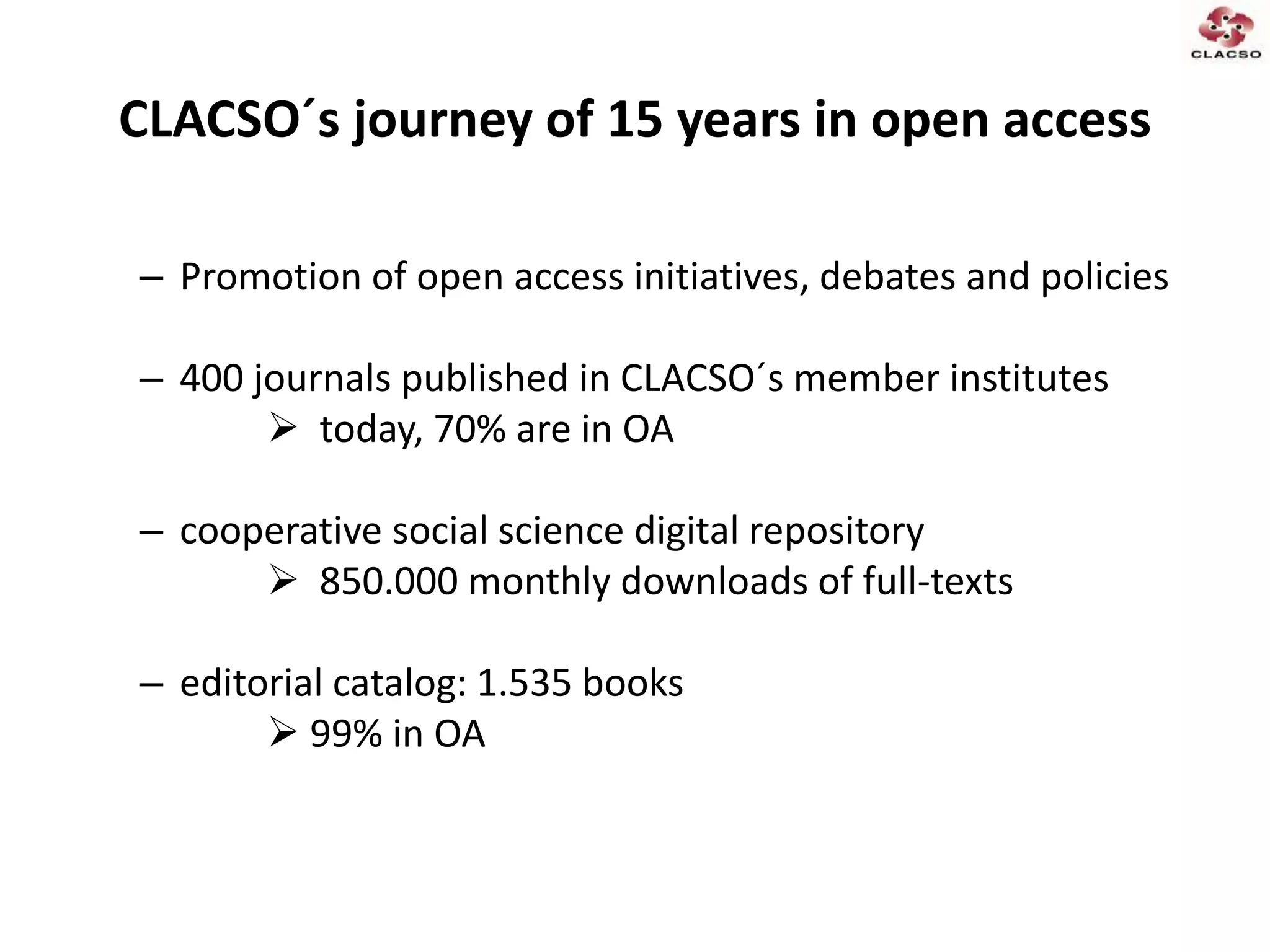
Radical Open Access Conference -
Latin America social sciences open access
experience and perspective
Dominique Babini, CLACSO
.
in this presentation
• CLACSO- Latin American Council of Social Sciences
experience with open access
• CLACSO´s vision of a non-commercial global open
access ecosystem
• Latin America´s non-commercial open access
tradition
• The risk of open access being integrated into existing
commercial publishing
CLACSO – social sciences network
• since 1967
• Membership: 382 social science institutions in 22 countries of
Latin America and Caribbean
• Promotes and supports
– collaborative research: 2.000 researchers participating in
CLACSO´s 50 regional research groups
– dialogue of research with policies and social movements
– among former members of CLACSO: 20 ministers in the
region, Evo Morales/García Linera (president, vice-
president Bolivia), F.Henrique Cardoso (former president
Brazil), Ricardo Lagos (former president Chile), Danilo
Astori (former vice-president Uruguay)
www.clacso.org
CLACSO´s journey of 15 years in open access
– Promotion of open access initiatives, debates and policies
– 400 journals published in CLACSO´s member institutes
 today, 70% are in OA
– cooperative social science digital repository
 850.000 monthly downloads of full-texts
– editorial catalog: 1.535 books
 99% in OA
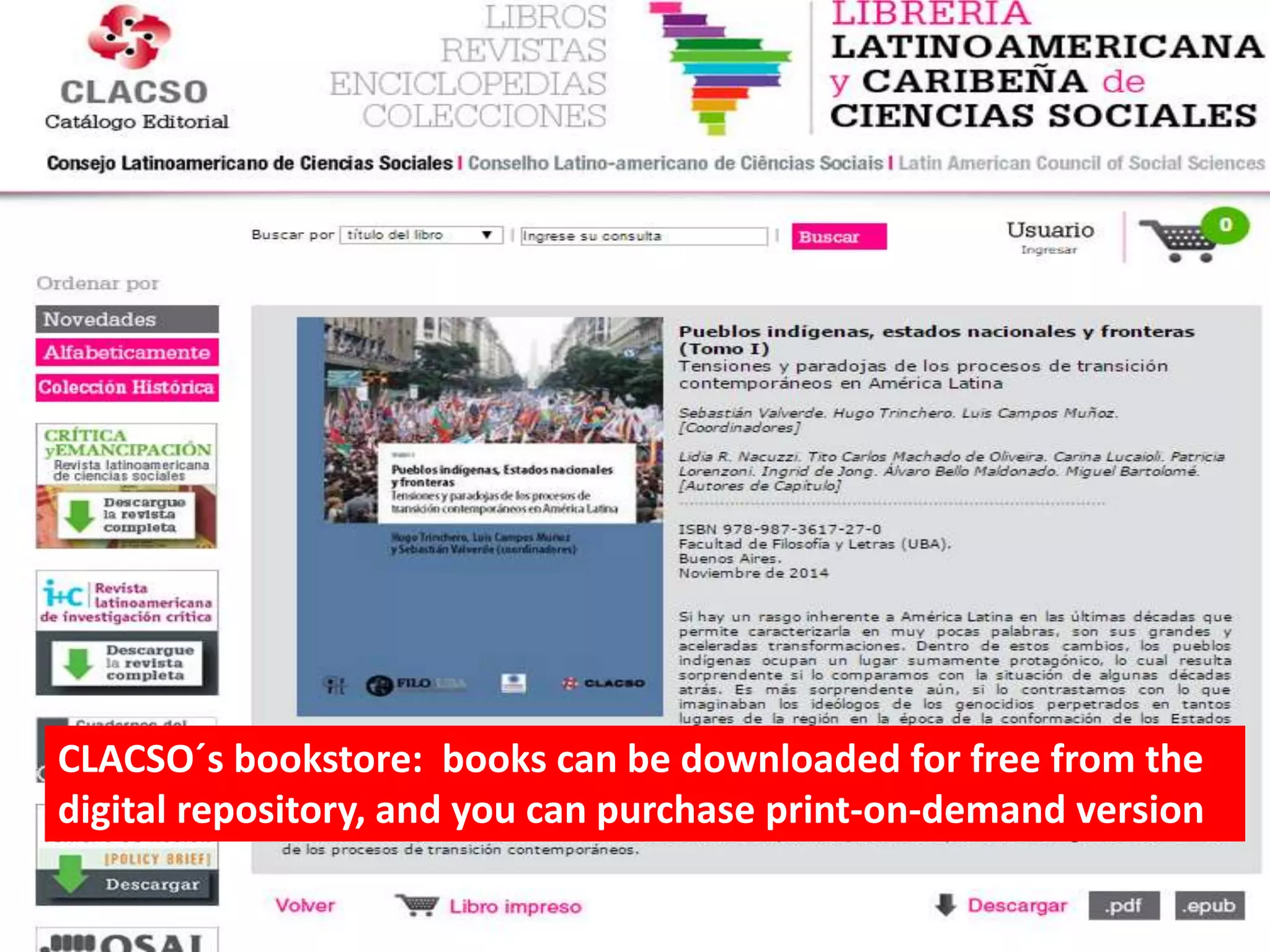
CLACSO´s bookstore: books can be downloaded for free from the
digital repository, and you can purchase print-on-demand version
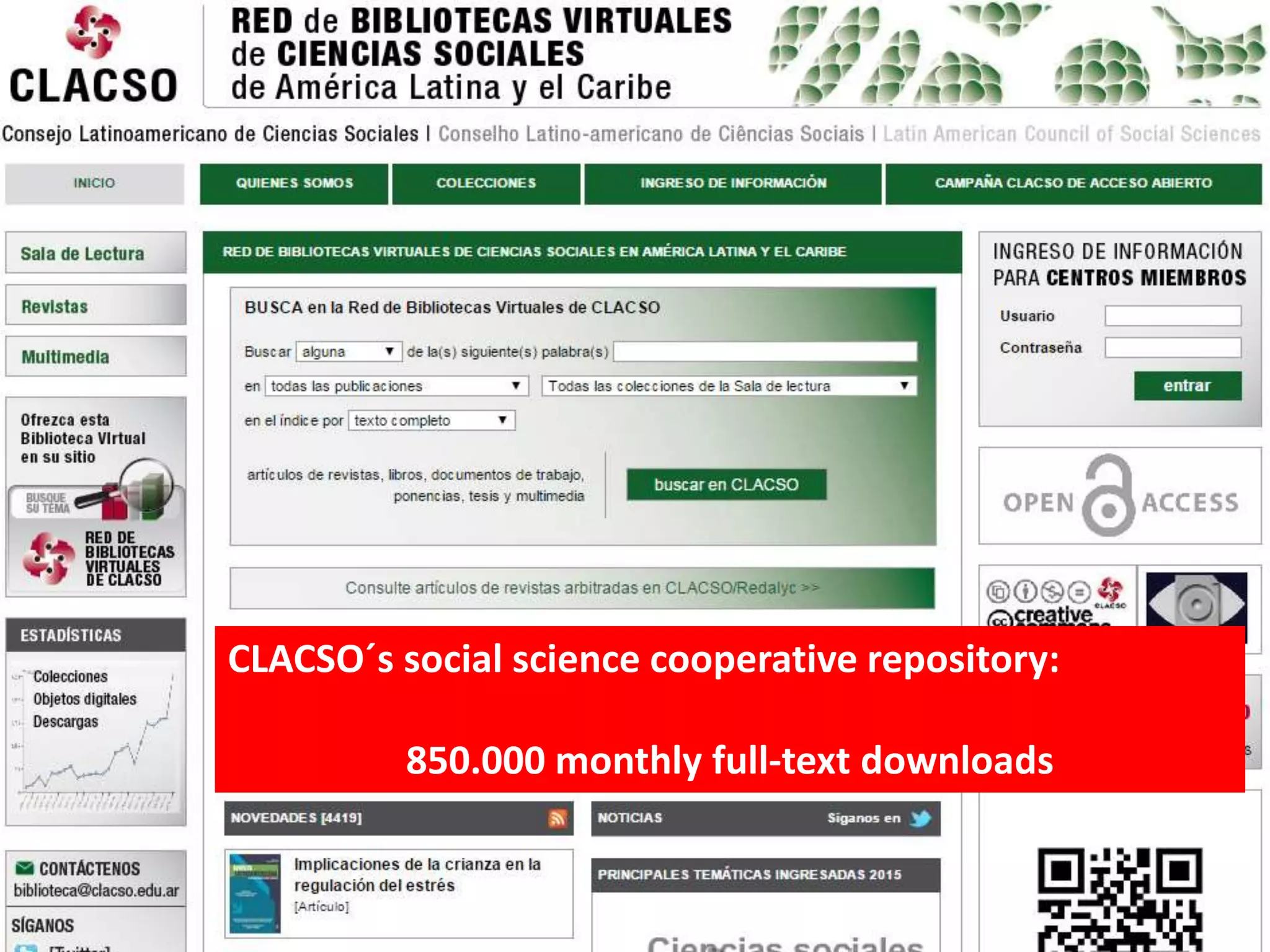
CLACSO´s social science cooperative repository:
850.000 monthly full-text downloads
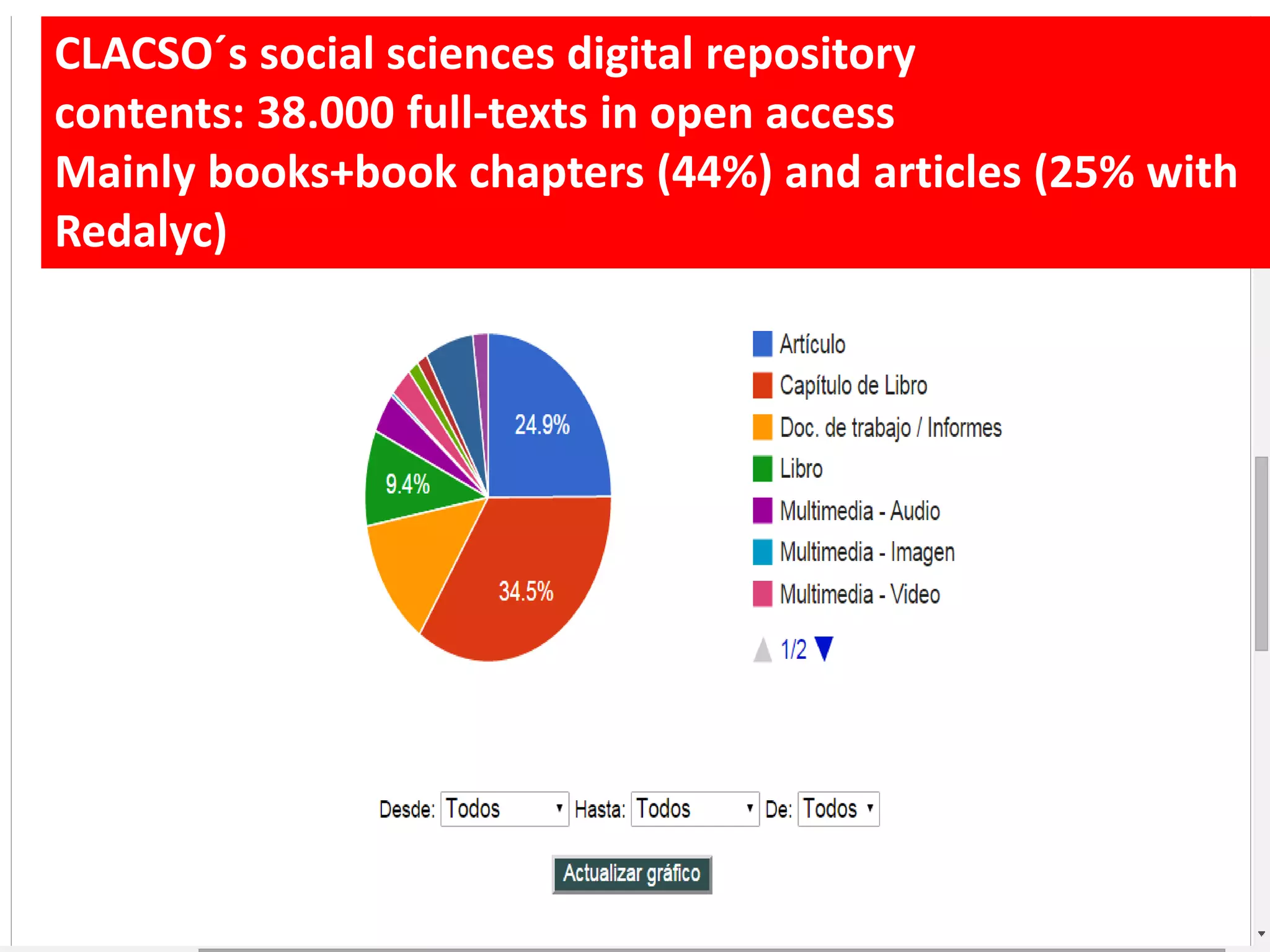
CLACSO´s social sciences digital repository
contents: 38.000 full-texts in open access
Mainly books+book chapters (44%) and articles (25% with
Redalyc)
CLACSO´s vision of a global non-commercial open
access
managed by the scholarly community
as a commons
 No fees to read
 No fees to publish
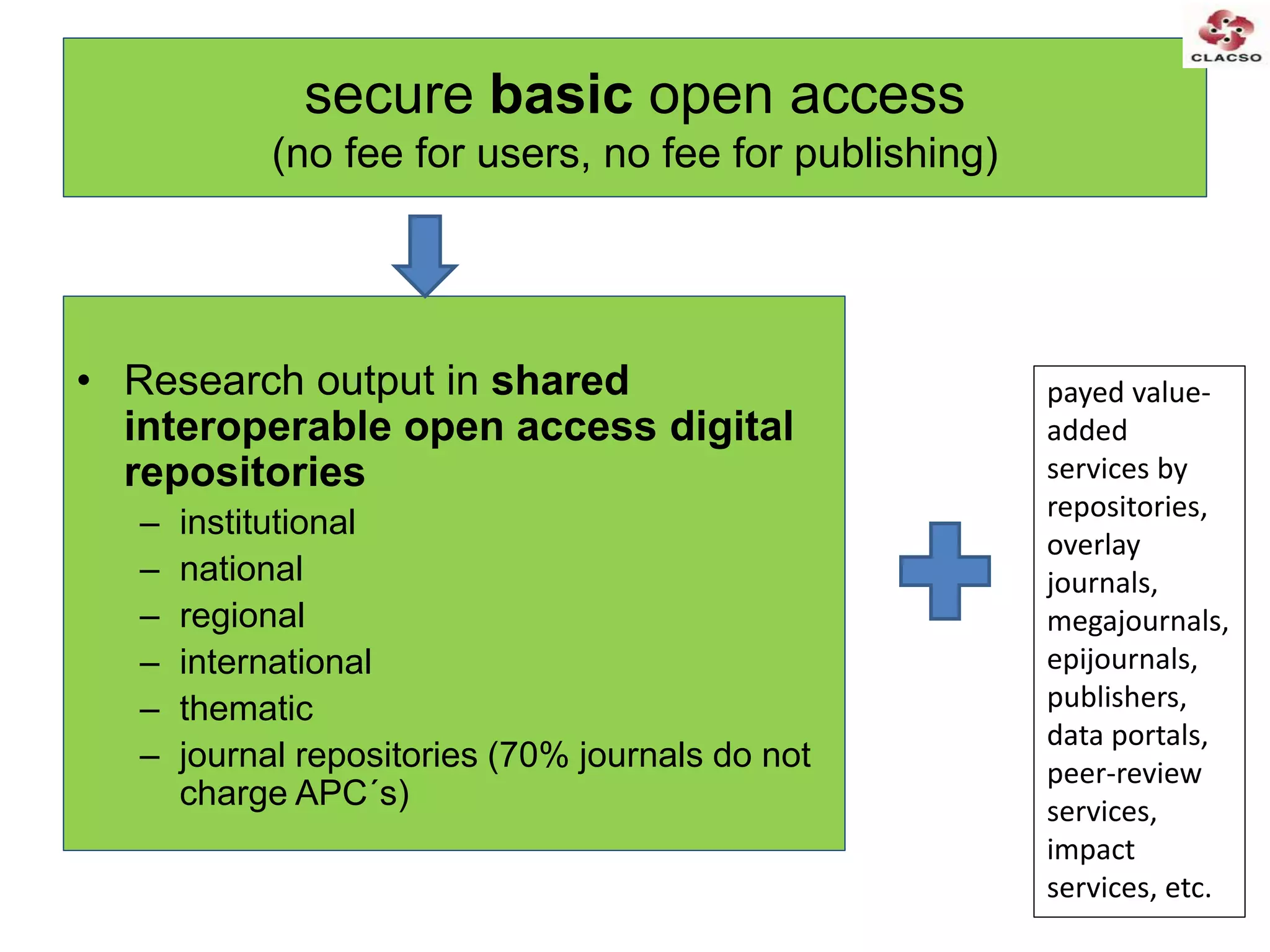
secure basic open access
(no fee for users, no fee for publishing)
• Research output in shared
interoperable open access digital
repositories
– institutional
– national
– regional
– international
– thematic
– journal repositories (70% journals do not
charge APC´s)
payed value-
added
services by
repositories,
overlay
journals,
megajournals,
epijournals,
publishers,
data portals,
peer-review
services,
impact
services, etc.
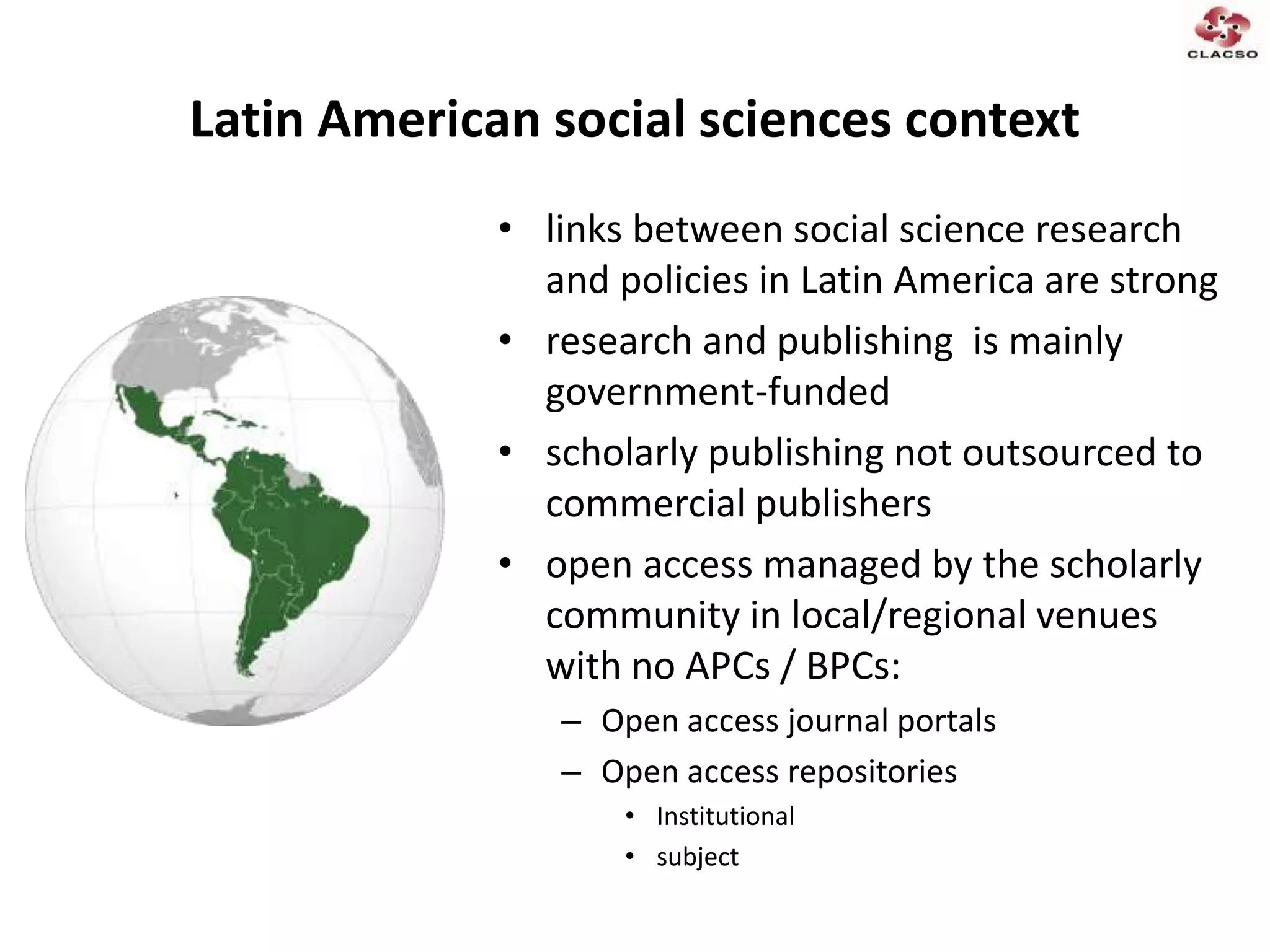
Latin American social sciences context
• links between social science research
and policies in Latin America are strong
• research and publishing is mainly
government-funded
• scholarly publishing not outsourced to
commercial publishers
• open access managed by the scholarly
community in local/regional venues
with no APCs / BPCs:
– Open access journal portals
– Open access repositories
• Institutional
• subject
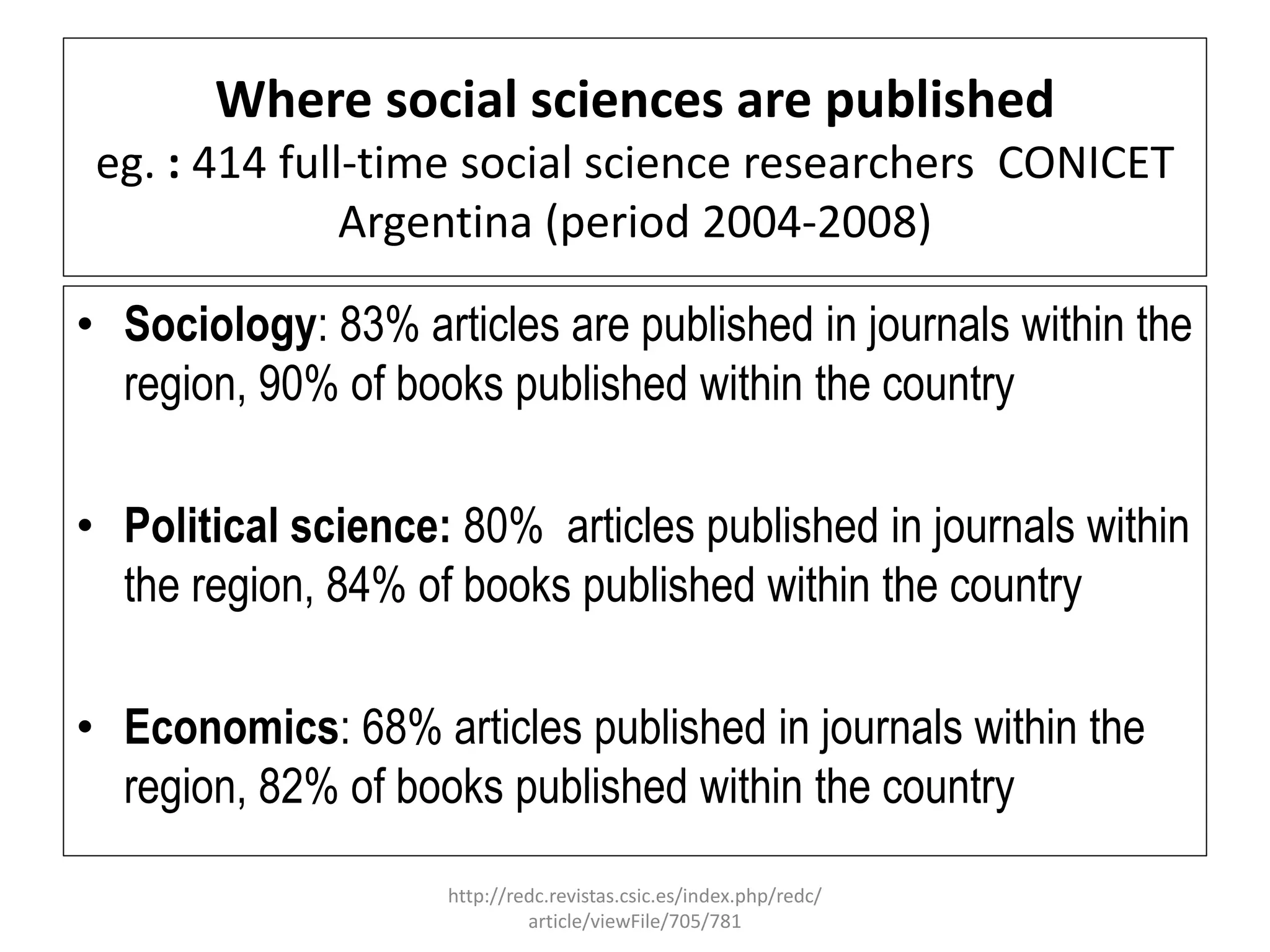
Where social sciences are published
eg. : 414 full-time social science researchers CONICET
Argentina (period 2004-2008)
• Sociology: 83% articles are published in journals within the
region, 90% of books published within the country
• Political science: 80% articles published in journals within
the region, 84% of books published within the country
• Economics: 68% articles published in journals within the
region, 82% of books published within the country
http://redc.revistas.csic.es/index.php/redc/
article/viewFile/705/781
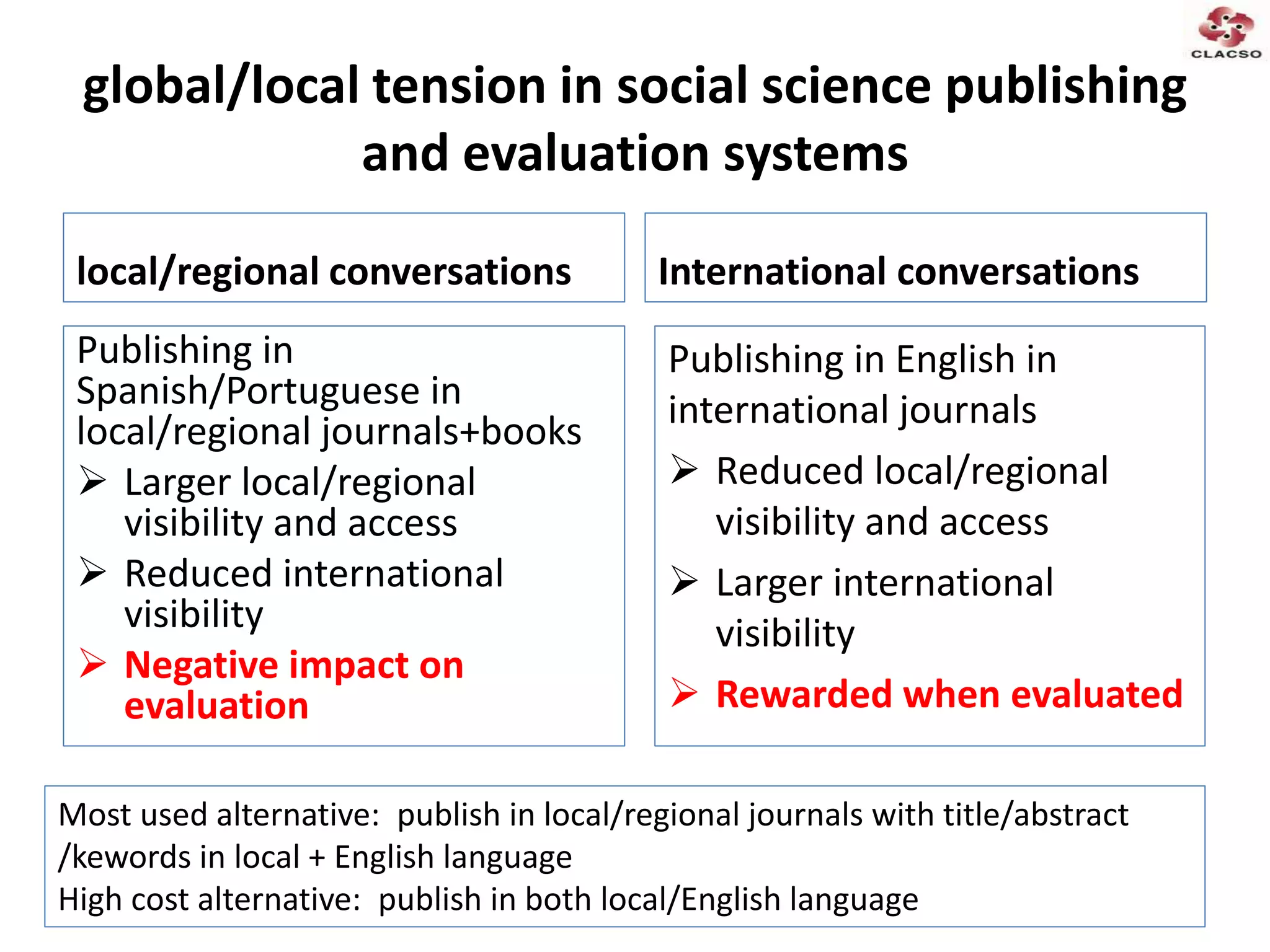
global/local tension in social science publishing
and evaluation systems
local/regional conversations
Publishing in
Spanish/Portuguese in
local/regional journals+books
 Larger local/regional
visibility and access
 Reduced international
visibility
 Negative impact on
evaluation
International conversations
Publishing in English in
international journals
 Reduced local/regional
visibility and access
 Larger international
visibility
 Rewarded when evaluated
Most used alternative: publish in local/regional journals with title/abstract
/kewords in local + English language
High cost alternative: publish in both local/English language
social science open access publishing in Latin
America
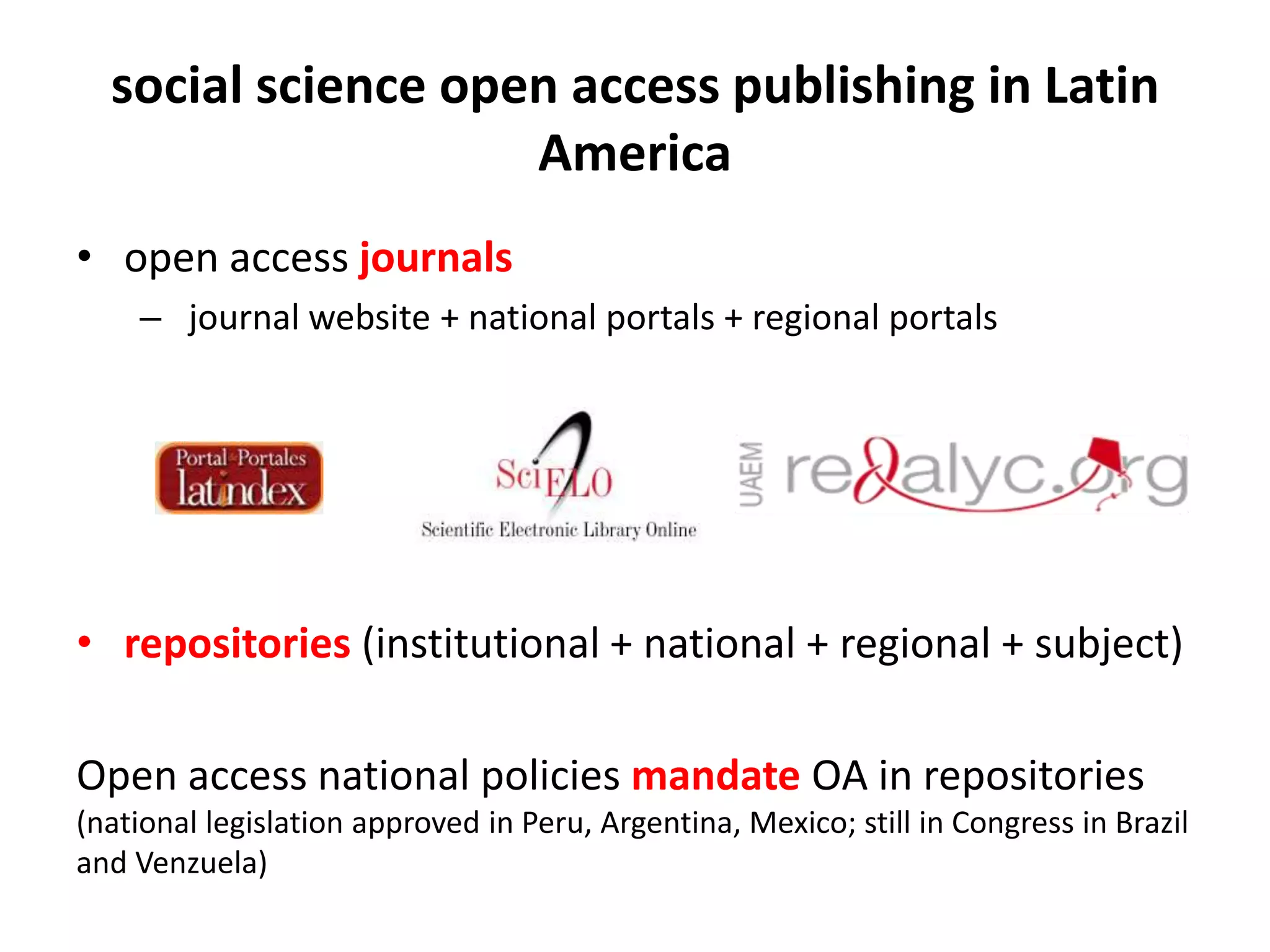
• open access journals
– journal website + national portals + regional portals
• repositories (institutional + national + regional + subject)
Open access national policies mandate OA in repositories
(national legislation approved in Peru, Argentina, Mexico; still in Congress in Brazil
and Venzuela)
OA managed in Latin America by the scholarly
community sharing costs, with no APC´s/BPC´s
now faces
trends of international open access
being integrated into commercial
publishing
we have to make an ongoing series of
decisions all of the time…
we have to think about who is being included
and who is being excluded…….
….. what seems open to us today, we have to
ask ourselves …will this seem open
tomorrow?
John Willinsky
Opening Science to Meet Future Challenges, 11 March 2014, Warsaw
https://www.youtube.com/watch?v=jODzw_5q7EU
Dominique Babini – CLACSO, Open Access Program
University of Buenos Aires/IIGG – Open Access research
@dominiquebabini
dasbabini@gmail.com
Thank you!!!!

Radical Open Access Conference - Latin America social sciences open access experience and perspective

  • 1.
    Radical Open AccessConference - Latin America social sciences open access experience and perspective Dominique Babini, CLACSO .
  • 2.
    in this presentation •CLACSO- Latin American Council of Social Sciences experience with open access • CLACSO´s vision of a non-commercial global open access ecosystem • Latin America´s non-commercial open access tradition • The risk of open access being integrated into existing commercial publishing
  • 3.
    CLACSO – socialsciences network • since 1967 • Membership: 382 social science institutions in 22 countries of Latin America and Caribbean • Promotes and supports – collaborative research: 2.000 researchers participating in CLACSO´s 50 regional research groups – dialogue of research with policies and social movements – among former members of CLACSO: 20 ministers in the region, Evo Morales/García Linera (president, vice- president Bolivia), F.Henrique Cardoso (former president Brazil), Ricardo Lagos (former president Chile), Danilo Astori (former vice-president Uruguay) www.clacso.org
  • 4.
    CLACSO´s journey of15 years in open access – Promotion of open access initiatives, debates and policies – 400 journals published in CLACSO´s member institutes  today, 70% are in OA – cooperative social science digital repository  850.000 monthly downloads of full-texts – editorial catalog: 1.535 books  99% in OA
  • 5.
    CLACSO´s bookstore: bookscan be downloaded for free from the digital repository, and you can purchase print-on-demand version
  • 6.
    CLACSO´s social sciencecooperative repository: 850.000 monthly full-text downloads
  • 7.
    CLACSO´s social sciencesdigital repository contents: 38.000 full-texts in open access Mainly books+book chapters (44%) and articles (25% with Redalyc)
  • 8.
    CLACSO´s vision ofa global non-commercial open access managed by the scholarly community as a commons  No fees to read  No fees to publish
  • 9.
    secure basic openaccess (no fee for users, no fee for publishing) • Research output in shared interoperable open access digital repositories – institutional – national – regional – international – thematic – journal repositories (70% journals do not charge APC´s) payed value- added services by repositories, overlay journals, megajournals, epijournals, publishers, data portals, peer-review services, impact services, etc.
  • 10.
    Latin American socialsciences context • links between social science research and policies in Latin America are strong • research and publishing is mainly government-funded • scholarly publishing not outsourced to commercial publishers • open access managed by the scholarly community in local/regional venues with no APCs / BPCs: – Open access journal portals – Open access repositories • Institutional • subject
  • 11.
    Where social sciencesare published eg. : 414 full-time social science researchers CONICET Argentina (period 2004-2008) • Sociology: 83% articles are published in journals within the region, 90% of books published within the country • Political science: 80% articles published in journals within the region, 84% of books published within the country • Economics: 68% articles published in journals within the region, 82% of books published within the country http://redc.revistas.csic.es/index.php/redc/ article/viewFile/705/781
  • 12.
    global/local tension insocial science publishing and evaluation systems local/regional conversations Publishing in Spanish/Portuguese in local/regional journals+books  Larger local/regional visibility and access  Reduced international visibility  Negative impact on evaluation International conversations Publishing in English in international journals  Reduced local/regional visibility and access  Larger international visibility  Rewarded when evaluated Most used alternative: publish in local/regional journals with title/abstract /kewords in local + English language High cost alternative: publish in both local/English language
  • 13.
    social science openaccess publishing in Latin America • open access journals – journal website + national portals + regional portals • repositories (institutional + national + regional + subject) Open access national policies mandate OA in repositories (national legislation approved in Peru, Argentina, Mexico; still in Congress in Brazil and Venzuela)
  • 14.
    OA managed inLatin America by the scholarly community sharing costs, with no APC´s/BPC´s now faces trends of international open access being integrated into commercial publishing
  • 15.
    we have tomake an ongoing series of decisions all of the time… we have to think about who is being included and who is being excluded……. ….. what seems open to us today, we have to ask ourselves …will this seem open tomorrow? John Willinsky Opening Science to Meet Future Challenges, 11 March 2014, Warsaw https://www.youtube.com/watch?v=jODzw_5q7EU
  • 16.
    Dominique Babini –CLACSO, Open Access Program University of Buenos Aires/IIGG – Open Access research @dominiquebabini dasbabini@gmail.com Thank you!!!!