Head and Neck Pathology Grossing Guidelines
Page | 1
Do not cut any HN specimens unless you are fully oriented anatomically
 Orient by anatomic structures (oral tongue, junction of buccal/gingival mucosa,
alveolar ridge, angle of jaw, hard palate, etc)
 For mandibulectomies/maxillectomies, please ask for help if unsure
 Ink resection margins
 Describe all abnormalities: size (staging cutoffs: 2 cm, 4 cm), location, extent,
depth (staging cutoffs: 0.5 cm, 1 cm), distance to margins
 Sample all margins (if grossly close, e.g. 1 cm, submit perpendicular section;
otherwise submit a shave of the margin closest to tumor)
 Sample tumor:
o Show relationship to peripheral/deep margins
o Show maximum depth of invasion
 Specimens containing mandible or maxilla:
o Bone margins
o Sections of bone adjacent to tumor or gross involvement of bone
 Diagrams and gross photos are appreciated
Specimen Type: RADICAL NECK DISSECTION (standard, modified, extended,
regional)
 If specimen is received oriented please consult with PA/attending
 Submit all lymph nodes
o If the remainder of the specimen can be submitted in less than 5
cassettes, submit entirely. If not, submit 5 cassettes of fat.
 For grossly positive nodes:
o Describe size of metastatic focus (staging cutoffs: 3 cm, 6 cm) and if
extranodal extension is present grossly
Gross Template:
Labeled with the patient’s name (last name, first name), medical record number (#),
designated “***”, and received [fresh/in formalin] is a [standard, modified, extended,
regional] neck dissection measuring *** x *** x *** cm. The dissection consists of
[describe tissue/glands/vasculature present]. [Describe orientation provided].
Sectioning reveals [describe number/size of lymph nodes identified]. The salivary gland
is sectioned to reveal [describe cut surfaces]. The muscle is sectioned to reveal
[describe cut surface]. The internal jugular vein is opened to reveal [describe contents –
noting thrombosis and relation to tumor]. Representative sections are submitted
[describe cassette submission].
Head and Neck Pathology Grossing Guidelines
Page | 2
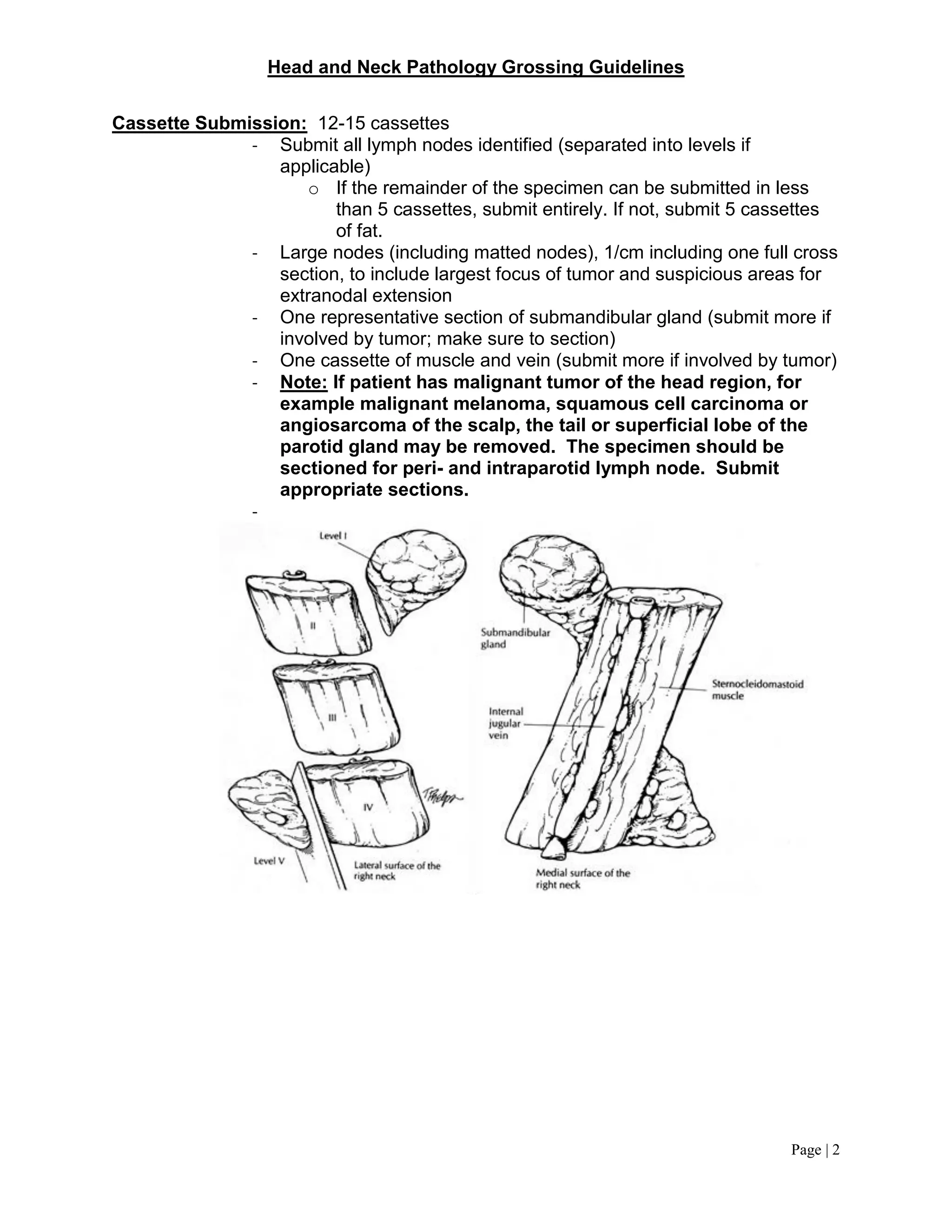
Cassette Submission: 12-15 cassettes
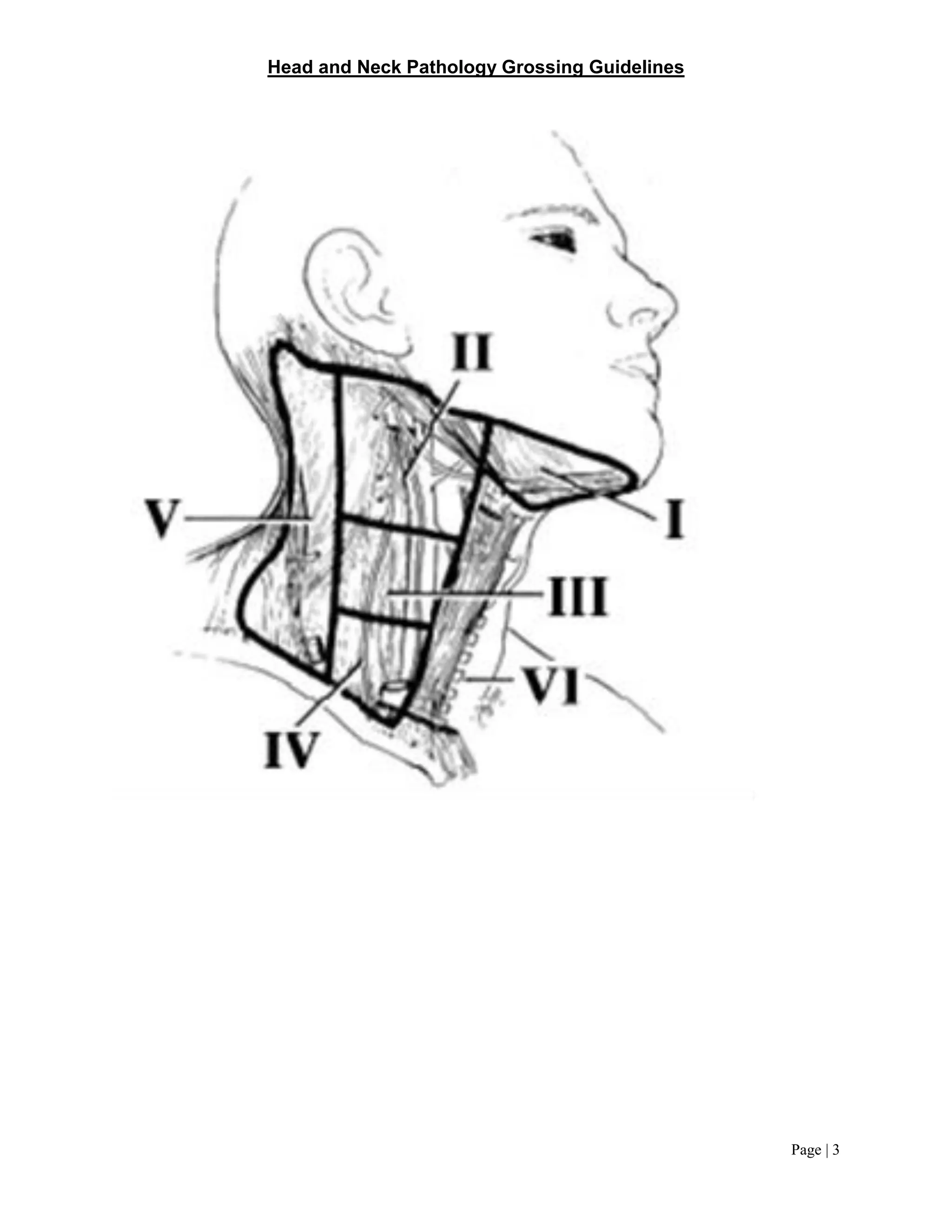
- Submit all lymph nodes identified (separated into levels if
applicable)
o If the remainder of the specimen can be submitted in less
than 5 cassettes, submit entirely. If not, submit 5 cassettes
of fat.
- Large nodes (including matted nodes), 1/cm including one full cross
section, to include largest focus of tumor and suspicious areas for
extranodal extension
- One representative section of submandibular gland (submit more if
involved by tumor; make sure to section)
- One cassette of muscle and vein (submit more if involved by tumor)
- Note: If patient has malignant tumor of the head region, for
example malignant melanoma, squamous cell carcinoma or
angiosarcoma of the scalp, the tail or superficial lobe of the
parotid gland may be removed. The specimen should be
sectioned for peri- and intraparotid lymph node. Submit
appropriate sections.
-
Head and Neck Pathology Grossing Guidelines
Page | 3

Radical neck dissection

  • 1.
    Head and NeckPathology Grossing Guidelines Page | 1 Do not cut any HN specimens unless you are fully oriented anatomically  Orient by anatomic structures (oral tongue, junction of buccal/gingival mucosa, alveolar ridge, angle of jaw, hard palate, etc)  For mandibulectomies/maxillectomies, please ask for help if unsure  Ink resection margins  Describe all abnormalities: size (staging cutoffs: 2 cm, 4 cm), location, extent, depth (staging cutoffs: 0.5 cm, 1 cm), distance to margins  Sample all margins (if grossly close, e.g. 1 cm, submit perpendicular section; otherwise submit a shave of the margin closest to tumor)  Sample tumor: o Show relationship to peripheral/deep margins o Show maximum depth of invasion  Specimens containing mandible or maxilla: o Bone margins o Sections of bone adjacent to tumor or gross involvement of bone  Diagrams and gross photos are appreciated Specimen Type: RADICAL NECK DISSECTION (standard, modified, extended, regional)  If specimen is received oriented please consult with PA/attending  Submit all lymph nodes o If the remainder of the specimen can be submitted in less than 5 cassettes, submit entirely. If not, submit 5 cassettes of fat.  For grossly positive nodes: o Describe size of metastatic focus (staging cutoffs: 3 cm, 6 cm) and if extranodal extension is present grossly Gross Template: Labeled with the patient’s name (last name, first name), medical record number (#), designated “***”, and received [fresh/in formalin] is a [standard, modified, extended, regional] neck dissection measuring *** x *** x *** cm. The dissection consists of [describe tissue/glands/vasculature present]. [Describe orientation provided]. Sectioning reveals [describe number/size of lymph nodes identified]. The salivary gland is sectioned to reveal [describe cut surfaces]. The muscle is sectioned to reveal [describe cut surface]. The internal jugular vein is opened to reveal [describe contents – noting thrombosis and relation to tumor]. Representative sections are submitted [describe cassette submission].
  • 2.
    Head and NeckPathology Grossing Guidelines Page | 2 Cassette Submission: 12-15 cassettes - Submit all lymph nodes identified (separated into levels if applicable) o If the remainder of the specimen can be submitted in less than 5 cassettes, submit entirely. If not, submit 5 cassettes of fat. - Large nodes (including matted nodes), 1/cm including one full cross section, to include largest focus of tumor and suspicious areas for extranodal extension - One representative section of submandibular gland (submit more if involved by tumor; make sure to section) - One cassette of muscle and vein (submit more if involved by tumor) - Note: If patient has malignant tumor of the head region, for example malignant melanoma, squamous cell carcinoma or angiosarcoma of the scalp, the tail or superficial lobe of the parotid gland may be removed. The specimen should be sectioned for peri- and intraparotid lymph node. Submit appropriate sections. -
  • 3.
    Head and NeckPathology Grossing Guidelines Page | 3