Radiative Transfer in the Atmosphere and Ocean Gary E. Thomas
Radiative Transfer in the Atmosphere and Ocean Gary E. Thomas
Radiative Transfer in the Atmosphere and Ocean Gary E. Thomas
Radiative Transfer in the Atmosphere and Ocean Gary E. Thomas
Radiative Transfer in the Atmosphere and Ocean Gary E. Thomas
1.
Radiative Transfer inthe Atmosphere and Ocean
Gary E. Thomas download
https://textbookfull.com/product/radiative-transfer-in-the-
atmosphere-and-ocean-gary-e-thomas/
Download more ebook from https://textbookfull.com
2.
We believe theseproducts will be a great fit for you. Click
the link to download now, or visit textbookfull.com
to discover even more!
Spectroscopy and radiative transfer of planetary
atmospheres 1st Edition Chance
https://textbookfull.com/product/spectroscopy-and-radiative-
transfer-of-planetary-atmospheres-1st-edition-chance/
Near Field Radiative Heat Transfer Across Nanometer
Vacuum Gaps Fundamentals and Applications 1st Edition
Soumyadipta Basu
https://textbookfull.com/product/near-field-radiative-heat-
transfer-across-nanometer-vacuum-gaps-fundamentals-and-
applications-1st-edition-soumyadipta-basu/
Controlled Atmosphere Transmission Electron Microscopy:
Principles and Practice 1st Edition Thomas Willum
Hansen
https://textbookfull.com/product/controlled-atmosphere-
transmission-electron-microscopy-principles-and-practice-1st-
edition-thomas-willum-hansen/
Coastal Ocean Observing Platforms Sensors and Systems
Jorge E. Corredor
https://textbookfull.com/product/coastal-ocean-observing-
platforms-sensors-and-systems-jorge-e-corredor/
3.
How To DoYour Research Project 3rd Edition Gary Thomas
https://textbookfull.com/product/how-to-do-your-research-
project-3rd-edition-gary-thomas/
Flaps and Grafts in Dermatologic Surgery 2nd Edition
Thomas E. Rohrer
https://textbookfull.com/product/flaps-and-grafts-in-
dermatologic-surgery-2nd-edition-thomas-e-rohrer/
Social Psychology Thomas E Heinzen
https://textbookfull.com/product/social-psychology-thomas-e-
heinzen/
Biodiversity and Climate Change: Transforming the
Biosphere Thomas E. Lovejoy
https://textbookfull.com/product/biodiversity-and-climate-change-
transforming-the-biosphere-thomas-e-lovejoy/
Optical Waves and Laser Beams in the Irregular
Atmosphere 1st Edition Nathan Blaunstein
https://textbookfull.com/product/optical-waves-and-laser-beams-
in-the-irregular-atmosphere-1st-edition-nathan-blaunstein/
5.
RADIATIVE TRANSFER INTHE
ATMOSPHERE AND OCEAN
second edition
This new and completely updated edition gives a detailed description of radiative
transfer processes at a level accessible to advanced students. The volume gives the reader a
basic understanding of global warming and enhanced levels of harmful ultraviolet radiation
caused by ozone depletion. It teaches the basic physics of absorption, scattering, and
emission processes in turbid media, such as the atmosphere and ocean, using simple
semiclassical models. The radiative transfer equation, including multiple scattering, is
formulated and solved for several prototype problems, using both simple approximate and
accurate numerical methods. In addition, the reader has access to a powerful, state-of-the-
art computational code for simulating radiative transfer processes in coupled atmosphere–
water systems, including snow and ice. This computational code can be regarded as a
powerful educational aid, but also as a research tool that can be applied to solve a variety
of research problems in environmental sciences.
knut stamnes is a Professor in the Department of Physics and Engineering Physics and
Director of the Light and Life Laboratory at Stevens Institute of Technology. His research
interests include radiative transfer, ocean optics, and remote sensing, and he has published
over 200 papers and coauthored two textbooks: this one and Radiative Transfer in Coupled
Environmental Systems (2015, Wiley). He is a fellow of the Optical Society (OSA), a
member of the International Society for Optical Engineering (SPIE), and a member of the
Norwegian Academy of Technological Sciences.
gary e. thomas is an Emeritus Professor in the Department of Astrophysical and
Planetary Science and Senior Research Associate at the Laboratory for Atmospheric and
Space Physics at the University of Colorado, Boulder. His research interests are in the
remote sensing of Earth and planetary atmospheres. He has published over 150 papers
in various fields of planetary and atmospheric science. He taught the graduate course
Radiative Transfer at the University of Colorado over a period of 30 years.
jakob j. stamnes is a Professor Emeritus in the Department of Physics and Technology
at the University of Bergen, Norway, and CEO of Balter Medical, Norway. His research
interests include wave propagation, radiative transfer, ocean optics, and remote sensing.
He has published over 190 research papers. He is the author of Waves in Focal Regions
(1986, CRC Press) and coauthored Radiative Transfer in Coupled Environmental Systems
(2015, Wiley). He is a fellow of the Optical Society (OSA), a member of the International
Society for Optical Engineering (SPIE), and a member of the Norwegian Academy of
Technological Sciences.
7.
RADIATIVE TRANSFER INTHE
ATMOSPHERE AND OCEAN
second edition
KNUT STAMNES
Stevens Institute of Technology, New Jersey
GARY E. THOMAS
University of Colorado, Boulder
JAKOB J. STAMNES
University of Bergen, Norway
Contents
List of Illustrationspage xiv
List of Tables xvii
1 Basic Properties of Radiation, Atmospheres, and Oceans 1
1.1 Introduction 1
1.2 Parts of the Spectrum 1
1.2.1 Extraterrestrial Solar Irradiance 2
1.2.2 Terrestrial Infrared Irradiance 6
1.3 Radiative Interaction with Planetary Media 8
1.3.1 Feedback Processes 8
1.3.2 Types of Matter Which Affect Radiation 9
1.4 Vertical Structure of Planetary Atmospheres 10
1.4.1 Hydrostatic Equilibrium and Ideal Gas Laws 10
1.4.2 Minor Species in the Atmosphere 15
1.4.3 Optical Line-of-Sight Columns 16
1.4.4 Radiative Equilibrium and the Thermal Structure of
Atmospheres 19
1.4.5 Climate Change: Radiative Forcing and Feedbacks 22
1.5 Density Structure of the Ocean 26
1.6 Vertical Structure of the Ocean 27
1.6.1 The Mixed Layer and the Deep Ocean 27
1.6.2 Seasonal Variations of Ocean Properties 29
1.6.3 Sea-Surface Temperature 30
1.6.4 Ocean Spectral Reflectance and Opacity 31
1.7 Remarks on Nomenclature, Notation, and Units 32
1.8 Summary 34
Exercises 35
v
10.
vi Contents
2 BasicState Variables and the Radiative Transfer Equation 37
2.1 Introduction 37
2.2 Geometrical Optics 38
2.3 Radiative Flux or Irradiance 39
2.4 Spectral Radiance and Its Angular Moments 41
2.4.1 Relationship between Irradiance and Radiance 42
2.4.2 Average (Mean) Radiance and Energy Density 43
2.5 Some Theorems on Radiance 46
2.5.1 Radiance and Irradiance from an Extended Source 48
2.6 Perception of Brightness: Analogy with Radiance 49
2.7 The Extinction Law 50
2.7.1 Extinction = Scattering Plus Absorption 53
2.8 The Differential Equation of Radiative Transfer 56
2.9 Summary 58
Exercises 58
3 Basic Scattering Processes 59
3.1 Introduction 59
3.2 Lorentz Theory for Radiation–Matter Interactions 61
3.2.1 Scattering and Collective Effects in a Uniform Medium 62
3.2.2 Scattering from Density Irregularities 65
3.2.3 Scattering in Random Media 66
3.2.4 First-Order and Multiple Scattering 68
3.3 Scattering from a Damped Simple Harmonic Oscillator 69
3.3.1 Case (1): Resonance Scattering and the Lorentz Profile 70
3.3.2 Conservative and Nonconservative Scattering 72
3.3.3 Natural Broadening 73
3.3.4 Pressure Broadening 74
3.3.5 Doppler Broadening 75
3.3.6 Realistic Line-Broadening Processes 77
3.3.7 Case (2): Rayleigh Scattering 78
3.4 The Scattering Phase Function 80
3.4.1 Rayleigh Scattering Phase Function 81
3.5 Mie–Debye Scattering 84
3.6 Summary 86
Exercises 87
4 Absorption by Solid, Aqueous, and Gaseous Media 89
4.1 Introduction 89
4.2 Absorption on Surfaces, Aerosols, and within Aqueous Media 91
4.2.1 Condensed Matter 91
11.
Contents vii
4.2.2 Aerosols93
4.2.3 Liquids 94
4.3 Molecular Absorption in Gases 95
4.3.1 Thermal Emission and Radiation Laws 97
4.3.2 Planck’s Spectral Distribution Law 100
4.3.3 Radiative Excitation Processes in Molecules 102
4.3.4 Inelastic Collisional Processes 103
4.3.5 Maintenance of Thermal Equilibrium Distributions 107
4.4 The Two-Level Atom 108
4.4.1 Microscopic Radiative Transfer Equation 108
4.4.2 Effects of Collisions on State Populations 112
4.5 Absorption in Molecular Lines and Bands 114
4.5.1 Molecular Rotation: The Rigid Rotator 116
4.5.2 Molecular Vibration and Rotation: The Vibrating Rotator 117
4.5.3 Line Strengths 119
4.6 Absorption Processes in the UV/Visible 121
4.7 Transmission in Spectrally Complex Media 125
4.7.1 Transmission in an Isolated Line 126
4.7.2 Isolated Lorentz Line 128
4.7.3 Band Models 129
4.7.4 Random Band Model 132
4.7.5 MODTRAN: A Moderate Resolution Band Model 133
4.7.6 Spectral Mapping Transformations for Homogeneous
Media 136
4.8 Summary 141
Exercises 143
5 Principles of Radiative Transfer 147
5.1 Introduction 147
5.2 Boundary Properties of Planetary Media 147
5.2.1 Thermal Emission from a Surface 148
5.2.2 Absorption by a Surface 149
5.2.3 Kirchhoff’s Law for Surfaces 150
5.2.4 Surface Reflection: The BRDF 151
5.2.5 Albedo for Collimated Incidence 154
5.2.6 The Irradiance Reflectance, or Albedo: Diffuse Incidence 156
5.2.7 Analytic Reflectance Expressions 158
5.2.8 The Opposition Effect 160
5.2.9 Specular Reflection from the Surface of a Water Body 162
12.
viii Contents
5.2.10 Transmissionthrough a Slab Medium 163
5.2.11 Spherical or Bond Albedo 165
5.3 Absorption and Scattering in Planetary Media 167
5.3.1 Kirchhoff’s Law for Volume Absorption and Emission 167
5.3.2 Differential Equation of Radiative Transfer 168
5.4 Solution of the Radiative Transfer Equation for Zero Scattering 170
5.4.1 Solution with Zero Scattering in Slab Geometry 173
5.4.2 Half-Range Quantities in a Slab Geometry 174
5.4.3 Formal Solution in a Slab Geometry 175
5.5 Gray Slab Medium in Local Thermodynamic Equilibrium 176
5.6 Formal Solution Including Scattering and Emission 177
5.7 Radiative Heating Rate 179
5.7.1 Generalized Gershun’s Law 180
5.7.2 Warming Rate, or the Temperature Tendency 181
5.7.3 Actinic Radiation, Photolysis Rate, and Dose Rate 182
5.8 Summary 183
Exercises 183
6 Formulation of Radiative Transfer Problems 186
6.1 Introduction 186
6.2 Separation into Diffuse and Direct (Solar) Components 186
6.2.1 Lower Boundary Conditions 188
6.2.2 Multiple Scattering 189
6.2.3 Azimuth Independence of Irradiance and Mean Radiance 190
6.2.4 Azimuthal Dependence of the Radiation Field 191
6.2.5 Spherical Shell Geometry 196
6.3 Nonstratified Media 196
6.4 Radiative Transfer in an Atmosphere–Water System 197
6.4.1 Two Stratified Media with Different Refractive Indices 199
6.5 Examples of Scattering Phase Functions 201
6.5.1 Rayleigh Scattering Phase Function 202
6.5.2 The Mie Scattering Phase Function 204
6.5.3 The Fournier–Forand Scattering Phase Function 205
6.5.4 The Petzold Scattering Phase Function 206
6.6 Scaling Transformations Useful for Anisotropic Scattering 206
6.6.1 The δ-Isotropic Approximation 208
6.6.2 Remarks on Low-Order Scaling Approximations 211
6.6.3 The δ-M Approximation: Arbitrary M 212
6.6.4 Mathematical and Physical Meaning of the Scaling 213
13.
Contents ix
6.7 PrototypeProblems in Radiative Transfer Theory 214
6.7.1 Prototype Problem 1: Uniform Illumination 215
6.7.2 Prototype Problem 2: Constant Imbedded Source 216
6.7.3 Prototype Problem 3: Diffuse Reflection Problem 216
6.7.4 Boundary Conditions: Reflecting and Emitting Surface 217
6.8 Reciprocity, Duality, and Inhomogeneous Media 218
6.9 Effects of Surface Reflection on the Radiation Field 219
6.10 Integral Equation Formulation of Radiative Transfer 222
6.11 Summary 223
Exercises 224
7 Approximate Solutions of Prototype Problems 227
7.1 Introduction 227
7.2 Separation of the Radiation Field into Orders of Scattering 228
7.2.1 The Single-Scattering Approximation 229
7.2.2 Lambda Iteration: The Multiple-Scattering Series 230
7.2.3 Single-Scattering Contribution from Ground
Reflection: The Planetary Problem 232
7.2.4 Successive Orders of Scattering (SOS) 233
7.3 The Two-Stream Approximation: Isotropic Scattering 234
7.3.1 Approximate Differential Equations 234
7.3.2 The Mean Inclination: Possible Choices for μ̄ 236
7.3.3 Prototype Problem 1: Differential Equation Approach 237
7.3.4 Imbedded Source: Prototype Problem 2 243
7.3.5 Beam Incidence: Prototype Problem 3 248
7.4 Conservative Scattering in a Finite Slab 251
7.5 Anisotropic Scattering 252
7.5.1 Two-Stream versus Eddington Approximations 252
7.5.2 The Backscattering Ratios 255
7.5.3 Two-Stream Solutions for Anisotropic Scattering 260
7.5.4 Scaling Approximations for Anisotropic Scattering 262
7.5.5 Generalized Two-Stream Equations 263
7.6 Accuracy of the Two-Stream Method 265
7.7 Final Comments on the Two-Stream Method 266
7.8 Summary 269
Exercises 270
8 The Role of Radiation in Climate 278
8.1 Introduction 278
8.2 Irradiance and Heating Rate: Clear-Sky Conditions 280
8.2.1 Monochromatic Irradiances 281
14.
x Contents
8.2.2 WidebandEmittance Models 283
8.2.3 Narrowband Absorption Model 288
8.2.4 Band Overlap 289
8.2.5 The Diffusivity Approximation 289
8.2.6 Equations for the Heating Rate 290
8.2.7 Clear-Sky Radiative Cooling: Nonisothermal Medium 293
8.2.8 Computations of Terrestrial Cooling Rates 294
8.3 The IR Radiative Impact of Clouds and Aerosols 295
8.3.1 Heating Rate in an Idealized Cloud 296
8.3.2 Detailed Longwave Radiative Effects of Clouds 298
8.3.3 Accurate Treatment of Longwave RT Including
Scattering 300
8.4 Radiative Equilibrium with Zero Visible Opacity 302
8.5 Radiative Equilibrium with Finite Visible Optical Depth 309
8.6 Radiative-Convective Equilibrium 312
8.7 The Concept of the Emission Height 315
8.8 Effects of a Spectral Window 318
8.9 Radiative Forcing 319
8.10 Climate Impact of Clouds 322
8.10.1 Longwave Effects of Water Clouds 323
8.10.2 Shortwave Effects of Water Clouds 325
8.10.3 Combined Shortwave and Longwave Effects of Clouds 328
8.11 Climate Impact of Cloud Height 331
8.12 Cloud and Aerosol Forcing 333
8.12.1 Aerosol Forcing 335
8.13 Water-Vapor Feedback 337
8.14 Effects of Carbon Dioxide Changes 338
8.15 Greenhouse Effect from Individual Gas Species 339
8.16 Summary 340
Exercises 342
9 Accurate Numerical Solutions of Prototype Problems 347
9.1 Introduction 347
9.2 Discrete-Ordinate Method – Isotropic Scattering 347
9.2.1 Quadrature Formulas 347
9.3 Anisotropic Scattering 350
9.3.1 General Considerations 350
9.3.2 Quadrature Rule 351
9.4 Matrix Formulation of the Discrete-Ordinate Method 352
9.4.1 Two- and Four-Stream Approximations 352
9.4.2 Multistream Approximation (N Arbitrary) 353
15.
Contents xi
9.5 MatrixEigensolutions 355
9.5.1 Two-Stream Solutions (N = 1) 355
9.5.2 Multistream Solutions (N Arbitrary) 356
9.5.3 Inhomogeneous Solution 357
9.5.4 General Solution 358
9.6 Source Function and Angular Distributions 359
9.7 Boundary Conditions – Removal of Ill Conditioning 360
9.8 Inhomogeneous Multilayered Media 362
9.8.1 General Solution – Boundary and Layer Interface
Conditions 362
9.8.2 Source Functions and Angular Distributions 365
9.9 Correction of the Truncated Radiance Field 366
9.9.1 The Nakajima–Tanaka Correction Procedure 367
9.9.2 Computed Radiance Distributions for the Standard
Problem 369
9.10 Coupled Atmosphere–Ocean Problem 370
9.10.1 Discrete-Ordinate Equations for the Atmosphere–
Ocean System 370
9.10.2 Quadrature and General Solution 371
9.10.3 Boundary, Continuity, and Atmosphere–Ocean
Interface Conditions 373
9.11 The Doubling-Adding and the Matrix Operator Methods 376
9.11.1 Matrix-Exponential Solution – Formal Derivation of
Doubling Rules 377
9.11.2 Connection between Doubling and Discrete Ordinate
Methods 378
9.11.3 Intuitive Derivation of the Doubling Rules – Adding
of Dissimilar Layers 379
9.12 Other Accurate Methods 381
9.12.1 The Spherical Harmonic Method 381
9.12.2 Invariant Imbedding 381
9.12.3 Iteration Methods 382
9.12.4 The Feautrier Method 382
9.12.5 Integral Equation Approach 382
9.12.6 Monte Carlo Markov Chain Methods 383
9.13 Final Comments 384
9.14 Summary 385
Exercises 387
16.
xii Contents
10 ShortwaveRadiative Transfer in the Atmosphere and Ocean 389
10.1 Introduction 389
10.2 Solar Radiation 391
10.2.1 Modeling UV Transmission into the Ocean 392
10.2.2 Measured and Computed UV Irradiance in the Ocean 393
10.2.3 Impact of Ozone Depletion on Primary Production in
the Ocean 395
10.2.4 Interaction of Solar Radiation with Snow and Ice 395
10.3 Modeling of Shortwave Radiative Effects in the Atmosphere 397
10.3.1 Gaseous Absorption and Penetration Depth 397
10.3.2 Solar Warming Rates Due to Ozone, Aerosols, and
Clouds 402
10.3.3 Computation of Photolysis Rates 404
10.3.4 UV Transmission: Relation to Ozone Abundance 405
10.3.5 UV Transmission and Dose Rates at the Earth’s Surface 407
10.3.6 Measured and Computed UV Irradiance – Derivation
of Ozone Abundance and Cloud Effects 409
10.4 Modeling of Shortwave Radiation in the Ocean 411
10.4.1 Attenuation in the Ocean: Apparent Optical Properties
(AOPs) 411
10.4.2 Two-Stream Model Appropriate for Deep Water 411
10.5 AccuRT: An RT Model for Coupled Atmosphere–Water Systems 413
10.5.1 Introduction 413
10.5.2 Notation 415
10.5.3 User Interface – Input/Output 415
10.5.4 Inherent Optical Properties (IOPs) 417
10.5.5 Spectral Averaging of Absorption Coefficients 430
10.5.6 Solving the Radiative Transfer Problem 430
10.5.7 Summary of AccuRT 434
10.6 Ocean Color – Simultaneous Marine and Aerosol Retrieval 434
10.6.1 Introduction 434
10.6.2 Methodology 435
10.6.3 Neural Network Training 437
10.6.4 Retrieved Atmospheric and Marine Parameters 438
10.6.5 Summary of OC-SMART Algorithm 439
10.7 Bidirectional Dependence of the Water-Leaving Radiance 441
10.7.1 Importance of the Anisotropy 441
10.7.2 Configuration of BRDF Measurements 441
10.7.3 Computation of the Anisotropy Factor 443
10.7.4 Radiance Anisotropy – the Q Factor 444
17.
Contents xiii
10.7.5 RadiativeTransfer Simulations of the Q Factor 445
10.7.6 Summary of Water BRDF Issues 450
10.8 Retrieving Water IOP Profiles from Measured AOP Profiles 451
10.8.1 Background and Status of Knowledge 451
10.8.2 Inverting IOPs from AOPs 452
10.8.3 IOP Inversion Algorithm 453
10.8.4 Summary of Water AOP → IOP Inversion Algorithm 456
10.9 Modeled versus Measured BRDFs: The Sunglint Problem 456
10.9.1 Description of the Sunglint Problem 456
10.9.2 Solution of the Sunglint Problem 458
10.9.3 Retrieval of Slope Variances, Wind Direction, and
Aerosol Optical Depth 461
10.9.4 Summary of Sunglint Study 462
10.10 Overall Summary 463
Exercises 465
Appendix A Nomenclature: Glossary of Symbols 473
Appendix B Physical Constants 481
Appendix C Ocean Optics Nomenclature 482
Appendix D Reflectance and Transmittance at an Interface 485
Appendices E through U can be downloaded from www.cambridge.org/stamnes
or www.rtatmocn.com.
References 491
Index 509
18.
Illustrations
1.1 Extraterrestrial solarirradiance. page 3
1.2 Earth’s energy budget. 5
1.3 Thermal emission spectra of Earth. 7
1.4 Standard empirical model temperature profiles. 14
1.5 Biological effects of solar radiation. 16
1.6 Geometry of the slant-column number. 17
1.7 Profiles of radiatively significant atmospheric species. 19
1.8 Radiative forcing by greenhouse gases. 25
1.9 Typical mean temperature/depth profiles for the open ocean. 28
1.10 Growth and decay of the seasonal thermocline. 29
1.11 Apparent attenuation coefficient of the ocean. 30
1.12 Ocean color dependence on biological activity. 33
2.1 Radiative energy carried by a beam. 40
2.2 Illustration for Theorem I. 47
2.3 Successive images of lady in white dress. 49
2.4 Illustration of extinction. 51
2.5 Leaf shadows. 54
3.1 Destructive interference inside a uniform medium. 64
3.2 Cartesian and spherical coordinates. 81
3.3 Rayleigh scattered light. 82
3.4 Rayleigh scattering phase function. 84
4.1 Low-resolution transmittance. 90
4.2 Spectral variation of the diffuse transmittance. 95
4.3 Synthetic spectral radiance. 96
4.4 High-resolution transmittance spectrum. 98
4.5 Ultra-high resolution measurement of absorption line. 99
4.6 The blackbody radiance versus wavelength. 101
4.7 Radiative and collisional processes. 109
xiv
19.
Illustrations xv
4.8 Normalmodes of vibration. 115
4.9 Rotational energy levels. 120
4.10 Absorption cross sections. 123
4.11 Beam transmittance of a homogeneous medium. 127
4.12 Mean beam absorptance versus absorber amounts. 130
4.13 Absorption coefficient for the 1510–1520 cm−1 portion of the 6.3 μm
water vapor band. 139
5.1 Geometry for the definition of the BRDF. 152
5.2 Law of reflection. 153
5.3 Bidirectional reflectance and transmittance. 155
5.4 BRDF for Minneart’s formula. 159
5.5 Measured bidirectional reflectance functions. 160
5.6 Upward radiance just above the ocean surface. 163
5.7 Spherical albedo. 166
5.8 Solar and terrestrial radiation. 169
5.9 Beam of radiation. 171
5.10 Half-range radiances. 175
6.1 Legendre polynomial fits to phase function. 193
6.2 Two adjacent media with a flat interface. 199
6.3 Scattering phase functions. 203
6.4 Scattering phase functions. 207
6.5 Actual and δ-M scaled scattering phase functions. 209
6.6 Prototype problems in radiative transfer. 215
6.7 Binomial series. 220
7.1 Angular backscattering ratio. 258
7.2 Approximate angular backscattering ratios. 259
8.1 Broadband irradiance absorptance. 285
8.2 Blackbody curves and absorption spectra. 287
8.3 Cooling-rate function. 292
8.4 Clear-sky cooling rates. 295
8.5 Longwave cloud forcing. 300
8.6 Longwave cloud optical properties. 301
8.7 Pure-radiative and radiative-convective equilibrium temperature profiles. 308
8.8 Greenhouse factor. 311
8.9 Net irradiances of incoming solar and outgoing IR radiation. 315
8.10 Surface temperature and tropopause height versus optical depth. 316
8.11 Greenhouse factor versus precipitable water. 317
8.12 Emission from the surface and TOA IR irradiance. 320
8.13 Zonally and annually averaged radiative forcing, and meridional energy
irradiance. 322
20.
xvi Illustrations
8.14 Greenhousefactor versus liquid water path. 325
8.15 Plane albedo of a cloud versus liquid water path. 327
8.16 Albedo versus liquid water path of clouds. 330
8.17 Surface temperature versus cloud fraction. 332
8.18 Spectral variation of longwave cloud forcing. 335
8.19 Longwave and shortwave forcing due to aerosols. 336
9.1 Multilayered, inhomogeneous medium. 363
9.2 Quadrature for a coupled atmosphere–ocean system. 372
9.3 The doubling concept. 379
9.4 The adding concept. 380
10.1 Measured and computed ratios of UV-B to total irradiance inside and
outside the ozone hole. 394
10.2 Spectral distribution of solar irradiance in sea ice. 397
10.3 Annual variation of total ozone and temperature over Antarctica. 398
10.4 Ozone vertical distribution, and OClO-ozone anticorrelation over
Antarctica. 399
10.5 Atmospheric penetration depth versus wavelength. 400
10.6 Atmospheric warming rates due to solar illumination. 402
10.7 Molecular and ozone optical depths and corresponding transmittances. 406
10.8 Effect of solar elevation on direct/diffuse irradiances. 406
10.9 Action spectra for various biological responses. 407
10.10 Annual UV dose versus the ozone depletion. 408
10.11 Measured versus computed diffuse/direct irradiance ratios. 410
10.12 Schematic illustration of the AccuRT tool. 414
10.13 Optical properties of stratospheric aerosols. 422
10.14 Schematic illustration of cloud models. 423
10.15 Optical properties of liquid water and ice clouds. 425
10.16 Comparison between OC-SMART and SeaDAS retrievals. 439
10.17 Comparison of retrieved chlorophyll concentrations. 440
10.18 SeaPRISM measurement configuration. 442
10.19 Comparison of retrieved and measured IOPs. 455
10.20 Simulated reflectances using 1D versus 2D BRDF models. 462
10.21 Comparison between simulated and measured reflectances. 463
D.1 Vectors in the plane of incidence. 486
21.
Tables
1.1 Subregions ofthe solar spectrum. page 2
8.1 Vibrational and rotational transitions for the important radiatively
significant gases in the Earth’s atmosphere. 286
10.1 Computed values of Q∞(g), f(τ, τb, g), and Q(τ, τb, g) using Eqs. 10.79
and 10.80 for τb = 0.1 and τ = 0.05. 448
10.2 Computed values of Q∞(g), f(τ, τb, g), and Q(τ, τb, g) using Eqs. 10.79
and 10.80 for τb = 0.05 and τ = 0.025. 449
10.3 Computed values of Q∞(g), f(τ, τb, g), and Q(τ, τb, g) using Eqs. 10.79
and 10.80 for τb = 0.001 and τ = 0.0005. 450
A.1 Glossary of symbols. 475
B.1 Physical constants. 481
C.1 Ocean optics nomenclature. 483
xvii
23.
1
Basic Properties ofRadiation, Atmospheres,
and Oceans
1.1 Introduction
This chapter presents a brief overview of the spectra of the shortwave solar and
longwave terrestrial radiation fields and the basic structure of atmospheres and
oceans. Some general properties of the emission spectra of the Sun and the Earth are
described. Their broad features are shown to be understandable from a few basic
radiative transfer principles. We introduce the four basic types of matter which
interact with radiation: gaseous, aqueous, particles, and surfaces. The stratified
vertical structure of the bulk properties of an atmosphere or ocean are shown to
be a consequence of hydrostatic balance. The vertical temperature structure of
the Earth’s atmosphere is shown to result mainly from radiative processes. Opti-
cal paths in stratified media are described for a general line-of-sight direction.
Radiative equilibrium, the greenhouse effect, feedbacks and radiative forcing are
introduced as examples of concepts to be dealt with in greater detail in Chapter 8.
The ocean’s vertical temperature structure, and its variations with season are
discussed as resulting from solar heating, radiative cooling, latent heat exchange,
and vertical mixing of water masses of different temperature and salinity. Its optical
properties are briefly described, along with ocean color. The last section prepares
the reader for the notation and units used consistently throughout the book. Finally
in the last section, we describe the conventions used for the various symbols which
may depart from standard usage.
1.2 Parts of the Spectrum
In Table 1.1, we summarize the nomenclature attached to the various parts of the
visible and infrared spectrum. The spectral variable is the wavelength λ. Here
λ = c/ν where c is the speed of light and ν is the frequency [s−1
] or [Hz]. In
the infrared (IR), λ is usually expressed in micrometers (where 1 μm = 10−6
m).
1
24.
2 Basic Propertiesof Radiation, Atmospheres, and Oceans
Table 1.1 Subregions of the spectrum.
Solar
Subregion Range variability Comments
X-rays λ < 10 nm 10–100% Photoionizes all thermosphere species.
Extreme UV 10 < λ < 100 nm 50% Photoionizes O2 and N2.
Photodissociates O2.
Far UV 100 < λ < 200 nm 7–80% Dissociates O2. Discrete electronic
excitation of atomic resonance lines.
Middle UV, 200 < λ < 280 nm 1–2% Dissociates O3 in intense Hartley
or UV-C bands. Potentially lethal to biosphere.
UV-B 280 < λ < 320 nm < 1% Some radiation reaches surface,
depending on O3 optical depth.
Damaging to biosphere. Responsible
for skin erythema.
UV-A 320 < λ < 400 nm < 1% Reaches surface. Benign to humans.
Scattered by clouds, aerosols,
and molecules.
Visible, 400 < λ < 700 nm ≤ 0.1% Absorbed by ocean, land. Scattered by
or PAR clouds, aerosols, and molecules.
Primary energy source for biosphere
and climate system.
Near IR 0.7 < λ < 3.5 μm − Absorbed by O2, H2O, CO2 in discrete
vibrational bands.
Thermal IR 3.5 < λ < 100 μm Emitted and absorbed by
surfaces and IR significant gases.
Note: PAR stands for photosynthetically active radiation.
In the ultraviolet (UV) and visible spectral ranges, λ is expressed in nanometers
(1 nm = 10−9
m). A wavelength unit widely used in astrophysics and laboratory
spectroscopy is the Ångström (1 Å = 10−10
m). For completeness we list both
X-rays and the shorter-wavelength UV regions, even though they are not discussed
in this book. A column lists the known solar variability, defined as the maximum
minus minimum divided by the minimum in percentages. We also provide brief
comments on how radiation in each spectral subregion interacts with the Earth’s
atmosphere. A common usage is to denote the solar part of the spectrum as short-
wave radiation and the thermal IR as longwave radiation. The latter is sometimes
referred to as terrestrial radiation.
1.2.1 Extraterrestrial Solar Irradiance
In this section, we consider some elementary aspects of solar radiation and the
origin of its deviations from blackbody behavior. We will assume that the reader
25.
1.2 Parts ofthe Spectrum 3
Figure 1.1 Extraterrestrial solar irradiance measured by a spectrometer on board
an Earth-orbiting satellite. The UV spectrum (119 < λ < 420 nm) was measured
by the SOLSTICE instrument on the UARS satellite (modified from a diagram
provided by G. J. Rottmann, private communication, 1995). The vertical lines
divide the various spectral subranges defined in Table 1.1. The smooth curves are
calculated blackbody spectra for a number of emission temperatures.
is familiar with the concept of absorption opacity, or optical depth, τ(ν) at
frequency ν. The basic ideas are reviewed in Appendix E and covered more
thoroughly in Chapter 2.
In Fig. 1.1, we show the measured spectral irradiance of the Sun’s radiative
energy at the mean distance between the Sun and the Earth, known as one astronom-
ical unit r⊕ (r⊕ = 1.4960 × 10¹¹
m).1
Integrated over all frequencies, this quantity
is called the solar constant [W · m−2
]. These data were taken by a spectrometer
onboard an Earth-orbiting satellite, beyond the influences of the atmosphere.2
The
solar constant is not actually a constant, but slightly variable. For this reason, the
modern term is the total solar irradiance, S0, whose most current published value3
is (1360.8 ± 0.5) W · m−2
. S0 represents the total instantaneous radiant energy
1 The visible spectrum is taken from a variety of sources. See Albritton et al. (1985), Nicolet (1989), and
rredc.nrel.gov/solar/spectra/am1.5/ASTMG173/ASTMG173.html (see §10.3.3).
2 See Rottman et al. (1993), lasp.colorado.edu/home/sorce/data/tsi-data/, and Kopp and Lean (2011).
3 Kopp and Lean (2011). This value supersedes the value 1365.2 W · m−2 used by Trenberth et al. (2009).
26.
4 Basic Propertiesof Radiation, Atmospheres, and Oceans
falling normally on a unit surface located at the distance r⊕ from the Sun. It is the
basic “forcing” of the Earth’s “heat engine,” and indeed for all planetary bodies
that derive their energy primarily from the Sun. The quantity S0(r2
⊕/r2
) is the
total instantaneous radiant energy falling normally on a unit surface at the solar
distance r.
Also shown in Fig. 1.1 are spectra of an ideal blackbody at several temperatures.
As the total energy emitted must be the same as that of a blackbody, one finds that
the Sun’s effective temperature is 5778 K. If the radiating layers of the Sun had
a uniform temperature at all depths, its spectrum would indeed match one of the
theoretical blackbody curves exactly. The interesting deviations seen in the solar
spectrum can be said to be a result of emission from a nonisothermal atmosphere.
Radiative transfer lies at the heart of the explanation for this behavior.
We can explain the visible solar spectrum qualitatively by considering two char-
acteristics of atmospheres and one basic rule: (1) their absorption opacity τ(ν)
depends upon frequency and (2) their temperature varies with atmospheric depth.
The basic rule is that a radiating body emits its energy to space most efficiently
at wavelengths where the opacity is approximately unity. This rule is explained
in terms of the competing effects of absorption and emission. In spectral regions
where the atmosphere is transparent (τ(ν) 1), it neither emits nor absorbs
efficiently. On the other hand, where it is opaque (τ(ν) 1), its radiative energy is
prevented from exiting the medium, that is, it is reabsorbed by surrounding regions.
At τ(ν) ≈ 1, a balance is struck between these opposing influences.
At visible wavelengths, the Sun’s opacity is unity deep within the solar atmo-
sphere in the relatively cool photosphere, where the temperature is ∼
= 5780 K.
Regions as cool as 4500 K are apparent at 140–180 nm (see Fig. 1.1). At shorter
wavelengths, the opacity increases, thereby raising the effective emission height
into the higher-temperature chromosphere. The solar spectrum can be thought of as
a “map” of the vertical temperature structure of the Sun. The “map” can be read
provided one has knowledge of the dependence of opacity of the solar atmosphere
on wavelength.
The bulk of the Earth’s atmosphere (99% by mass) consists of molecular nitrogen
and oxygen, in the form of radiatively inactive homonuclear, diatomic molecules.
Trace amounts of polyatomic molecules are responsible for atmospheric absorption
and emission of radiation in several hundred thousands of individual spectral lines
arising from rotational and vibrational transitions. Water vapor, carbon dioxide, and
ozone are the main absorbers (and emitters) contributing to warming and cooling of
the atmosphere and underlying surface. These gases warm our planet by absorbing
radiation emitted by the surface – without them, the Earth would be some 33◦
C
colder than at present and in a state of permanent glaciation. Hence, the so-called
greenhouse effect is very important for life itself. This effect also explains the
27.
1.2 Parts ofthe Spectrum 5
Figure 1.2 Earth’s energy budget based on a S0 value of 1368 W · m−2 (adapted
from Kiehl and Trenberth, 1997). American Meteorological Society. Used with
permission). An updated version of this illustration with revised budget numbers
based on a S0 value of 1365.2 W · m−2 is available (Trenberth et al., 2009).
high surface temperature of Venus and may have played a key role in maintaining
temperatures high enough in an early primitive atmosphere of Mars to sustain
running water and possibly even primitive life. Other trace gases make smaller
contributions to warming/cooling of the Earth’s atmosphere and surface. Some have
natural origins, while others are partially (such as methane) or wholly (such as the
chlorofluorocarbons) anthropogenic.
Figure 1.2 is a schematic diagram of the significant components of the Earth’s
energy balance. Of the incoming solar irradiance (342 W · m−2
averaged over the
entire planet), 31% is reflected to space.4
The absorbed solar energy (235 W · m−2
)
is balanced by an equal amount radiated to space in the IR. Within the atmo-
sphere, the land surface, and the ocean’s mixed layer, the transformation of radiative
energy into chemical, thermal, and kinetic energy drives the “engine” of weather
and climate. Perturbations of this complex system can arise internally. Examples
of internal forcing would be a change in atmospheric chemical composition or
distribution of land masses. External forcing of the climate can arise from a change
in the Sun’s output, and by changes in the Earth’s orbit.
The well-documented increase in CO2 abundance, above what is believed to be
the natural level existing in the preindustrial era, has been a matter of considerable
4 Albedo values derived from satellite data are uncertain and range from about 28% to 34% depending on data
source and estimation method (Trenberth et al., 2009).
28.
6 Basic Propertiesof Radiation, Atmospheres, and Oceans
concern. The reason for this concern is simply that the enhanced levels of CO2
(and other already existing greenhouse gases or the release of new ones) absorb
and trap terrestrial radiation that would otherwise escape to space. This situation
causes an imbalance between the energy received and emitted by the planet. If the
planet receives more energy from the Sun than it is able to emit to space, then
by increasing its temperature it will increase the energy emitted (by the Stefan–
Boltzmann Law) until a new radiative equilibrium between the Sun and the Earth is
established. Hence, this additional trapping of terrestrial radiation by the enhanced
levels of greenhouse gases is expected to lead to a warming so as to make the net
energy emitted by the planet equal to that received.
The amount of warming depends crucially on how the entire Earth climate
system, including the atmosphere, the land, the ocean, the cryosphere (snow and
ice), and living things (the biosphere), responds to this warming. For example,
could the Earth partly compensate for this extra heat source by increasing its
albedo? Increase in low cloudiness in response to warming (which is expected to
enhance evaporation) may lead to increased reflection of solar energy and thus
offset the warming. But more high clouds (cirrus) could on the other hand lead
to additional trapping of terrestrial radiation and therefore an amplification of the
warming.
1.2.2 Terrestrial Infrared Irradiance
An understanding of radiative transfer is also essential for understanding the energy
output of the Earth, defined to be the energy emitted in the spectral region where
λ 3.5 μm. Figure 1.3 shows the IR emission spectrum measured by a high-
resolution interferometer from a down-looking orbiting spacecraft, taken at three
different geographic locations. Also shown are blackbody curves for typical ter-
restrial temperatures. The spectral variable in Fig. 1.3 is wavenumber ν̃ = 1/λ,
commonly expressed in units of [cm−1
]. Again, as for the solar spectrum, the
deviations from blackbody curves are attributed to the nonisothermal character of
the Earth’s atmosphere. The spectral regions of minimum emission arise from the
upper cold regions of the Earth’s troposphere, where the opacity of the overlying
regions is ∼ 1. Those of highest emission originate from the warm surface in trans-
parent spectral regions (“windows”), with the exception of the Antarctic spectrum,
where the surface is actually colder than the overlying atmosphere (see Fig. 1.3).
In this somewhat anomalous situation, the lower-opacity region is one of higher
radiative emission because of the greater rate of emission of the warm air. Again,
the deviations from blackbody behavior can be understood qualitatively in terms of
the temperature structure of the Earth’s atmosphere and the variation with frequency
of the IR absorption opacity.
29.
1.2 Parts ofthe Spectrum 7
Wavenumber (cm–1
)
Figure 1.3 Thermal emission spectra of Earth measured by the IRIS Michelson
interferometer instrument on the Nimbus 4 spacecraft (Hanel and Conrath, 1970).
Shown also are the radiances of blackbodies at several temperatures: (a) Sahara
region; (b) Mediterranean; (c) Antarctic.
30.
8 Basic Propertiesof Radiation, Atmospheres, and Oceans
The effect of windows is clearly seen in Fig. 1.3. In the high-transparency
regions, the Earth’s surface emission is evident. The contribution of the upwelling
atmospheric radiation occurs within the opaque bands, at an effective temperature
lower than that of the surface. The emitted radiance is reduced in the regions of high
opacity, because the radiation received by the satellite instrument is emitted from
the upper colder atmospheric regions, where the lines are optically thin. Notice that
in the case of the Antarctic, where the surface is colder than the atmosphere, more
radiation is emitted from the warmer atmosphere in the vicinity of the bands than
from the surface (in the windows).
1.3 Radiative Interaction with Planetary Media
1.3.1 Feedback Processes
The properties of planetary media (chemical and dynamical) may themselves be
affected by radiation, on all spatial scales. These changes may then further influence
the way the media interact with radiation. On the macrophysical (much greater than
molecular) scale, we will mention two examples: (1) During daytime, solar radia-
tion heats the Earth’s surface and atmosphere. Often there results a fluid instability
which causes air to be set into convective motion, some air parcels moving upward,
others downward. Upward air motion causes adiabatic cooling and, if the atmo-
sphere is sufficiently moist, will lead to condensation and cloud formation. Clouds
will alter the distribution of incoming sunlight and absorb and emit IR radiation, and
thus affect the heating. (2) A second example is that of ocean photosynthesis. The
concentrations of light-absorbing phytoplankton determine the depth dependence
of the radiation field, which itself governs the viability of such organisms.
If we had to concern ourselves with these “chicken-and-egg” problems of simul-
taneous mutual interactions of the medium and the radiation, this book would be
very different and the subject much more difficult.
On the microphysical (molecular) scale, the presence of radiation can alter the
basic optical properties of matter itself. Radiative heating leads to a redistribution
of quantized states of excitation (for example, the internal vibrational energy of
molecules), which in turn alters the light interaction properties of the gas. In other
words, the absorptive and emissive properties of a gas depend upon its temperature,
which is itself affected by radiative heating. Again, a fortunate circumstance usually
allows us to decouple these two situations, so that the gas temperature may be
considered to be an externally specified quantity, independent of the radiation field.
This circumstance is contingent on the gas density being sufficiently high, so that
Kirchhoff’s Law is obeyed (§5.2.1). This condition is met for the lower portions of
most planetary atmospheres and for the ocean.
31.
1.3 Radiative Interactionwith Planetary Media 9
1.3.2 Types of Matter Which Affect Radiation
Pretending that they are independent of the radiation, we now focus on those aspects
of oceans and atmospheres which are important in modifying the radiation field. For
our purposes, there are four forms of matter which can affect radiation:
Gaseous matter: Under local thermodynamic equilibrium conditions (§5.2.1),
the density ρ, temperature T, and chemical composition are normally all that
is required to determine the optical properties. Gas pressure p should also be
included in this list, although it is not independent of ρ and T. Gas pressure,
through its collisional effects on the quantized excited states of the molecules,
affects absorption of light by altering the line strengths, as well as the line
positions in frequency and their spectral width (§3.3.3). ρ, T, and p are related
to one another by an empirical “real-gas” formula, although it is almost always
an adequate approximation to use the ideal gas law (see §1.4).
Aqueous matter: Similar to gaseous media, density largely determines the opti-
cal properties of pure ocean water. Salinity, which is important for ocean
dynamics, is unimportant for the optical properties. However, “pure sea water”
hardly exists’ outside the laboratory. “Impurities” usually dominate the optical
properties of natural bodies of water.
Particles: The atmospheric particulate population consists of suspended parti-
cles (aerosols) and condensed water (hygrosols). The latter is the generic
term for water droplets and ice crystals, or combinations with dust. Airborne
particles may be of biological origin or originate from pulverization of solid
surfaces. Particles are frequently chemically or physically altered by the ambi-
ent medium, and these alterations can affect their optical properties. Particles
with sizes comparable to the wavelength take on optical characteristics which
can be quite different from their parent-solid bulk optical properties (§4.2).
Oceanic particles consist of a large variety of suspended organic and inor-
ganic substances, such as the variously pigmented phytoplankton and mineral
compounds.5
Particles that are small enough to pass through a standard filter
are referred to as “dissolved” and include the organic yellow substances.6
Solid and ocean surfaces: The atmospheres of the terrestrial planets are all in
contact with surfaces, which vary greatly in their visible-light reflectance
and absorptance properties (§5.2). In many applications, their strong contin-
uous absorption in the IR allows them to be treated as thermally emitting
blackbodies, an enormous theoretical simplification. Knowledge of the visible
5 For a good discussion of the exchange of energy and optically significant constituents between the ocean and
the atmosphere see, Bréviére et al. (2015).
6 Yellow substances are a large class of dissolved organic material derived mainly from the remains and metabolic
products of marine plants and animals; see Jerlov (1968).
32.
10 Basic Propertiesof Radiation, Atmospheres, and Oceans
reflectance of underlying land and ocean surfaces is necessary for calculating
the diffuse radiation field emergent from the atmosphere. In addition, the
reflectance of the ocean bottom in shallow seas has an important influence
on the diffuse radiation field in the ocean and the radiation leaving the ocean
surface.
1.4 Vertical Structure of Planetary Atmospheres
It is useful to describe those general aspects of similarity and dissimilarity of oceans
and atmospheres. First, they are similar in that they are both fluids, that is, they
readily flow under the influences of gravity and pressure differences. Also, they
both obey the basic equation of hydrostatic equilibrium. A fundamental difference
is that atmospheres are highly compressible, whereas oceans are nearly incompress-
ible. A quantitative difference arises from the fact that the average density of water
(1×10³
[kg·m−3
]) is much higher than that of most planetary atmospheres. For the
Earth’s atmosphere on a clear day at sea level, visible light can traverse unattenuated
a horizontal path many hundreds of kilometers long. In the ocean, it penetrates at
most a few hundred meters before being attenuated. Of course, at sufficient depths
in the atmospheres of Venus, and of the giant outer planets, the atmospheric density
can approach or even exceed that of water.
1.4.1 Hydrostatic Equilibrium and Ideal Gas Laws
In this section, we describe some important bulk properties of the atmosphere and
ocean, in terms of their density, pressure, temperature, and index of refraction. As
a result of gas being highly compressible, the atmospheric density, ρ [kg · m−3
],
the mass per unit volume, varies strongly with height, z. For both atmospheres and
oceans in a state of rest, the pressure, p, must support the weight of the fluid above
it. This situation is called a state of hydrostatic equilibrium. With increasing height
in the atmosphere, the density decreases as the pressure decreases (Boyle’s Law).
With increasing depth in the ocean, hydrostatic equilibrium also holds true, but the
density change is slight.
Consider the atmospheric case. In differential form, the weight of the air (mass
times the acceleration of gravity, g) in a small volume element dV is gdM, where
dM is the mass of the air inside the volume. Now dM = ρdV = ρdAdz, and the net
force exerted by the surrounding gas on the parcel is −dpdA. The differential dp is
the change in pressure over the small height change dz. The minus sign comes from
the fact that the pressure at z + dz is smaller than at z, and the upward buoyancy
force must be positive. Equating the two forces, −dpdA = gρdAdz, we find
dp = −gρdz. (1.1)
our national engagements,we shall insist upon the same justice
from others which we exercise towards them.
Our abhorrence cannot be too strongly expressed of the intrigues of
foreign agents to alienate the affections of the Indian nations, and to
rouse them to acts of hostility against the United States. No means
in our power should be omitted of providing for the suppression of
such cruel practices, and for the adequate punishment of their
atrocious authors.
Upon the other interesting subjects noticed in your Address, we shall
bestow the requisite attention. To preserve inviolate the public faith,
by providing for the due execution of our treaties; to indemnify
those who may have just claims to retribution upon the United
States for expenses incurred in defending the property and relieving
the necessities of our unfortunate fellow-citizens; to guard against
evasions of the laws intended to secure advantages to the
navigation of our own vessels; and especially, to prevent, by all
possible means, an unnecessary accumulation of the public debt, are
duties which we shall endeavor to keep in view, and discharge with
assiduity.
We regard, with great anxiety, the singular and portentous situation
of the principal powers of Europe. It was to be devoutly wished that
the United States, remote from this seat of war and discord;
unambitious of conquest; respecting the rights of other nations; and
desirous, merely, to avail themselves of their natural resources,
might be permitted to behold the scenes which desolate that quarter
of the globe with only those sympathetic emotions which are natural
to the lovers of peace and friends of the human race. But we are led
by events to associate with these feelings a sense of the dangers
which menace our security and peace. We rely upon your assurances
of a zealous and hearty concurrence in such measures as may be
necessary to avert these dangers; and nothing on our part shall be
wanting to repel them, which the honor, safety, and prosperity of our
country may require.
35.
Tuesday, November 28.
SamuelSmith, from Maryland, appeared and took his seat.
Address to the President.
Mr. Coit moved for the order of the day on the reported Answer to
the President's Speech.
The motion being agreed to, the House accordingly resolved itself
into a Committee of the Whole upon that subject, and the Address
having been read through by the Chairman, it was again read by
paragraphs. The first four were read, without any objection being
offered to them. The fifth being gone through,
Mr. Pinckney said, he had to propose a small alteration to this clause:
he wished to make the latter part of it a little less harsh. Instead of
saying, we shall insist upon the same justice from others, c., he
thought it would have the same effect, and the terms would be less
objectionable, if the passage ran thus: Nothing shall be wanting on
our part to obtain the same justice from others, c. The expression
used, he said, might be perfectly justifiable, but, if we could obtain
what we wished without the possibility of giving offence, he thought
that mode ought to be preferred. It was on this account that he
wished the phraseology to be changed.
Mr. Rutledge said, as a member of the committee who reported the
Address, he did not feel tenacious as to the wording of it. At first, he
thought with his colleague, who proposed the amendment, that the
word insist was rather harsh; but, upon a little reflection, his
objections to the phrase were removed. Indeed, he thought the
proposed amendment would make the passage stronger than it was
in the original. They might insist, he said, in argument; looking upon
the treaty as a good one, they might insist upon its execution; but if
it were not to be effected without going to war, they might
afterwards relinquish it. The amendment he thought more forcible. It
said nothing shall be wanting to obtain, c.; which would be to
36.
say, we lookupon the treaty as a good one, and nothing shall be
wanting on our part to obtain its fulfilment. The words might even
be considered to say, that we are determined to have the treaty
carried into effect, though war should be the price of the
determination.
Mr. Dayton (the Speaker) approved of the amendment of the
gentleman from South Carolina, but not from the reasons which that
gentleman had urged in support of it, but for those which his
colleague had produced against it; not because it was more smooth,
but because it contained more of decision and firmness. He thought,
in this respect, this country had been trifled with, and any opinion
expressed by them upon this subject ought to be done with a
firmness of tone.
The question on Mr. Pinckney's amendment was put and carried,
there being sixty-two members in the affirmative.
The remainder of the Address was then gone through, without
further observation.
Mr. Otis, from the committee appointed to wait upon the President,
to know when and where it would be convenient for him to receive
the Address in answer to his Speech, reported that they had
attended to that service, and that it would be convenient for him to
receive it at his house to-morrow at twelve o'clock.
Wednesday, November 29.
Address to the President.
Mr. Lyon said, when the motion was proposed yesterday on the
subject of waiting upon the President, he should have opposed it,
only that he did not wish to deprive some gentlemen of the
gratification of attending the ceremony; and now he hoped those
gentlemen would consent to gratify him by agreeing to a similar
37.
resolution to thatof last session, excusing him from an attendance
upon the occasion.
Mr. Macon observed, that whether the resolution was agreed to or
not, the gentleman might doubtless remain behind if he chose, as he
had no idea that the House could compel members to go about
parading the streets of Philadelphia. The gentleman might have
conscientious scruples, and if the ceremony were meant to be
respectful to the President, members should attend it freely, or not at
all. He should wish, therefore, that gentlemen disinclined to do the
service, would not join it.
Mr. Otis hoped the motion would not prevail. He presumed no
gentleman there was particularly anxious for the society of the
gentleman from Vermont on this occasion. No doubt he would grace
the procession, but it would be sufficiently long without him, and if
he chose to remain behind, he need be under no apprehensions of
being called to account for his conduct. It was not becoming the
dignity of the House to pass the resolution in question. It appeared
to him that the gentleman was in full health and spirits, and every
way fit for business; and as the House had resolved the thing should
be done, he had no idea of admitting the protest of an individual
upon their journals against the measure.
Mr. Gallatin said he should be in favor of the previous question, but
not for the reasons assigned by the mover of it, but for those offered
by the gentleman from North Carolina, (Mr. Macon,) viz: because he
did not believe there existed any power in that House to compel any
member to wait upon the President with the Address; therefore it
would be improper to grant an indulgence to a member from doing
what there was no obligation upon him to do. He did not recollect
the words of the resolution which had been agreed to. [The Speaker
repeated them. They were, that the Speaker, attended by the House
of Representatives, shall wait upon the President, c.] This, Mr. G.
said, must be understood in a qualified sense, as the House of
Representatives had no existence out of those walls. When the
Speaker presented the Address, the House was not present; they
38.
could not debatenor do any act as a House. The Address was,
therefore, strictly speaking, presented by the Speaker, followed by the
members of the House of Representatives—as he did not conceive
the House had any power without the walls of the house. They
could, indeed, appoint committees to do business out of doors, but
could not call out the members as a body. Upon this ground he was,
therefore, in favor of the previous question.
Mr. Lyon said, understanding the matter in the light in which it had
been placed by the gentleman from Pennsylvania, he would
withdraw his motion.
The Speaker announced the arrival of the hour which the President of
the United States had appointed to receive the Address of the House
in answer to his Speech; and the Speaker, attended by the members,
accordingly waited upon the President, at his house, and presented
to him the Address: to which the President made the following reply:
Gentlemen of the House of Representatives:
I receive this Address from the House of Representatives of the
United States with peculiar interest.
Your approbation of the meeting of Congress in this city, and of
those other measures of the Executive authority of Government
communicated in my Address to both Houses, at the opening of the
session, afford me great satisfaction, as the strongest desire of my
heart is to give satisfaction to the people and their representatives
by a faithful discharge of my duty.
The confidence you express in the sincerity of my endeavors, and
the unanimity of the people, does me much honor, and gives me
great joy.
I rejoice in that harmony which appears in the sentiments of all the
branches of the Government, on the importance of our commerce
and our obligations to defend it, as well as in all other subjects
recommended to your consideration, and sincerely congratulate you
and our fellow-citizens at large on this appearance, so auspicious to
the honor, interest, and happiness of the nation.
39.
JOHN ADAMS.
United States,November 29, 1797.
The Speaker and members then returned to the House, and order
being obtained, the Speaker, as usual, read the Answer of the
President from the chair.
Thursday, November 30.
Thompson J. Skinner, from Massachusetts, appeared, and took his
seat.
Memorial of Quakers.
Mr. Gallatin presented the following memorial of certain citizens,
called Quakers, in the name of the annual meeting of that body,
lately held in Philadelphia.
To the Senate and House of Representatives of the United States in
Congress assembled:
The memorial and address of the people called Quakers, from their
yearly meeting held in Philadelphia, by adjournments from the 25th
of the 9th month, to the 29th of the same, inclusive, 1797,
respectfully showeth:
That, being convened, at this our annual solemnity, for the
promotion of the cause of truth and righteousness, we have been
favored to experience religious weight to attend our minds, and an
anxious desire to follow after those things which make for peace;
among other investigations the oppressed state of our brethren of
the African race has been brought into view, and particularly the
circumstances of one hundred and thirty-four in North Carolina, and
many others whose cases have not so fully come to our knowledge,
who were set free by members of our religious society, and again
reduced into cruel bondage, under the authority of existing or
retrospective laws; husbands and wives, and children, separated,
40.
one from another;which, we apprehend to be an abominable
tragedy, and with other acts, of a similar nature, practised in other
States, has a tendency to bring down the judgments of a righteous
God upon our land.
This city and neighborhood, and some other parts, have been visited
with an awful calamity, which ought to excite an inquiry in the cause
and endeavors to do away those things which occasion the heavy
clouds that hang over us. It is easy with the Almighty to bring down
the loftiness of men by diversified judgments, and to make them
fear the rod and Him that hath appointed it.
We wish to revive in your view the solemn engagement of Congress,
made in the year one thousand seven hundred and seventy-four, as
follows:
And, therefore, we do for ourselves, and the inhabitants of the
several colonies, whom we represent, firmly agree and associate,
under the sacred ties of virtue, honor, and love of our country, as
follows:
Article 2. We will neither import nor purchase any slaves imported
after the first day of December next, after which time we will wholly
discontinue the slave trade, and will neither be concerned in it
ourselves, nor will we hire our vessels, nor sell our commodities or
manufactures to those who are concerned in it.
Article 3. And will discountenance and discourage every species of
extravagance and dissipation, especially horse-racing, and all kinds
of gaming, cock-fighting, exhibitions of shows, plays, and other
expensive diversions and entertainments.
This was a solemn league and covenant, made with the Almighty in
an hour of distress, and He is now calling upon you to perform and
fulfil it; but how has this solemn covenant been contravened by the
wrongs and cruelties practised upon the poor African race, the
increase of dissipation and luxury, and the countenance and
encouragement given to play-houses, and other vain amusements!
And how grossly is the Almighty affronted on the day of the
41.
celebration of Independence!What rioting and drunkenness,
chambering and wantonness! to the great grief of sober inhabitants,
and the disgrace of our national character.
National evils produce national judgments; we therefore fervently
pray the Governor of the Universe may enlighten your
understandings and influence your minds, so as to engage you to
use every exertion in your power, to have these things redressed.
With sincere desires for your happiness here and hereafter, and that,
when you come to close this life, you may individually be able to
appeal as a ruler did formerly: Remember now, O Lord, I beseech
thee, how I have walked before thee, in truth and with a perfect
heart, and have done that which is good in thy sight.
We remain your friends and fellow-citizens.
Signed in and on behalf of the said meeting, by
JONATHAN EVANS,
Clerk to the meeting this year.
The memorial having been read by the Clerk,
Mr. Gallatin moved that it be read a second time.
Mr. Harper hoped not. This was not the first, second, or third time,
that the House had been troubled with similar applications, which
had a tendency to stir up a class of persons to inflict calamities
which would be of greater consequence than any evils which were at
present suffered; and this, and every other Legislature, ought to set
their faces against remonstrances complaining of what it was utterly
impossible to alter.
Mr. Thatcher hoped the petition would have a second reading, and be
committed. It appeared to him that this would be the regular way of
getting rid of the difficulty which was apprehended. The gentleman
who had just sat down said, that this was not the first, second, or
third time, that the House had been troubled with similar petitions.
This, he said, was natural. If any number of persons considered
themselves aggrieved, it was not likely they should leave off
42.
petitioning, until theHouse should act upon their petition. He
thought this was what they ought to do. If the Quakers thought
themselves aggrieved, it was their duty to present their petition, not
only three, five, or seven times, but seventy times, until it was
attended to.
Mr. Rutledge should not be opposed to the second reading and
reference of this memorial, if he thought the strong censure they
deserved would be the report of a committee. This censure, he
thought, this body of men ought to have; a set of men who attempt
to seduce the servants of gentlemen travelling to the seat of
Government, who were incessantly importuning Congress to
interfere in a business with which the constitution had said they had
no concern. If he was sure this conduct would be reprobated, he
would cheerfully vote for a reference of the present petition; but not
believing this would be the case, he should be for its laying on the
table, or under the table, that they might not only have done with
the business for to-day, but finally. At a time when some nations
were witnesses of the most barbarous and horrid scenes, these
petitioners are endeavoring to incite a class of persons to the
commission of similar enormities. He thought the matter of the
greatest importance, and that the reference ought by no means to
be made.
Mr. Swanwick was sorry to see so much heat produced by the
introduction of this petition. He himself could see no reason why the
petition should not be dealt with in the ordinary way. If the
petitioners asked for any thing which it was not in the power of the
House to grant, it would be of course refused; but this was no
reason why their petition should not be treated with ordinary
respect. In this memorial, he said, sundry things were complained
of; not only slavery, but several other grievances. For instance, play-
houses were complained of, whether justly or not, he was not about
to decide. With respect to the grievance mentioned in North
Carolina, something perhaps might be done to remedy it, without
affecting the property which gentlemen seemed so much alarmed
about. He could not suppose there was a disposition in the House to
43.
violate the propertyof any man; there was certainly as strong a
disposition in the Middle States as in the Southern, to hold inviolable
the right of property; nor could he see any reasonable ground for
throwing this petition under the table. If these people were wrong in
their understanding of this subject, it would be best to appoint a
committee to set them right.
Mr. Gallatin said it was the practice of the House, whenever a
memorial was presented, to have it read a first and a second time,
and then to commit it, unless it were expressed in such indecent
terms as to induce the House to reject it, or upon a subject upon
which petitions had been lately rejected by a large majority of the
House. In no other case were petitions rejected without examination
and without discussion. He said, without examination and without
discussion, because it was impossible, upon a single reading of a
petition, to be able to form a sound judgment upon it. Indeed,
seeing the way in which the gentleman from South Carolina (Mr.
Rutledge) had treated the subject, no cool examination could be
expected at present; in the moment of passion it would be best not
to decide, but to send the petition to a committee. What was the
objection to this mode of proceeding? It was that the subject would
shake a certain kind of property. How so? A petition that reminds us
of the fate of certain blacks in this country, which did not refer to
slaves, but to free men. This petition was to shake property! In the
same manner it might be said that the law of Pennsylvania for the
gradual abolition of slavery had also a tendency to destroy that
property; or that the Legislative decision of the State of
Massachusetts that there shall be no slaves under their Government,
would have that effect. But it was said the characters of the
petitioners was such as they ought to brand with the mark of
disapprobation.
In support of this charge, it was alleged that they were not satisfied
with petitioning, but they attempted to debauch and seduce servants
—to rob gentlemen of their property. He did not know to what the
gentleman who made this assertion alluded; but he believed, if the
matter was fairly stated, whatever may have been done in the State
44.
of Pennsylvania, hasbeen no more than an endeavor to carry into
full effect the laws of the State, which say, that all men are free
when they set their foot within the State, excepting only the
servants of Members of Congress.[25] As to the moral character of
this body of people, though a number of their principles were
different from those which he professed, he believed it could not be
said, with truth, that they were friends to any kind of disorder; and
he was surprised to hear gentlemen suppose that they could or
would do any thing which would throw into disorder any part of the
Union. On the contrary, he believed them to be good friends of
order. Mr. G. said he wished to have avoided a discussion of the
merits of the memorial; but when they were told it was improper to
do any thing on the subject, it became necessary. He knew it was in
their power to do something. They might lay a duty of ten dollars a
head on the importation of slaves; he knew a memorial had been
presented at a former session respecting the kidnapping of negroes,
which had been favorably reported upon. Finally, the present
memorial did not apply only to the blacks, but to other objects. With
respect to plays, they had a motion last session before them for
laying a tax upon them, which had a reference to the subject. By
committing this memorial, they should give no decision. If the
committee reported they could do nothing in the business, and the
House agreed to the report, the matter would be closed in a much
more respectful way than by throwing the petition under the table.
Mr. Sewall said, the gentleman last up had stated two cases in which
petitions had been received without a commitment. He might have
added a third, more applicable to the present memorial. This was
when a petition was upon matter over which this House had no
cognizance, especially if it were of such a nature as to excite
disagreeable sensations in one part of the House, who were
concerned in property which was already held under circumstances
sufficiently disagreeable. In such cases, they ought at once to reject
the memorial, as it would be misspending time to commit it. If, for
instance, a petition should be presented, complaining that a person
had refused to discharge an obligation to another, it would be at
45.
once acknowledged thatthe House could not enforce the obligation;
but application must be made to a court of justice. So in this case;
the petitioners complain of a law of North Carolina. This House, he
said, could not change that law. If any thing was done there
contrary to right, the courts of that State, as well as those of the
United States, were open to afford redress. It was their business,
and not the business of that House. They did not come there to act
upon subjects agreeable to their feelings, but upon such as the
constitution had placed in their hands.
Mr. Macon said, there was not a gentleman in North Carolina who did
not wish there were no blacks in the country. It was a misfortune—
he considered it as a curse; but there was no way of getting rid of
them. Instead of peace-makers, he looked upon the Quakers as war-
makers, as they were continually endeavoring in the Southern States
to stir up insurrections amongst the negroes.[26] It was
unconstitutional, he said, in these men to desire the House to do
what they had no power to do; as well might they ask the President
of the United States to come and take the Speaker's chair. There was a
law in North Carolina, he said, which forbade any person from
holding either a black or white person as a slave after he had been
set at liberty. The one hundred and thirty-four negroes alluded to in
the petition, he knew nothing of. In the war, he said, the Quakers in
their State were generally Tories. They began to set free their
negroes, when the State passed a law that they should not set them
free. If these people were dissatisfied with the law, they had nothing
to do but transport their negroes into Pennsylvania, where, the
gentleman from that State had told them, they would be
immediately free. This subject had already been before the House,
but they declined doing any thing in it. It was extraordinary that
these people should come, session after session, with their petitions
on this subject. They had put play-houses into their memorial; but
they had nothing to do with them. In this State, he believed, the
Legislature had passed a law authorizing them. It was altogether a
matter of State policy. The whole petition was, indeed, unnecessary.
The only object seemed to be to sow dissension. A petition could not
46.
come there touchingany subject on which they had power to act,
which he should not be in favor of committing; but this thing being
wrong in itself, it was needless to commit it, as no single purpose
could be answered by it.
Mr. Isaac Parker was of opinion with the gentleman from
Pennsylvania, (Mr. Gallatin,) with respect to the disposal of petitions.
But it appeared to him that the subject matter of all petitions should
be within the view and authority of the House; if not, to refer them
would certainly be a waste of time. He had attended to the petition,
and he did not think there was a single object upon which it was in
their power to act. Nothing was prayed for. The petitioners speak of
the slave trade, and, in general terms, of the immorality of the
times, as injurious to the state of society; and wish some means
may be taken to prevent the growth of them. To refer a petition of
this sort, therefore, to a committee would answer no purpose. He
did not think they were more obliged to take up the business than if
they had read the address in a newspaper.
Mr. Bayard said it might be inferred, from the anxiety and warmth of
gentlemen, that the question before them was, whether slavery
should or should not be abolished. The present was, however, very
remote from such a question, as it was merely whether a memorial
should be read a second time. The contents of this memorial, he
said, were right or wrong, reasonable or unreasonable; if right, it
was proper it should go to a committee; and if wrong, if so clearly
absurd as it had been represented, where would be the evil of a
reference for a report thereon? He did not like things to be decided
in the moment of passion, but from the fullest consideration. In
some countries they knew persons accused of crimes were
condemned without a hearing; but there could be but one sentiment
as to the injustice of such a proceeding. There could be no
objection, therefore, upon general principles, to the reference of this
petition. But it was said it was not to be sent, because of the general
habits of this society. He believed there was no body of men more
respectable; they were obedient, and contributed cheerfully to the
47.
support of Government;and, either politically or civilly speaking, as
few crimes could be imputed to that body as to any other.
This memorial, he said, had been treated as coming from an
Abolition Society—it was a memorial of the General Meeting of the
people called Quakers; and if only out of respect to that body, it
ought to be referred. But it was said it did not contain matter upon
which the House could act. Gentlemen seemed not to have attended
to the subject-matter of the petition. He did not believe that the
House had the power to manumit slaves, but he believed there was
not a word in the petition which had a reference to slavery. The
petitioners state, indeed, that a number of negroes, not slaves, for
negroes may be free, had been taken again into slavery, after they
had been freed by their masters. He wished to know whether the
House had not jurisdiction over this matter? He was warranted by
the constitution in saying they had, because that instrument says
that no State shall make ex post facto laws. It belonged to that
House, therefore, to see that the constitution was respected, as it
could not be expected from the justice of the individual States, that
they would repeal such laws. It rested, therefore, with the
Government of the United States to do it. Mr. B. read the clause of
the constitution touching this matter, and concluded by reminding
the House that this was not an ultimate decision, but merely a
reference.
Mr. Josiah Parker said he was always inclined to lend a favorable ear
to petitioners of every kind, but when a memorial was presented to
the House contrary to the nature of the government, he should
consent to its lying on the table or under it. No one, he said, could
say they had a right to legislate respecting the proceedings of any
individual State; they, therefore, had no power to decide on the
conduct of the citizens of North Carolina in the matter complained of.
Petitions had frequently come from Quakers and others on the
subject; whereas this Government had nothing to do with negro
slavery, except that they might lay a tax upon the importation of
slaves. He recollected, when the subject was brought before the
House in the first Congress held at New York, wishing to put a stop
48.
to the slavetrade as much as possible, being a friend of liberty, he
took every step in his power, and brought forward a proposition for
laying a tax of ten dollars upon every slave imported. It was not
agreed to; but there was only one State (Georgia) in which the
importation of slaves was admitted. Since the establishment of this
Government, Mr. P. said, the situation of slaves was much
ameliorated, and any interference now might have the effect to
make their masters more severe. He knew of no part of the
constitution which gave them power over horse-racing and cock-
fighting, nor could they interfere with respect to play-houses; and
where they had no right to legislate, they had no right to speak at
all. As the session had begun harmoniously, he hoped that harmony
would not be broken in upon by such applications as the present. Mr.
P. produced a precedent from the journals of 1792, where a
memorial of Warner Mifflin, a Quaker, after being read, was ordered
to lie on the table, and two days afterwards returned to the
memorialist.
Mr. Nicholas felt as much as other gentlemen from the Southern
States on the subject of the present petition, but his feelings did not
produce the same effect. He was not afraid of an interference from
the United States with their property, nor of any investigations or
discussions respecting it. He believed it would be to the honor of
people holding property in slaves, that the business should be looked
into. He thought such an inquiry would rather secure than injure
their property. He did not think it was the interest of slaveholders to
cover improper practices. He was satisfied, that in the part of the
country where he lived, there was no disposition to protect injuries—
no disposition to reject an inquiry, or to refuse to understand a
complaint. They had been told that the state of the negroes, whose
cases were mentioned in the memorial, might be produced by the
fugitive law; they had before heard that this law had operated
mischievously. It ought, therefore, to be inquired into. On inquiry, Mr.
N. said, it would not be found the fault of the Southern States that
slavery was tolerated, but their misfortune; but to liberate their
slaves at once, would be to act like madmen; it would be to injure all
49.
parts of theUnited States as well as those who possess slaves. It
was their duty, however, to remedy evils; they were unfortunately
placed in a situation which obliged them to hold slaves, but they did
not wish to extend the mischief. He should, indeed, be sorry if his
possessing property of this kind, obliged him to cover the violation of
another man's right; if this were the case, he should think it
necessary that his property should be taken from him. He did not
think it necessary, and he doubted not, if a fair investigation took
place, that this kind of property would be brought into the situation
in which every man of sense would place it. He was firmly of an
opinion, that to appear to be afraid of an inquiry would do more
harm to this property than a fair investigation. He trusted, therefore,
the petition would be committed.
Mr. Blount hoped this memorial would not be committed. As this was
not the first time the society of Quakers had come forward with
petitions to the House, seemingly with no other view than to fix an
odium on the State of North Carolina, he thought it his duty
positively to contradict a fact stated in this memorial. It was stated
that 134 persons, set free from slavery in North Carolina, had been
since enslaved by cruel retrospective, or ex post facto laws; they
alleged that certain members of their society had done what no
person was permitted to do. Mr. B. read part of a law of North
Carolina, stating that no negro or mulatto slave shall be set free,
except for meritorious services, acknowledged by a license of the
court; and when any person shall be set free contrary to this law, he
may be seized and sold as a slave, c. He also read a clause from
another law, passed afterwards, stating that several persons having
set at liberty their slaves contrary to law, and persons having taken
up and sold them, are doubtful of the validity of the sale, and that
this law is passed to do away all doubts of such validity. Mr. B. said
these extracts proved the assertion untrue.
Mr. Gordon lamented that this discussion had taken place, as it was
certain that wherever interest is concerned, some degree of warmth
will be produced; and when a petition was brought forward which
might affect the property of many gentlemen in this House, and their
50.
constituents, it couldnot be expected they would hear it with the
same calmness with persons wholly unconcerned about it. All that
had been advanced in favor of the second reading of the petition
was, the respectability of the persons presenting it, the opinion that
would be entertained of the petitioners, if their petition was not
referred, and the merits of the petition itself.
With respect to the persons of the petitioners, he felt inclined to do
them every justice; but he did not think this any reason for acting
upon their memorial, unless some good consequence could arise
from it, any more than if they were the vilest persons on earth. As to
the opinion that might be entertained out of doors, as the petition
was not examined, he was not afraid that the citizens of the United
States would believe that the House could be so far lost to its duty
as not to look into a question of this kind, but that it would be
conceived, if rejected, that they had nothing to do with it. The other
reason, the only material one, was to the merits of the petition. The
gentleman from Delaware, (Mr. Bayard,) who had examined the
business with much coolness and ability, had stated that a certain ex
post facto law of North Carolina had occasioned grievances.
Admitting there was such a law, what could the House do? Could
they declare a law of North Carolina null and void? There would be
no utility in this; but if there was a law in North Carolina that
violated the constitution, there was a clear remedy in the law which
organizes the Judical department of the United States, in which it is
said, if any law of an individual State interferes with a law of the
United States, a person has a right to take advantage of the law of
the United States. There was no necessity, therefore, to call upon
Congress for a remedy against this law. Indeed, he saw nothing in
this memorial which called for their interference, and he was
therefore against a reference, as a further discussion of it would only
produce uneasiness in certain parts of the United States, without
producing any good.
Mr. Rutledge observed, that notwithstanding all that had been said,
considering the present extraordinary state of the West India Islands
and of Europe, he should insist that sufficient for the day is the evil
51.
thereof, and thatthey ought to shut their doors against any thing
which had a tendency to produce the like confusion in this country.
If this were not done, the confidence of a great part of the Union in
the General Government would be weakened. In the Southern
States, where most of their property consisted of slaves, and where
the rest was of no value without them, there was already a prejudice
existing that the Northern and Eastern States were inimical to this
kind of property, though they were bound by the constitution from
an interference with it; but when they heard of the House giving
countenance to a petition like the present, it would increase their
uneasiness. He referred to what had fallen from the gentleman from
Delaware respecting ex post facto law, and thought a court of justice
the proper tribunal to settle that business. Mr. R. said he was
indisposed, notwithstanding the high panegyrics which had been
passed upon the body of Quakers, to withdraw the censures he had
cast upon them. The gentleman from New York had doubted the
charges which he had produced, and said such things could never be
attempted by the body. It was true, they did not come in a body into
his lodging to seduce his servant, but individuals did it. But why, he
asked, do these men come here in a body? Because they believe
that their presence will give more weight to their petition; so that
they appeared in bodies, or as individuals, to answer their purposes.
Gentlemen had charged the opposers of the petition with heat; he
thought there was as much heat on one side as the other.
Mr. Edmond did not believe there was any real ground of irritation in
the question; as no gentleman could suppose they were about to do
any thing which was either unconstitutional, or which would affect
their property. Whether the persons who presented the memorial are
virtuous or vicious, was of no consequence, since justice was due to
both classes of men. They had brought a petition before them, and
they ought to consider it. It was addressed to their honesty or
justice; if the facts were claims upon their honesty or justice they
should be attended to; and not only attended to, but, if possible,
relief granted. It was stated that there were a number of persons
held in bondage who were justly entitled to liberty.
52.
This fact calledfor examination; and a question arose, if it were
established, whether that House could afford redress. A gentleman
from North Carolina (Mr. Blount) had stated that the fact was not
true; it was certainly, therefore, worth while to be inquired into.
Another gentleman had said, if the fact were as stated, they had no
power to act; and a third was of opinion that, by the constitution,
redress might be afforded. This diversity of opinion showed the
necessity of an investigation of the subject, in order to determine
the jurisdiction of the House. He wished it for another reason. It had
been stated, that if this petition were attended to, it would open a
door to faction and mischief. Can it have this effect? These people
bring forward a petition stating a number of facts; they certainly do
not come forward for the mere design of exciting disorder in any
quarter. If the House say they will throw their petition under the
table, would not such treatment give the factious some ground of
clamor by which to sow dissension? But if, on the contrary, they
coolly looked into the petition, and reported thereon, would it not
stop the mouths of these people? It certainly would; since they
could not then say common justice was refused to the petitioners.
Again; having once investigated the subject fully, if petitions of a
similar kind should hereafter come forward, it would be reasonably
said, this matter has already been taken up and fully decided upon;
and, therefore, we will not again go into it. Until this was done, the
factious would doubtless have cause of complaint.
Mr. Blount said, several gentlemen who had spoken on this subject
seemed to express themselves as if they believed there was no
punishment for individuals reducing to slavery persons who had
been manumitted. He read an extract from a law, passed in 1779, in
North Carolina, by which the punishment of death is awarded
against such an offence.
Mr. Macon read the proceedings of the House on the petition
respecting the kidnapping of negroes, in order to show that the
gentleman from New York (Mr. Livingston) had misstated the issue of
the business. The last report on the subject was that it would be
best to leave the regulation of the subject to the Legislatures of the
53.
several States. Mr.M. allowed that his reflections upon the whole
body of Quakers were too general, and he had no hesitation in
retracting them; but he believed a number of them were guilty of
the charges brought against them by the gentleman from South
Carolina.
Mr. Thatcher said, if, when the motion was first made, he had been
against it, from what had fallen from gentlemen on the subject, he
should now be in favor of it; for, notwithstanding they opposed the
second reading of the petition, they were filing off in squads to read
it, and ready to fight for a sight of it. He believed, therefore, they
had some reasons for opposing the second reading, which did not
appear. He referred to what had been said by the gentleman from
North Carolina, as to the fact stated in the petition, and said that,
notwithstanding the laws which he had read, the fact might be true;
but that this very doubt about the fact was an additional reason for
going into the inquiry.
Gentlemen had said, however good and virtuous the petitioners
might be, it ought to have no effect upon the petition; if this were
true, he hoped when they were represented as the worst of men,
that representation was not meant to influence their decision on the
question. Mr. T. could not conceive for what purpose they were
carried to Europe, to witness the scenes which had taken place there
for the last ten years. Was this, he asked, the state of society? If he
thought so, if it had the faintest resemblance of what was taking
place there, he would fly from it to the uttermost parts of the earth,
and there make his habitation. Mr. T. wished an inquiry to take
place; there was a part of the United States in which slavery was
tolerated—some of the members from those parts thought it not
right; there were other parts of the Union which disclaimed it. These
two opposing principles were like two opposite powers in
mechanism, which produced rest; but, the more frequently the
subject was looked into, the more mitigated would be its effects.
The question was taken for the second reading of the petition, and
carried—53 votes being in the affirmative.
54.
Welcome to ourwebsite – the ideal destination for book lovers and
knowledge seekers. With a mission to inspire endlessly, we offer a
vast collection of books, ranging from classic literary works to
specialized publications, self-development books, and children's
literature. Each book is a new journey of discovery, expanding
knowledge and enriching the soul of the reade
Our website is not just a platform for buying books, but a bridge
connecting readers to the timeless values of culture and wisdom. With
an elegant, user-friendly interface and an intelligent search system,
we are committed to providing a quick and convenient shopping
experience. Additionally, our special promotions and home delivery
services ensure that you save time and fully enjoy the joy of reading.
Let us accompany you on the journey of exploring knowledge and
personal growth!
textbookfull.com



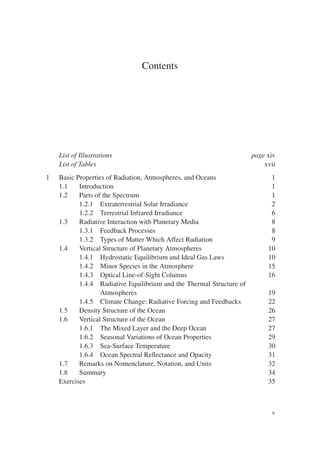
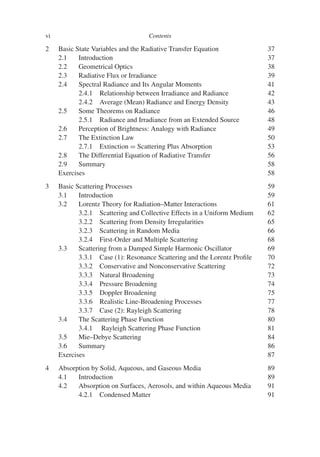

![1
Basic Properties of Radiation, Atmospheres,
and Oceans
1.1 Introduction
This chapter presents a brief overview of the spectra of the shortwave solar and
longwave terrestrial radiation fields and the basic structure of atmospheres and
oceans. Some general properties of the emission spectra of the Sun and the Earth are
described. Their broad features are shown to be understandable from a few basic
radiative transfer principles. We introduce the four basic types of matter which
interact with radiation: gaseous, aqueous, particles, and surfaces. The stratified
vertical structure of the bulk properties of an atmosphere or ocean are shown to
be a consequence of hydrostatic balance. The vertical temperature structure of
the Earth’s atmosphere is shown to result mainly from radiative processes. Opti-
cal paths in stratified media are described for a general line-of-sight direction.
Radiative equilibrium, the greenhouse effect, feedbacks and radiative forcing are
introduced as examples of concepts to be dealt with in greater detail in Chapter 8.
The ocean’s vertical temperature structure, and its variations with season are
discussed as resulting from solar heating, radiative cooling, latent heat exchange,
and vertical mixing of water masses of different temperature and salinity. Its optical
properties are briefly described, along with ocean color. The last section prepares
the reader for the notation and units used consistently throughout the book. Finally
in the last section, we describe the conventions used for the various symbols which
may depart from standard usage.
1.2 Parts of the Spectrum
In Table 1.1, we summarize the nomenclature attached to the various parts of the
visible and infrared spectrum. The spectral variable is the wavelength λ. Here
λ = c/ν where c is the speed of light and ν is the frequency [s−1
] or [Hz]. In
the infrared (IR), λ is usually expressed in micrometers (where 1 μm = 10−6
m).
1](https://image.slidesharecdn.com/49080-250501192810-f1c6582e/85/Radiative-Transfer-in-the-Atmosphere-and-Ocean-Gary-E-Thomas-23-320.jpg)
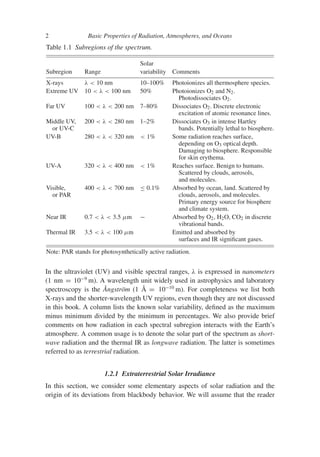
![1.2 Parts of the Spectrum 3
Figure 1.1 Extraterrestrial solar irradiance measured by a spectrometer on board
an Earth-orbiting satellite. The UV spectrum (119 < λ < 420 nm) was measured
by the SOLSTICE instrument on the UARS satellite (modified from a diagram
provided by G. J. Rottmann, private communication, 1995). The vertical lines
divide the various spectral subranges defined in Table 1.1. The smooth curves are
calculated blackbody spectra for a number of emission temperatures.
is familiar with the concept of absorption opacity, or optical depth, τ(ν) at
frequency ν. The basic ideas are reviewed in Appendix E and covered more
thoroughly in Chapter 2.
In Fig. 1.1, we show the measured spectral irradiance of the Sun’s radiative
energy at the mean distance between the Sun and the Earth, known as one astronom-
ical unit r⊕ (r⊕ = 1.4960 × 10¹¹
m).1
Integrated over all frequencies, this quantity
is called the solar constant [W · m−2
]. These data were taken by a spectrometer
onboard an Earth-orbiting satellite, beyond the influences of the atmosphere.2
The
solar constant is not actually a constant, but slightly variable. For this reason, the
modern term is the total solar irradiance, S0, whose most current published value3
is (1360.8 ± 0.5) W · m−2
. S0 represents the total instantaneous radiant energy
1 The visible spectrum is taken from a variety of sources. See Albritton et al. (1985), Nicolet (1989), and
rredc.nrel.gov/solar/spectra/am1.5/ASTMG173/ASTMG173.html (see §10.3.3).
2 See Rottman et al. (1993), lasp.colorado.edu/home/sorce/data/tsi-data/, and Kopp and Lean (2011).
3 Kopp and Lean (2011). This value supersedes the value 1365.2 W · m−2 used by Trenberth et al. (2009).](https://image.slidesharecdn.com/49080-250501192810-f1c6582e/85/Radiative-Transfer-in-the-Atmosphere-and-Ocean-Gary-E-Thomas-25-320.jpg)
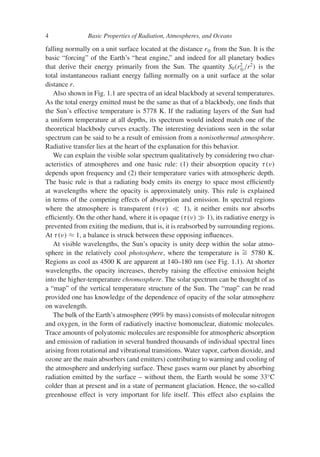
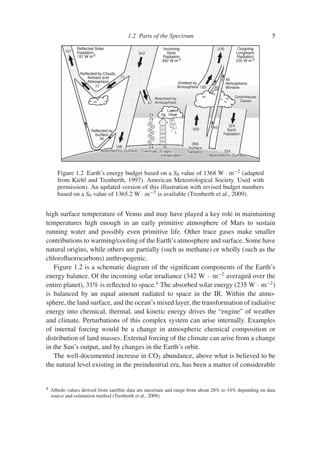
![6 Basic Properties of Radiation, Atmospheres, and Oceans
concern. The reason for this concern is simply that the enhanced levels of CO2
(and other already existing greenhouse gases or the release of new ones) absorb
and trap terrestrial radiation that would otherwise escape to space. This situation
causes an imbalance between the energy received and emitted by the planet. If the
planet receives more energy from the Sun than it is able to emit to space, then
by increasing its temperature it will increase the energy emitted (by the Stefan–
Boltzmann Law) until a new radiative equilibrium between the Sun and the Earth is
established. Hence, this additional trapping of terrestrial radiation by the enhanced
levels of greenhouse gases is expected to lead to a warming so as to make the net
energy emitted by the planet equal to that received.
The amount of warming depends crucially on how the entire Earth climate
system, including the atmosphere, the land, the ocean, the cryosphere (snow and
ice), and living things (the biosphere), responds to this warming. For example,
could the Earth partly compensate for this extra heat source by increasing its
albedo? Increase in low cloudiness in response to warming (which is expected to
enhance evaporation) may lead to increased reflection of solar energy and thus
offset the warming. But more high clouds (cirrus) could on the other hand lead
to additional trapping of terrestrial radiation and therefore an amplification of the
warming.
1.2.2 Terrestrial Infrared Irradiance
An understanding of radiative transfer is also essential for understanding the energy
output of the Earth, defined to be the energy emitted in the spectral region where
λ 3.5 μm. Figure 1.3 shows the IR emission spectrum measured by a high-
resolution interferometer from a down-looking orbiting spacecraft, taken at three
different geographic locations. Also shown are blackbody curves for typical ter-
restrial temperatures. The spectral variable in Fig. 1.3 is wavenumber ν̃ = 1/λ,
commonly expressed in units of [cm−1
]. Again, as for the solar spectrum, the
deviations from blackbody curves are attributed to the nonisothermal character of
the Earth’s atmosphere. The spectral regions of minimum emission arise from the
upper cold regions of the Earth’s troposphere, where the opacity of the overlying
regions is ∼ 1. Those of highest emission originate from the warm surface in trans-
parent spectral regions (“windows”), with the exception of the Antarctic spectrum,
where the surface is actually colder than the overlying atmosphere (see Fig. 1.3).
In this somewhat anomalous situation, the lower-opacity region is one of higher
radiative emission because of the greater rate of emission of the warm air. Again,
the deviations from blackbody behavior can be understood qualitatively in terms of
the temperature structure of the Earth’s atmosphere and the variation with frequency
of the IR absorption opacity.](https://image.slidesharecdn.com/49080-250501192810-f1c6582e/85/Radiative-Transfer-in-the-Atmosphere-and-Ocean-Gary-E-Thomas-28-320.jpg)
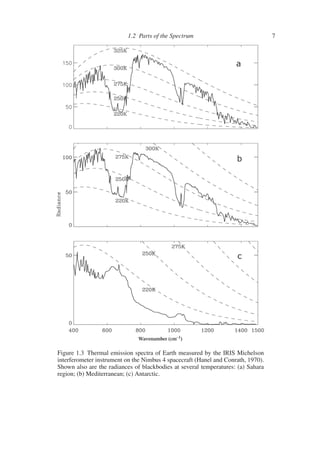
![10 Basic Properties of Radiation, Atmospheres, and Oceans
reflectance of underlying land and ocean surfaces is necessary for calculating
the diffuse radiation field emergent from the atmosphere. In addition, the
reflectance of the ocean bottom in shallow seas has an important influence
on the diffuse radiation field in the ocean and the radiation leaving the ocean
surface.
1.4 Vertical Structure of Planetary Atmospheres
It is useful to describe those general aspects of similarity and dissimilarity of oceans
and atmospheres. First, they are similar in that they are both fluids, that is, they
readily flow under the influences of gravity and pressure differences. Also, they
both obey the basic equation of hydrostatic equilibrium. A fundamental difference
is that atmospheres are highly compressible, whereas oceans are nearly incompress-
ible. A quantitative difference arises from the fact that the average density of water
(1×10³
[kg·m−3
]) is much higher than that of most planetary atmospheres. For the
Earth’s atmosphere on a clear day at sea level, visible light can traverse unattenuated
a horizontal path many hundreds of kilometers long. In the ocean, it penetrates at
most a few hundred meters before being attenuated. Of course, at sufficient depths
in the atmospheres of Venus, and of the giant outer planets, the atmospheric density
can approach or even exceed that of water.
1.4.1 Hydrostatic Equilibrium and Ideal Gas Laws
In this section, we describe some important bulk properties of the atmosphere and
ocean, in terms of their density, pressure, temperature, and index of refraction. As
a result of gas being highly compressible, the atmospheric density, ρ [kg · m−3
],
the mass per unit volume, varies strongly with height, z. For both atmospheres and
oceans in a state of rest, the pressure, p, must support the weight of the fluid above
it. This situation is called a state of hydrostatic equilibrium. With increasing height
in the atmosphere, the density decreases as the pressure decreases (Boyle’s Law).
With increasing depth in the ocean, hydrostatic equilibrium also holds true, but the
density change is slight.
Consider the atmospheric case. In differential form, the weight of the air (mass
times the acceleration of gravity, g) in a small volume element dV is gdM, where
dM is the mass of the air inside the volume. Now dM = ρdV = ρdAdz, and the net
force exerted by the surrounding gas on the parcel is −dpdA. The differential dp is
the change in pressure over the small height change dz. The minus sign comes from
the fact that the pressure at z + dz is smaller than at z, and the upward buoyancy
force must be positive. Equating the two forces, −dpdA = gρdAdz, we find
dp = −gρdz. (1.1)](https://image.slidesharecdn.com/49080-250501192810-f1c6582e/85/Radiative-Transfer-in-the-Atmosphere-and-Ocean-Gary-E-Thomas-32-320.jpg)

![resolution to that of last session, excusing him from an attendance
upon the occasion.
Mr. Macon observed, that whether the resolution was agreed to or
not, the gentleman might doubtless remain behind if he chose, as he
had no idea that the House could compel members to go about
parading the streets of Philadelphia. The gentleman might have
conscientious scruples, and if the ceremony were meant to be
respectful to the President, members should attend it freely, or not at
all. He should wish, therefore, that gentlemen disinclined to do the
service, would not join it.
Mr. Otis hoped the motion would not prevail. He presumed no
gentleman there was particularly anxious for the society of the
gentleman from Vermont on this occasion. No doubt he would grace
the procession, but it would be sufficiently long without him, and if
he chose to remain behind, he need be under no apprehensions of
being called to account for his conduct. It was not becoming the
dignity of the House to pass the resolution in question. It appeared
to him that the gentleman was in full health and spirits, and every
way fit for business; and as the House had resolved the thing should
be done, he had no idea of admitting the protest of an individual
upon their journals against the measure.
Mr. Gallatin said he should be in favor of the previous question, but
not for the reasons assigned by the mover of it, but for those offered
by the gentleman from North Carolina, (Mr. Macon,) viz: because he
did not believe there existed any power in that House to compel any
member to wait upon the President with the Address; therefore it
would be improper to grant an indulgence to a member from doing
what there was no obligation upon him to do. He did not recollect
the words of the resolution which had been agreed to. [The Speaker
repeated them. They were, that the Speaker, attended by the House
of Representatives, shall wait upon the President, c.] This, Mr. G.
said, must be understood in a qualified sense, as the House of
Representatives had no existence out of those walls. When the
Speaker presented the Address, the House was not present; they](https://image.slidesharecdn.com/49080-250501192810-f1c6582e/85/Radiative-Transfer-in-the-Atmosphere-and-Ocean-Gary-E-Thomas-37-320.jpg)
![of Pennsylvania, has been no more than an endeavor to carry into
full effect the laws of the State, which say, that all men are free
when they set their foot within the State, excepting only the
servants of Members of Congress.[25] As to the moral character of
this body of people, though a number of their principles were
different from those which he professed, he believed it could not be
said, with truth, that they were friends to any kind of disorder; and
he was surprised to hear gentlemen suppose that they could or
would do any thing which would throw into disorder any part of the
Union. On the contrary, he believed them to be good friends of
order. Mr. G. said he wished to have avoided a discussion of the
merits of the memorial; but when they were told it was improper to
do any thing on the subject, it became necessary. He knew it was in
their power to do something. They might lay a duty of ten dollars a
head on the importation of slaves; he knew a memorial had been
presented at a former session respecting the kidnapping of negroes,
which had been favorably reported upon. Finally, the present
memorial did not apply only to the blacks, but to other objects. With
respect to plays, they had a motion last session before them for
laying a tax upon them, which had a reference to the subject. By
committing this memorial, they should give no decision. If the
committee reported they could do nothing in the business, and the
House agreed to the report, the matter would be closed in a much
more respectful way than by throwing the petition under the table.
Mr. Sewall said, the gentleman last up had stated two cases in which
petitions had been received without a commitment. He might have
added a third, more applicable to the present memorial. This was
when a petition was upon matter over which this House had no
cognizance, especially if it were of such a nature as to excite
disagreeable sensations in one part of the House, who were
concerned in property which was already held under circumstances
sufficiently disagreeable. In such cases, they ought at once to reject
the memorial, as it would be misspending time to commit it. If, for
instance, a petition should be presented, complaining that a person
had refused to discharge an obligation to another, it would be at](https://image.slidesharecdn.com/49080-250501192810-f1c6582e/85/Radiative-Transfer-in-the-Atmosphere-and-Ocean-Gary-E-Thomas-44-320.jpg)
![once acknowledged that the House could not enforce the obligation;
but application must be made to a court of justice. So in this case;
the petitioners complain of a law of North Carolina. This House, he
said, could not change that law. If any thing was done there
contrary to right, the courts of that State, as well as those of the
United States, were open to afford redress. It was their business,
and not the business of that House. They did not come there to act
upon subjects agreeable to their feelings, but upon such as the
constitution had placed in their hands.
Mr. Macon said, there was not a gentleman in North Carolina who did
not wish there were no blacks in the country. It was a misfortune—
he considered it as a curse; but there was no way of getting rid of
them. Instead of peace-makers, he looked upon the Quakers as war-
makers, as they were continually endeavoring in the Southern States
to stir up insurrections amongst the negroes.[26] It was
unconstitutional, he said, in these men to desire the House to do
what they had no power to do; as well might they ask the President
of the United States to come and take the Speaker's chair. There was a
law in North Carolina, he said, which forbade any person from
holding either a black or white person as a slave after he had been
set at liberty. The one hundred and thirty-four negroes alluded to in
the petition, he knew nothing of. In the war, he said, the Quakers in
their State were generally Tories. They began to set free their
negroes, when the State passed a law that they should not set them
free. If these people were dissatisfied with the law, they had nothing
to do but transport their negroes into Pennsylvania, where, the
gentleman from that State had told them, they would be
immediately free. This subject had already been before the House,
but they declined doing any thing in it. It was extraordinary that
these people should come, session after session, with their petitions
on this subject. They had put play-houses into their memorial; but
they had nothing to do with them. In this State, he believed, the
Legislature had passed a law authorizing them. It was altogether a
matter of State policy. The whole petition was, indeed, unnecessary.
The only object seemed to be to sow dissension. A petition could not](https://image.slidesharecdn.com/49080-250501192810-f1c6582e/85/Radiative-Transfer-in-the-Atmosphere-and-Ocean-Gary-E-Thomas-45-320.jpg)



![An introduction to ocean remote sensing (2nd ed.) [s. martin, 2014]](https://cdn.slidesharecdn.com/ss_thumbnails/anintroductiontooceanremotesensing2nded-160718130035-thumbnail.jpg?width=640&height=640&fit=bounds)


