QuMat
Apache Mahout's Quantum Computing Interface
Andrew Musselman
FOSSY
Portland OR
Aug 2024
● Intro to Mahout
● Intro to Quantum
● Motivation for Quantum in Mahout
● Distributed Matrix Arithmetic
● Rationale for QuMat
● Logic Gates in QuMat
● Notebook Demo
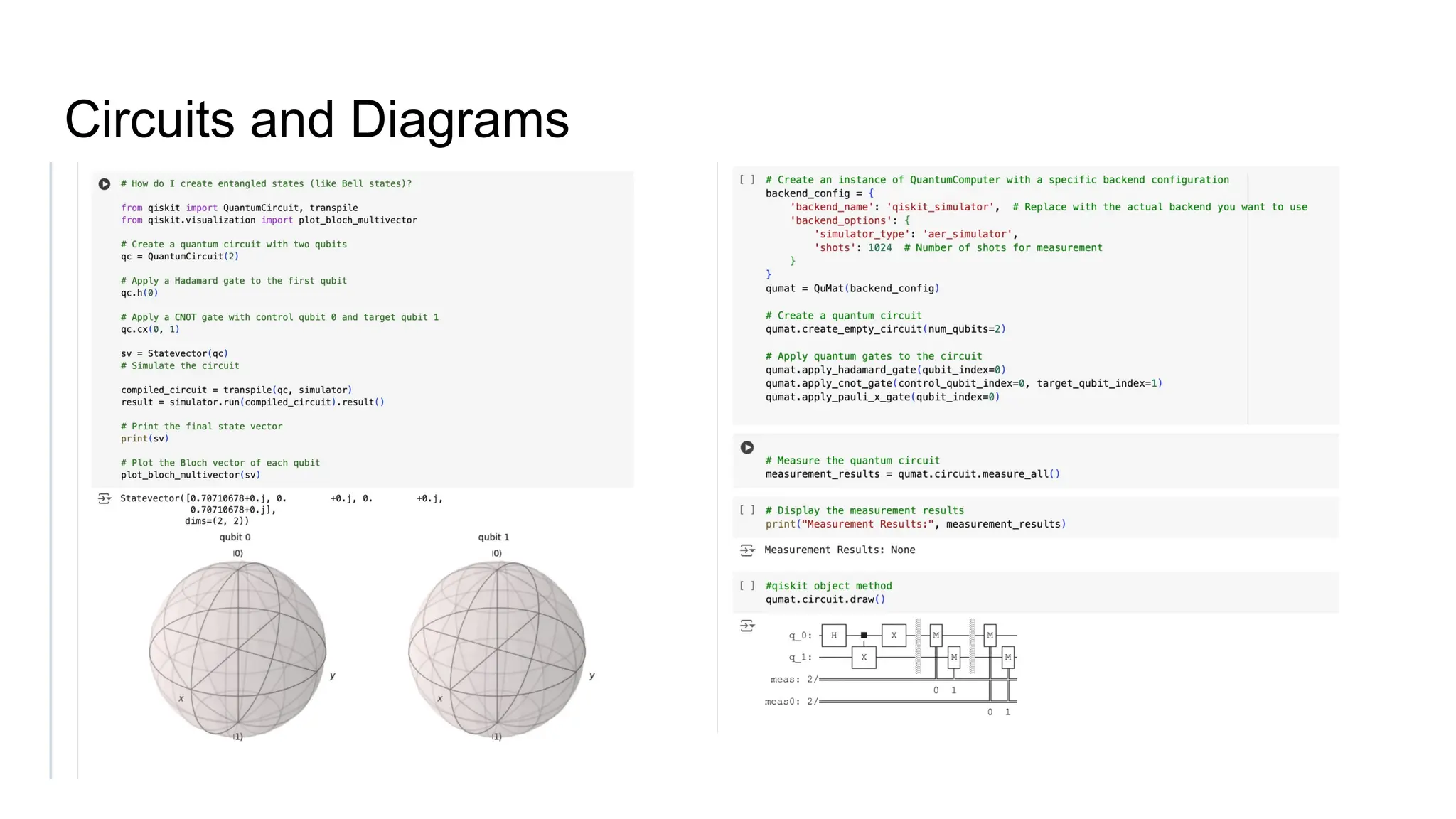
● Circuits and Diagrams
● Next Steps
● How to Get Involved
Agenda
Apache Mahout is a distributed linear algebra framework and mathematically
expressive Scala DSL designed to let mathematicians, statisticians, and data
scientists quickly implement their own algorithms.
● Mathematically Expressive Scala DSL
● Support for Multiple Distributed Backends (including Apache Spark)
● Modular Native Solvers for CPU/GPU/CUDA Acceleration
Intro to Mahout
● 2008: Lucene sub-project with analytics including clustering
● 2010: Apache top-level project recommender system
● Taste: (https://svn.apache.org/repos/asf/lucene/mahout/site/publish/taste.pdf?p=836600)
● 2015: Samsara (back-end independent programming environment)
● 2017: Hadoop MapReduce back-end deprecated
● 2020: 14.1 released
● 2022: Zeppelin integration and algorithm development framework
● 2024: QuMat quantum computing interface
Intro to Mahout
Intro to Quantum
Intro to Quantum
Classical bit
21
states, ("0" or "1")
Quantum bit ("qubit")
2n
states, ("it's complicated")
Intro to Quantum
* https://en.wikipedia.org/wiki/Quantum_logic_gate
Quantum states are typically represented by "kets," from a notation
known as bra–ket. The vector representation of a single qubit is
|a⟩ = v0 |0⟩ + v1 |1 →
⟩
where v0 and v1 are the complex probability amplitudes of the qubit,
and the values zero and one are represented by the kets
|0⟩ = and |1⟩ =
v0
v1
|0⟩ = and |1⟩ =
These kets are basis vectors for a complex vector space. Logic gates in
quantum computing are matrices which take actions on qubits.
For example, the identity gate (identity matrix) performs no action on any qubit:
= =
Intro to Quantum
v0 * 1 + v1 * 0
v0
v1 v0 * 0 + v1 * 1
v0
v1
Motivation for Quantum in Mahout
● Core capabilities of Mahout
○ Matrix arithmetic and operations
○ Linear algebra
○ Back-end agnostic, distributed or in-core CPU or GPU
○ Simplified syntax in matrix math DSL (Samsara)
○ Management of large-scale vectors and matrices
● Quantum compute in essence is matrix arithmetic
○ Circuits are composed by multiplying matrices
○ Vectors and matrices are complex-valued instead of binary or real
Samsara DSL and Syntax
Samsara A’A
val C = A.t %*% A
MLLib A’A
val C = A.transpose().multiply(A)
Samsara DSL and Syntax
Computation in distributed stochastic PCA (dSPCA):
In Samsara DSL:
val G = B %*% B.t - C - C.t + (xi.t dot xi) * (s_q.t cross
s_q)
// Dense matrices:
val A = dense((1, 2, 3), (3, 4, 5))
// Sparse matrices:
val A = sparse(
(1, 3) :: Nil,
(0, 2) :: (1, 2.5) :: Nil
)
Instantiating Matrices
Arithmetic and Assignment
// Plus/minus:
a + b
a - b
a + 5.0
a - 5.0
// Hadamard (elementwise) product:
a * b
a * 0.5
// Operations with
assignment:
a += b
a -= b
a += 5.0
a -= 5.0
a *= b
a *= 5
Other Operators
// Optimized right and left multiply
with a diagonal matrix:
diag(5, 5) :%*% b
A %*%: diag(5, 5)
// Second norm, of a vector or matrix:
a.norm
// Transpose:
val Mt = M.t
// Dot product:
a dot b
// Cross product:
a cross b
// Matrix multiply:
a %*% b
Distributed Matrix Arithmetic: Optimization of A'A
A
Distributed Matrix Arithmetic: Optimization of A'A
x
A
AT
Distributed Matrix Arithmetic: Optimization of A'A
x = x
A
AT
a1
T
a1
Distributed Matrix Arithmetic: Optimization of A'A
x = x + x
A
AT
a1
T
a1 a2
T
a2
Distributed Matrix Arithmetic: Optimization of A'A
x = x + x
A
AT
a1
T
a1 a2
T
a2
+ x
a3
T
a3
Distributed Matrix Arithmetic: Optimization of A'A
x = x + x
A
AT
a1
T
a1 a2
T
a2
+ x
a3
T
a3
+ x
a4
T
a4
Rationale for QuMat
● Multiple frameworks for programming quantum circuits
○ Qiskit (IBM)
○ Braket (AWS)
○ Cirq (Google)
○ TKET (Honeywell)
○ Qsharp (Microsoft)
○ Pyquil (Rigetti)
● Multiple vendor platforms for running on simulated or real quantum hardware
○ IBM (https://quantum.ibm.com)
○ AWS (https://aws.amazon.com/braket)
○ Google (https://quantumai.google/quantumcomputer)
○ Honeywell (https://www.honeywell.com/us/en/company/quantum/quantum-computer)
● Multiple frameworks and back-ends is a Mahout core value
● One interface with no code change across tools provides flexibility
● Logic gates implemented
○ Qiskit
○ Cirq
○ Braket
● Next steps
○ Draw
○ Measure
○ Execute
QuMat Current State
Samsara QuMat
Spark Flink … Qiskit Cirq Braket
Mahout
Logic Gates in QuMat
Function definitions in Python
Notebook Demo
Circuits and Diagrams
Next Steps
● Draw, measure, and execute methods
● Use cases
● More examples
● Quantum machine learning methods (QML)
How to Get Involved
● Try it out using Docker
● Subscribe to the user@mahout.apache.org and dev@mahout.apache.org
mailing lists
● Get a binary or source build
● Run a notebook straight out of GitHub
● Contribute some documentation, fix some bugs, add some features
Q&A
Thank You!

QuMat_ Apache Mahout's Quantum Computing Interface.pptx

  • 1.
    QuMat Apache Mahout's QuantumComputing Interface Andrew Musselman FOSSY Portland OR Aug 2024
  • 2.
    ● Intro toMahout ● Intro to Quantum ● Motivation for Quantum in Mahout ● Distributed Matrix Arithmetic ● Rationale for QuMat ● Logic Gates in QuMat ● Notebook Demo ● Circuits and Diagrams ● Next Steps ● How to Get Involved Agenda
  • 3.
    Apache Mahout isa distributed linear algebra framework and mathematically expressive Scala DSL designed to let mathematicians, statisticians, and data scientists quickly implement their own algorithms. ● Mathematically Expressive Scala DSL ● Support for Multiple Distributed Backends (including Apache Spark) ● Modular Native Solvers for CPU/GPU/CUDA Acceleration Intro to Mahout
  • 4.
    ● 2008: Lucenesub-project with analytics including clustering ● 2010: Apache top-level project recommender system ● Taste: (https://svn.apache.org/repos/asf/lucene/mahout/site/publish/taste.pdf?p=836600) ● 2015: Samsara (back-end independent programming environment) ● 2017: Hadoop MapReduce back-end deprecated ● 2020: 14.1 released ● 2022: Zeppelin integration and algorithm development framework ● 2024: QuMat quantum computing interface Intro to Mahout
  • 5.
  • 6.
    Intro to Quantum Classicalbit 21 states, ("0" or "1") Quantum bit ("qubit") 2n states, ("it's complicated")
  • 7.
    Intro to Quantum *https://en.wikipedia.org/wiki/Quantum_logic_gate Quantum states are typically represented by "kets," from a notation known as bra–ket. The vector representation of a single qubit is |a⟩ = v0 |0⟩ + v1 |1 → ⟩ where v0 and v1 are the complex probability amplitudes of the qubit, and the values zero and one are represented by the kets |0⟩ = and |1⟩ = v0 v1
  • 8.
    |0⟩ = and|1⟩ = These kets are basis vectors for a complex vector space. Logic gates in quantum computing are matrices which take actions on qubits. For example, the identity gate (identity matrix) performs no action on any qubit: = = Intro to Quantum v0 * 1 + v1 * 0 v0 v1 v0 * 0 + v1 * 1 v0 v1
  • 9.
    Motivation for Quantumin Mahout ● Core capabilities of Mahout ○ Matrix arithmetic and operations ○ Linear algebra ○ Back-end agnostic, distributed or in-core CPU or GPU ○ Simplified syntax in matrix math DSL (Samsara) ○ Management of large-scale vectors and matrices ● Quantum compute in essence is matrix arithmetic ○ Circuits are composed by multiplying matrices ○ Vectors and matrices are complex-valued instead of binary or real
  • 10.
    Samsara DSL andSyntax Samsara A’A val C = A.t %*% A MLLib A’A val C = A.transpose().multiply(A)
  • 11.
    Samsara DSL andSyntax Computation in distributed stochastic PCA (dSPCA): In Samsara DSL: val G = B %*% B.t - C - C.t + (xi.t dot xi) * (s_q.t cross s_q)
  • 12.
    // Dense matrices: valA = dense((1, 2, 3), (3, 4, 5)) // Sparse matrices: val A = sparse( (1, 3) :: Nil, (0, 2) :: (1, 2.5) :: Nil ) Instantiating Matrices
  • 13.
    Arithmetic and Assignment //Plus/minus: a + b a - b a + 5.0 a - 5.0 // Hadamard (elementwise) product: a * b a * 0.5 // Operations with assignment: a += b a -= b a += 5.0 a -= 5.0 a *= b a *= 5
  • 14.
    Other Operators // Optimizedright and left multiply with a diagonal matrix: diag(5, 5) :%*% b A %*%: diag(5, 5) // Second norm, of a vector or matrix: a.norm // Transpose: val Mt = M.t // Dot product: a dot b // Cross product: a cross b // Matrix multiply: a %*% b
  • 15.
    Distributed Matrix Arithmetic:Optimization of A'A A
  • 16.
    Distributed Matrix Arithmetic:Optimization of A'A x A AT
  • 17.
    Distributed Matrix Arithmetic:Optimization of A'A x = x A AT a1 T a1
  • 18.
    Distributed Matrix Arithmetic:Optimization of A'A x = x + x A AT a1 T a1 a2 T a2
  • 19.
    Distributed Matrix Arithmetic:Optimization of A'A x = x + x A AT a1 T a1 a2 T a2 + x a3 T a3
  • 20.
    Distributed Matrix Arithmetic:Optimization of A'A x = x + x A AT a1 T a1 a2 T a2 + x a3 T a3 + x a4 T a4
  • 21.
    Rationale for QuMat ●Multiple frameworks for programming quantum circuits ○ Qiskit (IBM) ○ Braket (AWS) ○ Cirq (Google) ○ TKET (Honeywell) ○ Qsharp (Microsoft) ○ Pyquil (Rigetti) ● Multiple vendor platforms for running on simulated or real quantum hardware ○ IBM (https://quantum.ibm.com) ○ AWS (https://aws.amazon.com/braket) ○ Google (https://quantumai.google/quantumcomputer) ○ Honeywell (https://www.honeywell.com/us/en/company/quantum/quantum-computer) ● Multiple frameworks and back-ends is a Mahout core value ● One interface with no code change across tools provides flexibility
  • 22.
    ● Logic gatesimplemented ○ Qiskit ○ Cirq ○ Braket ● Next steps ○ Draw ○ Measure ○ Execute QuMat Current State Samsara QuMat Spark Flink … Qiskit Cirq Braket Mahout
  • 23.
    Logic Gates inQuMat Function definitions in Python
  • 24.
  • 25.
  • 26.
    Next Steps ● Draw,measure, and execute methods ● Use cases ● More examples ● Quantum machine learning methods (QML)
  • 27.
    How to GetInvolved ● Try it out using Docker ● Subscribe to the user@mahout.apache.org and dev@mahout.apache.org mailing lists ● Get a binary or source build ● Run a notebook straight out of GitHub ● Contribute some documentation, fix some bugs, add some features
  • 28.