Q1
GENERAL BIOLOGY 1 09/07/2022
1. Who were responsible for
the second postulate of the
Cell Theory, all living things
are made of cells?
A.Remak & Virchow C. Spallanzani & Redi
B. Schleiden & Schwann D. Kenobi & Skywalker
2. Why was Anton van
Leeuwenhoek integral to the
development of the Cell Theory?
A. He was the first to describe of the DNA
B. He was first to disclose the process of Cell Division
C. He constructed the first iteration of an Electron
microscope
D. He was first to observe living cells
3. Which of the following
statements is considered
TRUE?
A. Plant cells reproduce through crystallization
B. Some living things can exist without cells
C. The ability to reproduce does not immediately
mean something is a living thing
D. Viruses are living things
4. Which cell organelle is
NOT found among
prokaryotes (bacteria)?
A.Mitochondria C. Flagella
B.Pili D. Nucleoid
5. What is the organelle
responsible for the synthesis
and storage of the DNA?
A.Nucleus C. Smooth ER
B. Rough ER D. Golgi Apparatus
6. What are the openings
found in the nucleus that
allow entry of nutrients and
exit for protein byproducts?
A.Nuclear envelope C. Nucleoid
B. Nuclear pores D. Nucleolus
7. Which of the following
pertains to packaging
proteins found in chromatin?
A.Histones C. Myosin
B. Lachrymatory Aldehyde D. Tubulin
8. Which cell organelle is
found in abundance
within liver cells and
other detoxifying organs?
A.Nucleus C. Smooth ER
B. Rough ER D. Golgi Apparatus
9. What is known as
the site of protein
synthesis?
A.Ribosome C. Smooth ER
B. Rough ER D. Golgi Apparatus
10. Which cell organelle
is found in abundance
within gland cells that
produce hormones,
enzymes, etc.?
A.Nucleus C. Smooth ER
B. Rough ER D. Golgi Apparatus
11. Which of the
following is NOT a cell
organelle byproduct?
A.Hydrogen peroxide C. Peptidoglycan
B. Lipids D. Amino Acids (proteins)
12. Which cell organelle fills
the entirety of the cell,
composed of enzymes,
nutrients, water, and other
substances? In eggs, this is
the same as the albumin.
A.Plasma Membrane C. Nucleus
B. Ribosomes D. Cytoplasm
13. What is the substance
that composes the Cell
Wall?
A.Peptidoglycan C. Cellulose
B. Phospholipids D. Amino Acids
14. What is the
cytoskeletal structure
that composes the
flagella and cilia?
A.Microtubule
B. Intermediate filaments
C.Microfilaments
D.Spindle fibers
15. What is the cytoskeletal
structure that provides
cushioning and keeps organelles
from moving within the cell?
A.Microtubule
B. Intermediate filaments
C.Microfilaments
D.Spindle fibers
16. Which is the most
ecologically important
organelle and provides
nutrition for every living
thing?
A.Golgi Bodies C. Ribosomes
B.Chloroplast D. Vacuole
17. Which organelles fuels
every metabolic process by
converting sugar into ATP in
animals and plants?
A.Vesicles C. Vacuoles
B.Chloroplasts D. Mitochondria
18. Which serves as the
primary water, sugar, toxin or
substance storage unit in
Plants?
A.Vesicles C. Vacuoles
B.Chloroplasts D. Mitochondria
19. What pigment causes
red coloration in plants?
A.Chlorophyll C. Alkaloids
B.Xanthophyll D. Carotenoids
20. What pigment causes
red coloration in plants?
A.Chlorophyll C. Alkaloids
B.Xanthophyll D. Carotenoids
21. What is known as the
organelle responsible for
dissolving nutrients or
intruders within the cell?
A.Peroxisome C. Amyoplast
B.Lysosome D. Chloroplast
22. What is the process
that is involved with
Mitochondria?
A.Production of sugars
B.Consumption of Carbon
C. Production of ATP
D.Use of sunlight as a catalyst
23. Why is the Mitochondria lined
with internal walls called cristae?
A.To increase surface area for ATP Production
B.To provide structural support necessary for
sugar production
C. To contain as much hemoglobin as possible
for oxygen retention
D.To consume oxygen as a catalyst
24. Why are bacteria generally
different with the cells of higher
organisms, e.g. animals?
A. They are much larger than animal cells
B.They are far primitive, they exist without a
nucleus
C. They do not contain DNA
D.They are actually non-living things
25. Why are cell walls more rigid
than plasma membranes?
A. They are made of amino acids with a high
volume of intermolecular forces
B.Due to the presence of interlocking sugars
C. Because plants need to protect itself from
radiation from the sun such as ultraviolet
D.Because of the amphiphilic nature of
phospholipids that compose them
26. Which of the following bodily
processes in involved with the
abundance of smooth endoplasmic
reticulum?
A. Production of proteins for repair when
wounded
B.Secretion of mucus during a cold
C. Muscle fatigue
D. Division of cells during Meiosis II
27. What is the structure
made of a coiled string of
DNA?
A. Chromatin C. Chronosphere
B.Centromere D. Midichlorians
28. What is referred to as the
ability of a living thing to
produce offspring of its own
kind?
A. Evolution C. Reproduction
B. Metabolism D. Heredity
29. Bonus, ayaw niyo?
A. Ayaw ko po C. Pogi si sir
B. Ayoko din D. Walang bonus
30. Why are viruses considered
non-living things?
A. Viruses do not use energy
B. Viruses are incapable of reproducing DNA
C. Because they require a food source much
larger in size than they are
D.Due to their origin, primarily made of organic
molecules such as carbon and nitrogen
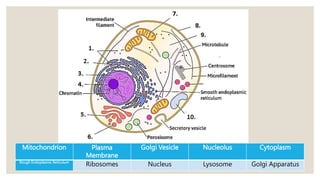
Mitochondrion Plasma
Membrane
Golgi Vesicle Nucleolus Cytoplasm
Rough Endoplasmic Reticulum
Ribosomes Nucleus Lysosome Golgi Apparatus

Quiz 1 The Cell.pptx

  • 1.
  • 2.
    1. Who wereresponsible for the second postulate of the Cell Theory, all living things are made of cells? A.Remak & Virchow C. Spallanzani & Redi B. Schleiden & Schwann D. Kenobi & Skywalker
  • 3.
    2. Why wasAnton van Leeuwenhoek integral to the development of the Cell Theory? A. He was the first to describe of the DNA B. He was first to disclose the process of Cell Division C. He constructed the first iteration of an Electron microscope D. He was first to observe living cells
  • 4.
    3. Which ofthe following statements is considered TRUE? A. Plant cells reproduce through crystallization B. Some living things can exist without cells C. The ability to reproduce does not immediately mean something is a living thing D. Viruses are living things
  • 5.
    4. Which cellorganelle is NOT found among prokaryotes (bacteria)? A.Mitochondria C. Flagella B.Pili D. Nucleoid
  • 6.
    5. What isthe organelle responsible for the synthesis and storage of the DNA? A.Nucleus C. Smooth ER B. Rough ER D. Golgi Apparatus
  • 7.
    6. What arethe openings found in the nucleus that allow entry of nutrients and exit for protein byproducts? A.Nuclear envelope C. Nucleoid B. Nuclear pores D. Nucleolus
  • 8.
    7. Which ofthe following pertains to packaging proteins found in chromatin? A.Histones C. Myosin B. Lachrymatory Aldehyde D. Tubulin
  • 9.
    8. Which cellorganelle is found in abundance within liver cells and other detoxifying organs? A.Nucleus C. Smooth ER B. Rough ER D. Golgi Apparatus
  • 10.
    9. What isknown as the site of protein synthesis? A.Ribosome C. Smooth ER B. Rough ER D. Golgi Apparatus
  • 11.
    10. Which cellorganelle is found in abundance within gland cells that produce hormones, enzymes, etc.? A.Nucleus C. Smooth ER B. Rough ER D. Golgi Apparatus
  • 12.
    11. Which ofthe following is NOT a cell organelle byproduct? A.Hydrogen peroxide C. Peptidoglycan B. Lipids D. Amino Acids (proteins)
  • 13.
    12. Which cellorganelle fills the entirety of the cell, composed of enzymes, nutrients, water, and other substances? In eggs, this is the same as the albumin. A.Plasma Membrane C. Nucleus B. Ribosomes D. Cytoplasm
  • 14.
    13. What isthe substance that composes the Cell Wall? A.Peptidoglycan C. Cellulose B. Phospholipids D. Amino Acids
  • 15.
    14. What isthe cytoskeletal structure that composes the flagella and cilia? A.Microtubule B. Intermediate filaments C.Microfilaments D.Spindle fibers
  • 16.
    15. What isthe cytoskeletal structure that provides cushioning and keeps organelles from moving within the cell? A.Microtubule B. Intermediate filaments C.Microfilaments D.Spindle fibers
  • 17.
    16. Which isthe most ecologically important organelle and provides nutrition for every living thing? A.Golgi Bodies C. Ribosomes B.Chloroplast D. Vacuole
  • 18.
    17. Which organellesfuels every metabolic process by converting sugar into ATP in animals and plants? A.Vesicles C. Vacuoles B.Chloroplasts D. Mitochondria
  • 19.
    18. Which servesas the primary water, sugar, toxin or substance storage unit in Plants? A.Vesicles C. Vacuoles B.Chloroplasts D. Mitochondria
  • 20.
    19. What pigmentcauses red coloration in plants? A.Chlorophyll C. Alkaloids B.Xanthophyll D. Carotenoids
  • 21.
    20. What pigmentcauses red coloration in plants? A.Chlorophyll C. Alkaloids B.Xanthophyll D. Carotenoids
  • 22.
    21. What isknown as the organelle responsible for dissolving nutrients or intruders within the cell? A.Peroxisome C. Amyoplast B.Lysosome D. Chloroplast
  • 23.
    22. What isthe process that is involved with Mitochondria? A.Production of sugars B.Consumption of Carbon C. Production of ATP D.Use of sunlight as a catalyst
  • 24.
    23. Why isthe Mitochondria lined with internal walls called cristae? A.To increase surface area for ATP Production B.To provide structural support necessary for sugar production C. To contain as much hemoglobin as possible for oxygen retention D.To consume oxygen as a catalyst
  • 25.
    24. Why arebacteria generally different with the cells of higher organisms, e.g. animals? A. They are much larger than animal cells B.They are far primitive, they exist without a nucleus C. They do not contain DNA D.They are actually non-living things
  • 26.
    25. Why arecell walls more rigid than plasma membranes? A. They are made of amino acids with a high volume of intermolecular forces B.Due to the presence of interlocking sugars C. Because plants need to protect itself from radiation from the sun such as ultraviolet D.Because of the amphiphilic nature of phospholipids that compose them
  • 27.
    26. Which ofthe following bodily processes in involved with the abundance of smooth endoplasmic reticulum? A. Production of proteins for repair when wounded B.Secretion of mucus during a cold C. Muscle fatigue D. Division of cells during Meiosis II
  • 28.
    27. What isthe structure made of a coiled string of DNA? A. Chromatin C. Chronosphere B.Centromere D. Midichlorians
  • 29.
    28. What isreferred to as the ability of a living thing to produce offspring of its own kind? A. Evolution C. Reproduction B. Metabolism D. Heredity
  • 30.
    29. Bonus, ayawniyo? A. Ayaw ko po C. Pogi si sir B. Ayoko din D. Walang bonus
  • 31.
    30. Why areviruses considered non-living things? A. Viruses do not use energy B. Viruses are incapable of reproducing DNA C. Because they require a food source much larger in size than they are D.Due to their origin, primarily made of organic molecules such as carbon and nitrogen
  • 32.
    Mitochondrion Plasma Membrane Golgi VesicleNucleolus Cytoplasm Rough Endoplasmic Reticulum Ribosomes Nucleus Lysosome Golgi Apparatus

Editor's Notes