Queue and Stack
By SIVAKUMAR R
Queue - Introduction
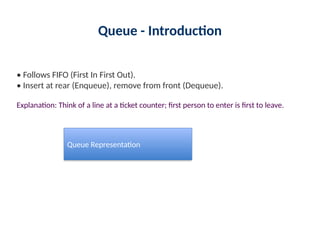
• Follows FIFO (First In First Out).
• Insert at rear (Enqueue), remove from front (Dequeue).
Explanation: Think of a line at a ticket counter; first person to enter is first to leave.
Queue Representation
Queue - Representation
• Array representation.
• Linked list implementation.
Explanation: Arrays are simple but have fixed size; Linked lists are dynamic.
Queue - Operations
• Enqueue, Dequeue, Peek, isEmpty, isFull.
Explanation: Operations help manage elements efficiently.
Types of Queue
• Simple Queue
• Circular Queue
• Priority Queue
• Deque
Explanation: Different types provide flexibility for various use cases.
Applications of Queue
• CPU scheduling
• Disk scheduling
• Data buffering
• Request handling
Explanation: Queues are used wherever order of processing matters.
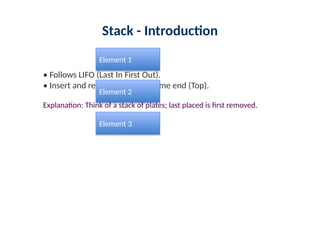
Stack - Introduction
• Follows LIFO (Last In First Out).
• Insert and remove from the same end (Top).
Explanation: Think of a stack of plates; last placed is first removed.
Element 3
Element 2
Element 1
Stack - Representation
• Array representation.
• Linked list implementation.
Explanation: Similar to queues, arrays are fixed while linked lists are flexible.
Stack - Operations
• Push, Pop, Peek, isEmpty, isFull.
Explanation: Stack operations ensure controlled access to elements.
Applications of Stack
• Function calls
• Expression evaluation
• Parsing
• Undo/Redo
• Backtracking
Explanation: Stacks are vital in programming and problem solving.
Queue_and_Stack_with_Explanations (1).pptx

  • 1.
    Queue and Stack BySIVAKUMAR R
  • 2.
    Queue - Introduction •Follows FIFO (First In First Out). • Insert at rear (Enqueue), remove from front (Dequeue). Explanation: Think of a line at a ticket counter; first person to enter is first to leave. Queue Representation
  • 3.
    Queue - Representation •Array representation. • Linked list implementation. Explanation: Arrays are simple but have fixed size; Linked lists are dynamic.
  • 4.
    Queue - Operations •Enqueue, Dequeue, Peek, isEmpty, isFull. Explanation: Operations help manage elements efficiently.
  • 5.
    Types of Queue •Simple Queue • Circular Queue • Priority Queue • Deque Explanation: Different types provide flexibility for various use cases.
  • 6.
    Applications of Queue •CPU scheduling • Disk scheduling • Data buffering • Request handling Explanation: Queues are used wherever order of processing matters.
  • 7.
    Stack - Introduction •Follows LIFO (Last In First Out). • Insert and remove from the same end (Top). Explanation: Think of a stack of plates; last placed is first removed. Element 3 Element 2 Element 1
  • 8.
    Stack - Representation •Array representation. • Linked list implementation. Explanation: Similar to queues, arrays are fixed while linked lists are flexible.
  • 9.
    Stack - Operations •Push, Pop, Peek, isEmpty, isFull. Explanation: Stack operations ensure controlled access to elements.
  • 10.
    Applications of Stack •Function calls • Expression evaluation • Parsing • Undo/Redo • Backtracking Explanation: Stacks are vital in programming and problem solving.