E M M A C H I L L M A N
QUESTION 1: IN WHAT WAYS
DOES YOUR MEDIA PRODUCT
USE, DEVELOP OR CHALLENGE
FORMS AND CONVENTIONS OF
REAL MEDIA PRODUCTS?
THE TITLE
The name of the film ‘at last’ is already placing the film in a drama
genre as it is mysterious and makes the audience question what it is
about. Real drama films have intriguing titles that engage viewers as
they want to feel included.
At last also has a variety of connotations for example it could mean at
last something good has happened or it could suggest something
darker as ‘last’ connotes the end of something, possibly a life.
The way the title appears on the trailer also has drama aspects as it looks unusual
because it has a hand drawn effect which is childish and doesn’t match the teen
protagonist. This could make viewers question what's happening as something
else might be going on. When seeing the coloured in title and seeing the actress
they don’t really match this mismatch effect creates an enigma which is common in
drama genres.
LOCATIONS
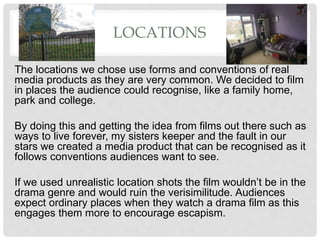
The locations we chose use forms and conventions of real
media products as they are very common. We decided to film
in places the audience could recognise, like a family home,
park and college.
By doing this and getting the idea from films out there such as
ways to live forever, my sisters keeper and the fault in our
stars we created a media product that can be recognised as it
follows conventions audiences want to see.
If we used unrealistic location shots the film wouldn’t be in the
drama genre and would ruin the verisimilitude. Audiences
expect ordinary places when they watch a drama film as this
engages them more to encourage escapism.
MISE – EN- SCENE
We used a various props that conform to the genre in which we have chosen.
They do develop the drama genre and take it in an interesting direction.
We had needles – to further the narrative of the protagonists past, a in depth
bucket list- to interest the audience as they have an idea on what they’re
going to see a camera to spark the bucket list. There are more props that add
verisimilitude and we saw in media products like the bucket list.
Without props there would be no enigma and the storyline wouldn’t have any
interesting aspects.
We precisely chose the characters for the film too, the protagonist is a
teenage girl who has a dark past which is common in the drama genre as it
may foreshadow or simply move the narration on. We went with a teenage girl
as a stereotype is that girls have more drama and this also draws in a larger
target audience. There is also a slight hint at a romance like many of the
products out there (fault in our stars) this is because we wanted the film to be
more about breaking the stigma of AIDS and less about conventional love
stories
THE DOCTOR SCENE
When the protagonist is in the doctors room and finds out she
has got a rare incurable case of AIDS this is a very important
scene.
This is when the audience know that things have gotten real
and is a very significant scene that juxtaposes with the party
scenes before. It is when the film reality gets the audience to
really feel something which is important for a drama genre as
this is what leads on to the next stage in her life. It challenges
other media products as it is a taboo illness that people in real
life find hard to talk about we chose to do this to shed a light
onto it as it is a very real condition we don’t see in movies.
THE OPENING SCENE
The opening scene is of the protagonist talking directly at
the camera. This immediately sets the drama genre as we
as an audience are introduced to the character straight
away to build a relationship. In a drama genre it is
important we feel connected to the character so we can
experience the scenes with her. Ways to live forever starts
in a similar way and allows us to be drawn into the
characters life.
CAMERA SHOTS
There are typical shots that we expect to see in a drama such as
many close and extreme close ups, mid shots and a few long shots
but the ones where we get close to the character are more important.
We use this convention as we want the audience to get to know the
character in order for them to enjoy the film. Audiences expect a lot of
these close up shots as they watch these films to get a sense of
escapism by getting involved in the characters lives.
We subverted it slightly and decided to use a lot of long shots too as
we wanted audiences to get a sense of where it was happening to
increase the verisimilitude of the film and let the audience see that this
illness can happen anywhere shedding light on the condition.
THE POSTER
The poster has clear iconography with the cigarettes and
alcohol. This suggests to the audience the film is about
possible substance abuse but not enough to give the storyline
away.
We are able to clearly see the protagonist so we are introduced
to her straight away allowing the audience to build a
connection.
The writing is large and easy to read. We went with a colourful
theme to not only match the title but also to confuse the
audience as it represents positivity which juxtaposes with the
alcohol.
The character is also passed out which is the end scene of the
trailer to draw it all together. The phone and stylish outfit
establishes her as a typical teen that audiences can relate to.
Having the NHS letter in her hand is acting as an enigma. The
audience will be able to recognise it and will want to watch the
film to find out.
We went with PG-13 as we want teenagers to watch it but the
main target audience is going to be 15+
THE MAGAZINE
The magazine, called silver screen to ensure it is
film related, has very clear conventions of a
magazine.
The magazine fits in with Blumler and Katz 1959
theory of uses and gratification. Providing personal
relationships, Personal identity, Diversion/escapism
and Surveillance. Readers could discover
something or someone new.
The barcode is on it as we would publish a physical
copy in stores as well as online version to appeal to
the younger audience.
The background is picturesque and contrasts the
blue in Alicia’s clothing making her stand out to the
audiences
The variety of text colours not only highlights the
important information but it also sticks to the theme
of the film
To improve it I would change the
background to something simpler as
it would allow all the attention to be
on the actress and the film.

Question 1

  • 1.
    E M MA C H I L L M A N QUESTION 1: IN WHAT WAYS DOES YOUR MEDIA PRODUCT USE, DEVELOP OR CHALLENGE FORMS AND CONVENTIONS OF REAL MEDIA PRODUCTS?
  • 2.
    THE TITLE The nameof the film ‘at last’ is already placing the film in a drama genre as it is mysterious and makes the audience question what it is about. Real drama films have intriguing titles that engage viewers as they want to feel included. At last also has a variety of connotations for example it could mean at last something good has happened or it could suggest something darker as ‘last’ connotes the end of something, possibly a life. The way the title appears on the trailer also has drama aspects as it looks unusual because it has a hand drawn effect which is childish and doesn’t match the teen protagonist. This could make viewers question what's happening as something else might be going on. When seeing the coloured in title and seeing the actress they don’t really match this mismatch effect creates an enigma which is common in drama genres.
  • 3.
    LOCATIONS The locations wechose use forms and conventions of real media products as they are very common. We decided to film in places the audience could recognise, like a family home, park and college. By doing this and getting the idea from films out there such as ways to live forever, my sisters keeper and the fault in our stars we created a media product that can be recognised as it follows conventions audiences want to see. If we used unrealistic location shots the film wouldn’t be in the drama genre and would ruin the verisimilitude. Audiences expect ordinary places when they watch a drama film as this engages them more to encourage escapism.
  • 4.
    MISE – EN-SCENE We used a various props that conform to the genre in which we have chosen. They do develop the drama genre and take it in an interesting direction. We had needles – to further the narrative of the protagonists past, a in depth bucket list- to interest the audience as they have an idea on what they’re going to see a camera to spark the bucket list. There are more props that add verisimilitude and we saw in media products like the bucket list. Without props there would be no enigma and the storyline wouldn’t have any interesting aspects. We precisely chose the characters for the film too, the protagonist is a teenage girl who has a dark past which is common in the drama genre as it may foreshadow or simply move the narration on. We went with a teenage girl as a stereotype is that girls have more drama and this also draws in a larger target audience. There is also a slight hint at a romance like many of the products out there (fault in our stars) this is because we wanted the film to be more about breaking the stigma of AIDS and less about conventional love stories
  • 5.
    THE DOCTOR SCENE Whenthe protagonist is in the doctors room and finds out she has got a rare incurable case of AIDS this is a very important scene. This is when the audience know that things have gotten real and is a very significant scene that juxtaposes with the party scenes before. It is when the film reality gets the audience to really feel something which is important for a drama genre as this is what leads on to the next stage in her life. It challenges other media products as it is a taboo illness that people in real life find hard to talk about we chose to do this to shed a light onto it as it is a very real condition we don’t see in movies.
  • 6.
    THE OPENING SCENE Theopening scene is of the protagonist talking directly at the camera. This immediately sets the drama genre as we as an audience are introduced to the character straight away to build a relationship. In a drama genre it is important we feel connected to the character so we can experience the scenes with her. Ways to live forever starts in a similar way and allows us to be drawn into the characters life.
  • 7.
    CAMERA SHOTS There aretypical shots that we expect to see in a drama such as many close and extreme close ups, mid shots and a few long shots but the ones where we get close to the character are more important. We use this convention as we want the audience to get to know the character in order for them to enjoy the film. Audiences expect a lot of these close up shots as they watch these films to get a sense of escapism by getting involved in the characters lives. We subverted it slightly and decided to use a lot of long shots too as we wanted audiences to get a sense of where it was happening to increase the verisimilitude of the film and let the audience see that this illness can happen anywhere shedding light on the condition.
  • 8.
    THE POSTER The posterhas clear iconography with the cigarettes and alcohol. This suggests to the audience the film is about possible substance abuse but not enough to give the storyline away. We are able to clearly see the protagonist so we are introduced to her straight away allowing the audience to build a connection. The writing is large and easy to read. We went with a colourful theme to not only match the title but also to confuse the audience as it represents positivity which juxtaposes with the alcohol. The character is also passed out which is the end scene of the trailer to draw it all together. The phone and stylish outfit establishes her as a typical teen that audiences can relate to. Having the NHS letter in her hand is acting as an enigma. The audience will be able to recognise it and will want to watch the film to find out. We went with PG-13 as we want teenagers to watch it but the main target audience is going to be 15+
  • 9.
    THE MAGAZINE The magazine,called silver screen to ensure it is film related, has very clear conventions of a magazine. The magazine fits in with Blumler and Katz 1959 theory of uses and gratification. Providing personal relationships, Personal identity, Diversion/escapism and Surveillance. Readers could discover something or someone new. The barcode is on it as we would publish a physical copy in stores as well as online version to appeal to the younger audience. The background is picturesque and contrasts the blue in Alicia’s clothing making her stand out to the audiences The variety of text colours not only highlights the important information but it also sticks to the theme of the film To improve it I would change the background to something simpler as it would allow all the attention to be on the actress and the film.