A	
  QUANTITATIVE	
  AND	
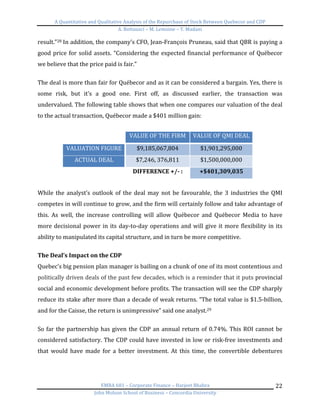
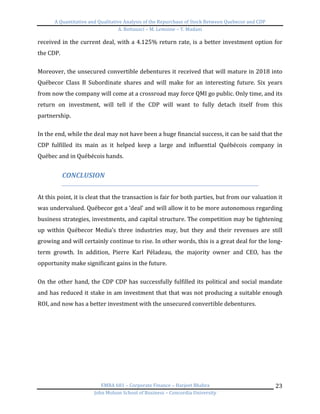
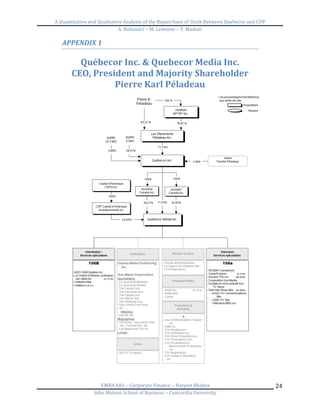
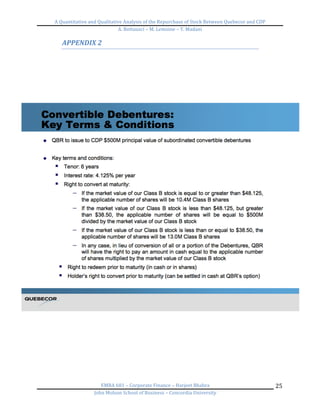
  QUALITATIVE	
  ANALYSIS	
  
OF	
  THE	
  REPURCHASE	
  OF	
  STOCK	
  
BETWEEN	


AND	


ALEX	
  BOTTAUSCI	
  •	
  MARK	
  LEMOINE	
  •	
  YOUSEF	
  MADANI	
  
JOHN	
  MOLSON	
  SCHOOL	
  OF	
  BUSINESS	
  
CONCORDIA	
  UNIVERSITY	


EMBA	
  681	
  
CORPORATE	
  FINANCE	
  
DR.	
  HARJEET	
  BHABRA	


DECEMBER	
  1ST,	
  2012	


A	
  Quantitative	
  and	
  Qualitative	
  Analysis	
  of	
  the	
  Repurchase	
  of	
  Stock	
  Between	
  Quebecor	
  and	
  CDP	
  
A.	
  Bottausci	
  –	
  M.	
  Lemoine	
  –	
  Y.	
  Madani	


EMBA	
  681	
  –	
  Corporate	
  Finance	
  –	
  Harjeet	
  Bhabra	
  
John	
  Molson	
  School	
  of	
  Business	
  –	
  Concordia	
  University	
  
2	
  
TABLE	
  OF	
  CONTENTS	


INTRODUCTION	


   3	


COMPANY	
  PROFILES	


   3	
  
	
   Québecor	
  Inc.	
  	
  
Caisse	
  de	
  dépôt	
  et	
  de	
  placement	
  du	
  Québec	
  
Quebecor	
  Media	
  Inc.	


THE	
  CABLE,	
  TELECOMMUNICATIONS	
  &	
  MEDIA	
  INDUSTRIES	
   	
   	
   6	


   The	
  Cable	
  Industry	


   The	
  Telecommunications	
  Industry	


   The	
  Media	
  Industry	


THE	
  COMPARABLE	
  COMPANIES	


   9	
  
Bell	
  Canada	
  Enterprises	
  Inc.	


   Rogers	
  Communications	
  Inc.	


   Shaw	
  Communications	
  Inc.	


   Cogeco	
  Inc.	


THE	
  TRANSACTION	


   11	
  
2000	
  
	
   2012	


VALUATION	
  OF	
  QMI’S	
  SHARES	


   13	
  
Two	
  Valuation	
  Methods	
  
Statements	
  and	
  Assumptions	


VALUATION	
  1:	
  MARKET-­‐BASED	
  COMPARABLES	
  COMPANIES	
  APPROACH	
   	
   15	


   Step	
  1:	
  Equity	


   Step	
  2:	
  Debt	


   Step	
  3:	
  The	
  Total	
  Value	
  of	
  the	
  Firm	


VALUATION	
  2:	
  THE	
  DISCOUNTED	
  CASH	
  FLOW	
  APPROACH	


   17	
  
	
   SCENARIO	
  1	
   	
  
Step	
  1:	
  Free	
  Cash	
  Flow	
  to	
  the	
  Firm	
  (FCFF)	
  
	
   Step	
  2:	
  Cost	
  of	
  Capital	
  (KD)	
  
	
   Step	
  3:	
  Cost	
  of	
  Debt	
  (KE)	
  
	
   Step	
  4:	
  Weighted	
  Average	
  Cost	
  of	
  Capital	
  (WACC)	
  
	
   Step	
  5:	
  Discount	
  the	
  FCFFs	
  and	
  Terminal	
  Values	
  
SCENARIO	
  2	
  
	
   THE	
  FINAL	
  ESTIMATED	
  PRESENT	
  VALUE	
  OF	
  QMI	
  SHARES	


   20	


ANALYSIS	
  AND	
  DISCUSSION	


   20	
  
	
   The	
  Deal’s	
  Impact	
  of	
  QBR	
  and	
  QMI	
  
	
   The	
  Deal’s	
  Impact	
  on	
  CDP	


CONCLUSION	


   23	


APPENDIX	
  1	


   24	


APPENDIX	
  2	


   25	


APPENDIX	
  3	


   26	


REFERENCES	


   27	
  
A	
  Quantitative	
  and	
  Qualitative	
  Analysis	
  of	
  the	
  Repurchase	
  of	
  Stock	
  Between	
  Quebecor	
  and	
  CDP	
  
A.	
  Bottausci	
  –	
  M.	
  Lemoine	
  –	
  Y.	
  Madani	


EMBA	
  681	
  –	
  Corporate	
  Finance	
  –	
  Harjeet	
  Bhabra	
  
John	
  Molson	
  School	
  of	
  Business	
  –	
  Concordia	
  University	
  
3	
  
INTRODUCTION	


On	
  October	
  3rd	
  of	
  this	
  year,	
  Québecor	
  Inc.	
  and	
  the	
  Caisse	
  de	
  dépôt	
  et	
  placement	
  du	
  Québec	
  
(CDP)	
  reached	
  an	
  agreement	
  on	
  the	
  partial	
  sale	
  of	
  the	
  CDP’s	
  interest	
  in	
  Quebecor	
  Media	
  Inc.	
  
(QMI).	
  Québecor	
  will	
  purchase	
  a	
  total	
  of	
  30.5	
  million	
  shares	
  valued	
  at	
  $1.5	
  billion.	


The	
  purpose	
  of	
  this	
  study	
  is	
  to	
  analyze	
  the	
  quantitative	
  and	
  qualitative	
  aspects	
  of	
  the	
  CDP’s	
  
reduction	
   in	
   ownership	
   of	
   QMI,	
   including	
   the	
   motives	
   and	
   non-­‐financial	
   considerations	
  
behind	
  the	
  deal.	
  In	
  addition,	
  this	
  paper	
  will	
  seek	
  to	
  determine	
  if	
  fair	
  value	
  was	
  realized	
  and	
  
validate	
  or	
  disprove	
  the	
  National	
  Post’s	
  analysts’	
  claim	
  that	
  this	
  “pegs	
  the	
  Value	
  of	
  QMI	
  at	
  
about	
  $6-­‐billion,	
  representing	
  a	
  20%	
  premium”.1	


COMPANY	
  PROFILES	


Québecor	
  Inc.	
  	
  
Québecor	
  Inc.	
  (TSX:	
  QBR)	
  was	
  founded	
  by	
  Pierre	
  Péladeau	
  in	
  1950,	
  in	
  Montréal,	
  Québec	
  
with	
   a	
   small	
   neighbourhood	
   newspaper.	
   Mr.	
   Péladeau	
   went	
   on	
   to	
   build	
   a	
   vast	
  
communications	
  empire	
  offering	
  cutting-­‐edge	
  technology	
  and	
  constantly	
  evolving	
  business	
  
solutions.	
  Today,	
  Québecor	
  has	
  a	
  fast-­‐expanding	
  national	
  presence	
  but	
  remains	
  profoundly	
  
attached	
  to	
  its	
  roots,	
  hence	
  one	
  of	
  the	
  main	
  motives	
  behind	
  the	
  initial	
  transaction.	
  A	
  new	
  
generation	
  of	
  managers	
  is	
  drawing	
  on	
  the	
  company's	
  traditions	
  to	
  sustain	
  and	
  nourish	
  its	
  
growth	
  into	
  the	
  future.	
  For	
  2011,	
  Québecor	
  reported	
  revenues	
  of	
  $4.3	
  Billions	
  and	
  a	
  net	
  
income	
  of	
  $374	
  Millions.	


Pierre	
  Karl	
  Péladeau	
  is	
  the	
  current	
  President	
  and	
  Chief	
  Executive	
  Officer	
  and	
  is	
  also	
  the	
  
firm’s	
   majority	
   shareholder,	
   possessing	
   72.16%	
   interest	
   in	
   the	
   company	
   (Appendix	
   1).	
  2	
  
The	
   Chief	
   Financial	
   Officer	
   (CFO)	
   is	
   Jean-­‐François	
   Pruneau.	
   The	
   current	
   members	
   of	
  
the	
  board	
  of	
  directors	
  of	
  Québecor	
  Inc.	
  are;	
  	
  
• Françoise	
  Bertrand,	
  	
  
Chairwoman	
  of	
  the	
  BOD	
  
• Rt.	
  Hon.	
  Brian	
  Mulroney	
  
Vice-­‐Chairman	
  of	
  the	
  BOD	
  
• Pierre	
  Karl	
  Péladeau	
  
• Jean	
  La	
  Couture	
  
• Sylvie	
  Lalande	
  
• Pierre	
  Laurin	
  
• Geneviève	
  Marcon	
  
• Pierre	
  Parent	
  
A	
  Quantitative	
  and	
  Qualitative	
  Analysis	
  of	
  the	
  Repurchase	
  of	
  Stock	
  Between	
  Quebecor	
  and	
  CDP	
  
A.	
  Bottausci	
  –	
  M.	
  Lemoine	
  –	
  Y.	
  Madani	


EMBA	
  681	
  –	
  Corporate	
  Finance	
  –	
  Harjeet	
  Bhabra	
  
John	
  Molson	
  School	
  of	
  Business	
  –	
  Concordia	
  University	
  
4	
  
In	
  2000,	
  Québecor	
  Inc.	
  opened	
  a	
  new	
  chapter	
  in	
  its	
  development	
  with	
  the	
  acquisition	
  of	
  the	
  
Groupe	
   Vidéotron	
   Ltée.,	
   the	
   largest	
   cable	
   operator	
   in	
   Québec.	
   Along	
   with	
   Vidéotron,	
  
Québecor	
  picked	
  up	
  its	
  subsidiaries	
  Netgraphe,	
  an	
  important	
  Web	
  content	
  developer	
  and	
  
operator	
   of	
   numerous	
   Web	
   properties,	
   and	
   TVA	
   Group,	
   owner	
   of	
   the	
   TVA	
   broadcasting	
  
network	
  and	
  of	
  magazine	
  publisher	
  TVA	
  Publishing.	


To	
  carry	
  out	
  this	
  major	
  acquisition,	
  Québecor	
  formed	
  a	
  partnership	
  with	
  a	
  major	
  financial	
  
backer,	
  the	
  Caisse	
  de	
  dépôt	
  et	
  placement	
  du	
  Québec,	
  and	
  together	
  created	
  a	
  new	
  subsidiary,	
  
Quebecor	
  Media	
  Inc.	
  Today,	
  the	
  bulk	
  of	
  Quebecor	
  Media’s	
  profit,	
  and	
  in	
  turn	
  Québecor’s	
  
comes	
  from	
  Vidéotron.	


Caisse	
  de	
  dépôt	
  et	
  de	
  placement	
  du	
  Québec	
  
The	
  Caisse	
  de	
  dépôt	
  et	
  placement	
  du	
  Québec	
  (CDP)	
  was	
  founded	
  in	
  1965	
  by	
  an	
  act	
  of	
  the	
  
National	
  Assembly	
  and	
  it	
  manages	
  institutional	
  funds,	
  primarily	
  from	
  public	
  and	
  private	
  
pension	
  and	
  insurance	
  funds	
  in	
  Québec,	
  including	
  the	
  Régie	
  des	
  rentes	
  du	
  Québec	
  and	
  the	
  
Commission	
  administrative	
  des	
  regimes	
  de	
  retraite	
  et	
  d’assurances,	
   amongst	
   dozen	
   others.	
  
The	
  CDP	
  is	
  headquartered	
  in	
  Québec	
  City	
  but	
  has	
  its	
  major	
  business	
  office	
  in	
  Montréal.	


The	
  CDP	
  has	
  traditionally	
  favoured	
  Québec	
  businesses.	
  The	
  CDP’s	
  mandate,	
  as	
  defined	
  by	
  
legislation	
  passed	
  in	
  2003,	
  is	
  to	
  “achieve	
  an	
  optimal	
  return	
  on	
  the	
  deposits	
  of	
  its	
  clients,	
  or	
  
depositors,	
   while	
   contributing	
   to	
  Québec's	
   economic	
   development”3.	
   This	
   concept	
   was	
  
further	
   pressed	
   just	
   weeks	
   before	
   the	
   QBR	
   and	
   CDP	
   transaction.	
   After	
   winning	
   the	
  
provincial	
   elections	
   in	
   early	
   September	
   2012,	
   new	
   Québec	
   Premier	
   Pauline	
   Marois,	
   who	
  
fought	
  off	
  the	
  recent	
  U.S.	
  takeover	
  bid	
  for	
  Québécois	
  home-­‐improvement	
  chain	
  Rona	
  Inc.,	
  
said	
   that	
   the	
   role	
   of	
   Quebec’s	
   pension	
   fund	
   should	
   be	
   strengthened	
   to	
   keep	
   corporate	
  
headquarters	
   in	
   Québécois	
   hands.4 	
  Nicolas	
   Marceau,	
   Québec’s	
   Finance	
   Minister,	
   also	
  
proposed	
   additional	
   revisions	
   to	
   the	
   CDP’s	
   mandate	
   so	
   that	
   it	
   would	
   further	
   promote	
  
economic	
  development	
  and	
  work	
  to	
  “keep	
  the	
  strategic	
  decision-­‐making	
  centers	
  here.”	


The	
  CDP’S	
  large	
  holdings	
  make	
  it	
  a	
  formidable	
  player	
  in	
  investment	
  markets.	
  Today	
  it	
  is	
  the	
  
leading	
  private	
  equity	
  investor	
  in	
  Canada	
  and	
  it	
  is	
  also	
  one	
  of	
  the	
  10	
  largest	
  real	
  estate	
  
asset	
   managers	
   in	
   the	
   world.5	
  It	
   is	
   the	
   second	
   largest	
   pension	
   fund	
   in	
   Canada,	
   with	
   the	
  
A	
  Quantitative	
  and	
  Qualitative	
  Analysis	
  of	
  the	
  Repurchase	
  of	
  Stock	
  Between	
  Quebecor	
  and	
  CDP	
  
A.	
  Bottausci	
  –	
  M.	
  Lemoine	
  –	
  Y.	
  Madani	


EMBA	
  681	
  –	
  Corporate	
  Finance	
  –	
  Harjeet	
  Bhabra	
  
John	
  Molson	
  School	
  of	
  Business	
  –	
  Concordia	
  University	
  
5	
  
Canada	
  Pension	
  Plan	
  (CPP)	
  in	
  first	
  place.6	
  In	
  addition,	
  the	
  CDP’s	
  financial	
  soundness	
  has	
  
earned	
   it	
   the	
   best	
   credit	
   ratings	
   issued	
   by	
   the	
   following	
   credit	
   rating	
   agencies:	
   Moody's	
  
Investors	
  Service,	
  Standard	
  and	
  Poor's,	
  and	
  Dominion	
  Bond	
  Rating	
  Service.7	
  As	
  of	
  February	
  
2012,	
  the	
  CDP’s	
  total	
  assets	
  under	
  management	
  amount	
  to	
  $159	
  billion.	


The	
  CDP’s	
  President	
  and	
  CEO	
  is	
  Michael	
  Sabia,	
  the	
  Vice-­‐President	
  and	
  Chief	
  Risk	
  officer	
  is	
  
Claude	
  Bergeron,	
  and	
  the	
  CFO	
  is	
  Maarika	
  Paul.	
  The	
  current	
  Board	
  of	
  Directors	
  of	
  the	
  CDP	
  
are:	
  
§ Robert	
  Tessier	
  
Chair	
  of	
  the	
  board	
  
§ Michael	
  Sabia	
  
§ Elisabetta	
  Bigsby	
  
§ Luise	
  Charette	
  
§ Jocelyne	
  Dagenias	
  
§ Michèle	
  
Desjardins	
  
§ Pierre	
  Fitzgibbon	
  
§ Denys	
  Jean	
  
§ A.	
  Michel	
  Lavigne	
  
§ Jean	
  Pierre	
  Ouellet	
  
§ Réal	
  Raymond	
  
§ François	
  R.	
  Roy	
  
§ Ouma	
  Sananikone	


Quebecor	
  Media	
  Inc.	
  
Quebecor	
  Media	
  Inc.,	
  a	
  fully	
  integrated	
  media	
  and	
  telecom	
  company,	
  was	
  founded	
  in	
  2000	
  
and	
   is	
   headquartered	
   in	
   Montréal,	
   Québec.	
   It	
   is	
   a	
   subsidiary	
   of	
   Québecor	
   Inc.	
   and	
   it	
  
operates	
  mostly	
  in	
  the	
  province	
  of	
  Québec	
  but	
  is	
  also	
  present	
  in	
  the	
  rest	
  of	
  country.	
  QMI	
  
possesses	
  several	
  divisions	
  and	
  they	
  include;	
  Vidéotron,	
  a	
  cable,	
  VoIP,	
  and	
  internet	
  service	
  
provider,	
  Sun	
  Media	
  and	
  Canoë,	
  the	
  largest	
  newspaper	
  publisher	
  in	
  Canada,	
  TVA,	
  the	
  largest	
  
French	
  language	
  broadcaster	
  and	
  publisher	
  in	
  North	
  America,	
  and	
  Archambault,	
  a	
  music	
  
and	
  book	
  retailer.	
  QMI’s	
  2009	
  revenues	
  totalled	
  $3.7	
  billion,	
  while	
  its	
  EBITDA	
  stood	
  at	
  $1.2	
  
billion.	


Pierre	
   Karl	
   Péladeau	
   is	
   the	
   President	
   and	
   CEO,	
   and	
   the	
   CFO	
   is	
   Jean-­‐François	
   Trudeau.	
  
Current	
  members	
  of	
  the	
  board	
  of	
  directors	
  of	
  Québecor	
  Media	
  Inc.	
  are;	
  
§ Serge	
  Gouin	
  
Chairman	
  of	
  the	
  BOD	
  
§ Pierre	
  Karl	
  Péladeau	
  
§ André	
  Delisle	
  
§ Jean	
  La	
  Couture	
  
§ Rt.	
  Hon.	
  Brian	
  Mulroney,	
  
§ Samuel	
  Minzberg	
  
§ Normand	
  Provost	


A	
  Quantitative	
  and	
  Qualitative	
  Analysis	
  of	
  the	
  Repurchase	
  of	
  Stock	
  Between	
  Quebecor	
  and	
  CDP	
  
A.	
  Bottausci	
  –	
  M.	
  Lemoine	
  –	
  Y.	
  Madani	


EMBA	
  681	
  –	
  Corporate	
  Finance	
  –	
  Harjeet	
  Bhabra	
  
John	
  Molson	
  School	
  of	
  Business	
  –	
  Concordia	
  University	
  
6	
  
THE	
  CABLE,	
  TELECOMMUNICATIONS	
  &	
  MEDIA	
  INDUSTRIES	


Canadian	
  cable,	
  telecommunications	
  and	
  media	
  businesses	
  operate	
  in	
  highly	
  competitive	
  
industries	
  that	
  are	
  experiencing	
  relentless	
  rapid	
  technological	
  developments	
  and	
  in	
  turn	
  
necessitate	
  large	
  capital	
  investments	
  by	
  the	
  firms.	
  	
  The	
  following	
  provides	
  the	
  reader	
  some	
  
insight	
  into	
  these	
  industries	
  that	
  are	
  very	
  much	
  linked	
  and	
  dependent	
  on	
  each	
  other.	


The	
  Cable	
  Industry	
  
Cable	
   television	
   has	
   been	
   available	
   in	
   Canada	
   for	
   more	
   than	
   50	
   years	
   and	
   it	
   is	
   a	
   well-­‐
developed	
   market.	
   As	
   2010,	
   there	
   were	
   approximately	
   8.3	
   million	
   cable	
   television	
  
customers	
  in	
  Canada.	
  The	
  total	
  industry	
  revenue	
  for	
  2012	
  was	
  estimated	
  to	
  be	
  over	
  $10.1	
  
billion.	
   These	
   revenues	
   are	
   expected	
   to	
   grow	
   based	
   on	
   the	
   fact	
   that	
   Canadian	
   cable	
  
operators	
   have	
   aggressively	
   upgraded	
   their	
   networks	
   and	
   have	
   begun	
   launching	
   and	
  
deploying	
   new	
   products	
   and	
   services,	
   such	
   as	
   cable	
   Internet	
   access,	
   digital	
   television	
  
services	
  and	
  telephony	
  services.	
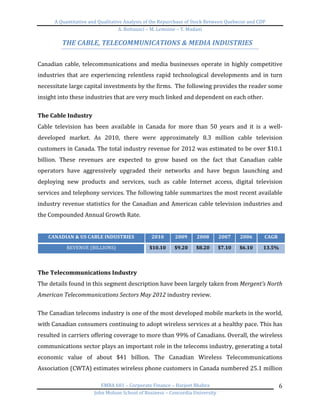
  The	
  following	
  table	
  summarizes	
  the	
  most	
  recent	
  available	
  
industry	
  revenue	
  statistics	
  for	
  the	
  Canadian	
  and	
  American	
  cable	
  television	
  industries	
  and	
  
the	
  Compounded	
  Annual	
  Growth	
  Rate.	


CANADIAN	
  &	
  US	
  CABLE	
  INDUSTRIES	
   2010	
   2009	
   2008	
   2007	
   2006	
   CAGR	
  
REVENUE	
  (BILLIONS)	
   $10.10	
   $9.20	
   $8.20	
   $7.10	
   $6.10	
   13.5%	


The	
  Telecommunications	
  Industry	
  	
  
The	
  details	
  found	
  in	
  this	
  segment	
  description	
  have	
  been	
  largely	
  taken	
  from	
  Mergent’s	
  North	
  
American	
  Telecommunications	
  Sectors	
  May	
  2012	
  industry	
  review.	


The	
  Canadian	
  telecoms	
  industry	
  is	
  one	
  of	
  the	
  most	
  developed	
  mobile	
  markets	
  in	
  the	
  world,	
  
with	
  Canadian	
  consumers	
  continuing	
  to	
  adopt	
  wireless	
  services	
  at	
  a	
  healthy	
  pace.	
  This	
  has	
  
resulted	
  in	
  carriers	
  offering	
  coverage	
  to	
  more	
  than	
  99%	
  of	
  Canadians.	
  Overall,	
  the	
  wireless	
  
communications	
  sector	
  plays	
  an	
  important	
  role	
  in	
  the	
  telecoms	
  industry,	
  generating	
  a	
  total	
  
economic	
   value	
   of	
   about	
   $41	
   billion.	
   The	
   Canadian	
   Wireless	
   Telecommunications	
  
Association	
  (CWTA)	
  estimates	
  wireless	
  phone	
  customers	
  in	
  Canada	
  numbered	
  25.1	
  million	
  
A	
  Quantitative	
  and	
  Qualitative	
  Analysis	
  of	
  the	
  Repurchase	
  of	
  Stock	
  Between	
  Quebecor	
  and	
  CDP	
  
A.	
  Bottausci	
  –	
  M.	
  Lemoine	
  –	
  Y.	
  Madani	


EMBA	
  681	
  –	
  Corporate	
  Finance	
  –	
  Harjeet	
  Bhabra	
  
John	
  Molson	
  School	
  of	
  Business	
  –	
  Concordia	
  University	
  
7	
  
at	
  the	
  end	
  of	
  June	
  2011,	
  or	
  about	
  75%	
  of	
  the	
  population,	
  with	
  wireless	
  service	
  providers	
  
reporting	
  a	
  net	
  addition	
  of	
  314,456	
  new	
  subscribers.	


The	
  majority	
  of	
  Canada’s	
  telecom	
  companies	
  recorded	
  increases	
  in	
  revenues	
  over	
  the	
  first	
  
half	
   of	
   2012.	
   Mobile	
   advertising	
   revenues	
   are	
   growing	
   throughout	
   Canada,	
   with	
   mobile	
  
search	
  advertising	
  generating	
  most	
  of	
  the	
  revenue.	
  The	
  Interactive	
  Advertising	
  Bureau	
  of	
  
Canada	
   announced	
   in	
   the	
   spring	
   of	
   2012	
   that	
   mobile	
   advertising	
   revenue	
   jumped	
   from	
  
C$22.8	
  million	
  in	
  2009	
  to	
  C$46.6	
  million	
  in	
  2010.	
  It	
  has	
  now	
  been	
  forecasted	
  that	
  revenues	
  
will	
  rise	
  by	
  nearly	
  110%	
  in	
  2012,	
  climbing	
  to	
  an	
  estimated	
  C$98	
  million.	
  The	
  share	
  price	
  
over	
  the	
  six	
  months	
  ended	
  April	
  2012,	
  overall	
  Canadian	
  telecom	
  share	
  prices	
  rose	
  by	
  an	
  
average	
  6.48%,	
  up	
  from	
  the	
  April	
  to	
  October	
  2011	
  period,	
  when	
  share	
  prices	
  declined	
  by	
  
6.59%.	


The	
  outlook	
  for	
  the	
  telecommunications	
  sector	
  is	
  relatively	
  positive,	
  but	
  not	
  strong,	
  with	
  
intense	
  competition	
  between	
  both	
  big	
  and	
  small	
  players	
  in	
  the	
  industry	
  reflected	
  in	
  price	
  
growth	
   over	
   the	
   past	
   six	
   months.	
   Over	
   the	
   past	
   year,	
   there	
   were	
   constant	
   new	
   product	
  
launches	
  including	
  new	
  smartphones	
  and	
  digital	
  TV	
  products,	
  resulting	
  in	
  the	
  higher	
  use	
  of	
  
wireless	
  services.	
  As	
  the	
  rate	
  of	
  adoption	
  for	
  smartphones	
  and	
  tablets	
  continues	
  to	
  climb,	
  
spending	
  on	
  wireless	
  data	
  is	
  expected	
  to	
  more	
  than	
  double	
  in	
  the	
  next	
  year.	


The	
  Media	
  Industry	
  	
  
The	
  details	
  found	
  in	
  this	
  segment	
  description	
  have	
  largely	
  been	
  taken	
  from	
  Mergent’s	
  North	
  
American	
  Media	
  Sectors	
  August	
  2012	
  industry	
  review.	


Despite	
   being	
   dwarfed	
   by	
   the	
   American	
   media	
   industry,	
   the	
   Canadian	
   media	
   industry	
   is	
  
large	
  by	
  international	
  standards.	
  It	
  plays	
  a	
  crucial	
  role	
  in	
  Canada’s	
  economy	
  and	
  in	
  public	
  
communication,	
  covering	
  an	
  area	
  of	
  9,984,670	
  square	
  kilometers	
  with	
  a	
  population	
  of	
  34.3	
  
million	
   divided	
   almost	
   equally	
   among	
   rural,	
   suburban	
   and	
   urban	
   areas.	
   Canadian	
   media	
  
content	
  is	
  popular	
  globally	
  in	
  certain	
  markets,	
  although	
  not	
  on	
  the	
  same	
  scale	
  as	
  US	
  media	
  
content.	
   Many	
   English	
   and	
   French-­‐speaking	
   countries	
   around	
   the	
   world	
   air	
   and	
   publish	
  
Canadian	
  media	
  content	
  regularly.	


A	
  Quantitative	
  and	
  Qualitative	
  Analysis	
  of	
  the	
  Repurchase	
  of	
  Stock	
  Between	
  Quebecor	
  and	
  CDP	
  
A.	
  Bottausci	
  –	
  M.	
  Lemoine	
  –	
  Y.	
  Madani	


EMBA	
  681	
  –	
  Corporate	
  Finance	
  –	
  Harjeet	
  Bhabra	
  
John	
  Molson	
  School	
  of	
  Business	
  –	
  Concordia	
  University	
  
8	
  
Modern	
   Canadian	
   broadcasting	
   began	
   in	
   the	
   1930s	
   with	
   the	
   formation	
   of	
   the	
   Canadian	
  
Broadcasting	
  Corporation/Radio-­‐Canada	
  (CBC),	
  which	
  runs	
  all	
  public	
  broadcasting.	
  Private	
  
broadcasting	
  is	
  diverse	
  and	
  also	
  mature,	
  with	
  a	
  concentrated	
  market	
  mostly	
  shared	
  by	
  four	
  
major	
  television	
  networks	
  —	
  CTV,	
  Global,	
  TVA	
  and	
  V.	
  The	
  CRTC	
  lists	
  slightly	
  fewer	
  than	
  
commercial	
   2,000	
   radio	
   stations	
   across	
   Canada.	
   In	
   addition,	
   there	
   were	
   95	
   English	
   and	
  
French	
   language	
   paid-­‐for	
   dailies	
   in	
   circulation	
   at	
   the	
   end	
   of	
   2011,	
   and	
   more	
   than	
   1,100	
  
community	
  newspapers.	


The	
  (CRTC)	
  reported	
  that	
  the	
  estimated	
  broadcasting	
  segment	
  revenues	
  totalled	
  C$15.713	
  
billion	
   and	
   were	
   up	
   8.94%	
   in	
   2010,	
   reflecting	
   revenue	
   improvement	
   in	
   all	
   of	
   the	
  
broadcasting	
   segments.	
   While	
   cable	
   and	
   direct-­‐to-­‐home/multipoint	
   distribution	
   service	
  
plus	
  IPTV	
  revenue	
  rose	
  by	
  8.94%,	
  television	
  revenue	
  grew	
  by	
  10.59%	
  and	
  radio	
  by	
  2.92%.	
  
Television	
   advertising	
   spending	
   is	
   forecast	
   to	
   grow	
   by	
   6.75%	
   in	
   2012,	
   while	
   radio	
  
advertising	
  spending	
  is	
  forecast	
  to	
  pick	
  up	
  by	
  3.73%.	
  Online	
  advertising	
  spending	
  is	
  likely	
  
to	
  rise	
  by	
  23.32%	
  in	
  2012,	
  more	
  than	
  total	
  advertising	
  spending	
  on	
  print	
  newspapers	
  and	
  
magazines,	
  due	
  to	
  total	
  US	
  print	
  advertising	
  spending	
  would	
  drop	
  by	
  6.11%.	


Canadian	
  television	
  broadcasters’	
  2011	
  advertising	
  revenues	
  were	
  up	
  4.74%,	
  representing	
  
47.92%	
   of	
   the	
   industry’s	
   total	
   operating	
   revenues.	
   The	
   shares	
   of	
   leading	
   Canadian	
  
companies	
  performed	
  well	
  over	
  first	
  half	
  of	
  2012.	
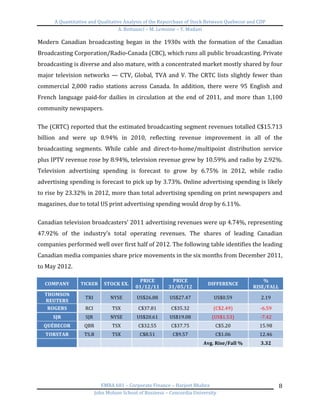
  The	
  following	
  table	
  identifies	
  the	
  leading	
  
Canadian	
  media	
  companies	
  share	
  price	
  movements	
  in	
  the	
  six	
  months	
  from	
  December	
  2011,	
  
to	
  May	
  2012.	


COMPANY	
   TICKER	
   STOCK	
  EX.	
  
PRICE	
  
01/12/11	
  
PRICE	
  
31/05/12	
  
DIFFERENCE	
  
%	
  
RISE/FALL	
  
THOMSON	
  
REUTERS	
  
TRI	
   NYSE	
   US$26.88	
   US$27.47	
   US$0.59	
   2.19	
  
ROGERS	
   RCI	
   TSX	
   C$37.81	
   C$35.32	
   (C$2.49)	
   -­‐6.59	
  
SJR	
   SJR	
   NYSE	
   US$20.61	
   US$19.08	
   (US$1.53)	
   -­‐7.42	
  
QUÉBECOR	
   QBR	
   TSX	
   C$32.55	
   C$37.75	
   C$5.20	
   15.98	
  
TORSTAR	
   TS.B	
   TSX	
   C$8.51	
   C$9.57	
   C$1.06	
   12.46	


Avg.	
  Rise/Fall	
  %	
   3.32	
  
A	
  Quantitative	
  and	
  Qualitative	
  Analysis	
  of	
  the	
  Repurchase	
  of	
  Stock	
  Between	
  Quebecor	
  and	
  CDP	
  
A.	
  Bottausci	
  –	
  M.	
  Lemoine	
  –	
  Y.	
  Madani	


EMBA	
  681	
  –	
  Corporate	
  Finance	
  –	
  Harjeet	
  Bhabra	
  
John	
  Molson	
  School	
  of	
  Business	
  –	
  Concordia	
  University	
  
9	
  
This	
   upbeat	
   outlook	
   for	
   the	
   media	
   industry	
   stands	
   in	
   contrast	
   to	
   Mr.	
   Péladeau’s	
   recent	
  
comments	
  in	
  front	
  of	
  the	
  CRTC,	
  when	
  he	
  warned	
  that	
  the	
  cable	
  business	
  was	
  under	
  threat	
  
as	
   he	
   tried	
   to	
   convince	
   the	
   Canadian	
   Radio-­‐television	
   and	
   Telecommunications	
  
Commission	
   to	
   reject	
   a	
   merger	
   between	
   BCE	
   Inc.	
   and	
   Astral	
   Media.	
   Québecor’s	
   CEO’s	
  
motive	
  must	
  be	
  taken	
  with	
  a	
  grain	
  of	
  salt,	
  considering	
  that	
  the	
  deal	
  would	
  have	
  made	
  one	
  
its	
  main	
  rival	
  much	
  stronger	
  in	
  the	
  Québec	
  market.	


THE	
  COMPARABLE	
  COMPANIES	


The	
  following	
  four	
  companies,	
  BCE,	
  Rogers,	
  Shaw	
  and	
  Cogeco,	
  compete	
  with	
  Québecor	
  and	
  
Quebecor	
  Media	
  in	
  the	
  cable,	
  telecommunications	
  and	
  media	
  industries	
  and	
  share	
  many	
  
characteristics,	
  including	
  business	
  models,	
  with	
  Québecor	
  and	
  QMI,	
  and	
  in	
  turn	
  provide	
  the	
  
most	
  accurate	
  comparable	
  companies	
  for	
  the	
  financial	
  valuation	
  process	
  conducted	
  in	
  this	
  
study.	
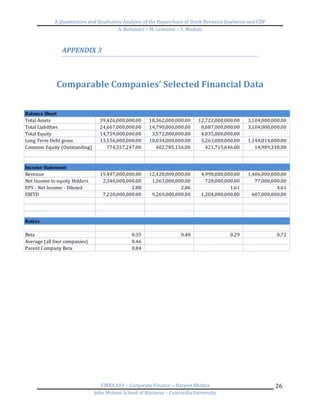
  Brief	
  summaries	
  of	
  selected	
  financial	
  data	
  are	
  found	
  in	
  Appendix	
  3.	


Bell	
  Canada	
  Enterprises	
  Inc.	
  	
  
Bell	
  Canada	
  Enterprises	
  Inc.	
  (TSX:	
  BCE)	
  is	
  headquartered	
  in	
  Montréal,	
  Québec	
  and	
  operates	
  
predominantly	
  in	
  Canada,	
  providing	
  services	
  to	
  over	
  20,000,000	
  residential,	
  business	
  and	
  
wholesale	
  customers.	
  The	
  company	
  was	
  originally	
  founded	
  in	
  1880	
  but	
  was	
  incorporated	
  
under	
   federal	
   charter	
   in	
   1970	
   as	
   Tele-­‐Direct	
   Ltd.,	
   and	
   continued	
   to	
   operate	
   under	
   the	
  
Canada	
   Business	
   Corporations	
   Act	
   of	
   1979.	
   The	
   company	
   was	
   renamed	
   Bell	
   Canada	
  
Enterprises	
  Inc.	
  in	
  1983	
  and	
  shortened	
  it	
  to	
  BCE	
  Inc.	
  in	
  1998.	
  BCE	
  is	
  a	
  communications	
  
company	
   engaged	
   in	
   providing	
   wireline	
   voice	
   and	
   wireless	
   communications	
   services,	
  
internet	
   access,	
   data	
   services	
   and	
   video	
   services	
   to	
   residential,	
   business	
   and	
   wholesale	
  
customers.	
   The	
   firm	
   operates	
   three	
   divisions:	
   1)	
   Bell	
   Wireline,	
   which	
   provides	
   local	
  
telephone,	
   long	
   distance,	
   Internet,	
   data,	
   video	
   and	
   other	
   services	
   and	
   products;	
   2)	
   Bell	
  
Wireless,	
   which	
   provides	
   wireless	
   voice	
   and	
   data	
   communication	
   products	
   and	
   services;	
  
and	
   3)	
   Bell	
   Aliant,	
   which	
   provides	
   local	
   telephone,	
   long	
   distance,	
   Internet,	
   data,	
   video,	
  
wireless	
  and	
  other	
  information	
  and	
  communications	
  technology	
  services.	
  For	
  2011,	
  BCE	
  
reported	
  revenues	
  of	
  $19.49	
  billion	
  and	
  a	
  net	
  income	
  of	
  $2.34	
  billion.8	


A	
  Quantitative	
  and	
  Qualitative	
  Analysis	
  of	
  the	
  Repurchase	
  of	
  Stock	
  Between	
  Quebecor	
  and	
  CDP	
  
A.	
  Bottausci	
  –	
  M.	
  Lemoine	
  –	
  Y.	
  Madani	


EMBA	
  681	
  –	
  Corporate	
  Finance	
  –	
  Harjeet	
  Bhabra	
  
John	
  Molson	
  School	
  of	
  Business	
  –	
  Concordia	
  University	
  
10	
  
Rogers	
  Communications	
  Inc.	
  
Rogers	
  Communications	
  Inc.	
  (TSX:	
  RCI)	
  was	
  originally	
  incorporated	
  in	
  1925,	
  in	
  Toronto,	
  
under	
  the	
  name	
  of	
  Rogers	
  Vacuum	
  Tube	
  Company.	
  Although	
  the	
  head	
  offices	
  have	
  always	
  
been	
  based	
  in	
  Toronto,	
  the	
  company	
  went	
  through	
  various	
  name	
  changes	
  until	
  1986	
  when	
  
it	
  was	
  finally	
  changed	
  to	
  Rogers	
  Communications	
  Inc.	
  Rogers	
  provides	
  wireless	
  voice	
  and	
  
data	
  communication	
  services,	
  and	
  like	
  BCE,	
  it	
  also	
  has	
  three	
  divisions;	
  1)	
  Rogers	
  Wireless;	
  
cable	
   television	
   services,	
   high-­‐speed	
   internet	
   access,	
   and	
   telephony	
   services,	
   2)	
   Rogers	
  
Cable;	
  retailing	
  of	
  communications	
  and	
  home	
  entertainment	
  products	
  and	
  services,	
  and	
  3)	
  
Rogers	
  Media;	
  radio	
  and	
  television	
  broadcasting,	
  televised	
  shopping,	
  magazines	
  and	
  trade	
  
publications,	
  and	
  sports	
  entertainment.	
  Rogers	
  recorded	
  revenues	
  of	
  $12.42	
  billion	
  and	
  a	
  
net	
  income	
  of	
  $1.56	
  billion	
  in	
  2011.	
  9	


Shaw	
  Communications	
  Inc.	
  	
  
Shaw	
  Communications	
  Inc.	
  (TSX:	
  SIR)	
  was	
  incorporated	
  in	
  1966	
  as	
  Capital	
  Cable	
  TV	
  Ltd.	
  
and	
   became	
   Shaw	
   in	
   1993.	
   Shaw	
   is	
   headquartered	
   in	
   Calgary,	
   Alberta	
   and	
   it	
   provides	
  
services	
   for	
   mostly	
   British	
   Columbia,	
   Alberta,	
   with	
   smaller	
   systems	
   in	
   Saskatchewan,	
  
Manitoba	
  and	
  Northwestern	
  Ontario.	
  The	
  company	
  offers	
  broadband	
  cable	
  television,	
  high-­‐
speed	
   Internet,	
   digital	
   phone,	
   telecommunications	
   services,	
   satellite	
   direct-­‐to-­‐home	
   and	
  
distribution	
   services	
   and	
   television	
   broadcasting.	
   The	
   firm	
   is	
   thus	
   divided	
   into	
   three	
  
businesses;	
   Shaw	
   Business,	
   Shaw	
   Direct	
   and	
   Shaw	
   Media,	
   that	
   serve	
   four	
   main	
   business	
  
segments:	
   1)	
   the	
   Cable	
  segment,	
   which	
   is	
   comprised	
   of	
   cable	
   television,	
   internet,	
   digital	
  
phone	
   and	
   internet	
   infrastructure	
   service	
   businesses;	
   2)	
   the	
   Satellite	
   segment,	
   which	
  
comprised	
  of	
  direct-­‐to-­‐home	
  and	
  satellite	
  services;	
  3)	
  the	
  Wireless	
  Segment,	
  which	
  is	
  in	
  the	
  
development	
  and	
  construction	
  stage;	
  and	
  4)	
  the	
  Media	
  segment,	
  which	
  includes	
  television	
  
broadcasting.	
  In	
  2012,	
  Shaw	
  reported	
  revenues	
  of	
  $4.99	
  billion	
  and	
  a	
  net	
  income	
  of	
  $728	
  
million.10	


Cogeco	
  Inc.	
  	
  
The	
  Compagnie	
  Général	
  de	
  Communication,	
  otherwise	
  known	
  as	
  Cogeco	
  Inc.	
  (TSX:	
  CGO),	
  
was	
   founded	
   in	
   Trois-­‐Rivières	
   in	
   1957,	
   and	
   today	
   it	
   is	
   based	
   in	
   Montréal,	
   Québec.	
   It	
  
provides	
  cable	
  television,	
  high-­‐speed	
  internet,	
  telephony,	
  managed	
  information	
  technology	
  
A	
  Quantitative	
  and	
  Qualitative	
  Analysis	
  of	
  the	
  Repurchase	
  of	
  Stock	
  Between	
  Quebecor	
  and	
  CDP	
  
A.	
  Bottausci	
  –	
  M.	
  Lemoine	
  –	
  Y.	
  Madani	


EMBA	
  681	
  –	
  Corporate	
  Finance	
  –	
  Harjeet	
  Bhabra	
  
John	
  Molson	
  School	
  of	
  Business	
  –	
  Concordia	
  University	
  
11	
  
and	
  infrastructure,	
  and	
  other	
  telecommunications	
  services	
  to	
  residential	
  and	
  commercial	
  
customers	
  in	
  the	
  provinces	
  of	
  Québec	
  and	
  Ontario,	
  and	
  it	
  conducts	
  international	
  operations	
  
in	
  Portugal.	
  Through	
  its	
  affiliate	
  Cogeco	
  Cable	
  Inc.,	
  the	
  company	
  provides	
  audio,	
  analogue	
  
and	
   digital	
   television,	
   high-­‐speed	
   Internet	
   (HSI)	
   and	
   telephony	
   services	
   to	
   residential	
  
customers	
  in	
  Ontario	
  and	
  Quebec.	
  Cogeco	
  Cable	
  also	
  provides	
  its	
  business	
  customers	
  with	
  
data	
   networking,	
   e-­‐business	
   applications,	
   video	
   conferencing,	
   hosting	
   services,	
   Ethernet,	
  
private	
  line,	
  Voice	
  over	
  Internet	
  Protocol	
  (VoIP),	
  HSI	
  access,	
  data	
  storage,	
  data	
  security,	
  co-­‐
location	
  services,	
  managed	
  IT	
  services,	
  cloud	
  services	
  and	
  other	
  advanced	
  communications	
  
services.	
   Furthermore,	
   Cogeco	
   runs	
   thirteen	
   French-­‐language	
   radio	
   stations	
   throughout	
  
Québec,	
   Cogeco	
   News,	
   a	
   news	
   agency	
   feeding	
   close	
   to	
   24	
   affiliate	
   and	
   community	
   radio	
  
stations	
  across	
  the	
  province,	
  and	
  it	
  also	
  operates	
  Métromedia	
  CMR	
  Plus	
  Inc.,	
  an	
  advertising	
  
representation	
   agency	
   specializing	
   in	
   the	
   public	
   transport	
   sector.	
   Just	
   this	
   year	
   Cogeco	
  
made	
  a	
  $1.3-­‐billion	
  purchase	
  of	
  U.S.-­‐based	
  Atlantic	
  Broadband,	
  the	
  fifteenth	
  largest	
  cable	
  
provider	
  in	
  the	
  U.S.A.,	
  and	
  it	
  has	
  been	
  criticized	
  because	
  analysts	
  believe	
  it	
  paid	
  too	
  high	
  a	
  
price	
   on	
   assets	
   they	
   feel	
   is	
   in	
   decline.	
   Cogeco	
   shares	
   fell	
   sharply	
   when	
   the	
   deal	
   was	
  
announced.11	
  2012	
  revenues	
  stood	
  at	
  $1.41	
  billion	
  but	
  it	
  terms	
  of	
  net	
  income	
  the	
  company	
  
registered	
  a	
  $77	
  million	
  gain.	


THE	
  TRANSACTION	


2000	
  
Before	
  outlining	
  the	
  transaction’s	
  motives	
  and	
  details,	
  it’s	
  important	
  to	
  understand	
  why	
  the	
  
two	
   firms	
   entered	
   a	
   partnership	
   in	
   the	
   first	
   place.	
   As	
   mentioned	
   earlier,	
   the	
   CDP’s	
  
traditional	
  role	
  has	
  been	
  to	
  favour	
  and	
  invest	
  into	
  Québec	
  businesses.	
  Québecor	
  is	
  a	
  profit-­‐
seeking	
  firm	
  where	
  financial	
  growth	
  is	
  always	
  one	
  of	
  the	
  primary	
  objectives.	
  With	
  this	
  in	
  
mind,	
   in	
   the	
   year	
   2000,	
   the	
   Toronto	
   based	
   Rogers	
   Communications	
   Inc.,	
   one	
   Canada’s	
  
largest	
   communications	
   companies,	
   began	
   a	
   friendly	
   takeover	
   process	
   with	
   Le	
   Groupe	
  
Vidéotron	
   Ltée.,	
   an	
   important	
   Québécois	
   cable	
   and	
   media	
   company.	
   In	
   reaction,	
   the	
  
Québecor	
   and	
   the	
   Caisse	
   de	
   dépôt	
   et	
   placement	
   du	
   Québec	
   formed	
   a	
   partnership	
   and	
  
launched	
  a	
  hostile	
  takeover	
  bid	
  and	
  bought	
  out	
  the	
  provincial	
  cable	
  provider	
  and	
  preserved	
  
an	
  important	
  ‘national’	
  media	
  outlet	
  in	
  Québécois	
  hands.	
  On	
  Oct.	
  23,	
  2000,	
  the	
  company	
  
A	
  Quantitative	
  and	
  Qualitative	
  Analysis	
  of	
  the	
  Repurchase	
  of	
  Stock	
  Between	
  Quebecor	
  and	
  CDP	
  
A.	
  Bottausci	
  –	
  M.	
  Lemoine	
  –	
  Y.	
  Madani	


EMBA	
  681	
  –	
  Corporate	
  Finance	
  –	
  Harjeet	
  Bhabra	
  
John	
  Molson	
  School	
  of	
  Business	
  –	
  Concordia	
  University	
  
12	
  
and	
  the	
  CDP,	
  jointly	
  acquired	
  Vidéotron	
  for	
  $45	
  per	
  share,	
  in	
  a	
  deal	
  valued	
  at	
  $5.4	
  billion.	
  
The	
   transaction	
   followed	
   a	
   decision	
   by	
   Rogers	
   to	
   terminate	
   its	
   merger	
   agreement	
   with	
  
Vidéotron.	
  When	
  the	
  dust	
  settled	
  Québecor	
  had	
  54.7%	
  and	
  the	
  CDP	
  had	
  45.3%	
  of	
  Vidéotron.	


2012	
  
Today,	
   Mr.	
   Péladeau	
   explains	
   the	
   latest	
   deal	
   as	
   the	
   following;	
   	
   “The	
   time	
   frame	
   of	
   the	
  
holding	
   of	
   the	
   Caisse	
   (CDP)	
   was	
   longer	
   than	
   usual	
   …	
   (and)	
   we	
   saw	
   there	
   were	
   some	
  
opportunities	
  in	
  the	
  debt	
  markets.”12	
  He	
  further	
  added;	
  “the	
  transaction	
  won’t	
  impair	
  the	
  
financial	
   flexibility	
   Québecor	
   needs	
   to	
   grow	
   the	
   capital	
   the	
   capital	
   intensive	
   telecom	
  
business.”	
  He	
  added	
  that	
  other	
  objectives	
  of	
  this	
  transaction	
  are	
  to	
  include	
  the	
  preservation	
  
of	
   operational	
   and	
   financial	
   flexibility	
   and	
   to	
   achieve	
   an	
   optimal	
   capital	
   structure	
   and	
  
maturity	
  profile	
  at	
  QMI.	


It	
  was	
  announced	
  on	
  October	
  3rd,	
  2012	
  that	
  Québecor,	
  Quebecor	
  Media	
  and	
  the	
  Caisse	
  de	
  
dépôt	
   et	
   placement	
   du	
   Québec	
   entered	
   an	
   agreement	
   providing	
   the	
   reduction	
   of	
   CDP’s	
  
interest	
  in	
  QMI	
  from	
  45.28%	
  to	
  24.64%13.	
  Québecor	
  purchased	
  20,351,307	
  shares	
  from	
  the	
  
CDP	
  for	
  $1	
  billion	
  in	
  cash,	
  and	
  will	
  immediately	
  cancel	
  them.	
  In	
  addition,	
  Québecor	
  also	
  
purchased	
  an	
  additional	
  10,175,653	
  shares	
  for	
  $500	
  million	
  in	
  consideration	
  that	
  the	
  CDP	
  
will	
  receive	
  in	
  return	
  unsecured	
  debentures	
  convertible,	
  bearing	
  an	
  interest	
  if	
  4.125%	
  and	
  
maturing	
  around	
  October	
  11,	
  2018,	
  into	
  Québecor	
  Class	
  B	
  Subordinate	
  shares14	
  (Appendix	
  
2).	
  This	
  could	
  allow	
  the	
  CDP	
  to	
  either	
  force	
  QMI	
  to	
  become	
  a	
  public	
  company	
  by	
  2019,	
  or	
  
sell	
  the	
  remaining	
  stake	
  to	
  a	
  third-­‐party.	
  Québecor	
  says	
  it	
  intends	
  to	
  take	
  advantage	
  of	
  the	
  
low	
  interest	
  rates	
  to	
  access	
  financial	
  markets	
  to	
  pay	
  for	
  the	
  shares.15	
  In	
  the	
  end,	
  the	
  deal	
  
was	
  closed	
  on	
  October	
  2012	
  and	
  Québecor’s	
  control	
  in	
  QMI	
  increased	
  to	
  75.36%.	


The	
  agreement	
  also	
  allows	
  the	
  CDP	
  to	
  exit	
  rights	
  in	
  2019,	
  through	
  either	
  an	
  IPO	
  or	
  sale	
  to	
  a	
  
financial	
  third	
  party,	
  and	
  Québecor	
  and	
  QMI	
  are	
  under	
  no	
  obligation	
  to	
  purchase	
  the	
  CDP’s	
  
remaining	
  interest.	


According	
  to	
  the	
  National	
  Post,	
  this	
  deal	
  pegs	
  the	
  value	
  of	
  Quebecor	
  Media	
  at	
  $6	
  billion,	
  
which	
   would	
   suggest	
   a	
   20%	
   premium.16	
  The	
   Market	
   Value	
   transaction	
   that	
   took	
   place	
  
between	
  Québecor	
  and	
  the	
  CDP	
  is	
  valued	
  at	
  $	
  7.246	
  billion.	
  This	
  is	
  based	
  on	
  $1.5	
  billion	
  
A	
  Quantitative	
  and	
  Qualitative	
  Analysis	
  of	
  the	
  Repurchase	
  of	
  Stock	
  Between	
  Quebecor	
  and	
  CDP	
  
A.	
  Bottausci	
  –	
  M.	
  Lemoine	
  –	
  Y.	
  Madani	


EMBA	
  681	
  –	
  Corporate	
  Finance	
  –	
  Harjeet	
  Bhabra	
  
John	
  Molson	
  School	
  of	
  Business	
  –	
  Concordia	
  University	
  
13	
  
paid	
  for	
  20.70%	
  shares	
  at	
  $49.14	
  per	
  share.	
  The	
  following	
  table	
  clarifies	
  the	
  transaction’s	
  
details:	


AMOUNT	
  PAID	
   TYPE	
  
#	
  OF	
  
SHARES	
   	
  
SHARE	
  
PRICE	
  
TOTAL	
  VALUE	
  OF	
  
SHARES	
  
$	
  1,000,000,000	
   Cash	
   20,351,307	
   16.5750%	


$	
  500,000,000	
   Debt	
   10,175,653	
   4.1250%	


$	
  1,500,000,000	


30,526,960	
   20.70%	
   $49.14	
   $	
  7,246,377,048.97	


VALUATION	
  OF	
  QMI’S	
  SHARES	


Two	
  Valuations	
  Methods	
  
The	
  objectives	
  of	
  this	
  paper	
  is	
  to	
  valuate	
  the	
  shares	
  of	
  QMI	
  and	
  determine	
  if	
  the	
  transaction	
  
was	
   of	
   fair	
   value	
   and	
   validate	
   or	
   disprove	
   National	
   Post’s	
   analysts	
   claim.	
   Two	
   valuation	
  
approaches,	
  methods	
  used	
  to	
  estimate	
  the	
  attractiveness	
  of	
  an	
  investment	
  opportunity,	
  will	
  
be	
  applied:	
  the	
  Market-­‐Based/Comparables	
  Companies	
  Approach	
  and	
  the	
  Discounted	
  Cash	
  
Flow	
  Approach.	


Valuation	
   1	
   -­‐	
   Market-­‐Based	
   Comparable	
   Company	
   Approach:	
   To	
   use	
   the	
   Market-­‐
Based/Comparable	
  Company	
  Approach	
  one	
  must	
  first	
  look	
  to	
  the	
  public	
  markets	
  for	
  firms	
  
which	
  most	
  closely	
  resemble	
  the	
  target	
  firm	
  and	
  then	
  use	
  indicators	
  of	
  financial	
  position	
  
such	
  as	
  EBITDA,	
  Revenue	
  or	
  Net	
  Income	
  to	
  make	
  comparisons.	
  By	
  consolidating	
  the	
  data	
  it	
  
is	
  possible	
  to	
  make	
  an	
  educated	
  estimate	
  of	
  the	
  value	
  of	
  an	
  equity	
  position	
  in	
  the	
  private	
  
firm,	
  and	
  by	
  adding	
  the	
  firm’s	
  debt	
  value,	
  if	
  any,	
  it	
  is	
  then	
  possible	
  to	
  estimate	
  the	
  firm’s	
  
total	
  value.17	
  The	
  comparable	
  companies	
  described	
  above,	
  BCE,	
  Rogers,	
  Shaw,	
  and	
  Cogeco	
  
and	
  their	
  financial	
  data,	
  are	
  for	
  the	
  valuation	
  process	
  of	
  this	
  study.	
  These	
  companies	
  share	
  
many	
  characteristics	
  with	
  Québecor	
  and	
  QMI,	
  and	
  in	
  turn	
  it	
  is	
  believed	
  that	
  they	
  offer	
  the	
  
most	
  accurate	
  comparables	
  for	
  the	
  valuation	
  process.	


Valuation	
   2	
   -­‐	
   Discounted	
   Cash	
   Flows	
   approach:	
   A	
   Discounted	
   Cash	
   Flow	
   (DCF)	
  
analysis	
  uses	
   future	
  free	
  cash	
   flow	
   projections	
   and	
   discounts	
   them	
   (most	
   often	
   using	
  the	
  
Weighted	
  Average	
  Cost	
  of	
  Capital)	
  to	
  arrive	
  at	
  a	
  present	
  value,	
  which	
  is	
  used	
  to	
  evaluate	
  the	
  
potential	
   for	
   investment.	
   The	
   premise	
   of	
   the	
   discounted	
   cash	
   flow	
   method	
   is	
   that	
   the	
  
A	
  Quantitative	
  and	
  Qualitative	
  Analysis	
  of	
  the	
  Repurchase	
  of	
  Stock	
  Between	
  Quebecor	
  and	
  CDP	
  
A.	
  Bottausci	
  –	
  M.	
  Lemoine	
  –	
  Y.	
  Madani	


EMBA	
  681	
  –	
  Corporate	
  Finance	
  –	
  Harjeet	
  Bhabra	
  
John	
  Molson	
  School	
  of	
  Business	
  –	
  Concordia	
  University	
  
14	
  
current	
  value	
  of	
  a	
  company	
  is	
  simply	
  the	
  present	
  value	
  of	
  its	
  future	
  cash	
  flows	
  that	
  are	
  
attributable	
  to	
  shareholders.18	


Statements	
  and	
  Assumptions	


• All	
  QMI	
  financial	
  figures	
  are	
  based	
  on	
  QMI’s	
  2011	
  Official	
  Financial	
  Statements	
  and	
  
are	
  in	
  millions	
  of	
  dollars.	
  In	
  addition,	
  all	
  financial	
  values	
  are	
  in	
  Canadian	
  (CAD)	
  dollars,	
  
unless	
  otherwise	
  noted.	


• The	
  Corporate	
  Tax	
  Rate	
  (TC	
  )	
  used	
  is	
  28.4%.	
  This	
  figure	
  was	
  taken	
  from	
  QMI’s	
  2011	
  
financial	
  statements19.	


• Growth	
  Rate	
  (g):	
  The	
  Growth	
  Rate	
  that	
  was	
  considered	
  in	
  the	
  valuation	
  of	
  the	
  QMI	
  
was	
  based	
  on	
  the	
  analyst	
  prospects	
  for	
  long	
  term	
  and	
  future	
  growth	
  in	
  the	
  industry	
  
for	
  parent	
  company.	
  An	
  industry	
  analysis	
  was	
  conducted	
  and	
  the	
  Free	
  Cash	
  Flow	
  to	
  
the	
  Firm	
  (FCFF)	
  is	
  expected	
  grow	
  over	
  the	
  next	
  five	
  years	
  by	
  9.47%20.	
  Afterward	
  it	
  is	
  
expected	
  and	
  assumed	
  to	
  grow	
  on	
  stable	
  rate	
  of	
  5%.	


• Return	
  on	
  Market	
  Portfolio	
  (Rm):	
  11.10%	
  is	
  the	
  historical	
  annual	
  average	
  return	
  (1957	
  
to	
  2006)	
  on	
  Canadian	
  common	
  stocks.21	


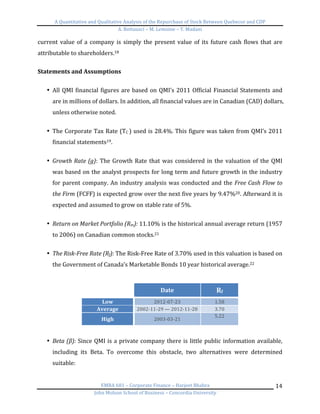
• The	
  Risk-­‐Free	
  Rate	
  (Rf):	
  The	
  Risk-­‐Free	
  Rate	
  of	
  3.70%	
  used	
  in	
  this	
  valuation	
  is	
  based	
  on	
  
the	
  Government	
  of	
  Canada’s	
  Marketable	
  Bonds	
  10	
  year	
  historical	
  average.22	


   Date	
   Rf	
  
Low	
   2012-­‐07-­‐23	
   1.58	
  
Average	
   2002-­‐11-­‐29	
  —	
  2012-­‐11-­‐28	
   3.70	
  
High	
   2003-­‐03-­‐21	
  
5.22	


• Beta	
  (β):	
  Since	
  QMI	
  is	
  a	
  private	
  company	
  there	
  is	
  little	
  public	
  information	
  available,	
  
including	
   its	
   Beta.	
   To	
   overcome	
   this	
   obstacle,	
   two	
   alternatives	
   were	
   determined	
  
suitable:	


A	
  Quantitative	
  and	
  Qualitative	
  Analysis	
  of	
  the	
  Repurchase	
  of	
  Stock	
  Between	
  Quebecor	
  and	
  CDP	
  
A.	
  Bottausci	
  –	
  M.	
  Lemoine	
  –	
  Y.	
  Madani	


EMBA	
  681	
  –	
  Corporate	
  Finance	
  –	
  Harjeet	
  Bhabra	
  
John	
  Molson	
  School	
  of	
  Business	
  –	
  Concordia	
  University	
  
15	
  
1)	
  Use	
  the	
  Québecor’s,	
  the	
  parents	
  company’s,	
  Beta	
  
2)	
  Use	
  the	
  average	
  Beta	
  of	
  the	
  four	
  comparable	
  companies.	


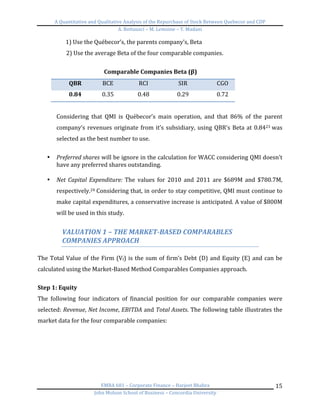
Considering	
   that	
   QMI	
   is	
   Québecor’s	
   main	
   operation,	
   and	
   that	
   86%	
   of	
   the	
   parent	
  
company’s	
  revenues	
  originate	
  from	
  it’s	
  subsidiary,	
  using	
  QBR’s	
  Beta	
  at	
  0.8423	
  was	
  
selected	
  as	
  the	
  best	
  number	
  to	
  use.	


• Preferred	
  shares	
  will	
  be	
  ignore	
  in	
  the	
  calculation	
  for	
  WACC	
  considering	
  QMI	
  doesn’t	
  
have	
  any	
  preferred	
  shares	
  outstanding.	


• Net	
  Capital	
  Expenditure:	
  The	
   values	
   for	
   2010	
   and	
   2011	
   are	
   $689M	
   and	
   $780.7M,	
  
respectively.24	
  Considering	
  that,	
  in	
  order	
  to	
  stay	
  competitive,	
  QMI	
  must	
  continue	
  to	
  
make	
  capital	
  expenditures,	
  a	
  conservative	
  increase	
  is	
  anticipated.	
  A	
  value	
  of	
  $800M	
  
will	
  be	
  used	
  in	
  this	
  study.	


VALUATION	
  1	
  –	
  THE	
  MARKET-­‐BASED	
  COMPARABLES	
  
COMPANIES	
  APPROACH	


The	
  Total	
  Value	
  of	
  the	
  Firm	
  (Vf)	
  is	
  the	
  sum	
  of	
  firm’s	
  Debt	
  (D)	
  and	
  Equity	
  (E)	
  and	
  can	
  be	
  
calculated	
  using	
  the	
  Market-­‐Based	
  Method	
  Comparables	
  Companies	
  approach.	


Step	
  1:	
  Equity	
  
The	
   following	
   four	
   indicators	
   of	
   financial	
   position	
   for	
   our	
   comparable	
   companies	
   were	
  
selected:	
  Revenue,	
  Net	
  Income,	
  EBITDA	
  and	
  Total	
  Assets.	
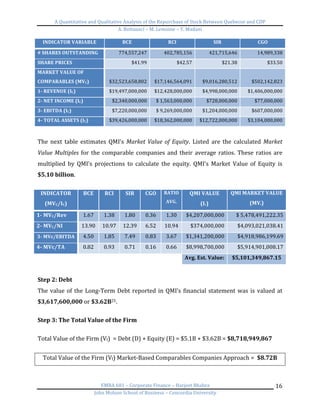
  The	
  following	
  table	
  illustrates	
  the	
  
market	
  data	
  for	
  the	
  four	
  comparable	
  companies:	


Comparable	
  Companies	
  Beta	
  (β)	
  
QBR	
   BCE	
   RCI	
   SIR	
   CGO	
  
0.84	
   0.35	
   0.48	
   0.29	
   0.72	
  
A	
  Quantitative	
  and	
  Qualitative	
  Analysis	
  of	
  the	
  Repurchase	
  of	
  Stock	
  Between	
  Quebecor	
  and	
  CDP	
  
A.	
  Bottausci	
  –	
  M.	
  Lemoine	
  –	
  Y.	
  Madani	


EMBA	
  681	
  –	
  Corporate	
  Finance	
  –	
  Harjeet	
  Bhabra	
  
John	
  Molson	
  School	
  of	
  Business	
  –	
  Concordia	
  University	
  
16	
  
INDICATOR	
  VARIABLE	
   BCE	
   RCI	
   SIR	
   CGO	
  
#	
  SHARES	
  OUTSTANDING	
   774,557,247	
   402,785,156	
   421,715,646	
   14,989,338	
  
SHARE	
  PRICES	
   $41.99	
   $42.57	
   $21.38	
   $33.50	
  
MARKET	
  VALUE	
  OF	
  
COMPARABLES	
  (MVC)	
   $32,523,658,802	
   $17,146,564,091	
   $9,016,280,512	
   $502,142,823	
  
1-­‐	
  REVENUE	
  (IC)	
   $19,497,000,000	
   $12,428,000,000	
   $4,998,000,000	
   $1,406,000,000	
  
2-­‐	
  NET	
  INCOME	
  (IC)	
   $2,340,000,000	
   $	
  1,563,000,000	
   $728,000,000	
   $77,000,000	
  
3-­‐	
  EBITDA	
  (IC)	
   $7,220,000,000	
   $	
  9,269,000,000	
   $1,204,000,000	
   $607,000,000	
  
4-­‐	
  TOTAL	
  ASSETS	
  (IC)	
   $39,426,000,000	
   $18,362,000,000	
   $12,722,000,000	
   $3,104,000,000	


The	
   next	
   table	
   estimates	
   QMI’s	
   Market	
  Value	
  of	
  Equity.	
   Listed	
   are	
   the	
   calculated	
   Market	
  
Value	
  Multiples	
  for	
  the	
  comparable	
  companies	
  and	
  their	
  average	
  ratios.	
  These	
  ratios	
  are	
  
multiplied	
   by	
   QMI’s	
   projections	
   to	
   calculate	
   the	
   equity.	
   QMI’s	
   Market	
   Value	
   of	
   Equity	
   is	
  
$5.10	
  billion.	


INDICATOR	
  
(MVC/IC)	
  
BCE	
   RCI	
   SIR	
   CGO	
   RATIO	
  	
  
AVG.	
  
QMI	
  VALUE	
  
(IC)	
  
QMI	
  MARKET	
  VALUE	
  
(MVt)	
  
1-­‐	
  MVC/Rev	
   1.67	
   1.38	
   1.80	
   0.36	
   1.30	
   $4,207,000,000	
   $	
  5,478,491,222.35	
  
2-­‐	
  MVC/NI	
   13.90	
   10.97	
   12.39	
   6.52	
   10.94	
   $374,000,000	
   $4,093,021,038.41	
  
3-­‐	
  MVc/EBITDA	
   4.50	
   1.85	
   7.49	
   0.83	
   3.67	
   $1,341,200,000	
   $4,918,986,199.69	
  
4-­‐	
  MVc/TA	
   0.82	
   0.93	
   0.71	
   0.16	
   0.66	
   $8,998,700,000	
   $5,914,901,008.17	


Avg.	
  Est.	
  Value:	
   $5,101,349,867.15	


Step	
  2:	
  Debt	
  
The	
  value	
  of	
  the	
  Long-­‐Term	
  Debt	
  reported	
  in	
  QMI’s	
  financial	
  statement	
  was	
  is	
  valued	
  at	
  
$3,617,600,000	
  or	
  $3.62B25.	


Step	
  3:	
  The	
  Total	
  Value	
  of	
  the	
  Firm	


Total	
  Value	
  of	
  the	
  Firm	
  (Vf)	
  	
  =	
  Debt	
  (D)	
  +	
  Equity	
  (E)	
  =	
  $5.1B	
  +	
  $3.62B	
  =	
  $8,718,949,867	


Total	
  Value	
  of	
  the	
  Firm	
  (Vf)	
  Market-­‐Based	
  Comparables	
  Companies	
  Approach	
  =	
  	
  $8.72B	


A	
  Quantitative	
  and	
  Qualitative	
  Analysis	
  of	
  the	
  Repurchase	
  of	
  Stock	
  Between	
  Quebecor	
  and	
  CDP	
  
A.	
  Bottausci	
  –	
  M.	
  Lemoine	
  –	
  Y.	
  Madani	


EMBA	
  681	
  –	
  Corporate	
  Finance	
  –	
  Harjeet	
  Bhabra	
  
John	
  Molson	
  School	
  of	
  Business	
  –	
  Concordia	
  University	
  
17	
  
Having	
  computed	
  Equity,	
  and	
  the	
  Total	
  Value	
  of	
  the	
  Firm,	
  it	
  is	
  now	
  possible	
  to	
  calculate	
  the	
  
Debt	
  Ratio	
  (D/V)	
  and	
  Equity	
  Ratio	
  (E/V)	
  as	
  well	
  as	
  the	
  Weighted	
  Average	
  Cost	
  of	
  Capital	
  
(WACC)	
  for	
  QMI.	
  These	
  computations	
  will	
  be	
  performed	
  in	
  the	
  following	
  section.	


VALUATION	
  2	
  –	
  THE	
  DISCOUNTED	
  CASH	
  FLOW	
  METHOD	


Using	
  the	
  discounted	
  Free	
  Cash	
  Flow	
  to	
  the	
  Firm	
  (FCFF),	
  the	
  Growth	
  Rate	
  (g),	
  Corporate	
  Tax	
  
Rate	
  (TC),	
  WACC,	
  the	
  value	
  of	
  QMI	
  can	
  be	
  found	
  using	
  the	
  Discounted	
  Cash	
  Flow	
  Approach	
  
(DCF).	
  	
  Two	
  scenarios,	
  Scenario	
  1	
  and	
  Scenario	
  2,	
  each	
  using	
  two	
  different	
  short-­‐term	
  and	
  
perpetual	
  growth	
  rates	
  (g),	
  are	
  calculated	
  in	
  this	
  section.	


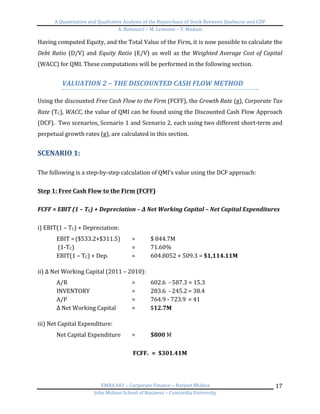
SCENARIO	
  1:	


The	
  following	
  is	
  a	
  step-­‐by-­‐step	
  calculation	
  of	
  QMI’s	
  value	
  using	
  the	
  DCF	
  approach:	


Step	
  1:	
  Free	
  Cash	
  Flow	
  to	
  the	
  Firm	
  (FCFF)	


FCFF	
  =	
  EBIT	
  (1	
  –	
  TC)	
  +	
  Depreciation	
  –	
  Δ	
  Net	
  Working	
  Capital	
  –	
  Net	
  Capital	
  Expenditures	


i)	
  EBIT(1	
  –	
  TC)	
  +	
  Depreciation:	
  
EBIT	
  =	
  ($533.2+$311.5)	
   =	
   $	
  844.7M	
  
	
  (1-­‐TC)	


   =	
   71.60%	
  
EBIT(1	
  –	
  TC)	
  +	
  Dep.	
   	
   =	
   604.8052	
  +	
  509.3	
  =	
  $1,114.11M	


ii)	
  Δ	
  Net	
  Working	
  Capital	
  (2011	
  –	
  2010):	
  
A/R	


   =	
  	
   602.6	
  	
  -­‐	
  587.3	
  =	
  15.3	
  
INVENTORY	
   	
   	
   =	
   283.6	
  	
  -­‐	
  245.2	
  =	
  38.4	
  
A/P	


   =	
   764.9	
  -­‐	
  723.9	
  	
  =	
  41	
  
Δ	
  Net	
  Working	
  Capital	
  	
   =	
  	
   $12.7M	


iii)	
  Net	
  Capital	
  Expenditure:	
   	
  
Net	
  Capital	
  Expenditure	
  	
   =	
   $800	
  M	


FCFF0	
  	
  =	
  	
  $301.41M	


A	
  Quantitative	
  and	
  Qualitative	
  Analysis	
  of	
  the	
  Repurchase	
  of	
  Stock	
  Between	
  Quebecor	
  and	
  CDP	
  
A.	
  Bottausci	
  –	
  M.	
  Lemoine	
  –	
  Y.	
  Madani	


EMBA	
  681	
  –	
  Corporate	
  Finance	
  –	
  Harjeet	
  Bhabra	
  
John	
  Molson	
  School	
  of	
  Business	
  –	
  Concordia	
  University	
  
18	


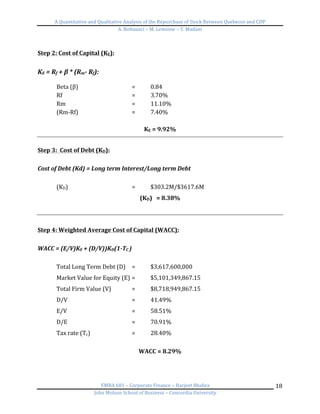
Step	
  2:	
  Cost	
  of	
  Capital	
  (KE):	


KE	
  =	
  Rf	
  +	
  β	
  *	
  (Rm-­‐	
  Rf):	


Beta	
  (β)	
   	
   	
   =	
   0.84	
  
Rf	


   =	
   3.70%	
  
Rm	


   =	
   11.10%	
  
(Rm-­‐Rf)	
   	
   	
   =	
   7.40%	


KE	
  =	
  9.92%	


Step	
  3:	
  	
  Cost	
  of	
  Debt	
  (KD):	


Cost	
  of	
  Debt	
  (Kd)	
  =	
  Long	
  term	
  Interest/Long	
  term	
  Debt	


(KD)	


   =	
   $303.2M/$3617.6M	
  
(KD)	
  	
  	
  =	
  8.38%	


Step	
  4:	
  Weighted	
  Average	
  Cost	
  of	
  Capital	
  (WACC):	


WACC	
  =	
  (E/V)KE	
  +	
  (D/V))KD(1-­‐TC	
  )	


Total	
  Long	
  Term	
  Debt	
  (D)	
   =	
   $3,617,600,000	
  
Market	
  Value	
  for	
  Equity	
  (E)	
  	
  =	
   $5,101,349,867.15	
  
Total	
  Firm	
  Value	
  (V)	
  	
  	
   =	
   $8,718,949,867.15	
  
D/V	


   =	
   41.49%	
  
E/V	


   =	
   58.51%	
  
D/E	


   =	
   70.91%	
  
Tax	
  rate	
  (Tc)	
   	
   	
   =	
   28.40%	


WACC	
  =	
  8.29%	


A	
  Quantitative	
  and	
  Qualitative	
  Analysis	
  of	
  the	
  Repurchase	
  of	
  Stock	
  Between	
  Quebecor	
  and	
  CDP	
  
A.	
  Bottausci	
  –	
  M.	
  Lemoine	
  –	
  Y.	
  Madani	


EMBA	
  681	
  –	
  Corporate	
  Finance	
  –	
  Harjeet	
  Bhabra	
  
John	
  Molson	
  School	
  of	
  Business	
  –	
  Concordia	
  University	
  
19	
  
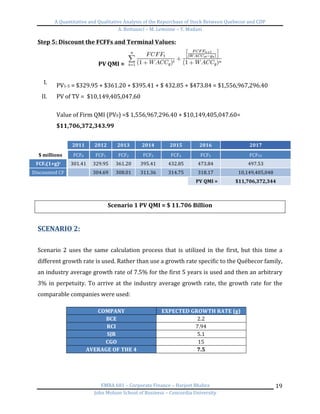
Step	
  5:	
  Discount	
  the	
  FCFFs	
  and	
  Terminal	
  Values:	
  
PV	
  QMI	
  =	


I. PV1-­‐5	
  =	
  $329.95	
  +	
  $361.20	
  +	
  $395.41	
  +	
  $	
  432.85	
  +	
  $473.84	
  =	
  $1,556,967,296.40	
  
II. PV	
  of	
  TV	
  =	
  	
  $10,149,405,047.60	


Value	
  of	
  Firm	
  QMI	
  (PV0)	
  =$	
  1,556,967,296.40	
  +	
  $10,149,405,047.60=	
  
$11,706,372,343.99	


   2011	
   2012	
   2013	
   2014	
   2015	
   2016	
   2017	
  
M$	
  millions	
   FCF0	
   FCF1	
   FCF2	
   FCF3	
   FCF4	
   FCF5	
   FCFTV	
  
FCFt(1+g)t	
   301.41	
   329.95	
   361.20	
   395.41	
   432.85	
   473.84	
   497.53	
  
Discounted	
  CF	


304.69	
   308.01	
   311.36	
   314.75	
   318.17	
   10,149,405,048	


   PV	
  QMI	
  =	
   $11,706,372,344	


Scenario	
  1	
  PV	
  QMI	
  =	
  $	
  11.706	
  Billion	


SCENARIO	
  2:	


Scenario	
   2	
   uses	
   the	
   same	
   calculation	
   process	
   that	
   is	
   utilized	
   in	
   the	
   first,	
   but	
   this	
   time	
   a	
  
different	
  growth	
  rate	
  is	
  used.	
  Rather	
  than	
  use	
  a	
  growth	
  rate	
  specific	
  to	
  the	
  Québecor	
  family,	
  
an	
  industry	
  average	
  growth	
  rate	
  of	
  7.5%	
  for	
  the	
  first	
  5	
  years	
  is	
  used	
  and	
  then	
  an	
  arbitrary	
  
3%	
  in	
  perpetuity.	
  To	
  arrive	
  at	
  the	
  industry	
  average	
  growth	
  rate,	
  the	
  growth	
  rate	
  for	
  the	
  
comparable	
  companies	
  were	
  used:	


COMPANY	
   EXPECTED	
  GROWTH	
  RATE	
  (g)	
  
BCE	
   2.2	
  
RCI	
   7.94	
  
SJR	
   5.1	
  
CGO	
   15	
  
AVERAGE	
  OF	
  THE	
  4	
   7.5	
  
A	
  Quantitative	
  and	
  Qualitative	
  Analysis	
  of	
  the	
  Repurchase	
  of	
  Stock	
  Between	
  Quebecor	
  and	
  CDP	
  
A.	
  Bottausci	
  –	
  M.	
  Lemoine	
  –	
  Y.	
  Madani	


EMBA	
  681	
  –	
  Corporate	
  Finance	
  –	
  Harjeet	
  Bhabra	
  
John	
  Molson	
  School	
  of	
  Business	
  –	
  Concordia	
  University	
  
20	


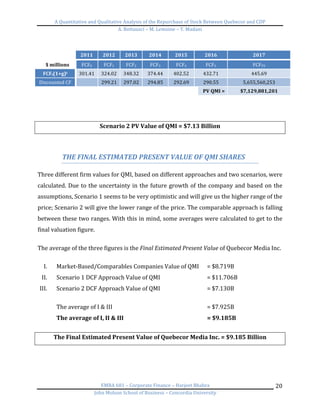
Scenario	
  2	
  PV	
  Value	
  of	
  QMI	
  =	
  $7.13	
  Billion	


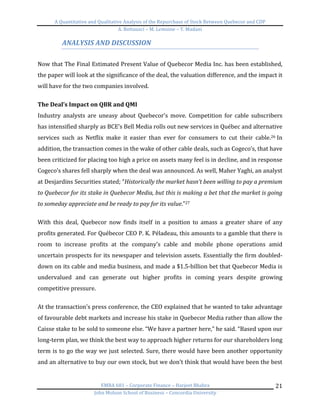
THE	
  FINAL	
  ESTIMATED	
  PRESENT	
  VALUE	
  OF	
  QMI	
  SHARES	


Three	
  different	
  firm	
  values	
  for	
  QMI,	
  based	
  on	
  different	
  approaches	
  and	
  two	
  scenarios,	
  were	
  
calculated.	
  Due	
  to	
  the	
  uncertainty	
  in	
  the	
  future	
  growth	
  of	
  the	
  company	
  and	
  based	
  on	
  the	
  
assumptions,	
  Scenario	
  1	
  seems	
  to	
  be	
  very	
  optimistic	
  and	
  will	
  give	
  us	
  the	
  higher	
  range	
  of	
  the	
  
price;	
  Scenario	
  2	
  will	
  give	
  the	
  lower	
  range	
  of	
  the	
  price.	
  The	
  comparable	
  approach	
  is	
  falling	
  
between	
  these	
  two	
  ranges.	
  With	
  this	
  in	
  mind,	
  some	
  averages	
  were	
  calculated	
  to	
  get	
  to	
  the	
  
final	
  valuation	
  figure.	


The	
  average	
  of	
  the	
  three	
  figures	
  is	
  the	
  Final	
  Estimated	
  Present	
  Value	
  of	
  Quebecor	
  Media	
  Inc.	


I. Market-­‐Based/Comparables	
  Companies	
  Value	
  of	
  QMI	
  	
   =	
  $8.719B	
  
II. Scenario	
  1	
  DCF	
  Approach	
  Value	
  of	
  QMI	


   =	
  $11.706B	
  
III. Scenario	
  2	
  DCF	
  Approach	
  Value	
  of	
  QMI	


   =	
  $7.130B	


The	
  average	
  of	
  I	
  &	
  III	


   =	
  $7.925B	
  
The	
  average	
  of	
  I,	
  II	
  &	
  III	


   =	
  $9.185B	


The	
  Final	
  Estimated	
  Present	
  Value	
  of	
  Quebecor	
  Media	
  Inc.	
  =	
  $9.185	
  Billion	


2	
   2011	
   2012	
   2013	
   2014	
   2015	
   2016	
   2017	
  
M$	
  millions	
   FCF0	
   FCF1	
   FCF2	
   FCF3	
   FCF4	
   FCF5	
   FCFTV	
  
FCFt(1+g)t	
   301.41	
   324.02	
   348.32	
   374.44	
   402.52	
   432.71	
   445.69	
  
Discounted	
  CF	
   	
   299.21	
   297.02	
   294.85	
   292.69	
   290.55	
   5,655,560,253	


   PV	
  QMI	
  =	
   $7,129,881,201	
  
A	
  Quantitative	
  and	
  Qualitative	
  Analysis	
  of	
  the	
  Repurchase	
  of	
  Stock	
  Between	
  Quebecor	
  and	
  CDP	
  
A.	
  Bottausci	
  –	
  M.	
  Lemoine	
  –	
  Y.	
  Madani	


EMBA	
  681	
  –	
  Corporate	
  Finance	
  –	
  Harjeet	
  Bhabra	
  
John	
  Molson	
  School	
  of	
  Business	
  –	
  Concordia	
  University	
  
21	
  
ANALYSIS	
  AND	
  DISCUSSION	


Now	
  that	
  The	
  Final	
  Estimated	
  Present	
  Value	
  of	
  Quebecor	
  Media	
  Inc.	
  has	
  been	
  established,	
  
the	
  paper	
  will	
  look	
  at	
  the	
  significance	
  of	
  the	
  deal,	
  the	
  valuation	
  difference,	
  and	
  the	
  impact	
  it	
  
will	
  have	
  for	
  the	
  two	
  companies	
  involved.	


The	
  Deal’s	
  Impact	
  on	
  QBR	
  and	
  QMI	
  
Industry	
   analysts	
   are	
   uneasy	
   about	
   Quebecor’s	
   move.	
   Competition	
   for	
   cable	
   subscribers	
  
has	
  intensified	
  sharply	
  as	
  BCE’s	
  Bell	
  Media	
  rolls	
  out	
  new	
  services	
  in	
  Québec	
  and	
  alternative	
  
services	
   such	
   as	
   Netflix	
   make	
   it	
   easier	
   than	
   ever	
   for	
   consumers	
   to	
   cut	
   their	
   cable.26	
  In	
  
addition,	
  the	
  transaction	
  comes	
  in	
  the	
  wake	
  of	
  other	
  cable	
  deals,	
  such	
  as	
  Cogeco’s,	
  that	
  have	
  
been	
  criticized	
  for	
  placing	
  too	
  high	
  a	
  price	
  on	
  assets	
  many	
  feel	
  is	
  in	
  decline,	
  and	
  in	
  response	
  
Cogeco’s	
  shares	
  fell	
  sharply	
  when	
  the	
  deal	
  was	
  announced.	
  As	
  well,	
  Maher	
  Yaghi,	
  an	
  analyst	
  
at	
  Desjardins	
  Securities	
  stated;	
  “Historically	
  the	
  market	
  hasn’t	
  been	
  willing	
  to	
  pay	
  a	
  premium	
  
to	
  Quebecor	
  for	
  its	
  stake	
  in	
  Quebecor	
  Media,	
  but	
  this	
  is	
  making	
  a	
  bet	
  that	
  the	
  market	
  is	
  going	
  
to	
  someday	
  appreciate	
  and	
  be	
  ready	
  to	
  pay	
  for	
  its	
  value.”27	


With	
   this	
   deal,	
   Quebecor	
   now	
   finds	
   itself	
   in	
   a	
   position	
   to	
   amass	
   a	
   greater	
   share	
   of	
   any	
  
profits	
  generated.	
  For	
  Québecor	
  CEO	
  P.	
  K.	
  Péladeau,	
  this	
  amounts	
  to	
  a	
  gamble	
  that	
  there	
  is	
  
room	
   to	
   increase	
   profits	
   at	
   the	
   company’s	
   cable	
   and	
   mobile	
   phone	
   operations	
   amid	
  
uncertain	
  prospects	
  for	
  its	
  newspaper	
  and	
  television	
  assets.	
  Essentially	
  the	
  firm	
  doubled-­‐
down	
  on	
  its	
  cable	
  and	
  media	
  business,	
  and	
  made	
  a	
  $1.5-­‐billion	
  bet	
  that	
  Quebecor	
  Media	
  is	
  
undervalued	
   and	
   can	
   generate	
   out	
   higher	
   profits	
   in	
   coming	
   years	
   despite	
   growing	
  
competitive	
  pressure.	


At	
  the	
  transaction’s	
  press	
  conference,	
  the	
  CEO	
  explained	
  that	
  he	
  wanted	
  to	
  take	
  advantage	
  
of	
  favourable	
  debt	
  markets	
  and	
  increase	
  his	
  stake	
  in	
  Quebecor	
  Media	
  rather	
  than	
  allow	
  the	
  
Caisse	
  stake	
  to	
  be	
  sold	
  to	
  someone	
  else.	
  “We	
  have	
  a	
  partner	
  here,”	
  he	
  said.	
  “Based	
  upon	
  our	
  
long-­‐term	
  plan,	
  we	
  think	
  the	
  best	
  way	
  to	
  approach	
  higher	
  returns	
  for	
  our	
  shareholders	
  long	
  
term	
  is	
  to	
  go	
  the	
  way	
  we	
  just	
  selected.	
  Sure,	
  there	
  would	
  have	
  been	
  another	
  opportunity	
  
and	
  an	
  alternative	
  to	
  buy	
  our	
  own	
  stock,	
  but	
  we	
  don’t	
  think	
  that	
  would	
  have	
  been	
  the	
  best	
  
A	
  Quantitative	
  and	
  Qualitative	
  Analysis	
  of	
  the	
  Repurchase	
  of	
  Stock	
  Between	
  Quebecor	
  and	
  CDP	
  
A.	
  Bottausci	
  –	
  M.	
  Lemoine	
  –	
  Y.	
  Madani	


EMBA	
  681	
  –	
  Corporate	
  Finance	
  –	
  Harjeet	
  Bhabra	
  
John	
  Molson	
  School	
  of	
  Business	
  –	
  Concordia	
  University	
  
22	
  
result.”28	
  In	
  addition,	
  the	
  company’s	
  CFO,	
  Jean-­‐François	
  Pruneau,	
  said	
  that	
  QBR	
  is	
  paying	
  a	
  
good	
  price	
  for	
  solid	
  assets.	
  “Considering	
  the	
  expected	
  financial	
  performance	
  of	
  Québecor	
  
we	
  believe	
  that	
  the	
  price	
  paid	
  is	
  fair.”	


The	
  deal	
  is	
  more	
  than	
  fair	
  for	
  Québecor	
  and	
  as	
  it	
  can	
  be	
  considered	
  a	
  bargain.	
  Yes,	
  there	
  is	
  
some	
   risk,	
   but	
   it’s	
   a	
   good	
   one.	
   First	
   off,	
   as	
   discussed	
   earlier,	
   the	
   transaction	
   was	
  
undervalued.	
  The	
  following	
  table	
  shows	
  that	
  when	
  one	
  compares	
  our	
  valuation	
  of	
  the	
  deal	
  
to	
  the	
  actual	
  transaction,	
  Québecor	
  made	
  a	
  $401	
  million	
  gain:	


While	
   the	
   analyst’s	
   outlook	
   of	
   the	
   deal	
   may	
   not	
   be	
   favourable,	
   the	
   3	
   industries	
   the	
  QMI	
  
competes	
  in	
  will	
  continue	
  to	
  grow,	
  and	
  the	
  firm	
  will	
  certainly	
  follow	
  and	
  take	
  advantage	
  of	
  
this.	
   As	
   well,	
   the	
   increase	
   controlling	
   will	
   allow	
   Québecor	
   and	
   Québecor	
   Media	
   to	
   have	
  
more	
  decisional	
  power	
  in	
  its	
  day-­‐to-­‐day	
  operations	
  and	
  will	
  give	
  it	
  more	
  flexibility	
  in	
  its	
  
ability	
  to	
  manipulated	
  its	
  capital	
  structure,	
  and	
  in	
  turn	
  be	
  more	
  competitive.	


The	
  Deal’s	
  Impact	
  on	
  the	
  CDP	
  
Quebec’s	
  big	
  pension	
  plan	
  manager	
  is	
  bailing	
  on	
  a	
  chunk	
  of	
  one	
  of	
  its	
  most	
  contentious	
  and	
  
politically	
  driven	
  deals	
  of	
  the	
  past	
  few	
  decades,	
  which	
  is	
  a	
  reminder	
  that	
  it	
  puts	
  provincial	
  
social	
  and	
  economic	
  development	
  before	
  profits.	
  The	
  transaction	
  will	
  see	
  the	
  CDP	
  sharply	
  
reduce	
  its	
  stake	
  after	
  more	
  than	
  a	
  decade	
  of	
  weak	
  returns.	
  “The	
  total	
  value	
  is	
  $1.5-­‐billion,	
  
and	
  for	
  the	
  Caisse,	
  the	
  return	
  is	
  unimpressive”	
  said	
  one	
  analyst.29	


So	
  far	
  the	
  partnership	
  has	
  given	
  the	
  CDP	
  an	
  annual	
  return	
  of	
  0.74%.	
  This	
  ROI	
  cannot	
  be	
  
considered	
  satisfactory.	
  The	
  CDP	
  could	
  have	
  invested	
  in	
  low	
  or	
  risk-­‐free	
  investments	
  and	
  
that	
   would	
   have	
   made	
   for	
   a	
   better	
   investment.	
   At	
   this	
   time,	
   the	
   convertible	
   debentures	
  
	
   VALUE	
  OF	
  THE	
  FIRM	
   VALUE	
  OF	
  QMI	
  DEAL	
  
VALUATION	
  FIGURE	
   $9,185,067,804	
   $1,901,295,000	
  
ACTUAL	
  DEAL	
   $7,246,	
  376,811	
   $1,500,000,000	
  
	
   DIFFERENCE	
  +/-­‐	
  :	
  	
   +$401,309,035	
  
A	
  Quantitative	
  and	
  Qualitative	
  Analysis	
  of	
  the	
  Repurchase	
  of	
  Stock	
  Between	
  Quebecor	
  and	
  CDP	
  
A.	
  Bottausci	
  –	
  M.	
  Lemoine	
  –	
  Y.	
  Madani	


EMBA	
  681	
  –	
  Corporate	
  Finance	
  –	
  Harjeet	
  Bhabra	
  
John	
  Molson	
  School	
  of	
  Business	
  –	
  Concordia	
  University	
  
23	
  
received	
  in	
  the	
  current	
  deal,	
  with	
  a	
  4.125%	
  return	
  rate,	
  is	
  a	
  better	
  investment	
  option	
  for	
  
the	
  CDP.	


Moreover,	
  the	
  unsecured	
  convertible	
  debentures	
  it	
  received	
  that	
  will	
  mature	
  in	
  2018	
  into	
  
Québecor	
   Class	
   B	
   Subordinate	
   shares	
   and	
   will	
   make	
   for	
   an	
   interesting	
   future.	
   Six	
   years	
  
from	
  now	
  the	
  company	
  will	
  come	
  at	
  a	
  crossroad	
  may	
  force	
  QMI	
  go	
  public.	
  Only	
  time,	
  and	
  its	
  
return	
   on	
   investment,	
   will	
   tell	
   if	
   the	
   CDP	
   will	
   want	
   to	
   fully	
   detach	
   itself	
   from	
   this	
  
partnership.	


In	
  the	
  end,	
  while	
  the	
  deal	
  may	
  not	
  have	
  been	
  a	
  huge	
  financial	
  success,	
  it	
  can	
  be	
  said	
  that	
  the	
  
CDP	
   fulfilled	
   its	
   main	
   as	
   it	
   helped	
   keep	
   a	
   large	
   and	
   influential	
   Québécois	
   company	
   in	
  
Québec	
  and	
  in	
  Québécois	
  hands.	


CONCLUSION	


At	
  this	
  point,	
  it	
  is	
  cleat	
  that	
  the	
  transaction	
  is	
  fair	
  for	
  both	
  parties,	
  but	
  from	
  our	
  valuation	
  it	
  
was	
  undervalued.	
  Québecor	
  got	
  a	
  ‘deal’	
  and	
  will	
  allow	
  it	
  to	
  be	
  more	
  autonomous	
  regarding	
  
business	
  strategies,	
  investments,	
  and	
  capital	
  structure.	
  The	
  competition	
  may	
  be	
  tightening	
  
up	
   within	
   Québecor	
   Media’s	
   three	
   industries	
   may,	
   but	
   they	
   and	
   their	
   revenues	
   are	
   still	
  
growing	
  and	
  will	
  certainly	
  continue	
  to	
  rise.	
  In	
  other	
  words,	
  this	
  is	
  a	
  great	
  deal	
  for	
  the	
  long-­‐
term	
   growth.	
   In	
   addition,	
   Pierre	
   Karl	
   Péladeau,	
   the	
   majority	
   owner	
   and	
   CEO,	
   has	
   the	
  
opportunity	
  make	
  significant	
  gains	
  in	
  the	
  future.	


On	
  the	
  other	
  hand,	
  the	
  CDP	
  CDP	
  has	
  successfully	
  fulfilled	
  its	
  political	
  and	
  social	
  mandate	
  
and	
  has	
  reduced	
  it	
  stake	
  in	
  am	
  investment	
  that	
  that	
  was	
  not	
  producing	
  a	
  suitable	
  enough	
  
ROI,	
  and	
  now	
  has	
  a	
  better	
  investment	
  with	
  the	
  unsecured	
  convertible	
  debentures.	


A	
  Quantitative	
  and	
  Qualitative	
  Analysis	
  of	
  the	
  Repurchase	
  of	
  Stock	
  Between	
  Quebecor	
  and	
  CDP	
  
A.	
  Bottausci	
  –	
  M.	
  Lemoine	
  –	
  Y.	
  Madani	


EMBA	
  681	
  –	
  Corporate	
  Finance	
  –	
  Harjeet	
  Bhabra	
  
John	
  Molson	
  School	
  of	
  Business	
  –	
  Concordia	
  University	
  
24	
  
APPENDIX	
  1	


Québecor	
  Inc.	
  &	
  Quebecor	
  Media	
  Inc.	
  
CEO,	
  President	
  and	
  Majority	
  Shareholder	
  
Pierre	
  Karl	
  Péladeau	
  
A	
  Quantitative	
  and	
  Qualitative	
  Analysis	
  of	
  the	
  Repurchase	
  of	
  Stock	
  Between	
  Quebecor	
  and	
  CDP	
  
A.	
  Bottausci	
  –	
  M.	
  Lemoine	
  –	
  Y.	
  Madani	


EMBA	
  681	
  –	
  Corporate	
  Finance	
  –	
  Harjeet	
  Bhabra	
  
John	
  Molson	
  School	
  of	
  Business	
  –	
  Concordia	
  University	
  
25	
  
APPENDIX	
  2	


A	
  Quantitative	
  and	
  Qualitative	
  Analysis	
  of	
  the	
  Repurchase	
  of	
  Stock	
  Between	
  Quebecor	
  and	
  CDP	
  
A.	
  Bottausci	
  –	
  M.	
  Lemoine	
  –	
  Y.	
  Madani	


EMBA	
  681	
  –	
  Corporate	
  Finance	
  –	
  Harjeet	
  Bhabra	
  
John	
  Molson	
  School	
  of	
  Business	
  –	
  Concordia	
  University	
  
26	


APPENDIX	
  3	


Comparable	
  Companies’	
  Selected	
  Financial	
  Data	


Balance	
  Sheet
Total	
  Assets 39,426,000,000.00	
  	
   18,362,000,000.00	
  	
   12,722,000,000.00	
  	
   3,104,000,000.00	
  	
  
Total	
  Liabilities 24,667,000,000.00	
  	
   14,790,000,000.00	
  	
   8,687,000,000.00	


   3,104,000,000.00	
  	
  
Total	
  Equity 14,759,000,000.00	
  	
   3,572,000,000.00	


   4,035,000,000.00	


Long	
  Term	
  Debt	
  gross 13,556,000,000.00	
  	
   10,034,000,000.00	
  	
   5,263,000,000.00	


   1,144,814,000.00	
  	
  
Common	
  Equity	
  (Outstanding) 774,557,247.00	


   402,785,156.00	


   421,715,646.00	


   14,989,338.00	


Income	
  Statement
Revenue 19,497,000,000.00	
  	
   12,428,000,000.00	
  	
   4,998,000,000.00	


   1,406,000,000.00	
  	
  
Net	
  Income	
  to	
  equity	
  Holders 2,340,000,000.00	


   1,563,000,000.00	


   728,000,000.00	


   77,000,000.00	


EPS	
  -­‐	
  Net	
  Income	
  -­‐	
  Diluted 2.88	


   2.86	


   1.61	


   4.61	


EBITD 7,220,000,000.00	


   9,269,000,000.00	


   1,204,000,000.00	


   607,000,000.00	


Ratios
Beta 0.35	


   0.48	


   0.29	


   0.72	


Average	
  (all	
  four	
  companies) 0.46	


Parent	
  Company	
  Beta 0.84	


A	
  Quantitative	
  and	
  Qualitative	
  Analysis	
  of	
  the	
  Repurchase	
  of	
  Stock	
  Between	
  Quebecor	
  and	
  CDP	
  
A.	
  Bottausci	
  –	
  M.	
  Lemoine	
  –	
  Y.	
  Madani	


EMBA	
  681	
  –	
  Corporate	
  Finance	
  –	
  Harjeet	
  Bhabra	
  
John	
  Molson	
  School	
  of	
  Business	
  –	
  Concordia	
  University	
  
27	
  
REFERENCES	


1	
  National	
  Post,	
  Quebecor	
  buys	
  back	
  shares	
  from	
  caisee	
  ;	
  $1.5B	
  Deal,	
  October	
  4,	
  2012.	
  
2	
  Informart	
  –	
  Historical	
  Reports,	
  Quebecor	
  Inc.,	
  Postemedia	
  Network,	
  2012.	
  	
  
3	
  Wikipedia,	
  The	
  Caisse	
  de	
  dépôt	
  et	
  placement	
  du	
  Québec,	
  
http://en.wikipedia.org/wiki/Caisse_de_d%C3%A9p%C3%B4t_et_placement_du_Qu%C3%A9bec	
  [Accessed,	
  November	
  
24,	
  2012].	
  
4	
  Globe	
  &	
  Mail,	
  Quebec’s	
  Caisse	
  to	
  help	
  block	
  takeovers:	
  Pauline	
  Marois	
  http://m.theglobeandmail.com/report-­‐on-­‐
business/quebecs-­‐caisse-­‐to-­‐help-­‐block-­‐takeovers-­‐pauline-­‐marois/article4555375/?service=mobile,	
  [Accessed,	
  
November	
  30,	
  2012].	
  
5	
  The	
  Caisse	
  de	
  dépôt	
  et	
  placement	
  du	
  Québec,	
  Profile	
  of	
  the	
  Caisse,	
  http://www.lacaisse.com/en/about-­‐us/profile,	
  
[Accessed	
  November	
  24,	
  2012].	
  
6	
  Wikipedia,	
  The	
  Caisse	
  de	
  dépôt	
  et	
  placement	
  du	
  Québec,	
  
http://en.wikipedia.org/wiki/Caisse_de_d%C3%A9p%C3%B4t_et_placement_du_Qu%C3%A9bec	
  [Accessed,	
  November	
  
24,	
  2012].	
  
7	
  http://www.lacaisse.com/en/about-­‐us/profile.	
  
8	
  Wikipedia,	
  Bell	
  Canada,	
  http://en.wikipedia.org/wiki/Bell_Canada	
  [Accessed	
  Nov	
  25,	
  2012].	
  
9	
  Wikipedia,	
  Rogers,	
  http://en.wikipedia.org/wiki/Rogers_Communications,	
  [Accessed	
  November	
  26,	
  2012].	
  
10	
  Wikipedia,	
  Shaw	
  Communications,	
  http://en.wikipedia.org/wiki/Shaw_Communications,	
  [Accessed	
  November	
  26,	
  
2012].	
  
11	
  Ladurantaye	
  ,	
  S.	
  ,	
  Quebecor	
  pays	
  up	
  for	
  media	
  stake,	
  Globe	
  &	
  Mail,	
  	
  http://m.theglobeandmail.com/globe-­‐
investor/quebecor-­‐pays-­‐up-­‐for-­‐media-­‐stake/article4584575/?service=mobile,	
  globe	
  &	
  mail,	
  [acessed	
  november	
  30,	
  
2012]	
  
12	
  National	
  Post,	
  Quebecor	
  buys	
  back	
  shares	
  from	
  caisee	
  ;	
  $1.5B	
  Deal,	
  October	
  4,	
  2012.	
  
13	
  Quebecor,	
  Information	
  Document,	
  October	
  3,	
  2012.	
  
14	
  The	
  Caisse	
  de	
  dépôt	
  et	
  placement	
  du	
  Québec,	
  Press	
  Release,	
  October	
  3,	
  2012.	
  	
  
15	
  National	
  Post,	
  Quebecor	
  buys	
  back	
  shares	
  from	
  caisee	
  ;	
  $1.5B	
  Deal,	
  October	
  4,	
  2012.	
  
16	
  National	
  Post,	
  Quebecor	
  buys	
  back	
  shares	
  from	
  caisee	
  ;	
  $1.5B	
  Deal,	
  October	
  4,	
  2012.	
  
17Investopedia,	
  Valuing	
  Private	
  Companies,	
  http://www.investopedia.com/articles/fundamental-­‐analysis/11/valuing-­‐
private-­‐companies.asp,	
  [Accessed	
  November	
  27,	
  2012]	
  	
  
18Invesopedia,	
  	
  Discounted	
  Cash	
  Flow	
  –	
  DCF,	
  http://www.investopedia.com/terms/d/dcf.asp,	
  [Accessed	
  November	
  27,	
  
2012]	
  
19	
  Quebecor	
  Media	
  Inc.	
  ,	
  Financial	
  Statements,	
  http://www.quebecor.com/sites/default/files/Final-­‐
avec%20annexes.PDF/,	
  [Accessed	
  November	
  22,	
  2012].	
  
20	
  http://www.reuters.com/finance/stocks/financialHighlights?symbol=QBCAF.PK,	
  [Accessed	
  November	
  22,	
  2012].	
  
21	
  Ross,	
   Westerfield,	
   Jaffe	
   and	
   Roberts,	
   Corporate	
   Finance:	
   6th
	
  
Canadian	
   Edition	
   2011,	
   pg.	
   276,	
   McGraw-­‐Hill	
   Ryerson	
  
Publishers,	
  2011.	
  	
  
22	
  http://www.bankofcanada.ca/rates/interest-­‐rates/lookup-­‐bond-­‐yields/,	
  [Accessed	
  November	
  29,	
  2012].	
  
23	
  http://www.quebecor.com/en/content/communications-­‐giant/,	
  [Accessed	
  November	
  22,	
  2012].	
  
24	
  Quebecor	
  Inc.,	
  Quebecor	
  Inc,	
  Annual	
  Documentation	
  Quebecor	
  Inc.,	
  Annual	
  Documentation	
  2011,	
  
http://www.quebecor.com/en/annual_doc_quebecor_inc,	
  [Accessed,	
  November	
  25,	
  2012]	
  
25	
  http://www.quebecor.com/sites/default/files/Final-­‐avec%20annexes.PDF/,	
  [Accessed	
  November	
  22,	
  2012].	
  
26	
  Ladurantaye	
  ,	
  S.	
  ,	
  Quebecor	
  pays	
  up	
  for	
  media	
  stake,	
  Globe	
  &	
  Mail,	
  	
  http://m.theglobeandmail.com/globe-­‐
investor/quebecor-­‐pays-­‐up-­‐for-­‐media-­‐stake/article4584575/?service=mobile,	
  globe	
  &	
  mail,	
  [acessed	
  november	
  30,	
  
2012]	
  
27	
  Ladurantaye	
  ,	
  S.	
  ,	
  Quebecor	
  pays	
  up	
  for	
  media	
  stake,	
  Globe	
  &	
  Mail,	
  	
  http://m.theglobeandmail.com/globe-­‐
investor/quebecor-­‐pays-­‐up-­‐for-­‐media-­‐stake/article4584575/?service=mobile,	
  globe	
  &	
  mail,	
  [acessed	
  november	
  30,	
  
2012]	
  
28	
  Ladurantaye	
  ,	
  S.	
  ,	
  Quebecor	
  pays	
  up	
  for	
  media	
  stake,	
  Globe	
  &	
  Mail,	
  	
  http://m.theglobeandmail.com/globe-­‐
investor/quebecor-­‐pays-­‐up-­‐for-­‐media-­‐stake/article4584575/?service=mobile,	
  globe	
  &	
  mail,	
  [acessed	
  november	
  30,	
  
2012]	
  
29	
  Boyd,	
  E.,	
  	
  	
  Caisse	
  forced	
  to	
  bail	
  on	
  weak	
  Quebecor	
  investment.	
  Globe	
  &	
  Mail,	
  http://m.theglobeandmail.com/globe-­‐
investor/quebecor-­‐pays-­‐up-­‐for-­‐media-­‐
stake/article4584575/?service=mobile&contentRedirect=true&articleId=4584976	
  [Accessed	
  November	
  30,	
  2012].	
  

A Quantitative Analysis of the Repurchase of Stock between Quebecor and the Caisse de depot et de placement du Quebec

  • 1.
        A  QUANTITATIVE  AND  QUALITATIVE  ANALYSIS   OF  THE  REPURCHASE  OF  STOCK   BETWEEN       AND           ALEX  BOTTAUSCI  •  MARK  LEMOINE  •  YOUSEF  MADANI   JOHN  MOLSON  SCHOOL  OF  BUSINESS   CONCORDIA  UNIVERSITY     EMBA  681   CORPORATE  FINANCE   DR.  HARJEET  BHABRA     DECEMBER  1ST,  2012    
  • 2.
    A  Quantitative  and  Qualitative  Analysis  of  the  Repurchase  of  Stock  Between  Quebecor  and  CDP   A.  Bottausci  –  M.  Lemoine  –  Y.  Madani     EMBA  681  –  Corporate  Finance  –  Harjeet  Bhabra   John  Molson  School  of  Business  –  Concordia  University   2   TABLE  OF  CONTENTS     INTRODUCTION                   3     COMPANY  PROFILES                 3     Québecor  Inc.     Caisse  de  dépôt  et  de  placement  du  Québec   Quebecor  Media  Inc.     THE  CABLE,  TELECOMMUNICATIONS  &  MEDIA  INDUSTRIES       6       The  Cable  Industry       The  Telecommunications  Industry       The  Media  Industry           THE  COMPARABLE  COMPANIES               9   Bell  Canada  Enterprises  Inc.       Rogers  Communications  Inc.       Shaw  Communications  Inc.       Cogeco  Inc.       THE  TRANSACTION                 11   2000     2012       VALUATION  OF  QMI’S  SHARES               13   Two  Valuation  Methods   Statements  and  Assumptions     VALUATION  1:  MARKET-­‐BASED  COMPARABLES  COMPANIES  APPROACH     15       Step  1:  Equity       Step  2:  Debt       Step  3:  The  Total  Value  of  the  Firm           VALUATION  2:  THE  DISCOUNTED  CASH  FLOW  APPROACH         17     SCENARIO  1     Step  1:  Free  Cash  Flow  to  the  Firm  (FCFF)     Step  2:  Cost  of  Capital  (KD)     Step  3:  Cost  of  Debt  (KE)     Step  4:  Weighted  Average  Cost  of  Capital  (WACC)     Step  5:  Discount  the  FCFFs  and  Terminal  Values   SCENARIO  2     THE  FINAL  ESTIMATED  PRESENT  VALUE  OF  QMI  SHARES         20       ANALYSIS  AND  DISCUSSION               20     The  Deal’s  Impact  of  QBR  and  QMI     The  Deal’s  Impact  on  CDP     CONCLUSION                   23     APPENDIX  1                   24     APPENDIX  2                   25     APPENDIX  3                   26       REFERENCES                   27  
  • 3.
    A  Quantitative  and  Qualitative  Analysis  of  the  Repurchase  of  Stock  Between  Quebecor  and  CDP   A.  Bottausci  –  M.  Lemoine  –  Y.  Madani     EMBA  681  –  Corporate  Finance  –  Harjeet  Bhabra   John  Molson  School  of  Business  –  Concordia  University   3   INTRODUCTION     On  October  3rd  of  this  year,  Québecor  Inc.  and  the  Caisse  de  dépôt  et  placement  du  Québec   (CDP)  reached  an  agreement  on  the  partial  sale  of  the  CDP’s  interest  in  Quebecor  Media  Inc.   (QMI).  Québecor  will  purchase  a  total  of  30.5  million  shares  valued  at  $1.5  billion.       The  purpose  of  this  study  is  to  analyze  the  quantitative  and  qualitative  aspects  of  the  CDP’s   reduction   in   ownership   of   QMI,   including   the   motives   and   non-­‐financial   considerations   behind  the  deal.  In  addition,  this  paper  will  seek  to  determine  if  fair  value  was  realized  and   validate  or  disprove  the  National  Post’s  analysts’  claim  that  this  “pegs  the  Value  of  QMI  at   about  $6-­‐billion,  representing  a  20%  premium”.1     COMPANY  PROFILES     Québecor  Inc.     Québecor  Inc.  (TSX:  QBR)  was  founded  by  Pierre  Péladeau  in  1950,  in  Montréal,  Québec   with   a   small   neighbourhood   newspaper.   Mr.   Péladeau   went   on   to   build   a   vast   communications  empire  offering  cutting-­‐edge  technology  and  constantly  evolving  business   solutions.  Today,  Québecor  has  a  fast-­‐expanding  national  presence  but  remains  profoundly   attached  to  its  roots,  hence  one  of  the  main  motives  behind  the  initial  transaction.  A  new   generation  of  managers  is  drawing  on  the  company's  traditions  to  sustain  and  nourish  its   growth  into  the  future.  For  2011,  Québecor  reported  revenues  of  $4.3  Billions  and  a  net   income  of  $374  Millions.     Pierre  Karl  Péladeau  is  the  current  President  and  Chief  Executive  Officer  and  is  also  the   firm’s   majority   shareholder,   possessing   72.16%   interest   in   the   company   (Appendix   1).  2   The   Chief   Financial   Officer   (CFO)   is   Jean-­‐François   Pruneau.   The   current   members   of   the  board  of  directors  of  Québecor  Inc.  are;     • Françoise  Bertrand,     Chairwoman  of  the  BOD   • Rt.  Hon.  Brian  Mulroney   Vice-­‐Chairman  of  the  BOD   • Pierre  Karl  Péladeau   • Jean  La  Couture   • Sylvie  Lalande   • Pierre  Laurin   • Geneviève  Marcon   • Pierre  Parent  
  • 4.
    A  Quantitative  and  Qualitative  Analysis  of  the  Repurchase  of  Stock  Between  Quebecor  and  CDP   A.  Bottausci  –  M.  Lemoine  –  Y.  Madani     EMBA  681  –  Corporate  Finance  –  Harjeet  Bhabra   John  Molson  School  of  Business  –  Concordia  University   4   In  2000,  Québecor  Inc.  opened  a  new  chapter  in  its  development  with  the  acquisition  of  the   Groupe   Vidéotron   Ltée.,   the   largest   cable   operator   in   Québec.   Along   with   Vidéotron,   Québecor  picked  up  its  subsidiaries  Netgraphe,  an  important  Web  content  developer  and   operator   of   numerous   Web   properties,   and   TVA   Group,   owner   of   the   TVA   broadcasting   network  and  of  magazine  publisher  TVA  Publishing.     To  carry  out  this  major  acquisition,  Québecor  formed  a  partnership  with  a  major  financial   backer,  the  Caisse  de  dépôt  et  placement  du  Québec,  and  together  created  a  new  subsidiary,   Quebecor  Media  Inc.  Today,  the  bulk  of  Quebecor  Media’s  profit,  and  in  turn  Québecor’s   comes  from  Vidéotron.       Caisse  de  dépôt  et  de  placement  du  Québec   The  Caisse  de  dépôt  et  placement  du  Québec  (CDP)  was  founded  in  1965  by  an  act  of  the   National  Assembly  and  it  manages  institutional  funds,  primarily  from  public  and  private   pension  and  insurance  funds  in  Québec,  including  the  Régie  des  rentes  du  Québec  and  the   Commission  administrative  des  regimes  de  retraite  et  d’assurances,   amongst   dozen   others.   The  CDP  is  headquartered  in  Québec  City  but  has  its  major  business  office  in  Montréal.       The  CDP  has  traditionally  favoured  Québec  businesses.  The  CDP’s  mandate,  as  defined  by   legislation  passed  in  2003,  is  to  “achieve  an  optimal  return  on  the  deposits  of  its  clients,  or   depositors,   while   contributing   to  Québec's   economic   development”3.   This   concept   was   further   pressed   just   weeks   before   the   QBR   and   CDP   transaction.   After   winning   the   provincial   elections   in   early   September   2012,   new   Québec   Premier   Pauline   Marois,   who   fought  off  the  recent  U.S.  takeover  bid  for  Québécois  home-­‐improvement  chain  Rona  Inc.,   said   that   the   role   of   Quebec’s   pension   fund   should   be   strengthened   to   keep   corporate   headquarters   in   Québécois   hands.4  Nicolas   Marceau,   Québec’s   Finance   Minister,   also   proposed   additional   revisions   to   the   CDP’s   mandate   so   that   it   would   further   promote   economic  development  and  work  to  “keep  the  strategic  decision-­‐making  centers  here.”     The  CDP’S  large  holdings  make  it  a  formidable  player  in  investment  markets.  Today  it  is  the   leading  private  equity  investor  in  Canada  and  it  is  also  one  of  the  10  largest  real  estate   asset   managers   in   the   world.5  It   is   the   second   largest   pension   fund   in   Canada,   with   the  
  • 5.
    A  Quantitative  and  Qualitative  Analysis  of  the  Repurchase  of  Stock  Between  Quebecor  and  CDP   A.  Bottausci  –  M.  Lemoine  –  Y.  Madani     EMBA  681  –  Corporate  Finance  –  Harjeet  Bhabra   John  Molson  School  of  Business  –  Concordia  University   5   Canada  Pension  Plan  (CPP)  in  first  place.6  In  addition,  the  CDP’s  financial  soundness  has   earned   it   the   best   credit   ratings   issued   by   the   following   credit   rating   agencies:   Moody's   Investors  Service,  Standard  and  Poor's,  and  Dominion  Bond  Rating  Service.7  As  of  February   2012,  the  CDP’s  total  assets  under  management  amount  to  $159  billion.     The  CDP’s  President  and  CEO  is  Michael  Sabia,  the  Vice-­‐President  and  Chief  Risk  officer  is   Claude  Bergeron,  and  the  CFO  is  Maarika  Paul.  The  current  Board  of  Directors  of  the  CDP   are:   § Robert  Tessier   Chair  of  the  board   § Michael  Sabia   § Elisabetta  Bigsby   § Luise  Charette   § Jocelyne  Dagenias   § Michèle   Desjardins   § Pierre  Fitzgibbon   § Denys  Jean   § A.  Michel  Lavigne   § Jean  Pierre  Ouellet   § Réal  Raymond   § François  R.  Roy   § Ouma  Sananikone     Quebecor  Media  Inc.   Quebecor  Media  Inc.,  a  fully  integrated  media  and  telecom  company,  was  founded  in  2000   and   is   headquartered   in   Montréal,   Québec.   It   is   a   subsidiary   of   Québecor   Inc.   and   it   operates  mostly  in  the  province  of  Québec  but  is  also  present  in  the  rest  of  country.  QMI   possesses  several  divisions  and  they  include;  Vidéotron,  a  cable,  VoIP,  and  internet  service   provider,  Sun  Media  and  Canoë,  the  largest  newspaper  publisher  in  Canada,  TVA,  the  largest   French  language  broadcaster  and  publisher  in  North  America,  and  Archambault,  a  music   and  book  retailer.  QMI’s  2009  revenues  totalled  $3.7  billion,  while  its  EBITDA  stood  at  $1.2   billion.       Pierre   Karl   Péladeau   is   the   President   and   CEO,   and   the   CFO   is   Jean-­‐François   Trudeau.   Current  members  of  the  board  of  directors  of  Québecor  Media  Inc.  are;   § Serge  Gouin   Chairman  of  the  BOD   § Pierre  Karl  Péladeau   § André  Delisle   § Jean  La  Couture   § Rt.  Hon.  Brian  Mulroney,   § Samuel  Minzberg   § Normand  Provost            
  • 6.
    A  Quantitative  and  Qualitative  Analysis  of  the  Repurchase  of  Stock  Between  Quebecor  and  CDP   A.  Bottausci  –  M.  Lemoine  –  Y.  Madani     EMBA  681  –  Corporate  Finance  –  Harjeet  Bhabra   John  Molson  School  of  Business  –  Concordia  University   6   THE  CABLE,  TELECOMMUNICATIONS  &  MEDIA  INDUSTRIES     Canadian  cable,  telecommunications  and  media  businesses  operate  in  highly  competitive   industries  that  are  experiencing  relentless  rapid  technological  developments  and  in  turn   necessitate  large  capital  investments  by  the  firms.    The  following  provides  the  reader  some   insight  into  these  industries  that  are  very  much  linked  and  dependent  on  each  other.       The  Cable  Industry   Cable   television   has   been   available   in   Canada   for   more   than   50   years   and   it   is   a   well-­‐ developed   market.   As   2010,   there   were   approximately   8.3   million   cable   television   customers  in  Canada.  The  total  industry  revenue  for  2012  was  estimated  to  be  over  $10.1   billion.   These   revenues   are   expected   to   grow   based   on   the   fact   that   Canadian   cable   operators   have   aggressively   upgraded   their   networks   and   have   begun   launching   and   deploying   new   products   and   services,   such   as   cable   Internet   access,   digital   television   services  and  telephony  services.  The  following  table  summarizes  the  most  recent  available   industry  revenue  statistics  for  the  Canadian  and  American  cable  television  industries  and   the  Compounded  Annual  Growth  Rate.       CANADIAN  &  US  CABLE  INDUSTRIES   2010   2009   2008   2007   2006   CAGR   REVENUE  (BILLIONS)   $10.10   $9.20   $8.20   $7.10   $6.10   13.5%       The  Telecommunications  Industry     The  details  found  in  this  segment  description  have  been  largely  taken  from  Mergent’s  North   American  Telecommunications  Sectors  May  2012  industry  review.       The  Canadian  telecoms  industry  is  one  of  the  most  developed  mobile  markets  in  the  world,   with  Canadian  consumers  continuing  to  adopt  wireless  services  at  a  healthy  pace.  This  has   resulted  in  carriers  offering  coverage  to  more  than  99%  of  Canadians.  Overall,  the  wireless   communications  sector  plays  an  important  role  in  the  telecoms  industry,  generating  a  total   economic   value   of   about   $41   billion.   The   Canadian   Wireless   Telecommunications   Association  (CWTA)  estimates  wireless  phone  customers  in  Canada  numbered  25.1  million  
  • 7.
    A  Quantitative  and  Qualitative  Analysis  of  the  Repurchase  of  Stock  Between  Quebecor  and  CDP   A.  Bottausci  –  M.  Lemoine  –  Y.  Madani     EMBA  681  –  Corporate  Finance  –  Harjeet  Bhabra   John  Molson  School  of  Business  –  Concordia  University   7   at  the  end  of  June  2011,  or  about  75%  of  the  population,  with  wireless  service  providers   reporting  a  net  addition  of  314,456  new  subscribers.     The  majority  of  Canada’s  telecom  companies  recorded  increases  in  revenues  over  the  first   half   of   2012.   Mobile   advertising   revenues   are   growing   throughout   Canada,   with   mobile   search  advertising  generating  most  of  the  revenue.  The  Interactive  Advertising  Bureau  of   Canada   announced   in   the   spring   of   2012   that   mobile   advertising   revenue   jumped   from   C$22.8  million  in  2009  to  C$46.6  million  in  2010.  It  has  now  been  forecasted  that  revenues   will  rise  by  nearly  110%  in  2012,  climbing  to  an  estimated  C$98  million.  The  share  price   over  the  six  months  ended  April  2012,  overall  Canadian  telecom  share  prices  rose  by  an   average  6.48%,  up  from  the  April  to  October  2011  period,  when  share  prices  declined  by   6.59%.       The  outlook  for  the  telecommunications  sector  is  relatively  positive,  but  not  strong,  with   intense  competition  between  both  big  and  small  players  in  the  industry  reflected  in  price   growth   over   the   past   six   months.   Over   the   past   year,   there   were   constant   new   product   launches  including  new  smartphones  and  digital  TV  products,  resulting  in  the  higher  use  of   wireless  services.  As  the  rate  of  adoption  for  smartphones  and  tablets  continues  to  climb,   spending  on  wireless  data  is  expected  to  more  than  double  in  the  next  year.       The  Media  Industry     The  details  found  in  this  segment  description  have  largely  been  taken  from  Mergent’s  North   American  Media  Sectors  August  2012  industry  review.       Despite   being   dwarfed   by   the   American   media   industry,   the   Canadian   media   industry   is   large  by  international  standards.  It  plays  a  crucial  role  in  Canada’s  economy  and  in  public   communication,  covering  an  area  of  9,984,670  square  kilometers  with  a  population  of  34.3   million   divided   almost   equally   among   rural,   suburban   and   urban   areas.   Canadian   media   content  is  popular  globally  in  certain  markets,  although  not  on  the  same  scale  as  US  media   content.   Many   English   and   French-­‐speaking   countries   around   the   world   air   and   publish   Canadian  media  content  regularly.    
  • 8.
    A  Quantitative  and  Qualitative  Analysis  of  the  Repurchase  of  Stock  Between  Quebecor  and  CDP   A.  Bottausci  –  M.  Lemoine  –  Y.  Madani     EMBA  681  –  Corporate  Finance  –  Harjeet  Bhabra   John  Molson  School  of  Business  –  Concordia  University   8   Modern   Canadian   broadcasting   began   in   the   1930s   with   the   formation   of   the   Canadian   Broadcasting  Corporation/Radio-­‐Canada  (CBC),  which  runs  all  public  broadcasting.  Private   broadcasting  is  diverse  and  also  mature,  with  a  concentrated  market  mostly  shared  by  four   major  television  networks  —  CTV,  Global,  TVA  and  V.  The  CRTC  lists  slightly  fewer  than   commercial   2,000   radio   stations   across   Canada.   In   addition,   there   were   95   English   and   French   language   paid-­‐for   dailies   in   circulation   at   the   end   of   2011,   and   more   than   1,100   community  newspapers.     The  (CRTC)  reported  that  the  estimated  broadcasting  segment  revenues  totalled  C$15.713   billion   and   were   up   8.94%   in   2010,   reflecting   revenue   improvement   in   all   of   the   broadcasting   segments.   While   cable   and   direct-­‐to-­‐home/multipoint   distribution   service   plus  IPTV  revenue  rose  by  8.94%,  television  revenue  grew  by  10.59%  and  radio  by  2.92%.   Television   advertising   spending   is   forecast   to   grow   by   6.75%   in   2012,   while   radio   advertising  spending  is  forecast  to  pick  up  by  3.73%.  Online  advertising  spending  is  likely   to  rise  by  23.32%  in  2012,  more  than  total  advertising  spending  on  print  newspapers  and   magazines,  due  to  total  US  print  advertising  spending  would  drop  by  6.11%.       Canadian  television  broadcasters’  2011  advertising  revenues  were  up  4.74%,  representing   47.92%   of   the   industry’s   total   operating   revenues.   The   shares   of   leading   Canadian   companies  performed  well  over  first  half  of  2012.  The  following  table  identifies  the  leading   Canadian  media  companies  share  price  movements  in  the  six  months  from  December  2011,   to  May  2012.       COMPANY   TICKER   STOCK  EX.   PRICE   01/12/11   PRICE   31/05/12   DIFFERENCE   %   RISE/FALL   THOMSON   REUTERS   TRI   NYSE   US$26.88   US$27.47   US$0.59   2.19   ROGERS   RCI   TSX   C$37.81   C$35.32   (C$2.49)   -­‐6.59   SJR   SJR   NYSE   US$20.61   US$19.08   (US$1.53)   -­‐7.42   QUÉBECOR   QBR   TSX   C$32.55   C$37.75   C$5.20   15.98   TORSTAR   TS.B   TSX   C$8.51   C$9.57   C$1.06   12.46             Avg.  Rise/Fall  %   3.32  
  • 9.
    A  Quantitative  and  Qualitative  Analysis  of  the  Repurchase  of  Stock  Between  Quebecor  and  CDP   A.  Bottausci  –  M.  Lemoine  –  Y.  Madani     EMBA  681  –  Corporate  Finance  –  Harjeet  Bhabra   John  Molson  School  of  Business  –  Concordia  University   9   This   upbeat   outlook   for   the   media   industry   stands   in   contrast   to   Mr.   Péladeau’s   recent   comments  in  front  of  the  CRTC,  when  he  warned  that  the  cable  business  was  under  threat   as   he   tried   to   convince   the   Canadian   Radio-­‐television   and   Telecommunications   Commission   to   reject   a   merger   between   BCE   Inc.   and   Astral   Media.   Québecor’s   CEO’s   motive  must  be  taken  with  a  grain  of  salt,  considering  that  the  deal  would  have  made  one   its  main  rival  much  stronger  in  the  Québec  market.       THE  COMPARABLE  COMPANIES     The  following  four  companies,  BCE,  Rogers,  Shaw  and  Cogeco,  compete  with  Québecor  and   Quebecor  Media  in  the  cable,  telecommunications  and  media  industries  and  share  many   characteristics,  including  business  models,  with  Québecor  and  QMI,  and  in  turn  provide  the   most  accurate  comparable  companies  for  the  financial  valuation  process  conducted  in  this   study.  Brief  summaries  of  selected  financial  data  are  found  in  Appendix  3.       Bell  Canada  Enterprises  Inc.     Bell  Canada  Enterprises  Inc.  (TSX:  BCE)  is  headquartered  in  Montréal,  Québec  and  operates   predominantly  in  Canada,  providing  services  to  over  20,000,000  residential,  business  and   wholesale  customers.  The  company  was  originally  founded  in  1880  but  was  incorporated   under   federal   charter   in   1970   as   Tele-­‐Direct   Ltd.,   and   continued   to   operate   under   the   Canada   Business   Corporations   Act   of   1979.   The   company   was   renamed   Bell   Canada   Enterprises  Inc.  in  1983  and  shortened  it  to  BCE  Inc.  in  1998.  BCE  is  a  communications   company   engaged   in   providing   wireline   voice   and   wireless   communications   services,   internet   access,   data   services   and   video   services   to   residential,   business   and   wholesale   customers.   The   firm   operates   three   divisions:   1)   Bell   Wireline,   which   provides   local   telephone,   long   distance,   Internet,   data,   video   and   other   services   and   products;   2)   Bell   Wireless,   which   provides   wireless   voice   and   data   communication   products   and   services;   and   3)   Bell   Aliant,   which   provides   local   telephone,   long   distance,   Internet,   data,   video,   wireless  and  other  information  and  communications  technology  services.  For  2011,  BCE   reported  revenues  of  $19.49  billion  and  a  net  income  of  $2.34  billion.8      
  • 10.
    A  Quantitative  and  Qualitative  Analysis  of  the  Repurchase  of  Stock  Between  Quebecor  and  CDP   A.  Bottausci  –  M.  Lemoine  –  Y.  Madani     EMBA  681  –  Corporate  Finance  –  Harjeet  Bhabra   John  Molson  School  of  Business  –  Concordia  University   10   Rogers  Communications  Inc.   Rogers  Communications  Inc.  (TSX:  RCI)  was  originally  incorporated  in  1925,  in  Toronto,   under  the  name  of  Rogers  Vacuum  Tube  Company.  Although  the  head  offices  have  always   been  based  in  Toronto,  the  company  went  through  various  name  changes  until  1986  when   it  was  finally  changed  to  Rogers  Communications  Inc.  Rogers  provides  wireless  voice  and   data  communication  services,  and  like  BCE,  it  also  has  three  divisions;  1)  Rogers  Wireless;   cable   television   services,   high-­‐speed   internet   access,   and   telephony   services,   2)   Rogers   Cable;  retailing  of  communications  and  home  entertainment  products  and  services,  and  3)   Rogers  Media;  radio  and  television  broadcasting,  televised  shopping,  magazines  and  trade   publications,  and  sports  entertainment.  Rogers  recorded  revenues  of  $12.42  billion  and  a   net  income  of  $1.56  billion  in  2011.  9     Shaw  Communications  Inc.     Shaw  Communications  Inc.  (TSX:  SIR)  was  incorporated  in  1966  as  Capital  Cable  TV  Ltd.   and   became   Shaw   in   1993.   Shaw   is   headquartered   in   Calgary,   Alberta   and   it   provides   services   for   mostly   British   Columbia,   Alberta,   with   smaller   systems   in   Saskatchewan,   Manitoba  and  Northwestern  Ontario.  The  company  offers  broadband  cable  television,  high-­‐ speed   Internet,   digital   phone,   telecommunications   services,   satellite   direct-­‐to-­‐home   and   distribution   services   and   television   broadcasting.   The   firm   is   thus   divided   into   three   businesses;   Shaw   Business,   Shaw   Direct   and   Shaw   Media,   that   serve   four   main   business   segments:   1)   the   Cable  segment,   which   is   comprised   of   cable   television,   internet,   digital   phone   and   internet   infrastructure   service   businesses;   2)   the   Satellite   segment,   which   comprised  of  direct-­‐to-­‐home  and  satellite  services;  3)  the  Wireless  Segment,  which  is  in  the   development  and  construction  stage;  and  4)  the  Media  segment,  which  includes  television   broadcasting.  In  2012,  Shaw  reported  revenues  of  $4.99  billion  and  a  net  income  of  $728   million.10     Cogeco  Inc.     The  Compagnie  Général  de  Communication,  otherwise  known  as  Cogeco  Inc.  (TSX:  CGO),   was   founded   in   Trois-­‐Rivières   in   1957,   and   today   it   is   based   in   Montréal,   Québec.   It   provides  cable  television,  high-­‐speed  internet,  telephony,  managed  information  technology  
  • 11.
    A  Quantitative  and  Qualitative  Analysis  of  the  Repurchase  of  Stock  Between  Quebecor  and  CDP   A.  Bottausci  –  M.  Lemoine  –  Y.  Madani     EMBA  681  –  Corporate  Finance  –  Harjeet  Bhabra   John  Molson  School  of  Business  –  Concordia  University   11   and  infrastructure,  and  other  telecommunications  services  to  residential  and  commercial   customers  in  the  provinces  of  Québec  and  Ontario,  and  it  conducts  international  operations   in  Portugal.  Through  its  affiliate  Cogeco  Cable  Inc.,  the  company  provides  audio,  analogue   and   digital   television,   high-­‐speed   Internet   (HSI)   and   telephony   services   to   residential   customers  in  Ontario  and  Quebec.  Cogeco  Cable  also  provides  its  business  customers  with   data   networking,   e-­‐business   applications,   video   conferencing,   hosting   services,   Ethernet,   private  line,  Voice  over  Internet  Protocol  (VoIP),  HSI  access,  data  storage,  data  security,  co-­‐ location  services,  managed  IT  services,  cloud  services  and  other  advanced  communications   services.   Furthermore,   Cogeco   runs   thirteen   French-­‐language   radio   stations   throughout   Québec,   Cogeco   News,   a   news   agency   feeding   close   to   24   affiliate   and   community   radio   stations  across  the  province,  and  it  also  operates  Métromedia  CMR  Plus  Inc.,  an  advertising   representation   agency   specializing   in   the   public   transport   sector.   Just   this   year   Cogeco   made  a  $1.3-­‐billion  purchase  of  U.S.-­‐based  Atlantic  Broadband,  the  fifteenth  largest  cable   provider  in  the  U.S.A.,  and  it  has  been  criticized  because  analysts  believe  it  paid  too  high  a   price   on   assets   they   feel   is   in   decline.   Cogeco   shares   fell   sharply   when   the   deal   was   announced.11  2012  revenues  stood  at  $1.41  billion  but  it  terms  of  net  income  the  company   registered  a  $77  million  gain.       THE  TRANSACTION     2000   Before  outlining  the  transaction’s  motives  and  details,  it’s  important  to  understand  why  the   two   firms   entered   a   partnership   in   the   first   place.   As   mentioned   earlier,   the   CDP’s   traditional  role  has  been  to  favour  and  invest  into  Québec  businesses.  Québecor  is  a  profit-­‐ seeking  firm  where  financial  growth  is  always  one  of  the  primary  objectives.  With  this  in   mind,   in   the   year   2000,   the   Toronto   based   Rogers   Communications   Inc.,   one   Canada’s   largest   communications   companies,   began   a   friendly   takeover   process   with   Le   Groupe   Vidéotron   Ltée.,   an   important   Québécois   cable   and   media   company.   In   reaction,   the   Québecor   and   the   Caisse   de   dépôt   et   placement   du   Québec   formed   a   partnership   and   launched  a  hostile  takeover  bid  and  bought  out  the  provincial  cable  provider  and  preserved   an  important  ‘national’  media  outlet  in  Québécois  hands.  On  Oct.  23,  2000,  the  company  
  • 12.
    A  Quantitative  and  Qualitative  Analysis  of  the  Repurchase  of  Stock  Between  Quebecor  and  CDP   A.  Bottausci  –  M.  Lemoine  –  Y.  Madani     EMBA  681  –  Corporate  Finance  –  Harjeet  Bhabra   John  Molson  School  of  Business  –  Concordia  University   12   and  the  CDP,  jointly  acquired  Vidéotron  for  $45  per  share,  in  a  deal  valued  at  $5.4  billion.   The   transaction   followed   a   decision   by   Rogers   to   terminate   its   merger   agreement   with   Vidéotron.  When  the  dust  settled  Québecor  had  54.7%  and  the  CDP  had  45.3%  of  Vidéotron.       2012   Today,   Mr.   Péladeau   explains   the   latest   deal   as   the   following;     “The   time   frame   of   the   holding   of   the   Caisse   (CDP)   was   longer   than   usual   …   (and)   we   saw   there   were   some   opportunities  in  the  debt  markets.”12  He  further  added;  “the  transaction  won’t  impair  the   financial   flexibility   Québecor   needs   to   grow   the   capital   the   capital   intensive   telecom   business.”  He  added  that  other  objectives  of  this  transaction  are  to  include  the  preservation   of   operational   and   financial   flexibility   and   to   achieve   an   optimal   capital   structure   and   maturity  profile  at  QMI.     It  was  announced  on  October  3rd,  2012  that  Québecor,  Quebecor  Media  and  the  Caisse  de   dépôt   et   placement   du   Québec   entered   an   agreement   providing   the   reduction   of   CDP’s   interest  in  QMI  from  45.28%  to  24.64%13.  Québecor  purchased  20,351,307  shares  from  the   CDP  for  $1  billion  in  cash,  and  will  immediately  cancel  them.  In  addition,  Québecor  also   purchased  an  additional  10,175,653  shares  for  $500  million  in  consideration  that  the  CDP   will  receive  in  return  unsecured  debentures  convertible,  bearing  an  interest  if  4.125%  and   maturing  around  October  11,  2018,  into  Québecor  Class  B  Subordinate  shares14  (Appendix   2).  This  could  allow  the  CDP  to  either  force  QMI  to  become  a  public  company  by  2019,  or   sell  the  remaining  stake  to  a  third-­‐party.  Québecor  says  it  intends  to  take  advantage  of  the   low  interest  rates  to  access  financial  markets  to  pay  for  the  shares.15  In  the  end,  the  deal   was  closed  on  October  2012  and  Québecor’s  control  in  QMI  increased  to  75.36%.       The  agreement  also  allows  the  CDP  to  exit  rights  in  2019,  through  either  an  IPO  or  sale  to  a   financial  third  party,  and  Québecor  and  QMI  are  under  no  obligation  to  purchase  the  CDP’s   remaining  interest.       According  to  the  National  Post,  this  deal  pegs  the  value  of  Quebecor  Media  at  $6  billion,   which   would   suggest   a   20%   premium.16  The   Market   Value   transaction   that   took   place   between  Québecor  and  the  CDP  is  valued  at  $  7.246  billion.  This  is  based  on  $1.5  billion  
  • 13.
    A  Quantitative  and  Qualitative  Analysis  of  the  Repurchase  of  Stock  Between  Quebecor  and  CDP   A.  Bottausci  –  M.  Lemoine  –  Y.  Madani     EMBA  681  –  Corporate  Finance  –  Harjeet  Bhabra   John  Molson  School  of  Business  –  Concordia  University   13   paid  for  20.70%  shares  at  $49.14  per  share.  The  following  table  clarifies  the  transaction’s   details:     AMOUNT  PAID   TYPE   #  OF   SHARES     SHARE   PRICE   TOTAL  VALUE  OF   SHARES   $  1,000,000,000   Cash   20,351,307   16.5750%       $  500,000,000   Debt   10,175,653   4.1250%       $  1,500,000,000     30,526,960   20.70%   $49.14   $  7,246,377,048.97     VALUATION  OF  QMI’S  SHARES     Two  Valuations  Methods   The  objectives  of  this  paper  is  to  valuate  the  shares  of  QMI  and  determine  if  the  transaction   was   of   fair   value   and   validate   or   disprove   National   Post’s   analysts   claim.   Two   valuation   approaches,  methods  used  to  estimate  the  attractiveness  of  an  investment  opportunity,  will   be  applied:  the  Market-­‐Based/Comparables  Companies  Approach  and  the  Discounted  Cash   Flow  Approach.     Valuation   1   -­‐   Market-­‐Based   Comparable   Company   Approach:   To   use   the   Market-­‐ Based/Comparable  Company  Approach  one  must  first  look  to  the  public  markets  for  firms   which  most  closely  resemble  the  target  firm  and  then  use  indicators  of  financial  position   such  as  EBITDA,  Revenue  or  Net  Income  to  make  comparisons.  By  consolidating  the  data  it   is  possible  to  make  an  educated  estimate  of  the  value  of  an  equity  position  in  the  private   firm,  and  by  adding  the  firm’s  debt  value,  if  any,  it  is  then  possible  to  estimate  the  firm’s   total  value.17  The  comparable  companies  described  above,  BCE,  Rogers,  Shaw,  and  Cogeco   and  their  financial  data,  are  for  the  valuation  process  of  this  study.  These  companies  share   many  characteristics  with  Québecor  and  QMI,  and  in  turn  it  is  believed  that  they  offer  the   most  accurate  comparables  for  the  valuation  process.       Valuation   2   -­‐   Discounted   Cash   Flows   approach:   A   Discounted   Cash   Flow   (DCF)   analysis  uses   future  free  cash   flow   projections   and   discounts   them   (most   often   using  the   Weighted  Average  Cost  of  Capital)  to  arrive  at  a  present  value,  which  is  used  to  evaluate  the   potential   for   investment.   The   premise   of   the   discounted   cash   flow   method   is   that   the  
  • 14.
    A  Quantitative  and  Qualitative  Analysis  of  the  Repurchase  of  Stock  Between  Quebecor  and  CDP   A.  Bottausci  –  M.  Lemoine  –  Y.  Madani     EMBA  681  –  Corporate  Finance  –  Harjeet  Bhabra   John  Molson  School  of  Business  –  Concordia  University   14   current  value  of  a  company  is  simply  the  present  value  of  its  future  cash  flows  that  are   attributable  to  shareholders.18     Statements  and  Assumptions     • All  QMI  financial  figures  are  based  on  QMI’s  2011  Official  Financial  Statements  and   are  in  millions  of  dollars.  In  addition,  all  financial  values  are  in  Canadian  (CAD)  dollars,   unless  otherwise  noted.     • The  Corporate  Tax  Rate  (TC  )  used  is  28.4%.  This  figure  was  taken  from  QMI’s  2011   financial  statements19.       • Growth  Rate  (g):  The  Growth  Rate  that  was  considered  in  the  valuation  of  the  QMI   was  based  on  the  analyst  prospects  for  long  term  and  future  growth  in  the  industry   for  parent  company.  An  industry  analysis  was  conducted  and  the  Free  Cash  Flow  to   the  Firm  (FCFF)  is  expected  grow  over  the  next  five  years  by  9.47%20.  Afterward  it  is   expected  and  assumed  to  grow  on  stable  rate  of  5%.       • Return  on  Market  Portfolio  (Rm):  11.10%  is  the  historical  annual  average  return  (1957   to  2006)  on  Canadian  common  stocks.21     • The  Risk-­‐Free  Rate  (Rf):  The  Risk-­‐Free  Rate  of  3.70%  used  in  this  valuation  is  based  on   the  Government  of  Canada’s  Marketable  Bonds  10  year  historical  average.22       Date   Rf   Low   2012-­‐07-­‐23   1.58   Average   2002-­‐11-­‐29  —  2012-­‐11-­‐28   3.70   High   2003-­‐03-­‐21   5.22       • Beta  (β):  Since  QMI  is  a  private  company  there  is  little  public  information  available,   including   its   Beta.   To   overcome   this   obstacle,   two   alternatives   were   determined   suitable:      
  • 15.
    A  Quantitative  and  Qualitative  Analysis  of  the  Repurchase  of  Stock  Between  Quebecor  and  CDP   A.  Bottausci  –  M.  Lemoine  –  Y.  Madani     EMBA  681  –  Corporate  Finance  –  Harjeet  Bhabra   John  Molson  School  of  Business  –  Concordia  University   15   1)  Use  the  Québecor’s,  the  parents  company’s,  Beta   2)  Use  the  average  Beta  of  the  four  comparable  companies.                 Considering   that   QMI   is   Québecor’s   main   operation,   and   that   86%   of   the   parent   company’s  revenues  originate  from  it’s  subsidiary,  using  QBR’s  Beta  at  0.8423  was   selected  as  the  best  number  to  use.     • Preferred  shares  will  be  ignore  in  the  calculation  for  WACC  considering  QMI  doesn’t   have  any  preferred  shares  outstanding.       • Net  Capital  Expenditure:  The   values   for   2010   and   2011   are   $689M   and   $780.7M,   respectively.24  Considering  that,  in  order  to  stay  competitive,  QMI  must  continue  to   make  capital  expenditures,  a  conservative  increase  is  anticipated.  A  value  of  $800M   will  be  used  in  this  study.       VALUATION  1  –  THE  MARKET-­‐BASED  COMPARABLES   COMPANIES  APPROACH       The  Total  Value  of  the  Firm  (Vf)  is  the  sum  of  firm’s  Debt  (D)  and  Equity  (E)  and  can  be   calculated  using  the  Market-­‐Based  Method  Comparables  Companies  approach.       Step  1:  Equity   The   following   four   indicators   of   financial   position   for   our   comparable   companies   were   selected:  Revenue,  Net  Income,  EBITDA  and  Total  Assets.  The  following  table  illustrates  the   market  data  for  the  four  comparable  companies:           Comparable  Companies  Beta  (β)   QBR   BCE   RCI   SIR   CGO   0.84   0.35   0.48   0.29   0.72  
  • 16.
    A  Quantitative  and  Qualitative  Analysis  of  the  Repurchase  of  Stock  Between  Quebecor  and  CDP   A.  Bottausci  –  M.  Lemoine  –  Y.  Madani     EMBA  681  –  Corporate  Finance  –  Harjeet  Bhabra   John  Molson  School  of  Business  –  Concordia  University   16   INDICATOR  VARIABLE   BCE   RCI   SIR   CGO   #  SHARES  OUTSTANDING   774,557,247   402,785,156   421,715,646   14,989,338   SHARE  PRICES   $41.99   $42.57   $21.38   $33.50   MARKET  VALUE  OF   COMPARABLES  (MVC)   $32,523,658,802   $17,146,564,091   $9,016,280,512   $502,142,823   1-­‐  REVENUE  (IC)   $19,497,000,000   $12,428,000,000   $4,998,000,000   $1,406,000,000   2-­‐  NET  INCOME  (IC)   $2,340,000,000   $  1,563,000,000   $728,000,000   $77,000,000   3-­‐  EBITDA  (IC)   $7,220,000,000   $  9,269,000,000   $1,204,000,000   $607,000,000   4-­‐  TOTAL  ASSETS  (IC)   $39,426,000,000   $18,362,000,000   $12,722,000,000   $3,104,000,000     The   next   table   estimates   QMI’s   Market  Value  of  Equity.   Listed   are   the   calculated   Market   Value  Multiples  for  the  comparable  companies  and  their  average  ratios.  These  ratios  are   multiplied   by   QMI’s   projections   to   calculate   the   equity.   QMI’s   Market   Value   of   Equity   is   $5.10  billion.       INDICATOR   (MVC/IC)   BCE   RCI   SIR   CGO   RATIO     AVG.   QMI  VALUE   (IC)   QMI  MARKET  VALUE   (MVt)   1-­‐  MVC/Rev   1.67   1.38   1.80   0.36   1.30   $4,207,000,000   $  5,478,491,222.35   2-­‐  MVC/NI   13.90   10.97   12.39   6.52   10.94   $374,000,000   $4,093,021,038.41   3-­‐  MVc/EBITDA   4.50   1.85   7.49   0.83   3.67   $1,341,200,000   $4,918,986,199.69   4-­‐  MVc/TA   0.82   0.93   0.71   0.16   0.66   $8,998,700,000   $5,914,901,008.17               Avg.  Est.  Value:   $5,101,349,867.15     Step  2:  Debt   The  value  of  the  Long-­‐Term  Debt  reported  in  QMI’s  financial  statement  was  is  valued  at   $3,617,600,000  or  $3.62B25.       Step  3:  The  Total  Value  of  the  Firm     Total  Value  of  the  Firm  (Vf)    =  Debt  (D)  +  Equity  (E)  =  $5.1B  +  $3.62B  =  $8,718,949,867     Total  Value  of  the  Firm  (Vf)  Market-­‐Based  Comparables  Companies  Approach  =    $8.72B    
  • 17.
    A  Quantitative  and  Qualitative  Analysis  of  the  Repurchase  of  Stock  Between  Quebecor  and  CDP   A.  Bottausci  –  M.  Lemoine  –  Y.  Madani     EMBA  681  –  Corporate  Finance  –  Harjeet  Bhabra   John  Molson  School  of  Business  –  Concordia  University   17   Having  computed  Equity,  and  the  Total  Value  of  the  Firm,  it  is  now  possible  to  calculate  the   Debt  Ratio  (D/V)  and  Equity  Ratio  (E/V)  as  well  as  the  Weighted  Average  Cost  of  Capital   (WACC)  for  QMI.  These  computations  will  be  performed  in  the  following  section.       VALUATION  2  –  THE  DISCOUNTED  CASH  FLOW  METHOD     Using  the  discounted  Free  Cash  Flow  to  the  Firm  (FCFF),  the  Growth  Rate  (g),  Corporate  Tax   Rate  (TC),  WACC,  the  value  of  QMI  can  be  found  using  the  Discounted  Cash  Flow  Approach   (DCF).    Two  scenarios,  Scenario  1  and  Scenario  2,  each  using  two  different  short-­‐term  and   perpetual  growth  rates  (g),  are  calculated  in  this  section.       SCENARIO  1:       The  following  is  a  step-­‐by-­‐step  calculation  of  QMI’s  value  using  the  DCF  approach:     Step  1:  Free  Cash  Flow  to  the  Firm  (FCFF)     FCFF  =  EBIT  (1  –  TC)  +  Depreciation  –  Δ  Net  Working  Capital  –  Net  Capital  Expenditures     i)  EBIT(1  –  TC)  +  Depreciation:   EBIT  =  ($533.2+$311.5)   =   $  844.7M    (1-­‐TC)         =   71.60%   EBIT(1  –  TC)  +  Dep.     =   604.8052  +  509.3  =  $1,114.11M     ii)  Δ  Net  Working  Capital  (2011  –  2010):   A/R           =     602.6    -­‐  587.3  =  15.3   INVENTORY       =   283.6    -­‐  245.2  =  38.4   A/P         =   764.9  -­‐  723.9    =  41   Δ  Net  Working  Capital     =     $12.7M     iii)  Net  Capital  Expenditure:     Net  Capital  Expenditure     =   $800  M     FCFF0    =    $301.41M    
  • 18.
    A  Quantitative  and  Qualitative  Analysis  of  the  Repurchase  of  Stock  Between  Quebecor  and  CDP   A.  Bottausci  –  M.  Lemoine  –  Y.  Madani     EMBA  681  –  Corporate  Finance  –  Harjeet  Bhabra   John  Molson  School  of  Business  –  Concordia  University   18     Step  2:  Cost  of  Capital  (KE):     KE  =  Rf  +  β  *  (Rm-­‐  Rf):     Beta  (β)       =   0.84   Rf         =   3.70%   Rm         =   11.10%   (Rm-­‐Rf)       =   7.40%     KE  =  9.92%     Step  3:    Cost  of  Debt  (KD):       Cost  of  Debt  (Kd)  =  Long  term  Interest/Long  term  Debt       (KD)         =   $303.2M/$3617.6M   (KD)      =  8.38%       Step  4:  Weighted  Average  Cost  of  Capital  (WACC):     WACC  =  (E/V)KE  +  (D/V))KD(1-­‐TC  )     Total  Long  Term  Debt  (D)   =   $3,617,600,000   Market  Value  for  Equity  (E)    =   $5,101,349,867.15   Total  Firm  Value  (V)       =   $8,718,949,867.15   D/V         =   41.49%   E/V         =   58.51%   D/E         =   70.91%   Tax  rate  (Tc)       =   28.40%       WACC  =  8.29%    
  • 19.
    A  Quantitative  and  Qualitative  Analysis  of  the  Repurchase  of  Stock  Between  Quebecor  and  CDP   A.  Bottausci  –  M.  Lemoine  –  Y.  Madani     EMBA  681  –  Corporate  Finance  –  Harjeet  Bhabra   John  Molson  School  of  Business  –  Concordia  University   19   Step  5:  Discount  the  FCFFs  and  Terminal  Values:   PV  QMI  =           I. PV1-­‐5  =  $329.95  +  $361.20  +  $395.41  +  $  432.85  +  $473.84  =  $1,556,967,296.40   II. PV  of  TV  =    $10,149,405,047.60     Value  of  Firm  QMI  (PV0)  =$  1,556,967,296.40  +  $10,149,405,047.60=   $11,706,372,343.99       2011   2012   2013   2014   2015   2016   2017   M$  millions   FCF0   FCF1   FCF2   FCF3   FCF4   FCF5   FCFTV   FCFt(1+g)t   301.41   329.95   361.20   395.41   432.85   473.84   497.53   Discounted  CF     304.69   308.01   311.36   314.75   318.17   10,149,405,048           PV  QMI  =   $11,706,372,344       Scenario  1  PV  QMI  =  $  11.706  Billion     SCENARIO  2:     Scenario   2   uses   the   same   calculation   process   that   is   utilized   in   the   first,   but   this   time   a   different  growth  rate  is  used.  Rather  than  use  a  growth  rate  specific  to  the  Québecor  family,   an  industry  average  growth  rate  of  7.5%  for  the  first  5  years  is  used  and  then  an  arbitrary   3%  in  perpetuity.  To  arrive  at  the  industry  average  growth  rate,  the  growth  rate  for  the   comparable  companies  were  used:                       COMPANY   EXPECTED  GROWTH  RATE  (g)   BCE   2.2   RCI   7.94   SJR   5.1   CGO   15   AVERAGE  OF  THE  4   7.5  
  • 20.
    A  Quantitative  and  Qualitative  Analysis  of  the  Repurchase  of  Stock  Between  Quebecor  and  CDP   A.  Bottausci  –  M.  Lemoine  –  Y.  Madani     EMBA  681  –  Corporate  Finance  –  Harjeet  Bhabra   John  Molson  School  of  Business  –  Concordia  University   20           Scenario  2  PV  Value  of  QMI  =  $7.13  Billion       THE  FINAL  ESTIMATED  PRESENT  VALUE  OF  QMI  SHARES       Three  different  firm  values  for  QMI,  based  on  different  approaches  and  two  scenarios,  were   calculated.  Due  to  the  uncertainty  in  the  future  growth  of  the  company  and  based  on  the   assumptions,  Scenario  1  seems  to  be  very  optimistic  and  will  give  us  the  higher  range  of  the   price;  Scenario  2  will  give  the  lower  range  of  the  price.  The  comparable  approach  is  falling   between  these  two  ranges.  With  this  in  mind,  some  averages  were  calculated  to  get  to  the   final  valuation  figure.       The  average  of  the  three  figures  is  the  Final  Estimated  Present  Value  of  Quebecor  Media  Inc.       I. Market-­‐Based/Comparables  Companies  Value  of  QMI     =  $8.719B   II. Scenario  1  DCF  Approach  Value  of  QMI         =  $11.706B   III. Scenario  2  DCF  Approach  Value  of  QMI         =  $7.130B     The  average  of  I  &  III               =  $7.925B   The  average  of  I,  II  &  III           =  $9.185B     The  Final  Estimated  Present  Value  of  Quebecor  Media  Inc.  =  $9.185  Billion         2   2011   2012   2013   2014   2015   2016   2017   M$  millions   FCF0   FCF1   FCF2   FCF3   FCF4   FCF5   FCFTV   FCFt(1+g)t   301.41   324.02   348.32   374.44   402.52   432.71   445.69   Discounted  CF     299.21   297.02   294.85   292.69   290.55   5,655,560,253               PV  QMI  =   $7,129,881,201  
  • 21.
    A  Quantitative  and  Qualitative  Analysis  of  the  Repurchase  of  Stock  Between  Quebecor  and  CDP   A.  Bottausci  –  M.  Lemoine  –  Y.  Madani     EMBA  681  –  Corporate  Finance  –  Harjeet  Bhabra   John  Molson  School  of  Business  –  Concordia  University   21   ANALYSIS  AND  DISCUSSION     Now  that  The  Final  Estimated  Present  Value  of  Quebecor  Media  Inc.  has  been  established,   the  paper  will  look  at  the  significance  of  the  deal,  the  valuation  difference,  and  the  impact  it   will  have  for  the  two  companies  involved.         The  Deal’s  Impact  on  QBR  and  QMI   Industry   analysts   are   uneasy   about   Quebecor’s   move.   Competition   for   cable   subscribers   has  intensified  sharply  as  BCE’s  Bell  Media  rolls  out  new  services  in  Québec  and  alternative   services   such   as   Netflix   make   it   easier   than   ever   for   consumers   to   cut   their   cable.26  In   addition,  the  transaction  comes  in  the  wake  of  other  cable  deals,  such  as  Cogeco’s,  that  have   been  criticized  for  placing  too  high  a  price  on  assets  many  feel  is  in  decline,  and  in  response   Cogeco’s  shares  fell  sharply  when  the  deal  was  announced.  As  well,  Maher  Yaghi,  an  analyst   at  Desjardins  Securities  stated;  “Historically  the  market  hasn’t  been  willing  to  pay  a  premium   to  Quebecor  for  its  stake  in  Quebecor  Media,  but  this  is  making  a  bet  that  the  market  is  going   to  someday  appreciate  and  be  ready  to  pay  for  its  value.”27     With   this   deal,   Quebecor   now   finds   itself   in   a   position   to   amass   a   greater   share   of   any   profits  generated.  For  Québecor  CEO  P.  K.  Péladeau,  this  amounts  to  a  gamble  that  there  is   room   to   increase   profits   at   the   company’s   cable   and   mobile   phone   operations   amid   uncertain  prospects  for  its  newspaper  and  television  assets.  Essentially  the  firm  doubled-­‐ down  on  its  cable  and  media  business,  and  made  a  $1.5-­‐billion  bet  that  Quebecor  Media  is   undervalued   and   can   generate   out   higher   profits   in   coming   years   despite   growing   competitive  pressure.     At  the  transaction’s  press  conference,  the  CEO  explained  that  he  wanted  to  take  advantage   of  favourable  debt  markets  and  increase  his  stake  in  Quebecor  Media  rather  than  allow  the   Caisse  stake  to  be  sold  to  someone  else.  “We  have  a  partner  here,”  he  said.  “Based  upon  our   long-­‐term  plan,  we  think  the  best  way  to  approach  higher  returns  for  our  shareholders  long   term  is  to  go  the  way  we  just  selected.  Sure,  there  would  have  been  another  opportunity   and  an  alternative  to  buy  our  own  stock,  but  we  don’t  think  that  would  have  been  the  best  
  • 22.
    A  Quantitative  and  Qualitative  Analysis  of  the  Repurchase  of  Stock  Between  Quebecor  and  CDP   A.  Bottausci  –  M.  Lemoine  –  Y.  Madani     EMBA  681  –  Corporate  Finance  –  Harjeet  Bhabra   John  Molson  School  of  Business  –  Concordia  University   22   result.”28  In  addition,  the  company’s  CFO,  Jean-­‐François  Pruneau,  said  that  QBR  is  paying  a   good  price  for  solid  assets.  “Considering  the  expected  financial  performance  of  Québecor   we  believe  that  the  price  paid  is  fair.”     The  deal  is  more  than  fair  for  Québecor  and  as  it  can  be  considered  a  bargain.  Yes,  there  is   some   risk,   but   it’s   a   good   one.   First   off,   as   discussed   earlier,   the   transaction   was   undervalued.  The  following  table  shows  that  when  one  compares  our  valuation  of  the  deal   to  the  actual  transaction,  Québecor  made  a  $401  million  gain:                 While   the   analyst’s   outlook   of   the   deal   may   not   be   favourable,   the   3   industries   the  QMI   competes  in  will  continue  to  grow,  and  the  firm  will  certainly  follow  and  take  advantage  of   this.   As   well,   the   increase   controlling   will   allow   Québecor   and   Québecor   Media   to   have   more  decisional  power  in  its  day-­‐to-­‐day  operations  and  will  give  it  more  flexibility  in  its   ability  to  manipulated  its  capital  structure,  and  in  turn  be  more  competitive.         The  Deal’s  Impact  on  the  CDP   Quebec’s  big  pension  plan  manager  is  bailing  on  a  chunk  of  one  of  its  most  contentious  and   politically  driven  deals  of  the  past  few  decades,  which  is  a  reminder  that  it  puts  provincial   social  and  economic  development  before  profits.  The  transaction  will  see  the  CDP  sharply   reduce  its  stake  after  more  than  a  decade  of  weak  returns.  “The  total  value  is  $1.5-­‐billion,   and  for  the  Caisse,  the  return  is  unimpressive”  said  one  analyst.29     So  far  the  partnership  has  given  the  CDP  an  annual  return  of  0.74%.  This  ROI  cannot  be   considered  satisfactory.  The  CDP  could  have  invested  in  low  or  risk-­‐free  investments  and   that   would   have   made   for   a   better   investment.   At   this   time,   the   convertible   debentures     VALUE  OF  THE  FIRM   VALUE  OF  QMI  DEAL   VALUATION  FIGURE   $9,185,067,804   $1,901,295,000   ACTUAL  DEAL   $7,246,  376,811   $1,500,000,000     DIFFERENCE  +/-­‐  :     +$401,309,035  
  • 23.
    A  Quantitative  and  Qualitative  Analysis  of  the  Repurchase  of  Stock  Between  Quebecor  and  CDP   A.  Bottausci  –  M.  Lemoine  –  Y.  Madani     EMBA  681  –  Corporate  Finance  –  Harjeet  Bhabra   John  Molson  School  of  Business  –  Concordia  University   23   received  in  the  current  deal,  with  a  4.125%  return  rate,  is  a  better  investment  option  for   the  CDP.       Moreover,  the  unsecured  convertible  debentures  it  received  that  will  mature  in  2018  into   Québecor   Class   B   Subordinate   shares   and   will   make   for   an   interesting   future.   Six   years   from  now  the  company  will  come  at  a  crossroad  may  force  QMI  go  public.  Only  time,  and  its   return   on   investment,   will   tell   if   the   CDP   will   want   to   fully   detach   itself   from   this   partnership.       In  the  end,  while  the  deal  may  not  have  been  a  huge  financial  success,  it  can  be  said  that  the   CDP   fulfilled   its   main   as   it   helped   keep   a   large   and   influential   Québécois   company   in   Québec  and  in  Québécois  hands.     CONCLUSION     At  this  point,  it  is  cleat  that  the  transaction  is  fair  for  both  parties,  but  from  our  valuation  it   was  undervalued.  Québecor  got  a  ‘deal’  and  will  allow  it  to  be  more  autonomous  regarding   business  strategies,  investments,  and  capital  structure.  The  competition  may  be  tightening   up   within   Québecor   Media’s   three   industries   may,   but   they   and   their   revenues   are   still   growing  and  will  certainly  continue  to  rise.  In  other  words,  this  is  a  great  deal  for  the  long-­‐ term   growth.   In   addition,   Pierre   Karl   Péladeau,   the   majority   owner   and   CEO,   has   the   opportunity  make  significant  gains  in  the  future.       On  the  other  hand,  the  CDP  CDP  has  successfully  fulfilled  its  political  and  social  mandate   and  has  reduced  it  stake  in  am  investment  that  that  was  not  producing  a  suitable  enough   ROI,  and  now  has  a  better  investment  with  the  unsecured  convertible  debentures.      
  • 24.
    A  Quantitative  and  Qualitative  Analysis  of  the  Repurchase  of  Stock  Between  Quebecor  and  CDP   A.  Bottausci  –  M.  Lemoine  –  Y.  Madani     EMBA  681  –  Corporate  Finance  –  Harjeet  Bhabra   John  Molson  School  of  Business  –  Concordia  University   24   APPENDIX  1     Québecor  Inc.  &  Quebecor  Media  Inc.   CEO,  President  and  Majority  Shareholder   Pierre  Karl  Péladeau  
  • 25.
    A  Quantitative  and  Qualitative  Analysis  of  the  Repurchase  of  Stock  Between  Quebecor  and  CDP   A.  Bottausci  –  M.  Lemoine  –  Y.  Madani     EMBA  681  –  Corporate  Finance  –  Harjeet  Bhabra   John  Molson  School  of  Business  –  Concordia  University   25   APPENDIX  2        
  • 26.
    A  Quantitative  and  Qualitative  Analysis  of  the  Repurchase  of  Stock  Between  Quebecor  and  CDP   A.  Bottausci  –  M.  Lemoine  –  Y.  Madani     EMBA  681  –  Corporate  Finance  –  Harjeet  Bhabra   John  Molson  School  of  Business  –  Concordia  University   26     APPENDIX  3       Comparable  Companies’  Selected  Financial  Data           Balance  Sheet Total  Assets 39,426,000,000.00     18,362,000,000.00     12,722,000,000.00     3,104,000,000.00     Total  Liabilities 24,667,000,000.00     14,790,000,000.00     8,687,000,000.00         3,104,000,000.00     Total  Equity 14,759,000,000.00     3,572,000,000.00         4,035,000,000.00         Long  Term  Debt  gross 13,556,000,000.00     10,034,000,000.00     5,263,000,000.00         1,144,814,000.00     Common  Equity  (Outstanding) 774,557,247.00               402,785,156.00               421,715,646.00               14,989,338.00               Income  Statement Revenue 19,497,000,000.00     12,428,000,000.00     4,998,000,000.00         1,406,000,000.00     Net  Income  to  equity  Holders 2,340,000,000.00         1,563,000,000.00         728,000,000.00               77,000,000.00               EPS  -­‐  Net  Income  -­‐  Diluted 2.88                                                       2.86                                                       1.61                                                       4.61                                                   EBITD 7,220,000,000.00         9,269,000,000.00         1,204,000,000.00         607,000,000.00           Ratios Beta 0.35                                                       0.48                                                       0.29                                                       0.72                                                   Average  (all  four  companies) 0.46                                                       Parent  Company  Beta 0.84                                                      
  • 27.
    A  Quantitative  and  Qualitative  Analysis  of  the  Repurchase  of  Stock  Between  Quebecor  and  CDP   A.  Bottausci  –  M.  Lemoine  –  Y.  Madani     EMBA  681  –  Corporate  Finance  –  Harjeet  Bhabra   John  Molson  School  of  Business  –  Concordia  University   27   REFERENCES                                                                                                                   1  National  Post,  Quebecor  buys  back  shares  from  caisee  ;  $1.5B  Deal,  October  4,  2012.   2  Informart  –  Historical  Reports,  Quebecor  Inc.,  Postemedia  Network,  2012.     3  Wikipedia,  The  Caisse  de  dépôt  et  placement  du  Québec,   http://en.wikipedia.org/wiki/Caisse_de_d%C3%A9p%C3%B4t_et_placement_du_Qu%C3%A9bec  [Accessed,  November   24,  2012].   4  Globe  &  Mail,  Quebec’s  Caisse  to  help  block  takeovers:  Pauline  Marois  http://m.theglobeandmail.com/report-­‐on-­‐ business/quebecs-­‐caisse-­‐to-­‐help-­‐block-­‐takeovers-­‐pauline-­‐marois/article4555375/?service=mobile,  [Accessed,   November  30,  2012].   5  The  Caisse  de  dépôt  et  placement  du  Québec,  Profile  of  the  Caisse,  http://www.lacaisse.com/en/about-­‐us/profile,   [Accessed  November  24,  2012].   6  Wikipedia,  The  Caisse  de  dépôt  et  placement  du  Québec,   http://en.wikipedia.org/wiki/Caisse_de_d%C3%A9p%C3%B4t_et_placement_du_Qu%C3%A9bec  [Accessed,  November   24,  2012].   7  http://www.lacaisse.com/en/about-­‐us/profile.   8  Wikipedia,  Bell  Canada,  http://en.wikipedia.org/wiki/Bell_Canada  [Accessed  Nov  25,  2012].   9  Wikipedia,  Rogers,  http://en.wikipedia.org/wiki/Rogers_Communications,  [Accessed  November  26,  2012].   10  Wikipedia,  Shaw  Communications,  http://en.wikipedia.org/wiki/Shaw_Communications,  [Accessed  November  26,   2012].   11  Ladurantaye  ,  S.  ,  Quebecor  pays  up  for  media  stake,  Globe  &  Mail,    http://m.theglobeandmail.com/globe-­‐ investor/quebecor-­‐pays-­‐up-­‐for-­‐media-­‐stake/article4584575/?service=mobile,  globe  &  mail,  [acessed  november  30,   2012]   12  National  Post,  Quebecor  buys  back  shares  from  caisee  ;  $1.5B  Deal,  October  4,  2012.   13  Quebecor,  Information  Document,  October  3,  2012.   14  The  Caisse  de  dépôt  et  placement  du  Québec,  Press  Release,  October  3,  2012.     15  National  Post,  Quebecor  buys  back  shares  from  caisee  ;  $1.5B  Deal,  October  4,  2012.   16  National  Post,  Quebecor  buys  back  shares  from  caisee  ;  $1.5B  Deal,  October  4,  2012.   17Investopedia,  Valuing  Private  Companies,  http://www.investopedia.com/articles/fundamental-­‐analysis/11/valuing-­‐ private-­‐companies.asp,  [Accessed  November  27,  2012]     18Invesopedia,    Discounted  Cash  Flow  –  DCF,  http://www.investopedia.com/terms/d/dcf.asp,  [Accessed  November  27,   2012]   19  Quebecor  Media  Inc.  ,  Financial  Statements,  http://www.quebecor.com/sites/default/files/Final-­‐ avec%20annexes.PDF/,  [Accessed  November  22,  2012].   20  http://www.reuters.com/finance/stocks/financialHighlights?symbol=QBCAF.PK,  [Accessed  November  22,  2012].   21  Ross,   Westerfield,   Jaffe   and   Roberts,   Corporate   Finance:   6th   Canadian   Edition   2011,   pg.   276,   McGraw-­‐Hill   Ryerson   Publishers,  2011.     22  http://www.bankofcanada.ca/rates/interest-­‐rates/lookup-­‐bond-­‐yields/,  [Accessed  November  29,  2012].   23  http://www.quebecor.com/en/content/communications-­‐giant/,  [Accessed  November  22,  2012].   24  Quebecor  Inc.,  Quebecor  Inc,  Annual  Documentation  Quebecor  Inc.,  Annual  Documentation  2011,   http://www.quebecor.com/en/annual_doc_quebecor_inc,  [Accessed,  November  25,  2012]   25  http://www.quebecor.com/sites/default/files/Final-­‐avec%20annexes.PDF/,  [Accessed  November  22,  2012].   26  Ladurantaye  ,  S.  ,  Quebecor  pays  up  for  media  stake,  Globe  &  Mail,    http://m.theglobeandmail.com/globe-­‐ investor/quebecor-­‐pays-­‐up-­‐for-­‐media-­‐stake/article4584575/?service=mobile,  globe  &  mail,  [acessed  november  30,   2012]   27  Ladurantaye  ,  S.  ,  Quebecor  pays  up  for  media  stake,  Globe  &  Mail,    http://m.theglobeandmail.com/globe-­‐ investor/quebecor-­‐pays-­‐up-­‐for-­‐media-­‐stake/article4584575/?service=mobile,  globe  &  mail,  [acessed  november  30,   2012]   28  Ladurantaye  ,  S.  ,  Quebecor  pays  up  for  media  stake,  Globe  &  Mail,    http://m.theglobeandmail.com/globe-­‐ investor/quebecor-­‐pays-­‐up-­‐for-­‐media-­‐stake/article4584575/?service=mobile,  globe  &  mail,  [acessed  november  30,   2012]   29  Boyd,  E.,      Caisse  forced  to  bail  on  weak  Quebecor  investment.  Globe  &  Mail,  http://m.theglobeandmail.com/globe-­‐ investor/quebecor-­‐pays-­‐up-­‐for-­‐media-­‐ stake/article4584575/?service=mobile&contentRedirect=true&articleId=4584976  [Accessed  November  30,  2012].