Quantum-Mechanical
Model of the Atom
Basic Concepts and Exercises
Quantum-Mechanical
Model of the Atom
Bohr's Atomic
Theory
Quantum
Mechanics
electron
configuration
describes
rules
filling order
Moeller
diagram
electrons placed
in orbits
uncertainty
wave-particle
duality
wave
functions
matter and
wave have
measures
introduce
behavior of particles can
be described by
quantum
numbers
energy
...
provide
solutions
about...
electrons
orbitals
types
rules
meet
can give solutions by
introducing
regions of probability to
find a given electron
are
based on
based
on
has to
meet
determine
graphically
specifies how
3-D
regions
Pauli's exclusion
Hundt's multiplicity
Aufbau
Heisenberg: Uncertainty
uncertainty principle
(Heisenberg)
complete information of
electrons (position and
velocity) cannot be known
path of electrons
cannot be specified
orbits ORBITALS
observation (measure)
affects the state of the
system
in observation process the
observer engages energetically
with the system
states
that
means
that
implies
that because
as a
consequence
instead
of
so, we should
talk about
2D paths of
electrons
3D regions of
probability to find an
electron
Schrödinger: Wave Function
Wave function
(Schrödinger)
description
of state of
systems
gives description
of state of
electrons
quantum numbers
needs to specify
principal azimutal magnetic spin
n
1, 2, 3, ...
l
0, 1, ... n-1
ml
-l, ..., 0, ..., l
are
describe orbitals
describe electrons
s
rotation on its own axis
size shape orientation
-1/2, +1/2
Resources

Quantum-Mechanical Model of the Atom - Basic Concepts and Exercises

  • 1.
    Quantum-Mechanical Model of theAtom Basic Concepts and Exercises
  • 2.
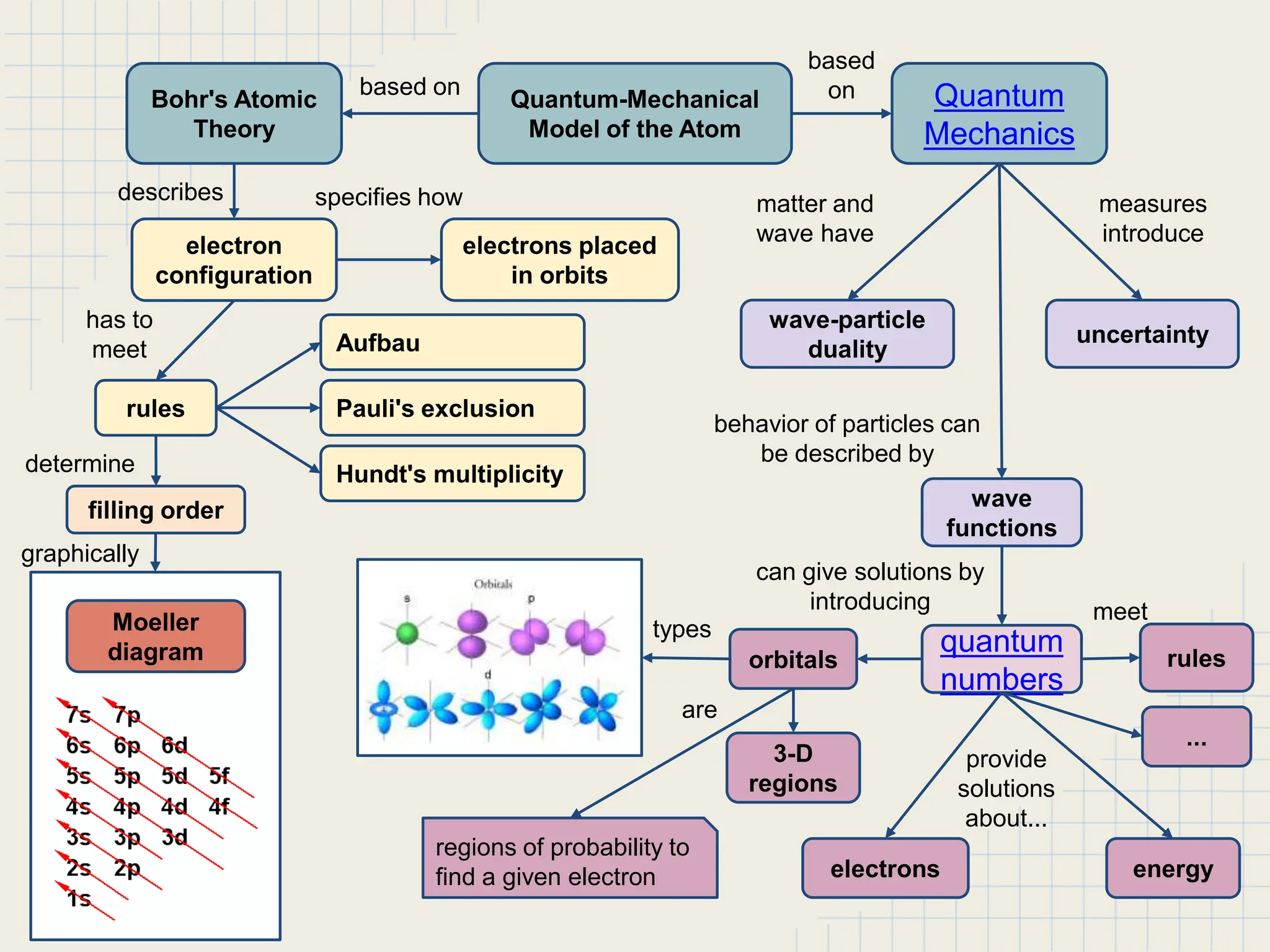
    Quantum-Mechanical Model of theAtom Bohr's Atomic Theory Quantum Mechanics electron configuration describes rules filling order Moeller diagram electrons placed in orbits uncertainty wave-particle duality wave functions matter and wave have measures introduce behavior of particles can be described by quantum numbers energy ... provide solutions about... electrons orbitals types rules meet can give solutions by introducing regions of probability to find a given electron are based on based on has to meet determine graphically specifies how 3-D regions Pauli's exclusion Hundt's multiplicity Aufbau
  • 3.
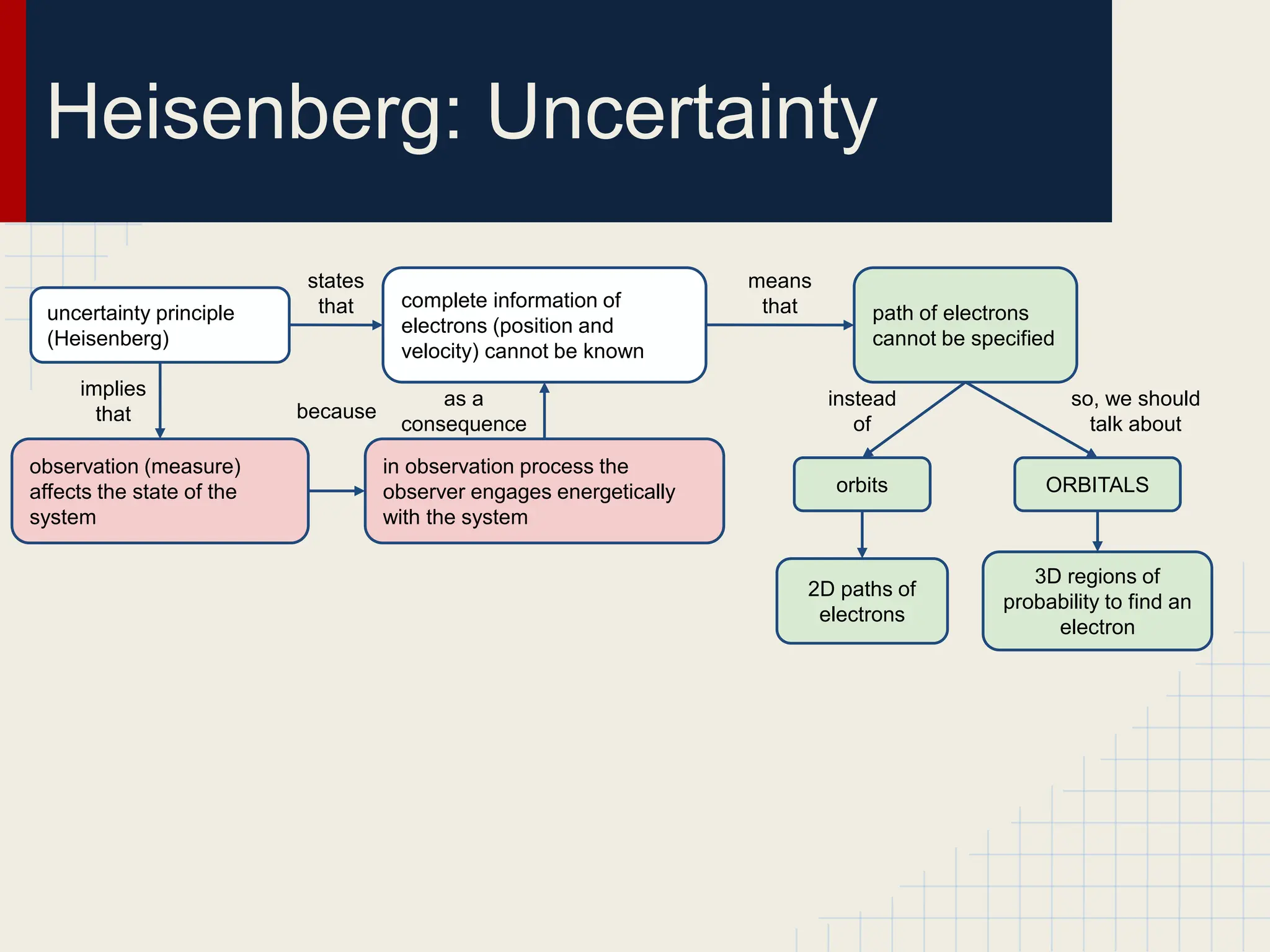
    Heisenberg: Uncertainty uncertainty principle (Heisenberg) completeinformation of electrons (position and velocity) cannot be known path of electrons cannot be specified orbits ORBITALS observation (measure) affects the state of the system in observation process the observer engages energetically with the system states that means that implies that because as a consequence instead of so, we should talk about 2D paths of electrons 3D regions of probability to find an electron
  • 4.
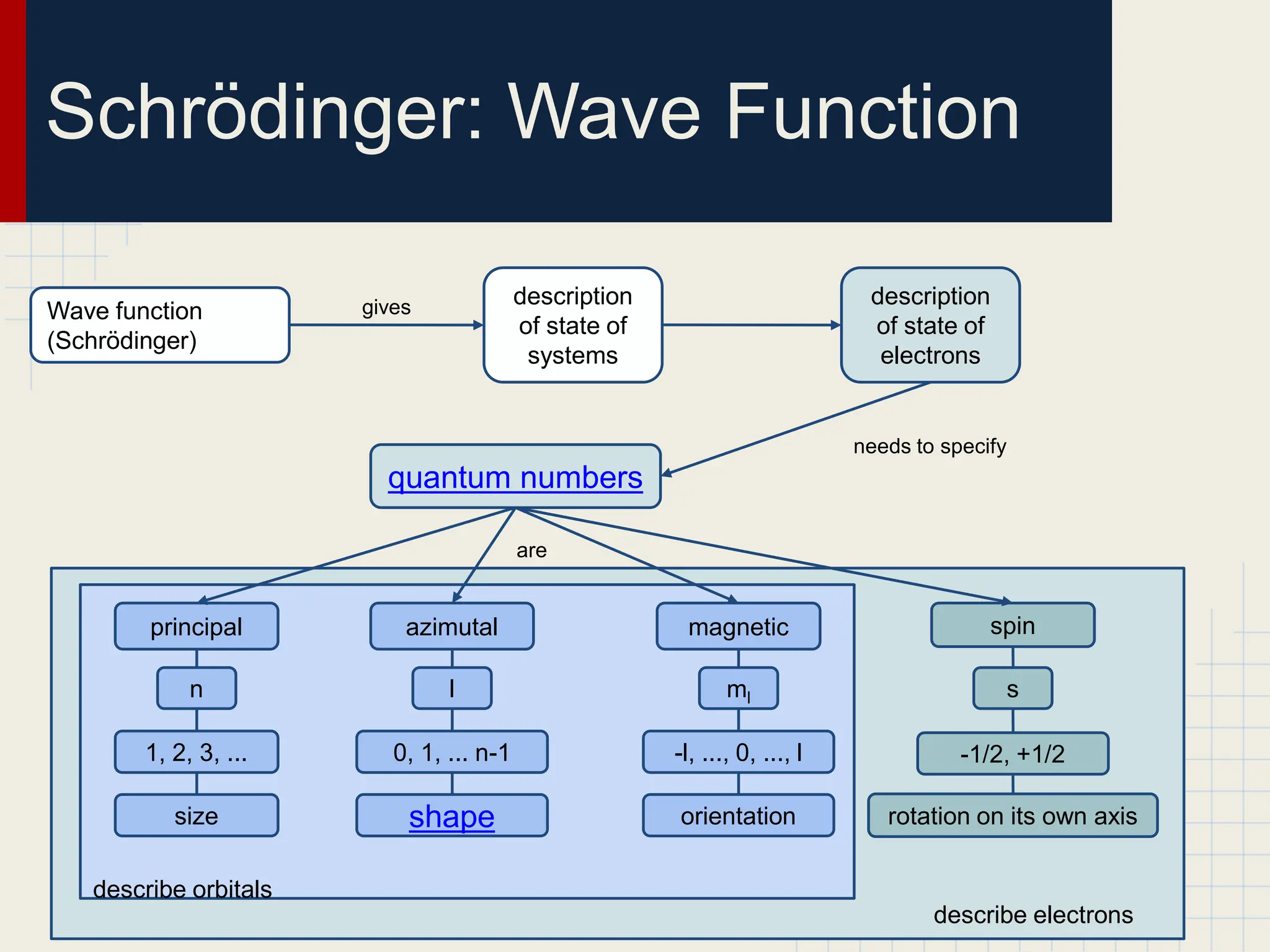
    Schrödinger: Wave Function Wavefunction (Schrödinger) description of state of systems gives description of state of electrons quantum numbers needs to specify principal azimutal magnetic spin n 1, 2, 3, ... l 0, 1, ... n-1 ml -l, ..., 0, ..., l are describe orbitals describe electrons s rotation on its own axis size shape orientation -1/2, +1/2
  • 5.